EP3524539B1 - Kunstharzbehälterdeckel - Google Patents
Kunstharzbehälterdeckel Download PDFInfo
- Publication number
- EP3524539B1 EP3524539B1 EP17858289.6A EP17858289A EP3524539B1 EP 3524539 B1 EP3524539 B1 EP 3524539B1 EP 17858289 A EP17858289 A EP 17858289A EP 3524539 B1 EP3524539 B1 EP 3524539B1
- Authority
- EP
- European Patent Office
- Prior art keywords
- break region
- axial
- groove
- hanging wall
- region
- Prior art date
- Legal status (The legal status is an assumption and is not a legal conclusion. Google has not performed a legal analysis and makes no representation as to the accuracy of the status listed.)
- Active
Links
Images



Classifications
-
- B—PERFORMING OPERATIONS; TRANSPORTING
- B65—CONVEYING; PACKING; STORING; HANDLING THIN OR FILAMENTARY MATERIAL
- B65D—CONTAINERS FOR STORAGE OR TRANSPORT OF ARTICLES OR MATERIALS, e.g. BAGS, BARRELS, BOTTLES, BOXES, CANS, CARTONS, CRATES, DRUMS, JARS, TANKS, HOPPERS, FORWARDING CONTAINERS; ACCESSORIES, CLOSURES, OR FITTINGS THEREFOR; PACKAGING ELEMENTS; PACKAGES
- B65D47/00—Closures with filling and discharging, or with discharging, devices
- B65D47/04—Closures with discharging devices other than pumps
- B65D47/06—Closures with discharging devices other than pumps with pouring spouts or tubes; with discharge nozzles or passages
- B65D47/08—Closures with discharging devices other than pumps with pouring spouts or tubes; with discharge nozzles or passages having articulated or hinged closures
- B65D47/0804—Closures with discharging devices other than pumps with pouring spouts or tubes; with discharge nozzles or passages having articulated or hinged closures integrally formed with the base element provided with the spout or discharge passage
-
- B—PERFORMING OPERATIONS; TRANSPORTING
- B65—CONVEYING; PACKING; STORING; HANDLING THIN OR FILAMENTARY MATERIAL
- B65D—CONTAINERS FOR STORAGE OR TRANSPORT OF ARTICLES OR MATERIALS, e.g. BAGS, BARRELS, BOTTLES, BOXES, CANS, CARTONS, CRATES, DRUMS, JARS, TANKS, HOPPERS, FORWARDING CONTAINERS; ACCESSORIES, CLOSURES, OR FITTINGS THEREFOR; PACKAGING ELEMENTS; PACKAGES
- B65D47/00—Closures with filling and discharging, or with discharging, devices
- B65D47/04—Closures with discharging devices other than pumps
- B65D47/06—Closures with discharging devices other than pumps with pouring spouts or tubes; with discharge nozzles or passages
- B65D47/10—Closures with discharging devices other than pumps with pouring spouts or tubes; with discharge nozzles or passages having frangible closures
- B65D47/103—Membranes with a tearing element
-
- B—PERFORMING OPERATIONS; TRANSPORTING
- B65—CONVEYING; PACKING; STORING; HANDLING THIN OR FILAMENTARY MATERIAL
- B65D—CONTAINERS FOR STORAGE OR TRANSPORT OF ARTICLES OR MATERIALS, e.g. BAGS, BARRELS, BOTTLES, BOXES, CANS, CARTONS, CRATES, DRUMS, JARS, TANKS, HOPPERS, FORWARDING CONTAINERS; ACCESSORIES, CLOSURES, OR FITTINGS THEREFOR; PACKAGING ELEMENTS; PACKAGES
- B65D41/00—Caps, e.g. crown caps or crown seals, i.e. members having parts arranged for engagement with the external periphery of a neck or wall defining a pouring opening or discharge aperture; Protective cap-like covers for closure members, e.g. decorative covers of metal foil or paper
- B65D41/32—Caps or cap-like covers with lines of weakness, tearing-strips, tags, or like opening or removal devices, e.g. to facilitate formation of pouring openings
- B65D41/46—Snap-on caps or cap-like covers
- B65D41/48—Snap-on caps or cap-like covers non-metallic, e.g. made of paper or plastics
- B65D41/485—Snap-on caps or cap-like covers non-metallic, e.g. made of paper or plastics with integral internal sealing means
-
- B—PERFORMING OPERATIONS; TRANSPORTING
- B65—CONVEYING; PACKING; STORING; HANDLING THIN OR FILAMENTARY MATERIAL
- B65D—CONTAINERS FOR STORAGE OR TRANSPORT OF ARTICLES OR MATERIALS, e.g. BAGS, BARRELS, BOTTLES, BOXES, CANS, CARTONS, CRATES, DRUMS, JARS, TANKS, HOPPERS, FORWARDING CONTAINERS; ACCESSORIES, CLOSURES, OR FITTINGS THEREFOR; PACKAGING ELEMENTS; PACKAGES
- B65D47/00—Closures with filling and discharging, or with discharging, devices
- B65D47/04—Closures with discharging devices other than pumps
- B65D47/06—Closures with discharging devices other than pumps with pouring spouts or tubes; with discharge nozzles or passages
- B65D47/08—Closures with discharging devices other than pumps with pouring spouts or tubes; with discharge nozzles or passages having articulated or hinged closures
-
- B—PERFORMING OPERATIONS; TRANSPORTING
- B65—CONVEYING; PACKING; STORING; HANDLING THIN OR FILAMENTARY MATERIAL
- B65D—CONTAINERS FOR STORAGE OR TRANSPORT OF ARTICLES OR MATERIALS, e.g. BAGS, BARRELS, BOTTLES, BOXES, CANS, CARTONS, CRATES, DRUMS, JARS, TANKS, HOPPERS, FORWARDING CONTAINERS; ACCESSORIES, CLOSURES, OR FITTINGS THEREFOR; PACKAGING ELEMENTS; PACKAGES
- B65D47/00—Closures with filling and discharging, or with discharging, devices
- B65D47/04—Closures with discharging devices other than pumps
- B65D47/06—Closures with discharging devices other than pumps with pouring spouts or tubes; with discharge nozzles or passages
- B65D47/08—Closures with discharging devices other than pumps with pouring spouts or tubes; with discharge nozzles or passages having articulated or hinged closures
- B65D47/0804—Closures with discharging devices other than pumps with pouring spouts or tubes; with discharge nozzles or passages having articulated or hinged closures integrally formed with the base element provided with the spout or discharge passage
- B65D47/0809—Closures with discharging devices other than pumps with pouring spouts or tubes; with discharge nozzles or passages having articulated or hinged closures integrally formed with the base element provided with the spout or discharge passage and elastically biased towards both the open and the closed positions
- B65D47/0814—Closures with discharging devices other than pumps with pouring spouts or tubes; with discharge nozzles or passages having articulated or hinged closures integrally formed with the base element provided with the spout or discharge passage and elastically biased towards both the open and the closed positions by at least three hinge sections, at least one having a length different from the others
-
- B—PERFORMING OPERATIONS; TRANSPORTING
- B65—CONVEYING; PACKING; STORING; HANDLING THIN OR FILAMENTARY MATERIAL
- B65D—CONTAINERS FOR STORAGE OR TRANSPORT OF ARTICLES OR MATERIALS, e.g. BAGS, BARRELS, BOTTLES, BOXES, CANS, CARTONS, CRATES, DRUMS, JARS, TANKS, HOPPERS, FORWARDING CONTAINERS; ACCESSORIES, CLOSURES, OR FITTINGS THEREFOR; PACKAGING ELEMENTS; PACKAGES
- B65D47/00—Closures with filling and discharging, or with discharging, devices
- B65D47/04—Closures with discharging devices other than pumps
- B65D47/06—Closures with discharging devices other than pumps with pouring spouts or tubes; with discharge nozzles or passages
- B65D47/12—Closures with discharging devices other than pumps with pouring spouts or tubes; with discharge nozzles or passages having removable closures
-
- B—PERFORMING OPERATIONS; TRANSPORTING
- B65—CONVEYING; PACKING; STORING; HANDLING THIN OR FILAMENTARY MATERIAL
- B65D—CONTAINERS FOR STORAGE OR TRANSPORT OF ARTICLES OR MATERIALS, e.g. BAGS, BARRELS, BOTTLES, BOXES, CANS, CARTONS, CRATES, DRUMS, JARS, TANKS, HOPPERS, FORWARDING CONTAINERS; ACCESSORIES, CLOSURES, OR FITTINGS THEREFOR; PACKAGING ELEMENTS; PACKAGES
- B65D51/00—Closures not otherwise provided for
- B65D51/18—Arrangements of closures with protective outer cap-like covers or of two or more co-operating closures
- B65D51/20—Caps, lids, or covers co-operating with an inner closure arranged to be opened by piercing, cutting, or tearing
Definitions
- This invention relates to a synthetic resin container lid of a shape including a body to be mounted on a mouth-neck portion of a container, and an upper lid coupled to the body via a hinge means, the synthetic resin container lid being configured such that after the contents of the container are consumed, the entire container lid can be detached from the container.
- a container lid of a shape which includes a body to be mounted on a mouth-neck portion of a container, and an upper lid coupled to the body, and which has been molded from a suitable synthetic resin such as polypropylene or polyethylene, has been widely put to practical use as a container lid for a container accommodating a liquid seasoning or the like.
- the body has a circular closing wall, and a cylindrical hanging wall hanging down from the peripheral edge of the closing wall, and a locking means is formed in a lower end part of the inner peripheral surface of the hanging wall.
- the locking means is generally composed of an annular ridge extending continuously in a circumferential direction, or a plurality of arcuate ridges extending in the circumferential direction at intervals in the circumferential direction.
- the upper lid is coupled to an upper end part of the outer peripheral surface of the hanging wall of the body via a hinge means, and is pivotable between a closing position where the upper lid covers the closing wall of the body, and an opening position where the upper lid exposes the closing wall of the body.
- a container lid is mounted on the mouth-neck portion of the container by fitting the body onto the mouth-neck portion of the container, and locking the locking means formed in the hanging wall to a locking jaw formed on an outer peripheral surface of the mouth-neck portion of the container.
- Patent Document 1 discloses a container lid improved so that the entire container lid can be detached from a mouth-neck portion of a container without the need to use a special tool or the like.
- a hanging wall of a body of the container lid is formed with an axial breakable line located downstream of a hinge in a clockwise direction as viewed from above, and is also formed with an arcuate groove which is opened in an upper surface of the hanging wall and which extends in the circumferential direction from the axial breakable line toward an upstream side in the clockwise direction past the hinge means.
- the axial depth of the arcuate groove is sufficiently great, and a thin wall is allowed to remain below the arcuate groove.
- a lower end part of the hanging wall is elastically deformed radially outwardly to disengage the locking means formed in the hanging wall upwardly from the locking jaw formed in the mouth-neck portion of the container.
- the body namely, the entire container lid
- Patent Document 1 JP-A-2008-213924
- Patent Document 1 The container lid disclosed in Patent Document 1 mentioned above can be detached from the mouth-neck portion of the container without the need to use a special tool or the like after the contents of the container are consumed.
- this container lid has not yet been sufficiently satisfactory, and has posed the following problem: Assume that the axial breakable line is broken, and then the thin wall allowed to remain below the arcuate groove is broken, as stated above. Even thereafter, it is likely that the detachment of the entire container lid from the mouth-neck portion of the container cannot be performed sufficiently easily, partly because the locking means formed in the hanging wall remains locked to the locking jaw formed in the mouth-neck portion of the container all over the circumferential direction.
- the present invention has been accomplished in the light of the above facts. Its main technical challenge is to provide a novel and improved container lid which can be detached sufficiently easily from a mouth-neck portion of a container and which is of a shape including a body and an upper lid coupled to the body via a hinge means.
- the present inventors Upon in-depth studies, the present inventors have found that the above main technical challenge can be solved by changing the axial depth of the annular or arcuate groove extending in the circumferential direction as required, and forming a circumferential breakable line along an axially lower end part of the groove.
- a container lid for solving the above main technical challenge a synthetic resin container lid which includes a body and an upper lid, and in which the body has a circular closing wall, and a cylindrical hanging wall hanging down from the peripheral edge of the closing wall, a locking means is formed in a lower end part of the inner peripheral surface of the hanging wall, and the upper lid is coupled to an upper end part of the outer peripheral surface of the hanging wall of the body via a hinge means, and is pivotable between a closing position where the upper lid covers the closing wall of the body, and an opening position where the upper lid exposes the closing wall of the body,
- the first break region extends in the circumferential direction over an angular range of 40 to 100 degrees
- the second break region extends over an angular range of 10 to 30 degrees
- the third break region extends over an angular range of 140 to 300 degrees.
- the axial remaining thickness in the first break region be 0 to 1.0 mm
- the axial remaining thickness in the second break region be 0.6 mm or more
- the axial remaining thickness in the third break region be 4.0 mm or more.
- the axial remaining thickness sharply increases at the boundary between the first break region and the second break region.
- the axial remaining thickness preferably changes along an oblique line extending axially upwardly at an inclination angle of 20 to 60 degrees toward the upstream side in the clockwise direction.
- the container lid of the present invention when the container lid is to be detached from the mouth-neck portion of the container, the upper lid placed at the opening position is forced upward or downward to break the axial breakable line, and then the upper lid is moved toward the upstream side in the clockwise (i.e., counterclockwise) as viewed from above. By so doing, the circumferential breakable line extending continuously in the circumferential direction is broken. In the third break region, therefore, the locking means located below the circumferential breakable line in the axial direction is disengaged from the locking jaw of the mouth-neck portion of the container. Hence, by moving the upper lid upward, for example, the entire container lid can be detached from the mouth-neck portion of the container sufficiently easily.
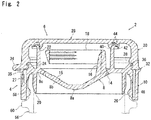
- a container lid entirely indicated at a numeral 2 includes a body 4 and an upper lid 6.
- a container lid 2 can be advantageously formed by injection- or compression-molding a suitable synthetic resin, such as polypropylene or polyethylene, integrally as a whole.
- the body 4 has a closing wall 8 circular when viewed from above, and a hanging wall 10 hanging down substantially vertically from the peripheral edge of the closing wall 8.
- the closing wall 8 is composed of a central part 8a extending substantially horizontally, an intermediate part 8b of an inverted frusto-conical cylindrical shape extending from the central part 8a radially outwardly in an upwardly inclined manner, and an outer peripheral part 8c following the intermediate part 8b and extending radially outwardly in a substantially horizontal manner.
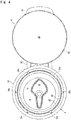
- the intermediate part 8b of the closing wall 8 is formed with a breakable line 14 defining a removal region 12 (reference to Figs. 3 and 4 is requested).
- the removal region 12 in the illustrated embodiment is composed of a deformed quadrilateral part located on one side in a radial direction, and a deformed triangular part extending from the deformed quadrilateral part to the other side in the radial direction.
- the breakable line 14 is composed of so-called scores formed by locally decreasing the thickness.
- an arrow-shaped protrusion 15 is formed on an upper surface of the removal region 12.
- a coupling column 16 which extends upward is disposed on one side of the upper surface of the deformed triangular part of the removal region 12, and a pull ring 18 is coupled to the upper end of the coupling column 16.
- a cylindrical sealing piece 20 which hangs down is formed on a lower surface of the outer peripheral part 8c of the closing wall 8.
- a nearly cylindrical guide tube 22 which extends upward is formed on an upper surface of the outer peripheral part 8c of the closing wall 8.
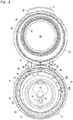
- the guide tube 22 is not concentric in the closing wall 8, but is rendered eccentric somewhat leftward in Figs. 2 and 3 .
- a leading end part of the guide tube 22 is protruded radially outwardly in an arcuate form.
- the outer peripheral part 8c of the closing wall 8 is further formed with an annular locking piece 24 protruding radially outwardly in an upwardly inclined manner radially outwardly of the guide tube 22.
- a locking means 26 is disposed in a lower end part of the inner peripheral surface of the hanging wall 10.
- the locking means 26 is composed of a plurality of arcuate ridges extending in the circumferential direction at intervals in the circumferential direction.
- the locking means 26 can be constituted by an annular ridge extending continuously in the circumferential direction.
- a notch 25 extending arcuately is formed in an upper part of the hanging wall 10.
- a shallow concavity 27 extending arcuately is formed on the outer peripheral surface of the hanging wall 10.
- the upper lid 6 is composed of a circular top panel wall 28 and a skirt wall 30 handing down from the periphery of the top panel wall 28 (in a state where the upper lid 6 is located at a closing position shown in Fig. 2 ).
- a lower end part of the skirt wall 30 is pivotably coupled to the outer peripheral surface of the hanging wall 10 of the body 4 via a hinge means 32 which itself may be in a well-known suitable form, and is pivotally moved to open and close between the closing position shown in Fig. 2 and an opening position at which the upper lid is pivoted, for example, at an angle of the order of 100 degrees from the closing position.
- a protruding piece 34 protruding radially outwardly is disposed at a site diametrically opposite to the hinge means 32 in the lower end part of the outer peripheral surface of the skirt wall 30.
- a finger can be hooked on the protruding piece 34.
- a thin-walled arcuate protruding piece 35 protruding downward is formed at a site diametrically opposite to the hinge means 32 on the lower surface of the skirt wall 30.
- annular locking ridge 36 is disposed at the lower end of the inner peripheral surface of the skirt wall 30, and an annular contact ridge 38 located above the annular locking ridge 36 is also disposed on the inner peripheral surface of the skirt wall 30.
- Two annular sealing pieces 40 and 42 protruding downward are disposed on the inner surface of the top panel wall 28.
- the two annular sealing pieces 40 and 42 are rendered somewhat eccentric leftward in Fig. 2 and rightward in Fig. 3 with respect to the center of the top panel wall 28, in correspondence with the eccentricity of the guide tube 22 in the body 4.
- Two annular shallow grooves 44, 44 are formed in a region between the two annular sealing pieces 40 and 42 in the inner surface of the top panel wall 28.
- annular or arcuate groove 46 which is opened in the upper surface of the hanging wall 10 (in other words, which extends downward from the upper surface of the hanging wall 10) and which extends in the circumferential direction in Fig. 3 (accordingly, when viewed from above), be formed in the hanging wall 10 of the body 4.
- the groove 46 is annular.
- the groove 46 can be formed into an arcuate shape extending from a starting point, which is located downstream of the hinge means 32 in the clockwise direction and downstream of an axial breakable line (to be described later) in the clockwise direction, toward the upstream side in the clockwise direction past the hinge means 32.
- the groove 46 it is advantageous for the groove 46 to extend continuously over an angle of 300 to 360 degrees. It is important that an axial breakable line 48 extending axially in a part radially outward of the groove 46 in the hanging wall 10 be disposed in a region which is downstream of the hinge means 32 in the clockwise direction and where the groove 46 is formed (the term "clockwise direction” used herein refers to the clockwise direction in Fig. 3 , in other words, as viewed from above).
- the axial breakable line 48 is located near the hinge means 32, and extends axially from the upper end to the lower end of the hanging wall 10. As will be understood by reference to Figs.
- the locking ridges constituting the locking means 26 are not present at the angular position where the axial breakable line 48 is formed. Moreover, the axially upper end position of a concave site 26a formed between the locking ridges is somewhat above the axially upper end position of a concave site 26c formed between the locking ridges in a third break region to be described later (this positioning is schematically shown in Fig. 14 ).
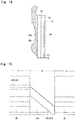
- the groove 46 will be described in further detail. It is important for the groove 46 that in a first break region indicated by a symbol A in Fig. 3 , the groove 46 is deep, and the axial remaining thickness of the hanging wall 10 is small or zero; in a second break region indicated by a symbol B in Fig. 3 , the groove 46 becomes gradually shallow toward the upstream side in the clockwise direction, and the axial remaining thickness of the hanging wall 10 gradually increases; in a third break region indicated by a symbol C in Fig.
- the groove 46 is shallow, and the axial remaining thickness of the hanging wall 10 is great; in the first break region A, the axially lower end of the groove 46 is located axially below the locking means 26; and in the third break region C, the axially lower end of the groove 46 is located axially above the locking means 26.
- the first break region A extends in the circumferential direction from the axial breakable line 48 toward the upstream side in the clockwise direction past the hinge means 32 as far as a required position, preferably over an angular range of 40 to 100 degrees;
- the second break region B follows the first break region A and extends toward the upstream side in the clockwise direction, preferably over an angular range of 10 to 30 degrees;
- the third break region C follows the second break region B and extends in the circumferential direction toward the upstream side in the clockwise direction, preferably over an angular range of 140 to 300 degrees.
- the depth of the groove 46 is markedly great, and the axial remaining thickness At of the hanging wall 10 is markedly small, for example, 0 to 0.2 mm. If desired, it is possible to make the remaining thickness At of the hanging wall 10 zero, namely, to define the groove 46 in such a manner as to penetrate the hanging wall 10 in the axial direction.
- the remaining thickness At of the hanging wall 10 is markedly small, for example, 0 to 0.2 mm.
- the depth of the groove 46 is sufficiently large, while the axial remaining thickness A't of the hanging wall 10 is sufficiently small, for example, 0.2 to 1.0 mm, and slightly larger than the above thickness At.
- the depth of the groove 46 is sufficiently large, while the axial remaining thickness A"t of the hanging wall 10 is sufficiently small, for example, 0.1 to 0.5 mm, and slightly larger than the above thickness At.
- the axial remaining thicknesses of the hanging wall 10 need not necessarily be slightly increased to A't and A"t, respectively, and if desired, even in the regions A' and A", the remaining thickness of the hanging wall 10 can be made At.
- the axially lower end of the groove 46 is located below the locking means 26.
- the depth of the groove 46 sharply decreases, and the axial remaining thickness of the hanging wall 10 sharply increases to Bt which preferably is 0.6 mm or more (thus, the axial remaining thickness Bt in the second break region B is 0.6 mm or more).
- the circumferential position of the boundary between the first break region A and the second break region B is symmetrical to the circumferential position of the axial breakable line 48 with respect to the central line extending in a right and left direction in Fig. 3 .
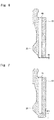
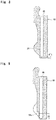
- the second break region B as will be understood by reference to Figs. 9 and 10 along with Fig.
- the depth of the groove 46 is gradually decreased toward the upstream side in the clockwise direction, and the axial remaining thickness of the hanging wall 10 is gradually increased from Bt to Ct.
- the increase in the axial remaining thickness of the hanging wall 10 from Bt to Ct preferably changes along an oblique line inclined upward at an inclination angle of 20 to 60 degrees toward the upstream side in the clockwise direction.
- the lower end of the groove 46 in the third break region C is located above the locking means 26. It is advantageous, therefore, that the axial remaining thickness Ct of the hanging wall 10 be 4.0 mm or more.
- a non-break region D is present upstream of the third break region C in the clockwise direction.
- the depth of the groove 46 is further decreased, and the axial remaining thickness Dt of the hanging wall 10 is further increased.
- the non-break region D is present over an angular range of 5 to 20 degrees, and the axial remaining thickness Dt of the hanging wall 10 is of the order of 5.0 to 9.0 mm.
- an additional non-break region E is present upstream of the non-break region D in the clockwise direction.
- the depth of the groove 46 is rendered larger than its depth in the non-break region D, but is sufficiently small, and the axial remaining thickness Et of the hanging wall 10 is sufficiently large.
- the additional non-break region E is present over an angular range of 10 to 50 degrees, and the axial remaining thickness Et of the hanging wall 10 may be substantially the same as the axial remaining thickness Ct of the hanging wall 10 in the third break region C.
- the groove 46 is markedly deep, and the axial remaining thickness Ft of the hanging wall 10 may be substantially the same as the axial remaining thickness At of the hanging wall 10 in the first break region A.
- the groove 46 may be omitted, so that the groove 46 can be in an arcuate form, rather than an annular form extending over 360 degrees.
- the axial breakable line 48 can be constituted by locally reducing the wall thickness of a part radially outward of the groove 46 in the hanging wall 10.
- the axial breakable line 48 is constituted by forming an axially extending recessed line 50 in each of the inner and outer surfaces of the part radially outward of the groove 46 in the hanging wall 10, and further forming a notch 52 in the axially upper end part. Since the axial breakable line 48 is constituted by the recessed lines 50 and the notch 52, the visibility of the axial breakable line 48 becomes satisfactory.
- the axial breakable line 48 when the axial breakable line 48 is broken, axial breakage along the valley part of the recessed line 50 can be performed reliably.
- a circumferential breakable line 53 extending continuously in the circumferential direction along an axially lower end part of the groove 46 be further formed at least in the second break region B and the third break region C.
- the circumferential breakable line 53 extending continuously in the circumferential direction from the lower end of the axial breakable line 48 is composed of a part in the hanging wall 10 where the axial remaining thickness At allowed to remain at the lower end of the groove 46 in the first break region A is sufficiently small, and a thin-walled portion 54 defined by locally increasing the inner diameter of the hanging wall 10 in the second break region B and the third break region C.
- the thin-walled portion 54 is further composed of a thin-walled portion 54a and a thin-walled portion 54b.
- the locking ridge constituting the locking means 26 does not exist, but a concave site 26b formed between the locking ridges is located.
- the concave site 26b there is formed the thin-walled portion (a site where the inner diameter is locally decreased) 54a extending along an axially lower end part of the groove 46 inclined upward toward the upstream side in the clockwise direction.
- a recessed groove defining the thin-walled portion 54a has a rectangular cross-sectional shape.
- the thin-walled portion 54a is preferably extended slightly as far as an upstream end part of the first break region A in the clockwise direction.
- the thin-walled portion 54b is formed which follows the upper end part of the thin-walled portion 54a and extends along the axially lower end part of the groove 46 in the circumferential direction toward the upstream side in the clockwise direction.
- the axially lower end of the groove 46 extends substantially horizontally, so that the thin-walled portion 54b also extends substantially horizontally.
- the cross-sectional shape of a recessed groove defining the thin-walled portion 54b is nearly crescent.
- the locking ridge constituting the locking means 26 is not present, and the axially upper end positions of the concave sites 26c formed between the locking ridges are located below the thin-walled portion 54b.
- the radial thicknesses of sites radially inward of the groove 46 of the hanging wall 10 in the thin-walled portion 54a and thin-walled portion 54b constituting the thin-walled portion 54 are preferably of the order of 0.05 to 0.5 mm.
- Fig. 2 shows the container lid 2 constituted in accordance with the present invention, and also a mouth-neck portion of a container to which the container lid 2 is applied.
- a mouth-neck portion 56 of a container which can be formed from a suitable synthetic resin or glass is in a cylindrical shape having an open upper surface, and a locked ridge 58 is formed in an upper end part of its outer peripheral surface.
- the outer peripheral surface of the mouth-neck portion 56 is further formed with a support ring 60 (the support ring 60 is utilized when the container is transported) located below the locked ridge 58.
- the container lid 2 is mounted on the mouth-neck portion 56 to seal the mouth-neck portion 56.
- the container lid 2 with the upper lid 6 brought to the closing position is fitted onto the mouth-neck portion 56, and forced downward, whereby the body 4 is elastically deformed, and the locking means 26 formed on the inner peripheral surface of the hanging wall 10 is locked below the locked ridge 58 of the mouth-neck portion 56.
- the entire container lid 2 is detached from the mouth-neck portion 56 for so-called segregated collection of wastes.
- the upper lid 6 placed at the opening position is gripped and, in the illustrated embodiment, forced downward at the site of formation of the axial breakable line 48 to break the axial breakable line 48.
- the upper lid 6 is forced toward the upstream side in the clockwise direction to break the circumferential breakable line 53.
- the part of the sufficiently small thickness At allowed to remain below the groove 46 in the hanging wall 10 is broken.
- the part radially outward of the groove 46 all over the axial direction of the hanging wall 10 is separated from the part radially inward of the groove 46 and moved radially outwardly.
- the axial remaining thickness sharply increases, so that the breakage of the hanging wall 10 is smoothly shifted from the first break region A to the second break region B.
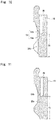
- the thin-walled portion 54a more detailedly, the upper edge part of the thin-walled portion 54a is broken, as indicated by a dashed double-dotted line in Fig. 15 .
- the entire hanging wall 10 is moved radially outwardly and, axially above the above broken part of the thin-walled portion 54a, the part radially outward of the groove 46 is moved radially outwardly.
- the thin-walled portion 54b more detailedly, a vertically nearly middle part of the thin-walled portion 54b is broken, as indicated by the dashed double-dotted line in Fig. 15 .
- the entire hanging wall 10 is moved radially outwardly and, axially above the above broken part of the thin-walled portion 54b, the part radially outward of the groove 46 is moved radially outwardly.
- the thin-walled portion 54b is located above the locking means 26.
- the locking means 26 is also moved radially outwardly, and separated from the mouth-neck portion 56 of the container. Thereafter, the upper lid 6 is forced upward, whereby the entire container lid 2 can be detached from the mouth-neck portion 56 sufficiently easily.
- the non-break region D located upstream of the third break region C in the clockwise direction, a thin-walled portion is not disposed, and the depth of the groove 46 is small. Accordingly, breakage does not proceed.
Landscapes
- Engineering & Computer Science (AREA)
- Mechanical Engineering (AREA)
- Closures For Containers (AREA)
Claims (6)
- Kunstharzbehälterdeckel (2), welcher einen Körper (4) und einen oberen Deckel (6) aufweist, und bei dem der Körper eine kreisrunde Abschlusswand (8) aufweist, sowie eine zylindrische hängende Wand (10) aufweist, die von einer Umfangskante der Abschlusswand herunterhängt, eine Sicherungseinrichtung (26) in einem unteren Endteil einer Innenumfangsfläche der hängenden Wand ausgebildet ist, und der obere Deckel über eine Gelenkeinrichtung (32) an einen oberen Endteil einer Außenumfangsfläche der hängenden Wand des Körpers gekoppelt ist und zwischen einer Schließposition, in der der obere Deckel die Abschlusswand des Körpers bedeckt, und einer Öffnungsposition, in der der obere Deckel die Abschlusswand des Körpers freilegt, verschwenkbar ist,wobei eine ringförmige oder bogenförmige Nut (46), die in einer oberen Fläche der hängenden Wand offen ist und in einer Umfangsrichtung verläuft, in der hängenden Wand des Körpers ausgebildet ist,eine axiale brechbare Linie (48), die axial in einem Teil radial außerhalb der Nut in der hängenden Wand verläuft, in einem Bereich angeordnet ist, der im Uhrzeigersinn stromabwärts der Gelenkeinrichtung liegt und in dem die Nut ausgebildet ist,dadurch gekennzeichnet, dassdie Nut eine erste axiale Tiefe, die größer als eine übrige axiale Dicke der hängenden Wand ist, welche so klein wie null sein könnte, in einem ersten Bruchbereich (A) aufweist, welcher in der Umfangsrichtung von der axialen brechbaren Linie in Richtung einer stromaufwärtigen Seite im Uhrzeigersinn an der Gelenkeinrichtung vorbei bis zu einer vorbestimmten Position verläuft; in einem zweiten Bruchbereich (B), der auf den ersten Bruchbereich folgt und in der Umfangsrichtung in Richtung der stromaufwärtigen Seite im Uhrzeigersinn verläuft, die axiale Tiefe der Nut allmählich abnimmt, während die übrige axiale Dicke der hängenden Wand allmählich zunimmt; und in einem dritten Bruchbereich (C), der auf den zweiten Bruchbereich folgt und in der Umfangsrichtung in Richtung der stromaufwärtigen Seite im Uhrzeigersinn verläuft, die axiale Tiefe der Nut und die übrige axiale Dicke der hängenden Wand bei den Werten konstant bleiben, die in dem zweiten Bruchbereich erreicht werden,zumindest in dem zweiten Bruchbereich und dem dritten Bruchbereich eine brechbare Umfangslinie (53), welche durchgehend in der Umfangsrichtung entlang eines axial unteren Endteils der Nut verläuft, in der hängenden Wand ausgebildet ist, undin dem ersten Bruchbereich ein axial unteres Ende der Nut sich in der Axialrichtung unter der Sicherungseinrichtung befindet, wohingegen in dem dritten Bruchbereich die brechbare Umfangslinie sich in der Axialrichtung oberhalb der Sicherungseinrichtung befindet.
- Kunstharzbehälterdeckel (2) nach Anspruch 1, wobei der erste Bruchbereich (A) in der Umfangsrichtung über einen Winkelbereich von 40 bis 100 Grad verläuft, der zweite Bruchbereich (B) über einen Winkelbereich von 10 bis 30 Grad verläuft, und der dritte Bruchbereich (C) über einen Winkelbereich von 140 bis 300 Grad verläuft.
- Kunstharzbehälterdeckel (2) nach Anspruch 1 oder 2, wobei die übrige axiale Dicke in dem ersten Bruchbereich (A) 0 bis 1,0 mm beträgt, die übrige axiale Dicke in dem zweiten Bruchbereich (B) 0,6 mm oder mehr beträgt, und die übrige axiale Dicke in dem dritten Bruchbereich (C) 4,0 mm oder mehr beträgt.
- Kunstharzbehälterdeckel (2) nach einem der Ansprüche 1 bis 3, wobei die übrige axiale Dicke an einer Grenze zwischen dem ersten Bruchbereich (A) und dem zweiten Bruchbereich (B) stark zunimmt.
- Kunstharzbehälterdeckel (2) nach einem der Ansprüche 1 bis 4, wobei es im Uhrzeigersinn stromaufwärts des dritten Bruchbereichs (C) einen Nicht-Bruchbereich (D) gibt, in dem die axiale Tiefe der Nut (46) sogar kleiner ist als die axiale Tiefe der Nut in dem dritten Bruchbereich, und die übrige axiale Dicke der hängenden Wand (10) sogar größer ist als die übrige axiale Dicke der hängenden Wand in dem dritten Bruchbereich.
- Kunstharzbehälterdeckel (2) nach einem der Ansprüche 1 bis 5, wobei sich in dem zweiten Bruchbereich (B) die übrige axiale Dicke entlang einer schrägen Linie verändert, welche axial bei einem Neigungswinkel von 20 bis 60 Grad im Uhrzeigersinn in Richtung der stromaufwärtigen Seite nach oben verläuft.
Applications Claiming Priority (2)
| Application Number | Priority Date | Filing Date | Title |
|---|---|---|---|
| JP2016198438A JP6326472B2 (ja) | 2016-10-06 | 2016-10-06 | 合成樹脂製容器蓋 |
| PCT/JP2017/035278 WO2018066451A1 (ja) | 2016-10-06 | 2017-09-28 | 合成樹脂製容器蓋 |
Publications (3)
| Publication Number | Publication Date |
|---|---|
| EP3524539A1 EP3524539A1 (de) | 2019-08-14 |
| EP3524539A4 EP3524539A4 (de) | 2020-06-24 |
| EP3524539B1 true EP3524539B1 (de) | 2021-10-27 |
Family
ID=61832061
Family Applications (1)
| Application Number | Title | Priority Date | Filing Date |
|---|---|---|---|
| EP17858289.6A Active EP3524539B1 (de) | 2016-10-06 | 2017-09-28 | Kunstharzbehälterdeckel |
Country Status (6)
| Country | Link |
|---|---|
| US (1) | US11180293B2 (de) |
| EP (1) | EP3524539B1 (de) |
| JP (1) | JP6326472B2 (de) |
| KR (1) | KR102207595B1 (de) |
| CN (1) | CN109803902B (de) |
| WO (1) | WO2018066451A1 (de) |
Families Citing this family (19)
| Publication number | Priority date | Publication date | Assignee | Title |
|---|---|---|---|---|
| EP3892559B1 (de) * | 2020-04-09 | 2023-08-09 | Tetra Laval Holdings & Finance S.A. | Deckel/ausguss-anordnung für eine verpackung und verpackung damit |
| JP7570945B2 (ja) * | 2021-02-26 | 2024-10-22 | 日本クロージャー株式会社 | ヒンジキャップ |
| US20230249882A1 (en) * | 2022-02-08 | 2023-08-10 | Michael Angelo Gomez | Bottle cap with a flip lid |
| US12096880B2 (en) | 2022-05-13 | 2024-09-24 | Sharkninja Operating Llc | Flavorant for beverage carbonation system |
| US12213617B2 (en) | 2022-05-13 | 2025-02-04 | Sharkninja Operating Llc | Flavored beverage carbonation process |
| US11647860B1 (en) | 2022-05-13 | 2023-05-16 | Sharkninja Operating Llc | Flavored beverage carbonation system |
| US11751585B1 (en) | 2022-05-13 | 2023-09-12 | Sharkninja Operating Llc | Flavored beverage carbonation system |
| US12539500B2 (en) | 2022-08-31 | 2026-02-03 | Sharkninja Operating Llc | Additive containers |
| US12084334B2 (en) | 2022-11-17 | 2024-09-10 | Sharkninja Operating Llc | Ingredient container |
| US11745996B1 (en) | 2022-11-17 | 2023-09-05 | Sharkninja Operating Llc | Ingredient containers for use with beverage dispensers |
| US11738988B1 (en) | 2022-11-17 | 2023-08-29 | Sharkninja Operating Llc | Ingredient container valve control |
| US12103840B2 (en) | 2022-11-17 | 2024-10-01 | Sharkninja Operating Llc | Ingredient container with sealing valve |
| US11634314B1 (en) | 2022-11-17 | 2023-04-25 | Sharkninja Operating Llc | Dosing accuracy |
| USD1092208S1 (en) | 2022-12-23 | 2025-09-09 | Sharkninja Operating Llc | Cap of ingredient container |
| USD1091308S1 (en) | 2022-12-23 | 2025-09-02 | Sharkninja Operating Llc | Ingredient container |
| US11925287B1 (en) | 2023-03-22 | 2024-03-12 | Sharkninja Operating Llc | Additive container with inlet tube |
| US11871867B1 (en) | 2023-03-22 | 2024-01-16 | Sharkninja Operating Llc | Additive container with bottom cover |
| US12116257B1 (en) | 2023-03-22 | 2024-10-15 | Sharkninja Operating Llc | Adapter for beverage dispenser |
| US12005408B1 (en) | 2023-04-14 | 2024-06-11 | Sharkninja Operating Llc | Mixing funnel |
Family Cites Families (12)
| Publication number | Priority date | Publication date | Assignee | Title |
|---|---|---|---|---|
| US5875942A (en) * | 1996-03-22 | 1999-03-02 | Japan Crown Cork Co., Ltd. | Hinged cap separable from bottle at the time of disposal |
| JP4554785B2 (ja) * | 1999-10-18 | 2010-09-29 | 三笠産業株式会社 | 分別回収容易なヒンジキャップ |
| JP3923308B2 (ja) | 2001-12-21 | 2007-05-30 | 株式会社吉野工業所 | 液注出容器の中栓とキャップ |
| JP4500626B2 (ja) | 2004-08-25 | 2010-07-14 | 日本クラウンコルク株式会社 | 合成樹脂製キャップ |
| JP4756237B2 (ja) * | 2005-05-11 | 2011-08-24 | 昇 末政 | 容器口から分離可能なキャップ |
| JP4786236B2 (ja) * | 2005-07-13 | 2011-10-05 | 日本クラウンコルク株式会社 | 分別廃棄性に優れたキャップ |
| JP5288714B2 (ja) * | 2007-03-07 | 2013-09-11 | 日本クロージャー株式会社 | 分別機構付きヒンジキャップ |
| CN102089220B (zh) * | 2008-07-08 | 2012-09-26 | 日本皇冠塞株式会社 | 合成树脂制容器盖 |
| JP5202189B2 (ja) * | 2008-08-28 | 2013-06-05 | 日本クラウンコルク株式会社 | 分別廃棄性に優れた合成樹脂製打栓キャップ |
| JP5710211B2 (ja) | 2010-10-29 | 2015-04-30 | 株式会社吉野工業所 | ヒンジキャップ |
| JP6052784B2 (ja) | 2013-02-28 | 2016-12-27 | 株式会社吉野工業所 | 注出キャップ |
| KR101943696B1 (ko) * | 2013-02-28 | 2019-01-29 | 니혼 클로져 가부시키가이샤 | 속마개와 뚜껑 본체로 구성된 용기 뚜껑 |
-
2016
- 2016-10-06 JP JP2016198438A patent/JP6326472B2/ja active Active
-
2017
- 2017-09-28 WO PCT/JP2017/035278 patent/WO2018066451A1/ja not_active Ceased
- 2017-09-28 KR KR1020197008092A patent/KR102207595B1/ko active Active
- 2017-09-28 CN CN201780061677.8A patent/CN109803902B/zh active Active
- 2017-09-28 US US16/325,263 patent/US11180293B2/en active Active
- 2017-09-28 EP EP17858289.6A patent/EP3524539B1/de active Active
Also Published As
| Publication number | Publication date |
|---|---|
| US20190185226A1 (en) | 2019-06-20 |
| EP3524539A1 (de) | 2019-08-14 |
| EP3524539A4 (de) | 2020-06-24 |
| US11180293B2 (en) | 2021-11-23 |
| CN109803902B (zh) | 2020-07-03 |
| JP6326472B2 (ja) | 2018-05-16 |
| WO2018066451A1 (ja) | 2018-04-12 |
| JP2018058622A (ja) | 2018-04-12 |
| KR102207595B1 (ko) | 2021-01-26 |
| KR20190057295A (ko) | 2019-05-28 |
| CN109803902A (zh) | 2019-05-24 |
Similar Documents
| Publication | Publication Date | Title |
|---|---|---|
| EP3524539B1 (de) | Kunstharzbehälterdeckel | |
| JP7506027B2 (ja) | 金属製本体及び合成樹脂製ライナーを備えた容器蓋 | |
| KR102542756B1 (ko) | 합성수지제 용기 덮개 | |
| US10343826B2 (en) | Container lid composed of inside plug and lid body | |
| JP4756237B2 (ja) | 容器口から分離可能なキャップ | |
| JP2005320055A (ja) | 合成樹脂製容器蓋 | |
| EP3976486B1 (de) | Kappe für einen behälter mit einem scharnier | |
| JP5984636B2 (ja) | 中栓と蓋本体とから構成された容器蓋 | |
| JP7716312B2 (ja) | 合成樹脂製容器蓋及びその製造方法 | |
| JP5650451B2 (ja) | 合成樹脂製容器蓋 | |
| JP4798897B2 (ja) | プルリングを備えた合成樹脂製容器蓋 | |
| JP7754733B2 (ja) | 合成樹脂製容器蓋 | |
| JP6045885B2 (ja) | 中栓と蓋本体とから構成された容器蓋 | |
| JP7797194B2 (ja) | 合成樹脂製容器蓋 | |
| JP2012020756A (ja) | 合成樹脂製容器蓋 | |
| JP4164135B2 (ja) | タンパーエビデント特性を有する合成樹脂製容器蓋 | |
| JP4388622B2 (ja) | プルリングを備えた合成樹脂製容器蓋 | |
| JP2025111907A (ja) | 合成樹脂製容器蓋 | |
| JP4330354B2 (ja) | 合成樹脂製容器蓋 | |
| JP2025101336A (ja) | 容器蓋 | |
| US20050127023A1 (en) | Push-off cap of plastic | |
| JP2023072778A (ja) | 1ピースキャップ | |
| JP2004269030A (ja) | 合成樹脂製容器蓋 | |
| JPH0585422B2 (de) | ||
| JPH048304B2 (de) |
Legal Events
| Date | Code | Title | Description |
|---|---|---|---|
| STAA | Information on the status of an ep patent application or granted ep patent |
Free format text: STATUS: THE INTERNATIONAL PUBLICATION HAS BEEN MADE |
|
| PUAI | Public reference made under article 153(3) epc to a published international application that has entered the european phase |
Free format text: ORIGINAL CODE: 0009012 |
|
| STAA | Information on the status of an ep patent application or granted ep patent |
Free format text: STATUS: REQUEST FOR EXAMINATION WAS MADE |
|
| 17P | Request for examination filed |
Effective date: 20190411 |
|
| AK | Designated contracting states |
Kind code of ref document: A1 Designated state(s): AL AT BE BG CH CY CZ DE DK EE ES FI FR GB GR HR HU IE IS IT LI LT LU LV MC MK MT NL NO PL PT RO RS SE SI SK SM TR |
|
| AX | Request for extension of the european patent |
Extension state: BA ME |
|
| DAV | Request for validation of the european patent (deleted) | ||
| DAX | Request for extension of the european patent (deleted) | ||
| A4 | Supplementary search report drawn up and despatched |
Effective date: 20200528 |
|
| RIC1 | Information provided on ipc code assigned before grant |
Ipc: B65D 47/08 20060101AFI20200520BHEP Ipc: B65D 41/48 20060101ALI20200520BHEP |
|
| GRAP | Despatch of communication of intention to grant a patent |
Free format text: ORIGINAL CODE: EPIDOSNIGR1 |
|
| STAA | Information on the status of an ep patent application or granted ep patent |
Free format text: STATUS: GRANT OF PATENT IS INTENDED |
|
| INTG | Intention to grant announced |
Effective date: 20210521 |
|
| GRAS | Grant fee paid |
Free format text: ORIGINAL CODE: EPIDOSNIGR3 |
|
| GRAA | (expected) grant |
Free format text: ORIGINAL CODE: 0009210 |
|
| STAA | Information on the status of an ep patent application or granted ep patent |
Free format text: STATUS: THE PATENT HAS BEEN GRANTED |
|
| AK | Designated contracting states |
Kind code of ref document: B1 Designated state(s): AL AT BE BG CH CY CZ DE DK EE ES FI FR GB GR HR HU IE IS IT LI LT LU LV MC MK MT NL NO PL PT RO RS SE SI SK SM TR |
|
| REG | Reference to a national code |
Ref country code: GB Ref legal event code: FG4D |
|
| REG | Reference to a national code |
Ref country code: CH Ref legal event code: EP |
|
| REG | Reference to a national code |
Ref country code: AT Ref legal event code: REF Ref document number: 1441592 Country of ref document: AT Kind code of ref document: T Effective date: 20211115 |
|
| REG | Reference to a national code |
Ref country code: DE Ref legal event code: R096 Ref document number: 602017048471 Country of ref document: DE |
|
| REG | Reference to a national code |
Ref country code: IE Ref legal event code: FG4D |
|
| REG | Reference to a national code |
Ref country code: LT Ref legal event code: MG9D |
|
| REG | Reference to a national code |
Ref country code: NL Ref legal event code: MP Effective date: 20211027 |
|
| REG | Reference to a national code |
Ref country code: AT Ref legal event code: MK05 Ref document number: 1441592 Country of ref document: AT Kind code of ref document: T Effective date: 20211027 |
|
| PG25 | Lapsed in a contracting state [announced via postgrant information from national office to epo] |
Ref country code: RS Free format text: LAPSE BECAUSE OF FAILURE TO SUBMIT A TRANSLATION OF THE DESCRIPTION OR TO PAY THE FEE WITHIN THE PRESCRIBED TIME-LIMIT Effective date: 20211027 Ref country code: LT Free format text: LAPSE BECAUSE OF FAILURE TO SUBMIT A TRANSLATION OF THE DESCRIPTION OR TO PAY THE FEE WITHIN THE PRESCRIBED TIME-LIMIT Effective date: 20211027 Ref country code: FI Free format text: LAPSE BECAUSE OF FAILURE TO SUBMIT A TRANSLATION OF THE DESCRIPTION OR TO PAY THE FEE WITHIN THE PRESCRIBED TIME-LIMIT Effective date: 20211027 Ref country code: BG Free format text: LAPSE BECAUSE OF FAILURE TO SUBMIT A TRANSLATION OF THE DESCRIPTION OR TO PAY THE FEE WITHIN THE PRESCRIBED TIME-LIMIT Effective date: 20220127 Ref country code: AT Free format text: LAPSE BECAUSE OF FAILURE TO SUBMIT A TRANSLATION OF THE DESCRIPTION OR TO PAY THE FEE WITHIN THE PRESCRIBED TIME-LIMIT Effective date: 20211027 |
|
| PG25 | Lapsed in a contracting state [announced via postgrant information from national office to epo] |
Ref country code: IS Free format text: LAPSE BECAUSE OF FAILURE TO SUBMIT A TRANSLATION OF THE DESCRIPTION OR TO PAY THE FEE WITHIN THE PRESCRIBED TIME-LIMIT Effective date: 20220227 Ref country code: SE Free format text: LAPSE BECAUSE OF FAILURE TO SUBMIT A TRANSLATION OF THE DESCRIPTION OR TO PAY THE FEE WITHIN THE PRESCRIBED TIME-LIMIT Effective date: 20211027 Ref country code: PT Free format text: LAPSE BECAUSE OF FAILURE TO SUBMIT A TRANSLATION OF THE DESCRIPTION OR TO PAY THE FEE WITHIN THE PRESCRIBED TIME-LIMIT Effective date: 20220228 Ref country code: PL Free format text: LAPSE BECAUSE OF FAILURE TO SUBMIT A TRANSLATION OF THE DESCRIPTION OR TO PAY THE FEE WITHIN THE PRESCRIBED TIME-LIMIT Effective date: 20211027 Ref country code: NO Free format text: LAPSE BECAUSE OF FAILURE TO SUBMIT A TRANSLATION OF THE DESCRIPTION OR TO PAY THE FEE WITHIN THE PRESCRIBED TIME-LIMIT Effective date: 20220127 Ref country code: NL Free format text: LAPSE BECAUSE OF FAILURE TO SUBMIT A TRANSLATION OF THE DESCRIPTION OR TO PAY THE FEE WITHIN THE PRESCRIBED TIME-LIMIT Effective date: 20211027 Ref country code: LV Free format text: LAPSE BECAUSE OF FAILURE TO SUBMIT A TRANSLATION OF THE DESCRIPTION OR TO PAY THE FEE WITHIN THE PRESCRIBED TIME-LIMIT Effective date: 20211027 Ref country code: HR Free format text: LAPSE BECAUSE OF FAILURE TO SUBMIT A TRANSLATION OF THE DESCRIPTION OR TO PAY THE FEE WITHIN THE PRESCRIBED TIME-LIMIT Effective date: 20211027 Ref country code: GR Free format text: LAPSE BECAUSE OF FAILURE TO SUBMIT A TRANSLATION OF THE DESCRIPTION OR TO PAY THE FEE WITHIN THE PRESCRIBED TIME-LIMIT Effective date: 20220128 Ref country code: ES Free format text: LAPSE BECAUSE OF FAILURE TO SUBMIT A TRANSLATION OF THE DESCRIPTION OR TO PAY THE FEE WITHIN THE PRESCRIBED TIME-LIMIT Effective date: 20211027 |
|
| REG | Reference to a national code |
Ref country code: DE Ref legal event code: R097 Ref document number: 602017048471 Country of ref document: DE |
|
| PG25 | Lapsed in a contracting state [announced via postgrant information from national office to epo] |
Ref country code: SM Free format text: LAPSE BECAUSE OF FAILURE TO SUBMIT A TRANSLATION OF THE DESCRIPTION OR TO PAY THE FEE WITHIN THE PRESCRIBED TIME-LIMIT Effective date: 20211027 Ref country code: SK Free format text: LAPSE BECAUSE OF FAILURE TO SUBMIT A TRANSLATION OF THE DESCRIPTION OR TO PAY THE FEE WITHIN THE PRESCRIBED TIME-LIMIT Effective date: 20211027 Ref country code: RO Free format text: LAPSE BECAUSE OF FAILURE TO SUBMIT A TRANSLATION OF THE DESCRIPTION OR TO PAY THE FEE WITHIN THE PRESCRIBED TIME-LIMIT Effective date: 20211027 Ref country code: EE Free format text: LAPSE BECAUSE OF FAILURE TO SUBMIT A TRANSLATION OF THE DESCRIPTION OR TO PAY THE FEE WITHIN THE PRESCRIBED TIME-LIMIT Effective date: 20211027 Ref country code: DK Free format text: LAPSE BECAUSE OF FAILURE TO SUBMIT A TRANSLATION OF THE DESCRIPTION OR TO PAY THE FEE WITHIN THE PRESCRIBED TIME-LIMIT Effective date: 20211027 Ref country code: CZ Free format text: LAPSE BECAUSE OF FAILURE TO SUBMIT A TRANSLATION OF THE DESCRIPTION OR TO PAY THE FEE WITHIN THE PRESCRIBED TIME-LIMIT Effective date: 20211027 |
|
| PLBE | No opposition filed within time limit |
Free format text: ORIGINAL CODE: 0009261 |
|
| STAA | Information on the status of an ep patent application or granted ep patent |
Free format text: STATUS: NO OPPOSITION FILED WITHIN TIME LIMIT |
|
| 26N | No opposition filed |
Effective date: 20220728 |
|
| PG25 | Lapsed in a contracting state [announced via postgrant information from national office to epo] |
Ref country code: AL Free format text: LAPSE BECAUSE OF FAILURE TO SUBMIT A TRANSLATION OF THE DESCRIPTION OR TO PAY THE FEE WITHIN THE PRESCRIBED TIME-LIMIT Effective date: 20211027 |
|
| PG25 | Lapsed in a contracting state [announced via postgrant information from national office to epo] |
Ref country code: SI Free format text: LAPSE BECAUSE OF FAILURE TO SUBMIT A TRANSLATION OF THE DESCRIPTION OR TO PAY THE FEE WITHIN THE PRESCRIBED TIME-LIMIT Effective date: 20211027 |
|
| PG25 | Lapsed in a contracting state [announced via postgrant information from national office to epo] |
Ref country code: MC Free format text: LAPSE BECAUSE OF FAILURE TO SUBMIT A TRANSLATION OF THE DESCRIPTION OR TO PAY THE FEE WITHIN THE PRESCRIBED TIME-LIMIT Effective date: 20211027 |
|
| REG | Reference to a national code |
Ref country code: CH Ref legal event code: PL |
|
| REG | Reference to a national code |
Ref country code: BE Ref legal event code: MM Effective date: 20220930 |
|
| PG25 | Lapsed in a contracting state [announced via postgrant information from national office to epo] |
Ref country code: LU Free format text: LAPSE BECAUSE OF NON-PAYMENT OF DUE FEES Effective date: 20220928 |
|
| PG25 | Lapsed in a contracting state [announced via postgrant information from national office to epo] |
Ref country code: LI Free format text: LAPSE BECAUSE OF NON-PAYMENT OF DUE FEES Effective date: 20220930 Ref country code: IE Free format text: LAPSE BECAUSE OF NON-PAYMENT OF DUE FEES Effective date: 20220928 Ref country code: CH Free format text: LAPSE BECAUSE OF NON-PAYMENT OF DUE FEES Effective date: 20220930 |
|
| PG25 | Lapsed in a contracting state [announced via postgrant information from national office to epo] |
Ref country code: BE Free format text: LAPSE BECAUSE OF NON-PAYMENT OF DUE FEES Effective date: 20220930 |
|
| PG25 | Lapsed in a contracting state [announced via postgrant information from national office to epo] |
Ref country code: HU Free format text: LAPSE BECAUSE OF FAILURE TO SUBMIT A TRANSLATION OF THE DESCRIPTION OR TO PAY THE FEE WITHIN THE PRESCRIBED TIME-LIMIT; INVALID AB INITIO Effective date: 20170928 |
|
| PG25 | Lapsed in a contracting state [announced via postgrant information from national office to epo] |
Ref country code: CY Free format text: LAPSE BECAUSE OF FAILURE TO SUBMIT A TRANSLATION OF THE DESCRIPTION OR TO PAY THE FEE WITHIN THE PRESCRIBED TIME-LIMIT Effective date: 20211027 |
|
| PG25 | Lapsed in a contracting state [announced via postgrant information from national office to epo] |
Ref country code: MK Free format text: LAPSE BECAUSE OF FAILURE TO SUBMIT A TRANSLATION OF THE DESCRIPTION OR TO PAY THE FEE WITHIN THE PRESCRIBED TIME-LIMIT Effective date: 20211027 |
|
| PG25 | Lapsed in a contracting state [announced via postgrant information from national office to epo] |
Ref country code: MT Free format text: LAPSE BECAUSE OF FAILURE TO SUBMIT A TRANSLATION OF THE DESCRIPTION OR TO PAY THE FEE WITHIN THE PRESCRIBED TIME-LIMIT Effective date: 20211027 |
|
| PGFP | Annual fee paid to national office [announced via postgrant information from national office to epo] |
Ref country code: DE Payment date: 20250925 Year of fee payment: 9 |
|
| PGFP | Annual fee paid to national office [announced via postgrant information from national office to epo] |
Ref country code: GB Payment date: 20250925 Year of fee payment: 9 |
|
| PGFP | Annual fee paid to national office [announced via postgrant information from national office to epo] |
Ref country code: FR Payment date: 20250925 Year of fee payment: 9 |
|
| PG25 | Lapsed in a contracting state [announced via postgrant information from national office to epo] |
Ref country code: TR Free format text: LAPSE BECAUSE OF FAILURE TO SUBMIT A TRANSLATION OF THE DESCRIPTION OR TO PAY THE FEE WITHIN THE PRESCRIBED TIME-LIMIT Effective date: 20211027 |
|
| PGFP | Annual fee paid to national office [announced via postgrant information from national office to epo] |
Ref country code: IT Payment date: 20250930 Year of fee payment: 9 |