EP3437745B1 - Trieur matriciel - Google Patents
Trieur matriciel Download PDFInfo
- Publication number
- EP3437745B1 EP3437745B1 EP18183893.9A EP18183893A EP3437745B1 EP 3437745 B1 EP3437745 B1 EP 3437745B1 EP 18183893 A EP18183893 A EP 18183893A EP 3437745 B1 EP3437745 B1 EP 3437745B1
- Authority
- EP
- European Patent Office
- Prior art keywords
- sorting
- objects
- stage
- lines
- batch
- Prior art date
- Legal status (The legal status is an assumption and is not a legal conclusion. Google has not performed a legal analysis and makes no representation as to the accuracy of the status listed.)
- Active
Links
Images

Classifications
-
- B—PERFORMING OPERATIONS; TRANSPORTING
- B65—CONVEYING; PACKING; STORING; HANDLING THIN OR FILAMENTARY MATERIAL
- B65G—TRANSPORT OR STORAGE DEVICES, e.g. CONVEYORS FOR LOADING OR TIPPING, SHOP CONVEYOR SYSTEMS OR PNEUMATIC TUBE CONVEYORS
- B65G47/00—Article or material-handling devices associated with conveyors; Methods employing such devices
- B65G47/52—Devices for transferring articles or materials between conveyors i.e. discharging or feeding devices
-
- B—PERFORMING OPERATIONS; TRANSPORTING
- B07—SEPARATING SOLIDS FROM SOLIDS; SORTING
- B07C—POSTAL SORTING; SORTING INDIVIDUAL ARTICLES, OR BULK MATERIAL FIT TO BE SORTED PIECE-MEAL, e.g. BY PICKING
- B07C3/00—Sorting according to destination
- B07C3/02—Apparatus characterised by the means used for distribution
-
- B—PERFORMING OPERATIONS; TRANSPORTING
- B07—SEPARATING SOLIDS FROM SOLIDS; SORTING
- B07C—POSTAL SORTING; SORTING INDIVIDUAL ARTICLES, OR BULK MATERIAL FIT TO BE SORTED PIECE-MEAL, e.g. BY PICKING
- B07C5/00—Sorting according to a characteristic or feature of the articles or material being sorted, e.g. by control effected by devices which detect or measure such characteristic or feature; Sorting by manually actuated devices, e.g. switches
- B07C5/34—Sorting according to other particular properties
- B07C5/3412—Sorting according to other particular properties according to a code applied to the object which indicates a property of the object, e.g. quality class, contents or incorrect indication
-
- B—PERFORMING OPERATIONS; TRANSPORTING
- B07—SEPARATING SOLIDS FROM SOLIDS; SORTING
- B07C—POSTAL SORTING; SORTING INDIVIDUAL ARTICLES, OR BULK MATERIAL FIT TO BE SORTED PIECE-MEAL, e.g. BY PICKING
- B07C3/00—Sorting according to destination
- B07C3/10—Apparatus characterised by the means used for detection ofthe destination
-
- B—PERFORMING OPERATIONS; TRANSPORTING
- B07—SEPARATING SOLIDS FROM SOLIDS; SORTING
- B07C—POSTAL SORTING; SORTING INDIVIDUAL ARTICLES, OR BULK MATERIAL FIT TO BE SORTED PIECE-MEAL, e.g. BY PICKING
- B07C5/00—Sorting according to a characteristic or feature of the articles or material being sorted, e.g. by control effected by devices which detect or measure such characteristic or feature; Sorting by manually actuated devices, e.g. switches
- B07C5/34—Sorting according to other particular properties
- B07C5/346—Sorting according to other particular properties according to radioactive properties
Definitions
- the present invention relates to an apparatus and a method for sorting several different objects.
- the device comprises at least a first sorting stage with at least two sorting lines, each with an input end and an output end.
- the input ends of the sorting lines of the first sorting stage are connected to a feed path for supplying the objects and the output ends of the sorting lines of the first sorting stage are connected to a first transport path for conveying the objects on.
- the objects are held in large warehouses and, depending on the incoming order, are removed from the warehouse in batches and ultimately fed to a packaging station. In order to ensure efficient handling of the warehouse, the objects are not removed in the order in which they were ordered, but in accordance with their arrangement in the warehouse. Thus, the objects to be shipped cannot reach the packaging station directly in the order required by the order, but must first be sorted in order to be packed and shipped in the combination desired by the customer in packages or the like.
- the size of a batch of objects removed from the warehouse results, among other things, from the capacity of the transport from the warehouse to the packing station.
- the objects are brought into a batch in a final sequence determined by the orders, the regrouping taking place using sorting levels.
- the objects are assigned ascending ordinal numbers in the desired final order and these ordinal numbers are expressed in digit notation, the number of available sorting levels being used as the basis for the digit notation.
- Individual sorting lines of the sorting levels are then each assigned a digit of the position corresponding to the sorting level.
- the objects are then sorted in a first regrouping step according to the number of their lowest place (in the first sorting level) and then in a further regrouping step - based on the grouping already achieved - according to the number of the higher places in the sorting lines of the sorting levels.
- a first possibility for improvement lies in the division of the sorting lines of each sorting level into two sub-sorting lines of equal size by inserting a breaker in the middle along the sorting line.
- This breaker divides the sorting lines into a first and a second part.
- the interrupter of the sorting lines is opened and the objects slide into the second part of the sorting line and the interrupter closes again. While the objects are gradually removed from the sorting lines of the second part and transported on, the introduction of the objects of the next batch can already begin.
- a disadvantage of this solution is initially still a less than optimal use of the time of the system, because the sliding of the objects from the first part into the second part takes about 5 seconds, for example, and then, to be on the safe side, there is a waiting period of 2 seconds before the objects of the next batch to be introduced.
- the more efficient use preferably relates to a saving of time in the processing of the individual objects and / or a saving of space in the design of the individual sorting lines / sorting stages. Both of these lead to lower costs when creating and operating the device.
- a breaker designed for the individual letting out of objects from the respective sorting line
- a device for counting and / or identifying the objects let out of the respective sorting line At the exit ends of the sorting lines there is a device for counting and / or identifying the objects let out of the respective sorting line.
- the objects of the sorting line can be let out individually, whereby the device for counting and / or identifying can ensure that precisely the objects in the sorting line that belong to a defined batch are let out. Objects that do not belong to the defined batch but to the subsequent batch are not let out by the interrupter before the sorting line is completely filled with objects from the batch in question.
- the device for counting typically counts the objects physically (through contact, light barrier, proximity sensor, camera, etc.). So it just detects the presence of an object and counts it. In contrast, the device for identification determines which object is present (by means of NFC readers, RFID readers, barcode readers, cameras, etc.).
- both a device for counting and a device for identification increases the reliability of the device. This is because in this way a fault in one of the two devices can be detected by the second device and the operation of the device does not have to be stopped. For example, this can be significant if an RFID chip in an object is defective. In this case, the RFID reader would not provide any information, but the counting device would physically determine that an object is present. The identity of the object can then be deduced from the (sorted) sequence or the information about the other objects on the sorting line.
- the central interrupter can be dispensed with, because the objects of a batch following the first batch can be introduced into the sorting lines of the sorting stage immediately after the first batch and are nevertheless not left out together with the first batch.
- sorting stage This allows the sorting stage to be used more efficiently in terms of time because it is not necessary to slide the objects from the first part into the second part (more precisely: because the following objects do not have to wait until the objects of the first batch enter the second part of the sorting line slipped and the central breaker closed), as well as a spatially more efficient use of the sorting stage, because the maximum size and number of objects per sorting line only has to be calculated once in order to achieve reliable inclusion of the objects in the sorting line.
- a sorting device which allows more efficient use both in terms of time saving and space saving than in the prior art.
- the device according to the invention thus enables lower costs for its creation and its operation.
- the device preferably further comprises at least one second sorting stage with at least two sorting lines, each with an input end and an output end, wherein the output ends of the sorting lines of the first sorting stage are connected to the input ends of the sorting lines of the second sorting stage via the first transport path, so that objects from any one sorting stage the sorting lines of the first sorting stage can be transferred into any one of the sorting lines of the second sorting stage, and the output ends of the sorting lines of the second sorting stage are connected to a second transport path for further conveying the objects.
- the device further comprises at least one third sorting stage with at least two sorting lines, each with an input end and an output end, the output ends of the sorting lines of the second sorting stage being connected to the input ends of the sorting lines of the third sorting stage via the second transport path, so that objects from a any of the sorting lines of the second sorting stage can be transferred into any of the sorting lines of the third sorting stage, and the output ends of the sorting lines of the third sorting stage are connected to a third transport path for further conveying the objects.
- a device with two sorting stages, each having ten sorting lines can sort 10 * 10, that is to say 100 objects, with 2 * 10, that is to say 20 sorting lines, being required for this.
- the number of sorting levels determines (for sorting levels with the same structure, i.e. equipped with the same number of sorting lines) the power, while the number of sorting lines per sorting level determines the basis. For reasons of space efficiency, it is therefore advantageous to use several sorting levels.
- the invention can already be used advantageously in a single-stage sorting device.
- each sorting stage has five, six, eight or ten sorting lines.
- a device with three sorting levels, each with six sorting lines, has proven to be overall better for most Applications have been shown to be particularly efficient and are therefore particularly preferred.
- the decisive factor is the order of magnitude of a normal batch of objects to be sorted. For larger batches, multi-stage devices are more worthwhile than for smaller batches.
- the device is advantageously designed to convey the objects in a hanging manner, in particular in a bag hanging on a bracket, in the sorting lines and over the transport path.
- Such devices can be used particularly flexibly and are suitable both for sorting clothes transported on hangers and objects that fit in transport bags.
- Such containers are known in principle in the field of conveyor systems and sorting systems, and the present invention is fundamentally also suitable for use in devices that transport objects lying down or otherwise.
- a device that transports the objects while hanging has proven to be particularly space-efficient in addition to its flexibility.
- the device is preferably designed to sort objects of different sizes. With such devices there is the problem of suitable and nevertheless efficient dimensioning of the overall device compared to a device which only transports and sorts objects of a single standardized size. However, the present invention also represents an improvement in such devices for objects of standard size, since the time efficiency of the device can be improved here.
- the device for counting and / or identifying the objects let out of the respective sorting line advantageously has an RFID reader.
- the RFID technology has proven to be particularly efficient for use highlighted in the sorting device according to the invention. However, it is also possible to use other devices for counting and / or identification, some of which have already been mentioned above.
- the device described allows a more efficient use compared to the known prior art.
- the more efficient use relates to both time savings in processing the individual objects and space savings in the design of the individual sorting lines / sorting stages. Individual embodiments achieve only one of these advantages; others achieve both advantages.
- a method according to the invention for sorting several batches from several different objects uses a device according to the invention, preferably a preferred device as described above.
- the method comprises feeding a first batch to the first sorting stage and sorting the multiple objects of the first batch into the sorting lines of the first sorting stage. It also includes continuing the first batch from the first sorting level and feeding a second batch to the first sorting level and sorting the multiple objects of the second batch into the sorting lines of the first sorting level before the first batch has been completely continued from the first sorting level.
- the objects of the first batch to be continued are counted and / or identified and, on this basis, the interrupters only let out the objects of the first batch, but keep objects of the second batch in the sorting line until the second batch is completely fed to the first sorting stage.
- the device according to the invention can be used particularly efficiently.
- a preferred method uses a multi-stage apparatus as described above. It includes continuing the first batch from the second sorting level, feeding the second batch to the second sorting level and sorting the multiple objects of the second batch into the sorting lines of the second sorting level before the first batch has been completely continued from the second sorting level, and a Feeding a third batch to the first sorting stage and sorting the multiple objects of the third batch into the sorting lines of the first sorting stage, before the second batch was completely passed on from the first sorting stage and fed to the second sorting stage.
- the present invention is particularly advantageous in multi-stage devices in which several batches can be sorted at the same time (distributed over the various stages).
- the invention is particularly advantageous here because the time savings and also the space savings are achieved again in each sorting stage.
- the invention is therefore particularly worthwhile in devices with several sorting levels, although it is also advantageous in devices with only one sorting level.
- the method according to the invention and in particular the preferred embodiment of the method uses the sorting device more efficiently than is known from the prior art.
- the more efficient use preferably relates to a saving of time in the processing of the individual objects and / or a saving of space in the design of the individual sorting lines / sorting stages.
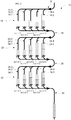
- Figure 1 shows a diagram of a sorting device 1 with three sorting stages 12, 22, 32, each of which has five sorting lines 14.1, 14.2, 14.3, 14.4, 14.5, 24.1, 24.2, 24.3, 24.4, 24.5, 34.1, 34.2, 34.3, 34.4, 34.5.
- a feed path 8 through which objects are fed to the first sorting stage 12 and sorted into the sorting lines 14.1, 14.2, 14.3, 14.4, 14.5.
- each of the sorting stages 12, 22, 32 is located in the prior art known device a first interrupter 13, 23, 33, the sorting lines 14.1, 14.2, 14.3, 14.4, 14.5, 24.1, 24.2, 24.3, 24.4, 24.5, 34.1, 34.2, 34.3, 34.4, 34.5 each in a first part and a second part divided.
- the objects are initially in the first (upper) part of the sorting lines 14.1, 14.2, 14.3, 14.4, 14.5, 24.1, 24.2, 24.3, 24.4, 24.5, 34.1, 34.2, 34.3, 34.4, 34.5.
- the first interrupter 13, 23, 33 is then opened and the objects slide into the first part over a period of, for example, 5 seconds the second part of the sorting lines 14.1, 14.2, 14.3, 14.4, 14.5, 24.1, 24.2, 24.3, 24.4, 24.5, 34.1, 34.2, 34.3, 34.4, 34.5, where they are separated by second interrupters 16, 26, 36, namely one per each Sorting line 14.1, 14.2, 14.3, 14.4, 14.5, 24.1, 24.2, 24.3, 24.4, 24.5, 34.1, 34.2, 34.3, 34.4, 34.5, at the exit end of the sorting lines 14.1, 14.2, 14.3, 14.4, 14.5, 24.1, 24.2, 24.3 , 24.4, 24.5, 34.1, 34.2, 34.3, 34.4, 34.5.
- the first interrupter 13, 23, 33 is kept open for another 2 seconds to ensure that there is no longer any object from the first batch in one of the first parts of the sorting lines 14.1, 14.2, 14.3, 14.4, 14.5, 24.1, 24.2, 24.3, 24.4, 24.5, 34.1, 34.2, 34.3, 34.4, 34.5.
- the second batch can be sorted into the first part of the first sorting stage 12, while the objects of the second batch are transferred via a transport path 18 from the first sorting stage 12 to the second sorting stage 22 and there be sorted.
- the transfer from the first sorting stage 12 to the second sorting stage 22 takes place by opening the second interrupters 16 in a sequence according to the arrangement of the sorting lines 14.1, 14.2, 14.3, 14.4, 14.5 of the first sorting level 12.
- the second interrupters 16 are opened once, until the objects of the respective sorting line 14.1, 14.2, 14.3, 14.4, 14.5 have left them. For example, only the second interrupter 16 of the first sorting line 14.1 is opened until the objects of this sorting line 14.1 have left it.
- the second interrupter 16 is closed again and parallel to it, shortly before or after the second interrupter 16 of the adjacent sorting line 14.2 is opened and so on. This method is carried out until the objects from the second part of the first sorting stage 12 have been transferred to the second sorting stage 22 via the transport path 18.
- the second batch is sorted into the first sorting stage 12, so that it is through the interrupter 13 , 23, 33 it is possible to use the sorting stages 12, 22, 32 more efficiently than if one had to wait until the first batch was not only completely sorted and transferred from the first part to the second part, but also the respective sorting stage 12, 22, 32 has completely left (which takes place one after the other, not at the same time as when sliding from the first part into the second part of the sorting lines).
- the second sorting stage 22 also has five sorting lines 24.1, 24.2, 24.3, 24.4, 24.5, a first interrupter 23 and second interrupter 26 and is connected to the third sorting stage 32 via a second transport path 28.
- the third sorting stage 32 also has five sorting lines 34.1, 34.2, 34.3, 34.4, 34.5, a first interrupter 33 and second interrupter 36, and the objects from the third sorting stage 32 are carried on via a third transport path 38, in the embodiment shown here to the packaging station .
- Figure 2 Figure 10 shows a preferred device 10 that of that of Figure 1 the basic structure is the same.
- three sorting stages 12, 22, 32 are provided, each of which has five sorting lines 14.1, 14.2, 14.3, 14.4, 14.5, 24.1, 24.2, 24.3, 24.4, 24.5, 34.1, 34.2, 34.3, 34.4, 34.5 and is provided with one first transport path 18, a second transport path 28 and a third transport path 38 are provided.
- the same elements are provided with the same reference symbols.
- the known device 1 also has the preferred device 10 in each of the sorting stages 12, 22, 32 at the output ends of the sorting lines 14.1, 14.2, 14.3, 14.4, 14.5, 24.1, 24.2, 24.3, 24.4, 24.5, 34.1, 34.2, 34.3, 34.4 , 34.5 one breaker 15.1, 15.2, 15.3, 15.4, 15.5, 25.1, 25.2, 25.3, 25.4, 25.5, 35.1, 35.2, 35.3, 35.4, 35.5 each for letting objects out of the respective sorting line 14.1, 14.2, 14.3, 14.4 , 14.5, 24.1, 24.2, 24.3, 24.4, 24.5, 34.1, 34.2, 34.3, 34.4, 34.5 and a device 17.1, 17.2, 17.3, 17.4, 17.5, 27.1, 27.2, 27.3, 27.4, 27.5, 37.1, 37.2, 37.3 , 37.4, 37.5 for counting and identifying the objects left out of the respective sorting line 14.1, 14.2, 14.3, 14.4, 14.5, 24.1, 24.2, 24.3, 24.4, 24.5, 34.1
- a first batch can now be sorted into the respective sorting stage 12, 22, 32 as in the prior art. After the first batch has been picked up, it is not necessary to wait until the objects of the batch are on the respective sorting line 14.1, 14.2, 14.3, 14.4, 14.5, 24.1, 24.2, 24.3, 24.4, 24.5, 34.1, 34.2, 34.3, 34.4, 34.5 have slipped from a first part into a second part, but the second or generally next batch can be sorted directly afterwards into the same sorting stage 12, 22, 32 and at the same time the first or generally preceding batch from the respective sorting stage 12, 22, 32 be led out.
- interrupter 15.1, 15.2, 15.3, 15.4, 15.5, 25.1, 25.2, 25.3, 25.4, 25.5, 35.1, 35.2, 35.3, 35.4, 35.5 enables the objects to be individually let out of the respective sorting levels 12, 22, 32 and the facility 17.1, 17.2, 17.3, 17.4, 17.5, 27.1, 27.2, 27.3, 27.4, 27.5, 37.1, 37.2, 37.3, 37.4, 37.5 make it possible to keep track and control that only the objects of the first (previous) Batch can be left out.
- the objects leave the sorting lines 14.1, 14.2, 14.3, 14.4, 14.5, 24.1, 24.2, 24.3, 24.4, 24.5, 34.1, 34.2, 34.3, 34.4, 34.5 not in blocks as in the prior art, but continuously, while already - likewise continuously - the objects of the next batch are sorted.
Landscapes
- Engineering & Computer Science (AREA)
- Mechanical Engineering (AREA)
- Branching, Merging, And Special Transfer Between Conveyors (AREA)
- Sorting Of Articles (AREA)
Claims (8)
- Dispositif (10) pour trier plusieurs objets différents, dans lequel le dispositif comprend :au moins un premier étage de tri (12) avec au moins deux lignes de tri (14.1, 14.2, 14.3, 14.4, 14.5) avec respectivement une extrémité d'entrée et une extrémité de sortie,dans lequel les extrémités d'entrée des lignes de tri (14.1, 14.2, 14.3, 14.4, 14.5) du premier étage de tri (12) sont connectées à une piste d'alimentation (8) pour alimenter les objets et les extrémités de sortie des lignes de tri (14.1, 14.2, 14.3, 14.4, 14.5) du premier étage de tri (12) sont connectées à une première piste de transport (18) pour acheminer les objets,un interrupteur (15.1, 15.2, 15.3, 15.4, 15.5) est disposé à chacune des extrémités de sortie des lignes de tri (14.1, 14.2, 14.3, 14.4, 14.5), lequel est conçu pour laisser sortir individuellement des objets de la ligne de tri respective (14.1, 14.2, 14.3, 14.4, 14.5), etun dispositif (17.1, 17.2, 17.3, 17.4, 17.5) pour compter et/ou identifier les objets sortis de la ligne de tri respective (14.1, 14.2, 14.3, 14.4, 14.5) est disposé à chacune des extrémités de sortie des lignes de tri (14.1, 14.2, 14.3, 14.4, 14.5),comprenant en outre au moins un deuxième étage de tri (22) avec au moins deux lignes de tri (24.1, 24.2, 24.3, 24.4, 24.5) avec respectivement une extrémité d'entrée et une extrémité de sortie,dans lequel les extrémités de sortie des lignes de tri (14.1, 14.2, 14.3, 14.4, 14.5) du premier étage de tri (12) sont connectées, par l'intermédiaire de la première piste de transport (18), aux extrémités d'entrée des lignes de tri (24.1, 24.2, 24.3, 24.4, 24.5) du deuxième étage de tri (22), de sorte que des objets provenant de l'une quelconque des lignes de tri (14.1, 14.2, 14.3, 14.4, 14.5) du premier étage de tri (12) peuvent être transférés à l'une quelconque des lignes de tri (24.1, 24.2, 24.3, 24.4, 24.5) du deuxième étage de tri (22), et les extrémités de sortie des lignes de tri (24.1, 24.2, 24.3, 24.4, 24.5) du deuxième étage de tri (22) sont connectées à une deuxième piste de transport (28) pour l'acheminement des objets,caractérisé en ceun interrupteur (25.1, 25.2, 25.3, 25.4, 25.5) est disposé à chacune des extrémités de sortie des lignes de tri (24.1, 24.2, 24.3, 24.4, 24.5), lequel est conçu pour laisser sortir individuellement des objets de la ligne de tri respective (24.1, 24.2, 24.3, 24.4, 24.5), etun dispositif (27.1, 27.2, 27.3, 27.4, 27.5) pour compter et/ou identifier les objets sortis de la ligne de tri respective (24.1, 24.2, 24.3, 24.4, 24.5) est disposé à chacune des extrémités de sortie des lignes de tri (24.1, 24.2, 24.3, 24.4, 24.5).
- Dispositif (10) selon la revendication 1, dans lequel le dispositif (10) comprend en outre :au moins un troisième étage de tri (32) avec au moins deux lignes de tri (34.1, 34.2, 34.3, 34.4, 34.5) avec respectivement une extrémité d'entrée et une extrémité de sortie,dans lequel les extrémités de sortie des lignes de tri (24.1, 24.2, 24.3, 24.4, 24.5) du deuxième étage de tri (22) sont connectées, par l'intermédiaire de la deuxième piste de transport (28), aux extrémités d'entrée des lignes de tri (34.1, 34.2, 34.3, 34.4, 34.5) du troisième étage de tri (32), de sorte que des objets provenant de l'une quelconque des lignes de tri (24.1, 24.2, 24.3, 24.4, 24.5) du deuxième étage de tri (22) peuvent être transférés à l'une quelconque des lignes de tri (34.1, 34.2, 34.3, 34.4, 34.5) du troisième étage de tri (32), et les extrémités de sortie des lignes de tri (34.1, 34.2, 34.3, 34.4, 34.5) du troisième étage de tri (32) sont connectées à une troisième piste de transport (38) pour l'acheminement des objets.
- Dispositif (10) selon l'une quelconque des revendications précédentes, dans lequel chaque étage de tri (12, 22, 32) présente cinq, six, huit ou dix lignes de tri (14.1, 14.2, 14.3, 14.4, 14.5, 24.1, 24.2, 24.3, 24.4, 24.5, 34.1, 34.2, 34.3, 34.4, 34.5).
- Dispositif (10) selon l'une quelconque des revendications précédentes, qui est conçu pour transporter les objets suspendus, en particulier dans un sac suspendu à un crochet, dans les lignes de tri (14.1, 14.2, 14.3, 14.4, 14.5, 24.1, 24.2, 24.3, 24.4, 24.5, 34.1, 34.2, 34.3, 34.4, 34.5) et par l'intermédiaire de la piste de transport (18, 28, 38).
- Dispositif (10) selon l'une quelconque des revendications précédentes, qui est conçu pour trier des objets de différentes tailles.
- Dispositif (10) selon l'une quelconque des revendications précédentes, dans lequel le dispositif (17.1, 17.2, 17.3, 17.4, 17.5) pour compter et/ou identifier les objets sortis de la ligne de tri respective présente un lecteur RFID.
- Procédé de tri de plusieurs charges parmi plusieurs objets différents utilisant un dispositif (10) selon l'une quelconque des revendications précédentes, dans lequel le procédé comprend :l'alimentation d'une première charge au premier étage de tri (12) et le tri des plusieurs objets de la première charge dans les lignes de tri (14.1, 14.2, 14.3, 14.4, 14.5) du premier étage de tri (12),l'acheminement de la première charge à partir du premier étage de tri (12),l'alimentation d'une deuxième charge au premier étage de tri (12) et le tri des plusieurs objets de la deuxième charge dans les lignes de tri (14.1, 14.2, 14.3, 14.4, 14.5) du premier étage de tri (12) avant que la première charge n'ait été complètement acheminée à partir du premier étage de tri (12),dans lequel les objets de la première charge à acheminer sont comptés et/ou identifiés et, sur cette base, les interrupteurs ne laissent sortir que les objets de la première charge, mais maintiennent les objets de la deuxième charge dans la ligne de tri (14.1, 14.2, 14.3, 14.4, 14.5) jusqu'à ce que la deuxième charge ait été complètement alimentée au premier étage de tri (12).
- Procédé selon la revendication 7 utilisant un dispositif (10) selon l'une quelconque des revendications 2, 3 ou 4 à 7 en fonction de la revendication 2 ou 3, dans lequel le procédé comprend :l'acheminement de la première charge à partir du deuxième étage de tri (22),l'alimentation de la deuxième charge au deuxième étage de tri (22) et le tri des plusieurs objets de la deuxième charge dans les lignes de tri (24.1, 24.2, 24.3, 24.4, 24.5) du deuxième étage de tri (22) avant que la première charge n'ait été complètement acheminée à partir du deuxième étage de tri (22), etl'alimentation d'une troisième charge au premier étage de tri (12) et le tri des plusieurs objets de la troisième charge dans les lignes de tri (14.1, 14.2, 14.3, 14.4, 14.5) du premier étage de tri (12) avant que la deuxième charge n'ait été complètement acheminée à partir du premier étage de tri (12) et alimentée au deuxième étage de tri (22).
Applications Claiming Priority (1)
| Application Number | Priority Date | Filing Date | Title |
|---|---|---|---|
| DE102017117713.2A DE102017117713A1 (de) | 2017-08-04 | 2017-08-04 | Matrixsorter |
Publications (3)
| Publication Number | Publication Date |
|---|---|
| EP3437745A1 EP3437745A1 (fr) | 2019-02-06 |
| EP3437745B1 true EP3437745B1 (fr) | 2021-09-01 |
| EP3437745B2 EP3437745B2 (fr) | 2026-01-28 |
Family
ID=63012828
Family Applications (1)
| Application Number | Title | Priority Date | Filing Date |
|---|---|---|---|
| EP18183893.9A Active EP3437745B2 (fr) | 2017-08-04 | 2018-07-17 | Trieur matriciel |
Country Status (6)
| Country | Link |
|---|---|
| US (1) | US10538395B2 (fr) |
| EP (1) | EP3437745B2 (fr) |
| JP (1) | JP6797157B2 (fr) |
| CN (1) | CN109382323B (fr) |
| DE (1) | DE102017117713A1 (fr) |
| ES (1) | ES2892305T5 (fr) |
Families Citing this family (7)
| Publication number | Priority date | Publication date | Assignee | Title |
|---|---|---|---|---|
| ES2961353T3 (es) | 2019-02-11 | 2024-03-11 | Tgw Logistics Group Gmbh | Sistema de almacenamiento y preparación de pedidos con prestaciones de almacenamiento mejoradas y procedimiento de funcionamiento del mismo |
| CN110694918A (zh) * | 2019-09-25 | 2020-01-17 | 石狮市云帆工业设计有限公司 | 一种物件偏离轨道回位分拣的出货分拣轨架 |
| AT523333B1 (de) | 2019-12-23 | 2025-12-15 | Tgw Logistics Gmbh | Sortiervorrichtung und -verfahren |
| CN111974707A (zh) * | 2020-08-20 | 2020-11-24 | 联丰(随州)食品有限公司 | 一种香菇自动分拣系统 |
| CN115783576B (zh) * | 2021-09-10 | 2025-09-23 | 浙江衣拿智能科技股份有限公司 | 批次型无固定货架仓储分拣系统 |
| CH721462A1 (de) | 2023-12-22 | 2025-06-30 | Ferag Ag | Anlage und Verfahren zum Sortieren und Zwischenspeichern von Stückgütern |
| EP4671156A1 (fr) | 2024-06-25 | 2025-12-31 | Dürkopp Fördertechnik GmbH | Procédé de tri pour trieurs matriciels |
Citations (8)
| Publication number | Priority date | Publication date | Assignee | Title |
|---|---|---|---|---|
| US5058750A (en) * | 1989-01-04 | 1991-10-22 | Dansk Vaskeri Teknik A/S | Plant for the sorting of suspended articles and the use hereof |
| EP0516970A1 (fr) | 1991-06-03 | 1992-12-09 | RSL LOGISTIK GMBH & CO | Méthode et dispositif pour la préparation de commandes |
| DE4335637C1 (de) | 1993-10-13 | 1995-06-22 | Dietrich Prof Lux | Verfahren zum Sortieren von Einzelstücken und Sortieranlage dafür |
| DE10039394C1 (de) * | 2000-08-11 | 2001-09-13 | Mts Modulare Transp Systeme Gm | Sortierverfahren, Sortieranlage und Sortiersystem |
| EP1273359A1 (fr) | 2001-07-06 | 2003-01-08 | AT&C Co., Ltd. | Système de tri d'objets commerciaux et procédé correspondant |
| DE102011104511B3 (de) * | 2011-06-15 | 2012-10-25 | SSI Schäfer PEEM GmbH | Distributionslager und Verfahren zum auftragsorientierten Zusammenstellen von verschiedenen Artikeln mit einem reduzierten Puffer |
| DE102011103194A1 (de) | 2011-05-31 | 2012-12-06 | SSI Schäfer PEEM GmbH | Verteileinrichtung und Verfahren zum Zusammenstellen einer Gruppe von Fördergütern |
| DE102013206240A1 (de) | 2013-04-09 | 2014-10-09 | Dürkopp Fördertechnik GmbH | Vorrichtung und Verfahren zum auftragsorientierten Bereitstellen von Einzelwaren für mehrere Aufträge aus einem Warenlager |
Family Cites Families (32)
| Publication number | Priority date | Publication date | Assignee | Title |
|---|---|---|---|---|
| US3351177A (en) * | 1965-04-12 | 1967-11-07 | Ans Inc | Sample conveyor |
| DE2110390A1 (de) | 1971-03-04 | 1972-09-14 | Weber Karl Heinz | Verfahren zum Ordnen von Gegenstaenden |
| US3841205A (en) * | 1973-04-11 | 1974-10-15 | Scripps E Co | Electromechanical detector system and method for controlling flow of newspaper bundles |
| US4410078A (en) * | 1978-01-05 | 1983-10-18 | The Continental Group, Inc. | Article density sensing |
| US4244672A (en) * | 1979-06-04 | 1981-01-13 | Burroughs Corporation | System for sequencing articles including mail |
| US4241293A (en) * | 1979-08-15 | 1980-12-23 | Pennwalt Corporation | Scanner for detecting and indicating missing and wedged articles in slat-type counting machine |
| US4597495A (en) * | 1985-04-25 | 1986-07-01 | Knosby Austin T | Livestock identification system |
| JPH02124876U (fr) | 1989-03-27 | 1990-10-15 | ||
| JP2501366Y2 (ja) * | 1990-11-27 | 1996-06-19 | 三菱重工業株式会社 | 洗濯物のスリングバッグ搬送装置 |
| US5687850A (en) * | 1995-07-19 | 1997-11-18 | White Conveyors, Inc. | Conveyor system with a computer controlled first sort conveyor |
| US6050421A (en) * | 1997-09-11 | 2000-04-18 | Jensen Usa, Inc. | Automatic laundry tie-off apparatus and method |
| US6266390B1 (en) * | 1998-09-21 | 2001-07-24 | Spectramet, Llc | High speed materials sorting using x-ray fluorescence |
| US6085914A (en) * | 1999-03-24 | 2000-07-11 | H. Salb International | Soft article sorting system |
| ES2237613T3 (es) * | 2000-11-06 | 2005-08-01 | United Parcel Service Of America, Inc. | Sistema para aliviar un equipo de clasificacion postal sobrecargado. |
| DE10145606A1 (de) * | 2001-09-15 | 2003-04-03 | Duerkopp Adler Ag | Verfahren zum Einlagern von Fördergut-Teilen in einen Speicher und zur Ausgabe von ausgewählten Fördergut-Teilen |
| JP2004131239A (ja) * | 2002-10-10 | 2004-04-30 | Fuji Photo Film Co Ltd | 仕分け装置 |
| JP2007535456A (ja) * | 2004-04-29 | 2007-12-06 | スパン テック エルエルシー | マトリックス型仕分けシステム |
| NL1027227C2 (nl) * | 2004-10-12 | 2006-04-13 | Vanderlande Ind Nederland | Werkwijze en systeem voor het sorteren van producten overeenkomstig orders daarvoor. |
| DE102006056475A1 (de) * | 2006-11-28 | 2008-05-29 | Kba-Metronic Ag | Mehrbahnige CD-Bedruckungsanlage |
| US8170712B2 (en) * | 2007-06-26 | 2012-05-01 | Amazon Technologies, Inc. | Method and apparatus for non-linear unit-level sortation in order fulfillment processes |
| JP2008156128A (ja) | 2008-02-15 | 2008-07-10 | Seibu Electric & Mach Co Ltd | 物品の荷揃え方法 |
| JP2009298556A (ja) | 2008-06-13 | 2009-12-24 | Seibu Electric & Mach Co Ltd | 商品を出荷先別に仕分ける方法 |
| US8952284B1 (en) * | 2008-09-16 | 2015-02-10 | Amazon Technologies, Inc. | Method and apparatus for managing the allocation of items to processing stations in an order fulfillment process |
| BR112013013959A2 (pt) * | 2010-12-06 | 2016-10-04 | Fleetwoodgoldcowyard Inc | acumulador de esteira para controle do fluxo de artigos sendo transportados |
| JP5712966B2 (ja) | 2012-05-29 | 2015-05-07 | 株式会社ダイフク | 仕分け設備および仕分け方法 |
| CN202638766U (zh) * | 2012-06-04 | 2013-01-02 | 合肥中鼎信息科技股份有限公司 | 一种多级分拣系统 |
| DE102014203118B4 (de) | 2014-02-20 | 2019-07-18 | Dürkopp Fördertechnik GmbH | Schaltbare Weiche zum Beeinflussen eines Flusses von Einzelwaren in einem Fördersystem, Fördersystem mit einer derartigen schaltbaren Weiche sowie Verfahren zum Schalten einer derartigen schaltbaren Weiche |
| JP6274704B2 (ja) | 2014-03-12 | 2018-02-07 | 西部電機株式会社 | 同一配送先への物品の配送準備装置および配送準備方法 |
| CN104590840B (zh) * | 2015-01-21 | 2016-08-24 | 贵州博通科技有限公司 | 矩阵式分拣系统 |
| CN204400032U (zh) * | 2015-01-21 | 2015-06-17 | 贵州博通科技有限公司 | 矩阵式物流自动分拣系统 |
| CN104889064B (zh) * | 2015-05-08 | 2018-02-16 | 长沙市致能电子科技有限公司 | 基于自动控制的高速分拣方法 |
| CN106111546B (zh) * | 2016-07-28 | 2018-02-16 | 中邮科技有限责任公司 | 条烟矩阵式分拣系统及方法 |
-
2017
- 2017-08-04 DE DE102017117713.2A patent/DE102017117713A1/de active Pending
-
2018
- 2018-07-17 ES ES18183893T patent/ES2892305T5/es active Active
- 2018-07-17 EP EP18183893.9A patent/EP3437745B2/fr active Active
- 2018-08-02 CN CN201810868476.5A patent/CN109382323B/zh active Active
- 2018-08-02 US US16/052,852 patent/US10538395B2/en active Active
- 2018-08-03 JP JP2018146636A patent/JP6797157B2/ja active Active
Patent Citations (8)
| Publication number | Priority date | Publication date | Assignee | Title |
|---|---|---|---|---|
| US5058750A (en) * | 1989-01-04 | 1991-10-22 | Dansk Vaskeri Teknik A/S | Plant for the sorting of suspended articles and the use hereof |
| EP0516970A1 (fr) | 1991-06-03 | 1992-12-09 | RSL LOGISTIK GMBH & CO | Méthode et dispositif pour la préparation de commandes |
| DE4335637C1 (de) | 1993-10-13 | 1995-06-22 | Dietrich Prof Lux | Verfahren zum Sortieren von Einzelstücken und Sortieranlage dafür |
| DE10039394C1 (de) * | 2000-08-11 | 2001-09-13 | Mts Modulare Transp Systeme Gm | Sortierverfahren, Sortieranlage und Sortiersystem |
| EP1273359A1 (fr) | 2001-07-06 | 2003-01-08 | AT&C Co., Ltd. | Système de tri d'objets commerciaux et procédé correspondant |
| DE102011103194A1 (de) | 2011-05-31 | 2012-12-06 | SSI Schäfer PEEM GmbH | Verteileinrichtung und Verfahren zum Zusammenstellen einer Gruppe von Fördergütern |
| DE102011104511B3 (de) * | 2011-06-15 | 2012-10-25 | SSI Schäfer PEEM GmbH | Distributionslager und Verfahren zum auftragsorientierten Zusammenstellen von verschiedenen Artikeln mit einem reduzierten Puffer |
| DE102013206240A1 (de) | 2013-04-09 | 2014-10-09 | Dürkopp Fördertechnik GmbH | Vorrichtung und Verfahren zum auftragsorientierten Bereitstellen von Einzelwaren für mehrere Aufträge aus einem Warenlager |
Also Published As
| Publication number | Publication date |
|---|---|
| EP3437745A1 (fr) | 2019-02-06 |
| US20190039834A1 (en) | 2019-02-07 |
| CN109382323A (zh) | 2019-02-26 |
| ES2892305T5 (en) | 2026-04-21 |
| DE102017117713A1 (de) | 2019-02-07 |
| JP2019031400A (ja) | 2019-02-28 |
| JP6797157B2 (ja) | 2020-12-09 |
| US10538395B2 (en) | 2020-01-21 |
| EP3437745B2 (fr) | 2026-01-28 |
| ES2892305T3 (es) | 2022-02-03 |
| CN109382323B (zh) | 2022-04-22 |
Similar Documents
| Publication | Publication Date | Title |
|---|---|---|
| EP3437745B2 (fr) | Trieur matriciel | |
| EP2789555B1 (fr) | Procédé de préparation de marchandises individuelles pour plusieurs commandes à partir d'un entrepôt de marchandises | |
| EP3655351B1 (fr) | Installation de préparation de commandes pour la préparation de différentes marchandises commandées pouvant en particulier être transportées en suspension, ainsi que procédé pour faire fonctionner ladite installation de préparation de commandes | |
| EP4001180B1 (fr) | Dispositif et procédé de distribution de sacs de transport dans une technique de transport d'une installation de transport suspendu, ainsi qu'une telle installation de transport suspendu | |
| EP2560899B1 (fr) | Installation de préparation de commandes et procédé permettant de préparer des paquets pour des commandes | |
| EP3581523B1 (fr) | Dispositif et procédé de mise à disposition, en fonction de la demande, de marchandises individuelles pour plusieurs demandes sur un poste d'emballage | |
| DE4015935C2 (de) | Kommissioniervorrichtung für Artikel | |
| EP3630655B1 (fr) | Procédé et système d'entrepôt pour la préparation de marchandises avec tampon dynamique exploité efficacement | |
| EP1846309B1 (fr) | Dispositif et procede de tri de recipients non ranges dans un systeme de preparation de commandes | |
| EP4112504A1 (fr) | Installation de préparation de commandes suspendu avec système de pesage intégré au rail et méthode correspondante | |
| DE2844210A1 (de) | Abgabevorrichtung | |
| EP4115994B2 (fr) | Agencements de tri destiné au tri des objets, ainsi que procédé correspondant | |
| EP3786088A1 (fr) | Procédé et système de tri de pièces à trier instables au stockage | |
| DE4236507C1 (de) | Umladebrücke | |
| DE102009017343A1 (de) | Sortierförderer innerhalb einer Förderanlage zum automatisierten Transport von Stückgütern | |
| EP3178986B1 (fr) | Procédé et dispositif de tri de linge | |
| AT523333A1 (de) | Sortiervorrichtung und -verfahren | |
| EP4087802B1 (fr) | Système de tri des pièces à trier dans les stations de destination liées logiquement à leur destination cible dans un agencement matrice | |
| EP3322657B1 (fr) | Colonne de descente à moyen d'entraînement | |
| DE19622482C2 (de) | Verfahren zum Kommissionieren und Verpacken und/oder Verteilen von Gegenständen | |
| EP1919636B1 (fr) | Procede pour trier des objets et installation de triage pour mettre en oeuvre le procede | |
| EP0897880A1 (fr) | Procédé pour la préparation de commandes, d'emballage et/ou la distribution d'articles | |
| EP4166482A1 (fr) | Technique de transport suspendu et procédé de transport des adaptateurs de suspension, ainsi qu'installation de transport suspendu dotée d'une telle technique de transport suspendu | |
| EP0943561A2 (fr) | Procédé et dispositif pour la préparation de commandes de produits de commerce | |
| DE19620599C2 (de) | Verfahren zum Zuführen von Versand- und Frachtgut zu einer Sortier- oder Verteilanlage und Vorrichtung zur Durchführung des Verfahrens |
Legal Events
| Date | Code | Title | Description |
|---|---|---|---|
| PUAI | Public reference made under article 153(3) epc to a published international application that has entered the european phase |
Free format text: ORIGINAL CODE: 0009012 |
|
| STAA | Information on the status of an ep patent application or granted ep patent |
Free format text: STATUS: THE APPLICATION HAS BEEN PUBLISHED |
|
| AK | Designated contracting states |
Kind code of ref document: A1 Designated state(s): AL AT BE BG CH CY CZ DE DK EE ES FI FR GB GR HR HU IE IS IT LI LT LU LV MC MK MT NL NO PL PT RO RS SE SI SK SM TR |
|
| AX | Request for extension of the european patent |
Extension state: BA ME |
|
| STAA | Information on the status of an ep patent application or granted ep patent |
Free format text: STATUS: REQUEST FOR EXAMINATION WAS MADE |
|
| 17P | Request for examination filed |
Effective date: 20190222 |
|
| RBV | Designated contracting states (corrected) |
Designated state(s): AL AT BE BG CH CY CZ DE DK EE ES FI FR GB GR HR HU IE IS IT LI LT LU LV MC MK MT NL NO PL PT RO RS SE SI SK SM TR |
|
| TPAC | Observations filed by third parties |
Free format text: ORIGINAL CODE: EPIDOSNTIPA |
|
| STAA | Information on the status of an ep patent application or granted ep patent |
Free format text: STATUS: EXAMINATION IS IN PROGRESS |
|
| 17Q | First examination report despatched |
Effective date: 20200408 |
|
| GRAP | Despatch of communication of intention to grant a patent |
Free format text: ORIGINAL CODE: EPIDOSNIGR1 |
|
| STAA | Information on the status of an ep patent application or granted ep patent |
Free format text: STATUS: GRANT OF PATENT IS INTENDED |
|
| INTG | Intention to grant announced |
Effective date: 20210423 |
|
| GRAS | Grant fee paid |
Free format text: ORIGINAL CODE: EPIDOSNIGR3 |
|
| GRAA | (expected) grant |
Free format text: ORIGINAL CODE: 0009210 |
|
| STAA | Information on the status of an ep patent application or granted ep patent |
Free format text: STATUS: THE PATENT HAS BEEN GRANTED |
|
| AK | Designated contracting states |
Kind code of ref document: B1 Designated state(s): AL AT BE BG CH CY CZ DE DK EE ES FI FR GB GR HR HU IE IS IT LI LT LU LV MC MK MT NL NO PL PT RO RS SE SI SK SM TR |
|
| REG | Reference to a national code |
Ref country code: GB Ref legal event code: FG4D Free format text: NOT ENGLISH |
|
| REG | Reference to a national code |
Ref country code: CH Ref legal event code: EP Ref country code: AT Ref legal event code: REF Ref document number: 1425666 Country of ref document: AT Kind code of ref document: T Effective date: 20210915 |
|
| REG | Reference to a national code |
Ref country code: DE Ref legal event code: R096 Ref document number: 502018006799 Country of ref document: DE |
|
| REG | Reference to a national code |
Ref country code: IE Ref legal event code: FG4D Free format text: LANGUAGE OF EP DOCUMENT: GERMAN |
|
| REG | Reference to a national code |
Ref country code: NL Ref legal event code: FP |
|
| REG | Reference to a national code |
Ref country code: LT Ref legal event code: MG9D |
|
| PG25 | Lapsed in a contracting state [announced via postgrant information from national office to epo] |
Ref country code: NO Free format text: LAPSE BECAUSE OF FAILURE TO SUBMIT A TRANSLATION OF THE DESCRIPTION OR TO PAY THE FEE WITHIN THE PRESCRIBED TIME-LIMIT Effective date: 20211201 Ref country code: BG Free format text: LAPSE BECAUSE OF FAILURE TO SUBMIT A TRANSLATION OF THE DESCRIPTION OR TO PAY THE FEE WITHIN THE PRESCRIBED TIME-LIMIT Effective date: 20211201 Ref country code: LT Free format text: LAPSE BECAUSE OF FAILURE TO SUBMIT A TRANSLATION OF THE DESCRIPTION OR TO PAY THE FEE WITHIN THE PRESCRIBED TIME-LIMIT Effective date: 20210901 Ref country code: RS Free format text: LAPSE BECAUSE OF FAILURE TO SUBMIT A TRANSLATION OF THE DESCRIPTION OR TO PAY THE FEE WITHIN THE PRESCRIBED TIME-LIMIT Effective date: 20210901 Ref country code: SE Free format text: LAPSE BECAUSE OF FAILURE TO SUBMIT A TRANSLATION OF THE DESCRIPTION OR TO PAY THE FEE WITHIN THE PRESCRIBED TIME-LIMIT Effective date: 20210901 Ref country code: HR Free format text: LAPSE BECAUSE OF FAILURE TO SUBMIT A TRANSLATION OF THE DESCRIPTION OR TO PAY THE FEE WITHIN THE PRESCRIBED TIME-LIMIT Effective date: 20210901 Ref country code: FI Free format text: LAPSE BECAUSE OF FAILURE TO SUBMIT A TRANSLATION OF THE DESCRIPTION OR TO PAY THE FEE WITHIN THE PRESCRIBED TIME-LIMIT Effective date: 20210901 |
|
| REG | Reference to a national code |
Ref country code: ES Ref legal event code: FG2A Ref document number: 2892305 Country of ref document: ES Kind code of ref document: T3 Effective date: 20220203 |
|
| PG25 | Lapsed in a contracting state [announced via postgrant information from national office to epo] |
Ref country code: PL Free format text: LAPSE BECAUSE OF FAILURE TO SUBMIT A TRANSLATION OF THE DESCRIPTION OR TO PAY THE FEE WITHIN THE PRESCRIBED TIME-LIMIT Effective date: 20210901 Ref country code: LV Free format text: LAPSE BECAUSE OF FAILURE TO SUBMIT A TRANSLATION OF THE DESCRIPTION OR TO PAY THE FEE WITHIN THE PRESCRIBED TIME-LIMIT Effective date: 20210901 Ref country code: GR Free format text: LAPSE BECAUSE OF FAILURE TO SUBMIT A TRANSLATION OF THE DESCRIPTION OR TO PAY THE FEE WITHIN THE PRESCRIBED TIME-LIMIT Effective date: 20211202 |
|
| REG | Reference to a national code |
Ref country code: DE Ref legal event code: R026 Ref document number: 502018006799 Country of ref document: DE |
|
| PG25 | Lapsed in a contracting state [announced via postgrant information from national office to epo] |
Ref country code: IS Free format text: LAPSE BECAUSE OF FAILURE TO SUBMIT A TRANSLATION OF THE DESCRIPTION OR TO PAY THE FEE WITHIN THE PRESCRIBED TIME-LIMIT Effective date: 20220101 Ref country code: SM Free format text: LAPSE BECAUSE OF FAILURE TO SUBMIT A TRANSLATION OF THE DESCRIPTION OR TO PAY THE FEE WITHIN THE PRESCRIBED TIME-LIMIT Effective date: 20210901 Ref country code: SK Free format text: LAPSE BECAUSE OF FAILURE TO SUBMIT A TRANSLATION OF THE DESCRIPTION OR TO PAY THE FEE WITHIN THE PRESCRIBED TIME-LIMIT Effective date: 20210901 Ref country code: RO Free format text: LAPSE BECAUSE OF FAILURE TO SUBMIT A TRANSLATION OF THE DESCRIPTION OR TO PAY THE FEE WITHIN THE PRESCRIBED TIME-LIMIT Effective date: 20210901 Ref country code: PT Free format text: LAPSE BECAUSE OF FAILURE TO SUBMIT A TRANSLATION OF THE DESCRIPTION OR TO PAY THE FEE WITHIN THE PRESCRIBED TIME-LIMIT Effective date: 20220103 Ref country code: EE Free format text: LAPSE BECAUSE OF FAILURE TO SUBMIT A TRANSLATION OF THE DESCRIPTION OR TO PAY THE FEE WITHIN THE PRESCRIBED TIME-LIMIT Effective date: 20210901 Ref country code: CZ Free format text: LAPSE BECAUSE OF FAILURE TO SUBMIT A TRANSLATION OF THE DESCRIPTION OR TO PAY THE FEE WITHIN THE PRESCRIBED TIME-LIMIT Effective date: 20210901 Ref country code: AL Free format text: LAPSE BECAUSE OF FAILURE TO SUBMIT A TRANSLATION OF THE DESCRIPTION OR TO PAY THE FEE WITHIN THE PRESCRIBED TIME-LIMIT Effective date: 20210901 |
|
| PLBI | Opposition filed |
Free format text: ORIGINAL CODE: 0009260 |
|
| PLAB | Opposition data, opponent's data or that of the opponent's representative modified |
Free format text: ORIGINAL CODE: 0009299OPPO |
|
| PLAX | Notice of opposition and request to file observation + time limit sent |
Free format text: ORIGINAL CODE: EPIDOSNOBS2 |
|
| 26 | Opposition filed |
Opponent name: DUERKOPP FOERDERTECHNIK GMBH Effective date: 20220531 |
|
| R26 | Opposition filed (corrected) |
Opponent name: DUERKOPP FOERDERTECHNIK GMBH Effective date: 20220531 |
|
| PG25 | Lapsed in a contracting state [announced via postgrant information from national office to epo] |
Ref country code: IT Free format text: LAPSE BECAUSE OF FAILURE TO SUBMIT A TRANSLATION OF THE DESCRIPTION OR TO PAY THE FEE WITHIN THE PRESCRIBED TIME-LIMIT Effective date: 20210901 Ref country code: DK Free format text: LAPSE BECAUSE OF FAILURE TO SUBMIT A TRANSLATION OF THE DESCRIPTION OR TO PAY THE FEE WITHIN THE PRESCRIBED TIME-LIMIT Effective date: 20210901 |
|
| PG25 | Lapsed in a contracting state [announced via postgrant information from national office to epo] |
Ref country code: SI Free format text: LAPSE BECAUSE OF FAILURE TO SUBMIT A TRANSLATION OF THE DESCRIPTION OR TO PAY THE FEE WITHIN THE PRESCRIBED TIME-LIMIT Effective date: 20210901 |
|
| PLBB | Reply of patent proprietor to notice(s) of opposition received |
Free format text: ORIGINAL CODE: EPIDOSNOBS3 |
|
| PG25 | Lapsed in a contracting state [announced via postgrant information from national office to epo] |
Ref country code: MC Free format text: LAPSE BECAUSE OF FAILURE TO SUBMIT A TRANSLATION OF THE DESCRIPTION OR TO PAY THE FEE WITHIN THE PRESCRIBED TIME-LIMIT Effective date: 20210901 |
|
| REG | Reference to a national code |
Ref country code: CH Ref legal event code: PL |
|
| REG | Reference to a national code |
Ref country code: BE Ref legal event code: MM Effective date: 20220731 |
|
| PG25 | Lapsed in a contracting state [announced via postgrant information from national office to epo] |
Ref country code: LU Free format text: LAPSE BECAUSE OF NON-PAYMENT OF DUE FEES Effective date: 20220717 Ref country code: LI Free format text: LAPSE BECAUSE OF NON-PAYMENT OF DUE FEES Effective date: 20220731 Ref country code: CH Free format text: LAPSE BECAUSE OF NON-PAYMENT OF DUE FEES Effective date: 20220731 |
|
| PG25 | Lapsed in a contracting state [announced via postgrant information from national office to epo] |
Ref country code: BE Free format text: LAPSE BECAUSE OF NON-PAYMENT OF DUE FEES Effective date: 20220731 |
|
| P01 | Opt-out of the competence of the unified patent court (upc) registered |
Effective date: 20230424 |
|
| PG25 | Lapsed in a contracting state [announced via postgrant information from national office to epo] |
Ref country code: IE Free format text: LAPSE BECAUSE OF NON-PAYMENT OF DUE FEES Effective date: 20220717 |
|
| PG25 | Lapsed in a contracting state [announced via postgrant information from national office to epo] |
Ref country code: HU Free format text: LAPSE BECAUSE OF FAILURE TO SUBMIT A TRANSLATION OF THE DESCRIPTION OR TO PAY THE FEE WITHIN THE PRESCRIBED TIME-LIMIT; INVALID AB INITIO Effective date: 20180717 |
|
| PG25 | Lapsed in a contracting state [announced via postgrant information from national office to epo] |
Ref country code: MK Free format text: LAPSE BECAUSE OF FAILURE TO SUBMIT A TRANSLATION OF THE DESCRIPTION OR TO PAY THE FEE WITHIN THE PRESCRIBED TIME-LIMIT Effective date: 20210901 Ref country code: CY Free format text: LAPSE BECAUSE OF FAILURE TO SUBMIT A TRANSLATION OF THE DESCRIPTION OR TO PAY THE FEE WITHIN THE PRESCRIBED TIME-LIMIT Effective date: 20210901 |
|
| PG25 | Lapsed in a contracting state [announced via postgrant information from national office to epo] |
Ref country code: MT Free format text: LAPSE BECAUSE OF FAILURE TO SUBMIT A TRANSLATION OF THE DESCRIPTION OR TO PAY THE FEE WITHIN THE PRESCRIBED TIME-LIMIT Effective date: 20210901 |
|
| APAH | Appeal reference modified |
Free format text: ORIGINAL CODE: EPIDOSCREFNO |
|
| APBP | Date of receipt of notice of appeal recorded |
Free format text: ORIGINAL CODE: EPIDOSNNOA2O |
|
| PGFP | Annual fee paid to national office [announced via postgrant information from national office to epo] |
Ref country code: NL Payment date: 20250728 Year of fee payment: 8 |
|
| APBU | Appeal procedure closed |
Free format text: ORIGINAL CODE: EPIDOSNNOA9O |
|
| PGFP | Annual fee paid to national office [announced via postgrant information from national office to epo] |
Ref country code: ES Payment date: 20250801 Year of fee payment: 8 |
|
| PGFP | Annual fee paid to national office [announced via postgrant information from national office to epo] |
Ref country code: DE Payment date: 20250728 Year of fee payment: 8 |
|
| PGFP | Annual fee paid to national office [announced via postgrant information from national office to epo] |
Ref country code: GB Payment date: 20250703 Year of fee payment: 8 |
|
| PGFP | Annual fee paid to national office [announced via postgrant information from national office to epo] |
Ref country code: FR Payment date: 20250707 Year of fee payment: 8 Ref country code: AT Payment date: 20250708 Year of fee payment: 8 |
|
| PG25 | Lapsed in a contracting state [announced via postgrant information from national office to epo] |
Ref country code: TR Free format text: LAPSE BECAUSE OF FAILURE TO SUBMIT A TRANSLATION OF THE DESCRIPTION OR TO PAY THE FEE WITHIN THE PRESCRIBED TIME-LIMIT Effective date: 20210901 |
|
| PUAH | Patent maintained in amended form |
Free format text: ORIGINAL CODE: 0009272 |
|
| STAA | Information on the status of an ep patent application or granted ep patent |
Free format text: STATUS: PATENT MAINTAINED AS AMENDED |
|
| REG | Reference to a national code |
Ref country code: CH Ref legal event code: M12 Free format text: ST27 STATUS EVENT CODE: U-0-0-M10-M12 (AS PROVIDED BY THE NATIONAL OFFICE) Effective date: 20251231 |
|
| 27A | Patent maintained in amended form |
Effective date: 20260128 |
|
| AK | Designated contracting states |
Kind code of ref document: B2 Designated state(s): AL AT BE BG CH CY CZ DE DK EE ES FI FR GB GR HR HU IE IS IT LI LT LU LV MC MK MT NL NO PL PT RO RS SE SI SK SM TR |
|
| REG | Reference to a national code |
Ref country code: DE Ref legal event code: R102 Ref document number: 502018006799 Country of ref document: DE |
|
| REG | Reference to a national code |
Ref country code: NL Ref legal event code: FP |
|
| REG | Reference to a national code |
Ref country code: ES Ref legal event code: DC2A Ref document number: 2892305 Country of ref document: ES Kind code of ref document: T5 Effective date: 20260421 |