EP3417025B1 - Verfahren zur haftverbesserung von silikon auf einer thermoplastischen oberfläche - Google Patents
Verfahren zur haftverbesserung von silikon auf einer thermoplastischen oberfläche Download PDFInfo
- Publication number
- EP3417025B1 EP3417025B1 EP16838021.0A EP16838021A EP3417025B1 EP 3417025 B1 EP3417025 B1 EP 3417025B1 EP 16838021 A EP16838021 A EP 16838021A EP 3417025 B1 EP3417025 B1 EP 3417025B1
- Authority
- EP
- European Patent Office
- Prior art keywords
- thermoplastic
- silicone
- radiation
- irradiation
- carried out
- Prior art date
- Legal status (The legal status is an assumption and is not a legal conclusion. Google has not performed a legal analysis and makes no representation as to the accuracy of the status listed.)
- Active
Links
Images


Classifications
-
- C—CHEMISTRY; METALLURGY
- C09—DYES; PAINTS; POLISHES; NATURAL RESINS; ADHESIVES; COMPOSITIONS NOT OTHERWISE PROVIDED FOR; APPLICATIONS OF MATERIALS NOT OTHERWISE PROVIDED FOR
- C09J—ADHESIVES; NON-MECHANICAL ASPECTS OF ADHESIVE PROCESSES IN GENERAL; ADHESIVE PROCESSES NOT PROVIDED FOR ELSEWHERE; USE OF MATERIALS AS ADHESIVES
- C09J5/00—Adhesive processes in general; Adhesive processes not provided for elsewhere, e.g. relating to primers
- C09J5/02—Adhesive processes in general; Adhesive processes not provided for elsewhere, e.g. relating to primers involving pretreatment of the surfaces to be joined
-
- C—CHEMISTRY; METALLURGY
- C09—DYES; PAINTS; POLISHES; NATURAL RESINS; ADHESIVES; COMPOSITIONS NOT OTHERWISE PROVIDED FOR; APPLICATIONS OF MATERIALS NOT OTHERWISE PROVIDED FOR
- C09J—ADHESIVES; NON-MECHANICAL ASPECTS OF ADHESIVE PROCESSES IN GENERAL; ADHESIVE PROCESSES NOT PROVIDED FOR ELSEWHERE; USE OF MATERIALS AS ADHESIVES
- C09J5/00—Adhesive processes in general; Adhesive processes not provided for elsewhere, e.g. relating to primers
-
- B—PERFORMING OPERATIONS; TRANSPORTING
- B29—WORKING OF PLASTICS; WORKING OF SUBSTANCES IN A PLASTIC STATE IN GENERAL
- B29C—SHAPING OR JOINING OF PLASTICS; SHAPING OF MATERIAL IN A PLASTIC STATE, NOT OTHERWISE PROVIDED FOR; AFTER-TREATMENT OF THE SHAPED PRODUCTS, e.g. REPAIRING
- B29C45/00—Injection moulding, i.e. forcing the required volume of moulding material through a nozzle into a closed mould; Apparatus therefor
- B29C45/16—Making multilayered or multicoloured articles
-
- B—PERFORMING OPERATIONS; TRANSPORTING
- B29—WORKING OF PLASTICS; WORKING OF SUBSTANCES IN A PLASTIC STATE IN GENERAL
- B29C—SHAPING OR JOINING OF PLASTICS; SHAPING OF MATERIAL IN A PLASTIC STATE, NOT OTHERWISE PROVIDED FOR; AFTER-TREATMENT OF THE SHAPED PRODUCTS, e.g. REPAIRING
- B29C65/00—Joining or sealing of preformed parts, e.g. welding of plastics materials; Apparatus therefor
- B29C65/002—Joining methods not otherwise provided for
-
- B—PERFORMING OPERATIONS; TRANSPORTING
- B32—LAYERED PRODUCTS
- B32B—LAYERED PRODUCTS, i.e. PRODUCTS BUILT-UP OF STRATA OF FLAT OR NON-FLAT, e.g. CELLULAR OR HONEYCOMB, FORM
- B32B25/00—Layered products comprising a layer of natural or synthetic rubber
- B32B25/04—Layered products comprising a layer of natural or synthetic rubber comprising rubber as the main or only constituent of a layer, which is next to another layer of the same or of a different material
- B32B25/042—Layered products comprising a layer of natural or synthetic rubber comprising rubber as the main or only constituent of a layer, which is next to another layer of the same or of a different material of natural rubber or synthetic rubber
-
- B—PERFORMING OPERATIONS; TRANSPORTING
- B32—LAYERED PRODUCTS
- B32B—LAYERED PRODUCTS, i.e. PRODUCTS BUILT-UP OF STRATA OF FLAT OR NON-FLAT, e.g. CELLULAR OR HONEYCOMB, FORM
- B32B25/00—Layered products comprising a layer of natural or synthetic rubber
- B32B25/04—Layered products comprising a layer of natural or synthetic rubber comprising rubber as the main or only constituent of a layer, which is next to another layer of the same or of a different material
- B32B25/08—Layered products comprising a layer of natural or synthetic rubber comprising rubber as the main or only constituent of a layer, which is next to another layer of the same or of a different material of synthetic resin
-
- B—PERFORMING OPERATIONS; TRANSPORTING
- B32—LAYERED PRODUCTS
- B32B—LAYERED PRODUCTS, i.e. PRODUCTS BUILT-UP OF STRATA OF FLAT OR NON-FLAT, e.g. CELLULAR OR HONEYCOMB, FORM
- B32B25/00—Layered products comprising a layer of natural or synthetic rubber
- B32B25/10—Layered products comprising a layer of natural or synthetic rubber next to a fibrous or filamentary layer
-
- B—PERFORMING OPERATIONS; TRANSPORTING
- B32—LAYERED PRODUCTS
- B32B—LAYERED PRODUCTS, i.e. PRODUCTS BUILT-UP OF STRATA OF FLAT OR NON-FLAT, e.g. CELLULAR OR HONEYCOMB, FORM
- B32B25/00—Layered products comprising a layer of natural or synthetic rubber
- B32B25/16—Layered products comprising a layer of natural or synthetic rubber comprising polydienes homopolymers or poly-halodienes homopolymers
-
- B—PERFORMING OPERATIONS; TRANSPORTING
- B32—LAYERED PRODUCTS
- B32B—LAYERED PRODUCTS, i.e. PRODUCTS BUILT-UP OF STRATA OF FLAT OR NON-FLAT, e.g. CELLULAR OR HONEYCOMB, FORM
- B32B25/00—Layered products comprising a layer of natural or synthetic rubber
- B32B25/18—Layered products comprising a layer of natural or synthetic rubber comprising butyl or halobutyl rubber
-
- B—PERFORMING OPERATIONS; TRANSPORTING
- B32—LAYERED PRODUCTS
- B32B—LAYERED PRODUCTS, i.e. PRODUCTS BUILT-UP OF STRATA OF FLAT OR NON-FLAT, e.g. CELLULAR OR HONEYCOMB, FORM
- B32B25/00—Layered products comprising a layer of natural or synthetic rubber
- B32B25/20—Layered products comprising a layer of natural or synthetic rubber comprising silicone rubber
-
- B—PERFORMING OPERATIONS; TRANSPORTING
- B32—LAYERED PRODUCTS
- B32B—LAYERED PRODUCTS, i.e. PRODUCTS BUILT-UP OF STRATA OF FLAT OR NON-FLAT, e.g. CELLULAR OR HONEYCOMB, FORM
- B32B27/00—Layered products comprising a layer of synthetic resin
-
- B—PERFORMING OPERATIONS; TRANSPORTING
- B32—LAYERED PRODUCTS
- B32B—LAYERED PRODUCTS, i.e. PRODUCTS BUILT-UP OF STRATA OF FLAT OR NON-FLAT, e.g. CELLULAR OR HONEYCOMB, FORM
- B32B27/00—Layered products comprising a layer of synthetic resin
- B32B27/06—Layered products comprising a layer of synthetic resin as the main or only constituent of a layer, which is next to another layer of the same or of a different material
- B32B27/08—Layered products comprising a layer of synthetic resin as the main or only constituent of a layer, which is next to another layer of the same or of a different material of synthetic resin
-
- B—PERFORMING OPERATIONS; TRANSPORTING
- B32—LAYERED PRODUCTS
- B32B—LAYERED PRODUCTS, i.e. PRODUCTS BUILT-UP OF STRATA OF FLAT OR NON-FLAT, e.g. CELLULAR OR HONEYCOMB, FORM
- B32B27/00—Layered products comprising a layer of synthetic resin
- B32B27/16—Layered products comprising a layer of synthetic resin specially treated, e.g. irradiated
-
- B—PERFORMING OPERATIONS; TRANSPORTING
- B32—LAYERED PRODUCTS
- B32B—LAYERED PRODUCTS, i.e. PRODUCTS BUILT-UP OF STRATA OF FLAT OR NON-FLAT, e.g. CELLULAR OR HONEYCOMB, FORM
- B32B27/00—Layered products comprising a layer of synthetic resin
- B32B27/28—Layered products comprising a layer of synthetic resin comprising synthetic resins not wholly covered by any one of the sub-groups B32B27/30 - B32B27/42
- B32B27/283—Layered products comprising a layer of synthetic resin comprising synthetic resins not wholly covered by any one of the sub-groups B32B27/30 - B32B27/42 comprising polysiloxanes
-
- B—PERFORMING OPERATIONS; TRANSPORTING
- B32—LAYERED PRODUCTS
- B32B—LAYERED PRODUCTS, i.e. PRODUCTS BUILT-UP OF STRATA OF FLAT OR NON-FLAT, e.g. CELLULAR OR HONEYCOMB, FORM
- B32B27/00—Layered products comprising a layer of synthetic resin
- B32B27/30—Layered products comprising a layer of synthetic resin comprising vinyl (co)polymers; comprising acrylic (co)polymers
- B32B27/302—Layered products comprising a layer of synthetic resin comprising vinyl (co)polymers; comprising acrylic (co)polymers comprising aromatic vinyl (co)polymers, e.g. styrenic (co)polymers
-
- B—PERFORMING OPERATIONS; TRANSPORTING
- B32—LAYERED PRODUCTS
- B32B—LAYERED PRODUCTS, i.e. PRODUCTS BUILT-UP OF STRATA OF FLAT OR NON-FLAT, e.g. CELLULAR OR HONEYCOMB, FORM
- B32B27/00—Layered products comprising a layer of synthetic resin
- B32B27/30—Layered products comprising a layer of synthetic resin comprising vinyl (co)polymers; comprising acrylic (co)polymers
- B32B27/308—Layered products comprising a layer of synthetic resin comprising vinyl (co)polymers; comprising acrylic (co)polymers comprising acrylic (co)polymers
-
- B—PERFORMING OPERATIONS; TRANSPORTING
- B32—LAYERED PRODUCTS
- B32B—LAYERED PRODUCTS, i.e. PRODUCTS BUILT-UP OF STRATA OF FLAT OR NON-FLAT, e.g. CELLULAR OR HONEYCOMB, FORM
- B32B27/00—Layered products comprising a layer of synthetic resin
- B32B27/32—Layered products comprising a layer of synthetic resin comprising polyolefins
-
- B—PERFORMING OPERATIONS; TRANSPORTING
- B32—LAYERED PRODUCTS
- B32B—LAYERED PRODUCTS, i.e. PRODUCTS BUILT-UP OF STRATA OF FLAT OR NON-FLAT, e.g. CELLULAR OR HONEYCOMB, FORM
- B32B27/00—Layered products comprising a layer of synthetic resin
- B32B27/34—Layered products comprising a layer of synthetic resin comprising polyamides
-
- B—PERFORMING OPERATIONS; TRANSPORTING
- B32—LAYERED PRODUCTS
- B32B—LAYERED PRODUCTS, i.e. PRODUCTS BUILT-UP OF STRATA OF FLAT OR NON-FLAT, e.g. CELLULAR OR HONEYCOMB, FORM
- B32B27/00—Layered products comprising a layer of synthetic resin
- B32B27/36—Layered products comprising a layer of synthetic resin comprising polyesters
- B32B27/365—Layered products comprising a layer of synthetic resin comprising polyesters comprising polycarbonates
-
- B—PERFORMING OPERATIONS; TRANSPORTING
- B32—LAYERED PRODUCTS
- B32B—LAYERED PRODUCTS, i.e. PRODUCTS BUILT-UP OF STRATA OF FLAT OR NON-FLAT, e.g. CELLULAR OR HONEYCOMB, FORM
- B32B37/00—Methods or apparatus for laminating, e.g. by curing or by ultrasonic bonding
- B32B37/14—Methods or apparatus for laminating, e.g. by curing or by ultrasonic bonding characterised by the properties of the layers
- B32B37/24—Methods or apparatus for laminating, e.g. by curing or by ultrasonic bonding characterised by the properties of the layers with at least one layer not being coherent before laminating, e.g. made up from granular material sprinkled onto a substrate
-
- B—PERFORMING OPERATIONS; TRANSPORTING
- B32—LAYERED PRODUCTS
- B32B—LAYERED PRODUCTS, i.e. PRODUCTS BUILT-UP OF STRATA OF FLAT OR NON-FLAT, e.g. CELLULAR OR HONEYCOMB, FORM
- B32B7/00—Layered products characterised by the relation between layers; Layered products characterised by the relative orientation of features between layers, or by the relative values of a measurable parameter between layers, i.e. products comprising layers having different physical, chemical or physicochemical properties; Layered products characterised by the interconnection of layers
- B32B7/04—Interconnection of layers
-
- B—PERFORMING OPERATIONS; TRANSPORTING
- B29—WORKING OF PLASTICS; WORKING OF SUBSTANCES IN A PLASTIC STATE IN GENERAL
- B29K—INDEXING SCHEME ASSOCIATED WITH SUBCLASSES B29B, B29C OR B29D, RELATING TO MOULDING MATERIALS OR TO MATERIALS FOR MOULDS, REINFORCEMENTS, FILLERS OR PREFORMED PARTS, e.g. INSERTS
- B29K2083/00—Use of polymers having silicon, with or without sulfur, nitrogen, oxygen, or carbon only, in the main chain, as moulding material
-
- B—PERFORMING OPERATIONS; TRANSPORTING
- B32—LAYERED PRODUCTS
- B32B—LAYERED PRODUCTS, i.e. PRODUCTS BUILT-UP OF STRATA OF FLAT OR NON-FLAT, e.g. CELLULAR OR HONEYCOMB, FORM
- B32B37/00—Methods or apparatus for laminating, e.g. by curing or by ultrasonic bonding
- B32B37/14—Methods or apparatus for laminating, e.g. by curing or by ultrasonic bonding characterised by the properties of the layers
- B32B37/24—Methods or apparatus for laminating, e.g. by curing or by ultrasonic bonding characterised by the properties of the layers with at least one layer not being coherent before laminating, e.g. made up from granular material sprinkled onto a substrate
- B32B2037/243—Coating
-
- B—PERFORMING OPERATIONS; TRANSPORTING
- B32—LAYERED PRODUCTS
- B32B—LAYERED PRODUCTS, i.e. PRODUCTS BUILT-UP OF STRATA OF FLAT OR NON-FLAT, e.g. CELLULAR OR HONEYCOMB, FORM
- B32B2250/00—Layers arrangement
- B32B2250/02—2 layers
-
- B—PERFORMING OPERATIONS; TRANSPORTING
- B32—LAYERED PRODUCTS
- B32B—LAYERED PRODUCTS, i.e. PRODUCTS BUILT-UP OF STRATA OF FLAT OR NON-FLAT, e.g. CELLULAR OR HONEYCOMB, FORM
- B32B2250/00—Layers arrangement
- B32B2250/24—All layers being polymeric
-
- B—PERFORMING OPERATIONS; TRANSPORTING
- B32—LAYERED PRODUCTS
- B32B—LAYERED PRODUCTS, i.e. PRODUCTS BUILT-UP OF STRATA OF FLAT OR NON-FLAT, e.g. CELLULAR OR HONEYCOMB, FORM
- B32B2260/00—Layered product comprising an impregnated, embedded, or bonded layer wherein the layer comprises an impregnation, embedding, or binder material
- B32B2260/02—Composition of the impregnated, bonded or embedded layer
- B32B2260/021—Fibrous or filamentary layer
-
- B—PERFORMING OPERATIONS; TRANSPORTING
- B32—LAYERED PRODUCTS
- B32B—LAYERED PRODUCTS, i.e. PRODUCTS BUILT-UP OF STRATA OF FLAT OR NON-FLAT, e.g. CELLULAR OR HONEYCOMB, FORM
- B32B2260/00—Layered product comprising an impregnated, embedded, or bonded layer wherein the layer comprises an impregnation, embedding, or binder material
- B32B2260/04—Impregnation, embedding, or binder material
- B32B2260/046—Synthetic resin
-
- B—PERFORMING OPERATIONS; TRANSPORTING
- B32—LAYERED PRODUCTS
- B32B—LAYERED PRODUCTS, i.e. PRODUCTS BUILT-UP OF STRATA OF FLAT OR NON-FLAT, e.g. CELLULAR OR HONEYCOMB, FORM
- B32B2262/00—Composition or structural features of fibres which form a fibrous or filamentary layer or are present as additives
- B32B2262/10—Inorganic fibres
- B32B2262/101—Glass fibres
-
- B—PERFORMING OPERATIONS; TRANSPORTING
- B32—LAYERED PRODUCTS
- B32B—LAYERED PRODUCTS, i.e. PRODUCTS BUILT-UP OF STRATA OF FLAT OR NON-FLAT, e.g. CELLULAR OR HONEYCOMB, FORM
- B32B2307/00—Properties of the layers or laminate
- B32B2307/70—Other properties
- B32B2307/748—Releasability
-
- B—PERFORMING OPERATIONS; TRANSPORTING
- B32—LAYERED PRODUCTS
- B32B—LAYERED PRODUCTS, i.e. PRODUCTS BUILT-UP OF STRATA OF FLAT OR NON-FLAT, e.g. CELLULAR OR HONEYCOMB, FORM
- B32B2310/00—Treatment by energy or chemical effects
- B32B2310/08—Treatment by energy or chemical effects by wave energy or particle radiation
- B32B2310/0806—Treatment by energy or chemical effects by wave energy or particle radiation using electromagnetic radiation
- B32B2310/0831—Treatment by energy or chemical effects by wave energy or particle radiation using electromagnetic radiation using UV radiation
-
- C—CHEMISTRY; METALLURGY
- C09—DYES; PAINTS; POLISHES; NATURAL RESINS; ADHESIVES; COMPOSITIONS NOT OTHERWISE PROVIDED FOR; APPLICATIONS OF MATERIALS NOT OTHERWISE PROVIDED FOR
- C09J—ADHESIVES; NON-MECHANICAL ASPECTS OF ADHESIVE PROCESSES IN GENERAL; ADHESIVE PROCESSES NOT PROVIDED FOR ELSEWHERE; USE OF MATERIALS AS ADHESIVES
- C09J2301/00—Additional features of adhesives in the form of films or foils
- C09J2301/40—Additional features of adhesives in the form of films or foils characterized by the presence of essential components
- C09J2301/416—Additional features of adhesives in the form of films or foils characterized by the presence of essential components use of irradiation
Definitions
- the invention relates to a method for improving the adhesion of silicone to the surface of a thermoplastic.
- the invention further relates to a composite of a thermoplastic and a silicone applied to a surface of the thermoplastic.
- thermoplastic surfaces are irradiated with UV-C radiation can to activate the surfaces.
- This increases the bond strength of the thermoplastic-thermoplastic compound.
- Such surface activation is based on the generation of oxygen radicals from the air, which react with radicals on the surface of the material. This creates a chemically modified surface of the thermoplastic. Consequently, the two thermoplastic surfaces can be brought together and bonded to one another in the bonding process.
- thermoplastic e.g. a silicone and a thermoplastic
- various activation methods are known for activating the surface of the thermoplastic so that an improvement in the adhesion of the silicone is achieved.
- the silicone should be applied to the surface of the thermoplastic, for example by injection molding.
- Adhesion promoters are known which can be present as additives in the material of the thermoplastic, and it is also known to additize the material of the silicone accordingly in order to create an adhesion promoter. Disadvantageously, such additives lead to a considerable increase in costs for the procurement of appropriately additive thermoplastics or silicones.
- thermoplastic surface by means of a so-called corona treatment
- corona process is based on an alternating electrical discharge in an air atmosphere.
- Generated high-energy electrons form radicals on the surface of the material, which react from the air using oxygen radicals that are also formed.
- Another physical process for surface treatment is flame treatment.
- flame treatment By the action of the gas flame on the Molecular bonds broken, which allow the incorporation of radicals from the flame into the molecular chain.
- the polar groups formed on the substrate surface are able to combine with other materials.
- thermoplastic surface activation In addition to flame treatment, activation of the thermoplastic surface by means of a plasma is also known. In the case of plasma activation, a targeted modification of a surface tension of the thermoplastic is achieved by means of plasma energy, which likewise leads to a considerable improvement in adhesion.
- thermoplastic for promoting adhesion to a silicone
- thermal processes such as flaming can cause the workpiece to warp, and the color of the surface can also change.
- plasma technology or corona treatment complex plant technology is required, and there are dangers for the operator, particularly when the electrical components of the plant are high.
- High operating costs, high energy requirements and high investment costs are further factors that make an alternative process for activating the surface of a thermoplastic appear necessary for the adhesion promotion of a silicone.
- a clear Adhesion improvement of a silicone can be achieved on the surface of a thermoplastic.
- the invention includes the technical teaching that the surface of the thermoplastic is irradiated with UV-C radiation to improve the adhesion of silicone to the surface.
- the invention uses UV-C radiation to activate the surface of the thermoplastic, in particular to improve the adhesion of silicone to the surface. If the silicone is applied to the surface after the irradiation, there is a clear improvement in the adhesion of the silicone to the thermoplastic.
- the method specifically provides for selective radiation of the surface in the areas in which the silicone is to be applied to the surface. Adjacent surface areas of the thermoplastic to which the silicone should not adhere can be covered, for example, before UV-C radiation.
- the UV-C radiation is provided with particular advantage with a wavelength of 100 nm to 280 nm, preferably from 150 nm to 200 nm and particularly preferably from 180 nm to 190 nm. Particularly good results could surprisingly be achieved with a wavelength of the UV-C radiation of 185 nm .
- the UV-C radiation is generated by means of a radiation source, the radiation source being moved over the surface of the thermoplastic during the irradiation.
- the UV-C radiation can sweep the surface areas of the thermoplastic workpiece in such a way that the areas of the surface are activated that are to be bonded with the silicone.
- the radiation source it is also conceivable for the radiation source to be arranged and operated at rest above the surface of the thermoplastic, and for example a corresponding mask can be used to activate specific areas and to exclude further areas from the activation.
- the irradiation of the surface of the thermoplastic is carried out within an irradiation chamber which is darkened to the outside.
- the radiation chamber is thus designed in particular in such a way that no UV-C radiation can escape from the radiation chamber. In this way, a danger to an operator, for example, arising from UV-C radiation is excluded in a simple manner.
- the radiation chamber can be designed in such a way that the thermoplastic workpiece can be inserted into the radiation chamber.
- the radiation source can be arranged within the radiation chamber.
- the irradiation of the surface of the thermoplastic is carried out by means of UV-C radiation with the formation of ozone, the ozone interacting with the surface during the irradiation.
- UV-C radiation When irradiating thermoplastic materials with UV-C radiation, it was found that the interaction with the atmospheric oxygen produces ozone, the ozone in turn interacting with the surface of the thermoplastic to produce a significant improvement in the activation of the surface. Consequently, that will Ozone formed is also used to improve the adhesion of silicone to the surface of the thermoplastic.
- the advantage achieved in connection with the ozone is that the ozone remains in the region of the thermoplastic near the surface and can enter into a corresponding interaction with the surface, to reinforce it Effects can also be provided to optimize the radiation chamber accordingly in order to ensure an intensive interaction of the ozone with the surface.
- the size of the radiation chamber is chosen to be so small that the highest possible concentration of ozone prevails over the surface of the thermoplastic.
- the duration of the irradiation is, for example, three seconds to 15 minutes. In particular, the duration of the irradiation is five seconds to 30 seconds, with which very good adhesion results of the silicone on the thermoplastic surface can already be achieved.
- the method provides for the provision of a thermoplastic material
- a silicone is provided which is to be connected to the thermoplastic.
- a polyamide for example a PA6 GF25, polycarbonate, a polypropylene, a methyl methacrylate-acrylonitrile-butadiene-styrene, a methyl methacrylate or an acrylonitrile-butadiene-styrene, is particularly advantageously provided as the thermoplastic.
- a liquid silicone rubber or a high consistency silicone rubber can be provided as the silicone.
- the silicone in the form of the Liquid Silicone Rubber, or LSR for short, is provided in particular as a self-adhesive LSR.
- the method is particularly suitable for preparing the surface of a thermoplastic in order to injection-mold the silicone onto the thermoplastic.
- the vulcanization temperature is, for example, 1 70 ° for PA6 GF25, 140 ° for polycarbonate and 80 ° for polypropylene, MABS, PMMA and ABS.
- the vulcanization time can last from 20 seconds to three hours. Peeling tests have shown that, depending on the material pairing, the peeling resistance can be greater than the material strength, for example when using polycarbonate as a thermoplastic material, whereby the peeling resistance is also greater than the material strength for connections with MABS, PMMA and ABS, to which self-holding LSR was applied during the pretreatment by UV-C radiation.
- the application to PP, MABS, PMMA and ABS can be done manually.
- Polycarbonate as a thermoplastic is especially produced by injection molding.
- the invention is further directed to a composite of a thermoplastic and a silicone applied to a surface of the thermoplastic, the surface of the thermoplastic having been activated using the method described above.
- the surface was irradiated with UV-C radiation.
- the composite is characterized in particular by first providing a thermoplastic workpiece, then irradiating the surface with UV-C radiation and finally applying the silicone to the activated surface by means of an injection molding process.
- a butt joint, T-joint, an overlapping connection or a complete or partial flat connection can be provided as a bond between a thermoplastic and a silicone.
- FIG. 1 shows schematically the irradiation of a surface 2 of a thermoplastic 3 with UV-C radiation 4.
- a radiation source 5 is shown schematically, and the radiation source 5 is formed, for example, by a gas discharge lamp, for example by a low pressure lamp in the form of a mercury lamp.
- the irradiation of the surface 2 leads to an activation which is intended to improve the adhesion of silicone to the surface 2. If, for example, the silicone is only applied to the surface 2 in discrete areas, for example by an injection molding process, only part of the surface 2 is also activated, so that an activated surface 7 is shown schematically over which the UV-C radiation 4 was carried out, which is indicated by an arrow.
- a mask or other shading means can also be used to cover parts of the surface 2 to keep away from the radiation and to activate parts of the surface 2, as shown with the activated surface 7.
- Figure 2 shows a structure for irradiating the surface 2 of a thermoplastic 3, and the structure comprises a workpiece holder 10 for holding the thermoplastic 3, the surface 2 to be activated being directed towards a radiation source 5.
- the thermoplastic 3 is located in an irradiation chamber 6, which is delimited by a housing 9. If the surface 2 of the thermoplastic 3 is irradiated with UV-C radiation 4, ozone 8 is produced, and the ozone 8 is kept in contact with the surface 2 by the radiation chamber 6, so that the ozone 8 can interact with the surface 2.
- the activation process is intensified by the presence of ozone 8, which is formed by the actual radiation process, whereby the adhesion of silicone to the surface 2 of the thermoplastic 3 is further improved.
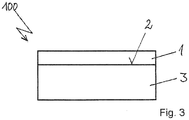
- Figure 3 shows a composite 100 of a thermoplastic 3 and a silicone 1, and the silicone 1 adheres to the surface 2, which was activated by the method described above.
- the composite 100 can comprise any form of thermoplastics and silicones, the thermoplastic 3 for example, a glass fiber reinforced polyamide, a polycarbonate, a polypropylene, a methyl methacrylate-acrylonitrile-butadiene-styrene, a methyl methacrylate or an acrylonitrile-butadiene-styrene, and wherein the thermoplastic 3 forms a body, for example a component.
- the silicone 1 can comprise a liquid silicone rubber or a high consistency silicone rubber, and the silicone 1 serves for example as a sealing lip on the component made of thermoplastic material, for example a sealing lip for a housing cover, soft handle for a brush, buttons for operating an electrical device, membrane in thermoplastic components, windshield wipers and the like.
- Figure 4 shows a table with measured Shulwidersteil for different material combinations of thermoplastics and silicones.
- the plastics PA6 GF25 glass fiber reinforced polyamide, PA
- various polycarbonates PC
- polypropylene PP
- methyl methacrylate-acrylonitrile-butadiene-styrene MABS
- methyl methacrylate and acrylonitrile-butadiene-styrene ABS
- thermoplastics Apart from a specific material pairing with a polycarbonate, a self-adhesive LSR is listed as silicone, a standard LSR being paired with the polycarbonate (Caliber 2081).
- the LSR silicone corresponds to a liquid silicone rubber.
- the peeling tests were carried out in accordance with the VDI Guideline 2019.
- the exposure times reflect the times at which the surface of the thermoplastics was exposed to the UV-C radiation. If no average peel resistances are given, there is a cohesive break, i.e. that the silicone material is torn inside and not at the interface with the thermoplastic. As a result, the peel resistance is then greater than the material strength of the LSR.
- the vulcanization temperature refers to the temperature at which the liquid silicone rubber was vulcanized, with the duration of the vulcanization being indicated at the same time.
- the sample preparation describes the form in which the liquid silicone rubber was applied to the surface of the thermoplastic.
- the peeling resistance generally increases with the duration of the UV-C irradiation, with the irradiation being carried out for up to 30 seconds. Particularly good results were obtained with irradiation times from 5 seconds for the material polycarbonate paired with self-adhesive LSR and with standard -LSR achieved. With an irradiation time of 10 seconds, good peeling results were achieved with MABS, PMMA and ABS.
Landscapes
- Engineering & Computer Science (AREA)
- Mechanical Engineering (AREA)
- Chemical & Material Sciences (AREA)
- Organic Chemistry (AREA)
- Manufacturing & Machinery (AREA)
- Treatments Of Macromolecular Shaped Articles (AREA)
- Adhesives Or Adhesive Processes (AREA)
Description
- Die Erfindung betrifft ein Verfahren zur Verbesserung der Haftung von Silikon auf der Oberfläche eines Thermoplasten. Weiterhin richtet sich die Erfindung auf einen Verbund aus einem Thermoplasten und einem auf einer Oberfläche des Thermoplasten aufgebrachten Silikons.
- Aus der
US 8,293,061 B2 ist ein Verfahren zum Bonden von zwei thermoplastischen Oberflächen bekannt, und es wird angegebenen, dass die thermoplastischen Oberflächen mit UV-C-Strahlung bestrahlt werden können, um die Oberflächen zu aktivieren. Dadurch wird die Bondfestigkeit der thermoplastisch-thermoplastischen Verbindung erhöht. Eine derartige Oberflächenaktivierung basiert auf der Erzeugung von Sauerstoffradikalen aus der Luft, die mit Radikalen an der Materialoberfläche reagieren. Dadurch entsteht eine chemisch veränderte Oberfläche des Thermoplasten, Folglich können die beiden Thermoplastoberflächen aufeinander gebracht und im Bondverfahren miteinander verbunden werden. - Sollen ungleiche Materialien miteinander verbunden werden, also beispielsweise ein Silikon und ein Thermoplast, so sind verschiedene Aktivierungsverfahren bekannt, um die Oberfläche des Thermoplasten zu aktivieren, damit eine Haftungsverbesserung des Silikons erreicht wird. Dabei soll das Silikon beispielsweise im Spritzgussverfahren auf die Oberfläche des Thermoplasten aufgebracht werden. Bekannt sind Haftvermittler, die als Additivierung im Werkstoff des Thermoplasten vorliegen können, ebenfalls ist es bekannt, den Werkstoff des Silikons entsprechend zu additivieren, um einen Haftvermittler zu schaffen. Nachteilhafterweise führen derartige Additivierungen zu einer erheblichen Kostensteigerung bei der Beschaffung entsprechend additivierter Thermoplasten oder Silikone.
- Weiterhin ist eine Aktivierung der Thermoplast-Oberfläche mittels einer sogenannten Koronabehandlung bekannt, und der Koronaprozess basiert auf einer alternierenden elektrischen Entladung in Luftatmosphäre. Erzeugte energiereiche Elektronen bilden Radikale auf der Materialoberfläche, die mittels ebenfalls gebildeter Sauerstoffradikalen aus der Luft reagieren.
- Ein weiteres physikalisches Verfahren zur Oberflächenbehandlung ist die Beflammung. Durch das Einwirken der Gasflamme werden an der Substratoberfläche Molekülbindungen aufgebrochen, die den Einbau von Radikalen aus der Flamme in die Molekülkette ermöglichen. Die an der Substratoberfläche entstandenen polaren Gruppen sind in der Lage, sich mit anderen Materialien zu verbinden.
- Neben einer Beflammung ist ferner eine Aktivierung der Thermoplast-Oberfläche mittels eines Plasmas bekannt. Bei einer Plasmaaktivierung wird eine gezielte Modifizierung einer Oberflächenspannung des Thermoplasten durch Plasmaenergie erreicht, wodurch ebenfalls eine erhebliche Haftungsverbesserung erreicht wird.
- Mit den verschiedenen aus dem Stand der Technik bekannten Verfahren zur Oberflächenaktivierung eines Thermoplasten für die Haftvermittlung zu einem Silikon gehen verschiedene Nachteile einher. Beispielsweise kann es bei thermischen Verfahren wie dem Beflammen zu einem Verzug des Werkstückes kommen, ebenfalls können sich Farbveränderungen der Oberfläche ergeben. Bei der Plasmatechnik oder der Koronabehandlung sind aufwendige Anlagentechniken erforderlich, und es entstehen insbesondere bei hohen elektrischen Spannungen von Anlagenbauteilen Gefahren für den Bediener. Hohe Betriebskosten, ein hoher Energiebedarf und hohe Investitionskosten sind weitere Faktoren, die einen alternativen Prozess zur Aktivierung der Oberfläche eines Thermoplasten für die Haftvermittlung eines Silikons erforderlich erscheinen lassen.
- Es ist die Aufgabe der Erfindung, ein Verfahren zur Verbesserung der Haftung von Silikon auf der Oberfläche eines Thermoplasten zu entwickeln, mit dem die Nachteile des vorstehend beschriebenen Standes der Technik vermieden werden und das mit einfachen Mitteln ausgeführt werden kann und entsprechend wirkungsvoll ist. Insbesondere soll eine deutliche Haftverbesserung eines Silikons auf der Öberflache eines Thermoplasten erreicht werden.
- Diese Aufgabe wird ausgehend von einem Verfahren gemäß dem Oberbegriff des Anspruches 1 und ausgehend von einem Verbund gemäß Anspruch 9 mit den jeweils kennzeichnenden Merkmalen gelöst. Vorteilhafte Weiterbildungen der Erfindung sind in den abhängigen Ansprüchen angegeben.
- Die Erfindung schließt die technische Lehre ein, dass die Oberfläche des Thermoplasten zur Verbesserung der Haftung von Silikon auf der Öberflache mit einer UV-C-Strahlung bestrahlt wird.
- Die Erfindung nutzt UV-C-Strahlung zur Aktivierung der Oberfläche des Thermoplasten, um speziell eine Verbesserung der Haftung von Silikon auf der Oberfläche zu erreichen. Wird das Silikon nach der Bestrahlung auf die Oberfläche aufgebracht, so ist eine deutliche Haftungsverbesserung des Silikons auf dem Thermoplasten zu verzeichnen. Das Verfahren sieht dabei im Speziellen eine selektive Bestrahlung der Oberfläche in den Bereichen vor, in denen das Silikon auf die Oberfläche aufgebracht werden soll. Angrenzende Oberflächenbereiche des Thermoplasten, an die das Silikon nicht anhaften soll, können beispielsweise vor der UV-C-Strahlung abgedeckt werden.
- Die UV-C-Strahlung wird mit besonderem Vorteil mit einer Wellenlänge von 100nm bis 280nm, vorzugsweise von 150nm bis 200nm und besonders bevorzugt von 180nm bis 190nm bereitgestellt, Besonders gute Ergebnisse konnten überraschend mit einer Wellenlänge der UV-C-Strahlung von 185nm erzielt werden.
- Mit weiterem Vorteil wird die UV-C-Strahlung mittels einer Strahlungsquelle erzeugt, wobei die Strahlungsquelle während der Bestrahlung über der Oberfläche des Thermoplasten bewegt wird. Beispielsweise kann die UV-C-Strahlung die Oberflächenbereiche des thermoplastischen Werkstückes so abfahren, dass die Bereiche der Öberflache aktiviert werden, die mit dem Silikon haftvermittelt werden sollen. Auch ist es denkbar, dass die Strahlungsquelle ruhend über der Oberfläche des Thermoplasten angeordnet und betrieben wird, und beispielsweise kann eine entsprechende Maske Verwendung finden, um gezielte Bereiche zu aktivieren und weitere Bereiche von der Aktivierung auszuschließen.
- Gemäß einer vorteilhaften Weiterbildung des erfindungsgemäßen Verfahrens wird die Bestrahlung der Oberfläche des Thermoplasten innerhalb einer nach außen abgedunkelten Bestrahlungskammer ausgeführt. Damit ist die Bestrahlungskammer insbesondere so ausgebildet, dass keine UV-C-Strahlung aus der Bestrahlungskammer austreten kann. Somit wird auf einfache Weise eine Gefahr beispielsweise für einen Bediener ausgeschlossen, die von der UV-C-Strahlung ausgeht. Die Bestrahlungskammer kann so ausgeführt sein, dass das thermoplastische Werkstück in die Bestrahlungskammer eingelegt werden kann. Ferner kann die Strahlungsquelle innerhalb der Bestrahlungskammer angeordnet sein.
- Mit weiterem Vorteil wird die Bestrahlung der Oberfläche des Thermoplasten mittels der UV-C-Strahlung unter Bildung von Ozon ausgeführt, wobei das Ozon während der Bestrahlung mit der Oberfläche wechselwirkt. Bei der Bestrahlung von thermoplastischen Materialien mit UV-C-Strahlung wurde festgestellt, dass durch die Wechselwirkung mit dem Luftsauerstoff Ozon gebildet wird, wobei das Ozon wiederum unter Wechselwirkung mit der Oberfläche des Thermoplasten eine deutliche Verbesserung der Aktivierung der Oberfläche erzeugt. Folglich wird das gebildete Ozon zusätzlich genutzt, um die Verbesserung der Haftung von Silikon auf der Oberfläche des Thermoplasten zu erzeugen.
- Wird die Bestrahlung innerhalb eines geschlossenen Raumes insbesondere innerhalb einer nach außen abgedunkelten Bestrahlungskammer ausgeführt, so wird in Verbindung mit dem Ozon insbesondere der Vorteil erreicht, dass das Ozon im oberflächennahen Bereich des Thermoplasten verbleibt und eine entsprechende Wechselwirkung mit der Oberfläche eingehen kann, Zur Verstärkung dieses Effektes kann zudem vorgesehen sein, die Bestrahlungskammer entsprechend zu optimieren, um möglichst eine intensive Wechselwirkung des Ozons mit der Oberfläche sicherzustellen. Beispielsweise wird die Bestrahlungskammer in der Größe so klein gewählt, dass eine möglichst hohe Konzentration des Ozons über der Oberfläche des Thermoplasten vorherrscht.
- Die Dauer der Bestrahlung beträgt beispielsweise drei Sekunden bis 15 Minuten, Insbesondere beträgt die Bestrahlungsdauer fünf Sekunden bis 30 Sekunden, womit bereits sehr gute Haftungsergebnisse des Silikons auf der thermoplastischen Oberfläche erzielt werden können.
- Das Verfahren sieht zum einen die Bereitstellung eines thermoplastischen Werkstoffes vor, zum anderen wird ein Silikon bereitgestellt, das mit dem Thermoplasten verbunden werden soll. Mit besonderem Vorteil wird als Thermoplast ein Polyamid, beispielsweise ein PA6 GF25, Polycarbonat, ein Polypropylen, ein Methylmethacrylat-Acrylnitril-Butadien-Styrol, ein Methylmethacrylat oder ein Acrylnitril-Butadien-Styrol bereitgestellt. Als Silikon kann ein Liquid Silicone Rubber oder ein High Consistency Silicone Rubber bereitgestellt werden. Das Silikon in Form des Liquid Silicone Rubber, kurz LSR, wird insbesondere als selbsthaftendes LSR bereitgestellt.
- Das Verfahren eignet sich insbesondere zur Vorbereitung der Oberfläche eines Thermoplasten, um das Silikon an den Thermoplasten im Spritzgussverfahren anzuspritzen. Die Vulkanisationstemperatur beträgt dabei beispielsweise 1 70° für PA6 GF25, 140° für Polycarbonat und 80° für Polypropylen, MABS, PMMA und ABS. Die Vulkanisationszeit kann dabei von 20 Sekunden bis drei Stunden dauern. Abschälversuche haben gezeigt, dass abhängig von der Materialpaarung der Schälwiderstand größer sein kann als die Materialfestigkeit, beispielsweise bei der Verwendung von Polycarbonat als thermoplastischer Werkstoff, wobei der Schälwiderstand ebenfalls größer als die Materialfestigkeit ist bei Verbindungen mit MABS, PMMA und ABS, auf welche selbsthaltender LSR bei der Vorbehandlung durch UV-C Strahlung aufgebracht wurde, Der Auftrag auf PP, MABS, PMMA und ABS kann dabei manuell erfolgen. Polycarbonat als thermoplastischer Kunststoff wird insbesondere im Spritzguss hergestellt.
- Die Erfindung richtet sich weiterhin auf einen Verbund aus einem Thermoplasten und einem auf einer Oberfläche des Thermoplasten ausgebrachten Silikons, wobei die Oberfläche des Thermoplasten mit dem vorstehend beschriebenen Verfahren aktiviert wurde. Insbesondere wurde die Oberfläche mit einer UV-C-Strahlung bestrahlt. Der Verbund zeichnet sich insbesondere dadurch aus, dass zunächst ein thermoplastisches Werkstück bereitgestellt wird, anschließend erfolgt die Bestrahlung der Oberfläche mit UV-C-Strahlung und schließlich wird das Silikon auf die aktivierte Oberfläche mittels eines Spritzgussverfahrens aufgebracht. Als Verbund zwischen einem Thermoplasten und einem Silikon kann ein Stumpfstoß, T-Stoß, eine überlappende Verbindung oder eine vollständige oder partielle flächige Verbindung vorgesehen sein.
- Weitere, die Erfindung verbessernde Maßnahmen werden nachstehend gemeinsam mit der Beschreibung eines bevorzugten Ausführungsbeispiels der Erfindung anhand der Figuren näher dargestellt. Es zeigt:
- Figur 1
- eine Ansicht eines Thermoplasten mit einer Oberfläche, die zur Verbesserung der Haftung von Silikon auf der Oberfläche mit einer UV-C-Strahlung bestrahlt wird,
- Figur 2
- eine quergeschnittene Ansicht durch einen Aufbau zur Bestrahlung eines Thermoplasten mit einer UV-C-Strahlung mittels einer Strahlungsquelle,
- Figur 3
- ein Verbund aus einem Thermoplasten mit einem aufgebrachten Silikon und
- Figur 4
- eine Tabelle mit gemessenen Schälwiderständen für verschiedene Materialpaarungen aus Thermoplasten und Silikonen.
-
Figur 1 zeigt in schematischer Weise die Bestrahlung einer Oberfläche 2 eines Thermoplasten 3 mit einer UV-C-Strahlung 4. Zur Erzeugung der UV-C-Strahlung 4 ist schematisch eine Strahlungsquelle 5 gezeigt, und die Strahlungsquelle 5 ist beispielsweise durch eine Gasentladungslampe gebildet, beispielsweise durch eine Niederdrucklampe in Form einer Quecksilberdampflampe. Die Bestrahlung der Oberfläche 2 führt zu einer Aktivierung, die zur Verbesserung der Haftung von Silikon auf der Oberfläche 2 dienen soll. Wird das Silikon beispielsweise nur in diskreten Bereichen auf der Oberfläche 2 aufgebracht, beispielsweise durch einen Spritzgussprozess, so wird auch nur ein Teil der Oberfläche 2 aktiviert, sodass schematisch eine aktivierte Oberfläche 7 gezeigt ist, über die die UV-C-Strahlung 4 geführt wurde, was angedeutet ist mit einem Pfeil, Alternativ zum Abscannen der Oberfläche zur Erzeugung der aktivierten Oberfläche 7 mit der UV-C- Strahlung 4 können auch eine Maske oder sonstige Abschattungsmittel Verwendung finden, um Teile der Oberfläche 2 von der Bestrahlung fernzuhalten und Teile der Oberfläche 2 zu aktivieren, wie mit der aktivierten Oberfläche 7 gezeigt. -
Figur 2 zeigt einen Aufbau zur Bestrahlung der Oberfläche 2 eines Thermoplasten 3, und der Aufbau umfasst eine Werkstückaufnahme 10 zur Aufnahme des Thermoplasten 3, wobei die zu aktivierende Oberfläche 2 in Richtung zu einer Strahlungsquelle 5 gerichtet ist. Der Thermoplast 3 befindet sich in einer Bestrahlungskammer 6, die durch ein Gehäuse 9 umgrenzt ist. Wird die Oberfläche 2 des Thermoplasten 3 mit UV-C-Strahlung 4 bestrahlt, so entsteht Ozon 8, und das Ozon 8 wird durch die Bestrahlungskammer 6 in Kontakt mit der Oberfläche 2 gehalten, sodass das Ozon 8 mit der Oberfläche 2 wechselwirken kann. Durch das Vorhandensein von Ozon 8, welches durch den eigentlichen Bestrahlungsprozess gebildet wird, wird der Aktivierungsprozess verstärkt, wodurch die Haftung von Silikon auf der Oberfläche 2 des Thermoplasten 3 weiter verbessert wird. -
Figur 3 zeigt einen Verbund 100 aus einem Thermoplasten 3 und einem Silikon 1, und das Silikon 1 haftet an der Oberfläche 2 an, die mit dem zuvor beschriebenen Verfahren aktiviert wurde, Der Verbund 100 kann dabei jede Form von Thermoplasten und Silikonen umfassen, wobei der Thermoplast 3 beispielsweise ein glasfaserverstärktes Polyamid, ein Polycarbonat, ein Polypropylen, ein Methylmethacrylat-Acrylnitril-Butadien-Styrol, ein Methylmethacrylat oder ein Acrylnitril-Butadien-Styrol umfassen kann und wobei der Thermoplast 3 einen Körper, beispielsweise ein Bauteil bildet. Das Silikon 1 kann ein Liquid Silicone Rubber oder ein High Consistency Silicone Rubber umfassen, und das Silikon 1 dient beispielsweise als Dichtlippe auf dem Bauteil aus thermoplastischem Material, beispielsweise eine Dichtlippe für einen Gehäusedeckel, Softgriff für eine Bürste, Tasten für die Bedienung eines Elektrogerätes, Membrane in thermoplastischen Bauteilen, Scheibenwischer und dergleichen. -
Figur 4 zeigt eine Tabelle mit gemessenen Schälwidersländen für verschiedene Materialpaarungen aus Thermoplasten und Silikonen. Als Thermoplasten sind die Kunststoffe PA6 GF25 (glasfaserverstärktes Polyamid, PA), verschiedene Polycarbonate (PC), Polypropylen (PP), Methylmethacrylat-Acrylnitril-Butadien-Styrol (MABS), Methylmethacrylat und Acrylnitril-Butadien-Styrol (ABS) aufgeführt. Als Silikon ist bis auf eine gezielte Materialpaarung mit einem Polycarbonat ein selbsthaftender LSR aufgeführt, wobei mit dem Polycarbonat (Calibre 2081) ein Standard- LSR gepaart wurde. Das LSR- Silikon entspricht dabei einem Flüssigsilikonkautschuk. - Die Schälversuche wurden in Anlehnung an die VDI Richtlinie 2019 durchgeführt. Die Bestrahlzeiten geben dabei die Zeiten wieder, mit denen die Oberfläche der Thermoplasten mit der UV-C-Strahlung bestrahlt wurde. Sind keine gemittelten Schälwiederstände angegeben, so liegt ein Kohäsivbruch vor, d.h. dass das Silikonmaterial in sich und nicht an der Grenzfläche zum Thermoplasten gerissen ist. Folglich ist dann der Schälwiderstand größer als die Materialfestigkeit des LSR.
- Die Vulkanisationstemperatur bezieht sich auf die Temperatur, bei der der Flüssigsilikonkautschuk ausvulkanisiert wurde, wobei zugleich die Vulkanisationsdauer angegeben ist Die Probenherstellung beschreibt, in welcher Form der Flüssigsilikonkautschuk auf der Oberfläche des Thermoplasten aufgetragen wurde.
- Wie die Schälversuche zeigen, steigt allgemein der Schälwiderstand mit der Dauer der UV-C-Bestrahlung, wobei die Bestrahlung bis zu 30 Sekunden vorgenommen wurde, Besonders gute Ergebnisse wurden dabei mit Bestrahlungsdauern ab 5 Sekunden für das Material Polycarbonat gepaart mit selbsthaftendem LSR und mit Standard-LSR erzielt. Bei einer Bestrahlungsdauer von 10 Sekunden wurden gute Abschälergebnisse mit MABS, PMMA und ABS erzielt.
-
- 1
- Silikon
- 2
- Oberfläche
- 3
- Thermoplast
- 4
- UV-C-Strahlung
- 5
- Strahlungsquelle
- 6
- Bestrahlungskammer
- 7
- aktivierte Oberfläche
- 8
- Ozon
- 9
- Gehäuse
- 10
- Werkstückaufnahme
- 100
- Verbund
Claims (10)
- Verfahren zur Verbesserung der Haftung von Silikon (1) auf der Oberfläche (2) eines Thermoplasten (3),
dadurch gekennzeichnet,
dass die Oberfläche (2) des Thermoplasten (3) mit einer UV-C-Strahlung (4) bestrahlt wird. - Verfahren nach Anspruch 1,
dadurch gekennzeichnet,
dass die UV-C-Strahlung (4) mit einer Wellenlänge von 100nm bis 280nm oder von 150nm bis 200nm oder von 180nm bis 190nm bereitgestellt wird. - Verfahren nach Anspruch 1 oder 2,
dadurch gekennzeichnet,
dass die UV-C-Strahlung mittels einer Strahlungsquelle (5) erzeugt wird, welche Strahlungsquelle (5) während der Bestrahlung über der Oberfläche (2) des Thermoplasten (3) bewegt wird. - Verfahren nach einem der Ansprüche 1 bis 3,
dadurch gekennzeichnet,
dass die Bestrahlung der Oberfläche (2) des Thermoplasten (3) innerhalb einer nach außen abgedunkelten Bestrahlungskammer (6) ausgeführt wird. - Verfahren nach einem der vorgenannten Ansprüche,
dadurch gekennzeichnet,
dass die Bestrahlung der Oberfläche (2) des Thermoplasten (3) unter Bildung von Ozon (8) ausgeführt wird, wobei das Ozon (8) währen der Bestrahlung mit der Oberfläche (2) wechselwirkt. - Verfahren nach einem der vorgenannten Ansprüche,
dadurch gekennzeichnet,
dass die Bestrahlung mit einer Strahlungsleistung von 5W bis 15W und/oder dass die Bestrahlung mit einer Quecksilberdampflampe als Strahlungsquelle (5) ausgeführt wird. - Verfahren nach einem der vorgenannten Ansprüche,
dadurch gekennzeichnet,
dass die Bestrahlung mit einer Strahlungsdauer von 3sec. bis 15min. ausgeführt wird. - Verfahren nach einem der vorgenannten Ansprüche,
dadurch gekennzeichnet,
dass als Thermoplast (3) ein glasfaserverstärktes Polyamid, ein Polycarbonat, ein Polypropylen, ein Methylmethacrylat-Acrylnitril-Butadien-Styrol, ein Methylmethacrylat oder ein Acrylnitril-Butadien-Styrol bereitgestellt wird und/oder dass als Silikon (1) ein Liquid Silicone Rubber oder ein High Consistency Silicone Rubber bereitgestellt wird. - Verbund (100) aus einem Thermoplasten (3) und einem auf einer Oberfläche (2) des Thermoplasten (3) angeordneten Silikons (1), wobei die Oberfläche (2) mit einem Verfahren gemäß einem der Ansprüche 1 bis 8 aktiviert wurde und die Bindung des Silikons (1) mit der Oberfläche (2) des Thermoplasten (3) auf der Erzeugung von Sauerstoffradikalen aus der Luft durch eine UV-C-Bestrahlung (4) der Oberfläche (2) des Thermoplasten (3) basiert.
- Verbund (100) gemäß Anspruch 9,
dadurch gekennzeichnet,
dass das Silikon (1) auf die aktivierte Oberfläche (7) mittels eines Spritzgussverfahrens aufgebracht wird.
Applications Claiming Priority (2)
| Application Number | Priority Date | Filing Date | Title |
|---|---|---|---|
| DE102016002011.3A DE102016002011A1 (de) | 2016-02-20 | 2016-02-20 | Verfahren zur Haftverbesserung von Silikon auf einer thermoplastischen Oberfläche |
| PCT/DE2016/100581 WO2017140288A1 (de) | 2016-02-20 | 2016-12-13 | Verfahren zur haftverbesserung von silikon auf einer thermoplastischen oberfläche |
Publications (2)
| Publication Number | Publication Date |
|---|---|
| EP3417025A1 EP3417025A1 (de) | 2018-12-26 |
| EP3417025B1 true EP3417025B1 (de) | 2020-07-08 |
Family
ID=58094089
Family Applications (1)
| Application Number | Title | Priority Date | Filing Date |
|---|---|---|---|
| EP16838021.0A Active EP3417025B1 (de) | 2016-02-20 | 2016-12-13 | Verfahren zur haftverbesserung von silikon auf einer thermoplastischen oberfläche |
Country Status (8)
| Country | Link |
|---|---|
| US (1) | US20200039195A1 (de) |
| EP (1) | EP3417025B1 (de) |
| JP (1) | JP7075123B2 (de) |
| KR (1) | KR102167846B1 (de) |
| CN (1) | CN108779369A (de) |
| CA (1) | CA3014826C (de) |
| DE (1) | DE102016002011A1 (de) |
| WO (1) | WO2017140288A1 (de) |
Families Citing this family (4)
| Publication number | Priority date | Publication date | Assignee | Title |
|---|---|---|---|---|
| DE102018202449A1 (de) * | 2018-02-19 | 2019-02-21 | Conti Temic Microelectronic Gmbh | Leadframe einer elektronischen Komponente und Verfahren zur Ummantelung eines Leadframes einer elektronischen Komponente |
| CN114446513A (zh) * | 2020-11-04 | 2022-05-06 | 进营全球株式会社 | 柔性扁平电缆与包含柔性扁平电缆的叠层母排 |
| JP7524488B2 (ja) | 2021-03-30 | 2024-07-29 | ダウ シリコーンズ コーポレーション | シリコーンゴムの熱可塑性物質への接着 |
| DE102022125594A1 (de) * | 2022-10-05 | 2024-04-11 | Rico Group Gmbh | Verfahren zur lokalen Haftungsbeeinflussung zwischen einem Silikonwerkstoff und einem Thermoplasten |
Family Cites Families (18)
| Publication number | Priority date | Publication date | Assignee | Title |
|---|---|---|---|---|
| KR0157844B1 (ko) | 1988-07-15 | 1998-10-15 | 모리나카 마사미 | 수지봉지형 반도체장치 및 제조방법 |
| JP3185311B2 (ja) * | 1992-02-03 | 2001-07-09 | 東レ株式会社 | エアバッグの製造方法 |
| DE69314997T2 (de) * | 1992-06-19 | 1998-03-05 | Fuji Polymertech Co Ltd | Verfahren zur Herstellung einer Fingertaste für einen Handhabeschalter |
| US6015759A (en) | 1997-12-08 | 2000-01-18 | Quester Technology, Inc. | Surface modification of semiconductors using electromagnetic radiation |
| JP3509615B2 (ja) * | 1999-03-31 | 2004-03-22 | 株式会社ダスキン | マット |
| US6565927B1 (en) | 1999-04-07 | 2003-05-20 | Board Of Trustees Of Michigan State University | Method for treatment of surfaces with ultraviolet light |
| EP1380354A4 (de) | 2001-03-21 | 2004-07-21 | Bridgestone Corp | Verfahren zur herstellung einer antifouling-beschichtung und antifouling-material mit antifouling-beschichtung |
| JP2002309019A (ja) | 2001-04-18 | 2002-10-23 | Idemitsu Petrochem Co Ltd | 成形品及び成形品の接着方法 |
| JP4875858B2 (ja) | 2004-05-28 | 2012-02-15 | 株式会社朝日ラバー | 半導体光学素子用レンズの製造方法 |
| FR2890970B1 (fr) | 2005-09-16 | 2008-03-14 | Rhodia Recherches & Tech | Procede de preparation d'un revetement silicone anti- adherent |
| JP2008230237A (ja) | 2007-02-22 | 2008-10-02 | Toray Ind Inc | 複合構造体 |
| US8293061B2 (en) * | 2008-03-06 | 2012-10-23 | University Of Maryland College Park | Low temperature polymer bonding using UV/ozone surface treatment |
| DE102011086103A1 (de) * | 2011-11-10 | 2013-05-16 | Wacker Chemie Ag | Siliconkautschuk auf Schmelzkleber |
| JP2013206871A (ja) | 2012-03-29 | 2013-10-07 | Konica Minolta Inc | 光蓄電池電極、光蓄電池電極の製造方法および光蓄電池 |
| JP6094241B2 (ja) | 2012-04-27 | 2017-03-15 | 三菱化学株式会社 | 端部部材の製造方法、及び感光体ドラムユニットの製造方法 |
| EP2862893B1 (de) * | 2012-07-25 | 2018-02-28 | Toray Industries, Inc. | Prepreg und kohlenstofffaserverstärkter verbundstoff |
| JP2014186232A (ja) | 2013-03-25 | 2014-10-02 | Mitsubishi Chemicals Corp | 端部部材の製造方法、及び感光体ドラムユニットの製造方法 |
| WO2015053405A1 (ja) | 2013-10-10 | 2015-04-16 | コニカミノルタ株式会社 | ガスバリア性フィルムの製造方法 |
-
2016
- 2016-02-20 DE DE102016002011.3A patent/DE102016002011A1/de not_active Ceased
- 2016-12-13 CN CN201680082072.2A patent/CN108779369A/zh active Pending
- 2016-12-13 CA CA3014826A patent/CA3014826C/en active Active
- 2016-12-13 EP EP16838021.0A patent/EP3417025B1/de active Active
- 2016-12-13 US US15/999,763 patent/US20200039195A1/en not_active Abandoned
- 2016-12-13 KR KR1020187025521A patent/KR102167846B1/ko not_active Expired - Fee Related
- 2016-12-13 JP JP2018542701A patent/JP7075123B2/ja active Active
- 2016-12-13 WO PCT/DE2016/100581 patent/WO2017140288A1/de not_active Ceased
Non-Patent Citations (1)
| Title |
|---|
| None * |
Also Published As
| Publication number | Publication date |
|---|---|
| US20200039195A1 (en) | 2020-02-06 |
| CN108779369A (zh) | 2018-11-09 |
| CA3014826A1 (en) | 2017-08-24 |
| KR20190017722A (ko) | 2019-02-20 |
| CA3014826C (en) | 2021-01-19 |
| EP3417025A1 (de) | 2018-12-26 |
| WO2017140288A1 (de) | 2017-08-24 |
| JP2019509373A (ja) | 2019-04-04 |
| DE102016002011A1 (de) | 2017-08-24 |
| JP7075123B2 (ja) | 2022-05-25 |
| KR102167846B1 (ko) | 2020-10-20 |
Similar Documents
| Publication | Publication Date | Title |
|---|---|---|
| DE102016002011A1 (de) | Verfahren zur Haftverbesserung von Silikon auf einer thermoplastischen Oberfläche | |
| WO2012013184A2 (de) | Verfahren und vorrichtung zum aufbringen einer dichtung auf eine oberfläche eines gerätegehäuses für ein kraftfahrzeug | |
| DE102015214914B4 (de) | Verbundkörper aus unterschiedlichen Materialien und Verfahren zur Herstellung desselben | |
| DE102010000088B4 (de) | Verfahren und Vorrichtung zum Herstellen von Polymerkaschierungen oder strangförmigen Aufträgen an einem Substrat | |
| DE102005057891B4 (de) | Verfahren und Vorrichtung zum Verbinden eines Kunstoff-Werkstücks mit einem weiteren Werkstück | |
| EP2243620A2 (de) | Verfahren und Vorrichtung zur Herstellung eines Verbundbauteils aus einem Metallbauteil und einem Polymerformteil | |
| EP4079497A1 (de) | Verfahren zum entfernen von anhaftenden materialschichten von fahrzeugreifen | |
| EP4349572B1 (de) | Verfahren zur lokalen haftungsbeeinflussung zwischen einem silikonwerkstoff und einem thermoplasten | |
| DE10024706C2 (de) | Verfahren zur Herstellung einer geklebten Verbundstruktur | |
| WO2004035857A2 (de) | Plasmapolymere haftschichten | |
| DE102016124416A1 (de) | Verfahren zum beschichten eines kunststoffbauteils mit einem schmelzklebstoff | |
| EP1388470A2 (de) | Verfahren zum Verbinden von Bauteilen, insbesondere von Scheibenwischeranlagen, mit Karosserieteilen eines Kraftfahrzeuges | |
| DE102015008953B4 (de) | Verfahren zum Vorbehandeln thermoplastischer Bauteile zum Strukturkleben - und Vorrichtung zum Bearbeiten einer Oberfläche | |
| DE102009004606A1 (de) | Vorrichtung und Verfahren zur Bearbeitung einer Nahtabdichtung | |
| DE102015202120A1 (de) | Verfahren zur Herstellung eines Kunststoff-Metall-Hybridbauteil | |
| DE102022214420A1 (de) | Verfahren zum Verkleben eines Bauteils, welches einen Kunststoff-Faser-Verbundwerkstoff aufweist, und Bauteilverbund | |
| EP2926951B1 (de) | Verfahren zur gleichzeitigen Reinigung und Aktivierung von Bauteiloberflächen durch eine Kombination aus Kohlendioxidschneestrahlen und dem Auftrag von haftvermittelnden Substanzen | |
| DE102019128541B4 (de) | Verfahren und Vorrichtung zur Behandlung von Fehlstellen in einer Oberfläche eines Transportbands | |
| DE102009026945A1 (de) | Verfahren zum dauerhaften Verbinden zweier Bauteile | |
| EP1760052A1 (de) | Verfahren zur Verbindung einer Fahrzeugscheibe mit einem vorgefertigten Bauteil | |
| WO2017036700A1 (de) | Verfahren zur herstellung eines mehrkomponenten-spritzgussbauteils | |
| DE102004061268A1 (de) | Verfahren zur Aktivierung einer Kunststoffoberfläche | |
| DE102016219136A1 (de) | Fügeverfahren zum Fügen von Fügepartnern im Sichtflächenbereich | |
| DE102011115412A1 (de) | Verfahren zum Entfernen von Funktionsschichten | |
| WO2019170877A1 (de) | Uv-aktivierung von klebstoffen insbesondere beim einkleben von scheiben eines kraftfahrzeuges |
Legal Events
| Date | Code | Title | Description |
|---|---|---|---|
| STAA | Information on the status of an ep patent application or granted ep patent |
Free format text: STATUS: UNKNOWN |
|
| STAA | Information on the status of an ep patent application or granted ep patent |
Free format text: STATUS: THE INTERNATIONAL PUBLICATION HAS BEEN MADE |
|
| PUAI | Public reference made under article 153(3) epc to a published international application that has entered the european phase |
Free format text: ORIGINAL CODE: 0009012 |
|
| STAA | Information on the status of an ep patent application or granted ep patent |
Free format text: STATUS: REQUEST FOR EXAMINATION WAS MADE |
|
| 17P | Request for examination filed |
Effective date: 20180817 |
|
| AK | Designated contracting states |
Kind code of ref document: A1 Designated state(s): AL AT BE BG CH CY CZ DE DK EE ES FI FR GB GR HR HU IE IS IT LI LT LU LV MC MK MT NL NO PL PT RO RS SE SI SK SM TR |
|
| AX | Request for extension of the european patent |
Extension state: BA ME |
|
| DAV | Request for validation of the european patent (deleted) | ||
| DAX | Request for extension of the european patent (deleted) | ||
| GRAP | Despatch of communication of intention to grant a patent |
Free format text: ORIGINAL CODE: EPIDOSNIGR1 |
|
| STAA | Information on the status of an ep patent application or granted ep patent |
Free format text: STATUS: GRANT OF PATENT IS INTENDED |
|
| INTG | Intention to grant announced |
Effective date: 20200218 |
|
| GRAS | Grant fee paid |
Free format text: ORIGINAL CODE: EPIDOSNIGR3 |
|
| GRAA | (expected) grant |
Free format text: ORIGINAL CODE: 0009210 |
|
| STAA | Information on the status of an ep patent application or granted ep patent |
Free format text: STATUS: THE PATENT HAS BEEN GRANTED |
|
| AK | Designated contracting states |
Kind code of ref document: B1 Designated state(s): AL AT BE BG CH CY CZ DE DK EE ES FI FR GB GR HR HU IE IS IT LI LT LU LV MC MK MT NL NO PL PT RO RS SE SI SK SM TR |
|
| REG | Reference to a national code |
Ref country code: AT Ref legal event code: REF Ref document number: 1288428 Country of ref document: AT Kind code of ref document: T Effective date: 20200715 Ref country code: CH Ref legal event code: EP |
|
| REG | Reference to a national code |
Ref country code: DE Ref legal event code: R096 Ref document number: 502016010480 Country of ref document: DE |
|
| REG | Reference to a national code |
Ref country code: IE Ref legal event code: FG4D Free format text: LANGUAGE OF EP DOCUMENT: GERMAN |
|
| REG | Reference to a national code |
Ref country code: LT Ref legal event code: MG4D |
|
| REG | Reference to a national code |
Ref country code: NL Ref legal event code: MP Effective date: 20200708 |
|
| PG25 | Lapsed in a contracting state [announced via postgrant information from national office to epo] |
Ref country code: NO Free format text: LAPSE BECAUSE OF FAILURE TO SUBMIT A TRANSLATION OF THE DESCRIPTION OR TO PAY THE FEE WITHIN THE PRESCRIBED TIME-LIMIT Effective date: 20201008 Ref country code: BG Free format text: LAPSE BECAUSE OF FAILURE TO SUBMIT A TRANSLATION OF THE DESCRIPTION OR TO PAY THE FEE WITHIN THE PRESCRIBED TIME-LIMIT Effective date: 20201008 Ref country code: FI Free format text: LAPSE BECAUSE OF FAILURE TO SUBMIT A TRANSLATION OF THE DESCRIPTION OR TO PAY THE FEE WITHIN THE PRESCRIBED TIME-LIMIT Effective date: 20200708 Ref country code: LT Free format text: LAPSE BECAUSE OF FAILURE TO SUBMIT A TRANSLATION OF THE DESCRIPTION OR TO PAY THE FEE WITHIN THE PRESCRIBED TIME-LIMIT Effective date: 20200708 Ref country code: PT Free format text: LAPSE BECAUSE OF FAILURE TO SUBMIT A TRANSLATION OF THE DESCRIPTION OR TO PAY THE FEE WITHIN THE PRESCRIBED TIME-LIMIT Effective date: 20201109 Ref country code: HR Free format text: LAPSE BECAUSE OF FAILURE TO SUBMIT A TRANSLATION OF THE DESCRIPTION OR TO PAY THE FEE WITHIN THE PRESCRIBED TIME-LIMIT Effective date: 20200708 Ref country code: SE Free format text: LAPSE BECAUSE OF FAILURE TO SUBMIT A TRANSLATION OF THE DESCRIPTION OR TO PAY THE FEE WITHIN THE PRESCRIBED TIME-LIMIT Effective date: 20200708 Ref country code: ES Free format text: LAPSE BECAUSE OF FAILURE TO SUBMIT A TRANSLATION OF THE DESCRIPTION OR TO PAY THE FEE WITHIN THE PRESCRIBED TIME-LIMIT Effective date: 20200708 Ref country code: GR Free format text: LAPSE BECAUSE OF FAILURE TO SUBMIT A TRANSLATION OF THE DESCRIPTION OR TO PAY THE FEE WITHIN THE PRESCRIBED TIME-LIMIT Effective date: 20201009 |
|
| PG25 | Lapsed in a contracting state [announced via postgrant information from national office to epo] |
Ref country code: IS Free format text: LAPSE BECAUSE OF FAILURE TO SUBMIT A TRANSLATION OF THE DESCRIPTION OR TO PAY THE FEE WITHIN THE PRESCRIBED TIME-LIMIT Effective date: 20201108 Ref country code: LV Free format text: LAPSE BECAUSE OF FAILURE TO SUBMIT A TRANSLATION OF THE DESCRIPTION OR TO PAY THE FEE WITHIN THE PRESCRIBED TIME-LIMIT Effective date: 20200708 Ref country code: RS Free format text: LAPSE BECAUSE OF FAILURE TO SUBMIT A TRANSLATION OF THE DESCRIPTION OR TO PAY THE FEE WITHIN THE PRESCRIBED TIME-LIMIT Effective date: 20200708 Ref country code: PL Free format text: LAPSE BECAUSE OF FAILURE TO SUBMIT A TRANSLATION OF THE DESCRIPTION OR TO PAY THE FEE WITHIN THE PRESCRIBED TIME-LIMIT Effective date: 20200708 |
|
| PG25 | Lapsed in a contracting state [announced via postgrant information from national office to epo] |
Ref country code: NL Free format text: LAPSE BECAUSE OF FAILURE TO SUBMIT A TRANSLATION OF THE DESCRIPTION OR TO PAY THE FEE WITHIN THE PRESCRIBED TIME-LIMIT Effective date: 20200708 |
|
| REG | Reference to a national code |
Ref country code: DE Ref legal event code: R097 Ref document number: 502016010480 Country of ref document: DE |
|
| PG25 | Lapsed in a contracting state [announced via postgrant information from national office to epo] |
Ref country code: DK Free format text: LAPSE BECAUSE OF FAILURE TO SUBMIT A TRANSLATION OF THE DESCRIPTION OR TO PAY THE FEE WITHIN THE PRESCRIBED TIME-LIMIT Effective date: 20200708 Ref country code: CZ Free format text: LAPSE BECAUSE OF FAILURE TO SUBMIT A TRANSLATION OF THE DESCRIPTION OR TO PAY THE FEE WITHIN THE PRESCRIBED TIME-LIMIT Effective date: 20200708 Ref country code: RO Free format text: LAPSE BECAUSE OF FAILURE TO SUBMIT A TRANSLATION OF THE DESCRIPTION OR TO PAY THE FEE WITHIN THE PRESCRIBED TIME-LIMIT Effective date: 20200708 Ref country code: SM Free format text: LAPSE BECAUSE OF FAILURE TO SUBMIT A TRANSLATION OF THE DESCRIPTION OR TO PAY THE FEE WITHIN THE PRESCRIBED TIME-LIMIT Effective date: 20200708 Ref country code: IT Free format text: LAPSE BECAUSE OF FAILURE TO SUBMIT A TRANSLATION OF THE DESCRIPTION OR TO PAY THE FEE WITHIN THE PRESCRIBED TIME-LIMIT Effective date: 20200708 Ref country code: EE Free format text: LAPSE BECAUSE OF FAILURE TO SUBMIT A TRANSLATION OF THE DESCRIPTION OR TO PAY THE FEE WITHIN THE PRESCRIBED TIME-LIMIT Effective date: 20200708 |
|
| PLBE | No opposition filed within time limit |
Free format text: ORIGINAL CODE: 0009261 |
|
| STAA | Information on the status of an ep patent application or granted ep patent |
Free format text: STATUS: NO OPPOSITION FILED WITHIN TIME LIMIT |
|
| PG25 | Lapsed in a contracting state [announced via postgrant information from national office to epo] |
Ref country code: AL Free format text: LAPSE BECAUSE OF FAILURE TO SUBMIT A TRANSLATION OF THE DESCRIPTION OR TO PAY THE FEE WITHIN THE PRESCRIBED TIME-LIMIT Effective date: 20200708 |
|
| 26N | No opposition filed |
Effective date: 20210409 |
|
| PG25 | Lapsed in a contracting state [announced via postgrant information from national office to epo] |
Ref country code: SK Free format text: LAPSE BECAUSE OF FAILURE TO SUBMIT A TRANSLATION OF THE DESCRIPTION OR TO PAY THE FEE WITHIN THE PRESCRIBED TIME-LIMIT Effective date: 20200708 |
|
| PG25 | Lapsed in a contracting state [announced via postgrant information from national office to epo] |
Ref country code: SI Free format text: LAPSE BECAUSE OF FAILURE TO SUBMIT A TRANSLATION OF THE DESCRIPTION OR TO PAY THE FEE WITHIN THE PRESCRIBED TIME-LIMIT Effective date: 20200708 Ref country code: MC Free format text: LAPSE BECAUSE OF FAILURE TO SUBMIT A TRANSLATION OF THE DESCRIPTION OR TO PAY THE FEE WITHIN THE PRESCRIBED TIME-LIMIT Effective date: 20200708 |
|
| REG | Reference to a national code |
Ref country code: BE Ref legal event code: MM Effective date: 20201231 |
|
| PG25 | Lapsed in a contracting state [announced via postgrant information from national office to epo] |
Ref country code: IE Free format text: LAPSE BECAUSE OF NON-PAYMENT OF DUE FEES Effective date: 20201213 Ref country code: LU Free format text: LAPSE BECAUSE OF NON-PAYMENT OF DUE FEES Effective date: 20201213 |
|
| PG25 | Lapsed in a contracting state [announced via postgrant information from national office to epo] |
Ref country code: TR Free format text: LAPSE BECAUSE OF FAILURE TO SUBMIT A TRANSLATION OF THE DESCRIPTION OR TO PAY THE FEE WITHIN THE PRESCRIBED TIME-LIMIT Effective date: 20200708 Ref country code: MT Free format text: LAPSE BECAUSE OF FAILURE TO SUBMIT A TRANSLATION OF THE DESCRIPTION OR TO PAY THE FEE WITHIN THE PRESCRIBED TIME-LIMIT Effective date: 20200708 Ref country code: CY Free format text: LAPSE BECAUSE OF FAILURE TO SUBMIT A TRANSLATION OF THE DESCRIPTION OR TO PAY THE FEE WITHIN THE PRESCRIBED TIME-LIMIT Effective date: 20200708 |
|
| PG25 | Lapsed in a contracting state [announced via postgrant information from national office to epo] |
Ref country code: MK Free format text: LAPSE BECAUSE OF FAILURE TO SUBMIT A TRANSLATION OF THE DESCRIPTION OR TO PAY THE FEE WITHIN THE PRESCRIBED TIME-LIMIT Effective date: 20200708 |
|
| PG25 | Lapsed in a contracting state [announced via postgrant information from national office to epo] |
Ref country code: BE Free format text: LAPSE BECAUSE OF NON-PAYMENT OF DUE FEES Effective date: 20201231 |
|
| P01 | Opt-out of the competence of the unified patent court (upc) registered |
Effective date: 20230525 |
|
| REG | Reference to a national code |
Ref country code: DE Ref legal event code: R081 Ref document number: 502016010480 Country of ref document: DE Owner name: RICO GROUP GMBH, AT Free format text: FORMER OWNER: UNIVERSITAET KASSEL, 34125 KASSEL, DE |
|
| REG | Reference to a national code |
Ref country code: GB Ref legal event code: 732E Free format text: REGISTERED BETWEEN 20240307 AND 20240313 |
|
| REG | Reference to a national code |
Ref country code: AT Ref legal event code: PC Ref document number: 1288428 Country of ref document: AT Kind code of ref document: T Owner name: RICO GROUP GMBH, AT Effective date: 20240422 |
|
| REG | Reference to a national code |
Ref country code: CH Ref legal event code: U11 Free format text: ST27 STATUS EVENT CODE: U-0-0-U10-U11 (AS PROVIDED BY THE NATIONAL OFFICE) Effective date: 20260101 |
|
| PGFP | Annual fee paid to national office [announced via postgrant information from national office to epo] |
Ref country code: GB Payment date: 20251218 Year of fee payment: 10 |
|
| PGFP | Annual fee paid to national office [announced via postgrant information from national office to epo] |
Ref country code: AT Payment date: 20251209 Year of fee payment: 10 |
|
| PGFP | Annual fee paid to national office [announced via postgrant information from national office to epo] |
Ref country code: FR Payment date: 20251218 Year of fee payment: 10 |
|
| PGFP | Annual fee paid to national office [announced via postgrant information from national office to epo] |
Ref country code: DE Payment date: 20251222 Year of fee payment: 10 |
|
| PGFP | Annual fee paid to national office [announced via postgrant information from national office to epo] |
Ref country code: CH Payment date: 20260101 Year of fee payment: 10 |