EP3413334A1 - Neue chlorsilylarylgermane, verfahren zu deren herstellung und deren verwendung - Google Patents
Neue chlorsilylarylgermane, verfahren zu deren herstellung und deren verwendung Download PDFInfo
- Publication number
- EP3413334A1 EP3413334A1 EP17197538.6A EP17197538A EP3413334A1 EP 3413334 A1 EP3413334 A1 EP 3413334A1 EP 17197538 A EP17197538 A EP 17197538A EP 3413334 A1 EP3413334 A1 EP 3413334A1
- Authority
- EP
- European Patent Office
- Prior art keywords
- nmr
- gecl
- preparation
- mhz
- reaction
- Prior art date
- Legal status (The legal status is an assumption and is not a legal conclusion. Google has not performed a legal analysis and makes no representation as to the accuracy of the status listed.)
- Granted
Links
Images

Classifications
-
- B—PERFORMING OPERATIONS; TRANSPORTING
- B01—PHYSICAL OR CHEMICAL PROCESSES OR APPARATUS IN GENERAL
- B01J—CHEMICAL OR PHYSICAL PROCESSES, e.g. CATALYSIS OR COLLOID CHEMISTRY; THEIR RELEVANT APPARATUS
- B01J31/00—Catalysts comprising hydrides, coordination complexes or organic compounds
- B01J31/02—Catalysts comprising hydrides, coordination complexes or organic compounds containing organic compounds or metal hydrides
- B01J31/0234—Nitrogen-, phosphorus-, arsenic- or antimony-containing compounds
- B01J31/0235—Nitrogen containing compounds
- B01J31/0239—Quaternary ammonium compounds
-
- C—CHEMISTRY; METALLURGY
- C07—ORGANIC CHEMISTRY
- C07F—ACYCLIC, CARBOCYCLIC OR HETEROCYCLIC COMPOUNDS CONTAINING ELEMENTS OTHER THAN CARBON, HYDROGEN, HALOGEN, OXYGEN, NITROGEN, SULFUR, SELENIUM OR TELLURIUM
- C07F7/00—Compounds containing elements of Groups 4 or 14 of the Periodic Table
- C07F7/30—Germanium compounds
-
- B—PERFORMING OPERATIONS; TRANSPORTING
- B01—PHYSICAL OR CHEMICAL PROCESSES OR APPARATUS IN GENERAL
- B01J—CHEMICAL OR PHYSICAL PROCESSES, e.g. CATALYSIS OR COLLOID CHEMISTRY; THEIR RELEVANT APPARATUS
- B01J31/00—Catalysts comprising hydrides, coordination complexes or organic compounds
- B01J31/02—Catalysts comprising hydrides, coordination complexes or organic compounds containing organic compounds or metal hydrides
- B01J31/0234—Nitrogen-, phosphorus-, arsenic- or antimony-containing compounds
- B01J31/0255—Phosphorus containing compounds
- B01J31/0267—Phosphines or phosphonium compounds, i.e. phosphorus bonded to at least one carbon atom, including e.g. sp2-hybridised phosphorus compounds such as phosphabenzene, the other atoms bonded to phosphorus being either carbon or hydrogen
- B01J31/0268—Phosphonium compounds, i.e. phosphine with an additional hydrogen or carbon atom bonded to phosphorous so as to result in a formal positive charge on phosphorous
-
- C—CHEMISTRY; METALLURGY
- C01—INORGANIC CHEMISTRY
- C01B—NON-METALLIC ELEMENTS; COMPOUNDS THEREOF; METALLOIDS OR COMPOUNDS THEREOF NOT COVERED BY SUBCLASS C01C
- C01B33/00—Silicon; Compounds thereof
- C01B33/06—Metal silicides
-
- C—CHEMISTRY; METALLURGY
- C01—INORGANIC CHEMISTRY
- C01G—COMPOUNDS CONTAINING METALS NOT COVERED BY SUBCLASSES C01D OR C01F
- C01G17/00—Compounds of germanium
-
- C—CHEMISTRY; METALLURGY
- C07—ORGANIC CHEMISTRY
- C07F—ACYCLIC, CARBOCYCLIC OR HETEROCYCLIC COMPOUNDS CONTAINING ELEMENTS OTHER THAN CARBON, HYDROGEN, HALOGEN, OXYGEN, NITROGEN, SULFUR, SELENIUM OR TELLURIUM
- C07F7/00—Compounds containing elements of Groups 4 or 14 of the Periodic Table
- C07F7/02—Silicon compounds
- C07F7/025—Silicon compounds without C-silicon linkages
-
- B—PERFORMING OPERATIONS; TRANSPORTING
- B01—PHYSICAL OR CHEMICAL PROCESSES OR APPARATUS IN GENERAL
- B01J—CHEMICAL OR PHYSICAL PROCESSES, e.g. CATALYSIS OR COLLOID CHEMISTRY; THEIR RELEVANT APPARATUS
- B01J2231/00—Catalytic reactions performed with catalysts classified in B01J31/00
- B01J2231/60—Reduction reactions, e.g. hydrogenation
- B01J2231/62—Reductions in general of inorganic substrates, e.g. formal hydrogenation, e.g. of N2
-
- C—CHEMISTRY; METALLURGY
- C07—ORGANIC CHEMISTRY
- C07B—GENERAL METHODS OF ORGANIC CHEMISTRY; APPARATUS THEREFOR
- C07B2200/00—Indexing scheme relating to specific properties of organic compounds
- C07B2200/13—Crystalline forms, e.g. polymorphs
-
- C—CHEMISTRY; METALLURGY
- C07—ORGANIC CHEMISTRY
- C07F—ACYCLIC, CARBOCYCLIC OR HETEROCYCLIC COMPOUNDS CONTAINING ELEMENTS OTHER THAN CARBON, HYDROGEN, HALOGEN, OXYGEN, NITROGEN, SULFUR, SELENIUM OR TELLURIUM
- C07F9/00—Compounds containing elements of Groups 5 or 15 of the Periodic Table
- C07F9/02—Phosphorus compounds
- C07F9/28—Phosphorus compounds with one or more P—C bonds
- C07F9/54—Quaternary phosphonium compounds
- C07F9/5442—Aromatic phosphonium compounds (P-C aromatic linkage)
-
- H—ELECTRICITY
- H10—SEMICONDUCTOR DEVICES; ELECTRIC SOLID-STATE DEVICES NOT OTHERWISE PROVIDED FOR
- H10P—GENERIC PROCESSES OR APPARATUS FOR THE MANUFACTURE OR TREATMENT OF DEVICES COVERED BY CLASS H10
- H10P14/00—Formation of materials, e.g. in the shape of layers or pillars
- H10P14/20—Formation of materials, e.g. in the shape of layers or pillars of semiconductor materials
- H10P14/26—Formation of materials, e.g. in the shape of layers or pillars of semiconductor materials using liquid deposition
- H10P14/265—Formation of materials, e.g. in the shape of layers or pillars of semiconductor materials using liquid deposition using solutions
-
- H—ELECTRICITY
- H10—SEMICONDUCTOR DEVICES; ELECTRIC SOLID-STATE DEVICES NOT OTHERWISE PROVIDED FOR
- H10P—GENERIC PROCESSES OR APPARATUS FOR THE MANUFACTURE OR TREATMENT OF DEVICES COVERED BY CLASS H10
- H10P14/00—Formation of materials, e.g. in the shape of layers or pillars
- H10P14/20—Formation of materials, e.g. in the shape of layers or pillars of semiconductor materials
- H10P14/34—Deposited materials, e.g. layers
- H10P14/3402—Deposited materials, e.g. layers characterised by the chemical composition
- H10P14/3404—Deposited materials, e.g. layers characterised by the chemical composition being Group IVA materials
- H10P14/3411—Silicon, silicon germanium or germanium
Definitions
- the present invention relates to novel Chlorsilylarylgermane, a process for their preparation and their use.
- Halogensilanes, polyhalosilanes, halogenatedermanes, polyhalogenomers, silane, polysilanes, German, polygermanes and corresponding mixed compounds have long been known, cf. in addition to the common textbooks of inorganic chemistry also WO 2004/036631 A2 or CJ Ritter et al., J. Am. Chem. Soc., 2005, 127, 9855-9864 ,
- phenyl- and hydrogen-containing compounds are known in which Sn-Sis and Sn-Ge bonds are present ( JB Tice et al., J. Inorganic Chemistry, 2009, 48 (13), 6314-6320 ). It is suggested to use these compounds as IR semiconductors.
- Singh et al. disclose in the patent US 7,540,920 B2 Si-Ge compounds of the formula X 1 X 2 X 3 -Si-Ge X 4 X 5 X 6 with hydrogen or halogen radicals X 1-6 .
- Chlorsilylarylgermane is virtually unknown until today. For example, fundamental research endeavors to find new connections and to search for new ways of producing, in particular with regard to possible industrial and, if necessary, upgradeable applications.
- the object of the present invention was to provide novel silicon-germanium compounds and a process for their preparation.
- the term “equivalent”, in short “eq.” Means the amount of the catalyst in mol, based on the amount of hexachlorodisilane in mol. For example, 0.1 eq. Catalyst 0.1 mol of catalyst per mole of hexachlorodisilane or 10 mol% of catalyst based on hexachlorodisilane.
- hexachlorodisilane is also abbreviated to “HCDS”.
- Chlorosilylarylgermanes of the general formula (I) have already been registered.
- the chlorosilylarylgermanes may be selected from the series trichlorosilyltriphenylgerman and / or 1,2-bis (trichlorosilyl) -1,1,2,2-tertraphenyldigerman.
- step (b) of the process described above it may be advantageous to carry out the reaction at room temperature.
- a triaryl chloride ether in a molar ratio to hexachlorodisilane of 1 to 1 and / or a diaryldichlorogerman in a molar ratio to hexachlorodisilane of 1 to 2 can be used.
- an aryl chlorogermaner from the series Triphenylchlorgerman and / or Diphenyldichlorgerman can preferably be used.
- the solvent used in step (a) is preferably chosen to be inert in order to avoid undesired reactions with HCDS.
- Dichloromethane can be used particularly advantageously since it does not react with HCDS in the selected temperature ranges.
- Another aspect of carrying out the process economically is the selection of the amount of solvent.
- at least 5 moles of solvent are used per mole of hexachlorodisilane, more preferably from 10 moles to 100 moles of solvent per mole of hexachlorodisilane.
- the reaction it is advantageous to carry out the reaction with thorough mixing, preferably with stirring, and over a period of 1 to 24 hours, preferably for 12 hours, and furthermore preferably under protective gas, preferably under nitrogen or argon, and then to remove the solvent ,
- This may preferably be carried out in an oxygen-free dry environment, more preferably in an isolated environment, for example in a glovebox, and further preferably under normal pressure or reduced pressure, preferably in the range of 1 to 500 hPa, yielding formed chlorosilylarylgermane as a crystalline product.
- the process is subjected to a surprisingly simple modification, namely, by using instead of the Arylchlorgerman GeCl 4 .
- the reaction reaction is then carried out subsequently with hexachlorodisilane in a solvent and in the presence of a catalyst.
- the invention thus provides a process for the preparation of Trichlorsilyltrichlorgerman by dissolving GeCl 4 with hexachlorodisilane in a solvent and in the presence of a catalyst at a temperature of 5 to 40 ° C.
- the catalyst may be advantageous to use in amounts of from 0.001 to 1 eq., Preferably from 0.01 to 0.1 eq. use.
- An exemplary implementation of this method is described in Example 3.
- Example 4 The synthesis carried out according to Example 4 represents a new possibility for obtaining [R 4 N] [GeCl 3 ] salts by varying the cation [R 4 N] + and using the desired chloride salt for heterolytic cleavage of the Si 2 Cl 6 , This is particularly interesting since it has been found that the cation decides how well a compound crystallizes.
- [R 4 N] [GeCl 3 ] and [R 4 P] [GeCl 2 ] salts can be prepared.
- [Ph 4 P] + may be used as a cation to obtain tris-trichlorosilylgermanide (Example 5).
- tris-trichlorosilylgermanide can be reacted with GaCl 3 . This is explained in Example 6 .
- tris-trichlorosilylgermanide can be carried out with BBr 3 , as illustrated by way of example in Example 7 .
- Si-Ge compounds according to the invention or prepared according to the invention can serve as a precursor for materials which are used for the selective deposition of thin Si-Ge layers.
- the invention likewise relates to the use of the trichlorosilyltrichlorogerman produced according to the invention for the production of Si-Ge layers.
- the chlorosilylarylgerman or trichlorosilyltrichlorogerman produced according to the invention can preferably be used with conversion into the chlorinated form, in the hydrogenated form, and / or with their thermal decomposition.
- room temperature is abbreviated to "RT” in the examples.
- Hexachlorodisilane "HCDS" for short, GeCl 4 from Evonik Industries AG, triphenylchlorogerman, diphenyldichlorogerman.
- Example 1 Preparation of trichlorosilyltriphenylgermane ( 1 ).
- Example 6 Preparation of tris (trichlorosilyl) germanide on GaCl 3 (6) adduct.
- Example 7 Preparation of tris (trichlorosilyl) germanide on BBr 3 (7) adduct.
Landscapes
- Chemical & Material Sciences (AREA)
- Organic Chemistry (AREA)
- Engineering & Computer Science (AREA)
- Materials Engineering (AREA)
- Chemical Kinetics & Catalysis (AREA)
- Inorganic Chemistry (AREA)
- Catalysts (AREA)
- Low-Molecular Organic Synthesis Reactions Using Catalysts (AREA)
Abstract
Description
- Die vorliegende Erfindung betrifft neue Chlorsilylarylgermane, ein Verfahren zur deren Herstellung sowie deren Verwendung.
- Halogensilane, Polyhalogensilane, Halogengermane, Polyhalogengermane, Silan, Polysilane, German, Polygermane sowie entsprechende Mischverbindungen sind lange bekannt, vgl. neben den gängigen Lehrbüchern der anorganischen Chemie auch
WO 2004/036631 A2 oder C.J. Ritter et al., J. Am. Chem. Soc., 2005, 127, 9855-9864. - L. Müller et al. beschreiben in J. Organomet. Chem., 1999, 579,156-163, u.a. die Herstellung von Trichlorsilylmethylgermanen.
- Aus der Angew. Chem., 1993, 105, 587-588 (G. Sih et al.) sowie aus Tetrahedron Lett., 1970, 51, 4443-4447 (F. Feher et al.) sind Methylgermylsilane sowie Phenylgermylsilane bekannt.
- Ferner sind Phenyl- und Wasserstoff-enthaltende Verbindungen bekannt, in denen Sn-Sisowie Sn-Ge-Bindungen vorliegen (J.B. Tice et al., J. Inorganic Chemistry, 2009, 48(13), 6314-6320). Dabei wird angeregt, diese Verbindungen als IR Halbleiter zu verwenden.
- Singh et al. offenbaren in der Patentschrift
US 7,540,920 B2 Si-Ge Verbindungen der Formel X1X2X3-Si-Ge- X4X5X6 mit Wasserstoff- oder Halogen-Resten X1-6. - Über Chlorsilylarylgermane ist bis heute praktisch nichts bekannt. So ist man seitens der Grundlagenforschung bestrebt, neue Verbindungen aufzufinden und neue Herstellungswege zu suchen, insbesondere auch mit Hinblick auf mögliche industrielle sowie ggf. verbesserbare Anwendungen.
- Der vorliegenden Erfindung lag die Aufgabe zugrunde, neue Silicium-Germanium Verbindungen sowie ein Verfahren zu deren Herstellung bereit zu stellen.
- Überraschenderweise wurde als neue Synthesemöglichkeit zur Herstellung von Silicium-Germanium Verbindungen, insbesondere
R3Ge-SiCl3, Cl3Si-GeR2-GeR2-SiCl3, Cl3Ge-SiCl3, [Ph4P][Ge(SiCl3)3],
[Ph4P][Ge(SiCl3)3*GaCl3], [Ph4P][Ge(SiCl3)3*BBr3],
die Umsetzung von chlorierten oder perchlorierten, organischen oder nicht organischen Germaniumverbindungen des Typs RnGeCl4-n (n = 0,2,3) mit Hexachlordisilan unter Zugabe von katalytischen Mengen eines Ammoniumchloridsalzes [R4N]Cl oder eines Phosphoniumsalzes [R4P]Cl mit den Resten R = Me, Et, iPr, nBu bzw. unter Zugabe von stöchiometrischen Mengen solcher Salze gefunden. Durch die erfindungsgemäße Umsetzung werden verschiedene Silicium-Germanium Verbindungen erhalten. - Des Weiteren wurde gefunden, dass Edukte des Typs R3GeCl sich durch die Reaktion mit Si2Cl6 in Anwesenheit von Ammoniumchlorid umsetzen, wobei an der Ge-Cl Position eine Ge-Si Bindungsknüpfung stattfindet. Bei der Umsetzung von R2GeCl2 mit Si2Cl6/Ammoniumchlorid erfolgt die Ge-Si Bindungsbildung nur an einer Ge-Cl Position. Zusätzlich tritt eine Ge-Ge Bindungsknüpfung an der zweiten Ge-Cl Position auf. Die so gefundenen bzw. hergestellten Germanium-Silicium-Verbindungen lassen sich mit LiAlH4 in Siliciumhydridverbindungen überführen. Solche Verbindungen werden im Rahmen der Erfindung am Beispiel Ph3Ge-SiCl3 mit der Synthese von Ph3Ge-SiH3 hergestellt. Im Fall der Reaktionen von Verbindungen des Typs RnGeCl4-n (n = 0) finden je nach Stöchiometrie unterschiedliche Reaktionen statt.
Es wurden
[R4N][GeCl3]- Salze (GeCl4:Si2Cl6:[R4N]Cl, 1:1:1),
Cl3Si-GeCl3 (GeCl4:Si2Cl6:[R4N]Cl, 1:1:0.1),
oder
[Ph4P][Ge(SiCl3)3] (GeCl4:Si2Cl6:[Ph4P]Cl, 1:4:1)
erzeugt. [Ph4P][Ge(SiCl3)3] lässt sich mit Lewis-Säuren, abgekürzt "LS", zu den entsprechenden Addukten [Ph4P][Ge(SiCl3)3*LS] umsetzen. - Im Rahmen der Erfindung wird unter dem Maß "equivalent", kurz "eq.", die Menge des Katalysators in mol bezogen auf die Menge Hexachlordisilan in mol verstanden. Beispielsweise bedeutet 0,1 eq. Katalysator 0,1 mol Katalysator pro mol Hexachlordisilan oder 10 mol-% Katalysator bezogen auf Hexachlordisilan.
- Im Rahmen der Erfindung wird "Hexachlordisilan" auch mit "HCDS" abgekürzt.
- Angemeldet wurden bereits Chlorsilylarylgermane der allgemeinen Formel (I)
XGe(Y2)-SiCl3 (I),
wobei X = Y oder X = [-Ge(Y2)-SiCl3] ist und die Gruppen Y unabhängig voneinander für Phenyl (Ph) stehen. - Ein Verfahren zur Herstellung eines Chlorsilylarylgerman ist dadurch gekennzeichnet, dass man
- (a) ein Arylchlorgerman mit Hexachlordisilan in einem Lösemittel löst und
- (b) in Gegenwart eines Katalysator bei einer Temperatur von 5 bis 40 °C umsetzt, wobei die Aryl-Gruppen des Arylchlorgermans unabhängig voneinander für Phenyl
- Die Chlorsilylarylgermane können ausgewählt sein aus der Reihe Trichlorsilyltriphenylgerman und/oder 1,2-Bis(trichlorsilyl)-1,1,2,2-tertraphenyldigerman.
- Im Schritt (b) des oben bezeichneten Verfahrens kann es vorteilhaft sein, die Umsetzung bei Raumtemperatur durchzuführen.
- Vorzugsweise kann man im Schritt (a) des Verfahrens ein Triarylchlorgerman in einem molaren Verhältnis zu Hexachlordisilan von 1 zu 1 und/oder ein Diaryldichlorgerman in einem molaren Verhältnis zu Hexachlordisilan von 1 zu 2 einsetzen.
- Weiterhin kann bevorzugt ein Arylchlorgerman aus der Reihe Triphenylchlorgerman und/oder Diphenyldichlorgerman eingesetzt werden.
- Das im Schritt (a) eingesetzte Lösemittel ist vorzugsweise inert gewählt, um unerwünschte Umsetzungen mit HCDS zu vermeiden. Besonders vorteilhaft kann Dichlormethan eingesetzt werden, da dieses in den gewählten Temperaturbereichen nicht mit HCDS reagiert.
- Es kann weiterhin vorteilhaft sein, bei der Durchführung des besagten Verfahrens als Katalysator Phosphoniumchloride [R4P]Cl oder Ammoniumchloridsalze [R4N]Cl einzusetzen, wobei die Reste R ausgewählt sind aus Me, Et, iPr, nBu, Ph. Vorzugsweise kann R = nBu gewählt werden.
- Es wird beobachtet, dass die Umsetzung umso langsamer abläuft, je weniger Katalysator man einsetzt. Andererseits sind zu große Mengen Katalysator nicht wünschenswert, da dieser am Ende der Umsetzungsreaktion abgetrennt werden muss. Es wurde gefunden, dass das Verfahren wirtschaftlich im Hinblick auf den Abtrennungsaufwand durchgeführt werden kann, wenn man den Katalysator in einer Menge von 0,001 bis 1 mol pro mol Hexachlordisilan einsetzt. Das Verfahren wird besonders günstig durchgeführt, wenn man von 0,01 bis 0,1 mol pro mol Hexachlordisilan einsetzt.
- Ein weiterer Aspekt, das Verfahren wirtschaftlich durchzuführen, ist die Auswahl der Menge des Lösemittels. In dem Verfahren wird vorzugsweise mindestens 5 mol Lösemittel pro mol Hexachlordisilan, besonders bevorzugt von 10 mol bis 100 mol Lösemittel pro mol Hexachlordisilan eingesetzt.
- In dem Verfahren ist es vorteilhaft, die Umsetzung unter Durchmischung, bevorzugt unter Rühren, und über eine Dauer von 1 bis 24 Stunden, vorzugsweise während 12 h, und weiterhin vorzugsweise unter Schutzgas, bevorzugt unter Stickstoff oder Argon durchzuführen, und anschließend das Lösemittel zu entfernen. Dies kann vorzugsweise in Sauerstoff freier trockener Umgebung vorgenommen werden, besonders bevorzugt in einer isolierten Umgebung, beispielsweise in einer Glovebox, und weiterhin bevorzugt unter Normaldruck oder vermindertem Druck, bevorzugt im Bereich von 1 bis 500 hPa, wobei man gebildete Chlorsilylarylgermane als kristallines Produkt gewinnt.
- Mit dem Verfahren kann auch das interessante Molekül Trichlorsilyltrichlorgerman bereitgestellt werden, welches bereits bei
Singh et al. (US 7,540,920 B2 ) ohne eine Methode zur Herstellung offenbart ist. - Hierzu wird das Verfahren einer überraschend einfachen Modifikation unterzogen, nämlich, indem anstelle des Arylchlorgerman GeCl4 eingesetzt wird. Die Umsetzungsreaktion wird dann im Weiteren mit Hexachlordisilan in einem Lösemittel und in Anwesenheit eines Katalysators durchgeführt.
- Gegenstand der Erfindung ist somit ein Verfahren zur Herstellung von Trichlorsilyltrichlorgerman, indem man GeCl4 mit Hexachlordisilan in einem Lösemittel löst und in Gegenwart eines Katalysators bei einer Temperatur von 5 bis 40 °C umsetzt.
- Es kann vorteilhaft sein, den Katalysator in Mengen von 0,001 bis 1 eq., vorzugsweise von 0,01 bis 0,1 eq. einzusetzen. Eine beispielhafte Durchführung dieses Verfahrens schildert Beispiel 3.
- Wird das erfindungsgemäße Verfahren dadurch modifiziert, indem man das Ammoniumchloridsalz [R4N]Cl oder Phosphoniumchloridsalz [R4P]Cl anstelle in katalytischer in stöchiometrischer Menge einsetzt, vorzugsweise von 0,5 bis 1,5 eq., besonders bevorzugt 1 eq., dann werden überraschend Halogengermanide erhalten, beispielsweise beim Einsatz von [R4N]Cl oder [R4P]Cl Trichlorogermanid. Eine bevorzugte Durchführung mit R = Bu schildert Beispiel 4.
- Die gemäß Beispiel 4 durchgeführte Synthese stellt eine neue Möglichkeit zur Gewinnung von [R4N][GeCl3]-Salzen dar, indem das Kation [R4N]+ variiert und das gewünschte Chloridsalz zur heterolytischen Spaltung des Si2Cl6 verwendet wird. Dies ist besonders interessant, da gefunden worden ist, dass das Kation darüber entscheidet, wie gut eine Verbindung kristallisiert.
- So kann man erfindungsgemäß eine große Vielzahl an [R4N][GeCl3]- und [R4P][GeCl2]-Salzen herstellen. Beispielsweise kann in einer bevorzugten Ausführung dieses Verfahrens [Ph4P]+ als Kation eingesetzt werden, um Tris-Trichlorsilylgermanid zu erhalten (Beispiel 5). Des Weiteren kann Tris-Trichlorsilylgermanid mit GaCl3 umgesetzt werden. Dies wird im Beispiel 6 erläutert.
- Anstelle einer Umsetzung mit GaCl3 kann Tris-Trichlorsilylgermanid mit BBr3 erfolgen, wie dies beispielhaft im Beispiel 7 erläutert ist.
- Die erfindungsgemäßen oder erfindungsgemäß hergestellten Si-Ge Verbindungen können als Vorstufe für Materialien dienen, die für die gezielte Abscheidung von dünnen Si-Ge Schichten eingesetzt werden.
- Gleichfalls ist Gegenstand der Erfindung die Verwendung des erfindungsgemäß hergestellten Trichlorsilyltrichlorgerman für die Erzeugung von Si-Ge Schichten. Weiterhin können das Chlorsilylarylgerman bzw. das erfindungsgemäß hergestellte Trichlorsilyltrichlorgerman vorzugsweise unter Umwandlung in die chlorierte Form, in die hydrierte Form, und/oder unter deren thermischer Zersetzung verwendet werden.
- Die nachfolgenden Beispiele erläutern die vorliegende Erfindung zusätzlich, ohne den Gegenstand zu beschränken. Der Begriff "Raumtemperatur" wird in den Beispielen mit "RT" abgekürzt.
- Die Daten für alle Strukturen wurden bei 173 K mit einem STOE IPDS II Zweikreisdiffraktometer mit einer Genix Mikrofokusröhre mit Spiegeloptik unter Verwendung von MoK α Strahlung (λ = 0,71073 A) gesammelt und mit dem frame scaling procedure des Programms X-AREA (Stoe & Cie, 2002) skaliert. Die Strukturen wurden mit direkten Methoden mit Hilfe des Programms SHELXS (Sheldrick, 2008) gelöst und gegen F2 mit der full-matrix least-squares Technik verfeinert. Zellparameter wurden durch Verfeinerung gegen θ Werte der Reflexe mit l>6σ(l) bestimmt.
- Hexachlordisilan, kurz "HCDS", GeCl4 von Evonik Industries AG, Triphenylchlorgerman, Diphenyldichlorgerman.
- Die Synthese erfolgte gemäß Gleichung 1 aus Ph3GeCl und Si2Cl6 unter Zugabe einer katalytischen Menge von 0,1 eq [nBu4N]Cl.


- Zu einer klaren, farblosen Lösung aus 500 mg entsprechend 1,47 mmol Ph3GeCl und 40 mg oder 0,14 mmol [nBu4N]Cl in 5 ml oder 78,3 mmol CH2Cl2 wurden unter Rühren bei Raumtemperatur 400 mg entsprechend 1,49 mmol Si2Cl6 gegeben. Es wurde eine klare, farblose Reaktionslösung erhalten, die während 12 h gerührt wurde. Aus der Reaktionslösung ließ sich nach langsamem Entfernen des Lösemittels ein Rohprodukt in Form eines farblosen, kristallinen Feststoffes 1 isolieren. Die Ausbeute betrug 59 %. Das Rohprodukt enthielt noch zu etwa 30 % das Edukt Ph3GeCl. Durch eine röntgendiffraktometrische Untersuchung konnte die Kristallstruktur von 1 ermittelt werden (
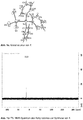
Abb. 1a ). Nicht gekennzeichnete Atome stehen in der Abbildung für Wasserstoff. - Das 29Si NMR Spektrum von 1 ist in
Abb. 1b dargestellt.
Alle Ergebnisse einer 1H, 13C und 29Si NMR-spektroskopischen Untersuchung: -
- δ = 13,3.
- 1H NMR (500,2 MHz, CD2Cl2, 298 K):
- δ = 7,58 (m); 7,75 (dd 3J(H,H) = 8,0 Hz, 2J(H,H) = 1,4 Hz).
- 13C NMR (125,0 MHz, CD2Cl2, 298 K):
- δ = 128,9; 130,1; 132,2; 135,3.
- Die Synthese erfolgte gemäß Gleichung 2 aus Ph2GeCl2 und Si2Cl6 unter Zugabe von katalytischen Mengen (0.1 eq) [nBu4N]Cl.

- Zu einer klaren, farblosen Lösung, enthaltend 500 mg oder 1,68 mmol Ph2GeCl2 und 90 mg oder 0,17 mmol [nBu4N]Cl in 5 ml oder 78,3 mmol CH2Cl2, wurde bei Raumtemperatur 903 mg oder 3,36 mmol Si2Cl6 gegeben. Die erhaltene Reaktionslösung wurde anschließend während 12 h bei Raumtemperatrur gerührt.
- Aus der Reaktionslösung ließ sich nach langsamem Entfernen des Lösemittels ein Rohprodukt in einer Ausbeute von 77 % erhalten, aus dem sich durch Extrahieren mit Et2O und nachfolgender Auskristallisation als farbloser, kristalliner Feststoff 2 isolieren ließ. Die Ausbeute hierfür betrug 57 %. Mittels Röntgendiffraktometrie konnte die Kristallstruktur von 2 ermittelt werden, dargestellt in
Abb. 2a . - Alle Ergebnisse einer 1H, 13C und 29Si NMR-spektroskopischen Untersuchung:
- 29Si NMR (99,4 MHz, CH2Cl2, 298 K):
- δ = 12,3
- 1H NMR (500,2 MHz, CH2Cl2, 298 K):
- δ = 7,41 (t 3J(H,H) = 7,2 Hz (2H)), 7,47 (d 3J(H,H) = 7,2 Hz (1 H)), 7,56 (d 3J(H,H) = 7,2 Hz (2H)).
- 13C NMR (125,0 MHz, CH2Cl2, 298 K):
- δ = 129,0; 130,1; 131,8; 136,0.
- Die Synthese erfolgte gemäß Gleichung 3 aus GeCl4 und Si2Cl6 (1:1) unter Zugabe von 0,1 eq. [nBu4N]Cl als katalytische Menge.


- Zu einer klaren, farblosen Lösung, enthaltend 100 mg oder 0,4 mmol [nBu4N]Cl in einem 30:70 Gemisch aus GeCl4 und CH2Cl2, wurde bei Raumtemperatur 1 g oder 3,7 mmol Si2Cl6 gegeben und das so erhaltene Reaktionsgemisch während 12 h bei Raumtemperatur gerührt. Aus der Reaktionslösung wurde das Produkt 3 mit anderen flüchtigen Bestandteilen in eine stickstoffgekühlte Vorlage kondensiert. Eine anschließende Destillation bei 1013 hPa ergab die Isolation von reinem 3 in einer Ausbeute von 22% als klare farblose Flüssigkeit.
- Das 29Si NMR Spektrum von 3 ist in
Abb. 3a dargestellt. - Alle Ergebnisse einer 29Si NMR-spektroskopischen Untersuchung:
- 29Si NMR (99,4 MHz; CH2Cl2; 298 K):
- δ = -6,3.
- Es wurde wie im Beispiel 3 vorgegangen, jedoch mit dem Unterschied, dass [nBu4N]Cl in stöchiometrischer Menge gleichbedeutend 1 eq. eingesetzt wurde. Die Umsetzungsreaktion erfolgte in einer Redox-Reaktion gemäß Gleichung 4.

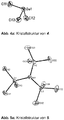
- Zu einer klaren farblosen Lösung aus 300 mg oder 1,4 mmol GeCl4 und 390 mg oder 1,4 mmol [nBu4N]Cl in CH2Cl2 wurden bei Raumtemperatur 375 mg oder 1,4 mmol Si2Cl6 gegeben und das so erhaltene Reaktionsgemisch während 12 h bei Raumtemperatur gerührt. Aus der Reaktionslösung ließ sich nach langsamem Entfernen des Lösemittels Trichlorogermanid 4 als gelblicher, kristalliner Feststoff isolieren. Durch Röntgendiffraktometrie konnte die Struktur von 4 ermittelt werden, gezeigt in
Abb. 4a . Das Kation [nBu4N]+ ist hier aus Gründen der Übersichtlichkeit nicht abgebildet. - Die Synthese erfolgte gemäß Gleichung 5 aus GeCl4 und Si2Cl6 in einem molaren Verhältnis von 1:4 unter Zugabe einer stöchiometrischen Menge, in diesem Fall 1 eq., von [Ph4P]Cl.

- Zu einer klaren, farblosen Lösung enthaltend 93 mg oder 0,4 mmol GeCl4 und 163 mg oder 0,4 mmol [Ph4P]Cl in CH2Cl2 als Lösemittel wurden bei Raumtemperatur 478 mg oder 1,7 mmol Si2Cl6 gegeben und das so erhaltene Reaktionsgemisch während 12 h bei Raumemperatur gerührt. Aus diesem Gemisch ließ sich nach langsamem Entfernen des Lösemittels 5 als gelblicher, kristalliner Feststoff in 99 % Ausbeute isolieren. Durch Röntgendiffraktometrie konnte die Kristallstruktur von 5 ermittelt werden, gezeigt in
Abb. 5a . Das Kation [Ph4P]+ ist hier aus Gründen der Übersichtlichkeit nicht abgebildet. - Bei dieser Reaktion kommt es zu einer Reduktion des GeCl4, zudem erfolgt eine dreifache Silylierung des Germaniumatoms.
- Das 29Si NMR Spektrum von 5 ist in
Abb. 5b dargestellt. - Alle Ergebnisse einer 1H und 29Si NMR-spektroskopischen Untersuchung:
- 29Si NMR (99,4 MHz; CD2Cl2; 298 K):
- δ = 29,7.
- 1H NMR (500,2 MHz; CD2Cl2; 298 K):
- δ = 7,54 (qd 3J(H,H) = 4,5 Hz; 2J(H,H) = 1,3 Hz; (2H)); 7,68 (td 3J(H,H) =7,4 Hz; 3J(H,H) = 3,4 Hz (2H)); 7,84 (tt 3J(H,H) = 7Hz; 2J(H,H) = 1,0 Hz (1 H)).
- Die Synthese von 6 erfolgte gemäß Gleichung 6 aus Tris-Trichlorsilylgermanid ( 5 ) und GaCl3.
[Ph4P][Ge(SiCl3)3] + GaCl3 → [Ph4P][Ge(SiCl3)3*GaCl3] Gleichung 6: Umsetzung von 5 mit GaCl3.
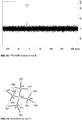
- 50 mg oder 0,1 mmol 5 und 10 mg oder 0,1 mmol GaCl3 wurden als Feststoffe bei Raumtemperatur vermischt und anschließend vollständig in CH2Cl2 gelöst. Das klare, gelbe Reaktionsgemisch wurde während 12 h bei Raumtemperatur gerührt. Aus der klaren, gelben Reaktionslösung ließ sich nach langsamem Entfernen des Lösemittels 6 als gelber kristalliner Feststoff in einer Ausbeute von 82 % erhalten. Durch Röntgendiffraktometrie konnte die Kristallstruktur von 6 ermittelt werden, gezeigt in
Abb. 6a . Das Kation [Ph4P]+ ist hier aus Gründen der Übersichtlichkeit nicht abgebildet. - Das 29Si NMR Spektrum von 6 ist in
Abb. 6b dargestellt. - Alle Ergebnisse einer 1H und 29Si NMR-spektroskopischen Untersuchung:
- 29Si NMR (99,4 MHz; CD2Cl2; 298 K):
- δ = 11,3.
- 1H NMR (500,2 MHz; CD2Cl2; 298 K):
- δ = 7,54 (qd 3J(H,H) = 4,5 Hz; 2J(H,H) = 1,3 Hz; (2H)); 7,68 (td 3J(H,H) =7,4 Hz; 3J(H,H) = 3,4 Hz (2H)); 7,84 (tt 3J(H,H) = 7Hz; 2J(H,H) = 1,0 Hz (1H)).
- Die Synthese von 7 erfolgte gemäß Gleichung 7 aus Tris-Trichlorsilylgermanid ( 5 ) und BBr3.
[Ph4P][Ge(SiCl3)3] + BBr3 → [Ph4P][Ge(SiCl3)3*BBr3] Gleichung 7: Umsetzung von 5 mit BBr3.
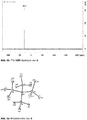
- Zu einer klaren gelben Lösung von 5 in CH2Cl2 wurde bei Raumtemperatur BBr3 gegeben. Nach 4 Tagen waren farblose Kristalle aus der so erhaltenen gelben Reaktionslösung ausgefallen. Durch Röntgendiffraktometrie konnte die Kristallstruktur von 7 ermittelt werden, gezeigt in
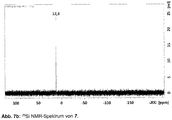
Abb. 7a . Das Kation [Ph4P]+ ist hier aus Gründen der Übersichtlichkeit nicht abgebildet. - Das 29Si NMR Spektrum von 7 ist in
Abb. 7b dargestellt. - Alle Ergebnisse einer 11B und 29Si NMR-spektroskopischen Untersuchung
- 29Si NMR (99,4 MHz; CD2Cl2; 298 K):
- δ = 12,3.
- 11B NMR (160,5 MHz; CD2Cl2; 298 K):
- δ = -17,5.
Claims (2)
- Verfahren zur Herstellung von Trichlorsilyltrichlorgerman,
indem man
GeCl4 mit Hexachlordisilan in einem Lösemittel löst und
in Gegenwart eines Katalysators bei einer Temperatur von 5 bis 40 °C umsetzt. - Verwendung von Trichlorsilyltrichlorgerman, hergestellt nach Anspruch 1, für die Erzeugung von GeSi-Schichten.
Priority Applications (1)
| Application Number | Priority Date | Filing Date | Title |
|---|---|---|---|
| EP17197538.6A EP3413334B1 (de) | 2017-06-01 | 2017-06-01 | Neue chlorsilylarylgermane, verfahren zu deren herstellung und deren verwendung |
Applications Claiming Priority (2)
| Application Number | Priority Date | Filing Date | Title |
|---|---|---|---|
| EP17173940.2A EP3410466B1 (de) | 2017-06-01 | 2017-06-01 | Neue chlorsilylarylgermane, verfahren zu deren herstellung und deren verwendung |
| EP17197538.6A EP3413334B1 (de) | 2017-06-01 | 2017-06-01 | Neue chlorsilylarylgermane, verfahren zu deren herstellung und deren verwendung |
Related Parent Applications (2)
| Application Number | Title | Priority Date | Filing Date |
|---|---|---|---|
| EP17173940.2A Division EP3410466B1 (de) | 2017-06-01 | 2017-06-01 | Neue chlorsilylarylgermane, verfahren zu deren herstellung und deren verwendung |
| EP17173940.2A Division-Into EP3410466B1 (de) | 2017-06-01 | 2017-06-01 | Neue chlorsilylarylgermane, verfahren zu deren herstellung und deren verwendung |
Publications (2)
| Publication Number | Publication Date |
|---|---|
| EP3413334A1 true EP3413334A1 (de) | 2018-12-12 |
| EP3413334B1 EP3413334B1 (de) | 2020-09-09 |
Family
ID=59070424
Family Applications (2)
| Application Number | Title | Priority Date | Filing Date |
|---|---|---|---|
| EP17197538.6A Not-in-force EP3413334B1 (de) | 2017-06-01 | 2017-06-01 | Neue chlorsilylarylgermane, verfahren zu deren herstellung und deren verwendung |
| EP17173940.2A Active EP3410466B1 (de) | 2017-06-01 | 2017-06-01 | Neue chlorsilylarylgermane, verfahren zu deren herstellung und deren verwendung |
Family Applications After (1)
| Application Number | Title | Priority Date | Filing Date |
|---|---|---|---|
| EP17173940.2A Active EP3410466B1 (de) | 2017-06-01 | 2017-06-01 | Neue chlorsilylarylgermane, verfahren zu deren herstellung und deren verwendung |
Country Status (6)
| Country | Link |
|---|---|
| US (1) | US10414783B2 (de) |
| EP (2) | EP3413334B1 (de) |
| JP (1) | JP7014677B2 (de) |
| KR (1) | KR102529558B1 (de) |
| CN (2) | CN108976256B (de) |
| TW (1) | TWI781176B (de) |
Cited By (1)
| Publication number | Priority date | Publication date | Assignee | Title |
|---|---|---|---|---|
| DE102020114994A1 (de) | 2020-06-05 | 2021-12-09 | Johann Wolfgang Goethe-Universität Frankfurt am Main Stiftung des öffentlichen Rechts | Silylierte Oligogermane, Verfahren zur Herstellung derselben sowie die Verwendung derselben zum Herstellen eines Si- und Ge-enthaltenden Festkörpers |
Families Citing this family (7)
| Publication number | Priority date | Publication date | Assignee | Title |
|---|---|---|---|---|
| EP3409645B1 (de) * | 2017-06-01 | 2019-10-02 | Evonik Degussa GmbH | Triphenylgermylsilan und trichlorsilyl-trichlorgerman für die erzeugung von germanium-silizium-schichten sowie verfahren zu deren herstellung aus trichlorsilyl-triphenylgerman |
| EP3653578B1 (de) | 2018-11-14 | 2021-04-21 | Evonik Operations GmbH | Tetrakis(trichlorsilyl) german, verfahren zu dessen herstellung |
| EP3653577B1 (de) | 2018-11-14 | 2021-10-06 | Evonik Operations GmbH | Tris(trichlorsilyl)dichlorogallylgerman, verfahren zu dessen herstellung und dessen verwendung |
| KR20230021025A (ko) | 2020-06-05 | 2023-02-13 | 요한 볼프강 괴테 우니베르시타트, 프랑크프루트 암 마인 | 실릴화 올리고게르만 및 폴리시클릭 규소-게르마늄 화합물, 그의 제조 방법, 및 Si- 및 Ge-함유 고체의 제조를 위한 그의 용도 |
| EP3932925A1 (de) | 2020-07-01 | 2022-01-05 | Evonik Operations GmbH | Neue perchlorierte disilene und germasilene sowie neopentatetrelane, verfahren zu deren herstellung und deren verwendung |
| EP4251631A1 (de) * | 2020-11-27 | 2023-10-04 | Johann Wolfgang Goethe-Universität | Polycyclische silicium-germanium-verbindungen, verfahren zur herstellung derselben sowie die verwendung derselben zum herstellen eines si- und ge-enthaltenden festkörpers |
| WO2024141311A1 (en) | 2022-12-28 | 2024-07-04 | Evonik Operations Gmbh | Silylated polymer and mixtures comprising said polymer |
Citations (2)
| Publication number | Priority date | Publication date | Assignee | Title |
|---|---|---|---|---|
| WO2004036631A2 (en) | 2002-10-18 | 2004-04-29 | Applied Materials, Inc. | Silicon-containing layer deposition with silicon compounds |
| WO2009005862A2 (en) * | 2007-04-02 | 2009-01-08 | Arizona Board Of Regents, Acting For And On Behalf Of Arizona State University | Novel methods for making and using halosilylgermanes |
Family Cites Families (10)
| Publication number | Priority date | Publication date | Assignee | Title |
|---|---|---|---|---|
| JPS6199150A (ja) * | 1984-10-22 | 1986-05-17 | Canon Inc | 堆積膜の形成法 |
| JPS63234513A (ja) * | 1987-03-24 | 1988-09-29 | Canon Inc | 堆積膜形成法 |
| JP3120160B2 (ja) * | 1992-03-05 | 2000-12-25 | 達哉 庄野 | Si−Ge結合を有する化合物の製造方法 |
| JPH07316860A (ja) * | 1994-03-30 | 1995-12-05 | Osaka Gas Co Ltd | Si−Ge結合を有する化合物の製造方法 |
| CN100471991C (zh) * | 2002-10-18 | 2009-03-25 | 应用材料有限公司 | 采用硅化合物进行的含硅层沉积 |
| JP4714422B2 (ja) * | 2003-04-05 | 2011-06-29 | ローム・アンド・ハース・エレクトロニック・マテリアルズ,エル.エル.シー. | ゲルマニウムを含有するフィルムを堆積させる方法、及び蒸気送達装置 |
| JP4954448B2 (ja) * | 2003-04-05 | 2012-06-13 | ローム・アンド・ハース・エレクトロニック・マテリアルズ,エル.エル.シー. | 有機金属化合物 |
| FR2941455B1 (fr) * | 2009-01-29 | 2011-02-11 | Rhodia Operations | Procede de fabrication de composes comprenant des fonctions nitriles |
| DE102011078942A1 (de) * | 2011-07-11 | 2013-01-17 | Evonik Degussa Gmbh | Verfahren zur Herstellung höherer Silane mit verbesserter Ausbeute |
| JP6640596B2 (ja) * | 2016-02-22 | 2020-02-05 | 東京エレクトロン株式会社 | 成膜方法 |
-
2017
- 2017-06-01 EP EP17197538.6A patent/EP3413334B1/de not_active Not-in-force
- 2017-06-01 EP EP17173940.2A patent/EP3410466B1/de active Active
-
2018
- 2018-05-29 TW TW107118289A patent/TWI781176B/zh not_active IP Right Cessation
- 2018-05-31 CN CN201810547407.4A patent/CN108976256B/zh not_active Expired - Fee Related
- 2018-05-31 CN CN202210457317.2A patent/CN114751934A/zh active Pending
- 2018-05-31 US US15/994,110 patent/US10414783B2/en active Active
- 2018-05-31 KR KR1020180062253A patent/KR102529558B1/ko active Active
- 2018-06-01 JP JP2018106110A patent/JP7014677B2/ja not_active Expired - Fee Related
Patent Citations (3)
| Publication number | Priority date | Publication date | Assignee | Title |
|---|---|---|---|---|
| WO2004036631A2 (en) | 2002-10-18 | 2004-04-29 | Applied Materials, Inc. | Silicon-containing layer deposition with silicon compounds |
| US7540920B2 (en) | 2002-10-18 | 2009-06-02 | Applied Materials, Inc. | Silicon-containing layer deposition with silicon compounds |
| WO2009005862A2 (en) * | 2007-04-02 | 2009-01-08 | Arizona Board Of Regents, Acting For And On Behalf Of Arizona State University | Novel methods for making and using halosilylgermanes |
Non-Patent Citations (5)
| Title |
|---|
| C.J. RITTER ET AL., J. AM. CHEM. SOC., vol. 127, 2005, pages 9855 - 9864 |
| F. FEHER, TETRAHEDRON LETT., vol. 51, 1970, pages 4443 - 4447 |
| G. SIH, ANGEW. CHEM., vol. 105, 1993, pages 587 - 588 |
| J.B. TICE ET AL., J. INORGANIC CHEMISTRY, vol. 48, no. 13, 2009, pages 6314 - 6320 |
| L. MÜLLER ET AL., J. ORGANOMET. CHEM., vol. 579, 1999, pages 156 - 163 |
Cited By (1)
| Publication number | Priority date | Publication date | Assignee | Title |
|---|---|---|---|---|
| DE102020114994A1 (de) | 2020-06-05 | 2021-12-09 | Johann Wolfgang Goethe-Universität Frankfurt am Main Stiftung des öffentlichen Rechts | Silylierte Oligogermane, Verfahren zur Herstellung derselben sowie die Verwendung derselben zum Herstellen eines Si- und Ge-enthaltenden Festkörpers |
Also Published As
| Publication number | Publication date |
|---|---|
| EP3413334B1 (de) | 2020-09-09 |
| EP3410466B1 (de) | 2020-02-26 |
| US20180346494A1 (en) | 2018-12-06 |
| KR102529558B1 (ko) | 2023-05-09 |
| JP2018203737A (ja) | 2018-12-27 |
| CN108976256A (zh) | 2018-12-11 |
| EP3410466A1 (de) | 2018-12-05 |
| CN108976256B (zh) | 2024-05-03 |
| KR20180131981A (ko) | 2018-12-11 |
| CN114751934A (zh) | 2022-07-15 |
| US10414783B2 (en) | 2019-09-17 |
| TW201902905A (zh) | 2019-01-16 |
| TWI781176B (zh) | 2022-10-21 |
| JP7014677B2 (ja) | 2022-02-01 |
Similar Documents
| Publication | Publication Date | Title |
|---|---|---|
| EP3413334B1 (de) | Neue chlorsilylarylgermane, verfahren zu deren herstellung und deren verwendung | |
| EP3409678B1 (de) | Neue halogengermanide und verfahren zu deren herstellung | |
| EP0773224B1 (de) | Verfahren zur selektiven Synthese von Silylalkyldisulfiden | |
| EP3409645B1 (de) | Triphenylgermylsilan und trichlorsilyl-trichlorgerman für die erzeugung von germanium-silizium-schichten sowie verfahren zu deren herstellung aus trichlorsilyl-triphenylgerman | |
| DE112014005811B4 (de) | Neutraler Komplex eines cyclischen Silans, Herstellungsverfahren dafür und Verfahren zur Herstellung eines cyclischen hydrierten Silans oder eines cyclischen organischen Silans | |
| WO2018138150A1 (de) | Verfahren zur reduktion von metallhalogeniden | |
| EP3653578B1 (de) | Tetrakis(trichlorsilyl) german, verfahren zu dessen herstellung | |
| EP3653577B1 (de) | Tris(trichlorsilyl)dichlorogallylgerman, verfahren zu dessen herstellung und dessen verwendung | |
| DE102013021306A1 (de) | Verfahren zum Herstellen von linearen, cyclischen und/oder käfigartigen perhalogenierten Oligo- und Polysilyl-Anionen | |
| EP3932925A1 (de) | Neue perchlorierte disilene und germasilene sowie neopentatetrelane, verfahren zu deren herstellung und deren verwendung | |
| DE2807230C3 (de) | Verfahren zur Herstellung von Alkoxymethylsilazanen | |
| DE68916375T2 (de) | Verfahren zur Herstellung von 3-Iminonitrilen. | |
| EP3455230A1 (de) | Kationische silicium(ii)-verbindungen und verfahren zu ihrer herstellung | |
| EP4028390A1 (de) | Verbessertes verfahren zur herstellung von epoxiden aus aldehyden oder ketonen | |
| DE102010028170A1 (de) | Verfahren zur Herstellung metallierter Hydridosilanverbindungen | |
| EP4251631A1 (de) | Polycyclische silicium-germanium-verbindungen, verfahren zur herstellung derselben sowie die verwendung derselben zum herstellen eines si- und ge-enthaltenden festkörpers | |
| DE102015105690B4 (de) | Verfahren zum Herstellen einer cyclischen Silanverbindung | |
| DE69111280T2 (de) | Verfahren zur Herstellung von Methylphenyltrisiloxan. | |
| DE2409674C3 (de) | Verfahren zur Herstellung von Silazanen | |
| DE2043906C3 (de) | Verfahren zur Herstellung von gegebenenfalls substituierten Trialkyl- und Triarylbleichloriden | |
| DE4120124A1 (de) | Verfahren zur herstellung von derivaten des cholesterols und seiner homologen | |
| EP4161940A1 (de) | Silylierte oligogermane und polycyclische silicium-germanium-verbindungen, verfahren zur herstellung derselben sowie die verwendung derselben zum herstellen eines si- und ge-enthaltenden festkörpers | |
| DE2741624B1 (de) | Verfahren zur Herstellung von 1,3-Divinyl-1,1,3,3-tetramethyldisiloxan |
Legal Events
| Date | Code | Title | Description |
|---|---|---|---|
| PUAI | Public reference made under article 153(3) epc to a published international application that has entered the european phase |
Free format text: ORIGINAL CODE: 0009012 |
|
| STAA | Information on the status of an ep patent application or granted ep patent |
Free format text: STATUS: REQUEST FOR EXAMINATION WAS MADE |
|
| 17P | Request for examination filed |
Effective date: 20171020 |
|
| AC | Divisional application: reference to earlier application |
Ref document number: 3410466 Country of ref document: EP Kind code of ref document: P |
|
| AK | Designated contracting states |
Kind code of ref document: A1 Designated state(s): AL AT BE BG CH CY CZ DE DK EE ES FI FR GB GR HR HU IE IS IT LI LT LU LV MC MK MT NL NO PL PT RO RS SE SI SK SM TR |
|
| AX | Request for extension of the european patent |
Extension state: BA ME |
|
| RAP1 | Party data changed (applicant data changed or rights of an application transferred) |
Owner name: EVONIK OPERATIONS GMBH |
|
| STAA | Information on the status of an ep patent application or granted ep patent |
Free format text: STATUS: EXAMINATION IS IN PROGRESS |
|
| 17Q | First examination report despatched |
Effective date: 20200103 |
|
| GRAP | Despatch of communication of intention to grant a patent |
Free format text: ORIGINAL CODE: EPIDOSNIGR1 |
|
| STAA | Information on the status of an ep patent application or granted ep patent |
Free format text: STATUS: GRANT OF PATENT IS INTENDED |
|
| INTG | Intention to grant announced |
Effective date: 20200619 |
|
| GRAS | Grant fee paid |
Free format text: ORIGINAL CODE: EPIDOSNIGR3 |
|
| GRAA | (expected) grant |
Free format text: ORIGINAL CODE: 0009210 |
|
| STAA | Information on the status of an ep patent application or granted ep patent |
Free format text: STATUS: THE PATENT HAS BEEN GRANTED |
|
| AC | Divisional application: reference to earlier application |
Ref document number: 3410466 Country of ref document: EP Kind code of ref document: P |
|
| AK | Designated contracting states |
Kind code of ref document: B1 Designated state(s): AL AT BE BG CH CY CZ DE DK EE ES FI FR GB GR HR HU IE IS IT LI LT LU LV MC MK MT NL NO PL PT RO RS SE SI SK SM TR |
|
| REG | Reference to a national code |
Ref country code: GB Ref legal event code: FG4D Free format text: NOT ENGLISH |
|
| REG | Reference to a national code |
Ref country code: AT Ref legal event code: REF Ref document number: 1312625 Country of ref document: AT Kind code of ref document: T Effective date: 20200915 Ref country code: CH Ref legal event code: EP |
|
| REG | Reference to a national code |
Ref country code: DE Ref legal event code: R096 Ref document number: 502017007133 Country of ref document: DE |
|
| REG | Reference to a national code |
Ref country code: IE Ref legal event code: FG4D Free format text: LANGUAGE OF EP DOCUMENT: GERMAN |
|
| REG | Reference to a national code |
Ref country code: LT Ref legal event code: MG4D |
|
| PG25 | Lapsed in a contracting state [announced via postgrant information from national office to epo] |
Ref country code: SE Free format text: LAPSE BECAUSE OF FAILURE TO SUBMIT A TRANSLATION OF THE DESCRIPTION OR TO PAY THE FEE WITHIN THE PRESCRIBED TIME-LIMIT Effective date: 20200909 Ref country code: HR Free format text: LAPSE BECAUSE OF FAILURE TO SUBMIT A TRANSLATION OF THE DESCRIPTION OR TO PAY THE FEE WITHIN THE PRESCRIBED TIME-LIMIT Effective date: 20200909 Ref country code: GR Free format text: LAPSE BECAUSE OF FAILURE TO SUBMIT A TRANSLATION OF THE DESCRIPTION OR TO PAY THE FEE WITHIN THE PRESCRIBED TIME-LIMIT Effective date: 20201210 Ref country code: LT Free format text: LAPSE BECAUSE OF FAILURE TO SUBMIT A TRANSLATION OF THE DESCRIPTION OR TO PAY THE FEE WITHIN THE PRESCRIBED TIME-LIMIT Effective date: 20200909 Ref country code: FI Free format text: LAPSE BECAUSE OF FAILURE TO SUBMIT A TRANSLATION OF THE DESCRIPTION OR TO PAY THE FEE WITHIN THE PRESCRIBED TIME-LIMIT Effective date: 20200909 Ref country code: BG Free format text: LAPSE BECAUSE OF FAILURE TO SUBMIT A TRANSLATION OF THE DESCRIPTION OR TO PAY THE FEE WITHIN THE PRESCRIBED TIME-LIMIT Effective date: 20201209 Ref country code: NO Free format text: LAPSE BECAUSE OF FAILURE TO SUBMIT A TRANSLATION OF THE DESCRIPTION OR TO PAY THE FEE WITHIN THE PRESCRIBED TIME-LIMIT Effective date: 20201209 |
|
| REG | Reference to a national code |
Ref country code: NL Ref legal event code: MP Effective date: 20200909 |
|
| PG25 | Lapsed in a contracting state [announced via postgrant information from national office to epo] |
Ref country code: PL Free format text: LAPSE BECAUSE OF FAILURE TO SUBMIT A TRANSLATION OF THE DESCRIPTION OR TO PAY THE FEE WITHIN THE PRESCRIBED TIME-LIMIT Effective date: 20200909 Ref country code: RS Free format text: LAPSE BECAUSE OF FAILURE TO SUBMIT A TRANSLATION OF THE DESCRIPTION OR TO PAY THE FEE WITHIN THE PRESCRIBED TIME-LIMIT Effective date: 20200909 Ref country code: LV Free format text: LAPSE BECAUSE OF FAILURE TO SUBMIT A TRANSLATION OF THE DESCRIPTION OR TO PAY THE FEE WITHIN THE PRESCRIBED TIME-LIMIT Effective date: 20200909 |
|
| PG25 | Lapsed in a contracting state [announced via postgrant information from national office to epo] |
Ref country code: EE Free format text: LAPSE BECAUSE OF FAILURE TO SUBMIT A TRANSLATION OF THE DESCRIPTION OR TO PAY THE FEE WITHIN THE PRESCRIBED TIME-LIMIT Effective date: 20200909 Ref country code: SM Free format text: LAPSE BECAUSE OF FAILURE TO SUBMIT A TRANSLATION OF THE DESCRIPTION OR TO PAY THE FEE WITHIN THE PRESCRIBED TIME-LIMIT Effective date: 20200909 Ref country code: PT Free format text: LAPSE BECAUSE OF FAILURE TO SUBMIT A TRANSLATION OF THE DESCRIPTION OR TO PAY THE FEE WITHIN THE PRESCRIBED TIME-LIMIT Effective date: 20210111 Ref country code: RO Free format text: LAPSE BECAUSE OF FAILURE TO SUBMIT A TRANSLATION OF THE DESCRIPTION OR TO PAY THE FEE WITHIN THE PRESCRIBED TIME-LIMIT Effective date: 20200909 |
|
| PG25 | Lapsed in a contracting state [announced via postgrant information from national office to epo] |
Ref country code: ES Free format text: LAPSE BECAUSE OF FAILURE TO SUBMIT A TRANSLATION OF THE DESCRIPTION OR TO PAY THE FEE WITHIN THE PRESCRIBED TIME-LIMIT Effective date: 20200909 Ref country code: AL Free format text: LAPSE BECAUSE OF FAILURE TO SUBMIT A TRANSLATION OF THE DESCRIPTION OR TO PAY THE FEE WITHIN THE PRESCRIBED TIME-LIMIT Effective date: 20200909 Ref country code: IS Free format text: LAPSE BECAUSE OF FAILURE TO SUBMIT A TRANSLATION OF THE DESCRIPTION OR TO PAY THE FEE WITHIN THE PRESCRIBED TIME-LIMIT Effective date: 20210109 |
|
| REG | Reference to a national code |
Ref country code: DE Ref legal event code: R097 Ref document number: 502017007133 Country of ref document: DE |
|
| PG25 | Lapsed in a contracting state [announced via postgrant information from national office to epo] |
Ref country code: SK Free format text: LAPSE BECAUSE OF FAILURE TO SUBMIT A TRANSLATION OF THE DESCRIPTION OR TO PAY THE FEE WITHIN THE PRESCRIBED TIME-LIMIT Effective date: 20200909 |
|
| PLBE | No opposition filed within time limit |
Free format text: ORIGINAL CODE: 0009261 |
|
| STAA | Information on the status of an ep patent application or granted ep patent |
Free format text: STATUS: NO OPPOSITION FILED WITHIN TIME LIMIT |
|
| 26N | No opposition filed |
Effective date: 20210610 |
|
| PG25 | Lapsed in a contracting state [announced via postgrant information from national office to epo] |
Ref country code: SI Free format text: LAPSE BECAUSE OF FAILURE TO SUBMIT A TRANSLATION OF THE DESCRIPTION OR TO PAY THE FEE WITHIN THE PRESCRIBED TIME-LIMIT Effective date: 20200909 Ref country code: DK Free format text: LAPSE BECAUSE OF FAILURE TO SUBMIT A TRANSLATION OF THE DESCRIPTION OR TO PAY THE FEE WITHIN THE PRESCRIBED TIME-LIMIT Effective date: 20200909 |
|
| PG25 | Lapsed in a contracting state [announced via postgrant information from national office to epo] |
Ref country code: IT Free format text: LAPSE BECAUSE OF FAILURE TO SUBMIT A TRANSLATION OF THE DESCRIPTION OR TO PAY THE FEE WITHIN THE PRESCRIBED TIME-LIMIT Effective date: 20200909 |
|
| PG25 | Lapsed in a contracting state [announced via postgrant information from national office to epo] |
Ref country code: MC Free format text: LAPSE BECAUSE OF FAILURE TO SUBMIT A TRANSLATION OF THE DESCRIPTION OR TO PAY THE FEE WITHIN THE PRESCRIBED TIME-LIMIT Effective date: 20200909 Ref country code: CZ Free format text: LAPSE BECAUSE OF NON-PAYMENT OF DUE FEES Effective date: 20210601 |
|
| REG | Reference to a national code |
Ref country code: CH Ref legal event code: PL |
|
| GBPC | Gb: european patent ceased through non-payment of renewal fee |
Effective date: 20210601 |
|
| REG | Reference to a national code |
Ref country code: BE Ref legal event code: MM Effective date: 20210630 |
|
| PG25 | Lapsed in a contracting state [announced via postgrant information from national office to epo] |
Ref country code: LU Free format text: LAPSE BECAUSE OF NON-PAYMENT OF DUE FEES Effective date: 20210601 |
|
| PG25 | Lapsed in a contracting state [announced via postgrant information from national office to epo] |
Ref country code: LI Free format text: LAPSE BECAUSE OF NON-PAYMENT OF DUE FEES Effective date: 20210630 Ref country code: IE Free format text: LAPSE BECAUSE OF NON-PAYMENT OF DUE FEES Effective date: 20210601 Ref country code: GB Free format text: LAPSE BECAUSE OF NON-PAYMENT OF DUE FEES Effective date: 20210601 Ref country code: CH Free format text: LAPSE BECAUSE OF NON-PAYMENT OF DUE FEES Effective date: 20210630 |
|
| PG25 | Lapsed in a contracting state [announced via postgrant information from national office to epo] |
Ref country code: FR Free format text: LAPSE BECAUSE OF NON-PAYMENT OF DUE FEES Effective date: 20210630 |
|
| PG25 | Lapsed in a contracting state [announced via postgrant information from national office to epo] |
Ref country code: BE Free format text: LAPSE BECAUSE OF NON-PAYMENT OF DUE FEES Effective date: 20210630 |
|
| P01 | Opt-out of the competence of the unified patent court (upc) registered |
Effective date: 20230524 |
|
| PG25 | Lapsed in a contracting state [announced via postgrant information from national office to epo] |
Ref country code: NL Free format text: LAPSE BECAUSE OF NON-PAYMENT OF DUE FEES Effective date: 20200923 Ref country code: CY Free format text: LAPSE BECAUSE OF FAILURE TO SUBMIT A TRANSLATION OF THE DESCRIPTION OR TO PAY THE FEE WITHIN THE PRESCRIBED TIME-LIMIT Effective date: 20200909 |
|
| PG25 | Lapsed in a contracting state [announced via postgrant information from national office to epo] |
Ref country code: HU Free format text: LAPSE BECAUSE OF FAILURE TO SUBMIT A TRANSLATION OF THE DESCRIPTION OR TO PAY THE FEE WITHIN THE PRESCRIBED TIME-LIMIT; INVALID AB INITIO Effective date: 20170601 |
|
| REG | Reference to a national code |
Ref country code: AT Ref legal event code: MM01 Ref document number: 1312625 Country of ref document: AT Kind code of ref document: T Effective date: 20220601 |
|
| PG25 | Lapsed in a contracting state [announced via postgrant information from national office to epo] |
Ref country code: AT Free format text: LAPSE BECAUSE OF NON-PAYMENT OF DUE FEES Effective date: 20220601 |
|
| PG25 | Lapsed in a contracting state [announced via postgrant information from national office to epo] |
Ref country code: MK Free format text: LAPSE BECAUSE OF FAILURE TO SUBMIT A TRANSLATION OF THE DESCRIPTION OR TO PAY THE FEE WITHIN THE PRESCRIBED TIME-LIMIT Effective date: 20200909 |
|
| PG25 | Lapsed in a contracting state [announced via postgrant information from national office to epo] |
Ref country code: TR Free format text: LAPSE BECAUSE OF FAILURE TO SUBMIT A TRANSLATION OF THE DESCRIPTION OR TO PAY THE FEE WITHIN THE PRESCRIBED TIME-LIMIT Effective date: 20200909 |
|
| PGFP | Annual fee paid to national office [announced via postgrant information from national office to epo] |
Ref country code: DE Payment date: 20240619 Year of fee payment: 8 |
|
| PG25 | Lapsed in a contracting state [announced via postgrant information from national office to epo] |
Ref country code: MT Free format text: LAPSE BECAUSE OF FAILURE TO SUBMIT A TRANSLATION OF THE DESCRIPTION OR TO PAY THE FEE WITHIN THE PRESCRIBED TIME-LIMIT Effective date: 20200909 |
|
| REG | Reference to a national code |
Ref country code: DE Ref legal event code: R079 Ref document number: 502017007133 Country of ref document: DE Free format text: PREVIOUS MAIN CLASS: H01L0021205000 Ipc: H10P0014240000 |
|
| REG | Reference to a national code |
Ref country code: DE Ref legal event code: R119 Ref document number: 502017007133 Country of ref document: DE |
|
| PG25 | Lapsed in a contracting state [announced via postgrant information from national office to epo] |
Ref country code: DE Free format text: LAPSE BECAUSE OF NON-PAYMENT OF DUE FEES Effective date: 20260101 |