EP3383950B1 - High porosity microcellular polyethylene - Google Patents
High porosity microcellular polyethylene Download PDFInfo
- Publication number
- EP3383950B1 EP3383950B1 EP15909513.2A EP15909513A EP3383950B1 EP 3383950 B1 EP3383950 B1 EP 3383950B1 EP 15909513 A EP15909513 A EP 15909513A EP 3383950 B1 EP3383950 B1 EP 3383950B1
- Authority
- EP
- European Patent Office
- Prior art keywords
- hdpe
- foaming
- ldpe
- peroxide
- mixture
- Prior art date
- Legal status (The legal status is an assumption and is not a legal conclusion. Google has not performed a legal analysis and makes no representation as to the accuracy of the status listed.)
- Active
Links
Images


Classifications
-
- C—CHEMISTRY; METALLURGY
- C08—ORGANIC MACROMOLECULAR COMPOUNDS; THEIR PREPARATION OR CHEMICAL WORKING-UP; COMPOSITIONS BASED THEREON
- C08J—WORKING-UP; GENERAL PROCESSES OF COMPOUNDING; AFTER-TREATMENT NOT COVERED BY SUBCLASSES C08B, C08C, C08F, C08G or C08H
- C08J9/00—Working-up of macromolecular substances to porous or cellular articles or materials; After-treatment thereof
- C08J9/0014—Use of organic additives
- C08J9/0023—Use of organic additives containing oxygen
-
- C—CHEMISTRY; METALLURGY
- C08—ORGANIC MACROMOLECULAR COMPOUNDS; THEIR PREPARATION OR CHEMICAL WORKING-UP; COMPOSITIONS BASED THEREON
- C08J—WORKING-UP; GENERAL PROCESSES OF COMPOUNDING; AFTER-TREATMENT NOT COVERED BY SUBCLASSES C08B, C08C, C08F, C08G or C08H
- C08J9/00—Working-up of macromolecular substances to porous or cellular articles or materials; After-treatment thereof
- C08J9/0061—Working-up of macromolecular substances to porous or cellular articles or materials; After-treatment thereof characterized by the use of several polymeric components
-
- C—CHEMISTRY; METALLURGY
- C08—ORGANIC MACROMOLECULAR COMPOUNDS; THEIR PREPARATION OR CHEMICAL WORKING-UP; COMPOSITIONS BASED THEREON
- C08J—WORKING-UP; GENERAL PROCESSES OF COMPOUNDING; AFTER-TREATMENT NOT COVERED BY SUBCLASSES C08B, C08C, C08F, C08G or C08H
- C08J9/00—Working-up of macromolecular substances to porous or cellular articles or materials; After-treatment thereof
- C08J9/04—Working-up of macromolecular substances to porous or cellular articles or materials; After-treatment thereof using blowing gases generated by a previously added blowing agent
- C08J9/12—Working-up of macromolecular substances to porous or cellular articles or materials; After-treatment thereof using blowing gases generated by a previously added blowing agent by a physical blowing agent
- C08J9/122—Hydrogen, oxygen, CO2, nitrogen or noble gases
-
- C—CHEMISTRY; METALLURGY
- C08—ORGANIC MACROMOLECULAR COMPOUNDS; THEIR PREPARATION OR CHEMICAL WORKING-UP; COMPOSITIONS BASED THEREON
- C08K—Use of inorganic or non-macromolecular organic substances as compounding ingredients
- C08K5/00—Use of organic ingredients
- C08K5/04—Oxygen-containing compounds
- C08K5/14—Peroxides
-
- C—CHEMISTRY; METALLURGY
- C08—ORGANIC MACROMOLECULAR COMPOUNDS; THEIR PREPARATION OR CHEMICAL WORKING-UP; COMPOSITIONS BASED THEREON
- C08L—COMPOSITIONS OF MACROMOLECULAR COMPOUNDS
- C08L23/00—Compositions of homopolymers or copolymers of unsaturated aliphatic hydrocarbons having only one carbon-to-carbon double bond; Compositions of derivatives of such polymers
- C08L23/02—Compositions of homopolymers or copolymers of unsaturated aliphatic hydrocarbons having only one carbon-to-carbon double bond; Compositions of derivatives of such polymers not modified by chemical after-treatment
- C08L23/04—Homopolymers or copolymers of ethene
-
- C—CHEMISTRY; METALLURGY
- C08—ORGANIC MACROMOLECULAR COMPOUNDS; THEIR PREPARATION OR CHEMICAL WORKING-UP; COMPOSITIONS BASED THEREON
- C08L—COMPOSITIONS OF MACROMOLECULAR COMPOUNDS
- C08L23/00—Compositions of homopolymers or copolymers of unsaturated aliphatic hydrocarbons having only one carbon-to-carbon double bond; Compositions of derivatives of such polymers
- C08L23/02—Compositions of homopolymers or copolymers of unsaturated aliphatic hydrocarbons having only one carbon-to-carbon double bond; Compositions of derivatives of such polymers not modified by chemical after-treatment
- C08L23/04—Homopolymers or copolymers of ethene
- C08L23/06—Polyethene
-
- C—CHEMISTRY; METALLURGY
- C08—ORGANIC MACROMOLECULAR COMPOUNDS; THEIR PREPARATION OR CHEMICAL WORKING-UP; COMPOSITIONS BASED THEREON
- C08L—COMPOSITIONS OF MACROMOLECULAR COMPOUNDS
- C08L23/00—Compositions of homopolymers or copolymers of unsaturated aliphatic hydrocarbons having only one carbon-to-carbon double bond; Compositions of derivatives of such polymers
- C08L23/02—Compositions of homopolymers or copolymers of unsaturated aliphatic hydrocarbons having only one carbon-to-carbon double bond; Compositions of derivatives of such polymers not modified by chemical after-treatment
- C08L23/04—Homopolymers or copolymers of ethene
- C08L23/08—Copolymers of ethene
- C08L23/0807—Copolymers of ethene with unsaturated hydrocarbons only containing four or more carbon atoms
- C08L23/0815—Copolymers of ethene with unsaturated hydrocarbons only containing four or more carbon atoms with aliphatic 1-olefins containing one carbon-to-carbon double bond
-
- C—CHEMISTRY; METALLURGY
- C08—ORGANIC MACROMOLECULAR COMPOUNDS; THEIR PREPARATION OR CHEMICAL WORKING-UP; COMPOSITIONS BASED THEREON
- C08J—WORKING-UP; GENERAL PROCESSES OF COMPOUNDING; AFTER-TREATMENT NOT COVERED BY SUBCLASSES C08B, C08C, C08F, C08G or C08H
- C08J2201/00—Foams characterised by the foaming process
- C08J2201/02—Foams characterised by the foaming process characterised by mechanical pre- or post-treatments
- C08J2201/026—Crosslinking before of after foaming
-
- C—CHEMISTRY; METALLURGY
- C08—ORGANIC MACROMOLECULAR COMPOUNDS; THEIR PREPARATION OR CHEMICAL WORKING-UP; COMPOSITIONS BASED THEREON
- C08J—WORKING-UP; GENERAL PROCESSES OF COMPOUNDING; AFTER-TREATMENT NOT COVERED BY SUBCLASSES C08B, C08C, C08F, C08G or C08H
- C08J2201/00—Foams characterised by the foaming process
- C08J2201/02—Foams characterised by the foaming process characterised by mechanical pre- or post-treatments
- C08J2201/03—Extrusion of the foamable blend
-
- C—CHEMISTRY; METALLURGY
- C08—ORGANIC MACROMOLECULAR COMPOUNDS; THEIR PREPARATION OR CHEMICAL WORKING-UP; COMPOSITIONS BASED THEREON
- C08J—WORKING-UP; GENERAL PROCESSES OF COMPOUNDING; AFTER-TREATMENT NOT COVERED BY SUBCLASSES C08B, C08C, C08F, C08G or C08H
- C08J2201/00—Foams characterised by the foaming process
- C08J2201/02—Foams characterised by the foaming process characterised by mechanical pre- or post-treatments
- C08J2201/032—Impregnation of a formed object with a gas
-
- C—CHEMISTRY; METALLURGY
- C08—ORGANIC MACROMOLECULAR COMPOUNDS; THEIR PREPARATION OR CHEMICAL WORKING-UP; COMPOSITIONS BASED THEREON
- C08J—WORKING-UP; GENERAL PROCESSES OF COMPOUNDING; AFTER-TREATMENT NOT COVERED BY SUBCLASSES C08B, C08C, C08F, C08G or C08H
- C08J2203/00—Foams characterized by the expanding agent
- C08J2203/06—CO2, N2 or noble gases
-
- C—CHEMISTRY; METALLURGY
- C08—ORGANIC MACROMOLECULAR COMPOUNDS; THEIR PREPARATION OR CHEMICAL WORKING-UP; COMPOSITIONS BASED THEREON
- C08J—WORKING-UP; GENERAL PROCESSES OF COMPOUNDING; AFTER-TREATMENT NOT COVERED BY SUBCLASSES C08B, C08C, C08F, C08G or C08H
- C08J2203/00—Foams characterized by the expanding agent
- C08J2203/08—Supercritical fluid
-
- C—CHEMISTRY; METALLURGY
- C08—ORGANIC MACROMOLECULAR COMPOUNDS; THEIR PREPARATION OR CHEMICAL WORKING-UP; COMPOSITIONS BASED THEREON
- C08J—WORKING-UP; GENERAL PROCESSES OF COMPOUNDING; AFTER-TREATMENT NOT COVERED BY SUBCLASSES C08B, C08C, C08F, C08G or C08H
- C08J2205/00—Foams characterised by their properties
- C08J2205/04—Foams characterised by their properties characterised by the foam pores
- C08J2205/044—Micropores, i.e. average diameter being between 0,1 micrometer and 0,1 millimeter
-
- C—CHEMISTRY; METALLURGY
- C08—ORGANIC MACROMOLECULAR COMPOUNDS; THEIR PREPARATION OR CHEMICAL WORKING-UP; COMPOSITIONS BASED THEREON
- C08J—WORKING-UP; GENERAL PROCESSES OF COMPOUNDING; AFTER-TREATMENT NOT COVERED BY SUBCLASSES C08B, C08C, C08F, C08G or C08H
- C08J2207/00—Foams characterised by their intended use
- C08J2207/06—Electrical wire insulation
-
- C—CHEMISTRY; METALLURGY
- C08—ORGANIC MACROMOLECULAR COMPOUNDS; THEIR PREPARATION OR CHEMICAL WORKING-UP; COMPOSITIONS BASED THEREON
- C08J—WORKING-UP; GENERAL PROCESSES OF COMPOUNDING; AFTER-TREATMENT NOT COVERED BY SUBCLASSES C08B, C08C, C08F, C08G or C08H
- C08J2323/00—Characterised by the use of homopolymers or copolymers of unsaturated aliphatic hydrocarbons having only one carbon-to-carbon double bond; Derivatives of such polymers
- C08J2323/02—Characterised by the use of homopolymers or copolymers of unsaturated aliphatic hydrocarbons having only one carbon-to-carbon double bond; Derivatives of such polymers not modified by chemical after treatment
- C08J2323/04—Homopolymers or copolymers of ethene
- C08J2323/06—Polyethene
-
- C—CHEMISTRY; METALLURGY
- C08—ORGANIC MACROMOLECULAR COMPOUNDS; THEIR PREPARATION OR CHEMICAL WORKING-UP; COMPOSITIONS BASED THEREON
- C08J—WORKING-UP; GENERAL PROCESSES OF COMPOUNDING; AFTER-TREATMENT NOT COVERED BY SUBCLASSES C08B, C08C, C08F, C08G or C08H
- C08J2423/00—Characterised by the use of homopolymers or copolymers of unsaturated aliphatic hydrocarbons having only one carbon-to-carbon double bond; Derivatives of such polymers
- C08J2423/02—Characterised by the use of homopolymers or copolymers of unsaturated aliphatic hydrocarbons having only one carbon-to-carbon double bond; Derivatives of such polymers not modified by chemical after treatment
- C08J2423/04—Homopolymers or copolymers of ethene
- C08J2423/06—Polyethene
-
- C—CHEMISTRY; METALLURGY
- C08—ORGANIC MACROMOLECULAR COMPOUNDS; THEIR PREPARATION OR CHEMICAL WORKING-UP; COMPOSITIONS BASED THEREON
- C08J—WORKING-UP; GENERAL PROCESSES OF COMPOUNDING; AFTER-TREATMENT NOT COVERED BY SUBCLASSES C08B, C08C, C08F, C08G or C08H
- C08J2483/00—Characterised by the use of macromolecular compounds obtained by reactions forming in the main chain of the macromolecule a linkage containing silicon with or without sulfur, nitrogen, oxygen, or carbon only; Derivatives of such polymers
- C08J2483/04—Polysiloxanes
-
- C—CHEMISTRY; METALLURGY
- C08—ORGANIC MACROMOLECULAR COMPOUNDS; THEIR PREPARATION OR CHEMICAL WORKING-UP; COMPOSITIONS BASED THEREON
- C08L—COMPOSITIONS OF MACROMOLECULAR COMPOUNDS
- C08L2203/00—Applications
- C08L2203/14—Applications used for foams
-
- C—CHEMISTRY; METALLURGY
- C08—ORGANIC MACROMOLECULAR COMPOUNDS; THEIR PREPARATION OR CHEMICAL WORKING-UP; COMPOSITIONS BASED THEREON
- C08L—COMPOSITIONS OF MACROMOLECULAR COMPOUNDS
- C08L2205/00—Polymer mixtures characterised by other features
- C08L2205/02—Polymer mixtures characterised by other features containing two or more polymers of the same C08L -group
- C08L2205/025—Polymer mixtures characterised by other features containing two or more polymers of the same C08L -group containing two or more polymers of the same hierarchy C08L, and differing only in parameters such as density, comonomer content, molecular weight, structure
-
- C—CHEMISTRY; METALLURGY
- C08—ORGANIC MACROMOLECULAR COMPOUNDS; THEIR PREPARATION OR CHEMICAL WORKING-UP; COMPOSITIONS BASED THEREON
- C08L—COMPOSITIONS OF MACROMOLECULAR COMPOUNDS
- C08L2207/00—Properties characterising the ingredient of the composition
- C08L2207/06—Properties of polyethylene
- C08L2207/062—HDPE
-
- C—CHEMISTRY; METALLURGY
- C08—ORGANIC MACROMOLECULAR COMPOUNDS; THEIR PREPARATION OR CHEMICAL WORKING-UP; COMPOSITIONS BASED THEREON
- C08L—COMPOSITIONS OF MACROMOLECULAR COMPOUNDS
- C08L2310/00—Masterbatches
-
- C—CHEMISTRY; METALLURGY
- C08—ORGANIC MACROMOLECULAR COMPOUNDS; THEIR PREPARATION OR CHEMICAL WORKING-UP; COMPOSITIONS BASED THEREON
- C08L—COMPOSITIONS OF MACROMOLECULAR COMPOUNDS
- C08L2312/00—Crosslinking
-
- H—ELECTRICITY
- H01—ELECTRIC ELEMENTS
- H01B—CABLES; CONDUCTORS; INSULATORS; SELECTION OF MATERIALS FOR THEIR CONDUCTIVE, INSULATING OR DIELECTRIC PROPERTIES
- H01B3/00—Insulators or insulating bodies characterised by the insulating materials; Selection of materials for their insulating or dielectric properties
- H01B3/18—Insulators or insulating bodies characterised by the insulating materials; Selection of materials for their insulating or dielectric properties mainly consisting of organic substances
- H01B3/30—Insulators or insulating bodies characterised by the insulating materials; Selection of materials for their insulating or dielectric properties mainly consisting of organic substances plastics; resins; waxes
- H01B3/44—Insulators or insulating bodies characterised by the insulating materials; Selection of materials for their insulating or dielectric properties mainly consisting of organic substances plastics; resins; waxes vinyl resins; acrylic resins
- H01B3/441—Insulators or insulating bodies characterised by the insulating materials; Selection of materials for their insulating or dielectric properties mainly consisting of organic substances plastics; resins; waxes vinyl resins; acrylic resins from alkenes
Definitions
- This invention relates to polyethylene (PE) foams.
- the invention relates to PE foams useful as telecom insulation while in another aspect, the invention relates to coaxial and radio frequency cables comprising PE foams.
- Coaxial/radio frequency cables made of highly foamed polyethylene are widely used as antenna feeders, cabling of antenna arrays, equipment interconnections, mobile telecommunication systems, microwave transmission systems, broadcast transmission systems and other communication systems.
- cables require the use of a highly foamed dielectric made with polymer resins, e.g., a polyolefin, with minimum polar groups or polar additives and which are cost effective and have good electrical properties.
- a high frequency cable is made of an inner conductor surrounded by a foamed insulation.
- the base resin for insulation is generally a mixture of high density polyethylene (HDPE), high pressure low density polyethylene (HPLDPE, or simply, LDPE) and a nucleating master batch.
- the ratio of HDPE to LDPE is 70-80% HDPE/30-20% LDPE.
- the nucleating master batch is typically added at about 1-3% and is generally also based on a LDPE resin. Due to less branching in the molecular structure of HDPE, the dissipation factor (Df) of HDPE is lower than LDPE and as such, the majority of base resin for cable insulation is typically HDPE. Moreover, this provides desirable mechanical properties to the foam such as high crush resistance. LDPE, in contrast, enhances the overall melt strength of the base resin due to its branched structure.
- Df dissipation factor
- the foaming step was implemented by compounding the base polymer resin with a specific chemical foaming agent capable of blowing closed cells of desired size.
- a specific chemical foaming agent capable of blowing closed cells of desired size.
- the porosity of the HDPE/LDPE (7/3) blend can reach 75-80% depending on customer lines.
- chemical foaming processes can only achieve lower levels of foaming and also suffer from the fact that the polymeric dielectric material traps residue of the foaming agent that deteriorates the dissipation factor. The lower foaming level and presence of residues from the foaming agent result in higher signal attenuation, especially at the upper end of the frequency range.
- Physical foaming of polymers is generally carried out by dissolving a blowing agent into the polymer matrix. Subsequently, the solubility of the blowing agent is reduced rapidly by producing thermodynamic instability in the structure (e.g., by increasing temperature or decreasing pressure), to induce nucleation and the growth of bubbles.
- the industrial practice for physical foaming for cable insulations is based on the similar concept by injecting an inert gas (such as nitrogen) to blow the gas filled expanded cell. Adding a nucleating agent is a frequently used and effective technique to reduce cell size, enhance cell density and uniform cell distribution.
- US 2004220287 describes a low loss foam composition and cable, such as a coaxial cable.
- JP2002338722 describes a crosslinked polyethylene foam for cutting processing easily subjected to slit processing and polishing processing and allowing processing with a high precision.
- US6492453 describes zero halogen polyolefin compositions exhibit low smoke emission, low corrosivity, low toxicity, and low heat release properties, as well as flame resistance and char formation, while simultaneously maintaining favorable electrical insulation properties.
- the resulting porosity is in the range of 50-80%, and, correspondingly, the Df of current PE foam is around 0.0002-0.00015 (at 2.47Ghz), which marginally meets the current high-end cable requirement.
- the expansion ratio is a measure of the void, or empty space, in the insulation and is generally measured as the ratio of the volume of the voids to the total volume of the foam. Attempts at higher porosity in the N 2 foaming process often result in foam cell collapse and non-uniform structures. Either a new PE base formulation or a breakthrough in foaming process is required to enable the production of high porosity PE insulation foam in cable industry.
- the invention is a process for making a foam composition, the process comprising the steps of:
- the invention is a foam composition made by the process described above.
- the foams of this invention exhibit a high expansion ratio of up to 85%porosity.
- the peroxide is used in relatively small amounts and in one embodiment, the foaming step is performed with supercritical carbon dioxide (ScCO 2 ).
- the peroxide modified polymer blend has a low Df value of 15 ⁇ 10 -5 .
- the process of the invention produces a foam composition useful in the manufacture of cables for use in high frequency applications (greater than (>) 3GHz).
- the foams made by the process of the invention (1) comprise an HDPE/LDPE blend with a low Df value, e.g., about 11 ⁇ 10 -5 , and (2) exhibit a slight crosslinking via reaction with peroxide, e.g., DTAP.
- the former favors a foam with a low Df value and the latter favors good melt strength for the resins but a minimum negative impact on dissipation factor, (mixture of (A)) which, in turn, further improves the porosity of the foam.
- the ScCO 2 foaming process is applied and pure CO 2 is used as blowing agent during present foaming process.
- the numerical ranges disclosed herein include all values from, and including, the lower and upper value.
- explicit values e.g., 1 or 2; or 3 to 5; or 6; or 7
- any subrange between any two explicit values is included (e.g., 1 to 2; 2 to 6; 2.5 to 6.5; 5 to 7; 3 to 7; 5 to 6; etc.).
- High pressure CO 2 and like terms means CO 2 at a pressure of greater than ambient pressure (>0.1 MPa), including CO 2 in a sub-critical or super-critical state.
- the critical pressure of CO 2 is 7.4 MPa.
- HDPE High Density Polyethylene
- a “high density polyethylene” is an ethylene-based polymer having a density of at least 0.94 g/cc, or from at least 0.94 g/cc to 0.98 g/cc.
- the HDPE has a melt index from 0.1 g/10 min to 25 g/10 min.
- the HDPE can include ethylene and one or more C 3 -C 20 ⁇ -olefin comonomers.
- the comonomer(s) can be linear or branched.
- suitable comonomers include propylene, 1-butene, 1 pentene, 4-methyl-1-pentene, 1-hexene, and 1-octene.
- the HDPE can be prepared with either Ziegler-Natta, chromium-based, constrained geometry or metallocene catalysts in slurry reactors, gas phase reactors or solution reactors.
- the ethylene/C 3 -C 20 ⁇ -olefin comonomer includes at least 50 percent by weight ethylene polymerized therein, or at least 70 percent by weight, or at least 80 percent by weight, or at least 85 percent by weight, or at least 90 weight percent, or at least 95 percent by weight ethylene in polymerized form.
- the HDPE is an ethylene/ ⁇ -olefin copolymer with a density from 0.95 g/cc to 0.98 g/cc, and a melt index from 0.1 g/10 min to 10 g/10 min.
- the HDPE has a density from 0.960 g/cc to 0.980 g/cc, and a melt index from 0.1 g/10 min to 10 g/10 min.
- the HDPE has a density from 0.95 g/cc, or 0.96 g/cc to 0.97 g/cc and a melt index from 0.1 g/10 min to 10 g/min.
- the HDPE has a density from 0.96 g/cc to 0.98 g/cc and a melt index from 1.0 g/10 min to 10.0 g/10 min.
- Nonlimiting examples of suitable HDPE include ELITE 5960G, HDPE KT 10000 UE, HDPE KS 10100 UE and HDPE 35057E, each available from The Dow Chemical Company Midland, Michigan, USA; and SURPASS® available from Nova Chemicals Corporation, Calgary, Alberta, Canada.
- LDPE Low Density Polyethylene
- the LDPE resins are well known in the art, commercially available, and made by any one of a wide variety of processes including, but not limited to, solution, gas or slurry phase, and high pressure tube or autoclave; Ziegler-Natta, metallocene or constrained geometry catalyzed (CGC); etc. These resins have a density of 0.915 to 0.925 g/cm 3 , and a melt index (MI, I 2 ) of 0.15 to 50 grams per 10 minutes (g/10 min).
- MI, I 2 melt index
- the polyethylene can have a broad molecular weight distribution, characterized by a polydispersity (Mw/Mn) of greater than 3.5, or a narrow molecular weight distribution, characterized by a polydispersity (Mw/Mn) in the range of 1.5 to 3.
- Mw is defined as weight average molecular weight
- Mn is defined as number average molecular weight.
- LDPE resins include but are not limited to DOW Low Density Polyethylene resins available from The Dow Chemical Company and, in general, any fractional melt flow index (MFI) resin for use in heavy duty bags or agricultural films such as those available from Borealis, Basel, Sabic and others.
- MFI fractional melt flow index
- the more preferred LDPE are the homogeneously branched linear and substantially linear ethylene copolymers.
- the substantially linear ethylene copolymers are especially preferred, and are more fully described in USP 5,272,236 , 5,278,272 and 5,986,028 .
- the amount of HDPE in the HDPE/LDPE blend, based on the weight of the composition is typically at least 45 weight percent (wt %), more typically at least 55 wt% and even more typically at least 60 wt%.
- the amount of HDPE in the polyolefin composition, based on the weight of the composition typically does not exceed 95 wt%, more typically it does not exceed 85 wt% and even more typically it does not exceed 80 wt%.
- the amount of LDPE in the HDPE/LDPE blend, based on the weight of the composition is typically at least 5 weight percent (wt %), more typically at least 15 wt% and even more typically at least 20 wt%.
- the amount of LDPE in the polyolefin composition typically does not exceed 55 wt%, more typically it does not exceed 45 wt% and even more typically it does not exceed 40 wt%. In one embodiment, a minor amount, e.g., less than 5, or 4, or 3, or 2, or 1, wt% of one or more other polymers, e.g., one or more other polyolefins such as polypropylene, may be present in the blend.
- the peroxide is di-t-amyl peroxide.
- Other suitable free radical initiators used as crosslinking agents are the dialkyl peroxides and diperoxyketal initiators. These compounds are described in the Encyclopedia of Chemical Technology, 3rd edition, Vol. 17, pp. 27-90 (1982 ). Mixtures of two or more free radical initiators may also be used together as the free radical initiator.
- nonlimiting examples of suitable free radical initiators are: dicumyl peroxide; di-t-butyl peroxide; t-butyl cumyl peroxide; 2,5-dimethyl-2,5-di(t-butylperoxy)-hexane; 2,5-dimethyl-2,5-di(t-amylperoxy)-hexane; 2,5-dimethyl-2,5-di(t-butylperoxy)hexyne-3,2,5-dimethyl-2,5-di(t-amylpero-xy)hexyne-3; ⁇ , ⁇ -di[(t-butylperoxy)-isopropyl]-benzene; di-t-amyl peroxide (DTAP); 1,3,5-tri-[(t-butylperoxy)-isopropyl]benzene; 1,3-dimethyl-3-(t-butylperoxy)
- nonlimiting examples of suitable free radical initiators include: 1,1-di(t-butylperoxy)-3,3,5-trimethylcyclohexane; 1,1-di(t-butylperoxy)-cyclohexane n-butyl; 4,4-di(t-amylperoxy)valerate; ethyl 3,3-di(t-butylperoxy)butyrate; 2,2-di(t-amylperoxy)propane; 3,6,6,9,9-pentamethyl-3-ethoxycarbonylmethyl-1,2,4,5-tetra-oxacyclononane; n-butyl-4,4-bis(t-butylperoxy)-valerate; ethyl-3,3-di(t-amylperoxy)-butyrate; and mixtures of two or more of these initiators.
- the amount of free radical initiator present in the composition can vary with the minimum amount being sufficient to afford the desired range of crosslinking.
- the minimum amount of peroxide is at least about 0.02 wt %, or at least about 0.05 wt %, or at least about 0.1, weight percent (wt%) based upon the weight of the HDPE/LDPE blend.
- the maximum amount of free radical initiator in the composition can vary, and it is typically determined by such factors as cost, efficiency and degree of desired crosslinking. The maximum amount may be less than about 2 wt %, or less than about 1 wt %, or less than about 0.5, wt % based upon the weight of the HDPE/LDPE blend.
- Polydimethylsiloxane fluids refer to a variety of siloxane-based polymers having repeating units based on Formula (I), such as, for example, XIAMETERTM PMX-200 Silicone Fluid 1,000 CS from Dow Corning Corporation having a kinetic viscosity of 1000 mm 2 /S (1000 centistokes). Where n is >4.
- Nucleating agents such as fluororesin particles (e.g., polytetrafluoroethylene (PTFE)), azodicarbonamide (ADCA), talc, silica, zeolites, boron nitride and the like, including mixtures of two or more agents, can be used to improve foaming.
- the loading range of nucleating agent is from 0.01% to 1%, preferably from 0.05% to 0.6%, most preferably from 0.1% to 0.5%.
- Compounding of the blended compositions of this invention can be performed by standard means known to those skilled in the art.
- Examples of compounding equipment are internal batch mixers, such as a HAAKETM, BANBURYTM or BOLLINGTM internal mixers.
- continuous single or twin screw mixers can be used, such as a FARRELTM continuous mixer, a WERNER and PFLEIDERERTM twin screw mixer, or a BUSSTM kneading continuous extruder.
- the type of mixer utilized, and the operating conditions of the mixer can affect properties of the composition such as viscosity, volume resistivity, and extruded surface smoothness.
- the compounding temperature for the blends of this invention is typically from 170°C to 200°C to ensure the complete reaction of peroxide with HDPE/LDPE polymer blend, more typically from 180°C to 190°C.
- the various components of the final composition can be added to and compounded with one another in any order, or simultaneously, but typically the HDPE and LDPE are first compounded with one another and then the peroxide and, if present, the CO 2 -philic compound are added either one before the other or simultaneously.
- the CO 2 -philic compound and/or peroxide are first formulated into a masterbatch with either or both the HDPE and LDPE as the carrier resin and then the masterbatch is added to the HDPE/LDPE blend.
- the masterbatch or peroxide-containing preblend should be prepared at a temperature below the activation temperature of the peroxide to avoid peroxide decomposition prior to preparation of the final formulation.
- preparation of a peroxide-containing masterbatch or preblend should be performed at temperatures below about 145°C.
- the HDPE/LDPE blends of this invention are contacted with CO 2 under typical extrusion conditions and foamed at the same time that the insulation is being extruded onto the conductor. As the compound exits the extrusion die, pressure drop results in foaming by the dissolved gas. Methods for extrusion foaming are well known in the art.
- the PE foam sample is fractured utilizing liquid nitrogen and then coated with Iridium.
- Scanning Electron Microscopy (SEM) images ( Figure 3 ) are obtained with different magnification.
- the average cell size is obtained through the analysis of the SEM photographs by the software of Image-Pro Plus 6.0 from Media Cybernetics.
- Foam densities are measured according to ASTM D792-00 involving weighing polymer foam in water using a sinker.
- Dissipation Factor measurements are conducted on a High Frequency Split Post Dielectric Resonator at a frequency of 2.47 gigahertz (GHz) on 1.27 mm (50 mil) compression molded plaques. Before measurements, the plaques are conditioned for 24hours at room temperature (21-24°C) in a desiccant chamber.
- Tables 1 and 2 report the materials used in these examples.
- Table 1 Materials Chemicals Producer Product specification HDPE (High density polyethylene) Dow Chemical Co. Ltd Grade: DGDA-6944; MFR (190 °C /2.16kg): 8.0g/10min LDPE (Low density polyethylene) Dow Chemical Co. Ltd Grade: DFDB-1258, MFR (190 oC /2.16kg): 1.8g/10min 2,5 dimethyl-2,5-di-(tert-butylperoxy) hexane 0.05- 1 Initiator, LUPEROXTM L-101 Peroxide Dicumyl peroxide Arkema Co. Ltd Initiator Di-t-amyl peroxide (DTAP) Tianjin McRIT Co.
- HDPE, LDPE, peroxide and PDMS are separately weighed into a beaker according to the formulation in Table 2, and then blended with one another to form a relatively homogeneous mass.
- HAAKETM mixing equipment [from Thermo Scientific as HAAKETM Polylab OS, 50 cubic centimeter] having two sigma rotors rotating in opposite directions is pre-heated to 180°C.
- the mixture of HDPE, LDPE, peroxide and PDMS is added to the mixer through the mixer filling port, and then blended at 180°C for 8 minutes.
- the rotation rate of is 60 revolutions per minute (rpm).
- the resulting mixture is withdrawn and cut into small pellets, ready for compression molding.
- the mixed PE pellets are placed into a mold in a hot plate compression molding machine, e.g., Platent Vulcanizing Press, manufactured by Guangzhou NO.1 Rubber & Plastic Equipment Co. Ltd., preheated to 150°C, held for 5 minutes and then subjected to compression pressure for 10 minutes.
- the resulting plate is cooled to room temperature (21-24°C) and stored for the foaming experiments.
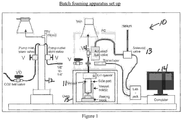
- Samples are made using a batch foaming apparatus that is intended to represent a laboratory screening test that correlates with extrusion foaming during the wire coating process.
- the process comprises the steps of loading, preheating, saturating and depressurizing.
- Figure 1 provides a general description of the process apparatus and layout.
- Foaming pressure is from 15 to 35 MPa
- foaming temperature is from 95°C to 105°C for LDPE and 125°C to 150°C for HDPE.
- the foaming temperature for the blend is from 120°C to 130°C.
- the polymer plaque is stood on end in a pressure vessel on a thin layer of glass wool which rests on top of the aluminum plug.
- the pressure vessel is heated to 150°C for 30 minutes.
- the pressure in the pressure vessel is then increased to 23 MPa by charging the vessel with a pressurized atmosphere comprising the foaming agent and saturate polymer melt with foaming agent at temperature of 150°C and pressure of 23 MPa pressure for 2 hours.
- pressure vessel is cooled down to foaming temperature of 127°C and keep the foaming temperature for 30 minutes. Afterwards, the pressure vessel is rapidly vented, thus depressurizing the pressure vessel, and the foamed sample is collected from the pressure vessel.
- batch foaming apparatus 10 comprises high pressure vessel (11), CO 2 injection pump (12), helium driven solenoid valve (13) and corresponding data acquisition system (14) to record the pressure profile after depressurization.
- foaming experiments are carried out under a pressure up to 5500 pounds per square inch (psi) (37.9 MPa) and a temperature less than or equal to 160°C.
- the foaming procedure is as follows:
- Table 3 reports the processing conditions for both the comparative examples and inventive examples. Various measured sample properties are also reported in Table 3.
- Table 3 Foaming Process Parameters and Sample Properties Examples
- Equation 1 The dissipation factor of the foam extrudate is calculated using Equation 1.
- tg ⁇ ⁇ tg ⁇ ⁇ + 2 ⁇ ⁇ tg ⁇ ⁇ 1 ⁇ P 2 ⁇ ⁇ + 1 ⁇ 2 P ⁇ ⁇ ⁇ 1 ⁇ ⁇ ⁇ tg ⁇ ⁇ 2 + P 2 ⁇ ⁇ + 1 + P ⁇ ⁇ ⁇ 1 Equation 1 is cited in Electrical Properties of Polymer: Chemical Principles, Hanser Publishers, 1976
- tan ⁇ ⁇ tan ⁇ ⁇ + 2 ⁇ ⁇ tan ⁇ ⁇ 1 ⁇ P 2 ⁇ ⁇ + 1 ⁇ 2 P ⁇ ⁇ ⁇ 1 ⁇ ⁇ ⁇ tan ⁇ ⁇ 2 + P 2 ⁇ ⁇ + 1 + P ⁇ ⁇ ⁇ 1
- the calculation of the dissipation factor for the foam extrudate of Example 2 is:
- the invention is peroxide selection for PE polymer resin system modification which has minimum deterioration on the DF property.
- DCP control 5, DF of 57 ⁇ 10-5) and L101 (control 6, DF of 44 ⁇ 10-5)
- DTAP modified HDPE/LDPE blend has the lowest DF data, ca. 12 ⁇ 10-5 (Ex.2) when peroxide loading is 0.1% for all formulations.
- the Df data of the comparative examples and several of the inventive examples are also listed in Table 3.
- the Df data are 7 ⁇ 10-5 and 11 ⁇ 10-5, respectively.
- the introduction of LDPE resulted in a Df increase.
- the effect of PMX-200 and different peroxides such as DCP and L101 on Df is also reported.
- 1% PMX-200 is added into the blend of HDPE/LDPE
- the Df of blend increases from 11 ⁇ 10-5 to 20 ⁇ 10-5
- 2% PDMS is added into the neat HDPE, the Df increases from 7 ⁇ 10 -5 to 23 ⁇ 10 -5 .
Landscapes
- Chemical & Material Sciences (AREA)
- Health & Medical Sciences (AREA)
- Chemical Kinetics & Catalysis (AREA)
- Medicinal Chemistry (AREA)
- Polymers & Plastics (AREA)
- Organic Chemistry (AREA)
- Engineering & Computer Science (AREA)
- Materials Engineering (AREA)
- Emergency Medicine (AREA)
- Manufacture Of Porous Articles, And Recovery And Treatment Of Waste Products (AREA)
- Compositions Of Macromolecular Compounds (AREA)
Applications Claiming Priority (1)
| Application Number | Priority Date | Filing Date | Title |
|---|---|---|---|
| PCT/CN2015/096250 WO2017091996A1 (en) | 2015-12-03 | 2015-12-03 | High porosity microcellular polyethylene |
Publications (3)
| Publication Number | Publication Date |
|---|---|
| EP3383950A1 EP3383950A1 (en) | 2018-10-10 |
| EP3383950A4 EP3383950A4 (en) | 2019-05-29 |
| EP3383950B1 true EP3383950B1 (en) | 2020-06-17 |
Family
ID=58795997
Family Applications (1)
| Application Number | Title | Priority Date | Filing Date |
|---|---|---|---|
| EP15909513.2A Active EP3383950B1 (en) | 2015-12-03 | 2015-12-03 | High porosity microcellular polyethylene |
Country Status (9)
| Country | Link |
|---|---|
| US (1) | US20180346676A1 (enExample) |
| EP (1) | EP3383950B1 (enExample) |
| JP (1) | JP6616506B2 (enExample) |
| KR (1) | KR20180089467A (enExample) |
| CN (1) | CN108473732B (enExample) |
| BR (1) | BR112018009883B1 (enExample) |
| CA (1) | CA3007012C (enExample) |
| MX (1) | MX2018006135A (enExample) |
| WO (1) | WO2017091996A1 (enExample) |
Families Citing this family (5)
| Publication number | Priority date | Publication date | Assignee | Title |
|---|---|---|---|---|
| SG11202001556RA (en) * | 2017-08-31 | 2020-03-30 | Dow Global Technologies Llc | Process for producing foam beads using a modified ethylene-based polymer |
| WO2019240913A1 (en) * | 2018-06-15 | 2019-12-19 | Dow Global Technologies Llc | Polymeric compounds for cable coatings and processes for producing same |
| EP3670600A1 (en) * | 2018-12-21 | 2020-06-24 | Borealis AG | Improved foaming behaviour of polymer compositions using passive nucleation |
| CN110615911A (zh) * | 2019-10-29 | 2019-12-27 | 恩奇(佛山)新材料科技有限公司 | 一种聚乙烯类高倍率发泡材料及其制备方法 |
| CN112210113B (zh) * | 2020-10-21 | 2022-11-15 | 华东理工大学 | 聚丙烯发泡材料及其制备方法 |
Family Cites Families (35)
| Publication number | Priority date | Publication date | Assignee | Title |
|---|---|---|---|---|
| US4681715A (en) * | 1984-11-16 | 1987-07-21 | The Dow Chemical Company | Steam expandable polymeric composition and method |
| US4714716A (en) * | 1984-11-16 | 1987-12-22 | The Dow Chemical Company | Lightly crosslinked linear olefinic polymer foams and process for making |
| US4607060A (en) * | 1985-09-30 | 1986-08-19 | Pennwalt Corporation | Foaming and crosslinking of elastomeric and/or thermoplastic polymers |
| JPH03139536A (ja) * | 1989-10-25 | 1991-06-13 | Nippon Unicar Co Ltd | 連続気泡型架橋エチレン系樹脂発泡体の製造方法 |
| JP2939565B2 (ja) * | 1990-07-19 | 1999-08-25 | 日本ユニカー株式会社 | 高発泡絶縁ポリエチレン用発泡性樹脂組成物およびその製造方法 |
| US5158986A (en) * | 1991-04-05 | 1992-10-27 | Massachusetts Institute Of Technology | Microcellular thermoplastic foamed with supercritical fluid |
| US5100924A (en) * | 1991-08-28 | 1992-03-31 | Nippon Unicar Company Limited | Open cell foam compositions |
| JP3092773B2 (ja) * | 1993-02-19 | 2000-09-25 | 三菱電線工業株式会社 | 発泡性有機高分子組成物および発泡体の製造方法 |
| US5574074A (en) * | 1993-02-19 | 1996-11-12 | Mitsubishi Cable Industries, Inc. | Foamable organic polymer composition and production of foamed article |
| CN1138870A (zh) * | 1994-11-15 | 1996-12-25 | 钟渊化学工业株式会社 | 发泡性树脂组合物及用其制成的发泡体及其制造方法 |
| US5670552A (en) * | 1995-12-18 | 1997-09-23 | W. R. Grace & Co.-Conn. | Foam and process for producing foam using a carbon dioxide blowing agent |
| NO313835B1 (no) * | 1998-06-19 | 2002-12-09 | Borealis As | Fremgangsmate for forgrening av polypropylenmaterialer, fremgangsmate for forgrening og skumming av polypropylenmaterialer, og anvendelse av polymermaterialene oppnadd ved fremgangsmatene |
| JP2000235814A (ja) * | 1998-12-14 | 2000-08-29 | Nippon Unicar Co Ltd | 不活性ガス発泡法による高発泡ポリエチレン被覆電線製造用の発泡性樹脂組成物及びこれを被覆して作った高発泡絶縁ポリエチレン被覆電線 |
| US6492453B1 (en) * | 1999-09-24 | 2002-12-10 | Alphagary Corporation | Low smoke emission, low corrosivity, low toxicity, low heat release, flame retardant, zero halogen polymeric compositions |
| US6124770A (en) * | 1999-10-22 | 2000-09-26 | Nippon Unicar Company Limited | Expandable resin composition |
| CN1139631C (zh) * | 2000-09-20 | 2004-02-25 | 中国石油化工股份有限公司 | 一种聚乙烯微孔材料的制备方法 |
| ATE307161T1 (de) * | 2000-10-24 | 2005-11-15 | Dow Global Technologies Inc | Herstellungverfahren für multimodalen thermoplastischen polymerschaum |
| US6541533B2 (en) * | 2001-01-10 | 2003-04-01 | Jsp Corporation | Extruded polyolefin resin foam |
| JP2002338722A (ja) * | 2001-05-11 | 2002-11-27 | Inoac Corp | 切削加工用架橋ポリエチレン発泡体 |
| DE60319154T2 (de) * | 2003-04-24 | 2009-02-05 | National Research Council Of Canada, Ottawa | Dämpfungsarme schaumstoffzusammensetzung und kabel mit einer schicht aus dämpfungsarmem schaumstoff |
| JP2007051190A (ja) * | 2005-08-17 | 2007-03-01 | Fujikura Ltd | 発泡用樹脂組成物、発泡同軸ケーブル及び発泡同軸ケーブルの製造方法 |
| EP2164893B1 (en) * | 2007-05-31 | 2013-06-26 | Saudi Basic Industries Corporation | Polyethylene foam |
| JP5552759B2 (ja) * | 2009-06-19 | 2014-07-16 | 日立金属株式会社 | 発泡用樹脂組成物および高周波同軸ケーブル |
| JP2011256375A (ja) * | 2010-05-10 | 2011-12-22 | Asahi Kasei Chemicals Corp | 無架橋発泡用ポリエチレン系樹脂組成物ならびにそのポリエチレン系樹脂無架橋発泡成形体 |
| US9120887B2 (en) * | 2010-06-22 | 2015-09-01 | Dow Global Technologies Llc | Crosslinked compositions and articles prepared therefrom |
| JP2012046574A (ja) * | 2010-08-25 | 2012-03-08 | Hitachi Cable Ltd | 樹脂組成物および高周波同軸ケーブル |
| CN102229708B (zh) * | 2011-05-16 | 2013-06-05 | 四川大学 | 高发泡倍率高密度聚乙烯微孔发泡型材及其制备方法 |
| CN103826669A (zh) * | 2011-09-23 | 2014-05-28 | 宙斯工业产品股份有限公司 | 复合假体分流器装置 |
| JP2013129757A (ja) * | 2011-12-21 | 2013-07-04 | Japan Polypropylene Corp | 発泡性ポリプロピレン系樹脂組成物、発泡成形体及びその製造方法 |
| KR20150060726A (ko) * | 2012-09-28 | 2015-06-03 | 다우 글로벌 테크놀로지스 엘엘씨 | 무선 통신탑을 위한 저밀도 금속-기재 부품 |
| WO2014099335A2 (en) * | 2012-12-21 | 2014-06-26 | Dow Global Technologies Llc | Polyolefin-based cable compound formulation for improved foamability and enhanced processability |
| CN103113653B (zh) * | 2013-02-06 | 2015-05-13 | 常州大学 | 一种hdpe/ldpe共混发泡材料及其制备方法 |
| CN103524821A (zh) * | 2013-06-19 | 2014-01-22 | 南京迪默森节能科技有限公司 | 聚乙烯泡沫塑料及其制备方法 |
| CN103554658A (zh) * | 2013-10-18 | 2014-02-05 | 深圳职业技术学院 | 塑料多孔材料及其制备方法 |
| US9505906B1 (en) * | 2014-05-02 | 2016-11-29 | Fina Technology, Inc. | Polymer foams |
-
2015
- 2015-12-03 BR BR112018009883-3A patent/BR112018009883B1/pt active IP Right Grant
- 2015-12-03 MX MX2018006135A patent/MX2018006135A/es unknown
- 2015-12-03 US US15/780,102 patent/US20180346676A1/en not_active Abandoned
- 2015-12-03 KR KR1020187018566A patent/KR20180089467A/ko not_active Abandoned
- 2015-12-03 WO PCT/CN2015/096250 patent/WO2017091996A1/en not_active Ceased
- 2015-12-03 CA CA3007012A patent/CA3007012C/en active Active
- 2015-12-03 CN CN201580084703.XA patent/CN108473732B/zh active Active
- 2015-12-03 JP JP2018523405A patent/JP6616506B2/ja active Active
- 2015-12-03 EP EP15909513.2A patent/EP3383950B1/en active Active
Non-Patent Citations (1)
| Title |
|---|
| None * |
Also Published As
| Publication number | Publication date |
|---|---|
| JP6616506B2 (ja) | 2019-12-04 |
| EP3383950A4 (en) | 2019-05-29 |
| CN108473732A (zh) | 2018-08-31 |
| CN108473732B (zh) | 2021-03-19 |
| JP2018536056A (ja) | 2018-12-06 |
| EP3383950A1 (en) | 2018-10-10 |
| US20180346676A1 (en) | 2018-12-06 |
| BR112018009883B1 (pt) | 2022-01-04 |
| MX2018006135A (es) | 2018-08-15 |
| WO2017091996A1 (en) | 2017-06-08 |
| CA3007012A1 (en) | 2017-06-08 |
| CA3007012C (en) | 2023-03-28 |
| BR112018009883A2 (pt) | 2018-11-13 |
| KR20180089467A (ko) | 2018-08-08 |
Similar Documents
| Publication | Publication Date | Title |
|---|---|---|
| EP3383950B1 (en) | High porosity microcellular polyethylene | |
| US11180645B2 (en) | Process for foaming polyolefin compositions using an azodicarbonamide/citrate mixture as a nucleating agent | |
| KR20150100675A (ko) | 개선된 발포성 및 향상된 가공성을 위한 폴리올레핀-기재 케이블 화합물 제제 | |
| EP3224311B1 (en) | Process for foaming polyolefin compositions using a fluororesin/azodicarbonamide mixture as a nucleating agent | |
| KR102304010B1 (ko) | 핵제로서 불소수지를 사용한 폴리올레핀 조성물을 포말화하는 방법 | |
| JP6584505B2 (ja) | フッ素樹脂/クエン酸混合物を核形成剤として使用してポリオレフィン組成物を発泡させるためのプロセス | |
| US11407873B2 (en) | Process for foaming polyolefin compositions using a modified high density polyethylene | |
| JP6797261B2 (ja) | フッ素樹脂/アソジカルボンアミド混合物を核形成剤として使用してポリオレフィン組成物を発泡させるためのプロセス | |
| JP2000191848A (ja) | エチレン系樹脂組成物およびそれからなる発泡体 |
Legal Events
| Date | Code | Title | Description |
|---|---|---|---|
| STAA | Information on the status of an ep patent application or granted ep patent |
Free format text: STATUS: THE INTERNATIONAL PUBLICATION HAS BEEN MADE |
|
| PUAI | Public reference made under article 153(3) epc to a published international application that has entered the european phase |
Free format text: ORIGINAL CODE: 0009012 |
|
| STAA | Information on the status of an ep patent application or granted ep patent |
Free format text: STATUS: REQUEST FOR EXAMINATION WAS MADE |
|
| 17P | Request for examination filed |
Effective date: 20180628 |
|
| AK | Designated contracting states |
Kind code of ref document: A1 Designated state(s): AL AT BE BG CH CY CZ DE DK EE ES FI FR GB GR HR HU IE IS IT LI LT LU LV MC MK MT NL NO PL PT RO RS SE SI SK SM TR |
|
| AX | Request for extension of the european patent |
Extension state: BA ME |
|
| DAV | Request for validation of the european patent (deleted) | ||
| DAX | Request for extension of the european patent (deleted) | ||
| A4 | Supplementary search report drawn up and despatched |
Effective date: 20190429 |
|
| RIC1 | Information provided on ipc code assigned before grant |
Ipc: C08L 23/06 20060101AFI20190423BHEP Ipc: C08J 9/00 20060101ALI20190423BHEP |
|
| GRAP | Despatch of communication of intention to grant a patent |
Free format text: ORIGINAL CODE: EPIDOSNIGR1 |
|
| STAA | Information on the status of an ep patent application or granted ep patent |
Free format text: STATUS: GRANT OF PATENT IS INTENDED |
|
| INTG | Intention to grant announced |
Effective date: 20200107 |
|
| GRAS | Grant fee paid |
Free format text: ORIGINAL CODE: EPIDOSNIGR3 |
|
| GRAA | (expected) grant |
Free format text: ORIGINAL CODE: 0009210 |
|
| STAA | Information on the status of an ep patent application or granted ep patent |
Free format text: STATUS: THE PATENT HAS BEEN GRANTED |
|
| AK | Designated contracting states |
Kind code of ref document: B1 Designated state(s): AL AT BE BG CH CY CZ DE DK EE ES FI FR GB GR HR HU IE IS IT LI LT LU LV MC MK MT NL NO PL PT RO RS SE SI SK SM TR |
|
| REG | Reference to a national code |
Ref country code: GB Ref legal event code: FG4D |
|
| REG | Reference to a national code |
Ref country code: CH Ref legal event code: EP |
|
| REG | Reference to a national code |
Ref country code: DE Ref legal event code: R096 Ref document number: 602015054590 Country of ref document: DE |
|
| REG | Reference to a national code |
Ref country code: IE Ref legal event code: FG4D |
|
| REG | Reference to a national code |
Ref country code: AT Ref legal event code: REF Ref document number: 1281239 Country of ref document: AT Kind code of ref document: T Effective date: 20200715 |
|
| PG25 | Lapsed in a contracting state [announced via postgrant information from national office to epo] |
Ref country code: SE Free format text: LAPSE BECAUSE OF FAILURE TO SUBMIT A TRANSLATION OF THE DESCRIPTION OR TO PAY THE FEE WITHIN THE PRESCRIBED TIME-LIMIT Effective date: 20200617 Ref country code: NO Free format text: LAPSE BECAUSE OF FAILURE TO SUBMIT A TRANSLATION OF THE DESCRIPTION OR TO PAY THE FEE WITHIN THE PRESCRIBED TIME-LIMIT Effective date: 20200917 Ref country code: GR Free format text: LAPSE BECAUSE OF FAILURE TO SUBMIT A TRANSLATION OF THE DESCRIPTION OR TO PAY THE FEE WITHIN THE PRESCRIBED TIME-LIMIT Effective date: 20200918 Ref country code: FI Free format text: LAPSE BECAUSE OF FAILURE TO SUBMIT A TRANSLATION OF THE DESCRIPTION OR TO PAY THE FEE WITHIN THE PRESCRIBED TIME-LIMIT Effective date: 20200617 Ref country code: LT Free format text: LAPSE BECAUSE OF FAILURE TO SUBMIT A TRANSLATION OF THE DESCRIPTION OR TO PAY THE FEE WITHIN THE PRESCRIBED TIME-LIMIT Effective date: 20200617 |
|
| REG | Reference to a national code |
Ref country code: LT Ref legal event code: MG4D |
|
| REG | Reference to a national code |
Ref country code: NL Ref legal event code: MP Effective date: 20200617 |
|
| PG25 | Lapsed in a contracting state [announced via postgrant information from national office to epo] |
Ref country code: LV Free format text: LAPSE BECAUSE OF FAILURE TO SUBMIT A TRANSLATION OF THE DESCRIPTION OR TO PAY THE FEE WITHIN THE PRESCRIBED TIME-LIMIT Effective date: 20200617 Ref country code: BG Free format text: LAPSE BECAUSE OF FAILURE TO SUBMIT A TRANSLATION OF THE DESCRIPTION OR TO PAY THE FEE WITHIN THE PRESCRIBED TIME-LIMIT Effective date: 20200917 Ref country code: HR Free format text: LAPSE BECAUSE OF FAILURE TO SUBMIT A TRANSLATION OF THE DESCRIPTION OR TO PAY THE FEE WITHIN THE PRESCRIBED TIME-LIMIT Effective date: 20200617 Ref country code: RS Free format text: LAPSE BECAUSE OF FAILURE TO SUBMIT A TRANSLATION OF THE DESCRIPTION OR TO PAY THE FEE WITHIN THE PRESCRIBED TIME-LIMIT Effective date: 20200617 |
|
| REG | Reference to a national code |
Ref country code: AT Ref legal event code: MK05 Ref document number: 1281239 Country of ref document: AT Kind code of ref document: T Effective date: 20200617 |
|
| PG25 | Lapsed in a contracting state [announced via postgrant information from national office to epo] |
Ref country code: NL Free format text: LAPSE BECAUSE OF FAILURE TO SUBMIT A TRANSLATION OF THE DESCRIPTION OR TO PAY THE FEE WITHIN THE PRESCRIBED TIME-LIMIT Effective date: 20200617 Ref country code: AL Free format text: LAPSE BECAUSE OF FAILURE TO SUBMIT A TRANSLATION OF THE DESCRIPTION OR TO PAY THE FEE WITHIN THE PRESCRIBED TIME-LIMIT Effective date: 20200617 |
|
| PG25 | Lapsed in a contracting state [announced via postgrant information from national office to epo] |
Ref country code: EE Free format text: LAPSE BECAUSE OF FAILURE TO SUBMIT A TRANSLATION OF THE DESCRIPTION OR TO PAY THE FEE WITHIN THE PRESCRIBED TIME-LIMIT Effective date: 20200617 Ref country code: AT Free format text: LAPSE BECAUSE OF FAILURE TO SUBMIT A TRANSLATION OF THE DESCRIPTION OR TO PAY THE FEE WITHIN THE PRESCRIBED TIME-LIMIT Effective date: 20200617 Ref country code: SM Free format text: LAPSE BECAUSE OF FAILURE TO SUBMIT A TRANSLATION OF THE DESCRIPTION OR TO PAY THE FEE WITHIN THE PRESCRIBED TIME-LIMIT Effective date: 20200617 Ref country code: CZ Free format text: LAPSE BECAUSE OF FAILURE TO SUBMIT A TRANSLATION OF THE DESCRIPTION OR TO PAY THE FEE WITHIN THE PRESCRIBED TIME-LIMIT Effective date: 20200617 Ref country code: ES Free format text: LAPSE BECAUSE OF FAILURE TO SUBMIT A TRANSLATION OF THE DESCRIPTION OR TO PAY THE FEE WITHIN THE PRESCRIBED TIME-LIMIT Effective date: 20200617 Ref country code: RO Free format text: LAPSE BECAUSE OF FAILURE TO SUBMIT A TRANSLATION OF THE DESCRIPTION OR TO PAY THE FEE WITHIN THE PRESCRIBED TIME-LIMIT Effective date: 20200617 Ref country code: PT Free format text: LAPSE BECAUSE OF FAILURE TO SUBMIT A TRANSLATION OF THE DESCRIPTION OR TO PAY THE FEE WITHIN THE PRESCRIBED TIME-LIMIT Effective date: 20201019 |
|
| PG25 | Lapsed in a contracting state [announced via postgrant information from national office to epo] |
Ref country code: IS Free format text: LAPSE BECAUSE OF FAILURE TO SUBMIT A TRANSLATION OF THE DESCRIPTION OR TO PAY THE FEE WITHIN THE PRESCRIBED TIME-LIMIT Effective date: 20201017 Ref country code: PL Free format text: LAPSE BECAUSE OF FAILURE TO SUBMIT A TRANSLATION OF THE DESCRIPTION OR TO PAY THE FEE WITHIN THE PRESCRIBED TIME-LIMIT Effective date: 20200617 Ref country code: SK Free format text: LAPSE BECAUSE OF FAILURE TO SUBMIT A TRANSLATION OF THE DESCRIPTION OR TO PAY THE FEE WITHIN THE PRESCRIBED TIME-LIMIT Effective date: 20200617 |
|
| REG | Reference to a national code |
Ref country code: DE Ref legal event code: R097 Ref document number: 602015054590 Country of ref document: DE |
|
| PLBE | No opposition filed within time limit |
Free format text: ORIGINAL CODE: 0009261 |
|
| STAA | Information on the status of an ep patent application or granted ep patent |
Free format text: STATUS: NO OPPOSITION FILED WITHIN TIME LIMIT |
|
| PG25 | Lapsed in a contracting state [announced via postgrant information from national office to epo] |
Ref country code: DK Free format text: LAPSE BECAUSE OF FAILURE TO SUBMIT A TRANSLATION OF THE DESCRIPTION OR TO PAY THE FEE WITHIN THE PRESCRIBED TIME-LIMIT Effective date: 20200617 |
|
| 26N | No opposition filed |
Effective date: 20210318 |
|
| PG25 | Lapsed in a contracting state [announced via postgrant information from national office to epo] |
Ref country code: SI Free format text: LAPSE BECAUSE OF FAILURE TO SUBMIT A TRANSLATION OF THE DESCRIPTION OR TO PAY THE FEE WITHIN THE PRESCRIBED TIME-LIMIT Effective date: 20200617 |
|
| REG | Reference to a national code |
Ref country code: CH Ref legal event code: PL |
|
| GBPC | Gb: european patent ceased through non-payment of renewal fee |
Effective date: 20201203 |
|
| PG25 | Lapsed in a contracting state [announced via postgrant information from national office to epo] |
Ref country code: MC Free format text: LAPSE BECAUSE OF FAILURE TO SUBMIT A TRANSLATION OF THE DESCRIPTION OR TO PAY THE FEE WITHIN THE PRESCRIBED TIME-LIMIT Effective date: 20200617 |
|
| REG | Reference to a national code |
Ref country code: BE Ref legal event code: MM Effective date: 20201231 |
|
| PG25 | Lapsed in a contracting state [announced via postgrant information from national office to epo] |
Ref country code: IE Free format text: LAPSE BECAUSE OF NON-PAYMENT OF DUE FEES Effective date: 20201203 Ref country code: LU Free format text: LAPSE BECAUSE OF NON-PAYMENT OF DUE FEES Effective date: 20201203 |
|
| PG25 | Lapsed in a contracting state [announced via postgrant information from national office to epo] |
Ref country code: LI Free format text: LAPSE BECAUSE OF NON-PAYMENT OF DUE FEES Effective date: 20201231 Ref country code: GB Free format text: LAPSE BECAUSE OF NON-PAYMENT OF DUE FEES Effective date: 20201203 Ref country code: CH Free format text: LAPSE BECAUSE OF NON-PAYMENT OF DUE FEES Effective date: 20201231 |
|
| PG25 | Lapsed in a contracting state [announced via postgrant information from national office to epo] |
Ref country code: IS Free format text: LAPSE BECAUSE OF FAILURE TO SUBMIT A TRANSLATION OF THE DESCRIPTION OR TO PAY THE FEE WITHIN THE PRESCRIBED TIME-LIMIT Effective date: 20201017 Ref country code: TR Free format text: LAPSE BECAUSE OF FAILURE TO SUBMIT A TRANSLATION OF THE DESCRIPTION OR TO PAY THE FEE WITHIN THE PRESCRIBED TIME-LIMIT Effective date: 20200617 Ref country code: MT Free format text: LAPSE BECAUSE OF FAILURE TO SUBMIT A TRANSLATION OF THE DESCRIPTION OR TO PAY THE FEE WITHIN THE PRESCRIBED TIME-LIMIT Effective date: 20200617 Ref country code: CY Free format text: LAPSE BECAUSE OF FAILURE TO SUBMIT A TRANSLATION OF THE DESCRIPTION OR TO PAY THE FEE WITHIN THE PRESCRIBED TIME-LIMIT Effective date: 20200617 |
|
| PG25 | Lapsed in a contracting state [announced via postgrant information from national office to epo] |
Ref country code: MK Free format text: LAPSE BECAUSE OF FAILURE TO SUBMIT A TRANSLATION OF THE DESCRIPTION OR TO PAY THE FEE WITHIN THE PRESCRIBED TIME-LIMIT Effective date: 20200617 |
|
| PG25 | Lapsed in a contracting state [announced via postgrant information from national office to epo] |
Ref country code: BE Free format text: LAPSE BECAUSE OF NON-PAYMENT OF DUE FEES Effective date: 20201231 |
|
| P01 | Opt-out of the competence of the unified patent court (upc) registered |
Effective date: 20230526 |
|
| PGFP | Annual fee paid to national office [announced via postgrant information from national office to epo] |
Ref country code: DE Payment date: 20241001 Year of fee payment: 10 |
|
| PGFP | Annual fee paid to national office [announced via postgrant information from national office to epo] |
Ref country code: IT Payment date: 20241112 Year of fee payment: 10 |
|
| PGFP | Annual fee paid to national office [announced via postgrant information from national office to epo] |
Ref country code: FR Payment date: 20250930 Year of fee payment: 11 |