EP3334835B1 - Herstellung von hochreinen kollagenteilchen und verwendung davon - Google Patents
Herstellung von hochreinen kollagenteilchen und verwendung davon Download PDFInfo
- Publication number
- EP3334835B1 EP3334835B1 EP16834678.1A EP16834678A EP3334835B1 EP 3334835 B1 EP3334835 B1 EP 3334835B1 EP 16834678 A EP16834678 A EP 16834678A EP 3334835 B1 EP3334835 B1 EP 3334835B1
- Authority
- EP
- European Patent Office
- Prior art keywords
- collagen
- sulfonic acid
- animal skin
- aqueous solution
- subjecting
- Prior art date
- Legal status (The legal status is an assumption and is not a legal conclusion. Google has not performed a legal analysis and makes no representation as to the accuracy of the status listed.)
- Active
Links
Images

Classifications
-
- A—HUMAN NECESSITIES
- A61—MEDICAL OR VETERINARY SCIENCE; HYGIENE
- A61L—METHODS OR APPARATUS FOR STERILISING MATERIALS OR OBJECTS IN GENERAL; DISINFECTION, STERILISATION OR DEODORISATION OF AIR; CHEMICAL ASPECTS OF BANDAGES, DRESSINGS, ABSORBENT PADS OR SURGICAL ARTICLES; MATERIALS FOR BANDAGES, DRESSINGS, ABSORBENT PADS OR SURGICAL ARTICLES
- A61L27/00—Materials for grafts or prostheses or for coating grafts or prostheses
- A61L27/36—Materials for grafts or prostheses or for coating grafts or prostheses containing ingredients of undetermined constitution or reaction products thereof, e.g. transplant tissue, natural bone, extracellular matrix
- A61L27/3604—Materials for grafts or prostheses or for coating grafts or prostheses containing ingredients of undetermined constitution or reaction products thereof, e.g. transplant tissue, natural bone, extracellular matrix characterised by the human or animal origin of the biological material, e.g. hair, fascia, fish scales, silk, shellac, pericardium, pleura, renal tissue, amniotic membrane, parenchymal tissue, fetal tissue, muscle tissue, fat tissue, enamel
- A61L27/3612—Cartilage, synovial fluid
-
- A—HUMAN NECESSITIES
- A61—MEDICAL OR VETERINARY SCIENCE; HYGIENE
- A61L—METHODS OR APPARATUS FOR STERILISING MATERIALS OR OBJECTS IN GENERAL; DISINFECTION, STERILISATION OR DEODORISATION OF AIR; CHEMICAL ASPECTS OF BANDAGES, DRESSINGS, ABSORBENT PADS OR SURGICAL ARTICLES; MATERIALS FOR BANDAGES, DRESSINGS, ABSORBENT PADS OR SURGICAL ARTICLES
- A61L27/00—Materials for grafts or prostheses or for coating grafts or prostheses
- A61L27/14—Macromolecular materials
- A61L27/20—Polysaccharides
-
- A—HUMAN NECESSITIES
- A61—MEDICAL OR VETERINARY SCIENCE; HYGIENE
- A61L—METHODS OR APPARATUS FOR STERILISING MATERIALS OR OBJECTS IN GENERAL; DISINFECTION, STERILISATION OR DEODORISATION OF AIR; CHEMICAL ASPECTS OF BANDAGES, DRESSINGS, ABSORBENT PADS OR SURGICAL ARTICLES; MATERIALS FOR BANDAGES, DRESSINGS, ABSORBENT PADS OR SURGICAL ARTICLES
- A61L27/00—Materials for grafts or prostheses or for coating grafts or prostheses
- A61L27/14—Macromolecular materials
- A61L27/22—Polypeptides or derivatives thereof, e.g. degradation products
- A61L27/24—Collagen
-
- A—HUMAN NECESSITIES
- A61—MEDICAL OR VETERINARY SCIENCE; HYGIENE
- A61L—METHODS OR APPARATUS FOR STERILISING MATERIALS OR OBJECTS IN GENERAL; DISINFECTION, STERILISATION OR DEODORISATION OF AIR; CHEMICAL ASPECTS OF BANDAGES, DRESSINGS, ABSORBENT PADS OR SURGICAL ARTICLES; MATERIALS FOR BANDAGES, DRESSINGS, ABSORBENT PADS OR SURGICAL ARTICLES
- A61L27/00—Materials for grafts or prostheses or for coating grafts or prostheses
- A61L27/36—Materials for grafts or prostheses or for coating grafts or prostheses containing ingredients of undetermined constitution or reaction products thereof, e.g. transplant tissue, natural bone, extracellular matrix
- A61L27/3604—Materials for grafts or prostheses or for coating grafts or prostheses containing ingredients of undetermined constitution or reaction products thereof, e.g. transplant tissue, natural bone, extracellular matrix characterised by the human or animal origin of the biological material, e.g. hair, fascia, fish scales, silk, shellac, pericardium, pleura, renal tissue, amniotic membrane, parenchymal tissue, fetal tissue, muscle tissue, fat tissue, enamel
- A61L27/362—Skin, e.g. dermal papillae
-
- A—HUMAN NECESSITIES
- A61—MEDICAL OR VETERINARY SCIENCE; HYGIENE
- A61L—METHODS OR APPARATUS FOR STERILISING MATERIALS OR OBJECTS IN GENERAL; DISINFECTION, STERILISATION OR DEODORISATION OF AIR; CHEMICAL ASPECTS OF BANDAGES, DRESSINGS, ABSORBENT PADS OR SURGICAL ARTICLES; MATERIALS FOR BANDAGES, DRESSINGS, ABSORBENT PADS OR SURGICAL ARTICLES
- A61L27/00—Materials for grafts or prostheses or for coating grafts or prostheses
- A61L27/36—Materials for grafts or prostheses or for coating grafts or prostheses containing ingredients of undetermined constitution or reaction products thereof, e.g. transplant tissue, natural bone, extracellular matrix
- A61L27/3641—Materials for grafts or prostheses or for coating grafts or prostheses containing ingredients of undetermined constitution or reaction products thereof, e.g. transplant tissue, natural bone, extracellular matrix characterised by the site of application in the body
- A61L27/3645—Connective tissue
- A61L27/3654—Cartilage, e.g. meniscus
-
- A—HUMAN NECESSITIES
- A61—MEDICAL OR VETERINARY SCIENCE; HYGIENE
- A61L—METHODS OR APPARATUS FOR STERILISING MATERIALS OR OBJECTS IN GENERAL; DISINFECTION, STERILISATION OR DEODORISATION OF AIR; CHEMICAL ASPECTS OF BANDAGES, DRESSINGS, ABSORBENT PADS OR SURGICAL ARTICLES; MATERIALS FOR BANDAGES, DRESSINGS, ABSORBENT PADS OR SURGICAL ARTICLES
- A61L27/00—Materials for grafts or prostheses or for coating grafts or prostheses
- A61L27/36—Materials for grafts or prostheses or for coating grafts or prostheses containing ingredients of undetermined constitution or reaction products thereof, e.g. transplant tissue, natural bone, extracellular matrix
- A61L27/3683—Materials for grafts or prostheses or for coating grafts or prostheses containing ingredients of undetermined constitution or reaction products thereof, e.g. transplant tissue, natural bone, extracellular matrix subjected to a specific treatment prior to implantation, e.g. decellularising, demineralising, grinding, cellular disruption/non-collagenous protein removal, anti-calcification, crosslinking, supercritical fluid extraction, enzyme treatment
-
- A—HUMAN NECESSITIES
- A61—MEDICAL OR VETERINARY SCIENCE; HYGIENE
- A61L—METHODS OR APPARATUS FOR STERILISING MATERIALS OR OBJECTS IN GENERAL; DISINFECTION, STERILISATION OR DEODORISATION OF AIR; CHEMICAL ASPECTS OF BANDAGES, DRESSINGS, ABSORBENT PADS OR SURGICAL ARTICLES; MATERIALS FOR BANDAGES, DRESSINGS, ABSORBENT PADS OR SURGICAL ARTICLES
- A61L27/00—Materials for grafts or prostheses or for coating grafts or prostheses
- A61L27/36—Materials for grafts or prostheses or for coating grafts or prostheses containing ingredients of undetermined constitution or reaction products thereof, e.g. transplant tissue, natural bone, extracellular matrix
- A61L27/3683—Materials for grafts or prostheses or for coating grafts or prostheses containing ingredients of undetermined constitution or reaction products thereof, e.g. transplant tissue, natural bone, extracellular matrix subjected to a specific treatment prior to implantation, e.g. decellularising, demineralising, grinding, cellular disruption/non-collagenous protein removal, anti-calcification, crosslinking, supercritical fluid extraction, enzyme treatment
- A61L27/3687—Materials for grafts or prostheses or for coating grafts or prostheses containing ingredients of undetermined constitution or reaction products thereof, e.g. transplant tissue, natural bone, extracellular matrix subjected to a specific treatment prior to implantation, e.g. decellularising, demineralising, grinding, cellular disruption/non-collagenous protein removal, anti-calcification, crosslinking, supercritical fluid extraction, enzyme treatment characterised by the use of chemical agents in the treatment, e.g. specific enzymes, detergents, capping agents, crosslinkers, anticalcification agents
-
- A—HUMAN NECESSITIES
- A61—MEDICAL OR VETERINARY SCIENCE; HYGIENE
- A61L—METHODS OR APPARATUS FOR STERILISING MATERIALS OR OBJECTS IN GENERAL; DISINFECTION, STERILISATION OR DEODORISATION OF AIR; CHEMICAL ASPECTS OF BANDAGES, DRESSINGS, ABSORBENT PADS OR SURGICAL ARTICLES; MATERIALS FOR BANDAGES, DRESSINGS, ABSORBENT PADS OR SURGICAL ARTICLES
- A61L27/00—Materials for grafts or prostheses or for coating grafts or prostheses
- A61L27/36—Materials for grafts or prostheses or for coating grafts or prostheses containing ingredients of undetermined constitution or reaction products thereof, e.g. transplant tissue, natural bone, extracellular matrix
- A61L27/3683—Materials for grafts or prostheses or for coating grafts or prostheses containing ingredients of undetermined constitution or reaction products thereof, e.g. transplant tissue, natural bone, extracellular matrix subjected to a specific treatment prior to implantation, e.g. decellularising, demineralising, grinding, cellular disruption/non-collagenous protein removal, anti-calcification, crosslinking, supercritical fluid extraction, enzyme treatment
- A61L27/3691—Materials for grafts or prostheses or for coating grafts or prostheses containing ingredients of undetermined constitution or reaction products thereof, e.g. transplant tissue, natural bone, extracellular matrix subjected to a specific treatment prior to implantation, e.g. decellularising, demineralising, grinding, cellular disruption/non-collagenous protein removal, anti-calcification, crosslinking, supercritical fluid extraction, enzyme treatment characterised by physical conditions of the treatment, e.g. applying a compressive force to the composition, pressure cycles, ultrasonic/sonication or microwave treatment, lyophilisation
-
- A—HUMAN NECESSITIES
- A61—MEDICAL OR VETERINARY SCIENCE; HYGIENE
- A61L—METHODS OR APPARATUS FOR STERILISING MATERIALS OR OBJECTS IN GENERAL; DISINFECTION, STERILISATION OR DEODORISATION OF AIR; CHEMICAL ASPECTS OF BANDAGES, DRESSINGS, ABSORBENT PADS OR SURGICAL ARTICLES; MATERIALS FOR BANDAGES, DRESSINGS, ABSORBENT PADS OR SURGICAL ARTICLES
- A61L27/00—Materials for grafts or prostheses or for coating grafts or prostheses
- A61L27/50—Materials characterised by their function or physical properties, e.g. injectable or lubricating compositions, shape-memory materials, surface modified materials
- A61L27/52—Hydrogels or hydrocolloids
-
- C—CHEMISTRY; METALLURGY
- C07—ORGANIC CHEMISTRY
- C07K—PEPTIDES
- C07K1/00—General methods for the preparation of peptides, i.e. processes for the organic chemical preparation of peptides or proteins of any length
- C07K1/14—Extraction; Separation; Purification
- C07K1/36—Extraction; Separation; Purification by a combination of two or more processes of different types
-
- C—CHEMISTRY; METALLURGY
- C07—ORGANIC CHEMISTRY
- C07K—PEPTIDES
- C07K14/00—Peptides having more than 20 amino acids; Gastrins; Somatostatins; Melanotropins; Derivatives thereof
- C07K14/435—Peptides having more than 20 amino acids; Gastrins; Somatostatins; Melanotropins; Derivatives thereof from animals; from humans
- C07K14/78—Connective tissue peptides, e.g. collagen, elastin, laminin, fibronectin, vitronectin or cold insoluble globulin [CIG]
-
- A—HUMAN NECESSITIES
- A61—MEDICAL OR VETERINARY SCIENCE; HYGIENE
- A61L—METHODS OR APPARATUS FOR STERILISING MATERIALS OR OBJECTS IN GENERAL; DISINFECTION, STERILISATION OR DEODORISATION OF AIR; CHEMICAL ASPECTS OF BANDAGES, DRESSINGS, ABSORBENT PADS OR SURGICAL ARTICLES; MATERIALS FOR BANDAGES, DRESSINGS, ABSORBENT PADS OR SURGICAL ARTICLES
- A61L2400/00—Materials characterised by their function or physical properties
- A61L2400/06—Flowable or injectable implant compositions
-
- A—HUMAN NECESSITIES
- A61—MEDICAL OR VETERINARY SCIENCE; HYGIENE
- A61L—METHODS OR APPARATUS FOR STERILISING MATERIALS OR OBJECTS IN GENERAL; DISINFECTION, STERILISATION OR DEODORISATION OF AIR; CHEMICAL ASPECTS OF BANDAGES, DRESSINGS, ABSORBENT PADS OR SURGICAL ARTICLES; MATERIALS FOR BANDAGES, DRESSINGS, ABSORBENT PADS OR SURGICAL ARTICLES
- A61L2400/00—Materials characterised by their function or physical properties
- A61L2400/12—Nanosized materials, e.g. nanofibres, nanoparticles, nanowires, nanotubes; Nanostructured surfaces
-
- A—HUMAN NECESSITIES
- A61—MEDICAL OR VETERINARY SCIENCE; HYGIENE
- A61L—METHODS OR APPARATUS FOR STERILISING MATERIALS OR OBJECTS IN GENERAL; DISINFECTION, STERILISATION OR DEODORISATION OF AIR; CHEMICAL ASPECTS OF BANDAGES, DRESSINGS, ABSORBENT PADS OR SURGICAL ARTICLES; MATERIALS FOR BANDAGES, DRESSINGS, ABSORBENT PADS OR SURGICAL ARTICLES
- A61L2430/00—Materials or treatment for tissue regeneration
- A61L2430/06—Materials or treatment for tissue regeneration for cartilage reconstruction, e.g. meniscus
-
- A—HUMAN NECESSITIES
- A61—MEDICAL OR VETERINARY SCIENCE; HYGIENE
- A61L—METHODS OR APPARATUS FOR STERILISING MATERIALS OR OBJECTS IN GENERAL; DISINFECTION, STERILISATION OR DEODORISATION OF AIR; CHEMICAL ASPECTS OF BANDAGES, DRESSINGS, ABSORBENT PADS OR SURGICAL ARTICLES; MATERIALS FOR BANDAGES, DRESSINGS, ABSORBENT PADS OR SURGICAL ARTICLES
- A61L2430/00—Materials or treatment for tissue regeneration
- A61L2430/34—Materials or treatment for tissue regeneration for soft tissue reconstruction
-
- A—HUMAN NECESSITIES
- A61—MEDICAL OR VETERINARY SCIENCE; HYGIENE
- A61L—METHODS OR APPARATUS FOR STERILISING MATERIALS OR OBJECTS IN GENERAL; DISINFECTION, STERILISATION OR DEODORISATION OF AIR; CHEMICAL ASPECTS OF BANDAGES, DRESSINGS, ABSORBENT PADS OR SURGICAL ARTICLES; MATERIALS FOR BANDAGES, DRESSINGS, ABSORBENT PADS OR SURGICAL ARTICLES
- A61L2430/00—Materials or treatment for tissue regeneration
- A61L2430/40—Preparation and treatment of biological tissue for implantation, e.g. decellularisation, cross-linking
Definitions
- the present disclosure in general relates to the field of methods for producing collagens, particularly, improved methods for producing collagen particles suitable for use as biological scaffolds for cells to grow thereon, such as dermal fillers for injections during a plastic surgery (e.g., a cosmetic surgery) for soft tissue augmentation (e.g., smoothing facial lines and wrinkles); or as wound dressings for promoting wound healing.
- a plastic surgery e.g., a cosmetic surgery
- soft tissue augmentation e.g., smoothing facial lines and wrinkles
- wound dressings for promoting wound healing.
- Collagen is an insoluble fibrous protein that occurs in vertebrates as the chief constituent of the fibrils of connective tissue such as skin.
- the conventional process of obtaining collagen is time consuming and inefficient, and oftentimes destroys the integrity of the collagens, rendering them unsuitable as a biological scaffold if they were intended to be used as an implant in the cosmetic surgery or in wound healing.
- most commercially available collagens such as those sold under the name Zyderm, and Zyplast are harvested from cow skin, which cannot be used in all patients due to severe allergic reactions they have on a significant population of hosts, especially those with a history of autoimmune diseases.
- bovine collagen does not exhibit long-term residence at the injection site, and thus requires periodic touch-up injections. It is believed that the short residence of the bovine collagen is due to the integrity of the collagen being destroyed when it was extracted from the cow hides, thereby resulting the collagen being easily absorbed by the host.
- Collagen that are of human origins such as Cosmoderm, and Cosmoplast have been developed, however, they are very expensive due to the limited sources (i.e., human foreskins of circumcisions).
- patients may use collagen derived from his/her own adipose tissue extracted by liposuction procedures and processed into injectable form for immediate use or stored for future use.
- they too, suffer from the same defect as that of bovine collagen, in that the integrity of the collagen is destroyed during isolation procedures.
- a published document, US 2015/037426 A discloses a method for producing decellularized skin fragments from soft tissues (e.g., particles from skin or adipose tissues) by subjecting the soft tissues to a hypertonic solution, which includes a detergent, an emulsifier, a surfactant, and additionally an enzyme.
- the hypertonic solution is a NaCl salt solution.
- a method for preparing acellular cartilage grafts from cartilage flakes by treating the cartilage flakes with an alkaline solution and a supercritical fluid (SCF) to produce the acellular cartilage graft is disclosed in US 2008/077251 A .
- the present disclosure was created by the present inventors to overcome the above-noted problems in the production of collagen particles, especially in the production of collagen particles characterized in having the native conformation of collagens from the skin of an animal (e.g., the skin of a hog or a cow).
- step (1) the animal skin having a thickness of about 0.1-1 mm is subject to the treatment of a supercritical fluid (SCF) under a pressure of about 10 - 50 Mpa (100 - 500 bar) at a temperature between 30-50°C for about 20 min to 5 days.
- SCF supercritical fluid
- the SCF is a supercritical carbon dioxide (scCO 2 ) or a supercritical nitrous oxide (scN 2 O). In one example, the SCF is scCO 2 . In another example, the SCF is scN 2 O.
- the decellularization process is carried out at a condition, in which the temperature is about 37°C, and the pressure is about 35 MPa (350 bar), for 20 min.
- the decellularized animal skin of step (1) is treated with an aqueous solution containing a surfactant selected from the group consisting of, octylphenol ethoxylates (e.g., Triton X series), sorbitan monostearate, polysorbate, poloxomer, nonoxynols, cetyl alcohol, and alkylpolyglucoside.
- a surfactant selected from the group consisting of, octylphenol ethoxylates (e.g., Triton X series), sorbitan monostearate, polysorbate, poloxomer, nonoxynols, cetyl alcohol, and alkylpolyglucoside.
- the aqueous solution may further comprise an anionic surfactant, such as lauryl sulfonic acid, dodecyl sulfonic acid, sodium dodecyl sulfate (SDS), dodecyl benzene sulfonic acid, tridecyl benzene sulfonic acid, alkyl-phenoxy benzene disulfonic acid, naphthalene sulfonic acid, alkyl-naphthalene sulfonic acid, and alkenyl-naphthalene.
- the aqueous solution may further comprise a salt, such as sodium chloride, potassium chloride, and the like.
- the anionic surfactant is sodium dodecyl sulfate (SDS).
- the protease of the step (3) is selected from the group consisting of, pepsin, trypsin, chymotrypsin, papain, chymopapain, bromelain, actinidain, proteinase A, proteinase K, peptidase, ficin, calpain, caspase, and a combination thereof.
- step (4) the protease treated animal skin of step (3) is treated with a nuclease that is a DNA nuclease or a RNA nuclease.
- the product of step (4) may be further treated with the aqueous solution of step (2), which comprises a non-ionic surfactant selected from the group consisting of, octylphenol ethoxylates (e.g., Triton X series), sorbitan monostearate, polysorbate, poloxomer, nonoxynols, cetyl alcohol, and alkylpolyglucoside.
- aqueous solution comprises 1% Triton X-100.
- the aqueous solution may further comprise an anionic surfactant, such as lauryl sulfonic acid, dodecyl sulfonic acid, dodecyl benzene sulfonic acid, tridecyl benzene sulfonic acid, alkyl-phenoxy benzene disulfonic acid, naphthalene sulfonic acid, alkyl-naphthalene sulfonic acid, and alkenyl-naphthalene.
- the aqueous solution may further comprise a salt, such as sodium chloride, potassium chloride, and the like.
- the anionic surfactant is sodium dodecyl sulfate (SDS).
- step (5) the nuclease treated animal skin of step (4) is treated with a hydrogen peroxide solution for an hour.
- the chemical removal process includes subjecting the de-ionized product of the step (5) to the treatment of a supercritical fluid under a pressure of about 10 - 50 MPa (100 - 500 bar) at a temperature between 30-50°C for about 20 min to 5 days.
- the supercritical fluid is a supercritical carbon dioxide (scCO 2 ) or a supercritical nitrous oxide (scN 2 O).
- the SCF is scCO 2 .
- the SCF is scN 2 O.
- the chemical removal process is carried out in the presence of a co-solvent which is ethanol.
- This co-solvent may be applied with SCF in a volume ratio of 1:10 and at a condition, in which the temperature is about 37°C, and the pressure is about 35 MPa , for about 60 min.
- the granulation process is performed by cutting or grinding the collagen matrix of step (6) and thereby producing the collagen particle having a particle size of about 10-250 ⁇ m.
- the thus produced collagen particle is constituted by collagens, in which their native structures and conformations are preserved, so that they may serve as a three-dimensional bio-scaffold that allows cells to grow therein after being applied onto a subject.
- the present disclosure pertains, among others, a novel method of producing a collagen particle, the novel collagen particle produced by the method, and a novel use of the thus produced collagen particle.
- the present disclosure involves a novel method of producing a collagen particle, in which the native structure and conformation of collagen is preserved, thus may provide an optimal micro-environment for host tissue cells to grow thereon once the present collagen particle is injected into the host.
- the present method includes at least, the following steps,
- the animal skin preferably obtained by skinning an animal
- animals suitable for use in the present disclosure are farm animals, which include but are not limited to, pigs, cattle, cows, bulls, sheep, goats, donkeys, rabbits, ducks, geese, and fowls.
- the de-haired and de-fatted process may be carried out by any mechanical or chemical method known in the related art.
- the hairs may be removed by treating the animal skin (e.g., a porcine rind) with an acid
- the fat may be removed by treating the animal skin with an enzyme (e.g., a lipase) or a chemical (e.g., a detergent), alternatively, by mechanically cutting it off.
- an enzyme e.g., a lipase
- a chemical e.g., a detergent
- an animal skin having a thickness of about 0.1 to 1 mm is produced, such as an animal skin having a thickness of about 0.1, 0.2, 0.3, 0.4, 0.5, 0.6, 0.7, 0.8, 0.9 and 1.0 mm; more preferably, about 0.2 to 0.6 mm, such as 0.2, 0.3, 0.4, 0.5 and 0.6 mm; most preferably, about 0.3 mm.
- the thus produced animal skin is then used in the present method.
- the afore-produced animal skin which has a thickness between 0.1 to 1 mm, is treated with an alkaline agent at a temperature between 0-55°C for about 0.1-24 hours to remove any residual hair and/or fat.
- alkaline agent suitable for used in the present method include, but are not limited to, sodium hydroxide, potassium hydroxide, calcium hydroxide, urea, sodium sulfide, calcium thioacetate and etc.
- the animal skin is a porcine rind having a thickness of about 0.1-0.6 mm, and is treated with a sodium hydroxide solution about 0.1-1 N at 4°C for about 1 hour.
- the animal skin having a thickness between 0.1-1 mm is subjected to a decellularization process.
- the decellularization process is performed for the purpose of removing the cellular materials from the animal skin, while preserving the physical and biochemical properties of collagen, so that it may better serve as a tissue scaffold.
- the animal skin having a thickness between 0.1-1 mm is subject to the treatment of a supercritical fluid (SCF) under a pressure of about 10 - 50 MPa (100 - 500 bar), such as 10, 11, 12, 13, 14, 15, 16, 17, 18, 19, 20, 21, 22, 23, 24, 25, 26, 27, 28, 29, 30, 31, 32, 33, 34, 35, 36, 37, 38, 39, 40, 41, 42, 43, 44, 45, 46, 47, 48, 49, and 50 MPa (100, 110, 120, 130, 140, 150, 160, 170, 180, 190, 200, 210, 220, 230, 240, 250, 260, 270, 280, 290, 300, 310, 320, 330, 340, 350, 360, 370, 380, 390, 400, 410, 420, 430, 440, 450, 460, 470, 480, 490 and 500 bar); preferably about 15 - 45 MPa (150 - 450 bar), such as 15, 16, 17, 18, 19, 20, 21, 22,
- the step (1) is performed at a temperature between 30-50°C, such as 30, 31, 32, 34, 35, 36, 37, 38, 39, 40, 41, 42, 43, 44, 45, 46, 47, 48, 49 and 50°C; preferably between 35-45°C, such as 35, 36, 37, 38, 39, 40, 41, 42, 43, 44, and 45°C; for about 20 min to 5 days, such as 20, 30, 40, 50, and 60 mins; 2, 3, 4, 5, 6, 7, 8, 9, 10, 11, 12, 13, 14, 15, 16, 17, 18, 19, 20, 21, 22, 23, and 24 hrs; 2, 3, 4, and 5 days.
- the animal skin having a thickness between 0.1 to 1 mm is treated with SCF for about 1 to 24 hrs. In other examples, the animal skin having a thickness between 0.1 to 1 mm is treated with SCF for about 2 to 5 days.
- the SCF may be any of a supercritical carbon dioxide (scCO 2 ) or a supercritical nitrous oxide (scN 2 O).
- scCO 2 supercritical carbon dioxide
- scN 2 O supercritical nitrous oxide
- the SCF is scCO 2 , for scCO 2 has mild critical condition of 37°C at about 35 MPa (350 bar), hence allows biological materials to be removed at or near body temperature (i.e., 37 °C).
- the SCF is scN 2 O.
- step (2) the decellularized animal skin of step (1) is washed with an aqueous solution containing a non-ionic surfactant, so as to remove any residual cellular matters.
- suitable non-ionic surfactant include, but are not limited to, octylphenol ethoxylates (e.g., Triton X series), sorbitan monostearate, polysorbate, poloxomer, nonoxynols, cetyl alcohol, alkylpolyglucoside, and etc.
- the non-ionic surfactant is octylphenol ethoxylates, i.e., the Triton X series, which include but are not limited to, Triton X-15, Triton X-35, Triton X-45, Triton X-100, Triton X-102, Triton X-114, and etc.
- Triton X series include but are not limited to, Triton X-15, Triton X-35, Triton X-45, Triton X-100, Triton X-102, Triton X-114, and etc.
- the non-ionic surfactant is Triton X-100, and is present in the aqueous solution in a concentration between about 0.1 -10% (wt%), such as 0.1, 0.2, 0.3, 0.4, 0.5, 0.6, 0.7, 0.8, 0.9, 1, 2, 3, 4, 5, 6, 7, 8, 9, or 10% (wt%).
- the non-ionic surfactant is present in the aqueous solution in a concentration between about 0.5 - 5% (wt%), such as 0.5, 0.6, 0.7, 0.8, 0.9, 1, 2, 3, 4 or 5% (wt%).
- the aqueous solution contains about 1% (wt) Triton X-100.
- the aqueous solution may further comprise an anionic surfactant, such as lauryl sulfonic acid, dodecyl sulfonic acid, dodecyl benzene sulfonic acid, tridecyl benzene sulfonic acid, alkyl-phenoxy benzene disulfonic acid, naphthalene sulfonic acid, alkyl-naphthalene sulfonic acid, and alkenyl-naphthalene.
- the aqueous solution may further comprise a salt, such as sodium chloride, potassium chloride, and the like.
- the anionic surfactant is sodium dodecyl sulfate (SDS).
- step (3) the aqueous solution washed animal skin of step (2) is enzymatically digested with a protease.
- the enzymatic digestion treatment in the present step is mild so as to preserve the native structure and conformation of collagen fiber.
- suitable protease that may be used in step (4) include, but are not limited to, pepsin, trypsin, chymotrypsin, papain, chymopapain, bromelain, actinidain, proteinase A, proteinase K, peptidase, ficin, calpain, caspase, or a combination thereof.
- the protease is pepsin.
- the protease is a mixture of trypsin and chemotrypsin.
- the protease is present in a concentration of about 0.001 - 0.1 % (wt%), such as 0.001, 0.002, 0.003, 0.004, 0.005, 0.006, 0.007, 0.008, 0.009, 0.01, 0.02, 0.03, 0.04, 0.05, 0.06, 0.07, 0.08, 0.09, and 0.1% (wt%); more preferably, about 0.002 - 0.05% (wt), such as 0.002, 0.003, 0.004, 0.005, 0.006, 0.007, 0.008, 0.009, 0.01, 0.02, 0.03, 0.04, and 0.05% (wt%).
- the aqueous solution washed animal skin of step (2) is digested with about 0.05% (wt%) pepsin for about 8-24 hrs, such as 8, 9, 10, 11, 12, 13, 14, 15, 16, 17, 18, 19, 20, 21, 22, 23 and 24 hrs; preferably for about 12 to 20 hrs, such as 12, 13, 14, 15, 16, 17, 18, 19, and 20 hrs.
- step (4) the product of step (3) is treated with a nuclease, which may be a DNA nuclease or a RNA nuclease, preferably a non-specific DNA/RNA nuclease.
- a nuclease which may be a DNA nuclease or a RNA nuclease, preferably a non-specific DNA/RNA nuclease.
- the produced in step (3) is treated with a nuclease at 37°C for about 1 hr.
- the product of step (4) may be further treated with a glycoside hydrolase, such as alpha-galactosidase, so as to remove any residual galactosyl moiety from the nuclease treated product of the step (3).
- a glycoside hydrolase such as alpha-galactosidase
- the product of step (4) may be further treated with the aqueous solution as described above, so as to remove any residual cellular matters.
- the aqueous solution contains 1% Triton X-100, and may further contain an anionic surfactant, such as SDS.
- the product of step (4) is subject to the treatment of a de-ionization process, which comprises treating the nuclease treated animal skin of step (4) with a hydrogen peroxide solution for 1 hour.
- a hydrogen peroxide solution for 1 hour.
- the hydrogen peroxide is present in the solution at a concentration from about 0.1-3% (wt%), such as about 0.1, 0.2, 0.3, 0.4, 0.5, 0.6, 0.7, 0.8, 0.9, 1, 1.5, 2, 2.5 or 3% (wt%).
- the product of step (4) is treated with 1% hydrogen peroxide solution for about 1 hr.
- step (6) the product of the step (5) is subject to a chemical removal process, which comprises treating the de-ionized product of the step (5) with a supercritical fluid.
- a supercritical fluid Similar to the condition as described animal skin in step (2), the same or different supercritical fluid may be used in the present step, under a pressure of about 10 - 50 MPa (100 - 500 bar) at a temperature between 30-50°C for about 20 min to 5 days.
- the SCF is scCO 2 .
- the SCF is scN 2 O.
- the SCF is applied is applied to the product of step (5) along with a co-solvent, and the chemical removal process is performed at a condition, in which the temperature is about 37°C, and the pressure is about 35 MPa (350 bar), for about 60 min.
- the co-solvent is ethanol.
- the co-solvent is applied with the SCF in a volume ration from 1:20 to 1:4, such as 1:20, 1:19, 1:18, 1:17, 1:16, 1:15, 1:14, 1:13, 1:10, 1:9, 1:8, 1:7, 1:6, 1:5, and 1:4.
- the ethanol is applied with SCF in a volume ration of 1:19.
- the ethanol is applied with SCF in the volume ratio of 1:10.
- the ethanol is applied with SCF in the volume ratio of 1:4.
- the product of the step (6) is granulated so as to produce the desired collagen particle suitable for administering via injection.
- the granulation process is performed by cutting, grinding or shearing the product of step (6) (i.e., a collagen matrix) in the presence of liquid nitrogen so as to produce the collagen particle having a particle size of about 10-250 ⁇ m, such as about 10, 15, 20, 25, 30, 35, 40, 45, 50, 55, 60, 65, 70, 75, 80, 85, 90, 95, 100, 105, 110, 115, 120, 125, 130, 135, 140, 145, 150, 155, 160, 170, 175, 180, 185, 190, 195, 200, 205, 210, 220, 225, 230, 235, 240, 245, and 250 ⁇ m.
- the collagen particle has a size about 50-100 ⁇ m, such as about 50, 55, 60, 65, 70, 75, 80, 85, 90, 95, and 100 ⁇ m.
- the collagen particle has a size about 100-150 ⁇ m, such as about 100, 105, 110, 115, 120, 125, 130, 135, 140, 145, and 150 ⁇ m.
- the collagen particle has a size about 150-250 ⁇ m, such as about 150, 155, 160, 170, 175, 180, 185, 190, 195, 200, 205, 210, 220, 225, 230, 235, 240, 245, and 250 ⁇ m.
- the thus produced collagen particle is characterized in having collagen fibers, in which the native structures and conformations of the collagen fibers are preserved, so that the collagen particle of the present disclosure may serve as a bio-scaffold that allows cells to grow thereon.
- the thus produced collagen particle may be used as dermal fillers and are administered to a desirable site of a subject (e.g., the face) by use of a needle of 32 gauge or less, such as 32, 30, 29, 28, 27, 26s, 26, 25, 24, 23, 22s, 22, 21, 20, 19, 18, 17, 16, 15, 14, 13, 12, 11, 10, 9, 8, or 7 gauge.
- a needle of 32 gauge or less such as 32, 30, 29, 28, 27, 26s, 26, 25, 24, 23, 22s, 22, 21, 20, 19, 18, 17, 16, 15, 14, 13, 12, 11, 10, 9, 8, or 7 gauge.
- the present collagen particle was injected by a needle of 30 gauge.
- the present collagen particle was injected by a needle of 27 gauge.
- the thus produced collagen particles may be used as wound dressings and are administered to the wound of a subject, by use of an applicator, that sprays the present collagen solution evenly on top of wounds, which include but are not limited to, surgical wounds (such as an incisions), ulcers, and any other injury to the body in which the skin or other tissue is broken, cut, pierced, or torn; lines and/or depression on the facial skin that include, but are not limited to, frown lines, lines around the mouth, worry lines, crows feet, smile lines, and facial scarring from acne or injury.
- surgical wounds such as an incisions
- ulcers any other injury to the body in which the skin or other tissue is broken, cut, pierced, or torn
- lines and/or depression on the facial skin that include, but are not limited to, frown lines, lines around the mouth, worry lines, crows feet, smile lines, and facial scarring from acne or injury.
- the present method differs from the prior art method in that, it does not require the use of a cross-linking agent or the addition of a salt to stabilize the collagen matrix during the preparation, nor does it require extracting collagen fibers from the thus produced collagen matrix; instead, the entire collagen matrix thus produced in the present disclosure is directly subject to a granulation process to produce desired collagen particles, in which each particles is about 10-250 ⁇ m in diameter.
- Each of the collagen particles produced by the present method is constituted by collagen fibers in which the integrity of the collagen fibers are maintained, thus, the collagen particles of the present disclosure are suitable for use as biological scaffolds for host cells to grow thereon.
- NIH-3T3 fibroblast cells were cultured in DMEM-high glucose with supplements, including 10% fetal bovine serum (FBS), 100 units/ml penicillin and 100 mg/ml streptomycin at 37°C in a humidified atmosphere with 5% CO2.
- FBS fetal bovine serum
- penicillin 100 units/ml penicillin
- streptomycin 100 mg/ml streptomycin
- 3T3 cells were grown to 80% confluent, then harvested by enzyme treatment (0.25% trypsin in 1 mM EDTA), and centrifugation at 500 ⁇ g for 5 min.
- the collected cells were re-suspended in culture medium and seeded in the SCF-treated collagen particles at the concentration of 1 ⁇ 10 3 cells/mL, and the particles were then placed in a 24-wells culture plate and cultured for 12, 24, 48 or 72 hours in the incubator to ensure cells were attached onto the surface.
- the collagen particles with 3T3 cells grown thereon were then fixed by immersing in 2.5% glutaraldehyde for 1.5 hrs, and 1% oximum tetraoxide for 1.5 hrs, then dehydrated by immersing in alcohol.
- New Zealand white rabbits (each weighted more than 0.5 or 2 Kg) were used in the pyrogen study and intracutaneous irritation study; ICR mice (BioLASCO Taiwan Co., Ltd., each weighted about 17-23 g) were used in skin sensitization study, and Guinea pigs (each weighted about 300-500 g) were used in the skin sensitization study.
- the rabbits (1 rabbit/cage), the mice (5 mice/cage), and the Guinea pigs (5 Guinea pigs/cage) were maintained in the animal facility with food and water provided ad libitum, the temperature and humidity of the animal facility were respectively kept at 18-26°C and 30-75%.
- Body temperatures of the New Zealand white rabbits were recorded daily, and those with body temperatures not exceeding 39.8°C and no more than 1°C difference between the highest and lowest body temperatures, were selected for pyrogen study. All animals were subject to quarantine and acclimate before each test began.
- a de-haired and de-fatted porcine rind of 0.2-0.4 mm was dried at 4 °C for 24 hrs, then was treated with scCO 2 at 35 MPa (350 bar), 37°C for 40 - 180 min to remove any residual cellular matters.
- the decellularized porcine rind was then subjected to various treatments at room temperature (about 22-28°C), including sonicating, washing, enzymatic digestion and washing.
- the decellularized porcine rind was sonicated (0.1 M Tris) for 1 hr, shaked at a speed of 100 rpm for 22 hrs, and sonicated again for another hour. Then, washed the sonicated porcine rind in sequence with, water (10 min/wash, 2 washes), a solution containing 1% Triton X-100 (shaking at a speed of 100 rpm, 24 hrs), and water (10 min each wash, total of 2 washes), so as to remove any impurities and produced a collagen matrix.
- the collagen matrix was then treated with a pepsin solution (0.01% pepsin in 0.5M acetic acid) for 1 hr, followed by washing with water (10 min/wash, 2 washes) while shaking at a speed of 100 rpm.
- the collagen matrix was then treated with a DNAase solution (0.3U/cm 2 ) at 37°C for 1 hr, then washed with 1% Triton X-100 (shaking at a speed of 100 rpm for 24 hrs), and water (10 min/wash, 2 washes) at room temperature (about 22-28°C). Then, the collagen matrix was placed in 1% H 2 O 2 solution and subjected to shaking at a speed of 65 rpm for 1 hr, washed with water (10 min/wash, 2 washes) at room temperature (about 22-28°C), and vacuum dried at 37°C for about 8-30 min.
- the rehydrated collagen matrix of example 1.1 was sliced and milled into particles uisng Freezer/Mill (6770/6870, 5-25 cycles). The thus produced collagen particles were irradiated with gamma ray (10-50 kGy) and stored at a sterized condition until use.
- Collagen partilces of example 1.2 support growth of 3T3 cells
- the collagen particles of example 1.2 was recellularized in accordance with the procedures described in the "Materials and Methods" section.
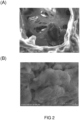
- the porosity of the collagen particles of example 1.2 served as an excellent biological scaffold in supporting the growth of the newly seeded 3T3 cells ( FIG 2 , panel A), the entire particle was convered with 3T3 cells after being cultured for 72 hrs ( FIG 2 , panel B).
- Example 2 Allergy tests the collagen particles of example 1
- a collagen extract was produced from the collagen matrix of example 1.1, then was used in various allergic tests, including pyrogen study, skin sensitization study, acute system injection study, and intracutaneous irritation study in accordance with relevant approved procedures, particularly, ISO 10993-10, 11, .
- the collagen matrix of example 1.1 (3 ⁇ 4 cm) was immersed in 0.9% saline or cottonseed oil at 50°C for 72 hrs with constant agitation (150 rpm) to produce the collagen extract in saline or the collagen extract in cottonseed oil.
- the surface ratio of collagen matrix/0.9% saline or cottonseed oil was approximately 1 cm 2 /1 mL.
- the pyrogen study was conducted in accordance with the protocols set forth in U.S. Pharmacopoeia National Formulary USP36/NF31(151). Briefly, 6 male New Zealand white rabbit (>1.5 Kg, 3 rabbits in the control group and 3 rabbits in teh test group) were used in this study, and 10mL/Kg of the collagen extract in saline of example 2.1 was injected into the ear vein of each rabbits. The rabbits in the control group received just the 0.9% saline injection. The administration was completed in 10 minutes. Body temperatures of the test rabbits were respectively measured 1, 1.5, 2, 2.5 and 3 hrs after the administration of the collagen extract.
- the body temperatures of the control rabbits were 39.1, 38.8 and 38.8 °C, respectively (Table 1), whereas slight fluctuations in the body temperatures of the test rabbits after the administeration of the collagen extract in slaine were observed; however, the fluctuations were still considred to be within the accetable range (Table 2), indicating the collagen extract derived from the collagen matrix of example 1 was pyrogen free.
- Table 1 Body temperature of the test rabbits before the administration of the collagen extract Animal number Body temperature before administration (°C) Control Temperature 1 st 2 nd # 1 39.1 39.1 39.1 39.1 # 2 38.6 38.8 38.8 # 3 38.8 38.8 38.8 Table 2.
- Treatment Solution Test periods Treatment-1 group (10 animals) Control-1 group (5 animals) Area Area A an emulsion of 0.9% saline and FCA in 1: 1 volume ratio A an emulsion of 0.9% saline and FCA in 1: 1 volume ratio Induction ( I ) B the collagen extract B 0.9% saline C an emulsion of the collagen extract and E-FCA in 1: 1 volume ratio C an emulsion of 0.9% saline and FCA in 1: 1 volume ratio Induction (II) A, B, C the collagen extract A, B, C 0.9% saline Challenge A, B, C the collagen extract A, B, C 0.9% saline FCA: Freund's complete adjuvant Table 4.
- Treatment Solution Test periods Treatment-2 group (10 animals) Control-2 group (5 animals) Area Area A an emulsion of cottonseed oil and FCA in 1:1 volume ratio A an emulsion of cottonseed oil and FCA in 1:1 volume ratio Induction ( I ) B the collagen extract in cottonseed oil B Cottonseed oil C an emulsion of the collagen extract and FCA in 1:1 volume ratio C an emulsion of cottonseed oil and FCA in 1:1 volume ratio Induction (II) A, B, C the collagen extract in cottonseed oil A, B, C Cottonseed oil Challenge A, B, C the collagen extract in cottonseed oil A, B, C Cottonseed oil
- the skin in the clipped area were observed 24 and 48 hrs after the challenge to see if any of the areas developed irritation and/or allergic response.
- the collagen extract of the present invention did not cause delayed hypersensitivity on teh skin of the test guinea pigs.
- mice in the treatmetn-1 group received a single dose intraveneous injection of the collagen extract in saline (50mL/Kg), whereas animals in the treatmetn-2 group received a single dose intraperitoneal injection of the collagen extract in cottonseed oil (50mL/Kg).
- the animals in contrrol-1 and control-2 received injections of 0.9% saline and cottonseed oil, respectively. Mice were then subject to toxcity obserbation respectively at 4, 24, 48 and 72 hrs post-adminstration.
Landscapes
- Health & Medical Sciences (AREA)
- Chemical & Material Sciences (AREA)
- Life Sciences & Earth Sciences (AREA)
- General Health & Medical Sciences (AREA)
- Medicinal Chemistry (AREA)
- Dermatology (AREA)
- Oral & Maxillofacial Surgery (AREA)
- Transplantation (AREA)
- Epidemiology (AREA)
- Animal Behavior & Ethology (AREA)
- Public Health (AREA)
- Veterinary Medicine (AREA)
- Biomedical Technology (AREA)
- Engineering & Computer Science (AREA)
- Molecular Biology (AREA)
- Chemical Kinetics & Catalysis (AREA)
- Botany (AREA)
- Organic Chemistry (AREA)
- Biophysics (AREA)
- Zoology (AREA)
- Proteomics, Peptides & Aminoacids (AREA)
- Genetics & Genomics (AREA)
- Biochemistry (AREA)
- Urology & Nephrology (AREA)
- Analytical Chemistry (AREA)
- Toxicology (AREA)
- Gastroenterology & Hepatology (AREA)
- General Chemical & Material Sciences (AREA)
- Vascular Medicine (AREA)
- Dispersion Chemistry (AREA)
- Materials For Medical Uses (AREA)
- Medicines That Contain Protein Lipid Enzymes And Other Medicines (AREA)
- Cosmetics (AREA)
- Medicinal Preparation (AREA)
- Peptides Or Proteins (AREA)
- Preparation Of Compounds By Using Micro-Organisms (AREA)
- Prostheses (AREA)
Claims (10)
- Verfahren zur Herstellung eines Kollagenpartikels, welches umfasst:(1) Unterziehen einer Tierhaut mit einer Dicke von etwa 0,1-1 mm einem Dezellularisierungsprozess;(2) Unterziehen der dezellularisierten Tierhaut aus Schritt (1) einer Behandlung mit einer wässrigen Lösung, die ein nichtionisches Tensid enthält;(3) Unterziehen der mit der wässrigen Lösung behandelten Tierhaut aus Schritt (2) einer Behandlung mit einer Protease;(4) Unterziehen der mit der Protease behandelten Tierhaut aus Schritt (3) einer Behandlung mit einer Nuklease;(5) Unterziehen der mit der Nuklease behandelten Tierhaut aus Schritt (4) einem Deionisierungsprozess;(6) Unterziehen der deionisierten Tierhaut aus Schritt (5) einem Chemikalienentfernungsverfahren, um eine Kollagenmatrix zu erzeugen; und(7) Unterziehen der Kollagenmatrix aus Schritt (6) einem Granulationsverfahren, um das Kollagenpartikel mit einer Größe von etwa 10-250 µm herzustellen,wobei im Schritt (1) die Tierhaut mit einer Dicke von etwa 0,1-1 mm einer Behandlung mit einem superkritischen Fluid (SCF) unter einem Druck von etwa 10 - 50 MPa (100 - 500 bar) bei einer Temperatur zwischen 30-50°C für etwa 20 min bis 5 Tage unterzogen wird und das SCF ein überkritisches Kohlendioxid (scCO2) oder ein überkritisches Distickstoffoxid (scN2O) ist,wobei das nichtionische Tensid der wässrigen Lösung aus Schritt (2) ausgewählt ist aus einer Gruppe, die Octylphenolethoxylate, Sorbitanmonostearat, Polysorbat, Poloxomer, Nonoxynole, Cetylalkohol und Alkylpolyglucosid enthält,wobei die Protease aus dem Schritt (3) eine von Pepsin, Trypsin, Chymotrypsin, Papain, Chymopapain, Bromelain, Actinidain, Proteinase A, Proteinase K, Peptidase, Ficin, Calpain, Caspase oder eine Kombination davon ist,wobei die Nuklease aus dem Schritt (4) eine DNA-Nuklease oder eine RNA-Nuklease ist,wobei der Deionisierungsprozess aus Schritt (5) umfasst, dass die mit der Nuklease behandelte Tierhaut aus dem Schritt (4) mit einer Wasserstoffperoxidlösung für eine Stunde behandelt wird,wobei in dem Schritt (6) die deionisierte Tierhaut aus Schritt (5) einer Behandlung mit einem superkritischen Fluid (SCF) unter einem Druck von etwa 10 - 50 MPa (100 - 500 bar) bei einer Temperatur zwischen 30-50°C für etwa 20 min bis 5 Tage unterzogen wird, um Chemikalienreste daraus zu entfernen, und das SCF ein überkritisches Kohlendioxid (scCO2) oder ein überkritisches Distickstoffoxid (scN2O) ist und das SCF auf die deionisierte Tierhaut aus Schritt (5) zusammen mit einem Co-Lösungsmittel, das Ethanol ist, angewendet wird, wobei "etwa" innerhalb von 10 % eines angegebenen Bereichs bedeutet.
- Verfahren nach Anspruch 1, bei welchem im Schritt (1) die Temperatur etwa 37°C und der Druck etwa 35 MPa (350 bar) beträgt, wobei "etwa" innerhalb von 10 % eines angegebenen Wertes bedeutet.
- Verfahren nach Anspruch 1, bei welchem die wässrige Lösung aus Schritt (2) ferner ein anionisches Tensid umfasst, das ausgewählt ist aus einer Gruppe, welche Laurylsulfonsäure, Dodecylsulfonsäure, Natriumdodecylsulfat (SDS), Dodecylbenzolsulfonsäure, Tridecylbenzolsulfonsäure, Alkylphenoxybenzoldisulfonsäure, Naphthalinsulfonsäure, Alkylnaphthalinsulfonsäure und Alkenylnaphthalin enthält.
- Verfahren nach Anspruch 1, bei welchem die wässrige Lösung aus Schritt (2) außerdem ein Salz umfasst.
- Verfahren nach Anspruch 1, bei welchem das Produkt aus Schritt (4) mit der wässrigen Lösung aus Schritt (2) weiter behandelt wird.
- Verfahren nach Anspruch 5, bei welchem das nichtionische Tensid der wässrigen Lösung aus Schritt (2) aus der Gruppe ausgewählt ist, die Octylphenolethoxylate, Sorbitanmonostearat, Polysorbat, Poloxomer, Nonoxynole, Cetylalkohol und Alkylpolyglucosid enthält.
- Verfahren nach Anspruch 6, bei welchem die wässrige Lösung ferner ein anionisches Tensid umfasst, das ausgewählt ist aus der Gruppe, welche Laurylsulfonsäure, Dodecylsulfonsäure, Natriumdodecylsulfat (SDS), Dodecylbenzolsulfonsäure, Tridecylbenzolsulfonsäure, Alkylphenoxybenzoldisulfonsäure, Naphthalinsulfonsäure, Alkylnaphthalinsulfonsäure und Alkenylnaphthalin enthält.
- Verfahren nach Anspruch 7, bei welchem die wässrige Lösung außerdem ein Salz umfasst.
- Verfahren nach Anspruch 1, bei welchem im Schritt (6) die Temperatur etwa 3°C und der Druck etwa 35 MPa (350 bar) beträgt, wobei "etwa" innerhalb von 10 % eines angegebenen Wertes bedeutet.
- Verfahren nach Anspruch 1, bei welchem das Granulationsverfahren aus Schritt (7) durch Schneiden oder Mahlen der Kollagenmatrix aus Schritt (6) in Gegenwart von flüssigem Stickstoff durchgeführt wird, um das Kollagenpartikel mit einer Größe von etwa 10-250 µm herzustellen, wobei "etwa" innerhalb von 10 % eines angegebenen Bereichs bedeutet.
Applications Claiming Priority (2)
| Application Number | Priority Date | Filing Date | Title |
|---|---|---|---|
| US201562203904P | 2015-08-11 | 2015-08-11 | |
| PCT/CN2016/094634 WO2017025054A1 (en) | 2015-08-11 | 2016-08-11 | Preparation of high purity collagen particles and used thereof |
Publications (4)
| Publication Number | Publication Date |
|---|---|
| EP3334835A1 EP3334835A1 (de) | 2018-06-20 |
| EP3334835A4 EP3334835A4 (de) | 2019-05-01 |
| EP3334835B1 true EP3334835B1 (de) | 2024-10-02 |
| EP3334835C0 EP3334835C0 (de) | 2024-10-02 |
Family
ID=57982971
Family Applications (2)
| Application Number | Title | Priority Date | Filing Date |
|---|---|---|---|
| EP16834677.3A Active EP3328455B1 (de) | 2015-08-11 | 2016-08-11 | Herstellung eines azellulären knorpeltransplantats und verwendungen davon |
| EP16834678.1A Active EP3334835B1 (de) | 2015-08-11 | 2016-08-11 | Herstellung von hochreinen kollagenteilchen und verwendung davon |
Family Applications Before (1)
| Application Number | Title | Priority Date | Filing Date |
|---|---|---|---|
| EP16834677.3A Active EP3328455B1 (de) | 2015-08-11 | 2016-08-11 | Herstellung eines azellulären knorpeltransplantats und verwendungen davon |
Country Status (8)
| Country | Link |
|---|---|
| US (2) | US10881761B2 (de) |
| EP (2) | EP3328455B1 (de) |
| JP (2) | JP6889118B2 (de) |
| KR (2) | KR102126140B1 (de) |
| CN (2) | CN108025111B (de) |
| ES (2) | ES3007682T3 (de) |
| TW (2) | TWI641683B (de) |
| WO (2) | WO2017025054A1 (de) |
Families Citing this family (18)
| Publication number | Priority date | Publication date | Assignee | Title |
|---|---|---|---|---|
| US11655270B2 (en) * | 2016-08-08 | 2023-05-23 | Dof Inc. | Method for separating collagen from liposuction effluent using supercritical process |
| JP7012950B2 (ja) * | 2016-11-17 | 2022-01-31 | 地方独立行政法人東京都立産業技術研究センター | 生体組織孔閉鎖用、潰瘍保護用及び血管塞栓療術用ゾル |
| CN107164298A (zh) * | 2017-06-02 | 2017-09-15 | 广州新诚生物科技有限公司 | 超临界流体技术制备软组织去细胞基质的方法 |
| TWI712687B (zh) * | 2018-09-11 | 2020-12-11 | 亞果生醫股份有限公司 | 去細胞器官及其製備方法 |
| TWI694817B (zh) * | 2019-06-12 | 2020-06-01 | 亞果生醫股份有限公司 | 去細胞骨移植物及包含該去細胞骨移植物之人工移植組件 |
| CN112143243A (zh) * | 2019-06-28 | 2020-12-29 | 柏登生医股份有限公司 | 鳞片衍生生活用品及其制造方法 |
| CN111214704B (zh) * | 2020-02-25 | 2022-02-25 | 南通大学 | 一种超临界流体萃取反应制备脱细胞神经移植物的方法 |
| CN114190075B (zh) * | 2020-07-13 | 2022-12-20 | 爱恩斯生物科技(昆山)有限公司 | 水合态无细胞化皮肤替代材料及其制造方法 |
| CN112113786B (zh) * | 2020-09-22 | 2022-08-12 | 北京小米移动软件有限公司 | 检测方法及装置、测试设备、存储介质 |
| CN112604030A (zh) * | 2020-12-03 | 2021-04-06 | 广东省医疗器械研究所 | 一种脱细胞基质、骨修复支架及其制备方法 |
| AU2022242956B2 (en) * | 2021-03-25 | 2025-05-15 | Coloplast A/S | Wound treatment compositions and methods of stabilizing, protecting, and treating a wound |
| CN113244439A (zh) * | 2021-06-24 | 2021-08-13 | 北京欣康研医药科技有限公司 | 一种无抗原胶原聚集体及其制备方法 |
| US12472238B2 (en) * | 2021-07-21 | 2025-11-18 | Organogenesis Inc. | Porcine collagen compositions and methods of use thereof |
| CN113577389A (zh) * | 2021-08-06 | 2021-11-02 | 中国医学科学院整形外科医院 | 一种来自猪耳软骨的脱细胞软骨材料及制备方法和应用 |
| TWI791290B (zh) * | 2021-09-17 | 2023-02-01 | 亞果生醫股份有限公司 | 膠原蛋白顆粒於促進毛囊生成或血管生成之用途 |
| US20240139374A1 (en) * | 2021-09-17 | 2024-05-02 | Acro Biomedical Company. Ltd. | Use of collagen particles in hair follicles formation or angiogenesis |
| CN114276974A (zh) * | 2021-12-24 | 2022-04-05 | 上海理工大学 | 封装细胞的间质材料及其制备方法和应用 |
| US20240343759A1 (en) * | 2023-04-14 | 2024-10-17 | Fu Yu Hsieh | Method of preparing procollagen from freshwater fish |
Family Cites Families (36)
| Publication number | Priority date | Publication date | Assignee | Title |
|---|---|---|---|---|
| FR2699408B1 (fr) * | 1992-12-21 | 1995-03-24 | Bioland | Procédé de traitement de tissus osseux et biomatériaux implantables correspondants. |
| FR2735372B1 (fr) * | 1995-06-13 | 1997-09-05 | Bioland | Nouvelles utilisations d'un courant de dioxyde de carbone supercritique a titre d'agent antiviral |
| US6613278B1 (en) * | 1998-11-13 | 2003-09-02 | Regeneration Technologies, Inc. | Tissue pooling process |
| US20080077251A1 (en) | 1999-06-07 | 2008-03-27 | Chen Silvia S | Cleaning and devitalization of cartilage |
| CN1116794C (zh) * | 2000-07-13 | 2003-08-06 | 胡杰 | 制备软骨移植体的方法 |
| US7008591B2 (en) * | 2001-10-17 | 2006-03-07 | Edwards Lifesciences Corporation | Supercritical fluid extraction process for tissue preparation |
| US9216236B2 (en) * | 2005-03-07 | 2015-12-22 | Technion Research & Development Foundation Limited | Natural tissue-derived decellularized matrix and methods of generating and using same |
| CN100348277C (zh) * | 2005-08-09 | 2007-11-14 | 中国人民解放军第三军医大学 | 成骨细胞特异性转录因子-2基因修饰的组织工程化骨的构建方法 |
| JP2007105081A (ja) * | 2005-10-11 | 2007-04-26 | Japan Health Science Foundation | 超臨界二酸化炭素による移植用生体組織の脱細胞処理 |
| US7829108B2 (en) * | 2006-04-21 | 2010-11-09 | Wake Forest University Health Sciences | Structurally modified acellular tissue engineering scaffolds and methods of production |
| CN101332312B (zh) * | 2007-06-29 | 2013-09-11 | 上海国睿生命科技有限公司 | 组织工程化移植物的处理方法 |
| US20090062233A1 (en) | 2007-08-09 | 2009-03-05 | Xin Ji | Modified starch material of biocompatible hemostasis |
| US20100209943A1 (en) * | 2007-10-10 | 2010-08-19 | David Goldberg | Measurement Of Protease Activity In Post-Mortem Meat Samples |
| KR100947553B1 (ko) * | 2008-02-14 | 2010-03-12 | 주식회사 바이오랜드 | 생체조직 이식재 및 그의 제조 방법 |
| US7771652B2 (en) * | 2008-04-11 | 2010-08-10 | Novasterilis, Inc. | Combined use of an alkaline earth metal compound and a sterilizing agent to maintain osteoinduction properties of a demineralized bone matrix |
| JP5429708B2 (ja) * | 2009-03-23 | 2014-02-26 | 学校法人福岡大学 | 生体組織再生用移植材およびその製造方法 |
| CA2770490C (en) * | 2009-08-11 | 2024-04-16 | The Johns Hopkins University | Compositions and methods for implantation of processed adipose tissue and processed adipose tissue products |
| JP2013502275A (ja) * | 2009-08-18 | 2013-01-24 | ライフセル コーポレーション | 組織の処理方法 |
| WO2011031827A2 (en) * | 2009-09-09 | 2011-03-17 | Cook Biotech Incorporated | Manufacture of extracellular matrix products using supercritical or near supercritical fluids |
| CN102781485A (zh) | 2009-10-07 | 2012-11-14 | 克雷西斯公司 | 用于创伤护理和/或其它组织愈合应用的支架材料 |
| CN102085390B (zh) * | 2009-12-07 | 2014-08-27 | 上海国睿生命科技有限公司 | 软骨脱细胞基质及其制备方法和用途 |
| US8926710B2 (en) * | 2010-10-25 | 2015-01-06 | Warsaw Orthopedic, Inc. | Osteoinductive bone graft injectable cement |
| KR101269618B1 (ko) * | 2011-04-12 | 2013-06-05 | 한스바이오메드 주식회사 | 포유류의 연골조직에서 유래한 생체이식재 |
| WO2012141454A2 (en) * | 2011-04-12 | 2012-10-18 | Hans Biomed. Cor. | Graft materials derived from mammalian cartilage |
| WO2012142569A2 (en) * | 2011-04-15 | 2012-10-18 | The Regents Of The University Of California | Decellularized extracellular matrix |
| EP2714099A4 (de) * | 2011-05-27 | 2014-11-19 | Cormatrix Cardiovascular Inc | Sterilisierte azelluläre/extrazelluläre matrixzusammensetzungen und verfahren zu ihrer herstellung |
| US20130079494A1 (en) * | 2011-09-22 | 2013-03-28 | Tyco Healthcare Group Lp | Processing Tissue Utilizing Supercritical Fluid |
| KR101329411B1 (ko) * | 2012-05-31 | 2013-11-14 | 주식회사 엘지생활건강 | 피부투과성 펩타이드 |
| GB201215725D0 (en) * | 2012-09-04 | 2012-10-17 | Univ Leeds | Composite connective tissue and bone implants |
| CN103223194A (zh) * | 2013-01-15 | 2013-07-31 | 广州莱德尔生物科技有限公司 | 一种用于软骨损伤修复的软骨移植物及其制备方法 |
| WO2014181886A1 (ja) * | 2013-05-07 | 2014-11-13 | 一般財団法人化学及血清療法研究所 | 粒子状脱細胞化組織を含むハイブリッドゲル |
| CN104174068B (zh) * | 2013-05-22 | 2016-02-17 | 烟台正海生物科技股份有限公司 | 一种生物型软骨修复材料及其制备方法 |
| MX2016001247A (es) | 2013-07-30 | 2016-08-17 | Musculoskeletal Transplant Foundation | Matrices derivadas de tejido suave acelular y metodos para preparar las mismas. |
| US20150328561A1 (en) * | 2014-05-16 | 2015-11-19 | Battelle Energy Alliance, Llc | Methods for separating bio-oils |
| CN104107456B (zh) * | 2014-07-09 | 2016-05-25 | 四川大学 | 无抗原胶原聚集体及其制备方法 |
| CN104189944B (zh) * | 2014-09-05 | 2017-02-15 | 四川大学 | 高纯度天然胶原纤维及其制备方法 |
-
2016
- 2016-08-11 ES ES16834678T patent/ES3007682T3/es active Active
- 2016-08-11 US US15/739,163 patent/US10881761B2/en active Active
- 2016-08-11 TW TW105125561A patent/TWI641683B/zh active
- 2016-08-11 EP EP16834677.3A patent/EP3328455B1/de active Active
- 2016-08-11 JP JP2017567442A patent/JP6889118B2/ja active Active
- 2016-08-11 KR KR1020187002475A patent/KR102126140B1/ko active Active
- 2016-08-11 ES ES16834677T patent/ES2891828T3/es active Active
- 2016-08-11 KR KR1020187002482A patent/KR102116620B1/ko active Active
- 2016-08-11 TW TW105125544A patent/TWI600660B/zh active
- 2016-08-11 JP JP2017567443A patent/JP6587702B2/ja active Active
- 2016-08-11 CN CN201680036558.2A patent/CN108025111B/zh active Active
- 2016-08-11 CN CN201680037497.1A patent/CN107849596B/zh active Active
- 2016-08-11 WO PCT/CN2016/094634 patent/WO2017025054A1/en not_active Ceased
- 2016-08-11 EP EP16834678.1A patent/EP3334835B1/de active Active
- 2016-08-11 US US15/739,164 patent/US11185610B2/en active Active
- 2016-08-11 WO PCT/CN2016/094633 patent/WO2017025053A1/en not_active Ceased
Also Published As
| Publication number | Publication date |
|---|---|
| CN107849596A (zh) | 2018-03-27 |
| KR20180021851A (ko) | 2018-03-05 |
| EP3334835A1 (de) | 2018-06-20 |
| JP2018523467A (ja) | 2018-08-23 |
| TWI600660B (zh) | 2017-10-01 |
| WO2017025054A1 (en) | 2017-02-16 |
| EP3328455B1 (de) | 2021-07-07 |
| US10881761B2 (en) | 2021-01-05 |
| ES3007682T3 (en) | 2025-03-20 |
| KR20180021853A (ko) | 2018-03-05 |
| CN108025111A (zh) | 2018-05-11 |
| TWI641683B (zh) | 2018-11-21 |
| US11185610B2 (en) | 2021-11-30 |
| JP2018527047A (ja) | 2018-09-20 |
| CN107849596B (zh) | 2022-02-25 |
| KR102126140B1 (ko) | 2020-06-24 |
| KR102116620B1 (ko) | 2020-05-29 |
| WO2017025053A1 (en) | 2017-02-16 |
| US20200040030A1 (en) | 2020-02-06 |
| US20180369449A1 (en) | 2018-12-27 |
| JP6889118B2 (ja) | 2021-06-18 |
| TW201710493A (zh) | 2017-03-16 |
| HK1248149A1 (zh) | 2018-10-12 |
| TW201712026A (zh) | 2017-04-01 |
| EP3328455A4 (de) | 2019-04-03 |
| EP3334835C0 (de) | 2024-10-02 |
| HK1246358A1 (zh) | 2018-09-07 |
| EP3334835A4 (de) | 2019-05-01 |
| EP3328455A1 (de) | 2018-06-06 |
| JP6587702B2 (ja) | 2019-10-09 |
| CN108025111B (zh) | 2021-04-16 |
| ES2891828T3 (es) | 2022-01-31 |
Similar Documents
| Publication | Publication Date | Title |
|---|---|---|
| EP3334835B1 (de) | Herstellung von hochreinen kollagenteilchen und verwendung davon | |
| US5397353A (en) | Implant tissue | |
| US7498412B2 (en) | Process for preparing porous collagen matrix from connective tissue | |
| WO2003097694A1 (en) | Collagen and method for producing same | |
| EP2595667B1 (de) | Kollagenmaterial | |
| TWI542365B (zh) | 可溶性膠原蛋白及其製備方法 | |
| JPS62236499A (ja) | 生物学的に活性なポリペプチド、それらの製造方法ならびにそれらを含有する組成物 | |
| CN110680779A (zh) | 一种金枪鱼皮胶原蛋白肽面膜 | |
| CN1310946C (zh) | 注射性胶原蛋白的制备方法及其产品 | |
| KR101000537B1 (ko) | 콜라겐 패치 베이스 및 이의 제조방법 | |
| EP4403568A1 (de) | Verwendung von kollagenpartikeln zur förderung der haarfollikelbildung oder angiogenese | |
| TWI791290B (zh) | 膠原蛋白顆粒於促進毛囊生成或血管生成之用途 | |
| TWI763265B (zh) | 一種結構性蛋白器官修補膜及其處理方法與處理劑 | |
| KR102765583B1 (ko) | 인체지방유래 세포외기질을 이용한 3d 프린팅용 바이오잉크 제작 방법 및 이를 이용한 세포지지체 제작 | |
| CN116103776B (zh) | 一种长效胶原蛋白纤维及其制备方法 | |
| HK1246358B (zh) | 高纯度胶原蛋白颗粒及其制备方法与用途 | |
| TWI252113B (en) | Artificial skin graft and preparation method thereof | |
| TR2024007861A2 (tr) | Balik deri̇si̇nden anti̇mi̇krobi̇yal etki̇li̇ ve d3k2 vi̇tami̇ni̇ katkili aselüler dermal matri̇ks geli̇şti̇ri̇lmesi̇ |
Legal Events
| Date | Code | Title | Description |
|---|---|---|---|
| STAA | Information on the status of an ep patent application or granted ep patent |
Free format text: STATUS: THE INTERNATIONAL PUBLICATION HAS BEEN MADE |
|
| PUAI | Public reference made under article 153(3) epc to a published international application that has entered the european phase |
Free format text: ORIGINAL CODE: 0009012 |
|
| STAA | Information on the status of an ep patent application or granted ep patent |
Free format text: STATUS: REQUEST FOR EXAMINATION WAS MADE |
|
| 17P | Request for examination filed |
Effective date: 20180309 |
|
| AK | Designated contracting states |
Kind code of ref document: A1 Designated state(s): AL AT BE BG CH CY CZ DE DK EE ES FI FR GB GR HR HU IE IS IT LI LT LU LV MC MK MT NL NO PL PT RO RS SE SI SK SM TR |
|
| AX | Request for extension of the european patent |
Extension state: BA ME |
|
| DAV | Request for validation of the european patent (deleted) | ||
| DAX | Request for extension of the european patent (deleted) | ||
| A4 | Supplementary search report drawn up and despatched |
Effective date: 20190329 |
|
| RIC1 | Information provided on ipc code assigned before grant |
Ipc: A61L 27/36 20060101ALI20190325BHEP Ipc: A61F 2/28 20060101ALI20190325BHEP Ipc: A61F 2/30 20060101ALI20190325BHEP Ipc: A61L 27/38 20060101AFI20190325BHEP Ipc: A61L 27/24 20060101ALI20190325BHEP Ipc: C12N 5/077 20100101ALI20190325BHEP |
|
| STAA | Information on the status of an ep patent application or granted ep patent |
Free format text: STATUS: EXAMINATION IS IN PROGRESS |
|
| 17Q | First examination report despatched |
Effective date: 20200312 |
|
| GRAP | Despatch of communication of intention to grant a patent |
Free format text: ORIGINAL CODE: EPIDOSNIGR1 |
|
| STAA | Information on the status of an ep patent application or granted ep patent |
Free format text: STATUS: GRANT OF PATENT IS INTENDED |
|
| INTG | Intention to grant announced |
Effective date: 20240327 |
|
| RIN1 | Information on inventor provided before grant (corrected) |
Inventor name: HSIEH, DAR-JEN Inventor name: KU, KAI-CHI Inventor name: TSAI, PEI-HUA Inventor name: WANG, JUN-JIE |
|
| GRAS | Grant fee paid |
Free format text: ORIGINAL CODE: EPIDOSNIGR3 |
|
| GRAA | (expected) grant |
Free format text: ORIGINAL CODE: 0009210 |
|
| STAA | Information on the status of an ep patent application or granted ep patent |
Free format text: STATUS: THE PATENT HAS BEEN GRANTED |
|
| AK | Designated contracting states |
Kind code of ref document: B1 Designated state(s): AL AT BE BG CH CY CZ DE DK EE ES FI FR GB GR HR HU IE IS IT LI LT LU LV MC MK MT NL NO PL PT RO RS SE SI SK SM TR |
|
| REG | Reference to a national code |
Ref country code: GB Ref legal event code: FG4D |
|
| REG | Reference to a national code |
Ref country code: CH Ref legal event code: EP |
|
| REG | Reference to a national code |
Ref country code: DE Ref legal event code: R096 Ref document number: 602016089675 Country of ref document: DE |
|
| REG | Reference to a national code |
Ref country code: IE Ref legal event code: FG4D |
|
| U01 | Request for unitary effect filed |
Effective date: 20241028 |
|
| U07 | Unitary effect registered |
Designated state(s): AT BE BG DE DK EE FI FR IT LT LU LV MT NL PT RO SE SI Effective date: 20241213 |
|
| REG | Reference to a national code |
Ref country code: ES Ref legal event code: FG2A Ref document number: 3007682 Country of ref document: ES Kind code of ref document: T3 Effective date: 20250320 |
|
| PG25 | Lapsed in a contracting state [announced via postgrant information from national office to epo] |
Ref country code: IS Free format text: LAPSE BECAUSE OF FAILURE TO SUBMIT A TRANSLATION OF THE DESCRIPTION OR TO PAY THE FEE WITHIN THE PRESCRIBED TIME-LIMIT Effective date: 20250202 Ref country code: HR Free format text: LAPSE BECAUSE OF FAILURE TO SUBMIT A TRANSLATION OF THE DESCRIPTION OR TO PAY THE FEE WITHIN THE PRESCRIBED TIME-LIMIT Effective date: 20241002 |
|
| PG25 | Lapsed in a contracting state [announced via postgrant information from national office to epo] |
Ref country code: NO Free format text: LAPSE BECAUSE OF FAILURE TO SUBMIT A TRANSLATION OF THE DESCRIPTION OR TO PAY THE FEE WITHIN THE PRESCRIBED TIME-LIMIT Effective date: 20250102 |
|
| PG25 | Lapsed in a contracting state [announced via postgrant information from national office to epo] |
Ref country code: GR Free format text: LAPSE BECAUSE OF FAILURE TO SUBMIT A TRANSLATION OF THE DESCRIPTION OR TO PAY THE FEE WITHIN THE PRESCRIBED TIME-LIMIT Effective date: 20250103 |
|
| PG25 | Lapsed in a contracting state [announced via postgrant information from national office to epo] |
Ref country code: CZ Free format text: LAPSE BECAUSE OF FAILURE TO SUBMIT A TRANSLATION OF THE DESCRIPTION OR TO PAY THE FEE WITHIN THE PRESCRIBED TIME-LIMIT Effective date: 20241002 Ref country code: PL Free format text: LAPSE BECAUSE OF FAILURE TO SUBMIT A TRANSLATION OF THE DESCRIPTION OR TO PAY THE FEE WITHIN THE PRESCRIBED TIME-LIMIT Effective date: 20241002 |
|
| PG25 | Lapsed in a contracting state [announced via postgrant information from national office to epo] |
Ref country code: RS Free format text: LAPSE BECAUSE OF FAILURE TO SUBMIT A TRANSLATION OF THE DESCRIPTION OR TO PAY THE FEE WITHIN THE PRESCRIBED TIME-LIMIT Effective date: 20250102 |
|
| PG25 | Lapsed in a contracting state [announced via postgrant information from national office to epo] |
Ref country code: SM Free format text: LAPSE BECAUSE OF FAILURE TO SUBMIT A TRANSLATION OF THE DESCRIPTION OR TO PAY THE FEE WITHIN THE PRESCRIBED TIME-LIMIT Effective date: 20241002 |
|
| PG25 | Lapsed in a contracting state [announced via postgrant information from national office to epo] |
Ref country code: SK Free format text: LAPSE BECAUSE OF FAILURE TO SUBMIT A TRANSLATION OF THE DESCRIPTION OR TO PAY THE FEE WITHIN THE PRESCRIBED TIME-LIMIT Effective date: 20241002 |
|
| PLBE | No opposition filed within time limit |
Free format text: ORIGINAL CODE: 0009261 |
|
| STAA | Information on the status of an ep patent application or granted ep patent |
Free format text: STATUS: NO OPPOSITION FILED WITHIN TIME LIMIT |
|
| 26N | No opposition filed |
Effective date: 20250703 |
|
| U20 | Renewal fee for the european patent with unitary effect paid |
Year of fee payment: 10 Effective date: 20250901 |
|
| PGFP | Annual fee paid to national office [announced via postgrant information from national office to epo] |
Ref country code: ES Payment date: 20250917 Year of fee payment: 10 |
|
| PGFP | Annual fee paid to national office [announced via postgrant information from national office to epo] |
Ref country code: TR Payment date: 20250806 Year of fee payment: 10 |
|
| PGFP | Annual fee paid to national office [announced via postgrant information from national office to epo] |
Ref country code: GB Payment date: 20250828 Year of fee payment: 10 |
|
| REG | Reference to a national code |
Ref country code: CH Ref legal event code: U11 Free format text: ST27 STATUS EVENT CODE: U-0-0-U10-U11 (AS PROVIDED BY THE NATIONAL OFFICE) Effective date: 20251202 |