EP3246162B1 - Dispositif d'impression à jet d'encre et procédé de commande de dispositif d'impression à jet d'encre - Google Patents
Dispositif d'impression à jet d'encre et procédé de commande de dispositif d'impression à jet d'encre Download PDFInfo
- Publication number
- EP3246162B1 EP3246162B1 EP16737275.4A EP16737275A EP3246162B1 EP 3246162 B1 EP3246162 B1 EP 3246162B1 EP 16737275 A EP16737275 A EP 16737275A EP 3246162 B1 EP3246162 B1 EP 3246162B1
- Authority
- EP
- European Patent Office
- Prior art keywords
- conveying
- unit
- ink
- recording
- heat source
- Prior art date
- Legal status (The legal status is an assumption and is not a legal conclusion. Google has not performed a legal analysis and makes no representation as to the accuracy of the status listed.)
- Active
Links
Images


Classifications
-
- B—PERFORMING OPERATIONS; TRANSPORTING
- B41—PRINTING; LINING MACHINES; TYPEWRITERS; STAMPS
- B41J—TYPEWRITERS; SELECTIVE PRINTING MECHANISMS, i.e. MECHANISMS PRINTING OTHERWISE THAN FROM A FORME; CORRECTION OF TYPOGRAPHICAL ERRORS
- B41J11/00—Devices or arrangements of selective printing mechanisms, e.g. ink-jet printers or thermal printers, for supporting or handling copy material in sheet or web form
- B41J11/0015—Devices or arrangements of selective printing mechanisms, e.g. ink-jet printers or thermal printers, for supporting or handling copy material in sheet or web form for treating before, during or after printing or for uniform coating or laminating the copy material before or after printing
- B41J11/002—Curing or drying the ink on the copy materials, e.g. by heating or irradiating
- B41J11/0024—Curing or drying the ink on the copy materials, e.g. by heating or irradiating using conduction means, e.g. by using a heated platen
-
- B—PERFORMING OPERATIONS; TRANSPORTING
- B41—PRINTING; LINING MACHINES; TYPEWRITERS; STAMPS
- B41J—TYPEWRITERS; SELECTIVE PRINTING MECHANISMS, i.e. MECHANISMS PRINTING OTHERWISE THAN FROM A FORME; CORRECTION OF TYPOGRAPHICAL ERRORS
- B41J2/00—Typewriters or selective printing mechanisms characterised by the printing or marking process for which they are designed
- B41J2/005—Typewriters or selective printing mechanisms characterised by the printing or marking process for which they are designed characterised by bringing liquid or particles selectively into contact with a printing material
- B41J2/01—Ink jet
- B41J2/015—Ink jet characterised by the jet generation process
- B41J2/04—Ink jet characterised by the jet generation process generating single droplets or particles on demand
- B41J2/045—Ink jet characterised by the jet generation process generating single droplets or particles on demand by pressure, e.g. electromechanical transducers
- B41J2/04501—Control methods or devices therefor, e.g. driver circuits, control circuits
- B41J2/04528—Control methods or devices therefor, e.g. driver circuits, control circuits aiming at warming up the head
-
- B—PERFORMING OPERATIONS; TRANSPORTING
- B41—PRINTING; LINING MACHINES; TYPEWRITERS; STAMPS
- B41J—TYPEWRITERS; SELECTIVE PRINTING MECHANISMS, i.e. MECHANISMS PRINTING OTHERWISE THAN FROM A FORME; CORRECTION OF TYPOGRAPHICAL ERRORS
- B41J2/00—Typewriters or selective printing mechanisms characterised by the printing or marking process for which they are designed
- B41J2/005—Typewriters or selective printing mechanisms characterised by the printing or marking process for which they are designed characterised by bringing liquid or particles selectively into contact with a printing material
- B41J2/01—Ink jet
- B41J2/015—Ink jet characterised by the jet generation process
- B41J2/04—Ink jet characterised by the jet generation process generating single droplets or particles on demand
- B41J2/045—Ink jet characterised by the jet generation process generating single droplets or particles on demand by pressure, e.g. electromechanical transducers
- B41J2/04501—Control methods or devices therefor, e.g. driver circuits, control circuits
- B41J2/04531—Control methods or devices therefor, e.g. driver circuits, control circuits controlling a head having a heater in the manifold
-
- B—PERFORMING OPERATIONS; TRANSPORTING
- B41—PRINTING; LINING MACHINES; TYPEWRITERS; STAMPS
- B41J—TYPEWRITERS; SELECTIVE PRINTING MECHANISMS, i.e. MECHANISMS PRINTING OTHERWISE THAN FROM A FORME; CORRECTION OF TYPOGRAPHICAL ERRORS
- B41J2/00—Typewriters or selective printing mechanisms characterised by the printing or marking process for which they are designed
- B41J2/005—Typewriters or selective printing mechanisms characterised by the printing or marking process for which they are designed characterised by bringing liquid or particles selectively into contact with a printing material
- B41J2/01—Ink jet
- B41J2/015—Ink jet characterised by the jet generation process
- B41J2/04—Ink jet characterised by the jet generation process generating single droplets or particles on demand
- B41J2/045—Ink jet characterised by the jet generation process generating single droplets or particles on demand by pressure, e.g. electromechanical transducers
- B41J2/04501—Control methods or devices therefor, e.g. driver circuits, control circuits
- B41J2/04563—Control methods or devices therefor, e.g. driver circuits, control circuits detecting head temperature; Ink temperature
-
- B—PERFORMING OPERATIONS; TRANSPORTING
- B41—PRINTING; LINING MACHINES; TYPEWRITERS; STAMPS
- B41J—TYPEWRITERS; SELECTIVE PRINTING MECHANISMS, i.e. MECHANISMS PRINTING OTHERWISE THAN FROM A FORME; CORRECTION OF TYPOGRAPHICAL ERRORS
- B41J2/00—Typewriters or selective printing mechanisms characterised by the printing or marking process for which they are designed
- B41J2/005—Typewriters or selective printing mechanisms characterised by the printing or marking process for which they are designed characterised by bringing liquid or particles selectively into contact with a printing material
- B41J2/01—Ink jet
- B41J2/17—Ink jet characterised by ink handling
- B41J2/175—Ink supply systems ; Circuit parts therefor
- B41J2/17593—Supplying ink in a solid state
-
- B—PERFORMING OPERATIONS; TRANSPORTING
- B41—PRINTING; LINING MACHINES; TYPEWRITERS; STAMPS
- B41J—TYPEWRITERS; SELECTIVE PRINTING MECHANISMS, i.e. MECHANISMS PRINTING OTHERWISE THAN FROM A FORME; CORRECTION OF TYPOGRAPHICAL ERRORS
- B41J25/00—Actions or mechanisms not otherwise provided for
- B41J25/304—Bodily-movable mechanisms for print heads or carriages movable towards or from paper surface
-
- B—PERFORMING OPERATIONS; TRANSPORTING
- B41—PRINTING; LINING MACHINES; TYPEWRITERS; STAMPS
- B41J—TYPEWRITERS; SELECTIVE PRINTING MECHANISMS, i.e. MECHANISMS PRINTING OTHERWISE THAN FROM A FORME; CORRECTION OF TYPOGRAPHICAL ERRORS
- B41J25/00—Actions or mechanisms not otherwise provided for
- B41J25/304—Bodily-movable mechanisms for print heads or carriages movable towards or from paper surface
- B41J25/308—Bodily-movable mechanisms for print heads or carriages movable towards or from paper surface with print gap adjustment mechanisms
-
- B—PERFORMING OPERATIONS; TRANSPORTING
- B41—PRINTING; LINING MACHINES; TYPEWRITERS; STAMPS
- B41J—TYPEWRITERS; SELECTIVE PRINTING MECHANISMS, i.e. MECHANISMS PRINTING OTHERWISE THAN FROM A FORME; CORRECTION OF TYPOGRAPHICAL ERRORS
- B41J2/00—Typewriters or selective printing mechanisms characterised by the printing or marking process for which they are designed
- B41J2/005—Typewriters or selective printing mechanisms characterised by the printing or marking process for which they are designed characterised by bringing liquid or particles selectively into contact with a printing material
- B41J2/01—Ink jet
- B41J2/015—Ink jet characterised by the jet generation process
- B41J2/04—Ink jet characterised by the jet generation process generating single droplets or particles on demand
- B41J2/045—Ink jet characterised by the jet generation process generating single droplets or particles on demand by pressure, e.g. electromechanical transducers
-
- B—PERFORMING OPERATIONS; TRANSPORTING
- B41—PRINTING; LINING MACHINES; TYPEWRITERS; STAMPS
- B41J—TYPEWRITERS; SELECTIVE PRINTING MECHANISMS, i.e. MECHANISMS PRINTING OTHERWISE THAN FROM A FORME; CORRECTION OF TYPOGRAPHICAL ERRORS
- B41J2/00—Typewriters or selective printing mechanisms characterised by the printing or marking process for which they are designed
- B41J2/005—Typewriters or selective printing mechanisms characterised by the printing or marking process for which they are designed characterised by bringing liquid or particles selectively into contact with a printing material
- B41J2002/0055—Heating elements adjacent to nozzle orifices of printhead for warming up ink meniscuses, e.g. for lowering the surface tension of the ink meniscuses
-
- B—PERFORMING OPERATIONS; TRANSPORTING
- B41—PRINTING; LINING MACHINES; TYPEWRITERS; STAMPS
- B41J—TYPEWRITERS; SELECTIVE PRINTING MECHANISMS, i.e. MECHANISMS PRINTING OTHERWISE THAN FROM A FORME; CORRECTION OF TYPOGRAPHICAL ERRORS
- B41J25/00—Actions or mechanisms not otherwise provided for
- B41J2025/008—Actions or mechanisms not otherwise provided for comprising a plurality of print heads placed around a drum
-
- B—PERFORMING OPERATIONS; TRANSPORTING
- B41—PRINTING; LINING MACHINES; TYPEWRITERS; STAMPS
- B41J—TYPEWRITERS; SELECTIVE PRINTING MECHANISMS, i.e. MECHANISMS PRINTING OTHERWISE THAN FROM A FORME; CORRECTION OF TYPOGRAPHICAL ERRORS
- B41J2202/00—Embodiments of or processes related to ink-jet or thermal heads
- B41J2202/01—Embodiments of or processes related to ink-jet heads
- B41J2202/21—Line printing
Definitions
- the present invention relates to an inkjet recording apparatus and a method of controlling an inkjet recording apparatus.
- an inkjet recording apparatus which records an image on a recording medium by ejecting ink from a plurality of nozzles provided on a recording head to the recording medium which is held and conveyed by a conveying surface of a conveying unit and by solidifying the ink.
- a heat source which increases the temperature of the conveying surface of the conveying unit can be arranged in the proximity of the conveying surface.
- an ink heating unit which heats ink stored in a recording head is provided inside the recording head, and this ink heating unit and the recording head heated by the ink heating unit correspond to the heat source in the proximity of the conveying surface.
- Patent Document 1 JP 2010-76207 A
- JP-A-2014/004701 discloses an image forming apparatus including a conveyance device for conveying a recording medium in a predetermined direction, a head mechanism in which a plurality of nozzles for discharging ink to be cured by irradiation with an energy line are arranged, energy line irradiation means for irradiating the recording medium to be conveyed by the conveyance device, to which the ink has been discharged, with the energy line, and a control unit.
- a plurality of head mechanisms are arranged side by side in a conveyance direction of the recording medium to be conveyed by the conveyance device.
- the energy line irradiation means is arranged on the downstream side of the plurality of head mechanisms along the conveyance direction.
- the control unit controls the plurality of head mechanisms to perform a discharge operation for maintaining a nozzle so that a discharge frequency or a total discharge amount in the head mechanism in closest proximity to the energy line irradiation means is greater than that in other head mechanisms.
- US-A1-2013/307893 discloses a digital printing apparatus including a sheet supply device, printing cylinder, inkjet nozzle portion, sheet delivery device, and conveyance devices.
- the sheet supply device supplies sheets one by one at a predetermined period.
- the printing cylinder includes at least one gripper device that grips and holds the sheet, and conveys the sheet while one edge of the sheet supplied from the sheet supply device is held by the plurality of gripper devices.
- the inkjet nozzle portion discharges ink droplets onto the sheet.
- the conveyance devices include a plurality of gripper devices including one reversing gripper device that grips and holds the other edge of the sheet, and conveys the sheet printed on one surface, which is received from the printing cylinder in a double-sided printing mode. The sheet is turned by reversing the obverse/reverse surface of the sheet by the reversing gripper device in the process of conveyance.
- An object of the present invention is to provide an inkjet recording apparatus and a method of controlling an inkjet recording apparatus which can suppress the occurrence of the unevenness of temperature on the conveying surface of the conveying unit when the conveying operation by the conveying unit is stopped.
- FIG. 1 is a view showing a schematic configuration of an inkjet recording apparatus 1 which is an embodiment of the present invention.
- the inkjet recording apparatus 1 includes a sheet feeding unit 10, an image recording unit 20, a sheet ejecting unit 30 and a control unit 40 ( FIG. 4 ).
- the inkjet recording apparatus 1 under the control of the controlling unit 40, conveys a recording medium P stored in the sheet feeding unit 10 to the image recording unit 20, records (forms) an image on the recording medium P in the image recording unit 20, and conveys the recording medium P on which an image is recorded to the sheet ejecting unit 30.
- the recording medium P a variety of medium can be used on which ink (color material) ejected on the surface thereof can be fixed such as paper, fabric and sheet-like resin.
- the sheet feeding unit 10 includes a sheet tray which stores the recording medium P and a conveyer 12 which conveys the recording medium P from the sheet tray 11 to the image recording unit 20.
- the conveyer 12 includes an endless belt 123 whose inner side is supported by two rollers 121 and 122.
- the conveyer 12 conveys the recording medium P by rotating rollers 121 and 122 in a state where the recording medium P is placed on the belt 123.
- the image recording unit 20 includes a conveying unit (conveying unit) 21, a passing unit 22, a conveying drum heating unit (conveying member heating unit), a head unit 50, a fixing unit 24 and a delivery unit 25.
- the conveying unit 21 includes a base 213 and a conveying drum (conveying unit) 211 which is attached to the base 213.
- the conveying drum 211 places and holds the recording medium P on a cylindrical conveying surface 212 which is the outer circumference of the conveying drum 211.
- the conveying unit 21 conveys the recording medium P in a conveying direction (hereinafter referred to as Y direction) along the conveying surface 212 by performing a rotating operation (hereinafter referred to also as conveying operation) which rotates the conveying drum 211 which holds the recording medium 212 around a rotating shaft of the conveying surface 212 which extends perpendicular to a direction (hereinafter referred to as X direction) extending the drawing of FIG. 1 .
- the conveying drum 211 includes a stop and an air intake (not shown) to hold the recording medium P on the conveying surface 212.
- the recording medium P is held on the conveying surface 212 of the conveying drum 211 with the end thereof being held by the stop and with the recording medium P being suctioned to the conveying drum 212 by the air intake.
- the conveying unit 21 includes a conveying drum motor 214 ( FIG. 4 ) to rotate the conveying drum 211, and the conveying drum 211 rotates by an angle proportional to the rotating amount of the conveying drum motor 214.
- the passing unit 22 passes the recording medium P which is conveyed by the conveyer 12 of the sheet feeding unit 10 to the conveying unit 21.
- the passing unit 22 is provided at a position between the conveyer 12 of the sheet feeding unit 10 and the conveying unit 21.
- the passing unit 22 holds and picks up an end of the recording medium P which is conveyed by the conveyer 12 with a swing arm unit 221 and passes to the conveying unit 21 via passing drum 222.
- a conveying drum heating unit 23 heats the conveying surface 212 of the rotating conveying drum 211 of the conveying unit 21 and the recording medium P held on the conveying drum 211 to a predetermined set temperature.
- the conveying drum heating unit 23 includes an infrared heater or the like, for example. The infrared heater is heated in response to energization.
- the conveying drum heating unit 23 is provided at a position which is opposed to the conveying surface 212 of the conveying drum 211 and which is on the upstream side of the head unit 50 with respect to the conveying direction of the recording medium P.
- a temperature sensor (now shown) is provided in proximity of the conveying drum heating unit 23.
- the control unit 40 controls the heating of the conveying drum heating unit 23 such that the conveying surface 212 of the conveying drum 211 becomes the predetermined temperature based on the temperature near the conveying drum heating unit 23 which is detected by the temperature sensor. As a result, the recording medium P which is held and conveyed by the conveying drum 211 is also heated to the predetermined temperature.
- the conveying drum heating unit 23 heats the conveying drum 211 to a temperature in the range of 40Co or more and 60Co or less, for example.
- This temperature range is a range by which an image of good image quality can be recorded on the recording medium P when the heating temperature of ink described below is in the range of 70Co or more and 90Co or less.
- the entire conveying drum 211 is heated to the temperature described above by the conveying drum heating unit 23.
- a part of the conveying drum 211 including the conveying surface 212 may be heated to such a temperature.
- the heating temperature of the conveying drum heating unit 23 may be changed as needed, for example, in case where the heating temperature of ink is changed in accordance with the type of the ink. Also, in case where the recording medium P on which an image of good image quality can be recorded even at a low temperature is used, the lower limit of the heating temperature of the conveying drum heating unit 23 may be a temperature less than 40Co.
- the head unit 50 records an image by ejecting ink to the recording medium P held on the conveying unit 21.
- the head unit 50 is arranged so that the ink ejecting surface is spaced from the conveying surface 212 of the conveying unit 21 by a predetermined distance.
- the inkjet recording apparatus 1 of the present embodiment includes four head units 50Y, 50M, 50C and 50K (hereinafter referred merely to as a head units 50) which respectively correspond to four color ink of yellow (Y), magenta (M), cyan (C) and black (K). These four head units 50 are arranged at predetermined intervals in the order of colors Y, M, C and K from the upstream side along the conveying direction of the recording medium P.
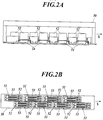
- FIGS. 2A and 2B are views showing internal configuration of the head unit 50.
- FIG. 2A is a schematic view of internal configuration when the head unit 50 is seen from side.
- FIG. 2B is a schematic view of internal configuration when the head unit 50 is seen from the side of the conveying unit 21.
- the head unit 50 is seen from side refers to when the head unit 50 is seen from a position of the conveying surface 212 which is opposed to the head unit 50 along a direction parallel to the conveying direction of the recording medium P.
- a single head unit 50 is provided with sixteen recording heads (recording unit, heat source) 52.
- the respective two recording heads 52 form a pair and the sixteen recording heads 52 constitutes eight recording head modules 51.
- Each of the recording heads 52 includes a plurality of recording elements 53.
- Each recording element 53 includes a pressure chamber which stores ink, a piezoelectric element provided on the wall of the pressure chamber and a nozzle.
- driving voltage is applied from a driving circuit of the recording head 52 to the piezoelectric element, the pressure in the pressure chamber is changed in response to the amount of driving voltage and ink is ejected from the nozzle which communicates with the pressure chamber.
- the nozzle of the recording element 53 has an opening on a surface of the side of the conveying unit 21 (ink ejecting surface). In FIG. 2B , a part of the openings of the nozzles included in the recording element 53 is depicted as dots.
- the nozzles of the recording elements 53 which the recording head 52 includes are arranged along widthwise direction (X direction) perpendicular to the conveying direction (Y direction) of the recording medium P in a surface of the recording head 52 opposed to the conveying unit 21.
- the recording elements 53 are arranged with regular intervals along X direction.
- the nozzle array of the recording element 53 only needs to be arranged along a direction which intersects with the conveying direction.
- the nozzle array of the recording element 53 does not necessarily need to be arranged along a direction perpendicular to the conveying direction.
- Each recording head 52 includes two rows of the recording elements 53 which are arranged along X direction. Therefore, each recording head module 51 includes four rows of the recording elements 53. In each recording head module 51, these four rows of the recording elements 53 each are arranged at different positions along X direction as a whole.
- the arrangement of the recording elements 53 means the arrangement of the nozzles of the recording elements 53 herein.
- the eight recording head modules 51 which each head unit 50 includes are arranged in staggered manner such that the range of the arrangement thereof are partially overlapped with each other along X direction.
- the rows of the recording elements 53 of the first, third, fifth and seventh recording head modules are positioned along the same line, and the rows of the recording elements 53 of the second, fourth, sixth and eighth recording head modules are positioned along the same line.
- the range of arrangement of the recording elements 53 which the head unit 50 includes along X direction covers the width along X direction of the area where an image is recorded on the recording medium P which is held and conveyed by the conveying unit 21 (recording width), and the position of the head unit 50 is fixed with respect to the conveying unit 21 when an image is recorded. That is, the inkjet recording apparatus 1 is an inkjet recording apparatus of single path.
- each recording head 52 is provided with an ink heating unit (ink heating unit) 54.
- the ink heating unit 54 includes a heating wire or the like, for example, and the temperature of the ink heating unit 54 is increased by the heating wire being heated in response to energization. Heat transfer occurs between the recording head 52 and the ink stored inside of the recording head 52 in accordance with the temperature difference between the recording head 52 and the ink.
- the recording head 52 being heated by the ink heating unit 54, the ink inside the recording head 52 is heated, and the temperature of the recording head 52 and that of the ink become the same in a steady state.
- the recording head 52 includes a plurality of (for example, six) temperature sensors (not shown) in proximity of a part of the recording head 52 where ink is stored.
- the control unit 40 controls the heating of the ink heating unit 54 such that the temperature of ink stored in the recording head 52 becomes a predetermined value based on the average value of the temperatures detected by the temperature sensors of the recording head 52.
- the ink heating unit 54 heats the ink stored in the recording head 52 to the temperature of the range of 70Co or more and 90Co or less, for example. This heating temperature of ink may be changed in accordance with the type of ink.
- FIG. 2A shows an example in which the ink heating unit 54 is attached to the outside of the exterior member of the recording head 52.
- the ink heating unit 54 may be attached to the inside of the exterior member of the recording head 52.
- the recording head 52 of the present embodiment has a structure in which heat from the ink heating unit 54 is transferred to the entire recording head 52, and the entire recording head 52 corresponds to a heat source.
- the head unit 50 includes an ink reservoir (not shown) in which ink to be supplied to the recording head 52 is stored, and a heating unit (not shown) which heats the ink in the ink reservoir to make it sol-like, and supplies sol-like ink to the recording head 52.
- the recording head 52 heats the sol-like ink supplied from the ink reservoir to a predetermined temperature by the ink heating unit 54 and ejects it.
- the sol-like ink is ejected onto the recording medium P, the ink shortly becomes gel-like and is solidified by natural cooling after the ink droplet hits on the recording medium P.
- the ink used in the present embodiment has the characteristic that the ink cures by irradiating energy ray such as ultraviolet ray in addition to the characteristic described above.
- Each head unit 50 is used with a position thereof being fixed with respect to the conveying unit 21 when an image is recorded as described above. However, the relative position of each head unit 50 can be changed with respect to the conveying unit 21 when an image is not recorded.
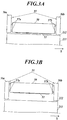
- FIGS. 3A and 3B are views for explaining about a head unit moving mechanism (heat source moving unit) 55 which moves the head unit 50.
- a head unit moving mechanism 55 which moves the head unit 50.
- a case is shown where the head unit 50, the head unit moving mechanism 55 and the conveying drum 211 of the conveying unit 21 are seen from a side direction in a manner similar to FIG. 2A .
- the head unit moving mechanism 55 includes a pair of supports 56a, 56b which are respectively arranged on -X direction side and +X direction side of the head unit 50 and attachment members 57a, 57b which are respectively attached to the supports 56a, 56b.
- the attachment members 57a, 57b are respectively fixed to the ends on -X direction side and +X direction side of the head unit 50.
- the attachment members 57a, 57b are configured so as to move along a direction perpendicular to the conveying surface 212 by a power transduction mechanism which transduces the rotation of a stepping motor (not shown) provided inside or outside of the supports 56a, 56b to the displacement along a direction perpendicular to the conveying surface 212 of the conveying drum 211.
- the head unit moving mechanism 55 configured in such a way moves the head unit 50 fixed to the attachment members 57a, 57b and the recording head 52 included in the head unit 50 along the direction perpendicular to the conveying surface 212 by a distance proportional to the rotating amount of the stepping motor, and changes the distance between the ink ejecting surface of the recording head 52 and the conveying surface 212 of the conveying drum 211. Also, the head unit moving mechanism 55 can switch the moving direction of the head unit 50 in response to the rotating direction of the stepping motor.
- the head unit moving mechanism 55 another motor such as a servomotor may be used in place of the stepping motor described above.
- the head unit moving mechanism 55 only needs to be configured so as to move the head unit 50 such that the distance between the recording head 52 and the conveying surface 212 is changed.
- the moving direction of the head unit 50 may not be the direction perpendicular to the conveying direction 212.
- the head unit moving mechanism 55 moves the recording head 52 included in the head unit 50 between the operation position (high temperature position) shown in FIG. 3A and the retracted position shown in FIG. 3B .
- the operation position is a position of the recording head 52 where a relative relationship with the base 213 of the conveying unit 21 is fixed and is also a position of the recording head 52 when an image is recorded onto the recording medium P by ejecting ink from the recording head 52.
- the distance between the recording head 52 and the conveying surface 212 of the conveying unit 21 is, for example, 1mm.
- the recording head 52 which is positioned at the operation position and is heated by the ink heating unit 54 increases the temperature of the conveying drum 211 by transferring heat to the conveying drum 211 of the conveying unit 21.
- the positional range of the heat source where the temperature of the conveying surface 212 of the conveying drum 211 is increased by transferring heat from the heat source is also referred to as proximity of the conveying surface 212.
- the retracted position is a position where the recording head 52 is retracted to prevent the temperature of the conveying unit 21 from locally increasing by transferring heat form the recording head 52 when an image is not recorded by the recording head 52.
- the distance between the recording head 52 and the conveying surface of the conveying unit 21 is, for example, 10cm. The retraction of the recording head 52 will be described in detail below.
- the recording head When the recording head is at the retracted position shown in FIG. 3B , the fixed relative position of the supports 56a, 56b with respect to the conveying unit 21 is released and a carriage (not shown) to which the both the head unit moving mechanism 55 and the supports 56a, 56b can be moved to +X direction along a guide rail (not shown) extending along X direction.
- the head unit 50 can be moved to a position where the recording head 52 included in the head unit 50 is opposed to a cleaning unit (not shown).
- the ink ejecting surface of the recording head 52 is wiped by a wiping cloth which is provided at the cleaning unit and which is impregnated with a predetermined chemical solution, and ink or other foreign objects attached to the ink ejecting surface are removed.
- the fixing unit 24 includes a light emitting unit arranged over the width along X direction of the conveying unit 21 in X direction, and irradiates energy ray such as ultraviolet ray from the light emitting unit to the recording medium P held on the conveying surface 212 of the conveying unit 21 to solidify and fix the ink ejected onto the recording medium P.
- the fixing unit 24 is arranged so as to be opposed to the conveying surface 212 on the downstream side of the head unit 50 along the conveying direction.
- a fluorescent tube low pressure mercury lamp, germicidal lamp
- a cold-cathode tube ultraviolet laser
- a low pressure, middle pressure and high pressure mercury lamp which has an operation pressure of a few hundred Pa to 1MPa
- a metal halide lamp LED (Light Emitting Diode) or the like.
- the delivery unit 25 includes an endless belt which is supported by two rollers 251, 252 from inside, and a cylindrical passing drum 254 which passes the recording medium P from the conveying unit 21 to the belt 253 .
- the delivery unit 25 conveys by the belt 253 the recording medium P which is passed from the conveying unit 21 to the belt 253 to send to the sheet ejecting unit 30.
- the sheet ejecting unit 30 includes a plate-like ejected sheet tray 31 on which the recording medium P is placed, the recording medium P being sent from the image recording unit 20 by the delivery unit 25.
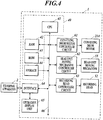
- FIG. 4 is a block diagram showing a main functional configuration of the inkjet recording apparatus 1.
- the inkjet recording apparatus 1 includes a control unit 40 including a CPU (Central Processing Unit) (heat source moving control unit, heating control unit, conveying control unit), a RAM (Random Access Memory) 42, a ROM (Read Only Memory) 43 and a storage 44, a conveying drum motor controller circuit 61 which is connected to the conveying drum motor 214, a head unit moving mechanism controller circuit 62 which is connected to the head unit moving mechanism 55, a recording head controller circuit 63 which is connected to the recording head 52, an interface 64 which is connected to an external apparatus 2, an operation display unit 65 which is connected to the interface 64 and the like.
- the CPU 41 is connected with the RAM 42, the ROM 43, the conveying drum motor controller circuit 61, the head unit moving mechanism controller circuit 62, the recording head controller circuit 63 and the interface 64 via a bus 66.
- the CPU 41 performs a variety of arithmetic processing and integrally controls the overall operation of the inkjet recording apparatus 1.
- the CPU 41 makes the conveying drum motor controller circuit 61 output a control signal to a driving circuit of the conveying drum motor 214 to rotate the conveying drum 211 of the conveying unit 21.
- the CPU 41 makes the head unit moving mechanism controller circuit 62 output a control signal to a driving circuit of the head unit moving mechanism 55 to operate the head unit moving mechanism 55 thereby moving the head unit 50.
- the CPU 41 makes the recording head controller circuit 63 output the image data of an image to be recorded on the recording medium P to the recording head 52 to make the recording head 52 eject ink thereby recording the image on the recording medium.
- the CPU 41 outputs a control signal to a driving circuit of the ink heating unit 54 to make the ink heating unit 54 heat the ink stored inside the recording head 52.
- the RAM 42 provides the CPU 41 with a working memory space to store a temporary data.
- the ROM 43 stores a variety of control programs to be executed by the CPU 41, set data or the like.
- the programs include an image recording program which operates the conveying unit 21, the recording head 52 or the like to record an image on the recording medium P and an emergency stop program which performs an emergency stop of the inkjet recording apparatus 1.
- a rewritable nonvolatile memory such as an EEPROM (Electrically Erasable Programmable Read Only Memory) and a flash memory may be used.
- the storage 44 is constituted by a DRAM (Dynamic Random Access Memory) or the like.
- the storage 44 stores the image data of an image which is input from the external apparatus 2 via the interface 64 and which is to be recorded on the recording medium P, and a printing job which includes the type, number or the like of the recording medium P for recording.
- the conveying drum motor controller circuit 61 outputs a control signal to operate the conveying drum motor 214 to the conveying drum motor 214 based on the signal input form the CPU 41.
- the head unit moving mechanism controller circuit 62 outputs a control signal to operate the head unit moving mechanism 55 to the head unit moving mechanism 55 based on the signal input from the CPU 41.
- the recording head controller circuit 63 outputs a control signal (image data) which defines the timing and/or magnitude of the driving voltage to be applied to the piezoelectric element of the recording element from the driving circuit of the recording head 52 based on the signal input from the CPU 41 and the image data stored in the storage 44.
- the interface 64 is a unit which performs the transmittance and reception of data between the external apparatus 2 and the operation display unit 65, and is constituted by any one of a variety of serial interfaces and a variety of parallel interfaces and the combination thereof.
- the operation display unit 65 includes a display unit such as a liquid crystal display device and an input device such as a light transmissive touch panel attached on the display device.
- the operation display unit 65 receives a user's input operation and outputs a signal corresponding to the input operation. For example, an input operation concerning an emergency stop by a user is performed on the operation display unit 65. Also, the operation display unit 65 displays an execution result of a program by CPU 41 or the like.
- the external apparatus 2 is a personal computer, for example, and transfers image data of an image to be recorded in the inkjet recording apparatus 1 to the control unit 40 via the interface 64.
- the recording head 52 and the ink stored in the recording head 52 is heated to the range of temperature of 70Co or more and 90oC or less, and the conveying drum 211 of the conveying unit 21 is heated to the range of temperature of 40Co or more and 60oC or less.
- the temperature of recording head 52 is higher than the temperature of conveying surface 212 of the conveying drum 211 by equal to or higher than 10oC.
- the recording head 52 is arranged at an operation position shown in FIG. 3A .
- the temperature of the conveying drum 211 increases due to the heat transfer from the recording head 52 to the conveying drum 211
- the conveying unit 21 performs a conveying operation and the conveying drum 211 is rotated, unevenness of temperature on the conveying drum 211 does not occur because the heat from the recording head 52 is transferred to the conveying surface 212 of the conveying drum 211 substantially homogeneously.
- the head unit moving mechanism 55 moves the recording head 52 from the operation position to the retracted position. That is, the recording head 52 is moved by the head unit moving mechanism 55 such that the distance between the recording head 52 and the conveying surface 212 is increased. Therefore, it becomes difficult for heat to transfer from the recording head 52 to the conveying drum 211.
- the larger difference between the retracted distance and the operation distance may be set, the larger the distance in temperature of the recording head 52 and the conveying drum 211 is.
- the difference between the retracted distance and the operation distance may be changed based on a planned stopped time of rotation of the conveying unit 21, the amount of heat capacity and heat conductivity of the conveying unit 21, type of ink or the like.
- the case where the conveying operation of the conveying unit 21 is stopped in a state where the conveying operation can be resumed includes a case where a normal image recording operation is stopped, a case where a user inputs operation to instruct to stop an image recording operation or to stop conveying operation by the conveying unit 21, and a case where the CPU 41 performs an interrupt processing concerning an emergency stop when a predetermined condition is satisfied and an interlock mechanism operates.
- predetermined conditions where the interlock mechanism operates include an occurrence of an operation error in a predetermined component which can cause a problem in recording an image by the inkjet recording apparatus 1, an external input of an instruction of an emergency stop, an occurrence of an earthquake, and an opened door of a storage space when the inkjet recording apparatus 1 is stored in the storage space for ensuring security.
- FIG. 5 is a flowchart showing a control procedure of an image recording processing.
- This image recording processing is carried out, when a printing job including image data is input to the control unit 40 from the external apparatus 2, for example.
- the ink in the recording head 52 is heated to a predetermined set temperature by ink heating unit 54 in accordance with the type of the ink.
- the conveying drum 211 of the conveying unit 21 is heated to a predetermined set temperature by the conveying drum heating unit 23.
- the ink in the recording head 52 is heated to a temperature within a range of 70Co or more and 90Co or less and the conveying drum 211 is heated to a temperature within a range of 40Co or more and 60Co or less.
- the CPU 41 makes the head unit moving mechanism controller circuit 62 output a control signal to the head unit moving mechanism 55 whereby the head unit moving mechanism 55 moves the head unit 50 such that the recording head 52 is arranged at the operation position (Step S11).
- the CPU 41 makes the conveying drum motor controller circuit 61 output a control signal to the conveying drum motor 214 to operate the conveying drum motor 214 whereby the conveying drum 211 rotates and the conveying unit 21 performs conveying operation (Step S12).
- the CPU 41 makes each of the sheet feeding unit 10 and the image recording unit 20 operate and record an image on the recording medium P which is conveyed by the conveying unit 21 based on a printing job which is stored in the storage 44 (Step S13). Specifically, the CPU 41 outputs a control signal to the conveyer 12 and the passing unit 22 to convey the recording medium P from the sheet feeding unit 10 onto the conveying unit 21 and to make the conveying unit 21 hold and convey the recording medium P.
- the CPU 41 makes the image data stored in the storage 44 output from the recording head controller circuit 63 to the recording head 52 whereby an image is recorded on the recording medium P by ejecting ink from the recording head 52 onto the recording medium P conveyed by the conveying unit 21.
- the CPU makes the recording medium P on which an image is recorded be conveyed to the position of the fixing unit 24 to fix the ink on the recording medium P by the fixing unit 24.
- the CPU 41 makes the delivery unit 25 convey the recording medium P on which ink is fixed to the sheet ejecting unit 30.
- the CPU 41 determines whether a printing job which is not carried out is stored in the storage 44 (Step S14). If the CPU 41 determines that a printing job which is not carried out is stored in the storage 44 ("YES" in Step S14), the CPU 41 shifts the processing to Step S13 to carry out the image recording in accordance with the printing job which is not carried out.
- Step S15 If the CPU 41 determines that a printing job which is not carried out is not stored in the storage 44 ("NO" in Step S14), the CPU 41 makes the conveying drum motor controller circuit 61 output a control signal to the conveying drum motor 214 to stop the operation of the conveying drum motor 214 whereby the rotation of the conveying drum 211 is stopped to stop the conveying operation of the conveying unit 21 (Step S15).
- the CPU 41 makes the head unit moving mechanism controller circuit 62 output a control signal to the head unit moving mechanism 55 to move the head unit 50 by the head unit moving mechanism 55 such that the recording head 52 is moved from the operation position to the retracted position (Step S16; heat source moving step).
- the CPU 41 carries out a stop processing of the inkjet recording apparatus 1 (Step S17).
- the CPU 41 makes each component of the inkjet recording apparatus 1 transfer to a predetermined state set as a starting state of the image recording processing.
- Step S17 When the processing of Step S17 is finished, the CPU 41 finishes the image recording processing.
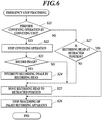
- FIG. 6 is a flowchart showing a control procedure of an emergency stop processing.
- This emergency stop processing is carried out by the inkjet recording apparatus 1 which performs image recording processing when a predetermined abnormal condition occurs.
- this emergency stop processing is an interrupt processing carried out when an interrupt request signal concerning an emergency stop interaction is sent to the CPU 41 via the interface 64 in case where a user performs an input operation in the external apparatus 2 or the operation display unit 65 to instruct the stop of the image recording operation or the stop of the conveying operation of the conveying unit 21, or when the interrupt request signal is sent to the CPU 41 in case where the interlock mechanism described above operates .
- the CPU 41 determines whether the conveying drum 211 rotates, that is whether the conveying unit 21 performs conveying operation (Step S21).
- Step S21 When the CPU 41 determines that the conveying unit 21 performs the conveying operation ("YES" in Step S21), the CPU 41 makes the conveying drum motor controller circuit 61 output a control signal to the conveying drum motor 214 to stop the operation of the conveying drum motor 214 whereby the rotation of the conveying drum 211 is stopped and the conveying operation of the conveying unit 21 is stopped (Step S22).
- the CPU 41 determines whether the recording head 52 performs the recording of an image (Step S23).
- Step S23 When the CPU 41 determines that the recording head 52 performs the recording of an image ("YES" in Step S23), the CPU 41 makes the recording head controller circuit 63 output a control signal to the recording head 52 to make the recording head controller circuit 63 stop the ejection of ink by the recording head 52 whereby the recording of an image by the recording head 52 is interrupted (Step S24).
- Step S23 and Step S24 may be performed at the same time as Step S22 after the processing of the CPU 41 for stopping the conveying operation of the conveying unit 21 and before the rotation of the conveying drum 211 is stopped completely.
- Step S24 the CPU 41 makes the head unit moving mechanism controller circuit 62 output a control signal to the head unit moving mechanism 55 to move the head unit 50 by the head unit moving mechanism 55 such that the recording head 52 is moved from the operation position to the retracted position (Step S25; heat source moving step).
- Step S23 When the CPU 41 determines that the recording head 52 does not perform the recording of an image in Step S23 ("NO" in Step S23), the CPU 41 shifts the processing to Step S25.
- Step S25 When the processing of Step S25 is finished, the CPU 41 performs the stop processing of the inkjet recording apparatus 1 (Step S26).
- the CPU 41 makes each component of the inkjet recording apparatus 1 transfer to a predetermined state set as a starting state of the image recording processing.
- Step S27 the CPU 41 determines whether the recording head 52 is at the retracted position.
- Step S27 When the CPU 41 determines that the recording head 52 is not at the retracted position ("NO” in Step S27), the CPU 41 shifts the processing to Step S25. When the CPU 41 determines that the recording head 52 is at the retracted position ("YES" in Step S27), the CPU 41 shifts the processing to Step S26.
- Step S26 When the processing of Step S26 is finished, the CPU 41 ends the emergency stop processing.
- the inkjet recording apparatus 1 includes the conveying unit 21 which performs a conveying operation to rotate the conveying drum 211 thereby conveying the recording medium P placed on the conveying surface 212 of the conveying drum 211; the recording head 52 which records an image by ejecting ink to the recording medium P conveyed by the conveying unit 21; the recording head 52 as a heat source; the head unit moving unit 55 which moves the recording head 52; and the CPU 41 as a heat source moving control unit which moves the recording head 52 by the recording head moving unit 55 such that a distance between the recording head 52 and the conveying surface 212 increases when the conveying operation which is performed by the conveying unit 21 stops in a manner in which the conveying operation can be resumed in a state where the recording head 52 is positioned in proximity of the conveying surface 212.
- the increase of temperature of the conveying surface 212 of the conveying drum 211 is suppressed when the conveying operation of the conveying unit 21 is stopped.
- the occurrence of unevenness of the temperature of the conveying surface 212 of the conveying drum 211 can be suppressed.
- the unevenness of temperature of the recording medium P held on the conveying drum 211 can be suppressed when the conveying operation is performed and recording an image is resumed, the decrease of the image quality of the recorded image resulting from the unevenness of the temperature of the recording medium P can be suppressed.
- the recording head 52 includes a configuration which serves as the heat source, and the head unit moving unit 55 moves the heat source by moving the recording head 52. In such a way, in the inkjet recording apparatus 1 in which the recording head 52 has higher temperature than that of the conveying drum 211, the occurrence of unevenness of temperature of the conveying surface 212 of the conveying drum 211 when the conveying operation of the conveying operation 21 is stopped.
- the inkjet recording apparatus 1 includes an ink heating unit 54 which heats ink which is stored in the recording head 52 and which is to be ejected, wherein the CPU 41 as a heating control unit heats the ink by the ink heating unit 54 to a temperature higher than a temperature of the conveying surface 212 of the conveying drum 211, and the recording head 52 is configured to transmit heat of the ink heating unit 54 to the configuration which serves as the heat source.
- the CPU 41 as the heating control unit heats the ink by the ink heating unit 54 to a temperature higher than a temperature of the conveying surface 212 of the conveying drum 211 by 10Co or more.
- the increase of temperature of the conveying drum 211 becomes eminent due to the heat transmission from the recording head 52 arranged at the operation position to the conveying drum 211.
- the occurrence of unevenness of temperature of the conveying surface 212 of the conveying drum 211 can be suppressed by moving the recording head 52 such that the distance between the recording head 52 and the conveying surface 212 increases when the conveying operation of the conveying unit 21 is stopped.
- the ink which is stored in the recording head 52 has a characteristic that the ink is gel-like at normal temperature and becomes sol-like when the ink is heated, the CPU 41 as the heating control unit heats the ink by the ink heating unit 54 to a temperature at which the ink becomes sol-like, and the recording head 52 ejects the sol-like ink which is heated by the ink heating unit 54 to the recording medium P. In such a way, the sol-like ink ejected onto the recording medium P is cooled and becomes gel-like thereby an image is recorded on the recording medium P in a manner in which the ink is shortly solidified.
- the recording head 52 included in the head unit 50 ejects ink from a plurality of recording elements 53 arranged along a widthwise direction perpendicular to a conveying direction of the recording medium P by the conveying unit 21 over a recording width of the recording medium P in the widthwise direction in a direction intersecting with the conveying direction.
- the occurrence of unevenness of temperature on the conveying surface 212 of the conveying drum 211 can be suppressed when the conveying operation of the conveying drum 211 of the conveying unit 21 is stopped.
- the conveying drum 211 includes the conveying surface 212 having a cylindrical surface shape, and the conveying unit 21 performs the conveying operation by rotating the conveying surface 212. In such a way, when the conveying operation of the conveying unit 21 is performed, the increase of temperature at each part of the conveying drum 211 due to heat from the recording head 52 at the operation position can be made uniform.
- the inkjet recording apparatus 1 includes a conveying drum heating unit 23 which heats the conveying surface 212 of the conveying drum 211. In such a way, even when the recording head 52 is heated to a high temperature, the difference in temperature between the recording head 52 and the conveying drum 211 can be made within a predetermined range.
- the CPU 41 as a conveying control unit stops the conveying operation of the conveying unit 21 when a predetermined abnormal condition occurs. In such a way, when an abnormal condition occurs in the inkjet recording apparatus 1, the conveying operation of the conveying unit 21 is stopped to ensure security. Also, the occurrence of unevenness in temperature on the conveying surface 212 of the conveying drum 211 can be suppressed when the conveying operation of the conveying unit 21 is stopped.
- the present invention is not limited to the embodiment and variation described above, but a variety of modification is possible.
- the entire recording head 52 heated by the ink heating unit 54 correspond to a heat source.
- the heat from the ink heating unit 54 may be configured to be transmitted to a part of the structure of the recording head 52, and an aspect in which the part of the structure may correspond to the heat source is possible.
- the recording head 52 corresponds to a heat source.
- a heat source such any component including the conveying drum heating unit 23 and the fixing unit 24 whose temperature increases by generating heat when irradiating an energy ray.
- the heat source may be moved such that the distance between the heat source and the conveying surface 212 increases.
- the conveying unit 21 which rotates the conveying drum 211 around the base 213 is explained.
- this is not limitative.
- Any conveying unit which holds a recording medium on the conveying surface of the conveying member and which conveys the recording medium P by the conveying member moving relative to a base may be used.
- a conveying unit may be used which includes a belt as a conveying member which is supported by two rollers as a base thereby rotating around the two rollers in response to the rotation of the rollers and which holds a recording medium P on a conveying surface of the belt.
- the inkjet recording apparatus 1 which heats ink which is gel-like at normal temperature and becomes sol-like by being heated to an extent that the ink becomes sol-like and ejects the ink is explained as an example.
- this is not limitative.
- a variety of known ink including sol-like or liquid ink at normal temperature may be used.
- ink which is sol-like at normal temperature may be used and such ink may be ejected after viscosity is reduced by heating the ink.
- the head unit 50 is provided with eight recording head modules 51 and the recording heads 52 as recording units and each recording head 52 is provided with two rows of recording elements 53.
- the number of rows of recording elements 53 included in each recording head 52 may be one row or three rows or more.
- the number of the recording heads 52 included in each recording head module 51 may be one or three or more.
- the head unit 50 may be constituted by a single recording head module 51 or recording head 52. In any case, by arranging a recording element(s) of one or more recording heads 52 included in the head unit 50 over the recording width in X direction of the recording medium P, the inkjet recording apparatus 1 of single path system can be formed. In this case, one or more recording heads 52 included in the head unit 50 correspond to the recording unit.
- the present invention may be applied to an inkjet recording apparatus which records an image while a recording head is being scanned in the main scanning direction (the direction perpendicular to the conveying direction of a recording medium P).
- the present invention can be used for an inkjet recording apparatus and a method of controlling an inkjet recording apparatus.
Landscapes
- Ink Jet (AREA)
Claims (9)
- Appareil d'enregistrement à jet d'encre (1) comprenant :une unité d'acheminement (21) qui est configurée pour effectuer une opération d'acheminement destinée à déplacer un élément d'acheminement (211) de façon à acheminer un support d'enregistrement (P) placé sur une surface d'acheminement (212) de l'élément d'acheminement (211) ;une unité d'enregistrement (20) qui est configurée pour enregistrer une image en éjectant de l'encre vers le support d'enregistrement (P) acheminé par l'unité d'acheminement (21) ;une source de chaleur (52) ;une unité de déplacement de source de chaleur (55) qui est configurée pour déplacer la source de chaleur (52) perpendiculairement à la surface d'acheminement (212) ;une unité de commande de déplacement de source de chaleur (40) qui est configurée pour déplacer la source de chaleur (52) par l'unité de déplacement de source de chaleur (55) de sorte qu'une distance entre la source de chaleur (52) et la surface d'acheminement (212) augmente lorsque l'opération d'acheminement qui est effectuée par l'unité d'acheminement (21) s'arrête d'une manière selon laquelle l'opération d'acheminement peut être reprise lorsque la source de chaleur (52) est positionnée à proximité de la surface d'acheminement (212) ; etcaractérisé parune unité de chauffage d'élément d'acheminement (23) qui est configurée pour chauffer la surface d'acheminement (212) de l'élément d'acheminement (211).
- Appareil d'enregistrement à jet d'encre (1) selon la revendication 1, dans lequel
l'unité d'enregistrement (20) comprend une configuration qui sert de source de chaleur (52), et
l'unité de déplacement de source de chaleur (55) est configurée pour déplacer la source de chaleur (52) en déplaçant l'unité d'enregistrement (20). - Appareil d'enregistrement à jet d'encre (1) selon la revendication 2, comprenant en outre :une unité de chauffage d'encre (54) qui est configurée pour chauffer l'encre qui est stockée dans l'unité d'enregistrement (20) et qui doit être éjectée ; etune unité de commande de chauffage (40) qui est configurée pour chauffer l'encre par l'unité de chauffage d'encre (54) à une température supérieure à une température de la surface d'acheminement (212) de l'élément d'acheminement (211), dans lequell'unité d'enregistrement (20) est configurée pour transmettre la chaleur de l'unité de chauffage d'encre (54) à la configuration qui sert de source de chaleur (52) .
- Appareil d'enregistrement à jet d'encre (1) selon la revendication 3, dans lequel l'unité de commande de chauffage (40) est configurée pour chauffer l'encre par l'unité de chauffage d'encre (54) à une température supérieure à une température de la surface d'acheminement (212) de l'élément d'acheminement (211) de 10°C ou plus.
- Appareil d'enregistrement à jet d'encre (1) selon la revendication 3 ou 4, dans lequel
l'encre qui est stockée dans l'unité d'enregistrement (20) possède une caractéristique selon laquelle l'encre est sous forme de gel à une température normale et devient sous forme de solution colloïdale lorsque l'encre est chauffée,
l'unité de commande de chauffage (40) est configurée pour chauffer l'encre par l'unité de chauffage d'encre (54) à une température à laquelle l'encre devient sous forme de solution colloïdale, et
l'unité d'enregistrement (20) est configurée pour éjecter l'encre sous forme de solution colloïdale qui est chauffée par l'unité de chauffage d'encre (54) vers le support d'enregistrement (P). - Appareil d'enregistrement à jet d'encre (1) selon l'une quelconque des revendications 1 à 5, dans lequel l'unité d'enregistrement (20) est configurée pour éjecter de l'encre depuis une pluralité d'éléments d'enregistrement (53) prévus le long d'une direction de largeur perpendiculaire à une direction d'acheminement du support d'enregistrement (P) par l'unité d'acheminement (21) sur une largeur d'enregistrement du support d'enregistrement (P) dans le sens de la largeur dans une direction qui croise la direction d'acheminement.
- Appareil d'enregistrement à jet d'encre (1) selon l'une quelconque des revendications 1 à 6, dans lequel
l'élément d'acheminement (211) comprend la surface d'acheminement (212) qui possède une forme de surface cylindrique, et
l'unité d'acheminement (21) est configurée pour effectuer l'opération d'acheminement en faisant tourner la surface d'acheminement (212). - Appareil d'enregistrement à jet d'encre (1) selon l'une quelconque des revendications 1 à 7, comprenant en outre une unité de commande d'acheminement (40) qui est configurée pour arrêter l'opération d'acheminement de l'unité d'acheminement (21) lorsqu'une condition anormale prédéterminée se produit.
- Procédé de commande d'un appareil d'enregistrement à jet d'encre (1) comprenant : une unité d'acheminement (21) qui effectue une opération d'acheminement destinée à déplacer un élément d'acheminement (211) de façon à acheminer un support d'enregistrement (P) placé sur une surface d'acheminement (212) de l'élément d'acheminement (211) ; une unité d'enregistrement (20) qui enregistre une image en éjectant de l'encre vers le support d'enregistrement (P) acheminé par l'unité d'acheminement (21) ; une source de chaleur (52) ; une unité de déplacement de source de chaleur (55) qui déplace la source de chaleur (52) perpendiculairement à la surface d'acheminement (212) ; et une unité de chauffage d'élément d'acheminement (23) qui chauffe la surface d'acheminement (212) de l'élément d'acheminement (211), le procédé comprenant :
une étape de déplacement d'une source de chaleur qui déplace la source de chaleur (52) par l'unité de déplacement de source de chaleur (55) de sorte qu'une distance entre la source de chaleur (52) et la surface d'acheminement (212) augmente lorsque l'opération d'acheminement qui est effectuée par l'unité d'acheminement (21) s'arrête d'une manière selon laquelle l'opération d'acheminement peut être reprise lorsque la source de chaleur (52) est positionnée à proximité de la surface d'acheminement (212).
Applications Claiming Priority (2)
| Application Number | Priority Date | Filing Date | Title |
|---|---|---|---|
| JP2015004880 | 2015-01-14 | ||
| PCT/JP2016/050282 WO2016114204A1 (fr) | 2015-01-14 | 2016-01-07 | Dispositif d'impression à jet d'encre et procédé de commande de dispositif d'impression à jet d'encre |
Publications (3)
| Publication Number | Publication Date |
|---|---|
| EP3246162A1 EP3246162A1 (fr) | 2017-11-22 |
| EP3246162A4 EP3246162A4 (fr) | 2018-08-29 |
| EP3246162B1 true EP3246162B1 (fr) | 2020-11-04 |
Family
ID=56405751
Family Applications (1)
| Application Number | Title | Priority Date | Filing Date |
|---|---|---|---|
| EP16737275.4A Active EP3246162B1 (fr) | 2015-01-14 | 2016-01-07 | Dispositif d'impression à jet d'encre et procédé de commande de dispositif d'impression à jet d'encre |
Country Status (5)
| Country | Link |
|---|---|
| US (1) | US10723155B2 (fr) |
| EP (1) | EP3246162B1 (fr) |
| JP (1) | JP6658546B2 (fr) |
| CN (1) | CN107107613B (fr) |
| WO (1) | WO2016114204A1 (fr) |
Families Citing this family (2)
| Publication number | Priority date | Publication date | Assignee | Title |
|---|---|---|---|---|
| CN114953740B (zh) * | 2022-06-16 | 2023-08-08 | 广州诺彩数码产品有限公司 | 一种具有对喷头加热装置的喷绘机 |
| JP2024161936A (ja) * | 2023-05-09 | 2024-11-21 | キヤノン株式会社 | 印刷装置及びその制御方法 |
Citations (1)
| Publication number | Priority date | Publication date | Assignee | Title |
|---|---|---|---|---|
| US20130257954A1 (en) * | 2012-03-29 | 2013-10-03 | Fujifilm Corporation | Liquid ejection apparatus and control method for liquid ejection apparatus |
Family Cites Families (14)
| Publication number | Priority date | Publication date | Assignee | Title |
|---|---|---|---|---|
| JP2005313519A (ja) * | 2004-04-30 | 2005-11-10 | Toppan Printing Co Ltd | インクジェット記録装置 |
| JP2010076207A (ja) | 2008-09-25 | 2010-04-08 | Fuji Xerox Co Ltd | 記録装置 |
| JP5454245B2 (ja) * | 2010-03-12 | 2014-03-26 | コニカミノルタ株式会社 | 定着装置及び画像形成装置 |
| JP5464077B2 (ja) * | 2010-06-29 | 2014-04-09 | セイコーエプソン株式会社 | 液体噴射ヘッド |
| US8814347B2 (en) * | 2010-12-10 | 2014-08-26 | Konica Minolta, Inc. | Inkjet recording device |
| JP5678870B2 (ja) * | 2011-11-16 | 2015-03-04 | コニカミノルタ株式会社 | 定着装置及び画像形成装置 |
| JP5817466B2 (ja) * | 2011-11-24 | 2015-11-18 | セイコーエプソン株式会社 | 画像記録装置、画像記録方法 |
| JP5953813B2 (ja) | 2012-02-27 | 2016-07-20 | 富士ゼロックス株式会社 | 画像形成装置 |
| JP2013223944A (ja) * | 2012-04-20 | 2013-10-31 | Seiko Epson Corp | インクジェット記録方法、インクジェット記録装置 |
| EP2657035B1 (fr) * | 2012-04-24 | 2016-09-07 | Komori Corporation | Appareil d'impression numérique |
| JP2013248879A (ja) * | 2012-05-02 | 2013-12-12 | Komori Corp | シートデジタル印刷機 |
| JP6321920B2 (ja) | 2012-05-02 | 2018-05-09 | 株式会社小森コーポレーション | シートデジタル印刷機 |
| JP5888145B2 (ja) | 2012-06-22 | 2016-03-16 | コニカミノルタ株式会社 | 画像形成装置 |
| JP5803885B2 (ja) * | 2012-11-28 | 2015-11-04 | コニカミノルタ株式会社 | 画像形成装置及び画像形成方法 |
-
2016
- 2016-01-07 US US15/540,437 patent/US10723155B2/en active Active
- 2016-01-07 EP EP16737275.4A patent/EP3246162B1/fr active Active
- 2016-01-07 JP JP2016569327A patent/JP6658546B2/ja active Active
- 2016-01-07 CN CN201680005439.0A patent/CN107107613B/zh active Active
- 2016-01-07 WO PCT/JP2016/050282 patent/WO2016114204A1/fr not_active Ceased
Patent Citations (1)
| Publication number | Priority date | Publication date | Assignee | Title |
|---|---|---|---|---|
| US20130257954A1 (en) * | 2012-03-29 | 2013-10-03 | Fujifilm Corporation | Liquid ejection apparatus and control method for liquid ejection apparatus |
Also Published As
| Publication number | Publication date |
|---|---|
| EP3246162A4 (fr) | 2018-08-29 |
| JPWO2016114204A1 (ja) | 2017-10-19 |
| CN107107613A (zh) | 2017-08-29 |
| US10723155B2 (en) | 2020-07-28 |
| WO2016114204A1 (fr) | 2016-07-21 |
| EP3246162A1 (fr) | 2017-11-22 |
| US20180264847A1 (en) | 2018-09-20 |
| CN107107613B (zh) | 2019-12-20 |
| JP6658546B2 (ja) | 2020-03-04 |
Similar Documents
| Publication | Publication Date | Title |
|---|---|---|
| JP5035063B2 (ja) | 記録装置及び記録方法 | |
| US20130021407A1 (en) | Nozzle surface cleaning device and liquid droplet ejecting apparatus | |
| US8376498B1 (en) | High productivity spreader/transfix system for duplex media sheets in an inkjet printer | |
| JP7031274B2 (ja) | 液体吐出装置、液体吐出システム、及び液体吐出装置のリフレッシュ方法 | |
| JP2014148051A (ja) | 画像記録装置及び画像記録方法 | |
| JP5884581B2 (ja) | 画像記録装置、画像記録方法 | |
| US10723155B2 (en) | Inkjet recording apparatus and method of controlling inkjet recording apparatus | |
| JP7155945B2 (ja) | 記録媒体加熱装置、液体吐出装置 | |
| JP7039930B2 (ja) | 液体噴射装置、及び、液体噴射装置の制御方法 | |
| CN104553327B (zh) | 液体喷吐装置 | |
| JP6848860B2 (ja) | インクジェット記録装置 | |
| JP5935600B2 (ja) | 液体吐出装置 | |
| JP6992609B2 (ja) | 記録媒体搬送装置、インクジェット記録装置及び供給熱量制御方法 | |
| JP5790194B2 (ja) | 画像記録装置、画像記録方法 | |
| JP6759727B2 (ja) | 印刷装置、プログラム | |
| JP4518340B2 (ja) | 画像形成方法及び画像形成装置 | |
| US11639065B2 (en) | Image formation apparatus and heating method for image formation apparatus | |
| JP2022012117A (ja) | インクジェット記録装置及び記録媒体温度制御方法 | |
| JP6003403B2 (ja) | 液体吐出装置 | |
| JP5582175B2 (ja) | 記録装置 | |
| JP7040182B2 (ja) | 液滴吐出装置、搬送制御装置、搬送制御方法、搬送制御プログラム | |
| JP2019199010A (ja) | 記録媒体搬送装置及びインクジェット記録装置 | |
| JP2025091238A (ja) | 画像記録装置及び画像記録装置の冷却方法 | |
| JP6300551B2 (ja) | 液体吐出装置および液体吐出方法 | |
| JP2013136159A (ja) | 印刷装置、及び、印刷方法 |
Legal Events
| Date | Code | Title | Description |
|---|---|---|---|
| STAA | Information on the status of an ep patent application or granted ep patent |
Free format text: STATUS: THE INTERNATIONAL PUBLICATION HAS BEEN MADE |
|
| PUAI | Public reference made under article 153(3) epc to a published international application that has entered the european phase |
Free format text: ORIGINAL CODE: 0009012 |
|
| STAA | Information on the status of an ep patent application or granted ep patent |
Free format text: STATUS: REQUEST FOR EXAMINATION WAS MADE |
|
| 17P | Request for examination filed |
Effective date: 20170529 |
|
| AK | Designated contracting states |
Kind code of ref document: A1 Designated state(s): AL AT BE BG CH CY CZ DE DK EE ES FI FR GB GR HR HU IE IS IT LI LT LU LV MC MK MT NL NO PL PT RO RS SE SI SK SM TR |
|
| AX | Request for extension of the european patent |
Extension state: BA ME |
|
| DAV | Request for validation of the european patent (deleted) | ||
| DAX | Request for extension of the european patent (deleted) | ||
| A4 | Supplementary search report drawn up and despatched |
Effective date: 20180726 |
|
| RIC1 | Information provided on ipc code assigned before grant |
Ipc: B41J 2/175 20060101ALI20180720BHEP Ipc: B41J 25/304 20060101AFI20180720BHEP |
|
| STAA | Information on the status of an ep patent application or granted ep patent |
Free format text: STATUS: EXAMINATION IS IN PROGRESS |
|
| 17Q | First examination report despatched |
Effective date: 20191127 |
|
| REG | Reference to a national code |
Ref country code: DE Ref legal event code: R079 Ref document number: 602016047153 Country of ref document: DE Free format text: PREVIOUS MAIN CLASS: B41J0002010000 Ipc: B41J0025304000 |
|
| GRAP | Despatch of communication of intention to grant a patent |
Free format text: ORIGINAL CODE: EPIDOSNIGR1 |
|
| STAA | Information on the status of an ep patent application or granted ep patent |
Free format text: STATUS: GRANT OF PATENT IS INTENDED |
|
| RIC1 | Information provided on ipc code assigned before grant |
Ipc: B41J 25/304 20060101AFI20200512BHEP Ipc: B41J 25/00 20060101ALN20200512BHEP Ipc: B41J 2/175 20060101ALI20200512BHEP |
|
| INTG | Intention to grant announced |
Effective date: 20200528 |
|
| GRAS | Grant fee paid |
Free format text: ORIGINAL CODE: EPIDOSNIGR3 |
|
| GRAA | (expected) grant |
Free format text: ORIGINAL CODE: 0009210 |
|
| STAA | Information on the status of an ep patent application or granted ep patent |
Free format text: STATUS: THE PATENT HAS BEEN GRANTED |
|
| AK | Designated contracting states |
Kind code of ref document: B1 Designated state(s): AL AT BE BG CH CY CZ DE DK EE ES FI FR GB GR HR HU IE IS IT LI LT LU LV MC MK MT NL NO PL PT RO RS SE SI SK SM TR |
|
| REG | Reference to a national code |
Ref country code: GB Ref legal event code: FG4D |
|
| REG | Reference to a national code |
Ref country code: CH Ref legal event code: EP |
|
| REG | Reference to a national code |
Ref country code: AT Ref legal event code: REF Ref document number: 1330323 Country of ref document: AT Kind code of ref document: T Effective date: 20201115 |
|
| REG | Reference to a national code |
Ref country code: DE Ref legal event code: R096 Ref document number: 602016047153 Country of ref document: DE |
|
| REG | Reference to a national code |
Ref country code: IE Ref legal event code: FG4D |
|
| REG | Reference to a national code |
Ref country code: NL Ref legal event code: MP Effective date: 20201104 |
|
| REG | Reference to a national code |
Ref country code: AT Ref legal event code: MK05 Ref document number: 1330323 Country of ref document: AT Kind code of ref document: T Effective date: 20201104 |
|
| PG25 | Lapsed in a contracting state [announced via postgrant information from national office to epo] |
Ref country code: GR Free format text: LAPSE BECAUSE OF FAILURE TO SUBMIT A TRANSLATION OF THE DESCRIPTION OR TO PAY THE FEE WITHIN THE PRESCRIBED TIME-LIMIT Effective date: 20210205 Ref country code: FI Free format text: LAPSE BECAUSE OF FAILURE TO SUBMIT A TRANSLATION OF THE DESCRIPTION OR TO PAY THE FEE WITHIN THE PRESCRIBED TIME-LIMIT Effective date: 20201104 Ref country code: RS Free format text: LAPSE BECAUSE OF FAILURE TO SUBMIT A TRANSLATION OF THE DESCRIPTION OR TO PAY THE FEE WITHIN THE PRESCRIBED TIME-LIMIT Effective date: 20201104 Ref country code: PT Free format text: LAPSE BECAUSE OF FAILURE TO SUBMIT A TRANSLATION OF THE DESCRIPTION OR TO PAY THE FEE WITHIN THE PRESCRIBED TIME-LIMIT Effective date: 20210304 Ref country code: NO Free format text: LAPSE BECAUSE OF FAILURE TO SUBMIT A TRANSLATION OF THE DESCRIPTION OR TO PAY THE FEE WITHIN THE PRESCRIBED TIME-LIMIT Effective date: 20210204 |
|
| PG25 | Lapsed in a contracting state [announced via postgrant information from national office to epo] |
Ref country code: SE Free format text: LAPSE BECAUSE OF FAILURE TO SUBMIT A TRANSLATION OF THE DESCRIPTION OR TO PAY THE FEE WITHIN THE PRESCRIBED TIME-LIMIT Effective date: 20201104 Ref country code: AT Free format text: LAPSE BECAUSE OF FAILURE TO SUBMIT A TRANSLATION OF THE DESCRIPTION OR TO PAY THE FEE WITHIN THE PRESCRIBED TIME-LIMIT Effective date: 20201104 Ref country code: ES Free format text: LAPSE BECAUSE OF FAILURE TO SUBMIT A TRANSLATION OF THE DESCRIPTION OR TO PAY THE FEE WITHIN THE PRESCRIBED TIME-LIMIT Effective date: 20201104 Ref country code: BG Free format text: LAPSE BECAUSE OF FAILURE TO SUBMIT A TRANSLATION OF THE DESCRIPTION OR TO PAY THE FEE WITHIN THE PRESCRIBED TIME-LIMIT Effective date: 20210204 Ref country code: IS Free format text: LAPSE BECAUSE OF FAILURE TO SUBMIT A TRANSLATION OF THE DESCRIPTION OR TO PAY THE FEE WITHIN THE PRESCRIBED TIME-LIMIT Effective date: 20210304 Ref country code: LV Free format text: LAPSE BECAUSE OF FAILURE TO SUBMIT A TRANSLATION OF THE DESCRIPTION OR TO PAY THE FEE WITHIN THE PRESCRIBED TIME-LIMIT Effective date: 20201104 Ref country code: PL Free format text: LAPSE BECAUSE OF FAILURE TO SUBMIT A TRANSLATION OF THE DESCRIPTION OR TO PAY THE FEE WITHIN THE PRESCRIBED TIME-LIMIT Effective date: 20201104 |
|
| REG | Reference to a national code |
Ref country code: LT Ref legal event code: MG9D |
|
| PG25 | Lapsed in a contracting state [announced via postgrant information from national office to epo] |
Ref country code: HR Free format text: LAPSE BECAUSE OF FAILURE TO SUBMIT A TRANSLATION OF THE DESCRIPTION OR TO PAY THE FEE WITHIN THE PRESCRIBED TIME-LIMIT Effective date: 20201104 |
|
| PG25 | Lapsed in a contracting state [announced via postgrant information from national office to epo] |
Ref country code: SK Free format text: LAPSE BECAUSE OF FAILURE TO SUBMIT A TRANSLATION OF THE DESCRIPTION OR TO PAY THE FEE WITHIN THE PRESCRIBED TIME-LIMIT Effective date: 20201104 Ref country code: RO Free format text: LAPSE BECAUSE OF FAILURE TO SUBMIT A TRANSLATION OF THE DESCRIPTION OR TO PAY THE FEE WITHIN THE PRESCRIBED TIME-LIMIT Effective date: 20201104 Ref country code: CZ Free format text: LAPSE BECAUSE OF FAILURE TO SUBMIT A TRANSLATION OF THE DESCRIPTION OR TO PAY THE FEE WITHIN THE PRESCRIBED TIME-LIMIT Effective date: 20201104 Ref country code: EE Free format text: LAPSE BECAUSE OF FAILURE TO SUBMIT A TRANSLATION OF THE DESCRIPTION OR TO PAY THE FEE WITHIN THE PRESCRIBED TIME-LIMIT Effective date: 20201104 Ref country code: SM Free format text: LAPSE BECAUSE OF FAILURE TO SUBMIT A TRANSLATION OF THE DESCRIPTION OR TO PAY THE FEE WITHIN THE PRESCRIBED TIME-LIMIT Effective date: 20201104 Ref country code: LT Free format text: LAPSE BECAUSE OF FAILURE TO SUBMIT A TRANSLATION OF THE DESCRIPTION OR TO PAY THE FEE WITHIN THE PRESCRIBED TIME-LIMIT Effective date: 20201104 |
|
| REG | Reference to a national code |
Ref country code: DE Ref legal event code: R097 Ref document number: 602016047153 Country of ref document: DE |
|
| PG25 | Lapsed in a contracting state [announced via postgrant information from national office to epo] |
Ref country code: MC Free format text: LAPSE BECAUSE OF FAILURE TO SUBMIT A TRANSLATION OF THE DESCRIPTION OR TO PAY THE FEE WITHIN THE PRESCRIBED TIME-LIMIT Effective date: 20201104 Ref country code: DK Free format text: LAPSE BECAUSE OF FAILURE TO SUBMIT A TRANSLATION OF THE DESCRIPTION OR TO PAY THE FEE WITHIN THE PRESCRIBED TIME-LIMIT Effective date: 20201104 |
|
| REG | Reference to a national code |
Ref country code: CH Ref legal event code: PL |
|
| PLBE | No opposition filed within time limit |
Free format text: ORIGINAL CODE: 0009261 |
|
| STAA | Information on the status of an ep patent application or granted ep patent |
Free format text: STATUS: NO OPPOSITION FILED WITHIN TIME LIMIT |
|
| PG25 | Lapsed in a contracting state [announced via postgrant information from national office to epo] |
Ref country code: LU Free format text: LAPSE BECAUSE OF NON-PAYMENT OF DUE FEES Effective date: 20210107 |
|
| REG | Reference to a national code |
Ref country code: BE Ref legal event code: MM Effective date: 20210131 |
|
| 26N | No opposition filed |
Effective date: 20210805 |
|
| PG25 | Lapsed in a contracting state [announced via postgrant information from national office to epo] |
Ref country code: AL Free format text: LAPSE BECAUSE OF FAILURE TO SUBMIT A TRANSLATION OF THE DESCRIPTION OR TO PAY THE FEE WITHIN THE PRESCRIBED TIME-LIMIT Effective date: 20201104 Ref country code: IT Free format text: LAPSE BECAUSE OF FAILURE TO SUBMIT A TRANSLATION OF THE DESCRIPTION OR TO PAY THE FEE WITHIN THE PRESCRIBED TIME-LIMIT Effective date: 20201104 Ref country code: NL Free format text: LAPSE BECAUSE OF FAILURE TO SUBMIT A TRANSLATION OF THE DESCRIPTION OR TO PAY THE FEE WITHIN THE PRESCRIBED TIME-LIMIT Effective date: 20201104 |
|
| PG25 | Lapsed in a contracting state [announced via postgrant information from national office to epo] |
Ref country code: SI Free format text: LAPSE BECAUSE OF FAILURE TO SUBMIT A TRANSLATION OF THE DESCRIPTION OR TO PAY THE FEE WITHIN THE PRESCRIBED TIME-LIMIT Effective date: 20201104 Ref country code: CH Free format text: LAPSE BECAUSE OF NON-PAYMENT OF DUE FEES Effective date: 20210131 Ref country code: LI Free format text: LAPSE BECAUSE OF NON-PAYMENT OF DUE FEES Effective date: 20210131 |
|
| PG25 | Lapsed in a contracting state [announced via postgrant information from national office to epo] |
Ref country code: IE Free format text: LAPSE BECAUSE OF NON-PAYMENT OF DUE FEES Effective date: 20210107 |
|
| PG25 | Lapsed in a contracting state [announced via postgrant information from national office to epo] |
Ref country code: IS Free format text: LAPSE BECAUSE OF FAILURE TO SUBMIT A TRANSLATION OF THE DESCRIPTION OR TO PAY THE FEE WITHIN THE PRESCRIBED TIME-LIMIT Effective date: 20210304 |
|
| PG25 | Lapsed in a contracting state [announced via postgrant information from national office to epo] |
Ref country code: BE Free format text: LAPSE BECAUSE OF NON-PAYMENT OF DUE FEES Effective date: 20210131 |
|
| PG25 | Lapsed in a contracting state [announced via postgrant information from national office to epo] |
Ref country code: HU Free format text: LAPSE BECAUSE OF FAILURE TO SUBMIT A TRANSLATION OF THE DESCRIPTION OR TO PAY THE FEE WITHIN THE PRESCRIBED TIME-LIMIT; INVALID AB INITIO Effective date: 20160107 |
|
| P01 | Opt-out of the competence of the unified patent court (upc) registered |
Effective date: 20230510 |
|
| PG25 | Lapsed in a contracting state [announced via postgrant information from national office to epo] |
Ref country code: CY Free format text: LAPSE BECAUSE OF FAILURE TO SUBMIT A TRANSLATION OF THE DESCRIPTION OR TO PAY THE FEE WITHIN THE PRESCRIBED TIME-LIMIT Effective date: 20201104 |
|
| PG25 | Lapsed in a contracting state [announced via postgrant information from national office to epo] |
Ref country code: MK Free format text: LAPSE BECAUSE OF FAILURE TO SUBMIT A TRANSLATION OF THE DESCRIPTION OR TO PAY THE FEE WITHIN THE PRESCRIBED TIME-LIMIT Effective date: 20201104 |
|
| PG25 | Lapsed in a contracting state [announced via postgrant information from national office to epo] |
Ref country code: MT Free format text: LAPSE BECAUSE OF FAILURE TO SUBMIT A TRANSLATION OF THE DESCRIPTION OR TO PAY THE FEE WITHIN THE PRESCRIBED TIME-LIMIT Effective date: 20201104 |
|
| PG25 | Lapsed in a contracting state [announced via postgrant information from national office to epo] |
Ref country code: TR Free format text: LAPSE BECAUSE OF FAILURE TO SUBMIT A TRANSLATION OF THE DESCRIPTION OR TO PAY THE FEE WITHIN THE PRESCRIBED TIME-LIMIT Effective date: 20201104 |
|
| PGFP | Annual fee paid to national office [announced via postgrant information from national office to epo] |
Ref country code: GB Payment date: 20251204 Year of fee payment: 11 |
|
| PGFP | Annual fee paid to national office [announced via postgrant information from national office to epo] |
Ref country code: FR Payment date: 20251208 Year of fee payment: 11 |
|
| PGFP | Annual fee paid to national office [announced via postgrant information from national office to epo] |
Ref country code: DE Payment date: 20251203 Year of fee payment: 11 |