EP3176144B1 - Verfahren zur herstellung von granatschnittstellen und artikel mit den daraus erhaltenen granaten - Google Patents
Verfahren zur herstellung von granatschnittstellen und artikel mit den daraus erhaltenen granaten Download PDFInfo
- Publication number
- EP3176144B1 EP3176144B1 EP16199725.9A EP16199725A EP3176144B1 EP 3176144 B1 EP3176144 B1 EP 3176144B1 EP 16199725 A EP16199725 A EP 16199725A EP 3176144 B1 EP3176144 B1 EP 3176144B1
- Authority
- EP
- European Patent Office
- Prior art keywords
- scintillator material
- exit surface
- value
- truncated
- powder
- Prior art date
- Legal status (The legal status is an assumption and is not a legal conclusion. Google has not performed a legal analysis and makes no representation as to the accuracy of the status listed.)
- Active
Links
Images



Classifications
-
- C—CHEMISTRY; METALLURGY
- C09—DYES; PAINTS; POLISHES; NATURAL RESINS; ADHESIVES; COMPOSITIONS NOT OTHERWISE PROVIDED FOR; APPLICATIONS OF MATERIALS NOT OTHERWISE PROVIDED FOR
- C09K—MATERIALS FOR MISCELLANEOUS APPLICATIONS, NOT PROVIDED FOR ELSEWHERE
- C09K11/00—Luminescent materials, e.g. electroluminescent or chemiluminescent
- C09K11/08—Luminescent materials, e.g. electroluminescent or chemiluminescent containing inorganic luminescent materials
- C09K11/77—Luminescent materials, e.g. electroluminescent or chemiluminescent containing inorganic luminescent materials containing rare earth metals
-
- C—CHEMISTRY; METALLURGY
- C09—DYES; PAINTS; POLISHES; NATURAL RESINS; ADHESIVES; COMPOSITIONS NOT OTHERWISE PROVIDED FOR; APPLICATIONS OF MATERIALS NOT OTHERWISE PROVIDED FOR
- C09K—MATERIALS FOR MISCELLANEOUS APPLICATIONS, NOT PROVIDED FOR ELSEWHERE
- C09K11/00—Luminescent materials, e.g. electroluminescent or chemiluminescent
- C09K11/08—Luminescent materials, e.g. electroluminescent or chemiluminescent containing inorganic luminescent materials
- C09K11/77—Luminescent materials, e.g. electroluminescent or chemiluminescent containing inorganic luminescent materials containing rare earth metals
- C09K11/7706—Aluminates
-
- A—HUMAN NECESSITIES
- A61—MEDICAL OR VETERINARY SCIENCE; HYGIENE
- A61B—DIAGNOSIS; SURGERY; IDENTIFICATION
- A61B6/00—Apparatus or devices for radiation diagnosis; Apparatus or devices for radiation diagnosis combined with radiation therapy equipment
- A61B6/02—Arrangements for diagnosis sequentially in different planes; Stereoscopic radiation diagnosis
- A61B6/03—Computed tomography [CT]
- A61B6/032—Transmission computed tomography [CT]
-
- B—PERFORMING OPERATIONS; TRANSPORTING
- B32—LAYERED PRODUCTS
- B32B—LAYERED PRODUCTS, i.e. PRODUCTS BUILT-UP OF STRATA OF FLAT OR NON-FLAT, e.g. CELLULAR OR HONEYCOMB, FORM
- B32B18/00—Layered products essentially comprising ceramics, e.g. refractory products
-
- B—PERFORMING OPERATIONS; TRANSPORTING
- B32—LAYERED PRODUCTS
- B32B—LAYERED PRODUCTS, i.e. PRODUCTS BUILT-UP OF STRATA OF FLAT OR NON-FLAT, e.g. CELLULAR OR HONEYCOMB, FORM
- B32B33/00—Layered products characterised by particular properties or particular surface features, e.g. particular surface coatings; Layered products designed for particular purposes not covered by another single class
-
- C—CHEMISTRY; METALLURGY
- C04—CEMENTS; CONCRETE; ARTIFICIAL STONE; CERAMICS; REFRACTORIES
- C04B—LIME, MAGNESIA; SLAG; CEMENTS; COMPOSITIONS THEREOF, e.g. MORTARS, CONCRETE OR LIKE BUILDING MATERIALS; ARTIFICIAL STONE; CERAMICS; REFRACTORIES; TREATMENT OF NATURAL STONE
- C04B35/00—Shaped ceramic products characterised by their composition; Ceramics compositions; Processing powders of inorganic compounds preparatory to the manufacturing of ceramic products
- C04B35/50—Shaped ceramic products characterised by their composition; Ceramics compositions; Processing powders of inorganic compounds preparatory to the manufacturing of ceramic products based on rare-earth compounds
-
- C—CHEMISTRY; METALLURGY
- C04—CEMENTS; CONCRETE; ARTIFICIAL STONE; CERAMICS; REFRACTORIES
- C04B—LIME, MAGNESIA; SLAG; CEMENTS; COMPOSITIONS THEREOF, e.g. MORTARS, CONCRETE OR LIKE BUILDING MATERIALS; ARTIFICIAL STONE; CERAMICS; REFRACTORIES; TREATMENT OF NATURAL STONE
- C04B35/00—Shaped ceramic products characterised by their composition; Ceramics compositions; Processing powders of inorganic compounds preparatory to the manufacturing of ceramic products
- C04B35/515—Shaped ceramic products characterised by their composition; Ceramics compositions; Processing powders of inorganic compounds preparatory to the manufacturing of ceramic products based on non-oxide ceramics
- C04B35/5156—Shaped ceramic products characterised by their composition; Ceramics compositions; Processing powders of inorganic compounds preparatory to the manufacturing of ceramic products based on non-oxide ceramics based on rare earth compounds
-
- C—CHEMISTRY; METALLURGY
- C04—CEMENTS; CONCRETE; ARTIFICIAL STONE; CERAMICS; REFRACTORIES
- C04B—LIME, MAGNESIA; SLAG; CEMENTS; COMPOSITIONS THEREOF, e.g. MORTARS, CONCRETE OR LIKE BUILDING MATERIALS; ARTIFICIAL STONE; CERAMICS; REFRACTORIES; TREATMENT OF NATURAL STONE
- C04B35/00—Shaped ceramic products characterised by their composition; Ceramics compositions; Processing powders of inorganic compounds preparatory to the manufacturing of ceramic products
- C04B35/622—Forming processes; Processing powders of inorganic compounds preparatory to the manufacturing of ceramic products
-
- C—CHEMISTRY; METALLURGY
- C04—CEMENTS; CONCRETE; ARTIFICIAL STONE; CERAMICS; REFRACTORIES
- C04B—LIME, MAGNESIA; SLAG; CEMENTS; COMPOSITIONS THEREOF, e.g. MORTARS, CONCRETE OR LIKE BUILDING MATERIALS; ARTIFICIAL STONE; CERAMICS; REFRACTORIES; TREATMENT OF NATURAL STONE
- C04B35/00—Shaped ceramic products characterised by their composition; Ceramics compositions; Processing powders of inorganic compounds preparatory to the manufacturing of ceramic products
- C04B35/622—Forming processes; Processing powders of inorganic compounds preparatory to the manufacturing of ceramic products
- C04B35/626—Preparing or treating the powders individually or as batches ; preparing or treating macroscopic reinforcing agents for ceramic products, e.g. fibres; mechanical aspects section B
- C04B35/62605—Treating the starting powders individually or as mixtures
- C04B35/6261—Milling
-
- C—CHEMISTRY; METALLURGY
- C04—CEMENTS; CONCRETE; ARTIFICIAL STONE; CERAMICS; REFRACTORIES
- C04B—LIME, MAGNESIA; SLAG; CEMENTS; COMPOSITIONS THEREOF, e.g. MORTARS, CONCRETE OR LIKE BUILDING MATERIALS; ARTIFICIAL STONE; CERAMICS; REFRACTORIES; TREATMENT OF NATURAL STONE
- C04B35/00—Shaped ceramic products characterised by their composition; Ceramics compositions; Processing powders of inorganic compounds preparatory to the manufacturing of ceramic products
- C04B35/622—Forming processes; Processing powders of inorganic compounds preparatory to the manufacturing of ceramic products
- C04B35/626—Preparing or treating the powders individually or as batches ; preparing or treating macroscopic reinforcing agents for ceramic products, e.g. fibres; mechanical aspects section B
- C04B35/62605—Treating the starting powders individually or as mixtures
- C04B35/62645—Thermal treatment of powders or mixtures thereof other than sintering
-
- C—CHEMISTRY; METALLURGY
- C04—CEMENTS; CONCRETE; ARTIFICIAL STONE; CERAMICS; REFRACTORIES
- C04B—LIME, MAGNESIA; SLAG; CEMENTS; COMPOSITIONS THEREOF, e.g. MORTARS, CONCRETE OR LIKE BUILDING MATERIALS; ARTIFICIAL STONE; CERAMICS; REFRACTORIES; TREATMENT OF NATURAL STONE
- C04B35/00—Shaped ceramic products characterised by their composition; Ceramics compositions; Processing powders of inorganic compounds preparatory to the manufacturing of ceramic products
- C04B35/622—Forming processes; Processing powders of inorganic compounds preparatory to the manufacturing of ceramic products
- C04B35/626—Preparing or treating the powders individually or as batches ; preparing or treating macroscopic reinforcing agents for ceramic products, e.g. fibres; mechanical aspects section B
- C04B35/62605—Treating the starting powders individually or as mixtures
- C04B35/62645—Thermal treatment of powders or mixtures thereof other than sintering
- C04B35/62675—Thermal treatment of powders or mixtures thereof other than sintering characterised by the treatment temperature
-
- C—CHEMISTRY; METALLURGY
- C04—CEMENTS; CONCRETE; ARTIFICIAL STONE; CERAMICS; REFRACTORIES
- C04B—LIME, MAGNESIA; SLAG; CEMENTS; COMPOSITIONS THEREOF, e.g. MORTARS, CONCRETE OR LIKE BUILDING MATERIALS; ARTIFICIAL STONE; CERAMICS; REFRACTORIES; TREATMENT OF NATURAL STONE
- C04B35/00—Shaped ceramic products characterised by their composition; Ceramics compositions; Processing powders of inorganic compounds preparatory to the manufacturing of ceramic products
- C04B35/622—Forming processes; Processing powders of inorganic compounds preparatory to the manufacturing of ceramic products
- C04B35/626—Preparing or treating the powders individually or as batches ; preparing or treating macroscopic reinforcing agents for ceramic products, e.g. fibres; mechanical aspects section B
- C04B35/62605—Treating the starting powders individually or as mixtures
- C04B35/62645—Thermal treatment of powders or mixtures thereof other than sintering
- C04B35/6268—Thermal treatment of powders or mixtures thereof other than sintering characterised by the applied pressure or type of atmosphere, e.g. in vacuum, hydrogen or a specific oxygen pressure
-
- C—CHEMISTRY; METALLURGY
- C04—CEMENTS; CONCRETE; ARTIFICIAL STONE; CERAMICS; REFRACTORIES
- C04B—LIME, MAGNESIA; SLAG; CEMENTS; COMPOSITIONS THEREOF, e.g. MORTARS, CONCRETE OR LIKE BUILDING MATERIALS; ARTIFICIAL STONE; CERAMICS; REFRACTORIES; TREATMENT OF NATURAL STONE
- C04B35/00—Shaped ceramic products characterised by their composition; Ceramics compositions; Processing powders of inorganic compounds preparatory to the manufacturing of ceramic products
- C04B35/622—Forming processes; Processing powders of inorganic compounds preparatory to the manufacturing of ceramic products
- C04B35/64—Burning or sintering processes
- C04B35/645—Pressure sintering
-
- C—CHEMISTRY; METALLURGY
- C04—CEMENTS; CONCRETE; ARTIFICIAL STONE; CERAMICS; REFRACTORIES
- C04B—LIME, MAGNESIA; SLAG; CEMENTS; COMPOSITIONS THEREOF, e.g. MORTARS, CONCRETE OR LIKE BUILDING MATERIALS; ARTIFICIAL STONE; CERAMICS; REFRACTORIES; TREATMENT OF NATURAL STONE
- C04B35/00—Shaped ceramic products characterised by their composition; Ceramics compositions; Processing powders of inorganic compounds preparatory to the manufacturing of ceramic products
- C04B35/622—Forming processes; Processing powders of inorganic compounds preparatory to the manufacturing of ceramic products
- C04B35/64—Burning or sintering processes
- C04B35/645—Pressure sintering
- C04B35/6455—Hot isostatic pressing
-
- C—CHEMISTRY; METALLURGY
- C09—DYES; PAINTS; POLISHES; NATURAL RESINS; ADHESIVES; COMPOSITIONS NOT OTHERWISE PROVIDED FOR; APPLICATIONS OF MATERIALS NOT OTHERWISE PROVIDED FOR
- C09K—MATERIALS FOR MISCELLANEOUS APPLICATIONS, NOT PROVIDED FOR ELSEWHERE
- C09K11/00—Luminescent materials, e.g. electroluminescent or chemiluminescent
- C09K11/08—Luminescent materials, e.g. electroluminescent or chemiluminescent containing inorganic luminescent materials
-
- C—CHEMISTRY; METALLURGY
- C09—DYES; PAINTS; POLISHES; NATURAL RESINS; ADHESIVES; COMPOSITIONS NOT OTHERWISE PROVIDED FOR; APPLICATIONS OF MATERIALS NOT OTHERWISE PROVIDED FOR
- C09K—MATERIALS FOR MISCELLANEOUS APPLICATIONS, NOT PROVIDED FOR ELSEWHERE
- C09K11/00—Luminescent materials, e.g. electroluminescent or chemiluminescent
- C09K11/08—Luminescent materials, e.g. electroluminescent or chemiluminescent containing inorganic luminescent materials
- C09K11/62—Luminescent materials, e.g. electroluminescent or chemiluminescent containing inorganic luminescent materials containing gallium, indium or thallium
-
- C—CHEMISTRY; METALLURGY
- C09—DYES; PAINTS; POLISHES; NATURAL RESINS; ADHESIVES; COMPOSITIONS NOT OTHERWISE PROVIDED FOR; APPLICATIONS OF MATERIALS NOT OTHERWISE PROVIDED FOR
- C09K—MATERIALS FOR MISCELLANEOUS APPLICATIONS, NOT PROVIDED FOR ELSEWHERE
- C09K11/00—Luminescent materials, e.g. electroluminescent or chemiluminescent
- C09K11/08—Luminescent materials, e.g. electroluminescent or chemiluminescent containing inorganic luminescent materials
- C09K11/63—Luminescent materials, e.g. electroluminescent or chemiluminescent containing inorganic luminescent materials containing boron
-
- C—CHEMISTRY; METALLURGY
- C09—DYES; PAINTS; POLISHES; NATURAL RESINS; ADHESIVES; COMPOSITIONS NOT OTHERWISE PROVIDED FOR; APPLICATIONS OF MATERIALS NOT OTHERWISE PROVIDED FOR
- C09K—MATERIALS FOR MISCELLANEOUS APPLICATIONS, NOT PROVIDED FOR ELSEWHERE
- C09K11/00—Luminescent materials, e.g. electroluminescent or chemiluminescent
- C09K11/08—Luminescent materials, e.g. electroluminescent or chemiluminescent containing inorganic luminescent materials
- C09K11/64—Luminescent materials, e.g. electroluminescent or chemiluminescent containing inorganic luminescent materials containing aluminium
-
- C—CHEMISTRY; METALLURGY
- C09—DYES; PAINTS; POLISHES; NATURAL RESINS; ADHESIVES; COMPOSITIONS NOT OTHERWISE PROVIDED FOR; APPLICATIONS OF MATERIALS NOT OTHERWISE PROVIDED FOR
- C09K—MATERIALS FOR MISCELLANEOUS APPLICATIONS, NOT PROVIDED FOR ELSEWHERE
- C09K11/00—Luminescent materials, e.g. electroluminescent or chemiluminescent
- C09K11/08—Luminescent materials, e.g. electroluminescent or chemiluminescent containing inorganic luminescent materials
- C09K11/77—Luminescent materials, e.g. electroluminescent or chemiluminescent containing inorganic luminescent materials containing rare earth metals
- C09K11/7728—Luminescent materials, e.g. electroluminescent or chemiluminescent containing inorganic luminescent materials containing rare earth metals containing europium
- C09K11/7729—Chalcogenides
- C09K11/7731—Chalcogenides with alkaline earth metals
-
- C—CHEMISTRY; METALLURGY
- C09—DYES; PAINTS; POLISHES; NATURAL RESINS; ADHESIVES; COMPOSITIONS NOT OTHERWISE PROVIDED FOR; APPLICATIONS OF MATERIALS NOT OTHERWISE PROVIDED FOR
- C09K—MATERIALS FOR MISCELLANEOUS APPLICATIONS, NOT PROVIDED FOR ELSEWHERE
- C09K11/00—Luminescent materials, e.g. electroluminescent or chemiluminescent
- C09K11/08—Luminescent materials, e.g. electroluminescent or chemiluminescent containing inorganic luminescent materials
- C09K11/77—Luminescent materials, e.g. electroluminescent or chemiluminescent containing inorganic luminescent materials containing rare earth metals
- C09K11/7728—Luminescent materials, e.g. electroluminescent or chemiluminescent containing inorganic luminescent materials containing rare earth metals containing europium
- C09K11/7732—Halogenides
- C09K11/7733—Halogenides with alkali or alkaline earth metals
-
- C—CHEMISTRY; METALLURGY
- C09—DYES; PAINTS; POLISHES; NATURAL RESINS; ADHESIVES; COMPOSITIONS NOT OTHERWISE PROVIDED FOR; APPLICATIONS OF MATERIALS NOT OTHERWISE PROVIDED FOR
- C09K—MATERIALS FOR MISCELLANEOUS APPLICATIONS, NOT PROVIDED FOR ELSEWHERE
- C09K11/00—Luminescent materials, e.g. electroluminescent or chemiluminescent
- C09K11/08—Luminescent materials, e.g. electroluminescent or chemiluminescent containing inorganic luminescent materials
- C09K11/77—Luminescent materials, e.g. electroluminescent or chemiluminescent containing inorganic luminescent materials containing rare earth metals
- C09K11/7766—Luminescent materials, e.g. electroluminescent or chemiluminescent containing inorganic luminescent materials containing rare earth metals containing two or more rare earth metals
- C09K11/77742—Silicates
-
- G—PHYSICS
- G01—MEASURING; TESTING
- G01T—MEASUREMENT OF NUCLEAR OR X-RADIATION
- G01T1/00—Measuring X-radiation, gamma radiation, corpuscular radiation, or cosmic radiation
- G01T1/16—Measuring radiation intensity
- G01T1/20—Measuring radiation intensity with scintillation detectors
- G01T1/2012—Measuring radiation intensity with scintillation detectors using stimulable phosphors, e.g. stimulable phosphor sheets
-
- G—PHYSICS
- G01—MEASURING; TESTING
- G01T—MEASUREMENT OF NUCLEAR OR X-RADIATION
- G01T1/00—Measuring X-radiation, gamma radiation, corpuscular radiation, or cosmic radiation
- G01T1/29—Measurement performed on radiation beams, e.g. position or section of the beam; Measurement of spatial distribution of radiation
- G01T1/2914—Measurement of spatial distribution of radiation
- G01T1/2985—In depth localisation, e.g. using positron emitters; Tomographic imaging (longitudinal and transverse section imaging; apparatus for radiation diagnosis sequentially in different planes, steroscopic radiation diagnosis)
-
- G—PHYSICS
- G02—OPTICS
- G02B—OPTICAL ELEMENTS, SYSTEMS OR APPARATUS
- G02B1/00—Optical elements characterised by the material of which they are made; Optical coatings for optical elements
- G02B1/002—Optical elements characterised by the material of which they are made; Optical coatings for optical elements made of materials engineered to provide properties not available in nature, e.g. metamaterials
- G02B1/005—Optical elements characterised by the material of which they are made; Optical coatings for optical elements made of materials engineered to provide properties not available in nature, e.g. metamaterials made of photonic crystals or photonic band gap materials
-
- G—PHYSICS
- G21—NUCLEAR PHYSICS; NUCLEAR ENGINEERING
- G21K—HANDLING OF PARTICLES OR IONISING RADIATION NOT OTHERWISE PROVIDED FOR; IRRADIATION DEVICES; GAMMA RAY OR X-RAY MICROSCOPES
- G21K4/00—Conversion screens for the conversion of the spatial distribution of X-rays or particle radiation into visible images, e.g. fluoroscopic screens
-
- B—PERFORMING OPERATIONS; TRANSPORTING
- B33—ADDITIVE MANUFACTURING TECHNOLOGY
- B33Y—ADDITIVE MANUFACTURING, i.e. MANUFACTURING OF THREE-DIMENSIONAL [3D] OBJECTS BY ADDITIVE DEPOSITION, ADDITIVE AGGLOMERATION OR ADDITIVE LAYERING, e.g. BY 3D PRINTING, STEREOLITHOGRAPHY OR SELECTIVE LASER SINTERING
- B33Y10/00—Processes of additive manufacturing
-
- B—PERFORMING OPERATIONS; TRANSPORTING
- B33—ADDITIVE MANUFACTURING TECHNOLOGY
- B33Y—ADDITIVE MANUFACTURING, i.e. MANUFACTURING OF THREE-DIMENSIONAL [3D] OBJECTS BY ADDITIVE DEPOSITION, ADDITIVE AGGLOMERATION OR ADDITIVE LAYERING, e.g. BY 3D PRINTING, STEREOLITHOGRAPHY OR SELECTIVE LASER SINTERING
- B33Y80/00—Products made by additive manufacturing
-
- C—CHEMISTRY; METALLURGY
- C04—CEMENTS; CONCRETE; ARTIFICIAL STONE; CERAMICS; REFRACTORIES
- C04B—LIME, MAGNESIA; SLAG; CEMENTS; COMPOSITIONS THEREOF, e.g. MORTARS, CONCRETE OR LIKE BUILDING MATERIALS; ARTIFICIAL STONE; CERAMICS; REFRACTORIES; TREATMENT OF NATURAL STONE
- C04B2235/00—Aspects relating to ceramic starting mixtures or sintered ceramic products
- C04B2235/02—Composition of constituents of the starting material or of secondary phases of the final product
- C04B2235/30—Constituents and secondary phases not being of a fibrous nature
- C04B2235/32—Metal oxides, mixed metal oxides, or oxide-forming salts thereof, e.g. carbonates, nitrates, (oxy)hydroxides, chlorides
- C04B2235/3201—Alkali metal oxides or oxide-forming salts thereof
-
- C—CHEMISTRY; METALLURGY
- C04—CEMENTS; CONCRETE; ARTIFICIAL STONE; CERAMICS; REFRACTORIES
- C04B—LIME, MAGNESIA; SLAG; CEMENTS; COMPOSITIONS THEREOF, e.g. MORTARS, CONCRETE OR LIKE BUILDING MATERIALS; ARTIFICIAL STONE; CERAMICS; REFRACTORIES; TREATMENT OF NATURAL STONE
- C04B2235/00—Aspects relating to ceramic starting mixtures or sintered ceramic products
- C04B2235/02—Composition of constituents of the starting material or of secondary phases of the final product
- C04B2235/30—Constituents and secondary phases not being of a fibrous nature
- C04B2235/32—Metal oxides, mixed metal oxides, or oxide-forming salts thereof, e.g. carbonates, nitrates, (oxy)hydroxides, chlorides
- C04B2235/3201—Alkali metal oxides or oxide-forming salts thereof
- C04B2235/3203—Lithium oxide or oxide-forming salts thereof
-
- C—CHEMISTRY; METALLURGY
- C04—CEMENTS; CONCRETE; ARTIFICIAL STONE; CERAMICS; REFRACTORIES
- C04B—LIME, MAGNESIA; SLAG; CEMENTS; COMPOSITIONS THEREOF, e.g. MORTARS, CONCRETE OR LIKE BUILDING MATERIALS; ARTIFICIAL STONE; CERAMICS; REFRACTORIES; TREATMENT OF NATURAL STONE
- C04B2235/00—Aspects relating to ceramic starting mixtures or sintered ceramic products
- C04B2235/02—Composition of constituents of the starting material or of secondary phases of the final product
- C04B2235/30—Constituents and secondary phases not being of a fibrous nature
- C04B2235/32—Metal oxides, mixed metal oxides, or oxide-forming salts thereof, e.g. carbonates, nitrates, (oxy)hydroxides, chlorides
- C04B2235/3205—Alkaline earth oxides or oxide forming salts thereof, e.g. beryllium oxide
- C04B2235/3206—Magnesium oxides or oxide-forming salts thereof
-
- C—CHEMISTRY; METALLURGY
- C04—CEMENTS; CONCRETE; ARTIFICIAL STONE; CERAMICS; REFRACTORIES
- C04B—LIME, MAGNESIA; SLAG; CEMENTS; COMPOSITIONS THEREOF, e.g. MORTARS, CONCRETE OR LIKE BUILDING MATERIALS; ARTIFICIAL STONE; CERAMICS; REFRACTORIES; TREATMENT OF NATURAL STONE
- C04B2235/00—Aspects relating to ceramic starting mixtures or sintered ceramic products
- C04B2235/02—Composition of constituents of the starting material or of secondary phases of the final product
- C04B2235/30—Constituents and secondary phases not being of a fibrous nature
- C04B2235/32—Metal oxides, mixed metal oxides, or oxide-forming salts thereof, e.g. carbonates, nitrates, (oxy)hydroxides, chlorides
- C04B2235/3205—Alkaline earth oxides or oxide forming salts thereof, e.g. beryllium oxide
- C04B2235/3208—Calcium oxide or oxide-forming salts thereof, e.g. lime
-
- C—CHEMISTRY; METALLURGY
- C04—CEMENTS; CONCRETE; ARTIFICIAL STONE; CERAMICS; REFRACTORIES
- C04B—LIME, MAGNESIA; SLAG; CEMENTS; COMPOSITIONS THEREOF, e.g. MORTARS, CONCRETE OR LIKE BUILDING MATERIALS; ARTIFICIAL STONE; CERAMICS; REFRACTORIES; TREATMENT OF NATURAL STONE
- C04B2235/00—Aspects relating to ceramic starting mixtures or sintered ceramic products
- C04B2235/02—Composition of constituents of the starting material or of secondary phases of the final product
- C04B2235/30—Constituents and secondary phases not being of a fibrous nature
- C04B2235/32—Metal oxides, mixed metal oxides, or oxide-forming salts thereof, e.g. carbonates, nitrates, (oxy)hydroxides, chlorides
- C04B2235/3205—Alkaline earth oxides or oxide forming salts thereof, e.g. beryllium oxide
- C04B2235/3213—Strontium oxides or oxide-forming salts thereof
-
- C—CHEMISTRY; METALLURGY
- C04—CEMENTS; CONCRETE; ARTIFICIAL STONE; CERAMICS; REFRACTORIES
- C04B—LIME, MAGNESIA; SLAG; CEMENTS; COMPOSITIONS THEREOF, e.g. MORTARS, CONCRETE OR LIKE BUILDING MATERIALS; ARTIFICIAL STONE; CERAMICS; REFRACTORIES; TREATMENT OF NATURAL STONE
- C04B2235/00—Aspects relating to ceramic starting mixtures or sintered ceramic products
- C04B2235/02—Composition of constituents of the starting material or of secondary phases of the final product
- C04B2235/30—Constituents and secondary phases not being of a fibrous nature
- C04B2235/32—Metal oxides, mixed metal oxides, or oxide-forming salts thereof, e.g. carbonates, nitrates, (oxy)hydroxides, chlorides
- C04B2235/3205—Alkaline earth oxides or oxide forming salts thereof, e.g. beryllium oxide
- C04B2235/3215—Barium oxides or oxide-forming salts thereof
-
- C—CHEMISTRY; METALLURGY
- C04—CEMENTS; CONCRETE; ARTIFICIAL STONE; CERAMICS; REFRACTORIES
- C04B—LIME, MAGNESIA; SLAG; CEMENTS; COMPOSITIONS THEREOF, e.g. MORTARS, CONCRETE OR LIKE BUILDING MATERIALS; ARTIFICIAL STONE; CERAMICS; REFRACTORIES; TREATMENT OF NATURAL STONE
- C04B2235/00—Aspects relating to ceramic starting mixtures or sintered ceramic products
- C04B2235/02—Composition of constituents of the starting material or of secondary phases of the final product
- C04B2235/30—Constituents and secondary phases not being of a fibrous nature
- C04B2235/32—Metal oxides, mixed metal oxides, or oxide-forming salts thereof, e.g. carbonates, nitrates, (oxy)hydroxides, chlorides
- C04B2235/3217—Aluminum oxide or oxide forming salts thereof, e.g. bauxite, alpha-alumina
-
- C—CHEMISTRY; METALLURGY
- C04—CEMENTS; CONCRETE; ARTIFICIAL STONE; CERAMICS; REFRACTORIES
- C04B—LIME, MAGNESIA; SLAG; CEMENTS; COMPOSITIONS THEREOF, e.g. MORTARS, CONCRETE OR LIKE BUILDING MATERIALS; ARTIFICIAL STONE; CERAMICS; REFRACTORIES; TREATMENT OF NATURAL STONE
- C04B2235/00—Aspects relating to ceramic starting mixtures or sintered ceramic products
- C04B2235/02—Composition of constituents of the starting material or of secondary phases of the final product
- C04B2235/30—Constituents and secondary phases not being of a fibrous nature
- C04B2235/32—Metal oxides, mixed metal oxides, or oxide-forming salts thereof, e.g. carbonates, nitrates, (oxy)hydroxides, chlorides
- C04B2235/3224—Rare earth oxide or oxide forming salts thereof, e.g. scandium oxide
-
- C—CHEMISTRY; METALLURGY
- C04—CEMENTS; CONCRETE; ARTIFICIAL STONE; CERAMICS; REFRACTORIES
- C04B—LIME, MAGNESIA; SLAG; CEMENTS; COMPOSITIONS THEREOF, e.g. MORTARS, CONCRETE OR LIKE BUILDING MATERIALS; ARTIFICIAL STONE; CERAMICS; REFRACTORIES; TREATMENT OF NATURAL STONE
- C04B2235/00—Aspects relating to ceramic starting mixtures or sintered ceramic products
- C04B2235/02—Composition of constituents of the starting material or of secondary phases of the final product
- C04B2235/30—Constituents and secondary phases not being of a fibrous nature
- C04B2235/32—Metal oxides, mixed metal oxides, or oxide-forming salts thereof, e.g. carbonates, nitrates, (oxy)hydroxides, chlorides
- C04B2235/3224—Rare earth oxide or oxide forming salts thereof, e.g. scandium oxide
- C04B2235/3225—Yttrium oxide or oxide-forming salts thereof
-
- C—CHEMISTRY; METALLURGY
- C04—CEMENTS; CONCRETE; ARTIFICIAL STONE; CERAMICS; REFRACTORIES
- C04B—LIME, MAGNESIA; SLAG; CEMENTS; COMPOSITIONS THEREOF, e.g. MORTARS, CONCRETE OR LIKE BUILDING MATERIALS; ARTIFICIAL STONE; CERAMICS; REFRACTORIES; TREATMENT OF NATURAL STONE
- C04B2235/00—Aspects relating to ceramic starting mixtures or sintered ceramic products
- C04B2235/02—Composition of constituents of the starting material or of secondary phases of the final product
- C04B2235/30—Constituents and secondary phases not being of a fibrous nature
- C04B2235/32—Metal oxides, mixed metal oxides, or oxide-forming salts thereof, e.g. carbonates, nitrates, (oxy)hydroxides, chlorides
- C04B2235/3224—Rare earth oxide or oxide forming salts thereof, e.g. scandium oxide
- C04B2235/3227—Lanthanum oxide or oxide-forming salts thereof
-
- C—CHEMISTRY; METALLURGY
- C04—CEMENTS; CONCRETE; ARTIFICIAL STONE; CERAMICS; REFRACTORIES
- C04B—LIME, MAGNESIA; SLAG; CEMENTS; COMPOSITIONS THEREOF, e.g. MORTARS, CONCRETE OR LIKE BUILDING MATERIALS; ARTIFICIAL STONE; CERAMICS; REFRACTORIES; TREATMENT OF NATURAL STONE
- C04B2235/00—Aspects relating to ceramic starting mixtures or sintered ceramic products
- C04B2235/02—Composition of constituents of the starting material or of secondary phases of the final product
- C04B2235/30—Constituents and secondary phases not being of a fibrous nature
- C04B2235/32—Metal oxides, mixed metal oxides, or oxide-forming salts thereof, e.g. carbonates, nitrates, (oxy)hydroxides, chlorides
- C04B2235/3224—Rare earth oxide or oxide forming salts thereof, e.g. scandium oxide
- C04B2235/3229—Cerium oxides or oxide-forming salts thereof
-
- C—CHEMISTRY; METALLURGY
- C04—CEMENTS; CONCRETE; ARTIFICIAL STONE; CERAMICS; REFRACTORIES
- C04B—LIME, MAGNESIA; SLAG; CEMENTS; COMPOSITIONS THEREOF, e.g. MORTARS, CONCRETE OR LIKE BUILDING MATERIALS; ARTIFICIAL STONE; CERAMICS; REFRACTORIES; TREATMENT OF NATURAL STONE
- C04B2235/00—Aspects relating to ceramic starting mixtures or sintered ceramic products
- C04B2235/02—Composition of constituents of the starting material or of secondary phases of the final product
- C04B2235/30—Constituents and secondary phases not being of a fibrous nature
- C04B2235/32—Metal oxides, mixed metal oxides, or oxide-forming salts thereof, e.g. carbonates, nitrates, (oxy)hydroxides, chlorides
- C04B2235/3281—Copper oxides, cuprates or oxide-forming salts thereof, e.g. CuO or Cu2O
-
- C—CHEMISTRY; METALLURGY
- C04—CEMENTS; CONCRETE; ARTIFICIAL STONE; CERAMICS; REFRACTORIES
- C04B—LIME, MAGNESIA; SLAG; CEMENTS; COMPOSITIONS THEREOF, e.g. MORTARS, CONCRETE OR LIKE BUILDING MATERIALS; ARTIFICIAL STONE; CERAMICS; REFRACTORIES; TREATMENT OF NATURAL STONE
- C04B2235/00—Aspects relating to ceramic starting mixtures or sintered ceramic products
- C04B2235/02—Composition of constituents of the starting material or of secondary phases of the final product
- C04B2235/30—Constituents and secondary phases not being of a fibrous nature
- C04B2235/32—Metal oxides, mixed metal oxides, or oxide-forming salts thereof, e.g. carbonates, nitrates, (oxy)hydroxides, chlorides
- C04B2235/3286—Gallium oxides, gallates, indium oxides, indates, thallium oxides, thallates or oxide forming salts thereof, e.g. zinc gallate
-
- C—CHEMISTRY; METALLURGY
- C04—CEMENTS; CONCRETE; ARTIFICIAL STONE; CERAMICS; REFRACTORIES
- C04B—LIME, MAGNESIA; SLAG; CEMENTS; COMPOSITIONS THEREOF, e.g. MORTARS, CONCRETE OR LIKE BUILDING MATERIALS; ARTIFICIAL STONE; CERAMICS; REFRACTORIES; TREATMENT OF NATURAL STONE
- C04B2235/00—Aspects relating to ceramic starting mixtures or sintered ceramic products
- C04B2235/02—Composition of constituents of the starting material or of secondary phases of the final product
- C04B2235/30—Constituents and secondary phases not being of a fibrous nature
- C04B2235/32—Metal oxides, mixed metal oxides, or oxide-forming salts thereof, e.g. carbonates, nitrates, (oxy)hydroxides, chlorides
- C04B2235/3293—Tin oxides, stannates or oxide forming salts thereof, e.g. indium tin oxide [ITO]
-
- C—CHEMISTRY; METALLURGY
- C04—CEMENTS; CONCRETE; ARTIFICIAL STONE; CERAMICS; REFRACTORIES
- C04B—LIME, MAGNESIA; SLAG; CEMENTS; COMPOSITIONS THEREOF, e.g. MORTARS, CONCRETE OR LIKE BUILDING MATERIALS; ARTIFICIAL STONE; CERAMICS; REFRACTORIES; TREATMENT OF NATURAL STONE
- C04B2235/00—Aspects relating to ceramic starting mixtures or sintered ceramic products
- C04B2235/02—Composition of constituents of the starting material or of secondary phases of the final product
- C04B2235/30—Constituents and secondary phases not being of a fibrous nature
- C04B2235/32—Metal oxides, mixed metal oxides, or oxide-forming salts thereof, e.g. carbonates, nitrates, (oxy)hydroxides, chlorides
- C04B2235/3298—Bismuth oxides, bismuthates or oxide forming salts thereof, e.g. zinc bismuthate
-
- C—CHEMISTRY; METALLURGY
- C04—CEMENTS; CONCRETE; ARTIFICIAL STONE; CERAMICS; REFRACTORIES
- C04B—LIME, MAGNESIA; SLAG; CEMENTS; COMPOSITIONS THEREOF, e.g. MORTARS, CONCRETE OR LIKE BUILDING MATERIALS; ARTIFICIAL STONE; CERAMICS; REFRACTORIES; TREATMENT OF NATURAL STONE
- C04B2235/00—Aspects relating to ceramic starting mixtures or sintered ceramic products
- C04B2235/02—Composition of constituents of the starting material or of secondary phases of the final product
- C04B2235/30—Constituents and secondary phases not being of a fibrous nature
- C04B2235/34—Non-metal oxides, non-metal mixed oxides, or salts thereof that form the non-metal oxides upon heating, e.g. carbonates, nitrates, (oxy)hydroxides, chlorides
- C04B2235/3418—Silicon oxide, silicic acids or oxide forming salts thereof, e.g. silica sol, fused silica, silica fume, cristobalite, quartz or flint
-
- C—CHEMISTRY; METALLURGY
- C04—CEMENTS; CONCRETE; ARTIFICIAL STONE; CERAMICS; REFRACTORIES
- C04B—LIME, MAGNESIA; SLAG; CEMENTS; COMPOSITIONS THEREOF, e.g. MORTARS, CONCRETE OR LIKE BUILDING MATERIALS; ARTIFICIAL STONE; CERAMICS; REFRACTORIES; TREATMENT OF NATURAL STONE
- C04B2235/00—Aspects relating to ceramic starting mixtures or sintered ceramic products
- C04B2235/02—Composition of constituents of the starting material or of secondary phases of the final product
- C04B2235/50—Constituents or additives of the starting mixture chosen for their shape or used because of their shape or their physical appearance
- C04B2235/54—Particle size related information
- C04B2235/5418—Particle size related information expressed by the size of the particles or aggregates thereof
- C04B2235/5427—Particle size related information expressed by the size of the particles or aggregates thereof millimeter or submillimeter sized, i.e. larger than 0,1 mm
-
- C—CHEMISTRY; METALLURGY
- C04—CEMENTS; CONCRETE; ARTIFICIAL STONE; CERAMICS; REFRACTORIES
- C04B—LIME, MAGNESIA; SLAG; CEMENTS; COMPOSITIONS THEREOF, e.g. MORTARS, CONCRETE OR LIKE BUILDING MATERIALS; ARTIFICIAL STONE; CERAMICS; REFRACTORIES; TREATMENT OF NATURAL STONE
- C04B2235/00—Aspects relating to ceramic starting mixtures or sintered ceramic products
- C04B2235/02—Composition of constituents of the starting material or of secondary phases of the final product
- C04B2235/50—Constituents or additives of the starting mixture chosen for their shape or used because of their shape or their physical appearance
- C04B2235/54—Particle size related information
- C04B2235/5418—Particle size related information expressed by the size of the particles or aggregates thereof
- C04B2235/5436—Particle size related information expressed by the size of the particles or aggregates thereof micrometer sized, i.e. from 1 to 100 micron
-
- C—CHEMISTRY; METALLURGY
- C04—CEMENTS; CONCRETE; ARTIFICIAL STONE; CERAMICS; REFRACTORIES
- C04B—LIME, MAGNESIA; SLAG; CEMENTS; COMPOSITIONS THEREOF, e.g. MORTARS, CONCRETE OR LIKE BUILDING MATERIALS; ARTIFICIAL STONE; CERAMICS; REFRACTORIES; TREATMENT OF NATURAL STONE
- C04B2235/00—Aspects relating to ceramic starting mixtures or sintered ceramic products
- C04B2235/60—Aspects relating to the preparation, properties or mechanical treatment of green bodies or pre-forms
- C04B2235/602—Making the green bodies or pre-forms by moulding
-
- C—CHEMISTRY; METALLURGY
- C04—CEMENTS; CONCRETE; ARTIFICIAL STONE; CERAMICS; REFRACTORIES
- C04B—LIME, MAGNESIA; SLAG; CEMENTS; COMPOSITIONS THEREOF, e.g. MORTARS, CONCRETE OR LIKE BUILDING MATERIALS; ARTIFICIAL STONE; CERAMICS; REFRACTORIES; TREATMENT OF NATURAL STONE
- C04B2235/00—Aspects relating to ceramic starting mixtures or sintered ceramic products
- C04B2235/60—Aspects relating to the preparation, properties or mechanical treatment of green bodies or pre-forms
- C04B2235/604—Pressing at temperatures other than sintering temperatures
-
- C—CHEMISTRY; METALLURGY
- C04—CEMENTS; CONCRETE; ARTIFICIAL STONE; CERAMICS; REFRACTORIES
- C04B—LIME, MAGNESIA; SLAG; CEMENTS; COMPOSITIONS THEREOF, e.g. MORTARS, CONCRETE OR LIKE BUILDING MATERIALS; ARTIFICIAL STONE; CERAMICS; REFRACTORIES; TREATMENT OF NATURAL STONE
- C04B2235/00—Aspects relating to ceramic starting mixtures or sintered ceramic products
- C04B2235/65—Aspects relating to heat treatments of ceramic bodies such as green ceramics or pre-sintered ceramics, e.g. burning, sintering or melting processes
- C04B2235/658—Atmosphere during thermal treatment
-
- C—CHEMISTRY; METALLURGY
- C04—CEMENTS; CONCRETE; ARTIFICIAL STONE; CERAMICS; REFRACTORIES
- C04B—LIME, MAGNESIA; SLAG; CEMENTS; COMPOSITIONS THEREOF, e.g. MORTARS, CONCRETE OR LIKE BUILDING MATERIALS; ARTIFICIAL STONE; CERAMICS; REFRACTORIES; TREATMENT OF NATURAL STONE
- C04B2235/00—Aspects relating to ceramic starting mixtures or sintered ceramic products
- C04B2235/65—Aspects relating to heat treatments of ceramic bodies such as green ceramics or pre-sintered ceramics, e.g. burning, sintering or melting processes
- C04B2235/66—Specific sintering techniques, e.g. centrifugal sintering
-
- C—CHEMISTRY; METALLURGY
- C04—CEMENTS; CONCRETE; ARTIFICIAL STONE; CERAMICS; REFRACTORIES
- C04B—LIME, MAGNESIA; SLAG; CEMENTS; COMPOSITIONS THEREOF, e.g. MORTARS, CONCRETE OR LIKE BUILDING MATERIALS; ARTIFICIAL STONE; CERAMICS; REFRACTORIES; TREATMENT OF NATURAL STONE
- C04B2235/00—Aspects relating to ceramic starting mixtures or sintered ceramic products
- C04B2235/65—Aspects relating to heat treatments of ceramic bodies such as green ceramics or pre-sintered ceramics, e.g. burning, sintering or melting processes
- C04B2235/66—Specific sintering techniques, e.g. centrifugal sintering
- C04B2235/667—Sintering using wave energy, e.g. microwave sintering
-
- C—CHEMISTRY; METALLURGY
- C04—CEMENTS; CONCRETE; ARTIFICIAL STONE; CERAMICS; REFRACTORIES
- C04B—LIME, MAGNESIA; SLAG; CEMENTS; COMPOSITIONS THEREOF, e.g. MORTARS, CONCRETE OR LIKE BUILDING MATERIALS; ARTIFICIAL STONE; CERAMICS; REFRACTORIES; TREATMENT OF NATURAL STONE
- C04B2235/00—Aspects relating to ceramic starting mixtures or sintered ceramic products
- C04B2235/70—Aspects relating to sintered or melt-casted ceramic products
- C04B2235/74—Physical characteristics
- C04B2235/76—Crystal structural characteristics, e.g. symmetry
- C04B2235/762—Cubic symmetry, e.g. beta-SiC
- C04B2235/764—Garnet structure A3B2(CO4)3
-
- C—CHEMISTRY; METALLURGY
- C04—CEMENTS; CONCRETE; ARTIFICIAL STONE; CERAMICS; REFRACTORIES
- C04B—LIME, MAGNESIA; SLAG; CEMENTS; COMPOSITIONS THEREOF, e.g. MORTARS, CONCRETE OR LIKE BUILDING MATERIALS; ARTIFICIAL STONE; CERAMICS; REFRACTORIES; TREATMENT OF NATURAL STONE
- C04B2235/00—Aspects relating to ceramic starting mixtures or sintered ceramic products
- C04B2235/70—Aspects relating to sintered or melt-casted ceramic products
- C04B2235/94—Products characterised by their shape
- C04B2235/945—Products containing grooves, cuts, recesses or protusions
-
- C—CHEMISTRY; METALLURGY
- C04—CEMENTS; CONCRETE; ARTIFICIAL STONE; CERAMICS; REFRACTORIES
- C04B—LIME, MAGNESIA; SLAG; CEMENTS; COMPOSITIONS THEREOF, e.g. MORTARS, CONCRETE OR LIKE BUILDING MATERIALS; ARTIFICIAL STONE; CERAMICS; REFRACTORIES; TREATMENT OF NATURAL STONE
- C04B2235/00—Aspects relating to ceramic starting mixtures or sintered ceramic products
- C04B2235/70—Aspects relating to sintered or melt-casted ceramic products
- C04B2235/96—Properties of ceramic products, e.g. mechanical properties such as strength, toughness, wear resistance
- C04B2235/9646—Optical properties
Definitions
- This disclosure relates to a method of manufacturing garnet interfaces and to articles containing the garnets obtained therefrom.
- a scintillation detector or scintillation counter is obtained when a scintillator material is coupled to an electronic light sensor such as a photomultiplier tube (PMT), photodiode, silicon photomultiplier, and the like.
- PMT photomultiplier tube
- Photomultiplier tubes absorb the light emitted by the scintillator material and convert it to an electron current via the photoelectric effect. The subsequent multiplication of those electrons (sometimes called photo-electrons) results in an electrical pulse which can then be analyzed and which yields meaningful information about the particle that originally struck the scintillator material.
- a scintillator is a material that produces light when excited by ionizing radiation. Luminescent materials when struck by an incoming particle, absorb its energy and scintillate, (i.e., re-emit the absorbed energy in the form of light).
- a useful characteristic of a scintillator material is the amount of light produced in a scintillation process, which can be measured as a number of scintillation photons produced by the absorption of 1 MeV energy of an ionizing particle. Only a small fraction of the scintillation photons produced in a scintillation event reach the detector. A substantial number of the scintillation photons are lost by absorption or by losses at optical interfaces in the detector module.
- One of the ways to improve the efficiency of light collection is to improve the optical clarity of the scintillator material by improving crystal uniformity. This results in the reduced absorption of scintillation photons and photon transfer properties of the material.
- Another method is to change the angular exit distribution (the distribution of exit angles) at which the photons exit the surface of the scintillator material.
- FIG. 1 depicts one manner of disposing grooves on the exit surface of the scintillator to reduce the number of photons that are reflected back from the interface due to total internal reflection.
- Figure 1 shows a block of glue 106 disposed on an exit surface of a lutetium orthosilicate scintillator (LSO) crystal 102.
- LSO lutetium orthosilicate scintillator
- micro-textures i.e., grooves
- the presence of the pyramids reduces the amount of total internal reflection that would have occurred if the exit surface of scintillator material 102 was flat.
- the effect caused by the presence of the pyramids on the exit surface of the scintillator material can be demonstrated by using ray tracking simulations of the scintillator 102 with and without the pyramids 104 as shown in the Figures 2(A) and the Figure 2(B) respectively.
- the Figure 2(A) depicts the scintillator 102 as having a flat exit surface. Because of this flat exit surface some of the photons that impinge on the surface at an angle that is greater than or equal to the critical angle are reflected completely at the interface back into the scintillator material 102.
- Figure 2(B) depicts a scintillator material 102 surface that is textured with pyramids 104.
- the pyramids 104 permit a higher percentage of the photons, which have a distribution of incident angles affected by the shape of the scintillator 102 and any surrounding optical elements, to pass through the interface because they are incident upon the interface at angles that are less than the critical angle.
- a variety of methods can be used to manufacture the textured exit surface of the scintillator material, such as, for example, mechanical polishing, laser cutting, chemical etching, or even bonding additional structures with a refractive index closely matching that of the scintillator.
- the latter method is particularly difficult due to the fact that most scintillator materials used for high energy applications have relatively high refractive indices when compared with most optical adhesives used as optical coupling agents. In this case, light reflection losses occur at the optical interface where a significant number of scintillation photons are lost.
- creating such a structure on the surfaces of scintillator materials by methods such as mechanical polishing, laser cutting, or chemical etching produces another problem.
- a method including disposing in a mold a powder that has a composition for manufacturing a scintillator material and compressing the powder to form the scintillator material; where an exit surface of the scintillator material has a texture that comprises a plurality of projections that reduce total internal reflection at the exit surface and that increase the amount of photons exiting the exit surface by an amount of greater than or equal to 5% over a surface that does not have the projections.
- a method comprising disposing on an exit surface of a scintillator material a geometrical object by additive manufacturing; where the additive manufacturing comprises adding successive layers of a scintillator material to form the geometrical object; and where the geometrical objects reduce total internal reflection at the exit surface and increase the amount of photons exiting the exit surface by an amount of greater than or equal to 5% over a surface that does not have the geometrical object.
- an article comprising a scintillator material having a textured exit surface manufactured by a method comprising disposing in a mold a powder that has a composition for manufacturing the scintillator material; and compressing the powder to form the scintillator material; where an exit surface of the scintillator material has a texture that comprises a plurality of projections that reduce total internal reflection at the exit surface and that increase the amount of photons exiting the exit surface by an amount of greater than or equal to 5% over a surface that does not have the projections.
- the scintillator materials with textured exit surfaces are manufactured in a process that permits grain boundary growth during the manufacturing process. More specifically, powders having a formulation with the defined stoichiometry for producing a desired scintillator material are subjected to compression with simultaneous annealing to facilitate grain boundary growth during the process. Grain boundary growth during the manufacturing process reduces stresses that cause cracking or crazing of the crystal surface.
- the scintillator materials can be single crystals, polycrystalline, or comprise a combination thereof. They can be manufactured from ceramics but are not limited thereto.
- the method comprises compressing a powder (that has the desired stoichiometry) in a mold that has internal surfaces designed to produce the desired textured surface on the scintillator material.
- the mold has an internal surface with a texture that that is opposite to the texture desired on the exit surfaces of the crystal.
- the method comprises pressing a powder that has a scintillator composition to produce a scintillator material having a textured exit surface.
- the textured exit surface comprises a plurality of outward or inward projections (hereinafter “geometrical objects") that reduce total internal reflection at the exit surface and that increase the amount of photons exiting the exit surface by an amount greater than or equal to 5% over a surface that does not have the outward projections.
- geometrical objects that reduce total internal reflection at the exit surface and that increase the amount of photons exiting the exit surface by an amount greater than or equal to 5% over a surface that does not have the outward projections.
- Grain boundary growth processes are driven only by local curvature of the grain boundaries.
- the reduction of the total amount of grain boundary surface area corresponds to the tendency of the system to minimize total free energy of the system.
- the process of grain boundary growth to reduce free surface energy can be initiated by applying elastic forces or strains or temperature gradients in the volume of the powder during its compression in the mold.
- the rate of growth of the grain boundary is proportional to the total amount of free energy at the grain boundary (also sometimes referred to as grain boundary energy).
- the process can be applied to ceramic materials sintered without applying a pressure, commonly known as pressureless sintering process.
- the compressing step can therefore be optional.
- the method comprises disposing a powder having the desired stoichiometry in a mold and compressing the powder at a temperature effective to promote grain boundary growth.
- the powders have a composition that upon being subjected to compression will produce the desired scintillator materials with the textured surfaces.
- the powder composition can be one of those represented by the formulas detailed below.
- the powdered composition can comprise gadolinium and gallium that has the formula (1): M 1 a M 2 b M 3 c M 4 d O 12 (1) where O represents oxygen, M 1 , M 2 , M 3 , and M 4 represents a first, second, third, and fourth metal that are different from each other, where the sum of a + b + c+ d is 8, where "a” has a value of 2.4 to 3.2, "b” has a value of 2 to 3, and more preferably about 2.1 to about 2.5, where “b” and “c", “b” and “d”, or “c” and “d” cannot both be equal to zero simultaneously, where “c” has a value of 1 to 4, "d” has a value of 0.001 to 0.5.
- M 1 a M 2 b M 3 c M 4 d O 12 (1) where O represents oxygen, M 1 , M 2 , M 3 , and M 4 represents a first, second, third, and fourth metal that are different from each other, where the sum of
- M 1 is a rare earth element including but not being limited to gadolinium, yttrium, lutetium, scandium, or a combination of thereof.
- M 1 is gadolinium.
- M 2 is aluminum or boron,
- M 3 is gallium and
- M 4 is a codopant and comprises one or more of thallium, copper, silver, lead, bismuth, indium, tin, antimony, tantalum, tungsten, strontium, barium, boron, magnesium, calcium, cerium, yttrium, scandium, lanthanum, lutetium, praseodymium, terbium, ytterbium, samarium, europium, holmium, dysprosium, erbium, thulium or neodymium.
- some of the gallium can be substituted with one or more of yttrium, gadolinium, lutetium, lanthanum, terbium, praseodymium, neodymium, cerium, samarium, europium, dysprosium, holmium, erbium, ytterbium, or combinations thereof.
- some gallium can be substituted with yttrium.
- M 3 is aluminum.
- the codopant M 4 includes TI+, Cu+, Ag+, Au+, Pb2+, Bi3+, In+, Sn2+, Sb3+, Ce3+, Pr3+, Eu2+, Yb2+, Nb5+, Ta5+, W6+, Sr2+, B3+, Ba2+, Mg2+, Ca2+, or combinations thereof.
- polycrystalline or single crystals grown using the composition of formula (1) by this method are (GAGG- gadolinium-aluminum-gallium garnet), (GGAG - gadolinium-gallium-aluminum garnet), (GYGAG - gadolinium-yttrium-gallium-aluminum garnet), (GSGG - gadolinium-scandium-gallium garnet), (GYAG-gadolinium-yttrium-aluminum garnet), (GSAG - gadolinum-scandium-aluminum garnet), (GGG - gadolinium-gallium garnet), (GYSAG - gadolinium-yttrium-scandium-aluminum garnet) or GLAGG - gadolinium-lutetium-aluminum-gallium garnet).
- Each of the polycrystalline or single crystals represented by the aforementioned formulas can be co-doped with cerium or praseody
- exemplary compositions include CsSr 1-x Eu x I 3 , Cs 3 Sr 1-x Eu x I 5 and CsSr 2(1-x) Eu 2x I 5 .
- Exemplary compositions include CsSr 0.9-0.99 Eu 0.01-0.10 I 3 and CsEuI 3 .
- another composition that can be used to manufacture the textured surface include bromides or halides having the formulas (5) or (6) A 3 M 6 Br 6(1-x) Cl 6x , (5); or AM 6 2 Br 7(1-x) Cl 7x , (6) where 0 ⁇ x ⁇ 1; preferably 0.05 ⁇ x ⁇ 0.995, and more preferably 0.1 ⁇ x ⁇ 0.9; wherein A is Li, Na, K, Rb, or a combination thereof; and wherein M 6 is cerium, scandium, yttrium, lanthanum, lutetium, gadolinium, praseodymium, terbium, ytterbium, neodymium, or a combination thereof.
- the compositions that are used to manufacture the textured surface are lutetium orthosilicates (LSO) having the formula (7) M 7 2x Lu 2(1-x) SiO 5 (7) where M 7 is cerium, scandium, yttrium, lanthanum, lutetium, gadolinium, praseodymium, terbium, ytterbium, neodymium, or a combination thereof, cerium; where x is 0.001 to 0.1, preferably 0.005 to 0.015.
- An exemplary LSO composition is Ce:Lu 2 SiO 5 .
- the powders used to make the scintillator materials comprise particles that have an average particle size that range from 2 nanometers to 500 micrometers, preferably 5 nanometers to 50 nanometers, The radius of gyration of the particles is measured to determine average particle size. Light scattering or electron microscopy can be used to determine the particle size.
- the powders can be further pulverized in a ball mill, roll mill, or other pulverizing device.
- the pulverized powders can then be subjected to an optional sieving process if it is desirable to use particles of a particular size.
- Powder particles can be made using Spray Flame Pyrolysis (FSP), Flame Spray Assisted Pyrolysis (FSAP) methods or by using a variety of 'wet chemistry' synthesis methods including sol-gel synthesis-based methods.
- FSP Spray Flame Pyrolysis
- FSAP Flame Spray Assisted Pyrolysis
- the desired powders can be disposed in a mold (also referred to as a die) and subjected to isostatic pressing (also referred to as hydrostatic pressing or hot isostatic pressing) or uniaxial compression.
- Isostatic pressing can be conducted at room temperature (23°C) or at elevated temperatures.
- an inert gas such as argon can be used to apply pressure to the powders contained in the mold, so that the powder does not chemically react with the gas or with itself.
- the mold is optionally heated, causing the pressure inside the mold to increase. Many systems use associated gas pumping to achieve the desired pressure level. Pressure is applied to the material from all directions (hence the term "isostatic").
- the inert gas is applied isostatically (also termed hydrostatically) at a pressure of 7,350 psi (1 MPa) and 45,000 psi (500 MPa), preferably 10,000 psi (66 MPa) to 30,000 psi (195 MPa).
- the temperature during the pressing can be room temperature.
- elevated temperatures of 900°F (482°C) to 3992°F (2200°C), preferably 1472°F (800°C) to 3962°F (2000°C) and more preferably 1650°F (900°C) to 1750°F (3182°C) can be used during the application of isostatic or uniaxial pressure.
- the annealing is conducted via convective or conductive heat transfer.
- radiative heating e.g. radiofrequency heating, microwave heating, or infrared heating
- the heating is conducted via conduction or a combination of conduction and convection while the sample is still in the press and under pressure.
- the heating and pressing of the composition can be conducted simultaneously or sequentially. In an embodiment, the heating and pressing of the composition can be conducted simultaneously.
- the simultaneous application of heat and pressure eliminates internal voids and microporosity through a combination of plastic deformation, creep, grain boundary growth and diffusion bonding. The process improves fatigue resistance of the component and reduces cracking and crazes during use.
- uniaxial compression In uniaxial compression, the pressures and temperatures defined above for isostatic compression can be used. However, the compressive pressure is applied only in two mutually opposing directions to produce the scintillator material.
- pressure can be applied to the powder contained in the mold by using opposing rams with a small clearance from the walls of the mold. The wall clearance is used to prevent the rams from being seized in the mold.
- the wall clearance is dependent upon the powder particle size and can be varied depending upon the particle sizes. The larger the particle size, the larger the wall cavity clearance.
- a binder or lubricant can be used in conjunction with the powder during the pressing operation.
- the lubricant facilitates ease of mobility of the rams in the mold during the compression.
- a binder can be used to bind the particles to prevent particle loss during the pressing operation.
- the texturing can comprise disposing a variety of different geometrical objects on an exit surface of the scintillator material.
- the texturing can include outward projections or inward projections.
- An outward projection can include disposing a geometrical object on an exit surface of the scintillator material.
- An inward projection can include cutting the geometrical object out of the scintillator material at its exit surface. The inward projection would therefore include a hollowing out of the scintillator material to accommodate the geometrical object. Combinations of inward and outward projections are used.
- the texturing can comprise geometrical objects that are photonic crystals.
- a photonic crystal is a periodic optical nanostructure that affects the motion of photons in much the same way that ionic lattices affect the motion of electrons in solids.
- the geometries are 3-dimensional geometries with the base of the geometrical object disposed in such a manner so as to contact the exit surface of the scintillator material.
- the geometry (of the geometrical object) chosen should be one where a photon contacts the exit surface of the geometrical object at an angle less than the critical angle.
- the geometries include pyramids, cones, hemispheres, ellipsoids, truncated pyramids, buckyballs (fullerenes), truncated cones, truncated hemispheres, truncated ellipsoids, truncated spheres, truncated fullerenes, or the like, or a combination thereof.
- Combinations of shapes can be used, such as a fullerene mounted on a truncated pyramid, a sphere mounted on a conical section, and so on.
- Hierarchical structures can also be used. For example, a hemisphere disposed on another hemisphere are used to form the texturing.
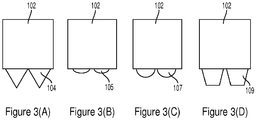
- the geometrical object disposed on the exit surface of the scintillator material is a pyramid.
- the Figure 3(A) shows a plurality of pyramids 104 disposed on an exit surface of the scintillator material.
- the Figure 3(B) shows a plurality of ellipsoids 105 disposed on an exit surface of the scintillator material.
- the Figure 3(C) shows a plurality of hemispheres 107 disposed on an exit surface of the scintillator material.
- the Figure 3(D) shows a plurality of truncated pyramids 109 disposed on an exit surface of the scintillator material. While the Figure 3(D) shows the truncated surface as being parallel to the exit surface of the scintillator material, it can be non-parallel if so desired.
- the angle of contact between a side of the geometrical object and the exit surface determines the efficiency of photon extraction.
- the Figure 4(A) shows how the angle is measured when the geometrical object is an outward projection such as, for example, a pyramid 104.
- the angle ⁇ between a side of the pyramid 104 and the exit surface of the scintillator material 102 is used as a measure of the extraction efficiency.
- This approach can be used for other geometrical objects such as truncated pyramids, cones, conical sections, or the like.
- an outward projecting geometrical object there are two geometrical objects -an outward projecting geometrical object (an ellipsoid 105) and an inward projecting geometrical object (a wedge 111).
- the outward projecting geometrical object is an ellipsoid 105.
- the angle ⁇ between a tangent to a surface of the ellipsoid at the point of contact of an edge of the ellipsoid with the exit surface of the scintillator material is used as a measure of the extraction efficiency.
- This approach can be used for other geometrical objects such as hemispheres, fullerenes, truncated fullerenes, or the like.
- the angle ⁇ between a tangent to a surface of the wedge 111 at the point of contact of an edge of the wedge 111 with the exit surface of the scintillator material is used as a measure of the extraction efficiency.
- the angle ⁇ is less than the critical angle for the scintillator material.
- the angle ⁇ can vary from 25 to 60 degrees, preferably 30 to 55 degrees and more preferably 35 to 45 degrees for outward projections. It is to be noted that for inward projections the ⁇ can be greater than 90 degrees and can vary from 25 to 135 degrees, preferably 65 to 130 degrees and more preferably from 95 to 125 degrees.
- the Table 1 below shows how the extraction efficiency of photons varies with the angle ⁇ in a scintillator having textured surfaces. The values shown in the Table 1 were the result of a simulation study. Table 1 Angle ( ⁇ ) Extraction Efficiency 0 [flat surface] 48% 30 65% 40 65% 45 65% 50 64% 60 60%
- the simulation shows that significantly larger amounts of photons approaching the interface can be successfully extracted without undergoing multiple internal reflections.
- the calculations using LSO indicate an increase in light yield of 17% for ⁇ having a value of 40 degrees over those surfaces where ⁇ has a value of 0 degrees. From the data above, it can be seen that by disposing the geometrical objects on the exit surface of the scintillator material, the extraction efficiency of photons is increased by an amount greater than 5%, preferably 5 to 25%, preferably 8 to 22%, and more preferably 10 to 20%.
- each geometrical object disposed on the exit surface of the scintillator material has dimensions that are of the order of the wavelength of light (i.e., they are in the micrometer and nanometer dimensional range).
- the dimensions (such as the width(s) and height of a pyramid or the radius of a sphere or the small and large axis of an ellipsoid) of the geometrical object are 50 nanometers to 700 nanometers, preferably 100 to 600 nanometers and more preferably 300 to 500 nanometers.
- the periodicity between geometrical objects can be from 50 nanometers to 1000 micrometers, preferably 400 nanometers to 500 micrometers.
- the texturing can be added using additive manufacturing (3D printing) where the geometrical objects are added to the surface of the scintillator under computer control.
- 3D manufacturing successive layers of material are formed under computer control to form an object of the desired geometry.
- additive manufacturing comprises adding successive layers of a scintillator material to form the geometrical object.
- the entire object (the scintillator material with the added geometrical objects) can be subjected to optional annealing at the appropriate temperatures to facilitate grain growth if desired.
- the method disclosed herein for manufacturing the scintillator material has a number of advantages.
- the texturing can be disposed on the scintillator material to improve photon extraction efficiency without causing crazing or cracking.
- the scintillator materials manufactured herein can be used in imaging articles and devices such as, for example, positron emission tomography, a computed tomography or single photon emission computed tomography machines.
- This example shows how the extraction efficiency increases with optimization of dimensions in a plurality of geometrical objects disposed on an exit surface of the crystal.
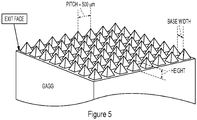
- the Figure 5 shows one embodiment where the texturing includes disposing a plurality of pyramids on an exit surface of the scintillator material. The widths of the base of the pyramid were varied from 100 to 500 micrometers. The pitch (periodicity) between pyramids is selected to be 500 micrometers.
- the Figure 6 is a graph that shows that the gain light yield is increased by up to 27% when the width is varied from 100 to 600 micrometers.
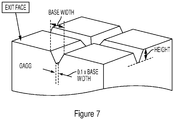
- Figure 7 shows a surface where the texture comprises truncated pyramids.
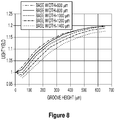
- Figure 8 is a graph that shows the light yield from the surface of the texture of the Figure 7 . From the Figure 8 it may be seen that the gain in light yield is increased by up to 20% when the width of the pyramid is 600 to 1400 micrometers.
- transition term comprising encompasses the transition terms "consisting of” and “consisting essentially of”.
Landscapes
- Chemical & Material Sciences (AREA)
- Engineering & Computer Science (AREA)
- Ceramic Engineering (AREA)
- Materials Engineering (AREA)
- Organic Chemistry (AREA)
- Manufacturing & Machinery (AREA)
- Inorganic Chemistry (AREA)
- Structural Engineering (AREA)
- Physics & Mathematics (AREA)
- Health & Medical Sciences (AREA)
- Life Sciences & Earth Sciences (AREA)
- Thermal Sciences (AREA)
- High Energy & Nuclear Physics (AREA)
- Molecular Biology (AREA)
- Medical Informatics (AREA)
- General Physics & Mathematics (AREA)
- Optics & Photonics (AREA)
- Pathology (AREA)
- Animal Behavior & Ethology (AREA)
- Radiology & Medical Imaging (AREA)
- Biomedical Technology (AREA)
- Heart & Thoracic Surgery (AREA)
- Biophysics (AREA)
- Surgery (AREA)
- Pulmonology (AREA)
- General Health & Medical Sciences (AREA)
- Public Health (AREA)
- Veterinary Medicine (AREA)
- Nuclear Medicine, Radiotherapy & Molecular Imaging (AREA)
- Theoretical Computer Science (AREA)
- Spectroscopy & Molecular Physics (AREA)
- General Engineering & Computer Science (AREA)
- Crystallography & Structural Chemistry (AREA)
- Luminescent Compositions (AREA)
- Measurement Of Radiation (AREA)
- Silicates, Zeolites, And Molecular Sieves (AREA)
- Compounds Of Alkaline-Earth Elements, Aluminum Or Rare-Earth Metals (AREA)
- Crystals, And After-Treatments Of Crystals (AREA)
Claims (7)
- Verfahren umfassend:Anordnen eines Pulvers in einer Form, das eine Zusammensetzung zur Herstellung eines Szintillatormaterials aufweist; undKomprimieren des Pulvers, um das Szintillatormaterial zu bilden; wobei eine Austrittsfläche des Szintillatormaterials eine Textur aufweist, die eine Vielzahl von Vorsprüngen umfasst, die die innere Totalreflexion an der Austrittsfläche verringern und die Menge der Photonen erhöhen, die aus der Austrittsfläche austreten, um einen Betrag von mehr als oder gleich 5 % über eine Oberfläche, die nicht die Vorsprünge aufweist,M4 ein Co-Dopant ist und einen der Stoffe Thallium, Kupfer, Silber, Blei, Wismut, Indium, Zinn, Antimon, Tantal, Wolfram, Strontium, Barium, Bor, Magnesium, Kalzium, Cerium, Yttrium, Scandium, Lanthan, Lutetium, Praseodym, Terbium, Ytterbium, Samarium, Europium, Holmium, Dysprosium, Erbium, Thulium oder Neodym umfasst,
wobei das Szintillatormaterial eine Zusammensetzung der Formel (1) aufweist,
M1 aM2 bM3 cM4 dO12
wobeiO für Sauerstoff steht,M1, M2, M3 und M4 für ein erstes, zweites, drittes und viertes Metall stehen, die sich voneinander unterscheiden,die Summe von a + b + c + d 8 ist, wobei"a" einen Wert von 2 bis 3,5 hat,"b" einen Wert von 0 bis 5 hat,"c" einen Wert von 0 bis 5 hat,"d" einen Wert von 0 bis 1 hat, wobei "b" und "c", "b" und "d" oder "c" und "d" nicht beide gleichzeitig gleich Null sein können,M1 ein Element der seltenen Erden ist, einschließlich, aber nicht beschränkt auf Gadolinium, Yttrium, Lutetium, Scandium oder eine Kombination davon,M2 Aluminium oder Bor ist,M3 Gallium ist, und
wobei die Projektionen Projektionen nach außen, Projektionen nach innen oder eine Kombination davon umfassen,
wobei die Projektionen geometrische Objekte umfassen, die eine Seite aufweisen, die in einem Winkel von 30 bis 60 Grad zur Austrittsfläche geneigt ist,
wobei die geometrischen Objekte mindestens eine Dimension aufweisen, die 50 bis 700 Nanometer groß ist
und/oder
wobei die geometrischen Objekte Pyramiden, Kegel, Halbkugeln, Ellipsoide, Pyramidenstümpfe, Fullerene, Kegelstümpfe, Halbkugelstümpfe, Ellipsoidstümpfe, Kugelstümpfe, Fullerenstümpfe oder eine Kombination davon sind,
wobei eine Periodizität zwischen geometrischen Objekten 300 Nanometer bis 1000 Mikrometer beträgt,
wobei das Komprimieren des Pulvers eine uniaxiale oder isostatische Kompression umfasst. - Verfahren nach Anspruch 1, wobei für M1 ein Teil des Gadoliniums durch eines oder mehrere von Yttrium, Lutetium, Lanthan, Terbium, Praseodym, Neodym, Cerium, Samarium, Europium, Dysprosium, Holmium, Erbium, Ytterbium oder Kombinationen davon ersetzt werden kann, oder wobei
M1 Gadolinium und M2 Aluminium ist. - Verfahren nach Anspruch 1, wobei"a" einen Wert von 2,4 bis 3,2 hat,"b" einen Wert von 2 bis 3 hat,"c" einen Wert von 1 bis 4 hat, und"d" einen Wert von 0,001 bis 0,5 hat.
- Verfahren nach einem der Ansprüche 1 bis 3, ferner umfassend ein Erhitzen des Pulvers durch Wärmeleitung oder Konvektion oder
ferner umfassend ein Erhitzen des Pulvers durch elektromagnetische Strahlung. - Verfahren nach Anspruch 1, wobei die uniaxiale oder isostatische Kompression bei einem Druck von 1 MPa bis 500 MPa durchgeführt wird, oder
wobei die uniaxiale Kompression bei Raumtemperatur durchgeführt wird. - Verfahren nach Anspruch 4, wobei das Pulver auf eine Temperatur von 480°C bis 2200°C erhitzt wird.
- Verfahren nach Anspruch 5, wobei während des Komprimierens Korngrenzenwachstum im Szintillatormaterial auftritt.
Applications Claiming Priority (1)
| Application Number | Priority Date | Filing Date | Title |
|---|---|---|---|
| US14/952,175 US9650569B1 (en) | 2015-11-25 | 2015-11-25 | Method of manufacturing garnet interfaces and articles containing the garnets obtained therefrom |
Publications (2)
| Publication Number | Publication Date |
|---|---|
| EP3176144A1 EP3176144A1 (de) | 2017-06-07 |
| EP3176144B1 true EP3176144B1 (de) | 2020-12-30 |
Family
ID=57542684
Family Applications (1)
| Application Number | Title | Priority Date | Filing Date |
|---|---|---|---|
| EP16199725.9A Active EP3176144B1 (de) | 2015-11-25 | 2016-11-21 | Verfahren zur herstellung von granatschnittstellen und artikel mit den daraus erhaltenen granaten |
Country Status (7)
| Country | Link |
|---|---|
| US (1) | US9650569B1 (de) |
| EP (1) | EP3176144B1 (de) |
| JP (1) | JP6539635B2 (de) |
| KR (1) | KR101903729B1 (de) |
| CN (1) | CN106977204A (de) |
| ES (1) | ES2863991T3 (de) |
| RU (1) | RU2663737C2 (de) |
Families Citing this family (10)
| Publication number | Priority date | Publication date | Assignee | Title |
|---|---|---|---|---|
| US10961452B2 (en) | 2015-12-01 | 2021-03-30 | Siemens Medical Solutions Usa, Inc. | Method for controlling gallium content in gadolinium-gallium garnet scintillators |
| US10197685B2 (en) * | 2015-12-01 | 2019-02-05 | Siemens Medical Solutions Usa, Inc. | Method for controlling gallium content in gadolinium-gallium garnet scintillators |
| US11014854B2 (en) | 2017-08-07 | 2021-05-25 | Consolidated Nuclear Security, LLC | Ceramic radiation detector device and method |
| JP2019047037A (ja) * | 2017-09-05 | 2019-03-22 | 株式会社東芝 | 光検出器 |
| EP3495849A1 (de) * | 2017-12-11 | 2019-06-12 | Koninklijke Philips N.V. | Mehrschichtiger pixelierter szintillator mit vergrössertem füllfaktor |
| CN108761517B (zh) * | 2018-04-19 | 2021-09-03 | 同济大学 | 一种内置型光子晶体闪烁体 |
| US11335472B2 (en) | 2019-02-03 | 2022-05-17 | Our United Corporation | Source storing apparatus, source guiding system, and source guiding method |
| WO2021070175A1 (en) | 2019-10-10 | 2021-04-15 | Technion Research And Development Foundation Ltd. | Scintillator structure and a method for emitting an output signal at a specific wavelength range |
| US10940639B1 (en) | 2020-01-29 | 2021-03-09 | The Florida International University Board Of Trustees | Glass scintillators and methods of manufacturing the same |
| CN112939592B (zh) * | 2021-02-07 | 2022-11-08 | 中国科学院上海光学精密机械研究所 | 镁钙离子共掺石榴石超快闪烁陶瓷及其制备方法 |
Family Cites Families (31)
| Publication number | Priority date | Publication date | Assignee | Title |
|---|---|---|---|---|
| JPH0634119B2 (ja) * | 1986-12-27 | 1994-05-02 | 富士写真フイルム株式会社 | 放射線像変換パネル |
| US4769353A (en) * | 1986-11-04 | 1988-09-06 | General Electric Company | Strontium-containing yttrium oxide ceramic body |
| JPH03158713A (ja) * | 1989-11-16 | 1991-07-08 | Hitachi Plant Eng & Constr Co Ltd | X線利用検査装置並びに該装置に用いるx線ラインセンサーおよびその製造方法 |
| US5208460A (en) * | 1991-09-23 | 1993-05-04 | General Electric Company | Photodetector scintillator radiation imager having high efficiency light collection |
| JP3144017B2 (ja) * | 1992-01-08 | 2001-03-07 | 日立金属株式会社 | 放射線検出器 |
| JPH09325185A (ja) * | 1996-06-03 | 1997-12-16 | Toshiba Fa Syst Eng Kk | 放射線検出器とその製造方法と透視検査装置とctスキャナ |
| CN1171973C (zh) * | 1997-12-24 | 2004-10-20 | 株式会社日立医药 | 磷光体和使用此磷光体的辐射探测器及使用此磷光体的x射线ct装置 |
| JP2004150932A (ja) * | 2002-10-30 | 2004-05-27 | Toshiba Corp | 放射線平面検出器 |
| US7576329B2 (en) * | 2003-10-17 | 2009-08-18 | General Electric Company | Scintillator compositions, and related processes and articles of manufacture |
| RU2350579C2 (ru) * | 2004-05-17 | 2009-03-27 | Федеральное Государственное Унитарное Предприятие "Научно-Исследовательский И Технологический Институт Оптического Материаловедения" Всероссийского Научного Центра "Государственный Оптический Институт Им. С.И.Вавилова" | Флуоресцентная керамика |
| JP4860368B2 (ja) | 2006-06-27 | 2012-01-25 | 富士フイルム株式会社 | ガーネット型化合物とその製造方法 |
| KR20100107001A (ko) * | 2007-12-03 | 2010-10-04 | 코닌클리즈케 필립스 일렉트로닉스 엔.브이. | 산란이 감소된 led를 위한 세라믹 재료 및 그것을 제조하는 방법 |
| WO2010010725A1 (ja) * | 2008-07-25 | 2010-01-28 | コニカミノルタエムジー株式会社 | シンチレータパネル及びそれを具備した放射線画像検出装置 |
| US8872119B2 (en) * | 2008-12-30 | 2014-10-28 | Saint-Gobain Ceramics & Plastics, Inc. | Ceramic scintillator body and scintillation device |
| JP5441798B2 (ja) * | 2010-04-07 | 2014-03-12 | キヤノン株式会社 | 放射線検出素子の製造方法及び放射線検出素子 |
| JP2011232197A (ja) * | 2010-04-28 | 2011-11-17 | Konica Minolta Medical & Graphic Inc | シンチレータパネル及び放射線画像検出装置 |
| JP5498908B2 (ja) * | 2010-09-29 | 2014-05-21 | 株式会社東芝 | 固体シンチレータ用材料、固体シンチレータ、およびそれを用いた放射線検出器並びに放射線検査装置 |
| US8815122B2 (en) * | 2010-10-29 | 2014-08-26 | Hitachi Metals, Ltd. | Polycrystalline scintillator for detecting soft X-rays |
| US8981305B2 (en) * | 2011-05-12 | 2015-03-17 | University Of Florida Research Foundation, Inc. | Index of refraction matched nanoparticles and methods of use |
| JP5767512B2 (ja) * | 2011-06-07 | 2015-08-19 | キヤノン株式会社 | 放射線検出素子及び放射線検出器 |
| CN102850047A (zh) * | 2011-06-29 | 2013-01-02 | 圣戈本陶瓷及塑料股份有限公司 | 基于掺杂的镥铝石榴石(LuAG)或其他镥铝氧化物的透明陶瓷闪烁体的制造方法 |
| JP2013134097A (ja) * | 2011-12-26 | 2013-07-08 | Canon Inc | シンチレータパネル、放射線検出装置、及び、それらを用いた放射線検出システム |
| EP2826835B1 (de) * | 2012-03-15 | 2018-03-07 | Kabushiki Kaisha Toshiba | Festkörperszintillator, strahlungsdetektor und röntgenuntersuchungsvorrichtung |
| US9006668B2 (en) * | 2012-10-02 | 2015-04-14 | Kabushiki Kaisha Toshiba | Method to improve light extraction from scintillators |
| WO2014070431A1 (en) * | 2012-10-31 | 2014-05-08 | Dow Global Technologies Llc | Nanocomposites of copolymers and dielectric materials |
| WO2014171985A2 (en) * | 2013-01-23 | 2014-10-23 | University Of Tennessee Research Foundation | Codoping method for modifying the scintillation and optical properties of garnet-type scintillators |
| WO2015118533A1 (en) * | 2014-02-04 | 2015-08-13 | Yissum Research Development Company Of The Hebrew University Of Jerusalem Ltd | Methods for fabricating 3-dimentional scintillators |
| KR102122746B1 (ko) * | 2014-05-30 | 2020-06-15 | 도레이 카부시키가이샤 | 신틸레이터 패널, 방사선 화상 검출 장치 및 그 제조 방법 |
| CN112358296A (zh) * | 2014-08-14 | 2021-02-12 | 清华大学 | 一种硫氧化钆闪烁陶瓷制备方法 |
| CN104557012B (zh) * | 2014-12-18 | 2017-03-08 | 徐州市江苏师范大学激光科技有限公司 | 一种Pr:LuAG闪烁陶瓷的制备方法 |
| CN104962994B (zh) * | 2015-07-30 | 2017-09-26 | 山东大学 | 导模法生长特定尺寸稀土掺杂含镓石榴石系列晶体的方法 |
-
2015
- 2015-11-25 US US14/952,175 patent/US9650569B1/en active Active
-
2016
- 2016-11-21 ES ES16199725T patent/ES2863991T3/es active Active
- 2016-11-21 EP EP16199725.9A patent/EP3176144B1/de active Active
- 2016-11-22 JP JP2016226507A patent/JP6539635B2/ja active Active
- 2016-11-23 KR KR1020160156671A patent/KR101903729B1/ko active Active
- 2016-11-24 CN CN201611043386.XA patent/CN106977204A/zh active Pending
- 2016-11-24 RU RU2016146110A patent/RU2663737C2/ru active
Non-Patent Citations (1)
| Title |
|---|
| None * |
Also Published As
| Publication number | Publication date |
|---|---|
| US9650569B1 (en) | 2017-05-16 |
| JP2017116532A (ja) | 2017-06-29 |
| US20170145305A1 (en) | 2017-05-25 |
| CN106977204A (zh) | 2017-07-25 |
| KR101903729B1 (ko) | 2018-10-04 |
| KR20170066234A (ko) | 2017-06-14 |
| JP6539635B2 (ja) | 2019-07-03 |
| RU2016146110A3 (de) | 2018-05-24 |
| RU2663737C2 (ru) | 2018-08-09 |
| EP3176144A1 (de) | 2017-06-07 |
| ES2863991T3 (es) | 2021-10-13 |
| RU2016146110A (ru) | 2018-05-24 |
Similar Documents
| Publication | Publication Date | Title |
|---|---|---|
| US9650569B1 (en) | Method of manufacturing garnet interfaces and articles containing the garnets obtained therefrom | |
| CN106947480B (zh) | 具有融合光学元件的陶瓷磷光体叠层体、其制造方法和包含其的制品 | |
| US5296163A (en) | Method for producing a scintillator ceramic | |
| JP6037025B2 (ja) | シンチレータ材料、放射線検出器及び放射線検査装置 | |
| CN104893709A (zh) | 闪烁体的表面处理方法 | |
| JP2013544442A (ja) | レーザーのためのセラミック非立方晶系フッ化物材料 | |
| JP6356352B2 (ja) | 最適化された効率を有するピクセル化されたシンチレータ | |
| WO2007083248A1 (en) | Method of making a gos ceramic using single-axis hot pressing and a flux aid | |
| JP2016145310A (ja) | シンチレータ材料、放射線検出器及び放射線検査装置 | |
| JP2016160297A (ja) | シンチレータ材料、放射線検出器及び放射線検査装置 | |
| JP6460440B2 (ja) | X線用蛍光体板 | |
| JP5962619B2 (ja) | シンチレータ材料、放射線検出器及び放射線検査装置 | |
| JP5767765B2 (ja) | 高解像度蛍光面板及び高解像度蛍光面板の製造方法 | |
| JP2016164210A (ja) | シンチレータ材料、放射線検出器及び放射線検査装置 | |
| JP5287669B2 (ja) | 真空蒸着法用酸化亜鉛系酸化物ペレットの製造方法 | |
| EP4058530A1 (de) | Bonden von szintillatormaterial zum produzieren von grossen tafeln oder anderen formen | |
| Seeley et al. | Transparent Lu2O3: Eu Ceramics | |
| Chen | Scintillator having a MgAI. sub. 2O. sub. 4 host lattice | |
| JP2016164208A (ja) | シンチレータ材料、放射線検出器及び放射線検査装置 |
Legal Events
| Date | Code | Title | Description |
|---|---|---|---|
| 17P | Request for examination filed |
Effective date: 20161121 |
|
| AK | Designated contracting states |
Kind code of ref document: A1 Designated state(s): AL AT BE BG CH CY CZ DE DK EE ES FI FR GB GR HR HU IE IS IT LI LT LU LV MC MK MT NL NO PL PT RO RS SE SI SK SM TR |
|
| AX | Request for extension of the european patent |
Extension state: BA ME |
|
| PUAI | Public reference made under article 153(3) epc to a published international application that has entered the european phase |
Free format text: ORIGINAL CODE: 0009012 |
|
| STAA | Information on the status of an ep patent application or granted ep patent |
Free format text: STATUS: REQUEST FOR EXAMINATION WAS MADE |
|
| RBV | Designated contracting states (corrected) |
Designated state(s): AL AT BE BG CH CY CZ DE DK EE ES FI FR GB GR HR HU IE IS IT LI LT LU LV MC MK MT NL NO PL PT RO RS SE SI SK SM TR |
|
| RAP1 | Party data changed (applicant data changed or rights of an application transferred) |
Owner name: SIEMENS MEDICAL SOLUTIONS USA, INC. |
|
| R17P | Request for examination filed (corrected) |
Effective date: 20161121 |
|
| GRAP | Despatch of communication of intention to grant a patent |
Free format text: ORIGINAL CODE: EPIDOSNIGR1 |
|
| STAA | Information on the status of an ep patent application or granted ep patent |
Free format text: STATUS: GRANT OF PATENT IS INTENDED |
|
| INTG | Intention to grant announced |
Effective date: 20200623 |
|
| RIN1 | Information on inventor provided before grant (corrected) |
Inventor name: SCHMAND, MATTHIAS J Inventor name: HEDLER, HARRY Inventor name: ANDREACO, MARK S. Inventor name: THALHAMMER, CHRISTOF Inventor name: MINTZER, ROBERT A. Inventor name: COHEN, PETER CARL |
|
| GRAS | Grant fee paid |
Free format text: ORIGINAL CODE: EPIDOSNIGR3 |
|
| GRAA | (expected) grant |
Free format text: ORIGINAL CODE: 0009210 |
|
| STAA | Information on the status of an ep patent application or granted ep patent |
Free format text: STATUS: THE PATENT HAS BEEN GRANTED |
|
| AK | Designated contracting states |
Kind code of ref document: B1 Designated state(s): AL AT BE BG CH CY CZ DE DK EE ES FI FR GB GR HR HU IE IS IT LI LT LU LV MC MK MT NL NO PL PT RO RS SE SI SK SM TR |
|
| REG | Reference to a national code |
Ref country code: GB Ref legal event code: FG4D |
|
| REG | Reference to a national code |
Ref country code: AT Ref legal event code: REF Ref document number: 1349782 Country of ref document: AT Kind code of ref document: T Effective date: 20210115 |
|
| REG | Reference to a national code |
Ref country code: DE Ref legal event code: R096 Ref document number: 602016050522 Country of ref document: DE |
|
| REG | Reference to a national code |
Ref country code: IE Ref legal event code: FG4D |
|
| PG25 | Lapsed in a contracting state [announced via postgrant information from national office to epo] |
Ref country code: NO Free format text: LAPSE BECAUSE OF FAILURE TO SUBMIT A TRANSLATION OF THE DESCRIPTION OR TO PAY THE FEE WITHIN THE PRESCRIBED TIME-LIMIT Effective date: 20210330 Ref country code: RS Free format text: LAPSE BECAUSE OF FAILURE TO SUBMIT A TRANSLATION OF THE DESCRIPTION OR TO PAY THE FEE WITHIN THE PRESCRIBED TIME-LIMIT Effective date: 20201230 Ref country code: FI Free format text: LAPSE BECAUSE OF FAILURE TO SUBMIT A TRANSLATION OF THE DESCRIPTION OR TO PAY THE FEE WITHIN THE PRESCRIBED TIME-LIMIT Effective date: 20201230 Ref country code: GR Free format text: LAPSE BECAUSE OF FAILURE TO SUBMIT A TRANSLATION OF THE DESCRIPTION OR TO PAY THE FEE WITHIN THE PRESCRIBED TIME-LIMIT Effective date: 20210331 |
|
| REG | Reference to a national code |
Ref country code: AT Ref legal event code: MK05 Ref document number: 1349782 Country of ref document: AT Kind code of ref document: T Effective date: 20201230 |
|
| PG25 | Lapsed in a contracting state [announced via postgrant information from national office to epo] |
Ref country code: BG Free format text: LAPSE BECAUSE OF FAILURE TO SUBMIT A TRANSLATION OF THE DESCRIPTION OR TO PAY THE FEE WITHIN THE PRESCRIBED TIME-LIMIT Effective date: 20210330 Ref country code: LV Free format text: LAPSE BECAUSE OF FAILURE TO SUBMIT A TRANSLATION OF THE DESCRIPTION OR TO PAY THE FEE WITHIN THE PRESCRIBED TIME-LIMIT Effective date: 20201230 Ref country code: SE Free format text: LAPSE BECAUSE OF FAILURE TO SUBMIT A TRANSLATION OF THE DESCRIPTION OR TO PAY THE FEE WITHIN THE PRESCRIBED TIME-LIMIT Effective date: 20201230 |
|
| REG | Reference to a national code |
Ref country code: NL Ref legal event code: MP Effective date: 20201230 |
|
| PG25 | Lapsed in a contracting state [announced via postgrant information from national office to epo] |
Ref country code: HR Free format text: LAPSE BECAUSE OF FAILURE TO SUBMIT A TRANSLATION OF THE DESCRIPTION OR TO PAY THE FEE WITHIN THE PRESCRIBED TIME-LIMIT Effective date: 20201230 |
|
| REG | Reference to a national code |
Ref country code: LT Ref legal event code: MG9D |
|
| PG25 | Lapsed in a contracting state [announced via postgrant information from national office to epo] |
Ref country code: RO Free format text: LAPSE BECAUSE OF FAILURE TO SUBMIT A TRANSLATION OF THE DESCRIPTION OR TO PAY THE FEE WITHIN THE PRESCRIBED TIME-LIMIT Effective date: 20201230 Ref country code: PT Free format text: LAPSE BECAUSE OF FAILURE TO SUBMIT A TRANSLATION OF THE DESCRIPTION OR TO PAY THE FEE WITHIN THE PRESCRIBED TIME-LIMIT Effective date: 20210430 Ref country code: SK Free format text: LAPSE BECAUSE OF FAILURE TO SUBMIT A TRANSLATION OF THE DESCRIPTION OR TO PAY THE FEE WITHIN THE PRESCRIBED TIME-LIMIT Effective date: 20201230 Ref country code: LT Free format text: LAPSE BECAUSE OF FAILURE TO SUBMIT A TRANSLATION OF THE DESCRIPTION OR TO PAY THE FEE WITHIN THE PRESCRIBED TIME-LIMIT Effective date: 20201230 Ref country code: EE Free format text: LAPSE BECAUSE OF FAILURE TO SUBMIT A TRANSLATION OF THE DESCRIPTION OR TO PAY THE FEE WITHIN THE PRESCRIBED TIME-LIMIT Effective date: 20201230 Ref country code: NL Free format text: LAPSE BECAUSE OF FAILURE TO SUBMIT A TRANSLATION OF THE DESCRIPTION OR TO PAY THE FEE WITHIN THE PRESCRIBED TIME-LIMIT Effective date: 20201230 |
|
| PG25 | Lapsed in a contracting state [announced via postgrant information from national office to epo] |
Ref country code: PL Free format text: LAPSE BECAUSE OF FAILURE TO SUBMIT A TRANSLATION OF THE DESCRIPTION OR TO PAY THE FEE WITHIN THE PRESCRIBED TIME-LIMIT Effective date: 20201230 Ref country code: AT Free format text: LAPSE BECAUSE OF FAILURE TO SUBMIT A TRANSLATION OF THE DESCRIPTION OR TO PAY THE FEE WITHIN THE PRESCRIBED TIME-LIMIT Effective date: 20201230 |
|
| PG25 | Lapsed in a contracting state [announced via postgrant information from national office to epo] |
Ref country code: IS Free format text: LAPSE BECAUSE OF FAILURE TO SUBMIT A TRANSLATION OF THE DESCRIPTION OR TO PAY THE FEE WITHIN THE PRESCRIBED TIME-LIMIT Effective date: 20210430 |
|
| REG | Reference to a national code |
Ref country code: DE Ref legal event code: R097 Ref document number: 602016050522 Country of ref document: DE |
|
| REG | Reference to a national code |
Ref country code: ES Ref legal event code: FG2A Ref document number: 2863991 Country of ref document: ES Kind code of ref document: T3 Effective date: 20211013 |
|
| PG25 | Lapsed in a contracting state [announced via postgrant information from national office to epo] |
Ref country code: AL Free format text: LAPSE BECAUSE OF FAILURE TO SUBMIT A TRANSLATION OF THE DESCRIPTION OR TO PAY THE FEE WITHIN THE PRESCRIBED TIME-LIMIT Effective date: 20201230 |
|
| PLBE | No opposition filed within time limit |
Free format text: ORIGINAL CODE: 0009261 |
|
| STAA | Information on the status of an ep patent application or granted ep patent |
Free format text: STATUS: NO OPPOSITION FILED WITHIN TIME LIMIT |
|
| PG25 | Lapsed in a contracting state [announced via postgrant information from national office to epo] |
Ref country code: DK Free format text: LAPSE BECAUSE OF FAILURE TO SUBMIT A TRANSLATION OF THE DESCRIPTION OR TO PAY THE FEE WITHIN THE PRESCRIBED TIME-LIMIT Effective date: 20201230 |
|
| 26N | No opposition filed |
Effective date: 20211001 |
|
| PG25 | Lapsed in a contracting state [announced via postgrant information from national office to epo] |
Ref country code: SI Free format text: LAPSE BECAUSE OF FAILURE TO SUBMIT A TRANSLATION OF THE DESCRIPTION OR TO PAY THE FEE WITHIN THE PRESCRIBED TIME-LIMIT Effective date: 20201230 |
|
| PG25 | Lapsed in a contracting state [announced via postgrant information from national office to epo] |
Ref country code: IS Free format text: LAPSE BECAUSE OF FAILURE TO SUBMIT A TRANSLATION OF THE DESCRIPTION OR TO PAY THE FEE WITHIN THE PRESCRIBED TIME-LIMIT Effective date: 20210430 |
|
| PG25 | Lapsed in a contracting state [announced via postgrant information from national office to epo] |
Ref country code: MC Free format text: LAPSE BECAUSE OF FAILURE TO SUBMIT A TRANSLATION OF THE DESCRIPTION OR TO PAY THE FEE WITHIN THE PRESCRIBED TIME-LIMIT Effective date: 20201230 |
|
| REG | Reference to a national code |
Ref country code: CH Ref legal event code: PL |
|
| PG25 | Lapsed in a contracting state [announced via postgrant information from national office to epo] |
Ref country code: LU Free format text: LAPSE BECAUSE OF NON-PAYMENT OF DUE FEES Effective date: 20211121 Ref country code: BE Free format text: LAPSE BECAUSE OF NON-PAYMENT OF DUE FEES Effective date: 20211130 |
|
| REG | Reference to a national code |
Ref country code: BE Ref legal event code: MM Effective date: 20211130 |
|
| PG25 | Lapsed in a contracting state [announced via postgrant information from national office to epo] |
Ref country code: IE Free format text: LAPSE BECAUSE OF NON-PAYMENT OF DUE FEES Effective date: 20211121 |
|
| PG25 | Lapsed in a contracting state [announced via postgrant information from national office to epo] |
Ref country code: HU Free format text: LAPSE BECAUSE OF FAILURE TO SUBMIT A TRANSLATION OF THE DESCRIPTION OR TO PAY THE FEE WITHIN THE PRESCRIBED TIME-LIMIT; INVALID AB INITIO Effective date: 20161121 |
|
| PG25 | Lapsed in a contracting state [announced via postgrant information from national office to epo] |
Ref country code: CY Free format text: LAPSE BECAUSE OF FAILURE TO SUBMIT A TRANSLATION OF THE DESCRIPTION OR TO PAY THE FEE WITHIN THE PRESCRIBED TIME-LIMIT Effective date: 20201230 |
|
| PG25 | Lapsed in a contracting state [announced via postgrant information from national office to epo] |
Ref country code: SM Free format text: LAPSE BECAUSE OF FAILURE TO SUBMIT A TRANSLATION OF THE DESCRIPTION OR TO PAY THE FEE WITHIN THE PRESCRIBED TIME-LIMIT Effective date: 20201230 Ref country code: LI Free format text: LAPSE BECAUSE OF NON-PAYMENT OF DUE FEES Effective date: 20220701 Ref country code: CH Free format text: LAPSE BECAUSE OF NON-PAYMENT OF DUE FEES Effective date: 20220701 |
|
| PG25 | Lapsed in a contracting state [announced via postgrant information from national office to epo] |
Ref country code: MK Free format text: LAPSE BECAUSE OF FAILURE TO SUBMIT A TRANSLATION OF THE DESCRIPTION OR TO PAY THE FEE WITHIN THE PRESCRIBED TIME-LIMIT Effective date: 20201230 |
|
| PG25 | Lapsed in a contracting state [announced via postgrant information from national office to epo] |
Ref country code: MT Free format text: LAPSE BECAUSE OF FAILURE TO SUBMIT A TRANSLATION OF THE DESCRIPTION OR TO PAY THE FEE WITHIN THE PRESCRIBED TIME-LIMIT Effective date: 20201230 |
|
| REG | Reference to a national code |
Ref country code: DE Ref legal event code: R082 Ref document number: 602016050522 Country of ref document: DE |
|
| PG25 | Lapsed in a contracting state [announced via postgrant information from national office to epo] |
Ref country code: TR Free format text: LAPSE BECAUSE OF FAILURE TO SUBMIT A TRANSLATION OF THE DESCRIPTION OR TO PAY THE FEE WITHIN THE PRESCRIBED TIME-LIMIT Effective date: 20201230 |
|
| PGFP | Annual fee paid to national office [announced via postgrant information from national office to epo] |
Ref country code: GB Payment date: 20251211 Year of fee payment: 10 |
|
| PGFP | Annual fee paid to national office [announced via postgrant information from national office to epo] |
Ref country code: IT Payment date: 20251125 Year of fee payment: 10 |
|
| PGFP | Annual fee paid to national office [announced via postgrant information from national office to epo] |
Ref country code: FR Payment date: 20251114 Year of fee payment: 10 |
|
| PGFP | Annual fee paid to national office [announced via postgrant information from national office to epo] |
Ref country code: CZ Payment date: 20251113 Year of fee payment: 10 |
|
| PGFP | Annual fee paid to national office [announced via postgrant information from national office to epo] |
Ref country code: ES Payment date: 20260220 Year of fee payment: 10 |
|
| PGFP | Annual fee paid to national office [announced via postgrant information from national office to epo] |
Ref country code: DE Payment date: 20260119 Year of fee payment: 10 |