EP3012867B1 - Halbleiterbauelemente und verfahren zur herstellung von halbleiterbauelementen - Google Patents
Halbleiterbauelemente und verfahren zur herstellung von halbleiterbauelementen Download PDFInfo
- Publication number
- EP3012867B1 EP3012867B1 EP15190765.6A EP15190765A EP3012867B1 EP 3012867 B1 EP3012867 B1 EP 3012867B1 EP 15190765 A EP15190765 A EP 15190765A EP 3012867 B1 EP3012867 B1 EP 3012867B1
- Authority
- EP
- European Patent Office
- Prior art keywords
- metal oxide
- layer
- oxide layer
- oxygen content
- forming
- Prior art date
- Legal status (The legal status is an assumption and is not a legal conclusion. Google has not performed a legal analysis and makes no representation as to the accuracy of the status listed.)
- Active
Links
Images


Classifications
-
- H—ELECTRICITY
- H10—SEMICONDUCTOR DEVICES; ELECTRIC SOLID-STATE DEVICES NOT OTHERWISE PROVIDED FOR
- H10D—INORGANIC ELECTRIC SEMICONDUCTOR DEVICES
- H10D30/00—Field-effect transistors [FET]
- H10D30/60—Insulated-gate field-effect transistors [IGFET]
- H10D30/67—Thin-film transistors [TFT]
- H10D30/674—Thin-film transistors [TFT] characterised by the active materials
- H10D30/6755—Oxide semiconductors, e.g. zinc oxide, copper aluminium oxide or cadmium stannate
-
- H—ELECTRICITY
- H10—SEMICONDUCTOR DEVICES; ELECTRIC SOLID-STATE DEVICES NOT OTHERWISE PROVIDED FOR
- H10D—INORGANIC ELECTRIC SEMICONDUCTOR DEVICES
- H10D30/00—Field-effect transistors [FET]
- H10D30/01—Manufacture or treatment
- H10D30/021—Manufacture or treatment of FETs having insulated gates [IGFET]
- H10D30/031—Manufacture or treatment of FETs having insulated gates [IGFET] of thin-film transistors [TFT]
-
- H—ELECTRICITY
- H10—SEMICONDUCTOR DEVICES; ELECTRIC SOLID-STATE DEVICES NOT OTHERWISE PROVIDED FOR
- H10D—INORGANIC ELECTRIC SEMICONDUCTOR DEVICES
- H10D30/00—Field-effect transistors [FET]
- H10D30/60—Insulated-gate field-effect transistors [IGFET]
- H10D30/67—Thin-film transistors [TFT]
- H10D30/6704—Thin-film transistors [TFT] having supplementary regions or layers in the thin films or in the insulated bulk substrates for controlling properties of the device
-
- H—ELECTRICITY
- H10—SEMICONDUCTOR DEVICES; ELECTRIC SOLID-STATE DEVICES NOT OTHERWISE PROVIDED FOR
- H10D—INORGANIC ELECTRIC SEMICONDUCTOR DEVICES
- H10D30/00—Field-effect transistors [FET]
- H10D30/60—Insulated-gate field-effect transistors [IGFET]
- H10D30/67—Thin-film transistors [TFT]
- H10D30/6704—Thin-film transistors [TFT] having supplementary regions or layers in the thin films or in the insulated bulk substrates for controlling properties of the device
- H10D30/6713—Thin-film transistors [TFT] having supplementary regions or layers in the thin films or in the insulated bulk substrates for controlling properties of the device characterised by the properties of the source or drain regions, e.g. compositions or sectional shapes
-
- H—ELECTRICITY
- H10—SEMICONDUCTOR DEVICES; ELECTRIC SOLID-STATE DEVICES NOT OTHERWISE PROVIDED FOR
- H10D—INORGANIC ELECTRIC SEMICONDUCTOR DEVICES
- H10D30/00—Field-effect transistors [FET]
- H10D30/60—Insulated-gate field-effect transistors [IGFET]
- H10D30/67—Thin-film transistors [TFT]
- H10D30/6729—Thin-film transistors [TFT] characterised by the electrodes
- H10D30/673—Thin-film transistors [TFT] characterised by the electrodes characterised by the shapes, relative sizes or dispositions of the gate electrodes
-
- H10D64/011—
-
- H—ELECTRICITY
- H10—SEMICONDUCTOR DEVICES; ELECTRIC SOLID-STATE DEVICES NOT OTHERWISE PROVIDED FOR
- H10D—INORGANIC ELECTRIC SEMICONDUCTOR DEVICES
- H10D86/00—Integrated devices formed in or on insulating or conducting substrates, e.g. formed in silicon-on-insulator [SOI] substrates or on stainless steel or glass substrates
- H10D86/40—Integrated devices formed in or on insulating or conducting substrates, e.g. formed in silicon-on-insulator [SOI] substrates or on stainless steel or glass substrates characterised by multiple TFTs
- H10D86/451—Integrated devices formed in or on insulating or conducting substrates, e.g. formed in silicon-on-insulator [SOI] substrates or on stainless steel or glass substrates characterised by multiple TFTs characterised by the compositions or shapes of the interlayer dielectrics
-
- H—ELECTRICITY
- H10—SEMICONDUCTOR DEVICES; ELECTRIC SOLID-STATE DEVICES NOT OTHERWISE PROVIDED FOR
- H10D—INORGANIC ELECTRIC SEMICONDUCTOR DEVICES
- H10D86/00—Integrated devices formed in or on insulating or conducting substrates, e.g. formed in silicon-on-insulator [SOI] substrates or on stainless steel or glass substrates
- H10D86/40—Integrated devices formed in or on insulating or conducting substrates, e.g. formed in silicon-on-insulator [SOI] substrates or on stainless steel or glass substrates characterised by multiple TFTs
- H10D86/60—Integrated devices formed in or on insulating or conducting substrates, e.g. formed in silicon-on-insulator [SOI] substrates or on stainless steel or glass substrates characterised by multiple TFTs wherein the TFTs are in active matrices
-
- H—ELECTRICITY
- H10—SEMICONDUCTOR DEVICES; ELECTRIC SOLID-STATE DEVICES NOT OTHERWISE PROVIDED FOR
- H10D—INORGANIC ELECTRIC SEMICONDUCTOR DEVICES
- H10D99/00—Subject matter not provided for in other groups of this subclass
-
- H10P14/6314—
-
- H10P14/6322—
Definitions
- the present invention relates to semiconductor devices and methods of manufacturing semiconductor devices. More particularly, the present invention relate to oxide semiconductor devices including protection structures, and methods of manufacturing the oxide semiconductor devices including the protection structures.
- a conventional thin film transistor (“TFT”) having a bottom gate configuration generally includes a gate electrode disposed on a substrate, a gate insulation layer disposed on the gate insulation layer, a source electrode and a drain electrode disposed on the gate insulation layer, and an active layer among the gate insulation layer, the source electrode, and the drain electrode.
- the source electrode and the drain electrode may make contact with a source region and a drain region of the active layer.
- the conventional transistor having a bottom gate configuration moisture and/or hydrogen may be permeated into the structures of the transistor such that the electrical characteristics of the transistor may be easily degraded.
- variation of the threshold voltage (Vth) of the transistor may be caused by moisture and/or hydrogen, so that the transistor may have degraded electrical characteristics, such as an increase of the threshold voltage distribution, a decrease of the driving current, etc.
- the conventional oxide semiconductor device which includes an active layer of oxide semiconductor, may be relatively sensitive to moisture and/or hydrogen, and thus, the electrical characteristics of the oxide semiconductor device may be easily degraded.
- Such a degraded oxide semiconductor device may not be properly employed in recent display devices, such as liquid crystal display devices, organic light emitting display devices, etc.
- US 2014/175432 relates to an oxide semiconductor device.
- US 2010/283049 relates to an oxide semiconductor device.
- Exemplary embodiments of the present invention provide oxide semiconductor devices having improved electrical characteristics by preventing permeation of moisture and/or hydrogen.
- Exemplary embodiments of the present invention also provide methods of manufacturing oxide semiconductor devices having improved electrical characteristics by prevention permeation of moisture and/or hydrogen.
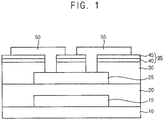
- FIG. 1 is a cross-sectional view illustrating an oxide semiconductor device in accordance with an exemplary embodiment.
- a semiconductor device includes a gate electrode 15, a gate insulation layer 20, an active layer 25, an insulating interlayer 30, a protection structure 35, a source electrode 50, and a drain electrode 55, which may be sequentially disposed on a substrate 10.
- the protection structure 35 includes a first metal oxide layer 40 and a second metal oxide layer 45.
- each of the first metal oxide layer 40 and the second metal oxide layer 45 may include aluminium oxide (AlOx), titanium oxide (TiOx), tantalum oxide (TaOx), zirconium oxide (ZrOx), etc.
- the substrate 10 may include an insulation material.
- the substrate 10 may include a glass substrate, a transparent plastic substrate, a transparent metal oxide substrate, etc.
- at least one buffer layer may be provided on the substrate 10.
- the buffer layer may include silicon oxide (SiOx), silicon nitride (SiNx), silicon oxynitride (SiOxNy), etc.
- the gate electrode 15 is provided on the substrate 10.
- the oxide semiconductor device illustrated in FIG. 1 has a bottom gate configuration. However, the oxide semiconductor device may have dual gate configuration, etc.
- the gate electrode 15 may include a metal, an alloy, a metal nitride, a conductive metal oxide, a transparent conductive material, etc.
- the gate electrode 15 may include aluminium (Al), an alloy containing aluminium, aluminium nitride (AlNx), silver (Ag), an alloy containing silver, tungsten (W), tungsten nitride (WNx), copper (Cu), an alloy containing copper, nickel (Ni), chrome (Cr), molybdenum (Mo), an alloy containing molybdenum, titanium (Ti), titanium nitride (TiNx), platinum (Pt), tantalum (Ta), tantalum nitride (TaNx), neodymium (Nd), scandium (Sc), strontium ruthenium oxide (SrRuxOy), zinc oxide (ZnOx), indium tin oxide (ITO), tin oxide (SnOx), gallium oxide (GaOx), indium
- the gate insulation layer 20 is disposed on the substrate 10 to substantially cover the gate electrode 15.
- the gate insulation layer 20 may sufficiently cover the gate electrode 15, and have a substantially level surface without a step around the gate electrode 15.
- the gate insulation layer 20 may include silicon compound, metal oxide, etc.
- the gate insulation layer 20 may include silicon oxide, silicon nitride, silicon oxynitride, aluminium oxide, tantalum oxide, hafnium oxide, zirconium oxide, titanium oxide, etc. These may be used alone or in a combination thereof.
- the active layer 25 is located on the gate insulation layer 20.
- the active layer 25 includes a semiconductor oxide, such as binary system compound (ABx), ternary system compound (ABxCy) or quaternary system compound (ABxCyDz), which may contain indium, zinc, gallium, tin, titanium, aluminium, hafnium (Hf), zirconium (Zr), magnesium (Mg), etc.
- ABx binary system compound
- ABxCy ternary system compound
- ABSDz quaternary system compound
- the active layer 25 may include indium-gallium-zinc oxide (IGZO), gallium zinc oxide (GaZnxOy), indium tin oxide (ITO), indium zinc oxide (IZO), zinc magnesium oxide (ZnMgxOy), zinc tin oxide (ZnSnxOy), zinc zirconium oxide (ZnZRxOy), zinc oxide (ZnOx), gallium oxide (GaOx), titanium oxide (TiOx), tin oxide (SnOx), indium oxide (InOx), indium-gallium-hafnium oxide (IGHO), tin-aluminium-zinc oxide (TAZO), indium-gallium-tin oxide (IGSO), etc. These may be used alone or in a mixture thereof.
- IGZO indium-gallium-zinc oxide
- GaZnxOy gallium zinc oxide
- ITO indium zinc oxide
- IZO zinc magnesium oxide
- ZnMgxOy zinc tin
- the insulating interlayer 30 is provided on the gate insulation layer 20 to substantially cover the active layer 25.
- the insulating interlayer 30 may sufficiently cover the active layer 25 while having a substantially flat upper face without a step around the active layer 25.
- the insulating interlayer 30 may include silicon compound.
- the insulating interlayer 30 may include silicon oxide, silicon nitride, silicon oxynitride, etc. These may be used alone or in a combination thereof.
- the protection structure 35 is disposed on the insulating interlayer 30.
- the protection structure 35 includes the first metal oxide layer 40 disposed on the insulating interlayer 30, and the second metal oxide layer 45 disposed on the first metal oxide layer 40.
- the first metal oxide layer 40 may include a metal oxide substantially the same as that contained in the second metal oxide layer 45.
- each of the first and the second metal oxide layers 40 and 45 may include aluminium oxide, titanium oxide, tantalum oxide, zirconium oxide, etc. These may be used alone or in a combination thereof.
- the first and the second metal oxide layers 40 and 45 have different oxygen contents, respectively.
- the first metal oxide layer 40 has a first composition of MOx1 (wherein, M represents aluminium, titanium, tantalum or zirconium, O denotes oxygen, and x means a positive real number) that may contain a first metal oxide having a first oxygen content.
- the second metal oxide layer 45 has a second composition of MOx2 that may contain a second metal oxide having a second oxygen content.
- the first metal oxide layer 40 may have the first composition of AlOx1 containing aluminium oxide having the first oxygen content
- the second metal oxide layer 45 may have the second composition of AlOx2 containing aluminium oxide having the second oxygen content.
- the first oxygen content of the first metal oxide layer 40 may be substantially greater than the second oxygen content of the second metal oxide layer 45.
- a difference between the first oxygen content and the second oxygen content may be more than 3 atomic percentage (at%).
- the first metal oxide layer 40 may have a thickness between about 5nm (50 ⁇ ) and about 100nm (1,000 ⁇ )
- the second metal oxide layer 45 may have a thickness of about 3nm (30 ⁇ ) to about 30nm (300 ⁇ ). Accordingly, a thickness ratio between the first metal oxide layer 40 and the second metal oxide layer 45 is in a range of about 1.0: 0.03 to about 1.0: 0.6.
- the second oxygen content of the second metal oxide layer 45 may be substantially greater than the first oxygen content of the first metal oxide layer 40.
- the second oxygen content may be higher than the first oxygen content by more than 3 at%.
- the thickness of the first metal oxide layer 40 may be in a range between about 3nm (30 ⁇ ) and about 30nm (300 ⁇ ) while the thickness of the second metal oxide layer 45 may be in a range between about 5nm (50 ⁇ ) and about 100nm (1,000 ⁇ ).
- the second oxygen content is abruptly varied from the first oxygen content at an interface between the first metal oxide layer 40 and the second metal oxide layer 45.
- the second oxygen content may be suddenly increased or decreased from the first oxygen content at an interface between the first metal oxide layer 40 and the second metal oxide layer 45.
- the protection structure 35 may prevent the underlying structures from external moisture and/or hydrogen. If moisture and/or hydrogen permeate into the underlying structure of the oxide semiconductor device, the concentration of charge carriers in the active layer 25 may be undesirably increased and, thus, the threshold voltage (Vth) of the oxide semiconductor device may be negatively shifted, thereby degrading the electrical characteristics of the oxide semiconductor device.
- Vth threshold voltage
- the oxide semiconductor device may ensure improved electrical characteristics by preventing the threshold voltage shift thereof.
- the source electrode 50 and the drain electrode 55 are provided on the second metal oxide layer 45 of the protection structure 35.
- the source and the drain electrodes 50 and 55 pass through the protection structure 35 and the insulating interlayer 30 so that the source and the drain electrodes 50 and 55 make contact with a source region and a drain region of the active layer 25.
- a source contact hole and drain contact hole is provided through the protection structure 35 and the insulating interlayer 30.
- the source and the drain contact holes expose the source and the drain regions of the active layer 25, respectively.
- the source and the drain electrodes 50 and 55 may be are electrically connected to the source and the drain regions, respectively.
- Each of the source and the drain regions 50 and 55 may include a metal, an alloy, a metal nitride, a conductive metal oxide, a transparent conductive material, etc.
- each of the source and the drain electrodes 50 and 55 may include aluminium, copper, molybdenum, titanium, chrome, tantalum, tungsten, neodymium, scandium, alloys thereof, nitrides thereof, strontium ruthenium oxide, indium tin oxide, indium zinc oxide, zinc oxide, tin oxide, carbon nanotube, etc.
- FIG. 2 is a flow chart illustrating a method of manufacturing an oxide semiconductor device in accordance with an exemplary embodiment.
- FIGS. 3 to 6 are cross-sectional views illustrating a method of manufacturing an oxide semiconductor device in accordance with an exemplary embodiment.
- a gate electrode 115 is formed on a substrate 110, which may be composed of transparent material, such as glass, transparent plastic, transparent ceramic, etc.
- the gate electrode 115 may be formed by a sputtering process, a spray process, a chemical vapor deposition (CVD) process, an atomic layer deposition (ALD) process, a vacuum evaporation process, a printing process, etc.
- the gate electrode 115 may be obtained using metal such as aluminium, tungsten, copper, nickel, chrome, molybdenum, titanium, platinum, tantalum or ruthenium, alloy containing these metals, nitrides of these metals, or conductive metal oxide.
- a gate insulation layer 120 is formed on the substrate 110 to cover the gate electrodes 115 in step S120.
- the gate insulation layer 120 may be formed by a CVD process, a thermal oxidation process, a plasma enhanced chemical vapor deposition (PECVD) process, a high density plasma-chemical vapor deposition (HDP-CVD) process, etc.
- the gate insulation layer 120 may be formed using silicon compound, metal oxide, etc.
- the gate insulation layer 120 may have a relatively large thickness that may sufficiently cover the gate electrode 115 on the substrate 110.
- an active layer 125 is formed on the gate insulation layer 120 in step S130.
- the active layer 125 may be obtained by a sputtering process, a CVD process, a printing process, a vacuum evaporation process, an ALD process, a sol-gel process, a PECVD process, etc.
- the active layer 125 is formed using a semiconductor oxide, such as a binary system compound, a ternary system compound, or a quaternary system compound.
- the active layer 125 may be formed using a semiconductor oxide containing indium, gallium, tin, titanium, aluminium, hafnium, zirconium, magnesium, etc.
- the active layer 125 is disposed on a portion of the gate insulation layer 120 under which the gate electrode 115 is disposed.
- An insulating interlayer 130 is formed on the gate insulation layer 120 to substantially cover the active layer 125 in step of S140.
- the insulating interlayer 130 may have a substantially flat upper face that sufficiently covers the active layer 125.
- a planarization process may be performed on the insulating interlayer 130 such that the insulating interlayer 130 may have such a level surface.
- a first metal oxide layer 140 is formed on the insulating interlayer 130 in step S150.
- the first metal oxide layer 140 may be formed by a sputtering process, a PECVD process, a CVD process, a vacuum evaporation process, etc. Additionally, the first metal oxide layer 140 may be formed using aluminium oxide, titanium oxide, tantalum oxide, zirconium oxide, etc.
- a gas mixture including an inactive gas e.g., an argon (Ar) gas, a neon (Ne) gas, a nitrogen (N2) gas, etc.
- an oxygen (O 2 ) gas may be introduced into a chamber having a substantial vacuum pressure, and then the gas mixture may changed into a plasma containing oxygen to thereby provide an atmosphere containing oxygen in the chamber.
- an inactive gas e.g., an argon (Ar) gas, a neon (Ne) gas, a nitrogen (N2) gas, etc.
- oxygen (O 2 ) gas may be introduced into a chamber having a substantial vacuum pressure, and then the gas mixture may changed into a plasma containing oxygen to thereby provide an atmosphere containing oxygen in the chamber.
- the first metal oxide layer 140 may be formed on the insulating interlayer 130.
- a metal layer (not illustrated) may be formed on the first metal oxide layer 140.
- the metal layer may be formed by a sputtering process using a target containing aluminium, titanium, tantalum or zirconium under an atmosphere containing no oxygen.
- An oxidation treatment may be performed on the metal layer so that a second metal oxide layer 145 is formed on the first metal oxide layer 140 in step S160.
- the protection structure 135 may prevent moisture and/or hydrogen from permeating into the resultant structures, such that the protection structure 135 may enhance the electrical characteristics of the oxide semiconductor device by preventing the variation of threshold voltage (Vth) of the oxide semiconductor device.
- the protection structure 135 of the metal oxide may have a relative large area when the protection structure 135 may include the plurality of metal oxide layers (e.g., 140 and 145) having different oxygen contents, respectively.
- the first metal oxide layer 140 and/or the second metal oxide layer 145 may have a relatively large area when each of the first and the second metal oxide layers 140 and 145 includes aluminium oxide by the processes described above.
- the second metal oxide layer 145 may be obtained by forming the metal layer on the first metal oxide layer 140 under the atmosphere including no oxygen, and then by performing a thermal treatment on the metal layer under an atmosphere containing oxygen.
- the second metal oxide layer 145 may be obtained by an annealing process performed at a temperature of about 200°C to about 500°C.
- the first metal oxide layer 140 has a first oxygen content different from a second oxygen content of the second metal oxide layer 145.
- the first metal oxide layer 140 has a first metal oxide composition of MOx1 having the first oxygen content
- the second metal oxide layer 145 has a metal oxide second composition of MOx2 having the second oxygen content.
- the second oxygen content of the second metal oxide layer 145 abruptly varies from the first oxygen content of the first metal oxide layer 140.
- the first oxygen content of the first metal oxide layer 140 may be greater than the second oxygen content of the second metal oxide layer 145 by more than about 3 at%.
- the second oxygen content may abruptly decrease from the second oxygen content at an interface between the first metal oxide layer 140 and the second metal oxide layer 145.
- a difference between the first oxygen content and the second oxygen content in the protection structure 135 may be achieved by controlling process conditions such as temperatures and/or concentrations of oxygen in the process for forming the first metal oxide layer 140 and/or the thermal treatment for forming the second metal oxide layer 145.
- the second oxygen content of the second metal oxide layer 145 may be greater than the first oxygen content of the first metal oxide layer 140 by more than about 3 at%.
- the second oxygen content may abruptly increase from the second oxygen content at the interface between the first metal oxide layer 140 and the second metal oxide layer 145.
- the second metal oxide layer 145, the first metal oxide layer 140, and the insulating interlayer 130 are partially removed to form a source contact hole 131 and a drain contact hole 133 in step S170.
- the source contact hole 131 and the drain contact hole 133 expose a source region and a drain region of the active layer 125, respectively.
- a source electrode (not illustrated) and a drain electrode (not illustrated) are formed on the second metal oxide layer 145 while filling the source contact hole 131 and the drain contact hole 133, respectively.
- the oxide semiconductor device having a configuration substantially the same as that of the oxide semiconductor device described with reference to FIG. 1 .
- the source and the drain electrodes may be formed by a CVD process, a vacuum evaporation process, a sputtering process, a PECVD process, an ALD process, etc. Further, each of the source and the drain electrodes may be formed using a metal, an alloy, a metal nitride, a conductive metal oxide, a transparent conductive material, etc.
- FIG. 7 is a cross-sectional view illustrating an oxide semiconductor device in accordance with another exemplary embodiment.
- the oxide semiconductor device includes a gate electrode 215, a gate insulation layer 220, an active layer 225, a first insulating interlayer 230, a source electrode 250, a drain electrode 255, a second insulating interlayer 260, a protection structure 265, etc.
- the protection structure 265 includes a first metal oxide layer 270 and a second metal oxide layer 275.
- the first and the second metal oxide layers 270 and 275 may include aluminium oxide, titanium oxide, tantalum oxide, zirconium oxide, etc.
- the gate electrode 215 is provided on a substrate 210 including hard transparent material or soft transparent material.
- the gate electrode 215 may include a metal, an alloy, a metal nitride, a conductive metal oxide, a transparent conductive material, etc.
- the gate insulation layer 220 covering the gate electrode 215 is disposed on the substrate 210.
- the gate insulation layer 220 may include a silicon compound, a metal oxide, etc.
- the active layer 225 is disposed on the gate insulation layer 220.
- the active layer 225 includes a semiconductor oxide containing a binary system compound, a ternary system compound, a quaternary system compound, etc.
- the first insulating interlayer 230 locates on the gate insulation layer 220 while substantially covering the active layer 225.
- the first insulating interlayer 230 may include silicon compound.
- the source and the drain electrodes 250 and 255 are disposed on the first insulating interlayer 230.
- the source electrode 250 and the drain electrode 255 pass through a source contact hole and a drain contact hole formed through the insulating interlayer 230, and then make contact with a source region and a drain region of the active layer 225.
- Each of the source and the drain regions 250 and 255 may include a metal, an alloy, a metal nitride, a conductive metal oxide, a transparent conductive material, etc.
- the source and the drain electrodes 250 and 255 may include aluminium, copper, molybdenum, titanium, chrome, tantalum, tungsten, neodymium, scandium, alloys thereof, nitrides thereof, strontium ruthenium oxide, indium tin oxide, indium zinc oxide, zinc oxide, tin oxide, carbon nanotube, etc.
- the second insulating interlayer 260 is disposed on the first insulating interlayer 230 to substantially cover the source electrode 250 and the drain electrode 255.
- the second insulating interlayer 260 may have a substantially flat upper face while sufficiently covering the source and the drain electrodes 250 and 255.
- the protection structure 265 is positioned on the second insulating interlayer 260.
- the protection structure 265 have the first and the second metal oxide layers 270 and 275 sequentially disposed on the second insulating interlayer 260.
- the first and the second metal oxide layers 270 and 275 may include the same metal oxide whereas the first metal oxide layer 270 may has an oxygen content different from that of the second metal oxide layer 275.
- the first metal oxide layer 270 has a first composition of MOx1 (M indicates metal such as aluminium, titanium, tantalum or zirconium, O means oxygen and x represents a positive real number) containing a first oxygen content while the second metal oxide layer 275 has a second composition of MOx2 containing a second oxygen content.
- the first metal oxide layer 270 may have the first composition of AlOx1 including the first oxygen content
- the second metal oxide layer 275 may have the second composition of AlOx2 including the second oxygen content.
- the first oxygen content of the first metal oxide layer 270 may be greater than the second oxygen content of the second metal oxide layer 275.
- an oxygen content difference between the first metal oxide layer 270 and the second metal oxide layer 275 may be more than about 3 at%.
- the first metal oxide layer 270 may have a thickness of about 5nm (50 ⁇ ) to about 100nm (1,000 ⁇ )
- the second metal oxide layer 275 may have a thickness of about 3nm (30 ⁇ ) to about 30nm (300 ⁇ ).
- a thickness ratio between the first and the second metal oxide layers 270 and 275 is in a range between about 1.0: 0.03 and about 1.0: 0.6.
- the second oxygen content of the second metal oxide layer 275 may be greater than the first oxygen content of the first metal oxide layer 270.
- the second oxygen content may be greater than the first oxygen content by more than about 3 at%.
- the first metal oxide layer 270 may have a thickness of about 3nm (30 ⁇ ) to about 30nm (300 ⁇ ), and the second metal oxide layer 275 may have a thickness of about 5nm (50 ⁇ ) to about 100nm (1,000 ⁇ ).
- the first oxygen content of the first metal oxide layer 270 may be substantially greater or less than the second oxygen content of the second metal oxide layer 275.
- the second oxygen content is abruptly changed from the first oxygen content at an interface between the first and the second metal oxide layers 270 and 275.
- the protection structure 265 having the first and the second metal oxide layers 270 and 275 may effectively block the permeation of moisture and/or hydrogen from an outside, so that the variation of the threshold voltage (Vth) of the oxide semiconductor device may be substantially prevented.
- Vth threshold voltage
- the charge carrier density of the active layer 225 may increase such that the threshold voltage of the oxide semiconductor device may negatively shift, resulting in the deterioration of the electrical characteristics of the oxide semiconductor device.
- the protection structure 265 may prevent the moisture and/or hydrogen from being permeated into the oxide semiconductor device as described above, and thus, the electrical characteristics of the oxide semiconductor device may be enhanced.
- FIG. 8 is a flow chart illustrating a method of manufacturing an oxide semiconductor device in accordance with an exemplary embodiment.
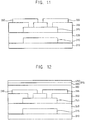
- FIGS. 9 to 12 are cross-sectional views illustrating a method of manufacturing an oxide semiconductor device in accordance with an exemplary embodiment.
- a gate electrode 315 is formed on a substrate 310 including insulation material in step S 210.
- the gate electrode 315 may be formed by a sputtering process, a CVD process, an ALD process, a vacuum evaporation process or a printing process using a metal, an alloy, a metal nitride, a conductive metal oxide, etc.
- a gate insulation layer 320 is formed on the substrate 310 to substantially cover the gate electrode 315.
- the gate insulation layer 320 may be formed by a CVD process, a thermal oxidation process, a PECVD process or an HDP-CVD process using a silicon compound, a metal oxide, etc.
- an active layer 325 is formed on the gate insulation layer 320 in step S230.
- the active layer 325 may be obtained by a sputtering process, a CVD process, a printing process, a spray process, a sol-gel process, a vacuum evaporation process, an ALD process, a PECVD process, etc. Further, the active layer 325 is formed using oxide semiconductor containing indium, zinc, gallium, tin, titanium, aluminium, hafnium, zirconium, magnesium, etc.
- a first insulating interlayer 330 is formed on the gate insulation layer 320 to substantially cover the active layer 325 in step S240.
- the first insulating interlayer 330 may sufficiently cover the active layer 325 and have a substantially level surface.
- the first insulating interlayer 330 may be formed using silicon compound by a CVD process, a PECVD process, an HDP-CVD process, etc.
- step S250 the first insulating interlayer 330 is partially etched to provide a source contact hole and a drain contact hole which expose portions of the active layer 325.
- the source contact hole and the drain contact hole expose a source region and a drain region of the active layer 325, respectively.
- a source electrode 350 and a drain electrode 355 are formed on the active layer 325 and the first insulating interlayer 330.
- the source and the drain electrodes 350 and 355 fill the source and the drain contact holes, respectively. Hence, the source and the drain electrodes 350 and 355 make contact with the source and the drain regions of the active layer 325.
- a second insulating interlayer 360 is formed on the first insulating interlayer 330 in step S270.
- the second insulating interlayer 360 may sufficiently cover the source and the drain electrodes 350 and 355, and may have a substantially flat upper face.
- the second insulating interlayer 360 may be formed using a material substantially the same as that for the first insulating interlayer 330. Alternatively, the second insulating interlayer 360 may be formed using an organic material.
- a protection structure 375 is formed on the second insulating interlayer 360.
- a first metal oxide layer 365 is formed on the second insulating interlayer 360n in step S280.
- the first metal oxide layer 365 may be formed using aluminium oxide, titanium oxide, tantalum oxide or zirconium oxide by a sputtering process, a vacuum evaporation process, a CVD process, etc. In this case, the first metal oxide layer 365 has a first composition of MOx1 having a first oxygen content.
- a second metal oxide layer 370 is formed on the first metal oxide layer 365 in step S290.
- a metal layer (not illustrated) may be formed on the first metal oxide layer 365, and then the metal oxide layer may be oxidized to obtain the second metal oxide layer 370.
- the metal layer may be formed using aluminium, titanium, tantalum, zirconium, etc.
- an oxidation treatment for the metal layer may include a thermal oxidation process such as an annealing process performed under an atmosphere containing oxygen.
- the second metal oxide layer 370 has a second composition of MOx2 having a second oxygen content which may be less than or greater than the first oxygen content.
- the protection structure 375 may prevent the permeation of the moisture and/or hydrogen from an outside, so the oxide semiconductor device may ensure improved electrical characteristics by blocking the variation of the threshold voltage thereof. Further, the metal oxide layers 365 and 360 of the protection structure 375 may be formed to have relatively large areas by the above described processes.
- the oxide semiconductor device including the above-described protection structure when applied to a display device such as an organic light emitting display device or a liquid crystal display device, the display device may also ensure improved quality of image displayed thereon, am enhanced response speed, etc.
- the protection structure including the plurality of metal oxide layers may effectively block the permeation of moisture and/or hydrogen from an outside, so that the electrical characteristics of the oxide semiconductor device may not be substantially deteriorated by the moisture and/or hydrogen. Further, when a display device includes the oxide semiconductor device including the protection structure, the display device may also have improved image quality, enhanced response speed, etc.
Landscapes
- Engineering & Computer Science (AREA)
- Thin Film Transistor (AREA)
- Physics & Mathematics (AREA)
- Condensed Matter Physics & Semiconductors (AREA)
- General Physics & Mathematics (AREA)
- Manufacturing & Machinery (AREA)
- Computer Hardware Design (AREA)
- Microelectronics & Electronic Packaging (AREA)
- Power Engineering (AREA)
Claims (8)
- Halbleiterbauelement, umfassend:eine Gate-Elektrode (15), die auf einem Substrat (10) angeordnet ist;eine Gate-Isolierschicht (20), die auf dem Substrat angeordnet ist, um die Gate-Elektrode abzudecken;eine aktive Schicht (25), die auf der Gate-Isolierschicht angeordnet ist, wobei die aktive Schicht einen Oxid-Halbleiter umfasst;eine isolierende Zwischenschicht (30), die auf der Gate-Isolierschicht angeordnet und dazu ausgestaltet ist, die aktive Schicht abzudecken;eine Schutzstruktur (35), die eine erste Metalloxidschicht (40), die auf der isolierenden Zwischenschicht angeordnet ist, und eine zweite Metalloxidschicht (45), die auf der ersten Metalloxidschicht angeordnet ist, umfasst,wobei die erste Metalloxidschicht eine erste Zusammensetzung von MOxl, die einen ersten Sauerstoffgehalt aufweist, umfasst, während die zweite Metalloxidschicht eine zweite Zusammensetzung von MOx2, die einen zweiten Sauerstoffgehalt aufweist, umfasst, wobei M auf ein Metall wie Aluminium, Titan, Tantal oder Zirkonium hinweist, O Sauerstoff meint und x eine positive reelle Zahl darstellt, wobei der zweite Sauerstoffgehalt an einer Schnittstelle zwischen der ersten Metalloxidschicht und der zweiten Metalloxidschicht plötzlich von dem ersten Sauerstoffgehalt abweicht,wobei ein Dickenverhältnis zwischen der ersten und der zweiten Metalloxidschicht in einem Bereich von ungefähr 1:0,03 bis 1:0,6 liegt; undeine Source-Elektrode (50) und eine Drain-Elektrode (55), die auf der Schutzstruktur angeordnet sind, wobei die Source-Elektrode und die Drain-Elektrode jeweils einen Source-Bereich und einen Drain-Bereich der aktiven Schicht berühren.
- Halbleiterbauelement nach Anspruch 1, wobei jede aus der ersten Metalloxidschicht (40) und der zweiten Metalloxidschicht (45) mindestens eines aus einem Aluminiumoxid, einem Titanoxid, einem Tantaloxid oder einem Zirkoniumoxid umfasst.
- Halbleiterbauelement nach Anspruch 1 oder 2, wobei eine Differenz zwischen dem ersten Sauerstoffgehalt und dem zweiten Sauerstoffgehalt größer als ungefähr 3 Atomprozent beträgt.
- Halbleiterbauelement, umfassend:eine Gate-Elektrode (215), die auf einem Substrat (210) angeordnet ist;eine Gate-Isolierschicht (220), die auf dem Substrat angeordnet ist und dazu ausgestaltet ist, die Gate-Elektrode abzudecken;eine aktive Schicht (225), die auf der Gate-Isolierschicht angeordnet ist, wobei die aktive Schicht einen Oxid-Halbleiter umfasst;eine erste isolierende Zwischenschicht (230), die auf der Gate-Isolierschicht angeordnet ist und dazu ausgestaltet ist, die aktive Schicht abzudecken;eine Source-Elektrode (250) und eine Drain-Elektrode (255), die auf der ersten isolierenden Zwischenschicht angeordnet sind, wobei die Source-Elektrode und die Drain-Elektrode jeweils einen Source-Bereich und einen Drain-Bereich der aktiven Schicht berühren;eine zweite isolierende Zwischenschicht (260), die auf der ersten isolierenden Zwischenschicht, der Source-Elektrode und der Drain-Elektrode angeordnet ist; undeine Schutzstruktur (265), die eine erste Metalloxidschicht (270), die auf der zweiten isolierenden Zwischenschicht angeordnet ist, und eine zweite Metalloxidschicht (275), die auf der ersten Metalloxidschicht angeordnet ist, umfasst,wobei die erste Metalloxidschicht eine erste Zusammensetzung von MOxl, die einen ersten Sauerstoffgehalt aufweist, umfasst, während die zweite Metalloxidschicht eine zweite Zusammensetzung von MOx2, die einen zweiten Sauerstoffgehalt aufweist, umfasst, wobei M auf ein Metall wie Aluminium, Titan, Tantal oder Zirkonium hinweist, O Sauerstoff meint und x eine positive reelle Zahl darstellt,wobei der zweite Sauerstoffgehalt an einer Schnittstelle zwischen der ersten Metalloxidschicht und der zweiten Metalloxidschicht plötzlich von dem ersten Sauerstoffgehalt abweicht, undwobei ein Dickenverhältnis zwischen der ersten und der zweiten Metalloxidschicht in einem Bereich von ungefähr 1:0,03 bis 1:0,6 liegt.
- Verfahren zur Herstellung eines Halbleiterbauelements, umfassend:Ausbilden einer Gate-Elektrode (15) auf einem Substrat (10);Ausbilden einer Gate-Isolierschicht (20) auf dem Substrat, um die Gate-Elektrode abzudecken;Ausbilden einer aktiven Schicht (25), die einen Oxid-Halbleiter auf der Gate-Isolierschicht umfasst;Ausbilden einer isolierenden Zwischenschicht (30) auf der aktiven Schicht, um die Gate-Isolierschicht abzudecken;Ausbilden einer Schutzstruktur (35), umfassend Ausbilden einer ersten Metalloxidschicht (40) auf der isolierenden Zwischenschicht und Ausbilden einer zweiten Metalloxidschicht (45) auf der ersten Metalloxidschicht,wobei die erste Metalloxidschicht eine erste Zusammensetzung von MOxl, die einen ersten Sauerstoffgehalt aufweist, umfasst, während die zweite Metalloxidschicht eine zweite Zusammensetzung von MOx2, die einen zweiten Sauerstoffgehalt aufweist, umfasst, wobei M auf ein Metall wie Aluminium, Titan, Tantal oder Zirkonium hinweist, O Sauerstoff meint und x eine positive reelle Zahl darstellt,wobei der zweite Sauerstoffgehalt an einer Schnittstelle zwischen der ersten Metalloxidschicht und der zweiten Metalloxidschicht plötzlich von dem ersten Sauerstoffgehalt abweicht,wobei ein Dickenverhältnis zwischen der ersten und der zweiten Metalloxidschicht in einem Bereich von ungefähr 1:0,03 bis 1:0,6 liegt, undwobei die zweite Metalloxidschicht durch einen Wärmeoxidationsvorgang wie thermisches Glühen bei einer sauerstoffhaltigen Atmosphäre ausgebildet wird; undAusbilden einer Source-Elektrode (50) und einer Drain-Elektrode (55) auf der Schutzstruktur, wobei die Source-Elektrode und die Drain-Elektrode jeweils einen Source-Bereich und einen Drain-Bereich der aktiven Schicht berühren.
- Verfahren zur Herstellung eines Halbleiterbauelements, umfassend:Ausbilden einer Gate-Elektrode (215) auf einem Substrat (210);Ausbilden einer Gate-Isolierschicht (220) auf dem Substrat, um die Gate-Elektrode abzudecken;Ausbilden einer aktiven Schicht (225), die einen Oxid-Halbleiter auf der Gate-Isolierschicht umfasst;Ausbilden einer ersten isolierenden Zwischenschicht (230) auf der aktiven Schicht, um die Gate-Isolierschicht abzudecken;Ausbilden einer Source-Elektrode (250) und einer Drain-Elektrode (255) auf der ersten isolierenden Zwischenschicht, wobei die Source-Elektrode und die Drain-Elektrode jeweils einen Source-Bereich und einen Drain-Bereich der aktiven Schicht berühren;Ausbilden einer zweiten isolierenden Zwischenschicht (260) über der Source- und der Drain-Elektrode;undAusbilden einer Schutzstruktur (265), umfassend Ausbilden einer ersten Metalloxidschicht (270) auf der zweiten isolierenden Zwischenschicht und Ausbilden einer zweiten Metalloxidschicht (275) auf der ersten Metalloxidschicht,wobei die erste Metalloxidschicht eine erste Zusammensetzung von MOxl, die einen ersten Sauerstoffgehalt aufweist, umfasst, während die zweite Metalloxidschicht eine zweite Zusammensetzung von MOx2, die einen zweiten Sauerstoffgehalt aufweist, umfasst, wobei M auf ein Metall wie Aluminium, Titan, Tantal oder Zirkonium hinweist, O Sauerstoff meint und x eine positive reelle Zahl darstellt,wobei der zweite Sauerstoffgehalt an einer Schnittstelle zwischen der ersten Metalloxidschicht und der zweiten Metalloxidschicht plötzlich von dem ersten Sauerstoffgehalt abweicht,wobei ein Dickenverhältnis zwischen der ersten und der zweiten Metalloxidschicht in einem Bereich von ungefähr 1:0,03 bis 1:0,6 liegt, undwobei die zweite Metalloxidschicht durch einen Wärmeoxidationsvorgang wie thermisches Glühen bei einer sauerstoffhaltigen Atmosphäre ausgebildet wird.
- Verfahren nach Anspruch 5 oder 6, wobei das Ausbilden der zweiten Metalloxidschicht (45, 275) Folgendes umfasst:Ausbilden einer Metallschicht auf der ersten Metalloxidschicht (40, 270); undAusführen einer Oxidationsbehandlung auf der Metallschicht.
- Verfahren nach Anspruch 7,
wobei das Ausbilden der Metallschicht einen Sputtervorgang umfasst und die Oxidationsbehandlung einen Wärmeoxidationsvorgang umfasst.
Applications Claiming Priority (1)
| Application Number | Priority Date | Filing Date | Title |
|---|---|---|---|
| KR1020140143178A KR102337370B1 (ko) | 2014-10-22 | 2014-10-22 | 반도체 소자 및 반도체 소자의 제조 방법 |
Publications (2)
| Publication Number | Publication Date |
|---|---|
| EP3012867A1 EP3012867A1 (de) | 2016-04-27 |
| EP3012867B1 true EP3012867B1 (de) | 2021-02-17 |
Family
ID=54337682
Family Applications (1)
| Application Number | Title | Priority Date | Filing Date |
|---|---|---|---|
| EP15190765.6A Active EP3012867B1 (de) | 2014-10-22 | 2015-10-21 | Halbleiterbauelemente und verfahren zur herstellung von halbleiterbauelementen |
Country Status (4)
| Country | Link |
|---|---|
| US (1) | US10461192B2 (de) |
| EP (1) | EP3012867B1 (de) |
| KR (1) | KR102337370B1 (de) |
| CN (1) | CN105552128B (de) |
Families Citing this family (5)
| Publication number | Priority date | Publication date | Assignee | Title |
|---|---|---|---|---|
| WO2020027243A1 (ja) * | 2018-08-01 | 2020-02-06 | 出光興産株式会社 | 結晶構造化合物、酸化物焼結体、スパッタリングターゲット、結晶質酸化物薄膜、アモルファス酸化物薄膜、薄膜トランジスタ、及び電子機器 |
| KR102563859B1 (ko) * | 2021-04-06 | 2023-08-03 | 연세대학교 산학협력단 | 원자층 증착 기반의 박막 내 인위적 조성 조절을 통한 고효율 수소 차단 제어막 형성 방법 |
| CN114141881B (zh) * | 2021-11-24 | 2024-11-15 | 深圳市华星光电半导体显示技术有限公司 | 一种驱动基板和显示面板 |
| CN114784112A (zh) * | 2022-02-28 | 2022-07-22 | 广州华星光电半导体显示技术有限公司 | 薄膜晶体管及其制备方法 |
| CN116056489B (zh) * | 2023-02-28 | 2025-10-24 | 固安翌光科技有限公司 | 一种有机发光二极管结构及其制备方法 |
Family Cites Families (15)
| Publication number | Priority date | Publication date | Assignee | Title |
|---|---|---|---|---|
| US7382421B2 (en) | 2004-10-12 | 2008-06-03 | Hewlett-Packard Development Company, L.P. | Thin film transistor with a passivation layer |
| KR100857455B1 (ko) | 2007-04-17 | 2008-09-08 | 한국전자통신연구원 | 산화물 반도체막상에 보호막을 형성하여 패터닝하는 박막트랜지스터의 제조방법 |
| JP5213422B2 (ja) | 2007-12-04 | 2013-06-19 | キヤノン株式会社 | 絶縁層を有する酸化物半導体素子およびそれを用いた表示装置 |
| KR101084173B1 (ko) * | 2009-10-27 | 2011-11-17 | 삼성모바일디스플레이주식회사 | 유기 발광 표시장치 및 그 제조 방법 |
| KR20130055607A (ko) * | 2010-04-23 | 2013-05-28 | 가부시키가이샤 한도오따이 에네루기 켄큐쇼 | 반도체 장치의 제작 방법 |
| CN106057907B (zh) * | 2010-04-23 | 2019-10-22 | 株式会社半导体能源研究所 | 半导体装置的制造方法 |
| US8467601B2 (en) * | 2010-09-15 | 2013-06-18 | Kyran Daisy | Systems, methods, and media for creating multiple layers from an image |
| US9082860B2 (en) * | 2011-03-31 | 2015-07-14 | Semiconductor Energy Laboratory Co., Ltd. | Semiconductor device |
| KR102100425B1 (ko) * | 2011-12-27 | 2020-04-13 | 가부시키가이샤 한도오따이 에네루기 켄큐쇼 | 반도체 장치 및 반도체 장치의 제작 방법 |
| KR20130113972A (ko) * | 2012-04-06 | 2013-10-16 | 한국전자통신연구원 | 산화물 박막 트랜지스터의 제조 방법 |
| KR102042483B1 (ko) | 2012-09-24 | 2019-11-12 | 한국전자통신연구원 | 박막 트랜지스터 및 그 제조 방법 |
| US9166021B2 (en) | 2012-10-17 | 2015-10-20 | Semiconductor Energy Laboratory Co., Ltd. | Semiconductor device and method for manufacturing the same |
| TWI782259B (zh) | 2012-10-24 | 2022-11-01 | 日商半導體能源研究所股份有限公司 | 半導體裝置及其製造方法 |
| CN104885230B (zh) | 2012-12-25 | 2018-02-23 | 株式会社半导体能源研究所 | 半导体装置 |
| TW202431651A (zh) * | 2013-10-10 | 2024-08-01 | 日商半導體能源研究所股份有限公司 | 液晶顯示裝置 |
-
2014
- 2014-10-22 KR KR1020140143178A patent/KR102337370B1/ko active Active
-
2015
- 2015-09-01 US US14/842,540 patent/US10461192B2/en active Active
- 2015-10-19 CN CN201510679471.4A patent/CN105552128B/zh active Active
- 2015-10-21 EP EP15190765.6A patent/EP3012867B1/de active Active
Non-Patent Citations (1)
| Title |
|---|
| None * |
Also Published As
| Publication number | Publication date |
|---|---|
| US10461192B2 (en) | 2019-10-29 |
| US20160118503A1 (en) | 2016-04-28 |
| KR102337370B1 (ko) | 2021-12-09 |
| KR20160047619A (ko) | 2016-05-03 |
| CN105552128A (zh) | 2016-05-04 |
| CN105552128B (zh) | 2020-07-03 |
| EP3012867A1 (de) | 2016-04-27 |
Similar Documents
| Publication | Publication Date | Title |
|---|---|---|
| EP2525408B1 (de) | Verfahren zur Herstellung der Oxidhalbleitervorrichtungen, Verfahren zur Herstellung der Anzeigevorrichtungen mit den Oxidhalbleitervorrichtungen | |
| JP5099740B2 (ja) | 薄膜トランジスタ | |
| JP4958253B2 (ja) | 薄膜トランジスタ | |
| EP2747141B1 (de) | Herstellungsverfahren für Dünnschichttransistor | |
| EP3012867B1 (de) | Halbleiterbauelemente und verfahren zur herstellung von halbleiterbauelementen | |
| KR102281300B1 (ko) | 박막 트랜지스터, 박막 트랜지스터의 제조 방법 및 박막 트랜지스터를 포함하는 표시장치 | |
| US8633479B2 (en) | Display device with metal oxidel layer and method for manufacturing the same | |
| KR20120048489A (ko) | 박막 트랜지스터 및 그 제조 방법 | |
| US12022690B2 (en) | Method of manufacturing semiconductor element that includes wet etching semiconductor layer that includes crystallized two-dimensional layers | |
| JP2008060419A (ja) | 薄膜トランジスタの製法 | |
| US20160247830A1 (en) | Thin film transistor and method of manufacturing the same, array substrate and display device | |
| US10847594B2 (en) | Organic light emitting display device | |
| US9224831B2 (en) | Method of manufacturing an oxide semiconductor device and method of manufacturing a display device having the same | |
| TWI535000B (zh) | 有機發光顯示裝置及製造其之方法 | |
| KR20130111873A (ko) | 박막 트랜지스터 표시판 제조 방법 | |
| TW201123441A (en) | Organic light-emitting display and method of manufacturing the same | |
| KR101748787B1 (ko) | 박막 트랜지스터 및 그 제조 방법 | |
| US9627515B2 (en) | Method of manufacturing thin-film transistor substrate | |
| JP2014165404A (ja) | 半導体装置及びその製造方法 | |
| KR20160129160A (ko) | 박막 트랜지스터 표시판 및 그 제조 방법 | |
| KR20140018702A (ko) | 박막 트랜지스터 및 그 제조 방법 | |
| JP6260992B2 (ja) | 薄膜トランジスタおよびその製造方法 | |
| KR102283812B1 (ko) | 반도체 소자 및 반도체 소자를 포함하는 유기 발광 표시 장치 | |
| KR20210021878A (ko) | 박막 트랜지스터 및 이의 제조 방법 | |
| KR20200128324A (ko) | 유기 발광 표시 장치 및 유기 발광 표시 장치의 제조 방법 |
Legal Events
| Date | Code | Title | Description |
|---|---|---|---|
| PUAI | Public reference made under article 153(3) epc to a published international application that has entered the european phase |
Free format text: ORIGINAL CODE: 0009012 |
|
| AK | Designated contracting states |
Kind code of ref document: A1 Designated state(s): AL AT BE BG CH CY CZ DE DK EE ES FI FR GB GR HR HU IE IS IT LI LT LU LV MC MK MT NL NO PL PT RO RS SE SI SK SM TR |
|
| AX | Request for extension of the european patent |
Extension state: BA ME |
|
| STAA | Information on the status of an ep patent application or granted ep patent |
Free format text: STATUS: REQUEST FOR EXAMINATION WAS MADE |
|
| 17P | Request for examination filed |
Effective date: 20161027 |
|
| RBV | Designated contracting states (corrected) |
Designated state(s): AL AT BE BG CH CY CZ DE DK EE ES FI FR GB GR HR HU IE IS IT LI LT LU LV MC MK MT NL NO PL PT RO RS SE SI SK SM TR |
|
| STAA | Information on the status of an ep patent application or granted ep patent |
Free format text: STATUS: EXAMINATION IS IN PROGRESS |
|
| 17Q | First examination report despatched |
Effective date: 20180412 |
|
| GRAP | Despatch of communication of intention to grant a patent |
Free format text: ORIGINAL CODE: EPIDOSNIGR1 |
|
| STAA | Information on the status of an ep patent application or granted ep patent |
Free format text: STATUS: GRANT OF PATENT IS INTENDED |
|
| INTG | Intention to grant announced |
Effective date: 20200709 |
|
| GRAJ | Information related to disapproval of communication of intention to grant by the applicant or resumption of examination proceedings by the epo deleted |
Free format text: ORIGINAL CODE: EPIDOSDIGR1 |
|
| STAA | Information on the status of an ep patent application or granted ep patent |
Free format text: STATUS: EXAMINATION IS IN PROGRESS |
|
| INTC | Intention to grant announced (deleted) | ||
| GRAS | Grant fee paid |
Free format text: ORIGINAL CODE: EPIDOSNIGR3 |
|
| STAA | Information on the status of an ep patent application or granted ep patent |
Free format text: STATUS: GRANT OF PATENT IS INTENDED |
|
| GRAP | Despatch of communication of intention to grant a patent |
Free format text: ORIGINAL CODE: EPIDOSNIGR1 |
|
| INTG | Intention to grant announced |
Effective date: 20201217 |
|
| GRAA | (expected) grant |
Free format text: ORIGINAL CODE: 0009210 |
|
| STAA | Information on the status of an ep patent application or granted ep patent |
Free format text: STATUS: THE PATENT HAS BEEN GRANTED |
|
| AK | Designated contracting states |
Kind code of ref document: B1 Designated state(s): AL AT BE BG CH CY CZ DE DK EE ES FI FR GB GR HR HU IE IS IT LI LT LU LV MC MK MT NL NO PL PT RO RS SE SI SK SM TR |
|
| REG | Reference to a national code |
Ref country code: GB Ref legal event code: FG4D |
|
| REG | Reference to a national code |
Ref country code: CH Ref legal event code: EP |
|
| REG | Reference to a national code |
Ref country code: DE Ref legal event code: R096 Ref document number: 602015065513 Country of ref document: DE |
|
| REG | Reference to a national code |
Ref country code: AT Ref legal event code: REF Ref document number: 1362607 Country of ref document: AT Kind code of ref document: T Effective date: 20210315 |
|
| REG | Reference to a national code |
Ref country code: IE Ref legal event code: FG4D |
|
| REG | Reference to a national code |
Ref country code: LT Ref legal event code: MG9D |
|
| REG | Reference to a national code |
Ref country code: NL Ref legal event code: MP Effective date: 20210217 |
|
| PG25 | Lapsed in a contracting state [announced via postgrant information from national office to epo] |
Ref country code: PT Free format text: LAPSE BECAUSE OF FAILURE TO SUBMIT A TRANSLATION OF THE DESCRIPTION OR TO PAY THE FEE WITHIN THE PRESCRIBED TIME-LIMIT Effective date: 20210617 Ref country code: LT Free format text: LAPSE BECAUSE OF FAILURE TO SUBMIT A TRANSLATION OF THE DESCRIPTION OR TO PAY THE FEE WITHIN THE PRESCRIBED TIME-LIMIT Effective date: 20210217 Ref country code: BG Free format text: LAPSE BECAUSE OF FAILURE TO SUBMIT A TRANSLATION OF THE DESCRIPTION OR TO PAY THE FEE WITHIN THE PRESCRIBED TIME-LIMIT Effective date: 20210517 Ref country code: NO Free format text: LAPSE BECAUSE OF FAILURE TO SUBMIT A TRANSLATION OF THE DESCRIPTION OR TO PAY THE FEE WITHIN THE PRESCRIBED TIME-LIMIT Effective date: 20210517 Ref country code: FI Free format text: LAPSE BECAUSE OF FAILURE TO SUBMIT A TRANSLATION OF THE DESCRIPTION OR TO PAY THE FEE WITHIN THE PRESCRIBED TIME-LIMIT Effective date: 20210217 Ref country code: GR Free format text: LAPSE BECAUSE OF FAILURE TO SUBMIT A TRANSLATION OF THE DESCRIPTION OR TO PAY THE FEE WITHIN THE PRESCRIBED TIME-LIMIT Effective date: 20210518 Ref country code: HR Free format text: LAPSE BECAUSE OF FAILURE TO SUBMIT A TRANSLATION OF THE DESCRIPTION OR TO PAY THE FEE WITHIN THE PRESCRIBED TIME-LIMIT Effective date: 20210217 |
|
| REG | Reference to a national code |
Ref country code: AT Ref legal event code: MK05 Ref document number: 1362607 Country of ref document: AT Kind code of ref document: T Effective date: 20210217 |
|
| PG25 | Lapsed in a contracting state [announced via postgrant information from national office to epo] |
Ref country code: SE Free format text: LAPSE BECAUSE OF FAILURE TO SUBMIT A TRANSLATION OF THE DESCRIPTION OR TO PAY THE FEE WITHIN THE PRESCRIBED TIME-LIMIT Effective date: 20210217 Ref country code: PL Free format text: LAPSE BECAUSE OF FAILURE TO SUBMIT A TRANSLATION OF THE DESCRIPTION OR TO PAY THE FEE WITHIN THE PRESCRIBED TIME-LIMIT Effective date: 20210217 Ref country code: RS Free format text: LAPSE BECAUSE OF FAILURE TO SUBMIT A TRANSLATION OF THE DESCRIPTION OR TO PAY THE FEE WITHIN THE PRESCRIBED TIME-LIMIT Effective date: 20210217 Ref country code: LV Free format text: LAPSE BECAUSE OF FAILURE TO SUBMIT A TRANSLATION OF THE DESCRIPTION OR TO PAY THE FEE WITHIN THE PRESCRIBED TIME-LIMIT Effective date: 20210217 Ref country code: NL Free format text: LAPSE BECAUSE OF FAILURE TO SUBMIT A TRANSLATION OF THE DESCRIPTION OR TO PAY THE FEE WITHIN THE PRESCRIBED TIME-LIMIT Effective date: 20210217 |
|
| PG25 | Lapsed in a contracting state [announced via postgrant information from national office to epo] |
Ref country code: IS Free format text: LAPSE BECAUSE OF FAILURE TO SUBMIT A TRANSLATION OF THE DESCRIPTION OR TO PAY THE FEE WITHIN THE PRESCRIBED TIME-LIMIT Effective date: 20210617 |
|
| PG25 | Lapsed in a contracting state [announced via postgrant information from national office to epo] |
Ref country code: AT Free format text: LAPSE BECAUSE OF FAILURE TO SUBMIT A TRANSLATION OF THE DESCRIPTION OR TO PAY THE FEE WITHIN THE PRESCRIBED TIME-LIMIT Effective date: 20210217 Ref country code: SM Free format text: LAPSE BECAUSE OF FAILURE TO SUBMIT A TRANSLATION OF THE DESCRIPTION OR TO PAY THE FEE WITHIN THE PRESCRIBED TIME-LIMIT Effective date: 20210217 Ref country code: EE Free format text: LAPSE BECAUSE OF FAILURE TO SUBMIT A TRANSLATION OF THE DESCRIPTION OR TO PAY THE FEE WITHIN THE PRESCRIBED TIME-LIMIT Effective date: 20210217 Ref country code: CZ Free format text: LAPSE BECAUSE OF FAILURE TO SUBMIT A TRANSLATION OF THE DESCRIPTION OR TO PAY THE FEE WITHIN THE PRESCRIBED TIME-LIMIT Effective date: 20210217 |
|
| REG | Reference to a national code |
Ref country code: DE Ref legal event code: R097 Ref document number: 602015065513 Country of ref document: DE |
|
| PG25 | Lapsed in a contracting state [announced via postgrant information from national office to epo] |
Ref country code: ES Free format text: LAPSE BECAUSE OF FAILURE TO SUBMIT A TRANSLATION OF THE DESCRIPTION OR TO PAY THE FEE WITHIN THE PRESCRIBED TIME-LIMIT Effective date: 20210217 Ref country code: DK Free format text: LAPSE BECAUSE OF FAILURE TO SUBMIT A TRANSLATION OF THE DESCRIPTION OR TO PAY THE FEE WITHIN THE PRESCRIBED TIME-LIMIT Effective date: 20210217 Ref country code: SK Free format text: LAPSE BECAUSE OF FAILURE TO SUBMIT A TRANSLATION OF THE DESCRIPTION OR TO PAY THE FEE WITHIN THE PRESCRIBED TIME-LIMIT Effective date: 20210217 Ref country code: RO Free format text: LAPSE BECAUSE OF FAILURE TO SUBMIT A TRANSLATION OF THE DESCRIPTION OR TO PAY THE FEE WITHIN THE PRESCRIBED TIME-LIMIT Effective date: 20210217 |
|
| PLBE | No opposition filed within time limit |
Free format text: ORIGINAL CODE: 0009261 |
|
| STAA | Information on the status of an ep patent application or granted ep patent |
Free format text: STATUS: NO OPPOSITION FILED WITHIN TIME LIMIT |
|
| 26N | No opposition filed |
Effective date: 20211118 |
|
| PG25 | Lapsed in a contracting state [announced via postgrant information from national office to epo] |
Ref country code: AL Free format text: LAPSE BECAUSE OF FAILURE TO SUBMIT A TRANSLATION OF THE DESCRIPTION OR TO PAY THE FEE WITHIN THE PRESCRIBED TIME-LIMIT Effective date: 20210217 |
|
| PG25 | Lapsed in a contracting state [announced via postgrant information from national office to epo] |
Ref country code: SI Free format text: LAPSE BECAUSE OF FAILURE TO SUBMIT A TRANSLATION OF THE DESCRIPTION OR TO PAY THE FEE WITHIN THE PRESCRIBED TIME-LIMIT Effective date: 20210217 |
|
| PG25 | Lapsed in a contracting state [announced via postgrant information from national office to epo] |
Ref country code: IT Free format text: LAPSE BECAUSE OF FAILURE TO SUBMIT A TRANSLATION OF THE DESCRIPTION OR TO PAY THE FEE WITHIN THE PRESCRIBED TIME-LIMIT Effective date: 20210217 |
|
| REG | Reference to a national code |
Ref country code: CH Ref legal event code: PL |
|
| PG25 | Lapsed in a contracting state [announced via postgrant information from national office to epo] |
Ref country code: IS Free format text: LAPSE BECAUSE OF FAILURE TO SUBMIT A TRANSLATION OF THE DESCRIPTION OR TO PAY THE FEE WITHIN THE PRESCRIBED TIME-LIMIT Effective date: 20210617 |
|
| REG | Reference to a national code |
Ref country code: BE Ref legal event code: MM Effective date: 20211031 |
|
| GBPC | Gb: european patent ceased through non-payment of renewal fee |
Effective date: 20211021 |
|
| PG25 | Lapsed in a contracting state [announced via postgrant information from national office to epo] |
Ref country code: MC Free format text: LAPSE BECAUSE OF FAILURE TO SUBMIT A TRANSLATION OF THE DESCRIPTION OR TO PAY THE FEE WITHIN THE PRESCRIBED TIME-LIMIT Effective date: 20210217 |
|
| PG25 | Lapsed in a contracting state [announced via postgrant information from national office to epo] |
Ref country code: LU Free format text: LAPSE BECAUSE OF NON-PAYMENT OF DUE FEES Effective date: 20211021 Ref country code: GB Free format text: LAPSE BECAUSE OF NON-PAYMENT OF DUE FEES Effective date: 20211021 Ref country code: BE Free format text: LAPSE BECAUSE OF NON-PAYMENT OF DUE FEES Effective date: 20211031 |
|
| PG25 | Lapsed in a contracting state [announced via postgrant information from national office to epo] |
Ref country code: LI Free format text: LAPSE BECAUSE OF NON-PAYMENT OF DUE FEES Effective date: 20211031 Ref country code: CH Free format text: LAPSE BECAUSE OF NON-PAYMENT OF DUE FEES Effective date: 20211031 |
|
| PG25 | Lapsed in a contracting state [announced via postgrant information from national office to epo] |
Ref country code: FR Free format text: LAPSE BECAUSE OF NON-PAYMENT OF DUE FEES Effective date: 20211031 |
|
| PG25 | Lapsed in a contracting state [announced via postgrant information from national office to epo] |
Ref country code: IE Free format text: LAPSE BECAUSE OF NON-PAYMENT OF DUE FEES Effective date: 20211021 |
|
| PG25 | Lapsed in a contracting state [announced via postgrant information from national office to epo] |
Ref country code: HU Free format text: LAPSE BECAUSE OF FAILURE TO SUBMIT A TRANSLATION OF THE DESCRIPTION OR TO PAY THE FEE WITHIN THE PRESCRIBED TIME-LIMIT; INVALID AB INITIO Effective date: 20151021 |
|
| P01 | Opt-out of the competence of the unified patent court (upc) registered |
Effective date: 20230515 |
|
| PG25 | Lapsed in a contracting state [announced via postgrant information from national office to epo] |
Ref country code: CY Free format text: LAPSE BECAUSE OF FAILURE TO SUBMIT A TRANSLATION OF THE DESCRIPTION OR TO PAY THE FEE WITHIN THE PRESCRIBED TIME-LIMIT Effective date: 20210217 |
|
| PG25 | Lapsed in a contracting state [announced via postgrant information from national office to epo] |
Ref country code: MK Free format text: LAPSE BECAUSE OF FAILURE TO SUBMIT A TRANSLATION OF THE DESCRIPTION OR TO PAY THE FEE WITHIN THE PRESCRIBED TIME-LIMIT Effective date: 20210217 |
|
| PG25 | Lapsed in a contracting state [announced via postgrant information from national office to epo] |
Ref country code: MT Free format text: LAPSE BECAUSE OF FAILURE TO SUBMIT A TRANSLATION OF THE DESCRIPTION OR TO PAY THE FEE WITHIN THE PRESCRIBED TIME-LIMIT Effective date: 20210217 |
|
| REG | Reference to a national code |
Ref country code: DE Ref legal event code: R079 Ref document number: 602015065513 Country of ref document: DE Free format text: PREVIOUS MAIN CLASS: H01L0029660000 Ipc: H10D0048000000 |
|
| PG25 | Lapsed in a contracting state [announced via postgrant information from national office to epo] |
Ref country code: TR Free format text: LAPSE BECAUSE OF FAILURE TO SUBMIT A TRANSLATION OF THE DESCRIPTION OR TO PAY THE FEE WITHIN THE PRESCRIBED TIME-LIMIT Effective date: 20210217 |
|
| PGFP | Annual fee paid to national office [announced via postgrant information from national office to epo] |
Ref country code: DE Payment date: 20250922 Year of fee payment: 11 |