EP2944643B1 - Harnstoffhaltige mercaptosilane, verfahren zu deren herstellung und deren verwendung - Google Patents
Harnstoffhaltige mercaptosilane, verfahren zu deren herstellung und deren verwendung Download PDFInfo
- Publication number
- EP2944643B1 EP2944643B1 EP15165635.2A EP15165635A EP2944643B1 EP 2944643 B1 EP2944643 B1 EP 2944643B1 EP 15165635 A EP15165635 A EP 15165635A EP 2944643 B1 EP2944643 B1 EP 2944643B1
- Authority
- EP
- European Patent Office
- Prior art keywords
- formula
- urea
- containing mercaptosilane
- mercaptosilane
- mol
- Prior art date
- Legal status (The legal status is an assumption and is not a legal conclusion. Google has not performed a legal analysis and makes no representation as to the accuracy of the status listed.)
- Not-in-force
Links
- 0 **NC(N*SC(*)=O)=O Chemical compound **NC(N*SC(*)=O)=O 0.000 description 1
Classifications
-
- C—CHEMISTRY; METALLURGY
- C07—ORGANIC CHEMISTRY
- C07F—ACYCLIC, CARBOCYCLIC OR HETEROCYCLIC COMPOUNDS CONTAINING ELEMENTS OTHER THAN CARBON, HYDROGEN, HALOGEN, OXYGEN, NITROGEN, SULFUR, SELENIUM OR TELLURIUM
- C07F7/00—Compounds containing elements of Groups 4 or 14 of the Periodic Table
- C07F7/02—Silicon compounds
- C07F7/08—Compounds having one or more C—Si linkages
- C07F7/18—Compounds having one or more C—Si linkages as well as one or more C—O—Si linkages
- C07F7/1804—Compounds having Si-O-C linkages
-
- C—CHEMISTRY; METALLURGY
- C07—ORGANIC CHEMISTRY
- C07F—ACYCLIC, CARBOCYCLIC OR HETEROCYCLIC COMPOUNDS CONTAINING ELEMENTS OTHER THAN CARBON, HYDROGEN, HALOGEN, OXYGEN, NITROGEN, SULFUR, SELENIUM OR TELLURIUM
- C07F7/00—Compounds containing elements of Groups 4 or 14 of the Periodic Table
- C07F7/02—Silicon compounds
- C07F7/08—Compounds having one or more C—Si linkages
- C07F7/10—Compounds having one or more C—Si linkages containing nitrogen having a Si-N linkage
-
- C—CHEMISTRY; METALLURGY
- C07—ORGANIC CHEMISTRY
- C07C—ACYCLIC OR CARBOCYCLIC COMPOUNDS
- C07C275/00—Derivatives of urea, i.e. compounds containing any of the groups, the nitrogen atoms not being part of nitro or nitroso groups
-
- C—CHEMISTRY; METALLURGY
- C07—ORGANIC CHEMISTRY
- C07F—ACYCLIC, CARBOCYCLIC OR HETEROCYCLIC COMPOUNDS CONTAINING ELEMENTS OTHER THAN CARBON, HYDROGEN, HALOGEN, OXYGEN, NITROGEN, SULFUR, SELENIUM OR TELLURIUM
- C07F7/00—Compounds containing elements of Groups 4 or 14 of the Periodic Table
- C07F7/02—Silicon compounds
- C07F7/08—Compounds having one or more C—Si linkages
- C07F7/18—Compounds having one or more C—Si linkages as well as one or more C—O—Si linkages
- C07F7/1804—Compounds having Si-O-C linkages
- C07F7/1872—Preparation; Treatments not provided for in C07F7/20
Definitions
- the invention relates to urea-containing mercaptosilanes, processes for their preparation and their use.
- CAS 1082204-82-7, 1268617-33-9 and 104261-54-3 are compounds of the formula known.
- Photosensitive resin compositions are known containing alkoxysilanes of the formula [(R 1 O) 3-a (R 2 ) a Si-R 3 -AC (O) -B] m -X.
- the invention relates to a urea-containing mercaptosilane of the formula I.
- R 1 are the same or different and are C 1 -C 10 -alkoxy groups, preferably methoxy or ethoxy group, C 2 -C 10 -cyclic dialkoxy groups, phenoxy group, C 4 -C 10 -cycloalkoxy groups, C 6 -C 20 -aryl groups, preferably phenyl, C 1 -C 10 -cycloalkyl groups Alkyl groups, preferably methyl or ethyl, C 2 -C 20 -alkenyl group, C 7 -C 20 -aralkyl group or halogen, preferably Cl
- R 2 denotes a monovalent C 1 -C 20 -hydrocarbon group, preferably a C 1 -C 20 -alkyl group, C 6 -C 20 -aryl group, C20-alkenyl group or C7-C20-aralkyl group, and R are the same or different and a branched or unbranched, saturated or unsaturated, alipha
- Urea-containing mercaptosilanes may be mixtures of urea-containing mercaptosilanes of the formula I.
- the process product may contain oligomers which are formed by hydrolysis and condensation of the alkoxysilane functions of the urea-containing mercaptosilanes of the formula I.
- the urea-containing mercaptosilanes of the formula I can be applied to a support, for example wax, polymer or carbon black.
- the urea-containing mercaptosilanes of the formula I can be applied to a silica, wherein the attachment can be carried out physically or chemically.
- R may preferably be -CH 2 -, -CH 2 CH 2 -, -CH 2 CH 2 CH 2 -, -CH 2 CH 2 CH 2 CH 2 -, -CH (CH 3 ) -, -CH 2 CH (CH 3 ) -, - CH (CH 3 ) CH 2 -, -C (CH 3 ) 2 -, -CH (C 2 H 5 ) -, -CH 2 CH 2 CH (CH 3 ) -, -CH (CH 3 ) CH 2 CH 2 -, -CH 2 CH (CH 3 ) CH 2 -, -CH 2 CH (CH 3 ) CH 2 -, -CH 2 CH (CH 3 ) CH 2 -, -CH 2 CH 2 CH 2 CH 2 -, -CH 2 CH 2 CH 2 CH 2 CH 2 -, -CH 2 CH 2 CH 2 CH 2 CH 2 -, -CH 2 CH 2 CH 2 CH 2 CH 2 -, -CH 2 CH 2 CH 2 CH 2 CH 2 -
- R 2 may preferably be CH 3 , CH 2 CH 3 , CH 2 CH 2 CH 3 or (CH 2 ) 6 CH 3 .
- Urea-containing mercaptosilanes of the formula I may be preferred: (CH 3 CH 2 O) 3 Si-CH 2 -NH-CO-NH-CH 2 -SC (O) -CH 3 , (CH 3 CH 2 O) 3 Si-CH 2 CH 2 -NH-CO-NH-CH 2 -SC (O) -CH 3 , (CH 3 CH 2 O) 3 Si-CH 2 -NH-CO-NH-CH 2 CH 2 -SC (O) -CH 3 , (CH 3 CH 2 O) 3 Si-CH 2 CH 2 -NH-CO-NH-CH 2 CH 2 -SC (O) -CH 3 , (CH 3 CH 2 O) 3 Si-CH 2 CH 2 CH 2 -NH-CO-NH-CH 2 CH 2 -SC (O) -CH 3 , (CH 3 CH 2 O) 3 Si-CH 2 CH 2 CH
- Another object of the invention is a process for preparing the urea-containing mercaptosilanes of the formula I according to the invention where R 1 , R 2 and R have the abovementioned meaning, which is characterized in that a halosilane of the formula II with a compound of formula III wherein R 1 , R 2 and R have the abovementioned meanings, Hal is F, Cl, Br or I, preferably Cl, and M is an alkali metal, preferably K or Na, in an alcohol.
- Halogensilanes of the formula II may be preferred: (C 2 H 5 O) 3 Si-CH 2 -NH-C (O) -NH-CH 2 -Cl, (C 2 H 5 O) 3 Si-CH 2 CH 2 -NH-C (O) -NH-CH 2 -Cl, (C 2 H 5 O) 3 Si-CH 2 CH 2 CH 2 -NH-C (O) -NH-CH 2 -Cl, (C 2 H 5 O) 3 Si-CH 2 -NH-C (O) -NH-CH 2 CH 2 -Cl, (C 2 H 5 O) 3 Si-CH 2 CH 2 -NH-C (O) -NH-CH 2 CH 2 -Cl, (C 2 H 5 O) 3 Si-CH 2 CH 2 CH 2 -NH-C (O) -NH-CH 2 CH 2 -Cl, (C 2 H 5 O) 3 Si-CH 2 CH 2 CH 2 -NH-C (O) -NH-CH 2 CH 2 -Cl
- Compounds of formula III may be preferred: NaS-C (O) -CH 3 , NaS-C (O) -CH 2 CH 3 , NaS-C (O) -CH 2 CH 2 CH 3 , NaS-C (O) - (CH 2 ) 6 CH 3 , KS-C (O) -CH 3 , KS-C (O) -CH 2 CH 3 , KS-C (O) -CH 2 CH 2 CH 3 or KS-C (O) - (CH 2 ) 6 CH 3 .
- the halosilane of the formula II can be metered into the compound of the formula II.
- compound of the formula III can preferably be metered into halosilane of the formula II.
- the halosilane of the formula II can be used to form the compound of the formula II in a molecular ratio of 0.85: 1 to 1.15: 1, preferably 0.90: 1 to 1.10: 1, particularly preferably in the ratio 0, 95: 1 to 1.05: 1.
- the reaction can be carried out under exclusion of air.
- the reaction can be carried out under a protective gas atmosphere, for example under argon or nitrogen, preferably under nitrogen.
- the process according to the invention can be carried out at normal pressure, elevated pressure or reduced pressure.
- the process according to the invention can preferably be carried out under atmospheric pressure.
- Increased pressure may be a pressure of from 1.1 bar to 100 bar, preferably from 1.5 bar to 50 bar, more preferably from 2 bar to 20 bar and most preferably from 2 to 10 bar.
- Reduced pressure may be a pressure of 1 mbar to 1000 mbar, preferably 1 mbar to 500 mbar, particularly preferably 1 mbar to 250 mbar, very particularly preferably 5 mbar to 100 mbar.
- the process according to the invention can be carried out between 0 ° C. and 150 ° C., preferably between 20 ° C. and 100 ° C., particularly preferably between 50 ° C. and 80 ° C. With particular preference, the process according to the invention can be carried out at the boiling point of the alcohol.
- the alcohol used in the process according to the invention may preferably be methanol, ethanol, propanol, butanol or cyclohexanol.
- the alcohol may particularly preferably be ethanol.
- the alcohol can be removed after the reaction, preferably distilled off.
- the reaction product can then be dried. Drying may be carried out at temperatures of + 20 ° C - + 100 ° C, preferably + 25 ° C - + 75 ° C. Drying can be carried out at a reduced pressure of 1 - 500 mbar.
- the urea-containing mercaptosilane of the formula I obtainable by the process according to the invention can be obtained in a yield of greater than 50%, preferably greater than 60%, most preferably greater than 70%.
- the halosilane of formula II may be prepared from the hydrochloride salt of an amine of formula IV prior to reaction with the compound of formula III and isocyanatosilane of the formula V by addition of a base, preferably NaOEt, where Hal, R 1 and R have the abovementioned meanings.
- the base can be added until a pH between 7 and 14 is established.
- the hydrochloride salt of the amines of the formula IV to isocyanic silane of the formula V in the molecular ratio of 0.85: 1 to 1.15: 1, preferably 0.90: 1 to 1.10: 1, particularly preferred in the ratio 0.95: 1 to 1.05: 1, are used.
- halosilane of formula II before the reaction with the compound of formula III from the Isocyanathalogentagen of formula VI and aminosilane of formula VII are prepared, wherein Hal, R and R 1 have the meanings mentioned above.
- the reaction can be carried out in a solvent, preferably alcohol, more preferably ethanol.
- the isocyanate halogen compound of the formula VI can be converted into aminosilane of the formula VII in a molecular ratio of 0.85: 1 to 1.15: 1, preferably 0.90: 1 to 1.10: 1, particularly preferably in the ratio 0, 95: 1 to 1.05: 1.
- the product prepared by the process according to the invention can have a residual content of halosilane of the formula II of less than 25 mol%, preferably less than 10 mol%, particularly preferably less than 5 mol%, very particularly preferably less than 3 mol% %, to have.
- the relative mol% of the halosilane of the formula II in the product prepared by the process according to the invention in 1 H-NMR by integration of the H atoms of the -CH 2 C H 2 -Cl group of the halosilane of formula II against the H Atoms of the Si-C H 2 group of the urea-containing mercaptosilane of the formula I.
- the product prepared by the process according to the invention may have a residual hydrochloride salt content of an amine of formula IV of less than 25 mol%, preferably less than 10 mol%, more preferably less than 5 mol%, most preferably less than 3 mol%.
- the relative mol% of the hydrochloride salt of an amine of the formula IV in the product prepared by the process according to the invention is determined in 13 C-NMR by integration of the C atoms of the - C H 2 -NH 2 .HCl group of the hydrochloride Salt of an amine of formula IV against the C atoms of the Si C H 2 - group of urea-containing mercaptosilanes of the formula I determined.
- the product prepared by the process according to the invention can have a residual content of isocyanatosilane of the formula V of less than 10 mol%, preferably less than 5 mol%, particularly preferably less than 1 mol%, very particularly preferably less than 0.1 mol%.
- the relative mol% of the isocyanate silane of the formula V in the product is in a range> 1 mol%, prepared with the inventive method are in the 13 C-NMR by integration of the C-atoms of the C-N O group of the isocyanate silane of the formula V determined against the C atoms of the Si- C H 2 group of the urea-containing mercaptosilanes of the formula I.
- the relative mol% of the isocyanatosilane of the formula V in the product in a range ⁇ 1 mol%, prepared by the process according to the invention, are determined by a quantitative FT-IR spectroscopy known to the person skilled in the art.
- the method is calibrated by using calibration solutions of suitable concentration (eg in C 2 Cl 4 ).
- suitable concentration eg in C 2 Cl 4
- approximately 1 g of sample is weighed into a 25 ml turtleneck bottle and 25 g of C 2 Cl 4 are added.
- the sample is shaken on the shaker for 1 to 2 hours.
- the lower liquid phase is carefully dosed into a 20 mm IR cuvette and measured by FT-IR spectroscopy (4000-1200 cm -1 , resolution 2 cm -1 ). Under the same conditions, a spectrum of the solvent is added for subtraction.
- the product prepared by the process according to the invention can have a residual content of isocyanate halogen compound of the formula VI of less than 25 mol%, preferably less than 10 mol%, particularly preferably less than 5 mol%, very particularly preferably less than 3 mol% %, to have.
- the product prepared by the process according to the invention can have a residual content of aminosilane of the formula VII of less than 10 mol%, preferably less than 5 mol%, particularly preferably less than 1 mol%, very particularly preferably less than 0.1 mol%.
- the relative mol% of the aminosilane of formula VII in the product prepared by the process of the present invention is determined in 13 C-NMR by integration of the C atoms of the - C H 2 -NH 2 Group of the aminosilane of the formula VII against the carbon atoms of the Si- C H 2 - group of the urea-containing mercaptosilane of the formula I determined.
- Urea-containing mercaptosilane of the formula I prepared by the process according to the invention can be characterized by a 1 H, 13 C or 29 Si NMR method known to the person skilled in the art.
- the urea-containing mercaptosilanes of the formula I can be used as adhesion promoters between inorganic materials, for example Glass beads, glass splinters, glass surfaces, glass fibers, or oxidic fillers, preferably silicic acids such as precipitated silicas and fumed silicas, and organic polymers, for example thermosetting plastics, thermoplastics or elastomers, or as crosslinking agents and surface modifiers for oxidic surfaces.
- inorganic materials for example Glass beads, glass splinters, glass surfaces, glass fibers, or oxidic fillers, preferably silicic acids such as precipitated silicas and fumed silicas, and organic polymers, for example thermosetting plastics, thermoplastics or elastomers, or as crosslinking agents and surface modifiers for oxidic surfaces.
- the urea-containing mercaptosilanes of the formula I can be used as coupling reagents in filled rubber mixtures, for example tire treads, technical rubber articles or shoe sols.
- Advantages of the urea-containing mercaptosilanes of the formula I according to the invention are improved processing behavior, network density, wet-slip properties and dynamic rigidity in rubber mixtures.
- Example 1 Preparation of (EtO) 3 Si-CH 2 CH 2 CH 2 -NH-CO-NH-CH 2 CH 2 -S-CO-CH 3 from (EtO) 3 Si-CH 2 CH 2 CH 2 -NH -CO-NH-CH 2 CH 2 -Cl and KSAc
- Example 2 Preparation of (EtO) 3 Si-CH 2 CH 2 CH 2 -NH-CO-NH-CH 2 CH 2 -S-CO-CH 3 from (EtO) 3 Si-CH 2 CH 2 CH 2 -NH 2 , OCN-CH 2 CH 2 -Cl and KSAc
- 3-Aminopropyltriethoxysilane (132.82 g, 0.60 mol, 1.00 eq) is initially charged in ethanol (300 mL) in a three-necked flask with KPG stirrer, internal thermometer, dropping funnel and reflux condenser and cooled to -78.degree.
- 2-Chloroethyl isocyanate (63.34 g, 0.60 mol, 1.00 eq) is added dropwise within 1.75 h at -78 to -68 ° C and then heated to 50 ° C.
- Potassium thioacetate (68.53 g, 0.60 mol, 1.00 eq) is added in five portions and the mixture is heated to reflux.
- Example 3 Preparation of (EtO) 3 Si-CH 2 CH 2 CH 2 -NH-CO-NH-CH 2 CH 2 -S-CH 3 from (EtO) 3 Si-CH 2 CH 2 CH 2 -NCO, HCl H 2 N-CH 2 CH 2 -Cl and KSAc
- 2-chloroethylamine hydrochloride (73.86 g, 0.70 mol, 1.00 eq) is initially charged in ethanol (2.0 L) in a 4 L three-necked flask with KPG stirrer, internal thermometer, dropping funnel and reflux condenser to -78 ° C. and sodium ethoxide (226.83 g, 0.70 mol, 1.00 eq, 21% in ethanol).
- 3-isocyanatopropyl (triethoxysilane) (173.15 g, 0.70 mol, 1.00 eq) is then added dropwise within 3 h at -78 to -65 ° C and then heated to 50 ° C.
- the recipe used for the rubber compounds is given in Table 1 below.
- the unit phr means parts by weight based on 100 parts of the raw rubber used.
- the inventive silane is used isomolar to the comparative silane.
- Mixture preparation was carried out under normal conditions in two stages in a laboratory kneader for the preparation of rubber mixtures (300 milliliters to 3 liters in volume), first in the first mixing stage (basic mixing stage) all ingredients except the vulcanization system (sulfur and vulcanization-influencing substances) for 200 to 600 seconds at 145 to 165 ° C, target temperatures of 152 to 157 ° C, are mixed. By adding the vulcanization system in the second stage (final mixing stage), the finished mixture is produced by mixing for 180 to 300 seconds at 90 to 120 ° C.
- Test specimens of all the blends were prepared by vulcanization at t 95 (measured on the moving rheometer according to ISO 6502 / ASTM D5289-12) under pressure at 160 ° C.
- Table 3 gives the rubber technical data for the vulcanizates.
- Table 3 substance Ref. Rubber mixture I inclusive Comp Rubber mixture II, containing erf. Ex. 2 Rohmischungshunt: Moving The method: minimum torque after 3rd stage [dNm] 4.4 3.5 Moving The method: Torque difference: Maximum torque- Minimum torque (dNm) after 3rd stage 12 18 Vulkanisatexcellent: Rebounds load.
- the rubber composition II which contains the urea-containing mercaptosilane according to the invention from Example 2, shows improved processing behavior (lower minimum torque after the third mixing stage), increased network density (greater difference maximum torque minimum torque), improved wet skid properties (rebound resilience at 23 ° C.) and an increased dynamic stiffness (E 'at 0.15% elongation, E' at 8% elongation and E 'at 8% elongation - E' at 0.15% elongation) compared to the reference rubber mixture I containing the isomerically used Comparative Example 1 (urea-containing mercaptosilane) ,
Landscapes
- Chemical & Material Sciences (AREA)
- Organic Chemistry (AREA)
- Health & Medical Sciences (AREA)
- Chemical Kinetics & Catalysis (AREA)
- Medicinal Chemistry (AREA)
- Polymers & Plastics (AREA)
Description
- Die Erfindung betrifft harnstoffhaltige Mercaptosilane, Verfahren zur deren Herstellung sowie deren Verwendung.
- Aus CAS 1082204-82-7, 1268617-33-9 und 104261-54-3 sind Verbindungen der Formel


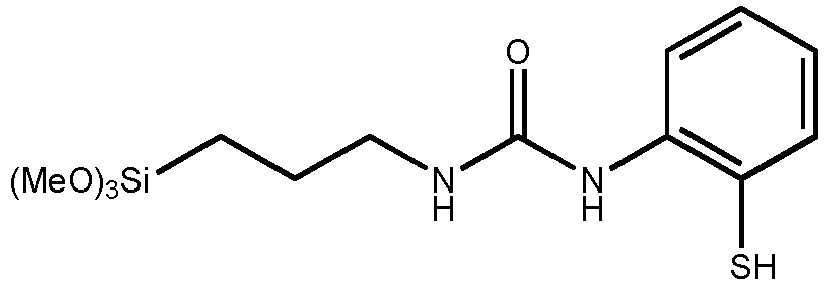
- Ferner sind aus
JP 2008279736 A DE 3424534 A1 sind N,N'- und N,N',N'-substituierte harnstoffhaltige Silane der Formel
- Ferner sind aus
JP 2002311574 - Aus
WO 9955754 A1
[(R1O)3-a(R2)aSi-R3-A-C(O)-B]m-X.
- Ferner sind aus
WO 2013/087698 geblockte Mercaptosilane der Formel (HO)R1 2Si-Z-S-C(=O)-A bekannt. Die geblockten Mercaptosilane enthalten Si-OH Gruppen. - Nachteile der bekannten harnstoffhaltigen Mercaptosilane sind das schlechte Verarbeitungsverhalten, die niedrige Netzwerkdichte, die schlechten Nassrutscheigenschaften und die niedrige dynamische Steifigkeit.
- Aufgabe der vorliegenden Erfindung ist es harnstoffhaltige Mercaptosilane zur Verfügung zu stellen, welche gegenüber aus dem Stand der Technik bekannten harnstoffhaltigen Mercaptosilanen ein verbessertes Verarbeitungsverhalten, Netzwerkdichte, Nassrutscheigenschaften und dynamische Steifigkeit in Kautschukmischungen aufweisen. Gegenstand der Erfindung ist ein harnstoffhaltiges Mercaptosilan der Formel I

- Harnstoffhaltige Mercaptosilane können Mischungen von harnstoffhaltigen Mercaptosilanen der Formel I sein.
- Das Verfahrensprodukt kann Oligomere, die durch Hydrolyse und Kondensation der Alkoxysilanfunktionen der harnstoffhaltigen Mercaptosilanen der Formel I entstehen, enthalten. Die harnstoffhaltigen Mercaptosilane der Formel I können auf einem Träger, beispielsweise Wachs, Polymer oder Ruß, aufgebracht sein. Die harnstoffhaltigen Mercaptosilane der Formel I können auf einer Kieselsäure aufgebracht sein, wobei die Anbindung physikalisch oder chemisch erfolgt sein kann.
- R kann bevorzugt -CH2-, -CH2CH2-, -CH2CH2CH2-, -CH2CH2CH2CH2-, -CH(CH3)-, -CH2CH(CH3)-, - CH(CH3)CH2-, -C(CH3)2-, -CH(C2H5)-, -CH2CH2CH(CH3)-, -CH(CH3)CH2CH2-, -CH2CH(CH3)CH2-, -CH2CH2CH2CH2CH2-, -CH2CH2CH2CH2CH2CH2-, -CH2CH2CH2CH2CH2CH2CH2-, -CH2CH2CH2CH2CH2CH2CH2CH2-, -CH2CH2CH2CH2CH2CH2CH2CH2CH2-, -CH2CH2CH2CH2CH2CH2CH2CH2CH2CH2-, -CH2CH2CH2CH2CH2CH2CH2CH2CH2CH2CH2CH2-, -CH2CH2CH2CH2CH2CH2CH2CH2CH2CH2CH2CH2CH2CH2-, -CH2CH2CH2CH2CH2CH2CH2CH2CH2CH2CH2CH2CH2CH2CH2CH2-, -CH2CH2CH2CH2CH2CH2CH2CH2CH2CH2CH2CH2CH2CH2CH2CH2CH2CH2-oder

R1 kann bevorzugt Methoxy oder Ethoxy sein. - R2 kann bevorzugt CH3, CH2CH3, CH2CH2CH3 oder (CH2)6CH3 sein. Harnstofffhaltige Mercaptosilane der Formel I können bevorzugt sein:
(CH3CH2O)3Si-CH2-NH-CO-NH-CH2-S-C(O)-CH3,
(CH3CH2O)3Si-CH2CH2-NH-CO-NH-CH2-S-C(O)-CH3,
(CH3CH2O)3Si-CH2-NH-CO-NH-CH2CH2-S-C(O)-CH3,
(CH3CH2O)3Si-CH2CH2-NH-CO-NH-CH2CH2-S-C(O)-CH3,
(CH3CH2O)3Si-CH2CH2CH2-NH-CO-NH-CH2-S-C(O)-CH3,
(CH3CH2O)3Si-CH2CH2CH2-NH-CO-NH-CH2CH2-S-C(O)-CH3,
(CH3CH2O)3Si-CH2-NH-CO-NH-CH2CH2CH2-S-C(O)-CH3,
(CH3CH2O)3Si-CH2CH2-NH-CO-NH-CH2CH2CH2-S-C(O)-CH3,
(CH3CH2O)3Si-CH2CH2CH2-NH-CO-NH-CH2CH2CH2-S-C(O)-CH3,
(CH3CH2O)3Si-CH2-NH-CO-NH-CH2-S-C(O)-(CH2)6CH3,
(CH3CH2O)3Si-CH2CH2-NH-CO-NH-CH2-S-C(O)-(CH2)6CH3,
(CH3CH2O)3Si-CH2-NH-CO-NH-CH2CH2-S-C(O)-(CH2)6CH3,
(CH3CH2O)3Si-CH2CH2-NH-CO-NH-CH2CH2-S-C(O)-(CH2)6CH3,
(CH3CH2O)3Si-CH2CH2CH2-NH-CO-NH-CH2-S-C(O)-(CH2)6CH3,
(CH3CH2O)3Si-CH2CH2CH2-NH-CO-NH-CH2CH2-S-C(O)-(CH2)6CH3,
(CH3CH2O)3Si-CH2-NH-CO-NH-CH2CH2CH2-S-C(O)-(CH2)6CH3,
(CH3CH2O)3Si-CH2CH2-NH-CO-NH-CH2CH2CH2-S-C(O)-(CH2)6OH3,
(CH3CH2O)3Si-CH2CH2CH2-NH-CO-NH-CH2CH2CH2-S-C(O)-(CH2)6CH3,
(CH3O)3Si-CH2-NH-CO-NH-CH2-S-C(O)-CH3,
(CH3O)3Si-CH2CH2-NH-CO-NH-CH2-S-C(O)-CH3,
(CH3O)3Si-CH2-NH-CO-NH-CH2CH2-S-C(O)-CH3,
(CH3O)3Si-CH2CH2-NH-CO-NH-CH2CH2-S-C(O)-CH3,
(CH3O)3Si-CH2CH2CH2-NH-CO-NH-CH2-S-C(O)-CH3,
(CH3O)3Si-CH2CH2CH2-NH-CO-NH-CH2CH2-S-C(O)-CH3,
(CH3O)3Si-CH2-NH-CO-NH-CH2CH2CH2-S-C(O)-CH3,
(CH3O)3Si-CH2CH2-NH-CO-NH-CH2CH2CH2-S-C(O)-CH3,
(CH3O)3Si-CH2CH2CH2-NH-CO-NH-CH2CH2CH2-S-C(O)-CH3,
(CH3O)3Si-CH2-NH-CO-NH-CH2-S-C(O)-(CH2)6CH3,
(CH3O)3Si-CH2CH2-NH-CO-NH-CH2-S-C(O)-(CH2)6CH3,
(CH3O)3Si-CH2-NH-CO-NH-CH2CH2-S-C(O)-(CH2)6CH3,
(CH3O)3Si-CH2CH2-NH-CO-NH-CH2CH2-S-C(O)-(CH2)6CH3,
(CH3O)3Si-CH2CH2CH2-NH-CO-NH-CH2-S-C(O)-(CH2)6CH3,
(CH3O)3Si-CH2CH2CH2-NH-CO-NH-CH2CH2-S-C(O)-(CH2)6CH3,
(CH3O)3Si-CH2-NH-CO-NH-CH2CH2CH2-S-C(O)-(CH2)6CH3,
(CH3O)3Si-CH2CH2-NH-CO-NH-CH2CH2CH2-S-C(O)-(CH2)6CH3,
(CH3O)3Si-CH2CH2CH2-NH-CO-NH-CH2CH2CH2-S-C(O)-(CH2)6OH3.
Insbesondere bevorzugt ist die Verbindung der Formel
(EtO)3Si-CH2CH2CH2-NH-CO-NH-CH2CH2-S-C(O)-CH3.
- Ein weiterer Gegenstand der Erfindung ist ein Verfahren zur Herstellung der erfindungsgemäßen harnstoffhaltigen Mercaptosilane der Formel I


in einem Alkohol umsetzt. Halogensilane der Formel II können bevorzugt sein:
(C2H5O)3Si-CH2-NH-C(O)-NH-CH2-Cl,
(C2H5O)3Si-CH2CH2-NH-C(O)-NH-CH2-Cl,
(C2H5O)3Si-CH2CH2CH2-NH-C(O)-NH-CH2-Cl,
(C2H5O)3Si-CH2-NH-C(O)-NH-CH2CH2-Cl,
(C2H5O)3Si-CH2CH2-NH-C(O)-NH-CH2CH2-Cl,
(C2H5O)3Si-CH2CH2CH2-NH-C(O)-NH-CH2CH2-Cl,
(C2H5O)3Si-CH2-NH-C(O)-NH-CH2CH2CH2-Cl,
(C2H5O)3Si-CH2CH2-NH-C(O)-NH-CH2CH2CH2-Cl,
(C2H5O)3Si-CH2CH2CH2-NH-C(O)-NH-CH2CH2CH2-Cl,
(CH3O)3Si-CH2-NH-C(O)-NH-CH2-Cl,
(CH3O)3Si-CH2CH2-NH-C(O)-NH-CH2-Cl,
(CH3O)3Si-CH2CH2CH2-NH-C(O)-NH-CH2-Cl,
(CH3O)3Si-CH2-NH-C(O)-NH-CH2CH2-Cl,
(CH3O)3Si-CH2CH2-NH-C(O)-NH-CH2CH2-Cl,
(CH3O)3Si-CH2CH2CH2-NH-C(O)-NH-CH2CH2-Cl,
(CH3O)3Si-CH2-NH-C(O)-NH-CH2CH2CH2-Cl,
(CH3O)3Si-CH2CH2-NH-C(O)-NH-CH2CH2CH2-Cl oder
(CH3O)3Si-CH2CH2CH2-NH-C(O)-NH-CH2CH2CH2-Cl.
- Verbindungen der Formel III können bevorzugt sein:
NaS-C(O)-CH3,
NaS-C(O)-CH2CH3,
NaS-C(O)-CH2CH2CH3,
NaS-C(O)-(CH2)6CH3,
KS-C(O)-CH3,
KS-C(O)-CH2CH3,
KS-C(O)-CH2CH2CH3 oder
KS-C(O)-(CH2)6CH3.
- Bei dem erfindungsgemäßen Verfahren kann das Halogensilan der Formel II zur Verbindung der Formel II dosiert werden.
- Bei dem erfindungsgemäßen Verfahren kann bevorzugt Verbindung der Formel III zu Halogensilan der Formel II dosiert werden.
- Bei dem erfindungsgemäßen Verfahren kann das Halogensilan der Formel II zur Verbindung der Formel II im molekularen Verhältnis von 0,85:1 bis 1,15:1, bevorzugt 0,90:1 bis 1,10:1, besonders bevorzugt im Verhältnis 0,95:1 bis 1,05:1, eingesetzt werden.
- Die Reaktion kann unter Luftausschluss durchgeführt werden.
- Die Reaktion kann unter Schutzgasatmosphäre durchgeführt werden, zum Beispiel unter Argon oder Stickstoff, bevorzugt unter Stickstoff.
- Das erfindungsgemäße Verfahren kann bei Normaldruck, erhöhtem Druck oder reduziertem Druck durchgeführt werden. Bevorzugt kann das erfindungsgemäße Verfahren bei Normaldruck durchgeführt werden.
- Erhöhter Druck kann ein Druck von 1,1 bar bis 100 bar, bevorzugt von 1,5 bar bis 50 bar, besonders bevorzugt von 2 bar bis 20 bar und ganz besonders bevorzugt von 2 bis 10 bar, sein. Reduzierter Druck kann ein Druck von 1 mbar bis 1000 mbar, bevorzugt 1 mbar bis 500 mbar, besonders bevorzugt 1 mbar bis 250 mbar, ganz besonders bevorzugt 5 mbar bis 100 mbar, sein. Das erfindungsgemäße Verfahren kann zwischen 0°C und 150°C, bevorzugt zwischen 20°C und 100°C, besonders bevorzugt zwischen 50°C und 80°C, durchgeführt werden. Insbesondere bevorzugt kann das erfindungsgemäße Verfahren beim Siedepunkt des Alkohols durchgeführt werden.
- Der bei dem erfindungsgemäßen Verfahren eingesetzte Alkohol kann vorzugsweise Methanol, Ethanol, Propanol, Butanol oder Cyclohexanol sein. Der Alkohol kann insbesondere bevorzugt Ethanol sein.
- Der Alkohol kann nach der Reaktion entfernt, vorzugsweise abdestilliert, werden.
- Das Reaktionsprodukt kann anschließend getrocknet werden. Die Trocknung kann bei Temperaturen von +20°C - +100°C, vorzugsweise von +25°C - +75°C, erfolgen. Die Trocknung kann bei Unterdruck von 1 - 500 mbar erfolgen.
- Das durch das erfindungsgemäße Verfahren erhältliche harnstoffhaltige Mercaptosilan der Formel I

- In einer Ausführungsform kann das Halogensilan der Formel II vor der Umsetzung mit der Verbindung der Formel III aus dem Hydrochlorid-Salz eines Amins der Formel IV


- Dabei kann die Base zugegeben werden bis sich ein pH-Wert zwischen 7 und 14 einstellt.
- Bei dem erfindungsgemäßen Verfahren kann das Hydrochlorid-Salz der Amine der Formel IV zu Isocyantsilan der Formel V im molekularen Verhältnis von 0,85:1 bis 1,15:1, bevorzugt 0,90:1 bis 1,10:1, besonders bevorzugt im Verhältnis 0,95:1 bis 1,05:1, eingesetzt werden.
- In der vorgenannten Ausführungsform kann das erfindungsgemäße Verfahren zur Herstellung von harnstoffhaltigen Mercaptosilanen der Formel I


anschließend das Isocyanatsilan der Formel V

- In einer weiteren Ausführungsform kann das Halogensilan der Formel II vor der Umsetzung mit der Verbindung der Formel III aus der Isocyanathalogenverbindung der Formel VI


- Die Umsetzung kann in einem Lösungsmittel, vorzugsweise Alkohol, besonders bevorzugt Ethanol, durchgeführt werden.
- Bei dem erfindungsgemäßen Verfahren kann die Isocyanathalogenverbindung der Formel VI zu Aminosilan der Formel VII im molekularen Verhältnis von 0,85:1 bis 1,15:1, bevorzugt 0,90:1 bis 1,10:1, besonders bevorzugt im Verhältnis 0,95:1 bis 1,05:1, eingesetzt werden.
- In der vorgenannten Ausführungsform kann das erfindungsgemäße Verfahren zur Herstellung von harnstoffhaltigen Mercaptosilanen der Formel I




- Das Produkt, hergestellt mit dem erfindungsgemäßen Verfahren, kann einen Restgehalt an Halogensilan der Formel II von weniger als 25 mol-%, bevorzugt weniger als 10 mol-%, besonders bevorzugt weniger als 5 mol-%, ganz besonders bevorzugt weniger als 3 mol-%, haben.
- Die relativen mol-% des Halogensilans der Formel II in dem Produkt, hergestellt mit dem erfindungsgemäßen Verfahren, werden im 1H-NMR durch Integration der H-Atome der -CH2CH 2-Cl Gruppe des Halogensilans der Formel II gegen die H-Atome der Si-CH 2- Gruppe des harnstoffhaltigen Mercaptosilans der Formel I bestimmt.
- Für die Substanz der Formel II (EtO)3Si-CH2CH2CH2-NH-CO-NH-CH2CH2-Cl wird zum Beispiel das Integral der H-Atome der -CH2CH 2-Cl Gruppe (δ = 3.17 ppm) für die Bestimmung der relativen Gehalte verwendet.
- Das Produkt, hergestellt mit dem erfindungsgemäßen Verfahren, kann einen Restgehalt an Hydrochlorid-Salz eines Amins der Formel IV von weniger als 25 mol-%, bevorzugt weniger als 10 mol-%, besonders bevorzugt weniger als 5 mol-%, ganz besonders bevorzugt weniger als 3 mol-%, haben.
- Die relativen mol-% des Hydrochlorid-Salz eines Amins der Formel IV in dem Produkt, hergestellt mit dem erfindungsgemäßen Verfahren, werden im 13C-NMR durch Integration der C-Atome der - CH2-NH2·HCl Gruppe des Hydrochlorid-Salz eines Amins der Formel IV gegen die C-Atome der SiCH2- Gruppe der harnstoffhaltigen Mercaptosilane der Formel I bestimmt.
- Für die Substanz der Formel IV HCl·H2N-CH2-CH2-Cl wird zum Beispiel das Integral der C-Atome der HCl·H2N-CH2-CH2-Cl Gruppe (δ = 41,25 ppm) oder der HCl·H2N-CH2-CH2-Cl Gruppe (δ = 40,79 ppm) für die Bestimmung der relativen Gehalte verwendet.
- Das Produkt, hergestellt mit dem erfindungsgemäßen Verfahren, kann einen Restgehalt an Isocyanatsilan der Formel V von weniger als 10 mol-%, bevorzugt weniger als 5 mol-%, besonders bevorzugt weniger als 1 mol-%, ganz besonders bevorzugt weniger als 0,1 mol-%, haben.
- Die relativen mol-% des Isocyanatsilan der Formel V in dem Produkt in einem Bereich >1 mol-%, hergestellt mit dem erfindungsgemäßen Verfahren, werden im 13C-NMR durch Integration der C-Atome der -NCO Gruppe des Isocyanatsilan der Formel V gegen die C-Atome der Si-CH2- Gruppe der harnstoffhaltigen Mercaptosilane der Formel I bestimmt.
- Für die Substanz der Formel V (EtO)3Si-CH2-CH2-CH2-NCO wird zum Beispiel das Integral der C-Atome der -NCO Gruppe (δ = 122,22 ppm) für die Bestimmung der relativen Gehalte in einem Bereich >1 mol-% verwendet.
- Die relativen mol-% der Isocyanatsilan der Formel V in dem Produkt in einem Bereich <1 mol-%, hergestellt mit dem erfindungsgemäßen Verfahren, werden durch eine dem Fachmann bekannte quantitative FT-IR-Spektroskopie bestimmt. Die Kalibrierung der Methode erfolgt durch Verwendung von Kalibrierlösungen geeigneter Konzentration (z.B. in C2Cl4). Für die Messung werden ca. 1 g Probe in eine 25 ml Rollkragenflasche eingewogen und 25 g C2Cl4 zugegeben. Die Probe wird auf der Schüttelmaschine 1 - 2 Stunden geschüttelt. Im Anschluss wird die untere flüssige Phase vorsichtig in eine 20 mm IR-Küvette dosiert und per FT-IR-Spektroskopie vermessen (4000-1200 cm-1, Auflösung 2 cm-1). Unter gleichen Bedingungen wird ein Spektrum des Lösungsmittels zur Subtraktion aufgenommen.
- Für die Substanz der Formel V (EtO)3Si-CH2-CH2-CH2-NCO wird zum Beispiel die Wellenlänge der Valenzschwingung der -NCO Gruppe bei 2270 cm-1 für die Bestimmung der relativen Gehalte in einem Bereich <1 mol-% verwendet.
- Das Produkt, hergestellt mit dem erfindungsgemäßen Verfahren, kann einen Restgehalt an Isocyanathalogenverbindung der Formel VI von weniger als 25 mol-%, bevorzugt weniger als 10 mol-%, besonders bevorzugt weniger als 5 mol-%, ganz besonders bevorzugt weniger als 3 mol-%, haben.
- Die relativen mol-% der Isocyanathalogenverbindung der Formel VI in dem Produkt, hergestellt mit dem erfindungsgemäßen Verfahren, werden im 13C-NMR durch Integration der C-Atome der OCN-CH2- Gruppe der Isocyanathalogenverbindung der Formel VI gegen die C-Atome der Si-CH2-Gruppe des harnstoffhaltigen Mercaptosilans der Formel I bestimmt.
- Für die Substanz der Formel VI OCN-CH2-CH2-Cl wird zum Beispiel das Integral der C-Atome der OCN-CH2- Gruppe (δ = 124,33 ppm) für die Bestimmung der relativen Gehalte verwendet.
- Das Produkt, hergestellt mit dem erfindungsgemäßen Verfahren, kann einen Restgehalt an Aminosilan der Formel VII von weniger als 10 mol-%, bevorzugt weniger als 5 mol-%, besonders bevorzugt weniger als 1 mol-%, ganz besonders bevorzugt weniger als 0,1 mol-%, haben.
- Die relativen mol-% des Aminosilans der Formel VII in dem Produkt, hergestellt mit dem erfindungsgemäßen Verfahren, werden im 13C-NMR durch Integration der C -Atome der -CH2-NH2 Gruppe des Aminosilans der Formel VII gegen die C-Atome der Si-CH2- Gruppe des harnstoffhaltigen Mercaptosilans der Formel I bestimmt.
- Für die Substanz der Formel VII (EtO)3Si-CH2-CH2-CH2-NH2 wird zum Beispiel das Integral der C-Atome der -CH2-NH2 Gruppe (δ = 45,15 ppm) für die Bestimmung der relativen Gehalte verwendet.
- Harnstoffhaltiges Mercaptosilan der Formel I hergestellt nach dem erfindungsgemäßen Verfahren kann durch eine dem Fachmann bekannte 1H-, 13C-, oder 29Si-NMR Methode charakterisiert werden.
- Der lösliche Anteil des harnstoffhaltigen Mercaptosilans der Formel I in dem durch die erfindungsgemäße Verfahren erhaltenen Produkte in DMSO-d6 oder CDCl3 wird durch Zugabe eines internen Standards, wie beispielsweise Triphenylphosphinoxid (TPPO), in DMSO-d6 oder in CDCl3 und eine dem Fachmann bekannte 1H-NMR Methode ermittelt.
- Die harnstoffhaltigen Mercaptosilane der Formel I können als Haftvermittler zwischen anorganischen Materialien, zum Beispiel
Glaskugeln, Glasplittern, Glasoberflächen, Glasfasern, oder oxidischen Füllstoffen, bevorzugt Kieselsäuren wie gefällten Kieselsäuren und pyrogene Kieselsäuren,
und organischen Polymeren, zum Beispiel Duroplasten, Thermoplasten oder Elastomeren, beziehungsweise als Vernetzungsmittel und Oberflächenmodifizierungsmittel für oxidische Oberflächen verwendet werden. - Die harnstoffhaltigen Mercaptosilane der Formel I können als Kopplungsreagenzien in gefüllten Kautschukmischungen, beispielsweise Reifenlaufflächen, technischen Gummiartikeln oder Schuhsolen, verwendet werden.
- Vorteile der erfindungsgemäßen harnstoffhaltigen Mercaptosilane der Formel I sind verbessertes Verarbeitungsverhalten, Netzwerkdichte, Nassrutscheigenschaften und dynamische Steifigkeit in Kautschukmischungen.
- Zu einer Lösung aus NaSH in Ethanol [hergestellt durch Einleiten von H2S (15,21 g, 0,45 mol, 1,07 eq) in eine Natriumethanolat-Lösung (hergestellt aus Na (10,55 g, 0,46 mol, 1,10 eq) in EtOH (300 mL))] wird bei 52°C (EtO)3Si-CH2CH2CH2-NH-CO-NH-CH2CH2-Cl (138,90 g, 0,42 mol, 1,00 eq) in Ethanol (300 mL) zudosiert und auf 78°C erwärmt. Nach einer Reaktionszeit von 5 h wird auf Raumtemperatur gekühlt und die Suspension filtriert. Das Filtrat wird am Rotationsverdampfer vom Lösungsmittel befreit und am Vakuum getrocknet. Man erhält das Produkt (EtO)3Si-CH2CH2CH2-NH-CO-NH-CH2CH2-SH (134,96 g, 97,9% d.Th.) als weißen Feststoff.
- 1H-NMR (δppm, 500 MHz, CDCl3): 0.64 (2H, t), 1.23 (9H, t), 1.36 (1H, br), 1.61 (2H, m), 2.67 (2H, t), 3.17 (2H, m), 3.37 (2H, m), 3.81 (6H, q), 4.74 (1H, br), 4.94 (1H, br);
13C-NMR (δppm, 125 MHz, CDCl3): 7.8 (1C), 18.3 (3C), 23.8 (1C), 25.6 (1C), 43.0 (1C), 43.5 (1C), 58.4 (3C), 158.9 (1C). - (EtO)3Si-CH2CH2CH2-NH-CO-NH-CH2CH2-Cl (81,52 g, 0,25 mol, 1,00 eq) wird in Ethanol (85 mL) in einem 500 mL Dreihalskolben mit Rührer, Rückflusskühler und Innenthermometer vorgelegt. Kaliumthioacetat (28,48 g, 0,25 mol, 1,00 eq) wird zugegeben und die Mischung zum Rückfluss erhitzt. Nach einer Reaktionszeit von 3,5 h wird auf Raumtemperatur gekühlt und die Suspension filtriert. Das Filtrat wird am Rotationsverdampfer vom Lösungsmittel befreit und am Vakuum getrocknet. Man erhält das Produkt (EtO)3Si-CH2CH2CH2-NH-CO-NH-CH2CH2-S-CH3 (81,64 g, 89% d.Th.) als hellbraunen Feststoff.
- 1H-NMR (δppm, 500 MHz, CDCl3): 0.64 (2H, t), 1.24 (9H, t), 1.61 (2H, m), 2.35 (3H, s), 3.01 (2H, t), 3.16 (2H, t), 3.34 (2H, t), 3.82 (6H, q), 4.5-7.0 (2H, br);
13C-NMR (δppm, 125 MHz, CDCl3): 7.8 (1C), 18.3 (3C), 23.8 (1C), 29.9 (1C), 30.6 (1C), 40.0 (1C), 43.0 (1C), 58.4 (3C), 159.0 (1C), 195.8 (1C). - 3-Aminopropyltriethoxysilan (132,82 g, 0,60 mol, 1,00 eq) wird in Ethanol (300 mL) in einem Dreihalskolben mit KPG-Rührer, Innenthermometer, Tropftrichter und Rückflusskühler vorgelegt und auf-78°C gekühlt. 2-Chlorethylisocyanat (63,34 g, 0,60 mol, 1,00 eq) wird innerhalb von 1,75 h bei -78 bis -68°C zugetropft und danach auf 50°C erwärmt. Kaliumthioacetat (68,53 g, 0,60 mol, 1,00 eq) wird in fünf Portionen zugegeben und die Mischung zum Rückfluss erhitzt. Nach einer Reaktionszeit von 2,25 h wird auf Raumtemperatur gekühlt und die Suspension filtriert. Das Filtrat wird am Rotationsverdampfer vom Lösungsmittel befreit und am Vakuum getrocknet. Man erhält das Produkt (EtO)3Si-CH2CH2CH2-NH-CO-NH-CH2CH2-S-CH3 (213,91 g, 97,3% d.Th.) als wachsartigen, weißen Feststoff.
- 1H-NMR (δppm, 500 MHz, CDCl3): 0.64 (2H, t), 1.22 (9H, t), 1.62 (2H, m), 2.35 (3H, s), 3.01 (2H, t), 3.16 (2H, t), 3.34 (2H, t), 3.82 (6H, q), 4.7-5.0 (2H, br);
13C-NMR (δppm, 125 MHz, CDCl3): 7.8 (1C), 18.3 (3C), 23.8 (1C), 29.9 (1C), 30.6 (1C), 40.1 (1C), 43.0 (1C), 58.4 (3C), 158.7 (1C), 195.9 (1C). - 2-Chlorethylamin Hydrochlorid (73,86 g, 0,70 mol, 1,00 eq) wird in Ethanol (2,0 L) in einem 4 L Dreihalskolben mit KPG-Rührer, Innenthermometer, Tropftrichter und Rückflusskühler vorgelegt und auf -78°C gekühlt und Natriumethanolat (226,83 g, 0,70 mol, 1,00 eq, 21% in Ethanol) zugegeben. 3-Isocyanatopropyl(triethoxysilan) (173,15 g, 0,70 mol, 1,00 eq) wird nun innerhalb von 3 h bei -78 bis -65°C zugetropft und danach auf 50°C erwärmt. Kaliumthioacetat (79,95 g, 0,70 mol, 1,00 eq) wird in fünf Portionen zugegeben und die Mischung zum Rückfluss erhitzt. Nach einer Reaktionszeit von 4 h wird auf Raumtemperatur gekühlt und die Suspension filtriert. Das Filtrat wird am Rotationsverdampfer vom Lösungsmittel befreit und am Vakuum getrocknet. Man erhält das Produkt (EtO)3Si-CH2CH2CH2-NH-CO-NH-CH2CH2-S-CH2CH3 (288,02 g, quant.) als orangenes Öl.
- Die für die Kautschukmischungen verwendete Rezeptur ist in der folgenden Tabelle 1 angegeben. Dabei bedeutet die Einheit phr Gewichtsanteile bezogen auf 100 Teile des eingesetzten Rohkautschuks. Das erfinderische Silan wird isomolar zum Vergleichssilan eingesetzt.
Tabelle 1 Substanz Menge [phr] Menge [phr] 1. Stufe Ref.kautschukmischung I enthaltend Vergl.beispiel 1 Kautschukmischung II, enthaltend erf. Beispiel 2 NR TSRa 10 10 BRb 18 18 SSBRc 72 72 Kieselsäured 95 95 ZnO 2,5 2,5 Stearinsäure 2,5 2,5 TDAE Öl 50 50 Ozonschutzwachs 2 2 6PPDe 2 2 Vergl.beispiel 1 12 - Beispiel 2 - 14 2. Stufe Batch Stufe 2 DPG† 2 2 CBSg 2 2 Schwefel 2 2 Verwendete Substanzen: a) NR TSR: SIR 20 SED, Firma Aneka Bumi Pratama (TSR = Technically Specified Rubber; SIR = Standard Indonesian Rubber)
b) BR: Polybutadien, Europrene Neocis BR 40, Firma Polimeri
c) SSBR: Sprintan® SLR-4601, Firma Styron
d) Kieselsäure: ULTRASIL® VN3 GR, Firma Evonik Industries AG
e) 6PPD: N-(1,3-Dimethylbutyl)-N`-phenyl-p-phenylenediamine
f) DPG: Diphenylguanidin
g) CBS: N-Cyclohexyl-2-benzothiazolsufenamid - Die Mischungsherstellung erfolgte unter üblichen Bedingungen in zwei Stufen in einem Laborkneter zur Herstellung von Gummimischungen (300 Milliliter bis 3 Liter Volumen), wobei zunächst in der ersten Mischstufe (Grundmischstufe) alle Bestandteile außer dem Vulkanisationssystem (Schwefel und vulkanisationsbeeinflussende Substanzen) für 200 bis 600 Sekunden bei 145 bis 165 °C, Zieltemperaturen von 152 bis 157 °C, vermischt werden. Durch Zugabe des Vulkanisationssystems in der zweiten Stufe (Fertigmischstufe) wird die Fertigmischung erzeugt, wobei für 180 bis 300 Sekunden bei 90 bis 120 °C gemischt wird.
- Das allgemeine Verfahren zur Herstellung von Kautschukmischungen und deren Vulkanisate ist in "Rubber Technology Handbook", W. Hofmann, Hanser Verlag 1994 beschrieben.
- Die gummitechnische Prüfung erfolgt gemäß den in Tabelle 2 angegebenen Prüfmethoden.
Tabelle 2: Physikalische Testung Norm/ Bedingungen Moving Die Rheometer (rotorloses Vulkameter): ISO 6502 Minimales Drehmoment (dNm) ASTM D5289-12 Drehmomentsunterschied: Maximales Drehmoment- Minimales Drehmoment (dNm) Rückprallelastizität bei 23°C (%) DIN 53512 Dynamisch-mechanische Messung bei 55°C Dynamischer Speichermodul E' bei 0.15% Dehnung und bei 8% Dehnung (MPa) ISO 4664-1 - Aus sämtlichen Mischungen wurden Prüfkörper durch Vulkanisation nach t95 (gemessen am Moving Die Rheometer gemäß ISO 6502 / ASTM D5289-12) unter Druck bei 160°C hergestellt. In der Tabelle 3 sind die gummitechnischen Daten für die Vulkanisate angegeben.
Tabelle 3: Substanz Ref.kautschukmischung I etnhaltend Vergl.beisp.1 Kautschuk--mischung II, enthaltend erf. Beisp. 2 Rohmischungsergebnisse: Moving Die Methode: minimales Drehmoment nach 3. Stufe [dNm] 4,4 3,5 Moving Die Methode: Drehmomentsunterschied: Maximales Drehmoment- Minimales Drehmoment (dNm) nach 3. Stufe 12 18 Vulkanisatergebnisse: Rückprallelast. 23°C [%] 29 26 Dynamisch-mechanische Messung bei 55°C E' bei 0,15% Dehnung (MPa) 10,1 16,5 Dynamisch-mechanische Messung bei 55°C E' bei 8% Dehnung (MPa) 6,0 7,1 Dynamisch-mechanische Messung bei 55°C E' bei 8% Dehnung - E' bei 0,15% Dehnung (MPa) 4,1 9,4 - Die Kautschukmischung II, die das erfindungsgemäße harnstoffhaltige Mercaptosilan aus Beispiel 2 enthält, zeigt ein verbessertes Verarbeitungsverhalten (niedrigeres minimales Drehmoment nach der 3. Mischstufe), eine erhöhte Netzwerkdichte (größere Differenz maximales Drehmomentminimales Drehmoment), verbesserte Nassrutscheigenschaften (Rückprallelastizität bei 23°C)sowie eine erhöhte dynamische Steifigkeit (E' bei 0.15% Dehnung, E' bei 8% Dehnung und E' bei 8% Dehnung - E' bei 0,15% Dehnung) gegenüber der Referenzkautschukmischung I, enthaltend das isomolar eingesetzte Vergleichsbeispiel 1 (harnstoffhaltiges Mercaptosilan).
Claims (13)
- Harnstoffhaltiges Mercaptosilan der Formel I

- Harnstoffhaltiges Mercaptosilan gemäß Anspruch 1, dadurch gekennzeichnet, dass das harnstoffhaltige Mercaptosilan der Formel I
(CH3CH2O)3Si-CH2-NH-CO-NH-CH2-S-C(O)-CH3,
(CH3CH2O)3Si-CH2CH2-NH-CO-NH-CH2-S-C(O)-CH3,
(CH3CH2O)3Si-CH2-NH-CO-NH-CH2CH2-S-C(O)-CH3,
(CH3CH2O)3Si-CH2CH2-NH-CO-NH-CH2CH2-S-C(O)-CH3,
(CH3CH2O)3Si-CH2CH2CH2-NH-CO-NH-CH2-S-C(O)-CH3,
(CH3CH2O)3Si-CH2CH2CH2-NH-CO-NH-CH2CH2-S-C(O)-CH3,
(CH3CH2O)3Si-CH2-NH-CO-NH-CH2CH2CH2-S-C(O)-CH3,
(CH3CH2O)3Si-CH2CH2-NH-CO-NH-CH2CH2CH2-S-C(O)-CH3,
(CH3CH2O)3Si-CH2CH2CH2-NH-CO-NH-CH2CH2CH2-S-C(O)-CH3,
(CH3CH2O)3Si-CH2-NH-CO-NH-CH2-S-C(O)-(CH2)6CH3,
(CH3CH2O)3Si-CH2CH2-NH-CO-NH-CH2-S-C(O)-(CH2)6CH3,
(CH3CH2O)3Si-CH2-NH-CO-NH-CH2CH2-S-C(O)-(CH2)6CH3,
(CH3CH2O)3Si-CH2CH2-NH-CO-NH-CH2CH2-S-C(O)-(CH2)6CH3,
(CH3CH2O)3Si-CH2CH2CH2-NH-CO-NH-CH2-S-C(O)-(CH2)6CH3,
(CH3CH2O)3Si-CH2CH2CH2-NH-CO-NH-CH2CH2-S-C(O)-(CH2)6CH3,
(CH3CH2O)3Si-CH2-NH-CO-NH-CH2CH2CH2-S-C(O)-(CH2)6CH3,
(CH3CH2O)3Si-CH2CH2-NH-CO-NH-CH2CH2CH2-S-C(O)-(CH2)6CH3 oder
(CH3CH2O)3Si-CH2CH2CH2-NH-CO-NH-CH2CH2CH2-S-C(O)-(CH2)6CH3
ist. - Harnstoffhaltiges Mercaptosilan gemäß Anspruch 1, dadurch gekennzeichnet, dass das harnstoffhaltige Mercaptosilan der Formel I (EtO)3Si-CH2CH2CH2-NH-CO-NH-CH2CH2-S-C(O)-CH3 ist.
- Verfahren zur Herstellung von harnstoffhaltigem Mercaptosilan der Formel I gemäß Anspruch 1, dadurch gekennzeichnet, dass man ein Halogensilan der Formel II


in einem Alkohol umsetzt. - Verfahren zur Herstellung von harnstoffhaltigem Mercaptosilan der Formel I gemäß Anspruch 4, dadurch gekennzeichnet, dass man die Reaktion unter Schutzgasatmosphäre durchführt.
- Verfahren zur Herstellung von harnstoffhaltigem Mercaptosilan der Formel I gemäß Anspruch 4, dadurch gekennzeichnet, dass man die Reaktion bei Temperaturen zwischen 0°C und 150°C durchführt.
- Verfahren zur Herstellung von harnstoffhaltigem Mercaptosilan der Formel I gemäß Anspruch 4, dadurch gekennzeichnet, dass man als Alkohol Ethanol einsetzt.
- Verfahren zur Herstellung von harnstoffhaltigem Mercaptosilan der Formel I gemäß Anspruch 4, dadurch gekennzeichnet ist, dass man das Halogensilan der Formel II aus dem Hydrochlorid-Salz eines Amins der Formel IV


- Verfahren zur Herstellung von harnstoffhaltigem Mercaptosilan der Formel I gemäß Anspruch 8, dadurch gekennzeichnet, dass man als Base NaOEt einsetzt.
- Verfahren zur Herstellung von harnstoffhaltigem Mercaptosilan der Formel I gemäß Anspruch 4, dadurch gekennzeichnet ist, dass man das Halogensilan der Formel II aus Isocyanathalogenverbindung der Formel VI


- Verfahren zur Herstellung von harnstoffhaltigem Mercaptosilan der Formel I gemäß Anspruch 10, dadurch gekennzeichnet, dass man die Reaktion in Ethanol durchführt.
- Verfahren zur Herstellung von harnstoffhaltigem Mercaptosilan der Formel I gemäß einem der Ansprüche 4 bis 10, dadurch gekennzeichnet, dass man den Alkohol abdestilliert.
- Verfahren zur Herstellung von harnstoffhaltigem Mercaptosilan der Formel I gemäß Anspruch 12, dadurch gekennzeichnet, dass man das erhaltene Produkt trocknet.
Priority Applications (1)
| Application Number | Priority Date | Filing Date | Title |
|---|---|---|---|
| PL15165635T PL2944643T3 (pl) | 2014-05-15 | 2015-04-29 | Merkaptosilany zawierające mocznik, sposób ich wytwarzania i zastosowanie |
Applications Claiming Priority (1)
| Application Number | Priority Date | Filing Date | Title |
|---|---|---|---|
| DE102014209233.7A DE102014209233A1 (de) | 2014-05-15 | 2014-05-15 | Harnstoffhaltige Mercaptosilane, Verfahren zu deren Herstellung und deren Verwendung |
Publications (2)
| Publication Number | Publication Date |
|---|---|
| EP2944643A1 EP2944643A1 (de) | 2015-11-18 |
| EP2944643B1 true EP2944643B1 (de) | 2017-07-12 |
Family
ID=53015657
Family Applications (1)
| Application Number | Title | Priority Date | Filing Date |
|---|---|---|---|
| EP15165635.2A Not-in-force EP2944643B1 (de) | 2014-05-15 | 2015-04-29 | Harnstoffhaltige mercaptosilane, verfahren zu deren herstellung und deren verwendung |
Country Status (12)
| Country | Link |
|---|---|
| US (1) | US9388200B2 (de) |
| EP (1) | EP2944643B1 (de) |
| JP (1) | JP6533095B2 (de) |
| KR (1) | KR102284349B1 (de) |
| CN (1) | CN105884812B (de) |
| BR (1) | BR102015010657B1 (de) |
| DE (1) | DE102014209233A1 (de) |
| ES (1) | ES2638407T3 (de) |
| PL (1) | PL2944643T3 (de) |
| RU (1) | RU2678701C2 (de) |
| TW (1) | TWI654195B (de) |
| ZA (1) | ZA201503357B (de) |
Families Citing this family (1)
| Publication number | Priority date | Publication date | Assignee | Title |
|---|---|---|---|---|
| DE102019206001A1 (de) * | 2019-04-26 | 2020-10-29 | Continental Reifen Deutschland Gmbh | Silan, Kautschukmischung enthaltend das Silan und Fahrzeugreifen, der die Kautschukmischung in wenigstens einem Bauteil aufweist sowie Verfahren zur Herstellung des Silans |
Family Cites Families (22)
| Publication number | Priority date | Publication date | Assignee | Title |
|---|---|---|---|---|
| US2509483A (en) * | 1946-08-20 | 1950-05-30 | Phillips Petroleum Co | Production of thiolesters |
| FR1527206A (fr) * | 1967-04-21 | 1968-05-31 | Aquitaine Petrole | Production de thioesters d'alcényles |
| DE2360471A1 (de) | 1973-12-05 | 1975-06-12 | Dynamit Nobel Ag | Verfahren zur herstellung von polysulfidbruecken enthaltenden alkylalkoxisilanen |
| JPS59144792A (ja) | 1984-01-12 | 1984-08-18 | Tokuyama Soda Co Ltd | 3−(β−クロロエチルウレイド)プロピルトリエトキシシラン |
| DE3424534A1 (de) | 1984-07-04 | 1986-01-09 | Degussa Ag, 6000 Frankfurt | N,n'- und n,n',n'-substituierte silylharnstoffe und verfahren zu deren herstellung |
| US6534568B1 (en) * | 1998-04-24 | 2003-03-18 | Crompton Corporation | Powder coating or adhesives employing silanes or silane treated fillers |
| US6452034B2 (en) | 2000-01-04 | 2002-09-17 | Crompton Corporation | Low-sulfur polysulfide silanes and process for preparation |
| US6441213B1 (en) | 2000-05-18 | 2002-08-27 | National Starch And Chemical Investment Holding Corporation | Adhesion promoters containing silane, carbamate or urea, and donor or acceptor functionality |
| JP2002201312A (ja) | 2000-10-30 | 2002-07-19 | Yokohama Rubber Co Ltd:The | ゴム改質剤及びそれを含むゴム組成物 |
| JP2002311574A (ja) | 2001-04-13 | 2002-10-23 | Asahi Kasei Corp | 感光性樹脂組成物 |
| US6803406B2 (en) | 2002-03-29 | 2004-10-12 | National Starch And Chemical Investmnet Holding Corporation | Electron donors, electron acceptors and adhesion promoters containing disulfide |
| DE10351735B3 (de) | 2003-11-06 | 2004-12-09 | Degussa Ag | Verfahren zur Herstellung von (Mercaptoorganyl)-alkoxysilanen |
| WO2006063294A2 (en) * | 2004-12-09 | 2006-06-15 | Kalypsys, Inc. | Novel inhibitors of histone deacetylase for the treatment of disease |
| DE102005052233A1 (de) | 2005-03-07 | 2006-09-21 | Degussa Ag | Verfahren zur Herstellung von Organosilanen |
| RU2391291C2 (ru) * | 2005-03-07 | 2010-06-10 | Эвоник Дегусса Гмбх | Способ получения органосиланов |
| DK1717240T3 (da) | 2005-04-29 | 2011-01-24 | Sika Technology Ag | Organoalkoxysilaner til anvendelse i fugtighedshærdende sammensætninger |
| JP5132888B2 (ja) | 2006-01-30 | 2013-01-30 | 株式会社 資生堂 | pH応答性シランカップリング剤およびそれで処理した表面処理物 |
| JP2008174535A (ja) * | 2007-01-22 | 2008-07-31 | Toyo Kasei Kogyo Co Ltd | メルカプト基含有シラン化合物の製造方法 |
| JP2008279736A (ja) | 2007-05-14 | 2008-11-20 | Fujifilm Corp | 親水性部材及びその製造方法 |
| US9017476B2 (en) | 2010-05-14 | 2015-04-28 | Kri, Inc. | Modified metal oxide sol |
| FR2984326B1 (fr) * | 2011-12-16 | 2014-01-10 | Michelin Soc Tech | Agent de couplage mercaptosilane bloque |
| JP6268175B2 (ja) | 2012-08-08 | 2018-01-24 | スリーエム イノベイティブ プロパティズ カンパニー | 尿素(マルチ)−(メタ)アクリレート(マルチ)−シラン化合物及びそれを含む物品 |
-
2014
- 2014-05-15 DE DE102014209233.7A patent/DE102014209233A1/de not_active Ceased
-
2015
- 2015-04-29 ES ES15165635.2T patent/ES2638407T3/es active Active
- 2015-04-29 PL PL15165635T patent/PL2944643T3/pl unknown
- 2015-04-29 EP EP15165635.2A patent/EP2944643B1/de not_active Not-in-force
- 2015-05-11 BR BR102015010657-2A patent/BR102015010657B1/pt not_active IP Right Cessation
- 2015-05-12 TW TW104115024A patent/TWI654195B/zh not_active IP Right Cessation
- 2015-05-12 KR KR1020150065767A patent/KR102284349B1/ko not_active Expired - Fee Related
- 2015-05-13 CN CN201510240382.XA patent/CN105884812B/zh active Active
- 2015-05-13 US US14/711,486 patent/US9388200B2/en not_active Expired - Fee Related
- 2015-05-14 JP JP2015098996A patent/JP6533095B2/ja not_active Expired - Fee Related
- 2015-05-14 RU RU2015118037A patent/RU2678701C2/ru active
- 2015-05-14 ZA ZA2015/03357A patent/ZA201503357B/en unknown
Non-Patent Citations (1)
| Title |
|---|
| None * |
Also Published As
| Publication number | Publication date |
|---|---|
| KR20150131988A (ko) | 2015-11-25 |
| RU2015118037A3 (de) | 2018-10-09 |
| TW201605876A (zh) | 2016-02-16 |
| US20150329569A1 (en) | 2015-11-19 |
| TWI654195B (zh) | 2019-03-21 |
| ZA201503357B (en) | 2021-09-29 |
| DE102014209233A1 (de) | 2015-11-19 |
| US9388200B2 (en) | 2016-07-12 |
| BR102015010657A2 (pt) | 2015-12-15 |
| RU2678701C2 (ru) | 2019-01-31 |
| JP2015218171A (ja) | 2015-12-07 |
| KR102284349B1 (ko) | 2021-08-03 |
| BR102015010657B1 (pt) | 2020-10-20 |
| ES2638407T3 (es) | 2017-10-20 |
| JP6533095B2 (ja) | 2019-06-19 |
| CN105884812A (zh) | 2016-08-24 |
| BR102015010657A8 (pt) | 2020-03-31 |
| RU2015118037A (ru) | 2016-12-10 |
| EP2944643A1 (de) | 2015-11-18 |
| CN105884812B (zh) | 2019-05-28 |
| PL2944643T3 (pl) | 2017-12-29 |
Similar Documents
| Publication | Publication Date | Title |
|---|---|---|
| EP2944640B1 (de) | Harnstoffhaltige Silane, Verfahren zu deren Herstellung und deren Verwendung | |
| EP2947087B1 (de) | Harnstoffhaltige silane, verfahren zu deren herstellung und deren verwendung | |
| EP2944642B1 (de) | Verfahren zur herstellung von harnstoffhaltigen silanen | |
| EP2944641B1 (de) | Verfahren zur Herstellung von harnstoffhaltigen Mercaptosilanen | |
| US11542285B2 (en) | Silane mixtures and process for preparing same | |
| EP3717569B1 (de) | Silanmischungen und verfahren zu deren herstellung | |
| EP3717568B1 (de) | Silanmischungen und verfahren zu deren herstellung | |
| DE102017221259A1 (de) | Silanmischungen und Verfahren zu deren Herstellung | |
| EP2944643A1 (de) | Harnstoffhaltige mercaptosilane, verfahren zu deren herstellung und deren verwendung | |
| EP3489246A1 (de) | Silanmischungen und verfahren zu deren herstellung |
Legal Events
| Date | Code | Title | Description |
|---|---|---|---|
| PUAI | Public reference made under article 153(3) epc to a published international application that has entered the european phase |
Free format text: ORIGINAL CODE: 0009012 |
|
| 17P | Request for examination filed |
Effective date: 20150429 |
|
| AK | Designated contracting states |
Kind code of ref document: A1 Designated state(s): AL AT BE BG CH CY CZ DE DK EE ES FI FR GB GR HR HU IE IS IT LI LT LU LV MC MK MT NL NO PL PT RO RS SE SI SK SM TR |
|
| AX | Request for extension of the european patent |
Extension state: BA ME |
|
| 17Q | First examination report despatched |
Effective date: 20160818 |
|
| GRAP | Despatch of communication of intention to grant a patent |
Free format text: ORIGINAL CODE: EPIDOSNIGR1 |
|
| INTG | Intention to grant announced |
Effective date: 20170210 |
|
| GRAS | Grant fee paid |
Free format text: ORIGINAL CODE: EPIDOSNIGR3 |
|
| GRAA | (expected) grant |
Free format text: ORIGINAL CODE: 0009210 |
|
| AK | Designated contracting states |
Kind code of ref document: B1 Designated state(s): AL AT BE BG CH CY CZ DE DK EE ES FI FR GB GR HR HU IE IS IT LI LT LU LV MC MK MT NL NO PL PT RO RS SE SI SK SM TR |
|
| REG | Reference to a national code |
Ref country code: GB Ref legal event code: FG4D Free format text: NOT ENGLISH |
|
| REG | Reference to a national code |
Ref country code: CH Ref legal event code: EP |
|
| REG | Reference to a national code |
Ref country code: AT Ref legal event code: REF Ref document number: 908205 Country of ref document: AT Kind code of ref document: T Effective date: 20170715 |
|
| REG | Reference to a national code |
Ref country code: IE Ref legal event code: FG4D Free format text: LANGUAGE OF EP DOCUMENT: GERMAN |
|
| REG | Reference to a national code |
Ref country code: DE Ref legal event code: R096 Ref document number: 502015001404 Country of ref document: DE |
|
| REG | Reference to a national code |
Ref country code: RO Ref legal event code: EPE |
|
| REG | Reference to a national code |
Ref country code: ES Ref legal event code: FG2A Ref document number: 2638407 Country of ref document: ES Kind code of ref document: T3 Effective date: 20171020 |
|
| REG | Reference to a national code |
Ref country code: NL Ref legal event code: MP Effective date: 20170712 |
|
| REG | Reference to a national code |
Ref country code: LT Ref legal event code: MG4D |
|
| REG | Reference to a national code |
Ref country code: HU Ref legal event code: AG4A Ref document number: E033795 Country of ref document: HU |
|
| PG25 | Lapsed in a contracting state [announced via postgrant information from national office to epo] |
Ref country code: SE Free format text: LAPSE BECAUSE OF FAILURE TO SUBMIT A TRANSLATION OF THE DESCRIPTION OR TO PAY THE FEE WITHIN THE PRESCRIBED TIME-LIMIT Effective date: 20170712 Ref country code: FI Free format text: LAPSE BECAUSE OF FAILURE TO SUBMIT A TRANSLATION OF THE DESCRIPTION OR TO PAY THE FEE WITHIN THE PRESCRIBED TIME-LIMIT Effective date: 20170712 Ref country code: HR Free format text: LAPSE BECAUSE OF FAILURE TO SUBMIT A TRANSLATION OF THE DESCRIPTION OR TO PAY THE FEE WITHIN THE PRESCRIBED TIME-LIMIT Effective date: 20170712 Ref country code: LT Free format text: LAPSE BECAUSE OF FAILURE TO SUBMIT A TRANSLATION OF THE DESCRIPTION OR TO PAY THE FEE WITHIN THE PRESCRIBED TIME-LIMIT Effective date: 20170712 Ref country code: NL Free format text: LAPSE BECAUSE OF FAILURE TO SUBMIT A TRANSLATION OF THE DESCRIPTION OR TO PAY THE FEE WITHIN THE PRESCRIBED TIME-LIMIT Effective date: 20170712 Ref country code: NO Free format text: LAPSE BECAUSE OF FAILURE TO SUBMIT A TRANSLATION OF THE DESCRIPTION OR TO PAY THE FEE WITHIN THE PRESCRIBED TIME-LIMIT Effective date: 20171012 |
|
| PG25 | Lapsed in a contracting state [announced via postgrant information from national office to epo] |
Ref country code: GR Free format text: LAPSE BECAUSE OF FAILURE TO SUBMIT A TRANSLATION OF THE DESCRIPTION OR TO PAY THE FEE WITHIN THE PRESCRIBED TIME-LIMIT Effective date: 20171013 Ref country code: IS Free format text: LAPSE BECAUSE OF FAILURE TO SUBMIT A TRANSLATION OF THE DESCRIPTION OR TO PAY THE FEE WITHIN THE PRESCRIBED TIME-LIMIT Effective date: 20171112 Ref country code: BG Free format text: LAPSE BECAUSE OF FAILURE TO SUBMIT A TRANSLATION OF THE DESCRIPTION OR TO PAY THE FEE WITHIN THE PRESCRIBED TIME-LIMIT Effective date: 20171012 Ref country code: RS Free format text: LAPSE BECAUSE OF FAILURE TO SUBMIT A TRANSLATION OF THE DESCRIPTION OR TO PAY THE FEE WITHIN THE PRESCRIBED TIME-LIMIT Effective date: 20170712 Ref country code: LV Free format text: LAPSE BECAUSE OF FAILURE TO SUBMIT A TRANSLATION OF THE DESCRIPTION OR TO PAY THE FEE WITHIN THE PRESCRIBED TIME-LIMIT Effective date: 20170712 |
|
| REG | Reference to a national code |
Ref country code: DE Ref legal event code: R097 Ref document number: 502015001404 Country of ref document: DE |
|
| REG | Reference to a national code |
Ref country code: FR Ref legal event code: PLFP Year of fee payment: 4 |
|
| PG25 | Lapsed in a contracting state [announced via postgrant information from national office to epo] |
Ref country code: DK Free format text: LAPSE BECAUSE OF FAILURE TO SUBMIT A TRANSLATION OF THE DESCRIPTION OR TO PAY THE FEE WITHIN THE PRESCRIBED TIME-LIMIT Effective date: 20170712 |
|
| PLBE | No opposition filed within time limit |
Free format text: ORIGINAL CODE: 0009261 |
|
| STAA | Information on the status of an ep patent application or granted ep patent |
Free format text: STATUS: NO OPPOSITION FILED WITHIN TIME LIMIT |
|
| PG25 | Lapsed in a contracting state [announced via postgrant information from national office to epo] |
Ref country code: SM Free format text: LAPSE BECAUSE OF FAILURE TO SUBMIT A TRANSLATION OF THE DESCRIPTION OR TO PAY THE FEE WITHIN THE PRESCRIBED TIME-LIMIT Effective date: 20170712 Ref country code: SK Free format text: LAPSE BECAUSE OF FAILURE TO SUBMIT A TRANSLATION OF THE DESCRIPTION OR TO PAY THE FEE WITHIN THE PRESCRIBED TIME-LIMIT Effective date: 20170712 Ref country code: EE Free format text: LAPSE BECAUSE OF FAILURE TO SUBMIT A TRANSLATION OF THE DESCRIPTION OR TO PAY THE FEE WITHIN THE PRESCRIBED TIME-LIMIT Effective date: 20170712 |
|
| 26N | No opposition filed |
Effective date: 20180413 |
|
| PG25 | Lapsed in a contracting state [announced via postgrant information from national office to epo] |
Ref country code: SI Free format text: LAPSE BECAUSE OF FAILURE TO SUBMIT A TRANSLATION OF THE DESCRIPTION OR TO PAY THE FEE WITHIN THE PRESCRIBED TIME-LIMIT Effective date: 20170712 |
|
| PG25 | Lapsed in a contracting state [announced via postgrant information from national office to epo] |
Ref country code: MT Free format text: LAPSE BECAUSE OF FAILURE TO SUBMIT A TRANSLATION OF THE DESCRIPTION OR TO PAY THE FEE WITHIN THE PRESCRIBED TIME-LIMIT Effective date: 20170712 |
|
| PG25 | Lapsed in a contracting state [announced via postgrant information from national office to epo] |
Ref country code: MC Free format text: LAPSE BECAUSE OF FAILURE TO SUBMIT A TRANSLATION OF THE DESCRIPTION OR TO PAY THE FEE WITHIN THE PRESCRIBED TIME-LIMIT Effective date: 20170712 |
|
| REG | Reference to a national code |
Ref country code: CH Ref legal event code: PL |
|
| REG | Reference to a national code |
Ref country code: IE Ref legal event code: MM4A |
|
| PG25 | Lapsed in a contracting state [announced via postgrant information from national office to epo] |
Ref country code: LU Free format text: LAPSE BECAUSE OF NON-PAYMENT OF DUE FEES Effective date: 20180429 |
|
| PG25 | Lapsed in a contracting state [announced via postgrant information from national office to epo] |
Ref country code: CH Free format text: LAPSE BECAUSE OF NON-PAYMENT OF DUE FEES Effective date: 20180430 Ref country code: LI Free format text: LAPSE BECAUSE OF NON-PAYMENT OF DUE FEES Effective date: 20180430 |
|
| PG25 | Lapsed in a contracting state [announced via postgrant information from national office to epo] |
Ref country code: IE Free format text: LAPSE BECAUSE OF NON-PAYMENT OF DUE FEES Effective date: 20180429 |
|
| REG | Reference to a national code |
Ref country code: DE Ref legal event code: R081 Ref document number: 502015001404 Country of ref document: DE Owner name: EVONIK OPERATIONS GMBH, DE Free format text: FORMER OWNER: EVONIK DEGUSSA GMBH, 45128 ESSEN, DE |
|
| GBPC | Gb: european patent ceased through non-payment of renewal fee |
Effective date: 20190429 |
|
| PG25 | Lapsed in a contracting state [announced via postgrant information from national office to epo] |
Ref country code: GB Free format text: LAPSE BECAUSE OF NON-PAYMENT OF DUE FEES Effective date: 20190429 |
|
| PG25 | Lapsed in a contracting state [announced via postgrant information from national office to epo] |
Ref country code: TR Free format text: LAPSE BECAUSE OF FAILURE TO SUBMIT A TRANSLATION OF THE DESCRIPTION OR TO PAY THE FEE WITHIN THE PRESCRIBED TIME-LIMIT Effective date: 20170712 |
|
| PG25 | Lapsed in a contracting state [announced via postgrant information from national office to epo] |
Ref country code: PT Free format text: LAPSE BECAUSE OF FAILURE TO SUBMIT A TRANSLATION OF THE DESCRIPTION OR TO PAY THE FEE WITHIN THE PRESCRIBED TIME-LIMIT Effective date: 20170712 |
|
| REG | Reference to a national code |
Ref country code: ES Ref legal event code: PC2A Owner name: EVONIK OPERATIONS GMBH Effective date: 20200623 |
|
| PG25 | Lapsed in a contracting state [announced via postgrant information from national office to epo] |
Ref country code: MK Free format text: LAPSE BECAUSE OF NON-PAYMENT OF DUE FEES Effective date: 20170712 Ref country code: CY Free format text: LAPSE BECAUSE OF FAILURE TO SUBMIT A TRANSLATION OF THE DESCRIPTION OR TO PAY THE FEE WITHIN THE PRESCRIBED TIME-LIMIT Effective date: 20170712 |
|
| PG25 | Lapsed in a contracting state [announced via postgrant information from national office to epo] |
Ref country code: AL Free format text: LAPSE BECAUSE OF FAILURE TO SUBMIT A TRANSLATION OF THE DESCRIPTION OR TO PAY THE FEE WITHIN THE PRESCRIBED TIME-LIMIT Effective date: 20170712 |
|
| REG | Reference to a national code |
Ref country code: BE Ref legal event code: HC Owner name: EVONIK OPERATIONS GMBH; DE Free format text: DETAILS ASSIGNMENT: CHANGE OF OWNER(S), CHANGEMENT DE NOM DU PROPRIETAIRE; FORMER OWNER NAME: EVONIK DEGUSSA GMBH Effective date: 20200403 |
|
| REG | Reference to a national code |
Ref country code: AT Ref legal event code: MM01 Ref document number: 908205 Country of ref document: AT Kind code of ref document: T Effective date: 20200429 |
|
| PG25 | Lapsed in a contracting state [announced via postgrant information from national office to epo] |
Ref country code: AT Free format text: LAPSE BECAUSE OF NON-PAYMENT OF DUE FEES Effective date: 20200429 |
|
| P01 | Opt-out of the competence of the unified patent court (upc) registered |
Effective date: 20230526 |
|
| PGFP | Annual fee paid to national office [announced via postgrant information from national office to epo] |
Ref country code: RO Payment date: 20230425 Year of fee payment: 9 Ref country code: IT Payment date: 20230426 Year of fee payment: 9 Ref country code: FR Payment date: 20230424 Year of fee payment: 9 Ref country code: ES Payment date: 20230627 Year of fee payment: 9 Ref country code: DE Payment date: 20230420 Year of fee payment: 9 Ref country code: CZ Payment date: 20230425 Year of fee payment: 9 |
|
| PGFP | Annual fee paid to national office [announced via postgrant information from national office to epo] |
Ref country code: PL Payment date: 20230420 Year of fee payment: 9 Ref country code: HU Payment date: 20230421 Year of fee payment: 9 |
|
| PGFP | Annual fee paid to national office [announced via postgrant information from national office to epo] |
Ref country code: BE Payment date: 20230419 Year of fee payment: 9 |
|
| REG | Reference to a national code |
Ref country code: DE Ref legal event code: R119 Ref document number: 502015001404 Country of ref document: DE |
|
| REG | Reference to a national code |
Ref country code: BE Ref legal event code: MM Effective date: 20240430 |
|
| PG25 | Lapsed in a contracting state [announced via postgrant information from national office to epo] |
Ref country code: DE Free format text: LAPSE BECAUSE OF NON-PAYMENT OF DUE FEES Effective date: 20241105 |
|
| PG25 | Lapsed in a contracting state [announced via postgrant information from national office to epo] |
Ref country code: BE Free format text: LAPSE BECAUSE OF NON-PAYMENT OF DUE FEES Effective date: 20240430 |
|
| PG25 | Lapsed in a contracting state [announced via postgrant information from national office to epo] |
Ref country code: FR Free format text: LAPSE BECAUSE OF NON-PAYMENT OF DUE FEES Effective date: 20240430 |
|
| PG25 | Lapsed in a contracting state [announced via postgrant information from national office to epo] |
Ref country code: CZ Free format text: LAPSE BECAUSE OF NON-PAYMENT OF DUE FEES Effective date: 20240429 |
|
| PG25 | Lapsed in a contracting state [announced via postgrant information from national office to epo] |
Ref country code: RO Free format text: LAPSE BECAUSE OF NON-PAYMENT OF DUE FEES Effective date: 20240429 |
|
| PG25 | Lapsed in a contracting state [announced via postgrant information from national office to epo] |
Ref country code: RO Free format text: LAPSE BECAUSE OF NON-PAYMENT OF DUE FEES Effective date: 20240429 Ref country code: FR Free format text: LAPSE BECAUSE OF NON-PAYMENT OF DUE FEES Effective date: 20240430 Ref country code: DE Free format text: LAPSE BECAUSE OF NON-PAYMENT OF DUE FEES Effective date: 20241105 Ref country code: CZ Free format text: LAPSE BECAUSE OF NON-PAYMENT OF DUE FEES Effective date: 20240429 Ref country code: BE Free format text: LAPSE BECAUSE OF NON-PAYMENT OF DUE FEES Effective date: 20240430 |
|
| PG25 | Lapsed in a contracting state [announced via postgrant information from national office to epo] |
Ref country code: HU Free format text: LAPSE BECAUSE OF NON-PAYMENT OF DUE FEES Effective date: 20240430 |
|
| PG25 | Lapsed in a contracting state [announced via postgrant information from national office to epo] |
Ref country code: PL Free format text: LAPSE BECAUSE OF NON-PAYMENT OF DUE FEES Effective date: 20240429 |
|
| PG25 | Lapsed in a contracting state [announced via postgrant information from national office to epo] |
Ref country code: IT Free format text: LAPSE BECAUSE OF NON-PAYMENT OF DUE FEES Effective date: 20240429 |
|
| REG | Reference to a national code |
Ref country code: ES Ref legal event code: FD2A Effective date: 20250605 |
|
| PG25 | Lapsed in a contracting state [announced via postgrant information from national office to epo] |
Ref country code: ES Free format text: LAPSE BECAUSE OF NON-PAYMENT OF DUE FEES Effective date: 20240430 |