EP2890702B1 - Verfahren zur herstellung von phosphorhaltigen flammschutzmitteln - Google Patents
Verfahren zur herstellung von phosphorhaltigen flammschutzmitteln Download PDFInfo
- Publication number
- EP2890702B1 EP2890702B1 EP13780050.4A EP13780050A EP2890702B1 EP 2890702 B1 EP2890702 B1 EP 2890702B1 EP 13780050 A EP13780050 A EP 13780050A EP 2890702 B1 EP2890702 B1 EP 2890702B1
- Authority
- EP
- European Patent Office
- Prior art keywords
- dopo
- residue
- dop
- mel
- mol
- Prior art date
- Legal status (The legal status is an assumption and is not a legal conclusion. Google has not performed a legal analysis and makes no representation as to the accuracy of the status listed.)
- Not-in-force
Links
- 239000003063 flame retardant Substances 0.000 title claims description 12
- 238000004519 manufacturing process Methods 0.000 title claims description 3
- 229910052698 phosphorus Inorganic materials 0.000 title description 14
- 239000011574 phosphorus Substances 0.000 title description 13
- OAICVXFJPJFONN-UHFFFAOYSA-N Phosphorus Chemical compound [P] OAICVXFJPJFONN-UHFFFAOYSA-N 0.000 title description 12
- YXFVVABEGXRONW-UHFFFAOYSA-N Toluene Chemical compound CC1=CC=CC=C1 YXFVVABEGXRONW-UHFFFAOYSA-N 0.000 claims description 42
- -1 phosphoryl residues Chemical group 0.000 claims description 23
- 238000000034 method Methods 0.000 claims description 20
- 150000001875 compounds Chemical class 0.000 claims description 18
- 238000006243 chemical reaction Methods 0.000 claims description 17
- 229920000877 Melamine resin Polymers 0.000 claims description 15
- JDSHMPZPIAZGSV-UHFFFAOYSA-N melamine Chemical compound NC1=NC(N)=NC(N)=N1 JDSHMPZPIAZGSV-UHFFFAOYSA-N 0.000 claims description 15
- HEDRZPFGACZZDS-UHFFFAOYSA-N Chloroform Chemical compound ClC(Cl)Cl HEDRZPFGACZZDS-UHFFFAOYSA-N 0.000 claims description 12
- 125000000217 alkyl group Chemical group 0.000 claims description 11
- 239000002904 solvent Substances 0.000 claims description 10
- MCTWTZJPVLRJOU-UHFFFAOYSA-N 1-methyl-1H-imidazole Chemical compound CN1C=CN=C1 MCTWTZJPVLRJOU-UHFFFAOYSA-N 0.000 claims description 9
- 125000003277 amino group Chemical group 0.000 claims description 9
- VZXTWGWHSMCWGA-UHFFFAOYSA-N 1,3,5-triazine-2,4-diamine Chemical compound NC1=NC=NC(N)=N1 VZXTWGWHSMCWGA-UHFFFAOYSA-N 0.000 claims description 8
- RNFJDJUURJAICM-UHFFFAOYSA-N 2,2,4,4,6,6-hexaphenoxy-1,3,5-triaza-2$l^{5},4$l^{5},6$l^{5}-triphosphacyclohexa-1,3,5-triene Chemical compound N=1P(OC=2C=CC=CC=2)(OC=2C=CC=CC=2)=NP(OC=2C=CC=CC=2)(OC=2C=CC=CC=2)=NP=1(OC=1C=CC=CC=1)OC1=CC=CC=C1 RNFJDJUURJAICM-UHFFFAOYSA-N 0.000 claims description 8
- 239000002253 acid Substances 0.000 claims description 8
- 239000007800 oxidant agent Substances 0.000 claims description 8
- 239000002516 radical scavenger Substances 0.000 claims description 8
- MHAJPDPJQMAIIY-UHFFFAOYSA-N Hydrogen peroxide Chemical compound OO MHAJPDPJQMAIIY-UHFFFAOYSA-N 0.000 claims description 6
- CIHOLLKRGTVIJN-UHFFFAOYSA-N tert‐butyl hydroperoxide Chemical compound CC(C)(C)OO CIHOLLKRGTVIJN-UHFFFAOYSA-N 0.000 claims description 6
- 239000007983 Tris buffer Substances 0.000 claims description 4
- 125000002496 methyl group Chemical group [H]C([H])([H])* 0.000 claims description 3
- 150000002978 peroxides Chemical class 0.000 claims description 3
- 239000003960 organic solvent Substances 0.000 claims description 2
- LFGREXWGYUGZLY-UHFFFAOYSA-N phosphoryl Chemical group [P]=O LFGREXWGYUGZLY-UHFFFAOYSA-N 0.000 claims description 2
- 125000003118 aryl group Chemical group 0.000 claims 3
- 125000005328 phosphinyl group Chemical group [PH2](=O)* 0.000 claims 2
- 238000002360 preparation method Methods 0.000 description 13
- 238000003756 stirring Methods 0.000 description 13
- XKRFYHLGVUSROY-UHFFFAOYSA-N Argon Chemical compound [Ar] XKRFYHLGVUSROY-UHFFFAOYSA-N 0.000 description 12
- 239000007787 solid Substances 0.000 description 12
- 239000000243 solution Substances 0.000 description 12
- 150000003254 radicals Chemical class 0.000 description 11
- 238000001816 cooling Methods 0.000 description 9
- 239000000203 mixture Substances 0.000 description 9
- 230000008569 process Effects 0.000 description 9
- 239000000047 product Substances 0.000 description 9
- CSCPPACGZOOCGX-UHFFFAOYSA-N Acetone Chemical compound CC(C)=O CSCPPACGZOOCGX-UHFFFAOYSA-N 0.000 description 8
- 230000003647 oxidation Effects 0.000 description 7
- 238000007254 oxidation reaction Methods 0.000 description 7
- XLYOFNOQVPJJNP-UHFFFAOYSA-N water Substances O XLYOFNOQVPJJNP-UHFFFAOYSA-N 0.000 description 7
- 238000005160 1H NMR spectroscopy Methods 0.000 description 6
- RTZKZFJDLAIYFH-UHFFFAOYSA-N Diethyl ether Chemical compound CCOCC RTZKZFJDLAIYFH-UHFFFAOYSA-N 0.000 description 6
- XEKOWRVHYACXOJ-UHFFFAOYSA-N Ethyl acetate Chemical compound CCOC(C)=O XEKOWRVHYACXOJ-UHFFFAOYSA-N 0.000 description 6
- 238000005481 NMR spectroscopy Methods 0.000 description 6
- 229910052786 argon Inorganic materials 0.000 description 6
- YFPJFKYCVYXDJK-UHFFFAOYSA-N Diphenylphosphine oxide Chemical compound C=1C=CC=CC=1[P+](=O)C1=CC=CC=C1 YFPJFKYCVYXDJK-UHFFFAOYSA-N 0.000 description 5
- 150000005840 aryl radicals Chemical class 0.000 description 5
- 239000011541 reaction mixture Substances 0.000 description 5
- 238000010992 reflux Methods 0.000 description 5
- 239000000126 substance Substances 0.000 description 5
- 238000012360 testing method Methods 0.000 description 5
- 239000003153 chemical reaction reagent Substances 0.000 description 4
- 239000000155 melt Substances 0.000 description 4
- XHXFXVLFKHQFAL-UHFFFAOYSA-N phosphoryl trichloride Chemical class ClP(Cl)(Cl)=O XHXFXVLFKHQFAL-UHFFFAOYSA-N 0.000 description 4
- 230000035484 reaction time Effects 0.000 description 4
- 238000007086 side reaction Methods 0.000 description 4
- UHOVQNZJYSORNB-UHFFFAOYSA-N Benzene Chemical compound C1=CC=CC=C1 UHOVQNZJYSORNB-UHFFFAOYSA-N 0.000 description 3
- 239000004593 Epoxy Substances 0.000 description 3
- ZMANZCXQSJIPKH-UHFFFAOYSA-N Triethylamine Chemical compound CCN(CC)CC ZMANZCXQSJIPKH-UHFFFAOYSA-N 0.000 description 3
- 238000009835 boiling Methods 0.000 description 3
- 238000000921 elemental analysis Methods 0.000 description 3
- RAXXELZNTBOGNW-UHFFFAOYSA-N imidazole Natural products C1=CNC=N1 RAXXELZNTBOGNW-UHFFFAOYSA-N 0.000 description 3
- 150000007974 melamines Chemical class 0.000 description 3
- QJGQUHMNIGDVPM-UHFFFAOYSA-N nitrogen group Chemical group [N] QJGQUHMNIGDVPM-UHFFFAOYSA-N 0.000 description 3
- 125000001997 phenyl group Chemical group [H]C1=C([H])C([H])=C(*)C([H])=C1[H] 0.000 description 3
- 229920000647 polyepoxide Polymers 0.000 description 3
- 230000009257 reactivity Effects 0.000 description 3
- 239000000725 suspension Substances 0.000 description 3
- QQOWHRYOXYEMTL-UHFFFAOYSA-N triazin-4-amine Chemical class N=C1C=CN=NN1 QQOWHRYOXYEMTL-UHFFFAOYSA-N 0.000 description 3
- STCBHSHARMAIOM-UHFFFAOYSA-N 1-methyl-1h-imidazol-1-ium;chloride Chemical compound Cl.CN1C=CN=C1 STCBHSHARMAIOM-UHFFFAOYSA-N 0.000 description 2
- 238000001644 13C nuclear magnetic resonance spectroscopy Methods 0.000 description 2
- GZVHEAJQGPRDLQ-UHFFFAOYSA-N 6-phenyl-1,3,5-triazine-2,4-diamine Chemical compound NC1=NC(N)=NC(C=2C=CC=CC=2)=N1 GZVHEAJQGPRDLQ-UHFFFAOYSA-N 0.000 description 2
- QGZKDVFQNNGYKY-UHFFFAOYSA-N Ammonia Chemical compound N QGZKDVFQNNGYKY-UHFFFAOYSA-N 0.000 description 2
- 229920000742 Cotton Polymers 0.000 description 2
- LFQSCWFLJHTTHZ-UHFFFAOYSA-N Ethanol Chemical compound CCO LFQSCWFLJHTTHZ-UHFFFAOYSA-N 0.000 description 2
- VEXZGXHMUGYJMC-UHFFFAOYSA-N Hydrochloric acid Chemical compound Cl VEXZGXHMUGYJMC-UHFFFAOYSA-N 0.000 description 2
- OFBQJSOFQDEBGM-UHFFFAOYSA-N Pentane Chemical compound CCCCC OFBQJSOFQDEBGM-UHFFFAOYSA-N 0.000 description 2
- JUJWROOIHBZHMG-UHFFFAOYSA-N Pyridine Chemical compound C1=CC=NC=C1 JUJWROOIHBZHMG-UHFFFAOYSA-N 0.000 description 2
- QPQGTZMAQRXCJW-UHFFFAOYSA-N [chloro(phenyl)phosphoryl]benzene Chemical compound C=1C=CC=CC=1P(=O)(Cl)C1=CC=CC=C1 QPQGTZMAQRXCJW-UHFFFAOYSA-N 0.000 description 2
- 239000000654 additive Substances 0.000 description 2
- 230000000996 additive effect Effects 0.000 description 2
- 150000001341 alkaline earth metal compounds Chemical class 0.000 description 2
- 230000008901 benefit Effects 0.000 description 2
- 230000015572 biosynthetic process Effects 0.000 description 2
- 239000012043 crude product Substances 0.000 description 2
- 239000003822 epoxy resin Substances 0.000 description 2
- LNEPOXFFQSENCJ-UHFFFAOYSA-N haloperidol Chemical compound C1CC(O)(C=2C=CC(Cl)=CC=2)CCN1CCCC(=O)C1=CC=C(F)C=C1 LNEPOXFFQSENCJ-UHFFFAOYSA-N 0.000 description 2
- 238000010438 heat treatment Methods 0.000 description 2
- 239000011261 inert gas Substances 0.000 description 2
- 239000007788 liquid Substances 0.000 description 2
- 229940056960 melamin Drugs 0.000 description 2
- 150000003018 phosphorus compounds Chemical class 0.000 description 2
- 238000001394 phosphorus-31 nuclear magnetic resonance spectrum Methods 0.000 description 2
- 239000004033 plastic Substances 0.000 description 2
- 229920003023 plastic Polymers 0.000 description 2
- 238000011160 research Methods 0.000 description 2
- 238000003786 synthesis reaction Methods 0.000 description 2
- 238000012546 transfer Methods 0.000 description 2
- 238000010626 work up procedure Methods 0.000 description 2
- 0 *c1nc(NC2*C2)nc(N)n1 Chemical compound *c1nc(NC2*C2)nc(N)n1 0.000 description 1
- ARSLPUKIQWMTSI-UHFFFAOYSA-N 2,4-bis(diphenylphosphoryl)-6-phenyl-1,3,5-triazine Chemical compound C=1C=CC=CC=1P(C=1N=C(N=C(N=1)C=1C=CC=CC=1)P(=O)(C=1C=CC=CC=1)C=1C=CC=CC=1)(=O)C1=CC=CC=C1 ARSLPUKIQWMTSI-UHFFFAOYSA-N 0.000 description 1
- PSICBBXHZMXMGB-UHFFFAOYSA-N 2-n,4-n,6-n-tris(benzo[c][2,1]benzoxaphosphinin-6-yl)-1,3,5-triazine-2,4,6-triamine Chemical compound O1C2=CC=CC=C2C2=CC=CC=C2P1NC1=NC(NP2C3=CC=CC=C3C3=CC=CC=C3O2)=NC(NP2C3=CC=CC=C3C3=CC=CC=C3O2)=N1 PSICBBXHZMXMGB-UHFFFAOYSA-N 0.000 description 1
- GCDRIRYINCSSIW-UHFFFAOYSA-N 6-chlorobenzo[c][2,1]benzoxaphosphinine 6-oxide Chemical compound C1=CC=C2P(Cl)(=O)OC3=CC=CC=C3C2=C1 GCDRIRYINCSSIW-UHFFFAOYSA-N 0.000 description 1
- KZJBHSXMURQXRM-UHFFFAOYSA-N CP1(Oc(cccc2)c2-c2c1cccc2)=O Chemical compound CP1(Oc(cccc2)c2-c2c1cccc2)=O KZJBHSXMURQXRM-UHFFFAOYSA-N 0.000 description 1
- VFYNVDRWOAJSKI-UHFFFAOYSA-N ClP(Oc1ccccc1)Oc1ccccc1 Chemical compound ClP(Oc1ccccc1)Oc1ccccc1 VFYNVDRWOAJSKI-UHFFFAOYSA-N 0.000 description 1
- UBEUAZASIHVFOB-UHFFFAOYSA-N ClP1Oc(cccc2)c2-c2c1cccc2 Chemical compound ClP1Oc(cccc2)c2-c2c1cccc2 UBEUAZASIHVFOB-UHFFFAOYSA-N 0.000 description 1
- UFHFLCQGNIYNRP-UHFFFAOYSA-N Hydrogen Chemical compound [H][H] UFHFLCQGNIYNRP-UHFFFAOYSA-N 0.000 description 1
- RAXXELZNTBOGNW-UHFFFAOYSA-O Imidazolium Chemical compound C1=C[NH+]=CN1 RAXXELZNTBOGNW-UHFFFAOYSA-O 0.000 description 1
- 206010061218 Inflammation Diseases 0.000 description 1
- CTQNGGLPUBDAKN-UHFFFAOYSA-N O-Xylene Chemical compound CC1=CC=CC=C1C CTQNGGLPUBDAKN-UHFFFAOYSA-N 0.000 description 1
- YZTQXNMFFOULNY-UHFFFAOYSA-N O=P(c1ccccc1)(c1ccccc1)Nc1nc(NP(c2ccccc2)(c2ccccc2)=O)nc(-c2ccccc2)n1 Chemical compound O=P(c1ccccc1)(c1ccccc1)Nc1nc(NP(c2ccccc2)(c2ccccc2)=O)nc(-c2ccccc2)n1 YZTQXNMFFOULNY-UHFFFAOYSA-N 0.000 description 1
- CBENFWSGALASAD-UHFFFAOYSA-N Ozone Chemical compound [O-][O+]=O CBENFWSGALASAD-UHFFFAOYSA-N 0.000 description 1
- 239000004793 Polystyrene Substances 0.000 description 1
- PMZURENOXWZQFD-UHFFFAOYSA-L Sodium Sulfate Chemical compound [Na+].[Na+].[O-]S([O-])(=O)=O PMZURENOXWZQFD-UHFFFAOYSA-L 0.000 description 1
- GSEJCLTVZPLZKY-UHFFFAOYSA-N Triethanolamine Chemical compound OCCN(CCO)CCO GSEJCLTVZPLZKY-UHFFFAOYSA-N 0.000 description 1
- BHIIGRBMZRSDRI-UHFFFAOYSA-N [chloro(phenoxy)phosphoryl]oxybenzene Chemical compound C=1C=CC=CC=1OP(=O)(Cl)OC1=CC=CC=C1 BHIIGRBMZRSDRI-UHFFFAOYSA-N 0.000 description 1
- 238000007605 air drying Methods 0.000 description 1
- 239000003513 alkali Substances 0.000 description 1
- 229910052782 aluminium Inorganic materials 0.000 description 1
- XAGFODPZIPBFFR-UHFFFAOYSA-N aluminium Chemical compound [Al] XAGFODPZIPBFFR-UHFFFAOYSA-N 0.000 description 1
- 229910021529 ammonia Inorganic materials 0.000 description 1
- 239000007864 aqueous solution Substances 0.000 description 1
- 150000004982 aromatic amines Chemical class 0.000 description 1
- 150000004945 aromatic hydrocarbons Chemical class 0.000 description 1
- 239000002585 base Substances 0.000 description 1
- 230000002051 biphasic effect Effects 0.000 description 1
- ZCIRMQNLPCHDFM-UHFFFAOYSA-N c(cc1)ccc1-c1nc(NP(c2ccccc2)c2ccccc2)nc(NP(c2ccccc2)c2ccccc2)n1 Chemical compound c(cc1)ccc1-c1nc(NP(c2ccccc2)c2ccccc2)nc(NP(c2ccccc2)c2ccccc2)n1 ZCIRMQNLPCHDFM-UHFFFAOYSA-N 0.000 description 1
- 239000007795 chemical reaction product Substances 0.000 description 1
- 239000003795 chemical substances by application Substances 0.000 description 1
- 239000002274 desiccant Substances 0.000 description 1
- QGBSISYHAICWAH-UHFFFAOYSA-N dicyandiamide Chemical compound NC(N)=NC#N QGBSISYHAICWAH-UHFFFAOYSA-N 0.000 description 1
- KUMNEOGIHFCNQW-UHFFFAOYSA-N diphenyl phosphite Chemical compound C=1C=CC=CC=1OP([O-])OC1=CC=CC=C1 KUMNEOGIHFCNQW-UHFFFAOYSA-N 0.000 description 1
- 239000012153 distilled water Substances 0.000 description 1
- 125000003700 epoxy group Chemical group 0.000 description 1
- 238000002474 experimental method Methods 0.000 description 1
- XXOYNJXVWVNOOJ-UHFFFAOYSA-N fenuron Chemical compound CN(C)C(=O)NC1=CC=CC=C1 XXOYNJXVWVNOOJ-UHFFFAOYSA-N 0.000 description 1
- 239000012065 filter cake Substances 0.000 description 1
- 238000001914 filtration Methods 0.000 description 1
- 239000011521 glass Substances 0.000 description 1
- 229910052736 halogen Inorganic materials 0.000 description 1
- 150000002367 halogens Chemical class 0.000 description 1
- 239000001257 hydrogen Substances 0.000 description 1
- 229910052739 hydrogen Inorganic materials 0.000 description 1
- 125000004435 hydrogen atom Chemical group [H]* 0.000 description 1
- 230000007062 hydrolysis Effects 0.000 description 1
- 238000006460 hydrolysis reaction Methods 0.000 description 1
- 150000002432 hydroperoxides Chemical class 0.000 description 1
- 239000005457 ice water Substances 0.000 description 1
- 239000013462 industrial intermediate Substances 0.000 description 1
- 230000004054 inflammatory process Effects 0.000 description 1
- 230000002452 interceptive effect Effects 0.000 description 1
- 239000000543 intermediate Substances 0.000 description 1
- 239000007791 liquid phase Substances 0.000 description 1
- 238000005259 measurement Methods 0.000 description 1
- 230000010534 mechanism of action Effects 0.000 description 1
- 238000002844 melting Methods 0.000 description 1
- 230000008018 melting Effects 0.000 description 1
- 239000004570 mortar (masonry) Substances 0.000 description 1
- 229910017464 nitrogen compound Inorganic materials 0.000 description 1
- 150000002830 nitrogen compounds Chemical class 0.000 description 1
- 229920003986 novolac Polymers 0.000 description 1
- 238000005580 one pot reaction Methods 0.000 description 1
- 239000012071 phase Substances 0.000 description 1
- ASUOLLHGALPRFK-UHFFFAOYSA-N phenylphosphonoylbenzene Chemical class C=1C=CC=CC=1P(=O)C1=CC=CC=C1 ASUOLLHGALPRFK-UHFFFAOYSA-N 0.000 description 1
- 229920002223 polystyrene Polymers 0.000 description 1
- 239000000843 powder Substances 0.000 description 1
- 238000000425 proton nuclear magnetic resonance spectrum Methods 0.000 description 1
- UMJSCPRVCHMLSP-UHFFFAOYSA-N pyridine Natural products COC1=CC=CN=C1 UMJSCPRVCHMLSP-UHFFFAOYSA-N 0.000 description 1
- 239000000376 reactant Substances 0.000 description 1
- 239000013558 reference substance Substances 0.000 description 1
- 239000002689 soil Substances 0.000 description 1
- 238000007711 solidification Methods 0.000 description 1
- 230000008023 solidification Effects 0.000 description 1
- 239000007858 starting material Substances 0.000 description 1
- 125000001424 substituent group Chemical group 0.000 description 1
- WEWFIUPOLKEEJP-UHFFFAOYSA-N triazine-4,6-diamine Chemical class NC1=CC(N)=NN=N1 WEWFIUPOLKEEJP-UHFFFAOYSA-N 0.000 description 1
- 238000001291 vacuum drying Methods 0.000 description 1
- 239000008096 xylene Substances 0.000 description 1
Classifications
-
- C—CHEMISTRY; METALLURGY
- C09—DYES; PAINTS; POLISHES; NATURAL RESINS; ADHESIVES; COMPOSITIONS NOT OTHERWISE PROVIDED FOR; APPLICATIONS OF MATERIALS NOT OTHERWISE PROVIDED FOR
- C09K—MATERIALS FOR MISCELLANEOUS APPLICATIONS, NOT PROVIDED FOR ELSEWHERE
- C09K21/00—Fireproofing materials
- C09K21/06—Organic materials
- C09K21/12—Organic materials containing phosphorus
-
- C—CHEMISTRY; METALLURGY
- C07—ORGANIC CHEMISTRY
- C07D—HETEROCYCLIC COMPOUNDS
- C07D251/00—Heterocyclic compounds containing 1,3,5-triazine rings
- C07D251/02—Heterocyclic compounds containing 1,3,5-triazine rings not condensed with other rings
- C07D251/12—Heterocyclic compounds containing 1,3,5-triazine rings not condensed with other rings having three double bonds between ring members or between ring members and non-ring members
- C07D251/26—Heterocyclic compounds containing 1,3,5-triazine rings not condensed with other rings having three double bonds between ring members or between ring members and non-ring members with only hetero atoms directly attached to ring carbon atoms
- C07D251/40—Nitrogen atoms
- C07D251/54—Three nitrogen atoms
- C07D251/66—Derivatives of melamine in which a hetero atom is directly attached to a nitrogen atom of melamine
-
- C—CHEMISTRY; METALLURGY
- C07—ORGANIC CHEMISTRY
- C07F—ACYCLIC, CARBOCYCLIC OR HETEROCYCLIC COMPOUNDS CONTAINING ELEMENTS OTHER THAN CARBON, HYDROGEN, HALOGEN, OXYGEN, NITROGEN, SULFUR, SELENIUM OR TELLURIUM
- C07F9/00—Compounds containing elements of Groups 5 or 15 of the Periodic Table
- C07F9/02—Phosphorus compounds
- C07F9/28—Phosphorus compounds with one or more P—C bonds
- C07F9/38—Phosphonic acids [RP(=O)(OH)2]; Thiophosphonic acids ; [RP(=X1)(X2H)2(X1, X2 are each independently O, S or Se)]
- C07F9/44—Amides thereof
-
- C—CHEMISTRY; METALLURGY
- C07—ORGANIC CHEMISTRY
- C07F—ACYCLIC, CARBOCYCLIC OR HETEROCYCLIC COMPOUNDS CONTAINING ELEMENTS OTHER THAN CARBON, HYDROGEN, HALOGEN, OXYGEN, NITROGEN, SULFUR, SELENIUM OR TELLURIUM
- C07F9/00—Compounds containing elements of Groups 5 or 15 of the Periodic Table
- C07F9/02—Phosphorus compounds
- C07F9/28—Phosphorus compounds with one or more P—C bonds
- C07F9/38—Phosphonic acids [RP(=O)(OH)2]; Thiophosphonic acids ; [RP(=X1)(X2H)2(X1, X2 are each independently O, S or Se)]
- C07F9/44—Amides thereof
- C07F9/4461—Amides thereof the amide moiety containing a substituent or a structure which is considered as characteristic
- C07F9/4476—Amides thereof the amide moiety containing a substituent or a structure which is considered as characteristic of aromatic amines (N-C aromatic linkage)
-
- C—CHEMISTRY; METALLURGY
- C07—ORGANIC CHEMISTRY
- C07F—ACYCLIC, CARBOCYCLIC OR HETEROCYCLIC COMPOUNDS CONTAINING ELEMENTS OTHER THAN CARBON, HYDROGEN, HALOGEN, OXYGEN, NITROGEN, SULFUR, SELENIUM OR TELLURIUM
- C07F9/00—Compounds containing elements of Groups 5 or 15 of the Periodic Table
- C07F9/02—Phosphorus compounds
- C07F9/547—Heterocyclic compounds, e.g. containing phosphorus as a ring hetero atom
- C07F9/6515—Heterocyclic compounds, e.g. containing phosphorus as a ring hetero atom having three nitrogen atoms as the only ring hetero atoms
- C07F9/6521—Six-membered rings
-
- C—CHEMISTRY; METALLURGY
- C07—ORGANIC CHEMISTRY
- C07F—ACYCLIC, CARBOCYCLIC OR HETEROCYCLIC COMPOUNDS CONTAINING ELEMENTS OTHER THAN CARBON, HYDROGEN, HALOGEN, OXYGEN, NITROGEN, SULFUR, SELENIUM OR TELLURIUM
- C07F9/00—Compounds containing elements of Groups 5 or 15 of the Periodic Table
- C07F9/02—Phosphorus compounds
- C07F9/547—Heterocyclic compounds, e.g. containing phosphorus as a ring hetero atom
- C07F9/6564—Heterocyclic compounds, e.g. containing phosphorus as a ring hetero atom having phosphorus atoms, with or without nitrogen, oxygen, sulfur, selenium or tellurium atoms, as ring hetero atoms
- C07F9/6571—Heterocyclic compounds, e.g. containing phosphorus as a ring hetero atom having phosphorus atoms, with or without nitrogen, oxygen, sulfur, selenium or tellurium atoms, as ring hetero atoms having phosphorus and oxygen atoms as the only ring hetero atoms
- C07F9/657154—Cyclic esteramides of oxyacids of phosphorus
Definitions
- the invention relates to a novel process for the preparation of phosphorus-containing compounds which are effective as flame retardants.
- Phosphorus compounds have long been known as flame retardants.
- DOPO 9,10-dihydro-9-oxa-10-phosphaphen-anthren-10-one or oxide
- DPhPO diphenylphosphine oxide
- DPhOPO diphenyl phosphite
- Q ' may inter alia be a DOPO or DPhPO radical
- R may be NH 2 , CH 3 or phenyl
- i and j are each 0, 1 or 2.
- the aim of the invention was therefore to provide an improved process for the preparation of such or similar compounds, by means of which these compounds are obtainable in good yields, after relatively short reaction times and substantially without interfering side reactions.
- the phosphinyl chlorides used in the process according to the invention have sufficiently high reactivity to allow a rapid connection of exactly one phosphorus-containing group per amino group, but not sufficient to substitute the amino groups twice, even if a molar excess of the phosphinyl chlorides is used.
- the phosphinyl chloride DOP-CI used in the process of the present invention for the preparation of DOPO derivatives is an industrial intermediate in the preparation of the common flame retardant DOPO, is therefore produced in large quantities and is therefore much cheaper and more readily available than the phosphoryl chloride DOPO-Cl in the case of Chun-Shan Wang.
- the monovalent alkyl and aryl radicals as options of the radicals R 1 to R 3 are preferably -CH 3 or -C 6 H 5 , ie methyl or phenyl, since these are common and readily available guanamines - methylguanamine and phenyl or benzoguanamine - form.
- the process of the invention is applicable to a wide range of substituents on the diaminotriazine nucleus, and therefore the scope of protection should not be limited to these two preferred radicals.
- the phosphorus-containing intermediates obtained in the first stage are largely stable to hydrolysis and can therefore easily be isolated, e.g. by stirring in water. However, one-pot reactions are possible for both stages. Both will be documented in the later embodiments.
- the oxidizing agent is not particularly limited as long as it does not lead to undesirable side reactions of the reactants. In preferred embodiments, however, a peroxide is used, since any surpluses are easy to separate or destroy. Besides hydrogen peroxide, H 2 O 2 , numerous other peroxides and hydroperoxides come into question. Also the literature known Oxidation of DOP to DOPO with ozone is possible, but gave less good results than hydrogen peroxide or t-butyl hydroperoxide in the inventors' experiments. The latter is to be preferred because of its higher stability and therefore easier handling over H 2 O 2 .
- the first step is preferably carried out in the presence of an acid scavenger to shift the reaction equilibrium towards the product side.
- the acid scavenger is preferably 1-methylimidazole, although other compounds known to those skilled in the art are also suitable, such as ammonia, alkyl and aryl amines, and other nitrogen compounds, e.g. Triethylamine, pyridine, imidazole and the like, or other bases, e.g. Alkali and alkaline earth metal compounds.
- 1-Methylimidazole has the great advantage that its hydrochloride melts even at 75 ° C (while, for example, the non-methylated homologous imidazolium has a melting point of 158-161 ° C) and therefore with a suitable choice of the solvent and the reaction temperature, a second liquid phase in addition to Reaction solution forms, which is easy to separate.
- Both stages are preferably carried out in an organic solvent to ensure the homogeneity of the reaction and the heat removal.
- the solvent is not particularly limited as long as it is chemically inert to the reactions occurring therein and the starting materials are soluble therein or at least dispersible.
- it should have a boiling point well above 75 ° C for the above reasons, have sufficiently good dissolving power for DOP-CI, and does not dissolve 1-methylimidazolium chloride. Therefore, in the present invention, it is preferable to use a relatively nonpolar, anhydrous solvent, more preferably an aromatic hydrocarbon such as benzene, toluene, xylene, etc., especially toluene.
- the same solvent is used both for the reaction of the aminotriazine with the phosphinyl chloride and for the subsequent oxidation.
- different solvents may also be used, for example chloroform for the first stage and toluene for the oxidation, etc.
- the acid scavenger functions simultaneously as a solvent in the first stage, which is why, in particular, 1-methylimidazole is used both as an acid scavenger and as a solvent.
- 1-methylimidazole is used both as an acid scavenger and as a solvent.
- chloroform or toluene due to the absence of halogen, in particular toluene are preferred.
- the first stage should preferably be carried out at a temperature in the range of 100 to 200 ° C to ensure short reaction times, high conversions and good yields.
- temperatures in the range of 50 to 100 ° C have been found to be advantageous for the second stage.
- DOPO 3 -Mel the trisubstituted melamine, ie 10,2,4,6-tris (9,10-dihydro-9-oxa-10-oxo-10-phosphaphenanthren-10-ylamino) -1,3,5-triazine (DOPO 3 -Mel ): wherein DOPO- the rest represents a new chemical compound, another aspect of the invention in the substance protection for this product and in its use as a flame retardant. In first fire tests Namely, the inventor shows this new compound excellent as a flame retardant for plastics, especially for polystyrene and epoxies.
- Step 1 Preparation of 3 -Mel DOP, ie 2,4,6-tris (9,10-dihydro-9-oxa-10-phosphaphenanthrene-10-ylamino) -1,3,5-triazine:
- Step 2 Oxidation of DOP 3 -Mel to DOPO 3 -Mel
- step 1 In a 1 liter three- necked flask equipped with a stirrer, internal thermometer and dropping funnel, the (DOP) 3 -mile (72.4 g) prepared in step 1 was stirred at 50 ° C. in 500 ml of chloroform, one part being dissolved. The mixture was then cooled with a cooling bath to about 12 ° C and immediately started with the addition of an 11% solution of H 2 O 2 (106.5 g, 34 mol) in ethyl acetate. The Reagent was added dropwise within about 1.5 h, while vigorously stirred and the temperature was maintained at about 15 ° C. Then the cooling bath was removed and stirring continued for a further 2 hours.
- H 2 O 2 106.5 g, 34 mol
- Step 1 Preparation of DOP 2 -PhGuanamine from phenylguanamine and DOP-CI
- Step 2 Oxidation of DOP 2 -PhGuanamine to DOPO 2 -PhGuanamine
- Step 2 Oxidation of DOP-Mel and DOP 2 -Mel to DOPO-Mel and DOPO 2 -Mel
- step 1 To the mixture of DOP-Mel and (DOP) 2 -mel in 1-methylimidazole obtained in step 1 was added 20 g (about 0.08 mol) of an about 37% toluene solution of tert-butyl hydroperoxide at 60-65 ° C within 45 min with stirring added dropwise. After completion of the addition of the reagent, the temperature was maintained at about 70 ° C for 2 hours. Then, the reaction mixture was stirred in 300 ml of water at a temperature of 50 ° C. After cooling, it was decanted. The substance thus obtained was dried for 15 hours in a stream of air, comminuted in a mortar and then stirred for 20 minutes in 300 ml of ethanol under reflux.
- Step 1 Preparation of DPhP 2 -PhGuanamine from phenylguanamine and DPhP-Cl
- the upper phase was decanted under inert conditions from the viscous body of soil (1-Methylimidazoliumchlorid) and thereby transferred via a connecting piece in a second, also filled with argon three-necked flask. In this way, a solution of DPhP 2 -PhGuanamin was obtained, which was used without work-up in the second stage.
- Step 2 Oxidation of DPhP 2 -PhGuanamine to DPhPO 2 -PhGuanamine
- Curing was carried out in an aluminum dish by gently heating to 120 ° C within 30 minutes, holding this temperature for 1 hour, raising the temperature to 130 ° C for 1 hour and then holding a temperature of 200 ° C for 2 hours. From this specimens were molded with 70 x 13 x 4 mm and classified to characterize the fire properties according to UL94.
- UL94 is the test specification of Underwriters Laboratories, which has been incorporated into IEC / DIN EN 60695-11-10 and -20 with the same content. Ignition flames with a power of 50 W act twice briefly on the sample body, whereby in the vertical test the burning time and the falling off of burning parts are evaluated by means of a cotton swab arranged below the sample body.
- Table 1 UL94 classification classification V0 V1 V2 Afterburning after each flame ⁇ 10 s ⁇ 30 s ⁇ 30 s Total burning time per set (10 flames) ⁇ 50 s ⁇ 250 s ⁇ 250 s Afterburning / afterglow after 2nd flame treatment ⁇ 30 s ⁇ 60 s ⁇ 60 s Burning to the holding chamber No No No Inflammation of the cotton wool No No Yes
- V0 therefore represents the highest requirement for fire protection and should therefore be aimed for when using flame retardant compositions.
- Table 2 shows the results of the test for DOPO 3 -Mel and for DOPO as reference substance.
- Table 2 Flame retardant additive Phosphorus content (% by weight) UL94 - 0.0 unclassified See: DOPO 1.0 unclassified See: DOPO 1.4 V1 See: DOPO 1.6 V0 Experience: DOPO 3 -Mel 1.0 V1 Experience: DOPO 3 -Mel 1.4 V0
Landscapes
- Chemical & Material Sciences (AREA)
- Organic Chemistry (AREA)
- Health & Medical Sciences (AREA)
- Life Sciences & Earth Sciences (AREA)
- Biochemistry (AREA)
- General Health & Medical Sciences (AREA)
- Molecular Biology (AREA)
- Engineering & Computer Science (AREA)
- Materials Engineering (AREA)
- Fireproofing Substances (AREA)
Description
- Die Erfindung betrifft ein neues Verfahren zur Herstellung von phosphorhaltigen Verbindungen, die als Flammschutzmittel wirksam sind.
- Phosphorverbindungen sind seit Langem als Flammschutzmittel bekannt. Darunter finden sich in den letzten Jahren häufig auch 9,10-Dihydro-9-oxa-10-phosphaphen-anthren-10-on oder -oxid (DOPO), das erstmals von Sanko Chemical Co. Ltd. in
DE 20 34 887 beschrieben wurde, und verschiedene Derivate davon. Deren Flammschutzeigenschaften scheinen darauf zu beruhen, dass sie beim Erhitzen phosphorhaltige Radikale freisetzen (siehe z.B. Schäfer et al., J. Appl. Polym. Sci. 105(2), 685-696 (2007)).
- Auch Derivate von Diphenylphosphinoxid (DPhPO) und Diphenylphosphit (DPhOPO) sind als Phosphorverbindungen mit flammhemmender Wirkung und ähnlichem Wirkmechanismus bekannt.

- Andererseits zählen Melamin- und Guanamin-Derivate zu den bekannten stickstoffhaltigen Verbindungen mit Flammschutzwirkung,

- In
US 2003/120021 A1 , entsprichtUS 6.797.821 B2 , undUS 2005/0004339 A1 von Wang et al. werden Härter für Epoxyharze bzw. damit gehärtete Epoxyharze beschrieben, die jeweils eine oder mehrere DOPO- bzw. Diarylphosphinoxid-Gruppen, kovalent an stickstoffhaltige Moleküle gebunden, darunter auch Melamin, Methyl- und Phenylguanamin, enthalten und der folgenden Formel entsprechen:
- Darin kann Q' unter anderem ein DOPO- oder DPhPO-Rest sein, R kann NH2, CH3 oder Phenyl sein, und i und j stehen jeweils für 0, 1 oder 2. Hergestellt werden in den Synthesebeispielen 13 und 14 beider zitierter Anmeldungen allerdings nur Produkte der obigen Formel, worin i = 1 und j = 0 ist, also einfach phosphoryliertes Melamin bzw. Guanamin, und zwar durch Umsetzung von 1 mol DOPO-Cl, d.h. 10-Chlor-9,10-dihydro-9-oxa-10-phosphaphenanthren-10-on, bzw. 1 mol DPhPO-Cl, d.h. Diphenylphosphorylchlorid, mit 1 mol Melamin unter Erhitzen auf rund 170 °C. Allgemein erwähnt wird auch die analoge Synthese von Verbindungen mit mehr als einer phosphorhaltigen DOPO- oder DPhPO-Gruppe durch Umsetzung von i+j mol Q'Cl mit 1 mol Melamin oder Guanamin, ohne jedoch ein konkretes Verfahren anzuführen.
- Die Erfinder haben im Verlauf ihrer Forschungen herausgefunden, dass diese analoge Umsetzung von bis zu 4 mol DOPOCI oder DPhPOCl mit 1 mol Melamin oder Guanamin nicht zu den gewünschten Produkten führen kann, wenn i und/oder j = 2 sein soll(en), und insbesondere nicht, wenn Melamin nur an zwei seiner drei Aminogruppen derivatisiert werden soll. Aufgrund der Reaktionsträgheit des Wasserstoffs einer bereits einfach mit der jeweiligen Phosphorverbindung derivatisierten Aminogruppe, also einer Gruppe -NHQ', kann es nämlich nicht einmal theoretisch gelingen, eine Aminogruppe zweifach mit Q' zu substituieren, ohne die Wasserstoffe der dritten Aminogruppe zu schützen, da -NH2 gegenüber den Phosphorylchloriden deutlich reaktiver ist als -NHQ'.
- Darüber hinaus umfasst das Verfahren von Wang et al. sehr lange Reaktionszeiten. So sind beispielsweise nach bereits beendeter Zugabe aller Reagenzien noch Rührzeiten von 16 h (für DOPO-Cl) bzw. 10 h (für DPhPO-Cl) erforderlich, um im Wesentlichen vollständigen Umsatz zu erzielen, obwohl bei Temperaturen von rund 170 °C gearbeitet wird.
- Ziel der Erfindung war daher die Bereitstellung eines verbesserten Verfahrens zur Herstellung derartiger oder ähnlicher Verbindungen, mittels dessen diese Verbindungen in guten Ausbeuten, nach relativ kurzen Reaktionszeiten und im Wesentlichen ohne störende Nebenreaktionen erhältlich sind.
- Dieses Ziel erreicht die Erfindung durch Bereitstellung eines Verfahrens zur Herstellung von Verbindungen der nachstehenden Formel (I)

- der Rest R1 aus -NH2, -NH2-zAz sowie einwertigen Alkyl- und Arylresten ausgewählt ist,
- die Reste A jeweils unabhängig voneinander aus den nachstehenden Phosphoryl-Resten DOPO-, DPhPO- und DPhOPO- ausgewählt sind

- die Indizes x, y, und z jeweils unabhängig voneinander für 0 oder 1 stehen, wobei zumindest einer der Indizes ≠ 0 ist;
indem in einer ersten Stufe Melamin oder, wenn R1 ein Alkyl- oder Arylrest ist, das entsprechende Alkyl- oder Arylguanamin mit einem oder mehreren der nachstehenden Phosphinylchloride DOP-Cl, DPhP-Cl und DPhOP-Cl
Genauer gesagt wird in der ersten Stufe eine Verbindung der Formel (II)

- der Rest R3 aus -NH2, -NH2-zBz sowie einwertigen Alkyl- und Arylresten ausgewählt ist,
- die Reste B jeweils unabhängig voneinander aus den nachstehenden Phosphinyl-Resten DOP-, DPhP- und DPhOP- ausgewählt sind

- die Indizes x, y, und z wie zuvor definiert sind;
- Durch dieses neue Verfahren können nicht nur Verbindungen der Formel (I) in guten Ausbeuten und im Wesentlichen ohne Nebenreaktionen hergestellt werden, sondern es können auch mit dem jeweiligen phosphorhaltigen Rest dreifach substituierte Melamine problemlos hergestellt werden, und es sind auch ganz gezielt Gemische aus einfach und zweifach substituierten Aminotriazinen erhältlich, was die späteren Beispiele klar belegen. Darüber hinaus konnten die Reaktionszeiten gegenüber dem Verfahren von Wang et al. deutlich verkürzt werden, was speziell in Anbetracht der hohen Reaktionstemperaturen einen wesentlichen wirtschaftlichen Vorteil darstellt.
- Ohne sich auf eine bestimmte Theorie beschränken zu wollen, wird angenommen, dass dies der im Vergleich zu den entsprechenden Phosphorylchloriden deutlich höheren Reaktivität der Phosphinylchloride zuzuschreiben ist. Überraschend waren dabei jedoch die nahezu quantitativen Ausbeuten bei der Herstellung der gewünschten Verbindungen. Gerade aufgrund der hohen Reaktivität der Phosphinylchloride wäre eigentlich anzunehmen, dass es vermehrt zu Nebenreaktionen kommt - speziell bei den bevorzugten hohen Reaktionstemperaturen von bis zu 200 °C. Das heißt, es war nicht zu erwarten, dass im Wesentlichen ausschließlich das jeweilige gewünschte Produkt mit je einem phosphorhaltigen Rest pro Aminogruppe gebildet wird, sondern vielmehr, dass daneben ein gewisser - wenn auch geringer - Anteil mit zwei phosphorhaltigen Resten an einer Aminogruppe entsteht. Dies war jedoch in keinem Fall zu beobachten. Somit weisen die im erfindungsgemäßen Verfahren eingesetzten Phosphinylchloride ausreichend hohe Reaktivität auf, um eine rasche Anbindung genau eines phosphorhaltigen Rests pro Aminogruppe zu ermöglichen, die aber nicht ausreicht, um die Aminogruppen zweifach zu substituieren, selbst wenn ein molarer Überschuss der Phosphinylchloride zum Einsatz kommt.
- Weiters ist das im erfindungsgemäßen Verfahren zur Herstellung von DOPO-Derivaten eingesetzte Phosphinylchlorid DOP-CI ein industrielles Zwischenprodukt bei der Herstellung des gängigen Flammschutzmittels DOPO, wird daher in großen Mengen produziert und ist somit weitaus kostengünstiger und leichter erhältlich als das Phosphorylchlorid DOPO-Cl, das im Verfahren von Chun-Shan Wang zum Einsatz kommt.
- Die einwertigen Alkyl- und Arylreste als Optionen der Reste R1 bis R3 sind vorzugsweise -CH3 oder -C6H5, also Methyl oder Phenyl, da diese gängige und leicht erhältliche Guanamine - Methylguanamin und Phenyl- oder auch Benzoguanamin - bilden. Das erfindungsgemäße Verfahren ist jedoch auf eine breite Palette von Substituenten am Diaminotriazin-Kern anwendbar, weswegen der Schutzumfang nicht auf diese beiden bevorzugten Reste beschränkt sein soll.
- Die in der ersten Stufe erhaltenen phosphorhaltigen Zwischenprodukte sind weitgehend hydrolysestabil und können daher einfach isoliert werden, z.B. durch Einrühren in Wasser. Allerdings sind auch Eintopfreaktionen für beide Stufen möglich. Beides wird in den späteren Ausführungsbeispielen belegt.
- Das Oxidationsmittel ist nicht speziell eingeschränkt, solange es zu keinen unerwünschten Nebenreaktionen der Reaktionspartner führt. In bevorzugten Ausführungsformen wird allerdings ein Peroxid eingesetzt, da etwaige Überschüsse einfach abzutrennen bzw. zu zerstören sind. Neben Wasserstoffperoxid, H2O2, kommen auch zahlreiche andere Peroxide und Hydroperoxide in Frage. Auch die literaturbekannte Oxidation von DOP zu DOPO mit Ozon ist möglich, lieferte aber in den Versuchen der Erfinder weniger gute Ergebnisse als Wasserstoffperoxid oder t-Butylhydroperoxid. Letzteres ist aufgrund seiner höheren Stabilität und daher einfacheren Handhabung gegenüber H2O2 zu bevorzugen.
- Da bei der Reaktion zwischen Phosphinylchlorid und dem Aminotriazin HCl frei wird, wird die erste Stufe vorzugsweise in Gegenwart eines Säurefängers durchgeführt, um das Reaktionsgleichgewicht zur Produktseite hin zu verschieben. Der Säurefänger ist vorzugsweise 1-Methylimidazol, obwohl sich durchaus auch andere, dem Fachmann bekannte Verbindungen eignen wie etwa Ammoniak, Alkyl- und Arylamine und andere Stickstoffverbindungen, wie z.B. Triethylamin, Pyridin, Imidazol und dergleichen, oder andere Basen, wie z.B. Alkali- und Erdalkalimetallverbindungen. 1-Methylimidazol besitzt den großen Vorteil, dass sein Hydrochlorid bereits bei 75 °C schmilzt (während z.B. das nichtmethylierte homologe Imidazoliumchlorid einen Schmelzpunkt von 158-161 °C aufweist) und daher bei geeigneter Wahl des Lösungsmittels und der Reaktionstemperatur eine zweite flüssige Phase neben der Reaktionslösung bildet, die leicht abzutrennen ist.
- Beide Stufen werden vorzugsweise in einem organischen Lösungsmittel durchgeführt, um die Homogenität der Reaktion und die Wärmeabfuhr sicherzustellen. Das Lösungsmittel ist nicht speziell eingeschränkt, solange es gegenüber den darin ablaufenden Reaktionen chemisch inert ist und die Ausgangsprodukte darin löslich oder zumindest dispergierbar sind. Es sollte jedoch in der ersten Stufe aus obigen Gründen einen deutlich über 75 °C liegenden Siedepunkt aufweisen, ausreichend gutes Lösungsvermögen für DOP-CI aufweisen und 1-Methylimidazoliumchlorid nicht lösen. Gemäß vorliegender Erfindung wird daher vorzugsweise ein relativ apolares, wasserfreies Lösungsmittel, noch bevorzugter ein aromatischer Kohlenwasserstoff, wie z.B. Benzol, Toluol, Xylol usw., insbesondere Toluol, eingesetzt. Vorzugsweise wird dasselbe Lösungsmittel sowohl für die Umsetzung des Aminotriazins mit dem Phosphinylchlorid als auch für die anschließende Oxidation eingesetzt. Es können jedoch auch unterschiedliche Lösungsmittel zum Einsatz kommen, beispielsweise Chloroform für die erste Stufe und Toluol für die Oxidation usw.
- In bevorzugten Ausführungsformen der Erfindung fungiert in der ersten Stufe der Säurefänger gleichzeitig als Lösungsmittel, weswegen hier insbesondere 1-Methylimidazol sowohl als Säurefänger als auch als Lösungsmittel eingesetzt wird. In der zweiten Stufe werden Chloroform oder Toluol, aufgrund der Halogenfreiheit insbesondere Toluol bevorzugt.
- Obwohl die Erfindung nicht darauf beschränkt ist, hat sich im Zuge der Forschungen der Erfinder gezeigt, dass die erste Stufe vorzugsweise bei einer Temperatur im Bereich von 100 bis 200 °C durchgeführt werden sollte, um kurze Reaktionszeiten, hohe Umsätze und gute Ausbeuten zu gewährleisten. In ähnlicher Weise haben sich für die zweite Stufe Temperaturen im Bereich von 50 bis 100 °C als vorteilhaft herausgestellt.
- Im Schutzumfang der Erfindung liegen natürlich auch die unmittelbaren Verfahrensprodukte des erfindungsgemäßen Verfahrens, d.h. die so hergestellten Verbindungen der Formel (I).
- Da das dreifach substituierte Melamin, d.h. 10.2,4,6-Tris(9,10-dihydro-9-oxa-10-oxo-10-phosphaphenanthren-10-ylamino)-1,3,5-triazin (DOPO3-Mel):


- Die Erfindung wird nachstehend anhand von nichteinschränkenden Ausführungsbeispielen im Detail beschrieben.
- Herstellung von DOPO3-Mel, d.h. 2,4,6-Tris(9,10-dihydro-9-oxa-10-oxo-10-phosphaphenanthren-10-ylamino)-1,3,5-triazin:

- Stufe 1 - Herstellung von DOP3-Mel, d.h. 2,4,6-Tris(9,10-dihydro-9-oxa-10-phosphaphenanthren-10-ylamino)-1,3,5-triazin:

- In einen mit Argon gefüllten 500-ml-Dreihalsrundkolben, der mit einem Innenthermometer, Tropftrichter, Rührer sowie einer Inertgasüberleitung ausgerüstet war, wurden 12,64 g (0,10 mol) Melamin sowie 82,1 g (1,00 mol) wasserfreies 1-Methylimidazol als Säurefänger und Lösungsmittel gefüllt und auf 100 °C erhitzt. Danach wurden 72,4 g (0,31 mol) DOP-CI bei ca. 100 °C unter Inertbedingungen geschmolzen und in den Tropftrichter gefüllt. Das DOP-CI wurde unter kräftigem Rühren im Verlauf von 1 h bei 100 °C zugetropft, wobei der Tropftrichter mit einem Heißluftföhn erhitzt wurde, um ein Erstarren des Reagens zu vermeiden. Anschließend wurde noch ca. 15 h lang bei 100 °C unter Argon gerührt, wonach der dickflüssige Kolbeninhalt in 500 ml Wasser eingerührt und der dabei ausgefallene körnige Feststoff mit einer Glasfritte abfiltriert wurde. Der Filterkuchen wurde dann 2x in jeweils 250 ml Wasser aufgeschlämmt und erneut abfiltriert. Anschließend wurde die Substanz gründlich mit 200 ml Aceton gewaschen und zuletzt mit n-Pentan gespült. Nach Trocknen im Luftstrom wurden 72,4 g (DOP)3-Mel in quantitativer Ausbeute erhalten.
- 31P-NMR (101 MHz, DMSO-d6): δ 66,2; 66,1; 65,9 ppm. 1H-NMR (250 MHz, DMSO-d6): δ 8,7-8,5 (d, 3 H, 3 NH-P); 8,25-8,15 (d, 6 H); 7,68-7,53 (t, 6 H); 7,50-7,40 (t, 3 H), 7,38-7,28 (t, 3 H), 7,27-7,17 (t, 3 H), 7,08-6,97 ppm (m, 3 H).
-

- In einem mit Rührer, Innenthermometer und Tropftrichter ausgerüsteten 1-I-Dreihalskolben wurde das in Stufe 1 hergestellte (DOP)3-Mel (72,4 g) bei 50 °C in 500 ml Chloroform eingerührt, wobei ein Teil in Lösung ging. Anschließend wurde das Gemisch mit einem Kühlbad auf ca. 12 °C abgekühlt und sofort mit der Zugabe einer 11 %igen Lösung von H2O2 (106,5 g, 34 mol) in Essigsäureethylester begonnen. Das Reagens wurde binnen etwa 1,5 h zugetropft, wobei kräftig gerührt und die Temperatur auf ca. 15 °C gehalten wurde. Dann wurde das Kühlbad entfernt und das Rühren noch 2 h lang fortgesetzt. Zur erhaltenen, trüben Lösung wurde wasserfreies Natriumsulfat zugesetzt, um das bei der Umsetzung entstandene Wasser abzutrennen. Nach dem Abfiltrieren des Trocknungsmittels wurde die Produktlösung bei 40 °C im Teilvakuum eingeengt, wobei sich eine zähe Substanz abschied. Nach Kühlen auf ca. 0 °C wurde dekantiert. Der verbliebene Feststoff wurde im Vakuum allmählich auf 230 °C erhitzt. Nach ca. 30 min bei dieser Temperatur, Abkühlen und Zerkleinern des so erhaltenen Rohprodukts wurde dieses in 150 ml Chloroform gelöst. Diese Lösung wurde unter kräftigem Rühren in 500 ml Diethylether getropft, wobei sich ein weißer, körniger Feststoff ausschied, der abfiltriert, mit Diethylether gewaschen und bei 60 °C im Vakuum getrocknet wurde. Auf diese Weise wurden 67 g (DOPO)3-Mel erhalten (87,2 % d.Th.).
- 31P-NMR (101 MHz, DMSO-d6): δ 6,86; 6,67; 6,30 ppm.
- 1H-NMR (250 MHz, DMSO-d6): δ 9,9-9,3 (3H, 3 NH-P); 8,40-8,22 (m, 3H); 8,18-8,00 (t, 6H); 7,78-7,58 (t, 3H), 7,55-7,35 (d, 6H), 7,35-7,16 ppm (m, 6H).
Elementaranalyse für C39H27N6P3O6 (768,59 g/mol) - ber.: C 60,95; H 3,54; N 10,93;
- gef.: C 60,52, H 3,71, N 10,80.
- Herstellung von DOPO2-PhGuanamin, d.h. 2,4-Bis(9,10-dihydro-9-oxa-10-oxo-10-phosphaphenanthren-10-ylamino)-6-phenyl-1,3,5-triazin:

-

- In einen mit Argon gefüllten und mit Rückflusskühler, Rührer und Tropftrichter ausgerüsteten Dreihalskolben wurden 6-Phenyl-1,3,5-triazin-2,4-diamin (Phenylguanamin; 33,1 g, 0,177 mol, 1 Äqu.) sowie 1-Methylimidazol (145 g, 1,77 mol, 10 Äqu.) gefüllt. Dann wurden 91,2 g (0,389 mol, 2,2 Äqu.) DOP-CI bei ca. 100 °C unter Inertbedingungen geschmolzen und in den Tropftrichter gefüllt. Das DOP-CI wurde unter kräftigem Rühren im Verlauf von 1 h bei 100 °C zugetropft, wobei ein Heißluftföhn benutzt wurde, um es flüssig zu halten. Das Reaktionsgemisch wurde noch 2 h lang bei dieser Temperatur gehalten und dann in 800 ml destilliertes Wasser eingerührt. Der ausgefallene Feststoff wurde abfiltriert und 3x mal mit Wasser sowie mit Aceton gewaschen. Dann wurde das Rohprodukt 2 h lang in 300 ml siedendem Toluol gerührt. Die noch heiße Suspension wurde filtriert, und der isolierte Feststoff wurde gründlich mit Toluol gewaschen und schließlich im Luftstrom getrocknet. Erhalten wurden so 97,24 g (0,1668 mol, 94,2 % d.Th.) (DOP)2-PhGuanamin als weißer Feststoff.
Fp.: 276-282 °C (Toluol)
31P-NMR (101 MHz, DMSO-d6): δ 67,2 ppm (d, J= 19,5 Hz, 2P).
13C-NMR (63 MHz, DMSO-d6): δ 170,5 (m, 1C, Tr), 167,5 (m, 1C, Tr), 167,2 (m, 1C, Tr), 149,0 (d, J = 2,4 Hz, 1C), 148,8 (d, J = 2,3 Hz, 1C), 135,5 (s, 1C, Ph), 133,0 (t, J = 2,2 Hz, 2C), 132,2 (s, 1C, Ph), 131,4 (s, 2C), 130,9 (d, J = 49,2 Hz, 2C-P), 130,4 (m, 2C), 129,5 (s, 2C), 128,4 (s, 2C, Ph), 128,0 (s, 2C, Ph), 127,4 (d, J = 13,3 Hz, 2C), 125,6 (s, 2C), 123,8 (s, 2C), 123,5 (d, J= 5,7 Hz, 2C), 123,4 (s, 2C), 120,5 ppm (s, 2C). - 1H-NMR (250 MHz, DMSO-d6): δ 8,97 (d, J = 9,7 Hz, 2H, 2NH-P), 8,35 (d, J = 6,8 Hz, 2H), 8,12 (d, J= 7,7 Hz, 4H), 7,73-7,63 (m, 4H), 7,63-7,47 (m, 5H), 7,39-7,17 (m, 4H), 7,06 ppm (d, J = 6,4 Hz, 2H).
- IR (KBr): v 206 (m, N-H), 1540 (vs, O=C-N-H), 1506, 1486, 1424 (vs, P-Ph), 1197 (m, P-O-Ph), 1103, 943, 845, 879, 764 und 746 (s, C-H bend).
- HRMS (EI) ber. für [12C33H23N5P2O2]+: 583,1327, gef.: 583.1379 [M]+.
Elementaranalyse für C33H23N5P2O2 (583,52 g/mol) - ber.: C 67,93, H 3,97, N 12,00, P 10,62%;
- gef.: C 67,90, H 3,93, N 12,13, P 10,64%.
-

- In einen mit Rückflusskühler, Rührvorrichtung, Thermometer und Tropftrichter ausgerüsteten Dreihalskolben wurden 11,68 g (0,0020 mol, 1 Äqu.) (DOP)2-PhGuanamin in 50 ml Chloroform auf 40 °C erwärmt. Nach 15 min wurde das Gemisch mit einem Kühlbad auf ca. 20 °C gekühlt. Dann wurden unter kräftigem Rühren 2,88 g (0,048 mol, 2,2 Äqu.) einer 30%igen wässrigen Lösung von tert-Butylhydroperoxid langsam zugetropft. Das kräftige Rühren wurde 1 h lang fortgesetzt, wonach weitere 2,00 g (0,033 mol, 1,5 Äqu.) des Oxidationsmittels zugetropft wurden. Danach wurde noch 1 h lang bei Raumtemperatur gerührt und das Gemisch anschließend filtriert. Der isolierte Feststoff wurde mit Aceton gewaschen. Eine zusätzliche Fraktion des Produkts wurde erhalten, indem die Restlösung im Vakuum eingeengt wurde. Die vereinigten Fraktionen wurden in unter kräftigem Rühren in Aceton aufgeschlämmt, die Suspension wurde filtriert und der Feststoff im Luftstrom getrocknet. Auf diese Weise wurden 11,75 g (0,0019 mol, 95,0 % d.Th.) (DOPO)2-PhGuanamin als weißes Pulver erhalten.
Fp.: 267-273 °C (Zers.)
31P-NMR (101 MHz, DMSO-d6): δ 6,8 (s, 1P), 6,7 ppm (s, 1P).
13C-NMR (63 MHz, DMSO-d6): δ 170,3 (s, 1C, Tr), 165,2 (t, J = 3,5 Hz, 2C, Tr), 149,7 (d, J = 7,4 Hz, 1C), 149,6 (d, J = 7,5 Hz, 1C), 135,5 (d, J = 7,3 Hz, 2C), 134,1 (s, 1C, Ph), 133,1 (d, J = 0,9 Hz, 2C), 132,1 (s, 1C, Ph), 130,5 (s, 2C), 130,3 (m, 2C), 128,5 (d, J = 15,1 Hz, 2C), 127,8 (s, 2C, Ph), 127,7 (s, 2C, Ph), 125,2 (s, 2C), 124,5 (s, 2C), 123,8 (d, J = 164,3 Hz, 1C-P), 123,7 (d, J = 164,3 Hz, 1C-P), 123,5 (d, J = 11,5 Hz, 2C), 120,9 (d, J = 12,0 Hz, 1C), 120,8 (d, J= 12,2 Hz, 1C), 120,0 ppm (m, 2C). - 1H-NMR (250 MHz, DMSO-d6): δ 10,39 (t, J = 8,0 Hz, 2H, 2NH-P), 8,36-8,28 (m, 4H), 8,11-7,88 (m, 2H), 7,70 (t, J= 7,4 Hz, 2H), 7,57-7,16 (m, 9H), 7,07-6,87 ppm (m, 4H).
- IR (KBr): v 3179 (w, N-H), 1587 (C=C), 1538 (vs, O=C-N-H), 1493, 1454, 1417 (vs, P-Ph), 1232 (s, P=O), 1205 (s, P-O-Ph), 1119, 1088, 943, 876, 751 und 785 (s, C-H bend).
- HRMS (EI) ber. für [12C33H23N5P2O4]+: 615,1225, gef.: 615,1290 [M]+.
- Elementaranalyse für C33H23N5P2O4 (615,51 g/mol)
- ber.: C 64,39, H 3,77, N 11,38, P 10,06%;
- gef.: C 64,07, H 3,78, N 11,25, P 10,16%.
-

- In einen mit Argon gefüllten 250-ml-Dreihalsrundkolben, der mit einem Innenthermometer, Tropftrichter, Rührer sowie einer Inertgasüberleitung ausgerüstet war, wurden 6,31 g (0,050 mol) Melamin sowie 50 g (ca. 0,6 mol) wasserfreies 1-Methylimidazol gefüllt und auf 100 °C erhitzt. Dann wurden 17,6 g (0,075 mol) DOP-CI bei 100 °C unter Inertbedingungen geschmolzen und in den Tropftrichter gefüllt. Das DOP-CI wurde unter kräftigem Rühren im Verlauf von 45 min bei 100 °C zugetropft, wobei ein Heißluftföhn benutzt wurde, um es flüssig zu halten. Nach Beendigung des Zutropfens wurde 3 h lang bei 120 °C und anschließend 1 h lang bei 145 °C gerührt. Das 31P-NMR-Spektrum der so erhaltenen Lösung zeigte, dass DOP-Mel und (DOP)2-Mel als Reaktionsprodukte entstanden waren. Diese Lösung wurde nach Abkühlen auf ca. 60 °C ohne Aufarbeitung in der zweiten Stufe eingesetzt.
-

- Zu dem in Stufe 1 erhaltenen Gemisch aus DOP-Mel und (DOP)2-Mel in 1-Methylimidazol wurden 20 g (ca. 0,08 mol) einer ca. 37%igen Toluol-Lösung von tert-Butylhydroperoxid bei 60-65 °C binnen 45 min unter Rühren zugetropft. Nach Beendigung der Reagenszugabe wurde die Temperatur 2 h lang bei ca. 70 °C gehalten. Dann wurde das Reaktionsgemisch in 300 ml Wasser mit einer Temperatur von 50 °C eingerührt. Nach dem Abkühlen wurde dekantiert. Die so erhaltene Substanz wurde 15 h lang im Luftstrom getrocknet, im Mörser zerkleinert und danach 20 min lang in 300 ml Ethanol unter Rückfluss gerührt. Nach dem Abkühlen auf ca. 50 °C wurde filtriert und der Feststoff bei 90 °C im Vakuum vorgetrocknet. Schließlich wurde er ca. 10 h lang im Vakuumtrockenschrank auf 170 °C erhitzt (Druck ca. 12 mbar). Die 1H-sowie 31P-NMR-Spektren des Produkts zeigten einen Gesamtgehalt von etwa 98 % an DOPO-Mel und (DOPO)2-Mel in einem Molverhältnis von rund 1:1.
- 31P-NMR (101 MHz, DMSO-d6): δ 8,79 ppm (DOPO-Mel); 7,60; 7,42 ppm ((DOPO)2-Mel).
1H-NMR (250 MHz, DMSO-d6): δ 9,8-9,1 (NH-P); 8,15-8,03; 7,8-7,6; 7,55-7,45; 7,45-7,25; 7,25-7,2; 6,8-5,7 (NH2).
MS (ESI): 341 (DOPO-Mel, M+1); 555 ((DOPO)2-Mel, M+1). - Herstellung von DPhPO2-PhGuanamin, d.h. 2,4-Bis(diphenylphosphoryl)-6-phenyl-1,3,5-triazin:

-
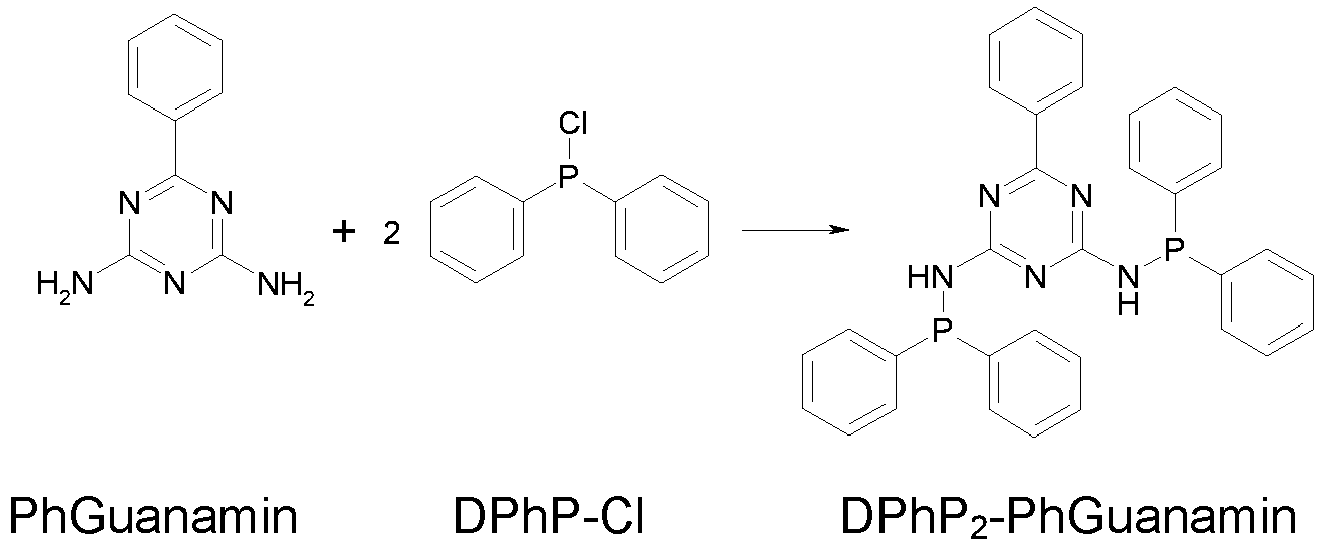
- In einen mit Argon gefüllten Dreihalskolben, der mit Rückflusskühler, Thermometer, Rührvorrichtung sowie einem Tropftrichter ausgerüstet war, wurden Phenylguanamin (2,38 g, 0,0127 mol, 1 Äqu.), 1-Methylimidazol (2,29 g, 0,0279 mol, 2,2 Äqu.) sowie 40 ml wasserfreies Toluol gefüllt und auf 80 °C erhitzt. Bei dieser Temperatur wurden unter Rühren 6,16 g (0,0279 mol, 2,2 Äqu.) Diphenylphosphinylchlorid (DPHP-Cl) langsam zugetropft. Danach wurde das nun zweiphasige Reaktionsgemisch 2 h lang bei 90 °C gerührt. Danach wurde die obere Phase unter inerten Bedingungen vom zähflüssigen Bodenkörper (1-Methylimidazoliumchlorid) dekantiert und dabei über ein Verbindungsstück in einen zweiten, ebenfalls mit Argon gefüllten Dreihalskolben übergeführt. Auf diese Weise wurde eine Lösung von DPhP2-PhGuanamin erhalten, die ohne Aufarbeitung in der zweiten Stufe eingesetzt wurde.
-

- Der Dreihalskolben mit der in Stufe 1 hergestellten Lösung von DPhP2-PhGuanamin wurde mit einem Rückflusskühler, Thermometer, Rührer sowie einem Tropftrichter ausgerüstet, der mit 6,86 g (0,0381 mol, 3 Äqu.) einer 11 %igen Lösung von H2O2 in Essigsäureethylester befüllt wurde. Dann wurde das Reaktionsgemisch mit einem Eiswasserbad auf ca. 5 °C gekühlt und das Oxidationsmittel langsam und unter kräftigem Rühren zugetropft, wobei die Temperatur bei maximal 15 °C gehalten wurde. Nach Beendigung der H2O2-Zugabe wurde das Kühlbad entfernt und das Reaktionsgemisch weitere 15 h lang gerührt. Der ausgefallene Feststoff wurde abfiltriert, mit Toluol gewaschen und danach 1,5 h lang in 50 ml siedendem Toluol gerührt. Anschließend wurde die heiße Suspension filtriert, und der Feststoff wurde erneut mit Toluol gewaschen und schließlich im Vakuum getrocknet (20 h, 150 °C). Auf diese Weise wurden 5,64 g (0,0096 mol, 75,6 % d.Th.) DPhPO2-PhGuanamin als weißer Feststoff erhalten.
- 31P-NMR (101 MHz, DMSO-d6): δ 16,1 ppm.
1H-NMR (250 MHz, DMSO-d6): δ 9,89 (d, J = 10,2 Hz, 2H, 2NH), 7,85 (m, 8H), 7,50 ppm (m, 14H), 7,15 ppm (m, 3H).
HRMS (EI) ber. für [12C33H27N5P2O2]+: 586,1562; gef.: 586,1656 [M-H]+. - Ein Epoxynovolak, D.E.N. 438 von Dow Chemicals mit einem EEW (Epoxyäquivalentgewicht) von 179 g/mol, wurde mit 0,1 Gew.-% Triethanolamin und der neuen Verbindung der Erfindung, DOPO3-Mel, als Flammschutzadditiv - in der zur Einstellung des erforderlichen Phosphorgehalts im Prüfkörper jeweils notwendigen Menge - vermischt. Das Gemisch wurde anschließend 2 h lang bei 140 °C gehalten, mittels Vakuum entgast und auf 90 °C abgekühlt. Die so hergestellte Präformulierung wurde bei 90 °C mit 6 Gewichtsteilen Dicyandiamid und 2 Gewichtsteilen Fenuron, bezogen auf 100 Gewichtsteile Epoxynovolak, vermischt. Die Aushärtung erfolgte in einem Aluminiumschälchen durch vorsichtiges Erhitzen auf 120°C innerhalb von 30 min, Halten dieser Temperatur für 1 h, Erhöhung der Temperatur auf 130 °C für 1 h und anschließendes Halten einer Temperatur von 200 °C für 2 h. Daraus wurden Probenkörper mit 70 x 13 x 4 mm geformt und zur Charakterisierung der Brandeigenschaften gemäß UL94 klassifiziert.
- Bei UL94 handelt es sich um die Prüfvorschrift der Underwriters Laboratories, die inhaltsgleich in die IEC/DIN EN 60695-11-10 und -20 übernommen wurde. Dabei wirken Zündflammen mit einer Leistung von 50 W zweimal kurzzeitig auf den Probenkörper ein, wobei bei der Vertikalprüfung die Brennzeit und das Abfallen brennender Teile mithilfe eines unterhalb des Probenkörpers angeordneten Wattebauschs bewertet werden. Die Klassifizierung erfolgt in den Stufen "V0", "V1" und "V2", die in nachstehender Tabelle 1 erläutert werden:
Tabelle 1: UL94-Klassifizierung Klassifizierung V0 V1 V2 Nachbrennzeit nach jeder Beflammung ≤ 10 s ≤ 30 s ≤ 30 s Gesamtbrenndauer je Satz (10 Beflammungen) ≤ 50 s ≤ 250 s ≤ 250 s Nachbrennzeit/Nachglühen nach der 2. Beflammung ≤ 30 s ≤ 60 s ≤ 60 s Abbrand bis zur Haltekammer nein nein nein Entzündung der Watte nein nein ja - Die Klassifizierung "V0" stellt demnach die höchste Anforderung beim Brandschutz dar und ist daher beim Einsatz von Flammschutzzusammensetzungen anzustreben. In der nachstehenden Tabelle 2 sind die Ergebnisse der Prüfung für DOPO3-Mel sowie für DOPO als Vergleichssubstanz angegeben.
Tabelle 2 Flammschutzadditiv Phosphorgehalt (Gew.-%) UL94-Klassifizierung - 0,0 nicht klassifiziert Vergl.: DOPO 1,0 nicht klassifiziert Vergl.: DOPO 1,4 V1 Vergl.: DOPO 1,6 V0 Erf.: DOPO3-Mel 1,0 V1 Erf.: DOPO3-Mel 1,4 V0 - Aus diesen Ergebnissen geht eindeutig eine verbesserte Flammschutzwirkung von DOPO3-Mel gegenüber dem handelsüblichen Additiv DOPO hervor. Somit eignet sich die neue Verbindung DOPO3-Mel sehr gut als Flammschutzmittel in Kunststoffen.
Claims (12)
- Verfahren zur Herstellung von Verbindungen der nachstehenden Formel (I)
 - der Rest R1 aus -NH2, -NH2-zAz sowie einwertigen Alkyl- und Arylresten ausgewählt ist,- die Reste A jeweils unabhängig voneinander aus den nachstehenden Phosphoryl-Resten DOPO-, DPhPO- und DPhOPO- ausgewählt sind
 - die Indizes x, y, und z jeweils unabhängig voneinander für 0 oder 1 stehen, wobei zumindest einer der Indizes ≠ 0 ist;indem in einer ersten Stufe Melamin oder, wenn R1 ein Alkyl- oder Arylrest ist, das entsprechende Alkyl- oder Arylguanamin mit einem oder mehreren der nachstehenden Phosphinylchloride DOP-Cl, DPhP-Cl und DPhOP-Cl
- Verfahren nach Anspruch 1, dadurch gekennzeichnet, dass der einwertige Alkyl- oder Arylrest von R1 aus -CH3 und -C6H5 ausgewählt ist.
- Verfahren nach Anspruch 1 oder 2, dadurch gekennzeichnet, dass als Oxidationsmittel ein Peroxid eingesetzt wird.
- Verfahren nach Anspruch 3, dadurch gekennzeichnet, dass als Oxidationsmittel Wasserstoffperoxid oder t-Butylhydroperoxid eingesetzt wird.
- Verfahren nach einem der vorangegangenen Ansprüche, dadurch gekennzeichnet, dass die erste Stufe in Gegenwart eines Säurefängers durchgeführt wird.
- Verfahren nach Anspruch 5, dadurch gekennzeichnet, dass der Säurefänger gleichzeitig als Lösungsmittel fungiert.
- Verfahren nach Anspruch 6, dadurch gekennzeichnet, dass 1-Methylimidazol als Säurefänger und Lösungsmittel eingesetzt wird.
- Verfahren nach einem der vorangegangenen Ansprüche, dadurch gekennzeichnet, dass die zweite Stufe in einem organischen Lösungsmittel, ausgewählt aus Chloroform und Toluol durchgeführt wird.
- Verfahren nach einem der vorangegangenen Ansprüche, dadurch gekennzeichnet, dass die erste Stufe bei einer Temperatur im Bereich von 100 bis 200 °C durchgeführt wird.
- Verfahren nach einem der vorangegangenen Ansprüche, dadurch gekennzeichnet, dass die zweite Stufe bei einer Temperatur im Bereich von 50 bis 100 °C durchgeführt wird.
- 2,4,6-Tris(9,10-dihydro-9-oxa-10-oxo-10-phosphaphenanthren-10-ylamino)-1,3,5-triazin (DOPO3-Mel):


- Verwendung von 2,4,6-Tris(9,10-dihydro-9-oxa-10-oxo-10-phosphaphenanthren-10-ylamino)-1,3,5-triazin als Flammschutzmittel.
Applications Claiming Priority (2)
| Application Number | Priority Date | Filing Date | Title |
|---|---|---|---|
| ATA944/2012A AT513327B1 (de) | 2012-08-29 | 2012-08-29 | Verfahren zur Herstellung von phosphorhaltigen Verbindungen |
| PCT/AT2013/050167 WO2014032070A1 (de) | 2012-08-29 | 2013-08-28 | Verfahren zur herstellung von phosphorhaltigen flammschutzmitteln |
Publications (2)
| Publication Number | Publication Date |
|---|---|
| EP2890702A1 EP2890702A1 (de) | 2015-07-08 |
| EP2890702B1 true EP2890702B1 (de) | 2016-08-24 |
Family
ID=49474164
Family Applications (1)
| Application Number | Title | Priority Date | Filing Date |
|---|---|---|---|
| EP13780050.4A Not-in-force EP2890702B1 (de) | 2012-08-29 | 2013-08-28 | Verfahren zur herstellung von phosphorhaltigen flammschutzmitteln |
Country Status (8)
| Country | Link |
|---|---|
| US (1) | US9238777B2 (de) |
| EP (1) | EP2890702B1 (de) |
| JP (1) | JP2015530999A (de) |
| KR (1) | KR20150052138A (de) |
| AT (1) | AT513327B1 (de) |
| DK (1) | DK2890702T3 (de) |
| RU (1) | RU2639161C2 (de) |
| WO (1) | WO2014032070A1 (de) |
Families Citing this family (14)
| Publication number | Priority date | Publication date | Assignee | Title |
|---|---|---|---|---|
| CN106633052B (zh) * | 2015-11-04 | 2019-06-25 | 华中师范大学 | 磷杂菲-三嗪双官能团低聚物及其制备方法与阻燃应用 |
| CN105541917B (zh) * | 2016-01-27 | 2017-10-17 | 厦门大学 | 一种磷氮协同聚酯阻燃剂及其制备方法 |
| KR102054675B1 (ko) * | 2017-06-20 | 2019-12-11 | (주)엔나노텍 | 난연성 에스테르 폴리올 및 이의 제조방법과, 상기 난연성 에스테르 폴리올을 포함하여 제조되는 폴리이소시아누레이트 |
| TWI668228B (zh) * | 2018-05-21 | 2019-08-11 | 國立中興大學 | 磷系化合物、其製備方法與阻燃固化物 |
| CN110938235B (zh) * | 2019-11-13 | 2021-09-17 | 上海力道新材料科技股份有限公司 | 含三嗪结构dopo氨基衍生物阻燃剂及其制法和应用 |
| CN110982121B (zh) * | 2019-12-05 | 2021-09-28 | 营口理工学院 | 一种三嗪基磷氮系阻燃剂及其制备方法和应用 |
| KR102477271B1 (ko) * | 2020-12-18 | 2022-12-13 | 한국신발피혁연구원 | 고인성 및 난연성을 가지는 열경화성 수지 조성물 |
| CN113025248B (zh) * | 2021-03-17 | 2021-11-23 | 东莞市德聚胶接技术有限公司 | 一种热固环氧胶及其制备方法 |
| WO2023153508A1 (ja) * | 2022-02-14 | 2023-08-17 | 三光株式会社 | 高屈折率を示す、トリアジン環を有する新規なジヒドロオキサフォスファフェナントレン誘導体及びその製造方法 |
| CN115073522B (zh) * | 2022-07-20 | 2022-11-18 | 上海沪正纳米科技有限公司 | 基于dopo基团含硅磷氮的化合物及其制备方法和用途 |
| CN116496630B (zh) * | 2023-04-12 | 2024-11-05 | 合肥恒德昌科技有限公司 | 一种水气管用阻燃型硅胶管及其制备方法 |
| CN116622144A (zh) * | 2023-05-30 | 2023-08-22 | 安徽国信电缆科技股份有限公司 | 一种城市轨道交通防鼠蚁用阻燃电力电缆的制备工艺 |
| WO2025033533A1 (ja) * | 2023-08-10 | 2025-02-13 | 三光株式会社 | 難燃剤としてのジヒドロオキサフォスファフェナントレン誘導体 |
| CN121574339B (zh) * | 2026-01-29 | 2026-04-07 | 内蒙古科技大学 | 一种具有阻燃、高强度和可回收性的透明聚氨酯材料的制备方法 |
Family Cites Families (6)
| Publication number | Priority date | Publication date | Assignee | Title |
|---|---|---|---|---|
| JPH0812692A (ja) * | 1994-06-23 | 1996-01-16 | Asahi Chem Ind Co Ltd | 新規な含窒素有機燐化合物及びその製法 |
| TW593526B (en) | 2001-09-20 | 2004-06-21 | Wangsuen Su Jen | Phosphorus group containing flame retardant hardener, advanced epoxy resins and cured epoxy resins thereof |
| DE102004042833B4 (de) * | 2004-09-04 | 2022-01-05 | Chemische Fabrik Budenheim Kg | Polyphosphatderivat einer 1,3,5-Triazonverbindung, Verfahren zu dessen Herstellung und dessen Verwendung |
| JP2007196631A (ja) * | 2006-01-30 | 2007-08-09 | Adeka Corp | 感熱記録材料 |
| CN102190814B (zh) * | 2011-03-25 | 2012-11-21 | 武汉工程大学 | 六苯基磷酸酯三聚氰胺盐阻燃剂制备方法 |
| CN102190801B (zh) | 2011-03-29 | 2012-11-21 | 湖南科技大学 | 一种以单一乳化剂制备非离子型氧化聚乙烯蜡乳液的方法 |
-
2012
- 2012-08-29 AT ATA944/2012A patent/AT513327B1/de not_active IP Right Cessation
-
2013
- 2013-08-28 RU RU2015110993A patent/RU2639161C2/ru active
- 2013-08-28 DK DK13780050.4T patent/DK2890702T3/en active
- 2013-08-28 EP EP13780050.4A patent/EP2890702B1/de not_active Not-in-force
- 2013-08-28 WO PCT/AT2013/050167 patent/WO2014032070A1/de not_active Ceased
- 2013-08-28 KR KR1020157007873A patent/KR20150052138A/ko not_active Withdrawn
- 2013-08-28 JP JP2015528803A patent/JP2015530999A/ja active Pending
-
2015
- 2015-02-27 US US14/633,156 patent/US9238777B2/en not_active Expired - Fee Related
Also Published As
| Publication number | Publication date |
|---|---|
| AT513327A1 (de) | 2014-03-15 |
| RU2015110993A (ru) | 2016-10-20 |
| EP2890702A1 (de) | 2015-07-08 |
| AT513327B1 (de) | 2014-06-15 |
| WO2014032070A1 (de) | 2014-03-06 |
| US9238777B2 (en) | 2016-01-19 |
| RU2639161C2 (ru) | 2017-12-20 |
| US20150203759A1 (en) | 2015-07-23 |
| KR20150052138A (ko) | 2015-05-13 |
| JP2015530999A (ja) | 2015-10-29 |
| DK2890702T3 (en) | 2016-12-19 |
Similar Documents
| Publication | Publication Date | Title |
|---|---|---|
| AT513327B1 (de) | Verfahren zur Herstellung von phosphorhaltigen Verbindungen | |
| EP1797105B1 (de) | Phosphor-haltige heptazinderivate, verfahren zu deren herstellung und deren verwendung als flammschutzmittel | |
| EP2449019B1 (de) | Neue derivate von 9,10-dihydro-9-oxa-10-phosphaphenanthren-10-on | |
| EP0929559A1 (de) | Verfahren zur herstellung von aluminium-dialkylphosphinaten | |
| EP2256122A1 (de) | Halogenfreie Derivate des Triazins und Heptazins | |
| EP2699582B1 (de) | Ammoniumsalze von dopo-oh | |
| EP0412936B1 (de) | Phosphorverbindungen | |
| CH696542A5 (de) | Verfahren zur Herstellung von substituierten 2,6-Dioxopiperidin-3-yl-Verbindungen. | |
| EP2773699B1 (de) | Flammhemmend modifizierte novolake | |
| EP0456605A1 (de) | Phosphorverbindungen | |
| DE1595894A1 (de) | Neue 1,5-Diazabicyclo[3,3,0]octan-2,6-dione | |
| AT508468B1 (de) | Derivate von 9,10-dihydro-9-oxa-10-phosphaphenanthren-10-on bzw. -10-oxid | |
| DE3027623A1 (de) | Neue glycidyl-1,2,4-triazolidin-3,5-dione und ein verfahren zu ihrer herstellung | |
| DE102023000325B3 (de) | Thiazolverbindungen als Flammschutzmittel, enthaltend Phosphor, Stickstoff und Schwefel und ihre Verwendung | |
| DE1695117A1 (de) | Verfahren zur Herstellung von Chloramino-s-triazinen | |
| AT509659B1 (de) | Derivate von 9,10-dihydro-9-oxa-10-phosphaphenanthren-10-on bzw. -10-oxid | |
| DE3411202C2 (de) | Verfahren zur Herstellung von 2-Amino-s-triazinen | |
| DE2308560C3 (de) | Verfahren zur Herstellung N-substituierter 2,4-Bis-alkenyloxy-6-amino-s-triazine | |
| DE2760278C2 (de) | ||
| DE2027635C3 (de) | Polysulfide von 2-Amino-4,6bisthlo-s-triazinen und deren Herstellung | |
| EP0060425B1 (de) | Glykolurilsalze und Verfahren zu deren Herstellung | |
| EP0492254A1 (de) | N-tert.-Butoxycarbonyl-maleinimid | |
| DD154820A1 (de) | Verfahren zur herstellung von aminodiaroxy-s-triazinen | |
| DE2431862A1 (de) | Tetrahydro-s-triaziniumsalze | |
| DE1805810A1 (de) | Triazinyl-phosphonester und Verfahren zu ihrer Herstellung |
Legal Events
| Date | Code | Title | Description |
|---|---|---|---|
| PUAI | Public reference made under article 153(3) epc to a published international application that has entered the european phase |
Free format text: ORIGINAL CODE: 0009012 |
|
| 17P | Request for examination filed |
Effective date: 20150302 |
|
| AK | Designated contracting states |
Kind code of ref document: A1 Designated state(s): AL AT BE BG CH CY CZ DE DK EE ES FI FR GB GR HR HU IE IS IT LI LT LU LV MC MK MT NL NO PL PT RO RS SE SI SK SM TR |
|
| AX | Request for extension of the european patent |
Extension state: BA ME |
|
| DAX | Request for extension of the european patent (deleted) | ||
| GRAP | Despatch of communication of intention to grant a patent |
Free format text: ORIGINAL CODE: EPIDOSNIGR1 |
|
| INTG | Intention to grant announced |
Effective date: 20160317 |
|
| GRAS | Grant fee paid |
Free format text: ORIGINAL CODE: EPIDOSNIGR3 |
|
| GRAA | (expected) grant |
Free format text: ORIGINAL CODE: 0009210 |
|
| AK | Designated contracting states |
Kind code of ref document: B1 Designated state(s): AL AT BE BG CH CY CZ DE DK EE ES FI FR GB GR HR HU IE IS IT LI LT LU LV MC MK MT NL NO PL PT RO RS SE SI SK SM TR |
|
| REG | Reference to a national code |
Ref country code: GB Ref legal event code: FG4D Free format text: NOT ENGLISH |
|
| REG | Reference to a national code |
Ref country code: CH Ref legal event code: EP |
|
| REG | Reference to a national code |
Ref country code: FR Ref legal event code: PLFP Year of fee payment: 4 |
|
| REG | Reference to a national code |
Ref country code: AT Ref legal event code: REF Ref document number: 822990 Country of ref document: AT Kind code of ref document: T Effective date: 20160915 |
|
| REG | Reference to a national code |
Ref country code: IE Ref legal event code: FG4D Free format text: LANGUAGE OF EP DOCUMENT: GERMAN |
|
| REG | Reference to a national code |
Ref country code: DE Ref legal event code: R096 Ref document number: 502013004220 Country of ref document: DE |
|
| REG | Reference to a national code |
Ref country code: CH Ref legal event code: NV Representative=s name: KASCHE AND PARTNER AG, CH Ref country code: NL Ref legal event code: FP |
|
| REG | Reference to a national code |
Ref country code: SE Ref legal event code: TRGR |
|
| REG | Reference to a national code |
Ref country code: DK Ref legal event code: T3 Effective date: 20161216 |
|
| REG | Reference to a national code |
Ref country code: LT Ref legal event code: MG4D |
|
| REG | Reference to a national code |
Ref country code: NO Ref legal event code: T2 Effective date: 20160824 |
|
| PG25 | Lapsed in a contracting state [announced via postgrant information from national office to epo] |
Ref country code: RS Free format text: LAPSE BECAUSE OF FAILURE TO SUBMIT A TRANSLATION OF THE DESCRIPTION OR TO PAY THE FEE WITHIN THE PRESCRIBED TIME-LIMIT Effective date: 20160824 Ref country code: LT Free format text: LAPSE BECAUSE OF FAILURE TO SUBMIT A TRANSLATION OF THE DESCRIPTION OR TO PAY THE FEE WITHIN THE PRESCRIBED TIME-LIMIT Effective date: 20160824 Ref country code: HR Free format text: LAPSE BECAUSE OF FAILURE TO SUBMIT A TRANSLATION OF THE DESCRIPTION OR TO PAY THE FEE WITHIN THE PRESCRIBED TIME-LIMIT Effective date: 20160824 |
|
| PG25 | Lapsed in a contracting state [announced via postgrant information from national office to epo] |
Ref country code: PT Free format text: LAPSE BECAUSE OF FAILURE TO SUBMIT A TRANSLATION OF THE DESCRIPTION OR TO PAY THE FEE WITHIN THE PRESCRIBED TIME-LIMIT Effective date: 20161226 Ref country code: LV Free format text: LAPSE BECAUSE OF FAILURE TO SUBMIT A TRANSLATION OF THE DESCRIPTION OR TO PAY THE FEE WITHIN THE PRESCRIBED TIME-LIMIT Effective date: 20160824 Ref country code: ES Free format text: LAPSE BECAUSE OF FAILURE TO SUBMIT A TRANSLATION OF THE DESCRIPTION OR TO PAY THE FEE WITHIN THE PRESCRIBED TIME-LIMIT Effective date: 20160824 Ref country code: GR Free format text: LAPSE BECAUSE OF FAILURE TO SUBMIT A TRANSLATION OF THE DESCRIPTION OR TO PAY THE FEE WITHIN THE PRESCRIBED TIME-LIMIT Effective date: 20161125 |
|
| PG25 | Lapsed in a contracting state [announced via postgrant information from national office to epo] |
Ref country code: EE Free format text: LAPSE BECAUSE OF FAILURE TO SUBMIT A TRANSLATION OF THE DESCRIPTION OR TO PAY THE FEE WITHIN THE PRESCRIBED TIME-LIMIT Effective date: 20160824 Ref country code: RO Free format text: LAPSE BECAUSE OF FAILURE TO SUBMIT A TRANSLATION OF THE DESCRIPTION OR TO PAY THE FEE WITHIN THE PRESCRIBED TIME-LIMIT Effective date: 20160824 |
|
| REG | Reference to a national code |
Ref country code: DE Ref legal event code: R097 Ref document number: 502013004220 Country of ref document: DE |
|
| PG25 | Lapsed in a contracting state [announced via postgrant information from national office to epo] |
Ref country code: CZ Free format text: LAPSE BECAUSE OF FAILURE TO SUBMIT A TRANSLATION OF THE DESCRIPTION OR TO PAY THE FEE WITHIN THE PRESCRIBED TIME-LIMIT Effective date: 20160824 Ref country code: PL Free format text: LAPSE BECAUSE OF FAILURE TO SUBMIT A TRANSLATION OF THE DESCRIPTION OR TO PAY THE FEE WITHIN THE PRESCRIBED TIME-LIMIT Effective date: 20160824 Ref country code: SK Free format text: LAPSE BECAUSE OF FAILURE TO SUBMIT A TRANSLATION OF THE DESCRIPTION OR TO PAY THE FEE WITHIN THE PRESCRIBED TIME-LIMIT Effective date: 20160824 Ref country code: BG Free format text: LAPSE BECAUSE OF FAILURE TO SUBMIT A TRANSLATION OF THE DESCRIPTION OR TO PAY THE FEE WITHIN THE PRESCRIBED TIME-LIMIT Effective date: 20161124 Ref country code: SM Free format text: LAPSE BECAUSE OF FAILURE TO SUBMIT A TRANSLATION OF THE DESCRIPTION OR TO PAY THE FEE WITHIN THE PRESCRIBED TIME-LIMIT Effective date: 20160824 |
|
| REG | Reference to a national code |
Ref country code: IE Ref legal event code: MM4A |
|
| PG25 | Lapsed in a contracting state [announced via postgrant information from national office to epo] |
Ref country code: MC Free format text: LAPSE BECAUSE OF FAILURE TO SUBMIT A TRANSLATION OF THE DESCRIPTION OR TO PAY THE FEE WITHIN THE PRESCRIBED TIME-LIMIT Effective date: 20160824 |
|
| PLBE | No opposition filed within time limit |
Free format text: ORIGINAL CODE: 0009261 |
|
| STAA | Information on the status of an ep patent application or granted ep patent |
Free format text: STATUS: NO OPPOSITION FILED WITHIN TIME LIMIT |
|
| PG25 | Lapsed in a contracting state [announced via postgrant information from national office to epo] |
Ref country code: IE Free format text: LAPSE BECAUSE OF NON-PAYMENT OF DUE FEES Effective date: 20160828 |
|
| 26N | No opposition filed |
Effective date: 20170526 |
|
| REG | Reference to a national code |
Ref country code: FR Ref legal event code: PLFP Year of fee payment: 5 |
|
| PG25 | Lapsed in a contracting state [announced via postgrant information from national office to epo] |
Ref country code: SI Free format text: LAPSE BECAUSE OF FAILURE TO SUBMIT A TRANSLATION OF THE DESCRIPTION OR TO PAY THE FEE WITHIN THE PRESCRIBED TIME-LIMIT Effective date: 20160824 Ref country code: LU Free format text: LAPSE BECAUSE OF NON-PAYMENT OF DUE FEES Effective date: 20160828 |
|
| PG25 | Lapsed in a contracting state [announced via postgrant information from national office to epo] |
Ref country code: HU Free format text: LAPSE BECAUSE OF FAILURE TO SUBMIT A TRANSLATION OF THE DESCRIPTION OR TO PAY THE FEE WITHIN THE PRESCRIBED TIME-LIMIT; INVALID AB INITIO Effective date: 20130828 |
|
| PG25 | Lapsed in a contracting state [announced via postgrant information from national office to epo] |
Ref country code: CY Free format text: LAPSE BECAUSE OF FAILURE TO SUBMIT A TRANSLATION OF THE DESCRIPTION OR TO PAY THE FEE WITHIN THE PRESCRIBED TIME-LIMIT Effective date: 20160824 Ref country code: MT Free format text: LAPSE BECAUSE OF FAILURE TO SUBMIT A TRANSLATION OF THE DESCRIPTION OR TO PAY THE FEE WITHIN THE PRESCRIBED TIME-LIMIT Effective date: 20160824 Ref country code: IS Free format text: LAPSE BECAUSE OF FAILURE TO SUBMIT A TRANSLATION OF THE DESCRIPTION OR TO PAY THE FEE WITHIN THE PRESCRIBED TIME-LIMIT Effective date: 20160824 Ref country code: MK Free format text: LAPSE BECAUSE OF FAILURE TO SUBMIT A TRANSLATION OF THE DESCRIPTION OR TO PAY THE FEE WITHIN THE PRESCRIBED TIME-LIMIT Effective date: 20160824 |
|
| REG | Reference to a national code |
Ref country code: FR Ref legal event code: PLFP Year of fee payment: 6 |
|
| PG25 | Lapsed in a contracting state [announced via postgrant information from national office to epo] |
Ref country code: AL Free format text: LAPSE BECAUSE OF FAILURE TO SUBMIT A TRANSLATION OF THE DESCRIPTION OR TO PAY THE FEE WITHIN THE PRESCRIBED TIME-LIMIT Effective date: 20160824 Ref country code: TR Free format text: LAPSE BECAUSE OF FAILURE TO SUBMIT A TRANSLATION OF THE DESCRIPTION OR TO PAY THE FEE WITHIN THE PRESCRIBED TIME-LIMIT Effective date: 20160824 |
|
| PGFP | Annual fee paid to national office [announced via postgrant information from national office to epo] |
Ref country code: NO Payment date: 20200821 Year of fee payment: 8 Ref country code: FI Payment date: 20200820 Year of fee payment: 8 Ref country code: GB Payment date: 20200826 Year of fee payment: 8 Ref country code: NL Payment date: 20200826 Year of fee payment: 8 Ref country code: DK Payment date: 20200821 Year of fee payment: 8 |
|
| PGFP | Annual fee paid to national office [announced via postgrant information from national office to epo] |
Ref country code: SE Payment date: 20200826 Year of fee payment: 8 Ref country code: IT Payment date: 20200826 Year of fee payment: 8 Ref country code: CH Payment date: 20200819 Year of fee payment: 8 Ref country code: BE Payment date: 20200826 Year of fee payment: 8 |
|
| PGFP | Annual fee paid to national office [announced via postgrant information from national office to epo] |
Ref country code: FR Payment date: 20210819 Year of fee payment: 9 Ref country code: AT Payment date: 20210820 Year of fee payment: 9 |
|
| PGFP | Annual fee paid to national office [announced via postgrant information from national office to epo] |
Ref country code: DE Payment date: 20210819 Year of fee payment: 9 |
|
| REG | Reference to a national code |
Ref country code: DK Ref legal event code: EBP Effective date: 20210831 |
|
| REG | Reference to a national code |
Ref country code: FI Ref legal event code: MAE |
|
| REG | Reference to a national code |
Ref country code: NO Ref legal event code: MMEP |
|
| REG | Reference to a national code |
Ref country code: SE Ref legal event code: EUG |
|
| REG | Reference to a national code |
Ref country code: CH Ref legal event code: PL |
|
| REG | Reference to a national code |
Ref country code: NL Ref legal event code: MM Effective date: 20210901 |
|
| REG | Reference to a national code |
Ref country code: BE Ref legal event code: MM Effective date: 20210831 |
|
| GBPC | Gb: european patent ceased through non-payment of renewal fee |
Effective date: 20210828 |
|
| PG25 | Lapsed in a contracting state [announced via postgrant information from national office to epo] |
Ref country code: LI Free format text: LAPSE BECAUSE OF NON-PAYMENT OF DUE FEES Effective date: 20210831 Ref country code: FI Free format text: LAPSE BECAUSE OF NON-PAYMENT OF DUE FEES Effective date: 20210828 Ref country code: CH Free format text: LAPSE BECAUSE OF NON-PAYMENT OF DUE FEES Effective date: 20210831 |
|
| PG25 | Lapsed in a contracting state [announced via postgrant information from national office to epo] |
Ref country code: SE Free format text: LAPSE BECAUSE OF NON-PAYMENT OF DUE FEES Effective date: 20210829 Ref country code: NO Free format text: LAPSE BECAUSE OF NON-PAYMENT OF DUE FEES Effective date: 20210831 |
|
| PG25 | Lapsed in a contracting state [announced via postgrant information from national office to epo] |
Ref country code: NL Free format text: LAPSE BECAUSE OF NON-PAYMENT OF DUE FEES Effective date: 20210901 |
|
| PG25 | Lapsed in a contracting state [announced via postgrant information from national office to epo] |
Ref country code: IT Free format text: LAPSE BECAUSE OF NON-PAYMENT OF DUE FEES Effective date: 20210828 Ref country code: GB Free format text: LAPSE BECAUSE OF NON-PAYMENT OF DUE FEES Effective date: 20210828 Ref country code: DK Free format text: LAPSE BECAUSE OF NON-PAYMENT OF DUE FEES Effective date: 20210831 Ref country code: BE Free format text: LAPSE BECAUSE OF NON-PAYMENT OF DUE FEES Effective date: 20210831 |
|
| REG | Reference to a national code |
Ref country code: DE Ref legal event code: R119 Ref document number: 502013004220 Country of ref document: DE |
|
| REG | Reference to a national code |
Ref country code: AT Ref legal event code: MM01 Ref document number: 822990 Country of ref document: AT Kind code of ref document: T Effective date: 20220828 |
|
| PG25 | Lapsed in a contracting state [announced via postgrant information from national office to epo] |
Ref country code: AT Free format text: LAPSE BECAUSE OF NON-PAYMENT OF DUE FEES Effective date: 20220828 |
|
| P01 | Opt-out of the competence of the unified patent court (upc) registered |
Effective date: 20230514 |
|
| PG25 | Lapsed in a contracting state [announced via postgrant information from national office to epo] |
Ref country code: FR Free format text: LAPSE BECAUSE OF NON-PAYMENT OF DUE FEES Effective date: 20220831 Ref country code: DE Free format text: LAPSE BECAUSE OF NON-PAYMENT OF DUE FEES Effective date: 20230301 |