EP2831021B1 - Improved controllability oxidative dehydrogenation process for producing butadiene - Google Patents
Improved controllability oxidative dehydrogenation process for producing butadiene Download PDFInfo
- Publication number
- EP2831021B1 EP2831021B1 EP13768548.3A EP13768548A EP2831021B1 EP 2831021 B1 EP2831021 B1 EP 2831021B1 EP 13768548 A EP13768548 A EP 13768548A EP 2831021 B1 EP2831021 B1 EP 2831021B1
- Authority
- EP
- European Patent Office
- Prior art keywords
- catalyst
- oxidative dehydrogenation
- feed
- butadiene
- bed
- Prior art date
- Legal status (The legal status is an assumption and is not a legal conclusion. Google has not performed a legal analysis and makes no representation as to the accuracy of the status listed.)
- Active
Links
- KAKZBPTYRLMSJV-UHFFFAOYSA-N Butadiene Chemical compound C=CC=C KAKZBPTYRLMSJV-UHFFFAOYSA-N 0.000 title claims description 206
- 238000005839 oxidative dehydrogenation reaction Methods 0.000 title claims description 107
- 238000000034 method Methods 0.000 title description 58
- 230000008569 process Effects 0.000 title description 49
- 239000003054 catalyst Substances 0.000 claims description 232
- VXNZUUAINFGPBY-UHFFFAOYSA-N 1-Butene Chemical compound CCC=C VXNZUUAINFGPBY-UHFFFAOYSA-N 0.000 claims description 89
- IAQRGUVFOMOMEM-UHFFFAOYSA-N butene Natural products CC=CC IAQRGUVFOMOMEM-UHFFFAOYSA-N 0.000 claims description 88
- QVGXLLKOCUKJST-UHFFFAOYSA-N atomic oxygen Chemical compound [O] QVGXLLKOCUKJST-UHFFFAOYSA-N 0.000 claims description 74
- 239000001301 oxygen Substances 0.000 claims description 74
- 229910052760 oxygen Inorganic materials 0.000 claims description 74
- 238000006243 chemical reaction Methods 0.000 claims description 67
- 238000004519 manufacturing process Methods 0.000 claims description 39
- 239000002245 particle Substances 0.000 claims description 34
- 239000007789 gas Substances 0.000 claims description 31
- 239000008187 granular material Substances 0.000 claims description 16
- 230000008016 vaporization Effects 0.000 claims description 16
- XEEYBQQBJWHFJM-UHFFFAOYSA-N Iron Chemical compound [Fe] XEEYBQQBJWHFJM-UHFFFAOYSA-N 0.000 claims description 12
- 238000002156 mixing Methods 0.000 claims description 11
- 238000011068 loading method Methods 0.000 claims description 9
- 238000012544 monitoring process Methods 0.000 claims description 9
- 238000010438 heat treatment Methods 0.000 claims description 7
- 239000002243 precursor Substances 0.000 claims description 7
- OYPRJOBELJOOCE-UHFFFAOYSA-N Calcium Chemical compound [Ca] OYPRJOBELJOOCE-UHFFFAOYSA-N 0.000 claims description 6
- 229910052791 calcium Inorganic materials 0.000 claims description 6
- 239000011575 calcium Substances 0.000 claims description 6
- 230000004044 response Effects 0.000 claims description 6
- PWHULOQIROXLJO-UHFFFAOYSA-N Manganese Chemical compound [Mn] PWHULOQIROXLJO-UHFFFAOYSA-N 0.000 claims description 5
- 229910052742 iron Inorganic materials 0.000 claims description 5
- 229910052748 manganese Inorganic materials 0.000 claims description 5
- 239000011572 manganese Substances 0.000 claims description 5
- 229910002651 NO3 Inorganic materials 0.000 claims description 4
- NHNBFGGVMKEFGY-UHFFFAOYSA-N Nitrate Chemical compound [O-][N+]([O-])=O NHNBFGGVMKEFGY-UHFFFAOYSA-N 0.000 claims description 4
- OAICVXFJPJFONN-UHFFFAOYSA-N Phosphorus Chemical compound [P] OAICVXFJPJFONN-UHFFFAOYSA-N 0.000 claims description 4
- HCHKCACWOHOZIP-UHFFFAOYSA-N Zinc Chemical compound [Zn] HCHKCACWOHOZIP-UHFFFAOYSA-N 0.000 claims description 4
- 229910052698 phosphorus Inorganic materials 0.000 claims description 4
- 239000011574 phosphorus Substances 0.000 claims description 4
- 229910052725 zinc Inorganic materials 0.000 claims description 4
- 239000011701 zinc Substances 0.000 claims description 4
- 239000012535 impurity Substances 0.000 claims description 3
- 239000000047 product Substances 0.000 description 38
- 150000001299 aldehydes Chemical class 0.000 description 36
- 239000003921 oil Substances 0.000 description 34
- 229930195733 hydrocarbon Natural products 0.000 description 30
- 150000002430 hydrocarbons Chemical class 0.000 description 30
- 239000000203 mixture Substances 0.000 description 25
- 239000006096 absorbing agent Substances 0.000 description 24
- 238000010791 quenching Methods 0.000 description 20
- 239000006200 vaporizer Substances 0.000 description 20
- 239000004215 Carbon black (E152) Substances 0.000 description 16
- 238000006356 dehydrogenation reaction Methods 0.000 description 13
- 229910052751 metal Inorganic materials 0.000 description 12
- 239000002184 metal Substances 0.000 description 12
- VNWKTOKETHGBQD-UHFFFAOYSA-N methane Chemical compound C VNWKTOKETHGBQD-UHFFFAOYSA-N 0.000 description 12
- 239000007795 chemical reaction product Substances 0.000 description 11
- 239000007800 oxidant agent Substances 0.000 description 11
- 239000007788 liquid Substances 0.000 description 10
- 238000007254 oxidation reaction Methods 0.000 description 10
- 239000002904 solvent Substances 0.000 description 10
- PNEYBMLMFCGWSK-UHFFFAOYSA-N Alumina Chemical compound [O-2].[O-2].[O-2].[Al+3].[Al+3] PNEYBMLMFCGWSK-UHFFFAOYSA-N 0.000 description 9
- 230000008859 change Effects 0.000 description 9
- 230000003647 oxidation Effects 0.000 description 9
- XLYOFNOQVPJJNP-UHFFFAOYSA-N water Substances O XLYOFNOQVPJJNP-UHFFFAOYSA-N 0.000 description 9
- HSFWRNGVRCDJHI-UHFFFAOYSA-N Acetylene Chemical compound C#C HSFWRNGVRCDJHI-UHFFFAOYSA-N 0.000 description 8
- 125000000383 tetramethylene group Chemical group [H]C([H])([*:1])C([H])([H])C([H])([H])C([H])([H])[*:2] 0.000 description 8
- 238000010521 absorption reaction Methods 0.000 description 7
- 150000001345 alkine derivatives Chemical class 0.000 description 7
- 238000009826 distribution Methods 0.000 description 7
- 238000012856 packing Methods 0.000 description 7
- 239000012071 phase Substances 0.000 description 7
- 238000012545 processing Methods 0.000 description 7
- UHOVQNZJYSORNB-UHFFFAOYSA-N Benzene Chemical compound C1=CC=CC=C1 UHOVQNZJYSORNB-UHFFFAOYSA-N 0.000 description 6
- YXFVVABEGXRONW-UHFFFAOYSA-N Toluene Chemical compound CC1=CC=CC=C1 YXFVVABEGXRONW-UHFFFAOYSA-N 0.000 description 6
- 239000006227 byproduct Substances 0.000 description 6
- 229910044991 metal oxide Inorganic materials 0.000 description 6
- 150000002739 metals Chemical class 0.000 description 6
- 239000003345 natural gas Substances 0.000 description 6
- 238000000746 purification Methods 0.000 description 6
- 125000004432 carbon atom Chemical group C* 0.000 description 5
- 238000002485 combustion reaction Methods 0.000 description 5
- 238000010586 diagram Methods 0.000 description 5
- 150000001993 dienes Chemical class 0.000 description 5
- AMWRITDGCCNYAT-UHFFFAOYSA-L manganese oxide Inorganic materials [Mn].O[Mn]=O.O[Mn]=O AMWRITDGCCNYAT-UHFFFAOYSA-L 0.000 description 5
- 150000004706 metal oxides Chemical class 0.000 description 5
- 239000011541 reaction mixture Substances 0.000 description 5
- 238000012546 transfer Methods 0.000 description 5
- CURLTUGMZLYLDI-UHFFFAOYSA-N Carbon dioxide Chemical compound O=C=O CURLTUGMZLYLDI-UHFFFAOYSA-N 0.000 description 4
- UFWIBTONFRDIAS-UHFFFAOYSA-N Naphthalene Chemical compound C1=CC=CC2=CC=CC=C21 UFWIBTONFRDIAS-UHFFFAOYSA-N 0.000 description 4
- PPBRXRYQALVLMV-UHFFFAOYSA-N Styrene Chemical compound C=CC1=CC=CC=C1 PPBRXRYQALVLMV-UHFFFAOYSA-N 0.000 description 4
- 238000009835 boiling Methods 0.000 description 4
- 230000005465 channeling Effects 0.000 description 4
- 238000004939 coking Methods 0.000 description 4
- 238000001816 cooling Methods 0.000 description 4
- 230000001627 detrimental effect Effects 0.000 description 4
- IIEWJVIFRVWJOD-UHFFFAOYSA-N ethylcyclohexane Chemical compound CCC1CCCCC1 IIEWJVIFRVWJOD-UHFFFAOYSA-N 0.000 description 4
- 125000002534 ethynyl group Chemical group [H]C#C* 0.000 description 4
- 238000000895 extractive distillation Methods 0.000 description 4
- SZVJSHCCFOBDDC-UHFFFAOYSA-N ferrosoferric oxide Chemical compound O=[Fe]O[Fe]O[Fe]=O SZVJSHCCFOBDDC-UHFFFAOYSA-N 0.000 description 4
- 239000007791 liquid phase Substances 0.000 description 4
- UAEPNZWRGJTJPN-UHFFFAOYSA-N methylcyclohexane Chemical compound CC1CCCCC1 UAEPNZWRGJTJPN-UHFFFAOYSA-N 0.000 description 4
- ODLMAHJVESYWTB-UHFFFAOYSA-N propylbenzene Chemical compound CCCC1=CC=CC=C1 ODLMAHJVESYWTB-UHFFFAOYSA-N 0.000 description 4
- 239000000376 reactant Substances 0.000 description 4
- 238000010992 reflux Methods 0.000 description 4
- 229930195735 unsaturated hydrocarbon Natural products 0.000 description 4
- 229910000859 α-Fe Inorganic materials 0.000 description 4
- FYYHWMGAXLPEAU-UHFFFAOYSA-N Magnesium Chemical compound [Mg] FYYHWMGAXLPEAU-UHFFFAOYSA-N 0.000 description 3
- 150000001336 alkenes Chemical class 0.000 description 3
- 230000003466 anti-cipated effect Effects 0.000 description 3
- 239000003795 chemical substances by application Substances 0.000 description 3
- 150000001875 compounds Chemical class 0.000 description 3
- 230000010354 integration Effects 0.000 description 3
- UQSXHKLRYXJYBZ-UHFFFAOYSA-N iron oxide Inorganic materials [Fe]=O UQSXHKLRYXJYBZ-UHFFFAOYSA-N 0.000 description 3
- 150000002576 ketones Chemical class 0.000 description 3
- 229910052749 magnesium Inorganic materials 0.000 description 3
- 239000011777 magnesium Substances 0.000 description 3
- 239000000463 material Substances 0.000 description 3
- 150000005673 monoalkenes Chemical class 0.000 description 3
- JRZJOMJEPLMPRA-UHFFFAOYSA-N olefin Natural products CCCCCCCC=C JRZJOMJEPLMPRA-UHFFFAOYSA-N 0.000 description 3
- 238000005191 phase separation Methods 0.000 description 3
- 238000006116 polymerization reaction Methods 0.000 description 3
- 238000002360 preparation method Methods 0.000 description 3
- MWWATHDPGQKSAR-UHFFFAOYSA-N propyne Chemical group CC#C MWWATHDPGQKSAR-UHFFFAOYSA-N 0.000 description 3
- 238000000926 separation method Methods 0.000 description 3
- IJGRMHOSHXDMSA-UHFFFAOYSA-N Atomic nitrogen Chemical compound N#N IJGRMHOSHXDMSA-UHFFFAOYSA-N 0.000 description 2
- VTYYLEPIZMXCLO-UHFFFAOYSA-L Calcium carbonate Chemical compound [Ca+2].[O-]C([O-])=O VTYYLEPIZMXCLO-UHFFFAOYSA-L 0.000 description 2
- QPLDLSVMHZLSFG-UHFFFAOYSA-N Copper oxide Chemical compound [Cu]=O QPLDLSVMHZLSFG-UHFFFAOYSA-N 0.000 description 2
- XDTMQSROBMDMFD-UHFFFAOYSA-N Cyclohexane Chemical compound C1CCCCC1 XDTMQSROBMDMFD-UHFFFAOYSA-N 0.000 description 2
- MYMOFIZGZYHOMD-UHFFFAOYSA-N Dioxygen Chemical compound O=O MYMOFIZGZYHOMD-UHFFFAOYSA-N 0.000 description 2
- NHTMVDHEPJAVLT-UHFFFAOYSA-N Isooctane Chemical compound CC(C)CC(C)(C)C NHTMVDHEPJAVLT-UHFFFAOYSA-N 0.000 description 2
- CTQNGGLPUBDAKN-UHFFFAOYSA-N O-Xylene Chemical group CC1=CC=CC=C1C CTQNGGLPUBDAKN-UHFFFAOYSA-N 0.000 description 2
- URLKBWYHVLBVBO-UHFFFAOYSA-N Para-Xylene Chemical group CC1=CC=C(C)C=C1 URLKBWYHVLBVBO-UHFFFAOYSA-N 0.000 description 2
- NBIIXXVUZAFLBC-UHFFFAOYSA-N Phosphoric acid Chemical compound OP(O)(O)=O NBIIXXVUZAFLBC-UHFFFAOYSA-N 0.000 description 2
- 229910001308 Zinc ferrite Inorganic materials 0.000 description 2
- XLOMVQKBTHCTTD-UHFFFAOYSA-N Zinc monoxide Chemical compound [Zn]=O XLOMVQKBTHCTTD-UHFFFAOYSA-N 0.000 description 2
- IYABWNGZIDDRAK-UHFFFAOYSA-N allene Chemical compound C=C=C IYABWNGZIDDRAK-UHFFFAOYSA-N 0.000 description 2
- 239000008346 aqueous phase Substances 0.000 description 2
- 239000011324 bead Substances 0.000 description 2
- OCKPCBLVNKHBMX-UHFFFAOYSA-N butylbenzene Chemical compound CCCCC1=CC=CC=C1 OCKPCBLVNKHBMX-UHFFFAOYSA-N 0.000 description 2
- VSGNNIFQASZAOI-UHFFFAOYSA-L calcium acetate Chemical compound [Ca+2].CC([O-])=O.CC([O-])=O VSGNNIFQASZAOI-UHFFFAOYSA-L 0.000 description 2
- 239000001639 calcium acetate Substances 0.000 description 2
- 229960005147 calcium acetate Drugs 0.000 description 2
- 235000011092 calcium acetate Nutrition 0.000 description 2
- 229910002092 carbon dioxide Inorganic materials 0.000 description 2
- 239000001569 carbon dioxide Substances 0.000 description 2
- 150000001728 carbonyl compounds Chemical class 0.000 description 2
- 230000003197 catalytic effect Effects 0.000 description 2
- 230000007423 decrease Effects 0.000 description 2
- LDLDYFCCDKENPD-UHFFFAOYSA-N ethenylcyclohexane Chemical compound C=CC1CCCCC1 LDLDYFCCDKENPD-UHFFFAOYSA-N 0.000 description 2
- 239000002803 fossil fuel Substances 0.000 description 2
- 238000005194 fractionation Methods 0.000 description 2
- 239000012634 fragment Substances 0.000 description 2
- 239000000446 fuel Substances 0.000 description 2
- 230000005484 gravity Effects 0.000 description 2
- 229910052739 hydrogen Inorganic materials 0.000 description 2
- 239000001257 hydrogen Substances 0.000 description 2
- 150000002431 hydrogen Chemical class 0.000 description 2
- XLYOFNOQVPJJNP-UHFFFAOYSA-M hydroxide Chemical compound [OH-] XLYOFNOQVPJJNP-UHFFFAOYSA-M 0.000 description 2
- 235000013980 iron oxide Nutrition 0.000 description 2
- MRELNEQAGSRDBK-UHFFFAOYSA-N lanthanum(3+);oxygen(2-) Chemical compound [O-2].[O-2].[O-2].[La+3].[La+3] MRELNEQAGSRDBK-UHFFFAOYSA-N 0.000 description 2
- 230000014759 maintenance of location Effects 0.000 description 2
- GYNNXHKOJHMOHS-UHFFFAOYSA-N methyl-cycloheptane Natural products CC1CCCCCC1 GYNNXHKOJHMOHS-UHFFFAOYSA-N 0.000 description 2
- 238000013508 migration Methods 0.000 description 2
- 230000005012 migration Effects 0.000 description 2
- 150000002894 organic compounds Chemical class 0.000 description 2
- 230000001590 oxidative effect Effects 0.000 description 2
- BASFCYQUMIYNBI-UHFFFAOYSA-N platinum Chemical compound [Pt] BASFCYQUMIYNBI-UHFFFAOYSA-N 0.000 description 2
- QQONPFPTGQHPMA-UHFFFAOYSA-N propylene Natural products CC=C QQONPFPTGQHPMA-UHFFFAOYSA-N 0.000 description 2
- 125000004805 propylene group Chemical group [H]C([H])([H])C([H])([*:1])C([H])([H])[*:2] 0.000 description 2
- 238000011084 recovery Methods 0.000 description 2
- 230000009467 reduction Effects 0.000 description 2
- 230000000717 retained effect Effects 0.000 description 2
- 238000005201 scrubbing Methods 0.000 description 2
- NDVLTYZPCACLMA-UHFFFAOYSA-N silver oxide Chemical compound [O-2].[Ag+].[Ag+] NDVLTYZPCACLMA-UHFFFAOYSA-N 0.000 description 2
- 229910052720 vanadium Inorganic materials 0.000 description 2
- GPPXJZIENCGNKB-UHFFFAOYSA-N vanadium Chemical compound [V]#[V] GPPXJZIENCGNKB-UHFFFAOYSA-N 0.000 description 2
- WGEATSXPYVGFCC-UHFFFAOYSA-N zinc ferrite Chemical compound O=[Zn].O=[Fe]O[Fe]=O WGEATSXPYVGFCC-UHFFFAOYSA-N 0.000 description 2
- 229910052726 zirconium Inorganic materials 0.000 description 2
- SDRZFSPCVYEJTP-UHFFFAOYSA-N 1-ethenylcyclohexene Chemical compound C=CC1=CCCCC1 SDRZFSPCVYEJTP-UHFFFAOYSA-N 0.000 description 1
- BBDKZWKEPDTENS-UHFFFAOYSA-N 4-Vinylcyclohexene Chemical compound C=CC1CCC=CC1 BBDKZWKEPDTENS-UHFFFAOYSA-N 0.000 description 1
- QGZKDVFQNNGYKY-UHFFFAOYSA-O Ammonium Chemical compound [NH4+] QGZKDVFQNNGYKY-UHFFFAOYSA-O 0.000 description 1
- UXVMQQNJUSDDNG-UHFFFAOYSA-L Calcium chloride Chemical compound [Cl-].[Cl-].[Ca+2] UXVMQQNJUSDDNG-UHFFFAOYSA-L 0.000 description 1
- OKTJSMMVPCPJKN-UHFFFAOYSA-N Carbon Chemical compound [C] OKTJSMMVPCPJKN-UHFFFAOYSA-N 0.000 description 1
- UGFAIRIUMAVXCW-UHFFFAOYSA-N Carbon monoxide Chemical compound [O+]#[C-] UGFAIRIUMAVXCW-UHFFFAOYSA-N 0.000 description 1
- BVKZGUZCCUSVTD-UHFFFAOYSA-L Carbonate Chemical compound [O-]C([O-])=O BVKZGUZCCUSVTD-UHFFFAOYSA-L 0.000 description 1
- 229910052684 Cerium Inorganic materials 0.000 description 1
- VYZAMTAEIAYCRO-UHFFFAOYSA-N Chromium Chemical compound [Cr] VYZAMTAEIAYCRO-UHFFFAOYSA-N 0.000 description 1
- GYHNNYVSQQEPJS-UHFFFAOYSA-N Gallium Chemical compound [Ga] GYHNNYVSQQEPJS-UHFFFAOYSA-N 0.000 description 1
- DGAQECJNVWCQMB-PUAWFVPOSA-M Ilexoside XXIX Chemical compound C[C@@H]1CC[C@@]2(CC[C@@]3(C(=CC[C@H]4[C@]3(CC[C@@H]5[C@@]4(CC[C@@H](C5(C)C)OS(=O)(=O)[O-])C)C)[C@@H]2[C@]1(C)O)C)C(=O)O[C@H]6[C@@H]([C@H]([C@@H]([C@H](O6)CO)O)O)O.[Na+] DGAQECJNVWCQMB-PUAWFVPOSA-M 0.000 description 1
- WHXSMMKQMYFTQS-UHFFFAOYSA-N Lithium Chemical compound [Li] WHXSMMKQMYFTQS-UHFFFAOYSA-N 0.000 description 1
- ZOKXTWBITQBERF-UHFFFAOYSA-N Molybdenum Chemical compound [Mo] ZOKXTWBITQBERF-UHFFFAOYSA-N 0.000 description 1
- ZLMJMSJWJFRBEC-UHFFFAOYSA-N Potassium Chemical compound [K] ZLMJMSJWJFRBEC-UHFFFAOYSA-N 0.000 description 1
- KJTLSVCANCCWHF-UHFFFAOYSA-N Ruthenium Chemical compound [Ru] KJTLSVCANCCWHF-UHFFFAOYSA-N 0.000 description 1
- ATJFFYVFTNAWJD-UHFFFAOYSA-N Tin Chemical compound [Sn] ATJFFYVFTNAWJD-UHFFFAOYSA-N 0.000 description 1
- QCWXUUIWCKQGHC-UHFFFAOYSA-N Zirconium Chemical compound [Zr] QCWXUUIWCKQGHC-UHFFFAOYSA-N 0.000 description 1
- 238000009825 accumulation Methods 0.000 description 1
- 150000000475 acetylene derivatives Chemical class 0.000 description 1
- 229910052768 actinide Inorganic materials 0.000 description 1
- 150000001255 actinides Chemical class 0.000 description 1
- 230000003213 activating effect Effects 0.000 description 1
- 239000000654 additive Substances 0.000 description 1
- 150000001335 aliphatic alkanes Chemical class 0.000 description 1
- 150000001338 aliphatic hydrocarbons Chemical class 0.000 description 1
- 229910052783 alkali metal Inorganic materials 0.000 description 1
- 150000001340 alkali metals Chemical class 0.000 description 1
- 229910052784 alkaline earth metal Inorganic materials 0.000 description 1
- 229910000287 alkaline earth metal oxide Inorganic materials 0.000 description 1
- 150000001342 alkaline earth metals Chemical class 0.000 description 1
- 229910000147 aluminium phosphate Inorganic materials 0.000 description 1
- 229910052787 antimony Inorganic materials 0.000 description 1
- WATWJIUSRGPENY-UHFFFAOYSA-N antimony atom Chemical compound [Sb] WATWJIUSRGPENY-UHFFFAOYSA-N 0.000 description 1
- 125000003118 aryl group Chemical group 0.000 description 1
- 229910052788 barium Inorganic materials 0.000 description 1
- DSAJWYNOEDNPEQ-UHFFFAOYSA-N barium atom Chemical compound [Ba] DSAJWYNOEDNPEQ-UHFFFAOYSA-N 0.000 description 1
- 230000008901 benefit Effects 0.000 description 1
- WFYPICNXBKQZGB-UHFFFAOYSA-N butenyne Chemical group C=CC#C WFYPICNXBKQZGB-UHFFFAOYSA-N 0.000 description 1
- 229910000019 calcium carbonate Inorganic materials 0.000 description 1
- 239000001110 calcium chloride Substances 0.000 description 1
- 229910001628 calcium chloride Inorganic materials 0.000 description 1
- 229940043430 calcium compound Drugs 0.000 description 1
- 150000001674 calcium compounds Chemical class 0.000 description 1
- BRPQOXSCLDDYGP-UHFFFAOYSA-N calcium oxide Chemical compound [O-2].[Ca+2] BRPQOXSCLDDYGP-UHFFFAOYSA-N 0.000 description 1
- 239000000292 calcium oxide Substances 0.000 description 1
- ODINCKMPIJJUCX-UHFFFAOYSA-N calcium oxide Inorganic materials [Ca]=O ODINCKMPIJJUCX-UHFFFAOYSA-N 0.000 description 1
- 229910052799 carbon Inorganic materials 0.000 description 1
- 229910002091 carbon monoxide Inorganic materials 0.000 description 1
- 229910052804 chromium Inorganic materials 0.000 description 1
- 239000011651 chromium Substances 0.000 description 1
- 238000007796 conventional method Methods 0.000 description 1
- 229960004643 cupric oxide Drugs 0.000 description 1
- 230000018044 dehydration Effects 0.000 description 1
- 238000006297 dehydration reaction Methods 0.000 description 1
- 238000013461 design Methods 0.000 description 1
- 229910001882 dioxygen Inorganic materials 0.000 description 1
- 238000004821 distillation Methods 0.000 description 1
- 238000005516 engineering process Methods 0.000 description 1
- 238000000407 epitaxy Methods 0.000 description 1
- 230000001747 exhibiting effect Effects 0.000 description 1
- 239000012530 fluid Substances 0.000 description 1
- 229910052733 gallium Inorganic materials 0.000 description 1
- 239000008246 gaseous mixture Substances 0.000 description 1
- 229910052732 germanium Inorganic materials 0.000 description 1
- GNPVGFCGXDBREM-UHFFFAOYSA-N germanium atom Chemical compound [Ge] GNPVGFCGXDBREM-UHFFFAOYSA-N 0.000 description 1
- 229910052735 hafnium Inorganic materials 0.000 description 1
- 229910052736 halogen Inorganic materials 0.000 description 1
- 150000002367 halogens Chemical class 0.000 description 1
- 239000002638 heterogeneous catalyst Substances 0.000 description 1
- ZSIAUFGUXNUGDI-UHFFFAOYSA-N hexan-1-ol Chemical compound CCCCCCO ZSIAUFGUXNUGDI-UHFFFAOYSA-N 0.000 description 1
- 238000005984 hydrogenation reaction Methods 0.000 description 1
- 230000003116 impacting effect Effects 0.000 description 1
- 238000010348 incorporation Methods 0.000 description 1
- VBMVTYDPPZVILR-UHFFFAOYSA-N iron(2+);oxygen(2-) Chemical class [O-2].[Fe+2] VBMVTYDPPZVILR-UHFFFAOYSA-N 0.000 description 1
- 229910052747 lanthanoid Inorganic materials 0.000 description 1
- 150000002602 lanthanoids Chemical class 0.000 description 1
- 229910052746 lanthanum Inorganic materials 0.000 description 1
- 229910052744 lithium Inorganic materials 0.000 description 1
- 239000000395 magnesium oxide Substances 0.000 description 1
- CPLXHLVBOLITMK-UHFFFAOYSA-N magnesium oxide Inorganic materials [Mg]=O CPLXHLVBOLITMK-UHFFFAOYSA-N 0.000 description 1
- AXZKOIWUVFPNLO-UHFFFAOYSA-N magnesium;oxygen(2-) Chemical compound [O-2].[Mg+2] AXZKOIWUVFPNLO-UHFFFAOYSA-N 0.000 description 1
- 239000011159 matrix material Substances 0.000 description 1
- 238000005259 measurement Methods 0.000 description 1
- 229910021645 metal ion Inorganic materials 0.000 description 1
- -1 metal oxide carbonate Chemical class 0.000 description 1
- 229910052750 molybdenum Inorganic materials 0.000 description 1
- 239000011733 molybdenum Substances 0.000 description 1
- 229910000480 nickel oxide Inorganic materials 0.000 description 1
- 229910052758 niobium Inorganic materials 0.000 description 1
- 239000010955 niobium Substances 0.000 description 1
- GUCVJGMIXFAOAE-UHFFFAOYSA-N niobium atom Chemical compound [Nb] GUCVJGMIXFAOAE-UHFFFAOYSA-N 0.000 description 1
- 150000002823 nitrates Chemical class 0.000 description 1
- 229910052757 nitrogen Inorganic materials 0.000 description 1
- QJGQUHMNIGDVPM-UHFFFAOYSA-N nitrogen group Chemical group [N] QJGQUHMNIGDVPM-UHFFFAOYSA-N 0.000 description 1
- GNRSAWUEBMWBQH-UHFFFAOYSA-N oxonickel Chemical compound [Ni]=O GNRSAWUEBMWBQH-UHFFFAOYSA-N 0.000 description 1
- 229910052697 platinum Inorganic materials 0.000 description 1
- 239000011148 porous material Substances 0.000 description 1
- 229910052700 potassium Inorganic materials 0.000 description 1
- 239000011591 potassium Substances 0.000 description 1
- CHWRSCGUEQEHOH-UHFFFAOYSA-N potassium oxide Chemical compound [O-2].[K+].[K+] CHWRSCGUEQEHOH-UHFFFAOYSA-N 0.000 description 1
- 229910001950 potassium oxide Inorganic materials 0.000 description 1
- UMPKMCDVBZFQOK-UHFFFAOYSA-N potassium;iron(3+);oxygen(2-) Chemical compound [O-2].[O-2].[K+].[Fe+3] UMPKMCDVBZFQOK-UHFFFAOYSA-N 0.000 description 1
- 230000002028 premature Effects 0.000 description 1
- 230000001737 promoting effect Effects 0.000 description 1
- 229910052761 rare earth metal Inorganic materials 0.000 description 1
- 150000002910 rare earth metals Chemical class 0.000 description 1
- 239000002994 raw material Substances 0.000 description 1
- 229910052703 rhodium Inorganic materials 0.000 description 1
- 239000010948 rhodium Substances 0.000 description 1
- MHOVAHRLVXNVSD-UHFFFAOYSA-N rhodium atom Chemical compound [Rh] MHOVAHRLVXNVSD-UHFFFAOYSA-N 0.000 description 1
- 229910052701 rubidium Inorganic materials 0.000 description 1
- IGLNJRXAVVLDKE-UHFFFAOYSA-N rubidium atom Chemical compound [Rb] IGLNJRXAVVLDKE-UHFFFAOYSA-N 0.000 description 1
- 229910052707 ruthenium Inorganic materials 0.000 description 1
- 229930195734 saturated hydrocarbon Natural products 0.000 description 1
- 229910052706 scandium Inorganic materials 0.000 description 1
- 229910001923 silver oxide Inorganic materials 0.000 description 1
- 229910052708 sodium Inorganic materials 0.000 description 1
- 239000011734 sodium Substances 0.000 description 1
- 229910052596 spinel Inorganic materials 0.000 description 1
- 239000011029 spinel Substances 0.000 description 1
- 239000007921 spray Substances 0.000 description 1
- 238000003860 storage Methods 0.000 description 1
- 229910052712 strontium Inorganic materials 0.000 description 1
- CIOAGBVUUVVLOB-UHFFFAOYSA-N strontium atom Chemical compound [Sr] CIOAGBVUUVVLOB-UHFFFAOYSA-N 0.000 description 1
- 239000000126 substance Substances 0.000 description 1
- 150000003464 sulfur compounds Chemical class 0.000 description 1
- 229910052715 tantalum Inorganic materials 0.000 description 1
- GUVRBAGPIYLISA-UHFFFAOYSA-N tantalum atom Chemical compound [Ta] GUVRBAGPIYLISA-UHFFFAOYSA-N 0.000 description 1
- 230000002123 temporal effect Effects 0.000 description 1
- 229910052718 tin Inorganic materials 0.000 description 1
- 239000011135 tin Substances 0.000 description 1
- 229910052719 titanium Inorganic materials 0.000 description 1
- WFKWXMTUELFFGS-UHFFFAOYSA-N tungsten Chemical compound [W] WFKWXMTUELFFGS-UHFFFAOYSA-N 0.000 description 1
- 229910052721 tungsten Inorganic materials 0.000 description 1
- 239000010937 tungsten Substances 0.000 description 1
- 239000012808 vapor phase Substances 0.000 description 1
- 238000009834 vaporization Methods 0.000 description 1
- 239000003039 volatile agent Substances 0.000 description 1
- 239000012855 volatile organic compound Substances 0.000 description 1
- 229910052727 yttrium Inorganic materials 0.000 description 1
- 239000011787 zinc oxide Substances 0.000 description 1
Images



Classifications
-
- B—PERFORMING OPERATIONS; TRANSPORTING
- B01—PHYSICAL OR CHEMICAL PROCESSES OR APPARATUS IN GENERAL
- B01J—CHEMICAL OR PHYSICAL PROCESSES, e.g. CATALYSIS OR COLLOID CHEMISTRY; THEIR RELEVANT APPARATUS
- B01J19/00—Chemical, physical or physico-chemical processes in general; Their relevant apparatus
- B01J19/24—Stationary reactors without moving elements inside
-
- C—CHEMISTRY; METALLURGY
- C07—ORGANIC CHEMISTRY
- C07C—ACYCLIC OR CARBOCYCLIC COMPOUNDS
- C07C5/00—Preparation of hydrocarbons from hydrocarbons containing the same number of carbon atoms
- C07C5/42—Preparation of hydrocarbons from hydrocarbons containing the same number of carbon atoms by dehydrogenation with a hydrogen acceptor
- C07C5/48—Preparation of hydrocarbons from hydrocarbons containing the same number of carbon atoms by dehydrogenation with a hydrogen acceptor with oxygen as an acceptor
-
- C—CHEMISTRY; METALLURGY
- C07—ORGANIC CHEMISTRY
- C07C—ACYCLIC OR CARBOCYCLIC COMPOUNDS
- C07C5/00—Preparation of hydrocarbons from hydrocarbons containing the same number of carbon atoms
- C07C5/02—Preparation of hydrocarbons from hydrocarbons containing the same number of carbon atoms by hydrogenation
- C07C5/08—Preparation of hydrocarbons from hydrocarbons containing the same number of carbon atoms by hydrogenation of carbon-to-carbon triple bonds
- C07C5/09—Preparation of hydrocarbons from hydrocarbons containing the same number of carbon atoms by hydrogenation of carbon-to-carbon triple bonds to carbon-to-carbon double bonds
-
- C—CHEMISTRY; METALLURGY
- C07—ORGANIC CHEMISTRY
- C07C—ACYCLIC OR CARBOCYCLIC COMPOUNDS
- C07C7/00—Purification; Separation; Use of additives
- C07C7/005—Processes comprising at least two steps in series
-
- B—PERFORMING OPERATIONS; TRANSPORTING
- B01—PHYSICAL OR CHEMICAL PROCESSES OR APPARATUS IN GENERAL
- B01J—CHEMICAL OR PHYSICAL PROCESSES, e.g. CATALYSIS OR COLLOID CHEMISTRY; THEIR RELEVANT APPARATUS
- B01J2219/00—Chemical, physical or physico-chemical processes in general; Their relevant apparatus
- B01J2219/00049—Controlling or regulating processes
- B01J2219/00051—Controlling the temperature
- B01J2219/00074—Controlling the temperature by indirect heating or cooling employing heat exchange fluids
- B01J2219/00087—Controlling the temperature by indirect heating or cooling employing heat exchange fluids with heat exchange elements outside the reactor
- B01J2219/00103—Controlling the temperature by indirect heating or cooling employing heat exchange fluids with heat exchange elements outside the reactor in a heat exchanger separate from the reactor
-
- B—PERFORMING OPERATIONS; TRANSPORTING
- B01—PHYSICAL OR CHEMICAL PROCESSES OR APPARATUS IN GENERAL
- B01J—CHEMICAL OR PHYSICAL PROCESSES, e.g. CATALYSIS OR COLLOID CHEMISTRY; THEIR RELEVANT APPARATUS
- B01J2219/00—Chemical, physical or physico-chemical processes in general; Their relevant apparatus
- B01J2219/24—Stationary reactors without moving elements inside
-
- B—PERFORMING OPERATIONS; TRANSPORTING
- B01—PHYSICAL OR CHEMICAL PROCESSES OR APPARATUS IN GENERAL
- B01J—CHEMICAL OR PHYSICAL PROCESSES, e.g. CATALYSIS OR COLLOID CHEMISTRY; THEIR RELEVANT APPARATUS
- B01J23/00—Catalysts comprising metals or metal oxides or hydroxides, not provided for in group B01J21/00
- B01J23/70—Catalysts comprising metals or metal oxides or hydroxides, not provided for in group B01J21/00 of the iron group metals or copper
- B01J23/76—Catalysts comprising metals or metal oxides or hydroxides, not provided for in group B01J21/00 of the iron group metals or copper combined with metals, oxides or hydroxides provided for in groups B01J23/02 - B01J23/36
- B01J23/84—Catalysts comprising metals or metal oxides or hydroxides, not provided for in group B01J21/00 of the iron group metals or copper combined with metals, oxides or hydroxides provided for in groups B01J23/02 - B01J23/36 with arsenic, antimony, bismuth, vanadium, niobium, tantalum, polonium, chromium, molybdenum, tungsten, manganese, technetium or rhenium
- B01J23/889—Manganese, technetium or rhenium
- B01J23/8892—Manganese
-
- B—PERFORMING OPERATIONS; TRANSPORTING
- B01—PHYSICAL OR CHEMICAL PROCESSES OR APPARATUS IN GENERAL
- B01J—CHEMICAL OR PHYSICAL PROCESSES, e.g. CATALYSIS OR COLLOID CHEMISTRY; THEIR RELEVANT APPARATUS
- B01J2523/00—Constitutive chemical elements of heterogeneous catalysts
-
- B—PERFORMING OPERATIONS; TRANSPORTING
- B01—PHYSICAL OR CHEMICAL PROCESSES OR APPARATUS IN GENERAL
- B01J—CHEMICAL OR PHYSICAL PROCESSES, e.g. CATALYSIS OR COLLOID CHEMISTRY; THEIR RELEVANT APPARATUS
- B01J27/00—Catalysts comprising the elements or compounds of halogens, sulfur, selenium, tellurium, phosphorus or nitrogen; Catalysts comprising carbon compounds
- B01J27/14—Phosphorus; Compounds thereof
- B01J27/186—Phosphorus; Compounds thereof with arsenic, antimony, bismuth, vanadium, niobium, tantalum, polonium, chromium, molybdenum, tungsten, manganese, technetium or rhenium
- B01J27/187—Phosphorus; Compounds thereof with arsenic, antimony, bismuth, vanadium, niobium, tantalum, polonium, chromium, molybdenum, tungsten, manganese, technetium or rhenium with manganese, technetium or rhenium
-
- C—CHEMISTRY; METALLURGY
- C07—ORGANIC CHEMISTRY
- C07C—ACYCLIC OR CARBOCYCLIC COMPOUNDS
- C07C2523/00—Catalysts comprising metals or metal oxides or hydroxides, not provided for in group C07C2521/00
- C07C2523/70—Catalysts comprising metals or metal oxides or hydroxides, not provided for in group C07C2521/00 of the iron group metals or copper
- C07C2523/74—Iron group metals
- C07C2523/745—Iron
-
- C—CHEMISTRY; METALLURGY
- C07—ORGANIC CHEMISTRY
- C07C—ACYCLIC OR CARBOCYCLIC COMPOUNDS
- C07C2523/00—Catalysts comprising metals or metal oxides or hydroxides, not provided for in group C07C2521/00
- C07C2523/70—Catalysts comprising metals or metal oxides or hydroxides, not provided for in group C07C2521/00 of the iron group metals or copper
- C07C2523/76—Catalysts comprising metals or metal oxides or hydroxides, not provided for in group C07C2521/00 of the iron group metals or copper combined with metals, oxides or hydroxides provided for in groups C07C2523/02 - C07C2523/36
- C07C2523/80—Catalysts comprising metals or metal oxides or hydroxides, not provided for in group C07C2521/00 of the iron group metals or copper combined with metals, oxides or hydroxides provided for in groups C07C2523/02 - C07C2523/36 with zinc, cadmium or mercury
-
- C—CHEMISTRY; METALLURGY
- C07—ORGANIC CHEMISTRY
- C07C—ACYCLIC OR CARBOCYCLIC COMPOUNDS
- C07C2527/00—Catalysts comprising the elements or compounds of halogens, sulfur, selenium, tellurium, phosphorus or nitrogen; Catalysts comprising carbon compounds
- C07C2527/14—Phosphorus; Compounds thereof
- C07C2527/185—Phosphorus; Compounds thereof with iron group metals or platinum group metals
-
- Y—GENERAL TAGGING OF NEW TECHNOLOGICAL DEVELOPMENTS; GENERAL TAGGING OF CROSS-SECTIONAL TECHNOLOGIES SPANNING OVER SEVERAL SECTIONS OF THE IPC; TECHNICAL SUBJECTS COVERED BY FORMER USPC CROSS-REFERENCE ART COLLECTIONS [XRACs] AND DIGESTS
- Y02—TECHNOLOGIES OR APPLICATIONS FOR MITIGATION OR ADAPTATION AGAINST CLIMATE CHANGE
- Y02P—CLIMATE CHANGE MITIGATION TECHNOLOGIES IN THE PRODUCTION OR PROCESSING OF GOODS
- Y02P20/00—Technologies relating to chemical industry
- Y02P20/50—Improvements relating to the production of bulk chemicals
Definitions
- previous processes typically used natural gas to vaporize butene and heat a mixture of hydrocarbons, preferably butenes, oxygen and steam to a temperature in excess of 260°C (500°F), more commonly in excess of about 315°C (600 °F), and preferably over about 345°C (650° F) or, in some cases, even over 370°C (700° F).
- the reaction mixture includes butenes, oxygen in an amount of from about 0.4 moles to about 0.8 moles, more typically from slightly in excess of 0.5 moles up to about 0.65 moles of oxygen for each mole of butene in the butene rich hydrocarbonaceous feed, and superheated steam in amounts of from about 12:1 to about 16:1.
- the heated reaction mixture was passed over a multilayer bed comprising four layers: an inert flow distribution and catalyst retention layer which restricted channeling of the reaction mixture as it passed through the catalyst bed and also served to hold the lower layers in place against vorticity that might be present above the catalyst bed; the second layer comprising the bulk of the bed was a oxidation/dehydrogenation catalyst; while the third layer comprises an aldehyde and alkyne removal ("AAR") catalyst which converts alkynes and aldehydes in the product into compounds which are less detrimental to processes for polymerization of butadienes than alkynes and aldehydes.
- the lowest layer comprises an inert particulate support material. As mentioned typically, the total bed height would be limited to about a meter or less while the depth of the oxidative dehydrogenation layer was limited to less than about 56 cm (22 inches).
- reaction product mixture is cooled and butadiene separated by contact with absorber oil and subsequent fractionation.
- absorber oil typically from about 50 to about 70%, more typically from about 55 to about 65%, which is passed onward in the plant for further processing using known technologies.
- a hydrocarbon conversion process comprising contacting a hydrocarbon feed with a catalyst comprising a crystalline metallo manganese oxide composition having a three-dimensional framework structure, an intracrystalline pore system and an empirical chemical composition on an anhydrous basis expressed by the formula: A y Mn 8-x M x O 16 where A is a templating agent selected from alkali metals, alkaline earth metals and ammonium ion, "y” is the moles of A and varies from the group consisting of about 0.5 to about 2.0, M is a metal selected from the group consisting of chromium, zirconium, tin, platinum, rhodium, niobium, tantalum, vanadium, antimony, ruthenium, gallium and germanium, "x" is the moles of
- Sasaki et al. IRON-ANTIMONY-CONTAINING METAL OXIDE CATALYST COMPOSITION AND PROCESS FOR PRODUCING THE SAME; United States Patent No. 5,139,988; Aug. 18, 1992 ; relates to a composition which contains as essential components: crystalline iron antimonate and at least one element selected from the group consisting of vanadium, molybdenum, and tungsten; is useful as a catalyst in the oxidation reaction of organic compounds. Also, a process for producing the composition is disclosed.
- McFarland, ACETYLENE REMOVAL PROCESS; United States Patent No. 4,658,080; April 14, 1987 relates to a process for removing acetylene from organics streams, particularly those streams resulting from oxidative-dehydrogenation of C4-C8 hydrocarbons, using an acetylene reduction catalyst comprising ferrite and nickel oxide, an alkaline earth metal oxide, carbonate or hydroxide of magnesium, calcium, strontium or barium and an alkaline metal oxide carbonate or hydroxide based on lithium, potassium, sodium, or rubidium.
- an acetylene reduction catalyst comprising ferrite and nickel oxide, an alkaline earth metal oxide, carbonate or hydroxide of magnesium, calcium, strontium or barium and an alkaline metal oxide carbonate or hydroxide based on lithium, potassium, sodium, or rubidium.
- a supported metal oxide catalyst cupric oxide, silver oxide, or mixtures thereof
- Miklas, METHOD OF ACTIVATING ZINC-FERRITE OXIDATIVE DEHYDROGENATION CATALYST; United States Patent No. 3,953,370; April 27, 1976 relates to use of steam at a temperature of from 370-700°C (700-1300°F) to activate a zinc ferrite oxidative hydrogenation catalyst for preparation of butadiene from C 4 -C 8 hydrocarbons.
- Tschopp; DIOLEFIN PRODUCTION AND PURIFICATION; United States Patent No. 3,943,185; Mar. 9, 1976 relates to a process for producing a stream of oxidatively dehydrogenated C 4 hydrocarbons substantially free of oxygen and inert noncondensable gases removed comprising absorbing the C 4 hydrocarbons in an absorber oil in a first zone; stripping oxygen and inert noncondensable gases from the mixture of adsorber oil and C 4 hydrocarbons in a second zone which is operated under conditions of temperature and pressure to maintain an aqueous phase in the second zone; and withdrawing (1) a predominately aqueous phase from the second zone, (2) an overhead of predominately all of the oxygen and inert noncondensable gases and a bottoms of adsorber oil and C4 hydrocarbon substantially free of oxygen and inert noncondensable gases.
- a hydrocarbon separation process for the separation of a hydrocarbon mixture comprising 4 to 5 carbon atoms including unsaturated hydrocarbons which comprises: extractively distilling the hydrocarbon mixture with a selective solvent in an extractive distillation column whereby hydrocarbon is selectively extracted in the extractive distillation column to form a hydrocarbon-rich solvent fraction which is fed to a solvent stripping column with said solvent being taken off as a bottoms from said stripping column and a vaporous hydrocarbon fraction being taken as an overhead fraction from said stripping column; adding said selective solvent in liquid phase to the vaporous overhead from the solvent stripper to lower the pressure in the overhead condenser of the solvent stripper column and in the solvent stripper. It is said that the product of the process may alternatively be taken as an overhead from the solvent stripper instead of from the extractive distillation column.
- Hydrocarbons to be dehydrogenated according to the process are hydrocarbons of 4 to 7 carbon atoms, preferably aliphatic hydrocarbons selected from the group consisting of saturated hydrocarbons, monoolefins, diolefins and mixtures thereof of 4 to 5 or 6 carbon atoms having a straight chain of at least four carbon atoms, and cycloaliphatic hydrocarbons.
- Oxygen is present in the reaction zone in an amount within the range of 0.2 to 2.5 mols of oxygen per mol of hydrocarbon to be dehydrogenated.
- the temperature for the dehydrogenation reaction will be greater than 250°C, such as greater than about 300°C or 375°C, and the maximum temperature in the reactor may be about 650° C or 750° C or perhaps higher under certain circumstances.
- the metal oxide-containing catalyst typically comprises an oxide of at least one metal selected from the group consisting of Group 2 metals, Group 3 metals (including Lanthanide and Actinide series metals), and Group 4 metals.
- the catalyst may include two or more metals from the same group of metals.
- the metal oxide containing catalyst comprises lanthanum oxide and magnesium oxide.
- the catalyst comprises an oxide of a metal selected from the group consisting of Ti, Zr, and Hf.
- the catalyst preferably comprises an oxide of a metal selected from the group consisting of Sc, Y, La, and Ce.
- Van Egmond; Distillation PROCESS FOR REMOVAL OF METHYL ACETYLENE AND/OR PROPADIENE FROM AN OLEFIN STREAM; US Patent Application Publication 2004/0122268; Jun. 24, 2004 relates to a process for producing a propylene product stream and/or a butylene product stream from an olefin stream by removing Methyl acetylene and/or propadiene (MAPD) from the propylene and/or butylene in a two-step fractionation process.
- MWD Methyl acetylene and/or propadiene
- Cantrell, et al. ; "CATALYST FOR THE OXIDATIVE DEHYDROGENATION OF HYDROCARBONS", WO 02/22258 A2 discloses an oxidative dehydrogenation catalyst including rare earth oxycarbonates.
- Miklas, "METHOD OF PREPARATION OF FERRITE CATALYSTS”; US Patent No. 3,828,202 ; Aug. 6, 1074 relates to catalysts for dehydrogenation which can be prepared by coprecipitating the metal containing catalysts from a solution of metal ions in the presence of a low molecular weight polyhdric material.
- Utsunomiya Masaru et al. "METHOD FOR PRODUCING CONJUGATED DIENE", JP 2011-148765; Aug. 4, 2011 relates to a method for producing a conjugated diene comprising mixing a raw material gas containing a monoolefin with at least 4 carbon atoms with a molecular oxygen-containing gas and subjecting the gaseous mixture in a reactor having a catalyst layer.
- a method comprising the steps of providing a butene rich hydrocarbonaceous feed, vaporizing and super heating said hydrocarbonaceous butene rich feed to a temperature of at least about 205°C (400° F), mixing said hydrocarbonaceous butene rich feed with superheated steam and an oxygen rich gas to form a reactor feed stream, the moles of oxygen in said reactor feed stream being controlled to fall in the range of at least about 0.4, more preferably at least about 0.5 moles of oxygen per mole of hydrocarbonaceous butene rich feed, oxidatively dehydrogenating said reactor feed stream over a catalyst comprising: a major proportion of iron oxide; a minor proportion of zinc oxide; and smaller amounts of manganese oxide; and phosphoric acid, along with a calcium oxide derived from a non-nitrogenous calcium precursor, preferably calcium acetate, and thereby forming a butadiene enriched product stream.
- the heated reaction feed mixture is passed over a multilayer bed comprising four layers: an inert flow distribution and catalyst retention layer, preferably comprising spheres of alpha-alumina, which restricts channeling of the reaction mixture as it passes through the catalyst bed and also serves to hold the lower layers in place against vorticity that might be present above the catalyst bed; the second layer comprising the bulk of the bed being a oxidation/dehydrogenation catalyst having itself a depth of more than 69 or 70 cm (27 inches); while the third layer comprises an aldehyde and alkyne removal ("AAR") catalyst which converts alkynes and aldehydes in the product into compounds which are less detrimental to processes for polymerization of butadienes than alkynes and aldehydes; and the lowest layer comprises an inert particulate support material.
- AAR aldehyde and alkyne removal
- inlet conditions primarily temperature are controlled such that the oxidative dehydrogenation reactions initially occur in the lower part of the oxidative dehydrogenation catalyst bed, so that coking is avoided in those portions of the bed above the initial reaction zone and at least 3, preferably at least 5, more preferably at least about 8, up to from about 10 to 75 or more remotely readable thermocouples are inserted into the oxidation/dehydrogenation portion of the bed to monitor the temperature therein at a variety of depths as well as at locations spaced laterally, with respect to the direction of flow, therefrom, and the temperature profile is monitored to determine when the effective portion of the catalyst nearest the AAR catalyst is becoming deactivated.
- the inlet temperature is increased slightly so that location where the oxidation/dehydrogenation reactions are occurring may be walked up the catalyst bed slightly and a new layer of catalyst is brought into effective use. Subsequently, the reaction process is monitored to determine when the newly employed layer of catalyst is becoming deactivated and the inlet temperature is again increased to move the effective reaction layer higher in the bed. In this fashion, coking of the upper layers of catalyst can be controlled so that a layer of catalyst relatively unaffected by coking is always in use until the uppermost layer in the bed becomes severely enough deactivated that a catalyst change out is justified.
- oxygen content in the AAR catalyst as well as the lower layers of the oxidative dehydrogenation catalyst can be monitored as a backup to monitoring the temperature profile to further ensure that oxygen breakthrough into the AAR catalyst and the highly undesirable consequences thereof are avoided.
- the present invention relates to a method of manufacturing butadiene from a butene rich feed, comprising the steps of:
- the invention relates further to a method of manufacturing butadiene from a butene rich feed, comprising the steps of:
- Suitable ferritic oxide catalysts for the present invention are usually somewhat friable or frangible so that, when conventional techniques are used to formulate and load the catalyst, there is considerable difficulty in ensuring that the catalyst bed does not become partially clogged by catalyst particle fragments. Such fragments can result from loading, relative motion between particles during operation or even the simple weight of particles above once the full depth of the bed has been reached.
- This issue may be addressed by both (i) pre-reducing the catalyst particles before they are loaded into the reactor to render them more wear resistant; as well as by (ii) loading the catalyst using a low impact loading technique such as sock or even loading the catalyst by hand as opposed to simple dumping.
- a low impact loading technique such as sock or even loading the catalyst by hand as opposed to simple dumping.
- both the pre-reducing technique and low impact placement techniques will be used together to ensure that the pressure drop through the bed remains as low as possible.
- indirect heat transfer refers to heat transfer from one medium to another medium through a heat exchanger wall and pressures refer to gauge pressures unless otherwise indicated.
- Indirect heat transfer may be carried out in accordance with the invention using any suitable equipment such as tube and shell heat exchangers or plate and frame heat exchangers.
- butadiene or “BD” refers to 1,3 butadiene or mixtures comprising 1,3 butadiene.
- the front end of butadiene production system of the present invention comprises multiple largely identical process trains, each process train having one reactor 30 producing a butadiene enriched product stream from which useful heat is extracted by indirect heat exchange before entering quench tower 64 at which point all process streams are combined. Only one train will be illustrated to avoid needless over-complication.
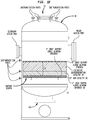
- reaction feed mixture comprising a butene rich hydrocarbonaceous gas, oxygen in a ratio of about 0.55 moles of oxygen per mole of hydrocarbon and steam in a ratio of about 15 moles of steam per mole of hydrocarbon enter reactor 30 through an upper inlet port 31 of reactor 30 and flows downwardly before impacting upon layer 32 of inert granules of alumina having an average particle size of about 3 mm to about 10 mm.
- these inert particles will be of a low surface area alumina such as perhaps alpha-alumina rather than some of the higher surface area forms usually loosely referred to as gamma alumina, although there are several intermediate forms of alumna exhibiting higher surface area than alpha-alumina.
- Spheres of alpha alumina having the following characteristics are quite suitable for both the uppermost and lowest layers in the catalyst bed: PROPERTIES MIN MAX Nominal Diameter, Inches 1/4 1/2 To Pass Opening, Inches 0.371 0.624 To Be Retained On Opening, Inches 0.263 0.525 Bulk Density, lb/cu.ft 128 125 Nominal Diameter, cm 0.635 1.27 To Pass Opening, cm 0.942 1.585 To Be Retained On Opening, cm 0.668 1.334 Bulk Density, kg/m 3 2050 2002
- Upper layer 32 may be from about 50 mm to about 100 mm in depth, such as from about 65 to 85 mm in depth and in some cases from about 70 to 80 mm.
- Each layer in the catalyst bed, including upper layer 32, is installed using a low-impact placement such as a sock loading technique to avoid damage to the catalyst layers therebelow while the depth of upper layer 32 is limited to avoid crushing of the oxidative dehydrogenation catalyst therebeneath.
- a low-impact placement such as a sock loading technique to avoid damage to the catalyst layers therebelow while the depth of upper layer 32 is limited to avoid crushing of the oxidative dehydrogenation catalyst therebeneath.
- a low-impact placement such as a sock loading technique to avoid damage to the catalyst layers therebelow while the depth of upper layer 32 is limited to avoid crushing of the oxidative dehydrogenation catalyst therebeneath.
- the sections of the bed 35 which includes layers 34, 36 can be arranged as annular sections with the reactants flowing radially through the bed.
- the inert flow distribution granules will be sized and configured to prevent disturbance to oxidative dehydrogenation layer 34 underneath due to any turbulence or vorticity in the flow of reaction feed mixture approaching the catalyst bed.
- the oxidative dehydrogenation catalyst particles can be of any physical arrangement that will provide effective contact between the catalytically active species and the reactants, including dispersed on an inert support, but will typically be massive particles rather than being actives dispersed on a high surface area catalyst support.
- the catalyst particles are from about 1 to about 25-30 mm in size, often taking the form of extrudates or spheres from about 1 mm up to about 5 mm in diameter.
- the catalyst particles preferably used in connection with the present invention should be slightly larger than commonly used in previous practice to limit the pressure drop through the catalyst bed as we prefer to use a catalyst bed which is deeper than commonly used previously. Higher pressure drop requires higher pressure in the system which reduces selectivity.
- catalyst particles having two key differences from previous practice: (1) the particles are "pre-reduced” or otherwise heat treated prior to loading to give them the crush strength necessary to be usable in a bed having a depth of from about 50 cm to about 150 cm (from about 20" up to about 60"), suitably a depth of from about 65 cm to about 130 cm (from about 25" to about 50"), or from about 75 cm to about 100 cm (from about 30" to about 40"); while the bulk density of the calcined particles is no more than about 1100 kg/m 3 (about 70 lbs/ft 3 ), suitably between about 880 kg/m 3 and 1050 kg/m 3 (about 55 lbs/ft 3 and 65 lbs/ft 3 ) or between about 920 kg/m 3 and 1010 kg/m 3 (about 58 lbs/ft 3 and 63 lbs/ft 3 ) and (2) it is preferred to avoid the use of nitrates that are conventionally used as precursors for the calcium compounds often incorporated into these catalysts
- Oxidative dehydrogenation catalyst particles having a composition as set forth in a companion application hereto, Low EMISSIONS OXIDATIVE DEHYDROGENATION PROCESS FOR PRODUCING BUTADIENE referenced above are disposed in layer or bed 34 having a depth of from over 69 cm (27") up to about 152 cm (60"), preferably between about 71 cm (28") and 127 cm (50"), more preferably between about 76 cm (30") and 102 cm (40"), the butene rich hydrocarbonaceous feed is converted to a butadiene enriched reaction product stream which proceeds downstream of layer or bed 34 of oxidative dehydrogenation catalyst particles though layer or bed 36 of AAR catalyst
- AAR catalyst layer 36 of AAR catalyst particles alkynes and aldehydes in butadiene enriched reaction product stream are converted to more innocuous species that are not so detrimental to use of butadiene in usual subsequent polymerization reactions.
- AAR catalyst layer 36 is present in a depth of from about 40% to about 60% of the depth of the oxidative dehydrogenation catalyst, more preferably about 50 %.
- the depth can be from about 30 cm (12 inches) to about 51 cm (20 inches), more preferably from about 33 cm (13 inches) to about 48 cm (19 inches) and most preferably from about 36 cm (14 inches) to about 46 cm (18 inches).
- Beneath layer 36 of AAR catalyst lies inert support layer 38 comprised of alumina spheres having a diameter of between about 1.0 cm (0.4 inches) and 2.54 cm (one inch), with inert support layer 38 being preferably from about 2.54 cm (1 inch) to about 20 cm (8 inches) in depth, preferably from about 5.08 cm (2 inches) to about 10 cm (4 inches) in depth, more preferably from about 6.4 cm to 8.9 cm (2.5 to 3.5 inches) in depth and even more preferably from about 6.99 cm to 7.62 cm (2.75 to 3 inches).
- a layer of larger beads may be separated from the AAR catalyst by layer of smaller beads as depicted in Fig. 1A .
- the butadiene enriched product stream exits reactor 30 though the lower exit port 33 for subsequent recovery of the heat value contained therein and concentration of the butadiene content into a crude butadiene stream having a concentration of approximately 50 to 60% butadiene.
- the catalytic process is initiated by raising the temperature of the catalyst bed to about 425°C (800°F); adding reactants until conversion is observed, then reducing the inlet temperatures to control the catalyst bed temperature.
- natural gas is used to bring the streams up to temperature; then use of natural gas is sharply curtailed or cut off entirely once conversion is observed.
- the inlet conditions are carefully controlled so that most of the conversion of butenes into butadiene occurs in the last several cm of layer 34 of oxidative dehydrogenation catalyst above the AAR catalyst, which initially registers as essentially a step change in temperature recorded by only the lowest of those thermocouples 40 distributed throughout layer 34 of oxidative dehydrogenation catalyst, the thermocouples in the layer of oxidative dehydrogenation catalyst wherein the reaction is occurring. It is extremely important that the reaction is essentially complete before the reactants reach the AAR catalyst.
- the inlet temperature is increased slightly to move the reaction zone upwardly in the oxidative dehydrogenation catalyst. In this way, coking of catalyst in layers of oxidative dehydrogenation catalyst above the layer in use is avoided.
- the oxygen content, or more precisely the lack of significant oxygen content, in the AAR catalyst is carefully monitored to confirm that oxygen is not breaking through into the AAR catalyst layer.
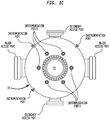
- FIGS 1B and 1C illustrate a configuration for reactor 30 of the present invention wherein access port(s) sized to allow entry is provided in the side wall of reactor 30 with catalyst support grid 38 spaced therebeneath allowing an overhead space suitably at least about 1.8 m (6 feet) of clearance between the fill level of the catalyst bed and the upper surface of the reactor chamber.
- Flow distribution is also important for avoiding channeling and hot spots in the catalyst bed.
- the preferred flow regime is fully turbulent and is enhanced by the presence of the inlet distributor. That is, an inlet distributor is advantageously provided to insure uniform flow distribution through the catalyst bed and prevent channeling and the potential creation of hot spots, which are likely to shorten the catalyst life.
- One preferred design for this inlet distributor device is in the form of baffles and rings which is mounted in the vapor space above the catalyst bed to promote even distribution of flow and to minimize inlet pressure losses.
- butene rich feed is vaporized in butene vaporizer 50 in which the heat required for vaporization is supplied by removal of heat from bottoms of quench tower 64 which, as will be discussed later, is heated by contact with the hot reaction product once a steady state operation has been achieve in the current process.
- the vaporized butene feed is mixed with steam, the steam being generated in two recycle condensate vaporizers 54 and 56.
- the steam generated in recycle condensate vaporizer 54 is produced by indirect heat exchange with butadiene enriched product stream leaving reactor feed superheater 48.
- the heat required to generate the steam in recycle condensate vaporizer 56 is preferably supplied by steam either from the plant grid or preferably from the thermal oxidizer or some other conveniently available source.
- the steam is completely vaporized in recycle condensate vaporizer 56 prior to being mixed with vaporized butene before passage through reactor feed superheater 48 in which the reactor feed is preheated by indirect heat exchange with the butadiene enriched product stream exiting reactor 30 with the resultant combined entry stream having a temperature of at least about 345°C (about 650°F), preferably in the range of from about 345°C to 400°C (from about 650°F to 750°F).
- the feed to reactor 30 is heated to the required temperature by indirect heat exchange with the exit stream which, as will be discussed later, is usually at a temperature in excess of 535°C (1000°F), more typically around 595°C (1100°F).
- the recovered heat passes through only a single tube wall in contrast to schemes in which an intermediate fluid is used.
- Preheated reactor feed leaving the reactor feed superheater 48 is mixed with compressed oxygen bearing gas, typically air, with the amount of air feed being carefully controlled so that approximately 0.5 to 0.6 moles of oxygen are supplied for each mole of hydrocarbon in the feed passed to the reactors.
- reaction feed stream is passed to refractory lined adiabatic reactor 30 illustrated in Figure 1 , where butene/steam/air feed inside reactor 30 passes first through: an inert flow distribution layer 32 then to an oxidative-dehydrogenation catalyst layer 34, having a depth of 83.8 cm (33 inches) or so; an aldehyde and acetylene removal (AAR) catalyst layer 36 and an inert support (alumina spheres) layer 38.
- AAR aldehyde and acetylene removal
- thermocouples 40 spaced along the height of oxidation-dehydrogenation layer 34 so that the location of the reaction zone therein may be determined.
- the amount of oxygen remaining in the product stream is monitored with oxygen analyzer 42 located near the bottom of layer 34 so that oxygen breakthrough into AAR layer 36 is avoided as discussed hereinafter in more detail.
- oxygen analyzer 42 located near the bottom of layer 34 so that oxygen breakthrough into AAR layer 36 is avoided as discussed hereinafter in more detail.
- a lower sample port 44 for a convergence analyzer in layer 36 so that composition may be monitored at the lower extreme of the reactor.
- Thermocouples 40 are also optionally disposed in layer 36 to monitor temperature in the AAR zone.
- any suitable temperature sensing device may be utilized, such as resistance temperature detectors, or noncontact sensors in a suitable reactor configuration.
- a target temperature for a reaction zone is pre-selected and maintained in the reaction zone.
- the reaction zone in layer 34 is initially disposed near the bottom of layer 34.
- the reaction zone or "active" layer of oxydehydrogenation catalyst layer 34 is characterized by a relatively sharp rise in temperature over a relatively short bed depth to the pre-selected target temperature.
- the reaction zone is characterized by a temperature rise of from 100°F to 300°F (55°C to 167°C) over a bed depth change of from 1 to 5 inches (2.5 cm to 13 cm) to the target temperature.
- the active layer is characterized by a temperature rise of from 150°F to 250°F (83°C to 139°C) over a bed depth of from 2 to 4 inches (5 cm to 10 cm). Below the reaction zone in bed 34, there is preferably no additional temperature rise if the system is controlled properly since oxygen is completely or nearly completely depleted in the reaction zone and is no longer present in the system.
- Suitable operating target temperatures for the oxydehydrogenation reaction zone are from 1000°F to 1200°F (540°C to 650°C).
- the inlet temperature to the reactor is raised and the active zone migrates upwardly in layer 34.
- the estimate of time to breakthrough is based on the temperature readings in the layers above the reaction zone (which are lower than the target temperature for the reaction zone) more so than on the temperatures at or below the reaction zone since the temperatures above the reaction zone are indicative of relatively fresh catalyst available to catalyze the reaction.
- thermocouple(s) indicate a fresh catalyst layer of 5 cm
- the oxidative dehydrogenation catalyst gives best performance for extended times.
- reactor feed superheater 48 ( Figure 2 ) which supplies a portion of the heat used to bring the feed to reactor 30 up to the requisite operating temperature and thence the reaction product exiting reactor feed superheater 48 passes through steam generator 54 wherein a portion of the sensible heat contained therein is used to vaporize and/or superheat the steam passing to reactor 30.
- butadiene enriched reaction product exiting from steam generator 54 passes to quench tower 64 ( Figure 3 ) entering at a height slightly above the maximum liquid level expected during normal operation.
- butadiene enriched product stream from reactor 30 is combined with other butadiene enriched product streams from the other reactors (not shown) prior to entering quench tower 64.
- bottom section 66 of quench tower 64 is equipped with valve trays while top section 70 is equipped with a corrugated metallic structured packing such as Koch Flexipac®, similar to that described in Lantz, et al., US Patent 6,874,769 , Structured Packing Plate and Element and Method of Fabricating Same or Rukovena, US Patent 4,740,334 .
- spray nozzles may be used for the entire tower. It is anticipated that in many cases, it will be possible to feed the mixture of vaporous and liquid reaction product effluent directly into quench tower 64 without any preliminary phase separation; but such preliminary phase separation can be easily accommodated, if expedient, by incorporation of a flash tank or similar phase separation device.
- quench condensate liquid phase collected at lower exit 67 of quench tower 64 composed primarily of condensed steam and quench water is fed back through the hot side of butene vaporizer 50 with cooled liquid return being passed back via quench condensate air cooler 76 and thence to quench tower circulating cooler 78 before being fed into quench tower 64 at a location well above the top of the packed section 70 of quench tower 64 but below demister pad 83.
- quench condensate air cooler 76 is equipped with modular tube banks, individually controlled fans, and variable pitch fan blades to facilitate temperature control in a variety of ambient conditions. In many cases, it will be possible to extract additional heat from Quench Tower 64 bottoms stream for uses elsewhere in the associated plant reducing size and cost of Quench Tower Coolers 76 and 78.
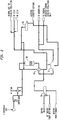
- Indirect inter-stage cooling is provided by compressor inter-stage coolers 88 and 89 with cooling to compressor inter-stage cooler 88 being supplied by a process stream leaving stripped water cooler 99 and the heated stream from the shell side of compressor inter- stage cooler 88 being fed to aldehyde stripper 98 ( Figure 4 ). Cooling to inter-stage cooler 89 is conveniently supplied by plant cooling tower water.
- Entrained liquid droplets coalesced on demister pad 83 are refluxed through quench tower 64 while compressed vaporous butadiene enriched product compressed to 1140 kPa abs. (about 150 psig) leaves the second stage of the gas compressor and it is passed to aldehyde scrubber 92 of which top portion 93 is preferably packed with structured packing which may be similar to Norton Intallox structured packing or those packings described above.
- a portion of the bottoms from aldehyde scrubber 92 is recycled through the structured packing via aldehyde scrubber bottoms cooler 95 while the remainder is passed to aldehyde stripper 98 via aldehyde scrubber bottoms separator 96 ( Figure 4 ) which receives liquid from the quench tower 64 bottoms via quench tower bottoms pump 65 as well as from gas compressor 84 second stage knock out drum.
- the water contents of the aldehyde scrubber bottoms separator 96 may be returned to quench tower 64 at a location below demister pad 83.
- Aldehyde stripper receives the water phase from the aldehyde scrubber bottoms after the oil phase has been skimmed out. This stream is pumped first to the shell side of stripped water cooler 99, from whence it reaches the shell side of compressor interstage cooler 88, which helps to increase its temperature via heat integration before being fed to aldehyde stripper 98, a portion of this overhead vapor from aldehyde stripper 98 going to aldehyde stripper overhead condenser 100 and thence being returned to aldehyde stripper 98 as reflux to maintain the vapor/liquid equilibrium in the column and drive overhead the aldehydes contained in the feed to this tower 98.
- the balance of the overhead vapor stream from aldehyde stripper 98 bypassing overhead condenser 100 is combined with other low value combustibles and directed to a thermal oxidizer (not shown) for production of superheated steam.
- Heavier hydrocarbons entrained in the condensed overhead stream from overhead condenser 100 are collected by bottoms coalescer and are also disposed of by treatment at a conventional oily water facility (not shown).
- Aldehyde stripper reboiler 102 uses steam, advantageously medium pressure steam, to vaporize a portion of aldehyde stripper bottoms from aldehyde stripper 98 and reintroduces the vapor below bottom tray of aldehyde stripper 98 while the remainder is pumped using adehyde stripper bottoms pump 105 to two locations: (1) back to the aldehyde scrubber 92 bottoms below the packing via two stripped water coolers (not shown), and (2) to the recycle condensate vaporizers, where it generates the vast bulk, if not all, of the steam used for the oxidative dehydrogenation reaction.
- steam advantageously medium pressure steam
- Reaction product from aldehyde scrubber 92 ( Figure 3 ) overhead is passed to the bottom of C4 absorber 110 ( Figure 5 ) containing numerous trays or other known devices for promoting gas liquid contact and equipped with at least one intercooler 111.
- Absorber oil (also sometimes referred to as lean oil) used in absorber 110 can suitably be paraffinic, or a mixture of paraffins and aromatics, although particularly superior results are obtained using oils which are richer in, or possibly even entirely, vinyl cyclohexene (butadiene dimer).
- Butadiene in the product stream is absorbed in absorber oil introduced at the top of C4 absorber 110, the bottoms from which is pumped to the top of degasser tower 116 through C4 absorber bottoms pump 113 and degasser feed cooler 115.
- Degasser tower 116 operates at lower pressure to facilitate the removal of residual gases, particularly carbon dioxide, nitrogen and hydrogen, which are passed through inter-stage cooler 88 of two-stage gas compressor 84 to the butadiene enriched product stream prior to passage through aldehyde scrubber 92.
- Degasser overhead gas from degasser 116 is recycled back to the second stage of compressor 84 and thence to scrubber 92 and absorber 110 whence it will ultimately find its way to thermal oxidizer 114.
- Degasser reboiler 122 maintains the temperature in the liquid phase of degasser tower 116 sufficiently high to allow residual gases to be flashed out passing to thermal oxidizer 114 as described above.
- the bottoms from degasser tower 116 largely comprising crude butadiene and miscellaneous C4's in absorber oil are passed to C4 stripper 124 through C4 stripper feed bottoms interchanger 127 where this bottoms stream is heated by passage of hot absorber oil from the bottoms of C4 stripper 124 through the tubes of C4 stripper feed/bottoms interchanger 127. Heated degasser bottoms are introduced into C4 stripper 124 at an intermediate height.
- Crude butadiene and C4's are stripped from heated absorber oil in C4 stripper 124, passing out as overhead to C4 stripper overhead condenser 130 while depleted absorber oil collected in the bottoms from C4 stripper 124 is reheated in C4 stripper reboiler 128; and the overhead vapor from C4 stripper 124 is condensed in C4 stripper overhead condenser 130 with a portion of the condensed liquid being accumulated in C4 stripper reflux drum 125 ,where residual water can be separated from the hydrocarbon phase and sent back to aldehyde stripper tower 98,while crude butadiene product is pumped through C4 stripper reflux pump 123 to further processing, while sufficient crude butadiene is being recirculated as reflux to ensure that sufficient separation is attained in C4 stripper 124.
- C4 stripper 124 comprise absorber oil having butadiene and other C4s stripped therefrom which is divided into three portions, one of which is recirculated to C4 stripper 124 through C4 stripper reboiler 128, a second portion being passed to absorber oil surge drum 142, ( Figure 6 ) the remaining portion being used as mentioned previously to heat butadiene/absorption oil mixture upon passage through C4 stripper feed/bottoms interchanger 127 where it, and oil being recycled from absorption oil surge drum 142, are passed to absorption oil air cooler 131 and absorption oil cooler 133 before being returned to C4 absorber 110 for reuse.
- absorber oil re-run tower 132 As absorber oil breaks down, forming heavier molecules, fresh oil make-up is introduced into the system while the balance is directed to a re-run column for heavies cleanup.
- absorber oil re-run tower 132 Upon sufficient accumulation of heavies in the absorption oil to justify, or necessitate, operation of absorber oil re-run tower 132, a portion of the oil being recirculated from absorption oil surge drum 142 is distilled to remove heavier components in absorber oil re-run tower bottoms with the overhead being pumped back to absorber oil recirculation loop. Occasionally the recovered oil could be pumped to storage tank 140 where the fresh absorber oil is stored.
- Tables 2 and 2A sets forth an energy balance for three possible plant configurations for 23,000 kg/hr (50,600 lb/hr) of butadiene production: one having no thermal oxidizer; one having a small thermal oxidizer sized primarily for the low value combustibles produced in the process of converting butene to butadiene; and one sized for both the low value combustibles produced in the process of converting butene to butadiene as well as those produced in the process of purifying crude butadiene to a saleable grade.
- All of the energy for Superheater 48, over 4400 kJ/kg (1900 BTU per pound) of butadiene, may be supplied by indirect heat transfer of sensible heat from the reactor effluent stream at high temperature, with the effluent product stream well above 370°C (700°F).
- all of the energy for vaporizer 54 may similarly be supplied by indirect heat transfer at a somewhat lower temperature of the effluent product stream.
- Heat recovery from the process stream is enhanced by extracting heat from the effluent stream when the stream is at a relatively high temperature for purposes of superheating the feed and then extracting heat from the reactor effluent at a relatively lower temperature for purposes of vaporizing feed.
- Energy for vaporizer 56 may be supplied from a plant steam grid which draws heat from thermal oxidation of volatile organic compounds generated in connection with the oxidative dehydration process as described herein.
- the inventive method may be practiced using a ferritic oxidative dehydrogenation catalyst which is substantially nitrate-free and may comprise: oxygen, a major proportion of iron; a minor proportion of zinc; and smaller amounts of manganese; phosphorus and a residue of a nitrate free calcium precursor.
- the process may be operated wherein the moles of oxygen in said reactor feed stream are controlled to so that at least 0.5 moles of oxygen are provided per mole of hydrocarbonaceous butene rich feed.
- the ferritic oxidative dehydrogenation catalyst bed generally has a depth of over 70 cm (27 inches) and the temperature sensing devices comprise thermocouples.
- the oxidative dehydrogenation catalysts may range from about 1 mm to about 30 mm in diameter such as from about 1 mm up to about 5 mm in diameter, optionally wherein the particles are pre-reduced or otherwise heat treated prior to loading to a degree sufficient to give them a crush strength necessary to be usable in a bed having a depth of from about 70 cm (27") up to about 150 cm (60"), the bulk density of the pre-reduced particles being no more than about 1120 kg/m 3 (70 lbs/ft 3 ).
- the bulk density of the pre-reduced particles may be between about 930 kg/m 3 and 1010 kg/m 3 (58 lbs/ft 3 and 63 lbs/ft 3 ).
- the oxidative dehydrogenation catalysts comprise: oxygen, a major proportion of iron; a minor proportion of zinc; and smaller amounts of manganese; phosphorus and a residue of a nitrate free calcium precursor.
- a method of manufacturing butadiene from a butene rich feed comprises the steps of:
- the oxidative dehydrogenation catalyst may comprise: oxygen, a major proportion of iron; a minor proportion of zinc; and smaller amounts of manganese; phosphorus and a residue of a nitrate free calcium precursor.
- a particularly preferred embodiment is directed to a method of manufacturing butadiene from a butene rich feed, comprising the steps of:
Landscapes
- Chemical & Material Sciences (AREA)
- Organic Chemistry (AREA)
- Chemical Kinetics & Catalysis (AREA)
- Engineering & Computer Science (AREA)
- Analytical Chemistry (AREA)
- Oil, Petroleum & Natural Gas (AREA)
- Water Supply & Treatment (AREA)
- Organic Low-Molecular-Weight Compounds And Preparation Thereof (AREA)
- Low-Molecular Organic Synthesis Reactions Using Catalysts (AREA)
Applications Claiming Priority (3)
| Application Number | Priority Date | Filing Date | Title |
|---|---|---|---|
| US201261617506P | 2012-03-29 | 2012-03-29 | |
| US201261617535P | 2012-03-29 | 2012-03-29 | |
| PCT/US2013/034215 WO2013148913A1 (en) | 2012-03-29 | 2013-03-28 | Improved controllability oxidative dehydrogenation process for producing butadiene |
Publications (3)
| Publication Number | Publication Date |
|---|---|
| EP2831021A1 EP2831021A1 (en) | 2015-02-04 |
| EP2831021A4 EP2831021A4 (en) | 2015-11-18 |
| EP2831021B1 true EP2831021B1 (en) | 2019-11-27 |
Family
ID=49261226
Family Applications (2)
| Application Number | Title | Priority Date | Filing Date |
|---|---|---|---|
| EP13768548.3A Active EP2831021B1 (en) | 2012-03-29 | 2013-03-28 | Improved controllability oxidative dehydrogenation process for producing butadiene |
| EP13769936.9A Active EP2831022B1 (en) | 2012-03-29 | 2013-03-28 | Low emissions oxidative dehydrogenation process for producing butadiene |
Family Applications After (1)
| Application Number | Title | Priority Date | Filing Date |
|---|---|---|---|
| EP13769936.9A Active EP2831022B1 (en) | 2012-03-29 | 2013-03-28 | Low emissions oxidative dehydrogenation process for producing butadiene |
Country Status (11)
| Country | Link |
|---|---|
| US (3) | US9650316B2 (enExample) |
| EP (2) | EP2831021B1 (enExample) |
| JP (2) | JP6157585B2 (enExample) |
| KR (2) | KR102051168B1 (enExample) |
| CN (2) | CN104507894B (enExample) |
| CA (2) | CA2867635A1 (enExample) |
| MX (2) | MX363244B (enExample) |
| MY (1) | MY166545A (enExample) |
| RU (2) | RU2619114C2 (enExample) |
| SG (2) | SG11201405986VA (enExample) |
| WO (2) | WO2013148913A1 (enExample) |
Families Citing this family (23)
| Publication number | Priority date | Publication date | Assignee | Title |
|---|---|---|---|---|
| SG11201405986VA (en) | 2012-03-29 | 2014-10-30 | Tpc Group Llc | Improved controllability oxidative dehydrogenation process for producing butadiene |
| KR101676531B1 (ko) * | 2013-11-21 | 2016-11-15 | 주식회사 엘지화학 | 부타디엔 제조 공정 내 에너지 재활용 방법 |
| US10035136B2 (en) | 2014-03-25 | 2018-07-31 | Tpc Group Llc | Catalyst for reduced nitrogen oxide (NOx) emissions in an oxodehydrogenation process |
| KR101782675B1 (ko) * | 2014-07-02 | 2017-09-27 | 주식회사 엘지화학 | 부타디엔 제조 공정 내 에너지 재활용 방법 |
| KR101784047B1 (ko) | 2014-07-02 | 2017-10-10 | 주식회사 엘지화학 | 부타디엔 제조 공정 내 에너지 재활용 방법 |
| KR101782674B1 (ko) * | 2014-07-02 | 2017-09-27 | 주식회사 엘지화학 | 부타디엔 제조 공정 내 에너지 재활용 방법 |
| KR101784046B1 (ko) | 2014-07-02 | 2017-10-10 | 주식회사 엘지화학 | 부타디엔 제조 공정 내 에너지 재활용 방법 |
| JP2018509450A (ja) * | 2015-03-26 | 2018-04-05 | ビーエーエスエフ ソシエタス・ヨーロピアBasf Se | 酸化的脱水素化によりn−ブテン類から1,3−ブタジエンを製造するための方法 |
| FR3040703B1 (fr) * | 2015-09-03 | 2017-10-06 | Ifp Energies Now | Procede integre de production de butadiene a partir de butanol |
| MX2018003666A (es) * | 2015-09-25 | 2018-04-30 | Uop Llc | Procesos y aparatos para la produccion de butadieno. |
| EP3371143B1 (en) * | 2015-11-06 | 2020-09-30 | Uop Llc | Heat recovery in the process of production of butadiene |
| RU2693490C1 (ru) * | 2015-11-06 | 2019-07-03 | Юоп Ллк | Использование абсорбера с4 для отпаривания альдегидов |
| WO2018095856A1 (de) | 2016-11-22 | 2018-05-31 | Basf Se | Verfahren zur herstellung von 1,3-butadien aus n-butenen durch oxidative dehydrierung umfassend eine methacrolein-abtrennung bei der aufarbeitung |
| WO2018095776A1 (de) | 2016-11-22 | 2018-05-31 | Basf Se | Verfahren zur herstellung von 1,3-butadien aus n-butenen durch oxidative dehydrierung umfassend eine wässrige wäsche des c4-produktgasstroms |
| EP3323797A1 (de) | 2016-11-22 | 2018-05-23 | Basf Se | Verfahren zur herstellung von 1,3-butadien aus n-butenen durch oxidative dehydrierung umfassend eine saure wäsche des c4-produktgasstroms |
| KR102224278B1 (ko) | 2017-04-12 | 2021-03-08 | 주식회사 엘지화학 | 산화적 탈수소화 반응용 촉매 시스템, 이를 포함하는 산화적 탈수소화용 반응기 및 산화적 탈수소화 방법 |
| US10543470B2 (en) * | 2017-04-28 | 2020-01-28 | Intramicron, Inc. | Reactors and methods for processes involving partial oxidation reactions |
| WO2018234158A1 (de) | 2017-06-19 | 2018-12-27 | Basf Se | Verfahren zur herstellung von 1,3-butadien aus n-butenen durch oxidative dehydrierung umfassend eine wäsche des c4-produktgasstroms |
| JP7137920B2 (ja) * | 2017-11-02 | 2022-09-15 | 旭化成株式会社 | ブタジエンの製造方法 |
| KR102262896B1 (ko) * | 2017-11-30 | 2021-06-09 | 주식회사 엘지화학 | 산화적 탈수소화 반응용 촉매 시스템, 이를 포함하는 부타디엔 제조용 반응기 및 1,3-부타디엔의 제조방법 |
| CN110066212B (zh) * | 2018-01-22 | 2022-04-01 | 惠生工程(中国)有限公司 | 一种甲醇制烯烃工艺副产碳四烯烃氧化脱氢制丁二烯工艺 |
| KR102564959B1 (ko) * | 2018-08-23 | 2023-08-07 | 주식회사 엘지화학 | 1,3-부타디엔의 제조방법 |
| CN110237788B (zh) * | 2019-05-28 | 2020-05-05 | 宁波浙铁江宁化工有限公司 | 一种顺酐反应系统在线检测工艺及设备 |
Citations (2)
| Publication number | Priority date | Publication date | Assignee | Title |
|---|---|---|---|---|
| US3828101A (en) * | 1971-08-26 | 1974-08-06 | Petro Tex Chem Corp | Method of preparation of ferrite catalysts |
| JP2011148765A (ja) * | 2009-12-21 | 2011-08-04 | Mitsubishi Chemicals Corp | 共役ジエンの製造方法 |
Family Cites Families (61)
| Publication number | Priority date | Publication date | Assignee | Title |
|---|---|---|---|---|
| US2444035A (en) * | 1943-12-31 | 1948-06-29 | Koppers Co Inc | Process for dehydrogenating hydrocarbons using as catalyst calcium oxide on calcium carbonate |
| US3159588A (en) * | 1960-06-15 | 1964-12-01 | Union Oil Co | Silica-zirconia-titania hydrocracking catalyst |
| US3207805A (en) | 1960-06-17 | 1965-09-21 | Petro Tex Chem Corp | Dehydrogenation in the presence of oxygen and an ammonium halide |
| BE615317A (enExample) * | 1961-03-22 | |||
| US3110746A (en) * | 1961-05-26 | 1963-11-12 | Shell Oil Co | Oxidative dehydrogenation of monoolefins |
| US3320330A (en) * | 1962-04-25 | 1967-05-16 | Standard Oil Co | Process for the catalytic oxidative dehydrogenation of olefins to diolefins |
| US3284536A (en) | 1964-01-02 | 1966-11-08 | Petro Tex Chem Corp | Dehydrogenation with magnesium ferrite |
| US4658074A (en) | 1965-05-28 | 1987-04-14 | Petro-Tex Chemical Corporation | Catalytic oxidative dehydrogenation process |
| US3322847A (en) * | 1965-09-02 | 1967-05-30 | Standard Oil Co | Oxidative dehydrogenation of monoolefins |
| US3496070A (en) | 1967-11-09 | 1970-02-17 | Petro Tex Chem Corp | Purification of unsaturated hydrocarbons by extractive distillation with addition of liquid solvent to stripper overhead |
| US3937746A (en) | 1969-09-19 | 1976-02-10 | Petro-Tex Chemical Corporation | Sulfur promoted oxidative dehydrogenation |
| US3925498A (en) * | 1970-05-27 | 1975-12-09 | Petro Tex Chem Corp | Oxidative dehydrogenation process |
| US3849511A (en) * | 1970-10-07 | 1974-11-19 | Petro Tex Chem Corp | Oxidative dehydrogenation with manganese ferrite catalyst |
| US3745194A (en) | 1970-10-16 | 1973-07-10 | Phillips Petroleum Co | Oxidative dehydrogenation of paraffinic hydrocarbons |
| US3674887A (en) * | 1970-12-24 | 1972-07-04 | Phillips Petroleum Co | Oxidative dehydrogenation process |
| US3801670A (en) * | 1970-12-25 | 1974-04-02 | Sumitomo Chemical Co | Catalytic process for the production of diolefins |
| JPS495321B1 (enExample) * | 1970-12-25 | 1974-02-06 | ||
| US3828202A (en) | 1971-07-06 | 1974-08-06 | Burroughs Corp | Logic circuit using a current switch to compensate for signal deterioration |
| BE794908A (fr) | 1972-02-03 | 1973-08-02 | Petro Tex Chem Corp | Purification de composes insatures |
| US3900525A (en) * | 1972-05-16 | 1975-08-19 | Petro Tex Chem Corp | Manganese ferrite catalyzed oxidative dehydrogenation |
| US3801671A (en) | 1972-05-30 | 1974-04-02 | Phillips Petroleum Co | Oxidative dehydrogenation of organic compounds |
| US4021500A (en) * | 1972-09-13 | 1977-05-03 | Phillips Petroleum Company | Oxidative dehydrogenation system |
| US3887631A (en) | 1973-05-14 | 1975-06-03 | Texaco Inc | Oxidative dehydrogenation of hydrocarbons |
| CA1034148A (en) * | 1974-02-19 | 1978-07-04 | Petro-Tex Chemical Corporation | Acetylene removal process |
| US4644088A (en) * | 1974-02-19 | 1987-02-17 | Petro-Tex Chemical Corporation | Acetylene removal process |
| US4658080A (en) * | 1974-02-19 | 1987-04-14 | Petro-Tex Chemical Corporation | Acetylene removal process |
| US3943185A (en) | 1974-05-28 | 1976-03-09 | Petro-Tex Chemical Corporation | Diolefin production and purification |
| US3960767A (en) * | 1974-09-03 | 1976-06-01 | Petro-Tex Chemical Corporation | Modified zinc ferrite oxidative dehydrogenation catalysts |
| US3953370A (en) | 1974-10-16 | 1976-04-27 | Petro-Tex Chemical Corporation | Method of activating zinc ferrite oxidative dehydrogenation catalysts |
| US4083884A (en) * | 1976-07-19 | 1978-04-11 | Petro-Tex Chemical Corporation | Calcium oxide modified zinc ferrite oxidative dehydrogenation catalysts and use |
| US4067921A (en) * | 1976-12-06 | 1978-01-10 | The Dow Chemical Company | Primary adjunct, continuous diene process |
| FR2444019A1 (fr) * | 1978-12-15 | 1980-07-11 | Inst Neftekhimicheskikh Prot | Procede de preparation de butadiene-1,3 |
| US4266086A (en) | 1980-02-12 | 1981-05-05 | The B. F. Goodrich Company | Process for removing α-acetylenes from diolefins |
| JPS5879932A (ja) * | 1981-11-06 | 1983-05-13 | Japan Synthetic Rubber Co Ltd | ブタジエン又はイソプレンの精製方法 |
| US4479025A (en) * | 1982-11-22 | 1984-10-23 | Uop Inc. | Alkylaromatic hydrocarbon dehydrogenation process |
| JPS60126235A (ja) * | 1983-12-14 | 1985-07-05 | Nippon Zeon Co Ltd | ブタジエンの製造方法 |
| US4595788A (en) * | 1983-11-25 | 1986-06-17 | Nippon Zeon Co. Ltd. | Process for producing butadiene |
| SU1216938A1 (ru) * | 1984-08-13 | 1999-10-20 | А.Л. Цайлингольд | Способ получения бутадиена |
| US4740334A (en) | 1987-05-29 | 1988-04-26 | Norton Company | Tower packing element with embossed surfaces |
| FR2630662A1 (fr) | 1988-04-29 | 1989-11-03 | Shell Int Research | Catalyseur pour la deshydrogenation de composes organiques, procede pour sa preparation et son utilisation |
| US4973793A (en) | 1989-06-08 | 1990-11-27 | Texas Petrochemicals Corporation | Oxidative dehydrogenation of amylenes |
| JP3371112B2 (ja) | 1990-09-18 | 2003-01-27 | ダイヤニトリックス株式会社 | 鉄・アンチモン含有金属酸化物触媒組成物およびその製法 |
| US5214225A (en) * | 1991-12-05 | 1993-05-25 | Hall Stephen G | Dehydrogenation process with improved heat recovery |
| US5772898A (en) | 1994-12-21 | 1998-06-30 | Uop Llc | Hydrocarbon conversion process using novel metallo manganese oxides |
| US6403523B1 (en) | 2000-09-18 | 2002-06-11 | Union Carbide Chemicals & Plastics Technology Corporation | Catalysts for the oxidative dehydrogenation of hydrocarbons |
| WO2004030809A1 (en) | 2002-10-03 | 2004-04-15 | Koch-Glitsch, Lp | Structured packing plate and element and method of fabricating same |
| US7402720B2 (en) | 2002-12-19 | 2008-07-22 | Exxonmobil Chemical Patents Inc. | Distillation process for removal of methyl acetylene and/or propadiene from an olefin stream |
| US7205447B2 (en) | 2002-12-23 | 2007-04-17 | Exxonmobil Chemical Patents Inc. | Process for removing aldehydes and/or ketones from an olefinic stream |
| DE10361822A1 (de) * | 2003-12-30 | 2005-08-11 | Basf Ag | Verfahren zur Herstellung von Butadien |
| DE102004061514A1 (de) * | 2004-12-21 | 2006-07-06 | Basf Ag | Verfahren zur Herstellung von Butadien aus n-Butan |
| DE102005002127A1 (de) * | 2005-01-17 | 2006-07-20 | Basf Ag | Verfahren zur Herstellung von Butadien aus n-Butan |
| DE102006029790A1 (de) * | 2006-06-27 | 2008-01-03 | Basf Ag | Verfahren der kontinuierlichen heterogen katalysierten partiellen Dehydrierung wenigstens eines zu dehydrierenden Kohlenwasserstoffs |
| KR100847206B1 (ko) | 2007-05-10 | 2008-07-17 | 에스케이에너지 주식회사 | 아연 페라이트 촉매, 이의 제조방법 및 이를 이용한1,3-부타디엔의 제조방법 |
| KR101508776B1 (ko) | 2008-03-28 | 2015-04-10 | 에스케이이노베이션 주식회사 | 연속 흐름식 2중 촉매 반응 장치를 이용하여노르말-부텐으로부터 1,3-부타디엔을 제조하는 방법 |
| EP2288583A1 (en) * | 2008-04-09 | 2011-03-02 | Shell Internationale Research Maatschappij B.V. | A method of improving a dehydrogenation process |
| US20110245568A1 (en) * | 2008-07-22 | 2011-10-06 | Fina Technology, Inc. | Dehydrogenation Reactions of N-Butene to Butadiene |
| JP5272657B2 (ja) * | 2008-10-31 | 2013-08-28 | 三菱化学株式会社 | プレート式反応器を用いた反応生成物の製造方法 |
| CN102388011A (zh) * | 2009-04-10 | 2012-03-21 | 南加州大学 | 使天然气成为环境上二氧化碳中性燃料和再生碳源 |
| KR20120026049A (ko) * | 2009-05-29 | 2012-03-16 | 미쓰비시 가가꾸 가부시키가이샤 | 공액 디엔의 제조 방법 |
| KR101713328B1 (ko) | 2010-07-20 | 2017-03-08 | 에스케이이노베이션 주식회사 | 혼성 망간 페라이트가 코팅된 촉매, 이의 제조방법 및 이를 이용한 1,3-부타디엔의 제조방법 |
| SG11201405986VA (en) | 2012-03-29 | 2014-10-30 | Tpc Group Llc | Improved controllability oxidative dehydrogenation process for producing butadiene |
-
2013
- 2013-03-28 SG SG11201405986VA patent/SG11201405986VA/en unknown
- 2013-03-28 RU RU2014143514A patent/RU2619114C2/ru active
- 2013-03-28 MX MX2014011658A patent/MX363244B/es unknown
- 2013-03-28 MY MYPI2014002729A patent/MY166545A/en unknown
- 2013-03-28 CA CA2867635A patent/CA2867635A1/en not_active Abandoned
- 2013-03-28 US US14/386,617 patent/US9650316B2/en active Active
- 2013-03-28 SG SG11201405984TA patent/SG11201405984TA/en unknown
- 2013-03-28 WO PCT/US2013/034215 patent/WO2013148913A1/en not_active Ceased
- 2013-03-28 US US14/386,550 patent/US9908097B2/en active Active
- 2013-03-28 KR KR1020147030267A patent/KR102051168B1/ko active Active
- 2013-03-28 KR KR1020147030264A patent/KR102036398B1/ko active Active
- 2013-03-28 CN CN201380027362.3A patent/CN104507894B/zh active Active
- 2013-03-28 CA CA2870209A patent/CA2870209A1/en not_active Abandoned
- 2013-03-28 EP EP13768548.3A patent/EP2831021B1/en active Active
- 2013-03-28 JP JP2015503552A patent/JP6157585B2/ja active Active
- 2013-03-28 WO PCT/US2013/034205 patent/WO2013148908A1/en not_active Ceased
- 2013-03-28 EP EP13769936.9A patent/EP2831022B1/en active Active
- 2013-03-28 CN CN201380027030.5A patent/CN104321294B/zh active Active
- 2013-03-28 MX MX2014011659A patent/MX366150B/es active IP Right Grant
- 2013-03-28 RU RU2014143515A patent/RU2628519C2/ru active
- 2013-03-28 JP JP2015503555A patent/JP6157586B2/ja active Active
-
2017
- 2017-04-11 US US15/484,247 patent/US10052608B2/en active Active
Patent Citations (2)
| Publication number | Priority date | Publication date | Assignee | Title |
|---|---|---|---|---|
| US3828101A (en) * | 1971-08-26 | 1974-08-06 | Petro Tex Chem Corp | Method of preparation of ferrite catalysts |
| JP2011148765A (ja) * | 2009-12-21 | 2011-08-04 | Mitsubishi Chemicals Corp | 共役ジエンの製造方法 |
Also Published As
Similar Documents
| Publication | Publication Date | Title |
|---|---|---|
| EP2831021B1 (en) | Improved controllability oxidative dehydrogenation process for producing butadiene | |
| JPH03501483A (ja) | プロセス | |
| JP2011132218A (ja) | 共役ジエンの製造方法 | |
| KR101820639B1 (ko) | 페놀로부터 사이클로헥산온을 생산하기 위한 공정 | |
| JP2006522120A (ja) | 炭化水素流れ中のアセチレン類及びジエン類の選択的水素化 | |
| JPWO2014168051A1 (ja) | 1,3−ブタジエンの製造方法 | |
| HK1204321B (en) | Improved controllability oxidative dehydrogenation process for producing butadiene | |
| JP6405857B2 (ja) | 共役ジエンの製造方法 | |
| JP5780038B2 (ja) | 共役ジエンの製造方法 | |
| US11230513B2 (en) | Production process of 1,3-butadiene | |
| US10421697B2 (en) | Integrated method for producing butadiene from butanol | |
| JP2011241208A (ja) | 共役ジエンの製造方法 | |
| WO2018208907A1 (en) | Methods and systems for oxidative dehydrogenation of hydrocarbons to olefins |
Legal Events
| Date | Code | Title | Description |
|---|---|---|---|
| PUAI | Public reference made under article 153(3) epc to a published international application that has entered the european phase |
Free format text: ORIGINAL CODE: 0009012 |
|
| 17P | Request for examination filed |
Effective date: 20141029 |
|
| AK | Designated contracting states |
Kind code of ref document: A1 Designated state(s): AL AT BE BG CH CY CZ DE DK EE ES FI FR GB GR HR HU IE IS IT LI LT LU LV MC MK MT NL NO PL PT RO RS SE SI SK SM TR |
|
| AX | Request for extension of the european patent |
Extension state: BA ME |
|
| DAX | Request for extension of the european patent (deleted) | ||
| RA4 | Supplementary search report drawn up and despatched (corrected) |
Effective date: 20151020 |
|
| RIC1 | Information provided on ipc code assigned before grant |
Ipc: C07C 5/48 20060101ALI20151014BHEP Ipc: B01J 23/889 20060101ALI20151014BHEP Ipc: B01J 23/745 20060101ALI20151014BHEP Ipc: C07C 11/16 20060101AFI20151014BHEP Ipc: B01J 19/24 20060101ALI20151014BHEP |
|
| STAA | Information on the status of an ep patent application or granted ep patent |
Free format text: STATUS: EXAMINATION IS IN PROGRESS |
|
| 17Q | First examination report despatched |
Effective date: 20180423 |
|
| GRAP | Despatch of communication of intention to grant a patent |
Free format text: ORIGINAL CODE: EPIDOSNIGR1 |
|
| STAA | Information on the status of an ep patent application or granted ep patent |
Free format text: STATUS: GRANT OF PATENT IS INTENDED |
|
| INTG | Intention to grant announced |
Effective date: 20190724 |
|
| GRAS | Grant fee paid |
Free format text: ORIGINAL CODE: EPIDOSNIGR3 |
|
| GRAA | (expected) grant |
Free format text: ORIGINAL CODE: 0009210 |
|
| STAA | Information on the status of an ep patent application or granted ep patent |
Free format text: STATUS: THE PATENT HAS BEEN GRANTED |
|
| AK | Designated contracting states |
Kind code of ref document: B1 Designated state(s): AL AT BE BG CH CY CZ DE DK EE ES FI FR GB GR HR HU IE IS IT LI LT LU LV MC MK MT NL NO PL PT RO RS SE SI SK SM TR |
|
| REG | Reference to a national code |
Ref country code: GB Ref legal event code: FG4D |
|
| REG | Reference to a national code |
Ref country code: CH Ref legal event code: EP |
|
| REG | Reference to a national code |
Ref country code: DE Ref legal event code: R096 Ref document number: 602013063385 Country of ref document: DE |
|
| REG | Reference to a national code |
Ref country code: AT Ref legal event code: REF Ref document number: 1206510 Country of ref document: AT Kind code of ref document: T Effective date: 20191215 |
|
| REG | Reference to a national code |
Ref country code: IE Ref legal event code: FG4D |
|
| REG | Reference to a national code |
Ref country code: NL Ref legal event code: MP Effective date: 20191127 |
|
| REG | Reference to a national code |
Ref country code: LT Ref legal event code: MG4D |
|
| PG25 | Lapsed in a contracting state [announced via postgrant information from national office to epo] |
Ref country code: GR Free format text: LAPSE BECAUSE OF FAILURE TO SUBMIT A TRANSLATION OF THE DESCRIPTION OR TO PAY THE FEE WITHIN THE PRESCRIBED TIME-LIMIT Effective date: 20200228 Ref country code: NO Free format text: LAPSE BECAUSE OF FAILURE TO SUBMIT A TRANSLATION OF THE DESCRIPTION OR TO PAY THE FEE WITHIN THE PRESCRIBED TIME-LIMIT Effective date: 20200227 Ref country code: ES Free format text: LAPSE BECAUSE OF FAILURE TO SUBMIT A TRANSLATION OF THE DESCRIPTION OR TO PAY THE FEE WITHIN THE PRESCRIBED TIME-LIMIT Effective date: 20191127 Ref country code: LT Free format text: LAPSE BECAUSE OF FAILURE TO SUBMIT A TRANSLATION OF THE DESCRIPTION OR TO PAY THE FEE WITHIN THE PRESCRIBED TIME-LIMIT Effective date: 20191127 Ref country code: NL Free format text: LAPSE BECAUSE OF FAILURE TO SUBMIT A TRANSLATION OF THE DESCRIPTION OR TO PAY THE FEE WITHIN THE PRESCRIBED TIME-LIMIT Effective date: 20191127 Ref country code: SE Free format text: LAPSE BECAUSE OF FAILURE TO SUBMIT A TRANSLATION OF THE DESCRIPTION OR TO PAY THE FEE WITHIN THE PRESCRIBED TIME-LIMIT Effective date: 20191127 Ref country code: LV Free format text: LAPSE BECAUSE OF FAILURE TO SUBMIT A TRANSLATION OF THE DESCRIPTION OR TO PAY THE FEE WITHIN THE PRESCRIBED TIME-LIMIT Effective date: 20191127 Ref country code: FI Free format text: LAPSE BECAUSE OF FAILURE TO SUBMIT A TRANSLATION OF THE DESCRIPTION OR TO PAY THE FEE WITHIN THE PRESCRIBED TIME-LIMIT Effective date: 20191127 Ref country code: BG Free format text: LAPSE BECAUSE OF FAILURE TO SUBMIT A TRANSLATION OF THE DESCRIPTION OR TO PAY THE FEE WITHIN THE PRESCRIBED TIME-LIMIT Effective date: 20200227 |
|
| PG25 | Lapsed in a contracting state [announced via postgrant information from national office to epo] |
Ref country code: IS Free format text: LAPSE BECAUSE OF FAILURE TO SUBMIT A TRANSLATION OF THE DESCRIPTION OR TO PAY THE FEE WITHIN THE PRESCRIBED TIME-LIMIT Effective date: 20200327 Ref country code: RS Free format text: LAPSE BECAUSE OF FAILURE TO SUBMIT A TRANSLATION OF THE DESCRIPTION OR TO PAY THE FEE WITHIN THE PRESCRIBED TIME-LIMIT Effective date: 20191127 Ref country code: HR Free format text: LAPSE BECAUSE OF FAILURE TO SUBMIT A TRANSLATION OF THE DESCRIPTION OR TO PAY THE FEE WITHIN THE PRESCRIBED TIME-LIMIT Effective date: 20191127 |
|
| PG25 | Lapsed in a contracting state [announced via postgrant information from national office to epo] |
Ref country code: AL Free format text: LAPSE BECAUSE OF FAILURE TO SUBMIT A TRANSLATION OF THE DESCRIPTION OR TO PAY THE FEE WITHIN THE PRESCRIBED TIME-LIMIT Effective date: 20191127 |
|
| PG25 | Lapsed in a contracting state [announced via postgrant information from national office to epo] |
Ref country code: DK Free format text: LAPSE BECAUSE OF FAILURE TO SUBMIT A TRANSLATION OF THE DESCRIPTION OR TO PAY THE FEE WITHIN THE PRESCRIBED TIME-LIMIT Effective date: 20191127 Ref country code: PT Free format text: LAPSE BECAUSE OF FAILURE TO SUBMIT A TRANSLATION OF THE DESCRIPTION OR TO PAY THE FEE WITHIN THE PRESCRIBED TIME-LIMIT Effective date: 20200419 Ref country code: EE Free format text: LAPSE BECAUSE OF FAILURE TO SUBMIT A TRANSLATION OF THE DESCRIPTION OR TO PAY THE FEE WITHIN THE PRESCRIBED TIME-LIMIT Effective date: 20191127 Ref country code: CZ Free format text: LAPSE BECAUSE OF FAILURE TO SUBMIT A TRANSLATION OF THE DESCRIPTION OR TO PAY THE FEE WITHIN THE PRESCRIBED TIME-LIMIT Effective date: 20191127 Ref country code: RO Free format text: LAPSE BECAUSE OF FAILURE TO SUBMIT A TRANSLATION OF THE DESCRIPTION OR TO PAY THE FEE WITHIN THE PRESCRIBED TIME-LIMIT Effective date: 20191127 |
|
| REG | Reference to a national code |
Ref country code: DE Ref legal event code: R097 Ref document number: 602013063385 Country of ref document: DE |
|
| PG25 | Lapsed in a contracting state [announced via postgrant information from national office to epo] |
Ref country code: SK Free format text: LAPSE BECAUSE OF FAILURE TO SUBMIT A TRANSLATION OF THE DESCRIPTION OR TO PAY THE FEE WITHIN THE PRESCRIBED TIME-LIMIT Effective date: 20191127 Ref country code: SM Free format text: LAPSE BECAUSE OF FAILURE TO SUBMIT A TRANSLATION OF THE DESCRIPTION OR TO PAY THE FEE WITHIN THE PRESCRIBED TIME-LIMIT Effective date: 20191127 |
|
| REG | Reference to a national code |
Ref country code: AT Ref legal event code: MK05 Ref document number: 1206510 Country of ref document: AT Kind code of ref document: T Effective date: 20191127 |
|
| PLBE | No opposition filed within time limit |
Free format text: ORIGINAL CODE: 0009261 |
|
| STAA | Information on the status of an ep patent application or granted ep patent |
Free format text: STATUS: NO OPPOSITION FILED WITHIN TIME LIMIT |
|
| PG25 | Lapsed in a contracting state [announced via postgrant information from national office to epo] |
Ref country code: MC Free format text: LAPSE BECAUSE OF FAILURE TO SUBMIT A TRANSLATION OF THE DESCRIPTION OR TO PAY THE FEE WITHIN THE PRESCRIBED TIME-LIMIT Effective date: 20191127 |
|
| REG | Reference to a national code |
Ref country code: CH Ref legal event code: PL |
|
| 26N | No opposition filed |
Effective date: 20200828 |
|
| PG25 | Lapsed in a contracting state [announced via postgrant information from national office to epo] |
Ref country code: AT Free format text: LAPSE BECAUSE OF FAILURE TO SUBMIT A TRANSLATION OF THE DESCRIPTION OR TO PAY THE FEE WITHIN THE PRESCRIBED TIME-LIMIT Effective date: 20191127 Ref country code: PL Free format text: LAPSE BECAUSE OF FAILURE TO SUBMIT A TRANSLATION OF THE DESCRIPTION OR TO PAY THE FEE WITHIN THE PRESCRIBED TIME-LIMIT Effective date: 20191127 Ref country code: SI Free format text: LAPSE BECAUSE OF FAILURE TO SUBMIT A TRANSLATION OF THE DESCRIPTION OR TO PAY THE FEE WITHIN THE PRESCRIBED TIME-LIMIT Effective date: 20191127 |
|
| PG25 | Lapsed in a contracting state [announced via postgrant information from national office to epo] |
Ref country code: LU Free format text: LAPSE BECAUSE OF NON-PAYMENT OF DUE FEES Effective date: 20200328 |
|
| PG25 | Lapsed in a contracting state [announced via postgrant information from national office to epo] |
Ref country code: LI Free format text: LAPSE BECAUSE OF NON-PAYMENT OF DUE FEES Effective date: 20200331 Ref country code: CH Free format text: LAPSE BECAUSE OF NON-PAYMENT OF DUE FEES Effective date: 20200331 Ref country code: IE Free format text: LAPSE BECAUSE OF NON-PAYMENT OF DUE FEES Effective date: 20200328 Ref country code: IT Free format text: LAPSE BECAUSE OF FAILURE TO SUBMIT A TRANSLATION OF THE DESCRIPTION OR TO PAY THE FEE WITHIN THE PRESCRIBED TIME-LIMIT Effective date: 20191127 |
|
| GBPC | Gb: european patent ceased through non-payment of renewal fee |
Effective date: 20200328 |
|
| PG25 | Lapsed in a contracting state [announced via postgrant information from national office to epo] |
Ref country code: GB Free format text: LAPSE BECAUSE OF NON-PAYMENT OF DUE FEES Effective date: 20200328 |
|
| PG25 | Lapsed in a contracting state [announced via postgrant information from national office to epo] |
Ref country code: TR Free format text: LAPSE BECAUSE OF FAILURE TO SUBMIT A TRANSLATION OF THE DESCRIPTION OR TO PAY THE FEE WITHIN THE PRESCRIBED TIME-LIMIT Effective date: 20191127 Ref country code: MT Free format text: LAPSE BECAUSE OF FAILURE TO SUBMIT A TRANSLATION OF THE DESCRIPTION OR TO PAY THE FEE WITHIN THE PRESCRIBED TIME-LIMIT Effective date: 20191127 Ref country code: CY Free format text: LAPSE BECAUSE OF FAILURE TO SUBMIT A TRANSLATION OF THE DESCRIPTION OR TO PAY THE FEE WITHIN THE PRESCRIBED TIME-LIMIT Effective date: 20191127 |
|
| PG25 | Lapsed in a contracting state [announced via postgrant information from national office to epo] |
Ref country code: MK Free format text: LAPSE BECAUSE OF FAILURE TO SUBMIT A TRANSLATION OF THE DESCRIPTION OR TO PAY THE FEE WITHIN THE PRESCRIBED TIME-LIMIT Effective date: 20191127 |
|
| PGFP | Annual fee paid to national office [announced via postgrant information from national office to epo] |
Ref country code: DE Payment date: 20250327 Year of fee payment: 13 |
|
| PGFP | Annual fee paid to national office [announced via postgrant information from national office to epo] |
Ref country code: BE Payment date: 20250327 Year of fee payment: 13 |
|
| PGFP | Annual fee paid to national office [announced via postgrant information from national office to epo] |
Ref country code: FR Payment date: 20250325 Year of fee payment: 13 |