EP2714092B1 - Immunoconjugates, compositions containing them, and methods of making and use - Google Patents
Immunoconjugates, compositions containing them, and methods of making and use Download PDFInfo
- Publication number
- EP2714092B1 EP2714092B1 EP12724065.3A EP12724065A EP2714092B1 EP 2714092 B1 EP2714092 B1 EP 2714092B1 EP 12724065 A EP12724065 A EP 12724065A EP 2714092 B1 EP2714092 B1 EP 2714092B1
- Authority
- EP
- European Patent Office
- Prior art keywords
- compound
- antibody
- cancer
- group
- immunoconjugate
- Prior art date
- Legal status (The legal status is an assumption and is not a legal conclusion. Google has not performed a legal analysis and makes no representation as to the accuracy of the status listed.)
- Not-in-force
Links
- 0 CC(N(C[C@]1C*)C2=C1C1=CC=CCC=C1C(OC(N(*)*)=O)=C2)=O Chemical compound CC(N(C[C@]1C*)C2=C1C1=CC=CCC=C1C(OC(N(*)*)=O)=C2)=O 0.000 description 6
- GLBLNHYDZADFKV-YDXIUACZSA-N CC(C)[C@@H](C(N[C@@H](CCCNC(N)=O)C(Nc(cc1)ccc1C(Nc(cc1)cc2c1[nH]c(C(N1c3cc(OP(O)(O)=O)c(cccc4)c4c3[C@H](CCl)C1)O)c2)=O)=O)=O)NCCNC(CCCN(C(C=C1)=O)C1=O)=O Chemical compound CC(C)[C@@H](C(N[C@@H](CCCNC(N)=O)C(Nc(cc1)ccc1C(Nc(cc1)cc2c1[nH]c(C(N1c3cc(OP(O)(O)=O)c(cccc4)c4c3[C@H](CCl)C1)O)c2)=O)=O)=O)NCCNC(CCCN(C(C=C1)=O)C1=O)=O GLBLNHYDZADFKV-YDXIUACZSA-N 0.000 description 1
Images











Classifications
-
- A—HUMAN NECESSITIES
- A61—MEDICAL OR VETERINARY SCIENCE; HYGIENE
- A61K—PREPARATIONS FOR MEDICAL, DENTAL OR TOILETRY PURPOSES
- A61K31/00—Medicinal preparations containing organic active ingredients
- A61K31/33—Heterocyclic compounds
- A61K31/395—Heterocyclic compounds having nitrogen as a ring hetero atom, e.g. guanethidine or rifamycins
- A61K31/40—Heterocyclic compounds having nitrogen as a ring hetero atom, e.g. guanethidine or rifamycins having five-membered rings with one nitrogen as the only ring hetero atom, e.g. sulpiride, succinimide, tolmetin, buflomedil
- A61K31/403—Heterocyclic compounds having nitrogen as a ring hetero atom, e.g. guanethidine or rifamycins having five-membered rings with one nitrogen as the only ring hetero atom, e.g. sulpiride, succinimide, tolmetin, buflomedil condensed with carbocyclic rings, e.g. carbazole
- A61K31/404—Indoles, e.g. pindolol
-
- A—HUMAN NECESSITIES
- A61—MEDICAL OR VETERINARY SCIENCE; HYGIENE
- A61K—PREPARATIONS FOR MEDICAL, DENTAL OR TOILETRY PURPOSES
- A61K47/00—Medicinal preparations characterised by the non-active ingredients used, e.g. carriers or inert additives; Targeting or modifying agents chemically bound to the active ingredient
- A61K47/50—Medicinal preparations characterised by the non-active ingredients used, e.g. carriers or inert additives; Targeting or modifying agents chemically bound to the active ingredient the non-active ingredient being chemically bound to the active ingredient, e.g. polymer-drug conjugates
-
- A—HUMAN NECESSITIES
- A61—MEDICAL OR VETERINARY SCIENCE; HYGIENE
- A61K—PREPARATIONS FOR MEDICAL, DENTAL OR TOILETRY PURPOSES
- A61K39/00—Medicinal preparations containing antigens or antibodies
- A61K39/395—Antibodies; Immunoglobulins; Immune serum, e.g. antilymphocytic serum
-
- A—HUMAN NECESSITIES
- A61—MEDICAL OR VETERINARY SCIENCE; HYGIENE
- A61K—PREPARATIONS FOR MEDICAL, DENTAL OR TOILETRY PURPOSES
- A61K47/00—Medicinal preparations characterised by the non-active ingredients used, e.g. carriers or inert additives; Targeting or modifying agents chemically bound to the active ingredient
- A61K47/50—Medicinal preparations characterised by the non-active ingredients used, e.g. carriers or inert additives; Targeting or modifying agents chemically bound to the active ingredient the non-active ingredient being chemically bound to the active ingredient, e.g. polymer-drug conjugates
- A61K47/51—Medicinal preparations characterised by the non-active ingredients used, e.g. carriers or inert additives; Targeting or modifying agents chemically bound to the active ingredient the non-active ingredient being chemically bound to the active ingredient, e.g. polymer-drug conjugates the non-active ingredient being a modifying agent
- A61K47/68—Medicinal preparations characterised by the non-active ingredients used, e.g. carriers or inert additives; Targeting or modifying agents chemically bound to the active ingredient the non-active ingredient being chemically bound to the active ingredient, e.g. polymer-drug conjugates the non-active ingredient being a modifying agent the modifying agent being an antibody, an immunoglobulin or a fragment thereof, e.g. an Fc-fragment
- A61K47/6801—Drug-antibody or immunoglobulin conjugates defined by the pharmacologically or therapeutically active agent
- A61K47/6803—Drugs conjugated to an antibody or immunoglobulin, e.g. cisplatin-antibody conjugates
-
- A—HUMAN NECESSITIES
- A61—MEDICAL OR VETERINARY SCIENCE; HYGIENE
- A61K—PREPARATIONS FOR MEDICAL, DENTAL OR TOILETRY PURPOSES
- A61K47/00—Medicinal preparations characterised by the non-active ingredients used, e.g. carriers or inert additives; Targeting or modifying agents chemically bound to the active ingredient
- A61K47/50—Medicinal preparations characterised by the non-active ingredients used, e.g. carriers or inert additives; Targeting or modifying agents chemically bound to the active ingredient the non-active ingredient being chemically bound to the active ingredient, e.g. polymer-drug conjugates
- A61K47/51—Medicinal preparations characterised by the non-active ingredients used, e.g. carriers or inert additives; Targeting or modifying agents chemically bound to the active ingredient the non-active ingredient being chemically bound to the active ingredient, e.g. polymer-drug conjugates the non-active ingredient being a modifying agent
- A61K47/68—Medicinal preparations characterised by the non-active ingredients used, e.g. carriers or inert additives; Targeting or modifying agents chemically bound to the active ingredient the non-active ingredient being chemically bound to the active ingredient, e.g. polymer-drug conjugates the non-active ingredient being a modifying agent the modifying agent being an antibody, an immunoglobulin or a fragment thereof, e.g. an Fc-fragment
- A61K47/6835—Medicinal preparations characterised by the non-active ingredients used, e.g. carriers or inert additives; Targeting or modifying agents chemically bound to the active ingredient the non-active ingredient being chemically bound to the active ingredient, e.g. polymer-drug conjugates the non-active ingredient being a modifying agent the modifying agent being an antibody, an immunoglobulin or a fragment thereof, e.g. an Fc-fragment the modifying agent being an antibody or an immunoglobulin bearing at least one antigen-binding site
- A61K47/6851—Medicinal preparations characterised by the non-active ingredients used, e.g. carriers or inert additives; Targeting or modifying agents chemically bound to the active ingredient the non-active ingredient being chemically bound to the active ingredient, e.g. polymer-drug conjugates the non-active ingredient being a modifying agent the modifying agent being an antibody, an immunoglobulin or a fragment thereof, e.g. an Fc-fragment the modifying agent being an antibody or an immunoglobulin bearing at least one antigen-binding site the antibody targeting a determinant of a tumour cell
-
- A—HUMAN NECESSITIES
- A61—MEDICAL OR VETERINARY SCIENCE; HYGIENE
- A61K—PREPARATIONS FOR MEDICAL, DENTAL OR TOILETRY PURPOSES
- A61K47/00—Medicinal preparations characterised by the non-active ingredients used, e.g. carriers or inert additives; Targeting or modifying agents chemically bound to the active ingredient
- A61K47/50—Medicinal preparations characterised by the non-active ingredients used, e.g. carriers or inert additives; Targeting or modifying agents chemically bound to the active ingredient the non-active ingredient being chemically bound to the active ingredient, e.g. polymer-drug conjugates
- A61K47/51—Medicinal preparations characterised by the non-active ingredients used, e.g. carriers or inert additives; Targeting or modifying agents chemically bound to the active ingredient the non-active ingredient being chemically bound to the active ingredient, e.g. polymer-drug conjugates the non-active ingredient being a modifying agent
- A61K47/68—Medicinal preparations characterised by the non-active ingredients used, e.g. carriers or inert additives; Targeting or modifying agents chemically bound to the active ingredient the non-active ingredient being chemically bound to the active ingredient, e.g. polymer-drug conjugates the non-active ingredient being a modifying agent the modifying agent being an antibody, an immunoglobulin or a fragment thereof, e.g. an Fc-fragment
- A61K47/6835—Medicinal preparations characterised by the non-active ingredients used, e.g. carriers or inert additives; Targeting or modifying agents chemically bound to the active ingredient the non-active ingredient being chemically bound to the active ingredient, e.g. polymer-drug conjugates the non-active ingredient being a modifying agent the modifying agent being an antibody, an immunoglobulin or a fragment thereof, e.g. an Fc-fragment the modifying agent being an antibody or an immunoglobulin bearing at least one antigen-binding site
- A61K47/6851—Medicinal preparations characterised by the non-active ingredients used, e.g. carriers or inert additives; Targeting or modifying agents chemically bound to the active ingredient the non-active ingredient being chemically bound to the active ingredient, e.g. polymer-drug conjugates the non-active ingredient being a modifying agent the modifying agent being an antibody, an immunoglobulin or a fragment thereof, e.g. an Fc-fragment the modifying agent being an antibody or an immunoglobulin bearing at least one antigen-binding site the antibody targeting a determinant of a tumour cell
- A61K47/6857—Medicinal preparations characterised by the non-active ingredients used, e.g. carriers or inert additives; Targeting or modifying agents chemically bound to the active ingredient the non-active ingredient being chemically bound to the active ingredient, e.g. polymer-drug conjugates the non-active ingredient being a modifying agent the modifying agent being an antibody, an immunoglobulin or a fragment thereof, e.g. an Fc-fragment the modifying agent being an antibody or an immunoglobulin bearing at least one antigen-binding site the antibody targeting a determinant of a tumour cell the tumour determinant being from lung cancer cell
-
- A—HUMAN NECESSITIES
- A61—MEDICAL OR VETERINARY SCIENCE; HYGIENE
- A61K—PREPARATIONS FOR MEDICAL, DENTAL OR TOILETRY PURPOSES
- A61K47/00—Medicinal preparations characterised by the non-active ingredients used, e.g. carriers or inert additives; Targeting or modifying agents chemically bound to the active ingredient
- A61K47/50—Medicinal preparations characterised by the non-active ingredients used, e.g. carriers or inert additives; Targeting or modifying agents chemically bound to the active ingredient the non-active ingredient being chemically bound to the active ingredient, e.g. polymer-drug conjugates
- A61K47/51—Medicinal preparations characterised by the non-active ingredients used, e.g. carriers or inert additives; Targeting or modifying agents chemically bound to the active ingredient the non-active ingredient being chemically bound to the active ingredient, e.g. polymer-drug conjugates the non-active ingredient being a modifying agent
- A61K47/68—Medicinal preparations characterised by the non-active ingredients used, e.g. carriers or inert additives; Targeting or modifying agents chemically bound to the active ingredient the non-active ingredient being chemically bound to the active ingredient, e.g. polymer-drug conjugates the non-active ingredient being a modifying agent the modifying agent being an antibody, an immunoglobulin or a fragment thereof, e.g. an Fc-fragment
- A61K47/6835—Medicinal preparations characterised by the non-active ingredients used, e.g. carriers or inert additives; Targeting or modifying agents chemically bound to the active ingredient the non-active ingredient being chemically bound to the active ingredient, e.g. polymer-drug conjugates the non-active ingredient being a modifying agent the modifying agent being an antibody, an immunoglobulin or a fragment thereof, e.g. an Fc-fragment the modifying agent being an antibody or an immunoglobulin bearing at least one antigen-binding site
- A61K47/6851—Medicinal preparations characterised by the non-active ingredients used, e.g. carriers or inert additives; Targeting or modifying agents chemically bound to the active ingredient the non-active ingredient being chemically bound to the active ingredient, e.g. polymer-drug conjugates the non-active ingredient being a modifying agent the modifying agent being an antibody, an immunoglobulin or a fragment thereof, e.g. an Fc-fragment the modifying agent being an antibody or an immunoglobulin bearing at least one antigen-binding site the antibody targeting a determinant of a tumour cell
- A61K47/6859—Medicinal preparations characterised by the non-active ingredients used, e.g. carriers or inert additives; Targeting or modifying agents chemically bound to the active ingredient the non-active ingredient being chemically bound to the active ingredient, e.g. polymer-drug conjugates the non-active ingredient being a modifying agent the modifying agent being an antibody, an immunoglobulin or a fragment thereof, e.g. an Fc-fragment the modifying agent being an antibody or an immunoglobulin bearing at least one antigen-binding site the antibody targeting a determinant of a tumour cell the tumour determinant being from liver or pancreas cancer cell
-
- A—HUMAN NECESSITIES
- A61—MEDICAL OR VETERINARY SCIENCE; HYGIENE
- A61K—PREPARATIONS FOR MEDICAL, DENTAL OR TOILETRY PURPOSES
- A61K47/00—Medicinal preparations characterised by the non-active ingredients used, e.g. carriers or inert additives; Targeting or modifying agents chemically bound to the active ingredient
- A61K47/50—Medicinal preparations characterised by the non-active ingredients used, e.g. carriers or inert additives; Targeting or modifying agents chemically bound to the active ingredient the non-active ingredient being chemically bound to the active ingredient, e.g. polymer-drug conjugates
- A61K47/51—Medicinal preparations characterised by the non-active ingredients used, e.g. carriers or inert additives; Targeting or modifying agents chemically bound to the active ingredient the non-active ingredient being chemically bound to the active ingredient, e.g. polymer-drug conjugates the non-active ingredient being a modifying agent
- A61K47/68—Medicinal preparations characterised by the non-active ingredients used, e.g. carriers or inert additives; Targeting or modifying agents chemically bound to the active ingredient the non-active ingredient being chemically bound to the active ingredient, e.g. polymer-drug conjugates the non-active ingredient being a modifying agent the modifying agent being an antibody, an immunoglobulin or a fragment thereof, e.g. an Fc-fragment
- A61K47/6835—Medicinal preparations characterised by the non-active ingredients used, e.g. carriers or inert additives; Targeting or modifying agents chemically bound to the active ingredient the non-active ingredient being chemically bound to the active ingredient, e.g. polymer-drug conjugates the non-active ingredient being a modifying agent the modifying agent being an antibody, an immunoglobulin or a fragment thereof, e.g. an Fc-fragment the modifying agent being an antibody or an immunoglobulin bearing at least one antigen-binding site
- A61K47/6851—Medicinal preparations characterised by the non-active ingredients used, e.g. carriers or inert additives; Targeting or modifying agents chemically bound to the active ingredient the non-active ingredient being chemically bound to the active ingredient, e.g. polymer-drug conjugates the non-active ingredient being a modifying agent the modifying agent being an antibody, an immunoglobulin or a fragment thereof, e.g. an Fc-fragment the modifying agent being an antibody or an immunoglobulin bearing at least one antigen-binding site the antibody targeting a determinant of a tumour cell
- A61K47/6863—Medicinal preparations characterised by the non-active ingredients used, e.g. carriers or inert additives; Targeting or modifying agents chemically bound to the active ingredient the non-active ingredient being chemically bound to the active ingredient, e.g. polymer-drug conjugates the non-active ingredient being a modifying agent the modifying agent being an antibody, an immunoglobulin or a fragment thereof, e.g. an Fc-fragment the modifying agent being an antibody or an immunoglobulin bearing at least one antigen-binding site the antibody targeting a determinant of a tumour cell the tumour determinant being from stomach or intestines cancer cell
-
- A—HUMAN NECESSITIES
- A61—MEDICAL OR VETERINARY SCIENCE; HYGIENE
- A61K—PREPARATIONS FOR MEDICAL, DENTAL OR TOILETRY PURPOSES
- A61K47/00—Medicinal preparations characterised by the non-active ingredients used, e.g. carriers or inert additives; Targeting or modifying agents chemically bound to the active ingredient
- A61K47/50—Medicinal preparations characterised by the non-active ingredients used, e.g. carriers or inert additives; Targeting or modifying agents chemically bound to the active ingredient the non-active ingredient being chemically bound to the active ingredient, e.g. polymer-drug conjugates
- A61K47/51—Medicinal preparations characterised by the non-active ingredients used, e.g. carriers or inert additives; Targeting or modifying agents chemically bound to the active ingredient the non-active ingredient being chemically bound to the active ingredient, e.g. polymer-drug conjugates the non-active ingredient being a modifying agent
- A61K47/68—Medicinal preparations characterised by the non-active ingredients used, e.g. carriers or inert additives; Targeting or modifying agents chemically bound to the active ingredient the non-active ingredient being chemically bound to the active ingredient, e.g. polymer-drug conjugates the non-active ingredient being a modifying agent the modifying agent being an antibody, an immunoglobulin or a fragment thereof, e.g. an Fc-fragment
- A61K47/6835—Medicinal preparations characterised by the non-active ingredients used, e.g. carriers or inert additives; Targeting or modifying agents chemically bound to the active ingredient the non-active ingredient being chemically bound to the active ingredient, e.g. polymer-drug conjugates the non-active ingredient being a modifying agent the modifying agent being an antibody, an immunoglobulin or a fragment thereof, e.g. an Fc-fragment the modifying agent being an antibody or an immunoglobulin bearing at least one antigen-binding site
- A61K47/6851—Medicinal preparations characterised by the non-active ingredients used, e.g. carriers or inert additives; Targeting or modifying agents chemically bound to the active ingredient the non-active ingredient being chemically bound to the active ingredient, e.g. polymer-drug conjugates the non-active ingredient being a modifying agent the modifying agent being an antibody, an immunoglobulin or a fragment thereof, e.g. an Fc-fragment the modifying agent being an antibody or an immunoglobulin bearing at least one antigen-binding site the antibody targeting a determinant of a tumour cell
- A61K47/6869—Medicinal preparations characterised by the non-active ingredients used, e.g. carriers or inert additives; Targeting or modifying agents chemically bound to the active ingredient the non-active ingredient being chemically bound to the active ingredient, e.g. polymer-drug conjugates the non-active ingredient being a modifying agent the modifying agent being an antibody, an immunoglobulin or a fragment thereof, e.g. an Fc-fragment the modifying agent being an antibody or an immunoglobulin bearing at least one antigen-binding site the antibody targeting a determinant of a tumour cell the tumour determinant being from a cell of the reproductive system: ovaria, uterus, testes, prostate
-
- A—HUMAN NECESSITIES
- A61—MEDICAL OR VETERINARY SCIENCE; HYGIENE
- A61P—SPECIFIC THERAPEUTIC ACTIVITY OF CHEMICAL COMPOUNDS OR MEDICINAL PREPARATIONS
- A61P35/00—Antineoplastic agents
-
- C—CHEMISTRY; METALLURGY
- C07—ORGANIC CHEMISTRY
- C07D—HETEROCYCLIC COMPOUNDS
- C07D209/00—Heterocyclic compounds containing five-membered rings, condensed with other rings, with one nitrogen atom as the only ring hetero atom
- C07D209/56—Ring systems containing three or more rings
- C07D209/58—[b]- or [c]-condensed
- C07D209/60—Naphtho [b] pyrroles; Hydrogenated naphtho [b] pyrroles
-
- C—CHEMISTRY; METALLURGY
- C07—ORGANIC CHEMISTRY
- C07D—HETEROCYCLIC COMPOUNDS
- C07D403/00—Heterocyclic compounds containing two or more hetero rings, having nitrogen atoms as the only ring hetero atoms, not provided for by group C07D401/00
- C07D403/02—Heterocyclic compounds containing two or more hetero rings, having nitrogen atoms as the only ring hetero atoms, not provided for by group C07D401/00 containing two hetero rings
- C07D403/06—Heterocyclic compounds containing two or more hetero rings, having nitrogen atoms as the only ring hetero atoms, not provided for by group C07D401/00 containing two hetero rings linked by a carbon chain containing only aliphatic carbon atoms
-
- C—CHEMISTRY; METALLURGY
- C07—ORGANIC CHEMISTRY
- C07D—HETEROCYCLIC COMPOUNDS
- C07D403/00—Heterocyclic compounds containing two or more hetero rings, having nitrogen atoms as the only ring hetero atoms, not provided for by group C07D401/00
- C07D403/14—Heterocyclic compounds containing two or more hetero rings, having nitrogen atoms as the only ring hetero atoms, not provided for by group C07D401/00 containing three or more hetero rings
-
- C—CHEMISTRY; METALLURGY
- C07—ORGANIC CHEMISTRY
- C07K—PEPTIDES
- C07K5/00—Peptides containing up to four amino acids in a fully defined sequence; Derivatives thereof
- C07K5/04—Peptides containing up to four amino acids in a fully defined sequence; Derivatives thereof containing only normal peptide links
- C07K5/06—Dipeptides
-
- C—CHEMISTRY; METALLURGY
- C07—ORGANIC CHEMISTRY
- C07K—PEPTIDES
- C07K5/00—Peptides containing up to four amino acids in a fully defined sequence; Derivatives thereof
- C07K5/04—Peptides containing up to four amino acids in a fully defined sequence; Derivatives thereof containing only normal peptide links
- C07K5/06—Dipeptides
- C07K5/06008—Dipeptides with the first amino acid being neutral
- C07K5/06017—Dipeptides with the first amino acid being neutral and aliphatic
- C07K5/06034—Dipeptides with the first amino acid being neutral and aliphatic the side chain containing 2 to 4 carbon atoms
-
- C—CHEMISTRY; METALLURGY
- C07—ORGANIC CHEMISTRY
- C07K—PEPTIDES
- C07K5/00—Peptides containing up to four amino acids in a fully defined sequence; Derivatives thereof
- C07K5/04—Peptides containing up to four amino acids in a fully defined sequence; Derivatives thereof containing only normal peptide links
- C07K5/06—Dipeptides
- C07K5/06086—Dipeptides with the first amino acid being basic
- C07K5/06095—Arg-amino acid
-
- C—CHEMISTRY; METALLURGY
- C07—ORGANIC CHEMISTRY
- C07K—PEPTIDES
- C07K5/00—Peptides containing up to four amino acids in a fully defined sequence; Derivatives thereof
- C07K5/04—Peptides containing up to four amino acids in a fully defined sequence; Derivatives thereof containing only normal peptide links
- C07K5/08—Tripeptides
-
- C—CHEMISTRY; METALLURGY
- C07—ORGANIC CHEMISTRY
- C07K—PEPTIDES
- C07K5/00—Peptides containing up to four amino acids in a fully defined sequence; Derivatives thereof
- C07K5/04—Peptides containing up to four amino acids in a fully defined sequence; Derivatives thereof containing only normal peptide links
- C07K5/08—Tripeptides
- C07K5/0802—Tripeptides with the first amino acid being neutral
- C07K5/0804—Tripeptides with the first amino acid being neutral and aliphatic
- C07K5/0808—Tripeptides with the first amino acid being neutral and aliphatic the side chain containing 2 to 4 carbon atoms, e.g. Val, Ile, Leu
-
- C—CHEMISTRY; METALLURGY
- C07—ORGANIC CHEMISTRY
- C07K—PEPTIDES
- C07K5/00—Peptides containing up to four amino acids in a fully defined sequence; Derivatives thereof
- C07K5/04—Peptides containing up to four amino acids in a fully defined sequence; Derivatives thereof containing only normal peptide links
- C07K5/10—Tetrapeptides
Definitions
- This invention relates to therapeutic immunoconjugates, compounds that can be utilized to make them, and methods of using such immunoconjugates.
- the natural products CC-1065 and the duocarmycins are potent cytotoxic agents that bind to the minor groove of DNA. They are characterized by a fused cyclopropyl ring (dotted box in structures below) that is destabilized by conformational changes induced upon binding within the minor groove and reacts with a DNA adenine base in a ring-opening alkylation reaction. The damage to the DNA can be irreparable, leading to cell death.
- the potency of these natural products has stimulated research aimed at developing analogs useful as anti-cancer drugs. See, e.g ., Cacciari et al. 2000 and Suckling 2004. (Full citations of the documents cited herein by first author or inventor and year are listed at the end of this specification.)
- the analogs have either the fused cyclopropyl pharmacophore or a ring-opened ( seco ) equivalent thereof, as shown in the structures below, where Ar represents an aromatic ring that typically is phenyl or pyrrole and X represents a leaving group such as Cl or Br.
- the seco form is convertible to the cyclopropyl form by the elimination of HX, a process that can occur either in vitro or in vivo.
- minor groove binding agent or "MGBA” will be used to refer to CC-1065/duocarmycin type compounds having the fused cyclopropyl ring or its seco form, although other types of DNA minor groove binding compounds are known.
- Analogs of the antitumor antibiotic CC-1065 and/or duocarmycins and their conjugates are described and investigated by Beusker et al. 2008 and Warpehoski et al. 1988. Denny 2001 and 2004 describe conjugates of an antibody, linked through a PEG-dipeptide spacer to a CC-1065 derivative. Asai et al. 1999 describe that phosphate esterification can make duocarmycine more water-soluble.
- Immunoconjugates represent an area of high current interest in anti-cancer therapy.
- a drug moiety is conjugated (covalently linked) to an antibody whose antigen is uniquely expressed or overexpressed by a cancer cell ("tumor associated antigen").
- tumor associated antigen In binding to its antigen, the antibody functions as a targeting agent for delivering the drug moiety to the cancer cell with high specificity.
- the antigen can be a protein on the surface of the cancer cell.
- the antigen-immunoconjugate complex Upon binding of the antibody to the antigen, the antigen-immunoconjugate complex is internalized and eventually finds its way inside a vesicular body such as a lysosome, where the covalent linker between the drug moiety and the antibody is cleaved, liberating the drug moiety to exert its cytotoxic effect.
- the tumor associated antigen can be one that is secreted by tumor cells into the vicinal extracellular space.
- the covalent linker is designed such that cleavage is effected by a factor prevalent inside a lysosome but not in plasma.
- a factor prevalent inside a lysosome but not in plasma is the lower lysosomal pH, so that the covalent linker can be an acid-sensitive group such as a hydrazone.
- Another such factor is the generally higher intracellular concentration of glutathione, allowing for the cleavage of disulfide covalent linkers by a disulfide exchange mechanism.
- Yet another such factor is the presence of lysosomal enzymes such as cathepsin B, which can cleave peptidyl linkers designed to be preferred substrates (Dubowchik et al. 2002).
- MGBAs Their potency makes MGBAs attractive candidates for the drug moiety in an immunoconjugate.
- Illustrative disclosures relating to MGBAs and their use in immunoconjugates include: Boyd et al. 2007, 2008 and 2010; Chen et al. 2010; Gangwar et al. 2008; Ng et al. 2002, 2006a, 2006b, 2009a, 2009b, and 2010; and Sufi et al. 2008 and 2010.
- the derivative By selecting a derivative that is cleaved inside a lysosome, the derivative functions as a prodrugging group and provides a safety factor: two cleavages, of the linker and of the prodrugging group, must occur before active cytotoxin is released.
- prodrugging group is a carbamate, which can be cleaved by lysosomal and/or cytosolic carboxyesterase as shown below.
- R a and R b represent generic radical groups.
- Another prodrugging group that can be used with seco-MGBAs is a phosphate, in which case the cleaving enzyme is a phosphatase, found inside lysosomes and/or in the cytosol.
- Illustrative disclosures relating to phosphate prodrugging groups in seco -MGBAs include Boyd et al. 2010, Chen et al. 2009, Glazier 2003, King et al. 2011, Kutyavin et al. 1997, Ng et al. 2002, Zhao et al. 2002a and 2002b, and Zhao et al. 2003 and 2010.
- An MGBA compound that has been extensively studied has the structure (A) (Boyd et al. 2007 and 2008 and Sufi et al. 2008 and 2010). It has a carbamate prodrugging group; a valine-citrulline (Val-Cit, recited in N-to-C direction, i.e., from the amino (NH 2 ) terminus to the carboxyl (CO 2 H) terminus) dipeptide linker, designed to be cleaved by cathepsin B (Dubowchik et al. 2002); and a maleimide group, for immunoconjugation by the Michael addition of an antibody sulfhydryl group.
- An immunoconjugate of compound (A) and an anti-CD70 antibody has been undergoing clinical trials.
- this invention provides an immunoconjugate comprising an antibody (or an antigen binding fragment thereof) and a phosphate-prodrugged seco -MGBA compound.
- the removal of the phosphate prodrugging group is independent of carboxyesterase activity within the target cell, thus avoiding the drawback noted above. Rather, compounds of this invention rely on phosphatase, which our experiments show to be present at sufficient levels across a range of human tumor cells.
- the present invention relates to an immunoconjugate wherein a compound of the formula (I) wherein X is a nucleophilically displaceable leaving group, or a pharmaceutically acceptable salt thereof, is conjugated at the -NH 2 group thereof via a peptidyl linker to an antibody or antigen binding fragment of such antibody.
- the antibody is a human monoclonal antibody that recognizes a human antigen selected from the group consisting of CD70, mesothelin, PSMA, CD19, glypican-3, B7H4, RG-1, CD22, and PTK7.
- a human antigen selected from the group consisting of CD70, mesothelin, PSMA, CD19, glypican-3, B7H4, RG-1, CD22, and PTK7.
- a phosphate-prodrugged seco -MGBA compound adapted for conjugation to an antibody or antigen binding fragment thereof.
- such a compound comprises a phosphate-prodrugged seco -MGBA moity, an enzymatically cleavable peptidyl linker, a spacer moiety, and a reactive functional group for attachment to an antibody or antigen-binding fragment thereof.
- One embodiment is represented by a compound of formula (II) wherein
- a phosphate prodrugged compound that can be used to prepare immunoconjugates, as embodied by a compound of formula (I): wherein X is a nucleophilically displaceable leaving group, or a pharmaceutically acceptable salt thereof.
- Compound (I) can be combined with a peptidyl linker, spacer, and reactive functional group as described above and then conjugated to an antibody or antigen-binding fragment thereof.
- an immunoconjugate of this invention for use in a method of treating a cancer in a subject - preferably a human.
- the cancer can be a cancer whose cells express an antigen selected from the group consisting of CD70, mesothelin, PSMA, CD19, glypican-3, B7H4, RG-1, CD22, and PTK7.
- cancers that can be so treated include renal cancer, pancreatic cancer, ovarian cancer, lymphoma, colon cancer, mesothelioma, gastric cancer, lung cancer, prostate cancer, adenocarcinoma, liver cancer, and breast cancer.
- an immunoconjugate of this invention for the preparation of a medicament for the treatment of cancer.
- Antibody means whole antibodies and any antigen binding fragment (i.e., "antigen-binding portion") or single chains thereof.
- a whole antibody is a glycoprotein comprising at least two heavy (H) chains and two light (L) chains inter-connected by disulfide bonds.
- Each heavy chain comprises a heavy chain variable region (V H ) and a heavy chain constant region comprising three domains, C H1 , C H2 and C H3 .
- Each light chain comprises a light chain variable region (V L or V k ) and a light chain constant region comprising one single domain, C L .
- V H and V L regions can be further subdivided into regions of hypervariability, termed complementarity determining regions (CDRs), interspersed with more conserved framework regions (FRs).
- CDRs complementarity determining regions
- FRs conserved framework regions
- Each V H and V L comprises three CDRs and four FRs, arranged from amino- to carboxy-terminus in the following order: FR1, CDR1, FR2, CDR2, FR3, CDR3, and FR4.
- the variable regions contain a binding domain that interacts with an antigen.
- the constant regions may mediate the binding of the antibody to host tissues or factors, including various cells of the immune system (e.g., effector cells) and the first component (Clq) of the classical complement system.
- An antibody is said to "specifically bind" to an antigen X if the antibody binds to antigen X with a K D of 5 x 10 -8 M or less, more preferably 1 x 10 -8 M or less, more preferably 6 x 10 -9 M or less, more preferably 3 x 10 -9 M or less, even more preferably 2 x 10 -9 M or less.
- the antibody can be chimeric, humanized, or, preferably, human.
- the heavy chain constant region can be engineered to affect glycosylation type or extent, to extend antibody half-life, to enhance or reduce interactions with effector cells or the complement system, or to modulate some other property. The engineering can be accomplished by replacement, addition, or deletion of one or more amino acids or by replacement of a domain with a domain from another immunoglobulin type, or a combination of the foregoing.
- Antibody fragment and "antigen-binding portion” of an antibody mean one or more fragments of an antibody that retain the ability to specifically bind to an antigen. It has been shown that the antigen-binding function of an antibody can be performed by fragments of a full-length antibody, such as (i) a Fab fragment, a monovalent fragment consisting of the V L , V H , C L and C H1 domains; (ii) a F(ab') 2 fragment, a bivalent fragment comprising two Fab fragments linked by a disulfide bridge at the hinge region; (iii) a Fab' fragment, which is essentially an Fab with part of the hinge region (see, for example, Abbas et al., Cellular and Molecular Immunology, 6th Ed., Saunders Elsevier 2007 ); (iv) an Fd fragment consisting of the V H and C H1 domains; (v) an Fv fragment consisting of the V L and V H domains
- the two domains of the Fv fragment, V L and V H are encoded by separate genes, they can be joined, using recombinant methods, by a synthetic linker that enables them to be made as a single protein chain in which the V L and V H regions pair to form monovalent molecules (known as single chain Fv, or scFv); see, e.g., Bird et al. (1988) Science 242:423-426 ; and Huston et al. (1988) Proc. Natl. Acad. Sci. USA 85:5879-5883 ).
- Such single chain antibodies are also encompassed within the term "antigen-binding portion" or "antigen-binding fragment" of an antibody.
- an “isolated antibody” means an antibody that is substantially free of other antibodies having different antigenic specificities (e.g., an isolated antibody that specifically binds antigen X is substantially free of antibodies that specifically bind antigens other than antigen X).
- An isolated antibody that specifically binds antigen X may, however, have cross-reactivity to other antigens, such as antigen X molecules from other species.
- an isolated antibody specifically binds to human antigen X and does not cross-react with other (non-human) antigen X antigens.
- an isolated antibody may be substantially free of other cellular material and/or chemicals.
- “Monoclonal antibody” or “monoclonal antibody composition” means a preparation of antibody molecules of single molecular composition, which displays a single binding specificity and affinity for a particular epitope.
- Human antibody means an antibody having variable regions in which both the framework and CDR regions (and the constant region, if present) are derived from human germline immunoglobulin sequences. Human antibodies may include later modifications, including natural or synthetic modifications. Human antibodies may include amino acid residues not encoded by human germline immunoglobulin sequences ( e.g., mutations introduced by random or site-specific mutagenesis in vitro or by somatic mutation in vivo ) . However, "human antibody” does not include antibodies in which CDR sequences derived from the germline of another mammalian species, such as a mouse, have been grafted onto human framework sequences.
- Human monoclonal antibody means an antibody displaying a single binding specificity, which has variable regions in which both the framework and CDR regions are derived from human germline immunoglobulin sequences.
- human monoclonal antibodies are produced by a hybridoma that includes a B cell obtained from a transgenic nonhuman animal, e.g ., a transgenic mouse, having a genome comprising a human heavy chain transgene and a light chain transgene fused to an immortalized cell.
- stereoisomers are specifically indicated (e.g., by a bolded or dashed bond at a relevant stereocenter in a structural formula, by depiction of a double bond as having E or Z configuration in a structural formula, or by use of stereochemistry-designating nomenclature), all stereoisomers are included within the scope of the invention, as pure compounds as well as mixtures thereof. Unless otherwise indicated, individual enantiomers, diastereomers, geometrical isomers, and combinations and mixtures thereof are all encompassed by the present invention.
- “Pharmaceutically acceptable salt” means a salt of a compound suitable for pharmaceutical formulation. Where a compound has one or more basic groups, the salt can be an acid addition salt, such as a sulfate, hydrobromide, tartrate, mesylate, maleate, citrate, phosphate, acetate, pamoate (embonate), hydroiodide, nitrate, hydrochloride, lactate, methylsulfate, fumarate, benzoate, succinate, lactobionate, suberate, tosylate, and the like.
- an acid addition salt such as a sulfate, hydrobromide, tartrate, mesylate, maleate, citrate, phosphate, acetate, pamoate (embonate), hydroiodide, nitrate, hydrochloride, lactate, methylsulfate, fumarate, benzoate, succinate, lactobionate, suberate, tosylate, and the like.
- the salt can be a salt such as a calcium salt, potassium salt, magnesium salt, meglumine salt, ammonium salt, zinc salt, piperazine salt, tromethamine salt, lithium salt, choline salt, diethylamine salt, 4-phenylcyclohexylamine salt, benzathine salt, sodium salt, tetramethylammonium salt, and the like.
- a salt such as a calcium salt, potassium salt, magnesium salt, meglumine salt, ammonium salt, zinc salt, piperazine salt, tromethamine salt, lithium salt, choline salt, diethylamine salt, 4-phenylcyclohexylamine salt, benzathine salt, sodium salt, tetramethylammonium salt, and the like.
- Polymorphic crystalline forms and solvates are also encompassed within the scope of this invention.
- specific examples of pharmaceutically acceptable salts include the sodium, potassium, and ammonium salts.
- a composition of this invention is an immunoconjugate wherein a compound of the formula (I) wherein X is a nucleophilically displaceable leaving group, or a pharmaceutically acceptable salt thereof, is conjugated via a peptidyl linker to an antibody or an antigen binding fragment thereof.
- the conjugation preferably is through the 4-NH 2 group thereof.
- the peptidyl linker preferably is a dipeptide selected from Val-Cit, Phe-Cit, Phe-Lys, Val-Lys, Val-Glu, Val-Asp, Val-Ser, and Val-Gly, each dipeptide being recited in the N-to-C direction.
- the immunoconjugate has a structure represented by formula (IIIa) where AA a , AA b , m, and Y are as defined hereinabove in respect of formula (II), Ab represents an antibody or an antigen-binding fragment of an antibody, and n is 1, 2, 3, 4, or 5; or a pharmaceutically acceptable salt thereof.
- formula (IIIa) where AA a , AA b , m, Y, Ab, and n are described hereinbelow.
- a preferred immunoconjugate according to formula (IIIa) has a structure according to formula (IIIa') where Ab and n are as defined above, or a pharmaceutically acceptable salt thereof.
- this embodiment has a Val-Cit dipeptide linker, with those skilled in the art understanding that in structural formula (IIIa') the dipeptide is drawn in a C-to-N orientation when read in a left to right direction.
- the immunoconjugate has a structure represented by formula (IIIb) where AA a , AA b , m, and Y are as defined hereinabove in respect of formula (II), Ab represents an antibody or an antigen-binding fragment of an antibody, and n is 1, 2, 3, 4, or 5; or a pharmaceutically acceptable salt thereof.
- AA a , AA b , m, Y, Ab, and n are described hereinbelow.
- a preferred immunoconjugate according to formula (IIIb) has a structure according to formula (IIIb') where Ab and n are as defined above, or a pharmaceutically acceptable salt thereof.
- each antibody can conjugate with more than one prodrugged seco -MGBA moiety, depending on the number of sites the antibody has available for conjugation and the experimental conditions employed.
- an immunoconjugate preparation may assay for a non-integer ratio of prodrugged seco -MGBA moieties per antibody ("substitution ratio" or "SR"), reflecting a statistical average.
- SR preferably is between 1 and 5, more preferably between 2.5 and 3.5.
- Another aspect of this invention is a compound adapted for conjugation to an antibody, represented by formula (II) where AA a , AA b , m, Y, and Z are as previously defined, or a pharmaceutically acceptable salt thereof.
- formula (II) where AA a , AA b , m, Y, and Z are as previously defined, or a pharmaceutically acceptable salt thereof.
- Preferred embodiments and/or combinations of AA a , AA b , m, Y, and Z are described hereinbelow.
- a preferred embodiment according to formula (II) has the structure of formula (IIa) or a pharmaceutically acceptable salt thereof.
- X is a nucleophilically displaceable group, preferably Cl, Br, or tosylate, more preferably Cl.
- AA a and each AA b are independently selected from the group consisting of alanine, ⁇ -alanine, ⁇ -aminobutyric acid, arginine, asparagine, aspartic acid, ⁇ -carboxyglutamic acid, citrulline (Cit), cysteine, glutamic acid, glutamine, glycine, histidine, isoleucine, leucine, lysine, methionine, norleucine, norvaline, ornithine, phenylalanine, proline, serine, threonine, tryptophan, tyrosine, and valine.
- AA a and AA b are selected from the group consisting of arginine, aspartic acid, citrulline, glutamic acid, glutamine, glycine, histidine, lysine, phenylalanine, serine, threonine, tryptophan, tyrosine, and valine.
- the moiety -AA a -[AA b ] m - in formulae (II), (IIIa) and (IIIb) represents a peptidyl linker where consecutive amino acids are joined by peptidyl bonds. It preferably is one that is cleavable by an intracellular or extracellular enzyme associated with the target cell.
- the enzyme can be, for example, cathepsin B, cathepsin E, legumain, or CD10.
- the peptidyl linker preferably consists of one to six, more preferably one to three, and most preferably one to two amino acids.
- AA a preferably is Cit, Lys, Glu, Ser, Ile, Leu, or Thr, more preferably Cit or Lys, especially in combination with m equals 0, 1, or 2.
- m in formulae (II), (IIIa) and (IIIb) is 0, 1, 2, 3, 4, or 5.
- m is 0, 1, or 2, more preferably 1.
- -AA a -[AA b ] m- represents a single amino acid linker, a dipeptide linker, a tripeptide linker, and so forth, according to the value of m, with AA a being at the C-terminus and AA b at the N-terminus.
- AA a and AA b in combination form a dipeptide preferred dipeptides are Val-Cit, Phe-Cit, Phe-Lys, Val-Lys, Val-Glu, Val-Asp, Val-Ser, and Val-Gly, each dipeptide being recited in the conventional N-to-C direction.
- a Val-Cit dipeptide linker is especially preferred.
- the peptidyl linker consists of a single amino acid (i.e., m is 0), it preferably is Cit, Glu, Lys, or Ser, as taught in Chen et al. 2010.
- the foregoing dipeptide and single peptide linkers are cleavable by cathepsin B.
- Another enzyme that can be utilized for cleaving peptidyl linkers is legumain, a lysosomal cysteine protease that preferentially cleaves at Ala-Ala-Asn.
- the peptides Leu-Ala-Leu and Leu-Ile are designed to be cleaved by CD10 and cathepsin E, respectively.
- Spacer Y in formulae (II), (IIIa), and (IIIb) provides spatial separation between the prodrugged seco -MGBA and the antibody (or antigen binding fragment thereof), lest the former sterically interfere with antigen binding by latter or the latter sterically interfere with cleavage of the peptidyl linker. Further, spacer Y can be used to confer increased solubility or decreased aggregation properties to the conjugates. Spacer Y can comprise one or more modular segments, which can be assembled in any number of combinations. Examples of suitable segments for spacer Y are: and combinations thereof, where the subscript q is 0 or 1 independently for each occurrence thereof and the subscript r is 1 to 24, preferably 2 to 4, independently for each occurrence thereof. These segments can be combined, such as shown below:
- Spacer Y preferably provides a linear separation of from 5 to 20 atoms, more preferably from 5 to 15 atoms, between the amino acid AA a or AA b to which it is bonded and the reactive functional group Z.
- spacer Y is connected to AA a or AA b , as the case may be, by other than a carboxylic acyl group directly attached to the alpha-amino group of AA a or AA b .
- spacer Y is connected to the alpha-amino group of AA a or AA b , as the case may be, via a methylene group in spacer Y.
- Z is a reactive functional group capable of conjugation to an antibody.
- -Z is -NH 2 , -OH, -ONH 2 (hydroxylamine), -CO 2 H, -SH, cyclooctyne, azide (-N 3 ),
- -Z is -ONH 2 , -SH, -N 3 ,
- An -OH group can be esterified with a carboxy group on the antibody, for example, on an aspartic or glutamic acid side chain.
- a -CO 2 H group can be esterified with a -OH group or amidated with an amino group (for example on a lysine side chain) on the antibody.
- a maleimide group can be conjugated with an -SH group on the antibody (e.g., from cysteine or from the chemical modification of the antibody to introduce a sulfhydryl functionality), in a Michael addition reaction.
- N-hydroxysuccinimide group is functionally an activated carboxyl group and can conveniently be amidated by reaction with an amino group (e.g., from lysine).
- An -SH group is particularly useful for conjugation where the antibody has been modified to introduce a maleimide group thereto, in a Michael addition reaction that is the "mirror image" of that described above.
- Antibodies can be modified to have maleimide groups with N-succinimidyl 4-(maleimidomethyl)-cyclohexanecarboxylate (SMCC) or its sulfonated variant sulfo-SMCC, both reagents being available from Sigma-Aldrich.
- Azide and cyclooctyne are complementary functional groups that can effect conjugation via so-called "click chemistry," in which the azide adds across the strained alkyne bond of the cyclooctyne to form an 1,2,3-triazole ring.
- the azide can be the Z-group in a compound of formula (II) and the cyclooctyne can be situated on the antibody or antigen binding fragment thereof, or vice-versa.
- a cyclooctyne group can be provided by a DIBO reagent (available from Invitrogen/Molecular Probes, Eugene, Oregon).
- non-natural amino acids can be utilized, with the non-natural amino acid providing a functionality for conjugation with the reactive functional group.
- the non-natural amino acid p-acetylphenylalanine can be incorporated into an antibody, as taught in Tian et al., WO 2008/030612 A2 (2008 ).
- the ketone group in p-acetylphenyalanine can be a conjugation site by the formation of an oxime with a hydroxylamino reactive functional group.
- Other non-natural amino acids also can be incorporated using the ReCODETM technology of Ambrx, Inc. (La Jolla, California).
- the antibody preferably is an antibody against a tumor associated antigen, allowing the immunoconjugate to selectively or preferentially target cancer cells.
- antigens include: mesothelin, prostate specific membrane antigen (PSMA), CD19, CD22, CD30, CD70, B7H4 (also known as O8E), protein tyrosine kinase 7 (PTK7), glypican-3, RG1, CTLA-4, and CD44.
- PSMA prostate specific membrane antigen
- PTK7 protein tyrosine kinase 7
- the antibody can be animal ( e.g., murine), chimeric, humanized, or, preferably, human.
- the antibody preferably is monoclonal, especially a monoclonal human antibody.
- Another aspect of the invention is a prodrugged compound of the formula (I) or a pharmaceutically acceptable salt thereof, where X is a nucleophilically displaceable leaving group, which preferably is Cl, Br, or tosylate and more preferably is Cl.
- X is a nucleophilically displaceable leaving group, which preferably is Cl, Br, or tosylate and more preferably is Cl.
- a compound of formula (I) can be conjugated to an antibody or an antigen-binding fragment thereof to make a therapeutically useful immunoconjugate by the employment of an appropriate linker, spacer, and reactive functional group, as discussed above.
- a preferred embodiment of formula (I) in which X is Cl corresponds to a structure of formula (Ia):
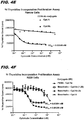
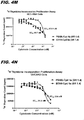
- FIG. 4A shows the inhibitory activity of the two immunoconjugates on the proliferation of 786-O cells, which are CD70-expressing human renal cancer cells.
- the conjugated antibody was 2H5, an anti-CD70 human monoclonal antibody.
- the compound (IIa) immunoconjugate not only had a lower EC 50 (0.1000 nM versus 0.5725 nM) but also had a higher overall percentage of inhibition, as evidenced by the depth of its inhibition curve.
- the full sequence information for antibody 2H5 is disclosed in Coccia et al. 2010 and Terret et al. 2012b.
- V H CDR1, CDR2, and CDR3 and V K CDR1, CDR2, and CDR3 sequences for antibody 2H5 are given in SEQ ID NO:1, SEQ ID NO:2, SEQ ID NO:3, SEQ ID NO:4, SEQ ID NO:5, and SEQ ID NO:6, respectively.
- FIG. 4B is a similar study, but using HPAC cells, which are mesothelin expressing human pancreatic cancer cells.
- the conjugated antibody was 6A4, an anti-mesothelin human monoclonal antibody.
- two different compound (IIa) conjugates were prepared, with substitution ratios of 1.25 and 3. (The cytotoxin concentrations on the X-axis are adjusted to reflect the substitution ratio.)
- FIG. 4B shows that the compound (A) immunoconjugate was essentially inactive, while the compound (IIa) immunoconjugates had approximately nanomolar EC 50 's. It is also noteworthy that the higher substitution ratio compound (IIa) immunoconjugate showed higher overall percentage of inhibition (deeper curve).
- V H CDR1, CDR2, and CDR3 and V K CDR1, CDR2, and CDR3 sequences for antibody 6A4 are given in SEQ ID NO:7, SEQ ID NO:8, SEQ ID NO:9, SEQ ID NO:10, SEQ ID NO:11, and SEQ ID NO:12, respectively.
- FIG. 4C is another similar study, this time using CHO-meso cells, which are Chinese hamster ovary cells transfected to express mesothelin.
- the conjugated antibody was, again, 6A4.
- the compound (A) immunoconjugate was essentially inactive, while the compound (IIa) immunoconjugate had an EC 50 of about 2 nM.
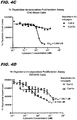
- FIG. 4D is yet another similar study, this time using OVCAR3 cells, which are mesothelin-expressing human ovarian cancer cells.
- the conjugated antibody was 6A4.
- the EC 50 for the compound (IIa) immunoconjugate was approximately 1000 times lower than that for the compound (A) immunoconjugate.
- FIG. 4E is yet another similar study, this time using Ramos cells, which are CD19-expressing human Burkitt's lymphoma cells.
- the conjugated antibody was 21D4, an anti-CD 19 human monoclonal antibody.
- the disparity between the compound (A) and (IIa) immunoconjugates was again marked, with the former being essentially inactive while the latter had a sub-nanomolar EC 50 .
- the full sequence information for antibody 21D4 is disclosed in King et al. 2010a and Rao-Naik et al. 2012.
- V H CDR1, CDR2, and CDR3 and V K CDR1, CDR2, and CDR3 sequences for antibody 21D4 are given in SEQ ID NO:13, SEQ ID NO:14, SEQ ID NO:15, SEQ ID NO:16, SEQ ID NO:17, and SEQ ID NO:18, respectively.
- FIG. 4F is yet another similar study, this time with NCI-H226 (H226) cells, which are mesothelin-expressing human lung-derived mesothelioma cells.
- the conjugated antibody was, again, 6A4.
- compound (IIa) was conjugated to 2A10, which is a human monoclonal antibody against prostate specific membrane antigen ("PSMA").
- PSMA prostate specific membrane antigen
- the PSMA immunoconjugate had very little or no activity, as H226 cells do not express PSMA.
- the compound (A) immunoconjugate had similarly low or no activity.
- the two compound (IIa) immunoconjugates each had sub-nanomolar EC 50 's.
- the immunoconjugate with the higher substitution ratio exhibited a higher overall percentage of proliferation inhibition.
- the full sequence information for antibody 2A10 is disclosed in Huang et al. 2009 and Cardarelli et al. 2011.
- the V H CDR1, CDR2, and CDR3 and V K CDR1, CDR2, and CDR3 sequences for antibody 2A10 are given in SEQ ID NO:19, SEQ ID NO:20, SEQ ID NO:21, SEQ ID NO:22, SEQ ID NO:23, and SEQ ID NO:24, respectively.
- FIG. 4G shows the activity of an immunoconjugate of anti-mesothelin antibody 6A4 and compound (IIa) against N87 human gastric carcinoma cells, which express mesothelin. A subnanomolar EC 50 was observed.
- FIG. 4H shows the activity of immunoconjugates of antibody 6A4 and compound (IIa) at various substitution ratios (SRs) against H292 cells, which are mesothelin expressing human mucoepidermoid pulmonary carcinoma cells.
- SRs substitution ratios
- the EC 50 values are shown in Table I, below. They show that there is a significant increase in potency when the SR is increased to about two or above.
- FIG. 4I shows a study similar to that of FIG. 4H , but against H1650 cells, which are mesothelin expressing human adenocarcinoma cells.
- the EC 50 values are presented in Table II. Again, a jump in potency was noted at SR above about two.
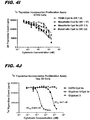
- FIGS. 4J and 4K are studies of immunoconjugates of this invention against two human hepatocellular carcinoma cell lines, Hep 3B and Hep G2, both of which express glypican-3.
- the potency of the anti-glypican-3 human monoclonal antibody 4A6 alone and when conjugated to compound (IIa) were compared, along with a control immunoconjugate of anti-CD70 antibody 2H5 and compound (IIa). (Neither Hep 3B nor Hep G2 cells express CD70.)
- the results show that the 4A6 immunoconjugate was very potent, about 1000X more active than the control CD70 immunoconjugate.
- the anti-glypican-3 antibody 4A6 alone was inactive.
- V H CDR1, CDR2, and CDR3 and V K CDR1, CDR2, and CDR3 sequences for antibody 4A6 are given in SEQ ID NO:25, SEQ ID NO:26, SEQ ID NO:27, SEQ ID NO:28, SEQ ID NO:29, and SEQ ID NO:30, respectively.
- FIGS. 4L , 4M, and 4N are studies of the activity of an immunoconjugate of the anti-B7H4 human monoclonal antibody 2A7 and compound (IIa) against MDA-MB-468, HCC-1954, and OVCAR3 cell lines.
- the first two are human breast cancer cell lines, while the third one is a human ovarian cancer cell line, all of which express B7H4 but not CD70.
- An immunoconjugate of anti-PSMA antibody 2A10 and compound IIa was used as control. It can be seen from figures that there was some specific activity against the breast cancer cell lines but little or none against OVCAR3 cells. (The full sequence information for antibody 2A7 is disclosed in Korman et al. 2009 and Terrett et al. 2011a.
- V H CDR1, CDR2, and CDR3 and V L CDR1, CDR2, and CDR3 sequences for antibody 2A7 are given in SEQ ID NO:31, SEQ ID NO:32, SEQ ID NO:33, SEQ ID NO:34, SEQ ID NO:35, and SEQ ID NO:36, respectively.
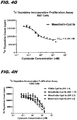
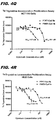
- FIG. 4O is a study of the activity of immunoconjugates of the anti-PSMA human monoclonal antibody 2A10 and the anti-RG-1 human monoclonal antibody 19G9, each conjugated to compound (IIa), against LNCap human prostate cancer cells, which express both PSMA and RG-1. Comparison data is provided for an immunoconjugate of anti-mesothelin antibody 6A4 and compound (IIa), as a control. It can be seen that both the PSMA and RG-1 conjugates were were effective, each with subnanomolar EC 50 's. (The full sequence information for antibody 19G9 is disclosed in King et al. 2011.
- V H CDR1, CDR2, and CDR3 and V L CDR1, CDR2, and CDR3 sequences for antibody 19G9 are given in SEQ ID NO:37, SEQ ID NO:38, SEQ ID NO:39, SEQ ID NO:40, SEQ ID NO:41, and SEQ ID NO:42, respectively.
- FIG. 4P is a study of the activity of immunoconjugates of the anti-CD 19 human monoclonal antibody 21D4 and the anti-CD22 human monoclonal antibody 12C5, each conjugated to compound (IIa), against Ramos cells, which express both CD19 and CD22. Comparison data is provided for immunoconjugates of anti-mesothelin antibody 6A4 and anti-CD70 antibody 2H5 compound (IIa). Both of the anti-CD19 and anti-CD22 immunoconjugates were highly potent, each with subnanomolar EC 50 's. (The full sequence information for antibody 12C5 is disclosed in King et al. 2010b.
- V H CDR1, CDR2, and CDR3 and V K CDR1, CDR2, and CDR3 sequences for antibody 12C5 are given in SEQ ID NO:43, SEQ ID NO:44, SEQ ID NO:45, SEQ ID NO:46, SEQ ID NO:47, and SEQ ID NO:48, respectively.
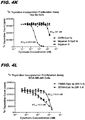
- FIG. 4Q shows the activity of an immunoconjugate of anti-PTK7 human monoclonal antibody 4D5 with compound IIa against HCT116 cells, which are human colon carcinoma cells.
- the immunoconjugate had an EC 50 of 1.87 nM, while a control immunoconjugate of the anti-PSMA antibody 2A10 was much less potent, with an EC 50 of 951 nM.
- the full sequence information for antibody 4D5 is disclosed in Terrett et al. 2010a and Terrett et al. 2012a.
- V H CDR1, CDR2, and CDR3 and V K CDR1, CDR2, and CDR3 sequences for antibody 4D5 are given in SEQ ID NO:49, SEQ ID NO:50, SEQ ID NO:51, SEQ ID NO:52, SEQ ID NO:53, and SEQ ID NO:54, respectively.
- FIG. 4R shows the activity of an immunoconjugate of the aforementioned anti-PTK7 antibody 4D5 against H520 cells, which are human lung squamous cell carcinoma cells.
- the PTK7 immunoconjugate had an EC 50 of 0.224 nM, while the control PSMA immunoconjugate again was much less potent, with an EC 50 of 61.6 nM.
- Immunoconjugates of this invention be used for treating diseases such as hyperproliferative diseases, including: cancers of the head and neck which include tumors of the head, neck, nasal cavity, paranasal sinuses, nasopharynx, oral cavity, oropharynx, larynx, hypopharynx, salivary glands, and paragangliomas; cancers of the liver and biliary tree, particularly hepatocellular carcinoma; intestinal cancers, particularly colorectal cancer; ovarian cancer; small cell and non-small cell lung cancer (SCLC and NSCLC); breast cancer sarcomas, such as fibrosarcoma, malignant fibrous histiocytoma, embryonal rhabdomyosarcoma, leiomysosarcoma, neurofibrosarcoma, osteosarcoma, synovial sarcoma, liposarcoma, and alveolar soft part sarcoma; leukemias such as acute promyeloc
- compositions described herein will result in a reduction in the size or number of the cancerous growth and/ or a reduction in associated symptoms (where applicable).
- Pathologically practice of the method and use of compositions described herein will produce a pathologically relevant response, such as: inhibition of cancer cell proliferation, reduction in the size of the cancer or tumor, prevention of further metastasis, and inhibition of tumor angiogenesis.
- the method of treating such diseases comprises administering a therapeutically effective amount of an inventive combination to a subject. The method may be repeated as necessary.
- the cancer can be a cancer whose cells express CD70, mesothelin, CD19, glypican-3, B7H4, RG-1, CD22, or PTK7.
- the cancer being treated is renal cancer, pancreatic cancer, ovarian cancer, lymphoma, colon cancer, mesothelioma, gastric cancer, lung cancer, prostate cancer, adenocarcinoma, liver cancer, or breast cancer.
- Immunoconjugates of this invention can be administered in combination with other therapeutic agents, including antibodies, alkylating agents, angiogenesis inhibitors, antimetabolites, DNA cleavers, DNA crosslinkers, DNA intercalators, DNA minor groove binders, enediynes, heat shock protein 90 inhibitors, histone deacetylase inhibitors, immunomodulators, microtubule stabilizers, nucleoside (purine or pyrimidine) analogs, nuclear export inhibitors, proteasome inhibitors, topoisomerase (I or II) inhibitors, tyrosine kinase inhibitors, and serine/threonine kinase inhibitors.
- other therapeutic agents including antibodies, alkylating agents, angiogenesis inhibitors, antimetabolites, DNA cleavers, DNA crosslinkers, DNA intercalators, DNA minor groove binders, enediynes, heat shock protein 90 inhibitors, histone deacetylase inhibitors, immunomodulators, microtubule stabilizers, nucleoside (purine
- Specific therapeutic agents include adalimumab, ansamitocin P3, auristatin, bendamustine, bevacizumab, bicalutamide, bleomycin, bortezomib, busulfan, callistatin A, camptothecin, capecitabine, carboplatin, carmustine, cetuximab, cisplatin, cladribin, cytarabin, cryptophycins, dacarbazine, dasatinib, daunorubicin, docetaxel, doxorubicin, duocarmycin, dynemycin A, epothilones, etoposide, floxuridine, fludarabine, 5-fluorouracil, gefitinib, gemcitabine, ipilimumab, hydroxyurea, imatinib, infliximab, interferons, interleukins, ⁇ -lapachone, lenali
- Immunoconjugates of this invention can be formulated and administered using techniques conventional for biologic drugs.
- Formulations can include excipients, such as taught in Gennaro, ed., Remington: The Science and Practice of Pharmacy, 20th Ed. (Lippincott Williams & Wilkins 2003 ).
- excipients include buffering agents (e.g., phosphates, acetate, tris(hydroxymethyl)aminomethane (Tris)), solubilizers and emulsifiers (e.g, polysorbate), preservatives (e.g., thimerosal, benzyl alcohol), salts (e.g., NaCl, KCl) chelators (e.g., EDTA), carbohydrates ( e.g., sucrose, dextrose, maltose, trehalose), carriers ( e.g ., albumin), amino acids and their respective hydrochloride salts, citrates, sorbitol, dextran, and the like.
- buffering agents e.g., phosphates, acetate, tris(hydroxymethyl)aminomethane (Tris)
- solubilizers and emulsifiers e.g, polysorbate
- preservatives e.g., thimerosal,
- the immunoconjugates can be provided as lyophilized powders with or without excipients, which can then be dissolved in a medium such as sterile water for injection, sodium chloride solution for injection, or dextrose solution for injection, with or without additional excipients.
- a medium such as sterile water for injection, sodium chloride solution for injection, or dextrose solution for injection, with or without additional excipients.
- the immunoconjugate can be provided as a concentrated solution, optionally including excipients, which is then diluted to the desired concentration prior to administration.
- Alternative forms include dispersions, microemulsion, and liposomes.
- a pharmaceutical composition is suitable for intravenous ("IV"), intramuscular, subcutaneous, parenteral, spinal or epidermal administration (e.g., by injection or infusion).
- parenteral administration means modes of administration other than enteral and topical administration, usually by injection, and includes, without limitation, intravenous, intramuscular, intraarterial, intrathecal, intracapsular, intraorbital, intracardiac, intradermal, intraperitoneal, transtracheal, subcutaneous, subcuticular, intraarticular, subcapsular, subarachnoid, intraspinal, epidural and intrasternal injection and infusion.
- Preferred modes of administration include IV infusion, IV bolus, subcutaneous, and intramuscular.
- a “therapeutically effective amount” preferably results in a decrease in severity of disease symptoms, an increase in frequency and duration of disease symptom-free periods, or a prevention of impairment or disability due to the disease affliction.
- a "therapeutically effective amount” preferably inhibits tumor growth by at least about 20%, more preferably by at least about 40%, even more preferably by at least about 60%, and still more preferably by at least about 80% relative to untreated subjects.
- a therapeutically effective amount of a therapeutic compound can decrease tumor size, or otherwise ameliorate symptoms in a subject, which is typically a human but can be another mammal.
- Dosage regimens are adjusted to provide a therapeutic response. For example, a single dose may be administered, several divided doses may be administered over time, or the dose may be proportionally reduced or increased as indicated by the exigencies of the situation. It is especially advantageous to formulate parenteral compositions in dosage unit form for ease of administration and uniformity of dosage.
- Dosage unit form refers to physically discrete units suited as unitary dosages for the subjects to be treated; each unit containing a predetermined quantity of active compound calculated to produce the desired therapeutic response, in association with the required pharmaceutical carrier. Devices such as prefilled syringes, two-chamber syringes, and autoinjectors can be used.
- the dosage will vary according to the disease being treated, patient traits such as age, gender, and genotype, and the stage of the treatment regimen. Typically, the dose can be from about 0.5 mg/kg to about 300 mg/kg.
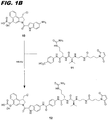
- FIGS. 1A and 1B combine to show the scheme for its synthesis.
- FIGS. 1A and 1B involve the convergent assembly of precursors of fragments a and a' and that alternative synthetic strategies may be employed, for instance through the assembly of precursors to fragments b, b' and b" or fragments c, c', and c" as shown below.
- the latter two strategies are illustrated in Sufi et al. 2010 and can be adapted for the synthesis of compounds of this invention, mutatis mutandis.
- This Example relates to the synthesis of compound 14, also referred to herein as compound (Ia).
- the schematic for the synthesis is shown in FIG. 2 .
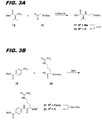
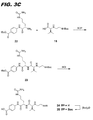
- FIGS. 3A-3D show in combination the synthesis of compound 28, also referred to herein as compound (IIb).
- compound (IIb) also referred to herein as compound (IIb).
- the general strategy employed here corresponds to the b/b'/b" pattern described above in Example 1.
- FIG. 3A shows the synthesis of a first intermediate compound 18.
- FIG. 3B shows the synthesis of a second intermediate compound 22.
- reaction mixture was stirred at RT overnight.
- the reaction mixture was diluted with EtOAc (600 mL) and the resultant solution was washed with Na 2 CO 3 solution (5%, 200 mL), saturated NaHCO 3 solution (1 ⁇ 200 mL), and brine (1 ⁇ 200 mL).
- the combined organic phases were dried over anhydrous MgSO 4 and concentrated to yield crude compound 21 as a yellow solid.
- FIG. 3C shows the synthesis of a third intermediate compound 25.
- FIG. 3D shows the completion of the synthesis of compound 28, also referred to herein as compound (IIb).
- the amount of 2-iminothiolane to be added can be determined by a preliminary experiment and varies from antibody to antibody.
- a titration of increasing amounts of 2-iminothiolane is added to the antibody, and following incubation with the antibody for 1 h at RT 25 °C), the antibody is desalted into 50 mM pH 6.0 HEPES buffer using a SEPHADEXTM G-25 column and the number of thiol groups introduced determined rapidly by reaction with dithiodipyridine ("DTDP"). Reaction of thiol groups with DTDP results in liberation of thiopyridine, which can be monitored spectroscopically at 324 nm. Samples at a protein concentration of 0.5-1.0 mg/mL are typically used.
- the absorbance at 280 nm can be used to accurately determine the concentration of protein in the samples, and then an aliquot of each sample (0.9 mL) is incubated with 0.1 mL DTDP (5 mM stock solution in ethanol) for 10 min at RT. Blank samples of buffer alone plus DTDP are also incubated alongside. After 10 min, absorbance at 324 nm is measured and the number of thiol groups is quantitated using an extinction coefficient for thiopyridine of 19,800 M -1 .
- a thiolation level of about three thiol groups per antibody is desirable. For example, with some antibodies this can be achieved by adding a 15-fold molar excess of 2-iminothiolane followed by incubation at RT for 1 h. The antibody is then incubated with 2-iminothiolane at the desired molar ratio and then desalted into conjugation buffer (50 mM pH 6.0 HEPES buffer containing 5 mM glycine and 2 mM DTPA). The thiolated material is maintained on ice while the number of thiols introduced is quantitated as described above.
- conjugation buffer 50 mM pH 6.0 HEPES buffer containing 5 mM glycine and 2 mM DTPA
- the drug-linker moiety is added at a 3-fold molar excess per thiol.
- the conjugation reaction is allowed to proceed in conjugation buffer also containing a final concentration of 5% dimethylsulfoxide (DMSO), or similar alternative solvent.
- DMSO dimethylsulfoxide
- the drug-linker stock solution is dissolved in 100% DMSO.
- the stock solution is added directly to the thiolated antibody, which has enough DMSO added to bring the final concentration to 10%, or pre-diluted in conjugation buffer containing a final concentration of 10% DMSO, followed by addition to an equal volume of thiolated antibody.
- the conjugation reaction mixture is incubated at RT for 2 h with stirring. Following incubation, the conjugation reaction mixture is centrifuged and filtered through a 0.2 ⁇ m filter. Purification of the conjugate can be achieved through chromatography using a number of methods. In one method, the conjugate is purified using size-exclusion chromatography on a SEPHACRYLTM S200 column pre-equilibrated with 50 mM pH 7.2 HEPES buffer containing 5 mM glycine and 50 mM NaCl. Chromatography is carried out at a linear flow rate of 28 cm/h. Fractions containing conjugate are collected, pooled and concentrated. In an alternative method, purification can be achieved through ion-exchange chromatography.
- antibody-drug conjugate reaction mix is applied to an SP-SEPHAROSETM column pre-equilibrated in 50 mM pH 5.5 HEPES containing 5mM glycine.
- the antibody conjugate is eluted using a gradient of 0-1 M NaCl in equilibration buffer at pH 5.5.
- Relevant fractions containing the immunoconjugate are pooled and dialyzed against formulation buffer (50 mM pH 7.2 HEPES buffer containing 5 mM glycine and 100 mM NaCl).
- immunoconjugates of compound (IIa) were prepared with an anti-PSMA human monoclonal antibody (2A10, Huang et al. 2009 and Cardarelli et al. 2011); an anti-mesothelin human monoclonal antibody (6A4, Terrett et al. 2009b), an anti-CD70 human monoclonal antibody (2H5, Terrett et al. 2009a), and an anti-CD19 human monoclonal antibody (21D4, Rao-Naik et al. 2009). Comparative immunoconjugates with compound (A) was likewise prepared.
- This example generally describes the procedure used to assay the antiproliferative activity of immunoconjugates of this invention.
- Human tumor cell lines were obtained from the American Type Culture Collection (ATCC), P.O. Box 1549, Manassas, VA 20108, USA, and cultured according to ATCC instructions.
- CHO-Meso cells were generated by transfecting CHO cells with DNA containing human Mesothelin gene and selecting for stable clonnes expressing human Mesothelin. Cells were seeded at 1.0 x 10 4 cells/well in 96-well plates for 3 hr for 3 H thymidine assays, respectively. Serial dilutions (1:3) of immunoconjugates were added to the wells.
- 786-O cells as frozen pellets with an estimated quantity of 10 7 cells per vortexing tube, were resuspended and homogenized in 500 ⁇ L of lysis buffer (25 mM NaOAc, 1 mM EDTA, 0.25 M sucrose, 0.1% Triton X-100, pH 5.5). Homogenization involved vortex mixing for 30 sec, followed by a one min cooling on ice. For each tube, three vortex and cooling cycles were performed. Cell samples were then further mixed by shearing in a 19 gauge needle three times.
- lysis buffer 25 mM NaOAc, 1 mM EDTA, 0.25 M sucrose, 0.1% Triton X-100, pH 5.5.
- the DNA of the cell lysate was hydrolyzed using BENZONASETM DNAse.
- Samples were first brought up in 1 mM MgSO 4 . After mixing, 2 ⁇ L of BENZONASETM DNAse (neat) were added to each vial of lysate (4 ⁇ L/mL, v/v, final concentration). Samples were then stored at RT for 15 min and then cooled on ice. For this step, successful DNAse activity was evidenced by appearance of flocculent precipitate. Samples were then spun at maximum speed in a microcentrifuge for 5 min to remove cellular debris. Supernatant was frozen at -70 °C for later use. Protein concentration of the lysate was determined using Pierce BCA Protein Determination methodology (Thermo Scientific). Samples in this study were found to contain 2.85 mg/mL protein.
- a 2000 ⁇ M stock solution of the compound of formula (Ia) was prepared. Lysate was diluted to 2.1 mg/mL in lysate buffer. For reaction, 5 ⁇ L of the compound (Ia) stock was added to 95 ⁇ L of lysate. Final concentrations were 100 ⁇ M compound (Ia) in lysate containing 2 mg/mL of protein.
- a buffer containing 25 mM NaOAc, 1 mM EDTA, 0.25 M sucrose, 0.1% Triton X 100, and 1 mM MgSO 4 provided buffering at pH 5.5.
- Negative controls were employed, with lysate buffer in place of cell lysate, with BENZONASETM DNAse and MgSO 4 also added.
- Test samples and controls were placed in a hot block set at 37 °C. At predetermined time intervals (5 min, 1 hr, 2 hr, 4 hr, and 8 hr), 50 ⁇ L aliquots were removed, and the reaction in each aliquot stopped by the addition of 150 ⁇ L (3X) of cold ethanol. Samples were stored on ice for one hour and centrifuged to remove protein. The supernatant was reserved for UPLC analysis, under the following conditions:
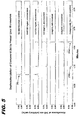
- This example demonstrates the dephosphorylation of compound (Ia) by human and mouse liver microsome enzymes.
- Human liver microsomes derived from pooled liver sources were obtained from Xenotech (Part Number H-0630). They were supplied at a nominal protein concentration of 20 mg/mL in a 20% sucrose solution. Protein content was verified with BCA analysis using reagent from Thermo-Fisher.
- a 2000 ⁇ M stock solution of the compound of formula (Ia) was prepared. For reactions, 95 ⁇ L of each microsome stock was allowed to equilibrate in a 37 °C hot block. A 5 ⁇ L aliquot of the compound (Ia) stock solution was then added to each reaction vial in precisely staggered 30 sec intervals. The final compound (Ia) concentration was 100 ⁇ M. Samples were allowed to react at temperature for 1 hr, after which reaction was stopped with the addition of 100 ⁇ L of cold ethanol. Stop was performed again in precise 30 second intervals, such that each vial was allowed to react for exactly 1 hour. Samples were prepared in duplicate. Protein was allowed to precipitate on ice for 30 min. The supernatant was collected following centrifugation.
- FIG. 6 is a plot of the amount of compounds (IVa) and (IVb) produced from compound (Ia) after 60 min as a function of microsome concentration.
- the rate of production was essentially linear for microsome concentrations between 0.00156 and 0.0125 mg/mL. Using the data in this range, a rate for the production of compounds (IVa) and (IVb) of 0.0054 ⁇ mol/min/mg was calculated.
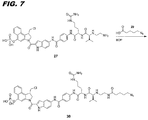
- Compound 30 (IIc) has an azido reactive functional group, making it suitable for conjugation employing "click” chemistry.
- Compound 34 (IId) has a hydroxylamine reactive functional group, making it suitable for conjugation by oxime formation with an antibody modified to contain a ketone group, for example by the incorporation of the non-natural amino acid p-acetylphenylalanine.
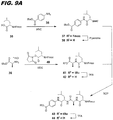
- FIGS. 9A-9B in combination describe the synthesis of compound 48 , also referred to herein as compound (IIe).
- the Leu-Ala-Leu tripeptide of compound 48 (IIe) is a substrate motif for the enzyme CD10, so that conjugates made with this compound should be susceptible to cleavage by CD10.
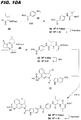
- FIGS. 10A-10B in combination describe the synthesis of compound 56, also referred to herein as compound (IIf).
- Leu-Ile dipeptide of compound 56 (IIf) is a substrate motif for the enzyme cathepsin E, so that immunoconjugates made with this compound should be susceptible to cleavage by cathepsin E.
- FIGS. 11A-11B in combination describe the synthesis of compound 67, also referred to herein as compound (IIg).
- FIGS. 12A-12I demonstrate the in vivo efficacy of immunoconjugates of this invention in xenograft studies with mice, against a variety of cancer types.
- OVCAR3 cell study Five million OVCAR3 ovarian cancer cells, resuspended in 0.1 mL phosphate buffered saline ("PBS") plus 0.1 mL matrigel, were implanted subcutaneously at the flank region of SCID mice. Tumor measurements started 23 days later, and mice were randomized into groups of 6 mice each with average tumor sizes of 90 mm 3 estimated by LWH/2 of tumors. At 24 days post tumor implantation, mice were dosed intraperitoneally singly with testing compounds. FIG.
- PBS phosphate buffered saline
- N87 cell study Two and a half million N87 gastric tumor cells, resuspended in 0.1 mL PBS plus 0.1 mL matrigel, were implanted subcutaneously at the flank region of SCID mice. Tumor measurements started 12 days later, and mice were randomized into groups of 7 mice each with average tumor sizes of 110 mm 3 estimated by LWH/2 of tumors. At 14 days post tumor implantation, mice were dosed intraperitoneally singly with testing compounds.
- FIG. 12B shows that, against N87 cells, an immunoconjugate of anti-mesothelin antibody 6A4 with compound (IIa) strongly inhibits tumor growth. Comparative data for formulation buffer alone or an immunoconjugate of anti-CD 19 antibody 21D4 and compound (IIa) are presented, the latter as an isotype control.
- FIG. 12C shows the dose-dependent effect of an immunoconjugate of anti-mesothelin antibody 6A4 and compound (IIa) on tumor growth.
- the SR was 3.6 in each instance.
- FIG. 12D shows the tumor inhibition by an immunoconjugate of anti-mesothelin antibody 6A4 and compound (IIa). Comparative data for a vehicle control and an immunoconjugate of anti-CD 19 antibody 21D4 and compound (IIa) are presented, the latter as an isotype control.
- FIG. 12E shows the dose-dependent tumor growth inhibitory effect of an immunoconjugate of anti-glypican 3 antibody 4A6 and compound (IIa). The strongest effect was seen with a dose of 0.1 ⁇ mol/kg.
- FIG. 12F is a graph from the same study, but demonstrating the ability of the antibody 4A6-compound (IIa) immunoconjugate to alleviate tumor-associated cachexia.
- Data for the anti-CD 19-compound (IIa) immunoconjugate is also presented showing that the anti-CD 19 conjugate, while it reduces tumor growth (per FIG. 12E ), it does not alleviate cachexia (per FIG. 12F ).
- FIG. 12G shows the tumor growth inhibition by an immunoconjugate of anti-PSMA antibody 2A10 and compound (IIa), compared to formulation buffer and an immunoconjugate of anti-CD 19 antibody 21D4 and compound (IIa) as isotype control.
- FIG. 12H shows another set of results from the same study, with an immunoconjugate of anti-RG-1 antibody 19G9 and compound (IIa), with an isotype control of an anti-CD19 immunoconjugate.
- FIG. 12I shows the tumor growth inhibitory effect by immunoconjugates of anti-mesothelin antibody 6A4, anti-CD19 antibody 21D4, anti-CD22 antibody 12C5, and anti-CD70 antibody 1F4, each with compound (IIa).
- V H CDR1, CDR2, and CDR3 and V K CDR1, CDR2, and CDR3 sequences for antibody 1F4 are given in SEQ ID NO:55, SEQ ID NO:56, SEQ ID NO:57, SEQ ID NO:58, SEQ ID NO:59, and SEQ ID NO:60, respectively.
Landscapes
- Health & Medical Sciences (AREA)
- Chemical & Material Sciences (AREA)
- Life Sciences & Earth Sciences (AREA)
- Organic Chemistry (AREA)
- Medicinal Chemistry (AREA)
- General Health & Medical Sciences (AREA)
- Bioinformatics & Cheminformatics (AREA)
- Engineering & Computer Science (AREA)
- Pharmacology & Pharmacy (AREA)
- Animal Behavior & Ethology (AREA)
- Public Health (AREA)
- Veterinary Medicine (AREA)
- Epidemiology (AREA)
- Cell Biology (AREA)
- Immunology (AREA)
- Molecular Biology (AREA)
- Biochemistry (AREA)
- Proteomics, Peptides & Aminoacids (AREA)
- Biophysics (AREA)
- Genetics & Genomics (AREA)
- Oncology (AREA)
- Gastroenterology & Hepatology (AREA)
- Reproductive Health (AREA)
- Pulmonology (AREA)
- General Chemical & Material Sciences (AREA)
- Chemical Kinetics & Catalysis (AREA)
- Microbiology (AREA)
- Mycology (AREA)
- Nuclear Medicine, Radiotherapy & Molecular Imaging (AREA)
- Peptides Or Proteins (AREA)
- Medicines Containing Antibodies Or Antigens For Use As Internal Diagnostic Agents (AREA)
- Medicines That Contain Protein Lipid Enzymes And Other Medicines (AREA)
- Medicinal Preparation (AREA)
- Pharmaceuticals Containing Other Organic And Inorganic Compounds (AREA)
Applications Claiming Priority (2)
| Application Number | Priority Date | Filing Date | Title |
|---|---|---|---|
| US201161490117P | 2011-05-26 | 2011-05-26 | |
| PCT/US2012/039312 WO2012162482A1 (en) | 2011-05-26 | 2012-05-24 | Immunoconjugates, compositions containing them, and methods of making and use |
Publications (2)
| Publication Number | Publication Date |
|---|---|
| EP2714092A1 EP2714092A1 (en) | 2014-04-09 |
| EP2714092B1 true EP2714092B1 (en) | 2020-07-15 |
Family
ID=46172969
Family Applications (1)
| Application Number | Title | Priority Date | Filing Date |
|---|---|---|---|
| EP12724065.3A Not-in-force EP2714092B1 (en) | 2011-05-26 | 2012-05-24 | Immunoconjugates, compositions containing them, and methods of making and use |
Country Status (23)
| Country | Link |
|---|---|
| US (2) | US8852599B2 (enExample) |
| EP (1) | EP2714092B1 (enExample) |
| JP (2) | JP6105566B2 (enExample) |
| KR (1) | KR102070464B1 (enExample) |
| CN (1) | CN103561772B (enExample) |
| AR (1) | AR086568A1 (enExample) |
| AU (1) | AU2012258750B2 (enExample) |
| BR (1) | BR112013029764A2 (enExample) |
| CA (1) | CA2837327C (enExample) |
| CL (1) | CL2013003393A1 (enExample) |
| CO (1) | CO6831975A2 (enExample) |
| EA (1) | EA024844B1 (enExample) |
| ES (1) | ES2814798T3 (enExample) |
| IL (1) | IL229477A (enExample) |
| MA (1) | MA35153B1 (enExample) |
| MX (1) | MX336806B (enExample) |
| PE (1) | PE20141480A1 (enExample) |
| PH (1) | PH12013502189A1 (enExample) |
| SG (1) | SG195011A1 (enExample) |
| TW (1) | TW201300401A (enExample) |
| UY (1) | UY34100A (enExample) |
| WO (1) | WO2012162482A1 (enExample) |
| ZA (2) | ZA201309669B (enExample) |
Cited By (1)
| Publication number | Priority date | Publication date | Assignee | Title |
|---|---|---|---|---|
| US11571481B2 (en) | 2020-12-21 | 2023-02-07 | Cornell University | Peptide-linked drug delivery system |
Families Citing this family (64)
| Publication number | Priority date | Publication date | Assignee | Title |
|---|---|---|---|---|
| AU2008275985B2 (en) * | 2007-07-17 | 2013-09-19 | E. R. Squibb & Sons, L.L.C. | Monoclonal antibodies against Glypican-3 |
| EP3539982B1 (en) | 2011-12-23 | 2025-02-19 | Pfizer Inc. | Engineered antibody constant regions for site-specific conjugation and methods and uses therefor |
| KR20210132742A (ko) | 2012-12-21 | 2021-11-04 | 알트루바이오 인코퍼레이티드 | 친수성 자기-희생 링커 및 그것의 포합체 |
| US10233249B2 (en) | 2013-03-19 | 2019-03-19 | Beijing Shenogen Pharma Group Ltd. | Antibodies and methods for treating estrogen receptor-associated diseases |
| DK2991683T3 (da) | 2013-05-02 | 2019-11-04 | Glykos Finland Oy | Konjugater af et glykoprotein eller en glykan med en toksisk ladning |
| BR112016002829A2 (pt) | 2013-08-12 | 2017-09-19 | Genentech Inc | Composto e processo para preparar o composto de conjugado anticorpo-¿droga, composição farmacêutica, método de tratamento do câncer, kit para o tratamento do câncer, intermediário ligante¿-droga, porção e composto de porção droga de dímero cbi |
| JP6980384B2 (ja) | 2013-12-16 | 2021-12-15 | ジェネンテック, インコーポレイテッド | 1−(クロロメチル)−2,3−ジヒドロ−1h−ベンゾ[e]インドール二量体抗体−薬物コンジュゲート化合物、並びに使用及び処置の方法 |
| SG11201605437YA (en) * | 2014-01-27 | 2016-08-30 | Pfizer | Bifunctional cytotoxic agents |
| SG11201607818WA (en) | 2014-03-20 | 2016-10-28 | Bristol Myers Squibb Co | Stabilized fibronectin based scaffold molecules |
| SMT202100146T1 (it) * | 2014-04-30 | 2021-05-07 | Pfizer | Coniugati di anticorpo anti-ptk7-farmaco |
| KR20170020868A (ko) | 2014-06-20 | 2017-02-24 | 바이오얼라이언스 씨.브이. | 항-폴레이트 수용체 알파 (fra) 항체-약물 컨쥬게이트 및 그것의 사용 방법 |
| WO2015196089A1 (en) * | 2014-06-20 | 2015-12-23 | Bioalliance C.V. | Anti-cd22 antibody-drug conjugates and methods of using thereof |
| US10973920B2 (en) | 2014-06-30 | 2021-04-13 | Glykos Finland Oy | Saccharide derivative of a toxic payload and antibody conjugates thereof |
| GB201412658D0 (en) | 2014-07-16 | 2014-08-27 | Ucb Biopharma Sprl | Molecules |
| ES2826566T3 (es) | 2014-11-21 | 2021-05-18 | Bristol Myers Squibb Co | Anticuerpos que comprenden regiones constantes pesadas modificadas |
| JP6805142B2 (ja) | 2014-11-21 | 2020-12-23 | ブリストル−マイヤーズ スクイブ カンパニーBristol−Myers Squibb Company | Cd73に対する抗体およびその使用 |
| JP6622814B2 (ja) | 2014-11-25 | 2019-12-18 | ブリストル−マイヤーズ スクイブ カンパニーBristol−Myers Squibb Company | イメージングのための新規pd−l1結合ポリペプチド |
| ES2736106T3 (es) | 2015-03-10 | 2019-12-26 | Bristol Myers Squibb Co | Anticuerpos que se pueden conjugar mediante la transglutaminasa y conjugados producidos a partir de ellos |
| KR102046862B1 (ko) | 2015-03-20 | 2019-11-20 | 화이자 인코포레이티드 | Cti 약물작용발생단을 함유하는 이관능성 세포독성제 |
| AU2016271111B2 (en) | 2015-05-29 | 2022-04-28 | Bristol-Myers Squibb Company | Antibodies against OX40 and uses thereof |
| RU2687237C1 (ru) | 2015-07-10 | 2019-05-08 | Синтон Байофармасьютикалс Б. В. | Композиции, содержащие конъюгаты антитело-лекарственное средство дуокармицин |
| GB201601073D0 (en) | 2016-01-20 | 2016-03-02 | Ucb Biopharma Sprl | Antibodies |
| GB201601077D0 (en) | 2016-01-20 | 2016-03-02 | Ucb Biopharma Sprl | Antibody molecule |
| GB201601075D0 (en) | 2016-01-20 | 2016-03-02 | Ucb Biopharma Sprl | Antibodies molecules |
| CA2996798A1 (en) | 2015-08-28 | 2017-03-09 | Ventana Medical Systems, Inc. | Protein proximity assay in formalin fixed paffafin embedded tissue using caged haptens |
| EP3353198B1 (en) | 2015-09-23 | 2020-06-17 | Bristol-Myers Squibb Company | Glypican-3binding fibronectin based scafflold molecules |
| CN108473565B (zh) | 2015-11-18 | 2022-05-27 | 默沙东公司 | Ctla4结合剂 |
| US10689458B2 (en) | 2015-11-30 | 2020-06-23 | Pfizer Inc. | Site specific HER2 antibody drug conjugates |
| EP3394096A1 (en) | 2015-12-21 | 2018-10-31 | Bristol-Myers Squibb Company | Variant antibodies for site-specific conjugation |
| WO2017120534A1 (en) | 2016-01-08 | 2017-07-13 | Bioalliance C.V. | Tetravalent anti-psgl-1 antibodies and uses thereof |
| AU2017228470A1 (en) | 2016-03-04 | 2018-08-30 | Bristol-Myers Squibb Company | Combination therapy with anti-CD73 antibodies |
| US20170326249A1 (en) | 2016-05-10 | 2017-11-16 | Bristol-Myers Squibb Company | Antibody-drug conjugate of an anti-glypican-3 antibody and a tubulysin analog, preparation and uses |
| WO2018035391A1 (en) | 2016-08-19 | 2018-02-22 | Bristol-Myers Squibb Company | Seco-cyclopropapyrroloindole compounds, antibody-drug conjugates thereof, and methods of making and use |
| CN113912586B (zh) | 2016-08-31 | 2023-04-07 | 江苏恒瑞医药股份有限公司 | 氧代吡啶酰胺类衍生物、其制备方法及其在医药上的应用 |
| US20190218294A1 (en) | 2016-09-09 | 2019-07-18 | Bristol-Myers Squibb Company | Use of an anti-pd-1 antibody in combination with an anti-mesothelin antibody in cancer treatment |
| WO2018064094A1 (en) | 2016-09-28 | 2018-04-05 | Bristol-Myers Squibb Company | Enantioselective synthesis of pyrroloindole compounds |
| CN110072890B (zh) * | 2016-11-03 | 2022-11-29 | 百时美施贵宝公司 | 可活化的抗ctla-4抗体及其用途 |
| CN110944651A (zh) | 2017-02-08 | 2020-03-31 | 蜻蜓疗法股份有限公司 | 用于自然杀伤细胞激活的多特异性结合蛋白及其治疗癌症的治疗性用途 |
| CA3053275A1 (en) * | 2017-02-10 | 2018-08-16 | Dragonfly Therapeutics, Inc. | Proteins binding psma, nkg2d and cd16 |
| EP4273258A3 (en) | 2017-02-20 | 2024-01-17 | Dragonfly Therapeutics, Inc. | Proteins binding her2, nkg2d and cd16 |
| MX2019013132A (es) | 2017-05-25 | 2020-01-27 | Bristol Myers Squibb Co | Anticuerpos que comprenden regiones constantes pesadas modificadas. |
| SG11202000387YA (en) | 2017-08-25 | 2020-03-30 | Five Prime Therapeutics Inc | B7-h4 antibodies and methods of use thereof |
| US11364303B2 (en) | 2017-09-29 | 2022-06-21 | Pfizer Inc. | Cysteine engineered antibody drug conjugates |
| CN108148137B (zh) * | 2017-12-29 | 2021-03-23 | 中国人民解放军第四军医大学 | 一种b7h4/1e10单克隆抗体及其应用 |
| CA3090244A1 (en) | 2018-02-08 | 2019-08-15 | Dragonfly Therapeutics, Inc. | Antibody variable domains targeting the nkg2d receptor |
| MX2020008333A (es) | 2018-02-08 | 2020-09-21 | Dragonfly Therapeutics Inc | Terapia de combinacion del cancer que incluye proteinas de union multiespecificas que activan a las celulas asesinas naturales. |
| CN112119093A (zh) | 2018-02-20 | 2020-12-22 | 蜻蜓治疗公司 | 结合cd33、nkg2d和cd16的多特异性结合蛋白和使用方法 |
| WO2019165077A1 (en) | 2018-02-21 | 2019-08-29 | Five Prime Therapeutics, Inc. | B7-h4 antibody formulations |
| KR20200144094A (ko) | 2018-03-02 | 2020-12-28 | 파이브 프라임 테라퓨틱스, 인크. | B7-h4 항체 및 이의 사용 방법 |
| EA202091888A1 (ru) | 2018-08-08 | 2020-10-23 | Драгонфлай Терапьютикс, Инк. | Вариабельные домены антител, нацеленные на рецептор nkg2d |
| CN113164570B (zh) | 2018-08-08 | 2024-05-14 | 蜻蜓疗法股份有限公司 | 结合nkg2d、cd16和肿瘤相关抗原的蛋白质 |
| CA3108427A1 (en) | 2018-08-08 | 2020-02-13 | Dragonfly Therapeutics, Inc. | Multi-specific binding proteins that bind bcma, nkg2d and cd16, and methods of use |
| AU2019361923B2 (en) | 2018-10-15 | 2026-07-09 | Five Prime Therapeutics, Inc. | Combination therapy for cancer |
| JP2022513653A (ja) | 2018-11-28 | 2022-02-09 | ブリストル-マイヤーズ スクイブ カンパニー | 修飾された重鎖定常領域を含む抗体 |
| DK3886914T3 (da) | 2018-11-30 | 2023-07-03 | Bristol Myers Squibb Co | Antistof omfattende en glutaminholdig letkæde-c-terminal forlængelse, konjugater deraf og fremgangsmåder samt anvendelser |
| WO2020123425A2 (en) | 2018-12-12 | 2020-06-18 | Bristol-Myers Squibb Company | Antibodies modified for transglutaminase conjugation, conjugates thereof, and methods and uses |
| AU2020288275A1 (en) * | 2019-06-06 | 2022-02-03 | Jiangsu Hansoh Pharmaceutical Group Co., Ltd. | Anti-B7-H4 antibody–drug conjugate and medicinal use thereof |
| US20240377413A1 (en) | 2019-09-16 | 2024-11-14 | Bristol-Myers Squibb Company | Dual capture method for analysis of antibody-drug conjugates |
| AU2021268340A1 (en) | 2020-05-06 | 2022-12-08 | Dragonfly Therapeutics, Inc. | Proteins binding NKG2D, CD16 and CLEC12A |
| WO2022147532A1 (en) | 2021-01-04 | 2022-07-07 | Mersana Therapeutics, Inc. | B7h4-targeted antibody-drug conjugates and methods of use thereof |
| CN116783485A (zh) * | 2021-01-15 | 2023-09-19 | 文塔纳医疗系统公司 | 储存稳定的笼状半抗原 |
| EP4301774A4 (en) | 2021-03-03 | 2025-08-13 | Dragonfly Therapeutics Inc | METHODS OF TREATING CANCER USING MULTI-SPECIFIC BINDING PROTEINS THAT BIND TO NKG2D, CD16, AND A TUMOR-ASSOCIATED ANTIGEN |
| CN117897405A (zh) * | 2021-06-30 | 2024-04-16 | 得克萨斯大学体系董事会 | 靶向cd70-阳性癌症的多肽 |
| WO2026080716A1 (en) * | 2024-10-11 | 2026-04-16 | Codeable Therapeutics, Incorporated | Modified self-immolating moieties in antibody-drug conjugates |
Family Cites Families (35)
| Publication number | Priority date | Publication date | Assignee | Title |
|---|---|---|---|---|
| AU648313B2 (en) | 1990-04-25 | 1994-04-21 | Pharmacia & Upjohn Company | Novel CC-1065 analogs |
| US5686072A (en) * | 1992-06-17 | 1997-11-11 | Board Of Regents, The University Of Texas | Epitope-specific monoclonal antibodies and immunotoxins and uses thereof |
| US5595756A (en) * | 1993-12-22 | 1997-01-21 | Inex Pharmaceuticals Corporation | Liposomal compositions for enhanced retention of bioactive agents |
| US5659022A (en) | 1996-01-05 | 1997-08-19 | Epoch Pharmaceuticals, Inc. | Oligonucleotide-cyclopropapyrroloindole conjugates as sequence specific hybridization and crosslinking agents for nucleic acids |
| NZ517202A (en) | 1999-08-24 | 2004-05-28 | Medarex Inc | Human CTLA-4 antibodies and their uses |
| KR20030033007A (ko) | 2001-05-31 | 2003-04-26 | 코울터 파머수티컬, 인코포레이티드 | 세포독소, 약물전구체, 링커 및 이에 유용한 안정화제 |
| US20030031677A1 (en) | 2001-06-25 | 2003-02-13 | Drug Innovation & Design, Incorporated | Exponential pattern recognition based cellular targeting, compositions, methods and anticancer applications |
| EP1471938A4 (en) | 2002-01-09 | 2008-03-05 | Medarex Inc | HUMAN MONOCLONAL ANTIBODIES AGAINST CD30 |
| US6756397B2 (en) | 2002-04-05 | 2004-06-29 | Immunogen, Inc. | Prodrugs of CC-1065 analogs |
| PE20050712A1 (es) | 2003-07-22 | 2005-11-02 | Schering Ag | Anticuerpos rg1 |
| US7691962B2 (en) | 2004-05-19 | 2010-04-06 | Medarex, Inc. | Chemical linkers and conjugates thereof |
| BRPI0510909A2 (pt) | 2004-05-19 | 2008-12-16 | Medarex Inc | composto de ligaÇço fÁrmaco-ligante citotàxico, formulaÇço farmacÊutica, mÉtodo para matar uma cÉlula e mÉtodo para retardar ou interromper o crescimento de tumor |
| CA2598454C (en) | 2005-02-18 | 2013-04-09 | Medarex, Inc. | Monoclonal antibodies against prostate specific membrane antigen (psma) lacking in fucosyl residues |
| ES2386366T3 (es) | 2005-02-18 | 2012-08-17 | Medarex, Inc. | Anticuerpo monoclonal humano contra el antígeno de membrana específico de la próstata (PSMA) |
| EP3530736A3 (en) | 2005-05-09 | 2019-11-06 | ONO Pharmaceutical Co., Ltd. | Human monoclonal antibodies to programmed death 1 (pd-1) and methods for treating cancer using anti-pd-1 antibodies alone or in combination with other immunotherapeutics |
| WO2007002223A2 (en) | 2005-06-20 | 2007-01-04 | Medarex, Inc. | Cd19 antibodies and their uses |
| EP1934261B1 (en) | 2005-09-26 | 2014-10-29 | Medarex, L.L.C. | Human monoclonal antibodies to cd70 |
| EA016577B1 (ru) | 2005-09-26 | 2012-06-29 | Медарекс, Инк. | Конъюгаты антитело-лекарство и их применение |
| WO2007059404A2 (en) | 2005-11-10 | 2007-05-24 | Medarex, Inc. | Duocarmycin derivatives as novel cytotoxic compounds and conjugates |
| US8609816B2 (en) | 2005-12-08 | 2013-12-17 | Medarex, L.L.C. | Human monoclonal antibodies to O8E |
| NZ569236A (en) | 2005-12-08 | 2012-06-29 | Medarex Inc | Human monoclonal antibodies to protein tyrosine kinase 7 (PTK7) and their use |
| MX2008009956A (es) | 2006-02-02 | 2008-12-12 | Syntarga Bv | Analogos de cc-1065 solubles en agua y sus conjugados. |
| CN101528914B (zh) | 2006-09-08 | 2014-12-03 | Ambrx公司 | 通过脊椎动物细胞位点特异性并入非天然氨基酸 |
| SG177168A1 (en) | 2006-12-01 | 2012-01-30 | Medarex Inc | Human antibodies that bind cd22 and uses thereof |
| CL2007003622A1 (es) | 2006-12-13 | 2009-08-07 | Medarex Inc | Anticuerpo monoclonal humano anti-cd19; composicion que lo comprende; y metodo de inhibicion del crecimiento de celulas tumorales. |
| US20100150950A1 (en) | 2006-12-14 | 2010-06-17 | Medarex, Inc. | Human antibodies that bind cd70 and uses thereof |
| CN101605906A (zh) * | 2006-12-14 | 2009-12-16 | 梅达雷克斯公司 | 结合cd70的人类抗体及其用途 |
| UY30776A1 (es) | 2006-12-21 | 2008-07-03 | Medarex Inc | Anticuerpos cd44 |
| TWI412367B (zh) * | 2006-12-28 | 2013-10-21 | 梅達雷克斯有限責任公司 | 化學鏈接劑與可裂解基質以及其之綴合物 |
| JP2010519310A (ja) | 2007-02-21 | 2010-06-03 | メダレックス インコーポレイテッド | 単一のアミノ酸を有する化学リンカーおよびその複合体 |
| AU2008275985B2 (en) | 2007-07-17 | 2013-09-19 | E. R. Squibb & Sons, L.L.C. | Monoclonal antibodies against Glypican-3 |
| HRP20150074T1 (hr) | 2007-10-01 | 2015-03-13 | Bristol-Myers Squibb Company | Humana antitijela koja se vežu za mezotelin i njihove uporabe |
| JP2011505371A (ja) | 2007-11-30 | 2011-02-24 | ブリストル−マイヤーズ スクイブ カンパニー | 抗−rg−1抗体の複合体 |
| EP2229187A2 (en) | 2007-11-30 | 2010-09-22 | Bristol-Myers Squibb Company | Monoclonal antibody partner molecule conjugates directed to protein tyrosine kinase 7 (ptk7) |
| AR069747A1 (es) | 2007-11-30 | 2010-02-17 | Medarex Inc | Conjugado anticuerpo monoclonal anti-b7h4- farmaco y metodos de utilizacion |
-
2012
- 2012-05-22 US US13/477,219 patent/US8852599B2/en active Active
- 2012-05-24 AU AU2012258750A patent/AU2012258750B2/en not_active Ceased
- 2012-05-24 AR ARP120101857A patent/AR086568A1/es unknown
- 2012-05-24 KR KR1020137033963A patent/KR102070464B1/ko not_active Expired - Fee Related
- 2012-05-24 CN CN201280025332.4A patent/CN103561772B/zh not_active Expired - Fee Related
- 2012-05-24 SG SG2013085048A patent/SG195011A1/en unknown
- 2012-05-24 BR BR112013029764A patent/BR112013029764A2/pt not_active Application Discontinuation
- 2012-05-24 JP JP2014512101A patent/JP6105566B2/ja not_active Expired - Fee Related
- 2012-05-24 PE PE2013002713A patent/PE20141480A1/es not_active Application Discontinuation
- 2012-05-24 WO PCT/US2012/039312 patent/WO2012162482A1/en not_active Ceased
- 2012-05-24 CA CA2837327A patent/CA2837327C/en not_active Expired - Fee Related
- 2012-05-24 ES ES12724065T patent/ES2814798T3/es active Active
- 2012-05-24 PH PH1/2013/502189A patent/PH12013502189A1/en unknown
- 2012-05-24 EA EA201391754A patent/EA024844B1/ru not_active IP Right Cessation
- 2012-05-24 EP EP12724065.3A patent/EP2714092B1/en not_active Not-in-force
- 2012-05-24 MX MX2013013402A patent/MX336806B/es active IP Right Grant
- 2012-05-25 UY UY0001034100A patent/UY34100A/es unknown
- 2012-05-25 TW TW101118845A patent/TW201300401A/zh unknown
-
2013
- 2013-11-15 MA MA36439A patent/MA35153B1/fr unknown
- 2013-11-17 IL IL229477A patent/IL229477A/en active IP Right Grant
- 2013-11-26 CL CL2013003393A patent/CL2013003393A1/es unknown
- 2013-12-11 CO CO13289636A patent/CO6831975A2/es not_active Application Discontinuation
- 2013-12-20 ZA ZA2013/09669A patent/ZA201309669B/en unknown
-
2014
- 2014-08-21 ZA ZA2014/06168A patent/ZA201406168B/en unknown
- 2014-08-28 US US14/471,096 patent/US9186416B2/en active Active
-
2017
- 2017-02-02 JP JP2017017666A patent/JP6359133B2/ja not_active Expired - Fee Related
Non-Patent Citations (1)
| Title |
|---|
| AMISHIRO N ET AL: "SYNTHESIS AND ANTITUMOR ACTIVITY OF DUOCARMYCIN DERIVATIVES: MODIFICATION OF SEGMENT-A OF A-RING PYROLLE COMPOUNDS", JOURNAL OF MEDICINAL CHEMISTRY, vol. 42, no. 15, 1999, pages 2946 - 2960, XP000910168, ISSN: 0022-2623, DOI: 10.1021/JM990094R * |
Cited By (2)
| Publication number | Priority date | Publication date | Assignee | Title |
|---|---|---|---|---|
| US11571481B2 (en) | 2020-12-21 | 2023-02-07 | Cornell University | Peptide-linked drug delivery system |
| US12263223B2 (en) | 2020-12-21 | 2025-04-01 | Cornell University | Method of treating diseases of the kidney and urinary tract by administering a peptide-linked therapeutic agent |
Also Published As
Similar Documents
| Publication | Publication Date | Title |
|---|---|---|
| US9186416B2 (en) | Immunoconjugates, compositions for making them, and methods of making and use | |
| EP2956173B1 (en) | Tubulysin compounds, methods of making and use | |
| AU2013221873B2 (en) | Enediyne compounds, conjugates thereof, and uses and methods therefor | |
| EP3245213B1 (en) | Benzodiazepine dimers, conjugates thereof, and methods of making and using | |
| CA2973355A1 (en) | Heteroarylene-bridged benzodiazepine dimers, conjugates thereof, and methods of making and using | |
| EP3500574A1 (en) | Seco-cyclopropapyrroloindole compounds, antibody-drug conjugates thereof, and methods of making and use | |
| HK1212209B (en) | Tubulysin compounds, methods of making and use |
Legal Events
| Date | Code | Title | Description |
|---|---|---|---|
| PUAI | Public reference made under article 153(3) epc to a published international application that has entered the european phase |
Free format text: ORIGINAL CODE: 0009012 |
|
| 17P | Request for examination filed |
Effective date: 20131126 |
|
| AK | Designated contracting states |
Kind code of ref document: A1 Designated state(s): AL AT BE BG CH CY CZ DE DK EE ES FI FR GB GR HR HU IE IS IT LI LT LU LV MC MK MT NL NO PL PT RO RS SE SI SK SM TR |
|
| DAX | Request for extension of the european patent (deleted) | ||
| REG | Reference to a national code |
Ref country code: HK Ref legal event code: DE Ref document number: 1196543 Country of ref document: HK |
|
| STAA | Information on the status of an ep patent application or granted ep patent |
Free format text: STATUS: EXAMINATION IS IN PROGRESS |
|
| 17Q | First examination report despatched |
Effective date: 20170927 |
|
| REG | Reference to a national code |
Ref country code: DE Ref legal event code: R079 Ref document number: 602012071247 Country of ref document: DE Free format text: PREVIOUS MAIN CLASS: A61K0047480000 Ipc: A61K0047680000 |
|
| GRAP | Despatch of communication of intention to grant a patent |
Free format text: ORIGINAL CODE: EPIDOSNIGR1 |
|
| STAA | Information on the status of an ep patent application or granted ep patent |
Free format text: STATUS: GRANT OF PATENT IS INTENDED |
|
| RIC1 | Information provided on ipc code assigned before grant |
Ipc: C07D 403/06 20060101ALI20200113BHEP Ipc: A61K 47/68 20170101AFI20200113BHEP Ipc: A61P 35/00 20060101ALI20200113BHEP |
|
| INTG | Intention to grant announced |
Effective date: 20200206 |
|
| GRAS | Grant fee paid |
Free format text: ORIGINAL CODE: EPIDOSNIGR3 |
|
| GRAA | (expected) grant |
Free format text: ORIGINAL CODE: 0009210 |
|
| STAA | Information on the status of an ep patent application or granted ep patent |
Free format text: STATUS: THE PATENT HAS BEEN GRANTED |
|
| AK | Designated contracting states |
Kind code of ref document: B1 Designated state(s): AL AT BE BG CH CY CZ DE DK EE ES FI FR GB GR HR HU IE IS IT LI LT LU LV MC MK MT NL NO PL PT RO RS SE SI SK SM TR |
|
| REG | Reference to a national code |
Ref country code: CH Ref legal event code: EP Ref country code: GB Ref legal event code: FG4D |
|
| REG | Reference to a national code |
Ref country code: DE Ref legal event code: R096 Ref document number: 602012071247 Country of ref document: DE |
|
| REG | Reference to a national code |
Ref country code: IE Ref legal event code: FG4D |
|
| REG | Reference to a national code |
Ref country code: AT Ref legal event code: REF Ref document number: 1290242 Country of ref document: AT Kind code of ref document: T Effective date: 20200815 |
|
| REG | Reference to a national code |
Ref country code: LT Ref legal event code: MG4D |
|
| REG | Reference to a national code |
Ref country code: AT Ref legal event code: MK05 Ref document number: 1290242 Country of ref document: AT Kind code of ref document: T Effective date: 20200715 |
|
| REG | Reference to a national code |
Ref country code: NL Ref legal event code: MP Effective date: 20200715 |
|
| REG | Reference to a national code |
Ref country code: HK Ref legal event code: WD Ref document number: 1196543 Country of ref document: HK |
|
| PG25 | Lapsed in a contracting state [announced via postgrant information from national office to epo] |
Ref country code: SE Free format text: LAPSE BECAUSE OF FAILURE TO SUBMIT A TRANSLATION OF THE DESCRIPTION OR TO PAY THE FEE WITHIN THE PRESCRIBED TIME-LIMIT Effective date: 20200715 Ref country code: AT Free format text: LAPSE BECAUSE OF FAILURE TO SUBMIT A TRANSLATION OF THE DESCRIPTION OR TO PAY THE FEE WITHIN THE PRESCRIBED TIME-LIMIT Effective date: 20200715 Ref country code: BG Free format text: LAPSE BECAUSE OF FAILURE TO SUBMIT A TRANSLATION OF THE DESCRIPTION OR TO PAY THE FEE WITHIN THE PRESCRIBED TIME-LIMIT Effective date: 20201015 Ref country code: PT Free format text: LAPSE BECAUSE OF FAILURE TO SUBMIT A TRANSLATION OF THE DESCRIPTION OR TO PAY THE FEE WITHIN THE PRESCRIBED TIME-LIMIT Effective date: 20201116 Ref country code: HR Free format text: LAPSE BECAUSE OF FAILURE TO SUBMIT A TRANSLATION OF THE DESCRIPTION OR TO PAY THE FEE WITHIN THE PRESCRIBED TIME-LIMIT Effective date: 20200715 Ref country code: LT Free format text: LAPSE BECAUSE OF FAILURE TO SUBMIT A TRANSLATION OF THE DESCRIPTION OR TO PAY THE FEE WITHIN THE PRESCRIBED TIME-LIMIT Effective date: 20200715 Ref country code: NO Free format text: LAPSE BECAUSE OF FAILURE TO SUBMIT A TRANSLATION OF THE DESCRIPTION OR TO PAY THE FEE WITHIN THE PRESCRIBED TIME-LIMIT Effective date: 20201015 Ref country code: FI Free format text: LAPSE BECAUSE OF FAILURE TO SUBMIT A TRANSLATION OF THE DESCRIPTION OR TO PAY THE FEE WITHIN THE PRESCRIBED TIME-LIMIT Effective date: 20200715 Ref country code: GR Free format text: LAPSE BECAUSE OF FAILURE TO SUBMIT A TRANSLATION OF THE DESCRIPTION OR TO PAY THE FEE WITHIN THE PRESCRIBED TIME-LIMIT Effective date: 20201016 |
|
| PG25 | Lapsed in a contracting state [announced via postgrant information from national office to epo] |
Ref country code: LV Free format text: LAPSE BECAUSE OF FAILURE TO SUBMIT A TRANSLATION OF THE DESCRIPTION OR TO PAY THE FEE WITHIN THE PRESCRIBED TIME-LIMIT Effective date: 20200715 Ref country code: RS Free format text: LAPSE BECAUSE OF FAILURE TO SUBMIT A TRANSLATION OF THE DESCRIPTION OR TO PAY THE FEE WITHIN THE PRESCRIBED TIME-LIMIT Effective date: 20200715 Ref country code: PL Free format text: LAPSE BECAUSE OF FAILURE TO SUBMIT A TRANSLATION OF THE DESCRIPTION OR TO PAY THE FEE WITHIN THE PRESCRIBED TIME-LIMIT Effective date: 20200715 Ref country code: IS Free format text: LAPSE BECAUSE OF FAILURE TO SUBMIT A TRANSLATION OF THE DESCRIPTION OR TO PAY THE FEE WITHIN THE PRESCRIBED TIME-LIMIT Effective date: 20201115 |
|
| REG | Reference to a national code |
Ref country code: ES Ref legal event code: FG2A Ref document number: 2814798 Country of ref document: ES Kind code of ref document: T3 Effective date: 20210329 |
|
| PG25 | Lapsed in a contracting state [announced via postgrant information from national office to epo] |
Ref country code: NL Free format text: LAPSE BECAUSE OF FAILURE TO SUBMIT A TRANSLATION OF THE DESCRIPTION OR TO PAY THE FEE WITHIN THE PRESCRIBED TIME-LIMIT Effective date: 20200715 |
|
| REG | Reference to a national code |
Ref country code: DE Ref legal event code: R097 Ref document number: 602012071247 Country of ref document: DE |
|
| PG25 | Lapsed in a contracting state [announced via postgrant information from national office to epo] |
Ref country code: CZ Free format text: LAPSE BECAUSE OF FAILURE TO SUBMIT A TRANSLATION OF THE DESCRIPTION OR TO PAY THE FEE WITHIN THE PRESCRIBED TIME-LIMIT Effective date: 20200715 Ref country code: DK Free format text: LAPSE BECAUSE OF FAILURE TO SUBMIT A TRANSLATION OF THE DESCRIPTION OR TO PAY THE FEE WITHIN THE PRESCRIBED TIME-LIMIT Effective date: 20200715 Ref country code: EE Free format text: LAPSE BECAUSE OF FAILURE TO SUBMIT A TRANSLATION OF THE DESCRIPTION OR TO PAY THE FEE WITHIN THE PRESCRIBED TIME-LIMIT Effective date: 20200715 Ref country code: RO Free format text: LAPSE BECAUSE OF FAILURE TO SUBMIT A TRANSLATION OF THE DESCRIPTION OR TO PAY THE FEE WITHIN THE PRESCRIBED TIME-LIMIT Effective date: 20200715 Ref country code: SM Free format text: LAPSE BECAUSE OF FAILURE TO SUBMIT A TRANSLATION OF THE DESCRIPTION OR TO PAY THE FEE WITHIN THE PRESCRIBED TIME-LIMIT Effective date: 20200715 |
|
| PLBE | No opposition filed within time limit |
Free format text: ORIGINAL CODE: 0009261 |
|
| STAA | Information on the status of an ep patent application or granted ep patent |
Free format text: STATUS: NO OPPOSITION FILED WITHIN TIME LIMIT |
|
| PG25 | Lapsed in a contracting state [announced via postgrant information from national office to epo] |
Ref country code: AL Free format text: LAPSE BECAUSE OF FAILURE TO SUBMIT A TRANSLATION OF THE DESCRIPTION OR TO PAY THE FEE WITHIN THE PRESCRIBED TIME-LIMIT Effective date: 20200715 |
|
| 26N | No opposition filed |
Effective date: 20210416 |
|
| PG25 | Lapsed in a contracting state [announced via postgrant information from national office to epo] |
Ref country code: SK Free format text: LAPSE BECAUSE OF FAILURE TO SUBMIT A TRANSLATION OF THE DESCRIPTION OR TO PAY THE FEE WITHIN THE PRESCRIBED TIME-LIMIT Effective date: 20200715 |
|
| PGFP | Annual fee paid to national office [announced via postgrant information from national office to epo] |
Ref country code: DE Payment date: 20210427 Year of fee payment: 10 Ref country code: IT Payment date: 20210412 Year of fee payment: 10 Ref country code: FR Payment date: 20210412 Year of fee payment: 10 |
|
| PG25 | Lapsed in a contracting state [announced via postgrant information from national office to epo] |
Ref country code: SI Free format text: LAPSE BECAUSE OF FAILURE TO SUBMIT A TRANSLATION OF THE DESCRIPTION OR TO PAY THE FEE WITHIN THE PRESCRIBED TIME-LIMIT Effective date: 20200715 |
|
| PGFP | Annual fee paid to national office [announced via postgrant information from national office to epo] |
Ref country code: ES Payment date: 20210609 Year of fee payment: 10 Ref country code: GB Payment date: 20210429 Year of fee payment: 10 |
|
| REG | Reference to a national code |
Ref country code: CH Ref legal event code: PL |
|
| PG25 | Lapsed in a contracting state [announced via postgrant information from national office to epo] |
Ref country code: CH Free format text: LAPSE BECAUSE OF NON-PAYMENT OF DUE FEES Effective date: 20210531 Ref country code: MC Free format text: LAPSE BECAUSE OF FAILURE TO SUBMIT A TRANSLATION OF THE DESCRIPTION OR TO PAY THE FEE WITHIN THE PRESCRIBED TIME-LIMIT Effective date: 20200715 Ref country code: LU Free format text: LAPSE BECAUSE OF NON-PAYMENT OF DUE FEES Effective date: 20210524 Ref country code: LI Free format text: LAPSE BECAUSE OF NON-PAYMENT OF DUE FEES Effective date: 20210531 |
|
| REG | Reference to a national code |
Ref country code: BE Ref legal event code: MM Effective date: 20210531 |
|
| PG25 | Lapsed in a contracting state [announced via postgrant information from national office to epo] |
Ref country code: IE Free format text: LAPSE BECAUSE OF NON-PAYMENT OF DUE FEES Effective date: 20210524 |
|
| PG25 | Lapsed in a contracting state [announced via postgrant information from national office to epo] |
Ref country code: BE Free format text: LAPSE BECAUSE OF NON-PAYMENT OF DUE FEES Effective date: 20210531 |
|
| REG | Reference to a national code |
Ref country code: DE Ref legal event code: R119 Ref document number: 602012071247 Country of ref document: DE |
|
| GBPC | Gb: european patent ceased through non-payment of renewal fee |
Effective date: 20220524 |
|
| PG25 | Lapsed in a contracting state [announced via postgrant information from national office to epo] |
Ref country code: FR Free format text: LAPSE BECAUSE OF NON-PAYMENT OF DUE FEES Effective date: 20220531 |
|
| PG25 | Lapsed in a contracting state [announced via postgrant information from national office to epo] |
Ref country code: HU Free format text: LAPSE BECAUSE OF FAILURE TO SUBMIT A TRANSLATION OF THE DESCRIPTION OR TO PAY THE FEE WITHIN THE PRESCRIBED TIME-LIMIT; INVALID AB INITIO Effective date: 20120524 Ref country code: GB Free format text: LAPSE BECAUSE OF NON-PAYMENT OF DUE FEES Effective date: 20220524 Ref country code: DE Free format text: LAPSE BECAUSE OF NON-PAYMENT OF DUE FEES Effective date: 20221201 Ref country code: CY Free format text: LAPSE BECAUSE OF FAILURE TO SUBMIT A TRANSLATION OF THE DESCRIPTION OR TO PAY THE FEE WITHIN THE PRESCRIBED TIME-LIMIT Effective date: 20200715 |
|
| P01 | Opt-out of the competence of the unified patent court (upc) registered |
Effective date: 20230418 |
|
| REG | Reference to a national code |
Ref country code: ES Ref legal event code: FD2A Effective date: 20230728 |
|
| PG25 | Lapsed in a contracting state [announced via postgrant information from national office to epo] |
Ref country code: IT Free format text: LAPSE BECAUSE OF NON-PAYMENT OF DUE FEES Effective date: 20220524 |
|
| PG25 | Lapsed in a contracting state [announced via postgrant information from national office to epo] |
Ref country code: ES Free format text: LAPSE BECAUSE OF NON-PAYMENT OF DUE FEES Effective date: 20220525 |
|
| PG25 | Lapsed in a contracting state [announced via postgrant information from national office to epo] |
Ref country code: MK Free format text: LAPSE BECAUSE OF FAILURE TO SUBMIT A TRANSLATION OF THE DESCRIPTION OR TO PAY THE FEE WITHIN THE PRESCRIBED TIME-LIMIT Effective date: 20200715 |
|
| PG25 | Lapsed in a contracting state [announced via postgrant information from national office to epo] |
Ref country code: MT Free format text: LAPSE BECAUSE OF FAILURE TO SUBMIT A TRANSLATION OF THE DESCRIPTION OR TO PAY THE FEE WITHIN THE PRESCRIBED TIME-LIMIT Effective date: 20200715 |
|
| PG25 | Lapsed in a contracting state [announced via postgrant information from national office to epo] |
Ref country code: TR Free format text: LAPSE BECAUSE OF FAILURE TO SUBMIT A TRANSLATION OF THE DESCRIPTION OR TO PAY THE FEE WITHIN THE PRESCRIBED TIME-LIMIT Effective date: 20200715 |