EP2705103B1 - Verfahren zur erhöhung der adhäsiven eigenschaften von haftklebemassen auf untergründen mittels plasmabehandlung - Google Patents
Verfahren zur erhöhung der adhäsiven eigenschaften von haftklebemassen auf untergründen mittels plasmabehandlung Download PDFInfo
- Publication number
- EP2705103B1 EP2705103B1 EP12720142.4A EP12720142A EP2705103B1 EP 2705103 B1 EP2705103 B1 EP 2705103B1 EP 12720142 A EP12720142 A EP 12720142A EP 2705103 B1 EP2705103 B1 EP 2705103B1
- Authority
- EP
- European Patent Office
- Prior art keywords
- treatment
- adhesive
- pressure
- substrate
- process according
- Prior art date
- Legal status (The legal status is an assumption and is not a legal conclusion. Google has not performed a legal analysis and makes no representation as to the accuracy of the status listed.)
- Active
Links
Images
Classifications
-
- C—CHEMISTRY; METALLURGY
- C09—DYES; PAINTS; POLISHES; NATURAL RESINS; ADHESIVES; COMPOSITIONS NOT OTHERWISE PROVIDED FOR; APPLICATIONS OF MATERIALS NOT OTHERWISE PROVIDED FOR
- C09J—ADHESIVES; NON-MECHANICAL ASPECTS OF ADHESIVE PROCESSES IN GENERAL; ADHESIVE PROCESSES NOT PROVIDED FOR ELSEWHERE; USE OF MATERIALS AS ADHESIVES
- C09J7/00—Adhesives in the form of films or foils
- C09J7/10—Adhesives in the form of films or foils without carriers
-
- B—PERFORMING OPERATIONS; TRANSPORTING
- B29—WORKING OF PLASTICS; WORKING OF SUBSTANCES IN A PLASTIC STATE IN GENERAL
- B29B—PREPARATION OR PRETREATMENT OF THE MATERIAL TO BE SHAPED; MAKING GRANULES OR PREFORMS; RECOVERY OF PLASTICS OR OTHER CONSTITUENTS OF WASTE MATERIAL CONTAINING PLASTICS
- B29B7/00—Mixing; Kneading
- B29B7/30—Mixing; Kneading continuous, with mechanical mixing or kneading devices
- B29B7/34—Mixing; Kneading continuous, with mechanical mixing or kneading devices with movable mixing or kneading devices
- B29B7/38—Mixing; Kneading continuous, with mechanical mixing or kneading devices with movable mixing or kneading devices rotary
- B29B7/46—Mixing; Kneading continuous, with mechanical mixing or kneading devices with movable mixing or kneading devices rotary with more than one shaft
- B29B7/48—Mixing; Kneading continuous, with mechanical mixing or kneading devices with movable mixing or kneading devices rotary with more than one shaft with intermeshing devices, e.g. screws
- B29B7/485—Mixing; Kneading continuous, with mechanical mixing or kneading devices with movable mixing or kneading devices rotary with more than one shaft with intermeshing devices, e.g. screws with three or more shafts provided with screws
-
- B—PERFORMING OPERATIONS; TRANSPORTING
- B29—WORKING OF PLASTICS; WORKING OF SUBSTANCES IN A PLASTIC STATE IN GENERAL
- B29B—PREPARATION OR PRETREATMENT OF THE MATERIAL TO BE SHAPED; MAKING GRANULES OR PREFORMS; RECOVERY OF PLASTICS OR OTHER CONSTITUENTS OF WASTE MATERIAL CONTAINING PLASTICS
- B29B7/00—Mixing; Kneading
- B29B7/80—Component parts, details or accessories; Auxiliary operations
- B29B7/82—Heating or cooling
-
- B—PERFORMING OPERATIONS; TRANSPORTING
- B29—WORKING OF PLASTICS; WORKING OF SUBSTANCES IN A PLASTIC STATE IN GENERAL
- B29B—PREPARATION OR PRETREATMENT OF THE MATERIAL TO BE SHAPED; MAKING GRANULES OR PREFORMS; RECOVERY OF PLASTICS OR OTHER CONSTITUENTS OF WASTE MATERIAL CONTAINING PLASTICS
- B29B7/00—Mixing; Kneading
- B29B7/80—Component parts, details or accessories; Auxiliary operations
- B29B7/86—Component parts, details or accessories; Auxiliary operations for working at sub- or superatmospheric pressure
-
- B—PERFORMING OPERATIONS; TRANSPORTING
- B32—LAYERED PRODUCTS
- B32B—LAYERED PRODUCTS, i.e. PRODUCTS BUILT-UP OF STRATA OF FLAT OR NON-FLAT, e.g. CELLULAR OR HONEYCOMB, FORM
- B32B27/00—Layered products comprising a layer of synthetic resin
- B32B27/06—Layered products comprising a layer of synthetic resin as the main or only constituent of a layer, which is next to another layer of the same or of a different material
- B32B27/08—Layered products comprising a layer of synthetic resin as the main or only constituent of a layer, which is next to another layer of the same or of a different material of synthetic resin
-
- B—PERFORMING OPERATIONS; TRANSPORTING
- B32—LAYERED PRODUCTS
- B32B—LAYERED PRODUCTS, i.e. PRODUCTS BUILT-UP OF STRATA OF FLAT OR NON-FLAT, e.g. CELLULAR OR HONEYCOMB, FORM
- B32B27/00—Layered products comprising a layer of synthetic resin
- B32B27/16—Layered products comprising a layer of synthetic resin specially treated, e.g. irradiated
-
- B—PERFORMING OPERATIONS; TRANSPORTING
- B32—LAYERED PRODUCTS
- B32B—LAYERED PRODUCTS, i.e. PRODUCTS BUILT-UP OF STRATA OF FLAT OR NON-FLAT, e.g. CELLULAR OR HONEYCOMB, FORM
- B32B27/00—Layered products comprising a layer of synthetic resin
- B32B27/30—Layered products comprising a layer of synthetic resin comprising vinyl (co)polymers; comprising acrylic (co)polymers
- B32B27/308—Layered products comprising a layer of synthetic resin comprising vinyl (co)polymers; comprising acrylic (co)polymers comprising acrylic (co)polymers
-
- B—PERFORMING OPERATIONS; TRANSPORTING
- B32—LAYERED PRODUCTS
- B32B—LAYERED PRODUCTS, i.e. PRODUCTS BUILT-UP OF STRATA OF FLAT OR NON-FLAT, e.g. CELLULAR OR HONEYCOMB, FORM
- B32B27/00—Layered products comprising a layer of synthetic resin
- B32B27/32—Layered products comprising a layer of synthetic resin comprising polyolefins
-
- B—PERFORMING OPERATIONS; TRANSPORTING
- B32—LAYERED PRODUCTS
- B32B—LAYERED PRODUCTS, i.e. PRODUCTS BUILT-UP OF STRATA OF FLAT OR NON-FLAT, e.g. CELLULAR OR HONEYCOMB, FORM
- B32B27/00—Layered products comprising a layer of synthetic resin
- B32B27/40—Layered products comprising a layer of synthetic resin comprising polyurethanes
-
- C—CHEMISTRY; METALLURGY
- C08—ORGANIC MACROMOLECULAR COMPOUNDS; THEIR PREPARATION OR CHEMICAL WORKING-UP; COMPOSITIONS BASED THEREON
- C08G—MACROMOLECULAR COMPOUNDS OBTAINED OTHERWISE THAN BY REACTIONS ONLY INVOLVING UNSATURATED CARBON-TO-CARBON BONDS
- C08G18/00—Polymeric products of isocyanates or isothiocyanates
- C08G18/06—Polymeric products of isocyanates or isothiocyanates with compounds having active hydrogen
- C08G18/08—Processes
- C08G18/10—Prepolymer processes involving reaction of isocyanates or isothiocyanates with compounds having active hydrogen in a first reaction step
- C08G18/12—Prepolymer processes involving reaction of isocyanates or isothiocyanates with compounds having active hydrogen in a first reaction step using two or more compounds having active hydrogen in the first polymerisation step
-
- C—CHEMISTRY; METALLURGY
- C08—ORGANIC MACROMOLECULAR COMPOUNDS; THEIR PREPARATION OR CHEMICAL WORKING-UP; COMPOSITIONS BASED THEREON
- C08G—MACROMOLECULAR COMPOUNDS OBTAINED OTHERWISE THAN BY REACTIONS ONLY INVOLVING UNSATURATED CARBON-TO-CARBON BONDS
- C08G18/00—Polymeric products of isocyanates or isothiocyanates
- C08G18/06—Polymeric products of isocyanates or isothiocyanates with compounds having active hydrogen
- C08G18/08—Processes
- C08G18/16—Catalysts
- C08G18/22—Catalysts containing metal compounds
- C08G18/227—Catalysts containing metal compounds of antimony, bismuth or arsenic
-
- C—CHEMISTRY; METALLURGY
- C08—ORGANIC MACROMOLECULAR COMPOUNDS; THEIR PREPARATION OR CHEMICAL WORKING-UP; COMPOSITIONS BASED THEREON
- C08G—MACROMOLECULAR COMPOUNDS OBTAINED OTHERWISE THAN BY REACTIONS ONLY INVOLVING UNSATURATED CARBON-TO-CARBON BONDS
- C08G18/00—Polymeric products of isocyanates or isothiocyanates
- C08G18/06—Polymeric products of isocyanates or isothiocyanates with compounds having active hydrogen
- C08G18/28—Polymeric products of isocyanates or isothiocyanates with compounds having active hydrogen characterised by the compounds used containing active hydrogen
- C08G18/30—Low-molecular-weight compounds
- C08G18/32—Polyhydroxy compounds; Polyamines; Hydroxyamines
- C08G18/3203—Polyhydroxy compounds
- C08G18/3206—Polyhydroxy compounds aliphatic
-
- C—CHEMISTRY; METALLURGY
- C08—ORGANIC MACROMOLECULAR COMPOUNDS; THEIR PREPARATION OR CHEMICAL WORKING-UP; COMPOSITIONS BASED THEREON
- C08G—MACROMOLECULAR COMPOUNDS OBTAINED OTHERWISE THAN BY REACTIONS ONLY INVOLVING UNSATURATED CARBON-TO-CARBON BONDS
- C08G18/00—Polymeric products of isocyanates or isothiocyanates
- C08G18/06—Polymeric products of isocyanates or isothiocyanates with compounds having active hydrogen
- C08G18/28—Polymeric products of isocyanates or isothiocyanates with compounds having active hydrogen characterised by the compounds used containing active hydrogen
- C08G18/40—High-molecular-weight compounds
- C08G18/48—Polyethers
- C08G18/4804—Two or more polyethers of different physical or chemical nature
- C08G18/4812—Mixtures of polyetherdiols with polyetherpolyols having at least three hydroxy groups
-
- C—CHEMISTRY; METALLURGY
- C08—ORGANIC MACROMOLECULAR COMPOUNDS; THEIR PREPARATION OR CHEMICAL WORKING-UP; COMPOSITIONS BASED THEREON
- C08G—MACROMOLECULAR COMPOUNDS OBTAINED OTHERWISE THAN BY REACTIONS ONLY INVOLVING UNSATURATED CARBON-TO-CARBON BONDS
- C08G18/00—Polymeric products of isocyanates or isothiocyanates
- C08G18/06—Polymeric products of isocyanates or isothiocyanates with compounds having active hydrogen
- C08G18/28—Polymeric products of isocyanates or isothiocyanates with compounds having active hydrogen characterised by the compounds used containing active hydrogen
- C08G18/40—High-molecular-weight compounds
- C08G18/48—Polyethers
- C08G18/4825—Polyethers containing two hydroxy groups
-
- C—CHEMISTRY; METALLURGY
- C08—ORGANIC MACROMOLECULAR COMPOUNDS; THEIR PREPARATION OR CHEMICAL WORKING-UP; COMPOSITIONS BASED THEREON
- C08G—MACROMOLECULAR COMPOUNDS OBTAINED OTHERWISE THAN BY REACTIONS ONLY INVOLVING UNSATURATED CARBON-TO-CARBON BONDS
- C08G18/00—Polymeric products of isocyanates or isothiocyanates
- C08G18/06—Polymeric products of isocyanates or isothiocyanates with compounds having active hydrogen
- C08G18/28—Polymeric products of isocyanates or isothiocyanates with compounds having active hydrogen characterised by the compounds used containing active hydrogen
- C08G18/40—High-molecular-weight compounds
- C08G18/48—Polyethers
- C08G18/4829—Polyethers containing at least three hydroxy groups
-
- C—CHEMISTRY; METALLURGY
- C08—ORGANIC MACROMOLECULAR COMPOUNDS; THEIR PREPARATION OR CHEMICAL WORKING-UP; COMPOSITIONS BASED THEREON
- C08G—MACROMOLECULAR COMPOUNDS OBTAINED OTHERWISE THAN BY REACTIONS ONLY INVOLVING UNSATURATED CARBON-TO-CARBON BONDS
- C08G18/00—Polymeric products of isocyanates or isothiocyanates
- C08G18/06—Polymeric products of isocyanates or isothiocyanates with compounds having active hydrogen
- C08G18/28—Polymeric products of isocyanates or isothiocyanates with compounds having active hydrogen characterised by the compounds used containing active hydrogen
- C08G18/65—Low-molecular-weight compounds having active hydrogen with high-molecular-weight compounds having active hydrogen
- C08G18/66—Compounds of groups C08G18/42, C08G18/48, or C08G18/52
- C08G18/6666—Compounds of group C08G18/48 or C08G18/52
- C08G18/667—Compounds of group C08G18/48 or C08G18/52 with compounds of group C08G18/32 or polyamines of C08G18/38
- C08G18/6674—Compounds of group C08G18/48 or C08G18/52 with compounds of group C08G18/32 or polyamines of C08G18/38 with compounds of group C08G18/3203
-
- C—CHEMISTRY; METALLURGY
- C08—ORGANIC MACROMOLECULAR COMPOUNDS; THEIR PREPARATION OR CHEMICAL WORKING-UP; COMPOSITIONS BASED THEREON
- C08G—MACROMOLECULAR COMPOUNDS OBTAINED OTHERWISE THAN BY REACTIONS ONLY INVOLVING UNSATURATED CARBON-TO-CARBON BONDS
- C08G18/00—Polymeric products of isocyanates or isothiocyanates
- C08G18/06—Polymeric products of isocyanates or isothiocyanates with compounds having active hydrogen
- C08G18/70—Polymeric products of isocyanates or isothiocyanates with compounds having active hydrogen characterised by the isocyanates or isothiocyanates used
- C08G18/72—Polyisocyanates or polyisothiocyanates
- C08G18/74—Polyisocyanates or polyisothiocyanates cyclic
- C08G18/75—Polyisocyanates or polyisothiocyanates cyclic cycloaliphatic
- C08G18/751—Polyisocyanates or polyisothiocyanates cyclic cycloaliphatic containing only one cycloaliphatic ring
- C08G18/752—Polyisocyanates or polyisothiocyanates cyclic cycloaliphatic containing only one cycloaliphatic ring containing at least one isocyanate or isothiocyanate group linked to the cycloaliphatic ring by means of an aliphatic group
- C08G18/753—Polyisocyanates or polyisothiocyanates cyclic cycloaliphatic containing only one cycloaliphatic ring containing at least one isocyanate or isothiocyanate group linked to the cycloaliphatic ring by means of an aliphatic group containing one isocyanate or isothiocyanate group linked to the cycloaliphatic ring by means of an aliphatic group having a primary carbon atom next to the isocyanate or isothiocyanate group
- C08G18/755—Polyisocyanates or polyisothiocyanates cyclic cycloaliphatic containing only one cycloaliphatic ring containing at least one isocyanate or isothiocyanate group linked to the cycloaliphatic ring by means of an aliphatic group containing one isocyanate or isothiocyanate group linked to the cycloaliphatic ring by means of an aliphatic group having a primary carbon atom next to the isocyanate or isothiocyanate group and at least one isocyanate or isothiocyanate group linked to a secondary carbon atom of the cycloaliphatic ring, e.g. isophorone diisocyanate
-
- C—CHEMISTRY; METALLURGY
- C08—ORGANIC MACROMOLECULAR COMPOUNDS; THEIR PREPARATION OR CHEMICAL WORKING-UP; COMPOSITIONS BASED THEREON
- C08J—WORKING-UP; GENERAL PROCESSES OF COMPOUNDING; AFTER-TREATMENT NOT COVERED BY SUBCLASSES C08B, C08C, C08F, C08G or C08H
- C08J5/00—Manufacture of articles or shaped materials containing macromolecular substances
- C08J5/12—Bonding of a preformed macromolecular material to the same or other solid material such as metal, glass, leather, e.g. using adhesives
- C08J5/124—Bonding of a preformed macromolecular material to the same or other solid material such as metal, glass, leather, e.g. using adhesives using adhesives based on a macromolecular component
- C08J5/128—Adhesives without diluent
-
- C—CHEMISTRY; METALLURGY
- C09—DYES; PAINTS; POLISHES; NATURAL RESINS; ADHESIVES; COMPOSITIONS NOT OTHERWISE PROVIDED FOR; APPLICATIONS OF MATERIALS NOT OTHERWISE PROVIDED FOR
- C09J—ADHESIVES; NON-MECHANICAL ASPECTS OF ADHESIVE PROCESSES IN GENERAL; ADHESIVE PROCESSES NOT PROVIDED FOR ELSEWHERE; USE OF MATERIALS AS ADHESIVES
- C09J123/00—Adhesives based on homopolymers or copolymers of unsaturated aliphatic hydrocarbons having only one carbon-to-carbon double bond; Adhesives based on derivatives of such polymers
- C09J123/02—Adhesives based on homopolymers or copolymers of unsaturated aliphatic hydrocarbons having only one carbon-to-carbon double bond; Adhesives based on derivatives of such polymers not modified by chemical after-treatment
- C09J123/16—Elastomeric ethylene-propylene or ethylene-propylene-diene copolymers, e.g. EPR and EPDM rubbers
-
- C—CHEMISTRY; METALLURGY
- C09—DYES; PAINTS; POLISHES; NATURAL RESINS; ADHESIVES; COMPOSITIONS NOT OTHERWISE PROVIDED FOR; APPLICATIONS OF MATERIALS NOT OTHERWISE PROVIDED FOR
- C09J—ADHESIVES; NON-MECHANICAL ASPECTS OF ADHESIVE PROCESSES IN GENERAL; ADHESIVE PROCESSES NOT PROVIDED FOR ELSEWHERE; USE OF MATERIALS AS ADHESIVES
- C09J175/00—Adhesives based on polyureas or polyurethanes; Adhesives based on derivatives of such polymers
- C09J175/04—Polyurethanes
- C09J175/08—Polyurethanes from polyethers
-
- C—CHEMISTRY; METALLURGY
- C09—DYES; PAINTS; POLISHES; NATURAL RESINS; ADHESIVES; COMPOSITIONS NOT OTHERWISE PROVIDED FOR; APPLICATIONS OF MATERIALS NOT OTHERWISE PROVIDED FOR
- C09J—ADHESIVES; NON-MECHANICAL ASPECTS OF ADHESIVE PROCESSES IN GENERAL; ADHESIVE PROCESSES NOT PROVIDED FOR ELSEWHERE; USE OF MATERIALS AS ADHESIVES
- C09J5/00—Adhesive processes in general; Adhesive processes not provided for elsewhere, e.g. relating to primers
- C09J5/02—Adhesive processes in general; Adhesive processes not provided for elsewhere, e.g. relating to primers involving pretreatment of the surfaces to be joined
-
- C—CHEMISTRY; METALLURGY
- C09—DYES; PAINTS; POLISHES; NATURAL RESINS; ADHESIVES; COMPOSITIONS NOT OTHERWISE PROVIDED FOR; APPLICATIONS OF MATERIALS NOT OTHERWISE PROVIDED FOR
- C09J—ADHESIVES; NON-MECHANICAL ASPECTS OF ADHESIVE PROCESSES IN GENERAL; ADHESIVE PROCESSES NOT PROVIDED FOR ELSEWHERE; USE OF MATERIALS AS ADHESIVES
- C09J7/00—Adhesives in the form of films or foils
- C09J7/30—Adhesives in the form of films or foils characterised by the adhesive composition
- C09J7/38—Pressure-sensitive adhesives [PSA]
-
- B—PERFORMING OPERATIONS; TRANSPORTING
- B32—LAYERED PRODUCTS
- B32B—LAYERED PRODUCTS, i.e. PRODUCTS BUILT-UP OF STRATA OF FLAT OR NON-FLAT, e.g. CELLULAR OR HONEYCOMB, FORM
- B32B2405/00—Adhesive articles, e.g. adhesive tapes
-
- C—CHEMISTRY; METALLURGY
- C08—ORGANIC MACROMOLECULAR COMPOUNDS; THEIR PREPARATION OR CHEMICAL WORKING-UP; COMPOSITIONS BASED THEREON
- C08G—MACROMOLECULAR COMPOUNDS OBTAINED OTHERWISE THAN BY REACTIONS ONLY INVOLVING UNSATURATED CARBON-TO-CARBON BONDS
- C08G2170/00—Compositions for adhesives
- C08G2170/40—Compositions for pressure-sensitive adhesives
-
- C—CHEMISTRY; METALLURGY
- C08—ORGANIC MACROMOLECULAR COMPOUNDS; THEIR PREPARATION OR CHEMICAL WORKING-UP; COMPOSITIONS BASED THEREON
- C08J—WORKING-UP; GENERAL PROCESSES OF COMPOUNDING; AFTER-TREATMENT NOT COVERED BY SUBCLASSES C08B, C08C, C08F, C08G or C08H
- C08J2323/00—Characterised by the use of homopolymers or copolymers of unsaturated aliphatic hydrocarbons having only one carbon-to-carbon double bond; Derivatives of such polymers
- C08J2323/02—Characterised by the use of homopolymers or copolymers of unsaturated aliphatic hydrocarbons having only one carbon-to-carbon double bond; Derivatives of such polymers not modified by chemical after treatment
- C08J2323/16—Ethene-propene or ethene-propene-diene copolymers
-
- C—CHEMISTRY; METALLURGY
- C09—DYES; PAINTS; POLISHES; NATURAL RESINS; ADHESIVES; COMPOSITIONS NOT OTHERWISE PROVIDED FOR; APPLICATIONS OF MATERIALS NOT OTHERWISE PROVIDED FOR
- C09J—ADHESIVES; NON-MECHANICAL ASPECTS OF ADHESIVE PROCESSES IN GENERAL; ADHESIVE PROCESSES NOT PROVIDED FOR ELSEWHERE; USE OF MATERIALS AS ADHESIVES
- C09J2301/00—Additional features of adhesives in the form of films or foils
- C09J2301/10—Additional features of adhesives in the form of films or foils characterized by the structural features of the adhesive tape or sheet
- C09J2301/12—Additional features of adhesives in the form of films or foils characterized by the structural features of the adhesive tape or sheet by the arrangement of layers
- C09J2301/124—Additional features of adhesives in the form of films or foils characterized by the structural features of the adhesive tape or sheet by the arrangement of layers the adhesive layer being present on both sides of the carrier, e.g. double-sided adhesive tape
- C09J2301/1242—Additional features of adhesives in the form of films or foils characterized by the structural features of the adhesive tape or sheet by the arrangement of layers the adhesive layer being present on both sides of the carrier, e.g. double-sided adhesive tape the opposite adhesive layers being different
-
- C—CHEMISTRY; METALLURGY
- C09—DYES; PAINTS; POLISHES; NATURAL RESINS; ADHESIVES; COMPOSITIONS NOT OTHERWISE PROVIDED FOR; APPLICATIONS OF MATERIALS NOT OTHERWISE PROVIDED FOR
- C09J—ADHESIVES; NON-MECHANICAL ASPECTS OF ADHESIVE PROCESSES IN GENERAL; ADHESIVE PROCESSES NOT PROVIDED FOR ELSEWHERE; USE OF MATERIALS AS ADHESIVES
- C09J2301/00—Additional features of adhesives in the form of films or foils
- C09J2301/20—Additional features of adhesives in the form of films or foils characterized by the structural features of the adhesive itself
- C09J2301/208—Additional features of adhesives in the form of films or foils characterized by the structural features of the adhesive itself the adhesive layer being constituted by at least two or more adjacent or superposed adhesive layers, e.g. multilayer adhesive
-
- C—CHEMISTRY; METALLURGY
- C09—DYES; PAINTS; POLISHES; NATURAL RESINS; ADHESIVES; COMPOSITIONS NOT OTHERWISE PROVIDED FOR; APPLICATIONS OF MATERIALS NOT OTHERWISE PROVIDED FOR
- C09J—ADHESIVES; NON-MECHANICAL ASPECTS OF ADHESIVE PROCESSES IN GENERAL; ADHESIVE PROCESSES NOT PROVIDED FOR ELSEWHERE; USE OF MATERIALS AS ADHESIVES
- C09J2301/00—Additional features of adhesives in the form of films or foils
- C09J2301/30—Additional features of adhesives in the form of films or foils characterized by the chemical, physicochemical or physical properties of the adhesive or the carrier
- C09J2301/302—Additional features of adhesives in the form of films or foils characterized by the chemical, physicochemical or physical properties of the adhesive or the carrier the adhesive being pressure-sensitive, i.e. tacky at temperatures inferior to 30°C
-
- C—CHEMISTRY; METALLURGY
- C09—DYES; PAINTS; POLISHES; NATURAL RESINS; ADHESIVES; COMPOSITIONS NOT OTHERWISE PROVIDED FOR; APPLICATIONS OF MATERIALS NOT OTHERWISE PROVIDED FOR
- C09J—ADHESIVES; NON-MECHANICAL ASPECTS OF ADHESIVE PROCESSES IN GENERAL; ADHESIVE PROCESSES NOT PROVIDED FOR ELSEWHERE; USE OF MATERIALS AS ADHESIVES
- C09J2301/00—Additional features of adhesives in the form of films or foils
- C09J2301/30—Additional features of adhesives in the form of films or foils characterized by the chemical, physicochemical or physical properties of the adhesive or the carrier
- C09J2301/304—Additional features of adhesives in the form of films or foils characterized by the chemical, physicochemical or physical properties of the adhesive or the carrier the adhesive being heat-activatable, i.e. not tacky at temperatures inferior to 30°C
-
- C—CHEMISTRY; METALLURGY
- C09—DYES; PAINTS; POLISHES; NATURAL RESINS; ADHESIVES; COMPOSITIONS NOT OTHERWISE PROVIDED FOR; APPLICATIONS OF MATERIALS NOT OTHERWISE PROVIDED FOR
- C09J—ADHESIVES; NON-MECHANICAL ASPECTS OF ADHESIVE PROCESSES IN GENERAL; ADHESIVE PROCESSES NOT PROVIDED FOR ELSEWHERE; USE OF MATERIALS AS ADHESIVES
- C09J2423/00—Presence of polyolefin
-
- C—CHEMISTRY; METALLURGY
- C09—DYES; PAINTS; POLISHES; NATURAL RESINS; ADHESIVES; COMPOSITIONS NOT OTHERWISE PROVIDED FOR; APPLICATIONS OF MATERIALS NOT OTHERWISE PROVIDED FOR
- C09J—ADHESIVES; NON-MECHANICAL ASPECTS OF ADHESIVE PROCESSES IN GENERAL; ADHESIVE PROCESSES NOT PROVIDED FOR ELSEWHERE; USE OF MATERIALS AS ADHESIVES
- C09J2423/00—Presence of polyolefin
- C09J2423/10—Presence of homo or copolymers of propene
-
- C—CHEMISTRY; METALLURGY
- C09—DYES; PAINTS; POLISHES; NATURAL RESINS; ADHESIVES; COMPOSITIONS NOT OTHERWISE PROVIDED FOR; APPLICATIONS OF MATERIALS NOT OTHERWISE PROVIDED FOR
- C09J—ADHESIVES; NON-MECHANICAL ASPECTS OF ADHESIVE PROCESSES IN GENERAL; ADHESIVE PROCESSES NOT PROVIDED FOR ELSEWHERE; USE OF MATERIALS AS ADHESIVES
- C09J2433/00—Presence of (meth)acrylic polymer
-
- C—CHEMISTRY; METALLURGY
- C09—DYES; PAINTS; POLISHES; NATURAL RESINS; ADHESIVES; COMPOSITIONS NOT OTHERWISE PROVIDED FOR; APPLICATIONS OF MATERIALS NOT OTHERWISE PROVIDED FOR
- C09J—ADHESIVES; NON-MECHANICAL ASPECTS OF ADHESIVE PROCESSES IN GENERAL; ADHESIVE PROCESSES NOT PROVIDED FOR ELSEWHERE; USE OF MATERIALS AS ADHESIVES
- C09J2475/00—Presence of polyurethane
-
- Y—GENERAL TAGGING OF NEW TECHNOLOGICAL DEVELOPMENTS; GENERAL TAGGING OF CROSS-SECTIONAL TECHNOLOGIES SPANNING OVER SEVERAL SECTIONS OF THE IPC; TECHNICAL SUBJECTS COVERED BY FORMER USPC CROSS-REFERENCE ART COLLECTIONS [XRACs] AND DIGESTS
- Y10—TECHNICAL SUBJECTS COVERED BY FORMER USPC
- Y10T—TECHNICAL SUBJECTS COVERED BY FORMER US CLASSIFICATION
- Y10T428/00—Stock material or miscellaneous articles
- Y10T428/28—Web or sheet containing structurally defined element or component and having an adhesive outermost layer
- Y10T428/2813—Heat or solvent activated or sealable
- Y10T428/2817—Heat sealable
- Y10T428/2826—Synthetic resin or polymer
Definitions
- the invention relates to a method for increasing the adhesive properties of PSAs on substrates by means of plasma treatment.
- PSAs have the problem of simultaneously required optimization of volume and surface, ie, cohesion and adhesion.
- the weakness of an adhesive bond is the surface, ie the adhesion.
- adhesion usually refers to the physical effect which brings about the cohesion of two phases brought into contact at their interface on the basis of intermolecular interactions occurring there.
- the adhesion thus determines the adhesion of the adhesive to the substrate surface, which can be determined as initial tack (the so-called "tack") and as bond strength.
- tackifiers plasticizers and / or adhesion-increasing resins
- adhesion may be "the interaction energy per unit area” [in mN / m], which is not measurable due to experimental constraints such as ignorance of true contact areas.
- surface energy (OFE) is often described as having "polar” and “non-polar” components. This simplistic model has prevailed in practice. This energy and its components are often measured by measuring the static contact angles of different test liquids. The surface tensions of these liquids are assigned polar and non-polar components. From the observed contact angles The droplets on the test surface are used to determine the polar and non-polar components of the surface energy of the test surface. This can be done, for example, according to the OWKR model.
- An industrially customary alternative method is the determination by means of test inks according to DIN ISO 8296.
- a surface may also have small or medium polar parts of the surface energy without the surface energy being "high".
- a guideline may be that, as soon as the polar fraction of the OFE is greater than 3 mN / m, the surface in the sense of this invention is to be termed "polar". This roughly corresponds to the practical lower detection limit.
- the limit is set at 38 mN / m and 38 dyn / cm, respectively. This is a value above which, for example, the printability of a surface is usually sufficient.
- polar PSAs such as acrylate compositions
- acrylate materials also have the typical behavior of "winding”, ie an often lasting process of "flowing” onto the substrate until the final strength of the bond is achieved. In most cases, this is an undesirable behavior.
- strapless, viscoelastic adhesive tapes there are strapless, viscoelastic adhesive tapes. "Strapless” in this context means that no layer is needed only for structural integrity, so the adhesive tape is sufficiently cohesive enough for the specified use. It is not necessary to use a carrier sheet or the like such as non-woven or woven fabric. These adhesive tapes are usually based on highly crosslinked acrylate adhesives. Furthermore, these PSA tapes are usually relatively thick, typically over 300 microns.
- a so-called viscoelastic polymer layer can be regarded as a very highly viscous liquid which under pressure load shows the flow behavior (also referred to as "creep").
- Such viscoelastic polymers or such a polymer layer have the particular Ability to relax the forces acting on them with slow force: they are capable of dissipating the forces into vibrations and / or deformations (which in particular can also be - at least in part - reversible), thus “buffering" the acting forces , And preferably to avoid a mechanical destruction by the forces acting, but advantageously at least reduce or at least delay the time of the occurrence of destruction.
- viscoelastic polymers In the case of a very rapidly acting force, viscoelastic polymers usually exhibit an elastic behavior, that is to say the behavior of a completely reversible deformation, whereby forces which go beyond the elasticity capacity of the polymers can lead to breakage. In contrast, there are elastic materials that show the described elastic behavior even with slow force. By admixtures, fillers, foaming or the like, such viscoelastic adhesives can be widely varied in their properties.
- the stress can not be completely degraded, for example, a tensile or shear stress.
- viscoelastic backings have a relaxivity of more than 50%.
- each adhesive is viscoelastic in nature
- adhesives are preferably used for high performance strapless adhesive tapes which exhibit these particular relaxation properties.
- a pressure-sensitive adhesive for example a viscoelastic thick-film product, fails both at high and at low temperatures. At low temperatures, this is typically due to reaching the glass transition point and resulting hardening. A common fracture pattern is adhesive failure. At the same time, the product can soften even at high temperatures, so that in shear tests insufficient strength or service life is measured, again in a fracture pattern adhesion failure.
- the physical pretreatment of substrates for example, by flame, corona, plasma
- An object of the physical pretreatment can also be a cleaning of the substrate, for example of oils, or roughening to increase the effective area.
- an "activation" of the surface This usually implies an unspecific interaction, in contrast, for example, to a chemical reaction according to the key-lock principle. Activation usually implies an improvement in wettability, printability or anchoring of a coating.
- the DE 10 2007 063 021 A1 describes activation of adhesives by means of a filamentary corona treatment.
- the corona treatment effect was essentially limited to an increase in Shear Life Time (SSZ).
- Other adhesive properties could not be improved. This is probably due to the formation of degradation products by electron bombardment in a corona discharge. In particular, an unchanged or even reduced bond strength was observed.
- SSZ Shear Life Time
- the learned oxidative-polar modification of the adhesive can bring an improvement to non-polar substrates.
- a corona treatment is associated with many other limitations, as will be explained later.
- From the US 2010/151236 A1 is a method of increasing adhesion between a PSA layer having a surface facing away from a substrate and a surface facing the substrate and the surface of a substrate, wherein the substrate facing surface of the PSA layer and the surface of the substrate covered with the PSA layer is to be treated in each case with atmospheric pressure plasma.
- Foamed acrylate PSA layers as PSAs are not mentioned.
- the object of the invention is to find the stated positive effects in physical surface modification of pressure-sensitive adhesives and substrates in order to achieve high-strength compounds.
- the core of the task is to achieve a high anchorage between the pressure sensitive adhesive layer and the substrate.
- the invention relates to a method for increasing the adhesion between a pressure-sensitive adhesive layer which has a surface facing away from the substrate and a surface facing the substrate, and the surface of a substrate, wherein the surface of the PSA layer facing the substrate and the surface of the Substrate, which is covered with the PSA layer, each treated with atmospheric pressure plasma.
- a surprising feature of the process according to the invention is that for a large number of adhesive tape / substrate combinations, a significant increase in both the bond strength and the shear strength and other adhesion properties can be observed. In particular, this also applies to low-energy substrates. This improvement arises
- the inventive method is surprisingly robust and easy to use.
- the plasma is applied by means of one or more nozzles, preferably when operating with compressed air or N 2 .
- the plasma is applied by means of a rotary nozzle, particularly preferably when operated with compressed air.
- the nozzle can be round or linear, partially worked with rotary nozzles, without wishing to make a restriction here.
- a nozzle principle is advantageous because of its flexibility and its inherently one-sided treatment.
- Such nozzles for example the company Plasmatreat, are widely used industrially for the pretreatment of substrates prior to bonding. Disadvantages are the indirect and less efficient since discharge-free treatment, and thus the reduced web speeds.
- the usual design of a round die is particularly well suited to handle narrow webs, such as an adhesive tape with a width of a few cm.
- a plasma treatment may take place in different atmospheres, where the atmosphere may also include air.
- the treatment atmosphere may be a mixture of various gases selected from, inter alia, N 2 , O 2 , H 2 , CO 2 , Ar, He, ammonia, in which case water vapor or other constituents may also be added. No limitation is made by this sample listing.
- the following pure or mixtures of process gases form a treatment atmosphere: N 2 , compressed air, O 2 , H 2 , CO 2 , Ar, He, ammonia, ethylene, wherein in addition water vapor or other volatile components may be added.
- N 2 and compressed air.
- the effects of a plasma treatment are of a chemical nature and a change in surface chemistry is in the foreground, one can describe the methods described above as a chemical-physical treatment methods. Although there may be differences in detail, no particular technique is to be emphasized for the purposes of this invention, either the type of plasma generation or the type. Further preferred is the application of the plasma jet by means of rotation of the nozzle tip. The plasma jet then sweeps over the substrate at a predetermined angle in a circular manner and advantageously offers a good treatment width for adhesive tapes. As a result of the rotation, the treatment beam repeatedly passes over the same points depending on the traversing speed, thus implicitly performing a multiple treatment.
- a likewise preferred variant of the plasma treatment is the use of a fixed plasma jet without a rotary nozzle.
- a likewise preferred plasma treatment uses a lateral arrangement of several nozzles, offset if necessary, for gapless, partially overlapping treatment in a sufficient width.
- the disadvantage here is the necessary number of nozzles, typically would have to be used instead of a rotary nozzle two to four non-rotating round nozzle.
- the treatment distance is 1 to 100 mm, preferably 3 to 50 mm, particularly preferably 4 to 20 mm.
- the treatment rate is 0 to 200 m / min, preferably 1 to 50 m / min, more preferably 2 to 20 m / min.
- a universal treatment by means of a rotary nozzle at 9 to 12 mm distance between the nozzle and the surface to be treated at a lateral relative movement between the nozzle and substrate of 4 to 6 m / min.
- the treatment must take place within a range in which the gas is reactive, or within a distance (for example to a nozzle) in which the gas is still reactive.
- this area encompasses the effective range of the plasma jet.
- the plasma treatment of the surfaces can also take place several times.
- a treatment can be done several times in succession to achieve the desired intensity. This always happens in the preferred rotational treatment or in partially overlapping nozzle arrangements.
- the necessary treatment intensity can be achieved, for example, by passing through several nozzles under one nozzle or by arranging several nozzles in succession.
- the multiple treatment can also be used to refresh the treatment. It is also possible that at least one of the treatments can be divided into several individual treatments.
- both interfaces are treated, ie tape and substrate.
- this may apply to both sides.
- the time is not predetermined, but preferred shortly before the bonding.
- the time interval for bonding may be ⁇ 1 s, for an inline treatment before bonding in the range of seconds to minutes, for an offline treatment in the range of hours to days, and for a treatment in the Production process of the adhesive tape in the range of days to many months.
- a plasma treatment can decay over time. However, this may depend very much on the details of the treatment and the substrate and the adhesive tape. Obviously, during a possible fade, the adhesion is still improved over the untreated condition. Basically, the improved adhesion is also part of this teaching during this period.
- a treatment can be generated or refreshed by a repeated treatment.
- the time interval between multiple treatments may range from about 0.1 s (during nozzle rotation) to about 1 year (when a product is delivered treated, with a pre-application rewet treatment).
- the treatments of the two interfaces are independent of place and time. For example, one treatment may be done in a first step, the second treatment in a second step.
- One or both of these treatments may be done in-line with the gluing. How many individual or other plasma generators are used for a single or all treatments is not limited. How many individual treatments are performed with the plasma generator (s) is not limited. For example, the pretreatment of one of the relevant surfaces with a specific plasma generator would be conceivable, with the treatment being supplemented or refreshed at a later time with a different plasma generator. For example, the surface could have already been pre-treated by flame or corona before being treated by the method taught herein. For example, plastic parts or films are sometimes equipped by the manufacturer with a physical pretreatment.
- the plasma is applied with a plasma nozzle unit with additional introduction of a precursor material into the working gas stream or into the plasma jet.
- the admission can be offset in time or simultaneously.
- An atmospheric pressure plasma (and a surface treatment by means of the same) differs substantially from a corona discharge (and a surface treatment by means of the same).
- a corona treatment is defined as a filamentary discharge surface treatment produced by high alternating voltage between two electrodes, the discrete discharge channels meeting the surface to be treated, see also Wagner et al., Vacuum, 71 (2003), pages 417-436 , Without further qualification, ambient air is assumed to be the process gas.
- the substrate is placed or passed in the discharge space between an electrode and a counter electrode, which is defined as a "direct" physical treatment.
- Web-shaped substrates are typically carried out between an electrode and a grounded roller.
- corona is usually understood to mean a “dielectric barrier discharge” (DBD).
- DBD dielectric barrier discharge
- At least one of the electrodes consists of a dielectric, ie an insulator, or is coated or coated with such a dielectric.
- the substrate is placed or passed in the discharge space between an electrode and a counter electrode, which is defined as a "direct” physical treatment.
- Web-shaped substrates are typically carried out between an electrode and a grounded roller.
- blown out corona or “unilateral corona” is used. This is not comparable to an atmospheric pressure plasma because very irregular discharge filaments are "blown out” together with a process gas and no stable, well-defined, efficient treatment is possible.
- Atmospheric pressure plasma is defined as an electrically activated, homogeneous, reactive gas, which is not in thermal equilibrium, at a pressure close to ambient pressure.
- the electrical discharges and ionization processes in the electric field activate the gas and generate highly excited states in the gas constituents.
- the gas or gas mixture used is called process gas.
- the plasma atmosphere can also be mixed with coating or polymerizing constituents as gas or aerosol.
- homogeneous indicates that no discrete, inhomogeneous discharge channels strike the surface of the substrate to be treated (even though they may be present in the production space).
- the electrical discharge usually takes place in a separate space from the surface.
- the process gas is then passed through this space, electrically activated and then passed as plasma mostly through a nozzle on the surface.
- the reactivity of the plasma jet usually decays quickly after exiting, spatially typically in millimeters to centimeters.
- the exiting evanescent plasma is often referred to as "afterglow". The lifetime and useful range of the exiting plasma depends on molecular details and accurate plasma generation.
- This type of physical treatment is referred to as "indirect” if the treatment is not performed at the site of electrical discharge.
- the treatment of the surface takes place at or near atmospheric pressure, but the pressure in the electrical discharge space may be increased.
- homogenous atmospheric pressure plasmas in which the treatment takes place in the discharge space referred to as homogenous glow discharge at atmospheric pressure
- Glow discharge plasma see, for example, T Yokoyama et al., 1990 J Phys. D: Appl., Phys., 23, 1125 ).
- the electrical discharges can take place between metal electrodes, but also between metal dielectrics or else be generated by piezoelectric discharge or other methods.
- Some exemplary commercial systems are Plasma Jet (Plasmatreat GmbH, Germany), Plasma Blaster (Tigres GmbH, Germany), Plasmabrush and Piezobrush (Reinhausen, Germany), Plasmaline (VITO, Belgium), or ApJet (ApJet, Inc., USA ).
- the systems mentioned operate with different process gases such as air, nitrogen or helium and different resulting gas temperatures.
- a plasma source is known in which a plasma jet is generated by applying a high-frequency high voltage in a nozzle tube between a pin electrode and a ring electrode by means of a non-thermal discharge from the working gas, which emerges from the nozzle opening.
- This non-thermal plasma jet has no electric streamer at a suitably set flow rate, so that only the high-energy, but low tempered plasma jet can be directed to the surface of a component.
- Streamer are the discharge channels, along which the electrical discharge energy passes during the discharge.
- the high electron temperature, the low ion temperature and the high gas velocity can also be used.
- filamentary discharge channels with accelerated electrons and ions form due to the applied high voltage.
- the light electrons hit the surface at high speed with energies sufficient to break most of the molecular bonds.
- the reactivity of the resulting reactive gas components is usually a minor effect.
- the broken bond sites then react with constituents of the air or process gas.
- a decisive effect is the formation of short-chain degradation products by electron bombardment. For higher intensity treatments, significant material removal also occurs.
- the plasma constituents are increasingly directly "incorporated".
- an excited state or an open binding site can be generated on the surface, which then further reacts secondarily, for example with atmospheric oxygen.
- gases such as noble gases
- no chemical bonding of the process gas atoms or molecules to the substrate is to be expected.
- the activation of the substrate takes place exclusively via secondary reactions.
- the essential difference is that during the plasma treatment there is no direct action of discrete discharge channels on the surface. The effect thus takes place homogeneously and gently above all via reactive gas constituents.
- free electrons may be present, but not accelerated because the treatment takes place outside the generating electric field.
- the plasma treatment is thus less destructive than a corona treatment, since no discrete discharge channels strike the surfaces. This results in less short-chain degradation products that can form a layer with a negative influence on the surface. Therefore, better wettability after plasma treatment over corona can often be achieved with longer duration of the effect.
- the adhesive according to the invention is a pressure-sensitive adhesive, that is to say an adhesive which, even under relatively slight pressure, permits a permanent connection with almost all adhesive properties and, after use, can be detached again from the primer without leaving any residue.
- a PSA is permanently tacky at room temperature, so it has a sufficiently low viscosity and high tack, so that it wets the surface of the respective Klebegrunds already at low pressure.
- the adhesiveness of the adhesive is based on its adhesive properties and the removability on their cohesive properties.
- the PSA layer consists of an expandable microballoon foamed PSA layer of pure acrylate or a majority of acrylate (hotmelt or UV), in particular viscoelastic, and blends and copolymers.
- the PSA may be blended with tackifiers to improve adhesive properties.
- tackifiers are, for example, hydrocarbon resins (for example polymers based on unsaturated C 5 or C 9 monomers), terpene-phenolic resins, polyolefin resins based on raw materials such as ⁇ - or ⁇ -pinene, aromatic resins such as coumarone-indene resins or resins based on Styrene or ⁇ -methylstyrene such as rosin and its derivatives, for example disproportionated, dimerized or esterified rosin, for example reaction products with glycol, glycerol or pentaerythritol, to name but a few.
- resins without readily oxidizable double bonds such as terpene-phenolic resins, aromatic resins and particularly preferably resins which are prepared by hydrogenation, for example hydrogenated aromatic resins, hydrogenated polycyclopentadiene resins, hydrogenated rosin derivatives or hydrogenated polyterpene resins.
- resins based on terpene phenols and rosin esters are also preferred.
- Particular preference is given to resins based on terpene phenols and rosin esters having a softening point above 90.degree ASTM E28-99 (2009 ).
- Typical amounts used are 10 to 100 parts by weight based on polymers of the adhesive.
- the adhesive formulation may optionally be blended with sunscreen or primary and / or secondary anti-aging agents.
- sunscreen agents products based on sterically hindered phenols, phosphites, thiosynergists, sterically hindered amines or UV absorbers can be used.
- primary antioxidants such as, for example, Irganox 1010 (tetrakis- (methylene- (3,5-di- (tert-butyl-4-hydrocinnamate)) methane; CAS No.
- anti-aging agents can be used in any combination with each other, with mixtures of primary and secondary antioxidants in combination with light stabilizers such as Tinuvin 213 show particularly good aging protection.
- Anti-aging agents have proven particularly advantageous in which a primary antioxidant is combined with a secondary antioxidant in one molecule.
- These antioxidants are cresol derivatives whose aromatic ring is substituted with thioalkyl chains at any two different positions, preferably in the ortho and meta position relative to the OH group, the sulfurone also having one or more alkyl chains on the aromatic ring of the cresol component can be connected.
- the number of carbon atoms between the aromatic and the sulfur atom may be between 1 and 10, preferably between 1 and 4.
- the number of carbon atoms of the alkyl side chain may be between 1 and 25, preferably between 6 and 16.
- the amount of the added anti-aging agent or aging protection agent package should be in a range between 0.1 and 10 wt .-%, preferably in a range between 0.2 and 5 wt .-%, particularly preferably in a range between 0.5 and 3 wt. -% based on the total solids content.
- the adhesive composition may also be blended with conventional processing aids such as defoamers, deaerators, wetting agents or leveling agents. Suitable concentrations are in the range of 0.1 to 5 parts by weight based on the solids.
- Fillers such as silicas (spherical, needle-shaped, platelet-shaped or irregular like the pyrogenic silicas), glass as solid or hollow spheres, non-expandable, organic microspheres of, in particular, phenolic resins, chalk, calcium carbonates, zinc oxides, titanium dioxides, aluminum oxides or aluminum oxide hydroxides Carbon blacks, carbon fibers, carbon nanotubes (CNTs) can be used to adjust the processability as well as the adhesive properties. Suitable concentrations are in the range from 0.1 up to 70 parts by weight based on the solids, in particular up to 40 parts by weight, particularly preferably between 1 and 20 parts by weight.
- (chemical) fibers staple fiber or continuous filament) of synthetic polymers, also called synthetic fibers, of polyester, polyamide, polyimide, aramid, polyolefin, polyacrylonitrile or glass, (chemical) fibers of natural polymers such as cellulosic fibers (viscose, Modal, lyocell, cupro, acetate, triacetate, cellulon), such as gum fibers, such as plant protein fibers, and / or such as animal protein fibers and / or natural fibers of cotton, sisal, flax, silk, hemp, linen, coconut or wool. Furthermore, yarns made of the specified fibers are also suitable. Staple fibers are single fibers that are limited in length.
- the opposite of staple fibers are filaments (continuous fibers).
- filaments continuous fibers
- the combination of a filling and a resin addition is particularly preferred.
- flame retardant fillers such as ammonium polyphosphate
- electrically conductive fillers such as carbon black, carbon fibers and / or silver-coated balls
- ferromagnetic additives such as iron (III) oxides, antiaging agents, light stabilizers, antiozonants before or after the concentration of the Polyacrylate added or compounded.
- Microballoons allow a foaming of the adhesive.
- Microballoons are elastic hollow spheres which have a thermoplastic polymer shell. These balls are filled with low-boiling liquids or liquefied gas.
- shell material find in particular polyacrylonitrile, PVDC, PVC or polyacrylates use.
- Hydrocarbons of the lower alkanes, for example isobutane or isopentane, which are enclosed in the polymer shell as a liquefied gas under pressure, are particularly suitable as the low-boiling liquid.
- the outer polymer shell By acting on the microballoons, in particular by a heat softened on the one hand, the outer polymer shell. At the same time, the liquid propellant gas in the casing changes into its gaseous state.
- the microballoons expand irreversibly and expand in three dimensions. The expansion is completed when the internal and external pressures equalize. As the polymeric shell is preserved, this results in a closed-cell foam.
- microballoon types are commercially available, such as Akzo Nobel's Expancel DU (dry unexpanded) grades, which are essentially sized (6 to 45 ⁇ m diameter in the unexpanded state) and their starting temperature required for expansion (FIG. 75 to 220 ° C) differentiate. If the type of microballoon or the foaming temperature is matched to the temperature profile and the machine parameters required for mass compounding, mass compounding and foaming can also take place simultaneously in one step.
- microballoon types are also available as aqueous dispersion with a solids or microballoon fraction of about 40 to 45% by weight, furthermore also as polymer-bound microballoons (masterbatches), for example in ethyl vinyl acetate with a microballoon concentration of about 65% by weight.
- masterbatches polymer-bound microballoons
- Both the microballoon dispersions and the masterbatches, like the DU types, are suitable for the foaming of adhesives according to the method according to the invention.
- Variants for foaming the adhesive may also be the chemical foaming with gas separators or the physical foaming known from the literature by mechanical incorporation of gases such as air or nitrogen.
- the improvement in adhesion by the invention may not necessarily be demonstrated by any arbitrarily selected test. For example, if the fracture pattern in a bond strength test without the taught treatment was 100% cohesive failure, the increased adhesion can not provide any measurable gain since the bulk properties of the adhesive tape represent the weakest bond. This can hide the increased adhesion.
- a complex mixed fracture with fractions of adhesion and cohesive failure can produce a high force in the peel test. If the adhesion is improved by the learned treatment, the measured force may decrease in the peel test, since the type of fracture changes, for example, into pure cohesive failure. In such cases, the improved adhesion could be detected, for example, by the increase in ground residue on the substrate.
- a suitable filling for example with hollow glass spheres, can significantly increase the compressive and shear resilience of a PSA.
- this positive volume property can only come to bear with sufficiently high adhesion.
- Many different concepts for the filling of pressure-sensitive adhesives are known and described. Most enhance aspects of cohesion but not adhesion. The maximum performance of the products is often not exhausted (or even known) due to the lack of adhesion.
- the invention is therefore particularly suitable for such filled PSAs, in particular highly filled PSAs, in particular syntactic foams.
- the adhesive treated according to the invention can be applied to a carrier material, in particular a film (made of PE, PP, PS or polyester such as PET), foam, fabric, nonwoven or paper carrier or a composite carrier.
- a carrier material in particular a film (made of PE, PP, PS or polyester such as PET), foam, fabric, nonwoven or paper carrier or a composite carrier.
- the carrier may contain one or more layers of films or foam carriers.
- the adhesive tape formed from backing and adhesive may include one or more functional layers such as barrier layers, layers of hot meltable material, or other functional layers.
- the carrier has viscoelastic properties.
- a second adhesive may be present, which need not be identical to the first and which need not be treated with the inventive method, but can be treated.
- the exposed side of the second adhesive layer may be treated with atmospheric pressure plasma. This also applies to the "second" substrate on which the second adhesive is glued.
- Adhesive tapes which are adhesive on both sides are preferred, preferably on a film or foam carrier.
- Advantageous embodiments of the invention include the adhesive tapes K1 and K3, as described in the examples. Preference is also given to both sides adhesive carrierless transfer tapes.
- the thickness of the PSA layer or the adhesive tape formed therewith is particularly preferably 20 ⁇ m, preferably ⁇ 100 ⁇ m, very particularly preferably ⁇ 300 ⁇ m and / or at most ⁇ 1500 ⁇ m, preferably ⁇ 1000 ⁇ m.
- a single-layer structure of a viscoelastic layer is preferred.
- a single-layered construction of a filled and resin-blended viscoelastic pressure-sensitive adhesive tape is preferred, wherein in particular a syntactic foam is preferred.
- a multilayer structure of viscoelastic layers is also preferred.
- all substrates are suitable as substrate, provided that they are treatable with the selected plasma at all.
- the major exceptions are fluoropolymer-based plastics, most notably the fully fluorinated ones. With suitable intensive plasmas, however, even these materials are treatable.
- both high and low energy materials are included in the concept of the invention, or polar and nonpolar.
- polyester such as PET, PVC, PC, PMMA, PE, PP, EPDM, glass, ABS
- paints and coatings including acrylate or PU-based
- composite materials such as CFRP, wood composite products, coated Cardboard boxes, foils, bottles, plastic containers, without this enumeration being to be understood as conclusive.
- a treatment with atmospheric pressure plasma thus differs - as already mentioned - substantially from a corona treatment.
- the indirect treatment with atmospheric pressure plasma by means of nozzles is particularly suitable for the learned method.
- a plasma nozzle with a stable plasma jet can still achieve a homogeneous effect from a distance of a few centimeters.
- a typical classic corona gap has a maximum opening of 2 to 3 mm, with larger distances either no discharge is possible or the discharges become very inhomogeneous. Thick irregularly shaped substrates or components can therefore be treated well only with a plasma nozzle.
- a plasma nozzle is particularly suitable for narrow treatments in the width of an adhesive tape. Plasma nozzles are available in different geometries: round, linear, etc. The design of a round nozzle is generally suitable for the treatment of narrow adhesive tapes. Linear nozzles are also suitable.
- the plasma is low-potential and can be carried out by a suitable measure virtually potential-free.
- a plasma treatment in air may be ozone-free (TÜV Nord, Report No. 34 268 8, for a plasma generator from Plasmatreat GmbH). If no ozone killer is needed, this is another price advantage.
- Indirect plasma treatment by means of nozzles does not produce any backside damage to the substrate or adhesive tape due to the omission of a backside counterelectrode.
- self-adhesive tapes have a release liner or release coating (siliconized, for example) which would be damaged by accidental corona discharge on the back surface.
- a potential-free plasma jet treatment is particularly suitable for preventing back discharge.
- the method according to the invention offers a multiplicity of advantages.
- the process can achieve an increase in both bond strength and shear strength over a wide range of PSAs and substrates.
- the surface energy of the substrate before treatment does not matter.
- the method is robust and not dependent on optimized treatment for each mass and / or optimized treatment for each substrate.
- the process can produce a comparable final tack with a given tape over multiple classes of substrates, often through cohesive failure.
- a "universal tape” this offers particular advantages, for example when designing bonds with different bonding partners.
- the effect of the method taught is synergistic, ie more than the sum of the individual effects of the treatment of substrate or adhesive.
- the learned method can therefore be carried out as a "universal treatment". This is a special feature of the invention.
- a so treated and glued tape showed the same or at least comparable performance on all substrates.
- the bonds were independent of the substrate.
- the adhesive tapes described thus obtained the property of "universal adhesive tapes" in this sense. This is also a special feature of the invention. This is surprising in particular when using acrylate adhesives.
- the invention enables the equivalent bonding on different substrates, it is particularly desirable not to have to develop a special pretreatment method on each substrate and each adhesive for sufficient adhesion.
- the process also produces good resistance to nonpolar solvents.
- the adhesion tests were carried out in accordance with PSTC-101 by peeling off the adhesive tapes from the substrates at 300 mm / min at an angle of 90 ° between take-off direction and substrate.
- the substrates were pushed into a special holder, which makes it possible to pull the pattern at an angle of 90 ° vertically upwards.
- the bond strength was measured with a Zwick tensile testing machine. The results of the measurements are averaged over a peel distance of at least 75 mm, are normalized to the width of the adhesive tape in N / cm and averaged over three measurements.
- the double-sided adhesive strapless adhesive tapes were laminated with a 36 ⁇ m etched PET film, which produces a very good bond to the adhesive surface.
- the other tapes have a tensile carrier.
- test samples were pressed shortly after bonding with a 2 kg roller 5 times with a winding speed of 10 m / min. Unless otherwise indicated, storage at three days at 23 ° C and 50% +/- 5% rel. Humidity before the measurement. The determination of the bond strength is carried out at a test climate of 23 ° C +/- 1 ° C temperature and 50% +/- 5% rel. Humidity. The bond strength test was carried out either on the laminated PET film or on the carrier of the adhesive tape.
- bond strength is used in this invention for the parameters mentioned herein, especially 90 ° peel angle and 300 mm / min peel rate, unless otherwise noted.
- Shear life indicates the bond strength for a loading force acting parallel to the bonded tape. It is the time taken to completely shearing a loaded tape from a steel plate.
- the shearing life is determined by bonding a double-sided adhesive tape between two polished steel plates with a bond area of 25 mm x 20 mm.
- the steel plates have suitable holes for suspending the specimen and attaching a weight. After bonding, the test pieces are pressed with 600 N for one minute. Unless otherwise stated, the test specimens after bonding and before measurement for 14 days at 23 ° C and 50% +/- 5% rel. Humidity stored. Unless otherwise stated, the specimens are in a tempered chamber measured at a constant 70 ° C and at a static load with a weight of 1 kg. The result given is the time to failure in minutes [min].
- the determination of the static glass transition temperature via differential scanning calorimetry according to DIN 53765 The information on the glass transition temperature T g refer to the glass transition temperature T g according to DIN 53765: 1994-03, unless otherwise indicated in individual cases.
- the determination of the average molecular weight M W and the polydispersity D was carried out by means of gel permeation chromatography (GPC).
- the eluent used was THF containing 0.1% by volume of trifluoroacetic acid. The measurement was carried out at 25 ° C.
- PSS-SDV 5 ⁇ m, 10 3 ⁇ (10 -7 m), ID 8.0 mm ⁇ 50 mm was used.
- the columns were PSS-SDV, 5 ⁇ m, 10 3 ⁇ (10 -7 m), 10 5 ⁇ (10 -5 m) and 10 6 ⁇ (10 -4 m) each having ID 8.0 mm ⁇ 300 mm inserted.
- the sample concentration was 4 g / l, the flow rate 1.0 ml per minute. It was measured against PMMA standards.
- the solids content is a measure of the proportion of non-volatile constituents in a polymer solution. It is determined gravimetrically by weighing the solution, then evaporating the vaporizable fractions for 2 hours at 120 ° C in a drying oven and weighing back the residue.
- the K value is a measure of the average molecular size of high polymer substances.
- one percent (1 g / 100 ml) of toluene polymer solutions were prepared and determined with the aid of a VOGEL OSSAG viscometer their kinematic viscosities. After normalization to the viscosity of the toluene, the relative viscosity is obtained, from which, according to FIKENTSCHER, the K value can be calculated (Polymer 8/1967, 381 ff.).
- the measuring principle is based on the displacement of the liquid in the pycnometer. First, the empty or liquid-filled pycnometer is weighed and then the body to be measured is placed in the vessel.
- the plasma generator RD1004 with plasma generator FG5001 from Plasmatreat GmbH (Steinhagen, Germany) was used.
- the generated plasma jet was led out at a slightly oblique angle through a nozzle tip rotating at 2800 rpm, so that the treatment covers a circular path.
- the nozzle was mounted fixed vertically at 90 ° to the substrate and it was moved through a moving table with the resting samples (substrates) under the nozzle.
- the treatment is carried out in a width corresponding to the diameter of the plasma gel at the given distance.
- this is Diameter larger than the diameter of the plasma jet itself. At the selected distance between nozzle and substrate, this corresponds to a treatment width of about 25 mm.
- the distance nozzle to the substrate surface can be calculated from the specified data of the substrates (substrates and adhesive tapes). If the distance between nozzle and substrate surface has been set to a certain value, this is explicitly noted.
- Table 1 Adhesive tapes used duct tape PSA construction Thickness of the adhesive tape K1 Acrylic (hotmelt), syntactic foam with microballoons Viscoelastic monolayer product 905 ⁇ m K2 Acrylate (hotmelt), pure acrylate Viscoelastic monolayer product 900 ⁇ m K3 Acrylate (hotmelt), syntactic foam with microballoons and resin addition Viscoelastic monolayer product 1105 ⁇ m K4 Acrylic (hotmelt), syntactic foam with micro glass bubbles and resin addition Viscoelastic monolayer product 990 ⁇ m K5 Acrylate (UV technology), syntactic foam with micro glass bubbles Viscoelastic monolayer product 800 ⁇ m K6 natural rubber Adhesive on fabric carrier 280 ⁇ m K7 synthetic rubber Adhesive on film carrier 100 ⁇ m K8 Polyurethane, syntactic foam with microballoons Viscoelastic monolayer product 1000 ⁇ m
- Table 2 Raw materials used Chemical compound trade name Manufacturer CAS-No. Bis (4- tert- butylcyclohexyl) peroxydicarbonate Perkadox 16 Akzo Nobel 15520-11-3 2,2'-azobis (2-methylpropionitrile), AIBN Vazo 64 DuPont 78-67-1 2,2'-azobis (2-methylbutyronitrile) Vazo 67 DuPont 13472-08-7 pentaerythritol tetraglycidyl Polypox R16 UPPC AG 3126-63-4 Denacol EX-411 Nagase Chemtex Corp.
- the expandability of the microballoons can be described by determining the TMA density [kg / m 3 ] (Stare Thermal Analysis System from Mettler Toledo, heating rate 20 ° C / min).
- the TMA density is the minimum achievable density at a certain temperature T max under normal pressure before the microballoons collapse.
- Adhesive M1 and adhesive tape K1 Adhesive M1 and adhesive tape K1
- a conventional reactor for radical polymerizations was charged with 30.0 kg of 2-ethylhexyl acrylate, 67.0 kg of butyl acrylate, 3.0 kg of acrylic acid and 66.7 kg of acetone / isopropanol (96: 4). After passing nitrogen gas for 45 minutes with stirring, the reactor was heated to 58 ° C and 50 g of Vazo® 67 dissolved in 500 g of acetone was added. Subsequently, the outer heating bath was heated to 70 ° C and the reaction was carried out constantly at this external temperature.
- the acrylate copolymers (base polymers M1 and M2) are largely freed from the solvent by means of single-screw extruders (concentrating extruder, BERSTORFF GmbH, Germany) (residual solvent content ⁇ 0.3% by weight, see the individual examples).
- concentration of the base polymer M1 are shown here.
- the speed of the screw was 150 U / min, the motor current 15 A, it was a throughput of 60.0 kg liquid / h realized.
- a vacuum was applied to three different domes.
- the negative pressures each amounted to between 20 mbar and 300 mbar.
- the outlet temperature of the concentrated hot melt is approx. 115 ° C.
- the solids content after this concentration step was 99.8%.
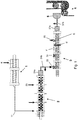
- the corresponding base polymer K (M1 to M5) is melted in a feed extruder 1 (single screw extruder from TROESTER GmbH & Co KG, Germany) and used as polymer melt via a heatable tube 11 in a planetary roller extruder 2 (PWE) from ENTEX (Bochum). (in particular, a PWE with four independently heatable modules T 1 , T 2 , T 3 , T 4 was used).
- the molten resin is now added via the metering opening 22.
- additional additives or fillers such as color pastes, via further existing metering points.
- the crosslinker is added. All components are mixed to a homogeneous polymer melt.
- the polymer melt is transferred to a twin-screw extruder 3 (BERSTORFF company) (entry position 33).
- the accelerator component is added.
- the entire mixture is freed from all gas inclusions in a vacuum dome V at a pressure of 175 mbar (criterion for freedom from gases, see above).
- a blister B Following the vacuum zone is located on the screw, a blister B, which allows a pressure build-up in the subsequent segment S.
- a pressure of greater than 8 bar is built up in the segment S between blister B and melt pump 37a, at the metering point 35 the microballoon mixture (microballoons embedded in the dispersing aid according to the information in the test series) is added and a mixing element homogeneously incorporated into the premix.
- the resulting melt mixture is transferred to a nozzle 5.
- An alternative method can be the DE 10 2009 015 233 A1 remove.
- Adhesive M2 and adhesive tape K2 are Adhesive M2 and adhesive tape K2
- a reactor conventional for radical polymerizations was charged with 54.4 kg of 2-ethylhexyl acrylate, 20.0 kg of methyl acrylate, 5.6 kg of acrylic acid and 53.3 kg of acetone / isopropanol (94: 6). After passage of nitrogen gas for 45 minutes with stirring, the reactor was heated to 58 ° C and 40 g of Vazo® 67) dissolved in 400 g of acetone was added. Subsequently, the outer heating bath was heated to 75 ° C and the reaction was carried out constantly at this external temperature. After 1 h, 40 g of Vazo® 67 dissolved in 400 g of acetone were again added, and after 4 h, the mixture was diluted with 10 kg of acetone / isopropanol mixture (94: 6).
- the adhesive tape K5 is a filled monolayer acrylate foam without resin addition from the company 3M named GT6008 with a density of 700 kg / m 3 and a thickness of 800 microns. It is filled with micro-glass bubbles (GHK) to give a syntactic foam.
- the adhesive tape is produced by UV polymerization, the method being based on, for example, DE 40 02 834 A1 takes place.
- the adhesive M6 is a natural rubber composition: composition Solid weight [% by weight] raw material Natural rubber V145 41,90 RES HIKO 41,40 Fill chalk MS 40 12.70 NR Powder Premix 3 4.00
- the Powder Premix 3 consists of 50% by weight of chalk, 25% by weight of TiO 2 and 25% by weight of anti-aging agents.
- RES HIKO is a C 5 -based hydrocarbon resin.
- This natural rubber composition is applied at 50 g / m 2 to a fabric carrier equipped with a backside release.
- Adhesive M7 and adhesive tape K7 are Adhesive M7 and adhesive tape K7
- Table 7 Components for M7 amount component 100 g Vector 4113 125 g Escorez 1310LC 10 g Tufflo 6056 1.5 g Irganox 1010
- the adhesive M7 according to this recipe was applied in a layer thickness of 50 g / m 2 on a MOPP film (thickness 85 microns) (adhesive tape K7).
- Adhesive M8 and adhesive tape K8 are Adhesive M8 and adhesive tape K8
- the polyurethane-based polymer M8 and the adhesive tape K8 were used after the WO 2009/138402 A1 produced, according to the local example 4. Furthermore, in connection with the production still on the EP 2 325 220 A1 directed. It is a viscoelastic syntactic foam filled with pre-expanded microballoons. The product was made in a thickness of 1000 ⁇ m.
- Table 8 Substrates used in bond strength tests substratum description thickness EPDM Lyondell Basell (HX TRC 135X / 4 Black), smooth 3.5 mm PE, PP, ABS, PET Standard plastic sheets of polyethylene, polypropylene, acrylonitrile-butadiene-styrene, polyethylene terephthalate 3 mm ASTM steel Standard test plates Steel according to ASTM standard 1 mm Lacquer 1 BASF FF79-0020 (based on polyurethane) coated on metal with basecoat 1 mm Lacquer 2 BASF FF99-0778, (base: acrylate resin) coated on thin sheet metal, mounted on plastic plate 3.5 mm CFK Carbonturakomposit 2.3 mm KTL Cathodic dip coating on metal 0.8 mm
- the bond strength on a substrate with high surface energy such as steel can be close to the maximum for the given adhesive even without the process. This is not contrary to the invention.
- a filling or a foaming leads to particularly high relative increases in bond strength.
- the combination with addition of resin leads to both a high relative increase and a high absolute bond strength.
- EPDM is a typical material for gaskets, KTL and paints 1 and 2 are used for body painting.
- CFRP is a future relevant material for lightweight construction.
- the adhesive tapes based on the polymer M2 are demonstrated to improve the adhesion by prolonging the shearing life (SSZ) at 70 ° C.
- the adhesive tapes K2 to K4 used are based on the base polymer M2 and differ by the addition of resin and fillers. Without the Plasma treatment, the SSZ are unsatisfactory at 70 ° C, but fully satisfactory after treatment.
- the combination of filling with hollow microspheres and resin addition shows a high shearing life at low shear under load and high bond strength (see table above).
- the bond strengths in the examples reach at least 14 N / cm after 5 min.
- Particularly suitable adhesives reach> 40 N / cm after 5 min.
- the adhesive tape K3 achieved by our invention after 5 min on steel, a bond strength of 90 N / cm, an exceptionally high value.
Landscapes
- Chemical & Material Sciences (AREA)
- Organic Chemistry (AREA)
- Health & Medical Sciences (AREA)
- Chemical Kinetics & Catalysis (AREA)
- Medicinal Chemistry (AREA)
- Polymers & Plastics (AREA)
- Engineering & Computer Science (AREA)
- Manufacturing & Machinery (AREA)
- Materials Engineering (AREA)
- Mechanical Engineering (AREA)
- Adhesive Tapes (AREA)
- Adhesives Or Adhesive Processes (AREA)
Applications Claiming Priority (3)
| Application Number | Priority Date | Filing Date | Title |
|---|---|---|---|
| DE201110075470 DE102011075470A1 (de) | 2011-05-06 | 2011-05-06 | Klebeband, bevorzugt Selbstklebeband, bestehend aus mindestens zwei direkt aufeinander laminierten Schichten A und B, wobei mindestens eine oder beide Schichten A oder B eine Klebmasse ist |
| DE102011075468 | 2011-05-06 | ||
| PCT/EP2012/058286 WO2012152714A1 (de) | 2011-05-06 | 2012-05-04 | Verfahren zur erhöhung der adhäsiven eigenschaften von haftklebemassen auf untergründen mittels plasmabehandlung |
Publications (2)
| Publication Number | Publication Date |
|---|---|
| EP2705103A1 EP2705103A1 (de) | 2014-03-12 |
| EP2705103B1 true EP2705103B1 (de) | 2018-09-26 |
Family
ID=46026826
Family Applications (2)
| Application Number | Title | Priority Date | Filing Date |
|---|---|---|---|
| EP12720142.4A Active EP2705103B1 (de) | 2011-05-06 | 2012-05-04 | Verfahren zur erhöhung der adhäsiven eigenschaften von haftklebemassen auf untergründen mittels plasmabehandlung |
| EP12718679.9A Active EP2705101B1 (de) | 2011-05-06 | 2012-05-04 | Doppelseitiges klebeband mit einer ersten äusseren haftklebrigen und einer zweiten äusseren hitzeaktivierbaren seite |
Family Applications After (1)
| Application Number | Title | Priority Date | Filing Date |
|---|---|---|---|
| EP12718679.9A Active EP2705101B1 (de) | 2011-05-06 | 2012-05-04 | Doppelseitiges klebeband mit einer ersten äusseren haftklebrigen und einer zweiten äusseren hitzeaktivierbaren seite |
Country Status (11)
| Country | Link |
|---|---|
| US (2) | US20140083608A1 (enExample) |
| EP (2) | EP2705103B1 (enExample) |
| JP (2) | JP6063452B2 (enExample) |
| KR (2) | KR101877884B1 (enExample) |
| CN (2) | CN103635552B (enExample) |
| CA (2) | CA2835051A1 (enExample) |
| DE (2) | DE112012001999A5 (enExample) |
| ES (1) | ES2700519T3 (enExample) |
| MX (2) | MX349050B (enExample) |
| TW (3) | TWI532810B (enExample) |
| WO (3) | WO2012152713A1 (enExample) |
Families Citing this family (45)
| Publication number | Priority date | Publication date | Assignee | Title |
|---|---|---|---|---|
| CA2835028A1 (en) * | 2011-05-06 | 2012-11-15 | Tesa Se | Method for increasing the adhesive power of a pressure-sensitive adhesive layer having an upper and a lower surface |
| DE102012209116A1 (de) | 2012-05-30 | 2013-12-05 | Tesa Se | Heißsiegelbares Klebeband |
| AU2013371583B2 (en) * | 2013-01-02 | 2018-02-01 | 3M Innovative Properties Company | A flexible, adherent, and non-polyurethane film wound drape cover |
| DE102013212345A1 (de) * | 2013-06-26 | 2014-12-31 | Tesa Se | Polare Klebharze für niederenergetischer Oberflächen |
| DE102014206220A1 (de) * | 2014-04-01 | 2015-10-01 | Tesa Se | Verfahren zur Plasma-initiierten Verklebung |
| EP2960054B1 (en) * | 2014-06-26 | 2022-10-12 | Taghleef Industries SPA | Surface-treated films with polypropylene base |
| CN104263264A (zh) * | 2014-08-13 | 2015-01-07 | 隆昌羽玺新材料科技有限公司 | 一种新型热粘合双面胶带及其制备、使用方法 |
| TWI709481B (zh) * | 2014-08-25 | 2020-11-11 | 日商東洋紡股份有限公司 | 矽烷偶合劑層疊層高分子膜及其製造方法、疊層體及其製造方法、可撓性電子器件之製造方法 |
| KR101527146B1 (ko) * | 2014-08-29 | 2015-06-16 | 유피씨(주) | 바이러스 방어용 합지 필름, 이의 제조 방법 및 이로부터 제조된 바이러스 방어 의류 |
| DE102014217805A1 (de) * | 2014-09-05 | 2016-03-10 | Tesa Se | Verfahren zur Erhöhung der Adhäsion zwischen der ersten Oberfläche eines ersten bahnförmigen Materials und einer ersten Oberfläche eines zweiten bahnförmigen Materials |
| DE102014217821A1 (de) * | 2014-09-05 | 2016-03-10 | Tesa Se | Verfahren zur Erhöhung der Adhäsion zwischen der ersten Oberfläche eines ersten bahnförmigen Materials und einer ersten Oberfläche eines zweiten bahnförmigen Materials |
| US10611873B2 (en) | 2014-12-16 | 2020-04-07 | 3M Innovative Properties Company | Polyurethane pressure-sensitive adhesives |
| KR102418432B1 (ko) | 2015-01-23 | 2022-07-08 | 삼성디스플레이 주식회사 | 액정표시패널 및 이의 제조방법 |
| DE102015204753A1 (de) * | 2015-03-17 | 2016-10-20 | Tesa Se | Niedertemperatur-Plasma-Behandlung |
| DE102015009764A1 (de) | 2015-07-31 | 2017-02-02 | Tesa Se | Reaktives Klebstofffilm-System zur Verklebung unpolarer Oberflächen |
| DE102015115717B4 (de) | 2015-09-17 | 2022-12-08 | Lohmann Gmbh & Co. Kg | Asymmetrische Klebefolie mit einer Kraftentkopplungsfunktion und Verwendung |
| CN106753000A (zh) * | 2015-11-25 | 2017-05-31 | 德莎欧洲公司 | 具有改善的耐湿热性的粘合 |
| DE102016202424A1 (de) * | 2016-02-17 | 2017-08-17 | Tesa Se | Verfahren zur Herstellung eines Klebebandes mittels Plasmalamination |
| DE102016203413A1 (de) * | 2016-03-02 | 2017-09-07 | Tesa Se | Erhöhung der Abzugskraft durch selektive Plasmavorbehandlung |
| DE102016223550A1 (de) * | 2016-03-10 | 2017-09-14 | Tesa Se | Verbundsystem mit schwach klebendem Abdeckmaterial |
| DE102016210536A1 (de) * | 2016-04-13 | 2017-10-19 | Tesa Se | Einfärbbarer Primer |
| DE102016220682A1 (de) * | 2016-10-21 | 2018-04-26 | Tesa Se | Physikalische Vorbehandlung zur Filamenteinbindung |
| WO2018118832A1 (en) | 2016-12-23 | 2018-06-28 | Carbon, Inc. | Adhesive sheet for securing 3d object to carrier platform and method of using same |
| DE102017200471A1 (de) * | 2017-01-12 | 2018-07-12 | Tesa Se | Verfahren zur Verklebung von Profilen auf Substratoberflächen |
| DE102017203062A1 (de) * | 2017-02-24 | 2018-08-30 | tesa SE, Kst. 9500 - Bf. 645 | Verfahren zur Herstellung von thermisch vernetzbaren Polymeren in einem Planetwalzenextruder |
| CN107139509A (zh) * | 2017-05-09 | 2017-09-08 | 深圳优普莱等离子体技术有限公司 | 一种基于等离子体改善反光热熔膜与基材表面粘结力的方法 |
| JP7237063B2 (ja) | 2017-08-25 | 2023-03-10 | スリーエム イノベイティブ プロパティズ カンパニー | 損傷のない取り外しを可能にする接着性物品 |
| JP6931741B2 (ja) | 2017-08-25 | 2021-09-08 | スリーエム イノベイティブ プロパティズ カンパニー | 損傷のない取り外しを可能にする接着性物品 |
| US9909035B1 (en) * | 2017-09-29 | 2018-03-06 | Mayapple Baby Llc | Mountable articles, dual-adhesive-adhesive tape and mounting methods using them |
| CN108329846A (zh) * | 2018-01-18 | 2018-07-27 | 上海交通大学 | 一种用于改善电泳钢结构件连接性能的胶接工艺 |
| JP7099206B2 (ja) * | 2018-09-11 | 2022-07-12 | 王子ホールディングス株式会社 | 両面粘着シートおよび剥離シート付き両面粘着シート |
| JP7135509B2 (ja) * | 2018-01-18 | 2022-09-13 | 王子ホールディングス株式会社 | 両面粘着シートおよび剥離シート付き両面粘着シート |
| CN110157345A (zh) * | 2018-03-01 | 2019-08-23 | 济南开发区星火科学技术研究院 | 一种基于石墨烯散的散热膜及其制备方法 |
| CN112437718B (zh) * | 2018-06-28 | 2022-07-12 | 应用材料公司 | 用于聚合物膜的表面处理方法 |
| CN109030293A (zh) * | 2018-08-22 | 2018-12-18 | 武汉红金龙印务股份有限公司 | 一种制盒贴片胶水选择的方法 |
| KR20200129230A (ko) | 2019-05-07 | 2020-11-18 | 삼성디스플레이 주식회사 | 표시 부품, 표시 장치 및 그것의 제조 방법 |
| CN112143212B (zh) * | 2019-06-28 | 2023-04-07 | 德莎欧洲股份公司 | 组合物、泡棉基材、背衬、胶带及其用途 |
| US12060261B2 (en) * | 2019-11-06 | 2024-08-13 | Bvw Holding Ag | Extremal microstructured surfaces |
| CN115039213A (zh) * | 2020-02-18 | 2022-09-09 | Ev 集团 E·索尔纳有限责任公司 | 用于传递构件的方法和装置 |
| US20230158735A1 (en) * | 2020-04-28 | 2023-05-25 | 3M Innovative Properties Company | Methods of Making Additive Manufactured Articles Using Multilayer Articles, Objects Prepared by the Methods, and Multilayer Articles |
| WO2022069164A1 (en) * | 2020-09-30 | 2022-04-07 | Basf Se | De-bondable polyurethane adhesives based on thermally expandable microspheres |
| KR102522374B1 (ko) * | 2020-11-13 | 2023-04-18 | 주식회사 코지스 | 표면처리된 플라스틱과 방진고무가 접착된 복합소재 및 그 제조방법 |
| PL4412827T3 (pl) * | 2021-10-07 | 2025-05-12 | Lohmann Gmbh & Co. Kg | Asymetryczny klej |
| CN119855880A (zh) * | 2022-09-22 | 2025-04-18 | 琳得科株式会社 | 粘合片 |
| CN116769407A (zh) * | 2023-05-12 | 2023-09-19 | 南方科技大学 | 一种超弹胶及其制备方法 |
Family Cites Families (55)
| Publication number | Priority date | Publication date | Assignee | Title |
|---|---|---|---|---|
| GB2030991B (en) | 1977-02-09 | 1982-11-24 | Nitto Electric Ind Co | Heat activatable pressuresensitive adhesive tape of sheet |
| US4248748A (en) | 1980-02-04 | 1981-02-03 | Minnesota Mining And Manufacturing Company | Heat-activated adhesive |
| US4484574A (en) * | 1984-01-25 | 1984-11-27 | Keene Corporation | Self-rolled foam tape without release layer and method of making same |
| JPS61236882A (ja) * | 1985-04-15 | 1986-10-22 | Shin Etsu Chem Co Ltd | カバ−レイフイルム |
| US4950537A (en) | 1988-01-13 | 1990-08-21 | Minnesota Mining And Manufacturing Company | Colored foamlike pressure-sensitive adhesive tape |
| CA2007914C (en) | 1989-02-21 | 2000-11-14 | Michael A. Johnson | Dual-functional adhesive tapes |
| AU5407794A (en) | 1992-10-20 | 1994-05-09 | Avery Dennison Corporation | Pressure-sensitive structural adhesive |
| DE9317356U1 (de) | 1993-11-12 | 1994-01-20 | Meteor Gummiwerke K. H. Bädje GmbH & Co, 31167 Bockenem | Klebeband |
| AUPM345994A0 (en) * | 1994-01-21 | 1994-02-10 | Commonwealth Scientific And Industrial Research Organisation | Surface treatment of polymers |
| JPH0873819A (ja) * | 1994-09-06 | 1996-03-19 | Toray Ind Inc | 四フッ化エチレン系樹脂粘着テープおよびその製造法 |
| DE19524250C2 (de) | 1995-07-04 | 1997-12-18 | Beiersdorf Ag | Verwendung von blockierungsmittelfreien Isocyanaten zur chemisch/thermischen Vernetzung von Acrylat-Schmelzhaftklebern sowie entsprechende Acrylatschmelzhaftkleber |
| DE19532412C2 (de) | 1995-09-01 | 1999-09-30 | Agrodyn Hochspannungstechnik G | Vorrichtung zur Oberflächen-Vorbehandlung von Werkstücken |
| JPH1030076A (ja) * | 1996-05-16 | 1998-02-03 | Kenichi Furukawa | 両面接着シート |
| DE19720145A1 (de) | 1997-05-14 | 1998-11-19 | Beiersdorf Ag | Doppelseitiges Klebeband und seine Verwendung |
| US6124032A (en) | 1998-01-15 | 2000-09-26 | Bloch; Gilbert | Pressure sensitive heat activated filmic adhesive tape |
| US6365254B1 (en) * | 1998-02-02 | 2002-04-02 | 3M Innovative Properties Company | Roll stabilizing release liner |
| JP2000256624A (ja) * | 1999-03-08 | 2000-09-19 | Nitto Denko Corp | 粘着部材 |
| JP2000256625A (ja) | 1999-03-08 | 2000-09-19 | Nitto Denko Corp | 粘着部材 |
| JP2001279208A (ja) * | 2000-01-26 | 2001-10-10 | Sekisui Chem Co Ltd | アクリル系粘着剤組成物及びアクリル系粘着テープもしくはシート |
| JP2001354917A (ja) * | 2000-06-14 | 2001-12-25 | Nitto Denko Corp | 粘着部材及びその製造方法 |
| DE10063661A1 (de) | 2000-12-20 | 2002-09-19 | Tesa Ag | Oberflächenschutzfolie für Lackoberflächen mit einer Selbstklebemasse auf Basis eines Polyurethan-Schaums |
| EP1262532B1 (en) | 2001-05-30 | 2005-04-20 | 3M Innovative Properties Company | Weatherstrip tape and method for producing the same |
| US7217455B2 (en) * | 2001-05-30 | 2007-05-15 | 3M Innovative Properties Company | Weatherstrip tape and method for producing the same |
| EP1423276A1 (en) * | 2001-08-30 | 2004-06-02 | Toray Plastics (America), Inc. | Polyolefin oil resistant film using porous particles |
| DE10153677A1 (de) | 2001-10-31 | 2003-05-15 | Tesa Ag | Doppelseitiges Klebeband |
| DE50200894D1 (de) | 2002-02-09 | 2004-09-30 | Plasma Treat Gmbh | Plasmadüse |
| DE10224842A1 (de) | 2002-06-05 | 2003-12-24 | Tesa Ag | Haftklebemasse für ein- oder beidseitig haftklebrige Klebefolienstreifen und Verfahren zur Herstellung hierzu |
| DE10317789A1 (de) | 2003-04-16 | 2004-12-02 | Tesa Ag | Haftklebstoff aus Polyurethan |
| DE10317791A1 (de) | 2003-04-16 | 2004-12-02 | Tesa Ag | Haftklebstoff aus Polyurethan für empfindliche Oberflächen |
| US7562827B2 (en) * | 2003-08-22 | 2009-07-21 | Tesa Se | Use of an adhesive film for implanting electrical modules into a card body |
| DE10349107A1 (de) * | 2003-10-17 | 2005-05-19 | Tesa Ag | Verfahren zum Verkleben von Kabelbäumen auf Untergründen wie die Innenraum-Dekorteile eines PKWs, insbesondere Dachhimmel, Türseitenteil, Kofferraumdeckel |
| DE10357323A1 (de) * | 2003-12-05 | 2005-06-30 | Tesa Ag | Haftklebemasse |
| JP4830258B2 (ja) * | 2004-01-28 | 2011-12-07 | 住友化学株式会社 | 粘着剤層の貼合方法。 |
| GB0410749D0 (en) * | 2004-05-14 | 2004-06-16 | Dow Corning Ireland Ltd | Coating apparatus |
| WO2005117507A2 (de) | 2004-05-28 | 2005-12-08 | Plasmatreat Gmbh | Verfahren zum entfernen mindestens einer anorganischen schicht von einem bauteil |
| JP2006036834A (ja) * | 2004-07-23 | 2006-02-09 | Sumitomo Bakelite Co Ltd | 半導体ウエハ加工用粘着テープ |
| DE102004044086A1 (de) | 2004-09-09 | 2006-03-16 | Tesa Ag | Thermisch vernetzte Acrylat-Hotmelts |
| JP2006312660A (ja) * | 2005-05-06 | 2006-11-16 | Sekisui Chem Co Ltd | フォトマスク保護用粘着テープ |
| JP2007253794A (ja) | 2006-03-23 | 2007-10-04 | Toyoda Gosei Co Ltd | ウエザストリップの取付け方法 |
| DE102006020482A1 (de) | 2006-04-28 | 2007-10-31 | Tesa Ag | Wieder ablösbarer Haftklebstoff aus Polyurethan |
| DE102006033796A1 (de) | 2006-07-19 | 2008-01-31 | Tesa Ag | Haftklebestoffe aus einem harzmodifizierten Polyurethan |
| DE102006057800A1 (de) * | 2006-12-06 | 2008-06-26 | Tesa Ag | Mehrlagiges Selbstklebeband |
| CN101573471A (zh) * | 2006-12-29 | 2009-11-04 | 3M创新有限公司 | 固化含有金属烷氧化物的膜的方法 |
| JP5068089B2 (ja) * | 2007-03-02 | 2012-11-07 | 日東電工株式会社 | 剥離ライナー付き粘着シートおよび剥離ライナー |
| DK1978067T3 (da) * | 2007-04-02 | 2010-04-26 | Nitto Europe Nv | Slipforing |
| DE102007016950A1 (de) | 2007-04-05 | 2008-10-09 | Tesa Ag | Thermisch vernetzende Polyacrylate und Verfahren zu deren Herstellung |
| JP2009086452A (ja) * | 2007-10-01 | 2009-04-23 | Nitto Denko Corp | 粘着型光学フィルムの製造方法、粘着型光学フィルムおよび画像表示装置 |
| DE102007063021A1 (de) | 2007-12-21 | 2009-06-25 | Tesa Ag | Corona-behandelte Klebemassen |
| DE102008023252A1 (de) | 2008-05-13 | 2009-11-19 | Tesa Se | Hotmelt-Verfahren zur Herstellung eines chemisch vernetzten Polyurethanfilms |
| DE102008059050A1 (de) | 2008-11-26 | 2010-05-27 | Tesa Se | Thermisch vernetzende Polyacrylate und Verfahren zu deren Herstellung |
| US20100151236A1 (en) * | 2008-12-11 | 2010-06-17 | Ford Global Technologies, Llc | Surface treatment for polymeric part adhesion |
| DE102009015233A1 (de) | 2009-04-01 | 2010-10-14 | Tesa Se | Verfahren zur Herstellung eines geschäumten Massesystems |
| DE102009048036A1 (de) * | 2009-10-02 | 2011-04-07 | Tesa Se | Montageklebebänder |
| DE102009046657A1 (de) | 2009-11-12 | 2011-05-19 | Tesa Se | Haftklebstoff auf Basis von Polyurethan |
| DE102010062669A1 (de) | 2010-12-08 | 2012-06-14 | Tesa Se | Verfahren zur Herstellung geschäumter Polymermassen, geschäumte Polymermassen und Klebeband damit |
-
2012
- 2012-05-04 DE DE112012001999.7T patent/DE112012001999A5/de not_active Withdrawn
- 2012-05-04 WO PCT/EP2012/058285 patent/WO2012152713A1/de not_active Ceased
- 2012-05-04 CN CN201280033079.7A patent/CN103635552B/zh active Active
- 2012-05-04 CN CN201280033428.5A patent/CN103649250B/zh active Active
- 2012-05-04 CA CA2835051A patent/CA2835051A1/en not_active Abandoned
- 2012-05-04 KR KR1020137032507A patent/KR101877884B1/ko not_active Expired - Fee Related
- 2012-05-04 MX MX2013012736A patent/MX349050B/es active IP Right Grant
- 2012-05-04 JP JP2014508837A patent/JP6063452B2/ja not_active Expired - Fee Related
- 2012-05-04 CA CA2835046A patent/CA2835046A1/en not_active Abandoned
- 2012-05-04 EP EP12720142.4A patent/EP2705103B1/de active Active
- 2012-05-04 DE DE112012002001.4T patent/DE112012002001A5/de not_active Withdrawn
- 2012-05-04 WO PCT/EP2012/058286 patent/WO2012152714A1/de not_active Ceased
- 2012-05-04 KR KR1020137032504A patent/KR101981695B1/ko active Active
- 2012-05-04 MX MX2013012735A patent/MX2013012735A/es unknown
- 2012-05-04 US US14/114,964 patent/US20140083608A1/en not_active Abandoned
- 2012-05-04 JP JP2014508836A patent/JP6210974B2/ja not_active Expired - Fee Related
- 2012-05-04 EP EP12718679.9A patent/EP2705101B1/de active Active
- 2012-05-04 WO PCT/EP2012/058287 patent/WO2012152715A1/de not_active Ceased
- 2012-05-04 US US14/115,135 patent/US9493680B2/en not_active Expired - Fee Related
- 2012-05-04 ES ES12720142T patent/ES2700519T3/es active Active
- 2012-05-07 TW TW101116312A patent/TWI532810B/zh not_active IP Right Cessation
- 2012-05-07 TW TW101116306A patent/TW201247749A/zh unknown
- 2012-05-07 TW TW101116162A patent/TWI558785B/zh not_active IP Right Cessation
Non-Patent Citations (1)
| Title |
|---|
| None * |
Also Published As
Similar Documents
| Publication | Publication Date | Title |
|---|---|---|
| EP2705103B1 (de) | Verfahren zur erhöhung der adhäsiven eigenschaften von haftklebemassen auf untergründen mittels plasmabehandlung | |
| DE102012220286A1 (de) | Verfahren zur Erhöhung der adhäsiven Eigenschaften von Haftklebemassen auf Untergründen mittels Plasmabehandlung | |
| EP2463332B2 (de) | Verfahren zur Herstellung schäumbarer Polymermassen, Verfahren zur Herstellung geschäumter Polymermassen daraus, geschäumte Polymermassen und Klebeband damit | |
| EP2705102B1 (de) | Verfahren zur erhöhung der adhäsiven eigenschaften einer haftklebemassenschicht, die eine obere und eine untere oberfläche aufweist | |
| EP2855612B2 (de) | Doppelseitiges klebeband mit einer ersten äusseren haftklebrigen und einer zweiten äusseren hitzeaktivierbaren seite | |
| EP2705104B1 (de) | Klebeband, bevorzugt selbstklebeband, bestehend aus mindestens zwei direkt aufeinander laminierten schichten a und b, wobei mindestens eine oder beide schichten a oder b eine klebmasse ist | |
| EP3328951B1 (de) | Reaktives klebstofffilm-system zur verklebung unpolarer oberflächen | |
| EP3228674B1 (de) | Haftklebmasse | |
| EP3188892B1 (de) | Verfahren zur erhöhung der adhäsion zwischen der ersten oberfläche eines ersten bahnförmigen materials und einer ersten oberfläche eines zweiten bahnförmigen materials | |
| EP3894501B1 (de) | Mehrschichtiges klebeband | |
| DE102017223768A1 (de) | Liner zum Eindecken eines Klebebandes, eingedecktes Klebeband, Spule mit diesem eingedeckten Klebeband sowie Verfahren zur Herstellung und zur Verwendung derselben | |
| DE102020204065A1 (de) | Verfahren zur Herstellung eines mehrschichtigen Klebebandes mit Schaumträger | |
| DE102018204594A1 (de) | Verfahren zum homogenen Einarbeiten von Füllstoff in eine, insbesondere thermisch vernetzbare, Selbstklebemasse auf Basis von nicht-thermoplastischem Elastomer |
Legal Events
| Date | Code | Title | Description |
|---|---|---|---|
| PUAI | Public reference made under article 153(3) epc to a published international application that has entered the european phase |
Free format text: ORIGINAL CODE: 0009012 |
|
| 17P | Request for examination filed |
Effective date: 20131206 |
|
| AK | Designated contracting states |
Kind code of ref document: A1 Designated state(s): AL AT BE BG CH CY CZ DE DK EE ES FI FR GB GR HR HU IE IS IT LI LT LU LV MC MK MT NL NO PL PT RO RS SE SI SK SM TR |
|
| DAX | Request for extension of the european patent (deleted) | ||
| RAP1 | Party data changed (applicant data changed or rights of an application transferred) |
Owner name: TESA SE |
|
| STAA | Information on the status of an ep patent application or granted ep patent |
Free format text: STATUS: EXAMINATION IS IN PROGRESS |
|
| 17Q | First examination report despatched |
Effective date: 20170317 |
|
| GRAP | Despatch of communication of intention to grant a patent |
Free format text: ORIGINAL CODE: EPIDOSNIGR1 |
|
| STAA | Information on the status of an ep patent application or granted ep patent |
Free format text: STATUS: GRANT OF PATENT IS INTENDED |
|
| RIC1 | Information provided on ipc code assigned before grant |
Ipc: C09J 7/10 20180101ALI20180328BHEP Ipc: B32B 27/16 20060101ALI20180328BHEP Ipc: B32B 27/08 20060101ALI20180328BHEP Ipc: C09J 5/02 20060101AFI20180328BHEP Ipc: C08G 18/75 20060101ALI20180328BHEP Ipc: C08G 18/48 20060101ALI20180328BHEP Ipc: C08G 18/66 20060101ALI20180328BHEP Ipc: C09J 123/16 20060101ALI20180328BHEP Ipc: C08G 18/32 20060101ALI20180328BHEP Ipc: C09J 175/08 20060101ALI20180328BHEP Ipc: C08G 18/22 20060101ALI20180328BHEP Ipc: B32B 27/32 20060101ALI20180328BHEP Ipc: B32B 27/30 20060101ALI20180328BHEP Ipc: C08G 18/12 20060101ALI20180328BHEP Ipc: C08J 5/12 20060101ALI20180328BHEP Ipc: B32B 27/40 20060101ALI20180328BHEP |
|
| INTG | Intention to grant announced |
Effective date: 20180425 |
|
| GRAS | Grant fee paid |
Free format text: ORIGINAL CODE: EPIDOSNIGR3 |
|
| GRAA | (expected) grant |
Free format text: ORIGINAL CODE: 0009210 |
|
| STAA | Information on the status of an ep patent application or granted ep patent |
Free format text: STATUS: THE PATENT HAS BEEN GRANTED |
|
| AK | Designated contracting states |
Kind code of ref document: B1 Designated state(s): AL AT BE BG CH CY CZ DE DK EE ES FI FR GB GR HR HU IE IS IT LI LT LU LV MC MK MT NL NO PL PT RO RS SE SI SK SM TR |
|
| REG | Reference to a national code |
Ref country code: GB Ref legal event code: FG4D Free format text: NOT ENGLISH |
|
| REG | Reference to a national code |
Ref country code: CH Ref legal event code: EP |
|
| REG | Reference to a national code |
Ref country code: AT Ref legal event code: REF Ref document number: 1046021 Country of ref document: AT Kind code of ref document: T Effective date: 20181015 |
|
| REG | Reference to a national code |
Ref country code: IE Ref legal event code: FG4D Free format text: LANGUAGE OF EP DOCUMENT: GERMAN |
|
| REG | Reference to a national code |
Ref country code: DE Ref legal event code: R096 Ref document number: 502012013502 Country of ref document: DE |
|
| REG | Reference to a national code |
Ref country code: NL Ref legal event code: MP Effective date: 20180926 |
|
| PG25 | Lapsed in a contracting state [announced via postgrant information from national office to epo] |
Ref country code: SE Free format text: LAPSE BECAUSE OF FAILURE TO SUBMIT A TRANSLATION OF THE DESCRIPTION OR TO PAY THE FEE WITHIN THE PRESCRIBED TIME-LIMIT Effective date: 20180926 Ref country code: BG Free format text: LAPSE BECAUSE OF FAILURE TO SUBMIT A TRANSLATION OF THE DESCRIPTION OR TO PAY THE FEE WITHIN THE PRESCRIBED TIME-LIMIT Effective date: 20181226 Ref country code: LT Free format text: LAPSE BECAUSE OF FAILURE TO SUBMIT A TRANSLATION OF THE DESCRIPTION OR TO PAY THE FEE WITHIN THE PRESCRIBED TIME-LIMIT Effective date: 20180926 Ref country code: RS Free format text: LAPSE BECAUSE OF FAILURE TO SUBMIT A TRANSLATION OF THE DESCRIPTION OR TO PAY THE FEE WITHIN THE PRESCRIBED TIME-LIMIT Effective date: 20180926 Ref country code: NO Free format text: LAPSE BECAUSE OF FAILURE TO SUBMIT A TRANSLATION OF THE DESCRIPTION OR TO PAY THE FEE WITHIN THE PRESCRIBED TIME-LIMIT Effective date: 20181226 Ref country code: GR Free format text: LAPSE BECAUSE OF FAILURE TO SUBMIT A TRANSLATION OF THE DESCRIPTION OR TO PAY THE FEE WITHIN THE PRESCRIBED TIME-LIMIT Effective date: 20181227 Ref country code: FI Free format text: LAPSE BECAUSE OF FAILURE TO SUBMIT A TRANSLATION OF THE DESCRIPTION OR TO PAY THE FEE WITHIN THE PRESCRIBED TIME-LIMIT Effective date: 20180926 |
|
| REG | Reference to a national code |
Ref country code: LT Ref legal event code: MG4D |
|
| REG | Reference to a national code |
Ref country code: ES Ref legal event code: FG2A Ref document number: 2700519 Country of ref document: ES Kind code of ref document: T3 Effective date: 20190218 |
|
| PG25 | Lapsed in a contracting state [announced via postgrant information from national office to epo] |
Ref country code: HR Free format text: LAPSE BECAUSE OF FAILURE TO SUBMIT A TRANSLATION OF THE DESCRIPTION OR TO PAY THE FEE WITHIN THE PRESCRIBED TIME-LIMIT Effective date: 20180926 Ref country code: LV Free format text: LAPSE BECAUSE OF FAILURE TO SUBMIT A TRANSLATION OF THE DESCRIPTION OR TO PAY THE FEE WITHIN THE PRESCRIBED TIME-LIMIT Effective date: 20180926 Ref country code: AL Free format text: LAPSE BECAUSE OF FAILURE TO SUBMIT A TRANSLATION OF THE DESCRIPTION OR TO PAY THE FEE WITHIN THE PRESCRIBED TIME-LIMIT Effective date: 20180926 |
|
| PG25 | Lapsed in a contracting state [announced via postgrant information from national office to epo] |
Ref country code: IT Free format text: LAPSE BECAUSE OF FAILURE TO SUBMIT A TRANSLATION OF THE DESCRIPTION OR TO PAY THE FEE WITHIN THE PRESCRIBED TIME-LIMIT Effective date: 20180926 Ref country code: EE Free format text: LAPSE BECAUSE OF FAILURE TO SUBMIT A TRANSLATION OF THE DESCRIPTION OR TO PAY THE FEE WITHIN THE PRESCRIBED TIME-LIMIT Effective date: 20180926 Ref country code: CZ Free format text: LAPSE BECAUSE OF FAILURE TO SUBMIT A TRANSLATION OF THE DESCRIPTION OR TO PAY THE FEE WITHIN THE PRESCRIBED TIME-LIMIT Effective date: 20180926 Ref country code: RO Free format text: LAPSE BECAUSE OF FAILURE TO SUBMIT A TRANSLATION OF THE DESCRIPTION OR TO PAY THE FEE WITHIN THE PRESCRIBED TIME-LIMIT Effective date: 20180926 Ref country code: PL Free format text: LAPSE BECAUSE OF FAILURE TO SUBMIT A TRANSLATION OF THE DESCRIPTION OR TO PAY THE FEE WITHIN THE PRESCRIBED TIME-LIMIT Effective date: 20180926 Ref country code: NL Free format text: LAPSE BECAUSE OF FAILURE TO SUBMIT A TRANSLATION OF THE DESCRIPTION OR TO PAY THE FEE WITHIN THE PRESCRIBED TIME-LIMIT Effective date: 20180926 Ref country code: IS Free format text: LAPSE BECAUSE OF FAILURE TO SUBMIT A TRANSLATION OF THE DESCRIPTION OR TO PAY THE FEE WITHIN THE PRESCRIBED TIME-LIMIT Effective date: 20190126 |
|
| PG25 | Lapsed in a contracting state [announced via postgrant information from national office to epo] |
Ref country code: PT Free format text: LAPSE BECAUSE OF FAILURE TO SUBMIT A TRANSLATION OF THE DESCRIPTION OR TO PAY THE FEE WITHIN THE PRESCRIBED TIME-LIMIT Effective date: 20190126 Ref country code: SK Free format text: LAPSE BECAUSE OF FAILURE TO SUBMIT A TRANSLATION OF THE DESCRIPTION OR TO PAY THE FEE WITHIN THE PRESCRIBED TIME-LIMIT Effective date: 20180926 Ref country code: SM Free format text: LAPSE BECAUSE OF FAILURE TO SUBMIT A TRANSLATION OF THE DESCRIPTION OR TO PAY THE FEE WITHIN THE PRESCRIBED TIME-LIMIT Effective date: 20180926 |
|
| REG | Reference to a national code |
Ref country code: DE Ref legal event code: R097 Ref document number: 502012013502 Country of ref document: DE |
|
| PG25 | Lapsed in a contracting state [announced via postgrant information from national office to epo] |
Ref country code: DK Free format text: LAPSE BECAUSE OF FAILURE TO SUBMIT A TRANSLATION OF THE DESCRIPTION OR TO PAY THE FEE WITHIN THE PRESCRIBED TIME-LIMIT Effective date: 20180926 |
|
| PGFP | Annual fee paid to national office [announced via postgrant information from national office to epo] |
Ref country code: LV Payment date: 20190612 Year of fee payment: 14 |
|
| PLBE | No opposition filed within time limit |
Free format text: ORIGINAL CODE: 0009261 |
|
| STAA | Information on the status of an ep patent application or granted ep patent |
Free format text: STATUS: NO OPPOSITION FILED WITHIN TIME LIMIT |
|
| 26N | No opposition filed |
Effective date: 20190627 |
|
| PG25 | Lapsed in a contracting state [announced via postgrant information from national office to epo] |
Ref country code: SI Free format text: LAPSE BECAUSE OF FAILURE TO SUBMIT A TRANSLATION OF THE DESCRIPTION OR TO PAY THE FEE WITHIN THE PRESCRIBED TIME-LIMIT Effective date: 20180926 |
|
| REG | Reference to a national code |
Ref country code: CH Ref legal event code: PL |
|
| PG25 | Lapsed in a contracting state [announced via postgrant information from national office to epo] |
Ref country code: LI Free format text: LAPSE BECAUSE OF NON-PAYMENT OF DUE FEES Effective date: 20190531 Ref country code: MC Free format text: LAPSE BECAUSE OF FAILURE TO SUBMIT A TRANSLATION OF THE DESCRIPTION OR TO PAY THE FEE WITHIN THE PRESCRIBED TIME-LIMIT Effective date: 20180926 Ref country code: CH Free format text: LAPSE BECAUSE OF NON-PAYMENT OF DUE FEES Effective date: 20190531 |
|
| REG | Reference to a national code |
Ref country code: BE Ref legal event code: MM Effective date: 20190531 |
|
| PG25 | Lapsed in a contracting state [announced via postgrant information from national office to epo] |
Ref country code: LU Free format text: LAPSE BECAUSE OF NON-PAYMENT OF DUE FEES Effective date: 20190504 |
|
| PG25 | Lapsed in a contracting state [announced via postgrant information from national office to epo] |
Ref country code: TR Free format text: LAPSE BECAUSE OF FAILURE TO SUBMIT A TRANSLATION OF THE DESCRIPTION OR TO PAY THE FEE WITHIN THE PRESCRIBED TIME-LIMIT Effective date: 20180926 |
|
| PG25 | Lapsed in a contracting state [announced via postgrant information from national office to epo] |
Ref country code: IE Free format text: LAPSE BECAUSE OF NON-PAYMENT OF DUE FEES Effective date: 20190504 |
|
| PG25 | Lapsed in a contracting state [announced via postgrant information from national office to epo] |
Ref country code: BE Free format text: LAPSE BECAUSE OF NON-PAYMENT OF DUE FEES Effective date: 20190531 |
|
| REG | Reference to a national code |
Ref country code: AT Ref legal event code: MM01 Ref document number: 1046021 Country of ref document: AT Kind code of ref document: T Effective date: 20190504 |
|
| PG25 | Lapsed in a contracting state [announced via postgrant information from national office to epo] |
Ref country code: AT Free format text: LAPSE BECAUSE OF NON-PAYMENT OF DUE FEES Effective date: 20190504 |
|
| PG25 | Lapsed in a contracting state [announced via postgrant information from national office to epo] |
Ref country code: CY Free format text: LAPSE BECAUSE OF FAILURE TO SUBMIT A TRANSLATION OF THE DESCRIPTION OR TO PAY THE FEE WITHIN THE PRESCRIBED TIME-LIMIT Effective date: 20180926 |
|
| PG25 | Lapsed in a contracting state [announced via postgrant information from national office to epo] |
Ref country code: HU Free format text: LAPSE BECAUSE OF FAILURE TO SUBMIT A TRANSLATION OF THE DESCRIPTION OR TO PAY THE FEE WITHIN THE PRESCRIBED TIME-LIMIT; INVALID AB INITIO Effective date: 20120504 Ref country code: MT Free format text: LAPSE BECAUSE OF FAILURE TO SUBMIT A TRANSLATION OF THE DESCRIPTION OR TO PAY THE FEE WITHIN THE PRESCRIBED TIME-LIMIT Effective date: 20180926 |
|
| REG | Reference to a national code |
Ref country code: ES Ref legal event code: FD2A Effective date: 20210927 |
|
| PG25 | Lapsed in a contracting state [announced via postgrant information from national office to epo] |
Ref country code: ES Free format text: LAPSE BECAUSE OF NON-PAYMENT OF DUE FEES Effective date: 20200505 |
|
| PG25 | Lapsed in a contracting state [announced via postgrant information from national office to epo] |
Ref country code: MK Free format text: LAPSE BECAUSE OF FAILURE TO SUBMIT A TRANSLATION OF THE DESCRIPTION OR TO PAY THE FEE WITHIN THE PRESCRIBED TIME-LIMIT Effective date: 20180926 |
|
| PGFP | Annual fee paid to national office [announced via postgrant information from national office to epo] |
Ref country code: DE Payment date: 20250521 Year of fee payment: 14 |
|
| PGFP | Annual fee paid to national office [announced via postgrant information from national office to epo] |
Ref country code: GB Payment date: 20250521 Year of fee payment: 14 |
|
| PGFP | Annual fee paid to national office [announced via postgrant information from national office to epo] |
Ref country code: FR Payment date: 20250528 Year of fee payment: 14 |