EP2556071B1 - Kinase inhibitors and their use in treating cancer - Google Patents
Kinase inhibitors and their use in treating cancer Download PDFInfo
- Publication number
- EP2556071B1 EP2556071B1 EP11764988.9A EP11764988A EP2556071B1 EP 2556071 B1 EP2556071 B1 EP 2556071B1 EP 11764988 A EP11764988 A EP 11764988A EP 2556071 B1 EP2556071 B1 EP 2556071B1
- Authority
- EP
- European Patent Office
- Prior art keywords
- mmol
- indazol
- title compound
- cyclopropane
- indolin
- Prior art date
- Legal status (The legal status is an assumption and is not a legal conclusion. Google has not performed a legal analysis and makes no representation as to the accuracy of the status listed.)
- Active
Links
- 0 *c1n[n]c2c1ccc([C@](C1)[C@]1(c1cc(*)ccc1N1)C1=O)c2 Chemical compound *c1n[n]c2c1ccc([C@](C1)[C@]1(c1cc(*)ccc1N1)C1=O)c2 0.000 description 1
- HJZWRYYURUSQAZ-VAWYXSNFSA-N CC1(C)OB(/C=C/c2ccc(CN3CCCC3)cc2)OC1(C)C Chemical compound CC1(C)OB(/C=C/c2ccc(CN3CCCC3)cc2)OC1(C)C HJZWRYYURUSQAZ-VAWYXSNFSA-N 0.000 description 1
- DZHGAVNSWQLNGL-WUXMJOGZSA-N CCN(CC1)CCN1c1ccc(/C=C/c2n[nH]c3cc(C(C4)C4(c4cc(OC)ccc4N4)C4=O)ccc23)cc1 Chemical compound CCN(CC1)CCN1c1ccc(/C=C/c2n[nH]c3cc(C(C4)C4(c4cc(OC)ccc4N4)C4=O)ccc23)cc1 DZHGAVNSWQLNGL-WUXMJOGZSA-N 0.000 description 1
- DKVKUPRCFKTRIY-XYOKQWHBSA-N CN(C)Cc1ccc(/C=C/c2n[nH]c3cc(C(C4)C4(c4cc(OC)ccc4N4)C4=O)ccc23)cc1 Chemical compound CN(C)Cc1ccc(/C=C/c2n[nH]c3cc(C(C4)C4(c4cc(OC)ccc4N4)C4=O)ccc23)cc1 DKVKUPRCFKTRIY-XYOKQWHBSA-N 0.000 description 1
- NZBZBQUHFXSFOR-JMCDQUADSA-N CN(C)Cc1ccc(/C=C/c2n[nH]c3cc(C(C4)[C@]4(c4ccccc4N4)C4=O)ccc23)cc1 Chemical compound CN(C)Cc1ccc(/C=C/c2n[nH]c3cc(C(C4)[C@]4(c4ccccc4N4)C4=O)ccc23)cc1 NZBZBQUHFXSFOR-JMCDQUADSA-N 0.000 description 1
- IKCSWWIZBWLZMP-FSXXDKMVSA-N CN1Cc2ccc(/C=C/c3n[nH]c4cc([C@H](C5)[C@]5(c5cc(OC)ccc5N5)C5=O)ccc34)cc2CC1 Chemical compound CN1Cc2ccc(/C=C/c3n[nH]c4cc([C@H](C5)[C@]5(c5cc(OC)ccc5N5)C5=O)ccc34)cc2CC1 IKCSWWIZBWLZMP-FSXXDKMVSA-N 0.000 description 1
- SQKCYDHDGHQXPI-UHXYVBAUSA-N CN1c2ccccc2[C@@](C2)([C@@H]2c(cc2)cc3c2c(/C=C/c2ccc(CN4CCCCC4)cc2)n[nH]3)C1=O Chemical compound CN1c2ccccc2[C@@](C2)([C@@H]2c(cc2)cc3c2c(/C=C/c2ccc(CN4CCCCC4)cc2)n[nH]3)C1=O SQKCYDHDGHQXPI-UHXYVBAUSA-N 0.000 description 1
- LMBKWHZLIDTIHL-AWNIVKPZSA-N COc(cc1/C2=C\c3ccc4c(I)n[nH]c4c3)ccc1NC2=O Chemical compound COc(cc1/C2=C\c3ccc4c(I)n[nH]c4c3)ccc1NC2=O LMBKWHZLIDTIHL-AWNIVKPZSA-N 0.000 description 1
- GUXGICSDXTZJBL-HKTAHLDOSA-N COc(cc1C2(C3)[C@@H]3c3ccc(c(/C=C/c(cc4)ccc4N4CCNCC4)n[nH]4)c4c3)ccc1NC2=O Chemical compound COc(cc1C2(C3)[C@@H]3c3ccc(c(/C=C/c(cc4)ccc4N4CCNCC4)n[nH]4)c4c3)ccc1NC2=O GUXGICSDXTZJBL-HKTAHLDOSA-N 0.000 description 1
- ASLOEJIVGTXGIM-FZKQIMNGSA-N COc(cc1[C@]2(C3)[C@H]3c3ccc4c(I)n[nH]c4c3)ccc1NC2=O Chemical compound COc(cc1[C@]2(C3)[C@H]3c3ccc4c(I)n[nH]c4c3)ccc1NC2=O ASLOEJIVGTXGIM-FZKQIMNGSA-N 0.000 description 1
- KJJSNGGJRYUNLE-YTJLLHSVSA-N NC(CN(C(C1(C2)[C@@H]2c2ccc3c(I)n[nH]c3c2)=O)c2c1cccc2)=O Chemical compound NC(CN(C(C1(C2)[C@@H]2c2ccc3c(I)n[nH]c3c2)=O)c2c1cccc2)=O KJJSNGGJRYUNLE-YTJLLHSVSA-N 0.000 description 1
- OEUGGXOGDAWLOY-VRTQXZOWSA-N O=C1Nc2ccccc2[C@@]1(C1)[C@@H]1c1ccc(c(/C=C/c(cc2)ccc2OCCN2CCOCC2)n[nH]2)c2c1 Chemical compound O=C1Nc2ccccc2[C@@]1(C1)[C@@H]1c1ccc(c(/C=C/c(cc2)ccc2OCCN2CCOCC2)n[nH]2)c2c1 OEUGGXOGDAWLOY-VRTQXZOWSA-N 0.000 description 1
Images
Classifications
-
- A—HUMAN NECESSITIES
- A61—MEDICAL OR VETERINARY SCIENCE; HYGIENE
- A61K—PREPARATIONS FOR MEDICAL, DENTAL OR TOILETRY PURPOSES
- A61K31/00—Medicinal preparations containing organic active ingredients
- A61K31/33—Heterocyclic compounds
- A61K31/395—Heterocyclic compounds having nitrogen as a ring hetero atom, e.g. guanethidine or rifamycins
- A61K31/40—Heterocyclic compounds having nitrogen as a ring hetero atom, e.g. guanethidine or rifamycins having five-membered rings with one nitrogen as the only ring hetero atom, e.g. sulpiride, succinimide, tolmetin, buflomedil
- A61K31/403—Heterocyclic compounds having nitrogen as a ring hetero atom, e.g. guanethidine or rifamycins having five-membered rings with one nitrogen as the only ring hetero atom, e.g. sulpiride, succinimide, tolmetin, buflomedil condensed with carbocyclic rings, e.g. carbazole
- A61K31/404—Indoles, e.g. pindolol
-
- A—HUMAN NECESSITIES
- A61—MEDICAL OR VETERINARY SCIENCE; HYGIENE
- A61K—PREPARATIONS FOR MEDICAL, DENTAL OR TOILETRY PURPOSES
- A61K31/00—Medicinal preparations containing organic active ingredients
- A61K31/33—Heterocyclic compounds
- A61K31/395—Heterocyclic compounds having nitrogen as a ring hetero atom, e.g. guanethidine or rifamycins
- A61K31/41—Heterocyclic compounds having nitrogen as a ring hetero atom, e.g. guanethidine or rifamycins having five-membered rings with two or more ring hetero atoms, at least one of which being nitrogen, e.g. tetrazole
- A61K31/415—1,2-Diazoles
- A61K31/416—1,2-Diazoles condensed with carbocyclic ring systems, e.g. indazole
-
- A—HUMAN NECESSITIES
- A61—MEDICAL OR VETERINARY SCIENCE; HYGIENE
- A61K—PREPARATIONS FOR MEDICAL, DENTAL OR TOILETRY PURPOSES
- A61K31/00—Medicinal preparations containing organic active ingredients
- A61K31/33—Heterocyclic compounds
- A61K31/395—Heterocyclic compounds having nitrogen as a ring hetero atom, e.g. guanethidine or rifamycins
- A61K31/535—Heterocyclic compounds having nitrogen as a ring hetero atom, e.g. guanethidine or rifamycins having six-membered rings with at least one nitrogen and one oxygen as the ring hetero atoms, e.g. 1,2-oxazines
- A61K31/5375—1,4-Oxazines, e.g. morpholine
- A61K31/5377—1,4-Oxazines, e.g. morpholine not condensed and containing further heterocyclic rings, e.g. timolol
-
- A—HUMAN NECESSITIES
- A61—MEDICAL OR VETERINARY SCIENCE; HYGIENE
- A61K—PREPARATIONS FOR MEDICAL, DENTAL OR TOILETRY PURPOSES
- A61K45/00—Medicinal preparations containing active ingredients not provided for in groups A61K31/00 - A61K41/00
- A61K45/06—Mixtures of active ingredients without chemical characterisation, e.g. antiphlogistics and cardiaca
-
- A—HUMAN NECESSITIES
- A61—MEDICAL OR VETERINARY SCIENCE; HYGIENE
- A61P—SPECIFIC THERAPEUTIC ACTIVITY OF CHEMICAL COMPOUNDS OR MEDICINAL PREPARATIONS
- A61P1/00—Drugs for disorders of the alimentary tract or the digestive system
-
- A—HUMAN NECESSITIES
- A61—MEDICAL OR VETERINARY SCIENCE; HYGIENE
- A61P—SPECIFIC THERAPEUTIC ACTIVITY OF CHEMICAL COMPOUNDS OR MEDICINAL PREPARATIONS
- A61P11/00—Drugs for disorders of the respiratory system
-
- A—HUMAN NECESSITIES
- A61—MEDICAL OR VETERINARY SCIENCE; HYGIENE
- A61P—SPECIFIC THERAPEUTIC ACTIVITY OF CHEMICAL COMPOUNDS OR MEDICINAL PREPARATIONS
- A61P15/00—Drugs for genital or sexual disorders; Contraceptives
-
- A—HUMAN NECESSITIES
- A61—MEDICAL OR VETERINARY SCIENCE; HYGIENE
- A61P—SPECIFIC THERAPEUTIC ACTIVITY OF CHEMICAL COMPOUNDS OR MEDICINAL PREPARATIONS
- A61P35/00—Antineoplastic agents
-
- A—HUMAN NECESSITIES
- A61—MEDICAL OR VETERINARY SCIENCE; HYGIENE
- A61P—SPECIFIC THERAPEUTIC ACTIVITY OF CHEMICAL COMPOUNDS OR MEDICINAL PREPARATIONS
- A61P35/00—Antineoplastic agents
- A61P35/02—Antineoplastic agents specific for leukemia
-
- C—CHEMISTRY; METALLURGY
- C07—ORGANIC CHEMISTRY
- C07D—HETEROCYCLIC COMPOUNDS
- C07D231/00—Heterocyclic compounds containing 1,2-diazole or hydrogenated 1,2-diazole rings
- C07D231/54—Heterocyclic compounds containing 1,2-diazole or hydrogenated 1,2-diazole rings condensed with carbocyclic rings or ring systems
- C07D231/56—Benzopyrazoles; Hydrogenated benzopyrazoles
-
- C—CHEMISTRY; METALLURGY
- C07—ORGANIC CHEMISTRY
- C07D—HETEROCYCLIC COMPOUNDS
- C07D403/00—Heterocyclic compounds containing two or more hetero rings, having nitrogen atoms as the only ring hetero atoms, not provided for by group C07D401/00
- C07D403/02—Heterocyclic compounds containing two or more hetero rings, having nitrogen atoms as the only ring hetero atoms, not provided for by group C07D401/00 containing two hetero rings
- C07D403/04—Heterocyclic compounds containing two or more hetero rings, having nitrogen atoms as the only ring hetero atoms, not provided for by group C07D401/00 containing two hetero rings directly linked by a ring-member-to-ring-member bond
-
- C—CHEMISTRY; METALLURGY
- C07—ORGANIC CHEMISTRY
- C07D—HETEROCYCLIC COMPOUNDS
- C07D403/00—Heterocyclic compounds containing two or more hetero rings, having nitrogen atoms as the only ring hetero atoms, not provided for by group C07D401/00
- C07D403/02—Heterocyclic compounds containing two or more hetero rings, having nitrogen atoms as the only ring hetero atoms, not provided for by group C07D401/00 containing two hetero rings
- C07D403/10—Heterocyclic compounds containing two or more hetero rings, having nitrogen atoms as the only ring hetero atoms, not provided for by group C07D401/00 containing two hetero rings linked by a carbon chain containing aromatic rings
-
- C—CHEMISTRY; METALLURGY
- C07—ORGANIC CHEMISTRY
- C07D—HETEROCYCLIC COMPOUNDS
- C07D403/00—Heterocyclic compounds containing two or more hetero rings, having nitrogen atoms as the only ring hetero atoms, not provided for by group C07D401/00
- C07D403/14—Heterocyclic compounds containing two or more hetero rings, having nitrogen atoms as the only ring hetero atoms, not provided for by group C07D401/00 containing three or more hetero rings
-
- C—CHEMISTRY; METALLURGY
- C07—ORGANIC CHEMISTRY
- C07D—HETEROCYCLIC COMPOUNDS
- C07D413/00—Heterocyclic compounds containing two or more hetero rings, at least one ring having nitrogen and oxygen atoms as the only ring hetero atoms
- C07D413/14—Heterocyclic compounds containing two or more hetero rings, at least one ring having nitrogen and oxygen atoms as the only ring hetero atoms containing three or more hetero rings
-
- A—HUMAN NECESSITIES
- A61—MEDICAL OR VETERINARY SCIENCE; HYGIENE
- A61K—PREPARATIONS FOR MEDICAL, DENTAL OR TOILETRY PURPOSES
- A61K2300/00—Mixtures or combinations of active ingredients, wherein at least one active ingredient is fully defined in groups A61K31/00 - A61K41/00
Definitions
- Protein kinases have been the subject of extensive study in the search for new therapeutic agents in various diseases, for example, cancer. Protein kinases are known to mediate intracellular signal transduction by effecting a phosphoryl transfer from a nucleoside triphosphate to a protein acceptor that is involved in a signaling pathway. There are a number of kinases and pathways through which extracellular and other stimuli cause a variety of cellular responses to occur inside the cell.
- the polo-like kinase (PLK) family of serine/threonine kinases comprises at least four known members: PLK1, PLK2 (also known as Snk), PLK3 (also known as Fnk or Prk) and PLK4 (also known as Sak).
- PLK4 is the least understood and most divergent member of the PLK family.
- the N-terminal catalytic domain of PLK4 has a different substrate specificity from that of PLK1-3.
- PLK4 also has a divergent C-terminus comprising only a single polo-box sequence, not the tandem PB sequences in PLK1-3, that appears to act as a homodimerization domain rather than a localization domain ( Lowery et al., (2005) Oncogene 24: 248-259 ).
- PLK4 is known to be involved in the control of mitotic entry and exit, and a regulator of centrosome duplication ( Habedanck et al. Nature Cell Biology 7: 1140-1146, 2005 ).
- PLK4 transcripts increase from S through M phase, and the protein is ubiquitylated and destroyed by the anaphase promoting complex (APC) ( Hudson et al. Curr. Biol. 11: 441- 446, 2001 ; Fode et al. Mol. Cell. Biol. 16: 4665-4672, 1996 ).
- PLK4 is required for late mitotic progression ( Fode et al. PNAS. 91: 6388-6392, 1994 ; Hudson et al. Curr. Biol.
- PLK4 knockout mice are embryonic lethal (E7.5), with a marked increase in mitotic and apoptotic cells ( Hudson et al. Curr. Biol. 11: 441-446, 2001 ).
- PLK4 is transcriptionally repressed by p53 ( Li et al. Neoplasia 7: 312-323, 2005 ). This repression is likely mediated through the recruitment of histone deacetylase (HDAC) repressors and repression appears to contribute to p53-induced apoptosis ( Li et al. Neoplasia 7: 312-323, 2005 ).
- HDAC histone deacetylase
- PLK4 has been reported to be overexpressed in colorectal tumors with expression reported as low in adjacent normal intestinal mucosa ( Macmillian et al. Ann. Surg. Oncol. 8: 729-740, 2001 ).
- PLK4 mRNA has been reported to be overexpressed in some tumor cell lines (Hitoshi, et al., U.S. Patent Application No. US 2003/0027756 ).
- PLK4 has been reported to be overexpressed in colorectal tumors with expression reported as low in adjacent normal intestinal mucosa ( Macmillian et al. Ann. Surg. Oncol. 8: 729-740, 2001 ).
- PLK4 mRNA has been reported to be overexpressed in some tumor cell lines (Hitoshi, et al., U.S. Patent Application No. US 2003/0027756 ).
- the human papillomavirus (HPV-16) E7 oncoproteins are overexpressed in HPV-associated anogenital and oropharyngeal cancers.
- the E7 oncoprotein triggers centrosome overduplication through a pathway that involves the concurrent formation of multiple daughters at single maternal centrioles.
- the HPV-16 E7 oncoprotein has been used as a tool to dissect abnormal centriole biogenesis and several lines of evidence identify PLK4 as a crucial player in this process ( Duensing et al Environ. Mol. Mutagen. 50: 741-747, 2009 ).
- an increased level of PLK4 transcription is found in keratinocytes stably expressing HPV-16 E7.
- HPV-16 E7 to upregulate PLK4 mRNA was found to depend on its ability to degrade the retinoblastoma (pRb) protein, suggesting a role of E2F-mediated gene transcription in deregulation of PLK4 ( Korzeniewski et al, AACR Meeting, Washington, 2010, Abstr. 5354 ). These results identify PLK4 as a target for small molecule inhibition to prevent centriole abnormalities, mitotic infidelity and malignant progression in HPV-associated cancers.
- agents which inhibit a protein kinase have the potential to treat cancer.
- agents which inhibit a protein kinase have the potential to treat cancer.
- agents which can act as protein kinase inhibitors in particular PLK4 inhibitors.
- spiro cyclopropyl indolinone compounds are potent kinase inhibitors, such as polo-like kinases 4 (PLK4) and Aurora Kinases ( see Example B and F).
- PLK4 polo-like kinases 4
- Aurora Kinases see Example B and F
- spiro cyclopropyl indolinone compounds have potent anticancer activity ( see Example J) and exhibit anti-angiogenic activity (example K). Based on these discoveries, spiro cyclopropyl indolinone compounds, pharmaceutical compositions thereof, and methods of treating cancer with the spiro cyclopropyl indolinone compounds are disclosed herein.
- One embodiment of the invention is a compound represented by Structural Formula (I) or (II): Pharmaceutically acceptable salts of the compound of Structural Formula (I) and (II) are also included in the invention.
- the variables in these structural formulas are defined below:
- the invention is any one the compounds disclosed in the Exemplification section that meets the criteria of at least one of the claims as a neutral compound or a pharmaceutically acceptable salt thereof.
- the present invention is a pharmaceutical composition
- a pharmaceutical composition comprising: i) a compound represented by Structural Formula (I), a compound represented by Structural Formula (II), a compound depicted in the Exemplification that meets the criteria of at least one of the claims or a pharmaceutically acceptable salt of any of the foregoing; and ii) a pharmaceutically acceptable carrier or diluent.
- Another embodiment of the invention is a compound represented by Structural Formula (I), a compound represented by Structural Formula (II), a compound depicted in the Exemplification that meets the criteria of at least one of the claims or a pharmaceutically acceptable salt of any of the foregoing for use as a medicament.
- Another embodiment of the invention is a compound represented by Structural Formula (I), a compound represented by Structural Formula (II), a compound depicted in the Exemplification that meets the criteria of at least one of the claims or a pharmaceutically acceptable salt of any of the foregoing for use in treating cancer.
- Another embodiment of the invention is a compound represented by Structural Formula (I), a compound represented by Structural Formula (II), a compound depicted in the Exemplification that meets the criteria of at least one of the claims or a pharmaceutically acceptable salt of any of the foregoing for use in treating cancer, wherein the cancer is selected from the group consisting of lung cancer, breast cancer, colon cancer, brain cancer, neuroblastoma, prostate cancer, melanoma, glioblastoma multiform, ovarian cancer, lymphoma, leukemia, melanoma, sarcoma, paraneoplasia, osteosarcoma, germinoma, glioma and mesothelioma.
- Another embodiment of the invention is a compound represented by Structural Formula (I), a compound represented by Structural Formula (II), a compound depicted in the Exemplification that meets the criteria of at least one of the claims or a pharmaceutically acceptable salt of any of the foregoing for use in treating cancer, wherein the cancer is basal sub-type breast cancer or a luminal B sub-type breast cancer.
- Another embodiment of the invention is a compound represented by Structural Formula (I), a compound represented by Structural Formula (II), a compound depicted in the Exemplification that meets the criteria of at least one of the claims or a pharmaceutically acceptable salt for use in treaing cancer, wherein the cancer is a soft tissue cancer, wherein the soft tissue cancer is a sarcoma preferably selected from the group consisting of a fibrosarcoma, a gastrointestinal sarcoma, a leiomyosarcoma, a dedifferentiated liposarcoma, a pleomorphic liposarcoma, a malignant fibrous histiocytoma, a round cell sarcoma, and a synovial sarcoma.
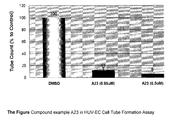
- the Figure shows the anti-angiogenesis effect of compounds A23.
- Tautomeric forms exist when a compound is a mixture of two or more structurally distinct compounds that are in rapid equilibrium. Certain compounds of the invention exist as tautomeric forms.
- the following compound encompassed within Structural Formula (I) include at least the following tautomeric forms: It is to be understoond that when one tautormeric form of a compound is depicted by name or structure, all tautomeric forms of the compound are included.
- the compounds of the invention contain at least two chiral centers and a cyclopropane and, therefore, exist as stereoisomers, such as isomers about the cyclopropane (i.e., cis/trans isomers), enantiomers, and/or diastereomers.
- stereoisomers such as isomers about the cyclopropane (i.e., cis/trans isomers), enantiomers, and/or diastereomers.
- Ring A and Ring B are cis means Ring A and Ring B are both on the same side of the cyclopropane whereas the language “Ring A and Ring B are trans” means Ring A and Ring B are on different sides of the cyclopropane.
- Stereoisomers of the cis/trans variety are also referred to as geometric isomers. Accordingly, the compounds of the invention depicted by Structural Formula (I) include the pure cis isomer, the pure trans isomer, and mixtures thereof, including cis / trans mixtures enriched in the cis geometric isomer and cis/trans mixtures enriched in the trans geometric isomer.
- Structural Formula (II) depicts a cis relationship between Ring A and B. It is to be understood that both cis and trans forms of Structural Formulas (I) with respect to Rings A and B are encompassed within the invention.
- geometric isomeric purity of the named or depicted geometric isomer is at least 60%, 70%, 80%, 90%, 99% or 99.9% pure by weight.
- Geometric isomeric purity is determined by dividing the weight of the named or depicted geometric isomer in the mixture by the total weight of both geomeric isomers in the mixture.
- Racemic mixture means 50% of one enantiomer and 50% of is corresponding enantiomer.
- the invention encompasses all enantiomerically-pure, enantiomerically-enriched, diastereomerically pure, diastereomerically enriched, and racemic mixtures, and diastereomeric mixtures of the compounds of the invention.
- Enantiomeric and diastereomeric mixtures can be resolved into their component enantiomers or stereoisomers by well known methods, such as chiral-phase gas chromatography, chiral-phase high performance liquid chromatography, crystallizing the compound as a chiral salt complex, or crystallizing the compound in a chiral solvent.
- Enantiomers and diastereomers can also be obtained from diastereomerically- or enantiomerically-pure intermediates, reagents, and catalysts by well known asymmetric synthetic methods.
- a compound When a compound is designated by a name or structure that indicates a single enantiomer, unless indicated otherwise, the compound is at least 60%, 70%, 80%, 90%, 99% or 99.9% optically pure (also referred to as "enantiomerically pure").
- Optical purity is the weight in the mixture of the named or depicted enantiomer divided by the total weight in the mixture of both enantiomers.
- stereochemistry of a disclosed compound is named or depicted by structure, and the named or depicted structure encompasses more than one stereoisomer (e.g., as in a diastereomeric pair), it is to be understood that one of the encompassed stereoisomers or any mixture of the encompassed stereoisomers are included. It is to be further understood that the stereoisomeric purity of the named or depicted stereoisomers at least 60%, 70%, 80%, 90%, 99% or 99.9% by weight. The stereoisomeric purity in this case is determined by dividing the total weight in the mixture of the stereoisomers encompassed by the name or structure by the total weight in the mixture of all of the stereoisomers.
- Suitable pharmaceutically acceptable acid addition salts of the compounds of the invention include salts of inorganic acids (such as hydrochloric acid, hydrobromic, phosphoric, metaphosphoric, nitric, and sulfuric acids) and of organic acids (such as, acetic acid, benzenesulfonic, benzoic, citric, ethanesulfonic, fumaric, gluconic, glycolic, isethionic, lactic, lactobionic, maleic, malic, methanesulfonic, succinic, p- toluenesulfonic, and tartaric acids).
- inorganic acids such as hydrochloric acid, hydrobromic, phosphoric, metaphosphoric, nitric, and sulfuric acids
- organic acids such as, acetic acid, benzenesulfonic, benzoic, citric, ethanesulfonic, fumaric, gluconic, glycolic, isethionic, lactic, lactobionic, maleic,
- Compounds of the invention with acidic groups such as carboxylic acids can form pharmaceutically acceptable salts with pharmaceutically acceptable base(s).
- suitable pharmaceutically acceptable basic salts include ammonium salts, alkali metal salts (such as sodium and potassium salts) and alkaline earth metal salts (such as magnesium and calcium salts).
- Compounds with a quaternary ammonium group also contain a counteranion such as chloride, bromide, iodide, acetate, perchlorate and the like.
- Other examples of such salts include hydrochlorides, hydrobromides, sulfates, methanesulfonates, nitrates, maleates, acetates, citrates, fumarates, tartrates [e.g. (+)-tartrates, (-)-tartrates or mixtures thereof including racemic mixtures], succinates, benzoates and salts with amino acids such as glutamic acid.
- halo as used herein means halogen and includes chloro, fluoro, bromo and iodo.
- An "aliphatic group” is acyclic, non-aromatic, consists solely of carbon and hydrogen and may optionally contain one or more units of unsaturation, e.g., double and/or triple bonds.
- An aliphatic group may be straight chained or branched.
- An aliphatic group typically contains between about one and about twenty carbon atoms, typically between about one and about ten carbon atoms, more typically between about one and about six carbon atoms.
- a "substituted aliphatic group” is substituted at any one or more "substitutable carbon atoms".
- a "substitutable carbon atom" in an aliphatic group is a carbon in the aliphatic group that is bonded to one or more hydrogen atoms.
- One or more hydrogen atoms can be optionally replaced with a suitable substituent group.
- a "haloaliphatic group” is an aliphatic group, as defined above, substituted with one or more halogen atom
- alkyl used alone or as part of a larger moiety, such as “alkoxy”, “haloalkyl”, “arylalkyl”, “alkylamine”, “dialkyamine”, “alkylamino”, “dialkyamino” “alkylcarbonyl”, “alkoxycarbonyl” and the like, means saturated straight-chain or branched aliphatic group.
- a C1-C6 alkyl group is referred to "lower alkyl.”
- the terms “lower alkoxy”, “lower haloalkyl”, “lower arylalkyl”, “lower alkylamine”, lower dialkyamine”, “lower alkylamino”, “lower dialkyamino” “lower alkylcarbonyl”, “lower alkoxycarbonyl” include straight and branched, saturated chains containing one to six carbon atoms.
- alkenyl means straight-chain or branched aliphatic group having at least one double bond.
- alkynyl menas straight-chain or branched aliphatic group having at least one triple bond.
- alkoxy means -0-alkyl; "hydroxyalkyl” means alkyl substituted with hydroxy; “aralkyl” means alkyl substituted with an aryl group; “alkoxyalkyl” mean alkyl substituted with an alkoxy group; "alkylamine” means amine substituted with an alkyl group; “cycloalkylalkyl” means alkyl substituted with cycloalkyl; “dialkylamine” means amine substituted with two alkyl groups; “alkylcarbonyl” means -C(O)-R, wherein R is alkyl; “alkoxycarbonyl” means -C(O)-OR, wherein R is alkyl; and where alkyl is as defined above.
- haloalkyl and haloalkoxy means alkyl or alkoxy, as the case may be, substituted with one or more halogen atoms.
- halogen means F, Cl, Br or I.
- the halogen in a haloalkyl or haloalkoxy is F.
- acyl group means -C(O)R, wherein R is an optionally substituted alkyl group or aryl group (e.g., optionally substituted phenyl). R is preferably an unsubstituted alkyl group or phenyl.
- alkylene group is represented by -[CH 2 ] z -, wherein z is a positive integer, preferably from one to eight, more preferably from one to four.
- alkenylene is an alkylene group in which one methylene has been replaced with a double bond.
- aryl group used alone or as part of a larger moiety as in “aralkyl”, “aralkoxy”, or “aryloxyalkyl”, means a carbocyclic aromatic ring.
- aryl may be used interchangeably with the terms “aryl ring” “carbocyclic aromatic ring”, “aryl group” and “carbocyclic aromatic group”.
- An aryl group typically has six to fourteen ring atoms. Examples includes phenyl, naphthyl, anthracenyl, 1,2-dihydronaphthyl, 1,2,3,4-tetrahydronaphthyl, fluorenyl, indanyl, indenyl and the like.
- a "substituted aryl group” is substituted at any one or more substitutable ring atom, which is a ring carbon atom bonded to a hydrogen.
- cycloalkyl refers to a monocyclic or polycyclic saturated hydrocarbon ring system.
- a C 5-7 cycloalkyl includes, but is not limited to cyclopentyl, cyclohexyl or cyclopentyl, each of which is optionally substituted.
- heteroaryl refers to aromatic ring groups having five to fourteen ring atoms selected from carbon and at least one (typically 1 to 4, more typically 1 or 2) heteroatoms (e.g., oxygen, nitrogen or sulfur).
- heteroaryl includes monocyclic rings and polycyclic rings in which a monocyclic heteroaromatic ring is fused to one or more other carbocyclic aromatic or heteroaromatic rings.
- heteroaryl includes monocyclic, bicyclic or tricyclic ring systems.
- Examples of monocyclic 5-6 membered heteroaryl groups include furanyl (e.g., 2-furanyl, 3-furanyl), imidazolyl (e.g., N -imidazolyl, 2-imidazolyl, 4-imidazolyl, 5-imidazolyl), isoxazolyl (e.g., 3-isoxazolyl, 4-isoxazolyl, 5-isoxazolyl), oxadiazolyl (e.g., 2-oxadiazolyl, 5-oxadiazolyl), oxazolyl (e.g., 2-oxazolyl, 4-oxazolyl, 5-oxazolyl), pyrazolyl (e.g., 3-pyrazolyl, 4-pyrazolyl), pyrrolyl (e.g., 1-pyrrolyl, 2-pyrrolyl, 3-pyrrolyl), pyridyl (e.g., 2-pyridyl, 3-pyridyl, 4-pyri
- polycyclic aromatic heteroaryl groups examples include carbazolyl, benzimidazolyl, benzothienyl, benzofuranyl, indolyl, quinolinyl, benzotriazolyl, benzothiazolyl, benzoxazolyl, benzimidazolyl, isoquinolinyl, indolyl, isoindolyl, acridinyl, or benzisoxazolyl.
- a "substituted heteroaryl group” is substituted at any one or more substitutable ring atom, which is a ring carbon or ring nitrogen atom bonded to a hydrogen.
- heterocyclyl group or “heterocyclic group” means a monocyclic, non-aromatic ring with 3 to 10-members containing from 1-3 ring heteroatoms or a polycyclic ring with ring with 7 to 20-members and from 1 to 4 ring heteroatoms, wherein the polycyclic ring having one or more monocyclic non-aromatic heterocyclic ring fused with one or more aromatic or heteroaromatic ring.
- the heterocyclyl group is a bicyclic ring having a monocyclic non-aromatic heterocyclic ring fused with a phenyl group.
- Exmplary polycyclic heterocyclic group includes tetrahydroisoquinolinyl (such as 1,2,3,4-tetrahydroisoquinolin-7-yl, 2-methyl-1,2,3,4-tetrahydroisoquinolin-7-yl, 1,2,3,4-tetrahydroisoquinolin-6-yl and 2-methyl-1,2,3,4-tetrahydroisoquinolin-6-yl), isoindolinyl (such as 2-ethylisoindolin-5-yl, 2-methylisoindolin-5-yl), indolinyl, tetrahydrobenzo[f]oxazepinyl (such as 2,3,4,5-tetrahydrobenzo[f][1,4]oxazepin-7-yl).
- tetrahydroisoquinolinyl such as 1,2,3,4-tetrahydroisoquinolin-7-yl, 2-methyl-1,2,3,4-tetra
- non-aromatic heterocyclic group means a monocyclic, non-aromatic ring with 3 to 10-members containing from 1-3 ring heteroatoms or a polycyclic non-aromatic ring with 7 to 20-members and from 1 to 4 ring heteroatoms.
- Each heteroatom is independently selected from nitrogen, quaternary nitrogen, oxidized nitrogen (e.g., NO); oxygen; and sulfur, including sulfoxide and sulfone.
- the substituted non-aromatic heterocylic group may be attached via a suitable heteroatom or carbon atom.
- non-aromatic heterocyclic groups include morpholinyl, thiomorpholinyl, pyrrolidinonyl, pyrrolidinyl, piperidinyl, piperazinyl, hydantoinyl, valerolactamyl, oxiranyl, oxetanyl, tetrahydrofuranyl, tetrahydropyranyl, tetrahydropyrindinyl, tetrahydropyrimidinyl, tetrahydrothiophenyl, tetrahydrothiopyranyl, and the like.
- a "substituted non-aromatic heterocylic group” is substituted at any one or more substitutable ring atom, which is a ring carbon or ring nitrogen atom bonded to a hydrogen.
- suitable substituents for a substituted aliphatic group, aryl group, heteroaryl group and non-aromatic heteroaryl groups include:
- substituents for an aliphatic group, aryl group, heteroaryl group and non-aromatic heteroaryl groups include halogen, nitro, cyano, hydroxy, C 1-20 alkyl, C 2-20 alkenyl, C 2-20 alkynyl, amino, C 1-20 alkylamino, C 1-20 dialkylamino, C 1-20 alkoxy, (C 1-10 alkoxy)C 1-20 alkyl, C 1-20 haloalkoxy, (C 1-10 haloalkoxy)C 1-20 alkyl and C 1-20 haloalkyl.
- Spiro cyclopropyl indolinone compounds of the invention can inhibit various kinases, including the PLK4, PLK1, PLK2, Aurora A, Aurora B and FLT-3 ( see Examples B-G).
- the spiro cyclopropyl indolinone compounds of the invention are useful in the treatment of diseases or conditions associated with such kinases.
- PLK4, PLK1, Aurora A and Aurora B are believed to be involved in cellular miotic progression.
- small molecule inhibitors of these enzymes can be potential anti-tumor agents.
- the compounds of the invention are PLK, Aurora A, Aurora B and/or FLT-3 inhibitors, and are useful for treating diseases, such as cancer, associated with such a kinase(s).
- the compounds of the invention are PLK inhibitors and are useful for treating diseases associated with PLK, such as cancer.
- the PLK is PLK4, PLK2 and PLK 1.
- the PLK is PLK1 and PLK4.
- the PLK is PLK4.
- the compounds of the invention are Aurora A and/or B inhibitors and are useful in inhibiting Aurora A and/or B activity for the treatment of various conditions such as cancers.
- the compounds of the invention are FLT-3 inhibitors and are useful in inhibiting FLT-3 activity for the treatment of various conditions such as cancers.
- the compounds of the invention are useful for treating a subject with cancer.
- the compounds of the invention inhibit the growth of a tumor.
- the compounds of the invention inhibit the growth of a tumor that overexpresses at least one of PLK, Aurora A, Aurora B, and FLT-3. More specifically, the compounds of the invention inhibit the growth of a tumor that overexpresses PLK, for example, PLK1, PLK2 and/or PLK4. Even more specifically, the compounds of the invention inhibit the growth of a tumor that overexpresses PLK4.
- the compounds of the invention inhibit the growth of the tumor by inducing apoptosis of the tumor cells or by inhibiting proliferation of the tumor cells.
- Cancers that can be treated or prevented by the compounds of the present invention include lung cancer, breast cancer, colon cancer, brain cancer, neuroblastoma, prostate cancer, melanoma, glioblastoma multiform, ovarian cancer, lymphoma, leukemia, melanoma, sarcoma, paraneoplasia, osteosarcoma, germinoma, glioma and mesothelioma.
- the cancer is lung cancer, colon cancer, brain cancer, neuroblastoma, prostate cancer, melanoma, glioblastoma mutiform or ovarian cancer.
- the cancer is lung cancer, breast cancer, colon cancer, brain cancer, neuroblastoma, prostate cancer, melanoma, glioblastoma multiform or ovarian cancer.
- the cancer is a breast cancer.
- the cancer is a basal sub-type breast cancer or a luminal B sub-type breast cancer.
- the basal sub-type breast cancer is ER (estrogen receptor), HER2 and PR (progesterone receptor) negative breast cancer.
- the cancer is a soft tissue cancer.
- a "soft tissue cancer” is an art-recognized term that encompasses tumors derived from any soft tissue of the body.
- soft tissue connects, supports, or surrounds various structures and organs of the body, including, but not limited to, smooth muscle, skeletal muscle, tendons, fibrous tissues, fatty tissue, blood and lymph vessels, perivascular tissue, nerves, mesenchymal cells and synovial tissues.
- soft tissue cancers can be of fat tissue, muscle tissue, nerve tissue, joint tissue, blood vessels, lymph vessels, and fibrous tissues.
- Soft tissue cancers can be benign or malignant. Generally, malignant soft tissue cancers are referred to as sarcomas, or soft tissue sarcomas.
- soft tissue tumors including lipoma, lipoblastoma, hibernoma, liposarcoma, leiomyoma, leiomyosarcoma, rhabdomyoma, rhabdomyosarcoma, neurofibroma, schwannoma (neurilemoma), neuroma, malignant schwannoma, neurofibrosarcoma, neurogenic sarcoma, nodular tenosynovitis, synovial sarcoma, hemangioma, glomus tumor, hemangiopericytoma, hemangioendothelioma, angiosarcoma, Kaposi sarcoma, lymphangioma, fibroma, elastofibroma, superficial fibromatosis, fibrous histiocytoma, fibrosarcoma, fibromatosis, dermatofibrosarcoma protuberans (DFSP), malignant fibrous hist
- the soft tissue cancer is a sarcoma selected from the group consisting of a fibrosarcoma, a gastrointestinal sarcoma, a leiomyosarcoma, a dedifferentiated liposarcoma, a pleomorphic liposarcoma, a malignant fibrous histiocytoma, a round cell sarcoma, and a synovial sarcoma.
- the invention further relates to a compound disclosed herein for use in treating a subject with tumor cells, wherein the compound is effective to reduce effectively PLK activity, such as PLK 2 or PLK4 activity, in the subject.
- PLK activity such as PLK 2 or PLK4 activity
- the PLK is PLK4.
- a "effective amount" means an amount when administered to the subject which results in beneficial or desired results, including clinical results, e.g., reduces the likelihood of developing the cancer or inhibits, suppresses or reduces the cancer (e.g., as determined by clinical symptoms or the amount of cancer cells) in a subject as compared to a control.
- "treating a subject with a cancer” includes achieving, partially or substantially, one or more of the following: arresting the growth or spread of a cancer, reducing the extent of a cancer (e.g., reducing size of a tumor or reducing the number of affected sites), inhibiting the growth rate of a cancer, and ameliorating or improving a clinical symptom or indicator associated with a cancer (such as tissue or serum components). It also reduces the likelihood of reoccurrence of the cancer.
- an effective amount of a compound of the invention varies depending upon various factors, such as the given drug or compound, the pharmaceutical formulation, the route of administration, the type of disease or disorder, the identity of the subject or host being treated, and the like, but can nevertheless be routinely determined by one skilled in the art.
- An effective amount of a compound of the present invention may be readily determined by one of ordinary skill by routine methods known in the art.
- an effective amount of a compound of the invention ranges from about 0.01 to about 1000 mg/kg body weight, alternatively about 0.05 to about 500 mg/kg body weight, alternatively about 0.1 to about 100 mg/kg body weight, alternatively about 0.1 to about 15 mg/kg body weight, alternatively about 1 to about 5 mg/kg body weight, and in another alternative, from about 2 to about 3 mg/kg body weight.
- the skilled artisan will appreciate that certain factors may influence the dosage required to effectively treat a subject suffering from cancer and these factors include, but are not limited to, the severity of the disease or disorder, previous treatments, the general health and/or age of the subject and other diseases present.
- a "treatment" regime of a subject with an effective amount of the compound of the present invention may consist of a single administration, or alternatively comprise a series of applications.
- the compound of the present invention may be administered at least once a week.
- the compound may be administered to the subject from about one time per week to once daily for a given treatment.
- the length of the treatment period depends on a variety of factors, such as the severity of the disease, the age of the patient, the concentration and the activity of the compounds of the present invention, or a combination thereof.
- the effective dosage of the compound used for the treatment or prophylaxis may increase or decrease over the course of a particular treatment or prophylaxis regime. Changes in dosage may result and become apparent by standard diagnostic assays known in the art. In some instances, chronic administration may be required.
- treatment is an approach for obtaining beneficial or desired results, including clinical results.
- beneficial or desired clinical results can include, but are not limited to, alleviation or amelioration of one or more symptoms or conditions, diminishment of extent of disease, stabilized (i.e. not worsening) state of disease, reducing the likelihood of the spread of the disease, delay or slowing of disease progression, amelioration or palliation of the disease state, and remission (whether partial or total), whether detectable or undetectable.
- Treatment can also mean prolonging survival as compared to expected survival if not receiving treatment.
- Treatment also includes reducing the likelihood of developing the disease or reducing the likelihood of reoccurrence of the disease.
- a "subject” is a mammal, preferably a human, but can also be an animal in need of veterinary treatment, e.g., companion animals (e.g., dogs, cats, and the like), farm animals (e.g., cows, sheep, pigs, horses, and the like) and laboratory animals (e.g., rats, mice, guinea pigs, and the like).
- companion animals e.g., dogs, cats, and the like
- farm animals e.g., cows, sheep, pigs, horses, and the like
- laboratory animals e.g., rats, mice, guinea pigs, and the like.
- the present invention concerns a mono-therapy where the pharmaceutical compositions of the invention are administered alone. Accordingly, in this aspect, the compound of the invention is the only pharmaceutically active ingredient in the pharmaceutical compositions or the only pharmaceutically active ingredient administered to the subject.
- the invention concerns a co-therapy with one or more of other therapeutically active drugs or therapies known in the art for treating the desired diseases or indications.
- one or more other anti-proliferative or anticancer therapies are combined with the compounds of the invention.
- the compounds disclosed herein are co-administered with one or more of other anticancer drugs known in the art.
- Anticancer therapies that may be used in combination with the compound of the invention include surgery, radiotherapy (including, but not limited to, gamma-radiation, neutron beam radiotherapy, electron beam radiotherapy, proton therapy, brachytherapy, and systemic radioactive isotopes) and endocrine therapy.
- Anticancer agents that may be used in combination with the the compounds of the invention include biologic response modifiers (including, but not limited to, interferons, interleukins, and tumor necrosis factor (TNF)), hyperthermia and cryotherapy, agents to attenuate any adverse effects (e.g., antiemetics), and other approved chemotherapeutic drugs (e.g. taxol and analogs thereof).
- biologic response modifiers including, but not limited to, interferons, interleukins, and tumor necrosis factor (TNF)
- hyperthermia and cryotherapy agents to attenuate any adverse effects (e.g., antiemetics), and other approved chemotherapeutic drugs (e.g. taxol and analogs thereof).
- administered contemporaneously means that two substances are administered to a subject such that they are both biologically active in the subject at the same time.
- the exact details of the administration will depend on the pharmacokinetics of the two substances in the presence of each other, and can include administering one substance within a period of time of one another, e.g., 24 hours of administration of the other, if the pharmacokinetics are suitable. Designs of suitable dosing regimens are routine for one skilled in the art.
- two substances will be administered substantially simultaneously, i.e. within minutes of each other, or in a single composition that comprises both substances.
- the two agents can be administered separately, such that only one is biologically active in the subject at the same time.
- the compounds of the invention can be administered to a patient in a variety of forms depending on the selected route of administration, as will be understood by those skilled in the art.
- the compounds of the invention may be administered, for example, by oral, parenteral, buccal, sublingual, nasal, rectal, patch, pump or transdermal administration and the pharmaceutical compositions formulated accordingly.
- Parenteral administration includes intravenous, intraperitoneal, subcutaneous, intramuscular, transepithelial, nasal, intrapulmonary, intrathecal, rectal and topical modes of administration. Parenteral administration can be by continuous infusion over a selected period of time.
- the compounds of the invention can be suitably formulated into pharmaceutical compositions for administration to a subject.
- the pharmaceutical compositions of the invention optionally include one or more pharmaceutically acceptable carriers and/or diluents therefor, such as lactose, starch, cellulose and dextrose.
- Other excipients such as flavoring agents; sweeteners; and preservatives, such as methyl, ethyl, propyl and butyl parabens, can also be included. More complete listings of suitable excipients can be found in the Handbook of Pharmaceutical Excipients (5th Ed., Pharmaceutical Press (2005 )). A person skilled in the art would know how to prepare formulations suitable for various types of administration routes.
- a compound of the invention may be incorporated with excipient and used in the form of ingestible tablets, buccal tablets, troches, capsules, elixirs, suspensions, syrups, wafers, and the like.
- solutions of a compound of the invention can generally be prepared in water suitably mixed with a surfactant such as hydroxypropylcellulose.
- Dispersions can also be prepared in glycerol, liquid polyethylene glycols, DMSO and mixtures thereof with or without alcohol, and in oils. Under ordinary conditions of storage and use, these preparations contain a preservative to prevent the growth of microorganisms.
- sterile aqueous solutions or dispersion of, and sterile powders of, a compound of the invention for the extemporaneous preparation of sterile injectable solutions or dispersions.
- the compounds of the invention can be formulated as aerosols, drops, gels and powders.
- Aerosol formulations typically comprise a solution or fine suspension of the active substance in a physiologically acceptable aqueous or non-aqueous solvent and are usually presented in single or multidose quantities in sterile form in a sealed container, which can take the form of a cartridge or refill for use with an atomizing device.
- the sealed container may be a unitary dispensing device such as a single dose nasal inhaler or an aerosol dispenser fitted with a metering valve which is intended for disposal after use.
- the dosage form comprises an aerosol dispenser, it will contain a propellant which can be a compressed gas such as compressed air or an organic propellant such as fluorochlorohydrocarbon.
- the aerosol dosage forms can also take the form of a pump-atomizer.
- the compounds of the invention can be formulated with with a carrier such as sugar, acacia, tragacanth, or gelatin and glycerine, as tablets, lozenges or pastilles.
- a carrier such as sugar, acacia, tragacanth, or gelatin and glycerine, as tablets, lozenges or pastilles.
- the compounds of the invention can be formulated in the form of suppositories containing a conventional suppository base such as cocoa butter.
- a pharmaceutical composition of the invention comprises a pharmaceutically acceptable carrier or diluent, a compound disclosed herein or a pharmacuetically acceptable salt thereof and another anti-cancer agent, for example, but not limited to a glucose metabolism inhibitor or taxol.
- the compounds of the invention can be prepared by processes analogous to those established in the art.
- compounds of Formula (I), wherein Rings A and B are as defined herein may be prepared by the methods outlined in Scheme 1.
- a suitable methylene source such as trimethylsulfonium iodide, or trimethylsulfoxonium iodide in the presence of a base (such as sodium hydride, LDA or NaHMDS), in a polar solvent (such as DMF, THF or DMSO).
- the reaction is conveniently effected at the appropriate temperature (generally in the range of 20° to 60 °C).
- the vinyl linkage wherein Ar is a phenyl and heteroaryl group as defined herein, and P 1 represents suitable indazole protecting group (such as Boc, acetyl or SEM) and X is a halide can be installed under typical Heck reaction conditions.
- P 1 represents suitable indazole protecting group (such as Boc, acetyl or SEM) and X is a halide
- the reaction is preferably effected under microwave irradiation conditions, advantageously in the range, for example of 100 to 150 °C, or generally at about 120 °C.
- Removal of the protecting group may be effected by any of the procedures known to effect such a transformation.
- the protecting group P 1 is SEM
- the transformation can be effected by treatment with tetrabutylammonium fluoride in a polar solvent, such as THF, at reflux, or by stepwise treatment with boron trifluoride etherate and 2N HCl in ethanol.
- the aryl linkage wherein R 6 is as defined herein, P 1 is either H or a suitable indazole protecting group (such as Boc, acetyl or SEM) and X is a halide can be installed under typical Suzuki reaction conditions, using either a boronic acid or boronate ester.
- the reaction is preferably effected under microwave irradiation conditions, advantageously in the range, for example of 100 to 150 °C, or generally at about 120 °C. Removal of the protecting group may be effected by any of the procedures known to effect such a transformation.
- the transformation can be effected by treatment with tetrabutylammonium fluoride in a polar solvent, such as THF, at reflux, or by stepwise treatment with boron trifluoride etherate and 2N HCl in ethanol.
- a polar solvent such as THF
- the cyclopropanation can be effected on compounds such as (I), wherein R 5 is as defined herein and R 6 is as defined herein, is reacted with a suitable methylene source, such as trimethylsulfonium iodide, or trimethylsulfoxonium iodide in the presence of a base (such as sodium hydride, LDA or NaHMDS), in a polar solvent (such as DMF, THF or DMSO).
- a base such as sodium hydride, LDA or NaHMDS
- a polar solvent such as DMF, THF or DMSO
- indazolyl-spiro-cyclopropane-indolinones 3 may be obtained from reaction of the dianions generated by treating substituted oxindoles 1 with a strong base such as sodium hydride in a suitable solvent such as THF, with bis-electrophiles 2 (Scheme 5).
- a strong base such as sodium hydride
- THF a suitable solvent
- bis-electrophiles 2 Scheme 5
- Indazolyl-spiro-cyclopropane-indolinones 3 which contain a Bn or PMB moiety may be deprotected by employment of suitable reaction conditions. Compounds 3 which contain more than one such protecting group may be deprotected at both sites in a one-pot reaction to provide compounds 4 (Scheme 6). Compounds 3 containing a PMB or Bn group may be deprotected by treatment with a strong base, such as KO t Bu or t BuLi, and oxygen donor such as O 2 , MoOPH or MoOPD, in a suitable solvent such as THF, with DMSO or DMS to reduce the hydroperoxide intermediate formed in situ ( A.A. Haddach, A. Kelleman, and M.V.
- a strong base such as KO t Bu or t BuLi
- oxygen donor such as O 2 , MoOPH or MoOPD
- Compounds 3 containing a PMB group may alternatively be deprotected by treatment with an acid such as TFA, TfOH or a mixture of such acids, at temperatures between 50 °C - 130 °C to provide indazolyl-spiro-cyclopropane-indolinones 4.
- an acid such as TFA, TfOH or a mixture of such acids
- Indazolyl-spiro-cyclopropane-indolinones 4 may be iodinated to provide compounds of 5 (Scheme 7) by treatment with an iodinating agent such as iodine or N-iodosuccinimide, in the presence of a base such as Na 2 CO 3 , K 2 CO 3 , NaOH or KO t Bu, in a suitable solvent such as acetone, ACN, DMF, DMSO, dioxane, NMP, THF, with or in the absence of water.
- an iodinating agent such as iodine or N-iodosuccinimide
- a base such as Na 2 CO 3 , K 2 CO 3 , NaOH or KO t Bu
- suitable solvent such as acetone, ACN, DMF, DMSO, dioxane, NMP, THF, with or in the absence of water.
- the relative stereochemistry of the cyclopropane ring may be assigned as (1R*,2S*) by comparison to the minor diastereomer produced in the synthesis of the racemic reference standards by use of HCOSY NMR experiment to assign the signals for each proton in the 1 H NMR followed by NOESY experiment to determine the through space interaction between the cyclopropane protons and the proton at position 4 of the indolinone following ( I. Moldvai, E. Gacs-Baitz, M. Balazs, M. Incze and C. Szantay; Arch. Pharm. Pharm. Med. Chem. 1996, 329, 541-549 ).
- the absolute stereochemistry of the product may be assigned as (1R,2S), based upon application of the Sharpless mnemonic to predict diol configuration as (S) and assuming an S N 2 coupling process to form the cyclopropane resulting in inversion of the (S) stereocenter of the diol with preservation of e.e.
- Optical Rotations were measured at the sodium D-line (589.44nM) using an AA-55 Polarimeter from Optical Activity Ltd with a 2.5x100mm unjacketed stainless steel tube at given sample concentrations (c, units of g/100mL).
- Racemic compounds with known relative stereochemistry were named using the R*/S* system as described by North (Principles and Applications of Stereochemistry, CRC Press, 1998), wherein the lower numbered atom is arbitrarily defined as R*, and the higher numbered atoms are defined relative to that center.
- R* the lower numbered atom
- R * the higher numbered atoms are defined relative to that center.
- a racemic mixture of enantiomers of a compound with two chiral centers is designated as (1 R *, 2 S *) or (1 R *, 2 R *) depending on the known relative stereochemistry.
- the standard R and S nomenclature or "abs" representing absolute is used to describe single enantiomers or enantiomerically enriched compounds of greater than 95% e.e.
- This intermediate was also prepared using these conditions: A round bottom flask was charged with 5-methoxyoxindole (commercial reagent from Prime Organics, 300 mg, 1.84 mmol), 3-iodo-1 H -indazole-6-carbaldehyde (500 mg, 1.84 mmol), piperidine (20 uL, 0.18 mmol) and MeOH (7 mL). The reaction was then heated to 60°C for 4h. A bright red precipitate formed which was further precipitated by cooling to room temperature. The red powder was then filtered and washed with MeOH giving 658 mg, 86% of the title compound. A mixture of (E)- and (Z)-isomers (84:16 by NMR) was obtained.
- 5-methoxyoxindole commercial reagent from Prime Organics, 300 mg, 1.84 mmol
- 3-iodo-1 H -indazole-6-carbaldehyde 500 mg, 1.84 mmol
- piperidine 20 uL, 0.18 mmol
- the mixture was used as an intermediate without purification of the isomers, or alternatively the pure E isomer could be purified by dissolving in THF (1.57 g in 46.85 mL) at room temperature. Hexane (146.8 mL) was added to the clear solution with stirring to give a yellow precipitate. The solid suspension was heated to 70°C for 30 min & then cooled to room temperature. The yellow solid was filtered and washed with hexane (3.14 mL) to give the title compound (1.22 g, 79 %).
- Oxindole (665 mg, 5 mmol) and 3-iodo-1-((2-(trimethylsilyl)ethoxy)methyl)-1H-indazole-6-carbaldehyde (2 g, 5 mmol) were dissolved into ethanol (25 mL). Piperdine (0.1 mL) was added and the solution was heated to 70 °C for 2 h, cooled to rt and stirred overnight. The solvent was removed in vacuo to give an orange solid which was triturated with ethanol to give the title compound in quantitative yield.
- Trimethylsulfoxonium iodide (164.4 mg, 0.747 mmol) was added to a suspension of sodium hydride (89.6 mg, 2.24 mmol) (60% dispersion in oil) in DMF (2.0 mL) at room temperature. The mixture was stirred for 15 min after which time a solution of (E)-5-fluoro-3-((3-iodo-1-((2-(trimethylsilyl)ethoxy)methyl)-1H-indazol-6-yl)methylene)indolin-2-one (200 mg, 0.373 mmol) in DMF (1.25 ml) was added.
- the solution was stirred at 55°C for 7.0 h prior to quenching reaction mass over 25% NH 4 Cl solution (10 mL) at room temperature.
- the product was extracted using ethyl acetate (15 mL x 2) and the organic layer was dried over MSO 4 and evaporated in vacuo.
- the crude product was purified using silica gel column chromatography (hexane : acetone 80:20 as an eluent) to yield a creamy semi-solid, which was then triturated with hexanes (2.0 mL) to give the title compound as an off-white powder (94 mg, 46%).
- the title compound was synthesized according to the method of Example A22A in WO2010/115279 , utilizing N,N -dimethyl-1-(4-vinylphenyl)methanamine (42 mg, 0.26 mmol) and 3-iodo-1-((2-(trimethylsilyl)ethoxy)methyl)-1H-indazole-6-carbaldehyde (70 mg, 0.17 mmol) with heating in a sealed tube at 90°C overnight instead of with microwave irradiation. Purified by prepTLC (SiO 2 10 % MeOH/DCM) to provide the title compound to as a pale orange gum (33.4 mg, 44 %).
- the second eluting fraction was the Z-isomer (5 mg, 30%).
- 1 H NMR 400 MHz, CD 3 OD
- Glacial acetic acid (3 drops) was added to a mixture of 4-ethynylbenzaldehyde (250.7 mg, 1.93 mmol), dimethylamine (2M in THF, 1.5 mL, 3.0 mmol) and NaBH(OAc) 3 (617 mg, 2.91 mmol) in DCE (6.5 mL). The resulting mixture was stirred for 2.5 h at rt. The reaction was quenched with saturated aqueous NaHCO 3 ( ⁇ 40 mL). The product was extracted into CH 2 Cl 2 (100 mL, then 2 x 50 mL), and the combined organic layer was washed with brine (25 mL), dried (Na 2 SO 4 ) and evaporated in vacuo.
- Glacial acetic acid (0.2 mL) was added to a mixture of 4-ethynylbenzaldehyde (1 g, 7.5 mmol), pyrrolidine (1.2 mL, 15 mmol) and NaBH(OAc) 3 (2.5 g, 11.5 mmol) in DCE (35 mL). The resulting mixture was stirred for 2 h at rt. The reaction was quenched with saturated aqueous NaHCO 3 (50 mL).
- N-benzylisatin 13.0 g, 55 mmol was mixed with hydrazine hydrate (60 mL) and placed in an oil bath. The mixture was heated in stages to 125 °C, becoming first a green sludge, then yellow with clumps of a sticky solid. After a total of 5 h at 125 °C, the mixture was cooled and extracted with EtOAc (2 x 100 mL). The combined organic portions were washed twice with 1.0 M aq. H 2 SO 4 , and once each with half-saturated brine then brine, dried over MgSO 4 , filtered and concentrated to afford a pale yellow solid.
- the title compound was prepared in a manner similar to the method of (1R,2S)-1'-benzyl-2-(1-benzyl-1H-indazol-6-yl)spiro[cyclopropane-1,3'-indolin]-2'-one using (S)-1-(1-benzyl-1H-indazol-6-yl)ethane-1,2-diyl dimethanesulfonate (501.4 mg, 1.181 mmol) and 1-benzyl-5-fluoroindolin-2-one (285.0 mg, 1.181 mmol).
- the title compound was prepared in a manner similar to the chiral synthetic method of Example A4 using (1R,2S)-1'-benzyl-2-(1-benzyl-1H-indazol-6-yl)-5'-fluorospiro [cyclopropane-1,3'-indolin]-2'-one (560 mg, 1.18 mmol). Purification by using silica gel column chromatography with 5-95% EtOAc in hexane to give the title compound as a creamy solid (179 mg, 52%).
- the title compound was prepared in a manner similar to the method of (1R,2S)-1'-benzyl-2-(1-benzyl-1H-indazol-6-yl)spiro[cyclopropane-1,3'-indolin]-2'-one using (S)-1-(1-benzyl-1H-indazol-6-yl)ethane-1,2-diyl dimethanesulfonate (6.70 g, 15.8 mmol) and 1-methylindolin-2-one (2.33 g, 15.8 mmol).
- the title compound was prepared in a manner similar to the method of (1R,2S)-1'-benzyl-2-(1-benzyl-1H-indazol-6-yl)spiro[cyclopropane-1,3'-indolin]-2'-one using (S)-1-(1-benzyl-1H-indazol-6-yl)ethane-1,2-diyl dimethanesulfonate (1.44 g, 3.39 mmol) and 5-methoxy-1-methylindolin-2-one (0.601 g, 3.39 mmol).
- the reaction mixture was purged O 2 gas for 1.5 hr at 0°C. After stirring at 0°C for a further 15 min, the reaction mixture was quenched with 25% aq. NH 4 Cl (20 mL). The product was extracted using EtOAc (40 mL x 2), and the combined EtOAc layer was washed with water (10 mL) and dried (Na 2 SO 4 ) and concentrated under vacuum at 40°C/125 mbar. The resultant pale yellow residue was purified by silica gel column chromatography using 5-10% EtOAc in hexane to give the title compound as an off-white solid (445 mg, 65%).
- the title compound was prepared in a manner similar to the method of (1R,2S)-1'-benzyl-2-(1-benzyl-1H-indazol-6-yl)spiro[cyclopropane-1,3'-indolin]-2'-one using (S)-1-(1-benzyl-1H-indazol-6-yl)ethane-1,2-diyl dimethanesulfonate (1.22 g, 2.87 mmol) and 1-(2-methoxyethyl)indolin-2-one (550.0 mg, 2.87 mmol).
- reaction mixture was purged with O 2 gas for 1.5 h at 0°C. After stirring at 0°C for a further 15 min, reaction mixture was quenched with 25% aq. NH 4 Cl (10 mL). The product was extracted using EtOAc (20 mL x 2), and the combined EtOAc layer was washed with water (10 mL) and dried over an. sodium sulfate and concentrated under vacuum at 40°C/125 mbar. The resultant pale yellowish residue was purified by flash chromatography on Biotage Isolera (using 5-10% EtOAc in hexane, SNAP 25g column) to give the title compound as a white solid (205 mg, 67%).
- Racemic (1 R *, 2 S *)-2-(1H-indazol-6-yl)spiro[cyclopropane-1,3'-indolin]-2'-one (25 mg, prepared in example A2) was separated using chiral HPLC: Chiralpak 1A (3 x 15 cm), (30% methanol (0.1% DEA)/CO 2 , 70 mL/min) to give a white solid (11.8 mg).
- Racemic (1 R *, 2 S *)-2-(1H-indazol-6-yl)spiro[cyclopropane-1,3'-indolin]-2'-one (25 mg, prepared in example A2) was separated using chiral HPLC: Chiralpak 1A (3 x 15 cm), (30% methanol (0.1% DEA)/CO 2 , 70 mL/min) to give a white solid (11.5 mg).
- Analytical HPLC: Chiralpak 1A (15 x 0.46 cm), (40% methanol (0.1% DEA)/CO 2 , 3 mL/min) 97% e.e., Rt 5.2 min).
- Racemic (1 R *, 2 S *)-2-(3-iodo-1H-indazol-6-yl)-5'-methoxyspiro spiro[cyclopropane-1,3'-indolin]-2'-one (15 g, prepared in example A6) was separated using chiral HPLC: Chiralcel OJ-H (3 x 15 cm), (30% methanol (0.1% DEA)/CO 2 75 mL/min) to give a white solid (6.75 g).
- the title compound was prepared in a manner similar to the method of (1R,2S)-1'-benzyl-2-(1-benzyl-1H-indazol-6-yl)spiro[cyclopropane-1,3'-indolin]-2'-one using (S)-1-(1-benzyl-1H-indazol-6-yl)ethane-1,2-diyl dimethanesulfonate (3.35 g, 7.90 mmol) and 1-benzyl-5-methoxyindolin-2-one (2.00 g, 7.90 mmol).
- the title compound was prepared in a manner similar to the chiral synthetic method of Example A4 using (1R,2S)-1'-benzyl-2-(1-benzyl-1H-indazol-6-yl)-5'-methoxy spiro[cyclopropane-1,3'-indolin]-2'-one (1.0 g, 2.1 mmol). Purification via column chromatography (silica gel, 30-80% EtOAc in hexane) yielded the title compound as a white solid (0.50 g, 80%).
- Racemic (1 R *, 2 S *)-2-(3-iodo-1H-indazol-6-yl)-5'-methoxyspiro spiro[cyclopropane-1,3'-indolin]-2'-one (15 g, prepared in example A6) was separated using chiral HPLC: Chiralcel OJ-H (3 x 15 cm), (30% methanol (0.1% DEA)/CO 2 75 mL/min) to give a white solid (6.6 g).
- Racemic (1 R *, 2 S *)-2-(3-iodo-1H-indazol-6-yl)spiro[cyclopropane-1,3'-indolin]-2'-one (35 mg, prepared in example A9) was separated using chiral HPLC: Lux Cellulose AXIA (150 x 21.2 mm), (Gradient 10% isopropanol/Hexane to 90% isopropanol/hexane 20 mL/min) to give a white solid (8.8 mg).
- the title compound was synthesized according to the method of Example A22 in WO2010/115279 , Method 1B, using (E)-2-(3-(4-((dimethylamino)methyl)styryl)-1-((2-(trimethylsilyl)-ethoxy)methyl)-1H-indazol-6-yl)spiro[cyclopropane-1,3'-indolin]-2'-one (38 mg, 0.052 mmol).
- the crude reaction mixture was concentrated under reduced pressure to dryness, and purified by reverse phase preparative HPLC to give the title compound as a white solid and as the TFA salt (11 mg, 31%).
- Example A23 During a larger scale preparation of Example A23 (obtained as a pale yellow solid, 63 mg), the corresponding minor diastereomer, i.e. the title compound, was obtained as a white solid by reverse phase preparative HPLC (4.6 mg).
- Trimethylsulfoxonium iodide (173.8 mg, 0.789 mmol) was added to a suspension of sodium hydride (94.76 mg, 4.12 mmol) (60% dispersion in oil) in THF (4.0 mL) at room temperature. The mixture was stirred for 15 min after which time a solution of (Z)-5-fluoro-3-((3-iodo-1H-indazol-6-yl)methylene)indolin-2-one (160 mg, 0.394 mmol) in THF (2.4 mL) was added. The solution was stirred at 50 °C for 7 h prior to quenching the reaction mass over 10% NH 4 Cl solution (15 mL) at room temperature.
- the HCl salt was prepared by dissolving the free base (183 mg, 0.361 mmol) into THF (2 mL) and then HCl (0.72 mL of a 1M solution in Et 2 O) was added. A precipitate immediately formed which was further precipitated with Et 2 O (10 mL). The solid was quickly filtered and washed with Et 2 O to give, after drying, an off-white solid (153 mg, 78 %).
- Example A55A 40 mg, 0.1 mmol
- THF 3 mL
- morpholine 43 mg, 0.5 mmol
- titanium isopropoxide 57 mg, 0.2 mmol
- Sodium borohydride 13 mg, 0.2 mmol
- the reaction was quenched with water (2 mL) and extracted with ethyl acetate (25 mL) dried over MgSO 4 and concentrated to dryness.
- the residue was purified by reversed phase preparatory HPLC to give the title compound as the TFA salt (5 mg, 9%).
- Example A51B The title compound was synthesized according to the method of Example A51B, except substituting (1R,2S)-2-(3-iodo-1H-indazol-6-yl) [cyclopropane-1,3'-indolin]-2'-one (175 mg, 0.43 mmol) and (E)-4-(4-(2-(4,4,5,5-tetramethyl-1,3,2-dioxaborolan-2-yl)vinyl)benzyl)pyrrolidine (225 mg, 0.64 mmol). Purification by reverse phase preparatory HPLC gave the title compound as a yellow TFA salt (123 mg, 51%). Spectral was data identical to that obtained in Example A60.
- Example A51A The title compound was synthesized according to the method of Example A51A, except substituting 7-bromo-2-methyl-1,2,3,4-tetrahydroisoquinoline (720 mg, 3.2 mmol). The title compound isolated as an orange oil (700 mg, 73%).
- Example A51A The title compound was synthesized according to the method of Example A51A, except substituting 1-(7-bromo-3,4-dihydroisoquinolin-2(1H)-yl)-2,2,2-trifluoroethanone (415 mg, 1.32 mmol).
- the title compound was purified by silica gel chromatography (3:2 hexanes/EtOAC) to give the title compound as a white solid (300 mg, 58%).
- MS ESI 382.2 [M + H] + calcd for [C 19 H 23 BF 3 NO 3 + H] + 382.2.
- Example A42B The title compound was synthesized according to the method of Example A42B, except substituting (1R,2S)-2-(3-iodo-1H-indazol-6-yl) [cyclopropane-1,3'-indolin]-2'-one (64 mg, 0.15 mmol) and 2-methyl-6-(4,4,5,5-tetramethyl-1,3,2-dioxaborolan-2-yl)-1,2,3,4-tetrahydroisoquinoline (80 mg, 0.29 mmol). Purification by reverse phase preparatory HPLC gave the title compound as a yellow TFA salt (24 mg, 31 %).
- a microwave vial was charged with tert-butyl 4-(4-iodophenyl)piperazine-1-carboxylate (300 mg, 0.773 mmol), trimethylsilylacetylene (0.22 mL, 1.54 mmol), NEt 3 (3.0 mL), DMF (1.5 mL), CuI (15 mg, 0.080 mmol), and PdCl 2 (PPh 3 ) 2 (27 mg, 0.039 mmol).
- the vial was capped and heated in the microwave at 100 °C for 1 h. After removing the NEt 3 in vacuo, the residue was extracted with EtOAc (15 mL).
- Example A42A The title compound was synthesized according to the method of Example A42A, except substituting tert-butyl 4-(4-ethynylphenyl)piperazine-1-carboxylate (212 mg, 0.740 mmol) to give, after column chromatography (silica gel, Hexanes/EtOAc, 6:1 to 5:1), the title compound as a pale-yellow solid (137 mg, 45 %); MS ESI 415.3 [M + H] + , calcd for [C 23 H 35 BN 2 O 4 + H] + 415.28.
- Example A91 The title compound was synthesized according to the method of Example A91, except substituting (1R,2S)-2-(3-iodo-1H-indazol-6-yl)spiro[cyclopropane-1,3'-indolin]-2'-one (40 mg, 0.1 mmol). The title compound was isolated as a yellow solid (23 mg, 40%). The spectral data was identical to that obtained for Example A91.
- Example A51B The title compound was synthesized according to the method of Example A51B, by using (1R,2S)-2-(3-iodo-1H-indazol-6-yl)spiro[cyclopropane-1,3'-indolin]-2'-one (125 mg, 0.311 mmol) and (E)-4-(2,6-difluoro-4-(2-(4,4,5,5-tetramethyl-1,3,2-dioxaborolan-2-yl)vinyl)benzyl)morpholine (130.9 mg, 0.358 mmol). Purification by preparative HPLC gave the title compound as a cream solid (88 mg, 45%).
- Example A146 (1 R, 2 S )-(E)-2-(3-(4-((diethylamino)methyl)-3,5-difluorostyryl)-1H-indazol-6-yl)-5'-methoxyspiro[cyclopropane-1,3'-indolin]-2'-one 2,2,2-trifluoroacetate
- the title compound was synthesized according to the method of Example A51B, by using (1R,2S)-2-(3-iodo-1H-indazol-6-yl-)-5'-methoxyspioro[cyclopropane-1,3'-indolin]-2'-one (125 mg, 0.289 mmol) and (E)-N-(2,6-Difluoro-(4-(2-(4,4,5,5-tetramethyl-1,3,2-dioxaborolan-2-yl)vinyl)benzyl)N-ethylethanamine (122.2 mg, 0.347 mmol). Purification by preparative HPLC gave the title compound as a cream solid (59 mg, 31.6%).
- the title compound was prepared in a similar manner to Example A51B using (1R,2S)-2-(3-iodo-1H-indazol-6-yl)-5'-methoxyspiro[cyclopropane-1,3'-indolin]-2'-one (36.0 mg, 0.083 mmol) and (E)-1-methyl-4-(4-(2-(4,4,5,5-tetramethyl-1,3,2-dioxaborolan-2-yl)vinyl)phenyl)piperazine (31.9 mg, 0.097 mmol).
- the reaction mixture was diluted with MeOH (3 mL) and poured onto a 20 cc PoraPak Rxn Cx cartridge.
- Example A180 (1R* , 2S*)-(E)-2-(3-(4-((dimethylamino)methyl)styryl)-1H-indazol-6-yl)-1'-(2-methoxyethyl)spiro[cyclopropane-1,3'-indolin]-2'-one 2,2,2-trifluoroacetate
- Example A206 (1 R ,2 S )-(E)-2-(3-(4-((diethylamino)methyl)styryl)-1H-indazol-6-yl)-5'-methoxy spiro[cyclopropane-1,3'-indolin]-2'-one 2,2,2-trifluoroacetate
- the aqueous layer was extracted using dichloromethane (10 mL), and the combined organic layers were washed with brine and dried over sodium sulfate. The solvent was then removed under vacuum at 40°C/200 mbar. The resultant oily residue was purified by silica gel column chromatography using dichloromethane: methanol (100 to 90:10) gradient to give the title compound as pale yellow thick oil (0.455 g, 63.2%).
- example A42A According to procedure for the synthesis of example A42A , by using N-ethyl-N-(4-ethynylbenzyl)ethanamine (0.70 g, 3.73 mmol) and 4,4,5,5-tetramethyl-1,3,2-dioxaborolane (1.62 mL , 11.21 mmol) to give the title compound as a yellowish orange oil (1.02 g, 86%).
- Example A211A According to procedure for the synthesis of Example A211A , by using (E)-4-(2-(4,4,5,5-tetramethyl-1,3,2-dooxaborolan-2-yl)vinyl)benzaldehyde (1.93 g, 7.48 mmol), sodium triacetoxyborohydride (2.38 g, 11.22 mmol) and diethylamine (1.16 mL, 11.22 mmol) to give the title compound after purification using Biotage on SNAP 25g column with hexane:ethylacetate (100 to 72:25) gradient as a pale yellow thick oil (1.55 g, 66 %).
- the reaction was then diluted with ethyl acetate (20 mL) and water (5 mL) and the layers were separated. The aqueous layer was extracted using ethyl acetate (10 mL), and the combined ethyl acetate layer was washed with brine (4.0 mL) and was dried over sodium sulfate and then concentrated vacuum at 40°C/100 mbar to yield a yellowish residue.
- the crude product was purified by prep. HPLC to give the title compound as a pale yellow solid (9.5 mg, 10%).
- Example A216 (1 R ,2 S )-(E)-2-3-(4-((dimethylamino)methyl)-3,5-difluorostyryl)-1H-indazol-6-yl)-5'-methoxyspiro[cyclopropane-1,3'-indolin]-2'-one 2,2,2-trifluoroacetate
- This intermediate was prepared via 2 different synthetic methods.
- Example A211A According to procedure for the synthesis of Example A211A, by using 4-bromo-2,6-difluorobenzaldehyde (500 mg, 2.26 mmol), sodium triacetoxyborohydride (959 mg, 4.52 mmol) and 2M dimethylamine solution (2.626 mL, 4.52 mmol) to give the title compound as a colorless oil (452 mg, 79%).
- example A42A According to procedure for the synthesis of example A42A, by using 1-(4-ethylnyl-2,6-difluorophenyl)-N,N-dimethylmethanamine (97 mg, 0.496 mmol) and 4,4,5,5-tetramethyl-1,3,2-dioxaborolane(0.21 mL, 1.488 mmol) to give the title compound after purification on Biotage using KPNH SNAP 25 gm column with hexane : ethyl acetate (100 to 50:50) gradient as a brown semi solid (67 mg, 41%).
- Example A211A According to procedure for the synthesis of Example A211A by using 4-bromo-2,6-difluorobenzaldehyde (1.0 g, 4.52 mmol), sodiumtriacetoxyborohydride (1.438 g, 6.78 mmol) and morpholine (0.59 mL, 6.78 mmol) to give the title compound as a pale yellow oil (1.30 g, 98.4%).
- Example A216A method 1b by using 1-(4-bromo-2,6-difluorophenyl)-morpholine (1.32 g, 4.51 mmol) to give the title compound as a light brown oil (0.65 g, 60%).
- example A42A According to procedure for the synthesis of example A42A , by using 1-(4-ethylnyl-2,6-difluorophenyl)morpholine (0.97 g, 4.08 mmol) and 4,4,5,5-tetramethyl-1,3,2-dioxa borolane (1.78 mL , 12.24 mmol) to give the title compound as a cream solid (1.21 g, 81%).
- Example A220 (1 R ,2 S )-(E)-5'-fluoro-2-(3-(4-(morpholinomethyl)styryl-1H-indazol-6-yl)spiro [cyclopropane-1,3'-indolin]-2'-one 2,2,2-trifluoroacetate
- Example A211A According to procedure for the synthesis of Example A211A, by using 4-bromo-2,6-difluorobenzaldehyde (610 mg, 2.76mmol), sodium triacetoxyborohydride (883.35 mg, 4.15 mmol) and diethylamine (425.21 mmL, 4.15 mmol) to give the title compound as a colorless oil (660 mg, 86%).
- Example A216A method 1b by using N-(4-bromo-2,6-difluorobenzyl-)N-ethylethanamine (660 mg, 2.37 mmol) to give the title compound as a light brown oil (252 mg, 48%).
- example A42A According to procedure for the synthesis of example A42A, by using N-ethyl-N-(4-ethynyl-2,6-difluorobenzyl)ethanamine (252 mg, 1.12 mmol) and 4,4,5,5-tetramethyl-1,3,2-dioxaborolane (0.493 mL , 3.36 mmol) to give the title compound as a cream semi solid (410 mg, 90%).
- Example A211A According to procedure for the synthesis of Example A211A, by using (E)-2,6-difluoro-4-(2-(4,4,5,5-tetramethyl-1,3,2-dioxaborolan-2-yl)vinyl)benzaldehyde (1.10 g, 3.74 mmol), sodium triacetoxyborohydride (1.19 g, 5.61 mmol) and diethylamine (0.58 mL, 5.61 mmol) to give the title compound as a cream color solid (0.54 g, 41%).
- Example A51B The title compound was synthesized according to the method of Example A51B, by using (1R,2S)-2-(3-iodo-1H-indazol-6-yl-)-spiro[cyclopropane-1,3'-indolin]-2'-one (125 mg, 0.311 mmol) and (E)-N-(2,6-difluoro-(4-(2-(4,4,5,5-tetramethyl-1,3,2-dioxaborolan-2-yl)vinyl)benzyl)-N-ethylethanamine (131.4 mg, 0.373 mmol). Purification by preparative HPLC gave the title compound as a cream solid (54 mg, 28.4%).
- Active PLK4 was purified from an E. coli expression system as an amino terminal GST fusion of residues 1-391 of human PLK4.
- the protein was purified from clarified cell extracts after induction at 15 °C overnight using glutathione sepharose, gel permeation chromatography, and ion exchange (Resource Q).
- the resulting protein was dephosphorylated with lambda phosphatase (NEB cat# P0753), and resolved from the phosphatase using gluthione sepharose.
- the dephosphorylated GST-PLK4 was stored in aliquots at -80°C until use.
- PLK4 activity was measured using an indirect ELISA detection system.
- Dephosphorylated GST-PLK4 (4 nM) was incubated in the presence of 15 ⁇ M ATP (Sigma cat# A7699), 50 mM HEPES-Na 2+ pH 7.4, 10 mM MgCl 2 , 0.01% Brij 35 (Sigma cat# 03-3170), in a 96 well microtitre plate pre-coated with MBP (Millipore cat# 30-011).
- the reaction was allowed to proceed for 30 minutes, followed by 5 washes of the plate with Wash Buffer (50 mM TRIS-Cl pH 7.4 and 0.2% Tween 20), and incubation for 30 minutes with a 1:3000 dilution of primary antibody (Cell Signaling cat# 9381).
- the plate was washed 5 times with Wash Buffer, incubated for 30 minutes in the presence of secondary antibody coupled to horse radish peroxidase (BioRad cat# 1721019, 1:3000 concentration), washed an additional 5 times with Wash Buffer, and incubated in the presence of TMB substrate (Sigma cat# T0440).
- the colourimetric reaction was allowed to continue for 5 minutes, followed by addition of stop solution (0.5 N sulphuric acid), and quantified by detection at 450 nm with either a monochromatic or filter based plate reader (Molecular Devices M5 or Beckman DTX880, respectively).
- XLfit4, IDBS non-linear 4 point logistic curve fit
- Aurora A inhibition was determined using the Z-Lyte assay kit from Invitrogen. The assay was performed using the recommended manufacturer's instructions with 20 ⁇ M ATP and 12 nM Aurora A (Invitrogen cat # PV3612). The % inhibition values were determined according to the manufacturer's directions and IC 50 values were obtained using a non-linear 4 point logistic curve fit (XLfit4, IDBS)
- Aurora B inhibition was determined using the Z-Lyte assay kit from Invitrogen. The assay was performed using the recommended manufacturer's instructions with 128 ⁇ M ATP and 28 nM Aurora B (Invitrogen cat # PV3970). The % inhibition values were determined according to the manufacturer's directions and IC 50 values were obtained using a non-linear 4 point logistic curve fit (XLfit4, IDBS)
- IC 50 values for PLK4,Aurora A and Aurora B Kinases are indicated as “A,” “B,” and “C,” for those less than or equal to 0.1 ⁇ M; those greater than 0.1 ⁇ M and less than or equal to 1 ⁇ M; and those greater than 1 ⁇ M, respectively.
- the relative inhibition percentages at a dose of 1 ⁇ M are indicated as "X” and "Y” for those equal to or greater than 50% inhibition and those less than 50% inhibition, respectively.
- numerous compounds of the invention are effective PLK4 inhibitors. With respect to PLK1, PLK2 and PLK3, Examples A22 amd A23 did not show greater than 50% inhibition at 10 ⁇ M.
- a number of compounds of the invention also inhibit Aurora kinases, in particular Aurora B kinase.
- Table 1 Inhibition Data of PLK4, Aurora A and Aurora B Kinases Compound # IC50 Ranges PLK4 Aurora A Aurora B Example A1 C -- -- Example A2 C Y C Example A3 C -- -- Example A4 B -- -- Example A5 C -- -- Example A6 A Y B Example A7 A Y B Example A8 C -- -- Example A9 B Y B Example A10 B Y B Example All C Y C Example A23 A A A Example A24 A X A Example A25 B X B Example A26 A X A Example A34 A X A Example A35 A B A Example A Example A36 A X A Example A40 B Y B Example A41 A X A Example A Example A42 A X A Example A51 A A A Example A Example A54 A X B Example A55 A X A Example A Example A Example A56 A A A Example A57 A X B Example A58 A X A Example A59 A
- the enzymatic activity of FLT3 was determined using the Z-Lyte assay kit from Invitrogen (Invitrogen cat # PV3191). The assay was performed using the recommended manufacturer's instructions with 117.5 ⁇ M ATP and 1 nM FLT3 (Invitrogen cat # PV3182). The % inhibition values were determined according to the manufacturer's directions and IC 50 values were obtained using a non-linear 4 point logistic curve fit (XLfit4, IDBS).
- IC 50 values for FLT3 inhibiton are indicated as “A,” “B,” and “C,” for those less than or equal to 0.1 ⁇ M; those greater than 0.1 ⁇ M and less than or equal to 1 ⁇ M; and those greater than 1 ⁇ M, respectively, for selected compounds of the invention.
- Table 2 Inhibition Data of Flt3 Compound # IC 50 Ranges Compound # IC 50 Ranges Example A24 A Example A131 C Example A42 A Example A132 A Example A Example A Example A134 A Example A58 A Example A175 A Example A71 B Example A185 B Example A112 B Example A217 A
- the inhibitory activity of selected compounds of the invention was evaluated against a panel of 45 different kinase enzymes by CEREP, France.
- the assays were performed using standard HTRF assay methods as documented by CEREP against the human orthologues of Abl kinase, Akt1/PKBa, AMPKa, BMX kinase (Etk), Brk, CaMK2a, CaMK4, CDC2/CDK1 (cycB), CHK1, CHK2, c-Met kinase, CSK, EphB4 kinase, ERK1, ERK2 (P42mapk), FGFR2 kinase, FGFR4 kinase, FLT-1 kinase (VEGFR1), FLT-3 kinase, Fyn kinase, IGF1R kinase, IRK (InsR), JNK 2, KDR kinase (VEGFR2), Lck kina
- % Inhibition 100 x (1 - (experimental value - background value)/(high activity control - background value)).
- Table 3 Percent Inhibition Values For Examples A2 and A26 at 10 ⁇ M Concentration Kinase Example A2 % Inhibition @ 10 uM Example A26 % Inhibition @ 10 uM Abl 3 100 Akt1/PKBalpha -2 -4 AMPKalpha 57 69 BMX (Etk) -3 39 Brk 1 53 CaMK2alpha 41 9 CaMK4 7 -4 CDC2/CDK1 57 60 CHK1 -4 43 CHK2 -10 -3 c-Met 15 61 CSK 9 75 EphB4 11 65 ERK1 4 1 ERK (P42mapk) 9 2 FGFR4 0 -12 FLT-1 (VEGFR1) 1 30 FLT-3 62 102 Fyn 7 55 IGF1R 20 0 IRK (InsR) 4
- Table 3 above shows the percent inhibition values obtained for Examples A2 and A24 at 10 ⁇ M concentration. From this inhibition data it is apparent that certain kinases, e.g. Abl, CSK, FLT-3, Lck, Lyn, Ret and TRKA kinase are inhibited by compounds of the invention. These activities may impart additional therapeutic benefit to these compounds.
- kinases e.g. Abl, CSK, FLT-3, Lck, Lyn, Ret and TRKA kinase are inhibited by compounds of the invention. These activities may impart additional therapeutic benefit to these compounds.
- the inhibitory activity of selected compounds of the invention was evaluated against a panel of 284 different kinase enzymes by Millipore Corporation.
- Table 4 above shows the percent inhibition values obtained for Example A42 at 0.1 ⁇ M concentration. From the panel of 284 kinases, only examples which showed greater than 50% inhibition at 0.1 ⁇ M are reported in Table 4. From this inhibition data it is apparent that certain kinases, e.g. Abl, Arg, AurA, AurB, FGFR3, TrkA and TRKB kinase are inhibited by compounds of the invention. These activities may impart additional therapeutic benefit to these compounds.
- kinases e.g. Abl, Arg, AurA, AurB, FGFR3, TrkA and TRKB kinase are inhibited by compounds of the invention. These activities may impart additional therapeutic benefit to these compounds.
- MCF-7 Breast cancer cells
- SW620 colon cancer cells
- A549 human mammary epithelial primary cells
- HMEC human mammary epithelial primary cells
- Sulforhodamine B (purchased from Sigma, Oakville, ON, Canada) is a watersoluble dye that binds to the basic amino acids of the cellular proteins. Thus, colorimetric measurement of the bound dye provides an estimate of the total protein mass that is related to the cell number.
- the cells are fixed in situ by gently aspirating off the culture media and adding 50 ⁇ l ice cold 10% Trichloroacetic Acid (TCA) per well and incubate at 4°C for 30-60 min, The plates are washed with water five times and allowed to air dry for 5 min. Addition of 50 ⁇ l 0.4%(w/v) SRB solution in 1% (v/v) acetic acid to each well and incubatation for 30 min at RT completes the staining reaction.
- TCA Trichloroacetic Acid
- GI 50 The percentage (%) of relative growth inhibition was calculated by comparing to DMSO treated only cells (100%). GI 50 's were determined for compounds with cytotoxic activity. The GI 50 was calculated using GraphPad PRISM software (GraphPad Software, Inc., San Diego, CA, USA). GI 50 (growth inhibition) is the compound concentration that causes 50% inhibition of cell growth.
- GI 50 value ranges for several compound examples against a luminal breast cancer cell line (MCF-7), two basal breast cancer cell line (MDA-MB-468, HCC 1954), a lung cancer cell line (A549), a colon cancer cell line (SW-620) and primary breast cells (HMEC) are given.
- MCF-7 luminal breast cancer cell line
- MDA-MB-468, HCC 1954 basal breast cancer cell line
- SW-620 colon cancer cell line
- HMEC primary breast cells
Landscapes
- Chemical & Material Sciences (AREA)
- Organic Chemistry (AREA)
- Health & Medical Sciences (AREA)
- Veterinary Medicine (AREA)
- Pharmacology & Pharmacy (AREA)
- Life Sciences & Earth Sciences (AREA)
- Animal Behavior & Ethology (AREA)
- General Health & Medical Sciences (AREA)
- Public Health (AREA)
- Medicinal Chemistry (AREA)
- Epidemiology (AREA)
- Nuclear Medicine, Radiotherapy & Molecular Imaging (AREA)
- General Chemical & Material Sciences (AREA)
- Chemical Kinetics & Catalysis (AREA)
- Engineering & Computer Science (AREA)
- Bioinformatics & Cheminformatics (AREA)
- Oncology (AREA)
- Hematology (AREA)
- Endocrinology (AREA)
- Reproductive Health (AREA)
- Pulmonology (AREA)
- Pharmaceuticals Containing Other Organic And Inorganic Compounds (AREA)
- Plural Heterocyclic Compounds (AREA)
- Nitrogen Condensed Heterocyclic Rings (AREA)
- Indole Compounds (AREA)
Priority Applications (4)
| Application Number | Priority Date | Filing Date | Title |
|---|---|---|---|
| HRP20161498TT HRP20161498T1 (hr) | 2010-04-06 | 2011-04-06 | Inhibitori kinaza i njihova upotreba u liječenju raka |
| MEP-2016-265A ME02545B (me) | 2010-04-06 | 2011-04-06 | Inhibitori kinaza i njihova upotreba u liječenju raka |
| SI201131015A SI2556071T1 (sl) | 2010-04-06 | 2011-04-06 | Kinazni inhibitorji in njihova uporaba pri zdravljenju raka |
| RS20160997A RS55471B1 (sr) | 2010-04-06 | 2011-04-06 | Inhibitori kinaze i njihova upotreba za lečenje kancera |
Applications Claiming Priority (4)
| Application Number | Priority Date | Filing Date | Title |
|---|---|---|---|
| US32132910P | 2010-04-06 | 2010-04-06 | |
| US32133210P | 2010-04-06 | 2010-04-06 | |
| PCT/CA2010/000518 WO2010115279A1 (en) | 2009-04-06 | 2010-04-06 | Kinase inhibitors and method of treating cancer with same |
| PCT/CA2011/000386 WO2011123946A1 (en) | 2010-04-06 | 2011-04-06 | Kinase inhibitors and method of treating cancer with same |
Publications (3)
| Publication Number | Publication Date |
|---|---|
| EP2556071A1 EP2556071A1 (en) | 2013-02-13 |
| EP2556071A4 EP2556071A4 (en) | 2013-09-04 |
| EP2556071B1 true EP2556071B1 (en) | 2016-08-17 |
Family
ID=44761967
Family Applications (2)
| Application Number | Title | Priority Date | Filing Date |
|---|---|---|---|
| EP11764988.9A Active EP2556071B1 (en) | 2010-04-06 | 2011-04-06 | Kinase inhibitors and their use in treating cancer |
| EP11764989.7A Active EP2556070B1 (en) | 2010-04-06 | 2011-04-06 | Synthesis of chiral 2-(1h-indazol-6-yl)-spiro[cyclopropane-1,3'- indolin]-2'-ones |
Family Applications After (1)
| Application Number | Title | Priority Date | Filing Date |
|---|---|---|---|
| EP11764989.7A Active EP2556070B1 (en) | 2010-04-06 | 2011-04-06 | Synthesis of chiral 2-(1h-indazol-6-yl)-spiro[cyclopropane-1,3'- indolin]-2'-ones |
Country Status (25)
| Country | Link |
|---|---|
| US (9) | US8921545B2 (enExample) |
| EP (2) | EP2556071B1 (enExample) |
| JP (1) | JP5442906B2 (enExample) |
| KR (1) | KR101782668B1 (enExample) |
| CN (1) | CN102892766B (enExample) |
| AU (1) | AU2011238384B2 (enExample) |
| BR (1) | BR112012025496B1 (enExample) |
| CY (1) | CY1118610T1 (enExample) |
| DK (1) | DK2556071T3 (enExample) |
| EA (1) | EA023173B1 (enExample) |
| ES (2) | ES2639757T3 (enExample) |
| HR (1) | HRP20161498T1 (enExample) |
| HU (1) | HUE030651T2 (enExample) |
| IL (1) | IL221556A (enExample) |
| LT (1) | LT2556071T (enExample) |
| ME (1) | ME02545B (enExample) |
| MX (1) | MX2012011516A (enExample) |
| NZ (1) | NZ602350A (enExample) |
| PL (1) | PL2556071T3 (enExample) |
| PT (1) | PT2556071T (enExample) |
| SG (1) | SG183875A1 (enExample) |
| SI (1) | SI2556071T1 (enExample) |
| SM (1) | SMT201600430B (enExample) |
| TW (1) | TWI516262B (enExample) |
| WO (2) | WO2011123947A1 (enExample) |
Families Citing this family (27)
| Publication number | Priority date | Publication date | Assignee | Title |
|---|---|---|---|---|
| JP2011506494A (ja) | 2007-12-21 | 2011-03-03 | ユニバーシティ・ヘルス・ネットワーク | 癌の治療に有用なキナーゼ阻害剤としてのインダゾリル、ベンズイミダゾリル、ベンゾトリアゾリル置換インドルモン誘導体 |
| EP2417127B1 (en) | 2009-04-06 | 2014-02-26 | University Health Network | Kinase inhibitors and method of treating cancer with same |
| PT2556071T (pt) | 2010-04-06 | 2016-11-22 | Univ Health Network | Inibidores de quinase e seus usos no tratamento de cancro |
| WO2012000103A1 (en) | 2010-07-02 | 2012-01-05 | University Health Network | Methods of targeting pten mutant diseases and compositions therefor |
| WO2012048411A1 (en) * | 2010-10-13 | 2012-04-19 | University Health Network | Plk-4 inhibitors and method of treating cancer with same |
| DK3444238T3 (da) * | 2012-07-27 | 2022-01-03 | Sato Pharma | Fremgangsmåde til fremstilling af difluormethylenforbindelser |
| ES2908200T3 (es) * | 2013-10-18 | 2022-04-28 | Univ Health Network | Tratamiento para el cáncer de páncreas |
| HRP20190564T1 (hr) | 2013-10-18 | 2019-05-17 | University Health Network | Sol i kristalni oblici inhibitora plk-4 |
| CN104130175A (zh) * | 2014-06-13 | 2014-11-05 | 天津科技大学 | 不同位置取代吲哚酮类衍生物及其应用 |
| CN110072865B (zh) | 2017-02-08 | 2022-02-11 | 中国医药研究开发中心有限公司 | 吡咯并芳杂环类化合物及其制备方法和医药用途 |
| CN108947961B (zh) * | 2017-05-18 | 2021-06-04 | 四川大学 | 吲唑类衍生物及其制备方法和用途 |
| CN111225670A (zh) * | 2017-09-08 | 2020-06-02 | 大学健康网络 | 抑制Polo样激酶4的组合疗法 |
| WO2020097400A1 (en) | 2018-11-07 | 2020-05-14 | Dana-Farber Cancer Institute, Inc. | Imidazopyridine derivatives and aza-imidazopyridine derivatives as janus kinase 2 inhibitors and uses thereof |
| EP3876930A4 (en) | 2018-11-07 | 2022-07-20 | Dana-Farber Cancer Institute, Inc. | BENZIMIDAZOLE DERIVATIVES AND AZA-BENZIMIDAZOLE DERIVATIVES AS JANUS KINASE 2 INHIBITORS AND USES THEREOF |
| EP3876939A4 (en) | 2018-11-07 | 2022-08-10 | Dana-Farber Cancer Institute, Inc. | Benzothiazole derivatives and 7-aza-benzothiazole derivatives as janus kinase 2 inhibitors and uses thereof |
| EP3959209A4 (en) * | 2019-04-24 | 2022-12-28 | University Health Network | S4 CRYSTALLINE FORM OF A PLK4 INHIBITOR (1R,2S)-(E)-2-(3-(4-((CIS-2,6-DIMETHYLMORPHOLINO)METHYL)STYRYL)-1H-IMIDAZOL-6-YL )-5'-METHOXYSPIRO[CYCLOPROPANE-L,3'-INDOLIN]-2'-ONE FUMARATE |
| TWI880995B (zh) * | 2019-12-06 | 2025-04-21 | 加拿大健康網路大學 | 急性骨髓性白血病或骨髓發育不良症候群的治療 |
| BR112022022409A2 (pt) | 2020-05-06 | 2023-02-07 | Ajax Therapeutics Inc | 6-heteroarilóxi benzimidazóis e azabenzimidazóis como inibidores de jak2 |
| CN112250614B (zh) | 2020-10-20 | 2022-02-01 | 苏州大学 | 3-螺三元环吲哚酮衍生物的合成方法 |
| WO2022140527A1 (en) | 2020-12-23 | 2022-06-30 | Ajax Therapeutics, Inc. | 6-heteroaryloxy benzimidazoles and azabenzimidazoles as jak2 inhibitors |
| TW202300485A (zh) * | 2021-03-02 | 2023-01-01 | 大陸商上海齊魯製藥研究中心有限公司 | Plk4抑制劑及其用途 |
| MX2023013225A (es) | 2021-05-11 | 2024-01-15 | Oric Pharmaceuticals Inc | Inhibidores de la cinasa 4 similar a polo. |
| CN115677682B (zh) * | 2021-07-30 | 2023-07-18 | 上海齐鲁制药研究中心有限公司 | 螺环类plk4抑制剂及其用途 |
| CA3234638A1 (en) | 2021-11-09 | 2023-05-19 | Ajax Therapeutics, Inc. | 6-heteroaryloxy benzimidazoles and azabenzimidazoles as jak2 inhibitors |
| WO2023086320A1 (en) | 2021-11-09 | 2023-05-19 | Ajax Therapeutics, Inc. | Forms and compositions of inhibitors of jak2 |
| US20260015351A1 (en) * | 2022-06-30 | 2026-01-15 | Axonis Therapeutics, Inc. | Methods and compounds for inhibiting mkk7 enzymes |
| TWI899933B (zh) | 2023-04-06 | 2025-10-01 | 美商輝瑞大藥廠 | 經取代吲唑丙酸衍生化合物及其用途 |
Family Cites Families (47)
| Publication number | Priority date | Publication date | Assignee | Title |
|---|---|---|---|---|
| DE3310891A1 (de) | 1983-03-25 | 1984-09-27 | Boehringer Mannheim Gmbh, 6800 Mannheim | Neue indolinon-(2)-derivate, verfahren zu ihrer herstellung, diese verbindungen enthaltende arzneimittel und zwischenprodukte |
| US5182397A (en) | 1990-05-31 | 1993-01-26 | American Cyanamid Company | Aryloxyspiroalkylindolinone herbicides |
| GB9507298D0 (en) | 1995-04-07 | 1995-05-31 | Pharmacia Spa | Substituted indolylmethylene-oxindale analogues as tyrosine kinase inhibitors |
| US5880141A (en) | 1995-06-07 | 1999-03-09 | Sugen, Inc. | Benzylidene-Z-indoline compounds for the treatment of disease |
| AU4155697A (en) | 1996-08-23 | 1998-03-06 | Sugen, Inc. | Indolinone combinatorial libraries and related products and methods for the treatment of disease |
| GB9716557D0 (en) | 1997-08-06 | 1997-10-08 | Glaxo Group Ltd | Benzylidene-1,3-dihydro-indol-2-one derivatives having anti-cancer activity |
| US6133305A (en) * | 1997-09-26 | 2000-10-17 | Sugen, Inc. | 3-(substituted)-2-indolinones compounds and use thereof as inhibitors of protein kinase activity |
| AU5468499A (en) | 1998-08-04 | 2000-02-28 | Sugen, Inc. | 3-methylidenyl-2-indolinone modulators of protein kinase |
| CA2368041A1 (en) | 1999-03-24 | 2000-09-28 | Sugen, Inc. | Indolinone compounds as kinase inhibitors |
| YU54202A (sh) * | 2000-01-18 | 2006-01-16 | Agouron Pharmaceuticals Inc. | Jedinjenja indazola, farmaceutske smeše i postupci za stimulisanje i inhibiranje ćelijske proliferacije |
| AU2001268154A1 (en) | 2000-06-02 | 2001-12-17 | Sugen, Inc. | Indolinone derivatives as protein kinase/phosphatase inhibitors |
| US6897231B2 (en) * | 2000-07-31 | 2005-05-24 | Signal Pharmaceuticals, Inc. | Indazole derivatives as JNK inhibitors and compositions and methods related thereto |
| KR20050004214A (ko) | 2002-05-31 | 2005-01-12 | 에자이 가부시키가이샤 | 피라졸 화합물 및 이것을 포함하여 이루어지는 의약 조성물 |
| US7148249B2 (en) | 2002-09-12 | 2006-12-12 | Boehringer Ingelheim Pharma Gmbh & Co. Kg | Indolinones substituted by heterocycles, the preparation thereof and their use as medicaments |
| US7205328B2 (en) | 2002-10-21 | 2007-04-17 | Irm Llc | Oxindoles with anti-HIV activity |
| EP1696906A1 (en) | 2003-12-16 | 2006-09-06 | Leo Pharma A/S | Novel therapeutic use of indolinone derivatives |
| US20050211590A1 (en) | 2004-03-26 | 2005-09-29 | Mcclure George K | Protective cover for medical devices |
| DE102005005395A1 (de) | 2005-02-03 | 2006-08-10 | Schering Aktiengesellschaft | Thiazolidinone, deren Herstellung und Verwendung als Arzneimittel |
| US7309787B2 (en) * | 2005-07-13 | 2007-12-18 | Allergan, Inc. | Kinase inhibitors |
| WO2007058626A1 (en) * | 2005-11-16 | 2007-05-24 | S*Bio Pte Ltd | Indazole compounds |
| US20070135509A1 (en) | 2005-12-09 | 2007-06-14 | Blackburn Thomas P | Indolone compounds useful to treat cognitive impairment |
| FR2896503B1 (fr) | 2006-01-23 | 2012-07-13 | Aventis Pharma Sa | Nouveaux derives soufres d'uree cyclique, leur preparation et leur utilisation pharmaceutique comme inhibiteurs de kinases |
| WO2007109026A2 (en) | 2006-03-15 | 2007-09-27 | The Trustees Of Columbia University In The City Of New York | Pten compositions and methods for detecting breast cancer |
| GB0606234D0 (en) | 2006-03-29 | 2006-05-10 | Pliva Istrazivanje I Razvoj D | Pharmaceutically acceptable salts and polymorphic forms |
| CA2690567A1 (en) | 2007-06-12 | 2008-12-18 | Boehringer Ingelheim International Gmbh | 3-hetrocyclylidene-indolinone derivatives as inhibitors of specific cell cycle kinases |
| US20110201818A1 (en) | 2007-09-25 | 2011-08-18 | Takeda Pharmaceutical Company Limited | Polo-like kinase inhibitors |
| CA2706075A1 (en) | 2007-11-20 | 2009-05-28 | University Health Network | Cancer diagnostic and therapeutic methods that target plk4/sak |
| JP2011506494A (ja) | 2007-12-21 | 2011-03-03 | ユニバーシティ・ヘルス・ネットワーク | 癌の治療に有用なキナーゼ阻害剤としてのインダゾリル、ベンズイミダゾリル、ベンゾトリアゾリル置換インドルモン誘導体 |
| JP2009173629A (ja) * | 2007-12-21 | 2009-08-06 | Banyu Pharmaceut Co Ltd | Rsk1阻害作用を有する新規スピロインダン誘導体 |
| CN102014900B (zh) * | 2008-03-11 | 2014-04-02 | 大学健康网络 | 一种神经肽y5r(npy5r)拮抗剂在制备治疗癌症的药物中的应用 |
| EP2108641A1 (en) | 2008-04-11 | 2009-10-14 | Laboratorios Almirall, S.A. | New substituted spiro[cycloalkyl-1,3'-indo]-2'(1'H)-one derivatives and their use as p38 mitogen-activated kinase inhibitors |
| EP2113503A1 (en) | 2008-04-28 | 2009-11-04 | Laboratorios Almirall, S.A. | New substituted indolin-2-one derivatives and their use as p39 mitogen-activated kinase inhibitors |
| US20100016421A1 (en) | 2008-06-16 | 2010-01-21 | Burger Angelika M | Methods for determining sensitivity to aminoflavones |
| DE102008040187A1 (de) * | 2008-07-04 | 2010-01-07 | Robert Bosch Gmbh | Sensorelement, Verfahren zu seiner Herstellung sowie Verwendung |
| EP2320907A4 (en) | 2008-08-05 | 2012-09-05 | Merck Sharp & Dohme | THERAPEUTIC COMPOUNDS |
| EP2417127B1 (en) * | 2009-04-06 | 2014-02-26 | University Health Network | Kinase inhibitors and method of treating cancer with same |
| WO2011069298A1 (en) | 2009-12-11 | 2011-06-16 | F. Hoffmann-La Roche Ag | Novel cyclopropane indolinone derivatives |
| JP5056876B2 (ja) | 2010-03-19 | 2012-10-24 | Jfeスチール株式会社 | 冷間加工性と焼入れ性に優れた熱延鋼板およびその製造方法 |
| PT2556071T (pt) | 2010-04-06 | 2016-11-22 | Univ Health Network | Inibidores de quinase e seus usos no tratamento de cancro |
| WO2012000103A1 (en) * | 2010-07-02 | 2012-01-05 | University Health Network | Methods of targeting pten mutant diseases and compositions therefor |
| WO2012048411A1 (en) | 2010-10-13 | 2012-04-19 | University Health Network | Plk-4 inhibitors and method of treating cancer with same |
| KR20130105675A (ko) | 2010-11-25 | 2013-09-25 | 라티오팜 게엠베하 | 아파티닙의 신규 염 및 다형 |
| EP3323820B1 (en) * | 2011-02-28 | 2023-05-10 | Epizyme, Inc. | Substituted 6,5-fused bicyclic heteroaryl compounds |
| GB201109966D0 (en) | 2011-06-10 | 2011-07-27 | Cancer Res Inst Royal | Materials and methods for treating pten mutated or deficient cancer |
| US9580390B2 (en) | 2011-10-12 | 2017-02-28 | University Health Network | Indazole compounds as kinase inhibitors and method of treating cancer with same |
| HRP20190564T1 (hr) | 2013-10-18 | 2019-05-17 | University Health Network | Sol i kristalni oblici inhibitora plk-4 |
| ES2908200T3 (es) | 2013-10-18 | 2022-04-28 | Univ Health Network | Tratamiento para el cáncer de páncreas |
-
2011
- 2011-04-06 PT PT117649889T patent/PT2556071T/pt unknown
- 2011-04-06 ES ES11764989T patent/ES2639757T3/es active Active
- 2011-04-06 JP JP2013502966A patent/JP5442906B2/ja active Active
- 2011-04-06 ES ES11764988.9T patent/ES2603613T3/es active Active
- 2011-04-06 ME MEP-2016-265A patent/ME02545B/me unknown
- 2011-04-06 WO PCT/CA2011/000387 patent/WO2011123947A1/en not_active Ceased
- 2011-04-06 DK DK11764988.9T patent/DK2556071T3/en active
- 2011-04-06 EP EP11764988.9A patent/EP2556071B1/en active Active
- 2011-04-06 US US13/639,648 patent/US8921545B2/en active Active
- 2011-04-06 MX MX2012011516A patent/MX2012011516A/es active IP Right Grant
- 2011-04-06 SG SG2012065090A patent/SG183875A1/en unknown
- 2011-04-06 HR HRP20161498TT patent/HRP20161498T1/hr unknown
- 2011-04-06 AU AU2011238384A patent/AU2011238384B2/en active Active
- 2011-04-06 BR BR112012025496-0A patent/BR112012025496B1/pt active IP Right Grant
- 2011-04-06 HU HUE11764988A patent/HUE030651T2/en unknown
- 2011-04-06 NZ NZ602350A patent/NZ602350A/en unknown
- 2011-04-06 SI SI201131015A patent/SI2556071T1/sl unknown
- 2011-04-06 LT LTEP11764988.9T patent/LT2556071T/lt unknown
- 2011-04-06 CN CN201180018148.2A patent/CN102892766B/zh active Active
- 2011-04-06 EP EP11764989.7A patent/EP2556070B1/en active Active
- 2011-04-06 WO PCT/CA2011/000386 patent/WO2011123946A1/en not_active Ceased
- 2011-04-06 KR KR1020127029064A patent/KR101782668B1/ko active Active
- 2011-04-06 PL PL11764988T patent/PL2556071T3/pl unknown
- 2011-04-06 TW TW100111767A patent/TWI516262B/zh active
- 2011-04-06 EA EA201270752A patent/EA023173B1/ru unknown
- 2011-04-06 US US13/081,254 patent/US8263596B2/en active Active
-
2012
- 2012-06-21 US US13/529,542 patent/US8481533B2/en active Active
- 2012-08-21 IL IL221556A patent/IL221556A/en active IP Right Grant
-
2013
- 2013-07-03 US US13/935,021 patent/US9139563B2/en active Active
-
2014
- 2014-12-23 US US14/580,658 patent/US9579327B2/en active Active
-
2015
- 2015-08-11 US US14/823,057 patent/US9907800B2/en active Active
-
2016
- 2016-11-17 CY CY20161101184T patent/CY1118610T1/el unknown
- 2016-11-24 SM SM201600430T patent/SMT201600430B/it unknown
-
2017
- 2017-02-23 US US15/440,548 patent/US9796703B2/en active Active
- 2017-10-23 US US15/790,847 patent/US10077255B2/en active Active
-
2018
- 2018-02-22 US US15/902,143 patent/US10358436B2/en active Active
Also Published As
Similar Documents
| Publication | Publication Date | Title |
|---|---|---|
| USRE47731E1 (en) | Kinase inhibitors and method of treating cancer with same | |
| DK2556071T3 (en) | Kinase inhibitors AND THEIR USE FOR THE TREATMENT OF CANCER | |
| WO2012048411A1 (en) | Plk-4 inhibitors and method of treating cancer with same | |
| HK1180315B (en) | Kinase inhibitors and their use in treating cancer | |
| CA2791324A1 (en) | Kinase inhibitors and method of treating cancer with same | |
| WO2023091550A1 (en) | Methods of treating estrogen receptor-associated diseases | |
| TW202108576A (zh) | 用於治療hbv感染或hbv誘發的疾病之醯胺衍生物 | |
| HK40097285A (zh) | Myc家族原癌基因蛋白的调节剂 |
Legal Events
| Date | Code | Title | Description |
|---|---|---|---|
| PUAI | Public reference made under article 153(3) epc to a published international application that has entered the european phase |
Free format text: ORIGINAL CODE: 0009012 |
|
| 17P | Request for examination filed |
Effective date: 20121029 |
|
| AK | Designated contracting states |
Kind code of ref document: A1 Designated state(s): AL AT BE BG CH CY CZ DE DK EE ES FI FR GB GR HR HU IE IS IT LI LT LU LV MC MK MT NL NO PL PT RO RS SE SI SK SM TR |
|
| AX | Request for extension of the european patent |
Extension state: BA ME |
|
| A4 | Supplementary search report drawn up and despatched |
Effective date: 20130802 |
|
| RIC1 | Information provided on ipc code assigned before grant |
Ipc: C07D 413/14 20060101AFI20130729BHEP Ipc: C07D 403/14 20060101ALI20130729BHEP Ipc: C07D 403/04 20060101ALI20130729BHEP Ipc: A61K 31/5377 20060101ALI20130729BHEP Ipc: A61P 35/00 20060101ALI20130729BHEP Ipc: C07D 403/10 20060101ALI20130729BHEP |
|
| REG | Reference to a national code |
Ref country code: HK Ref legal event code: DE Ref document number: 1180315 Country of ref document: HK |
|
| 17Q | First examination report despatched |
Effective date: 20150702 |
|
| GRAP | Despatch of communication of intention to grant a patent |
Free format text: ORIGINAL CODE: EPIDOSNIGR1 |
|
| INTG | Intention to grant announced |
Effective date: 20160223 |
|
| GRAS | Grant fee paid |
Free format text: ORIGINAL CODE: EPIDOSNIGR3 |
|
| GRAA | (expected) grant |
Free format text: ORIGINAL CODE: 0009210 |
|
| AK | Designated contracting states |
Kind code of ref document: B1 Designated state(s): AL AT BE BG CH CY CZ DE DK EE ES FI FR GB GR HR HU IE IS IT LI LT LU LV MC MK MT NL NO PL PT RO RS SE SI SK SM TR |
|
| AX | Request for extension of the european patent |
Extension state: BA ME |
|
| REG | Reference to a national code |
Ref country code: GB Ref legal event code: FG4D |
|
| REG | Reference to a national code |
Ref country code: CH Ref legal event code: EP |
|
| REG | Reference to a national code |
Ref country code: IE Ref legal event code: FG4D |
|
| REG | Reference to a national code |
Ref country code: AT Ref legal event code: REF Ref document number: 820960 Country of ref document: AT Kind code of ref document: T Effective date: 20160915 |
|
| REG | Reference to a national code |
Ref country code: DE Ref legal event code: R096 Ref document number: 602011029372 Country of ref document: DE |
|
| REG | Reference to a national code |
Ref country code: HR Ref legal event code: TUEP Ref document number: P20161498 Country of ref document: HR |
|
| REG | Reference to a national code |
Ref country code: CH Ref legal event code: NV Representative=s name: ING. MARCO ZARDI C/O M. ZARDI AND CO. S.A., CH |
|
| REG | Reference to a national code |
Ref country code: PT Ref legal event code: SC4A Ref document number: 2556071 Country of ref document: PT Date of ref document: 20161122 Kind code of ref document: T Free format text: AVAILABILITY OF NATIONAL TRANSLATION Effective date: 20161114 |
|
| REG | Reference to a national code |
Ref country code: NL Ref legal event code: FP |
|
| REG | Reference to a national code |
Ref country code: SE Ref legal event code: TRGR |
|
| REG | Reference to a national code |
Ref country code: DK Ref legal event code: T3 Effective date: 20161206 |
|
| REG | Reference to a national code |
Ref country code: HR Ref legal event code: T1PR Ref document number: P20161498 Country of ref document: HR |
|
| REG | Reference to a national code |
Ref country code: NO Ref legal event code: T2 Effective date: 20160817 |
|
| REG | Reference to a national code |
Ref country code: ES Ref legal event code: FG2A Ref document number: 2603613 Country of ref document: ES Kind code of ref document: T3 Effective date: 20170228 |
|
| REG | Reference to a national code |
Ref country code: GR Ref legal event code: EP Ref document number: 20160402946 Country of ref document: GR Effective date: 20170222 |
|
| REG | Reference to a national code |
Ref country code: FR Ref legal event code: PLFP Year of fee payment: 7 |
|
| PG25 | Lapsed in a contracting state [announced via postgrant information from national office to epo] |
Ref country code: RO Free format text: LAPSE BECAUSE OF FAILURE TO SUBMIT A TRANSLATION OF THE DESCRIPTION OR TO PAY THE FEE WITHIN THE PRESCRIBED TIME-LIMIT Effective date: 20160817 Ref country code: EE Free format text: LAPSE BECAUSE OF FAILURE TO SUBMIT A TRANSLATION OF THE DESCRIPTION OR TO PAY THE FEE WITHIN THE PRESCRIBED TIME-LIMIT Effective date: 20160817 |
|
| REG | Reference to a national code |
Ref country code: DE Ref legal event code: R097 Ref document number: 602011029372 Country of ref document: DE |
|
| REG | Reference to a national code |
Ref country code: HU Ref legal event code: AG4A Ref document number: E030651 Country of ref document: HU |
|
| PG25 | Lapsed in a contracting state [announced via postgrant information from national office to epo] |
Ref country code: SK Free format text: LAPSE BECAUSE OF FAILURE TO SUBMIT A TRANSLATION OF THE DESCRIPTION OR TO PAY THE FEE WITHIN THE PRESCRIBED TIME-LIMIT Effective date: 20160817 Ref country code: BG Free format text: LAPSE BECAUSE OF FAILURE TO SUBMIT A TRANSLATION OF THE DESCRIPTION OR TO PAY THE FEE WITHIN THE PRESCRIBED TIME-LIMIT Effective date: 20161117 |
|
| PLBE | No opposition filed within time limit |
Free format text: ORIGINAL CODE: 0009261 |
|
| STAA | Information on the status of an ep patent application or granted ep patent |
Free format text: STATUS: NO OPPOSITION FILED WITHIN TIME LIMIT |
|
| 26N | No opposition filed |
Effective date: 20170518 |
|
| REG | Reference to a national code |
Ref country code: HK Ref legal event code: GR Ref document number: 1180315 Country of ref document: HK |
|
| REG | Reference to a national code |
Ref country code: FR Ref legal event code: PLFP Year of fee payment: 8 |
|
| REG | Reference to a national code |
Ref country code: AT Ref legal event code: UEP Ref document number: 820960 Country of ref document: AT Kind code of ref document: T Effective date: 20160817 |
|
| REG | Reference to a national code |
Ref country code: HR Ref legal event code: ODRP Ref document number: P20161498 Country of ref document: HR Payment date: 20190320 Year of fee payment: 9 |
|
| REG | Reference to a national code |
Ref country code: HR Ref legal event code: ODRP Ref document number: P20161498 Country of ref document: HR Payment date: 20200320 Year of fee payment: 10 |
|
| REG | Reference to a national code |
Ref country code: HR Ref legal event code: ODRP Ref document number: P20161498 Country of ref document: HR Payment date: 20210319 Year of fee payment: 11 |
|
| REG | Reference to a national code |
Ref country code: HR Ref legal event code: ODRP Ref document number: P20161498 Country of ref document: HR Payment date: 20220318 Year of fee payment: 12 |
|
| REG | Reference to a national code |
Ref country code: HR Ref legal event code: ODRP Ref document number: P20161498 Country of ref document: HR Payment date: 20230320 Year of fee payment: 13 |
|
| P01 | Opt-out of the competence of the unified patent court (upc) registered |
Effective date: 20230511 |
|
| REG | Reference to a national code |
Ref country code: HR Ref legal event code: ODRP Ref document number: P20161498 Country of ref document: HR Payment date: 20240320 Year of fee payment: 14 |
|
| PGFP | Annual fee paid to national office [announced via postgrant information from national office to epo] |
Ref country code: MT Payment date: 20240320 Year of fee payment: 14 |
|
| PGFP | Annual fee paid to national office [announced via postgrant information from national office to epo] |
Ref country code: MC Payment date: 20250320 Year of fee payment: 15 |
|
| PGFP | Annual fee paid to national office [announced via postgrant information from national office to epo] |
Ref country code: PT Payment date: 20250324 Year of fee payment: 15 Ref country code: HR Payment date: 20250319 Year of fee payment: 15 |
|
| REG | Reference to a national code |
Ref country code: HR Ref legal event code: ODRP Ref document number: P20161498 Country of ref document: HR Payment date: 20250319 Year of fee payment: 15 |
|
| PGFP | Annual fee paid to national office [announced via postgrant information from national office to epo] |
Ref country code: SM Payment date: 20250324 Year of fee payment: 15 Ref country code: LT Payment date: 20250318 Year of fee payment: 15 |
|
| PGFP | Annual fee paid to national office [announced via postgrant information from national office to epo] |
Ref country code: LV Payment date: 20250318 Year of fee payment: 15 Ref country code: SI Payment date: 20250317 Year of fee payment: 15 |
|
| PGFP | Annual fee paid to national office [announced via postgrant information from national office to epo] |
Ref country code: PL Payment date: 20250319 Year of fee payment: 15 Ref country code: CZ Payment date: 20250320 Year of fee payment: 15 |
|
| PGFP | Annual fee paid to national office [announced via postgrant information from national office to epo] |
Ref country code: RS Payment date: 20250319 Year of fee payment: 15 |
|
| PGFP | Annual fee paid to national office [announced via postgrant information from national office to epo] |
Ref country code: TR Payment date: 20250327 Year of fee payment: 15 Ref country code: MT Payment date: 20250319 Year of fee payment: 14 |
|
| PGFP | Annual fee paid to national office [announced via postgrant information from national office to epo] |
Ref country code: NL Payment date: 20250427 Year of fee payment: 15 |
|
| PGFP | Annual fee paid to national office [announced via postgrant information from national office to epo] |
Ref country code: LU Payment date: 20250428 Year of fee payment: 15 |
|
| PGFP | Annual fee paid to national office [announced via postgrant information from national office to epo] |
Ref country code: FI Payment date: 20250425 Year of fee payment: 15 |
|
| PGFP | Annual fee paid to national office [announced via postgrant information from national office to epo] |
Ref country code: DE Payment date: 20250429 Year of fee payment: 15 |
|
| PGFP | Annual fee paid to national office [announced via postgrant information from national office to epo] |
Ref country code: GB Payment date: 20250428 Year of fee payment: 15 Ref country code: ES Payment date: 20250505 Year of fee payment: 15 Ref country code: DK Payment date: 20250425 Year of fee payment: 15 |
|
| PGFP | Annual fee paid to national office [announced via postgrant information from national office to epo] |
Ref country code: IS Payment date: 20250402 Year of fee payment: 15 Ref country code: HU Payment date: 20250326 Year of fee payment: 15 Ref country code: NO Payment date: 20250429 Year of fee payment: 15 |
|
| PGFP | Annual fee paid to national office [announced via postgrant information from national office to epo] |
Ref country code: AL Payment date: 20250408 Year of fee payment: 15 Ref country code: BE Payment date: 20250428 Year of fee payment: 15 Ref country code: IT Payment date: 20250422 Year of fee payment: 15 |
|
| PGFP | Annual fee paid to national office [announced via postgrant information from national office to epo] |
Ref country code: FR Payment date: 20250425 Year of fee payment: 15 |
|
| PGFP | Annual fee paid to national office [announced via postgrant information from national office to epo] |
Ref country code: GR Payment date: 20250430 Year of fee payment: 15 |
|
| PGFP | Annual fee paid to national office [announced via postgrant information from national office to epo] |
Ref country code: CH Payment date: 20250501 Year of fee payment: 15 |
|
| PGFP | Annual fee paid to national office [announced via postgrant information from national office to epo] |
Ref country code: AT Payment date: 20250319 Year of fee payment: 15 |
|
| PGFP | Annual fee paid to national office [announced via postgrant information from national office to epo] |
Ref country code: IE Payment date: 20250428 Year of fee payment: 15 |
|
| PGFP | Annual fee paid to national office [announced via postgrant information from national office to epo] |
Ref country code: SE Payment date: 20250507 Year of fee payment: 15 |
|
| PGFP | Annual fee paid to national office [announced via postgrant information from national office to epo] |
Ref country code: MK Payment date: 20250319 Year of fee payment: 15 |
|
| PGFP | Annual fee paid to national office [announced via postgrant information from national office to epo] |
Ref country code: CY Payment date: 20250328 Year of fee payment: 15 |