EP2543257B1 - Method for manufacturing a confectionery product - Google Patents
Method for manufacturing a confectionery product Download PDFInfo
- Publication number
- EP2543257B1 EP2543257B1 EP11172831.7A EP11172831A EP2543257B1 EP 2543257 B1 EP2543257 B1 EP 2543257B1 EP 11172831 A EP11172831 A EP 11172831A EP 2543257 B1 EP2543257 B1 EP 2543257B1
- Authority
- EP
- European Patent Office
- Prior art keywords
- chocolate
- primary package
- liquid
- package
- unsolidified
- Prior art date
- Legal status (The legal status is an assumption and is not a legal conclusion. Google has not performed a legal analysis and makes no representation as to the accuracy of the status listed.)
- Active
Links
Images
Classifications
-
- A—HUMAN NECESSITIES
- A23—FOODS OR FOODSTUFFS; TREATMENT THEREOF, NOT COVERED BY OTHER CLASSES
- A23G—COCOA; COCOA PRODUCTS, e.g. CHOCOLATE; SUBSTITUTES FOR COCOA OR COCOA PRODUCTS; CONFECTIONERY; CHEWING GUM; ICE-CREAM; PREPARATION THEREOF
- A23G1/00—Cocoa; Cocoa products, e.g. chocolate; Substitutes therefor
- A23G1/0003—Processes of manufacture not relating to composition or compounding ingredients
- A23G1/005—Moulding, shaping, cutting or dispensing chocolate
- A23G1/0053—Processes of shaping not covered elsewhere
- A23G1/0063—Processes in which the material is shaped at least partially in a mould, in the hollows of a surface, a drum or an endless band, or by drop-by-drop casting or dispensing of the material on a surface, e.g. injection moulding or transfer moulding
-
- A—HUMAN NECESSITIES
- A23—FOODS OR FOODSTUFFS; TREATMENT THEREOF, NOT COVERED BY OTHER CLASSES
- A23G—COCOA; COCOA PRODUCTS, e.g. CHOCOLATE; SUBSTITUTES FOR COCOA OR COCOA PRODUCTS; CONFECTIONERY; CHEWING GUM; ICE-CREAM; PREPARATION THEREOF
- A23G1/00—Cocoa; Cocoa products, e.g. chocolate; Substitutes therefor
-
- A—HUMAN NECESSITIES
- A23—FOODS OR FOODSTUFFS; TREATMENT THEREOF, NOT COVERED BY OTHER CLASSES
- A23G—COCOA; COCOA PRODUCTS, e.g. CHOCOLATE; SUBSTITUTES FOR COCOA OR COCOA PRODUCTS; CONFECTIONERY; CHEWING GUM; ICE-CREAM; PREPARATION THEREOF
- A23G1/00—Cocoa; Cocoa products, e.g. chocolate; Substitutes therefor
- A23G1/0003—Processes of manufacture not relating to composition or compounding ingredients
- A23G1/0079—Chocolate moulds processing
-
- A—HUMAN NECESSITIES
- A23—FOODS OR FOODSTUFFS; TREATMENT THEREOF, NOT COVERED BY OTHER CLASSES
- A23G—COCOA; COCOA PRODUCTS, e.g. CHOCOLATE; SUBSTITUTES FOR COCOA OR COCOA PRODUCTS; CONFECTIONERY; CHEWING GUM; ICE-CREAM; PREPARATION THEREOF
- A23G1/00—Cocoa; Cocoa products, e.g. chocolate; Substitutes therefor
- A23G1/0003—Processes of manufacture not relating to composition or compounding ingredients
- A23G1/0079—Chocolate moulds processing
- A23G1/0083—Chocolate moulds processing characterised by the material of the moulds
- A23G1/0086—Moulding in plastic or elastomeric material, or plastic or elastomer coated material
-
- A—HUMAN NECESSITIES
- A23—FOODS OR FOODSTUFFS; TREATMENT THEREOF, NOT COVERED BY OTHER CLASSES
- A23G—COCOA; COCOA PRODUCTS, e.g. CHOCOLATE; SUBSTITUTES FOR COCOA OR COCOA PRODUCTS; CONFECTIONERY; CHEWING GUM; ICE-CREAM; PREPARATION THEREOF
- A23G3/00—Sweetmeats; Confectionery; Marzipan; Coated or filled products
- A23G3/0002—Processes of manufacture not relating to composition and compounding ingredients
- A23G3/0004—Processes specially adapted for manufacture or treatment of sweetmeats or confectionery
- A23G3/0019—Shaping of liquid, paste, powder; Manufacture of moulded articles, e.g. modelling, moulding, calendering
- A23G3/0025—Processes in which the material is shaped at least partially in a mould in the hollows of a surface, a drum, an endless band, or by a drop-by-drop casting or dispensing of the material on a surface, e.g. injection moulding, transfer moulding
-
- A—HUMAN NECESSITIES
- A23—FOODS OR FOODSTUFFS; TREATMENT THEREOF, NOT COVERED BY OTHER CLASSES
- A23G—COCOA; COCOA PRODUCTS, e.g. CHOCOLATE; SUBSTITUTES FOR COCOA OR COCOA PRODUCTS; CONFECTIONERY; CHEWING GUM; ICE-CREAM; PREPARATION THEREOF
- A23G7/00—Other apparatus or process specially adapted for the chocolate or confectionery industry
- A23G7/0043—Other processes specially adapted for the chocolate or confectionery industry
- A23G7/0093—Cooling or drying
Definitions
- the present invention relates to a method for manufacturing a confectionery product, more particularly a method in which chocolate is solidified so as to produce a confectionery product.
- Confections formed from a liquid mass are usually required to be cooled in order to solidify the mass prior to packaging.
- a moulded or enrobed confection having an outer chocolate layer is cooled so that the chocolate solidifies and the confection can be handled and packaged.
- Cooling of chocolate must be controlled so that the fat in the chocolate crystallises in the correct form (usually Form V). If the temperature is too low, "fat blooming" (formation of large fat crystals on the surface of the confection) may occur and the confection might not be capable of being easily removed from a mould due to sub-optimal crystallisation. Low temperatures may also cause water vapour in the air to condense onto the confection and cause "sugar blooming" due to dissolution and recrystallisation of sugar on the surface of the confection.
- a confection is typically cooled by passing it through a tunnel which is divided into zones having different temperatures, the different temperatures being attained using a series of cooling units. Initial cooling is usually mild, particularly if the confection is enrobed with chocolate. The confection is then passed through the zone having the lowest temperature (e.g. about 13°C) before being warmed slightly prior to exiting the cooler to prevent condensation forming on the confection. It is also necessary to carefully control moisture levels inside the cooler to prevent condensation forming on the confection.
- Initial cooling is usually mild, particularly if the confection is enrobed with chocolate.
- the confection is then passed through the zone having the lowest temperature (e.g. about 13°C) before being warmed slightly prior to exiting the cooler to prevent condensation forming on the confection. It is also necessary to carefully control moisture levels inside the cooler to prevent condensation forming on the confection.
- the time required to solidify chocolate depends on its composition and quantity. However, it normally takes between 10 and 20 minutes, possibly up to 90 minutes, to obtain a confection having a satisfactory quality using a conventional cooler as described above. As well as this time burden, coolers are expensive in terms of initial investment and maintenance, and coolers occupy a significant amount of floor space. Moreover, it is still necessary to package confections following cooling as well as remove the confections from any mould before packaging.
- a further disadvantage of conventional confectionery coolers is that it is difficult to control the cooling process when there is a stoppage in the production line (i.e. movement of the confections through the cooler is halted).
- GB-A-2 405 827 discloses a method for producing moulded confections using a cooler along the lines described above.
- Chocolate shells, fillings and chocolate bases are sequentially solidified by repeatedly passing the mould through a cooling tunnel at a temperature of 10-12°C for at least 10 minutes (at least 15 minutes in the case of the shells) .
- WO94/04046 discloses a method for producing a packaged "ice pop" precursor comprising the steps of depositing a heated aqueous liquid into a pouch, sealing the pouch and cooling the liquid, which cooling may be performed using a chilled water bath.
- GB1128525 , FR2609237 , JP56023838 and US4104411 describe various methods for the production of materials including ice lollies, ice cream, moulded fruit, cooked eggs suspended in jelly and iced confections, all of which confections are placed within a primary package; the methods comprising immersing the primary package in a liquid to solidify the confectionery material.
- DE19830258 discloses production of a chocolate in which a step of cooling an unsealed chocolate contained in a mould is performed using cold air or nitrogen gas.
- FR2539670 discloses the solidification of a chocolate contained in a mould by immersing the mould in a liquid, with the mould being unsealed prior to immersion in the liquid.
- FR1587835 , US2796033 and GB2279286 disclose methods of solidifying chocolate.
- FR1587835 and US2796033 disclose solidifying chocolate in a cooling tunnel, whereas GB2270286 does not disclose any particular cooling means.
- This method allows the chocolate to be solidified more rapidly than using a conventional cooler without deterioration in product quality (i.e. without fat- and sugar-blooming) and without the investment, operation and maintenance costs associated with a cooler. Cooling can be easily controlled by adjusting the temperature of the liquid and the immersion period.
- the above method is also advantageous in that the chocolate is solidified whilst being sealed within a primary package. This not only avoids the need to apply such packaging after cooling, but also prevents contamination of the chocolate and avoids sugar blooming caused by condensation.
- Figures 1-3 Flow diagrams illustrating particular methods according to the present invention.
- the confectionery product is not particularly limited; the confectionery product can, for instance, be a block or tablet (with or without breakable portions), a thin sheet or slice, an individual bite-sized portion or a bar.
- the chocolate deposited into the primary package is unsolidified. This means that the chocolate is not fully solidified.
- the mass can, however, be partially solidified and/or be mixed with solid components (e.g. solid chocolate or nut pieces).
- the chocolate is free-flowing under gravity so that it can be easily shaped in the primary package.
- the chocolate comprises, or consists of, tempered chocolate, meaning that the chocolate has undergone controlled heating and cooling so that it contains predominantly Type V fat crystals. Tempering processes are well known. Tempered chocolate provides optimal taste, texture, appearance and "snap".
- the primary package within which the unsolidified chocolate is sealed serves to contain and protect the chocolate during immersion in the liquid (hereinafter occasionally referred to as the "cooling liquid"). It is therefore required that the primary package is impervious to the chocolate and the liquid under the conditions of immersion in the liquid, i.e. chocolate should not leak through the primary package and the liquid should not pass through the package.
- Use of a primary package which is pervious to the liquid under the immersion conditions can lead to contamination of the chocolate. This should be prevented from both a consumer perception and safety point of view.
- the primary package should enable heat conduction to some extent so that the chocolate solidifies whilst immersed in the liquid. This may depend on the thickness of the package and the thickness of the chocolate.
- the primary package suitably has a thermal conductivity of at least 0.1 W/(m.K).
- the primary package may be formed from a polymeric material (i.e. a polymer-containing material) so that the package can be produced without difficulty and the package is impervious to the chocolate and the liquid.
- the primary package comprises at least one of polyvinyl chloride (PVC), polyethylene teraphthalate, polypropylene, polyamide, polyethylene and copolymers thereof.
- the primary package comprises, or consists essentially of, polypropylene.
- the primary package comprises a mould portion which causes the chocolate to solidify in a predetermined shape. This means that a portion of the primary package has the predetermined shape and does not lose this shape when the package is immersed in the cooling liquid.
- the package may, for instance, contain a concave portion into which chocolate is deposited.
- the mould portion can comprise a plurality of cavities which are semi-filled or completely filled by the chocolate. The cavities may be embossed or engraved in order to form a decorative element on the solidified chocolate.
- a primary package comprising a mould portion is advantageous in that it avoids the need for de-moulding following solidification of the chocolate, thereby avoiding product breakages which commonly occur during de-moulding.
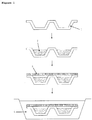
- FIG. 1 A method which utilises a primary package having a moulded portion according to the embodiment described above is illustrated in Figure 1 .
- a mould (1) comprising a plurality of cavities (two are visible in Figure 1 , but more cavities may be present) is employed as the principal component of the primary package.
- the primary package may have no predetermined shape.
- the package may be formed from a flexible material (e.g. a polymeric material) which takes on the shape of at least part of the unsolidified chocolate.
- the mass sealed in the primary package can have a viscosity of ⁇ 6 Pa.s at 40°C and a shear rate of 5 s ⁇ -1>.
- the primary package may comprise a flexible film of material comprising a single layer or a plurality of layers connected together by lamination or the like.
- the chocolate can be shaped inside the primary package by vibrating the package. Vibration can be used to spread the chocolate out so that it forms a thin layer which is rapidly solidified when immersed in the liquid.
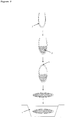
- FIG. 2 A method in which the primary package has no predetermined shape is illustrated in Figure 2 .
- a flexible, open package (5) is (partially) filled with an unsolidified chocolate (2).
- the package is laid horizontally so that the chocolate can spread out and the package takes on the shape of the chocolate. This may be promoted by vibrating the package.
- the unsolidified chocolate typically has a temperature of 26-31°C when sealed inside the primary package. Accordingly, the chocolate may have a viscosity of ⁇ 10 Pa.s at 28°C and 5 s ⁇ -1>.
- the primary package should not be so thick that it does not conduct heat at a sufficient rate, as is the case for conventional moulds.
- An overly thick primary package is also undesirable in terms of cost, environmental impact and the weight of the confectionery product as sold when the primary package is retained.
- the primary package may have a maximum wall thickness of 2.5 mm, 1.5 mm, 0.5 mm, 0.1 mm, 0.05 mm or 0.03 mm. The latter four values are particularly appropriate when the primary package has no predetermined shape so it is sufficiently flexible and allows rapid heat conduction.
- the unsolidified chocolate is sealed inside the primary package.
- “sealed” means that the chocolate is contained within the primary package such that the mass does not leak out of the package and the cooling liquid does not pass into the package during solidification.
- the primary package is sealed using ultrasound (i.e. by ultrasonic sealing). This involves applying high-frequency ultrasonic acoustic vibrations to the package in order to seal the open parts of the package without heating it. Heating of the package risks damaging the chocolate.
- the primary package may consist of a plurality of parts which are sealed together once the chocolate has been deposited.
- a second package portion may be laid over the open mould portion once the chocolate has been deposited into the mould portion, and the mould portion and the second portion are then sealed together.
- the second portion can be a single-or multi-layered film. Particular components of the layer(s) are as described above for the primary package as a whole. The second portion does not, however, have to have the same composition as the mould portion.
- Figure 1 illustrates a method employing a primary package having a plurality of parts.
- An unsolidified chocolate mass (2) is sealed inside a primary package consisting of a mould portion (1) and a single-layered film (3).
- the primary package is flexible and a seal is formed between two ends of the package once the chocolate has been deposited into the package, thereby enclosing the mass inside the package. This is illustrated in Figure 2 .
- a seal (6) is formed between the open ends of the flexible package (5).
- the primary package containing the chocolate is immersed in a liquid having a temperature below the solidification temperature of the chocolate.
- the liquid is not particularly limited, provided that it can be maintained at a temperature below the solidification temperature of the chocolate and the liquid does not pass through the primary package.
- the liquid can be water.
- the primary package containing the unsolidified chocolate is immersed in the liquid to such an extent that the chocolate solidifies. This generally involves submerging the chocolate beneath the surface of the liquid so that the chocolate solidifies rapidly and evenly. It is not, however, necessary for the entire primary package to be submerged.
- the temperature of the liquid should be lower than the solidification temperature of the chocolate, i.e. below the temperature at which the chocolate in full liquid form begins to solidify.
- the liquid can have a temperature of no more than 20°C, 18°C or 1.6°C, and at least 1°C, 2°C, 3°C, 4°C, 5°C or 10°C. More particularly, the temperature of the liquid may be in the range of 5-16°C or 10-15°C. A temperature within these ranges solidifies the chocolate rapidly and produces a stable crystal structure.
- the immersion period is dependent on the composition and mass of the chocolate as well as the distribution of the mass in the primary package and the temperature of the cooling liquid.
- the primary package is immersed in the liquid for no longer than 5 minutes, more particularly no longer than 2 minutes, in order to solidify the chocolate.
- Such rapid solidification increases the output of the method compared to methods using a conventional cooler.
- the minimum immersion period necessary for solidification is generally 30 seconds, 45 seconds or 1 minute. These values can be freely combined with the aforementioned maximum durations.
- the chocolate is completely solidified when it is immersed in the cooling liquid. However, substantial solidification is advantageous in terms of avoiding the need to further cool the mass after immersion. In one embodiment, the chocolate is completely solidified during immersion in the cooling liquid.
- the chocolate can be retained in the primary package after solidification so that the solidified mass remains protected and is ready for shipping as it is or for further packaging (secondary packaging).
- second packaging a secondary package is formed around the solidified chocolate sealed inside the primary package. Examples of the secondary package include paper and cardboard boxes and sleeves, and foil wrappers.
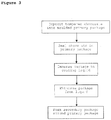
- Figure 3 illustrates a particular method according to the present invention.
- unsolidified tempered chocolate is first deposited into a primary package comprising a mould portion.
- the package is sealed (e.g. by ultrasonically 'welding' a polymer film over the mould portion) and subsequently immersed in a liquid having a temperature below the solidification temperature of the chocolate (e.g. 5-16°C).
- a liquid having a temperature below the solidification temperature of the chocolate e.g. 5-16°C.
- the present invention is illustrated by the following Examples.
- the pouches containing the unsolidified chocolate were fully immersed in a water bath.
- the water had a temperatures of 5°C and was gently circulated.
- the temperature of the chocolate in each of the pouches was monitored using a Testo 735 temperature probe until the temperature of the solidified chocolate reached the temperature of the water or the cooling rate reached zero. It was found that the chocolate took 32 seconds to reach a temperature of 20°C and an average of 4.2 minutes to reach 5°C. The maximum cooling rate was 28°C/minute.
- the solidified chocolate was stored inside the sealed pouches for 3 months at 16°C. None of the samples displayed a change in appearance over this period (i.e. no fat- or sugar-blooming occurred), despite the low temperatures of the cooling liquids.
- the crystallisation properties of the chocolate of Examples 1 and 5 were compared by subjecting the chocolate to differential scanning calorimetry (DSC). This revealed no significant difference between the chocolate as regards melting temperature. However, the average enthalpy of melting of the chocolate solidified in a water bath at 5°C was lower than that solidified at 14°C: 32.05 J/g versus 33.99 J/g. This indicates that the lower cooling rate provided a more stable crystalline structure.
- the sealed mould containing the unsolidified chocolate was submerged in a water bath having a temperature of 5 °C for 116 seconds in order to solidify the chocolate.
- the chocolate was stored for 3 weeks inside the sealed mould. It was found that the appearance of the chocolate was unchanged over this period, i.e. no fat- or sugar-blooming occurred.
Landscapes
- Engineering & Computer Science (AREA)
- Life Sciences & Earth Sciences (AREA)
- Chemical & Material Sciences (AREA)
- Food Science & Technology (AREA)
- Polymers & Plastics (AREA)
- Manufacturing & Machinery (AREA)
- Confectionery (AREA)
- Packging For Living Organisms, Food Or Medicinal Products That Are Sensitive To Environmental Conditiond (AREA)
Priority Applications (10)
| Application Number | Priority Date | Filing Date | Title |
|---|---|---|---|
| PL11172831T PL2543257T3 (pl) | 2011-07-06 | 2011-07-06 | Sposób wytwarzania wyrobu cukierniczego |
| EP11172831.7A EP2543257B1 (en) | 2011-07-06 | 2011-07-06 | Method for manufacturing a confectionery product |
| CN201280033501.9A CN103648293B (zh) | 2011-07-06 | 2012-07-02 | 用于制备糖果点心产品的方法 |
| IN859CHN2014 IN2014CN00859A (enExample) | 2011-07-06 | 2012-07-02 | |
| RU2014103313A RU2608721C2 (ru) | 2011-07-06 | 2012-07-02 | Способ изготовления кондитерского изделия |
| CA2840866A CA2840866C (en) | 2011-07-06 | 2012-07-02 | Method for manufacturing a confectionery product |
| AU2012279200A AU2012279200B2 (en) | 2011-07-06 | 2012-07-02 | Method for manufacturing a confectionery product |
| PCT/US2012/045196 WO2013006530A1 (en) | 2011-07-06 | 2012-07-02 | Method for manufacturing a confectionery product |
| NZ619794A NZ619794B2 (en) | 2011-07-06 | 2012-07-02 | Method for manufacturing a confectionery product |
| BR112014000151-0A BR112014000151B1 (pt) | 2011-07-06 | 2012-07-02 | Método para produzir um produto de confeitaria |
Applications Claiming Priority (1)
| Application Number | Priority Date | Filing Date | Title |
|---|---|---|---|
| EP11172831.7A EP2543257B1 (en) | 2011-07-06 | 2011-07-06 | Method for manufacturing a confectionery product |
Publications (2)
| Publication Number | Publication Date |
|---|---|
| EP2543257A1 EP2543257A1 (en) | 2013-01-09 |
| EP2543257B1 true EP2543257B1 (en) | 2018-06-27 |
Family
ID=44941537
Family Applications (1)
| Application Number | Title | Priority Date | Filing Date |
|---|---|---|---|
| EP11172831.7A Active EP2543257B1 (en) | 2011-07-06 | 2011-07-06 | Method for manufacturing a confectionery product |
Country Status (9)
| Country | Link |
|---|---|
| EP (1) | EP2543257B1 (enExample) |
| CN (1) | CN103648293B (enExample) |
| AU (1) | AU2012279200B2 (enExample) |
| BR (1) | BR112014000151B1 (enExample) |
| CA (1) | CA2840866C (enExample) |
| IN (1) | IN2014CN00859A (enExample) |
| PL (1) | PL2543257T3 (enExample) |
| RU (1) | RU2608721C2 (enExample) |
| WO (1) | WO2013006530A1 (enExample) |
Families Citing this family (8)
| Publication number | Priority date | Publication date | Assignee | Title |
|---|---|---|---|---|
| CN105357972B (zh) * | 2013-05-31 | 2020-03-27 | 雀巢产品有限公司 | 包装内模塑设备 |
| BR112016007247B1 (pt) * | 2013-10-02 | 2022-01-04 | The Hershey Company | Processo para produzir produtos de confeitaria |
| US10285873B2 (en) | 2014-09-30 | 2019-05-14 | Johnson & Johnson Consumer Inc. | Absorbent article demonstrating controlled deformation and longitudinal fluid distribution |
| US10307308B2 (en) | 2014-09-30 | 2019-06-04 | Johnson & Johnson Consumer Inc. | Absorbent article demonstrating controlled deformation and longitudinal fluid distribution |
| US10265224B2 (en) | 2014-09-30 | 2019-04-23 | Johnson & Johnson Consumer Inc. | Absorbent article demonstrating controlled deformation and longitudinal fluid distribution |
| US9999554B2 (en) | 2014-09-30 | 2018-06-19 | Johnson & Johnson Consumer Inc. | Absorbent article demonstrating controlled deformation and longitudinal fluid distribution |
| US9968496B2 (en) | 2014-09-30 | 2018-05-15 | Johnson & Johnson Consumer Inc. | Absorbent article demonstrating controlled deformation and longitudinal fluid distribution |
| KR102010231B1 (ko) * | 2018-10-02 | 2019-08-13 | 채정한 | 수평형 일회용 플라스틱 필름 몰드를 내포장재로 이용한 아이스크림 포장재 |
Family Cites Families (23)
| Publication number | Priority date | Publication date | Assignee | Title |
|---|---|---|---|---|
| GB645747A (en) * | 1948-10-16 | 1950-11-08 | Michael Nathanson | Improvements in or relating to apparatus for use in the manufacture of ice confections and the like |
| US2796033A (en) * | 1954-07-06 | 1957-06-18 | Feinstein Edward | Method of forming a confection package |
| GB1128525A (en) * | 1965-12-08 | 1968-09-25 | Midland Counties Dairy Ltd | New or improved method for producing confections |
| GB1214983A (en) * | 1967-12-02 | 1970-12-09 | Ben Edward Rasmusson | Improvements in or relating to non-refrigerator food products |
| FR1587835A (enExample) * | 1968-10-14 | 1970-03-27 | ||
| US4104411A (en) * | 1974-03-28 | 1978-08-01 | Thomas J. Lipton, Inc. | Forming of ice lollies and other confections |
| JPS5939102B2 (ja) * | 1978-08-08 | 1984-09-20 | 株式会社イズミフ−ドマシナリ | 冷菓製造設備 |
| JPS5623838A (en) * | 1979-08-01 | 1981-03-06 | Shichifuku Shokuhin Kk | Sealed and packaged food and its preparation |
| JPS59120062A (ja) * | 1982-12-28 | 1984-07-11 | Usui Kogyosho:Kk | ゼリ−状をした品物の製造装置 |
| FR2539670B3 (fr) * | 1983-01-26 | 1985-10-25 | Chaudronnees Centre Sa Const | Procede de moulage au moyen d'empreintes a paroi souple, et machine automatique de mise en oeuvre |
| JPS6137077A (ja) * | 1984-07-30 | 1986-02-21 | Toyo Reikou Kk | 豆腐の急速冷却方法およびその装置 |
| FR2609237A1 (fr) * | 1987-01-06 | 1988-07-08 | Garnier Patrick | Procede et installation pour la reconstitution de fruits pour preparations alimentaires |
| JPH0292261A (ja) * | 1988-09-29 | 1990-04-03 | Toppan Printing Co Ltd | 立体成形品の製造方法 |
| IT1268407B1 (it) * | 1992-04-10 | 1997-02-27 | Giorgio Trani | Procedimento per realizzare gelati confezionati da passeggio e confezione per effettuare il procedimento |
| AU5009593A (en) * | 1992-08-20 | 1994-03-15 | R.W. Frookies, Incorporated | Natural frozen confection precursors |
| GB2279286B (en) * | 1993-06-25 | 1996-09-18 | Gilchris Confectionery Limited | Novelty confectionery item |
| IT1262654B (it) * | 1993-08-26 | 1996-07-04 | Unifill Spa | Metodo per la formatura ad iniezione di prodotti commestibili e prodotto relativo. |
| RU2041640C1 (ru) * | 1993-11-02 | 1995-08-20 | Владимир Сергеевич Люляев | Способ приготовления шоколадных изделий |
| DE19830258A1 (de) * | 1998-07-07 | 2000-01-13 | Ritter Kg Alfred | Verfahren sowie Vorrichtung zur Herstellung verpackter schokoladenartiger Produkte und nach diesem Verfahren hergestelltes Produkt |
| FR2801570B1 (fr) * | 1999-11-29 | 2002-02-22 | Jacquot | Emballage pour produits alimentaires dont l'etat change en fonction de la temperature, notamment pour des produits a base de chocolat |
| GB2405827B (en) | 2003-09-12 | 2007-01-31 | Mlom Ltd | Sweet manufacture |
| BE1017445A6 (nl) * | 2007-01-26 | 2008-09-02 | Copabe Nv | Werkwijze voor het vervaardigen van chocoladeproducten. |
| JP2009136193A (ja) * | 2007-12-05 | 2009-06-25 | Kichinosuke Nagashio | 密封容器入り擦りおろし食品の製造方法及びその装置 |
-
2011
- 2011-07-06 EP EP11172831.7A patent/EP2543257B1/en active Active
- 2011-07-06 PL PL11172831T patent/PL2543257T3/pl unknown
-
2012
- 2012-07-02 WO PCT/US2012/045196 patent/WO2013006530A1/en not_active Ceased
- 2012-07-02 CA CA2840866A patent/CA2840866C/en active Active
- 2012-07-02 IN IN859CHN2014 patent/IN2014CN00859A/en unknown
- 2012-07-02 RU RU2014103313A patent/RU2608721C2/ru active
- 2012-07-02 AU AU2012279200A patent/AU2012279200B2/en not_active Ceased
- 2012-07-02 CN CN201280033501.9A patent/CN103648293B/zh not_active Expired - Fee Related
- 2012-07-02 BR BR112014000151-0A patent/BR112014000151B1/pt not_active IP Right Cessation
Non-Patent Citations (1)
| Title |
|---|
| None * |
Also Published As
| Publication number | Publication date |
|---|---|
| BR112014000151A2 (pt) | 2017-05-30 |
| CN103648293B (zh) | 2018-02-09 |
| CA2840866A1 (en) | 2013-01-10 |
| BR112014000151B1 (pt) | 2019-06-04 |
| CN103648293A (zh) | 2014-03-19 |
| RU2608721C2 (ru) | 2017-01-23 |
| RU2014103313A (ru) | 2015-08-20 |
| NZ619794A (en) | 2015-10-30 |
| BR112014000151A8 (pt) | 2019-05-07 |
| AU2012279200A1 (en) | 2014-02-06 |
| AU2012279200B2 (en) | 2015-05-28 |
| EP2543257A1 (en) | 2013-01-09 |
| WO2013006530A1 (en) | 2013-01-10 |
| IN2014CN00859A (enExample) | 2015-04-03 |
| PL2543257T3 (pl) | 2018-11-30 |
| CA2840866C (en) | 2019-06-11 |
Similar Documents
| Publication | Publication Date | Title |
|---|---|---|
| US20140328986A1 (en) | Method for manufacturing a confectionery product | |
| CA2840866C (en) | Method for manufacturing a confectionery product | |
| RU2717715C2 (ru) | Двухслойное замороженное кондитерское изделие | |
| EP0923875B1 (en) | Method for making food articles using counter rotating rollers | |
| US20080050484A1 (en) | Filled confectionery products | |
| EP2386208B1 (en) | Method for manufacturing a multi-layered confectionary shell | |
| CA2840960C (en) | Method for manufacturing a confectionery shell | |
| US10123550B2 (en) | Method for manufacturing confectionery shells | |
| Fryer et al. | The materials science of chocolate | |
| US20180177212A1 (en) | Frozen dessert | |
| US3574639A (en) | Liquid center confectionary product and process for producing the same | |
| US10869491B2 (en) | Process for manufacture of coated frozen confection | |
| US8495892B2 (en) | Process and apparatus for the manufacturing of frozen aerated products | |
| JP5898450B2 (ja) | 冷菓の製造方法 | |
| US20160302438A1 (en) | Method for the preparation of a chocolate product | |
| JP4056650B2 (ja) | センター入り油脂性食品の製法およびそれに用いる装置 | |
| JP4202304B2 (ja) | 固化食材の製造装置 | |
| JP2007097540A (ja) | コーンカップおよびその製法、それを用いたコーンカップ冷菓、コーンカップの吸湿防止方法、コーンカップ冷菓の製法、コーンカップ冷菓製造装置及び把持具 | |
| BRPI1102417B1 (pt) | Método para a produção de uma cobertura de confeitos feita de camadas múltiplas | |
| WO2016062616A1 (en) | Coated frozen confection |
Legal Events
| Date | Code | Title | Description |
|---|---|---|---|
| PUAI | Public reference made under article 153(3) epc to a published international application that has entered the european phase |
Free format text: ORIGINAL CODE: 0009012 |
|
| 17P | Request for examination filed |
Effective date: 20110706 |
|
| AK | Designated contracting states |
Kind code of ref document: A1 Designated state(s): AL AT BE BG CH CY CZ DE DK EE ES FI FR GB GR HR HU IE IS IT LI LT LU LV MC MK MT NL NO PL PT RO RS SE SI SK SM TR |
|
| AX | Request for extension of the european patent |
Extension state: BA ME |
|
| 17Q | First examination report despatched |
Effective date: 20131114 |
|
| RAP1 | Party data changed (applicant data changed or rights of an application transferred) |
Owner name: KRAFT FOODS R & D, INC. |
|
| STAA | Information on the status of an ep patent application or granted ep patent |
Free format text: STATUS: EXAMINATION IS IN PROGRESS |
|
| GRAP | Despatch of communication of intention to grant a patent |
Free format text: ORIGINAL CODE: EPIDOSNIGR1 |
|
| STAA | Information on the status of an ep patent application or granted ep patent |
Free format text: STATUS: GRANT OF PATENT IS INTENDED |
|
| INTG | Intention to grant announced |
Effective date: 20180209 |
|
| GRAS | Grant fee paid |
Free format text: ORIGINAL CODE: EPIDOSNIGR3 |
|
| GRAA | (expected) grant |
Free format text: ORIGINAL CODE: 0009210 |
|
| STAA | Information on the status of an ep patent application or granted ep patent |
Free format text: STATUS: THE PATENT HAS BEEN GRANTED |
|
| AK | Designated contracting states |
Kind code of ref document: B1 Designated state(s): AL AT BE BG CH CY CZ DE DK EE ES FI FR GB GR HR HU IE IS IT LI LT LU LV MC MK MT NL NO PL PT RO RS SE SI SK SM TR |
|
| REG | Reference to a national code |
Ref country code: GB Ref legal event code: FG4D |
|
| REG | Reference to a national code |
Ref country code: AT Ref legal event code: REF Ref document number: 1011512 Country of ref document: AT Kind code of ref document: T Effective date: 20180715 |
|
| REG | Reference to a national code |
Ref country code: DE Ref legal event code: R096 Ref document number: 602011049517 Country of ref document: DE |
|
| REG | Reference to a national code |
Ref country code: IE Ref legal event code: FG4D |
|
| REG | Reference to a national code |
Ref country code: FR Ref legal event code: PLFP Year of fee payment: 8 |
|
| PG25 | Lapsed in a contracting state [announced via postgrant information from national office to epo] |
Ref country code: LT Free format text: LAPSE BECAUSE OF FAILURE TO SUBMIT A TRANSLATION OF THE DESCRIPTION OR TO PAY THE FEE WITHIN THE PRESCRIBED TIME-LIMIT Effective date: 20180627 Ref country code: BG Free format text: LAPSE BECAUSE OF FAILURE TO SUBMIT A TRANSLATION OF THE DESCRIPTION OR TO PAY THE FEE WITHIN THE PRESCRIBED TIME-LIMIT Effective date: 20180927 Ref country code: FI Free format text: LAPSE BECAUSE OF FAILURE TO SUBMIT A TRANSLATION OF THE DESCRIPTION OR TO PAY THE FEE WITHIN THE PRESCRIBED TIME-LIMIT Effective date: 20180627 Ref country code: NO Free format text: LAPSE BECAUSE OF FAILURE TO SUBMIT A TRANSLATION OF THE DESCRIPTION OR TO PAY THE FEE WITHIN THE PRESCRIBED TIME-LIMIT Effective date: 20180927 Ref country code: SE Free format text: LAPSE BECAUSE OF FAILURE TO SUBMIT A TRANSLATION OF THE DESCRIPTION OR TO PAY THE FEE WITHIN THE PRESCRIBED TIME-LIMIT Effective date: 20180627 |
|
| REG | Reference to a national code |
Ref country code: NL Ref legal event code: MP Effective date: 20180627 |
|
| REG | Reference to a national code |
Ref country code: LT Ref legal event code: MG4D |
|
| PG25 | Lapsed in a contracting state [announced via postgrant information from national office to epo] |
Ref country code: GR Free format text: LAPSE BECAUSE OF FAILURE TO SUBMIT A TRANSLATION OF THE DESCRIPTION OR TO PAY THE FEE WITHIN THE PRESCRIBED TIME-LIMIT Effective date: 20180928 Ref country code: HR Free format text: LAPSE BECAUSE OF FAILURE TO SUBMIT A TRANSLATION OF THE DESCRIPTION OR TO PAY THE FEE WITHIN THE PRESCRIBED TIME-LIMIT Effective date: 20180627 Ref country code: LV Free format text: LAPSE BECAUSE OF FAILURE TO SUBMIT A TRANSLATION OF THE DESCRIPTION OR TO PAY THE FEE WITHIN THE PRESCRIBED TIME-LIMIT Effective date: 20180627 Ref country code: RS Free format text: LAPSE BECAUSE OF FAILURE TO SUBMIT A TRANSLATION OF THE DESCRIPTION OR TO PAY THE FEE WITHIN THE PRESCRIBED TIME-LIMIT Effective date: 20180627 |
|
| REG | Reference to a national code |
Ref country code: AT Ref legal event code: MK05 Ref document number: 1011512 Country of ref document: AT Kind code of ref document: T Effective date: 20180627 |
|
| PG25 | Lapsed in a contracting state [announced via postgrant information from national office to epo] |
Ref country code: NL Free format text: LAPSE BECAUSE OF FAILURE TO SUBMIT A TRANSLATION OF THE DESCRIPTION OR TO PAY THE FEE WITHIN THE PRESCRIBED TIME-LIMIT Effective date: 20180627 |
|
| PG25 | Lapsed in a contracting state [announced via postgrant information from national office to epo] |
Ref country code: RO Free format text: LAPSE BECAUSE OF FAILURE TO SUBMIT A TRANSLATION OF THE DESCRIPTION OR TO PAY THE FEE WITHIN THE PRESCRIBED TIME-LIMIT Effective date: 20180627 Ref country code: SK Free format text: LAPSE BECAUSE OF FAILURE TO SUBMIT A TRANSLATION OF THE DESCRIPTION OR TO PAY THE FEE WITHIN THE PRESCRIBED TIME-LIMIT Effective date: 20180627 Ref country code: CZ Free format text: LAPSE BECAUSE OF FAILURE TO SUBMIT A TRANSLATION OF THE DESCRIPTION OR TO PAY THE FEE WITHIN THE PRESCRIBED TIME-LIMIT Effective date: 20180627 Ref country code: EE Free format text: LAPSE BECAUSE OF FAILURE TO SUBMIT A TRANSLATION OF THE DESCRIPTION OR TO PAY THE FEE WITHIN THE PRESCRIBED TIME-LIMIT Effective date: 20180627 Ref country code: AT Free format text: LAPSE BECAUSE OF FAILURE TO SUBMIT A TRANSLATION OF THE DESCRIPTION OR TO PAY THE FEE WITHIN THE PRESCRIBED TIME-LIMIT Effective date: 20180627 Ref country code: IS Free format text: LAPSE BECAUSE OF FAILURE TO SUBMIT A TRANSLATION OF THE DESCRIPTION OR TO PAY THE FEE WITHIN THE PRESCRIBED TIME-LIMIT Effective date: 20181027 |
|
| PG25 | Lapsed in a contracting state [announced via postgrant information from national office to epo] |
Ref country code: ES Free format text: LAPSE BECAUSE OF FAILURE TO SUBMIT A TRANSLATION OF THE DESCRIPTION OR TO PAY THE FEE WITHIN THE PRESCRIBED TIME-LIMIT Effective date: 20180627 Ref country code: SM Free format text: LAPSE BECAUSE OF FAILURE TO SUBMIT A TRANSLATION OF THE DESCRIPTION OR TO PAY THE FEE WITHIN THE PRESCRIBED TIME-LIMIT Effective date: 20180627 |
|
| REG | Reference to a national code |
Ref country code: DE Ref legal event code: R097 Ref document number: 602011049517 Country of ref document: DE |
|
| PG25 | Lapsed in a contracting state [announced via postgrant information from national office to epo] |
Ref country code: LU Free format text: LAPSE BECAUSE OF NON-PAYMENT OF DUE FEES Effective date: 20180706 Ref country code: MC Free format text: LAPSE BECAUSE OF FAILURE TO SUBMIT A TRANSLATION OF THE DESCRIPTION OR TO PAY THE FEE WITHIN THE PRESCRIBED TIME-LIMIT Effective date: 20180627 |
|
| REG | Reference to a national code |
Ref country code: IE Ref legal event code: MM4A |
|
| PG25 | Lapsed in a contracting state [announced via postgrant information from national office to epo] |
Ref country code: IE Free format text: LAPSE BECAUSE OF NON-PAYMENT OF DUE FEES Effective date: 20180706 |
|
| PLBE | No opposition filed within time limit |
Free format text: ORIGINAL CODE: 0009261 |
|
| STAA | Information on the status of an ep patent application or granted ep patent |
Free format text: STATUS: NO OPPOSITION FILED WITHIN TIME LIMIT |
|
| PG25 | Lapsed in a contracting state [announced via postgrant information from national office to epo] |
Ref country code: DK Free format text: LAPSE BECAUSE OF FAILURE TO SUBMIT A TRANSLATION OF THE DESCRIPTION OR TO PAY THE FEE WITHIN THE PRESCRIBED TIME-LIMIT Effective date: 20180627 |
|
| 26N | No opposition filed |
Effective date: 20190328 |
|
| PG25 | Lapsed in a contracting state [announced via postgrant information from national office to epo] |
Ref country code: SI Free format text: LAPSE BECAUSE OF FAILURE TO SUBMIT A TRANSLATION OF THE DESCRIPTION OR TO PAY THE FEE WITHIN THE PRESCRIBED TIME-LIMIT Effective date: 20180627 |
|
| PG25 | Lapsed in a contracting state [announced via postgrant information from national office to epo] |
Ref country code: AL Free format text: LAPSE BECAUSE OF FAILURE TO SUBMIT A TRANSLATION OF THE DESCRIPTION OR TO PAY THE FEE WITHIN THE PRESCRIBED TIME-LIMIT Effective date: 20180627 |
|
| PG25 | Lapsed in a contracting state [announced via postgrant information from national office to epo] |
Ref country code: MT Free format text: LAPSE BECAUSE OF NON-PAYMENT OF DUE FEES Effective date: 20180706 |
|
| REG | Reference to a national code |
Ref country code: BE Ref legal event code: PD Owner name: KRAFT FOODS SCHWEIZ HOLDING GMBH; CH Free format text: DETAILS ASSIGNMENT: CHANGE OF OWNER(S), CESSION; FORMER OWNER NAME: KRAFT FOODS R & D, INC. Effective date: 20191227 |
|
| PG25 | Lapsed in a contracting state [announced via postgrant information from national office to epo] |
Ref country code: TR Free format text: LAPSE BECAUSE OF FAILURE TO SUBMIT A TRANSLATION OF THE DESCRIPTION OR TO PAY THE FEE WITHIN THE PRESCRIBED TIME-LIMIT Effective date: 20180627 |
|
| REG | Reference to a national code |
Ref country code: DE Ref legal event code: R081 Ref document number: 602011049517 Country of ref document: DE Owner name: KRAFT FOODS SCHWEIZ HOLDING GMBH, CH Free format text: FORMER OWNER: KRAFT FOODS R & D, INC., DEERFIELD, ILL., US |
|
| REG | Reference to a national code |
Ref country code: GB Ref legal event code: 732E Free format text: REGISTERED BETWEEN 20200402 AND 20200408 |
|
| PG25 | Lapsed in a contracting state [announced via postgrant information from national office to epo] |
Ref country code: PT Free format text: LAPSE BECAUSE OF FAILURE TO SUBMIT A TRANSLATION OF THE DESCRIPTION OR TO PAY THE FEE WITHIN THE PRESCRIBED TIME-LIMIT Effective date: 20180627 Ref country code: HU Free format text: LAPSE BECAUSE OF FAILURE TO SUBMIT A TRANSLATION OF THE DESCRIPTION OR TO PAY THE FEE WITHIN THE PRESCRIBED TIME-LIMIT; INVALID AB INITIO Effective date: 20110706 |
|
| PG25 | Lapsed in a contracting state [announced via postgrant information from national office to epo] |
Ref country code: MK Free format text: LAPSE BECAUSE OF NON-PAYMENT OF DUE FEES Effective date: 20180627 Ref country code: CY Free format text: LAPSE BECAUSE OF FAILURE TO SUBMIT A TRANSLATION OF THE DESCRIPTION OR TO PAY THE FEE WITHIN THE PRESCRIBED TIME-LIMIT Effective date: 20180627 |
|
| REG | Reference to a national code |
Ref country code: CH Ref legal event code: PUE Owner name: KRAFT FOODS SCHWEIZ HOLDING GMBH, CH Free format text: FORMER OWNER: KRAFT FOODS R AND D, INC., US |
|
| PGFP | Annual fee paid to national office [announced via postgrant information from national office to epo] |
Ref country code: PL Payment date: 20220617 Year of fee payment: 12 |
|
| PGFP | Annual fee paid to national office [announced via postgrant information from national office to epo] |
Ref country code: IT Payment date: 20220721 Year of fee payment: 12 Ref country code: GB Payment date: 20220727 Year of fee payment: 12 Ref country code: DE Payment date: 20220727 Year of fee payment: 12 |
|
| PGFP | Annual fee paid to national office [announced via postgrant information from national office to epo] |
Ref country code: FR Payment date: 20220725 Year of fee payment: 12 Ref country code: BE Payment date: 20220727 Year of fee payment: 12 |
|
| PGFP | Annual fee paid to national office [announced via postgrant information from national office to epo] |
Ref country code: CH Payment date: 20220808 Year of fee payment: 12 |
|
| P01 | Opt-out of the competence of the unified patent court (upc) registered |
Effective date: 20230324 |
|
| REG | Reference to a national code |
Ref country code: DE Ref legal event code: R119 Ref document number: 602011049517 Country of ref document: DE |
|
| REG | Reference to a national code |
Ref country code: CH Ref legal event code: PL |
|
| REG | Reference to a national code |
Ref country code: BE Ref legal event code: MM Effective date: 20230731 |
|
| GBPC | Gb: european patent ceased through non-payment of renewal fee |
Effective date: 20230706 |
|
| PG25 | Lapsed in a contracting state [announced via postgrant information from national office to epo] |
Ref country code: DE Free format text: LAPSE BECAUSE OF NON-PAYMENT OF DUE FEES Effective date: 20240201 Ref country code: GB Free format text: LAPSE BECAUSE OF NON-PAYMENT OF DUE FEES Effective date: 20230706 Ref country code: CH Free format text: LAPSE BECAUSE OF NON-PAYMENT OF DUE FEES Effective date: 20230731 |
|
| PG25 | Lapsed in a contracting state [announced via postgrant information from national office to epo] |
Ref country code: FR Free format text: LAPSE BECAUSE OF NON-PAYMENT OF DUE FEES Effective date: 20230731 Ref country code: BE Free format text: LAPSE BECAUSE OF NON-PAYMENT OF DUE FEES Effective date: 20230731 |
|
| PG25 | Lapsed in a contracting state [announced via postgrant information from national office to epo] |
Ref country code: IT Free format text: LAPSE BECAUSE OF NON-PAYMENT OF DUE FEES Effective date: 20230706 |
|
| PG25 | Lapsed in a contracting state [announced via postgrant information from national office to epo] |
Ref country code: PL Free format text: LAPSE BECAUSE OF NON-PAYMENT OF DUE FEES Effective date: 20230706 |