EP2500757B1 - Method of manufacturing optical module - Google Patents
Method of manufacturing optical module Download PDFInfo
- Publication number
- EP2500757B1 EP2500757B1 EP12159734.8A EP12159734A EP2500757B1 EP 2500757 B1 EP2500757 B1 EP 2500757B1 EP 12159734 A EP12159734 A EP 12159734A EP 2500757 B1 EP2500757 B1 EP 2500757B1
- Authority
- EP
- European Patent Office
- Prior art keywords
- bonding
- microbumps
- load
- substrate
- optical device
- Prior art date
- Legal status (The legal status is an assumption and is not a legal conclusion. Google has not performed a legal analysis and makes no representation as to the accuracy of the status listed.)
- Not-in-force
Links
Images




Classifications
-
- H—ELECTRICITY
- H10—SEMICONDUCTOR DEVICES; ELECTRIC SOLID-STATE DEVICES NOT OTHERWISE PROVIDED FOR
- H10W—GENERIC PACKAGES, INTERCONNECTIONS, CONNECTORS OR OTHER CONSTRUCTIONAL DETAILS OF DEVICES COVERED BY CLASS H10
- H10W72/00—Interconnections or connectors in packages
- H10W72/071—Connecting or disconnecting
- H10W72/073—Connecting or disconnecting of die-attach connectors
-
- H—ELECTRICITY
- H10—SEMICONDUCTOR DEVICES; ELECTRIC SOLID-STATE DEVICES NOT OTHERWISE PROVIDED FOR
- H10W—GENERIC PACKAGES, INTERCONNECTIONS, CONNECTORS OR OTHER CONSTRUCTIONAL DETAILS OF DEVICES COVERED BY CLASS H10
- H10W72/00—Interconnections or connectors in packages
- H10W72/071—Connecting or disconnecting
- H10W72/0711—Apparatus therefor
- H10W72/07183—Means for monitoring
-
- H—ELECTRICITY
- H10—SEMICONDUCTOR DEVICES; ELECTRIC SOLID-STATE DEVICES NOT OTHERWISE PROVIDED FOR
- H10W—GENERIC PACKAGES, INTERCONNECTIONS, CONNECTORS OR OTHER CONSTRUCTIONAL DETAILS OF DEVICES COVERED BY CLASS H10
- H10W72/00—Interconnections or connectors in packages
- H10W72/071—Connecting or disconnecting
- H10W72/072—Connecting or disconnecting of bump connectors
-
- H—ELECTRICITY
- H10—SEMICONDUCTOR DEVICES; ELECTRIC SOLID-STATE DEVICES NOT OTHERWISE PROVIDED FOR
- H10W—GENERIC PACKAGES, INTERCONNECTIONS, CONNECTORS OR OTHER CONSTRUCTIONAL DETAILS OF DEVICES COVERED BY CLASS H10
- H10W72/00—Interconnections or connectors in packages
- H10W72/071—Connecting or disconnecting
- H10W72/073—Connecting or disconnecting of die-attach connectors
- H10W72/07331—Connecting techniques
-
- H—ELECTRICITY
- H10—SEMICONDUCTOR DEVICES; ELECTRIC SOLID-STATE DEVICES NOT OTHERWISE PROVIDED FOR
- H10W—GENERIC PACKAGES, INTERCONNECTIONS, CONNECTORS OR OTHER CONSTRUCTIONAL DETAILS OF DEVICES COVERED BY CLASS H10
- H10W72/00—Interconnections or connectors in packages
- H10W72/071—Connecting or disconnecting
- H10W72/073—Connecting or disconnecting of die-attach connectors
- H10W72/07341—Controlling the bonding environment, e.g. atmosphere composition or temperature
-
- H—ELECTRICITY
- H10—SEMICONDUCTOR DEVICES; ELECTRIC SOLID-STATE DEVICES NOT OTHERWISE PROVIDED FOR
- H10W—GENERIC PACKAGES, INTERCONNECTIONS, CONNECTORS OR OTHER CONSTRUCTIONAL DETAILS OF DEVICES COVERED BY CLASS H10
- H10W72/00—Interconnections or connectors in packages
- H10W72/071—Connecting or disconnecting
- H10W72/073—Connecting or disconnecting of die-attach connectors
- H10W72/07351—Connecting or disconnecting of die-attach connectors characterised by changes in properties of the die-attach connectors during connecting
- H10W72/07353—Connecting or disconnecting of die-attach connectors characterised by changes in properties of the die-attach connectors during connecting changes in shapes
-
- H—ELECTRICITY
- H10—SEMICONDUCTOR DEVICES; ELECTRIC SOLID-STATE DEVICES NOT OTHERWISE PROVIDED FOR
- H10W—GENERIC PACKAGES, INTERCONNECTIONS, CONNECTORS OR OTHER CONSTRUCTIONAL DETAILS OF DEVICES COVERED BY CLASS H10
- H10W72/00—Interconnections or connectors in packages
- H10W72/20—Bump connectors, e.g. solder bumps or copper pillars; Dummy bumps; Thermal bumps
- H10W72/241—Dispositions, e.g. layouts
-
- H—ELECTRICITY
- H10—SEMICONDUCTOR DEVICES; ELECTRIC SOLID-STATE DEVICES NOT OTHERWISE PROVIDED FOR
- H10W—GENERIC PACKAGES, INTERCONNECTIONS, CONNECTORS OR OTHER CONSTRUCTIONAL DETAILS OF DEVICES COVERED BY CLASS H10
- H10W72/00—Interconnections or connectors in packages
- H10W72/30—Die-attach connectors
-
- H—ELECTRICITY
- H10—SEMICONDUCTOR DEVICES; ELECTRIC SOLID-STATE DEVICES NOT OTHERWISE PROVIDED FOR
- H10W—GENERIC PACKAGES, INTERCONNECTIONS, CONNECTORS OR OTHER CONSTRUCTIONAL DETAILS OF DEVICES COVERED BY CLASS H10
- H10W72/00—Interconnections or connectors in packages
- H10W72/30—Die-attach connectors
- H10W72/331—Shapes of die-attach connectors
- H10W72/334—Cross-sectional shape, i.e. in side view
-
- H—ELECTRICITY
- H10—SEMICONDUCTOR DEVICES; ELECTRIC SOLID-STATE DEVICES NOT OTHERWISE PROVIDED FOR
- H10W—GENERIC PACKAGES, INTERCONNECTIONS, CONNECTORS OR OTHER CONSTRUCTIONAL DETAILS OF DEVICES COVERED BY CLASS H10
- H10W72/00—Interconnections or connectors in packages
- H10W72/30—Die-attach connectors
- H10W72/351—Materials of die-attach connectors
- H10W72/352—Materials of die-attach connectors comprising metals or metalloids, e.g. solders
-
- H—ELECTRICITY
- H10—SEMICONDUCTOR DEVICES; ELECTRIC SOLID-STATE DEVICES NOT OTHERWISE PROVIDED FOR
- H10W—GENERIC PACKAGES, INTERCONNECTIONS, CONNECTORS OR OTHER CONSTRUCTIONAL DETAILS OF DEVICES COVERED BY CLASS H10
- H10W72/00—Interconnections or connectors in packages
- H10W72/30—Die-attach connectors
- H10W72/351—Materials of die-attach connectors
- H10W72/353—Materials of die-attach connectors not comprising solid metals or solid metalloids, e.g. ceramics
- H10W72/354—Materials of die-attach connectors not comprising solid metals or solid metalloids, e.g. ceramics comprising polymers
-
- H—ELECTRICITY
- H10—SEMICONDUCTOR DEVICES; ELECTRIC SOLID-STATE DEVICES NOT OTHERWISE PROVIDED FOR
- H10W—GENERIC PACKAGES, INTERCONNECTIONS, CONNECTORS OR OTHER CONSTRUCTIONAL DETAILS OF DEVICES COVERED BY CLASS H10
- H10W72/00—Interconnections or connectors in packages
- H10W72/90—Bond pads, in general
- H10W72/931—Shapes of bond pads
-
- H—ELECTRICITY
- H10—SEMICONDUCTOR DEVICES; ELECTRIC SOLID-STATE DEVICES NOT OTHERWISE PROVIDED FOR
- H10W—GENERIC PACKAGES, INTERCONNECTIONS, CONNECTORS OR OTHER CONSTRUCTIONAL DETAILS OF DEVICES COVERED BY CLASS H10
- H10W72/00—Interconnections or connectors in packages
- H10W72/90—Bond pads, in general
- H10W72/951—Materials of bond pads
- H10W72/952—Materials of bond pads comprising metals or metalloids, e.g. PbSn, Ag or Cu
-
- H—ELECTRICITY
- H10—SEMICONDUCTOR DEVICES; ELECTRIC SOLID-STATE DEVICES NOT OTHERWISE PROVIDED FOR
- H10W—GENERIC PACKAGES, INTERCONNECTIONS, CONNECTORS OR OTHER CONSTRUCTIONAL DETAILS OF DEVICES COVERED BY CLASS H10
- H10W80/00—Direct bonding of chips, wafers or substrates
- H10W80/301—Bonding techniques, e.g. hybrid bonding
- H10W80/314—Bonding techniques, e.g. hybrid bonding characterized by direct bonding of pads or other interconnections
-
- H—ELECTRICITY
- H10—SEMICONDUCTOR DEVICES; ELECTRIC SOLID-STATE DEVICES NOT OTHERWISE PROVIDED FOR
- H10W—GENERIC PACKAGES, INTERCONNECTIONS, CONNECTORS OR OTHER CONSTRUCTIONAL DETAILS OF DEVICES COVERED BY CLASS H10
- H10W90/00—Package configurations
- H10W90/701—Package configurations characterised by the relative positions of pads or connectors relative to package parts
- H10W90/731—Package configurations characterised by the relative positions of pads or connectors relative to package parts of die-attach connectors
- H10W90/734—Package configurations characterised by the relative positions of pads or connectors relative to package parts of die-attach connectors between a chip and a stacked insulating package substrate, interposer or RDL
-
- Y—GENERAL TAGGING OF NEW TECHNOLOGICAL DEVELOPMENTS; GENERAL TAGGING OF CROSS-SECTIONAL TECHNOLOGIES SPANNING OVER SEVERAL SECTIONS OF THE IPC; TECHNICAL SUBJECTS COVERED BY FORMER USPC CROSS-REFERENCE ART COLLECTIONS [XRACs] AND DIGESTS
- Y10—TECHNICAL SUBJECTS COVERED BY FORMER USPC
- Y10T—TECHNICAL SUBJECTS COVERED BY FORMER US CLASSIFICATION
- Y10T156/00—Adhesive bonding and miscellaneous chemical manufacture
- Y10T156/10—Methods of surface bonding and/or assembly therefor
- Y10T156/1002—Methods of surface bonding and/or assembly therefor with permanent bending or reshaping or surface deformation of self sustaining lamina
- Y10T156/1039—Surface deformation only of sandwich or lamina [e.g., embossed panels]
Definitions
- the present invention relates to a method of manufacturing an optical module and, more specifically, to a method of manufacturing an optical module including a plurality of optical devices bonded by using bonding bumps.
- a method of mounting a semiconductor laser element, and joining a photodiode to a copper heat sink using bonding bumps to optically align the semiconductor laser element and the photodiode with high precision is known from, for example, Japanese Unexamined Patent Application Publication No. H10-208269 ( FIG. 1 ).
- this method in the case of joining the photodiode with the bonding bumps, the relationship between pressure applied to the bonding bumps and height of the bonding bumps deformed according to the applied pressure is examined in advance, and a proper application pressure is selected according to the relationship. This is however not a technique of positioning in the height direction of an optical device in submicron order by pressing bonding bumps.
- US 2008/0245843 A1 discloses a bonding method for bonding objects to be bonded which have a bonding portion formed of a metal, e.g. gold, wherein said bonding portions have a hardness of 200 Hv or less and are contacted with each other and pressed in a solid phase at room temperature after heating said bonding portions with an energy wave which is an atom beam, an ion beam, or a plasma.
- the objects to be bonded may be a light emitting element and an optical fiber.
- the bonding process may comprise to recognize a light emitting point of said light emitting element using a recognizing means to adjust the position of the light emitting element to an optimum position while the light emitting element is caused to electrically function, and thereafter to bond said objects together.
- US 5,393,697 discloses a method of forming a composite bump structure comprising a polymer body of relatively low Young's Moduls compared to metals covered by a conductive metal coating formed at input/output pads of an integrated circuit element or substrate.
- JP 2001 189 339 A discloses a semiconductor chip element which is subjected to ultrasonic welding to a circuit board and is mounted on the circuit board.
- the re-deformation that the bonding bumps are deformed again to the state before the deformation after the load is released will be called “elastic return of bonding bumps", and the deformation amount will be called “elastic return amount”.
- the “elastic return amount” changes according to the amount of a load applied, the material of the bonding bumps, the shape of the bonding bumps, and the like.
- the second optical device is bonded on the bonding bumps based on the elastic return amount of the bonding bumps. Consequently, also in a state in which the load is released, the first and second optical devices can be aligned with high precision.
- the invention therefore provides a method of manufacturing an optical module in which optical devices can be optically aligned with high precision regardless of an elastic return of bonding bumps.
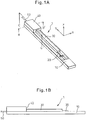
- FIG. 1A is a perspective view of a semiconductor laser module 1 as an example of an optical module and FIG. 1B is a side view in the Y-axis direction of the semiconductor laser module 1.
- the semiconductor laser module 1 includes a silicon substrate 10, an LD (Laser Diode) element 20, a PPLN (Periodically Poled Lithium Niobate) element 30 for converting the wavelength of light emitted from the LD element 20, a sub-substrate 40 made of silicon or glass, and an optical fiber 50.
- the semiconductor laser module 1 functions to convert single-mode laser near-infrared light having wavelength of 1,064 nm emitted from the LD element 20 to green laser light having wavelength of 532 nm in the PPLN element 30 and emit the green laser light.
- the light emitted from the PPLN element 30 is transmitted through the single-mode optical fiber (SMF) 50 bonded to the silicon substrate 10 via the sub-substrate 40.
- SMF single-mode optical fiber
- elements are optically coupled so that light emitted from the LD element 20 can efficiently enter the PPLN element 30.
- those elements are requested to be aligned at extremely high precision.
- the positional precision in the plane direction (XY plane) on the silicon substrate 10 in FIG. 1A is adjusted by a mounting device at the time of mounting by providing reference marks such as alignment marks on the silicon substrate 10.
- the mounting height is determined by contact points between the silicon substrate 10 and each of the LD element 20 and the PPLN element 30. Consequently, by forming microbumps as bonding bumps which will be described later on the silicon substrate 10 and deforming the microbumps by applying a predetermined load to the microbumps at the time of mounting the PPLN element 30, the precision in the height direction (Z direction) is maintained.
- a bonding material such as resin, AuSn, or solder can be used.
- the position adjustment can be performed by vertically moving the elements during the bonding material is in a liquid form, when the bonding material is cooled and solidified, the bonding material is shrunk and deformed unpredictably. It is consequently difficult with high-precision to adjust the position in the height direction (Z direction).
- the semiconductor laser module 1 is an example of the optical module. It is not interpreted that the optical module is limited to the semiconductor laser module 1.
- the optical module can be preferably applied to other modules each having two or more optical devices optically coupled.
- the optical module can be used for optical coupling between the LD element 20 and the PPLN element 30 or optical coupling between the PPLN element 30 and the optical fiber 50 fixed to the sub-substrate 40.
- the optical coupling denotes that the positional relation of optical devices is determined so that light output from one of the optical devices directly enters the other optical device.
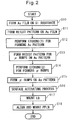
- FIG. 2 is a flowchart for explaining processes of manufacturing the semiconductor laser module 1.
- FIGS. 3A to 3D to FIGS. 5A to 5C are diagrams for more specifically explaining the processes of manufacturing the semiconductor laser module 1 illustrated in FIG. 2 .
- FIG. 3A is a cross sectional view of the silicon substrate 10.
- the entire silicon substrate 10 is heated in an oxidizing atmosphere and an SiO 2 (silicon dioxide) thin film 11 is formed on the silicon substrate 10.
- a Ti (titanium) thin film 12 is formed on the SiO 2 thin film 11 by vapor deposition.
- an Au layer 13 having a thickness of 3 ⁇ m is formed on the Ti thin film 12 by vapor deposition (S10) (refer to FIG. 3B ).
- the Au layer 13 may be formed by, in addition to vapor deposition, sputtering, electrodeposition, or the like.
- the SiO 2 thin film 11 functions as an insulating layer insulating between the silicon substrate 10 and microbumps 18 which will be described later.
- the Ti thin film 12 is formed to increase adhesion between the SiO 2 thin film 11 and the Au layer 13.
- a photoresist layer 14 is formed on the Au layer 13, a mask layer 9 is disposed, and ultraviolet light is applied so that a photoresist 14' corresponding to the mask layer 9 is formed (S11) (refer to FIG. 3C ).
- the Au layer 13 and the Ti thin film 12 out of the part in which the photoresist 14' is formed are etched by dry etching to form an Au layer pattern 13' (S12) (refer to FIG. 3D ).
- the Au layer pattern 13' may be formed by wet etching in place of dry etching.
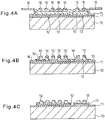
- the photoresist layer 15 is formed again, a mask layer 16 is disposed, and ultraviolet light is applied so that a photoresist 15' corresponding to the mask layer 16 is formed (S13) (refer to FIG. 4A ).
- the Au layer pattern 13' out of the part in which the photoresist 15' is formed is half-etched by dry etching to form the microbumps 18 and microbumps 19 (S14) (refer to FIG. 4B ).
- the microbumps 18 and 19 may be formed by wet etching in place of dry etching.
- the half-etching is etching performed so that the pattern out of the part in which the photoresist 15' is formed is not entirely removed but partially remains. In the embodiment, on the outside of the part in which the photoresist 15' is formed, etching is performed so that the thickness of Au layer pattern 13' is 1 ⁇ m.
- microbumps 18 and 19 are disposed at pitches of 10 to 25 ⁇ m equally in the horizontal direction.
- the values of shape, height, width, pitch, and the like of the projection are an example and are not limited to the above-mentioned ones.
- the microbumps 18 and 19 are based on the Au layer 13 formed by sputtering (S10) and formed by half-etching (S14), so that the heights of all of the projections included in the microbumps 18 and 19 are uniformed with high precision.
- the surface is activated (S16). Since atoms having high surface energy can be made come into contact with each other by the surface activation, bonding can be firmly performed at room temperature by using adhesion between the atoms.
- This bonding method does not require special heating and occurrence of a positional deviation of each of the parts caused by residual stress of a thermal expansion coefficient difference is suppressed, so that high-precision alignment and mounting can be performed.
- the method also has advantages such that destruction of parts caused by the residual stress of a thermal expansion coefficient difference does not easily occur, no stress is applied to the parts, and very little deterioration in functions.
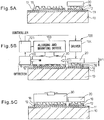
- the LD element 20 is mounted on the surface-activated microbumps 18 (S17) (refer to FIG. 5A ).
- An Au layer is formed also on the bonding face of the LD element 20, and its surface is subjected to activating process. Therefore, only by mounting the LD element 20 on the microbumps 18 and applying a predetermined load, the LD element 20 is surface-activated and bonded to the microbumps 18 and fixed.
- the LD element 20 can receive supply of drive current via the microbumps 18. In this case, it is sufficient to perform predetermined patterning for supplying drive current on the Au layer pattern 13' for forming the microbumps 18.
- the LD element 20 is mounted by a mounting device for attaching not-shown electronic parts on the circuit board.
- the LD element 20 may be mounted by using an aligning and mounting device 103 used in S18 to be described later.
- the PPLN element 30 is aligned and mounted on the surface-activated microbumps 19 (S18) (refer to FIG. 5B ), and the series of processes are finished.
- An Au layer is formed also on the bonding surface of the PPLN element 30, and the surface is subjected to the activating process. Therefore, only by mounting the PPLN element 30 on the microbumps 19 and applying a predetermined load, the PPLN element 30 is surface-activated and bonded on the microbumps 19 and fixed.
- the alignment and mounting in S18 is performed by using an aligning and mounting apparatus 100.
- the aligning and mounting apparatus 100 includes: a controller 101 constructed by, for example, a PC including a CPU, a predetermined memory, and the like; a detector 102 detecting intensity of a wavelength-converted laser beam output from the PPLN element 30 and outputting detection output voltage V (mV) according to the intensity; the aligning and mounting device 103 capable of mounting an electronic part in a predetermined position on the silicon substrate 20 and applying a load (N) according to a control amount at the time of mounting; and a driver 104 driving the LD element 20 to emit a laser beam.
- a controller 101 constructed by, for example, a PC including a CPU, a predetermined memory, and the like
- a detector 102 detecting intensity of a wavelength-converted laser beam output from the PPLN element 30 and outputting detection output voltage V (mV) according to the intensity
- the aligning and mounting device 103 capable of mounting an electronic part in a pre
- the controller 101 controls the driver 104 to drive the LD element 20 and make the laser beam enter the PPLN element 30, and the intensity of the wavelength-converted laser beam emitted from the PPLN element 30 is detected by the detector 102. Further, the controller 101 controls the aligning and mounting device 103 while monitoring output voltage V detected by the detector 102 to control the load applied to the PPLN element 30.
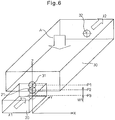
- FIG. 6 is a diagram illustrating the positional relation between the LD element 20 and the PPLN element 30.
- a laser beam having a wavelength ⁇ 1 emitted from a light emission center 21 of the LD element 20 enters an incident position 31 in the PPLN element 30 and goes out as a laser beam having a wavelength ⁇ 2 from an outgoing center 32 of the PPLN element 30.
- the LD element 20 and the PPLN element 30 are mounted on the silicon substrate 10 by the aligning and mounting device 103, the positional relation in the plane (the positional relation in the X-Y axis direction) between the light emission center 21 of the LD element 20 and the incident position 31 in the PPLN element 30 is determined with high precision.
- the positional relation in the height direction (Z-axis direction) of the silicon substrate 10 has to be determined with high precision.
- the arrow A shows a direction in which a load is applied to the PPLN element 30 by the aligning and mounting device 103.
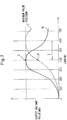
- FIG. 7 is a graph showing the relation between output voltage of the detector 102 and a load applied by the aligning and mounting device 103.
- the curve B indicates the relation between output voltage (mV) of the detector 102 and the load (N) applied by the aligning and mounting device 103 in a state where the load is applied.
- the curve C indicates the relationship between the output voltage (mV) of the detector 102 and the final load (N) applied by the aligning and mounting device 103 after the load is released.
- the output voltage (mV) of the detector 102 in the state where the load is applied, in the case where the load is 400 (N), the output voltage (mV) of the detector 102 becomes the maximum value (refer to point D).
- the output voltage (mV) of the detector 102 does not become the maximum value (refer to point E).
- the point D corresponds to the case where the microbumps 19 are deformed by applying a load to the PPLN element 30 to set the incident position 31 of the PPLN element 30 to a position (refer to the position P2 in FIG. 6 ) in which the incident position 31 is most-efficiently optically coupled to the light emission center 21 of the LD element 20 and, in this state, the load is released.
- the microbumps 19 have a characteristic such that when the load is applied, the microbumps 19 are deformed (pressed) and shrunk. When the load is released by elastic rebound, the force of returning to the original state works, and the microbumps 19 return to the original state only by the elastic return amount. That is, the point E corresponds to the case where when the load is released in the state of the point D, the incident position 31 of the PPLN element 30 moves to another position (for example, refer to the position P1 in FIG. 6 ) by the elastic return.
- the incident position 31 of the PPLN element 30 has to be set to the position (refer to the position P2 in FIG. 6 ) in which the incident position 31 is most-efficiently and optically coupled to the light emission center 21 of the LD element 20. Consequently, in the aligning and mounting in S18, the controller 101 controls the aligning and mounting device 103 as follows.
- the PPLN element 30 is disposed in the predetermined position of the microbumps 19. While increasing the load applied, after the output voltage V from the detector 102 becomes the maximum value, a predetermined load amount is applied to further deform the microbumps 19 and, then, the load is released.
- the controller 101 further applies a predetermined load amount (F: 200(N)) and, after that, the load is released.
- the predetermined load F is further applied so that the incident position 31 of the PPLN element 30 is pushed into a position (refer to the position P3 in FIG. 6 ) deeply pushed from the light emission center 21 of the LD element 20 only by the distance W1 shown in FIG. 6 .
- the incident position 31 of the PPLN element 30 returns to the position where it is most-efficiently optically coupled to the light emission center 21 of the LD element 20 (refer to P2 in FIG. 6 ) by elastic return (refer to FIG. 5C ).
- the above-described predetermined load amount (F: 200(N)) varies depending on the shape of the aligning and mounting device 103 and the PPLN element 30 to which the load is applied, the material and the shape of the microbumps 19, and the like. It can be calculated by conducting an experiment to obtain the curves B and C shown in FIG. 7 .
- the controller 101 controls the aligning and mounting device 103 so as to apply a predetermined load.
- the user may control the aligning and mounting device 103 while observing the output voltage V from the detector 102 by a monitor.
- FIG. 8 is a diagram showing a non-claimed example of the process of manufacturing the semiconductor laser module 1.
- the controller 101 controls the aligning and mounting device 103 so as to apply a predetermined load.
- the controller 101 controls the aligning and mounting device 103 so as to apply a predetermined load.
- the microbumps 18 and 19 the LD element 20, and the PPLN element 30 manufactured with a predetermined reference, it is not always necessary to make the LD element 20 emit light and individually perform the aligning and mounting according to the output voltage V from the detector 102.
- the load at which the output voltage V from the detector 102 becomes the maximum value (refer to the point D in FIG. 7 ) is predicted and, in addition to the load (for example, 400 (N)), the above-described predetermined load amount (F: 200(N)) is applied (for example, 600 (N) in total).
- the incident position 31 of the PPLN element 30 is pushed into the position (refer to the position P3 in FIG. 6 ) which is further deeply pushed from the light emission center 21 of the LD element 20 only by the distance W1 shown in FIG. 6 and, after that, the load is released.
- the incident position 31 of the PPLN element 30 returns to the position where it is most-efficiently optically coupled to the light emission center 21 of the LD element 20 (refer to P2 in FIG. 6 ) by elastic return. That is, in the example of FIG. 8 , using only the aligning and mounting device 103, without using the controller 101, the detector 102, and the driver 104 shown in FIG. 5B , the positional relation in the height direction (Z-axis direction) between the PPLN element 30 and the LD element 20 is set.
- the method shown in FIG. 8 is different from the manufacturing process of the semiconductor laser module 1 illustrated in FIG. 2 only with respect to the point that only the aligning and mounting device 103 is used and the controller 101, the detector 102, and the driver 104 are not used in the aligning and mounting process (S18 in FIG. 2 ). Since the other points, particularly, the process of manufacturing the microbumps 18 and 19 and the method of bonding the LD element 20 and the PPLN element 30 and the microbumps 18 and 19 are the same, their description will not be repeated.
- FIGS. 9A to 9C are diagrams for explaining other microbumps.
- the microbumps 18 and 19 shown in FIGS. 4 and 5 include a plurality of projections each having a columnar shape and having a height of 2 ⁇ m and a diameter of 5 ⁇ m, which are disposed at pitches of 10 to 25 ⁇ m equally in the horizontal direction.
- Other microbumps 18' and 19' shown in FIG. 9A include a plurality of projections each having a truncated cone shape.
- FIG. 9A is a cross section of the microbumps 18' and 19' and others, and corresponds to FIG. 4C .
- FIG. 9B is a cross section of a projection part 60 included in the microbumps 18' and 19'
- FIG. 9C is a diagram showing an example of a pressed projection part 61 included in the microbumps 18' and 19'.
- the bottom face has a circular shape having a diameter S1 (for example, 2 ⁇ m)
- the top face has a circular shape having a diameter S2 (for example, 1 ⁇ m)
- height is T1 (for example, 2 ⁇ m).
- the microbumps 18' and 19' include the projection parts 60 which are disposed at pitches of 2 ⁇ m and equally in the horizontal direction.
- FIG. 9C shows an example of the projection part 61 which is pressed at the time of aligning and mounting the PPLN element 30.
- the bottom face has a circular shape having a diameter S1 (for example, 2 ⁇ m), and height is T2 (for example, 1 ⁇ m).
- S1 for example, 2 ⁇ m
- T2 for example, 1 ⁇ m
- microbumps 18' and 19' each having the truncated cone shape of which top face is slightly smaller are pressed more easily as compared with the microbumps 18 and 19 each having a columnar shape shown in FIGS. 4B and 4C and FIGS. 5A to 5C in the case of applying the same load. There is consequently an effect that the control for alignment is easier (for the reason that the aligning and mounting device 103 does not have to apply a high load).
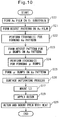
- FIG. 10 is a flowchart for explaining processes of the semiconductor laser module 2.
- FIGS. 11A to 11C are diagrams for explaining processes of manufacturing the semiconductor laser module 2 shown in FIG. 10 more specifically.
- the difference between the semiconductor laser module 2 and the foregoing semiconductor laser module 1 is the point that, in the semiconductor laser module 2, the PPLN element 30 and the microbumps 19 are fixed by a thermosetting bonding resin. Therefore, the Au layer is not formed on the substrate on the microbumps side of the PPLN element 30. Since it is unnecessary to supply current to the PPLN element 30 in the semiconductor laser module 2, the PPLN element 30 is fixed on the microbumps 19 by a thermosetting bonding resin without using a high-cost Au layer. Except for this point, the semiconductor laser module 2 is similar to the semiconductor laser module 1. Accordingly, S20 to S25 and S27 in the processes of manufacturing the semiconductor laser module 2 shown in FIG. 10 are the same as S10 to S15 and S17 in the processes of manufacturing the semiconductor laser module 1 shown in FIG. 2 , and their description will not be repeated.
- the surface activation is performed by performing cleaning and/or a treatment using plasma only on the surface of the microbumps 18 in S26.
- the surface activating process may be performed also on the microbumps 19.
- the LD element 20 is mounted in S27 like in S17 in FIG. 2 and, after that, a resin 70 for bonding is applied on the microbumps 19 (refer to FIG. 11A ).
- a resin 70 for bonding a thermosetting resin, a UV curable resin, or the like for optical parts can be used.
- the PPLN element 30 is aligned and mounted with heat on the resin 70 for bonding (S29) (refer to FIG. 11B ).
- the aligning and mounting method in S29 is the same as that in S18 in FIG. 2 and in FIG. 5B . Therefore, the controller 101 preliminarily considers the elastic return amount of the microbumps 19 and, after the output voltage V from the detector 102 becomes the maximum value (refer to the point D), further applies a predetermined load amount (F: 200(N)) to the PPLN element 30.
- the controller 101 further applies a predetermined load so that the incident position 31 of the PPLN element 30 is pushed in to a position which is further deeply pressed from the light emission center 21 of the LD element 20 only by the distance W3 shown in FIG. 11B .
- heating is performed to harden the resin 70 for bonding in a state where the load is further applied.
- the incident position 31 of the PPLN element 30 returns to the position where it most-efficiently optically couples to the light emission center 21 of the LD element 20 by elastic return (refer to FIG. 11C ). After that, the series of processes are finished.
- the LD element 20 and the silicon substrate 10 may be bonded by using the resin 70 for bonding.
- the resin 70 for bonding In the case where it is necessary to make the LD element 20 and the silicon substrate 10 conducted via the microbumps 18, it is sufficient to make the resin 70 for bonding penetrate the microbumps 18. Further, in the case where it is necessary to make the LD element 20 and the silicon substrate 10 conducted by an adhesive, it is sufficient to bond the LD element 20 and the silicon substrate 10 by using a conductive adhesive.
- the aligning and mounting device 103 may be used without using the controller 101, the detector 102, and the driver 104.
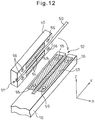
- FIG. 12 is a diagram for explaining bonding between the substrate 10 and the sub-substrate 40.
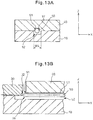
- FIGS. 13A and 13B are diagrams illustrating the positional relationship between the PPLN element 30 and the fiber 50.
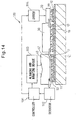
- FIG. 14 is a diagram for explaining aligning and mounting of the sub-substrate 40.
- a rectangular groove 51 is formed in the sub-substrate 40, and a front-end part 58 of the optical fiber 50 is fit in the rectangular groove 51 and fixed by an adhesive 57. It is also possible to form a V-shaped groove in place of the rectangular groove 51 in the sub-substrate 40 and fit and fix the front-end part 58 of the optical fiber 50 in the V-shaped groove.
- Metal thin films 54 and alignment marks 56 are provided in a bonding face of the sub-substrate 40.
- a fiber escape groove 52, microbumps 53, and alignment marks 55 are provided.
- the sub-substrate 40 is mounted on the silicon substrate 10 by the aligning and mounting device 103 as will be described later.
- positions are roughly determined by the alignment marks 55 and alignment marks 56.
- the positions in the X-axis direction, Y-axis direction, and Z-axis direction are determined in the submicron order, and the sub-substrate 40 is bonded on the silicon substrate 10.
- the microbumps 53 formed on the joint face of the sub-substrate 40 and the silicon substrate 10 are subjected to the plasma cleaning process so that the surface is activated and, after that, bonded by a load applied from the aligning and mounting device 103.
- the microbumps 53 made of gold formed on the silicon substrate 10 are formed on the silicon substrate 10 by a method similar to the above-described method of forming the microbumps 18 and 19.
- FIG. 13A is a cross section taken along line B-B' in FIG. 1A .
- the optical fiber 50 fixed in the rectangular groove 51 in the sub-substrate 40 by an adhesive 57 can move in the fiber escape groove 52 provided in the silicon substrate 10 by moving sub-substrate 40 in the X-axis and Y-axis directions by the aligning and mounting device 103. That is, the position adjustment in the X-axis and Y-axis directions can be performed within the range of the width W4 of the fiber escape groove 52.
- the microbumps 53 and the like are not shown.
- FIG. 13B is a cross section taken along line C-C' in FIG. 1A .
- the front-end part 58 of the optical fiber 50 fixed in the sub-substrate 40 is optically coupled to the outgoing center 32 of the PPLN element 30 with high precision and receives a wavelength-converted green laser beam having a wavelength of 532 nm which is output from the outgoing center 32 of the PPLN element 30.
- the green laser beam having a wavelength of 532 nm received by the front-end part 58 of the optical fiber 50 propagates through the optical fiber 50.
- the microbumps. 53 and so one are not shown in FIG. 13B , the alignment of the outgoing center 32 of the PPLN element and the front-end part 58 of the optical fiber 50 in the Z direction is controlled by the microbumps 53.
- FIG. 14 aligning and mounting of the sub-substrate 40 will be described.
- the example of FIG. 5B (S18 in FIG. 2 ) relates to the aligning and mounting of the PPLN element 30.
- the sub-substrate 40 is aligned and mounted so that the outgoing center 32 of the PPLN element 30 and the front-end part 58 of the optical fiber 50 are optically coupled with high precision. It is assumed that, prior to the aligning and mounting of FIG. 14 , the surface of the metal thin film 54 on the joint face side of the sub-substrate 40 and the microbumps 53 on the silicon substrate 10 are subjected to the plasma cleaning process.
- the aligning and mounting in FIG. 14 is performed by using the aligning and mounting device 100 in a manner similar to the case of FIG. 5B .
- the controller 101 controls the driver 104 to drive the LD element 20 and make the laser beam enter the PPLN element 30, and the intensity of a laser beam emitted from the PPLN element 30 and transmitted through the optical fiber 50 is detected by the detector 102.
- the controller 101 controls the aligning and mounting device 103 while monitoring the output voltage V detected by the detector 102 and, while moving the sub-substrate 40 in the X-axis and Y-axis directions, determines the position where the output voltage V is the highest (first stage).
- the aligning and mounting device 103 moves the sub-substrate 40 in the X-axis and Y-axis directions in this range.
- the controller 101 controls the aligning and mounting device 103 and disposes the sub-substrate 40 on the microbumps 53 in the position where the output voltage V is the highest in the first stage.
- the controller 101 While monitoring the output voltage V detected by the detector 102, the controller 101 controls the aligning and mounting device 103 to control the load applied to the sub-substrate 40 and to position the sub-substrate 40 in the Z-axis direction (second stage). After the output voltage V from the detector 102 becomes the maximum value, the controller 101 further applies a predetermined load amount and, then, releases the load. A predetermined load is further applied so that the front-end part 58 of the optical fiber 50 fixed in the sub-substrate 40 is in the position which is further deeply pressed from the outgoing center 32 of the PPLN element 30 only by predetermined distance.
- the front-end part 58 of the optical fiber 50 fixed to the sub-substrate 40 returns to the position where it is optically coupled to the outgoing center 32 of the PPLN element 30 most efficiently by elastic return.
- the above point is based on the theory similar to the aligning and mounting for optically coupling the PPLN element 30 and the LD element 20 described with reference to FIGS. 5A to 5C to FIG. 7 .
- the sub-substrate 40 is positioned in the X-axis and Y-axis directions in the first stage and is positioned in the Z-axis direction in the second stage.
- the sub-substrate 40 may be bonded to the silicon substrate 10 by using microbumps similar to the different microbumps 18' and 19' shown in FIG. 9 .
- the sub-substrate 40 may be bonded to the silicon substrate 10 by using an adhesive.
- the microbumps 18, 19, and 53 each having a cylindrical projection and made of Au (refer to FIG. 4C ) and the microbumps 18' and 19' each having a truncated cone shape and made of Au (refer to FIG. 9 ) have been described.
- Other bonding bumps may be used as long as they are made of metal and have a shape formed with high precision.
- the conditions requested for the bonding bumps are that bumps have a material and a shape by which a deformation amount in the case of applying a predetermined load and an elastic return amount in the case of releasing a predetermined load which is applied are always almost constant.
- the sub-substrate 40 to which the LD element 20, the PPLN element 30, and the optical fiber 50 are fixed is bonded to the silicon substrate 10 by surface-activation bonding using the microbumps.
- the sub-substrate 40 to which only the LD element 20 and the PPLN element 30 or the PPLN element 30 and the optical fiber 50 are fixed may be bonded to the silicon substrate 10 by surface-activation bonding using the microbumps so that optical coupling is carried out excellently.
Landscapes
- Optical Couplings Of Light Guides (AREA)
- Semiconductor Lasers (AREA)
- Optical Modulation, Optical Deflection, Nonlinear Optics, Optical Demodulation, Optical Logic Elements (AREA)
Applications Claiming Priority (1)
| Application Number | Priority Date | Filing Date | Title |
|---|---|---|---|
| JP2011060916A JP5636319B2 (ja) | 2011-03-18 | 2011-03-18 | 光モジュールの製造方法 |
Publications (2)
| Publication Number | Publication Date |
|---|---|
| EP2500757A1 EP2500757A1 (en) | 2012-09-19 |
| EP2500757B1 true EP2500757B1 (en) | 2018-06-27 |
Family
ID=45936772
Family Applications (1)
| Application Number | Title | Priority Date | Filing Date |
|---|---|---|---|
| EP12159734.8A Not-in-force EP2500757B1 (en) | 2011-03-18 | 2012-03-15 | Method of manufacturing optical module |
Country Status (4)
| Country | Link |
|---|---|
| US (1) | US9214446B2 (enExample) |
| EP (1) | EP2500757B1 (enExample) |
| JP (1) | JP5636319B2 (enExample) |
| CN (1) | CN102684064B (enExample) |
Families Citing this family (6)
| Publication number | Priority date | Publication date | Assignee | Title |
|---|---|---|---|---|
| JP5847473B2 (ja) * | 2011-07-21 | 2016-01-20 | シチズンホールディングス株式会社 | 光モジュール |
| JP5230829B1 (ja) * | 2012-03-09 | 2013-07-10 | 株式会社フジクラ | 水分の除去方法、光ファイバの半田付け方法、及び、半導体レーザモジュールの製造方法 |
| JP5925062B2 (ja) * | 2012-06-18 | 2016-05-25 | シチズンホールディングス株式会社 | 光モジュール及び光モジュールの製造方法 |
| DE102015002176A1 (de) * | 2015-02-24 | 2016-08-25 | Jenoptik Laser Gmbh | Verfahren zum Herstellen eines Diodenlasers und Diodenlaser |
| US10126504B2 (en) * | 2015-05-27 | 2018-11-13 | The United States Of America, As Represented By The Secretary Of The Navy | Antireflective surface structures for active and passive optical fiber |
| CN105711224B (zh) * | 2016-03-25 | 2017-11-24 | 湖南新中合光电科技股份有限公司 | 一种光分路器晶圆贴片系统 |
Citations (2)
| Publication number | Priority date | Publication date | Assignee | Title |
|---|---|---|---|---|
| US5393697A (en) * | 1994-05-06 | 1995-02-28 | Industrial Technology Research Institute | Composite bump structure and methods of fabrication |
| JP2001189339A (ja) * | 1999-10-20 | 2001-07-10 | Fujitsu Ltd | 半導体チップ素子、半導体チップ素子実装装置及び実装方法 |
Family Cites Families (6)
| Publication number | Priority date | Publication date | Assignee | Title |
|---|---|---|---|---|
| US5568892A (en) * | 1994-06-16 | 1996-10-29 | Lucent Technologies Inc. | Alignment and bonding techniques |
| JPH10208269A (ja) | 1997-01-28 | 1998-08-07 | Toshiba Corp | 光ピックアップヘッド及びその製造方法並びに製造装置 |
| JP2002111113A (ja) * | 2000-09-28 | 2002-04-12 | Hitachi Ltd | 光モジュール |
| JP3790995B2 (ja) * | 2004-01-22 | 2006-06-28 | 有限会社ボンドテック | 接合方法及びこの方法により作成されるデバイス並びに接合装置 |
| JP2007133011A (ja) * | 2005-11-08 | 2007-05-31 | Nec Corp | 光結合構造およびその製造方法、光モジュール |
| JP4349475B2 (ja) * | 2009-03-19 | 2009-10-21 | 三菱電機株式会社 | 光モジュールの製造方法 |
-
2011
- 2011-03-18 JP JP2011060916A patent/JP5636319B2/ja not_active Expired - Fee Related
-
2012
- 2012-03-15 EP EP12159734.8A patent/EP2500757B1/en not_active Not-in-force
- 2012-03-16 US US13/422,656 patent/US9214446B2/en not_active Expired - Fee Related
- 2012-03-16 CN CN201210070077.7A patent/CN102684064B/zh not_active Expired - Fee Related
Patent Citations (2)
| Publication number | Priority date | Publication date | Assignee | Title |
|---|---|---|---|---|
| US5393697A (en) * | 1994-05-06 | 1995-02-28 | Industrial Technology Research Institute | Composite bump structure and methods of fabrication |
| JP2001189339A (ja) * | 1999-10-20 | 2001-07-10 | Fujitsu Ltd | 半導体チップ素子、半導体チップ素子実装装置及び実装方法 |
Also Published As
| Publication number | Publication date |
|---|---|
| EP2500757A1 (en) | 2012-09-19 |
| CN102684064A (zh) | 2012-09-19 |
| JP2012198295A (ja) | 2012-10-18 |
| US9214446B2 (en) | 2015-12-15 |
| US20120234458A1 (en) | 2012-09-20 |
| JP5636319B2 (ja) | 2014-12-03 |
| CN102684064B (zh) | 2016-12-14 |
Similar Documents
| Publication | Publication Date | Title |
|---|---|---|
| US6053395A (en) | Method of flip-chip bonding between a chip element and a wafer-board | |
| US9049806B2 (en) | Integrated device and manufacturing method | |
| US9214446B2 (en) | Method of manufacturing optical module | |
| US9507107B2 (en) | Arrangement of a substrate with at least one optical waveguide and with an optical coupling location and of an optoelectronic component, and method for manufacturing such an arrangement | |
| US9508679B2 (en) | Mounting method | |
| JP5847473B2 (ja) | 光モジュール | |
| US7202553B2 (en) | Wafer bonding using reactive foils for massively parallel micro-electromechanical systems packaging | |
| JP6157356B2 (ja) | 光集積デバイス | |
| US9046666B2 (en) | Optical module and method for fabricating optical module | |
| JP4643891B2 (ja) | パラレル光学系接続装置用の位置決め方法 | |
| KR100442609B1 (ko) | 플립칩 본딩구조 및 본딩방법 | |
| US6839497B2 (en) | Optical waveguide platform and method of manufacturing the same | |
| US20140348463A1 (en) | Optical device and method for manufacuturing the optical device | |
| Kapulainen et al. | Hybrid integration of InP lasers with SOI waveguides using thermocompression bonding | |
| JP5908698B2 (ja) | レーザ光源およびレーザ光源の製造方法 | |
| KR100524672B1 (ko) | 광수동 정렬용 각진 홈을 이용한 플립칩 본딩방법 및 광모듈 | |
| US20050079716A1 (en) | Semiconductor optical device and method for manufacturing the same | |
| JP4729893B2 (ja) | 半導体光学装置の製造方法 | |
| JP2977338B2 (ja) | 半導体モジュール | |
| JP5982457B2 (ja) | 光モジュールの製造方法 | |
| KR100680997B1 (ko) | 플립칩 본딩방법 및 이를 이용한 광모듈 | |
| JP2005150298A (ja) | 微小タイル状素子、接続構造、接続方法、薄膜デバイス及び電子機器 | |
| US20060108396A1 (en) | Bonded components and component bonding | |
| Rosa et al. | Flip-chip process development using recessed bonding pads for laser/MEMS integration | |
| JP2014059392A (ja) | 光モジュールの製造方法 |
Legal Events
| Date | Code | Title | Description |
|---|---|---|---|
| PUAI | Public reference made under article 153(3) epc to a published international application that has entered the european phase |
Free format text: ORIGINAL CODE: 0009012 |
|
| AK | Designated contracting states |
Kind code of ref document: A1 Designated state(s): AL AT BE BG CH CY CZ DE DK EE ES FI FR GB GR HR HU IE IS IT LI LT LU LV MC MK MT NL NO PL PT RO RS SE SI SK SM TR |
|
| AX | Request for extension of the european patent |
Extension state: BA ME |
|
| 17P | Request for examination filed |
Effective date: 20130318 |
|
| 17Q | First examination report despatched |
Effective date: 20160222 |
|
| RAP1 | Party data changed (applicant data changed or rights of an application transferred) |
Owner name: CITIZEN WATCH CO., LTD. |
|
| GRAP | Despatch of communication of intention to grant a patent |
Free format text: ORIGINAL CODE: EPIDOSNIGR1 |
|
| STAA | Information on the status of an ep patent application or granted ep patent |
Free format text: STATUS: GRANT OF PATENT IS INTENDED |
|
| RIC1 | Information provided on ipc code assigned before grant |
Ipc: G02B 6/42 20060101AFI20180109BHEP Ipc: H05K 3/34 20060101ALI20180109BHEP Ipc: H01L 21/603 20060101ALN20180109BHEP Ipc: H01L 23/00 20060101ALI20180109BHEP |
|
| INTG | Intention to grant announced |
Effective date: 20180123 |
|
| GRAS | Grant fee paid |
Free format text: ORIGINAL CODE: EPIDOSNIGR3 |
|
| GRAA | (expected) grant |
Free format text: ORIGINAL CODE: 0009210 |
|
| STAA | Information on the status of an ep patent application or granted ep patent |
Free format text: STATUS: THE PATENT HAS BEEN GRANTED |
|
| AK | Designated contracting states |
Kind code of ref document: B1 Designated state(s): AL AT BE BG CH CY CZ DE DK EE ES FI FR GB GR HR HU IE IS IT LI LT LU LV MC MK MT NL NO PL PT RO RS SE SI SK SM TR |
|
| REG | Reference to a national code |
Ref country code: GB Ref legal event code: FG4D |
|
| REG | Reference to a national code |
Ref country code: AT Ref legal event code: REF Ref document number: 1012814 Country of ref document: AT Kind code of ref document: T Effective date: 20180715 |
|
| REG | Reference to a national code |
Ref country code: IE Ref legal event code: FG4D |
|
| REG | Reference to a national code |
Ref country code: DE Ref legal event code: R096 Ref document number: 602012047771 Country of ref document: DE |
|
| PG25 | Lapsed in a contracting state [announced via postgrant information from national office to epo] |
Ref country code: BG Free format text: LAPSE BECAUSE OF FAILURE TO SUBMIT A TRANSLATION OF THE DESCRIPTION OR TO PAY THE FEE WITHIN THE PRESCRIBED TIME-LIMIT Effective date: 20180927 Ref country code: NO Free format text: LAPSE BECAUSE OF FAILURE TO SUBMIT A TRANSLATION OF THE DESCRIPTION OR TO PAY THE FEE WITHIN THE PRESCRIBED TIME-LIMIT Effective date: 20180927 Ref country code: FI Free format text: LAPSE BECAUSE OF FAILURE TO SUBMIT A TRANSLATION OF THE DESCRIPTION OR TO PAY THE FEE WITHIN THE PRESCRIBED TIME-LIMIT Effective date: 20180627 Ref country code: SE Free format text: LAPSE BECAUSE OF FAILURE TO SUBMIT A TRANSLATION OF THE DESCRIPTION OR TO PAY THE FEE WITHIN THE PRESCRIBED TIME-LIMIT Effective date: 20180627 Ref country code: LT Free format text: LAPSE BECAUSE OF FAILURE TO SUBMIT A TRANSLATION OF THE DESCRIPTION OR TO PAY THE FEE WITHIN THE PRESCRIBED TIME-LIMIT Effective date: 20180627 |
|
| REG | Reference to a national code |
Ref country code: NL Ref legal event code: MP Effective date: 20180627 |
|
| REG | Reference to a national code |
Ref country code: LT Ref legal event code: MG4D |
|
| PG25 | Lapsed in a contracting state [announced via postgrant information from national office to epo] |
Ref country code: HR Free format text: LAPSE BECAUSE OF FAILURE TO SUBMIT A TRANSLATION OF THE DESCRIPTION OR TO PAY THE FEE WITHIN THE PRESCRIBED TIME-LIMIT Effective date: 20180627 Ref country code: RS Free format text: LAPSE BECAUSE OF FAILURE TO SUBMIT A TRANSLATION OF THE DESCRIPTION OR TO PAY THE FEE WITHIN THE PRESCRIBED TIME-LIMIT Effective date: 20180627 Ref country code: GR Free format text: LAPSE BECAUSE OF FAILURE TO SUBMIT A TRANSLATION OF THE DESCRIPTION OR TO PAY THE FEE WITHIN THE PRESCRIBED TIME-LIMIT Effective date: 20180928 Ref country code: LV Free format text: LAPSE BECAUSE OF FAILURE TO SUBMIT A TRANSLATION OF THE DESCRIPTION OR TO PAY THE FEE WITHIN THE PRESCRIBED TIME-LIMIT Effective date: 20180627 |
|
| REG | Reference to a national code |
Ref country code: AT Ref legal event code: MK05 Ref document number: 1012814 Country of ref document: AT Kind code of ref document: T Effective date: 20180627 |
|
| PG25 | Lapsed in a contracting state [announced via postgrant information from national office to epo] |
Ref country code: NL Free format text: LAPSE BECAUSE OF FAILURE TO SUBMIT A TRANSLATION OF THE DESCRIPTION OR TO PAY THE FEE WITHIN THE PRESCRIBED TIME-LIMIT Effective date: 20180627 |
|
| PG25 | Lapsed in a contracting state [announced via postgrant information from national office to epo] |
Ref country code: IS Free format text: LAPSE BECAUSE OF FAILURE TO SUBMIT A TRANSLATION OF THE DESCRIPTION OR TO PAY THE FEE WITHIN THE PRESCRIBED TIME-LIMIT Effective date: 20181027 Ref country code: CZ Free format text: LAPSE BECAUSE OF FAILURE TO SUBMIT A TRANSLATION OF THE DESCRIPTION OR TO PAY THE FEE WITHIN THE PRESCRIBED TIME-LIMIT Effective date: 20180627 Ref country code: RO Free format text: LAPSE BECAUSE OF FAILURE TO SUBMIT A TRANSLATION OF THE DESCRIPTION OR TO PAY THE FEE WITHIN THE PRESCRIBED TIME-LIMIT Effective date: 20180627 Ref country code: EE Free format text: LAPSE BECAUSE OF FAILURE TO SUBMIT A TRANSLATION OF THE DESCRIPTION OR TO PAY THE FEE WITHIN THE PRESCRIBED TIME-LIMIT Effective date: 20180627 Ref country code: AT Free format text: LAPSE BECAUSE OF FAILURE TO SUBMIT A TRANSLATION OF THE DESCRIPTION OR TO PAY THE FEE WITHIN THE PRESCRIBED TIME-LIMIT Effective date: 20180627 Ref country code: PL Free format text: LAPSE BECAUSE OF FAILURE TO SUBMIT A TRANSLATION OF THE DESCRIPTION OR TO PAY THE FEE WITHIN THE PRESCRIBED TIME-LIMIT Effective date: 20180627 Ref country code: SK Free format text: LAPSE BECAUSE OF FAILURE TO SUBMIT A TRANSLATION OF THE DESCRIPTION OR TO PAY THE FEE WITHIN THE PRESCRIBED TIME-LIMIT Effective date: 20180627 |
|
| PG25 | Lapsed in a contracting state [announced via postgrant information from national office to epo] |
Ref country code: SM Free format text: LAPSE BECAUSE OF FAILURE TO SUBMIT A TRANSLATION OF THE DESCRIPTION OR TO PAY THE FEE WITHIN THE PRESCRIBED TIME-LIMIT Effective date: 20180627 Ref country code: IT Free format text: LAPSE BECAUSE OF FAILURE TO SUBMIT A TRANSLATION OF THE DESCRIPTION OR TO PAY THE FEE WITHIN THE PRESCRIBED TIME-LIMIT Effective date: 20180627 Ref country code: ES Free format text: LAPSE BECAUSE OF FAILURE TO SUBMIT A TRANSLATION OF THE DESCRIPTION OR TO PAY THE FEE WITHIN THE PRESCRIBED TIME-LIMIT Effective date: 20180627 |
|
| REG | Reference to a national code |
Ref country code: DE Ref legal event code: R097 Ref document number: 602012047771 Country of ref document: DE |
|
| PLBE | No opposition filed within time limit |
Free format text: ORIGINAL CODE: 0009261 |
|
| STAA | Information on the status of an ep patent application or granted ep patent |
Free format text: STATUS: NO OPPOSITION FILED WITHIN TIME LIMIT |
|
| PG25 | Lapsed in a contracting state [announced via postgrant information from national office to epo] |
Ref country code: DK Free format text: LAPSE BECAUSE OF FAILURE TO SUBMIT A TRANSLATION OF THE DESCRIPTION OR TO PAY THE FEE WITHIN THE PRESCRIBED TIME-LIMIT Effective date: 20180627 |
|
| 26N | No opposition filed |
Effective date: 20190328 |
|
| PG25 | Lapsed in a contracting state [announced via postgrant information from national office to epo] |
Ref country code: SI Free format text: LAPSE BECAUSE OF FAILURE TO SUBMIT A TRANSLATION OF THE DESCRIPTION OR TO PAY THE FEE WITHIN THE PRESCRIBED TIME-LIMIT Effective date: 20180627 |
|
| REG | Reference to a national code |
Ref country code: DE Ref legal event code: R119 Ref document number: 602012047771 Country of ref document: DE |
|
| PG25 | Lapsed in a contracting state [announced via postgrant information from national office to epo] |
Ref country code: MC Free format text: LAPSE BECAUSE OF FAILURE TO SUBMIT A TRANSLATION OF THE DESCRIPTION OR TO PAY THE FEE WITHIN THE PRESCRIBED TIME-LIMIT Effective date: 20180627 |
|
| REG | Reference to a national code |
Ref country code: CH Ref legal event code: PL |
|
| GBPC | Gb: european patent ceased through non-payment of renewal fee |
Effective date: 20190315 |
|
| PG25 | Lapsed in a contracting state [announced via postgrant information from national office to epo] |
Ref country code: LU Free format text: LAPSE BECAUSE OF NON-PAYMENT OF DUE FEES Effective date: 20190315 Ref country code: AL Free format text: LAPSE BECAUSE OF FAILURE TO SUBMIT A TRANSLATION OF THE DESCRIPTION OR TO PAY THE FEE WITHIN THE PRESCRIBED TIME-LIMIT Effective date: 20180627 |
|
| REG | Reference to a national code |
Ref country code: BE Ref legal event code: MM Effective date: 20190331 |
|
| PG25 | Lapsed in a contracting state [announced via postgrant information from national office to epo] |
Ref country code: CH Free format text: LAPSE BECAUSE OF NON-PAYMENT OF DUE FEES Effective date: 20190331 Ref country code: LI Free format text: LAPSE BECAUSE OF NON-PAYMENT OF DUE FEES Effective date: 20190331 Ref country code: DE Free format text: LAPSE BECAUSE OF NON-PAYMENT OF DUE FEES Effective date: 20191001 Ref country code: GB Free format text: LAPSE BECAUSE OF NON-PAYMENT OF DUE FEES Effective date: 20190315 Ref country code: IE Free format text: LAPSE BECAUSE OF NON-PAYMENT OF DUE FEES Effective date: 20190315 |
|
| PG25 | Lapsed in a contracting state [announced via postgrant information from national office to epo] |
Ref country code: FR Free format text: LAPSE BECAUSE OF NON-PAYMENT OF DUE FEES Effective date: 20190331 Ref country code: BE Free format text: LAPSE BECAUSE OF NON-PAYMENT OF DUE FEES Effective date: 20190331 |
|
| PG25 | Lapsed in a contracting state [announced via postgrant information from national office to epo] |
Ref country code: TR Free format text: LAPSE BECAUSE OF FAILURE TO SUBMIT A TRANSLATION OF THE DESCRIPTION OR TO PAY THE FEE WITHIN THE PRESCRIBED TIME-LIMIT Effective date: 20180627 |
|
| PG25 | Lapsed in a contracting state [announced via postgrant information from national office to epo] |
Ref country code: PT Free format text: LAPSE BECAUSE OF FAILURE TO SUBMIT A TRANSLATION OF THE DESCRIPTION OR TO PAY THE FEE WITHIN THE PRESCRIBED TIME-LIMIT Effective date: 20181029 Ref country code: MT Free format text: LAPSE BECAUSE OF NON-PAYMENT OF DUE FEES Effective date: 20190315 |
|
| PG25 | Lapsed in a contracting state [announced via postgrant information from national office to epo] |
Ref country code: CY Free format text: LAPSE BECAUSE OF FAILURE TO SUBMIT A TRANSLATION OF THE DESCRIPTION OR TO PAY THE FEE WITHIN THE PRESCRIBED TIME-LIMIT Effective date: 20180627 |
|
| PG25 | Lapsed in a contracting state [announced via postgrant information from national office to epo] |
Ref country code: HU Free format text: LAPSE BECAUSE OF FAILURE TO SUBMIT A TRANSLATION OF THE DESCRIPTION OR TO PAY THE FEE WITHIN THE PRESCRIBED TIME-LIMIT; INVALID AB INITIO Effective date: 20120315 |
|
| PG25 | Lapsed in a contracting state [announced via postgrant information from national office to epo] |
Ref country code: MK Free format text: LAPSE BECAUSE OF FAILURE TO SUBMIT A TRANSLATION OF THE DESCRIPTION OR TO PAY THE FEE WITHIN THE PRESCRIBED TIME-LIMIT Effective date: 20180627 |