EP2492460A2 - Dispositif de commande de soupape et tête de cylindre de dispositif fournie avec celui-ci - Google Patents
Dispositif de commande de soupape et tête de cylindre de dispositif fournie avec celui-ci Download PDFInfo
- Publication number
- EP2492460A2 EP2492460A2 EP12156314A EP12156314A EP2492460A2 EP 2492460 A2 EP2492460 A2 EP 2492460A2 EP 12156314 A EP12156314 A EP 12156314A EP 12156314 A EP12156314 A EP 12156314A EP 2492460 A2 EP2492460 A2 EP 2492460A2
- Authority
- EP
- European Patent Office
- Prior art keywords
- valve
- spring
- surface portion
- bearing surface
- cylinder head
- Prior art date
- Legal status (The legal status is an assumption and is not a legal conclusion. Google has not performed a legal analysis and makes no representation as to the accuracy of the status listed.)
- Granted
Links
Images



Classifications
-
- F—MECHANICAL ENGINEERING; LIGHTING; HEATING; WEAPONS; BLASTING
- F01—MACHINES OR ENGINES IN GENERAL; ENGINE PLANTS IN GENERAL; STEAM ENGINES
- F01L—CYCLICALLY OPERATING VALVES FOR MACHINES OR ENGINES
- F01L13/00—Modifications of valve-gear to facilitate reversing, braking, starting, changing compression ratio, or other specific operations
- F01L13/0005—Deactivating valves
-
- F—MECHANICAL ENGINEERING; LIGHTING; HEATING; WEAPONS; BLASTING
- F01—MACHINES OR ENGINES IN GENERAL; ENGINE PLANTS IN GENERAL; STEAM ENGINES
- F01L—CYCLICALLY OPERATING VALVES FOR MACHINES OR ENGINES
- F01L1/00—Valve-gear or valve arrangements, e.g. lift-valve gear
- F01L1/12—Transmitting gear between valve drive and valve
- F01L1/14—Tappets; Push rods
- F01L1/143—Tappets; Push rods for use with overhead camshafts
-
- F—MECHANICAL ENGINEERING; LIGHTING; HEATING; WEAPONS; BLASTING
- F01—MACHINES OR ENGINES IN GENERAL; ENGINE PLANTS IN GENERAL; STEAM ENGINES
- F01L—CYCLICALLY OPERATING VALVES FOR MACHINES OR ENGINES
- F01L1/00—Valve-gear or valve arrangements, e.g. lift-valve gear
- F01L1/46—Component parts, details, or accessories, not provided for in preceding subgroups
- F01L1/462—Valve return spring arrangements
-
- F—MECHANICAL ENGINEERING; LIGHTING; HEATING; WEAPONS; BLASTING
- F01—MACHINES OR ENGINES IN GENERAL; ENGINE PLANTS IN GENERAL; STEAM ENGINES
- F01L—CYCLICALLY OPERATING VALVES FOR MACHINES OR ENGINES
- F01L3/00—Lift-valve, i.e. cut-off apparatus with closure members having at least a component of their opening and closing motion perpendicular to the closing faces; Parts or accessories thereof
- F01L3/10—Connecting springs to valve members
-
- F—MECHANICAL ENGINEERING; LIGHTING; HEATING; WEAPONS; BLASTING
- F01—MACHINES OR ENGINES IN GENERAL; ENGINE PLANTS IN GENERAL; STEAM ENGINES
- F01L—CYCLICALLY OPERATING VALVES FOR MACHINES OR ENGINES
- F01L1/00—Valve-gear or valve arrangements, e.g. lift-valve gear
- F01L1/46—Component parts, details, or accessories, not provided for in preceding subgroups
- F01L2001/467—Lost motion springs
-
- F—MECHANICAL ENGINEERING; LIGHTING; HEATING; WEAPONS; BLASTING
- F02—COMBUSTION ENGINES; HOT-GAS OR COMBUSTION-PRODUCT ENGINE PLANTS
- F02B—INTERNAL-COMBUSTION PISTON ENGINES; COMBUSTION ENGINES IN GENERAL
- F02B61/00—Adaptations of engines for driving vehicles or for driving propellers; Combinations of engines with gearing
- F02B61/02—Adaptations of engines for driving vehicles or for driving propellers; Combinations of engines with gearing for driving cycles
Definitions
- the present invention relates to a valve train device installed in a cylinder head of an engine, more particularly, to a valve train device including a valve resting mechanism, and also relates to a cylinder head of the engine provided with the valve train device.
- a conventionally known valve train device of an engine of, for example, a vehicle includes a valve resting mechanism that holds a poppet valve (intake valve and exhaust valve) in a closed position irrespective of an operation of a camshaft of an engine, for example, as disclosed in Japanese Patent Application Laid-Open Publication No. 2000-87711 (Patent Document 1).
- the valve train device described in Patent Document 1 is mounted to a cylinder head of the engine and configured to transmit power from a camshaft to the poppet valve via a valve tappet.
- the valve tappet includes a lost motion unit that temporarily interrupts power transmission from the camshaft to the poppet valve.
- the lost motion unit is constructed so as to be hydraulically switchable between an interlocking state and a non-interlocking state between the valve tappet and an upper end of a stem portion of the poppet valve.
- the lost motion unit transmits a vertical motion of the valve tappet in accordance with rotation of the camshaft to the poppet valve, and operates to open or close the poppet valve, for example, during middle speed rotation or high speed rotation of the engine.
- the lost motion unit temporality interrupts power transmission to the poppet valve irrespective of the vertical motion of the valve tappet, for example, during low speed rotation of the engine, and holds the poppet valve in the closed position.
- valve train device described above includes the lost motion unit between the camshaft and the poppet valve, a size or dimension of the valve train device is increased in a driving direction of the poppet valve, which may result in increase in sizes of components such as a cylinder head and a head cover that house the valve train device, and hence, increasing height of the entire engine.
- This makes it difficult to ensure an installation space for the engine, and increases weight of the engine, and furthermore, the increase in the size or dimension of the engine further requires production of a dedicated component, which may result in increasing in the production costs.
- the present invention was conceived in view of the circumstances encountered in the prior art mentioned above and an object thereof is to provide a valve train device provided with a lost motion unit without increasing height of an engine of a vehicle, and also provide a cylinder head of an engine equipped with such valve train device.
- a valve train device installed in a cylinder head of an engine and driven by a camshaft of the engine, the valve train device includes: a valve unit including an intake valve and an exhaust valve communicated with a combustion chamber of an engine, each of the intake valve and exhaust valve having a linearly extending stem portion and driven in an extending direction of the stem portion to open/close an intake port or exhaust port communicating with the combustion chamber of the engine; a valve lifter disposed between one end side of the stem portion located apart from the combustion chamber and the camshaft so as to transmit power from the camshaft to the valve unit; a lost motion unit that interrupts power transmission from the valve lifter to the valve unit; a first spring urging the valve unit in a direction to close the intake valve or exhaust valve; and a second spring having a diameter lager than that of the first spring and urging the lost motion unit against the valve lifter, in which another end side of the second spring is disposed at a portion closer to one
- the narrow portion of the installation portion of the valve train device in the cylinder head can be placed in a dead space near the fluid path of the cylinder head, thus contributing the absorption of an increase in size of the valve train device by the lost motion unit, and preventing an increase in height of the engine.
- an installation space for the engine can be ensured and the weight of the engine can be reduced.
- the installed portion of the valve train device is narrow on the other end side of the stem portion, thereby preventing the valve train device from protruding from the dead space of the cylinder head into the fluid path.
- the first spring is installed in the cylinder head through the first spring seat
- the second spring is installed in the cylinder head via the second spring seat
- the first spring seat has an outer bearing surface portion that receives an end of the second spring on the other end side in the extending direction of the stem portion
- the second spring seat has an inner bearing surface portion that receives an end of the first spring on the other end side in the extending direction of the stem portion
- the first spring has an end surface portion exposed between the first spring seat and the second spring seat.
- the spring seat integrally holds the first spring and the second spring, thereby preventing dismounting or removal of the first spring and the second spring during assembling.
- the installation portion of the valve train device in the cylinder head is made to be further narrower on the other end side of the stem portion.
- a cylinder head of an engine which includes: an intake port; an exhaust port; a valve unit including an intake valve and an exhaust valve to open/close the intake port and the exhaust port; and a valve train device that drives the valve unit, wherein the valve train device includes a cam shaft, a valve lifter driven by a cam mounted to the cam shaft to be integrally rotatable, a lost motion unit that interrupts power transmission from the valve lifter to the valve unit, a first spring urging the valve unit in a direction to close the intake valve or exhaust valve, and a second spring having a diameter lager than that of the first spring and urging the lost motion unit against the valve lifter, and wherein the cylinder head is provided with an inner bearing surface portion to which the first spring is fitted and an outer bearing surface portion to which the second spring is fitted, in which the outer bearing surface portion is positioned closer to the valve lifter than the inner bearing surface portion, and the inner bearing surface portion and the outer bearing surface portion have configuration such that a virtual line connecting
- valve train device of the present invention is herein specifically applied to an engine, i.e., cylinder head thereof, of a vehicle of a naked type motorcycle will be described, but the present invention is not limited to this embodiment and other modifications or alternations may be applied to an engine (engine unit) of motorcycles of other types, four-wheel vehicles, boats such as outboard motor, or the like. It is further to be noted that terms “upper”, “lower”, “right”, “left” and like terms representing direction are used herein with reference to the illustration of the drawings as far as specific other description is not made.
- a front side of a vehicle body is shown by an arrow FR and a rear of the vehicle body is shown by an arrow RE.
- a motorcycle 1 includes a vehicle body frame structure 2 made of steel or aluminum alloy, and components such as a power unit and an electric system are mounted thereto.
- a main frame 21 of the vehicle body frame structure 2 is laterally bifurcated rearward from a head pipe 22 at a front end and slopes rearward downward.
- An engine unit 3 is suspended from a lower portion of the main frame 21.
- a fuel tank 4 is placed on an upper portion of the main frame 21.
- a driver seat 5a and a passenger seat 5b are connected to upper portions of a pair of left and right seat rails, not shown, connected to a rear portion of the main frame 21 on the rear of the fuel tank 4.
- the seat rails extend rearward and upward from the rear portion of the main frame 21 and support the driver seat 5a and the passenger seat 5b together with reinforcing seat pillars 23.
- Handlebars 51 for the passenger are provided on left and right frame covers of the passenger seat 5b.
- foot rests 52 and 53 are provided correspondingly in positions.
- a shift pedal 54 is provided in front of the driver foot rest 52 on the left side of the vehicle body and a brake pedal, not shown, for a rear wheel 6 is provided in front of the driver foot rest 52 on the right side of the vehicle body.
- a pair of front forks 71 is laterally and swingably supported via a steering shaft mounted to the head pipe 22 on an upper side of the front portion of the vehicle body frame 2.
- Grips 73 are mounted to opposite ends of the handlebars in upper portions of the pair of front forks 71.
- a clutch lever 74 is provided on the handlebar on the left side of the vehicle body, and a brake lever, not shown, for a front wheel 7 is provided on the handlebar on the right side of the vehicle body.
- the front wheel 7 is rotatably supported and a front fender 75 that covers the upper portion of the front wheel 7 is also placed.
- the front wheel 7 is provided with a brake disk 76.
- a swing arm 61 is vertically swingably connected to a lower side of the rear portion of the vehicle body frame 2, and a suspension 62 for absorbing shock on the rear wheel is mounted between the vehicle body frame 2 and the swing arm 61.
- the rear wheel 6 is rotatably supported by the rear portion of the swing arm 61.
- a driven sprocket 63 is provided on the rear wheel 6, and a chain 64 is stretched between the driven sprocket 63 and a drive sprocket on the engine side.
- the rear wheel 6 is rotationally driven by power transmitted from the engine via the chain 64.
- An upper portion of the chain 64 is covered with a chain cover 65, and an upper portion of the rear wheel 6 is covered with a rear fender 66 placed on the rear side of the passenger seat 5b.
- the engine unit 3 includes, for example, a four-cycle V-type two-cylinder engine and a transmission, and is supported by the main frame 21 via an engine mount.
- the engine unit 3 is a horizontal crank type in which a crankshaft is located in a vehicle width direction, and two front and rear cylinders are disposed in a V-shape arrangement in a crankcase 31 that houses the crankshaft.
- Air is taken into the engine unit 3 through an intake pipe 32 (see Fig. 3 ), the air is mixed with fuel in a fuel injection device and supplied to a combustion chamber 355.
- An exhaust gas after combustion in the engine is exhausted from a muffler 34 through an exhaust pipe 33 extending downward from the engine unit 3.
- a head lamp 91 is provided in front of the front fork 71, and a pair of left and right front winkers 92 are provided on opposite sides of the head lamp 91.
- a meter unit 93 that indicates speed, engine rpm, and fuel level is provided on an upper portion of the head lamp 91.
- a rearview mirror 95 is supported by the handlebar through a stay 94.
- a pair of left and right rear winkers 96 are provided on a rear side of the rear fender 66, and a combination lamp 97 is installed on a rear side of the rear winker 96.
- a plurality of covers as a vehicle body exterior covers forming outer configuration are provided on the vehicle body frame 2 or the like so as to provide unity of outer appearance of the vehicle body.
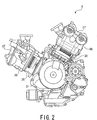
- Fig. 2 is a side view of the engine unit according to the embodiment
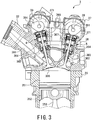
- Fig. 3 is a partial sectional view of the engine unit
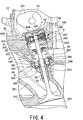
- Fig. 4 is an enlarged view of the valve train device around the valve train mechanism on an intake side in Fig. 3
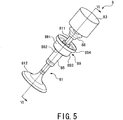
- Fig. 5 is a perspective view of the valve train device.
- an outer spring and an inner spring are omitted for the sake of convenience of the description.
- the engine unit 3 has a contour configured by mounting two front and rear cylinder blocks 35 on the crankcase 31 in V-shape and mounting a cylinder head 36 and a head cover 37 to each of the cylinder blocks 35.
- the crankcase 31 houses the crankshaft, not shown, so as to extend in a vehicle width direction.
- a plurality of cylinder bores 351 are formed so as to be arranged laterally in the vehicle width direction, and a piston 352 is housed in each cylinder bore 351 to be vertically and reciprocally movable.
- the piston 352 is connected to the crankshaft via a connecting rod 353.
- the cylinder head 36 includes an intake port (fluid path or passage) 361 that feeds air into the engine, and an exhaust port (fluid path or passage) 362 that delivers an exhaust gas to the outside of the engine unit.
- the cylinder head 36 also includes an intake valve 81 that opens/closes the intake port 361, and an exhaust valve 82 that opens/closes the exhaust port 362.
- the intake port 361 and the exhaust port 362 communicate with the combustion chamber 355 defined by a lower surface of the cylinder head 36 and an upper surface of the piston 352 in the cylinder bore 351.
- An ignition plug, now shown, provided in the cylinder head 36 is disposed so as to protrude in an upper portion of the combustion chamber 355.
- the engine unit 3 is a direct acting DOHC (Double OverHead Camshaft) engine, and includes a pair of camshafts 39 independently provided on the intake side and the exhaust side in a fashion corresponding to the valve train devices 8.
- the pair of camshafts 39 extend in the vehicle width direction in the upper portion of the cylinder head 36, and each camshaft is provided with a cam 391.
- each of the pair of camshafts 39 is connected to the crankshaft through a valve lifter such as a sprocket and a cam chain.
- the rotational motion of the crankshaft is transmitted to the pair of camshafts 39 through the valve lifter to operate the valve train devices 8 on the intake side and the exhaust side.
- installation spaces 364 for the pair of valve train devices 8 are formed above the intake port 361 and the exhaust port 362.
- the installation space 364 communicates with a housing space 371 housing the camshaft 39 at an upper portion, and is partitioned by an outer wall portion 365 of the intake port 361 or the exhaust port 362 at a lower portion.
- the pair of valve train devices 8 are provided in the installation spaces 364 with the intake valve 81 and the exhaust valve 82 protruding into the intake port 361 and the exhaust port 362 from the outer wall portion 365.
- valve train device 8 on the intake side is configured to transmit power from the camshaft 39 to the intake valve 81 via a valve tappet 83, that is one of power transmission components such as valve lifter or valve tappet, in contact with the cam 391.
- the valve tappet 83 has a cylindrical configuration having a closed upper end and an opened lower end, and is placed between an upper end of the intake valve 81 and the camshaft.
- a lost motion unit 84 that temporarily interrupts power transmission from the camshaft 39 to the intake valve 81 is provided in the valve tappet 83.
- the lost motion unit 84 is formed so as to be hydraulically switchable between an interlocking state and a non-interlocking state between the valve tappet 83 and the stem portion 811 of the intake valve 81.
- an oil passage 367 for driving the lost motion unit 84 is formed in a side wall portion 366 that supports the valve tappet 83.
- the intake valve 81 includes a linearly extending stem portion 811 and an umbrella portion 812 provided at a lower end of the stem portion 811.
- the stem portion 811 of the intake valve 81 is passed through the valve guide 85 provided in the outer wall portion 365, and supported reciprocally movably toward the combustion chamber 355.
- the valve tappet 83 and the intake valve 81 are urged by the outer spring (second spring) 86 and the inner spring (first spring) 87 concentrically placed in the installation space 364.
- the valve tappet 83 is pressed against the camshaft 39 by the outer spring 86, and the intake valve 81 is urged in a valve closing operation direction, toward the camshaft, by the inner spring 87 via a retainer 88 secured to the stem portion 811.
- the outer wall portion 365 is generally a dead space S of the cylinder block 35.
- An annular recess 363 is formed around the valve guide 85 of the outer wall portion 365.
- a bottom surface of the recess 363 is formed as a support surface 369 for the inner spring 87 formed in a position deeper than a support surface 368 for the outer spring 86.
- a lower end of the inner spring 87 is positioned closer to the combustion chamber 355 than a lower end of the outer spring 86 in an extending direction of the stem portion 811.
- the recess 363 is formed in the dead space S of the cylinder head 36, and thus the entire valve train device 8 is installed in a low position.
- only the lower end of the inner spring 87 having a small diameter is located in the dead space S, thereby preventing the valve train device 8 from protruding into the intake port 361 or minimizing such protrusion thereof.
- the outer spring 86 and the inner spring 87 are supported by the support surfaces 368 and 369 of the cylinder head 36 through the spring seat 89.
- the spring seat 89 is formed of synthetic resin or metal into a stepped cylindrical shape and mounted around the valve guide 85.
- the spring seat 89 includes an outer bearing surface portion 891 that receives the lower end of the outer spring 86, an inner bearing surface portion 892 that receives the lower end of the inner spring 87, and a side surface portion 893 that connects an inner peripheral edge of the outer bearing surface portion 891 and an outer peripheral edge of the inner bearing surface portion 892.
- An annular holding portion 894 for retaining the outer spring 86 stands on an outer edge of the outer bearing surface portion 891, and an annular holding portion 895 for retaining the inner spring 87 stands on an inner edge of the inner bearing surface portion 892.
- the spring seat 89 has the outer bearing surface portion 891 and the inner bearing surface portion 892 integrally formed, and further includes the annular holding portions 894 and 895, thereby preventing the springs 86 and 87 from removing and facilitating assembly of the valve train device 8.
- the side surface portion 893 of the spring seat 89 is interposed between a surface on the lower end side of the inner spring 87 and the inner peripheral surface of the recess 363 in the cylinder head 36.
- the downward movement of the valve tappet 83 by the rotation of the camshaft 39 is transmitted to the intake valve 81 through the lost motion unit 84.
- the intake valve 81 is pressed downward in a valve opening direction to thereby open the intake port 361.
- the valve tappet 83 and the intake valve 81 pressed downward are urged backward (i.e., returned) by the outer spring 86 and the inner spring 87 so as to close the intake port 361.
- the lost motion unit 84 is in the non-interlocking state, the power transmission to the intake valve 81 is interrupted to maintain the closed state of the valve.
- the lost motion unit 84 includes a cylindrical plunger holder 841 mounted in the valve tappet 83 and a plunger 842 slidably held in the diametrical direction in the plunger holder 841.
- An upper surface of the plunger holder 841 is engaged with an upper surface of the valve tappet 83, and a lower surface of the plunger holder 841 is engaged with an upper end of the outer spring 86.
- the valve tappet 83 is pressed against the camshaft 39 via the plunger holder 841 by the outer spring 86.
- a shallow groove 843 is formed in the entire outer peripheral surface of the plunger holder 841.
- the oil passage 367 formed in the cylinder head 36 is connected to the shallow groove 843.
- a plunger hole 844 is formed in the plunger holder 841 so as to extend in the diametrical direction thereof.
- the plunger hole 844 has one opened end and the other closed end, and the plunger 842 is housed therein in the slidable manner.
- a spring housing portion 845 cylindrically recessed from the end surface of the plunger hole 844 is formed to the end of the plunger 842 located on the closed side of the plunger hole 844.
- a return spring 846 that urges the plunger 842 toward the opening in the plunger hole 844 is housed between a back surface (a surface in a deep side) of the spring housing portion 845 and a back surface (a surface in a deep side) of the plunger hole 844.
- a through hole 847 is formed to the plunger 842 so as to be capable of entering into and out of the upper end of the stem portion 811 through the plunger 842 in the vertical direction perpendicular to the extending direction.
- the plunger 842 pressed backward by the return spring 846 may be positioned by a positioning member or the like.
- the lost motion unit 84 is not limited to the above configuration and may take any mechanism configuration that can interrupt the power transmission from the valve tappet 83 to the intake valve 81.
- the valve train device 8 on the exhaust side has substantially the same configuration and arrangement as those of the valve train device 8 on the intake side, and the description thereof will be omitted herein.
- FIG. 6 illustrates the installed structure or arrangement of the valve train device according to the present embodiment.
- the right side represents the valve train device according to the embodiment of the present invention and the left side view represents a valve train device according to a comparative example.
- the valve train device according to the comparative example is different from the valve train device according to the present embodiment on the right side in that an outer spring and an inner spring are supported by the same support surface.
- the same terms as in the embodiment are denoted by the same reference numerals for the sake of easy understanding of the explanation.
- the valve train device on the exhaust side has substantially the same installed structure or configuration as that of the valve train device on the intake side, and the description thereof is hence omitted herein.
- an outer spring 86 and an inner spring 87 are supported by the same support surface 368 of the cylinder head 36.
- a length L1 of the outer spring 86 is longer than a length L2 of the inner spring 87, and the lost motion unit 84 is spaced by a distance L3 from a retainer 88 secured to a stem portion 811.
- the distance L3 ensures a moving length of the stem portion 811 into and out of a through hole 847 in a plunger 842 during a lost motion, thereby providing establishment of the non-interlocking state between a valve tappet 83 and an intake valve 81.
- the lost motion unit 84 provided in the valve train device 8 of the comparative example increases a size of the valve train device 8 in a driving direction of the intake valve 81.
- components such as the cylinder head 36 and a head cover 37 that house the valve train device 8 are also increased in size, hence increasing the height of the engine.
- the valve train device 8 according to the comparative example requires a dedicated component corresponding to an increase in size of the valve train device, thereby increasing production costs.
- a long stem portion 811 of the intake valve 81 needs to be formed to achieve the lost motion.
- the outer spring 86 is supported by the support surface 368, and the inner spring 87 is supported by the support surface 369 in a position deeper than the outer spring 86.
- the outer spring 86 having a length L4 shorter than the length L1 of the outer spring 86 in the comparative example can ensure a distance L3 between the retainer 88 and the lost motion unit 84.
- the length of the outer spring 86 can be reduced by a distance "a" between the support surface 368 and the lower end of the inner spring 87 as compared to the comparative example.
- the length of the outer spring 86 can be reduced, and thus, the valve tappet 83 and the lost motion unit 84 can be placed at a low position.
- This arrangement can contribute to absorb an increase in size of the valve train device 8 by the lost motion unit 84 and to prevent an increase in height of the engine unit. Further, the need for a dedicated component due to the increase in height of the engine unit is eliminated, resulting in the reduction of the production costs. According to the present embodiment, as shown in right side illustration of Fig.
- valve tappet 83 and the lost motion unit 84 are placed in a low position, and thus, a stem portion 811 having short length can be formed, and for example, the intake valve 81 of the valve train device 8 without the lost motion unit 84 can be used.
- a width W2 defined by the side surface portion 893 at the lower end of the inner spring 87 can be formed to be narrower than a width W1 defined by the annular holding portion 894 at the lower end of the outer spring 86. Accordingly, in the valve train device 8 of the present embodiment, the installation portion (specifically, a region from the valve tappet 83 to the spring seat 89) in the cylinder head 36 is narrower on the lower end side than the upper end side of the stem portion 811.
- valve train device 8 can be prevented from protruding into the intake port 361 or minimizing the protruding distance, thus being advantages and effective.
- the end of the inner spring 87 having a diameter smaller than that of the outer spring 86 is disposed in the dead space S of the cylinder head 36, thereby preventing the springs 86 and 87 from protruding into the intake port 361 and the exhaust port 362 or minimizing the protrusion entering therein, and preventing an increase in height of the engine with a simple configuration, thereby absorbing an increase in size of the valve train device 8 by the lost motion unit 84, and preventing an increase in height of the engine (engine unit). Therefore, an installation space for the engine unit can be ensured, and the weight of the engine can be reduced. Further, a location of dedicated component due to the increase in height of the engine is not needed, so that the production costs can be reduced.
- valve train device 8 includes the spring seat 89 having the outer bearing surface portion 891 and the inner bearing surface portion 892 integrally formed
- a separately formed spring seat may be provided as in a valve train device 8 as a modified example such as shown in Figs. 7 and 8 , in which the valve train device is different from the valve train device according to the described embodiment only in the separately formed spring seat.
- FIG. 7 is a perspective view of a valve train device according to a modified example
- Fig. 8 is a sectional view of the valve train device of the modified example.
- the same terms as in the embodiment are denoted by the same reference numerals.
- the valve train device 8 includes a spring seat (second spring seat) 89a for an outer spring 86, and a spring seat (first spring seat) 89b for an inner spring 87.
- the spring seat 89a includes an outer bearing surface portion 891 that receives a lower end of the outer spring 86 and a retaining annular holding portion 894 standing on an outer edge of the outer bearing surface portion 891.
- the spring seat 89b includes an inner bearing surface portion 892 that receives the lower end of the inner spring 87 and a retaining annular holding portion 895 standing on an inner edge of the inner bearing surface portion 892.
- the spring seats 89a and 89b have configurations of the spring seat 89 with the side surface portion 893 removed, and a surface of the lower end of the inner spring 87 is exposed between the spring seats 89a and 89b.
- a valve train device installed in a cylinder head of an engine and driven by a camshaft of the engine.
- the valve train device includes a valve unit including an intake valve and an exhaust valve communicated with a combustion chamber of an engine, each of the intake valve and exhaust valve having a linearly extending stem portion and driven in an extending direction of the stem portion to open/close an intake port or exhaust port communicating with the combustion chamber; a valve lifter as a power transmission mechanism disposed between one end side of the stem portion located apart from the combustion chamber and the camshaft so as to transmit power from the camshaft to the valve unit; and a lost motion unit that interrupts power transmission from the valve lifter to the valve unit.
- the valve train device further includes a first spring urging the valve unit in a direction to close the intake valve or exhaust valve, and a second spring having a diameter larger than that of the first spring and urging the lost motion unit against the valve lifter, in which another end side of the second spring is disposed at a portion closer to one end side of the stem portion than a location of another end side of the first spring with respect to the cylinder head.
- a cylinder head of an engine provided with an intake port and an exhaust port, and includes an intake valve and an exhaust valve to open/close the intake port and the exhaust port, and a valve train device that drives the intake valve and/ or exhaust valve.
- the valve train device includes a valve unit and other components mentioned above, wherein the cylinder head is provided with an inner bearing surface portion to which the first spring is fitted and an outer bearing surface portion to which the second spring is fitted, in which the outer bearing surface portion is positioned closer to the valve lifter than the inner bearing surface portion, and the inner bearing surface portion and the outer bearing surface portion have configuration such that a virtual line (VL in Fig. 4 ) connecting an outer edge portion of the inner bearing surface portion and an outer edge portion of the outer bearing surface portion is substantially parallel to an inner peripheral wall surface of the intake port or exhaust port as viewed in an axial direction of the valve unit.
- VL in Fig. 4 virtual line connecting an outer edge portion of the inner bearing surface portion and an outer edge portion of the outer bearing surface portion is substantially parallel to an inner peripheral wall surface
- valve train device of the structure mentioned above can provide advantageous effects and/or functions as those mentioned with reference to the valve train device.
Landscapes
- Engineering & Computer Science (AREA)
- Mechanical Engineering (AREA)
- General Engineering & Computer Science (AREA)
- Valve-Gear Or Valve Arrangements (AREA)
- Valve Device For Special Equipments (AREA)
- Cylinder Crankcases Of Internal Combustion Engines (AREA)
Applications Claiming Priority (1)
| Application Number | Priority Date | Filing Date | Title |
|---|---|---|---|
| JP2011036099A JP2012172609A (ja) | 2011-02-22 | 2011-02-22 | 動弁装置及びエンジン |
Publications (3)
| Publication Number | Publication Date |
|---|---|
| EP2492460A2 true EP2492460A2 (fr) | 2012-08-29 |
| EP2492460A3 EP2492460A3 (fr) | 2013-01-23 |
| EP2492460B1 EP2492460B1 (fr) | 2014-09-24 |
Family
ID=45656269
Family Applications (1)
| Application Number | Title | Priority Date | Filing Date |
|---|---|---|---|
| EP20120156314 Active EP2492460B1 (fr) | 2011-02-22 | 2012-02-21 | Dispositif de commande de soupape et tête de cylindre de dispositif fournie avec celui-ci |
Country Status (4)
| Country | Link |
|---|---|
| US (1) | US8936001B2 (fr) |
| EP (1) | EP2492460B1 (fr) |
| JP (1) | JP2012172609A (fr) |
| ES (1) | ES2511216T3 (fr) |
Cited By (1)
| Publication number | Priority date | Publication date | Assignee | Title |
|---|---|---|---|---|
| EP3486442A1 (fr) * | 2017-11-17 | 2019-05-22 | Yamaha Hatsudoki Kabushiki Kaisha | Moteur à combustion interne et véhicule à califourchon comprenant celui-ci |
Families Citing this family (1)
| Publication number | Priority date | Publication date | Assignee | Title |
|---|---|---|---|---|
| KR20200118278A (ko) * | 2019-04-03 | 2020-10-15 | 현대자동차주식회사 | 밸브시스템의 하중 가변장치 |
Citations (1)
| Publication number | Priority date | Publication date | Assignee | Title |
|---|---|---|---|---|
| JP2000087711A (ja) | 1998-09-14 | 2000-03-28 | Honda Motor Co Ltd | バルブ休止機構を有する内燃機関の弁装置 |
Family Cites Families (21)
| Publication number | Priority date | Publication date | Assignee | Title |
|---|---|---|---|---|
| EP0312216B1 (fr) * | 1987-09-22 | 1993-01-20 | Honda Giken Kogyo Kabushiki Kaisha | Dispositif de commande de soupape pour moteur à combustion interne |
| JPH06101437A (ja) * | 1992-09-18 | 1994-04-12 | Aisin Seiki Co Ltd | エンジンの動弁装置 |
| DE4433742A1 (de) | 1993-09-22 | 1995-04-20 | Aisin Seiki | Ventilsteuerungsvorrichtung |
| EP0668436B1 (fr) * | 1994-02-18 | 1998-08-12 | Dr.Ing.h.c. F. Porsche Aktiengesellschaft | Poussoir pour une soupape débrayable d'un moteur à combustion interne |
| JPH08158832A (ja) | 1994-11-30 | 1996-06-18 | Aisin Seiki Co Ltd | エンジンの動弁装置 |
| JPH08189316A (ja) | 1994-12-28 | 1996-07-23 | Aisin Seiki Co Ltd | 可変バルブリフト装置 |
| JP3378699B2 (ja) * | 1995-06-20 | 2003-02-17 | 株式会社オティックス | 内燃機関の休止機構付き動弁機構 |
| DE19544473C2 (de) * | 1995-11-29 | 1999-04-01 | Daimler Benz Ag | Mechanisch-hydraulisch arbeitende Steuerung für ein Gaswechselventil einer Brennkraftmaschine |
| US5709180A (en) | 1997-02-06 | 1998-01-20 | General Motors Corporation | Narrow cam two-step lifter |
| JP2002037167A (ja) | 2000-07-24 | 2002-02-06 | Yamaha Motor Co Ltd | 自動二輪車 |
| US6799543B2 (en) | 2001-01-05 | 2004-10-05 | Delphi Technologies, Inc. | Valve deactivation system with free motion spring |
| JP3983016B2 (ja) | 2001-07-16 | 2007-09-26 | 本田技研工業株式会社 | 4ストローク内燃機関のバルブ休止機構 |
| US6568496B1 (en) | 2001-11-20 | 2003-05-27 | Yung Ho Huang | Electromotive motorcycle arranged with power system using fuel cell |
| EP1398263A1 (fr) | 2002-09-16 | 2004-03-17 | Asia Pacific Fuel Cell Technologies, Ltd. | Scooter électrique avec système de piles à combustible |
| JP4093120B2 (ja) * | 2003-06-06 | 2008-06-04 | マツダ株式会社 | エンジンの動弁装置 |
| JP4082597B2 (ja) | 2003-07-11 | 2008-04-30 | 本田技研工業株式会社 | 燃料電池車両 |
| GB2422717B (en) | 2005-02-01 | 2007-11-14 | Intelligent Energy Ltd | Detachable fuel cell power unit for vehicle applications |
| JP4502907B2 (ja) * | 2005-03-24 | 2010-07-14 | 本田技研工業株式会社 | 4ストローク内燃機関の可変動弁機構 |
| JP4855764B2 (ja) | 2005-11-30 | 2012-01-18 | 本田技研工業株式会社 | 燃料電池二輪車 |
| JP2008014252A (ja) * | 2006-07-06 | 2008-01-24 | Yamaha Motor Co Ltd | 4サイクル内燃機関及び車両 |
| JP5387132B2 (ja) | 2009-05-20 | 2014-01-15 | スズキ株式会社 | スクータ型燃料電池自動二輪車の燃料タンク支持構造 |
-
2011
- 2011-02-22 JP JP2011036099A patent/JP2012172609A/ja active Pending
-
2012
- 2012-02-20 US US13/400,438 patent/US8936001B2/en active Active
- 2012-02-21 EP EP20120156314 patent/EP2492460B1/fr active Active
- 2012-02-21 ES ES12156314.2T patent/ES2511216T3/es active Active
Patent Citations (1)
| Publication number | Priority date | Publication date | Assignee | Title |
|---|---|---|---|---|
| JP2000087711A (ja) | 1998-09-14 | 2000-03-28 | Honda Motor Co Ltd | バルブ休止機構を有する内燃機関の弁装置 |
Cited By (2)
| Publication number | Priority date | Publication date | Assignee | Title |
|---|---|---|---|---|
| EP3486442A1 (fr) * | 2017-11-17 | 2019-05-22 | Yamaha Hatsudoki Kabushiki Kaisha | Moteur à combustion interne et véhicule à califourchon comprenant celui-ci |
| US10794240B2 (en) | 2017-11-17 | 2020-10-06 | Yamaha Hatsudoki Kabushiki Kaisha | Internal combustion engine and straddled vehicle having the same |
Also Published As
| Publication number | Publication date |
|---|---|
| EP2492460B1 (fr) | 2014-09-24 |
| ES2511216T3 (es) | 2014-10-22 |
| EP2492460A3 (fr) | 2013-01-23 |
| JP2012172609A (ja) | 2012-09-10 |
| US20120210965A1 (en) | 2012-08-23 |
| US8936001B2 (en) | 2015-01-20 |
Similar Documents
| Publication | Publication Date | Title |
|---|---|---|
| JP4734292B2 (ja) | ノックセンサの配置 | |
| NZ583768A (en) | 4-stroke cycle internal combustion engine | |
| JP2010281223A (ja) | 自動二輪車エンジンのオイルブリーザ装置 | |
| EP2492460B1 (fr) | Dispositif de commande de soupape et tête de cylindre de dispositif fournie avec celui-ci | |
| KR100536967B1 (ko) | 내연기관 | |
| JP5032222B2 (ja) | 空冷エンジン | |
| EP2806116B1 (fr) | Moteur à combustion interne et motocyclette équipée du moteur | |
| US7455039B2 (en) | Engine | |
| JP4062909B2 (ja) | 内燃機関の動弁装置 | |
| JP2009057879A (ja) | 気筒休止機構を備えたエンジン | |
| JP5830880B2 (ja) | 内燃機関のシリンダヘッドカバー構造 | |
| JP3919017B2 (ja) | スクータ用エンジン | |
| JP5310467B2 (ja) | 動弁装置及びこれを備えた内燃機関 | |
| JP6035977B2 (ja) | 内燃機関の動弁装置 | |
| JP5853808B2 (ja) | 内燃機関のタイミングチェーンガイド装置 | |
| JP2014070601A (ja) | 4ストローク内燃機関のロッカー軸配置構造 | |
| JP5691695B2 (ja) | 内燃機関の動弁装置 | |
| JP4254570B2 (ja) | 動弁装置及びこれを備えた内燃機関 | |
| JP4645547B2 (ja) | 動弁装置及びこれを備えた内燃機関 | |
| JP6349425B2 (ja) | 4ストローク内燃機関のロッカー軸配置構造 | |
| JP6870413B2 (ja) | 内燃機関 | |
| JP7472756B2 (ja) | エンジン | |
| JP5853836B2 (ja) | 内燃機関の動弁装置 | |
| JP2012207551A (ja) | 内燃機関の燃料ガス処理装置 | |
| JP2021008854A (ja) | 内燃機関構造 |
Legal Events
| Date | Code | Title | Description |
|---|---|---|---|
| PUAI | Public reference made under article 153(3) epc to a published international application that has entered the european phase |
Free format text: ORIGINAL CODE: 0009012 |
|
| 17P | Request for examination filed |
Effective date: 20120221 |
|
| AK | Designated contracting states |
Kind code of ref document: A2 Designated state(s): AL AT BE BG CH CY CZ DE DK EE ES FI FR GB GR HR HU IE IS IT LI LT LU LV MC MK MT NL NO PL PT RO RS SE SI SK SM TR |
|
| AX | Request for extension of the european patent |
Extension state: BA ME |
|
| PUAL | Search report despatched |
Free format text: ORIGINAL CODE: 0009013 |
|
| AK | Designated contracting states |
Kind code of ref document: A3 Designated state(s): AL AT BE BG CH CY CZ DE DK EE ES FI FR GB GR HR HU IE IS IT LI LT LU LV MC MK MT NL NO PL PT RO RS SE SI SK SM TR |
|
| AX | Request for extension of the european patent |
Extension state: BA ME |
|
| RIC1 | Information provided on ipc code assigned before grant |
Ipc: F01L 3/10 20060101ALI20121217BHEP Ipc: F01L 13/00 20060101AFI20121217BHEP Ipc: F01L 1/46 20060101ALI20121217BHEP Ipc: F01L 1/14 20060101ALI20121217BHEP |
|
| RIC1 | Information provided on ipc code assigned before grant |
Ipc: F01L 1/14 20060101ALI20140122BHEP Ipc: F02B 61/02 20060101ALI20140122BHEP Ipc: F01L 3/10 20060101ALI20140122BHEP Ipc: F01L 13/00 20060101AFI20140122BHEP Ipc: F01L 1/46 20060101ALI20140122BHEP |
|
| GRAP | Despatch of communication of intention to grant a patent |
Free format text: ORIGINAL CODE: EPIDOSNIGR1 |
|
| INTG | Intention to grant announced |
Effective date: 20140429 |
|
| GRAS | Grant fee paid |
Free format text: ORIGINAL CODE: EPIDOSNIGR3 |
|
| GRAA | (expected) grant |
Free format text: ORIGINAL CODE: 0009210 |
|
| AK | Designated contracting states |
Kind code of ref document: B1 Designated state(s): AL AT BE BG CH CY CZ DE DK EE ES FI FR GB GR HR HU IE IS IT LI LT LU LV MC MK MT NL NO PL PT RO RS SE SI SK SM TR |
|
| REG | Reference to a national code |
Ref country code: GB Ref legal event code: FG4D |
|
| REG | Reference to a national code |
Ref country code: CH Ref legal event code: EP |
|
| REG | Reference to a national code |
Ref country code: AT Ref legal event code: REF Ref document number: 688752 Country of ref document: AT Kind code of ref document: T Effective date: 20141015 |
|
| REG | Reference to a national code |
Ref country code: IE Ref legal event code: FG4D Ref country code: ES Ref legal event code: FG2A Ref document number: 2511216 Country of ref document: ES Kind code of ref document: T3 Effective date: 20141022 |
|
| REG | Reference to a national code |
Ref country code: DE Ref legal event code: R096 Ref document number: 602012003166 Country of ref document: DE Effective date: 20141106 |
|
| PG25 | Lapsed in a contracting state [announced via postgrant information from national office to epo] |
Ref country code: NO Free format text: LAPSE BECAUSE OF FAILURE TO SUBMIT A TRANSLATION OF THE DESCRIPTION OR TO PAY THE FEE WITHIN THE PRESCRIBED TIME-LIMIT Effective date: 20141224 Ref country code: FI Free format text: LAPSE BECAUSE OF FAILURE TO SUBMIT A TRANSLATION OF THE DESCRIPTION OR TO PAY THE FEE WITHIN THE PRESCRIBED TIME-LIMIT Effective date: 20140924 Ref country code: SE Free format text: LAPSE BECAUSE OF FAILURE TO SUBMIT A TRANSLATION OF THE DESCRIPTION OR TO PAY THE FEE WITHIN THE PRESCRIBED TIME-LIMIT Effective date: 20140924 Ref country code: LT Free format text: LAPSE BECAUSE OF FAILURE TO SUBMIT A TRANSLATION OF THE DESCRIPTION OR TO PAY THE FEE WITHIN THE PRESCRIBED TIME-LIMIT Effective date: 20140924 Ref country code: GR Free format text: LAPSE BECAUSE OF FAILURE TO SUBMIT A TRANSLATION OF THE DESCRIPTION OR TO PAY THE FEE WITHIN THE PRESCRIBED TIME-LIMIT Effective date: 20141225 |
|
| REG | Reference to a national code |
Ref country code: LT Ref legal event code: MG4D Ref country code: NL Ref legal event code: VDEP Effective date: 20140924 |
|
| PG25 | Lapsed in a contracting state [announced via postgrant information from national office to epo] |
Ref country code: RS Free format text: LAPSE BECAUSE OF FAILURE TO SUBMIT A TRANSLATION OF THE DESCRIPTION OR TO PAY THE FEE WITHIN THE PRESCRIBED TIME-LIMIT Effective date: 20140924 Ref country code: HR Free format text: LAPSE BECAUSE OF FAILURE TO SUBMIT A TRANSLATION OF THE DESCRIPTION OR TO PAY THE FEE WITHIN THE PRESCRIBED TIME-LIMIT Effective date: 20140924 Ref country code: CY Free format text: LAPSE BECAUSE OF FAILURE TO SUBMIT A TRANSLATION OF THE DESCRIPTION OR TO PAY THE FEE WITHIN THE PRESCRIBED TIME-LIMIT Effective date: 20140924 Ref country code: LV Free format text: LAPSE BECAUSE OF FAILURE TO SUBMIT A TRANSLATION OF THE DESCRIPTION OR TO PAY THE FEE WITHIN THE PRESCRIBED TIME-LIMIT Effective date: 20140924 |
|
| REG | Reference to a national code |
Ref country code: AT Ref legal event code: MK05 Ref document number: 688752 Country of ref document: AT Kind code of ref document: T Effective date: 20140924 |
|
| PG25 | Lapsed in a contracting state [announced via postgrant information from national office to epo] |
Ref country code: NL Free format text: LAPSE BECAUSE OF FAILURE TO SUBMIT A TRANSLATION OF THE DESCRIPTION OR TO PAY THE FEE WITHIN THE PRESCRIBED TIME-LIMIT Effective date: 20140924 |
|
| PG25 | Lapsed in a contracting state [announced via postgrant information from national office to epo] |
Ref country code: SK Free format text: LAPSE BECAUSE OF FAILURE TO SUBMIT A TRANSLATION OF THE DESCRIPTION OR TO PAY THE FEE WITHIN THE PRESCRIBED TIME-LIMIT Effective date: 20140924 Ref country code: RO Free format text: LAPSE BECAUSE OF FAILURE TO SUBMIT A TRANSLATION OF THE DESCRIPTION OR TO PAY THE FEE WITHIN THE PRESCRIBED TIME-LIMIT Effective date: 20140924 Ref country code: PT Free format text: LAPSE BECAUSE OF FAILURE TO SUBMIT A TRANSLATION OF THE DESCRIPTION OR TO PAY THE FEE WITHIN THE PRESCRIBED TIME-LIMIT Effective date: 20150126 Ref country code: CZ Free format text: LAPSE BECAUSE OF FAILURE TO SUBMIT A TRANSLATION OF THE DESCRIPTION OR TO PAY THE FEE WITHIN THE PRESCRIBED TIME-LIMIT Effective date: 20140924 Ref country code: IS Free format text: LAPSE BECAUSE OF FAILURE TO SUBMIT A TRANSLATION OF THE DESCRIPTION OR TO PAY THE FEE WITHIN THE PRESCRIBED TIME-LIMIT Effective date: 20150124 Ref country code: EE Free format text: LAPSE BECAUSE OF FAILURE TO SUBMIT A TRANSLATION OF THE DESCRIPTION OR TO PAY THE FEE WITHIN THE PRESCRIBED TIME-LIMIT Effective date: 20140924 |
|
| PG25 | Lapsed in a contracting state [announced via postgrant information from national office to epo] |
Ref country code: PL Free format text: LAPSE BECAUSE OF FAILURE TO SUBMIT A TRANSLATION OF THE DESCRIPTION OR TO PAY THE FEE WITHIN THE PRESCRIBED TIME-LIMIT Effective date: 20140924 Ref country code: AT Free format text: LAPSE BECAUSE OF FAILURE TO SUBMIT A TRANSLATION OF THE DESCRIPTION OR TO PAY THE FEE WITHIN THE PRESCRIBED TIME-LIMIT Effective date: 20140924 |
|
| REG | Reference to a national code |
Ref country code: DE Ref legal event code: R097 Ref document number: 602012003166 Country of ref document: DE |
|
| PG25 | Lapsed in a contracting state [announced via postgrant information from national office to epo] |
Ref country code: BE Free format text: LAPSE BECAUSE OF NON-PAYMENT OF DUE FEES Effective date: 20150228 |
|
| PG25 | Lapsed in a contracting state [announced via postgrant information from national office to epo] |
Ref country code: DK Free format text: LAPSE BECAUSE OF FAILURE TO SUBMIT A TRANSLATION OF THE DESCRIPTION OR TO PAY THE FEE WITHIN THE PRESCRIBED TIME-LIMIT Effective date: 20140924 |
|
| PLBE | No opposition filed within time limit |
Free format text: ORIGINAL CODE: 0009261 |
|
| STAA | Information on the status of an ep patent application or granted ep patent |
Free format text: STATUS: NO OPPOSITION FILED WITHIN TIME LIMIT |
|
| REG | Reference to a national code |
Ref country code: DE Ref legal event code: R119 Ref document number: 602012003166 Country of ref document: DE |
|
| 26N | No opposition filed |
Effective date: 20150625 |
|
| PG25 | Lapsed in a contracting state [announced via postgrant information from national office to epo] |
Ref country code: LU Free format text: LAPSE BECAUSE OF FAILURE TO SUBMIT A TRANSLATION OF THE DESCRIPTION OR TO PAY THE FEE WITHIN THE PRESCRIBED TIME-LIMIT Effective date: 20150221 |
|
| REG | Reference to a national code |
Ref country code: CH Ref legal event code: PL |
|
| PG25 | Lapsed in a contracting state [announced via postgrant information from national office to epo] |
Ref country code: CH Free format text: LAPSE BECAUSE OF NON-PAYMENT OF DUE FEES Effective date: 20150228 Ref country code: LI Free format text: LAPSE BECAUSE OF NON-PAYMENT OF DUE FEES Effective date: 20150228 Ref country code: MC Free format text: LAPSE BECAUSE OF FAILURE TO SUBMIT A TRANSLATION OF THE DESCRIPTION OR TO PAY THE FEE WITHIN THE PRESCRIBED TIME-LIMIT Effective date: 20140924 |
|
| REG | Reference to a national code |
Ref country code: IE Ref legal event code: MM4A |
|
| REG | Reference to a national code |
Ref country code: FR Ref legal event code: ST Effective date: 20151030 |
|
| PG25 | Lapsed in a contracting state [announced via postgrant information from national office to epo] |
Ref country code: IE Free format text: LAPSE BECAUSE OF NON-PAYMENT OF DUE FEES Effective date: 20150221 Ref country code: DE Free format text: LAPSE BECAUSE OF NON-PAYMENT OF DUE FEES Effective date: 20150901 |
|
| PG25 | Lapsed in a contracting state [announced via postgrant information from national office to epo] |
Ref country code: SI Free format text: LAPSE BECAUSE OF FAILURE TO SUBMIT A TRANSLATION OF THE DESCRIPTION OR TO PAY THE FEE WITHIN THE PRESCRIBED TIME-LIMIT Effective date: 20140924 Ref country code: FR Free format text: LAPSE BECAUSE OF NON-PAYMENT OF DUE FEES Effective date: 20150302 |
|
| GBPC | Gb: european patent ceased through non-payment of renewal fee |
Effective date: 20160221 |
|
| PG25 | Lapsed in a contracting state [announced via postgrant information from national office to epo] |
Ref country code: MT Free format text: LAPSE BECAUSE OF FAILURE TO SUBMIT A TRANSLATION OF THE DESCRIPTION OR TO PAY THE FEE WITHIN THE PRESCRIBED TIME-LIMIT Effective date: 20140924 |
|
| PG25 | Lapsed in a contracting state [announced via postgrant information from national office to epo] |
Ref country code: GB Free format text: LAPSE BECAUSE OF NON-PAYMENT OF DUE FEES Effective date: 20160221 |
|
| PG25 | Lapsed in a contracting state [announced via postgrant information from national office to epo] |
Ref country code: SM Free format text: LAPSE BECAUSE OF FAILURE TO SUBMIT A TRANSLATION OF THE DESCRIPTION OR TO PAY THE FEE WITHIN THE PRESCRIBED TIME-LIMIT Effective date: 20140924 Ref country code: HU Free format text: LAPSE BECAUSE OF FAILURE TO SUBMIT A TRANSLATION OF THE DESCRIPTION OR TO PAY THE FEE WITHIN THE PRESCRIBED TIME-LIMIT; INVALID AB INITIO Effective date: 20120221 Ref country code: BG Free format text: LAPSE BECAUSE OF FAILURE TO SUBMIT A TRANSLATION OF THE DESCRIPTION OR TO PAY THE FEE WITHIN THE PRESCRIBED TIME-LIMIT Effective date: 20140924 |
|
| PG25 | Lapsed in a contracting state [announced via postgrant information from national office to epo] |
Ref country code: TR Free format text: LAPSE BECAUSE OF FAILURE TO SUBMIT A TRANSLATION OF THE DESCRIPTION OR TO PAY THE FEE WITHIN THE PRESCRIBED TIME-LIMIT Effective date: 20140924 |
|
| PG25 | Lapsed in a contracting state [announced via postgrant information from national office to epo] |
Ref country code: MK Free format text: LAPSE BECAUSE OF FAILURE TO SUBMIT A TRANSLATION OF THE DESCRIPTION OR TO PAY THE FEE WITHIN THE PRESCRIBED TIME-LIMIT Effective date: 20140924 |
|
| PG25 | Lapsed in a contracting state [announced via postgrant information from national office to epo] |
Ref country code: AL Free format text: LAPSE BECAUSE OF FAILURE TO SUBMIT A TRANSLATION OF THE DESCRIPTION OR TO PAY THE FEE WITHIN THE PRESCRIBED TIME-LIMIT Effective date: 20140924 |
|
| PGFP | Annual fee paid to national office [announced via postgrant information from national office to epo] |
Ref country code: ES Payment date: 20260304 Year of fee payment: 15 |
|
| PGFP | Annual fee paid to national office [announced via postgrant information from national office to epo] |
Ref country code: IT Payment date: 20260122 Year of fee payment: 15 |