EP2448044B1 - Positives aktives elektrodenmaterial für eine lithiumsekundärbatterie und lithiumsekundärbatterie - Google Patents
Positives aktives elektrodenmaterial für eine lithiumsekundärbatterie und lithiumsekundärbatterie Download PDFInfo
- Publication number
- EP2448044B1 EP2448044B1 EP10792004.3A EP10792004A EP2448044B1 EP 2448044 B1 EP2448044 B1 EP 2448044B1 EP 10792004 A EP10792004 A EP 10792004A EP 2448044 B1 EP2448044 B1 EP 2448044B1
- Authority
- EP
- European Patent Office
- Prior art keywords
- active material
- positive active
- point
- transition metal
- secondary battery
- Prior art date
- Legal status (The legal status is an assumption and is not a legal conclusion. Google has not performed a legal analysis and makes no representation as to the accuracy of the status listed.)
- Active
Links
Images
Classifications
-
- H—ELECTRICITY
- H01—ELECTRIC ELEMENTS
- H01M—PROCESSES OR MEANS, e.g. BATTERIES, FOR THE DIRECT CONVERSION OF CHEMICAL ENERGY INTO ELECTRICAL ENERGY
- H01M4/00—Electrodes
- H01M4/02—Electrodes composed of, or comprising, active material
- H01M4/36—Selection of substances as active materials, active masses, active liquids
- H01M4/58—Selection of substances as active materials, active masses, active liquids of inorganic compounds other than oxides or hydroxides, e.g. sulfides, selenides, tellurides, halogenides or LiCoFy; of polyanionic structures, e.g. phosphates, silicates or borates
- H01M4/5825—Oxygenated metallic salts or polyanionic structures, e.g. borates, phosphates, silicates, olivines
-
- C—CHEMISTRY; METALLURGY
- C01—INORGANIC CHEMISTRY
- C01B—NON-METALLIC ELEMENTS; COMPOUNDS THEREOF; METALLOIDS OR COMPOUNDS THEREOF NOT COVERED BY SUBCLASS C01C
- C01B25/00—Phosphorus; Compounds thereof
- C01B25/16—Oxyacids of phosphorus; Salts thereof
- C01B25/26—Phosphates
- C01B25/45—Phosphates containing plural metal, or metal and ammonium
-
- H—ELECTRICITY
- H01—ELECTRIC ELEMENTS
- H01M—PROCESSES OR MEANS, e.g. BATTERIES, FOR THE DIRECT CONVERSION OF CHEMICAL ENERGY INTO ELECTRICAL ENERGY
- H01M4/00—Electrodes
- H01M4/02—Electrodes composed of, or comprising, active material
- H01M4/13—Electrodes for accumulators with non-aqueous electrolyte, e.g. for lithium-accumulators; Processes of manufacture thereof
- H01M4/136—Electrodes based on inorganic compounds other than oxides or hydroxides, e.g. sulfides, selenides, tellurides, halogenides or LiCoFy
-
- H—ELECTRICITY
- H01—ELECTRIC ELEMENTS
- H01M—PROCESSES OR MEANS, e.g. BATTERIES, FOR THE DIRECT CONVERSION OF CHEMICAL ENERGY INTO ELECTRICAL ENERGY
- H01M10/00—Secondary cells; Manufacture thereof
- H01M10/05—Accumulators with non-aqueous electrolyte
- H01M10/052—Li-accumulators
-
- H—ELECTRICITY
- H01—ELECTRIC ELEMENTS
- H01M—PROCESSES OR MEANS, e.g. BATTERIES, FOR THE DIRECT CONVERSION OF CHEMICAL ENERGY INTO ELECTRICAL ENERGY
- H01M4/00—Electrodes
- H01M4/02—Electrodes composed of, or comprising, active material
- H01M2004/021—Physical characteristics, e.g. porosity, surface area
-
- H—ELECTRICITY
- H01—ELECTRIC ELEMENTS
- H01M—PROCESSES OR MEANS, e.g. BATTERIES, FOR THE DIRECT CONVERSION OF CHEMICAL ENERGY INTO ELECTRICAL ENERGY
- H01M4/00—Electrodes
- H01M4/02—Electrodes composed of, or comprising, active material
- H01M4/36—Selection of substances as active materials, active masses, active liquids
- H01M4/362—Composites
- H01M4/366—Composites as layered products
-
- H—ELECTRICITY
- H01—ELECTRIC ELEMENTS
- H01M—PROCESSES OR MEANS, e.g. BATTERIES, FOR THE DIRECT CONVERSION OF CHEMICAL ENERGY INTO ELECTRICAL ENERGY
- H01M4/00—Electrodes
- H01M4/02—Electrodes composed of, or comprising, active material
- H01M4/62—Selection of inactive substances as ingredients for active masses, e.g. binders, fillers
- H01M4/624—Electric conductive fillers
- H01M4/625—Carbon or graphite
-
- Y—GENERAL TAGGING OF NEW TECHNOLOGICAL DEVELOPMENTS; GENERAL TAGGING OF CROSS-SECTIONAL TECHNOLOGIES SPANNING OVER SEVERAL SECTIONS OF THE IPC; TECHNICAL SUBJECTS COVERED BY FORMER USPC CROSS-REFERENCE ART COLLECTIONS [XRACs] AND DIGESTS
- Y02—TECHNOLOGIES OR APPLICATIONS FOR MITIGATION OR ADAPTATION AGAINST CLIMATE CHANGE
- Y02E—REDUCTION OF GREENHOUSE GAS [GHG] EMISSIONS, RELATED TO ENERGY GENERATION, TRANSMISSION OR DISTRIBUTION
- Y02E60/00—Enabling technologies; Technologies with a potential or indirect contribution to GHG emissions mitigation
- Y02E60/10—Energy storage using batteries
-
- Y—GENERAL TAGGING OF NEW TECHNOLOGICAL DEVELOPMENTS; GENERAL TAGGING OF CROSS-SECTIONAL TECHNOLOGIES SPANNING OVER SEVERAL SECTIONS OF THE IPC; TECHNICAL SUBJECTS COVERED BY FORMER USPC CROSS-REFERENCE ART COLLECTIONS [XRACs] AND DIGESTS
- Y02—TECHNOLOGIES OR APPLICATIONS FOR MITIGATION OR ADAPTATION AGAINST CLIMATE CHANGE
- Y02T—CLIMATE CHANGE MITIGATION TECHNOLOGIES RELATED TO TRANSPORTATION
- Y02T10/00—Road transport of goods or passengers
- Y02T10/60—Other road transportation technologies with climate change mitigation effect
- Y02T10/70—Energy storage systems for electromobility, e.g. batteries
Definitions
- the present invention relates to a lithium-manganese -iron -phosphate-based compound usable as a positive active material for a lithium secondary battery, and also to a lithium secondary battery using the same.
- Nonaqueous electrolyte secondary batteries such as lithium secondary batteries
- Lithium secondary batteries have high energy density, low self-discharge rate, and excellent cycle performance.
- the mainstream lithium secondary batteries are small consumer batteries, mainly including 2-Ah or lower batteries for mobile phones.
- a large number of proposals have been made as positive active materials for lithium secondary batteries.
- the most commonly known material is a lithium-containing transition metal oxide having an operating voltage of about 4 V.
- the basic structure of a lithium-containing transition metal oxide is lithium cobalt oxide (LiCoO 2 ), lithium nickel oxide (LiNiO 2 ), or lithium manganese oxide (LiMn 2 O 4 ) with a spinel structure.
- a lithium cobalt oxide has excellent charge-discharge characteristics and energy density. Accordingly, a lithium cobalt oxide has been widely adopted as a positive active material for small-capacity lithium secondary batteries having a battery capacity up to 2 Ah.
- capacitors are the only one that is usable in such a temperature zone, capacitors do not satisfy the needs of users because of their low energy density. Therefore, there is a demand for a battery that lasts long life even in a high-temperature environment and has high energy density.
- LiFePO 4 lithium iron phosphate
- LiFePO 4 a polyanionic positive active material having excellent thermal stability
- the polyanion moiety of LiFePO 4 phosphorus and oxygen are linked together by a covalent bond. Accordingly, no oxygen is released even at high temperatures. Therefore, LiFePO 4 shows high safety even when all Li is removed from the Li site. Accordingly, by using LiFePO 4 as an active material for a battery, the safety of the battery can be dramatically improved.
- the operating potential of LiFePO 4 is low (about 3.4 V). Accordingly, the energy density of LiFePO 4 is lower than conventional 4-V class positive active materials. This low operating potential corresponds to the fact that a Fe 2+/3+ redox reaction takes place near 3.4 V (vs. Li/Li + ).
- LiMnPO 4 lithium manganese phosphate
- a reductive reaction in which lithium is electrochemically inserted into a lithium transition metal phosphate compound proceeds through a two-phase reaction. Accordingly, in LiFePO 4 , a plateau potential region occurs near 3.4 V (vs. Li/Li + ) corresponding to the Fe 2+/3+ redox potential. Then, in the case where a lithium transition metal phosphate compound contains a plurality of oxidizable and reducible elements as the transition metal, theoretically, a plurality of plateau potential regions appear each corresponding to the redox potential of each element. For example, in LiFe a Mn 1-a PO 4 , two stages are observed, i.e., a potential region near 3.4 V (vs. Li/Li + ) corresponding to the Fe 2+/3+ redox potential and a potential region near 4.1 V (vs. Li/Li + ) corresponding to the Mn 2+/3+ redox potential.
- Patent Document 1 describes the charge-discharge curves of batteries using, as positive active materials, LiMn 0.6 Fe 0.4 PO 4 (Example 1), LiMn 0.7 Fe 0.3 PO 4 (Example 2), and LiMn 0.75 Fe 0 . 25 PO 4 (Example 3).
- This document describes that in such a composition range, that is, in the composition range where the transition metal elements of a lithium transition metal phosphate compound are Mn and Fe, and the proportion of Mn in Mn and Fe is 0.6 to 0.75, a higher proportion of Mn results in a wider discharge region near 4 V corresponding to the Mn 2+/3+ redox potential.
- this document describes, in paragraph 0027: "in the compound having an olivine structure represented by Li a Mn b Fe c M d PO 4 , when the element ratio b of Mn in the formula is within a range of more than 0 and less than 0.8, the battery 1 can be provided with higher battery capacity.
- the positive electrode 2 can be provided with improved electrical conductivity.
- this document describes, in paragraph 0026: "when the element ratio of Mn is 0.8 or more, the content of Mn reduces electrical conductivity is too high. Accordingly, even when a part of Mn and/or a part of Fe is substituted with a predetermined element, it is difficult to increase electron conductivity.”
- the present invention it has been found that by applying Ni within a specific range to a material in which the element ratio of Mn is 0.9, the capacity is remarkably improved. Therefore, the present invention cannot be readily derived from the descriptions of Patent Document 2.
- the invention defined in claim 1 of Patent Document 3 is "a method for producing a positive electrode active material, including the step of mixing a metal-doped lithium manganese phosphate LiMn 1-x M x PO 4 (wherein 0 ⁇ x ⁇ 0.1, and M represents a doping metal element) with a carbon source, and heat-treating the resulting mixture in an inert gas atmosphere.”
- An object of the invention is “to provide a production method that enables the easy mass-production of a positive active material having rate characteristics suitable for nonaqueous electrolyte secondary batteries, and also to provide a high-performance nonaqueous electrolyte battery having a positive active material obtained by the method.”
- this document describes, in paragraph 0016: “in the above general formula: LiMn 1-x M x PO 4 , the doping metal element M other than Mn in the compound is not particularly limited, but is preferably at least one selected from Co, Ni, Fe, Mg, Zn, and Cu.
- the x representing the proportion of the metal element M other than Mn is 0 ⁇ x ⁇ 0.1, preferably 0.003 ⁇ x ⁇ 0.05, more preferably 0.005 ⁇ x ⁇ 0.05, more preferably 0.007 ⁇ x ⁇ 0.03, and particularly 0.01 ⁇ x ⁇ 0.03.
- the positive active material of the invention is characterized by the use of a metal-doped lithium manganese phosphate having a doping metal in an extremely small proportion.”
- candidates for the metal element M Co, Ni, Fe, Mg, Zn, and Cu are listed equally without any distinction.
- Patent Document 3 merely describes, in Examples, specific cases of substitution with Mg alone (0.
- EP 1 936 721 A1 relates to a positive electrode active material that comprises an olivine-type lithium manganese phosphate compound represented by the general formula Li x Mn y M a PO 4 , wherein 0 ⁇ x ⁇ 2, 0 ⁇ y ⁇ 1, 0 ⁇ a ⁇ 1, and M is at least one metal element selected from the group consisting of Co, Ni, Fe, Zn, Cu, Ti, Sn, Zr, V, and Al.
- An object of the present invention is to provide a positive active material for a lithium secondary battery, which contains LiMPO 4 (M is transition metal) and is capable of achieving high discharge capacity even when the atomic ratio of Mn in M of LiMPO 4 is 85% or more (Mn is inexpensive and is capable of high operating potential).
- LiMPO 4 transition metal
- the present invention employs the following measures.
- a positive active material for a lithium secondary battery which contains Li x MPO 4 (M is at least Ni, Fe, and Mn) and is capable of achieving high discharge capacity even when the atomic ratio of Mn in M of LiMPO 4 is 85% or more (Mn is inexpensive and is capable of high operating potential). This is achieved by specific amounts of Ni and Fe being contained as M in Li x MPO 4 .
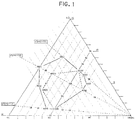
- Fig. 1 shows the positions of positive active materials of Examples and Comparative Examples in the Ni a Fe b Mn c triangular phase diagram, together with the discharge capacity values of cells using those positive active materials at the seventh cycle.
- the atomic ratio of Mn is also important. As in Examples below, when the atomic ratio of Mn is 0.85 ⁇ c ⁇ 0.92, and the range 0.3 ⁇ a/(a + b) ⁇ 0.9 is satisfied, the discharge capacity of a lithium secondary battery using the positive active material at the seventh cycle can be 60 mAh/g or more.
- the discharge capacity of a lithium secondary battery at the seventh cycle can be 60 mAh/g or more.
- the discharge capacity of a lithium secondary battery at the seventh cycle is preferably 68 mAh/g or more, and more preferably 90 mAh/g or more.
- the discharge capacity at the seventh cycle can be 68 mAh/g or more.
- the Li composition is particularly variable.
- such a positive active material releases Li upon charging. Accordingly, the Li coefficient x can reach 0.
- such a positive active material absorbs Li upon discharging. Accordingly, the Li coefficient x can reach 1.2. Thus, 0 ⁇ x ⁇ 1.2.
- the positive active material of the present invention is represented by the general formula Li x MPO 4 (0 ⁇ x ⁇ 1.2, M is transition metal elements including at least Ni, Fe, and Mn).
- M is transition metal elements including at least Ni, Fe, and Mn.
- impurities may coexist inevitably or for the purpose of improving performance as an active material. Even in such a case, the effects of the present invention are not impaired.
- the positive active material of the present invention may contain small amounts of transition metal elements other than Mn, Fe, and Ni and boron. SiO 4 or the like may be contained in a part of the polyanion moiety, which is represented by PO 4 , in the positive active material of the present invention.
- the positive active material of the present invention is represented by the general formula Li x Ni a Fe b Mn c M' d PO 4 .
- the amounts of the transition metal elements other than Mn, Fe, and Ni and boron are small as mentioned above.
- a + b + c + d 1, when the mole atomic ratio c of Mn is extremely smaller than 0.85 (e.g., c is 0.84 or less), such materials are excluded from the present invention.
- a method for synthesizing the positive active material according to the present invention is not particularly limited as long as the method is capable of synthesizing single-phase crystals of Li x MPO 4 type (M is transition metal).
- Specific examples of such methods include a solid-phase method, a liquid-phase method, a sol-gel method, and a hydrothermal method.
- hydrothermal method it is preferable to use a hydrothermal method. This is because a positive active material with a small particle size can be easily obtained.
- hydrothermal method a known general method can be employed.
- the hydrothermal method for example, the following method can be employed: an aqueous solution obtained by dissolving raw materials for the lithium transition metal compound is placed in a hermetically sealable vessel, and then the vessel is heated from the outside.
- a method in which an aqueous solution obtained by dissolving raw materials for the lithium manganese phosphate is placed in a hermetically sealable vessel, subsequently, the vessel is hermetically sealed, and the vessel is heated from the outside at a temperature of more than 100°C and the heating makes the internal pressure about 0.5 to 1.5 MPa can be employed.
- the above hydrothermal method is employed in hydrothermal synthesis, the smaller size of particles containing a lithium transition metal compound can be easily obtained.
- raw materials for the lithium manganese phosphate including manganese, iron, nickel, lithium, and phosphate are mixed to form particles containing a lithium transition metal compound.
- raw materials for the lithium transition metal compound various materials are usable.
- raw materials containing manganese (Mn) include manganese sulfate, manganese oxalate, and manganese acetate.
- raw materials containing iron (Fe) include iron sulfate, iron oxalate, and iron acetate.
- raw materials containing nickel (Ni) include nickel sulfate, nickel oxalate, and nickel acetate.
- raw materials containing lithium (Li) include lithium hydroxide and lithium carbonate.
- raw materials containing phosphate (PO 4 ) include ammonium phosphate, diammonium hydrogenphosphate, ammonium dihydrogenphosphate, and lithium phosphate.
- the raw material solution contains ascorbic acid. Therefore, in a heat treatment process, organic substances derived from ascorbic acid are decomposed, whereby carbon is given to the particle surface. However, such carbon alone is not necessarily sufficient to ensure the electron conduction between particles. Therefore, in Examples below, an organic substance, such as PVA, is allowed to coexist in the heat treatment process, thereby compensating for the electron conduction between particles.
- the carbon source contained in the raw material solution is not limited to ascorbic acid. It is preferable that the carbon source has a molecular weight of 350 or less having two or more hydroxy groups in the molecule. Further, in the hydrothermal synthesis, water can be used as a solvent. Therefore, it is preferable that the carbon source is one that easily dissolves in water (water-soluble). Specifically, it is preferable that the carbon source is one that dissolves 1 mass% or more in 20°C neutral water. In particular, monosaccharides, disaccharides, and organic acids with a molecular weight of 350 or less having two or more hydroxy groups in the molecule are preferable. Besides, the molecular weight of the compound having two or more hydroxy groups in the molecule mentioned above is usually 100 or more.
- Examples of the monosaccharides include glucose, fructose, galactose, and mannose.
- Examples of the disaccharides include maltose, sucrose, and cellobiose.
- Examples of the organic acids include ascorbic acid (including erythorbic acid, an optical isomer), tartaric acid, mevalonic acid, quinic acid, shikimic acid, gallic acid, and caffeic acid.
- sucrose, ascorbic acid, or tartaric acid it is preferable to use sucrose, ascorbic acid, or tartaric acid. As a result, the discharge capacity of a lithium secondary battery can be further improved.
- the organic substance to be applied in the heat treatment process is not limited to PVA (polyvinyl alcohol).
- PVA polyvinyl alcohol
- water-soluble compounds with a weight-average molecular weight of 500 or more having a hydroxy group in the molecule are usable.
- polyalkylene glycols such as polyethylene glycols, polypropylene glycols, and polyethylene polypropylene glycols
- hydrophilic vinyl polymers such as polyvinyl alcohols and polyhydroxyalkyl (meth)acrylates
- polyoxyethylene (alkyl)phenyl ethers such as polyoxyethylene (tetramethylbutyl)phenyl ethers are usable.
- the hydrophilic vinyl polymer has a structural unit derived from a hydroxy-group-containing vinyl monomer. Specifically, the hydrophilic vinyl polymer has a structural unit derived from a vinyl monomer having at least one ethylenic unsaturation and a hydroxy group in the molecule.
- hydrophilic vinyl polymers examples include hydroxyethyl (meth)acrylates.
- examples of the hydrophilic vinyl polymers also include, in addition to these, copolymers obtained by the copolymerization of hydroxy-group-containing vinyl monomers.
- the polyvinyl alcohols are usually formed by hydrolyzing a polymerized vinyl acetate monomer.
- a polyvinyl alcohol has a structural unit derived from a vinyl monomer having at least one ethylenic unsaturation and a hydroxy group in the molecule.
- the hydrophilic vinyl polymers include polyvinyl alcohols.
- the amount of the organic substance applied in the heat treatment process is preferably about 4 to 6 mass% in terms of carbon content relative to particles formed in the hydrothermal synthesis. As a result, the discharge capacity of a lithium secondary battery can be further improved.
- the heat treatment process can be performed, for example, at a temperature of about 500 to 750°C for about 0.5 to 2 hours in a nitrogen-gas-replaced atmosphere having a small amount of oxygen gas, etc. Besides, it is preferable that cooling after the heat treatment is performed slowly, for example, at a cooling rate not exceeding -1°C/min.
- the positive active material according to the present invention is used in a positive electrode for a lithium secondary battery, it is preferable that the positive active material is a powder with an average particle size of 100 ⁇ m or less. Particularly, a positive active material with a smaller particle diameter is more desirable. It is preferable that the average particle size of secondary particles is 0.5 to 20 ⁇ m, and it is more preferable that the particle diameter of primary particles is 1 to 500 nm. Further, for the improvement of the high-rate performance of the positive electrode, powder particles having a larger specific surface area are more desirable. The specific surface area is preferably 1 to 100 m 2 /g, and more preferably 5 to 100 m 2 /g.
- a crusher or a classifier can be used.
- a mortar, a ball mill, a sand mill, a vibration ball mill, a planet ball mill, a jet mill, a counter jet mill, a swirling flow type jet mill, a sieve, or the like can be used.
- wet milling may be employed, where water or an organic solvent, such as alcohol or hexane, is allowed to coexist.
- the classification method is not particularly limited. Both in dry classification and wet classification, a sieve, an air classifier, or the like can be used as required.
- the moisture content of the positive electrode containing the positive active material of the present invention a smaller content is more desirable. Specifically, it is preferable that the content is less than 2000 ppm.
- the thickness of the electrode composite material layer applied to the present invention is preferably 20 to 500 ⁇ m.
- a negative electrode of the battery according to the present invention is not limited.
- materials for the negative electrode include lithium metal and lithium alloys (lithium-metal-containing alloys such as lithium-aluminum, lithium-lead, lithium-tin, lithium-aluminum-tin, lithium-gallium, and Wood's metal), as well as alloys capable of absorbing/releasing lithium, carbon materials (e.g., graphite, hard carbon, low-temperature-sintered carbon, amorphous carbon, etc.), metal oxides, lithium metal oxides (Li 4 Ti 5 O 12 , etc.), and polyphosphate compounds.
- graphite has an operating potential extremely close to metallic lithium, and thus enables charge-discharge at a high operating voltage.
- graphite is a preferred negative electrode material.
- artificial graphite or natural graphite is preferably used, for example.
- graphite having a particle surface modified with amorphous carbon or the like As a result, gas generation during charging can be reduced.
- a lithium secondary battery includes a positive electrode, a negative electrode, and a nonaqueous electrolyte in which an electrolyte salt is contained in a nonaqueous solvent.
- a separator is provided between the positive electrode and the negative electrode. Further, an exterior body for packaging them is provided.
- nonaqueous solvent examples include a nonaqueous solvent made of one of the following: cyclic carbonates such as propylene carbonate and ethylene carbonate; cyclic esters such as ⁇ -butyrolactone and ⁇ -valerolactone; chain carbonates such as dimethyl carbonate, diethyl carbonate, and ethyl methyl carbonate; chain esters such as methyl formate, methyl acetate, and methyl butyrate; tetrahydrofuran and derivatives thereof; ethers such as 1,3-dioxane, 1,4-dioxane, 1,2-dimethoxyethane, 1,4-dibutoxyethane, and methyl diglyme; nitriles such as acetonitrile and benzonitrile; dioxolane and derivatives thereof; and ethylene sulfide, sulfolane, sultone, and derivatives thereof. Examples thereof also include a mixture of two or more of these nonaqueous
- the electrolyte salts include ionic compounds such as LiBF 4 and LiPF 6 . These ionic compounds may be used alone or as a mixture of two or more kinds.
- the concentration of the electrolyte salt in the nonaqueous electrolyte is preferably 0.5 mol/l to 5 mol/l, and still more preferably 1 mol/l to 2.5 mol/l. As a result, a lithium secondary battery having high battery characteristics can be reliably obtained.
- a solution prepared by dissolving LiOH•H 2 O in ion-exchange water and a solution prepared by dissolving (NH 4 ) 2 HPO 4 in ion-exchange water were mixed, and the resulting mixed solution was stirred for 2 hours.
- the solution pH is not constant.
- the pH of the mixed solution after stirring for 2 hours was about 8. Meanwhile, MnSO 4 •5H 2 O, FeSO 4 •7H 2 O, and NiSO 4 •6H 2 O were dissolved in water containing ascorbic acid dissolved therein.
- the amount of ascorbic acid herein was adjusted to 0.025 in terms of molar ratio relative to MnSO 4 .
- the solution was added to the mixed solution of LiOH•H 2 O and (NH 4 ) 2 HPO 4 in a nitrogen atmosphere.
- the purpose of employing a nitrogen atmosphere at this time is to reduce the possibility that oxides derived from the oxidation of Fe 2+ into Fe 3+ are present in the final product as impurities.
- a precursor solution was obtained through the above operation. Besides, Li : P : Mn : Fe : Ni in the precursor solution was adjusted so that their molar ratio was 2 : 1 : 0.90 : 0.07 : 0.03. This solution was transferred to a cylindrical vessel made of polytetrafluoroethylene.
- the vessel was set to a temperature controller. The atmosphere in the vessel was sufficiently replaced with nitrogen, and then the vessel was hermetically sealed. The vessel was subjected to stirring at a temperature of 170°C for 12 hours at 150 rpm to perform hydrothermal synthesis. After the reaction, the solution was filtered, and the resulting precipitate was thoroughly washed with deionized water and acetone. Subsequently, the precipitate was vacuum-dried at 120°C for 5 hours. The obtained powder was mixed with an about 1.1 times larger mass of polyvinyl alcohol powder (PVA, polymerization degree: 1,500). To the mixture was further added a small amount of water warmed to 60°C.
- PVA polyvinyl alcohol powder
- a working electrode for evaluating positive active materials was prepared according to the following procedure.
- the synthesized active material and acetylene black (AB) weighed to a mass ratio of 80 : 8 were pulverized and mixed in a mortar.
- NMP N-methylpyrrolidone
- the mixed powder was kneaded.
- the solution was added dropwise in such a manner that the ratio between the mass of the solution (in terms of solids) and the mass of the positive active material was 80 (positive active material) : 12 (PVdF).
- the positive electrode paste was applied to an aluminum mesh plate, and dried at 80°C for 30 minutes. Subsequently, the positive electrode paste was pressed and dried under reduced pressure. A working electrode was thus obtained. Then, using the working electrode, a counter electrode and a reference electrode made of metallic Li, and a nonaqueous electrolytic solution, a three-electrode glass cell was prepared.
- the nonaqueous electrolyte solution used is obtained by dissolving LiPF 6 to a concentration of 1 mol/l in a mixed solvent of ethylene carbonate and diethyl carbonate mixed in a volume ratio of 1 : 1.
- the charge-discharge test was performed at a temperature of 25°C.
- charge was constant-current constant-potential charge at a charge current of 0.1 CmA and a charge set potential of 4.3 V (vs. Li/Li + ) for a charge time of 15 hours.
- Discharge was constant-current discharge at a discharge current of 0.1C mA to an end potential of 2.0 V (vs. Li/Li + ).
- the current value (CmA) was determined on the assumption that the theoretical capacity of the positive active material was 171 mAh/g.
- positive active materials herein contain, in addition to lithium transition metal compounds, carbon applied before the heat treatment process.
- the positive active materials of all Examples and Comparative Examples described therein contain 3 to 5 mass% of carbon.
- the above charge-discharge was performed for seven cycles. Besides, an interval of 30 minutes was provided between the completion of charge and the start of discharge and also between the completion of discharge and the start of charge.
- the discharge capacity (mAh) from the start of charge until the end potential of 2 V was measured.
- Table 1 shows the discharge capacity of cells (lithium secondary batteries) using the positive active materials of Examples 1 to 14 and Comparative Examples 1 to 10 at the first cycle and the seventh cycle.
- Fig. 1 shows the positions of positive active materials of Examples and Comparative Examples in the Ni a Fe b Mn c triangular phase diagram, together with the discharge capacity value of each cell at the seventh cycle.
- the discharge capacity value of the battery varies such that it slowly increases or slowly decreases. Then, after several cycles, the discharge capacity value stabilizes. The same tendency is seen in the lithium secondary battery of the present invention. Therefore, the characteristics of the battery of the present invention were evaluated from the discharge capacity of the cell at the seventh cycle.
- Table 1 and Fig. 1 show that cells containing the positive active materials of Example 1 to 15 have high discharge capacity at the seventh cycle (60 mAh/g or more).
- These positive active materials are lithium-manganese-phosphate-based positive active materials of Li x Ni a Fe b Mn c PO 4 , wherein 0.85 ⁇ c ⁇ 0.92 and 0.3 ⁇ a/(a + b) ⁇ 0.9.
- (a, b, c) values in the Ni a Fe b Mn c triangular phase diagram are on the sides of or within the octagon ABCDEFGH whose vertices are point A (0.09, 0.01, 0.9), point B (0.04, 0.04, 0.92), point C (0.03, 0.05, 0.92), point D (0.027, 0.063, 0.91), point E (0.039, 0.091, 0.87), point F (0.075, 0.075, 0.85), point G (0.0915, 0.0435, 0.865), and point H (0.099, 0.011, 0.89).
- Comparative Example 1 Comparative Example 2, Example 1, Example 5, Example 6, and Comparative Example 6, which repeats the operation of maintaining an open-circuit state for 90 minutes every 30 minutes of discharge.
- This test is for the evaluation of the performance of a positive active material under the conditions where the influences of IR resistance of a cell and the ion diffusion rate are eliminated as much as possible.
- a discharge current of 0.1 CmA was employed. From the obtained open circuit potential curve (OCP curve), the accumulated capacity discharged until an open circuit potential of 3.0 V was determined.
- Lithium secondary batteries using the positive active material of the present invention are suitable for application to the field where particularly higher-capacity industrial batteries are demanded, such as electric vehicles that are awaiting further development. Therefore, the industrial applicability in such a lithium secondary battery is extremely great.
Landscapes
- Chemical & Material Sciences (AREA)
- Inorganic Chemistry (AREA)
- Chemical Kinetics & Catalysis (AREA)
- Electrochemistry (AREA)
- General Chemical & Material Sciences (AREA)
- Organic Chemistry (AREA)
- Engineering & Computer Science (AREA)
- Materials Engineering (AREA)
- Crystallography & Structural Chemistry (AREA)
- Battery Electrode And Active Subsutance (AREA)
- Secondary Cells (AREA)
- Manufacturing & Machinery (AREA)
Claims (10)
- Positives aktives Material für eine Lithium-Sekundärbatterie, die eine Lithium-Übergangsmetall-Verbindung aufweist, die eine Olivin-Kristallstruktur aufweist und mindestens Ni, Fe, und Mn als Übergangsmetallelemente enthält, wobei wenn die Summe der Molatome von Ni, Fe, und Mn der in der Lithium-Übergangsmetall-Verbindung enthaltenen Übergangsmetallelemente als 1 ausgedrückt wird, und die Molatomverhältnisse von Ni, Fe, und Mn durch a, b bzw. c (a + b + c = 1, a > 0, b > 0, c > 0) repräsentiert werden, das Folgende erfüllt ist: 0,85 ≤ c ≤ 0,92 und 0,3 ≤ a/(a + b) ≤ 0,9; und
wobei die Lithium-Übergangsmetall-Verbindung eine Lithium-Übergangsmetall-Phosphat-Verbindung ist. - Positives aktives Material nach Anspruch 1,
wobei im ternären NiaFebMnc-Phasendiagramm (a, b, c) durch Werte auf den Seiten oder innerhalb des Achtecks ABCDEFGH repräsentiert werden, dessen Eckpunkte der Punkt A (0,09, 0,01, 0,9), der Punkt B (0,04, 0,04, 0,92), der Punkt C (0,03, 0,05, 0,92), der Punkt D (0,027, 0,063, 0,91), der Punkt E (0,039, 0,091, 0,87), der Punkt F (0,075, 0,075, 0,85), der Punkt G (0,0915, 0,0435, 0,865) und der Punkt H (0,099, 0,011, 0,89) sind. - Positives aktives Material nach Anspruch 2, wobei die (a, b, c) durch Werte auf den Seiten oder innerhalb des Siebenecks ABCDEFG repräsentiert werden.
- Positives aktives Material nach Anspruch 1,
wobei im ternären NiaFebMnc-Phasendiagramm (a, b, c) durch Werte auf den Seiten oder innerhalb des Fünfecks ABXYZ repräsentiert werden, dessen Eckpunkte der Punkt A (0,09, 0,01, 0,9), der Punkt B (0,04, 0,04, 0,92), der Punkt X (0,03, 0,07, 0,9), der Punkt Y (0,065, 0,065, 0,87) und der Punkt Z (0,087, 0,043, 0,87) sind. - Positives aktives Material nach einem der Ansprüche 1 bis 4, wobei die Lithium-Übergangsmetall-Phosphat-Verbindung durch LixMPO4 repräsentiert wird (0 < x < 1,2, M aus Übergangsmetallelementen besteht, die mindestens Ni, Fe und Mn aufweisen, und der Atomanteil von Mn 85% oder mehr und 92% oder weniger beträgt).
- Positives aktives Material nach Anspruch 5, wobei die Lithium-Übergangsmetall-Phosphat-Verbindung LixNiaFebMncPO4 ist (0 < x < 1,2, a + b + c = 1, a > 0, b > 0, c > 0), wobei 0,85 ≤ c ≤ 0,92 und 0,3 ≤ a/(a + b) ≤ 0,9.
- Positives aktives Material nach einem der Ansprüche 1 bis 6, das aus einem Pulver mit einer durchschnittlichen Teilchengröße von 100 µm oder weniger besteht, das vorzugsweise durch eine Synthese durch ein Hydrothermalverfahren erzeugt wird.
- Positives aktives Material nach einem der Ansprüche 1 bis 7, das eine mit Kohlenstoff beschichtete Oberfläche aufweist.
- Positive Elektrode, die das positive aktive Material für eine Lithium-Sekundärbatterie nach einem der Ansprüche 1 bis 8 aufweist.
- Lithium-Sekundärbatterie, die die positive Elektrode nach Anspruch 9, eine negative Elektrode und einen nichtwässrigen Elektrolyten aufweist.
Applications Claiming Priority (3)
| Application Number | Priority Date | Filing Date | Title |
|---|---|---|---|
| JP2009149366 | 2009-06-24 | ||
| JP2010026139 | 2010-02-09 | ||
| PCT/JP2010/060170 WO2010150686A1 (ja) | 2009-06-24 | 2010-06-16 | リチウム二次電池用正極活物質及びリチウム二次電池 |
Publications (3)
| Publication Number | Publication Date |
|---|---|
| EP2448044A1 EP2448044A1 (de) | 2012-05-02 |
| EP2448044A4 EP2448044A4 (de) | 2014-12-31 |
| EP2448044B1 true EP2448044B1 (de) | 2019-02-27 |
Family
ID=43386456
Family Applications (1)
| Application Number | Title | Priority Date | Filing Date |
|---|---|---|---|
| EP10792004.3A Active EP2448044B1 (de) | 2009-06-24 | 2010-06-16 | Positives aktives elektrodenmaterial für eine lithiumsekundärbatterie und lithiumsekundärbatterie |
Country Status (7)
| Country | Link |
|---|---|
| US (1) | US9225022B2 (de) |
| EP (1) | EP2448044B1 (de) |
| JP (1) | JP5488598B2 (de) |
| KR (2) | KR101956089B1 (de) |
| CN (1) | CN102449821B (de) |
| TW (1) | TWI505536B (de) |
| WO (1) | WO2010150686A1 (de) |
Families Citing this family (16)
| Publication number | Priority date | Publication date | Assignee | Title |
|---|---|---|---|---|
| US20120003139A1 (en) * | 2010-06-30 | 2012-01-05 | Semiconductor Energy Laboratory Co., Ltd. | Method for manufacturing power storage device |
| JP5831296B2 (ja) * | 2011-03-07 | 2015-12-09 | 日亜化学工業株式会社 | オリビン型リチウム遷移金属酸化物およびその製造方法 |
| JP5760524B2 (ja) * | 2011-03-09 | 2015-08-12 | 株式会社Gsユアサ | リチウム二次電池用正極活物質およびリチウム二次電池 |
| US8945498B2 (en) * | 2011-03-18 | 2015-02-03 | Semiconductor Energy Laboratory Co., Ltd. | Method for manufacturing lithium-containing composite oxide |
| CN103443971B (zh) | 2011-03-25 | 2016-06-08 | 株式会社半导体能源研究所 | 锂离子二次电池 |
| US9225013B2 (en) * | 2011-04-22 | 2015-12-29 | Showa Denko K.K. | Method for producing cathode-active material for lithium secondary battery |
| US9249524B2 (en) * | 2011-08-31 | 2016-02-02 | Semiconductor Energy Laboratory Co., Ltd. | Manufacturing method of composite oxide and manufacturing method of power storage device |
| US9118077B2 (en) * | 2011-08-31 | 2015-08-25 | Semiconductor Energy Laboratory Co., Ltd. | Manufacturing method of composite oxide and manufacturing method of power storage device |
| EP2698346A1 (de) * | 2012-08-14 | 2014-02-19 | Clariant International Ltd. | Gemischtes Sulphat mit Lithium-Manganmetallphosphat |
| JP6260535B2 (ja) * | 2012-08-31 | 2018-01-17 | 戸田工業株式会社 | 炭素複合化リン酸マンガン鉄リチウム粒子粉末の製造方法、及び該粒子粉末を用いた非水電解質二次電池の製造方法 |
| JP6124062B2 (ja) * | 2013-04-15 | 2017-05-10 | 日本電気硝子株式会社 | 蓄電デバイス用正極材料、およびその製造方法 |
| JP6231966B2 (ja) * | 2014-09-30 | 2017-11-15 | 住友大阪セメント株式会社 | 電極材料及びその製造方法、電極、並びにリチウムイオン電池 |
| WO2016182044A1 (ja) * | 2015-05-14 | 2016-11-17 | 株式会社村田製作所 | 非水電解質二次電池 |
| JP6151386B2 (ja) * | 2015-06-09 | 2017-06-21 | 太平洋セメント株式会社 | オリビン型リン酸リチウム系正極材料の製造方法 |
| CN110980682A (zh) * | 2019-12-18 | 2020-04-10 | 江苏力泰锂能科技有限公司 | 制备磷酸锰铁锂前体的方法和制备磷酸锰铁锂的方法 |
| CN115417395B (zh) * | 2022-10-12 | 2025-10-24 | 北京钠谛科技有限公司 | 一种锰铁铜磷酸三元锂材料及其制备方法 |
Family Cites Families (14)
| Publication number | Priority date | Publication date | Assignee | Title |
|---|---|---|---|---|
| JP4461566B2 (ja) | 2000-04-25 | 2010-05-12 | ソニー株式会社 | 正極活物質及び非水電解質電池 |
| EP1261050A1 (de) * | 2001-05-23 | 2002-11-27 | n.v. Umicore s.a. | Lithium-Übergangsmetall-Phosphatpulver für wiederaufladbaren Batterien |
| JP2003323894A (ja) | 2002-05-02 | 2003-11-14 | Kri Inc | 二次電池用正極材料の製造方法及びそれを用いた二次電池 |
| JP2004063422A (ja) * | 2002-07-31 | 2004-02-26 | Sony Corp | 正極活物質、並びに非水電解質電池 |
| JP2005071665A (ja) | 2003-08-20 | 2005-03-17 | Toyota Central Res & Dev Lab Inc | 水系リチウム二次電池 |
| US7060238B2 (en) * | 2004-03-04 | 2006-06-13 | Valence Technology, Inc. | Synthesis of metal phosphates |
| JP4869629B2 (ja) * | 2005-05-30 | 2012-02-08 | 住友大阪セメント株式会社 | リチウム電池用正極活物質の製造方法及びリチウム電池用正極活物質並びにリチウム電池 |
| US7964118B2 (en) * | 2005-09-21 | 2011-06-21 | Kanto Denka Kogyo Co., Ltd. | Positive electrode active material and method of producing the same and nonaqueous electrolyte battery having positive electrode containing positive electrode active material |
| WO2007113624A1 (en) * | 2006-04-06 | 2007-10-11 | High Power Lithium S.A. | Synthesis of nanoparticles of lithium metal phosphate positive material for lithium secondary battery |
| JP5268042B2 (ja) | 2006-11-24 | 2013-08-21 | 国立大学法人九州大学 | 正極活物質の製造方法およびそれを用いた非水電解質電池 |
| CN101212048A (zh) * | 2006-12-30 | 2008-07-02 | 比亚迪股份有限公司 | 一种锂离子二次电池的正极材料及含有该正极材料的电池 |
| JP5145745B2 (ja) | 2007-03-28 | 2013-02-20 | 株式会社Gsユアサ | 非水電解質二次電池用正極活物質及びそれを用いた非水電解質二次電池 |
| EP2015382A1 (de) | 2007-07-13 | 2009-01-14 | High Power Lithium S.A. | Kohlenstoffbeschichtetes Lithium-Mangan-Phosphat-Kathodenmaterial |
| TWI466370B (zh) | 2008-01-17 | 2014-12-21 | A123 Systems Inc | 鋰離子電池的混合式金屬橄欖石電極材料 |
-
2010
- 2010-06-16 EP EP10792004.3A patent/EP2448044B1/de active Active
- 2010-06-16 US US13/263,079 patent/US9225022B2/en not_active Expired - Fee Related
- 2010-06-16 KR KR1020167005478A patent/KR101956089B1/ko not_active Expired - Fee Related
- 2010-06-16 KR KR1020117023418A patent/KR20120030036A/ko not_active Ceased
- 2010-06-16 JP JP2011519803A patent/JP5488598B2/ja not_active Expired - Fee Related
- 2010-06-16 CN CN201080022986.2A patent/CN102449821B/zh active Active
- 2010-06-16 WO PCT/JP2010/060170 patent/WO2010150686A1/ja not_active Ceased
- 2010-06-21 TW TW099120093A patent/TWI505536B/zh active
Non-Patent Citations (1)
| Title |
|---|
| None * |
Also Published As
| Publication number | Publication date |
|---|---|
| CN102449821B (zh) | 2014-12-24 |
| EP2448044A1 (de) | 2012-05-02 |
| WO2010150686A1 (ja) | 2010-12-29 |
| KR20120030036A (ko) | 2012-03-27 |
| CN102449821A (zh) | 2012-05-09 |
| TWI505536B (zh) | 2015-10-21 |
| US20120028122A1 (en) | 2012-02-02 |
| JP5488598B2 (ja) | 2014-05-14 |
| TW201114093A (en) | 2011-04-16 |
| US9225022B2 (en) | 2015-12-29 |
| EP2448044A4 (de) | 2014-12-31 |
| KR101956089B1 (ko) | 2019-03-08 |
| JPWO2010150686A1 (ja) | 2012-12-10 |
| KR20160028522A (ko) | 2016-03-11 |
Similar Documents
| Publication | Publication Date | Title |
|---|---|---|
| EP2448044B1 (de) | Positives aktives elektrodenmaterial für eine lithiumsekundärbatterie und lithiumsekundärbatterie | |
| KR100437339B1 (ko) | 전지용 활물질의 제조방법 및 그로부터 제조되는 전지용활물질 | |
| EP2471134B1 (de) | Lithiumreiche komplexe schicht-schicht-metalloxide mit hoher spezifischer kapazität und hervorragender zyklisierung | |
| EP2498323B1 (de) | Positiv-Aktivmaterial und Elektrode und Lithiumbatterie mit dem Material | |
| EP2936590B1 (de) | Lmfp-kathodenmaterialien mit verbesserten elektrochemischen eigenschaften | |
| JP4734701B2 (ja) | 正極活物質の製造方法及び非水電解質電池の製造方法 | |
| EP2383820B1 (de) | Positiv-elektrodenaktivmaterial für eine lithium-sekundärbatterie und lithium-sekundärbatterie | |
| US9745194B2 (en) | Method of producing cathode active material for lithium secondary battery | |
| JP4734700B2 (ja) | 正極活物質の製造方法及び非水電解質電池の製造方法 | |
| KR20170075596A (ko) | 리튬 이차 전지용 양극 활물질, 이의 제조 방법, 및 이를 포함하는 리튬 이차 전지 | |
| JP5298659B2 (ja) | リチウム二次電池用活物質及びリチウム二次電池 | |
| JP4491950B2 (ja) | 正極活物質の製造方法及び非水電解質電池の製造方法 | |
| KR100393684B1 (ko) | 리튬 이차 전지용 양극 활물질 및 그 제조방법 | |
| KR100441520B1 (ko) | 리튬 이차 전지용 양극 활물질 및 그 제조방법 | |
| KR20110011497A (ko) | 양극활물질, 이를 포함하는 양극 및 상기 양극을 채용한 리튬전지 | |
| CN118712377A (zh) | 一种五元高熵金属磷硫化物负极材料及其制备方法和应用 | |
| KR101871919B1 (ko) | 리튬 이차 전지용 양극 활물질, 이의 제조 방법 및 이를 포함하는 리튬 이차 전지 | |
| JP4491947B2 (ja) | 正極活物質の製造方法及び非水電解質電池の製造方法 | |
| CN120288736B (zh) | 一种磷酸盐材料、改性磷酸盐材料及其制备方法 | |
| KR101386150B1 (ko) | 음극활물질 전극 및 그 제조방법 및 이를 구비한 리튬이차전지 | |
| EP4068429A1 (de) | Mit lithiummolybdänverbindung beschichtetes kathoden-aktivmaterial für lithiumsekundärbatterie und herstellungsverfahren dafür | |
| EP4682980A1 (de) | Vorläufermaterial und herstellungsverfahren dafür, positivelektrodenmaterial und herstellungsverfahren dafür, positivelektrodenfolie, batterie und elektrische vorrichtung | |
| WO2023184494A1 (zh) | 正极活性材料、其制备方法以及包含其的正极极片、二次电池及用电装置 | |
| EP4685871A1 (de) | Herstellungsverfahren für positivelektrodenmaterial, positivelektrodenmaterial, positivelektrodenfolie, batterie und elektrische vorrichtung |
Legal Events
| Date | Code | Title | Description |
|---|---|---|---|
| PUAI | Public reference made under article 153(3) epc to a published international application that has entered the european phase |
Free format text: ORIGINAL CODE: 0009012 |
|
| 17P | Request for examination filed |
Effective date: 20120111 |
|
| AK | Designated contracting states |
Kind code of ref document: A1 Designated state(s): AL AT BE BG CH CY CZ DE DK EE ES FI FR GB GR HR HU IE IS IT LI LT LU LV MC MK MT NL NO PL PT RO SE SI SK SM TR |
|
| DAX | Request for extension of the european patent (deleted) | ||
| RAP1 | Party data changed (applicant data changed or rights of an application transferred) |
Owner name: GS YUASA INTERNATIONAL LTD. |
|
| A4 | Supplementary search report drawn up and despatched |
Effective date: 20141201 |
|
| RIC1 | Information provided on ipc code assigned before grant |
Ipc: H01M 4/58 20100101AFI20141125BHEP |
|
| STAA | Information on the status of an ep patent application or granted ep patent |
Free format text: STATUS: EXAMINATION IS IN PROGRESS |
|
| 17Q | First examination report despatched |
Effective date: 20180508 |
|
| REG | Reference to a national code |
Ref country code: DE Ref legal event code: R079 Ref document number: 602010057260 Country of ref document: DE Free format text: PREVIOUS MAIN CLASS: H01M0004580000 Ipc: C01B0025450000 |
|
| GRAP | Despatch of communication of intention to grant a patent |
Free format text: ORIGINAL CODE: EPIDOSNIGR1 |
|
| STAA | Information on the status of an ep patent application or granted ep patent |
Free format text: STATUS: GRANT OF PATENT IS INTENDED |
|
| RIC1 | Information provided on ipc code assigned before grant |
Ipc: C01B 25/45 20060101AFI20180822BHEP Ipc: H01M 4/136 20100101ALI20180822BHEP Ipc: H01M 10/052 20100101ALI20180822BHEP Ipc: H01M 4/62 20060101ALI20180822BHEP Ipc: H01M 4/58 20100101ALI20180822BHEP Ipc: H01M 4/36 20060101ALI20180822BHEP Ipc: H01M 4/02 20060101ALI20180822BHEP |
|
| INTG | Intention to grant announced |
Effective date: 20180924 |
|
| RIN1 | Information on inventor provided before grant (corrected) |
Inventor name: KOHMOTO, MARIKO Inventor name: INAMASU, TOKUO Inventor name: NUKUDA, TOSHIYUKI Inventor name: TABUCHI, TORU |
|
| GRAS | Grant fee paid |
Free format text: ORIGINAL CODE: EPIDOSNIGR3 |
|
| GRAA | (expected) grant |
Free format text: ORIGINAL CODE: 0009210 |
|
| STAA | Information on the status of an ep patent application or granted ep patent |
Free format text: STATUS: THE PATENT HAS BEEN GRANTED |
|
| AK | Designated contracting states |
Kind code of ref document: B1 Designated state(s): AL AT BE BG CH CY CZ DE DK EE ES FI FR GB GR HR HU IE IS IT LI LT LU LV MC MK MT NL NO PL PT RO SE SI SK SM TR |
|
| REG | Reference to a national code |
Ref country code: GB Ref legal event code: FG4D |
|
| REG | Reference to a national code |
Ref country code: CH Ref legal event code: EP |
|
| REG | Reference to a national code |
Ref country code: DE Ref legal event code: R096 Ref document number: 602010057260 Country of ref document: DE |
|
| REG | Reference to a national code |
Ref country code: AT Ref legal event code: REF Ref document number: 1101018 Country of ref document: AT Kind code of ref document: T Effective date: 20190315 |
|
| REG | Reference to a national code |
Ref country code: IE Ref legal event code: FG4D |
|
| REG | Reference to a national code |
Ref country code: NL Ref legal event code: MP Effective date: 20190227 |
|
| REG | Reference to a national code |
Ref country code: LT Ref legal event code: MG4D |
|
| PG25 | Lapsed in a contracting state [announced via postgrant information from national office to epo] |
Ref country code: PT Free format text: LAPSE BECAUSE OF FAILURE TO SUBMIT A TRANSLATION OF THE DESCRIPTION OR TO PAY THE FEE WITHIN THE PRESCRIBED TIME-LIMIT Effective date: 20190627 Ref country code: SE Free format text: LAPSE BECAUSE OF FAILURE TO SUBMIT A TRANSLATION OF THE DESCRIPTION OR TO PAY THE FEE WITHIN THE PRESCRIBED TIME-LIMIT Effective date: 20190227 Ref country code: NO Free format text: LAPSE BECAUSE OF FAILURE TO SUBMIT A TRANSLATION OF THE DESCRIPTION OR TO PAY THE FEE WITHIN THE PRESCRIBED TIME-LIMIT Effective date: 20190527 Ref country code: FI Free format text: LAPSE BECAUSE OF FAILURE TO SUBMIT A TRANSLATION OF THE DESCRIPTION OR TO PAY THE FEE WITHIN THE PRESCRIBED TIME-LIMIT Effective date: 20190227 Ref country code: NL Free format text: LAPSE BECAUSE OF FAILURE TO SUBMIT A TRANSLATION OF THE DESCRIPTION OR TO PAY THE FEE WITHIN THE PRESCRIBED TIME-LIMIT Effective date: 20190227 Ref country code: LT Free format text: LAPSE BECAUSE OF FAILURE TO SUBMIT A TRANSLATION OF THE DESCRIPTION OR TO PAY THE FEE WITHIN THE PRESCRIBED TIME-LIMIT Effective date: 20190227 |
|
| PG25 | Lapsed in a contracting state [announced via postgrant information from national office to epo] |
Ref country code: GR Free format text: LAPSE BECAUSE OF FAILURE TO SUBMIT A TRANSLATION OF THE DESCRIPTION OR TO PAY THE FEE WITHIN THE PRESCRIBED TIME-LIMIT Effective date: 20190528 Ref country code: IS Free format text: LAPSE BECAUSE OF FAILURE TO SUBMIT A TRANSLATION OF THE DESCRIPTION OR TO PAY THE FEE WITHIN THE PRESCRIBED TIME-LIMIT Effective date: 20190627 Ref country code: HR Free format text: LAPSE BECAUSE OF FAILURE TO SUBMIT A TRANSLATION OF THE DESCRIPTION OR TO PAY THE FEE WITHIN THE PRESCRIBED TIME-LIMIT Effective date: 20190227 Ref country code: LV Free format text: LAPSE BECAUSE OF FAILURE TO SUBMIT A TRANSLATION OF THE DESCRIPTION OR TO PAY THE FEE WITHIN THE PRESCRIBED TIME-LIMIT Effective date: 20190227 Ref country code: BG Free format text: LAPSE BECAUSE OF FAILURE TO SUBMIT A TRANSLATION OF THE DESCRIPTION OR TO PAY THE FEE WITHIN THE PRESCRIBED TIME-LIMIT Effective date: 20190527 |
|
| REG | Reference to a national code |
Ref country code: AT Ref legal event code: MK05 Ref document number: 1101018 Country of ref document: AT Kind code of ref document: T Effective date: 20190227 |
|
| PG25 | Lapsed in a contracting state [announced via postgrant information from national office to epo] |
Ref country code: IT Free format text: LAPSE BECAUSE OF FAILURE TO SUBMIT A TRANSLATION OF THE DESCRIPTION OR TO PAY THE FEE WITHIN THE PRESCRIBED TIME-LIMIT Effective date: 20190227 Ref country code: RO Free format text: LAPSE BECAUSE OF FAILURE TO SUBMIT A TRANSLATION OF THE DESCRIPTION OR TO PAY THE FEE WITHIN THE PRESCRIBED TIME-LIMIT Effective date: 20190227 Ref country code: CZ Free format text: LAPSE BECAUSE OF FAILURE TO SUBMIT A TRANSLATION OF THE DESCRIPTION OR TO PAY THE FEE WITHIN THE PRESCRIBED TIME-LIMIT Effective date: 20190227 Ref country code: EE Free format text: LAPSE BECAUSE OF FAILURE TO SUBMIT A TRANSLATION OF THE DESCRIPTION OR TO PAY THE FEE WITHIN THE PRESCRIBED TIME-LIMIT Effective date: 20190227 Ref country code: ES Free format text: LAPSE BECAUSE OF FAILURE TO SUBMIT A TRANSLATION OF THE DESCRIPTION OR TO PAY THE FEE WITHIN THE PRESCRIBED TIME-LIMIT Effective date: 20190227 Ref country code: DK Free format text: LAPSE BECAUSE OF FAILURE TO SUBMIT A TRANSLATION OF THE DESCRIPTION OR TO PAY THE FEE WITHIN THE PRESCRIBED TIME-LIMIT Effective date: 20190227 Ref country code: AL Free format text: LAPSE BECAUSE OF FAILURE TO SUBMIT A TRANSLATION OF THE DESCRIPTION OR TO PAY THE FEE WITHIN THE PRESCRIBED TIME-LIMIT Effective date: 20190227 Ref country code: SK Free format text: LAPSE BECAUSE OF FAILURE TO SUBMIT A TRANSLATION OF THE DESCRIPTION OR TO PAY THE FEE WITHIN THE PRESCRIBED TIME-LIMIT Effective date: 20190227 |
|
| REG | Reference to a national code |
Ref country code: DE Ref legal event code: R097 Ref document number: 602010057260 Country of ref document: DE |
|
| PG25 | Lapsed in a contracting state [announced via postgrant information from national office to epo] |
Ref country code: PL Free format text: LAPSE BECAUSE OF FAILURE TO SUBMIT A TRANSLATION OF THE DESCRIPTION OR TO PAY THE FEE WITHIN THE PRESCRIBED TIME-LIMIT Effective date: 20190227 Ref country code: SM Free format text: LAPSE BECAUSE OF FAILURE TO SUBMIT A TRANSLATION OF THE DESCRIPTION OR TO PAY THE FEE WITHIN THE PRESCRIBED TIME-LIMIT Effective date: 20190227 |
|
| PG25 | Lapsed in a contracting state [announced via postgrant information from national office to epo] |
Ref country code: AT Free format text: LAPSE BECAUSE OF FAILURE TO SUBMIT A TRANSLATION OF THE DESCRIPTION OR TO PAY THE FEE WITHIN THE PRESCRIBED TIME-LIMIT Effective date: 20190227 |
|
| PLBE | No opposition filed within time limit |
Free format text: ORIGINAL CODE: 0009261 |
|
| STAA | Information on the status of an ep patent application or granted ep patent |
Free format text: STATUS: NO OPPOSITION FILED WITHIN TIME LIMIT |
|
| PG25 | Lapsed in a contracting state [announced via postgrant information from national office to epo] |
Ref country code: MC Free format text: LAPSE BECAUSE OF FAILURE TO SUBMIT A TRANSLATION OF THE DESCRIPTION OR TO PAY THE FEE WITHIN THE PRESCRIBED TIME-LIMIT Effective date: 20190227 |
|
| REG | Reference to a national code |
Ref country code: CH Ref legal event code: PL |
|
| 26N | No opposition filed |
Effective date: 20191128 |
|
| GBPC | Gb: european patent ceased through non-payment of renewal fee |
Effective date: 20190616 |
|
| PG25 | Lapsed in a contracting state [announced via postgrant information from national office to epo] |
Ref country code: SI Free format text: LAPSE BECAUSE OF FAILURE TO SUBMIT A TRANSLATION OF THE DESCRIPTION OR TO PAY THE FEE WITHIN THE PRESCRIBED TIME-LIMIT Effective date: 20190227 |
|
| REG | Reference to a national code |
Ref country code: BE Ref legal event code: MM Effective date: 20190630 |
|
| PG25 | Lapsed in a contracting state [announced via postgrant information from national office to epo] |
Ref country code: TR Free format text: LAPSE BECAUSE OF FAILURE TO SUBMIT A TRANSLATION OF THE DESCRIPTION OR TO PAY THE FEE WITHIN THE PRESCRIBED TIME-LIMIT Effective date: 20190227 |
|
| PG25 | Lapsed in a contracting state [announced via postgrant information from national office to epo] |
Ref country code: GB Free format text: LAPSE BECAUSE OF NON-PAYMENT OF DUE FEES Effective date: 20190616 Ref country code: IE Free format text: LAPSE BECAUSE OF NON-PAYMENT OF DUE FEES Effective date: 20190616 |
|
| PG25 | Lapsed in a contracting state [announced via postgrant information from national office to epo] |
Ref country code: LU Free format text: LAPSE BECAUSE OF NON-PAYMENT OF DUE FEES Effective date: 20190616 Ref country code: CH Free format text: LAPSE BECAUSE OF NON-PAYMENT OF DUE FEES Effective date: 20190630 Ref country code: LI Free format text: LAPSE BECAUSE OF NON-PAYMENT OF DUE FEES Effective date: 20190630 Ref country code: BE Free format text: LAPSE BECAUSE OF NON-PAYMENT OF DUE FEES Effective date: 20190630 |
|
| PG25 | Lapsed in a contracting state [announced via postgrant information from national office to epo] |
Ref country code: FR Free format text: LAPSE BECAUSE OF NON-PAYMENT OF DUE FEES Effective date: 20190630 |
|
| PG25 | Lapsed in a contracting state [announced via postgrant information from national office to epo] |
Ref country code: CY Free format text: LAPSE BECAUSE OF FAILURE TO SUBMIT A TRANSLATION OF THE DESCRIPTION OR TO PAY THE FEE WITHIN THE PRESCRIBED TIME-LIMIT Effective date: 20190227 |
|
| PG25 | Lapsed in a contracting state [announced via postgrant information from national office to epo] |
Ref country code: MT Free format text: LAPSE BECAUSE OF FAILURE TO SUBMIT A TRANSLATION OF THE DESCRIPTION OR TO PAY THE FEE WITHIN THE PRESCRIBED TIME-LIMIT Effective date: 20190227 Ref country code: HU Free format text: LAPSE BECAUSE OF FAILURE TO SUBMIT A TRANSLATION OF THE DESCRIPTION OR TO PAY THE FEE WITHIN THE PRESCRIBED TIME-LIMIT; INVALID AB INITIO Effective date: 20100616 |
|
| PG25 | Lapsed in a contracting state [announced via postgrant information from national office to epo] |
Ref country code: MK Free format text: LAPSE BECAUSE OF FAILURE TO SUBMIT A TRANSLATION OF THE DESCRIPTION OR TO PAY THE FEE WITHIN THE PRESCRIBED TIME-LIMIT Effective date: 20190227 |
|
| P01 | Opt-out of the competence of the unified patent court (upc) registered |
Effective date: 20230522 |
|
| PGFP | Annual fee paid to national office [announced via postgrant information from national office to epo] |
Ref country code: DE Payment date: 20250520 Year of fee payment: 16 |