EP2310558B1 - Improved copper-tin electrolyte and process for the deposition of tin-bronze layers - Google Patents
Improved copper-tin electrolyte and process for the deposition of tin-bronze layers Download PDFInfo
- Publication number
- EP2310558B1 EP2310558B1 EP09776985A EP09776985A EP2310558B1 EP 2310558 B1 EP2310558 B1 EP 2310558B1 EP 09776985 A EP09776985 A EP 09776985A EP 09776985 A EP09776985 A EP 09776985A EP 2310558 B1 EP2310558 B1 EP 2310558B1
- Authority
- EP
- European Patent Office
- Prior art keywords
- electrolyte
- acid
- tin
- range
- copper
- Prior art date
- Legal status (The legal status is an assumption and is not a legal conclusion. Google has not performed a legal analysis and makes no representation as to the accuracy of the status listed.)
- Not-in-force
Links
- 239000003792 electrolyte Substances 0.000 title claims abstract description 100
- 229910000906 Bronze Inorganic materials 0.000 title claims abstract description 31
- 238000000034 method Methods 0.000 title claims abstract description 28
- 230000008021 deposition Effects 0.000 title claims description 12
- KUNSUQLRTQLHQQ-UHFFFAOYSA-N copper tin Chemical compound [Cu].[Sn] KUNSUQLRTQLHQQ-UHFFFAOYSA-N 0.000 title abstract description 33
- 239000010974 bronze Substances 0.000 title abstract description 26
- 239000002253 acid Substances 0.000 claims abstract description 13
- 150000007513 acids Chemical class 0.000 claims abstract description 6
- -1 disulfide compound Chemical class 0.000 claims description 37
- 150000003839 salts Chemical class 0.000 claims description 26
- 229910052751 metal Inorganic materials 0.000 claims description 21
- 239000002184 metal Substances 0.000 claims description 21
- ATJFFYVFTNAWJD-UHFFFAOYSA-N Tin Chemical compound [Sn] ATJFFYVFTNAWJD-UHFFFAOYSA-N 0.000 claims description 19
- 150000002739 metals Chemical class 0.000 claims description 18
- 229910052718 tin Inorganic materials 0.000 claims description 17
- RYGMFSIKBFXOCR-UHFFFAOYSA-N Copper Chemical compound [Cu] RYGMFSIKBFXOCR-UHFFFAOYSA-N 0.000 claims description 15
- 229910052802 copper Inorganic materials 0.000 claims description 15
- 239000010949 copper Substances 0.000 claims description 15
- 239000011135 tin Substances 0.000 claims description 15
- 150000001875 compounds Chemical class 0.000 claims description 14
- 235000011180 diphosphates Nutrition 0.000 claims description 14
- BVKZGUZCCUSVTD-UHFFFAOYSA-L Carbonate Chemical compound [O-]C([O-])=O BVKZGUZCCUSVTD-UHFFFAOYSA-L 0.000 claims description 11
- YDONNITUKPKTIG-UHFFFAOYSA-N [Nitrilotris(methylene)]trisphosphonic acid Chemical compound OP(O)(=O)CN(CP(O)(O)=O)CP(O)(O)=O YDONNITUKPKTIG-UHFFFAOYSA-N 0.000 claims description 11
- 150000002500 ions Chemical class 0.000 claims description 11
- NFDRPXJGHKJRLJ-UHFFFAOYSA-N edtmp Chemical compound OP(O)(=O)CN(CP(O)(O)=O)CCN(CP(O)(O)=O)CP(O)(O)=O NFDRPXJGHKJRLJ-UHFFFAOYSA-N 0.000 claims description 9
- HCHKCACWOHOZIP-UHFFFAOYSA-N Zinc Chemical compound [Zn] HCHKCACWOHOZIP-UHFFFAOYSA-N 0.000 claims description 7
- 229910052784 alkaline earth metal Inorganic materials 0.000 claims description 7
- 125000003118 aryl group Chemical group 0.000 claims description 7
- BVKZGUZCCUSVTD-UHFFFAOYSA-N carbonic acid Chemical class OC(O)=O BVKZGUZCCUSVTD-UHFFFAOYSA-N 0.000 claims description 7
- 229910052725 zinc Inorganic materials 0.000 claims description 7
- 239000011701 zinc Substances 0.000 claims description 7
- LFQSCWFLJHTTHZ-UHFFFAOYSA-N Ethanol Chemical compound CCO LFQSCWFLJHTTHZ-UHFFFAOYSA-N 0.000 claims description 6
- 229940042400 direct acting antivirals phosphonic acid derivative Drugs 0.000 claims description 6
- 150000003007 phosphonic acid derivatives Chemical class 0.000 claims description 6
- 229940120146 EDTMP Drugs 0.000 claims description 5
- DUYCTCQXNHFCSJ-UHFFFAOYSA-N dtpmp Chemical compound OP(=O)(O)CN(CP(O)(O)=O)CCN(CP(O)(=O)O)CCN(CP(O)(O)=O)CP(O)(O)=O DUYCTCQXNHFCSJ-UHFFFAOYSA-N 0.000 claims description 5
- 208000035220 Dyserythropoietic Congenital Anemia Diseases 0.000 claims description 4
- DBVJJBKOTRCVKF-UHFFFAOYSA-N Etidronic acid Chemical compound OP(=O)(O)C(O)(C)P(O)(O)=O DBVJJBKOTRCVKF-UHFFFAOYSA-N 0.000 claims description 4
- JYYOBHFYCIDXHH-UHFFFAOYSA-N carbonic acid;hydrate Chemical class O.OC(O)=O JYYOBHFYCIDXHH-UHFFFAOYSA-N 0.000 claims description 4
- 239000008139 complexing agent Substances 0.000 claims description 4
- GNOIPBMMFNIUFM-UHFFFAOYSA-N hexamethylphosphoric triamide Chemical compound CN(C)P(=O)(N(C)C)N(C)C GNOIPBMMFNIUFM-UHFFFAOYSA-N 0.000 claims description 4
- 239000000758 substrate Substances 0.000 claims description 4
- ABLZXFCXXLZCGV-UHFFFAOYSA-N Phosphorous acid Chemical compound OP(O)=O ABLZXFCXXLZCGV-UHFFFAOYSA-N 0.000 claims description 3
- KIDJHPQACZGFTI-UHFFFAOYSA-N [6-[bis(phosphonomethyl)amino]hexyl-(phosphonomethyl)amino]methylphosphonic acid Chemical compound OP(O)(=O)CN(CP(O)(O)=O)CCCCCCN(CP(O)(O)=O)CP(O)(O)=O KIDJHPQACZGFTI-UHFFFAOYSA-N 0.000 claims description 3
- 229910052783 alkali metal Inorganic materials 0.000 claims description 3
- 150000001340 alkali metals Chemical class 0.000 claims description 3
- 125000000217 alkyl group Chemical group 0.000 claims description 3
- 150000004649 carbonic acid derivatives Chemical class 0.000 claims description 3
- 150000004820 halides Chemical class 0.000 claims description 3
- 125000005842 heteroatom Chemical group 0.000 claims description 3
- SPDJZXXKQOBLBT-UHFFFAOYSA-N n-[6-[bis[hydroxy(methoxy)phosphoryl]amino]hexyl]-n-[hydroxy(methoxy)phosphoryl]-methoxyphosphonamidic acid Chemical compound COP(O)(=O)N(P(O)(=O)OC)CCCCCCN(P(O)(=O)OC)P(O)(=O)OC SPDJZXXKQOBLBT-UHFFFAOYSA-N 0.000 claims description 3
- OZMCKSGKGHEMGG-UHFFFAOYSA-N (1-acetamido-2,2,2-trichloroethyl)phosphonic acid Chemical compound CC(=O)NC(C(Cl)(Cl)Cl)P(O)(O)=O OZMCKSGKGHEMGG-UHFFFAOYSA-N 0.000 claims description 2
- BQIYVTCUMQVDEJ-UHFFFAOYSA-N (1-amino-1-phosphonooctyl)phosphonic acid Chemical compound CCCCCCCC(N)(P(O)(O)=O)P(O)(O)=O BQIYVTCUMQVDEJ-UHFFFAOYSA-N 0.000 claims description 2
- WCJYZAIHHQFLSS-UHFFFAOYSA-N (1-benzamido-2,2,2-trichloroethyl)phosphonic acid Chemical compound OP(O)(=O)C(C(Cl)(Cl)Cl)NC(=O)C1=CC=CC=C1 WCJYZAIHHQFLSS-UHFFFAOYSA-N 0.000 claims description 2
- SIXJDNRSTUBUBM-UHFFFAOYSA-N (1-benzamido-2,2-dichloroethenyl)phosphonic acid Chemical compound OP(O)(=O)C(=C(Cl)Cl)NC(=O)C1=CC=CC=C1 SIXJDNRSTUBUBM-UHFFFAOYSA-N 0.000 claims description 2
- MGRVRXRGTBOSHW-UHFFFAOYSA-N (aminomethyl)phosphonic acid Chemical compound NCP(O)(O)=O MGRVRXRGTBOSHW-UHFFFAOYSA-N 0.000 claims description 2
- UIQSKEDQPSEGAU-UHFFFAOYSA-N 1-Aminoethylphosphonic Acid Chemical compound CC(N)P(O)(O)=O UIQSKEDQPSEGAU-UHFFFAOYSA-N 0.000 claims description 2
- DELJNDWGTWHHFA-UHFFFAOYSA-N 1-azaniumylpropyl(hydroxy)phosphinate Chemical compound CCC(N)P(O)(O)=O DELJNDWGTWHHFA-UHFFFAOYSA-N 0.000 claims description 2
- 229910019142 PO4 Inorganic materials 0.000 claims description 2
- HPPXSNUAVNMIES-UHFFFAOYSA-N [(4-chlorophenyl)-hydroxymethyl]phosphonic acid Chemical compound OP(=O)(O)C(O)C1=CC=C(Cl)C=C1 HPPXSNUAVNMIES-UHFFFAOYSA-N 0.000 claims description 2
- DZPHHZSEQIZIRE-UHFFFAOYSA-N [2,2,2-trichloro-1-(furan-2-carbonylamino)ethyl]phosphonic acid Chemical compound OP(O)(=O)C(C(Cl)(Cl)Cl)NC(=O)C1=CC=CO1 DZPHHZSEQIZIRE-UHFFFAOYSA-N 0.000 claims description 2
- 150000001991 dicarboxylic acids Chemical class 0.000 claims description 2
- 150000004679 hydroxides Chemical class 0.000 claims description 2
- 150000002763 monocarboxylic acids Chemical class 0.000 claims description 2
- 150000002823 nitrates Chemical class 0.000 claims description 2
- 150000002826 nitrites Chemical class 0.000 claims description 2
- 235000021317 phosphate Nutrition 0.000 claims description 2
- 150000003013 phosphoric acid derivatives Chemical class 0.000 claims description 2
- LSNNMFCWUKXFEE-UHFFFAOYSA-L sulfite Chemical class [O-]S([O-])=O LSNNMFCWUKXFEE-UHFFFAOYSA-L 0.000 claims description 2
- 150000003467 sulfuric acid derivatives Chemical class 0.000 claims description 2
- 229910021645 metal ion Inorganic materials 0.000 claims 1
- 230000000087 stabilizing effect Effects 0.000 claims 1
- XPPKVPWEQAFLFU-UHFFFAOYSA-N diphosphoric acid Chemical compound OP(O)(=O)OP(O)(O)=O XPPKVPWEQAFLFU-UHFFFAOYSA-N 0.000 abstract description 13
- 231100000252 nontoxic Toxicity 0.000 abstract description 9
- 230000003000 nontoxic effect Effects 0.000 abstract description 9
- XFXPMWWXUTWYJX-UHFFFAOYSA-N Cyanide Chemical compound N#[C-] XFXPMWWXUTWYJX-UHFFFAOYSA-N 0.000 abstract description 4
- 238000005260 corrosion Methods 0.000 abstract description 3
- 230000007797 corrosion Effects 0.000 abstract description 3
- 238000004070 electrodeposition Methods 0.000 abstract description 2
- 229940048084 pyrophosphate Drugs 0.000 description 11
- AFVFQIVMOAPDHO-UHFFFAOYSA-N Methanesulfonic acid Chemical class CS(O)(=O)=O AFVFQIVMOAPDHO-UHFFFAOYSA-N 0.000 description 9
- KRKNYBCHXYNGOX-UHFFFAOYSA-N citric acid Chemical compound OC(=O)CC(O)(C(O)=O)CC(O)=O KRKNYBCHXYNGOX-UHFFFAOYSA-N 0.000 description 9
- 238000000151 deposition Methods 0.000 description 9
- PXHVJJICTQNCMI-UHFFFAOYSA-N Nickel Chemical compound [Ni] PXHVJJICTQNCMI-UHFFFAOYSA-N 0.000 description 8
- 238000009713 electroplating Methods 0.000 description 7
- 239000000203 mixture Substances 0.000 description 7
- 231100000331 toxic Toxicity 0.000 description 7
- 230000002588 toxic effect Effects 0.000 description 7
- HAXFWIACAGNFHA-UHFFFAOYSA-N aldrithiol Chemical compound C=1C=CC=NC=1SSC1=CC=CC=N1 HAXFWIACAGNFHA-UHFFFAOYSA-N 0.000 description 6
- 239000000463 material Substances 0.000 description 6
- UEZVMMHDMIWARA-UHFFFAOYSA-M phosphonate Chemical compound [O-]P(=O)=O UEZVMMHDMIWARA-UHFFFAOYSA-M 0.000 description 6
- BWHMMNNQKKPAPP-UHFFFAOYSA-L potassium carbonate Chemical compound [K+].[K+].[O-]C([O-])=O BWHMMNNQKKPAPP-UHFFFAOYSA-L 0.000 description 6
- 150000003254 radicals Chemical class 0.000 description 6
- GEZAUFNYMZVOFV-UHFFFAOYSA-J 2-[(2-oxo-1,3,2$l^{5},4$l^{2}-dioxaphosphastannetan-2-yl)oxy]-1,3,2$l^{5},4$l^{2}-dioxaphosphastannetane 2-oxide Chemical compound [Sn+2].[Sn+2].[O-]P([O-])(=O)OP([O-])([O-])=O GEZAUFNYMZVOFV-UHFFFAOYSA-J 0.000 description 5
- BWGNESOTFCXPMA-UHFFFAOYSA-N Dihydrogen disulfide Chemical compound SS BWGNESOTFCXPMA-UHFFFAOYSA-N 0.000 description 5
- 239000000654 additive Substances 0.000 description 5
- 238000007747 plating Methods 0.000 description 5
- 239000011734 sodium Substances 0.000 description 5
- 229910052708 sodium Inorganic materials 0.000 description 5
- 125000001424 substituent group Chemical group 0.000 description 5
- OMSYGYSPFZQFFP-UHFFFAOYSA-J zinc pyrophosphate Chemical compound [Zn+2].[Zn+2].[O-]P([O-])(=O)OP([O-])([O-])=O OMSYGYSPFZQFFP-UHFFFAOYSA-J 0.000 description 5
- 150000002019 disulfides Chemical class 0.000 description 4
- 229940098779 methanesulfonic acid Drugs 0.000 description 4
- 229910052759 nickel Inorganic materials 0.000 description 4
- RPACBEVZENYWOL-XFULWGLBSA-M sodium;(2r)-2-[6-(4-chlorophenoxy)hexyl]oxirane-2-carboxylate Chemical compound [Na+].C=1C=C(Cl)C=CC=1OCCCCCC[C@]1(C(=O)[O-])CO1 RPACBEVZENYWOL-XFULWGLBSA-M 0.000 description 4
- 150000003460 sulfonic acids Chemical class 0.000 description 4
- 125000004209 (C1-C8) alkyl group Chemical group 0.000 description 3
- 125000005913 (C3-C6) cycloalkyl group Chemical group 0.000 description 3
- DGAQECJNVWCQMB-PUAWFVPOSA-M Ilexoside XXIX Chemical compound C[C@@H]1CC[C@@]2(CC[C@@]3(C(=CC[C@H]4[C@]3(CC[C@@H]5[C@@]4(CC[C@@H](C5(C)C)OS(=O)(=O)[O-])C)C)[C@@H]2[C@]1(C)O)C)C(=O)O[C@H]6[C@@H]([C@H]([C@@H]([C@H](O6)CO)O)O)O.[Na+] DGAQECJNVWCQMB-PUAWFVPOSA-M 0.000 description 3
- MUBZPKHOEPUJKR-UHFFFAOYSA-N Oxalic acid Chemical compound OC(=O)C(O)=O MUBZPKHOEPUJKR-UHFFFAOYSA-N 0.000 description 3
- 230000000996 additive effect Effects 0.000 description 3
- 150000001342 alkaline earth metals Chemical class 0.000 description 3
- 229910045601 alloy Inorganic materials 0.000 description 3
- 239000000956 alloy Substances 0.000 description 3
- 150000001412 amines Chemical class 0.000 description 3
- 125000004432 carbon atom Chemical group C* 0.000 description 3
- 150000001735 carboxylic acids Chemical class 0.000 description 3
- 239000000470 constituent Substances 0.000 description 3
- DDISVBZQSSOXFA-UHFFFAOYSA-L copper carbonate dihydrate Chemical compound O.O.[Cu++].[O-]C([O-])=O DDISVBZQSSOXFA-UHFFFAOYSA-L 0.000 description 3
- 230000000694 effects Effects 0.000 description 3
- 239000012528 membrane Substances 0.000 description 3
- 150000003009 phosphonic acids Chemical class 0.000 description 3
- 239000011736 potassium bicarbonate Substances 0.000 description 3
- 229910000028 potassium bicarbonate Inorganic materials 0.000 description 3
- 235000015497 potassium bicarbonate Nutrition 0.000 description 3
- 229910000027 potassium carbonate Inorganic materials 0.000 description 3
- 235000011181 potassium carbonates Nutrition 0.000 description 3
- TYJJADVDDVDEDZ-UHFFFAOYSA-M potassium hydrogencarbonate Chemical compound [K+].OC([O-])=O TYJJADVDDVDEDZ-UHFFFAOYSA-M 0.000 description 3
- 229940086066 potassium hydrogencarbonate Drugs 0.000 description 3
- KCXFHTAICRTXLI-UHFFFAOYSA-N propane-1-sulfonic acid Chemical compound CCCS(O)(=O)=O KCXFHTAICRTXLI-UHFFFAOYSA-N 0.000 description 3
- 239000000080 wetting agent Substances 0.000 description 3
- GSASOFRDSIKDSN-UHFFFAOYSA-N 6-[(5-carboxypyridin-2-yl)disulfanyl]pyridine-3-carboxylic acid Chemical compound N1=CC(C(=O)O)=CC=C1SSC1=CC=C(C(O)=O)C=N1 GSASOFRDSIKDSN-UHFFFAOYSA-N 0.000 description 2
- IJGRMHOSHXDMSA-UHFFFAOYSA-N Atomic nitrogen Chemical compound N#N IJGRMHOSHXDMSA-UHFFFAOYSA-N 0.000 description 2
- BVKZGUZCCUSVTD-UHFFFAOYSA-M Bicarbonate Chemical compound OC([O-])=O BVKZGUZCCUSVTD-UHFFFAOYSA-M 0.000 description 2
- OKTJSMMVPCPJKN-UHFFFAOYSA-N Carbon Chemical compound [C] OKTJSMMVPCPJKN-UHFFFAOYSA-N 0.000 description 2
- NBIIXXVUZAFLBC-UHFFFAOYSA-N Phosphoric acid Chemical compound OP(O)(O)=O NBIIXXVUZAFLBC-UHFFFAOYSA-N 0.000 description 2
- YAWYUSRBDMEKHZ-UHFFFAOYSA-N [2-hydroxyethyl(phosphonomethyl)amino]methylphosphonic acid Chemical compound OCCN(CP(O)(O)=O)CP(O)(O)=O YAWYUSRBDMEKHZ-UHFFFAOYSA-N 0.000 description 2
- 230000002378 acidificating effect Effects 0.000 description 2
- 239000003513 alkali Substances 0.000 description 2
- 239000002585 base Substances 0.000 description 2
- 230000015572 biosynthetic process Effects 0.000 description 2
- 239000003093 cationic surfactant Substances 0.000 description 2
- 230000000536 complexating effect Effects 0.000 description 2
- 150000001879 copper Chemical class 0.000 description 2
- 238000005137 deposition process Methods 0.000 description 2
- PEVJCYPAFCUXEZ-UHFFFAOYSA-J dicopper;phosphonato phosphate Chemical compound [Cu+2].[Cu+2].[O-]P([O-])(=O)OP([O-])([O-])=O PEVJCYPAFCUXEZ-UHFFFAOYSA-J 0.000 description 2
- 239000000383 hazardous chemical Substances 0.000 description 2
- 239000003014 ion exchange membrane Substances 0.000 description 2
- 239000003446 ligand Substances 0.000 description 2
- 230000007774 longterm Effects 0.000 description 2
- 238000004519 manufacturing process Methods 0.000 description 2
- 150000002825 nitriles Chemical class 0.000 description 2
- 125000000449 nitro group Chemical group [O-][N+](*)=O 0.000 description 2
- 239000000243 solution Substances 0.000 description 2
- 239000003381 stabilizer Substances 0.000 description 2
- RYCLIXPGLDDLTM-UHFFFAOYSA-J tetrapotassium;phosphonato phosphate Chemical compound [K+].[K+].[K+].[K+].[O-]P([O-])(=O)OP([O-])([O-])=O RYCLIXPGLDDLTM-UHFFFAOYSA-J 0.000 description 2
- UMGDCJDMYOKAJW-UHFFFAOYSA-N thiourea Chemical class NC(N)=S UMGDCJDMYOKAJW-UHFFFAOYSA-N 0.000 description 2
- IUTCEZPPWBHGIX-UHFFFAOYSA-N tin(2+) Chemical compound [Sn+2] IUTCEZPPWBHGIX-UHFFFAOYSA-N 0.000 description 2
- 229910000597 tin-copper alloy Inorganic materials 0.000 description 2
- 231100000925 very toxic Toxicity 0.000 description 2
- LBEMXJWGHIEXRA-UHFFFAOYSA-N 2-[(2-carboxyphenyl)disulfanyl]benzoic acid Chemical compound OC(=O)C1=CC=CC=C1SSC1=CC=CC=C1C(O)=O LBEMXJWGHIEXRA-UHFFFAOYSA-N 0.000 description 1
- OBDVFOBWBHMJDG-UHFFFAOYSA-N 3-mercapto-1-propanesulfonic acid Chemical compound OS(=O)(=O)CCCS OBDVFOBWBHMJDG-UHFFFAOYSA-N 0.000 description 1
- UHBAPGWWRFVTFS-UHFFFAOYSA-N 4,4'-dipyridyl disulfide Chemical compound C=1C=NC=CC=1SSC1=CC=NC=C1 UHBAPGWWRFVTFS-UHFFFAOYSA-N 0.000 description 1
- MERLDGDYUMSLAY-UHFFFAOYSA-N 4-[(4-aminophenyl)disulfanyl]aniline Chemical compound C1=CC(N)=CC=C1SSC1=CC=C(N)C=C1 MERLDGDYUMSLAY-UHFFFAOYSA-N 0.000 description 1
- UTMDJGPRCLQPBT-UHFFFAOYSA-N 4-nitro-1h-1,2,3-benzotriazole Chemical class [O-][N+](=O)C1=CC=CC2=NNN=C12 UTMDJGPRCLQPBT-UHFFFAOYSA-N 0.000 description 1
- ROUFCTKIILEETD-UHFFFAOYSA-N 5-nitro-2-[(5-nitropyridin-2-yl)disulfanyl]pyridine Chemical compound N1=CC([N+](=O)[O-])=CC=C1SSC1=CC=C([N+]([O-])=O)C=N1 ROUFCTKIILEETD-UHFFFAOYSA-N 0.000 description 1
- LSNNMFCWUKXFEE-UHFFFAOYSA-M Bisulfite Chemical compound OS([O-])=O LSNNMFCWUKXFEE-UHFFFAOYSA-M 0.000 description 1
- CPELXLSAUQHCOX-UHFFFAOYSA-M Bromide Chemical compound [Br-] CPELXLSAUQHCOX-UHFFFAOYSA-M 0.000 description 1
- VEXZGXHMUGYJMC-UHFFFAOYSA-M Chloride anion Chemical compound [Cl-] VEXZGXHMUGYJMC-UHFFFAOYSA-M 0.000 description 1
- 229910000881 Cu alloy Inorganic materials 0.000 description 1
- JPVYNHNXODAKFH-UHFFFAOYSA-N Cu2+ Chemical compound [Cu+2] JPVYNHNXODAKFH-UHFFFAOYSA-N 0.000 description 1
- LEVWYRKDKASIDU-QWWZWVQMSA-N D-cystine Chemical compound OC(=O)[C@H](N)CSSC[C@@H](N)C(O)=O LEVWYRKDKASIDU-QWWZWVQMSA-N 0.000 description 1
- BRLQWZUYTZBJKN-UHFFFAOYSA-N Epichlorohydrin Chemical compound ClCC1CO1 BRLQWZUYTZBJKN-UHFFFAOYSA-N 0.000 description 1
- KRHYYFGTRYWZRS-UHFFFAOYSA-M Fluoride anion Chemical compound [F-] KRHYYFGTRYWZRS-UHFFFAOYSA-M 0.000 description 1
- LEVWYRKDKASIDU-IMJSIDKUSA-N L-cystine Chemical compound [O-]C(=O)[C@@H]([NH3+])CSSC[C@H]([NH3+])C([O-])=O LEVWYRKDKASIDU-IMJSIDKUSA-N 0.000 description 1
- 239000004158 L-cystine Substances 0.000 description 1
- 235000019393 L-cystine Nutrition 0.000 description 1
- 229920000557 Nafion® Polymers 0.000 description 1
- OAICVXFJPJFONN-UHFFFAOYSA-N Phosphorus Chemical compound [P] OAICVXFJPJFONN-UHFFFAOYSA-N 0.000 description 1
- ZLMJMSJWJFRBEC-UHFFFAOYSA-N Potassium Chemical compound [K] ZLMJMSJWJFRBEC-UHFFFAOYSA-N 0.000 description 1
- 229910006069 SO3H Inorganic materials 0.000 description 1
- NINIDFKCEFEMDL-UHFFFAOYSA-N Sulfur Chemical compound [S] NINIDFKCEFEMDL-UHFFFAOYSA-N 0.000 description 1
- 229910021626 Tin(II) chloride Inorganic materials 0.000 description 1
- RTAQQCXQSZGOHL-UHFFFAOYSA-N Titanium Chemical compound [Ti] RTAQQCXQSZGOHL-UHFFFAOYSA-N 0.000 description 1
- XSQUKJJJFZCRTK-UHFFFAOYSA-N Urea Natural products NC(N)=O XSQUKJJJFZCRTK-UHFFFAOYSA-N 0.000 description 1
- PDYXSJSAMVACOH-UHFFFAOYSA-N [Cu].[Zn].[Sn] Chemical compound [Cu].[Zn].[Sn] PDYXSJSAMVACOH-UHFFFAOYSA-N 0.000 description 1
- HJPBEXZMTWFZHY-UHFFFAOYSA-N [Ti].[Ru].[Ir] Chemical compound [Ti].[Ru].[Ir] HJPBEXZMTWFZHY-UHFFFAOYSA-N 0.000 description 1
- 239000000853 adhesive Substances 0.000 description 1
- 230000001070 adhesive effect Effects 0.000 description 1
- 230000002411 adverse Effects 0.000 description 1
- 125000002877 alkyl aryl group Chemical group 0.000 description 1
- 125000005213 alkyl heteroaryl group Chemical group 0.000 description 1
- 150000008052 alkyl sulfonates Chemical class 0.000 description 1
- 239000013566 allergen Substances 0.000 description 1
- 229910000147 aluminium phosphate Inorganic materials 0.000 description 1
- 125000000129 anionic group Chemical group 0.000 description 1
- 150000001450 anions Chemical class 0.000 description 1
- 125000002178 anthracenyl group Chemical group C1(=CC=CC2=CC3=CC=CC=C3C=C12)* 0.000 description 1
- 239000003963 antioxidant agent Substances 0.000 description 1
- 239000007864 aqueous solution Substances 0.000 description 1
- 238000010923 batch production Methods 0.000 description 1
- 238000005282 brightening Methods 0.000 description 1
- 125000000484 butyl group Chemical group [H]C([*])([H])C([H])([H])C([H])([H])C([H])([H])[H] 0.000 description 1
- 229910052799 carbon Inorganic materials 0.000 description 1
- 239000003575 carbonaceous material Substances 0.000 description 1
- 150000001732 carboxylic acid derivatives Chemical class 0.000 description 1
- 125000002091 cationic group Chemical group 0.000 description 1
- 150000001768 cations Chemical class 0.000 description 1
- 239000007795 chemical reaction product Substances 0.000 description 1
- 230000000052 comparative effect Effects 0.000 description 1
- 238000010924 continuous production Methods 0.000 description 1
- 229910001431 copper ion Inorganic materials 0.000 description 1
- TVZPLCNGKSPOJA-UHFFFAOYSA-N copper zinc Chemical compound [Cu].[Zn] TVZPLCNGKSPOJA-UHFFFAOYSA-N 0.000 description 1
- 125000004122 cyclic group Chemical group 0.000 description 1
- 125000000113 cyclohexyl group Chemical group [H]C1([H])C([H])([H])C([H])([H])C([H])(*)C([H])([H])C1([H])[H] 0.000 description 1
- 125000001511 cyclopentyl group Chemical group [H]C1([H])C([H])([H])C([H])([H])C([H])(*)C1([H])[H] 0.000 description 1
- 125000001559 cyclopropyl group Chemical group [H]C1([H])C([H])([H])C1([H])* 0.000 description 1
- LEVWYRKDKASIDU-UHFFFAOYSA-N cystine Chemical compound OC(=O)C(N)CSSCC(N)C(O)=O LEVWYRKDKASIDU-UHFFFAOYSA-N 0.000 description 1
- 229960003067 cystine Drugs 0.000 description 1
- 229910003460 diamond Inorganic materials 0.000 description 1
- 239000010432 diamond Substances 0.000 description 1
- AFZSMODLJJCVPP-UHFFFAOYSA-N dibenzothiazol-2-yl disulfide Chemical compound C1=CC=C2SC(SSC=3SC4=CC=CC=C4N=3)=NC2=C1 AFZSMODLJJCVPP-UHFFFAOYSA-N 0.000 description 1
- MZGNSEAPZQGJRB-UHFFFAOYSA-N dimethyldithiocarbamic acid Chemical compound CN(C)C(S)=S MZGNSEAPZQGJRB-UHFFFAOYSA-N 0.000 description 1
- 239000002270 dispersing agent Substances 0.000 description 1
- RTZKZFJDLAIYFH-UHFFFAOYSA-N ether Substances CCOCC RTZKZFJDLAIYFH-UHFFFAOYSA-N 0.000 description 1
- 125000001495 ethyl group Chemical group [H]C([H])([H])C([H])([H])* 0.000 description 1
- 238000002474 experimental method Methods 0.000 description 1
- 238000009472 formulation Methods 0.000 description 1
- 239000010439 graphite Substances 0.000 description 1
- 229910002804 graphite Inorganic materials 0.000 description 1
- 150000002390 heteroarenes Chemical class 0.000 description 1
- 125000001072 heteroaryl group Chemical group 0.000 description 1
- 125000004051 hexyl group Chemical group [H]C([H])([H])C([H])([H])C([H])([H])C([H])([H])C([H])([H])C([H])([H])* 0.000 description 1
- XLYOFNOQVPJJNP-UHFFFAOYSA-M hydroxide Chemical compound [OH-] XLYOFNOQVPJJNP-UHFFFAOYSA-M 0.000 description 1
- CJTCBBYSPFAVFL-UHFFFAOYSA-N iridium ruthenium Chemical compound [Ru].[Ir] CJTCBBYSPFAVFL-UHFFFAOYSA-N 0.000 description 1
- 125000000959 isobutyl group Chemical group [H]C([H])([H])C([H])(C([H])([H])[H])C([H])([H])* 0.000 description 1
- 125000001449 isopropyl group Chemical group [H]C([H])([H])C([H])(*)C([H])([H])[H] 0.000 description 1
- 150000002596 lactones Chemical class 0.000 description 1
- LQBJWKCYZGMFEV-UHFFFAOYSA-N lead tin Chemical compound [Sn].[Pb] LQBJWKCYZGMFEV-UHFFFAOYSA-N 0.000 description 1
- 125000002496 methyl group Chemical group [H]C([H])([H])* 0.000 description 1
- 150000007522 mineralic acids Chemical class 0.000 description 1
- 125000001624 naphthyl group Chemical group 0.000 description 1
- 229910052757 nitrogen Inorganic materials 0.000 description 1
- 150000007524 organic acids Chemical class 0.000 description 1
- 239000006259 organic additive Substances 0.000 description 1
- 150000002898 organic sulfur compounds Chemical class 0.000 description 1
- 235000006408 oxalic acid Nutrition 0.000 description 1
- 230000003647 oxidation Effects 0.000 description 1
- 238000007254 oxidation reaction Methods 0.000 description 1
- 125000001147 pentyl group Chemical group C(CCCC)* 0.000 description 1
- 125000001997 phenyl group Chemical group [H]C1=C([H])C([H])=C(*)C([H])=C1[H] 0.000 description 1
- PTMHPRAIXMAOOB-UHFFFAOYSA-N phosphoramidic acid Chemical compound NP(O)(O)=O PTMHPRAIXMAOOB-UHFFFAOYSA-N 0.000 description 1
- 229910052698 phosphorus Inorganic materials 0.000 description 1
- 239000011574 phosphorus Substances 0.000 description 1
- UUWCBFKLGFQDME-UHFFFAOYSA-N platinum titanium Chemical compound [Ti].[Pt] UUWCBFKLGFQDME-UHFFFAOYSA-N 0.000 description 1
- 229960003975 potassium Drugs 0.000 description 1
- 229910052700 potassium Inorganic materials 0.000 description 1
- 239000011591 potassium Substances 0.000 description 1
- 229940093956 potassium carbonate Drugs 0.000 description 1
- 239000000047 product Substances 0.000 description 1
- 230000002035 prolonged effect Effects 0.000 description 1
- 125000001436 propyl group Chemical group [H]C([*])([H])C([H])([H])C([H])([H])[H] 0.000 description 1
- 229940005657 pyrophosphoric acid Drugs 0.000 description 1
- 125000002914 sec-butyl group Chemical group [H]C([H])([H])C([H])([H])C([H])(*)C([H])([H])[H] 0.000 description 1
- 229940083542 sodium Drugs 0.000 description 1
- 235000015424 sodium Nutrition 0.000 description 1
- 229910000030 sodium bicarbonate Inorganic materials 0.000 description 1
- UIIMBOGNXHQVGW-UHFFFAOYSA-M sodium bicarbonate Substances [Na+].OC([O-])=O UIIMBOGNXHQVGW-UHFFFAOYSA-M 0.000 description 1
- 235000017557 sodium bicarbonate Nutrition 0.000 description 1
- CDBYLPFSWZWCQE-UHFFFAOYSA-L sodium carbonate Substances [Na+].[Na+].[O-]C([O-])=O CDBYLPFSWZWCQE-UHFFFAOYSA-L 0.000 description 1
- 229910000029 sodium carbonate Inorganic materials 0.000 description 1
- 229910000679 solder Inorganic materials 0.000 description 1
- 125000000446 sulfanediyl group Chemical group *S* 0.000 description 1
- 229910052717 sulfur Inorganic materials 0.000 description 1
- 239000011593 sulfur Substances 0.000 description 1
- 229910052715 tantalum Inorganic materials 0.000 description 1
- 238000005494 tarnishing Methods 0.000 description 1
- 150000003573 thiols Chemical class 0.000 description 1
- 150000003585 thioureas Chemical class 0.000 description 1
- 229910001432 tin ion Inorganic materials 0.000 description 1
- 239000010936 titanium Substances 0.000 description 1
- 229910052719 titanium Inorganic materials 0.000 description 1
- 229910052723 transition metal Inorganic materials 0.000 description 1
- 239000008207 working material Substances 0.000 description 1
Images
Classifications
-
- C—CHEMISTRY; METALLURGY
- C25—ELECTROLYTIC OR ELECTROPHORETIC PROCESSES; APPARATUS THEREFOR
- C25D—PROCESSES FOR THE ELECTROLYTIC OR ELECTROPHORETIC PRODUCTION OF COATINGS; ELECTROFORMING; APPARATUS THEREFOR
- C25D3/00—Electroplating: Baths therefor
- C25D3/02—Electroplating: Baths therefor from solutions
- C25D3/56—Electroplating: Baths therefor from solutions of alloys
- C25D3/58—Electroplating: Baths therefor from solutions of alloys containing more than 50% by weight of copper
-
- C—CHEMISTRY; METALLURGY
- C25—ELECTROLYTIC OR ELECTROPHORETIC PROCESSES; APPARATUS THEREFOR
- C25D—PROCESSES FOR THE ELECTROLYTIC OR ELECTROPHORETIC PRODUCTION OF COATINGS; ELECTROFORMING; APPARATUS THEREFOR
- C25D3/00—Electroplating: Baths therefor
- C25D3/02—Electroplating: Baths therefor from solutions
- C25D3/38—Electroplating: Baths therefor from solutions of copper
Definitions
- the invention relates to a copper-tin electrolyte which is free of toxic constituents such as cyanides.
- the invention relates to a corresponding electrolyte having a novel brightener system. It likewise encompasses a process for the deposition of decorative, white and yellow bronze layers on consumer goods and industrial articles using the electrolyte of the invention.
- Consumer goods or consumer articles as defined in the consumer articles regulations are finished with thin, oxidation-stable metal layers for decorative reasons and in order to prevent corrosion. These layers have to be mechanically stable and should not display any tarnishing or signs of wear even after prolonged use. Since 2001, the sale of consumer goods coated with nickel-containing finishing alloys has no longer been permitted, or is possible only with observance of strict conditions, in Europe pursuant to EU directive 94/27/EC since nickel and nickel-containing metal layers are contact allergens. Bronze alloys in particular have become established as a replacement for nickel-containing finishing layers and these enable such mass-produced consumer goods to be finished inexpensively in barrel or rack electroplating processes to give allergen-free, attractive products.
- the solderability of the resulting layer and, if appropriate, its mechanical adhesive strength are the critical properties of the layer to be produced.
- the appearance of the layers is generally less important than their functionality.
- the decorative effect (shine and brightness) and also a long service life of the resulting layer with an essentially unchanged appearance are the important target parameters.
- EP 1 111 097 A2 describes an electrolyte comprising an organosulfonic acid and ions of tin and copper together with dispersants and brightening additives and also, if appropriate, antioxidants.
- EP 1 408 141 A1 describes a process for the electrochemical deposition of bronzes, in which an acidic electrolyte comprising tin and copper ions together with an alkylsulfonic acid and an aromatic, nonionic wetting agent.
- DE 100 46 600 A1 describes an alkylsulfonic or alkanolsulfonic acid-containing bath which comprises soluble tin and copper salts together with organic sulfur compounds, and a process using this bath.
- a significant disadvantage of such electrolytes produced on the basis of organosulfonic acids is their high corrosivity.
- baths based on methanesulfonic acids frequently have pH values below one.
- the high corrosivity of these baths limits their use range in respect of the substrate materials to be finished and requires the use of particularly corrosion-resistant working materials for carrying out the process.
- EP 1 146 148 A2 describes a cyanide-free copper-tin electrolyte based on diphosphoric acid, which in addition to the reaction product of an amine and an epihalohydrin in a molar ratio of 1:1 contains a cationic surfactant.
- WO 2004/005528 describes a cyanide-free diphosphoric acid-copper-tin electrolyte which contains an additive composed of amine derivative, an epihalohydrin and a glicidyl ether compound. Electrolytes based on diphosphoric acid generally have very limited long-term stabilities and have to be renewed frequently.
- EP 1 001 054 A2 describes a tin-copper electrolyte which comprises a water-soluble tin salt, a water-soluble copper salt, an inorganic or organic acid or a water-soluble salt thereof and also one or more compounds from the group consisting of generally toxic thiourea or thiol derivatives.
- the inventive bath described there can additionally contain one or more compounds selected from the group consisting of carboxylic acids, lactones, phosphoric acid condensates, phosphonic acid derivatives or water-soluble salts of these or combinations thereof.
- WO2004/005528 describes a cyanide-free diphosphoric acid-copper-tin electrolyte which contains an additive composed of an amine derivative, an epichlorohydrin and a glycidyl ether compound in a molar ratio of 1:0.5 - 2:0.1 - 5. It was an object of this document to further widen the current density range in which uniform deposition of the metals in a shiny layer can be achieved. It is explicitly mentioned that such deposition can only be attained when the additive added is made up of all three of the abovementioned components.
- a nontoxic electrolyte for the deposition of decorative bronze alloy layers on consumer goods and industrial articles which electrolyte contains the metals to be deposited in the form of water-soluble salts and further comprises one or more phosphonic acid derivatives as complexing agents and also a brighter system composed of a disulfide compound and a carbonate or hydrogencarbonate salt, completely surprisingly but nonetheless advantageously achieves the stated objects.
- the inventive electrolyte having a different composition than in the prior art makes it possible to obtain excellent electrolytic deposits of bronze layers. In particular, the good brightness and shine of the bronze layers can be obtained independently of their thickness.
- the alloy composition remains approximately constant over a wide current density range, which is in no way suggested by the prior art.
- the metals copper and tin or copper, tin and zinc to be deposited are present in dissolved form as their ions. They are preferably introduced in the form of water-soluble salts which are preferably selected from the group consisting of pyrophosphates, carbonates, hydroxide-carbonates, hydrogencarbonates, sulfites, sulfates, phosphates, nitrites, nitrates, halides, hydroxides, oxide-hydroxides, oxides or combinations thereof.
- the metals are used in the form of salts with ions selected from the group consisting of pyrophosphate, carbonate, hydroxide-carbonate, oxide-hydroxide, hydroxide and hydrogencarbonate.
- ions selected from the group consisting of pyrophosphate, carbonate, hydroxide-carbonate, oxide-hydroxide, hydroxide and hydrogencarbonate.
- Which salts are introduced in which amount into the electrolyte can determine the color of the resulting decorative bronze layers and can be adjusted according to customer requirements.
- the metals to be deposited are, as indicated, present in ionically dissolved form in the electrolyte for application of decorative bronze layers to consumer goods and industrial articles.
- the ion concentration of copper can be set in the range from 0.2 to 10 g/l, preferably from 0.3 to 4 g/l, of electrolyte
- the ion concentration of tin can be set in the range from 1.0 to 30 g/l, preferably 2 - 20 g/l, of electrolyte
- the ion concentration of zinc can be set in the range from 1.0 to 20 g/l, preferably 0 - 3 g/l, of electrolyte.
- the metals to be deposited are particularly preferably introduced as salt of a pyrophosphate, carbonate, hydrogencarbonate or hydroxide-carbonate in such a way that the resulting ion concentration is in the range from 0.3 to 4 gram of copper, from 2 to 20 gram of tin and from 0 to 3 gram of zinc, in case per liter of electrolyte.
- the electrolyte of the invention has some concentration of carbonate or hydrogencarbonate ions. These can be present in the electrolyte in the form of preferably soluble salts selected from the group consisting of alkali metal and alkaline earth metal salts, in particular sodium or potassium carbonate or sodium or potassium hydrogencarbonate.
- alkali metal and alkaline earth metal salts in particular sodium or potassium carbonate or sodium or potassium hydrogencarbonate.
- the embodiment in which the metals which are used and are to be deposited are also added either completely or partly in the form of carbonates or hydrogencarbonates to the electrolyte is preferred.
- the embodiment in which only copper is present as carbonate in the bath formulation is advantageous. Tin and zinc and also, during operation of the bath, copper are then advantageously added as pyrophosphate.
- Addition of the abovementioned salts enables a concentration of carbonate or hydrogencarbonate ions in the electrolyte of from 0.5 to 100 g/l of electrolyte to be set.
- the concentration is particularly preferably in the range from 5 to 40 g/l and very particularly preferably from 15 to 30 g/l.
- disulfide compounds can advantageously be selected from the group consisting of substituted and unsubstituted bisalkyl or bis(hetero)aryl or alkyl (hetero)aryl disulfides, in particular those of the general formula (I), R-S-S-R' (I) wherein R and R' can each be, independently of one another, substituted or unsubstituted (C 1 -C 8 )-alkyl, (C 3 -C 6 )-cycloalkyl, (C 7 -C 19 )-alkylaryl, (C 6 -C 18 )-aryl, (C 7 -C 19 )-aralkyl, (C 3 -C 18 )-heteroaryl, (C 4 -C 19 )-alkylheteroaryl, (C 4 -C 19 )-heteroaralkyl.
- R and R' can each be, independently of one another, substituted or unsubstituted (C 1 -C
- R and R' can also be joined to form a ring.
- Possible substitutents for R and R' are in principle all groups of substituents which a person skilled in the art would consider for this purpose. These are, in particular, substituents selected from the group consisting of amine radicals, nitro groups, hydroxyl radicals, halide radicals, acid radicals such as carboxylic acids, sulfonic acids and phosphonic acids.
- Particularly advantageous disulfide compounds are compounds selected from the group consisting of 2,2'-dithiodipyridine, 4,4'-dithiodipyridine, 6,6'-dithiodinicotinic acid, bis(4-aminophenyl) disulfide, 2,2'-dithiosalicylic acid, D-cystine, L-cystine, DL-cystine, 2,2'-dithio(bis)benzothiazole, 2,2'-dithiobis(5-nitropyridine).
- SPS bis-(3-sodium sulfopropyl) disulfide
- the disulfide compounds are preferably used in an amount of from 0.01 mg per liter to 10.0 g per liter of electrolyte. Particular preference is given to use in a concentration range from 0.5 mg per liter to 7.5 g per liter of electrolyte.
- the disulfide compound, in particular the abovementioned SPS, is very particularly preferably used in a concentration range from 0.1 mg per liter to 5 g per liter in the electrolyte.
- the application of the decorative bronze layers to consumer goods and industrial articles using the electrolyte of the invention is effected, as indicated, in an electroplating process. It is important here that the metals to be deposited are kept permanently in solution during the process, regardless of whether electroplating is carried out in a continuous process or in a batch process.
- the electrolyte of the invention contains phosphonic acids as complexing agents. Preference is given to using compounds selected from the group consisting of hydroxyphosphonic, nitrilophosphonic or aminophosphonic acid, e.g.
- 1-aminomethylphosphonic acid AMP aminotris(methylenephosphonic acid) ATMP, 1-aminoethylphosphonic acid AEP, 1-aminopropylphosphonic acid APP, (1-acetylamino-2,2,2-trichloroethyl)phosphonic acid, (1-amino-1-phosphonooctyl) phosphonic acid, (1-benzoylamino-2,2,2-trichloroethyl)phosphonic acid, (1-benzoylamino-2,2-dichlorovinyl)phosphonic acid, (4-chlorophenylhydroxymethyl)phosphonic acid, diethylenetriaminepenta(methylenephosphonic acid) DTPMP, ethylenediaminetetra(methylenephosphonic acid) EDTMP, 1-hydroxyethane(1,1-diphosphonic acid) HEDP, hydroxyethylamino-di(methylenephosphonic acid) HEMPA, hexamethylenediaminetetra(methylphosphonic acid
- Particular preference is given to using one or more compounds selected from the group consisting of aminotris(methylenephosphonic acid) ATMP, diethylenetriamine-penta(methylenphosphonic acid) DTPMP, ethylenediaminetetra(methylenephosphonic acid) EDTMP, 1-hydroxyethane(1,1-diphosphonic acid) HEDP, hydroxyethylamino-di(methylenephosphonic acid) HEMPA, hexamethylenediaminetetra(methylphosphonic acid) HDTMP, salts derived therefrom and condensates derived therefrom, or combinations thereof.
- aminotris(methylenephosphonic acid) ATMP diethylenetriamine-penta(methylenphosphonic acid) DTPMP
- EDTMP ethylenediaminetetra(methylenephosphonic acid)
- 1-hydroxyethane(1,1-diphosphonic acid) HEDP hydroxyethylamino-di(methylenephosphonic acid) HEMPA
- HEMPA hydroxyeth
- the pH of the electrolyte is in the range from 6 to 14 required for the electroplating application. Preference is given to a range of 8 - 12 and very particular preference to about 10.
- the electrolyte can contain further organic additives which assume functions as complexing ligands, brighteners, wetting agents or stabilizers.
- the electrolyte of the invention can also dispense with the use of cationic surfactants.
- the addition of further brighteners and wetting agents is only preferred in the case of the appearance of the decorative bronze layers to be deposited having to meet special requirements. They make it possible to adjust not only the color of the bronze layers, which depends critically on the ratio of the metals to be deposited, but also the shine of the layers in all gradations from matt silk to high gloss.
- R is substituted or unsubstituted (C 1 -C 8 )-alkyl, (C 3 -C 6 )-cycloalkyl, (C 7 -C 19 )-alkylaryl, (C 6 -C 18 )-aryl, (C 7 -C 19 )-aralkyl, (C 3 -C 18 )-heteroaryl, (C 4 -C 19 )-alkylheteroaryl, (C 4 -C 19 )-heteroaralkyl.
- R and R' are in principle all groups of substituents which a person skilled in the art would consider for this purpose. These are, in particular, substituents selected from the group consisting of amine radicals, nitro groups, hydroxyl radicals, halide radicals, acid radicals such as carboxylic acids, sulfonic acids and phosphonic acids. This applies analogously to the corresponding salts, in particular salts with cations of the alkali metals or alkaline earth metals.
- Preferred compounds are those selected from the group consisting of 3-mercapto-1-propanesulfonic acid Na salt, 3-(2-benzothiazolyl-2-mercapto)propanesulfonic acid Na salt, saccharin-N-propylsulfonate Na salt, 3-sulfopropyl N,N-dimethyl dithiocarbamate Na salt, 1-propanesulfonic acid and 3[(ethoxythioxomethyl)thio] K salt.
- disulfide required for the brightener system and the sulfonic acid being present in one compound as is the case, for example, for bis-(3-sodium sulfopropyl) disulfide.
- citric acid as carboxylic acid
- citric acid Die galvanische Abscheidung von Zinn und Zinnlegleiteren, Saulgau 1993, page 156
- Betaines to be used can preferably be found in WO2004/005528 or in Jordan, Manfred (Die galvanische Abscheidung von Zinn und Zinnlegleiteren, Saulgau 1993, page 156 ). Particular preference is given to those presented in EP636713 . Further additives may be found in the literature ( Jordan, Manfred, Die galvanische Abscheidung von Zinn und Zinnlegleiteren, Saulgau 1993 ).
- pyrophosphate ions which can be present in the electrolyte and can advantageously be introduced into the electrolyte as anions of the metal salts to be deposited.
- the embodiment in which the pyrophosphate ions are added in the form of salts of other metals, in particular of alkali and alkaline earth metals in the electrolyte is likewise possible.
- the amount of pyrophosphate ions can be set in a precise manner by a person skilled in the art. It is limited by the fact that the concentration in the electrolyte should be above a minimum amount in order to be able still to bring about the effect discussed to a sufficient extent.
- the amount of pyrophosphate to be used is guided by economic aspects. In this context, reference may be made to EP1146148 and the relevant information presented there.
- the amount of pyrophosphate to be used in the electrolyte is preferably 1 - 400 g/l. Particular preference is given to using an amount of 2 - 200 g/l of electrolyte.
- the pyrophosphate can, if it is, as indicated, not introduced as salt constituent of the metals to be deposited, be used as sodium or potassium diphosphate or as H 2 P 2 O 7 in combination with a base of the alkali or alkaline earth metals. Preference is given to using K 2 P 2 O 7 for this purpose.
- the electrolyte of the invention is free of hazardous materials classified as toxic (T) or very toxic (T + ). No cyanides, no thiourea derivatives or similarly toxic materials are present.
- the nontoxic electrolyte of the invention is particularly suitable for the electrochemical application of decorative bronze layers to consumer goods and industrial articles. It can be used in barrel, rack, belt or reel to reel electroplating plants.
- the consumer goods and industrial articles to be coated dip into the nontoxic electrolyte of the invention and form the cathode.
- the electrolyte is preferably maintained in the range from 20 to 70°C. It is possible to set a current density which is in the range from 0.01 to 100 ampere per square decimeter [A/dm 2 ] and depends on the type of plating plant. In barrel plating plants, current densities in the range from 0.05 to 0.75 A/dm 2 are preferred, more preferably from 0.1 to 0.5 A/dm 2 and very particularly preferably about 0.3 A/dm 2 . In rack plating processes, current densities in the range from 0.2 to 10.0 A/dm 2 are preferably chosen, particularly preferably from 0.2 to 5.0 A/dm 2 and very particularly preferably from 0.25 to 1.0 A/dm 2 .
- anodes can be employed when using the nontoxic electrolyte of the invention.
- Soluble or insoluble anodes are suitable, as is the combination of soluble and insoluble anodes.
- soluble anodes preference is given to using anodes made of a material selected from the group consisting of electrolytic copper, phosphorus-containing copper, tin, tin-copper alloy, zinc-copper alloy and zinc-tin-copper alloy. Particular preference is given to combinations of different soluble anodes made of these materials, and also combinations of soluble tin anodes with insoluble anodes.
- insoluble anodes preference is given to using anodes made of a material selected from the group consisting of platinized titanium, graphite, iridium-transition metal mixed oxide and special carbon material ("Diamond Like Carbon", DLC) or combinations of these anodes.
- DLC Diamond Like Carbon
- mixed oxide anodes composed of iridium-ruthenium mixed oxide, iridium-ruthenium-titanium mixed oxide or iridum-tantalum mixed oxide.
- insoluble anodes are used, this is a particularly preferred embodiment of the process when the substrates to be provided with decorative bronze layers, which represent the cathode, are separated from the insoluble anode by an ion-exchange membrane so as to form a cathode space and an anode space.
- an ion-exchange membrane so as to form a cathode space and an anode space.
- An aqueous solution containing only a conductive salt is preferably present in the anode space.
- Such an arrangement prevents the anodic oxidation of tin(II) ions Sn 2+ to tin(IV) ions Sn 4+ , which would have an adverse effect on the plating process.
- the disadvantage of additive-free phosphonate-based copper-tin electrolytes is the restriction to a narrow current density range and the lack of shine and the lower brightness of the layers deposited.
- the novel brightener system avoids these disadvantages in the phosphonate-based electrolyte system. Only when the electrolyte of the invention is used is the deposition of bright and shiny layers made possible over a wide current density range. None of the known cyanide-free substitute processes (pyrophosphate, phosphonate, alkylsulfonate) achieves the properties of cyanide-containing baths (particularly in the case of shine and brightness, also only to an extent).
- the use of the brightener combination according to the invention for the first time makes it possible to achieve the shine and brightness which is comparable to the cyanide-containing electrolytes of the prior art and is thus significantly better than in all known cyanide-free substitute processes.
- the novel brightener system enables the electrolyte to be operated at higher copper contents.
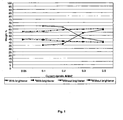
- the combination of the compounds used, in particular those of the brightener system comprising carbonate ions and disulfide compounds, is critical here. In the presence of carbonate ions, even very small amounts of organic disulfidates influence copper-tin alloy formation. In contrast to additive-free baths, a largely constant alloy composition is obtained over a wider current density range as a result of the addition of the brightener system ( fig. 1 - comparison of copper-tin electrolyte based on phosphonic acid with and without brightener system). In the case of additive-free baths, tin is deposited preferentially at higher current densities, which leads to a loss of shine of the layers.
- (C 1 -C 8 )-alkyl is an alkyl radical having from 1 to 8 carbon atoms. This can be branched as desired or in the case of (C 3 -C 6 )-cycloalkyl be cyclic. This is, in particular, radicals such as methyl, ethyl, propyl, isopropyl, butyl, sec-butyl, isobutyl, pentyl, hexyl, cyclopropyl, cyclopentyl, cyclohexyl etc.
- (C 6 -C 18 )-Arryl is an aromatic system which is made up entirely of from 6 to 18 carbon atoms. This is, in particular, selected from the group consisting of phenyl, naphthyl, anthracenyl etc.
- (C 7 -C 19 )-Alkylaryl radicals are radicals which have a (C 1 -C 8 )-alkyl radical on the (C 6 -C 18 )-aryl radical.
- (C 7 -C 19 )-Aralkyl radicals are radicals which have a (C 6 -C 18 )-aryl radical on a (C 1 -C 8 )-alkyl radical, via which the radical is bound to the molecule concerned.
- a (C 3 -C 18 )-heteroaryl radical is an aromatic system which has at least three carbon atoms.
- further heteroatoms are present in the aromatic system. These are preferably nitrogen and/or sulfur.
- Such heteroaromatics are described, for example, in the book Bayer-Walter, Lehrbuch der Organischen Chemie, S. Hirzel Verlag, 22nd edition, p. 703 ff .
- (C 4 -C 19 )-alkylheteroaryl is a (C 3 -C 18 )-heteroaryl radical which is supplemented by a (C 1 -C 8 )-alkyl substituent.
- the bonding to the molecule under consideration is via the heteroaromatic here.
- (C 4 -C 19 )-heteroaralkyl is a (C 3 -C 18 )-heteroaryl which is bound to the molecule concerned via a (C 1 -C 8 )-alkyl substituent.
- halide encompasses chloride, bromide and fluoride.
- Alkyl(hetero)aryl is alkylaryl and alkylheteroaryl.
- Barrel deposition of white bronze layers was carried out using a nontoxic electrolyte according to the invention containing 100 g/l of ethylenediaminetetra(methylenephosphonic acid) EDTMP, 1.5 g/l of copper as copper hydroxide carbonate, 5 g/l of tin as tin pyrophosphate, 2 g/l of zinc as zinc pyrophosphate, 10 m/l of methanesulfonic acid (70%), 20 g/l of potassium hydrogencarbonate and 10 mg/l of bis(3-sodium sulfopropyl) disulfide.
- the electrolyte was maintained at 50°C.
- a set current density of from 0.05 to 0.5 A/dm 2 optically uniform, high-shine bronze layers having the color typical of white bronze were obtained in a drum plating apparatus.
- ATMP 100 g/l of potassium pyrophosphate 20 g/l of citric acid 4.2 g/l of copper hydroxide carbonate 8.66 g/l of tin pyrophosphate 4.5 g/l of zinc pyrophosphate 10 g/l of potassium hydrogencarbonate 0.5 g/l of 6,6'-dithiodinicotinic acid Parameters: pH 9.0 / 60°C / current densities: 0.05 - 0.5 A/dm 2
Landscapes
- Chemical & Material Sciences (AREA)
- Engineering & Computer Science (AREA)
- Chemical Kinetics & Catalysis (AREA)
- Electrochemistry (AREA)
- Materials Engineering (AREA)
- Metallurgy (AREA)
- Organic Chemistry (AREA)
- Electroplating And Plating Baths Therefor (AREA)
- Electrolytic Production Of Metals (AREA)
- Electroplating Methods And Accessories (AREA)
Priority Applications (1)
| Application Number | Priority Date | Filing Date | Title |
|---|---|---|---|
| PL09776985T PL2310558T3 (pl) | 2008-07-10 | 2009-07-06 | Ulepszony elektrolit miedziowo-cynowy i sposób osadzania warstw cyny i brązu |
Applications Claiming Priority (2)
| Application Number | Priority Date | Filing Date | Title |
|---|---|---|---|
| DE102008032398A DE102008032398A1 (de) | 2008-07-10 | 2008-07-10 | Verbesserter Kupfer-Zinn-Elektrolyt und Verfahren zur Abscheidung von Bronzeschichten |
| PCT/EP2009/004879 WO2010003621A1 (en) | 2008-07-10 | 2009-07-06 | Improved copper-tin electrolyte and process for the deposition of bronze layers |
Publications (2)
| Publication Number | Publication Date |
|---|---|
| EP2310558A1 EP2310558A1 (en) | 2011-04-20 |
| EP2310558B1 true EP2310558B1 (en) | 2012-03-14 |
Family
ID=41258161
Family Applications (1)
| Application Number | Title | Priority Date | Filing Date |
|---|---|---|---|
| EP09776985A Not-in-force EP2310558B1 (en) | 2008-07-10 | 2009-07-06 | Improved copper-tin electrolyte and process for the deposition of tin-bronze layers |
Country Status (10)
| Country | Link |
|---|---|
| US (1) | US20110174631A1 (enExample) |
| EP (1) | EP2310558B1 (enExample) |
| JP (1) | JP2011527381A (enExample) |
| KR (1) | KR20110031183A (enExample) |
| CN (1) | CN102089466B (enExample) |
| AT (1) | ATE549434T1 (enExample) |
| DE (1) | DE102008032398A1 (enExample) |
| PL (1) | PL2310558T3 (enExample) |
| TW (1) | TW201014935A (enExample) |
| WO (1) | WO2010003621A1 (enExample) |
Families Citing this family (14)
| Publication number | Priority date | Publication date | Assignee | Title |
|---|---|---|---|---|
| DE102010044551A1 (de) * | 2010-09-07 | 2012-03-08 | Coventya Gmbh | Anode sowie deren Verwendung in einem alkalischen Galvanikbad |
| DE102011121799B4 (de) * | 2011-12-21 | 2013-08-29 | Umicore Galvanotechnik Gmbh | Elektrolyt und Verfahren zur elektrolytischen Abscheidung von Cu-Zn-Sn-Legierungsschichten und Verfahren zur Herstellung einer Dünnschichtsolarzelle |
| DE102012008544A1 (de) | 2012-05-02 | 2013-11-07 | Umicore Galvanotechnik Gmbh | Verchromte Verbundwerkstoffe ohne Nickelschicht |
| AT514818B1 (de) * | 2013-09-18 | 2015-10-15 | W Garhöfer Ges M B H Ing | Abscheidung von Cu, Sn, Zn-Beschichtungen auf metallischen Substraten |
| DE102013226297B3 (de) * | 2013-12-17 | 2015-03-26 | Umicore Galvanotechnik Gmbh | Wässriger, cyanidfreier Elektrolyt für die Abscheidung von Kupfer-Zinn- und Kupfer-Zinn-Zink-Legierungen aus einem Elektrolyten und Verfahren zur elektrolytischen Abscheidung dieser Legierungen |
| CN103789803B (zh) * | 2014-01-13 | 2016-04-27 | 孙松华 | 一种无氰铜锡合金电镀液及其制备方法 |
| JP5938426B2 (ja) * | 2014-02-04 | 2016-06-22 | 株式会社豊田中央研究所 | 電気めっきセル、及び、金属皮膜の製造方法 |
| AR100422A1 (es) * | 2014-05-15 | 2016-10-05 | Nippon Steel & Sumitomo Metal Corp | Solución para deposición para conexión roscada para un caño o tubo y método de producción de la conexión roscada para un caño o tubo |
| CN106521574B (zh) * | 2016-12-05 | 2018-10-26 | 浙江工业大学 | 一种适用于宽pH和宽电流密度范围的无氰镀铜电镀液及其制备方法 |
| TWI728217B (zh) * | 2016-12-28 | 2021-05-21 | 德商德國艾托特克公司 | 錫電鍍浴液及於基板之表面上沉積錫或錫合金之方法 |
| CN110344079B (zh) * | 2019-08-16 | 2021-06-08 | 广东超华科技股份有限公司 | 一种降低电解铜箔电解液中铁离子浓度的装置及方法 |
| RU2762501C1 (ru) * | 2021-05-17 | 2021-12-21 | Федеральное государственное бюджетное образовательное учреждение высшего образования "Российский химико-технологический университет имени Д.И. Менделеева" (РХТУ им. Д.И. Менделеева) | Щелочной электролит для электролитического осаждения желтой оловянной бронзы |
| DE202021004169U1 (de) | 2021-07-02 | 2022-12-07 | Umicore Galvanotechnik Gmbh | Bronzeschicht als Edelmetallersatz in Smart Cards |
| DE102021117095A1 (de) | 2021-07-02 | 2023-01-05 | Umicore Galvanotechnik Gmbh | Bronzeschichten als Edelmetallersatz |
Family Cites Families (24)
| Publication number | Priority date | Publication date | Assignee | Title |
|---|---|---|---|---|
| US3833486A (en) * | 1973-03-26 | 1974-09-03 | Lea Ronal Inc | Cyanide-free electroplating |
| US4289286A (en) * | 1978-10-16 | 1981-09-15 | East/West Industries, Inc. | Replaceable harness bracket assembly |
| US4356067A (en) * | 1979-06-13 | 1982-10-26 | Electrochemical Products, Inc. | Alkaline plating baths and electroplating process |
| US4417956A (en) * | 1980-07-17 | 1983-11-29 | Electrochemical Products, Inc. | Alkaline plating baths and electroplating process |
| US4389286A (en) * | 1980-07-17 | 1983-06-21 | Electrochemical Products, Inc. | Alkaline plating baths and electroplating process |
| US4347108A (en) * | 1981-05-29 | 1982-08-31 | Rohco, Inc. | Electrodeposition of copper, acidic copper electroplating baths and additives therefor |
| CN1004010B (zh) * | 1986-07-11 | 1989-04-26 | 南京大学 | 无氰仿金电镀液 |
| DE4324995C2 (de) * | 1993-07-26 | 1995-12-21 | Demetron Gmbh | Cyanidisch-alkalische Bäder zur galvanischen Abscheidung von Kupfer-Zinn-Legierungsüberzügen |
| SG68083A1 (en) * | 1997-10-30 | 1999-10-19 | Sung Soo Moon | Tin alloy plating compositions |
| TW577938B (en) * | 1998-11-05 | 2004-03-01 | Uyemura C & Co Ltd | Tin-copper alloy electroplating bath and plating process therewith |
| JP2001181889A (ja) * | 1999-12-22 | 2001-07-03 | Nippon Macdermid Kk | 光沢錫−銅合金電気めっき浴 |
| JP3455712B2 (ja) | 2000-04-14 | 2003-10-14 | 日本ニュークローム株式会社 | 銅−スズ合金めっき用ピロリン酸浴 |
| WO2002024979A1 (de) * | 2000-09-20 | 2002-03-28 | Dr.-Ing. Max Schlötter Gmbh & Co. Kg | Elektrolyt und verfahren zur abscheidung von zinn-kupfer-legierungsschichten |
| DE10046600C2 (de) | 2000-09-20 | 2003-02-20 | Schloetter Fa Dr Ing Max | Elektrolyt und Verfahren zur Abscheidung von Zinn-Kupfer-Legierungsschichten und Verwendung des Elektrolyten |
| US6645364B2 (en) * | 2000-10-20 | 2003-11-11 | Shipley Company, L.L.C. | Electroplating bath control |
| JP4249438B2 (ja) * | 2002-07-05 | 2009-04-02 | 日本ニュークローム株式会社 | 銅―錫合金めっき用ピロリン酸浴 |
| DE10243139A1 (de) * | 2002-09-17 | 2004-03-25 | Omg Galvanotechnik Gmbh | Dunkle Schichten |
| ES2531163T3 (es) | 2002-10-11 | 2015-03-11 | Enthone | Procedimiento y electrolito para la deposición galvánica de bronces |
| JP4441726B2 (ja) * | 2003-01-24 | 2010-03-31 | 石原薬品株式会社 | スズ又はスズ合金の脂肪族スルホン酸メッキ浴の製造方法 |
| US7128822B2 (en) * | 2003-06-04 | 2006-10-31 | Shipley Company, L.L.C. | Leveler compounds |
| US20050067297A1 (en) * | 2003-09-26 | 2005-03-31 | Innovative Technology Licensing, Llc | Copper bath for electroplating fine circuitry on semiconductor chips |
| US20060231409A1 (en) * | 2005-03-31 | 2006-10-19 | Tdk Corporation | Plating solution, conductive material, and surface treatment method of conductive material |
| EP1870495A1 (de) * | 2006-06-21 | 2007-12-26 | Atotech Deutschland Gmbh | Wässriges alkalisches cyanidfreies Bad zur galvanischen Abscheidung von Zink- und Zinklegierungsüberzügen |
| EP1961840B1 (de) * | 2007-02-14 | 2009-12-30 | Umicore Galvanotechnik GmbH | Kupfer-Zinn-Elektrolyt und Verfahren zur Abscheidung von Bronzeschichten |
-
2008
- 2008-07-10 DE DE102008032398A patent/DE102008032398A1/de not_active Ceased
-
2009
- 2009-07-03 TW TW098122653A patent/TW201014935A/zh unknown
- 2009-07-06 JP JP2011517017A patent/JP2011527381A/ja not_active Withdrawn
- 2009-07-06 PL PL09776985T patent/PL2310558T3/pl unknown
- 2009-07-06 US US13/003,209 patent/US20110174631A1/en not_active Abandoned
- 2009-07-06 CN CN2009801264856A patent/CN102089466B/zh not_active Expired - Fee Related
- 2009-07-06 AT AT09776985T patent/ATE549434T1/de active
- 2009-07-06 WO PCT/EP2009/004879 patent/WO2010003621A1/en not_active Ceased
- 2009-07-06 EP EP09776985A patent/EP2310558B1/en not_active Not-in-force
- 2009-07-06 KR KR1020117000324A patent/KR20110031183A/ko not_active Withdrawn
Also Published As
| Publication number | Publication date |
|---|---|
| KR20110031183A (ko) | 2011-03-24 |
| TW201014935A (en) | 2010-04-16 |
| EP2310558A1 (en) | 2011-04-20 |
| PL2310558T3 (pl) | 2012-09-28 |
| CN102089466A (zh) | 2011-06-08 |
| ATE549434T1 (de) | 2012-03-15 |
| DE102008032398A1 (de) | 2010-01-14 |
| JP2011527381A (ja) | 2011-10-27 |
| CN102089466B (zh) | 2012-11-07 |
| WO2010003621A1 (en) | 2010-01-14 |
| US20110174631A1 (en) | 2011-07-21 |
Similar Documents
| Publication | Publication Date | Title |
|---|---|---|
| EP2310558B1 (en) | Improved copper-tin electrolyte and process for the deposition of tin-bronze layers | |
| US8211285B2 (en) | Copper-tin electrolyte and method for depositing bronze layers | |
| EP1874982B1 (en) | Method for electrodeposition of bronzes | |
| US20110089043A1 (en) | Modified copper-tin electrolyte and process for the deposition of bronze layers | |
| EP3084042B1 (en) | Deposition of copper-tin and copper-tin-zinc alloys from an electrolyte | |
| JP2012504701A (ja) | 向上した白色度を有するパラジウム−ロジウム層の堆積方法 | |
| TWI417427B (zh) | 含銀合金鍍敷浴、使用其之電解鍍敷方法 | |
| US20190071789A1 (en) | Additive for silver-palladium alloy electrolytes | |
| US20130140185A1 (en) | Electrolyte and process for the deposition of copper-tin alloy layers | |
| JP2013534276A5 (enExample) | ||
| TWI427195B (zh) | 用於沈積出黑色釕裝飾層與技術層的電解液與方法 | |
| EP3399071B1 (en) | Snag alloy plating liquid | |
| GB2046794A (en) | Silver and gold/silver alloy plating bath and method | |
| HK1137785B (en) | Copper-tin electrolyte and method for depositing bronze layers |
Legal Events
| Date | Code | Title | Description |
|---|---|---|---|
| PUAI | Public reference made under article 153(3) epc to a published international application that has entered the european phase |
Free format text: ORIGINAL CODE: 0009012 |
|
| 17P | Request for examination filed |
Effective date: 20110210 |
|
| AK | Designated contracting states |
Kind code of ref document: A1 Designated state(s): AT BE BG CH CY CZ DE DK EE ES FI FR GB GR HR HU IE IS IT LI LT LU LV MC MK MT NL NO PL PT RO SE SI SK SM TR |
|
| AX | Request for extension of the european patent |
Extension state: AL BA RS |
|
| RIN1 | Information on inventor provided before grant (corrected) |
Inventor name: BRONDER, KLAUS Inventor name: WEYHMUELLER, BERND Inventor name: OBERST, FRANK Inventor name: BERGER, SASCHA Inventor name: MANZ, UWE |
|
| RTI1 | Title (correction) |
Free format text: IMPROVED COPPER-TIN ELECTROLYTE AND PROCESS FOR THE DEPOSITION OF TIN-BRONZE LAYERS |
|
| DAX | Request for extension of the european patent (deleted) | ||
| GRAP | Despatch of communication of intention to grant a patent |
Free format text: ORIGINAL CODE: EPIDOSNIGR1 |
|
| GRAS | Grant fee paid |
Free format text: ORIGINAL CODE: EPIDOSNIGR3 |
|
| GRAA | (expected) grant |
Free format text: ORIGINAL CODE: 0009210 |
|
| AK | Designated contracting states |
Kind code of ref document: B1 Designated state(s): AT BE BG CH CY CZ DE DK EE ES FI FR GB GR HR HU IE IS IT LI LT LU LV MC MK MT NL NO PL PT RO SE SI SK SM TR |
|
| REG | Reference to a national code |
Ref country code: GB Ref legal event code: FG4D |
|
| RIN1 | Information on inventor provided before grant (corrected) |
Inventor name: WEYHMUELLER, BERND Inventor name: BERGER, SASCHA Inventor name: OBERST, FRANK Inventor name: MANZ, UWE Inventor name: BRONDER, KLAUS |
|
| REG | Reference to a national code |
Ref country code: AT Ref legal event code: REF Ref document number: 549434 Country of ref document: AT Kind code of ref document: T Effective date: 20120315 Ref country code: CH Ref legal event code: EP |
|
| REG | Reference to a national code |
Ref country code: IE Ref legal event code: FG4D |
|
| REG | Reference to a national code |
Ref country code: DE Ref legal event code: R096 Ref document number: 602009005930 Country of ref document: DE Effective date: 20120510 |
|
| REG | Reference to a national code |
Ref country code: NL Ref legal event code: VDEP Effective date: 20120314 |
|
| PG25 | Lapsed in a contracting state [announced via postgrant information from national office to epo] |
Ref country code: LT Free format text: LAPSE BECAUSE OF FAILURE TO SUBMIT A TRANSLATION OF THE DESCRIPTION OR TO PAY THE FEE WITHIN THE PRESCRIBED TIME-LIMIT Effective date: 20120314 Ref country code: NO Free format text: LAPSE BECAUSE OF FAILURE TO SUBMIT A TRANSLATION OF THE DESCRIPTION OR TO PAY THE FEE WITHIN THE PRESCRIBED TIME-LIMIT Effective date: 20120614 Ref country code: HR Free format text: LAPSE BECAUSE OF FAILURE TO SUBMIT A TRANSLATION OF THE DESCRIPTION OR TO PAY THE FEE WITHIN THE PRESCRIBED TIME-LIMIT Effective date: 20120314 |
|
| LTIE | Lt: invalidation of european patent or patent extension |
Effective date: 20120314 |
|
| PG25 | Lapsed in a contracting state [announced via postgrant information from national office to epo] |
Ref country code: GR Free format text: LAPSE BECAUSE OF FAILURE TO SUBMIT A TRANSLATION OF THE DESCRIPTION OR TO PAY THE FEE WITHIN THE PRESCRIBED TIME-LIMIT Effective date: 20120615 Ref country code: LV Free format text: LAPSE BECAUSE OF FAILURE TO SUBMIT A TRANSLATION OF THE DESCRIPTION OR TO PAY THE FEE WITHIN THE PRESCRIBED TIME-LIMIT Effective date: 20120314 Ref country code: FI Free format text: LAPSE BECAUSE OF FAILURE TO SUBMIT A TRANSLATION OF THE DESCRIPTION OR TO PAY THE FEE WITHIN THE PRESCRIBED TIME-LIMIT Effective date: 20120314 |
|
| REG | Reference to a national code |
Ref country code: AT Ref legal event code: MK05 Ref document number: 549434 Country of ref document: AT Kind code of ref document: T Effective date: 20120314 |
|
| PG25 | Lapsed in a contracting state [announced via postgrant information from national office to epo] |
Ref country code: CY Free format text: LAPSE BECAUSE OF FAILURE TO SUBMIT A TRANSLATION OF THE DESCRIPTION OR TO PAY THE FEE WITHIN THE PRESCRIBED TIME-LIMIT Effective date: 20120314 |
|
| REG | Reference to a national code |
Ref country code: PL Ref legal event code: T3 |
|
| PG25 | Lapsed in a contracting state [announced via postgrant information from national office to epo] |
Ref country code: SI Free format text: LAPSE BECAUSE OF FAILURE TO SUBMIT A TRANSLATION OF THE DESCRIPTION OR TO PAY THE FEE WITHIN THE PRESCRIBED TIME-LIMIT Effective date: 20120314 Ref country code: BE Free format text: LAPSE BECAUSE OF FAILURE TO SUBMIT A TRANSLATION OF THE DESCRIPTION OR TO PAY THE FEE WITHIN THE PRESCRIBED TIME-LIMIT Effective date: 20120314 Ref country code: RO Free format text: LAPSE BECAUSE OF FAILURE TO SUBMIT A TRANSLATION OF THE DESCRIPTION OR TO PAY THE FEE WITHIN THE PRESCRIBED TIME-LIMIT Effective date: 20120314 Ref country code: SE Free format text: LAPSE BECAUSE OF FAILURE TO SUBMIT A TRANSLATION OF THE DESCRIPTION OR TO PAY THE FEE WITHIN THE PRESCRIBED TIME-LIMIT Effective date: 20120314 Ref country code: EE Free format text: LAPSE BECAUSE OF FAILURE TO SUBMIT A TRANSLATION OF THE DESCRIPTION OR TO PAY THE FEE WITHIN THE PRESCRIBED TIME-LIMIT Effective date: 20120314 Ref country code: IS Free format text: LAPSE BECAUSE OF FAILURE TO SUBMIT A TRANSLATION OF THE DESCRIPTION OR TO PAY THE FEE WITHIN THE PRESCRIBED TIME-LIMIT Effective date: 20120714 |
|
| PG25 | Lapsed in a contracting state [announced via postgrant information from national office to epo] |
Ref country code: PT Free format text: LAPSE BECAUSE OF FAILURE TO SUBMIT A TRANSLATION OF THE DESCRIPTION OR TO PAY THE FEE WITHIN THE PRESCRIBED TIME-LIMIT Effective date: 20120716 Ref country code: SK Free format text: LAPSE BECAUSE OF FAILURE TO SUBMIT A TRANSLATION OF THE DESCRIPTION OR TO PAY THE FEE WITHIN THE PRESCRIBED TIME-LIMIT Effective date: 20120314 |
|
| PLBE | No opposition filed within time limit |
Free format text: ORIGINAL CODE: 0009261 |
|
| STAA | Information on the status of an ep patent application or granted ep patent |
Free format text: STATUS: NO OPPOSITION FILED WITHIN TIME LIMIT |
|
| PG25 | Lapsed in a contracting state [announced via postgrant information from national office to epo] |
Ref country code: NL Free format text: LAPSE BECAUSE OF FAILURE TO SUBMIT A TRANSLATION OF THE DESCRIPTION OR TO PAY THE FEE WITHIN THE PRESCRIBED TIME-LIMIT Effective date: 20120314 Ref country code: AT Free format text: LAPSE BECAUSE OF FAILURE TO SUBMIT A TRANSLATION OF THE DESCRIPTION OR TO PAY THE FEE WITHIN THE PRESCRIBED TIME-LIMIT Effective date: 20120314 Ref country code: DK Free format text: LAPSE BECAUSE OF FAILURE TO SUBMIT A TRANSLATION OF THE DESCRIPTION OR TO PAY THE FEE WITHIN THE PRESCRIBED TIME-LIMIT Effective date: 20120314 |
|
| 26N | No opposition filed |
Effective date: 20121217 |
|
| PG25 | Lapsed in a contracting state [announced via postgrant information from national office to epo] |
Ref country code: MC Free format text: LAPSE BECAUSE OF NON-PAYMENT OF DUE FEES Effective date: 20120731 Ref country code: MK Free format text: LAPSE BECAUSE OF FAILURE TO SUBMIT A TRANSLATION OF THE DESCRIPTION OR TO PAY THE FEE WITHIN THE PRESCRIBED TIME-LIMIT Effective date: 20120314 |
|
| REG | Reference to a national code |
Ref country code: DE Ref legal event code: R097 Ref document number: 602009005930 Country of ref document: DE Effective date: 20121217 |
|
| PG25 | Lapsed in a contracting state [announced via postgrant information from national office to epo] |
Ref country code: ES Free format text: LAPSE BECAUSE OF FAILURE TO SUBMIT A TRANSLATION OF THE DESCRIPTION OR TO PAY THE FEE WITHIN THE PRESCRIBED TIME-LIMIT Effective date: 20120625 |
|
| REG | Reference to a national code |
Ref country code: IE Ref legal event code: MM4A |
|
| PG25 | Lapsed in a contracting state [announced via postgrant information from national office to epo] |
Ref country code: IE Free format text: LAPSE BECAUSE OF NON-PAYMENT OF DUE FEES Effective date: 20120706 Ref country code: BG Free format text: LAPSE BECAUSE OF FAILURE TO SUBMIT A TRANSLATION OF THE DESCRIPTION OR TO PAY THE FEE WITHIN THE PRESCRIBED TIME-LIMIT Effective date: 20120614 Ref country code: MT Free format text: LAPSE BECAUSE OF FAILURE TO SUBMIT A TRANSLATION OF THE DESCRIPTION OR TO PAY THE FEE WITHIN THE PRESCRIBED TIME-LIMIT Effective date: 20120314 |
|
| PGFP | Annual fee paid to national office [announced via postgrant information from national office to epo] |
Ref country code: CZ Payment date: 20130619 Year of fee payment: 5 |
|
| PGFP | Annual fee paid to national office [announced via postgrant information from national office to epo] |
Ref country code: IT Payment date: 20130620 Year of fee payment: 5 |
|
| PGFP | Annual fee paid to national office [announced via postgrant information from national office to epo] |
Ref country code: CH Payment date: 20130712 Year of fee payment: 5 Ref country code: DE Payment date: 20130703 Year of fee payment: 5 |
|
| PGFP | Annual fee paid to national office [announced via postgrant information from national office to epo] |
Ref country code: FR Payment date: 20130724 Year of fee payment: 5 Ref country code: PL Payment date: 20130701 Year of fee payment: 5 Ref country code: GB Payment date: 20130703 Year of fee payment: 5 |
|
| PG25 | Lapsed in a contracting state [announced via postgrant information from national office to epo] |
Ref country code: TR Free format text: LAPSE BECAUSE OF FAILURE TO SUBMIT A TRANSLATION OF THE DESCRIPTION OR TO PAY THE FEE WITHIN THE PRESCRIBED TIME-LIMIT Effective date: 20120314 |
|
| PG25 | Lapsed in a contracting state [announced via postgrant information from national office to epo] |
Ref country code: LU Free format text: LAPSE BECAUSE OF NON-PAYMENT OF DUE FEES Effective date: 20120706 Ref country code: SM Free format text: LAPSE BECAUSE OF FAILURE TO SUBMIT A TRANSLATION OF THE DESCRIPTION OR TO PAY THE FEE WITHIN THE PRESCRIBED TIME-LIMIT Effective date: 20120314 |
|
| PG25 | Lapsed in a contracting state [announced via postgrant information from national office to epo] |
Ref country code: HU Free format text: LAPSE BECAUSE OF FAILURE TO SUBMIT A TRANSLATION OF THE DESCRIPTION OR TO PAY THE FEE WITHIN THE PRESCRIBED TIME-LIMIT Effective date: 20090706 |
|
| PG25 | Lapsed in a contracting state [announced via postgrant information from national office to epo] |
Ref country code: CZ Free format text: LAPSE BECAUSE OF NON-PAYMENT OF DUE FEES Effective date: 20140706 |
|
| REG | Reference to a national code |
Ref country code: DE Ref legal event code: R119 Ref document number: 602009005930 Country of ref document: DE |
|
| REG | Reference to a national code |
Ref country code: CH Ref legal event code: PL |
|
| GBPC | Gb: european patent ceased through non-payment of renewal fee |
Effective date: 20140706 |
|
| REG | Reference to a national code |
Ref country code: FR Ref legal event code: ST Effective date: 20150331 |
|
| PG25 | Lapsed in a contracting state [announced via postgrant information from national office to epo] |
Ref country code: LI Free format text: LAPSE BECAUSE OF NON-PAYMENT OF DUE FEES Effective date: 20140731 Ref country code: IT Free format text: LAPSE BECAUSE OF NON-PAYMENT OF DUE FEES Effective date: 20140706 Ref country code: DE Free format text: LAPSE BECAUSE OF NON-PAYMENT OF DUE FEES Effective date: 20150203 Ref country code: CH Free format text: LAPSE BECAUSE OF NON-PAYMENT OF DUE FEES Effective date: 20140731 |
|
| REG | Reference to a national code |
Ref country code: DE Ref legal event code: R119 Ref document number: 602009005930 Country of ref document: DE Effective date: 20150203 |
|
| PG25 | Lapsed in a contracting state [announced via postgrant information from national office to epo] |
Ref country code: FR Free format text: LAPSE BECAUSE OF NON-PAYMENT OF DUE FEES Effective date: 20140731 Ref country code: GB Free format text: LAPSE BECAUSE OF NON-PAYMENT OF DUE FEES Effective date: 20140706 |
|
| REG | Reference to a national code |
Ref country code: PL Ref legal event code: LAPE |
|
| PG25 | Lapsed in a contracting state [announced via postgrant information from national office to epo] |
Ref country code: PL Free format text: LAPSE BECAUSE OF NON-PAYMENT OF DUE FEES Effective date: 20140706 |