EP2309749B1 - Improved optimization techniques for data compression - Google Patents
Improved optimization techniques for data compression Download PDFInfo
- Publication number
- EP2309749B1 EP2309749B1 EP10012820.6A EP10012820A EP2309749B1 EP 2309749 B1 EP2309749 B1 EP 2309749B1 EP 10012820 A EP10012820 A EP 10012820A EP 2309749 B1 EP2309749 B1 EP 2309749B1
- Authority
- EP
- European Patent Office
- Prior art keywords
- slice
- direct mode
- prediction
- macroblocks
- temporal
- Prior art date
- Legal status (The legal status is an assumption and is not a legal conclusion. Google has not performed a legal analysis and makes no representation as to the accuracy of the status listed.)
- Expired - Lifetime
Links
- 238000005457 optimization Methods 0.000 title claims description 12
- 238000013144 data compression Methods 0.000 title description 3
- 238000000034 method Methods 0.000 claims description 100
- 230000002123 temporal effect Effects 0.000 claims description 40
- 239000013598 vector Substances 0.000 claims description 16
- 230000015654 memory Effects 0.000 claims description 12
- 230000011664 signaling Effects 0.000 claims description 3
- 230000008569 process Effects 0.000 description 26
- 238000013139 quantization Methods 0.000 description 21
- 230000003044 adaptive effect Effects 0.000 description 15
- 238000010586 diagram Methods 0.000 description 14
- 238000004458 analytical method Methods 0.000 description 10
- 238000007906 compression Methods 0.000 description 7
- 230000006835 compression Effects 0.000 description 7
- 238000004891 communication Methods 0.000 description 6
- 238000003708 edge detection Methods 0.000 description 6
- 230000006870 function Effects 0.000 description 6
- 238000010191 image analysis Methods 0.000 description 6
- 230000003287 optical effect Effects 0.000 description 6
- 238000012545 processing Methods 0.000 description 6
- 230000000875 corresponding effect Effects 0.000 description 5
- 230000008859 change Effects 0.000 description 4
- 230000001419 dependent effect Effects 0.000 description 4
- 230000002093 peripheral effect Effects 0.000 description 4
- 238000002474 experimental method Methods 0.000 description 3
- 230000006855 networking Effects 0.000 description 3
- 230000008901 benefit Effects 0.000 description 2
- 230000005540 biological transmission Effects 0.000 description 2
- 238000001514 detection method Methods 0.000 description 2
- 230000006872 improvement Effects 0.000 description 2
- 230000007246 mechanism Effects 0.000 description 2
- 230000005055 memory storage Effects 0.000 description 2
- 230000009467 reduction Effects 0.000 description 2
- 101100129500 Caenorhabditis elegans max-2 gene Proteins 0.000 description 1
- 241000613118 Gryllus integer Species 0.000 description 1
- 230000000903 blocking effect Effects 0.000 description 1
- 230000002596 correlated effect Effects 0.000 description 1
- 230000000873 masking effect Effects 0.000 description 1
- 239000011159 matrix material Substances 0.000 description 1
- 238000005259 measurement Methods 0.000 description 1
- 238000012986 modification Methods 0.000 description 1
- 230000004048 modification Effects 0.000 description 1
- 230000008707 rearrangement Effects 0.000 description 1
- 238000006467 substitution reaction Methods 0.000 description 1
- 238000012546 transfer Methods 0.000 description 1
Images





Classifications
-
- H—ELECTRICITY
- H04—ELECTRIC COMMUNICATION TECHNIQUE
- H04N—PICTORIAL COMMUNICATION, e.g. TELEVISION
- H04N19/00—Methods or arrangements for coding, decoding, compressing or decompressing digital video signals
- H04N19/50—Methods or arrangements for coding, decoding, compressing or decompressing digital video signals using predictive coding
- H04N19/503—Methods or arrangements for coding, decoding, compressing or decompressing digital video signals using predictive coding involving temporal prediction
- H04N19/51—Motion estimation or motion compensation
- H04N19/567—Motion estimation based on rate distortion criteria
-
- H—ELECTRICITY
- H04—ELECTRIC COMMUNICATION TECHNIQUE
- H04N—PICTORIAL COMMUNICATION, e.g. TELEVISION
- H04N19/00—Methods or arrangements for coding, decoding, compressing or decompressing digital video signals
- H04N19/10—Methods or arrangements for coding, decoding, compressing or decompressing digital video signals using adaptive coding
- H04N19/102—Methods or arrangements for coding, decoding, compressing or decompressing digital video signals using adaptive coding characterised by the element, parameter or selection affected or controlled by the adaptive coding
- H04N19/103—Selection of coding mode or of prediction mode
-
- H—ELECTRICITY
- H04—ELECTRIC COMMUNICATION TECHNIQUE
- H04N—PICTORIAL COMMUNICATION, e.g. TELEVISION
- H04N19/00—Methods or arrangements for coding, decoding, compressing or decompressing digital video signals
- H04N19/10—Methods or arrangements for coding, decoding, compressing or decompressing digital video signals using adaptive coding
- H04N19/102—Methods or arrangements for coding, decoding, compressing or decompressing digital video signals using adaptive coding characterised by the element, parameter or selection affected or controlled by the adaptive coding
- H04N19/124—Quantisation
- H04N19/126—Details of normalisation or weighting functions, e.g. normalisation matrices or variable uniform quantisers
-
- H—ELECTRICITY
- H04—ELECTRIC COMMUNICATION TECHNIQUE
- H04N—PICTORIAL COMMUNICATION, e.g. TELEVISION
- H04N19/00—Methods or arrangements for coding, decoding, compressing or decompressing digital video signals
- H04N19/10—Methods or arrangements for coding, decoding, compressing or decompressing digital video signals using adaptive coding
- H04N19/134—Methods or arrangements for coding, decoding, compressing or decompressing digital video signals using adaptive coding characterised by the element, parameter or criterion affecting or controlling the adaptive coding
- H04N19/146—Data rate or code amount at the encoder output
- H04N19/147—Data rate or code amount at the encoder output according to rate distortion criteria
-
- H—ELECTRICITY
- H04—ELECTRIC COMMUNICATION TECHNIQUE
- H04N—PICTORIAL COMMUNICATION, e.g. TELEVISION
- H04N19/00—Methods or arrangements for coding, decoding, compressing or decompressing digital video signals
- H04N19/10—Methods or arrangements for coding, decoding, compressing or decompressing digital video signals using adaptive coding
- H04N19/134—Methods or arrangements for coding, decoding, compressing or decompressing digital video signals using adaptive coding characterised by the element, parameter or criterion affecting or controlling the adaptive coding
- H04N19/146—Data rate or code amount at the encoder output
- H04N19/149—Data rate or code amount at the encoder output by estimating the code amount by means of a model, e.g. mathematical model or statistical model
-
- H—ELECTRICITY
- H04—ELECTRIC COMMUNICATION TECHNIQUE
- H04N—PICTORIAL COMMUNICATION, e.g. TELEVISION
- H04N19/00—Methods or arrangements for coding, decoding, compressing or decompressing digital video signals
- H04N19/10—Methods or arrangements for coding, decoding, compressing or decompressing digital video signals using adaptive coding
- H04N19/134—Methods or arrangements for coding, decoding, compressing or decompressing digital video signals using adaptive coding characterised by the element, parameter or criterion affecting or controlling the adaptive coding
- H04N19/162—User input
-
- H—ELECTRICITY
- H04—ELECTRIC COMMUNICATION TECHNIQUE
- H04N—PICTORIAL COMMUNICATION, e.g. TELEVISION
- H04N19/00—Methods or arrangements for coding, decoding, compressing or decompressing digital video signals
- H04N19/10—Methods or arrangements for coding, decoding, compressing or decompressing digital video signals using adaptive coding
- H04N19/169—Methods or arrangements for coding, decoding, compressing or decompressing digital video signals using adaptive coding characterised by the coding unit, i.e. the structural portion or semantic portion of the video signal being the object or the subject of the adaptive coding
- H04N19/186—Methods or arrangements for coding, decoding, compressing or decompressing digital video signals using adaptive coding characterised by the coding unit, i.e. the structural portion or semantic portion of the video signal being the object or the subject of the adaptive coding the unit being a colour or a chrominance component
-
- H—ELECTRICITY
- H04—ELECTRIC COMMUNICATION TECHNIQUE
- H04N—PICTORIAL COMMUNICATION, e.g. TELEVISION
- H04N19/00—Methods or arrangements for coding, decoding, compressing or decompressing digital video signals
- H04N19/10—Methods or arrangements for coding, decoding, compressing or decompressing digital video signals using adaptive coding
- H04N19/189—Methods or arrangements for coding, decoding, compressing or decompressing digital video signals using adaptive coding characterised by the adaptation method, adaptation tool or adaptation type used for the adaptive coding
- H04N19/19—Methods or arrangements for coding, decoding, compressing or decompressing digital video signals using adaptive coding characterised by the adaptation method, adaptation tool or adaptation type used for the adaptive coding using optimisation based on Lagrange multipliers
-
- H—ELECTRICITY
- H04—ELECTRIC COMMUNICATION TECHNIQUE
- H04N—PICTORIAL COMMUNICATION, e.g. TELEVISION
- H04N19/00—Methods or arrangements for coding, decoding, compressing or decompressing digital video signals
- H04N19/60—Methods or arrangements for coding, decoding, compressing or decompressing digital video signals using transform coding
-
- H—ELECTRICITY
- H04—ELECTRIC COMMUNICATION TECHNIQUE
- H04N—PICTORIAL COMMUNICATION, e.g. TELEVISION
- H04N19/00—Methods or arrangements for coding, decoding, compressing or decompressing digital video signals
- H04N19/60—Methods or arrangements for coding, decoding, compressing or decompressing digital video signals using transform coding
- H04N19/61—Methods or arrangements for coding, decoding, compressing or decompressing digital video signals using transform coding in combination with predictive coding
Definitions
- the present invention relates generally to computers and like devices, and more particularly to methods, apparatuses and systems for compressing/encoding data and decompressing/decoding data.
- Rate Distortion Optimization (RDO) techniques are quite popular in video and image encoding/decoding systems since they can considerably improve encoding efficiency compared to more conventional encoding methods.
- the invention provides methods according to claims 1 and 6 and a computer-readable medium according to claim 10.
- the present invention provides improved methods and apparatuses that can be used in compressing/encoding, decompressing/decoding data, and/or otherwise processing various forms of data including, but not limited to image, video and/or audio data.
- a method that includes processing at least a portion of data using a plurality of different quantization functions to produce a plurality of corresponding quantized portions of data, and selectively outputting one of the quantized portions of data based on at least one threshold value.
- the method may also include dividing initial data into a plurality of portions and classifying the portion of data based on at least one classification characteristic.
- there may be a threshold value that is associated with the classification characteristic.
- the initial data may include image data, video data, audio data, speech data, and the like.
- the portion that is selected may take the form of a block, a macroblock, a slit, a slice, a section, or the like.
- the classification characteristic(s) may include an edge characteristic, a texture characteristic, a smoothness characteristic, a luminance characteristic, a chrominance characteristic, a color characteristic, a noise characteristic, an object characteristic, a motion characteristic, a user preference characteristic, a user interface focus characteristic, a layering characteristic, a timing characteristic, a volume characteristic, a frequency characteristic, a pitch characteristic, a tone characteristic, a quality characteristic, a bit rate characteristic, a data type characteristic, a resolution characteristic, an encryption characteristic, or the like.
- the plurality of different quantization functions includes at least two operatively different Deadzone Quantizers.
- a Deadzone Quantizer may be an adaptive coverage Deadzone Quantizer, a variable coverage size Deadzone Quantizer, or the like.
- the method may also include encoding the quantized portions.
- the method may further include performing Rate Distortion Optimization (RDO) to select the quantized portions of data.
- RDO Rate Distortion Optimization
- another method includes performing at least one characteristic analysis on at least one portion of image data, selectively setting at least one adaptive quantization parameter within an encoder based on the characteristic analysis, and encoding the portion of image data with the encoder.
- a method in yet another exemplary implementation, includes causing at least one portion of image data to be encoded using at least two different Deadzone Quantizers, and identifying preferred encoded data in an output of one of the at least two different Deadzone Quantizers based on a Rate Distortion Optimization (RDO) decision associated with at least one decision factor.
- RDO Rate Distortion Optimization
- a method that includes causing at least one portion of image data to be encoded using a first Deadzone Quantizer, determining if an output of the first Deadzone Quantizer satisfies at least one decision factor and if so, then outputting the output of the first Deadzone Quantizer. If not, then causing the portion of image data to be encoded using at least a second Deadzone Quantizer that is different from the first Deadzone Quantizer.
- the method may also include identifying an acceptable encoded version of the portion of the image data based on an RDO decision or other like.
- a method includes performing image analysis on at least one portion of image data, performing block classification on the analyzed portion of image data, performing Deadzone Quantization of the block classified portion of image data, and performing encoding of the Deadzone Quantized portion of image data.
- the image analysis may include edge detection analysis, texture analysis, etc.
- a method includes causing at least one portion of video image data to be encoded using at least two different encoders wherein at least one of the two different encoders includes a Deadzone Quantizer operatively configured to support a Non Residual Mode of the video image data, and identifying preferred encoded frame data in an output of one of the two different encoders based on a Rate Distortion Optimization (RDO) decision associated with at least one decision factor.
- RDO Rate Distortion Optimization
- Another exemplary method includes selectively varying at least one Lagrangian multiplier that is operatively configuring encoding logic having a quantizing function based on at least one characteristic of at least one portion of image data, and encoding the portion of the image data using the encoding logic.
- an exemplary method includes encoding at least a portion of video image data using encoder logic, and causing the encoder logic to output syntax information identifying a type of motion vector prediction employed by the encoder logic.
- a method for use in conveying video encoding related information includes encoding video data, and selectively setting at least one descriptor within a syntax portion of the encoded video data, the descriptor identifying an adaptive spatial/spatio-temporal encoding associated with at least one B frame encoded with the video data.
- Another method for use in conveying video encoding related information includes encoding video data, and selectively setting at least one descriptor within a syntax portion of the encoded video data, the descriptor identifying an adaptive copy/motion-copy skip mode in at least one inter frame encoded with the video data.
- the method includes selectively applying spatial prediction of motion associated with at least one portion of a video frame in a video sequence, and, if temporal motion prediction information for a reference portion of another video frame is zero, then setting the spatial prediction of motion to zero.
- program modules include routines, programs, objects, components, data structures, etc. that perform particular tasks or implement particular abstract data types.
- program modules may also be practiced in distributed computing environments where tasks are performed by remote processing devices that are linked through a communications network.
- program modules may be located in both local and remote memory storage devices.
- Fig.1 illustrates an example of a suitable computing environment 120 on which the subsequently described methods and arrangements may be implemented.
- Exemplary computing environment 120 is only one example of a suitable computing environment and is not intended to suggest any limitation as to the scope of use or functionality of the improved methods and arrangements described herein. Neither should computing environment 120 be interpreted as having any dependency or requirement relating to any one or combination of components illustrated in computing environment 120.
- computing environment 120 includes a general-purpose computing device in the form of a computer 130.
- the components of computer 130 may include one or more processors or processing units 132, a system memory 134, and a bus 136 that couples various system components including system memory 134 to processor 132.
- Bus 136 represents one or more of any of several types of bus structures, including a memory bus or memory controller, a peripheral bus, an accelerated graphics port, and a processor or local bus using any of a variety of bus architectures.
- bus architectures include Industry Standard Architecture (ISA) bus, Micro Channel Architecture (MCA) bus, Enhanced ISA (EISA) bus, Video Electronics Standards Association (VESA) local bus, and Peripheral Component Interconnects (PCI) bus also known as Mezzanine bus.
- Computer 130 typically includes a variety of computer readable media. Such media may be any available media that is accessible by computer 130, and it includes both volatile and non-volatile media, removable and non-removable media.
- system memory 134 includes computer readable media in the form of volatile memory, such as random access memory (RAM) 140, and/or non-volatile memory, such as read only memory (ROM) 138.
- RAM random access memory
- ROM read only memory
- a basic input/output system (BIOS) 142 containing the basic routines that help to transfer information between elements within computer 130, such as during start-up, is stored in ROM 138.
- BIOS basic input/output system
- RAM 140 typically contains data and/or program modules that are immediately accessible to and/or presently being operated on by processor 132.
- Computer 130 may further include other removable/non-removable, volatile/non-volatile computer storage media.
- Fig. 1 illustrates a hard disk drive 144 for reading from and writing to a non-removable, non-volatile magnetic media (not shown and typically called a "hard drive"), a magnetic disk drive 146 for reading from and writing to a removable, non-volatile magnetic disk 148 (e.g., a "floppy disk"), and an optical disk drive 150 for reading from or writing to a removable, non-volatile optical disk 152 such as a CD-ROM, CD-R, CD-RW, DVD-ROM, DVD-RAM or other optical media.
- Hard disk drive 144, magnetic disk drive 146 and optical disk drive 150 are each connected to bus 136 by one or more interfaces 154.
- the drives and associated computer-readable media provide nonvolatile storage of computer readable instructions, data structures, program modules, and other data for computer 130.
- exemplary environment described herein employs a hard disk, a removable magnetic disk 148 and a removable optical disk 152, it should be appreciated by those skilled in the art that other types of computer readable media which can store data that is accessible by a computer, such as magnetic cassettes, flash memory cards, digital video disks, random access memories (RAMs), read only memories (ROM), and the like, may also be used in the exemplary operating environment.
- a number of program modules may be stored on the hard disk, magnetic disk 148, optical disk 152, ROM 138, or RAM 140, including, e.g., an operating system 158, one or more application programs 160, other program modules 162, and program data 164.
- operating system 158 may be implemented within operating system 158, one or more application programs 160, other program modules 162, and/or program data 164.
- a user may provide commands and information into computer 130 through input devices such as keyboard 166 and pointing device 168 (such as a "mouse").
- Other input devices may include a microphone, joystick, game pad, satellite dish, serial port, scanner, camera, etc.
- a user input interface 170 that is coupled to bus 136, but may be connected by other interface and bus structures, such as a parallel port, game port, or a universal serial bus (USB).
- USB universal serial bus
- a monitor 172 or other type of display device is also connected to bus 136 via an interface, such as a video adapter 174.
- a monitor 172 or other type of display device is also connected to bus 136 via an interface, such as a video adapter 174.
- personal computers typically include other peripheral output devices (not shown), such as speakers and printers, which may be connected through output peripheral interface 175.
- Computer 130 may operate in a networked environment using logical connections to one or more remote computers, such as a remote computer 182.
- Remote computer 182 may include many or all of the elements and features described herein relative to computer 130.
- Logical connections shown in Fig. 1 are a local area network (LAN) 177 and a general wide area network (WAN) 179.
- LAN local area network
- WAN wide area network
- Such networking environments are commonplace in offices, enterprise-wide computer networks, intranets, and the Internet.
- computer 130 When used in a LAN networking environment, computer 130 is connected to LAN 177 via network interface or adapter 186. When used in a WAN networking environment, the computer typically includes a modem 178 or other means for establishing communications over WAN 179. Modem 178, which may be internal or external, may be connected to system bus 136 via the user input interface 170 or other appropriate mechanism.
- Fig. 1 Depicted in Fig. 1 , is a specific implementation of a WAN via the Internet.
- computer 130 employs modem 178 to establish communications with at least one remote computer 182 via the Internet 180.
- program modules depicted relative to computer 130, or portions thereof, may be stored in a remote memory storage device.
- remote application programs 189 may reside on a memory device of remote computer 182. It will be appreciated that the network connections shown and described are exemplary and other means of establishing a communications link between the computers may be used.
- logic as used herein is meant to include hardware, firmware, software, or any combination thereof, and any other supporting hardware or other mechanism as may be required to fulfill the desired functions, either fully or partially.
- JPEG Joint Video Team
- JVT Joint Video Team
- syntax changes are presented that can operatively enable an adaptive selection of different prediction types that can be used for predicting certain parameters of the video, such as, e.g., motion information.
- Rate Distortion Optimization (RDO) techniques are quite popular in video and image encoding/decoding systems since they can considerably improve encoding efficiency compared to more conventional encoding methods. There is a continuing desire to provide even more encoding efficiency. This description describes methods and apparatuses that can significantly improve the performance of RDO or other like techniques to achieve improved coding efficiency versus existing systems.
- This description also introduces/defines some additional exemplary syntax changes that can be implemented to enable a combination of different prediction schemes at a frame level, for example, thus further improving the performance of video coding schemes.
- one technique arises from the fact that for some frames or portions of a sequence, motion may be more correlated in a temporal domain than in a spatial domain, or vice versa. This could be exploited by performing a pre-analysis of the frame, but also through encoding the same frame using two or possibly more different methods and selecting a preferred method in an RDO and/or RDO-like sense. The preferred method may then be signaled in the resulting data, for example, in the frame header, to allow a decoder to properly decode the frame.
- one such exemplary method may include the possible variation of a Direct Mode within B frames by either using a spatial prediction or a temporal prediction, or a Skip Mode motion vector selection within P frames by using either spatial predicted motion vector parameters or temporally predicted motion vector parameters, or even zero.
- part of the data to be compressed may actually include more significant information that when compared to other information (data) should be coded differently (e.g., at a higher priority, in a higher quality, etc.).
- One way to accomplish this is to use different quantizer values. For example, in certain implementations a smaller quantizer value may be used for "more important information" and a larger quantizer value may be used for the "less important information”. However, doing so would also typically require the transmission of information identifying each quantizer value used for each block, macroblock, groups of macroblocks, etc., so that subsequent decompressing/decoding is successful. Unfortunately, such additional information tends to increase the compressed overhead and the complexity of the encoder. Thus, instead of increasing efficiency there may actually be a reduction in efficiency.
- Figs 2 (a-d) are each illustrative graphs depicting certain exemplary Deadzone Quantizers employable within certain exemplary image/video coding schemes.
- the vertical (y-axis) represents quantized values and the horizontal (x-axis) represents original values.
- the illustrated exemplary Deadzone Quantizer 202 in Fig. 2(a) is associated with a Deadzone Quantization A that can considerably improve coding efficiency versus a uniform quantizer.
- Conventional Deadzone Quantizers are often kept constant or uniform throughout the quantization process thus, possibly, not exploiting completely all existing redundancies within the data.
- an improvement in coding efficiency may be achieved. This can be done, for example, by adapting the coverage of each quantization bin (e.g., along the x-axis), but without changing the reconstructed value. For example, compare Deadzone Quantizer 202 to Deadzone Quantizers 204, 206 and 208 of Figs 2 (b, c, and d), respectively.
- the reconstructed values may remain constant throughout the coded data, unless of course a change in quantization parameters is signaled. For example, by increasing the zero bin ( Fig.
- the Deadzone quantizer only affects the zero bin versus the first positive/negative bins, where as all other bins remain the same and there is no change to the reconstructed value used.
- An adaptive scheme with adaptive estimate of the Deadzone is also possible (e.g., using Rate distortion optimization and adaptive estimate).
- quatization selecting logic is therefore provided in the compressing/encoding system to select between different Deadzone Quantizers (or quantization values) based on at least one characteristic or parameter.
- the logic may select between different Deadzone Quantizers 202, 204, 206 and 208 according to certain image characteristics.
- the logic may be configured to characterize texture and/or edges within the image data as representing "more important" information and therefore code such data in a manner to provide a higher level of quality.
- the logic can use conventional texture analysis/detection and edge detection algorithms to support such decision processes.
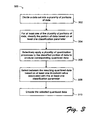
- Fig. 3 is a flow-diagram illustrating a method 300 for selectively applying different quantization processes to data, in accordance with certain implementations of the present invention.
- an initial data set is divided into a plurality of portions of data.
- image or video data may be divided into a plurality of blocks, macroblocks, slits, slice, sections, etc.
- act 304 at least one of the plurality of portions of data from act 302 is classified in some manner, for example, based on at least one characteristic or parameter.
- the classification may be based on edge characteristics, texture characteristics, smoothness characteristics, luminance characteristics, chrominance characteristics, color characteristics, noise characteristics, object characteristics, motion characteristics, user preference characteristics, user interface focus characteristics, layering characteristics, timing characteristics, volume characteristics, frequency characteristics, pitch characteristics, tone characteristics, quality characteristics, bit rate characteristics, data type characteristics, resolution characteristics, encryption characteristics.
- the classified portion from act 304 is processed using at least two of a plurality of quantization processes to produce corresponding quantized data.
- a decision is made wherein one of the quantized data from act 306 is selected, for example, based on satisfying at least one threshold value or measurement that is associated with the classification parameter used in act 304.
- the quantized data from act 308 is encoded in some manner that allows it to be subsequently decoded.
- logic can be provided that essentially analyzes portions of image or video data and deems certain portions to be more important than others. Different Deadzone Quantizers are then applied to the more important data portions and the resulting quantized data analyzed to determine which Deadzone Quantizer(s) satisfy a desired threshold requirement for this more important data. For example, a quality or noise threshold requirement may be enforced.
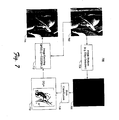
- edges often play a significant role in motion compensation techniques. This is illustrated, for example, in the block diagram depicted in Fig. 7 that is described in greater detail below.
- Fig. 7 it is possible to perform image analysis on an image (frame) or portion thereof, and according to the analysis decide which one of a plurality of Deadzone Quantizers is best to use to use, for example, according to Rate Distortion Optimization (RDO) criterion.
- RDO Rate Distortion Optimization
- logic 400 illustrates an on-the-fly decision process in accordance with certain exemplary implementations of the present invention.
- an input frame/image (or portion thereof) is subjected to image analysis in block 402.
- the image analysis includes an edge detection and/or texture analysis capability and the output is provided to a Deadzone decision block 404.
- Deadzone decision block 404 then causes an encoder 406 to use a specified or otherwise selected Deadzone Quantizer or quantization value(s) when encoding the input frame/image (or portion thereof).
- logic 500 in Fig. 5 is configurable to support method 300, wherein a plurality of Deadzone Quantizers are used and an RDO decision is made based on certain threshold criteria.
- an input macroblock (MB)/image 502 (or other like portion) is (selectively) provided to different Deadzone encoding blocks 504, 506, 508, and/or 510, and the outputs from of these various Deadzone encoding blocks are analyzed in RDO decision block 512 and the selected encoded data output.
- some or all of the Deadzone encoding blocks/processes may occur in parallel. In other implementations, such processes may be timed to occur serially.
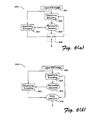
- Fig. 6(a) and Fig. 6(b) illustrate logic wherein a selective recoding decision process is used.
- input MB/image 502 is provided to Deadzone encoding blocks 602 and 604.
- a recoding decision block 606 considers the output from Deadzone encoding block 602 and affects the selection 608 between the outputs of Deadzone encoding blocks 602 and 604.
- Recoding decision block 606 may also selectively initiate Deadzone encoding block 604.
- Fig. 6(a) for example, input MB/image 502 is provided to Deadzone encoding blocks 602 and 604.
- a recoding decision block 606 considers the output from Deadzone encoding block 602 and affects the selection 608 between the outputs of Deadzone encoding blocks 602 and 604.
- Recoding decision block 606 may also selectively initiate Deadzone encoding block 604.
- logic 610 is similar to logic 600 but rather than having selection 608 associated with recoding decision block 606 includes an RDO decision block 612 that is configured to analyze the outputs from Deadzone encoding blocks 602 and 604 and decide which to output.
- Recoding decision block 606 in Figs 6 (a, b) may be configured to make decisions based on various criteria. For example, in certain implementations, quality limits, rate limits and/or other RDO concepts/thresholds may be considered.
- Deadzone quantizers only if some previously defined conditions are satisfied, such as for example the rate/quality is above a particular threshold.
- a Deadzone Quantizer was successfully selected which had about a 30% larger Deadzone than the original.
- Other, possibly adaptive according to image characteristics such as AC frequencies or edge types, Deadzone quantizers may also be used.
- exemplary encoding logic 700 illustratively demonstrates how an initial image 702 (or portion thereof) is processed according to an image analysis process 704 to produce, in this example, edge detection data 706. Edge detection data 706 is then provided to a block classification process 708 to produce block classified data 710. Block classified data 710 is then provided along with initial image 702 to an image encoding process 712, which then produces encoded image 714.
- This is one example, of a simple encoding process for an image.
- the image is analyzed (e.g. using an edge detection algorithm) and then blocks are classified according to such information.
- DZ p N-ary matrix (DZ p ) is defined (N depends on the number of Deadzones defined) which later on assigns the proper Deadzone (DZ) for the Quantizer (QP) assigned at Macroblock at position ( i.j ).
- Direct Mode is basically a special mode which requires no transmission of motion parameters since such can be directly predicted through either spatial or temporal prediction. Additional information on Direct Mode can be found in co-pending U.S. Provisional Patent Application Serial No. 60/385,965 .
- Non Residual Direct Mode can be configured to exploit Run Length encoding (RLC) strategies.
- RLC Run Length encoding
- a Deadzone quantizer may provide a desirable solution.
- the basic idea is to selectively cause or otherwise force the Direct Mode, under certain conditions, to be coded without Residue even though such exists. Schemes based on the same concepts as in Fig. 5 , for example, as shown in Fig.
- non residual direct mode is also examined within the RDO process compared to all other available modes.
- the performance of such scheme may not be as good as expected since the RDO used is inadequate for such cases.
- Other processes, which are dependent on the Quantization values, are also affected, such as, for example, an in-loop filter (not shown) that used to remove blocking artifacts. More specifically, even though performance appears to be good at lower bit rates, performance may suffer significantly at higher bit rates; it could be even outperformed by the usage of a larger quantizer and without the consideration of the Non Residual Direct Mode.
- the logic can be configured to consider such modes only if some previously defined conditions are satisfied and in particular if the residue associated with the Direct Mode is not significant.
- the logic may, for example, be configured to use as a condition an estimate of how significant this residue is by examining the Coded Block Pattern (CBP) of the Direct Mode. If the CBP, without considering chrominance information, is below a particular threshold then this may be considered to imply that the residue is not as significant and if skipped it might not incur too much distortion. Further, other image characteristics such as the non existence of edges and texture may also be used within such video encoding processes/logic.
- CBP Coded Block Pattern
- the logic may even extend this even further by examining whether only the chrominance residue could be removed while keeping all luminance residue intact. It is also possible to extend such concepts to all possible modes for a macroblock that is to examine whether by sending no residue entirely, or no chrominance for this mode would give better performance. Obviously though such could increase the encoding complexity even further.
- logic 900 illustrates how an input MB/image 902 is provided to different Direct Mode (B frames) or Copy Mode (Inter frames) encoding process blocks 902, 904, 906, and 908 and the outputs from those process blocks provided to a frame based RDO decision block 910 that selects an appropriate output.
- B frames Direct Mode
- Inter frames Copy Mode
- logic 1000 further illustrates how a scheme decision block 1002 and selection 1004 can also be included to provide additional selectability depending on user inputs, the application, system requirements, etc.
- scheme decision block 1002 selectively provides input MB/image to one or more of the Direct Mode (B frames) or Copy Mode (Inter frames) encoding process blocks 902, 904, 906, and 908.
- Selection 1004 may be controlled by scheme decision block 1002 or other processes/logic/inputs.
- RDO techniques are often based on the concepts of Langrangian Multipliers. For example, a specific mode may be selected that jointly minimizes distortion and bit rate.
- Such a function can be expressed as the minimization of: J Mode
- QP , ⁇ SSD Mode
- QP is the macroblock quantizer
- ⁇ is the Lagrangian multiplier for mode decision
- Mode indicates the macroblock mode that is to be examined and possibly selected within the RDO process.
- sequences and frames may have different types of dominant motion correlation.
- MVs motion vectors
- temporally adjacent frames temporary domain
- Larger objects with smooth motion may instead have higher correlation in the spatial domain (adjacent macroblocks), whereas in other cases information from both spatial and temporal domain may be important for the prediction.
- the encoding logic is configured to signal or otherwise identify in some manner at the frame, slice, or some other like level, which prediction scheme for prediction dependent modes is to be used.
- One exemplary syntax for accomplishing this, as an example within JVT, is presented in chart 800 in Fig. 8 .
- Such syntax could, of course, be modified/different in other encoding designs.
- three (3) possible prediction cases are allowed for the P frame skip mode.
- u(2) 2 bits
- entropy coded e.g., e(v) using UVLC or CABAC.
- Spatial motion vector prediction may be used for all Direct Mode motion parameters as one mode, and the temporally predicted parameters as a second mode.
- Other direct modes as described, for example, in co-pending U.S. Provisional Patent Application Serial No. 60/385,965 may also be considered/included.
- the encoding logic is configured to signal which prediction mode is to be used at the Frame or slice level. The selection can be performed, for example, using an RDO based scheme (e.g., Fig. 9 ). In certain implementations, the encoding logic may also make use a specific mode explicitly due to specific requirements placed on the encoder and/or decoder.
- the Spatial Prediction is usually computationally simpler (e.g., requiring no division, no storage of the motion vectors, and is independent to timing information), it may be the preferred choice for some applications (e.g., Fig. 10 ).
- the combination may yield further improved encoding performance.
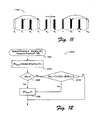
- P and B frames are shown along with a scene change.
- P and B frames are shown for corresponding Skip, or Direct mode macroblocks.
- the signaling can be an indication of how the encoding logic should perform the motion vector prediction for the motion vector coding, or for the prediction of other modes (e.g., Direct P described in co-pending U.S. Provisional Patent Application Serial No. 60/376,005 and co-pending U.S. Patent Application Serial No. 10/186,284 ).
- different frames signal different type of prediction for their corresponding Direct (B) and Skip (P) modes.
- P Z , P T , and P M define for example zero, temporal and spatial (Motion-Copy) prediction
- B T and B SP define temporal and spatial prediction for Direct mode.
- spatial prediction may be more useful (e.g., due to its properties) than temporal prediction.
- spatial prediction is used as the main prediction of Direct Modes.
- One possible exception is made when the motion information and the reference frame from the temporal predictors are zero.
- the motion information and reference frame for the corresponding block of the direct mode is also considered to be zero.
- the spatial prediction is refined by also considering a spatial zero biased-ness and/or of stationary subpartitions. Accordingly, if any or some of the adjacent macroblocks or blocks to the currently predicted block have zero motion (or very close (e.g. integer motion vector is zero) and reference frame, then also the entire macroblock, or part of it is also considered to have zero motion. Both of these concepts help in protecting stationary backgrounds, which, in particular at the edges of moving objects, might be quite distorted if such conditions are not introduced.
- FIG. 12 A flow diagram 1200, simplified for the case of a 16x16 Macroblock, is shown in Fig. 12 . It is noted that such concepts using spatial prediction for the direct mode, may also be extended to even smaller blocks (e.g. 8x8 or 4x4) (or larger blocks or other shaped portions).
- act 1202 spatial predictors MV a , MY b , and MV c and temporal predictor MV t are provided to act 1204, wherein MV Direct is set to a Median (MV a , MV b , MV c ).
- act 1206 a decision is made based on MV t that leads to either act 1208 wherein MV Direct is set to zero, or act 1210 for an additional decision. As result of act 1210, MV Direct is either set to zero in act 1208 or not changed, and MV Direct is output.
Landscapes
- Engineering & Computer Science (AREA)
- Multimedia (AREA)
- Signal Processing (AREA)
- Physics & Mathematics (AREA)
- Algebra (AREA)
- General Physics & Mathematics (AREA)
- Mathematical Analysis (AREA)
- Mathematical Optimization (AREA)
- Pure & Applied Mathematics (AREA)
- Compression Or Coding Systems Of Tv Signals (AREA)
- Compression Of Band Width Or Redundancy In Fax (AREA)
- Compression, Expansion, Code Conversion, And Decoders (AREA)
- Image Processing (AREA)
Applications Claiming Priority (2)
| Application Number | Priority Date | Filing Date | Title |
|---|---|---|---|
| US39389402P | 2002-07-05 | 2002-07-05 | |
| EP03013967A EP1379090A3 (en) | 2002-07-05 | 2003-06-20 | Improved optimization techniques for data compression |
Related Parent Applications (2)
| Application Number | Title | Priority Date | Filing Date |
|---|---|---|---|
| EP03013967.9 Division | 2003-06-20 | ||
| EP03013967A Division EP1379090A3 (en) | 2002-07-05 | 2003-06-20 | Improved optimization techniques for data compression |
Publications (3)
| Publication Number | Publication Date |
|---|---|
| EP2309749A2 EP2309749A2 (en) | 2011-04-13 |
| EP2309749A3 EP2309749A3 (en) | 2011-04-27 |
| EP2309749B1 true EP2309749B1 (en) | 2015-04-15 |
Family
ID=29720452
Family Applications (2)
| Application Number | Title | Priority Date | Filing Date |
|---|---|---|---|
| EP10012820.6A Expired - Lifetime EP2309749B1 (en) | 2002-07-05 | 2003-06-20 | Improved optimization techniques for data compression |
| EP03013967A Withdrawn EP1379090A3 (en) | 2002-07-05 | 2003-06-20 | Improved optimization techniques for data compression |
Family Applications After (1)
| Application Number | Title | Priority Date | Filing Date |
|---|---|---|---|
| EP03013967A Withdrawn EP1379090A3 (en) | 2002-07-05 | 2003-06-20 | Improved optimization techniques for data compression |
Country Status (6)
| Country | Link |
|---|---|
| US (1) | US7280700B2 (enExample) |
| EP (2) | EP2309749B1 (enExample) |
| JP (1) | JP4662697B2 (enExample) |
| KR (2) | KR100965703B1 (enExample) |
| CN (1) | CN100394447C (enExample) |
| BR (1) | BR0301992A (enExample) |
Families Citing this family (60)
| Publication number | Priority date | Publication date | Assignee | Title |
|---|---|---|---|---|
| US7003035B2 (en) | 2002-01-25 | 2006-02-21 | Microsoft Corporation | Video coding methods and apparatuses |
| JP4019790B2 (ja) * | 2002-05-23 | 2007-12-12 | 富士ゼロックス株式会社 | 画像処理装置および画像処理プログラム |
| US20040001546A1 (en) | 2002-06-03 | 2004-01-01 | Alexandros Tourapis | Spatiotemporal prediction for bidirectionally predictive (B) pictures and motion vector prediction for multi-picture reference motion compensation |
| US7280700B2 (en) * | 2002-07-05 | 2007-10-09 | Microsoft Corporation | Optimization techniques for data compression |
| US7154952B2 (en) | 2002-07-19 | 2006-12-26 | Microsoft Corporation | Timestamp-independent motion vector prediction for predictive (P) and bidirectionally predictive (B) pictures |
| CN1206864C (zh) * | 2002-07-22 | 2005-06-15 | 中国科学院计算技术研究所 | 结合率失真优化的码率控制的方法及其装置 |
| US7609763B2 (en) * | 2003-07-18 | 2009-10-27 | Microsoft Corporation | Advanced bi-directional predictive coding of video frames |
| US8064520B2 (en) * | 2003-09-07 | 2011-11-22 | Microsoft Corporation | Advanced bi-directional predictive coding of interlaced video |
| JP2007522724A (ja) * | 2004-01-30 | 2007-08-09 | トムソン ライセンシング | アダプティブレートコントロールによるエンコーダ |
| EP1564997A1 (en) * | 2004-02-12 | 2005-08-17 | Matsushita Electric Industrial Co., Ltd. | Encoding and decoding of video images based on a quantization with an adaptive dead-zone size |
| KR100860147B1 (ko) * | 2004-02-20 | 2008-09-24 | 닛본 덴끼 가부시끼가이샤 | 화상 부호화 방법, 그 장치 및 제어 프로그램을 기록한 컴퓨터 판독가능한 기록 매체 |
| KR100694050B1 (ko) * | 2004-06-11 | 2007-03-12 | 삼성전자주식회사 | 움직임 예측 방법 및 그 장치 |
| CN1296824C (zh) * | 2004-10-28 | 2007-01-24 | 威盛电子股份有限公司 | 程序编码方法及其系统 |
| JP5046335B2 (ja) * | 2004-11-04 | 2012-10-10 | トムソン ライセンシング | ビデオ符号器におけるbフレームの高速モード決定のための方法および装置 |
| US8548055B2 (en) * | 2005-03-10 | 2013-10-01 | Qualcomm Incorporated | Encoding of multimedia data |
| WO2006114954A1 (ja) * | 2005-04-22 | 2006-11-02 | Matsushita Electric Industrial Co., Ltd. | 映像情報記録装置、映像情報記録方法、映像情報記録プログラム、及び映像情報記録プログラムを記録した記録媒体 |
| US7859574B1 (en) * | 2005-07-19 | 2010-12-28 | Maxim Integrated Products, Inc. | Integrated camera image signal processor and video encoder |
| SG135081A1 (en) * | 2006-03-03 | 2007-09-28 | Matrixview Ltd | Streaming repetition coded compression |
| KR100790986B1 (ko) * | 2006-03-25 | 2008-01-03 | 삼성전자주식회사 | 가변 비트율 비디오 코딩에서 비트율을 제어하는 장치 및방법 |
| US7995649B2 (en) | 2006-04-07 | 2011-08-09 | Microsoft Corporation | Quantization adjustment based on texture level |
| US8503536B2 (en) | 2006-04-07 | 2013-08-06 | Microsoft Corporation | Quantization adjustments for DC shift artifacts |
| US8711925B2 (en) | 2006-05-05 | 2014-04-29 | Microsoft Corporation | Flexible quantization |
| ATE509347T1 (de) | 2006-10-20 | 2011-05-15 | Dolby Sweden Ab | Vorrichtung und verfahren zum codieren eines informationssignals |
| US7885476B2 (en) * | 2006-12-14 | 2011-02-08 | Sony Corporation | System and method for effectively performing an adaptive encoding procedure |
| US8437397B2 (en) * | 2007-01-04 | 2013-05-07 | Qualcomm Incorporated | Block information adjustment techniques to reduce artifacts in interpolated video frames |
| DE102007005930A1 (de) * | 2007-02-06 | 2008-08-07 | Efficient Energy Gmbh | Wärmepuppe, Kleinkraftwerk und Verfahren zum Pumpen von Wärme |
| US8594187B2 (en) * | 2007-03-02 | 2013-11-26 | Qualcomm Incorporated | Efficient video block mode changes in second pass video coding |
| US8498335B2 (en) * | 2007-03-26 | 2013-07-30 | Microsoft Corporation | Adaptive deadzone size adjustment in quantization |
| US8243797B2 (en) | 2007-03-30 | 2012-08-14 | Microsoft Corporation | Regions of interest for quality adjustments |
| US8442337B2 (en) | 2007-04-18 | 2013-05-14 | Microsoft Corporation | Encoding adjustments for animation content |
| KR100955396B1 (ko) | 2007-06-15 | 2010-04-29 | 성균관대학교산학협력단 | 양-예측 부호화 방법 및 장치, 양-예측 복호화 방법 및장치 및 기록매체 |
| WO2008153262A1 (en) | 2007-06-15 | 2008-12-18 | Sungkyunkwan University Foundation For Corporate Collaboration | Bi-prediction coding method and apparatus, bi-prediction decoding method and apparatus, and recording midium |
| US8116581B2 (en) * | 2007-06-28 | 2012-02-14 | Microsoft Corporation | Efficient image representation by edges and low-resolution signal |
| US8254455B2 (en) | 2007-06-30 | 2012-08-28 | Microsoft Corporation | Computing collocated macroblock information for direct mode macroblocks |
| US8982951B2 (en) * | 2008-03-10 | 2015-03-17 | Mediatek Inc. | Adaptive motion estimation coding |
| CN101552924B (zh) * | 2008-03-31 | 2011-08-03 | 深圳市融创天下科技发展有限公司 | 一种用于视频编码的空间预测方法 |
| US20090262801A1 (en) * | 2008-04-17 | 2009-10-22 | Qualcomm Incorporated | Dead zone parameter selections for rate control in video coding |
| US8897359B2 (en) | 2008-06-03 | 2014-11-25 | Microsoft Corporation | Adaptive quantization for enhancement layer video coding |
| US8204964B2 (en) * | 2008-08-06 | 2012-06-19 | Microsoft Corporation | Efficient size optimization of visual information or auditory information |
| CN102165772B (zh) | 2008-09-16 | 2013-07-24 | 杜比实验室特许公司 | 自适应视频编码器控制 |
| KR100957073B1 (ko) * | 2008-11-19 | 2010-05-13 | 고려대학교 산학협력단 | 지문영상의 품질에 기초한 선택적 영상압축장치 및 방법, 그리고 이를 이용한 인증장치 |
| US8189666B2 (en) | 2009-02-02 | 2012-05-29 | Microsoft Corporation | Local picture identifier and computation of co-located information |
| KR101888679B1 (ko) * | 2009-08-12 | 2018-08-16 | 톰슨 라이센싱 | 개선된 인트라 색차 엔코딩 및 디코딩을 위한 방법 및 장치 |
| KR101815723B1 (ko) | 2010-09-24 | 2018-01-05 | 선 페이턴트 트러스트 | 화상 부호화 방법, 화상 복호화 방법, 화상 부호화 장치, 및 화상 복호화 장치 |
| US8371941B2 (en) | 2010-12-06 | 2013-02-12 | SRM Institute of Science and Technology | System and method for game state reduction |
| US9877019B2 (en) * | 2011-01-03 | 2018-01-23 | Hfi Innovation Inc. | Method of filter-unit based in-loop filtering |
| KR20120084168A (ko) * | 2011-01-19 | 2012-07-27 | 삼성전자주식회사 | 비디오 인코딩 모드 선택 방법 및 이를 수행하는 비디오 인코딩 장치 |
| US20120294353A1 (en) | 2011-05-16 | 2012-11-22 | Mediatek Inc. | Apparatus and Method of Sample Adaptive Offset for Luma and Chroma Components |
| US9112526B2 (en) * | 2011-06-15 | 2015-08-18 | Sony Corporation | Binarization of DQP using separate absolute value and sign (SAVS) in CABAC |
| US8711928B1 (en) | 2011-10-05 | 2014-04-29 | CSR Technology, Inc. | Method, apparatus, and manufacture for adaptation of video encoder tuning parameters |
| GB2496015B (en) * | 2012-09-05 | 2013-09-11 | Imagination Tech Ltd | Pixel buffering |
| CN102883163B (zh) * | 2012-10-08 | 2014-05-28 | 华为技术有限公司 | 用于运动矢量预测的运动矢量列表建立的方法、装置 |
| SG11201505922XA (en) | 2013-01-29 | 2015-08-28 | Fraunhofer Ges Forschung | Low-complexity tonality-adaptive audio signal quantization |
| EP3014774A4 (en) | 2013-06-24 | 2017-04-05 | Intel Corporation | Dynamic compression/decompression (codec) configuration |
| CN104486503B (zh) * | 2014-12-16 | 2016-04-13 | 努比亚技术有限公司 | 一种移动终端及其语音加密的方法 |
| CN106878727A (zh) * | 2016-12-31 | 2017-06-20 | 深圳市共进电子股份有限公司 | 视频数据处理方法及装置 |
| EP3429207A1 (en) * | 2017-07-13 | 2019-01-16 | Thomson Licensing | A method and apparatus for encoding/decoding a colored point cloud representing the geometry and colors of a 3d object |
| CN110213593B (zh) * | 2018-05-25 | 2023-01-24 | 腾讯科技(深圳)有限公司 | 一种运动矢量的确定方法、编码压缩方法和相关装置 |
| WO2022119304A1 (ko) * | 2020-12-01 | 2022-06-09 | 현대자동차주식회사 | 적응적 데드존 양자화를 이용하는 포인트 클라우드 코딩 장치 및 방법 |
| CN120111246B (zh) * | 2025-03-10 | 2026-07-03 | 南京考恩奇信息科技有限公司 | 深度学习的视频多级自适应压缩跨层传输优化方法及系统 |
Family Cites Families (175)
| Publication number | Priority date | Publication date | Assignee | Title |
|---|---|---|---|---|
| US186284A (en) | 1877-01-16 | Improvement in plow-stocks | ||
| JPS56128070A (en) | 1980-03-13 | 1981-10-07 | Fuji Photo Film Co Ltd | Band compressing equipment of variable density picture |
| JPS60158786A (ja) | 1984-01-30 | 1985-08-20 | Kokusai Denshin Denwa Co Ltd <Kdd> | 画像動き量検出方式 |
| JPH031688Y2 (enExample) | 1985-02-20 | 1991-01-18 | ||
| US4661849A (en) | 1985-06-03 | 1987-04-28 | Pictel Corporation | Method and apparatus for providing motion estimation signals for communicating image sequences |
| JPS61205086U (enExample) | 1985-06-13 | 1986-12-24 | ||
| US4661853A (en) | 1985-11-01 | 1987-04-28 | Rca Corporation | Interfield image motion detector for video signals |
| FR2599577B1 (fr) | 1986-05-29 | 1988-08-05 | Guichard Jacques | Procede de codage par transformation pour la transmission de signaux d'image. |
| DE3704777C1 (de) | 1987-02-16 | 1988-04-07 | Ant Nachrichtentech | Verfahren zum UEbertragen und zum Wiedergeben von Fernsehbildsequenzen |
| NL8700565A (nl) | 1987-03-10 | 1988-10-03 | Philips Nv | Televisiesysteem waarin aan een transformatiekodering onderworpen gedigitaliseerde beeldsignalen worden overgebracht van een kodeerstation naar een dekodeerstation. |
| EP0290085B1 (de) | 1987-05-06 | 1996-03-20 | Philips Patentverwaltung GmbH | System zur Übertragung von Videobildern |
| DE3717057A1 (de) | 1987-05-21 | 1988-12-01 | Bayer Ag | Verfahren zur herstellung von isocyanaten |
| EP0294962B1 (en) | 1987-06-09 | 1995-07-19 | Sony Corporation | Motion vector estimation in television images |
| EP0294958B1 (en) | 1987-06-09 | 1995-08-23 | Sony Corporation | Motion compensated interpolation of digital television images |
| FR2648254B2 (fr) | 1988-09-23 | 1991-08-30 | Thomson Csf | Procede et dispositif d'estimation de mouvement dans une sequence d'images animees |
| US4985768A (en) | 1989-01-20 | 1991-01-15 | Victor Company Of Japan, Ltd. | Inter-frame predictive encoding system with encoded and transmitted prediction error |
| JPH07109990B2 (ja) | 1989-04-27 | 1995-11-22 | 日本ビクター株式会社 | 適応型フレーム間予測符号化方法及び復号方法 |
| JPH0832047B2 (ja) | 1989-04-28 | 1996-03-27 | 日本ビクター株式会社 | 予測符号化装置 |
| USRE35910E (en) | 1989-05-11 | 1998-09-29 | Matsushita Electric Industrial Co., Ltd. | Moving image signal encoding apparatus and decoding apparatus |
| AU612543B2 (en) | 1989-05-11 | 1991-07-11 | Panasonic Corporation | Moving image signal encoding apparatus and decoding apparatus |
| EP0715469B1 (en) | 1989-10-14 | 2001-09-12 | Sony Corporation | Video signal coding/decoding method and apparatus |
| JP2787599B2 (ja) | 1989-11-06 | 1998-08-20 | 富士通株式会社 | 画像信号符号化制御方式 |
| NL9000424A (nl) | 1990-02-22 | 1991-09-16 | Philips Nv | Overdrachtsysteem voor gedigitaliseerde televisiebeelden. |
| JPH082107B2 (ja) | 1990-03-02 | 1996-01-10 | 国際電信電話株式会社 | 動画像のハイブリッド符号化方法及びその装置 |
| JPH03265290A (ja) | 1990-03-14 | 1991-11-26 | Toshiba Corp | テレビジョン信号走査線変換器 |
| US5103306A (en) | 1990-03-28 | 1992-04-07 | Transitions Research Corporation | Digital image compression employing a resolution gradient |
| US5091782A (en) | 1990-04-09 | 1992-02-25 | General Instrument Corporation | Apparatus and method for adaptively compressing successive blocks of digital video |
| US5068724A (en) | 1990-06-15 | 1991-11-26 | General Instrument Corporation | Adaptive motion compensation for digital television |
| EP0484140B1 (en) | 1990-10-31 | 1996-12-18 | Victor Company Of Japan, Ltd. | Compression method of interlace moving image signals |
| USRE35093E (en) | 1990-12-03 | 1995-11-21 | The Trustees Of Columbia University In The City Of New York | Systems and methods for coding even fields of interlaced video sequences |
| JP3119888B2 (ja) | 1991-04-18 | 2000-12-25 | 松下電器産業株式会社 | 信号処理方法及び記録再生装置 |
| JP3226539B2 (ja) | 1991-05-24 | 2001-11-05 | ブリティッシュ・ブロードキャスティング・コーポレーション | ビデオ画像処理 |
| US5317397A (en) | 1991-05-31 | 1994-05-31 | Kabushiki Kaisha Toshiba | Predictive coding using spatial-temporal filtering and plural motion vectors |
| US5467136A (en) | 1991-05-31 | 1995-11-14 | Kabushiki Kaisha Toshiba | Video decoder for determining a motion vector from a scaled vector and a difference vector |
| US5539466A (en) | 1991-07-30 | 1996-07-23 | Sony Corporation | Efficient coding apparatus for picture signal and decoding apparatus therefor |
| JP2699703B2 (ja) | 1991-07-31 | 1998-01-19 | 松下電器産業株式会社 | 動き補償予測方法とそれを用いた画像信号符号化方法 |
| US5428396A (en) | 1991-08-03 | 1995-06-27 | Sony Corporation | Variable length coding/decoding method for motion vectors |
| JPH0541862A (ja) | 1991-08-03 | 1993-02-19 | Sony Corp | 動きベクトルの可変長符号化方式 |
| JP2507204B2 (ja) | 1991-08-30 | 1996-06-12 | 松下電器産業株式会社 | 映像信号符号化装置 |
| CA2079434A1 (en) | 1991-09-30 | 1993-03-31 | Derek Andrew | Motion vector estimation, motion picture encoding and storage |
| JP2586260B2 (ja) | 1991-10-22 | 1997-02-26 | 三菱電機株式会社 | 適応的ブロッキング画像符号化装置 |
| JP3134424B2 (ja) | 1991-10-31 | 2001-02-13 | ソニー株式会社 | 可変長符号化方法及び装置 |
| US5231484A (en) | 1991-11-08 | 1993-07-27 | International Business Machines Corporation | Motion video compression system with adaptive bit allocation and quantization |
| JP2962012B2 (ja) | 1991-11-08 | 1999-10-12 | 日本ビクター株式会社 | 動画像符号化装置及びその復号装置 |
| US5510840A (en) | 1991-12-27 | 1996-04-23 | Sony Corporation | Methods and devices for encoding and decoding frame signals and recording medium therefor |
| JP2524044B2 (ja) | 1992-01-22 | 1996-08-14 | 松下電器産業株式会社 | 画像符号化方法及び画像符号化装置 |
| CA2088082C (en) | 1992-02-07 | 1999-01-19 | John Hartung | Dynamic bit allocation for three-dimensional subband video coding |
| US5594813A (en) | 1992-02-19 | 1997-01-14 | Integrated Information Technology, Inc. | Programmable architecture and methods for motion estimation |
| US5293229A (en) | 1992-03-27 | 1994-03-08 | Matsushita Electric Corporation Of America | Apparatus and method for processing groups of fields in a video data compression system |
| KR0166716B1 (ko) | 1992-06-18 | 1999-03-20 | 강진구 | 블럭 dpcm을 이용한 부호화/복호화방법 및 장치 |
| US6160849A (en) | 1992-06-29 | 2000-12-12 | Sony Corporation | Selectable field and frame based predictive video coding |
| US6226327B1 (en) | 1992-06-29 | 2001-05-01 | Sony Corporation | Video coding method and apparatus which select between frame-based and field-based predictive modes |
| JPH06153180A (ja) | 1992-09-16 | 1994-05-31 | Fujitsu Ltd | 画像データ符号化方法及び装置 |
| KR0166722B1 (ko) | 1992-11-30 | 1999-03-20 | 윤종용 | 부호화 및 복호화방법 및 그 장치 |
| US5467134A (en) | 1992-12-22 | 1995-11-14 | Microsoft Corporation | Method and system for compressing video data |
| US5400075A (en) | 1993-01-13 | 1995-03-21 | Thomson Consumer Electronics, Inc. | Adaptive variable length encoder/decoder |
| US5592228A (en) | 1993-03-04 | 1997-01-07 | Kabushiki Kaisha Toshiba | Video encoder using global motion estimation and polygonal patch motion estimation |
| JPH06276481A (ja) | 1993-03-18 | 1994-09-30 | Sony Corp | 画像信号符号化及び復号化方法、並びに記録媒体 |
| JP3312417B2 (ja) | 1993-03-18 | 2002-08-05 | ソニー株式会社 | 画像信号符号化装置及び画像信号復号化装置 |
| PT2334083E (pt) * | 1993-03-24 | 2013-09-30 | Sony Corp | Método para codificar e descodificar vetores de movimento e respetivo dispositivo e método para codificar e descodificar sinais de imagem e respetivo dispositivo |
| US5442400A (en) | 1993-04-29 | 1995-08-15 | Rca Thomson Licensing Corporation | Error concealment apparatus for MPEG-like video data |
| DE69416717T2 (de) | 1993-05-21 | 1999-10-07 | Nippon Telegraph And Telephone Corp., Tokio/Tokyo | Bewegtbildkoder und -dekoder |
| US5448297A (en) | 1993-06-16 | 1995-09-05 | Intel Corporation | Method and system for encoding images using skip blocks |
| US5477272A (en) | 1993-07-22 | 1995-12-19 | Gte Laboratories Incorporated | Variable-block size multi-resolution motion estimation scheme for pyramid coding |
| CA2118880A1 (en) | 1994-03-11 | 1995-09-12 | Kannan Ramchandran | Jpeg/mpeg decoder-compatible optimized thresholding for image and video signal compression |
| TW283289B (enExample) | 1994-04-11 | 1996-08-11 | Gen Instrument Corp | |
| US5796438A (en) | 1994-07-05 | 1998-08-18 | Sony Corporation | Methods and apparatus for interpolating picture information |
| US5594504A (en) | 1994-07-06 | 1997-01-14 | Lucent Technologies Inc. | Predictive video coding using a motion vector updating routine |
| KR0126871B1 (ko) | 1994-07-30 | 1997-12-29 | 심상철 | 양방향 이동벡터 추정을 위한 고속 블럭정합 방식 |
| JP3474005B2 (ja) | 1994-10-13 | 2003-12-08 | 沖電気工業株式会社 | 動画像符号化方法及び動画像復号方法 |
| US5659626A (en) * | 1994-10-20 | 1997-08-19 | Calspan Corporation | Fingerprint identification system |
| EP0710033A3 (en) | 1994-10-28 | 1999-06-09 | Matsushita Electric Industrial Co., Ltd. | MPEG video decoder having a high bandwidth memory |
| US5623311A (en) | 1994-10-28 | 1997-04-22 | Matsushita Electric Corporation Of America | MPEG video decoder having a high bandwidth memory |
| JPH08140099A (ja) | 1994-11-11 | 1996-05-31 | Canon Inc | 符号化装置及び方法 |
| JP2951861B2 (ja) | 1994-12-28 | 1999-09-20 | シャープ株式会社 | 画像符号化装置及び画像復号装置 |
| US5619281A (en) | 1994-12-30 | 1997-04-08 | Daewoo Electronics Co., Ltd | Method and apparatus for detecting motion vectors in a frame decimating video encoder |
| KR0181027B1 (ko) | 1995-03-20 | 1999-05-01 | 배순훈 | 화소 단위 움직임 추정을 이용하는 영상처리 시스템 |
| KR0171118B1 (ko) | 1995-03-20 | 1999-03-20 | 배순훈 | 비디오신호 부호화 장치 |
| US5724453A (en) | 1995-07-10 | 1998-03-03 | Wisconsin Alumni Research Foundation | Image compression system and method having optimized quantization tables |
| US5764807A (en) * | 1995-09-14 | 1998-06-09 | Primacomp, Inc. | Data compression using set partitioning in hierarchical trees |
| US5883678A (en) | 1995-09-29 | 1999-03-16 | Kabushiki Kaisha Toshiba | Video coding and video decoding apparatus for reducing an alpha-map signal at a controlled reduction ratio |
| US5825929A (en) | 1995-10-05 | 1998-10-20 | Microsoft Corporation | Transformation block optimization method |
| JPH09107547A (ja) | 1995-10-09 | 1997-04-22 | Hitachi Ltd | 既圧縮動画データ量削減装置および既圧縮動画データ量削減システムならびに既圧縮動画データ量削減方法 |
| US5929940A (en) | 1995-10-25 | 1999-07-27 | U.S. Philips Corporation | Method and device for estimating motion between images, system for encoding segmented images |
| US6192081B1 (en) | 1995-10-26 | 2001-02-20 | Sarnoff Corporation | Apparatus and method for selecting a coding mode in a block-based coding system |
| KR100211917B1 (ko) | 1995-10-26 | 1999-08-02 | 김영환 | 물체 모양정보 부호화 방법 |
| US5963673A (en) | 1995-12-20 | 1999-10-05 | Sanyo Electric Co., Ltd. | Method and apparatus for adaptively selecting a coding mode for video encoding |
| JPH09182083A (ja) | 1995-12-27 | 1997-07-11 | Matsushita Electric Ind Co Ltd | ビデオ画像符号化方法及び復号化方法とその装置 |
| US6055012A (en) | 1995-12-29 | 2000-04-25 | Lucent Technologies Inc. | Digital multi-view video compression with complexity and compatibility constraints |
| US5787203A (en) | 1996-01-19 | 1998-07-28 | Microsoft Corporation | Method and system for filtering compressed video images |
| US6957350B1 (en) | 1996-01-30 | 2005-10-18 | Dolby Laboratories Licensing Corporation | Encrypted and watermarked temporal and resolution layering in advanced television |
| JP3371191B2 (ja) | 1996-03-22 | 2003-01-27 | ソニー株式会社 | 画像信号の符号化方法及び復号方法、並びに、符号化装置及び復号装置 |
| US5982438A (en) | 1996-03-22 | 1999-11-09 | Microsoft Corporation | Overlapped motion compensation for object coding |
| US5933546A (en) * | 1996-05-06 | 1999-08-03 | Nec Research Institute, Inc. | Method and apparatus for multi-resolution image searching |
| US5847776A (en) | 1996-06-24 | 1998-12-08 | Vdonet Corporation Ltd. | Method for entropy constrained motion estimation and coding of motion vectors with increased search range |
| DE19637522A1 (de) | 1996-09-13 | 1998-03-19 | Bosch Gmbh Robert | Verfahren zur Reduzierung von Daten in Videosignalen |
| US6130963A (en) | 1996-11-22 | 2000-10-10 | C-Cube Semiconductor Ii, Inc. | Memory efficient decoding of video frame chroma |
| US6263024B1 (en) | 1996-12-12 | 2001-07-17 | Matsushita Electric Industrial Co., Ltd. | Picture encoder and picture decoder |
| US6377628B1 (en) | 1996-12-18 | 2002-04-23 | Thomson Licensing S.A. | System for maintaining datastream continuity in the presence of disrupted source data |
| EP0786907A3 (en) | 1997-01-24 | 2001-06-13 | Texas Instruments Incorporated | Video encoder |
| US6785331B1 (en) | 1997-02-14 | 2004-08-31 | Nippon Telegraph And Telephone Corporation | Predictive encoding and decoding methods of video data |
| US6201927B1 (en) | 1997-02-18 | 2001-03-13 | Mary Lafuze Comer | Trick play reproduction of MPEG encoded signals |
| US5991447A (en) | 1997-03-07 | 1999-11-23 | General Instrument Corporation | Prediction and coding of bi-directionally predicted video object planes for interlaced digital video |
| US6005980A (en) | 1997-03-07 | 1999-12-21 | General Instrument Corporation | Motion estimation and compensation of video object planes for interlaced digital video |
| US6175592B1 (en) * | 1997-03-12 | 2001-01-16 | Matsushita Electric Industrial Co., Ltd. | Frequency domain filtering for down conversion of a DCT encoded picture |
| US5844613A (en) | 1997-03-17 | 1998-12-01 | Microsoft Corporation | Global motion estimator for motion video signal encoding |
| US6404813B1 (en) | 1997-03-27 | 2002-06-11 | At&T Corp. | Bidirectionally predicted pictures or video object planes for efficient and flexible video coding |
| US5973755A (en) | 1997-04-04 | 1999-10-26 | Microsoft Corporation | Video encoder and decoder using bilinear motion compensation and lapped orthogonal transforms |
| JP3129986B2 (ja) | 1997-04-09 | 2001-01-31 | 日本車輌製造株式会社 | 杭施工機のトルク管理装置 |
| JP3164031B2 (ja) | 1997-05-30 | 2001-05-08 | 日本ビクター株式会社 | 動画像符号化復号化装置、動画像符号化復号化方法、及び動画像符号化記録媒体 |
| US6067322A (en) | 1997-06-04 | 2000-05-23 | Microsoft Corporation | Half pixel motion estimation in motion video signal encoding |
| DE69808519T2 (de) | 1997-06-09 | 2003-06-26 | Hitachi, Ltd. | Verfahren zur Bildsequenzcodierung |
| JPH1169345A (ja) | 1997-06-11 | 1999-03-09 | Fujitsu Ltd | フレーム間予測動画像符号化装置及び復号装置並びにフレーム間予測動画像符号化方法及び復号方法 |
| JP2828095B2 (ja) | 1997-06-23 | 1998-11-25 | 松下電器産業株式会社 | 画像信号復号化装置及び画像信号復号化方法 |
| US6064771A (en) | 1997-06-23 | 2000-05-16 | Real-Time Geometry Corp. | System and method for asynchronous, adaptive moving picture compression, and decompression |
| JP2897763B2 (ja) | 1997-07-28 | 1999-05-31 | 日本ビクター株式会社 | 動き補償符号化装置、復号化装置、符号化方法及び復号化方法 |
| KR100252342B1 (ko) | 1997-08-12 | 2000-04-15 | 전주범 | 움직임 벡터 부호화 방법 및 그 장치 |
| JPH11136683A (ja) | 1997-10-27 | 1999-05-21 | Matsushita Electric Ind Co Ltd | 映像信号符号化装置 |
| US5973743A (en) | 1997-12-02 | 1999-10-26 | Daewoo Electronics Co., Ltd. | Mode coding method and apparatus for use in an interlaced shape coder |
| US6094225A (en) | 1997-12-02 | 2000-07-25 | Daewoo Electronics, Co., Ltd. | Method and apparatus for encoding mode signals for use in a binary shape coder |
| US6122017A (en) | 1998-01-22 | 2000-09-19 | Hewlett-Packard Company | Method for providing motion-compensated multi-field enhancement of still images from video |
| DE69801209T2 (de) | 1998-03-20 | 2001-11-08 | Stmicroelectronics S.R.L., Agrate Brianza | Hierarchischer rekursiver Bewegungsschätzer für Bewegtbildkodierer |
| KR100281462B1 (ko) | 1998-03-30 | 2001-02-01 | 전주범 | 격행 부호화에서 이진 형상 신호의 움직임 벡터 부호화 방법 |
| US6125147A (en) | 1998-05-07 | 2000-09-26 | Motorola, Inc. | Method and apparatus for reducing breathing artifacts in compressed video |
| JP3888597B2 (ja) | 1998-06-24 | 2007-03-07 | 日本ビクター株式会社 | 動き補償符号化装置、及び動き補償符号化復号化方法 |
| JP4026238B2 (ja) | 1998-07-23 | 2007-12-26 | ソニー株式会社 | 画像復号装置及び画像復号方法 |
| GB2343579A (en) | 1998-11-07 | 2000-05-10 | Ibm | Hybrid-linear-bicubic interpolation method and apparatus |
| US6563953B2 (en) | 1998-11-30 | 2003-05-13 | Microsoft Corporation | Predictive image compression using a single variable length code for both the luminance and chrominance blocks for each macroblock |
| US6983018B1 (en) | 1998-11-30 | 2006-01-03 | Microsoft Corporation | Efficient motion vector coding for video compression |
| US6192080B1 (en) | 1998-12-04 | 2001-02-20 | Mitsubishi Electric Research Laboratories, Inc. | Motion compensated digital video signal processing |
| KR100587280B1 (ko) | 1999-01-12 | 2006-06-08 | 엘지전자 주식회사 | 오류 은폐방법 |
| JP2000278692A (ja) | 1999-03-25 | 2000-10-06 | Victor Co Of Japan Ltd | 圧縮データ処理方法及び処理装置並びに記録再生システム |
| US6320593B1 (en) | 1999-04-20 | 2001-11-20 | Agilent Technologies, Inc. | Method of fast bi-cubic interpolation of image information |
| JP3411234B2 (ja) * | 1999-04-26 | 2003-05-26 | 沖電気工業株式会社 | 符号化情報受信復号装置 |
| EP1056297A3 (en) * | 1999-05-24 | 2002-10-02 | Agilent Technologies, Inc. (a Delaware corporation) | Multimedia decoder with error detection |
| US6408026B1 (en) | 1999-08-06 | 2002-06-18 | Sony Corporation | Deadzone quantization method and apparatus for image compression |
| US6600836B1 (en) | 2000-01-28 | 2003-07-29 | Qualcomm, Incorporated | Quality based image compression |
| WO2001080567A1 (fr) | 2000-04-14 | 2001-10-25 | Sony Corporation | Decodeur, procede de decodage, support enregistre et programme |
| CN1322759C (zh) | 2000-04-27 | 2007-06-20 | 三菱电机株式会社 | 编码装置和编码方法 |
| US6654419B1 (en) | 2000-04-28 | 2003-11-25 | Sun Microsystems, Inc. | Block-based, adaptive, lossless video coder |
| US6876703B2 (en) | 2000-05-11 | 2005-04-05 | Ub Video Inc. | Method and apparatus for video coding |
| GB2362533A (en) | 2000-05-15 | 2001-11-21 | Nokia Mobile Phones Ltd | Encoding a video signal with an indicator of the type of error concealment used |
| US6647061B1 (en) | 2000-06-09 | 2003-11-11 | General Instrument Corporation | Video size conversion and transcoding from MPEG-2 to MPEG-4 |
| US6614442B1 (en) | 2000-06-26 | 2003-09-02 | S3 Graphics Co., Ltd. | Macroblock tiling format for motion compensation |
| RU2182727C2 (ru) | 2000-07-20 | 2002-05-20 | Дворкович Александр Викторович | Способ поиска векторов движения деталей в динамических изображениях |
| US6920175B2 (en) | 2001-01-03 | 2005-07-19 | Nokia Corporation | Video coding architecture and methods for using same |
| WO2002062074A1 (en) | 2001-01-22 | 2002-08-08 | Webcast Technologies, Inc. | Video encoding and decoding techniques and apparatus |
| US6689410B2 (en) * | 2001-01-25 | 2004-02-10 | Flavor Burst Co. | Product blender and dispenser |
| US8374237B2 (en) | 2001-03-02 | 2013-02-12 | Dolby Laboratories Licensing Corporation | High precision encoding and decoding of video images |
| US6876705B2 (en) | 2001-03-05 | 2005-04-05 | Intervideo, Inc. | Systems and methods for decoding of partially corrupted reversible variable length code (RVLC) intra-coded macroblocks and partial block decoding of corrupted macroblocks in a video decoder |
| US7206453B2 (en) | 2001-05-03 | 2007-04-17 | Microsoft Corporation | Dynamic filtering for lossy compression |
| US6975680B2 (en) | 2001-07-12 | 2005-12-13 | Dolby Laboratories, Inc. | Macroblock mode decision biasing for video compression systems |
| US6950469B2 (en) | 2001-09-17 | 2005-09-27 | Nokia Corporation | Method for sub-pixel value interpolation |
| US20030099294A1 (en) | 2001-11-27 | 2003-05-29 | Limin Wang | Picture level adaptive frame/field coding for digital video content |
| US6980596B2 (en) | 2001-11-27 | 2005-12-27 | General Instrument Corporation | Macroblock level adaptive frame/field coding for digital video content |
| CN101448162B (zh) | 2001-12-17 | 2013-01-02 | 微软公司 | 处理视频图像的方法 |
| JP4610195B2 (ja) | 2001-12-17 | 2011-01-12 | マイクロソフト コーポレーション | スキップマクロブロックコード化 |
| US6873657B2 (en) * | 2001-12-27 | 2005-03-29 | Koninklijke Philips Electronics, N.V. | Method of and system for improving temporal consistency in sharpness enhancement for a video signal |
| FI114433B (fi) | 2002-01-23 | 2004-10-15 | Nokia Corp | Otossiirtymän koodaaminen videokoodauksessa |
| US7003035B2 (en) | 2002-01-25 | 2006-02-21 | Microsoft Corporation | Video coding methods and apparatuses |
| ES2644005T3 (es) | 2002-04-19 | 2017-11-27 | Panasonic Intellectual Property Corporation Of America | Procedimiento de cálculo de vectores de movimiento |
| KR100481732B1 (ko) * | 2002-04-20 | 2005-04-11 | 전자부품연구원 | 다 시점 동영상 부호화 장치 |
| US20040001546A1 (en) | 2002-06-03 | 2004-01-01 | Alexandros Tourapis | Spatiotemporal prediction for bidirectionally predictive (B) pictures and motion vector prediction for multi-picture reference motion compensation |
| US7280700B2 (en) * | 2002-07-05 | 2007-10-09 | Microsoft Corporation | Optimization techniques for data compression |
| US7154952B2 (en) * | 2002-07-19 | 2006-12-26 | Microsoft Corporation | Timestamp-independent motion vector prediction for predictive (P) and bidirectionally predictive (B) pictures |
| KR100506864B1 (ko) | 2002-10-04 | 2005-08-05 | 엘지전자 주식회사 | 모션벡터 결정방법 |
| AU2003290536A1 (en) | 2002-10-23 | 2004-05-13 | Divxnetworks, Inc. | Method and system for supercompression of compressed digital video |
| JP4093405B2 (ja) | 2002-10-25 | 2008-06-04 | 株式会社リコー | 画像処理装置、プログラム及び記憶媒体 |
| WO2005004491A1 (en) | 2003-06-25 | 2005-01-13 | Thomson Licensing S.A. | Fast mode-decision encoding for interframes |
| US7426308B2 (en) | 2003-07-18 | 2008-09-16 | Microsoft Corporation | Intraframe and interframe interlace coding and decoding |
| US20050013498A1 (en) | 2003-07-18 | 2005-01-20 | Microsoft Corporation | Coding of motion vector information |
| US7961786B2 (en) | 2003-09-07 | 2011-06-14 | Microsoft Corporation | Signaling field type information |
| KR20050061762A (ko) | 2003-12-18 | 2005-06-23 | 학교법인 대양학원 | 부호화 모드 결정방법, 움직임 추정방법 및 부호화 장치 |
| US7889792B2 (en) | 2003-12-24 | 2011-02-15 | Apple Inc. | Method and system for video encoding using a variable number of B frames |
| FR2872973A1 (fr) | 2004-07-06 | 2006-01-13 | Thomson Licensing Sa | Procede ou dispositif de codage d'une sequence d'images sources |
-
2003
- 2003-06-13 US US10/462,085 patent/US7280700B2/en not_active Expired - Lifetime
- 2003-06-20 EP EP10012820.6A patent/EP2309749B1/en not_active Expired - Lifetime
- 2003-06-20 EP EP03013967A patent/EP1379090A3/en not_active Withdrawn
- 2003-06-25 JP JP2003181889A patent/JP4662697B2/ja not_active Expired - Lifetime
- 2003-06-30 BR BR0301992-6A patent/BR0301992A/pt active IP Right Grant
- 2003-07-04 KR KR1020030045330A patent/KR100965703B1/ko not_active Expired - Lifetime
- 2003-07-04 CN CNB031471315A patent/CN100394447C/zh not_active Expired - Lifetime
-
2010
- 2010-03-29 KR KR1020100028167A patent/KR101038860B1/ko not_active Expired - Lifetime
Non-Patent Citations (2)
| Title |
|---|
| CHUNG-WEI KU ET AL: "INVESTIGATION OF A VISUAL TELEPHONE PROTOTYPING ON PERSONAL COMPUTERS", 19960801, vol. 42, no. 3, 1 August 1996 (1996-08-01), pages 750 - 759, XP011083514 * |
| LAINEMA: "Skip mode motion compensation", 3. JVT MEETING; 60. MPEG MEETING; 06-05-2002 - 10-05-2002; FAIRFAX,US; (JOINT VIDEO TEAM OF ISO/IEC JTC1/SC29/WG11 AND ITU-T SG.16 ),, no. JVT-C027, 10 May 2002 (2002-05-10), XP030005133, ISSN: 0000-0442 * |
Also Published As
| Publication number | Publication date |
|---|---|
| HK1156454A1 (en) | 2012-06-08 |
| KR20040004178A (ko) | 2004-01-13 |
| EP1379090A3 (en) | 2005-06-22 |
| US7280700B2 (en) | 2007-10-09 |
| EP2309749A2 (en) | 2011-04-13 |
| JP4662697B2 (ja) | 2011-03-30 |
| CN100394447C (zh) | 2008-06-11 |
| KR20100048978A (ko) | 2010-05-11 |
| BR0301992A (pt) | 2004-08-31 |
| KR101038860B1 (ko) | 2011-06-02 |
| KR100965703B1 (ko) | 2010-06-24 |
| CN1487474A (zh) | 2004-04-07 |
| EP2309749A3 (en) | 2011-04-27 |
| JP2004254274A (ja) | 2004-09-09 |
| US20040008899A1 (en) | 2004-01-15 |
| EP1379090A2 (en) | 2004-01-07 |
Similar Documents
| Publication | Publication Date | Title |
|---|---|---|
| US7280700B2 (en) | Optimization techniques for data compression | |
| RU2707926C1 (ru) | Способ и устройство для предоставления компенсационных смещений для набора восстановленных выборок изображения | |
| KR101131689B1 (ko) | 필터 선택을 이용한 비디오 압축 방법 | |
| CA2732532C (en) | Image decoder that decodes a color image signal and related method | |
| US8422546B2 (en) | Adaptive video encoding using a perceptual model | |
| US20030128882A1 (en) | Image coding and decoding method and apparatus considering human visual characteristics | |
| EP1296524A1 (en) | Process and apparatus for the compression of digital video signals, a system and a computer program product therefor | |
| WO2010132976A1 (en) | Method and system for generating block mode conversion table for efficient video transcoding | |
| KR102140271B1 (ko) | 문턱값 기반 부호화 단위 분할을 이용한 고속 인트라 부호화 방법 및 장치 | |
| JP2006093777A (ja) | 動画像符号化装置及び動画像符号化プログラム | |
| HK1156454B (en) | Improved optimization techniques for data compression | |
| CN114830642A (zh) | 图像编码方法和图像解码方法 | |
| CN114788270A (zh) | 图像编码方法和图像解码方法 | |
| JP6241558B2 (ja) | 映像符号化装置、映像システム、映像符号化方法、及び映像符号化プログラム | |
| BRPI0301992B1 (pt) | método para codificar dados, meio legível por computador, e aparelho que compreende uma lógica operacionalmente configurada para receber dados de imagem |
Legal Events
| Date | Code | Title | Description |
|---|---|---|---|
| PUAI | Public reference made under article 153(3) epc to a published international application that has entered the european phase |
Free format text: ORIGINAL CODE: 0009012 |
|
| PUAL | Search report despatched |
Free format text: ORIGINAL CODE: 0009013 |
|
| AC | Divisional application: reference to earlier application |
Ref document number: 1379090 Country of ref document: EP Kind code of ref document: P |
|
| AK | Designated contracting states |
Kind code of ref document: A2 Designated state(s): AT BE BG CH CY CZ DE DK EE ES FI FR GB GR HU IE IT LI LU MC NL PT RO SE SI SK TR |
|
| AK | Designated contracting states |
Kind code of ref document: A3 Designated state(s): AT BE BG CH CY CZ DE DK EE ES FI FR GB GR HU IE IT LI LU MC NL PT RO SE SI SK TR |
|
| 17P | Request for examination filed |
Effective date: 20111027 |
|
| REG | Reference to a national code |
Ref country code: HK Ref legal event code: DE Ref document number: 1156454 Country of ref document: HK |
|
| 17Q | First examination report despatched |
Effective date: 20140303 |
|
| REG | Reference to a national code |
Ref country code: DE Ref legal event code: R079 Ref document number: 60347524 Country of ref document: DE Free format text: PREVIOUS MAIN CLASS: H04N0007260000 Ipc: H04N0019186000 |
|
| GRAP | Despatch of communication of intention to grant a patent |
Free format text: ORIGINAL CODE: EPIDOSNIGR1 |
|
| RIC1 | Information provided on ipc code assigned before grant |
Ipc: H04N 19/567 20140101ALI20140811BHEP Ipc: H04N 19/186 20140101AFI20140811BHEP Ipc: H04N 19/147 20140101ALI20140811BHEP Ipc: H04N 19/60 20140101ALI20140811BHEP Ipc: H04N 19/61 20140101ALI20140811BHEP Ipc: H04N 19/149 20140101ALI20140811BHEP Ipc: H04N 19/126 20140101ALI20140811BHEP Ipc: H04N 19/19 20140101ALI20140811BHEP Ipc: H04N 19/162 20140101ALI20140811BHEP Ipc: H04N 19/103 20140101ALI20140811BHEP |
|
| INTG | Intention to grant announced |
Effective date: 20140829 |
|
| GRAP | Despatch of communication of intention to grant a patent |
Free format text: ORIGINAL CODE: EPIDOSNIGR1 |
|
| INTG | Intention to grant announced |
Effective date: 20141205 |
|
| GRAS | Grant fee paid |
Free format text: ORIGINAL CODE: EPIDOSNIGR3 |
|
| GRAA | (expected) grant |
Free format text: ORIGINAL CODE: 0009210 |
|
| AC | Divisional application: reference to earlier application |
Ref document number: 1379090 Country of ref document: EP Kind code of ref document: P |
|
| AK | Designated contracting states |
Kind code of ref document: B1 Designated state(s): AT BE BG CH CY CZ DE DK EE ES FI FR GB GR HU IE IT LI LU MC NL PT RO SE SI SK TR |
|
| REG | Reference to a national code |
Ref country code: GB Ref legal event code: FG4D Ref country code: CH Ref legal event code: EP |
|
| RAP2 | Party data changed (patent owner data changed or rights of a patent transferred) |
Owner name: MICROSOFT TECHNOLOGY LICENSING, LLC |
|
| REG | Reference to a national code |
Ref country code: IE Ref legal event code: FG4D |
|
| REG | Reference to a national code |
Ref country code: AT Ref legal event code: REF Ref document number: 722551 Country of ref document: AT Kind code of ref document: T Effective date: 20150515 |
|
| REG | Reference to a national code |
Ref country code: NL Ref legal event code: T3 |
|
| REG | Reference to a national code |
Ref country code: DE Ref legal event code: R096 Ref document number: 60347524 Country of ref document: DE Effective date: 20150528 |
|
| REG | Reference to a national code |
Ref country code: AT Ref legal event code: MK05 Ref document number: 722551 Country of ref document: AT Kind code of ref document: T Effective date: 20150415 |
|
| PG25 | Lapsed in a contracting state [announced via postgrant information from national office to epo] |
Ref country code: FI Free format text: LAPSE BECAUSE OF FAILURE TO SUBMIT A TRANSLATION OF THE DESCRIPTION OR TO PAY THE FEE WITHIN THE PRESCRIBED TIME-LIMIT Effective date: 20150415 Ref country code: PT Free format text: LAPSE BECAUSE OF FAILURE TO SUBMIT A TRANSLATION OF THE DESCRIPTION OR TO PAY THE FEE WITHIN THE PRESCRIBED TIME-LIMIT Effective date: 20150817 Ref country code: ES Free format text: LAPSE BECAUSE OF FAILURE TO SUBMIT A TRANSLATION OF THE DESCRIPTION OR TO PAY THE FEE WITHIN THE PRESCRIBED TIME-LIMIT Effective date: 20150415 |
|
| PG25 | Lapsed in a contracting state [announced via postgrant information from national office to epo] |
Ref country code: AT Free format text: LAPSE BECAUSE OF FAILURE TO SUBMIT A TRANSLATION OF THE DESCRIPTION OR TO PAY THE FEE WITHIN THE PRESCRIBED TIME-LIMIT Effective date: 20150415 Ref country code: GR Free format text: LAPSE BECAUSE OF FAILURE TO SUBMIT A TRANSLATION OF THE DESCRIPTION OR TO PAY THE FEE WITHIN THE PRESCRIBED TIME-LIMIT Effective date: 20150716 |
|
| REG | Reference to a national code |
Ref country code: HK Ref legal event code: GR Ref document number: 1156454 Country of ref document: HK |
|
| REG | Reference to a national code |
Ref country code: DE Ref legal event code: R097 Ref document number: 60347524 Country of ref document: DE |
|
| PG25 | Lapsed in a contracting state [announced via postgrant information from national office to epo] |
Ref country code: DK Free format text: LAPSE BECAUSE OF FAILURE TO SUBMIT A TRANSLATION OF THE DESCRIPTION OR TO PAY THE FEE WITHIN THE PRESCRIBED TIME-LIMIT Effective date: 20150415 Ref country code: IT Free format text: LAPSE BECAUSE OF FAILURE TO SUBMIT A TRANSLATION OF THE DESCRIPTION OR TO PAY THE FEE WITHIN THE PRESCRIBED TIME-LIMIT Effective date: 20150415 Ref country code: EE Free format text: LAPSE BECAUSE OF FAILURE TO SUBMIT A TRANSLATION OF THE DESCRIPTION OR TO PAY THE FEE WITHIN THE PRESCRIBED TIME-LIMIT Effective date: 20150415 Ref country code: MC Free format text: LAPSE BECAUSE OF FAILURE TO SUBMIT A TRANSLATION OF THE DESCRIPTION OR TO PAY THE FEE WITHIN THE PRESCRIBED TIME-LIMIT Effective date: 20150415 |
|
| REG | Reference to a national code |
Ref country code: CH Ref legal event code: PL |
|
| PLBE | No opposition filed within time limit |
Free format text: ORIGINAL CODE: 0009261 |
|
| STAA | Information on the status of an ep patent application or granted ep patent |
Free format text: STATUS: NO OPPOSITION FILED WITHIN TIME LIMIT |
|
| PG25 | Lapsed in a contracting state [announced via postgrant information from national office to epo] |
Ref country code: RO Free format text: LAPSE BECAUSE OF NON-PAYMENT OF DUE FEES Effective date: 20150415 Ref country code: LU Free format text: LAPSE BECAUSE OF FAILURE TO SUBMIT A TRANSLATION OF THE DESCRIPTION OR TO PAY THE FEE WITHIN THE PRESCRIBED TIME-LIMIT Effective date: 20150620 Ref country code: CZ Free format text: LAPSE BECAUSE OF FAILURE TO SUBMIT A TRANSLATION OF THE DESCRIPTION OR TO PAY THE FEE WITHIN THE PRESCRIBED TIME-LIMIT Effective date: 20150415 Ref country code: SK Free format text: LAPSE BECAUSE OF FAILURE TO SUBMIT A TRANSLATION OF THE DESCRIPTION OR TO PAY THE FEE WITHIN THE PRESCRIBED TIME-LIMIT Effective date: 20150415 |
|
| 26N | No opposition filed |
Effective date: 20160118 |
|
| REG | Reference to a national code |
Ref country code: IE Ref legal event code: MM4A |
|
| PG25 | Lapsed in a contracting state [announced via postgrant information from national office to epo] |
Ref country code: CH Free format text: LAPSE BECAUSE OF NON-PAYMENT OF DUE FEES Effective date: 20150630 Ref country code: IE Free format text: LAPSE BECAUSE OF NON-PAYMENT OF DUE FEES Effective date: 20150620 Ref country code: LI Free format text: LAPSE BECAUSE OF NON-PAYMENT OF DUE FEES Effective date: 20150630 |
|
| REG | Reference to a national code |
Ref country code: FR Ref legal event code: PLFP Year of fee payment: 14 |
|
| PG25 | Lapsed in a contracting state [announced via postgrant information from national office to epo] |
Ref country code: SI Free format text: LAPSE BECAUSE OF FAILURE TO SUBMIT A TRANSLATION OF THE DESCRIPTION OR TO PAY THE FEE WITHIN THE PRESCRIBED TIME-LIMIT Effective date: 20150415 |
|
| PG25 | Lapsed in a contracting state [announced via postgrant information from national office to epo] |
Ref country code: BE Free format text: LAPSE BECAUSE OF FAILURE TO SUBMIT A TRANSLATION OF THE DESCRIPTION OR TO PAY THE FEE WITHIN THE PRESCRIBED TIME-LIMIT Effective date: 20150415 |
|
| REG | Reference to a national code |
Ref country code: FR Ref legal event code: PLFP Year of fee payment: 15 |
|
| PG25 | Lapsed in a contracting state [announced via postgrant information from national office to epo] |
Ref country code: BG Free format text: LAPSE BECAUSE OF FAILURE TO SUBMIT A TRANSLATION OF THE DESCRIPTION OR TO PAY THE FEE WITHIN THE PRESCRIBED TIME-LIMIT Effective date: 20150415 Ref country code: HU Free format text: LAPSE BECAUSE OF FAILURE TO SUBMIT A TRANSLATION OF THE DESCRIPTION OR TO PAY THE FEE WITHIN THE PRESCRIBED TIME-LIMIT; INVALID AB INITIO Effective date: 20030620 |
|
| PG25 | Lapsed in a contracting state [announced via postgrant information from national office to epo] |
Ref country code: CY Free format text: LAPSE BECAUSE OF FAILURE TO SUBMIT A TRANSLATION OF THE DESCRIPTION OR TO PAY THE FEE WITHIN THE PRESCRIBED TIME-LIMIT Effective date: 20150415 Ref country code: SE Free format text: LAPSE BECAUSE OF FAILURE TO SUBMIT A TRANSLATION OF THE DESCRIPTION OR TO PAY THE FEE WITHIN THE PRESCRIBED TIME-LIMIT Effective date: 20150415 |
|
| PG25 | Lapsed in a contracting state [announced via postgrant information from national office to epo] |
Ref country code: TR Free format text: LAPSE BECAUSE OF FAILURE TO SUBMIT A TRANSLATION OF THE DESCRIPTION OR TO PAY THE FEE WITHIN THE PRESCRIBED TIME-LIMIT Effective date: 20150415 |
|
| REG | Reference to a national code |
Ref country code: FR Ref legal event code: PLFP Year of fee payment: 16 |
|
| REG | Reference to a national code |
Ref country code: DE Ref legal event code: R082 Ref document number: 60347524 Country of ref document: DE |
|
| PGFP | Annual fee paid to national office [announced via postgrant information from national office to epo] |
Ref country code: NL Payment date: 20220513 Year of fee payment: 20 |
|
| PGFP | Annual fee paid to national office [announced via postgrant information from national office to epo] |
Ref country code: GB Payment date: 20220506 Year of fee payment: 20 Ref country code: FR Payment date: 20220510 Year of fee payment: 20 Ref country code: DE Payment date: 20220505 Year of fee payment: 20 |
|
| P01 | Opt-out of the competence of the unified patent court (upc) registered |
Effective date: 20230501 |
|
| REG | Reference to a national code |
Ref country code: DE Ref legal event code: R071 Ref document number: 60347524 Country of ref document: DE |
|
| REG | Reference to a national code |
Ref country code: NL Ref legal event code: MK Effective date: 20230619 |
|
| REG | Reference to a national code |
Ref country code: GB Ref legal event code: PE20 Expiry date: 20230619 |
|
| PG25 | Lapsed in a contracting state [announced via postgrant information from national office to epo] |
Ref country code: GB Free format text: LAPSE BECAUSE OF EXPIRATION OF PROTECTION Effective date: 20230619 |