EP2285894B1 - Process for preparing dynamically vulcanized alloys - Google Patents
Process for preparing dynamically vulcanized alloys Download PDFInfo
- Publication number
- EP2285894B1 EP2285894B1 EP09763150.1A EP09763150A EP2285894B1 EP 2285894 B1 EP2285894 B1 EP 2285894B1 EP 09763150 A EP09763150 A EP 09763150A EP 2285894 B1 EP2285894 B1 EP 2285894B1
- Authority
- EP
- European Patent Office
- Prior art keywords
- elastomer
- mixing
- thermoplastic resin
- processing device
- dva
- Prior art date
- Legal status (The legal status is an assumption and is not a legal conclusion. Google has not performed a legal analysis and makes no representation as to the accuracy of the status listed.)
- Not-in-force
Links
- 239000000956 alloy Substances 0.000 title claims description 31
- 229910045601 alloy Inorganic materials 0.000 title claims description 31
- 238000004519 manufacturing process Methods 0.000 title description 12
- 229920001971 elastomer Polymers 0.000 claims description 175
- 239000000806 elastomer Substances 0.000 claims description 124
- 238000002156 mixing Methods 0.000 claims description 68
- 239000004594 Masterbatch (MB) Substances 0.000 claims description 63
- 229920005992 thermoplastic resin Polymers 0.000 claims description 62
- 229920005989 resin Polymers 0.000 claims description 55
- 239000011347 resin Substances 0.000 claims description 55
- 239000000203 mixture Substances 0.000 claims description 45
- 238000000034 method Methods 0.000 claims description 42
- 230000008569 process Effects 0.000 claims description 39
- 238000010128 melt processing Methods 0.000 claims description 31
- 229920001577 copolymer Polymers 0.000 claims description 24
- VQTUBCCKSQIDNK-UHFFFAOYSA-N Isobutene Chemical group CC(C)=C VQTUBCCKSQIDNK-UHFFFAOYSA-N 0.000 claims description 21
- 239000004014 plasticizer Substances 0.000 claims description 20
- 239000002245 particle Substances 0.000 claims description 19
- 238000004073 vulcanization Methods 0.000 claims description 18
- 239000004952 Polyamide Substances 0.000 claims description 11
- 229920002647 polyamide Polymers 0.000 claims description 11
- 229920001778 nylon Polymers 0.000 claims description 8
- 238000001125 extrusion Methods 0.000 claims description 7
- 239000004677 Nylon Substances 0.000 claims description 6
- 229920000728 polyester Polymers 0.000 claims description 6
- 229920002292 Nylon 6 Polymers 0.000 claims description 4
- 239000004721 Polyphenylene oxide Substances 0.000 claims description 4
- 239000004734 Polyphenylene sulfide Substances 0.000 claims description 4
- 229920000147 Styrene maleic anhydride Polymers 0.000 claims description 4
- XECAHXYUAAWDEL-UHFFFAOYSA-N acrylonitrile butadiene styrene Chemical compound C=CC=C.C=CC#N.C=CC1=CC=CC=C1 XECAHXYUAAWDEL-UHFFFAOYSA-N 0.000 claims description 4
- 229920000122 acrylonitrile butadiene styrene Polymers 0.000 claims description 4
- 239000004676 acrylonitrile butadiene styrene Substances 0.000 claims description 4
- 125000003118 aryl group Chemical group 0.000 claims description 4
- CGPRUXZTHGTMKW-UHFFFAOYSA-N ethene;ethyl prop-2-enoate Chemical class C=C.CCOC(=O)C=C CGPRUXZTHGTMKW-UHFFFAOYSA-N 0.000 claims description 4
- 229920006380 polyphenylene oxide Polymers 0.000 claims description 4
- 229920000069 polyphenylene sulfide Polymers 0.000 claims description 4
- 239000011145 styrene acrylonitrile resin Substances 0.000 claims description 4
- PYSRRFNXTXNWCD-UHFFFAOYSA-N 3-(2-phenylethenyl)furan-2,5-dione Chemical compound O=C1OC(=O)C(C=CC=2C=CC=CC=2)=C1 PYSRRFNXTXNWCD-UHFFFAOYSA-N 0.000 claims description 3
- 229920000299 Nylon 12 Polymers 0.000 claims description 3
- 229920000305 Nylon 6,10 Polymers 0.000 claims description 3
- 229920002302 Nylon 6,6 Polymers 0.000 claims description 3
- 239000004642 Polyimide Substances 0.000 claims description 3
- 239000004793 Polystyrene Substances 0.000 claims description 3
- 239000004417 polycarbonate Substances 0.000 claims description 3
- 229920000515 polycarbonate Polymers 0.000 claims description 3
- 229920001721 polyimide Polymers 0.000 claims description 3
- 229920001470 polyketone Polymers 0.000 claims description 3
- 229920006324 polyoxymethylene Polymers 0.000 claims description 3
- 229920002223 polystyrene Polymers 0.000 claims description 3
- 230000003746 surface roughness Effects 0.000 claims description 3
- JHWNWJKBPDFINM-UHFFFAOYSA-N Laurolactam Chemical compound O=C1CCCCCCCCCCCN1 JHWNWJKBPDFINM-UHFFFAOYSA-N 0.000 claims description 2
- 229920000571 Nylon 11 Polymers 0.000 claims description 2
- 238000005453 pelletization Methods 0.000 claims description 2
- 239000005060 rubber Substances 0.000 description 52
- 238000012545 processing Methods 0.000 description 18
- 239000000463 material Substances 0.000 description 15
- 238000012360 testing method Methods 0.000 description 14
- IPRJXAGUEGOFGG-UHFFFAOYSA-N N-butylbenzenesulfonamide Chemical group CCCCNS(=O)(=O)C1=CC=CC=C1 IPRJXAGUEGOFGG-UHFFFAOYSA-N 0.000 description 10
- 239000000654 additive Substances 0.000 description 10
- -1 bromobutyl Chemical group 0.000 description 9
- 238000006243 chemical reaction Methods 0.000 description 8
- 238000004132 cross linking Methods 0.000 description 8
- 239000000155 melt Substances 0.000 description 8
- 229920002725 thermoplastic elastomer Polymers 0.000 description 8
- 239000003795 chemical substances by application Substances 0.000 description 7
- JLBJTVDPSNHSKJ-UHFFFAOYSA-N 4-Methylstyrene Chemical compound CC1=CC=C(C=C)C=C1 JLBJTVDPSNHSKJ-UHFFFAOYSA-N 0.000 description 6
- 239000004615 ingredient Substances 0.000 description 6
- 239000003921 oil Substances 0.000 description 6
- 239000008188 pellet Substances 0.000 description 6
- 229920001169 thermoplastic Polymers 0.000 description 5
- XLOMVQKBTHCTTD-UHFFFAOYSA-N Zinc monoxide Chemical compound [Zn]=O XLOMVQKBTHCTTD-UHFFFAOYSA-N 0.000 description 4
- 229920005549 butyl rubber Polymers 0.000 description 4
- 238000002347 injection Methods 0.000 description 4
- 239000007924 injection Substances 0.000 description 4
- 230000007246 mechanism Effects 0.000 description 4
- 230000002829 reductive effect Effects 0.000 description 4
- 239000004416 thermosoftening plastic Substances 0.000 description 4
- XOOUIPVCVHRTMJ-UHFFFAOYSA-L zinc stearate Chemical compound [Zn+2].CCCCCCCCCCCCCCCCCC([O-])=O.CCCCCCCCCCCCCCCCCC([O-])=O XOOUIPVCVHRTMJ-UHFFFAOYSA-L 0.000 description 4
- OKOBUGCCXMIKDM-UHFFFAOYSA-N Irganox 1098 Chemical compound CC(C)(C)C1=C(O)C(C(C)(C)C)=CC(CCC(=O)NCCCCCCNC(=O)CCC=2C=C(C(O)=C(C=2)C(C)(C)C)C(C)(C)C)=C1 OKOBUGCCXMIKDM-UHFFFAOYSA-N 0.000 description 3
- 235000021355 Stearic acid Nutrition 0.000 description 3
- 239000003963 antioxidant agent Substances 0.000 description 3
- 230000003078 antioxidant effect Effects 0.000 description 3
- GBRBMTNGQBKBQE-UHFFFAOYSA-L copper;diiodide Chemical compound I[Cu]I GBRBMTNGQBKBQE-UHFFFAOYSA-L 0.000 description 3
- 238000005336 cracking Methods 0.000 description 3
- 239000003431 cross linking reagent Substances 0.000 description 3
- 239000000945 filler Substances 0.000 description 3
- 239000012467 final product Substances 0.000 description 3
- 238000009472 formulation Methods 0.000 description 3
- 238000004898 kneading Methods 0.000 description 3
- 238000005259 measurement Methods 0.000 description 3
- 238000002844 melting Methods 0.000 description 3
- 230000008018 melting Effects 0.000 description 3
- QIQXTHQIDYTFRH-UHFFFAOYSA-N octadecanoic acid Chemical compound CCCCCCCCCCCCCCCCCC(O)=O QIQXTHQIDYTFRH-UHFFFAOYSA-N 0.000 description 3
- OQCDKBAXFALNLD-UHFFFAOYSA-N octadecanoic acid Natural products CCCCCCCC(C)CCCCCCCCC(O)=O OQCDKBAXFALNLD-UHFFFAOYSA-N 0.000 description 3
- 229920000642 polymer Polymers 0.000 description 3
- 239000000047 product Substances 0.000 description 3
- 230000009467 reduction Effects 0.000 description 3
- 239000008117 stearic acid Substances 0.000 description 3
- 239000000454 talc Substances 0.000 description 3
- 229910052623 talc Inorganic materials 0.000 description 3
- VTYYLEPIZMXCLO-UHFFFAOYSA-L Calcium carbonate Chemical compound [Ca+2].[O-]C([O-])=O VTYYLEPIZMXCLO-UHFFFAOYSA-L 0.000 description 2
- 229920000577 Nylon 6/66 Polymers 0.000 description 2
- 125000000217 alkyl group Chemical group 0.000 description 2
- 238000004630 atomic force microscopy Methods 0.000 description 2
- TZYHIGCKINZLPD-UHFFFAOYSA-N azepan-2-one;hexane-1,6-diamine;hexanedioic acid Chemical compound NCCCCCCN.O=C1CCCCCN1.OC(=O)CCCCC(O)=O TZYHIGCKINZLPD-UHFFFAOYSA-N 0.000 description 2
- 230000008901 benefit Effects 0.000 description 2
- 125000004432 carbon atom Chemical group C* 0.000 description 2
- 230000015556 catabolic process Effects 0.000 description 2
- 238000013329 compounding Methods 0.000 description 2
- 238000006731 degradation reaction Methods 0.000 description 2
- 150000002009 diols Chemical class 0.000 description 2
- 230000000694 effects Effects 0.000 description 2
- 230000003628 erosive effect Effects 0.000 description 2
- 239000010419 fine particle Substances 0.000 description 2
- 239000008187 granular material Substances 0.000 description 2
- 125000001188 haloalkyl group Chemical group 0.000 description 2
- 229920005555 halobutyl Polymers 0.000 description 2
- 229910052736 halogen Inorganic materials 0.000 description 2
- 150000002367 halogens Chemical class 0.000 description 2
- 230000004048 modification Effects 0.000 description 2
- 238000012986 modification Methods 0.000 description 2
- 229920006122 polyamide resin Polymers 0.000 description 2
- 229920001897 terpolymer Polymers 0.000 description 2
- 229920001187 thermosetting polymer Polymers 0.000 description 2
- 230000004584 weight gain Effects 0.000 description 2
- 235000019786 weight gain Nutrition 0.000 description 2
- 239000011787 zinc oxide Substances 0.000 description 2
- GUOSQNAUYHMCRU-UHFFFAOYSA-N 11-Aminoundecanoic acid Chemical compound NCCCCCCCCCCC(O)=O GUOSQNAUYHMCRU-UHFFFAOYSA-N 0.000 description 1
- QLZJUIZVJLSNDD-UHFFFAOYSA-N 2-(2-methylidenebutanoyloxy)ethyl 2-methylidenebutanoate Chemical class CCC(=C)C(=O)OCCOC(=O)C(=C)CC QLZJUIZVJLSNDD-UHFFFAOYSA-N 0.000 description 1
- SWZOQAGVRGQLDV-UHFFFAOYSA-N 4-[2-(4-hydroxy-2,2,6,6-tetramethylpiperidin-1-yl)ethoxy]-4-oxobutanoic acid Chemical compound CC1(C)CC(O)CC(C)(C)N1CCOC(=O)CCC(O)=O SWZOQAGVRGQLDV-UHFFFAOYSA-N 0.000 description 1
- OKTJSMMVPCPJKN-UHFFFAOYSA-N Carbon Chemical compound [C] OKTJSMMVPCPJKN-UHFFFAOYSA-N 0.000 description 1
- VHOQXEIFYTTXJU-UHFFFAOYSA-N Isobutylene-isoprene copolymer Chemical compound CC(C)=C.CC(=C)C=C VHOQXEIFYTTXJU-UHFFFAOYSA-N 0.000 description 1
- 239000004696 Poly ether ether ketone Substances 0.000 description 1
- 239000004902 Softening Agent Substances 0.000 description 1
- 239000002253 acid Substances 0.000 description 1
- 125000001931 aliphatic group Chemical group 0.000 description 1
- 150000001336 alkenes Chemical class 0.000 description 1
- 150000001408 amides Chemical group 0.000 description 1
- 125000003277 amino group Chemical group 0.000 description 1
- 150000008064 anhydrides Chemical class 0.000 description 1
- 230000003712 anti-aging effect Effects 0.000 description 1
- JUPQTSLXMOCDHR-UHFFFAOYSA-N benzene-1,4-diol;bis(4-fluorophenyl)methanone Chemical compound OC1=CC=C(O)C=C1.C1=CC(F)=CC=C1C(=O)C1=CC=C(F)C=C1 JUPQTSLXMOCDHR-UHFFFAOYSA-N 0.000 description 1
- 229920005557 bromobutyl Polymers 0.000 description 1
- 229910000019 calcium carbonate Inorganic materials 0.000 description 1
- 229910052799 carbon Inorganic materials 0.000 description 1
- 239000006229 carbon black Substances 0.000 description 1
- 239000003054 catalyst Substances 0.000 description 1
- 230000008859 change Effects 0.000 description 1
- 239000007795 chemical reaction product Substances 0.000 description 1
- 238000000748 compression moulding Methods 0.000 description 1
- 239000007859 condensation product Substances 0.000 description 1
- 238000010924 continuous production Methods 0.000 description 1
- 125000004122 cyclic group Chemical group 0.000 description 1
- 230000003247 decreasing effect Effects 0.000 description 1
- 230000001419 dependent effect Effects 0.000 description 1
- 235000014113 dietary fatty acids Nutrition 0.000 description 1
- 239000006185 dispersion Substances 0.000 description 1
- 238000009826 distribution Methods 0.000 description 1
- WSUTUEIGSOWBJO-UHFFFAOYSA-N dizinc oxygen(2-) Chemical compound [O-2].[O-2].[Zn+2].[Zn+2] WSUTUEIGSOWBJO-UHFFFAOYSA-N 0.000 description 1
- 239000013536 elastomeric material Substances 0.000 description 1
- 150000002148 esters Chemical group 0.000 description 1
- 230000001747 exhibiting effect Effects 0.000 description 1
- 239000000194 fatty acid Substances 0.000 description 1
- 229930195729 fatty acid Natural products 0.000 description 1
- 150000004665 fatty acids Chemical class 0.000 description 1
- 230000010006 flight Effects 0.000 description 1
- 238000000227 grinding Methods 0.000 description 1
- 125000004968 halobutyl group Chemical group 0.000 description 1
- 230000026030 halogenation Effects 0.000 description 1
- 238000005658 halogenation reaction Methods 0.000 description 1
- 238000010438 heat treatment Methods 0.000 description 1
- 230000000977 initiatory effect Effects 0.000 description 1
- 238000001746 injection moulding Methods 0.000 description 1
- 229920000126 latex Polymers 0.000 description 1
- 230000000670 limiting effect Effects 0.000 description 1
- 230000014759 maintenance of location Effects 0.000 description 1
- FPYJFEHAWHCUMM-UHFFFAOYSA-N maleic anhydride Chemical compound O=C1OC(=O)C=C1 FPYJFEHAWHCUMM-UHFFFAOYSA-N 0.000 description 1
- 239000011159 matrix material Substances 0.000 description 1
- 238000000465 moulding Methods 0.000 description 1
- JRZJOMJEPLMPRA-UHFFFAOYSA-N olefin Natural products CCCCCCCC=C JRZJOMJEPLMPRA-UHFFFAOYSA-N 0.000 description 1
- 150000003022 phthalic acids Chemical class 0.000 description 1
- 230000000704 physical effect Effects 0.000 description 1
- 229920001652 poly(etherketoneketone) Polymers 0.000 description 1
- 229920002492 poly(sulfone) Polymers 0.000 description 1
- 229920001707 polybutylene terephthalate Polymers 0.000 description 1
- 229920002530 polyetherether ketone Polymers 0.000 description 1
- 229920000139 polyethylene terephthalate Polymers 0.000 description 1
- 239000005020 polyethylene terephthalate Substances 0.000 description 1
- 229920006123 polyhexamethylene isophthalamide Polymers 0.000 description 1
- 238000002360 preparation method Methods 0.000 description 1
- 238000003672 processing method Methods 0.000 description 1
- 239000012744 reinforcing agent Substances 0.000 description 1
- 238000010057 rubber processing Methods 0.000 description 1
- 238000010008 shearing Methods 0.000 description 1
- 239000007787 solid Substances 0.000 description 1
- 239000003381 stabilizer Substances 0.000 description 1
- 230000003068 static effect Effects 0.000 description 1
- 229920000638 styrene acrylonitrile Polymers 0.000 description 1
- 239000000126 substance Substances 0.000 description 1
- 238000010998 test method Methods 0.000 description 1
- 238000012956 testing procedure Methods 0.000 description 1
- 229920006345 thermoplastic polyamide Polymers 0.000 description 1
- 229920006342 thermoplastic vulcanizate Polymers 0.000 description 1
- 239000002699 waste material Substances 0.000 description 1
Images

Classifications
-
- C—CHEMISTRY; METALLURGY
- C08—ORGANIC MACROMOLECULAR COMPOUNDS; THEIR PREPARATION OR CHEMICAL WORKING-UP; COMPOSITIONS BASED THEREON
- C08L—COMPOSITIONS OF MACROMOLECULAR COMPOUNDS
- C08L51/00—Compositions of graft polymers in which the grafted component is obtained by reactions only involving carbon-to-carbon unsaturated bonds; Compositions of derivatives of such polymers
- C08L51/06—Compositions of graft polymers in which the grafted component is obtained by reactions only involving carbon-to-carbon unsaturated bonds; Compositions of derivatives of such polymers grafted on to homopolymers or copolymers of aliphatic hydrocarbons containing only one carbon-to-carbon double bond
-
- B—PERFORMING OPERATIONS; TRANSPORTING
- B29—WORKING OF PLASTICS; WORKING OF SUBSTANCES IN A PLASTIC STATE IN GENERAL
- B29B—PREPARATION OR PRETREATMENT OF THE MATERIAL TO BE SHAPED; MAKING GRANULES OR PREFORMS; RECOVERY OF PLASTICS OR OTHER CONSTITUENTS OF WASTE MATERIAL CONTAINING PLASTICS
- B29B7/00—Mixing; Kneading
- B29B7/74—Mixing; Kneading using other mixers or combinations of mixers, e.g. of dissimilar mixers ; Plant
- B29B7/7466—Combinations of similar mixers
-
- B—PERFORMING OPERATIONS; TRANSPORTING
- B29—WORKING OF PLASTICS; WORKING OF SUBSTANCES IN A PLASTIC STATE IN GENERAL
- B29B—PREPARATION OR PRETREATMENT OF THE MATERIAL TO BE SHAPED; MAKING GRANULES OR PREFORMS; RECOVERY OF PLASTICS OR OTHER CONSTITUENTS OF WASTE MATERIAL CONTAINING PLASTICS
- B29B7/00—Mixing; Kneading
- B29B7/74—Mixing; Kneading using other mixers or combinations of mixers, e.g. of dissimilar mixers ; Plant
- B29B7/7476—Systems, i.e. flow charts or diagrams; Plants
- B29B7/7495—Systems, i.e. flow charts or diagrams; Plants for mixing rubber
-
- C—CHEMISTRY; METALLURGY
- C08—ORGANIC MACROMOLECULAR COMPOUNDS; THEIR PREPARATION OR CHEMICAL WORKING-UP; COMPOSITIONS BASED THEREON
- C08J—WORKING-UP; GENERAL PROCESSES OF COMPOUNDING; AFTER-TREATMENT NOT COVERED BY SUBCLASSES C08B, C08C, C08F, C08G or C08H
- C08J3/00—Processes of treating or compounding macromolecular substances
- C08J3/20—Compounding polymers with additives, e.g. colouring
- C08J3/22—Compounding polymers with additives, e.g. colouring using masterbatch techniques
- C08J3/226—Compounding polymers with additives, e.g. colouring using masterbatch techniques using a polymer as a carrier
-
- C—CHEMISTRY; METALLURGY
- C08—ORGANIC MACROMOLECULAR COMPOUNDS; THEIR PREPARATION OR CHEMICAL WORKING-UP; COMPOSITIONS BASED THEREON
- C08L—COMPOSITIONS OF MACROMOLECULAR COMPOUNDS
- C08L23/00—Compositions of homopolymers or copolymers of unsaturated aliphatic hydrocarbons having only one carbon-to-carbon double bond; Compositions of derivatives of such polymers
- C08L23/02—Compositions of homopolymers or copolymers of unsaturated aliphatic hydrocarbons having only one carbon-to-carbon double bond; Compositions of derivatives of such polymers not modified by chemical after-treatment
- C08L23/18—Homopolymers or copolymers of hydrocarbons having four or more carbon atoms
- C08L23/20—Homopolymers or copolymers of hydrocarbons having four or more carbon atoms having four to nine carbon atoms
- C08L23/22—Copolymers of isobutene; Butyl rubber; Homopolymers or copolymers of other iso-olefins
-
- C—CHEMISTRY; METALLURGY
- C08—ORGANIC MACROMOLECULAR COMPOUNDS; THEIR PREPARATION OR CHEMICAL WORKING-UP; COMPOSITIONS BASED THEREON
- C08L—COMPOSITIONS OF MACROMOLECULAR COMPOUNDS
- C08L55/00—Compositions of homopolymers or copolymers, obtained by polymerisation reactions only involving carbon-to-carbon unsaturated bonds, not provided for in groups C08L23/00 - C08L53/00
- C08L55/02—ABS [Acrylonitrile-Butadiene-Styrene] polymers
-
- C—CHEMISTRY; METALLURGY
- C08—ORGANIC MACROMOLECULAR COMPOUNDS; THEIR PREPARATION OR CHEMICAL WORKING-UP; COMPOSITIONS BASED THEREON
- C08L—COMPOSITIONS OF MACROMOLECULAR COMPOUNDS
- C08L77/00—Compositions of polyamides obtained by reactions forming a carboxylic amide link in the main chain; Compositions of derivatives of such polymers
-
- B—PERFORMING OPERATIONS; TRANSPORTING
- B29—WORKING OF PLASTICS; WORKING OF SUBSTANCES IN A PLASTIC STATE IN GENERAL
- B29B—PREPARATION OR PRETREATMENT OF THE MATERIAL TO BE SHAPED; MAKING GRANULES OR PREFORMS; RECOVERY OF PLASTICS OR OTHER CONSTITUENTS OF WASTE MATERIAL CONTAINING PLASTICS
- B29B7/00—Mixing; Kneading
- B29B7/30—Mixing; Kneading continuous, with mechanical mixing or kneading devices
- B29B7/34—Mixing; Kneading continuous, with mechanical mixing or kneading devices with movable mixing or kneading devices
- B29B7/38—Mixing; Kneading continuous, with mechanical mixing or kneading devices with movable mixing or kneading devices rotary
-
- C—CHEMISTRY; METALLURGY
- C08—ORGANIC MACROMOLECULAR COMPOUNDS; THEIR PREPARATION OR CHEMICAL WORKING-UP; COMPOSITIONS BASED THEREON
- C08L—COMPOSITIONS OF MACROMOLECULAR COMPOUNDS
- C08L77/00—Compositions of polyamides obtained by reactions forming a carboxylic amide link in the main chain; Compositions of derivatives of such polymers
- C08L77/02—Polyamides derived from omega-amino carboxylic acids or from lactams thereof
-
- C—CHEMISTRY; METALLURGY
- C08—ORGANIC MACROMOLECULAR COMPOUNDS; THEIR PREPARATION OR CHEMICAL WORKING-UP; COMPOSITIONS BASED THEREON
- C08L—COMPOSITIONS OF MACROMOLECULAR COMPOUNDS
- C08L77/00—Compositions of polyamides obtained by reactions forming a carboxylic amide link in the main chain; Compositions of derivatives of such polymers
- C08L77/06—Polyamides derived from polyamines and polycarboxylic acids
Definitions
- the present invention relates generally to dynamically vulcanized alloys and processes for preparing dynamically vulcanized alloys.
- thermoplastic elastomer compositions are known and have found use in tire and other industrial rubber applications, as well as in other manufactured products.
- thermoplastic elastomer composition comprises a low-permeability thermoplastic resin, such as polyamide or a blend of polyamides, in which there is dispersed a low-permeability rubber, such as butyl rubber, halobutyl rubbers, or brominated isobutylene para-methylstyrene copolymers.
- the rubber is cured under conditions of dynamic vulcanization (curing the rubber during melt mixing as opposed to static curing that typically occurs in a rubber mold) and is intimately and uniformly dispersed as a particulate phase within a continuous phase of the thermoplastic resin. Because the rubber is cured under shear mixing conditions, these compositions are commonly known as dynamically vulcanized alloys ("DVAs").
- DVAs dynamically vulcanized alloys
- the shear mixing for achieving the thermoplastic elastomer is accomplished by a mixer, such as multi-screw extruders.
- thermoelastic nature is desired for the flexibility, strength, and elongation desired for tire innerliners.
- Such dynamically vulcanized compositions allow for an air impermeability that is greater than that of a conventional bromobutyl inner liner. Due to the increase impermeability of the dynamically vulcanized composition, the gauge of the innerliner material may be reduced. However, even with the composition exhibiting thermoelastic properties, the resin component of the composition is less flexible than the elastomeric component, and as operating temperatures to which the material is subjected is decreased, this reduced flexibility may lead to reduced low temperature fatigue resistance and cracking of the composition.
- EP 0 969 039 A1 discloses that small particle size rubber dispersed in a thermoplastic resin is important in order to achieve acceptable durability of the resulting composition, particularly where such compositions are intended to be used as innerliners in pneumatic tires.
- EP 0 969 039 A1 also discloses that, in attempting to fabricate a thermoplastic elastomer composition having sufficient flexibility, strength and elongation, as well as superior durability for use as an innerliner for pneumatic tires, by increasing the amount of rubber in the composition and keeping the ratio of melt viscosities of the rubber/resin at 1, the rubber becomes the principal matrix of the composition and the composition no longer exhibits thermoplasticity.
- U.S. Patent Application Publication No. 2006/0293457 discloses a method for preparing a thermoplastic vulcanizate comprising: a) melt processing a blend of thermoplastic polymer and vulcanizable elastomer in a multi-screw extruder having at least three intermeshing screws; b) adding at least one curing agent to the melt-processed blend of a) in at least one location in the first 46% of the length of said extruder, or adding at least one curing agent to the melt-processed blend of a) in a second extruder, so as to initiate curing of the blend; and, curing at least partially said elastomer by reactive melt processing.
- WO 2009/048472 A1 published on 16 April 2009 discloses a method of making a thermoplastic elastomer composition which comprises compounding a halogenated elastomer and a curative and pelletizing that composition, introducing a polyamide resin and optionally stabilizers into a mixer together with a nylon plasticizer and then introducing pellets of the pre-compounded elastomer into the mixer and initiating dynamic vulcanization of the elastomer and polyamide components. A second elastomer is introduced and heating and shearing is continued.
- WO 2007/050071 A1 discloses a process of making a thermoplastic elastomer composition in which an elastomer (BIMS) is compounded with a curative and is then mixed with a thermoplastic under vulcanization conditions. The pre-compounded elastomer is added in several stages.
- BIMS elastomer
- WO 2007/050076 A1 relates to the use of a low molecular weight polyamide as a plasticizer for a polyamide resin in the preparation of a thermoplastic elastomer composition comprising an elastomer.
- the elastomer is pre-compounded with a curative prior to mixing with polyamide.
- EP 1 362 681 A1 is directed to a method for grinding up waste rubbers into small particles which are then combined new rubber for making into tyres etc.
- WO 99/16600 A1 is directed to a process in which a rubber latex and other components are compounded with a filler such as carbon black to provide a rubber composition for use in tyres.
- the manufacturing process by which the DVA is produced has a significant impact on the morphology of the DVA, and thus impacts the properties of the DVA.
- the DVA's low temperature durability is dependent not only on the composition but also on the morphology of the final product. Therefore, there is a continued need for improved processes for preparing DVAs that allow for similar or improved morphologies and properties of the DVAs than that which are currently achieved during conventional processes.
- the present invention is directed to a process for preparing a dynamically vulcanized alloy ("DVA") comprising a thermoplastic resin and an elastomer.
- the elastomer is a low-permeability rubber, such as an isobutylene-containing elastomer, and most preferably the elastomer is halogenated.
- the elastomer, and the thermoplastic resin will be fed into a mixer where the mixture can be dynamically vulcanized.
- the DVA has improved low temperature fatigue resistance which reduces the potential of cracking of the alloy under repeated cyclic stress at relatively lower operating temperatures. These properties may be affected by the processing of the DVA, and processing methods are disclosed to obtain a DVA with improved low temperature fatigue properties.
- the invention provides a method for producing a dynamically vulcanized alloy, the alloy comprising 2 to 90 wt% of at least one isobutylene-containing elastomer and at least one thermoplastic resin, the process comprising the steps of a) mixing said thermoplastic resin and at least one plasticizer in a first melt processing device to form a resin masterbatch; b) feeding said elastomer, at least one curative, and said resin masterbatch into the feed throat of a second melt processing device, wherein said elastomer and said curative are added directly into the feed throat of the second melt processing device without any prior mixing; c) mixing said contents of the second melt processing device under dynamic vulcanization conditions to form a dynamically vulcanized alloy, wherein the elastomer is present as a dispersed phase of small vulcanized or partially vulcanized particles in a continuous phase of the thermoplastic resin.
- the invention provides a dynamically vulcanized alloy comprising 2 to 90 wt% of at least one halogenated isobutylene-containing elastomer and at least one thermoplastic resin made by the process comprising the steps of: a) mixing said thermoplastic resin and at least one plasticizer in a multi-screw extruder to form a resin masterbatch; b) feeding said elastomer, at least one curative, and said resin masterbatch into the feed throat of a second multi-screw extruder, wherein said elastomer and said curative are added directly into the feed throat of the second multi-screw extruder without any prior mixing; c) mixing said contents of the second multi-screw extruder under dynamic vulcanization conditions to form a dynamically vulcanized alloy, wherein the elastomer is present as a dispersed phase of small vulcanized or partially vulcanized particles in a continuous phase of the thermoplastic resin.
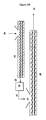
- Figure 1 is a schematic illustration of a process for manufacturing dynamically vulcanized alloys wherein a rubber master batch and rubber granulator are used.
- Figure 2 is a schematic illustration of one embodiment of the inventive process for manufacturing dynamically vulcanized alloys.
- dynamic vulcanization is used herein to connote a vulcanization process in which a thermoplastic resin and a vulcanizable elastomer are vulcanized under conditions of high shear. As a result of the shear mixing, the vulcanizable elastomer is simultaneously crosslinked and dispersed as fine particles of a "micro gel" within the thermoplastic resin, creating a dynamically vulcanized alloy ("DVA").
- DVA dynamically vulcanized alloy
- Dynamic vulcanization is effected by mixing the ingredients at a temperature which is at or above the curing temperature of the elastomer.
- Mixers used in the mixing process may include, but are not limited to, equipment such as roll mills, Banbury TM mixers, continuous mixers, kneaders, or mixing extruders, e.g., twin screw extruders.
- the unique characteristic of the DVA is that, notwithstanding the fact that the elastomer component may be fully cured, the DVA can be processed and reprocessed by conventional rubber processing techniques such as extrusion, injection molding, compression molding, etc. Scrap or flashing can be salvaged and reprocessed.
- the DVA has a morphology wherein the elastomer is uniformly dispersed as fine particles within the thermoplastic resin.
- the thermoplastic resin component forms the continuous phase and the elastomer is the dispersed phase even where the rubber to resin ratio is 1.0 or more.
- the dispersed particle size of the elastomer and the structure of the resin phase are controlled to improve the durability of the DVA, in particular durability at low temperatures.
- the dynamically vulcanized alloy comprises at least one halogenated isobutylene-containing elastomer and at least one thermoplastic resin, and is produced by mixing said thermoplastic resin and at least one plasticizer in a multi-screw extruder to form a resin masterbatch; feeding said elastomer, at least one curative, and said resin masterbatch into the feed throat of a second multi-screw extruder; mixing said contents of the second multi-screw extruder under dynamic vulcanization conditions of temperature and shear to form a dynamically vulcanized alloy, wherein the elastomer is present as a dispersed phase of small vulcanized or partially vulcanized particles in a continuous phase of the thermoplastic resin.
- thermoplastic resin means a material which generally softens, or melts, when exposed to high temperatures and returns to its original condition when cooled to a lower, or room temperature.
- a thermoplastic resin is distinct from a thermoset or elastomeric material which solidifies via cross-linking or curing when subjected to heat.
- Suitable thermoplastic resins for use in the DVA include resins selected from the group consisting of polyamides, polyimides, polycarbonates, polyesters, polysulfones, polylactones, polyacetals, acrylonitrile-butadiene-styrene resins ("ABS”), polyphenyleneoxide (“PPO”), polyphenylene sulfide (“PPS”), polystyrene, styrene-acrylonitrile resins (“SAN”), styrene maleic anhydride resins (“SMA”), aromatic polyketones (e.g., "PEEK”, “PED”, and “PEKK”), and mixtures thereof.
- ABS acrylonitrile-butadiene-styrene resins
- PPS polyphenyleneoxide
- PPS polyphenylene sulfide
- SAN styrene-acrylonitrile resins
- SMA styrene maleic anhydride resins
- Suitable thermoplastic polyamides comprise crystalline or resinous, high molecular weight solid polymers including copolymers and terpolymers having recurring amide units within the polymer chain. Both fiber-forming and molding grade nylons are suitable. Examples of such polyamides are polycaprolactam (nylon-6), polylauryllactam (nylon-12), polyhexamethyleneadipamide (nylon-6,6) polyhexamethyleneazelamide (nylon-6,9) polyhexamethylenesebacamide (nylon-6,10), polyhexamethyleneisophthalamide (nylon-6, IP), nylon 6,66 copolymer, and the condensation product of 11-amino-undecanoic acid (nylon-11).
- thermoplastic polyesters which may be employed include the polymer reaction products of one or a mixture of aliphatic or aromatic polycarboxylic acids esters of anhydrides and one or a mixture of diols.
- Preferred polyesters are derived from aromatic dicarboxylic acids such as naphthalenic or phthalic acids and C 2 to C 4 diols, such as polyethylene terephthalate and polybutylene terephthalate.
- Preferred polyesters will have a melting point in the range of 160° C to 260° C.
- Suitable thermoplastic resins have a melting point of at least 150° C. In one embodiment, the resin has a melting point in the range of from about 150° to about 250° C.
- the elastomeric component of the DVA may be selected from an assortment of thermosetting, elastomeric materials.
- Suitable low-permeability elastomers are isobutylene containing elastomers such as butyl rubber, halogenated butyl rubber, star branched butyl rubber, halogenated star branched butyl rubber, poly(isobutylene-co-alkylstyrene), halogenated poly(isobutylene-co-alkylstyrene), and isobutylene - isoprene - alkylstyrene terpolymers.
- Suitable halogenated isobutylene elastomer components include copolymers (such as brominated isobutylene-paramethylstyrene copolymers) having a number average molecular weight Mn of at least about 25,000, preferably at least about 50,000, preferably at least about 75,000, preferably at least about 100,000, preferably at least about 150,000.
- the copolymers may also have a ratio of weight average molecular weight (Mw) to number average molecular weight (Mn), i.e., Mw/Mn of less than about 6, preferably less than about 4, more preferably less than about 2.5, most preferably less than about 2.0.
- suitable halogenated isobutylene elastomer components include copolymers (such as brominated isobutylene-paramethylstyrene copolymers) having a Mooney viscosity (1+4) at 125 °C (as measured by ASTM D 1646-99) of 25 or more, preferably 30 or more, or more preferably 40 or more.
- Preferred elastomers include copolymers of isobutylene and para-alkylstyrene, which may or may not be halogenated. Preferably the copolymer of isobutylene and para-alkylstyrene is halogenated. Such elastomers are described in European Patent Application 0 344 021 .
- the copolymers preferably have a substantially homogeneous compositional distribution.
- Preferred alkyl groups for the para-alkylstyrene moiety include alkyl groups having from I to 5 carbon atoms, primary haloalkyl, secondary haloalkyl having from 1 to 5 carbon atoms and mixtures thereof.
- a preferred copolymer comprises isobutylene and para-methylstyrene.
- Preferred brominated copolymers of isobutylene and para-methylstyrene include those having 5 to 12 weight % para-methylstyrene, 0.3 to 1.8 mol % brominated para-methylstyrene, and a Mooney viscosity of 30 to 65 (1+4) at 125 °C (as measured by ASTM D 1646-99).
- Such halogenated isobutylene elastomer copolymers may be prepared from isobutylene and about 0.5 to 25% by weight, preferably about 2 to 20% by weight, based upon the total amount of the comonomers, of p-alkylstyrene, preferably p-methylstyrene, followed by halogenation.
- the content of the halogen e.g., Br and/or Cl, preferably Br
- Br is preferably less than about 10% by weight, more preferably about 0.1 to about 7% by weight, based upon the total amount of the copolymer.
- the elastomer composition according to the present invention may contain, in addition to the above-mentioned essential ingredients, a vulcanization or cross-linking agent, or a vulcanization or cross-linking accelerator.
- a vulcanization or cross-linking agent or a vulcanization or cross-linking accelerator.
- the amounts of these additives added may be conventional amounts so long as they do not run counter to the object of the present invention.
- the relative weight ratio for the thermoplastic resin to the elastomer in the DVA is in the range of 5/95 to 75/25 in one embodiment, and 10/90 to 75/25 in another embodiment.
- the ratios are presumptive of the fact that the total amount of the thermoplastic resin and elastomer is 100 parts by weight.
- the thermoplastic resin is present in an amount ranging from about 10 to 98 wt% based on the alloy blend, and from about 20 to 95 wt% in another embodiment. In yet another embodiment, the thermoplastic resin is present in an amount ranging from 35 to 90 wt%.
- the amount of elastomer in the DVA is in an amount ranging from about 2 to 90 wt% based on the alloy blend, and from about 5 to 80 wt% in another embodiment. In yet another embodiment, the elastomer is present in an amount ranging from 10 to 65 wt%.
- the DVA may further comprise a secondary elastomer.
- the secondary elastomer may be any elastomer, but preferably the secondary elastomer is not an isobutylene-containing elastomer.
- An example of a preferred secondary elastomer is a maleic anhydride-modified copolymer.
- the secondary elastomer is a copolymer comprising maleic anhydride and ester functionalities such as maleic anhydride-modified ethylene-ethyl acrylate.
- the secondary elastomer may be added to the DVA processing extruder simultaneously with the elastomer and the thermoplastic resin masterbatch. Alternatively, it may be added to the DVA either prior to or after the elastomer and the thermoplastic resin masterbatch have entered the DVA processing extruder.
- the amount of the secondary elastomer in the DVA may be in the range of from about 2 wt% to about 45 wt%. If the DVA comprises at least one elastomer and a secondary elastomer, the total amount of both the elastomer and secondary elastomer is preferably in the range of from about 2 wt% to about 90 wt%.
- the method for producing the DVA comprises mixing the elastomer and the thermoplastic resin.
- the mixing is performed by a melt processing device, such as by a screw extruder.
- Any melt processing device can be used in the process that is capable of processing and mixing the cross-linkable elastomer, oil, thermoplastic resin, cure agents, and catalyst and can generate high enough temperature and shear for cure.
- suitable melt processing devices include, but are not limited to, buss-co kneader, planetary extruder, co-or counter rotating multi-screw screw extruders, with two or more screw tips, co-rotating intermixing extruder with two or more screws, ring extruder.
- screw tips refers to the leading edge of the flights of the extruder screws.
- melt-blending takes place with materials being in the melted or molten state.
- the materials may be in a molten state when entering the melt processing device.
- the melt processing device may or may not be used to melt the materials before they are mixed.
- a twin screw extruder (TSE) is used.
- the screws are intermeshing and co-rotating.
- TSE twin screw extruder
- ZSK 83 type 3 screw tips
- L/D 46 from Coperion Co.
- the materials may be mixed and melted in an extruder for dynamic curing, or mixed and melted in one extruder and passed to another extruder as a melt, or as a pellet if pelletized between extruders, for further dynamic curing.
- the mixing of polymeric components with or without curing agents may be carried in one or more of melt compounders and then the curing is carried out in one or more extruders.
- two or more types of extruders may be used for successive kneading/mixing of the components.
- One of the control conditions for the extrusion mixing is specific energy, which is equivalent to the overall energy supplied to the extruder per the mass passing through the extruder.
- the amount of overall energy supplied to the material may be affected by the melt temperature in the extruder, the amount of energy required to the rotate the extruder blocks in the extruder, the amount of mass moving through the extruder, and the speed of the mass moving through the extruder. For example, if a small volume of mass having a low viscosity and a low melt temperature is moved through an extruder, not much energy is required to move the material through the extruder.
- Conventional conditions for dynamic mixing of the elastomer and the thermoplastic resin components generally requires a specific energy of around 0.35 kw-hr/kg or higher.
- the first is the reaction between the thermoplastic resin and the elastomer.
- a component of the thermoplastic such as the amine group when polyamide is the thermoplastic, may react with the pendant halogen of the halogenated elastomer.
- This interfacial grafting reaction results in a high viscoelastomer copolymer.
- This reaction also allows the elastomer to be finely dispersed in the thermoplastic resin.
- physical mechanisms occur due to the shear mixing, an erosion phenomenon and other conventional drop breakup mechanism such as capillary drop break-up.
- edge portions of any large rubber particles which are grafted with the thermoplastic resin are pulled away from the main rubber particle body during the shear mixing and elongation flowing of the copolymer. If the DVA is heated too much due to excessive energy or temperature applied to the system, cross-linking of the elastomer may actually slow down the erosion phenomenon and other conventional drop breakup mechanisms, and reduce the ability of the elastomer to be finely dispersed within the DVA.
- the interfacial grafting reaction and the shear mixing allow for a DVA having a fine dispersion of elastomer as small particles in the continuous nylon phase.
- the two ingredients i.e., the elastomer and the thermoplastic resin
- the lower softening-temperature elastomer and the thermoplastic resin form a co-continuous morphology.
- the interfacial grafting reaction occurs the interfacial tension is lowered, allowing for a reduction of the elastomer phase as the two phases become compatible.
- the elastomer phase is dispersed it becomes a discontinuous phase dispersed in the continuous phase of thermoplastic resin.
- various compounding agents such as fillers, various types of oils, anti-aging agents, reinforcing agents, plasticizers, softening agent, or other various additives (except vulcanization agents) that are generally mixed into elastomers may be added during the above kneading, or they may be mixed in advance into the elastomer alone prior to kneading of the combined elastomer and thermoplastic resin.
- the DVA After the DVA has been fabricated, i.e. mixed to form the alloy, it may be further processed and formed into pellets or other desired article or shape.
- the process by which the DVA is produced impacts the morphology of the DVA.
- the inventive processes maintains, or not appreciably impairs, or improves the morphology of the DVA that is achieved during conventional mixing processes.
- the morphology of the DVA can be determined by particular properties of the DVA, including capillary viscosity and extrusion surface roughness, or by analytical tools such as atomic force microscopy.
- the capillary viscosity of the DVA is measured on a Laboratory Capillary Rheometer ("LCR"), according to a modified ASTM D-3835-02 test.
- the test modification is that the test is run at 220° C, with measurements taken at 1200 s -1 .
- An increase in the capillary viscosity indicates a decrease in viscosity degradation that can occur during shear mixing.
- the DVA has an average LCR viscosity of at least 300 Pa-sec. In one embodiment, the LCR viscosity in the range of from about 200 Pa-sec to about 350 Pa-sec, or in the range of from about 215 Pa-sec to about 300 Pa-sec.
- the extrusion surface roughness is a measure of the surface smoothness of the DVA, with lower numbers indicating a smoother surface.
- the ESR is measured using a Surfanalizer, supplied by Federal, and measured in accordance with the manufacturer's instructions for operation. Lower numbers are also indicative of the elastomer phase being more uniformly and well-dispersed within the continuous thermoplastic resin phase.
- the ESR is a particularly important extrusion property as it may dictate the performance of the DVA in the final product in end-use applications.
- the DVA has an ESR value not greater than 80. In one embodiment, the ESR value is in the range of from about 20 to about 70. In another embodiment, the ESR value of the DVA is in the range of about 30 to about 60.
- the conventional DVA fabrication process is a multiple-step process.
- the DVA is produced by first premixing (i) a rubber master batch that comprises a rubber component and the necessary curatives; and (ii) a resin master batch comprising a thermoplastic resin and plasticizers.
- the resin masterbatch is mixed, typically in a twin screw extruder, by mixing the resin and plasticizers.
- the resin masterbatch may then be pelletized.
- the pelletized resin masterbatch may be immediately used, or may be stored and used at a later time.
- the rubber master batch, resin master batch, and all remaining components are then fed into a mixer, such as an extruder, preferably by way of the extruder feed throat.
- a secondary elastomer, such as maleic anhydride-modified ethylene ethyl acrylate, may also be added to the DVA either prior to or after the rubber master batch and the resin master batch have entered the extruder.
- the elastomer component is dynamically vulcanized, during the melt mixing causing the elastomer component to disperse as a discontinuous phase in the continuous thermoplastic resin phase.
- the temperature for the melt mixing should be at least the temperature at which the thermoplastic resin melts.
- the shear rate at the time of mixing is typically from 500 to 7500 sec -1 .
- the overall time of the mixing is typically from 30 seconds to 10 minutes.
- FIG. 1 An example of the conventional process to produce a DVA is illustrated in Figure 1 .
- the elastomer and curatives enter a mixing device 11 by conduit 10 where they are intimately mixed to form a rubber masterbatch.
- Other conventional additives may also be mixed into the rubber masterbatch.
- the rubber masterbatch exits the mixing device 11 through conduit 12 and enters a rubber granulator 13.
- the rubber granulator 13 granulates the rubber masterbatch into smaller granular which exit the rubber granulator 13 through conduit 14.
- a resin masterbatch is mixed in the extruder 19.
- the thermoplastic resin enters the extruder 19 at the feed throat 20.
- Plasticizers and other additives may be added into the resin masterbatch at the feed throat 20 or along any entry ports of the extruder 19.
- the resin masterbatch then exits the extruder 19 through conduit 23 and enters a pelletizer 22 .
- the pelletized resin masterbatch then exits the pelletizer 22 via conduit 16 .
- the pellets may then enter the DVA processing extruder 18 via the feed throat 17 .
- the resin masterbatch 16 , rubber masterbatch 14 , and any other additives 15 are then dynamically vulcanized in extruder 18 , they are typically added to the extruder 18 through feed throat 17 .
- the DVA then exits the extruder 18 through conduit 21 .
- the conventional process to produce a DVA requires several sequential and parallel mixing operations. It was believed that the two-stage mixing operation was necessary to obtain the desired morphology in the final DVA product.
- the pre-mixing of the rubber masterbatch served principally to effect homogenous blending of the elastomer with the curative and the dynamic mixing of the rubber masterbatch with the resin masterbatch served principally to effect reduction in particle size of the dispersed phase material.
- the DVA is produced by the mixing of at least one thermoplastic resin and at least one plasticizer in a first melt processing device to form a resin masterbatch; and then mixing at least one elastomer, at least one curative, and said resin masterbatch in a second melt processing device under dynamic vulcanization conditions of temperature and shear.
- the inventive process there is no rubber masterbatching step, and the elastomer and curatives are added directly to the DVA melt processing device without any prior mixing. Eliminating the rubber masterbatching step may allow for savings in the cost of producing the DVA, as it may require less equipment and time to produce the DVA.
- the dynamically vulcanized alloy comprises at least one halogenated isobutylene-containing elastomer and at least one thermoplastic resin.
- the DVA is produced by mixing the thermoplastic resin and plasticizer in a first melt processing device to form a resin masterbatch.
- the first melt-processing device is a multi-screw extruder, such as a twin screw extruder. Any suitable plasticizer known in the art may be used.
- the plasticizer causes the thermoplastic resin to swell/expand.
- a preferred plasticizer is n-butylbenzene sulfonamide.
- An example of a suitable commercially available plasticizer is Uniplex 214, which is available from Unitex.
- the resin masterbatch may then be pelletized. If the resin masterbatch is pelletized, the pellets may be added directly to the feed throat of a second melt-processing device or they may be stored and used at a later time.
- the elastomer, at least one curative, and the resin masterbatch are then fed into the feed throat of a second melt-processing device.
- a secondary elastomer may be fed into the feed throat of the second melt-processing device.
- the contents of the second-melt processing device are then mixed under dynamic vulcanization conditions of temperature and shear to form a dynamically vulcanized alloy, wherein the elastomer is present as a dispersed phase of small vulcanized or partially vulcanized particles in a continuous phase of the thermoplastic resin.
- the second melt-processing device is a multi-screw extruder, such as a twin screw extruder.
- the dynamic vulcanization conditions are of such a temperature and shear so as to cause the elastomer component to disperse as a discontinuous phase in the continuous thermoplastic resin phase.
- the temperature for the melt mixing should be at least the temperature at which the thermoplastic resin melts.
- the shear rate at the time of mixing is typically from 500 to 7500 sec -1 .
- the overall time of the mixing is typically from 30 seconds to 10 minutes.
- a resin masterbatch is mixed in a first twin-screw extruder (“TSE") 19 .
- the resin enters the first TSE 19 through feed throat 20 .
- Conventional additives such as a plasticizer, may enter the first TSE 19 through feed throat 20 or alternatively may be added through any side injection ports along the length of the first TSE 19.
- the resin masterbatch exits the first TSE 19 through conduit 23 and enters a pelletizer 22 .
- the pelletized resin masterbatch then exits the pelletizer 22 via conduit 16.
- the pellets 16 may then enter enters the DVA processing extruder 18 through feed throat 17 .
- the DVA processing extruder is a twin-screw extruder.
- the additives may be added through side injection ports along the length of the DVA processing extruder 18 .
- the elastomer and curatives are directly added to the DVA processing extruder without any prior pre-mixing.
- the elastomer, curatives, resin masterbatch, and any additives, are then dynamically vulcanized by shear mixing in the DVA processing extruder 18 .
- the final DVA product exits the DVA processing extruder 18 through conduit 21 .
- the ultimate elongation ("UE") of the DVA was measured in accordance with ASTM D412.
- the UE indicates the distance a strand of the material can be stretched before it breaks.
- the M100 test measures the modulus of the material and indicates the resistance to strain at 100% extension in force per unit area.
- the weight gain percentage test (“WtGain% ”) is a measurement of the amount of oil absorbed by the sample in an oil swell resistance test. The test is based on ASTM D471 and ISO 1817. A sample of the DVA is immersed in IRM 903 oil for 24 hours at 121 °C. The WtGain% is an indirect measure of the completeness of the cross-linking (cross-linking density) of the DVA. Although weight gain values can depend on whether or not the elastomer is oil-extended, and how much, in DVAs having the same composition, the values show the amount of cross-linking of the DVAs relative to each other.
- Tension set is a measure of the permanent deformation of the DVA when it is stretched.
- the capillary viscosity of the DVA is measured on a Laboratory Capillary Rheometer ("LCR"), according to a modified ASTM D-3835-02 test.
- the test modification is that the test is run at 220 °C with measurements taken at 1200 s -1 .
- An increase in the capillary viscosity indicates a decrease in viscosity degradation that can occur during shear mixing.
- ESR is a measure of the surface smoothness of the DVA, where lower numbers indicate a smoother surface.
- the ESR is measured using a Surfanalizer, supplied by Federal, and measured in accordance with the manufacturer's instructions for operation. Lower numbers are also indicative of the elastomer phase being more uniformly and well-dispersed within the continuous thermoplastic resin phase. It is a particularly important extrusion property as the ESR may dictate the performance of the DVA in the final product in end-use applications.
- Equivalent Rubber Diameter is a measure of the elastomer particles in the DVA. The number of particles in a 30 micron x 30 micron cross-section of a DVA sample are counted as observed with atomic force microscopy. The particle aspect is the ratio between the major axis and the minor axis of the elastomer particles. The particle equivalent is then the Feret Diameter, which is the caliper length along the major axis of the particles.
- Curative Stearic Acid F 1000 Stearic Fatty Acid Harwick ZnSt Zinc Stearate D Witco Chemtura/Crompton SG2000 Talc Nippon AR201 MAH-g-EEA (maleic anhydride-modified ethylene ethyl acrylate) Mitsui-DuPont Chemicals Co., Ltd
- the same DVA formulation was used for all of the examples, with the difference being in the process for preparing the samples.
- the DVA composition contained 49.12 wt% of a halogenated copolymer of isobutylene and para-alkylstyrene, 30.93 wt% nylon 6,66, 13.26 wt% of n-butylbenzene sulfonamide (a plasticizer), with the remaining components of the composition being curatives, and other conventional additives.
- the formulations for the samples are provided in Table 3 .
- Samples A1 and A2 were prepared by a conventional process for preparing DVAs.
- Samples B1, B2, B3, and B4 were prepared by one embodiment of the invention. All of the DVA samples used in the example were processed using a Werner & Pfleiderer 83mm twin screw extruder (3-lobe); the extruder having fifteen barrel sections, 46 L/D, multiple potential injection locations, and a maximum RPM of 390.
- Samples A1 and A2 were prepared using the conventional process.
- a rubber master batch was first mixed using a batch internal mixer.
- the rubber master batch contained Exxpro 98-4, ZnO, stearic acid, ZnSt, and talc. After the rubber master batch was mixed it was introduced into a rubber granulator.
- the resin master batch was mixed using a twin screw extruder and then pelletized prior to introducing the resin master batch into the DVA processing twin screw extruder.
- the resin master batch contained Nylon 6/66, Uniplex 214, Irganox 1098, Tinuvin 622LD, and the copper iodide.
- the granulated rubber master batch, the secondary elastomer (AR201), and the pelletized resin masterbatch were then fed into the DVA processing twin screw
- Samples B1, B2, B3, and B4 were prepared using one embodiment of the invention.
- a resin master batch was prepared using the conventional process. However, no rubber master batch was made.
- the resin master batch, secondary elastomer, elastomer, curatives, and all remaining ingredients were added directly to the feed throat of the DVA processing twin screw extruder.
Landscapes
- Chemical & Material Sciences (AREA)
- Health & Medical Sciences (AREA)
- Chemical Kinetics & Catalysis (AREA)
- Medicinal Chemistry (AREA)
- Polymers & Plastics (AREA)
- Organic Chemistry (AREA)
- Engineering & Computer Science (AREA)
- Mechanical Engineering (AREA)
- Processes Of Treating Macromolecular Substances (AREA)
- Extrusion Moulding Of Plastics Or The Like (AREA)
Applications Claiming Priority (2)
| Application Number | Priority Date | Filing Date | Title |
|---|---|---|---|
| US12/139,248 US8158721B2 (en) | 2008-06-13 | 2008-06-13 | Process for preparing dynamically vulcanized alloys |
| PCT/US2009/043777 WO2009151859A1 (en) | 2008-06-13 | 2009-05-13 | Process for preparing dynamically vulcanized alloys |
Publications (2)
| Publication Number | Publication Date |
|---|---|
| EP2285894A1 EP2285894A1 (en) | 2011-02-23 |
| EP2285894B1 true EP2285894B1 (en) | 2013-06-26 |
Family
ID=40848766
Family Applications (1)
| Application Number | Title | Priority Date | Filing Date |
|---|---|---|---|
| EP09763150.1A Not-in-force EP2285894B1 (en) | 2008-06-13 | 2009-05-13 | Process for preparing dynamically vulcanized alloys |
Country Status (7)
| Country | Link |
|---|---|
| US (1) | US8158721B2 (enExample) |
| EP (1) | EP2285894B1 (enExample) |
| JP (1) | JP5463353B2 (enExample) |
| CN (1) | CN102066475B (enExample) |
| CA (1) | CA2727387C (enExample) |
| RU (1) | RU2534364C2 (enExample) |
| WO (1) | WO2009151859A1 (enExample) |
Families Citing this family (22)
| Publication number | Priority date | Publication date | Assignee | Title |
|---|---|---|---|---|
| US20150065625A1 (en) * | 2011-03-11 | 2015-03-05 | Exxonmobil Chemical Patents Inc. | Method of Forming Dynamically Vulcanized Thermoplastic Elastomer Films and Films Formed Therefrom |
| EP2574635A1 (en) | 2011-09-28 | 2013-04-03 | Lanxess Inc. | Process for continuous production of halogen-free thermoplastic elastomer compositions |
| US9975378B2 (en) | 2011-11-15 | 2018-05-22 | Bridgestone Americas Tire Operations, Llc | Rolled multilayer tire inner liner product and methods for preparing |
| US8871125B2 (en) | 2011-12-19 | 2014-10-28 | Exxonmobil Chemical Patents Inc. | Laminates of partially scorched adhesive and DVA film |
| WO2013191685A1 (en) * | 2012-06-19 | 2013-12-27 | The Yokohama Rubber Co., Ltd. | Thermoplastic elastomer composition and process to produce same |
| US9312047B2 (en) | 2012-06-22 | 2016-04-12 | Honeywell International Inc. | Method and compositions for producing polymer blends |
| RU2635610C2 (ru) | 2012-12-20 | 2017-11-14 | Эксонмобил Кемикэл Пейтентс Инк. | Способ получения динамически вулканизированных сплавов |
| EP2969594A4 (en) | 2013-03-15 | 2016-10-26 | Bridgestone Americas Tire | LOW WEIGHT INTERNAL CHAMBER AND ASSOCIATED METHODS |
| JP5659288B1 (ja) | 2013-12-26 | 2015-01-28 | 東芝機械株式会社 | ポリカーボネート樹脂とアクリル樹脂を含む透明樹脂組成物の製造方法 |
| JP5668876B2 (ja) * | 2014-02-07 | 2015-02-12 | 横浜ゴム株式会社 | 熱可塑性エラストマー組成物の製造方法 |
| CN105524361B (zh) * | 2014-09-29 | 2017-12-22 | 中国石油化工股份有限公司 | 一种热塑性硫化橡胶组合物及其制备方法和薄膜 |
| CN105524362B (zh) * | 2014-09-29 | 2017-12-22 | 中国石油化工股份有限公司 | 一种橡塑组合物的制备方法 |
| CN105524357B (zh) * | 2014-09-29 | 2017-12-22 | 中国石油化工股份有限公司 | 一种热塑性硫化橡胶及其制备方法 |
| CA2907297A1 (en) * | 2014-11-04 | 2016-05-04 | Exxonmobil Chemical Patents Inc. | Method of forming dynamically vulcanized thermoplastic elastomer films and films formed therefrom |
| US11738606B2 (en) | 2014-12-16 | 2023-08-29 | Triangle Tyre Co. Ltd. | Multilayer intrinsic sealants based on ionic butyl |
| US10919242B2 (en) | 2014-12-16 | 2021-02-16 | Triangle Tyre Co. Ltd. | Pneumatic tire with in-situ generated sealant composition by chain cessation of ionic butyl |
| US10399391B2 (en) | 2014-12-16 | 2019-09-03 | Triangle Tyre Co., Ltd. | Pneumatic tire having multiple built-in sealant layers and preparation thereof |
| US10589478B2 (en) | 2014-12-16 | 2020-03-17 | Triangle Tyre Co. Ltd. | Pneumatic tire having sealant layer |
| CN106239765B (zh) * | 2016-08-05 | 2017-11-28 | 常州瑞安普新材料有限公司 | 一种连续方式制备动态硫化热塑性弹性体的方法 |
| US10875267B2 (en) | 2017-06-08 | 2020-12-29 | Exxonmobil Chemical Patents Inc. | Methods of making a film of dynamically vulcanized thermoplastic elastomeric materials |
| US11292298B2 (en) | 2017-11-10 | 2022-04-05 | Triangle Tyre Co. Ltd. | Noise damper bonded to tire using adhesives |
| JP7335483B2 (ja) * | 2018-12-26 | 2023-08-30 | 横浜ゴム株式会社 | 冷媒輸送配管用熱可塑性樹脂組成物の製造方法 |
Family Cites Families (23)
| Publication number | Priority date | Publication date | Assignee | Title |
|---|---|---|---|---|
| US4594390A (en) | 1982-08-23 | 1986-06-10 | Monsanto Company | Process for the preparation of thermoplastic elastomers |
| US5244972A (en) | 1987-01-16 | 1993-09-14 | General Electric Company | Single step bulk process for high impact polyester masterbatches, products thereof and blends with polyesters |
| US6013727A (en) * | 1988-05-27 | 2000-01-11 | Exxon Chemical Patents, Inc. | Thermoplastic blend containing engineering resin |
| CA1338546C (en) | 1988-05-27 | 1996-08-20 | Kenneth William Powers | Para-alkylstyrene/isoolefin copolymers |
| JPH10292067A (ja) * | 1997-04-17 | 1998-11-04 | Yokohama Rubber Co Ltd:The | 流動性を改良した熱可塑性エラストマー組成物とその製造方法 |
| CN100473684C (zh) | 1997-09-30 | 2009-04-01 | 卡伯特公司 | 弹性体复合共混料及其制备方法 |
| KR100703576B1 (ko) | 1998-01-13 | 2007-04-05 | 요코하마 고무 가부시키가이샤 | 열가소성 탄성중합체 조성물, 이의 제조방법 및 이를 사용한 공기 타이어 |
| JP3236257B2 (ja) * | 1998-01-13 | 2001-12-10 | 横浜ゴム株式会社 | 熱可塑性エラストマー組成物およびそれを使用した空気入りタイヤ |
| DE19905292A1 (de) | 1998-02-10 | 1999-10-21 | Sumitomo Chemical Co | Copolymermasse auf Olefinbasis |
| JP3957394B2 (ja) | 1998-04-27 | 2007-08-15 | 横浜ゴム株式会社 | 熱可塑性エラストマー組成物 |
| US6288171B2 (en) * | 1998-07-01 | 2001-09-11 | Advanced Elastomer Systems, L.P. | Modification of thermoplastic vulcanizates using random propylene copolymers |
| JP4942253B2 (ja) * | 2000-04-11 | 2012-05-30 | 横浜ゴム株式会社 | 加工性が改良された熱可塑性エラストマー組成物およびそれを用いたタイヤ |
| DE60206915T2 (de) | 2001-06-15 | 2006-08-31 | Basell Poliolefine Italia S.R.L. | Verfahren zum vernetzen von thermoplastischem olefin und elastomer enthaltenden zusammensetzungen |
| CN100354364C (zh) | 2001-06-18 | 2007-12-12 | 可乐丽股份有限公司 | 热塑性弹性体组合物的制造方法 |
| ES2213723T3 (es) * | 2002-06-04 | 2004-09-01 | Chemplast Gmbh | Procedimiento y dispositivo para la produccion de polvo de caucho altamente activo a partir de residuos de caucho. |
| CA2490046A1 (en) | 2004-12-10 | 2006-06-10 | Lanxess Inc. | Multistage process for the manufacture of peroxide-cured hxnbr-polyamide thermoplastic vulcanizates |
| US8653170B2 (en) | 2005-06-27 | 2014-02-18 | Exxonmobil Chemical Patents Inc. | Dynamic vulcanization process for preparing thermoplastic elastomers |
| US7655728B2 (en) | 2005-06-27 | 2010-02-02 | Exxonmobil Chemical Patents Inc. | Preparation of thermoplastic elastomers by dynamic vulcanization in multi-screw extruders |
| RU2406739C2 (ru) | 2005-10-27 | 2010-12-20 | Эксонмобил Кемикал Пэйтенс, Инк. | Термопластичная эластомерная композиция и способ ее получения |
| CA2627170C (en) * | 2005-10-27 | 2012-02-21 | Exxonmobil Chemical Patents Inc. | Low permeability thermoplastic elastomer composition |
| US7655727B2 (en) | 2005-12-09 | 2010-02-02 | Exxonmobil Chemical Patents Inc. | Method for preparing thermoplastic vulcanizates with improved extrusion surfaces |
| CA2598342C (en) * | 2006-09-08 | 2014-10-14 | Lanxess Inc. | Peroxide cured thermoplastic vulcanizates comprising butyl rubber |
| CA2701805C (en) | 2007-10-11 | 2014-03-25 | Exxonmobil Chemical Patents Inc. | Efficient mixing process for producing thermoplastic elastomer composition |
-
2008
- 2008-06-13 US US12/139,248 patent/US8158721B2/en active Active
-
2009
- 2009-05-13 RU RU2010152297/04A patent/RU2534364C2/ru active
- 2009-05-13 EP EP09763150.1A patent/EP2285894B1/en not_active Not-in-force
- 2009-05-13 CA CA2727387A patent/CA2727387C/en not_active Expired - Fee Related
- 2009-05-13 JP JP2011513529A patent/JP5463353B2/ja active Active
- 2009-05-13 CN CN2009801215703A patent/CN102066475B/zh active Active
- 2009-05-13 WO PCT/US2009/043777 patent/WO2009151859A1/en not_active Ceased
Also Published As
| Publication number | Publication date |
|---|---|
| JP5463353B2 (ja) | 2014-04-09 |
| US20090312458A1 (en) | 2009-12-17 |
| JP2011522955A (ja) | 2011-08-04 |
| RU2010152297A (ru) | 2012-07-20 |
| CN102066475B (zh) | 2013-07-31 |
| CA2727387A1 (en) | 2009-12-17 |
| CA2727387C (en) | 2013-08-13 |
| WO2009151859A1 (en) | 2009-12-17 |
| RU2534364C2 (ru) | 2014-11-27 |
| EP2285894A1 (en) | 2011-02-23 |
| US8158721B2 (en) | 2012-04-17 |
| CN102066475A (zh) | 2011-05-18 |
Similar Documents
| Publication | Publication Date | Title |
|---|---|---|
| US8158721B2 (en) | Process for preparing dynamically vulcanized alloys | |
| EP0742268B1 (en) | Thermoplastic elastomers having improved high temperature performance | |
| EP2935409B1 (en) | Process for preparing dynamically vulcanized alloys | |
| US5936039A (en) | Processes for producing thermoplastic elastomers having improved engineering performance | |
| CA2518090C (en) | A method for controlling dispersion size of elastomer in thermoplastic elastomer composition | |
| CN1469901A (zh) | 卤化弹性体的热塑性组合物 | |
| EP2601261B1 (en) | Thermoplastic elastomeric compositions | |
| CN1751094A (zh) | 具有提高的橡胶造粒过程的热塑性弹性体组合物 | |
| KR102174802B1 (ko) | 할로겐-무함유 열가소성 엘라스토머 조성물의 연속적 제조 방법 | |
| EP4019586A2 (en) | High temperature, oil-resistant thermoplastic vulcanizates | |
| JP4007706B2 (ja) | ゴム補強用表面処理カーボンブラック含有熱可塑性エラストマー組成物 | |
| JP2005213326A (ja) | 熱可塑性エラストマー組成物 |
Legal Events
| Date | Code | Title | Description |
|---|---|---|---|
| PUAI | Public reference made under article 153(3) epc to a published international application that has entered the european phase |
Free format text: ORIGINAL CODE: 0009012 |
|
| 17P | Request for examination filed |
Effective date: 20101215 |
|
| AK | Designated contracting states |
Kind code of ref document: A1 Designated state(s): AT BE BG CH CY CZ DE DK EE ES FI FR GB GR HR HU IE IS IT LI LT LU LV MC MK MT NL NO PL PT RO SE SI SK TR |
|
| AX | Request for extension of the european patent |
Extension state: AL BA RS |
|
| 17Q | First examination report despatched |
Effective date: 20110516 |
|
| RIN1 | Information on inventor provided before grant (corrected) |
Inventor name: THE OTHER INVENTORS HAVE AGREED TO WAIVE THEIR ENT Inventor name: LYON, MICHAEL, K. Inventor name: DE LUCIA, JOSEPH, M. Inventor name: CHENG, JIANYA |
|
| DAX | Request for extension of the european patent (deleted) | ||
| GRAP | Despatch of communication of intention to grant a patent |
Free format text: ORIGINAL CODE: EPIDOSNIGR1 |
|
| GRAP | Despatch of communication of intention to grant a patent |
Free format text: ORIGINAL CODE: EPIDOSNIGR1 |
|
| GRAS | Grant fee paid |
Free format text: ORIGINAL CODE: EPIDOSNIGR3 |
|
| GRAA | (expected) grant |
Free format text: ORIGINAL CODE: 0009210 |
|
| AK | Designated contracting states |
Kind code of ref document: B1 Designated state(s): AT BE BG CH CY CZ DE DK EE ES FI FR GB GR HR HU IE IS IT LI LT LU LV MC MK MT NL NO PL PT RO SE SI SK TR |
|
| REG | Reference to a national code |
Ref country code: GB Ref legal event code: FG4D |
|
| REG | Reference to a national code |
Ref country code: CH Ref legal event code: EP |
|
| REG | Reference to a national code |
Ref country code: AT Ref legal event code: REF Ref document number: 618694 Country of ref document: AT Kind code of ref document: T Effective date: 20130715 |
|
| REG | Reference to a national code |
Ref country code: IE Ref legal event code: FG4D |
|
| REG | Reference to a national code |
Ref country code: DE Ref legal event code: R096 Ref document number: 602009016711 Country of ref document: DE Effective date: 20130822 |
|
| PG25 | Lapsed in a contracting state [announced via postgrant information from national office to epo] |
Ref country code: LT Free format text: LAPSE BECAUSE OF FAILURE TO SUBMIT A TRANSLATION OF THE DESCRIPTION OR TO PAY THE FEE WITHIN THE PRESCRIBED TIME-LIMIT Effective date: 20130626 Ref country code: SE Free format text: LAPSE BECAUSE OF FAILURE TO SUBMIT A TRANSLATION OF THE DESCRIPTION OR TO PAY THE FEE WITHIN THE PRESCRIBED TIME-LIMIT Effective date: 20130626 Ref country code: NO Free format text: LAPSE BECAUSE OF FAILURE TO SUBMIT A TRANSLATION OF THE DESCRIPTION OR TO PAY THE FEE WITHIN THE PRESCRIBED TIME-LIMIT Effective date: 20130926 Ref country code: FI Free format text: LAPSE BECAUSE OF FAILURE TO SUBMIT A TRANSLATION OF THE DESCRIPTION OR TO PAY THE FEE WITHIN THE PRESCRIBED TIME-LIMIT Effective date: 20130626 Ref country code: SI Free format text: LAPSE BECAUSE OF FAILURE TO SUBMIT A TRANSLATION OF THE DESCRIPTION OR TO PAY THE FEE WITHIN THE PRESCRIBED TIME-LIMIT Effective date: 20130626 |
|
| REG | Reference to a national code |
Ref country code: AT Ref legal event code: MK05 Ref document number: 618694 Country of ref document: AT Kind code of ref document: T Effective date: 20130626 |
|
| REG | Reference to a national code |
Ref country code: LT Ref legal event code: MG4D |
|
| PG25 | Lapsed in a contracting state [announced via postgrant information from national office to epo] |
Ref country code: HR Free format text: LAPSE BECAUSE OF FAILURE TO SUBMIT A TRANSLATION OF THE DESCRIPTION OR TO PAY THE FEE WITHIN THE PRESCRIBED TIME-LIMIT Effective date: 20130626 Ref country code: BG Free format text: LAPSE BECAUSE OF FAILURE TO SUBMIT A TRANSLATION OF THE DESCRIPTION OR TO PAY THE FEE WITHIN THE PRESCRIBED TIME-LIMIT Effective date: 20130926 |
|
| REG | Reference to a national code |
Ref country code: NL Ref legal event code: VDEP Effective date: 20130626 |
|
| PG25 | Lapsed in a contracting state [announced via postgrant information from national office to epo] |
Ref country code: LV Free format text: LAPSE BECAUSE OF FAILURE TO SUBMIT A TRANSLATION OF THE DESCRIPTION OR TO PAY THE FEE WITHIN THE PRESCRIBED TIME-LIMIT Effective date: 20130626 |
|
| PG25 | Lapsed in a contracting state [announced via postgrant information from national office to epo] |
Ref country code: EE Free format text: LAPSE BECAUSE OF FAILURE TO SUBMIT A TRANSLATION OF THE DESCRIPTION OR TO PAY THE FEE WITHIN THE PRESCRIBED TIME-LIMIT Effective date: 20130626 Ref country code: PT Free format text: LAPSE BECAUSE OF FAILURE TO SUBMIT A TRANSLATION OF THE DESCRIPTION OR TO PAY THE FEE WITHIN THE PRESCRIBED TIME-LIMIT Effective date: 20131028 Ref country code: CZ Free format text: LAPSE BECAUSE OF FAILURE TO SUBMIT A TRANSLATION OF THE DESCRIPTION OR TO PAY THE FEE WITHIN THE PRESCRIBED TIME-LIMIT Effective date: 20130626 Ref country code: IS Free format text: LAPSE BECAUSE OF FAILURE TO SUBMIT A TRANSLATION OF THE DESCRIPTION OR TO PAY THE FEE WITHIN THE PRESCRIBED TIME-LIMIT Effective date: 20131026 Ref country code: SK Free format text: LAPSE BECAUSE OF FAILURE TO SUBMIT A TRANSLATION OF THE DESCRIPTION OR TO PAY THE FEE WITHIN THE PRESCRIBED TIME-LIMIT Effective date: 20130626 Ref country code: AT Free format text: LAPSE BECAUSE OF FAILURE TO SUBMIT A TRANSLATION OF THE DESCRIPTION OR TO PAY THE FEE WITHIN THE PRESCRIBED TIME-LIMIT Effective date: 20130626 Ref country code: CY Free format text: LAPSE BECAUSE OF FAILURE TO SUBMIT A TRANSLATION OF THE DESCRIPTION OR TO PAY THE FEE WITHIN THE PRESCRIBED TIME-LIMIT Effective date: 20130918 |
|
| PG25 | Lapsed in a contracting state [announced via postgrant information from national office to epo] |
Ref country code: ES Free format text: LAPSE BECAUSE OF FAILURE TO SUBMIT A TRANSLATION OF THE DESCRIPTION OR TO PAY THE FEE WITHIN THE PRESCRIBED TIME-LIMIT Effective date: 20131007 Ref country code: RO Free format text: LAPSE BECAUSE OF FAILURE TO SUBMIT A TRANSLATION OF THE DESCRIPTION OR TO PAY THE FEE WITHIN THE PRESCRIBED TIME-LIMIT Effective date: 20130626 Ref country code: PL Free format text: LAPSE BECAUSE OF FAILURE TO SUBMIT A TRANSLATION OF THE DESCRIPTION OR TO PAY THE FEE WITHIN THE PRESCRIBED TIME-LIMIT Effective date: 20130626 Ref country code: NL Free format text: LAPSE BECAUSE OF FAILURE TO SUBMIT A TRANSLATION OF THE DESCRIPTION OR TO PAY THE FEE WITHIN THE PRESCRIBED TIME-LIMIT Effective date: 20130626 |
|
| PG25 | Lapsed in a contracting state [announced via postgrant information from national office to epo] |
Ref country code: CY Free format text: LAPSE BECAUSE OF FAILURE TO SUBMIT A TRANSLATION OF THE DESCRIPTION OR TO PAY THE FEE WITHIN THE PRESCRIBED TIME-LIMIT Effective date: 20130626 |
|
| PG25 | Lapsed in a contracting state [announced via postgrant information from national office to epo] |
Ref country code: DK Free format text: LAPSE BECAUSE OF FAILURE TO SUBMIT A TRANSLATION OF THE DESCRIPTION OR TO PAY THE FEE WITHIN THE PRESCRIBED TIME-LIMIT Effective date: 20130626 |
|
| PLBE | No opposition filed within time limit |
Free format text: ORIGINAL CODE: 0009261 |
|
| STAA | Information on the status of an ep patent application or granted ep patent |
Free format text: STATUS: NO OPPOSITION FILED WITHIN TIME LIMIT |
|
| PG25 | Lapsed in a contracting state [announced via postgrant information from national office to epo] |
Ref country code: IT Free format text: LAPSE BECAUSE OF FAILURE TO SUBMIT A TRANSLATION OF THE DESCRIPTION OR TO PAY THE FEE WITHIN THE PRESCRIBED TIME-LIMIT Effective date: 20130626 |
|
| 26N | No opposition filed |
Effective date: 20140327 |
|
| REG | Reference to a national code |
Ref country code: DE Ref legal event code: R097 Ref document number: 602009016711 Country of ref document: DE Effective date: 20140327 |
|
| PG25 | Lapsed in a contracting state [announced via postgrant information from national office to epo] |
Ref country code: LU Free format text: LAPSE BECAUSE OF FAILURE TO SUBMIT A TRANSLATION OF THE DESCRIPTION OR TO PAY THE FEE WITHIN THE PRESCRIBED TIME-LIMIT Effective date: 20140513 |
|
| REG | Reference to a national code |
Ref country code: CH Ref legal event code: PL |
|
| PG25 | Lapsed in a contracting state [announced via postgrant information from national office to epo] |
Ref country code: LI Free format text: LAPSE BECAUSE OF NON-PAYMENT OF DUE FEES Effective date: 20140531 Ref country code: MC Free format text: LAPSE BECAUSE OF FAILURE TO SUBMIT A TRANSLATION OF THE DESCRIPTION OR TO PAY THE FEE WITHIN THE PRESCRIBED TIME-LIMIT Effective date: 20130626 Ref country code: CH Free format text: LAPSE BECAUSE OF NON-PAYMENT OF DUE FEES Effective date: 20140531 |
|
| REG | Reference to a national code |
Ref country code: IE Ref legal event code: MM4A |
|
| PG25 | Lapsed in a contracting state [announced via postgrant information from national office to epo] |
Ref country code: IE Free format text: LAPSE BECAUSE OF NON-PAYMENT OF DUE FEES Effective date: 20140513 |
|
| PG25 | Lapsed in a contracting state [announced via postgrant information from national office to epo] |
Ref country code: MT Free format text: LAPSE BECAUSE OF FAILURE TO SUBMIT A TRANSLATION OF THE DESCRIPTION OR TO PAY THE FEE WITHIN THE PRESCRIBED TIME-LIMIT Effective date: 20130626 |
|
| REG | Reference to a national code |
Ref country code: FR Ref legal event code: PLFP Year of fee payment: 8 |
|
| PG25 | Lapsed in a contracting state [announced via postgrant information from national office to epo] |
Ref country code: GR Free format text: LAPSE BECAUSE OF FAILURE TO SUBMIT A TRANSLATION OF THE DESCRIPTION OR TO PAY THE FEE WITHIN THE PRESCRIBED TIME-LIMIT Effective date: 20130626 |
|
| PG25 | Lapsed in a contracting state [announced via postgrant information from national office to epo] |
Ref country code: TR Free format text: LAPSE BECAUSE OF FAILURE TO SUBMIT A TRANSLATION OF THE DESCRIPTION OR TO PAY THE FEE WITHIN THE PRESCRIBED TIME-LIMIT Effective date: 20130626 Ref country code: HU Free format text: LAPSE BECAUSE OF FAILURE TO SUBMIT A TRANSLATION OF THE DESCRIPTION OR TO PAY THE FEE WITHIN THE PRESCRIBED TIME-LIMIT; INVALID AB INITIO Effective date: 20090513 |
|
| REG | Reference to a national code |
Ref country code: FR Ref legal event code: PLFP Year of fee payment: 9 |
|
| REG | Reference to a national code |
Ref country code: FR Ref legal event code: PLFP Year of fee payment: 10 |
|
| PG25 | Lapsed in a contracting state [announced via postgrant information from national office to epo] |
Ref country code: MK Free format text: LAPSE BECAUSE OF FAILURE TO SUBMIT A TRANSLATION OF THE DESCRIPTION OR TO PAY THE FEE WITHIN THE PRESCRIBED TIME-LIMIT Effective date: 20130626 |
|
| PGFP | Annual fee paid to national office [announced via postgrant information from national office to epo] |
Ref country code: DE Payment date: 20200417 Year of fee payment: 12 Ref country code: FR Payment date: 20200421 Year of fee payment: 12 |
|
| PGFP | Annual fee paid to national office [announced via postgrant information from national office to epo] |
Ref country code: BE Payment date: 20200421 Year of fee payment: 12 Ref country code: GB Payment date: 20200429 Year of fee payment: 12 |
|
| REG | Reference to a national code |
Ref country code: DE Ref legal event code: R119 Ref document number: 602009016711 Country of ref document: DE |
|
| GBPC | Gb: european patent ceased through non-payment of renewal fee |
Effective date: 20210513 |
|
| REG | Reference to a national code |
Ref country code: BE Ref legal event code: MM Effective date: 20210531 |
|
| PG25 | Lapsed in a contracting state [announced via postgrant information from national office to epo] |
Ref country code: GB Free format text: LAPSE BECAUSE OF NON-PAYMENT OF DUE FEES Effective date: 20210513 Ref country code: DE Free format text: LAPSE BECAUSE OF NON-PAYMENT OF DUE FEES Effective date: 20211201 |
|
| PG25 | Lapsed in a contracting state [announced via postgrant information from national office to epo] |
Ref country code: FR Free format text: LAPSE BECAUSE OF NON-PAYMENT OF DUE FEES Effective date: 20210531 |
|
| PG25 | Lapsed in a contracting state [announced via postgrant information from national office to epo] |
Ref country code: BE Free format text: LAPSE BECAUSE OF NON-PAYMENT OF DUE FEES Effective date: 20210531 |