EP2246928A2 - Lithiumion-Sekundärbatterie - Google Patents
Lithiumion-Sekundärbatterie Download PDFInfo
- Publication number
- EP2246928A2 EP2246928A2 EP10170018A EP10170018A EP2246928A2 EP 2246928 A2 EP2246928 A2 EP 2246928A2 EP 10170018 A EP10170018 A EP 10170018A EP 10170018 A EP10170018 A EP 10170018A EP 2246928 A2 EP2246928 A2 EP 2246928A2
- Authority
- EP
- European Patent Office
- Prior art keywords
- electrolyte
- electrode assembly
- insulating plate
- lithium ion
- ion secondary
- Prior art date
- Legal status (The legal status is an assumption and is not a legal conclusion. Google has not performed a legal analysis and makes no representation as to the accuracy of the status listed.)
- Withdrawn
Links
Images

Classifications
-
- H—ELECTRICITY
- H01—ELECTRIC ELEMENTS
- H01M—PROCESSES OR MEANS, e.g. BATTERIES, FOR THE DIRECT CONVERSION OF CHEMICAL ENERGY INTO ELECTRICAL ENERGY
- H01M10/00—Secondary cells; Manufacture thereof
- H01M10/05—Accumulators with non-aqueous electrolyte
- H01M10/056—Accumulators with non-aqueous electrolyte characterised by the materials used as electrolytes, e.g. mixed inorganic/organic electrolytes
- H01M10/0564—Accumulators with non-aqueous electrolyte characterised by the materials used as electrolytes, e.g. mixed inorganic/organic electrolytes the electrolyte being constituted of organic materials only
- H01M10/0566—Liquid materials
-
- H—ELECTRICITY
- H01—ELECTRIC ELEMENTS
- H01M—PROCESSES OR MEANS, e.g. BATTERIES, FOR THE DIRECT CONVERSION OF CHEMICAL ENERGY INTO ELECTRICAL ENERGY
- H01M10/00—Secondary cells; Manufacture thereof
- H01M10/05—Accumulators with non-aqueous electrolyte
- H01M10/056—Accumulators with non-aqueous electrolyte characterised by the materials used as electrolytes, e.g. mixed inorganic/organic electrolytes
- H01M10/0564—Accumulators with non-aqueous electrolyte characterised by the materials used as electrolytes, e.g. mixed inorganic/organic electrolytes the electrolyte being constituted of organic materials only
- H01M10/0566—Liquid materials
- H01M10/0567—Liquid materials characterised by the additives
-
- H—ELECTRICITY
- H01—ELECTRIC ELEMENTS
- H01M—PROCESSES OR MEANS, e.g. BATTERIES, FOR THE DIRECT CONVERSION OF CHEMICAL ENERGY INTO ELECTRICAL ENERGY
- H01M50/00—Constructional details or processes of manufacture of the non-active parts of electrochemical cells other than fuel cells, e.g. hybrid cells
- H01M50/10—Primary casings; Jackets or wrappings
- H01M50/102—Primary casings; Jackets or wrappings characterised by their shape or physical structure
- H01M50/107—Primary casings; Jackets or wrappings characterised by their shape or physical structure having curved cross-section, e.g. round or elliptic
-
- H—ELECTRICITY
- H01—ELECTRIC ELEMENTS
- H01M—PROCESSES OR MEANS, e.g. BATTERIES, FOR THE DIRECT CONVERSION OF CHEMICAL ENERGY INTO ELECTRICAL ENERGY
- H01M50/00—Constructional details or processes of manufacture of the non-active parts of electrochemical cells other than fuel cells, e.g. hybrid cells
- H01M50/10—Primary casings; Jackets or wrappings
- H01M50/116—Primary casings; Jackets or wrappings characterised by the material
- H01M50/117—Inorganic material
- H01M50/119—Metals
-
- H—ELECTRICITY
- H01—ELECTRIC ELEMENTS
- H01M—PROCESSES OR MEANS, e.g. BATTERIES, FOR THE DIRECT CONVERSION OF CHEMICAL ENERGY INTO ELECTRICAL ENERGY
- H01M50/00—Constructional details or processes of manufacture of the non-active parts of electrochemical cells other than fuel cells, e.g. hybrid cells
- H01M50/10—Primary casings; Jackets or wrappings
- H01M50/147—Lids or covers
- H01M50/148—Lids or covers characterised by their shape
- H01M50/152—Lids or covers characterised by their shape for cells having curved cross-section, e.g. round or elliptic
-
- H—ELECTRICITY
- H01—ELECTRIC ELEMENTS
- H01M—PROCESSES OR MEANS, e.g. BATTERIES, FOR THE DIRECT CONVERSION OF CHEMICAL ENERGY INTO ELECTRICAL ENERGY
- H01M50/00—Constructional details or processes of manufacture of the non-active parts of electrochemical cells other than fuel cells, e.g. hybrid cells
- H01M50/10—Primary casings; Jackets or wrappings
- H01M50/147—Lids or covers
- H01M50/148—Lids or covers characterised by their shape
- H01M50/154—Lid or cover comprising an axial bore for receiving a central current collector
-
- H—ELECTRICITY
- H01—ELECTRIC ELEMENTS
- H01M—PROCESSES OR MEANS, e.g. BATTERIES, FOR THE DIRECT CONVERSION OF CHEMICAL ENERGY INTO ELECTRICAL ENERGY
- H01M50/00—Constructional details or processes of manufacture of the non-active parts of electrochemical cells other than fuel cells, e.g. hybrid cells
- H01M50/10—Primary casings; Jackets or wrappings
- H01M50/183—Sealing members
- H01M50/184—Sealing members characterised by their shape or structure
-
- H—ELECTRICITY
- H01—ELECTRIC ELEMENTS
- H01M—PROCESSES OR MEANS, e.g. BATTERIES, FOR THE DIRECT CONVERSION OF CHEMICAL ENERGY INTO ELECTRICAL ENERGY
- H01M50/00—Constructional details or processes of manufacture of the non-active parts of electrochemical cells other than fuel cells, e.g. hybrid cells
- H01M50/10—Primary casings; Jackets or wrappings
- H01M50/183—Sealing members
- H01M50/186—Sealing members characterised by the disposition of the sealing members
-
- H—ELECTRICITY
- H01—ELECTRIC ELEMENTS
- H01M—PROCESSES OR MEANS, e.g. BATTERIES, FOR THE DIRECT CONVERSION OF CHEMICAL ENERGY INTO ELECTRICAL ENERGY
- H01M50/00—Constructional details or processes of manufacture of the non-active parts of electrochemical cells other than fuel cells, e.g. hybrid cells
- H01M50/10—Primary casings; Jackets or wrappings
- H01M50/183—Sealing members
- H01M50/19—Sealing members characterised by the material
- H01M50/193—Organic material
-
- H—ELECTRICITY
- H01—ELECTRIC ELEMENTS
- H01M—PROCESSES OR MEANS, e.g. BATTERIES, FOR THE DIRECT CONVERSION OF CHEMICAL ENERGY INTO ELECTRICAL ENERGY
- H01M50/00—Constructional details or processes of manufacture of the non-active parts of electrochemical cells other than fuel cells, e.g. hybrid cells
- H01M50/50—Current conducting connections for cells or batteries
- H01M50/543—Terminals
- H01M50/547—Terminals characterised by the disposition of the terminals on the cells
- H01M50/548—Terminals characterised by the disposition of the terminals on the cells on opposite sides of the cell
-
- H—ELECTRICITY
- H01—ELECTRIC ELEMENTS
- H01M—PROCESSES OR MEANS, e.g. BATTERIES, FOR THE DIRECT CONVERSION OF CHEMICAL ENERGY INTO ELECTRICAL ENERGY
- H01M50/00—Constructional details or processes of manufacture of the non-active parts of electrochemical cells other than fuel cells, e.g. hybrid cells
- H01M50/50—Current conducting connections for cells or batteries
- H01M50/543—Terminals
- H01M50/552—Terminals characterised by their shape
- H01M50/559—Terminals adapted for cells having curved cross-section, e.g. round, elliptic or button cells
-
- H—ELECTRICITY
- H01—ELECTRIC ELEMENTS
- H01M—PROCESSES OR MEANS, e.g. BATTERIES, FOR THE DIRECT CONVERSION OF CHEMICAL ENERGY INTO ELECTRICAL ENERGY
- H01M10/00—Secondary cells; Manufacture thereof
- H01M10/05—Accumulators with non-aqueous electrolyte
- H01M10/052—Li-accumulators
-
- H—ELECTRICITY
- H01—ELECTRIC ELEMENTS
- H01M—PROCESSES OR MEANS, e.g. BATTERIES, FOR THE DIRECT CONVERSION OF CHEMICAL ENERGY INTO ELECTRICAL ENERGY
- H01M50/00—Constructional details or processes of manufacture of the non-active parts of electrochemical cells other than fuel cells, e.g. hybrid cells
- H01M50/10—Primary casings; Jackets or wrappings
- H01M50/116—Primary casings; Jackets or wrappings characterised by the material
- H01M50/124—Primary casings; Jackets or wrappings characterised by the material having a layered structure
-
- H—ELECTRICITY
- H01—ELECTRIC ELEMENTS
- H01M—PROCESSES OR MEANS, e.g. BATTERIES, FOR THE DIRECT CONVERSION OF CHEMICAL ENERGY INTO ELECTRICAL ENERGY
- H01M50/00—Constructional details or processes of manufacture of the non-active parts of electrochemical cells other than fuel cells, e.g. hybrid cells
- H01M50/10—Primary casings; Jackets or wrappings
- H01M50/116—Primary casings; Jackets or wrappings characterised by the material
- H01M50/124—Primary casings; Jackets or wrappings characterised by the material having a layered structure
- H01M50/1245—Primary casings; Jackets or wrappings characterised by the material having a layered structure characterised by the external coating on the casing
-
- Y—GENERAL TAGGING OF NEW TECHNOLOGICAL DEVELOPMENTS; GENERAL TAGGING OF CROSS-SECTIONAL TECHNOLOGIES SPANNING OVER SEVERAL SECTIONS OF THE IPC; TECHNICAL SUBJECTS COVERED BY FORMER USPC CROSS-REFERENCE ART COLLECTIONS [XRACs] AND DIGESTS
- Y02—TECHNOLOGIES OR APPLICATIONS FOR MITIGATION OR ADAPTATION AGAINST CLIMATE CHANGE
- Y02E—REDUCTION OF GREENHOUSE GAS [GHG] EMISSIONS, RELATED TO ENERGY GENERATION, TRANSMISSION OR DISTRIBUTION
- Y02E60/00—Enabling technologies; Technologies with a potential or indirect contribution to GHG emissions mitigation
- Y02E60/10—Energy storage using batteries
-
- Y—GENERAL TAGGING OF NEW TECHNOLOGICAL DEVELOPMENTS; GENERAL TAGGING OF CROSS-SECTIONAL TECHNOLOGIES SPANNING OVER SEVERAL SECTIONS OF THE IPC; TECHNICAL SUBJECTS COVERED BY FORMER USPC CROSS-REFERENCE ART COLLECTIONS [XRACs] AND DIGESTS
- Y02—TECHNOLOGIES OR APPLICATIONS FOR MITIGATION OR ADAPTATION AGAINST CLIMATE CHANGE
- Y02P—CLIMATE CHANGE MITIGATION TECHNOLOGIES IN THE PRODUCTION OR PROCESSING OF GOODS
- Y02P70/00—Climate change mitigation technologies in the production process for final industrial or consumer products
- Y02P70/50—Manufacturing or production processes characterised by the final manufactured product
Definitions
- the present invention relates to lithium ion secondary batteries.
- Battery packs are built in the portable electrical and electronic apparatuses so that the portable electrical and electronic apparatuses can operate without an additional power source.
- the built-in battery pack includes at least one battery for outputting a uniform voltage level to drive the portable electrical or electronic apparatus for a desired period of time.
- Secondary batteries that can be charged and discharged have recently been used as the battery packs for economic reasons. Secondary batteries include Ni-Cd batteries, Ni-MH batteries, lithium metal batteries, and lithium ion batteries.
- the operation voltage of lithium ion secondary batteries is commonly 3.6V, which is three times higher than the operation voltages of Ni-Cd batteries and Ni-MH batteries which are widely used as the power sources for portable electronic apparatuses.
- the energy density per unit weigh of lithium ion secondary batteries is high. Therefore, use of lithium ion secondary batteries has rapidly increased.
- lithium ion secondary batteries lithium based oxides are used as the positive electrode active materials, and carbon materials are used as the negative electrode active materials.
- lithium ion secondary batteries are classified into liquid electrolyte batteries and polymer electrolyte batteries depending on the kind of electrolyte. Batteries using liquid electrolytes are referred to as lithium ion batteries and batteries using polymer electrolytes are referred to as lithium polymer batteries. Also, lithium ion secondary batteries can take various shapes, such as cylinders, polygons, and pouches.
- a cylindrical lithium ion secondary battery in general, includes an electrode assembly having a positive electrode plate coated with positive active materials, a negative electrode plate coated with negative active materials, and a separator positioned between the positive electrode plate and the negative electrode plate.
- the separator prevents the positive electrode plate and the negative electrode plate from short-circuiting and permits movement of only lithium ions.
- the electrode assembly is wound and placed in a case together with the electrolyte, and a cap assembly seals the case.
- a sealing tape for supporting, protecting, and insulating the electrode assembly is wound around the outer circumference of the electrode assembly in the lithium ion secondary battery.
- the sealing tape is commonly formed of polyolefin based materials such as polyethylene (PE), polypropylene (PP), and polyimide (PI).
- PE polyethylene
- PP polypropylene
- PI polyimide
- these materials are barely wetted by the electrolyte and the electrolyte is barely diffused into the materials (the materials have a weak affinity for the electrolyte).
- the capillary phenomenon which generates a minute gap between the case and the electrode assembly during impregnation of the electrolyte, is prevented.
- the capacity of the battery increases, the density of the electrode assembly increases. Therefore, the external diameter of the electrode assembly increases and the space between the electrode assembly and the case decreases, making impregnation of the electrolyte more difficult.
- a lower insulating plate is inserted to insulate the electrode assembly and the case from each other. Also, after inserting the electrode assembly and before sealing the case with the cap assembly, an upper insulating plate is inserted to insulate the electrode assembly and the cap assembly from each other.
- the upper and lower insulating plates are commonly formed of polyethylene (PE) or polypropylene (PP), the upper and lower insulating plates are barely wetted by the electrolyte and the electrolyte is barely diffused into the upper and lower insulating plates (the upper and lower insulating plates have weak affinities for the electrolyte). Therefore, the electrode assembly is prevented from being sufficiently impregnated with the electrolyte. Furthermore, as the capacity of the battery increases, the density of the electrode assembly increases. As a result, the external diameter of the electrode assembly increases. When the external diameter of the electrode assembly increases, the space between the case and the electrode assembly decreases, making impregnation of the electrolyte more difficult.
- PE polyethylene
- PP polypropylene
- a lithium ion secondary battery includes first and second insulating plates, and the surface of at least one of the first and second insulating plates is modified by a material that can be easily impregnated with an electrolyte. This enables even a high density electrode assembly to be easily impregnated with the electrolyte.
- a lithium ion secondary battery includes first and second insulating plates and the surface of at least one of the first and second insulating plates is coated with a material that can be easily impregnated with an electrolyte. This enables even a high density electrode assembly to be easily impregnated with the electrolyte.
- a lithium ion secondary battery includes an electrode assembly, a case for accommodating the electrode assembly and an electrolyte, a cap assembly for sealing the case, a first insulating plate positioned between the electrode assembly and the case, and a second insulating plate positioned between the electrode assembly and the cap assembly.
- At least one of the first and second insulating plates comprises a material having an affinity for the electrolyte so that the electrolyte is easily diffused into the sealing tape and so that the sealing tape is easily wetted by the electrolyte.
- the material having an affinity for the electrolyte is a polymer material having a contact angle at the interface with the electrolyte ranging from about 1 to about 80°, as measured during contact angle experimentation.
- the polymer material is PVdF.or the polymer material includes an ester group or a carboxyl group.
- a lithium ion secondary battery includes an electrode assembly, a case for accommodating the electrode assembly and an electrolyte, a cap assembly for sealing the case, a first insulating plate positioned between the electrode assembly and the case, and a second insulating plate positioned between the electrode assembly and the cap assembly.
- At least one of the first and second insulating plates comprises a material including a mixture of a material having an affinity for the electrolyte and a material that does not have an affinity for the electrolyte.
- the material having an affinity for the electrolyte can be an oxide having a contact angle at the interface with the electrolyte ranging from about 1 to about 80° as measured during contact angle experimentation.
- the oxide can be silica (SiO 2 ) or aluminum oxide (Al 2 O 3 ).
- the oxide is present in an amount ranging from about 30% to about 95% by weight based on the total weight of the mixture.
- the material that does not have an affinity for the electrolyte can be polyethylene (PE) or polypropylene (PP).
- a lithium ion secondary battery includes an electrode assembly, a case for accommodating the electrode assembly and an electrolyte, a cap assembly for sealing the case, a first insulating plate positioned between the electrode assembly and the case, and a second insulating plate positioned between the electrode assembly and the cap assembly. At least one of the first and second insulating plates has at least one surface coated with a material having an affinity for the electrolyte so that the electrolyte is easily diffused into the sealing tape and so that the sealing tape is easily wetted by the electrolyte.
- the material having an affinity for the electrolyte can be a polymer material having a contact angle at the interface with the electrolyte ranging from about 1 to about 80° as measured during contact angle experimentation.
- the polymer material is PVdF or the polymer material includes an ester group or a carboxyl group.
- the material having an affinity for the electrolyte is a surfactant.
- the first and second insulating plates are formed of polyethylene (PE) or polypropylene (PP). According to one embodiment, the second insulating plate is cylindrical. A plurality of holes can be formed on a surface of the second insulating plate.
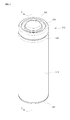
- FIG. 1 is a perspective view of a lithium ion secondary battery according to one embodiment of the present invention.
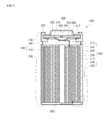
- FIG. 2 is a cross-sectional view of the battery of FIG. 1 taken along line A-A;
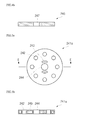
- FIG. 3a is a plan view of a second insulating plate according to one embodiment of the present invention.
- FIG. 3b is a cross-sectional view of the second insulating plate of FIG. 3a taken along line C-C;
- FIG. 4a is a plan view of a first insulating plate according to one embodiment of the present invention.
- FIG. 4b is a cross-sectional view of the first insulating plate of FIG. 4a taken along line D-D;
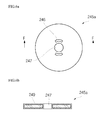
- FIG. 5a is a plan view of a second insulating plate according to another embodiment of the present invention.
- FIG. 5b is a cross-sectional view of the second insulating plate of FIG. 5a taken along line E-E;
- FIG. 6a is a plan view of a first insulating plate according to another embodiment of the present invention.
- FIG. 6b is a cross-sectional view of the first insulating plate of FIG. 6a taken along line F-F.
- FIG. 1 is a perspective view of a lithium ion secondary battery according to one embodiment of the present invention.
- FIG. 2 is a cross-sectional view of the battery of FIG. 1 taken along line A-A.
- a cylindrical lithium ion secondary battery is described.
- the present invention is not limited to cylindrical lithium ion secondary batteries and can include any lithium ion secondary batteries, including polygonal lithium ion secondary batteries.
- a cylindrical lithium ion secondary battery 100 includes an electrode assembly 200, a cylindrical case 300 for accommodating the electrode assembly 200 and an electrolyte, and a cap assembly 400 coupled to the cylindrical case 300 for sealing the cylindrical case 300 and for passing current generated by the electrode assembly 200 to an external apparatus.
- the electrode assembly 200 includes a positive electrode plate 210 obtained by coating the surface of a positive electrode collector with a positive electrode coating, a negative electrode plate 220 obtained by coating the surface of a negative electrode collector with a negative electrode coating, and a separator 230 positioned between the positive electrode plate 210 and the negative electrode plate 220.
- the separator 220 electrically insulates the positive electrode plate and the negative electrode plate 220 from each other.
- the electrode assembly 200 is wound to form a jelly-roll shape.
- the positive electrode plate 210 can include a positive electrode collector formed of a thin metal plate having good conductivity.
- a positive electrode collector formed of a thin metal plate having good conductivity.
- aluminum (Al) foil can be used as the positive electrode plate.
- the positive electrode coating can be coated on both surfaces of the positive electrode collector. Both ends of the positive electrode collector may include portions that are not coated with the positive electrode coating.
- a positive electrode tab 215 formed of aluminum (Al) may protrude outside the electrode assembly 200 and can be connected to one uncoated end of the positive electrode collector.
- the negative electrode plate 220 can include a negative electrode collector formed of a thin conductive metal plate, for example, copper (Cu) or nickel (Ni) foil.
- the negative electrode coating can be coated on both surfaces of the negative electrode collector. Both ends of the negative electrode collector can include portions that are not coated with the negative electrode coating.
- a negative electrode tab 225 formed of nickel (Ni) protrudes outside the electrode assembly 200 and can be connected to an uncoated end of the negative electrode collector.
- the lithium ion secondary battery 100 may further include first and second insulating plates 241 and 245, respectively, connected to the electrode assembly 200.
- the insulating plates 241 and 245 prevent the electrode assembly 200 from being connected directly to the cap assembly 400 and cylindrical case 300.
- the insulating plates 241 and 245 are described further below.
- the second insulating plate 241 are positioned between the cap assembly 400 (in particular, the safety vent 410) and the upper part of the electrode assembly 200.
- the second insulating plate 241 prevents the cap assembly 400 (including the safety vent 410 electrically connected to the positive electrode tab 215) and the electrode assembly 200 from short-circuiting.
- the second insulating plate can include electrolyte holes 242, positive electrode tab holes 243, and a hollow 244. Electrolyte holes 242 are paths through which the injected electrolyte is impregnated.
- Positive electrode tab holes 243 are paths through which the positive electrode tab 215 is ejected.
- Hollow 244 is connected to one end of a center pin.
- the first insulating plate 245 are positioned between the bottom surface 320 of the case and the lower part of the electrode assembly 200.
- the first insulating plate 245 prevents the case 300 (including the bottom surface 320 electrically connected to the negative electrode tab 225) and the electrode assembly 200 from short-circuiting.
- the first insulating plate can include a negative electrode tab hole 246 and a hollow 247.
- the negative electrode tab hole 246 is a path through which the negative electrode tab 225 is ejected.
- the hollow 247 is connected to one end of the center pin.
- the negative electrode tab hole 246 need not be formed. In this case, after the first insulating plate 245 is positioned under the electrode assembly 200 and the negative electrode tab 225 is bent at approximately a right angle, the negative electrode tab 225 is welded to the bottom surface 320 of the case 300.
- the second insulating plate 241 and the first insulating plate 245 are commonly formed of a polyolefin based resin such as polyethylene (PE), polypropylene (PP), and polyimide (PI). Since polyethylene (PE) has low density and a loose arrangement of molecules, polyethylene (PE) is well extended, has low tensile strength and high shock resistance. Therefore, polyethylene (PE) can be easily processed and used. Also, since polyethylene (PE) is formed of only CH 2 , its electrical insulation properties are excellent. Since polyethylene (PE) has a symmetrical carbon (C) chain, as illustrated in its chemical formula, polyethylene (PE) is suitable for use as a high frequency insulating material.
- PE polyolefin based resin
- PE polyethylene
- PP polypropylene
- PI polyimide
- Polypropylene (PP) is generated together with ethylene when naphthalene is decomposed, and has an isotactic structure. A methyl group is arranged in the same direction, as illustrated in the chemical formula of PP. Crystallinity is high before molding but is reduced after molding.
- the electric characteristics of polypropylene (PP) and polyimide (PI) are similar to the electric characteristics of polyethylene (PE).
- polyethylene (PE) and polypropylene (PP) do not have an affinity for the non-aqueous electrolyte as described above. This is because large differences in surface energy exist between polyethylene (PE) and polypropylene (PP) and the non-aqueous electrolyte so that polyethylene (PE) and polypropylene (PP) are not easily coupled to the electrolyte molecules.
- the first and second insulating plates are formed of a material having an affinity for the electrolyte instead of the conventional material that does not have an affinity for the electrolyte.
- the material having an affinity for the electrolyte may include a polymer material that is wetted by the electrolyte and into which the electrolyte is diffused at a contact angle at the interface with the electrolyte ranging from about 1 to about 80° as measured during contact angle experimentation. PVdF is used as the material having an affinity for the electrolyte.
- PVdF has a repeating -CH 2 -CF 2 - structure and is a kind of fluoro-resin used to bind electrode active materials to current collectors.
- the main chain of the fluoro-resin has the same C-C bond as polyolefin.
- the fluoro-resin is a synthetic resin having a structure in which a part or all of the hydrogen atoms of the polyolefin are replaced by fluorine atoms (F).
- the PVdF that is easily wetted by the non-aqueous electrolyte and into which the non-aqueous electrolyte that is easily diffused can be PVdF 761 or PVdF 2801. Therefore, the insulating plates may comprise PVdF 761, PVdF 2801, or a mixture thereof.
- the insulating plate can be modified by the PVdF.
- the insulating plate can be formed of a polymer material including an ester group or a carboxyl group (i.e., a hydrophilic atom group) instead of PVdF.
- the ester group is an atom group that forms an aliphatic compound represented by RCOOR'.
- the ester is generated reaction of an alcohol or phenol with an organic or inorganic acid to remove water (H 2 O), thereby forming the ester.
- inorganic acid esters such as sulfuric acid ester and nitric ester, may be used as an organic solvent.
- the carboxyl group is an atom group that forms an aliphatic compound represented by RCOOH, such as acetic acid (CH 3 COOH) and benzoic acid (C 6 H 5 COOH).
- Polymer materials including an ester group or carboxyl group have an affinity for the non-aqueous electrolyte.
- the insulating tape is formed of sulfuric acid ester or benzoic acid (including an ester group or carboxyl group)
- the insulating plate is easily wetted by the electrolyte and the electrolyte is easily diffused into the insulating plate. As a result, electrolyte impregnation is improved.
- the insulating plates must not swell. Swelling is a characteristic of polymers having crystalline parts and amorphous parts penetrated by solvent molecules such that the volume of the polymer increases. Such a phenomenon can occur in the crystalline part of the polymer after a long time. However, since the distance between polymer chains is closer in the crystalline parts compared to the amorphous parts, there is a lesser chance that the phenomenon will occur in the crystalline part compared to the amorphous part.
- the insulating plates swell, thereby deforming the electrode assembly. Therefore, when the material having an affinity for the electrolyte is used for the material of the insulating plates, a countermeasure should be provided to prevent swelling. Alternatively, a material that does not swell should be used.
- a lithium ion secondary battery includes an electrode assembly, a case for accommodating the electrode assembly, a cap assembly for sealing the case, a first insulating plate positioned between the electrode assembly and the case, and a second insulating plate positioned between the electrode assembly and the cap assembly.
- the insulating plates can be formed of a mixture of a material having an affinity for the electrolyte and a material that does not have an affinity or has a reduced affinity for the electrolyte.
- a polyolefin based resin such as polyethylene (PE), polypropylene (PP), and polyimide (PI) can be used as the material that does not have an affinity for the electrolyte as described above.
- the material that does not have an affinity for the electrolyte and the material having an affinity for the electrolyte are mixed to improve electrolyte impregnation.
- Oxides in which the electrolyte is diffused at a contact angle ranging from about 1 to about 80° as measured during contact angle experimentation can be used as the material having an affinity for the electrolyte.
- suitable oxides include silica (SiO 2 ), aluminum oxide (Al 2 O 3 ), and equivalents.
- the silica (silicon dioxide) is a transparent solid and has a molecular weight of about 60.09. Since natural silica includes impurities, natural silica can be opaque or colored.
- SiO 4 is a regular tetrahedron in which silicon is surrounded by four oxygen atoms, and is used as a basic unit. All of the oxygen atoms are shared by the silicon so that a large, three dimensionally connected molecular structure is provided. Quartz glass having an irregular molecular arrangement is obtained by melting and then cooling crystalline silicon dioxide. The silica is not melted by acid, however, and becomes a soluble silicate by alkali melting or carbonate melting, and is slowly melted by a strong alkali aqueous solution. An amorphous silica gel absorbs moisture to be used as a desiccant.
- Aluminum oxide (alumina) has various shapes. ⁇ -aluminum oxide, generated by heating aluminum hydroxide at a temperature of less than about 300°C, is pure and stable. ⁇ -aluminum oxide has poor crystallinity and is generated by dehydrating ⁇ -alumina hydrate slightly including alkali. Among the above, the aluminum oxide having poor crystallinity, such as ⁇ -aluminum oxide, functions as a strong dehydrating catalyst. Aluminum oxides or alumina hydrates that are not crystallized are commonly referred to as alumina gels and are used as antacids and absorbents.
- Silica and aluminum oxide each have an affinity for the non-aqueous electrolyte.
- the silica and the aluminum oxide function as fillers.
- the oxide can be present in an amount ranging from about 30% to about 95% by weight based on the total weight of the mixture.
- the affinity for the electrolyte increases.
- the insulating plates may be modified by the polymer material having an affinity for the electrolyte.
- the insulating plates may be include the filler (such as the oxide) mixed with polyethylene (PE) or polypropylene (PP). Since the insulating plates do not exclusively contact the electrolyte, it is possible to increase the penetration speed and impregnation speed of the electrolyte.
- the second insulating plate 241 a can be positioned between the cap assembly 400 (in particular, the safety vent 410) and the upper part of the electrode assembly 200.
- the second insulating plate 241 a prevents the cap assembly 400 (including the safety vent 410 electrically connected to the positive electrode tab 215) and the electrode assembly 200 from short-circuiting.
- the second insulating plate may include electrolyte holes 242 through which the injected electrolyte is impregnated, positive electrode tab holes 243 through which the positive electrode tab 215 is ejected, and a hollow 244 connected to one end of a center pin.
- the second insulating plate 241 a is coated with the coating composition on only a portion of the insulating plate. As shown, the coating composition is coated in layers 249 on the second insulating plate.
- the first insulating plate 245a can be positioned between the bottom surface 320 of the case 300 and the lower part of the electrode assembly 200.
- the first insulating plate 245a prevents the case 300 (including the bottom surface 320 electrically connected to the negative electrode tab 225) and the electrode assembly 200 from short-circuiting.
- the first insulating plate 245a may include a negative electrode tab hole 246 through which the negative electrode tab 225 is ejected, and a hollow 247 connected to one end of the center pin.
- the first insulating plate 245a can be coated with the coating composition on only a portion of the insulating plate. As shown, the coating composition is coated in layers 249 on the first insulating plate.
- the negative electrode tab hole 246 need not be formed.
- the negative electrode tab 225 is welded to the bottom surface 320 of the case 300.
- the second insulating plate 241 a and the first insulating plate 245a can be formed of a polyolefin based resin such as polyethylene (PE), polypropylene (PP), or polyimide (PI), as described above.
- a polyolefin based resin such as polyethylene (PE), polypropylene (PP), or polyimide (PI), as described above.
- PE polyethylene
- PP polypropylene
- PI polyimide
- polyethylene (PE) and polypropylene (PP) do not have an affinity for the non-aqueous electrolyte.
- polyethylene (PE) and polypropylene (PP) do not have an affinity for the non-aqueous electrolyte.
- the insulating plates (which do not have an affinity for the electrolyte) are coated with a material having an affinity for the electrolyte in order to improve electrolyte impregnation.
- the material having an affinity for the electrolyte may comprise a polymer material that is wetted by the electrolyte and into which the electrolyte is diffused at a contact angle ranging from about 1 to about 80° as measured during contact angle experimentation.
- PVdF can be used as the material having an affinity for the electrolyte.
- the PVdF has a repeating -CH 2 -CF 2 - structure and is a kind of fluoro-resin used to bind electrode active materials to current collectors.
- the main chain of the fluoro-resin has the same C-C bond as polyolefin.
- the fluoro-resin is a synthetic resin having a structure in which a part or all of the hydrogen atoms of the polyolefin are replaced by fluorine atoms (F).
- PVdF that is easily wetted by the non-aqueous electrolyte and into which the non-aqueous electrolyte that is easily diffused can be PVdF 761 or PVdF 2801. Therefore, the insulating plate can be coated with PVdF 761, PVdF 2801, or a mixture thereof.
- the insulating plates can be modified by the PVdF.
- the insulating plate can be formed of a polymer material including an ester group or carboxyl group (i.e., a hydrophilic atom group) instead of the PVdF.
- the ester group is an atom group that forms an aliphatic compound represented by RCOOR'.
- the ester is generated reaction of an alcohol or phenol with an organic or inorganic acid to remove water (H 2 O), thereby forming the ester.
- inorganic acid esters such as sulfuric acid ester and nitric ester, may be used as an organic solvent.
- the carboxyl group is an atom group that forms an aliphatic compound represented by RCOOH, such as acetic acid (CH 3 COOH) and benzoic acid (C 6 H 5 COOH).
- Polymer materials including an ester group or carboxyl group have an affinity for the non-aqueous electrolyte.
- the insulating tape is formed of sulfuric acid ester or benzoic acid (including an ester group or carboxyl group)
- the insulating plate is easily wetted by the electrolyte and the electrolyte is easily diffused into the insulating plate. As a result, electrolyte impregnation is improved.
- the insulating plates must not swell. Swelling is a characteristic of polymers having crystalline parts and amorphous parts penetrated by solvent molecules such that the volume of the polymer increases. Such a phenomenon can occur in the crystalline part of the polymer after a long time. However, since the distance between polymer chains is closer in the crystalline parts compared to the amorphous parts, there is a lesser chance that the phenomenon will occur in the crystalline part compared to the amorphous part.
- the polymer material including the ester group or carboxyl group absorbs the non-aqueous electrolyte, the polymer material swells due to overcharge. This causes the insulating plates to swell, thereby deforming the electrode assembly. Therefore, when the surfaces of the insulating plates are coated with a material having an affinity for the electrolyte, the coating layer should be thin so that the material does not swell.
- the insulating plates can be coated with a surfactant.
- Surfactants have both hydrophilic groups and lipophilic groups and function to decrease the surface tension of water. Surfactants also penetrate, diffuse, emulsify, and bubble. As a representative function, surfactants are used to clean laundry and operate by mixing oil attached to the laundry fibers with water to remove dirt from the laundry. Surfactants are divided into anionic surfactants, cationic surfactants, nonionic surfactants, and ampholytic surfactants. Anionic surfactants are mainly used as synthetic detergents.
- the lipophilic group ion dissociates.
- an anionic surfactant is formed.
- a cationic surfactant is formed.
- an ampholytic surfactant is formed.
- a nonionic surfactant is formed.
- the surfactant When the surfactant contacts the non-aqueous electrolyte, the surfactant's lipophilic group attaches to the surfaces of the non-aqueous electrolyte molecules. Therefore, the interface between the surfactant and the non-aqueous electrolyte increases and the surface tension of the electrolyte decreases. As a result, the insulating plate is easily wetted by the electrolyte and the electrolyte is easily diffused into the insulating plate.
- the insulating plate can be coated with a polymer material having an affinity for the electrolyte.
- the insulating plate can be coated with a surfactant. Since the surface of the insulating plate does not exclusively contact the electrolyte, penetration speed and impregnation speed of the electrolyte can be improved. It is possible to modify the surface even when the coating layers are within 1 ⁇ m and when the coating layer is a monolayer.
- the insulating plates comprise a material having an affinity for the electrolyte.
- the insulating plates comprise a mixture of a filler material having an affinity for the electrolyte and polypropylene or polyethylene. The insulating plates do not exclusively contact the electrolyte, enabling the electrolyte to easily flow in the battery, thereby improving electrolyte impregnation. Electrolyte impregnation speed is also improved, thereby improving productivity.
- the surfaces of the insulating plates are coated with a polymer material having an affinity for the electrolyte.
- the insulating plates are coated with a surfactant that reduces the surface tension of the electrolyte.
- the insulating plates do not exclusively contact the electrolyte, enabling the electrolyte to easily flow in the battery. This improves electrolyte impregnation and electrolyte impregnation speed, thereby improving productivity.
Landscapes
- Chemical & Material Sciences (AREA)
- General Chemical & Material Sciences (AREA)
- Chemical Kinetics & Catalysis (AREA)
- Electrochemistry (AREA)
- Inorganic Chemistry (AREA)
- General Physics & Mathematics (AREA)
- Condensed Matter Physics & Semiconductors (AREA)
- Engineering & Computer Science (AREA)
- Manufacturing & Machinery (AREA)
- Physics & Mathematics (AREA)
- Secondary Cells (AREA)
- Connection Of Batteries Or Terminals (AREA)
- Sealing Battery Cases Or Jackets (AREA)
Applications Claiming Priority (4)
| Application Number | Priority Date | Filing Date | Title |
|---|---|---|---|
| KR1020050134539A KR100839784B1 (ko) | 2005-12-29 | 2005-12-29 | 리튬 이차전지 |
| KR1020050134537A KR100749650B1 (ko) | 2005-12-29 | 2005-12-29 | 리튬 이차전지 |
| KR1020050134540A KR100778998B1 (ko) | 2005-12-29 | 2005-12-29 | 리튬 이차전지 |
| EP06127327A EP1804327A1 (de) | 2005-12-29 | 2006-12-29 | Lithiumion-Sekundärbatterie |
Related Parent Applications (1)
| Application Number | Title | Priority Date | Filing Date |
|---|---|---|---|
| EP06127327.2 Division | 2006-12-29 |
Publications (2)
| Publication Number | Publication Date |
|---|---|
| EP2246928A2 true EP2246928A2 (de) | 2010-11-03 |
| EP2246928A3 EP2246928A3 (de) | 2010-12-15 |
Family
ID=37989199
Family Applications (2)
| Application Number | Title | Priority Date | Filing Date |
|---|---|---|---|
| EP10170018A Withdrawn EP2246928A3 (de) | 2005-12-29 | 2006-12-29 | Lithiumion-Sekundärbatterie |
| EP06127327A Withdrawn EP1804327A1 (de) | 2005-12-29 | 2006-12-29 | Lithiumion-Sekundärbatterie |
Family Applications After (1)
| Application Number | Title | Priority Date | Filing Date |
|---|---|---|---|
| EP06127327A Withdrawn EP1804327A1 (de) | 2005-12-29 | 2006-12-29 | Lithiumion-Sekundärbatterie |
Country Status (4)
| Country | Link |
|---|---|
| US (2) | US7709141B2 (de) |
| EP (2) | EP2246928A3 (de) |
| JP (1) | JP4795177B2 (de) |
| CN (1) | CN102013460B (de) |
Cited By (1)
| Publication number | Priority date | Publication date | Assignee | Title |
|---|---|---|---|---|
| JP2015008092A (ja) * | 2013-06-25 | 2015-01-15 | 株式会社Gsユアサ | 電池 |
Families Citing this family (31)
| Publication number | Priority date | Publication date | Assignee | Title |
|---|---|---|---|---|
| KR100890329B1 (ko) * | 2006-12-21 | 2009-03-26 | 삼성에스디아이 주식회사 | 리튬 이차전지 |
| JP5107678B2 (ja) * | 2007-11-13 | 2012-12-26 | 日立ビークルエナジー株式会社 | リチウムイオン二次電池 |
| US20110091756A1 (en) | 2008-05-13 | 2011-04-21 | Kureha Corporation | Lithium ion battery and electrode wound body for lithium ion battery |
| JP2010055987A (ja) * | 2008-08-29 | 2010-03-11 | Sony Corp | 非水電解質二次電池 |
| US8288036B2 (en) * | 2009-05-18 | 2012-10-16 | Samsung Sdi Co., Ltd. | Secondary battery and method of making the secondary battery |
| US8574753B2 (en) | 2009-08-27 | 2013-11-05 | Kabushiki Kaisha Toshiba | Battery comprising a conductive nipping member |
| KR101118261B1 (ko) * | 2009-09-30 | 2012-03-20 | 삼성에스디아이 주식회사 | 이차 전지 및 이의 제조 방법 |
| KR20120123432A (ko) * | 2010-01-20 | 2012-11-08 | 다이킨 고교 가부시키가이샤 | 고유전성 필름 |
| DE102010041285A1 (de) * | 2010-09-23 | 2012-03-29 | Sb Limotive Company Ltd. | Batterie mit verbesserter Wärmeabfuhr durch Nutzung des Kapillareffekts |
| WO2012077293A1 (ja) * | 2010-12-10 | 2012-06-14 | パナソニック株式会社 | リチウムイオン電池の製造方法 |
| KR20120066916A (ko) | 2010-12-15 | 2012-06-25 | 주식회사 엘지화학 | 우수한 제조 공정성과 안전성의 이차전지 |
| EP2728658B1 (de) * | 2011-06-30 | 2017-09-27 | LG Chem, Ltd. | Sekundärbatterie mit hervorragender produktivität und sicherheit |
| JP5730442B2 (ja) * | 2011-06-30 | 2015-06-10 | エルジー ケム. エルティーディ. | 絶縁部材が装着された二次電池 |
| KR20130033551A (ko) * | 2011-09-27 | 2013-04-04 | 주식회사 엘지화학 | 우수한 제조 공정성과 안전성의 이차전지 |
| KR101275775B1 (ko) | 2011-09-27 | 2013-06-17 | 주식회사 엘지화학 | 우수한 제조 공정성과 안전성의 이차전지 |
| KR101381706B1 (ko) * | 2011-10-31 | 2014-04-14 | 에스케이이노베이션 주식회사 | 이차 전지용 파우치 셀의 젤리 롤 |
| DE102014206890A1 (de) * | 2014-04-10 | 2015-10-15 | Bayerische Motoren Werke Aktiengesellschaft | Verfahren und Vorrichtung zum zumindest teilumfänglichen Herstellen einer elektrischen Energiespeicherzelle |
| KR102170490B1 (ko) * | 2014-06-10 | 2020-10-28 | 에스케이이노베이션 주식회사 | 리튬 이차 전지 |
| KR102221807B1 (ko) * | 2014-08-11 | 2021-03-02 | 삼성에스디아이 주식회사 | 이차 전지 |
| KR101995064B1 (ko) * | 2015-05-22 | 2019-07-02 | 주식회사 엘지화학 | 다공성 물질의 박막을 포함하는 리튬 이차전지 |
| US10950912B2 (en) | 2017-06-14 | 2021-03-16 | Milwaukee Electric Tool Corporation | Arrangements for inhibiting intrusion into battery pack electrical components |
| KR102410911B1 (ko) * | 2017-10-11 | 2022-06-20 | 삼성에스디아이 주식회사 | 전극 조립체 및 이를 포함하는 이차전지 |
| KR102288850B1 (ko) | 2017-11-01 | 2021-08-12 | 주식회사 엘지에너지솔루션 | 이차 전지 및 이차 전지용 절연판 |
| JP2020017470A (ja) * | 2018-07-27 | 2020-01-30 | 株式会社クレハ | 基材フィルム、緩み防止用テープ、および蓄電デバイス |
| US11949060B2 (en) * | 2018-09-11 | 2024-04-02 | Energizer Brands, Llc | Rechargeable hearing aid battery with slotted grommet |
| CN114365316B (zh) * | 2019-09-11 | 2024-04-16 | 松下新能源株式会社 | 非水电解质二次电池 |
| KR102928854B1 (ko) | 2020-01-17 | 2026-02-19 | 주식회사 엘지에너지솔루션 | 이차 전지 및 이를 포함하는 전지 팩 |
| US12119474B1 (en) | 2020-04-02 | 2024-10-15 | Energizer Brands, Llc | Electrode bonding system and method of use |
| US11641044B1 (en) | 2020-04-14 | 2023-05-02 | Energizer Brands, Llc | Battery housing and systems and methods of making thereof |
| JP7695638B2 (ja) * | 2021-02-09 | 2025-06-19 | 株式会社Gsユアサ | 電極体、及び蓄電素子 |
| US12087899B1 (en) | 2021-05-19 | 2024-09-10 | Energizer Brands, Llc | Electrode and separator feed system and method of use |
Family Cites Families (22)
| Publication number | Priority date | Publication date | Assignee | Title |
|---|---|---|---|---|
| US4457991A (en) * | 1982-11-15 | 1984-07-03 | Rayovac Corporation | Sealant for lithium cells |
| US5227264A (en) * | 1991-02-14 | 1993-07-13 | Hydro-Quebec | Device for packaging a lithium battery |
| JP3321853B2 (ja) * | 1992-10-30 | 2002-09-09 | ソニー株式会社 | 非水電解液二次電池 |
| JPH07263028A (ja) * | 1994-03-25 | 1995-10-13 | Fuji Photo Film Co Ltd | 非水二次電池 |
| JP3524989B2 (ja) * | 1995-07-14 | 2004-05-10 | 東芝電池株式会社 | ポリマー電解質二次電池 |
| JPH09274920A (ja) | 1996-04-05 | 1997-10-21 | Sony Corp | 非水電解液電池 |
| JPH10125335A (ja) * | 1996-10-16 | 1998-05-15 | Matsushita Electric Ind Co Ltd | 渦巻状電極を備えた電池およびその製造方法 |
| US6444356B1 (en) * | 1996-11-01 | 2002-09-03 | Jackson C. Ma | Lithium battery with secondary battery separator |
| JPH10163075A (ja) | 1996-12-04 | 1998-06-19 | Japan Storage Battery Co Ltd | 電気化学装置及び電極 |
| CN1139142C (zh) | 1997-02-28 | 2004-02-18 | 旭化成株式会社 | 无水二次电池及其制造方法 |
| JP4055219B2 (ja) | 1997-04-08 | 2008-03-05 | 松下電器産業株式会社 | 非水電解液二次電池 |
| JPH10308204A (ja) | 1997-05-08 | 1998-11-17 | Mitsubishi Cable Ind Ltd | 非水有機電解液電池用の電気絶縁板 |
| US5948562A (en) * | 1997-11-03 | 1999-09-07 | Motorola, Inc. | Energy storage device |
| JP2001210384A (ja) | 2000-01-26 | 2001-08-03 | Sony Corp | 非水電解液二次電池 |
| JP2001297790A (ja) | 2000-04-11 | 2001-10-26 | Matsushita Electric Ind Co Ltd | 非水電解質二次電池 |
| JP4951168B2 (ja) * | 2000-12-25 | 2012-06-13 | トータル ワイヤレス ソリューショオンズ リミテッド | シート状リチウム二次電池 |
| JP2003151634A (ja) * | 2001-11-12 | 2003-05-23 | Asahi Kasei Corp | 非水系二次電池 |
| CN1285133C (zh) | 2002-09-27 | 2006-11-15 | Tdk株式会社 | 锂二次电池 |
| KR20040090642A (ko) | 2003-04-18 | 2004-10-26 | 주식회사성우 | 원심분리기의 원격모니터링 기능을 갖는 콘트롤장치 |
| CN1270400C (zh) * | 2003-09-01 | 2006-08-16 | 比亚迪股份有限公司 | 圆柱形锂离子二次电池 |
| KR100624934B1 (ko) * | 2004-10-28 | 2006-09-15 | 삼성에스디아이 주식회사 | 원통형 리튬 이차 전지 |
| KR100624941B1 (ko) * | 2004-11-29 | 2006-09-18 | 삼성에스디아이 주식회사 | 원통형 리튬 이차 전지 |
-
2006
- 2006-09-04 JP JP2006239339A patent/JP4795177B2/ja active Active
- 2006-12-27 US US11/646,889 patent/US7709141B2/en active Active
- 2006-12-29 EP EP10170018A patent/EP2246928A3/de not_active Withdrawn
- 2006-12-29 CN CN2010105468289A patent/CN102013460B/zh active Active
- 2006-12-29 EP EP06127327A patent/EP1804327A1/de not_active Withdrawn
-
2009
- 2009-01-05 US US12/348,835 patent/US7722983B2/en active Active
Non-Patent Citations (1)
| Title |
|---|
| None |
Cited By (1)
| Publication number | Priority date | Publication date | Assignee | Title |
|---|---|---|---|---|
| JP2015008092A (ja) * | 2013-06-25 | 2015-01-15 | 株式会社Gsユアサ | 電池 |
Also Published As
| Publication number | Publication date |
|---|---|
| US7709141B2 (en) | 2010-05-04 |
| US20090123835A1 (en) | 2009-05-14 |
| US7722983B2 (en) | 2010-05-25 |
| CN102013460A (zh) | 2011-04-13 |
| EP1804327A1 (de) | 2007-07-04 |
| JP4795177B2 (ja) | 2011-10-19 |
| JP2007184234A (ja) | 2007-07-19 |
| CN102013460B (zh) | 2013-05-08 |
| EP2246928A3 (de) | 2010-12-15 |
| US20070154804A1 (en) | 2007-07-05 |
Similar Documents
| Publication | Publication Date | Title |
|---|---|---|
| EP2246928A2 (de) | Lithiumion-Sekundärbatterie | |
| KR100687159B1 (ko) | 고체 전해질 전지 | |
| KR101312860B1 (ko) | 비수 전해질 전지 | |
| US20120301774A1 (en) | Inorganic/organic composite porous separator and electrochemical device using the same | |
| CN103311574B (zh) | 非水电解质二次电池 | |
| US8372544B2 (en) | Non-aqueous electrolyte secondary battery | |
| KR101804707B1 (ko) | 전지 모듈, 전지 팩 및 차량 | |
| US20160276652A1 (en) | Electrode, nonaqueous electrolyte battery, and battery pack | |
| JP2014514712A (ja) | 高電圧のリチウムイオンバッテリー | |
| CA2249935C (en) | Lithium secondary battery | |
| KR101581422B1 (ko) | 전기화학소자용 세퍼레이터 및 이를 포함하는 전기화학소자 | |
| KR100735486B1 (ko) | 2종 분리막을 사용한 전기화학소자 | |
| JP2021182478A (ja) | 非水電解液二次電池 | |
| CN100583542C (zh) | 锂离子二次电池 | |
| KR100778998B1 (ko) | 리튬 이차전지 | |
| JP3511966B2 (ja) | 円筒形リチウムイオン電池 | |
| KR100839784B1 (ko) | 리튬 이차전지 | |
| KR100679662B1 (ko) | 2종 분리막 시스템을 사용한 전기화학소자 | |
| KR102909163B1 (ko) | 이차 전지용 전극 및 이를 포함하는 리튬 이차 전지 | |
| KR102909166B1 (ko) | 이차 전지용 전극 및 이를 포함하는 리튬 이차 전지 | |
| JP2007026724A (ja) | 二次電池および組電池、並びにこれらを搭載する車両 | |
| WO2025248805A1 (ja) | 電池 | |
| KR20230060477A (ko) | 원통형 이차전지 | |
| KR101511817B1 (ko) | 안전성이 향상된 리튬 이차전지 | |
| KR20160112517A (ko) | 안전성이 강화된 이차 전지용 분리막 |
Legal Events
| Date | Code | Title | Description |
|---|---|---|---|
| PUAI | Public reference made under article 153(3) epc to a published international application that has entered the european phase |
Free format text: ORIGINAL CODE: 0009012 |
|
| 17P | Request for examination filed |
Effective date: 20100719 |
|
| AC | Divisional application: reference to earlier application |
Ref document number: 1804327 Country of ref document: EP Kind code of ref document: P |
|
| AK | Designated contracting states |
Kind code of ref document: A2 Designated state(s): DE FR GB |
|
| PUAL | Search report despatched |
Free format text: ORIGINAL CODE: 0009013 |
|
| AK | Designated contracting states |
Kind code of ref document: A3 Designated state(s): DE FR GB |
|
| 17Q | First examination report despatched |
Effective date: 20110613 |
|
| 17Q | First examination report despatched |
Effective date: 20110615 |
|
| STAA | Information on the status of an ep patent application or granted ep patent |
Free format text: STATUS: THE APPLICATION IS DEEMED TO BE WITHDRAWN |
|
| 18D | Application deemed to be withdrawn |
Effective date: 20121103 |