EP2246342A2 - Triacetontriperoxid und Diacetondiperoxid-Derivat, Verfahren zu ihrer Herstellung sowie ihre Verwendung - Google Patents
Triacetontriperoxid und Diacetondiperoxid-Derivat, Verfahren zu ihrer Herstellung sowie ihre Verwendung Download PDFInfo
- Publication number
- EP2246342A2 EP2246342A2 EP10160157A EP10160157A EP2246342A2 EP 2246342 A2 EP2246342 A2 EP 2246342A2 EP 10160157 A EP10160157 A EP 10160157A EP 10160157 A EP10160157 A EP 10160157A EP 2246342 A2 EP2246342 A2 EP 2246342A2
- Authority
- EP
- European Patent Office
- Prior art keywords
- tatp
- dadp
- derivative
- group
- derivative according
- Prior art date
- Legal status (The legal status is an assumption and is not a legal conclusion. Google has not performed a legal analysis and makes no representation as to the accuracy of the status listed.)
- Granted
Links
- ZTLXICJMNFREPA-UHFFFAOYSA-N 3,3,6,6,9,9-hexamethyl-1,2,4,5,7,8-hexaoxonane Chemical compound CC1(C)OOC(C)(C)OOC(C)(C)OO1 ZTLXICJMNFREPA-UHFFFAOYSA-N 0.000 title claims abstract description 91
- 238000000034 method Methods 0.000 title claims abstract description 16
- 238000004519 manufacturing process Methods 0.000 title claims abstract description 9
- SJQITXILEOCXGI-UHFFFAOYSA-N 3,3,6,6-tetramethyl-1,2,4,5-tetraoxane Chemical class CC1(C)OOC(C)(C)OO1 SJQITXILEOCXGI-UHFFFAOYSA-N 0.000 title claims description 21
- 238000001514 detection method Methods 0.000 claims abstract description 24
- 239000011230 binding agent Substances 0.000 claims abstract description 11
- 239000000427 antigen Substances 0.000 claims abstract description 10
- 108091007433 antigens Proteins 0.000 claims abstract description 9
- 102000036639 antigens Human genes 0.000 claims abstract description 9
- 230000008569 process Effects 0.000 claims abstract description 6
- YZCKVEUIGOORGS-IGMARMGPSA-N Protium Chemical compound [1H] YZCKVEUIGOORGS-IGMARMGPSA-N 0.000 claims abstract description 4
- CSCPPACGZOOCGX-UHFFFAOYSA-N Acetone Chemical compound CC(C)=O CSCPPACGZOOCGX-UHFFFAOYSA-N 0.000 claims description 40
- MHAJPDPJQMAIIY-UHFFFAOYSA-N Hydrogen peroxide Chemical compound OO MHAJPDPJQMAIIY-UHFFFAOYSA-N 0.000 claims description 21
- 102000004169 proteins and genes Human genes 0.000 claims description 16
- 108090000623 proteins and genes Proteins 0.000 claims description 16
- 238000005859 coupling reaction Methods 0.000 claims description 14
- 230000008878 coupling Effects 0.000 claims description 13
- 238000010168 coupling process Methods 0.000 claims description 13
- 238000006243 chemical reaction Methods 0.000 claims description 11
- 150000001875 compounds Chemical class 0.000 claims description 11
- 150000002148 esters Chemical class 0.000 claims description 11
- OSAHCBHKCKPJGI-UHFFFAOYSA-N 7-keto-n-caprylic acid Chemical compound CC(=O)CCCCCC(O)=O OSAHCBHKCKPJGI-UHFFFAOYSA-N 0.000 claims description 6
- 239000002253 acid Substances 0.000 claims description 6
- 150000008064 anhydrides Chemical class 0.000 claims description 6
- 108090000765 processed proteins & peptides Proteins 0.000 claims description 5
- YBJHBAHKTGYVGT-ZKWXMUAHSA-N (+)-Biotin Chemical compound N1C(=O)N[C@@H]2[C@H](CCCCC(=O)O)SC[C@@H]21 YBJHBAHKTGYVGT-ZKWXMUAHSA-N 0.000 claims description 4
- 230000002378 acidificating effect Effects 0.000 claims description 4
- 229920006395 saturated elastomer Polymers 0.000 claims description 4
- 239000007858 starting material Substances 0.000 claims description 4
- 102000008394 Immunoglobulin Fragments Human genes 0.000 claims description 3
- 108010021625 Immunoglobulin Fragments Proteins 0.000 claims description 3
- 125000003178 carboxy group Chemical group [H]OC(*)=O 0.000 claims description 3
- NMHMNPHRMNGLLB-UHFFFAOYSA-N phloretic acid Chemical compound OC(=O)CCC1=CC=C(O)C=C1 NMHMNPHRMNGLLB-UHFFFAOYSA-N 0.000 claims description 3
- 239000002243 precursor Substances 0.000 claims description 3
- 235000000346 sugar Nutrition 0.000 claims description 3
- 125000003396 thiol group Chemical group [H]S* 0.000 claims description 3
- KGDQIGKUXZQNRH-UHFFFAOYSA-N 6-(3,6,6,9,9-pentamethyl-1,2,4,5,7,8-hexaoxonan-3-yl)hexanoic acid Chemical group CC1(C)OOC(C)(C)OOC(C)(CCCCCC(O)=O)OO1 KGDQIGKUXZQNRH-UHFFFAOYSA-N 0.000 claims description 2
- 108091023037 Aptamer Proteins 0.000 claims description 2
- 125000003277 amino group Chemical group 0.000 claims description 2
- 238000003556 assay Methods 0.000 claims description 2
- 125000004069 aziridinyl group Chemical group 0.000 claims description 2
- 229960002685 biotin Drugs 0.000 claims description 2
- 235000020958 biotin Nutrition 0.000 claims description 2
- 239000011616 biotin Substances 0.000 claims description 2
- 229920001577 copolymer Polymers 0.000 claims description 2
- 239000012634 fragment Substances 0.000 claims description 2
- 230000004927 fusion Effects 0.000 claims description 2
- OAKJQQAXSVQMHS-UHFFFAOYSA-N hydrazine group Chemical group NN OAKJQQAXSVQMHS-UHFFFAOYSA-N 0.000 claims description 2
- 125000002887 hydroxy group Chemical group [H]O* 0.000 claims description 2
- 125000002496 methyl group Chemical group [H]C([H])([H])* 0.000 claims description 2
- 239000002086 nanomaterial Substances 0.000 claims description 2
- 229920005615 natural polymer Polymers 0.000 claims description 2
- 108020004707 nucleic acids Proteins 0.000 claims description 2
- 102000039446 nucleic acids Human genes 0.000 claims description 2
- 150000007523 nucleic acids Chemical class 0.000 claims description 2
- 125000000466 oxiranyl group Chemical group 0.000 claims description 2
- 230000002285 radioactive effect Effects 0.000 claims description 2
- 150000003839 salts Chemical class 0.000 claims description 2
- 229920001059 synthetic polymer Polymers 0.000 claims description 2
- 125000003172 aldehyde group Chemical group 0.000 claims 1
- 150000004820 halides Chemical class 0.000 claims 1
- AVXURJPOCDRRFD-UHFFFAOYSA-N hydroxylamine group Chemical group NO AVXURJPOCDRRFD-UHFFFAOYSA-N 0.000 claims 1
- 238000002360 preparation method Methods 0.000 abstract description 4
- DAEAPNUQQAICNR-GFCOJPQKSA-N dadp Chemical class C1=NC=2C(N)=NC=NC=2N1C1C[C@H](O)[C@@H](COP(O)(=O)OP(O)(O)=O)O1 DAEAPNUQQAICNR-GFCOJPQKSA-N 0.000 abstract 3
- 238000002965 ELISA Methods 0.000 description 18
- 230000003053 immunization Effects 0.000 description 13
- 238000002649 immunization Methods 0.000 description 13
- WEVYAHXRMPXWCK-UHFFFAOYSA-N Acetonitrile Chemical compound CC#N WEVYAHXRMPXWCK-UHFFFAOYSA-N 0.000 description 9
- 241000283973 Oryctolagus cuniculus Species 0.000 description 8
- 230000015572 biosynthetic process Effects 0.000 description 7
- 239000002360 explosive Substances 0.000 description 7
- 239000000126 substance Substances 0.000 description 7
- 238000003786 synthesis reaction Methods 0.000 description 7
- 102000014914 Carrier Proteins Human genes 0.000 description 6
- 108010078791 Carrier Proteins Proteins 0.000 description 6
- QAOWNCQODCNURD-UHFFFAOYSA-N Sulfuric acid Chemical compound OS(O)(=O)=O QAOWNCQODCNURD-UHFFFAOYSA-N 0.000 description 6
- 230000002163 immunogen Effects 0.000 description 6
- 102000013415 peroxidase activity proteins Human genes 0.000 description 6
- 108040007629 peroxidase activity proteins Proteins 0.000 description 6
- SPSSULHKWOKEEL-UHFFFAOYSA-N 2,4,6-trinitrotoluene Chemical compound CC1=C([N+]([O-])=O)C=C([N+]([O-])=O)C=C1[N+]([O-])=O SPSSULHKWOKEEL-UHFFFAOYSA-N 0.000 description 5
- 241001465754 Metazoa Species 0.000 description 5
- 108010058846 Ovalbumin Proteins 0.000 description 5
- 125000000524 functional group Chemical group 0.000 description 5
- 229940092253 ovalbumin Drugs 0.000 description 5
- 238000002198 surface plasmon resonance spectroscopy Methods 0.000 description 5
- 239000000015 trinitrotoluene Substances 0.000 description 5
- VEXZGXHMUGYJMC-UHFFFAOYSA-N Hydrochloric acid Chemical compound Cl VEXZGXHMUGYJMC-UHFFFAOYSA-N 0.000 description 4
- NBIIXXVUZAFLBC-UHFFFAOYSA-N Phosphoric acid Chemical compound OP(O)(O)=O NBIIXXVUZAFLBC-UHFFFAOYSA-N 0.000 description 4
- -1 carboxy, hydroxyl Chemical group 0.000 description 4
- 239000000700 radioactive tracer Substances 0.000 description 4
- 210000002966 serum Anatomy 0.000 description 4
- QTBSBXVTEAMEQO-UHFFFAOYSA-N Acetic acid Chemical compound CC(O)=O QTBSBXVTEAMEQO-UHFFFAOYSA-N 0.000 description 3
- QOSSAOTZNIDXMA-UHFFFAOYSA-N Dicylcohexylcarbodiimide Chemical compound C1CCCCC1N=C=NC1CCCCC1 QOSSAOTZNIDXMA-UHFFFAOYSA-N 0.000 description 3
- 241000699666 Mus <mouse, genus> Species 0.000 description 3
- 241000699670 Mus sp. Species 0.000 description 3
- 239000002671 adjuvant Substances 0.000 description 3
- 238000011088 calibration curve Methods 0.000 description 3
- KRKNYBCHXYNGOX-UHFFFAOYSA-N citric acid Chemical compound OC(=O)CC(O)(C(O)=O)CC(O)=O KRKNYBCHXYNGOX-UHFFFAOYSA-N 0.000 description 3
- 239000007789 gas Substances 0.000 description 3
- 238000001819 mass spectrum Methods 0.000 description 3
- 238000001254 matrix assisted laser desorption--ionisation time-of-flight mass spectrum Methods 0.000 description 3
- XLYOFNOQVPJJNP-UHFFFAOYSA-N water Substances O XLYOFNOQVPJJNP-UHFFFAOYSA-N 0.000 description 3
- YOETUEMZNOLGDB-UHFFFAOYSA-N 2-methylpropyl carbonochloridate Chemical compound CC(C)COC(Cl)=O YOETUEMZNOLGDB-UHFFFAOYSA-N 0.000 description 2
- IJGRMHOSHXDMSA-UHFFFAOYSA-N Atomic nitrogen Chemical compound N#N IJGRMHOSHXDMSA-UHFFFAOYSA-N 0.000 description 2
- 108091003079 Bovine Serum Albumin Proteins 0.000 description 2
- 102000004190 Enzymes Human genes 0.000 description 2
- 108090000790 Enzymes Proteins 0.000 description 2
- 108010001336 Horseradish Peroxidase Proteins 0.000 description 2
- AFVFQIVMOAPDHO-UHFFFAOYSA-N Methanesulfonic acid Chemical compound CS(O)(=O)=O AFVFQIVMOAPDHO-UHFFFAOYSA-N 0.000 description 2
- NQTADLQHYWFPDB-UHFFFAOYSA-N N-Hydroxysuccinimide Chemical compound ON1C(=O)CCC1=O NQTADLQHYWFPDB-UHFFFAOYSA-N 0.000 description 2
- UIIMBOGNXHQVGW-UHFFFAOYSA-M Sodium bicarbonate Chemical compound [Na+].OC([O-])=O UIIMBOGNXHQVGW-UHFFFAOYSA-M 0.000 description 2
- 241000251539 Vertebrata <Metazoa> Species 0.000 description 2
- 150000007513 acids Chemical class 0.000 description 2
- 229910000147 aluminium phosphate Inorganic materials 0.000 description 2
- 238000003491 array Methods 0.000 description 2
- 239000006227 byproduct Substances 0.000 description 2
- 230000009260 cross reactivity Effects 0.000 description 2
- 238000000354 decomposition reaction Methods 0.000 description 2
- 238000004880 explosion Methods 0.000 description 2
- 239000007850 fluorescent dye Substances 0.000 description 2
- 230000016784 immunoglobulin production Effects 0.000 description 2
- BDAGIHXWWSANSR-UHFFFAOYSA-N methanoic acid Natural products OC=O BDAGIHXWWSANSR-UHFFFAOYSA-N 0.000 description 2
- 239000000203 mixture Substances 0.000 description 2
- VLTRZXGMWDSKGL-UHFFFAOYSA-N perchloric acid Chemical compound OCl(=O)(=O)=O VLTRZXGMWDSKGL-UHFFFAOYSA-N 0.000 description 2
- 239000003380 propellant Substances 0.000 description 2
- 230000035945 sensitivity Effects 0.000 description 2
- 239000002904 solvent Substances 0.000 description 2
- 238000001228 spectrum Methods 0.000 description 2
- OZXIZRZFGJZWBF-UHFFFAOYSA-N 1,3,5-trimethyl-2-(2,4,6-trimethylphenoxy)benzene Chemical compound CC1=CC(C)=CC(C)=C1OC1=C(C)C=C(C)C=C1C OZXIZRZFGJZWBF-UHFFFAOYSA-N 0.000 description 1
- 238000001644 13C nuclear magnetic resonance spectroscopy Methods 0.000 description 1
- 238000005160 1H NMR spectroscopy Methods 0.000 description 1
- NHBKXEKEPDILRR-UHFFFAOYSA-N 2,3-bis(butanoylsulfanyl)propyl butanoate Chemical compound CCCC(=O)OCC(SC(=O)CCC)CSC(=O)CCC NHBKXEKEPDILRR-UHFFFAOYSA-N 0.000 description 1
- OSWFIVFLDKOXQC-UHFFFAOYSA-N 4-(3-methoxyphenyl)aniline Chemical compound COC1=CC=CC(C=2C=CC(N)=CC=2)=C1 OSWFIVFLDKOXQC-UHFFFAOYSA-N 0.000 description 1
- HBAQYPYDRFILMT-UHFFFAOYSA-N 8-[3-(1-cyclopropylpyrazol-4-yl)-1H-pyrazolo[4,3-d]pyrimidin-5-yl]-3-methyl-3,8-diazabicyclo[3.2.1]octan-2-one Chemical class C1(CC1)N1N=CC(=C1)C1=NNC2=C1N=C(N=C2)N1C2C(N(CC1CC2)C)=O HBAQYPYDRFILMT-UHFFFAOYSA-N 0.000 description 1
- 229920000936 Agarose Polymers 0.000 description 1
- NOWKCMXCCJGMRR-UHFFFAOYSA-N Aziridine Chemical group C1CN1 NOWKCMXCCJGMRR-UHFFFAOYSA-N 0.000 description 1
- 239000004215 Carbon black (E152) Substances 0.000 description 1
- 206010010144 Completed suicide Diseases 0.000 description 1
- 108091008102 DNA aptamers Proteins 0.000 description 1
- 238000004252 FT/ICR mass spectrometry Methods 0.000 description 1
- KDXKERNSBIXSRK-UHFFFAOYSA-N Lysine Natural products NCCCCC(N)C(O)=O KDXKERNSBIXSRK-UHFFFAOYSA-N 0.000 description 1
- 239000004472 Lysine Substances 0.000 description 1
- GRYLNZFGIOXLOG-UHFFFAOYSA-N Nitric acid Chemical compound O[N+]([O-])=O GRYLNZFGIOXLOG-UHFFFAOYSA-N 0.000 description 1
- 108091008103 RNA aptamers Proteins 0.000 description 1
- 230000009471 action Effects 0.000 description 1
- 238000001042 affinity chromatography Methods 0.000 description 1
- 125000000217 alkyl group Chemical group 0.000 description 1
- 238000013459 approach Methods 0.000 description 1
- 239000011324 bead Substances 0.000 description 1
- 210000004369 blood Anatomy 0.000 description 1
- 239000008280 blood Substances 0.000 description 1
- 229940098773 bovine serum albumin Drugs 0.000 description 1
- 239000000969 carrier Substances 0.000 description 1
- 125000003636 chemical group Chemical group 0.000 description 1
- 239000002894 chemical waste Substances 0.000 description 1
- 238000004587 chromatography analysis Methods 0.000 description 1
- 239000011248 coating agent Substances 0.000 description 1
- 238000000576 coating method Methods 0.000 description 1
- 238000012937 correction Methods 0.000 description 1
- 230000037029 cross reaction Effects 0.000 description 1
- 230000001419 dependent effect Effects 0.000 description 1
- 238000011033 desalting Methods 0.000 description 1
- 239000000975 dye Substances 0.000 description 1
- 150000002118 epoxides Chemical group 0.000 description 1
- 239000004744 fabric Substances 0.000 description 1
- 238000000684 flow cytometry Methods 0.000 description 1
- 235000019253 formic acid Nutrition 0.000 description 1
- 238000004817 gas chromatography Methods 0.000 description 1
- PCHJSUWPFVWCPO-UHFFFAOYSA-N gold Chemical compound [Au] PCHJSUWPFVWCPO-UHFFFAOYSA-N 0.000 description 1
- 239000010931 gold Substances 0.000 description 1
- 229910052737 gold Inorganic materials 0.000 description 1
- 108060003552 hemocyanin Proteins 0.000 description 1
- 229930195733 hydrocarbon Natural products 0.000 description 1
- 229910052739 hydrogen Inorganic materials 0.000 description 1
- 210000000987 immune system Anatomy 0.000 description 1
- 238000003018 immunoassay Methods 0.000 description 1
- 230000000984 immunochemical effect Effects 0.000 description 1
- 238000010324 immunological assay Methods 0.000 description 1
- 238000002347 injection Methods 0.000 description 1
- 239000007924 injection Substances 0.000 description 1
- 229910052500 inorganic mineral Inorganic materials 0.000 description 1
- 238000002372 labelling Methods 0.000 description 1
- 238000012125 lateral flow test Methods 0.000 description 1
- 239000007788 liquid Substances 0.000 description 1
- 239000003550 marker Substances 0.000 description 1
- 239000000463 material Substances 0.000 description 1
- 239000011159 matrix material Substances 0.000 description 1
- 238000001840 matrix-assisted laser desorption--ionisation time-of-flight mass spectrometry Methods 0.000 description 1
- 238000005259 measurement Methods 0.000 description 1
- 230000007246 mechanism Effects 0.000 description 1
- 239000012528 membrane Substances 0.000 description 1
- SHOJXDKTYKFBRD-UHFFFAOYSA-N mesityl oxide Natural products CC(C)=CC(C)=O SHOJXDKTYKFBRD-UHFFFAOYSA-N 0.000 description 1
- 239000002184 metal Substances 0.000 description 1
- 229910052751 metal Inorganic materials 0.000 description 1
- 229940098779 methanesulfonic acid Drugs 0.000 description 1
- OKKJLVBELUTLKV-VMNATFBRSA-N methanol-d1 Chemical compound [2H]OC OKKJLVBELUTLKV-VMNATFBRSA-N 0.000 description 1
- WCYWZMWISLQXQU-UHFFFAOYSA-N methyl Chemical compound [CH3] WCYWZMWISLQXQU-UHFFFAOYSA-N 0.000 description 1
- 238000002493 microarray Methods 0.000 description 1
- 239000011859 microparticle Substances 0.000 description 1
- 239000011707 mineral Substances 0.000 description 1
- 235000010755 mineral Nutrition 0.000 description 1
- 229920000344 molecularly imprinted polymer Polymers 0.000 description 1
- 229910017604 nitric acid Inorganic materials 0.000 description 1
- 229910052757 nitrogen Inorganic materials 0.000 description 1
- 230000003287 optical effect Effects 0.000 description 1
- 239000002245 particle Substances 0.000 description 1
- 239000008188 pellet Substances 0.000 description 1
- 150000002978 peroxides Chemical class 0.000 description 1
- 238000002823 phage display Methods 0.000 description 1
- 239000012071 phase Substances 0.000 description 1
- 230000010399 physical interaction Effects 0.000 description 1
- 230000002516 postimmunization Effects 0.000 description 1
- 230000001376 precipitating effect Effects 0.000 description 1
- 125000002924 primary amino group Chemical group [H]N([H])* 0.000 description 1
- 102000004196 processed proteins & peptides Human genes 0.000 description 1
- 239000000047 product Substances 0.000 description 1
- 239000012460 protein solution Substances 0.000 description 1
- 238000000746 purification Methods 0.000 description 1
- 239000010453 quartz Substances 0.000 description 1
- 238000003380 quartz crystal microbalance Methods 0.000 description 1
- 150000003254 radicals Chemical class 0.000 description 1
- 238000012216 screening Methods 0.000 description 1
- 238000011896 sensitive detection Methods 0.000 description 1
- VYPSYNLAJGMNEJ-UHFFFAOYSA-N silicon dioxide Inorganic materials O=[Si]=O VYPSYNLAJGMNEJ-UHFFFAOYSA-N 0.000 description 1
- PCMORTLOPMLEFB-ONEGZZNKSA-N sinapic acid Chemical compound COC1=CC(\C=C\C(O)=O)=CC(OC)=C1O PCMORTLOPMLEFB-ONEGZZNKSA-N 0.000 description 1
- PCMORTLOPMLEFB-UHFFFAOYSA-N sinapinic acid Natural products COC1=CC(C=CC(O)=O)=CC(OC)=C1O PCMORTLOPMLEFB-UHFFFAOYSA-N 0.000 description 1
- 229910000030 sodium bicarbonate Inorganic materials 0.000 description 1
- 235000017557 sodium bicarbonate Nutrition 0.000 description 1
- 239000007790 solid phase Substances 0.000 description 1
- 238000004611 spectroscopical analysis Methods 0.000 description 1
- 230000002269 spontaneous effect Effects 0.000 description 1
- 238000006467 substitution reaction Methods 0.000 description 1
- 150000008163 sugars Chemical class 0.000 description 1
- OJNFDOAQUXJWED-XCSFTKGKSA-N tatp Chemical class NC(=S)C1=CC=C[N+]([C@H]2[C@@H]([C@@H](O)[C@H](COP([O-])(=O)O[P@@](O)(=O)OC[C@H]3[C@@H]([C@@H](OP(O)(O)=O)[C@@H](O3)N3C4=NC=NC(N)=C4N=C3)O)O2)O)=C1 OJNFDOAQUXJWED-XCSFTKGKSA-N 0.000 description 1
- 238000012360 testing method Methods 0.000 description 1
- 230000009466 transformation Effects 0.000 description 1
- 230000001960 triggered effect Effects 0.000 description 1
- 238000010792 warming Methods 0.000 description 1
Images
Classifications
-
- C—CHEMISTRY; METALLURGY
- C07—ORGANIC CHEMISTRY
- C07K—PEPTIDES
- C07K16/00—Immunoglobulins [IGs], e.g. monoclonal or polyclonal antibodies
- C07K16/44—Immunoglobulins [IGs], e.g. monoclonal or polyclonal antibodies against material not provided for elsewhere, e.g. haptens, metals, DNA, RNA, amino acids
-
- C—CHEMISTRY; METALLURGY
- C07—ORGANIC CHEMISTRY
- C07D—HETEROCYCLIC COMPOUNDS
- C07D323/00—Heterocyclic compounds containing more than two oxygen atoms as the only ring hetero atoms
-
- C—CHEMISTRY; METALLURGY
- C07—ORGANIC CHEMISTRY
- C07D—HETEROCYCLIC COMPOUNDS
- C07D323/00—Heterocyclic compounds containing more than two oxygen atoms as the only ring hetero atoms
- C07D323/04—Six-membered rings
-
- G—PHYSICS
- G01—MEASURING; TESTING
- G01N—INVESTIGATING OR ANALYSING MATERIALS BY DETERMINING THEIR CHEMICAL OR PHYSICAL PROPERTIES
- G01N33/00—Investigating or analysing materials by specific methods not covered by groups G01N1/00 - G01N31/00
- G01N33/48—Biological material, e.g. blood, urine; Haemocytometers
- G01N33/50—Chemical analysis of biological material, e.g. blood, urine; Testing involving biospecific ligand binding methods; Immunological testing
- G01N33/53—Immunoassay; Biospecific binding assay; Materials therefor
- G01N33/5308—Immunoassay; Biospecific binding assay; Materials therefor for analytes not provided for elsewhere, e.g. nucleic acids, uric acid, worms, mites
Definitions
- X is a carboxyl group or an activated ester, a mixed or symmetrical anhydride.
- the linkage of such a carboxyl group to a carrier protein is particularly easy to carry out.
- the triacetontriperoxide derivative according to the invention preferably corresponds to the specific formula (Ia) (6- (3,6,6,9,9-pentamethyl-1,2,4,5,7,8-hexaoxonan-3-yl) hexanoic acid) or an activated ester (eg N-hydroxysuccinimide ester, NHS ester) or a mixed anhydride (eg made with isobutyl chloroformate).
- an activated ester eg N-hydroxysuccinimide ester, NHS ester
- a mixed anhydride eg made with isobutyl chloroformate
- the reaction is preferably carried out at room temperature or lower.
- the resulting TATP- or DADP-specific binders are preferably used in an affinity sensor (immunosensor) for the detection of triacetontriperoxide (TATP) or of diacetone diperoxide (DADP).
- TATP triacetontriperoxide
- DADP diacetone diperoxide
- a sensor contains a detection mechanism that provides a measurable signal upon binding between antibody and TATP or DADP (or a derivative thereof).
- all detection systems used in known immunosensors are suitable, in particular quartz microbalances, Cantilever systems, surface plasmon resonance (SPR) systems and other optical and electrochemical systems.
Landscapes
- Chemical & Material Sciences (AREA)
- Organic Chemistry (AREA)
- Health & Medical Sciences (AREA)
- Life Sciences & Earth Sciences (AREA)
- Molecular Biology (AREA)
- Immunology (AREA)
- Engineering & Computer Science (AREA)
- Urology & Nephrology (AREA)
- Hematology (AREA)
- Medicinal Chemistry (AREA)
- General Health & Medical Sciences (AREA)
- Biomedical Technology (AREA)
- Biochemistry (AREA)
- Tropical Medicine & Parasitology (AREA)
- Food Science & Technology (AREA)
- Biotechnology (AREA)
- Cell Biology (AREA)
- Genetics & Genomics (AREA)
- Microbiology (AREA)
- Biophysics (AREA)
- Proteomics, Peptides & Aminoacids (AREA)
- Physics & Mathematics (AREA)
- Analytical Chemistry (AREA)
- General Physics & Mathematics (AREA)
- Pathology (AREA)
- Peptides Or Proteins (AREA)
- Steroid Compounds (AREA)
Abstract

Description
- Die Erfindung betrifft ein Triacetontriperoxid- und ein Diacetondiperoxid-Derivat, ein Verfahren zu ihrer Herstellung sowie ihre Verwendungen zur Herstellung von Antikörpern und zur Herstellung von lmmunsensoren zum Nachweis von TATP bzw. DADP, insbesondere in der Luft.
- Triacetontriperoxid (TATP) - oder korrekt nach IUPAC 3,3,6,6,9,9-Hexamethyl-1,2,4,5,7,8-hexaoxocyclononan (CAS-Nr. 17088-37-8) - wurde erstmalig bereits 1895 aus Aceton CH3COCH3 und Wasserstoffperoxid H2O2 in Gegenwart geringer Mengen Phosphorsäure synthetisiert (R. Wolffenstein "Über die Einwirkung von Wasserstoffsuperoxyd auf Aceton und Mesityloxyd", Berichte der Deutschen Chemischen Gesellschaft, 28(2), 1895, 2265-2269). Bereits damals wurde die enorme, durch Schlag, Reibung oder Erwärmung auslösbare Explosivität der Verbindung beobachtet.
- Heute ist TATP weitläufig als Explosivstoff bekannt, der u.a. von Selbstmordattentätern eingesetzt wird. Seine Bevorzugung für terroristische Anwendungen liegt einerseits darin, dass die Verbindung sehr einfach aus allgemein verfügbaren Ausgangsstoffen hergestellt werden kann, etwa aus in Nagellackentfernern enthaltenem Aceton und Wasserstoffperoxid, das sich in Haarbleichmitteln findet. Durch seine Eigenschaft als Initialsprengstoff, d.h. durch seine hohe Stoß- und Schlagempfindlichkeit, entfällt zudem das Erfordernis eines gesonderten, gegebenenfalls metallhaltigen und damit leicht detektierbaren Zünders. Darüber hinaus enthält TATP keinen Stickstoff, wodurch einige Detektionsverfahren für seinen Nachweis ausfallen, und hat eine ähnlich niedrige Dichte wie Zucker und wird dadurch von gängigen, z.B. bei der Gepäckdurchleuchtung eingesetzten Scannern nicht angezeigt.
- Neben seinem kriminellen Einsatz wurde TATP jedoch auch wiederholt beabsichtigt oder unbeabsichtigt von Hobbybastlern hergestellt oder entsteht gelegentlich durch unsachgemäße gemeinsame Entsorgung entsprechender Vorstufen in Chemikalienabfällen.
- Es besteht somit ein dringender Bedarf an einem Verfahren bzw. einer Detektionsvorrichtung zum Nachweis von TATP in der Luft, auf Oberflächen von Gegenständen, in Geweben etc..
- Für eine hochselektive und sehr nachweisempfindliche Detektion von Substanzen, insbesondere auch Explosivstoffen, sind immunchemische Methoden besonders geeignet. Sie beruhen auf einer starken Bindung des hier als Antigen agierenden Analyten an einen hochselektiven Antikörper und einem geeigneten Nachweis dieser Bindung durch Umwandlung des Bindungsvorgangs in ein einfach nachzuweisendes Signal. Beispielsweise ist bekannt, die Antikörper auf einer Quarzkristall-Mikrowaage zu verwenden (z.B. A.V. Kuznetsov und O.I. Osetrov in "Detection and Disposal of Improvised Explosives" NATO Security through Science Series - B: Physics and Biophysics, H. Schubert und A. Kuznetsov (Hrsg.), Springer-Verlag, 2006, 7-23). Ein Gassensor mit einer Nachweisempfindlichkeit für Trinitrotoluol (TNT) von 73 ppb, der mit monoklonalen TNT-Antikörpern ausgestattet ist und die Methode der Oberflächenplasmonenresonanz (SPR) zum Nachweis der Antikörper-Antigen-Bindung nutzt, wurde in der Literatur beschrieben (J. Bowen et al. "Gas-Phase Detection of Trinitrotoluene Utilizing a Solid-Phase Antibody Immobilized on a Gold Film by Means of Surface Plasmon Resonance Spectroscopy", Applied Spectroscopy 57(8), 2003, 906-914).
- Der Dampfdruck von TATP bei Raumtemperatur wurde gaschromatographisch zu etwa 7 Pa bestimmt und ist damit um einen Faktor 104 höher als der von TNT (J.C. Oxley et al. "Determination of the Vapor Density of Triacetone Triperoxide (TATP) Using a Gas Chromatagraphy Headspace Technique", Propellants Explosives Pyrotechnics 30(2), 2005, 127-130). Somit sollte eine Detektion von TATP in der Luft grundsätzlich möglich sein. Jedoch ist ein Immunsensor für TATP bislang ebenso wenig bekannt wie ein TATP-Antikörper (A.V. Kuznetsov und O.I. Osetrov in "Detection and Disposal of Improvised Explosives" NATO Security through Science Series - B: Physics and Biophysics, H. Schubert und A. Kuznetsov (Hrsg.), Springer-Verlag, 2006, 7-23).
- Darüber hinaus ist auch Diacetondiperoxid (DADP, CAS-Nr. 1073-91-2, IUPAC-Name 3,3,6,6,-Tetramethyl-1,2,4,5-tetraoxan) bekannt, das über ähnliche Eigenschaften wie sein trimeres Pendant verfügt und sich in Gegenwart bestimmter Säuren in einer äußerst langsamen Reaktion aus diesem bildet (F. Dubnikova et al. "Decomposition of triacteone triperoxide is an entropic explosion", Journal of the American Chemical Society 2005, 127(4), 1146-1159; R. Matyas "Study of TATP: Spontaneous transformation of TATP to DADP" Propellants Explosives Pyrotechnics 33(2), 2008, 89-91).
- Antikörper werden durch Immunisierung von Wirbeltieren gewonnen, wozu diesen üblicherweise das Antigen injiziert wird. Allerdings muss im Fall von niedermolekularen Analyten wie TATP oder DADP, damit dieses vom Immunsystem des Tieres als Antigen erkannt wird, die Substanz an ein (immunogenes) Trägerprotein gekoppelt werden. Aufgrund seiner chemischen Struktur, insbesondere des Fehlens geeigneter chemischer Gruppen, ist eine Kopplung von TATP bzw. DADP an Proteine jedoch nicht ohne Weiteres möglich.
- Der Erfindung liegt die Aufgabe zugrunde, ein Derivat von TATP und DADP zur Verfügung zu stellen, das an ein Protein koppelbar ist, um somit TATP- bzw. DADP-spezifische Antikörper zum Einsatz in TATP- bzw. DADP-Sensoren herstellen zu können. Folglich besteht eine weitere Aufgabe der Erfindung in der Bereitstellung in TATP- oder DADP-spezifischen Antikörpern und Sensoren.
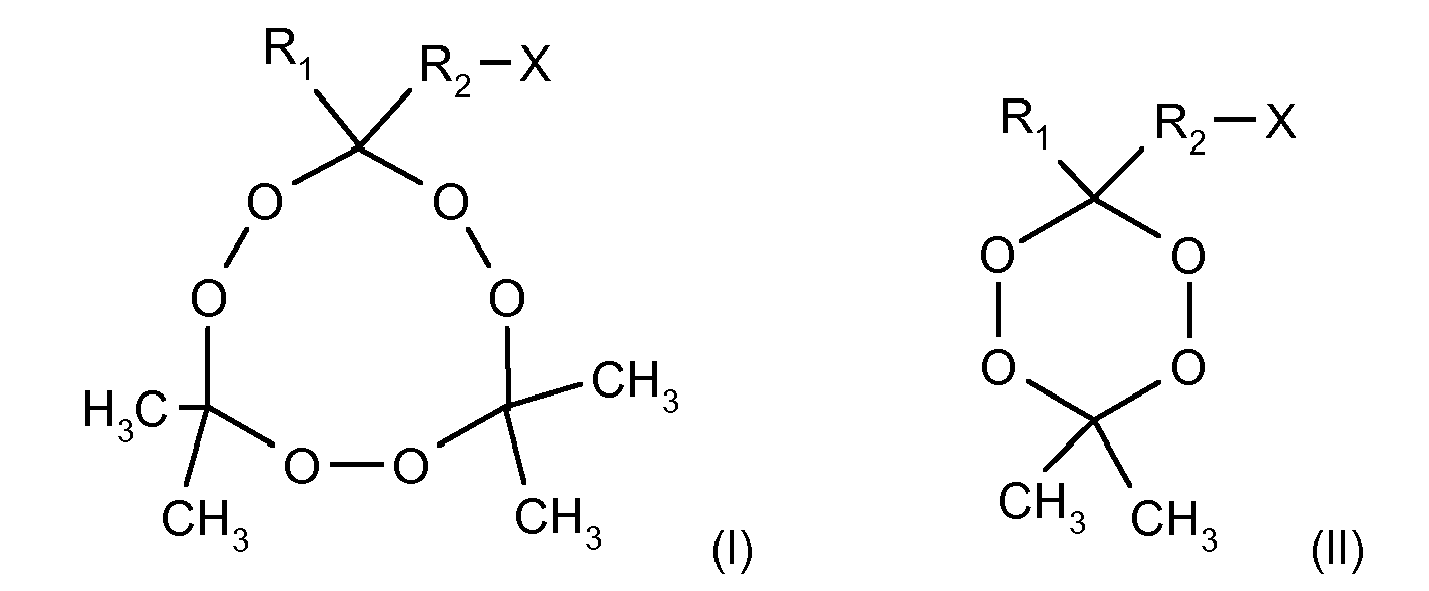
- Diese Aufgabe wird durch ein Triacetontriperoxid-Derivat gemäß der allgemeinen Formel (I) gelöst,

- Ebenso wird die Aufgabe durch ein Diacetondiperoxid-Derivat gemäß der allgemeinen Formel (II) gelöst, worin R1, R2 und X die gleiche Bedeutung wie in Formel (I) haben.

- Die erfindungsgemäßen Derivate (die beide Enantiomere oder das Racemat umfassen können) unterscheiden sich von der eigentlichen Target-Struktur des TATP bzw. DADP durch die Substitution eines Methylrestes durch eine, die funktionelle Gruppe X enthaltende Seitenkette. Durch diese funktionelle Gruppe ist eine Kopplung des Derivates an ein (immunogenes) Trägerprotein möglich, wobei die insbesondere kovalente Bindung beispielsweise an eine funktionelle Gruppe einer Seitenkette des Proteinrückgrates, etwa einer Carboxy-, Hydroxyl-, Amino- oder Thiolgruppe erfolgen kann.
- Überraschend an den erfindungsgemäßen Derivaten ist unter anderem ihre für diese Peroxide ungewöhnliche Stabilität, die auch eine Immunisierung ermöglicht. Aufgrund dieser längerfristigen Stabilität ist auch eine kommerzielle Nutzung z.B. von Konjugaten in einfacher Weise möglich. Die Substanzen stellen praktisch keine Gefahr für Mensch und Umwelt dar und lassen sich verdünnt gefahrlos transportieren.
- Bei dem Linker-Molekül R2 kann es sich um nahezu beliebige Strukturen handeln, die beispielsweise aus der Fachliteratur der Immunologie bekannt sind (z.B. Greg. T. Hermanson: Bioconjugate Techniques). Insbesondere kann R2 ein vorzugsweise unverzweigter, gesättigter oder einfach oder mehrfach ungesättigter C1- bis C20-Alkylrest sein. Dabei werden unter "einfach oder mehrfach ungesättigten Alkylgruppen" solche Kohlenwasserstoffreste verstanden, die eine oder mehrere Doppelbindungen oder Dreifachbindungen oder Mischungen von diesen in beliebigen Anordnungen aufweisen. Außerdem kann R2 ein Oligoethylenoxid, ein Peptid, ein Peptidoid, eine Nukleinsäure, ein Oligozucker sein sowie andere synthetische oder natürliche Polymere oder Copolymere und Kombinationen der vorgenannten Gruppen.
- Gemäß einer bevorzugten Ausgestaltung kann R2 vorteilhaft ein unverzweigter, gesättigter C1- bis C8-Alkylrest sein, insbesondere ein C2- bis C7-Alkylrest, vorzugsweise ein C5-Alkylrest.
- Für die koppelbare (aktive) Gruppe X kommen gleichfalls aus der einschlägigen Fachliteratur bekannte funktionelle Gruppen in Frage (z.B. Greg. T. Hermanson: Bioconjugate Techniques). Insbesondere kann X eine Aminogruppe NH2, eine Carboxylgruppe COOH, eine Aldehydgruppe CHO, eine Hydroxylgruppe OH, eine Thiolgruppe SH, eine Oxirangruppe (Epoxidgruppe) CH(O)CH2, eine Aziridingruppe (Ethylenimingruppe) CH(NH)CH2, eine Hydrazingruppe NH-NH2, eine Hydrazidgruppe CONH-NH2, eine Hydroxylamonogruppe ONH2, ein N-Hydroxysuccinimidester u.ä. bedeuten. Ebenfalls eingeschlossen sind Salze, Ester (insbesondere aktivierte Ester) und Anhydride der funktionellen Gruppen X, soweit sie zu deren Bildung befähigt sind. Auch nicht-kovalente Bindungsgruppen sind als koppelbare Gruppe X geeignet, so z.B. Biotin und dessen Derivate, so genannte Peptid-Tags, insbesondere His-Tags (Oligo-Histidin) und andere. Die Gruppe X kann auch eine detektierbare Markierung sein oder eine solche umfassen, beispielsweise ein Farbstoff, insbesondere Fluoreszenzfarbstoff oder ein anderer, eine radioaktive Markierung oder eine stabile Isotopen-Markierung.
- Es ist ferner bevorzugt, dass X eine Carboxylgruppe oder ein aktivierter Ester, ein gemischtes oder symmetrisches Anhydrid ist. Die Verknüpfung einer solchen Carboxylgruppe an ein Trägerprotein ist besonders einfach durchführbar.
- In bevorzugter Ausgestaltung der Erfindung ist R1 eine Methylgruppe.
- Vorzugsweise entspricht das erfindungsgemäße Triacetontriperoxid-Derivat der speziellen Formel (la) (6-(3,6,6,9,9-Pentamethyl-1,2,4,5,7,8-hexaoxonan-3-yl)hexansäure) oder einem aktivierten Ester (z.B. N-Hydroxysuccinimidester, NHS-Ester) oder einem gemischten Anhydrid (z.B. hergestellt mit Isobutylchlorformiat).

- Die bevorzugte Struktur des erfindungsgemäßen Diacetondiperoxid-Derivats entspricht der speziellen Formel (IIa) oder einem aktivierten Ester (z.B. NHS-Ester) oder einem gemischten Anhydrid (z.B. hergestellt mit Isobutylchlorformiat).


- Bevorzugte Ausgestaltungen der Reste R1 und R2 entsprechen den im Zusammenhang mit dem erfindungsgemäßen TATP-Derivat und DADP-Derivat genannten.
- Die Herstellung des TATp-Derivats entspricht somit der Reaktionsgleichung (IV).

- Vorzugsweise wird als Verbindung gemäß allgemeiner Formel (III) 7-Oxooktansäure gemäß Formel (IIIa) eingesetzt, so dass das Triacetontriperoxid-Derivat nach Formel (la) resultiert.

- Die hier angewandte Reaktion entspricht somit dem Ansatz gemäß Wolffenstein (s.o.), wobei ein Aceton-Baustein durch die Verbindung gemäß allgemeiner Formel (III) und insbesondere durch 7-Oxooktansäure ersetzt wird.
- Die erfindungsgemäße Reaktion wird durch die Gegenwart von Protonen wesentlich beschleunigt. Daher wird sie vorzugsweise in einem sauren Milieu durchgeführt. Dieses kann durch Zugabe laborüblicher Mineralsäuren erreicht werden, beispielsweise Schwefelsäure, Salzsäure, Salpetersäure, Phosphorsäure, Perchlorsäure, Methansulfonsäure, Ameisensäure, Essigsäure, Zitronensäure, oder andere. Vorzugsweise wird hier Schwefelsäure oder Salzsäure eingesetzt. Falls eines der Edukte selbst saure Eigenschaften aufweist, so kann auf die Zugabe einer Säure verzichtet und die Reaktion autokatalytisch durchgeführt werden.
- Besonders gute Ausbeuten und geringere Mengen Nebenprodukte werden erhalten, wenn Aceton, Wasserstoffperoxid und die Verbindung gemäß der allgemeinen Formel (III) in einem molaren Verhältnis von etwa 1 : 1 : 1 zum Ansatz gebracht werden. Auf diese Weise können die Anteile an Nebenprodukten geringer gehalten werden.
- Abgesehen von aus dem Wasserstoffperoxid stammendem Wasser kann die Reaktion ohne die Zugabe von Lösungsmitteln durchgeführt werden, da Aceton selbst ein Lösungsmittel ist.
- Die Reaktion wird vorzugsweise bei Zimmertemperatur oder niedriger durchgeführt.
- Ein weiterer Aspekt der vorliegenden Erfindung betrifft die Verwendung des vorstehend beschriebenen erfindungsgemäßen TATP- oder DADP-Derivats zur kovalenten oder nicht-kovalenten Kopplung an Proteine (z.B. immunogene Carrier-Proteine, Beschichtungsproteine oder Markerenzyme), DNA, Zucker, oder Labels (z.B. Fluoreszenzfarbstoffe, Radioisotope oder stabile Isotope), inerte Träger (z.B. Agarose), Mikropartikel oder Membranen.
- Noch ein weiterer Aspekt der vorliegenden Erfindung betrifft die Verwendung des vorstehend beschriebenen erfindungsgemäßen TATP- oder DADP-Derivats als Antigen zur Herstellung von TATP- oder DADP-spezifischen Bindern, insbesondere von Antikörpern, vorzugsweise von monoklonalen Antikörpern), deren Fragmenten, Derivaten oder Fusionsprodukten, Antikörper-Analogen, Aptameren, Bindern auf Basis von Proteingerüsten, molekular geprägte Systeme (MIPs), nanostrukturierte Materialien, selektiv bindenden Oberflächen oder isotopenmarkierten Verbindungen. Die Herstellung von Antikörpern erfolgt üblicherweise durch vorzugsweise kovalente Bindung des Derivats an ein geeignetes Trägerprotein, beispielsweise Ovalbumin, Rinderserumalbumin oder KLH (Hämocyanin), und anschließende Immunisierung von Wirbeltieren. Hierzu werden diese dem Antigen, d.h. dem Konjugat aus Trägerprotein und daran gekoppelten TATP- oder DADP-Derivat, ausgesetzt, was üblicherweise durch mehrfache Injektion des Antigens erfolgt. Nach einer gewissen Immunisierungsdauer können dann die gebildeten (polyklonalen) Antikörper aus dem Blut des Tieres isoliert und aufgereinigt werden. Monoklonale Antikörper können ebenfalls aus derartig immunisierten Tieren gewonnen werden. Die zur Herstellung von polyklonalen und monoklonalen Antikörpern angewandten Methoden gehören zum allgemeinen Fachwissen von Biochemikern und Molekularbiologen und müssen daher hier nicht im Einzelnen erläutert werden.
- Die so erhaltenen TATP- oder DADP-spezifischen Binder, insbesondere die Antikörper, werden bevorzugt in einem Affinitätssensor (Immunsensor) zum Nachweis von Triacetontriperoxid (TATP) bzw. von Diacetondiperoxid (DADP) eingesetzt. Neben den immobilisierten Antikörpern enthält ein solcher Sensor einen Detektionsmechanismus, der bei erfolgter Bindung zwischen Antikörper und TATP bzw. DADP (oder einem Derivat von diesen) ein messbares Signal liefert. Hier kommen grundsätzlich alle bei bekannten Immunsensoren angewandten Detektionssysteme in Frage, insbesondere Quarzmikrowaagen, Cantilever-Systeme, SPR-Systeme (surface plasmon resonance) und andere optische und elektrochemische Systeme.
- Ebenfalls können die TATP- oder DADP-spezifischen Binder, insbesondere die Antikörper, in Affinitätsassays (z.B. ELISA) oder in affinitätsanreichernden Systemen (z.B. Immunaffinitätschromatographiesäulen) zum Nachweis von Triacetontriperoxid (TATP) bzw. von Diacetondiperoxid (DADP) eingesetzt werden.
- Die für das erfindungsgemäße Triacetontriperoxid- und Diacetondiperoxid-Derivat und damit für TATP bzw. DADP selbst spezifischen Antikörper, insbesondere monoklonalen Antikörper, oder Antikörperfragmente sowie ein solche Antikörper enthaltender Sensor zum Nachweis von TATP bzw. DADP stellen weitere Aspekte der vorliegenden Erfindung dar.
- Weitere Anwendungen der Antikörper betreffen Immunoassays (z.B. ELISA) für die Detektion von TATP oder DADP in flüssigen Proben; Affinitätsmaterialien, die immobilisierte Antikörper oder Haptene enthalten, für die Affinitätschromatographie oder Affinitätsanreicherung, und immunologische Schnelltests zum Nachweis von TATP bzw. DATP, beispielsweise in Form von Teststreifen, immunchromatographischen Systemen, Lateral-Flow-Tests oder ähnliche Systeme.
- Darüber hinaus können andere spezifisch mit TATP und/oder DADP wechselwirkende "Binder" hergestellt werden. Solche Verbindungen sind beispielsweise Antikörperfragmente (z.B. Fab), rekombinante Antikörper, DNA- oder RNA-Aptamere, Binder auf Basis anderer Polymergerüste ("protein scaffolds"), Molecularly Imprinted Polymers (MIPs), Phage Display Peptide, Mimotope.
- Ebenfalls können mit Hilfe der erfindungsgemäßen Derivate weitere TATP- bzw. DADP-Tracer synthetisiert werden, etwa Enzymkonjugate, Fluoreszenzkonjugate, Radiotracer, Isotopentracer, Partikeltracer u.a.
- Eine weitere Verwendung besteht in der Herstellung von Microarrays (Immunoarrays oder Hapten-Arrays) oder Bead-based Arrays sowie die Verwendung der Derivate zur Zellmarkierung in der Durchflusszytometrie.
- Weitere bevorzugte Ausgestaltungen der Erfindung ergeben sich aus den übrigen, in den Unteransprüchen genannten Merkmalen.
- Die Erfindung wird nachfolgend in Ausführungsbeispielen anhand der zugehörigen Figuren näher erläutert. Es zeigen:
- Figur 1
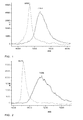
- MALDI-TOF-Massenspektren eines an BSA gekoppelten TATP-Derivats (durch- gezogene Linie) mit einer Kopplungsdichte von 11 TATP-Derivat-Molekülen pro BSA-Molekül sowie von ungekoppeltem BSA (gestrichelte Linie);
- Figur 2
- MALDI-TOF-Massenspektren eines an BSA gekoppelten TATP-Derivats (durch- gezogene Linie) mit einer Kopplungsdichte von 15 TATP-Derivat-Molekülen pro BSA-Molekül sowie von ungekoppeltem BSA (gestrichelte Linie);
- Figur 3
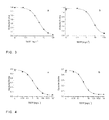
- zeitlicher Verlauf der Immunisierung von Mäusen mit BSA-Konjugat des TATP- Derivats (a: direkter ELISA; b: indirekter ELISA); und
- Figur 4
- zeitlicher Verlauf der Immunisierung von Kaninchen mit BSA-Konjugat des TATP-Derivats (a: direkter ELISA; b: indirekter ELISA).
- Die Synthese erfolgte gemäß der unten angegebenen Reaktionsgleichung. Es wurden 80,71 mg 7-Oxooktansäure (Reinheit 98%, 0,5 mmol) eingewogen und in 36,76 µl Aceton (0,5 mmol) gelöst und 51,05 µl Wasserstoffperoxid (30 %, 0,5 mmol) zugemischt. Durch Zugabe von 2,5 µl Schwefelsäure H2S04 (2 M, 0,005 mmol) bei 0 °C wurde ein saures Milieu eingestellt (pH-Wert nicht bestimmt, Verhältnis Aceton/Säure ≤ 1x 10⁻²). Der Ansatz wurde für 24 h bis ca. 7 Tage bei Raumtemperatur ruhen gelassen. Danach wurde mit H2O ausgefällt und ein zähflüssiges Pellet erhalten, das in einer Acetonitril/Wasser-Mischung aufgenommen wurde. Die Aufreinigung erfolgte mittels HPLC-DAD per Acetonitril/Wasser-Gradienten mit TFA.

- Die Struktur des gereinigten TATP-Derivats wurde 1H-NMR-spektroskopisch (Bruker, 600 MHz) und 13C-NMR-spektroskopisch (Bruker 150,9 MHz) jeweils in MeOD verifiziert. Außerdem wurde ein hochaufgelöstes Massenspektrum (ESI-negative-FT-MS) des gereinigten TATP-Derivats in Acetonitril aufgenommen. Die gefundenen Massen von 321,1552 (m/z) weicht um weniger als 0,0001 % von der theoretischen (M(C14H25O8) = 321,1555) ab.
- Nach dem folgenden Reaktionsschema wurde das TATP-Derivat mit N-Hydroxysuccinimid (NHS) und Dicyclohexylcarbodümid (DCC) in wasserfreiem THF oder wasserfreiem DMF in einem molaren Verhältnis TATP-Derivat : NHS : DCC von 1 : 1,2-2 : 1,2-2 umgesetzt. Es ist hierbei strengstens auf wasserfreie Bedingungen zu achten. Dabei wurde der aktivierte Ester des TATP-Derivats erhalten.


- Der gemäß der vorstehenden Beschreibung hergestellte aktivierte Ester des TATP-Derivats wurde in Gegenwart von 0,13 M Natriumhydrogencarbonat NaHC03 (0,13 M) an verschiedene Proteine gekoppelt. Es wurden die Proteine Rinderserumalbumin (BSA, ca. 66 kDa) Meerrettichperoxidase (POD, ca. 44 kDa) und Ovalbumin (OVA, ca. 43 kDa) eingesetzt. Es entstand jeweils eine kovalente Peptidbindung über ein Lysin des jeweiligen Proteins. Das nachfolgende Reaktionsschema zeigt die Kopplungsreaktion am Beispiel des BSA.

- Als Nachweis des Erfolgs der Kopplung des TATP-Derivats an das Protein wurden MALDI-TOF-MS-Spektren zweier BSA-Konjugate im Vergleich mit ungekoppeltem BSA aufgenommen. Das Entsalzen der Protein-Lösung vor der Messung erfolgte über ZebaSpin-Säulen. Als Matrix wurde Sinapinsäure verwendet. Die Spektren wurden durch einen gleitenden Durchschnitt (100 Punkte) geglättet und einer Basislinienkorrektur unterzogen. Es wurde keine Massenkalibration des MALDI-TOF-Massenspektrometers durchgeführt. Die Massenspektren sind in
Figur 1 gezeigt, in der die gestrichelte Linie das Spektrum von ungekoppeltem BSA (Edukt) zeigt und die durchgezogene Linie das des BSA-Konjugats (= Immunogen) für die Immunisierung von Mäusen, welches eine mittlere Kopplungsdichte von 11 Haptenen (TATP-Derivat-Moleküle) pro BSA-Molekül aufweist. InFigur 2 sind analoge Massenspektren dargestellt, wobei die mittlere Kopplungsdichte hier 15 Haptenen (TATP-Derivat-Moleküle) pro BSA-Molekül beträgt. - Für Kopplungen mit Meerrettichperoxidase (POD) und Ovalbumin (OVA) wurden mittlere Kopplungsdichten von 2 bzw. 4 Haptenen (TATP-Derivat-Moleküle) je Protein-Molekül erzielt (nicht dargestellt).
- Mit dem unter 1.3 gezeigten BSA-Konjugat wurden 3 BALB/c-Mäuse immunisiert, dazu wurden 50 µg Immunogen alle 4 Wochen injiziert. Die Erstimmunisierung erfolgte unter Verwendung von komplettem Freunds Adjuvans, die Nachimmunisierungen wurden mit inkomplettem Freunds Adjuvans durchgeführt. Mit den Seren, die 7 Tage nach jeder Immunisierung den Tieren entnommen wurden, konnte der Immunisierungsverlauf per ELISA (Enzyme-Linked Immunosorbent Assay) überwacht werden, woraus sich die in
Figur 3 gezeigten sigmoidalen TATP-Kalibrierkurven ergaben (Fehlerbalken: Standardabweichung). Kurve a zeigt einen direkten ELISA mit 1:10.000 verdünntem Mausserum und 1:10.000 verdünnten TATP-Peroxidase-Tracer (TATP-Derivat-POD-Konjugat). Der Wendepunkt ist bei 2,5 mg L-1; die mittlere Antikörperaffinität beträgt ca. 5,7 µM und die Nachweisgrenze liegt bei 65 µg L-1 (n = 4). Kurve b zeigt einen indirekten ELISA mit 1:10.000 verdünntem Mausserum und 1:5.000 verdünnten anti-Maus-Peroxidase-Tracer. Der Wendepunkt ist bei 5,6 mg L-1; die mittlere Antikörperaffinität beträgt ca. 13 µM und die Nachweisgrenze liegt bei 870 µg L-1 (n = 3). - Mit dem unter 1.3 gezeigten BSA-Konjugat wurden 2 Kaninchen immunisiert, dazu wurden 50 µg Immunogen alle 4 Wochen injiziert. Die Immunisierungen erfolgten unter Verwendung eines Adjuvans. Mit den Seren, die 7 Tage nach jeder Immunisierung den Tieren entnommen wurden, konnte der Immunisierungsverlauf per ELISA überwacht werden, woraus sich die in
Figur 4 gezeigten sigmoidalen TATP-Kalibrierkurven ergaben (Fehlerbalken: Standardabweichung). Kurve a zeigt einen direkten ELISA mit 1:120.000 verdünntem Kaninchenserum und 1:30.000 verdünntem TATP-Peroxidase-Tracer (TATP-Derivat-POD-Konjugat). Der Wendepunkt ist bei 1,6 µg L-1; die mittlere Antikörperaffinität beträgt ca. 5,7 nM und die Nachweisgrenze liegt bei 92 ng L-1 (n = 3). Kurve b zeigt einen direkten ELISA mit 1 : 120.000 verdünntem Kaninchenserum und 1 : 30.000 verdünntem TATP-Peroxidase-Tracer (TATP-Derivat-POD-Konjugat). Der Wendepunkt ist bei 0,98 µg L-1; die mittlere Antikörperaffinität beträgt ca. 3,5 nM und die Nachweisgrenze liegt bei 170 ng L-1 (n = 3). - Mit den Seren der beiden Kaninchen aus Beispiel 1.4 wurden für die einzelnen Edukte der TATP-Derivat-Synthese (7-Oxooktansäure, H2O2 und Aceton) die Kreuzreaktivitäten relativ zu TATP bestimmt. Die Kreuzreaktivitäten wurden über den Quotienten der Wendepunkte (in µg L-1) der sigmoidalen Kalibrierkurven ermittelt. Es zeigt sich in nachfolgender Tabelle, dass die polyklonalen Antikörper sehr selektiv sind. Die Ergebnisse wurden im direkten als auch indirekten ELISA erzielt.
Tabelle: Kaninchen 1 Kaninchen 2 TATP 100 % 100 % 7-Oxooktansäure < 0,1 % < 0,1 % H2O2 < 0,1 % < 0,1 % Aceton < 0,1 % < 0,1 % - Die Synthese erfolgte analog zur TATP-Synthese wie in Dubnikova et al. (Decomposition of triacteone triperoxide is an entropic explosion. Journal of the American Chemical Society 2005, 127(4), 1148).
Claims (16)
- Triacetontriperoxid-Derivat gemäß der allgemeinen Formel (I) oder Diacetondiperoxid-Derivat gemäß der allgemeinen Formel (II),
- TATP- oder DADP-Derivat nach Anspruch 1, wobei R2 ein gesättigter oder einfach oder mehrfach ungesättigter C1- bis C20-Alkylrest ist, ein Oligoethylenoxid, ein Peptid, ein Peptidoid, eine Nukleinsäure, ein Oligozucker, ein synthetisches oder natürliches Polymer oder Copolymer oder eine Kombinationen der vorgenannten Gruppen ist.
- TATP- oder DADP-Derivat nach Anspruch 2, wobei R2 ein unverzweigter gesättigter C1- bis C8-Alkylrest, insbesondere ein C2- bis C7-Alkylrest, vorzugsweise ein C5-Alkylrest, ist.
- TATP- oder DADP-Derivat nach einem der vorhergehenden Ansprüche, wobei X eine Aminogruppe, eine Carboxylgruppe, eine Aldehydgruppe, eine Hydroxylgruppe, eine Thiolgruppe, eine Oxirangruppe, eine Aziridingruppe, eine Hydrazingruppe, eine Hydroxylamingruppe, eine Hydrazidgruppe, ein N-Hydroxysuccinimidester oder ein Salz, Ester oder Anhydrid von diesen bedeutet oder einer nicht-kovalent an Proteine koppelbaren Gruppe, insbesondere Biotin oder einem Derivat von diesem oder einem Peptid-Tag, insbesondere Oligo-Histidin, entspricht.
- TATP- oder DADP-Derivat nach einem der vorhergehenden Ansprüche, wobei X eine detektierbare Markierung ist oder umfasst, insbesondere ein Farbstoff, eine radioaktive Markierung oder eine stabile Isotopen-Markierung.
- TATP- oder DADP-Derivat nach einem der vorhergehenden Ansprüche, wobei R1 eine Methylgruppe ist.
- TATP- oder DADP-Derivat nach einem der vorhergehenden Ansprüche, wobei das Triacetontriperoxid-Derivat 6-(3,6,6,9,9-Pentamethyl-1,2,4,5,7,8-hexaoxonan-3-yl)hexansäure gemäß der Formel (la) ist oder ein aktivierter Ester, ein Anhydrid oder Säurehalogenid von diesem

- Verfahren zur Herstellung eines Triacetontriperoxid- oder Diacetondiperoxid-Derivats nach einem der Ansprüche 1 bis 7 durch Umsetzung von Aceton, einem Aceton-Derivat oder einer Aceton-abspaltenden Vorstufe mit Wasserstoffperoxid, einem Wasserstoffperoxid-Derivat oder einer Wasserstoffperoxid-abspaltenden Vorstufe mit einer Verbindung gemäß der allgemeinen Formel (III),

- Verfahren nach einem der Anspruch 8, wobei die Verbindung gemäß allgemeiner Formel (III) 7-Oxooktansäure gemäß Formel (IIIa) ist

- Verfahren nach einem der Ansprüche 8 oder 9, wobei die Reaktion in Gegenwart einer Säure durchgeführt wird oder autokatalytisch unter Verwendung eines saure Eigenschaften aufweisenden Edukts.
- Verfahren nach einem der Ansprüche 8 bis 10, wobei Aceton, Wasserstoffperoxid und die Verbindung gemäß der allgemeinen Formel (III) in einem molaren Verhältnis von etwa 1 : 1 :1 eingesetzt werden.
- Verwendung eines TATP- oder DADP-Derivats nach einem der Ansprüche 1 bis 7 zur kovalenten oder nicht-kovalenten Kopplung an Proteine, DNA oder Labels.
- Verwendung eines TATP- oder DADP-Derivats nach einem der Ansprüche 1 bis 7 als Antigen zur Herstellung von TATP- oder DADP-spezifischen Bindern, insbesondere von monoklonalen oder polyklonalen Antikörpern, deren Fragmenten, Derivaten oder Fusionsprodukten, Antikörper-Analogen, Aptameren, Bindern auf Basis von Proteingerüsten, molekular geprägten Systemen, nanostrukturierten Materialien, selektiv bindenden Oberflächen oder isotopenmarkierten Verbindungen.
- Verwendung nach Anspruch 13, wobei die TATP- oder DADP-spezifischen Binder in einem Affinitätssensor, in einem Affinitätsassay oder in einem affnitätsanreichernden System zum Nachweis von Triacetontriperoxid (TATP) oder Diacetondiperoxid (DADP) eingesetzt werden.
- Antikörper oder Antikörperfragment gegen ein Triacetontriperoxid- oder Diacetondiperoxid-Derivat nach einem der Ansprüche 1 bis 7.
- Sensor zum Nachweis von Triacetontriperoxid oder Diacetondiperoxid enthaltend einen TATP- oder DADP-spezifischen Binder nach Anspruch 13.
Applications Claiming Priority (1)
| Application Number | Priority Date | Filing Date | Title |
|---|---|---|---|
| DE102009002652A DE102009002652A1 (de) | 2009-04-27 | 2009-04-27 | Triacetontriperoxid und Diacetondiperoxid-Derivat, Verfahren zu ihrer Herstellung sowie ihre Verwendung |
Publications (3)
| Publication Number | Publication Date |
|---|---|
| EP2246342A2 true EP2246342A2 (de) | 2010-11-03 |
| EP2246342A3 EP2246342A3 (de) | 2011-09-28 |
| EP2246342B1 EP2246342B1 (de) | 2013-01-23 |
Family
ID=42557286
Family Applications (1)
| Application Number | Title | Priority Date | Filing Date |
|---|---|---|---|
| EP10160157A Not-in-force EP2246342B1 (de) | 2009-04-27 | 2010-04-16 | Triacetontriperoxid-Derivat, Verfahren zu dessen Herstellung sowie dessen Verwendung |
Country Status (3)
| Country | Link |
|---|---|
| US (1) | US20100273193A1 (de) |
| EP (1) | EP2246342B1 (de) |
| DE (1) | DE102009002652A1 (de) |
Families Citing this family (1)
| Publication number | Priority date | Publication date | Assignee | Title |
|---|---|---|---|---|
| CN102532094B (zh) * | 2012-01-09 | 2014-08-06 | 北京理工大学 | 过氧化碳氢化合物的制备方法及检测方法 |
Family Cites Families (3)
| Publication number | Priority date | Publication date | Assignee | Title |
|---|---|---|---|---|
| US5367061A (en) * | 1993-05-06 | 1994-11-22 | Westinghouse Electric Company | Method of detecting nitrate esters |
| CZ18497A3 (en) * | 1994-07-21 | 1997-07-16 | Akzo Nobel Nv | Cyclic ketoneperoxidic compounds |
| IL123451A (en) * | 1998-02-25 | 2003-07-06 | Ehud Keinan | Method and kit for the detection of peroxide-based explosives |
-
2009
- 2009-04-27 DE DE102009002652A patent/DE102009002652A1/de not_active Withdrawn
-
2010
- 2010-04-16 EP EP10160157A patent/EP2246342B1/de not_active Not-in-force
- 2010-04-26 US US12/767,305 patent/US20100273193A1/en not_active Abandoned
Non-Patent Citations (8)
| Title |
|---|
| A.V. KUZNETSOV; 0.1. OSETROV: "NATO Security through Science Series - B: Physics and Biophysics", 2006, SPRINGER-VERLAG, article "Detection and Disposal of Improvised Explosives", pages: 7 - 23 |
| DUBNIKOVA ET AL.: "Decomposition of triacteone triperoxide is an entropic explosion", JOURNAL OF THE AMERICAN CHEMICAL SOCIETY, vol. 127, no. 4, 2005, pages 1148 |
| F. DUBNIKOVA ET AL.: "Decomposition of triacteone triperoxide is an entropic explosion", JOURNAL OF THE AMERICAN CHEMICAL SOCIETY, vol. 127, no. 4, 2005, pages 1146 - 1159 |
| GREG. T. HERMANSON: "Bioconjugate Techniques", 2008, ACADEMIC PRESS |
| J. BOWEN ET AL.: "Gas-Phase Detection of Trinitrotoluene Utilizing a Solid-Phase Antibody Immobilized on a Gold Film by Means of Surface Plasmon Resonance Spectroscopy", APPLIED SPECTROSCOPY, vol. 57, no. 8, 2003, pages 906 - 914 |
| J.C. OXLEY ET AL.: "Determination of the Vapor Density of Triacetone Triperoxide (TATP) Using a Gas Chromatagraphy Headspace Technique", PROPELLANTS EXPLOSIVES PYROTECHNICS, vol. 30, no. 2, 2005, pages 127 - 130 |
| R. MATYAS: "Study of TATP: Spontaneous transformation of TATP to DADP", PROPELLANTS EXPLOSIVES PYROTECHNICS, vol. 33, no. 2, 2008, pages 89 - 91 |
| R. WOLFFENSTEIN: "Über die Einwirkung von Wasserstoffsuperoxyd auf Aceton und Mesityloxyd", BERICHTE DER DEUTSCHEN CHEMISCHEN GESELLSCHAFT, vol. 28, no. 2, 1895, pages 2265 - 2269 |
Also Published As
| Publication number | Publication date |
|---|---|
| DE102009002652A1 (de) | 2010-10-28 |
| EP2246342B1 (de) | 2013-01-23 |
| EP2246342A3 (de) | 2011-09-28 |
| US20100273193A1 (en) | 2010-10-28 |
Similar Documents
| Publication | Publication Date | Title |
|---|---|---|
| DE2808523C2 (de) | ||
| DE69030829T2 (de) | Reagenzien zum Nachweis von Drogen | |
| DE69321655T2 (de) | Zweianalytenimmunoassay | |
| DE3875354T2 (de) | Fluoreszenzpolarisationsimmunassay fuer amphetamin/methamphetamin. | |
| DE69113114T2 (de) | Test für Phencyclidin und Phencyclidin-Metaboliten, Tracer, Immunogene, Antikörper und Reagenzsatz dafür. | |
| DE69520383T2 (de) | Quaternäre ammonium immunogenische Konjugate und Immuntest-Reagenz | |
| DE68926779T2 (de) | Zusammensetzung und Methoden zur Bestimmung der Anwesenheit von Amphetaminen in einer Probe, die in Verdacht steht, Amphetamine und/oder Metamphetamine zu enthalten | |
| DE69610716T2 (de) | Topiramate-immunoassay, sowie analoge und antikörper | |
| EP0794196A2 (de) | Antikörper zur selektiven immunologischen Bestimmung von Gallensäuren in biologischen Matrices | |
| DE60211849T2 (de) | Verfahren zur Identifizierung von Liganden eines biologischen Substrats | |
| DE60219124T2 (de) | Verfahren und Kit zum Nachweis, oder zum Quantifizieren von, Metaboliten von Fentanyl und Metaboliten von Fentanyl Analoga | |
| DE10111224B4 (de) | Analoge der Ecstasy-Klasse sowie Verwendung derselben beim Nachweis von Verbindungen der Ecstasy-Klasse | |
| EP0089598B1 (de) | Anti-Streptolysin O-Latex-Reagenz und Verfahren zu seiner Herstellung | |
| EP2246342B1 (de) | Triacetontriperoxid-Derivat, Verfahren zu dessen Herstellung sowie dessen Verwendung | |
| CN106674138A (zh) | 一种戊唑醇新型半抗原及其合成方法和应用 | |
| DE2716536A1 (de) | Bestimmung von methadon | |
| EP2440938B1 (de) | Mcpp-immuntest | |
| CN107619440A (zh) | 一种氯吡脲人工抗原和多克隆抗体的制备方法与应用 | |
| DE112020001471T5 (de) | Immunassay für Mitragynin | |
| EP0716304A1 (de) | Immunoassays für Haptene und hierfür verwendbare Haptentracer-Antikörper-Komplexe sowie Verfahren zur Herstellung derselben | |
| DE2324544A1 (de) | Synthetische antigene und ihre verwendung | |
| DE69332637T2 (de) | Kokainderivat,Proteinkonjugat,davon,einen monoklonalen Antikörper produzierende Hybridom-Zellinie, Verfahren zur Herstellung der Hybridom-Zellinie und des monoklonalen Antikörpers | |
| DE69023357T2 (de) | Fluoreszenz-Polarisationsimmunoassay für Methadon. | |
| EP2418492B1 (de) | Immunoreagens für Meprobamate | |
| DE60116146T2 (de) | Konjugate definierter stöchiometrie |
Legal Events
| Date | Code | Title | Description |
|---|---|---|---|
| PUAI | Public reference made under article 153(3) epc to a published international application that has entered the european phase |
Free format text: ORIGINAL CODE: 0009012 |
|
| AK | Designated contracting states |
Kind code of ref document: A2 Designated state(s): AT BE BG CH CY CZ DE DK EE ES FI FR GB GR HR HU IE IS IT LI LT LU LV MC MK MT NL NO PL PT RO SE SI SK SM TR |
|
| AX | Request for extension of the european patent |
Extension state: AL BA ME RS |
|
| PUAL | Search report despatched |
Free format text: ORIGINAL CODE: 0009013 |
|
| AK | Designated contracting states |
Kind code of ref document: A3 Designated state(s): AT BE BG CH CY CZ DE DK EE ES FI FR GB GR HR HU IE IS IT LI LT LU LV MC MK MT NL NO PL PT RO SE SI SK SM TR |
|
| AX | Request for extension of the european patent |
Extension state: AL BA ME RS |
|
| RIC1 | Information provided on ipc code assigned before grant |
Ipc: C07D 323/00 20060101AFI20110819BHEP Ipc: C07D 323/04 20060101ALI20110819BHEP Ipc: G01N 33/53 20060101ALI20110819BHEP Ipc: C07K 16/44 20060101ALI20110819BHEP |
|
| 17P | Request for examination filed |
Effective date: 20120327 |
|
| GRAP | Despatch of communication of intention to grant a patent |
Free format text: ORIGINAL CODE: EPIDOSNIGR1 |
|
| GRAS | Grant fee paid |
Free format text: ORIGINAL CODE: EPIDOSNIGR3 |
|
| GRAA | (expected) grant |
Free format text: ORIGINAL CODE: 0009210 |
|
| AK | Designated contracting states |
Kind code of ref document: B1 Designated state(s): AT BE BG CH CY CZ DE DK EE ES FI FR GB GR HR HU IE IS IT LI LT LU LV MC MK MT NL NO PL PT RO SE SI SK SM TR |
|
| REG | Reference to a national code |
Ref country code: GB Ref legal event code: FG4D Free format text: NOT ENGLISH |
|
| REG | Reference to a national code |
Ref country code: CH Ref legal event code: EP |
|
| REG | Reference to a national code |
Ref country code: AT Ref legal event code: REF Ref document number: 594902 Country of ref document: AT Kind code of ref document: T Effective date: 20130215 Ref country code: CH Ref legal event code: EP |
|
| REG | Reference to a national code |
Ref country code: IE Ref legal event code: FG4D Free format text: LANGUAGE OF EP DOCUMENT: GERMAN |
|
| REG | Reference to a national code |
Ref country code: DE Ref legal event code: R096 Ref document number: 502010002184 Country of ref document: DE Effective date: 20130321 |
|
| REG | Reference to a national code |
Ref country code: LT Ref legal event code: MG4D |
|
| REG | Reference to a national code |
Ref country code: NL Ref legal event code: VDEP Effective date: 20130123 |
|
| PG25 | Lapsed in a contracting state [announced via postgrant information from national office to epo] |
Ref country code: NO Free format text: LAPSE BECAUSE OF FAILURE TO SUBMIT A TRANSLATION OF THE DESCRIPTION OR TO PAY THE FEE WITHIN THE PRESCRIBED TIME-LIMIT Effective date: 20130423 Ref country code: SE Free format text: LAPSE BECAUSE OF FAILURE TO SUBMIT A TRANSLATION OF THE DESCRIPTION OR TO PAY THE FEE WITHIN THE PRESCRIBED TIME-LIMIT Effective date: 20130123 Ref country code: BG Free format text: LAPSE BECAUSE OF FAILURE TO SUBMIT A TRANSLATION OF THE DESCRIPTION OR TO PAY THE FEE WITHIN THE PRESCRIBED TIME-LIMIT Effective date: 20130423 Ref country code: ES Free format text: LAPSE BECAUSE OF FAILURE TO SUBMIT A TRANSLATION OF THE DESCRIPTION OR TO PAY THE FEE WITHIN THE PRESCRIBED TIME-LIMIT Effective date: 20130504 Ref country code: LT Free format text: LAPSE BECAUSE OF FAILURE TO SUBMIT A TRANSLATION OF THE DESCRIPTION OR TO PAY THE FEE WITHIN THE PRESCRIBED TIME-LIMIT Effective date: 20130123 Ref country code: IS Free format text: LAPSE BECAUSE OF FAILURE TO SUBMIT A TRANSLATION OF THE DESCRIPTION OR TO PAY THE FEE WITHIN THE PRESCRIBED TIME-LIMIT Effective date: 20130523 |
|
| PG25 | Lapsed in a contracting state [announced via postgrant information from national office to epo] |
Ref country code: NL Free format text: LAPSE BECAUSE OF FAILURE TO SUBMIT A TRANSLATION OF THE DESCRIPTION OR TO PAY THE FEE WITHIN THE PRESCRIBED TIME-LIMIT Effective date: 20130123 Ref country code: PT Free format text: LAPSE BECAUSE OF FAILURE TO SUBMIT A TRANSLATION OF THE DESCRIPTION OR TO PAY THE FEE WITHIN THE PRESCRIBED TIME-LIMIT Effective date: 20130523 Ref country code: LV Free format text: LAPSE BECAUSE OF FAILURE TO SUBMIT A TRANSLATION OF THE DESCRIPTION OR TO PAY THE FEE WITHIN THE PRESCRIBED TIME-LIMIT Effective date: 20130123 Ref country code: GR Free format text: LAPSE BECAUSE OF FAILURE TO SUBMIT A TRANSLATION OF THE DESCRIPTION OR TO PAY THE FEE WITHIN THE PRESCRIBED TIME-LIMIT Effective date: 20130424 Ref country code: PL Free format text: LAPSE BECAUSE OF FAILURE TO SUBMIT A TRANSLATION OF THE DESCRIPTION OR TO PAY THE FEE WITHIN THE PRESCRIBED TIME-LIMIT Effective date: 20130123 Ref country code: FI Free format text: LAPSE BECAUSE OF FAILURE TO SUBMIT A TRANSLATION OF THE DESCRIPTION OR TO PAY THE FEE WITHIN THE PRESCRIBED TIME-LIMIT Effective date: 20130123 Ref country code: SI Free format text: LAPSE BECAUSE OF FAILURE TO SUBMIT A TRANSLATION OF THE DESCRIPTION OR TO PAY THE FEE WITHIN THE PRESCRIBED TIME-LIMIT Effective date: 20130123 |
|
| PG25 | Lapsed in a contracting state [announced via postgrant information from national office to epo] |
Ref country code: HR Free format text: LAPSE BECAUSE OF FAILURE TO SUBMIT A TRANSLATION OF THE DESCRIPTION OR TO PAY THE FEE WITHIN THE PRESCRIBED TIME-LIMIT Effective date: 20130123 |
|
| BERE | Be: lapsed |
Owner name: BAM BUNDESANSTALT FUR MATERIALFORSCHUNG UND -PRUF Effective date: 20130430 |
|
| PG25 | Lapsed in a contracting state [announced via postgrant information from national office to epo] |
Ref country code: CZ Free format text: LAPSE BECAUSE OF FAILURE TO SUBMIT A TRANSLATION OF THE DESCRIPTION OR TO PAY THE FEE WITHIN THE PRESCRIBED TIME-LIMIT Effective date: 20130123 Ref country code: EE Free format text: LAPSE BECAUSE OF FAILURE TO SUBMIT A TRANSLATION OF THE DESCRIPTION OR TO PAY THE FEE WITHIN THE PRESCRIBED TIME-LIMIT Effective date: 20130123 Ref country code: DK Free format text: LAPSE BECAUSE OF FAILURE TO SUBMIT A TRANSLATION OF THE DESCRIPTION OR TO PAY THE FEE WITHIN THE PRESCRIBED TIME-LIMIT Effective date: 20130123 Ref country code: SK Free format text: LAPSE BECAUSE OF FAILURE TO SUBMIT A TRANSLATION OF THE DESCRIPTION OR TO PAY THE FEE WITHIN THE PRESCRIBED TIME-LIMIT Effective date: 20130123 Ref country code: RO Free format text: LAPSE BECAUSE OF FAILURE TO SUBMIT A TRANSLATION OF THE DESCRIPTION OR TO PAY THE FEE WITHIN THE PRESCRIBED TIME-LIMIT Effective date: 20130123 |
|
| PG25 | Lapsed in a contracting state [announced via postgrant information from national office to epo] |
Ref country code: CY Free format text: LAPSE BECAUSE OF FAILURE TO SUBMIT A TRANSLATION OF THE DESCRIPTION OR TO PAY THE FEE WITHIN THE PRESCRIBED TIME-LIMIT Effective date: 20130123 Ref country code: MC Free format text: LAPSE BECAUSE OF FAILURE TO SUBMIT A TRANSLATION OF THE DESCRIPTION OR TO PAY THE FEE WITHIN THE PRESCRIBED TIME-LIMIT Effective date: 20130123 |
|
| PLBE | No opposition filed within time limit |
Free format text: ORIGINAL CODE: 0009261 |
|
| STAA | Information on the status of an ep patent application or granted ep patent |
Free format text: STATUS: NO OPPOSITION FILED WITHIN TIME LIMIT |
|
| PG25 | Lapsed in a contracting state [announced via postgrant information from national office to epo] |
Ref country code: IT Free format text: LAPSE BECAUSE OF FAILURE TO SUBMIT A TRANSLATION OF THE DESCRIPTION OR TO PAY THE FEE WITHIN THE PRESCRIBED TIME-LIMIT Effective date: 20130123 |
|
| 26N | No opposition filed |
Effective date: 20131024 |
|
| REG | Reference to a national code |
Ref country code: IE Ref legal event code: MM4A |
|
| PG25 | Lapsed in a contracting state [announced via postgrant information from national office to epo] |
Ref country code: BE Free format text: LAPSE BECAUSE OF NON-PAYMENT OF DUE FEES Effective date: 20130430 |
|
| REG | Reference to a national code |
Ref country code: FR Ref legal event code: ST Effective date: 20131231 |
|
| REG | Reference to a national code |
Ref country code: DE Ref legal event code: R097 Ref document number: 502010002184 Country of ref document: DE Effective date: 20131024 |
|
| PG25 | Lapsed in a contracting state [announced via postgrant information from national office to epo] |
Ref country code: FR Free format text: LAPSE BECAUSE OF NON-PAYMENT OF DUE FEES Effective date: 20130430 |
|
| PG25 | Lapsed in a contracting state [announced via postgrant information from national office to epo] |
Ref country code: IE Free format text: LAPSE BECAUSE OF NON-PAYMENT OF DUE FEES Effective date: 20130416 |
|
| REG | Reference to a national code |
Ref country code: CH Ref legal event code: PL |
|
| GBPC | Gb: european patent ceased through non-payment of renewal fee |
Effective date: 20140416 |
|
| PG25 | Lapsed in a contracting state [announced via postgrant information from national office to epo] |
Ref country code: LI Free format text: LAPSE BECAUSE OF NON-PAYMENT OF DUE FEES Effective date: 20140430 Ref country code: GB Free format text: LAPSE BECAUSE OF NON-PAYMENT OF DUE FEES Effective date: 20140416 Ref country code: CH Free format text: LAPSE BECAUSE OF NON-PAYMENT OF DUE FEES Effective date: 20140430 |
|
| PG25 | Lapsed in a contracting state [announced via postgrant information from national office to epo] |
Ref country code: MT Free format text: LAPSE BECAUSE OF FAILURE TO SUBMIT A TRANSLATION OF THE DESCRIPTION OR TO PAY THE FEE WITHIN THE PRESCRIBED TIME-LIMIT Effective date: 20130123 |
|
| PG25 | Lapsed in a contracting state [announced via postgrant information from national office to epo] |
Ref country code: SM Free format text: LAPSE BECAUSE OF FAILURE TO SUBMIT A TRANSLATION OF THE DESCRIPTION OR TO PAY THE FEE WITHIN THE PRESCRIBED TIME-LIMIT Effective date: 20130123 |
|
| PG25 | Lapsed in a contracting state [announced via postgrant information from national office to epo] |
Ref country code: TR Free format text: LAPSE BECAUSE OF FAILURE TO SUBMIT A TRANSLATION OF THE DESCRIPTION OR TO PAY THE FEE WITHIN THE PRESCRIBED TIME-LIMIT Effective date: 20130123 |
|
| PG25 | Lapsed in a contracting state [announced via postgrant information from national office to epo] |
Ref country code: MK Free format text: LAPSE BECAUSE OF FAILURE TO SUBMIT A TRANSLATION OF THE DESCRIPTION OR TO PAY THE FEE WITHIN THE PRESCRIBED TIME-LIMIT Effective date: 20130123 Ref country code: LU Free format text: LAPSE BECAUSE OF NON-PAYMENT OF DUE FEES Effective date: 20130416 Ref country code: HU Free format text: LAPSE BECAUSE OF FAILURE TO SUBMIT A TRANSLATION OF THE DESCRIPTION OR TO PAY THE FEE WITHIN THE PRESCRIBED TIME-LIMIT; INVALID AB INITIO Effective date: 20100416 |
|
| PGFP | Annual fee paid to national office [announced via postgrant information from national office to epo] |
Ref country code: DE Payment date: 20150429 Year of fee payment: 6 |
|
| REG | Reference to a national code |
Ref country code: AT Ref legal event code: MM01 Ref document number: 594902 Country of ref document: AT Kind code of ref document: T Effective date: 20150416 |
|
| PG25 | Lapsed in a contracting state [announced via postgrant information from national office to epo] |
Ref country code: AT Free format text: LAPSE BECAUSE OF NON-PAYMENT OF DUE FEES Effective date: 20150416 |
|
| REG | Reference to a national code |
Ref country code: DE Ref legal event code: R119 Ref document number: 502010002184 Country of ref document: DE |
|
| PG25 | Lapsed in a contracting state [announced via postgrant information from national office to epo] |
Ref country code: DE Free format text: LAPSE BECAUSE OF NON-PAYMENT OF DUE FEES Effective date: 20161101 |