EP2185223B1 - A cannula-insertion device - Google Patents
A cannula-insertion device Download PDFInfo
- Publication number
- EP2185223B1 EP2185223B1 EP08763616.3A EP08763616A EP2185223B1 EP 2185223 B1 EP2185223 B1 EP 2185223B1 EP 08763616 A EP08763616 A EP 08763616A EP 2185223 B1 EP2185223 B1 EP 2185223B1
- Authority
- EP
- European Patent Office
- Prior art keywords
- cannula
- unit
- inserter
- penetrating
- patient
- Prior art date
- Legal status (The legal status is an assumption and is not a legal conclusion. Google has not performed a legal analysis and makes no representation as to the accuracy of the status listed.)
- Active
Links
Images










Classifications
-
- A—HUMAN NECESSITIES
- A61—MEDICAL OR VETERINARY SCIENCE; HYGIENE
- A61M—DEVICES FOR INTRODUCING MEDIA INTO, OR ONTO, THE BODY; DEVICES FOR TRANSDUCING BODY MEDIA OR FOR TAKING MEDIA FROM THE BODY; DEVICES FOR PRODUCING OR ENDING SLEEP OR STUPOR
- A61M5/00—Devices for bringing media into the body in a subcutaneous, intra-vascular or intramuscular way; Accessories therefor, e.g. filling or cleaning devices, arm-rests
- A61M5/14—Infusion devices, e.g. infusing by gravity; Blood infusion; Accessories therefor
- A61M5/142—Pressure infusion, e.g. using pumps
- A61M5/14244—Pressure infusion, e.g. using pumps adapted to be carried by the patient, e.g. portable on the body
- A61M5/14248—Pressure infusion, e.g. using pumps adapted to be carried by the patient, e.g. portable on the body of the skin patch type
-
- A—HUMAN NECESSITIES
- A61—MEDICAL OR VETERINARY SCIENCE; HYGIENE
- A61B—DIAGNOSIS; SURGERY; IDENTIFICATION
- A61B5/00—Measuring for diagnostic purposes; Identification of persons
- A61B5/68—Arrangements of detecting, measuring or recording means, e.g. sensors, in relation to patient
- A61B5/6846—Arrangements of detecting, measuring or recording means, e.g. sensors, in relation to patient specially adapted to be brought in contact with an internal body part, i.e. invasive
- A61B5/6847—Arrangements of detecting, measuring or recording means, e.g. sensors, in relation to patient specially adapted to be brought in contact with an internal body part, i.e. invasive mounted on an invasive device
- A61B5/6848—Needles
- A61B5/6849—Needles in combination with a needle set
-
- A—HUMAN NECESSITIES
- A61—MEDICAL OR VETERINARY SCIENCE; HYGIENE
- A61M—DEVICES FOR INTRODUCING MEDIA INTO, OR ONTO, THE BODY; DEVICES FOR TRANSDUCING BODY MEDIA OR FOR TAKING MEDIA FROM THE BODY; DEVICES FOR PRODUCING OR ENDING SLEEP OR STUPOR
- A61M5/00—Devices for bringing media into the body in a subcutaneous, intra-vascular or intramuscular way; Accessories therefor, e.g. filling or cleaning devices, arm-rests
- A61M5/14—Infusion devices, e.g. infusing by gravity; Blood infusion; Accessories therefor
- A61M5/158—Needles for infusions; Accessories therefor, e.g. for inserting infusion needles, or for holding them on the body
-
- A—HUMAN NECESSITIES
- A61—MEDICAL OR VETERINARY SCIENCE; HYGIENE
- A61M—DEVICES FOR INTRODUCING MEDIA INTO, OR ONTO, THE BODY; DEVICES FOR TRANSDUCING BODY MEDIA OR FOR TAKING MEDIA FROM THE BODY; DEVICES FOR PRODUCING OR ENDING SLEEP OR STUPOR
- A61M5/00—Devices for bringing media into the body in a subcutaneous, intra-vascular or intramuscular way; Accessories therefor, e.g. filling or cleaning devices, arm-rests
- A61M5/42—Devices for bringing media into the body in a subcutaneous, intra-vascular or intramuscular way; Accessories therefor, e.g. filling or cleaning devices, arm-rests having means for desensitising skin, for protruding skin to facilitate piercing, or for locating point where body is to be pierced
- A61M5/422—Desensitising skin
-
- A—HUMAN NECESSITIES
- A61—MEDICAL OR VETERINARY SCIENCE; HYGIENE
- A61B—DIAGNOSIS; SURGERY; IDENTIFICATION
- A61B5/00—Measuring for diagnostic purposes; Identification of persons
- A61B5/145—Measuring characteristics of blood in vivo, e.g. gas concentration or pH-value ; Measuring characteristics of body fluids or tissues, e.g. interstitial fluid or cerebral tissue
- A61B5/14532—Measuring characteristics of blood in vivo, e.g. gas concentration or pH-value ; Measuring characteristics of body fluids or tissues, e.g. interstitial fluid or cerebral tissue for measuring glucose, e.g. by tissue impedance measurement
-
- A—HUMAN NECESSITIES
- A61—MEDICAL OR VETERINARY SCIENCE; HYGIENE
- A61M—DEVICES FOR INTRODUCING MEDIA INTO, OR ONTO, THE BODY; DEVICES FOR TRANSDUCING BODY MEDIA OR FOR TAKING MEDIA FROM THE BODY; DEVICES FOR PRODUCING OR ENDING SLEEP OR STUPOR
- A61M5/00—Devices for bringing media into the body in a subcutaneous, intra-vascular or intramuscular way; Accessories therefor, e.g. filling or cleaning devices, arm-rests
- A61M5/14—Infusion devices, e.g. infusing by gravity; Blood infusion; Accessories therefor
- A61M5/142—Pressure infusion, e.g. using pumps
- A61M5/14244—Pressure infusion, e.g. using pumps adapted to be carried by the patient, e.g. portable on the body
- A61M5/14248—Pressure infusion, e.g. using pumps adapted to be carried by the patient, e.g. portable on the body of the skin patch type
- A61M2005/14252—Pressure infusion, e.g. using pumps adapted to be carried by the patient, e.g. portable on the body of the skin patch type with needle insertion means
-
- A—HUMAN NECESSITIES
- A61—MEDICAL OR VETERINARY SCIENCE; HYGIENE
- A61M—DEVICES FOR INTRODUCING MEDIA INTO, OR ONTO, THE BODY; DEVICES FOR TRANSDUCING BODY MEDIA OR FOR TAKING MEDIA FROM THE BODY; DEVICES FOR PRODUCING OR ENDING SLEEP OR STUPOR
- A61M5/00—Devices for bringing media into the body in a subcutaneous, intra-vascular or intramuscular way; Accessories therefor, e.g. filling or cleaning devices, arm-rests
- A61M5/14—Infusion devices, e.g. infusing by gravity; Blood infusion; Accessories therefor
- A61M5/142—Pressure infusion, e.g. using pumps
- A61M5/14244—Pressure infusion, e.g. using pumps adapted to be carried by the patient, e.g. portable on the body
- A61M5/14248—Pressure infusion, e.g. using pumps adapted to be carried by the patient, e.g. portable on the body of the skin patch type
- A61M2005/1426—Pressure infusion, e.g. using pumps adapted to be carried by the patient, e.g. portable on the body of the skin patch type with means for preventing access to the needle after use
-
- A—HUMAN NECESSITIES
- A61—MEDICAL OR VETERINARY SCIENCE; HYGIENE
- A61M—DEVICES FOR INTRODUCING MEDIA INTO, OR ONTO, THE BODY; DEVICES FOR TRANSDUCING BODY MEDIA OR FOR TAKING MEDIA FROM THE BODY; DEVICES FOR PRODUCING OR ENDING SLEEP OR STUPOR
- A61M5/00—Devices for bringing media into the body in a subcutaneous, intra-vascular or intramuscular way; Accessories therefor, e.g. filling or cleaning devices, arm-rests
- A61M5/14—Infusion devices, e.g. infusing by gravity; Blood infusion; Accessories therefor
- A61M5/158—Needles for infusions; Accessories therefor, e.g. for inserting infusion needles, or for holding them on the body
- A61M2005/1581—Right-angle needle-type devices
-
- A—HUMAN NECESSITIES
- A61—MEDICAL OR VETERINARY SCIENCE; HYGIENE
- A61M—DEVICES FOR INTRODUCING MEDIA INTO, OR ONTO, THE BODY; DEVICES FOR TRANSDUCING BODY MEDIA OR FOR TAKING MEDIA FROM THE BODY; DEVICES FOR PRODUCING OR ENDING SLEEP OR STUPOR
- A61M5/00—Devices for bringing media into the body in a subcutaneous, intra-vascular or intramuscular way; Accessories therefor, e.g. filling or cleaning devices, arm-rests
- A61M5/14—Infusion devices, e.g. infusing by gravity; Blood infusion; Accessories therefor
- A61M5/158—Needles for infusions; Accessories therefor, e.g. for inserting infusion needles, or for holding them on the body
- A61M2005/1585—Needle inserters
-
- A—HUMAN NECESSITIES
- A61—MEDICAL OR VETERINARY SCIENCE; HYGIENE
- A61M—DEVICES FOR INTRODUCING MEDIA INTO, OR ONTO, THE BODY; DEVICES FOR TRANSDUCING BODY MEDIA OR FOR TAKING MEDIA FROM THE BODY; DEVICES FOR PRODUCING OR ENDING SLEEP OR STUPOR
- A61M2205/00—General characteristics of the apparatus
- A61M2205/36—General characteristics of the apparatus related to heating or cooling
- A61M2205/3606—General characteristics of the apparatus related to heating or cooling cooled
-
- A—HUMAN NECESSITIES
- A61—MEDICAL OR VETERINARY SCIENCE; HYGIENE
- A61M—DEVICES FOR INTRODUCING MEDIA INTO, OR ONTO, THE BODY; DEVICES FOR TRANSDUCING BODY MEDIA OR FOR TAKING MEDIA FROM THE BODY; DEVICES FOR PRODUCING OR ENDING SLEEP OR STUPOR
- A61M2205/00—General characteristics of the apparatus
- A61M2205/36—General characteristics of the apparatus related to heating or cooling
- A61M2205/362—General characteristics of the apparatus related to heating or cooling by gas flow
-
- A—HUMAN NECESSITIES
- A61—MEDICAL OR VETERINARY SCIENCE; HYGIENE
- A61M—DEVICES FOR INTRODUCING MEDIA INTO, OR ONTO, THE BODY; DEVICES FOR TRANSDUCING BODY MEDIA OR FOR TAKING MEDIA FROM THE BODY; DEVICES FOR PRODUCING OR ENDING SLEEP OR STUPOR
- A61M2205/00—General characteristics of the apparatus
- A61M2205/36—General characteristics of the apparatus related to heating or cooling
- A61M2205/3673—General characteristics of the apparatus related to heating or cooling thermo-electric, e.g. Peltier effect, thermocouples, semi-conductors
-
- A—HUMAN NECESSITIES
- A61—MEDICAL OR VETERINARY SCIENCE; HYGIENE
- A61M—DEVICES FOR INTRODUCING MEDIA INTO, OR ONTO, THE BODY; DEVICES FOR TRANSDUCING BODY MEDIA OR FOR TAKING MEDIA FROM THE BODY; DEVICES FOR PRODUCING OR ENDING SLEEP OR STUPOR
- A61M5/00—Devices for bringing media into the body in a subcutaneous, intra-vascular or intramuscular way; Accessories therefor, e.g. filling or cleaning devices, arm-rests
- A61M5/14—Infusion devices, e.g. infusing by gravity; Blood infusion; Accessories therefor
- A61M5/1413—Modular systems comprising interconnecting elements
Definitions
- Embodiments of the present invention generally relate to medical devices, and more particularly to devices that administer medication into the body of a patient and/or sense analyte level(s) in a bodily fluid. Even more particularly, embodiments of the present invention relate to protection of a cannula cartridge unit that contains a cannula for delivery of a drug by an infusion pump and/or for continuous sensing of a body analyte.
- the cannula cartridge unit contains a cannula for delivery of a drug, and/or a sensor for continuous sensing of a body analyte, which can be accommodated in a skin adherable patch unit.
- Some embodiments of the present invention also relate to a method for manual, semi-automatic and/or fully automatic insertion of a cannula into the body.
- Continuous subcutaneous delivery of medication or monitoring of a body analyte is often accomplished using a cannula, which remains in the body of a patient for several days. Diabetes patients may use such cannula positioned in a subcutaneous compartment for continuous delivery of insulin effectuated by pumps and/or for monitoring interstitial glucose levels by means of sensors.
- a combination of a tube, connecting an insulin pump to the cannula and a detachable connector is often referred to as an infusion set.
- Such infusion sets and modes of their insertion are discussed in, for example, U.S. Patents Nos. 4,755,173 , 5,176,662 and 5,257,980 .
- Subcutaneous cannula insertion modes for continuous glucose monitoring are discussed in, for example, U.S.
- Patents Nos. 5,390,671 , 5,568,806 and 5,586,553 cannula insertion can be carried out with the aid of a sharp metallic "penetrating member" to be withdrawn after piercing the skin. This procedure can be carried out manually by the patient. The insertion is usually painful and may require considerable skill. Some patients are reluctant or hesitant to pierce their own skin, and therefore achieving proper insertion of the cannula may be difficult. Another hurdle of currently existing methods of manual or automatic cannula insertion is a possibility for unintentional self piercing. Conventional systems have a further problem associated with a need for a proper bio-hazard disposal of the cannula.
- infusion set insertion devices were developed to assure correct placement of a cannula in the body of the patient (i.e., subcutaneous layer), at a correct angle, while minimizing pain and hazardous obstructions associated with cannula insertion.
- U.S. Patents Nos. 6,093,172 and 6,830,562 disclose inserters having a spring-loaded plunger for an automatic subcutaneous placement of infusion sets. These automatic inserters can be used with "pager like" insulin infusion pumps having long tubing and a cannula. However, these devices cannot be used for insertion of a cannula that is employed in skin adherable insulin pumps, which do not employ long external tubing.
- One of the disadvantages of this device is that it is relatively bulky, heavy and indiscreet because the spring loaded mechanism is enclosed within the device's housing during the entire period of usage.
- the cannula has only one length, and it can penetrate the skin at only a certain angle. Further, the patient cannot adjust these parameters according to various insertion sites and other clinical requirements.
- the invention relates to an apparatus for delivering a therapeutic fluid as claimed in claim 1.
- Some embodiments of the present invention provide a cannula cartridge unit that contains cannula, penetrating member and protector.
- the cannula and penetrating member are concealed and guarded by the protector (e.g., a housing).
- the protector may include an elongate body having a longitudinal axis and a first end configured to mate with a patch secured cutaneously to a human body.
- the cannula and penetrating member are fired from the protector (e.g., along the longitudinal axis).
- the cannula remains in the body and the penetrating member is retracted back into the protector. Thereafter, the penetrating member and the protector may be discarded.
- the cannula cartridge unit can be loaded into an inserter for precise placement of a cannula within the body of a user.
- the inserter may be configured for automatic insertion of a cannula that is used with the fluid delivery pump.
- the pump may be a remote-controlled skin adherable patch type (e.g., a dispensing patch unit) allowing programmed fluid delivery and can include a continuous analyte level monitor.
- the delivered fluid is insulin and the monitored analyte is glucose.
- the device includes a remote control unit and the following three units:
- the cannula delivering a fluid includes a sensor for monitoring a body analyte in the body (e.g., glucose). Fluid delivery can be adjusted according to sensor inputs in a semi- or fully-closed-loop mode.
- the dispensing patch unit can include both a cannula for fluid delivery and a sensor for analyte sensing, which can both be inserted into the body.
- a skin adherable infusion pump (“dispensing patch unit”) is provided without tubing, where the dispensing patch unit is configured to be connected and disconnected to and from a cradle unit, and in which a cannula can be inserted through the cradle unit into the body and remain rigidly connected to the cradle unit.
- a skin adherable analyte monitoring device configured to be connected and disconnected to and from a cradle unit.
- the device is further provided with a sensor that can be inserted through the cradle unit into the body and remain rigidly connected to the cradle unit.
- a skin adherable infusion pump and analyte monitoring device can be connected and disconnected to and from a cradle unit.
- the device employs one dual function cannula/sensor that can be inserted through the cradle unit into the body and remain rigidly connected to the cradle unit.
- a cannula contained within a cannula cartridge unit can be automatically inserted into the body of the patient and can be used for delivery of medication to a patient by a dispensing patch unit.
- a sensor contained within a cannula cartridge unit is provided that can be suitable for continuous analyte monitoring (i.e., continuous glucose monitoring) and which can be adhered to a patient's skin.
- a cannula contained within a cannula cartridge unit is provided that can be precisely aligned relative to a cradle unit and which can be rigidly connected to the cradle unit after insertion.
- the present invention provides a cannula contained within a cannula cartridge unit that can be used in connection with a skin adherable pump. In some embodiments, the present invention relates to a method for automatically inserting the cannula.
- the present invention provides a sensor contained within a cannula cartridge unit that can be used in connection with a skin adherable continuous analyte monitoring means. In some embodiments, the present invention relates to a method for automatically inserting the sensor.
- Some embodiments of the present invention provide a cannula and a sensor contained within a cannula cartridge unit that is intended for use in association with a skin adherable pump having analyte sensing and fluid dispensing capabilities, where the fluid dispensing can be adjusted according to analyte sensing in a semi- or a fully-closed-loop mode.
- the present invention relates to a method for automatically inserting the cannula and the sensor, where the cannula is used for the insulin delivery and the sensor is used for continuously monitoring the glucose levels.
- the invention provides a cannula cartridge unit that can be loaded into an inserter and can be easily unloaded from the inserter.
- the present invention provides a cannula cartridge unit that can be easily handled and has a griping mean for inserter loading and unloading.
- Some embodiments of the present invention relate to a cannula or a sensor contained within a cannula cartridge unit and a method for automatically inserting the cannula or the sensor into the body of the user.
- the present invention provides a cannula cartridge unit loaded into an inserter that can automatically insert the cannula into the body of the user, where the retraction of the penetrating member can be performed manually.
- the inserter is preloaded with a cannula cartridge unit.
- the user presses a trigger provided in the inserter.
- the trigger releases a spring from its loaded position and a dedicated rod which is connected to the spring forcefully pushes the cannula and the penetrating needle out from the protector through the cradle unit's passage (i.e., "well") towards the body of the user.
- the penetrating member is manually retracted from the body of the user back into the protector and the cannula hub is rigidly connected to the well.
- the inserter is removed from the cradle unit and the protector (with the penetrating member inside) is unloaded and disposed of.
- the inserter is preloaded with the cannula cartridge unit and the cradle unit. After spring loading, the user attaches the cradle unit to the skin and pushes a release button. Insertion of the cannula and the penetrating member into the body and retraction of the penetrating member therefrom can be carried out automatically using a spring-loaded flywheel.
- the present invention provides a cannula cartridge unit that can be loaded into an inserter that enables alignment of the cannula with a cradle unit.
- the present invention provides a cannula cartridge unit that can be loaded into a disposable or reusable inserter.
- the inserter is preloaded with the cannula cartridge unit and, after insertion of the cannula, the protector (with the penetrating member inside) remains within the inserter's housing and the inserter is then discarded.
- the present invention provides a cannula cartridge unit that allows cannula insertion at any desired penetration angle.
- the present invention provides a cannula cartridge unit that allows insertion of a cannula at any desired depth, i.e., the patient can choose the desired cannula length.
- the present invention provides a cannula cartridge unit that can be directly attached to cradle unit and allows manual insertion.
- the cannula cartridge unit is attached to the cradle unit's passage ("well") and the cannula and the penetrating member are pushed into the body with the aid of a dedicated rod (or any other similar device). After insertion, the protector is removed from the cradle unit and the penetrating member is manually retracted from the body and is disposed of.
- a skin adherable insulin delivery device was disclosed in the co-owned, co-pending International Patent Application No. PCT/IL07/000932 , entitled “Systems, Devices, and Methods for Fluid/Drug Delivery", filed July 24, 2007, claiming priority to U.S. Provisional Patent Application Nos. 60/833,110, filed July 24, 2006 , and 60/837,877, filed August 14, 2006 , and further disclosed in the co-owned, co-pending U.S Patent Application No. 12/004,837 , and International Patent Application No. PCT/IL07/001578 , both filed December 20, 2007 and entitled “Systems, Devices, and Methods for Sustained Delivery of a Therapeutic Fluid", and claiming priority to U.S. Provisional Patent Application No.
- the devices in these applications include a remote control unit and a skin adherable unit ("dispensing patch unit").
- the dispensing patch unit can be coupled with a unique cannula apparatus, which does not require an infusion set and long tubing.
- the cannula apparatus allows the patient to choose the desired depth of penetration and angle for cannula insertion.
- the dispensing patch unit is provided with a "well assembly" connected to an inner insulin delivery tube.
- the well assembly has an upper opening and a lower rubber gasket.
- An insertion apparatus is provided with a "penetrating cartridge” comprising a cannula, penetrating member and rubber cap. The penetrating cartridge allows for the cannula to penetrate through the well assembly and then through the skin, while the upper opening remains sealed and delivery of insulin is maintained.
- the device in another embodiment, it is provided with a "cradle unit''.
- the cradle unit is configured as a sheet with an adhesive layer that is attached to the skin before cannula insertion, and it is used to allow connection and disconnection of the dispensing patch unit to and from the body.
- the cannula is inserted through the cradle unit into the skin and remains rigidly connected to the cradle unit after insertion.
- the penetrating member metallic sharp needle
- Continuous glucose monitors are disclosed the co-owned, co-pending International Patent Application No. PCT/IL07/001096, filed September 5, 2007 , entitled “Fluid Delivery System With Optical Sensing of Analyte Concentration Levels", and claiming priority to U.S. Provisional Patent Applications No. 60/842,869, filed September 6, 2006 , and International Patent Application No. PCT/IL007/001177, filed September 25, 2007 , entitled “Fluid Delivery System with Electrochemical Sensing of Analyte Concentration Levels", and claiming priority to U.S. Provisional Patent Application No. 60/848,511, filed September 29, 2006 .
- FIG. 1a shows an exemplary fluid delivery device having a dispensing unit or a dispensing patch unit (10) for dispensing therapeutic fluid to the body of a user and a remote control unit (40) for remotely controlling operation of the unit (10).
- Such remote control can include sending and receiving instructions to and from the dispensing unit (10) via wireless, wired, RF, or any other methods of communication.
- the remote control unit (40) can be a mobile telephone, a PDA, a laptop computer, an iPod, a personal computer, a remote control device, or any other suitable device.
- the dispensing patch unit (10) may be composed of a single part (as shown in FIG.
- the reusable part (100) and the disposable part (200) are connected to each other to make the dispensing unit operational, i.e., capable of dispensing fluid to the user.
- the fluid is insulin.
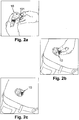
- FIGS. 2a-c illustrate exemplary adherence of a dispensing patch unit (10) to the skin (5) of the patient.
- FIG. 2a shows peeling of an adhesive protective sheet (101) from the dispensing patch unit (10).
- FIG. 2b shows adherence of the dispensing patch unit (10) to the skin (5) of the patient.
- FIG. 2c shows the dispensing patch unit (10) adhered to the skin (5) and being ready for operation.
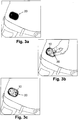
- the present invention's device can implement a cradle unit (20), which can be initially adhered to the skin (5) and then the dispensing patch unit (10) can be connected to and disconnected from the cradle unit (20) upon patient's discretion.
- the device employing the cradle unit is described in the co-owned, co-pending International Patent Application No. PCT/IL07/001578, filed December 20, 2007 and entitled “Systems, Devices, and Methods for Sustained Delivery of a Therapeutic Fluid", and claiming priority to U.S. Provisional Patent Application No. 60/876,679, filed December 22, 2006 .
- FIG. 3a shows the cradle unit (20) being adhered to the skin (5).
- FIG. 3b shows connection of the dispensing patch unit (10) to the adhered cradle unit (20).
- FIG. 3c shows the dispensing patch unit (10) being connected to the cradle unit (20) and ready for operation.
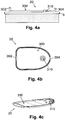
- FIGS. 4a-b show side and upper views, respectively, of the cradle unit (20).
- the cradle unit (20) can include the following components:
- FIG. 5a shows schematically an exemplary cannula cartridge unit (700), according to some embodiments of the present invention.
- the cannula cartridge unit (700) includes a protector (710) and a penetrating cartridge (711).
- the penetrating cartridge (711) includes a cannula (713) that is used for maintaining fluid (e.g., insulin) delivery from the dispensing patch unit (10) to the body of the patient and/or for analyte (e.g., glucose) sensing.
- the penetrating cartridge (711) also includes a penetrating member (716) that pierces the skin (5) and facilitates insertion of the cannula (713).
- the protector (710) is configured as a protective cover that conceals and guards the cannula (713) and the penetrating member (716). Thus, the user is protected from unintentional skin piercing.
- the shape and size of the protector (710) are not limited to the specific shape and size shown in FIG. 5a , and it can also be designed to contain multiple cannulae.
- the cannula cartridge unit (700) is configured as a modular piece that can be loaded into an inserter (800), as shown in FIG. 5b .
- the inserter (800) allows either automatic or manual advancement of the cannula (713) and the penetrating member (716) from the protector (710) and into the body of the user (e.g., during a hypodermic cannula insertion), as will be discussed in detail below.
- the cannula (713) remains in the body of the user and the penetrating member (716) is retracted back into the protector (710).
- the process concludes with the unloading of the protector (710) (with the penetrating member (716) disposed inside) from the inserter (800) and disposal of the item.
- the cannula cartridge unit (either as a stand-alone item, in which case the insertion can be manual, or after it has been loaded into an inserter) can be used in conjunction with the cradle unit, or in conjunction with any skin adherable dispensing patch unit, which delivers the fluid using a well assembly or an infusion set, or in conjunction with a non-adherable dispensing unit (e.g., a pager-like pump), which delivers the fluid using an infusion set.
- a non-adherable dispensing unit e.g., a pager-like pump
- PCT/IL07/000932 entitled “Systems, Devices, and Methods for Fluid/Drug Delivery", filed July 24, 2007, claiming priority to U.S. Provisional Patent Application Nos. 60/833,110, filed July 24, 2006 , and 60/837,877, filed August 14, 2006 .
- FIG. 6a shows the cannula cartridge unit (700) connected to the cradle unit (20). After the cannula insertion process is completed, the cannula cartridge unit (700) is disconnected from the cradle unit (20) and the dispensing patch unit is connected to the cradle unit (20), as will be described below.
- FIG. 6b shows the cannula cartridge unit (700) connected to a well assembly (102), which can be employed in a single-part dispensing patch unit (10) or in a two-part dispensing patch unit.
- the well assembly (102) has an inlet port (103) on its side to allow the passage of dispensed fluid from a reservoir (220) via a delivery tube (230) to the cannula (713), through a lateral opening (not shown in FIG. 6b ) made in the cannula (713).
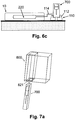
- FIG. 6c shows an embodiment, where the cannula cartridge unit (700) is connected to an infusion set (110) disposed outside the dispensing unit 10).
- the dispensing unit (10) can be adherable to the skin of the patient, as illustrated in FIG. 6c , or non-adherable thereto, e.g., it can be configured as a pager-like pump.
- the infusion set (110) includes a hub (112) and a short connecting tube (114) for connecting the dispensing patch unit (10) to a proximate insertion site.
- the connecting tube (114) is in fluid communication with a reservoir (220).
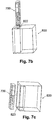
- FIGS. 7a-c show various ways of loading the cannula cartridge unit (700) into an inserter (800), according to some embodiments of the present invention.
- the cannula cartridge unit (700) can be loaded into the inserter (800) through a bottom opening (821) ( FIG. 7a ), upper opening (822) ( FIG. 7b ), or lateral opening (823) ( FIG. 7c ).
- the cannula cartridge unit (700) can be designed as a modular piece that can be loaded into various types of inserters.
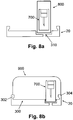
- FIG. 8a schematically shows the inserter being configured in a form of a pen (800).
- the pen (800) can be connected to the cradle unit (20) via the well (310).
- FIG. 8b schematically shows the inserter being configured in form of a dome-shaped unit, e.g., a computer mouse (hereinafter referred to as "mouse-like"), (900), which can be connected to the cradle unit (20) using anchoring means (302), (304) provided on an upper side of the cradle base (300).
- anchoring means (302), (304) provided on an upper side of the cradle base (300).
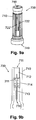
- FIG. 9a is a perspective view of the exemplary cannula cartridge unit (700), having the protector (710) covering the cannula and the penetrating member (not shown in FIG. 9a ).
- the protector (710) includes an upper end (748) and a bottom end (749).
- the protector (710) further includes at least one longitudinal slit (722), (722') disposed between the upper end (748) and the bottom end (749).
- the upper end (748) and the bottom end (749) are both open and are configured to allow protraction of the penetrating cartridge (not shown in FIG. 9a ) from the protector (710) towards the body of the patient and retraction of the penetrating member back into the protector (710).
- the bottom end (749) is open and is configured to be coupled to the well assembly of the dispensing unit or to the infusion set hub, or to the well which is part of the cradle unit.
- the bottom end (749) of the protector (710) can be designed to precisely fit over the well assembly (i.e., the size of the bottom end can be configured to accommodate the size of the well assembly), or of the infusion set hub, or of the well which is part of the cradle unit.
- Cannula insertion is carried out by thrusting the penetrating cartridge, manually or automatically using dedicated means.
- Such dedicated means can be either a rod that pushes the penetrating cartridge down through the upper end (748), or at least one hook that forcibly displaces the penetrating cartridge through at least one longitudinal slit (722), (722') disposed in the wall of the protector (710), as will be discussed below.
- the hook is configured to access the penetrating cartridge through the slit and is not limited to any specific shape, material or design.
- FIG. 9b is a cross-sectional view of the exemplary cannula cartridge unit (700) shown in FIG. 9a and having the protector (710) and the penetrating cartridge (711).
- the penetrating cartridge (711) includes the following components: the penetrating member (716) having a grip portion (712) located at the blunt end of the penetrating member (716), and the cannula (713).
- the penetrating cartridge can include a cannula hub (714), which is attached to the cannula (713) and contains a self-sealable septum (311) for sealing the cannula (713) after it has been inserted through the well into the body of the user.
- the septum (311) can be pierced repeatedly by a connecting lumen provided in the disposable part of the dispensing patch unit, as will be described below, for maintaining fluid communication between the reservoir and the cannula (713).
- the cannula cartridge unit equipped with a dedicated protector has the following advantages.
- One of the advantages is that the user is protected from unintentional skin piercing, as for example illustrated in FIG. 10 .
- the dedicated protector provides an important psychological advantage over conventional insertion devices, where the user is able to see the needle, which may cause some users to have an adverse reaction.
- the protector prevents direct contact by the user with the cannula (e.g., touching the cannula with user's hands), thereby maintaining sterility of the cannula.
- a single protector (having pre-defined dimensions) can accommodate variably sized/shaped cannulae and/or sensors having various sizes/shapes. This is advantageous since differently sized/shaped cannulae may be inserted at different insertion sites, where user may have different fat layer thicknesses.
- a single inserter can be loaded with a single dedicated cannula cartridge unit that is tailored specifically to patient requirements.
- the protector can accommodate insertion of a subcutaneously insertable element that can include a cannula, a probe, and/or a sensor. The subcutaneously insertable element can be used for both fluid delivery and analyte sensing as well as other tasks.
- FIGS. 11a-d are perspective and cross-sectional views of the protector (710) accommodating different size cannulae and sensors.
- FIGS. 11a-d illustrate an exemplary 30mm protector (710).
- FIGS. 11a-b show perspective and cross-sectional views of the protector (710) containing a 6mm cannula (713).
- FIGS. 11c-d show perspective and cross-sectional views of the same protector (710) containing a 9mm cannula (713).
- the length of the cannula (713) is not limited to the indicated lengths.
- the protector (710) can be provided with a handle (720), as shown in FIG. 12a (which is a perspective view of the protector with the handle), to enable convenient gripping and proper loading of the cannula cartridge unit (700) into the inserter (800), as shown in FIG. 12b (which is a top view of the protector with the handle being loaded into the dispensing unit).
- the handle (720) can be round, square, rectangular, or of any other desired shape and size.
- the cannula cartridge unit (700) facilitates insertion of a cannula (713) at various angles, for example, by connection to a tiltable well (320), as shown in FIG. 13 .
- the well (320) can be disposed with regard to the skin (5) of the user at an angle ⁇ , thereby allowing insertion of the cannula (713) at an angle ⁇ into the subcutaneous compartment (4), which can be useful when inserting the cannula at specific insertion sites.
- the angle ⁇ can vary as desired by the user and/or dispensing unit design.
- the cradle unit (20) can be designed to accommodate angular insertion of the cannula (713).
- the cannula insertion process using a cannula cartridge unit, can be carried out either manual (i.e., the cannula insertion and the penetrating member retraction are performed manually), or semi-automatic (i.e., the cannula insertion can be automatic, while the penetrating member retraction can be manual and vice versa), or fully automatic (i.e., both the cannula insertion and the penetrating member retraction are automatic), as discussed in detail below.
- manual i.e., the cannula insertion and the penetrating member retraction are performed manually
- semi-automatic i.e., the cannula insertion can be automatic, while the penetrating member retraction can be manual and vice versa
- fully automatic i.e., both the cannula insertion and the penetrating member retraction are automatic
- the penetrating member and the protector can be disposable. Thus, after the cannula insertion process is completed, the protector, containing the penetrating member, can be disposed. Since the sharp penetrating member is entirely concealed and shielded by the protector, disposal of the protector can be done into a standard garbage container instead of a dedicated bio-hazard container.
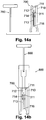
- FIGS. 14a-i are cross-sectional views of the cannula cartridge unit (700) during manual insertion process.
- Manual insertion can be carried out using the cannula cartridge unit (700) being a stand-alone item with the aid of a dedicated rod (760) (as shown in FIG. 14a ) or by loading the cannula cartridge unit (700) into the inserter (800) provided with a rod (860) (as shown in FIG. 14b ).
- the insertion process in both embodiments is substantially similar.
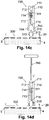
- FIGS. 14c-i illustrate the insertion process using the cannula cartridge unit (700) as a stand-alone item together with the skin adherable cradle unit (20).
- FIG. 14c shows the cannula cartridge unit (700) and the cradle unit (20) prior to being connected.
- the cradle unit (20) includes the well (310) disposed in the base (300) and having a snapping engagement mechanism with a resistance loaded annular latch (313).
- the cannula cartridge unit (700) includes an annular notch or recess (744) that corresponds and is configured to accommodate insertion of the annular latch (313). As discussed above, the cannula cartridge unit (700) is placed over the well (310), thereby snapping the notch (744) over the latch (313) and therefore locking the unit (700) to the well (310).
- other ways of securing the unit (700) to the well (310) are possible.
- the cannula cartridge unit (700) can be only placed over a well (310) without being connected to the well (310).
- FIG. 14d shows the cannula cartridge unit (700) being connected to the cradle unit (20) via the well (310) and ready for operation.
- the dedicated rod (760) is disposed outside the open top end of the cannula cartridge unit (700).
- the rod (760) includes a handle and a push rod that can be configured to be a blunt end located opposite the handle.
- the cannula cartridge unit (700) includes the penetrating cartridge (711) and a recessed grip portion (712) that accommodates placement of the blunt end of the rod (760).
- the recessed grip portion (712) secures the rod (760) and prevents wobbling of the rod (760) when the latter is being pushed down the cannula cartridge unit (700).
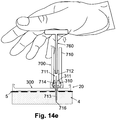
- FIG. 14e shows the penetrating cartridge (711) being pushed down by the rod (760) through the well (310) and into the subcutaneous tissue (4) of the user.
- the user pushes on the handle of the rod (760) to thrust the rod (760) in a downward direction toward the well (310).
- the force that the user applies to the handle is transferred to the penetrating cartridge (711) that is being pushed down toward the skin of the user.
- the pushing or thrusting of the penetrating cartridge (711) can be carried out using a rod, as illustrated, or the user's finger, or any other means.
- the penetrating cartridge (711) As the penetrating cartridge (711) is pushed down, the penetrating member (716) pierces the skin (5) of the user and enters the subcutaneous tissue (4).
- the cannula (713) is also inserted into the subcutaneous compartment (4). Once the cannula (713) is inserted, the penetrating member (716) can be removed
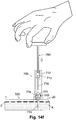
- FIG. 14f shows retraction of the penetrating member (716) back into the protector (710) using the rod (760).
- the protector (710) can include stoppers at its top end to prevent accidental removal of the grip portion (712). Additionally, the protector's interior portion can include interior stoppers to prevent excessive insertion of the penetrating member (716) and accidental slip out of the penetrating member (716) along with the grip portion (712) from the bottom end of the protector (710) once it is disengaged from the well (310). In some embodiments, the well (310) can serve as a stopper to prevent excessive insertion of the penetrating member (716). Once the penetrating member (716) is removed, the protector (710) can be disengaged from the well (310).
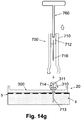
- FIG. 14g shows the protector (710) being disconnected from the well (310) and the cradle unit (20).
- the protector (710) is removed by disengaging the notch (744) from the latch (313). This can be done by pulling the notch (744) away from the latch (313) or by pushing a button that pulls the notch (744) out, or using any other means.
- the protector (710) Upon being removed from the well (310), the protector (710) continues to conceal the penetrating member (716) along with its grip portion (712).
- the rod (760) can be disengaged from the grip portion (712) and the protector (710) along with its contents can then be disposed.
- the rod (760) can be reused for future cannula insertions.
- the rod (760) is disposable.
- the rod (760) can remain secured to the grip portion (712) or it can be disengaged from the grip portion (712), and the protector (710) along with its contents and the rod (760) can then be disposed.
- the protector (710) can be disconnected from the cradle unit (20) after inserting the cannula (713) while the penetrating member (716) remains inside the body.
- the user can manually remove the penetrating member (716) from the body by holding the grip portion (712) of the penetrating member (716) with his/her fingers and pulling it in an upward direction or a direction that is substantially opposite to the direction of insertion.
- FIG. 14h shows the two-part dispensing patch unit (10) prior to being connected to the cradle unit (20).
- the dispensing patch unit (10) contains, inter alia, a fluid reservoir (220), an outlet port (213) and a connecting lumen (214) that maintains fluid communication between the reservoir (220) and the outlet port (213).
- the connecting lumen (214) pierces the septum (311) (that seals the cannula (713)), thereby allowing fluid delivery via the cannula (713) to the subcutaneous tissue (4).
- the outlet port (213) allows repetitive connection and disconnection of the dispensing patch unit (10) to and from the cradle unit (20).
- FIG. 14i shows the two-part dispensing patch unit (10) shown in FIG. 14h after it has been connected to the cradle unit (20).
- the fluid (e.g., insulin) delivery cannula (713) can contain a sensor for monitoring a bodily analyte (e.g., glucose). Fluid delivery can be adjusted according to sensor inputs (in a semi- or fully-closed-loop system).
- the dispending patch unit (10) includes both a cannula (713) for fluid delivery and a sensor (not shown) for analyte sensing. An example of such arrangement is disclosed in the co-owned, co-pending International Patent Application No. PCT/IL07/000163 and U.S. Patent Application No.
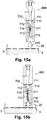
- FIGS. 15a-e are a cross-sectional views of the cannula cartridge unit (700) during semi-automatic insertion process, according to some embodiments of the present invention.
- FIG. 15a shows the cradle unit (20) prior to being connected to the inserter (800) loaded with the cannula cartridge unit (700).
- the connection between the cannula cartridge unit (700) and the cradle unit (20) is established as described above with reference to FIG. 14c .
- the inserter (800) can include a spring-loaded mechanism that is coupled to the grip portion (712) and upon release of the spring, pushes on the grip portion (712) to force insertion of the penetrating member (716) along with the cannula (713) into the subcutaneous tissue (4), as will be discussed below.
- FIG. 15b shows the cannula cartridge unit (700) being connected to the cradle unit (20) and the inserter (800) being ready for operation.
- the inserter (800) can be connected to the well (310) in a fashion similar to the connection of the cannula cartridge unit (700) to the well (310) (e.g., using the latch-notch connection).
- the inserter (800) includes a spring-loaded mechanism having a spring (850) coupled to an advancing rod (852) and a spring release button (854).
- the spring (850) is initially in a compressed state, whereby the advancing rod (852) is disposed in a pre-firing position substantially near the top end of the inserter (800).
- the spring release button (854) is configured to cause release of the spring (850) in a downward direction (or direction toward the skin (5)). Once the button (854) is pressed, the spring (850) is released, as illustrated in FIG. 15c . Release of the spring (850), causes the advancing rod (852) to apply pressure on the penetrating cartridge (711) thrusting it in a downward direction (or toward the skin (5)) automatically.
- Movement of the cartridge (711) causes movement of the penetrating member (716) and the cannula (713) toward the skin (5) through the well (310), thereby forcing piercing of the skin (5) and insertion of the penetrating member (716) and the cannula (713) into the subcutaneous compartment (4).
- the penetrating member (716) can be retracted or removed from the subcutaneous compartment (4).
- FIG. 15d shows the penetrating member (716) being manually retracted into the protector (710) using a lateral protrusion (856) coupled to the advancing rod (852).
- the lateral protrusion (856) is configured to move with the advancing rod (852) as it is forced downward during insertion process.
- the user can pull on the protrusion (856) in an upward direction (or direction opposite to direction of insertion) and secure the advancing rod (852) in the pre-firing position.
- the cannula hub (714) Upon removal of the penetrating member (716), the cannula hub (714) remains secured at the well (310), and the cannula (713) remains within the subcutaneous tissue (4). Upon removal of the penetrating member (716), the inserter (800) and the protector (710) can be disconnected from the well (310).
- FIG. 15e shows the inserter (800) being disconnected from the cradle unit (20).
- the protector (710) now containing only the penetrating member (716)
- the inserter (800) can be reusable.
- the inserter (800) can be disconnected from the cradle unit (20) after the cannula (713) insertion while the penetrating member (716) remains inside the body.
- the user manually removes the penetrating member (716) from the body by holding the grip portion (712) of the penetrating member with his/her fingers and pulling it upwards together with the penetrating member (716).
- the dispensing patch unit is connected to the cradle unit, as previously described with reference to FIGS. 14h-i .
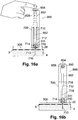
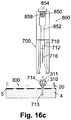
- FIGS. 16a-c are cross-sectional views of the cannula cartridge unit during an automatic insertion process.
- the connection of the inserter (800) to the cradle unit (20) and the insertion of the cannula (713) and penetrating member (716) into the subcutaneous tissue (4) are carried out as previously described with reference to FIGS. 15a-c .
- the inserter (800) is provided with means for automatically retracting the penetrating member (716).
- the inserter (800) includes a retraction spring (858) that can stretch during cannula insertion process, as shown in FIG. 16a .
- the retraction spring (858) can be configured to automatically compress once the penetrating member (716) and the cannula (713) are inserted into the subcutaneous compartment (4) and the cannula hub (714) is secured at the well (310). In some embodiments, the retraction spring (858) can compress upon pressing of the release button (854) or of a separate button (not shown in FIG. 16a).
- FIG. 16b shows the penetrating member (716) being retracted into the protector (710) using the retraction spring (858), while the cannula hub (714) is secured at the well (310), and the cannula (713) remains in the subcutaneous tissue (4).
- FIG. 16c shows the inserter (800) being disconnected from the cradle unit (20).
- the protector (710) now containing only the penetrating member (716), is then unloaded from the inserter (800) and is disposed. After disconnecting the inserter (800) from the cradle unit (20), the dispensing patch unit is connected to the cradle unit, as previously described with reference to FIGS. 14h-i .
- FIG. 17a shows an exemplary pen-like inserter (80) for loading with the cannula cartridge unit (700), according to some embodiments of the present invention.
- the inserter (80) includes a body portion (810) having an arcuate cross-section to allow loading of the cannula cartridge unit (700) into the inserter (80) from the side of the inserter (80).
- the body portion (810) of the inserter (80) can be configured as a tube thereby allowing loading of the cannula cartridge unit (700) in an upward direction through the bottom end of the inserter (80).
- the body portion (810) includes a bottom open end (849) to allow insertion of the body portion (810) over the well (310), a semi-annular protrusion (812) disposed on the inwardly facing wall and near the top end of the body portion (810).
- the inserter (80) further includes a firing mechanism coupled to the body portion (810) for inserting the penetrating member and the cannula into the subcutaneous compartment (4), as will be discussed below.
- FIG. 17b shows loading of the cannula cartridge unit (700) into the inserter (80).
- the unit (700) includes the protector (710) having the opened bottom end (749).
- the bottom end (749) is placed on the bottom ring-shaped end (849) of the inserter (80), then the protector (710) is pushed into the body portion (810) of the inserter (80) until the semi-annular protrusion (812) is completely engaged with an annular depression (719) disposed on the exterior portion of the protector (710).
- the protector (710) interlocks with the body portion (810), thereby securing the cannula cartridge unit (700) within the inserter (80).
- FIG. 17c shows the inserter (80) after it has been loaded with the cannula cartridge unit (700) and prior to connecting it to the cradle unit (20).
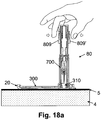
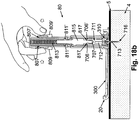
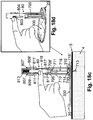
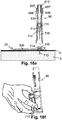
- FIGS. 18a-f are cross-sectional views of the cannula cartridge unit (700) during the insertion process using the pen-like inserter (80) shown in FIGS. 17a-c .
- FIG. 18a shows the inserter (80) after it has been loaded with the cannula cartridge unit (700) and connected to the cradle unit (20) (i.e., placed over the well (310) of the cradle unit (20), as discussed above with regard to FIG. 14c ).
- the inserter (80) includes means for preventing inadvertent or premature firing of the cannula and penetrating member, which can be a cap (not shown in FIG.
- the user employs two lateral triggers (809), (809') disposed on the exterior surface of the inserter (80), as shown in FIG. 18a .
- the triggers (809) and (809') are used simultaneously to insert the cannula.
- the inserter (80) includes a spring (813) disposed inside the inserter (80), rod (815) having an annular depression (817) and being coupled to the spring (813), and spring latches (811), (811') suspended on respective recesses (807), (807') (which are disposed near the top portion of the inserter (80)), as shown in FIG. 18b.
- FIG. 18b further shows automatic insertion of the cannula (713) into the subcutaneous tissue (4).
- the spring latches (811), (811') are pushed inwardly, thus releasing them from their respective recesses (807), (807').
- spring holding arms (706) forming the crown-like section are captured by the annular depression (817) provided in the rod (815).
- the penetrating cartridge (711) is forced to move in the downward direction toward the well (310).
- the penetrating member (716) and cannula (713) then penetrate through the well (310) and are inserted into the subcutaneous compartment (4).
- FIG. 18c shows how the penetrating member (716) is retracted.
- the retraction can be carried out manually by the user.
- the user pushes a lever (803) in an upward direction, where the lever (803) is fixed to the rod (815) and is accessible to the user through a window (804) in the inserter housing (810), as can be seen in FIG. 18d .
- This causes the rod (815) with the penetrating member (716) to retract, and the spring (813) to compress into its pre-firing state.
- the spring holding arms (706) reach the top section of the protector (710) having a larger diameter than the body of the protector (710), the arms (706) are released from the annular depression (817) and assume their original position within the protector (710).
- the retraction process ends when the spring (813) is returned to its loaded state and the spring latches (811), (811') become suspended in the recesses (807), (807'), respectively.
- the cannula hub (714) remains within the well (310).
- the well (310) includes spring protrusions (715), (715') to help retain the cannula hub (714) within the well (310).
- FIG. 18e shows the disconnection of the inserter (80) from the cradle unit (20) after the manual retraction process has been completed.
- the spring (813) is back in its initial loaded state, and the rod (815) is disconnected from the grip portion (712).
- the dispensing patch unit (not shown in FIG. 18e ) is connected to the cradle unit (20).
- the protector (710) with the penetrating member (716) disposed inside it can then be unloaded from the inserter (80), as shown in FIG. 18f , and the unloaded assembly can be disposed.
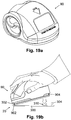
- FIG. 19a is a perspective view of yet another exemplary inserter (90) that can be configured as a mouse and designed to be loaded with the cannula cartridge unit (not shown in FIG. 19a ).
- the inserter (90) can include a release button that allows the user to insert the penetrating member and the cannula (not shown in FIG. 19a ) into the subcutaneous compartment.
- the inserter (90) can also include a compartment for insertion of the cannula cartridge unit (700), as will be discussed below.
- the inserter (90) can have any desired shape and is not limited to the inserter (90) shown in FIGS. 19a-h .
- the inserter (90) shown in these figures is provided for exemplary, nonlimiting purposes.
- FIG. 19b shows connection of the inserter (90) to the cradle unit (20).
- the inserter (90) includes a recess (902) and a notch (904) disposed around the perimeter of the bottom portion of the inserter (90).
- the inserter (90) is connected to the cradle base (300) by angularly inserting the inserter (90) with the recess (902) mating with a latch (302) of the cradle base (300) and then pushing the inserter (90) in a downward direction and engaging the notch (904) with a latch (304) in a snap-fit arrangement.
- FIG. 19c is a side view of the inserter (90) being coupled to the cradle unit (20).
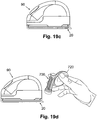
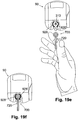
- FIGS. 19d-e show the loading of the cannula cartridge unit (700) into the inserter (90).
- the unit (700) includes the handle (720), as discussed above with regard to FIGS. 12a-b ).
- the inserter includes spring holders (928), (928') disposed within the opening created in the inserter (90) for insertion of the cannula cartridge unit (700).
- the user grips the cannula cartridge unit (700) by its handle (720), mounts it on the well (310), and then pushes the cannula cartridge unit (700) into the inserter (90) until it is captured by the spring holders (928), (928'), as shown in FIG. 19f . This ensures that the cannula cartridge unit (700) is properly positioned and is ready for the cannula insertion process.
- FIG. 19g is a perspective view of the inserter (90) after it has been connected to the cradle unit (20) and loaded with the cannula cartridge unit (700). As illustrated in FIG. 19g , the inserter is connected to the cradle unit (20) using the latch-recess connection shown in FIGS. 19a-b . The unit (700) is loaded into the opening created in the inserter (90) with the handle (720) protruding away from the unit (700).
- FIG. 19h is a cross-sectional view of the inserter (90).
- the inserter (90) includes a release button (924) disposed on the outer surface of the inserter's housing, a flywheel (912), a ratchet crank (914), and at least one hook (930). After attaching the cradle unit (20) to the skin (5) of the user the user pushes the release button (924) on the inserter (90).
- insertion of the cannula (713) and the penetrating member (716) into the body of the user and retraction of the penetrating member (716) therefrom can be carried out automatically using the spring-loaded flywheel (912) operatively coupled to the ratchet crank (914) and at least one dedicated hook (930), which maintains contact with the penetrating cartridge (711) through the protector's (710) at least one longitudinal slit (not seen).
- An example of such insertion process is disclosed in the co-owned, co-pending U.S. Provisional Application No. 60/937,214, filed on June 25, 2007 , and entitled "Insertion Device for Inserting a Cannula into a Body”.
Landscapes
- Health & Medical Sciences (AREA)
- Life Sciences & Earth Sciences (AREA)
- Animal Behavior & Ethology (AREA)
- Veterinary Medicine (AREA)
- Public Health (AREA)
- Engineering & Computer Science (AREA)
- Biomedical Technology (AREA)
- Heart & Thoracic Surgery (AREA)
- General Health & Medical Sciences (AREA)
- Vascular Medicine (AREA)
- Anesthesiology (AREA)
- Hematology (AREA)
- Dermatology (AREA)
- Pathology (AREA)
- Biophysics (AREA)
- Physics & Mathematics (AREA)
- Surgery (AREA)
- Medical Informatics (AREA)
- Molecular Biology (AREA)
- Infusion, Injection, And Reservoir Apparatuses (AREA)
- Media Introduction/Drainage Providing Device (AREA)
- Surgical Instruments (AREA)
- Measurement Of The Respiration, Hearing Ability, Form, And Blood Characteristics Of Living Organisms (AREA)
Priority Applications (1)
| Application Number | Priority Date | Filing Date | Title |
|---|---|---|---|
| PL08763616T PL2185223T3 (pl) | 2007-06-25 | 2008-06-25 | Urządzenie wprowadzające kaniulę |
Applications Claiming Priority (4)
| Application Number | Priority Date | Filing Date | Title |
|---|---|---|---|
| US93715507P | 2007-06-25 | 2007-06-25 | |
| US93721407P | 2007-06-25 | 2007-06-25 | |
| US93716307P | 2007-06-25 | 2007-06-25 | |
| PCT/IL2008/000859 WO2009001345A1 (en) | 2007-06-25 | 2008-06-25 | A cannula-insertion device |
Publications (2)
| Publication Number | Publication Date |
|---|---|
| EP2185223A1 EP2185223A1 (en) | 2010-05-19 |
| EP2185223B1 true EP2185223B1 (en) | 2017-07-19 |
Family
ID=39739376
Family Applications (3)
| Application Number | Title | Priority Date | Filing Date |
|---|---|---|---|
| EP08763617.1A Active EP2170439B1 (en) | 2007-06-25 | 2008-06-25 | A cannula-insertion device |
| EP08763616.3A Active EP2185223B1 (en) | 2007-06-25 | 2008-06-25 | A cannula-insertion device |
| EP08763618A Withdrawn EP2167174A1 (en) | 2007-06-25 | 2008-06-25 | Portable infusion pump with cannula inserter and pain reduction mechanism |
Family Applications Before (1)
| Application Number | Title | Priority Date | Filing Date |
|---|---|---|---|
| EP08763617.1A Active EP2170439B1 (en) | 2007-06-25 | 2008-06-25 | A cannula-insertion device |
Family Applications After (1)
| Application Number | Title | Priority Date | Filing Date |
|---|---|---|---|
| EP08763618A Withdrawn EP2167174A1 (en) | 2007-06-25 | 2008-06-25 | Portable infusion pump with cannula inserter and pain reduction mechanism |
Country Status (8)
| Country | Link |
|---|---|
| US (4) | US8002752B2 (enExample) |
| EP (3) | EP2170439B1 (enExample) |
| JP (3) | JP2010531197A (enExample) |
| CN (2) | CN101784296A (enExample) |
| AU (2) | AU2008269310A1 (enExample) |
| DK (2) | DK2185223T3 (enExample) |
| PL (1) | PL2185223T3 (enExample) |
| WO (3) | WO2009001346A1 (enExample) |
Families Citing this family (300)
| Publication number | Priority date | Publication date | Assignee | Title |
|---|---|---|---|---|
| US7381184B2 (en) | 2002-11-05 | 2008-06-03 | Abbott Diabetes Care Inc. | Sensor inserter assembly |
| US20190357827A1 (en) | 2003-08-01 | 2019-11-28 | Dexcom, Inc. | Analyte sensor |
| USD914881S1 (en) | 2003-11-05 | 2021-03-30 | Abbott Diabetes Care Inc. | Analyte sensor electronic mount |
| US7872396B2 (en) | 2004-06-14 | 2011-01-18 | Massachusetts Institute Of Technology | Electrochemical actuator |
| JP2008503059A (ja) | 2004-06-14 | 2008-01-31 | マサチューセッツ・インスティテュート・オブ・テクノロジー | 電気化学的方法、デバイス、および構造体 |
| US8247946B2 (en) | 2004-06-14 | 2012-08-21 | Massachusetts Institute Of Technology | Electrochemical actuator |
| US7999435B2 (en) | 2004-06-14 | 2011-08-16 | Massachusetts Institute Of Technology | Electrochemical actuator |
| US7994686B2 (en) | 2004-06-14 | 2011-08-09 | Massachusetts Institute Of Technology | Electrochemical methods, devices, and structures |
| US7883464B2 (en) | 2005-09-30 | 2011-02-08 | Abbott Diabetes Care Inc. | Integrated transmitter unit and sensor introducer mechanism and methods of use |
| US7697967B2 (en) | 2005-12-28 | 2010-04-13 | Abbott Diabetes Care Inc. | Method and apparatus for providing analyte sensor insertion |
| US9788771B2 (en) | 2006-10-23 | 2017-10-17 | Abbott Diabetes Care Inc. | Variable speed sensor insertion devices and methods of use |
| US9398882B2 (en) | 2005-09-30 | 2016-07-26 | Abbott Diabetes Care Inc. | Method and apparatus for providing analyte sensor and data processing device |
| US20090105569A1 (en) | 2006-04-28 | 2009-04-23 | Abbott Diabetes Care, Inc. | Introducer Assembly and Methods of Use |
| US8333714B2 (en) | 2006-09-10 | 2012-12-18 | Abbott Diabetes Care Inc. | Method and system for providing an integrated analyte sensor insertion device and data processing unit |
| US9259175B2 (en) | 2006-10-23 | 2016-02-16 | Abbott Diabetes Care, Inc. | Flexible patch for fluid delivery and monitoring body analytes |
| US8512243B2 (en) | 2005-09-30 | 2013-08-20 | Abbott Diabetes Care Inc. | Integrated introducer and transmitter assembly and methods of use |
| US7731657B2 (en) | 2005-08-30 | 2010-06-08 | Abbott Diabetes Care Inc. | Analyte sensor introducer and methods of use |
| US8029441B2 (en) | 2006-02-28 | 2011-10-04 | Abbott Diabetes Care Inc. | Analyte sensor transmitter unit configuration for a data monitoring and management system |
| US10226207B2 (en) | 2004-12-29 | 2019-03-12 | Abbott Diabetes Care Inc. | Sensor inserter having introducer |
| US9572534B2 (en) | 2010-06-29 | 2017-02-21 | Abbott Diabetes Care Inc. | Devices, systems and methods for on-skin or on-body mounting of medical devices |
| CN102440785A (zh) | 2005-08-31 | 2012-05-09 | 弗吉尼亚大学专利基金委员会 | 传感器信号处理方法及传感器信号处理装置 |
| US9521968B2 (en) | 2005-09-30 | 2016-12-20 | Abbott Diabetes Care Inc. | Analyte sensor retention mechanism and methods of use |
| EP2441486B1 (en) * | 2005-11-02 | 2013-12-11 | Injectica AG | Implantable infusion device |
| WO2007056504A1 (en) | 2005-11-08 | 2007-05-18 | M2 Medical A/S | Infusion pump system |
| US11298058B2 (en) | 2005-12-28 | 2022-04-12 | Abbott Diabetes Care Inc. | Method and apparatus for providing analyte sensor insertion |
| US7885698B2 (en) | 2006-02-28 | 2011-02-08 | Abbott Diabetes Care Inc. | Method and system for providing continuous calibration of implantable analyte sensors |
| US8219173B2 (en) | 2008-09-30 | 2012-07-10 | Abbott Diabetes Care Inc. | Optimizing analyte sensor calibration |
| US9675290B2 (en) | 2012-10-30 | 2017-06-13 | Abbott Diabetes Care Inc. | Sensitivity calibration of in vivo sensors used to measure analyte concentration |
| US7653425B2 (en) | 2006-08-09 | 2010-01-26 | Abbott Diabetes Care Inc. | Method and system for providing calibration of an analyte sensor in an analyte monitoring system |
| US8435211B2 (en) * | 2006-07-24 | 2013-05-07 | Medingo Ltd. | Systems, devices and methods for fluid/drug delivery |
| WO2008080990A1 (de) * | 2006-12-29 | 2008-07-10 | Disetronic Licensing Ag | Extrakorporal tragbare infusionsvorrichtung |
| US20100292557A1 (en) * | 2007-03-19 | 2010-11-18 | Benny Pesach | Method and device for substance measurement |
| MX2009010000A (es) | 2007-03-19 | 2010-03-17 | Insuline Medical Ltd | Dispositivo para el suministro de farmaco. |
| US9220837B2 (en) | 2007-03-19 | 2015-12-29 | Insuline Medical Ltd. | Method and device for drug delivery |
| EP2136863A2 (en) * | 2007-03-19 | 2009-12-30 | Insuline Medical Ltd. | Device for drug delivery and associated connections thereto |
| US8622991B2 (en) * | 2007-03-19 | 2014-01-07 | Insuline Medical Ltd. | Method and device for drug delivery |
| US8456301B2 (en) | 2007-05-08 | 2013-06-04 | Abbott Diabetes Care Inc. | Analyte monitoring system and methods |
| US8239166B2 (en) | 2007-05-14 | 2012-08-07 | Abbott Diabetes Care Inc. | Method and apparatus for providing data processing and control in a medical communication system |
| US8002752B2 (en) * | 2007-06-25 | 2011-08-23 | Medingo, Ltd. | Protector apparatus |
| US8160900B2 (en) | 2007-06-29 | 2012-04-17 | Abbott Diabetes Care Inc. | Analyte monitoring and management device and method to analyze the frequency of user interaction with the device |
| EP2178584A2 (en) * | 2007-07-26 | 2010-04-28 | Entra Pharmaceuticals Inc. | Skin-patch pump comprising a changing-volume electrochemical actuator |
| EP2185219B1 (en) * | 2007-08-01 | 2019-07-03 | Roche Diabetes Care GmbH | Portable infusion device provided with means for monitoring and controlling fluid delivery |
| EP2185218B1 (en) | 2007-08-01 | 2013-06-26 | Medingo Ltd. | Detachable portable infusion device |
| DK2185220T3 (da) | 2007-08-01 | 2019-06-17 | Hoffmann La Roche | Anordning til lægemiddelfremføring |
| WO2009016638A1 (en) * | 2007-08-01 | 2009-02-05 | Medingo Ltd. | Device for facilitating infusion of therapeutic fluids and sensing of bodily analytes |
| US7967795B1 (en) | 2010-01-19 | 2011-06-28 | Lamodel Ltd. | Cartridge interface assembly with driving plunger |
| US9345836B2 (en) | 2007-10-02 | 2016-05-24 | Medimop Medical Projects Ltd. | Disengagement resistant telescoping assembly and unidirectional method of assembly for such |
| US9656019B2 (en) | 2007-10-02 | 2017-05-23 | Medimop Medical Projects Ltd. | Apparatuses for securing components of a drug delivery system during transport and methods of using same |
| US10420880B2 (en) | 2007-10-02 | 2019-09-24 | West Pharma. Services IL, Ltd. | Key for securing components of a drug delivery system during assembly and/or transport and methods of using same |
| EP2195052B1 (en) | 2007-10-02 | 2019-09-04 | Medimop Medical Projects Ltd. | External drug pump |
| EP4159114B1 (en) | 2007-10-09 | 2024-04-10 | DexCom, Inc. | Integrated insulin delivery system with continuous glucose sensor |
| DE102007049446A1 (de) * | 2007-10-16 | 2009-04-23 | Cequr Aps | Katheter-Einführeinrichtung |
| WO2009060432A1 (en) * | 2007-11-07 | 2009-05-14 | Medingo Ltd. | Device and method for preventing diabetic complications |
| WO2009066288A1 (en) | 2007-11-21 | 2009-05-28 | Medingo Ltd. | Analyte monitoring and fluid dispensing system |
| EP2227134A2 (en) * | 2007-11-21 | 2010-09-15 | Medingo Ltd. | Hypodermic optical monitoring of bodily analyte |
| WO2009076470A2 (en) * | 2007-12-10 | 2009-06-18 | Patton Medical Devices, Lp | Insertion devices, insertion needles, and related methods |
| US8409133B2 (en) | 2007-12-18 | 2013-04-02 | Insuline Medical Ltd. | Drug delivery device with sensor for closed-loop operation |
| SG154343A1 (en) * | 2008-01-08 | 2009-08-28 | Ting Choon Meng | Method and apparatus for intra-articular injection or aspiration |
| CA2711772A1 (en) | 2008-02-08 | 2009-08-13 | Unomedical A/S | Inserter assembly |
| RU2500349C2 (ru) * | 2008-03-17 | 2013-12-10 | Айсенс Корпорейшн | Вспомогательный блок датчика аналита и способы и устройства для введения датчика аналита, связанного со вспомогательным блоком |
| ES2772756T3 (es) | 2008-04-09 | 2020-07-08 | Hoffmann La Roche | Sensor de nivel de líquido para un sistema modular adherente a la piel para la administración médica de líquidos |
| CA2723291C (en) * | 2008-05-14 | 2017-08-15 | Becton, Dickinson And Company | Separatable infusion set with cleanable interface and straight line attachment |
| US9295786B2 (en) * | 2008-05-28 | 2016-03-29 | Medtronic Minimed, Inc. | Needle protective device for subcutaneous sensors |
| EP2303359B1 (en) | 2008-05-29 | 2020-02-26 | Roche Diabetes Care GmbH | Modular medical infusion device with means for identification/authentication between its components |
| US7959598B2 (en) | 2008-08-20 | 2011-06-14 | Asante Solutions, Inc. | Infusion pump systems and methods |
| US12097357B2 (en) | 2008-09-15 | 2024-09-24 | West Pharma. Services IL, Ltd. | Stabilized pen injector |
| US9393369B2 (en) | 2008-09-15 | 2016-07-19 | Medimop Medical Projects Ltd. | Stabilized pen injector |
| AU2009312474B2 (en) | 2008-11-07 | 2014-12-04 | Insuline Medical Ltd. | Device and method for drug delivery |
| US8152779B2 (en) | 2008-12-30 | 2012-04-10 | Medimop Medical Projects Ltd. | Needle assembly for drug pump |
| EP2391408B1 (en) | 2008-12-31 | 2018-01-17 | Roche Diabetes Care GmbH | Portable medical fluid delivery device with drive screw articulated with reservoir plunger |
| US9375529B2 (en) | 2009-09-02 | 2016-06-28 | Becton, Dickinson And Company | Extended use medical device |
| WO2010080715A1 (en) * | 2009-01-12 | 2010-07-15 | Becton, Dickinson And Company | Infusion set and/or patch pump having at least one of an in-dwelling rigid catheter with flexible features and/or a flexible catheter attachment |
| WO2011056182A1 (en) * | 2009-01-27 | 2011-05-12 | Becton, Dickinson And Company | Infusion set with anesthetic compound |
| US20100198034A1 (en) * | 2009-02-03 | 2010-08-05 | Abbott Diabetes Care Inc. | Compact On-Body Physiological Monitoring Devices and Methods Thereof |
| WO2010127051A1 (en) | 2009-04-29 | 2010-11-04 | Abbott Diabetes Care Inc. | Method and system for providing real time analyte sensor calibration with retrospective backfill |
| US9184490B2 (en) | 2009-05-29 | 2015-11-10 | Abbott Diabetes Care Inc. | Medical device antenna systems having external antenna configurations |
| US10376213B2 (en) * | 2009-06-30 | 2019-08-13 | Waveform Technologies, Inc. | System, method and apparatus for sensor insertion |
| EP4309580A3 (en) | 2009-07-23 | 2024-02-28 | Abbott Diabetes Care Inc. | Continuous analyte measurement system |
| WO2011014851A1 (en) | 2009-07-31 | 2011-02-03 | Abbott Diabetes Care Inc. | Method and apparatus for providing analyte monitoring system calibration accuracy |
| EP3001194B1 (en) | 2009-08-31 | 2019-04-17 | Abbott Diabetes Care, Inc. | Medical devices and methods |
| DK3988470T3 (da) | 2009-08-31 | 2023-08-28 | Abbott Diabetes Care Inc | Visningsindretninger til en medicinsk indretning |
| US8932256B2 (en) * | 2009-09-02 | 2015-01-13 | Medtronic Minimed, Inc. | Insertion device systems and methods |
| US8900190B2 (en) * | 2009-09-02 | 2014-12-02 | Medtronic Minimed, Inc. | Insertion device systems and methods |
| US8308679B2 (en) * | 2009-12-30 | 2012-11-13 | Medtronic Minimed, Inc. | Alignment systems and methods |
| US10071198B2 (en) | 2012-11-02 | 2018-09-11 | West Pharma. Servicees IL, Ltd. | Adhesive structure for medical device |
| US8157769B2 (en) | 2009-09-15 | 2012-04-17 | Medimop Medical Projects Ltd. | Cartridge insertion assembly for drug delivery system |
| US10071196B2 (en) | 2012-05-15 | 2018-09-11 | West Pharma. Services IL, Ltd. | Method for selectively powering a battery-operated drug-delivery device and device therefor |
| EP2493538B1 (en) * | 2009-10-30 | 2016-04-13 | Roche Diagnostics GmbH | Systems, methods and devices for adjusting the insertion depth of a cannula associated with a portable therapeutic device |
| US10973994B2 (en) * | 2013-09-16 | 2021-04-13 | Pourang Bral | Means and method to invade skin, mucosa, and underlying tissues with little or no pain |
| ATE553800T1 (de) | 2009-11-26 | 2012-05-15 | Hoffmann La Roche | Extern auslösbare kanülenanordnung |
| ES2700734T3 (es) * | 2009-11-30 | 2019-02-19 | Hoffmann La Roche | Supervisión de analitos y sistemas de distribución de fluido |
| US9039653B2 (en) * | 2009-12-29 | 2015-05-26 | Medtronic Minimed, Inc. | Retention systems and methods |
| US8998840B2 (en) | 2009-12-30 | 2015-04-07 | Medtronic Minimed, Inc. | Connection and alignment systems and methods |
| US8858500B2 (en) * | 2009-12-30 | 2014-10-14 | Medtronic Minimed, Inc. | Engagement and sensing systems and methods |
| US8998858B2 (en) * | 2009-12-29 | 2015-04-07 | Medtronic Minimed, Inc. | Alignment and connection systems and methods |
| US9421321B2 (en) | 2009-12-30 | 2016-08-23 | Medtronic Minimed, Inc. | Connection and alignment systems and methods |
| US20120215163A1 (en) * | 2009-12-30 | 2012-08-23 | Medtronic Minimed, Inc. | Sensing systems and methods |
| US8435209B2 (en) | 2009-12-30 | 2013-05-07 | Medtronic Minimed, Inc. | Connection and alignment detection systems and methods |
| US11497850B2 (en) | 2009-12-30 | 2022-11-15 | Medtronic Minimed, Inc. | Connection and alignment detection systems and methods |
| US8348898B2 (en) | 2010-01-19 | 2013-01-08 | Medimop Medical Projects Ltd. | Automatic needle for drug pump |
| USD924406S1 (en) | 2010-02-01 | 2021-07-06 | Abbott Diabetes Care Inc. | Analyte sensor inserter |
| WO2011162843A1 (en) | 2010-03-24 | 2011-12-29 | Abbott Diabetes Care Inc. | Medical device inserters and processes of inserting and using medical devices |
| WO2011140359A2 (en) | 2010-05-05 | 2011-11-10 | Springleaf Therapeutics, Inc. | Systems and methods for delivering a therapeutic agent |
| WO2011141907A1 (en) | 2010-05-10 | 2011-11-17 | Medimop Medical Projects Ltd. | Low volume accurate injector |
| EP2399624B1 (en) * | 2010-06-21 | 2015-10-07 | F.Hoffmann-La Roche Ag | Device for inserting a soft member into the tissue of the body of a patient |
| EP3020429B1 (en) * | 2010-06-21 | 2020-07-01 | F. Hoffmann-La Roche AG | Device for inserting an insertion member into the tissue of the body of a patient |
| CN102946924B (zh) * | 2010-06-21 | 2016-06-08 | 霍夫曼-拉罗奇有限公司 | 用于将插入构件插入患者的身体组织的装置 |
| US11064921B2 (en) | 2010-06-29 | 2021-07-20 | Abbott Diabetes Care Inc. | Devices, systems and methods for on-skin or on-body mounting of medical devices |
| EP2415395A1 (de) * | 2010-08-04 | 2012-02-08 | Roche Diagnostics GmbH | Medizinische Vorrichtung mit Aufnahmekanal für Körperflüssigkeit |
| US8915879B2 (en) | 2010-09-24 | 2014-12-23 | Perqflo, Llc | Infusion pumps |
| US9498573B2 (en) | 2010-09-24 | 2016-11-22 | Perqflo, Llc | Infusion pumps |
| US9381300B2 (en) * | 2010-09-24 | 2016-07-05 | Perqflo, Llc | Infusion pumps |
| US9216249B2 (en) | 2010-09-24 | 2015-12-22 | Perqflo, Llc | Infusion pumps |
| EP2433663A1 (en) * | 2010-09-27 | 2012-03-28 | Unomedical A/S | Insertion system |
| EP2635323B1 (en) | 2010-11-01 | 2020-01-15 | Roche Diabetes Care GmbH | Fluid dispensing device with a flow detector |
| US8905972B2 (en) | 2010-11-20 | 2014-12-09 | Perqflo, Llc | Infusion pumps |
| US8784383B2 (en) | 2010-11-30 | 2014-07-22 | Becton, Dickinson And Company | Insulin pump dermal infusion set having partially integrated mechanized cannula insertion with disposable activation portion |
| US8795234B2 (en) * | 2010-11-30 | 2014-08-05 | Becton, Dickinson And Company | Integrated spring-activated ballistic insertion for drug infusion device |
| US8795230B2 (en) | 2010-11-30 | 2014-08-05 | Becton, Dickinson And Company | Adjustable height needle infusion device |
| US8814831B2 (en) | 2010-11-30 | 2014-08-26 | Becton, Dickinson And Company | Ballistic microneedle infusion device |
| US9950109B2 (en) | 2010-11-30 | 2018-04-24 | Becton, Dickinson And Company | Slide-activated angled inserter and cantilevered ballistic insertion for intradermal drug infusion |
| CA2821979A1 (en) | 2010-12-17 | 2012-06-21 | Yet-Ming Chiang | Electrochemical actuators |
| WO2012103428A2 (en) * | 2011-01-27 | 2012-08-02 | Medtronic Minimed, Inc. | Insertion device systems and methods |
| US20120203137A1 (en) * | 2011-02-03 | 2012-08-09 | Avishai Neuman, Md, Pllc | Reduced-pain needle assembly |
| USD694397S1 (en) * | 2011-02-28 | 2013-11-26 | Abbott Diabetes Care Inc. | Medical device inserter |
| USD702834S1 (en) | 2011-03-22 | 2014-04-15 | Medimop Medical Projects Ltd. | Cartridge for use in injection device |
| EP4324399A3 (en) | 2011-04-15 | 2024-05-15 | DexCom, Inc. | Advanced analyte sensor calibration and error detection |
| USD691710S1 (en) * | 2011-05-23 | 2013-10-15 | Abbott Diabetes Care Inc. | Medical device inserter |
| WO2012164556A1 (en) * | 2011-05-30 | 2012-12-06 | Insuline Medical Ltd | Drug delivery infusion set with manual pump |
| US9707335B2 (en) | 2011-09-02 | 2017-07-18 | Unitract Syringe Pty Ltd | Drive mechanism for drug delivery pumps with integrated status indication |
| CN103764200B (zh) | 2011-09-02 | 2016-12-21 | 尤尼特拉克特注射器控股有限公司 | 用于具有积体式状态指示的药品输送帮浦的驱动机构 |
| US11173244B2 (en) | 2011-09-02 | 2021-11-16 | Unl Holdings Llc | Drive mechanism for drug delivery pumps with integrated status indication |
| US9814832B2 (en) | 2011-09-02 | 2017-11-14 | Unl Holdings Llc | Drive mechanism for drug delivery pumps with integrated status indication |
| CN104245017B (zh) | 2011-09-02 | 2017-06-09 | 尤尼特拉克特注射器控股有限公司 | 药品输送帮浦的插置机构 |
| AU2012308764C1 (en) | 2011-09-13 | 2017-05-25 | Unitract Syringe Pty Ltd | Sterile fluid pathway connection to drug containers for drug delivery pumps |
| US9011350B2 (en) | 2011-11-30 | 2015-04-21 | Lincoln Diagnostics, Inc. | Allergy testing device and method of testing for allergies |
| LT4056105T (lt) | 2011-12-11 | 2024-01-10 | Abbott Diabetes Care, Inc. | Analitės jutiklių įrenginiai |
| WO2013115843A1 (en) | 2012-01-31 | 2013-08-08 | Medimop Medical Projects Ltd. | Time dependent drug delivery apparatus |
| ES2672239T3 (es) | 2012-03-15 | 2018-06-13 | Steadymed Ltd. | Reducción mejorada del dolor en el lugar de infusión para dispositivos de administración de fármacos |
| EP2641629A1 (en) * | 2012-03-22 | 2013-09-25 | Sanofi-Aventis Deutschland GmbH | Medical injection device with injection site pain reduction device |
| US10668213B2 (en) | 2012-03-26 | 2020-06-02 | West Pharma. Services IL, Ltd. | Motion activated mechanisms for a drug delivery device |
| US9072827B2 (en) | 2012-03-26 | 2015-07-07 | Medimop Medical Projects Ltd. | Fail safe point protector for needle safety flap |
| US9463280B2 (en) | 2012-03-26 | 2016-10-11 | Medimop Medical Projects Ltd. | Motion activated septum puncturing drug delivery device |
| US20130267812A1 (en) * | 2012-04-04 | 2013-10-10 | Dexcom, Inc. | Transcutaneous analyte sensors, applicators therefor, and associated methods |
| USD687536S1 (en) | 2012-04-13 | 2013-08-06 | Becton, Dickinson And Company | Infusion device |
| USD685083S1 (en) | 2012-04-13 | 2013-06-25 | Becton, Dickinson And Company | Infusion device |
| USD687141S1 (en) | 2012-04-13 | 2013-07-30 | Becton, Dickinson And Company | Infusion device |
| USD687140S1 (en) | 2012-04-13 | 2013-07-30 | Becton, Dickinson And Company | Infusion device |
| USD685084S1 (en) | 2012-04-13 | 2013-06-25 | Becton, Dickinson And Company | Infusion device |
| USD688784S1 (en) | 2012-04-13 | 2013-08-27 | Becton, Dickinson And Company | Infusion device |
| EP2668901A1 (en) * | 2012-05-31 | 2013-12-04 | Roche Diagniostics GmbH | Sensor insertion assembly, sensor cartridge, and inserter |
| EP2668902A1 (en) | 2012-05-31 | 2013-12-04 | Roche Diagniostics GmbH | Sensor cartridge and inserter |
| WO2013182321A1 (en) * | 2012-06-09 | 2013-12-12 | Roche Diagnostics Gmbh | Disposable inserter for use with a medical device |
| DK2674177T3 (da) * | 2012-06-14 | 2021-08-30 | Stevanato Group Spa | Medikamentinfusionsindretning |
| EP2674184A1 (en) | 2012-06-15 | 2013-12-18 | Ares Trading S.A. | Injection device with needle sensor |
| EP2674179A1 (en) * | 2012-06-15 | 2013-12-18 | Ares Trading S.A. | Injection device |
| ES2615903T3 (es) | 2012-08-29 | 2017-06-08 | Unitract Syringe Pty Ltd | Mecanismos impulsores de administración controlada para bombas de administración de fármacos |
| JP5952411B2 (ja) * | 2012-09-24 | 2016-07-13 | テルモ株式会社 | センサ挿入装置 |
| EP2901153A4 (en) | 2012-09-26 | 2016-04-27 | Abbott Diabetes Care Inc | METHOD AND DEVICE FOR IMPROVING DELAY CORRECTION FUNCTION DURING IN VIVO MEASUREMENT OF ANALYZ CONCENTRATION WITH ANALYZ CONCENTRATION VARIABILITY AND RANGE DATA |
| WO2014049886A1 (ja) * | 2012-09-28 | 2014-04-03 | テルモ株式会社 | 穿刺装置及び薬液投与装置 |
| US20140135699A1 (en) * | 2012-11-09 | 2014-05-15 | Springleaf Therapeutics, Inc. | Systems and methods for delivering a therapeutic agent |
| DK3081249T3 (da) * | 2012-11-21 | 2021-03-15 | Amgen Inc | Lægemiddeladministrationsanordning |
| US20140155819A1 (en) * | 2012-12-03 | 2014-06-05 | PicoLife Technologies | Medicament Delivery Systems |
| US9421323B2 (en) | 2013-01-03 | 2016-08-23 | Medimop Medical Projects Ltd. | Door and doorstop for portable one use drug delivery apparatus |
| USD723157S1 (en) | 2013-03-12 | 2015-02-24 | Unitract Syringe Pty Ltd | Drug delivery pump |
| HK1217924A1 (zh) | 2013-01-25 | 2017-01-27 | Unitract Syringe Pty Ltd | 用於药物输送泵的整体式的滑动密封流体通道连接件和药物容器 |
| JP2014200364A (ja) * | 2013-04-02 | 2014-10-27 | テルモ株式会社 | 薬液投与装置 |
| US9011164B2 (en) | 2013-04-30 | 2015-04-21 | Medimop Medical Projects Ltd. | Clip contact for easy installation of printed circuit board PCB |
| AU2014260023B2 (en) * | 2013-04-30 | 2018-12-06 | Abbott Diabetes Care Inc. | Systems, devices, and methods for energy efficient electrical device activation |
| US9889256B2 (en) | 2013-05-03 | 2018-02-13 | Medimop Medical Projects Ltd. | Sensing a status of an infuser based on sensing motor control and power input |
| EP2818191A1 (en) * | 2013-06-25 | 2014-12-31 | F. Hoffmann-La Roche AG | Einführinstrument mit Parametereinstellung |
| US9561324B2 (en) | 2013-07-19 | 2017-02-07 | Bigfoot Biomedical, Inc. | Infusion pump system and method |
| EP2832390A1 (en) * | 2013-07-30 | 2015-02-04 | Sensile Pat AG | Drug delivery device with needle actuation mechanism |
| JP6496315B2 (ja) | 2013-08-23 | 2019-04-03 | ユニトラクト シリンジ プロプライエタリイ リミテッドUnitract Syringe Pty Ltd | 薬剤送り出しポンプ用の一体形穿刺可能シール流体経路連結手段及び薬剤容器 |
| US10046111B2 (en) | 2013-09-05 | 2018-08-14 | Sanofi-Aventis Deutchland Gmbh | Needle insertion and retraction arrangment with manually triggered, spring-loaded drive mechanism |
| WO2015032743A1 (en) | 2013-09-05 | 2015-03-12 | Sanofi-Aventis Deutschland Gmbh | Drive mechanism for a needle insertion arrangement |
| DE102013224431B4 (de) * | 2013-11-28 | 2015-06-18 | 4A Engineering Gmbh | Setzhilfe zum Setzen eines Katheters für Diabetiker |
| US10569015B2 (en) | 2013-12-02 | 2020-02-25 | Bigfoot Biomedical, Inc. | Infusion pump system and method |
| WO2015134975A1 (en) * | 2014-03-07 | 2015-09-11 | Eldeen, Inc. | Systems and apparatus for needle-penetration pain management |
| CN114191652B (zh) | 2014-03-07 | 2024-06-25 | C·R·巴德股份有限公司 | 用于进入植入的进入接口的稳定和引导装置以及相关的方法 |
| US9610402B2 (en) * | 2014-03-24 | 2017-04-04 | Medtronic Minimed, Inc. | Transcutaneous conduit insertion mechanism with a living hinge for use with a fluid infusion patch pump device |
| US10195342B2 (en) | 2014-04-24 | 2019-02-05 | Becton, Dickinson And Company | Cannula deployment mechanism |
| US10456064B2 (en) | 2014-09-03 | 2019-10-29 | Nova Biomedical Corporation | Subcutaneous sensor inserter and method |
| US20170252509A1 (en) * | 2014-09-15 | 2017-09-07 | Sanofi | Medicament delivery device with sterilizing pad |
| JP6713467B2 (ja) | 2014-09-29 | 2020-06-24 | ユーエヌエル ホールディングス エルエルシーUNL Holdings LLC | 薬剤送達ポンプの為の剛性針挿入機構 |
| US12178992B2 (en) | 2014-09-30 | 2024-12-31 | Medtronic Minimed, Inc. | Different disposable assemblies for the same reusable assembly |
| US10159786B2 (en) | 2014-09-30 | 2018-12-25 | Perqflo, Llc | Hybrid ambulatory infusion pumps |
| US10598624B2 (en) | 2014-10-23 | 2020-03-24 | Abbott Diabetes Care Inc. | Electrodes having at least one sensing structure and methods for making and using the same |
| CN105559796B (zh) * | 2014-10-31 | 2021-06-25 | 爱科来株式会社 | 传感器插入装置 |
| EP3650060B1 (en) | 2015-02-18 | 2021-09-29 | Medtronic Minimed, Inc. | Ambulatory infusion pumps and reservoir assemblies for use with same |
| US10251813B2 (en) | 2015-03-04 | 2019-04-09 | West Pharma. Services IL, Ltd. | Flexibly mounted cartridge alignment collar for drug delivery device |
| US9795534B2 (en) | 2015-03-04 | 2017-10-24 | Medimop Medical Projects Ltd. | Compliant coupling assembly for cartridge coupling of a drug delivery device |
| JP6613297B2 (ja) * | 2015-03-11 | 2019-11-27 | テルモ株式会社 | センサ挿入装置 |
| US9744297B2 (en) | 2015-04-10 | 2017-08-29 | Medimop Medical Projects Ltd. | Needle cannula position as an input to operational control of an injection device |
| US10293120B2 (en) | 2015-04-10 | 2019-05-21 | West Pharma. Services IL, Ltd. | Redundant injection device status indication |
| US9878097B2 (en) | 2015-04-29 | 2018-01-30 | Bigfoot Biomedical, Inc. | Operating an infusion pump system |
| US10213139B2 (en) | 2015-05-14 | 2019-02-26 | Abbott Diabetes Care Inc. | Systems, devices, and methods for assembling an applicator and sensor control device |
| AU2016260547B2 (en) | 2015-05-14 | 2020-09-03 | Abbott Diabetes Care Inc. | Compact medical device inserters and related systems and methods |
| US20160338628A1 (en) * | 2015-05-22 | 2016-11-24 | Dexcom, Inc. | Needle for transcutaneous analyte sensor delivery |
| ES2753453T3 (es) * | 2015-05-26 | 2020-04-08 | Hoffmann La Roche | Cartucho e insertador para un sistema médico |
| US10149943B2 (en) | 2015-05-29 | 2018-12-11 | West Pharma. Services IL, Ltd. | Linear rotation stabilizer for a telescoping syringe stopper driverdriving assembly |
| US11207465B2 (en) | 2015-06-04 | 2021-12-28 | West Pharma. Services Il. Ltd. | Cartridge insertion for drug delivery device |
| US9987432B2 (en) | 2015-09-22 | 2018-06-05 | West Pharma. Services IL, Ltd. | Rotation resistant friction adapter for plunger driver of drug delivery device |
| US10576207B2 (en) | 2015-10-09 | 2020-03-03 | West Pharma. Services IL, Ltd. | Angled syringe patch injector |
| WO2017060899A2 (en) | 2015-10-05 | 2017-04-13 | E3D Agricultural Cooperative Association Ltd. | Infusion pump device and method for use thereof |
| CN108430536B (zh) | 2015-10-09 | 2022-04-08 | 西医药服务以色列分公司 | 填充定制注射筒的方法 |
| AU2016341945B2 (en) | 2015-10-21 | 2019-06-13 | Dexcom, Inc. | Transcutaneous analyte sensors, applicators therefor, and associated methods |
| US11806502B2 (en) | 2015-11-20 | 2023-11-07 | Tandem Diabetes Care Switzerland Sarl | Micropump |
| EP4252647B1 (en) | 2015-12-30 | 2024-08-07 | DexCom, Inc. | Transcutaneous analyte sensor systems |
| EP3374900B1 (en) | 2016-01-05 | 2025-06-11 | Insulet Corporation | Operating multi-modal medicine delivery systems |
| US10610643B2 (en) | 2016-01-14 | 2020-04-07 | Bigfoot Biomedical, Inc. | Occlusion resolution in medication delivery devices, systems, and methods |
| JP6542481B2 (ja) | 2016-01-21 | 2019-07-10 | ウェスト ファーマ サービシーズ イスラエル リミテッド | システム |
| EP3405227B1 (en) | 2016-01-21 | 2020-06-17 | West Pharma. Services Il, Ltd. | Force containment in an automatic injector |
| US11311674B2 (en) | 2016-01-21 | 2022-04-26 | West Pharma. Services IL, Ltd. | Medicament delivery device comprising a visual indicator |
| DK3199121T3 (en) * | 2016-01-29 | 2018-12-10 | Hoffmann La Roche | FUNCTIONAL MEDICAL PACKAGING AND MEDICAL DEVICE FOR INSTALLING AT LEAST ONE SUB-SYSTEM IN A HOST |
| JP6763890B2 (ja) * | 2016-02-04 | 2020-09-30 | テルモ株式会社 | 穿刺装置 |
| WO2017139723A1 (en) | 2016-02-12 | 2017-08-17 | Perqflo, Llc | Ambulatory infusion pumps and assemblies for use with same |
| US11389597B2 (en) | 2016-03-16 | 2022-07-19 | West Pharma. Services IL, Ltd. | Staged telescopic screw assembly having different visual indicators |
| US20170312456A1 (en) * | 2016-04-27 | 2017-11-02 | David Bruce PHILLIPS | Skin Desensitizing Device |
| JP6957525B2 (ja) | 2016-06-02 | 2021-11-02 | ウェスト ファーマ サービシーズ イスラエル リミテッド | 3つの位置による針の退避 |
| GB2552193A (en) * | 2016-07-13 | 2018-01-17 | Ndm Technologies Ltd | Improvements in or relating to transdermal delivery |
| US11730892B2 (en) | 2016-08-01 | 2023-08-22 | West Pharma. Services IL, Ltd. | Partial door closure prevention spring |
| CN109562229B (zh) | 2016-08-01 | 2021-07-13 | 西医药服务以色列有限公司 | 抗旋转药筒销 |
| JP6970733B2 (ja) * | 2016-08-02 | 2021-11-24 | サノフィ−アベンティス・ドイチュラント・ゲゼルシャフト・ミット・ベシュレンクテル・ハフツング | 薬剤送達デバイス |
| WO2018029520A1 (en) | 2016-08-08 | 2018-02-15 | Unitract Syringe Pty Ltd | Drug delivery device and method for connecting a fluid flowpath |
| EP3323446B1 (en) | 2016-11-18 | 2021-01-06 | Roche Diabetes Care GmbH | Disposable inserter and reusable inserter for accommodating a disposable inserter |
| US20190133500A1 (en) * | 2016-12-08 | 2019-05-09 | Intel Corporation | Wearable assay system and method of use |
| EP3570735A4 (en) | 2017-01-23 | 2020-10-21 | Abbott Diabetes Care Inc. | SYSTEMS, DEVICES AND METHODS FOR INSERTING ANALYTE SENSOR |
| US10413658B2 (en) * | 2017-03-31 | 2019-09-17 | Capillary Biomedical, Inc. | Helical insertion infusion device |
| WO2018204476A1 (en) | 2017-05-03 | 2018-11-08 | Abbott Diabetes Care Inc. | Systems, devices, and methods with duration-based adjustment of sensor data |
| US11806134B2 (en) | 2017-05-09 | 2023-11-07 | Ascensia Diabetes Care Holdings Ag | Sensor assembly apparatus and methods for continuous glucose monitors |
| JP6921997B2 (ja) | 2017-05-30 | 2021-08-18 | ウェスト ファーマ サービシーズ イスラエル リミテッド | ウェアラブル注射器のモジュラ駆動トレイン |
| EP4480412A3 (en) | 2017-06-02 | 2025-03-26 | i-Sens, Inc. | Sensor applicator assembly for continuous glucose monitoring system |
| CA3064094C (en) | 2017-06-23 | 2023-09-26 | Dexcom, Inc. | Transcutaneous analyte sensors, applicators therefor, and associated methods |
| US11260171B2 (en) | 2017-07-04 | 2022-03-01 | Medtronic Minimed, Inc. | Ambulatory infusion pumps and assemblies for use with same |
| US20230123806A1 (en) | 2017-07-07 | 2023-04-20 | Neuroderm, Ltd. | Device for subcutaneous delivery of fluid medicament |
| EP4389173A3 (en) | 2017-07-07 | 2025-01-29 | Neuroderm Ltd | Device for subcutaneous delivery of fluid medicament |
| US10610215B2 (en) * | 2017-07-11 | 2020-04-07 | Durastat Llc | Devices and methods for suture placement |
| CN111032122A (zh) | 2017-07-18 | 2020-04-17 | 贝克顿·迪金森公司 | 给药系统、输送设备和用于传达医疗设备的状态的通知设备 |
| DE202018006591U1 (de) | 2017-08-18 | 2021-07-21 | Abbott Diabetes Care, Inc. | Systeme und Vorrichtungen betreffend die individualisierte Kalibrierung und/oder Herstellung von medizinischen Vorrichtungen |
| DK3700416T3 (da) | 2017-10-24 | 2024-09-30 | Dexcom Inc | På forhånd forbundne analytsensorer |
| US11331022B2 (en) | 2017-10-24 | 2022-05-17 | Dexcom, Inc. | Pre-connected analyte sensors |
| WO2019112889A1 (en) | 2017-12-05 | 2019-06-13 | Abbott Diabetes Care Inc. | Medical devices having a dynamic surface profile and methods for production and use thereof |
| CN111432860B (zh) | 2017-12-08 | 2023-08-08 | 坦德姆糖尿病护理瑞士有限责任公司 | 给药装置 |
| CN111683703B (zh) | 2017-12-22 | 2022-11-18 | 西氏医药包装(以色列)有限公司 | 适用于不同尺寸的药筒的注射器 |
| EP3743005B1 (en) | 2018-01-26 | 2025-09-03 | Bard Peripheral Vascular, Inc. | Systems for locating and identifying an implanted medical device |
| ES3026571T3 (en) | 2018-06-07 | 2025-06-11 | Abbott Diabetes Care Inc | Analyte monitoring systems |
| AU2019280846A1 (en) | 2018-06-07 | 2021-01-14 | Abbott Diabetes Care Inc. | Focused sterilization and sterilized sub-assemblies for analyte monitoring systems |
| USD926325S1 (en) | 2018-06-22 | 2021-07-27 | Dexcom, Inc. | Wearable medical monitoring device |
| EP3616736B1 (en) | 2018-08-27 | 2022-04-06 | Roche Diabetes Care GmbH | Method and devices for receiving a cannula |
| US12357751B2 (en) | 2018-11-08 | 2025-07-15 | Tandem Diabetes Care, Inc. | Linear insertion device with rotational drive |
| HUE063930T2 (hu) * | 2018-12-21 | 2024-02-28 | Hoffmann La Roche | Bõrre felhelyezhetõ orvostechnikai eszköz |
| KR20210107007A (ko) * | 2018-12-25 | 2021-08-31 | 고쿠리츠다이가쿠호징 히로사키다이가쿠 | 약제 투여 디바이스 및 약제 투여 시스템 |
| EP4643909A2 (en) | 2019-02-22 | 2025-11-05 | DEKA Products Limited Partnership | Inserter assembly for infusion sets |
| USD1002852S1 (en) | 2019-06-06 | 2023-10-24 | Abbott Diabetes Care Inc. | Analyte sensor device |
| US11707297B2 (en) | 2019-08-20 | 2023-07-25 | Ascensia Diabetes Care Holdings Ag | Continuous analyte monitor inserter apparatus and methods |
| US11602373B2 (en) | 2019-08-20 | 2023-03-14 | Ascensia Diabetes Care Holdings Ag | Biosensor inserter apparatus and methods |
| US11944784B2 (en) | 2019-11-18 | 2024-04-02 | Medtronic Minimed, Inc. | Combined analyte sensor and infusion set |
| US12194280B2 (en) * | 2020-04-13 | 2025-01-14 | Amgen Inc. | Drug delivery devices and associated heating and/or cooling devices |
| WO2021209234A1 (en) * | 2020-04-14 | 2021-10-21 | Shl Medical Ag | Pad for adhering a medicament delivery device to the skin, including a neelde |
| CN115867333B (zh) * | 2020-07-07 | 2025-12-16 | 英赛罗公司 | 输注泵部署系统及方法 |
| CA3182587A1 (en) | 2020-07-08 | 2022-01-13 | Stephen OJA | Analyte sensors featuring enhancements for decreasing interferent signal |
| US12335342B2 (en) | 2020-07-21 | 2025-06-17 | Abbott Diabetes Care Inc. | Transmitting analyte data using low-power instruction sets |
| FR3112961B1 (fr) * | 2020-07-28 | 2022-12-02 | Nemera La Verpilliere | Dispositif d’insertion d’une aiguille pour la distribution d’un produit dans un site |
| WO2022047199A1 (en) | 2020-08-28 | 2022-03-03 | Capillary Biomedical, Inc. | Insulin infusion set |
| CA3181818A1 (en) | 2020-08-31 | 2022-03-03 | Xuandong Hua | Secured communications in medical monitoring systems |
| AU2021333904A1 (en) | 2020-08-31 | 2023-03-02 | Abbott Diabetes Care Inc. | Systems, devices, and methods for analyte sensor insertion |
| JP2023540735A (ja) | 2020-09-07 | 2023-09-26 | アセンシア・ダイアベティス・ケア・ホールディングス・アーゲー | 電子ユニットを連続分析物監視デバイスのベースユニットに結合することを可能にする方法および装置 |
| US11951281B2 (en) * | 2020-11-11 | 2024-04-09 | Medtronic Minimed, Inc. | Fluid conduit insertion devices |
| US12447269B2 (en) | 2020-11-11 | 2025-10-21 | Medtronic Minimed, Inc. | Torsional insertion devices |
| AU2020478795B2 (en) | 2020-11-24 | 2025-09-25 | Bard Peripheral Vascular, Inc. | Access needle indication systems for locating and accessing subcutaneous medical devices |
| USD999913S1 (en) | 2020-12-21 | 2023-09-26 | Abbott Diabetes Care Inc | Analyte sensor inserter |
| WO2022139876A1 (en) | 2020-12-23 | 2022-06-30 | Abbott Diabetes Care Inc. | Analyte sensors with reduced interferent signal and methods |
| CN116867431A (zh) * | 2021-01-21 | 2023-10-10 | 安晟信医疗科技控股公司 | 具有减少的医疗废物的生物传感器插入器和方法 |
| US12097046B2 (en) | 2021-01-21 | 2024-09-24 | Ascensia Diabetes Care Holdings Ag | Wearable continuous analyte measurement devices, biosensor inserters, and methods of use |
| CN113082362B (zh) * | 2021-03-26 | 2022-09-20 | 普昂(杭州)健康管理有限公司 | 一种分体式敷贴皮下软针及穿刺方法 |
| US12048543B2 (en) | 2021-11-08 | 2024-07-30 | Satio, Inc. | Dermal patch for collecting a physiological sample with removable vial |
| US12053284B2 (en) | 2021-11-08 | 2024-08-06 | Satio, Inc. | Dermal patch for collecting a physiological sample |
| US11510602B1 (en) | 2021-11-08 | 2022-11-29 | Satio, Inc. | Dermal patch for collecting a physiological sample |
| US12029562B2 (en) | 2021-04-14 | 2024-07-09 | Satio, Inc. | Dermal patch system |
| US12023156B2 (en) | 2021-10-13 | 2024-07-02 | Satio, Inc. | Dermal patch for collecting a physiological sample |
| US12214346B2 (en) | 2021-10-13 | 2025-02-04 | Satio, Inc. | Dermal patch with a diagnostic test strip |
| US11877848B2 (en) | 2021-11-08 | 2024-01-23 | Satio, Inc. | Dermal patch for collecting a physiological sample |
| US11964121B2 (en) | 2021-10-13 | 2024-04-23 | Satio, Inc. | Mono dose dermal patch for pharmaceutical delivery |
| US12178979B2 (en) | 2021-10-13 | 2024-12-31 | Satio, Inc. | Dermal patch for delivering a pharmaceutical |
| US11679199B2 (en) | 2021-06-01 | 2023-06-20 | Amf Medical Sa | Systems and methods for delivering microdoses of medication |
| US11857757B2 (en) | 2021-06-01 | 2024-01-02 | Tandem Diabetes Care Switzerland Sàrl | Systems and methods for delivering microdoses of medication |
| US11529460B1 (en) | 2021-06-01 | 2022-12-20 | Amf Medical Sa | Systems and methods for delivering microdoses of medication |
| JP2024530880A (ja) | 2021-07-21 | 2024-08-27 | アボット ダイアベティス ケア インコーポレイテッド | センサデバイスのオーバ・ザ・エアプログラミング |
| EP4137177A1 (en) | 2021-08-18 | 2023-02-22 | F. Hoffmann-La Roche AG | Manual insertion aid and insertion aid system |
| JP2024529177A (ja) | 2021-08-18 | 2024-08-01 | エフ. ホフマン-ラ ロシュ アーゲー | 手動挿入補助具および挿入補助システム |
| USD1013864S1 (en) | 2021-08-26 | 2024-02-06 | Deka Products Limited Partnership | Fluid administration apparatus assembly |
| AU2022348451A1 (en) | 2021-09-15 | 2024-03-14 | Abbott Diabetes Care Inc. | Modular analyte connectivity system for extendible communication with different types of physiological sensors |
| WO2023086482A1 (en) * | 2021-11-12 | 2023-05-19 | Aita Bio Inc. | Device for delivering medicament with integrated infusion catheter and continous glucose monitor sensor assembly |
| USD1090862S1 (en) | 2022-08-26 | 2025-08-26 | Deka Products Limited Partnership | Adhering assembly for medical devices and the like |
| USD1057941S1 (en) | 2022-08-26 | 2025-01-14 | Deka Products Limited Partnership | Patient care assembly component |
| USD1043976S1 (en) | 2022-08-26 | 2024-09-24 | Deka Products Limited Partnership | Fluid transfer connector |
| EP4382147A1 (en) * | 2022-12-07 | 2024-06-12 | Becton Dickinson France | Automatic medical injection device |
| KR102546630B1 (ko) | 2023-03-24 | 2023-06-22 | (주)우리메카 | 국소냉각마취 방식의 무통주사기 이송장치 |
| WO2025096263A1 (en) * | 2023-10-31 | 2025-05-08 | Insulet Corporation | Co-location cradle for automated medicament delivery systems and analyte sensors and deployment thereof |
Citations (2)
| Publication number | Priority date | Publication date | Assignee | Title |
|---|---|---|---|---|
| EP1704889A1 (en) * | 2004-01-16 | 2006-09-27 | Kabushiki Kaisha Top | Indwelling needle |
| WO2008014792A1 (en) * | 2006-08-02 | 2008-02-07 | Unomedical A/S | Insertion device |
Family Cites Families (58)
| Publication number | Priority date | Publication date | Assignee | Title |
|---|---|---|---|---|
| US2746264A (en) | 1953-07-17 | 1956-05-22 | Alfred Bicknell Associates Inc | Miniature cooling unit |
| US2982112A (en) | 1957-02-27 | 1961-05-02 | Frederick G Keyes Inc | Refrigeration apparatus for contact cooling of small areas |
| US3327713A (en) | 1964-06-18 | 1967-06-27 | Eidus William | Portable thermoelectric hypothermia device |
| US3396726A (en) * | 1968-01-25 | 1968-08-13 | Stanley J. Sarnoff | Hypodermic syringe and cartridge for use therewith |
| US3826264A (en) | 1973-01-30 | 1974-07-30 | R Gunther | Thorn and splinter pullers |
| US4614191A (en) | 1983-09-02 | 1986-09-30 | Perler Robert F | Skin-cooling probe |
| JPH0215501Y2 (enExample) * | 1985-12-02 | 1990-04-25 | ||
| US4646735A (en) | 1985-10-04 | 1987-03-03 | Seney John S | Pain-alleviating tissue treatment assembly |
| US4755173A (en) * | 1986-02-25 | 1988-07-05 | Pacesetter Infusion, Ltd. | Soft cannula subcutaneous injection set |
| US5176662A (en) * | 1990-08-23 | 1993-01-05 | Minimed Technologies, Ltd. | Subcutaneous injection set with improved cannula mounting arrangement |
| US5527288A (en) * | 1990-12-13 | 1996-06-18 | Elan Medical Technologies Limited | Intradermal drug delivery device and method for intradermal delivery of drugs |
| US5196019A (en) * | 1991-10-04 | 1993-03-23 | Dlp, Inc. | Goniometer for needle placement |
| IL101720A (en) * | 1992-04-29 | 1998-09-24 | Mali Tech Ltd | Needle for syringe or the like |
| US5292325A (en) * | 1992-12-04 | 1994-03-08 | Simon Gurmarnik | Device for and method of subcutaneous introduction of a catheter into a peripheral artery |
| US5257980A (en) * | 1993-04-05 | 1993-11-02 | Minimed Technologies, Ltd. | Subcutaneous injection set with crimp-free soft cannula |
| US5342319A (en) * | 1993-08-17 | 1994-08-30 | Watson Robert L | Transdermal injection appliance |
| US5390671A (en) * | 1994-03-15 | 1995-02-21 | Minimed Inc. | Transcutaneous sensor insertion set |
| US5568806A (en) * | 1995-02-16 | 1996-10-29 | Minimed Inc. | Transcutaneous sensor insertion set |
| US5586553A (en) * | 1995-02-16 | 1996-12-24 | Minimed Inc. | Transcutaneous sensor insertion set |
| US5609577A (en) * | 1996-01-29 | 1997-03-11 | Haber; Terry M. | Automatically locking hypodermic needle hiding shield for a dose metering syringe |
| US6607509B2 (en) * | 1997-12-31 | 2003-08-19 | Medtronic Minimed, Inc. | Insertion device for an insertion set and method of using the same |
| US6093172A (en) * | 1997-02-05 | 2000-07-25 | Minimed Inc. | Injector for a subcutaneous insertion set |
| EP0958495B1 (en) * | 1997-02-06 | 2002-11-13 | Therasense, Inc. | Small volume in vitro analyte sensor |
| US6741877B1 (en) * | 1997-03-04 | 2004-05-25 | Dexcom, Inc. | Device and method for determining analyte levels |
| CA2312919C (en) * | 1997-12-31 | 2004-12-14 | Minimed, Inc. | Insertion device for an insertion set and method of using the same |
| US6254586B1 (en) * | 1998-09-25 | 2001-07-03 | Minimed Inc. | Method and kit for supplying a fluid to a subcutaneous placement site |
| DE19932352A1 (de) * | 1999-07-10 | 2001-01-11 | Hermann Hatzfeld | Injektionsvorrichtung |
| AU2002239781A1 (en) * | 2000-11-09 | 2002-05-27 | Insulet Corporation | Transcutaneous delivery means |
| EP3210637B1 (de) * | 2001-04-06 | 2021-01-27 | F. Hoffmann-La Roche AG | Infusionsset |
| US7544188B2 (en) * | 2001-07-19 | 2009-06-09 | Intelliject, Inc. | Medical injector |
| US6830562B2 (en) * | 2001-09-27 | 2004-12-14 | Unomedical A/S | Injector device for placing a subcutaneous infusion set |
| ITTO20011228A1 (it) * | 2001-12-28 | 2003-06-28 | Cane Srl | Contenitore per ago monouso. |
| AU2003278798A1 (en) * | 2002-09-12 | 2004-04-30 | Children's Hospital Medical Center | Method and device for painless injection of medication |
| US7381184B2 (en) * | 2002-11-05 | 2008-06-03 | Abbott Diabetes Care Inc. | Sensor inserter assembly |
| DE20320207U1 (de) * | 2003-06-12 | 2004-10-14 | Disetronic Licensing Ag | Insertionsvorrichtung für Infusionssets |
| US7699807B2 (en) * | 2003-11-10 | 2010-04-20 | Smiths Medical Asd, Inc. | Device and method for insertion of a cannula of an infusion device |
| US7731691B2 (en) * | 2003-11-10 | 2010-06-08 | Smiths Medical Asd, Inc. | Subcutaneous infusion device and device for insertion of a cannula of an infusion device and method |
| DE102004025651A1 (de) * | 2004-05-26 | 2005-12-22 | Tecpharma Licensing Ag | Vorrichtung zum schmerzfreien Eindringen eines Stechmittels in ein Gewebe |
| US7946984B2 (en) * | 2004-07-13 | 2011-05-24 | Dexcom, Inc. | Transcutaneous analyte sensor |
| WO2006032692A1 (en) * | 2004-09-22 | 2006-03-30 | Novo Nordisk A/S | Medical device with cannula inserter |
| WO2006123329A2 (en) | 2005-05-17 | 2006-11-23 | Medingo Ltd. | Disposable dispenser for patient infusion |
| IL169807A (en) * | 2005-07-21 | 2015-03-31 | Steadymed Ltd | Device for administering a drug |
| PT1762259E (pt) * | 2005-09-12 | 2010-12-10 | Unomedical As | Insersor para um conjunto de infusão com uma primeira e uma segunda unidades de mola |
| EP1944051A4 (en) * | 2005-10-31 | 2009-09-02 | Terumo Corp | PUNCTION DEVICE, DOSING DEVICE AND PUNCTURE PROCESS |
| EP1993637A2 (en) * | 2006-02-15 | 2008-11-26 | Medingo Ltd. | Systems and methods for sensing analyte and dispensing therapeutic fluid |
| GB2437924B (en) * | 2006-05-11 | 2010-12-22 | Owen Mumford Ltd | Injection device |
| US8435211B2 (en) | 2006-07-24 | 2013-05-07 | Medingo Ltd. | Systems, devices and methods for fluid/drug delivery |
| WO2008029403A1 (en) | 2006-09-06 | 2008-03-13 | Medingo Ltd. | Fluid delivery system with optical sensing of analyte concentration levels |
| US8603075B2 (en) | 2006-09-29 | 2013-12-10 | Medingo, Ltd. | Fluid delivery system with electrochemical sensing of analyte concentration levels |
| US8834494B2 (en) * | 2006-10-20 | 2014-09-16 | St. Jude Medical, Cardiology Division, Inc. | Method and device for automated needle deployment |
| WO2008065646A1 (en) | 2006-11-28 | 2008-06-05 | Medingo Ltd. | An insertion device and method for inserting a subcutaneously insertable element into a body |
| AU2007337685A1 (en) | 2006-12-22 | 2008-07-03 | F.Hoffmann-La Roche Ag | Fluid delivery with in vivo electrochemical analyte sensing |
| CN114712615B (zh) * | 2006-12-22 | 2024-07-23 | F·霍夫曼-拉罗氏股份公司 | 用于维持输送治疗流体的系统和装置 |
| EP2136863A2 (en) | 2007-03-19 | 2009-12-30 | Insuline Medical Ltd. | Device for drug delivery and associated connections thereto |
| EP2146760B1 (en) * | 2007-04-30 | 2018-10-10 | Medtronic MiniMed, Inc. | Reservoir filling, bubble management, and infusion medium delivery systems and methods with same |
| WO2009056981A2 (en) | 2007-05-07 | 2009-05-07 | Medingo Ltd. | Reciprocating delivery of fluids to the body with analyte concentration monitoring |
| US8002752B2 (en) | 2007-06-25 | 2011-08-23 | Medingo, Ltd. | Protector apparatus |
| US11654608B2 (en) | 2019-05-31 | 2023-05-23 | Berry Global, Inc. | Brim-forming machine and method of use |
-
2008
- 2008-06-24 US US12/215,219 patent/US8002752B2/en active Active
- 2008-06-25 WO PCT/IL2008/000860 patent/WO2009001346A1/en not_active Ceased
- 2008-06-25 DK DK08763616.3T patent/DK2185223T3/en active
- 2008-06-25 US US12/452,187 patent/US8715232B2/en not_active Expired - Fee Related
- 2008-06-25 AU AU2008269310A patent/AU2008269310A1/en not_active Abandoned
- 2008-06-25 EP EP08763617.1A patent/EP2170439B1/en active Active
- 2008-06-25 JP JP2010514245A patent/JP2010531197A/ja active Pending
- 2008-06-25 CN CN200880104231A patent/CN101784296A/zh active Pending
- 2008-06-25 EP EP08763616.3A patent/EP2185223B1/en active Active
- 2008-06-25 PL PL08763616T patent/PL2185223T3/pl unknown
- 2008-06-25 DK DK08763617.1T patent/DK2170439T3/en active
- 2008-06-25 EP EP08763618A patent/EP2167174A1/en not_active Withdrawn
- 2008-06-25 US US12/215,255 patent/US9808574B2/en active Active
- 2008-06-25 AU AU2008269311A patent/AU2008269311A1/en not_active Abandoned
- 2008-06-25 WO PCT/IL2008/000859 patent/WO2009001345A1/en not_active Ceased
- 2008-06-25 WO PCT/IL2008/000861 patent/WO2009001347A1/en not_active Ceased
- 2008-06-25 JP JP2010514244A patent/JP5385901B2/ja active Active
- 2008-06-25 CN CN200880104217A patent/CN101815550A/zh active Pending
-
2011
- 2011-07-27 US US13/136,291 patent/US8628500B2/en active Active
-
2014
- 2014-03-05 JP JP2014042667A patent/JP5820008B2/ja active Active
Patent Citations (2)
| Publication number | Priority date | Publication date | Assignee | Title |
|---|---|---|---|---|
| EP1704889A1 (en) * | 2004-01-16 | 2006-09-27 | Kabushiki Kaisha Top | Indwelling needle |
| WO2008014792A1 (en) * | 2006-08-02 | 2008-02-07 | Unomedical A/S | Insertion device |
Also Published As
| Publication number | Publication date |
|---|---|
| US9808574B2 (en) | 2017-11-07 |
| JP2010531197A (ja) | 2010-09-24 |
| US8002752B2 (en) | 2011-08-23 |
| CN101784296A (zh) | 2010-07-21 |
| EP2185223A1 (en) | 2010-05-19 |
| JP5820008B2 (ja) | 2015-11-24 |
| JP2010531196A (ja) | 2010-09-24 |
| US20080319414A1 (en) | 2008-12-25 |
| US8715232B2 (en) | 2014-05-06 |
| CN101815550A (zh) | 2010-08-25 |
| EP2170439A1 (en) | 2010-04-07 |
| JP5385901B2 (ja) | 2014-01-08 |
| DK2185223T3 (en) | 2017-08-28 |
| AU2008269311A1 (en) | 2008-12-31 |
| US20110288390A1 (en) | 2011-11-24 |
| US20100106088A1 (en) | 2010-04-29 |
| EP2170439B1 (en) | 2017-07-19 |
| DK2170439T3 (en) | 2017-08-28 |
| AU2008269310A1 (en) | 2008-12-31 |
| WO2009001345A1 (en) | 2008-12-31 |
| WO2009001346A1 (en) | 2008-12-31 |
| JP2014128710A (ja) | 2014-07-10 |
| EP2167174A1 (en) | 2010-03-31 |
| US20080319416A1 (en) | 2008-12-25 |
| WO2009001347A1 (en) | 2008-12-31 |
| PL2185223T3 (pl) | 2017-10-31 |
| US8628500B2 (en) | 2014-01-14 |
Similar Documents
| Publication | Publication Date | Title |
|---|---|---|
| EP2185223B1 (en) | A cannula-insertion device | |
| EP2187994B1 (en) | Device for facilitating infusion of therapeutic fluids and sensing of bodily analytes | |
| EP2099384B1 (en) | An insertion device and method for inserting a subcutaneously insertable element into a body | |
| CN100579598C (zh) | 透气的皮肤可安装设备 | |
| US9399094B2 (en) | Assembly comprising skin-mountable device and packaging therefore | |
| CN100584399C (zh) | 具有经皮套管装置的医疗装置 | |
| DK2187994T3 (en) | DEVICE FOR EASY INFUSION OF THERAPEUTIC FLUIDS AND BODY ANALYSIS DETECTION |
Legal Events
| Date | Code | Title | Description |
|---|---|---|---|
| PUAI | Public reference made under article 153(3) epc to a published international application that has entered the european phase |
Free format text: ORIGINAL CODE: 0009012 |
|
| 17P | Request for examination filed |
Effective date: 20100118 |
|
| AK | Designated contracting states |
Kind code of ref document: A1 Designated state(s): AT BE BG CH CY CZ DE DK EE ES FI FR GB GR HR HU IE IS IT LI LT LU LV MC MT NL NO PL PT RO SE SI SK TR |
|
| AX | Request for extension of the european patent |
Extension state: AL BA MK RS |
|
| RIN1 | Information on inventor provided before grant (corrected) |
Inventor name: NETA, AVRAHAM Inventor name: YODFAT, OFER |
|
| DAX | Request for extension of the european patent (deleted) | ||
| 17Q | First examination report despatched |
Effective date: 20120426 |
|
| RAP1 | Party data changed (applicant data changed or rights of an application transferred) |
Owner name: ROCHE DIAGNOSTICS GMBH Owner name: F.HOFFMANN-LA ROCHE AG |
|
| RAP1 | Party data changed (applicant data changed or rights of an application transferred) |
Owner name: F.HOFFMANN-LA ROCHE AG Owner name: ROCHE DIABETES CARE GMBH |
|
| RIC1 | Information provided on ipc code assigned before grant |
Ipc: A61M 5/14 20060101ALI20161223BHEP Ipc: A61M 5/32 20060101AFI20161223BHEP Ipc: A61B 5/00 20060101ALI20161223BHEP Ipc: A61B 5/145 20060101ALI20161223BHEP Ipc: A61M 5/142 20060101ALI20161223BHEP Ipc: A61M 5/42 20060101ALI20161223BHEP Ipc: A61M 5/158 20060101ALI20161223BHEP |
|
| GRAP | Despatch of communication of intention to grant a patent |
Free format text: ORIGINAL CODE: EPIDOSNIGR1 |
|
| INTG | Intention to grant announced |
Effective date: 20170203 |
|
| GRAS | Grant fee paid |
Free format text: ORIGINAL CODE: EPIDOSNIGR3 |
|
| GRAA | (expected) grant |
Free format text: ORIGINAL CODE: 0009210 |
|
| AK | Designated contracting states |
Kind code of ref document: B1 Designated state(s): AT BE BG CH CY CZ DE DK EE ES FI FR GB GR HR HU IE IS IT LI LT LU LV MC MT NL NO PL PT RO SE SI SK TR |
|
| REG | Reference to a national code |
Ref country code: GB Ref legal event code: FG4D |
|
| REG | Reference to a national code |
Ref country code: CH Ref legal event code: EP |
|
| REG | Reference to a national code |
Ref country code: IE Ref legal event code: FG4D |
|
| REG | Reference to a national code |
Ref country code: AT Ref legal event code: REF Ref document number: 909783 Country of ref document: AT Kind code of ref document: T Effective date: 20170815 |
|
| REG | Reference to a national code |
Ref country code: NL Ref legal event code: FP |
|
| REG | Reference to a national code |
Ref country code: DE Ref legal event code: R096 Ref document number: 602008051198 Country of ref document: DE |
|
| REG | Reference to a national code |
Ref country code: DK Ref legal event code: T3 Effective date: 20170822 |
|
| REG | Reference to a national code |
Ref country code: LT Ref legal event code: MG4D |
|
| REG | Reference to a national code |
Ref country code: AT Ref legal event code: MK05 Ref document number: 909783 Country of ref document: AT Kind code of ref document: T Effective date: 20170719 |
|
| PG25 | Lapsed in a contracting state [announced via postgrant information from national office to epo] |
Ref country code: HR Free format text: LAPSE BECAUSE OF FAILURE TO SUBMIT A TRANSLATION OF THE DESCRIPTION OR TO PAY THE FEE WITHIN THE PRESCRIBED TIME-LIMIT Effective date: 20170719 Ref country code: FI Free format text: LAPSE BECAUSE OF FAILURE TO SUBMIT A TRANSLATION OF THE DESCRIPTION OR TO PAY THE FEE WITHIN THE PRESCRIBED TIME-LIMIT Effective date: 20170719 Ref country code: AT Free format text: LAPSE BECAUSE OF FAILURE TO SUBMIT A TRANSLATION OF THE DESCRIPTION OR TO PAY THE FEE WITHIN THE PRESCRIBED TIME-LIMIT Effective date: 20170719 Ref country code: LT Free format text: LAPSE BECAUSE OF FAILURE TO SUBMIT A TRANSLATION OF THE DESCRIPTION OR TO PAY THE FEE WITHIN THE PRESCRIBED TIME-LIMIT Effective date: 20170719 Ref country code: NO Free format text: LAPSE BECAUSE OF FAILURE TO SUBMIT A TRANSLATION OF THE DESCRIPTION OR TO PAY THE FEE WITHIN THE PRESCRIBED TIME-LIMIT Effective date: 20171019 Ref country code: SE Free format text: LAPSE BECAUSE OF FAILURE TO SUBMIT A TRANSLATION OF THE DESCRIPTION OR TO PAY THE FEE WITHIN THE PRESCRIBED TIME-LIMIT Effective date: 20170719 |
|
| PG25 | Lapsed in a contracting state [announced via postgrant information from national office to epo] |
Ref country code: GR Free format text: LAPSE BECAUSE OF FAILURE TO SUBMIT A TRANSLATION OF THE DESCRIPTION OR TO PAY THE FEE WITHIN THE PRESCRIBED TIME-LIMIT Effective date: 20171020 Ref country code: IS Free format text: LAPSE BECAUSE OF FAILURE TO SUBMIT A TRANSLATION OF THE DESCRIPTION OR TO PAY THE FEE WITHIN THE PRESCRIBED TIME-LIMIT Effective date: 20171119 Ref country code: LV Free format text: LAPSE BECAUSE OF FAILURE TO SUBMIT A TRANSLATION OF THE DESCRIPTION OR TO PAY THE FEE WITHIN THE PRESCRIBED TIME-LIMIT Effective date: 20170719 Ref country code: ES Free format text: LAPSE BECAUSE OF FAILURE TO SUBMIT A TRANSLATION OF THE DESCRIPTION OR TO PAY THE FEE WITHIN THE PRESCRIBED TIME-LIMIT Effective date: 20170719 Ref country code: BG Free format text: LAPSE BECAUSE OF FAILURE TO SUBMIT A TRANSLATION OF THE DESCRIPTION OR TO PAY THE FEE WITHIN THE PRESCRIBED TIME-LIMIT Effective date: 20171019 |
|
| REG | Reference to a national code |
Ref country code: DE Ref legal event code: R097 Ref document number: 602008051198 Country of ref document: DE |
|
| PG25 | Lapsed in a contracting state [announced via postgrant information from national office to epo] |
Ref country code: CZ Free format text: LAPSE BECAUSE OF FAILURE TO SUBMIT A TRANSLATION OF THE DESCRIPTION OR TO PAY THE FEE WITHIN THE PRESCRIBED TIME-LIMIT Effective date: 20170719 Ref country code: RO Free format text: LAPSE BECAUSE OF FAILURE TO SUBMIT A TRANSLATION OF THE DESCRIPTION OR TO PAY THE FEE WITHIN THE PRESCRIBED TIME-LIMIT Effective date: 20170719 |
|
| REG | Reference to a national code |
Ref country code: FR Ref legal event code: PLFP Year of fee payment: 11 |
|
| PLBE | No opposition filed within time limit |
Free format text: ORIGINAL CODE: 0009261 |
|
| STAA | Information on the status of an ep patent application or granted ep patent |
Free format text: STATUS: NO OPPOSITION FILED WITHIN TIME LIMIT |
|
| PG25 | Lapsed in a contracting state [announced via postgrant information from national office to epo] |
Ref country code: IT Free format text: LAPSE BECAUSE OF FAILURE TO SUBMIT A TRANSLATION OF THE DESCRIPTION OR TO PAY THE FEE WITHIN THE PRESCRIBED TIME-LIMIT Effective date: 20170719 Ref country code: EE Free format text: LAPSE BECAUSE OF FAILURE TO SUBMIT A TRANSLATION OF THE DESCRIPTION OR TO PAY THE FEE WITHIN THE PRESCRIBED TIME-LIMIT Effective date: 20170719 Ref country code: SK Free format text: LAPSE BECAUSE OF FAILURE TO SUBMIT A TRANSLATION OF THE DESCRIPTION OR TO PAY THE FEE WITHIN THE PRESCRIBED TIME-LIMIT Effective date: 20170719 |
|
| 26N | No opposition filed |
Effective date: 20180420 |
|
| PG25 | Lapsed in a contracting state [announced via postgrant information from national office to epo] |
Ref country code: SI Free format text: LAPSE BECAUSE OF FAILURE TO SUBMIT A TRANSLATION OF THE DESCRIPTION OR TO PAY THE FEE WITHIN THE PRESCRIBED TIME-LIMIT Effective date: 20170719 |
|
| REG | Reference to a national code |
Ref country code: BE Ref legal event code: MM Effective date: 20180630 |
|
| PG25 | Lapsed in a contracting state [announced via postgrant information from national office to epo] |
Ref country code: MC Free format text: LAPSE BECAUSE OF FAILURE TO SUBMIT A TRANSLATION OF THE DESCRIPTION OR TO PAY THE FEE WITHIN THE PRESCRIBED TIME-LIMIT Effective date: 20170719 Ref country code: LU Free format text: LAPSE BECAUSE OF NON-PAYMENT OF DUE FEES Effective date: 20180625 |
|
| PG25 | Lapsed in a contracting state [announced via postgrant information from national office to epo] |
Ref country code: BE Free format text: LAPSE BECAUSE OF NON-PAYMENT OF DUE FEES Effective date: 20180630 |
|
| PG25 | Lapsed in a contracting state [announced via postgrant information from national office to epo] |
Ref country code: MT Free format text: LAPSE BECAUSE OF NON-PAYMENT OF DUE FEES Effective date: 20180625 |
|
| PG25 | Lapsed in a contracting state [announced via postgrant information from national office to epo] |
Ref country code: TR Free format text: LAPSE BECAUSE OF FAILURE TO SUBMIT A TRANSLATION OF THE DESCRIPTION OR TO PAY THE FEE WITHIN THE PRESCRIBED TIME-LIMIT Effective date: 20170719 |
|
| PG25 | Lapsed in a contracting state [announced via postgrant information from national office to epo] |
Ref country code: HU Free format text: LAPSE BECAUSE OF FAILURE TO SUBMIT A TRANSLATION OF THE DESCRIPTION OR TO PAY THE FEE WITHIN THE PRESCRIBED TIME-LIMIT; INVALID AB INITIO Effective date: 20080625 Ref country code: PT Free format text: LAPSE BECAUSE OF FAILURE TO SUBMIT A TRANSLATION OF THE DESCRIPTION OR TO PAY THE FEE WITHIN THE PRESCRIBED TIME-LIMIT Effective date: 20170719 |
|
| PG25 | Lapsed in a contracting state [announced via postgrant information from national office to epo] |
Ref country code: CY Free format text: LAPSE BECAUSE OF FAILURE TO SUBMIT A TRANSLATION OF THE DESCRIPTION OR TO PAY THE FEE WITHIN THE PRESCRIBED TIME-LIMIT Effective date: 20170719 |
|
| PGFP | Annual fee paid to national office [announced via postgrant information from national office to epo] |
Ref country code: NL Payment date: 20250520 Year of fee payment: 18 |
|
| PGFP | Annual fee paid to national office [announced via postgrant information from national office to epo] |
Ref country code: PL Payment date: 20250522 Year of fee payment: 18 Ref country code: DE Payment date: 20250520 Year of fee payment: 18 |
|
| PGFP | Annual fee paid to national office [announced via postgrant information from national office to epo] |
Ref country code: GB Payment date: 20250520 Year of fee payment: 18 Ref country code: DK Payment date: 20250520 Year of fee payment: 18 |
|
| PGFP | Annual fee paid to national office [announced via postgrant information from national office to epo] |
Ref country code: FR Payment date: 20250520 Year of fee payment: 18 |
|
| PGFP | Annual fee paid to national office [announced via postgrant information from national office to epo] |
Ref country code: IE Payment date: 20250522 Year of fee payment: 18 |
|
| PGFP | Annual fee paid to national office [announced via postgrant information from national office to epo] |
Ref country code: CH Payment date: 20250701 Year of fee payment: 18 |