EP2182323B1 - Navigation device and navigation method - Google Patents
Navigation device and navigation method Download PDFInfo
- Publication number
- EP2182323B1 EP2182323B1 EP09174524A EP09174524A EP2182323B1 EP 2182323 B1 EP2182323 B1 EP 2182323B1 EP 09174524 A EP09174524 A EP 09174524A EP 09174524 A EP09174524 A EP 09174524A EP 2182323 B1 EP2182323 B1 EP 2182323B1
- Authority
- EP
- European Patent Office
- Prior art keywords
- link
- vehicle
- road
- sub
- travelling
- Prior art date
- Legal status (The legal status is an assumption and is not a legal conclusion. Google has not performed a legal analysis and makes no representation as to the accuracy of the status listed.)
- Not-in-force
Links
Images






Classifications
-
- G—PHYSICS
- G01—MEASURING; TESTING
- G01C—MEASURING DISTANCES, LEVELS OR BEARINGS; SURVEYING; NAVIGATION; GYROSCOPIC INSTRUMENTS; PHOTOGRAMMETRY OR VIDEOGRAMMETRY
- G01C21/00—Navigation; Navigational instruments not provided for in groups G01C1/00 - G01C19/00
- G01C21/26—Navigation; Navigational instruments not provided for in groups G01C1/00 - G01C19/00 specially adapted for navigation in a road network
- G01C21/34—Route searching; Route guidance
- G01C21/3453—Special cost functions, i.e. other than distance or default speed limit of road segments
- G01C21/3469—Fuel consumption; Energy use; Emission aspects
Definitions
- the present invention relates to a navigation device and a navigation method capable of route search and route guide for a vehicle in a fuel-efficient manner.
- a navigation system searches a route from a departure point to a destination and proposes the searched route to a driver.
- road links each having a some kind of predetermined cost (hereinafter called a link cost) and forming a probable route between the departure point and the destination, undergoes calculation using a cost function based on its link cost of each road link so that the result in the calculation of the cost function should be minimized.
- the cost function used in a navigation system of this kind is a time necessary to travel a route between the departure point and the destination or the distance (length) of the route. That is, the link cost set for each road link in this case is a time necessary to travel the route or the length of each link.
- the navigation system uses a predetermined algorithm and searches a time-saving route or a distance-saving route, which has the result calculated and minimized by using the cost function.
- a cost function for route search may be the amount of fuel to be consumed (hereinafter called fuel consumption).
- the link cost of each road link in this case must have a predetermined fuel consumption of a vehicle which will travel the road link.
- the navigation device can search the fuel-efficient route, which can minimize fuel consumption, by using the link costs each having a predetermined fuel consumption.
- the fuel consumption of the vehicle which will travel each road link must be measured or estimated prior to setting the fuel consumption as a link cost of each road link.
- the following patent documents disclose examples of navigation devices which search the fuel-efficient route by measuring or estimating fuel consumption of each road link.
- Patent Document 1 discloses a technique of preparing correlation among geometry, congestion condition, and fuel efficiency in advance; and estimating fuel consumption of each road link based on a three-dimensional road map and traffic condition of each road link.
- Patent Document 2 discloses a method of estimating fuel consumption of each road link based on a record of fuel consumption obtained in the past.
- Patent Document 3 discloses a method of estimating fuel consumption of each road link by multiple regression analysis using a record of fuel consumption obtained in the past and various parameters, indicative of road conditions, such as the length of each link, the number of traffic signals, the number of traffic lanes, and altitude above sea level etc.
- a three-dimensional road map is indispensable for estimating the fuel consumption of each road link accurately.
- such a three-dimensional road map should include information indicative of ups and downs in each road link in addition to the difference of altitude from sea level between the beginning point and the ending point of each road link.
- a large-capacity storage device is necessary for storing such a three-dimensional road map which usually has a considerable data size.
- a large-capacity storage device is an unbearable burden for an on-board navigation device.
- Patent Document 2 discloses a method not requiring a three-dimensional road map, but a link cost indicative of fuel consumption of a road link cannot be obtained unless the vehicle has record of travel.
- the invention disclosed in Patent Document 3 can estimate fuel consumption of a road link for which the vehicle has no record of travel.
- the information indicative of ups and downs in each road link or congestion information can hardly be reflected on data of the fuel consumption in this case.
- Patent Document 1 does not disclose a method of estimating a link cost indicative of fuel consumption for each type of vehicle.
- US 5913917 A discloses a method and apparatus for prediction or estimation of fuel or energy consumption by a vehicle over a chosen trip route, where the route includes a plurality of road segments and where fuel consumption over each road segment is estimated also using information on altitude and slope of the road segment.
- WO 2007061409 A2 discloses a navigation method wherein the method also includes comparing the fuel economy of the shortest distance route, the fastest time route, and the optimal fuel efficient route.
- the present invention provides a navigation device for searching a destination and guiding a vehicle to the destination.
- the navigation device includes: a road map data storage unit storing road map data therein; a geometry parameter storage unit for storing data of variations of energy calculated previously for road links included in the road map data by using altitude information, the data of variations of energy being stored as geometry parameters; an energy variation calculation unit for calculating the variation of energy of the vehicle travelling on each road link included in the road map data based on the data of variation of energy according to each travel pattern of the vehicle; and/or a route-search unit for searching a fuel-efficient route for the vehicle based on the variation of energy calculated by the energy variation calculation unit.
- the geometry parameter storage unit stores the summation of the variations of energy of the vehicle travelling each road link in a constant-speed travel mode per each estimate state of fuel consumption amounts of an acceleration travel mode, a deceleration travel mode, and the constant-speed travel mode as the geometry parameters of the road link.
- the energy variation calculation unit has a link-travelling time-calculating unit for obtaining a link-travelling time of the road link; estimates an acceleration-travel pattern, a deceleration-travel pattern, and a constant-speed-travel pattern of the vehicle travelling the road link based on the obtained link-travelling time of the road link and length of the road link obtained from the road map data storage unit; and estimates fuel consumption of the vehicle travelling the road link based on the estimated travel patterns of the vehicle and the geometry parameter.
- the route-search unit may further have an input unit for inputting vehicle information thereinto which indicates type of the vehicle; and estimate the fuel consumption of the vehicle, the type of which is inputted into the input unit.
- the navigation device does not need information of the three-dimensional road map including the altitude information of the road link since the navigation device uses the geometry parameter of each road link when the route-search unit of the navigation device estimates the fuel consumption of the vehicle travelling each road link. Accordingly, the information data size stored in the on-board navigation device can be reduced.
- the navigation device does not have to calculate energy consumption of the vehicle when estimating the fuel consumption, i.e., when travelling the vehicle, since the geometry parameter indicates the result of calculation conducted for obtaining the energy consumption. Therefore, the on-board navigation device can reduce calculations therein to a greater degree.
- the variation of energy of the vehicle is normalized by using the vehicle weight etc. for calculating the geometry parameter. Since the geometry parameter can be used generally for all vehicle types, the navigation device may only have to consider the vehicle's parameter, e.g. the vehicle weight or the efficiency of engine when estimating the fuel consumption of the vehicle travelling each road link.
- the present invention can provide an on-board navigation device which is applicable to various vehicle types and is capable of reducing the information data size and calculations therein used for searching a fuel-efficient route.
- FIG. 1 shows a functional block diagram of a navigation system according to an embodiment of the present invention.
- a navigation system 10 includes a central device 1 installed at a traffic information center etc.; and an on-board terminal device 2 installed in a vehicle such as a passenger car etc. Information is sent between the central device 1 and the on-board terminal device 2 by using portable storage media including a digital versatile disk (DVD) 5; through a communication network 3 including telephone lines or Internet and a mobile-phone network base station 4.
- DVD digital versatile disk
- the central device 1 includes: a central-processing device 11 which is a general-purpose information-processing device; a communication device 12 including a router connected to the communication network 3; and a media drive unit 13 including a reader-writer unit for the portable storage media such as the DVD 5 etc.
- a central-processing device 11 which is a general-purpose information-processing device
- a communication device 12 including a router connected to the communication network 3
- a media drive unit 13 including a reader-writer unit for the portable storage media such as the DVD 5 etc.
- the central-processing device 11 includes a central processing unit (CPU, omitted in the drawings) which is a hardware conducting an information process; and a storage device (e.g., a semiconductor memory devices, hard disc drive units, or the likes, omitted in the drawings) for storing various information including information-processing program etc.
- CPU central processing unit
- storage device e.g., a semiconductor memory devices, hard disc drive units, or the likes, omitted in the drawings
- the central-processing device 11 includes various function blocks, i.e., a link shape compression unit 111; a data I/O controller 112; a three-dimensional road map storage section 113; a geometry parameter storage unit 114, and the likes.
- the link shape compression unit 111 obtains three-dimensional shape information indicating ups and downs included in a road link of the three-dimensional road map stored in the three-dimensional road map storage section 113.
- the link shape compression unit 111 is operable as an unit for calculating variation of energy and calculates the variation of energy of the travelling vehicle.
- the link shape compression unit 111 further calculates geometry parameter based on the variation of energy of the vehicle, and stores the calculated geometry parameter in the geometry parameter storage unit 114. It should be noted that processes conducted by the link shape compression unit 111 will be explained later in detail.
- the data I/O controller 112 controls transmission of information input into and output from the communication device 12 and the media drive unit 13. According to the present embodiment, the data I/O controller 112 sends the geometry parameter stored in the geometry parameter storage unit 114 to the on-board terminal device 2 through the communication device 12, the communication network 3, and the base station 4. Alternatively, the data I/O controller 112 writes the geometry parameter into the portable storage media such as the DVD 5 by using the media drive unit 13.
- the CPU included in the central-processing device 11 provides the functions of the link shape compression unit 111 and the data I/O controller 112 by performing a predetermined program stored in the storage device.
- the three-dimensional road map storage section 113 and the geometry parameter storage unit 114 exist in the storage device.
- the on-board terminal device 2 includes a navigation-processing device 21 which is a general-purpose information-processing device; a GPS receiver 22 which receives Global Positioning System (GPS) signals sent from a GPS satellite and determines the current position of the vehicle; a direction sensor 23 including a gyroscope etc.; a display unit 24 including a liquid crystal display (LCD) etc.; an input device 25 including a touch panel sensor and a remote-controller; a media drive unit 26 including a reader/writer unit for portable storage media such as a DVD 5; and a communication device 27 such as a mobile phone.
- GPS Global Positioning System
- the navigation-processing device 21 includes a CPU ( omitted in the drawings) which is a hardware conducting an information process; and a storage device (e.g., a semiconductor memory device, a hard disc drive unit, or the likes, omitted in the drawings) for storing various information including information-processing program etc.
- a CPU omitted in the drawings
- a storage device e.g., a semiconductor memory device, a hard disc drive unit, or the likes, omitted in the drawings
- the navigation-processing device 21 includes various function blocks, i.e., a travel-time estimation unit 211; a route-search unit 212; a route-guidance unit 213; a vehicle-type selector 214; a fuel-consumption estimation unit 215; a data input/output (hereinafter I/O) controller 216; a storage section 217 for storing statistically-stored traffic information (hereinafter called the storage section 217); a road map storage unit 218; a vehicle-type parameter storage unit 219; a geometry parameter storage unit 220, and the likes.
- the function blocks will be explained in detail later.
- the CPU included in the navigation-processing device 21 provides the functions of the travel-time estimation unit 211, the route-search unit 212, the route-guidance unit 213, the vehicle-type selector 214, the fuel-consumption estimation unit 215, and the data I/O controller 216 by performing a predetermined program stored in the storage device.
- the storage section 217, the road map storage unit 218, the vehicle-type parameter storage unit 219, and the geometry parameter storage unit 220 exist in the storage device.
- the link shape compression unit 111 carries out the link shape compression process for compressing a three-dimensional road map having a considerable data size into geometry parameter data having a modest data size.
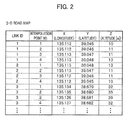
- FIG. 2 shows records of a three-dimensional road map stored in the three-dimensional road map storage section 113.
- FIG. 3 shows a profile indicating altitude of a road link which is divided into a plurality of sub-links.
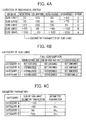
- FIGS. 4A to 4C shows various parameters used in a link shape compression process.
- FIG. 4A shows variation of mechanical energy.
- FIG. 4B shows categories of sub-links.
- FIG. 4C shows examples of geometry parameters.
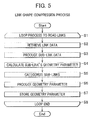
- FIG. 5 is a flowchart of the link shape compression process.
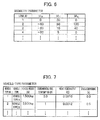
- FIG. 6 shows records of geometry parameter stored in the geometry parameter storage unit 114.
- the three-dimensional road map includes three-dimensional position and shape of each road link.
- the position and shape of each road link are represented by a sequence of points each having a three-dimensional coordinate (X, Y, and Z). Therefore, a linear road link having a fixed gradient can be represented by using coordinates of the beginning point and the ending point of the road link.
- interpolation points are provided on a road link having folding points or gradient-changing points thereon.
- a road link has an arbitrary number of interpolation points adjacent to each other at arbitrary intervals since it must represent an arbitrary three-dimensional shape of a road surface accurately. Therefore, interpolation points may not have to be provided on a linear road link.
- a road link indicating a curved road having a smaller radius may have interpolation points disposed at a narrow interval, e.g. 10 meter.
- a road link is represented by at least two points, i.e., the beginning point and the ending point of the road link, each having a three-dimensional coordinate.
- the three-dimensional road map has records each having a link ID (or a road link ID), an interpolation point number, a longitude, a latitude, and an altitude. Each record also indicates coordinates of the beginning point, the ending point, and the interpolation point of each road link.
- Each road link has the link ID which is an identification number identical with an identification number put to each road link provided on a two-dimensional road map stored in the road map storage unit 218 of the on-board terminal device 2.
- a road link is defined separately between in an up-bound direction and a down-bound direction.
- the interpolation point number is provided for identifying the interpolation points.
- the beginning point and the ending point are interpolation points.
- the interpolation points are numbered in an ascending order from the beginning point which is numbered "1".
- the longitude, latitude, and altitude of each interpolation point are indicated by the three-dimensional coordinates X, Y, and Z respectively.
- a road link usually has a plurality of interpolation points dividing the road link into a plurality of sub-links. Each sub-link is approximated by using a line segment. Each sub-link of the road link indicates relationship of the beginning point of the road link and each sub-link in distance and altitude since fuel consumption is affected by difference in altitude or by gradient of each road link.
- the travel condition of a vehicle can be categorized into three travel modes, more specifically, an acceleration travel mode, a constant-speed travel mode, and a deceleration travel mode.
- Fuel consumption increases if a vehicle travels on a flat (zero gradient) road in the acceleration travel mode since the vehicle must increase its kinetic energy.
- fuel consumption decreases if the vehicle travels on the flat road in the constant-speed travel mode since the constant-speed can be maintained as long as energy withstanding the rolling fiction is applied to the vehicle.
- No fuel is consumed if the vehicle travels on the flat road in the deceleration travel mode since the vehicle travelling in the deceleration travel mode needs no energy.
- the variation of mechanical energy M is normalized by using the weight of the vehicle. That is, the variation of mechanical energy M is defined by a unit weight of the vehicle.
- the variation of mechanical energy M is calculated by further using friction coefficient, and acceleration rate during a temporary speed drop which are independent from factors relating to road surface condition, the type of vehicle, and personal preference of a driver. That is, the friction coefficient and the acceleration rate during a temporary speed drop are averaged values and are obtainable from information including the vehicle design or driving test etc. Drag (i.e. air resistance) which depends on a travel speed is ignorable in the explanation of the embodiments.
- acceleration rates of a vehicle in an accelerated mode and a decelerated mode are assumed to be identical.
- the link shape compression unit 111 calculates the variations of mechanical energy M of the vehicle travelling each sub-link in the acceleration travel mode, the constant-speed travel mode, and the deceleration travel mode.
- FIG. 4A shows an example of the variations of mechanical energy M calculated for sub-links 1 to 5 of the road link shown in FIG. 3 .
- Values shown in a column titled “FRICTION + POSITION” indicate energies of "fiction + position" of Equation 1.
- Values show in a column titled “ACCELERATION TRAVEL MODE” indicates variation of mechanical energy M of the vehicle in the acceleration travel mode.
- Values show in a column titled “CONSTANT-SPEED TRAVEL MODE” indicates variation of mechanical energy M of the vehicle in the constant-speed travel mode.
- Values show in a column titled “DECELERATION TRAVEL MODE” indicates variation of mechanical energy M of the vehicle in the deceleration travel mode.
- the sub-link 3 has a greater energy in the column titled "FRICTION + POSITION” by ⁇ P.
- the sub-links 4 and 5 have energies in negative value in the column titled "FRICTION + POSITION” since gradients of the sub-links 4 and 5 become negative, and thereby ⁇ P becomes negative.
- the variation of mechanical energy M may sometimes becomes negative in not only the deceleration travel mode but also constant-speed travel mode.
- energy does not have to be supplied to the vehicle travelling in the constant-speed travel mode. That is, the vehicle in this case consumes no fuel.
- the variation of mechanical energy M of the vehicle travelling in the acceleration travel mode becomes negative. (See sub-link 5). The vehicle consumes no fuel even if travelling in the acceleration travel mode.
- the sub-links can be categorized as shown in FIG 4B according to whether the vehicle consumes the fuel or not in each travel mode.
- a sub-link shown in the category A indicates that the vehicle consumes no fuel in every travel mode (See the sub-link 5).
- An example of a sub-link in the category A is a steep downhill on which the vehicle consumes no fuel even if travelling in the acceleration travel mode.
- a sub-link shown in the category B indicates that the vehicle consumes fuel in the acceleration travel mode but consumes no fuel in the constant-speed travel mode and the deceleration travel mode (See the sub-link 4).
- An example of a sub-link in the category B is a gentle downhill on which the vehicle consumes no fuel when travelling in the constant-speed travel mode and the deceleration travel mode.
- a sub-link shown in the category C indicates that the vehicle consumes fuel in the constant-speed travel mode and the acceleration travel mode but consumes no fuel in the deceleration travel mode (See the sub-links 1 and 2).
- An example of a sub-link in the category C is a flat road, an extremely gentle downhill, or a gentle uphill.
- a sub-link shown in the category D indicates that the vehicle consumes fuel in every travel mode (See the sub-link 3).
- An example of a sub-link in the category D is a steep uphill on which the vehicle consumes fuel even if travelling in the deceleration travel mode.
- the column titled "CATEGORY" in FIG. 4A shows the result of categorization conducted for each sub-link of the road link shown in FIG. 3 .
- energy shown in the column titled "FRICTION + POSITION” is determined according to the three-dimensional shape of each sub-link. That is, FR indicating the energy of friction loss is determined according to a travelling distance of each sub-link, which is identical with the length of each sub-link; and variation ⁇ P of potential energy is determined according to the vertical difference of two ends of a sub-link.
- the variation of energy in each sub-link shown in the column titled "FRICTION + POSITION” is determined according to the three-dimensional shape of each sub-link; therefore, the variation of energy in each sub-link does not depend on the travel mode of the vehicle.
- the energy shown in the column titled “FRICTION + POSITION” may be construed as each sub-link's geometry parameter.
- the energy shown in the column titled “FRICTION + POSITION” is called "geometry parameter of each sub-link”.
- the present invention obtains the variation of energy in the column titled "FRICTION + POSITION" by normalizing the vehicle weight and calculating the variation of energy per unit weight; and the present invention uses a constant fiction coefficient for estimating fuel consumption.
- the each sub-link's geometry parameter obtained in the aforementioned manner may be used generally for all vehicle types; therefore, the present invention does not have to produce data of geometry parameter for each vehicle type.
- the link shape compression unit 111 defines four geometry parameters M A , M B , M C , and M D as follows by using geometry parameters of a plurality of sub-links forming a road link.
- Values in the column titled "SUM OF SUB-LINKS' GEOMETRY PARAMETERS” shown in FIG. 4C are obtained by calculating the sum of geometry parameters of all the sub-links belonging to categories A to D shown in FIG. 4A .
- values shown in the column titled “SUM OF SUB-LINKS' GEOMETRY PARAMETERS” shown in FIG. 4C are obtained by calculating the sum of energies of the "sub-links 1 and 2" in the columns titled “FRICTION + POSITION” categorized in the "category C".
- a sum of energies in the columns titled "CONSTANT-SPEED TRAVEL MODE" may be calculated in the present invention.
- the present invention can calculate the fuel consumption of a road link by using the geometry parameters M A , M B , M C , and M D , and vehicle-type parameters such as vehicle weight. That is, the present embodiment is capable of calculating the fuel consumption of a road link by using the geometry parameters of the road link in place of using a three-dimensional road map. That is, the data of three-dimensional link shapes indicated by information associated with three-dimensional position of each road link are compressed into data indicated by the geometry parameters M A , M B , M C , and M D .
- the link shape compression process in step S1 is a loop process conducted to all the road links included in the three-dimensional road map storage section 113.
- the CPU of the central-processing device 11 sets a link ID and retrieves link data having the link IDs from the three-dimensional road map storage section 113 (step S2).
- the link data are records stored in the three-dimensional road map storage section 113.
- the CPU produces sub-link data indicating distance and altitude from the beginning point of a link at each interpolation point based on the retrieved link data in step S3; and then, the CPU calculates variation of mechanical energy for each travel mode, i.e., each sub-link's geometry parameter as shown in FIG. 4A in step S4. In step S5, the CPU categorizes the sub-links in accordance with the calculated variation of mechanical energy.
- step S6 the CPU produces the geometry parameters M B , M C , and M D , of the road link in accordance with each sub-link's geometry parameter.
- step S7 the CPU stores the produced geometry parameters M B , M C , and M D in the geometry parameter storage unit 114.
- step S8 the CPU determines as to whether the loop processes of steps S 1 through S7 have been conducted for all the road links, and the CPU ends the loop processes if they have been conducted.
- each link's geometry parameter stored in the geometry parameter storage unit 114 has three kinds of data, i.e., M B , M C , and M D .
- the geometry parameters shown in FIG. 6 is notably compressed to small size data as compared with data of the three-dimensional road map shown in FIG. 2 .
- the data I/O controller 112 uses the media drive unit 13 and writes the data of geometry parameter stored in the geometry parameter storage unit 114 into portable storage media such as a DVD 5, or sends the geometry parameter to the on-board terminal device 2 through the communication device 12, the communication network 3, and the likes.
- a vehicle-type selection process conducted in the navigation-processing device 21 will be explained as follows with reference to FIGS. 7 to 9 .
- the vehicle-type selector 214 conducts the vehicle-type selection process for selecting a model of the vehicle having the on-board terminal device 2 installed therein.
- FIG. 7 shows data of vehicle-type parameters stored in a vehicle-type parameter storage unit.
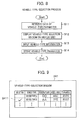
- FIG. 8 is a flowchart of the vehicle-type selection process.
- FIG. 9 is an example of a vehicle-type selection window displayed on a display unit 24.
- vehicle-type parameters include data indicated by: vehicle type ID; vehicle type; vehicle weight W; fundamental fuel consumption F; heat equivalent E; drag coefficient k.
- the fundamental fuel consumption F indicates the amount of fuel consumed per unit time for maintaining the operation of an engine against its internal resistance.
- the heat equivalent E is the amount of fuel consumed for obtaining a predetermined quantity of mechanical energy.
- the data I/O controller 216 receives data regarding the vehicle-type parameter externally by using media drive unit 26 or the communication device 27; and stores the data in the vehicle-type parameter storage unit 219.
- a driver of the vehicle Prior to obtaining data regarding a fuel-efficient route from the on-board terminal device 2, a driver of the vehicle must select the type of vehicle.
- the driver inputs an instruction to start a vehicle-type selection process into the input device 25 etc.
- the CPU of the navigation-processing device 21 starts the vehicle-type selection process as shown in FIG. 8 .
- the CPU retrieves data of vehicle-type parameter from the vehicle-type parameter storage unit 219 in step S11, and then, the CPU displays a vehicle-type selection window 241 on the display unit 24 in step S12.
- the vehicle-type selection window 241 shows a list of vehicle type, manufacturer's name, model name, year model, and the like. The list has a column of check boxes for the driver to select the type of vehicle.
- the CPU receives the selected vehicle-type information in step S13, and then, the CPU stores the vehicle-type parameter, regarded as his or her own vehicle's parameters and designated in the input selected vehicle-type information, into the storage device in step S 14.
- the vehicle weight W of the vehicle-type parameter includes net weight of the vehicle and an adult driver's average weight.
- a passenger-number input window or the like may be provided for the driver, if necessary, to adjust the vehicle weight W by directly inputting the number of passengers aboard in the vehicle or the weight of luggage.
- a sensor may be provided on the vehicle for detecting the vehicle weight W.
- the on-board terminal device 2 conducting the aforementioned vehicle-type selection process can provide fuel-efficient routes for various type of vehicles accurately to the driver.
- the fuel-consumption estimation unit 215 carries out the fuel-consumption estimation process for estimating the fuel consumption of a currently-driving vehicle travelling on a road link.
- FIG. 10 shows an example of records indicative of statistically-stored traffic information stored in the storage section 217.
- FIG. 11 shows a flowchart of a travel-pattern-estimation process included in the fuel-consumption estimation process.
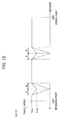
- FIG. 12 shows an example of travelling pattern of the vehicle travelling a road link.
- FIG. 13 shows an example of flowchart of a fuel-consumption calculation process included in a fuel-consumption estimation process.
- the storage section 217 stores the statistically-stored traffic information by tabulating data regarding travelling time obtained for each road link in the past and sorting them on day type basis (e.g. regarding weekday or holiday etc.) or time frame basis as shown in FIG. 10 .
- day type basis e.g. regarding weekday or holiday etc.
- time frame basis e.g. 10
- the following explanation is based on assumption that, the storage section 217 receives data regarding the statistically-stored traffic information externally by using media drive unit 26 for reading out the data or by using the communication device 27; and stores the data in the storage unit 217.
- the CPU of the navigation-processing device 21 estimates a link-travelling time of the day type and the time frame designated by the instruction based on the statistically-stored traffic information stored in the storage section 217 or based on currently-obtainable traffic information by using the travel-time estimation unit 211. Since various prior arts disclose estimation methods of such kinds in detail, the present specification omits explanation thereof.
- the simplest method for estimating a link-travelling time may estimate data by directly outputting the link-travelling time included in the statistically-stored traffic information based on day type and time frame designated in a route-search instruction.
- the CPU starts a travel-pattern estimation process as shown in FIG. 11 by using a travel-pattern estimation unit 2151.
- the CPU obtains a link-travel time T estimated by the travel-time estimation unit 211 in step S21, and then, obtains a link length L of the road link from the road map storage unit 218 in step S22.
- step S23 the CPU conducts a congestion estimation process.
- step S24 the CPU conducts an acceleration/deceleration estimation process.
- the CPU estimates the number N of temporary speed drop of the vehicle on each road link.
- N T/C
- C a coefficient determined based on road type
- T indicates link-travel time.
- the number N of temporary speed drops is estimated in accordance with the link-travel time T
- the number N of the estimated temporary speed drops may be corrected in accordance with the number of interpolation points existing in the road link of the three-dimensional road map. More specifically, the number N of the estimated temporary speed drops may be increased or decreased in accordance with the number or density of the interpolation points since temporary speed drops occur more frequently in a road link having folding points, curves, or gradient-changing points indicated by interpolation points.
- step S25 the CPU conducts an acceleration-and-deceleration-distance ratio estimation process.
- Acceleration-and-deceleration-distance ratio includes a ratio P A indicating a distance travelled in an acceleration travel mode in a road link, and a ratio P D indicating a distance travelled in a deceleration travel mode in the identical road link. Therefore, the ratio of distance travelled in a constant-speed travel mode is indicated by 1-P A -P D .
- the CPU calculates a congestion degree J of the road link, and sets the maximum speed in the calculated congestion degree J at V MAX as shown in FIG. 12 .
- the V MAX is set at lower one of the maximum speed set for the congestion degree J and the predetermined speed limit.
- an equation congestion degree J 2 is effective if the currently travelling link is a non-expressway, and if an average speed Va is 25 km/h and a speed limit is 50 km/h.
- the CPU calculates the ratios P A and P D .
- the calculation of the ratios P A and P D is based on assumptions that: the vehicle drives at the V MAX ; speed increases from 0 km/h to the V MAX by a constant acceleration rate G; and speed decreases from the V MAX to 0 km/h by the deceleration rate having the same absolute value as that of the constant acceleration rate G.
- the rate G is assumed to be identical with the acceleration rate G of the temporary speed drop previously explained with reference to FIG. 5 regarding the link shape compression process conducted by the central-processing device 11.
- FIG. 12 shows a travelling pattern of a vehicle travelling on a road link in the constant-speed travel mode and repeating temporary speed drops twice by using a diagram in which the vertical axis is travel speed and the horizontal axis is distance from the beginning point of the road link.
- the vehicle maintains the same acceleration rate G when accelerating or decelerating in each temporary speed drop.
- step S26 the travel-pattern estimation information is sent to a fuel-consumption calculation unit 2152 as shown in FIG. 11 .
- step S31 the CPU obtains the travel-pattern estimation information calculated by the travel-pattern estimation unit 2151, and then, the CPU obtains the geometry parameters M B , M C , and M D of the road link from the geometry parameter storage unit 220 in step S32.
- step S33 the CPU calculates estimated fuel consumption amount Q by using the following Equation 3 including the various vehicle-type parameters of the vehicle selected by the vehicle-type selector 214:
- Q F ⁇ T + E ⁇ W ⁇ M B ⁇ P A + M C ⁇ 1 - P A + M D + E AIR + E ACC W is the vehicle weight included in the vehicle-type parameter selected by the vehicle-type selector 214;
- F fundamental fuel consumption;
- E heat equivalent; and k is drag coefficient.
- Equation 3 A portion of (FxT) in Equation 3 indicates fundamental fuel consumption of the engine.
- a portion of (M B xP A ) indicates friction produced when travelling in the acceleration travel mode and loss of potential energy
- a portion of (M C x(1-P A )) indicates fiction produced when travelling in the constant-speed travel mode loss of potential energy
- a portion of (+M D ) indicates friction produced when travelling in the deceleration travel mode and loss of potential energy.
- E AIR indicates loss caused by drag (i.e. air resistance)
- E ACC indicates acceleration loss caused by kinetic energy produced when the vehicle travels in the acceleration travel mode.
- step S34 the CPU sends the estimated fuel consumption amount Q calculated in the step S33 to the route-search unit 212.
- the CPU of the navigation-processing device 21 can obtain the estimated fuel consumption amount Q based on day type, time frame, and road link designated by the driver by conducting the aforementioned travel-pattern estimation process and the fuel-consumption calculation process.
- the navigation-processing device 21 obtains the estimated fuel consumption amount Q without using a three-dimensional road map.
- the navigation-processing device 21 uses the geometry parameters M B , M C , and M D of each road link in place of the three-dimensional road map. Since the navigation-processing device 21 does not have to maintain the three-dimensional road map, the storage device of the navigation-processing device 21 can save its storage capacity.
- the navigation-processing device 21 uses only a few sets of geometry parameters, more specifically, three geometry parameters M B , M C , and M D for calculating the estimated fuel consumption amount Q for each road link. This means that workload is reduced in the fuel-consumption calculation process, and more specifically, that workload for the CPU of the navigation-processing device 21 is reduced.
- FIGS. 14 and 15 A route-search process and a route-guide process conducted by the navigation-processing device 21 will be explained with reference to FIGS. 14 and 15 .
- the route-search unit 212 conducts the route-search process
- the route-guidance unit 213 conducts the route-guide process.
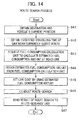
- FIG. 14 shows a flowchart of the route-search process.
- FIG. 15 shows a window displayed on the display unit in the route-guide process.
- the CPU starts the route-search process at various timings, e.g. when the driver puts instruction for searching a fuel-efficient route into the input device 25, or when the CPU recognizes that a currently-guided route must be re-routed.
- the CPU obtains information of a destination and a vehicle's current position from the input device 25 and the GPS receiver 22 etc.
- the CPU uses the travel-time estimation unit 211 and obtains estimated link-travelling time for travelling a road which is in the vicinity of the currently-guided route connecting the vehicle's current position to the destination.
- step S43 the CPU requests the fuel-consumption calculation unit 2152 to calculate the estimated fuel consumption amount Q of the road link of the road in the vicinity of the currently travelling route.
- step S44 the CPU obtains the estimated fuel consumption amount Q calculated by the fuel-consumption calculation unit 2152.
- step S45 the CPU sets a link cost for use in route search by using the estimated fuel consumption amount Q.
- step S46 the CPU conducts the route-search process based on the link cost having the estimated fuel consumption amount Q.
- step S47 the CPU sends the result of route search to the route-guidance unit 213.
- a commonly known route search algorithm e.g. Dijkstra's Algorithm can be used for searching a fuel-efficient route.
- the CPU conducts the route-guide process by using the route-guidance unit 213, and displays the result of route search on the display unit 24.
- the display unit 24 may display the fuel-efficient route alone as a guided route in this case.
- a fuel-efficient route 2423 and a time-saving route 2424 both of which leads the vehicle from a vehicle's current position 2421 to a destination 2422, may be displayed in combination on the guided-route-display window 242 as shown in FIG. 15 .
- This alternative case is based on assumption that the time-saving route is searched in advance in the route-search process conducted by the route-search unit 212.
- a display window 2425 may be provided on the guided-route-display window 242 for showing route summary including fuel consumption and necessary travel time for each route.
- checkboxes 2426 may be provided for the driver to select the type of route appropriately.
- the display unit 24 displays the fuel-efficient route and the time-saving route as shown in FIG. 15
- the display unit 24 may display a distance-saving route in place of the time-saving route.
- the display unit 24 may display a plurality of cost-saving routes, searched by using another cost function, together with the time-saving route and the distance-saving route.
- the navigation-processing device 21 may search a plurality of cost-saving routes including a fuel-efficient route and display the searched routes side by side so that the driver can select a route to be guided as shown in FIG. 15 .
- the driver may select a cost function for use in route search in advance, and then, the navigation-processing device 21 may search only a cost-function-saving route and displays the result of route search.
- the information of road link stored in the road map storage unit 218 may include the geometry parameters.
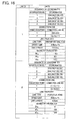
- FIG. 16 shows an example of data indicative of road links including information of geometry parameters.
- the data of road links include: ordinary link property data indicating the position and shape of each road link and including a sequence of coordinate points, link connection information, and link property information; and geometry parameters.
- the present invention enables high-speed performance since the navigation-processing device 21 in this case does not have to correlate the data stored in the road map storage unit 218 to the data stored in the geometry parameter storage unit 220 in the fuel-consumption estimation process conducted by the fuel-consumption estimation unit 215.
- the present invention can reduce the time for updating data since road map data and geometry parameters stored in a DVD 5 or provided via a communication network 3 are updated simultaneously.
Landscapes
- Engineering & Computer Science (AREA)
- Radar, Positioning & Navigation (AREA)
- Remote Sensing (AREA)
- Automation & Control Theory (AREA)
- Physics & Mathematics (AREA)
- General Physics & Mathematics (AREA)
- Navigation (AREA)
- Traffic Control Systems (AREA)
- Instructional Devices (AREA)
Applications Claiming Priority (1)
| Application Number | Priority Date | Filing Date | Title |
|---|---|---|---|
| JP2008281968A JP5027777B2 (ja) | 2008-10-31 | 2008-10-31 | カーナビゲーション装置およびカーナビゲーション方法 |
Publications (2)
| Publication Number | Publication Date |
|---|---|
| EP2182323A1 EP2182323A1 (en) | 2010-05-05 |
| EP2182323B1 true EP2182323B1 (en) | 2012-05-23 |
Family
ID=41600589
Family Applications (1)
| Application Number | Title | Priority Date | Filing Date |
|---|---|---|---|
| EP09174524A Not-in-force EP2182323B1 (en) | 2008-10-31 | 2009-10-29 | Navigation device and navigation method |
Country Status (4)
| Country | Link |
|---|---|
| US (1) | US20100114473A1 (enExample) |
| EP (1) | EP2182323B1 (enExample) |
| JP (1) | JP5027777B2 (enExample) |
| CN (1) | CN101788298B (enExample) |
Families Citing this family (52)
| Publication number | Priority date | Publication date | Assignee | Title |
|---|---|---|---|---|
| WO2010113319A1 (ja) * | 2009-04-03 | 2010-10-07 | トヨタ自動車株式会社 | 車両の駆動制御装置 |
| JP5135308B2 (ja) | 2009-09-09 | 2013-02-06 | クラリオン株式会社 | エネルギ消費量予測方法、エネルギ消費量予測装置および端末装置 |
| KR101092690B1 (ko) * | 2009-11-02 | 2011-12-09 | 기아자동차주식회사 | 연료 최소화 경로 및 비용 산출 방법 |
| DE102009052853B4 (de) * | 2009-11-11 | 2017-07-20 | Dr. Ing. H.C. F. Porsche Aktiengesellschaft | Verfahren zur Reichweitenabschätzung eines Kraftfahrzeugs |
| DE112010005366B4 (de) * | 2010-03-08 | 2022-02-03 | Mitsubishi Electric Corporation | Routensuchvorrichtung |
| KR101655467B1 (ko) * | 2010-06-23 | 2016-09-08 | 현대자동차주식회사 | 차량용 길 안내 시스템 |
| KR101231515B1 (ko) * | 2010-06-30 | 2013-02-07 | 기아자동차주식회사 | 주행경로의 연료량 계산 시스템 및 그 방법 |
| DE102010027172B4 (de) * | 2010-07-14 | 2013-09-26 | Deutsches Zentrum für Luft- und Raumfahrt e.V. | Verfahren und Vorrichtung zur Bestimmung einer energieminimalen Route |
| JP5618669B2 (ja) * | 2010-07-21 | 2014-11-05 | クラリオン株式会社 | カーナビゲーション装置およびカーナビゲーション方法 |
| JP4978720B2 (ja) * | 2010-08-06 | 2012-07-18 | トヨタ自動車株式会社 | 区間定義方法、及び旅行時間演算装置、及び運転支援装置 |
| EP2431711B1 (en) * | 2010-09-08 | 2014-11-12 | Harman Becker Automotive Systems GmbH | Vehicle navigation system |
| JP5649892B2 (ja) * | 2010-09-22 | 2015-01-07 | トヨタ自動車株式会社 | 区間設定方法、燃費情報生成装置、及び運転支援装置 |
| DE102010047080B4 (de) | 2010-10-01 | 2012-09-06 | Audi Ag | Verfahren zum Gewinnen eines Geschwindigkeitsprofils |
| JP5549520B2 (ja) * | 2010-10-08 | 2014-07-16 | アイシン・エィ・ダブリュ株式会社 | 経路関連情報提供装置、経路関連情報提供方法、経路関連情報提供プログラムおよび経路案内システム |
| DE102010063330A1 (de) * | 2010-12-17 | 2012-06-21 | Bayerische Motoren Werke Aktiengesellschaft | Verfahren und Vorrichtung zum Komprimieren von Routendaten |
| WO2012101887A1 (ja) * | 2011-01-28 | 2012-08-02 | 楽天株式会社 | 経路情報提供装置、経路情報提供方法、プログラム及び情報記録媒体 |
| JP5776431B2 (ja) * | 2011-02-23 | 2015-09-09 | 株式会社デンソー | 省燃費運転評価システム及び省燃費運転評価システム用プログラム |
| JP5704229B2 (ja) * | 2011-03-18 | 2015-04-22 | トヨタ自動車株式会社 | 運転支援装置及び車両用情報処理装置 |
| JP5810621B2 (ja) * | 2011-05-16 | 2015-11-11 | 株式会社デンソー | 道路勾配データ作成装置、記憶媒体、並びに、車両のエネルギー消費量予測装置 |
| JP5740215B2 (ja) | 2011-06-10 | 2015-06-24 | クラリオン株式会社 | エネルギー消費量計算装置とそのエネルギー消費量計算方法 |
| US8965694B2 (en) | 2011-10-17 | 2015-02-24 | Clarion Co., Ltd. | Route search method |
| US9555811B2 (en) * | 2011-10-28 | 2017-01-31 | Thinkware Corporation | Method and apparatus for providing analysis index of roadway section based on road and traffic conditions |
| CN104024800B (zh) * | 2011-12-08 | 2017-06-30 | 株式会社日立制作所 | 可到达范围计算装置、方法 |
| KR101294087B1 (ko) * | 2011-12-09 | 2013-08-08 | 기아자동차주식회사 | 전기 자동차용 친환경 드라이빙 운전자 지원 시스템 및 지원 방법 |
| JP5926558B2 (ja) | 2011-12-29 | 2016-05-25 | クラリオン株式会社 | 車両用情報システムおよびサーバ装置 |
| JP5893953B2 (ja) * | 2012-02-22 | 2016-03-23 | 日立建機株式会社 | 車両運行管理システム |
| CN103287437B (zh) * | 2012-02-22 | 2015-07-15 | 厦门金龙联合汽车工业有限公司 | 一种基于车辆运行工况的发动机自适应系统及节油方法 |
| US8706416B2 (en) * | 2012-04-03 | 2014-04-22 | Ford Global Technologies, Llc | System and method for determining a vehicle route |
| JP6171141B2 (ja) | 2012-06-07 | 2017-08-02 | クラリオン株式会社 | エネルギー推定装置、車両用情報システム、サーバ装置 |
| CN104471219B (zh) * | 2012-06-27 | 2017-07-11 | 三菱电机株式会社 | 行驶模式评价装置及行驶模式评价方法 |
| JP5840090B2 (ja) * | 2012-08-17 | 2016-01-06 | 株式会社東芝 | 消費電力量推定装置 |
| CN103072572B (zh) * | 2013-01-18 | 2016-08-10 | 浙江吉利汽车研究院有限公司杭州分公司 | 可充电式混合动力汽车远程优化系统 |
| US20140214267A1 (en) * | 2013-01-25 | 2014-07-31 | Audi Ag | Predicting consumption and range of a vehicle based on collected route energy consumption data |
| US9709969B2 (en) | 2013-03-15 | 2017-07-18 | Deere & Company | Methods and apparatus to control machine configurations |
| CN105102930B (zh) * | 2013-04-11 | 2019-05-10 | 日产自动车株式会社 | 能量消耗量预测装置以及能量消耗量预测方法 |
| JP6490486B2 (ja) * | 2015-04-21 | 2019-03-27 | クラリオン株式会社 | 経路探索装置及び経路探索方法 |
| CN104992044B (zh) * | 2015-05-26 | 2018-01-30 | 深圳大学 | 应用于实时合乘的最优多会合点路径搜索方法及装置 |
| US9970780B2 (en) * | 2015-11-19 | 2018-05-15 | GM Global Technology Operations LLC | Method and apparatus for fuel consumption prediction and cost estimation via crowd sensing in vehicle navigation system |
| JP6720805B2 (ja) * | 2016-09-28 | 2020-07-08 | いすゞ自動車株式会社 | 区間決定装置及び区間決定方法 |
| US11030831B2 (en) | 2016-09-29 | 2021-06-08 | Mitsubishi Electric Corporation | Fuel efficiency estimation system, fuel efficiency estimation method, and computer readable medium |
| DE112016007169B4 (de) | 2016-09-29 | 2022-12-29 | Mitsubishi Electric Corporation | Kraftstoff-Wirkungsgrad-Schätzsystem, Kraftstoff-Wirkungsgrad-Schätzverfahren und Kraftstoff-Wirkungsgrad-Schätzprogramm |
| CN107221195B (zh) * | 2017-05-26 | 2020-03-17 | 重庆长安汽车股份有限公司 | 汽车车道预测方法及车道级地图 |
| JP6972924B2 (ja) * | 2017-10-27 | 2021-11-24 | コベルコ建機株式会社 | 走行ルートガイダンス装置 |
| KR20190069772A (ko) * | 2017-12-12 | 2019-06-20 | 현대자동차주식회사 | 하이브리드 자동차 및 그를 위한 경로 탐색 방법 |
| US10885783B2 (en) * | 2018-06-29 | 2021-01-05 | Palo Alto Research Center Incorporated | Generating collaboratively optimal transport plans |
| CN109159782B (zh) * | 2018-08-21 | 2022-08-26 | 上海博泰悦臻网络技术服务有限公司 | 车辆的动力模式调节方法及服务器 |
| JP7082555B2 (ja) * | 2018-09-27 | 2022-06-08 | 本田技研工業株式会社 | 車両利用支援システム |
| JP7283077B2 (ja) * | 2018-12-27 | 2023-05-30 | トヨタ自動車株式会社 | 情報処理装置、情報処理方法、プログラム |
| US11486710B2 (en) * | 2020-04-06 | 2022-11-01 | The Boeing Company | System and method for determining a three-dimensional travel path for a vehicle |
| JP7414019B2 (ja) | 2021-01-04 | 2024-01-16 | トヨタ自動車株式会社 | エネルギー消費量推定装置およびエネルギー消費量推定方法 |
| WO2022252234A1 (zh) * | 2021-06-04 | 2022-12-08 | 华为技术有限公司 | 3d地图的编码装置和方法 |
| CN116229601B (zh) * | 2023-03-14 | 2025-10-21 | 广汽本田汽车有限公司 | 一种车辆电驱动里程预测方法、系统、装置及存储介质 |
Family Cites Families (31)
| Publication number | Priority date | Publication date | Assignee | Title |
|---|---|---|---|---|
| JP2759815B2 (ja) | 1989-04-19 | 1998-05-28 | 三菱自動車工業株式会社 | ナビゲーションシステム |
| EP0683382A3 (en) * | 1994-05-20 | 1996-08-14 | Ford Motor Co | Method and system for calculating effective fuel economy. |
| JP3384126B2 (ja) * | 1994-08-11 | 2003-03-10 | 日産自動車株式会社 | 移動体の移動可能範囲推定装置 |
| JP3099694B2 (ja) * | 1995-09-22 | 2000-10-16 | トヨタ自動車株式会社 | 車両の制御装置 |
| US5742922A (en) * | 1996-02-12 | 1998-04-21 | Hyundai Motor Company | Vehicle navigation system and method for selecting a route according to fuel consumption |
| JP3551634B2 (ja) * | 1996-07-18 | 2004-08-11 | トヨタ自動車株式会社 | 走行制御装置 |
| JPH10122883A (ja) | 1996-10-15 | 1998-05-15 | Aqueous Res:Kk | 車両用ナビゲーション装置及びルート設定方法 |
| US6005494A (en) * | 1996-10-16 | 1999-12-21 | Chrysler Corporation | Energy minimization routing of vehicle using satellite positioning an topographic mapping |
| US5913917A (en) * | 1997-08-04 | 1999-06-22 | Trimble Navigation Limited | Fuel consumption estimation |
| JP2000002553A (ja) * | 1998-06-18 | 2000-01-07 | Hino Motors Ltd | ナビゲーション装置 |
| US6317686B1 (en) * | 2000-07-21 | 2001-11-13 | Bin Ran | Method of providing travel time |
| WO2004077283A2 (en) * | 2003-02-27 | 2004-09-10 | Acculeon, Inc. | A vehicle management system |
| DE10335927B4 (de) * | 2003-08-06 | 2005-09-22 | Siemens Ag | Navigationssystem mit Ermittlung einer verbrauchsoptimierten Route |
| JP2005098749A (ja) * | 2003-09-22 | 2005-04-14 | Toyota Motor Corp | 車両用ナビゲーション装置 |
| JP4374242B2 (ja) * | 2003-12-10 | 2009-12-02 | 株式会社ザナヴィ・インフォマティクス | ナビゲーション装置およびコンピュータプログラム。 |
| JP4502766B2 (ja) | 2004-09-29 | 2010-07-14 | クラリオン株式会社 | 経路探索装置 |
| JP4379406B2 (ja) * | 2005-03-04 | 2009-12-09 | 日産自動車株式会社 | 車両の駆動力配分制御装置 |
| US7512486B2 (en) * | 2005-06-29 | 2009-03-31 | Intel Corporation | Fuel efficient navigation system |
| JP2007024833A (ja) * | 2005-07-21 | 2007-02-01 | Denso Corp | 車載ナビゲーション装置 |
| WO2007061409A2 (en) * | 2005-11-21 | 2007-05-31 | Ford Motor Company | Navigation system for a vehicle |
| JP4840077B2 (ja) * | 2006-10-24 | 2011-12-21 | 株式会社デンソー | コスト算出装置、ナビゲーション装置、プログラム |
| US7778769B2 (en) * | 2006-11-27 | 2010-08-17 | International Business Machines Corporation | Method and system for calculating least-cost routes based on historical fuel efficiency, street mapping and location based services |
| US7783417B2 (en) * | 2007-03-09 | 2010-08-24 | Mitac International Corporation | Methods and apparatus for determining a route having an estimated minimum fuel usage for a vehicle |
| US20090005974A1 (en) * | 2007-06-29 | 2009-01-01 | Gm Global Technology Operations, Inc. | Fuel cost predictor system |
| DE102007059120A1 (de) * | 2007-12-07 | 2009-06-10 | Robert Bosch Gmbh | Verfahren zur Bestimmung einer Route und Vorrichtung dazu |
| US7493209B1 (en) * | 2008-04-07 | 2009-02-17 | International Business Machines Corporation | Method of calculating a route based on estimated energy consumption |
| US8374781B2 (en) * | 2008-07-09 | 2013-02-12 | Chrysler Group Llc | Method for vehicle route planning |
| US8108138B2 (en) * | 2008-10-02 | 2012-01-31 | The Boeing Company | Optimal vehicle router with energy management system |
| US20100174484A1 (en) * | 2009-01-05 | 2010-07-08 | Manthram Sivasubramaniam | System and method for optimizing hybrid engine operation |
| JP4876159B2 (ja) * | 2009-09-04 | 2012-02-15 | クラリオン株式会社 | カーナビゲーションシステム |
| US8185302B2 (en) * | 2010-08-26 | 2012-05-22 | Ford Global Technologies, Llc | Conservational vehicle routing |
-
2008
- 2008-10-31 JP JP2008281968A patent/JP5027777B2/ja active Active
-
2009
- 2009-10-29 CN CN2009110000670A patent/CN101788298B/zh not_active Expired - Fee Related
- 2009-10-29 EP EP09174524A patent/EP2182323B1/en not_active Not-in-force
- 2009-10-29 US US12/608,340 patent/US20100114473A1/en not_active Abandoned
Also Published As
| Publication number | Publication date |
|---|---|
| EP2182323A1 (en) | 2010-05-05 |
| JP2010107459A (ja) | 2010-05-13 |
| CN101788298A (zh) | 2010-07-28 |
| CN101788298B (zh) | 2012-09-05 |
| US20100114473A1 (en) | 2010-05-06 |
| JP5027777B2 (ja) | 2012-09-19 |
Similar Documents
| Publication | Publication Date | Title |
|---|---|---|
| EP2182323B1 (en) | Navigation device and navigation method | |
| US9043141B2 (en) | Navigation system and navigation method of route planning using variations of mechanical energy | |
| CN102782449B (zh) | 路线搜索装置 | |
| US8712676B2 (en) | Method for computing an energy efficient route | |
| US10500974B2 (en) | Travelable distance calculation system and travelable distance calculation method for vehicle | |
| JP5135308B2 (ja) | エネルギ消費量予測方法、エネルギ消費量予測装置および端末装置 | |
| US9046379B2 (en) | Devices and methods for determining fuel consumption and searching vehicle routes | |
| US8798901B2 (en) | Travel distance estimating apparatus, travel distance estimating method, travel distance estimating program, and recording medium | |
| US9702716B2 (en) | Traffic score determination | |
| KR100920265B1 (ko) | 구간 과속 경고 장치 및 시스템 | |
| EP2949501A1 (en) | Central apparatus, driving support system, and driving support method | |
| CN102378897A (zh) | 具有路线客制化机制之导航系统及其操作方法 | |
| CN103959014A (zh) | 能量消耗量估计装置、能量消耗量估计方法、能量消耗量估计程序以及记录介质 | |
| KR101308264B1 (ko) | 에너지 소모율을 고려하는 네비게이션 장치 및 방법 | |
| JP5397275B2 (ja) | カーナビゲーションシステム | |
| US20130158898A1 (en) | Mobile-object information acquiring apparatus, mobile-object information acquiring method, mobile-object information acquiring program, and recording medium | |
| JP4890659B1 (ja) | エネルギー消費量推定装置、エネルギー消費量推定方法、エネルギー消費量推定プログラムおよび記録媒体 | |
| JP4884430B2 (ja) | 車載用ナビゲーション装置 | |
| WO2014162526A1 (ja) | 消費エネルギー量推定装置、消費エネルギー量推定方法、消費エネルギー量推定プログラムおよび記録媒体 | |
| JP2012063357A (ja) | エネルギー消費量推定装置、エネルギー消費量推定方法、エネルギー消費量推定プログラムおよび記録媒体 | |
| KR20120061107A (ko) | 경사도에 따른 에너지 소모율을 고려하는 네비게이션 장치 및 방법 | |
| JP5618669B2 (ja) | カーナビゲーション装置およびカーナビゲーション方法 | |
| WO2014162525A1 (ja) | エネルギー補給施設探索装置、エネルギー補給施設探索方法およびエネルギー補給施設探索プログラム | |
| JP2012047551A (ja) | 燃料消費評価装置 |
Legal Events
| Date | Code | Title | Description |
|---|---|---|---|
| PUAI | Public reference made under article 153(3) epc to a published international application that has entered the european phase |
Free format text: ORIGINAL CODE: 0009012 |
|
| AK | Designated contracting states |
Kind code of ref document: A1 Designated state(s): AT BE BG CH CY CZ DE DK EE ES FI FR GB GR HR HU IE IS IT LI LT LU LV MC MK MT NL NO PL PT RO SE SI SK SM TR |
|
| AX | Request for extension of the european patent |
Extension state: AL BA RS |
|
| 17P | Request for examination filed |
Effective date: 20100331 |
|
| 17Q | First examination report despatched |
Effective date: 20100527 |
|
| RIC1 | Information provided on ipc code assigned before grant |
Ipc: G01C 21/34 20060101AFI20110504BHEP |
|
| GRAP | Despatch of communication of intention to grant a patent |
Free format text: ORIGINAL CODE: EPIDOSNIGR1 |
|
| GRAS | Grant fee paid |
Free format text: ORIGINAL CODE: EPIDOSNIGR3 |
|
| GRAA | (expected) grant |
Free format text: ORIGINAL CODE: 0009210 |
|
| AK | Designated contracting states |
Kind code of ref document: B1 Designated state(s): AT BE BG CH CY CZ DE DK EE ES FI FR GB GR HR HU IE IS IT LI LT LU LV MC MK MT NL NO PL PT RO SE SI SK SM TR |
|
| REG | Reference to a national code |
Ref country code: GB Ref legal event code: FG4D |
|
| REG | Reference to a national code |
Ref country code: CH Ref legal event code: EP |
|
| REG | Reference to a national code |
Ref country code: AT Ref legal event code: REF Ref document number: 559281 Country of ref document: AT Kind code of ref document: T Effective date: 20120615 |
|
| REG | Reference to a national code |
Ref country code: IE Ref legal event code: FG4D |
|
| REG | Reference to a national code |
Ref country code: DE Ref legal event code: R096 Ref document number: 602009007179 Country of ref document: DE Effective date: 20120719 |
|
| REG | Reference to a national code |
Ref country code: NL Ref legal event code: VDEP Effective date: 20120523 |
|
| REG | Reference to a national code |
Ref country code: LT Ref legal event code: MG4D Effective date: 20120523 |
|
| PG25 | Lapsed in a contracting state [announced via postgrant information from national office to epo] |
Ref country code: FI Free format text: LAPSE BECAUSE OF FAILURE TO SUBMIT A TRANSLATION OF THE DESCRIPTION OR TO PAY THE FEE WITHIN THE PRESCRIBED TIME-LIMIT Effective date: 20120523 Ref country code: LT Free format text: LAPSE BECAUSE OF FAILURE TO SUBMIT A TRANSLATION OF THE DESCRIPTION OR TO PAY THE FEE WITHIN THE PRESCRIBED TIME-LIMIT Effective date: 20120523 Ref country code: CY Free format text: LAPSE BECAUSE OF FAILURE TO SUBMIT A TRANSLATION OF THE DESCRIPTION OR TO PAY THE FEE WITHIN THE PRESCRIBED TIME-LIMIT Effective date: 20120523 Ref country code: IS Free format text: LAPSE BECAUSE OF FAILURE TO SUBMIT A TRANSLATION OF THE DESCRIPTION OR TO PAY THE FEE WITHIN THE PRESCRIBED TIME-LIMIT Effective date: 20120923 Ref country code: SE Free format text: LAPSE BECAUSE OF FAILURE TO SUBMIT A TRANSLATION OF THE DESCRIPTION OR TO PAY THE FEE WITHIN THE PRESCRIBED TIME-LIMIT Effective date: 20120523 Ref country code: NO Free format text: LAPSE BECAUSE OF FAILURE TO SUBMIT A TRANSLATION OF THE DESCRIPTION OR TO PAY THE FEE WITHIN THE PRESCRIBED TIME-LIMIT Effective date: 20120823 |
|
| REG | Reference to a national code |
Ref country code: AT Ref legal event code: MK05 Ref document number: 559281 Country of ref document: AT Kind code of ref document: T Effective date: 20120523 |
|
| PG25 | Lapsed in a contracting state [announced via postgrant information from national office to epo] |
Ref country code: PT Free format text: LAPSE BECAUSE OF FAILURE TO SUBMIT A TRANSLATION OF THE DESCRIPTION OR TO PAY THE FEE WITHIN THE PRESCRIBED TIME-LIMIT Effective date: 20120924 Ref country code: LV Free format text: LAPSE BECAUSE OF FAILURE TO SUBMIT A TRANSLATION OF THE DESCRIPTION OR TO PAY THE FEE WITHIN THE PRESCRIBED TIME-LIMIT Effective date: 20120523 Ref country code: HR Free format text: LAPSE BECAUSE OF FAILURE TO SUBMIT A TRANSLATION OF THE DESCRIPTION OR TO PAY THE FEE WITHIN THE PRESCRIBED TIME-LIMIT Effective date: 20120523 Ref country code: GR Free format text: LAPSE BECAUSE OF FAILURE TO SUBMIT A TRANSLATION OF THE DESCRIPTION OR TO PAY THE FEE WITHIN THE PRESCRIBED TIME-LIMIT Effective date: 20120824 Ref country code: SI Free format text: LAPSE BECAUSE OF FAILURE TO SUBMIT A TRANSLATION OF THE DESCRIPTION OR TO PAY THE FEE WITHIN THE PRESCRIBED TIME-LIMIT Effective date: 20120523 |
|
| PG25 | Lapsed in a contracting state [announced via postgrant information from national office to epo] |
Ref country code: BE Free format text: LAPSE BECAUSE OF FAILURE TO SUBMIT A TRANSLATION OF THE DESCRIPTION OR TO PAY THE FEE WITHIN THE PRESCRIBED TIME-LIMIT Effective date: 20120523 |
|
| PG25 | Lapsed in a contracting state [announced via postgrant information from national office to epo] |
Ref country code: NL Free format text: LAPSE BECAUSE OF FAILURE TO SUBMIT A TRANSLATION OF THE DESCRIPTION OR TO PAY THE FEE WITHIN THE PRESCRIBED TIME-LIMIT Effective date: 20120523 Ref country code: RO Free format text: LAPSE BECAUSE OF FAILURE TO SUBMIT A TRANSLATION OF THE DESCRIPTION OR TO PAY THE FEE WITHIN THE PRESCRIBED TIME-LIMIT Effective date: 20120523 Ref country code: DK Free format text: LAPSE BECAUSE OF FAILURE TO SUBMIT A TRANSLATION OF THE DESCRIPTION OR TO PAY THE FEE WITHIN THE PRESCRIBED TIME-LIMIT Effective date: 20120523 Ref country code: CZ Free format text: LAPSE BECAUSE OF FAILURE TO SUBMIT A TRANSLATION OF THE DESCRIPTION OR TO PAY THE FEE WITHIN THE PRESCRIBED TIME-LIMIT Effective date: 20120523 Ref country code: EE Free format text: LAPSE BECAUSE OF FAILURE TO SUBMIT A TRANSLATION OF THE DESCRIPTION OR TO PAY THE FEE WITHIN THE PRESCRIBED TIME-LIMIT Effective date: 20120523 Ref country code: SK Free format text: LAPSE BECAUSE OF FAILURE TO SUBMIT A TRANSLATION OF THE DESCRIPTION OR TO PAY THE FEE WITHIN THE PRESCRIBED TIME-LIMIT Effective date: 20120523 Ref country code: AT Free format text: LAPSE BECAUSE OF FAILURE TO SUBMIT A TRANSLATION OF THE DESCRIPTION OR TO PAY THE FEE WITHIN THE PRESCRIBED TIME-LIMIT Effective date: 20120523 |
|
| PG25 | Lapsed in a contracting state [announced via postgrant information from national office to epo] |
Ref country code: IT Free format text: LAPSE BECAUSE OF FAILURE TO SUBMIT A TRANSLATION OF THE DESCRIPTION OR TO PAY THE FEE WITHIN THE PRESCRIBED TIME-LIMIT Effective date: 20120523 Ref country code: PL Free format text: LAPSE BECAUSE OF FAILURE TO SUBMIT A TRANSLATION OF THE DESCRIPTION OR TO PAY THE FEE WITHIN THE PRESCRIBED TIME-LIMIT Effective date: 20120523 |
|
| PLBE | No opposition filed within time limit |
Free format text: ORIGINAL CODE: 0009261 |
|
| STAA | Information on the status of an ep patent application or granted ep patent |
Free format text: STATUS: NO OPPOSITION FILED WITHIN TIME LIMIT |
|
| PG25 | Lapsed in a contracting state [announced via postgrant information from national office to epo] |
Ref country code: ES Free format text: LAPSE BECAUSE OF FAILURE TO SUBMIT A TRANSLATION OF THE DESCRIPTION OR TO PAY THE FEE WITHIN THE PRESCRIBED TIME-LIMIT Effective date: 20120903 |
|
| 26N | No opposition filed |
Effective date: 20130226 |
|
| PG25 | Lapsed in a contracting state [announced via postgrant information from national office to epo] |
Ref country code: MC Free format text: LAPSE BECAUSE OF NON-PAYMENT OF DUE FEES Effective date: 20121031 |
|
| REG | Reference to a national code |
Ref country code: DE Ref legal event code: R097 Ref document number: 602009007179 Country of ref document: DE Effective date: 20130226 |
|
| PG25 | Lapsed in a contracting state [announced via postgrant information from national office to epo] |
Ref country code: BG Free format text: LAPSE BECAUSE OF FAILURE TO SUBMIT A TRANSLATION OF THE DESCRIPTION OR TO PAY THE FEE WITHIN THE PRESCRIBED TIME-LIMIT Effective date: 20120823 |
|
| REG | Reference to a national code |
Ref country code: IE Ref legal event code: MM4A |
|
| PG25 | Lapsed in a contracting state [announced via postgrant information from national office to epo] |
Ref country code: IE Free format text: LAPSE BECAUSE OF NON-PAYMENT OF DUE FEES Effective date: 20121029 |
|
| PG25 | Lapsed in a contracting state [announced via postgrant information from national office to epo] |
Ref country code: MT Free format text: LAPSE BECAUSE OF FAILURE TO SUBMIT A TRANSLATION OF THE DESCRIPTION OR TO PAY THE FEE WITHIN THE PRESCRIBED TIME-LIMIT Effective date: 20120523 |
|
| PG25 | Lapsed in a contracting state [announced via postgrant information from national office to epo] |
Ref country code: TR Free format text: LAPSE BECAUSE OF FAILURE TO SUBMIT A TRANSLATION OF THE DESCRIPTION OR TO PAY THE FEE WITHIN THE PRESCRIBED TIME-LIMIT Effective date: 20120523 |
|
| PG25 | Lapsed in a contracting state [announced via postgrant information from national office to epo] |
Ref country code: SM Free format text: LAPSE BECAUSE OF FAILURE TO SUBMIT A TRANSLATION OF THE DESCRIPTION OR TO PAY THE FEE WITHIN THE PRESCRIBED TIME-LIMIT Effective date: 20120523 Ref country code: LU Free format text: LAPSE BECAUSE OF NON-PAYMENT OF DUE FEES Effective date: 20121029 |
|
| REG | Reference to a national code |
Ref country code: CH Ref legal event code: PL |
|
| PG25 | Lapsed in a contracting state [announced via postgrant information from national office to epo] |
Ref country code: HU Free format text: LAPSE BECAUSE OF FAILURE TO SUBMIT A TRANSLATION OF THE DESCRIPTION OR TO PAY THE FEE WITHIN THE PRESCRIBED TIME-LIMIT Effective date: 20091029 Ref country code: LI Free format text: LAPSE BECAUSE OF NON-PAYMENT OF DUE FEES Effective date: 20131031 Ref country code: CH Free format text: LAPSE BECAUSE OF NON-PAYMENT OF DUE FEES Effective date: 20131031 |
|
| PG25 | Lapsed in a contracting state [announced via postgrant information from national office to epo] |
Ref country code: MK Free format text: LAPSE BECAUSE OF FAILURE TO SUBMIT A TRANSLATION OF THE DESCRIPTION OR TO PAY THE FEE WITHIN THE PRESCRIBED TIME-LIMIT Effective date: 20120523 |
|
| REG | Reference to a national code |
Ref country code: FR Ref legal event code: PLFP Year of fee payment: 8 |
|
| REG | Reference to a national code |
Ref country code: FR Ref legal event code: PLFP Year of fee payment: 9 |
|
| REG | Reference to a national code |
Ref country code: FR Ref legal event code: PLFP Year of fee payment: 10 |
|
| PGFP | Annual fee paid to national office [announced via postgrant information from national office to epo] |
Ref country code: GB Payment date: 20210922 Year of fee payment: 13 |
|
| GBPC | Gb: european patent ceased through non-payment of renewal fee |
Effective date: 20221029 |
|
| PG25 | Lapsed in a contracting state [announced via postgrant information from national office to epo] |
Ref country code: GB Free format text: LAPSE BECAUSE OF NON-PAYMENT OF DUE FEES Effective date: 20221029 |
|
| PGFP | Annual fee paid to national office [announced via postgrant information from national office to epo] |
Ref country code: FR Payment date: 20230920 Year of fee payment: 15 |
|
| PGFP | Annual fee paid to national office [announced via postgrant information from national office to epo] |
Ref country code: DE Payment date: 20230920 Year of fee payment: 15 |
|
| REG | Reference to a national code |
Ref country code: DE Ref legal event code: R119 Ref document number: 602009007179 Country of ref document: DE |
|
| PG25 | Lapsed in a contracting state [announced via postgrant information from national office to epo] |
Ref country code: DE Free format text: LAPSE BECAUSE OF NON-PAYMENT OF DUE FEES Effective date: 20250501 |
|
| PG25 | Lapsed in a contracting state [announced via postgrant information from national office to epo] |
Ref country code: FR Free format text: LAPSE BECAUSE OF NON-PAYMENT OF DUE FEES Effective date: 20241031 |