EP2158279B1 - An antireflective coating composition comprising fused aromatic rings - Google Patents
An antireflective coating composition comprising fused aromatic rings Download PDFInfo
- Publication number
- EP2158279B1 EP2158279B1 EP08751011A EP08751011A EP2158279B1 EP 2158279 B1 EP2158279 B1 EP 2158279B1 EP 08751011 A EP08751011 A EP 08751011A EP 08751011 A EP08751011 A EP 08751011A EP 2158279 B1 EP2158279 B1 EP 2158279B1
- Authority
- EP
- European Patent Office
- Prior art keywords
- polymer
- composition
- antireflective coating
- alkyl
- unit
- Prior art date
- Legal status (The legal status is an assumption and is not a legal conclusion. Google has not performed a legal analysis and makes no representation as to the accuracy of the status listed.)
- Not-in-force
Links
Images
Classifications
-
- C—CHEMISTRY; METALLURGY
- C09—DYES; PAINTS; POLISHES; NATURAL RESINS; ADHESIVES; COMPOSITIONS NOT OTHERWISE PROVIDED FOR; APPLICATIONS OF MATERIALS NOT OTHERWISE PROVIDED FOR
- C09D—COATING COMPOSITIONS, e.g. PAINTS, VARNISHES OR LACQUERS; FILLING PASTES; CHEMICAL PAINT OR INK REMOVERS; INKS; CORRECTING FLUIDS; WOODSTAINS; PASTES OR SOLIDS FOR COLOURING OR PRINTING; USE OF MATERIALS THEREFOR
- C09D165/00—Coating compositions based on macromolecular compounds obtained by reactions forming a carbon-to-carbon link in the main chain; Coating compositions based on derivatives of such polymers
-
- G—PHYSICS
- G03—PHOTOGRAPHY; CINEMATOGRAPHY; ANALOGOUS TECHNIQUES USING WAVES OTHER THAN OPTICAL WAVES; ELECTROGRAPHY; HOLOGRAPHY
- G03F—PHOTOMECHANICAL PRODUCTION OF TEXTURED OR PATTERNED SURFACES, e.g. FOR PRINTING, FOR PROCESSING OF SEMICONDUCTOR DEVICES; MATERIALS THEREFOR; ORIGINALS THEREFOR; APPARATUS SPECIALLY ADAPTED THEREFOR
- G03F7/00—Photomechanical, e.g. photolithographic, production of textured or patterned surfaces, e.g. printing surfaces; Materials therefor, e.g. comprising photoresists; Apparatus specially adapted therefor
- G03F7/004—Photosensitive materials
- G03F7/09—Photosensitive materials characterised by structural details, e.g. supports, auxiliary layers
- G03F7/091—Photosensitive materials characterised by structural details, e.g. supports, auxiliary layers characterised by antireflection means or light filtering or absorbing means, e.g. anti-halation, contrast enhancement
-
- G—PHYSICS
- G03—PHOTOGRAPHY; CINEMATOGRAPHY; ANALOGOUS TECHNIQUES USING WAVES OTHER THAN OPTICAL WAVES; ELECTROGRAPHY; HOLOGRAPHY
- G03F—PHOTOMECHANICAL PRODUCTION OF TEXTURED OR PATTERNED SURFACES, e.g. FOR PRINTING, FOR PROCESSING OF SEMICONDUCTOR DEVICES; MATERIALS THEREFOR; ORIGINALS THEREFOR; APPARATUS SPECIALLY ADAPTED THEREFOR
- G03F7/00—Photomechanical, e.g. photolithographic, production of textured or patterned surfaces, e.g. printing surfaces; Materials therefor, e.g. comprising photoresists; Apparatus specially adapted therefor
- G03F7/0002—Lithographic processes using patterning methods other than those involving the exposure to radiation, e.g. by stamping
-
- G—PHYSICS
- G03—PHOTOGRAPHY; CINEMATOGRAPHY; ANALOGOUS TECHNIQUES USING WAVES OTHER THAN OPTICAL WAVES; ELECTROGRAPHY; HOLOGRAPHY
- G03F—PHOTOMECHANICAL PRODUCTION OF TEXTURED OR PATTERNED SURFACES, e.g. FOR PRINTING, FOR PROCESSING OF SEMICONDUCTOR DEVICES; MATERIALS THEREFOR; ORIGINALS THEREFOR; APPARATUS SPECIALLY ADAPTED THEREFOR
- G03F7/00—Photomechanical, e.g. photolithographic, production of textured or patterned surfaces, e.g. printing surfaces; Materials therefor, e.g. comprising photoresists; Apparatus specially adapted therefor
- G03F7/70—Microphotolithographic exposure; Apparatus therefor
- G03F7/70383—Direct write, i.e. pattern is written directly without the use of a mask by one or multiple beams
-
- H—ELECTRICITY
- H01—ELECTRIC ELEMENTS
- H01L—SEMICONDUCTOR DEVICES NOT COVERED BY CLASS H10
- H01L21/00—Processes or apparatus adapted for the manufacture or treatment of semiconductor or solid state devices or of parts thereof
- H01L21/02—Manufacture or treatment of semiconductor devices or of parts thereof
- H01L21/027—Making masks on semiconductor bodies for further photolithographic processing not provided for in group H01L21/18 or H01L21/34
- H01L21/0271—Making masks on semiconductor bodies for further photolithographic processing not provided for in group H01L21/18 or H01L21/34 comprising organic layers
- H01L21/0273—Making masks on semiconductor bodies for further photolithographic processing not provided for in group H01L21/18 or H01L21/34 comprising organic layers characterised by the treatment of photoresist layers
- H01L21/0274—Photolithographic processes
- H01L21/0276—Photolithographic processes using an anti-reflective coating
-
- H10P76/2043—
Definitions
- the present invention relates to an absorbing antireflective coating composition
- an absorbing antireflective coating composition comprising a polymer with 3 or more fused aromatic rings in the backbone of the polymer, and a process for forming an image using the antireflective coating composition.
- the process is especially useful for imaging photoresists using radiation in the deep and extreme ultraviolet (uv) region.
- Photoresist compositions are used in microlithography processes for making miniaturized electronic components such as in the fabrication of computer chips and integrated circuits.
- a thin coating of film of a photoresist composition is first applied to a substrate material, such as silicon based wafers used for making integrated circuits.
- the coated substrate is then baked to evaporate any solvent in the photoresist composition and to fix the coating onto the substrate.
- the baked coated surface of the substrate is next subjected to an image-wise exposure to radiation.
- This radiation exposure causes a chemical transformation in the exposed areas of the coated surface.
- Visible light, ultraviolet (UV) light, electron beam and X-ray radiant energy are radiation types commonly used today in microlithographic processes.
- the coated substrate is treated with a developer solution to dissolve and remove either the radiation-exposed or the unexposed areas of the photoresist.
- Absorbing antireflective coatings and underlayers in photolithography are used to diminish problems that result from back reflection of light from highly reflective substrates.
- Two major disadvantages of back reflectivity are thin film interference effects and reflective notching.
- Thin film interference, or standing waves result in changes in critical line width dimensions caused by variations in the total light intensity in the photoresist film as the thickness of the photoresist changes or interference of reflected and incident exposure radiation can cause standing wave effects that distort the uniformity of the radiation through the thickness.
- Reflective notching becomes severe as the photoresist is patterned over reflective substrates containing topographical features, which scatter light through the photoresist film, leading to line width variations, and in the extreme case, forming regions with complete photoresist loss.
- An antireflective coating coated beneath a photoresist and above a reflective substrate provides significant improvement in lithographic performance of the photoresist.
- the bottom antireflective coating is applied on the substrate and then a layer of photoresist is applied on top of the antireflective coating.
- the antireflective coating is cured to prevent intermixing between the antireflective coating and the photoresist.
- the photoresist is exposed imagewise and developed.
- the antireflective coating in the exposed area is then typically dry etched using various etching gases, and the photoresist pattern is thus transferred to the substrate. Multiple antireflective layers and underlayers are being used in new lithographic techniques.
- underlayers or antireflective coatings for the photoresist that act as a hard mask and are highly etch resistant during substrate etching are preferred, and one approach has been to incorporate silicon into a layer beneath the organic photoresist layer. Additionally, another high carbon content antireflective or mask layer is added beneath the silicon antireflective layer, which is used to improve the lithographic performance of the imaging process.
- the silicon layer may be spin coatable or deposited by chemical vapor deposition. Silicon is highly etch resistant in processes where O 2 etching is used, and by providing a organic mask layer with high carbon content beneath the silicon antireflective layer, a very large aspect ratio can be obtained. Thus, the organic high carbon mask layer can be much thicker than the photoresist or silicon layer above it. The organic mask layer can be used as a thicker film and can provide better substrate etch masking that the original photoresist.
- the present invention relates to a novel organic spin coatable antireflective coating composition or organic mask underlayer which has high carbon content, and can be used between a photoresist layer and the substrate as a single layer of one of multiple layers.
- the novel composition can be used to form a layer beneath an essentially etch resistant antireflective coating layer, such as a silicon antireflective coating.
- the high carbon content in the novel antireflective coating also known as a carbon hard mask underlayer, allows for a high resolution image transfer with high aspect ratio.
- the novel composition is useful for imaging photoresists, and also for etching the substrate.
- the novel composition enables a good image transfer from the photoresist to the substrate, and also reduces reflections and enhances pattern transfer. Additionally, substantially no intermixing is present between the antireflective coating and the film coated above it.
- the antireflective coating also has good solution stability and forms films with good coating quality, the latter being particularly advantageous for lithography.
- JP-A-2002014474 discloses novolak-based underlayers for improving the pattern profile in imaging of photoresists.
- the novolak contains alkylene moieties, R 30 being methylene.
- a carbon content of greater than 80 weight-1 is not disclosed.
- the present invention relates to an organic spin coatable antireflective coating composition
- a polymer comprising at least one unit with 3 or more fused aromatic rings in the backbone of the polymer and at least one unit with an aliphatic moiety in the backbone of the polymer.
- the invention further relates to a process for imaging the present composition.
- the present invention relates to a novel organic spin coatable mask layer and antireflective coating composition
- a polymer where the polymer comprises at least one unit with three or more fused aromatic rings in the backbone of the polymer and at least one unit with an aliphatic moeity in the backbone of the polymer as claimed in claim 1.
- the invention also relates to a process for imaging a photoresist layer coated above the novel antireflective coating layer.
- the novel antireflective coating of the present invention comprises a novel polymer with high carbon content which is capable of crosslinking, such that the coating becomes insoluble in the solvent of the material coated above it.
- the novel coating composition is capable of self-crosslinking or may additionally comprise a crosslinking compound capable of crosslinking with the polymer.
- the composition may additionally comprise other additives, such as organic acids, thermal acid generators, photoacid generators, surfactants, other high carbon content polymers etc.
- the solid components of the novel composition are dissolved in an organic coating solvent composition, comprising one or more organic solvents.
- the polymer of the novel composition comprises at least one unit with three or more fused aromatic rings in the backbone of the polymer and at least one unit with a cyclic aliphatic moiety in the backbone of the polymer.
- Other comonomeric units may also be present, such as substituted or unsubstituted phenyl, or substituted or unsubstituted naphthyl.
- the polymer may be free of any phenyl or single ring aromatic moiety.
- the fused aromatic rings provide the absorption for the coating, and are the absorbing chromophore.
- the fused aromatic rings of the polymer can comprise 6 membered aromatic rings which have a common bond to form a fused ring structure, such as units exemplified by structures 136 and their isomers, 6
- the fused rings may be exemplified by anthracene, phenanthrene, pyrene, fluoranthene, and coronene triphenylene.
- the fused rings may form the backbone of the polymer at any site in the aromatic structure and the attachment sites may vary within the polymer.
- the fused ring structure can have more than 2 points of attachment forming a branched oligomer or branched polymer.
- the number of fused aromatic rings may vary from 3-8, and in other embodiment of the polymer it comprises 4 or more fused aromatic rings, and more specifically the polymer may comprise pyrene as shown in structure 3.
- the fused aromatic rings may comprise one or more hetero-aromatic rings, where the heteroatom may be nitrogen or sulfur, as illustrated by structure 7.
- the fused aromatic unit in order to isolate the chromophore, is connected to an aliphatic carbon moiety.
- the fused aromatic rings of the polymer may be unsubstituted or substituted with one or more organo substituents, such as alkyl, alkylaryl, ethers, haloalkyls, carboxylic acid, ester of carboxylic acid, alkylcarbonates, alkylaldehydes, ketones.
- the fused aromatic group is free of any pendant moeity containing nitrogen.
- the substituents on the aromatic rings may aid in the solubility of the polymer in the coating solvent. Some of the substituents on the fused aromatic structure may also be thermolysed during curing, such that they may not remain in the cured coating and may still give a high carbon content film useful during the etching process.
- the fused aromatic groups are more generally illustrated by structures 1' '3', '6', where R a is an organo substituent, such as hydrogen, hydroxy, hydroxy alkylaryl, alkyl, alkylaryl, carboxylic acid, ester of carboxylic acid, etc., and n is the number of substituents on the rings.
- the polymer may comprise more than one type of the fused aromatic structures described herein.
- the polymer of the novel antireflective coating further comprises at least one unit with an essentially aliphatic moiety in the backbone of the polymer, and the moiety is any that has a nonaromatic structure that forms the backbone of the polymer, such as an alkylene which is primarily a carbon/hydrogen nonaromatic moiety.
- the polymer can comprise at least one unit which forms only a cycle aliphatic backbone in the polymer, and the polymer may be described by comprising units, - (A)-and -(B)-, where A is any fused aromatic unit described previously, which may be linear or branched, and where B has only an aliphatic backbone.
- the B may further have pendant substituted or unsubstituted aryl or aralkyl groups or be connected to form a branched polymer.
- Multiple types of the alkylene units may be in the polymer.
- the alkylene backbone unit may have some pendant groups present, such as hydroxy, hydroxyalkyl, alkyl, alkene, alkenealkyl, alkylalkyne, alkyne, alkoxy, aryl, alkylaryl, aralkyl ester, ether, carbonate, halo (e.g. Cl, Br).
- Pendant groups can impart useful properties to the polymer.
- pendant groups may be thermally eliminated during curing to give a polymer with high carbon content, for example through crosslinking or elimination to form an unsaturated bond.
- Alkylene groups such as hydroxyadamantylene, hydroxycyclohexylene, olefinic cycloaliphatic moiety, are present in the backbone of the polymer. These groups can also provide crosslinking sites for crosslinking the polymer during the curing step.
- Pendant groups on the alkylene moiety such as those described previously, can enhance solubility of the polymer in organic solvents, such as coating solvents of the composition or solvents useful for edge bead removal.
- adamantylene More specific groups of the aliphatic comonomeric unit are exemplified by adamantylene, dicyclopentylene, and hydroxy adamantylene.
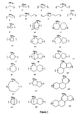
- the structures of some of the alkylene moieties are given in Figure 1 , where R b is independently selected from hydrogen, hydroxy, hydroxyalkyl, alkyl, alkylaryl, ethers, halo, haloalkyls, carboxylic acid, ester of carboxylic acid, alkylcarbonates, alkylaldehydes, ketones, and other known substituents, and m is the number of substituents. The number, m, may range from 1-40, depending on the size of the unit.
- Different or the same alkylene group may be connected together to form a block unit and this block unit may be then connected to the unit comprising the fused aromatic rings.
- a block copolymer may be formed, in some case a random copolymer may be formed, and in other cases alternating copolymers may be formed.
- the copolymer may comprise at least 2 different aliphatic comonomeric units.
- the copolymer may comprise at least 2 different fused aromatic moieties.
- the polymer may comprise at least 2 different aliphatic comonomeric units and at least 2 different fused aromatic moieties.
- the polymer comprises at least one fused aromatic unit and aliphatic unit(s) free of aromatics.
- the cycloalkylene group is selected from a biscycloalkylene group, a triscycloalkylene group, a tetracycloalkylene group in which the linkage to the polymer backbone is through the cyclic structure and these cyclic structures form either a monocyclic, a dicyclic or tricyclic structure.
- the polymer comprises a unit with the fused aromatic rings and a unit with an aliphatic moiety in the backbone, where the aliphatic moiety is a mixture of unsubstituted alkylene and a substituted alkylene where the substituent may be hydroxy, carboxylic acid, carboxylic ester, alkylether, alkoxy alkyl, alkylaryl, ethers, haloalkyls, alkylcarbonates, alkylaldehydes, ketones and mixtures thereof.
- alkylene may be linear alkylene, branched alkylene or cycloaliphatic alkylene (cycloalkylene).
- Alkylene groups are divalent alkyl groups derived from any of the known alkyl groups and may contain up to about 20-30 carbon atoms.
- the alkylene monomeric unit can comprise a mixture of cycloalkene, linear and/or branched alkylene units, such as -CH 2 -cyclohexanyl-CH 2 -).
- alkylene groups may also include an alkylene substituted with (C 1 -C 20 )alkyl groups in the main carbon backbone of the alkylene group.
- Alkylene groups can also include one or more alkene and or alkyne groups in the alkylene moiety, where alkene refers to a double bond and alkyne refers to a triple bond.
- the unsaturated bond(s) may be present within the cycloaliphatic structure or in the linear or branched structure, but preferably not in conjugation with the fused aromatic unit.
- the alkyene moiety may itself be an unsaturated bond comprising a double or triple bond.
- the alkylene group may contain substituents such as, hydroxy, hydroxyalkyl, carboxylic acid, carboxylic ester, alkylether, alkoxy alkyl, alkylaryl, ethers, haloalkyls, alkylcarbonates, alkylaldehydes, and ketones.
- the alkylene backbone may have aryl substituents.
- an alkylene moiety is at least a divalent hydrocarbon group, with possible substituents.
- a divalent acyclic group may be methylene, ethylene, n-or iso-propylene, n-iso, or tert-butylene, linear or branched pentylene, hexylene, heptylene, octylene, decylene, dodecylene, tetradecylene and hexadecylene.
- a divalent cyclic alkylene group may be monocyclic or multicyclic containing many cyclic rings.
- Monocyclic moieties may be exemplified by 1,2- or 1,3-cyclopentylene, 1,2-, 1,3-, or 1,4-cyclohexylene, and the like.
- Bicyclo alkylene groups may be exemplified by bicyclo[2.2.1 ]heptylene, bicyclo[2.2.2]octylene, bicyclo[3.2.1 ]octylene, bicyclo[3.2.2]nonylene, and bicyclo[3.3.2]decylene, and the like.
- Cyclic alkylenes also include spirocyclic alkylene in which the linkage to the polymer backbone is through the cyclo or a spiroalkane moiety, as illustrated in structure 8,
- Divalent tricyclo alkylene groups may be exemplified by tricyclo[5.4.0.0. 2.9 ]undecylene, tricyclo[4.2.1.2. 7.9 ]undecylene, tricyclo[5.3.2.0. 4, 9]dodecylene, and tricyclo[5.2.1.0. 2.6 ]decylene.
- Diadamantyl is an example of an alkylene. Further examples of alkylene moieties are given in Figure 1 , which may be in the polymer alone or as mixtures or repeat units.
- the alkyl group is generally aliphatic and may be cyclic or acyclic (i.e. noncyclic) alkyl having the desirable number of carbon atoms and valence Suitable acyclic groups can be methyl, ethyl, n-or iso-propyl, n-,iso, or tert-butyl, linear or branched pentyl, hexyl, heptyl, octyl, decyl, dodecyl, tetradecyl and hexadecyl. Unless otherwise stated, alkyl refers to 1-20 carbon atom moeity.
- the cyclic alkyl groups may be mono cyclic or polycyclic.
- Suitable example of monocyclic alkyl groups include substituted cyclopentyl, cyclohexyl, and cycloheptyl groups.
- the substituents may be any of the acyclic alkyl groups described herein.
- Suitable bicyclic alkyl groups include substituted bicyclo[2.2.1]heptane, bicyclo[2.2.2]octane, bicyclo[3.2.1 ]octane, bicyclo[3.2.2]nonane, and bicyclo[3.3.2]decane, and the like.
- Examples of tricyclic alkyl groups include tricyclo[5.4.0.0. 2,9 ]undecane, tricyclo[4.2.1.2. 7,9 ]undecane, tricyclo[5.3.2.0. 4, 9]dodecane, and tricyclo[5.2.1.0. 2,6 ]decane.
- the cyclic alkyl groups may have any of the acyclic alkyl groups or aryl groups as substituent
- Aryl groups contain 6 to 24 carbon atoms including phenyl, tolyl, xylyl, naphthyl, anthracyl, biphenyls, bis-phenyls, tris-phenyls and the like. These aryl groups may further be substituted with any of the appropriate substituents e.g. alkyl, alkoxy, acyl or aryl groups mentioned hereinabove. Similarly, appropriate polyvalent aryl groups as desired may be used in this invention. Representative examples of divalent aryl groups include phenylenes, xylylenes, naphthylenes, biphenylenes, and the like.
- Alkoxy means straight or branched chain alkoxy having 1 to 20 carbon atoms, and includes, for example, methoxy, ethoxy, n-propoxy, isopropoxy, n-butoxy, isobutoxy, tert-butoxy, pentyloxy, hexyloxy, heptyloxy, octyloxy, nonanyloxy, decanyloxy, 4-methylhexyloxy, 2-propylheptyloxy, and 2-ethyloctyloxy.
- Aralkyl means aryl groups with attached substituents.
- the substituents may be any such as alkyl, alkoxy, acyl, etc.
- Examples of monovalent aralkyl having 7 to 24 carbon atoms include phenylmethyl, phenylethyl, diphenylmethyl, 1,1- or 1,2-diphenylethyl, 1,1-, 1,2-, 2,2-, or 1,3-diphenylpropyl, and the like.
- Appropriate combinations of substituted aralkyl groups as described herein having desirable valence may be used as a polyvalent aralkyl group.
- the polymer comprises at least one unit with 3 or more fused aromatic rings in the backbone of the polymer, at least one unit with an aliphatic moiety in the backbone of the polymer, and at least one unit comprising a group selected from a substituted phenyl, unsubstituted phenyl, unsubstituted biphenyl, substituted biphenyl, substituted naphthyl and unsubstituted naphthyl.
- the fused aromatic ring with 3 or more aromatic units and the aliphatic moiety are as described herein.
- the polymer may be free of any pendant moiety containing nitrogen.
- the polymer may be free of any pendant moiety containing nitrogen, in one embodiment.
- the substituents on the phenyl, biphenyl and naphthyl may be at least one polar group that increases the solubility of the polymer in a polar solvent, such as ethyl lactate, PGMEA and PGME.
- substituents are hydroxy, hydroxyalkyl, halide, etc.
- the phenyl, biphenyl or naphthyl group may form part of the backbone or be attached to the polymer backbone directly or through a linking group such as a adamantyl group, ethylene group, etc., and where examples of monomeric units may be derived from monomers such as hydroxystyrene, phenol, naphthol, and hydroxynaphthylene.
- the incorporation of phenol and/or naphthol moieties in the polymer backbone is preferred for films with high carbon content.
- the amount of the substituted phenyl, unsubstituted phenyl, unsubstituted biphenyl, substituted biphenyl, substituted naphthyl or unsubstituted naphthyl may range from about 5 mole% to about 50 mole% in the polymer, or from about 20 mole% to about 45 mole% in the polymer.
- Compositions comprising polymers of the present invention which further comprise phenolic and/or naphthol groups are useful when the coating solvent of the composition is PGMEA or a mixture of PGMEA and PGME.
- compositions comprising polymers of the present invention which further comprise phenolic and/or naphthol groups are also useful when the excess composition is to be removed with an edgebead remover, especially where the edgebead remover comprises PGMEA or a mixture of PGMEA and PGME.
- edgebead removers comprising ethyl lactate may also be used.
- the composition comprises a polymer comprising at least one unit with 3 or more fused aromatic rings in the backbone of the polymer, at least one unit with an aliphatic moiety in the backbone of the polymer, and at least one unit comprising a group selected from phenol, naphthol and mixtures thereof. Pyrene, as the fused aromatic moiety, may be used.
- the composition may further contain a solvent comprising PGMEA.
- Other additives, as described herein, may be used in the composition.
- the polymer of the present novel composition may be synthesized by reacting a) at least one aromatic compound comprising 3 or more fused aromatic rings capable of electrophilic substitution such that the fused rings form the backbone of the polymer, with b) at least one essentially cycloaliphatic compound.
- the aromatic compound may be selected from monomers that provide the desired aromatic unit, more specifically structures 1-6 or 1'-6' or equivalents, and may be further selected from compounds such as anthracene, phenanthrene, pyrene, fluoranthene, and coronene triphenylene.
- the fused aromatic rings provide at least 2 reactive hydrogens which are sites for electrophilic substitution.
- the aliphatic compound is an essentially cyclic substituted or unsubstituted alkyl compound capable of forming the cycloaliphatic unit in the polymer, and also capable of forming a carbocation in the presence of an acid, and may be selected from compounds such as aliphatic diol, aliphatic triol, aliphatic tetrol, aliphatic alkene, aliphatic diene, etc. Any compound that is capable of forming the alkylene unit in the polymer of the novel composition as described previously may be used.
- the aliphatic monomer may be exemplified by 1,3-adamantanediol, 1,5-adamantanediol, 1,3,5-adamantanetriol, 1,3,5-cyclohexanetriol, and dicyclopentadiene.
- Other monomers may also be added into the reaction mixture, such as phenol and/or naphthol.
- the reaction is catalysed in the presence of a strong acid, such as a sulfonic acid. Any sulfonic acid may be used, examples of which are triflic acid, nonafluorobutane sulfonic acid, bisperfluoroalkylimides, trisperfluoroalkylcarbides, or other strong nonnucleophilic acids.
- the reaction may be carried out with or without a solvent. If a solvent is used then any solvent capable of dissolving the solid components may be used, especially one which is nonreactive towards strong acids; solvents such as chloroform, bis(2-methoxyethyl ether), nitrobenzene, methylene chloride, and diglyme may be used.
- the reaction may be mixed for a suitable length of time at a suitable temperature, till the polymer is formed.
- the reaction time may range from about 3 hours to about 24 hours, and the reaction temperature may range from about 80°C to about 180°C.
- the polymer is isolated and purified in appropriate solvents, such as methanol, cyclohexanone, etc., through precipitation and washing.
- the weight average molecular weight of the polymer can range from about 1000 to about 50,000, or about 1300 to about 20,000.
- the refractive indices of the polymer, n (refractive index) and k (absorption) can range from about 1.3 to about 2.0 for the refractive index and about 0.05 to about 1.0 for the absorption at the exposure wavelength used, such as 193 nm.
- the carbon content of the polymer is greater than 80% as measured by elemental analysis, preferably greater than 85%.
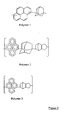
- the polymer of the present novel composition may have the structural units shown in Figure 2 .
- the novel composition of the present invention comprises the polymer and may further comprise a crosslinker.
- the crosslinker is a compound that can act as an electrophile and can, alone or in the presence of an acid, form a carbocation.
- compounds containing groups such as alcohol, ether, ester, olefin, methoxymethylamino, methoxymethylphenyl and other molecules containing multiple electrophilic sites, are capable of crosslinking with the polymer.
- Examples of compounds which can be crosslinkers are, 1,3 adamantane diol, 1,3, 5 adamantane triol, polyfunctional reactive benzylic compounds, tetramethoxymethyl-bisphenol (TMOM-BP) of structure (9), aminoplast crosslinkers, glycolurils, Cymels, Powderlinks, etc.
- TMOM-BP tetramethoxymethyl-bisphenol
- the novel composition comprising the polymer may also comprise an acid generator, and optionally the crosslinker.
- the acid generator can be a thermal acid generator capable of generating a strong acid upon heating.
- the thermal acid generator (TAG) used in the present invention may be any one or more that upon heating generates an acid which can react with the polymer and propagate crosslinking of the polymer present in the invention, particularly preferred is a strong acid such as a sulfonic acid.
- the thermal acid generator is activated at above 90°C and more preferably at above 120°C, and even more preferably at above 150°C.
- thermal acid generators are metal-free sulfonium salts and iodonium salts, such as triarylsulfonium, dialkylarylsulfonium, and diarylakylsulfonium salts of strong non-nucleophilic acids, alkylaryliodonium, diaryliodonium salts of strong non-nucleophilic acids; and ammonium, alkylammonium, dialkylammonium, trialkylammonium, tetraalkylammonium salts of strong non nucleophilic acids.
- metal-free sulfonium salts and iodonium salts such as triarylsulfonium, dialkylarylsulfonium, and diarylakylsulfonium salts of strong non-nucleophilic acids, alkylaryliodonium, diaryliodonium salts of strong non-nucleophilic acids; and ammonium, alkylammonium, dialkylammoni
- covalent thermal acid generators are also envisaged as useful additives for instance 2-nitrobenzyl esters of alkyl or arylsulfonic acids and other esters of sulfonic acid which thermally decompose to give free sulfonic acids.
- Examples are diaryliodonium perfluoroalkylsulfonates, diaryliodonium tris(fluoroalkylsulfonyl)methide, diaryliodonium bis(fluoroalkylsulfonyl)methide, diarlyliodonium bis(fluoroalkylsulfonyl)imide, diaryliodonium quaternary ammonium perfluoroalkylsulfonate.
- labile esters 2-nitrobenzyl tosylate, 2,4-dinitrobenzyl tosylate, 2,6-dinitrobenzyl tosylate, 4-nitrobenzyl tosylate; benzenesulfonates such as 2-trifluoromethyl-6-nitrobenzyl 4-chlorobenzenesulfonate, 2-trifluoromethyl-6-nitrobenzyl 4-nitro benzenesulfonate; phenolic sulfonate esters such as phenyl, 4-methoxybenzenesulfonate; quaternary ammonium tris(fluoroalkylsulfonyl)methide, and quaternaryalkyl ammonium bis(fluoroalkylsulfonyl)imide, alkyl ammonium salts of organic acids, such as triethylammonium salt of 10-camphorsulfonic acid.
- benzenesulfonates such as 2-trifluoromethyl-6-
- TAG aromatic (anthracene, naphthalene or benzene derivatives) sulfonic acid amine salts
- TAG aromatic (anthracene, naphthalene or benzene derivatives) sulfonic acid amine salts
- the TAG will have a very low volatility at temperatures between 170-220°C.
- TAGs are those sold by King Industries under Nacure and CDX names.
- TAG's are Nacure 5225, and CDX-2168E, which is a dodecylbenzene sulfonic acid amine salt supplied at 25-30% activity in propylene glycol methyl ether from King Industries, Norwalk, Conn. 06852, USA.
- the novel composition may further contain at least one of the known photoacid generators, examples of which without limitation, are onium salts, sulfonate compounds, nitrobenzyl esters, triazines, etc.
- the preferred photoacid generators are onium salts and sulfonate esters of hydoxyimides, specifically diphenyl iodonium salts, triphenyl sulfonium salts, dialkyl iodonium salts, triakylsulfonium salts, and mixtures thereof. These photoacid generators are not necessarily photolysed but are thermally decomposed to form an acid.
- the antireflection coating composition of the present invention contains 1 weight% to 15 weight% of the fused aromatic polymer, and preferably 4 weight% to 10 weight%, of total solids.
- the crosslinker when used in the composition, may be present at 1 weight% to 30 weight% of total solids.
- the acid generator may be incorporated in a range from 0.1 to 10 weight % by total solids of the antireflective coating composition, preferably from 0.3 to 5 weight % by solids, and more preferably 0.5 to 2.5 weight % by solids.
- Suitable solvents for the antireflective coating composition may include, for example, a glycol ether derivative such as ethyl cellosolve, methyl cellosolve, propylene glycol monomethyl ether, diethylene glycol monomethyl ether, diethylene glycol monoethyl ether, dipropylene glycol dimethyl ether, propylene glycol n-propyl ether, or diethylene glycol dimethyl ether; a glycol ether ester derivative such as ethyl cellosolve acetate, methyl cellosolve acetate, or propylene glycol monomethyl ether acetate; carboxylates such as ethyl acetate, n-butyl acetate and amyl acetate; carboxylates of di-basic acids such as diethyloxylate and diethylmalonate; dicar
- the antireflective coating composition comprises the polymer, and other components may be added to enhance the performance of the coating, e.g. monomeric dyes, lower alcohols (C 1 -C 6 alcohols), surface leveling agents, adhesion promoters, antifoaming agents, etc.
- the antireflective film is coated on top of the substrate and is also subjected to dry etching, it is envisioned that the film is of sufficiently low metal ion level and of sufficient purity that the properties of the semiconductor device are not adversely affected. Treatments such as passing a solution of the polymer through an ion exchange column, filtration, and extraction processes can be used to reduce the concentration of metal ions and to reduce particles.
- the absorption parameter (k) of the novel composition ranges from about 0.05 to about 1.0, preferably from about 0.1 to about 0.8 at the exposure wavelength, as derived from ellipsometric measurements.
- the composition has a k value in the range of about 0.2 to about 0.5 at the exposure wavelength.
- the refractive index (n) of the antireflective coating is also optimized and can range from about 1.3 to about 2.0, preferably 1.5 to about 1.8.
- the n and k values can be calculated using an ellipsometer, such as the J. A. Woollam WVASE VU-32 TM Ellipsometer. The exact values of the optimum ranges for k and n are dependent on the exposure wavelength used and the type of application. Typically for 193 nm the preferred range for k is about 0.05 to about 0.75, and for 248 nm the preferred range for k is about 0.15 to about 0.8.
- the carbon content of the novel antireflective coating composition is greater than 80 weight% or greater than 85 weight% as measured by elemental analysis.
- the antireflective coating composition is coated on the substrate using techniques well known to those skilled in the art, such as dipping, spin coating or spraying.
- the film thickness of the antireflective coating ranges from about 15 nm to about 400 nm.
- the coating is further heated on a hot plate or convection oven for a sufficient length of time to remove any residual solvent and induce crosslinking, and thus insolubilizing the antireflective coating to prevent intermixing between the antireflective coating and the layer to be coated above it.
- the preferred range of temperature is from about 90°C to about 280°C.
- antireflective coatings may be coated above the coating of the present invention.
- an antireflective coating which has a high resistance to oxygen etching, such as one comprising silicon groups, such as siloxane, functionalized siloxanes, silsesquioxanes, or other moieties that reduce the rate of etching, etc., is used so that the coating can act as a hard mask for pattern transference.
- the silicon coating can be spin coatable or chemical vapor deposited.
- the substrate is coated with a first film of the novel composition of the present invention and a second coating of another antireflective coating comprising silicon is coated above the first film.
- the second coating can have an absorption (k) value in the range of about 0.05 and 0.5.
- a film of photoresist is then coated over the second coating.
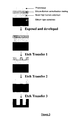
- the imaging process is exemplified in Figure 3 .
- a film of photoresist is coated on top of the uppermost antireflective coating and baked to substantially remove the photoresist solvent.
- An edge bead remover may be applied after the coating steps to clean the edges of the substrate using processes well known in the art.
- the substrates over which the antireflective coatings are formed can be any of those typically used in the semiconductor industry. Suitable substrates include, without limitation, low dielectric constant materials, silicon, silicon substrate coated with a metal surface, copper coated silicon wafer, copper, aluminum, polymeric resins, silicon dioxide, metals, doped silicon dioxide, silicon nitride, tantalum, polysilicon, ceramics, aluminum/copper mixtures; gallium arsenide and other such Group III/V compounds.
- the substrate may comprise any number of layers made from the materials described above.
- Photoresists can be any of the types used in the semiconductor industry, provided the photoactive compound in the photoresist and the antireflective coating substantially absorb at the exposure wavelength used for the imaging process.
- Photoresists for 248 nm have typically been based on substituted polyhydroxystyrene and its copolymers/onium salts, such as those described in US 4,491,628 and US 5,350,660 .
- photoresists for exposure at 193 nm and 157 nm require non-aromatic polymers since aromatics are opaque at this wavelength.
- US 5,843,624 and US 6,866,984 disclose photoresists useful for 193 nm exposure.
- polymers containing alicyclic hydrocarbons are used for photoresists for exposure below 200 nm.
- Alicyclic hydrocarbons are incorporated into the polymer for many reasons, primarily since they have relatively high carbon to hydrogen ratios which improve etch resistance, they also provide transparency at low wavelengths and they have relatively high glass transition temperatures.
- US 5,843,624 discloses polymers for photoresist that are obtained by free radical polymerization of maleic anhydride and unsaturated cyclic monomers. Any of the known types of 193nm photoresists may be used, such as those described in US 6,447,980 and US 6,723,488 , and incorporated herein by reference.
- One class of 157 nm fluoroalcohol photoresists is derived from polymers containing groups such as fluorinated-norbornenes, and are homopolymerized or copolymerized with other transparent monomers such as tetrafluoroethylene ( US 6,790,587 , and US 6,849,377 ) using either metal catalyzed or radical polymerization. Generally, these materials give higher absorbencies but have good plasma etch resistance due to their high alicyclic content.
- the photoresist is imagewise exposed.
- the exposure may be done using typical exposure equipment.
- the exposed photoresist is then developed in an aqueous developer to remove the treated photoresist.
- the developer is preferably an aqueous alkaline solution comprising, for example, tetramethyl ammonium hydroxide (TMAH).
- TMAH tetramethyl ammonium hydroxide
- the developer may further comprise surfactant(s).
- An optional heating step can be incorporated into the process prior to development and after exposure.
- the process of coating and imaging photoresists is well known to those skilled in the art and is optimized for the specific type of photoresist used.
- the patterned substrate can then be dry etched with an etching gas or mixture of gases, in a suitable etch chamber to remove the exposed portions of the antireflective film or multiple layers of antireflective coatings, with the remaining photoresist acting as an etch mask.
- etching gases are known in the art for etching organic antireflective coatings, such as those comprising O 2 , CF 4 , CHF 3 , Cl 2 , HBr, SO 2 , CO, etc.
- the refractive index (n) and the absorption (k) values of the antireflective coating in the Examples below were measured on a J. A. Woollam VASE32 ellipsometer.
- the molecular weight of the polymers was measured on a Gel Permeation Chromatograph.
- a solution was prepared consisting of 1.8157 grams (8.977X10⁻³ moles) of pyrene, 1.51 grams (8.977X10 -3 moles) of 1,3-adamantanediol and 0.15 grams of triflic acid dissolved in 10 ml of nitrobenzene, which was placed in a round bottomed flask which was purged slowly with nitrogen. The reaction was heated in an oil bath to 100°C and left to stir at this temperature overnight. After this time the reaction mixture was precipitated into 500 ml of methanol. The recovered solid was air dried and then dissolved into 10 ml of cyclohexanone and precipitated into methanol one more time.
- the material isolated from this precipitation was dissolved into 10 ml of cyclohexanone and precipitated into 500 ml of hexane. After drying, 1.94 grams of polymer was recovered (58% yield).
- the polymer had a weight average molecular weight Mw of 2,200 and polydispersity of 2.
- the Proton NMR was: 1-3.2 ppm (adamantane unit), 7.3-9.2 ppm (pyrene unit), with a ratio of 3.75 to 5 in integration indicating that there was an excess of adamantyl derived units.
- a film was spun from a mixture of the polymer and cyclohexanone at 5 weight%, and baked at 110°C.
- a solution was prepared by using the polymer of example 1 and formulated as a 2.5 wt % solids solution additionally consisting of 3 wt % diphenyliodonium nonaflate (thermal acid generator, TAG) and 10% TMOM-BP (cross-linker), in cyclohexanone.
- This solution was spin coated at 1,500 rpm for 3 minutes and baked at 250°C for 1 min. After curing at 250°C for 1 min, the film was uneffected by cyclohexanone, PGMEA, PGME or a mixture of 70/30 PGMEA and PGME in a 1 minute soak test. However, prior to this cure, edge bead removal can be done with cyclohexanone.
- the solvent was evaporated using rotary evaporator to very concentrated syrup and drowned into 1.5 liter methanol. A precipitate was formed, and the solid was filtered and dried. The polymer was redissolved in 74g chloroform and reprecipitated from 1.5 liter hexane, filtered through Buckner funnel and dried in the vacuum oven. The yield was 65%, weight average molecular weight was Mw 1890, and polydispersity was 1.85.
- a formulation was prepared as a 5 wt % solids solution containing the polymer of example 3 (2.5g), 1.0g of dodecylbenzenesulfonic acid (DBSA) as a 10% solution in 70:30 PGMEA:PGME solution and 0.25g of TMOM-BP (cross-linker), in cyclohexanone.
- This solution was spun at 1,500 rpm for 3 minutes, and baked at 250°C for 1 minute. After curing at 250°C for 1 minute, the film was unaffected by cyclohexanone, PGMEA, PGME or a mixture of 70/30 PGMEA and PGME in a 1 min soak test. However, prior to this cure, edge bead removal can be done with a mixture of 70/30 PGMEA and PGME.
- Example 3 was repeated using as the monomers, pyrene (20.2g, 0.1 mole) and 1,3-adamantane diol (16.8g, 0.1 mole).
- the polymer was obtained with a yield of 60% yield, weight average molecular weight Mw of 1857, and polydispersity of 1.9.
- a formulation was prepared as a 5 wt % solids containing the polymer of example 5 (2.5g).
- 1.0g of DBSA as a 10% solution in 70:30 PGMEA:PGME solution and 0.25g of TMOM-BP (cross-linker), in cyclohexanone.
- This solution was spun at 1,500 rpm for 3 minutes, baked at 250°C for 1 minute. After curing the film at 250°C for 1 min., the film was unaffected by cyclohexanone, PGMEA, PGME or a mixture of 70/30 PGMEA and PGME in a 1 min soak test. However, prior to this cure edge bead removal can be done with a mixture of 70/30 PGMEA and PGME.
- the dry polymer was dissolved in chloroform and transferred to a separating funnel and then water (500g) and 3.6g of TMAH (25% in water) were added. The organic layer was washed with DI water three times. The solution was concentrated by evaporating the chloroform in a rotary evaporator and precipitated from 2.0 liters of hexane, filtered through a Buckner funnel and dried in the vacuum oven. The yield of the polymer was 55%, weight average molecular weight Mw was 1312, and polydispersity was 1.72.
- a formulation was prepared as a 5 wt % solids containing the polymer of example 7 (2.5g), 1.0g of DBSA as a 10% solution in 70:30 PGMEA:PGME solution and 0.25g of TMOM-BP (cross-linker), in 46.35g of cyclohexanone.
- This solution was spun at 1,500 rpm for 3 minutes, and baked at 250°C for 1 min. After curing the film at 250°C for 1 min, the film was unaffected by cyclohexanone, PGMEA, PGME or a mixture of 70/30 PGMEA and PGME in a 1 min soak test. However, prior to this cure edge bead removal can be done with a mixture of 70/30 PGMEA and PGME.
- Example 7 was repeated with pyrene (20.2g, 0.1 mole), 1,3-adamantane diol (16.8g, 0.1 mole) and a polymer was obtained with a yield of 50%, molecular weight Mw 1312, and polydispersity of 1.61.
- a formulation was prepared as a 5 wt % solids containing polymer of example 9 (2.5g), 1.0g of DBSA as a 10% solution in 70:30 PGMEA:PGME solution and 0.25g of TMOM-BP (cross-linker), in 46.25g of cyclohexanone.
- This solution was spun at 1,500 rpm for 3 minutes, baked at 250°C for 1 min. After curing the film at 250°C for 1 min, the film was unaffected by cyclohexanone, PGMEA, PGME or a mixture of 70/30 PGMEA and PGME, in a 1 min soak test. However, prior to this cure edge bead removal can be done with a mixture of 70/30 PGMEA and PGME.
- Optical Measurements 0.125 g of polymer (from example 11) and 9.875 g of cyclohexanone were weighed into a 20 ml vial. The mixture was allowed to mix until all the materials become soluble. The homogeneous solution was filtered with 0.2 ⁇ m membrane filter. This filtered solution was spin-coated on a 4" silicon wafer at 2000 rpm. The coated wafer was baked on a hotplate at 250 °C for 60 seconds. Then, n and k values were measured with a VASE Ellipsometer manufactured by J. A. Woollam Co. Inc. The optical constants n and k of the film were 1.63 and 0.37 respectively for 193 nm radiation.
- Optical Measurement 0.125 g of polymer and 9.875 g of cyclohexanone were weighed into a 20 ml vial. The mixture was allowed to mix until all the materials become soluble. The homogeneous solution was filtered with 0.2 ⁇ m membrane filter. This filtered solution was spin-coated on a 4" silicon wafer at 2000 rpm. The coated wafer was baked on a hotplate at 250°C for 60 seconds. Then, n and k values were measured with a VASE Ellipsometer manufactured by J. A. Woollam Co. Inc. The optical constants n and k of the film were 1.62 and 0.34 respectively for 193 nm radiation.
- Table 1 provides a summary of the synthesis and results for Example 11 and 12.
- Table 1 Synthesis, preparation and results for Example 11 and 12
- Soak Test 1.00g polymer (from example 11), 0.1 g TMOM-BP, 0.4g of dodecylbenzenesulfonic acid:triethylamine salt (DBSA:E, TAG) as a 10% solution in 70:30 PGMEA:PGME,18.5g cyclohexanone were weighed into a 30ml vial. The mixture was allowed to mix until all the materials become soluble. The homogeneous solution was filtered with 0.2 ⁇ m membrane filter. This filtered solution was spin-coated on a 4" silicon wafer at 2000 rpm. The coated wafer was baked on hotplate at 250 °C for 60 seconds. After bake, the wafer was cooled to room temp and partially submerged in PGME for 30 seconds. The two halves of the wafer were examined for changes in film thickness. As a result of effective crosslinking, no film loss was observed.
- DBSA:E, TAG dodecylbenzenesulfonic acid:triethyl
- Soak Test 1.00g polymer (from example 12), 0.1 g TMOM-BP, 0.4g of DBSA:E TAG as a 10% solution in 70:30 PGMEA:PGME and 18.5g cyclohexanone were weighed into a 30ml vial. The mixture was allowed to mix until all the materials became soluble. The homogeneous solution was filtered with 0.2 ⁇ m membrane filter. This filtered solution was spin-coated on a 4" silicon wafer at 2000 rpm. The coated wafer was baked on hotplate at 250°C for 60 seconds. After bake, the wafer was cooled to room temp and partially submerged in PGME for 30 seconds. The two halves of the wafer are examined for changes in film thickness. As a result of effective crosslinking, no film loss is observed.
- Optical Measurements 0.125 g of the above polymer and 9.875 g of cyclohexanone were weighed into a 20 ml vial. The mixture was allowed to mix until all the materials become soluble. The homogeneous solution was filtered with 0.2 ⁇ m membrane filter. This filtered solution was spin-coated on a 4" silicon wafer at 2000 rpm. The coated wafer was baked on a hotplate at 250°C for 60 seconds. Then, n and k values were measured with a VASE Ellipsometer manufactured by J. A. Woollam Co. Inc. The optical constants n and k of the film were 1.58 and 0.29 respectively for 193 nm radiation.
- Example 15 was repeated with 0.1 mole of pyrene, and the results are given in Table 2, for Example 15 and 16.
- Table 2 Synthesis, preparation and results for Example 15 and 16
- Soak Test 1.00g polymer (from example 15), 0.1 g TMOM-BP, 0.4g of DBSA:E TAG as a 10% solution in 70:30 PGMEA:PGME and 18.5g cyclohexanone were weighed into a 30ml vial. The mixture was allowed to mix until all the materials become soluble. The homogeneous solution was filtered with 0.2 ⁇ m membrane filter. This filtered solution was spin-coated on a 4" silicon wafer at 2000 rpm. The coated wafer was baked on hotplate at 250 °C for 60 seconds. After bake, the wafer was cooled to room temp and partially submerged in PGME for 30 seconds. The two halves of the wafer are examined for changes in film thickness. With effective crosslinking, no film loss was observed.
- Soak Test 1.00g polymer (from example 16), 0.1 g TMOM-BP, 0.4g of DBSA:E TAG as a 10% solution and 18.5g cyclohexanone were weighed into a 30ml vial. The mixture was allowed to mix until all the materials became soluble. The homogeneous solution was filtered with 0.2 ⁇ m membrane filter. This filtered solution was spin-coated on a 4" silicon wafer at 2000 rpm. The coated wafer was baked on hotplate at 250°C for 60 seconds. After bake, the wafer was cooled to room temp and partially submerged in PGME for 30 seconds. The two halves of the wafer are examined for changes in film thickness. With effective crosslinking, no film loss is observed.
- a soak test in the solvents shows that the novel coating film is crosslinked and insoluble in the typical solvents used to form the coating of the layer coated above the novel layer.
- the photoresist can be coated above the antireflective coating(s) and imaged.
- the antireflective coating(s) can then be dry etched.
- Blanket etch rates of the coatings of the antireflective coatings were measured on a NE-5000 N (ULVAC) using both an oxidative and a fluorocarbon-rich etch condition outlined in Table 3.
- the antireflective coating films (Example 10 and 13) and the 193nm photoresist AZ® AX1120P (available from AZ® Electronic Materials, Somerville, New Jersey, USA) with about 250 nm thickness were coated on 8in silicon wafers, baked at 240°C for 1 minute.
- Individual film thickness measuring programs on a Nanospec 8000 using Cauchy's material-dependent constants derived by VASE analysis of the films and a 5 point inspection were performed before and after a 20 second etch. Etch rates were then calculated by taking the film thickness difference divided by etch times.
- Etch rate masking potential is revealed in the etch rate data in Table 4 and 5 below. Both pyrene resins reveal they are much more etch resistant over 193nm photoresist.
- Table 3 Etch conditions used in the blanket etch rate studies Etch condition Oxidative condition Fluorocarbon condition Gas Cl 2 /O 2 /Ar, 24/6/25 SCCM CF 4 /O 2 /Ar, 50/20/150 SCCM Process Pressure 1.6Pa 5Pa Plate temperature: 20°C; RF power: 500 W with 50 W bias.
- Table 4 Etch rate using Oxidative condition.
- a 8in wafer coated with 500nm of chemically vapor deposited SiO 2 is coated with 300nm of coating from example 10 using the same process conditions as outlined in the example for film preparation.
- S14 a silicon containing bottom antireflective coating, is coated over the coating from Example 10, and baked at 240°C for 60 seconds to cure.
- AZ ArF1120P photoresist is then coated on top and soft baked at 100°C for 30 seconds. The photoresist is exposed imagewise using a 193nm exposure tool, baked to amplify the latent image at 120°C and then developed in 0.26N aqueous TMAH solution.
- the image is transferred into the SiO 2 by performing three image transfer etch steps.
- the first is image transfer from the photoresist into the Si- bottom antireflective coating which uses a fluorocarbon type of etch chemistry which can be similar to the fluorocarbon condition in Table 3.
- the second is transfer of the Si- bottom antireflective coating image into the pyrene coating of Example 10, which uses an oxygen etch chemistry which can be similar to the fluorocarbon condition in Table 3.
- the last transfer is from the pyrene coating into the SiO 2 substrate and uses a fluorocarbon type of etch chemistry similar to fluorocarbon condition in Table 3. In between transfer steps a mild isotropic strip of the previous mask may be done.
- the reaction mixture was drowned into 1.4 liters of methanol, a precipitate formed which was filtered through a Buckner Funnel and dried under vacuum.
- the crude polymer was redissolved in cyclopentyl methyl ether and washed with water three times and then mixed with 1.5 liters of hexane and a precipitate was formed.
- the mixture was filtered, washed with hexane and dried under vacuum, 9.8g of polymer was formed with a 45% yield.
- N & K Measurements for Polymer Examples 21-23 0.125 g of polymer (from example 21 to 23) and 9.875 g of ArF Thinner(70:30 PGMEA:PGME) were weighed into a 20 mL vial. The mixture was allowed to mix until all the materials become soluble. The homogeneous solution was filtered with 0.2 ⁇ m membrane filter. This filtered solution was spin-coated on a 4" silicon wafer at 2000 rpm. The coated wafer was baked on hotplate at 250°C for 60 seconds. Then, n and k values were measured with a VASE Ellipsometer manufactured by J. A. Woollam Co. Inc. The optical constants n and k of the film for 193 nm radiation are shown in Table 6, n/k column.
- the reaction mixture was mixed with 1.4 liters of methanol and a precipitate was formed.
- the precipitate was filtered through a Buckner Funnel and dried under vacuum.
- the crude polymer was redissolved in cyclopentyl methyl ether, washed with water three times and then mixed in 1.5 liters of hexane. A precipitate was formed, filtered, washed with hexane and dried under vacuum. 24.3g of the polymer was obtained with a yield of 47% yield.
- the polymer had a weight average molecular weight, Mw, of 2204 and polydispersity of 2.02.
- Example 28 Synthesis of Poly(Pyrene-co-1-Naphthol-co-Phenol-co-Adamantane diol).
- the reaction mixture was mixed with 1.4 liters of methanol and a precipitate was formed.
- the precipitate was filtered through a Buckner Funnel and dried under vacuum.
- the crude polymer was redissolved in cyclopentyl methyl ether, washed with water three times and then drowned in 1.5 liters of hexane. A precipitate was formed, filtered, washed with hexane and dried under vacuum. 16.0g of the polymer was obtained with a yield of 37%, and the weight average molecular weight, Mw, was 3509 with a polydispersity of 1.49.
- Example 29 Synthesis of Poly(Anthracene-co-1-Naphthol-co-Phenol-co-Adamantane diol).
- Anthracene (8.9g -0.05 mole) and 1,3-adamantane diol (16.8g-0.1 mole), 1-naphthol (7.2g ⁇ 0.1mole) and phenol (9.4g 0.1 mole) were taken into a 500mL 4neck round bottomed flask equipped with stirrer, condenser, Dean Stark trap, Thermo watch and N 2 sweep. 140g of diglyme and 40g of cyclopentyl methyl ether were added, mixed for 10 minutes under nitrogen and 1.50g of trifluoromethane sulphonic acid was added. The flask was heated to reflux at 140°C, for three hours. After the reaction, the flask was cooled to room temperature.
- the reaction mixture was mixed with 1.4 liters of methanol and a precipitate was formed.
- the precipitate was filtered through a Buckner Funnel and dried under vacuum.
- the crude polymer was redissolved in cyclopentyl methyl ether, washed with water three times and then drowned in 1.5 liters of hexane. A precipitate was formed, filtered, washed with hexane and dried under vacuum. 20.0g of the polymer was obtained with a yield of 50%, and the weight average molecular weight, Mw, was 2946, with a polydispersity of 1.57.
- Example 7 Polymer of examples 27-29 Example/Polymer Example Mw/Pd Yield (%) n/k Soak test Polymer Solubility in ArF Thinner 30/27 2204/2.02 47 1.52/0.37 Good good 31/28 3509/1.49 37 1.47/0.50 Good good 32/29 2946/1.57 50 1.47/0.47 Good good Good in soak test means effective crosslinking of the film
Landscapes
- Chemical & Material Sciences (AREA)
- Engineering & Computer Science (AREA)
- Physics & Mathematics (AREA)
- General Physics & Mathematics (AREA)
- Organic Chemistry (AREA)
- Materials Engineering (AREA)
- Wood Science & Technology (AREA)
- Life Sciences & Earth Sciences (AREA)
- Architecture (AREA)
- Structural Engineering (AREA)
- Chemical Kinetics & Catalysis (AREA)
- Manufacturing & Machinery (AREA)
- Power Engineering (AREA)
- Computer Hardware Design (AREA)
- Microelectronics & Electronic Packaging (AREA)
- Condensed Matter Physics & Semiconductors (AREA)
- Materials For Photolithography (AREA)
- Exposure Of Semiconductors, Excluding Electron Or Ion Beam Exposure (AREA)
- Paints Or Removers (AREA)
- Organic Low-Molecular-Weight Compounds And Preparation Thereof (AREA)
- Polyoxymethylene Polymers And Polymers With Carbon-To-Carbon Bonds (AREA)
Applications Claiming Priority (3)
| Application Number | Priority Date | Filing Date | Title |
|---|---|---|---|
| US11/752,040 US20080292987A1 (en) | 2007-05-22 | 2007-05-22 | Antireflective Coating Composition Comprising Fused Aromatic Rings |
| US11/872,962 US8017296B2 (en) | 2007-05-22 | 2007-10-16 | Antireflective coating composition comprising fused aromatic rings |
| PCT/IB2008/001284 WO2008142546A2 (en) | 2007-05-22 | 2008-05-20 | An antireflective coating composition comprising fused aromatic rings |
Publications (2)
| Publication Number | Publication Date |
|---|---|
| EP2158279A2 EP2158279A2 (en) | 2010-03-03 |
| EP2158279B1 true EP2158279B1 (en) | 2012-08-29 |
Family
ID=39938209
Family Applications (1)
| Application Number | Title | Priority Date | Filing Date |
|---|---|---|---|
| EP08751011A Not-in-force EP2158279B1 (en) | 2007-05-22 | 2008-05-20 | An antireflective coating composition comprising fused aromatic rings |
Country Status (7)
| Country | Link |
|---|---|
| US (1) | US8017296B2 (enExample) |
| EP (1) | EP2158279B1 (enExample) |
| JP (1) | JP5327217B2 (enExample) |
| KR (1) | KR101532102B1 (enExample) |
| CN (1) | CN101679800B (enExample) |
| TW (1) | TWI424033B (enExample) |
| WO (1) | WO2008142546A2 (enExample) |
Families Citing this family (37)
| Publication number | Priority date | Publication date | Assignee | Title |
|---|---|---|---|---|
| KR100972900B1 (ko) * | 2007-12-31 | 2010-07-28 | 주식회사 하이닉스반도체 | 반도체 소자 및 그 제조 방법 |
| TWI452419B (zh) * | 2008-01-28 | 2014-09-11 | Az電子材料Ip股份有限公司 | 細微圖案光罩及其製造方法、及使用其之細微圖案形成方法 |
| US7989144B2 (en) * | 2008-04-01 | 2011-08-02 | Az Electronic Materials Usa Corp | Antireflective coating composition |
| US20090253080A1 (en) * | 2008-04-02 | 2009-10-08 | Dammel Ralph R | Photoresist Image-Forming Process Using Double Patterning |
| US20090253081A1 (en) * | 2008-04-02 | 2009-10-08 | David Abdallah | Process for Shrinking Dimensions Between Photoresist Pattern Comprising a Pattern Hardening Step |
| US7932018B2 (en) * | 2008-05-06 | 2011-04-26 | Az Electronic Materials Usa Corp. | Antireflective coating composition |
| US20100040838A1 (en) * | 2008-08-15 | 2010-02-18 | Abdallah David J | Hardmask Process for Forming a Reverse Tone Image |
| US20100119979A1 (en) * | 2008-11-13 | 2010-05-13 | Rahman M Dalil | Antireflective Coating Composition Comprising Fused Aromatic Rings |
| US20100119980A1 (en) * | 2008-11-13 | 2010-05-13 | Rahman M Dalil | Antireflective Coating Composition Comprising Fused Aromatic Rings |
| US20100151392A1 (en) * | 2008-12-11 | 2010-06-17 | Rahman M Dalil | Antireflective coating compositions |
| JP5085569B2 (ja) * | 2009-01-06 | 2012-11-28 | 信越化学工業株式会社 | レジスト下層膜形成方法およびこれを用いたパターン形成方法 |
| US8084186B2 (en) * | 2009-02-10 | 2011-12-27 | Az Electronic Materials Usa Corp. | Hardmask process for forming a reverse tone image using polysilazane |
| US20100316949A1 (en) * | 2009-06-10 | 2010-12-16 | Rahman M Dalil | Spin On Organic Antireflective Coating Composition Comprising Polymer with Fused Aromatic Rings |
| JP5609882B2 (ja) | 2009-09-29 | 2014-10-22 | Jsr株式会社 | パターン形成方法及びレジスト下層膜形成用組成物 |
| US8288271B2 (en) * | 2009-11-02 | 2012-10-16 | International Business Machines Corporation | Method for reworking antireflective coating over semiconductor substrate |
| KR101414278B1 (ko) * | 2009-11-13 | 2014-07-02 | 제일모직 주식회사 | 레지스트 하층막용 고분자, 이를 포함하는 레지스트 하층막 조성물 및 소자의 패턴 형성 방법 |
| US8486609B2 (en) * | 2009-12-23 | 2013-07-16 | Az Electronic Materials Usa Corp. | Antireflective coating composition and process thereof |
| KR101311942B1 (ko) * | 2009-12-31 | 2013-09-26 | 제일모직주식회사 | 레지스트 하층막용 방향족 고리 함유 화합물 및 이를 포함하는 레지스트 하층막용 조성물 |
| JP5266294B2 (ja) * | 2010-11-01 | 2013-08-21 | 信越化学工業株式会社 | レジスト下層膜材料及びこれを用いたパターン形成方法 |
| US8906590B2 (en) * | 2011-03-30 | 2014-12-09 | Az Electronic Materials Usa Corp. | Antireflective coating composition and process thereof |
| CN103635858B (zh) * | 2011-07-07 | 2017-09-29 | 日产化学工业株式会社 | 包含含有脂环式骨架的咔唑树脂的形成抗蚀剂下层膜的组合物 |
| KR101863634B1 (ko) * | 2011-10-13 | 2018-06-04 | 주식회사 동진쎄미켐 | 자가 가교형 고분자, 이를 포함하는 레지스트 하층막 조성물 및 이를 이용한 패턴 형성 방법 |
| US8906592B2 (en) | 2012-08-01 | 2014-12-09 | Az Electronic Materials (Luxembourg) S.A.R.L. | Antireflective coating composition and process thereof |
| KR101912677B1 (ko) | 2012-08-10 | 2018-10-29 | 닛산 가가쿠 가부시키가이샤 | 레지스트 하층막 형성조성물 |
| KR102004697B1 (ko) | 2013-04-17 | 2019-07-29 | 닛산 가가쿠 가부시키가이샤 | 레지스트 하층막 형성 조성물 |
| US9152051B2 (en) | 2013-06-13 | 2015-10-06 | Az Electronics Materials (Luxembourg) S.A.R.L. | Antireflective coating composition and process thereof |
| TWI541611B (zh) | 2013-06-26 | 2016-07-11 | 第一毛織股份有限公司 | 用於硬罩幕組合物的單體、包括該單體的硬罩幕組合物及使用該硬罩幕組合物形成圖案的方法 |
| CN105555888B (zh) * | 2013-09-19 | 2019-04-02 | 日产化学工业株式会社 | 含有脂肪族多环结构的自组装膜的下层膜形成用组合物 |
| KR102454445B1 (ko) | 2014-11-04 | 2022-10-14 | 닛산 가가쿠 가부시키가이샤 | 아릴렌기를 갖는 폴리머를 포함하는 레지스트 하층막 형성 조성물 |
| CN105037106B (zh) * | 2015-05-20 | 2016-08-17 | 中节能万润股份有限公司 | 一种联芘酚及其制备方法和用途 |
| JP2018127505A (ja) * | 2015-06-17 | 2018-08-16 | 三菱瓦斯化学株式会社 | アダマンタン構造含有重合体 |
| KR102365131B1 (ko) * | 2016-11-10 | 2022-02-17 | 삼성에스디아이 주식회사 | 유기막 조성물, 유기막, 및 패턴형성방법 |
| KR101940655B1 (ko) * | 2016-11-22 | 2019-01-21 | 동우 화인켐 주식회사 | 하드마스크용 조성물 |
| US10381481B1 (en) | 2018-04-27 | 2019-08-13 | Taiwan Semiconductor Manufacturing Co., Ltd. | Multi-layer photoresist |
| WO2020184642A1 (ja) * | 2019-03-13 | 2020-09-17 | 日産化学株式会社 | レジスト下層膜形成組成物 |
| TWI843893B (zh) | 2019-10-09 | 2024-06-01 | 日商日產化學股份有限公司 | 阻劑下層膜形成組成物 |
| WO2023088869A2 (en) | 2021-11-17 | 2023-05-25 | Merck Patent Gmbh | Compositions and methods for improving metal structure fabrication by wet chemical etch |
Family Cites Families (86)
| Publication number | Priority date | Publication date | Assignee | Title |
|---|---|---|---|---|
| US3474058A (en) * | 1966-01-19 | 1969-10-21 | Nat Distillers Chem Corp | Compositions comprising ethylene-vinyl acetate copolymer,fatty acid salt and fatty acid amide |
| US3474054A (en) * | 1966-09-13 | 1969-10-21 | Permalac Corp The | Surface coating compositions containing pyridine salts or aromatic sulfonic acids |
| US4200729A (en) * | 1978-05-22 | 1980-04-29 | King Industries, Inc | Curing amino resins with aromatic sulfonic acid oxa-azacyclopentane adducts |
| US4251665A (en) * | 1978-05-22 | 1981-02-17 | King Industries, Inc. | Aromatic sulfonic acid oxa-azacyclopentane adducts |
| US4463162A (en) * | 1980-12-09 | 1984-07-31 | Asahi-Dow Limited | Polynuclear fused aromatic ring type polymer and preparation thereof |
| US4491628A (en) * | 1982-08-23 | 1985-01-01 | International Business Machines Corporation | Positive- and negative-working resist compositions with acid generating photoinitiator and polymer with acid labile groups pendant from polymer backbone |
| JPH0618861B2 (ja) | 1986-03-31 | 1994-03-16 | 住金化工株式会社 | 熱硬化性樹脂組成物 |
| US4719166A (en) * | 1986-07-29 | 1988-01-12 | Eastman Kodak Company | Positive-working photoresist elements containing anti-reflective butadienyl dyes which are thermally stable at temperatures of at least 200° C. |
| JPS6351419A (ja) | 1986-08-21 | 1988-03-04 | Sugiro Otani | 熱硬化性炭化水素樹脂の製造方法 |
| EP0440374B1 (en) * | 1990-01-30 | 1997-04-16 | Wako Pure Chemical Industries Ltd | Chemical amplified resist material |
| US5067824A (en) * | 1990-06-29 | 1991-11-26 | The Johnson Corporation | Air controlled rotary joint compensator |
| US5187019A (en) * | 1991-09-06 | 1993-02-16 | King Industries, Inc. | Latent catalysts |
| US5294680A (en) * | 1992-07-24 | 1994-03-15 | International Business Machines Corporation | Polymeric dyes for antireflective coatings |
| US5607824A (en) * | 1994-07-27 | 1997-03-04 | International Business Machines Corporation | Antireflective coating for microlithography |
| JPH0873570A (ja) | 1994-09-12 | 1996-03-19 | Dainippon Ink & Chem Inc | フェノールアラルキル型樹脂の製造方法および硬化性エポキシ樹脂組成物 |
| US5747599A (en) * | 1994-12-12 | 1998-05-05 | Kansai Paint Company, Limited | Thermosetting coating composition |
| JP4031061B2 (ja) | 1995-05-01 | 2008-01-09 | 新日鐵化学株式会社 | 新規エポキシ樹脂、中間体及び製造法、並びにこれを用いたエポキシ樹脂組成物及びその硬化物 |
| KR100469551B1 (ko) * | 1995-09-12 | 2005-05-27 | 다우 글로벌 테크놀로지스 인크. | 에티닐치환된방향족화합물,이의합성방법,이의중합체및이의제조방법 |
| US5843624A (en) * | 1996-03-08 | 1998-12-01 | Lucent Technologies Inc. | Energy-sensitive resist material and a process for device fabrication using an energy-sensitive resist material |
| EP0845486A1 (en) | 1996-06-17 | 1998-06-03 | Daicel Chemical Industries, Ltd. | Epoxidized polyene, epoxy resin composition and product of curing thereof, and powder coating material |
| US5688598A (en) * | 1996-06-28 | 1997-11-18 | Morton International, Inc. | Non-blistering thick film coating compositions and method for providing non-blistering thick film coatings on metal surfaces |
| US5965679A (en) * | 1996-09-10 | 1999-10-12 | The Dow Chemical Company | Polyphenylene oligomers and polymers |
| US6228552B1 (en) * | 1996-09-13 | 2001-05-08 | Kabushiki Kaisha Toshiba | Photo-sensitive material, method of forming a resist pattern and manufacturing an electronic parts using photo-sensitive material |
| EP0851300B1 (en) * | 1996-12-24 | 2001-10-24 | Fuji Photo Film Co., Ltd. | Bottom anti-reflective coating material composition and method of forming resist pattern using the same |
| US6808859B1 (en) * | 1996-12-31 | 2004-10-26 | Hyundai Electronics Industries Co., Ltd. | ArF photoresist copolymers |
| TW473475B (en) * | 1997-03-04 | 2002-01-21 | Kyowa Yuka Kk | Diglycidyl ether, composition containing thereof, curing process of epoxy resin and cured product |
| JP4110589B2 (ja) | 1997-03-31 | 2008-07-02 | 日立化成工業株式会社 | 回路用接続部材及び回路板の製造法 |
| US5981145A (en) * | 1997-04-30 | 1999-11-09 | Clariant Finance (Bvi) Limited | Light absorbing polymers |
| US6468718B1 (en) | 1999-02-04 | 2002-10-22 | Clariant Finance (Bvi) Limited | Radiation absorbing polymer, composition for radiation absorbing coating, radiation absorbing coating and application thereof as anti-reflective coating |
| US5935760A (en) * | 1997-10-20 | 1999-08-10 | Brewer Science Inc. | Thermosetting polyester anti-reflective coatings for multilayer photoresist processes |
| CA2243727A1 (en) | 1998-01-30 | 1999-07-30 | James J. Briguglio | Positive-tone photoimageable crosslinkable coating |
| JPH11249311A (ja) | 1998-03-03 | 1999-09-17 | Jsr Corp | 反射防止膜形成用組成物 |
| US20010006759A1 (en) * | 1998-09-08 | 2001-07-05 | Charles R. Shipley Jr. | Radiation sensitive compositions |
| JP3542931B2 (ja) * | 1998-09-08 | 2004-07-14 | 雅夫 鬼澤 | イソプレン・イソブチレンゴムの架橋方法およびその方法によって架橋して得られるゴム製品 |
| US6849377B2 (en) * | 1998-09-23 | 2005-02-01 | E. I. Du Pont De Nemours And Company | Photoresists, polymers and processes for microlithography |
| US6316165B1 (en) * | 1999-03-08 | 2001-11-13 | Shipley Company, L.L.C. | Planarizing antireflective coating compositions |
| US6323287B1 (en) * | 1999-03-12 | 2001-11-27 | Arch Specialty Chemicals, Inc. | Hydroxy-amino thermally cured undercoat for 193 NM lithography |
| US6790587B1 (en) * | 1999-05-04 | 2004-09-14 | E. I. Du Pont De Nemours And Company | Fluorinated polymers, photoresists and processes for microlithography |
| US6440642B1 (en) | 1999-09-15 | 2002-08-27 | Shipley Company, L.L.C. | Dielectric composition |
| US6268072B1 (en) * | 1999-10-01 | 2001-07-31 | Eastman Kodak Company | Electroluminescent devices having phenylanthracene-based polymers |
| KR20030009326A (ko) | 1999-11-30 | 2003-01-29 | 브레우어 사이언스 인코포레이션 | 중합체 반사 방지 코팅에 사용하기 위한 비방향족 발색단 |
| KR20030076228A (ko) * | 2000-06-21 | 2003-09-26 | 아사히 가라스 가부시키가이샤 | 레지스트 조성물 |
| JP3971088B2 (ja) | 2000-06-30 | 2007-09-05 | 株式会社東芝 | パターン形成方法 |
| US6447980B1 (en) * | 2000-07-19 | 2002-09-10 | Clariant Finance (Bvi) Limited | Photoresist composition for deep UV and process thereof |
| TW583503B (en) * | 2000-12-01 | 2004-04-11 | Kansai Paint Co Ltd | Method of forming conductive pattern |
| EP1365290B1 (en) * | 2001-02-09 | 2007-11-21 | Asahi Glass Company Ltd. | Resist composition |
| US6410208B1 (en) * | 2001-04-18 | 2002-06-25 | Gary Ganghui Teng | Lithographic printing plates having a thermo-deactivatable photosensitive layer |
| TW576859B (en) * | 2001-05-11 | 2004-02-21 | Shipley Co Llc | Antireflective coating compositions |
| JP2003082070A (ja) | 2001-09-07 | 2003-03-19 | Sumitomo Metal Ind Ltd | 縮合多環芳香族樹脂とその製造方法 |
| TW591341B (en) * | 2001-09-26 | 2004-06-11 | Shipley Co Llc | Coating compositions for use with an overcoated photoresist |
| US6723488B2 (en) * | 2001-11-07 | 2004-04-20 | Clariant Finance (Bvi) Ltd | Photoresist composition for deep UV radiation containing an additive |
| AU2002227106A1 (en) * | 2001-11-15 | 2003-06-10 | Honeywell International Inc. | Spin-on anti-reflective coatings for photolithography |
| US6730454B2 (en) * | 2002-04-16 | 2004-05-04 | International Business Machines Corporation | Antireflective SiO-containing compositions for hardmask layer |
| JP4013058B2 (ja) | 2002-12-24 | 2007-11-28 | 信越化学工業株式会社 | パターン形成方法及び下層膜形成材料 |
| JP4069025B2 (ja) | 2003-06-18 | 2008-03-26 | 信越化学工業株式会社 | レジスト下層膜材料ならびにパターン形成方法 |
| GB2404284B (en) * | 2003-07-10 | 2007-02-21 | Dainippon Printing Co Ltd | Organic electroluminescent element |
| JP4206851B2 (ja) | 2003-07-23 | 2009-01-14 | Jsr株式会社 | 反射防止膜形成組成物及び反射防止膜の形成方法 |
| JP4235698B2 (ja) * | 2003-08-21 | 2009-03-11 | 旭化成ケミカルズ株式会社 | 感光性組成物およびその硬化物 |
| US7303855B2 (en) * | 2003-10-03 | 2007-12-04 | Shin-Etsu Chemical Co., Ltd. | Photoresist undercoat-forming material and patterning process |
| TWI274771B (en) * | 2003-11-05 | 2007-03-01 | Mitsui Chemicals Inc | Resin composition, prepreg and laminate using the same |
| US20050186444A1 (en) * | 2004-02-25 | 2005-08-25 | Eastman Kodak Company | Electroluminescent devices having conjugated arylamine polymers |
| US6899963B1 (en) | 2004-02-25 | 2005-05-31 | Eastman Kodak Company | Electroluminescent devices having pendant naphthylanthracene-based polymers |
| US7427464B2 (en) * | 2004-06-22 | 2008-09-23 | Shin-Etsu Chemical Co., Ltd. | Patterning process and undercoat-forming material |
| EP1691238A3 (en) * | 2005-02-05 | 2009-01-21 | Rohm and Haas Electronic Materials, L.L.C. | Coating compositions for use with an overcoated photoresist |
| US7816071B2 (en) * | 2005-02-10 | 2010-10-19 | Az Electronic Materials Usa Corp. | Process of imaging a photoresist with multiple antireflective coatings |
| US7358025B2 (en) * | 2005-03-11 | 2008-04-15 | Shin-Etsu Chemical Co., Ltd. | Photoresist undercoat-forming material and patterning process |
| EP1705519B1 (en) | 2005-03-20 | 2016-07-06 | Rohm and Haas Electronic Materials, L.L.C. | Method of treating a microelectronic substrate |
| JP4575220B2 (ja) * | 2005-04-14 | 2010-11-04 | 信越化学工業株式会社 | レジスト下層膜材料およびパターン形成方法 |
| EP1762895B1 (en) * | 2005-08-29 | 2016-02-24 | Rohm and Haas Electronic Materials, L.L.C. | Antireflective Hard Mask Compositions |
| JP4659678B2 (ja) * | 2005-12-27 | 2011-03-30 | 信越化学工業株式会社 | フォトレジスト下層膜形成材料及びパターン形成方法 |
| EP1829942B1 (en) | 2006-02-28 | 2012-09-26 | Rohm and Haas Electronic Materials, L.L.C. | Coating compositions for use with an overcoated photoresist |
| TWI414893B (zh) | 2006-03-14 | 2013-11-11 | Jsr Corp | 底層膜形成用組成物及圖型之形成方法 |
| EP1845416A3 (en) | 2006-04-11 | 2009-05-20 | Rohm and Haas Electronic Materials, L.L.C. | Coating compositions for photolithography |
| JP5362176B2 (ja) * | 2006-06-12 | 2013-12-11 | ルネサスエレクトロニクス株式会社 | 半導体装置の製造方法 |
| KR100896451B1 (ko) | 2006-12-30 | 2009-05-14 | 제일모직주식회사 | 카본 함량이 개선된 고 내에칭성 반사방지 하드마스크조성물, 이를 이용한 패턴화된 재료 형상의 제조방법 |
| JP5118191B2 (ja) * | 2007-04-02 | 2013-01-16 | チェイル インダストリーズ インコーポレイテッド | 反射防止性を有するハードマスク組成物及びこれを利用した材料のパターン形成方法 |
| KR100908601B1 (ko) | 2007-06-05 | 2009-07-21 | 제일모직주식회사 | 반사방지 하드마스크 조성물 및 이를 이용한 기판상 재료의패턴화 방법 |
| JP4877101B2 (ja) | 2007-07-02 | 2012-02-15 | Jsr株式会社 | レジスト下層膜形成用組成物及びパターン形成方法 |
| KR100930673B1 (ko) * | 2007-12-24 | 2009-12-09 | 제일모직주식회사 | 반사방지 하드마스크 조성물 및 이를 이용한재료의 패턴화 방법 |
| US7989144B2 (en) * | 2008-04-01 | 2011-08-02 | Az Electronic Materials Usa Corp | Antireflective coating composition |
| US7932018B2 (en) * | 2008-05-06 | 2011-04-26 | Az Electronic Materials Usa Corp. | Antireflective coating composition |
| US20100119979A1 (en) * | 2008-11-13 | 2010-05-13 | Rahman M Dalil | Antireflective Coating Composition Comprising Fused Aromatic Rings |
| US20100119980A1 (en) * | 2008-11-13 | 2010-05-13 | Rahman M Dalil | Antireflective Coating Composition Comprising Fused Aromatic Rings |
| US20100151392A1 (en) * | 2008-12-11 | 2010-06-17 | Rahman M Dalil | Antireflective coating compositions |
| US20100316949A1 (en) * | 2009-06-10 | 2010-12-16 | Rahman M Dalil | Spin On Organic Antireflective Coating Composition Comprising Polymer with Fused Aromatic Rings |
| US8486609B2 (en) | 2009-12-23 | 2013-07-16 | Az Electronic Materials Usa Corp. | Antireflective coating composition and process thereof |
-
2007
- 2007-10-16 US US11/872,962 patent/US8017296B2/en active Active
-
2008
- 2008-04-28 TW TW097115585A patent/TWI424033B/zh active
- 2008-05-20 KR KR1020097026046A patent/KR101532102B1/ko active Active
- 2008-05-20 EP EP08751011A patent/EP2158279B1/en not_active Not-in-force
- 2008-05-20 CN CN2008800168448A patent/CN101679800B/zh active Active
- 2008-05-20 JP JP2010508923A patent/JP5327217B2/ja not_active Expired - Fee Related
- 2008-05-20 WO PCT/IB2008/001284 patent/WO2008142546A2/en not_active Ceased
Also Published As
| Publication number | Publication date |
|---|---|
| JP5327217B2 (ja) | 2013-10-30 |
| US8017296B2 (en) | 2011-09-13 |
| KR101532102B1 (ko) | 2015-06-26 |
| EP2158279A2 (en) | 2010-03-03 |
| US20080292995A1 (en) | 2008-11-27 |
| KR20100023868A (ko) | 2010-03-04 |
| CN101679800B (zh) | 2013-06-26 |
| JP2010528334A (ja) | 2010-08-19 |
| WO2008142546A2 (en) | 2008-11-27 |
| TW200916539A (en) | 2009-04-16 |
| CN101679800A (zh) | 2010-03-24 |
| WO2008142546A3 (en) | 2009-02-05 |
| TWI424033B (zh) | 2014-01-21 |
Similar Documents
| Publication | Publication Date | Title |
|---|---|---|
| EP2158279B1 (en) | An antireflective coating composition comprising fused aromatic rings | |
| US7989144B2 (en) | Antireflective coating composition | |
| US7932018B2 (en) | Antireflective coating composition | |
| US20100119980A1 (en) | Antireflective Coating Composition Comprising Fused Aromatic Rings | |
| EP2516566B1 (en) | Antireflective coating composition and process thereof | |
| US20100119979A1 (en) | Antireflective Coating Composition Comprising Fused Aromatic Rings | |
| EP2691439B1 (en) | Antireflective coating composition and process thereof | |
| US20080292987A1 (en) | Antireflective Coating Composition Comprising Fused Aromatic Rings | |
| EP3137943B1 (en) | Antireflective coating compositions and processes thereof | |
| US20100316949A1 (en) | Spin On Organic Antireflective Coating Composition Comprising Polymer with Fused Aromatic Rings | |
| US20100151392A1 (en) | Antireflective coating compositions | |
| US20120251943A1 (en) | Antireflective coating composition and process thereof |
Legal Events
| Date | Code | Title | Description |
|---|---|---|---|
| PUAI | Public reference made under article 153(3) epc to a published international application that has entered the european phase |
Free format text: ORIGINAL CODE: 0009012 |
|
| 17P | Request for examination filed |
Effective date: 20091202 |
|
| AK | Designated contracting states |
Kind code of ref document: A2 Designated state(s): AT BE BG CH CY CZ DE DK EE ES FI FR GB GR HR HU IE IS IT LI LT LU LV MC MT NL NO PL PT RO SE SI SK TR |
|
| AX | Request for extension of the european patent |
Extension state: AL BA MK RS |
|
| 17Q | First examination report despatched |
Effective date: 20100325 |
|
| GRAP | Despatch of communication of intention to grant a patent |
Free format text: ORIGINAL CODE: EPIDOSNIGR1 |
|
| DAX | Request for extension of the european patent (deleted) | ||
| GRAS | Grant fee paid |
Free format text: ORIGINAL CODE: EPIDOSNIGR3 |
|
| GRAA | (expected) grant |
Free format text: ORIGINAL CODE: 0009210 |
|
| AK | Designated contracting states |
Kind code of ref document: B1 Designated state(s): AT BE BG CH CY CZ DE DK EE ES FI FR GB GR HR HU IE IS IT LI LT LU LV MC MT NL NO PL PT RO SE SI SK TR |
|
| REG | Reference to a national code |
Ref country code: GB Ref legal event code: FG4D |
|
| REG | Reference to a national code |
Ref country code: CH Ref legal event code: EP |
|
| REG | Reference to a national code |
Ref country code: AT Ref legal event code: REF Ref document number: 573087 Country of ref document: AT Kind code of ref document: T Effective date: 20120915 |
|
| REG | Reference to a national code |
Ref country code: IE Ref legal event code: FG4D |
|
| REG | Reference to a national code |
Ref country code: DE Ref legal event code: R096 Ref document number: 602008018396 Country of ref document: DE Effective date: 20121025 |
|
| REG | Reference to a national code |
Ref country code: AT Ref legal event code: MK05 Ref document number: 573087 Country of ref document: AT Kind code of ref document: T Effective date: 20120829 |
|
| REG | Reference to a national code |
Ref country code: NL Ref legal event code: VDEP Effective date: 20120829 |
|
| REG | Reference to a national code |
Ref country code: LT Ref legal event code: MG4D Effective date: 20120829 |
|
| PG25 | Lapsed in a contracting state [announced via postgrant information from national office to epo] |
Ref country code: NO Free format text: LAPSE BECAUSE OF FAILURE TO SUBMIT A TRANSLATION OF THE DESCRIPTION OR TO PAY THE FEE WITHIN THE PRESCRIBED TIME-LIMIT Effective date: 20121129 Ref country code: LT Free format text: LAPSE BECAUSE OF FAILURE TO SUBMIT A TRANSLATION OF THE DESCRIPTION OR TO PAY THE FEE WITHIN THE PRESCRIBED TIME-LIMIT Effective date: 20120829 Ref country code: IS Free format text: LAPSE BECAUSE OF FAILURE TO SUBMIT A TRANSLATION OF THE DESCRIPTION OR TO PAY THE FEE WITHIN THE PRESCRIBED TIME-LIMIT Effective date: 20121229 Ref country code: AT Free format text: LAPSE BECAUSE OF FAILURE TO SUBMIT A TRANSLATION OF THE DESCRIPTION OR TO PAY THE FEE WITHIN THE PRESCRIBED TIME-LIMIT Effective date: 20120829 Ref country code: HR Free format text: LAPSE BECAUSE OF FAILURE TO SUBMIT A TRANSLATION OF THE DESCRIPTION OR TO PAY THE FEE WITHIN THE PRESCRIBED TIME-LIMIT Effective date: 20120829 Ref country code: FI Free format text: LAPSE BECAUSE OF FAILURE TO SUBMIT A TRANSLATION OF THE DESCRIPTION OR TO PAY THE FEE WITHIN THE PRESCRIBED TIME-LIMIT Effective date: 20120829 Ref country code: CY Free format text: LAPSE BECAUSE OF FAILURE TO SUBMIT A TRANSLATION OF THE DESCRIPTION OR TO PAY THE FEE WITHIN THE PRESCRIBED TIME-LIMIT Effective date: 20120829 |
|
| PG25 | Lapsed in a contracting state [announced via postgrant information from national office to epo] |
Ref country code: SI Free format text: LAPSE BECAUSE OF FAILURE TO SUBMIT A TRANSLATION OF THE DESCRIPTION OR TO PAY THE FEE WITHIN THE PRESCRIBED TIME-LIMIT Effective date: 20120829 Ref country code: GR Free format text: LAPSE BECAUSE OF FAILURE TO SUBMIT A TRANSLATION OF THE DESCRIPTION OR TO PAY THE FEE WITHIN THE PRESCRIBED TIME-LIMIT Effective date: 20121130 Ref country code: BE Free format text: LAPSE BECAUSE OF FAILURE TO SUBMIT A TRANSLATION OF THE DESCRIPTION OR TO PAY THE FEE WITHIN THE PRESCRIBED TIME-LIMIT Effective date: 20120829 Ref country code: SE Free format text: LAPSE BECAUSE OF FAILURE TO SUBMIT A TRANSLATION OF THE DESCRIPTION OR TO PAY THE FEE WITHIN THE PRESCRIBED TIME-LIMIT Effective date: 20120829 Ref country code: PT Free format text: LAPSE BECAUSE OF FAILURE TO SUBMIT A TRANSLATION OF THE DESCRIPTION OR TO PAY THE FEE WITHIN THE PRESCRIBED TIME-LIMIT Effective date: 20121231 Ref country code: LV Free format text: LAPSE BECAUSE OF FAILURE TO SUBMIT A TRANSLATION OF THE DESCRIPTION OR TO PAY THE FEE WITHIN THE PRESCRIBED TIME-LIMIT Effective date: 20120829 |
|
| PG25 | Lapsed in a contracting state [announced via postgrant information from national office to epo] |
Ref country code: EE Free format text: LAPSE BECAUSE OF FAILURE TO SUBMIT A TRANSLATION OF THE DESCRIPTION OR TO PAY THE FEE WITHIN THE PRESCRIBED TIME-LIMIT Effective date: 20120829 Ref country code: CZ Free format text: LAPSE BECAUSE OF FAILURE TO SUBMIT A TRANSLATION OF THE DESCRIPTION OR TO PAY THE FEE WITHIN THE PRESCRIBED TIME-LIMIT Effective date: 20120829 Ref country code: DK Free format text: LAPSE BECAUSE OF FAILURE TO SUBMIT A TRANSLATION OF THE DESCRIPTION OR TO PAY THE FEE WITHIN THE PRESCRIBED TIME-LIMIT Effective date: 20120829 Ref country code: RO Free format text: LAPSE BECAUSE OF FAILURE TO SUBMIT A TRANSLATION OF THE DESCRIPTION OR TO PAY THE FEE WITHIN THE PRESCRIBED TIME-LIMIT Effective date: 20120829 Ref country code: NL Free format text: LAPSE BECAUSE OF FAILURE TO SUBMIT A TRANSLATION OF THE DESCRIPTION OR TO PAY THE FEE WITHIN THE PRESCRIBED TIME-LIMIT Effective date: 20120829 |
|
| PG25 | Lapsed in a contracting state [announced via postgrant information from national office to epo] |
Ref country code: PL Free format text: LAPSE BECAUSE OF FAILURE TO SUBMIT A TRANSLATION OF THE DESCRIPTION OR TO PAY THE FEE WITHIN THE PRESCRIBED TIME-LIMIT Effective date: 20120829 Ref country code: IT Free format text: LAPSE BECAUSE OF FAILURE TO SUBMIT A TRANSLATION OF THE DESCRIPTION OR TO PAY THE FEE WITHIN THE PRESCRIBED TIME-LIMIT Effective date: 20120829 Ref country code: SK Free format text: LAPSE BECAUSE OF FAILURE TO SUBMIT A TRANSLATION OF THE DESCRIPTION OR TO PAY THE FEE WITHIN THE PRESCRIBED TIME-LIMIT Effective date: 20120829 |
|
| PLBE | No opposition filed within time limit |
Free format text: ORIGINAL CODE: 0009261 |
|
| STAA | Information on the status of an ep patent application or granted ep patent |
Free format text: STATUS: NO OPPOSITION FILED WITHIN TIME LIMIT |
|
| PG25 | Lapsed in a contracting state [announced via postgrant information from national office to epo] |
Ref country code: BG Free format text: LAPSE BECAUSE OF FAILURE TO SUBMIT A TRANSLATION OF THE DESCRIPTION OR TO PAY THE FEE WITHIN THE PRESCRIBED TIME-LIMIT Effective date: 20121129 |
|
| 26N | No opposition filed |
Effective date: 20130530 |
|
| REG | Reference to a national code |
Ref country code: DE Ref legal event code: R097 Ref document number: 602008018396 Country of ref document: DE Effective date: 20130530 |
|
| PG25 | Lapsed in a contracting state [announced via postgrant information from national office to epo] |
Ref country code: ES Free format text: LAPSE BECAUSE OF FAILURE TO SUBMIT A TRANSLATION OF THE DESCRIPTION OR TO PAY THE FEE WITHIN THE PRESCRIBED TIME-LIMIT Effective date: 20121210 |
|
| PG25 | Lapsed in a contracting state [announced via postgrant information from national office to epo] |
Ref country code: MC Free format text: LAPSE BECAUSE OF FAILURE TO SUBMIT A TRANSLATION OF THE DESCRIPTION OR TO PAY THE FEE WITHIN THE PRESCRIBED TIME-LIMIT Effective date: 20120829 |
|
| REG | Reference to a national code |
Ref country code: CH Ref legal event code: PL |
|
| GBPC | Gb: european patent ceased through non-payment of renewal fee |
Effective date: 20130520 |
|
| PG25 | Lapsed in a contracting state [announced via postgrant information from national office to epo] |
Ref country code: LI Free format text: LAPSE BECAUSE OF NON-PAYMENT OF DUE FEES Effective date: 20130531 Ref country code: CH Free format text: LAPSE BECAUSE OF NON-PAYMENT OF DUE FEES Effective date: 20130531 |
|
| REG | Reference to a national code |
Ref country code: IE Ref legal event code: MM4A |
|
| PG25 | Lapsed in a contracting state [announced via postgrant information from national office to epo] |
Ref country code: GB Free format text: LAPSE BECAUSE OF NON-PAYMENT OF DUE FEES Effective date: 20130520 Ref country code: IE Free format text: LAPSE BECAUSE OF NON-PAYMENT OF DUE FEES Effective date: 20130520 |
|
| REG | Reference to a national code |
Ref country code: DE Ref legal event code: R082 Ref document number: 602008018396 Country of ref document: DE Representative=s name: PATENTANWAELTE ISENBRUCK BOESL HOERSCHLER LLP, DE |
|
| PG25 | Lapsed in a contracting state [announced via postgrant information from national office to epo] |
Ref country code: MT Free format text: LAPSE BECAUSE OF FAILURE TO SUBMIT A TRANSLATION OF THE DESCRIPTION OR TO PAY THE FEE WITHIN THE PRESCRIBED TIME-LIMIT Effective date: 20120829 |
|
| REG | Reference to a national code |
Ref country code: FR Ref legal event code: TP Owner name: MERCK PATENT GMBH, DE Effective date: 20150204 |
|
| REG | Reference to a national code |
Ref country code: DE Ref legal event code: R082 Ref document number: 602008018396 Country of ref document: DE Representative=s name: PATENTANWAELTE ISENBRUCK BOESL HOERSCHLER LLP, DE Effective date: 20150223 Ref country code: DE Ref legal event code: R081 Ref document number: 602008018396 Country of ref document: DE Owner name: MERCK PATENT GMBH, DE Free format text: FORMER OWNER: AZ ELECTRONIC MATERIALS USA CORP., SOMERVILLE, N.J., US Effective date: 20150223 |
|
| PG25 | Lapsed in a contracting state [announced via postgrant information from national office to epo] |
Ref country code: TR Free format text: LAPSE BECAUSE OF FAILURE TO SUBMIT A TRANSLATION OF THE DESCRIPTION OR TO PAY THE FEE WITHIN THE PRESCRIBED TIME-LIMIT Effective date: 20120829 |
|
| PG25 | Lapsed in a contracting state [announced via postgrant information from national office to epo] |
Ref country code: HU Free format text: LAPSE BECAUSE OF FAILURE TO SUBMIT A TRANSLATION OF THE DESCRIPTION OR TO PAY THE FEE WITHIN THE PRESCRIBED TIME-LIMIT; INVALID AB INITIO Effective date: 20080520 Ref country code: LU Free format text: LAPSE BECAUSE OF NON-PAYMENT OF DUE FEES Effective date: 20130520 |
|
| REG | Reference to a national code |
Ref country code: FR Ref legal event code: PLFP Year of fee payment: 9 |
|
| REG | Reference to a national code |
Ref country code: FR Ref legal event code: PLFP Year of fee payment: 10 |
|
| REG | Reference to a national code |
Ref country code: FR Ref legal event code: PLFP Year of fee payment: 11 |
|
| PGFP | Annual fee paid to national office [announced via postgrant information from national office to epo] |
Ref country code: FR Payment date: 20180411 Year of fee payment: 11 |
|
| PG25 | Lapsed in a contracting state [announced via postgrant information from national office to epo] |
Ref country code: FR Free format text: LAPSE BECAUSE OF NON-PAYMENT OF DUE FEES Effective date: 20190531 |
|
| PGFP | Annual fee paid to national office [announced via postgrant information from national office to epo] |
Ref country code: DE Payment date: 20200506 Year of fee payment: 13 |
|
| REG | Reference to a national code |
Ref country code: DE Ref legal event code: R119 Ref document number: 602008018396 Country of ref document: DE |
|
| PG25 | Lapsed in a contracting state [announced via postgrant information from national office to epo] |
Ref country code: DE Free format text: LAPSE BECAUSE OF NON-PAYMENT OF DUE FEES Effective date: 20211201 |