EP2099112A2 - Informationsverarbeitungsvorrichtung und integrierte Schaltung - Google Patents
Informationsverarbeitungsvorrichtung und integrierte Schaltung Download PDFInfo
- Publication number
- EP2099112A2 EP2099112A2 EP20090154216 EP09154216A EP2099112A2 EP 2099112 A2 EP2099112 A2 EP 2099112A2 EP 20090154216 EP20090154216 EP 20090154216 EP 09154216 A EP09154216 A EP 09154216A EP 2099112 A2 EP2099112 A2 EP 2099112A2
- Authority
- EP
- European Patent Office
- Prior art keywords
- battery
- capacity
- charge
- batteries
- battery capacity
- Prior art date
- Legal status (The legal status is an assumption and is not a legal conclusion. Google has not performed a legal analysis and makes no representation as to the accuracy of the status listed.)
- Granted
Links
Images



Classifications
-
- G—PHYSICS
- G06—COMPUTING OR CALCULATING; COUNTING
- G06F—ELECTRIC DIGITAL DATA PROCESSING
- G06F1/00—Details not covered by groups G06F3/00 - G06F13/00 and G06F21/00
- G06F1/16—Constructional details or arrangements
- G06F1/1613—Constructional details or arrangements for portable computers
- G06F1/1626—Constructional details or arrangements for portable computers with a single-body enclosure integrating a flat display, e.g. Personal Digital Assistants [PDAs]
-
- G—PHYSICS
- G06—COMPUTING OR CALCULATING; COUNTING
- G06F—ELECTRIC DIGITAL DATA PROCESSING
- G06F1/00—Details not covered by groups G06F3/00 - G06F13/00 and G06F21/00
- G06F1/16—Constructional details or arrangements
- G06F1/1613—Constructional details or arrangements for portable computers
- G06F1/1633—Constructional details or arrangements of portable computers not specific to the type of enclosures covered by groups G06F1/1615 - G06F1/1626
- G06F1/1635—Details related to the integration of battery packs and other power supplies such as fuel cells or integrated AC adapter
-
- G—PHYSICS
- G06—COMPUTING OR CALCULATING; COUNTING
- G06F—ELECTRIC DIGITAL DATA PROCESSING
- G06F1/00—Details not covered by groups G06F3/00 - G06F13/00 and G06F21/00
- G06F1/16—Constructional details or arrangements
- G06F1/1613—Constructional details or arrangements for portable computers
- G06F1/1633—Constructional details or arrangements of portable computers not specific to the type of enclosures covered by groups G06F1/1615 - G06F1/1626
- G06F1/1675—Miscellaneous details related to the relative movement between the different enclosures or enclosure parts
- G06F1/1677—Miscellaneous details related to the relative movement between the different enclosures or enclosure parts for detecting open or closed state or particular intermediate positions assumed by movable parts of the enclosure, e.g. detection of display lid position with respect to main body in a laptop, detection of opening of the cover of battery compartment
-
- G—PHYSICS
- G06—COMPUTING OR CALCULATING; COUNTING
- G06F—ELECTRIC DIGITAL DATA PROCESSING
- G06F1/00—Details not covered by groups G06F3/00 - G06F13/00 and G06F21/00
- G06F1/26—Power supply means, e.g. regulation thereof
- G06F1/263—Arrangements for using multiple switchable power supplies, e.g. battery and AC
-
- H—ELECTRICITY
- H01—ELECTRIC ELEMENTS
- H01M—PROCESSES OR MEANS, e.g. BATTERIES, FOR THE DIRECT CONVERSION OF CHEMICAL ENERGY INTO ELECTRICAL ENERGY
- H01M10/00—Secondary cells; Manufacture thereof
- H01M10/42—Methods or arrangements for servicing or maintenance of secondary cells or secondary half-cells
- H01M10/425—Structural combination with electronic components, e.g. electronic circuits integrated to the outside of the casing
-
- H—ELECTRICITY
- H01—ELECTRIC ELEMENTS
- H01M—PROCESSES OR MEANS, e.g. BATTERIES, FOR THE DIRECT CONVERSION OF CHEMICAL ENERGY INTO ELECTRICAL ENERGY
- H01M10/00—Secondary cells; Manufacture thereof
- H01M10/42—Methods or arrangements for servicing or maintenance of secondary cells or secondary half-cells
- H01M10/44—Methods for charging or discharging
- H01M10/441—Methods for charging or discharging for several batteries or cells simultaneously or sequentially
-
- H—ELECTRICITY
- H01—ELECTRIC ELEMENTS
- H01M—PROCESSES OR MEANS, e.g. BATTERIES, FOR THE DIRECT CONVERSION OF CHEMICAL ENERGY INTO ELECTRICAL ENERGY
- H01M10/00—Secondary cells; Manufacture thereof
- H01M10/42—Methods or arrangements for servicing or maintenance of secondary cells or secondary half-cells
- H01M10/48—Accumulators combined with arrangements for measuring, testing or indicating the condition of cells, e.g. the level or density of the electrolyte
- H01M10/482—Accumulators combined with arrangements for measuring, testing or indicating the condition of cells, e.g. the level or density of the electrolyte for several batteries or cells simultaneously or sequentially
-
- H—ELECTRICITY
- H01—ELECTRIC ELEMENTS
- H01M—PROCESSES OR MEANS, e.g. BATTERIES, FOR THE DIRECT CONVERSION OF CHEMICAL ENERGY INTO ELECTRICAL ENERGY
- H01M50/00—Constructional details or processes of manufacture of the non-active parts of electrochemical cells other than fuel cells, e.g. hybrid cells
- H01M50/20—Mountings; Secondary casings or frames; Racks, modules or packs; Suspension devices; Shock absorbers; Transport or carrying devices; Holders
- H01M50/247—Mountings; Secondary casings or frames; Racks, modules or packs; Suspension devices; Shock absorbers; Transport or carrying devices; Holders specially adapted for portable devices, e.g. mobile phones, computers, hand tools or pacemakers
-
- H—ELECTRICITY
- H01—ELECTRIC ELEMENTS
- H01M—PROCESSES OR MEANS, e.g. BATTERIES, FOR THE DIRECT CONVERSION OF CHEMICAL ENERGY INTO ELECTRICAL ENERGY
- H01M50/00—Constructional details or processes of manufacture of the non-active parts of electrochemical cells other than fuel cells, e.g. hybrid cells
- H01M50/20—Mountings; Secondary casings or frames; Racks, modules or packs; Suspension devices; Shock absorbers; Transport or carrying devices; Holders
- H01M50/271—Lids or covers for the racks or secondary casings
-
- H—ELECTRICITY
- H01—ELECTRIC ELEMENTS
- H01M—PROCESSES OR MEANS, e.g. BATTERIES, FOR THE DIRECT CONVERSION OF CHEMICAL ENERGY INTO ELECTRICAL ENERGY
- H01M50/00—Constructional details or processes of manufacture of the non-active parts of electrochemical cells other than fuel cells, e.g. hybrid cells
- H01M50/20—Mountings; Secondary casings or frames; Racks, modules or packs; Suspension devices; Shock absorbers; Transport or carrying devices; Holders
- H01M50/284—Mountings; Secondary casings or frames; Racks, modules or packs; Suspension devices; Shock absorbers; Transport or carrying devices; Holders with incorporated circuit boards, e.g. printed circuit boards [PCB]
-
- H—ELECTRICITY
- H01—ELECTRIC ELEMENTS
- H01M—PROCESSES OR MEANS, e.g. BATTERIES, FOR THE DIRECT CONVERSION OF CHEMICAL ENERGY INTO ELECTRICAL ENERGY
- H01M50/00—Constructional details or processes of manufacture of the non-active parts of electrochemical cells other than fuel cells, e.g. hybrid cells
- H01M50/50—Current conducting connections for cells or batteries
- H01M50/569—Constructional details of current conducting connections for detecting conditions inside cells or batteries, e.g. details of voltage sensing terminals
-
- H02J7/585—
-
- H02J7/855—
-
- H—ELECTRICITY
- H01—ELECTRIC ELEMENTS
- H01M—PROCESSES OR MEANS, e.g. BATTERIES, FOR THE DIRECT CONVERSION OF CHEMICAL ENERGY INTO ELECTRICAL ENERGY
- H01M50/00—Constructional details or processes of manufacture of the non-active parts of electrochemical cells other than fuel cells, e.g. hybrid cells
- H01M50/20—Mountings; Secondary casings or frames; Racks, modules or packs; Suspension devices; Shock absorbers; Transport or carrying devices; Holders
- H01M50/204—Racks, modules or packs for multiple batteries or multiple cells
- H01M50/207—Racks, modules or packs for multiple batteries or multiple cells characterised by their shape
- H01M50/209—Racks, modules or packs for multiple batteries or multiple cells characterised by their shape adapted for prismatic or rectangular cells
-
- H02J7/56—
-
- Y—GENERAL TAGGING OF NEW TECHNOLOGICAL DEVELOPMENTS; GENERAL TAGGING OF CROSS-SECTIONAL TECHNOLOGIES SPANNING OVER SEVERAL SECTIONS OF THE IPC; TECHNICAL SUBJECTS COVERED BY FORMER USPC CROSS-REFERENCE ART COLLECTIONS [XRACs] AND DIGESTS
- Y02—TECHNOLOGIES OR APPLICATIONS FOR MITIGATION OR ADAPTATION AGAINST CLIMATE CHANGE
- Y02E—REDUCTION OF GREENHOUSE GAS [GHG] EMISSIONS, RELATED TO ENERGY GENERATION, TRANSMISSION OR DISTRIBUTION
- Y02E60/00—Enabling technologies; Technologies with a potential or indirect contribution to GHG emissions mitigation
- Y02E60/10—Energy storage using batteries
Definitions
- the present invention relates to information processing equipment including battery housing portions that house batteries, and an integrated circuit that switches between a plurality of power supply paths.
- the invention particularly relates to information processing equipment that automatically changes the battery being used so that there will be no interruption in power supply during battery replacement, and an integrated circuit of the information processing equipment.
- volatile memory i.e., a semiconductor memory in which memory contents are retained only for a period during which power is supplied, and the memory contents are lost when the supply of power is stopped
- DRAM Dynamic Random Access Memory
- a further technique has also been disclosed in which, in an electronic device configured to contain a plurality of batteries, the remaining battery power of each of the batteries is sensed, and the sensed remaining battery power is displayed on a panel (see, for example, JP 2002-216856A ).
- a yet further technique has been disclosed with which in an electronic device configured to contain a plurality of batteries and to use the individual batteries alternately, the remaining battery power of each of the contained batteries is sensed, and any consumed battery is displayed, while switching to a battery that has not been consumed by means of a manual switch, thereby enabling continuous long-term operation (see, for example, JP H5-122856A ).
- the present invention was made in view of the foregoing problems, and it is an object of the present invention to provide portable information processing equipment capable of continuously operating in a stable manner for a long period and maintaining the reliability of the operation of changing the battery being used, over a long period of time, by housing a plurality of batteries that can be used independently and improving the stability when the batteries being used are switched in an alternating manner, and an integrated circuit for such switching.
- Information processing equipment includes: a plurality of battery housing portions configured to individually house batteries; lid portions that are provided corresponding respectively to the battery housing portions, that are opened and closed independently during attachment or removal of the batteries, and that are provided with magnetic-field-generating portions; magnetic-field-detecting elements that are provided corresponding to the magnetic-field-generating portions, and that detect the strength of a magnetic field from the magnetic-field-generating portions; a switching portion that selects the battery from which power is drawn, from among the batteries housed in the plurality of battery housing portions; and a control portion that controls the switching portion based on a detection result obtained by the magnetic-field-detecting elements.
- the switching portion has a switching functionality through which power is drawn selectively from any one of the batteries housed in the plurality of battery housing portions, and, when the magnetic-field-detecting element corresponding to the lid portion of the battery from which power is being drawn detects a weak magnetic field, the control portion controls the switching portion so as to change the battery from which power is drawn to another battery.
- the control portion detects a weak magnetic field when the lid portion of the battery from which power is drawn is changed from the closed state to the open state, and changes the battery from which power is drawn. This makes it possible freely to open and close a lid portion covering a battery from which power is not drawn, or a lid portion covering a battery housing portion in which no battery is housed, without affecting the operation of the power-drawing portion.
- an integrated circuit is an integrated circuit that controls switching of a battery from which power is drawn, and that is provided in information processing equipment, including: a plurality of battery housing portions configured to individually house batteries; and lid portions that are provided corresponding respectively to the battery housing portions, that are opened and closed independently during attachment or removal of the batteries, and that are provided with magnetic-field-generating portions; the integrated circuit including:
- a magnetic-field-detecting functionality and a switching functionality can be produced using integrated circuit technology, thereby realizing size and cost reductions.
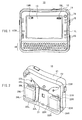
- FIG. 1 is a front view of information processing equipment according to an embodiment of the present invention, as viewed from the front surface thereof
- FIG. 2 is a perspective view of the information processing equipment according to the embodiment of the invention, as viewed from the rear surface thereof.
- a personal digital assistant hereinafter, abbreviated as "PDA" 10 having a configuration as shown in FIGS. 1 and 2 is described as an example of the information processing equipment.
- the PDA 10 includes a front casing portion 11 and a rear casing portion 12, which are produced by molding resin or the like.
- a display portion 13 that displays the results of an operation in the PDA 10 by means of images
- a keyboard 14 through which input operations performed by the user are accepted
- a plurality of operation buttons 15 to which various operational functionalities in the PDA 10 are assigned beforehand
- a power switch 16 and so on are disposed on the front casing portion 11, so that all the manipulations of the PDA 10 can be performed on the front side.
- a thin display device such as an LCD (Liquid Crystal Display) or an EL (Electro Luminescence) display is used suitably as the display portion 13, other display devices may be used. Display devices that are integrated with a touch panel or the like and have an input functionality also may be used.
- LCD Liquid Crystal Display
- EL Electro Luminescence
- a first front remaining battery power display portion 17L and a second front remaining battery power display portion 17R are provided that respectively display the remaining power of a plurality of (in this case, two) batteries used as the power sources of the PDA 10.
- a first remaining battery power display icon 19L and a second remaining battery power display icon 19R that indicate the remaining power of the batteries are displayed on the display portion 13, along with the first front remaining battery power display portion 17L and the second front remaining battery power display portion 17R.
- first front remaining battery power display portion 17L and the second front remaining battery power display portion 17R are omitted, and the remaining power of the batteries is indicated using only the first remaining battery power display icon 19L and the second remaining battery power display icon 19R.
- the rear portion of the rear casing portion 12 is configured to include a lower surface portion 21, as well as a higher surface portion 22L and a higher surface portion 22R that are provided connected in a row with the lower surface portion 21.
- the higher surface portions 22L and 22R are respectively provided on both sides of the rear casing portion 12, and a first battery housing portion 23L and a second battery housing portion 23R that individually house a battery are provided in the higher surface portions 22L and 22R.
- a first battery 24L is housed in the first battery housing portion 23L
- a second battery 24R is housed in the second battery housing portion 23R.
- batteries capable of independently supplying power to the PDA 10 are used as the first battery 24L and the second battery 24R, and the PDA 10 can be operated continuously for a long time by changing the battery being used as the power source of the PDA 10 in a power-drawing portion 36 (not shown in FIGS. 1 and 2 ) described later.
- Primary batteries such as dry batteries may be used as the first battery 24L and the second battery 24R.
- rechargeable secondary batteries may be used.
- the PDA 10 in this embodiment of the invention also includes the same number of lid portions that are opened and closed during attachment and removal of the batteries as the number of batteries housed in the housing portions. That is, a first battery lid 25L and a second battery lid 25R serving as lid portions provided with a hook are attached to the first battery housing portion 23L and the second battery housing portion 23R, respectively.
- a first rear remaining battery power display portion 27L and a second rear remaining battery power display portion 27R corresponding to the batteries housed under the respective battery lids are provided.
- Light emitting elements configured of an LED (Light Emitting Diode) or the like are used as the first front remaining battery power display portion 17L and the second front remaining battery power display portion 17R, as well as the first rear remaining battery power display portion 27L and the second rear remaining battery power display portion 27R, and these portions are configured to provide a binary indication, such as being unlit when there is sufficient remaining battery power and being lit when the remaining battery power has fallen below a predetermined value.
- first front remaining battery power display portion 17L is configured to be lit in the same manner as the first rear remaining battery power display portion 27L
- the second front remaining battery power display portion 17R is configured to be lit in the same manner as the second rear remaining battery power display portion 27R.
- light emitting elements that are lit in a single color may be used, and the light emitting elements may be lit in one color (for example, green) when there is sufficient remaining battery power, and may be lit in the other color (for example, red) when the remaining battery power has fallen below a predetermined value.
- the light emitting elements can be unlit when no battery is housed, which makes it possible to improve usability.
- a first magnet 29L and a second magnet 29R serving as magnetic-field-generating portions are fixed to the first battery lid 25L and the second battery lid 25R, respectively.
- a first magnetic-field-detecting element 31L and a second magnetic-field-detecting element 31R that change an output signal depending on the strength of the magnetic field are provided on the rear casing portion 12 at locations adjacent to and facing the first magnet 29L and the second magnet 29R, respectively, when the first battery lid 25L and the second battery lid 25R are closed.
- Hall IC in which a Hall element serving as a magnetic sensor and a circuit that converts the output signals of the Hall element into digital signals are integrated in a single chip, can be used as the first magnetic-field-detecting element 31L and the second magnetic-field-detecting element 31R.
- Hall IC in which a Hall element serving as a magnetic sensor and a circuit that converts the output signals of the Hall element into digital signals are integrated in a single chip, can be used as the first magnetic-field-detecting element 31L and the second magnetic-field-detecting element 31R.
- other elements that change the output signal depending on the strength of the magnetic field also may be used.
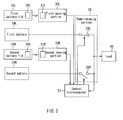
- FIG. 3 is a block diagram showing an example of the configuration of the PDA 10 according to this embodiment of the invention. Note that this block diagram shows components relating to a configuration in which batteries used as the power source of the PDA 10 are switched automatically by opening or closing the battery lids; and components that perform various computations or the like in the PDA 10, the display portion 13 and so on are shown collectively as a load 38.
- the power-drawing portion 36 serving as a switching portion includes a first switch 35L that is brought into a state of conduction when power is drawn from the first battery 24L, and a second switch 35R that is brought into a state of conduction when power is drawn from the second battery 24R.
- the power-drawing portion 36 has a switching functionality through which power is drawn selectively from any one of the plurality of batteries (in this case, the first battery 24L and the second battery 24R) housed in the battery housing portions (in this case, the first battery housing portion 23L and the second battery housing portion 23R) by switching between the switches to be brought into a state of conduction.
- switching between the first switch 35L and the second switch 35R is performed using a control microcomputer 37 serving as a control portion.
- the switching functionality By using integrated circuit technology to integrate the switching functionality, the magnetic-field-detecting functionality, and the control functionality, such as the power-drawing portion 36 serving as the switching portion, a first sensing portion 33L and a second sensing portion 33R respectively including the first magnetic-field-detecting element 31L and the second magnetic-field-detecting element 31R, and the control microcomputer 37 serving as the control portion, it is possible to realize a device that implements these functionalities with a small size and low costs, and to mount such a device within information processing equipment.
- the first magnetic-field-detecting element 31L detects a strong magnetic field as the magnetic field strength, and a signal indicating "closed state” (for example, "Hi") is output from the first sensing portion 33L including the first magnetic-field-detecting element 31L to the control microcomputer 37.
- a signal indicating "open state” for example, "Lo" is output from the first sensing portion 33L to the control microcomputer 37.
- the opening or closing motion of the lid portion is sensed by electromagnetically sensing a change in distance between the magnet fixed to the lid portion and the detecting element, and a signal indicating the result of the sensing is output. Accordingly, this configuration will experience less deterioration than a configuration in which the opening or closing motion of the lid portions is sensed using a mechanical contact mechanism, and therefore can maintain reliable sensing of the opening or closing motion of the lid portions over a long period.
- the control microcomputer 37 controls the power-drawing portion 36 in accordance with signals transmitted from the first sensing portion 33L and the second sensing portion 33R.
- the first sensing portion 33L if a signal indicating that the first battery lid 25L has changed from a "closed state” to an “open state” is transmitted from the first sensing portion 33L (if the signal transmitted from the first sensing portion 33L has changed from "Hi” to "Lo") when the first switch 35L is in a state of conduction (on) and the second switch 35R is interrupted (off), then it is determined that the first battery lid 25L has been opened in order to remove the first battery 24L. Accordingly, in order to switch the battery from which power is drawn from the first battery 24L to the second battery 24R, the second switch 35R is switched from off to on, and then the first switch 35L is switched from on to off.
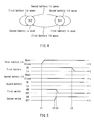
- FIG. 4 is a state transfer diagram showing an example of the operation of the PDA 10 according to this embodiment of the invention.
- the state in which power is drawn from the first battery 24L is taken as "State S1”
- the state in which power is drawn from the second battery 24R is taken as "State S2”.
- FIG. 5 is a timing chart showing an example of the operation of the PDA 10 according to this embodiment of the invention. Here, the operation performed when removing the first battery 24L being used from the PDA 10 will be described as an example.
- the user is notified of a decrease in the remaining power of the first battery 24L, for example, through a change in the lighting state of the first front remaining battery power display portion 17L, and the first battery lid 25L is brought into an "open state" in order to remove the first battery 24L.
- the state change of the first battery lid 25L is sensed by the first sensing portion 33L, and the result of the sensing is transmitted to the control microcomputer 37.
- the control microcomputer 37 changes the second switch 35R from off to on in order to switch the battery from which power is drawn to the second battery 24R.
- control microcomputer 37 After turning the second switch 35R on, the control microcomputer 37 changes the first switch 35L from on to off in order to prepare for the removal of the first battery 24L.
- a period in which both the first switch 35L and the second switch 35R are on is provided in this way, thereby preventing the occurrence of any period in which power cannot be drawn from the batteries, and improving the stability of the operation in the PDA 10.
- the first switch 35L and the second switch 35R in this embodiment of the invention are configured using electronic switches, so that the time interval between Time t2 and Time t3 can be a very short period of several tens of milliseconds or less, which will not cause any practical problems.
- the detection of the state change of the first battery lid 25L at the first sensing portion 33L, and the control operation performed by the control microcomputer 37 based on the result of that detection take several tens of milliseconds or less, and are performed in a very short period, as compared with the above-described time interval. Accordingly, it is very unlikely that the battery is removed before the control microcomputer 37 switches between the switches and, therefore, no practical problems will occur. That is, the user can remove the battery being used from the PDA 10 at ease during operation.
- FIG. 5 the operation performed in the case of removing the first battery 24L from the PDA 10 has been described.
- the user may open the second battery lid 25R erroneously, even though the user has been notified of a decrease in the remaining power of the first battery 24L.
- the second battery 24R is removed, power supply will not last long due to the reduced capacity of the first battery 24L, which may cause the operation of the PDA 10 to stop.
- the PDA 10 uses the front remaining battery power display portions 17L and 17R, as well as the rear remaining battery power display portions 27L and 27R as an alert output portion 41 to issue an alert to the user under the control of the control microcomputer 37 as shown in FIG. 3 . All of the front remaining battery power display portions 17L and 17R, and the rear remaining battery power display portions 27L and 27R may be used to output an alert, or only some of them may be used to output an alert.
- the control microcomputer 37 causes the remaining battery power display portion 27L or 17L of the first battery 24L to flash rapidly, or to increase the brightness of lighting in order to notify the user of the fact that the remaining power of the first battery 24L is low in an emphasized manner.
- the control microcomputer 37 may cause the remaining battery power display portion 27R or 17R of the second battery 24R to perform a special operation (e.g., flashing or increasing in brightness). It is, of course, possible to cause both of the remaining battery power display portions to flash or increasing in brightness. By notifying the user of an error through the operation of the remaining battery power display portions in this way, it is possible to prevent the user from removing the second battery 24R erroneously.
- the remaining power of the first battery 24L may be displayed when the second battery lid 25R is open.
- the remaining power of the first battery 24L is displayed on the display portion 13 under the control of the control microcomputer 37.
- the user can decide not to remove the second battery 24R when the remaining power of the first battery 24L is excessively low, or can replace the second battery 24R for the meantime, when the remaining power of the first battery 24L is low but is at a certain level.
- By displaying the remaining power of the first battery 24L to the user it is possible to inform the user of the fact that the lid was erroneously opened, and to give the user the discretion to decide whether or not to continue replacing the battery.
- the configuration described by the above-described example mainly uses the front remaining battery power display portions 17L and 17R, as well as the rear remaining battery power display portions 27L and 27R as the alert output portion for the user.
- the means for issuing an alert to the user is not limited to these.
- an alert may be issued by providing a special display mode for the first remaining battery power display icon 19L and the second remaining battery power display icon 19R displayed on the display portion 13. It is also possible to display an alert message on the display portion 13.
- a speaker or the like further is provided as the alert output portion, it is also possible to issue an alert through output of a voice message or an alert sound.
- an opening or closing motion of the lid portions is electromagnetically detected at the sensing portions, and the battery from which power is drawn is changed at the power-drawing portion based on the detection result. Accordingly, in the information processing equipment, it is possible to increase stability during the operation of switching between a plurality of housed batteries, and to realize a stable continuous operation for a long period. Furthermore, since the battery switching operation is performed using electronic switches, it is possible to maintain the reliability of the switching operation for the batteries used in the information processing equipment for a long period.
- batteries capable of independently supplying power to the PDA 10 are used, and the same number of lids as the batteries is provided.
- a plurality of batteries are used simultaneously to supply power to the PDA 10
- the PDA 10 has been described as an example, the configuration described in the present invention can also be used widely for other electronic devices such as various information terminals and portable information equipment.
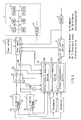
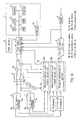
- FIG. 6 is a diagram showing an electrical configuration of the PDA 10.
- the PDA 10 includes an information processing portion 1 having a word processor functionality, an Internet functionality and another functionality, and other power supply portions.
- a CPU 1a is a central processing unit that controls the entire PDA 10.
- An OS and various application software programs are stored in an HDD (hard disk drive) 1b, along with various data.
- a keyboard 1c is used, for example, for inputting data, and for giving instructions to the information processing portion 1 using a pointing device or various operation buttons 15 included in the PDA 10.
- a basic operation program such as a BIOS is contained in a ROM 1d.
- a RAM 1e operates as the main memory of the CPU 1a.
- a display 1f displays characters, graphics and the like. These components denoted by numerals 1a to 1f are connected together with a bus 1g, and transmit information to each other.
- a DC/DC converter 1h supplies power at a required voltage to each of the components denoted by numerals 1a to 1f.
- the other power supply portions include a power supply control portion 2 connected to the bus 1g, a power switch 3, an external AC adapter 4 that supplies power to the power supply control portion 2, a current control portion 5, and an "a" battery 6 serving as a first battery (corresponding to the first battery 24L), a "b" battery 7 serving as a second battery (corresponding to the second battery 24R), a switching device 8, ammeters 9a and 9b, voltmeters 10a and 10b, thermometers 11a and 11b, and a microcomputer 18.
- an "a” battery 6 and a “b” battery 7 respectively are provided with nonvolatile memories 6a and 7a, such as EEPROMs (Electrically Erasable Programmable Read Only Memories), and temperature sensors 6b and 7b.
- nonvolatile memories 6a and 7a such as EEPROMs (Electrically Erasable Programmable Read Only Memories), and temperature sensors 6b and 7b.
- the switching device 8 controls the respective connections of the "a” battery 6 and the “b” battery 7 to the power supply control portion 2.
- the ammeters 9a and 9b measure the currents of the "a” battery 6 and the “b” battery 7 respectively, and input the measurement results to the microcomputer 18 in the form of digital signals.
- the voltmeters 10a and 10b measure the voltages of the "a” battery 6 and the “b” battery 7 respectively, and input the measurement results to the microcomputer 18 in the form of digital signals.
- the temperature sensors 6b and 7b sense the temperatures of the "a” battery 6 and the "b” battery 7 respectively, and the thermometers 11a and 11b input those temperatures into the microcomputer 18 in the form of digitized temperature signals.
- the nonvolatile memories 6a and 7a also are connected to the microcomputer 18.
- the microcomputer 18 usually is called an "EC” (embedded controller), and contains a battery-capacity-acquiring portion 18a, a battery-capacity-comparing portion 18b, and a charge/discharge control portion 18c, which are described in detail later.
- EC embedded controller
- the microcomputer 18 is configured such that the output of the charge/discharge control portion 18c controls the switching device 8 and the current control portion 5, and the output of the battery-capacity-comparing portion 18b executes the below-described display on the display 1f via the power supply control portion 2.
- power supply to the information processing portion 1 is first carried out by supplying power from the "a" battery 6 or the “b” battery 7, and the AC adapter 4, and the power supply control portion 2 connected to the bus 1g manages these power supplying operations.
- the power supply control portion 2 supplies power from the "a" battery 6 or the “b” battery 7 to the DC/DC converter 1h.
- the power supply control portion 2 supplies power from the AC adapter 4 to the DC/DC converter 1h.
- the power supplied by the current control portion 5 is used to charge each of the batteries.
- Charging of the "a" battery 6 and the "b" battery 7 is executed by the current control portion 5 controlling the current of the power supplied from the AC adapter 4 via the switching device 8. These operations are controlled by the charge/discharge control portion 18c.
- control microcomputer 37 shown in FIG. 3 may be incorporated in the microcomputer 18 shown in FIG. 6 .
- the switching device 8 shown in FIG. 6 also has the functionality of the power-drawing portion 36 shown in FIG. 4 .
- control of the charge/discharge control portion 18c is performed, in addition to the control of the switching device 8 by the control microcomputer 37. That is, the control of the switching device 8 by the charge/discharge control portion 18c is performed when the lids of the "a" battery 6 and the "b" battery 7 are closed.
- the above-described switching control by the control microcomputer 37 is performed.
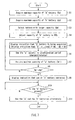
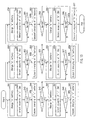
- a charge/discharge control method for a plurality of batteries now will be described using the flowchart of FIG. 7 with reference to FIG. 6 and FIGS. 8 to 9 .
- Step S1 the battery-capacity-acquiring portion 18a acquires the maximum battery capacity of the "a" battery 6. This can be performed, for example, in the following manner.
- the battery-capacity-acquiring portion 18a causes the "a" battery 6 to discharge so that its battery capacity becomes empty (zero).
- the switching device 8 is on at the "a" battery 6 side as shown in FIG. 6 , and the power of the "a" battery 6 is consumed in the information processing portion 1.
- the empty state of the battery capacity is sensed based on the battery voltage measured by the voltmeter 10a.
- the battery-capacity-acquiring portion 18a charges the "a" battery 6 with power supplied from the AC adapter 4 at a constant current value controlled by the current control portion 5, until the maximum battery capacity is reached.
- the sensing of the maximum battery capacity is performed through the sensing, for example, of a voltage gradient sensed by the voltmeter 10a, and an increasing gradient in the temperature measured by the thermometer 11a.
- a time integration value for the charge current measured by the ammeter 9a during this charging is computed to calculate a current-time product (ampere hour).
- the battery-capacity-acquiring portion 18a acquires a true maximum battery capacity Qa, which is obtained by correcting the calculated current-time product value with the battery temperature.
- Step S2 the maximum battery capacity Qb of the "b" battery 7 is acquired in the same manner as in Step S1.
- Step S1 and Step S2 are written in the nonvolatile memories 6a and 6b, respectively.
- the battery-capacity-comparing portion 18b compares the maximum battery capacities Qa and Qb of the "a" battery 6 and the "b" battery 7. Since a battery with a larger maximum battery capacity can be used to drive the PDA 10 for a longer number of hours per charge and has a larger number of cycles, the battery-capacity-comparing portion 18b selects the battery with the larger capacity (in this case, Qa > Qb).
- Step S4 since it can be judged that the battery that has been determined to have a lower maximum battery capacity by the battery-capacity-comparing portion 18b has a small number of charging cycles and/or has deteriorated, the charge/discharge control portion 18c adjusts the "b" battery 7, which has a lower maximum battery capacity, to a predetermined battery capacity (for example, 30% of the maximum battery capacity) such that the "b" battery 7 can be used for a longer period and can be stored stably for a long period. That is, the charge/discharge control portion 18c disconnects the "a” battery 6 using the switching device 8 and connects the "b" battery 7 such that the power of "b" battery 7 is consumed in the information processing portion 1. When the battery capacity of the "b" battery 7 has reached a predetermined battery capacity (in this embodiment, 30%), the charge/discharge control portion 18c operates the switching device 8 so as to disconnect the "b" battery 7.
- a predetermined battery capacity for example, 30%
- Step S5 an indication that the "b" battery 7 is being suspended is displayed on the display 1f as shown in indications 21 and 22 in FIG. 8 . Similarly, an indication that the battery is being charged is displayed for the "a" battery 6.
- Step S6 the switching device 8 connects the "a" battery 6, and the power necessary for the information processing portion 1 is supplied only from the "a" battery 6.
- the battery-capacity-acquiring portion 18a acquires the maximum battery capacity Qa' of the "a” battery 6 again in Step S7 in the same manner as in Step S1.
- the maximum battery capacity Qa' of the "a” battery 6 becomes substantially equal to the maximum battery capacity Qb of the "b” battery 7 in Step S8, an indication that use of the "b" battery 7 is to commence (not shown) is displayed on the display 1f in Step S9. If attachment of the "b" battery 7 is confirmed in Step S10, the above-described flow is repeated thereafter in Step S11, and the "a" battery 6 and the "b” battery 7 are used alternately.
- the "a" battery 6 is changed to the "b" battery 7 when Qa' becomes equal to Qb in Step S8.
- hysteresis may be provided when comparing the maximum battery capacities of the two batteries in Step S8, and the "a" battery 6 may be used until Qa' becomes smaller than Qb by a predetermined capacity value.
- the frequency of such acquisition of the maximum battery capacities of the batteries may be set appropriately, taking into consideration the usage environment and the usage frequency of the PDA 10.
- the maximum battery capacities of individual batteries are acquired and compared, then the battery with the largest battery capacity is selected, and only that battery is used for a predetermined period.
- a plurality of batteries are used while keeping a balance between the maximum battery capacities of the batteries. Accordingly, it is possible to prevent any particular battery from being unusable before other batteries, thereby extending the life of the batteries as a whole.
- a battery other than the selected battery are put into standby with a low battery capacity suitable for storage, including, for example, a predetermined battery capacity of about 30%, it is possible to prevent the life of the non-selected battery from being reduced unnecessarily.
- the maximum battery capacity of the batteries is acquired by bringing the battery capacity from an empty state to a fully charged state. However, conversely, the maximum battery capacity may be acquired by bringing the battery capacity from a fully charged state to an empty state.
- Step S7 the procedure may move to Step S9 after using the "a" battery 6 for a charging time or discharging time corresponding to the difference between the maximum battery capacities of the "a" battery 6 and the "b" battery 7 (Qa - Qb) obtained in Step S1 and Step S2.
- Steps S1 and S2 may not necessarily be performed every charge/discharge cycle. For example, these steps may be performed every predetermined number of charge/discharge cycles (for example, five), only when a new battery is housed in the battery housing portions, or only when the housing lid of any of the battery housing portions is opened and then closed.
- Steps S1 and S2 are performed in a specific case as described above, the loop from Step S5 through Step S8 in FIG. 7 will be executed in an ordinary charging step.
- the charging, discharging, suspension and so on of the batteries are described as being indicated on the display of the information processing equipment, such indications may be performed using a plurality of LEDs or the like. Similarly, in the case where the difference in maximum capacity between two batteries is larger than a predetermined value, this can be indicated by flashing LEDs or the like rather than using a display.
- FIG. 10 is a diagram showing an electrical configuration of a PDA 10.
- FIG. 10 The electrical configuration shown in FIG. 10 is basically the same as that shown in FIG. 6 , but the means contained in the microcomputer 18 are different.
- the components denoted by the same numerals as those in FIG. 6 are the same as the components in FIG. 6 and therefore the description thereof has been omitted.
- a charge/discharge-count-acquiring portion 18d, a charge/discharge-count-comparing portion 18e, and the charge/discharge control portion 18c described in relation to FIG. 6 are provided in the microcomputer 18.
- Step S21 the charge/discharge-count-acquiring portion 18d acquires a charge or discharge count, Na, stored in the nonvolatile memory 6a of the "a" battery 6.
- Step S22 the charge/discharge-count-acquiring portion 18d acquires a charge or discharge count, Nb, stored in the nonvolatile memory 7a of the "b" battery 7 in the same manner as in Step S21.
- Step S23 the charge/discharge-count-comparing portion 18e compares the charge or discharge counts, Na and Nb, of the "a" battery 6 and the "b" battery 7. Since the battery with a smaller charge/discharge count has a larger maximum battery capacity, and can be used to drive the PDA 10 for a longer number of hours per charge and has a longer life, the charge/discharge-count-comparing portion 18e selects the battery with a smaller charge/discharge count (in this case, Na ⁇ Nb).
- Step S24 since it can be judged that the battery that has been determined to have a larger charge/discharge count by the charge/discharge-count-comparing portion 18e has a lower maximum battery capacity and/or has deteriorated, the charge/discharge control portion 18c adjusts "b" battery 7, which has a larger charge/discharge count, to a predetermined battery capacity (for example, 30% of the maximum battery capacity) such that "b" battery 7 can be stored stably for a long period, in order to suppress the progress of deterioration in the "b" battery 7.
- a predetermined battery capacity for example, 30% of the maximum battery capacity
- the charge/discharge control portion 18c disconnects "a” battery 6 using the switching device 8 and connects "b” battery 7 such that the power of "b” battery 7 is consumed in the information processing portion 1.
- the charge/discharge control portion 18c operates the switching device 8 so as to disconnect "b" battery 7.
- Step S25 an indication that "b" battery 7 is being suspended is displayed on the display 1f as shown in indications 21 and 22 in FIG. 8 . Similarly, an indication that the battery is being charged or discharged is displayed for "a" battery 6.
- Nb - Na which is the difference in the above-described count between the two batteries, is larger than a predetermined value Ns at this point, for example, an indication that it is recommended that "b" battery 7 be removed and stored in a cool, dark place, or be replaced with a new battery is displayed on the display 1f as shown by an indication 23 in FIG. 9 .
- Step S26 the switching device 8 connects "a" battery 6, and the power necessary for the information processing portion 1 is supplied only from “a” battery 6.
- Step S27 the charge or discharge count N of the "a" battery 6 is measured, and the result is added and stored in the nonvolatile memory 6a.
- Step S28 When the charge or discharge count Na + N of the "a” battery 6 becomes equal to the charge or discharge count Nb of "b” battery 7 in the subsequent Step S28, an indication that use of "b” battery 7 commences (not shown) is displayed on the display 1f in Step S29. Next, if attachment of "b" battery 7 is confirmed in Step S30, the above-described flow is repeated thereafter in Step S31, and "a" battery 6 and "b” battery 7 are used alternately.
- a battery 6 is switched to “b” battery 7 when Na + N becomes equal to Nb in Step S28.
- hysteresis may be provided when comparing the charge/discharge counts of the two batteries in Step S28, and "a" battery 6 may be used until Na + N becomes larger than Nb by a predetermined count.
- the frequency of acquiring the charge/discharge count of the batteries may be appropriately set in consideration of the environment of usage and the frequency of usage of the PDA 10.
- the charge or discharge counts of individual batteries are acquired and compared, the battery with the smallest charge/discharge count is selected, and only the selected battery is used repeatedly until its charge or discharge count reaches that of the other batteries.
- the charge/discharge count has been described as being stored in the nonvolatile memories in the batteries. However, in the case where the batteries are used for a specific PDA, the charge/discharge count may be stored in a nonvolatile memory included in the PDA itself.
- the degree of deterioration in a battery increases when the battery is used in a highly charged state.
- the degree of deterioration is large when a battery is used in the fully charged state (the state in which a battery is charged to its maximum capacity). Therefore, a case will be described in which the life of a battery is increased by avoiding such a fully charged state.
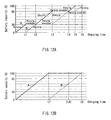
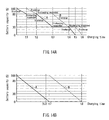
- FIG. 12A schematically shows the progress of charging, illustrating a charge control method, with the charging time plotted on the horizontal axis and the progress of charging plotted on the vertical axis.
- characteristic A indicates the progress of charging for the "a" battery 6
- characteristic B indicates the progress of charging for the "b” battery 7.
- the battery capacity at which each battery has been spent is indicated as zero for both of the batteries.
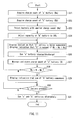
- Step S41 the "a” battery 6 is charged.
- Step S42 the battery capacity Qa of the "a” battery 6 is successively detected.
- Step S43 the charging of the "a" battery 6 is suspended in Step S44 (Time t1 in FIG. 12A ).
- Step S45 whether or not the battery capacity Qb of the other battery is lower than the predetermined value Q1 is checked. Since the "b" battery 7 has an battery capacity of zero (YES), the procedure moves to Step S46, in which the charging of the "b” battery 7 commences.
- Step S47 the battery capacity Qb is successively detected, and when the battery capacity Qb has risen above the predetermined value Q1 in Step S48, the charging of the "b" battery 7 is suspended in Step S49 (Time t2 in FIG. 12A ).
- Step S45 when the battery capacity Qb of the "b" battery 7 is above the predetermined value Q1 (NO) in Step S45, the charging of the "b" battery 7 in Step S46 is not performed, and the procedure jumps to Step S50.
- Step S50 the "a" battery 6 is charged again, and the battery capacity Qa is successively detected in Step S51.
- the battery capacity Qa has risen above a second predetermined value Q2 (in FIG. 13 , 80%) in Step S52, the charging of the "a" battery 6 is suspended in Step S53 (Time t3 in FIG. 12A ).
- Step S54 whether or not the battery capacity Qb of the other battery is lower than the predetermined value Q2 is checked. If a battery with an battery capacity lower than the predetermined value Q2 is not present at this time, the procedure moves to Step S59, in which charging is continued. However, since the battery capacity of the "b" battery 7 remains at 30% (YES), the procedure moves to the subsequent Step S55, in which the charging of the "b" battery 7 commences.
- Step S56 the battery capacity Qb is successively detected, and when the battery capacity Qb has risen above the predetermined value Q2 in Step S57, the charging of the "b" battery 7 is suspended in Step S58 (Time t4 in FIG. 12A ).
- Step S59 the "a" battery 6 is charged again, and the battery capacity Qa is successively detected in Step S60.
- the battery capacity Qa has risen above a third predetermined value Q3 (in FIG. 13 , 100%) in Step S61, the charging of the "a" battery 6 is suspended in Step S62 (Time t5 in FIG. 12A ).
- Step S63 whether or not the battery capacity Qb of the other battery is lower than the predetermined value Q3 is checked. Since the "b" battery 7 is maintained at an battery capacity of 80% (YES), the procedure moves to Step S64, in which the charging of the "b" battery 7 commences. In Step S65, the battery capacity Qb is successively detected, and when the battery capacity Qb has risen above the predetermined value Q3 in Step S66, the charging of the "b" battery 7 is suspended in Step S67 (Time t6 in FIG. 12A ).
- a plurality of charging targets (battery capacities) are set, and a plurality of batteries are charged in ascending order of their capacity values until they reach the closest charging target. This provides an effect as described below.
- FIG. 12B shows a conventional method in which the "a" battery is fully charged as indicated by characteristic A (solid line), and then the "b" battery is charged as indicated by characteristic B (dotted line).
- the temporal axis in FIG. 12B is plotted to the same scale as the temporal axis in FIG. 12A .
- the difference in battery capacity between the individual batteries during charging is reduced. Accordingly, the difference in capacity between the batteries is reduced when charging is stopped midway, and the degree of deterioration can be leveled when the batteries are left standing thereafter.
- the period for which some of the batteries are maintained in the fully charged state is shortened, so that it is possible to prevent any particular battery from deteriorating rapidly.
- the present invention when the charging operation is stopped midway and the batteries are left standing thereafter, it is possible to reduce the chances of one of the batteries being fully charged, thereby minimizing the possibility of an extreme deterioration in the battery that could result from leaving the battery in a fully charged state.
- each of the batteries in a mode in which a plurality of (for example, two) batteries are switched to drive information processing equipment such as the PDA 10, each of the batteries can be charged to, for example, approximately 50% of the maximum battery capacity.
- the sum of the battery capacities of the two batteries is 100% as with the conventional method.
- the method of the present invention can suppress the deterioration of the plurality of batteries more effectively, even though the charging time and the driving time of the information processing equipment are the same as the conventional method.
- FIGS. 12A and 12B show the same gradient, it is known that in practice the charging efficiency decreases at the last stages of charging (a state close to the fully charged state). Therefore, as compared with a conventional configuration in which one of the batteries is fully charged and maintained in the fully charged state until the battery capacity of the other battery is reduced, a configuration in which the battery capacity to be charged is shared by a plurality of batteries and the individual batteries are charged to a low capacity can achieve higher charging efficiency and thus can contribute to energy savings, even though the sums of the battery capacities are the same.
- FIG. 14A schematically shows the progress of discharging, illustrating a discharge control method, with the discharge time plotted on the horizontal axis and the progress of discharging plotted on the vertical axis.
- characteristic A indicates the progress of discharging of "a" battery 6
- characteristic B indicates the progress of discharging of "b” battery 7.
- the discharging is performed from an battery capacity of 100%, which is the fully charged capacity, to an battery capacity of 0%, which is the battery capacity of the battery that has been spent, for both of the batteries.
- Step S71 "a" battery 6 is discharged.
- Step S72 the battery capacity Qa of "a” battery 6 is successively detected.
- Step S73 the discharging of "a" battery 6 is suspended in Step S74 (Time t1 in FIG. 14A ).
- Step S75 whether or not the battery capacity Qb of the other battery is larger than the predetermined value Q1 is checked. Since "b" battery 7 has an battery capacity of 100% (YES), the procedure moves to Step S76, in which the discharging of "b” battery 7 commences.
- Step S77 the battery capacity Qb is successively detected, and when the battery capacity Qb has fallen below the predetermined value Q1 in Step S78, the discharging of "b” battery 7 is suspended in Step S79 Time t2 in FIG. 14A ).
- Step S75 when the battery capacity Qb of "b" battery 7 is less than the predetermined value Q1 (NO) in Step S75, the discharging of "b" battery 7 in Step S76 is not performed, and the procedure jumps to Step S80.
- Step S80 "a" battery 6 is discharged again, and the battery capacity Qa is successively detected in Step S81.
- the battery capacity Qa has fallen below a second predetermined value Q2 (in FIG. 15 , 30%) in Step S82, the discharging of "a" battery 6 is suspended in Step S83 (Time t3 in FIG. 14A ).
- Step S84 whether or not the battery capacity Qb of the other battery is larger than the predetermined value Q2 is checked. If a battery with an battery capacity larger than the predetermined value Q2 is not present at this time, the procedure moves to Step S89, in which the discharging is continued. However, since the battery capacity of "b" battery 7 remains at 80% (YES), the procedure moves to the subsequent Step S85, in which the discharging of "b" battery 7 commences. In Step S86, the battery capacity Qb is successively detected, and when the battery capacity Qb has fallen below the predetermined value Q2 in Step S87, the discharging of "b" battery 7 is suspended in Step S88 (Time t4 in FIG. 14A ).
- Step S89 "a" battery 6 is discharged again, and the battery capacity Qa is successively detected in Step S90.
- the battery capacity Qa has reached a third predetermined value Q3 (in FIG. 15 , 0%) in Step S91, the discharging of "a" battery 6 is suspended in Step S92 (Time t5 in FIG. 14A ).
- Step S93 whether or not the battery capacity Qb of the other battery is larger than the predetermined value Q3 is checked. Since "b" battery 7 is maintained at an battery capacity of 30% (YES), the procedure moves to Step S94, in which the discharging of "b" battery 7 commences.
- Step S95 the battery capacity Qb is successively detected, and when the battery capacity Qb has reached the predetermined value Q3 in Step S96, the discharging of "b" battery 7 is suspended in Step S97 (Time t6 in FIG. 14A ).
- a plurality of discharging targets are set, and a plurality of batteries are discharged in descending order of their capacity values until they reach the closest discharging target, and the plurality of batteries with an equalized capacity value are further discharged sequentially to a lower discharging target.
- FIG. 14B shows a conventional method in which the "a" battery 6 is discharged to a capacity of 0% as indicated by characteristic A (solid line), and then the "b" battery 7 is discharged as indicated by characteristic B (dotted line).
- the temporal axis in FIG. 14B is plotted in the same scale as the temporal axis in FIG. 14A .
- the difference in battery capacity between the individual batteries during discharging is reduced. Accordingly, the difference in capacity between the batteries is reduced when the discharging is stopped (when the use of the information processing equipment is stopped), and the degree of deterioration can be leveled.
- the period for which some of the batteries are maintained in the fully charged state is shortened, so that it is possible to prevent any particular battery from deteriorating rapidly.
- the present invention when the discharging operation is stopped midway and the batteries are left standing thereafter, it is possible to reduce the period for which one of the batteries is maintained in the fully charged state, thereby minimizing the possibility of an extreme deterioration of the batteries that could result from leaving the batteries in the fully charged state.
- the above-described target capacities during charging/discharging are set in three steps, namely, 30%, 80% and 100%, the target capacity, the number of steps and the like are not limited thereto, and may be set appropriately in an optimum manner depending on the state of use.
- the configurations shown in the above-described embodiment merely illustrate specific examples, and are not to be construed as limiting the technical scope of the present invention. Any configuration may be adopted as long as the effects of the invention can be achieved.
- the capacity zone to which each remaining capacity of the "a" battery 6 and the "b” battery 7 belongs is determined, and the charge/discharge control of the "a" battery 6 and the "b” battery 7 is carried out based on the capacity zones to which the remaining capacities thereof are determined to belong (e.g., a zone of 0 % to 30 %, a zone 30 % to 60 %, and a zone of 60 % to 80 %).
- each capacity zone is expressed as a range in percentages, but it may be expressed as a range of capacity values.
- the capacity zone preferably is set according to the manner of use of the battery or the purpose of use thereof appropriately.
- Each capacity zone can be expressed, for example, by an upper limit value and a lower limit value of a capacity.
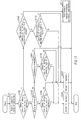
- Step S81 the battery-capacity-acquiring portion 18a acquires capacity zones of the "a" battery 6 and the "b" battery 7.
- the battery-capacity-acquiring portion 18a acquires, as the capacity zones, the ranges of possible values of the battery capacities, which are set according to the acquired battery capacities.
- Step S82 the charge/discharge control portion 18c determines whether or not the capacity zone of the "a" battery 6 is different from the capacity zone of the "b" battery 7.
- Step S82 When it is determined in Step S82 that the capacity zones thereof are different from each other, the procedure moves to Step S83, where the charge/discharge control portion 18c determines whether or not charging is being executed.
- Step S83 When it is determined in Step S83 that charging is being executed, the procedure moves to Step S84, where the charge/discharge control portion 18c determines whether or not the capacity zone of the "a" battery 6 is a zone for a smaller capacity, as compared with the capacity zone of the "b" battery 7.
- Step S84 When it is determined in Step S84 that the capacity zone of the "a" battery 6 is a zone for a smaller capacity, the procedure moves to Step S85, where the charge/discharge control portion 18c selects the "a" battery 6 and charges the same.
- Step S84 When it is determined in Step S84 that the capacity zone of the "a" battery 6 is not a zone for a smaller capacity, the procedure moves to Step S86, where the charge/discharge control portion 18c selects the "b" battery 7 and charges the same.
- Step S83 when it is determined in Step S83 that charging is not being executed, the procedure moves to Step S87, where the charge/discharge control portion 18c determines whether or not discharging is being executed.
- Step S87 the charge/discharge control portion 18c determines whether or not discharging is being executed.
- Step S87 the charge/discharge control portion 18c ends the procedure.
- Step S88 the charge/discharge control portion 18c determines whether or not the capacity zone of the "a" battery 6 is a zone for a greater capacity, as compared with the capacity zone of the "b" battery 7.
- Step S88 When it is determined in Step S88 that the capacity zone of the "a" battery 6 is a zone for a greater capacity, the procedure moves to Step S85, where the charge/discharge control portion 18c selects the "a" battery 6 and discharges the same.
- Step S86 When it is determined in Step S88 that the capacity zone of the "a" battery 6 is not a zone for a greater capacity, the procedure moves to Step S86, where the charge/discharge control portion 18c selects the "b" battery 7 and discharges the same.
- Step S82 When it is determined in Step S82 that the capacity zones thereof are the same, the procedure moves to Step S89, where the charge/discharge-count-comparing portion 18e determines whether or not a charge/discharge count of the "a" battery and a charge/discharge count of the "b" battery, which are obtained by the the charge/discharge-count-acquiring portion 18d, are equal to each other.
- Step S89 When it is determined in Step S89 that the charge/discharge counts are equal, the procedure moves to Step S85, where the charge/discharge control portion 18c continuously charges/discharges the currently used battery.
- Step S89 when it is determined in Step S89 that the charge/discharge counts are different, the procedure moves to Step S90, where the charge/discharge-count-comparing portion 18e determines whether or not the charge/discharge count of the "a" battery is greater than the charge/discharge count of the "b" battery.
- Step S90 When it is determined in Step S90 that the charge/discharge count of the "a" battery is not greater, the procedure moves to Step S85, where the charge/discharge control portion 18c selects the “a” battery 6 and charges/discharges the same.
- Step S90 When it is determined in Step S90 that the charge/discharge count of the "a" battery is greater, the procedure moves to Step S86, where the charge/discharge control portion 18c selects the "b" battery 7 and charges/discharges the same.
- Step S81 a plurality of batteries are classified under preliminarily set capacity zones as battery capacity ranges, based on the respective battery capacities of the batteries. Therefore, as long as the selected batteries belong to the same zone, the step of comparing the batteries in the same zone with one another can be omitted. Therefore, the complexity in comparing each of capacities with another according to the states of use (charge or discharge) of each battery can be eliminated, whereby an effect of excellent practical utility can be achieved.
- Steps S84 and S88 the comparison of battery capacity values of batteries belonging to the same zone is omitted in Steps S84 and S88. But in the case where a plurality of batteries belong to the same zone, a step is added for comparing the battery capacity values of the plurality of batteries belonging to the selected zone in Steps S84 and S88.
- Step S89 and S90 the comparison of the charge/discharge counts of batteries belonging to the same zone is omitted in Steps S89 and S90. But in the case where a plurality of batteries belong to the same zone, steps for comparing the charge/discharge counts of the plurality of batteries belonging to the selected zone are added between Step S82 and Step S89, as is the case with Steps S89 and S90.
- the capacity zones of 0 % to 30 %, 30 % to 60 %, and 60 % to 80% are set, but the upper limit value and the lower limit value of each zone may be set appropriately according to an information processing device used.
- the spending of the battery to the capacity of 0 % also is known as a factor that reduces the life of the battery, as is the case with the fully charged state. Therefore, by changing the limit of "0 %" of the above-described capacity zone to about "10 %", the life of a battery can be increased.
- Still another exemplary case will be described in which the life of a battery is increased by avoiding a fully charged state.
- it is determined to which capacity zone each remaining capacity of an "a" battery 6 and a "b" battery 7 belongs, and the charge/discharge control of the "a" battery 6 and the "b” battery 7 is carried out based on the capacity zones that the remaining capacities thereof are determined to belong (e.g., a zone of 0 % to 30 %, a zone 30 % to 60 %, and a zone of 60 % to 80 %).
- Step S101 the battery-capacity-acquiring portion 18a acquires capacity zones of the "a" battery 6 and the "b" battery 7.
- Step S102 the charge/discharge control portion 18c determines whether or not the capacity zone of the "a" battery 6 is different from the capacity zone of the "b" battery 7.
- Step S103 the charge/discharge control portion 18c determines whether or not charging is being executed.
- Step S104 the charge/discharge control portion 18c determines whether or not the capacity zone of the "a" battery 6 is a zone for a smaller capacity, as compared with the capacity zone of the "b" battery 7.
- Step S104 When it is determined in Step S104 that the capacity zone of the "a" battery 6 is a zone for a smaller capacity, the procedure moves to Step S105, where the charge/discharge control portion 18c selects the "a" battery 6 and charges the same.
- Step S104 When it is determined in Step S104 that the capacity zone of the "a" battery 6 is not a zone for a smaller capacity, the procedure moves to Step S106, where the charge/discharge control portion 18c selects the "b" battery 7 and charges the same.
- Step S 103 when it is determined in Step S 103 that charging is not being executed, the procedure moves to Step S107, where the charge/discharge control portion 18c determines whether or not discharging is being executed.
- Step S107 the charge/discharge control portion 18c ends the procedure.
- Step S108 the charge/discharge control portion 18c determines whether the capacity zone of the "a" battery 6 is a zone for a greater capacity, as compared with the capacity zone of the "b" battery 7.
- Step S108 When it is determined in Step S108 that the capacity zone of the "a" battery 6 is a zone for a greater capacity, the procedure moves to Step S105, where the charge/discharge control portion 18c selects the "a" battery 6 and charges the same.
- Step S106 When it is determined in Step S108 that the capacity zone of the "a" battery 6 is not a zone for a greater capacity, the procedure moves to Step S106, where the charge/discharge control portion 18c selects the "b" battery 7 and charges the same.
- Step S102 When it is determined in Step S102 that the capacity zones thereof are the same, the procedure moves to Step S109, where the battery-capacity-comparing portion 18b determines whether or not the maximum battery capacities of the "a" battery 6 and the "b" battery acquired by the battery-capacity-acquiring portion 18a are equal to each other.
- Step S109 When it is determined in Step S109 that the maximum battery capacities are equal, the procedure moves to Step S111, where the charge/discharge control portion 18c continuously charges/discharges the currently used battery.
- Step S109 when it is determined in Step S109 that the maximum battery capacities are different, the procedure moves to Step S110, where the battery-capacity-comparing portion 18b determines whether or not the maximum battery capacity of the "a" battery 6 is greater than the maximum battery capacity of the "b" battery 7.
- Step S110 When it is determined in Step S110 that the maximum battery capacity of the "a" battery 6 is greater, the procedure moves to Step S105, where the charge/discharge control portion 18c selects the “a” battery 6 and charges/discharges the same.
- Step S110 When it is determined in Step S110 that the maximum battery capacity of the "a" battery is smaller, the procedure moves to Step S106, where the charge/discharge control portion 18c selects the "b" battery 7 and charges/discharges the same.
- Step S101 a plurality of batteries are classified under preliminarily set capacity zones as battery capacity ranges, based on the respective battery capacities of the batteries. Therefore, the selected batteries belong to the same zone, the step of comparing the batteries in the same zone with one another. The complexity in comparing each of capacities with another according to the states of use (charge or discharge) of each battery can be eliminated, whereby an effect of excellent practical utility can be achieved.
- Steps S104 and S108 the comparison of battery capacity values of batteries belonging to the same zone is omitted in Steps S104 and S108. But in the case where a plurality of batteries belong to the same zone, a step is added for comparing the battery capacity values of the plurality of batteries belonging to the selected zone in Steps S104 and S108.
- Steps S109 and S110 the comparison of the charge/discharge counts of batteries belonging to the same zone is omitted in Steps S109 and S110. But in the case where a plurality of batteries belong to the same zone, steps for comparing the charge/discharge counts of the plurality of batteries belonging to the selected zone are added between Step S102 and Step S109, as is the case with Steps S109 and S110.
- the capacity zones of 0 % to 30 %, 30 % to 60 %, and 60 % to 80% are set, but the upper limit value and the lower limit value of each zone may be set appropriately according to an information processing device used.
- the spending of the battery to the capacity of 0 % also is known as a factor that reduces the life of the battery, as is the case with the fully charged state. Therefore, by changing the limit of "0 %" of the above-described capacity zone to about "10 %", the life of a battery can be increased.
Landscapes
- Engineering & Computer Science (AREA)
- Theoretical Computer Science (AREA)
- Chemical & Material Sciences (AREA)
- Chemical Kinetics & Catalysis (AREA)
- Electrochemistry (AREA)
- General Chemical & Material Sciences (AREA)
- Computer Hardware Design (AREA)
- General Physics & Mathematics (AREA)
- General Engineering & Computer Science (AREA)
- Physics & Mathematics (AREA)
- Human Computer Interaction (AREA)
- Manufacturing & Machinery (AREA)
- Power Engineering (AREA)
- Life Sciences & Earth Sciences (AREA)
- Microelectronics & Electronic Packaging (AREA)
- Biophysics (AREA)
- Charge And Discharge Circuits For Batteries Or The Like (AREA)
- Secondary Cells (AREA)
- Power Sources (AREA)
- Battery Mounting, Suspending (AREA)
- Cell Separators (AREA)
Applications Claiming Priority (3)
| Application Number | Priority Date | Filing Date | Title |
|---|---|---|---|
| JP2008051783 | 2008-03-03 | ||
| JP2008063662 | 2008-03-13 | ||
| JP2008095470 | 2008-04-01 |
Publications (3)
| Publication Number | Publication Date |
|---|---|
| EP2099112A2 true EP2099112A2 (de) | 2009-09-09 |
| EP2099112A3 EP2099112A3 (de) | 2013-01-23 |
| EP2099112B1 EP2099112B1 (de) | 2016-09-07 |
Family
ID=40785291
Family Applications (1)
| Application Number | Title | Priority Date | Filing Date |
|---|---|---|---|
| EP09154216.7A Active EP2099112B1 (de) | 2008-03-03 | 2009-03-03 | Informationsverarbeitungsvorrichtung und integrierte Schaltung |
Country Status (3)
| Country | Link |
|---|---|
| US (1) | US20090284225A1 (de) |
| EP (1) | EP2099112B1 (de) |
| JP (1) | JP5360968B2 (de) |
Cited By (7)
| Publication number | Priority date | Publication date | Assignee | Title |
|---|---|---|---|---|
| EP2315295A1 (de) * | 2009-09-14 | 2011-04-27 | Nihon Kohden Corporation | Elektronische Vorrichtung |
| WO2012111234A1 (ja) * | 2011-02-18 | 2012-08-23 | 三洋電機株式会社 | 電力供給システム |
| FR2985613A1 (fr) * | 2012-01-09 | 2013-07-12 | Commissariat Energie Atomique | Detection d'un dysfonctionnement dans un accumulateur electrochimique |
| EP2600488A3 (de) * | 2011-01-26 | 2015-03-11 | Mohamed Papa Talla Fall | Energieumwandlungsvorrichtung und -verfahren |
| WO2016160748A1 (en) * | 2015-04-03 | 2016-10-06 | Microsoft Technology Licensing, Llc | Battery management in a device with multiple batteries |
| DE102017106836A1 (de) * | 2017-03-30 | 2018-10-04 | Endress+Hauser Flowtec Ag | Gerät mit elektrischem Verbraucher |
| CN110709718A (zh) * | 2017-06-08 | 2020-01-17 | 三星Sdi株式会社 | 用于诊断电池组的设备和方法 |
Families Citing this family (41)
| Publication number | Priority date | Publication date | Assignee | Title |
|---|---|---|---|---|
| JP5421632B2 (ja) * | 2009-03-27 | 2014-02-19 | 伊藤忠商事株式会社 | 電池パック |
| DE102009003873A1 (de) * | 2009-05-04 | 2010-11-18 | Paade Gmbh | Verfahren und Vorrichtung zum Aufladen von Akkumulatoren |
| JP5427521B2 (ja) * | 2009-09-04 | 2014-02-26 | 株式会社マキタ | 電池パック |
| WO2011048923A1 (en) * | 2009-10-21 | 2011-04-28 | Semiconductor Energy Laboratory Co., Ltd. | E-book reader |
| US8310842B1 (en) | 2010-03-09 | 2012-11-13 | Amazon Technologies, Inc. | Height reduction in portable devices |
| AU2011245104B8 (en) * | 2010-04-30 | 2013-07-11 | Fontem Holdings 4 B.V. | Electronic smoking device |
| JP2012061023A (ja) | 2010-09-14 | 2012-03-29 | Angel Playing Cards Co Ltd | カード読取り装置およびテーブルゲームシステム |
| JP5786330B2 (ja) * | 2010-12-24 | 2015-09-30 | ソニー株式会社 | 放電制御装置及び放電制御方法 |
| WO2012139604A1 (de) * | 2011-04-12 | 2012-10-18 | E-Moove Gmbh | Verfahren zum betrieb einer energiespeicheranordnung |
| KR101843983B1 (ko) * | 2011-06-14 | 2018-03-30 | 삼성전자주식회사 | 휴대 단말기에서 배터리를 교체하는 장치 및 방법 |
| JP5988142B2 (ja) * | 2011-07-08 | 2016-09-07 | パナソニックIpマネジメント株式会社 | 情報処理装置および情報処理装置の制御方法 |
| EP2738908A1 (de) | 2011-07-28 | 2014-06-04 | Sanyo Electric Co., Ltd | Batteriesystem, batteriesteuerungsvorrichtung, elektrofahrzeug, mobiler körper und stromquelle |
| CN103326310B (zh) * | 2012-03-20 | 2017-12-05 | 富泰华工业(深圳)有限公司 | 通信终端及其控制方法 |
| JP2014027800A (ja) * | 2012-07-27 | 2014-02-06 | Sony Corp | バッテリ制御装置、充放電装置、電力管理装置、バッテリ装置、電気自動車 |
| JP5901478B2 (ja) * | 2012-09-11 | 2016-04-13 | シャープ株式会社 | 情報処理装置、制御方法、制御プログラム、および、記録媒体 |
| KR20140080228A (ko) * | 2012-12-20 | 2014-06-30 | 주식회사 팬택 | 듀얼 배터리를 이용한 단말 제어 장치 및 방법 |
| US9559545B2 (en) * | 2013-08-06 | 2017-01-31 | Microsoft Technology Licensing, Llc | Automated charging |
| US9711994B2 (en) * | 2014-01-31 | 2017-07-18 | Semiconductor Energy Laboratory Co., Ltd. | Electronic device and its operation system |
| JP6054906B2 (ja) * | 2014-04-17 | 2016-12-27 | レノボ・シンガポール・プライベート・リミテッド | 電子機器、そのバッテリ制御方法、及びコンピュータが実行可能なプログラム |
| JP6040956B2 (ja) * | 2014-04-25 | 2016-12-07 | コニカミノルタ株式会社 | 充電制御装置、およびそれを搭載した画像形成装置 |
| EP3236787B1 (de) | 2014-12-25 | 2023-04-26 | Fontem Ventures B.V. | Dynamische ausgangsleistungsverwaltung für elektronische rauchvorrichtung |
| JPWO2016114143A1 (ja) * | 2015-01-16 | 2017-11-09 | パナソニックIpマネジメント株式会社 | 電子機器 |
| FR3056348B1 (fr) * | 2016-09-20 | 2019-08-09 | Commissariat A L'energie Atomique Et Aux Energies Alternatives | Procede de gestion de la charge d'une pluralite de batteries |
| WO2019017020A1 (ja) * | 2017-07-19 | 2019-01-24 | パナソニックIpマネジメント株式会社 | 電子機器及び電子システム |
| US11103013B2 (en) | 2018-09-07 | 2021-08-31 | Fontem Holdings 1 B.V. | Pivotable charging case for electronic smoking device |
| WO2020121603A1 (ja) * | 2018-12-12 | 2020-06-18 | パナソニックIpマネジメント株式会社 | 撮像装置 |
| JP2020096462A (ja) * | 2018-12-13 | 2020-06-18 | キヤノン株式会社 | 電子機器、電力供給装置および制御方法 |
| JP2020098124A (ja) * | 2018-12-17 | 2020-06-25 | セイコーエプソン株式会社 | 電子機器、バッテリー状態表示方法および印刷装置 |
| JP7251172B2 (ja) * | 2019-01-30 | 2023-04-04 | ブラザー工業株式会社 | 情報処理装置、情報処理装置の制御方法、及びプログラム |
| JP6770139B1 (ja) * | 2019-06-05 | 2020-10-14 | レノボ・シンガポール・プライベート・リミテッド | 電子機器 |
| JP2019208358A (ja) * | 2019-08-09 | 2019-12-05 | コニカミノルタ株式会社 | ヘッドマウントディスプレイ |
| JP6709975B1 (ja) * | 2019-11-26 | 2020-06-17 | パナソニックIpマネジメント株式会社 | 無線通信端末 |
| US20210232191A1 (en) * | 2020-01-29 | 2021-07-29 | Gopro, Inc. | Power source time division multiplex for thermal management and extended operation |
| CN116018736A (zh) * | 2020-07-01 | 2023-04-25 | 维斯塔斯风力系统集团公司 | 操作中的电池测试 |
| GB202019673D0 (en) * | 2020-12-14 | 2021-01-27 | Nicoventures Trading Ltd | Case |
| USD1089212S1 (en) | 2021-07-28 | 2025-08-19 | Getac Holdings Corporation | Electronic device |
| JP7522709B2 (ja) * | 2021-09-28 | 2024-07-25 | Kddi株式会社 | 充電制御装置、充電制御方法及び充電制御システム |
| JP2024044437A (ja) * | 2022-09-21 | 2024-04-02 | ヤンマーホールディングス株式会社 | 制御装置 |
| WO2025126388A1 (ja) * | 2023-12-13 | 2025-06-19 | 日本たばこ産業株式会社 | エアロゾル生成装置の電源ユニット |
| WO2025126390A1 (ja) * | 2023-12-13 | 2025-06-19 | 日本たばこ産業株式会社 | エアロゾル生成装置の電源ユニット |
| WO2025126386A1 (ja) * | 2023-12-13 | 2025-06-19 | 日本たばこ産業株式会社 | エアロゾル生成装置の電源ユニット |
Citations (11)
| Publication number | Priority date | Publication date | Assignee | Title |
|---|---|---|---|---|
| JPH05122856A (ja) | 1991-10-28 | 1993-05-18 | Matsushita Electric Ind Co Ltd | 電源装置 |
| JPH05225140A (ja) | 1992-02-10 | 1993-09-03 | Sharp Corp | 電池装着装置 |
| JPH0729716Y2 (ja) | 1989-03-27 | 1995-07-05 | シャープ株式会社 | 電池切換装置 |
| US5553294A (en) | 1990-06-25 | 1996-09-03 | Kabushiki Kaisha Toshiba | Portable computer powered by rechargeable batteries |
| US5739596A (en) | 1995-04-06 | 1998-04-14 | Seiko Epson Corporation | Power supply for an electronic device and power delivery method therefor |
| US5955867A (en) | 1997-07-29 | 1999-09-21 | Dell Usa L.P. | Dual battery pack charging in a computer system |
| JP2002216856A (ja) | 2001-01-22 | 2002-08-02 | Kenwood Corp | 電池残量表示方法及び電池残量表示装置 |
| US6438392B1 (en) | 1998-04-20 | 2002-08-20 | Nec Corporation | Absence reception information device and absence reception information method for folding portable cellular phone |
| US6650089B1 (en) | 2002-10-16 | 2003-11-18 | Texas Instruments Incorporated | Control circuit for multiple battery systems with capacity gauge on end equipment |
| US7166989B2 (en) | 2004-03-01 | 2007-01-23 | Acer Incorporated | Power supply system for supplying power to an electronic apparatus |
| US20070285056A1 (en) | 2006-06-08 | 2007-12-13 | Samsung Electronics Co., Ltd. | Portable terminal and power supply control method |
Family Cites Families (13)
| Publication number | Priority date | Publication date | Assignee | Title |
|---|---|---|---|---|
| JPH03173323A (ja) * | 1989-11-30 | 1991-07-26 | Nec Corp | 二次電池の充電装置 |
| JPH03106845U (de) * | 1990-02-16 | 1991-11-05 | ||
| JP2539982B2 (ja) * | 1992-01-31 | 1996-10-02 | 株式会社ピーエフユー | 電源制御方式 |
| JPH0984273A (ja) * | 1995-09-13 | 1997-03-28 | Nec Shizuoka Ltd | バッテリ切替回路 |
| JPH11355976A (ja) * | 1998-04-09 | 1999-12-24 | Seiko Epson Corp | 電子装置 |
| US5998887A (en) * | 1998-06-17 | 1999-12-07 | Lucent Technologies, Inc. | Battery test circuit for optical network and method of operation thereof |
| JP2000278872A (ja) * | 1999-03-19 | 2000-10-06 | Honda Motor Co Ltd | バッテリ充電方法および装置 |
| KR100536589B1 (ko) * | 1999-07-27 | 2005-12-14 | 삼성전자주식회사 | 배터리 전원의 전자 장치 및 그의 전원 공급 제어 방법 |
| JP2002233065A (ja) * | 2001-01-30 | 2002-08-16 | Nec Saitama Ltd | 充電器 |
| JP2004229391A (ja) * | 2003-01-22 | 2004-08-12 | Sony Corp | 電池パック |
| TWI247469B (en) * | 2003-02-11 | 2006-01-11 | O2Micro Int Ltd | Power supply system, electronic device comprising the same, and method of ensuring safe operation of batteries in parallel |
| JP2005253255A (ja) * | 2004-03-08 | 2005-09-15 | Nec Corp | 携帯型通信装置用バッテリー切り換え回路 |
| JP2006317617A (ja) * | 2005-05-11 | 2006-11-24 | Canon Inc | カメラ |
-
2009
- 2009-03-02 JP JP2009048250A patent/JP5360968B2/ja active Active
- 2009-03-02 US US12/395,903 patent/US20090284225A1/en not_active Abandoned
- 2009-03-03 EP EP09154216.7A patent/EP2099112B1/de active Active
Patent Citations (11)
| Publication number | Priority date | Publication date | Assignee | Title |
|---|---|---|---|---|
| JPH0729716Y2 (ja) | 1989-03-27 | 1995-07-05 | シャープ株式会社 | 電池切換装置 |
| US5553294A (en) | 1990-06-25 | 1996-09-03 | Kabushiki Kaisha Toshiba | Portable computer powered by rechargeable batteries |
| JPH05122856A (ja) | 1991-10-28 | 1993-05-18 | Matsushita Electric Ind Co Ltd | 電源装置 |
| JPH05225140A (ja) | 1992-02-10 | 1993-09-03 | Sharp Corp | 電池装着装置 |
| US5739596A (en) | 1995-04-06 | 1998-04-14 | Seiko Epson Corporation | Power supply for an electronic device and power delivery method therefor |
| US5955867A (en) | 1997-07-29 | 1999-09-21 | Dell Usa L.P. | Dual battery pack charging in a computer system |
| US6438392B1 (en) | 1998-04-20 | 2002-08-20 | Nec Corporation | Absence reception information device and absence reception information method for folding portable cellular phone |
| JP2002216856A (ja) | 2001-01-22 | 2002-08-02 | Kenwood Corp | 電池残量表示方法及び電池残量表示装置 |
| US6650089B1 (en) | 2002-10-16 | 2003-11-18 | Texas Instruments Incorporated | Control circuit for multiple battery systems with capacity gauge on end equipment |
| US7166989B2 (en) | 2004-03-01 | 2007-01-23 | Acer Incorporated | Power supply system for supplying power to an electronic apparatus |
| US20070285056A1 (en) | 2006-06-08 | 2007-12-13 | Samsung Electronics Co., Ltd. | Portable terminal and power supply control method |
Cited By (13)
| Publication number | Priority date | Publication date | Assignee | Title |
|---|---|---|---|---|
| US8399785B2 (en) | 2009-09-14 | 2013-03-19 | Nihon Kohden Corporation | Electronic apparatus |
| EP2315295A1 (de) * | 2009-09-14 | 2011-04-27 | Nihon Kohden Corporation | Elektronische Vorrichtung |
| US9735602B2 (en) | 2011-01-26 | 2017-08-15 | Mohamed Papa Talla Fall | Energy converting apparatus and method |
| EP2600488A3 (de) * | 2011-01-26 | 2015-03-11 | Mohamed Papa Talla Fall | Energieumwandlungsvorrichtung und -verfahren |
| WO2012111234A1 (ja) * | 2011-02-18 | 2012-08-23 | 三洋電機株式会社 | 電力供給システム |
| FR2985613A1 (fr) * | 2012-01-09 | 2013-07-12 | Commissariat Energie Atomique | Detection d'un dysfonctionnement dans un accumulateur electrochimique |
| WO2013104603A1 (fr) * | 2012-01-09 | 2013-07-18 | Commissariat à l'énergie atomique et aux énergies alternatives | Detection d'un dysfonctionnement dans un accumulateur electrochimique |
| WO2016160748A1 (en) * | 2015-04-03 | 2016-10-06 | Microsoft Technology Licensing, Llc | Battery management in a device with multiple batteries |
| US10591979B2 (en) | 2015-04-03 | 2020-03-17 | Microsoft Technology Licensing, Llc | Battery management in a device with multiple batteries |
| DE102017106836A1 (de) * | 2017-03-30 | 2018-10-04 | Endress+Hauser Flowtec Ag | Gerät mit elektrischem Verbraucher |
| US11025079B2 (en) | 2017-03-30 | 2021-06-01 | Endress+Hauser Flowtec Ag | Device with electric load |
| CN110709718A (zh) * | 2017-06-08 | 2020-01-17 | 三星Sdi株式会社 | 用于诊断电池组的设备和方法 |
| US11592492B2 (en) | 2017-06-08 | 2023-02-28 | Samsung Sdi Co., Ltd. | Device and method for diagnosing battery pack |
Also Published As
| Publication number | Publication date |
|---|---|
| JP5360968B2 (ja) | 2013-12-04 |
| EP2099112B1 (de) | 2016-09-07 |
| EP2099112A3 (de) | 2013-01-23 |
| US20090284225A1 (en) | 2009-11-19 |
| JP2009268341A (ja) | 2009-11-12 |
Similar Documents
| Publication | Publication Date | Title |
|---|---|---|
| EP2099112B1 (de) | Informationsverarbeitungsvorrichtung und integrierte Schaltung | |
| KR100275367B1 (ko) | 전지 잔량 예측방법, 전지 유니트 및 전지 유니트를 사용하는 장치 | |
| US6992464B2 (en) | Battery charger capable of indicating time remaining to achieve full charge | |
| US8823324B2 (en) | Staggered multi-battery battery charging | |
| EP2819211B1 (de) | Batteriepack | |
| JP2009240154A (ja) | 複数個の電池の充放電制御方法および情報処理装置 | |
| JP2020512793A (ja) | 再充電可能電気化学セルを使用した高速切り替えバックアップ電力供給システム | |
| US20070236173A1 (en) | Battery pack and electric device using the same | |
| US20120166847A1 (en) | Batteries for electric tools | |
| KR20070119034A (ko) | 양방향 배터리 충전 제어기 | |
| KR20060086024A (ko) | 배터리팩의 모니터링 장치 및 그 방법 | |
| JP2010124640A5 (de) | ||
| CN101379655A (zh) | 电池组 | |
| KR20140094349A (ko) | 배터리의 충전 방법 및 이에 따른 배터리 팩 | |
| JP2009201337A (ja) | 充電装置及び充電方法 | |
| US20050112416A1 (en) | Battery assembly and battery pack | |
| US9196933B2 (en) | System and method for discharging a high impedance battery | |
| JP3405525B2 (ja) | 電池パック制御装置 | |
| US7619389B2 (en) | Charge control device for a secondary battery | |
| JP2012023938A (ja) | 充電システム | |
| KR101034035B1 (ko) | 전지팩 회로 및 이를 이용한 전지팩의 보호 방법 | |
| JP2007110820A (ja) | パック電池 | |
| KR20070095122A (ko) | 배터리 관리방법 및 그를 이용한 휴대형 단말기기 | |
| CN118971275A (zh) | 一种换电柜电源自动切换控制系统和控制方法 | |
| JP2005108491A (ja) | 電子機器 |
Legal Events
| Date | Code | Title | Description |
|---|---|---|---|
| PUAI | Public reference made under article 153(3) epc to a published international application that has entered the european phase |
Free format text: ORIGINAL CODE: 0009012 |
|
| AK | Designated contracting states |
Kind code of ref document: A2 Designated state(s): AT BE BG CH CY CZ DE DK EE ES FI FR GB GR HR HU IE IS IT LI LT LU LV MC MK MT NL NO PL PT RO SE SI SK TR |
|
| AX | Request for extension of the european patent |
Extension state: AL BA RS |
|
| PUAL | Search report despatched |
Free format text: ORIGINAL CODE: 0009013 |
|
| AK | Designated contracting states |
Kind code of ref document: A3 Designated state(s): AT BE BG CH CY CZ DE DK EE ES FI FR GB GR HR HU IE IS IT LI LT LU LV MC MK MT NL NO PL PT RO SE SI SK TR |
|
| AX | Request for extension of the european patent |
Extension state: AL BA RS |
|
| RIC1 | Information provided on ipc code assigned before grant |
Ipc: H01M 10/44 20060101ALI20121219BHEP Ipc: G06F 1/16 20060101ALI20121219BHEP Ipc: G06F 1/26 20060101ALI20121219BHEP Ipc: H01M 10/48 20060101ALI20121219BHEP Ipc: H01M 2/10 20060101ALI20121219BHEP Ipc: H02J 7/00 20060101AFI20121219BHEP Ipc: H01M 10/42 20060101ALI20121219BHEP |
|
| 17P | Request for examination filed |
Effective date: 20130607 |
|
| RBV | Designated contracting states (corrected) |
Designated state(s): AT BE BG CH CY CZ DE DK EE ES FI FR GB GR HR HU IE IS IT LI LT LU LV MC MK MT NL NO PL PT RO SE SI SK TR |
|
| AKX | Designation fees paid |
Designated state(s): DE FR GB |
|
| GRAP | Despatch of communication of intention to grant a patent |
Free format text: ORIGINAL CODE: EPIDOSNIGR1 |
|
| INTG | Intention to grant announced |
Effective date: 20160331 |
|
| GRAS | Grant fee paid |
Free format text: ORIGINAL CODE: EPIDOSNIGR3 |
|
| GRAA | (expected) grant |
Free format text: ORIGINAL CODE: 0009210 |
|
| AK | Designated contracting states |
Kind code of ref document: B1 Designated state(s): DE FR GB |
|
| REG | Reference to a national code |
Ref country code: GB Ref legal event code: FG4D |
|
| REG | Reference to a national code |
Ref country code: DE Ref legal event code: R096 Ref document number: 602009040907 Country of ref document: DE |
|
| REG | Reference to a national code |
Ref country code: FR Ref legal event code: PLFP Year of fee payment: 9 |
|
| REG | Reference to a national code |
Ref country code: DE Ref legal event code: R097 Ref document number: 602009040907 Country of ref document: DE |
|
| PLBE | No opposition filed within time limit |
Free format text: ORIGINAL CODE: 0009261 |
|
| STAA | Information on the status of an ep patent application or granted ep patent |
Free format text: STATUS: NO OPPOSITION FILED WITHIN TIME LIMIT |
|
| 26N | No opposition filed |
Effective date: 20170608 |
|
| REG | Reference to a national code |
Ref country code: FR Ref legal event code: PLFP Year of fee payment: 10 |
|
| PGFP | Annual fee paid to national office [announced via postgrant information from national office to epo] |
Ref country code: DE Payment date: 20250319 Year of fee payment: 17 |
|
| PGFP | Annual fee paid to national office [announced via postgrant information from national office to epo] |
Ref country code: FR Payment date: 20250325 Year of fee payment: 17 |
|
| PGFP | Annual fee paid to national office [announced via postgrant information from national office to epo] |
Ref country code: GB Payment date: 20250321 Year of fee payment: 17 |