EP2019891B1 - Holzmast, insbesondere leitungsmast - Google Patents
Holzmast, insbesondere leitungsmast Download PDFInfo
- Publication number
- EP2019891B1 EP2019891B1 EP07725424.1A EP07725424A EP2019891B1 EP 2019891 B1 EP2019891 B1 EP 2019891B1 EP 07725424 A EP07725424 A EP 07725424A EP 2019891 B1 EP2019891 B1 EP 2019891B1
- Authority
- EP
- European Patent Office
- Prior art keywords
- pole
- wooden
- metal
- wooden pole
- region
- Prior art date
- Legal status (The legal status is an assumption and is not a legal conclusion. Google has not performed a legal analysis and makes no representation as to the accuracy of the status listed.)
- Not-in-force
Links
- 239000002184 metal Substances 0.000 claims description 48
- 229910052751 metal Inorganic materials 0.000 claims description 48
- 239000002023 wood Substances 0.000 claims description 25
- 229920006300 shrink film Polymers 0.000 claims description 22
- 239000011888 foil Substances 0.000 claims description 17
- 238000000034 method Methods 0.000 claims description 16
- 238000005470 impregnation Methods 0.000 claims description 13
- 239000002689 soil Substances 0.000 claims description 10
- 239000010410 layer Substances 0.000 claims description 9
- RYGMFSIKBFXOCR-UHFFFAOYSA-N Copper Chemical compound [Cu] RYGMFSIKBFXOCR-UHFFFAOYSA-N 0.000 claims description 7
- 229910052802 copper Inorganic materials 0.000 claims description 7
- 239000010949 copper Substances 0.000 claims description 7
- 230000007704 transition Effects 0.000 claims description 6
- 239000003795 chemical substances by application Substances 0.000 claims description 5
- 229920000098 polyolefin Polymers 0.000 claims description 4
- 239000003171 wood protecting agent Substances 0.000 claims description 4
- 229910001369 Brass Inorganic materials 0.000 claims description 3
- 229910045601 alloy Inorganic materials 0.000 claims description 3
- 239000000956 alloy Substances 0.000 claims description 3
- 239000010951 brass Substances 0.000 claims description 3
- 235000013399 edible fruits Nutrition 0.000 claims description 3
- 229910000906 Bronze Inorganic materials 0.000 claims description 2
- BQCADISMDOOEFD-UHFFFAOYSA-N Silver Chemical compound [Ag] BQCADISMDOOEFD-UHFFFAOYSA-N 0.000 claims description 2
- HCHKCACWOHOZIP-UHFFFAOYSA-N Zinc Chemical compound [Zn] HCHKCACWOHOZIP-UHFFFAOYSA-N 0.000 claims description 2
- 239000010974 bronze Substances 0.000 claims description 2
- KUNSUQLRTQLHQQ-UHFFFAOYSA-N copper tin Chemical compound [Cu].[Sn] KUNSUQLRTQLHQQ-UHFFFAOYSA-N 0.000 claims description 2
- 229910052709 silver Inorganic materials 0.000 claims description 2
- 239000004332 silver Substances 0.000 claims description 2
- 239000002356 single layer Substances 0.000 claims description 2
- 229910052725 zinc Inorganic materials 0.000 claims description 2
- 239000011701 zinc Substances 0.000 claims description 2
- 125000002924 primary amino group Chemical group [H]N([H])* 0.000 claims 1
- 230000003019 stabilising effect Effects 0.000 claims 1
- 239000002985 plastic film Substances 0.000 description 6
- 229920006255 plastic film Polymers 0.000 description 6
- 150000003839 salts Chemical class 0.000 description 4
- 241000233866 Fungi Species 0.000 description 3
- 230000015572 biosynthetic process Effects 0.000 description 3
- 150000002739 metals Chemical class 0.000 description 3
- 230000001681 protective effect Effects 0.000 description 3
- 230000006641 stabilisation Effects 0.000 description 3
- 238000011105 stabilization Methods 0.000 description 3
- 241000218657 Picea Species 0.000 description 2
- 230000003115 biocidal effect Effects 0.000 description 2
- 230000009194 climbing Effects 0.000 description 2
- 238000005553 drilling Methods 0.000 description 2
- 150000002500 ions Chemical class 0.000 description 2
- 238000004519 manufacturing process Methods 0.000 description 2
- 239000000463 material Substances 0.000 description 2
- XLYOFNOQVPJJNP-UHFFFAOYSA-N water Substances O XLYOFNOQVPJJNP-UHFFFAOYSA-N 0.000 description 2
- 229910001316 Ag alloy Inorganic materials 0.000 description 1
- 241000235349 Ascomycota Species 0.000 description 1
- 241000894006 Bacteria Species 0.000 description 1
- 241000221198 Basidiomycota Species 0.000 description 1
- ZOXJGFHDIHLPTG-UHFFFAOYSA-N Boron Chemical compound [B] ZOXJGFHDIHLPTG-UHFFFAOYSA-N 0.000 description 1
- 241001481710 Cerambycidae Species 0.000 description 1
- 241000254173 Coleoptera Species 0.000 description 1
- 206010053172 Fatal outcomes Diseases 0.000 description 1
- 241000238631 Hexapoda Species 0.000 description 1
- 238000010521 absorption reaction Methods 0.000 description 1
- 239000004480 active ingredient Substances 0.000 description 1
- 239000013543 active substance Substances 0.000 description 1
- 210000003484 anatomy Anatomy 0.000 description 1
- 229910052796 boron Inorganic materials 0.000 description 1
- 150000001639 boron compounds Chemical class 0.000 description 1
- 239000004566 building material Substances 0.000 description 1
- 238000009933 burial Methods 0.000 description 1
- 230000015556 catabolic process Effects 0.000 description 1
- 230000006378 damage Effects 0.000 description 1
- 238000006731 degradation reaction Methods 0.000 description 1
- 230000001419 dependent effect Effects 0.000 description 1
- 238000009826 distribution Methods 0.000 description 1
- 230000000694 effects Effects 0.000 description 1
- 230000007613 environmental effect Effects 0.000 description 1
- 230000002349 favourable effect Effects 0.000 description 1
- 239000000835 fiber Substances 0.000 description 1
- 230000002538 fungal effect Effects 0.000 description 1
- 230000000855 fungicidal effect Effects 0.000 description 1
- 230000002070 germicidal effect Effects 0.000 description 1
- 239000003673 groundwater Substances 0.000 description 1
- 208000015181 infectious disease Diseases 0.000 description 1
- 239000007788 liquid Substances 0.000 description 1
- 238000012423 maintenance Methods 0.000 description 1
- 229910021645 metal ion Inorganic materials 0.000 description 1
- 244000005700 microbiome Species 0.000 description 1
- 230000035515 penetration Effects 0.000 description 1
- 230000008092 positive effect Effects 0.000 description 1
- 239000003755 preservative agent Substances 0.000 description 1
- 230000002335 preservative effect Effects 0.000 description 1
- -1 silver) are known Chemical class 0.000 description 1
- 238000004088 simulation Methods 0.000 description 1
- 239000002904 solvent Substances 0.000 description 1
- 230000000087 stabilizing effect Effects 0.000 description 1
- 230000001954 sterilising effect Effects 0.000 description 1
- 239000000126 substance Substances 0.000 description 1
- 238000009827 uniform distribution Methods 0.000 description 1
Images

Classifications
-
- E—FIXED CONSTRUCTIONS
- E04—BUILDING
- E04H—BUILDINGS OR LIKE STRUCTURES FOR PARTICULAR PURPOSES; SWIMMING OR SPLASH BATHS OR POOLS; MASTS; FENCING; TENTS OR CANOPIES, IN GENERAL
- E04H12/00—Towers; Masts or poles; Chimney stacks; Water-towers; Methods of erecting such structures
- E04H12/22—Sockets or holders for poles or posts
- E04H12/2292—Holders used for protection, repair or reinforcement of the post or pole
-
- E—FIXED CONSTRUCTIONS
- E04—BUILDING
- E04H—BUILDINGS OR LIKE STRUCTURES FOR PARTICULAR PURPOSES; SWIMMING OR SPLASH BATHS OR POOLS; MASTS; FENCING; TENTS OR CANOPIES, IN GENERAL
- E04H12/00—Towers; Masts or poles; Chimney stacks; Water-towers; Methods of erecting such structures
- E04H12/02—Structures made of specified materials
- E04H12/04—Structures made of specified materials of wood
Definitions
- the present invention relates to a wooden mast, in particular in the form of a round timber for use as a pylon, having the features of the preamble of claim 1, and the use of such a wooden mast, and a method for mechanical and biological stabilization of anchored in the ground wooden poles.
- Wood and wood components that are intended to be installed in the soil or water are subject to high infection pressure by wood-degrading organisms, which can considerably limit the service life of the components.
- the wood-degrading organisms include in particular wood-destroying fungi from the group of Basidiomycetes (eg sponges, leaflets) and / or ascomycetes from the group of fungi imperfecti (eg soft rot) and wood-destroying insects, predominantly from the family Cerambycidae ( longhorn beetle).
- wooden poles are used for use as a carrier of power lines and telephone lines as well as for fence posts usually in the pressure-impregnated state, d. H. a wood preservative is pressed under pressure into the wood.
- the weak point of piles and masts, which are anchored in the ground, is the transition area between soil and atmosphere, where putrefactive bacteria, fungi, etc. attack the wood. While the average lifespan of the areas below and above the vulnerable area is several Decades, this transitional area, depending on the nature of the soil, even in the impregnated state, often only has a lifespan of about 5 to 10 years. To make matters worse, that many particularly effective impregnating agents that have been used so far, due to stricter environmental legislation, eg. B. because of the threat to groundwater, are prohibited.
- KVD impregnation i. H. the boiler vacuum pressure impregnation, in which the impregnation solution is conveyed by means of pressure differences in the wood.
- Erd-Luft-area In telecommunications masts, the part of the masts is referred to as Erd-Luft-area, which extends from about 40 to 60 cm below to about 20 to 30 cm above the ground level. In this area, the admission of air and moisture forms optimal conditions for the existence of wood-destroying organisms. In addition, the greatest compressive and tensile forces occur in the case of mechanical loads on a mast.
- DE 38 23 353 A1 is a method for preserving or impregnating anchored in the ground wooden poles described in which in the transition zone between soil and atmosphere, a shrink tube is arranged, which is shrunk with its downwardly facing end on the wooden pole, whereupon then in the annulus between the shrink-open tube open to the top and the wood mast a fäulnishemmender substance is introduced in free-flowing or liquid form. Subsequently, the upwardly facing end of the shrink tube is also shrunk onto the wooden pole.
- An additional, particularly critical aspect of decay formation in the earth-air area is that under mechanical loads also the greatest compressive and tensile forces occur.
- a mast that is weakened in this area breaks down at ground level under mechanical stress.
- the breaking mechanism of wood weakened by microorganisms differs substantially from a healthy wood. In weakened wood, the breakage is seamless and without any warning, while in healthy wood, the break is usually announced and the fiber structure of the wood counteracts the breakage. This is so far in particular for telephone poles of great importance, since on telephone lines are always perform maintenance work in which, for example, a telephone pole must be climbed by a technician. This climbing of the telephone mast leads to a heavy mechanical load, which can easily lead to a breakage in the case of a weakened mast. In this way, it always comes back to accidents with serious injuries or even fatal outcome.
- EP 0 400 447 B1 do not provide additional protection against breakage.
- EP 0 750 084 A1 discloses all features of the preambles of claims 1 and 14.
- the replacement of the wood as a building material for poles, hop poles, water timbers, palisades or piles for fruit and wine cultivation by other materials has been discussed again and again, but due to the numerous advantages of wood, such. For example, the low weight, the high mechanical strength, the low-energy production, the fundamental processing, the availability as a renewable resource and the acceptance as part of the landscape, not enforce.
- the essence of the invention is that the wooden pole to be treated is first impregnated in the usual way, then in the transition zone between soil and atmosphere with a metal, in particular in the form of a network, a film, a sleeve or a sheet is wrapped and then in the critical earth-air area, together with the metal coil is wrapped with a shrink film.
- a metal in particular in the form of a network
- a film, a sleeve or a sheet is wrapped and then in the critical earth-air area, together with the metal coil is wrapped with a shrink film.
- the shrink film protrudes in the longitudinal direction both above and below on the metal and closes the entire critical area tight.
- the metal has an oligodynamic effect.
- the sterilizing effect of metal ions in smallest quantities.
- metals are copper, zinc and copper-containing alloys, e.g. Brass and bronze, or silver alloys.
- Other oligodynamic metals such as silver are known, but because of their availability, their price and their material properties, the abovementioned metals are preferably used according to the invention.
- the metal Since the metal not only has the function of fungicidal or biocidal effect, but also to provide mechanical stabilization in the ground-air area of the mast, the metal is used in layer thicknesses of 0.05 to 2 mm. The preferred range is 0.1 to 0.3 mm layer thickness.
- the metal When wrapping the wooden mast with the metal in the form of a foil, a net, a cuff or a sheet, make sure that the mast is covered with metal in the earth-air area over its entire radius. To ensure this, for example, in the case of a single-layer arrangement of a film, an overlap of at least approximately 50 to 100 mm.
- metal or its ions have a germicidal effect and the metal coil itself acts as a depot for such ions, which then optionally diffused by the solvent of the impregnating agent diffuse into the interior of the wood.
- the metal coil is firmly attached to the wood and can be additionally prevented by suitable measures, such as attachment with nails, from slipping.
- the wood mast prepared in this way is then covered with a shrink film over the entire earth-air area.
- the film is in the shrunken state directly to the metal and ends in the longitudinal direction of the mast by about 50 to 100 mm above and below the metal-wrapped area. In this projecting area, the film is then tight and close to the wooden mast.
- the film has a thickness of about 0.5 to 5 mm in the shrunken state and covers a length of 400 to 1700 mm depending on the application.
- a particularly good biological stabilization is obtained when the wooden mast is first perforated, then pressure-impregnated, then wrapped according to the invention with a metal foil and finally covered with a plastic film.
- Excellent durability of masts is obtained when a wood preservative containing copper in the form of aminocomplexes is used for impregnation.
- a further preferred embodiment provides that a shrink film in the form of a shrink tube made of polyolefin is used, which has a wall thickness of about 0.1 to 1.0 mm, for example, in expanded form, and then shrinking to a wall thickness of about 0 , 5 to 5 mm, preferably about 2.0 to 3.0 mm.
- the shrinkage itself can be carried out in the usual way by means of a gas burner by hand.
- a preferred, because economically favorable embodiment provides to perform the shrinkage in an automatic shrinking system with circularly arranged shrink burners. In this way, a particularly uniform enclosure of the critical earth-air area of the wooden mast can be ensured.
- a peeled, ready-to-handle spruce raw spruce with a length of approx. 12 meters and an average diameter of approx. 200 mm is placed in its earth-air area over a length of approx. 900 mm (from approx. 1,500 mm above the lower end of the mast ) perforated using a mast drilling machine.
- the wooden pole is impregnated in the usual way with a copper-containing impregnating salt in the boiler pressure process.
- the wooden pole is wrapped with a brass foil having a length of 1,000 mm, a thickness of 0,3 mm and a width of 700 mm, in such a way that the perforated area is overlapped in the longitudinal direction by the metal foil.
- a shrink tube made of polyolefin with a length of about 1,600 mm is pulled over the wooden mast so wrapped.
- the heat-shrinkable tube is arranged so that it overlaps at the lower end of the earth-air region, which is when using the wooden mast in the ground, the metal coil by about 500 mm and in the upper part of the earth-air zone, as visible area above the ground level is arranged to overlap by about 100 mm.
- the shrink tube has a diameter of about 300 mm in the expanded state with a film thickness of 0.7 mm. After being treated in an automatic shrinking machine, the plastic film fits snugly against the metal wrap and the wood and shows a film thickness of approx. 3.1 mm.
- FIG. 1 shows a wooden mast 1 which is provided in the earth-air area above and below the ground level A over a length B with a perforation 4.
- the perforated area B is wrapped over a length C with a metal foil 2.
- the entire earth-air region is covered with a shrink film 3 which extends over a length D and covers both the perforation region B and the metal-wrapped region C and protrudes in the longitudinal direction, so that the entire critical earth-air Area with the plastic film 3 is tightly closed.
- the mast 1 is off FIG. 1 shown in cross section.
- the perforations 4 can be seen, which lead into the mast interior.
- the mast 1 is wrapped in its circumference directly and tightly with a metal foil 2, which in turn is closely enclosed by the shrink film 3.
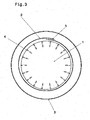
- the FIG. 3 turns the mast 1 off FIG. 1 before the treatment. From this presentation, the treatment principle is particularly well recognized.
- the metal foil 2 is arranged overlapping with an overlap 5 around the mast 1.
- the shrink tube 3 is arranged in the expanded state.
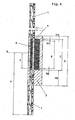
- FIG. 4 represents a schematic structure of the treated wooden mast 1. Similar to in FIG. 1 it is a partial sectional view, wherein in particular the critical earth-air region is partially shown as a section.
- the mast 1 is in turn provided over the area B with a perforation 4.
- the perforated area B is wrapped with the metal foil 2, which extends beyond the perforated area B in the longitudinal direction by the lengths G 1 and G 2 and thus completely covers the perforated area.
- the wrapped with the metal area C in turn is covered with shrink film 3, which extends beyond the metal-wrapped area C in the longitudinal direction above the ground level A by the length H 1 and below the ground level A by the length H 2 and shrunk in the critical state Earth-air area including the metal collar 2 includes.
- the dimension F is the burial depth of the wooden mast 1 again, which accounts for about 1/6 of the total mast length, for example, for telegraph poles.
Landscapes
- Engineering & Computer Science (AREA)
- Architecture (AREA)
- Life Sciences & Earth Sciences (AREA)
- Wood Science & Technology (AREA)
- Civil Engineering (AREA)
- Structural Engineering (AREA)
- Chemical & Material Sciences (AREA)
- Materials Engineering (AREA)
- Chemical And Physical Treatments For Wood And The Like (AREA)
Description
- Die vorliegende Erfindung betrifft einen Holzmast, insbesondere in Form eines Rundholzes für den Einsatz als Leitungsmast, der die Merkmale des Oberbegriffes des Anspruchs 1 aufweist, sowie die Verwendung eines solchen Holzmastes, und ein Verfahren zur mechanischen und biologischen Stabilisierung von im Erdreich verankerten Holzmasten.
- Hölzer und Holzbauteile, die bestimmungsgemäß im Boden oder Wasser verbaut werden (Gebrauchsklasse 4 gemäß DIN 68800 Teil 3), unterliegen einem hohen Infektionsdruck durch holzabbauende Organismen, der die Nutzungsdauer der Bauteile erheblich einschränken kann. Zu den holzabbauenden Organismen gehören insbesondere holzzerstörende Pilze aus der Gruppe der Basidiomyceten (z. B. Schwämme, Blättlinge) und/oder Ascomyceten aus der Gruppe der Fungi imperfecti (z. B. Moderfäule) sowie holzzerstörende Insekten, vorwiegend aus der Familie der Cerambycidae (Bockkäfer).
- Es ist Stand der Technik, dem beschriebenen Holzabbau durch eine geeignete biozide Imprägnierung entgegenzuwirken. So werden Holzmasten für den Einsatz als Träger von Überlandleitungen und Telefonleitungen ebenso wie für Zaunpfähle meist im druckimprägnierten Zustand eingesetzt, d. h. ein Holzschutzmittel wird unter Druck in das Holz eingepresst.
- Die Schwachstelle von Pfählen und Masten, die im Erdreich verankert sind, ist der Übergangsbereich zwischen Erdreich und Atmosphäre, wo Fäulnisbakterien, Pilze, etc. das Holz angreifen. Während die durchschnittliche Lebensdauer der unterhalb und oberhalb des gefährdeten Bereiches gelegenen Bereiche mehrere Dekaden betragen kann, hat dieser Übergangsbereich je nach Bodenbeschaffenheit selbst im imprägnierten Zustand oft nur eine Lebensdauer von ca. 5 bis 10 Jahren. Erschwerend kommt hinzu, dass viele besonders wirksame Imprägniermittel, die bisher eingesetzt wurden, aufgrund einer verschärften Umweltgesetzgebung, z. B. wegen der Gefährdung des Grundwassers, verboten sind.
- Man hat erkannt, dass eine tiefe und gleichmäßige Verteilung der Imprägnierung bzw. der Wirksubstanzen im Holz, insbesondere in den besonders schutzbedürftigen Bereichen, wie z. B. den Erd-Luft-Bereichen, wesentlich für eine wirksame und dauerhafte Imprägnierung ist. So ist ein bevorzugtes Verfahren zur Imprägnierung von Holzmasten heute die sogenannte KVD-Tränkung, d. h. die Kessel-Vakuum-Druck-Tränkung, bei der die Tränklösung vermittels Druckunterschieden in das Holz befördert wird.
- Aber auch mit solchen Verfahren gelingt es nicht, eine vollständige Imprägnierung von Holzmasten zu garantieren oder zu erreichen. Verantwortlich dafür ist die dem Holz eigene Anatomie und naturbedingte Inhomogenität, aber auch die Tatsache, dass die Tränkreife für Holzmasten nur schwer zu erkennen ist, was dazu führt, dass sich der Imprägniererfolg nicht in jedem Fall einstellt und ein bestimmter Teil der Holzmasten bereits vor dem Erreichen einer Nutzungsdauer von 10 Jahren, insbesondere durch Pilzangriff (Fäulnis), ausfällt.
- Man hat versucht, mangelnder Tränkreife, d. h. hohe Feuchtigkeitsgehalte der Rohmasten, die der erforderlichen Schutzmittelaufnahme und -verteilung entgegenstehen, dadurch zu begegnen, dass in dem besonders gefährdeten Erd-Luft-Bereich zusätzliche Maßnahmen angewandt wurden, um die Durchdringung des Holzes mit dem Holzschutzmittel zu verbessern. So werden beispielsweise die Masten geschält und im Erd-Luft-Bereich mit Hilfe von sogenannten Mastenbohrmaschinen perforiert.
- Bei Telekommunikationsmasten wird als Erd-Luft-Bereich der Teil von den Masten bezeichnet wird, der sich von ca. 40 bis 60 cm unterhalb bis ca. 20 bis 30 cm oberhalb der Bodengleiche erstreckt. In diesem Bereich bildet der Luft- und Feuchtezutritt optimale Existenzvoraussetzungen für holzzerstörende Organismen. Darüber hinaus treten bei mechanischen Belastungen eines Mastes hier die größten Druck- und Zugkräfte auf.
- Mit der oben geschilderten Perforation ist zwar eine deutliche Verlängerung der Lebensdauer von Holzmasten erreicht worden, trotzdem kommt es immer wieder zu Ausfällen bei den eingesetzten Holzmasten durch Fäulnisbildung im Erd/Luft-Bereich.
- In der
DE 38 23 353 A1 wird ein Verfahren zum Haltbarmachen bzw. Imprägnieren von im Erdreich verankerten Holzmasten beschrieben, bei dem im Bereich der Übergangszone zwischen Erdreich und Atmosphäre ein Schrumpfschlauch angeordnet wird, der mit seinem nach unten weisenden Ende auf den Holzmast geschrumpft wird, woraufhin dann in den Ringraum zwischen dem nach oben offenen Schrumpfschlauch und dem Holzmast ein fäulnishemmender Stoff in rieselfähiger oder flüssiger Form eingebracht wird. Anschließend wird das nach oben weisende Ende des Schrumpfschlauches ebenfalls auf den Holzmast geschrumpft. Mit diesem Verfahren gelingt es zwar, die Lebensdauer von Holzmasten deutlich zu verlängern, aber auch hier kommt es immer wieder zu Ausfällen bei den so behandelten Holzmasten durch Fäulnisbildung, die möglicherweise auch dadurch begünstigt wird, dass die Schrumpffolie im kritischen Bereich aufgrund des dort deponierten Imprägnierschutzmittels nicht ideal am Holzmast anliegt, so dass hier Raum für die Anlagerung von Feuchtigkeit geschaffen wird, die vom Boden her in diesen Bereich vordringen kann. - Ein zusätzlicher, besonders kritischer Aspekt bei der Fäulnisbildung im Erd-Luft-Bereich ist, dass hier bei mechanischen Belastungen auch die größten Druck- und Zugkräfte auftreten. Das führt dazu, dass ein in diesem Bereich geschwächter Mast bei einer mechanischen Belastung auf Höhe der Bodengleiche bricht. Dabei unterscheidet sich der Bruchmechanismus von durch Mikroorganismen geschwächtem Holz ganz wesentlich von einem gesunden Holz. Bei geschwächtem Holz ist der Bruch übergangslos und ohne jede Vorwarnung, während bei gesundem Holz in der Regel sich der Bruch ankündigt und die Faserstruktur des Holzes dem Bruch entgegenwirkt. Dies ist insofern insbesondere für Telefonmasten von großer Bedeutung, da an Telefonleitungen immer wieder Wartungsarbeiten durchzuführen sind, bei denen beispielsweise ein Telefonmast von einem Techniker erklettert werden muss. Dieses Erklettern des Telefonmastes führt zu einer starken mechanischen Belastung, bei der es im Falle eines geschwächten Mastes leicht zu einem Bruch kommen kann. Auf diese Weise kommt es immer wieder zu Unfällen mit schweren Verletzungen oder sogar mit tödlichem Ausgang.
- In der
EP 0 400 447 B1 wird ein Holzmast für den Einsatz als Leitungsmast beschrieben, der im Erd/Luftbereich von einer Schrumpffolie umhüllt ist, wobei zwischen Schrumpffolie und Mast eine Paste vorgesehen ist, die als Wirkstoff Bor oder eine Borverbindung enthält, die als Imprägniermittel für den Mast vorgesehen sind. Ein ähnliches System wird in der OffenlegungsschriftDE 20 43 489 beschrieben, die ebenfalls eine Umhüllung des Mastes im Erd/Luftbereich mit einer Folie vorsieht, wobei zwischen Folie und Mast eine Schutzsalzschicht aufgebracht ist. Um einen Verlust der Schutzsalzschicht zu vermeiden, ist ein Nachfüllen der Salzschicht aus einem Vorratsbehälter vorgesehen. Dabei kann als Einfüllhilfe ein Ring aus einem witterungsbeständigen Metall eingesetzt werden. Sowohl dieEP 0 400 447 B1 als auch dieDE 20 43 489 sehen keinen zusätzlichen Schutz gegen Bruch vor. Weiteren Stand der Technik offenbarenEP 0 750 084 A1 ,US 2003/0221390 A1 , sowie die SchriftenDE 20 43 489 undUS 1,521,285 .EP 0 750 084 A1 offenbart alle Merkmale der Oberbegriffe der Ansprüche 1 und 14.
Der Ersatz des Holzes als Baustoff für Leitungsmasten, Hopfenstangen, Wasserbauhölzer, Palisaden oder Pfähle für den Obst- und Weinanbau durch andere Materialien wurde zwar immer wieder diskutiert, konnte sich aber aufgrund der zahlreichen Vorteile des Holzes, wie z. B. das geringe Gewicht, die hohe mechanische Belastbarkeit, die energiearme Herstellung, die fundamentlose Verarbeitung, die Verfügbarkeit als nachwachsender Rohstoff sowie die Akzeptanz als Teil des Landschaftsbilds, nicht durchsetzen. - Es besteht somit weiterhin das Problem, dass die Holzmasten im Erd-Luft-Bereich nicht ausreichend geschützt sind und abbrechen. Darüber hinaus besteht das Problem, dass die Schutzmaßnahmen mit Imprägniermitteln zu Belastungen der Umwelt führen.
- Es ist daher die Aufgabe der vorliegenden Erfindung, Holzmasten zur Verfügung zu stellen, die die Nachteile des Standes der Technik nicht aufweisen. Der vorliegenden Erfindung liegt darüber hinaus die Aufgabe zugrunde, ein Verfahren bereitzustellen, mit dem Holzmasten im kritischen Erd-Luft-Bereich wirksam mechanisch und biologisch stabilisiert werden.
- Diese Aufgaben werden durch einen Holzmast mit den Merkmalen des Anspruchs 1 sowie ein Verfahren zu seiner Herstellung mit den Merkmalen des Anspruchs 14 gelöst. Vorteilhafte Ausführungsformen sind Gegenstand der Unteransprüche.
- Das Wesen der Erfindung besteht darin, dass der zu behandelnde Holzmast zunächst auf die übliche Weise imprägniert wird, anschließend im Bereich der Übergangszone zwischen Erdreich und Atmosphäre mit einem Metall, insbesondere in Form eines Netzes, einer Folie, einer Manschette oder eines Bleches, umwickelt wird und dann im kritischen Erd-Luft-Bereich mitsamt des Metallwickels mit einer Schrumpffolie umhüllt wird. Dabei ragt die Schrumpffolie in Längsrichtung sowohl oben als auch unten über das Metall hinaus und schließt den gesamten kritischen Bereich dicht ab.
- Entscheidend bei dieser Behandlung ist, dass das Metall eine oligodynamische Wirkung aufweist. Darunter versteht man die entkeimende Wirkung von Metallionen in kleinsten Mengen. Beispiele für derartige Metalle sind Kupfer, Zink und kupferhaltige Legierungen, wie z.B. Messing und Bronze, oder silberhaltige Legierungen. Es sind weitere oligodynamische Metalle (wie z. B. Silber) bekannt, jedoch werden aufgrund ihrer Verfügbarkeit, ihres Preises und ihrer Werkstoffeigenschaften vorzugsweise die oben genannten Metalle erfindungsgemäß eingesetzt.
- Da das Metall nicht nur die Funktion hat, fungizid oder biozid zu wirken, sondern auch darüber hinaus noch für eine mechanische Stabilisierung im Erd-Luft-Bereich des Mastes sorgen soll, wird das Metall in Schichtdicken von 0,05 bis 2 mm eingesetzt. Der bevorzugte Bereich liegt bei 0,1 bis 0,3 mm Schichtdicke. Bei der Umwicklung des Holzmastes mit dem Metall in Form einer Folie, eines Netzes, einer Manschette oder eines Bleches ist darauf zu achten, dass der Mast im Erd-Luft-Bereich über seinen gesamten Radius mit Metall bedeckt ist. Um dies sicherzustellen, sollte bei einer einlagigen Anordnung einer Folie beispielsweise eine Überlappung von mindestens ca. 50 bis 100 mm erfolgen. Allgemein kann die radiale Überlappung x auch entsprechend der Formel

bestimmt werden, wobei d der Durchmesser des Holzmastes ist. - Der besondere Einfluss des Systems auf die Standsicherheit konnte durch Bruchversuche an Holzleitungsmasten, die im Bereich der Bodengleiche künstlich geschwächt waren (20% Restquerschnitt zur Simulation fortgeschrittener Fäulnis) demonstriert werden. Nach Auslenkung und Bruch hielten solche Masten einer Zugkraft von mehr als 100 kg stand und neigten sich dabei langsam bis in die Horizontale (90°). Für die Praxis bedeutet dies, dass unkontrollierte Mastumbrüche auch beim Besteigen nicht mehr zu befürchten sind. Dieser zusätzliche positive Effekt auf die Versorgungs- und Verkehrssicherheit von Holzleitungsmasten ist ein wesentlicher Aspekt der vorliegenden Erfindung.
- Je nach Einsatzzweck des Holzmastes werden unterschiedlich große Bereiche auf diese Weise geschützt und es werden in Längsrichtung des Mastes zwischen 300 und 1500 mm, vorzugsweise ca. 1000 mm, der Übergangszone zwischen Erdreich und Atmosphäre mit Metall abgedeckt. Das Metall bzw. seine Ionen haben eine keimtötende Wirkung und der Metallwickel selber fungiert als Depot für derartige Ionen, die dann gegebenenfalls unterstützt von dem Lösungsmittel des Imprägniermittels in das Holzinnere diffundieren.
- Erfindungsgemäß liegt der Metallwickel fest an dem Holz an und kann zusätzlich noch durch geeignete Maßnahmen, wie z.B. Befestigung mit Nägeln, an einem Verrutschen gehindert werden. Der auf diese Weise präparierte Holzmast wird anschließend über den gesamten Erd-Luft-Bereich mit einer Schrumpffolie umhüllt. Dabei liegt die Folie im geschrumpften Zustand direkt an dem Metall an und endet in Längsrichtung des Mastes um ca. 50 bis 100 mm oberhalb und unterhalb des mit Metall umwickelten Bereiches. In diesem überstehenden Bereich liegt die Folie dann dicht und eng an dem Holzmast an. Die Folie weist im geschrumpften Zustand eine Dicke von ca. 0,5 bis 5 mm auf und deckt je nach Anwendungsbereich eine Länge von 400 bis 1.700 mm ab.
- Eine besonders gute biologische Stabilisierung erhält man dann, wenn der Holzmast zunächst perforiert, dann druckimprägniert wird, anschließend erfindungsgemäß mit einer Metallfolie umwickelt und schließlich mit einer Kunststofffolie umhüllt wird. Hervorragende Haltbarkeitsdauern von Masten erhält man, wenn zum Imprägnieren ein Holzschutzmittel eingesetzt wird, das Kupfer in Form von Aminokomplexen enthält.
- Eine weitere bevorzugte Ausführungsform sieht vor, dass eine Schrumpffolie in Form eines Schrumpfschlauches aus Polyolefin eingesetzt wird, der beispielsweise in expandierter Form eine Wandstärke von ca. 0,1 bis 1,0 mm aufweist, und dann beim Schrumpfen auf eine Wandstärke von ca. 0,5 bis 5 mm, vorzugsweise ca. 2,0 bis 3,0 mm anwächst. Das Schrumpfen selber kann auf die übliche Weise mit Hilfe eines Gasbrenners von Hand durchgeführt werden. Eine bevorzugte, weil wirtschaftlich günstige, Ausführungsform sieht vor, die Schrumpfung in einer automatischen Schrumpfanlage mit kreisförmig angeordneten Schrumpfbrennern durchzuführen. Auf diese Weise kann eine besonders gleichmäßige Umhüllung des kritischen Erd-Luft-Bereiches des Holzmastes gewährleistet werden.
- Im Folgenden wird das erfindungsgemäße Verfahren anhand eines Beispiels näher erläutert.
- Ein geschälter, tränkreifer Rohmast aus Fichtenholz mit einer Länge von ca. 12 Metern und einem mittleren Durchmesser von ca. 200 mm wird über eine Länge von ca. 900 mm in seinem Erd-Luft-Bereich (ab ca. 1.500 mm oberhalb des unteren Mastendes) mit Hilfe einer Mastenbohrmaschine perforiert. Anschließend wird der Holzmast auf die übliche Weise mit einem kupferhaltigen Imprägniersalz im Kesseldruckverfahren imprägniert. Nach einer Wartezeit von 3 Tagen wird der Holzmast mit einer Messingfolie mit einer Länge von 1.000 mm, einer Stärke von 0,3 mm und einer Breite von 700 mm, so umwickelt, dass der perforierte Bereich in Längsrichtung überlappend durch die Metallfolie abgedeckt ist. Die Metallfolie selber überlappt dabei radial um ca. 70 mm. Über den so umwickelten Holzmast wird anschließend ein Schrumpfschlauch aus Polyolefin mit einer Länge von ca. 1.600 mm gezogen. Der Schrumpfschlauch ist dabei so angeordnet, dass er am unteren Ende des Erd-Luft-Bereichs, der beim Einsatz des Holzmastes im Erdreich angeordnet ist, den Metallwickel um ca. 500 mm überlappt und im oberen Bereich der Erd-Luft-Zone, der als sichtbarer Bereich oberhalb der Bodengleiche angeordnet ist, um ca. 100 mm überlappt. Der Schrumpfschlauch besitzt im expandierten Zustand einen Durchmesser von ca. 300 mm bei einer Foliendicke von 0,7 mm. Nach der Behandlung in einer automatischen Schrumpfanlage liegt die Kunststofffolie eng an dem Metallwickel und dem Holz an und zeigt eine Folienstärke von ca. 3,1 mm.
- Neben dem geschilderten Beispiel wird der' erfindungsgemäße Holzmast anhand von Abbildungen näher erläutert.
- Dabei zeigen:
- Figur 1
- eine partielle Schnittdarstellung eines Holzmastes,
- Figur 2
- einen Querschnitt eines Holzmastes,
- Figur 3
- den Querschnitt des Holzmastes aus
Figur 2 vor der Behandlung und - Figur 4
- einen partiellen Schnitt eines Holzmastes mit einer schematischen Darstellung des Aufbaus.
- Die
Figur 1 zeigt einen Holzmast 1 der im Erd-Luft-Bereich oberhalb und unterhalb der Bodengleiche A über eine Länge B mit einer Perforation 4 versehen ist. Der perforierte Bereich B ist über eine Länge C mit einer Metallfolie 2 umwickelt. Der gesamte Erd-Luft-Bereich ist mit einer Schrumpffolie 3 abgedeckt, die sich über eine Länge D erstreckt und sowohl den Perforationsbereich B als auch den mit dem Metall umwickelten Bereich C abdeckt und in der Längsrichtung überragt, so dass der gesamte kritische Erd-Luft-Bereich mit der Kunststofffolie 3 dicht abgeschlossen ist. - In der
Figur 2 ist der Mast 1 ausFigur 1 im Querschnitt dargestellt. Bei dieser Darstellung sind die Perforationen 4 zu erkennen, die in das Mastinnere führen. Der Mast 1 ist in seinem Umfang direkt und eng anliegend mit einer Metallfolie 2 umwickelt, die wiederum eng von der Schrumpffolie 3 umschlossen wird. - Die
Figur 3 stellt den Mast 1 ausFigur 1 vor der Behandlung dar. Aus dieser Darstellung ist das Behandlungsprinzip besonders gut zu erkennen. So ist die Metallfolie 2 überlappend mit einer Überlappung 5 um den Mast 1 angeordnet. Um Mast 1 und Metallfolie 2 ist der Schrumpfschlauch 3 im expandierten Zustand angeordnet. - Noch deutlicher ist das Behandlungsprinzip in der
Figur 4 zu erkennen, die einen schematischen Aufbau des behandelten Holzmastes 1 wiedergibt. Ähnlich wie inFigur 1 handelt es sich um eine partielle Schnittdarstellung, wobei insbesondere der kritische Erd-Luft-Bereich teilweise als Schnitt dargestellt ist. Der Mast 1 ist wiederum über den Bereich B mit einer Perforation 4 versehen. Der perforierte Bereich B ist umwickelt mit der Metallfolie 2, die in Längsrichtung den perforierten Bereich B um die Längen G1 und G2 überragt und damit den perforierten Bereich vollständig abdeckt. Der mit dem Metall umwickelte Bereich C wiederum ist mit Schrumpffolie 3 ummantelt, die den mit Metall umwickelten Bereich C in der Längsrichtung oberhalb der Bodengleiche A um die Länge H1 und unterhalb der Bodengleiche A um die Länge H2 überragt und im aufgeschrumpften Zustand den kritischen Erd-Luft-Bereich mitsamt der Metallmanschette 2 einschließt. Die Abmessung F gibt die Eingrabtiefe des Holzmastes 1 wieder, die beispielsweise für Telegraphenmaste etwa 1/6 der gesamten Mastlänge ausmacht. -
- 1
- Holzmast
- 2
- Metall (Folie, Netz, Manschette, Blech)
- 3
- Schrumpffolie (Schrumpfschlauch)
- 4
- Perforation
- 5
- Überlappung
- A
- Bodengleiche
- B
- Länge des Perforationsbereiches
- C
- Mit Metall umwickelter Bereich
- D
- Mit Kunststofffolie umhüllter Bereich
- E
- In das Erdreich ragender Perforationsbereich
- F
- Eingrabtiefe
- G1
- Überlappungsbereich Metallfolie oben
- G2
- Überlappungsbereich Metallfolie unten
- H1
- Überlappungsbereich Kunststofffolie oben
- H2
- Überlappungsbereich Kunststofffolie unten
Claims (20)
- Holzmast (1), mit einem von einer Schrumpffolie (3) umhüllten imprägnierten Erd/Luftbereich,
dadurch gekennzeichnet, dass zwischen der Schrumpffolie (3) und dem imprägnierten Holzmast (1) sandwichartig ein Metall (2) mit oligodynamischer Wirkung angeordnet ist, wobei der Mast im Erd-Luft-Bereich über seinem gesamten Radius mit Metall bedeckt ist, und wobei das Metall (2) eine Schichtdicke von 0.05 bis 2 mm aufweist, und in Längsrichtung des Mastes (1) einen Bereich (C) von 300 bis 1500 mm abdeckt. - Holzmast (1) nach Anspruch 1,
dadurch gekennzeichnet, dass der Holzmast in Form eines Rundholzes für den Einsatz als Leitungsmast, Obst- oder Rebpfahl, Palisade, Hopfenstange sowie Bauholz für Wasserbau oder Lawinenschutz vorgesehen ist. - Holzmast (1) nach Anspruch 1 oder 2,
dadurch gekennzeichnet, dass das Metall (2) in Form einer Folie, eines Netzes, einer Manschette oder eines Bleches vorliegt. - Holzmast (1) nach einem der Ansprüche 1 bis 3,
dadurch gekennzeichnet, dass das Metall (2) ausgewählt ist aus der Gruppe Kupfer, Zink und kupferhaltige Legierungen, wie z.B. Messing und Bronze, oder silberhaltige Legierungen. - Holzmast (1) nach einem der Ansprüche 1 bis 4,
dadurch gekennzeichnet, dass das Metall (2) eine Schichtdicke von 0.1 bis 0.3 mm, aufweist. - Holzmast (1) nach einem der Ansprüche 1 bis 5,
dadurch gekennzeichnet, dass das Metall (2) in Längsrichtung des Mastes (1) einen Bereich (C)von 1000 mm, abdeckt. - Holzmast (1) nach einem der Ansprüche 1 bis 6,
dadurch gekennzeichnet, dass die Schrumpffolie (3) im geschrumpften Zustand direkt an dem Metall (2) anliegt. - Holzmast (1) nach einem der Ansprüche 1 bis 7,
dadurch gekennzeichnet, dass die Schrumpffolie (3) im geschrumpften Zustand das Metall (2) in der Längsrichtung des Mastes (1) oben und unten um jeweils mindestens ca. 50 mm überragt und in diesem Bereich direkt an dem Holzmast anliegt. - Holzmast (1) nach einem der Ansprüche 1 bis 8,
dadurch gekennzeichnet, dass die Schrumpffolie (3) eine Dicke von 0.5 bis 5 mm sowie eine Höhe von 400 bis 1700 mm aufweist. - Holzmast (1) nach einem der Ansprüche 1 bis 9,
dadurch gekennzeichnet, dass die Schrumpffolie (3) ein Folienschlauch aus Polyolefin ist. - Holzmast (1) nach einem der Ansprüche 1 bis 10,
dadurch gekennzeichnet, dass der Holzmast (1) in dem Übergangsbereich zwischen Erdreich und Atmosphäre eine Perforation (4) zur Aufnahme eines Imprägniermittels aufweist. - Holzmast (1) nach einem der Ansprüche 1 bis 11,
dadurch gekennzeichnet, dass der perforierte Bereich (B) vollständig mit dem Metall (2) abgedeckt ist, wobei das Metall (2) den perforierten Bereich (B) in der Längsrichtung oben und unten um ca. 50 mm überragt. - Holzmast (1) nach einem der Ansprüche 1 bis 12,
dadurch gekennzeichnet, dass der Holzmast (1), insbesondere im Bereich (B) der Perforation, mit einem Holzschutzmittel imprägniert ist, das Kupfer in Form von Aminokomplexen enthält. - Verfahren zum Schutz von Holzmasten (1), insbesondere zur mechanischen und biologischen Stabilisierung von im Erdreich verankerten Holzmasten (1), im Bereich der Übergangszone zwischen Erdreich und Atmosphäre, wobei das Verfahren die Schritte umfasst- Imprägnieren des Holzmastes (1) im Erd/Luft-Bereich,- Umhüllen des imprägnierten Bereiches mit einer Schrumpffolie (3) aus Kunststoff und- Aufschrumpfen der Schrumpffolie (3) auf den Holzmast (1),dadurch gekennzeichnet, dass vor dem Umhüllen mit der Schrumpffolie (3) der imprägnierte Erd/Luft-Bereich des Holzmastes (1) mit einem Metall (2) mit oligodynamischer Wirkung, insbesondere in Form einer Folie, eines Bleches, eines Netzes oder einer Manschette, umwickelt wird, wobei der Mast im Erd-Luft-Bereich über seinem gesamten Radius mit Metall bedeckt ist, und wobei das Metall (2) eine Schichtdicke von 0.05 bis 2 mm aufweist, und in Längsrichtung des Mastes (1) einen Bereich (C)von 300 bis 1500 mm abdeckt.
- Verfahren nach Anspruch 14,
dadurch gekennzeichnet, dass vor der Imprägnierung eine Perforation (4) des Erd/Luft-Bereiches des Holzmastes (1) erfolgt. - Verfahren nach Anspruch 14 oder 15,
dadurch gekennzeichnet, dass das Metall (2) in Form einer Folie eingesetzt wird, womit der Radius des Holzmastes (1) mit mindestens einer vollständigen Lage umwickelt wird, wobei bei einer einlagigen Anordnung eine radiale Überlappung der Folie mit mindestens 50 bis 100 mm erfolgt. - Verfahren nach einem der Ansprüche 14 bis 16,
dadurch gekennzeichnet, dass eine Schrumpffolie (3) in Form eines Schrumpfschlauches (3) aus Polyolefin eingesetzt wird. - Verfahren nach einem der Ansprüche 14 bis 17,
dadurch gekennzeichnet, dass die Schrumpffolie (3) in expandierter Form eine Wandstärke von ca. 0.1 bis 1.0 mm und nach der Schrumpfung eine Wandstärke von ca. 0.5 bis 5.0 mm, vorzugsweise ca. 2.0 bis 3.0 mm, aufweist. - Verfahren nach einem der Ansprüche 14 bis 18,
dadurch gekennzeichnet, dass die Schrumpfung in einer automatischen Schrumpfanlage mit kreisförmig angeordneten Schrumpfbrennern erfolgt. - Verwendung eines Holzmastes (1) nach einem der Ansprüche 1 bis 13 in Form eines Rundholzes als Leitungsmast, Obst- oder Rebpfahl, Palisade, Hopfenstange sowie als Bauholz, insbesondere für Wasserbau oder Lawinenschutz.
Priority Applications (2)
| Application Number | Priority Date | Filing Date | Title |
|---|---|---|---|
| PL07725424T PL2019891T3 (pl) | 2006-05-22 | 2007-05-22 | Drewniany słup, w szczególności słup sieci elektrycznej |
| SI200731412T SI2019891T1 (sl) | 2006-05-22 | 2007-05-22 | Lesen drog, še zlasti drog za napeljavo |
Applications Claiming Priority (2)
| Application Number | Priority Date | Filing Date | Title |
|---|---|---|---|
| DE102006024127A DE102006024127A1 (de) | 2006-05-22 | 2006-05-22 | Holzmast, insbesondere Leitungsmast |
| PCT/EP2007/004524 WO2007134835A1 (de) | 2006-05-22 | 2007-05-22 | Holzmast, insbesondere leitungsmast |
Publications (2)
| Publication Number | Publication Date |
|---|---|
| EP2019891A1 EP2019891A1 (de) | 2009-02-04 |
| EP2019891B1 true EP2019891B1 (de) | 2013-12-04 |
Family
ID=38606456
Family Applications (1)
| Application Number | Title | Priority Date | Filing Date |
|---|---|---|---|
| EP07725424.1A Not-in-force EP2019891B1 (de) | 2006-05-22 | 2007-05-22 | Holzmast, insbesondere leitungsmast |
Country Status (5)
| Country | Link |
|---|---|
| EP (1) | EP2019891B1 (de) |
| DE (1) | DE102006024127A1 (de) |
| PL (1) | PL2019891T3 (de) |
| SI (1) | SI2019891T1 (de) |
| WO (1) | WO2007134835A1 (de) |
Cited By (1)
| Publication number | Priority date | Publication date | Assignee | Title |
|---|---|---|---|---|
| DE202015101674U1 (de) | 2015-04-02 | 2016-07-05 | Induo Gesellschaft Zur Verwertung Von Schutzrechten Mbh & Co. Kg | Schutzbandage |
Families Citing this family (7)
| Publication number | Priority date | Publication date | Assignee | Title |
|---|---|---|---|---|
| DE102011107781A1 (de) | 2011-07-15 | 2013-01-17 | Carl Scholl Gmbh | Bandage für Holzmast |
| DE202012012862U1 (de) | 2011-09-28 | 2014-02-14 | Fürstenberg-THP GmbH | Hölzer in dauerndem Boden- oder Wasserkontakt |
| DE102011114472A1 (de) * | 2011-09-28 | 2013-03-28 | Holzindustrie Fürst zu Fürstenberg GmbH & Co. KG | Verfahren zum Schutz von Holz im Bodenkontakt |
| FI9863U1 (fi) * | 2012-03-16 | 2012-11-08 | Tehomet Oy | Puusta valmistettu valaisinpylväsrakenne |
| DE102016103895A1 (de) | 2016-03-03 | 2017-09-07 | Nicolas Steiner | Im Erdreich verankerbarer Mast |
| DE202016101163U1 (de) | 2016-03-03 | 2016-04-26 | Nicolas Steiner | Im Erdreich verankerbarer Mast |
| DE102018003341A1 (de) | 2018-04-24 | 2019-10-24 | Kurt Obermeier Gmbh & Co. Kg | Physikalische Entkopplung der ober- und unterirdischen Holzfeuchten von Holzbauteilen im Erd- oder Wasserkontakt |
Citations (2)
| Publication number | Priority date | Publication date | Assignee | Title |
|---|---|---|---|---|
| DE3823353A1 (de) * | 1988-07-09 | 1990-01-11 | Kabelmetal Electro Gmbh | Verfahren zum haltbarmachen bzw. impraegnieren von holzmasten |
| EP0400447A1 (de) * | 1989-06-02 | 1990-12-05 | kabelmetal electro GmbH | Anordnung zum Schutz von Holzmasten |
Family Cites Families (6)
| Publication number | Priority date | Publication date | Assignee | Title |
|---|---|---|---|---|
| US1521285A (en) | 1923-10-15 | 1924-12-30 | Axel B Erickson | Telephone and telegraph pole |
| DE2043489A1 (en) * | 1970-09-02 | 1972-03-09 | Hoffmann, Robert, Dipl. Ing., 3500 Kassel-Wilhelmshöhe | Mast protection - with foot bound with impregnated bandage and covered by shrunk pvc with protective fluid reservoir |
| US5326410A (en) * | 1993-03-25 | 1994-07-05 | Timber Products, Inc. | Method for reinforcing structural supports and reinforced structural supports |
| DE69608034T2 (de) | 1995-06-20 | 2000-12-21 | Biotechnology Intellectual Property N.V., Willemstad | Auskleidung zum Schutz von Pfosten gegen Untergrundverfall |
| DE19536328A1 (de) * | 1995-09-29 | 1997-04-03 | Remmers Bauchemie Gmbh | Mittel zum Schutz von technischen Materialien vor Schädigung und Zerstörung durch Schadorganismen auf Basis natürlicher Wirkstoffe |
| CA2430474A1 (en) * | 2002-05-30 | 2003-11-30 | Mcfarland Cascade Holdings, Inc. | Protector for chemically treated wooden utility pole and surrounding environment |
-
2006
- 2006-05-22 DE DE102006024127A patent/DE102006024127A1/de not_active Ceased
-
2007
- 2007-05-22 SI SI200731412T patent/SI2019891T1/sl unknown
- 2007-05-22 EP EP07725424.1A patent/EP2019891B1/de not_active Not-in-force
- 2007-05-22 WO PCT/EP2007/004524 patent/WO2007134835A1/de not_active Ceased
- 2007-05-22 PL PL07725424T patent/PL2019891T3/pl unknown
Patent Citations (2)
| Publication number | Priority date | Publication date | Assignee | Title |
|---|---|---|---|---|
| DE3823353A1 (de) * | 1988-07-09 | 1990-01-11 | Kabelmetal Electro Gmbh | Verfahren zum haltbarmachen bzw. impraegnieren von holzmasten |
| EP0400447A1 (de) * | 1989-06-02 | 1990-12-05 | kabelmetal electro GmbH | Anordnung zum Schutz von Holzmasten |
Cited By (1)
| Publication number | Priority date | Publication date | Assignee | Title |
|---|---|---|---|---|
| DE202015101674U1 (de) | 2015-04-02 | 2016-07-05 | Induo Gesellschaft Zur Verwertung Von Schutzrechten Mbh & Co. Kg | Schutzbandage |
Also Published As
| Publication number | Publication date |
|---|---|
| DE102006024127A1 (de) | 2007-11-29 |
| EP2019891A1 (de) | 2009-02-04 |
| PL2019891T3 (pl) | 2014-04-30 |
| WO2007134835A1 (de) | 2007-11-29 |
| SI2019891T1 (sl) | 2014-03-31 |
Similar Documents
| Publication | Publication Date | Title |
|---|---|---|
| EP0400447B1 (de) | Anordnung zum Schutz von Holzmasten | |
| EP2019891A1 (de) | Holzmast, insbesondere leitungsmast | |
| DE69108540T2 (de) | Ankersystem zum nachträglichen spannen. | |
| DE102022116559A1 (de) | Schutzelement | |
| DE69608034T2 (de) | Auskleidung zum Schutz von Pfosten gegen Untergrundverfall | |
| DE102008009057A1 (de) | Holzmastegründung | |
| DE102011107781A1 (de) | Bandage für Holzmast | |
| EP2089577B1 (de) | Bauwerksfundament sowie verfahren zur herstellung eines solchen bauwerksfundaments | |
| EP2574435A2 (de) | Hölzer in dauerndem Boden- oder Wasserkontakt | |
| DE102010018811A1 (de) | Holzmastegründung | |
| DE102022104353A1 (de) | Schutzelement | |
| CH415016A (de) | Verfahren und Vorrichtung zum Imprägnieren von Holzmasten oder Holzpfeilern und mit Imprägnierungsmittel versehener Holzmast oder -pfeiler | |
| DE102016103895A1 (de) | Im Erdreich verankerbarer Mast | |
| DE2153334C3 (de) | Rammpfahl | |
| DE10140441C2 (de) | Montagesystem zur Errichtung von Antennenanlagen mit Antennenhüllen | |
| DE669200C (de) | Vorrichtung zum Einfuehren von durch Diffusion und Osmose im Holz verteilbaren wasserloeslichen Schutzsalzen an wechselnder Feuchtigkeit ausgesetzten Holzbauten | |
| DE202004010156U1 (de) | Zaunpfahl, insbesondere Weidezaunpfahl | |
| DE60210994T2 (de) | Seilanker und Herstellungsverfahren | |
| DE202016101163U1 (de) | Im Erdreich verankerbarer Mast | |
| DE20220286U1 (de) | Fundament für einen Holzpfahl | |
| DE3823353A1 (de) | Verfahren zum haltbarmachen bzw. impraegnieren von holzmasten | |
| DE60104773T2 (de) | Verfahren und Einrichtung zum Ankern eines Behälters in einem Graben | |
| DE102015014993B3 (de) | Halterung für einen Zaun | |
| DE2017411C3 (de) | Mast oder Pfahl | |
| AT397444B (de) | Erdbebensichere aufbewahrungsanlage für radioaktives material |
Legal Events
| Date | Code | Title | Description |
|---|---|---|---|
| PUAI | Public reference made under article 153(3) epc to a published international application that has entered the european phase |
Free format text: ORIGINAL CODE: 0009012 |
|
| 17P | Request for examination filed |
Effective date: 20081015 |
|
| AK | Designated contracting states |
Kind code of ref document: A1 Designated state(s): AT BE BG CH CY CZ DE DK EE ES FI FR GB GR HU IE IS IT LI LT LU LV MC MT NL PL PT RO SE SI SK TR |
|
| AX | Request for extension of the european patent |
Extension state: AL BA HR MK RS |
|
| DAX | Request for extension of the european patent (deleted) | ||
| RAP1 | Party data changed (applicant data changed or rights of an application transferred) |
Owner name: FUERSTENBERG-THP GMBH |
|
| 17Q | First examination report despatched |
Effective date: 20130124 |
|
| GRAP | Despatch of communication of intention to grant a patent |
Free format text: ORIGINAL CODE: EPIDOSNIGR1 |
|
| INTG | Intention to grant announced |
Effective date: 20130628 |
|
| GRAS | Grant fee paid |
Free format text: ORIGINAL CODE: EPIDOSNIGR3 |
|
| GRAP | Despatch of communication of intention to grant a patent |
Free format text: ORIGINAL CODE: EPIDOSNIGR1 |
|
| GRAA | (expected) grant |
Free format text: ORIGINAL CODE: 0009210 |
|
| INTG | Intention to grant announced |
Effective date: 20131021 |
|
| AK | Designated contracting states |
Kind code of ref document: B1 Designated state(s): AT BE BG CH CY CZ DE DK EE ES FI FR GB GR HU IE IS IT LI LT LU LV MC MT NL PL PT RO SE SI SK TR |
|
| REG | Reference to a national code |
Ref country code: GB Ref legal event code: FG4D Free format text: NOT ENGLISH |
|
| REG | Reference to a national code |
Ref country code: CH Ref legal event code: EP |
|
| REG | Reference to a national code |
Ref country code: AT Ref legal event code: REF Ref document number: 643632 Country of ref document: AT Kind code of ref document: T Effective date: 20140115 Ref country code: IE Ref legal event code: FG4D Free format text: LANGUAGE OF EP DOCUMENT: GERMAN |
|
| REG | Reference to a national code |
Ref country code: DE Ref legal event code: R096 Ref document number: 502007012554 Country of ref document: DE Effective date: 20140130 |
|
| REG | Reference to a national code |
Ref country code: CH Ref legal event code: NV Representative=s name: R. A. EGLI AND CO. PATENTANWAELTE, CH |
|
| REG | Reference to a national code |
Ref country code: NL Ref legal event code: VDEP Effective date: 20131204 |
|
| PG25 | Lapsed in a contracting state [announced via postgrant information from national office to epo] |
Ref country code: SE Free format text: LAPSE BECAUSE OF FAILURE TO SUBMIT A TRANSLATION OF THE DESCRIPTION OR TO PAY THE FEE WITHIN THE PRESCRIBED TIME-LIMIT Effective date: 20131204 Ref country code: LT Free format text: LAPSE BECAUSE OF FAILURE TO SUBMIT A TRANSLATION OF THE DESCRIPTION OR TO PAY THE FEE WITHIN THE PRESCRIBED TIME-LIMIT Effective date: 20131204 Ref country code: NL Free format text: LAPSE BECAUSE OF FAILURE TO SUBMIT A TRANSLATION OF THE DESCRIPTION OR TO PAY THE FEE WITHIN THE PRESCRIBED TIME-LIMIT Effective date: 20131204 |
|
| REG | Reference to a national code |
Ref country code: PL Ref legal event code: T3 |
|
| REG | Reference to a national code |
Ref country code: LT Ref legal event code: MG4D |
|
| PG25 | Lapsed in a contracting state [announced via postgrant information from national office to epo] |
Ref country code: CY Free format text: LAPSE BECAUSE OF FAILURE TO SUBMIT A TRANSLATION OF THE DESCRIPTION OR TO PAY THE FEE WITHIN THE PRESCRIBED TIME-LIMIT Effective date: 20131204 Ref country code: LV Free format text: LAPSE BECAUSE OF FAILURE TO SUBMIT A TRANSLATION OF THE DESCRIPTION OR TO PAY THE FEE WITHIN THE PRESCRIBED TIME-LIMIT Effective date: 20131204 |
|
| REG | Reference to a national code |
Ref country code: SK Ref legal event code: T3 Ref document number: E 15857 Country of ref document: SK |
|
| PG25 | Lapsed in a contracting state [announced via postgrant information from national office to epo] |
Ref country code: EE Free format text: LAPSE BECAUSE OF FAILURE TO SUBMIT A TRANSLATION OF THE DESCRIPTION OR TO PAY THE FEE WITHIN THE PRESCRIBED TIME-LIMIT Effective date: 20131204 Ref country code: IS Free format text: LAPSE BECAUSE OF FAILURE TO SUBMIT A TRANSLATION OF THE DESCRIPTION OR TO PAY THE FEE WITHIN THE PRESCRIBED TIME-LIMIT Effective date: 20140404 |
|
| PG25 | Lapsed in a contracting state [announced via postgrant information from national office to epo] |
Ref country code: RO Free format text: LAPSE BECAUSE OF FAILURE TO SUBMIT A TRANSLATION OF THE DESCRIPTION OR TO PAY THE FEE WITHIN THE PRESCRIBED TIME-LIMIT Effective date: 20131204 Ref country code: PT Free format text: LAPSE BECAUSE OF FAILURE TO SUBMIT A TRANSLATION OF THE DESCRIPTION OR TO PAY THE FEE WITHIN THE PRESCRIBED TIME-LIMIT Effective date: 20140404 Ref country code: ES Free format text: LAPSE BECAUSE OF FAILURE TO SUBMIT A TRANSLATION OF THE DESCRIPTION OR TO PAY THE FEE WITHIN THE PRESCRIBED TIME-LIMIT Effective date: 20131204 |
|
| REG | Reference to a national code |
Ref country code: DE Ref legal event code: R097 Ref document number: 502007012554 Country of ref document: DE |
|
| REG | Reference to a national code |
Ref country code: HU Ref legal event code: AG4A Ref document number: E020484 Country of ref document: HU |
|
| PLBE | No opposition filed within time limit |
Free format text: ORIGINAL CODE: 0009261 |
|
| STAA | Information on the status of an ep patent application or granted ep patent |
Free format text: STATUS: NO OPPOSITION FILED WITHIN TIME LIMIT |
|
| PG25 | Lapsed in a contracting state [announced via postgrant information from national office to epo] |
Ref country code: DK Free format text: LAPSE BECAUSE OF FAILURE TO SUBMIT A TRANSLATION OF THE DESCRIPTION OR TO PAY THE FEE WITHIN THE PRESCRIBED TIME-LIMIT Effective date: 20131204 |
|
| 26N | No opposition filed |
Effective date: 20140905 |
|
| REG | Reference to a national code |
Ref country code: DE Ref legal event code: R097 Ref document number: 502007012554 Country of ref document: DE Effective date: 20140905 |
|
| PG25 | Lapsed in a contracting state [announced via postgrant information from national office to epo] |
Ref country code: LU Free format text: LAPSE BECAUSE OF FAILURE TO SUBMIT A TRANSLATION OF THE DESCRIPTION OR TO PAY THE FEE WITHIN THE PRESCRIBED TIME-LIMIT Effective date: 20140522 |
|
| PG25 | Lapsed in a contracting state [announced via postgrant information from national office to epo] |
Ref country code: MC Free format text: LAPSE BECAUSE OF FAILURE TO SUBMIT A TRANSLATION OF THE DESCRIPTION OR TO PAY THE FEE WITHIN THE PRESCRIBED TIME-LIMIT Effective date: 20131204 |
|
| PGFP | Annual fee paid to national office [announced via postgrant information from national office to epo] |
Ref country code: GB Payment date: 20150521 Year of fee payment: 9 Ref country code: SI Payment date: 20150508 Year of fee payment: 9 |
|
| PGFP | Annual fee paid to national office [announced via postgrant information from national office to epo] |
Ref country code: HU Payment date: 20150515 Year of fee payment: 9 Ref country code: AT Payment date: 20150520 Year of fee payment: 9 Ref country code: IE Payment date: 20150519 Year of fee payment: 9 Ref country code: PL Payment date: 20150427 Year of fee payment: 9 |
|
| PG25 | Lapsed in a contracting state [announced via postgrant information from national office to epo] |
Ref country code: MT Free format text: LAPSE BECAUSE OF FAILURE TO SUBMIT A TRANSLATION OF THE DESCRIPTION OR TO PAY THE FEE WITHIN THE PRESCRIBED TIME-LIMIT Effective date: 20131204 |
|
| REG | Reference to a national code |
Ref country code: FR Ref legal event code: PLFP Year of fee payment: 10 |
|
| PG25 | Lapsed in a contracting state [announced via postgrant information from national office to epo] |
Ref country code: BG Free format text: LAPSE BECAUSE OF FAILURE TO SUBMIT A TRANSLATION OF THE DESCRIPTION OR TO PAY THE FEE WITHIN THE PRESCRIBED TIME-LIMIT Effective date: 20131204 |
|
| PG25 | Lapsed in a contracting state [announced via postgrant information from national office to epo] |
Ref country code: GR Free format text: LAPSE BECAUSE OF FAILURE TO SUBMIT A TRANSLATION OF THE DESCRIPTION OR TO PAY THE FEE WITHIN THE PRESCRIBED TIME-LIMIT Effective date: 20140305 |
|
| PG25 | Lapsed in a contracting state [announced via postgrant information from national office to epo] |
Ref country code: BE Free format text: LAPSE BECAUSE OF FAILURE TO SUBMIT A TRANSLATION OF THE DESCRIPTION OR TO PAY THE FEE WITHIN THE PRESCRIBED TIME-LIMIT Effective date: 20140531 Ref country code: TR Free format text: LAPSE BECAUSE OF FAILURE TO SUBMIT A TRANSLATION OF THE DESCRIPTION OR TO PAY THE FEE WITHIN THE PRESCRIBED TIME-LIMIT Effective date: 20131204 |
|
| PGFP | Annual fee paid to national office [announced via postgrant information from national office to epo] |
Ref country code: IT Payment date: 20160524 Year of fee payment: 10 Ref country code: SK Payment date: 20160513 Year of fee payment: 10 |
|
| REG | Reference to a national code |
Ref country code: AT Ref legal event code: MM01 Ref document number: 643632 Country of ref document: AT Kind code of ref document: T Effective date: 20160522 |
|
| GBPC | Gb: european patent ceased through non-payment of renewal fee |
Effective date: 20160522 |
|
| REG | Reference to a national code |
Ref country code: IE Ref legal event code: MM4A |
|
| PG25 | Lapsed in a contracting state [announced via postgrant information from national office to epo] |
Ref country code: AT Free format text: LAPSE BECAUSE OF NON-PAYMENT OF DUE FEES Effective date: 20160522 |
|
| REG | Reference to a national code |
Ref country code: SI Ref legal event code: KO00 Effective date: 20170216 |
|
| PG25 | Lapsed in a contracting state [announced via postgrant information from national office to epo] |
Ref country code: HU Free format text: LAPSE BECAUSE OF NON-PAYMENT OF DUE FEES Effective date: 20160523 |
|
| REG | Reference to a national code |
Ref country code: FR Ref legal event code: PLFP Year of fee payment: 11 |
|
| PG25 | Lapsed in a contracting state [announced via postgrant information from national office to epo] |
Ref country code: SI Free format text: LAPSE BECAUSE OF NON-PAYMENT OF DUE FEES Effective date: 20160523 Ref country code: IE Free format text: LAPSE BECAUSE OF NON-PAYMENT OF DUE FEES Effective date: 20160522 Ref country code: GB Free format text: LAPSE BECAUSE OF NON-PAYMENT OF DUE FEES Effective date: 20160522 |
|
| PG25 | Lapsed in a contracting state [announced via postgrant information from national office to epo] |
Ref country code: PL Free format text: LAPSE BECAUSE OF NON-PAYMENT OF DUE FEES Effective date: 20160522 |
|
| PG25 | Lapsed in a contracting state [announced via postgrant information from national office to epo] |
Ref country code: SK Free format text: LAPSE BECAUSE OF NON-PAYMENT OF DUE FEES Effective date: 20170522 |
|
| REG | Reference to a national code |
Ref country code: SK Ref legal event code: MM4A Ref document number: E 15857 Country of ref document: SK Effective date: 20170522 |
|
| REG | Reference to a national code |
Ref country code: FR Ref legal event code: PLFP Year of fee payment: 12 |
|
| PG25 | Lapsed in a contracting state [announced via postgrant information from national office to epo] |
Ref country code: IT Free format text: LAPSE BECAUSE OF NON-PAYMENT OF DUE FEES Effective date: 20170522 |
|
| PGFP | Annual fee paid to national office [announced via postgrant information from national office to epo] |
Ref country code: FI Payment date: 20190517 Year of fee payment: 13 Ref country code: CZ Payment date: 20190515 Year of fee payment: 13 |
|
| PGFP | Annual fee paid to national office [announced via postgrant information from national office to epo] |
Ref country code: FR Payment date: 20190521 Year of fee payment: 13 |
|
| PGFP | Annual fee paid to national office [announced via postgrant information from national office to epo] |
Ref country code: CH Payment date: 20190523 Year of fee payment: 13 |
|
| PGFP | Annual fee paid to national office [announced via postgrant information from national office to epo] |
Ref country code: DE Payment date: 20190626 Year of fee payment: 13 |
|
| REG | Reference to a national code |
Ref country code: DE Ref legal event code: R119 Ref document number: 502007012554 Country of ref document: DE |
|
| REG | Reference to a national code |
Ref country code: FI Ref legal event code: MAE |
|
| PG25 | Lapsed in a contracting state [announced via postgrant information from national office to epo] |
Ref country code: FI Free format text: LAPSE BECAUSE OF NON-PAYMENT OF DUE FEES Effective date: 20200522 Ref country code: CH Free format text: LAPSE BECAUSE OF NON-PAYMENT OF DUE FEES Effective date: 20200531 Ref country code: LI Free format text: LAPSE BECAUSE OF NON-PAYMENT OF DUE FEES Effective date: 20200531 Ref country code: CZ Free format text: LAPSE BECAUSE OF NON-PAYMENT OF DUE FEES Effective date: 20200522 |
|
| PG25 | Lapsed in a contracting state [announced via postgrant information from national office to epo] |
Ref country code: FR Free format text: LAPSE BECAUSE OF NON-PAYMENT OF DUE FEES Effective date: 20200531 |
|
| PG25 | Lapsed in a contracting state [announced via postgrant information from national office to epo] |
Ref country code: DE Free format text: LAPSE BECAUSE OF NON-PAYMENT OF DUE FEES Effective date: 20201201 |