EP1990339B1 - Dioxetanverbindung, kationisch polymerisierbare zusammensetzung, optischer film und flüssigkristallanzeige - Google Patents
Dioxetanverbindung, kationisch polymerisierbare zusammensetzung, optischer film und flüssigkristallanzeige Download PDFInfo
- Publication number
- EP1990339B1 EP1990339B1 EP06812114A EP06812114A EP1990339B1 EP 1990339 B1 EP1990339 B1 EP 1990339B1 EP 06812114 A EP06812114 A EP 06812114A EP 06812114 A EP06812114 A EP 06812114A EP 1990339 B1 EP1990339 B1 EP 1990339B1
- Authority
- EP
- European Patent Office
- Prior art keywords
- compound
- cationically polymerizable
- film
- liquid crystal
- optical film
- Prior art date
- Legal status (The legal status is an assumption and is not a legal conclusion. Google has not performed a legal analysis and makes no representation as to the accuracy of the status listed.)
- Not-in-force
Links
Images
Classifications
-
- C—CHEMISTRY; METALLURGY
- C07—ORGANIC CHEMISTRY
- C07D—HETEROCYCLIC COMPOUNDS
- C07D305/00—Heterocyclic compounds containing four-membered rings having one oxygen atom as the only ring hetero atoms
- C07D305/02—Heterocyclic compounds containing four-membered rings having one oxygen atom as the only ring hetero atoms not condensed with other rings
- C07D305/04—Heterocyclic compounds containing four-membered rings having one oxygen atom as the only ring hetero atoms not condensed with other rings having no double bonds between ring members or between ring members and non-ring members
- C07D305/06—Heterocyclic compounds containing four-membered rings having one oxygen atom as the only ring hetero atoms not condensed with other rings having no double bonds between ring members or between ring members and non-ring members with only hydrogen atoms, hydrocarbon or substituted hydrocarbon radicals, directly attached to the ring atoms
-
- C—CHEMISTRY; METALLURGY
- C08—ORGANIC MACROMOLECULAR COMPOUNDS; THEIR PREPARATION OR CHEMICAL WORKING-UP; COMPOSITIONS BASED THEREON
- C08F—MACROMOLECULAR COMPOUNDS OBTAINED BY REACTIONS ONLY INVOLVING CARBON-TO-CARBON UNSATURATED BONDS
- C08F20/00—Homopolymers and copolymers of compounds having one or more unsaturated aliphatic radicals, each having only one carbon-to-carbon double bond, and only one being terminated by only one carboxyl radical or a salt, anhydride, ester, amide, imide or nitrile thereof
- C08F20/02—Monocarboxylic acids having less than ten carbon atoms, Derivatives thereof
- C08F20/10—Esters
- C08F20/26—Esters containing oxygen in addition to the carboxy oxygen
- C08F20/30—Esters containing oxygen in addition to the carboxy oxygen containing aromatic rings in the alcohol moiety
-
- C—CHEMISTRY; METALLURGY
- C08—ORGANIC MACROMOLECULAR COMPOUNDS; THEIR PREPARATION OR CHEMICAL WORKING-UP; COMPOSITIONS BASED THEREON
- C08G—MACROMOLECULAR COMPOUNDS OBTAINED OTHERWISE THAN BY REACTIONS ONLY INVOLVING UNSATURATED CARBON-TO-CARBON BONDS
- C08G65/00—Macromolecular compounds obtained by reactions forming an ether link in the main chain of the macromolecule
- C08G65/02—Macromolecular compounds obtained by reactions forming an ether link in the main chain of the macromolecule from cyclic ethers by opening of the heterocyclic ring
- C08G65/04—Macromolecular compounds obtained by reactions forming an ether link in the main chain of the macromolecule from cyclic ethers by opening of the heterocyclic ring from cyclic ethers only
- C08G65/06—Cyclic ethers having no atoms other than carbon and hydrogen outside the ring
- C08G65/16—Cyclic ethers having four or more ring atoms
- C08G65/18—Oxetanes
-
- G—PHYSICS
- G02—OPTICS
- G02B—OPTICAL ELEMENTS, SYSTEMS OR APPARATUS
- G02B1/00—Optical elements characterised by the material of which they are made; Optical coatings for optical elements
- G02B1/04—Optical elements characterised by the material of which they are made; Optical coatings for optical elements made of organic materials, e.g. plastics
-
- G—PHYSICS
- G02—OPTICS
- G02F—OPTICAL DEVICES OR ARRANGEMENTS FOR THE CONTROL OF LIGHT BY MODIFICATION OF THE OPTICAL PROPERTIES OF THE MEDIA OF THE ELEMENTS INVOLVED THEREIN; NON-LINEAR OPTICS; FREQUENCY-CHANGING OF LIGHT; OPTICAL LOGIC ELEMENTS; OPTICAL ANALOGUE/DIGITAL CONVERTERS
- G02F1/00—Devices or arrangements for the control of the intensity, colour, phase, polarisation or direction of light arriving from an independent light source, e.g. switching, gating or modulating; Non-linear optics
- G02F1/01—Devices or arrangements for the control of the intensity, colour, phase, polarisation or direction of light arriving from an independent light source, e.g. switching, gating or modulating; Non-linear optics for the control of the intensity, phase, polarisation or colour
- G02F1/13—Devices or arrangements for the control of the intensity, colour, phase, polarisation or direction of light arriving from an independent light source, e.g. switching, gating or modulating; Non-linear optics for the control of the intensity, phase, polarisation or colour based on liquid crystals, e.g. single liquid crystal display cells
- G02F1/133—Constructional arrangements; Operation of liquid crystal cells; Circuit arrangements
- G02F1/1333—Constructional arrangements; Manufacturing methods
- G02F1/1335—Structural association of cells with optical devices, e.g. polarisers or reflectors
- G02F1/13363—Birefringent elements, e.g. for optical compensation
-
- C—CHEMISTRY; METALLURGY
- C08—ORGANIC MACROMOLECULAR COMPOUNDS; THEIR PREPARATION OR CHEMICAL WORKING-UP; COMPOSITIONS BASED THEREON
- C08F—MACROMOLECULAR COMPOUNDS OBTAINED BY REACTIONS ONLY INVOLVING CARBON-TO-CARBON UNSATURATED BONDS
- C08F220/00—Copolymers of compounds having one or more unsaturated aliphatic radicals, each having only one carbon-to-carbon double bond, and only one being terminated by only one carboxyl radical or a salt, anhydride ester, amide, imide or nitrile thereof
- C08F220/02—Monocarboxylic acids having less than ten carbon atoms; Derivatives thereof
- C08F220/10—Esters
- C08F220/26—Esters containing oxygen in addition to the carboxy oxygen
- C08F220/30—Esters containing oxygen in addition to the carboxy oxygen containing aromatic rings in the alcohol moiety
- C08F220/303—Esters containing oxygen in addition to the carboxy oxygen containing aromatic rings in the alcohol moiety and one or more carboxylic moieties in the chain
-
- C—CHEMISTRY; METALLURGY
- C09—DYES; PAINTS; POLISHES; NATURAL RESINS; ADHESIVES; COMPOSITIONS NOT OTHERWISE PROVIDED FOR; APPLICATIONS OF MATERIALS NOT OTHERWISE PROVIDED FOR
- C09K—MATERIALS FOR MISCELLANEOUS APPLICATIONS, NOT PROVIDED FOR ELSEWHERE
- C09K2323/00—Functional layers of liquid crystal optical display excluding electroactive liquid crystal layer characterised by chemical composition
-
- G—PHYSICS
- G02—OPTICS
- G02F—OPTICAL DEVICES OR ARRANGEMENTS FOR THE CONTROL OF LIGHT BY MODIFICATION OF THE OPTICAL PROPERTIES OF THE MEDIA OF THE ELEMENTS INVOLVED THEREIN; NON-LINEAR OPTICS; FREQUENCY-CHANGING OF LIGHT; OPTICAL LOGIC ELEMENTS; OPTICAL ANALOGUE/DIGITAL CONVERTERS
- G02F1/00—Devices or arrangements for the control of the intensity, colour, phase, polarisation or direction of light arriving from an independent light source, e.g. switching, gating or modulating; Non-linear optics
- G02F1/01—Devices or arrangements for the control of the intensity, colour, phase, polarisation or direction of light arriving from an independent light source, e.g. switching, gating or modulating; Non-linear optics for the control of the intensity, phase, polarisation or colour
- G02F1/13—Devices or arrangements for the control of the intensity, colour, phase, polarisation or direction of light arriving from an independent light source, e.g. switching, gating or modulating; Non-linear optics for the control of the intensity, phase, polarisation or colour based on liquid crystals, e.g. single liquid crystal display cells
- G02F1/133—Constructional arrangements; Operation of liquid crystal cells; Circuit arrangements
- G02F1/1333—Constructional arrangements; Manufacturing methods
- G02F1/1335—Structural association of cells with optical devices, e.g. polarisers or reflectors
- G02F1/13363—Birefringent elements, e.g. for optical compensation
- G02F1/133633—Birefringent elements, e.g. for optical compensation using mesogenic materials
-
- G—PHYSICS
- G02—OPTICS
- G02F—OPTICAL DEVICES OR ARRANGEMENTS FOR THE CONTROL OF LIGHT BY MODIFICATION OF THE OPTICAL PROPERTIES OF THE MEDIA OF THE ELEMENTS INVOLVED THEREIN; NON-LINEAR OPTICS; FREQUENCY-CHANGING OF LIGHT; OPTICAL LOGIC ELEMENTS; OPTICAL ANALOGUE/DIGITAL CONVERTERS
- G02F2413/00—Indexing scheme related to G02F1/13363, i.e. to birefringent elements, e.g. for optical compensation, characterised by the number, position, orientation or value of the compensation plates
- G02F2413/04—Number of plates greater than or equal to 4
-
- G—PHYSICS
- G02—OPTICS
- G02F—OPTICAL DEVICES OR ARRANGEMENTS FOR THE CONTROL OF LIGHT BY MODIFICATION OF THE OPTICAL PROPERTIES OF THE MEDIA OF THE ELEMENTS INVOLVED THEREIN; NON-LINEAR OPTICS; FREQUENCY-CHANGING OF LIGHT; OPTICAL LOGIC ELEMENTS; OPTICAL ANALOGUE/DIGITAL CONVERTERS
- G02F2413/00—Indexing scheme related to G02F1/13363, i.e. to birefringent elements, e.g. for optical compensation, characterised by the number, position, orientation or value of the compensation plates
- G02F2413/06—Two plates on one side of the LC cell
-
- G—PHYSICS
- G02—OPTICS
- G02F—OPTICAL DEVICES OR ARRANGEMENTS FOR THE CONTROL OF LIGHT BY MODIFICATION OF THE OPTICAL PROPERTIES OF THE MEDIA OF THE ELEMENTS INVOLVED THEREIN; NON-LINEAR OPTICS; FREQUENCY-CHANGING OF LIGHT; OPTICAL LOGIC ELEMENTS; OPTICAL ANALOGUE/DIGITAL CONVERTERS
- G02F2413/00—Indexing scheme related to G02F1/13363, i.e. to birefringent elements, e.g. for optical compensation, characterised by the number, position, orientation or value of the compensation plates
- G02F2413/08—Indexing scheme related to G02F1/13363, i.e. to birefringent elements, e.g. for optical compensation, characterised by the number, position, orientation or value of the compensation plates with a particular optical axis orientation
Definitions
- the present invention relates to novel dioxétane compounds, cationically polymerizable compositions containing such dioxetane compounds, optical films produced from such polymerizable compositions, and liquid crystal display devices equipped with such optical films.
- liquid crystalline compounds As an optical material, it is essential that after the molecules of the compound are aligned and fixed in a liquid crystal state, the aligned state can be retained under practical use conditions.
- methods for retaining a liquid crystalline compound in an aligned state there have been proposed various methods such as those using polymerizable liquid crystalline compounds, polymeric liquid crystalline compounds, polymeric liquid crystalline compounds having crosslinkable reactive groups, and the combination of polymeric liquid crystalline compounds having crosslinkable reactive groups and polymerizable liquid crystalline compounds.
- the liquid crystalline layer thus formed is aligned in a liquid crystal state by heating and then polymerized by photo-irradiation so as to fix the layer in the liquid crystal state.
- this method it is necessary for this method to suppress undesired polymerization inhibition effects caused by oxygen in the air and conduct some complicated operations such as photo-irradiation under an inert gas atmosphere, requiring improvements in facilities and apparatus. Since a (meth)acrylate group is apt to polymerize with light or heat, a careful attention must be paid during the synthesis.
- a liquid crystalline compound which contains a cationically polymerizable group in place of a (meth)acrylic group, both groups of which have an symmetrical structure viewed from the mesogen group and have characteristics that they have liquid crystallinity (Patent Document Nos. 2 and 3).
- Patent Document No. 4 As the method using a polymeric liquid crystalline compound, it is proposed to use a liquid crystalline polyester with excellent properties to be retained in the liquid crystal orientation (Patent Document No. 4).
- Patent Document No. 4 As a result of the widespread of mobile devices, an optical film comprised of such a liquid crystalline polyester has been demanded to have properties to retain the liquid crystal orientation under more sever practical use conditions and more excellent mechanical strength as well.
- liquid crystalline dioxetane compound is highly compatible with a liquid crystalline compound but can not be sufficient in compatibility with a non-liquid crystalline compound such as the foregoing compounds capable of generating cations because it is likely to cause phase separation when the non-liquid crystalline compound is added.
- the present invention has an object to provide a compound which can overcome the foregoing problems, specifically which requires no complicated process carried out under an inert gas atmosphere or carried out to inhibit contact with air and contains no functional group such as (meth) acrylate or epoxy groups, the syntheses of which are difficult and further is excellent in compatibility with another compound regardless of whether the compound has liquid crystallinity or not; a cationically polymerizable composition containing such a compound; and an optical film containing such a compound.
- the inventors of the present invention found a dioxetane compound having cationically polymerizable groups as polymerizable groups and developed a new optical film with excellent retainability of the liquid crystal orientation after having been aligned and fixed therein and excellent mechanical strength on the basis of the finding that the dioxetane compound can be uniformly aligned without causing phase separation in a composition of the dioxetane compound and a cationically polymerizable compound and easily polymerized to be fixed in the aligned state and thus formed into a film.
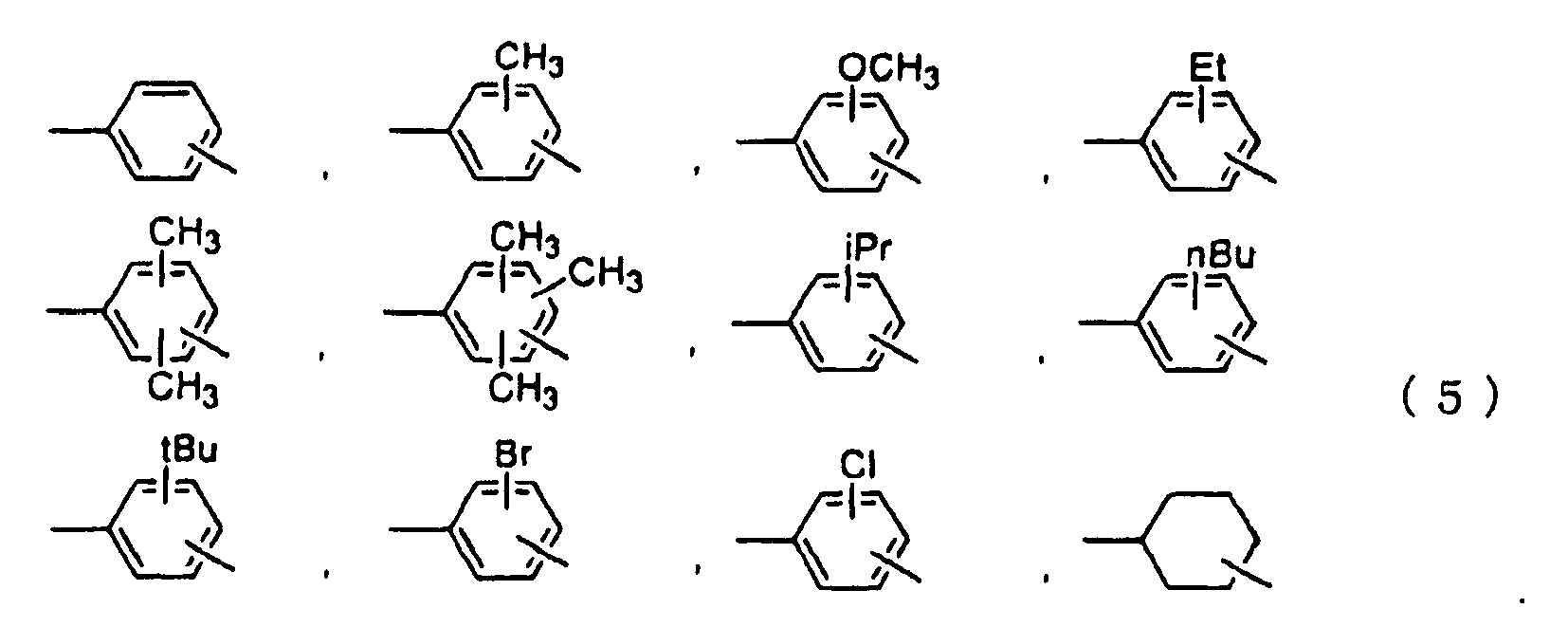
- a dioxetane compound represented by formula (1) below: wherein R 1 and R 2 are each independently hydrogen, methyl, or ethyl, L 1 denotes - (CH 2 ) n - wherein n is an integer of 1 to 12, X 1 denotes a single bond, -O-, -O-CO- or -CO-O-, Y denotes a single bond or -CO-, M 1 is represented by formula (2) or (3) below wherein P 1 and P 3 are each independently a group selected from the group consisting of those represented by formula (4) below, and P 2 is a group selected from the group consisting of those represented by formula (5) below, and L 2 and L 3 are each denotes a single bond, -CH CH-, -C ⁇ C-, -O-, -O-CO-, or -CO-O-: -P 1 -L 2 -P 2 -L 3 -
- the dioxetane compound according to the first aspect wherein in formula (1) L 1 is - (CH 2 ) 2 -, - (CH 2 ) 4 -, or -(CH 2 ) 6 -, and Y is a single bond.
- a cationically polymerizable composition comprising a dioxetane compound represented by formula (1) and a compound having a cationically polymerizable group, provided that the compound represented by formula (1) is excluded.
- the cationically polymerizable composition according to the third aspect wherein the composition contains at least 5 percent by mass or more of a dioxetane compound represented by formula (1).
- the cationically polymerizable composition according to the third aspect wherein the compound having a cationically polymerizable group is a compound exhibiting liquid crystallinity.
- the cationically polymerizable composition according to the fifth aspect wherein the compound exhibiting liquid crystallinity is an oligomer or a polymer.
- the cationically polymerizable composition according to the third aspect wherein the composition contains a photo cation generator and/or a thermal cation generator.
- an optical film produced by polymerizing the cationically polymerizable composition according to any one of the third to seventh aspects.
- a liquid crystal display equipped with the optical film according to the eighth aspect.
- the dioxetane compound of the present invention is a novel compound, and a composition comprising the dioxetane compound and a cationically polymerizable compound can be uniformly aligned in a liquid crystal state without causing phase separation and easily polymerized to be fixed in the liquid crystal state and formed into a film thereby rendering it possible to produce an optical film with excellent retainability of the liquid crystal orientation formed after having been aligned and fixed and excellent mechanical strength.
- the dioxetane compound of the present invention is a compound represented by formula (1) below and has a remarkable feature that the interconnecting groups coupling the M 1 group to the oxetane groups positioned on the right and left sides thereof are different from one another (asymmetric).
- the oxetane groups have cationic polymerizability, it is necessary to select the reaction conditions with a consideration given to side reactions such as polymerization and ring-opening possibly occurring under strong acid conditions.
- the oxetane groups are less potential to induce such side reactions, compared with oxylane group which is though a similar cationically polymerizable functional group.
- the oxetane group may allow various compounds similar thereto, such as alcohols, phenols, and carboxylic acids to react with one another, the use of protection groups may be considered if necessary.
- the crude oxetane compound derivative thus synthesized may be refined by recrystallization or column chromatography. Recrystallization is effective particularly for compounds of a rather high crystallinity. Even if the compound can not be recrystallized at ordinary temperature, it may be able to be recrystallized after being cooled to a lower temperature of such as -20°C.
- synthesis methods include those wherein hydroxybenzoic acid as the starting material is bonded to oxetane groups with for example the Williamson ether synthesis and then the resulting compound is bonded to a diol suitable for the present invention with an acid chloride method or condensation with carbodiimide and wherein hydroxybenzoic acid is condensed with a diol suitable for the present invention after the hydroxyl group is protected with an appropriate protection group and then the hydroxyl group is reacted with a proper oxetane compound such as haloalkyloxetane after the protection group is desorbed.
- a proper oxetane compound such as haloalkyloxetane after the protection group is desorbed.
- Reaction between the oxetane compound and the hydroxyl group may be carried out under suitable conditions selected depending on the configuration or reactivity of the compounds to be used.
- the reaction temperature is from -20 to 180°C, preferably from 10 to 150°C while the reaction time is from 10 minutes to 48 hours, preferably from 30 minutes to 24 hours. Ranges other than the foregoing ranges are not preferable because the reaction would not proceed sufficiently or a side reaction would occur.
- the mixing ratio of the oxetane compound and the hydroxyl group is preferably from 0.8 to 1.2 equivalent of oxetane compound per equivalent of hydroxyl group.
- the reaction may be carried out without using a solvent but is usually carried out in the presence of a solvent.
- a solvent There is no particular restriction on the solvent as long as it does not bother the intended reaction.
- the solvent include aromatic hydrocarbons such as benzene, toluene and xylene; amides such as dimethylformamide, dimethylacetoamide and N-methylpyrorridone; ketones such as methyl ethyl ketone and methyl isobutyl ketone; ethers such as dibutyl ether, ethylene glycol dimethyl ether and diethylene glycol dimethyl ether; esters such as ethyl acetate and ethyl benzoate; and mixtures thereof.
- the present invention also relates to a cationically polymerizable composition
- a cationically polymerizable composition comprising the above-described dioxetane compound and a compound having a cationically polymerizable group (excluding the dioxetane compound of the present invention).
- the cationically polymerizable composition is a composition comprising the dioxetane compound of the present invention and a compound having a cationically polymerizable group other than the dioxetane compound of the present invention and containing preferably at least 5 to 60 percent by mass, more preferably 10 to 50 percent by mass of the dioxetane compound.
- a content of the dioxetane compound of less than 5 percent by mass is not preferable because the concentration of the polymerizable group would be low and thus mechanical strength after polymerization would be insufficient.
- a content of the dioxetane compound of more than 60 percent by mass is not also preferable because the resulting composition would be likely to cause phase separation.
- the compound having a cationically polymerizable group to be blended with the dioxetane compound of the present invention as long as it is a compound having a cationically polymerizable group as represented by formula (6) below (excluding the dioxetane compound of the present invention) and can be mixed therewith. Therefore, examples of the compound having a cationically polymerizable group include various low molecular weight compounds, various polymeric compounds with an ability to be formed into a film and various low molecular weight liquid crystalline compounds and polymeric liquid crystalline compounds both exhibiting liquid crystallinity.
- compounds having no cationically polymerizable group and various dyes, pigments and additives may be added to an extent that the achievement of the purposes of the present invention is not bothered.
- preferred are compounds exhibiting liquid crystallinity and the whole composition preferably exhibits liquid crystallinity for the production of an optical film described below.
- the polymeric liquid crystalline compounds may be of main chain type or side chain type.
- the main chain type polymeric liquid crystalline compounds include polyesters, polyesteramides and polycarbonates.
- the side chain type liquid crystalline compounds include polyacrylates, polysiloxanes and polymalonates.
- the side chain type polymeric liquid crystalline compound may also be synthesized with various methods. For example, when a poly (meth) acrylate is synthesized, a liquid crystalline (meth)acrylic compound having a cationically polymerizable group at one of its terminal ends is radically or anionically polymerized to polymerize the (meth)acrylic group only thereby producing a side chain type polymeric liquid crystalline compound having a cationically polymerizable group.
- radical polymerization a method may be used in which a (meth)acrylic compound is dissolved in a solvent such as dimethylformamide (DMF) and reacted at a temperature of 60 to 110°C for several hours using 2,2'-azobisisobutylonitrile (AIBN) or benzoyl peroxide (BPO) as an initiator.
- a solvent such as dimethylformamide (DMF)
- AIBN 2,2'-azobisisobutylonitrile
- BPO benzoyl peroxide
- anionic polymerization a method may be used in which a (meth)acrylic compound is dissolved in a solvent such as tetrahydrofuran (THF) and reacted using a strong base such as an organic lithium compound, an organic sodium compound or the Grignard reagent as an initiator.
- a solvent such as tetrahydrofuran (THF)
- a strong base such as an organic lithium compound, an organic sodium compound or the Grignard reagent
- this polymerization can be converted to living anionic polymerization by optimizing the initiator or reaction temperature thereby controlling the molecular weight distribution.
- another compound that can be copolymerized may be copolymerized.
- compounds to be copolymerized are (meth)acrylic compounds having a mesogen group so as to enhance the liquid crystallinity of the polymeric compound to be synthesized.
- a portion having a cationically polymerizable group is coupled to a portion having a (meth) acrylic group by means of the Williamson's ether synthesis or an ester synthesis using a condensing agent thereby synthesizing a (meth)acrylic compound having two completely different reactive functional groups, i.e., a cationically polymerizable group and a (meth)acrylic group.
- the cationically polymerizable composition of the present invention comprises a compound having a cationically polymerizable group
- a cation generator is preferably added thereto to polymerize (cure) the compounds.
- cation generators such as photo cation generators capable of generating cations with appropriate light and thermal cation generators capable of generating cations with heat (hereinafter may be collectively referred to as "cation generator").
- cation generator To the cationically polymerizable composition may be added these cation generators alone or in combination. If necessary, various sensitizing agents may be added.
- photo cation generator used herein denotes a compound which can generate cations by irradiation of a light with a specific wavelength and may be any of organic sulfonium salt-, iodonium salt-, or phosphonium salt-based compounds. Counter ions of these compounds are preferably antimonate, phosphate, and borate. Specific examples include Ar 3 S + SbF 6 - , Ar 3 P 4 BF 4 - , and Ar 2 I + PF 6 - wherein Ar indicates a phenyl or substituted phenyl group. Sulfonic acid esters, triazines, diazomethanes, ⁇ -ketosulfones, iminosulfonates, and benzoinsulfonates may also be used.
- thermal cation generator used herein denotes a compound which can generate cations by heating to a certain temperature and may be any of benzylsulfonium salts, benzylammonium salts, benzylpyridinium salts, benzylphosphonium salts, hydrazinium salts, carbonic acid esters, sulfonic acid esters, amineimides, antimony pentachloride-acetyl chloride complexes, diaryliodonium salt-dibenzyloxy coppers, and halogenated boron-tertiary amine adducts.
- a cationically polymerizable liquid crystalline composition having been blended with a compound generating cations, such as Lewis acid is prepared beforehand and then polymerized by allowing cations to generate after being coated or dried.
- a compound generating cations such as Lewis acid
- the cationically polymerizable composition exhibits liquid crystallinity
- the cationically polymerizable groups are polymerized after or simultaneously with a liquid crystal orientation is formed.
- it is more preferred to use a cation generator eliciting the generation of cations with heat or light because both sufficient liquid crystal orientation and polymerization degree can be achieved more frequently in the case where a liquid crystal orientation aligning process and a polymerization process are separated.
- a heat treatment for aligning the polymerizable liquid crystalline•composition is carried out at a temperature lower than the activation temperature of the thermal cation generator (the index thereof which is usually used is a 50 % dissociation temperature), followed by a step of generating cations wherein a heat treatment is carried out at the activation temperature or higher to dissociate the thermal cation generator thereby reacting the cationically polymerizable groups with the cations thus generated.
- This method has an advantage that the aligning process and polymerization reaction can be conducted only in heat treatment facilities.
- this method has a disadvantage that since the aligning and polymerization processes are separated only with heat, i.e., difference in temperature, undesired polymerization may slightly progress during the aligning process or may not progress sufficiently during the actual polymerization process.
- the cationically polymerizable liquid crystalline composition can be aligned, maintaining sufficient fluidity without undergoing polymerization or decomposition during the aligning process if the heat treatment for aligning the composition in a liquid crystal orientation is carried out under such dark conditions that the photo cation generator is not dissociated. Thereafter, the polymerizable liquid crystalline composition may be allowed to polymerize, i.e., cure with a light irradiated from a light source capable of emitting an appropriate wavelength of light so as to generate cations.
- the amount of the cation generator to be added to the cationically polymerizable liquid crystalline composition varies depending on the structures of compounds constituting the composition and various additives to be used, or the equivalent weight of the oxetane group, it can not be determined with certainty. However, it is within the range of usually 100 ppm to 30 percent, preferably 1,000 ppm to 25 percent, more preferably 0.2 percent to 20 percent, and most preferably 0.5 percent to 15 percent on the basis of the mass of the cationically polymerizable composition.
- An amount of the cation generator of less than 100 ppm is not preferable because polymerization may not progress due to the insufficient amount of cation to be generated.
- An amount of the cation generator of more than 30 percent is not also preferable because a large amount of the undecomposed residue of the cation generator is likely to remain and be colored and may cause the light resistance to degrade.
- the photo cation generators capable of generating cations with light are particularly preferable because they can generate cations and polymerize (cure) the polymerizable liquid crystalline composition at any temperature at which the composition exhibits a liquid crystal phase.
- the cationically polymerizable composition is formed into a film and polymerized (cured) thereby producing an optical film.
- An optical film made from the cationically polymerizable liquid crystalline composition of the present invention may be in any form such as one wherein the optical film is kept on an alignment substrate, i.e., (alignment substrate/(alignment layer) /optical film); one wherein the optical film is transferred to a transparent substrate film other than an alignment substrate, i.e., (transparent substrate film/optical film); or one wherein the optical film is used as a single layer (optical film only) when it has a self-standing property.
- Substrates which may be used in the present invention are preferably those that can align the composition of the present invention in a liquid crystal state also considering the case where the cationically polymerizable composition may exhibit liquid crystallinity.
- substrates include films formed from polyimide, polyamide, polyamideimide, polyphenylene sulfide, polyphenylene oxide, polyether ketone, polyetherether ketone, polyether sulfone, polysulfone, polyethylene terephthalate, polyethylene naphthalate, polyarylate, triacetyl cellulose, epoxy resins, phenol resins, cycloolefin polymers, and uniaxially stretched films thereof.
- the films exhibit a sufficient alignability for the cationically polymerizable composition of the present invention depending on the method of producing the films even though they are not subjected to an aligning treatment.
- the film may be stretched by an appropriate heating treatment; subjected to a rubbing treatment wherein the film is rubbed in one direction with a rayon cloth or the like or wherein the film is rubbed after a conventional alignment layer of polyimide, polyvinyl alcohol, or a silane coupling agent is formed over the film; subjected to an oblique vapor deposition with silicon oxide; or subjected to the combination of these treatments to be provided with alignability.
- the alignment substrate may be a metal plates of aluminum, iron, or copper or any of various glass plates on which surfaces fine grooves are regularly formed.
- the optical film may be transferred from such an alignment substrate to an optically isotropic film or a substrate which is transparent at a wavelength region where the optical film is intended to be used.
- Examples of the method of transferring include those as disclosed in Japanese Patent Laid-Open Publication Nos. 4-57017 and 5-333313 wherein after an optical film layer on an alignment substrate is laminated via a tacky adhesive or adhesive over a transparent substrate which is different from the alignment substrate and if necessary the adhesive is cured, only the optical film is transferred to the transparent substrate by releasing the alignment substrate from the laminate.
- the transparent substrate onto which the liquid crystal layer is transferred examples include triacetyl cellulose films such as Fujitac (manufactured by Fuji Photo Film Co., Ltd.) and Konicatac (manufactured by Konica Corp.); TPX film (manufactured by Mitsui Chemical Inc.); Arton film (manufactured by JSR); Zeonex film (manufactured by Zeon Corp.); and Acryplene film (manufactured by Mitsubishi Rayon Co., Ltd.).
- the transparent substrate may be a polarizer or a retardation film produced by stretching a polycarbonate, a cycloolefin polymer or a polyester.
- a quartz plate or a glass plate may be used.
- a polarizer may be used regardless of whether or not a protective layer is used.
- tacky adhesive or adhesive there is no particular restriction on the tacky adhesive or adhesive to be used to transfer the optical film as long as it is of optical grade. Therefore, there may be used conventional acrylic-, epoxy resin-, ethylene-vinyl acetate copolymer-, rubber-, urethane-based adhesives, mixture types thereof, or various reactive adhesives of such as thermal curing type and/or photo curing type or electron radiation curing types.
- the reaction (curing) conditions under which the reactive tacky adhesives or adhesives are cured vary depending on their formulation, viscosity and reaction temperature thereof. Therefore, the curing may be conducted under the conditions properly selected.
- photo-curing type adhesives may be cured at a similar irradiation dose using a similar light source to those used for a photo cation generator described hereinafter.
- Electron radiation curing type adhesives may be cured at an accelerating voltage of usually 10 kV to 200 kV, preferably 25 kV to 100 kV.
- the optical film may be produced by a method wherein a cationically polymerizable liquid crystalline composition in a molten state or in the form of a solution is coated over an alignment substrate.
- the coated layer on the alignment layer is dried and if necessary heated and/or stretched, and then subjected to a photo irradiation and/or a heat treatment (polymerization) thereby being formed into an optical film.
- the solvent used for preparing a solution of the cationically polymerizable liquid crystalline composition of the present invention includes ketones such as acetone, methyl ethyl ketone, and isophorone; ether alcohols such as butoxy ethyl alcohol, hexyloxy ethyl alcohol, and methoxy-2-propanol; glycol ethers such as ethylene glycol dimethylether and diethylene glycol dimethyl ether; ester-based solvents such as ethyl acetate, methoxypropyl acetate and ethyl lactate; phenol-based solvents such as phenol and chlorophenol; amide-based solvents such as N,N-dimethylformamide, N,N-dimethylacetoamide, and N-methylpyrrolidone; halogenated hydrocarbon-based solvents such as chloroform, t
- Surfactants, defoaming agents, or leveling agents may be added to the solution so as to form a uniform film layer on an alignment substrate.
- dichroic dyes, dyes, or pigments may be added to an extent that the exhibition of liquid crystallinity is not inhibited.
- the coating method there is no particular restriction on the coating method as long as the uniformity of the film layer can be maintained. Therefore, there may be used any conventional method such as roll coating, die coating, dip coating, curtain coating, or spin coating methods.
- the coating may be followed by a solvent-removing process, i.e., drying using a heater or a hot air blowing.
- the thickness of the coated film is adjusted depending on the physical properties of a cationically polymerizable composition (refractive index anisotropy, constituents) or the usage of the resulting optical film.
- the thickness of the coated film after being dried is from 0.1 to 20 ⁇ m, preferably 0.3 to 10 ⁇ m.
- the retardation is adjusted to be from 20 to 1000 nm, preferably 50 to 800 nm. The ranges deviating these ranges are not preferable because they make the exhibition of the intended effects difficult.
- Heat treatment may be carried out if necessary before the coated film is subjected to a photo irradiation and/or a heat treatment to be polymerized (cured).
- This heat treatment is preferably incorporated when the cationically polymerizable composition exhibits liquid crystallinity.
- the polymerizable liquid crystalline composition used is heated to the range of temperatures at which the composition exhibits a liquid crystal phase, so as to align the composition in a liquid crystal state by its self-alignability. Since the conditions for the heat treatment vary in optimum conditions and limits depending on the liquid crystal phase behavior temperature (transition temperature) of the polymerizable liquid crystalline composition to be used, it can not be determined with certainty.
- the heat treatment is conducted at a temperature within the range of usually 10 to 250°C and preferably 20 to 200°C. Too low temperatures are not preferable because there is a possibility that the composition may not be aligned in a liquid crystal state sufficiently, while too high temperatures are not also preferable because cationically polymerizable groups such as oxetane group or substrates may be adversely affected.
- the heat treatment is conducted for usually 3 seconds to 30 minutes, preferably 10 seconds to 10 minutes.
- the heat treatment for shorter than 3 seconds is not preferable because there is a possibility that the composition may not be aligned in a liquid crystal phase completely. Whereas, the heat treatment for longer than 30 minutes is not also preferable because the productivity is extremely deteriorated.
- the composition on the alignment substrate is cured by polymerization.
- the polymerization/curing process is carried out in order to modify the coated film by polymerization or curing reaction to fix the film in a liquid crystal state to be a harder film layer.
- a light is irradiated from a light source capable of emitting an appropriate wavelength of light so as to allow the photo-cation generator to generate cations.
- the light irradiation is carried out with different optimum values such as irradiation wavelength, irradiation intensity or irradiation time depending on the type or amount of a photo-cation generator to be used but is usually carried out by irradiating a light from a light source having a spectrum in an absorption wavelength region of the photo-cation generator to be used, such as a metal halide lamp, a high-pressure mercury lamp, a low-pressure mercury lamp, a xenon lamp, an are discharge lamp, a laser and a synchrotron irradiation light source thereby decomposing the photo-cation generator.
- the irradiation dose per cm 2 is within the range of generally 1 to 2,000 mJ and preferably 10 to 1, 000 mJ in the integrated irradiation dose.
- the absorption region of the photo-cation generator is extremely different from the spectrum of the light source, or the cationically polymerizable composition itself can absorb a light in the wavelength of the light source, the irradiation dose is not limited to the foregoing range. In these cases, a method may be employed in which a suitable photo sensitizer or two or more types of photo-cation generators having different absorption wavelengths may be used.
- the optical film produced through the above-described processes becomes a sufficiently solid and strong film. More specifically, since the three-dimensional bond of the mesogen portion is achieved by the curing reaction, the optical film layer is significantly improved not only in heat-resistance but also in mechanical strength such as resistance to scratch, wear, and cracking compared with that before being cured.
- the present invention is of great significance in the industrial sense because it can achieve an improvement in thermal/mechanical strength and also the precise control, i.e., liquid crystal orientation when the cationically polymerizable composition has liquid crystallinity, at the same time.
- the cationically polymerizable composition of the present invention has liquid crystallinity
- its orientation structure can be controlled by selecting proper compounds to be added, if necessary, rendering it possible to produce an optical film with a fixed nematic, twisted nematic, cholesteric or nematic hybrid orientation.
- the optical film has many usages depending on its orientation structure.
- an optical film with a fixed nematic or twisted nematic orientation may be used as a compensation plate for a transmissive or reflection type of liquid crystal display device of STN, TN, OCB or HAN mode.
- Optical films with a fixed cholesteric orientation can be used as polarizing reflective films for luminance enhancement, reflection type color filters, and security elements or various decoration films utilizing color variations of reflection light depending on viewing angles peculiar to the selective reflection.
- Those with a fixed nematic hybrid orientation can be used as a viewing angle improving film for TN-type liquid crystal display devices utilizing a retardation upon viewing from the front or the asymmetric nature caused by the orientation of retardation value (inclination of the film).
- those having a function as a 1/4 wavelength plate when used in combination with a polarizer can be used as anti-glare filters for reflection type liquid crystal displays and EL displays.
- a compound was dissolved in deuterated chloroform or deuterated dimethylsulfoxide, and the 1 H-NMR and 13 C-NMR were determined with "INOVA 400" manufactured by VARIAN Co., Ltd.
- Liquid crystal phase behavior was observed using a polarizing microscope "Olympus BH2" while heating a sample on a hot stage “FP82HT” manufactured by Mettler-Toledo International Inc.
- Phase transition temperature was measured using a differential scanning calorimeter "DSC7" manufactured by Perkin Elmer Co.
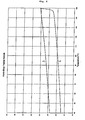
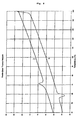
- the DSC measurement conditions (under nitrogen flow) are as follows:
- Peaks emerging in Steps 2 and 3 were determined as phase transition temperatures.
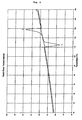
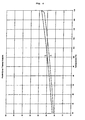
- the ordinate of each DSC chart indicates the calorie variation cause by phase change and upwardly projected peaks indicate endotherm.
- phase behavior “C” indicates crystal phase
- “Ch” indicates cholesteric phase
- “Nm” indicates nematic phase
- “Iso” indicates isotropic liquid phase. Further, for example, “C-Iso” indicates a phase change between “C” and "Iso".
- the retardation ( ⁇ nd) of a nematic orientation was measured using "KOBRA-20ADH” manufactured by Oji Keisokukiki Co., Ltd. The measurement was carried out at a wavelength of 550 nm unless otherwise stated.
- the average tilt angle of a nematic hybrid orientation was determined through a simulation wherein the tilt angle is assumed to change in a linear form, using ⁇ nd from -50 to 50 degrees incremented by 10 degrees measured with "KOBRA-20ADH” manufactured by Oji Keisokukiki Co., Ltd.
- the twisted angle and ⁇ nd of a twisted nematic structure were measured using "Optipro” manufactured by SHINTECH, Inc.
- the thickness of a film was measured using SURFACE TEXTURE ANALYSIS SYSTEM Dektak 3030ST manufactured by SLOAN Co. A method was also used in which the film thickness was determined by interference measurement ("Ultraviolet Visible Near-Infrared Spectrophotometer V-570" manufactured by JASCO Corporation) and refractive index data.
- GPC measurement was carried out by dissolving compounds in tetrahydrofuran and using 8020 GPC system manufactured by TOSOH CORPORATION equipped with TSK-GEL, Super H1000, Super H2000, Super H3000, and Super H4000 which are connected in series and tetrahydrofuran as an eluent solvent.
- Polystyrene was used as a standard for calibration of the molecular weight.
- an intermediate compound 1 having an oxetanyl group was synthesized using 3-ethyl-3-hydroxymethyloxetane (OXT-101, manufactured by Toagosei Co., Ltd.) as the raw material.
- a side chain type liquid crystalline polyacrylate 8 was synthesized by radical-polymerizing 2 parts (molar ratio) of the acrylic compound 3 and 8 parts (molar ratio) of the acrylic compound 5 at a temperature of 90°C under a nitrogen atmosphere for 6 hours using 2,2'-azobisisobutyronitrile as an initiator and DMF as a solvent and reprecipitating the polymerized product with methanol.
- Tg glass transition temperature
- a side chain type liquid crystalline polyacrylate 9 was synthesized by radical-polymerizing 2 parts (molar ratio) of the acrylic compound 4, 6 parts (molar ratio) of the acrylic compound 5 and 2 parts (molar ratio) of the acrylic compound 6 at a temperature of 90°C under a nitrogen atmosphere for 6 hours using 2,2' -azobisisobutyronitrile as an initiator and DMF as a solvent and reprecipitating the polymerized product with methanol.
- Tg glass transition temperature
- a side chain type liquid crystalline polyacrylate 10 having an oxetanyl group was synthesized by radical-polymerizing 2 parts (molar ratio) of the acrylic compound 3, 7.3 parts (molar ratio) of the acrylic compound 5 and 0.7 part (molar ratio) of the acrylic compound 7 having a chiral source at a temperature of 90°C under a nitrogen atmosphere for 6 hours using 2,2'-azobisisobutyronitrile as an initiator and DMF as a solvent and reprecipitating the polymerized product with methanol.
- Tg glass transition temperature
- a dioxetane compound 1 was synthesized using hydroquinone, 3,4-dihydro-2H-pyrane, the intermediate compound 1 having an oxetanyl group and the intermediate compound 2 having an oxetanyl group.
- the resulting compound was refined by recrystallization with a hexane/ethyl acetate solvent.
- the recrystallized product was white solid at room temperature.
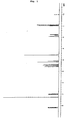
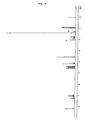
- the 1 H-NMR spectrum of the dioxetane compound 1 is shown in Fig. 1 and the result of the DSC measurement is shown in Fig. 2 .
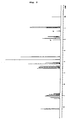
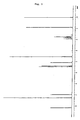
- the 1 H-NMR spectrum of the dioxetane compound 2 is shown in Fig. 3 and the result of the DSC measurement is shown in Fig. 4 .
- Steps 2 and 3 of DSC no endothermic peak was observed.
- the presence of C-Iso phase behavior was confirmed through the polarizing microscope observation on the hot stage only when the temperature was increased. It was confirmed from these results that the dioxetane compound 2 had no liquid crystal phase.
- Steps 2 and 3 of DSC no endothermic peak was observed.
- the presence of C-Iso phase behavior was confirmed through the polarizing microscope observation on the hot stage only when the temperature was increased. It was confirmed from these results that the dioxetane compound 3 had no liquid crystal phase.
- Step 3 of DSC the endothermic peaks of C-Nm and Nm-Iso were observed at 72°C and 95°C, respectively.
- C-Nm and Nm-Iso phase behaviors were observed at temperatures in the vicinity that are the substantially same as those at each peak observed through DSC. It was confirmed from these results that the dioxetane compound 4 had a liquid crystal phase.
- the solution was spin-coated over a 100 ⁇ m thickness polyimide film "KAPTON” manufactured by DU PONT-TORAY CO., LTD., whose surface had been subjected to a rubbing treatment with a rayon cloth, and then dried on a hot plate kept at 60°C. While the resulting cationically polymerizable composition layer on the polyimide film was heated at a temperature of 145°C, the layer was irradiated with an ultraviolet light of an integrated irradiation dose of 300 mJ/cm 2 from a high-pressure mercury lamp under an air atmosphere and then cooled thereby producing a cured cationically polymerizable composition layer.
- KAPTON manufactured by DU PONT-TORAY CO., LTD.
- the resulting cured cationically polymerizable composition layer was transferred via an ultraviolet curing type adhesive "UV-3400" (manufactured by Toagosei Co., Ltd.) onto a triacetyl cellulose (TAC) film thereby producing an optical film with retardation. More specifically, the UV-3400 with a thickness of 5 ⁇ m was coated over the cured cationically polymerizable composition layer on the polyimide film and laminated with a TAC film. After the laminate was subjected to an irradiation of ultraviolet light of 400 mJ/cm 2 from the TAC film side so as to cure the adhesive, the polyimide film was released.
- UV-3400 ultraviolet curing type adhesive
- TAC triacetyl cellulose
- the film exhibited a monodomain uniform nematic hybrid liquid crystal orientation having no disclination and the ⁇ nd viewed from the front was 102 nm.
- the ⁇ nd viewed from a position tilted at an angle of 40 degrees from the vertical direction along the rubbing axis was 142 nm while the ⁇ nd viewed from an opposite position tilted at an angle of -40 degrees was 46 nm.
- the both ⁇ nds were asymmetrical. From these observations, it was recognized that the film was aligned in a nematic hybrid orientation structure because there was no point wherein the ⁇ nd is zero nm at any angle.
- the thickness of the liquid crystalline composition layer of the resulting liquid crystal film was 0.85 ⁇ m.
- the optical film was attached via a non-carrier tacky adhesive onto a 2 mm thickness sodalime glass plate. Over the film was attached a polarizer (SQW-862 manufactured by Sumitomo Chemical Co., Ltd.) such that the rubbing direction of the polyimide film was aligned with the absorption axis of the polarizer. This sample was observed through the polarizer on a backlight and found to be a uniform film. After the sample was kept in a thermostat whose temperature was set at 110°C, for 100 hours, it was taken out therefrom and similarly observed. As a result, any particular change or disorder in the liquid crystal orientation was not observed.
- a polarizer SQW-862 manufactured by Sumitomo Chemical Co., Ltd.
- the pencil hardness of the cationically polymerizable composition layer surface of the film was on the order of 4H and thus it was confirmed that the film had a sufficient hardness.
- the use of the side chain type liquid crystalline polyacrylate 8 rendered it possible to produce an optical film which was aligned excellently in a liquid crystal orientation state and improved in thermal stability and strength after being fixed in the liquid crystal orientation.
- the solution was spin-coated over a 100 ⁇ m thickness polyimide film "KAPTON” manufactured by DU PONT-TORAY CO., LTD., whose surface had been subjected to a rubbing treatment with a rayon cloth, and then dried on a hot plate kept at 60°C. While the resulting cationically polymerizable composition layer on the polyimide film was heated at a temperature of 145°C, the layer was irradiated with an ultraviolet light of an integrated irradiation dose of 300 mJ/cm 2 from a high-pressure mercury lamp under an air atmosphere and then cooled thereby producing a cured cationically polymerizable composition layer.
- KAPTON manufactured by DU PONT-TORAY CO., LTD.
- the resulting cured cationically polymerizable composition layer was transferred via an ultraviolet curing type adhesive "UV-3400" (manufactured by Toagosei Co., Ltd.) onto a triacetyl cellulose (TAC) film thereby producing an optical film with retardation. More specifically, the UV-3400 with a thickness of 5 ⁇ m was coated over the cured cationically polymerizable composition layer on the polyimide film and laminated with a TAC film. After the laminate was subjected to an irradiation of ultraviolet light of 400 mJ/cm 2 from the TAC film side so as to cure the adhesive, the polyimide film was released.
- UV-3400 ultraviolet curing type adhesive
- TAC triacetyl cellulose
- Phase separation seemed to occur in the compositional structure of Comparative Example 2.
- a retardation film was produced with the same procedures of Comparative Example 2 except that the amount of a propylene carbonate solution of 50 percent of triarylsulfonium hexafluoroantimonate (a reagent manufactured by Aldrich Co.) was changed to 0.05 g.
- the retardation film exhibited a monodomain uniform nematic hybrid liquid crystal orientation having no disclination and the ⁇ nd viewed from the front was 85 nm.
- the retardation film was attached via a non-carrier tacky adhesive onto a 2 mm thickness sodalime glass plate. Over the film was attached a polarizer (SQW-862 manufactured by Sumitomo Chemical Co., Ltd.) such that the rubbing direction of the polyimide film was aligned with the absorption axis of the polarizer. This sample was observed through the polarizer on a backlight and found to be a uniform film. After the sample was kept in a thermostat whose temperature was set at 110°C, for 100 hours, it was taken out therefrom and similarly observed. As a result, disorder in the liquid crystal orientation was partially observed.
- a polarizer SQW-862 manufactured by Sumitomo Chemical Co., Ltd.
- the pencil hardness of the cationically polymerizable composition layer surface of the film was on the order of 2H.
- the resulting solution was spin-coated over a 50 ⁇ m thickness polyethylene naphthalate film "Teonex Q-51" (manufactured by Teijin Dupont Films Japan Ltd.) whose surface had been subjected to a rubbing treatment with a rayon cloth and then a hot air of about 60°C was slowly blown to the film to remove the solvent. Thereafter, the film was heated at a temperature of 150°C in an oven for 3 minutes so as to form a uniform liquid crystal orientation (film 1a). The pencil hardness of the film 1a was 6B or less which was weak.
- the film 1a was irradiated with an ultraviolet light of an integrated irradiation dose of 450 mJ/cm 2 from a high-pressure mercury lamp thereby producing a cured cationically polymerizable composition layer (film 1b). Since the polyethylene naphthalate film used as a substrate had birefringence and thus is not preferable, the film 1b was transferred via an ultraviolet curing type adhesive "UV-3400" (manufactured by Toagosei Co., Ltd.) onto a TAC film thereby obtaining an optical film 1. The UV-3400 with a thickness of 5 ⁇ m was coated over the cured cationically polymerizable composition layer on the polyethylene naphthalate film and laminated with a TAC film. After the laminate was subjected to an irradiation of ultraviolet light of 400 mJ/cm 2 from the TAC film side so as to cure the adhesive, the polyethylene naphthalate film was released.
- UV-3400 ultraviolet curing type adhesive
- the film exhibited a monodomain uniform nematic hybrid liquid crystal orientation having no disclination and the ⁇ nd viewed from the front was 120 nm.
- the average tilt angle was 28 degrees and the thickness of the cationically polymerizable composition layer was 0.83 ⁇ m.
- the resulting solution was spin-coated over a 50 ⁇ m thickness polyethylene naphthalate film "Teonex Q-51" (manufactured by Teijin Dupont Films Japan Ltd.) whose surface had been subjected to a rubbing treatment with a rayon cloth and then a hot air of about 60°C was slowly blown to the film to remove the solvent. Thereafter, the film was heated at a temperature of 150°C in an oven for 3 minutes so as to form a uniform liquid crystal orientation.
- Teonex Q-51 manufactured by Teijin Dupont Films Japan Ltd.
- the film was irradiated with an ultraviolet light of an integrated irradiation dose of 300 mJ/cm 2 from a high-pressure mercury lamp thereby producing a cured cationically polymerizable composition layer. Since the polyethylene naphthalate film used as a substrate had birefringence and thus is not preferable, the film was transferred via an ultraviolet curing type adhesive "UV-3400" (manufactured by Toagosei Co., Ltd.) onto a TAC film thereby obtaining an optical film 2. More specifically, the UV-3400 with a thickness of 5 ⁇ m was coated over the cured cationically polymerizable composition layer on the polyethylene naphthalate film and laminated with a TAC film. After the laminate was subjected to an irradiation of ultraviolet light of 500 mJ/cm 2 from the TAC film side so as to cure the adhesive, the polyethylene naphthalate film was released.
- UV-3400 ultraviolet curing type adhesive
- the film exhibited a monodomain cholesteric liquid crystal orientation having no disclination.
- the film had a selective reflection light peculiar to the cholesteric orientation when viewed from the front.
- Tg glass transition temperature
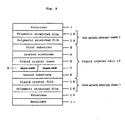
- a transflective liquid crystal display device as shown in Fig. 9 was produced.
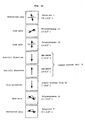
- the axial orientation of each layer is shown in Fig. 10 .
- a reflective electrode 6 formed from a highly reflective material such as Al
- a transparent electrode 7 formed from a highly transparent material such as ITO
- a counter electrode 4 on a first substrate 3 is arranged a counter electrode 4.
- a liquid crystal layer 5 formed from a liquid crystalline material exhibiting a positive dielectric constant anisotropy is sandwiched between the reflective and transparent electrodes 6, 7 and the counter electrode 4.
- a first optically anisotropic element 2 consisting of stretched polymeric carbonate films 13 (And: about 268 nm), 14 (And: about 98 nm) each formed of a uniaxially stretched polycarbonate film and a polarizer 1 while on the side of the second substrate 8, opposite to the side on which the reflective and transparent electrodes 6, 7 are formed are arranged a second optically anisotropic element 9 consisting of the liquid crystal film 1 produced in Example 5 and a stretched polymeric carbonate film 16 (And: about 272 nm) formed of a uniaxially stretched polycarbonate film and a polarizer 10.
- a backlight 11 On the rear side of the polarizer 10 is arranged a backlight 11.
- the liquid crystal cell 12 used in this example was produced using ZLI-1695 (manufactured by Merck Ltd) as a liquid crystalline material.
- the liquid crystal layer thicknesses in the reflective electrode region 6 (reflective display part) and the transparent electrode region 7 (transmissive display part) were set to 2.4 ⁇ m and 4.8 ⁇ m, respectively.
- the pre-tilt angle of the liquid crystal layer at both of the substrate interfaces was 2 degrees.
- the ⁇ nds of the liquid crystal cell in the reflective display part and transmissive display part are approximately 150 nm and 300 nm, respectively.
- the polarizers 1 and 10 arranged on the viewer's side of the liquid crystal cell 12 and on the opposite side thereof were "SQW-862" (thickness: about 180 ⁇ m) manufactured by Sumitomo Chemical Industry Co., Ltd.
- the absorption axes of the polarizers 1, 10, the slow axes of the polymeric stretched films 13, 14 and 16, the pre-tilt direction of the cell 12 at both of the interfaces, and the tilt direction of the liquid crystal film 1 were oriented as shown in Fig. 10 .
- An optical film with excellent retainability of the liquid crystal orientation and excellent mechanical strength can be provided by polymerizing the novel dioxetane compound of the present invention.
Landscapes
- Chemical & Material Sciences (AREA)
- Organic Chemistry (AREA)
- Physics & Mathematics (AREA)
- Health & Medical Sciences (AREA)
- Chemical Kinetics & Catalysis (AREA)
- Medicinal Chemistry (AREA)
- Polymers & Plastics (AREA)
- Nonlinear Science (AREA)
- Optics & Photonics (AREA)
- General Physics & Mathematics (AREA)
- Mathematical Physics (AREA)
- Crystallography & Structural Chemistry (AREA)
- Polyethers (AREA)
- Polarising Elements (AREA)
- Liquid Crystal Substances (AREA)
- Addition Polymer Or Copolymer, Post-Treatments, Or Chemical Modifications (AREA)
- Liquid Crystal (AREA)
- Epoxy Compounds (AREA)
Claims (9)
- Dioxetanverbindung, die keine Flüssigkristallinität aufweist und durch die nachstehende Formel (1) wiedergegeben ist:

-P1-L2-P2-L3-P3- (2)
P1-L2-P3 - (3)

- Dioxetanverbindung nach Anspruch 1, wobei in Formel (1) L1 -(CH3)2-, -(CH2)4- oder -(CH2)6- ist und Y eine Einfachbindung ist.
- Kationisch polymerisierbare Zusammensetzung umfassend eine Dioxetanverbindung, die durch Formel (1) wiedergegeben ist, und eine Verbindung mit einer kationisch polymerisierbaren Gruppe, wobei die durch Formel (1) wiedergegebene Verbindung ausgeschlossen ist.
- Kationisch polymerisierbare Zusammensetzung nach Anspruch 3, wobei die Zusammensetzung wenigstens 5 Massenprozent oder mehr von einer Dioxetanverbindung, die durch Formel (1) wiedergegeben ist, enthält.
- Kationisch polymerisierbare Zusammensetzung nach Anspruch 3, wobei die Verbindung mit einer kationisch polymerisierbaren Gruppe eine Verbindung ist, die Flüssigkristallinität aufweist.
- Kationisch polymerisierbare Zusammensetzung nach Anspruch 5, wobei die Verbindung, die Flüssigkristallinität aufweist, ein Oligomer oder ein Polymer ist.
- Kationisch polymerisierbare Zusammensetzung nach Anspruch 3, wobei die Zusammensetzung einen Fotokationen-Generator und/oder einen Thermokationen-Generator enthält.
- Optischer Film, der durch Polymerisieren der kationisch polymerisierbaren Zusammensetzung nach einem der Ansprüche 3 bis 7 hergestellt ist.
- Flüssigkristallanzeige, die mit dem optischen Film nach Anspruch 8 ausgestattet ist.
Applications Claiming Priority (2)
| Application Number | Priority Date | Filing Date | Title |
|---|---|---|---|
| JP2006053652A JP4648854B2 (ja) | 2006-02-28 | 2006-02-28 | ジオキセタン化合物、カチオン重合性組成物および光学フィルム並びに液晶表示装置 |
| PCT/JP2006/320994 WO2007099669A1 (ja) | 2006-02-28 | 2006-10-17 | ジオキセタン化合物、カチオン重合性組成物および光学フィルム並びに液晶表示装置 |
Publications (3)
| Publication Number | Publication Date |
|---|---|
| EP1990339A1 EP1990339A1 (de) | 2008-11-12 |
| EP1990339A4 EP1990339A4 (de) | 2010-06-09 |
| EP1990339B1 true EP1990339B1 (de) | 2012-05-02 |
Family
ID=38458792
Family Applications (1)
| Application Number | Title | Priority Date | Filing Date |
|---|---|---|---|
| EP06812114A Not-in-force EP1990339B1 (de) | 2006-02-28 | 2006-10-17 | Dioxetanverbindung, kationisch polymerisierbare zusammensetzung, optischer film und flüssigkristallanzeige |
Country Status (7)
| Country | Link |
|---|---|
| US (1) | US7998543B2 (de) |
| EP (1) | EP1990339B1 (de) |
| JP (1) | JP4648854B2 (de) |
| KR (1) | KR101291392B1 (de) |
| CN (1) | CN101365691B (de) |
| TW (1) | TWI362385B (de) |
| WO (1) | WO2007099669A1 (de) |
Families Citing this family (7)
| Publication number | Priority date | Publication date | Assignee | Title |
|---|---|---|---|---|
| JP4925709B2 (ja) * | 2006-04-10 | 2012-05-09 | Jx日鉱日石エネルギー株式会社 | 接着性を向上させた液晶性組成物、該組成物からなる液晶フィルム、および該フィルムを搭載した液晶表示素子 |
| JP5087260B2 (ja) * | 2006-11-21 | 2012-12-05 | 富士フイルム株式会社 | 重合性液晶化合物並びにそれを用いた位相差フィルムおよび液晶表示装置 |
| JP5140525B2 (ja) * | 2008-09-12 | 2013-02-06 | 日東電工株式会社 | 偏光膜およびその製造方法 |
| JP6500286B2 (ja) | 2015-07-02 | 2019-04-17 | エルジー・ケム・リミテッド | 偏光素子 |
| WO2017003268A1 (ko) * | 2015-07-02 | 2017-01-05 | 주식회사 엘지화학 | 게스트호스트형 액정 조성물 |
| JPWO2022224875A1 (de) * | 2021-04-20 | 2022-10-27 | ||
| WO2022234837A1 (ja) * | 2021-05-07 | 2022-11-10 | 学校法人立命館 | 液晶高分子微粒子及び液晶高分子微粒子の製造方法 |
Family Cites Families (33)
| Publication number | Priority date | Publication date | Assignee | Title |
|---|---|---|---|---|
| JP2651870B2 (ja) | 1989-06-06 | 1997-09-10 | 株式会社リコー | 液晶性高分子薄膜付基板及びその製造方法 |
| JPH03239788A (ja) | 1990-02-16 | 1991-10-25 | Nippon Oil Co Ltd | 液晶化合物および該化合物を含有する液晶組成物 |
| JP2660601B2 (ja) * | 1990-06-27 | 1997-10-08 | 日本石油株式会社 | 液晶表示素子用補償板の製造法 |
| WO1992015631A1 (en) | 1991-03-05 | 1992-09-17 | Sumitomo Electric Industries, Ltd. | Side chain type polymer liquid crystal |
| JP2952449B2 (ja) | 1992-06-03 | 1999-09-27 | 日石三菱株式会社 | 液晶表示素子用補償板の製造法 |
| JPH0620434A (ja) | 1992-06-30 | 1994-01-28 | Sony Corp | テープカセット |
| JP3366154B2 (ja) | 1995-04-07 | 2003-01-14 | 新日本石油株式会社 | 液晶性高分子フィルムの製造方法 |
| JPH093454A (ja) | 1995-06-20 | 1997-01-07 | Fuji Photo Film Co Ltd | 高分子組成物およびそれを用いた製造方法、液晶表示素子 |
| JP3554619B2 (ja) | 1995-09-06 | 2004-08-18 | 富士写真フイルム株式会社 | 長尺状光学補償シートの製造方法 |
| US5773178A (en) * | 1996-09-13 | 1998-06-30 | Japan Synthetic Rubber Co, Ltd. | Process for producing a patterned anisotropic polymeric film |
| JPH1160619A (ja) * | 1997-08-07 | 1999-03-02 | Jsr Corp | 液晶性組成物、硬化物およびその製造方法 |
| JP3963035B2 (ja) | 1997-09-05 | 2007-08-22 | 大日本インキ化学工業株式会社 | 液晶性(メタ)アクリレート化合物と組成物及びこれを用いた光学異方体 |
| JP3508502B2 (ja) | 1997-09-30 | 2004-03-22 | 宇部興産株式会社 | オキセタン環を有するビフェニル誘導体 |
| EP1039317B1 (de) * | 1997-11-18 | 2006-03-22 | Nippon Mitsubishi Oil Corporation | Flüssigkristallines Polyesterharz-Material und ein daraus hergestellter optischer Film |
| JP4011166B2 (ja) | 1997-11-28 | 2007-11-21 | 新日本石油株式会社 | 光学フィルム |
| GB9803935D0 (en) * | 1998-02-26 | 1998-04-22 | Secr Defence | Liquid crystal polymer devices and materials |
| DE69907579T2 (de) * | 1998-07-15 | 2004-04-01 | Merck Patent Gmbh | Polymerisierbare mesogene Fluorphenylene |
| JP2000321426A (ja) | 1999-05-12 | 2000-11-24 | Nitto Denko Corp | 広視野角偏光板及び液晶表示装置 |
| JP2001049205A (ja) | 1999-08-04 | 2001-02-20 | Nitto Denko Corp | 表面保護フィルム及び光学部材 |
| EP1337602B1 (de) * | 2000-10-04 | 2006-04-12 | Koninklijke Philips Electronics N.V. | Polymerisierbare, flüssigkristalline dioxetane, deren herstellung und verwendung |
| JP2002146353A (ja) | 2000-11-13 | 2002-05-22 | Chisato Kajiyama | 重合性円盤状モノマーから形成される高分子ネットワークを利用した液晶光学材料 |
| JP4058481B2 (ja) * | 2001-04-12 | 2008-03-12 | 日東電工株式会社 | 重合性液晶化合物および光学フィルム |
| JP4673502B2 (ja) * | 2001-06-07 | 2011-04-20 | Jx日鉱日石エネルギー株式会社 | 主鎖型液晶性ポリエステル、液晶性組成物、液晶フィルムの製造方法、光学フィルムおよび表示装置 |
| JP4911844B2 (ja) * | 2001-09-20 | 2012-04-04 | Jx日鉱日石エネルギー株式会社 | 液晶フィルムの製造方法、光学フィルムおよび液晶表示装置 |
| JP3985997B2 (ja) | 2001-11-05 | 2007-10-03 | 日東電工株式会社 | 光学素子の製造方法、光学素子、光学フィルム並びにこれらを用いた照明装置及び液晶表示装置 |
| JP4348889B2 (ja) | 2002-01-24 | 2009-10-21 | チッソ株式会社 | 反強誘電性液晶複合体 |
| JP4347553B2 (ja) | 2002-10-01 | 2009-10-21 | 新日本石油株式会社 | オキセタニル基を有する(メタ)アクリル化合物および当該化合物から誘導されるオキセタニル基を有する側鎖型液晶性高分子物質ならびに当該側鎖型液晶性高分子物質を含む高分子液晶組成物 |
| EP1405850B1 (de) * | 2002-10-01 | 2007-03-07 | Nippon Oil Corporation | (Meth)acrylverbindung mit einer Oxetanylgruppe und damit hergestellter Flüssigkristallfilm |
| JP4087205B2 (ja) | 2002-10-01 | 2008-05-21 | 新日本石油株式会社 | 液晶表示素子用光学フィルムおよび当該フィルムを搭載した液晶表示素子 |
| JP2004149587A (ja) * | 2002-10-29 | 2004-05-27 | Tokuyama Corp | 光カチオン重合開始剤組成物 |
| JP4246536B2 (ja) * | 2003-04-18 | 2009-04-02 | 新日本石油株式会社 | 液晶フィルムおよび当該フィルムを搭載した液晶表示素子 |
| JP4648659B2 (ja) * | 2004-07-20 | 2011-03-09 | Jx日鉱日石エネルギー株式会社 | オキセタン誘導体、カチオン重合性組成物および位相差フィルム |
| JP4925709B2 (ja) * | 2006-04-10 | 2012-05-09 | Jx日鉱日石エネルギー株式会社 | 接着性を向上させた液晶性組成物、該組成物からなる液晶フィルム、および該フィルムを搭載した液晶表示素子 |
-
2006
- 2006-02-28 JP JP2006053652A patent/JP4648854B2/ja not_active Expired - Fee Related
- 2006-10-17 EP EP06812114A patent/EP1990339B1/de not_active Not-in-force
- 2006-10-17 KR KR1020087023192A patent/KR101291392B1/ko not_active Expired - Fee Related
- 2006-10-17 US US12/281,008 patent/US7998543B2/en not_active Expired - Fee Related
- 2006-10-17 CN CN2006800524617A patent/CN101365691B/zh not_active Expired - Fee Related
- 2006-10-17 WO PCT/JP2006/320994 patent/WO2007099669A1/ja not_active Ceased
- 2006-12-20 TW TW095147826A patent/TWI362385B/zh not_active IP Right Cessation
Also Published As
| Publication number | Publication date |
|---|---|
| US7998543B2 (en) | 2011-08-16 |
| EP1990339A4 (de) | 2010-06-09 |
| TW200732316A (en) | 2007-09-01 |
| KR20080097232A (ko) | 2008-11-04 |
| JP2007231108A (ja) | 2007-09-13 |
| CN101365691A (zh) | 2009-02-11 |
| EP1990339A1 (de) | 2008-11-12 |
| KR101291392B1 (ko) | 2013-07-30 |
| JP4648854B2 (ja) | 2011-03-09 |
| US20090068379A1 (en) | 2009-03-12 |
| CN101365691B (zh) | 2011-01-26 |
| TWI362385B (en) | 2012-04-21 |
| WO2007099669A1 (ja) | 2007-09-07 |
Similar Documents
| Publication | Publication Date | Title |
|---|---|---|
| EP1422255B1 (de) | Flüssigkristallpolyester vom hauptkettentyp, flüssigkristalline zusammensetzung, verfahren zur herstellung von flüssigkristallfolien, optischen folien und anzeigen | |
| US7244798B2 (en) | (Meth) acrylic compound having an oxetanyl group and liquid crystal film produced by using same | |
| EP2006351B1 (de) | Flüssigkristalline zusammensetzung mit verbesserter haftung, sie enthaltender flüssigkristalliner film und davon gebrauch machendes flüssigkristallines displayelement | |
| EP1469058B1 (de) | Flüssigkristallfilm und damit versehene Flüssigkristallanzeigevorrichtung | |
| US7087273B2 (en) | Liquid crystalline oxetane compound, polymerizable liquid crystalline composition, method for producing liquid crystal film, optical film, and liquid crystal display | |
| EP1524309B1 (de) | Polymerisierbare Flüssigkristallmischung und daraus hergestellter Flüssigkristallfilm | |
| JP2004123882A (ja) | 液晶フィルムおよび当該フィルムを搭載した液晶表示素子 | |
| EP1803773B1 (de) | Polymerisierbare flüssigkristallzusammensetzung und daraus hergestellter flüssigkristallfilm | |
| US7998543B2 (en) | Dioxetane compound, cationically polymerizable composition, optical film, and liquid crystal display device | |
| JP4979242B2 (ja) | トリオキセタン化合物、カチオン重合性組成物および光学フィルム並びに表示装置 | |
| JP2006028428A (ja) | オキセタン誘導体、カチオン重合性組成物および位相差フィルム | |
| JP2010174128A (ja) | 液晶性組成物、液晶フィルム及びその製造方法並びに液晶表示素子 | |
| JP2007286278A (ja) | 所定の平均チルト角を有するハイブリッド配向の形成方法 | |
| JP2010174129A (ja) | 液晶性組成物、液晶フィルムおよびその製造方法並びに液晶表示素子 |
Legal Events
| Date | Code | Title | Description |
|---|---|---|---|
| PUAI | Public reference made under article 153(3) epc to a published international application that has entered the european phase |
Free format text: ORIGINAL CODE: 0009012 |
|
| 17P | Request for examination filed |
Effective date: 20080708 |
|
| AK | Designated contracting states |
Kind code of ref document: A1 Designated state(s): AT BE BG CH CY CZ DE DK EE ES FI FR GB GR HU IE IS IT LI LT LU LV MC NL PL PT RO SE SI SK TR |
|
| A4 | Supplementary search report drawn up and despatched |
Effective date: 20100511 |
|
| GRAP | Despatch of communication of intention to grant a patent |
Free format text: ORIGINAL CODE: EPIDOSNIGR1 |
|
| DAX | Request for extension of the european patent (deleted) | ||
| GRAS | Grant fee paid |
Free format text: ORIGINAL CODE: EPIDOSNIGR3 |
|
| GRAA | (expected) grant |
Free format text: ORIGINAL CODE: 0009210 |
|
| AK | Designated contracting states |
Kind code of ref document: B1 Designated state(s): AT BE BG CH CY CZ DE DK EE ES FI FR GB GR HU IE IS IT LI LT LU LV MC NL PL PT RO SE SI SK TR |
|
| REG | Reference to a national code |
Ref country code: GB Ref legal event code: FG4D |
|
| REG | Reference to a national code |
Ref country code: CH Ref legal event code: EP Ref country code: AT Ref legal event code: REF Ref document number: 556064 Country of ref document: AT Kind code of ref document: T Effective date: 20120515 |
|
| REG | Reference to a national code |
Ref country code: IE Ref legal event code: FG4D |
|
| REG | Reference to a national code |
Ref country code: NL Ref legal event code: T3 |
|
| REG | Reference to a national code |
Ref country code: DE Ref legal event code: R096 Ref document number: 602006029296 Country of ref document: DE Effective date: 20120705 |
|
| REG | Reference to a national code |
Ref country code: LT Ref legal event code: MG4D Effective date: 20120502 |
|
| PG25 | Lapsed in a contracting state [announced via postgrant information from national office to epo] |
Ref country code: SE Free format text: LAPSE BECAUSE OF FAILURE TO SUBMIT A TRANSLATION OF THE DESCRIPTION OR TO PAY THE FEE WITHIN THE PRESCRIBED TIME-LIMIT Effective date: 20120502 Ref country code: IS Free format text: LAPSE BECAUSE OF FAILURE TO SUBMIT A TRANSLATION OF THE DESCRIPTION OR TO PAY THE FEE WITHIN THE PRESCRIBED TIME-LIMIT Effective date: 20120902 Ref country code: FI Free format text: LAPSE BECAUSE OF FAILURE TO SUBMIT A TRANSLATION OF THE DESCRIPTION OR TO PAY THE FEE WITHIN THE PRESCRIBED TIME-LIMIT Effective date: 20120502 Ref country code: LT Free format text: LAPSE BECAUSE OF FAILURE TO SUBMIT A TRANSLATION OF THE DESCRIPTION OR TO PAY THE FEE WITHIN THE PRESCRIBED TIME-LIMIT Effective date: 20120502 Ref country code: PL Free format text: LAPSE BECAUSE OF FAILURE TO SUBMIT A TRANSLATION OF THE DESCRIPTION OR TO PAY THE FEE WITHIN THE PRESCRIBED TIME-LIMIT Effective date: 20120502 Ref country code: CY Free format text: LAPSE BECAUSE OF FAILURE TO SUBMIT A TRANSLATION OF THE DESCRIPTION OR TO PAY THE FEE WITHIN THE PRESCRIBED TIME-LIMIT Effective date: 20120502 |
|
| REG | Reference to a national code |
Ref country code: AT Ref legal event code: MK05 Ref document number: 556064 Country of ref document: AT Kind code of ref document: T Effective date: 20120502 |
|
| PG25 | Lapsed in a contracting state [announced via postgrant information from national office to epo] |
Ref country code: PT Free format text: LAPSE BECAUSE OF FAILURE TO SUBMIT A TRANSLATION OF THE DESCRIPTION OR TO PAY THE FEE WITHIN THE PRESCRIBED TIME-LIMIT Effective date: 20120903 Ref country code: SI Free format text: LAPSE BECAUSE OF FAILURE TO SUBMIT A TRANSLATION OF THE DESCRIPTION OR TO PAY THE FEE WITHIN THE PRESCRIBED TIME-LIMIT Effective date: 20120502 Ref country code: LV Free format text: LAPSE BECAUSE OF FAILURE TO SUBMIT A TRANSLATION OF THE DESCRIPTION OR TO PAY THE FEE WITHIN THE PRESCRIBED TIME-LIMIT Effective date: 20120502 Ref country code: GR Free format text: LAPSE BECAUSE OF FAILURE TO SUBMIT A TRANSLATION OF THE DESCRIPTION OR TO PAY THE FEE WITHIN THE PRESCRIBED TIME-LIMIT Effective date: 20120803 |
|
| PG25 | Lapsed in a contracting state [announced via postgrant information from national office to epo] |
Ref country code: BE Free format text: LAPSE BECAUSE OF FAILURE TO SUBMIT A TRANSLATION OF THE DESCRIPTION OR TO PAY THE FEE WITHIN THE PRESCRIBED TIME-LIMIT Effective date: 20120502 |
|
| PG25 | Lapsed in a contracting state [announced via postgrant information from national office to epo] |
Ref country code: DK Free format text: LAPSE BECAUSE OF FAILURE TO SUBMIT A TRANSLATION OF THE DESCRIPTION OR TO PAY THE FEE WITHIN THE PRESCRIBED TIME-LIMIT Effective date: 20120502 Ref country code: CZ Free format text: LAPSE BECAUSE OF FAILURE TO SUBMIT A TRANSLATION OF THE DESCRIPTION OR TO PAY THE FEE WITHIN THE PRESCRIBED TIME-LIMIT Effective date: 20120502 Ref country code: AT Free format text: LAPSE BECAUSE OF FAILURE TO SUBMIT A TRANSLATION OF THE DESCRIPTION OR TO PAY THE FEE WITHIN THE PRESCRIBED TIME-LIMIT Effective date: 20120502 Ref country code: SK Free format text: LAPSE BECAUSE OF FAILURE TO SUBMIT A TRANSLATION OF THE DESCRIPTION OR TO PAY THE FEE WITHIN THE PRESCRIBED TIME-LIMIT Effective date: 20120502 Ref country code: EE Free format text: LAPSE BECAUSE OF FAILURE TO SUBMIT A TRANSLATION OF THE DESCRIPTION OR TO PAY THE FEE WITHIN THE PRESCRIBED TIME-LIMIT Effective date: 20120502 Ref country code: RO Free format text: LAPSE BECAUSE OF FAILURE TO SUBMIT A TRANSLATION OF THE DESCRIPTION OR TO PAY THE FEE WITHIN THE PRESCRIBED TIME-LIMIT Effective date: 20120502 |
|
| PG25 | Lapsed in a contracting state [announced via postgrant information from national office to epo] |
Ref country code: IT Free format text: LAPSE BECAUSE OF FAILURE TO SUBMIT A TRANSLATION OF THE DESCRIPTION OR TO PAY THE FEE WITHIN THE PRESCRIBED TIME-LIMIT Effective date: 20120502 |
|
| PLBE | No opposition filed within time limit |
Free format text: ORIGINAL CODE: 0009261 |
|
| STAA | Information on the status of an ep patent application or granted ep patent |
Free format text: STATUS: NO OPPOSITION FILED WITHIN TIME LIMIT |
|
| 26N | No opposition filed |
Effective date: 20130205 |
|
| PG25 | Lapsed in a contracting state [announced via postgrant information from national office to epo] |
Ref country code: ES Free format text: LAPSE BECAUSE OF FAILURE TO SUBMIT A TRANSLATION OF THE DESCRIPTION OR TO PAY THE FEE WITHIN THE PRESCRIBED TIME-LIMIT Effective date: 20120813 |
|
| REG | Reference to a national code |
Ref country code: DE Ref legal event code: R097 Ref document number: 602006029296 Country of ref document: DE Effective date: 20130205 |
|
| PG25 | Lapsed in a contracting state [announced via postgrant information from national office to epo] |
Ref country code: MC Free format text: LAPSE BECAUSE OF NON-PAYMENT OF DUE FEES Effective date: 20121031 |
|
| REG | Reference to a national code |
Ref country code: CH Ref legal event code: PL |
|
| REG | Reference to a national code |
Ref country code: IE Ref legal event code: MM4A |
|
| PG25 | Lapsed in a contracting state [announced via postgrant information from national office to epo] |
Ref country code: IE Free format text: LAPSE BECAUSE OF NON-PAYMENT OF DUE FEES Effective date: 20121017 Ref country code: CH Free format text: LAPSE BECAUSE OF NON-PAYMENT OF DUE FEES Effective date: 20121031 Ref country code: LI Free format text: LAPSE BECAUSE OF NON-PAYMENT OF DUE FEES Effective date: 20121031 Ref country code: BG Free format text: LAPSE BECAUSE OF FAILURE TO SUBMIT A TRANSLATION OF THE DESCRIPTION OR TO PAY THE FEE WITHIN THE PRESCRIBED TIME-LIMIT Effective date: 20120802 |
|
| PG25 | Lapsed in a contracting state [announced via postgrant information from national office to epo] |
Ref country code: TR Free format text: LAPSE BECAUSE OF FAILURE TO SUBMIT A TRANSLATION OF THE DESCRIPTION OR TO PAY THE FEE WITHIN THE PRESCRIBED TIME-LIMIT Effective date: 20120502 |
|
| PG25 | Lapsed in a contracting state [announced via postgrant information from national office to epo] |
Ref country code: LU Free format text: LAPSE BECAUSE OF NON-PAYMENT OF DUE FEES Effective date: 20121017 |
|
| PG25 | Lapsed in a contracting state [announced via postgrant information from national office to epo] |
Ref country code: HU Free format text: LAPSE BECAUSE OF FAILURE TO SUBMIT A TRANSLATION OF THE DESCRIPTION OR TO PAY THE FEE WITHIN THE PRESCRIBED TIME-LIMIT Effective date: 20061017 |
|
| REG | Reference to a national code |
Ref country code: FR Ref legal event code: PLFP Year of fee payment: 10 |
|
| PGFP | Annual fee paid to national office [announced via postgrant information from national office to epo] |
Ref country code: FR Payment date: 20150908 Year of fee payment: 10 |
|
| PGFP | Annual fee paid to national office [announced via postgrant information from national office to epo] |
Ref country code: NL Payment date: 20150909 Year of fee payment: 10 |
|
| PGFP | Annual fee paid to national office [announced via postgrant information from national office to epo] |
Ref country code: GB Payment date: 20161012 Year of fee payment: 11 Ref country code: DE Payment date: 20161011 Year of fee payment: 11 |
|
| REG | Reference to a national code |
Ref country code: NL Ref legal event code: MM Effective date: 20161101 |
|
| REG | Reference to a national code |
Ref country code: FR Ref legal event code: ST Effective date: 20170630 |
|
| PG25 | Lapsed in a contracting state [announced via postgrant information from national office to epo] |
Ref country code: FR Free format text: LAPSE BECAUSE OF NON-PAYMENT OF DUE FEES Effective date: 20161102 |
|
| PG25 | Lapsed in a contracting state [announced via postgrant information from national office to epo] |
Ref country code: NL Free format text: LAPSE BECAUSE OF NON-PAYMENT OF DUE FEES Effective date: 20161101 |
|
| REG | Reference to a national code |
Ref country code: DE Ref legal event code: R119 Ref document number: 602006029296 Country of ref document: DE |
|
| GBPC | Gb: european patent ceased through non-payment of renewal fee |
Effective date: 20171017 |
|
| PG25 | Lapsed in a contracting state [announced via postgrant information from national office to epo] |
Ref country code: DE Free format text: LAPSE BECAUSE OF NON-PAYMENT OF DUE FEES Effective date: 20180501 Ref country code: GB Free format text: LAPSE BECAUSE OF NON-PAYMENT OF DUE FEES Effective date: 20171017 |