EP1964179B1 - Methods of manufacturing reduced-resistance finfets - Google Patents
Methods of manufacturing reduced-resistance finfets Download PDFInfo
- Publication number
- EP1964179B1 EP1964179B1 EP06830385A EP06830385A EP1964179B1 EP 1964179 B1 EP1964179 B1 EP 1964179B1 EP 06830385 A EP06830385 A EP 06830385A EP 06830385 A EP06830385 A EP 06830385A EP 1964179 B1 EP1964179 B1 EP 1964179B1
- Authority
- EP
- European Patent Office
- Prior art keywords
- source
- silicon
- substrate
- region
- finfet
- Prior art date
- Legal status (The legal status is an assumption and is not a legal conclusion. Google has not performed a legal analysis and makes no representation as to the accuracy of the status listed.)
- Active
Links
Images



Classifications
-
- H—ELECTRICITY
- H10—SEMICONDUCTOR DEVICES; ELECTRIC SOLID-STATE DEVICES NOT OTHERWISE PROVIDED FOR
- H10D—INORGANIC ELECTRIC SEMICONDUCTOR DEVICES
- H10D30/00—Field-effect transistors [FET]
- H10D30/60—Insulated-gate field-effect transistors [IGFET]
- H10D30/62—Fin field-effect transistors [FinFET]
-
- H—ELECTRICITY
- H10—SEMICONDUCTOR DEVICES; ELECTRIC SOLID-STATE DEVICES NOT OTHERWISE PROVIDED FOR
- H10D—INORGANIC ELECTRIC SEMICONDUCTOR DEVICES
- H10D30/00—Field-effect transistors [FET]
- H10D30/01—Manufacture or treatment
- H10D30/021—Manufacture or treatment of FETs having insulated gates [IGFET]
- H10D30/0212—Manufacture or treatment of FETs having insulated gates [IGFET] using self-aligned silicidation
-
- H—ELECTRICITY
- H10—SEMICONDUCTOR DEVICES; ELECTRIC SOLID-STATE DEVICES NOT OTHERWISE PROVIDED FOR
- H10D—INORGANIC ELECTRIC SEMICONDUCTOR DEVICES
- H10D30/00—Field-effect transistors [FET]
- H10D30/01—Manufacture or treatment
- H10D30/021—Manufacture or treatment of FETs having insulated gates [IGFET]
- H10D30/024—Manufacture or treatment of FETs having insulated gates [IGFET] of fin field-effect transistors [FinFET]
-
- H—ELECTRICITY
- H10—SEMICONDUCTOR DEVICES; ELECTRIC SOLID-STATE DEVICES NOT OTHERWISE PROVIDED FOR
- H10D—INORGANIC ELECTRIC SEMICONDUCTOR DEVICES
- H10D30/00—Field-effect transistors [FET]
- H10D30/60—Insulated-gate field-effect transistors [IGFET]
- H10D30/62—Fin field-effect transistors [FinFET]
- H10D30/6219—Fin field-effect transistors [FinFET] characterised by the source or drain electrodes
-
- H—ELECTRICITY
- H10—SEMICONDUCTOR DEVICES; ELECTRIC SOLID-STATE DEVICES NOT OTHERWISE PROVIDED FOR
- H10D—INORGANIC ELECTRIC SEMICONDUCTOR DEVICES
- H10D30/00—Field-effect transistors [FET]
- H10D30/60—Insulated-gate field-effect transistors [IGFET]
- H10D30/67—Thin-film transistors [TFT]
- H10D30/6704—Thin-film transistors [TFT] having supplementary regions or layers in the thin films or in the insulated bulk substrates for controlling properties of the device
- H10D30/6713—Thin-film transistors [TFT] having supplementary regions or layers in the thin films or in the insulated bulk substrates for controlling properties of the device characterised by the properties of the source or drain regions, e.g. compositions or sectional shapes
-
- H—ELECTRICITY
- H10—SEMICONDUCTOR DEVICES; ELECTRIC SOLID-STATE DEVICES NOT OTHERWISE PROVIDED FOR
- H10D—INORGANIC ELECTRIC SEMICONDUCTOR DEVICES
- H10D64/00—Electrodes of devices having potential barriers
- H10D64/01—Manufacture or treatment
- H10D64/015—Manufacture or treatment removing at least parts of gate spacers, e.g. disposable spacers
-
- H—ELECTRICITY
- H10—SEMICONDUCTOR DEVICES; ELECTRIC SOLID-STATE DEVICES NOT OTHERWISE PROVIDED FOR
- H10D—INORGANIC ELECTRIC SEMICONDUCTOR DEVICES
- H10D84/00—Integrated devices formed in or on semiconductor substrates that comprise only semiconducting layers, e.g. on Si wafers or on GaAs-on-Si wafers
- H10D84/01—Manufacture or treatment
- H10D84/0123—Integrating together multiple components covered by H10D12/00 or H10D30/00, e.g. integrating multiple IGBTs
- H10D84/0126—Integrating together multiple components covered by H10D12/00 or H10D30/00, e.g. integrating multiple IGBTs the components including insulated gates, e.g. IGFETs
- H10D84/013—Manufacturing their source or drain regions, e.g. silicided source or drain regions
-
- H—ELECTRICITY
- H10—SEMICONDUCTOR DEVICES; ELECTRIC SOLID-STATE DEVICES NOT OTHERWISE PROVIDED FOR
- H10D—INORGANIC ELECTRIC SEMICONDUCTOR DEVICES
- H10D84/00—Integrated devices formed in or on semiconductor substrates that comprise only semiconducting layers, e.g. on Si wafers or on GaAs-on-Si wafers
- H10D84/01—Manufacture or treatment
- H10D84/0123—Integrating together multiple components covered by H10D12/00 or H10D30/00, e.g. integrating multiple IGBTs
- H10D84/0126—Integrating together multiple components covered by H10D12/00 or H10D30/00, e.g. integrating multiple IGBTs the components including insulated gates, e.g. IGFETs
- H10D84/0135—Manufacturing their gate conductors
-
- H—ELECTRICITY
- H10—SEMICONDUCTOR DEVICES; ELECTRIC SOLID-STATE DEVICES NOT OTHERWISE PROVIDED FOR
- H10D—INORGANIC ELECTRIC SEMICONDUCTOR DEVICES
- H10D84/00—Integrated devices formed in or on semiconductor substrates that comprise only semiconducting layers, e.g. on Si wafers or on GaAs-on-Si wafers
- H10D84/01—Manufacture or treatment
- H10D84/02—Manufacture or treatment characterised by using material-based technologies
- H10D84/03—Manufacture or treatment characterised by using material-based technologies using Group IV technology, e.g. silicon technology or silicon-carbide [SiC] technology
- H10D84/038—Manufacture or treatment characterised by using material-based technologies using Group IV technology, e.g. silicon technology or silicon-carbide [SiC] technology using silicon technology, e.g. SiGe
-
- Y—GENERAL TAGGING OF NEW TECHNOLOGICAL DEVELOPMENTS; GENERAL TAGGING OF CROSS-SECTIONAL TECHNOLOGIES SPANNING OVER SEVERAL SECTIONS OF THE IPC; TECHNICAL SUBJECTS COVERED BY FORMER USPC CROSS-REFERENCE ART COLLECTIONS [XRACs] AND DIGESTS
- Y10—TECHNICAL SUBJECTS COVERED BY FORMER USPC
- Y10S—TECHNICAL SUBJECTS COVERED BY FORMER USPC CROSS-REFERENCE ART COLLECTIONS [XRACs] AND DIGESTS
- Y10S438/00—Semiconductor device manufacturing: process
- Y10S438/96—Porous semiconductor
Definitions
- the present invention relates generally to semiconductor device manufacturing, and more particularly to methods of manufacturing reduced-resistance finFETs.
- a finFET is a transistor that includes a narrow fin (e.g., of silicon) with gate conductors either on two opposing sidewalls of the fin, or on two opposing sidewalls and the top surface of the fin.
- An overall resistance of the finFET is strongly determined by the area of an interface between a silicide layer and silicon in the source/drain regions of the finFET.
- Conventional finFETs may include a silicide formed on portions of a top surface of silicon in a source/drain region of the finFETs.
- such finFETs exhibit a high resistance, which is undesirable, because of the small area available at the top surface of the fin. Consequently, improved finFETs and methods of manufacturing the same are desired.
- a method of manufacturing a finFET is provided. The method includes the steps of claim 1.
- the present invention provides methods of manufacturing an improved fin MOSFET (FinFET). More specifically, the present invention provides a method of manufacturing a finFET with silicide formed on a top surface of and sidewalls of silicon in at least one source/drain diffusion region of the finFET. In this manner, the source/drain diffusion region includes an interior unsilicided region (e.g., silicon) nearly surrounded by silicide. Therefore, an area of an interface of the silicide and silicon in the finFET source/drain diffusion region is increased compared to conventional finFETs. Consequently, a resistance of the finFET manufactured in accordance with an embodiment of the present invention may be reduced compared to conventional finFETs.
- FinFET fin MOSFET
- portions of silicon in the source/drain diffusion region are converted to porous silicon. Thereafter, a layer of metal may be deposited on the substrate. Silicidation is be employed to cause the metal to react with silicon of the substrate such that silicide is formed around portions of silicon in the source/drain diffusion region as described above. In this manner, the present invention provides methods of manufacturing an improved finFET.
- FIGS. 1A-D are block diagrams of respective top, first cross-sectional front, second cross-sectional front and cross-sectional side views of a substrate following a step of a method of manufacturing a finFET in which a body region having source/drain diffusion regions and a gate region are formed in accordance with an embodiment of the present invention.
- a substrate 100 is provided.
- the substrate 100 may include a silicon-on-insulator (SOI) layer.
- SOI silicon-on-insulator
- the substrate 100 may include a bulk substrate layer.
- the present invention includes methods of manufacturing a finFET with a reduced source-drain resistance on a bulk substrate. Such methods may employ different isolation techniques.
- the substrate 100 may include a layer of silicon 102 (e.g., single crystal silicon) formed on a layer of oxide (e.g., buried oxide) 104. RIE or another suitable method may be employed to remove portions of the silicon layer 102 such that a body region 106 may be formed.
- the body region 106 may include at least one source/drain diffusion region and define a gate channel region 108. Further, the body region 106 may include one or more source/drain contact regions 107.
- the body region 106 may include a first source/drain diffusion region 110 and a second source/drain diffusion region 112.
- Chemical vapor deposition (CVD) or another suitable method may be employed to form a layer of dielectric material 114 and/or another suitable material around the body region 106.
- the body region 106 may be a "dog bone"-shaped silicon island (although the body region may have a different shape). In this manner, the body region 106 may provide an increased contact area and/or an area within the source/drain diffusion region 110, 112 normal to the direction of the current density.
- the source-drain current density is predominantly determined by the majority carrier flux.
- the majority carrier flux refers to charge carriers (electrons or holes) normal to the interface between the source/drain diffusion and the silicide. In an NFET the source/drain diffusions are heavily N-type doped and the majority carrier flux comprises electrons. In a PFET the source/drain diffusions are heavily P-type doped and the majority carriers are holes.
- a portion 115 of the body region 106 between the first and second source/drain diffusion regions 110-112 may serve as a silicon fin of the finFET being manufactured.
- the fin may have a height h of about 50 nm to about 500 nm and a width w1 of about 5 nm to about 100 nm (although a larger or smaller and/or different height range may be employed).
- the fin may be design to be narrow enough to enable fully-depleted body operation which may result in volume inversion, high carrier mobility and/or increased control of electric potential in the body region 106. Consequently, the finFET being manufactured may provide an "on"/"off" current ratio that is superior to a planar MOSFET.
- CVD or another suitable method may be employed to deposit a layer of polysilicon material 116 or another suitable material on the substrate 100, and a layer of nitride 118 or another suitable material thereon.
- RIE or another suitable method may be employed to remove portions of the polysilicon material layer 116 and nitride layer 118 such that the polysilicon material layer 116 and nitride layer 118 are formed on a portion of the body region 106 between source/drain diffusion regions 110, 112 thereof.
- the polysilicon material layer 116 and dielectric layer 114 may serve as a gate 120 (e.g., gate region or stack) of finFET being manufactured. More specifically, the polysilicon material layer 116 may serve as a gate conductor layer.
- the nitride layer 118 may serve as a gate capping layer. Consequently, the gate 120 may be formed around multiple (e.g., three) sides of the body region 106. For example, a three-sided gate 120 may be formed on portions of opposing approximately vertical sidewalls and a portion of a top surface of the body region 106.
- the gate 120 may have a length 1 of about 18 nm to about 130 nm (although a larger or smaller and/or different length range may be employed). The length 1 of the gate 120 may determine the length of a channel formed in the finFET.
- FIGS. 1A-8D are not drawn to scale.
- a width w1 of the fin and a width w2 of the gate conductor layer are intentionally enlarged.
- both the width w1, w2 of the gate conductor and the fin are significantly narrower than that shown in these drawings.
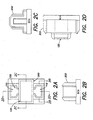
- FIGS. 2A-D are block diagrams of respective top, first cross-sectional front, second cross-sectional front and cross-sectional side views of the substrate following a step of the method of manufacturing a finFET in which spacers are formed adjacent the body region and gate region in accordance with an embodiment of the present invention.
- CVD or another suitable method may be employed to form a layer of silicon nitride or another suitable material on the substrate 100.
- RIE or another suitable method may be employed to remove portions of the silicon nitride layer such that spacers 200 are formed adjacent sidewalls of the body region 106 and the gate 120.
- the spacers 200 may be about 10 nm to about 100 nm wide (although a larger or smaller and/or different width range may be employed).
- portions of the dielectric material layer 114 may be removed.
- portions of the dielectric material layer 114 on a top surface of source/drain diffusion regions 110, 112 of the body region 106 may be removed.
- the spacers 200 may serve as sacrificial or temporary spacers employed to protect portions of the gate conductor layer 116 during subsequent processing. In this manner, a spacer width may be employed such that subsequently-formed silicide may be prevented from penetrating into a junction of the finFET as described below. Penetration of the silicide into the junction regions of the source/drain diffusion regions may result in severe leakage currents and must be avoided.
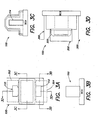
- FIGS. 3A-D are block diagrams of respective top, first cross-sectional front, second cross-sectional front and cross-sectional side views of the substrate following a step of the method of manufacturing a finFET in which one or more portions of the spacers are removed from the substrate in accordance with an embodiment of the present invention.
- a spin-on technique or another suitable method may be employed to deposit a photoresist layer or another suitable material layer on the substrate 100.
- the photoresist layer may be patterned with a mask such that portions of the photoresist layer may be removed during a subsequent process (e.g., developing). In this manner a trim mask 300 may be formed.
- the trim mask 300 described above comprises photoresist
- the trim mask may comprise a hard mask material.
- Dotted boxes 302, 304 illustrate portions of the substrate 100 that may be exposed by the trim mask 300 during subsequent processing.
- the trim mask 300 may be employed duringRIE or another suitable method to remove portions of the spacers 200 and/or the dielectric material layer 114 adjacent source/drain diffusion regions 110, 112 of the body region 106. In this manner, a larger area of the source/ drain diffusion regions 110-112 (e.g., including sidewalls thereof) may be exposed during subsequent processing, thereby improving contact to the source/drain diffusion regions thereof.
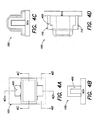
- FIGS. 4A-D are block diagrams of respective top, first cross-sectional front, second cross-sectional front and cross-sectional side views of the substrate following a step of the method of manufacturing a finFET in which porous silicon 400 is formed in the source/drain diffusion regions 110, 112 in accordance with an embodiment of the present invention.
- impurity atoms e.g., dopant
- exposed portions of the substrate 100 such as source/drain diffusion regions 110, 112 may be doped to form a p+ impurity species layer (which is later converted to porous silicon 400), such as boron or the like.
- the p+ doped layer may have a peak concentration of about 5 x 10 17 cm -3 to about 1 x 10 21 cm -3 (although a larger or smaller and/or different concentration range may be employed):
- the thickness of the p+ doped layer preferably ranges from 5 nm to 100 nm (although a larger or smaller thickness may be employed).
- the P+ doped layer is preferably formed by plasma immersion implantation. Alternatively, solid source doping, gas phase doping, or angled ion implantation processes, or combinations thereof, may be employed to form the p+ doped layer.
- a thin layer of CVD nitride or another suitable material may be employed as a mask to block doping of portions of the substrate 100.
- An anodization process may be employed to convert the doped (e.g., p+ doped) silicon to porous silicon.
- contactless anodization such as that described in " A technique to form a porous silicon layer with no backside contact by alternating current electrochemical process," A. El-Bahar, Y. Nemirovsky, Applied Physics Letters, v 77, n 2, Jul 10, 2000, p 208-210 may be employed to form porous silicon in an SOI layer, which is electrically insulated from a contacted substrate.
- an AC voltage excitation may be applied to the substrate 100, with the insulated silicon layer 102 being capacitively coupled to the substrate 100.
- a reaction that forms the porous silicon 400 in the source/drain diffusion regions 110-112 may occur while an AC anode, which may be positive relative to the cathode, is excited.
- a fluoride-containing acidic electrolyte solution or the like may be employed for etching (e.g., anodic etching) during anodization.
- a contactless anodization method e.g., a method which may not require direct electrical contact with the substrate 100
- a contactless anodization method e.g., a method which may not require direct electrical contact with the substrate 100
- an excitation frequency of between about 500 Hz and about 10 kHz, an RMS current density of about_5 mA/cm 2 to about 200mA/cm 2 , and silicon regions having a p+ doping concentration of greater than about 10 19 /cm 3 may be may be employed to form the porous silicon 400 (although a larger or smaller and/or different range may be employed for the excitation frequency, current density and/or doping concentration).
- pores e.g., canals
- a density of such pores ranges from about 10 9 pores/cm 2 to about 10 15 pores/cm 2 .
- pores of the porous silicon 400 may occupy about 30% to about 80% of an overall volume of the silicon 400 (although the pores may occupy a larger or smaller and/or different percentage range of the overall volume).
- a stripper bath or another suitable method may be employed to remove the trim mask 300 from the substrate 100.
- the substrate 100 may undergo annealing to remove excess dopant from the porous silicon 400.
- the substrate 100 may undergo a hydrogen-ambient bake after the porous silicon 400 is formed such that some or all of the p+ dopant remaining in the source/drain diffusion regions 110-112 may be removed.
- the substrate 100 may be subjected to a temperature of about 850 °C to about 1100 °C for about 10 seconds to about 30 minutes (although a larger or smaller and/or different temperature range and/or time period may be employed).
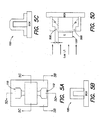
- FIGS. 5A-D are block diagrams of respective top, first cross-sectional front, second cross-sectional front and cross-sectional side views of the substrate following a step of the method of manufacturing a finFET in which the substrate undergoes a second implant in accordance with an embodiment of the present invention.
- RIE reactive ion etching
- isotropic etching or another suitable method may be employed to remove exposed portions of the nitride layer 118 and/or the dielectric layer 114 from the substrate 100.
- portions of the spacers 200 and/or the nitride layer 118 remaining while the porous silicon 400 is formed served to protect the gate 120 (e.g., polysilicon material layer 116'and dielectric layer 114) while forming the porous silicon 400.
- the spacers 200 served to position an edge (e.g., sidewall) of the porous silicon 400 a predetermined distance d (e.g., based on the width of the spacers 200) from the gate 120.
- a leakage current between such regions may be reduced and/or prevented. For example, a spiking through of a source/drain metal into a gate channel of the finFET may be reduced and/or eliminated. Consequently, the width of the spacer 200 may be employed such that subsequently-formed silicide may be prevented from penetrating into a gate-source/drain junction.
- the substrate 100 may be subjected to angled ion implantations (Ldd I/I), such that lightly-doped source/drain diffusion (LDD) regions are formed within the N-channel and P-channel finFETs.
- LDD lightly-doped source/drain diffusion
- a concentration of about 1 x 10 18 cm -3 to about 5 x 10 19 cm -3 may be employed for the LDD regions (although a larger or smaller and/or different concentration range may be employed).
- Standardly practiced LDD dopants such as arsenic, phosphorus or antimony N-type dopant species may be used for the N-channel finFETs, and boron or indium P-type species for the P-channel finFETs.
- the substrate 100 may be lightly doped. More specifically, a region 500 of relatively low doping close to the gate 120 may be formed in the source/drain diffusion regions 110, 112.
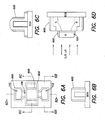
- FIGS. 6A-D are block diagrams of respective top, first cross-sectional front, second cross-sectional front and cross-sectional side views of the substrate following a step of the method of manufacturing a finFET in which the substrate undergoes a third implant in accordance with an embodiment of the present invention.
- CVD or another suitable method followed by RIE or another suitable method may be employed to form spacers 600 (e.g., permanent spacers) on sidewalls of the gate 120 and sidewalls of the body region 106 including the source/drain diffusion regions 110, 112.
- the width of the spacers 600 may be less than the previously-formed spacers 200.
- the spacers 600 may be about 5 nm to about 50 nm wide (although a larger or smaller and/or different width range may be employed).
- the substrate 100 may be subjected to implantation, such as a source/drain ion implant (S/D I/I) or the like, such that junctions (e.g., of the source/drain diffusion regions 110, 112) of the finFET being manufactured may be formed.
- a concentration of about 1 x 10 9 cm -3 to about 5x10 20 cm -3 of dopant may be introduced into the substrate 100 (although a larger or smaller and/or different concentration range and/or dopant type may be employed).
- the substrate 100 may be heavily doped with impurity atoms.
- an angled source-drain ion implant S/D I/I may be performed through the porous silicon 400 to form a doped (e.g., heavily doped silicon) region underneath the porous silicon 400.
- a gate conductor work function of the finFET being manufactured may be based on such doping.
- a gate 120 has a work function which generally matches (e.g., is approximately equal to) the work function of the adjacent source-drain diffusions.
- the second implant e.g., light doping of the source/drain diffusion regions 110, 112
- the third implant e.g., heavy doping of the source/drain diffusion regions 110, 112
- dopants inserted into the substrate 100 during the second and third implants may penetrate through the porous layer 400 and form a junction.
- the spacers 200 may cause the porous silicon 400 to be formed a predetermined distance (e.g., based on a width of the spacer 200) from a source-drain junction near the gate 120. Such distance may prevent silicide subsequently formed in the porous silicon 400 from encroaching (e.g., laterally) on such junction.
- Implantation of impurity atoms through the porous silicon 400 during the third implant enables formation of heavy source-drain doping much deeper than the porous silicon 400 after the substrate 100 undergoes annealing.
- the porous silicon 400 is converted to a highly-conductive metallic silicide.
- silicide should not encroach (e.g., penetrate or spike through) the junctions.
- spacer 200 is wider than the spacer 600, which may be employed to separate the lightly-doped and heavily-doped implants of the source/drain diffusion regions 110, 112.
- substantially thick silicide subsequently may be formed inside the porous silicon 400 upon the source/drain diffusion regions 110, 112 but away from the edge of gate 120 so that a series resistance can be significantly reduced.
- a series resistance can be significantly reduced.
- closer to the gate 120 e.g., along the edges of the polysilicon material layer 116 serving as the gate conductor
- only a very shallow surface layer of the source/drain diffusion regions 110, 112 subsequently may be converted into silicide. Therefore, neither lateral nor vertical metal spiking will occur using the present method.
- the substrate 100 may undergo annealing or another suitable process.
- a dopant activation anneal such as a rapid thermal anneal (RTA) or spike anneal at a temperature between about 950 °C and about 1150 °C for about 5 seconds to about 30 seconds (although a larger or smaller and/or different temperature and/or time period range may be employed).
- RTA rapid thermal anneal
- spike anneal at a temperature between about 950 °C and about 1150 °C for about 5 seconds to about 30 seconds (although a larger or smaller and/or different temperature and/or time period range may be employed).
- a different type of annealing may be employed.
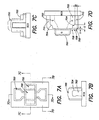
- FIGS. 7A-D are block diagrams of respective top, first cross-sectional front, second cross-sectional front and cross-sectional side views of the substrate following a step of the method of manufacturing a finFET in which silicide is formed on the substrate in accordance with an embodiment of the present invention.
- CVD or another suitable method may be employed to form a layer of metal, such as tungsten, cobalt, titanium, nickel and/or the like, on the substrate 100.
- the substrate 100 undergoes silicidation.
- Silicidation of different regions of the substrate 100 may lower series resistance and enable better current drivability of the finFET.
- the metal may react with different portions of silicon on the substrate 100 such that silicide forms therein.
- the porous silicon 400 is silicided. More specifically, metal may be soaked into pores of the porous silicon 400. Silicidation may proceed more rapidly through the porous silicon 400 than through remaining portions of silicon in the source/drain diffusion regions 110, 112 and on remaining portions of the substrate 100. Consequently, a time period for silicidation of the porous silicon 400 and/or remaining portions of the finFET may be reduced.
- a depth of a silicide layer 700 formed on the substrate 100 may be precisely controlled. More specifically, silicon in the entire source/drain diffusion regions 110, 112 is not converted to silicide. Consequently, the present method forms an interior unsilicided silicon region 702 (e.g., an unsilicied silicon "core") within the source/drain diffusion regions 110, 112. Thus, an area of an interface 704 of the silicide layer 700 and unsilicided silicon region 702 is increased compared to a transistor having silicide formed only on a top surface of source/drain diffusion regions of the transistor and compared to a transistor having silicide formed in the entire source/drain diffusion region of the transistor.
- an interior unsilicided silicon region 702 e.g., an unsilicied silicon "core
- a resistance (e.g., a source-drain resistance) of a finFET may be based on (e.g., inversely proportional to) the area of such interface. Consequently, the unsilicided silicon "core” 702 formed by the present invention may reduce a series resistance of the finFET being manufactured. Further, the finFET may employ the unsilicided silicon "core” 702 to avoid reducing an area normal to the direction of the current density crossing the silicide/unsilicided silicon interface in source/drain diffusion regions 110, 112 of the finFET.
- Process parameters employed while forming the porous silicon 400 may determine thicknesses of respective portions of the porous silicon 400.
- a thickness of the subsequently-formed silicide may be based on the porous silicon layer thickness. Therefore, the present invention may be employed to form a silicide layer 700 (as described above) portions of which may be thinner than a conventional silicide layer. In this manner, the present invention may be employed in finFETs with shallow junctions.
- the silicide layer 700 formed in a source/drain diffusion region 110, 112 may have a first portion 706 having a thickness t1 of about 1 nm to about 5 nm (although a larger or smaller and/or different thickness range may be employed). Such portion 706 may serve as a contact (e.g., a thin contact) to the LDD silicon. Additionally, the silicide layer 700 formed in the source/drain diffusion region 110, 112 may have a second portion 708 having a thickness t2 of about 5 nm to about 100 nm (although a larger or smaller and/or different thickness range may be employed).
- Such portion 708 may serve as a contact (e.g., a thicker contact) to a top surface of silicon in the source/drain diffusion region 110, 112.
- the silicide layer 700 formed in the source/drain diffusion region 110, 112 may have a third portion 710 having a width w1 of about 5 nm to about 100 nm (although a larger or smaller and/or different width range may be employed).
- Such portion 710 may serve as a contact to sidewalls of silicon in the source/drain diffusion region 110, 112. Consequently, the silicide layer 700 may form or define a region of silicon in the interior of the source/drain diffusion region 110, 112 (e.g., the unsilicided silicon "core" 702).
- the silicide layer 700 in the source/drain diffusion regions 110, 112 may have any shape adapted to increase an area of the interface 704 of the silicide layer 700 and silicon in the source/drain diffusion region 110, 112 of the finFET being manufactured.
- the silicide may have a resistivity of about 10 micro-ohm-cm to about 100 micro-ohm-cm (although a larger or smaller and/or different resistivity range may be employed).
- RIE reactive ion etching
- FIGS. 8A-D are block diagrams of respective top, first cross-sectional front, second cross-sectional front and cross-sectional side views of the substrate following a step of the method of manufacturing a finFET in which back-end-of-line (BEOL) processing is performed in accordance with an embodiment of the present invention.
- CVD or another suitable method may be employed to deposit an insulator layer 800, such as a planarizing glass (e.g., undoped TEOS, phosphosilicate glass (PSG), borosilicate glass (BSG), borophosphosilicate glass (BPSG) and/or the like) on a top surface of the substrate 100. Thereafter, the insulator layer 800 may be planarized.
- a planarizing glass e.g., undoped TEOS, phosphosilicate glass (PSG), borosilicate glass (BSG), borophosphosilicate glass (BPSG) and/or the like
- the insulator may be reflowed to planarize the insulator layer 800.
- CMP chemical mechanical polishing
- RIE or another suitable method may be employed to form one or more vias or contact openings 802 on the substrate 100.
- CVD or another suitable method followed by RIE, CMP or another suitable method may be employed to fill such vias 802 with a conductor, such as tungsten or another suitable material, thereby forming studs 804.
- one or more levels of wiring and/or interlevel dielectric may be formed on the substrate 100. In this manner, an improved finFET 806 may be formed.
- the finFET 806 has a reduced source-drain resistance compared to conventional transistors.
- the finFET 806 includes at least one source/drain diffusion region 110, 112 having silicide (e.g., a low-resistivity silicide) formed on a top surface of and on sidewalls of silicon (e.g., heavily-doped unsilicided silicon) in the source/drain diffusion regions 110, 112.
- silicide e.g., a low-resistivity silicide
- silicon e.g., heavily-doped unsilicided silicon
- a source/drain diffusion region 110, 112 of the finFET 806 may include a silicide layer 700 having a thin silicide region (e.g., the first portion 706) located in the vicinity of a gate channel region 808 of the finFET 806, a thicker silicide region (e.g., the second portion 708) located in a distance away from the gate channel region 808, sidewall silicide regions (e.g., the third portion 710) which may be coupled to and/or included in outer edges of the source/drain diffusion region 110, 112 and an unsilicided silicon region 702 in the interior of the source/drain diffusion region 110, 112.
- a thin silicide region e.g., the first portion 706 located in the vicinity of a gate channel region 808 of the finFET 806, a thicker silicide region (e.g., the second portion 708) located in a distance away from the gate channel region 808, sidewall silicide regions (e.g., the third portion 710) which may
- FIG. 9 illustrates a process flow 900 of the method of manufacturing the finFET in accordance with an embodiment of the present invention.
- the gate region 120 may be protected (e.g., by the trim mask 300) and the source/drain diffusion regions 110, 112 may be exposed (e.g., by the trim mask 300) while the porous silicon 400 is formed in portions of the source/drain diffusion regions 110, 112.
- the porous silicon 400 is formed in portions of the source/drain diffusion regions 110, 112.
- pores may be prevented from forming in the gate conductor material layer 116, and the gate dielectric 114 is protected from damage due to the etching action of the electrolyte used to form pores in the exposed silicon.
- the gate region 120 may not be doped more than desired, thereby avoiding a problem of removing a dopant, such as boron, from grain boundaries of the gate conductor material. Further, a larger portion (depth) than that desired of the gate region 120 may not be silicided, which would adversely affect a work function at an edge of the gate region 120 (e.g., for a short channel device) and threshold voltage of the finFET 806.
- step 904 porosity (e.g., porous silicon 400) is formed in selected areas of the source/drain diffusion regions 110, 112. Details of step 904 are described below with reference to FIG. 10 .
- implant and annealing process steps may be employed to form the source/drain diffusion regions 110, 112 of the finFET 806.
- dopant may be implanted into the substrate 100.
- the LDD I/I and the S/D I/I may be employed to dope the gate region 120 and form junctions in the source/drain diffusion regions 110, 112.
- step 908 silicidation is employed to form the silicide layer 700 on the substrate 100 (e.g., on the gate region 120 and on the porous silicon 400 of the source/drain diffusion regions 110, 112).
- the silicide layer 700 is formed inside the porous silicon 400 and may as well be formed at exposed surfaces of single-crystal silicon and polysilicon on the substrate 100.
- step 910 may be performed.
- BEOL processing may continue.
- the insulator layer 800, vias or contact openings 802, studs 804, interlevel dielectrics, wiring levels and/or the like may be formed such that contact may be made to the finFET 806. In this manner, the low source-drain resistance finFET 806 may be formed.
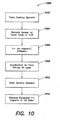
- FIG. 10 illustrates sub-steps 1000 of a step in the process flow 900 in which porous silicon is formed in source/drain diffusion regions in accordance with an embodiment of the present invention.
- dummy spacers such as the sacrificial or temporary spacers 200 may be formed on the substrate 100.
- the temporary spacers 200 may be formed adjacent the gate region 120 and body region 106 of the substrate 100.
- portions of the temporary spacers 200 adjacent source/drain diffusion regions 110, 112 of the body region 106 may be removed using isotropic etching or the like. Such portions may be exposed during etching by the trim mask 300.
- step 1006 dopant (e.g., p+ dopant such as boron and/or the like) may be introduced into exposed portions of the substrate 100.
- dopant e.g., p+ dopant such as boron and/or the like
- Plasma immersion implantation, ion implantation (e.g., angled), gas phase doping, a solid source doping technique or conventional gaseous source diffusion process may be employed to dope the exposed portions of the substrate 100. In this manner, the source/drain diffusion regions 110, 112 may be doped after porous silicon 400 is formed.
- the substrate 100 may undergo anodization such that pores form inside the p+ doped regions of the source/drain diffusion regions 110, 112.
- step 1010 remaining portions of the temporary spacers 200 may be stripped from the substrate 100.
- RIE or another suitable method may be employed.
- step 1012 the substrate 100 may undergo annealing to remove excessive dopant therefrom.
- the substrate 100 may be subjected to a hydrogen bake (e.g., a low temperature bake in a hydrogen ambient) such that excess p+ dopant inserted in the substrate 100 during step 1006 may be removed (e.g., depleted by the bake).
- a finFET 806 with a unique and robust source-drain contacting scheme may be formed.
- Increased source-drain doping concentration may be employed to attempt to resolve this problem.
- high doping concentration may not easily be obtained due to limitations of solid solubility and electrical activation.
- a significant fraction of the source-drain series resistance is due to the interface between the silicide layer and the silicon. This leads to sharply increased series resistance when silicide is formed completely through the source-drain silicon because a channel current is forced to flow through a small cross-sectional area dictated by the thickness of the SOI film or by the width of the FinFET fin.
- the present methods may provide advantages over conventional finFETs and avoid the disadvantages of conventional finFETs described above.
- the sacrificial spacer 200 before forming the porous silicon 400, the subsequently-formed silicide layer 700 may be prevented from encroaching on metallurgical junctions.
- the finFET 806 may avoid the high leakage currents of conventional finFETs by maintaining a low-junction leakage current.
- a gate electrode of the finFET 806 may be protected while forming porous silicon 400 in the source/drain diffusion region 110, 112 so the finFET gate 120 has a preferred work-function.
- a source and drain region may contribute a high series resistance to the finFET.
- a contact resistance problem increases. More specifically, because the sidewalls of the source/drain diffusion regions of such finFETs are often blocked by spacer material associated with gate formation, doping and silicidation occurs only on portions of a top surface of the source/drain diffusion regions. Further, a contact region on a top surface of the source/drain diffusion area is narrow, resulting in high contact resistance.
- silicide of the present invention may have a larger contact surface area than the planar surface area of the source/drain diffusion region 110, 112. Further, an interior of the source/drain diffusion region remains unsilicided to increase an area of a silicide/non-silicide interface. More specifically, the silicide layer 700 may form on four sides (e.g., on three sidewalls and a top surface) of the source/drain diffusion region 110, 112 thereby reducing a contact resistance to the finFET 806. For the above reasons, compared to conventional transistors, the finFET 806 has a reduced source-drain series resistance.
- a source/drain ion implant is performed on the substrate 100 after forming the porous silicon 400 so that after drive-in of dopant a junction is always formed beneath the layer of porous silicon 400. Thereafter, the entire region of porous silicon 400 may be converted to silicide. Because the silicide forms mainly inside the region of porous silicon 400, dopant depletion problems are reduced and/or eliminated.
- the substrate 100 may be subjected to a halo implants or the like.
- a concentration of about 5 x 10 17 cm -3 to about 5x10 18 cm -3 may be employed of dopant polarity opposite of the source-drain doping polarity may be implanted into the substrate 100 (although a larger or smaller and/or different concentration range and/or dopant type may be employed).
- the halo implant may be employed to adjust a threshold voltage of the finFET 806 being manufactured.
Landscapes
- Thin Film Transistor (AREA)
- Insulated Gate Type Field-Effect Transistor (AREA)
- Electrodes Of Semiconductors (AREA)
Applications Claiming Priority (2)
| Application Number | Priority Date | Filing Date | Title |
|---|---|---|---|
| US11/316,244 US7531423B2 (en) | 2005-12-22 | 2005-12-22 | Reduced-resistance finFETs by sidewall silicidation and methods of manufacturing the same |
| PCT/EP2006/069339 WO2007071555A1 (en) | 2005-12-22 | 2006-12-05 | Reduced-resistance finfets and methods of manufacturing the same |
Publications (2)
| Publication Number | Publication Date |
|---|---|
| EP1964179A1 EP1964179A1 (en) | 2008-09-03 |
| EP1964179B1 true EP1964179B1 (en) | 2009-09-02 |
Family
ID=37771049
Family Applications (1)
| Application Number | Title | Priority Date | Filing Date |
|---|---|---|---|
| EP06830385A Active EP1964179B1 (en) | 2005-12-22 | 2006-12-05 | Methods of manufacturing reduced-resistance finfets |
Country Status (8)
| Country | Link |
|---|---|
| US (2) | US7531423B2 (enExample) |
| EP (1) | EP1964179B1 (enExample) |
| JP (1) | JP4550146B2 (enExample) |
| KR (1) | KR100992037B1 (enExample) |
| CN (1) | CN101317273B (enExample) |
| AT (1) | ATE441938T1 (enExample) |
| DE (1) | DE602006008984D1 (enExample) |
| WO (1) | WO2007071555A1 (enExample) |
Families Citing this family (40)
| Publication number | Priority date | Publication date | Assignee | Title |
|---|---|---|---|---|
| US7479437B2 (en) * | 2006-04-28 | 2009-01-20 | International Business Machines Corporation | Method to reduce contact resistance on thin silicon-on-insulator device |
| KR100864928B1 (ko) * | 2006-12-29 | 2008-10-22 | 동부일렉트로닉스 주식회사 | 모스펫 소자의 형성 방법 |
| US20090001426A1 (en) * | 2007-06-29 | 2009-01-01 | Kangguo Cheng | Integrated Fin-Local Interconnect Structure |
| US8004045B2 (en) | 2007-07-27 | 2011-08-23 | Panasonic Corporation | Semiconductor device and method for producing the same |
| CN102723366B (zh) * | 2007-07-27 | 2015-03-04 | 知识产权之桥一号有限责任公司 | 半导体装置 |
| US8021939B2 (en) * | 2007-12-12 | 2011-09-20 | International Business Machines Corporation | High-k dielectric and metal gate stack with minimal overlap with isolation region and related methods |
| EP2311072B1 (en) | 2008-07-06 | 2013-09-04 | Imec | Method for doping semiconductor structures |
| US20110001169A1 (en) * | 2009-07-01 | 2011-01-06 | International Business Machines Corporation | Forming uniform silicide on 3d structures |
| US8653608B2 (en) * | 2009-10-27 | 2014-02-18 | Taiwan Semiconductor Manufacturing Company, Ltd. | FinFET design with reduced current crowding |
| US8278179B2 (en) | 2010-03-09 | 2012-10-02 | Taiwan Semiconductor Manufacturing Co., Ltd. | LDD epitaxy for FinFETs |
| US8431995B2 (en) * | 2010-05-13 | 2013-04-30 | International Business Machines Corporation | Methodology for fabricating isotropically recessed drain regions of CMOS transistors |
| US8716798B2 (en) | 2010-05-13 | 2014-05-06 | International Business Machines Corporation | Methodology for fabricating isotropically recessed source and drain regions of CMOS transistors |
| JP5837307B2 (ja) * | 2011-02-07 | 2015-12-24 | 公益財団法人神奈川科学技術アカデミー | 多孔性微粒子の製造方法 |
| US8614134B2 (en) * | 2011-03-21 | 2013-12-24 | Globalfoundries Inc. | Shallow source and drain architecture in an active region of a semiconductor device having a pronounced surface topography by tilted implantation |
| US10629900B2 (en) | 2011-05-04 | 2020-04-21 | Corning Incorporated | Porous silicon compositions and devices and methods thereof |
| CN103137478A (zh) * | 2011-11-21 | 2013-06-05 | 中芯国际集成电路制造(上海)有限公司 | FinFET器件的制造方法及结构 |
| US8637931B2 (en) | 2011-12-27 | 2014-01-28 | International Business Machines Corporation | finFET with merged fins and vertical silicide |
| KR101894221B1 (ko) | 2012-03-21 | 2018-10-04 | 삼성전자주식회사 | 전계 효과 트랜지스터 및 이를 포함하는 반도체 장치 |
| US8664072B2 (en) | 2012-05-30 | 2014-03-04 | Globalfoundries Inc. | Source and drain architecture in an active region of a P-channel transistor by tilted implantation |
| WO2014009991A1 (ja) * | 2012-07-09 | 2014-01-16 | 国立大学法人東北大学 | 3次元構造のmosfet及びその製造方法 |
| US8975125B2 (en) * | 2013-03-14 | 2015-03-10 | International Business Machines Corporation | Formation of bulk SiGe fin with dielectric isolation by anodization |
| US8859379B2 (en) | 2013-03-15 | 2014-10-14 | International Business Machines Corporation | Stress enhanced finFET devices |
| US8940602B2 (en) | 2013-04-11 | 2015-01-27 | International Business Machines Corporation | Self-aligned structure for bulk FinFET |
| KR102083493B1 (ko) | 2013-08-02 | 2020-03-02 | 삼성전자 주식회사 | 반도체 소자의 제조방법 |
| US9583590B2 (en) | 2013-09-27 | 2017-02-28 | Samsung Electronics Co., Ltd. | Integrated circuit devices including FinFETs and methods of forming the same |
| US9711645B2 (en) * | 2013-12-26 | 2017-07-18 | International Business Machines Corporation | Method and structure for multigate FinFET device epi-extension junction control by hydrogen treatment |
| US9391173B2 (en) * | 2014-04-22 | 2016-07-12 | International Business Machines Corporation | FinFET device with vertical silicide on recessed source/drain epitaxy regions |
| CN105702729B (zh) * | 2014-11-27 | 2019-01-15 | 中国科学院微电子研究所 | 半导体器件及其制造方法 |
| CN105702725B (zh) * | 2014-11-27 | 2018-12-11 | 中国科学院微电子研究所 | 半导体器件及其制造方法 |
| US9666716B2 (en) | 2014-12-15 | 2017-05-30 | Sang U. Kim | FinFET transistor |
| US9741811B2 (en) | 2014-12-15 | 2017-08-22 | Samsung Electronics Co., Ltd. | Integrated circuit devices including source/drain extension regions and methods of forming the same |
| CN105789301B (zh) * | 2014-12-25 | 2018-09-11 | 中国科学院微电子研究所 | 鳍式场效应晶体管、鳍结构及其制造方法 |
| US9837277B2 (en) | 2015-08-12 | 2017-12-05 | International Business Machines Corporation | Forming a contact for a tall fin transistor |
| US9397197B1 (en) | 2015-09-23 | 2016-07-19 | International Business Machines Corporation | Forming wrap-around silicide contact on finFET |
| US9484251B1 (en) * | 2015-10-30 | 2016-11-01 | Lam Research Corporation | Contact integration for reduced interface and series contact resistance |
| WO2017091543A1 (en) * | 2015-11-25 | 2017-06-01 | Corning Incorporated | Porous silicon compositions and devices and methods thereof |
| CN107452792A (zh) * | 2016-06-01 | 2017-12-08 | 中芯国际集成电路制造(上海)有限公司 | 半导体装置及其制造方法 |
| US9853127B1 (en) * | 2016-06-22 | 2017-12-26 | International Business Machines Corporation | Silicidation of bottom source/drain sheet using pinch-off sacrificial spacer process |
| CN108155236B (zh) * | 2016-12-05 | 2020-08-07 | 上海新昇半导体科技有限公司 | 具有黑磷沟道层的低接触电阻率FinFET及其制备方法 |
| US10707331B2 (en) * | 2017-04-28 | 2020-07-07 | Taiwan Semiconductor Manufacturing Company, Ltd. | FinFET device with a reduced width |
Family Cites Families (15)
| Publication number | Priority date | Publication date | Assignee | Title |
|---|---|---|---|---|
| US6297135B1 (en) | 1997-01-29 | 2001-10-02 | Ultratech Stepper, Inc. | Method for forming silicide regions on an integrated device |
| JP3209164B2 (ja) * | 1997-10-07 | 2001-09-17 | 日本電気株式会社 | 半導体装置の製造方法 |
| US6133124A (en) * | 1999-02-05 | 2000-10-17 | Advanced Micro Devices, Inc. | Device improvement by source to drain resistance lowering through undersilicidation |
| US6255214B1 (en) * | 1999-02-24 | 2001-07-03 | Advanced Micro Devices, Inc. | Method of forming junction-leakage free metal silicide in a semiconductor wafer by amorphization of source and drain regions |
| WO2003010461A1 (en) * | 2001-07-25 | 2003-02-06 | Philmac Pty Ltd | Coupling or transition fitting for the connection of metal or plastic pipes |
| US7358121B2 (en) * | 2002-08-23 | 2008-04-15 | Intel Corporation | Tri-gate devices and methods of fabrication |
| US6864519B2 (en) * | 2002-11-26 | 2005-03-08 | Taiwan Semiconductor Manufacturing Co., Ltd. | CMOS SRAM cell configured using multiple-gate transistors |
| US7105894B2 (en) * | 2003-02-27 | 2006-09-12 | Taiwan Semiconductor Manufacturing Co., Ltd. | Contacts to semiconductor fin devices |
| KR100559572B1 (ko) * | 2003-09-01 | 2006-03-10 | 동부아남반도체 주식회사 | 살리사이드를 갖는 반도체 소자 제조 방법 |
| US20050090067A1 (en) * | 2003-10-27 | 2005-04-28 | Dharmesh Jawarani | Silicide formation for a semiconductor device |
| KR100526889B1 (ko) * | 2004-02-10 | 2005-11-09 | 삼성전자주식회사 | 핀 트랜지스터 구조 |
| KR20050108916A (ko) * | 2004-05-14 | 2005-11-17 | 삼성전자주식회사 | 다마신 공정을 이용한 핀 전계 효과 트랜지스터의 형성 방법 |
| JP3964885B2 (ja) * | 2004-05-19 | 2007-08-22 | 株式会社東芝 | 半導体装置及びその製造方法 |
| US7015126B2 (en) * | 2004-06-03 | 2006-03-21 | Taiwan Semiconductor Manufacturing Co., Ltd. | Method of forming silicided gate structure |
| JP2006012898A (ja) * | 2004-06-22 | 2006-01-12 | Toshiba Corp | 半導体装置及びその製造方法 |
-
2005
- 2005-12-22 US US11/316,244 patent/US7531423B2/en not_active Expired - Lifetime
-
2006
- 2006-12-05 AT AT06830385T patent/ATE441938T1/de not_active IP Right Cessation
- 2006-12-05 EP EP06830385A patent/EP1964179B1/en active Active
- 2006-12-05 WO PCT/EP2006/069339 patent/WO2007071555A1/en not_active Ceased
- 2006-12-05 DE DE602006008984T patent/DE602006008984D1/de active Active
- 2006-12-05 JP JP2008546349A patent/JP4550146B2/ja active Active
- 2006-12-05 KR KR1020087014763A patent/KR100992037B1/ko not_active Expired - Fee Related
- 2006-12-05 CN CN2006800440556A patent/CN101317273B/zh active Active
-
2007
- 2007-10-31 US US11/933,392 patent/US20080054349A1/en not_active Abandoned
Also Published As
| Publication number | Publication date |
|---|---|
| US20070148836A1 (en) | 2007-06-28 |
| EP1964179A1 (en) | 2008-09-03 |
| KR20080086458A (ko) | 2008-09-25 |
| US7531423B2 (en) | 2009-05-12 |
| WO2007071555A1 (en) | 2007-06-28 |
| DE602006008984D1 (de) | 2009-10-15 |
| JP2009521113A (ja) | 2009-05-28 |
| KR100992037B1 (ko) | 2010-11-05 |
| US20080054349A1 (en) | 2008-03-06 |
| CN101317273B (zh) | 2012-08-22 |
| JP4550146B2 (ja) | 2010-09-22 |
| CN101317273A (zh) | 2008-12-03 |
| ATE441938T1 (de) | 2009-09-15 |
Similar Documents
| Publication | Publication Date | Title |
|---|---|---|
| US7531423B2 (en) | Reduced-resistance finFETs by sidewall silicidation and methods of manufacturing the same | |
| US10134892B2 (en) | High voltage device with low Rdson | |
| US8822291B2 (en) | High voltage device | |
| US9570545B2 (en) | High voltage trench transistor | |
| US10840246B2 (en) | Integrated circuit having a vertical power MOS transistor | |
| US8159024B2 (en) | High voltage (>100V) lateral trench power MOSFET with low specific-on-resistance | |
| US20080042205A1 (en) | Low-cost high-performance planar back-gate cmos | |
| US10580888B1 (en) | Oxygen inserted Si-layers for reduced contact implant outdiffusion in vertical power devices | |
| US20070032029A1 (en) | Lateral trench power MOSFET with reduced gate-to-drain capacitance | |
| CN108428743B (zh) | 金属/多晶硅栅极沟槽功率mosfet及其形成方法 | |
| US10978559B1 (en) | MOS transistor with folded channel and folded drift region | |
| US9768295B2 (en) | Semiconductor devices having super-junction trenches with conductive regions and method of making the same | |
| US20080169505A1 (en) | Structure of Trench MOSFET and Method for Manufacturing the same | |
| US9530884B2 (en) | Method of manufacturing a semiconductor device and semiconductor device | |
| KR101801406B1 (ko) | 반도체 장치 및 관련 제조 방법 | |
| US20130026565A1 (en) | Low rdson resistance ldmos | |
| US8912066B2 (en) | Lateral double-diffused high voltage device | |
| US20120080749A1 (en) | Umos semiconductor devices formed by low temperature processing | |
| US6395606B1 (en) | MOSFET with metal in gate for reduced gate resistance | |
| US20200135916A1 (en) | Vertical transistor with extended drain region | |
| US10749028B2 (en) | Transistor with gate/field plate structure | |
| US7119017B2 (en) | Method for improving interlevel dielectric gap filling over semiconductor structures having high aspect ratios | |
| US20130049122A1 (en) | Semiconductor device and method of manufacturing the same |
Legal Events
| Date | Code | Title | Description |
|---|---|---|---|
| PUAI | Public reference made under article 153(3) epc to a published international application that has entered the european phase |
Free format text: ORIGINAL CODE: 0009012 |
|
| 17P | Request for examination filed |
Effective date: 20080619 |
|
| AK | Designated contracting states |
Kind code of ref document: A1 Designated state(s): AT BE BG CH CY CZ DE DK EE ES FI FR GB GR HU IE IS IT LI LT LU LV MC NL PL PT RO SE SI SK TR |
|
| RIC1 | Information provided on ipc code assigned before grant |
Ipc: H01L 21/8234 20060101ALI20090327BHEP Ipc: H01L 21/285 20060101ALI20090327BHEP Ipc: H01L 29/45 20060101ALI20090327BHEP Ipc: H01L 29/78 20060101ALI20090327BHEP Ipc: H01L 21/336 20060101AFI20090327BHEP |
|
| RTI1 | Title (correction) |
Free format text: METHODS OF MANUFACTURING REDUCED-RESISTANCE FINFETS |
|
| GRAP | Despatch of communication of intention to grant a patent |
Free format text: ORIGINAL CODE: EPIDOSNIGR1 |
|
| GRAS | Grant fee paid |
Free format text: ORIGINAL CODE: EPIDOSNIGR3 |
|
| GRAA | (expected) grant |
Free format text: ORIGINAL CODE: 0009210 |
|
| AK | Designated contracting states |
Kind code of ref document: B1 Designated state(s): AT BE BG CH CY CZ DE DK EE ES FI FR GB GR HU IE IS IT LI LT LU LV MC NL PL PT RO SE SI SK TR |
|
| REG | Reference to a national code |
Ref country code: CH Ref legal event code: NV Representative=s name: IBM RESEARCH GMBH ZURICH RESEARCH LABORATORY INTEL Ref country code: CH Ref legal event code: EP |
|
| REG | Reference to a national code |
Ref country code: IE Ref legal event code: FG4D |
|
| REF | Corresponds to: |
Ref document number: 602006008984 Country of ref document: DE Date of ref document: 20091015 Kind code of ref document: P |
|
| REG | Reference to a national code |
Ref country code: GB Ref legal event code: 746 Effective date: 20091027 |
|
| PG25 | Lapsed in a contracting state [announced via postgrant information from national office to epo] |
Ref country code: SE Free format text: LAPSE BECAUSE OF FAILURE TO SUBMIT A TRANSLATION OF THE DESCRIPTION OR TO PAY THE FEE WITHIN THE PRESCRIBED TIME-LIMIT Effective date: 20090902 Ref country code: LT Free format text: LAPSE BECAUSE OF FAILURE TO SUBMIT A TRANSLATION OF THE DESCRIPTION OR TO PAY THE FEE WITHIN THE PRESCRIBED TIME-LIMIT Effective date: 20090902 Ref country code: FI Free format text: LAPSE BECAUSE OF FAILURE TO SUBMIT A TRANSLATION OF THE DESCRIPTION OR TO PAY THE FEE WITHIN THE PRESCRIBED TIME-LIMIT Effective date: 20090902 |
|
| NLV1 | Nl: lapsed or annulled due to failure to fulfill the requirements of art. 29p and 29m of the patents act | ||
| LTIE | Lt: invalidation of european patent or patent extension |
Effective date: 20090902 |
|
| PG25 | Lapsed in a contracting state [announced via postgrant information from national office to epo] |
Ref country code: LV Free format text: LAPSE BECAUSE OF FAILURE TO SUBMIT A TRANSLATION OF THE DESCRIPTION OR TO PAY THE FEE WITHIN THE PRESCRIBED TIME-LIMIT Effective date: 20090902 Ref country code: NL Free format text: LAPSE BECAUSE OF FAILURE TO SUBMIT A TRANSLATION OF THE DESCRIPTION OR TO PAY THE FEE WITHIN THE PRESCRIBED TIME-LIMIT Effective date: 20090902 Ref country code: PL Free format text: LAPSE BECAUSE OF FAILURE TO SUBMIT A TRANSLATION OF THE DESCRIPTION OR TO PAY THE FEE WITHIN THE PRESCRIBED TIME-LIMIT Effective date: 20090902 Ref country code: SI Free format text: LAPSE BECAUSE OF FAILURE TO SUBMIT A TRANSLATION OF THE DESCRIPTION OR TO PAY THE FEE WITHIN THE PRESCRIBED TIME-LIMIT Effective date: 20090902 |
|
| PG25 | Lapsed in a contracting state [announced via postgrant information from national office to epo] |
Ref country code: CY Free format text: LAPSE BECAUSE OF FAILURE TO SUBMIT A TRANSLATION OF THE DESCRIPTION OR TO PAY THE FEE WITHIN THE PRESCRIBED TIME-LIMIT Effective date: 20090902 |
|
| PG25 | Lapsed in a contracting state [announced via postgrant information from national office to epo] |
Ref country code: RO Free format text: LAPSE BECAUSE OF FAILURE TO SUBMIT A TRANSLATION OF THE DESCRIPTION OR TO PAY THE FEE WITHIN THE PRESCRIBED TIME-LIMIT Effective date: 20090902 Ref country code: PT Free format text: LAPSE BECAUSE OF FAILURE TO SUBMIT A TRANSLATION OF THE DESCRIPTION OR TO PAY THE FEE WITHIN THE PRESCRIBED TIME-LIMIT Effective date: 20100104 Ref country code: IS Free format text: LAPSE BECAUSE OF FAILURE TO SUBMIT A TRANSLATION OF THE DESCRIPTION OR TO PAY THE FEE WITHIN THE PRESCRIBED TIME-LIMIT Effective date: 20100102 Ref country code: ES Free format text: LAPSE BECAUSE OF FAILURE TO SUBMIT A TRANSLATION OF THE DESCRIPTION OR TO PAY THE FEE WITHIN THE PRESCRIBED TIME-LIMIT Effective date: 20091213 Ref country code: EE Free format text: LAPSE BECAUSE OF FAILURE TO SUBMIT A TRANSLATION OF THE DESCRIPTION OR TO PAY THE FEE WITHIN THE PRESCRIBED TIME-LIMIT Effective date: 20090902 Ref country code: CZ Free format text: LAPSE BECAUSE OF FAILURE TO SUBMIT A TRANSLATION OF THE DESCRIPTION OR TO PAY THE FEE WITHIN THE PRESCRIBED TIME-LIMIT Effective date: 20090902 |
|
| PG25 | Lapsed in a contracting state [announced via postgrant information from national office to epo] |
Ref country code: SK Free format text: LAPSE BECAUSE OF FAILURE TO SUBMIT A TRANSLATION OF THE DESCRIPTION OR TO PAY THE FEE WITHIN THE PRESCRIBED TIME-LIMIT Effective date: 20090902 |
|
| PG25 | Lapsed in a contracting state [announced via postgrant information from national office to epo] |
Ref country code: BE Free format text: LAPSE BECAUSE OF FAILURE TO SUBMIT A TRANSLATION OF THE DESCRIPTION OR TO PAY THE FEE WITHIN THE PRESCRIBED TIME-LIMIT Effective date: 20090902 Ref country code: AT Free format text: LAPSE BECAUSE OF FAILURE TO SUBMIT A TRANSLATION OF THE DESCRIPTION OR TO PAY THE FEE WITHIN THE PRESCRIBED TIME-LIMIT Effective date: 20090902 |
|
| PLBE | No opposition filed within time limit |
Free format text: ORIGINAL CODE: 0009261 |
|
| STAA | Information on the status of an ep patent application or granted ep patent |
Free format text: STATUS: NO OPPOSITION FILED WITHIN TIME LIMIT |
|
| PG25 | Lapsed in a contracting state [announced via postgrant information from national office to epo] |
Ref country code: MC Free format text: LAPSE BECAUSE OF NON-PAYMENT OF DUE FEES Effective date: 20100701 Ref country code: DK Free format text: LAPSE BECAUSE OF FAILURE TO SUBMIT A TRANSLATION OF THE DESCRIPTION OR TO PAY THE FEE WITHIN THE PRESCRIBED TIME-LIMIT Effective date: 20090902 |
|
| 26N | No opposition filed |
Effective date: 20100603 |
|
| PG25 | Lapsed in a contracting state [announced via postgrant information from national office to epo] |
Ref country code: IE Free format text: LAPSE BECAUSE OF NON-PAYMENT OF DUE FEES Effective date: 20091205 Ref country code: GR Free format text: LAPSE BECAUSE OF FAILURE TO SUBMIT A TRANSLATION OF THE DESCRIPTION OR TO PAY THE FEE WITHIN THE PRESCRIBED TIME-LIMIT Effective date: 20091203 |
|
| PG25 | Lapsed in a contracting state [announced via postgrant information from national office to epo] |
Ref country code: BG Free format text: LAPSE BECAUSE OF FAILURE TO SUBMIT A TRANSLATION OF THE DESCRIPTION OR TO PAY THE FEE WITHIN THE PRESCRIBED TIME-LIMIT Effective date: 20091231 Ref country code: IT Free format text: LAPSE BECAUSE OF FAILURE TO SUBMIT A TRANSLATION OF THE DESCRIPTION OR TO PAY THE FEE WITHIN THE PRESCRIBED TIME-LIMIT Effective date: 20090902 |
|
| PG25 | Lapsed in a contracting state [announced via postgrant information from national office to epo] |
Ref country code: LU Free format text: LAPSE BECAUSE OF NON-PAYMENT OF DUE FEES Effective date: 20091205 |
|
| PG25 | Lapsed in a contracting state [announced via postgrant information from national office to epo] |
Ref country code: HU Free format text: LAPSE BECAUSE OF FAILURE TO SUBMIT A TRANSLATION OF THE DESCRIPTION OR TO PAY THE FEE WITHIN THE PRESCRIBED TIME-LIMIT Effective date: 20100303 |
|
| REG | Reference to a national code |
Ref country code: CH Ref legal event code: PL |
|
| PG25 | Lapsed in a contracting state [announced via postgrant information from national office to epo] |
Ref country code: TR Free format text: LAPSE BECAUSE OF FAILURE TO SUBMIT A TRANSLATION OF THE DESCRIPTION OR TO PAY THE FEE WITHIN THE PRESCRIBED TIME-LIMIT Effective date: 20090902 |
|
| PG25 | Lapsed in a contracting state [announced via postgrant information from national office to epo] |
Ref country code: CH Free format text: LAPSE BECAUSE OF NON-PAYMENT OF DUE FEES Effective date: 20101231 Ref country code: LI Free format text: LAPSE BECAUSE OF NON-PAYMENT OF DUE FEES Effective date: 20101231 |
|
| PGFP | Annual fee paid to national office [announced via postgrant information from national office to epo] |
Ref country code: FR Payment date: 20130110 Year of fee payment: 7 |
|
| REG | Reference to a national code |
Ref country code: FR Ref legal event code: ST Effective date: 20140829 |
|
| PG25 | Lapsed in a contracting state [announced via postgrant information from national office to epo] |
Ref country code: FR Free format text: LAPSE BECAUSE OF NON-PAYMENT OF DUE FEES Effective date: 20131231 |
|
| REG | Reference to a national code |
Ref country code: DE Ref legal event code: R082 Ref document number: 602006008984 Country of ref document: DE Representative=s name: KUISMA, SIRPA, FI |
|
| P01 | Opt-out of the competence of the unified patent court (upc) registered |
Effective date: 20230423 |
|
| REG | Reference to a national code |
Ref country code: DE Ref legal event code: R079 Ref document number: 602006008984 Country of ref document: DE Free format text: PREVIOUS MAIN CLASS: H01L0029786000 Ipc: H10D0030670000 |
|
| PGFP | Annual fee paid to national office [announced via postgrant information from national office to epo] |
Ref country code: DE Payment date: 20231120 Year of fee payment: 19 |
|
| PGFP | Annual fee paid to national office [announced via postgrant information from national office to epo] |
Ref country code: GB Payment date: 20251201 Year of fee payment: 20 |