EP1795253A2 - Abgasreinigungsvorrichtung für einen Verbrennungsmotor und Katalysator zur Reinigung von Abgas - Google Patents
Abgasreinigungsvorrichtung für einen Verbrennungsmotor und Katalysator zur Reinigung von Abgas Download PDFInfo
- Publication number
- EP1795253A2 EP1795253A2 EP06025372A EP06025372A EP1795253A2 EP 1795253 A2 EP1795253 A2 EP 1795253A2 EP 06025372 A EP06025372 A EP 06025372A EP 06025372 A EP06025372 A EP 06025372A EP 1795253 A2 EP1795253 A2 EP 1795253A2
- Authority
- EP
- European Patent Office
- Prior art keywords
- exhaust gas
- trapping agent
- substrate
- catalyst
- alkaline earth
- Prior art date
- Legal status (The legal status is an assumption and is not a legal conclusion. Google has not performed a legal analysis and makes no representation as to the accuracy of the status listed.)
- Granted
Links
Images

Classifications
-
- B—PERFORMING OPERATIONS; TRANSPORTING
- B01—PHYSICAL OR CHEMICAL PROCESSES OR APPARATUS IN GENERAL
- B01D—SEPARATION
- B01D53/00—Separation of gases or vapours; Recovering vapours of volatile solvents from gases; Chemical or biological purification of waste gases, e.g. engine exhaust gases, smoke, fumes, flue gases, aerosols
- B01D53/34—Chemical or biological purification of waste gases
- B01D53/92—Chemical or biological purification of waste gases of engine exhaust gases
- B01D53/94—Chemical or biological purification of waste gases of engine exhaust gases by catalytic processes
- B01D53/9404—Removing only nitrogen compounds
- B01D53/9409—Nitrogen oxides
- B01D53/9413—Processes characterised by a specific catalyst
- B01D53/9422—Processes characterised by a specific catalyst for removing nitrogen oxides by NOx storage or reduction by cyclic switching between lean and rich exhaust gases (LNT, NSC, NSR)
-
- B—PERFORMING OPERATIONS; TRANSPORTING
- B01—PHYSICAL OR CHEMICAL PROCESSES OR APPARATUS IN GENERAL
- B01D—SEPARATION
- B01D53/00—Separation of gases or vapours; Recovering vapours of volatile solvents from gases; Chemical or biological purification of waste gases, e.g. engine exhaust gases, smoke, fumes, flue gases, aerosols
- B01D53/34—Chemical or biological purification of waste gases
- B01D53/92—Chemical or biological purification of waste gases of engine exhaust gases
- B01D53/94—Chemical or biological purification of waste gases of engine exhaust gases by catalytic processes
- B01D53/9445—Simultaneously removing carbon monoxide, hydrocarbons or nitrogen oxides making use of three-way catalysts [TWC] or four-way-catalysts [FWC]
- B01D53/945—Simultaneously removing carbon monoxide, hydrocarbons or nitrogen oxides making use of three-way catalysts [TWC] or four-way-catalysts [FWC] characterised by a specific catalyst
-
- B—PERFORMING OPERATIONS; TRANSPORTING
- B01—PHYSICAL OR CHEMICAL PROCESSES OR APPARATUS IN GENERAL
- B01J—CHEMICAL OR PHYSICAL PROCESSES, e.g. CATALYSIS OR COLLOID CHEMISTRY; THEIR RELEVANT APPARATUS
- B01J23/00—Catalysts comprising metals or metal oxides or hydroxides, not provided for in group B01J21/00
- B01J23/38—Catalysts comprising metals or metal oxides or hydroxides, not provided for in group B01J21/00 of noble metals
- B01J23/54—Catalysts comprising metals or metal oxides or hydroxides, not provided for in group B01J21/00 of noble metals combined with metals, oxides or hydroxides provided for in groups B01J23/02 - B01J23/36
- B01J23/56—Platinum group metals
- B01J23/58—Platinum group metals with alkali- or alkaline earth metals
-
- B—PERFORMING OPERATIONS; TRANSPORTING
- B01—PHYSICAL OR CHEMICAL PROCESSES OR APPARATUS IN GENERAL
- B01J—CHEMICAL OR PHYSICAL PROCESSES, e.g. CATALYSIS OR COLLOID CHEMISTRY; THEIR RELEVANT APPARATUS
- B01J23/00—Catalysts comprising metals or metal oxides or hydroxides, not provided for in group B01J21/00
- B01J23/38—Catalysts comprising metals or metal oxides or hydroxides, not provided for in group B01J21/00 of noble metals
- B01J23/54—Catalysts comprising metals or metal oxides or hydroxides, not provided for in group B01J21/00 of noble metals combined with metals, oxides or hydroxides provided for in groups B01J23/02 - B01J23/36
- B01J23/66—Silver or gold
-
- B—PERFORMING OPERATIONS; TRANSPORTING
- B01—PHYSICAL OR CHEMICAL PROCESSES OR APPARATUS IN GENERAL
- B01J—CHEMICAL OR PHYSICAL PROCESSES, e.g. CATALYSIS OR COLLOID CHEMISTRY; THEIR RELEVANT APPARATUS
- B01J37/00—Processes, in general, for preparing catalysts; Processes, in general, for activation of catalysts
- B01J37/02—Impregnation, coating or precipitation
- B01J37/024—Multiple impregnation or coating
- B01J37/0244—Coatings comprising several layers
-
- F—MECHANICAL ENGINEERING; LIGHTING; HEATING; WEAPONS; BLASTING
- F01—MACHINES OR ENGINES IN GENERAL; ENGINE PLANTS IN GENERAL; STEAM ENGINES
- F01N—GAS-FLOW SILENCERS OR EXHAUST APPARATUS FOR MACHINES OR ENGINES IN GENERAL; GAS-FLOW SILENCERS OR EXHAUST APPARATUS FOR INTERNAL-COMBUSTION ENGINES
- F01N3/00—Exhaust or silencing apparatus having means for purifying, rendering innocuous, or otherwise treating exhaust
- F01N3/02—Exhaust or silencing apparatus having means for purifying, rendering innocuous, or otherwise treating exhaust for cooling, or for removing solid constituents of, exhaust
- F01N3/021—Exhaust or silencing apparatus having means for purifying, rendering innocuous, or otherwise treating exhaust for cooling, or for removing solid constituents of, exhaust by means of filters
- F01N3/033—Exhaust or silencing apparatus having means for purifying, rendering innocuous, or otherwise treating exhaust for cooling, or for removing solid constituents of, exhaust by means of filters in combination with other devices
- F01N3/035—Exhaust or silencing apparatus having means for purifying, rendering innocuous, or otherwise treating exhaust for cooling, or for removing solid constituents of, exhaust by means of filters in combination with other devices with catalytic reactors
-
- F—MECHANICAL ENGINEERING; LIGHTING; HEATING; WEAPONS; BLASTING
- F01—MACHINES OR ENGINES IN GENERAL; ENGINE PLANTS IN GENERAL; STEAM ENGINES
- F01N—GAS-FLOW SILENCERS OR EXHAUST APPARATUS FOR MACHINES OR ENGINES IN GENERAL; GAS-FLOW SILENCERS OR EXHAUST APPARATUS FOR INTERNAL-COMBUSTION ENGINES
- F01N3/00—Exhaust or silencing apparatus having means for purifying, rendering innocuous, or otherwise treating exhaust
- F01N3/08—Exhaust or silencing apparatus having means for purifying, rendering innocuous, or otherwise treating exhaust for rendering innocuous
- F01N3/0807—Exhaust or silencing apparatus having means for purifying, rendering innocuous, or otherwise treating exhaust for rendering innocuous by using absorbents or adsorbents
- F01N3/0814—Exhaust or silencing apparatus having means for purifying, rendering innocuous, or otherwise treating exhaust for rendering innocuous by using absorbents or adsorbents combined with catalytic converters, e.g. NOx absorption/storage reduction catalysts
-
- F—MECHANICAL ENGINEERING; LIGHTING; HEATING; WEAPONS; BLASTING
- F01—MACHINES OR ENGINES IN GENERAL; ENGINE PLANTS IN GENERAL; STEAM ENGINES
- F01N—GAS-FLOW SILENCERS OR EXHAUST APPARATUS FOR MACHINES OR ENGINES IN GENERAL; GAS-FLOW SILENCERS OR EXHAUST APPARATUS FOR INTERNAL-COMBUSTION ENGINES
- F01N3/00—Exhaust or silencing apparatus having means for purifying, rendering innocuous, or otherwise treating exhaust
- F01N3/08—Exhaust or silencing apparatus having means for purifying, rendering innocuous, or otherwise treating exhaust for rendering innocuous
- F01N3/0807—Exhaust or silencing apparatus having means for purifying, rendering innocuous, or otherwise treating exhaust for rendering innocuous by using absorbents or adsorbents
- F01N3/0828—Exhaust or silencing apparatus having means for purifying, rendering innocuous, or otherwise treating exhaust for rendering innocuous by using absorbents or adsorbents characterised by the absorbed or adsorbed substances
-
- F—MECHANICAL ENGINEERING; LIGHTING; HEATING; WEAPONS; BLASTING
- F01—MACHINES OR ENGINES IN GENERAL; ENGINE PLANTS IN GENERAL; STEAM ENGINES
- F01N—GAS-FLOW SILENCERS OR EXHAUST APPARATUS FOR MACHINES OR ENGINES IN GENERAL; GAS-FLOW SILENCERS OR EXHAUST APPARATUS FOR INTERNAL-COMBUSTION ENGINES
- F01N3/00—Exhaust or silencing apparatus having means for purifying, rendering innocuous, or otherwise treating exhaust
- F01N3/08—Exhaust or silencing apparatus having means for purifying, rendering innocuous, or otherwise treating exhaust for rendering innocuous
- F01N3/10—Exhaust or silencing apparatus having means for purifying, rendering innocuous, or otherwise treating exhaust for rendering innocuous by thermal or catalytic conversion of noxious components of exhaust
- F01N3/24—Exhaust or silencing apparatus having means for purifying, rendering innocuous, or otherwise treating exhaust for rendering innocuous by thermal or catalytic conversion of noxious components of exhaust characterised by constructional aspects of converting apparatus
- F01N3/28—Construction of catalytic reactors
- F01N3/2803—Construction of catalytic reactors characterised by structure, by material or by manufacturing of catalyst support
- F01N3/2807—Metal other than sintered metal
- F01N3/281—Metallic honeycomb monoliths made of stacked or rolled sheets, foils or plates
-
- B—PERFORMING OPERATIONS; TRANSPORTING
- B01—PHYSICAL OR CHEMICAL PROCESSES OR APPARATUS IN GENERAL
- B01D—SEPARATION
- B01D2255/00—Catalysts
- B01D2255/20—Metals or compounds thereof
- B01D2255/202—Alkali metals
-
- B—PERFORMING OPERATIONS; TRANSPORTING
- B01—PHYSICAL OR CHEMICAL PROCESSES OR APPARATUS IN GENERAL
- B01D—SEPARATION
- B01D2255/00—Catalysts
- B01D2255/90—Physical characteristics of catalysts
- B01D2255/902—Multilayered catalyst
- B01D2255/9022—Two layers
-
- B—PERFORMING OPERATIONS; TRANSPORTING
- B01—PHYSICAL OR CHEMICAL PROCESSES OR APPARATUS IN GENERAL
- B01J—CHEMICAL OR PHYSICAL PROCESSES, e.g. CATALYSIS OR COLLOID CHEMISTRY; THEIR RELEVANT APPARATUS
- B01J35/00—Catalysts, in general, characterised by their form or physical properties
- B01J35/50—Catalysts, in general, characterised by their form or physical properties characterised by their shape or configuration
- B01J35/56—Foraminous structures having flow-through passages or channels, e.g. grids or three-dimensional [3D] monoliths
-
- F—MECHANICAL ENGINEERING; LIGHTING; HEATING; WEAPONS; BLASTING
- F01—MACHINES OR ENGINES IN GENERAL; ENGINE PLANTS IN GENERAL; STEAM ENGINES
- F01N—GAS-FLOW SILENCERS OR EXHAUST APPARATUS FOR MACHINES OR ENGINES IN GENERAL; GAS-FLOW SILENCERS OR EXHAUST APPARATUS FOR INTERNAL-COMBUSTION ENGINES
- F01N2370/00—Selection of materials for exhaust purification
- F01N2370/02—Selection of materials for exhaust purification used in catalytic reactors
-
- F—MECHANICAL ENGINEERING; LIGHTING; HEATING; WEAPONS; BLASTING
- F01—MACHINES OR ENGINES IN GENERAL; ENGINE PLANTS IN GENERAL; STEAM ENGINES
- F01N—GAS-FLOW SILENCERS OR EXHAUST APPARATUS FOR MACHINES OR ENGINES IN GENERAL; GAS-FLOW SILENCERS OR EXHAUST APPARATUS FOR INTERNAL-COMBUSTION ENGINES
- F01N2510/00—Surface coverings
- F01N2510/06—Surface coverings for exhaust purification, e.g. catalytic reaction
-
- Y—GENERAL TAGGING OF NEW TECHNOLOGICAL DEVELOPMENTS; GENERAL TAGGING OF CROSS-SECTIONAL TECHNOLOGIES SPANNING OVER SEVERAL SECTIONS OF THE IPC; TECHNICAL SUBJECTS COVERED BY FORMER USPC CROSS-REFERENCE ART COLLECTIONS [XRACs] AND DIGESTS
- Y02—TECHNOLOGIES OR APPLICATIONS FOR MITIGATION OR ADAPTATION AGAINST CLIMATE CHANGE
- Y02T—CLIMATE CHANGE MITIGATION TECHNOLOGIES RELATED TO TRANSPORTATION
- Y02T10/00—Road transport of goods or passengers
- Y02T10/10—Internal combustion engine [ICE] based vehicles
- Y02T10/12—Improving ICE efficiencies
Definitions
- the present invention relates to an exhaust gas purification apparatus for an internal combustion engine and a catalyst for purifying exhaust gas, and more particularly to an exhaust gas purification apparatus for an internal combustion engine and a catalyst for purifying exhaust gas, which are suitable for a lean burn engine.
- catalytic active components are generally disposed on a surface of a substrate made of ceramics such as cordierite.
- the NOx trapping agent i.e. alkali metals or alkaline earth metals react with components of the substrate when the trapping agents are subjected to high temperatures for a long time period, which brings about cracks of the substrate or lowering of the catalytic activity.
- the present inventors have investigated metal honeycomb substrates. As a result, the inventors have noticed that when the metal honeycomb substrates contain Cr, exhaust gas purification activity is greatly lowered if the substrates are subjected to aging treatment. They also found that the reaction between Cr in the metal honeycomb substrate and alkali metals or alkaline earth metals contained in the catalytic active components causes the above problems. The reaction between Cr and alkali metals or alkaline earth metals takes place as long as Cr is contained in not only metal honeycomb substrates but also other substrates.
- the present invention resides in that a Cr trapping agent is disposed in contact with components of the substrate.
- the Cr trapping agent is disposed on a surface of the substrate or inside the substrate or inside the porous carrier supporting catalytic active components.
- a Cr trapping agent Ag or elements which are stronger in basicity strength than alkali metals or alkaline earth metals contained as catalytic active components are used in singly or in combination. Particularly, elements, which are positioned at right side in the order consisting of Mg, Ca, Li, Sr, Na, Ba, K, Rb and Cs than the alkali metals or alkaline earth metals contained as the catalytic active components are preferable.
- the transfer of Cr in the substrate towards the catalytic active components is prevented by the Cr trapping agent.
- the Cr trapping agent As a result, cracks in the substrate or reduction in NOx purification performance, which are caused by reaction between Cr in the substrate and alkali metals or alkaline earth metals, are suppressed.
- the metal honeycomb contains Fe, Al and/or Cr as constituting components, in general.
- Al in the constituting components diffuses into the surface thereof to form a film of Al 2 O 3 .
- alkali metals or alkaline earth metals are contained in the catalytic active components, these elements easily react with Cr; thus Cr also diffuses into the surface of the honeycomb and reacts with the alkali metals or alkaline earth metals to form compounds. Since the lean burn gas contains oxygen, composite oxides of Cr and alkali metals or Cr and alkaline earth metals are formed.
- alkali metals and alkaline earth metals when used as catalytically active components, they react with Cr under the presence of O 2 to form the composite oxides, which may the catalyst to be deteriorated.
- Cr trapping agent it is preferable to use ones that are more easily react with Cr than alkali metals or alkaline earth metals in the catalyst used as active components.
- a degree of chemical boning between Cr and alkali metals or alkaline earth metals under heating in the presence of oxygen was calculated by a thermodynamic method.
- the calculation method was the thermal dynamics database MAL Windows Version (sold by Science Technologies Co.).
- Mg, Ca, Ca, Li, Sr, Na, Ba, K, Rb and Cs was obtained.
- Elements positioned at right sides in the order tend to react with Cr more easily than other elements positioned not at right sides. It is presumed that the elements positioned at right sides are stronger in basicity strength than other elements and react with Cr.
- Cs added as a Cr trapping agent may trap Cr even when Cr moves towards the catalytic active element from the substrate thereby to suppress poisoning of K by Cr.
- the Cr trapping agent itself may form a protecting film; it may be dispersed in the porous carrier thereby to effectively use the trapping agent.
- porous carriers metal oxides or composite oxides such as alumina, titania, silica, silica-alumina, zirconia, magnesia, etc may be used. Among them, alumina is preferable because it is excellent in thermal resistance and has a function for increasing dispersion performance of the Cr trapping agent.
- As the Cr trapping agent Ag is suitable. Ag and Cr tend to form composite oxides in the presence of O 2 thereby to suppress poisoning of catalytic active elements such as alkali metals or alkaline earth metals by Cr.
- a method of disposing the Cr trapping agent may be formed as layers between the substrate and the catalytic active elements.
- the Cr trapping agent that contains Cr trapping element may cover the whole surface of the substrate, it may be dispersed as dots or islands, which may exhibit Cr trapping performance.
- a thickness of the Cr trapping agent may be freely determined; 10 to 200 micrometers is particularly preferable. If the thickness is less than 10 micrometers, Cr trapping performance becomes insufficient, and if the thickness is larger than 200 micrometers, cells of the honeycomb may be clogged.
- the Cr trapping agent may be disposed inside the substrate. In this case, since Cr in the substrate maintains the state of Cr being trapped by the trapping agent, the transfer of Cr towards the catalytic active elements is effectively suppressed thereby to suppress poisoning of alkali metals or alkaline earth metals.
- the substrate is a metal substrate made of metal foil
- the Cr trapping agent in the form of metal.
- the metal substrate if the Cr trapping agent is carbonates, chlorides, nitrates, etc, the substrate cannot keep its structure stably.
- An amount of the Cr trapping agent may be determined in accordance with an amount of Cr in the substrate.
- these elements react to form a composite oxide M 2 CrO 4 (M; alkali metal or Ag) in accordance with the thermal dynamic calculation.
- M alkali metal or Ag
- the Cr trapping agent in an amount of 2 moles or more than an amount of Cr contained in the substrate may exhibit the Cr trapping performance.
- an amount of the Cr trapping agent is preferably three times the amount of Cr in contained the substrate.
- the Cr trapping agent When alkaline earth metals are used as the Cr trapping agent, these elements react with Cr to form composite oxides represented by NCrO 4 (N; alkaline earth metal) according to the thermal dynamic calculation. Accordingly, in this case, the Cr trapping agent in an amount of equal mole to an amount of Cr contained in the substrate may exhibit the Cr trapping performance. However, since all Cr trapping agents may not react with Cr, an amount of the Cr trapping agent is preferably two times the amount of Cr in contained the substrate.
- the present invention may be applied to substrates that contain Cr.
- substrates that contain Cr For example, there may be honeycomb structures made of iron-group alloy foils of Cr-Al-Fe alloys, Cr-Ni-Al-Fe alloys.
- substrates made of alloys of Ti and Cr, alloys of Ti, Cr and Mg Substrates other than metal substrates such as cordierite substrate to which Cr is added may be used.
- the present invention may be applied to any of exhaust gas purification apparatuses using catalysts that contain at least one catalytic active component selected from the group consisting of alkali metals and alkaline earth metals and substrates containing Cr.
- the present invention is useful for internal combustion engines whose air fuel ratio changes from a lean to rich or stoichiometric condition.
- the present invention is also effective when noble metals are contained as catalytic active components. Particularly, the present invention is effective, when Rh, Pt and/or Pd are contained. If a catalyst that contains noble metals is in contact with the metal substrate and aging treatment of the substrate is applied, there is a case that catalytic activity of the noble metal drastically lowers. Although the reason of this phenomenon is not known, it is presumed that Cr diffused out to the catalytic layer may give some adverse affects on noble metals when the alkali metals or alkaline earth metals are combined with noble metals. Accordingly, it may be possible to suppress the adverse affects by Cr on the noble metals, when a film of the trapping agent is formed on the substrate to control the transfer of Cr towards the catalytic active components.
- the NOx trapping component, NOx trapping components, noble metals and Mn are contained as catalytic active components.
- the catalyst may preferably contain at least one NOx trapping agent selected from the group consisting of alkali metals and alkaline earth metals and at least one noble metal selected from the group consisting of Pt, Pd and Rh.
- the noble metals work as an oxidizing catalyst for NO at the time of lean burn and also work as a reducing catalyst for trapped NOx at the time of rich or stoichiometric operation.
- Mn is contained, adsorption capability of NOx after heat treatment increases. This is because addition of Mn suppresses sintering of the alkali metals.
- One of the alkali metals and alkaline earth metals may be used, but the use of two or more elements is more preferable to expand a NOx trapping temperature range.
- the temperatures at which NOx is trapped differ depending on elements used.
- Addition of two or three noble metals is more preferable than addition of one kind.
- Pt is particularly useful for oxidation reaction of NO
- Pd and Rh are particularly effective for reducing reaction of trapped NOx at the time of stoichiometric or rich operation.
- Methods of preparing the exhaust gas purification catalysts are various chemical or physical preparation methods using impregnation, kneading, co-precipitation, sol-gel, ion-exchange, evaporation, etc.
- starting materials there are metals, metal oxides or various compounds such as nitrate compounds , acetate compounds , chelate compounds , hydroxide compounds, carbonate compounds, organic compounds, etc.
- the catalytic active components may be directly disposed on the substrate or disposed on a surface of a porous carrier layer on the substrate. In case where the catalytic active components are supported on the porous carrier and then the supported catalyst is dispersed on the substrate, the high dispersion of the catalytic active components is expected thereby to increase the exhaust gas purification performance.
- An amount of the porous carrier per one litter of the substrate is preferably 50 to 400 g, which gives an excellent NOx purification performance. If the amount of porous carrier is less than 50 g, function of the porous carrier is insufficient. If the supported amount is larger than 400 g, a surface area of the porous carrier decreases and may cause clogging of cell in case of the honeycomb substrate.
- alkali metals such as Li, K, Cs, etc and alkaline earth metals such as Ca, Sr, Ba, etc may be present as metals or oxides.
- a total supported amount of the alkali metals and alkaline earth metals as the catalytic active components should preferably be 0.25 to 2. 0 mole parts in metal element conversion per 1. 9 mole parts of the porous carrier.
- the "mol part” is used to mean concentration fractions of the respective components in mol number conversion.
- 1.9 mol parts of A component to 2 mol parts of B component means that 2 of component B is supported per 1. 9 of component A, regardless of an absolute amount of A.
- the total supported amount is larger than 2 mol parts, a specific surface area of the alkali metals and alkaline earth metals decreases, which is not preferable.
- the alkali metal to be supported may be K only, Na or Li may be supported in addition to K, which further increases catalytic activity. Combination of two or more of alkali metals may generate new catalytic active points. According to the technologies disclosed by the present invention, it is possible to reduce an amount of alkali metals and alkaline earth metals as the catalytic active components because the reaction between CR and the alkali metals or alkaline earth metals is suppressed thereby to control the poisoning by Cr.
- a total supporting amount of Pt, Rh and Pd is 0.004 to 0.07 mol part per 1. 9 mol parts of the porous carrier in metal element conversion. If the amount of the noble metal is smaller than 0.004 mol part, the catalytic activity increase by the noble 25 metal is insufficient. On the other hand, if the amount is larger than 0.07 mol part, a specific surface area of the noble metal decreases and increases a cost of the catalyst.
- Shapes of the catalysts may be selected in accordance with applications.
- Honeycomb structures made of Cr containing alloy foils are provided with catalytic active components directly on thereon or honeycomb structures with coatings of porous carriers on the structures may be employed.
- Other structures such as pellets, plates, grains, powder, etc may be employed.
- honeycomb structures though the number of cell of 400 can exhibit sufficiently high NOx purification performance, 600 cells or more will give a high NOx purification performance.
- the larger the cell number the geometric surface of the catalyst increases to increase a contact surface with the exhaust gas.
- Cell structures may be triangles, rectangular, squares, circulars, etc. In the case of hexagons, highest purification performance may be expected. In the case of the hexagonal cells, catalytic active components located at the corners of the cells may effectively work.
- Fig. 4 shows an example of an exhaust gas purification apparatus having the exhaust gas purification catalyst according to the present invention disposed in an exhaust gas flow passage from an internal combustion engine.
- the exhaust gas purification apparatus of the present invention is provided with the exhaust gas purification catalyst 12 in the exhaust gas flow passage from the engine 99, which is capable of lean burn operation.
- An air fuel ratio of the exhaust gas introduced into the catalyst is controlled by control unit (hereinafter referred to as CPU) 11.
- An aspiration system of the internal combustion engine is provided with air-flow sensor 2 and throttle valve 3, etc and an exhaust gas system is provided with oxygen concentration sensor (A/F sensor) 7 and exhaust gas purification catalyst gas entrance temperature sensor 8 and the exhaust gas purification catalyst 12, etc.
- ECU is constituted by an I/O as output/input interface, an LSI, a calculation processing device, a RAM and a ROM for storing a large number of control programs and timer counter, etc.
- the above-mentioned exhaust gas purification apparatus works as follows. After aspirated air into the engine is filtered by air-cleaner 1, its amount is measured by air flow sensor 2. Then, it goes through throttle valve 3 and receives fuel injection from injector 5 to form a mixed fuel gas, which is sent to engine 9. Air flow sensor signals and other sensor signals are input into ECU 11. ECU 11 determines an operation air-fuel ratio by evaluating operation conditions of the internal combustion engine and of the exhaust gas purification catalyst, and controls injection time, etc of injector 5 to set a predetermined value of a fuel concentration of the mixed fuel gas. The mixed fuel gas aspirated into the cylinder is ignited by ignition plug 6 with signals from ECU 11 thereby to combust the fuel gas.
- Combusted exhaust gas is introduced into an exhaust gas purification system.
- An exhaust gas purification catalyst 12 for lean burn combustion is disposed in the exhaust gas purification system and at the time of stoichiometric operation a three-way catalyst purifies NOx, HC and CO in the exhaust gas.
- the catalyst purifies NOx by its NOx trapping function and at the same time it purifies HC and CO by its functions.
- ECU 11 always judges NOx purification capability of the exhaust gas purification catalyst at the lean operation and gives signals to switch the operation to stoichiometric or rich operation when the purification capability becomes insufficient. By this method, NOx purification capability can be recovered.
- the exhaust gas purification apparatus it is possible to effectively reduce an emission of NOx from all of the internal combustion engines that conduct lean operation and stoichiometric or rich operation.
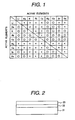
- Fig. 1 shows cases where the first elements first react with Cr shown as ⁇ and other cases as X, in the combinations of the first elements on the ordinate and second elements on the abscissa.
- the results indicate that if Na is contained in the catalytic active components, it is possible to prevent Cr to form a composite oxide with Na, when K, Rb, Cs and/or Ba, which are stronger in basicity than Na, is used as a Cr trapping agent.
- a composition of the composite oxide of alkali metals with Cr was M 2 CrO 4 (M; alkali metal) and a composition of the composite oxide of alkaline earth metals with Cr other than Mg was NcrO 4 (N; alkaline earth metal). It is understood from Fig. 1 that the elements are reactive with Cr in the order of Mg, Ca, Li, Sr, Na, Ba, K, Rb and Cs.
- a catalyst using K as a catalytic active component was prepared in the following manner.
- a solution of Cs nitrate was impregnated in alumina powder, which is a porous carrier, and the impregnate was dried at 150 °C, followed by calcining it at 600 °C thereby to produce a Cr trapping agent powder A containing 2 moles of Cs in an element conversion per 1 mol of alumina.
- Alumina powder was impregnated with a solution of dinitrosodianemine Pt nitrate, a solution of dinitrosodianemine Pd nitrate, a nitrate Rh solution and a mixed solution of sodium nitrate and potassium acetate.
- the impregnated was dried at 200 °C, followed by calcinations at 600 °C for 1 hour thereby to produce a catalytic active component powder B comprising 12.4 g of Na, 15.6 g of K, 0.139g of Rb, 2.792g of Pt and 1.35g of Pd in element conversion per 2 moles of alumina.
- a slurry prepared by adding nitric solution to the Cr trapping agent powder A was coated on a metal honeycomb substrate (400 cells /square inches) made of an alloy of 20 wt% of Cr - 5 wt % of Al - the balance being iron. Thereafter, the coated honeycomb was dried at 200 °C, followed by calcinations at 600 °C for 1 hour. As a result, a honeycomb having 100g of the Cr trapping agent powder A per 1 liter of the honeycomb was obtained.
- An alkaline slurry prepared by adding ammonia water to the catalytic active powder B was coated on the honeycomb coated with the Cr trapping agent powder and dried at 200 °C, followed by calcinations at 600 °C for 1 hour.
- FIG. 2 A diagrammatic view of the resulting catalyst of Embodiment 1, which was prepared in the above-mentioned method, is shown in Fig. 2.
- the catalyst has the Cr trapping agent layer 22 containing Cs in the alumina on the metal honeycomb substrate 21, and the catalytic active component 23 containing Na and K on the layer 22. It is possible to keep a high NOx purification performance. Since Cs is more reactive with Cr than Na and K and since Cs traps Cr, the catalytic active components Na and K are not poisoned by Cr, even if Cr in the metal honeycomb substrate moves towards the catalytic active components.
- Reactivity between Ag and Cr at 500 °C was investigated. Li was selected as alkali metal and a reaction product of Cr was calculated wherein there are 0.4 mol of Li carbonate, 0.2 mol of Ag, 0.1 mol of Cr, 1 mol of O 2 . Calculation was carried out by using the thermal dynamics database MALT Windows. As a result, all of Cr reacted with Ag to form Ag 2 CrO 4 . From the results, it is apparent that poisoning of the alkali metals as the catalytic active components by Cr is prevented when Ag is utilized as the Cr trapping agent.
- a catalyst was prepared wherein the catalytic active component powder B was coated on a substrate that contains Cs as the Cr trapping agent therein.
- a diagrammatic view of the catalyst is shown in Fig. 3.
- Cs the Cr trapping agent 32 is present in the metal honeycomb substrate 31 made of Cr-Al-Fe alloy.
- the catalytic active component 33 containing Na and K is supported on the substrate.
- Cs traps Cr in the metal honeycomb substrate to prevent poisoning of Na and K, since Cs is more reactive with Cr than Na and K. As a result, the catalyst maintained high NOx purification performance.
Landscapes
- Chemical & Material Sciences (AREA)
- Engineering & Computer Science (AREA)
- Chemical Kinetics & Catalysis (AREA)
- Combustion & Propulsion (AREA)
- Mechanical Engineering (AREA)
- General Engineering & Computer Science (AREA)
- Health & Medical Sciences (AREA)
- Organic Chemistry (AREA)
- Materials Engineering (AREA)
- Biomedical Technology (AREA)
- Environmental & Geological Engineering (AREA)
- Analytical Chemistry (AREA)
- General Chemical & Material Sciences (AREA)
- Oil, Petroleum & Natural Gas (AREA)
- Toxicology (AREA)
- Catalysts (AREA)
- Exhaust Gas After Treatment (AREA)
- Exhaust Gas Treatment By Means Of Catalyst (AREA)
- Solid-Sorbent Or Filter-Aiding Compositions (AREA)
Applications Claiming Priority (1)
| Application Number | Priority Date | Filing Date | Title |
|---|---|---|---|
| JP2005353146A JP4504307B2 (ja) | 2005-12-07 | 2005-12-07 | 内燃機関の排ガス浄化装置及び排ガス浄化触媒 |
Publications (3)
| Publication Number | Publication Date |
|---|---|
| EP1795253A2 true EP1795253A2 (de) | 2007-06-13 |
| EP1795253A3 EP1795253A3 (de) | 2007-07-04 |
| EP1795253B1 EP1795253B1 (de) | 2013-08-07 |
Family
ID=37836842
Family Applications (1)
| Application Number | Title | Priority Date | Filing Date |
|---|---|---|---|
| EP06025372.1A Not-in-force EP1795253B1 (de) | 2005-12-07 | 2006-12-07 | Abgasreinigungsvorrichtung für einen Verbrennungsmotor und Katalysator zur Reinigung von Abgasen |
Country Status (3)
| Country | Link |
|---|---|
| US (1) | US7772149B2 (de) |
| EP (1) | EP1795253B1 (de) |
| JP (1) | JP4504307B2 (de) |
Families Citing this family (1)
| Publication number | Priority date | Publication date | Assignee | Title |
|---|---|---|---|---|
| JP4916981B2 (ja) * | 2007-09-10 | 2012-04-18 | 本田技研工業株式会社 | 排ガス浄化装置 |
Family Cites Families (21)
| Publication number | Priority date | Publication date | Assignee | Title |
|---|---|---|---|---|
| JPS5787837A (en) | 1980-11-20 | 1982-06-01 | Toyota Motor Corp | Production of catalyst for purification of waste gas |
| DE3232729A1 (de) * | 1982-09-03 | 1984-03-08 | Degussa Ag, 6000 Frankfurt | Verfahren zur herabsetzung der zuendtemperatur von aus dem abgas von dieselmotoren herausgefiltertem dieselruss |
| US4601999A (en) | 1983-11-09 | 1986-07-22 | William B. Retallick | Metal support for a catalyst |
| US4742038A (en) * | 1985-11-26 | 1988-05-03 | Toyota Jidoshi Kabushiki Kaisha | Monolithic catalyst support and catalyst deposited on the support |
| JPH05184926A (ja) | 1992-01-10 | 1993-07-27 | Cataler Kogyo Kk | 排ガス浄化用触媒 |
| JP3901224B2 (ja) | 1994-05-27 | 2007-04-04 | 新日鉄マテリアルズ株式会社 | 触媒メタル担体 |
| JP3751994B2 (ja) | 1995-05-12 | 2006-03-08 | 新日本製鐵株式会社 | 耐酸化性、耐久性に優れた触媒用メタル担体 |
| JPH08332394A (ja) | 1995-06-07 | 1996-12-17 | Calsonic Corp | 排気浄化用金属担体触媒およびその製造方法 |
| JPH0985093A (ja) | 1995-09-26 | 1997-03-31 | Toyota Motor Corp | 排ガス浄化用触媒 |
| JPH10286461A (ja) * | 1997-04-16 | 1998-10-27 | Daihatsu Motor Co Ltd | 排気ガス浄化触媒 |
| JP2001232195A (ja) * | 1999-12-17 | 2001-08-28 | Ngk Insulators Ltd | 触媒体 |
| JP2001246252A (ja) | 2000-03-08 | 2001-09-11 | Mitsubishi Motors Corp | 排ガス浄化用触媒 |
| US20040043898A1 (en) | 2000-09-08 | 2004-03-04 | Naomi Noda | Method for producing catalyst body and carrier having alumina carried thereon |
| JP2002282702A (ja) | 2001-01-19 | 2002-10-02 | Ngk Insulators Ltd | 触媒体 |
| US6764665B2 (en) | 2001-10-26 | 2004-07-20 | Engelhard Corporation | Layered catalyst composite |
| JP2003144926A (ja) | 2001-11-19 | 2003-05-20 | Hitachi Ltd | 内燃機関の排ガス浄化触媒、浄化方法及び浄化装置 |
| US7022644B2 (en) | 2002-02-20 | 2006-04-04 | Engelhard Corporation | Hydrogen sulfide-suppressing catalyst compositions |
| DE10332995A1 (de) | 2003-07-18 | 2005-03-03 | Rhodius Gmbh | Katalysatorsubstrat sowie Verfahren zu dessen Herstellung |
| DE102004010496A1 (de) | 2004-03-04 | 2005-09-22 | Robert Bosch Gmbh | Vorrichtung zur Reinigung von Abgasen |
| JPWO2006001077A1 (ja) * | 2004-06-28 | 2008-04-17 | 株式会社日立製作所 | 内燃機関用排ガス浄化装置及び排ガス浄化方法 |
| WO2006103781A1 (ja) * | 2005-03-31 | 2006-10-05 | Babcock-Hitachi K.K. | 排ガスの浄化装置及び排ガスの浄化触媒 |
-
2005
- 2005-12-07 JP JP2005353146A patent/JP4504307B2/ja not_active Expired - Fee Related
-
2006
- 2006-12-06 US US11/634,241 patent/US7772149B2/en not_active Expired - Fee Related
- 2006-12-07 EP EP06025372.1A patent/EP1795253B1/de not_active Not-in-force
Non-Patent Citations (1)
| Title |
|---|
| None |
Also Published As
| Publication number | Publication date |
|---|---|
| JP4504307B2 (ja) | 2010-07-14 |
| EP1795253A3 (de) | 2007-07-04 |
| US20070129244A1 (en) | 2007-06-07 |
| US7772149B2 (en) | 2010-08-10 |
| JP2007152269A (ja) | 2007-06-21 |
| EP1795253B1 (de) | 2013-08-07 |
Similar Documents
| Publication | Publication Date | Title |
|---|---|---|
| KR100241666B1 (ko) | 산소 과잉 배기 가스 정화용 촉매 | |
| EP1967263B1 (de) | Katalytisches Material und Katalysator zur Reinigung von Abgaskomponenten | |
| EP2322274B1 (de) | Abgasreinigungskatalysator und verfahren zu seiner herstellung | |
| JP5386121B2 (ja) | 排気ガス浄化触媒装置、並びに排気ガス浄化方法 | |
| KR100370486B1 (ko) | 내연기관의 배기가스 정화장치, 배기가스정화방법 및배기가스정화촉매 | |
| EP1064985B1 (de) | Abgasreinigungssystem | |
| JP2004516400A (ja) | NOxトラップ | |
| US20090246109A1 (en) | Solid solutions and methods of making the same | |
| EP1867389A1 (de) | Vorrichtung zur reinigung von abgas und katalysator zur reinigung von abgas | |
| US5950421A (en) | Tungsten-modified platinum NOx traps for automotive emission reduction | |
| CN100531902C (zh) | 废气净化催化剂 | |
| EP1149623B1 (de) | Katalysator und Verfahren zur Abgasreinigung | |
| US20110118113A1 (en) | Exhaust gas purifying catalyst | |
| JP4716087B2 (ja) | 排ガス浄化用触媒 | |
| JP5504834B2 (ja) | 排ガス浄化用触媒 | |
| JP4852595B2 (ja) | 排ガス浄化触媒 | |
| US7772149B2 (en) | Exhaust gas purification apparatus for an internal combustion engine and a catalyst for purifying exhaust gas | |
| KR20070095988A (ko) | 배기가스정화용 촉매 및 이를 이용한 배기가스정화제어장치 | |
| US5876680A (en) | Bimetallic tungsten/platinum catalysts for lean-burn emissions | |
| JP2005205302A (ja) | 内燃機関用排ガス浄化触媒および排ガス浄化装置 | |
| JP4503314B2 (ja) | 排ガス浄化用触媒 | |
| JP3590092B2 (ja) | ガスエンジン排ガス浄化用三元触媒及びガスエンジン排ガスの浄化方法 | |
| JP3925015B2 (ja) | 内燃機関の排ガスの浄化装置,浄化方法及び浄化触媒 | |
| JP2007239616A (ja) | 排ガスの浄化装置及び排ガスの浄化方法,浄化触媒 | |
| JP2004275842A (ja) | 排ガス浄化用触媒 |
Legal Events
| Date | Code | Title | Description |
|---|---|---|---|
| PUAI | Public reference made under article 153(3) epc to a published international application that has entered the european phase |
Free format text: ORIGINAL CODE: 0009012 |
|
| PUAL | Search report despatched |
Free format text: ORIGINAL CODE: 0009013 |
|
| AK | Designated contracting states |
Kind code of ref document: A2 Designated state(s): AT BE BG CH CY CZ DE DK EE ES FI FR GB GR HU IE IS IT LI LT LU LV MC NL PL PT RO SE SI SK TR |
|
| AX | Request for extension of the european patent |
Extension state: AL BA HR MK YU |
|
| AK | Designated contracting states |
Kind code of ref document: A3 Designated state(s): AT BE BG CH CY CZ DE DK EE ES FI FR GB GR HU IE IS IT LI LT LU LV MC NL PL PT RO SE SI SK TR |
|
| AX | Request for extension of the european patent |
Extension state: AL BA HR MK YU |
|
| 17P | Request for examination filed |
Effective date: 20080104 |
|
| 17Q | First examination report despatched |
Effective date: 20080212 |
|
| AKX | Designation fees paid |
Designated state(s): DE FR GB |
|
| RAP1 | Party data changed (applicant data changed or rights of an application transferred) |
Owner name: HONDA MOTOR CO., LTD. Owner name: NIPPON STEEL MATERIALS CO., LTD. |
|
| GRAP | Despatch of communication of intention to grant a patent |
Free format text: ORIGINAL CODE: EPIDOSNIGR1 |
|
| GRAS | Grant fee paid |
Free format text: ORIGINAL CODE: EPIDOSNIGR3 |
|
| GRAA | (expected) grant |
Free format text: ORIGINAL CODE: 0009210 |
|
| AK | Designated contracting states |
Kind code of ref document: B1 Designated state(s): DE FR GB |
|
| REG | Reference to a national code |
Ref country code: GB Ref legal event code: FG4D |
|
| REG | Reference to a national code |
Ref country code: DE Ref legal event code: R081 Ref document number: 602006037703 Country of ref document: DE Owner name: NIPPON STEEL & SUMIKIN MATERIALS CO., LTD., JP Free format text: FORMER OWNERS: HITACHI, LTD., TOKYO, JP; HONDA MOTOR CO., LTD., TOKYO, JP; NIPPON STEEL MATERIALS CO., LTD., TOKIO, JP |
|
| REG | Reference to a national code |
Ref country code: DE Ref legal event code: R096 Ref document number: 602006037703 Country of ref document: DE Effective date: 20131002 |
|
| PLBE | No opposition filed within time limit |
Free format text: ORIGINAL CODE: 0009261 |
|
| STAA | Information on the status of an ep patent application or granted ep patent |
Free format text: STATUS: NO OPPOSITION FILED WITHIN TIME LIMIT |
|
| 26N | No opposition filed |
Effective date: 20140508 |
|
| REG | Reference to a national code |
Ref country code: DE Ref legal event code: R097 Ref document number: 602006037703 Country of ref document: DE Effective date: 20140508 |
|
| GBPC | Gb: european patent ceased through non-payment of renewal fee |
Effective date: 20131207 |
|
| REG | Reference to a national code |
Ref country code: FR Ref legal event code: ST Effective date: 20140829 |
|
| PG25 | Lapsed in a contracting state [announced via postgrant information from national office to epo] |
Ref country code: GB Free format text: LAPSE BECAUSE OF NON-PAYMENT OF DUE FEES Effective date: 20131207 Ref country code: FR Free format text: LAPSE BECAUSE OF NON-PAYMENT OF DUE FEES Effective date: 20131231 |
|
| REG | Reference to a national code |
Ref country code: DE Ref legal event code: R082 Ref document number: 602006037703 Country of ref document: DE Representative=s name: BEETZ & PARTNER MBB PATENTANWAELTE, DE Ref country code: DE Ref legal event code: R082 Ref document number: 602006037703 Country of ref document: DE Representative=s name: BEETZ & PARTNER MBB PATENT- UND RECHTSANWAELTE, DE Ref country code: DE Ref legal event code: R081 Ref document number: 602006037703 Country of ref document: DE Owner name: NIPPON STEEL & SUMIKIN MATERIALS CO., LTD., JP Free format text: FORMER OWNERS: HONDA MOTOR CO., LTD., TOKYO, JP; NIPPON STEEL MATERIALS CO., LTD., TOKYO, JP |
|
| REG | Reference to a national code |
Ref country code: DE Ref legal event code: R082 Ref document number: 602006037703 Country of ref document: DE Representative=s name: BEETZ & PARTNER MBB PATENTANWAELTE, DE Ref country code: DE Ref legal event code: R082 Ref document number: 602006037703 Country of ref document: DE Representative=s name: BEETZ & PARTNER MBB PATENT- UND RECHTSANWAELTE, DE Ref country code: DE Ref legal event code: R081 Ref document number: 602006037703 Country of ref document: DE Owner name: NIPPON STEEL & SUMIKIN MATERIALS CO., LTD., JP Free format text: FORMER OWNERS: HONDA MOTOR CO., LTD., TOKYO, JP; NIPPON STEEL & SUMIKIN MATERIALS CO., LTD., TOKYO, JP |
|
| PGFP | Annual fee paid to national office [announced via postgrant information from national office to epo] |
Ref country code: DE Payment date: 20191126 Year of fee payment: 14 |
|
| REG | Reference to a national code |
Ref country code: DE Ref legal event code: R119 Ref document number: 602006037703 Country of ref document: DE |
|
| PG25 | Lapsed in a contracting state [announced via postgrant information from national office to epo] |
Ref country code: DE Free format text: LAPSE BECAUSE OF NON-PAYMENT OF DUE FEES Effective date: 20210701 |