EP1772774B1 - Protected ketone photoinitiators - Google Patents
Protected ketone photoinitiators Download PDFInfo
- Publication number
- EP1772774B1 EP1772774B1 EP06021725A EP06021725A EP1772774B1 EP 1772774 B1 EP1772774 B1 EP 1772774B1 EP 06021725 A EP06021725 A EP 06021725A EP 06021725 A EP06021725 A EP 06021725A EP 1772774 B1 EP1772774 B1 EP 1772774B1
- Authority
- EP
- European Patent Office
- Prior art keywords
- substrate
- photoinitiator
- colour
- phenyl
- latent
- Prior art date
- Legal status (The legal status is an assumption and is not a legal conclusion. Google has not performed a legal analysis and makes no representation as to the accuracy of the status listed.)
- Expired - Lifetime
Links
- 150000002576 ketones Chemical class 0.000 title claims description 12
- -1 di-iodobutoxy fluorone Chemical compound 0.000 claims description 14
- VHMYBWIOLGKSHO-UHFFFAOYSA-N 2-methylidene-1,3-dioxolane Chemical group C=C1OCCO1 VHMYBWIOLGKSHO-UHFFFAOYSA-N 0.000 claims description 7
- YIKSHDNOAYSSPX-UHFFFAOYSA-N 1-propan-2-ylthioxanthen-9-one Chemical compound S1C2=CC=CC=C2C(=O)C2=C1C=CC=C2C(C)C YIKSHDNOAYSSPX-UHFFFAOYSA-N 0.000 claims description 4
- 229930006711 bornane-2,3-dione Natural products 0.000 claims description 4
- VNQXSTWCDUXYEZ-UHFFFAOYSA-N 1,7,7-trimethylbicyclo[2.2.1]heptane-2,3-dione Chemical compound C1CC2(C)C(=O)C(=O)C1C2(C)C VNQXSTWCDUXYEZ-UHFFFAOYSA-N 0.000 claims description 3
- KWVGIHKZDCUPEU-UHFFFAOYSA-N 2,2-dimethoxy-2-phenylacetophenone Chemical compound C=1C=CC=CC=1C(OC)(OC)C(=O)C1=CC=CC=C1 KWVGIHKZDCUPEU-UHFFFAOYSA-N 0.000 claims description 3
- DBHQYYNDKZDVTN-UHFFFAOYSA-N [4-(4-methylphenyl)sulfanylphenyl]-phenylmethanone Chemical compound C1=CC(C)=CC=C1SC1=CC=C(C(=O)C=2C=CC=CC=2)C=C1 DBHQYYNDKZDVTN-UHFFFAOYSA-N 0.000 claims description 3
- SJEBAWHUJDUKQK-UHFFFAOYSA-N 2-ethylanthraquinone Chemical compound C1=CC=C2C(=O)C3=CC(CC)=CC=C3C(=O)C2=C1 SJEBAWHUJDUKQK-UHFFFAOYSA-N 0.000 claims description 2
- LWRBVKNFOYUCNP-UHFFFAOYSA-N 2-methyl-1-(4-methylsulfanylphenyl)-2-morpholin-4-ylpropan-1-one Chemical compound C1=CC(SC)=CC=C1C(=O)C(C)(C)N1CCOCC1 LWRBVKNFOYUCNP-UHFFFAOYSA-N 0.000 claims description 2
- LYXOWKPVTCPORE-UHFFFAOYSA-N phenyl-(4-phenylphenyl)methanone Chemical compound C=1C=C(C=2C=CC=CC=2)C=CC=1C(=O)C1=CC=CC=C1 LYXOWKPVTCPORE-UHFFFAOYSA-N 0.000 claims description 2
- 238000000034 method Methods 0.000 abstract description 32
- 238000006243 chemical reaction Methods 0.000 abstract description 20
- 238000005516 engineering process Methods 0.000 abstract description 19
- 239000000203 mixture Substances 0.000 abstract description 18
- 239000000758 substrate Substances 0.000 abstract description 17
- 230000005855 radiation Effects 0.000 abstract description 11
- 238000004132 cross linking Methods 0.000 abstract description 6
- 239000000126 substance Substances 0.000 abstract description 5
- 230000003213 activating effect Effects 0.000 abstract description 4
- 230000008859 change Effects 0.000 abstract description 4
- 238000009826 distribution Methods 0.000 abstract description 2
- 230000004048 modification Effects 0.000 abstract description 2
- 238000012986 modification Methods 0.000 abstract description 2
- 239000003999 initiator Substances 0.000 description 26
- 125000002091 cationic group Chemical group 0.000 description 17
- 230000008569 process Effects 0.000 description 17
- 238000003384 imaging method Methods 0.000 description 11
- WNXJIVFYUVYPPR-UHFFFAOYSA-N 1,3-dioxolane Chemical group C1COCO1 WNXJIVFYUVYPPR-UHFFFAOYSA-N 0.000 description 10
- 239000002253 acid Substances 0.000 description 10
- 150000003254 radicals Chemical class 0.000 description 10
- 229910052709 silver Inorganic materials 0.000 description 10
- 239000004332 silver Substances 0.000 description 10
- 150000001875 compounds Chemical class 0.000 description 9
- 239000000463 material Substances 0.000 description 9
- CSNNHWWHGAXBCP-UHFFFAOYSA-L Magnesium sulfate Chemical compound [Mg+2].[O-][S+2]([O-])([O-])[O-] CSNNHWWHGAXBCP-UHFFFAOYSA-L 0.000 description 8
- 238000009472 formulation Methods 0.000 description 8
- 238000006862 quantum yield reaction Methods 0.000 description 7
- XLYOFNOQVPJJNP-UHFFFAOYSA-N water Substances O XLYOFNOQVPJJNP-UHFFFAOYSA-N 0.000 description 7
- 230000015572 biosynthetic process Effects 0.000 description 6
- 238000000576 coating method Methods 0.000 description 6
- 238000011161 development Methods 0.000 description 6
- 239000011541 reaction mixture Substances 0.000 description 6
- 238000001723 curing Methods 0.000 description 5
- 238000004519 manufacturing process Methods 0.000 description 5
- 239000000178 monomer Substances 0.000 description 5
- 238000006552 photochemical reaction Methods 0.000 description 5
- KKBHSBATGOQADJ-UHFFFAOYSA-N 2-ethenyl-1,3-dioxolane Chemical compound C=CC1OCCO1 KKBHSBATGOQADJ-UHFFFAOYSA-N 0.000 description 4
- NIXOWILDQLNWCW-UHFFFAOYSA-M Acrylate Chemical compound [O-]C(=O)C=C NIXOWILDQLNWCW-UHFFFAOYSA-M 0.000 description 4
- RTZKZFJDLAIYFH-UHFFFAOYSA-N Diethyl ether Chemical compound CCOCC RTZKZFJDLAIYFH-UHFFFAOYSA-N 0.000 description 4
- BQCADISMDOOEFD-UHFFFAOYSA-N Silver Chemical compound [Ag] BQCADISMDOOEFD-UHFFFAOYSA-N 0.000 description 4
- WYURNTSHIVDZCO-UHFFFAOYSA-N Tetrahydrofuran Chemical compound C1CCOC1 WYURNTSHIVDZCO-UHFFFAOYSA-N 0.000 description 4
- 238000013459 approach Methods 0.000 description 4
- 229910052943 magnesium sulfate Inorganic materials 0.000 description 4
- 235000019341 magnesium sulphate Nutrition 0.000 description 4
- 238000010992 reflux Methods 0.000 description 4
- 229920005989 resin Polymers 0.000 description 4
- 239000011347 resin Substances 0.000 description 4
- UHOVQNZJYSORNB-UHFFFAOYSA-N Benzene Chemical compound C1=CC=CC=C1 UHOVQNZJYSORNB-UHFFFAOYSA-N 0.000 description 3
- 0 CC1(C)C2C1CC*2 Chemical compound CC1(C)C2C1CC*2 0.000 description 3
- YXFVVABEGXRONW-UHFFFAOYSA-N Toluene Chemical compound CC1=CC=CC=C1 YXFVVABEGXRONW-UHFFFAOYSA-N 0.000 description 3
- QYKIQEUNHZKYBP-UHFFFAOYSA-N Vinyl ether Chemical class C=COC=C QYKIQEUNHZKYBP-UHFFFAOYSA-N 0.000 description 3
- 238000003776 cleavage reaction Methods 0.000 description 3
- 239000011248 coating agent Substances 0.000 description 3
- 239000000839 emulsion Substances 0.000 description 3
- XMBWDFGMSWQBCA-UHFFFAOYSA-N hydrogen iodide Chemical class I XMBWDFGMSWQBCA-UHFFFAOYSA-N 0.000 description 3
- 230000003287 optical effect Effects 0.000 description 3
- 230000007017 scission Effects 0.000 description 3
- 230000035945 sensitivity Effects 0.000 description 3
- 239000007787 solid Substances 0.000 description 3
- 239000002904 solvent Substances 0.000 description 3
- 238000003786 synthesis reaction Methods 0.000 description 3
- SSZWWUDQMAHNAQ-UHFFFAOYSA-N 3-chloropropane-1,2-diol Chemical compound OCC(O)CCl SSZWWUDQMAHNAQ-UHFFFAOYSA-N 0.000 description 2
- CDBYLPFSWZWCQE-UHFFFAOYSA-L Sodium Carbonate Chemical compound [Na+].[Na+].[O-]C([O-])=O CDBYLPFSWZWCQE-UHFFFAOYSA-L 0.000 description 2
- UIIMBOGNXHQVGW-UHFFFAOYSA-M Sodium bicarbonate Chemical compound [Na+].OC([O-])=O UIIMBOGNXHQVGW-UHFFFAOYSA-M 0.000 description 2
- 238000003848 UV Light-Curing Methods 0.000 description 2
- NIXOWILDQLNWCW-UHFFFAOYSA-N acrylic acid group Chemical group C(C=C)(=O)O NIXOWILDQLNWCW-UHFFFAOYSA-N 0.000 description 2
- 230000003321 amplification Effects 0.000 description 2
- 230000008901 benefit Effects 0.000 description 2
- 125000002915 carbonyl group Chemical group [*:2]C([*:1])=O 0.000 description 2
- 230000003197 catalytic effect Effects 0.000 description 2
- 150000004862 dioxolanes Chemical class 0.000 description 2
- 239000000975 dye Substances 0.000 description 2
- 230000000694 effects Effects 0.000 description 2
- 238000002474 experimental method Methods 0.000 description 2
- 238000003199 nucleic acid amplification method Methods 0.000 description 2
- 239000012044 organic layer Substances 0.000 description 2
- KJIFKLIQANRMOU-UHFFFAOYSA-N oxidanium;4-methylbenzenesulfonate Chemical compound O.CC1=CC=C(S(O)(=O)=O)C=C1 KJIFKLIQANRMOU-UHFFFAOYSA-N 0.000 description 2
- 229920000642 polymer Polymers 0.000 description 2
- LPNYRYFBWFDTMA-UHFFFAOYSA-N potassium tert-butoxide Chemical compound [K+].CC(C)(C)[O-] LPNYRYFBWFDTMA-UHFFFAOYSA-N 0.000 description 2
- YLQBMQCUIZJEEH-UHFFFAOYSA-N tetrahydrofuran Natural products C=1C=COC=1 YLQBMQCUIZJEEH-UHFFFAOYSA-N 0.000 description 2
- YDEFWNPNDWYOAH-UHFFFAOYSA-N (2-hydroxy-3-oxo-2,3-diphenylpropyl) phenylmethanesulfonate Chemical compound OC(C(=O)C1=CC=CC=C1)(COS(=O)(=O)CC1=CC=CC=C1)C1=CC=CC=C1 YDEFWNPNDWYOAH-UHFFFAOYSA-N 0.000 description 1
- PIZHFBODNLEQBL-UHFFFAOYSA-N 2,2-diethoxy-1-phenylethanone Chemical compound CCOC(OCC)C(=O)C1=CC=CC=C1 PIZHFBODNLEQBL-UHFFFAOYSA-N 0.000 description 1
- LBLYYCQCTBFVLH-UHFFFAOYSA-N 2-Methylbenzenesulfonic acid Chemical compound CC1=CC=CC=C1S(O)(=O)=O LBLYYCQCTBFVLH-UHFFFAOYSA-N 0.000 description 1
- XMLYCEVDHLAQEL-UHFFFAOYSA-N 2-hydroxy-2-methyl-1-phenylpropan-1-one Chemical compound CC(C)(O)C(=O)C1=CC=CC=C1 XMLYCEVDHLAQEL-UHFFFAOYSA-N 0.000 description 1
- XKTYXVDYIKIYJP-UHFFFAOYSA-N 3h-dioxole Chemical group C1OOC=C1 XKTYXVDYIKIYJP-UHFFFAOYSA-N 0.000 description 1
- RUHBLUSPLYPMPQ-UHFFFAOYSA-N 4,4-diiodobutyl hypofluorite Chemical compound FOCCCC(I)I RUHBLUSPLYPMPQ-UHFFFAOYSA-N 0.000 description 1
- BTBUEUYNUDRHOZ-UHFFFAOYSA-N Borate Chemical compound [O-]B([O-])[O-] BTBUEUYNUDRHOZ-UHFFFAOYSA-N 0.000 description 1
- BVKZGUZCCUSVTD-UHFFFAOYSA-L Carbonate Chemical compound [O-]C([O-])=O BVKZGUZCCUSVTD-UHFFFAOYSA-L 0.000 description 1
- 239000004593 Epoxy Substances 0.000 description 1
- OAZWDJGLIYNYMU-UHFFFAOYSA-N Leucocrystal Violet Chemical compound C1=CC(N(C)C)=CC=C1C(C=1C=CC(=CC=1)N(C)C)C1=CC=C(N(C)C)C=C1 OAZWDJGLIYNYMU-UHFFFAOYSA-N 0.000 description 1
- 206010034972 Photosensitivity reaction Diseases 0.000 description 1
- 206010070834 Sensitisation Diseases 0.000 description 1
- 244000028419 Styrax benzoin Species 0.000 description 1
- 235000000126 Styrax benzoin Nutrition 0.000 description 1
- UCKMPCXJQFINFW-UHFFFAOYSA-N Sulphide Chemical compound [S-2] UCKMPCXJQFINFW-UHFFFAOYSA-N 0.000 description 1
- 235000008411 Sumatra benzointree Nutrition 0.000 description 1
- PFHLXMMCWCWAMA-UHFFFAOYSA-N [4-(4-diphenylsulfoniophenyl)sulfanylphenyl]-diphenylsulfanium Chemical compound C=1C=C([S+](C=2C=CC=CC=2)C=2C=CC=CC=2)C=CC=1SC(C=C1)=CC=C1[S+](C=1C=CC=CC=1)C1=CC=CC=C1 PFHLXMMCWCWAMA-UHFFFAOYSA-N 0.000 description 1
- SJWFRIPVKWSATF-UHFFFAOYSA-N [4-[4-bis[4-(2-hydroxyethyl)phenyl]sulfoniophenyl]sulfanylphenyl]-bis[4-(2-hydroxyethyl)phenyl]sulfanium Chemical compound C1=CC(CCO)=CC=C1[S+](C=1C=CC(SC=2C=CC(=CC=2)[S+](C=2C=CC(CCO)=CC=2)C=2C=CC(CCO)=CC=2)=CC=1)C1=CC=C(CCO)C=C1 SJWFRIPVKWSATF-UHFFFAOYSA-N 0.000 description 1
- 238000007171 acid catalysis Methods 0.000 description 1
- 239000003377 acid catalyst Substances 0.000 description 1
- 238000005844 autocatalytic reaction Methods 0.000 description 1
- 229960002130 benzoin Drugs 0.000 description 1
- RWCCWEUUXYIKHB-UHFFFAOYSA-N benzophenone Chemical compound C=1C=CC=CC=1C(=O)C1=CC=CC=C1 RWCCWEUUXYIKHB-UHFFFAOYSA-N 0.000 description 1
- 239000012965 benzophenone Substances 0.000 description 1
- 150000001728 carbonyl compounds Chemical class 0.000 description 1
- 230000015556 catabolic process Effects 0.000 description 1
- 239000003054 catalyst Substances 0.000 description 1
- 230000001419 dependent effect Effects 0.000 description 1
- ISAOCJYIOMOJEB-UHFFFAOYSA-N desyl alcohol Natural products C=1C=CC=CC=1C(O)C(=O)C1=CC=CC=C1 ISAOCJYIOMOJEB-UHFFFAOYSA-N 0.000 description 1
- 238000009792 diffusion process Methods 0.000 description 1
- 238000001035 drying Methods 0.000 description 1
- ZSWFCLXCOIISFI-UHFFFAOYSA-N endo-cyclopentadiene Natural products C1C=CC=C1 ZSWFCLXCOIISFI-UHFFFAOYSA-N 0.000 description 1
- 230000007613 environmental effect Effects 0.000 description 1
- 125000003700 epoxy group Chemical group 0.000 description 1
- 150000002170 ethers Chemical class 0.000 description 1
- ZONYXWQDUYMKFB-UHFFFAOYSA-N flavanone Chemical compound O1C2=CC=CC=C2C(=O)CC1C1=CC=CC=C1 ZONYXWQDUYMKFB-UHFFFAOYSA-N 0.000 description 1
- 235000019382 gum benzoic Nutrition 0.000 description 1
- 125000004356 hydroxy functional group Chemical group O* 0.000 description 1
- 238000010952 in-situ formation Methods 0.000 description 1
- 239000000976 ink Substances 0.000 description 1
- 239000007788 liquid Substances 0.000 description 1
- 239000012669 liquid formulation Substances 0.000 description 1
- 239000003960 organic solvent Substances 0.000 description 1
- 150000002921 oxetanes Chemical class 0.000 description 1
- 125000001997 phenyl group Chemical group [H]C1=C([H])C([H])=C(*)C([H])=C1[H] 0.000 description 1
- 230000000886 photobiology Effects 0.000 description 1
- 238000006303 photolysis reaction Methods 0.000 description 1
- 230000036211 photosensitivity Effects 0.000 description 1
- 230000015843 photosynthesis, light reaction Effects 0.000 description 1
- 230000000704 physical effect Effects 0.000 description 1
- 229920000647 polyepoxide Polymers 0.000 description 1
- 229920001470 polyketone Polymers 0.000 description 1
- 238000006116 polymerization reaction Methods 0.000 description 1
- 238000002360 preparation method Methods 0.000 description 1
- 238000003847 radiation curing Methods 0.000 description 1
- 238000007348 radical reaction Methods 0.000 description 1
- 238000007152 ring opening metathesis polymerisation reaction Methods 0.000 description 1
- 238000007142 ring opening reaction Methods 0.000 description 1
- 231100000489 sensitizer Toxicity 0.000 description 1
- 229910000030 sodium bicarbonate Inorganic materials 0.000 description 1
- 235000017557 sodium bicarbonate Nutrition 0.000 description 1
- 229910000029 sodium carbonate Inorganic materials 0.000 description 1
- 229910000679 solder Inorganic materials 0.000 description 1
- 238000007711 solidification Methods 0.000 description 1
- 230000008023 solidification Effects 0.000 description 1
- 241000894007 species Species 0.000 description 1
- 239000007858 starting material Substances 0.000 description 1
- RWSOTUBLDIXVET-UHFFFAOYSA-O sulfonium Chemical compound [SH3+] RWSOTUBLDIXVET-UHFFFAOYSA-O 0.000 description 1
- 239000003930 superacid Substances 0.000 description 1
- 238000010189 synthetic method Methods 0.000 description 1
- 239000013076 target substance Substances 0.000 description 1
- JOXIMZWYDAKGHI-UHFFFAOYSA-N toluene-4-sulfonic acid Chemical compound CC1=CC=C(S(O)(=O)=O)C=C1 JOXIMZWYDAKGHI-UHFFFAOYSA-N 0.000 description 1
- 125000000391 vinyl group Chemical class [H]C([*])=C([H])[H] 0.000 description 1
- 229920002554 vinyl polymer Polymers 0.000 description 1
Images



Classifications
-
- C—CHEMISTRY; METALLURGY
- C08—ORGANIC MACROMOLECULAR COMPOUNDS; THEIR PREPARATION OR CHEMICAL WORKING-UP; COMPOSITIONS BASED THEREON
- C08F—MACROMOLECULAR COMPOUNDS OBTAINED BY REACTIONS ONLY INVOLVING CARBON-TO-CARBON UNSATURATED BONDS
- C08F2/00—Processes of polymerisation
-
- C—CHEMISTRY; METALLURGY
- C08—ORGANIC MACROMOLECULAR COMPOUNDS; THEIR PREPARATION OR CHEMICAL WORKING-UP; COMPOSITIONS BASED THEREON
- C08F—MACROMOLECULAR COMPOUNDS OBTAINED BY REACTIONS ONLY INVOLVING CARBON-TO-CARBON UNSATURATED BONDS
- C08F2/00—Processes of polymerisation
- C08F2/46—Polymerisation initiated by wave energy or particle radiation
- C08F2/48—Polymerisation initiated by wave energy or particle radiation by ultraviolet or visible light
- C08F2/50—Polymerisation initiated by wave energy or particle radiation by ultraviolet or visible light with sensitising agents
-
- G—PHYSICS
- G03—PHOTOGRAPHY; CINEMATOGRAPHY; ANALOGOUS TECHNIQUES USING WAVES OTHER THAN OPTICAL WAVES; ELECTROGRAPHY; HOLOGRAPHY
- G03F—PHOTOMECHANICAL PRODUCTION OF TEXTURED OR PATTERNED SURFACES, e.g. FOR PRINTING, FOR PROCESSING OF SEMICONDUCTOR DEVICES; MATERIALS THEREFOR; ORIGINALS THEREFOR; APPARATUS SPECIALLY ADAPTED THEREFOR
- G03F7/00—Photomechanical, e.g. photolithographic, production of textured or patterned surfaces, e.g. printing surfaces; Materials therefor, e.g. comprising photoresists; Apparatus specially adapted therefor
- G03F7/004—Photosensitive materials
- G03F7/0045—Photosensitive materials with organic non-macromolecular light-sensitive compounds not otherwise provided for, e.g. dissolution inhibitors
-
- G—PHYSICS
- G03—PHOTOGRAPHY; CINEMATOGRAPHY; ANALOGOUS TECHNIQUES USING WAVES OTHER THAN OPTICAL WAVES; ELECTROGRAPHY; HOLOGRAPHY
- G03F—PHOTOMECHANICAL PRODUCTION OF TEXTURED OR PATTERNED SURFACES, e.g. FOR PRINTING, FOR PROCESSING OF SEMICONDUCTOR DEVICES; MATERIALS THEREFOR; ORIGINALS THEREFOR; APPARATUS SPECIALLY ADAPTED THEREFOR
- G03F7/00—Photomechanical, e.g. photolithographic, production of textured or patterned surfaces, e.g. printing surfaces; Materials therefor, e.g. comprising photoresists; Apparatus specially adapted therefor
- G03F7/004—Photosensitive materials
- G03F7/027—Non-macromolecular photopolymerisable compounds having carbon-to-carbon double bonds, e.g. ethylenic compounds
- G03F7/028—Non-macromolecular photopolymerisable compounds having carbon-to-carbon double bonds, e.g. ethylenic compounds with photosensitivity-increasing substances, e.g. photoinitiators
- G03F7/031—Organic compounds not covered by group G03F7/029
-
- G—PHYSICS
- G03—PHOTOGRAPHY; CINEMATOGRAPHY; ANALOGOUS TECHNIQUES USING WAVES OTHER THAN OPTICAL WAVES; ELECTROGRAPHY; HOLOGRAPHY
- G03F—PHOTOMECHANICAL PRODUCTION OF TEXTURED OR PATTERNED SURFACES, e.g. FOR PRINTING, FOR PROCESSING OF SEMICONDUCTOR DEVICES; MATERIALS THEREFOR; ORIGINALS THEREFOR; APPARATUS SPECIALLY ADAPTED THEREFOR
- G03F7/00—Photomechanical, e.g. photolithographic, production of textured or patterned surfaces, e.g. printing surfaces; Materials therefor, e.g. comprising photoresists; Apparatus specially adapted therefor
- G03F7/20—Exposure; Apparatus therefor
- G03F7/2022—Multi-step exposure, e.g. hybrid; backside exposure; blanket exposure, e.g. for image reversal; edge exposure, e.g. for edge bead removal; corrective exposure
-
- G—PHYSICS
- G03—PHOTOGRAPHY; CINEMATOGRAPHY; ANALOGOUS TECHNIQUES USING WAVES OTHER THAN OPTICAL WAVES; ELECTROGRAPHY; HOLOGRAPHY
- G03F—PHOTOMECHANICAL PRODUCTION OF TEXTURED OR PATTERNED SURFACES, e.g. FOR PRINTING, FOR PROCESSING OF SEMICONDUCTOR DEVICES; MATERIALS THEREFOR; ORIGINALS THEREFOR; APPARATUS SPECIALLY ADAPTED THEREFOR
- G03F7/00—Photomechanical, e.g. photolithographic, production of textured or patterned surfaces, e.g. printing surfaces; Materials therefor, e.g. comprising photoresists; Apparatus specially adapted therefor
- G03F7/004—Photosensitive materials
- G03F7/038—Macromolecular compounds which are rendered insoluble or differentially wettable
Definitions
- This invention relates protected photoinitiators for use in photoinitiated reactions, for example curing and polymerisation reactions, and more particularly to UV curing used in photopolymer technology, as well as to photoinitiated colour forming reactions.
- the second basic form of photopolymer quantum yield enhancement is exemplified by the cationic U.V. curing systems.
- the absorbed photon generates a catalytic monomer species which is capable' of catalysing polymerisations, cross-linking, or even molecular cleavage.
- This technology has been described as capable of producing "living polymers" which will continue growing as long as substrate monomer molecules are still available.
- the reactions are, however, relatively slow compared to the chain reactions of the free radical process.
- the quantum yield in terms of reacted molecules is theoretically near infinite, the slow reactions limit spatial resolution by reason of diffusion of active species out of the imaged area.
- a limitation in terms of photopolymer imaging has always been the amount of time needed to deliver an adequate number of photons to the area to be imaged.
- the delivery of a large amount of random photons is easy.
- High powered lamps, simple reflectors and conveyor belts used in combination enable this aim to be achieved.
- the light needs to be collimated and delivered in a controlled fashion.
- To collimate the light output from any lamp involves a substantial loss of intensity.
- the subsequent-use of optical components and even photo tools serves to reduce the yield of available photons from even a very powerful lamp to a remarkably low level.
- the silver halide process achieves extreme quantum efficiency by virtue of the development step.
- the actual efficiency of the photochemistry is relatively low compared with chain reaction processes. It is only when the silver halide emulsion is developed that the remarkable autocatalytic development chemistry improves the quantum yield. Wherever silver has been produced, the silver available accelerates the development reaction, which in turn produces more silver. Thus a single photon can generate a great number of silver atoms and a very high quantum yield is obtained due to the propagation which occurs in the development process.
- the present invention provides a protected ketone photoinitiator selected from:
- the protected, or latent, photoinitiator may be used in methods which increase significantly the efficiency of photochemical reactions used in particular in photopolymer imaging.
- the protected photoinitiator may be used in a method of carrying out a photoinitiated polymerisation and/or crosslinking of a substrate, which comprises providing a reactive substrate comprising a polymerisable and/or crosslinkable composition and the protected photoinitiator, activating the photoinitiator and exposing the reactive substrate composition with the resulting photoinitiator therein to photoreaction conditions wherein actinic radiation - causes the composition to undergo polymerisation and/or crosslinking.
- the protected photoinitiator may be used in a method of carrying out a photoinitiated reaction which comprises applying a reactive substrate selected from a polymerisable and/or crosslinkable composition and a colour changing substance to a support activating of the protected photoinitiator which yields a ketone photoinitiator and which has been applied with the reactive substrate and subsequently exposing the reactive substrate with the resulting photoinitiator therein to photoreaction conditions wherein actinic radiation causes the substrate to undergo polymerisation and/or crosslinking or colour change respectively, the substrate being locally modified in its constitution as a result of its exposure to actinic radiation at at least one stage of the method, so that the resulting polymerised and/or crosslinked composition or colour changed substance corresponds in its distribution on the support to the locations of the modification of the substrate.
- leuco crystal violet is an important chromophore in this respect (latent colour formers are generally termed "leuco dyes").
- leuco dyes include leucoxanthene and leucofluorans.
- the latent photoinitiator is most commonly to be a protected photoinitiator whose protection is removed in a reaction which takes place under preliminary conditions.
- Such preliminary conditions preferably include the use of a photoinitiator as such which, when exposed to actinic radiation, is able to interact with the latent photoinitiator to cause the latent photoinitiator to be converted to its underlying photoinitiator.
- the methods featured herein will, unless otherwise indicated, be described with reference to such a mode of activating the latent photoinitiator. There is then overall use of two photoreactions which will need to include application of actinic radiation at two distinct wavelengths.
- a low energy source of actinic radiation may be employed in a first or preliminary photoreaction, which can be utilised in achieving an imagewise exposure of the substrate, and a high dosage of actinic radiation is applied as a flood in connection with a second photoreaction in which the substrate is polymerised and/or crosslinked.
- laser direct imaging is used in applying the low energy source of actinic radiation.
- Such method featured herein thus uses an amplification step, in which a second photochemical reaction is carried out subsequently to a preliminary, preferably photochemical reaction.
- a second photochemical reaction is carried out subsequently to a preliminary, preferably photochemical reaction.
- the methylene-1,3-dioxolane structure can be produced from a ketone photoinitiator starting material although other methods are available for the production of such a structure.
- the methylene-1,3-dioxolane behaves as a ketal-protected carbonyl compound and the process generates a polyketone as the dioxolane ring is opened, generating the theoretical parent ketone for the dioxolane ring.
- the ketone used was benzophenone, a well known photoinitiator of acrylate polymerisation.
- the dioxolane ring opening reaction is applicable to formation of a whole range of ketonic functional initiator and co-initiator species ranging from such simple well known materials as benzil dimethyl ketal through to exotic materials such as di-iodo butoxy fluorone (a visible active photoinitiator used for stereolithography).
- ketonic functional initiator and co-initiator species ranging from such simple well known materials as benzil dimethyl ketal through to exotic materials such as di-iodo butoxy fluorone (a visible active photoinitiator used for stereolithography).
- the resulting compounds act as "latent photoinitiators", capable of being activated by low doses of U.V. light on formation of catalytic quantities of acid from cationic initiators or by ongoing radical reactions. Examples of such compounds are:
- Such enhanced photopolymerisation method featured herein typically involves an initial irradiation of a film containing a cationic (acid producing) photoinitiator, acrylate and vinyl-dioxolane based latent photoinitiator.
- This irradiation is fast and efficient, as the polymer formed in this step may be minimal and not cause any viscosity increase, which is a prime limit on reaction rates.
- the system can be flood irradiated with light of wavelength long enough to avoid further photolysis of the cationic initiator, but adequate to photolyse the initiator formed from the cleavage of the dioxolane ring.
- This flood irradiation is not image-wise and therefore can involve far higher dosages of light in a relatively short time.
- An application for this example is that of laser direct imaging of photoimageable coatings.
- the technology eliminates the bottleneck of having to deliver all the polymerisation energy via the laser in an imagewise fashion.
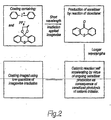
- An example of this technology is summarised in the flow scheme of Fig. 1 of the accompanying drawings. -
- cationic acid-producing photoinitiators such as sulphonium and iodonium salts and salt-form orgonometallic compounds are utilised in achieving conversion of the latent photoinitiator although ⁇ -sulphonyloxy ketones can also be used as cationic acid-producing photoinitiators.
- sulphonium and iodonium salts and salt-form orgonometallic compounds are utilised in achieving conversion of the latent photoinitiator although ⁇ -sulphonyloxy ketones can also be used as cationic acid-producing photoinitiators.
- the amount may be in the range of from 0.25 to 3% by weight of the material to be acted on.
- the practical working range is from 3 to 10% by weight of the material to be acted on.
- the methods featured herein permit products to be obtained which dramatically increase the productivity of imaging processes dependent on actinic radiation curing. Practical experience has shown that it is particularly convenient to work in the UV range. With vinyl-dioxolane latent photoinitiators and the aforementioned acid-producing producing photoinitiators, one can use UV-radiation of a relatively short wavelength in the first photochemical reaction and UV-radiator of a longer wavelength in the second photochemical reaction, or vice versa.
- a second procedure featured herein is in the field of photoimageable inks for sequential build up (SBU) technology where cationic systems are to be preferred due to their advantageous physical properties.
- This procedure demonstrates the versatility of the method of featured herein.
- One of the materials which can be made in a dioxolane ring blocked form is isopropylthioxanthone (ITX).
- IX isopropylthioxanthone
- Thioxanthones are particularly suitable as sensitisers for iodonium salts.
- the iodonium salts themselves are generators of acid catalysts for cationic polymerisation, the possibility of their being used in a self-sensitising system is apparent and provides a means of increasing quantum yields.
- a third example of the same concept relies on the radical cleavage of the dioxolane. If a free radical initiator sensitive only to short wavelength light is formulated together with acrylic monomers, acrylic prepolymers, and a latent initiator, the latent initiator being sensitive to longer wavelength, the resulting mixture can be exposed to give an autoaccelerating reaction.
- LPISM Liquid Photoimageable Solder Masks
- a photoacid generating initiator cationic initiator
- a dioxolane blocked acrylate initiator permits formulation of a 100% solids LPISM.
- This system has the advantage of producing no emissions.
- Such a 100% solids formulation which can be made tack-free on exposure to acid catalysis, but remains developable, can be made by following the teaching of the present invention.
- the LPISM thus produced can be U.V. dried, being heated to complete the solidification process and to ensure complete deblocking. Subsequently it can be re-exposed to image the formulation and still be developed and finally cured in a fashion familiar to the industry.
- the use of dioxolane blocked latent photoinitiators preserves the radical initiator during the imaging step whilst the coating is U.V. dried.
- Vinyl ethers, cycloaliphatic epoxies and oxetane compounds can be used as polymerisable solvents.
- use of such materials as cross linkers-for functionalised resins is viable.
- Use of reactive resins, and building resin molecular weight by cationic reaction can also be used.
- Such technology may be represented by the following:
- the technology can be applied to the field of visible active photoinitiators.
- the increased usage of these initiators means that many areas have to be configured as red light zones, these providing an exceedingly difficult environment to work in.
- Visible active formulations can be made with this technology so that they only become visible sensitive after U.V. irradiation. Substantial production and handling benefits ensue from this.
- the curing of thick films is limited to certain initiators which undergo photobleaching e.g. acylphosphine oxides.
- use of a low concentration of cationic initiator in conjunction with a dioxolane blocked free radical initiator results in the ongoing, in-situ formation of free radical initiator.
- optical density can be controlled, only a small proportion of free radical initiator being produced at any one time. This, in conjunction with the cold running of these lamps, would enable the use of this latent initiator technology in a wide variety of fields.
- the latent initiators described here are not confined to being unblocked by photochemical processes yielding acid moieties. Any blocked acid of sufficient strength, for example a blocked toluene sulphonic acid, especially p-toluene sulphonic acid, will, on unblocking, catalyse the breakdown of the dioxolane ring on the latent photoinitiators. Examples of such compounds which can be used are the thermally unblockable blocked superacids produced by King Industries. A thermal unblocking variant on this technology can be useful for a number of the examples given here, especially the 100% solids LPISM and the improved handling for visible initiated processes
- the chemistry outlined here provides - for the synthesis of a deactivated photoinitiator by a prescribed synthetic method, for example by reaction of a carbonyl group to form a methylene-1,3-dioxolane ring, for example, by use of a leuco carbonyl group present in the form of a vinyl functionalised dioxolene ring as latent photoinitiator.
- the resultant reaction mixture was cooled and washed with 200ml molar sodium carbonate solution and then water.
- the organic layer was then dried over magnesium sulphate, rotary evaporated and distilled - under reduced pressure.
- the purified intermediate was taken and dripped into a refluxing solution of potassium t-butoxide (22g) in tetrahydrofuran (50g) contained in a 250ml two necked round bottomed flask fitted with a dropping funnel and condenser. After adding the intermediate over a period of 1.5 hours the mixture was refluxed for a further hour. The resultant reaction mixture was extracted with ether, washed twice with water, dried over magnesium sulphate and rotary evaporated to leave a clear oil of the above captioned target substance.
- the resultant reaction mixture was cooled and washed with 200ml molar sodium hydrogen carbonate solution and then water.
- the organic layer was then dried over magnesium sulphate, rotary evaporated and distilled under reduced pressure.
- the purified intermediate was taken and dripped into a refluxing solution of potassium t-butoxide (50g) in tetrahydrofuran (200g) contained in a 500ml two necked round bottomed flask fitted with a dropping funnel and condenser. After adding the intermediate over a period of 2 hours the mixture was refluxed for a further two hours. The resultant reaction mixture was extracted with ether, washed twice with water, dried over magnesium sulphate and rotary evaporated to leave a clear oil of the above-captioned target product.
Landscapes
- Physics & Mathematics (AREA)
- General Physics & Mathematics (AREA)
- Chemical & Material Sciences (AREA)
- Spectroscopy & Molecular Physics (AREA)
- Health & Medical Sciences (AREA)
- Chemical Kinetics & Catalysis (AREA)
- Medicinal Chemistry (AREA)
- Polymers & Plastics (AREA)
- Organic Chemistry (AREA)
- Polymerisation Methods In General (AREA)
- Organic Low-Molecular-Weight Compounds And Preparation Thereof (AREA)
Applications Claiming Priority (2)
| Application Number | Priority Date | Filing Date | Title |
|---|---|---|---|
| GBGB0019251.8A GB0019251D0 (en) | 2000-08-04 | 2000-08-04 | Photoinitiated reactions |
| EP01954148A EP1307783B1 (en) | 2000-08-04 | 2001-08-03 | Photoinitiated reactions |
Related Parent Applications (2)
| Application Number | Title | Priority Date | Filing Date |
|---|---|---|---|
| EP01954148.1 Division | 2001-08-03 | ||
| EP01954148A Division EP1307783B1 (en) | 2000-08-04 | 2001-08-03 | Photoinitiated reactions |
Publications (3)
| Publication Number | Publication Date |
|---|---|
| EP1772774A2 EP1772774A2 (en) | 2007-04-11 |
| EP1772774A3 EP1772774A3 (en) | 2009-08-19 |
| EP1772774B1 true EP1772774B1 (en) | 2012-06-13 |
Family
ID=9897051
Family Applications (2)
| Application Number | Title | Priority Date | Filing Date |
|---|---|---|---|
| EP06021725A Expired - Lifetime EP1772774B1 (en) | 2000-08-04 | 2001-08-03 | Protected ketone photoinitiators |
| EP01954148A Expired - Lifetime EP1307783B1 (en) | 2000-08-04 | 2001-08-03 | Photoinitiated reactions |
Family Applications After (1)
| Application Number | Title | Priority Date | Filing Date |
|---|---|---|---|
| EP01954148A Expired - Lifetime EP1307783B1 (en) | 2000-08-04 | 2001-08-03 | Photoinitiated reactions |
Country Status (14)
| Country | Link |
|---|---|
| US (2) | US7183333B2 (https=) |
| EP (2) | EP1772774B1 (https=) |
| JP (1) | JP5486141B2 (https=) |
| KR (1) | KR100789218B1 (https=) |
| CN (1) | CN1468390A (https=) |
| AT (1) | ATE343158T1 (https=) |
| AU (1) | AU2001276496A1 (https=) |
| CA (1) | CA2455220C (https=) |
| DE (1) | DE60123965T2 (https=) |
| ES (1) | ES2272510T3 (https=) |
| GB (1) | GB0019251D0 (https=) |
| MY (1) | MY136915A (https=) |
| TW (1) | TW575587B (https=) |
| WO (1) | WO2002012350A2 (https=) |
Cited By (1)
| Publication number | Priority date | Publication date | Assignee | Title |
|---|---|---|---|---|
| US10221193B2 (en) | 2010-01-18 | 2019-03-05 | Lintfiled Limited | Photoinitiated reactions |
Families Citing this family (18)
| Publication number | Priority date | Publication date | Assignee | Title |
|---|---|---|---|---|
| US20100030183A1 (en) | 2004-03-19 | 2010-02-04 | Toner John L | Method of treating vascular disease at a bifurcated vessel using a coated balloon |
| US7727544B2 (en) | 2004-05-07 | 2010-06-01 | The Regents Of The University Of California | Treatment of myopia |
| US7559862B2 (en) * | 2005-05-12 | 2009-07-14 | Waboba Ab | Ball suitable for water games |
| JP4993700B2 (ja) * | 2007-03-09 | 2012-08-08 | 国立大学法人 香川大学 | 保護膜およびその製造方法 |
| US7931091B2 (en) * | 2007-10-03 | 2011-04-26 | Schlumberger Technology Corporation | Open-hole wellbore lining |
| KR100984910B1 (ko) * | 2007-12-26 | 2010-10-01 | 채차식 | 확개형 불꽃장식 조명구 |
| US20100003617A1 (en) * | 2008-07-02 | 2010-01-07 | Sony Corporation | Optical information recording medium |
| JP4632101B2 (ja) * | 2008-07-02 | 2011-02-16 | ソニー株式会社 | 光情報記録媒体 |
| US8394464B2 (en) * | 2009-03-31 | 2013-03-12 | Schlumberger Technology Corporation | Lining of wellbore tubing |
| GB2477139A (en) * | 2010-01-25 | 2011-07-27 | Datalase Ltd | Inkless printing apparatus |
| KR200458166Y1 (ko) * | 2010-03-24 | 2012-01-25 | 김송수 | 회전식 절첩 파라솔 |
| US8475975B2 (en) * | 2011-06-21 | 2013-07-02 | General Electric Company | Method of recording data in an optical data storage medium and an optical data storage medium |
| JP6425479B2 (ja) * | 2014-09-18 | 2018-11-21 | キヤノン株式会社 | 印刷制御装置、印刷制御方法、及びプログラム |
| DE102015114094A1 (de) * | 2015-08-25 | 2017-03-02 | Alanod Gmbh & Co. Kg | Reflektierendes Verbundmaterial mit lackiertem Aluminium-Träger und mit einer Silber-Reflexionsschicht und Verfahren zu dessen Herstellung |
| US10968197B2 (en) | 2016-10-20 | 2021-04-06 | 3M Innovative Properties Company | Photoinitiators with protected carbonyl group |
| KR102912926B1 (ko) | 2018-07-19 | 2026-01-14 | 린트필드 리미티드 | 티오크산톤 유도체 및 이를 포함하는 조성물 및 상기 조성물을 포함하는 패턴 형성 방법{Thioxanthone derivatives, composition comprising the same and pattern forming method comprising said composition} |
| GB202000736D0 (en) | 2020-01-17 | 2020-03-04 | Lintfield Ltd | Modified thioxanthone photoinitators |
| KR102850494B1 (ko) * | 2023-10-18 | 2025-08-26 | 한화토탈에너지스 주식회사 | 에틸렌 비닐아세테이트 공중합체의 제조 방법 |
Family Cites Families (15)
| Publication number | Priority date | Publication date | Assignee | Title |
|---|---|---|---|---|
| US4026705A (en) * | 1975-05-02 | 1977-05-31 | General Electric Company | Photocurable compositions and methods |
| US4072694A (en) * | 1975-09-15 | 1978-02-07 | Lee Pharmaceuticals | Dioxolane derivatives and use as photoinitiators |
| EP0108037B1 (de) * | 1982-10-01 | 1989-06-07 | Ciba-Geigy Ag | Propiophenonderivate als Photoinitiatoren für die Photopolymerisation |
| JPS6225179A (ja) * | 1985-07-25 | 1987-02-03 | Sanyo Kokusaku Pulp Co Ltd | 紫外線硬化樹脂組成物 |
| KR910000199B1 (ko) * | 1986-04-15 | 1991-01-23 | 시바-가이기 코오포레이숀 | 액체 광개시제 혼합물 |
| US4923941A (en) * | 1987-10-28 | 1990-05-08 | American Cyanamid Company | Carboxy-functional polymers and their use as detergent additives |
| US5998495A (en) * | 1997-04-11 | 1999-12-07 | 3M Innovative Properties Company | Ternary photoinitiator system for curing of epoxy/polyol resin compositions |
| JP3798504B2 (ja) * | 1997-04-21 | 2006-07-19 | 富士写真フイルム株式会社 | ネガ型画像記録材料 |
| EP0887706A1 (en) | 1997-06-25 | 1998-12-30 | Wako Pure Chemical Industries, Ltd | Resist composition containing specific cross-linking agent |
| JPH11269235A (ja) * | 1998-03-20 | 1999-10-05 | Nippon Shokubai Co Ltd | アセタール基含有重合体およびその製法 |
| JP2000105945A (ja) * | 1998-09-28 | 2000-04-11 | Taiyo Yuden Co Ltd | 光情報記録媒体 |
| TWI234567B (en) * | 1998-11-27 | 2005-06-21 | Hyundai Electronics Ind | Cross-linker for photoresist, and photoresist composition comprising the same |
| US6479039B1 (en) * | 1999-07-13 | 2002-11-12 | Woodward Laboratories, Inc. | Antimicrobial artificial nail composition and methods for preparing and using same |
| DE69911020T2 (de) * | 1999-10-06 | 2004-07-08 | Dainippon Ink And Chemicals, Inc. | 4-Methylen-1,3-dioxolane mit funktionellen Gruppen |
| ES2233255T3 (es) * | 2000-08-25 | 2005-06-16 | Dainippon Ink And Chemicals, Inc. | 4-metilen-1,3-dioxolano como agentes reticulantes. |
-
2000
- 2000-08-04 GB GBGB0019251.8A patent/GB0019251D0/en not_active Ceased
-
2001
- 2001-08-03 AU AU2001276496A patent/AU2001276496A1/en not_active Abandoned
- 2001-08-03 EP EP06021725A patent/EP1772774B1/en not_active Expired - Lifetime
- 2001-08-03 TW TW090118993A patent/TW575587B/zh not_active IP Right Cessation
- 2001-08-03 WO PCT/GB2001/003497 patent/WO2002012350A2/en not_active Ceased
- 2001-08-03 AT AT01954148T patent/ATE343158T1/de not_active IP Right Cessation
- 2001-08-03 MY MYPI20013667A patent/MY136915A/en unknown
- 2001-08-03 CN CNA018169201A patent/CN1468390A/zh active Pending
- 2001-08-03 DE DE60123965T patent/DE60123965T2/de not_active Expired - Lifetime
- 2001-08-03 US US10/343,782 patent/US7183333B2/en not_active Expired - Lifetime
- 2001-08-03 JP JP2002518321A patent/JP5486141B2/ja not_active Expired - Lifetime
- 2001-08-03 CA CA2455220A patent/CA2455220C/en not_active Expired - Fee Related
- 2001-08-03 EP EP01954148A patent/EP1307783B1/en not_active Expired - Lifetime
- 2001-08-03 KR KR1020037001625A patent/KR100789218B1/ko not_active Expired - Fee Related
- 2001-08-03 ES ES01954148T patent/ES2272510T3/es not_active Expired - Lifetime
-
2006
- 2006-12-22 US US11/644,529 patent/US8030368B2/en not_active Expired - Fee Related
Cited By (2)
| Publication number | Priority date | Publication date | Assignee | Title |
|---|---|---|---|---|
| US10221193B2 (en) | 2010-01-18 | 2019-03-05 | Lintfiled Limited | Photoinitiated reactions |
| US10919909B2 (en) | 2010-01-18 | 2021-02-16 | Lintfield Limited | Photoinitiated reactions |
Also Published As
| Publication number | Publication date |
|---|---|
| EP1307783B1 (en) | 2006-10-18 |
| EP1772774A2 (en) | 2007-04-11 |
| TW575587B (en) | 2004-02-11 |
| US20040014833A1 (en) | 2004-01-22 |
| JP5486141B2 (ja) | 2014-05-07 |
| MY136915A (en) | 2008-11-28 |
| DE60123965T2 (de) | 2007-06-14 |
| WO2002012350A3 (en) | 2002-08-22 |
| CN1468390A (zh) | 2004-01-14 |
| US20070185225A1 (en) | 2007-08-09 |
| CA2455220C (en) | 2011-01-11 |
| EP1772774A3 (en) | 2009-08-19 |
| GB0019251D0 (en) | 2000-09-27 |
| ES2272510T3 (es) | 2007-05-01 |
| EP1307783A2 (en) | 2003-05-07 |
| CA2455220A1 (en) | 2002-02-14 |
| ATE343158T1 (de) | 2006-11-15 |
| KR20030040383A (ko) | 2003-05-22 |
| DE60123965D1 (de) | 2006-11-30 |
| WO2002012350A2 (en) | 2002-02-14 |
| HK1055800A1 (en) | 2004-01-21 |
| AU2001276496A1 (en) | 2002-02-18 |
| US8030368B2 (en) | 2011-10-04 |
| US7183333B2 (en) | 2007-02-27 |
| JP2004506070A (ja) | 2004-02-26 |
| KR100789218B1 (ko) | 2007-12-31 |
Similar Documents
| Publication | Publication Date | Title |
|---|---|---|
| EP1772774B1 (en) | Protected ketone photoinitiators | |
| US5639802A (en) | Cationic polymerization | |
| US5942554A (en) | Method for forming highly colored polymeric bodies | |
| GB2476976A (en) | Protected aryl ketones and their use as photoinitiators | |
| Fouassier et al. | Visible laser lights in photoinduced polymerization. VI. Thioxanthones and ketocoumarins as photoinitiators | |
| KR100865832B1 (ko) | 중합성 조성물 | |
| US5500453A (en) | (Oxo)sulfonium complex, polymerizable composition containing the complex, and method of polymerizing the composition | |
| Green et al. | Photocross-linkable resin systems | |
| CA1338955C (en) | Process for forming images | |
| EP0555058B1 (en) | (Oxo)sulfonium complex, polymerizable composition containing the complex, and method of polymerizing composition | |
| US5194365A (en) | Method for forming images | |
| JP3838234B2 (ja) | 感エネルギー線酸発生剤、酸の発生方法、および感エネルギー線硬化性組成物 | |
| JP4529641B2 (ja) | 感エネルギー線酸発生剤、酸の発生方法、および感エネルギー線硬化性組成物 | |
| HK1055800B (en) | Photoinitiated reactions | |
| JPS6076735A (ja) | 光硬化樹脂組成物 | |
| JP4543640B2 (ja) | 感エネルギー線酸発生剤、酸の発生方法、および感エネルギー線硬化性組成物 | |
| Hacker | Photoresists and their development | |
| JP2006008586A (ja) | 感エネルギー線酸発生剤、酸の発生方法、および感エネルギー線硬化性組成物 | |
| JP2007246801A (ja) | 感エネルギー線酸発生剤、酸の発生方法、および感エネルギー線硬化性組成物 | |
| JPH0478857A (ja) | 感光性樹脂組成物及び感光性平版印刷版 | |
| JPH05255421A (ja) | 重合性組成物および重合方法 |
Legal Events
| Date | Code | Title | Description |
|---|---|---|---|
| PUAI | Public reference made under article 153(3) epc to a published international application that has entered the european phase |
Free format text: ORIGINAL CODE: 0009012 |
|
| AC | Divisional application: reference to earlier application |
Ref document number: 1307783 Country of ref document: EP Kind code of ref document: P |
|
| AK | Designated contracting states |
Kind code of ref document: A2 Designated state(s): AT BE CH CY DE DK ES FI FR GB GR IE IT LI LU MC NL PT SE TR |
|
| AX | Request for extension of the european patent |
Extension state: SI |
|
| PUAL | Search report despatched |
Free format text: ORIGINAL CODE: 0009013 |
|
| AK | Designated contracting states |
Kind code of ref document: A3 Designated state(s): AT BE CH CY DE DK ES FI FR GB GR IE IT LI LU MC NL PT SE TR |
|
| AX | Request for extension of the european patent |
Extension state: SI |
|
| 17P | Request for examination filed |
Effective date: 20100215 |
|
| AKX | Designation fees paid |
Designated state(s): AT BE CH CY DE DK ES FI FR GB GR IE IT LI LU MC NL PT SE TR |
|
| 17Q | First examination report despatched |
Effective date: 20100406 |
|
| GRAP | Despatch of communication of intention to grant a patent |
Free format text: ORIGINAL CODE: EPIDOSNIGR1 |
|
| RTI1 | Title (correction) |
Free format text: PROTECTED KETONE PHOTOINITIATORS |
|
| GRAS | Grant fee paid |
Free format text: ORIGINAL CODE: EPIDOSNIGR3 |
|
| GRAA | (expected) grant |
Free format text: ORIGINAL CODE: 0009210 |
|
| AC | Divisional application: reference to earlier application |
Ref document number: 1307783 Country of ref document: EP Kind code of ref document: P |
|
| AK | Designated contracting states |
Kind code of ref document: B1 Designated state(s): AT BE CH CY DE DK ES FI FR GB GR IE IT LI LU MC NL PT SE TR |
|
| REG | Reference to a national code |
Ref country code: GB Ref legal event code: FG4D |
|
| REG | Reference to a national code |
Ref country code: CH Ref legal event code: EP Ref country code: AT Ref legal event code: REF Ref document number: 562243 Country of ref document: AT Kind code of ref document: T Effective date: 20120615 |
|
| REG | Reference to a national code |
Ref country code: IE Ref legal event code: FG4D |
|
| REG | Reference to a national code |
Ref country code: DE Ref legal event code: R096 Ref document number: 60146722 Country of ref document: DE Effective date: 20120816 |
|
| REG | Reference to a national code |
Ref country code: NL Ref legal event code: VDEP Effective date: 20120613 |
|
| PG25 | Lapsed in a contracting state [announced via postgrant information from national office to epo] |
Ref country code: CY Free format text: LAPSE BECAUSE OF FAILURE TO SUBMIT A TRANSLATION OF THE DESCRIPTION OR TO PAY THE FEE WITHIN THE PRESCRIBED TIME-LIMIT Effective date: 20120613 Ref country code: FI Free format text: LAPSE BECAUSE OF FAILURE TO SUBMIT A TRANSLATION OF THE DESCRIPTION OR TO PAY THE FEE WITHIN THE PRESCRIBED TIME-LIMIT Effective date: 20120613 Ref country code: SE Free format text: LAPSE BECAUSE OF FAILURE TO SUBMIT A TRANSLATION OF THE DESCRIPTION OR TO PAY THE FEE WITHIN THE PRESCRIBED TIME-LIMIT Effective date: 20120613 |
|
| REG | Reference to a national code |
Ref country code: AT Ref legal event code: MK05 Ref document number: 562243 Country of ref document: AT Kind code of ref document: T Effective date: 20120613 |
|
| PG25 | Lapsed in a contracting state [announced via postgrant information from national office to epo] |
Ref country code: GR Free format text: LAPSE BECAUSE OF FAILURE TO SUBMIT A TRANSLATION OF THE DESCRIPTION OR TO PAY THE FEE WITHIN THE PRESCRIBED TIME-LIMIT Effective date: 20120914 |
|
| PG25 | Lapsed in a contracting state [announced via postgrant information from national office to epo] |
Ref country code: BE Free format text: LAPSE BECAUSE OF FAILURE TO SUBMIT A TRANSLATION OF THE DESCRIPTION OR TO PAY THE FEE WITHIN THE PRESCRIBED TIME-LIMIT Effective date: 20120613 Ref country code: AT Free format text: LAPSE BECAUSE OF FAILURE TO SUBMIT A TRANSLATION OF THE DESCRIPTION OR TO PAY THE FEE WITHIN THE PRESCRIBED TIME-LIMIT Effective date: 20120613 |
|
| PG25 | Lapsed in a contracting state [announced via postgrant information from national office to epo] |
Ref country code: IT Free format text: LAPSE BECAUSE OF FAILURE TO SUBMIT A TRANSLATION OF THE DESCRIPTION OR TO PAY THE FEE WITHIN THE PRESCRIBED TIME-LIMIT Effective date: 20120613 Ref country code: PT Free format text: LAPSE BECAUSE OF FAILURE TO SUBMIT A TRANSLATION OF THE DESCRIPTION OR TO PAY THE FEE WITHIN THE PRESCRIBED TIME-LIMIT Effective date: 20121015 |
|
| REG | Reference to a national code |
Ref country code: CH Ref legal event code: PL |
|
| PG25 | Lapsed in a contracting state [announced via postgrant information from national office to epo] |
Ref country code: MC Free format text: LAPSE BECAUSE OF NON-PAYMENT OF DUE FEES Effective date: 20120831 Ref country code: NL Free format text: LAPSE BECAUSE OF FAILURE TO SUBMIT A TRANSLATION OF THE DESCRIPTION OR TO PAY THE FEE WITHIN THE PRESCRIBED TIME-LIMIT Effective date: 20120613 |
|
| PLBE | No opposition filed within time limit |
Free format text: ORIGINAL CODE: 0009261 |
|
| STAA | Information on the status of an ep patent application or granted ep patent |
Free format text: STATUS: NO OPPOSITION FILED WITHIN TIME LIMIT |
|
| PG25 | Lapsed in a contracting state [announced via postgrant information from national office to epo] |
Ref country code: CH Free format text: LAPSE BECAUSE OF NON-PAYMENT OF DUE FEES Effective date: 20120831 Ref country code: ES Free format text: LAPSE BECAUSE OF FAILURE TO SUBMIT A TRANSLATION OF THE DESCRIPTION OR TO PAY THE FEE WITHIN THE PRESCRIBED TIME-LIMIT Effective date: 20120924 Ref country code: DK Free format text: LAPSE BECAUSE OF FAILURE TO SUBMIT A TRANSLATION OF THE DESCRIPTION OR TO PAY THE FEE WITHIN THE PRESCRIBED TIME-LIMIT Effective date: 20120613 Ref country code: LI Free format text: LAPSE BECAUSE OF NON-PAYMENT OF DUE FEES Effective date: 20120831 |
|
| REG | Reference to a national code |
Ref country code: FR Ref legal event code: ST Effective date: 20130430 |
|
| 26N | No opposition filed |
Effective date: 20130314 |
|
| REG | Reference to a national code |
Ref country code: IE Ref legal event code: MM4A |
|
| GBPC | Gb: european patent ceased through non-payment of renewal fee |
Effective date: 20120913 |
|
| PG25 | Lapsed in a contracting state [announced via postgrant information from national office to epo] |
Ref country code: DE Free format text: LAPSE BECAUSE OF NON-PAYMENT OF DUE FEES Effective date: 20130301 Ref country code: IE Free format text: LAPSE BECAUSE OF NON-PAYMENT OF DUE FEES Effective date: 20120803 Ref country code: GB Free format text: LAPSE BECAUSE OF NON-PAYMENT OF DUE FEES Effective date: 20120913 |
|
| PG25 | Lapsed in a contracting state [announced via postgrant information from national office to epo] |
Ref country code: FR Free format text: LAPSE BECAUSE OF NON-PAYMENT OF DUE FEES Effective date: 20120831 |
|
| REG | Reference to a national code |
Ref country code: DE Ref legal event code: R119 Ref document number: 60146722 Country of ref document: DE Effective date: 20130301 |
|
| PG25 | Lapsed in a contracting state [announced via postgrant information from national office to epo] |
Ref country code: TR Free format text: LAPSE BECAUSE OF FAILURE TO SUBMIT A TRANSLATION OF THE DESCRIPTION OR TO PAY THE FEE WITHIN THE PRESCRIBED TIME-LIMIT Effective date: 20120613 |
|
| PG25 | Lapsed in a contracting state [announced via postgrant information from national office to epo] |
Ref country code: LU Free format text: LAPSE BECAUSE OF NON-PAYMENT OF DUE FEES Effective date: 20120803 |