EP1767433A2 - Elektrische Hilfskraftlenkung - Google Patents
Elektrische Hilfskraftlenkung Download PDFInfo
- Publication number
- EP1767433A2 EP1767433A2 EP06019604A EP06019604A EP1767433A2 EP 1767433 A2 EP1767433 A2 EP 1767433A2 EP 06019604 A EP06019604 A EP 06019604A EP 06019604 A EP06019604 A EP 06019604A EP 1767433 A2 EP1767433 A2 EP 1767433A2
- Authority
- EP
- European Patent Office
- Prior art keywords
- steering
- output
- torque
- steering state
- state
- Prior art date
- Legal status (The legal status is an assumption and is not a legal conclusion. Google has not performed a legal analysis and makes no representation as to the accuracy of the status listed.)
- Granted
Links
Images




Classifications
-
- B—PERFORMING OPERATIONS; TRANSPORTING
- B62—LAND VEHICLES FOR TRAVELLING OTHERWISE THAN ON RAILS
- B62D—MOTOR VEHICLES; TRAILERS
- B62D5/00—Power-assisted or power-driven steering
- B62D5/04—Power-assisted or power-driven steering electrical, e.g. using an electric servo-motor connected to, or forming part of, the steering gear
- B62D5/0457—Power-assisted or power-driven steering electrical, e.g. using an electric servo-motor connected to, or forming part of, the steering gear characterised by control features of the drive means as such
- B62D5/046—Controlling the motor
- B62D5/0466—Controlling the motor for returning the steering wheel to neutral position
Definitions
- the present invention relates to an electric power steering apparatus providing steering assist power with a motor.
- a correspondence relationship between the steering torque and assist torque is stored as an assist characteristic, and a motor for generating the steering assist power is controlled so as to generate the steering assist power according to the assist torque corresponding to the steering torque detected with a torque sensor.
- the cut-off frequency of a low-pass filter through which the detection signal of the motor drive current passes is made larger in a return steering state than in a feed steering state.
- the electric power steering apparatus in accordance with the present invention comprises a motor for generating steering assist power, a torque sensor for detecting steering torque, a storage element for storing a corresponding relationship between the steering torque and target output value of the motor, a calculation element for calculating the target output value with the detected steering torque and the corresponding relationship, a detection element for detecting actual output value of the motor, an output control element for controlling output of the motor according to output command value corresponding to deviation between the target output value and the actual output value so as to eliminate the deviation, a phase control element for a signal corresponding to the detected steering torque, and a steering state judgment element for judging whether a steering wheel is in a return steering state in which the steering wheel is steered toward the straight travelling steering position or a feed steering state in which the steering wheel is steered away from the straight travelling steering position, wherein a phase control characteristic of the phase control element is changed according to the judgment by the steering state judgment element so that a response of a variation of the target output value to a variation of the detected steering torque in
- the response of the variation of the target output value to the variation of the steering torque in the return steering state is decreased in comparison with that in the feed steering state, by varying the phase of the signal that varies correspondingly to the steering torque detected by the torque sensor, by the change of the phase control characteristic of the phase control element.
- the response of the variation of the output command value to the variation of the deviation between the target output value and the actual output value can be reduced synchronously with the decrease in the response of the target output value to the steering torque.
- the rapid decrease in the motor output during the return steering can be inhibited more reliably.
- phase control characteristic of the phase control element is changed according to the judgment by the steering state judgment element by decreasing a gain in the return steering state in comparison with that in the feed steering state in a high frequency side of a frequency response characteristic of output to input of the torque sensor.
- the rapid decrease of the target output value can be inhibited even when the actual steering torque decreases abruptly during the return steering, so that the response of the variation of the target output value to the variation of the steering torque can be decreased reliably.
- the output control element determines the output command value by calculations including at least a proportional integral control calculation, and that the output control characteristic of the output control element is changed by decreasing a gain in the return steering state in comparison with that in the feed steering state in a high frequency side of a frequency response characteristic of the output command value to the deviation.
- the rapid decrease in the motor output can be reliably inhibited even when the steering torque acting in the feed steering direction decreases abruptly during the return steering.
- the electric power steering apparatus in accordance with the present invention further comprises a storage element for storing a corresponding relationship between the steering torque and basic assist torque, wherein the corresponding relationship between the steering torque and the basic assist torque is set so that an assist gradient that is a variation rate of the basic assist torque to the steering torque varies in response to variation of the detected steering torque, and the phase control characteristic of the phase control element is changed according to the assist gradient so that the gain is decreased when the assist gradient increases in comparison with that before the increase of the assist gradient in a high frequency side of the frequency response characteristic of the output to input of the torque sensor.
- the stability of control can be increased when the assist gradient increases.
- the electric power steering apparatus in accordance with the present invention further comprises a calculation element for calculating a variation rate of the detected steering torque, wherein the target output value is decreased by the increase in the variation rate of the detected steering torque in the feed steering state, and the target output value is uncorrelated with the variation rate of the detected steering torque in the return steering state.
- the motor output is prevented from becoming too large in the case where a rapid steering is performed in the feed steering state, whereby the steering feeling can be improved.
- the motor output can be prevented from decreasing rapidly.
- the convergence of the steering wheel during the return steering can be improved, control stability can be increased and steering feeling during the feed steering can be improved.
- An electric power steering apparatus 1 of an embodiment of the present invention shown in Fig. 1 comprises a mechanism that transmits the rotation of a steering wheel 2 produced by steering operation to wheels 3 so as to change the steering angle of a vehicle.
- the rotation of the steering wheel 2 is transmitted to a pinion 5 via a steering shaft 4, whereby a rack 6 engaged with the pinion 5 is moved, and the movement of the rack 6 is transmitted to the wheels 3 via tie rods 7 and knuckle arms 8 to change the steering angle.
- a motor 10 for generating steering assist power is provided.
- the motor 10 of the present embodiment is a three-phase brushless motor.
- the rotation of the output shaft of the motor 10 is transmitted to the steering shaft 4 via a reduction gear mechanism 11.
- the steering assist power acts on the path by which the rotation of the steering wheel 2 is transmitted to the wheels 3.
- the motor 10 is connected to a controller 20.
- a torque sensor 22 that detects steering torque ⁇ of the steering wheel 2
- a steering angle sensor 23 that detects steering angle ⁇ h corresponding to the rotation angle of the steering wheel 2
- a vehicle speed sensor 24 that detects vehicle speed v are connected to the controller 20.
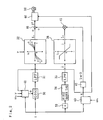
- Fig. 2 is a block diagram illustrating the configuration of the controller 20 that has a phase control element 30.
- the phase control element 30 controls the phase of the output signal of the torque sensor 22, which is a signal corresponding to the detected steering torque ⁇ .
- the transfer function G1(s) of the phase control element 30 of the present embodiment is expressed by the following formula where s is a Laplacian, T 1 is a time constant, and ⁇ (0 ⁇ ⁇ ⁇ 1) is a coefficient.
- G ⁇ 1 s 1 + ⁇ ⁇ T 1 ⁇ s / 1 + T 1 ⁇ s
- the coefficient ⁇ is set in the first coefficient setting element 41.
- the signal whose phase is controlled by the phase control element 30 is input into a calculation element 32 after the unnecessary high-frequency component is removed therefrom by a low-pass filter 31.
- the assist characteristic that represents the correspondence relationship between the steering torque ⁇ , vehicle speed v and basic assist current I o is stored in the form of, for example, a table or calculation formula in the controller 20.
- the basic assist current I o is calculated from the detected steering torque ⁇ and detected vehicle speed v with the assist characteristic.
- the magnitude of the basic assist current I o increases with the increase in the magnitude of the steering torque ⁇ , and if the steering torque ⁇ is constant, the magnitude of the basic assist current I o increases with the decrease in the vehicle speed v.
- the signs are plus in a state of steering in one of the left and right directions, and the signs are minus in a state of steering in the other direction.
- the basic assist current I o corresponds to a basic assist torque ⁇ o .
- the output signal of the torque sensor 22 is inputted into a differentiator 33.
- the differentiator 33 functions as an element for calculating variation rate (d ⁇ /dt) of the detected steering torque ⁇ , and the signal corresponding to the variation rate d ⁇ /dt is input into a calculation element 36 via a first order lag element 34 and a low-pass filter 35.
- the unnecessary high-frequency component is removed from the signal corresponding to the variation rate d ⁇ /dt with the low-pass filter 35.
- an additional assist current I a inversely correlated with the variation rate of the detected steering torque ⁇ is calculated. As shown in the calculation element 36 in Fig.
- the variation rate of the steering torque ⁇ is positive and the additional assist current I a is negative in a state of steering in one of the left and right directions, and the variation rate of the steering torque ⁇ is negative and the additional assist current I a is positive in a state of steering in the other direction.
- the steering state judgment element 40 judges whether the steering wheel 2 is in a return steering state in which the steering wheel 2 is steered toward the straight travelling steering position or a feed steering state in which the steering wheel is steered away from the straight travelling steering position.
- the steering state judgment element 40 of the present embodiment compares the plus or minus sign of the steering torque ⁇ , whose sign in a state of steering to the right direction is inverse to that in a state of steering to the left direction, with the plus or minus sign of the steering angular velocity ⁇ h , whose sign at the time when the steering wheel 2 is turned to the right direction is inverse to that at the time when the steering wheel 2 is turned to the left direction, and judges that it is a feed steering state when the signs match and that it is a return steering state when the signs do not match.
- a steering state judgment signal x corresponding to the judgment result is input into a first coefficient setting element 41, an open-close signal output element 43 and an output control element 60.
- the steering angular velocity ⁇ h is calculated by differentiating the detected steering angle ⁇ h determined with the steering sensor 23 with a differentiator (not shown in the figure).
- the open-close signal output element 43 outputs a signal corresponding to 1 in the feed steering state and outputs a signal corresponding to zero in the return steering state to a multiplier 45.
- a value calculated by multiplying the additional assist current I a by the output signal from the open-close signal output element 43 is calculated.
- the sum of the value calculated in the multiplier 45 and the basic assist current I o is calculated as a target drive current I* in an addition element 46.
- the target drive current I* corresponds to the target output value of the motor 10.
- the magnitude of the target drive current I* is decreased by the increase of the magnitude of the variation rate of the detected steering torque ⁇ in the feed steering state. In the return steering state, the magnitude of the target drive current I* is uncorrelated with the magnitude of the variation rate of the detected steering torque ⁇ .
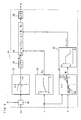
- Fig. 4 is a block diagram illustrating the configuration of the first coefficient setting element 41 in which a steering state judgment signal x is input into a sign setting element 50.
- the sign setting element 50 sets the sign of the steering angular velocity ⁇ h to plus in the feed steering state and to minus in the return steering state.
- the sign of the steering angular velocity ⁇ h prior to inputting into the sign setting element 50 is set according to the rotation direction of the steering wheel 2, and the sign of the steering angular velocity ⁇ h output from the sign setting element 50 is set according to whether it is the return steering state or the feed steering state.
- a gain K 1 corresponding to the value of the steering angular velocity ⁇ h output from the sign setting element 50 is calculated in a calculation element 52.
- the relationship between the gain K 1 and steering angular velocity ⁇ h is predetermined and stored in the controller 20.
- the gain K 1 is inversely correlated with the steering angular velocity ⁇ h .
- the gain K 1 is equal to or higher than zero, and it becomes larger in the return steering state than in the feed steering state.
- the gain K 1 decreases with the increase in the steering angular velocity ⁇ h , and it becomes a constant minimum value when the value of the steering angular velocity ⁇ h is equal to or higher than a fixed value.
- the gain K 1 increases with the increase in the steering angular velocity ⁇ h , and it becomes a constant maximum value when the value of the steering angular velocity ⁇ h is equal to or higher than a fixed value.
- the minimum value of gain K 1 is taken as 0 and the maximum value thereof is taken as 1.
- a signal corresponding to the gain K 1 output from the calculation element 52 is input into a coefficient calculation element 54 after the unnecessary high-frequency component is removed therefrom with a low-pass filter 53.
- a gain K 2 corresponding to the vehicle speed v is calculated.
- the relationship between the gain K 2 and vehicle speed v is predetermined and stored in the controller 20.
- the gain K 2 in the present embodiment is equal to or higher than zero, increases with the increase in the vehicle speed v and becomes a constant maximum value when the vehicle speed v is equal to or higher than a constant value.
- the minimum value of the gain K 2 is taken as 0.5 and the maximum value thereof is taken as 1.
- a signal corresponding to the gain K 2 is output from the calculation element 55 and then input into the coefficient calculation element 54.
- an assist gradient R corresponding to the detected steering torque ⁇ and detected vehicle speed v is calculated.
- the variation ratio (d ⁇ o /d ⁇ ) of the basic assist torque ⁇ o to the steering torque ⁇ is taken as the assist gradient R, and the correspondence relationship between the steering torque ⁇ , basic assist torque ⁇ o and vehicle speed v is stored in the controller 20.
- the assist gradient R is calculated from this stored relationship, detected steering torque ⁇ and detected vehicle speed v.
- a characteristic is demonstrated in which, as shown in the calculation element 56 in Fig. 4, the assist gradient R increases when the magnitude of the steering torque ⁇ increases and the vehicle speed v decreases.
- a signal corresponding to the assist gradient R is output from the calculation element 56 and then input into the calculation element 57.
- a parameter a 1 corresponding to the assist gradient R is calculated.
- the relationship between the parameter a 1 and assist gradient R is predetermined and stored in the controller 20.
- the maximum value of the parameter a 1 is taken as 1 and the minimum value thereof is taken as 0.3, and it becomes a minimum value a 2 during steering when the vehicle is stopping.
- a signal corresponding to the parameter a 1 is output from the calculation element 57 and then input into the coefficient calculation element 54.
- the coefficient ⁇ corresponding to the gains K 1 , K 2 and parameters a 1 , a 2 is calculated.
- the parameter a 1 that is inversely correlated with the assist gradient R, the gain K 1 that is inversely correlated with the steering angular velocity ⁇ h and the gain K 2 that is correlated with the vehicle speed v are equal to or lower than 1 and equal to or higher than 0.
- the gain K 1 in the return steering state is larger than that in the feed steering state.
- the minimum value of a 1 is a 2 , so that a 1 ⁇ a 2 .
- the coefficient ⁇ has a characteristic such that it becomes less in the return steering state than in the feed steering state, decreases with the increase in the magnitude of the steering angular velocity ⁇ h in the return steering state, increases with the increase in the magnitude of the steering angular velocity ⁇ h in the feed steering state, decreases with the increase in the vehicle speed v and increases with the increase in the assist gradient R.
- the coefficient ⁇ of the transfer function G1(s) is set by inputting the signal corresponding to the coefficient ⁇ into the phase control element 30 via a low-pass filter 58.
- the assist gradient R increases with the increase in the steering torque ⁇ , while the parameter a 1 corresponding to the assist gradient R decreases with the increase in the steering torque ⁇ , so the low-pass filter 58 removes the high-frequency component of the signal corresponding to the coefficient ⁇ in order to prevent the divergence.
- Fig. 5 shows a frequency response characteristic of the output to input of the torque sensor 22, wherein the abscissa corresponds to the frequency of the output signal of the torque sensor 22, and the ordinate corresponds to the gain of the output to input of the torque sensor 22.
- the characteristic in case where the coefficient ⁇ of the transfer function G1(s) of the phase control element 30 is 1 is shown by a solid line, and the characteristic in case where the coefficient ⁇ is less than 1 is shown by a broken line.
- ⁇ a 1/(2 ⁇ T 1 )
- ⁇ b 1/(2 ⁇ T 1 )
- ⁇ c is a cut-off frequency of the low-pass filter 31.
- the coefficient ⁇ becomes smaller in the return steering state than in the feed steering state; therefore the gain in the return steering state decreases in comparison with that in the feed steering state in the high frequency side of the frequency response characteristic of the output to input of the torque sensor 22.
- the phase control characteristic of the phase control element 30 is changed according to the judgment by the steering state judgment element 40 so that the response of the variation of the target drive current I* to the variation of the detected steering torque ⁇ decreases in the return steering state in comparison with that in the feed steering state.
- the coefficient ⁇ increases with the increase in the assist gradient R; therefore the gain is decreased when the assist gradient R increases in comparison with that before the increase of the assist gradient R in the high frequency side of the frequency response characteristic of the output to input of the torque sensor 22.
- the phase control characteristic of the phase control element 30 is changed according to the assist gradient R so that the response of the variation of the target drive current I* to the variation of the detected steering torque ⁇ decreases when the assist gradient R increases in comparison with that before the increase of the assist gradient R.
- the signal corresponding to the target drive current I* is input into an output control element 60 of the motor 10.
- the output control element 60 comprises a dq axes target current calculation element 61, a dq axes actual current calculation element 62, an applied voltage calculation element 63, a current detection element 64, a rotation position detection element 65 and a motor driver 66.
- the dq axes target current calculation element 61 calculates the d axis target current I d * for generating the magnetic field in the direction of d axis and the q axis target current I q * for generating the magnetic field in the direction of q axis as the value corresponding to the calculated target drive current I*, wherein the axis along the direction of magnetic flux of a field magnet of a rotor in the motor 10 is taken as the d axis, and the axis perpendicular to the d axis and rotation axis of the rotor is taken as the q axis.
- a function F d expressing the relationship between the target drive current I* and the d axis target current I d * and a function F q expressing the relationship between the target drive current I* and the q axis target current I q * are predetermined and stored in the controller 20, and the d axis target current I d * and q axis target current I q * are calculated from the functions F d , F q and the target drive current I*.
- Known functions can be used as the functions F d , F q .
- the dq axes actual current calculation element 62 calculates the d axis actual current I d for generating the magnetic field in the d axis direction and the q axis actual current I q for generating the magnetic field in the q axis direction based on the actual currents I U , I V , I W detected by the current detection element 64 and the rotation position ⁇ o detected by the rotation position detection element 65.
- the current detection element 64 constitutes a detection element for detecting the actual currents I U , I V , I W flowing in respective coils of U phase, V phase and W phase in the motor 10 as actual output values of the motor 10.
- the rotation position detection element 65 detects the rotation angle of the rotor to the predetermined reference position in a stator of the motor 10 as the rotation position ⁇ o based on the signal from a rotation angle sensor 65a such as a resolver, encoder or the like mounted on the motor 10.
- the calculation in the dq axes actual current calculation element 62 can be performed by using a known calculation formula.
- the applied voltage calculation element 63 calculates voltages v U *, v V *, v W * applied to the coils based on the d axis target current I d *, q axis target current I q *, d axis actual current I d , q axis actual current I q , and detected rotation position ⁇ o .
- the d axis target voltage v d * is calculated by calculating the deviation between the d axis target current I d * and the d axis actual current I d with a deviation calculation element 70 and performing the PI (proportional integral) control calculation of this deviation in a d axis PI control calculation element 71.
- the q axis target voltage v q * is calculated by calculating the deviation between the q axis target current I q * and the q axis actual current I q with a deviation calculation element 72 and performing the PI control calculation of this deviation in a q axis PI control calculation element 73.
- the applied voltages v U *, v V *, v W * are calculated as output command values of the motor 10 in a three-phase voltage calculation element 74 from the d axis target voltage v d *, q axis target voltage v q * and detected rotation position ⁇ o .
- the calculation in the three-phase voltage calculation element 74 can be conducted by a known calculation formula.
- the deviations between the respective dq axes target currents I d *, I q * corresponding to the target drive current I* that is a target output value of the motor 10 and the respective dq axes actual currents I d , I q corresponding to the actual output values correspond to the applied voltages v U *, v V *, v W * that are the output command values of the motor 10.
- the motor driver 66 drives the motor 10 by applying the calculated applied voltages v U *, v V *, v W * to the coils of the motor 10, for example, by PWM (pulse width modulation) control.
- the output control element 60 determines the applied voltages v U *, v V *, v W * that are the output command values by the calculations including the PI control calculation and controls the applied voltages v U *, v V *, v W * corresponding to the deviations between the respective dq axes target currents I d *, I q * corresponding to the target drive current I* that is a target output value of the motor 10 and the respective dq axes actual currents I d , I q corresponding to the actual output values so as to eliminate the deviations.
- the motor 10 generates steering assist power corresponding to the target drive current I*.
- Fig. 7 is a block diagram of the d axis PI control calculation element 71 that calculates the d axis target voltage v d * based on the deviation between the d axis target current I d * and d axis actual current I d .
- the d axis PI control calculation element 71 has a proportional calculation element 71a, an integrator 71b, an addition element 71c, a d axis phase compensator 71d and a d axis coefficient setting element 71e.
- K pd is a gain of the proportional calculation element 71a
- K Id is a gain of the integrator 71b
- G2(s) is a transfer function of the d axis phase compensator 71d.
- T 5 , T 6 are time constants
- a 5 , a 6 are coefficients
- the coefficients a 5 , a 6 of the transfer function G2(s) are set in the d axis coefficient setting element 71e.
- the steering state judgment signal x from the steering state judgment element 40 is input into the d axis coefficient setting element 71e, and the coefficients a 5 , a 6 set by the d axis coefficient setting element 71e are changed according to the judgment by the steering state judgment element 40.
- Fig. 8 shows a frequency response characteristic of the output to input of the proportional calculation element 71a, in which the abscissa corresponds to the frequency of the signal corresponding to the d axis target current I d *, and the ordinate corresponds to the gain of the output to the input of the proportional calculation element 71a.
- ⁇ 1 1/(2 ⁇ T 5 )
- ⁇ 2 1/(2 ⁇ a 5 T 5 )
- ⁇ 3 1/(2 ⁇ a 6 T 6
- ⁇ 4 1/(2 ⁇ T 6 ).
- Fig. 9 shows a frequency response characteristic of the output to input of the integrator 71b, in which the abscissa corresponds to the frequency of the signal corresponding to the d axis target current I d *, and the ordinate corresponds to the gain of the output to the input of the integrator 71b.
- ⁇ 1 1/(2 ⁇ T 5 )
- ⁇ 2 1/(2 ⁇ a 5 T 5 )
- ⁇ 3 1/(2 ⁇ a 6 T 6
- ⁇ 4 1/(2 ⁇ T 6 ).
- the coefficients a 7 , a 8 of the transfer function G3(s) are set in the q axis coefficient setting element 73e.
- the steering state judgment signal x from the steering state judgment element 40 is input into the q axis coefficient setting element 73e, and the coefficients a 7 , a 8 set by the q axis coefficient setting element 73e are changed according to the judgment by the steering state judgment element 40.
- Fig. 11 shows a frequency response characteristic of the output to input of the proportional calculation element 73a, in which the abscissa corresponds to the frequency of the signal corresponding to the q axis target current I q *, and the ordinate corresponds to the gain of the output to the input of the proportional calculation element 73a.
- ⁇ 5 1/(2 ⁇ T 7 )
- ⁇ 6 1/(2 ⁇ a 7 T 7
- ⁇ 7 1/(2 ⁇ a 8 T 8
- ⁇ 8 1/(2 ⁇ T 8 ).
- Fig. 12 shows a frequency response characteristic of the output to input of the integrator 73b, in which the abscissa corresponds to the frequency of the signal corresponding to the q axis target current I q *, and the ordinate corresponds to the gain of the output to the input of the integrator 73b.
- ⁇ 5 1/(2 ⁇ T 7 )
- ⁇ 6 1/(2 ⁇ a 7 T 7
- ⁇ 7 1/(2 ⁇ a 8 T 8
- ⁇ 8 1/(2 ⁇ T 8 ).
- the gain in the return steering state is decreased in comparison with that in the feed steering state in the high frequency side of the frequency response characteristic of the applied voltages v U *, v V *, v W * corresponding to the output command value to the deviations between the respective dq axes target currents I d *, I q * corresponding to the target output value of the motor 10 and the respective dq axes actual currents I d , I q corresponding to the actual output value.
- the output control characteristic of the output control element 60 for the motor 10 is changed according to the judgment by the steering state judgment element 40 so that the response of the variation of the output command value to the variation of the deviation between the target output value and the actual output value of the motor 10 in the return steering state decreases in comparison with that in the feed steering state.
- the change of the output control characteristic of the output control element 60 is synchronized with the change of the phase control characteristic of the phase control element 30 according to the judgment by the steering state judgment element 40.
- the response of the variation of the target drive current I* corresponding to the target output value to the variation of the steering torque ⁇ in the return steering state is decreased in comparison with that in the feed steering state, by varying the phase of the signal that varies correspondingly to the steering torque ⁇ detected with the torque sensor 22, by the change of the phase control characteristic of the phase control element 30.
- the output control characteristic of the output control element 60 can be changed synchronously with the change of the phase control characteristic of the phase control element 30, the response of the variation of the applied voltages v U *, v V *, v W * corresponding to the output command value to the variation of the deviations between the respective dq axes target currents I d *, I q * corresponding to the target output value of the motor 10 and the respective dq axes actual currents I d , I q corresponding to the actual output value can be reduced synchronously with the decrease in the response of the variation of the target drive current I* to the variation of the steering torque ⁇ .
- the output of the motor 10 can be reliably prevented from decreasing rapidly during the return steering.
- the sum of the basic assist current I o and the additional assist current I a which is inversely correlated with the variation rate of the detected steering torque ⁇ , becomes the target drive current I*, so that the output of the motor 10 is prevented from getting too large in the case of rapid steering in the feed steering state, whereby the steering feeling can be improved.
- the basic assist current I o becomes the target drive current I* in the return steering state, so that the output of the motor 10 can be prevented from decreasing rapidly in the case where the steering torque ⁇ decreases abruptly as a result of, e.g., removing hands from the steering wheel 2 in the return steering state.
- the phase of the signal corresponding to the basic assist current I o can be controlled with a phase control element disposed between the calculation element 32 and addition element 46, instead of the phase control element 30 disposed between the torque sensor 22 and calculation element 32.
- the phase control element is not limited to an element that directly controls the output signal of the torque sensor, and it can control the phase of the signal such as the basic assist current I o corresponding to the detected steering torque.
- no specific limitation is placed on the correspondence relationship between the steering torque and the target output value of the motor, provided that it gives an adequate steering assist power.
- the target output value of the motor can vary according to the steering angle.
- the applied voltages v U *, v V *, v W * can be determined as the output command values of the motor 10, by determining the target currents I U *, I V *, I W * respectively corresponding to U, V and W phases of the motor 10 from the target drive current I* and detected rotation position ⁇ o instead of the dq axes target currents I d *, I q * in the above-described embodiment, and performing the PI control calculation of the deviations (I U * - I U ), (I V * - I V ) and (I W * - I W ) between the respective target currents I U *, I V *, I W * and the respective actual currents I U , I V , I W of the respective coils of U, V and W phases.
- the gain in the return steering state can be decreased in comparison with that in the feed steering state in the high frequency side of the frequency response characteristic of the applied voltages v U *, v V *, v W * to the deviations (I U * - I U ), (I V * - I V ), (I W * - I W ).
- a mechanism for transmitting the output of the motor for generating the steering assist power to the steering system is not limited to that of the embodiment, provided that the steering assist power can be supplied.
- the steering assist power can be supplied by driving a ball nut engaged with a ball screw integrated with the rack by the output of the motor.
Landscapes
- Engineering & Computer Science (AREA)
- Chemical & Material Sciences (AREA)
- Combustion & Propulsion (AREA)
- Transportation (AREA)
- Mechanical Engineering (AREA)
- Power Steering Mechanism (AREA)
- Steering Control In Accordance With Driving Conditions (AREA)
Applications Claiming Priority (1)
| Application Number | Priority Date | Filing Date | Title |
|---|---|---|---|
| JP2005273892A JP4737402B2 (ja) | 2005-09-21 | 2005-09-21 | 電動パワーステアリング装置 |
Publications (3)
| Publication Number | Publication Date |
|---|---|
| EP1767433A2 true EP1767433A2 (de) | 2007-03-28 |
| EP1767433A3 EP1767433A3 (de) | 2011-01-05 |
| EP1767433B1 EP1767433B1 (de) | 2012-06-13 |
Family
ID=37577235
Family Applications (1)
| Application Number | Title | Priority Date | Filing Date |
|---|---|---|---|
| EP06019604A Ceased EP1767433B1 (de) | 2005-09-21 | 2006-09-19 | Elektrische Hilfskraftlenkung |
Country Status (4)
| Country | Link |
|---|---|
| US (1) | US7918306B2 (de) |
| EP (1) | EP1767433B1 (de) |
| JP (1) | JP4737402B2 (de) |
| CN (1) | CN1935576B (de) |
Cited By (2)
| Publication number | Priority date | Publication date | Assignee | Title |
|---|---|---|---|---|
| EP2082945A1 (de) * | 2008-01-25 | 2009-07-29 | Delphi Technologies, Inc. | Verfahren zum Erzeugen eines Rückführdrehmoment-Signals |
| EP2463177A1 (de) * | 2008-04-23 | 2012-06-13 | Honda Motor Co., Ltd. | Elektrische Servolenkeinrichtung |
Families Citing this family (22)
| Publication number | Priority date | Publication date | Assignee | Title |
|---|---|---|---|---|
| DE102007054017A1 (de) * | 2007-11-13 | 2009-05-14 | Trw Automotive Gmbh | Verfahren zur Ermittlung eines Unterstützungsmoment-Sollwerts für ein elektromotorisch angetriebenes Servolenksystem |
| US8335611B2 (en) * | 2008-12-02 | 2012-12-18 | GM Global Technology Operations LLC | Methods and systems for controlling motor current in steering systems of vehicles equipped with electric steering assist |
| JP5262739B2 (ja) * | 2009-01-16 | 2013-08-14 | 株式会社ジェイテクト | 車両用操舵装置 |
| EP2409898B1 (de) * | 2009-02-23 | 2013-03-13 | Showa Corporation | Elektrische Servolenkvorrichtung |
| JP4948567B2 (ja) * | 2009-05-29 | 2012-06-06 | 三菱電機株式会社 | 車両用操舵装置 |
| US9242670B2 (en) * | 2010-02-19 | 2016-01-26 | Mitsubishi Electric Corporation | Power steering controller with compensation for tire deformation and caster |
| JP2014136525A (ja) * | 2013-01-17 | 2014-07-28 | Omron Automotive Electronics Co Ltd | ステアリング制御装置 |
| WO2014167631A1 (ja) * | 2013-04-08 | 2014-10-16 | 三菱電機株式会社 | 操舵制御装置および操舵制御方法 |
| CN105121257B (zh) * | 2013-04-08 | 2017-04-05 | 三菱电机株式会社 | 转向控制装置及转向控制方法 |
| PL2799310T3 (pl) | 2013-04-30 | 2018-06-29 | Steering Solutions Ip Holding Corporation | Dostarczanie momentu obrotowego wspomagania bez czujnika momentu obrotowego kierownicy |
| US10144445B2 (en) | 2014-09-15 | 2018-12-04 | Steering Solutions Ip Holding Corporation | Modified static tire model for providing assist without a torque sensor for zero to low vehicle speeds |
| JP6327198B2 (ja) * | 2015-04-30 | 2018-05-23 | 株式会社デンソー | 電動パワーステアリング制御装置 |
| US10336363B2 (en) | 2015-09-03 | 2019-07-02 | Steering Solutions Ip Holding Corporation | Disabling controlled velocity return based on torque gradient and desired velocity error |
| US10464594B2 (en) * | 2015-09-03 | 2019-11-05 | Steering Solutions Ip Holding Corporation | Model based driver torque estimation |
| US10155534B2 (en) | 2016-06-14 | 2018-12-18 | Steering Solutions Ip Holding Corporation | Driver intent estimation without using torque sensor signal |
| KR102224996B1 (ko) * | 2017-06-30 | 2021-03-10 | 현대모비스 주식회사 | 전동식 파워 스티어링 시스템의 토크 보상 장치 및 방법 |
| JP6988513B2 (ja) * | 2018-01-24 | 2022-01-05 | 株式会社ジェイテクト | 操舵制御装置 |
| US10768075B2 (en) * | 2018-06-14 | 2020-09-08 | GM Global Technology Operations LLC | Rack disturbance test for determining the frequency response of an electric power steering system |
| CN114206705B (zh) * | 2019-08-09 | 2024-01-12 | 日本电产株式会社 | 控制装置、驱动装置、电动助力转向装置以及控制方法 |
| CN114190086B (zh) * | 2020-07-13 | 2023-12-22 | 日本精工株式会社 | 手放开检测装置以及操舵装置 |
| WO2023148884A1 (ja) * | 2022-02-03 | 2023-08-10 | 株式会社ジェイテクト | 操舵制御装置、および操舵制御方法 |
| WO2023209940A1 (ja) * | 2022-04-28 | 2023-11-02 | 株式会社ジェイテクト | 操舵制御装置および操舵制御方法 |
Family Cites Families (18)
| Publication number | Priority date | Publication date | Assignee | Title |
|---|---|---|---|---|
| MX156827A (es) * | 1983-05-05 | 1988-10-03 | Allied Corp | Mejoras a mecanismo de direccion asistido por energia electrica para un vehiculo automotriz |
| DE3812289C2 (de) * | 1987-04-20 | 1995-06-08 | Mitsubishi Electric Corp | Leerlaufdrehzahlregelvorrichtung für eine Brennkraftmaschine |
| JPS63291768A (ja) * | 1987-05-25 | 1988-11-29 | Fuji Heavy Ind Ltd | 電動式パワステアリング装置の制御装置 |
| US4896089A (en) * | 1989-01-31 | 1990-01-23 | General Electric Company | Fault management system for a switched reluctance motor |
| DE69401858T2 (de) * | 1993-07-02 | 1997-09-11 | Koyo Seiko Co | Elektrische Servolenkung |
| JP3357159B2 (ja) * | 1993-08-10 | 2002-12-16 | 三菱自動車工業株式会社 | 車両運転操作状態の推定方法および車両運転特性制御方法 |
| JPH0820350A (ja) | 1994-07-05 | 1996-01-23 | Honda Motor Co Ltd | 電動パワーステアリング装置 |
| JP3128531B2 (ja) * | 1997-04-03 | 2001-01-29 | 本田技研工業株式会社 | 電動パワーステアリング装置 |
| JP3803226B2 (ja) * | 2000-03-13 | 2006-08-02 | 株式会社ジェイテクト | 電動パワーステアリング制御装置 |
| JP3633453B2 (ja) * | 2000-07-19 | 2005-03-30 | 三菱電機株式会社 | 電動式ステアリング装置の制御装置 |
| JP3527469B2 (ja) * | 2000-09-07 | 2004-05-17 | 三菱電機株式会社 | 電動パワーステアリング装置 |
| JP3777961B2 (ja) * | 2000-09-11 | 2006-05-24 | 日本精工株式会社 | 電動パワーステアリング装置の制御装置 |
| US6570352B2 (en) * | 2000-11-17 | 2003-05-27 | Nsk Ltd. | Control unit for electric power steering apparatus |
| JP3781653B2 (ja) * | 2001-03-12 | 2006-05-31 | 株式会社ジェイテクト | 電動パワーステアリング装置 |
| JP3891258B2 (ja) * | 2001-07-10 | 2007-03-14 | 株式会社ジェイテクト | 電気式動力舵取装置 |
| ATE391066T1 (de) * | 2002-09-19 | 2008-04-15 | Nsk Ltd | Steuervorrichtung für motorisierte servolenkvorrichtung |
| JP2005041279A (ja) * | 2003-07-23 | 2005-02-17 | Koyo Seiko Co Ltd | 電動パワーステアリング装置 |
| JP4349309B2 (ja) * | 2004-09-27 | 2009-10-21 | 日産自動車株式会社 | 車両用操舵制御装置 |
-
2005
- 2005-09-21 JP JP2005273892A patent/JP4737402B2/ja not_active Expired - Fee Related
-
2006
- 2006-09-19 EP EP06019604A patent/EP1767433B1/de not_active Ceased
- 2006-09-20 CN CN2006101398806A patent/CN1935576B/zh not_active Expired - Fee Related
- 2006-09-21 US US11/524,671 patent/US7918306B2/en not_active Expired - Fee Related
Cited By (3)
| Publication number | Priority date | Publication date | Assignee | Title |
|---|---|---|---|---|
| EP2082945A1 (de) * | 2008-01-25 | 2009-07-29 | Delphi Technologies, Inc. | Verfahren zum Erzeugen eines Rückführdrehmoment-Signals |
| US7950495B2 (en) | 2008-01-25 | 2011-05-31 | Nexteer (Beijing) Technology Co., Ltd. | Steering system and method for adapting return torque relative to hand wheel speed |
| EP2463177A1 (de) * | 2008-04-23 | 2012-06-13 | Honda Motor Co., Ltd. | Elektrische Servolenkeinrichtung |
Also Published As
| Publication number | Publication date |
|---|---|
| US7918306B2 (en) | 2011-04-05 |
| JP2007083827A (ja) | 2007-04-05 |
| JP4737402B2 (ja) | 2011-08-03 |
| CN1935576A (zh) | 2007-03-28 |
| CN1935576B (zh) | 2011-07-27 |
| US20070114094A1 (en) | 2007-05-24 |
| EP1767433B1 (de) | 2012-06-13 |
| EP1767433A3 (de) | 2011-01-05 |
Similar Documents
| Publication | Publication Date | Title |
|---|---|---|
| EP1767433B1 (de) | Elektrische Hilfskraftlenkung | |
| US7831356B2 (en) | Electric power steering control apparatus | |
| EP2942264B1 (de) | Elektrische servolenkvorrichtung | |
| JP3849979B2 (ja) | 電動パワーステアリング装置 | |
| EP1539559B1 (de) | Steuerung eines hilfsmotors unter verwendung eines mischfilters | |
| EP3072784B1 (de) | Motorgetriebene servolenkvorrichtung | |
| EP1955928B1 (de) | Motorensteuerung und elektrisches Servolenkungssystem | |
| EP1262394B1 (de) | Dämpfung beim Ausschalten einer elektrischen Servolenkung | |
| EP2000389A1 (de) | Elektrische Servolenkung | |
| US20070162206A1 (en) | Electric power steering apparatus | |
| JP5155815B2 (ja) | 電動パワーステアリング装置 | |
| JP2010202062A (ja) | 電動パワーステアリング装置 | |
| EP1714852B1 (de) | Elektrische Servolenkung | |
| JP2015182493A (ja) | 電動パワーステアリング装置 | |
| JP2005170136A (ja) | ステアリング装置 | |
| JP2013023002A (ja) | 電動パワーステアリング装置 | |
| WO2019016967A1 (ja) | 操舵制御装置、電動パワーステアリング装置 | |
| JP5308254B2 (ja) | 電動パワーステアリング装置 | |
| JP2008132918A (ja) | 車両用電動パワーステアリング装置の制御装置 | |
| JP5045872B2 (ja) | 電動パワーステアリング装置 | |
| JP7235022B2 (ja) | ステアリング制御装置 | |
| JP2008068663A (ja) | 電動パワーステアリング装置の制御装置 | |
| JP2026011533A (ja) | 制御装置、ステアリング装置、制御方法、プログラム | |
| JP2008062816A (ja) | 電動パワーステアリング装置の制御装置 | |
| JP2023016624A (ja) | ステアリング制御装置 |
Legal Events
| Date | Code | Title | Description |
|---|---|---|---|
| PUAI | Public reference made under article 153(3) epc to a published international application that has entered the european phase |
Free format text: ORIGINAL CODE: 0009012 |
|
| AK | Designated contracting states |
Kind code of ref document: A2 Designated state(s): AT BE BG CH CY CZ DE DK EE ES FI FR GB GR HU IE IS IT LI LT LU LV MC NL PL PT RO SE SI SK TR |
|
| AX | Request for extension of the european patent |
Extension state: AL BA HR MK YU |
|
| PUAL | Search report despatched |
Free format text: ORIGINAL CODE: 0009013 |
|
| AK | Designated contracting states |
Kind code of ref document: A3 Designated state(s): AT BE BG CH CY CZ DE DK EE ES FI FR GB GR HU IE IS IT LI LT LU LV MC NL PL PT RO SE SI SK TR |
|
| AX | Request for extension of the european patent |
Extension state: AL BA HR MK RS |
|
| 17P | Request for examination filed |
Effective date: 20110616 |
|
| AKX | Designation fees paid |
Designated state(s): DE FR |
|
| GRAP | Despatch of communication of intention to grant a patent |
Free format text: ORIGINAL CODE: EPIDOSNIGR1 |
|
| GRAS | Grant fee paid |
Free format text: ORIGINAL CODE: EPIDOSNIGR3 |
|
| GRAA | (expected) grant |
Free format text: ORIGINAL CODE: 0009210 |
|
| AK | Designated contracting states |
Kind code of ref document: B1 Designated state(s): DE FR |
|
| REG | Reference to a national code |
Ref country code: DE Ref legal event code: R096 Ref document number: 602006030057 Country of ref document: DE Effective date: 20120816 |
|
| PLBE | No opposition filed within time limit |
Free format text: ORIGINAL CODE: 0009261 |
|
| STAA | Information on the status of an ep patent application or granted ep patent |
Free format text: STATUS: NO OPPOSITION FILED WITHIN TIME LIMIT |
|
| 26N | No opposition filed |
Effective date: 20130314 |
|
| REG | Reference to a national code |
Ref country code: DE Ref legal event code: R097 Ref document number: 602006030057 Country of ref document: DE Effective date: 20130314 |
|
| REG | Reference to a national code |
Ref country code: FR Ref legal event code: PLFP Year of fee payment: 11 |
|
| REG | Reference to a national code |
Ref country code: FR Ref legal event code: PLFP Year of fee payment: 12 |
|
| REG | Reference to a national code |
Ref country code: FR Ref legal event code: PLFP Year of fee payment: 13 |
|
| PGFP | Annual fee paid to national office [announced via postgrant information from national office to epo] |
Ref country code: FR Payment date: 20230808 Year of fee payment: 18 Ref country code: DE Payment date: 20230802 Year of fee payment: 18 |
|
| REG | Reference to a national code |
Ref country code: DE Ref legal event code: R082 Ref document number: 602006030057 Country of ref document: DE Representative=s name: PUSCHMANN BORCHERT KAISER KLETTNER PATENTANWAE, DE |
|
| REG | Reference to a national code |
Ref country code: DE Ref legal event code: R119 Ref document number: 602006030057 Country of ref document: DE |
|
| PG25 | Lapsed in a contracting state [announced via postgrant information from national office to epo] |
Ref country code: DE Free format text: LAPSE BECAUSE OF NON-PAYMENT OF DUE FEES Effective date: 20250401 |
|
| PG25 | Lapsed in a contracting state [announced via postgrant information from national office to epo] |
Ref country code: FR Free format text: LAPSE BECAUSE OF NON-PAYMENT OF DUE FEES Effective date: 20240930 |