EP1739954B1 - Datenübertragbarkeitsprädiktor - Google Patents
Datenübertragbarkeitsprädiktor Download PDFInfo
- Publication number
- EP1739954B1 EP1739954B1 EP06116281A EP06116281A EP1739954B1 EP 1739954 B1 EP1739954 B1 EP 1739954B1 EP 06116281 A EP06116281 A EP 06116281A EP 06116281 A EP06116281 A EP 06116281A EP 1739954 B1 EP1739954 B1 EP 1739954B1
- Authority
- EP
- European Patent Office
- Prior art keywords
- image
- scanned
- estimated
- size
- file
- Prior art date
- Legal status (The legal status is an assumption and is not a legal conclusion. Google has not performed a legal analysis and makes no representation as to the accuracy of the status listed.)
- Not-in-force
Links
- 238000000034 method Methods 0.000 claims description 71
- 238000012546 transfer Methods 0.000 claims description 25
- 238000007906 compression Methods 0.000 claims description 24
- 230000006835 compression Effects 0.000 claims description 24
- 230000008569 process Effects 0.000 claims description 16
- 238000003384 imaging method Methods 0.000 claims description 6
- 230000004044 response Effects 0.000 claims description 4
- 238000012545 processing Methods 0.000 description 11
- 230000005540 biological transmission Effects 0.000 description 10
- 238000004891 communication Methods 0.000 description 9
- 238000010586 diagram Methods 0.000 description 7
- 230000033458 reproduction Effects 0.000 description 5
- 230000006870 function Effects 0.000 description 4
- 230000009467 reduction Effects 0.000 description 3
- 238000013144 data compression Methods 0.000 description 2
- 230000000593 degrading effect Effects 0.000 description 2
- 230000000877 morphologic effect Effects 0.000 description 2
- 238000007781 pre-processing Methods 0.000 description 2
- 238000013139 quantization Methods 0.000 description 2
- 230000000007 visual effect Effects 0.000 description 2
- 230000009471 action Effects 0.000 description 1
- 230000009286 beneficial effect Effects 0.000 description 1
- 238000012790 confirmation Methods 0.000 description 1
- 230000001419 dependent effect Effects 0.000 description 1
- 230000009365 direct transmission Effects 0.000 description 1
- 230000007274 generation of a signal involved in cell-cell signaling Effects 0.000 description 1
- 230000000873 masking effect Effects 0.000 description 1
- 238000005259 measurement Methods 0.000 description 1
- 230000000737 periodic effect Effects 0.000 description 1
- 238000011084 recovery Methods 0.000 description 1
Images



Classifications
-
- H—ELECTRICITY
- H04—ELECTRIC COMMUNICATION TECHNIQUE
- H04N—PICTORIAL COMMUNICATION, e.g. TELEVISION
- H04N1/00—Scanning, transmission or reproduction of documents or the like, e.g. facsimile transmission; Details thereof
- H04N1/32—Circuits or arrangements for control or supervision between transmitter and receiver or between image input and image output device, e.g. between a still-image camera and its memory or between a still-image camera and a printer device
- H04N1/32609—Fault detection or counter-measures, e.g. original mis-positioned, shortage of paper
- H04N1/32614—Fault detection or counter-measures, e.g. original mis-positioned, shortage of paper related to a single-mode communication, e.g. at the transmitter or at the receiver
-
- H—ELECTRICITY
- H04—ELECTRIC COMMUNICATION TECHNIQUE
- H04N—PICTORIAL COMMUNICATION, e.g. TELEVISION
- H04N1/00—Scanning, transmission or reproduction of documents or the like, e.g. facsimile transmission; Details thereof
- H04N1/32—Circuits or arrangements for control or supervision between transmitter and receiver or between image input and image output device, e.g. between a still-image camera and its memory or between a still-image camera and a printer device
- H04N1/32609—Fault detection or counter-measures, e.g. original mis-positioned, shortage of paper
- H04N1/32625—Fault detection
- H04N1/32641—Fault detection of transmission or transmitted data, e.g. interruption or wrong number of pages
-
- H—ELECTRICITY
- H04—ELECTRIC COMMUNICATION TECHNIQUE
- H04N—PICTORIAL COMMUNICATION, e.g. TELEVISION
- H04N1/00—Scanning, transmission or reproduction of documents or the like, e.g. facsimile transmission; Details thereof
- H04N1/32—Circuits or arrangements for control or supervision between transmitter and receiver or between image input and image output device, e.g. between a still-image camera and its memory or between a still-image camera and a printer device
- H04N1/32609—Fault detection or counter-measures, e.g. original mis-positioned, shortage of paper
- H04N1/32646—Counter-measures
- H04N1/32651—Indicating or reporting
- H04N1/32657—Indicating or reporting locally
-
- H—ELECTRICITY
- H04—ELECTRIC COMMUNICATION TECHNIQUE
- H04N—PICTORIAL COMMUNICATION, e.g. TELEVISION
- H04N1/00—Scanning, transmission or reproduction of documents or the like, e.g. facsimile transmission; Details thereof
- H04N1/32—Circuits or arrangements for control or supervision between transmitter and receiver or between image input and image output device, e.g. between a still-image camera and its memory or between a still-image camera and a printer device
- H04N1/32609—Fault detection or counter-measures, e.g. original mis-positioned, shortage of paper
- H04N1/32646—Counter-measures
- H04N1/32683—Preventive counter-measures, e.g. using redundant hardware, or anticipating a fault
-
- H—ELECTRICITY
- H04—ELECTRIC COMMUNICATION TECHNIQUE
- H04N—PICTORIAL COMMUNICATION, e.g. TELEVISION
- H04N1/00—Scanning, transmission or reproduction of documents or the like, e.g. facsimile transmission; Details thereof
- H04N1/32—Circuits or arrangements for control or supervision between transmitter and receiver or between image input and image output device, e.g. between a still-image camera and its memory or between a still-image camera and a printer device
- H04N1/333—Mode signalling or mode changing; Handshaking therefor
- H04N1/3333—Mode signalling or mode changing; Handshaking therefor during transmission, input or output of the picture signal; within a single document or page
-
- H—ELECTRICITY
- H04—ELECTRIC COMMUNICATION TECHNIQUE
- H04N—PICTORIAL COMMUNICATION, e.g. TELEVISION
- H04N1/00—Scanning, transmission or reproduction of documents or the like, e.g. facsimile transmission; Details thereof
- H04N1/32—Circuits or arrangements for control or supervision between transmitter and receiver or between image input and image output device, e.g. between a still-image camera and its memory or between a still-image camera and a printer device
- H04N1/333—Mode signalling or mode changing; Handshaking therefor
- H04N1/33376—Mode signalling or mode changing; Handshaking therefor according to characteristics or state of one of the communicating parties, e.g. available memory capacity
- H04N1/33384—Mode signalling or mode changing; Handshaking therefor according to characteristics or state of one of the communicating parties, e.g. available memory capacity according to transient characteristics or state
-
- H—ELECTRICITY
- H04—ELECTRIC COMMUNICATION TECHNIQUE
- H04N—PICTORIAL COMMUNICATION, e.g. TELEVISION
- H04N2201/00—Indexing scheme relating to scanning, transmission or reproduction of documents or the like, and to details thereof
- H04N2201/32—Circuits or arrangements for control or supervision between transmitter and receiver or between image input and image output device, e.g. between a still-image camera and its memory or between a still-image camera and a printer device
- H04N2201/333—Mode signalling or mode changing; Handshaking therefor
- H04N2201/33307—Mode signalling or mode changing; Handshaking therefor of a particular mode
- H04N2201/33342—Mode signalling or mode changing; Handshaking therefor of a particular mode of transmission mode
- H04N2201/33357—Compression mode
Definitions
- Illustrated herein generally, are systems and methods for providing continuing communication between networked devices and more particularly, to enabling a device configured to run a "scan-to-export" program to communicate with a connected target device during the scanning process.
- US-A-5930003 discloses a facsimile apparatus that comprises a counter for counting available space of an image memory and a function for determining the memory size of one page of received or read data and comparing the memory size determined by a reception or reading mode with the available space of the image memory.
- transmission mode the storing of data into the memory is interrupted and transmission of the data stored in the memory is started if the available space is not enough.
- the transmission of the data in the memory is completed, the transmission of the rest of the original is performed by direct transmission.
- the reception mode the transmitting side is notified that the memory has no available space and communication is terminated, if the available space is not enough, and direct reception is not possible.
- the receiver uses received indications of the original image size and compression mude to estimate the manising space needed.
- JP-A035570 discloses facsimile equipment wherein data related to the page sizes in a transmission document is transmitted from the transmission site to the reception site, and the transmission site accepts the communication interrupting request due to the memory full of data on the reception side not in the middle of transmission of a page, but on the boundary of each page, and then lowers the data resolution.
- US-A-2001/030762 discloses a communication system comprising a transmitter terminal and a receiver terminal communicating via a communication line.
- the system is adapted for reception and transmission of data and size information indicative of the size of the data of multiple pages between the terminals.
- the data size contained in the size information is compared with the size of the free space in the storage section of the receiver. If the storage section is short of free space, a waiting period required for recovery from the shortage of the free space in the storage section is calculated.
- US-A-2002/131097 and US-A-1002/102027 A1 disclose methods of coding image data.
- US-A-5208681 discloses a facsimile machine wherein, when a plurality of pages are to be received, an information amount of the received coded data of the first page or, when a plurality of pages are to be received, an information amount of the received coded data of the immediately preceding page, is counted, and a remaining transmissible paper number is calculated therefrom. The remaining transmissible paper number can be displayed at the transmitter
- Image reproduction devices commonly provide "scan-to-export” features to enable users to digitally capture hardcopy document images for transfer to other devices.
- “scan-to-e-mail,” “scan-to-mailbox” and “scan-to-network” features can generate digital representations of original documents and transmit them as email attachments, deliver them to electronic mailboxes or transfer them to remote network servers, respectively.
- Available scan-to-export methods and systems require all of the pages in a job to be scanned and processed, the connection between the sending device and the target to be established and the sending device to submit a request to transfer the completed file before the user can determine whether the target will grant the transfer request. If the target denies the request, the job will only be transferred if the user repeats the entire process and the target device grants the transfer request. In other words, all of the pages must be rescanned, the data must be re-processed, the connection to the target must reestablished, the file transfer request must be re-submitted to the target and the target must grant the re-submitted request.
- a digital imaging device comprises the features defined in claim 1.
- a method according to the present invention comprises the features defined in claim 5.
- FIG. 1 provides an example of a digital reproduction system that may be used to operate a scan-to-export feature.
- FIG. 2 is a block diagram showing the primary functional aspects of an image processing system that may be used to operate present systems and methods.
- FIG. 3 is a flow diagram showing the steps that are performed during a typical scan-to-export process.
- FIG. 4 is a flow diagram showing an example of how present systems and methods may be used by an image reproduction system that transmits data using a scan-to-export process.
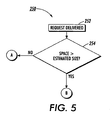
- FIG. 5 is a flow diagram showing an example of how present systems and methods may be used by a device that receives data via a scan-to-export process.
- FIG. 6 is a flow diagram showing an example of how present systems and methods may be used to provide accurate data transferability information in a system with a target device that is capable of communicating with multiple sending devices.
- Image processing means manipulating data that represents text, graphical or pictorial information to achieve a desired result.
- Scan2export and “scan-to-export” refer to a process that digitally captures an image from a hardcopy document and prepares it for transfer to another device.
- file transferability and “data transferability” refer to the ability of a receiving device to accept data/files from a sending device.
- Information refers to a message that has meaning in some context, which is typically presented in a format that is suitable for human interpretation.
- Data refers to a set of symbols or characters that may be manipulated, communicated and/or interpreted to convey information.
- Data compression means reducing the volume of data that represents a given item of information.
- compression ratio is a numerical value that shows the size relationship between an original set of data and a processed set of data that carries the same information. Conventionally, a high compression ratio indicates that the processed data set is much smaller than the original data set.
- Coding refers to the continuous checking by one device of one or more other programs or devices to receive communications.
- Redundant data is data that provides duplicative or unnecessary information.
- Data is "non-essential" when it is not required to provide the minimum acceptable image quality for the selected application.
- Output optimized image data is data that provides optimal output when processed using a specified program, application and/or device.
- a "compressed output optimized image” is file that represents a scanned image captured from an original document, which has been fully processed and compressed for output.
- Transport scan processing refers to a feature that provides a confirmation at the sending device when a scan-to-export job is successfully transferred to and/or processed at the target device.
- MFD 10 multi-function device
- FIG. 1 MFD 10 includes a scanner 12 that digitally captures images from hardcopy original documents 16 that are positioned on a scanning platen 18.
- MFD 10 also includes an image processor (IP) 20 that optimizes the image data generated by scanner 12 for output and a digital color printer 14 that generates hardcopy reproductions of the processed image data.
- IP image processor
- UI 1 also has a user interface (UI) 22 with a telecommunications key pad 24 that can be used to establish connections to remote devices over a telecommunications channel and has a document feeder 26 that can be used to transport original documents 16 to platen 18 and an output tray 28 that can be used to collect hardcopy output.
- UI user interface
- IP 20 includes an image analyzer (IA) 21 that pre-process the data generated by scanner 12 in real-time, for example, to improve contrast, remove noise, segment the image and/or perform other initial operations.
- IP 20 usually includes an image manipulator (IM) 23 that modifies the scanned data in accordance with one or more sets of predefined instructions and may also process it to correct skew and provide masking, cropping and other enhancements that improve its appearance and an image renderer (IR) 25 that processes the scanned data to generate image data that is optimized for a selected type of output.
- IA image analyzer
- IM image manipulator
- IR image renderer
- IP 20 may generate image data that is optimized for display on a video monitor, for permanent storage or to provide printed hardcopies.
- IP 20 also includes an image compressor (IC) 27 that compresses the output optimized image data, i.e., reduces the amount of data in the output optimized image, so it will require less storage space and so it can be transmitted more efficiently
- An IP 20 used by present systems and methods includes an image size estimator (SE) 29 that estimates the size of the compressed output image data while the corresponding job is being scanned.
- SE 29 may provide an estimated size for the entire job.
- SE 29 may add the estimated size of the compressed output image data corresponding to each original document 16 to the sum of the estimated sizes of the compressed output image data for all of the previously scanned pages.
- FIG. 2 shows an example of an IP 20 that may be used with present systems and methods, it is understood that other arrangements are possible and that the described processing functions need not be performed in the order shown.
- Compression methods typically seek to reduce the volume of an image data file without degrading image quality.
- such methods identify and eliminate redundant data and/or data that is non-essential to the appearance of the image. For example, since small changes in luminance and chrominance are not detected by the human visual system, at least some luminance and/or chrominance data can usually be eliminated from a color image. In contrast, since the visual system is very sensitive to changes in spatial resolution, very little data can be eliminated from text and other images with sharp edges without causing a reduction in image quality.
- the amount of space that is required to store an image depends upon both the amount of data being processed (e.g., how many pixels are turned on to generate the image) and the method that is used to compress the data. For example, a full color, 8.5 x 11, (21,59 cm x 27,94 cm) mixed raster content (MRC) image (which contains both graphics and text) scanned at 300 x 300 dpi would typically generate an uncompressed image approximately 25MB in size. If the image were compressed using a JPEG low quality quantization table, the amount of space required to store the compressed image could be as little as 5% (i.e., 1.25 MB) of that required for the uncompressed image. However, if the same image were instead compressed using a JPEG high quality quantization table, the amount of required space would probably be as much as 50% (i.e., 12.5 MB) of that required to store the uncompressed image.
- MRC mixed raster content
- IP 20 typically has access to several different data compression methods and is programmed to select the method that will achieve the highest compression ratio without degrading the quality of the scanned image for the type of data that is being captured.
- IP 20 may have the Lempel-Ziv Welch (LZW), CCITT G4, JPEG and JBIG2 compression methods stored memory and be programmed to use LZW for images that are highly patterned, to use CCITT G4 for images that contain scanned text, to use JPEG for images that have significant amounts of color and detail and to use JBIG2 for monochrome images. Accordingly, as an original document 16 is scanned, IP 20 analyzes the data to identify its content and selects the compression method that is most appropriate.
- LZW Lempel-Ziv Welch
- CCITT G4 for images that contain scanned text
- JPEG for images that have significant amounts of color and detail
- JBIG2 for monochrome images
- FIG. 3 is a flow diagram showing a typical scan-to-export method 100.
- scanner 12 generates a continuous tone representation of a scanned original document 16 as indicated in block 102.
- the scanned image data is then forwarded to IP 20 for pre-processing as shown in block 104 and the pre-processed data is placed in temporary storage as shown in block 106.
- IP 20 performs several tasks, including selecting the appropriate compression method for the identified content as shown at block 108. When a job includes more than one page, the above described steps are repeated as indicated at block 110.
- scanner 12 may remain idle until image processing is completed or, as in the example of FIG. 3 , the image data may be placed in a queue as shown in block 112 and subjected to full processing offline as shown in block 114 in order to increase throughput (it is noted that in a lower throughput system, the step at block 114 will replace that shown at block 106 and block 112 will be omitted).
- the processed data is then placed in permanent storage as shown at block 116 and compressed as shown in block 118, using the method selected at block 108. Headers and/or other required information is then added as shown in block 120 to format the file for output.
- MFD 10 queries the target device as shown in block 122 to request to transfer the scanned file. If there is sufficient storage space, the target will grant the request, the file will be transferred and the data will be processed at the target as shown at block 124. If the request is denied, an error message is generated at UI 22 as shown in block 126 and the file is deleted from storage.
- Present systems and methods provide continuing communication between the sending and target devices while original documents 16 are being scanned, to enable MFD 10 to determine in advance whether the target will grant its request to transfer the compressed output optimized image. More specifically, present systems and methods use the compression method that is selected by IP 20 at block 108 of FIG. 3 to estimate the size of the file for the compressed output optimized image corresponding to original documents 16 as they are being scanned.
- a user name, password and/or other authentication data may be entered at UI 22 to enable the target device to identify the user and/or system and validate access rights.
- Authentication data may also include the network address for the MFD 10 or target device, or other information that is required before the target device will accept communications from networked devices.
- MFD 10 queries the target destination soon after the authentication data is entered as shown in block 204. Accordingly, if the target cannot validate the data that has been entered as shown at block 228, if the memory at the target destination is full or it is apparent that the target would ultimately deny the file transfer request for some other reason, an error signal can be generated as shown in block 206 before scanning even begins. If the authentication data is valid, the next steps are similar to those for method 100 of FIG. 3 . That is, original document 16 is scanned at block 208, pre-processed at block 210, placed in temporary storage at block 212 and the compression method that will be used to process the image data is selected as shown in block 214.
- the output of the compression method selection shown in block 214 is forwarded to an image size predictor, which estimates the size of the fully scanned and processed compressed output optimized image as shown in block 230.
- image size predictor estimates the size of the fully scanned and processed compressed output optimized image as shown in block 230.
- present systems and methods may estimate the size of a compressed image using a lookup table that associates image content and the selected compression method with a compression ratio.
- a look up table may assign a compression ratio of 40:1 to mixed raster content (MRC) images (i.e., images that include multiple types of data such as text and graphics) that are compressed using JBIG2.
- MRC mixed raster content
- SE 29 would predict an output size of 600KB for the previously described 8.5 x 11, color, MRC image scanned at 300 x 300 dpi.
- SE 29 may estimate the size of one or more images that are scanned and compressed later in the job using the actual, average, or other available compression ratio obtained when one or more pages are scanned and compressed earlier.
- IP 20 is capable of processing earlier scanned pages while subsequent original documents 16 are being scanned
- SE 29 can increase the accuracy of the size estimate for the fully compressed image by providing actual output sizes for earlier scanned pages while pages at the end of the job are still being scanned, processed and formatted.
- US Patent Publication No. US-A-2004/0114195 provides another example of a method and system for estimating the compression ratio for an image data set that present systems and methods may use to estimate compressed image size.
- the method includes determining a number of on-pixels in the image data set, performing a morphological operation on the image data set, yielding a processed image data set that includes processed on-pixels, deriving a metric from a relationship between a number of on-pixels in the image data set and a number of processed on-pixels in the processed image data set and using the metric to estimate a compression performance associated with the image data set.
- a "morphological operation” includes deriving, for each of a plurality of windows, each window including a plurality of pixels in the image data set, a processed pixel, with the processed pixel being a processed on-pixel if there exists a predetermined threshold number of on-pixels in the window.
- the scanned data may optionally be placed in a queue as shown in block 216 and the image data may be processed off-line as shown in block 218 to increase throughput, then placed in permanent storage as shown in block 220, compressed as shown in block 222 and formatted for output as shown in block 224.
- MFD 10 queries the target as shown in block 250 to determine whether the predicted job size exceeds the available storage space.
- queries and the associated responses may be provided in many ways.
- a query may include a request for the target to report the amount of available storage space and MFD 10 may compare it to the estimated size of the compressed output optimized image to determine whether the target would grant a transfer request.
- the query may include the estimated size of the compressed output optimized image and the target device may respond by sending a binary or other response that indicates whether a request to transfer a file having the estimated size would be granted.
- the target when a query includes the estimated size of the compressed output optimized image, the target may respond when a specified condition is met.
- the target could signal MFD 10 to stop scanning if the file is too large for it to grant a transfer request or it could respond with a "OK" signal when the available storage space is sufficient and MFD 10 may be configured to continue scanning only upon receipt of the OK signal.
- target device queries may be used to provide continuous updates of the ability of the target to transfer the file being scanned as image data is captured from the original document.
- present systems and methods may query the target device as shown at block 250 using a standard polling process.
- MFD 10 may continuously establish connections to the target device while a job is being scanned to obtain updated information regarding the ability of the target device to grant a request to transfer the corresponding compressed output optimized image.
- polling may take place at regular periodic intervals, while in other aspects MFD 10 may poll the target upon the completion of scanning of an original document 16, upon the completion of compression of a scanned image or at some other interval.
- these queries could include a request for a report of the available storage space so MFD 10 can assess file transferability or they could include the estimated size of the compressed output optimized image for the target to indicate whether it will grant or deny the transfer request. It is understood that queries could be made in numerous ways and that present systems and methods are not limited to these examples.
- FIG. 5 shows on example of how MFD 10 present systems and methods may poll a target device to submit queries as indicated in block 250.
- the target determines whether the available storage space exceeds the estimated size of the compressed output optimized image as shown in block 254. If there is sufficient storage space to store a compressed output optimized image having the estimated size, scanning continues as shown in block 226 ( FIG. 4 ). However, if the estimated size of the compressed output optimized image exceeds the available storage space, an error signal is generated as indicated in block 206 ( FIG. 4 ) to notify the user.
- the error signal of block 206 may be accompanied by a visible, audible or other function to alert the user that the file is too large for transfer.
- the manner in which the notification signal is generated may be controlled by file storage protocols for MFD 10 or the signal generation may be the same for all protocols.
- the scanning process may be automatically terminated when the error signal is generated and the user will be required to decide how to proceed. For example, the user may decide to remove all of the original documents 16 and re-start the entire job at another time. If a reduction in image quality is acceptable, the user instead may choose to modify the scan settings to obtain a higher compression ratio and rescan the job.
- present systems and methods may be used to submit queries at block 250 that enable the target to provide data transferability information to each device and/or to reserve space for a specific device while the job is being scanned.
- a target device that communicates with six networked systems may have a maximum storage capacity of 100 MB. If the query submitted by MFD 10 includes an estimated compressed output optimized file size of 20 MB, the target would respond by indicating that the transfer would be authorized. However, if three other systems each transfer completed 30 MB files to the target before MFD 10 completes scanning and processing, the target would authorize those requests and the available storage space will have been reduced to 10 MB by the time MFD 10 is ready to transfer the file, which means its query will be denied.
- the target device queries submitted at block 250 include a Device Identifier (DID), such as a network address or other information that can be used to identify sending devices that communicate with the target. More specifically, in one aspect, the target device may record the DID and the associated estimated compressed image size each time it receives an unrecorded DID. Accordingly, the target will be able to associate subsequent queries from the same device with a job that is already in progress. Thus as queries are received, the target will either generate a new record for the estimated compressed image size or update an existing record to maintain an accurate measurement of the amount of storage space that is available.
- DID Device Identifier
- a query is delivered to the target as shown in block 252 and the target device determines whether it has sufficient available storage space to transfer the compressed output optimized image as shown in block 254. As before, if the available storage space is insufficient, an error signal is generated (block 206 of FIG. 4 ) and the user can determine how to proceed. If the amount of available storage space is sufficient, the target next determines whether the DID in the query relates to a job that is already in progress as indicated at block 260. More specifically, the target determines whether the DID in the query has already been recorded and if so, it updates the existing record as indicated in block 256 with the estimated image size from the current query. If there is no existing record for the DID, the target generates a new record as indicated in block 258 that associates the DID with the estimated image size.
- the DID and associated size estimates can be recorded in many ways.
- the estimated image sizes may be recorded as objects in an object oriented database that are identified by the DID.
- the target device will either add the estimated size to the database with its associated DID or modify the value associated with an existing DID to provide the new estimated size.
- the target may store each new DID and estimated size value in a memory, then retrieve the DID and update the estimated size value as new queries are received.
- the target may associate an address with each new DID that is received, store the size information at the address linked to the DID and store the DID in another location. As queries are received, the target may retrieve the estimated size information from the address associated with the DID and update the data.
- the target maintains updated available space information as shown at block 262 as scanning continues (see block 228 of FIG. 4 ). For example, when there is no previous record for a DID, the target device may recalculate the available space by deducting the estimated size from the current amount of available space and when the DID has already been recorded, the target device may deduct the difference between the current and the previous estimated sizes for the compressed output optimized image from the current amount of available space.
- present systems and methods can use the DID to record the estimated size of a file being scanned by each sending device when multiple sending devices simultaneously communicate with a single target.
- the target can provide accurate information regarding the transferability of a file that is being scanned and/or it can reserve sufficient storage space to receive data from the sending device that is associated with a specific DID.
- the target can delete or update the DID so new jobs that are being submitted by the same MFD 10 can be identified and to free storage space that is no longer needed after a file is transferred or scanning is aborted.
Landscapes
- Engineering & Computer Science (AREA)
- Multimedia (AREA)
- Signal Processing (AREA)
- Facsimiles In General (AREA)
- Compression Of Band Width Or Redundancy In Fax (AREA)
Claims (7)
- Digitale Bilderzeugungsvorrichtung (10), die umfasst:eine Abtasteinrichtung (12), die so eingerichtet ist, dass sie Halbtondarstellungen von Bildern von Seiten eines Originaldokumentes (16) erzeugt;eine Bildverarbeitungseinrichtung (20), die so eingerichtet ist, dass sie eine Datei erzeugt, die komprimierte Ausgabebilder von Seiten umfasst, die den Halbtondarstellungen von Bildern von Seiten eines Originaldokumentes entsprechen, wobei die komprimierten Ausgabebilder von Seiten in der Datei vollständig für die Ausgabe verarbeitet und komprimiert worden sind, die Bildverarbeitungseinrichtung (20) des Weiteren so eingerichtet ist, dass sie die komprimierten Ausgabebilder von Seiten zum Export an eine vernetzte Zielvorrichtung aufbereitet und eine geschätzte Größe der Datei vorhersagt; undeine Netzwerk-Schnittstelle, die so eingerichtet ist, dass sie die Datei, die die komprimierten Ausgabebilder von Seiten enthält, und die geschätzte Dateigröße zu der vernetzten Zielvorrichtung überträgt;dadurch gekennzeichnet, dass
die Bildverarbeitungseinrichtung (20) so eingerichtet ist, dass sie die geschätzte Dateigröße vorhersagt und periodisch erzeugte Aktualisierungen der geschätzten Dateigröße bereitstellt, während das Bild des Originaldokumentes abgetastet wird; und
die Netzwerk-Schnittstelle so eingerichtet ist, dass sie die geschätzte Dateigröße und die Aktualisierungen der geschätzten Dateigröße zu der vernetzten Zielvorrichtung überträgt, während das Originaldokument abgetastet wird. - Digitale Bilderzeugungsvorrichtung (10) nach Anspruch 1, wobei die Bildverarbeitungseinrichtung (20) des Weiteren so eingerichtet ist, dass sie die periodisch erzeugten Aktualisierungen des Größen-Schätzwertes mit einer Kennung für die digitale Bilderzeugungsvorrichtung versieht.
- Digitale Bilderzeugungsvorrichtung (10) nach Anspruch 1, wobei die Bildverarbeitungseinrichtung (20) des Weiteren so eingerichtet ist, dass sie geschätzte Größen komprimierter Ausgabebilder von Seiten unter Verwendung einer Verweistabelle bereitstellt, die Kompressionsverhältnisse auf Basis von Bildinhalt und Bild-Kompressionsverfahren bereitstellt.
- Digitale Bilderzeugungsvorrichtung (10) nach Anspruch 1, wobei die Bildverarbeitungseinrichtung (20) des Weiteren so eingerichtet ist, dass sie eine oder mehrere früher abgetastete Seiten in einem Mehrfachseiten-Auftrag verarbeitet, um ein Kompressionsverhältnis für die eine bzw. die mehreren früher abgetasteten Seite/n zu ermitteln und eine Größe des komprimierten Bildes der Ausgabeseiten zu schätzen, indem sie das Kompressionsverhältnis der früheren Seite auf eine oder mehrere später abgetastete Seite/n in dem Mehrfachseiten-Auftrag anwendet.
- Verfahren, das umfasst:Empfangen von Daten abgetasteter Bilder, die Bilder von Seiten eines Originaldokumentes (16) darstellen;auf Basis des Inhalts von Bildern von Seiten eines Originaldokumentes Auswählen eines Verfahrens zum Erzeugen einer Datei, die komprimierte Ausgabebilder von Seiten umfasst, die den Daten abgetasteter Bilder entsprechen, wobei die komprimierten Ausgabebilder von Seiten in der Datei Daten abgetasteter Bilder von Seiten enthalten, die vollständig für die Ausgabe verarbeitet und komprimiert worden sind; undBereitstellen einer geschätzten Dateigröße auf Basis des Inhaltes von Bildern von Seiten des Originaldokumentes und des ausgewählten Kompressionsverfahrens;dadurch gekennzeichnet, dass
die geschätzte Dateigröße und periodisch erzeugte Aktualisierungen der geschätzten Dateigröße bereitgestellt werden, während das Originaldokument abgetastet wird, und das Verfahren des Weiteren umfasst, dass die geschätzte Dateigröße und die Aktualisierungen der geschätzten Dateigröße zu einer vernetzten Ziel-Vorrichtung übertragen werden, während das Originaldokument abgetastet wird. - Verfahren nach Anspruch 5, das des Weiteren umfasst:Abfragen einer vernetzten Ziel-Vorrichtung bezüglich einer Anforderung zum Übermitteln der Datei; undEmpfangen einer Antwort auf die Abfrage auf Basis der geschätzten Dateigröße.
- Verfahren nach Anspruch 6, das des Weiteren umfasst:Integrieren der geschätzten Dateigröße in die Abfrage an die vernetzte Ziel-Vorrichtung; undin Reaktion auf die Abfrage Empfangen einer Angabe bezüglich der Fähigkeit der ZielVorrichtung, eine Übermittlung einer Datei mit der geschätzten Dateigröße zu autorisieren.
Applications Claiming Priority (1)
| Application Number | Priority Date | Filing Date | Title |
|---|---|---|---|
| US11/170,490 US7894679B2 (en) | 2005-06-29 | 2005-06-29 | Data transferability predictor |
Publications (3)
| Publication Number | Publication Date |
|---|---|
| EP1739954A2 EP1739954A2 (de) | 2007-01-03 |
| EP1739954A3 EP1739954A3 (de) | 2010-09-08 |
| EP1739954B1 true EP1739954B1 (de) | 2012-08-15 |
Family
ID=37136764
Family Applications (1)
| Application Number | Title | Priority Date | Filing Date |
|---|---|---|---|
| EP06116281A Not-in-force EP1739954B1 (de) | 2005-06-29 | 2006-06-29 | Datenübertragbarkeitsprädiktor |
Country Status (4)
| Country | Link |
|---|---|
| US (1) | US7894679B2 (de) |
| EP (1) | EP1739954B1 (de) |
| JP (1) | JP5005270B2 (de) |
| BR (1) | BRPI0602443A8 (de) |
Cited By (1)
| Publication number | Priority date | Publication date | Assignee | Title |
|---|---|---|---|---|
| US9179039B2 (en) | 2014-02-12 | 2015-11-03 | Xerox Corporation | Methods and systems for processing low resolution images via error diffusion |
Families Citing this family (16)
| Publication number | Priority date | Publication date | Assignee | Title |
|---|---|---|---|---|
| JP4400589B2 (ja) * | 2006-03-28 | 2010-01-20 | セイコーエプソン株式会社 | 画像供給装置、及び画像圧縮方式決定方法 |
| AU2006201851A1 (en) * | 2006-05-03 | 2007-11-22 | Canon Kabushiki Kaisha | Compressing page descriptions while preserving high quality |
| US8081332B2 (en) * | 2006-07-10 | 2011-12-20 | Xerox Corporation | Systems and methods for secure fax and scan transmission status notification |
| JP2008054210A (ja) * | 2006-08-28 | 2008-03-06 | Ricoh Co Ltd | 画像形成装置、情報処理方法及び情報処理プログラム |
| US8166212B2 (en) * | 2007-06-26 | 2012-04-24 | Xerox Corporation | Predictive DMA data transfer |
| JP2009070119A (ja) * | 2007-09-13 | 2009-04-02 | Riso Kagaku Corp | 画像形成システム |
| JP4990751B2 (ja) * | 2007-12-25 | 2012-08-01 | 京セラドキュメントソリューションズ株式会社 | 画像処理装置、画像読取装置 |
| US20110258575A1 (en) * | 2010-04-16 | 2011-10-20 | Microsoft Corporation | Displaying large datasets in a browser environment |
| US8730504B2 (en) * | 2010-10-20 | 2014-05-20 | Marvell World Trade Ltd. | Image acquisition using cloud services |
| US8730543B2 (en) | 2012-06-19 | 2014-05-20 | Xerox Corporation | Detecting common errors in repeated scan workflows by use of job profile metrics |
| US8736929B2 (en) * | 2012-06-19 | 2014-05-27 | Xerox Corporation | Recording and recalling of scan build job and scan batch job settings |
| JP6366458B2 (ja) | 2014-10-16 | 2018-08-01 | キヤノン株式会社 | 情報処理装置、その制御方法、プログラム |
| US10572460B2 (en) * | 2016-02-11 | 2020-02-25 | Pure Storage, Inc. | Compressing data in dependence upon characteristics of a storage system |
| US12253990B2 (en) | 2016-02-11 | 2025-03-18 | Pure Storage, Inc. | Tier-specific data compression |
| CN113254176B (zh) * | 2021-05-28 | 2023-02-07 | 平安普惠企业管理有限公司 | 项目管理方法、装置、计算机设备及存储介质 |
| US11765288B1 (en) * | 2022-05-18 | 2023-09-19 | Xerox Corporation | Methods and systems for automatically managing output size of a document submitted for scanning |
Family Cites Families (24)
| Publication number | Priority date | Publication date | Assignee | Title |
|---|---|---|---|---|
| JPH0797805B2 (ja) * | 1987-03-11 | 1995-10-18 | キヤノン株式会社 | フアクシミリ装置 |
| US5208681A (en) | 1987-03-11 | 1993-05-04 | Canon Kabushiki Kaisha | Data communication apparatus for receiving information indicative of an available memory and recording capacity |
| JP2928940B2 (ja) | 1990-05-31 | 1999-08-03 | キヤノン株式会社 | データ通信方法 |
| JPH05130343A (ja) * | 1991-11-07 | 1993-05-25 | Canon Inc | フアクシミリ装置 |
| US6553143B2 (en) | 1992-06-30 | 2003-04-22 | Canon Kabushiki Kaisha | Image encoding method and apparatus |
| JP3190118B2 (ja) * | 1992-06-30 | 2001-07-23 | キヤノン株式会社 | 画像処理装置 |
| JP3205087B2 (ja) * | 1992-11-06 | 2001-09-04 | キヤノン株式会社 | 画像処理装置及び方法 |
| JP3222554B2 (ja) * | 1992-06-30 | 2001-10-29 | キヤノン株式会社 | 画像処理装置及び方法 |
| US6307962B1 (en) * | 1995-09-01 | 2001-10-23 | The University Of Rochester | Document data compression system which automatically segments documents and generates compressed smart documents therefrom |
| JPH09233248A (ja) * | 1996-02-20 | 1997-09-05 | Ricoh Co Ltd | ファクシミリ装置 |
| JPH09247289A (ja) * | 1996-03-05 | 1997-09-19 | Hitachi Telecom Technol Ltd | 通信制御装置 |
| JP3553760B2 (ja) * | 1997-03-31 | 2004-08-11 | 松下電器産業株式会社 | データ通信方法とデータ通信システム |
| US6198850B1 (en) | 1998-06-12 | 2001-03-06 | Xerox Corporation | System and method for segmentation dependent lossy and lossless compression for higher quality |
| JP2000101795A (ja) * | 1998-09-22 | 2000-04-07 | Ricoh Co Ltd | ネットワークスキャナ |
| JP3707991B2 (ja) | 2000-04-12 | 2005-10-19 | シャープ株式会社 | 通信装置及び方法並びにこれに利用される記憶媒体 |
| US6738521B2 (en) | 2001-03-15 | 2004-05-18 | Kabushiki Kaisha Toshiba | Coding device and coding method |
| JP4003410B2 (ja) * | 2001-06-11 | 2007-11-07 | 富士ゼロックス株式会社 | 符号化選択装置および符号化装置ならびにその方法 |
| JP2002368625A (ja) * | 2001-06-11 | 2002-12-20 | Fuji Xerox Co Ltd | 符号量予測装置、符号化選択装置および符号化装置ならびにその方法 |
| JP2003108408A (ja) * | 2001-09-28 | 2003-04-11 | Canon Inc | サーバ装置及びその制御方法 |
| JP2003108409A (ja) * | 2001-09-28 | 2003-04-11 | Canon Inc | サーバ装置及びその制御方法 |
| US7062100B2 (en) | 2002-12-16 | 2006-06-13 | Xerox Corporation | System for selecting a compression method for image data |
| JP2004282386A (ja) * | 2003-03-14 | 2004-10-07 | Canon Inc | 情報端末装置 |
| JP2005151017A (ja) * | 2003-11-13 | 2005-06-09 | Sharp Corp | 画像符号化装置 |
| US8745079B2 (en) * | 2008-07-29 | 2014-06-03 | Oracle International Corporation | Reducing lag time when searching a repository using a keyword search |
-
2005
- 2005-06-29 US US11/170,490 patent/US7894679B2/en not_active Expired - Fee Related
-
2006
- 2006-06-22 JP JP2006172310A patent/JP5005270B2/ja not_active Expired - Fee Related
- 2006-06-28 BR BRPI0602443A patent/BRPI0602443A8/pt not_active Application Discontinuation
- 2006-06-29 EP EP06116281A patent/EP1739954B1/de not_active Not-in-force
Cited By (1)
| Publication number | Priority date | Publication date | Assignee | Title |
|---|---|---|---|---|
| US9179039B2 (en) | 2014-02-12 | 2015-11-03 | Xerox Corporation | Methods and systems for processing low resolution images via error diffusion |
Also Published As
| Publication number | Publication date |
|---|---|
| BRPI0602443A (pt) | 2007-02-21 |
| EP1739954A2 (de) | 2007-01-03 |
| JP5005270B2 (ja) | 2012-08-22 |
| BRPI0602443A8 (pt) | 2017-12-05 |
| JP2007013956A (ja) | 2007-01-18 |
| EP1739954A3 (de) | 2010-09-08 |
| US20070002391A1 (en) | 2007-01-04 |
| US7894679B2 (en) | 2011-02-22 |
Similar Documents
| Publication | Publication Date | Title |
|---|---|---|
| EP1739954B1 (de) | Datenübertragbarkeitsprädiktor | |
| US7397575B2 (en) | Communication apparatus and method having electronic mail communication function, and program | |
| US7262871B2 (en) | Data processing apparatus and method that notifies a user when data transferred | |
| US6639693B1 (en) | Data communication apparatus and method therefor | |
| US7489416B2 (en) | Image processing apparatus | |
| US7009725B2 (en) | Electronic mail communication apparatus and communication method | |
| US20150092249A1 (en) | Facsimile apparatus | |
| US7046392B2 (en) | Communication system and method, and storage medium for the system | |
| US20030233467A1 (en) | Data transmission apparatus, data transmission method and data transmission program that can select optimal transmission mode for each recipient | |
| JP3507198B2 (ja) | 通信装置 | |
| JP2003198785A (ja) | インターネットファクシミリ装置 | |
| US5416785A (en) | Data communication apparatus having memory control in an error correction communication mode | |
| JP3734082B2 (ja) | 画像処理装置及び画像処理装置の画像データの格納方法 | |
| JP2003288307A (ja) | データ送信装置およびプログラム | |
| JP3592139B2 (ja) | 記録装置、画像処理装置およびその方法 | |
| JPH09205513A (ja) | 画像処理装置 | |
| JP3622704B2 (ja) | インターネットファクシミリ装置 | |
| US6546020B1 (en) | Data communication system | |
| JP4210894B2 (ja) | インターネットファクシミリ装置 | |
| JPH07221959A (ja) | ファクシミリ装置 | |
| JP2004032085A (ja) | 文書管理システム | |
| JPH07193669A (ja) | ファクシミリ装置 | |
| JP2629636B2 (ja) | ファクシミリ装置 | |
| US20040212839A1 (en) | Facsimile apparatus | |
| JP2006148585A (ja) | 画像データのデータ量を削減するための画像処理方法および装置 |
Legal Events
| Date | Code | Title | Description |
|---|---|---|---|
| PUAI | Public reference made under article 153(3) epc to a published international application that has entered the european phase |
Free format text: ORIGINAL CODE: 0009012 |
|
| AK | Designated contracting states |
Kind code of ref document: A2 Designated state(s): AT BE BG CH CY CZ DE DK EE ES FI FR GB GR HU IE IS IT LI LT LU LV MC NL PL PT RO SE SI SK TR |
|
| AX | Request for extension of the european patent |
Extension state: AL BA HR MK YU |
|
| PUAL | Search report despatched |
Free format text: ORIGINAL CODE: 0009013 |
|
| AK | Designated contracting states |
Kind code of ref document: A3 Designated state(s): AT BE BG CH CY CZ DE DK EE ES FI FR GB GR HU IE IS IT LI LT LU LV MC NL PL PT RO SE SI SK TR |
|
| AX | Request for extension of the european patent |
Extension state: AL BA HR MK RS |
|
| 17P | Request for examination filed |
Effective date: 20110308 |
|
| AKX | Designation fees paid |
Designated state(s): DE FR GB |
|
| RIC1 | Information provided on ipc code assigned before grant |
Ipc: H04N 1/327 20060101AFI20110628BHEP |
|
| GRAP | Despatch of communication of intention to grant a patent |
Free format text: ORIGINAL CODE: EPIDOSNIGR1 |
|
| GRAS | Grant fee paid |
Free format text: ORIGINAL CODE: EPIDOSNIGR3 |
|
| 17Q | First examination report despatched |
Effective date: 20120126 |
|
| GRAA | (expected) grant |
Free format text: ORIGINAL CODE: 0009210 |
|
| AK | Designated contracting states |
Kind code of ref document: B1 Designated state(s): DE FR GB |
|
| REG | Reference to a national code |
Ref country code: GB Ref legal event code: FG4D |
|
| REG | Reference to a national code |
Ref country code: DE Ref legal event code: R081 Ref document number: 602006031385 Country of ref document: DE Owner name: III HOLDINGS 6, LLC, WILMINGTON, US Free format text: FORMER OWNER: XEROX CORP., ROCHESTER, N.Y., US |
|
| REG | Reference to a national code |
Ref country code: DE Ref legal event code: R096 Ref document number: 602006031385 Country of ref document: DE Effective date: 20121018 |
|
| PLBE | No opposition filed within time limit |
Free format text: ORIGINAL CODE: 0009261 |
|
| STAA | Information on the status of an ep patent application or granted ep patent |
Free format text: STATUS: NO OPPOSITION FILED WITHIN TIME LIMIT |
|
| 26N | No opposition filed |
Effective date: 20130516 |
|
| REG | Reference to a national code |
Ref country code: DE Ref legal event code: R097 Ref document number: 602006031385 Country of ref document: DE Effective date: 20130516 |
|
| PGFP | Annual fee paid to national office [announced via postgrant information from national office to epo] |
Ref country code: FR Payment date: 20130724 Year of fee payment: 8 |
|
| REG | Reference to a national code |
Ref country code: FR Ref legal event code: ST Effective date: 20150227 |
|
| PG25 | Lapsed in a contracting state [announced via postgrant information from national office to epo] |
Ref country code: FR Free format text: LAPSE BECAUSE OF NON-PAYMENT OF DUE FEES Effective date: 20140630 |
|
| REG | Reference to a national code |
Ref country code: GB Ref legal event code: 732E Free format text: REGISTERED BETWEEN 20150813 AND 20150819 |
|
| REG | Reference to a national code |
Ref country code: DE Ref legal event code: R082 Ref document number: 602006031385 Country of ref document: DE Representative=s name: GRUENECKER PATENT- UND RECHTSANWAELTE PARTG MB, DE Ref country code: DE Ref legal event code: R081 Ref document number: 602006031385 Country of ref document: DE Owner name: III HOLDINGS 6, LLC, WILMINGTON, US Free format text: FORMER OWNER: XEROX CORP., ROCHESTER, N.Y., US |
|
| PGFP | Annual fee paid to national office [announced via postgrant information from national office to epo] |
Ref country code: GB Payment date: 20220621 Year of fee payment: 17 |
|
| PGFP | Annual fee paid to national office [announced via postgrant information from national office to epo] |
Ref country code: DE Payment date: 20220628 Year of fee payment: 17 |
|
| REG | Reference to a national code |
Ref country code: DE Ref legal event code: R119 Ref document number: 602006031385 Country of ref document: DE |
|
| GBPC | Gb: european patent ceased through non-payment of renewal fee |
Effective date: 20230629 |
|
| PG25 | Lapsed in a contracting state [announced via postgrant information from national office to epo] |
Ref country code: DE Free format text: LAPSE BECAUSE OF NON-PAYMENT OF DUE FEES Effective date: 20240103 Ref country code: GB Free format text: LAPSE BECAUSE OF NON-PAYMENT OF DUE FEES Effective date: 20230629 |