EP1713794B1 - Heterocycle grafted monomers and related polymers and hybrid inorganic-organic polymer membranes - Google Patents
Heterocycle grafted monomers and related polymers and hybrid inorganic-organic polymer membranes Download PDFInfo
- Publication number
- EP1713794B1 EP1713794B1 EP05712383.8A EP05712383A EP1713794B1 EP 1713794 B1 EP1713794 B1 EP 1713794B1 EP 05712383 A EP05712383 A EP 05712383A EP 1713794 B1 EP1713794 B1 EP 1713794B1
- Authority
- EP
- European Patent Office
- Prior art keywords
- triazole
- heterocycle
- pka
- polymer
- group
- Prior art date
- Legal status (The legal status is an assumption and is not a legal conclusion. Google has not performed a legal analysis and makes no representation as to the accuracy of the status listed.)
- Expired - Lifetime
Links
- 0 CC(CC1)C*[C@]1C1C*CCCC1 Chemical compound CC(CC1)C*[C@]1C1C*CCCC1 0.000 description 4
- DEVNHPNAAZYEKN-RMKNXTFCSA-N COC(C=C1)=CC/C1=C/[n]1nnc(CO)c1 Chemical compound COC(C=C1)=CC/C1=C/[n]1nnc(CO)c1 DEVNHPNAAZYEKN-RMKNXTFCSA-N 0.000 description 1
- MOHYOXXOKFQHDC-UHFFFAOYSA-N COc1ccc(CCl)cc1 Chemical compound COc1ccc(CCl)cc1 MOHYOXXOKFQHDC-UHFFFAOYSA-N 0.000 description 1
- CQUUIZBWSVKYOZ-UHFFFAOYSA-N C[O](C)c1ccc(CO)cc1 Chemical compound C[O](C)c1ccc(CO)cc1 CQUUIZBWSVKYOZ-UHFFFAOYSA-N 0.000 description 1
Images


Classifications
-
- C—CHEMISTRY; METALLURGY
- C08—ORGANIC MACROMOLECULAR COMPOUNDS; THEIR PREPARATION OR CHEMICAL WORKING-UP; COMPOSITIONS BASED THEREON
- C08F—MACROMOLECULAR COMPOUNDS OBTAINED BY REACTIONS ONLY INVOLVING CARBON-TO-CARBON UNSATURATED BONDS
- C08F226/00—Copolymers of compounds having one or more unsaturated aliphatic radicals, each having only one carbon-to-carbon double bond, and at least one being terminated by a single or double bond to nitrogen or by a heterocyclic ring containing nitrogen
- C08F226/06—Copolymers of compounds having one or more unsaturated aliphatic radicals, each having only one carbon-to-carbon double bond, and at least one being terminated by a single or double bond to nitrogen or by a heterocyclic ring containing nitrogen by a heterocyclic ring containing nitrogen
-
- C—CHEMISTRY; METALLURGY
- C07—ORGANIC CHEMISTRY
- C07D—HETEROCYCLIC COMPOUNDS
- C07D233/00—Heterocyclic compounds containing 1,3-diazole or hydrogenated 1,3-diazole rings, not condensed with other rings
- C07D233/54—Heterocyclic compounds containing 1,3-diazole or hydrogenated 1,3-diazole rings, not condensed with other rings having two double bonds between ring members or between ring members and non-ring members
- C07D233/64—Heterocyclic compounds containing 1,3-diazole or hydrogenated 1,3-diazole rings, not condensed with other rings having two double bonds between ring members or between ring members and non-ring members with substituted hydrocarbon radicals attached to ring carbon atoms, e.g. histidine
-
- C—CHEMISTRY; METALLURGY
- C07—ORGANIC CHEMISTRY
- C07D—HETEROCYCLIC COMPOUNDS
- C07D239/00—Heterocyclic compounds containing 1,3-diazine or hydrogenated 1,3-diazine rings
- C07D239/02—Heterocyclic compounds containing 1,3-diazine or hydrogenated 1,3-diazine rings not condensed with other rings
- C07D239/24—Heterocyclic compounds containing 1,3-diazine or hydrogenated 1,3-diazine rings not condensed with other rings having three or more double bonds between ring members or between ring members and non-ring members
- C07D239/28—Heterocyclic compounds containing 1,3-diazine or hydrogenated 1,3-diazine rings not condensed with other rings having three or more double bonds between ring members or between ring members and non-ring members with hetero atoms or with carbon atoms having three bonds to hetero atoms with at the most one bond to halogen, directly attached to ring carbon atoms
- C07D239/32—One oxygen, sulfur or nitrogen atom
- C07D239/38—One sulfur atom
-
- C—CHEMISTRY; METALLURGY
- C07—ORGANIC CHEMISTRY
- C07D—HETEROCYCLIC COMPOUNDS
- C07D249/00—Heterocyclic compounds containing five-membered rings having three nitrogen atoms as the only ring hetero atoms
- C07D249/02—Heterocyclic compounds containing five-membered rings having three nitrogen atoms as the only ring hetero atoms not condensed with other rings
- C07D249/04—1,2,3-Triazoles; Hydrogenated 1,2,3-triazoles
-
- C—CHEMISTRY; METALLURGY
- C07—ORGANIC CHEMISTRY
- C07D—HETEROCYCLIC COMPOUNDS
- C07D249/00—Heterocyclic compounds containing five-membered rings having three nitrogen atoms as the only ring hetero atoms
- C07D249/02—Heterocyclic compounds containing five-membered rings having three nitrogen atoms as the only ring hetero atoms not condensed with other rings
- C07D249/08—1,2,4-Triazoles; Hydrogenated 1,2,4-triazoles
- C07D249/10—1,2,4-Triazoles; Hydrogenated 1,2,4-triazoles with hetero atoms or with carbon atoms having three bonds to hetero atoms with at the most one bond to halogen, e.g. ester or nitrile radicals, directly attached to ring carbon atoms
- C07D249/12—Oxygen or sulfur atoms
-
- C—CHEMISTRY; METALLURGY
- C07—ORGANIC CHEMISTRY
- C07F—ACYCLIC, CARBOCYCLIC OR HETEROCYCLIC COMPOUNDS CONTAINING ELEMENTS OTHER THAN CARBON, HYDROGEN, HALOGEN, OXYGEN, NITROGEN, SULFUR, SELENIUM OR TELLURIUM
- C07F7/00—Compounds containing elements of Groups 4 or 14 of the Periodic Table
- C07F7/02—Silicon compounds
- C07F7/08—Compounds having one or more C—Si linkages
- C07F7/18—Compounds having one or more C—Si linkages as well as one or more C—O—Si linkages
- C07F7/1804—Compounds having Si-O-C linkages
-
- C—CHEMISTRY; METALLURGY
- C08—ORGANIC MACROMOLECULAR COMPOUNDS; THEIR PREPARATION OR CHEMICAL WORKING-UP; COMPOSITIONS BASED THEREON
- C08F—MACROMOLECULAR COMPOUNDS OBTAINED BY REACTIONS ONLY INVOLVING CARBON-TO-CARBON UNSATURATED BONDS
- C08F228/00—Copolymers of compounds having one or more unsaturated aliphatic radicals, each having only one carbon-to-carbon double bond, and at least one being terminated by a bond to sulfur or by a heterocyclic ring containing sulfur
- C08F228/02—Copolymers of compounds having one or more unsaturated aliphatic radicals, each having only one carbon-to-carbon double bond, and at least one being terminated by a bond to sulfur or by a heterocyclic ring containing sulfur by a bond to sulfur
-
- C—CHEMISTRY; METALLURGY
- C08—ORGANIC MACROMOLECULAR COMPOUNDS; THEIR PREPARATION OR CHEMICAL WORKING-UP; COMPOSITIONS BASED THEREON
- C08G—MACROMOLECULAR COMPOUNDS OBTAINED OTHERWISE THAN BY REACTIONS ONLY INVOLVING UNSATURATED CARBON-TO-CARBON BONDS
- C08G75/00—Macromolecular compounds obtained by reactions forming a linkage containing sulfur with or without nitrogen, oxygen, or carbon in the main chain of the macromolecule
- C08G75/20—Polysulfones
-
- C—CHEMISTRY; METALLURGY
- C08—ORGANIC MACROMOLECULAR COMPOUNDS; THEIR PREPARATION OR CHEMICAL WORKING-UP; COMPOSITIONS BASED THEREON
- C08G—MACROMOLECULAR COMPOUNDS OBTAINED OTHERWISE THAN BY REACTIONS ONLY INVOLVING UNSATURATED CARBON-TO-CARBON BONDS
- C08G77/00—Macromolecular compounds obtained by reactions forming a linkage containing silicon with or without sulfur, nitrogen, oxygen or carbon in the main chain of the macromolecule
- C08G77/04—Polysiloxanes
- C08G77/22—Polysiloxanes containing silicon bound to organic groups containing atoms other than carbon, hydrogen and oxygen
- C08G77/26—Polysiloxanes containing silicon bound to organic groups containing atoms other than carbon, hydrogen and oxygen nitrogen-containing groups
-
- C—CHEMISTRY; METALLURGY
- C08—ORGANIC MACROMOLECULAR COMPOUNDS; THEIR PREPARATION OR CHEMICAL WORKING-UP; COMPOSITIONS BASED THEREON
- C08J—WORKING-UP; GENERAL PROCESSES OF COMPOUNDING; AFTER-TREATMENT NOT COVERED BY SUBCLASSES C08B, C08C, C08F, C08G or C08H
- C08J5/00—Manufacture of articles or shaped materials containing macromolecular substances
- C08J5/20—Manufacture of shaped structures of ion-exchange resins
- C08J5/22—Films, membranes or diaphragms
- C08J5/2206—Films, membranes or diaphragms based on organic and/or inorganic macromolecular compounds
- C08J5/2218—Synthetic macromolecular compounds
- C08J5/2231—Synthetic macromolecular compounds based on macromolecular compounds obtained by reactions involving unsaturated carbon-to-carbon bonds
-
- C—CHEMISTRY; METALLURGY
- C08—ORGANIC MACROMOLECULAR COMPOUNDS; THEIR PREPARATION OR CHEMICAL WORKING-UP; COMPOSITIONS BASED THEREON
- C08L—COMPOSITIONS OF MACROMOLECULAR COMPOUNDS
- C08L81/00—Compositions of macromolecular compounds obtained by reactions forming in the main chain of the macromolecule a linkage containing sulfur with or without nitrogen, oxygen or carbon only; Compositions of polysulfones; Compositions of derivatives of such polymers
- C08L81/06—Polysulfones; Polyethersulfones
-
- H—ELECTRICITY
- H01—ELECTRIC ELEMENTS
- H01M—PROCESSES OR MEANS, e.g. BATTERIES, FOR THE DIRECT CONVERSION OF CHEMICAL ENERGY INTO ELECTRICAL ENERGY
- H01M8/00—Fuel cells; Manufacture thereof
- H01M8/10—Fuel cells with solid electrolytes
- H01M8/1016—Fuel cells with solid electrolytes characterised by the electrolyte material
- H01M8/1018—Polymeric electrolyte materials
- H01M8/102—Polymeric electrolyte materials characterised by the chemical structure of the main chain of the ion-conducting polymer
- H01M8/1027—Polymeric electrolyte materials characterised by the chemical structure of the main chain of the ion-conducting polymer having carbon, oxygen and other atoms, e.g. sulfonated polyethersulfones [S-PES]
-
- H—ELECTRICITY
- H01—ELECTRIC ELEMENTS
- H01M—PROCESSES OR MEANS, e.g. BATTERIES, FOR THE DIRECT CONVERSION OF CHEMICAL ENERGY INTO ELECTRICAL ENERGY
- H01M8/00—Fuel cells; Manufacture thereof
- H01M8/10—Fuel cells with solid electrolytes
- H01M8/1016—Fuel cells with solid electrolytes characterised by the electrolyte material
- H01M8/1018—Polymeric electrolyte materials
- H01M8/102—Polymeric electrolyte materials characterised by the chemical structure of the main chain of the ion-conducting polymer
- H01M8/103—Polymeric electrolyte materials characterised by the chemical structure of the main chain of the ion-conducting polymer having nitrogen, e.g. sulfonated polybenzimidazoles [S-PBI], polybenzimidazoles with phosphoric acid, sulfonated polyamides [S-PA] or sulfonated polyphosphazenes [S-PPh]
-
- H—ELECTRICITY
- H01—ELECTRIC ELEMENTS
- H01M—PROCESSES OR MEANS, e.g. BATTERIES, FOR THE DIRECT CONVERSION OF CHEMICAL ENERGY INTO ELECTRICAL ENERGY
- H01M8/00—Fuel cells; Manufacture thereof
- H01M8/10—Fuel cells with solid electrolytes
- H01M8/1016—Fuel cells with solid electrolytes characterised by the electrolyte material
- H01M8/1018—Polymeric electrolyte materials
- H01M8/102—Polymeric electrolyte materials characterised by the chemical structure of the main chain of the ion-conducting polymer
- H01M8/1032—Polymeric electrolyte materials characterised by the chemical structure of the main chain of the ion-conducting polymer having sulfur, e.g. sulfonated-polyethersulfones [S-PES]
-
- H—ELECTRICITY
- H01—ELECTRIC ELEMENTS
- H01M—PROCESSES OR MEANS, e.g. BATTERIES, FOR THE DIRECT CONVERSION OF CHEMICAL ENERGY INTO ELECTRICAL ENERGY
- H01M8/00—Fuel cells; Manufacture thereof
- H01M8/10—Fuel cells with solid electrolytes
- H01M8/1016—Fuel cells with solid electrolytes characterised by the electrolyte material
- H01M8/1018—Polymeric electrolyte materials
- H01M8/102—Polymeric electrolyte materials characterised by the chemical structure of the main chain of the ion-conducting polymer
- H01M8/1037—Polymeric electrolyte materials characterised by the chemical structure of the main chain of the ion-conducting polymer having silicon, e.g. sulfonated crosslinked polydimethylsiloxanes
-
- H—ELECTRICITY
- H01—ELECTRIC ELEMENTS
- H01M—PROCESSES OR MEANS, e.g. BATTERIES, FOR THE DIRECT CONVERSION OF CHEMICAL ENERGY INTO ELECTRICAL ENERGY
- H01M8/00—Fuel cells; Manufacture thereof
- H01M8/10—Fuel cells with solid electrolytes
- H01M8/1016—Fuel cells with solid electrolytes characterised by the electrolyte material
- H01M8/1018—Polymeric electrolyte materials
- H01M8/1039—Polymeric electrolyte materials halogenated, e.g. sulfonated polyvinylidene fluorides
-
- H—ELECTRICITY
- H01—ELECTRIC ELEMENTS
- H01M—PROCESSES OR MEANS, e.g. BATTERIES, FOR THE DIRECT CONVERSION OF CHEMICAL ENERGY INTO ELECTRICAL ENERGY
- H01M8/00—Fuel cells; Manufacture thereof
- H01M8/10—Fuel cells with solid electrolytes
- H01M8/1016—Fuel cells with solid electrolytes characterised by the electrolyte material
- H01M8/1018—Polymeric electrolyte materials
- H01M8/1067—Polymeric electrolyte materials characterised by their physical properties, e.g. porosity, ionic conductivity or thickness
-
- C—CHEMISTRY; METALLURGY
- C08—ORGANIC MACROMOLECULAR COMPOUNDS; THEIR PREPARATION OR CHEMICAL WORKING-UP; COMPOSITIONS BASED THEREON
- C08J—WORKING-UP; GENERAL PROCESSES OF COMPOUNDING; AFTER-TREATMENT NOT COVERED BY SUBCLASSES C08B, C08C, C08F, C08G or C08H
- C08J2379/00—Characterised by the use of macromolecular compounds obtained by reactions forming in the main chain of the macromolecule a linkage containing nitrogen with or without oxygen, or carbon only, not provided for in groups C08J2361/00 - C08J2377/00
- C08J2379/04—Polycondensates having nitrogen-containing heterocyclic rings in the main chain; Polyhydrazides; Polyamide acids or similar polyimide precursors
- C08J2379/06—Polyhydrazides; Polytriazoles; Polyamino-triazoles; Polyoxadiazoles
-
- H—ELECTRICITY
- H01—ELECTRIC ELEMENTS
- H01M—PROCESSES OR MEANS, e.g. BATTERIES, FOR THE DIRECT CONVERSION OF CHEMICAL ENERGY INTO ELECTRICAL ENERGY
- H01M2300/00—Electrolytes
- H01M2300/0017—Non-aqueous electrolytes
- H01M2300/0065—Solid electrolytes
- H01M2300/0082—Organic polymers
-
- Y—GENERAL TAGGING OF NEW TECHNOLOGICAL DEVELOPMENTS; GENERAL TAGGING OF CROSS-SECTIONAL TECHNOLOGIES SPANNING OVER SEVERAL SECTIONS OF THE IPC; TECHNICAL SUBJECTS COVERED BY FORMER USPC CROSS-REFERENCE ART COLLECTIONS [XRACs] AND DIGESTS
- Y02—TECHNOLOGIES OR APPLICATIONS FOR MITIGATION OR ADAPTATION AGAINST CLIMATE CHANGE
- Y02E—REDUCTION OF GREENHOUSE GAS [GHG] EMISSIONS, RELATED TO ENERGY GENERATION, TRANSMISSION OR DISTRIBUTION
- Y02E60/00—Enabling technologies; Technologies with a potential or indirect contribution to GHG emissions mitigation
- Y02E60/30—Hydrogen technology
- Y02E60/50—Fuel cells
Definitions
- Proton electrolyte membranes are components of fuel cells, hydrogen separation/purification, reforming/partial oxidation of hydrocarbon fuels, contaminant removal, gas sensing, and other processes relevant to energy storage and conversion. While various electrolyte membranes have been studied in many years, the existing membranes are still inadequate in performance for many applications.
- the widely used perfluorosulfonic polymers (mainly Nafion ® ) have serious disadvantages, such as low proton conductivity over 100°C due to loss of water, large amount of fuel crossover, dimensional changes with water contents, high cost, and the reduction of -SO 3 H groups under fuel cell working conditions.
- polybenzimidazole (PBI)-H 3 PO 4 membranes have the best performance.
- PBI-H 3 PO 4 membranes have high proton conductivity above 150°C, good mechanical properties and high thermal stability ( J. Electrochem. Soc. 1995, Vol. 142, p. L121 ).
- H 3 PO 4 can leach out easily from such pure organic polymer membranes, especially when H 3 PO 4 content is high.
- US 2003/0144450 A1 discloses a silane-resin composition that can be obtained by at least partial hydrolytic condensation of at least the following components: (1) one or more sulfonic acid group-containing silane(s) with at least one group that can be cleaved under hydrolytic conditions, (2) one or more styryl-functionalized silane(s) and (3) one or more silane(s) that carry a nitrogen-containing heterocyclic compound, an amine group or a sulfonamide group with at least one group that can be cleaved under hydrolytic conditions, and mixing of the components before, during or after the hydrolytic condensation, as well as a process for the production of this composition.
- proton-conductive, organically corss-linked heteropolysiloxanes can be produced that are suitable for PEMFC in a layer or membrane form as proton-conductive systems.
- Their proton conductivity can be further increased by the addition of suitable liquids.
- Polymers including hybrid inorganic-organic copolymers, and polymer precursors are described, which can be used in proton-exchange membranes (PEMs) in accordance with the present invention having improved proton conductivity.
- PEMs proton-exchange membranes
- the term 'polymer' is used to refer generally to polymers and co-polymers.
- the term 'polymer' can also refer to hybrid inorganic-organic polymers, such as an organically modified silica.
- the term 'grafted', as in heterocycle-grafted polymer, refers to groups attached to a polymer backbone, and is not limited to materials obtained by any specific synthetic method.
- a polymer precursor can be polymerized, or copolymerized with other precursors.
- PEM refers to proton-exchange membranes, also known as polymer electrolyte membranes. These membranes are commonly used as proton-conducting materials in fuel cells. Polymers and other compounds according to the present invention can be used in improved PEMs. A PEM may also include other materials chosen to improve mechanical, electrical, or other properties.
- a polymer according to the present invention has a general structure X-Y-Z, where X includes a heterocycle, Y is a linking group, and Z is a polymerizable group, other functional group, or a polymer backbone.
- the linking group Y include an alkyl chain having two or more carbon atoms.
- the heterocycle-including group X includes a nitrogen-containing heterocycle selected from the group consisting of imidazole, pyrazole, pyrazine, pyridine, purine, 1,2,4-triazole, 1,2,3-triazole, 1H-benzotriazole, pyrrolizine, quinazoline, quinoline, quinolizine, quinoxaline, phenanthroline, phenazine, cinnoline, phthalazine, pyrimidine, or derivative thereof.
- the group X may further include one or more electron-withdrawing groups attached to a heterocycle. Electron-withdrawing groups are well known in the chemical arts, and not all such groups are mentioned here.
- the group X is a heterocycle having at least one atom providing a lone pair of electrons, namely N.
- Heterocycles may include one or more nitrogen atoms, or some combination of N with O, and/or S.
- the X group may include one or more ring structures, which may or may not be fused, and one or more substituents on the ring structure (s).
- the group X is a heterocycle having a pKa of less than 7, such as less than approximately 5, for example less than approximately 3.
- pKa -log (Ka)
- Ka is defined as the equilibrium constant of the self-dissociation of a protonated heterocycle, and all pKa values cited in this invention were measured in water at 25 °C.
- X may include a fluorinated imidazole ring having a pKa of less than approximately 3, such as 2-fluoro-1-H-imidazole.
- a heterocycle may be an example of the X group discussed above.
- an improved PEM polymer electrolyte membrane
- a polymer having a nitrogen-containing heterocycle attached to a polymer through a linking group the nitrogen-containing heterocycle having a pKa of less than approximately 3, such as less than 2.6.
- An improved PEM according to the present invention may comprise an acid-group containing polymer and a compound having a first heterocycle flexibly interconnected to a second heterocycle by a linking group.
- the heterocycles may be the same or different, and at least one heterocycle may be a nitrogen-containing heterocycle.
- the compound may have at least two nitrogen-containing heterocycles interconnected by one or more organic groups, such as alkyl groups or other flexible chain.
- the acid-group containing polymer can be a sulfonated polymer, such as NafionTM, however, being not in accordance with the present invention.
- the linking group may be a chain formed by between 5 and 20 atoms, such as an alkyl chain.
- imidazole rings were fluorinated to synthesize new polymers (including hybrid inorganic-organic copolymers) with fluorinated-imidazole-terminated side chains.
- the fluorination of imidazole rings increases the activity of the protons on imidazole rings.
- the pKa value of imidazole is 6.99, but that of 2-fluoro-1-H-imidazole is 2.44.
- Proton electrolyte membranes (PEM) based on these polymers (including copolymers) and acid groups (attached on the polymer backbones) exhibit high proton conductivity, excellent mechanical properties, and high thermal stability.
- heterocycles and substituted heterocycles are described which provide low pKa values, and which can act as solvents for protons or proton donors (such as water and/or phosphoric acid) or other proton conducting groups in improved polymer membranes.
- new polymers such as hybrid inorganic-organic copolymers, or composites, include heterocycle groups with suitable pKa values.
- Example heterocycles include one or more nitrogen atoms, and are associated with a low pKa value.
- the ring structure may be an aromatic ring.
- 1 H-1,2,3-triazole (or the isomer 2H-1,2,3-triazole) and its organic derivatives as illustrated in Scheme 1, have a lower pKa value than imidazole, and are more stable under oxidation conditions than imidazole, so they can act as effective proton conducting groups in the materials.
- Derivatives of a nitrogen-containing heterocycle include heterocycles with one or more organic substituents, such as discussed in the examples below.
- imidazole ring can be readily oxidized under typical fuel cell operating conditions. Also, imidazole and the oxidized product tend to absorb on a Pt electrode to block the active sites for electrochemical reactions, often leading poisoning of the Pt electrode. Hence, an electrochemically functional fuel cell using imidazole-containing membranes is difficult to fabricate.
- Fluorine groups on the imidazole ring have a strong electron-withdrawing effect, to lower the electron density of N atoms in the imidazole ring.
- the fluorinated imidazole has much more active N-H groups for proton conduction.
- the binding energy of fluorinated imidazole to Pt is much lower than that of imidazole. Because of the lower electron density of fluorinated imidazole, its electrochemical stability is expected to be higher than that of imidazole. These can also be present for other halogenated heterocycles.
- an example improved polymer or polymer precursor includes a heterocycle, such as a nitrogen-containing heterocycle, having a pKa of less than approximately 3, for example equal or less than approximately 2.6 (e.g. pyrazole).
- a heterocycle such as a nitrogen-containing heterocycle, having a pKa of less than approximately 3, for example equal or less than approximately 2.6 (e.g. pyrazole).
- Scheme 1 (1-1 and 1-2) above show possible structures for example heterocycle-containing compounds which may be incorporated into a polymer or copolymer according to the present invention.
- Scheme 1-1 represents 1H-1,2,3, triazole and derivatives thereof
- Scheme 1-2 represents 2H-1,2,3-triazole and derivatives thereof.
- R group(s) can be on C4 and/or C5 of the ring.
- the R group may include groups such as (but not limited to) hydrogen, halogen, alkyl, alkenyl, aromatic group, alkoxyl, ester, sulfone, ketone, thio, thiol, amino, silyl, or other flexible chain and/or functional groups (such as polymerizable groups).
- R may be a linking group attached to a polymer backbone.
- a molecular structure such as shown in Scheme 1 can be grafted onto a polymer.
- a precursor may have a structure represented by Scheme 1, and included in a polymer network by polymerization or co-polymerization.
- An R group may include a functional group which may be polymerized, co-polymerized, or allow addition to an existing polymer network.
- substituent groups may be present, which may be the same or different.
- one substituent may be a halogen
- the other substituent can be a linking group
- one substituent may be a halogen-containing alkyl group
- the other two may be linking groups which include functional groups for polymerization.
- R may be a linking group, such as an organic chain, such as a hydrocarbon chain, linking the heterocycle to a polymer chain, or to a hybrid organic-inorganic matrix.
- R may also link the heterocycle to one or more other heterocycles (which can be the same or different).
- R may be, or include, substituents chosen to modify pKa of the heterocycle.
- Polymer electrolyte membranes based on polymers or copolymers including these heterocycles (being grafted on the polymer or copolymer backbones through an organic chain), exhibit high proton conductivity, excellent mechanical properties, and high thermal stability.
- Heterocycles (such as those with low pKa values) can be substantially immobilized (for example within a PEM) by linking two or more heterocycle rings together through a soft (flexible) organic chain, as shown in Schemes 2-1 and 2-2, both being not in accordance with the present invention.
- the immobilized heterocycles can be dispersed in a sulfonated or phosphonated polymer or copolymer matrix. In addition, they can be mixed with inorganic or organic acids to obtain highly proton conducting materials.
- R - (Htc) n Scheme 2-1
- Htc is a heterocycle; n ⁇ ; and R is an organic chain, for example a chain including CH 2 , -C 6 H 4 , CF 2 , CHF, O, and/or S, and the like, as groups or elements).
- Scheme 3 below (3-1 - 3-4) illustrate general structures of heterocycle grafted polymers and copolymers, of which only Scheme 3-2 is in accordance with the present invention.
- Htc represents a heterocycle
- R 1 and R 4 may be linear organic chains with C 1 to C 20
- R 2 and R 3 may be organic compound units
- a 1 can be an acidic group
- m and n are the numbers of the units in the polymer or copolymer.
- R groups may be the same or different.
- Polymers (including copolymers) with grafted heterocycles include polymers having the general structures shown in Scheme 3 (3-1 to 3-4).
- a polymer backbone includes at least one heterocycle, and may comprise a repeated unit including one or more heterocycles.
- Composites may be formed comprising any polymer according to the present invention.
- Scheme 4 (4-1 through 4-4) below illustrates general structures of example hybrid inorganic-organic copolymer networks of which only Schemes 4-3 and 4-4 are in accordance with the present invention.
- Htc is a heterocycle
- R 1 can be a linear organic chain with C 1 to C 20
- R 2 , R 4 and R 6 can be an organic group with C 1 to C 20
- R 3 and R 5 can be an organic compound with saturated linear or branched chain
- A can be an acidic group.
- Example compounds can include one or more species of heterocycle ring grafted onto hybrid inorganic-organic polymer backbones.
- Several possible structure types of the hybrid inorganic-organic copolymers are represented by Scheme 4. Acid groups, such as inorganic acid groups, are attached to a polymer backbone.
- Hybrid inorganic-organic copolymers with heterocycle-terminated organic side chains were synthesized by hydrolysis of corresponding heterocycle-grafted alkoxysilanes in certain solvents, such as methanol, ethanol, and THF, together with other alkoxysilanes and precursors as organic chain formers by water with hydrochloric acid as catalyst.
- solvents such as methanol, ethanol, and THF
- the membrane manufacture process has been described in our former invention disclosures or patent applications, for example U. S. Prov. Pat. App. Ser. No. 60/439,985, filed Jan. 14,2003 .
- imidazole rings were fluorinated to provide new polymers or hybrid inorganic-organic copolymers with fluorinated-imidazole-terminated side chains.
- Halogenation of imidazole rings can increase the activity of the protons on imidazole rings, increasing proton conductivity.
- Proton electrolyte membranes (PEM) fabricated using polymers according to the present invention incorporating fluorinated imidazole rings and inorganic acid groups (as free acid molecules, or acid groups attached to a polymer backbones) exhibit high proton conductivity, excellent mechanical properties, and high thermal stability.
- Scheme 5 (5-1 and 5-2) of which only Scheme 5-2 is in accordance with the present invention, illustrates examples of such fluorinated-imidazole ring grafted polymers.
- a 1 and A 2 can be-H,-F,-CF 3 , or-C 2 F 5 groups, where at least one of A 1 and A 2 is F or a fluorine containing group);
- R 1 and R 4 can be linear organic chains with C 1 to C 20 (1 - 20 carbon atoms);
- R 2 and R 3 are organic compound units;
- a 3 is an acidic group; and
- m and n are the numbers of the units in the polymer or copolymers.
- the polymers can absorb acids, including, but not limited to, H 3 PO 4 , HSO 4 , CF 3 SO 2 NHSO 2 CF 3 , CF 3 SO 3 H, CH 3 SO 3 H, CF 3 PO 3 H 2 , and others. Acids are attached to the polymer backbone.
- a 1 and A 2 can be-H, -F, -CF 3 ,-C 2 F 5 group, or similar, where at least one of A 1 and A 2 is -F or a fluorine-containing group;
- R 1 can be a linear organic chain with C 1 to C 20 (1 - 20 carbon atoms);
- R 2 , R 4 and R 6 are organic groups with C 1 to C 20 ;
- R 3 and R 5 are organic groups with saturated linear or branched chains; and
- a 5 is an acidic group.
- Organic groups may be the same or different.
- Scheme 6 (6-1 to 6-4) shows several possible general structure types for hybrid inorganic-organic copolymers according to the present invention.
- the hybrid inorganic-organic copolymers with fluorinated-imidazole-ring-terminated organic side chains were synthesized by hydrolysis of corresponding fluorinated-imidazole-grafted alkoxysilanes in certain solvents, such as methanol, ethanol, and THF, together with other alkoxysilanes and precursors as organic chain formers by water with hydrochloric acid as catalyst.
- solvents such as methanol, ethanol, and THF
- these polymers or copolymers shown in Scheme 6 can absorb acids, including, but not limited to, H 3 PO 4 , HSO 4 , CF 3 SO 2 NHSO 2 CF 3 , CF 3 SO 3 H, CH 3 SO 3 H, CF 3 PO 3 H 2 , and others.
- the precursors were synthesized from 1H-imidazole-4-chloromethyl-5-fluoro-ethyl ester or 1H-imidazole-4-chloromethyl-2,5-fluoro-ethyl ester which were synthesized from 1 H-imidazole-4-carboxylic-5-amino-ethyl ester.
- chemicals were obtained from the Zelinsky Institute. The synthesis method was described in J. Am. Chem. Soc. 95(14), 4619-24,1973 , and in J. Org. Chem. 49(11). 1951-54,1984 .
- Several specific exemplary precursors were synthesized as follows.
- Heterocycle-containing precursors useful for preparation of polymers or copolymers, can include a linear organic chain with C 1 to C 20 , and a functional group for polymerization.
- Methyltriphenylphosphonium bromide 6 mmol was dissolved in anhydrous THF 10 ml. Under nitrogen gas, at 0°C, n-butyl lithium (2M in cyclohexane) 3.5 ml was added into the solution and the mixture was stirred for 1h at room temperature. 4.6 mmol 1-(4-methoxybenzyl)-1H-1,2,3-triazole-4-carbaldehyde in 5 ml THF was added into the solution and stirred overnight. The resulted mixture was purified by flash column and 4.6 mmol 1-(4-methoxybenzyl)-4-vinyl-1H-1,2,3-triazole was achieved.
- Heterocycle-containing precursors which may be used in the preparation hybrid inorganic-organic copolymers are shown in Scheme 7. Specific examples include: 2-(3-(trimethoxysilyl)propylthio)- pyrimidine, 2-(3-(trimethoxysilyl)propylthio)pyrimidine, and the like. Htc-R 1 -Si(MxAy) Scheme 28
- R 1 can be a linear organic chain with C 1 to C 20 ;
- M can be alkoxy, such as C 2 H 5 O- or CH 3 O-;
- A can be alkyl, such as C 2 H 5 - or CH 3 -;
- X is 1,2, or 3; and
- the precursors were synthesized from 1H-imidazole-4-chloromethyl, 5-fluoro-ethyl ester or 1H-imidazole-4-chloromethyl, 2,5-fluoro-ethyl ester.
- Several specific exemplary precursors were synthesized as follows.
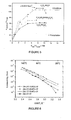
- Figure 1 shows the proton conductivity of poly (4-vinyl-IH-1, 2,3-triazole) in dir air from room temperature to 120°C, compared with poly (4-vinyl-IH-imidazole) from Solid State Ion. 138, 259-265 (2001 ).
- Sulfonate polysulfone was prepared by using chlorosulfonic acid in dichloroethane following the procedure of Johnson et al. (J. Polyya. Sci., Polyn, Chem. Ed. 1984, 22, 721 ). Excess chlorosulfonic acid was removed by washing products in the dichloroethane, ethanol and deionized water for several times. The sPSU was dried in the oven at 120°C for two weeks over P205 and then kept in a desiccator. Ion-Exchange Capacity (IEC) of sPSU was determined by 1 H NMR and back titration.
- IEC Ion-Exchange Capacity
- Figure 2 shows proton conductivity of s-PSU doped with 1H-1,2,3-triazole in anhydrous state. Proton conductivity of the materials is 0.01 S/cm at 120°C and 10 - 4 S/cm at room temperature.
- Figure 3 shows proton conductivity of s-PSU doped with 1 H-1,2,4-triazole in anhydrous state. Proton conductivity of the materials is 5 x 10 -3 S/cm at 140°C and 1.5 x 10 -3 S/cm at 100°C.
- Figure 4 presents the proton conductivity of the mixtures of 4TriC4 and C 12 PhSO 3 H in anhydrous state.
- the conductivities of 1 H-1,2,3-triazole doped with different types of acids and of different concentrations were measured at room temperature under anhydrous condition. The resulted mixture showed high ionic conductivity.
- Figure 5 shows the conductivity ratio of the acid-triazole mixture to the pure 1H-1,2,3-triazole ( ⁇ triazole+acid/ ⁇ triazole ) against the concentration ratio of acid to the triazole (C acid /C triazole x 100).
- the highest conductivity of acid-triazole mixture is about 0.015 S/cm at room temperature under anhydrous condition.
- Hybrid inorganic-organic copolymer membranes with grafted 1H-1,2,4-triazole and phosphonic acid :
- the membranes were dried at 60°C for 3 days, at 80°C for 3 hours, and then at 100 °C for 1 hour to evaporate the organic solvents and water.
- the samples were labeled by their mole composition as x MDSPPO-y TEOS-z Si4Tri-m H 3 PO 4 , where x, y, and z represent the moles of Si from MDSPPO, TEOS, and Si4Tri, an m is the moles of H 3 PO 4 , respectively.
- the value of x is 1-2, y 2-4, z 3-6, and m 3-8.
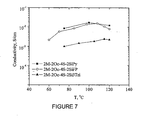
- the proton conductivity varied from 10 -7 S/cm to 10 -2 S/cm from room temperature to 150°C in anhydrous state.
- the membranes were dried at 60°C for 3 days, at 80°C for 3 hours, and then at 100 °C for 1 hour to evaporate the organic solvents and water.
- the samples were labeled by their mole composition as x M-y Oc -z SiPy-m S, where x, y, z, and m represent the moles of Si from M, Oc, PPr, and S, respectively.
- the value of x is 2-4, y 1-2, z 2-6, and m 2-6.
- These membranes are thermally stable up to 240°C in dry air.
- the proton conductivity varied from 10 -7 S/cm to 10 -1 S/cm from room temperature to 160 °C in varying relative humidity.
- Hybrid inorganic-organic copolymer membranes with 1H-1,2,3-triazole terminated side chain and -SO 3 H group terminated side chain 3-(trihydroxysilyl)-1-propane sulfonic acid (S), 5-(4-(2-(trimethoxysilyl)ethyl)benzylthio)-1H-1,2,3-triazole (Si3Tri), bis((3-methyldimethoxysilyl)propyl)polypropylene oxide (M), and bis(triethoxysilyl)octane (Oc) were dissolved in ethanol by stirring. 0.5 N HCl aqueous solution was added dropwise to the mixture, and further stirred for 6 hours.
- the membranes were dried at 60°C for 3 days, at 80°C for 3 hours, and then at 100 °C for 1 hour to evaporate the organic solvents and water.
- the samples were labeled by their mole composition as x M-y Oc -z Si3Tri-m S, where x, y, z, and m represent the moles of Si from M, Oc, Si3Tri, and S, respectively.
- the value of x is 2-4, y 1-2, z 2-6, and m 2-6.
- These membranes are thermally stable up to 240 °C in dry air.
- the proton conductivity is from 10 -7 S/cm to 10 -1 S/cm from room temperature to 160 °C in low relative humidity.
- the water amount added was 4 times of the total Si in mole.
- the membranes were dried at 60°C for 3 days, at 80°C for 3 hours, and then at 100°C for 1 hour to evaporate the organic solvents and water.
- the samples were labeled by their mole composition as x M-y Oc -z SiFP-m S, where x, y, z, and m represent the moles of Si from M, Oc, SiFP, and S, respectively.
- the value of x is 2-4, y is 1-2, z is 2-6, and m is 2-6.
- These membranes are thermally stable up to 240 °C in dry air.
- the proton conductivity varied from 10-7 S/cm to 10-1 S/cm from room temperature to 160°C in low relative humidity.
- Example compounds according to the present invention include heterocycles, such as nitrogen containing heterocycles.
- Heterocycles can be 5- or 6- membered single ring structures, larger ring structures, multiple ring structures, or some other ring structure, and each heterocycle may include, for example, 1, 2, 3, or more nitrogen atoms. In other examples, one or more other atoms providing a lone pair of electrons may be included in a ring structure.
- New thermally stable heterocycle containing compounds can replace water in a polymer electrolyte membrane fuel cell (PEM FC) system, allowing higher operation temperature.
- PEM FC polymer electrolyte membrane fuel cell
- an improved PEM comprises a polymer membrane, an acid group, and a compound including two or more nitrogen-containing heterocycles interconnected by organic chains.
- the acid group may be part of a free acid molecule, or be bound to the polymer membrane.
- the polymer membrane may include a polymer according to the present invention, a polymer according to one of our co-pending applications, or a polymer known in the art, such as NafionTM.
- nitrogen-containing heterocycles include pyrazine, pyrazole, pyridazine, pyridine, pyrimidine, and pyrrole, and fused ring structures such as pyrrolizine, quinazoline, quinoline, quinolizine, quinoxaline, phenanthroline, phenazine, cinnoline, phthalazine, and the like.
- pyrrolizine quinazoline, quinoline, quinolizine, quinoxaline, phenanthroline, phenazine, cinnoline, phthalazine, and the like.
- Nitrogen-containing heterocycles may further include oxygen, sulfur, selenium, other chalcogenides, or other non-carbon elements within a ring structure.
- Nitrogen containing heterocycles may be halogenated, for example fluorinated.
- Heterocycles may be nitrogen-containing, oxygen-containing, or sulfur-containing.
- Compounds according to the present invention may include heterocycles, the heterocycles including one or more non-carbon atoms such as nitrogen, oxygen, sulfur and/or other non-carbon atoms.
- Heterocycles may be aromatic or non-aromatic, though aromatic heterocycles are preferred.
- Heterocycles may be halogenated, for example, fluorinated. Other substituents are discussed below.
- Heterocycles may be substituted in one or more substitutable positions, for example with a group selected from: hydroxy, amino, hydrogen, halogen (chloro-, fluoro-, iodo-, bromo-), methyl or other alkyl, aromatic, alkenyl, methoxy or other alkoxy, nitro, nitrobenzyl or other aromatic derivative, ester, sulfone, ketone, thio, thiol, amyl, allyl, allylthio, allyloxy, cyano, silyl, or other group or combination of groups. If there is more than one substituent, the substituents may be the same or different. Substituents may be chosen so as to lower pKa.
- Example compounds according to the present invention include a nitrogen containing heterocycle having a pKa of equal to or less than 7 (corresponding to imidazole), for example having a pKa of equal to or less than approximately 5.2 (corresponding to pyridine), for example, a pKa equal to or less than approximately 2.4 (corresponding to 1H-1,2,4-triazole), for example, a pKa equal to or less than approximately 1.2 (corresponding to 1H-1,2,3-triazole).
- Tables of pKa for various heterocycles are known in the chemical art, and will not be reproduced here.
- the pKa used may be for the heterocycle ring structure alone, or for a molecule or analogous moiety containing the heterocycle (for example, a polymer side chain).
- a heterocycle pKa is chosen so as to be equal to or less than the approximate pH of the PEM environment.
- Example polymers according to the present invention may further include inorganic acid groups bound to a polymer backbone, and/or other proton solvent groups such as imidazole and derivatives thereof, such as fluorinated imidazole, for example as described in our co-pending patent applications.
- ion-conducting membranes such as proton-conducting membranes and alkali ion conducting membranes.
- Other PEM applications are disclosed in our co-pending applications, or will be clear to those skilled in the art.
- Improved fuel cells can be fabricated using PEMs at least in part including (or synthesized using) compounds disclosed herein.
- Other applications may include direct methanol fuel cells, electrochromic cells, capacitors and other electrochemical devices.
- PEMs including polymers discussed here provide high proton conductivity in a dry atmosphere and at higher temperatures; good mechanical properties; and high thermal stability.
Landscapes
- Chemical & Material Sciences (AREA)
- Organic Chemistry (AREA)
- Chemical Kinetics & Catalysis (AREA)
- Engineering & Computer Science (AREA)
- Manufacturing & Machinery (AREA)
- Sustainable Development (AREA)
- Life Sciences & Earth Sciences (AREA)
- Polymers & Plastics (AREA)
- Medicinal Chemistry (AREA)
- Health & Medical Sciences (AREA)
- Sustainable Energy (AREA)
- Electrochemistry (AREA)
- General Chemical & Material Sciences (AREA)
- Crystallography & Structural Chemistry (AREA)
- Inorganic Chemistry (AREA)
- Materials Engineering (AREA)
- Conductive Materials (AREA)
- Manufacture Of Macromolecular Shaped Articles (AREA)
- Fuel Cell (AREA)
- Silicon Polymers (AREA)
- Compositions Of Macromolecular Compounds (AREA)
- Addition Polymer Or Copolymer, Post-Treatments, Or Chemical Modifications (AREA)
- Treatments Of Macromolecular Shaped Articles (AREA)
Applications Claiming Priority (4)
| Application Number | Priority Date | Filing Date | Title |
|---|---|---|---|
| US53964104P | 2004-01-27 | 2004-01-27 | |
| US61481404P | 2004-09-30 | 2004-09-30 | |
| US11/044,527 US7576165B2 (en) | 2004-01-27 | 2005-01-26 | Heterocycle grafted monomers and related polymers and hybrid inorganic-organic polymer membranes |
| PCT/US2005/002922 WO2005072413A2 (en) | 2004-01-27 | 2005-01-27 | Heterocycle grafted monomers and related polymers and hybrid inorganic-organic polymer membranes |
Publications (3)
| Publication Number | Publication Date |
|---|---|
| EP1713794A2 EP1713794A2 (en) | 2006-10-25 |
| EP1713794A4 EP1713794A4 (en) | 2010-04-28 |
| EP1713794B1 true EP1713794B1 (en) | 2014-05-07 |
Family
ID=34831063
Family Applications (1)
| Application Number | Title | Priority Date | Filing Date |
|---|---|---|---|
| EP05712383.8A Expired - Lifetime EP1713794B1 (en) | 2004-01-27 | 2005-01-27 | Heterocycle grafted monomers and related polymers and hybrid inorganic-organic polymer membranes |
Country Status (5)
| Country | Link |
|---|---|
| US (1) | US7576165B2 (https=) |
| EP (1) | EP1713794B1 (https=) |
| JP (1) | JP5171042B2 (https=) |
| CN (1) | CN1926131B (https=) |
| WO (1) | WO2005072413A2 (https=) |
Cited By (1)
| Publication number | Priority date | Publication date | Assignee | Title |
|---|---|---|---|---|
| US12486399B2 (en) | 2021-08-04 | 2025-12-02 | Toyota Jidosha Kabushiki Kaisha | Proton conductive material |
Families Citing this family (33)
| Publication number | Priority date | Publication date | Assignee | Title |
|---|---|---|---|---|
| US20060083976A1 (en) * | 2004-06-09 | 2006-04-20 | California Institute Of Technology | Substituted nitrogen heterocycles as proton carriers for water-free proton exchange membranes for fuel cells |
| US7208243B2 (en) * | 2004-12-01 | 2007-04-24 | Toyota Technical Center Usa, Inc. | Proton exchange membranes using cycloaddition reaction between azide and alkyne containing components |
| JP5100383B2 (ja) | 2005-07-15 | 2012-12-19 | Jsr株式会社 | 固体高分子型燃料電池用電極電解質 |
| US20070066762A1 (en) * | 2005-09-22 | 2007-03-22 | Acosta Erick J | Triazole-containing fluorinated polymers |
| US7977392B2 (en) | 2005-12-22 | 2011-07-12 | Daimler Ag | Water insoluble additive for improving conductivity of an ion exchange membrane |
| US7964651B2 (en) * | 2006-12-21 | 2011-06-21 | Toyota Motor Engineering & Manufacturing North America, Inc. | Sulfonyl grafted heterocycle materials for proton conducting electrolytes |
| FR2921517B1 (fr) * | 2007-09-26 | 2010-12-03 | Commissariat Energie Atomique | Membranes conductrices de protons pour pile a combustible presentant un gradient de protons et procedes de preparation desdites membranes |
| US20090269644A1 (en) * | 2008-04-24 | 2009-10-29 | 3M Innovative Properties Company | Proton conducting materials |
| US7947410B2 (en) * | 2008-08-22 | 2011-05-24 | Toyota Motor Engineering & Manufacturing North America, Inc. | Fuel cell electrodes with triazole modified polymers and membrane electrode assemblies incorporating same |
| WO2010104837A1 (en) | 2009-03-11 | 2010-09-16 | Isp Investments Inc. | Functionalized 4-and 5-vinyl substituted regioisomers of 1,2,3-triazoles via 1,3-dipolar cycloaddition and polymers thereof |
| EP2451286B8 (en) * | 2009-07-08 | 2018-04-04 | ISP Investments LLC | 4- and 5 substituted 1,2,3- triazole moieties with at least one remote polymerizable moiety and polymers thereof |
| US20110045381A1 (en) * | 2009-08-18 | 2011-02-24 | Gm Global Technology Operations, Inc. | Hydrocarbon PEM Membranes with Perfluorosulfonic Acid Groups for Automotive Fuel Cells |
| US9101886B2 (en) | 2009-11-10 | 2015-08-11 | Daimler Ag | Composite proton conducting membrane with low degradation and membrane electrode assembly for fuel cells |
| US20110111321A1 (en) * | 2009-11-10 | 2011-05-12 | Daimler Ag | Composite proton conducting membrane with low degradation and membrane electrode assembly for fuel cells |
| US8519074B2 (en) * | 2010-01-15 | 2013-08-27 | The University of Massachusettes | Comb polymers for supramolecular nanoconfinement |
| KR101767370B1 (ko) | 2011-07-29 | 2017-08-24 | 코오롱인더스트리 주식회사 | 연료전지용 고분자 전해질막 및 그 제조방법 |
| FR2992650B1 (fr) * | 2012-06-29 | 2014-08-08 | Peugeot Citroen Automobiles Sa | Procede de synthese de polymeres et leur utilisation pour realiser des membranes pour piles a combustible fonctionnant a faible humidite relative |
| CN103396551B (zh) * | 2012-09-14 | 2015-09-30 | 深圳市泰康新材料科技有限公司 | 一种咪唑基改性硅油及其制备与应用 |
| CN102945975A (zh) * | 2012-12-10 | 2013-02-27 | 厦门大学 | 吡啶鎓盐聚合物阴离子交换膜及其制备方法 |
| CN103346341A (zh) * | 2013-06-08 | 2013-10-09 | 上海大学 | 酸碱复合型高温质子交换膜及其制备方法 |
| CN103755650B (zh) * | 2013-10-24 | 2016-03-30 | 上海大学 | 三唑官能化的4,4’-二氟二苯砜类化合物及其合成方法 |
| WO2017155648A2 (en) | 2016-02-03 | 2017-09-14 | Camx Power, L.L.C. | Bipolar ionomer membrane |
| US10950882B2 (en) * | 2018-02-05 | 2021-03-16 | Toyota Jidosha Kabushiki Kaisha | Proton-conductive membrane and fuel cell |
| CN108417870B (zh) * | 2018-03-13 | 2021-03-23 | 中国科学院上海有机化学研究所 | 一种有机高温质子交换膜及其制备方法 |
| CN108777314B (zh) * | 2018-05-29 | 2020-08-07 | 中国科学院上海有机化学研究所 | 一种复合型有机膦酸高温质子交换膜及其制备方法 |
| CN108384170B (zh) * | 2018-05-29 | 2020-03-10 | 中国科学院上海有机化学研究所 | 一种交联型有机膦酸高温质子交换膜及其制备方法 |
| CN108666603B (zh) * | 2018-05-29 | 2020-03-10 | 中国科学院上海有机化学研究所 | 一种有机膦酸高温质子交换膜及其制备方法 |
| CN108598532B (zh) * | 2018-05-29 | 2020-08-07 | 中国科学院上海有机化学研究所 | 一种燃料电池用有机膦酸高温质子交换膜及其制备方法 |
| CN108767298B (zh) * | 2018-05-29 | 2020-10-30 | 中国科学院上海有机化学研究所 | 一种有机高分子交联的有机膦酸高温质子交换膜及其制备方法 |
| JP7103912B2 (ja) * | 2018-10-24 | 2022-07-20 | トヨタ自動車株式会社 | 橋架け構造を有するプロトン伝導膜及び燃料電池 |
| AU2020391106B2 (en) | 2019-11-26 | 2024-03-21 | Gilead Sciences, Inc. | Processes and intermediates for preparing MCL1 inhibitors |
| US20240343696A1 (en) * | 2021-07-05 | 2024-10-17 | Yissum Research Development Company Of The Hebrew University Of Jerusalem Ltd. | Compounds and uses thereof in the treatment and prevention of diseases and conditions associate with or aggravated by impaired mitophagy or oxidative stress |
| US12278363B1 (en) | 2024-04-29 | 2025-04-15 | Camx Power, Llc | Multiple morphology composite cathode materials providing high energy and long cycle life and cells employing the same |
Family Cites Families (40)
| Publication number | Priority date | Publication date | Assignee | Title |
|---|---|---|---|---|
| US3122581A (en) | 1961-10-27 | 1964-02-25 | Union Carbide Corp | Preparation of phosphorus-containing organosilicon compounds |
| US3408420A (en) | 1964-04-30 | 1968-10-29 | Du Pont | Silane-modified olefinic copolymers |
| JPS60235134A (ja) | 1984-05-08 | 1985-11-21 | Fuji Photo Film Co Ltd | 写真要素 |
| GB8418591D0 (en) | 1984-07-20 | 1984-08-22 | Bp Chem Int Ltd | Polymer composition |
| FR2601017B1 (fr) | 1986-07-02 | 1988-09-23 | Centre Nat Rech Scient | Nouvelles compositions a base de derives de silice modifiee par des groupements organiques, leur preparation et leur application, notamment comme conducteurs protoniques |
| GB9118597D0 (en) | 1991-08-30 | 1991-10-16 | Biocompatibles Ltd | Polymer treatments |
| EP0532408A1 (fr) * | 1991-09-13 | 1993-03-17 | Saint-Gobain Vitrage International | Polymère conducteur protonique, application en tant qu'électrolyte dans des dispositifs électrochimiques |
| CH691209A5 (de) | 1993-09-06 | 2001-05-15 | Scherrer Inst Paul | Herstellungsverfahren für einen Polmerelektrolyten und elektrochemische Zelle mit diesem Polymerelektrolyten. |
| US5389726A (en) | 1994-05-05 | 1995-02-14 | Dow Corning Corporation | Nail lacquer primary film forming resin |
| DE19500253A1 (de) | 1995-01-05 | 1996-07-11 | Wacker Chemie Gmbh | Phosphorhaltige Organosiliciumverbindungen |
| US5548055A (en) | 1995-01-13 | 1996-08-20 | Sri International | Single-ion conducting solid polymer electrolytes |
| US5840800A (en) | 1995-11-02 | 1998-11-24 | Dow Corning Corporation | Crosslinked emulsions of pre-formed silicon modified organic polymers |
| FR2748485B1 (fr) | 1996-05-07 | 1998-08-07 | Commissariat Energie Atomique | Polyimides sulfones, membranes preparees avec ceux-ci, et dispositif de pile a combustible comprenant ces membranes |
| DE19632285A1 (de) * | 1996-08-09 | 1998-02-19 | Hoechst Ag | Protonenleiter mit einer Temperaturbeständigkeit in einem weiten Bereich und guten Protonenleitfähigkeiten |
| US6201064B1 (en) | 1997-11-06 | 2001-03-13 | Kaneka Corporation | Crosslinked rubber particles, graft copolymer particles and thermoplastic resin composition |
| US6096899A (en) | 1998-04-14 | 2000-08-01 | The Regents Of The University Of Michigan | Cylic imidazole compounds having relatively low hydrogen content and relatively high nitrogen content and polymers formed therefrom |
| US6124060A (en) | 1998-05-20 | 2000-09-26 | Honda Giken Kogyo Kabushiki Kaisha | Solid polymer electrolytes |
| US6310110B1 (en) | 1999-07-30 | 2001-10-30 | Michael A. Markowitz | Molecularly-imprinted material made by template-directed synthesis |
| US6488343B1 (en) | 1999-08-19 | 2002-12-03 | Bendix Commercial Vehicle Systems Llc | Parking control circuit |
| JP4539896B2 (ja) | 1999-09-17 | 2010-09-08 | 独立行政法人産業技術総合研究所 | プロトン伝導性膜、その製造方法及びそれを用いた燃料電池 |
| EP1230278B1 (en) | 1999-11-08 | 2005-06-01 | E.I. Du Pont De Nemours And Company | Moisture curable, melt processible graft ethylene copolymers |
| US6423784B1 (en) | 1999-12-15 | 2002-07-23 | 3M Innovative Properties Company | Acid functional fluoropolymer membranes and method of manufacture |
| JP2001199961A (ja) | 2000-01-21 | 2001-07-24 | Fuji Photo Film Co Ltd | 重合性溶融塩モノマー、電解質組成物および電気化学電池 |
| DE10017654A1 (de) | 2000-04-08 | 2001-10-18 | Degussa | Organosiliciumverbindungen |
| DE10021106A1 (de) * | 2000-05-02 | 2001-11-08 | Univ Stuttgart | Polymere Membranen |
| DE10021104A1 (de) | 2000-05-02 | 2001-11-08 | Univ Stuttgart | Organisch-anorganische Membranen |
| JP3513097B2 (ja) * | 2000-09-29 | 2004-03-31 | 株式会社東芝 | プロトン伝導性膜およびそれを用いた燃料電池 |
| US20020127474A1 (en) | 2001-01-09 | 2002-09-12 | E.C.R.-Electro-Chemical Research Ltd. | Proton-selective conducting membranes |
| EP1377628B1 (de) | 2001-03-13 | 2011-02-02 | Fraunhofer-Gesellschaft zur Förderung der angewandten Forschung e.V. | Phosphorhaltige, organisch polymerisierbare silane und damit hergestellte kieselsäure-polykondensate |
| US6713643B2 (en) | 2001-05-24 | 2004-03-30 | Board Of Trustees Of Michigan State University | Ultrastable organofunctional microporous to mesoporous silica compositions |
| US6756436B2 (en) | 2001-06-26 | 2004-06-29 | Acushnet Company | Golf balls comprising highly-neutralized acid polymers |
| JP4004769B2 (ja) * | 2001-10-17 | 2007-11-07 | Necトーキン株式会社 | 電解液、並びにこれを用いた電気化学セル |
| DE10163518A1 (de) | 2001-12-21 | 2003-07-10 | Fraunhofer Ges Forschung | Protonenleitfähige Membranen/Schichten und Verfahren zu deren Herstellung |
| US6716908B2 (en) | 2002-01-30 | 2004-04-06 | Dow Corning Corporation | Alkoxysilyl functional silicone based materials |
| CA2475501C (en) | 2002-02-06 | 2011-03-15 | Battelle Memorial Institute | Polymer electrolyte membranes for use in fuel cells |
| US7740967B2 (en) | 2002-07-04 | 2010-06-22 | Ben Gurion University Of The Negev Research And Development Authority | Highly conductive ordered ion exchange membranes |
| JP3884340B2 (ja) | 2002-07-10 | 2007-02-21 | 本田技研工業株式会社 | プロトン伝導性高分子固体電解質 |
| CN1809606B (zh) | 2003-05-28 | 2010-10-27 | 美国丰田技术中心公司 | 由具有官能团的硅烷形成的传导膜 |
| WO2005001037A2 (en) | 2003-05-28 | 2005-01-06 | Toyota Technical Center, Usa, Inc. | Electrolyte membranes based on alkyloxysilane grafted thermoplastic polymers |
| US7183370B2 (en) | 2003-09-11 | 2007-02-27 | Toyota Technical Center Usa, Inc | Phosphonic-acid grafted hybrid inorganic-organic proton electrolyte membranes (PEMs) |
-
2005
- 2005-01-26 US US11/044,527 patent/US7576165B2/en not_active Expired - Lifetime
- 2005-01-27 EP EP05712383.8A patent/EP1713794B1/en not_active Expired - Lifetime
- 2005-01-27 CN CN2005800064394A patent/CN1926131B/zh not_active Expired - Fee Related
- 2005-01-27 WO PCT/US2005/002922 patent/WO2005072413A2/en not_active Ceased
- 2005-01-27 JP JP2006551531A patent/JP5171042B2/ja not_active Expired - Fee Related
Cited By (1)
| Publication number | Priority date | Publication date | Assignee | Title |
|---|---|---|---|---|
| US12486399B2 (en) | 2021-08-04 | 2025-12-02 | Toyota Jidosha Kabushiki Kaisha | Proton conductive material |
Also Published As
| Publication number | Publication date |
|---|---|
| US20060111530A1 (en) | 2006-05-25 |
| CA2555273C (en) | 2014-10-28 |
| CN1926131B (zh) | 2012-10-31 |
| EP1713794A4 (en) | 2010-04-28 |
| JP2007523066A (ja) | 2007-08-16 |
| WO2005072413A8 (en) | 2006-06-29 |
| US7576165B2 (en) | 2009-08-18 |
| CA2555273A1 (en) | 2005-08-11 |
| WO2005072413A2 (en) | 2005-08-11 |
| JP5171042B2 (ja) | 2013-03-27 |
| EP1713794A2 (en) | 2006-10-25 |
| WO2005072413A3 (en) | 2006-03-30 |
| CN1926131A (zh) | 2007-03-07 |
Similar Documents
| Publication | Publication Date | Title |
|---|---|---|
| EP1713794B1 (en) | Heterocycle grafted monomers and related polymers and hybrid inorganic-organic polymer membranes | |
| JP5085132B2 (ja) | イミダゾール環末端可撓性分岐をグラフトしたハイブリッド無機−有機ポリマーを基剤とするポリマー電解質膜(pem) | |
| US7902299B2 (en) | Single ion conductor cross-linked polymeric networks | |
| US7659026B2 (en) | Fluorinated sulfonamide compounds and polymer electrolyte membranes prepared therefrom for use in electrochemical cells | |
| US7470761B2 (en) | Proton-conductive membranes and layers and methods for their production | |
| JP2007523066A5 (https=) | ||
| US7906608B2 (en) | Nitrogenated aromatic compound, process for production of the same, polymer, and proton conductive membrane | |
| CN110982081B (zh) | 一种膦酸化(聚烯烃-g-聚苯并咪唑)接枝共聚物及其制备方法与应用 | |
| Cho et al. | Synthesis and characterization of poly (arylene ether sulfone) copolymers with sulfonimide side groups for a proton‐exchange membrane | |
| US20040225153A1 (en) | Synthesis of polyphosphazenes with sulfonimide side groups | |
| US20080032184A1 (en) | Stable Trifluorostyrene Containing Compounds, And Their Use In Polymer Electroyte Membranes | |
| US20070265426A1 (en) | Synthesis of polyphosphazenes with sulfonimide side groups | |
| Frutsaert et al. | Synthesis and properties of new fluorinated polymers bearing pendant imidazole groups for fuel cell membranes operating over a broad relative humidity range | |
| CA2555273E (en) | Heterocycle grafted monomers and related polymers and hybrid inorganic-organic polymer membranes | |
| US20060178411A1 (en) | Sulfonimide containing compounds and their use in polymer electrolyte membranes for electrochemical cells | |
| KR20220038839A (ko) | 폴리플로우렌계 이오노머를 포함하는 전해질막 및 이의 제조방법 | |
| US20110098370A1 (en) | Sulfonated poly 2-(phenyl ethyl) siloxane polymer electrolyte membranes | |
| US7977393B2 (en) | Composition containing oxocarbon and use thereof | |
| US8741454B2 (en) | Proton exchange membrane for fuel cell | |
| CN117916007A (zh) | 二氧化碳吸收剂 | |
| KR102011418B1 (ko) | 고분자 전해질막의 제조방법, 이를 이용하여 제조된 고분자 전해질막, 상기 고분자 전해질막을 포함하는 막전극 접합체 및 상기 막전극 접합체를 포함하는 연료전지 | |
| JP5109367B2 (ja) | 芳香族スルホン酸イミド誘導体、芳香族スルホン酸イミド含有ブロック共重合体、スルホン酸イミドスルホン酸共重合体を有するポリアリーレン、芳香族スルホン酸イミド誘導体を含む高分子固体電解質、スルホン酸イミドスルホン酸含有ポリアリーレンを含む高分子固体電解質、それらを含むプロトン伝導膜 | |
| KR20220149299A (ko) | 연료전지 양성자 교환막용 폴리(벤조페논)계 고분자, 이를 포함하는 연료전지용 고분자 양성자 교환막 및 연료전지 | |
| Ekanayake | Poly (organophosphazenes) with azolylmethylphenoxy and pyridinoxy side groups to be used as proton exchange membranes in fuel cells | |
| KR20180083612A (ko) | 중합체 및 이를 포함하는 막 |
Legal Events
| Date | Code | Title | Description |
|---|---|---|---|
| PUAI | Public reference made under article 153(3) epc to a published international application that has entered the european phase |
Free format text: ORIGINAL CODE: 0009012 |
|
| 17P | Request for examination filed |
Effective date: 20060821 |
|
| AK | Designated contracting states |
Kind code of ref document: A2 Designated state(s): AT BE BG CH CY CZ DE DK EE ES FI FR GB GR HU IE IS IT LI LT LU MC NL PL PT RO SE SI SK TR |
|
| AX | Request for extension of the european patent |
Extension state: AL BA HR LV MK YU |
|
| R17D | Deferred search report published (corrected) |
Effective date: 20060629 |
|
| DAX | Request for extension of the european patent (deleted) | ||
| RBV | Designated contracting states (corrected) |
Designated state(s): DE FR GB IT |
|
| A4 | Supplementary search report drawn up and despatched |
Effective date: 20100331 |
|
| 17Q | First examination report despatched |
Effective date: 20110111 |
|
| GRAP | Despatch of communication of intention to grant a patent |
Free format text: ORIGINAL CODE: EPIDOSNIGR1 |
|
| INTG | Intention to grant announced |
Effective date: 20131216 |
|
| GRAS | Grant fee paid |
Free format text: ORIGINAL CODE: EPIDOSNIGR3 |
|
| GRAA | (expected) grant |
Free format text: ORIGINAL CODE: 0009210 |
|
| AK | Designated contracting states |
Kind code of ref document: B1 Designated state(s): DE FR GB IT |
|
| REG | Reference to a national code |
Ref country code: GB Ref legal event code: FG4D |
|
| REG | Reference to a national code |
Ref country code: DE Ref legal event code: R096 Ref document number: 602005043530 Country of ref document: DE Effective date: 20140612 |
|
| REG | Reference to a national code |
Ref country code: DE Ref legal event code: R082 Ref document number: 602005043530 Country of ref document: DE Representative=s name: GESKES PATENT- UND RECHTSANWAELTE, DE |
|
| RAP2 | Party data changed (patent owner data changed or rights of a patent transferred) |
Owner name: TOYOTA JIDOSHA KABUSHIKI KAISHA Owner name: GEORGIA TECH RESEARCH CORPORATION |
|
| REG | Reference to a national code |
Ref country code: GB Ref legal event code: 732E Free format text: REGISTERED BETWEEN 20140911 AND 20140917 |
|
| REG | Reference to a national code |
Ref country code: DE Ref legal event code: R082 Ref document number: 602005043530 Country of ref document: DE Representative=s name: KUHNEN & WACKER PATENT- UND RECHTSANWALTSBUERO, DE Effective date: 20140901 Ref country code: DE Ref legal event code: R081 Ref document number: 602005043530 Country of ref document: DE Owner name: TOYOTA JIDOSHA KABUSHIKI KAISHA, TOYOTA-SHI, JP Free format text: FORMER OWNERS: TOYOTA TECHNICAL CENTER USA, INC., ANN ARBOR, MICH., US; GEORGIA TECH RESEARCH CORP., ATLANTA, GA., US Effective date: 20140901 Ref country code: DE Ref legal event code: R081 Ref document number: 602005043530 Country of ref document: DE Owner name: GEORGIA TECH RESEARCH CORP., ATLANTA, US Free format text: FORMER OWNERS: TOYOTA TECHNICAL CENTER USA, INC., ANN ARBOR, MICH., US; GEORGIA TECH RESEARCH CORP., ATLANTA, GA., US Effective date: 20140901 Ref country code: DE Ref legal event code: R081 Ref document number: 602005043530 Country of ref document: DE Owner name: TOYOTA JIDOSHA KABUSHIKI KAISHA, TOYOTA-SHI, JP Free format text: FORMER OWNER: TOYOTA TECHNICAL CENTER USA, IN, GEORGIA TECHNOLOGY RESEARCH COR, , US Effective date: 20140507 Ref country code: DE Ref legal event code: R081 Ref document number: 602005043530 Country of ref document: DE Owner name: GEORGIA TECH RESEARCH CORP., ATLANTA, US Free format text: FORMER OWNER: TOYOTA TECHNICAL CENTER USA, IN, GEORGIA TECHNOLOGY RESEARCH COR, , US Effective date: 20140507 Ref country code: DE Ref legal event code: R082 Ref document number: 602005043530 Country of ref document: DE Representative=s name: GESKES PATENT- UND RECHTSANWAELTE, DE Effective date: 20140901 Ref country code: DE Ref legal event code: R081 Ref document number: 602005043530 Country of ref document: DE Owner name: TOYOTA JIDOSHA KABUSHIKI KAISHA, TOYOTA-SHI, JP Free format text: FORMER OWNER: TOYOTA TECHNICAL CENTER USA, IN, GEORGIA TECH RESEARCH CORP., , US Effective date: 20140901 Ref country code: DE Ref legal event code: R081 Ref document number: 602005043530 Country of ref document: DE Owner name: GEORGIA TECH RESEARCH CORP., ATLANTA, US Free format text: FORMER OWNER: TOYOTA TECHNICAL CENTER USA, IN, GEORGIA TECH RESEARCH CORP., , US Effective date: 20140901 Ref country code: DE Ref legal event code: R081 Ref document number: 602005043530 Country of ref document: DE Owner name: GEORGIA TECH RESEARCH CORP., ATLANTA, US Free format text: FORMER OWNERS: TOYOTA TECHNICAL CENTER USA, INC., ANN ARBOR, MICH., US; GEORGIA TECHNOLOGY RESEARCH CORP., ATLANTA, GA., US Effective date: 20140507 Ref country code: DE Ref legal event code: R081 Ref document number: 602005043530 Country of ref document: DE Owner name: TOYOTA JIDOSHA KABUSHIKI KAISHA, TOYOTA-SHI, JP Free format text: FORMER OWNERS: TOYOTA TECHNICAL CENTER USA, INC., ANN ARBOR, MICH., US; GEORGIA TECHNOLOGY RESEARCH CORP., ATLANTA, GA., US Effective date: 20140507 |
|
| REG | Reference to a national code |
Ref country code: DE Ref legal event code: R097 Ref document number: 602005043530 Country of ref document: DE |
|
| PLBE | No opposition filed within time limit |
Free format text: ORIGINAL CODE: 0009261 |
|
| STAA | Information on the status of an ep patent application or granted ep patent |
Free format text: STATUS: NO OPPOSITION FILED WITHIN TIME LIMIT |
|
| 26N | No opposition filed |
Effective date: 20150210 |
|
| REG | Reference to a national code |
Ref country code: DE Ref legal event code: R097 Ref document number: 602005043530 Country of ref document: DE Effective date: 20150210 |
|
| REG | Reference to a national code |
Ref country code: DE Ref legal event code: R082 Ref document number: 602005043530 Country of ref document: DE Representative=s name: KUHNEN & WACKER PATENT- UND RECHTSANWALTSBUERO, DE |
|
| REG | Reference to a national code |
Ref country code: FR Ref legal event code: PLFP Year of fee payment: 12 |
|
| REG | Reference to a national code |
Ref country code: FR Ref legal event code: PLFP Year of fee payment: 13 |
|
| REG | Reference to a national code |
Ref country code: FR Ref legal event code: PLFP Year of fee payment: 14 |
|
| PGFP | Annual fee paid to national office [announced via postgrant information from national office to epo] |
Ref country code: FR Payment date: 20211217 Year of fee payment: 18 Ref country code: GB Payment date: 20211209 Year of fee payment: 18 |
|
| PGFP | Annual fee paid to national office [announced via postgrant information from national office to epo] |
Ref country code: DE Payment date: 20211130 Year of fee payment: 18 |
|
| PGFP | Annual fee paid to national office [announced via postgrant information from national office to epo] |
Ref country code: IT Payment date: 20211213 Year of fee payment: 18 |
|
| REG | Reference to a national code |
Ref country code: DE Ref legal event code: R119 Ref document number: 602005043530 Country of ref document: DE |
|
| GBPC | Gb: european patent ceased through non-payment of renewal fee |
Effective date: 20230127 |
|
| PG25 | Lapsed in a contracting state [announced via postgrant information from national office to epo] |
Ref country code: GB Free format text: LAPSE BECAUSE OF NON-PAYMENT OF DUE FEES Effective date: 20230127 Ref country code: DE Free format text: LAPSE BECAUSE OF NON-PAYMENT OF DUE FEES Effective date: 20230801 |
|
| PG25 | Lapsed in a contracting state [announced via postgrant information from national office to epo] |
Ref country code: FR Free format text: LAPSE BECAUSE OF NON-PAYMENT OF DUE FEES Effective date: 20230131 |
|
| PG25 | Lapsed in a contracting state [announced via postgrant information from national office to epo] |
Ref country code: IT Free format text: LAPSE BECAUSE OF NON-PAYMENT OF DUE FEES Effective date: 20230127 |