EP1632289A1 - Katalysator für die herstellung von kohlenwasserstoff aus synthesegas und verfahren zur herstellung des katalysators - Google Patents
Katalysator für die herstellung von kohlenwasserstoff aus synthesegas und verfahren zur herstellung des katalysators Download PDFInfo
- Publication number
- EP1632289A1 EP1632289A1 EP04726307A EP04726307A EP1632289A1 EP 1632289 A1 EP1632289 A1 EP 1632289A1 EP 04726307 A EP04726307 A EP 04726307A EP 04726307 A EP04726307 A EP 04726307A EP 1632289 A1 EP1632289 A1 EP 1632289A1
- Authority
- EP
- European Patent Office
- Prior art keywords
- catalyst
- support
- mass
- hydrocarbon
- silica
- Prior art date
- Legal status (The legal status is an assumption and is not a legal conclusion. Google has not performed a legal analysis and makes no representation as to the accuracy of the status listed.)
- Ceased
Links
Images
Classifications
-
- C—CHEMISTRY; METALLURGY
- C10—PETROLEUM, GAS OR COKE INDUSTRIES; TECHNICAL GASES CONTAINING CARBON MONOXIDE; FUELS; LUBRICANTS; PEAT
- C10G—CRACKING HYDROCARBON OILS; PRODUCTION OF LIQUID HYDROCARBON MIXTURES, e.g. BY DESTRUCTIVE HYDROGENATION, OLIGOMERISATION, POLYMERISATION; RECOVERY OF HYDROCARBON OILS FROM OIL-SHALE, OIL-SAND, OR GASES; REFINING MIXTURES MAINLY CONSISTING OF HYDROCARBONS; REFORMING OF NAPHTHA; MINERAL WAXES
- C10G2/00—Production of liquid hydrocarbon mixtures of undefined composition from oxides of carbon
- C10G2/30—Production of liquid hydrocarbon mixtures of undefined composition from oxides of carbon from carbon monoxide with hydrogen
- C10G2/32—Production of liquid hydrocarbon mixtures of undefined composition from oxides of carbon from carbon monoxide with hydrogen with the use of catalysts
- C10G2/33—Production of liquid hydrocarbon mixtures of undefined composition from oxides of carbon from carbon monoxide with hydrogen with the use of catalysts characterised by the catalyst used
-
- B—PERFORMING OPERATIONS; TRANSPORTING
- B01—PHYSICAL OR CHEMICAL PROCESSES OR APPARATUS IN GENERAL
- B01J—CHEMICAL OR PHYSICAL PROCESSES, e.g. CATALYSIS OR COLLOID CHEMISTRY; THEIR RELEVANT APPARATUS
- B01J21/00—Catalysts comprising the elements, oxides, or hydroxides of magnesium, boron, aluminium, carbon, silicon, titanium, zirconium, or hafnium
- B01J21/06—Silicon, titanium, zirconium or hafnium; Oxides or hydroxides thereof
- B01J21/08—Silica
-
- B—PERFORMING OPERATIONS; TRANSPORTING
- B01—PHYSICAL OR CHEMICAL PROCESSES OR APPARATUS IN GENERAL
- B01J—CHEMICAL OR PHYSICAL PROCESSES, e.g. CATALYSIS OR COLLOID CHEMISTRY; THEIR RELEVANT APPARATUS
- B01J23/00—Catalysts comprising metals or metal oxides or hydroxides, not provided for in group B01J21/00
- B01J23/38—Catalysts comprising metals or metal oxides or hydroxides, not provided for in group B01J21/00 of noble metals
- B01J23/40—Catalysts comprising metals or metal oxides or hydroxides, not provided for in group B01J21/00 of noble metals of the platinum group metals
- B01J23/46—Ruthenium, rhodium, osmium or iridium
- B01J23/462—Ruthenium
-
- B—PERFORMING OPERATIONS; TRANSPORTING
- B01—PHYSICAL OR CHEMICAL PROCESSES OR APPARATUS IN GENERAL
- B01J—CHEMICAL OR PHYSICAL PROCESSES, e.g. CATALYSIS OR COLLOID CHEMISTRY; THEIR RELEVANT APPARATUS
- B01J23/00—Catalysts comprising metals or metal oxides or hydroxides, not provided for in group B01J21/00
- B01J23/70—Catalysts comprising metals or metal oxides or hydroxides, not provided for in group B01J21/00 of the iron group metals or copper
- B01J23/74—Iron group metals
- B01J23/75—Cobalt
-
- B—PERFORMING OPERATIONS; TRANSPORTING
- B01—PHYSICAL OR CHEMICAL PROCESSES OR APPARATUS IN GENERAL
- B01J—CHEMICAL OR PHYSICAL PROCESSES, e.g. CATALYSIS OR COLLOID CHEMISTRY; THEIR RELEVANT APPARATUS
- B01J37/00—Processes, in general, for preparing catalysts; Processes, in general, for activation of catalysts
- B01J37/06—Washing
-
- B—PERFORMING OPERATIONS; TRANSPORTING
- B01—PHYSICAL OR CHEMICAL PROCESSES OR APPARATUS IN GENERAL
- B01J—CHEMICAL OR PHYSICAL PROCESSES, e.g. CATALYSIS OR COLLOID CHEMISTRY; THEIR RELEVANT APPARATUS
- B01J37/00—Processes, in general, for preparing catalysts; Processes, in general, for activation of catalysts
- B01J37/34—Irradiation by, or application of, electric, magnetic or wave energy, e.g. ultrasonic waves ; Ionic sputtering; Flame or plasma spraying; Particle radiation
-
- B—PERFORMING OPERATIONS; TRANSPORTING
- B01—PHYSICAL OR CHEMICAL PROCESSES OR APPARATUS IN GENERAL
- B01J—CHEMICAL OR PHYSICAL PROCESSES, e.g. CATALYSIS OR COLLOID CHEMISTRY; THEIR RELEVANT APPARATUS
- B01J23/00—Catalysts comprising metals or metal oxides or hydroxides, not provided for in group B01J21/00
- B01J23/70—Catalysts comprising metals or metal oxides or hydroxides, not provided for in group B01J21/00 of the iron group metals or copper
- B01J23/76—Catalysts comprising metals or metal oxides or hydroxides, not provided for in group B01J21/00 of the iron group metals or copper combined with metals, oxides or hydroxides provided for in groups B01J23/02 - B01J23/36
- B01J23/78—Catalysts comprising metals or metal oxides or hydroxides, not provided for in group B01J21/00 of the iron group metals or copper combined with metals, oxides or hydroxides provided for in groups B01J23/02 - B01J23/36 with alkali- or alkaline earth metals
-
- B—PERFORMING OPERATIONS; TRANSPORTING
- B01—PHYSICAL OR CHEMICAL PROCESSES OR APPARATUS IN GENERAL
- B01J—CHEMICAL OR PHYSICAL PROCESSES, e.g. CATALYSIS OR COLLOID CHEMISTRY; THEIR RELEVANT APPARATUS
- B01J35/00—Catalysts, in general, characterised by their form or physical properties
- B01J35/40—Catalysts, in general, characterised by their form or physical properties characterised by dimensions, e.g. grain size
-
- B—PERFORMING OPERATIONS; TRANSPORTING
- B01—PHYSICAL OR CHEMICAL PROCESSES OR APPARATUS IN GENERAL
- B01J—CHEMICAL OR PHYSICAL PROCESSES, e.g. CATALYSIS OR COLLOID CHEMISTRY; THEIR RELEVANT APPARATUS
- B01J35/00—Catalysts, in general, characterised by their form or physical properties
- B01J35/60—Catalysts, in general, characterised by their form or physical properties characterised by their surface properties or porosity
- B01J35/61—Surface area
- B01J35/615—100-500 m2/g
-
- B—PERFORMING OPERATIONS; TRANSPORTING
- B01—PHYSICAL OR CHEMICAL PROCESSES OR APPARATUS IN GENERAL
- B01J—CHEMICAL OR PHYSICAL PROCESSES, e.g. CATALYSIS OR COLLOID CHEMISTRY; THEIR RELEVANT APPARATUS
- B01J35/00—Catalysts, in general, characterised by their form or physical properties
- B01J35/60—Catalysts, in general, characterised by their form or physical properties characterised by their surface properties or porosity
- B01J35/63—Pore volume
- B01J35/635—0.5-1.0 ml/g
-
- B—PERFORMING OPERATIONS; TRANSPORTING
- B01—PHYSICAL OR CHEMICAL PROCESSES OR APPARATUS IN GENERAL
- B01J—CHEMICAL OR PHYSICAL PROCESSES, e.g. CATALYSIS OR COLLOID CHEMISTRY; THEIR RELEVANT APPARATUS
- B01J35/00—Catalysts, in general, characterised by their form or physical properties
- B01J35/60—Catalysts, in general, characterised by their form or physical properties characterised by their surface properties or porosity
- B01J35/63—Pore volume
- B01J35/638—Pore volume more than 1.0 ml/g
Definitions
- the present invention relates to a catalyst for producing hydrocarbon from a syngas, which is suitable for a hydrogenation of carbon monoxide and a hydrocarbon production from carbon monoxide, a producing method of the catalyst, and a producing method of hydrocarbon using the catalyst.
- This Fischer-Tropsch synthesis reaction converting the syngas into hydrocarbon with a catalyst is an exothermic reaction, where it is extremely important to effectively remove reaction heat for a stable operation of the plant.
- time-proven reaction processes there are gas-phase synthesis processes (in a fixed bed, entrained bed, or fluid bed) and a liquid-phase synthesis process (in a slurry bed) having respective features.
- the liquid-phase synthesis process carried out in the slurry bed is gathering attentions and being researched and developed strenuously for the reason that it exhibits a higher heat removing efficiency but avoids the accumulation of generated high-boiling point hydrocarbon on the catalyst as well as a reactor tube plugging caused thereby.
- a higher catalytic activity is preferable, and especially, in the case of the slurry bed, there is a constraint that the concentration of slurry is needed to be a prescribed value or below so as to keep a favorable slurry state, so that the increase in the catalytic activity is an extremely important factor to increase a process design flexibility.
- the ever-reported catalytic activities of various types of catalysts for the Fischer- Tropsch synthesis are approximately 1 (kg - hydrocarbon/kg - catalyst ⁇ hour) at most in view of the production rate of liquid hydrocarbon of a carbon number of five or above, which cannot be said always enough from the above-described viewpoints (See Non-patent document 1).
- the particle diameter of the catalyst for the Fischer-Tropsch synthesis reaction is preferably small as practically as possible from the aspect of reducing a possibility in which the diffusions of heat and matters come to a rate-determining level.
- the Fischer-Tropsch synthesis reaction in the slurry bed out of the generated hydrocarbon, the high-boiling point hydrocarbon is accumulated in the reactor, inevitably requiring a solid-liquid separating operation for separating a product from the catalyst, so that there arises another problem that the catalyst of a too small particle diameter greatly reduces the efficiency of the separating operation.
- the catalyst for the slurry bed there should be an optimum particle diameter range, and generally, the range from about 20 ⁇ m to about 250 ⁇ m, or about 40 ⁇ m to about 150 ⁇ m as an average particle diameter, is considered to be desirable; however, as shown below, there may be a case where the catalyst is caused to be fractured and powdered to have a smaller particle diameter in the course of the reaction, requiring a caution.
- the operation is frequently performed at an extremely high material-gas superficial velocity (>0.1 m / second), so that the catalyst particles clash furiously with each other during the reaction to possibly reduce their particle diameters during the reaction when the physical strength and abrasion resistance (resistance to be powdered) are insufficient, causing an inconvenience sometimes in the separating operation.
- the current catalytic activity is not sufficient yet, and the catalyst with a higher catalytic activity has been demanded as a pressing need, also from a viewpoint of extending the design flexibility in the plant.
- the catalyst for the slurry bed is frequently put into practical use by being prepared through a size control by way of a grinding to have such an appropriate particle diameter as described above.
- a catalyst of a ground type frequently has a crack or sharp protrusion arisen originally and reveals a lesser mechanical strength and abrasion resistance, leaving a problem that the catalyst is forced to fracture to generate fine powders and makes it difficult to separate the generated high-boiling point hydrocarbon from the catalyst when used in the Fischer-Tropsch synthesis reaction in the slurry bed.
- An object of the present invention is to provide a catalyst for a Fischer-Tropsch synthesis, which brings a solution to the above-described problems and exhibits a high activity without deteriorating its catalytic strength and abrasion resistance; a producing method of the catalyst, and a producing method of hydrocarbon using the catalyst.
- the present invention relates to a catalyst for a Fischer-Tropsch synthesis exhibiting a high strength and activity, a producing method of the catalyst, and a producing method of hydrocarbon using the catalyst. More detail description will be presented hereinafter.
- the present inventors have found that a substantial increase in catalytic activity is possible by reducing the impurities, and that a catalyst with high strength and abrasive resistance can be produced without deteriorating the activity with the use of a specific support, to finally attain the present invention.
- a catalyst according to the present invention is not specifically limited to some one as long as the catalyst contains metal having an activity for a Fischer-Tropsch synthesis reaction, and those catalysts containing iron, cobalt, nickel, ruthenium and the like are acceptable, and as for a support, preferably, a selection is made from porous oxides or the like made of silica, alumina, titania and the like appropriately to use the selection for the catalyst support.
- a common impregnation method, an incipient wetness method, a precipitation method, an ion-exchange method and the like can be employed.
- a loading amount in that the amount changes depending on respective active metals in use, however, a range between a minimum amount exhibiting the activity or above and a loading amount, which causes a contribution efficiency down in a reaction due to a sharp drop in the dispersion of the active metal on a catalyst support, or below is acceptable.
- the amount when the cobalt is in use, the amount is in the range from 5 mass% to 50 mass%, and, preferably, from 10 mass% to 40 mass%. In the case of the amount below the range, enough activity cannot be obtained, and in the case of the amount above the range, the dispersion drops to lower utilization efficiency of the cobalt loaded on the catalyst support uneconomically, being unfavorable.
- the present inventors have found first that the reduction of impurities, which is other than the active metal and an element composing the support, in the catalyst to control the impurities to be within a certain range has a great effect to improve the activity.
- the silica in general, the silica frequently contains an alkali metal such as Na, an alkaline-earth metal such as Ca and Mg, and Fe, Al, and the like, as the impurities.
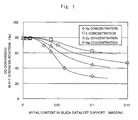
- the amount of impurities in the catalyst should be curbed to 0.15 mass% or below. If the impurity amount is above the range, the activity decreases largely, being extremely disadvantage. However, an excessive reduction of the impurities leads to diseconomy, so that a preferable impurity amount in the catalyst is 0.01 mass% or above. It is difficult to limit the impurity amount in the precursor of metallic compound, since it depends on the loading amount and the type of precursor, however, in order to reduce the impurity amount in the catalyst, it is effective to curb the impurity amount in the precursor of active metal, especially, the alkali metal content or the alkaline-earth metal content to 5 mass% or below.
- the alkali metal content or the alkaline-earth metal content in the support are preferably 0.1 mass% or below, and more preferably, they are 0.07 mass% or below, and most preferably, they are 0.04 mass% or below.
- the impurity content in the support comes to 0.15 mass% or above, the activity of the catalyst falls largely.
- an excessive reduction of the alkali metal content and alkali-earth metal content in the support leads to diseconomy, the alkali metal and alkali-earth metal may exist in the catalyst to the extent of their contents not affecting adversely the catalytic activity.
- the alkali metal content and alkaline-earth metal content in the support are reduced to 0.01 mass% or below, enough effect can be obtained, so that the alkali metal content and alkaline-earth metal content are preferably 0.01 mass% or above from a cost performance viewpoint.
- rinsing water For instance, generally, a large quantity of rinsing water is used when producing a support of silica, however, when rinsing water containing impurities such as industrial water is used, a large amount of impurities remains in the support, causing the catalytic activity to fall largely, being unfavorable. However, with the use of rinsing water of low impurity content or no impurity, a favorable support of silica of a lesser impurity content can be obtained.
- the alkali metal content or the alkaline-earth metal content in the rinsing water is favorably 0.06 mass% or below, and the content above 0.06 mass% leads to the increase in the impurity content in the support of silica, which causes a substantial down in the catalytic activity after the preparation, being unfavorable.
- the use of ion-exchanged water is favorable, in which the ion-exchanged water may be obtained by a production using an ion-exchange resin or the like, however, it may be obtained by a production through an ion exchange using a silica gel, for example, when employing a silica as the support, since the silica gel is generated in the silica production line as a substandard article.
- the silica captures the impurities in the rinsing water due to an ion exchange between hydrogen in a silanol on the surface of the silica and an impurity ion.
- an exchanged ion amount is in proportion to the amount of the rinsing water used, so that the reduction of the impurities in the silica can be realized by reducing the rinsing water, in other words, by increasing a usage efficiency of the water to the end of the water rinsing.
- Such a pretreatment may be the one appropriately using a water rinsing, an acid rinsing, an alkalis rinsing and the like, and, for example, when rinsing the support of silica, rinsing with an acid solution such as a nitric acid solution, a hydrochloric acid solution, an acetic acid solution or the like, and rinsing with an ion-exchanged water are effective. After the rinsing with these acids, when a partial acid remaining in the support comes to be an obstacle, further rinsing with clean water such as ion-exchanged water is effective.
- silica when preparing silica, calcination is frequently performed in an aim to improve particle strength, an activity of a surface-silanol group and the like.
- impurity elements are captured into a skeletal structure of the silica. Accordingly, even if rinse of the support of silica is performed to reduce the impurity content, it is difficult to make the reduction of the impurity content.
- the use of a silica gel without calcination is preferable.
- the present inventors have found that, as a support being an object of the present invention, that satisfying together a pore diameter in the range from 8 nm to 50 nm, a specific surface area in the range from 80 m 2 /g to 550 m 2 /g, and a pore volume in the range from 0.5 mL/g to 2.0 mL/g, as physical properties thereof, is extremely preferable.
- the pore diameter in the range from 8 nm to 30 nm More preferably, that satisfying together the pore diameter in the range from 8 nm to 30 nm, the specific surface area in the range from 150 m 2 /g to 450 m 2 /g, and the pore volume in the range from 0.6 mL/g to 1.5 mL/g; and most preferably, that satisfying together the pore diameter in the range from 8 nm to 20 nm, the specific surface area in the range from 200 m 2 /g to 400 m 2 /g, and the pore volume in the range from 0.8 mL/g to 1.2 mL/g.
- the specific surface area should be 80 m 2 /g or more. Under this specific surface area, the dispersion of the loaded metal decreases to lower the contribution efficiency to the reaction of the active metal, being unfavorable. Above the specific surface area of 550 m 2 /g, it is difficult that the pore volume and the pore diameter satisfy the previously-described ranges together, being unfavorable.
- the pore volume is in the range from 0.5 mL/g to 2.0 mL/g. Under 0.5 mL/g, it becomes difficult to satisfy the pore diameter and the specific surface area in the above-described ranges together; and above 2.0 mL/g, the strength deteriorates substantially, being unfavorable.
- the catalyst for the Fischer-Tropsch synthesis which is for the slurry bed, requires the abrasion resistance and strength. Further, in the Fischer-Tropsch synthesis reaction, a large amount of water is generated as a by-product, so that the use of a catalyst which is fractured into powders under the existence of water causes an inconvenience as described before, requiring a caution. Accordingly, it is preferable to use a support having a spherical shape rather than a support of a shattered structure potentially having cracks at high probability in which a sharp angle thereof tends to suffer a damage and removal.
- a granulation or spraying method is applicable, and specifically, when producing a spherical support of silica having a particle diameter of approximately 20 ⁇ m to 250 ⁇ m, the spraying method is appropriate, by which the spherical support of silica exhibiting excellent abrasion resistance and water resistance can be obtained.
- a producing method of such a support of silica will be described below.
- a silica sol is generated by mixing an alkali metal silicate solution and an acid solution under the condition from pH 2 to pH 10.5; the silica sol is sprayed into a gas medium or an organic solvent which the sol is insoluble to, so that the sol becomes to a gel; and the silica gel goes through an acid treatment, a water rinsing treatment, and a dry treatment.
- an alkali metal silicate solution a sodium silicate solution is desirable, in which, preferably, the mole ratio of Na 2 O : SiO 2 is 1:1 to 1:5, and the concentration of silica is 5 mass% to 30 mass%.
- a nitric acid, a hydrochloric acid, a sulfuric acid, an organic acid, or the like is applicable, whereas, the sulfuric acid is preferable from a viewpoint that the sulfuric acid is not corrosive to a container used in the production process and leaves no organic matter behind.
- the concentration of the acid is, preferably, in the range from 1 mol/L to 10 mol/L. Under the range, the progress of the gelation slows significantly, and above the range, the gelation progresses too fast to be difficult to be controlled so that a desired physical property value is difficult to be obtained, being unfavorable. Further, when adopting the method of spraying into the organic solvent, as an organic solvent, kerosene, paraffin, xylene, toluene or the like can be employed.
- the spherical support obtainable by the above-described producing method barely deteriorates by the crash between the catalysts, by the fracture due to water, and by the pulverization.
- There are various quantification methods for the fracture and pulverization out of which the present inventors employed an abrasion resistance test to perform an evaluation, in which an ultrasonic wave is emitted at a temperature in the range from a room temperature to 400 °C while dispersing the catalyst into water.
- a catalyst for a Fischer-Tropsch synthesis which exhibits higher activity without deteriorating strength and abrasion resistance of the catalyst, can be obtained.
- the catalyst for the Fischer-Tropsch synthesis according to the present invention, producing a product is enabled by the Fischer-Tropsch synthesis reaction with higher efficiency and lower costs.
- the Fischer-Tropsch synthesis reaction is carried out using the catalyst obtainable by the present invention, a selectivity of a liquid product having a carbon number of five or above as a main product is high, and the production rate of the liquid product per a catalyst unit mass (production rate of hydrocarbon) is extremely high.
- the catalyst is barely pulverized and catalyst activity decrease is very small when it is in use, so that the catalyst has a longer catalytic life, as a feature. With these features, the Fischer-Tropsch synthesis reaction can be carried out with higher efficiency at lower costs.
- CO ⁇ conversion ⁇ ( % ) ( Suplied ⁇ CO amount ⁇ ( mol ) ) ⁇ ( CO ⁇ amount ⁇ in ⁇ gas at ⁇ reactor ⁇ outlet ⁇ ( mol ) ) Supplied ⁇ CO ⁇ amount ⁇ ( mol ) ⁇ 100
- C H 4 ⁇ selectivity ⁇ ( % ) generated ⁇ C H 4 ⁇ amount ⁇ ( mol ) reacted ⁇ CO ⁇ amount ⁇ ( mol ) ⁇ 100
- C O 2 ⁇ selectivity ⁇ ( % ) generated ⁇ C O 2 ⁇ amount ⁇ ( mol ) reacted ⁇ C O ⁇ amount ⁇ ( mol ) ⁇ 100
- a support of silica having characteristics as shown in column G in Table 1 was rinsed with a hydrochloric acid solution and an ion-exchanged water to obtain a support of silica as shown in column C in Table 1.
- a 20 mass% of Co was loaded on the support of silica and a Fischer-Tropsch synthesis reaction was carried out and, as a result, the CO conversion was 74.1%, CH 4 selectivity was 4.8% and CO 2 selectivity was 1.0 %.
- an abrasion resistance test emitting a supersonic wave at the room temperature described before was carried out, and the fractured or pulverized rate was measured as a result, the mass ratio of particles of 20 um or below was 0.00%.
- the catalyst which had been subjected to the reaction for 1000 hours was collected, and a measurement was made for a particle size distribution. As a result, the mass ratio of particles of 20 ⁇ m or below was 0.00%.
- Example 3 The same reaction as in the Example 3 was carried out only by letting a 30 mass% of Co to be loaded on the support and letting W/F to be 1.5 (g.h/mol). As a result, the CO conversion was 74.7%, CH 4 selectivity was 3.7% and CO 2 selectivity was 0.6 %, and the production rate of the hydrocarbon having a carbon number of 5 or above was 2.1 (kg - hydrocarbon/kg - catalyst ⁇ hour)
- a catalyst for a Fischer-Tropsch synthesis which exhibits an extremely high activity, can be produced without deteriorating strength and abrasion resistance of the catalyst, and a Fischer-Tropsch synthesis reaction exhibiting a higher hydrocarbon production rate can be carried out with the catalyst.
Landscapes
- Chemical & Material Sciences (AREA)
- Engineering & Computer Science (AREA)
- Organic Chemistry (AREA)
- Chemical Kinetics & Catalysis (AREA)
- Materials Engineering (AREA)
- Oil, Petroleum & Natural Gas (AREA)
- General Chemical & Material Sciences (AREA)
- Physics & Mathematics (AREA)
- Health & Medical Sciences (AREA)
- Plasma & Fusion (AREA)
- Toxicology (AREA)
- Catalysts (AREA)
- Organic Low-Molecular-Weight Compounds And Preparation Thereof (AREA)
- Low-Molecular Organic Synthesis Reactions Using Catalysts (AREA)
Applications Claiming Priority (2)
| Application Number | Priority Date | Filing Date | Title |
|---|---|---|---|
| JP2003103176 | 2003-04-07 | ||
| PCT/JP2004/005013 WO2004089540A1 (ja) | 2003-04-07 | 2004-04-07 | 合成ガスから炭化水素を製造する触媒及び触媒の製造方法 |
Publications (2)
| Publication Number | Publication Date |
|---|---|
| EP1632289A1 true EP1632289A1 (de) | 2006-03-08 |
| EP1632289A4 EP1632289A4 (de) | 2012-03-07 |
Family
ID=33156819
Family Applications (1)
| Application Number | Title | Priority Date | Filing Date |
|---|---|---|---|
| EP04726307A Ceased EP1632289A4 (de) | 2003-04-07 | 2004-04-07 | Katalysator für die herstellung von kohlenwasserstoff aus synthesegas und verfahren zur herstellung des katalysators |
Country Status (8)
| Country | Link |
|---|---|
| US (3) | US20060223693A1 (de) |
| EP (1) | EP1632289A4 (de) |
| JP (1) | JP4429063B2 (de) |
| KR (1) | KR101054604B1 (de) |
| CN (1) | CN100479917C (de) |
| AU (1) | AU2004228845B2 (de) |
| RU (1) | RU2311230C2 (de) |
| WO (1) | WO2004089540A1 (de) |
Cited By (5)
| Publication number | Priority date | Publication date | Assignee | Title |
|---|---|---|---|---|
| GB2475492A (en) * | 2009-11-18 | 2011-05-25 | Gtl F1 Ag | Fischer-Tropsch catalyst with an alkaline earth metal content of less than 2000 ppm |
| AU2007288693B2 (en) * | 2006-08-25 | 2011-10-13 | Nippon Steel Engineering Co., Ltd. | Catalyst for producing hydrocarbon from synthetic gas, method for producing catalyst, method for regenerating catalyst, and method for producing hydrocarbon from synthetic gas |
| US8969231B2 (en) | 2009-09-01 | 2015-03-03 | Gtl.Fi Ag | Fischer-Tropsch catalysts |
| DE102014203877A1 (de) | 2014-03-04 | 2015-09-10 | Wacker Chemie Ag | Katalysator für die Fischer-Tropsch-Synthese und Verfahren zu seiner Herstellung |
| US9242229B2 (en) | 2010-08-09 | 2016-01-26 | Gtl.F1 Ag | Fischer-tropsch catalysts |
Families Citing this family (23)
| Publication number | Priority date | Publication date | Assignee | Title |
|---|---|---|---|---|
| US20060223693A1 (en) | 2003-04-07 | 2006-10-05 | Kenichiro Fujimoto | Catalyst for producing hydrocarbon from synthsis gas and method for producing catalyst |
| GB2410449B (en) | 2004-01-28 | 2008-05-21 | Statoil Asa | Fischer-Tropsch catalysts |
| AU2005286263B2 (en) * | 2004-09-23 | 2010-07-08 | Petro Sa | Promoted Fischer-Tropsch catalysts |
| GB0506976D0 (en) * | 2005-04-06 | 2005-05-11 | Johnson Matthey Plc | Catalyst supports |
| JP4827432B2 (ja) * | 2005-04-20 | 2011-11-30 | 新日本製鐵株式会社 | F−t合成反応用触媒 |
| JP4698343B2 (ja) * | 2005-09-01 | 2011-06-08 | 新日本製鐵株式会社 | 合成ガスから炭化水素を製造する触媒とその触媒の製造方法、及び当該触媒を用いた合成ガスから炭化水素を製造する方法 |
| JP5100151B2 (ja) * | 2006-02-28 | 2012-12-19 | 新日鐵住金株式会社 | 合成ガスから炭化水素を製造する触媒、触媒の製造方法、合成ガスから炭化水素を製造する方法、及び、触媒の再生方法 |
| JP4808688B2 (ja) * | 2006-08-25 | 2011-11-02 | 新日本製鐵株式会社 | 合成ガスから炭化水素を製造する触媒、触媒の製造方法、触媒の再生方法、及び合成ガスから炭化水素を製造する方法 |
| CN100493701C (zh) * | 2007-05-08 | 2009-06-03 | 中科合成油技术有限公司 | 一种进行费托合成反应的方法及其专用催化剂 |
| KR100998083B1 (ko) * | 2008-09-25 | 2010-12-16 | 한국화학연구원 | 피셔―트롭쉬 합성용 슬러리 반응에 의한 액체 탄화수소 화합물의 제조방법 |
| EP2408554B1 (de) * | 2009-03-16 | 2016-12-14 | Basf Se | Katalysatorträger auf silicagel-basis |
| JP5493928B2 (ja) * | 2009-07-10 | 2014-05-14 | 三菱化学株式会社 | 炭化水素の製造方法 |
| JP5883791B2 (ja) | 2009-09-30 | 2016-03-15 | サノフィ−アベンティス・ドイチュラント・ゲゼルシャフト・ミット・ベシュレンクテル・ハフツング | 薬物送達デバイス、薬物送達デバイス用のアセンブリ及び薬物送達デバイスをセットアップする方法 |
| JP5649849B2 (ja) * | 2010-04-19 | 2015-01-07 | 日揮触媒化成株式会社 | 一酸化炭素還元触媒の製造方法および一酸化炭素還元触媒 |
| WO2012107718A2 (en) * | 2011-02-07 | 2012-08-16 | Oxford Catalysts Limited | Catalysts |
| WO2013041997A1 (en) * | 2011-09-21 | 2013-03-28 | Sasol Technology (Proprietary) Limited | Process for preparing a cobalt - containing fischer tropsch catalyst |
| KR101181954B1 (ko) * | 2012-02-07 | 2012-09-11 | 한국과학기술원 | 공간특이성을 이용한 이종 촉매의 제조방법 |
| JP5919145B2 (ja) * | 2012-09-03 | 2016-05-18 | 新日鉄住金エンジニアリング株式会社 | 合成ガスから炭化水素を製造する触媒の製造方法、合成ガスから炭化水素を製造する方法、及び触媒の再生方法 |
| CN104624192B (zh) * | 2015-01-23 | 2017-04-12 | 武汉凯迪工程技术研究总院有限公司 | 钴基费托合成催化剂及制备方法与应用 |
| JP2016182544A (ja) * | 2015-03-25 | 2016-10-20 | 東ソー株式会社 | 水素化反応用触媒およびこれを用いた脂環族化合物の製造方法 |
| CN105032496B (zh) * | 2015-06-16 | 2017-11-07 | 武汉凯迪工程技术研究总院有限公司 | 用于合成气选择性合成高品质煤油馏分的载体及其催化剂和制备方法 |
| JP6839602B2 (ja) * | 2017-05-01 | 2021-03-10 | 日鉄エンジニアリング株式会社 | 合成ガスから炭化水素を製造する触媒の製造方法、合成ガスから炭化水素を製造する炭化水素の製造方法 |
| JP7018754B2 (ja) * | 2017-12-08 | 2022-02-14 | 日鉄エンジニアリング株式会社 | 合成ガスから炭化水素を製造する触媒、その触媒の製造方法、及び合成ガスから炭化水素を製造する方法、並びに触媒担体 |
Family Cites Families (17)
| Publication number | Priority date | Publication date | Assignee | Title |
|---|---|---|---|---|
| US3969274A (en) * | 1974-03-14 | 1976-07-13 | National Distillers And Chemical Corporation | Fixed bed catalyst |
| US4154751A (en) * | 1978-03-01 | 1979-05-15 | Exxon Research & Engineering Co. | Preparation and use of supported potassium (or rubidium)-Group VIII-metal cluster catalysts in CO/H2 Fischer-Tropsch synthesis reactions |
| US4544674A (en) * | 1983-12-14 | 1985-10-01 | Exxon Research And Engineering Co. | Cobalt-promoted fischer-tropsch catalysts |
| GB8925979D0 (en) * | 1989-11-16 | 1990-01-04 | Shell Int Research | Process for the preparation of extrudates,extrudates,and use of the extrudates |
| GB9010076D0 (en) * | 1990-05-04 | 1990-06-27 | Shell Int Research | Process for the conversion of methanol into liquid hydrocarbons |
| GB9103417D0 (en) * | 1991-02-19 | 1991-04-03 | Shell Int Research | Washing treatment for catalysts and/or catalyst precursors |
| GB9117899D0 (en) | 1991-08-20 | 1991-10-09 | Shell Int Research | Process for the activation of a catalyst |
| US5604170A (en) * | 1993-02-23 | 1997-02-18 | Nippon Oil Company, Limited | Solid catalyst components for olefin polemerization and use thereof |
| DZ2013A1 (fr) * | 1995-04-07 | 2002-10-23 | Sastech Ltd | Catalyseurs. |
| NO313086B1 (no) * | 1995-08-04 | 2002-08-12 | Inst Francais Du Petrole | Fremgangsmåte for fremstilling av en katalysator, katalysator som kan oppnås derved, katalysatorblanding oppnådd derved samtfremgangsmåte for syntese av hydrokarboner |
| ZA9711090B (en) * | 1996-12-13 | 1998-06-15 | Shell Int Research | Process for the preparation of hydrocarbons. |
| KR20020010673A (ko) | 1998-05-27 | 2002-02-04 | 에너지 인터내셔날 코포레이션 | 알루미나상 코발트 촉매의 개선된 피셔-트롭슈 활성 |
| US6271432B2 (en) * | 1998-05-27 | 2001-08-07 | Energy International | Fischer-tropsch activity for non-promoted cobalt-on-alumina catalysts |
| US6191066B1 (en) * | 1998-05-27 | 2001-02-20 | Energy International Corporation | Fischer-Tropsch activity for non-promoted cobalt-on-alumina catalysts |
| CN1181105C (zh) * | 2000-08-22 | 2004-12-22 | 中国石油化工股份有限公司 | 用于乙烯聚合或共聚合的高活性硅胶载体催化剂组分及其催化剂和该催化剂的应用 |
| JP4911974B2 (ja) | 2003-03-26 | 2012-04-04 | Jx日鉱日石エネルギー株式会社 | フィッシャー・トロプシュ合成用触媒および炭化水素の製造法 |
| US20060223693A1 (en) | 2003-04-07 | 2006-10-05 | Kenichiro Fujimoto | Catalyst for producing hydrocarbon from synthsis gas and method for producing catalyst |
-
2004
- 2004-04-07 US US10/552,234 patent/US20060223693A1/en not_active Abandoned
- 2004-04-07 JP JP2004113383A patent/JP4429063B2/ja not_active Expired - Fee Related
- 2004-04-07 EP EP04726307A patent/EP1632289A4/de not_active Ceased
- 2004-04-07 AU AU2004228845A patent/AU2004228845B2/en not_active Ceased
- 2004-04-07 KR KR1020057018995A patent/KR101054604B1/ko not_active Expired - Fee Related
- 2004-04-07 RU RU2005134237/04A patent/RU2311230C2/ru not_active IP Right Cessation
- 2004-04-07 CN CNB2004800093138A patent/CN100479917C/zh not_active Expired - Fee Related
- 2004-04-07 WO PCT/JP2004/005013 patent/WO2004089540A1/ja not_active Ceased
-
2010
- 2010-03-30 US US12/750,451 patent/US8178589B2/en not_active Expired - Fee Related
-
2012
- 2012-04-12 US US13/445,484 patent/US8524788B2/en not_active Expired - Fee Related
Cited By (8)
| Publication number | Priority date | Publication date | Assignee | Title |
|---|---|---|---|---|
| AU2007288693B2 (en) * | 2006-08-25 | 2011-10-13 | Nippon Steel Engineering Co., Ltd. | Catalyst for producing hydrocarbon from synthetic gas, method for producing catalyst, method for regenerating catalyst, and method for producing hydrocarbon from synthetic gas |
| US8969231B2 (en) | 2009-09-01 | 2015-03-03 | Gtl.Fi Ag | Fischer-Tropsch catalysts |
| GB2475492A (en) * | 2009-11-18 | 2011-05-25 | Gtl F1 Ag | Fischer-Tropsch catalyst with an alkaline earth metal content of less than 2000 ppm |
| WO2011061484A3 (en) * | 2009-11-18 | 2011-07-07 | Gtl.F1 Ag | Fischer-tropsch catalyst comprising supported cobalt and low levels of alkaline earth metals, its preparation method and use for producing hydrocarbons |
| GB2475492B (en) * | 2009-11-18 | 2014-12-31 | Gtl F1 Ag | Fischer-Tropsch synthesis |
| US10040054B2 (en) | 2009-11-18 | 2018-08-07 | Gtl.Fi Ag | Fischer-Tropsch synthesis |
| US9242229B2 (en) | 2010-08-09 | 2016-01-26 | Gtl.F1 Ag | Fischer-tropsch catalysts |
| DE102014203877A1 (de) | 2014-03-04 | 2015-09-10 | Wacker Chemie Ag | Katalysator für die Fischer-Tropsch-Synthese und Verfahren zu seiner Herstellung |
Also Published As
| Publication number | Publication date |
|---|---|
| US20100184876A1 (en) | 2010-07-22 |
| WO2004089540A1 (ja) | 2004-10-21 |
| EP1632289A4 (de) | 2012-03-07 |
| CN100479917C (zh) | 2009-04-22 |
| RU2311230C2 (ru) | 2007-11-27 |
| RU2005134237A (ru) | 2007-05-20 |
| KR101054604B1 (ko) | 2011-08-04 |
| AU2004228845B2 (en) | 2009-07-09 |
| US8178589B2 (en) | 2012-05-15 |
| CN1771086A (zh) | 2006-05-10 |
| US20120289615A1 (en) | 2012-11-15 |
| US8524788B2 (en) | 2013-09-03 |
| JP2004322085A (ja) | 2004-11-18 |
| US20060223693A1 (en) | 2006-10-05 |
| JP4429063B2 (ja) | 2010-03-10 |
| KR20060007013A (ko) | 2006-01-23 |
| AU2004228845A1 (en) | 2004-10-21 |
Similar Documents
| Publication | Publication Date | Title |
|---|---|---|
| US8178589B2 (en) | Catalyst for producing hydrocarbon from syngas and producing method of catalyst | |
| EP4223412B1 (de) | Katalysator zur zersetzung von ammoniak | |
| KR101906620B1 (ko) | 차바자이트형 제올라이트 및 그 제조 방법, 구리가 담지되어 있는 저실리카 제올라이트, 및 그 제올라이트를 함유하는 질소 산화물 환원 제거 촉매, 그리고, 그 촉매를 사용하는 질소 산화물 환원 제거방법 | |
| JP4677539B2 (ja) | フィッシャートロプシュ触媒 | |
| EP2055381A1 (de) | Katalysator zur herstellung von kohlenwasserstoff aus synthetischem gas, verfahren zur herstellung von katalysator, verfahren zur regeneration von katalysator und verfahren zur herstellung von kohlenwasserstoff aus synthetischem gas | |
| JP4808688B2 (ja) | 合成ガスから炭化水素を製造する触媒、触媒の製造方法、触媒の再生方法、及び合成ガスから炭化水素を製造する方法 | |
| CN116440898B (zh) | 用于二硝基甲苯加氢反应的原子级分散Pd-Pt催化剂及其制备方法和应用 | |
| CN113145144A (zh) | 一种Ni3P/SiO2催化剂及其制备方法和应用 | |
| WO2017208099A1 (en) | Catalysts made with manganese tungsten oxide for the oxidative coupling of methane | |
| CN109734601B (zh) | 一种制备1,3-丙二胺的方法 | |
| CN109621968B (zh) | 高压耐低硫变换催化剂及制备方法 | |
| JP5919145B2 (ja) | 合成ガスから炭化水素を製造する触媒の製造方法、合成ガスから炭化水素を製造する方法、及び触媒の再生方法 | |
| JP5100151B2 (ja) | 合成ガスから炭化水素を製造する触媒、触媒の製造方法、合成ガスから炭化水素を製造する方法、及び、触媒の再生方法 | |
| KR101594901B1 (ko) | 환원가스 제조용 개질 촉매, 그 제조방법 및 상기 개질 촉매를 이용하여 환원가스를 제조하는 방법 | |
| WO2005030391A1 (en) | Catalyst and method for the generation of co-free hydrogen from methane | |
| CN104383935B (zh) | 一种甲醇裂解制氢用镍基催化剂的制备方法 | |
| CN111434382B (zh) | 一种载体负载型氧化钒促进的Rh基催化剂及其制备方法和应用 | |
| JP5649849B2 (ja) | 一酸化炭素還元触媒の製造方法および一酸化炭素還元触媒 | |
| CN108620084B (zh) | 一种用于硝基苯液相加氢制苯胺的体相镍钼催化剂及其制备方法 | |
| JP7018754B2 (ja) | 合成ガスから炭化水素を製造する触媒、その触媒の製造方法、及び合成ガスから炭化水素を製造する方法、並びに触媒担体 | |
| CN119215905B (zh) | 一种二氧化碳加氢制甲醇的疏水型催化剂及其制备方法 | |
| US20260098023A1 (en) | Method for hydrogenation of furfural to bio-fuel | |
| WO2026105821A1 (ja) | 触媒体、触媒体を製造する方法、燃料を製造する方法、及び気相反応装置 | |
| CN118807754A (zh) | 一种双活性金属加脱氢催化剂及其制备方法和应用 | |
| JP2006297273A (ja) | F−t合成反応用触媒 |
Legal Events
| Date | Code | Title | Description |
|---|---|---|---|
| PUAI | Public reference made under article 153(3) epc to a published international application that has entered the european phase |
Free format text: ORIGINAL CODE: 0009012 |
|
| 17P | Request for examination filed |
Effective date: 20051027 |
|
| AK | Designated contracting states |
Kind code of ref document: A1 Designated state(s): DE FR GB IT NL |
|
| DAX | Request for extension of the european patent (deleted) | ||
| RBV | Designated contracting states (corrected) |
Designated state(s): DE FR GB IT NL |
|
| A4 | Supplementary search report drawn up and despatched |
Effective date: 20120206 |
|
| RIC1 | Information provided on ipc code assigned before grant |
Ipc: B01J 37/02 20060101ALI20120131BHEP Ipc: B01J 23/74 20060101AFI20120131BHEP Ipc: B01J 35/08 20060101ALI20120131BHEP Ipc: C10G 2/00 20060101ALI20120131BHEP Ipc: B01J 35/10 20060101ALI20120131BHEP Ipc: B01J 35/02 20060101ALI20120131BHEP |
|
| 17Q | First examination report despatched |
Effective date: 20120921 |
|
| RAP1 | Party data changed (applicant data changed or rights of an application transferred) |
Owner name: JAPAN OIL GAS AND METALS NATIONAL CORPORATION Owner name: NIPPON STEEL & SUMITOMO METAL CORPORATION |
|
| RAP1 | Party data changed (applicant data changed or rights of an application transferred) |
Owner name: NIPPON STEEL CORPORATION Owner name: JAPAN OIL GAS AND METALS NATIONAL CORPORATION |
|
| REG | Reference to a national code |
Ref country code: DE Ref legal event code: R003 |
|
| STAA | Information on the status of an ep patent application or granted ep patent |
Free format text: STATUS: THE APPLICATION HAS BEEN REFUSED |
|
| 18R | Application refused |
Effective date: 20200903 |