EP1599452B1 - 3-(2-phenyl-oxazol-4- ylmethoxy)-cyclohexylmethoxy -essigsäure derivate und verwandte verbindungen als ppar modulatoren zur behandlung von typ 2 diabetes und atherosklerose - Google Patents
3-(2-phenyl-oxazol-4- ylmethoxy)-cyclohexylmethoxy -essigsäure derivate und verwandte verbindungen als ppar modulatoren zur behandlung von typ 2 diabetes und atherosklerose Download PDFInfo
- Publication number
- EP1599452B1 EP1599452B1 EP04712490A EP04712490A EP1599452B1 EP 1599452 B1 EP1599452 B1 EP 1599452B1 EP 04712490 A EP04712490 A EP 04712490A EP 04712490 A EP04712490 A EP 04712490A EP 1599452 B1 EP1599452 B1 EP 1599452B1
- Authority
- EP
- European Patent Office
- Prior art keywords
- alkyl
- methyl
- cis
- phenyl
- tert
- Prior art date
- Legal status (The legal status is an assumption and is not a legal conclusion. Google has not performed a legal analysis and makes no representation as to the accuracy of the status listed.)
- Expired - Lifetime
Links
- BNWCETAHAJSBFG-UHFFFAOYSA-N CC(C)(C)OC(CBr)=O Chemical compound CC(C)(C)OC(CBr)=O BNWCETAHAJSBFG-UHFFFAOYSA-N 0.000 description 2
- SETFJYMSNFDHPA-UHFFFAOYSA-N CC(C(O)=O)OCC(CCC1)CC1OCc1c(C)[o]c(-c2cc(OC)ccc2)n1 Chemical compound CC(C(O)=O)OCC(CCC1)CC1OCc1c(C)[o]c(-c2cc(OC)ccc2)n1 SETFJYMSNFDHPA-UHFFFAOYSA-N 0.000 description 1
- SDEQOTSJLZZPLE-UHFFFAOYSA-N CC(C)(C)OC(C(C)(C)OCC(CCC1)CC1OC)=O Chemical compound CC(C)(C)OC(C(C)(C)OCC(CCC1)CC1OC)=O SDEQOTSJLZZPLE-UHFFFAOYSA-N 0.000 description 1
- MISUXMWJCDKLQC-UHFFFAOYSA-N CC(C)(C)OC(COCC(CCC1)CC1OCOC)=O Chemical compound CC(C)(C)OC(COCC(CCC1)CC1OCOC)=O MISUXMWJCDKLQC-UHFFFAOYSA-N 0.000 description 1
- KCZXRYMQGHKVQQ-UHFFFAOYSA-N CC(C)(C)OC(COCC(CCC1)CC1O[Si](C(C)(C)C)(c1ccccc1)c1ccccc1)=O Chemical compound CC(C)(C)OC(COCC(CCC1)CC1O[Si](C(C)(C)C)(c1ccccc1)c1ccccc1)=O KCZXRYMQGHKVQQ-UHFFFAOYSA-N 0.000 description 1
- SAVHILRBZCZRGR-UHFFFAOYSA-N CC(C)(C1)C1c(cccc1)c1[Si+](c1ccccc1)OC1CC(CO)CCC1 Chemical compound CC(C)(C1)C1c(cccc1)c1[Si+](c1ccccc1)OC1CC(CO)CCC1 SAVHILRBZCZRGR-UHFFFAOYSA-N 0.000 description 1
- FAUXGBNDWXZEIB-FNTYUKOXSA-N CC(C)[C@@H](C(O)=O)N(CC(CCC1)CC1OCc1c(C)[o]c(-c2ccc(C)cc2)n1)C(c1ccccc1)=O Chemical compound CC(C)[C@@H](C(O)=O)N(CC(CCC1)CC1OCc1c(C)[o]c(-c2ccc(C)cc2)n1)C(c1ccccc1)=O FAUXGBNDWXZEIB-FNTYUKOXSA-N 0.000 description 1
- FBNVEGYGDXUURA-IRSIHTCSSA-N CC(C)[C@@H](C(O)=O)N(CC(CCC1)CC1OCc1c(C)[o]c(-c2ccc(C)cc2)n1)S(C)(=O)=O Chemical compound CC(C)[C@@H](C(O)=O)N(CC(CCC1)CC1OCc1c(C)[o]c(-c2ccc(C)cc2)n1)S(C)(=O)=O FBNVEGYGDXUURA-IRSIHTCSSA-N 0.000 description 1
- OJFUQZUNNXWSAP-ZNIKRAEXSA-N CC(C)[C@@H](C(O)=O)NCC(CCC1)CC1OCc1c(C)[o]c(-c2ccc(C)cc2)n1 Chemical compound CC(C)[C@@H](C(O)=O)NCC(CCC1)CC1OCc1c(C)[o]c(-c2ccc(C)cc2)n1 OJFUQZUNNXWSAP-ZNIKRAEXSA-N 0.000 description 1
- KRADBTAFFLUWMU-JVPYDEADSA-O CC(C)[C@@H](C(O)=[OH+])N(CC(CCC1)CC1OCc1c(C)[o]c(-c2ccc(C)cc2)n1)S(CS(C)(=O)=O)(=O)=O Chemical compound CC(C)[C@@H](C(O)=[OH+])N(CC(CCC1)CC1OCc1c(C)[o]c(-c2ccc(C)cc2)n1)S(CS(C)(=O)=O)(=O)=O KRADBTAFFLUWMU-JVPYDEADSA-O 0.000 description 1
- RCINKPHVMAXNBC-GCKKQHTFSA-N CC(C)[C@@H](C(OC(C)(C)C)=O)NCC(CCC1)CC1OCc1c(C)[o]c(-c2ccc(C)cc2)n1 Chemical compound CC(C)[C@@H](C(OC(C)(C)C)=O)NCC(CCC1)CC1OCc1c(C)[o]c(-c2ccc(C)cc2)n1 RCINKPHVMAXNBC-GCKKQHTFSA-N 0.000 description 1
- FZJUAXFGRJYBBZ-UHFFFAOYSA-N CC1OC(c2cccc(C)c2)=NC1COC1CC(COC(C)(C)C(O)=O)CCC1 Chemical compound CC1OC(c2cccc(C)c2)=NC1COC1CC(COC(C)(C)C(O)=O)CCC1 FZJUAXFGRJYBBZ-UHFFFAOYSA-N 0.000 description 1
- KBIHBGYYYFRDEA-UHFFFAOYSA-N CCc1c(CI)nc(-c2ccc(C)cc2)[o]1 Chemical compound CCc1c(CI)nc(-c2ccc(C)cc2)[o]1 KBIHBGYYYFRDEA-UHFFFAOYSA-N 0.000 description 1
- BBBVDPWVHDYQGB-UHFFFAOYSA-N COCOC1CC(CO)CCC1 Chemical compound COCOC1CC(CO)CCC1 BBBVDPWVHDYQGB-UHFFFAOYSA-N 0.000 description 1
- MVUPNMYSPWFTJE-UHFFFAOYSA-N COc1cccc(-c2nc(CI)c(C(F)(F)F)[o]2)c1 Chemical compound COc1cccc(-c2nc(CI)c(C(F)(F)F)[o]2)c1 MVUPNMYSPWFTJE-UHFFFAOYSA-N 0.000 description 1
- CSTIILLRRCIENC-CHMXZITNSA-N C[C@@](Cc1ccccc1)(C(O)=O)N(CCC(CCC1)CC1OCc1c(C)[o]c(-c2cccc(C)c2)n1)C(OCc(cc1)ccc1OC)=O Chemical compound C[C@@](Cc1ccccc1)(C(O)=O)N(CCC(CCC1)CC1OCc1c(C)[o]c(-c2cccc(C)c2)n1)C(OCc(cc1)ccc1OC)=O CSTIILLRRCIENC-CHMXZITNSA-N 0.000 description 1
- YHFHYYAOKIABPW-UHFFFAOYSA-N Cc1c(C=O)nc(-c2ccc(C)cc2)[o]1 Chemical compound Cc1c(C=O)nc(-c2ccc(C)cc2)[o]1 YHFHYYAOKIABPW-UHFFFAOYSA-N 0.000 description 1
- VCTKYTBWZTZPHF-UHFFFAOYSA-N Cc1c(CCl)nc(-c2ccccc2)[o]1 Chemical compound Cc1c(CCl)nc(-c2ccccc2)[o]1 VCTKYTBWZTZPHF-UHFFFAOYSA-N 0.000 description 1
- LAKXJTRDJPBSAS-UHFFFAOYSA-N Cc1c(CI)nc(-c2cc(C(F)(F)F)ccc2)[o]1 Chemical compound Cc1c(CI)nc(-c2cc(C(F)(F)F)ccc2)[o]1 LAKXJTRDJPBSAS-UHFFFAOYSA-N 0.000 description 1
- MTHCACYGISCLOU-UHFFFAOYSA-N Cc1c(COC2CC(CCC3(CCCC3)C(O)=O)CCC2)nc(-c2ccc(C)cc2)[o]1 Chemical compound Cc1c(COC2CC(CCC3(CCCC3)C(O)=O)CCC2)nc(-c2ccc(C)cc2)[o]1 MTHCACYGISCLOU-UHFFFAOYSA-N 0.000 description 1
- PLWOCLPUOIZNFX-UHFFFAOYSA-O Cc1c(C[OH+]C2CC(CN(CC(O)=O)Cc3ccc[s]3)CCC2)nc(-c2ccc(C)cc2)[o]1 Chemical compound Cc1c(C[OH+]C2CC(CN(CC(O)=O)Cc3ccc[s]3)CCC2)nc(-c2ccc(C)cc2)[o]1 PLWOCLPUOIZNFX-UHFFFAOYSA-O 0.000 description 1
Classifications
-
- C—CHEMISTRY; METALLURGY
- C07—ORGANIC CHEMISTRY
- C07D—HETEROCYCLIC COMPOUNDS
- C07D263/00—Heterocyclic compounds containing 1,3-oxazole or hydrogenated 1,3-oxazole rings
- C07D263/02—Heterocyclic compounds containing 1,3-oxazole or hydrogenated 1,3-oxazole rings not condensed with other rings
- C07D263/30—Heterocyclic compounds containing 1,3-oxazole or hydrogenated 1,3-oxazole rings not condensed with other rings having two or three double bonds between ring members or between ring members and non-ring members
- C07D263/32—Heterocyclic compounds containing 1,3-oxazole or hydrogenated 1,3-oxazole rings not condensed with other rings having two or three double bonds between ring members or between ring members and non-ring members with only hydrogen atoms, hydrocarbon or substituted hydrocarbon radicals, directly attached to ring carbon atoms
-
- A—HUMAN NECESSITIES
- A61—MEDICAL OR VETERINARY SCIENCE; HYGIENE
- A61P—SPECIFIC THERAPEUTIC ACTIVITY OF CHEMICAL COMPOUNDS OR MEDICINAL PREPARATIONS
- A61P3/00—Drugs for disorders of the metabolism
-
- A—HUMAN NECESSITIES
- A61—MEDICAL OR VETERINARY SCIENCE; HYGIENE
- A61P—SPECIFIC THERAPEUTIC ACTIVITY OF CHEMICAL COMPOUNDS OR MEDICINAL PREPARATIONS
- A61P3/00—Drugs for disorders of the metabolism
- A61P3/06—Antihyperlipidemics
-
- A—HUMAN NECESSITIES
- A61—MEDICAL OR VETERINARY SCIENCE; HYGIENE
- A61P—SPECIFIC THERAPEUTIC ACTIVITY OF CHEMICAL COMPOUNDS OR MEDICINAL PREPARATIONS
- A61P3/00—Drugs for disorders of the metabolism
- A61P3/08—Drugs for disorders of the metabolism for glucose homeostasis
-
- A—HUMAN NECESSITIES
- A61—MEDICAL OR VETERINARY SCIENCE; HYGIENE
- A61P—SPECIFIC THERAPEUTIC ACTIVITY OF CHEMICAL COMPOUNDS OR MEDICINAL PREPARATIONS
- A61P3/00—Drugs for disorders of the metabolism
- A61P3/08—Drugs for disorders of the metabolism for glucose homeostasis
- A61P3/10—Drugs for disorders of the metabolism for glucose homeostasis for hyperglycaemia, e.g. antidiabetics
-
- A—HUMAN NECESSITIES
- A61—MEDICAL OR VETERINARY SCIENCE; HYGIENE
- A61P—SPECIFIC THERAPEUTIC ACTIVITY OF CHEMICAL COMPOUNDS OR MEDICINAL PREPARATIONS
- A61P43/00—Drugs for specific purposes, not provided for in groups A61P1/00-A61P41/00
-
- A—HUMAN NECESSITIES
- A61—MEDICAL OR VETERINARY SCIENCE; HYGIENE
- A61P—SPECIFIC THERAPEUTIC ACTIVITY OF CHEMICAL COMPOUNDS OR MEDICINAL PREPARATIONS
- A61P5/00—Drugs for disorders of the endocrine system
-
- A—HUMAN NECESSITIES
- A61—MEDICAL OR VETERINARY SCIENCE; HYGIENE
- A61P—SPECIFIC THERAPEUTIC ACTIVITY OF CHEMICAL COMPOUNDS OR MEDICINAL PREPARATIONS
- A61P5/00—Drugs for disorders of the endocrine system
- A61P5/48—Drugs for disorders of the endocrine system of the pancreatic hormones
- A61P5/50—Drugs for disorders of the endocrine system of the pancreatic hormones for increasing or potentiating the activity of insulin
-
- A—HUMAN NECESSITIES
- A61—MEDICAL OR VETERINARY SCIENCE; HYGIENE
- A61P—SPECIFIC THERAPEUTIC ACTIVITY OF CHEMICAL COMPOUNDS OR MEDICINAL PREPARATIONS
- A61P7/00—Drugs for disorders of the blood or the extracellular fluid
- A61P7/12—Antidiuretics, e.g. drugs for diabetes insipidus
-
- A—HUMAN NECESSITIES
- A61—MEDICAL OR VETERINARY SCIENCE; HYGIENE
- A61P—SPECIFIC THERAPEUTIC ACTIVITY OF CHEMICAL COMPOUNDS OR MEDICINAL PREPARATIONS
- A61P9/00—Drugs for disorders of the cardiovascular system
- A61P9/10—Drugs for disorders of the cardiovascular system for treating ischaemic or atherosclerotic diseases, e.g. antianginal drugs, coronary vasodilators, drugs for myocardial infarction, retinopathy, cerebrovascula insufficiency, renal arteriosclerosis
-
- C—CHEMISTRY; METALLURGY
- C07—ORGANIC CHEMISTRY
- C07D—HETEROCYCLIC COMPOUNDS
- C07D413/00—Heterocyclic compounds containing two or more hetero rings, at least one ring having nitrogen and oxygen atoms as the only ring hetero atoms
- C07D413/02—Heterocyclic compounds containing two or more hetero rings, at least one ring having nitrogen and oxygen atoms as the only ring hetero atoms containing two hetero rings
-
- C—CHEMISTRY; METALLURGY
- C07—ORGANIC CHEMISTRY
- C07D—HETEROCYCLIC COMPOUNDS
- C07D413/00—Heterocyclic compounds containing two or more hetero rings, at least one ring having nitrogen and oxygen atoms as the only ring hetero atoms
- C07D413/02—Heterocyclic compounds containing two or more hetero rings, at least one ring having nitrogen and oxygen atoms as the only ring hetero atoms containing two hetero rings
- C07D413/12—Heterocyclic compounds containing two or more hetero rings, at least one ring having nitrogen and oxygen atoms as the only ring hetero atoms containing two hetero rings linked by a chain containing hetero atoms as chain links
Definitions
- the invention relates to cycloalkyl-methoxy-substituted acetic acid derivatives, processes for their preparation and their use as medicaments and their physiologically acceptable salts and physiologically functional derivatives.
- the invention was based on the object to provide compounds that allow a therapeutically useful modulation of the lipid and / or carbohydrate metabolism and are thus suitable for the prevention and / or treatment of diseases such as type 2 diabetes and atherosclerosis and their multiple sequelae.
- the compounds are useful for activating PPARalpha and PPARgamma, although the extent of relative activation may vary depending on the compounds.
- alkyl radicals in the substituents R1, R2, R3, R4, R5, R6, R7, R8, R9, R10, R11, R12, R13 and R14 can be both straight-chain and branched.
- aryl an aromatic carbocyclic mono- or bicyclic ring system containing from 6 to 10 atoms in the ring or in the rings.
- Heteroaryl is a mono- or bicyclic aromatic ring system having 4 to 11 ring members, wherein at least one atom in the ring system is a heteroatom from the series N; O and S.
- the compounds of formula I contain at least two centers of asymmetry and moreover can contain more.
- the compounds of formula I may be in the form of their racemates, racemic mixtures, pure enantiomers, diastereomers and diastereomer mixtures.
- the present invention encompasses all these isomeric forms of the compounds of the formula I. These isomeric forms, although sometimes not expressis verbis described, can be obtained by known methods.
- Suitable pharmaceutically acceptable acid addition salts of the compounds of the present invention are salts of inorganic acids such as hydrochloric, hydrobromic, phosphoric, metaphosphoric, nitric and sulfuric and organic acids, e.g.
- Suitable pharmaceutically acceptable basic salts are ammonium salts, alkali metal salts (such as sodium and potassium salts) and alkaline earth salts (such as magnesium and calcium salts), trometamol (2-amino-2-hydroxymethyl-1,3-propanediol), diethanolamine, lysine or ethylenediamine.
- Salts with a non-pharmaceutically acceptable anion are also within the scope of the invention as useful intermediates for the preparation or purification of pharmaceutically acceptable salts and / or for use in non-therapeutic, for example, in vitro applications.
- physiologically functional derivative refers to any physiologically acceptable derivative of a compound of formula I, e.g. an ester which, when administered to a mammal, e.g. humans, is able to form (directly or indirectly) a compound of formula I or an active metabolite thereof.
- the physiologically functional derivatives also include prodrugs of the compounds of the invention, such as in Chem. Pharm. Bull. 1994, 42, 57-61 described. Such prodrugs can be metabolized in vivo to a compound of the invention. These prodrugs may or may not be effective.
- the compounds of the invention may also be in various polymorphic forms, e.g. as amorphous and crystalline polymorphic forms. All polymorphic forms of the compounds of the invention are within the scope of the invention and are a further aspect of the invention.
- the daily dose is in the range of 0.001 mg to 100 mg (typically 0.01 mg and 50 mg) per day per kilogram of body weight, for example 0.1 to 10 mg / kg / day.
- an intravenous dose may range from 0.001 mg to 1.0 mg / kg, which may suitably be administered as an infusion of 10 ng to 100 ng per kilogram per minute.
- Suitable infusion solutions for these purposes may be, for example, from 0.1 ng to 10 mg, typically from 1 ng to 10 mg per milliliter, contain.
- Single doses may contain, for example, from 1 mg to 10 g of the active ingredient.
- injectable ampoules, and orally administrable unit dose formulations such as tablets or capsules, may contain, for example, from 0.05 to 1000 mg, typically from 0.5 to 600 mg.
- the compounds according to formula I can themselves be used as compound, but they are preferably present with a compatible carrier in the form of a pharmaceutical composition.
- the carrier must of course be compatible in the sense that it is compatible with the other ingredients of the composition and is not harmful to the patient.
- the carrier may be a solid or a liquid, or both, and is preferably formulated with the compound as a single dose, for example, as a tablet, which may contain from 0.05% to 95% by weight of the active ingredient.
- Other pharmaceutically active substances may likewise be present, including further compounds of the formula I.
- the pharmaceutical compositions according to the invention can be prepared by one of the known pharmaceutical methods, which essentially consist in mixing the ingredients with pharmacologically acceptable carriers and / or excipients ,
- compositions according to the invention are those which are suitable for oral, rectal, topical, peroral (eg sublingual) and parenteral (eg subcutaneous, intramuscular, intradermal or intravenous) administration, although the most suitable mode of administration in each individual case is the nature and severity of the treatment State and on the nature of the particular compound used in accordance with formula I is dependent.
- coated formulations and coated slow release formulations are within the scope of the invention. Preference is given to acid and enteric formulations. Suitable enteric coatings include cellulose acetate phthalate, polyvinyl acetate phthalate, hydroxypropyl methylcellulose phthalate and anionic polymers of methacrylic acid and methyl methacrylate.
- Suitable pharmaceutical preparations for oral administration may be in separate units, such as capsules, cachets, lozenges or tablets, each containing a certain amount of the compound of formula I; as a powder or granules; as a solution or suspension in an aqueous or non-aqueous liquid; or as an oil-in-water or water-in-oil emulsion.
- these compositions may be prepared by any suitable pharmaceutical method comprising a step of contacting the active ingredient and the carrier (which may consist of one or more additional ingredients).
- the compositions are prepared by uniformly and homogeneously mixing the active ingredient with a liquid and / or finely divided solid carrier, after which the product is molded, if necessary.
- a tablet can be made by compressing or molding a powder or granules of the compound, optionally with one or more additional ingredients.
- Pressed tablets may be prepared by tableting the compound in free-flowing form, such as a powder or granules, optionally mixed with a binder, lubricant, inert diluent and / or surfactant / dispersant in a suitable machine.
- Molded tablets may be prepared by shaping the powdered compound moistened with an inert liquid diluent in a suitable machine.
- compositions suitable for peroral (sublingual) administration include lozenges containing a compound of formula I with a flavor, usually sucrose and gum arabic or tragacanth, and lozenges containing the compound in an inert base such as gelatin and glycerol or sucrose and gum arabic.
- Suitable pharmaceutical compositions for parenteral administration preferably comprise sterile aqueous preparations of a compound according to formula I which are preferably isotonic with the blood of the intended recipient. These preparations are preferably administered intravenously, albeit the administration can also be subcutaneous, intramuscular or intradermal injection. These preparations may preferably be prepared by mixing the compound with water and rendering the resulting solution sterile and isotonic with the blood. Injectable compositions of the invention generally contain from 0.1% to 5% by weight of the active compound.
- Suitable pharmaceutical compositions for rectal administration are preferably as single dose suppositories. These can be prepared by mixing a compound according to formula I with one or more conventional solid carriers, for example cocoa butter, and shaping the resulting mixture.
- Suitable pharmaceutical compositions for topical application to the skin are preferably as an ointment, cream, lotion, paste, spray, aerosol or oil.
- Vaseline, lanolin, polyethylene glycols, alcohols, and combinations of two or more of these substances can be used as the carrier.
- the active ingredient is generally present at a level of from 0.1% to 15% by weight of the composition, for example from 0.5% to 2%.
- Suitable pharmaceutical compositions for transdermal applications may exist as single patches suitable for long-term close contact with the epidermis of the patient. Such patches suitably contain the active ingredient in an optionally buffered aqueous solution, dissolved and / or dispersed in an adhesive or dispersed in a polymer.
- a suitable active ingredient concentration is about 1% to 35%, preferably about 3% to 15%.
- the active ingredient can be released by electrotransport or iontophoresis as described, for example, in Pharmaceutical Research, 2 (6): 318 (1986).
- the compounds of the formula I are distinguished by favorable effects on metabolic disorders. They influence the fat and sugar metabolism In particular, they lower the triglyceride level and are suitable for the prevention and treatment of type II diabetes and arteriosclerosis and their multiple sequelae.
- the active ingredient combination can be carried out either by separate administration of the active ingredients to the patient or in the form of combination preparations in which several active ingredients are present in a pharmaceutical preparation.
- Examples include:
- Antidiabetics are disclosed, for example, in the Red List 2001, Chapter 12 or the USP Dictionary of US and International Drug Names, US Pharmacopeia, Rockville 2003.
- Antidiabetics include all insulins and insulin derivatives such as, for example, Lantus ® (see www.lantus.com) or Apidra ®, and other fast-acting insulins (see US 6,221,633 ), GLP-1 receptor modulators, as in WO 01/04146 described, or even such as those in WO 98/08871 from Novo Nordisk A / S.
- the orally active hypoglycemic agents preferably include sulfonylureas, biguanidines, meglitinides, oxadiazolidinediones, thiazolidinediones, glucosidase inhibitors, glucagon antagonists, oral GLP-1 agonists, DPP-IV inhibitors, potassium channel openers, such as those described in U.S.
- Pat WO 97/26265 and WO 99/03861 Insulin sensitizers, inhibitors of liver enzymes involved in the stimulation of gluconeogenesis and / or glycogenolysis, modulators of glucose uptake, lipid metabolism-altering compounds that alter the lipid composition of the blood, compounds that reduce food intake or food intake , PPAR and PXR modulators and drugs that act on the ATP-dependent potassium channel of beta cells.
- the compounds of the formula I are administered in combination with insulin.
- the compounds of the formula in combination with substances which have an influence on the hepatic glucose production, such as glycogen phosphorylase inhibitors (see: WO 01/94300 . WO 02/096864 . WO 03/084923 . WO 03/084922 . WO 03/104188 )
- the compounds of the formula are administered in combination with a sulphonylurea such as tolbutamide, glibenclamide, glipizide or glimepiride.
- the compounds of formula I are administered in combination with an agent that acts on the ATP-dependent potassium channel of beta cells, such as tolbutamide, glibenclamide, glipizide, glimepiride or repaglinide.
- an agent that acts on the ATP-dependent potassium channel of beta cells such as tolbutamide, glibenclamide, glipizide, glimepiride or repaglinide.
- the compounds of formula I are administered in combination with a biguanide such as metformin.
- the compounds of formula I are administered in combination with a meglitinide, such as repaglinide.
- the compounds of the formula I are used in combination with a thiazolidinedione, such as, for example, ciglitazone, pioglitazone, rosiglitazone or those described in WO 97/41097 from dr.
- Reddy's Research Foundation disclosed compounds, particularly 5 - [[4 - [(3,4-dihydro-3-methyl-4-oxo-2-quinazolinylmethoxy] -phenyl] methyl] -2,4-thiazolidinedione.
- the compounds of formula I in combination with a DPPIV inhibitor such as in WO98 / 19998 . WO99 / 61431 . WO99 / 67278 . WO99 / 67279 . WO01 / 72290 . WO 02/38541 .
- WO03 / 040174 in particular P 93/01 (1-cyclopentyl-3-methyl-1-oxo-2-pentanammonium chloride), P-31/98, LAF237 (1- [2- [3-hydroxyadamant-1-ylamino) acetyl] pyrrolidine-2- (S) -carbonitrile), TSO21 ((2S, 4S) -4-fluoro-1 - [[(2-hydroxy-1,1-dimethylethyl) amino] -acetyl] -pyrrolidine-2-carbonitrile monobenzenesulfonate )
- the compounds of formula I are administered in combination with a PPARgamma agonist, e.g. Rosiglitazone, pioglitazone.
- a PPARgamma agonist e.g. Rosiglitazone, pioglitazone.
- the compounds of formula I in combination with compounds having an inhibitory effect on SGLT-1 and / or 2, such as in PCT / EP03 / 06841 .
- PCT / EP03 / 13454 and PCT / EP03 / 13455 disclosed directly or indirectly.
- the compounds of formula I are administered in combination with an ⁇ -glucosidase inhibitor, such as miglitol or acarbose.
- the compounds of the formula I are used in combination with more than one of the abovementioned compounds, for example in combination with a sulphonylurea and metformin, a sulphonylurea and acarbose, repaglinide and metformin, insulin and a sulphonylurea, insulin and metformin, insulin and troglitazone , Insulin and lovastatin, etc. administered.
- the compounds of formula I are administered in combination with an HMGCoA reductase inhibitor such as lovastatin, fluvastatin, pravastatin, simvastatin, ivastatin, itavastatin, atorvastatin, rosuvastatin.
- an HMGCoA reductase inhibitor such as lovastatin, fluvastatin, pravastatin, simvastatin, ivastatin, itavastatin, atorvastatin, rosuvastatin.
- the compounds of the formula I are used in combination with a bile acid resorption inhibitor (see, for example, US Pat US 6,245,744 . US 6,221,897 . US 6,277,831 . EP 0683 773 . EP 0683 774 ).
- the compounds of formula I are used in combination with a polymeric bile acid adsorber, e.g. Cholestyramine, colesevelam.
- a polymeric bile acid adsorber e.g. Cholestyramine, colesevelam.
- the compounds of the formula I are used in combination with a cholesterol absorption inhibitor, such as in WO 0250027 described, or Ezetimibe, Tiqueside, Pamaqueside administered.
- a cholesterol absorption inhibitor such as in WO 0250027 described, or Ezetimibe, Tiqueside, Pamaqueside administered.
- the compounds of the formula I in combination with an LDL receptor inducible (see, for example US 6,342,512 ).
- the compounds of formula I in combination with bulking agents preferably insoluble bulking agents
- bulking agents preferably insoluble bulking agents
- Caromax is a carob-containing product of the company Nutrinova, Nutrition Specialties & Food Ingredients GmbH, Industriepark availability, 65926 Frankfurt / Main
- Combination with Caromax ® is possible in one preparation or by separate administration of compounds of the formula I and Caromax ®.
- Caromak ® can also be administered in the form of food, such as in baked goods or muesli bars.
- the compounds of the formula I are administered in combination with a PPARalpha agonist.
- the compounds of formula I are used in combination with a mixed PPAR alpha / gamma agonist such as AZ 242 (Tesaglitazar, (S) -3- (4- [2- (4-methanesulfonyloxyphenyl) ethoxy] phenyl) 2-ethoxypropionic acid), BMS 298585 (N - [(4-methoxyphenoxy) carbonyl] -N - [[4- [2- (5-methyl-2-phenyl-4-oxazolyl) ethoxy] phenyl] methyl] glycine) or as in WO 99/62872 . WO 99/62871 . WO 01/40171 . WO 01/40169 . WO96 / 38428 . WO 01/81327 . WO 01/21602 . WO 03/020269 . WO 00/64888 or WO 00/64876 described, administered.
- AZ 242 Tesagli
- the compounds of formula I are used in combination with a fibrate, e.g. Fenofibrate, gemfibrozil, clofibrate, bezafibrate.
- a fibrate e.g. Fenofibrate, gemfibrozil, clofibrate, bezafibrate.
- the compounds of the formula I are administered in combination with nicotinic acid or niacin.
- the compounds of formula I in combination with a CETP inhibitor e.g. CP-529, 414 (torcetrapib).
- the compounds of the formula I are administered in combination with an ACAT inhibitor
- the compounds of formula I are administered in combination with an MTP inhibitor, e.g. Implitapide, administered.
- an MTP inhibitor e.g. Implitapide
- the compounds of the formula I are administered in combination with an antioxidant.
- the compounds of the formula I are administered in combination with a lipoprotein lipase inhibitor.
- the compounds of the formula I are administered in combination with an ATP citrate lyase inhibitor.
- the compounds of the formula I are administered in combination with a squalene synthetase inhibitor.
- the compounds of the formula I are administered in combination with a lipoprotein (a) antagonist.
- the compounds of formula I are administered in combination with a lipase inhibitor, e.g. Orlistat, administered.
- a lipase inhibitor e.g. Orlistat
- the other active ingredient is fenfluramine or dexfenfluramine. In yet another embodiment, the other active ingredient is sibutramine.
- the compounds of the formula I are administered in combination with CART modulators (see “cocaine-amphetamine-regulated transcriptinfluenza-metabolism, anxiety and gastric emptying in mice”).
- CART modulators see “cocaine-amphetamine-regulated transcriptinfluenza-metabolism, anxiety and gastric emptying in mice”).
- CART modulators see “cocaine-amphetamine-regulated transcriptinfluenza-metabolism, anxiety and gastric emptying in mice”).
- CART modulators see “cocaine-amphetamine-regulated transcriptinfluenza-metabolism, anxiety and gastric emptying in mice”).
- NPY antagonists eg naphthalene-1-sulfonic acid ⁇ 4 - [(4-amino-quinazolin-2-ylamino) -methyl] -cyclohexylmethyl ⁇ -amide; hydrochloride (CGP 71683A)
- MC4 agonists eg, 1-a
- Leptin agonists as a potential approach to the treatment of obesity.
- Drugs of the Future (2001), 26 (9), 873-881 ) DA agonists (bromocriptine, doprexin), lipase / amylase inhibitors (eg WO 00/40569 ), PPAR modulators (eg WO 00/78312 ), RXR modulators or TR- ⁇ agonists).
- the further active ingredient is leptin.
- the further active ingredient is dexamphatamine, amphetamine, mazindol or phentermine.
- the compounds of Formula I are administered in combination with drugs having effects on the cardiovascular and blood vessel systems, such as, for example, ACE inhibitors (eg, ramipril), medicaments based on the angiotensin-renin system act, calcium antagonists, beta-blockers etc.
- the compounds of formula I are administered in combination with anti-inflammatory drugs.
- the compounds of the formula are administered in combination with drugs used for cancer therapy and cancer prevention.
- HEK human embryo kidney
- PPARalpha reporter cell line contains two genetic elements, a luciferase reporter element (pdeltaM-GAL4-Luc-Zeo) and a PPARalpha fusion protein (GR-GAL4-humanPPARalpha-LBD), which mediates the expression of the luciferase reporter element as a function of a PPARalpha ligand.
- the stable and constitutively expressed fusion protein GR-GAL4-humanPPARalpha-LBD binds in the nucleus of the PPARalpha reporter cell line via the GAL4 protein portion to the GAL4 DNA binding motifs 5'-above the luciferase reporter element present in the genome the cell line is integrated. Without the addition of a PPARalpha ligand, the expression of the luciferase reporter gene is only slight if fatty acid-depleted fetal calf serum (cs-FKS) is used in the test.
- cs-FKS fatty acid-depleted fetal calf serum
- PPARalpha ligands bind and activate the PPARalpha fusion protein and cause expression of the luciferase reporter gene.
- the luciferase formed can be detected via a corresponding substrate by means of chemiluminescence.
- the PPARalpha reporter cell line was prepared in 2 steps: First, the luciferase reporter element was constructed and stably transfected into HEK cells. For this purpose, five binding sites of the yeast transcription factor GAL4 (each 5'-CGGAGTACTGTCCTCCGAG-3 ') were cloned 5'-above a 68 bp minimum MMTV promoter (Genbank accession # V01175). The minimal MMTV promoter portion contains a CCAAT box and a TATA element to allow efficient transcription by RNA polymerase II. The cloning and sequencing of the GAL4-MMTV construct was carried out analogously as in Sambrook J. et. al. (Molecular cloning, Cold Spring Harbor Laboratory Press, 1989 ).
- the entire luciferase gene of Photinus pyralis (Genbank Accession # M15077) was cloned 3'-below the GAL4-MMTV element.
- the luciferase reporter element consisting of five GAL4 binding sites, MMTV promoter and luciferase gene was recloned into a zeolite resistance-conferring plasmid to arrive at the plasmid pdeltaM-GAL4-Luc-Zeo.
- This vector was used according to the data in Ausubel, FM et al. (Current Protocols in Molecular Biology, Vol. 1-3, John Wiley & Sons, Inc., 1995 ) transfected into HEK cells.
- a suitable stable cell clone which showed the lowest possible basal expression of the luciferase gene.
- the PPARalpha fusion protein (GR-GAL4-humanPPARalpha-LBD) was introduced into the described stable cell clone.
- GR-GAL4-humanPPARalpha-LBD PPARalpha fusion protein
- the cDNA of the ligand binding domain of the human PPARalpha receptor was cloned in (amino acids S167-Y468; Genbank accession # S74349).
- the fusion construct (GR-GAL4-humanPPARalpha-LBD) thus prepared was recloned into the plasmid pcDNA3 (Invitrogen company) to allow constitutive expression by the cytomegalovirus promoter therein.
- This plasmid was linearized with a restriction endonuclease and stably transfected into the cell clone already described containing the luciferase reporter element.
- the final PPARalpha reporter cell line containing a luciferase reporter cell was isolated and constitutively the PPARalpha fusion protein (GR-GAL4-humanPPARalpha-LBD ) expressed.
- the activity of PPARalpha agonists is determined in a 3-day test, which is described below:
- the PPARalpha reporter cell line is cultured to 80% confluence in DMEM medium (# 41965-039, Invitrogen) supplemented with the following: 10% cs-FKS (fetal calf serum; # SH-30068.03, Hyclone) , 0.5 mg / ml Zeocin (# R250-01, Invitrogen), 0.5 mg / ml G418 (# 10131-027, Invitrogen), 1% penicillin-streptomycin solution (# 15140-122, Invitrogen) and 2 mM L-glutamine (# 25030-024, Invitrogen).
- 10% cs-FKS fetal calf serum
- SH-30068.03 Hyclone
- Cultivation is carried out in standard cell culture dishes (# 353112, Becton Dickinson) in a cell culture incubator at 37 ° C in the presence of 5% CO 2 .
- the 80% confluent cells are washed once with 15 ml PBS (# 14190-094, Invitrogen), treated with 3 ml trypsin solution (# 25300-054, Invitrogen) for 2 min at 37 ° C, in 5 ml of the described DMEM. Medium recorded and counted in a cell counter. After dilution to 500,000 cells / ml, each 35,000 cells per well of a 96 well microtiter plate with clear plastic bottom (# 3610, Corning Costar). The plates are incubated for 24 h in a cell culture incubator at 37 ° C and 5% CO 2 .
- PPARalpha agonists to be tested are dissolved in DMSO at a concentration of 10 mM.
- This stock solution is diluted in DMEM medium (# 4.1965-039, Invitrogen) supplemented with 5% cs-FKS (# SH-30068.03, Hyclone), 2mM L-Glutamine (# 25030-024, Invitrogen) and those already described Antibiotics (Zeozin, G418, penicillin and streptomycin) is added.
- Test substances are tested in 11 different concentrations ranging from 10 ⁇ M to 100 pM. More potent compounds are tested in concentration ranges from 1 ⁇ M to 10 pM or between 100 nM and 1 pM.
- the medium of the PPARalpha reporter cell line seeded on day 1 is completely aspirated off and the test substances diluted in medium are immediately added to the cells.
- the dilution and addition of the substances is carried out with a robot (Beckman FX).
- the final volume of the test substances diluted in medium is 100 ⁇ l per well of a 96-well microtiter plate.
- the DMSO concentration in the test is below 0.1% v / v to avoid cytotoxic effects of the solvent.
- Each plate was overlayed with a standard PPARalpha agonist, which was also diluted in 11 different concentrations to demonstrate the operability of the assay in each plate.
- the test plates are incubated for 24 h in an incubator at 37 ° C and 5% CO 2 .
- the treated with the test substances PPAR ⁇ reporter cells are removed from the incubator and the medium aspirated.
- 50 ⁇ l Bright Glo reagent (Promega) per well of a 96-well microtiter plate are pipetted. After a 10 minute incubation in the dark at room temperature, the microtiter plates are measured in the luminescence meter (Trilux from Wallac). The measuring time per well of a microtiter plate is 1 sec.
- the PPARalpha EC50 values for the compounds of Examples 1 to 85 in this assay range from 0.07nM to> 10 ⁇ M.
- the compounds of the formula I according to the invention activate the PPARalpha receptor and thus cause, for example, triglyceride lowering in the organism analogously to clinically used fibrates (see, for example, US Pat J.-Ch. Fruchard et al.,: PPARS, Metabolic Disease and Atherosclerosis, Pharmacological Research, Vol. 5, 2001 ; S. Kersten et al .: Roles of PPARs in Health and Disease, NATURE, VOL 405, 25 MAY 2000 ; I. Pineda et al .: Peroxisome proliferator-activated receptors: from transcriptional control to clinical practice, Curr Opin Lipidol 12: 2001, 245-254 ).
- HEK cells human embryonic kidney cells
- the expression of the luciferase reporter gene is induced by the activated fusion protein GAL4-humanPPARgammaLBD, which can be detected after addition of a luciferase subtrate in the form of a chemiluminescence signal.
- the two components luciferase reporter plasmid and PPARgamma expression plasmid
- the two components are transiently transfected into HEK cells because the stable and permanent expression of the PPARgamma fusion protein is cytotoxic.
- the luciferase reporter plasmid pGL3basic-5xGAL4-TK is based on the vector pGL3basic from Promega.
- the reporter plasmid five binding sites of the yeast transcription factor GAL4 (each binding site with the Sequence 5'-CTCGGAGGACAGTACTCCG-3 '), 5'-upstream together with a 160 bp thymidine kinase promoter section (Genbank accession # AF027128) cloned into pGL3basic.
- the thymidine kinase promoter is the entire luciferase gene of Photinus pyralis (Genbank accession # M15077), which is already part of the plasmid pGL3basic used.
- the cloning and sequencing of the reporter plasmid pGL3basic-SxGAL4-TK was carried out analogously to Sambrook J. et. al. (Molecular cloning, Cold Spring Harbor Laboratory Press, 1989 ).
- the cDNA coding for amino acids 1-147 of the yeast transcription factor GAL4 (Genbank accession # P04386) was first cloned into the plasmid pcDNA3 (Invitrogen) 3'-below the cytomegalovirus promoter. Subsequently, the cDNA of the ligand binding domain (LBD) of the human PPARgamma receptor was cloned 3'-below the GAL4 DNA binding domain (amino acids 1152-Y475; Accession # g1480099).
- HEK cells Prior to transfection, HEK cells are cultured in DMEM medium (# 41965-039, Invitrogen) supplemented with the following additions: 10% FCS (# 16000-044, Invitrogen), 1% penicillin-streptomycin solution (# 15140-122, Invitrogen) and 2mM L-glutamine (# 25030-024, Invitrogen).
- solution A is prepared, a transfection mixture which contains all four plasmids already described in addition to DMEM medium.
- solution A is prepared, a transfection mixture which contains all four plasmids already described in addition to DMEM medium.
- the following amounts are used per 96-well microtiter plate for the preparation of 3 ml of solution A: 2622 ⁇ l antibiotic and serum-free DMEM medium (# 41965-039, Invitrogen), 100 ⁇ l reference plasmid pRL-CMV (1 ng / ⁇ l) , 100 ⁇ l luciferase reporter plasmid pGL3basic-5xGAL4-TK (10 ng / ⁇ l), 100 ⁇ l PPARgamma expression plasmid pcDNA3-GAL4-humanPPARgammaLBD (100 ng / ⁇ l) and 78 ⁇ l plasmid pBluescript-SK (+) (500 ng / ⁇ l) , Thereafter,
- solution A 3 ml of solution A are mixed with 2 ml of solution B to 5 ml of solution C, mixed thoroughly by repeated pipetting and incubated for 10 min at room temperature.
- 80% confluent HEK cells from a 175 cm 2 cell culture flask are washed once with 15 ml PBS (# 14190-094, Invitrogen) and treated with 3 ml trypsin solution (# 25300-054, Invitrogen) for 2 min at 37 ° C.
- the cells are taken up in 15 ml of DMEM medium (# 41965-039, Invitrogen), soft with 10% FCS (# 16000-044, Invitrogen); 1% penicillin-streptomycin solution (# 15140-122, Invitrogen) and 2mM L-glutamine (# 25030-024, Invitrogen).
- the suspension is diluted to 250,000 cells / ml.
- For 1 microtiter plate mix 15 ml of this cell suspension with 5 ml of solution C. 200 ⁇ l of the suspension are seeded per well of a 96 well microtiter plate with clear plastic bottom (# 3610, Corning Costar). The plates are incubated for 24 h in a cell culture incubator at 37 ° C and 5% CO 2 .
- PPAR agonists to be tested are dissolved in DMSO at a concentration of 10 mM.
- This stock solution is diluted in DMEM medium (# 41965-039, Invitrogen) containing 2% Ultroser (# 12039-012, Biosepra), 1% penicillin-streptomycin solution (# 15140-122, Invitrogen) and 2mM L-glutamine (# 25030-024, Invitrogen).
- Test substances are tested in a total of 11 different concentrations ranging from 10 ⁇ M to 100 pM. More potent compounds are tested in concentration ranges from 1 ⁇ M to 10 pM.
- the medium of the HEK cells transfected and seeded on day 1 is completely aspirated off and the test substances diluted in medium are added immediately to the cells.
- the dilution and addition of the substances is carried out with a robot (Beckman FX).
- the final volume of the test substances diluted in medium is 100 ⁇ l per well of a 96-well microtiter plate.
- Each plate is loaded with a standard PPARgamma agonist, which is also diluted in 11 different concentrations to demonstrate the functionality of the test in each plate.
- the test plates are incubated for 48 h in an incubator at 37 ° C and 5% CO 2 .
- Dual-Glo TM reagent Dual-Glo TM luciferase assay system, Promega company
- Luciferase Photinus pyralis
- the firefly luciferase-mediated chemiluminescence is measured in the measuring instrument (1 sec. Measuring time / well; Trilux from Wallac).
- Dual-Glo TM Stop & Glo reagent Dual-Glo TM luciferase assay system, Promega company
- 50 ⁇ l of the Dual-Glo TM Stop & Glo reagent is added per well to stop the activity of the firefly luciferase and to excite the substrate for the reference plasmid pRL-CMV To provide Renilla luciferase.
- the chemiluminescence mediated by the Renilla luciferase is again measured in the measuring device for 1 sec / well.
- the raw data of the Lumineszenzmeß marers be transferred to a Microsoft Excel file.
- the quotient Firefly / Renilla luciferase activity is determined.
- the dose-response curves and EC50 values of PPAR agonists are calculated with the program XL.Fit according to the manufacturer's instructions (IDBS company).
- the PPAR agonists described in this application measured PPARgamma EC50 values in the range of 0.08nM to> 10 ⁇ M.
- the compound A-1 is reacted in an alcohol R-8OH.
- the product thus obtained is protected on the secondary hydroxyl group (e.g., by stirring at RT with TBDPSCl and imidazole in DMF) to give compound A-2 wherein R8 is as described above.
- A-2 is in an ethereal solvent reduced with lithium aluminum hydride to compound A-3.
- the compound A-3 is reacted in a two-phase system of toluene and 50% sodium hydroxide solution at 10 ° C with bromoacetic acid tert-butyl ester and tetrabutylammonium hydrogen sulfate to compound A-4.
- the compound A-4 is reacted in tetrahydrofuran with lithium diisopropylamide and an alkyl iodide of the general formula R6-1, wherein R6 has the meaning described above.
- the compound so obtained is reacted in tetrahydrofuran with lithium diisopropylamide and another alkyl iodide of the general formula R7-1, wherein R7 is as described above.
- the protecting group is cleaved to give the compound of general formula A-5.
- the compound A-5 is reacted in methyl tert-butyl ether or dimethylformamide with sodium hydride and the compound A-6 (see method A) wherein R1, R2, R3 and W have the meanings described above, to the compound A-7.
- the product A-7 is stirred for several hours in trifluoroacetic acid or HCl / dioxane. Thereby, the compound of the general formula A-8 is obtained.
- Examples 31 to 51 can be synthesized.
- Compound B-2 is reduced with lithium aluminum hydride in diethyl ether or THF to compound B-3.
- Compound B-3 is reacted with triphenylphosphine and iodine in toluene at room temperature to give compound B-4.
- the compound B-4 is reacted with the compound of the general formula B-5, wherein R6 and R7 have the meanings described above, to the compound B-6.
- the ester is cleaved by stirring compound B-6 for several hours in a mixture of methanol and concentrated potassium hydroxide or lithium hydroxide in THF / methanol / water.
- the compound B-7 is obtained.
- compound B-7 is equivalent Hydrogen peroxide in trifluoroacetic acid at room temperature to the compound of general formula B-8, wherein R1, R2, R3, R6, W and R7 have the meanings described above, oxidized.
- compound B-7 becomes three equivalents Hydrogen peroxide in trifluoroacetic acid at room temperature to the compound of general formula B-9, wherein R1, R2, R3; R6, W and R7 have the meanings described above, oxidized.
- Examples 52 to 71 can be synthesized.
- Compound B-3 (see method B) is oxidized with oxalyl chloride, triethylamine and dimethyl sulfoxide in dichloromethane at -78 ° C to give aldehyde C-1. This is reacted with sodium triacetoxyborohydride and the compound of general formula C-2, wherein, R6 and R7 have the meanings described above, to the compound C-3. Compound C-3 is reacted by stirring in trifluoroacetic acid for several hours to give compound C-4.
- the compound C-3 is reacted with acyl chlorides, sulfonyl chlorides or chloroformates of the general formula R9-Cl, wherein R9 has the meaning described above, in dichloromethane in the presence of pyridine Implemented compound C-5.
- Compound C-5 is reacted by stirring in trifluoroacetic acid for several hours to give compound C-6. According to this method, Examples 72 to 78 can be synthesized.
- Compound D-1 is protected at the hydroxyl group with a suitable protecting group, for example the methoxymethyl protecting group. Subsequently, the carboxyl group is reacted with lithium aluminum hydride in diethyl ether to give compound D-2. This is reacted with bromoacetic acid tert-butyl ester and tetrabutylammonium hydrogen sulfate in a two-phase system toluene / 50% sodium hydroxide solution to compound D-3.
- a suitable protecting group for example the methoxymethyl protecting group.
- Compound D-3 is deprotected (for example with concentrated hydrochloric acid in tetrahydrofuran in the case of the methoxymethyl protecting group) and then reacted with tert-butyldimethylsilyl chloride and imidazole in dimethylformamide to give compound D-4.
- the compound D-4 is deprotonated with lithium diisopropylamide in tetrahydrofuran at 0 ° C and reacted with an alkyl iodide of the general formula R6-I, wherein R6 has the meaning described above.
- the compound E-2 is reacted with tert-butyldiphenylsilyl chloride and imidazole as the base in dimethylformamide, worked up and then reacted with osmium tetroxide and sodium periodate in diethyl ether.
- the compound thus obtained is reacted with Triphenylphosphoranylidenessigklandre tert-butyl ester and n-butyllithium in a Wittig reaction and then hydrogenated with hydrogen on palladium / carbon to compound F-1.
- the compound F-1 is deprotonated with lithium diisopropylamide in tetrahydrofuran at 0 ° C and with an alkyl iodide of the general formula R6-I, wherein R6 is the above has described meaning implemented. Subsequently, the resulting compound is deprotonated with lithium diisopropylamide in tetrahydrofuran at 0 ° C and reacted with an alkyl iodide of the general formula R7-I, wherein R7 has the meaning described above, to the compound F-2. The compound F-2 is reacted for deprotection with tetrabutylammonium fluoride in tetrahydrofuran.
- the compound E-4 is reacted with an amino acid ester of the general formula G-1 wherein R6, R7 and R8 are as defined above in the presence of a borohydride reagent (eg sodium triacetoxyborohydride) to give the compound G-2.
- a borohydride reagent eg sodium triacetoxyborohydride
- the compound G-2 is reacted with a chloride R12-Cl, wherein R12 has the abovementioned meaning, to the compound G-3 (R12 can also be isocyanate or isothiocyanate). Subsequently, the compound G-3 is saponified with LiOH to the compound G-4.
- ester H-1 wherein R3 has the abovementioned meaning, is reacted with sodium nitrite and hydrochloric acid to oxime H-2, which is reduced by hydrogenation with hydrogen on palladium / carbon to the amine H-3.
- the compound H-3 is reacted with acid chlorides of the general formula H-4 wherein R1, W and R2 have the meanings given above, and base (for example triethylamine) to the compound H-5.
- Compound H-5 is converted to compound H-6 by heating in phosphoryl chloride.
- the ester H-6 is reduced to the alcohol H-7 with lithium aluminum hydride in diethyl ether. This is converted into the iodide A-6 with iodine, imidazole (ImH) and triphenylphosphine.
- compound H-7 is oxidized to aldehyde B-1 with oxalyl chloride, dimethylsulfoxide and triethylamine in dichloromethane at -78 ° C.
- the solution is first stirred at -78 ° C for 90 min, then warmed to 0 ° C (ice bath) and added with 1.41 g of methyl iodide in 1.5 ml of tetrahydrofuran, and the solution is stirred at 0 ° C for 1 h.
- 1 ml of HCl (conc.) Is added and the phases are separated.
- the aqueous phase is extracted with ethyl acetate.
- the combined organic phases are dried over MgSO4 and concentrated (yield: 320 mg of crude product).
- the crude product is abs. In 5 ml. Dissolved tetrahydrofuran and cooled to -78 ° C (dry ice / acetone bath).
- tert-butyl 2- (cis-3-hydroxycyclohexylmethoxy) -2-methylpropionate are dissolved in 5 ml of dimethylformamide and 20 mg of NaH (95%) are added.
- 460 mg of 5-methyl-2-p-tolyl-oxazol-4-ylmethyl iodide in 1.5 ml of dimethylformamide are added at 0 ° C.
- the mixture is stirred at room temperature for 2 h.
- 10 ml of methyl tert-butyl ether and 10 ml of saturated NH4Cl solution are added.
- tert-butyl 2- (cis-3-hydroxycyclohexylmethoxy) -2-methylpropionate 50 mg are dissolved in 0.5 ml of dimethylformamide and 22 mg of NaH (60%) are added. After stirring for 30 minutes, 112 mg of 5-methyl-2-p-tolyl-oxazol-4-ylmethyl iodide are added at room temperature. The mixture is placed in the ultrasonic bath for 10 minutes and then stirred for 3 hours at room temperature. Subsequently, 10 ml of methyl tert-butyl ether and 10 ml of water are added.
- the aqueous phase is acidified and extracted again with 200 ml of methyl tert-butyl ether.
- the combined organic phases are extracted by shaking with saturated sodium chloride solution, dried over magnesium sulfate and the solvent is removed in vacuo.
- 27.8 g of the cis-3- (tert-butyl-diphenyl-silanyloxy) -cyclohexylmethoxy] -acetic acid tert-butyl ester are obtained as a yellow oil.
- reaction control results in the formation of a new product (monomethyl compound).
- the reaction mixture is mixed with 200 ml of saturated ammonium chloride solution and extracted with water / methyl tert-butyl ether.
- the crude product is obtained as a dark red oil, which is reacted without purification in the same reaction sequence to the geminal dimethyl compound.
- the crude product is purified on silica gel (heptane / ethyl acetate 50: 1 ⁇ 10: 1).
- Example 10 Analogously to Example 10 is obtained from 2- (cis-3-hydroxycyclohexylmethoxy) -2-methylpropionic acid tert-butyl ester and 2- (3-methoxy-phenyl) -5-methyl-oxazol-4-ylmethyliodid 2 - ⁇ (1 S , 3R) -cis-3- [2- (3-methoxy-phenyl) -5-methyl-oxazol-4-ylmethoxy] cyclohexylmethoxy ⁇ -2-methyl-propionic acid.
- Example 10 Analogously to Example 10 is obtained from 2- (cis-3-hydroxycyclohexylmethoxy) -2-methylpropionic acid tert-butyl ester and 2- (3,4-dimethoxyphenyl) -5-methyl-oxazol-4-ylmeth yl iodide 2- ⁇ (1R, 3S) -cis-3- [2- (3,4-dimethoxyphenyl) -5-methyl-oxazol-4-ylmethoxy] -cyclohexylmethoxy ⁇ -2-methyl-propionic acid.
- LiAlH4 9.3 g LiAlH4 are in a dry four-necked flask with stirrer motor, internal thermometer, dropping funnel with pressure equalization and reflux condenser with argon inlet (suction with cock) covered with 600 ml of diethyl ether. The suspension is cooled to 0 ° C. 30 g of 5-methyl-2-p-tolyl-oxazole-4-carboxylic acid ethyl ester are dissolved in 100 ml of diethyl ether and added dropwise to the suspension.
- Methyl 2-mercapto-2-methylpropionate is obtained from 2-bromo-2-methylpropionic acid ethyl ester analogously to the building block synthesis of methyl 2-mercaptobutyrate.
- Example 55 Analogously to Example 55 is obtained from [cis-3- (methoxymethoxymethyl) -cyclohexylmethoxy) -acetic acid tert-butyl ester, methyl iodide, ethyl iodide and 5-methyl-2-p-tolyl-oxazole-4-carbaldehyde 2- [cis-3 - (5-methyl-2-p-tolyl-oxazol-4-ylmethoxymethyl) cyclohexylmethoxy] -2-methyl butyric acid. C25H35NO5 (429.25); MS (ES): 428.22 (MH + ).
- tert-butyl 2- [cis-3-hydroxymethylcyclohexylmethoxy] -2-methylpropionate and 200 mg of 5-methyl-2- (4-biphenyl) oxazol-4-ylmethoxymethyl iodide are dissolved in 2 ml of chlorobenzene and 59 mg of potassium tert-butoxide added. The suspension is stirred at RT for 24 h, then 2.5 ml of TFA are added and the solution is stirred in for a further 24 h RT stirred.
- Example 57 Analogously to Example 57 is obtained from tert-butyl 2- [cis-3-hydroxymethylcyclohexylmethoxy] -2-methylpropionklare and 5-methyl-2-phenyl-oxazol-4-ylmethoxymethylchlorid 2- [cis-3- (5-methyl-2 phenyl-oxazol-4-ylmethoxymethyl) cyclohexylmethoxy] -2-methylpropionic acid. C23H31NO5 (401.51); MS (ESI): 402 (MH + ).
- Triethylphosphonobutyrat are dissolved in 5 ml of tetrahydrofuran and treated at -20 ° C with 0.5 ml of a 2.5 M n-butyllithium solution in n-hexane. The mixture is stirred for 1 hour at -20 ° C, then 386 mg ⁇ cis-3- [2- (3-methoxy-phenyl) -5-methyl-oxazol-4-ylmethoxy] -cyclohexyl ⁇ -acetaldehyde, dissolved in 4 ml of tetrahydrofuran, added.
- reaction mixture is diluted by addition of 150 ml of methyl tert-butyl ether and washed with saturated NaCl solution.
- the organic phase is dried over MgSO4 and then the solvent is removed in vacuo.
- This product is dissolved in 20 ml of tetrahydrofuran and treated at -78 ° C with 6 ml of a 2M solution of lithium diisopropylamide in tetrahydrofuran.
- Example 71 Analogously to Example 71 were from 4- (cis-3-hydroxy-cyclohexyl) -2,2-dimethylbutyric acid tert-butyl ester and 4-iodo-methyl-5-methyl-2- (3-trifluoromethyl-phenyl) -oxazole 2.2 -Dimethyl-4- ⁇ 3- [5-methyl-2- (3-trifluoromethyl-phenyl) -oxazol-4-ylmethoxy] -cyclohexyl ⁇ -butyric acid.
- C24H30F3NO4 (453.50)
- Example 76 Analogously to Example 71 and Example 76 was prepared from 2-allyl-2- ⁇ 2- [cis-3- (tert-butyl-diphenylsilanyloxy) cyclohexyl] ethyl ⁇ pent-4-enoic acid tert-butyl ester and 4-iodomethyl 5-methyl-2- (3-trifluoromethyl-phenyl) -oxazole 2- (2- ⁇ cis-3- [5-methyl-2- (3-trifluoromethyl-phenyl) -oxazol-4-ylmethoxy] -cyclohexyl ⁇ -ethyl) -2-propyl-pentanoic acid.
- C28H38F3NO4 (509.61)
- ⁇ cis-3- [2- (3-methylphenyl) -5-methyl-oxazol-4-ylmethoxy] -cyclohexyl ⁇ -acetaldehyde (prepared by the process E4) are initially charged in methylene chloride and a spatula tip of magnesium sulfate is added. Then 64 mg of amine are added, the mixture cooled to 0 ° C and treated with 30 mg of sodium acetate and stirred for 30 min. 84 mg of sodium triacetoxyborohydride are added and the mixture is stirred at RT overnight.
- Example 79 Analogously to Example 79 were from [cis-3- (5-methyl-2-m-tolyl-oxazol-4-ylmethoxy) cyclohexyl] acetaldehyde and 1-amino-cyclopentanecarbonklaremethylester, 1- (benzyloxycarbonyl ⁇ 2- [cis -3- (5-methyl-2-m-tolyl-oxazol-4-ylmethoxy) -cyclohexyl] -ethyl ⁇ -amino) -cyclopentanecarboxylic acid. C34H42N2O6 (574.7), MS (ESI): 575 (M + H)
- Example 79 Analogously to Example 79 were from cis-3- (5-methyl-2-m-tolyl-oxazol-4-ylmethoxy) -cyclohexyl] acetaldehyde and (S) -2-amino-2-methyl-3-phenyl-propionate , (R) -2 - ((4-methoxy-benzyloxycarbonyl) - ⁇ 2- [cis-3- (5-methyl-2-m-tolyl-oxazol-4-ylmethoxy) -cyclohexyl] -ethyl ⁇ -amino) -2-methyl-3-phenyl-propionic acid. C39H46N2O7 (654.8), MS (ESI): 656 (M + H)
Landscapes
- Health & Medical Sciences (AREA)
- Organic Chemistry (AREA)
- Chemical & Material Sciences (AREA)
- Diabetes (AREA)
- Engineering & Computer Science (AREA)
- Bioinformatics & Cheminformatics (AREA)
- General Health & Medical Sciences (AREA)
- Animal Behavior & Ethology (AREA)
- Medicinal Chemistry (AREA)
- Nuclear Medicine, Radiotherapy & Molecular Imaging (AREA)
- Chemical Kinetics & Catalysis (AREA)
- Pharmacology & Pharmacy (AREA)
- Life Sciences & Earth Sciences (AREA)
- General Chemical & Material Sciences (AREA)
- Veterinary Medicine (AREA)
- Public Health (AREA)
- Hematology (AREA)
- Endocrinology (AREA)
- Obesity (AREA)
- Emergency Medicine (AREA)
- Urology & Nephrology (AREA)
- Cardiology (AREA)
- Heart & Thoracic Surgery (AREA)
- Vascular Medicine (AREA)
- Pharmaceuticals Containing Other Organic And Inorganic Compounds (AREA)
- Acyclic And Carbocyclic Compounds In Medicinal Compositions (AREA)
- Organic Low-Molecular-Weight Compounds And Preparation Thereof (AREA)
- Medicines That Contain Protein Lipid Enzymes And Other Medicines (AREA)
- Heterocyclic Carbon Compounds Containing A Hetero Ring Having Nitrogen And Oxygen As The Only Ring Hetero Atoms (AREA)
- Plural Heterocyclic Compounds (AREA)
- Pyrrole Compounds (AREA)
Abstract
Description
- Die Erfindung betrifft Cycloalkyl-methoxy substituierte Essigsäurederivate, Verfahren zu ihrer Herstellung und ihre Anwendung als Arzneimittel sowie deren physiologisch verträgliche Salze und physiologisch funktionelle Derivate.
- Es sind bereits strukturähnliche Verbindungen zur Behandlung von Hyperlipidämie und Diabetes im Stand der Technik beschrieben (
WO 2000/64876 - Der Erfindung lag die Aufgabe zu Grunde, Verbindungen zur Verfügung zu stellen, die eine therapeutisch verwertbare Modulation des Lipid- und/oder Kohlehydratstoffwechsels erlauben und sich somit zur Prävention und/oder Behandlung von Krankheiten wie Typ 2 Diabetes und Atherosklerose sowie deren vielfältigen Folgeerkrankungen eignen.
- Überraschenderweise wurde eine Serie von Verbindungen gefunden, die die Aktivität von PPAR Rezeptoren modulieren. Insbesondere eignen sich die Verbindungen zur Aktivierung von PPARalpha und PPARgamma, wobei das Ausmaß der relativen Aktivierung je nach Verbindungen unterschiedlich sein kann.
- Die Erfindung betrifft daher Verbindungen der Formel I

- Ring A
- Cyclodexan-1,3-diyl
- R1, R2
- unabhängig voneinander H, F, Cl, Br, CF3, OCF3, (C1-C6)-Alkyl, O-(C1-C6)-Alkyl, SCF3, SF5, OCF2-CHF2, (C6-C10)-Aryl, (C6-C10)-Aryloxy, OH, NO2; oder
- R1 und R2
- zusammengenommen mit dem Phenyl-, Pyridin-, 1-H-Pyrrol-, Thiophen- oder Furan-Ring kondensiertes, teilweise oder nicht gesättigtes bicyclisches (C6-C10)-Aryl, (C5-C11)-Heteroaryl;
- R3
- H, (C1-C6)-Alkyl, (C3-C8)-Cycloalkyl, (C1-C3)-Alkyl-(C3-C8)-Cycloalkyl, Phenyl, (C1-C3)-Alkyl-Phenyl, (C5-C6)-Heteroaryl, (C1-C3)-Alkyl-(C5-C6)-Heteroaryl oder (C1-C3)-Alkyl, das durch F ganz oder teilweise substituiert ist;
- o
- O oder 1;
- W
- CH, N, falls o = 1;
- W
- O, S, NR10, falls o = 0;
- X
- (C1-C6)-Alkandiyl, wobei in der Alkandiylgruppe ein oder mehrere Kohlenstoffatome durch Sauerstoffatome ersetzt sein können;
- Y1
- (CR13R14)p;
- p
- 1, 2;
- Y2
- CH2, O, S, SO, SO2, NR9;-
- n
- 0-2;
- R4
- H, (C1-C6)-Alkyl; oder F, falls Y2 ungleich O, NR9;
- R5
- H, (C1-C6)-Alkyl; oder F, falls Y2 ungleich O, NR9;
- R6
- H, (C1-C6)-Alkyl; oder F, falls n ungleich 0;
- R7
- H, F (falls n ungleich 0), (C1-C6)-Alkyl, (C1-C6)-Alkoxy, (C2-C6)-Alkenyl, (C2-C6)-Alkinyl, (C3-C8)-Cycloalkyl, Phenyl, wobei Alkyl gegebenenfalls substituiert sein kann durch ein oder mehrere Reste aus der Reihe Hydroxy, Phenyl, (C5-C11)-Heteroaryl, (C1-C6)-Alkoxy und NR11 R12, und Phenyl gegebenfalls substituiert sein kann durch ein oder mehrere Reste aus der Reihe Hydroxy, (C1-C6)-Alkoxy, F und CF3; mit der Maßgabe, dass R7 ungleich NR11 R12 oder (C1-C6)-Alkoxy, falls R6 = F ist;
- R6 und R7
- zusammen mit dem sie tragenden C-Atom (C3-C8)-Cycloalkyl;
- R8
- H, (C1-C6)-Alkyl;
- R9
- H, (C1-C6)-Alkyl, (C2-C6)-Alkenyl, (C2-C6)-Alkinyl, Aryl-(C1-C4)alkyl, CO-(C1-C6)-Alkyl, CO-(C6-C10)-Aryl, CO-(C1-C6)-Alkyl-(C6-C10)-Aryl, CO-(C5-C11)-Heteroaryl, C(O)-O-(C1-C6)-Alkyl, C(O)-O-(C1-C6)-Alkyl-(C6-C10)-Aryl, C(O)-O-(C6-C10)-Aryl, C(O)-O-(C5-C11)-Heteroaryl, SO2-(C1-C6)-Alkyl, SO2-(C1-C6)-Alkyl-(C6-C10)-Aryl, SO2-(C1-C6)-Alkyl-SO2-(C1-C6)-alkyl, SO2-(C6-C10)-Aryl, SO2-(C5-C11)-Heteroaryl, wobei Aryl und Heteroaryl gegebenenfalls substituiert sein können durch (C1-C6)-Alkyl, O-(C1-C6)-Alkyl, F, Cl, CO-(C1-C6)-Alkyl;
- R10
- H, (C1-C6)-Alkyl, (C1-C6)-Alkyl-Phenyl;
- R11
- H, (C1-C6)-Alkyl, (C1-C6)-Alkyl-Phenyl;
- R12
- H, (C1-C6)-Alkyl, (C1-C6)-Alkyl-Phenyl;
- R13
- H, (C1-C6)-Alkyl;
- R14
- H, (C1-C6)-Alkyl;
- Bevorzugt sind Verbindungen der Formel I, in denen
- Ring A
- Cyclohexan-1,3-diyl
- X
- (C1-C6)-Alkandiyl, wobei in der Alkandiylgruppe das C1- oder C2-Kohlenstoffatom (zum Ring A) durch Sauerstoffatom ersetzt ist.
- Besonders bevorzugt sind die Verbindungen der Formel I, worin ein oder mehrere Reste die folgenden Bedeutungen haben:
- Ring A
- Cyclohexan-1,3-diyl; oder
- R1
- F, Br, CF3, OCF3, (C1-C6)-Alkyl, O-(C1-C6)-Alkyl, Phenyl; oder
- R1 und R2
- zusammen mit dem Phenylring = Naphthyl; oder
- R1
- in meta- oder in para-Stellung; oder
- R2
- Wasserstoff ist; oder
- R3
- H, (C1-C6)-Alkyl, (C3-C8)-Cycloalkyl, (C1-C3)-Alkyl-(C5-C6)-Cycloalkyl, Phenyl, (C1-C3)-Alkyl-Phenyl; oder
- W
- CH, falls o = 1; oder
- X
- CH2-O oder CH2-O-CH2; oder
- n
- 0; oder
- R6
- H, (C1-C6)-Alkyl; oder
- R6 und R7
- zusammen mit dem sie tragenden C-Atom (C3-C6)-Cycloalkyl, besonders Cyclopentyl; oder
- R7
- (C1-C6)-Alkyl, wobei Alkyl gegebenenfalls substituiert sein kann durch ein oder mehrere Reste aus der Reihe Hydroxy, Phenyl, (C5-C11)-Heteroaryl, (C1-C6)-Alkoxy und NR11 R12, mit.
- R11 und R12
- H, (C1-C6)-Alkyl; oder
- R13 und R14
- Wasserstoff sind.
- Besonders bevorzugt sind ferner die Verbindungen der Formel I, worin bedeuten
- R7
- (C1-C4)-Alkyl, (C1-C4)-Alkyl-O-(C1-C4)-Alkyl oder Benzyl;
- R7
- (C1-C4)-Alkyl oder, Benzyl.
- Ganz besonders bevorzugt sind ferner die Verbindungen der Formel I,
worin bedeuten - Ring A
- cis-Cyclohexan-1,3-diyl
- R1, R2
- unabhängig voneinander H, F, CF3, (C1-C6)-Alkyl, O-(C1-C6)-Alkyl, Phenyl, oder
- R1 und R2
- zusammengenommen mit dem Phenylring = Naphthyl;
- R3
- (C1-C6)-Alkyl, (C3-C8)-Cycloalkyl, Phenyl;
- o
- O oder 1
- W
- CH, falls o = 1;
- W
- O, S, falls o = 0;
- X
- CH2-O, CH2-O-CH2;
- Y1
- CH2,;
- Y2
- CH2, O, S, SO, SO2, NR9;
- n
- 0;
- R4
- H;
- R5
- H;
- R6
- H, (C1-C6)-Alkyl, Benzyl;
- R7
- H, (C1-C6)-Alkyl, (C3-C6)-Cycloalkyl, Phenyl, Benzyl,
- R6 und R7
- zusammen mit dem sie tragenden C-Atom (C3-C6)-Cycloalkyl;
- R8
- H;
- R9
- H; (C1-C6)-Alkyl, das gegebenenfalls substituiert sein kann durch (C3-C6)-Cycloalkyl, Phenyl, (C5-C6)-Heteroaryl; CO-(C1-C6)-Alkyl, CO-(C1-C6)-Alkyl-Phenyl, CO-Phenyl, C(O)-O-(C1-C6)-Alkyl, CO-NH-Phenyl, SO2-(C1-C4)-Alkyl, SO2-(C1-C4)-Alkyl-SO2-(C1-C4)-alkyl, SO2-Tolyl, wobei Phenyl wiederum substituiert sein kann durch O-(C1-C3)-Alkyl;
- Die Alkylreste in den Substituenten R1, R2, R3, R4, R5 , R6, R7, R8, R9, R10, R11, R12, R13 und R14 können sowohl geradkettig wie verzweigt sein.
- Unter Aryl wird ein aromatisches carbocyclisches mono- oder bicyclisches RingSystem verstanden, das 6 bis 10 Atome im Ring oder in den Ringen enthält.
- Heteroaryl ist ein mono- oder bicyclisches aromatisches Ringsystem mit 4 bis 11 Ringgliedern, worin mindestens ein Atom im Ringsystem ist ein Heteroatom aus der Reihe N; O und S.
- Die Verbindungen der Formel I enthalten mindestens zwei Assymmetriezentren und können darüber hinaus mehr enthalten. Daher können die Verbindungen der Formel I in Form ihrer Racemate, racemischen Mischungen, reinen Enantiomere, Diastereomere und Diastereomer-Mischungen vorliegen. Die vorliegende Erfindung umfasst alle diese isomeren Formen der Verbindungen der Formel I. Diese Isomeren Formen können, wenn auch zum Teil nicht expressis verbis beschrieben, nach bekannnten Methoden erhalten werden.
- Pharmazeutisch verträgliche Salze sind aufgrund ihrer höheren Wasserlöslichkeit gegenüber den Ausgangs- bzw. Basisverbindungen besonders geeignet für medizinische Anwendungen. Diese Salze müssen ein pharmazeutisch verträgliches Anion oder Kation aufweisen. Geeignete pharmazeutisch verträgliche Säureadditionssalze der erfindungsgemäßen Verbindungen sind Salze anorganischer Säuren, wie Salzsäure, Bromwasserstoff-, Phosphor-, Metaphosphor-, Salpeter- und Schwefelsäure sowie organischer Säuren, wie z.B. Essigsäure, Benzolsulfon-, Benzoe-, Zitronen-, ,Ethansulfon-, Fumar-, Glucon-, Glykol-, lsethion-, Milch-, Lactobion-, Malein-, Äpfel-, Methansulfon-, Bernstein-, p-Toluolsulfon- und Weinsäure. Geeignete pharmazeutisch verträgliche basische Salze sind Ammoniumsalze, Alkalimetallsalze (wie Natrium- und Kaliumsalze) und Erdalkalisalze (wie Magnesium- und Calciumsalze), Trometamol (2-Amino-2-hydroxymethyl-1,3-propandiol), Diethanolamin, Lysin oder Ethylendiamin.
- Salze mit einem nicht pharmazeutisch verträglichen Anion, wie zum Beispiel Trifluoracetat, gehören ebenfalls in den Rahmen der Erfindung als nützliche Zwischenprodukte für die Herstellung oder Reinigung pharmazeutisch verträglicher Salze und/oder für die Verwendung in nicht-therapeutischen, zum Beispiel in-vitro-Anwendungen.
- Der hier verwendete Begriff "physiologisch funktionelles Derivat" bezeichnet jedes physiologisch verträgliche Derivat einer erfindungsgemäßen Verbindung der Formel I, z.B. einen Ester, der bei Verabreichung an einen Säuger, wie z.B. den Menschen, in der Lage ist, (direkt oder indirekt) eine Verbindung der Formel I oder einen aktiven Metaboliten hiervon zu bilden.
- Zu den physiologisch funktionellen Derivaten zählen auch Prodrugs der erfindungsgemäßen Verbindungen, wie zum Beispiel in H. Okada et al., Chem. Pharm. Bull. 1994, 42, 57-61 beschrieben. Solche Prodrugs können in vivo zu einer erfindungsgemäßen Verbindung metabolisiert werden. Diese Prodrugs können selbst wirksam sein oder nicht.
- Die erfindungsgemäßen Verbindungen können auch in verschiedenen polymorphen Formen vorliegen, z.B. als amorphe und kristalline polymorphe Formen. Alle polymorphen Formen der erfindungsgemäßen Verbindungen gehören in den Rahmen der Erfindung und sind ein weiterer Aspekt der Erfindung.
- Nachfolgend beziehen sich alle Verweise auf "Verbindung(en) gemäß Formel I" auf Verbindung(en) der Formel I, wie vorstehend beschrieben, sowie ihre Salze, Solvate und physiologisch funktionelle Derivate wie hierin beschrieben.
- Diese Erfindung bezieht sich weiterhin auf die Verwendung von Verbindungen der Formeln I und ihren pharmazeutischen Zusammensetzungen als PPAR-Rezeptor-Liganden. Die erfindungsgemäßen PPAR-Rezeptor-Liganden eignen sich als Modulatoren der Aktivität der PPAR Rezeptoren.
Peroxisomen-Proliferatoren-Aktivierte Rezeptoren (PPAR) sind durch Liganden aktivierbare Transkriptionsfaktoren, die zur Klasse der Kern-Hormon-Rezeptoren gehören. Es existieren drei PPAR Isoformen, PPARalpha, PPARgamma und PPARdelta, die von verschiedenen Genen kodiert werden (Peroxisome proliferator-activated receptor (PPAR): structure, mechanisms of activation and diverse functions: Motojima K, Cell Struct Funct. 1993 Oct; 18(5): 267-77).
Von PPARgamma existieren zwei Varianten, PPARgamma1 und gamma2, die das Ergebnis eines alternativen Einsatzes von Promotoren und einer differenziellen mRNA-Spleißung (Vidal-Puig et al. J. Clin. Invest., 97:2553-2561, 1996) sind. Die verschiedenen PPAR Rezeptoren besitzen eine unterschiedliche Gewebsverteilung und modulieren unterschiedliche physiologische Funktionen. Die PPAR-Rezeptoren spielen eine Schlüsselrolle bei unterschiedlichen Aspekten der Regulation einer Vielzahl von Genen, deren Genprodukte direkt oder indirekt am Lipid- und Kohlehydratstoffwechsel entscheidend beteiligt sind. So spielen z. B. PPARalpha Rezeptoren bei der Regulation des Fettsäurekatabolismus oder des Lipoproteinstoffwechsels in der Leber eine wichtige Rolle, während PPARgamma zum Beispiel bei der Regulation der Fettzelldifferenzierung entscheidend beteiligt ist. Darüberhinaus sind PPAR Rezeptoren aber auch an der Regulation vieler weiterer physiologischer Prozesse, auch solcher die nicht direkt mit dem Kohlehydrat- oder Lipidstoffwechsel in Verbindung stehen, beteiligt. Die Aktivität der unterschiedlichen PPAR Rezeptoren kann durch verschiedene Fettsäuren, Fettsäurederivate sowie synthetische Verbindungen in unterschiedlichem Ausmaß moduliert werden. Entsprechende Reviews über Funktionen, physiologische Wirkung und Pathophysiologie siehe: Joel Berger et al., Annu. Rev. Med. 2002, 53,409-435; Timothy Wilson et al. J. Med. Chem., 2000, Vol. 43, No. 4, 527-550; Steven Kliewer et al., Recent Prog Horm Res. 2001; 56: 239-63.
Die vorliegende Erfindung betrifft Verbindungen der Formel I, die sich zur Modulierung der Aktivität von PPAR Rezeptoren eignen, insbesondere der Aktivität von PPARalpha und PPARgamma. Je nach Profil der Modulation sind die Verbindungen der Formel I zur Behandlung, Kontrolle und Prohylaxe nachfolgend beschriebener Indikationen, sowie einer Reihe anderer, damit verbundener pharmazeutischer Anwendungen geeignet (siehe z.B. Joel Berger et al., Annu. Rev. Med. 2002, 53, 409 -435; Timothy Wilson et al. J. Med. Chem., 2000, Vol. 43, No. 4, 527-550; Steven Kliewer et al., Recent Prog Horm Res. 2001; 56: 239-63; Jean-Charles Fruchart, Bart Staels and Patrick Duriez: PPARS, Metabolic Disease and Arteriosclerosis, Pharmacological Research, Vol. 44, No. 5, 2001; Sander Kersten; Beatrice Desvergne & Walter Wahli: Roles of PPARs in health and disease, NATURE, VOL 405 ,25 MAY 2000 ; Ines Pineda Torra, Giulia Chinetti, Caroline Duval, Jean-Charles Fruchart and Bart Staels: Peroxisome proliferator-activated receptors: from transcriptional control to clinical practice, Curr Opin Lipidol 12: 2001, 245-254).
Besonders geeignet sind solche Verbindungen zur Behandlung und/oder Prävention von - 1. - Störungen des Fettsäurestoffwechsels und Glucoseverwertungsstörungen
- Störungen, bei denen Insulin Resistenz eine Rolle spielt
- 2. Diabetes mellitus, insbesondere Typ 2 Diabetes einschließlich der Verhinderung der damit verbundenen Folgeerkrankungen.
Besondere Aspekte sind dabei die- Hyperglykämie,
- Verbesserung der Insulinresistenz,
- Verbesserung der Glucose-Toleranz,
- Schutz der β-Zellen der Bauchspeicheldrüse
- Verhinderung makro- und mikrovaskulärer Erkrankungen
- 3. Dyslipidämien und deren Folgen, wie z.B. Atherosklerose, koronare Herzkrankheit, zerebrovaskuläre Erkrankungen etc, insbesondere solche (aber nicht beschränkt auf), die durch einen oder mehrerer folgender Faktoren charakterisiert sind:
- hohe Plasma-Triglycerid-, hohe postprandiale Plasma-Triglycerid-Konzentrationen
- niedrige HDL-Cholesterin Konzentration
- niedrige ApoA Lipoprotein-Konzentrationen
- hohe LDL-Cholesterin Konzentrationen
- kleine dichte LDL-Cholesterin Partikel
- hohe ApoB Lipoprotein-Konzentrationen
- 4. Verschiedene andere Zuständen, die mit dem Metabolischen Syndrom assoziert sein können, sind wie:
- Adipositas (Fettsucht), einschließlich abdominale Adipositas
- Thrombosen, Stadien von Hyperkoagulabilität und Thromboseneigung (arteriell und venös)
- Hoher Blutdruck
- Herzinsuffizienz, wie z.B. (aber nicht beschränkt auf) bei Zustand nach Myokardinfarkt, hypertensive Herzerkrankung oder Kardiomyopathie
- 5. weitere Krankheiten oder Zustände bei welchen zum Beispiel entzündliche Reaktionen oder die Zelldifferenzierung eine Rolle spielt sind:
- Atherosklerose wie z.B. (aber nicht beschränkt auf) Koronarsklerose einschl. Angina pectoris oder Herzinfarkt, Hirnschlag
- Vaskuläre Restenose oder Reverschluß
- Chronisch entzündliche Darmerkrankungen, wie z.B. Morbus Crohn und Colitis ulcerosa
- Pankreatitis
- Andere entzündliche Zustände
- Retinopathie
- Fettzell-Tumore (adipose cell tumors)
- Fettzell-Karzimone, wie z.B. Liposarkome
- solide Tumoren und Neoplasien, wie z.B. (aber nicht beschränkt auf) Karzinome des Magen-Darm Traktes, der Leber, der Gallenwege und des Pankreas, endokrine Tumore, Karzinome der Lunge, der Niere und harnableitenden Organe, des Genitaltraktes, Prostata-Karzinome etc.
- akute und chronische myeloprolifeative Erkrankungen und Lymphome
- Angiogenese
- Neurodegenerative Erkrankungen
- Alzheimersche Krankheit
- Multiple Sklerose
- Morbus Parkinson
- Erythemato-squamöse Dermatosen, wie z.B. Psoriasis (Schuppenflechte)
- Akne vulgaris
- Andere Hautkrankheiten und dermatologische Zustände, die durch PPAR moduliert werden
- Ekzeme und Neurodermitis
- Dermatitiden, wie z.B. seborrhoische Dermatitis oder Lichtdermatitis
- Keratitis und Keratosen, wie z.B. seborrhoische Keratosen, senile Keratosen, aktinische Keratose, photo-induzierte Keratosen oder Keratosis follicularis
- Keloide und Keloid-Prophylaxe
- Warzen, einschließlich Kondylomata oder Kondylomata acuminata
- Human papilloma viral (HPV) Infektionen, wie z.B. venerische Papillomata, virale Warzen, wie z.B. Molluscum contagiosum, Leukoplakie
- Papulöse Dermatosen, wie z.B. Lichen planus
- Hautkrebs, wie z.B. Basalzellkarzinome, Melanome oder kutane T-Zell Lymphome
- Lokalisierte, benigne epidermale Tumore, wie z.B. Keratoderma, epidermale Naevi
- Frostbeulen
- Hoher Blutdruck
- Syndrome X
- Syndrom der polyzystischen Ovarien (PCOS)
- Asthma
- Osteoarthritis
- Lupus erythematodes (LE) oder entzündliche rheumatische Erkrankungen, wie z.B. Rheumatoide Arthritis
- Vaskulitis
- Auszehrung (Kachexie)
- Gicht
- lschämie/Reperfusions Syndrom
- Akutes respiratorisches Distress Syndrom (ARDS) ("Schocklunge")
- Die Menge einer Verbindung gemäß Formel I, die erforderlich ist, um den gewünschten biologischen Effekt zu erreichen, ist abhängig von einer Reihe von Faktoren, z.B. der gewählten spezifischen Verbindung, der beabsichtigten Verwendung, der Art der Verabreichung und dem klinischen Zustand des Patienten. Im allgemeinen liegt die Tagesdosis im Bereich von 0,001 mg bis 100 mg (typischerweise von 0,01 mg und 50 mg) pro Tag pro Kilogramm Körpergewicht, z.B. 0,1 -10 mg/kg/Tag. Eine intravenöse Dosis kann z.B. im Bereich von 0,001 mg bis 1,0 mg/kg liegen, die geeigneterweise als Infusion von 10 ng bis 100 ng pro Kilogramm pro Minute verabreicht werden kann. Geeignete Infusionslösungen für diese Zwecke können z.B. von 0,1 ng bis 10 mg, typischerweise von 1 ng bis 10 mg pro Milliliter, enthalten. Einzeldosen können z.B. von 1 mg bis 10 g des Wirkstoffs enthalten. Somit können Ampullen für Injektionen beispielsweise von 1 mg bis 100 mg, und oral verabreichbare Einzeldosisformulierungen, wie zum Beispiel Tabletten oder Kapseln, können beispielsweise von 0.05 bis 1000 mg, typischerweise von 0,5 bis 600 mg enthalten. Zur Therapie der oben genannten Zustände können die Verbindungen gemäß Formel I selbst als Verbindung verwendet werden, vorzugsweise liegen sie jedoch mit einem verträglichen Träger in Form einer pharmazeutischen Zusammensetzung vor. Der Träger muss natürlich verträglich sein, in dem Sinne, dass er mit den anderen Bestandteilen der Zusammensetzung kompatibel ist und nicht gesundheitsschädlich für den Patienten ist. Der Träger kann ein Feststoff oder eine Flüssigkeit oder beides sein und wird vorzugsweise mit der Verbindung als Einzeldosis formuliert, beispielsweise als Tablette, die von 0,05% bis 95 Gew.-% des Wirkstoffs enthalten kann. Weitere pharmazeutisch aktive Substanzen können ebenfalls vorhanden sein, einschließlich weiterer Verbindungen gemäß Formel I. Die erfindungsgemäßen pharmazeutischen Zusammensetzungen können nach einer der bekannten pharmazeutischen Methoden hergestellt werden, die im wesentlichen darin bestehen, dass die Bestandteile mit pharmakologisch verträglichen Träger- und/oder Hilfsstoffen gemischt werden.
- Erfindungsgemäße pharmazeutische Zusammensetzungen sind solche, die für orale, rektale, topische, perorale (z.B. sublinguale) und parenterale (z.B. subkutane, intramuskuläre, intradermale oder intravenöse) Verabreichung geeignet sind, wenngleich die geeignetste Verabreichungsweise in jedem Einzelfall von der Art und Schwere des zu behandelnden Zustandes und von der Art der jeweils verwendeten Verbindung gemäß Formel I abhängig ist. Auch dragierte Formulierungen und dragierte Retardformulierungen gehören in den Rahmen der Erfindung. Bevorzugt sind säure- und magensaftresistente Formulierungen. Geeignete magensaftresistente Beschichtungen umfassen Celluloseacetatphthalat, Polyvinalacetatphthalat, Hydroxypropylmethylcellulosephthalat und anionische Polymere von Methacrylsäure und Methacrylsäuremethylester.
- Geeignete pharmazeutische Zubereitungen für die orale Verabreichung können in separaten Einheiten vorliegen, wie zum Beispiel Kapseln, Oblatenkapseln, Lutschtabletten oder Tabletten, die jeweils eine bestimmte Menge der Verbindung gemäß Formel I enthalten; als Pulver oder Granulate; als Lösung oder Suspension in einer wässrigen oder nicht-wässrigen Flüssigkeit; oder als eine Öl-in-Wasser- oder Wasser-in Öl-Emulsion. Diese Zusammensetzungen können, wie bereits erwähnt, nach jeder geeigneten pharmazeutischen Methode zubereitet werden, die einen Schritt umfasst, bei dem der Wirkstoff und der Träger (der aus einem oder mehreren zusätzlichen Bestandteilen bestehen kann) in Kontakt gebracht werden. Im allgemeinen werden die Zusammensetzungen durch gleichmäßiges und homogenes Vermischen des Wirkstoffs mit einem flüssigen und/oder feinverteilten festen Träger hergestellt, wonach das Produkt, falls erforderlich, geformt wird. So kann beispielsweise eine Tablette hergestellt werden, indem ein Pulver oder Granulat der Verbindung verpresst oder geformt wird, gegebenenfalls mit einem oder mehreren zusätzlichen Bestandteilen. Gepresste Tabletten können durch Tablettieren der Verbindung in frei fließender Form, wie beispielsweise einem Pulver oder Granulat, gegebenenfalls gemischt mit einem Bindemittel, Gleitmittel, inertem Verdünner und/oder einem (mehreren) oberflächenaktiven/dispergierenden Mittel in einer geeigneten Maschine hergestellt werden. Geformte Tabletten können durch Formen der pulverförmigen, mit einem inerten flüssigen Verdünnungsmittel befeuchteten Verbindung in einer geeigneten Maschine hergestellt werden.
- Pharmazeutische Zusammensetzungen, die für eine perorale (sublinguale) Verabreichung geeignet sind, umfassen Lutschtabletten, die eine Verbindung gemäß Formel I mit einem Geschmacksstoff enthalten, üblicherweise Saccharose und Gummi arabicum oder Tragant, und Pastillen, die die Verbindung in einer inerten Basis wie Gelatine und Glycerin oder Saccharose und Gummi arabicum umfassen.
- Geeignete pharmazeutische Zusammensetzungen für die parenterale Verabreichung umfassen vorzugsweise sterile wässrige Zubereitungen einer Verbindung gemäß Formel I, die vorzugsweise isotonisch mit dem Blut des vorgesehenen Empfängers sind. Diese Zubereitungen werden vorzugsweise intravenös verabreicht, wenngleich die Verabreichung auch subkutan, intramuskulär oder intradermal als Injektion erfolgen kann. Diese Zubereitungen können vorzugsweise hergestellt werden, indem die Verbindung mit Wasser gemischt wird und die erhaltene Lösung steril und mit dem Blut isotonisch gemacht wird. Injizierbare erfindungsgemäße Zusammensetzungen enthalten im allgemeinen von 0,1 bis 5 Gew.-% der aktiven Verbindung.
- Geeignete pharmazeutische Zusammensetzungen für die rektale Verabreichung liegen vorzugsweise als Einzeldosis-Zäpfchen vor. Diese können hergestellt werden, indem man eine Verbindung gemäß Formel I mit einem oder mehreren herkömmlichen festen Trägem, beispielsweise Kakaobutter, mischt und das entstehende Gemisch in Form bringt.
- Geeignete pharmazeutische Zusammensetzungen für die topische Anwendung auf der Haut liegen vorzugsweise als Salbe, Creme, Lotion, Paste, Spray, Aerosol oder Öl vor. Als Träger können Vaseline, Lanolin, Polyethylenglycole, Alkohole und Kombinationen von zwei oder mehreren dieser Substanzen verwendet werden. Der Wirkstoff ist im allgemeinen in einer Konzentration von 0,1 bis 15 Gew.-% der Zusammensetzung vorhanden, beispielsweise von 0,5 bis 2%.
- Auch eine transdermale Verabreichung ist möglich. Geeignete pharmazeutische Zusammensetzungen für transdermale Anwendungen können als einzelne Pflaster vorliegen, die für einen langzeitigen engen Kontakt mit der Epidermis des Patienten geeignet sind. Solche Pflaster ,enthalten geeigneterweise den Wirkstoff in einer gegebenenfalls gepufferten wässrigen Lösung, gelöst und/oder dispergiert in einem Haftmittel oder dispergiert in einem Polymer. Eine geeignete Wirkstoff-Konzentration beträgt ca. 1% bis 35%, vorzugsweise ca. 3% bis 15%. Als eine besondere Möglichkeit kann der Wirkstoff, wie beispielsweise in Pharmaceutical Research, 2(6): 318 (1986) beschrieben, durch Elektrotransport oder lontophorese freigesetzt werden.
- Die Verbindungen der Formeln I zeichnen sich durch günstige Wirkungen auf Stoffwechselstörungen aus. Sie beeinflussen den Fett- und Zuckerstoffwechsel positiv, sie senken insbesondere den Triglyceridspiegel und sind zur Prävention und Behandlung von Typ II Diabetes und Arteriosklerose sowie deren vielfältigen Folgeerkrankungen geeignet.
- Die erfindungsgemäßen Verbindungen können allein oder in Kombination mit einer oder mehreren weiteren pharmakologisch wirksamen Substanzen verabreicht werden, die beispielsweise günstige Wirkungen auf Stoffwechselstörungen oder damit häufig assoziierte Erkrankungen haben. Solche Medikamente sind zum Beispiel
- 1. Blutzuckersenkende Medikamente, Antidiabetika,
- 2. Wirkstoffe zur Behandlung von Dyslipidemien,
- 3. Antiatherosklerotische Medikamente,
- 4. Antiadiposita,
- 5. Antiinflammatorische Wirkstoffe
- 6. Wirkstoffe zur Behandlung von malignen Tumoren
- 7. Antithrombotische Wirkstoffe
- 8. Wirkstoffe zur Behandlung von Bluthochdruck
- 9. Wirkstoffe zur Behandlung von Herzinsuffizienz sowie
- 10. Wirkstoffe zur Behandlung und/oder Prävention von Komplikationen, die von Diabetes verursacht werden oder mit Diabetes assoziiert sind.
- Sie können mit den erfindungsgemäßen Verbindungen der Formel I insbesondere zur synergistischen Wirkungsverbesserung kombiniert werden. Die Verabreichung der Wirkstoffkombination kann entweder durch getrennte Gabe der Wirkstoffe an den Patienten oder in Form von Kombinationspräparaten, worin mehrere Wirkstoffe in einer pharmazeutischen Zubereitung vorliegen, erfolgen.
- Geeignete Antidiabetika sind z.B. die in der Roten Liste 2001, Kapitel 12 oder USP Dictionary of USAN and International Drug Names, US Pharmacopeia, Rockville 2003, offenbart. Antidiabetika umfassen alle Insuline und Insulinderivate, wie z.B. Lantus® (siehe www.lantus.com) oder Apidra®, sowie andere schnell wirkende Insuline (siehe
US 6,221,633 ), GLP-1-Rezeptor Modulatoren, wie inWO 01/04146 WO 98/08871 WO 97/26265 WO 99/03861 - Bei einer Ausführungsform der Erfindung werden die Verbindungen der Formel I in Kombination mit Insulin verabreicht.
Bei einer Ausführungsform der Erfindung werden die Verbindungen der Formel in Kombination mit Substanzen, die Einfluss haben auf die hepatische Glukoseproduktion, wie z.B. Glycogen Phosphorylase Inhibitoren (siehe:WO 01/94300 WO 02/096864 WO 03/084923 WO 03/084922 WO 03/104188
Bei einer Ausführungsform werden die Verbindungen der Formel in Kombination mit einem Sulphonylharnstoff, wie z.B. Tolbutamid, Glibenclamid, Glipizid oder Glimepirid verabreicht.
Bei einer Ausführungsform werden die Verbindungen der Formel I in Kombination mit einem Wirkstoff verabreicht, der auf den ATP-abhängigen Kaliumkanal der Betazellen wirkt, wie z.B. Tolbutamid, Glibenclamid, Glipizid, Glimepirid oder Repaglinid.
Bei einer Ausführungsform werden die Verbindungen der Formel I in Kombination mit einem Biguanid, wie z.B. Metformin, verabreicht. - Bei wieder einer Ausführungsform werden die Verbindungen der Formel I in Kombination mit einem Meglitinid, wie z.B. Repaglinid, verabreicht.
Bei einer Ausführungsform werden die Verbindungen der Formel I in Kombination mit einem Thiazolidindion, wie z.B., Ciglitazon, Pioglitazon, Rosiglitazon oder den inWO 97/41097
Bei einer Ausführungsform werden die Verbindungen der Formel I in Kombination mit einem DPPIV Inhibitor, wie z.B. inWO98/19998 WO99/61431 WO99/67278 WO99/67279 WO01/72290 WO 02/38541 WO03/040174 - Bei einer Ausführungsform der Erfindung werden die Verbindungen der Formel I in Kombination mit einem PPARgamma Agonist, wie z.B. Rosiglitazon, Pioglitazon, verabreicht.
- Bei einer Aufführungsform werden die Verbindungen der Formel I in Kombination mit Verbindungen mit inhibitorischer Wirkung auf SGLT-1 und/oder 2, wie z.B. in
PCT/EP03/06841 ,PCT/EP03/13454 undPCT/EP03/13455 direkt oder indirekt offenbart, verabreicht. - Bei einer Ausführungsform werden die Verbindungen der Formel I in Kombination mit einem α-Glukosidase-Inhibitor, wie z.B. Miglitol oder Acarbose, verabreicht.
Bei einer Ausführungsform werden die Verbindungen der Formel I in Kombination mit mehr als einer der vorstehend genannten Verbindungen, z.B. in Kombination mit einem Sulphonylharnstoff und Metformin, einem Sulphonylharnstoff und Acarbose, Repaglinid und Metformin, Insulin und einem Sulphonylharnstoff, Insulin und Metformin, Insulin und Troglitazon, Insulin und Lovastatin, etc. verabreicht. - Bei einer Ausführungsform der Erfindung werden die Verbindungen der Formel I in Kombination mit einem HMGCoA-Reduktase Inhibitor wie Lovastatin , Fluvastatin, Pravastatin, Simvastatin, Ivastatin, Itavastatin, Atorvastatin, Rosuvastatin verabreicht.
- Bei einer Ausführungsform der Erfindung werden die Verbindungen der Formel I in Kombination mit einem Gallensäureresorptionsinhibitor (siehe z.B.
US 6,245,744 ,US 6,221,897 ,US 6,277,831 ,EP 0683 773 ,EP 0683 774 ) verabreicht. - Bei einer Ausführungsform der Erfindung werden die Verbindungen der Formel I in Kombination mit einem polymeren Gallensäureadsorber, wie z.B. Cholestyramin, Colesevelam, verabreicht.
- Bei einer Ausführungsform der Erfindung werden die Verbindungen der Formel I in Kombination mit einem Cholesterinresorptionsinhibitor, wie z.B. in
WO 0250027 - Bei einer Ausführungsform der Erfindung werden die Verbindungen der Formel I in Kombination mit einem LDL-Rezeptorinduktor (siehe z.B.
US 6,342,512 ) verabreicht. - Bei einer Ausführungsform werden die Verbindungen der Formel I in Kombination mit Ballaststoffen, vorzugsweise unlöslichen Ballaststoffen (siehe z.B. Carob/ Caromax® (Zunft H J; et al., Carob pulp preparation for treatment of hypercholesterolemia, ADVANCES IN THERAPY (2001 Sep-Oct), 18(5), 230-6)); Caromax ist ein Carob enthaltendes Produkt der Fa. Nutrinova, Nutrition Specialties &Food Ingredients GmbH, Industriepark Höchst, 65926 Frankfurt / Main) verabreicht. Die Kombination mit Caromax® kann in einer Zubereitung erfolgen, oder durch getrennte Gabe von Verbindungen der Formel I und Caromax®. Caromak® kann dabei auch in Form von Lebensmitteln, wie z.B. in Backwaren oder Müsliriegeln, verabreicht werden.
- Bei einer Ausführungsform der Erfindung werden die Verbindungen der Formel I in Kombination mit einem PPARalpha Agonist verabreicht.
- Bei einer Ausführungsform der Erfindung werden die Verbindungen der Formel I in Kombination mit einem gemischten PPAR alpha/gamma Agonisten, wie z.B. AZ 242 (Tesaglitazar, (S)-3-(4-[2-(4-Methansulfonyloxyphenyl)ethoxy]phenyl)-2-ethoxypropionsäure), BMS 298585 (N-[(4-Methoxyphenoxy)carbonyl]-N-[[4-[2-(5-methyl-2-phenyl-4-oxazolyl)ethoxy]phenyl]methyl]glycin) oder wie in
WO 99/62872 WO 99/62871 WO 01/40171 WO 01/40169 WO96/38428 WO 01/81327 WO 01/21602 WO 03/020269 WO 00/64888 WO 00/64876 - Bei einer Ausführungsform der Erfindung werden die Verbindungen der Formel I in Kombination mit einem Fibrat, wie z.B. Fenofibrat, Gemfibrozil, Clofibrat, Bezafibrat, verabreicht.
- Bei einer Ausführungsform der Erfindung werden die Verbindungen der Formel I in Kombination mit Nicotinsäure bzw. Niacin verabreicht.
- Bei einer Ausführungsform der Erfindung werden die Verbindungen der Formel I in Kombination mit einem CETP-Inhibitor, z.B. CP- 529, 414 (Torcetrapib), verabreicht.
- Bei einer Ausführungsform der Erfindung werden die Verbindungen der Formel I in Kombination mit einem ACAT-Inhibitor verabreicht
- Bei einer Ausführungsform der Erfindung werden die Verbindungen der Formel I in Kombination mit einem MTP-Inhibitor, wie z.B. Implitapide, verabreicht.
- Bei einer Ausführungsform der Erfindung werden die Verbindungen der Formel I in Kombination mit einem Antioxidanz verabreicht.
- Bei einer Ausführungsform der Erfindung werden die Verbindungen der Formel I in Kombination mit einem Lipoprotein-Lipase Inhibitor, verabreicht.
- Bei einer Ausführungsform der Erfindung werden die Verbindungen der Formel I in Kombination mit einem ATP-Citrat-Lyase Inhibitor verabreicht.
- Bei einer Ausführungsform der Erfindung werden die Verbindungen der Formel I in Kombination mit einem Squalen Synthetase Inhibitor verabreicht.
- Bei einer Ausführungsform der Erfindung werden die Verbindungen der Formel I in Kombination mit einem Lipoprotein(a) Antagonist verabreicht.
- Bei einer Ausführungsform der Erfindung werden die Verbindungen der Formel I in Kombination mit einem Lipase Inhibitor, wie z.B. Orlistat, verabreicht.
- Bei einer Ausführungsform ist der weitere Wirkstoff Fenfluramin oder Dexfenfluramin. Bei noch einer Ausführungsform ist der weitere Wirkstoff Sibutramin.
- Bei einer weiteren Ausführungsform werden die Verbindungen der Formel I in Kombination mit CART-Modulatoren (siehe "Cocaine-amphetamine-regulated transcript influences energy metabolism, anxiety and gastric emptying in mice" Asakawa, A, et al., M.:Hormone and Metabolic Research (2001), 33(9), 554-558), NPY-Antagonisten z.B. Naphthalin-1-sulfonsäure {4-[(4-amino-quinazolin-2-ylamino)-methyl]-cyclohexylmethyl}- amid; hydrochlorid (CGP 71683A)), MC4-Agonisten (z.B. 1-Amino-1,2,3,4-tetrahydro-naphthalin-2-carbonsäure [2-(3a-benzyl-2-methyl-3-oxo-2,3,3a,4,6,7-hexahydro-pyrazolo[4,3-c]pyridin-5-yl)-1-(4-chloro-phenyl)-2-oxo-ethyl]-amid; (
WO 01/91752 WO 00/63208 WO 00/66585 WO 01/83451 WO 99/15525 WO 00/71549 WO 01/09111 WO 01/85695 EP 0 462 884 ) entkoppelnde Protein 2- oder 3-Modulatoren, Leptinagonisten (siehe z.B. Lee, Daniel W.; Leinung, Matthew C.; Rozhavskaya-Arena, Marina; Grasso, Patricia. Leptin agonists as a potential approach to the treatment of obesity. Drugs of the Future (2001), 26(9), 873-881),
DA-Agonisten (Bromocriptin, Doprexin), Lipase/Amylase-Inhibitoren (z.B.WO 00/40569 WO 00/78312 - Bei einer Ausführungsform der Erfindung ist der weitere Wirkstoff Leptin.
- Bei einer Ausführungsform ist der weitere Wirkstoff Dexamphatamin, Amphetamin, Mazindol oder Phentermin.
Bei einer Ausführungsform werden die Verbindungen der Formel I in Kombination mit Medikamenten mit Wirkungen auf das Herz-Kreislauf- und das Blutgefäß-System, wie verabreicht, wie z.B. ACE-Hemmer (z.B. Ramipril), Medikamente, die auf das Angiotensin-Renin-System wirken, Calcium-Antagonisten, Beta-Blocker etc. - Bei einer Ausführungsform werden die Verbindungen der Formel I in Kombination mit anti-entzündlich wirkenden Medikamenten verabreicht.
- Bei einer Ausführungsform werden die Verbindungen der Formel in Kombination mit Medikamenten, die zur Krebstherapie und Krebsprävention eingesetzt werden, verabreicht.
- Es versteht sich, dass jede geeignete Kombination der erfindungsgemäßen Verbindungen mit einer oder mehreren der vorstehend genannten Verbindungen und wahlweise einer oder mehreren weiteren pharmakologisch wirksamen Substanzen als unter den Schutzbereich der vorliegenden Erfindung fallend angesehen wird.
- Für die Analyse der Wirkstärke von Substanzen, die an humanes PPARalpha binden und es in agonistischer Weise aktivieren, wird eine stabil transfizierte HEK-Zellinie (HEK= human embryo kidney) benutzt, die hier als PPARalpha-Reporterzellinie bezeichnet wird. Sie enthält zwei genetische Elemente, ein Luziferase-Reporterelement (pdeltaM-GAL4-Luc-Zeo) und ein PPARalpha-Fusionsprotein (GR-GAL4-humanPPARalpha-LBD), welches die Expression des Luziferase-Reporterelementes in Abhängigkeit eines PPARalpha-Liganden vermittelt. Das stabil und konstitutiv exprimierte Fusionsprotein GR-GAL4-humanPPARalpha-LBD bindet im Zellkern der PPARalpha-Reporterzellinie über den GAL4-Proteinanteil an die GAL4-DNA-Bindungsmotife 5'-oberhalb des Luziferase-Reporterelementes, das im Genom der Zellinie integriert ist. Ohne Zugabe eines PPARalpha-Liganden ist die Expression des Luziferase-Reportergens nur gering, sofern im Test fettsäuredepletiertes fötales Kälberserum (cs-FKS) verwendet wird. PPARalpha-Liganden binden und aktivieren das PPARalpha-Fusionsprotein und bewirken darüber die Expression des Luciferasereportergens. Die gebildete Luziferase lässt sich über ein entsprechendes Substrat mittels Chemilumineszenz nachweisen.
- Die PPARalpha-Reporterzellinie wurde in 2 Stufen hergestellt: Zuerst wurde das Luziferase-Reporterelement konstruiert und stabil in HEK-Zellen transfiziert. Dazu wurden fünf Bindungsstellen des Hefe-Transkriptionsfaktors GAL4 (jeweils 5'-CGGAGTACTGTCCTCCGAG-3') 5'-oberhalb eines 68 bp langen minimalen MMTV-Promotors (Genbank-Accession # V01175) einkloniert. Der minimale MMTV-Promotorabschnitt enthält eine CCAAT-Box und ein TATA-Element, um eine effiziente Transkription durch die RNA-Polymerase II zu ermöglichen. Die Klonierung und Sequenzierung des GAL4-MMTV-Konstruktes erfolgte analog wie bei Sambrook J. et. al. beschrieben (Molecular cloning, Cold Spring Harbor Laboratory Press, 1989). Danach wurde 3'-unterhalb des GAL4-MMTV-Elementes das gesamte Luziferasegen von Photinus pyralis (Genbank-Accession # M15077) einkloniert. Nach der Sequenzierung wurde das aus fünf GAL4-Bindungsstellen, MMTV-Promotor und Luziferasegen bestehende Luziferase-Reporterelement in ein Zeozin-Resistenz vermittelndes Plasmid umkloniert, um zu dem Plasmid pdeltaM-GAL4-Luc-Zeo zu gelangen. Dieser Vektor wurde nach den Angaben in Ausubel, F.M. et al. (Current protocols in molecular biology, Vol. 1-3, John Wiley & Sons, Inc., 1995) in HEK-Zellen transfiziert. Danach wurde unter Verwendung von zeozinhaltigem Medium (0,5 mg/ml) ein geeigneter stabiler Zellklon selektioniert, der eine möglichst niedrige Basalexpression des Luziferasegens zeigte.
In einem zweiten Schritt wurde das PPARalpha-Fusionsprotein (GR-GAL4-humanPPARalpha-LBD) in den beschriebenen stabilen Zellklon eingebracht. Dazu wurde zunächst die für die N-terminalen 76 Aminosäuren des Glukocorticoid-Rezeptors (Genbank-Accession # P04150) kodierende cDNA mit dem für die Aminosäuren 1-147 des Hefetranskriptionsfaktors GAL4 (Genbank-Accession # P04386) kodierenden cDNA-Abschnitt verknüpft. Am 3'-Ende dieses GR-GAL4-Konstruktes wurde die cDNA der Ligandenbindungsdomäne des humanen PPARalpha-Rezeptors einkloniert (Aminosäuren S167-Y468; Genbank-Accession # S74349). Das so hergestellte Fusionskonstrukt (GR-GAL4-humanPPARalpha-LBD) wurde in das Plasmid pcDNA3 (Firma Invitrogen) umkloniert, um darin eine konstitutive Expression durch den Cytomegalovirus-Promotor zu ermöglichen. Dieses Plasmid wurde mit einer Restriktionsendonuklease linearisiert und stabil in den bereits beschriebenen, das Luziferase-Reporterelement enthaltenden Zellklon transfiziert. Durch Selektion mit Zeozin (0,5 mg/ml) und G418 (0,5 mg/ml) wurde die fertige PPARalpha-Reporterzellinie isoliert, die ein Luziferase-Reporterelement enthält und konstitutiv das PPARalpha-Fusionsprotein (GR-GAL4-humanPPARalpha-LBD) exprimiert. - Die Aktivität von PPARalpha-Agonisten wird in einem 3-Tagestest bestimmt, der nachfolgend beschrieben ist:
- Die PPARalpha-Reporterzellinie wird bis zu einer 80 %-igen Konfluenz in DMEM-Medium (# 41965-039, Invitrogen) kultiviert, das mit folgenden Zusätzen versetzt ist: 10% cs-FKS (fötales Kälberserum; #SH-30068.03, Hyclone), 0,5 mg/ml Zeozin (#R250-01, Invitrogen), 0,5 mg/ml G418 (#10131-027, Invitrogen), 1% Penicillin-Streptomycin-Lösung (#15140-122, Invitrogen) und 2 mM L-Glutamin (#25030-024, Invitrogen). Die Kultivierung erfolgt in Standard-Zellkulturtlaschen (# 353112, Becton Dickinson) in einem Zellkulturbrutschrank bei 37°C in Anwesenheit von 5% CO2. Die zu 80% konfluenten Zellen werden einmal mit 15 ml PBS gewaschen (#14190-094, Invitrogen), mit 3 ml Trypsinlösung (#25300-054, Invitrogen) für 2 min bei 37°C behandelt, in 5 ml des beschriebenen DMEM-Mediums aufgenommen und in einem Zellzählgerät gezählt. Nach der Verdünnung auf 500.000 Zellen/ml werden jeweils 35.000 Zellen pro well einer 96 well-Mikrotiterplatte mit klarem Plastikboden (#3610, Corning Costar) ausgesät. Die Platten werden für 24 h in einem Zellkulturbrutschrank bei 37°C und 5% CO2 inkubiert.
- Zu testende PPARalpha-Agonisten werden in einer Konzentration von 10 mM in DMSO gelöst. Diese Stocklösung wird in DMEM-Medium (#4.1965-039, Invitrogen) verdünnt, das mit 5 % cs-FKS (#SH-30068.03, Hyclone), 2 mM L-Glutamin (#25030-024, Invitrogen) und den bereits beschriebenen Antibiotika (Zeozin, G418, Penicillin und Streptomycin) versetzt ist.
Testsubstanzen werden in 11 verschiedenen Konzentrationen im Bereich von 10 µM bis 100 pM getestet. Potentere Verbindungen werden in Konzentrationsbereichen von 1 µM bis 10 pM oder zwischen 100 nM und 1 pM geprüft.
Das Medium der an Tag 1 ausgesäten PPARalpha-Reporterzellinie wird vollständig abgesaugt und die in Medium verdünnten Testsubstanzen sofort zu den Zellen zugegeben. Die Verdünnung und Zugabe der Substanzen erfolgt mit einem Roboter (Beckman FX). Das Endvolumen der in Medium verdünnten Testsubstanzen beträgt 100 µl pro well einer 96 well-Mikrotiterplatte. Die DMSO-Konzentration in dem Test beträgt unter 0.1 % v/v, um zelltoxische Effekte des Lösungsmittels zu vermeiden. Jede Platte wurde mit einem Standard PPARalpha-Agonisten belegt, der ebenfalls in 11 verschiedenen Konzentrationen verdünnt wird, um die Funktionsfähigkeit des Tests in jeder Einzelplatte nachzuweisen. Die Testplatten werden für 24 h in einem Brutschrank bei 37 °C und 5 % CO2 inkubiert. - Die mit den Testsubstanzen behandelten PPARαλπηα-Reporterzellen werden aus dem Brutschrank entnommen und das Medium abgesaugt. Zur Lyse der Zellen werden 50 µl Bright Glo Reagens (Firma Promega) pro well einer 96-well Mikrotiterplatte zupipettiert. Nach einer 10 minütigen Inkubation im Dunkeln bei Raumtemperatur werden die Mikrotiterplatten im Lumineszenzmeßgerät (Trilux der Firma Wallac) gemessen. Die Messzeit pro well einer Mikrotiterplatte beträgt 1 sec.
- Die Rohdaten des Lumineszenzmeßgerätes werden in ein Microsoft Excel-File transferiert. Dosis-Wirkungskurven und EC50-Werte von PPAR-Agonisten werden mit dem Program XL.Fit nach Vorgabe des Herstellers (Firma IDBS) berechnet.
- Die PPARalpha-EC50-Werte für die Verbindungen der Beispiele 1 bis 85 liegen in diesem Assay im Bereich von 0,07nM bis >10 µM.
- Die Ergebnisse für die Aktivität einiger erfindungsgemäßer Verbindungen der Formel I sind in der folgenden Tabelle I angegeben:
Tabelle I Beispiel Nr. EC50 PPARalpha [nM] 4 25 8a 1,8 9 4,3 16 4,0 22 0,07 24 0,3 33 17 38 8,5 42 79 51 12 64 0,4 74 0,4 - Aus der Tabelle I ist ersichtlich, dass die erfindungsgemäßen Verbindungen der Formel I den PPARalpha-Rezeptor aktivieren und damit zum Beispiel analog zu klinisch verwendeten Fibraten im Organismus eine Triglyceridsenkung bewirken (siehe z.B. J.-Ch. Fruchard et al.,: PPARS, Metabolic Disease and Atherosclerosis, Pharmacological Research, Vol. 44, No. 5, 2001; S. Kersten et al.: Roles of PPARs in health and disease, NATURE, VOL 405 ,25 MAY 2000 ;I. Pineda et al.: Peroxisome proliferator-activated receptors: from transcriptional control to clinical practice,Curr Opin Lipidol 12: 2001, 245-254).
- Zur Bestimmung der zellulären PPARgamma Aktivität von PPAR-Agonisten wird ein transientes Transfektionssystem eingesetzt. Es basiert auf der Verwendung eines Luziferase-Reporterplasmides (pGL3basic-5xGAL4-TK) und eines PPARgamma-Expressionsplasmides (pcDNA3-GAL4-humanPPARgammaLBD). Beide Plasmide werden vorübergehend (= transient) in humane embryonale Nierenzellen (HEK-Zellen) transfiziert. In diesen Zellen wird dann das Fusionsprotein GAL4-humanPPARgammaLBD exprimiert, das an die GAL4-Bindungsstellen des Reporterplasmides bindet. In Anwesenheit eines PPARgamma-aktiven Liganden wird durch das aktivierte Fusionsprotein GAL4-humanPPARgammaLBD die Expression des Luziferase-Reportergens induziert, was sich nach Zugabe eines Luziferasesubtrates in Form eines Chemilumineszenzsignals nachweisen lässt. Im Unterschied zur stabil transfizierten PPARalpha-Reporterzellinie werden beim zellulären PPARgamma-Test die beiden Komponenten (Luziferase-Reporterplasmid und PPARgamma-Expressionsplasmid) transient in HEK-Zellen transfiziert, weil die stabile und permanente Expression des PPARgamma-Fusionsproteins zelltoxisch ist.
- Das Luziferase-Reporterplasmid pGL3basic-5xGAL4-TK basiert auf dem Vektor pGL3basic der Firma Promega. Zur Herstellung des Reporterplasmides wurden fünf Bindungsstellen des Hefe-Transkriptionsfaktors GAL4 (jede Bindungsstelle mit der Sequenz 5'-CTCGGAGGACAGTACTCCG-3'), 5'-oberhalb zusammen mit einem 160 bp langen Thymidinkinase-Promotorabschnitt (Genbank-Accession # AF027128) in pGL3basic einkloniert. 3'-unterhalb des Thymidinkinasepromotors liegt das gesamte Luziferasegen von Photinus pyralis (Genbank-Accession # M15077), welches bereits Bestandteil des verwendeten Plasmides pGL3basic ist. Die Klonierung und Sequenzierung des Reporterplasmides pGL3basic-SxGAL4-TK erfolgte analog wie bei Sambrook J. et. al. beschrieben (Molecular cloning, Cold Spring Harbor Laboratory Press, 1989).
Zur Herstellung des PPARgamma-Expressionsplasmides pcDNA3-GAL4-humanPPARgammaLBD wurde in das Plasmid pcDNA3 (Firma Invitrogen) 3'-unterhalb des Cytomegalovirus-Promotors zunächst die für die Aminosäuren 1-147 des Hefetranskriptionsfaktors GAL4 (Genbank-Accession # P04386) kodierende cDNA einkloniert. 3'-unterhalb der GAL4-DNA-Bindungsdomäne wurde anschließend die cDNA der Ligandenbindungsdomäne (LBD) des humanen PPARgamma-Rezeptors kloniert (Aminosäuren 1152-Y475; Accession # g1480099). Klonierung und Sequenzierung des PPARgamma-Expressionsplasmides pcDNA3-GAL4-humanPPARgammaLBD erfolgten wiederum analog wie bei Sambrook J. et. al. beschrieben (Molecular cloning, Cold Spring Harbor Laboratory Press, 1989). Neben dem Luziferase-Reporterplasmid pGL3basic-5xGAL4-TK und dem PPARgamma-Expressionsplasmid pcDNA3-GAL4-humanPPARgammaLBD werden für den zellulären PPARgamma-Test noch das Referenzplasmid pRL-CMV (Firma Promega), sowie das Plasmid pBluescript-SK(+) der Firma Stratagene verwendet. Alle vier Plasmide wurden vor der Transfektion in HEK-Zellen mit einem Plasmidpräparationskit der Firma Qiagen präpariert, der eine möglichst endotoxinfreie Plasmidqualität gewährleistet. - Die Aktivität von PPARgamma-Agonisten wird in einem 4-Tagestest bestimmt, der nachfolgend beschrieben ist. Vor der Transfektion werden HEK-Zellen in DMEM-Medium (# 41965-039, Invitrogen) kultiviert, das mit folgenden Zusätzen versetzt ist: 10% FKS (#16000-044, Invitrogen), 1% Penicillin-Streptomycin-Lösung (#15140-122, Invitrogen) und 2 mM L-Glutamin (#25030-024, Invitrogen).
- Zunächst wird Lösung A hergestellt, ein Transfektionsgemisch, das neben DMEM-Medium alle vier bereits beschriebenen Plasmide enthält. Für einen Test werden pro 96-well Mikrotiterplatte folgende Mengen zum Ansetzen von 3 ml Lösung A verwendet: 2622 µl antibiotika- und serumfreies DMEM-Medium (# 41965-039, Invitrogen), 100 µl Referenzplasmid pRL-CMV (1 ng/µl), 100 µl Luziferase-Reporterplasmid pGL3basic-5xGAL4-TK (10 ng/µl), 100 µl PPARgamma-Expressionsplasmid pcDNA3-GAL4-humanPPARgammaLBD (100 ng/µl) und 78 µl Plasmid pBluescript-SK(+) (500 ng/µl). Danach werden pro 96-well Mikrotiterplatte 2 ml Lösung B durch Mischen von 1,9 ml DMEM-Medium (# 41965-039, Invitrogen) mit 100 µl PolyFect-Transfektionsreagens (Firma Qiagen) hergestellt. Anschließend werden 3 ml Lösung A mit 2 ml, Lösung B zu 5 ml Lösung C versetzt, durch mehrfaches Pipettieren gründlich gemischt und für 10 min bei Raumtemperatur inkubiert.
80% konfluente HEK-Zellen aus einer 175 cm2 großen Zellkulturflasche werden einmal mit 15 ml PBS gewaschen (#14190-094, Invitrogen) und mit 3 ml Trypsinlösung (#25300-054, Invitrogen) für 2 min bei 37°C behandelt. Danach werden die Zellen in 15 ml DMEM-Medium (# 41965-039, Invitrogen) aufgenommen, weiches mit 10% FKS (# 16000-044, Invitrogen); 1 % Penicillin-Streptomycin-Lösung (#15140-122, Invitrogen) und 2 mM L-Glutamin (#25030-024, Invitrogen) versetzt ist. Nach dem Zählen der Zellsuspension im Zellzählgerät wird die Suspension auf 250.000 Zellen/ml verdünnt. Für 1 Mikrotiterplatte werden 15 ml dieser Zellsuspension mit 5 ml der Lösung C vermengt. Pro well einer 96 well-Mikrotiterplatte mit klarem Plastikboden (#3610, Corning Costar) werden 200 µl der Suspension ausgesät. Die Platten werden für 24 h in einem Zellkulturbrutschrank bei 37°C und 5 % CO2 inkubiert. - Zu testende PPAR-Agonisten werden in einer Konzentration von 10 mM in DMSO gelöst. Diese Stocklösung wird in DMEM-Medium (# 41965-039, Invitrogen) verdünnt, welches mit 2 % Ultroser (#12039-012, Biosepra), 1 % Penicillin-Streptomycin-Lösung (#15140-122, Invitrogen) und 2 mM L-Glutamin (#25030-024, Invitrogen) versetzt ist. Testsubstanzen werden in insgesamt 11 verschiedenen Konzentrationen im Bereich von 10 µM bis 100 pM getestet. Potentere Verbindungen werden in Konzentrationsbereichen von 1 µM bis 10 pM geprüft.
Das Medium der an Tag 1 transfizierten und ausgesäten HEK-Zellen wird vollständig abgesaugt und die in Medium verdünnten Testsubstanzen sofort zu den Zellen zugegeben. Die Verdünnung und Zugabe der Substanzen erfolgt mit einem Roboter (Beckman FX). Das Endvolumen der in Medium verdünnten Testsubstanzen beträgt 100 µl pro well einer 96 well-Mikrotiterplatte. Jede Platte wird mit einem Standard PPARgamma-Agonisten belegt, der ebenfalls in 11 verschiedenen Konzentrationen verdünnt wird, um die Funktionsfähigkeit des Tests in jeder Einzelplatte nachzuweisen. Die Testplatten werden für 48 h in einem Brutschrank bei 37 °C und 5 % CO2 inkubiert. - Nach dem Absaugen des Mediums werden gemäß den Angaben des Herstellers pro well je 50 µl Dual-Glo™ Reagens (Dual-Glo™ Luciferase Assay System; Firma Promega) zugegeben, um die Zellen zu lysieren und das Substrat für die in den Zellen gebildete Firefly-Luziferase (Photinus pyralis) zur Verfügung zu stellen. Nach einer 10 minütigen Inkubation im Dunkeln bei Raumtemperatur wird die Firefly-Luziferasevermittelte Chemilumineszenz im Messgerät gemessen (1 sec. Meßzeit/well; Trilux der Firma Wallac). Danach wird pro well je 50 µl des Dual-Glo™ Stop & Glo Reagens (Dual-Glo™ Luciferase Assay System; Firma Promega) zugegeben, um die Aktivität der Firefly-Luziferase abzustoppen und das Substrat für die vom Referenzplasmid pRL-CMV aus exprimierten Renilla-Luciferase zur Verfügung zu stellen. Nach einer weiteren 10 minütigen Inkubation im Dunkeln bei Raumtemperatur wird erneut für 1 sec/well die durch die Renilla-Luziferase vermittelte Chemilumineszenz im Messgerät gemessen.
- Die Rohdaten des Lumineszenzmeßgerätes werden in ein Microsoft Excel-File transferiert. Für jeden Meßpunkt, der sich von einem well der Mikrotiterplatte ableitet, wird der Quotient Firefly/Renilla-Luciferaseaktivität bestimmt. Aus den Quotienten werden die Dosis-Wirkungskurven und EC50-Werte von PPAR-Agonisten mit dem Program XL.Fit nach Vorgabe des Herstellers (Firma IDBS) berechnet. Mit den in dieser Anmeldung beschriebenen PPAR-Agonisten wurden PPARgamma-EC50-Werte im Bereich von 0,08nM bis >10 µM gemessen.
- Die nachfolgend aufgeführten Beispiele dienen zur Erläuterung der Erfindung, ohne diese jedoch einzuschränken.
Tabelle II: 
Im folgenden sind: Ring A = cis-Cyclohexan-1,3-diyl, R4 = R5 = H und R8 = H. Bsp R1 R2 R3 W X Y1 Y2 n R6 R7 R9 1 p-CH3 H CH3 CH CH2O CH2 O 0 H n-C3H7 - 2 p-CH3 H CH3 CH CH2O CH2 O 0 H CH3 - 3 p-CH3 H CH3 CH CH2O CH2 O 0 H C2H5 - 4 p-CH3 H CH3 CH CH2O CH2 O 0 H PhCH2 - 5 m-OCH3 H CH3 CH CH2O CH2 O 0 H CH3 - 6 m-CH3 H CH3 CH CH2O CH2 O 0 H CH3 - 7 m-CF3 H CH3 CH CH2O CH2 O 0 H CH3 - 8 p-CH3 H CH3 CH CH2O CH2 O 0 CH3 CH3 - 8a p-CH3 H CH3 CH CH2O CH2 O 0 CH3 CH3 - 9 p-CH3 H CH3 CH CH2O CH2 O . 0 Cyclopentyl - 10 p-F H CH3 CH CH2O CH2 O 0 CH3 CH3 - 11 m-OCH3 H CH3 CH CH2O CH2 O 0 CH3 CH3 - 12 m-CF3 H CH3 CH CH2O CH2 O 0 CH3 CH3 - 13 5-CH3 H CH3 O CH2O CH2 O 0 CH3 CH3 - 14 p-OCH3 m-OCH3 CH3 CH CH2O CH2 O 0 CH3 CH3 - 15 p-CH3 H Ph CH CH2O CH2 O 0 CH3 CH3 - 16 p-CF3 H CH3 CH CH2O CH2 O 0 CH3 CH3 - 17 p-OCH3 H CH3 CH CH2O CH2 O 0 CH3 CH3 - 18 H H CH3 S CH2O CH2 O 0 CH3 CH3 - 19 m-OCF3 H CH3 CH CH2O CH2 O 0 CH3 CH3 - 20 p-i-C3H7 H CH3 CH CH2O CH2 O 0 CH3 CH3 - 21 m-CH3 H CH3 CH CH2O CH2 O 0 CH3 CH3 - 22 p-CH3 H CH3 CH CH2O CH2 S 0 H H - 23 p-CH3 H CH3 CH CH2O CH2 S 0 H CH3 - 24 p-CH3 H CH3 CH CH2O CH2 S 0 H C2H5 - 25 p-CH3 H CH3 CH CH2O CH2 S 0 H n-C5H11 - 26 p-CH3 H CH3 CH CH2O CH2 S 0 H i-C3H7 - 27 p-CH3 H CH3 CH CH2O CH2 S 0 CH3 CH3 - 28 p-CH3 H CH3 CH CH2O CH2 S 0 H Ph - 29 p-CH3 H CH3 CH CH2O CH2 S 0 H cycl-C6H11 - 30 p-CH3 H CH3 CH CH2O CH2 S 0 H n-C3H7 - 31 p-CH3 H CH3 CH CH2O CH2 S 0 Cyclobutyl - 32 p-CH3 H CH3 CH CH2O CH2 SO 0 H H - 33 p-CH3 H CH3 CH CH2O CH2 SO 0 H n-C5H11 - 34 p-CH3 H CH3 CH CH2O CH2 SO 0 CH3 CH3 - 35 p-CH3 H CH3 CH CH2O CH2 SO 0 H i-C3H7 - 36 p-CH3 H CH3 CH CH2O CH2 SO 0 H n-C3H7 - 37 p-CH3 H CH3 CH CH2O CH2 SO2 0 H H - 38 p-CH3 H CH3 CH CH2O CH2 SO2 0 H n-C5H11 - 39 p-CH3 H CH3 CH CH2O CH2 SO2 0 CH3 CH3 - 40 p-CH3 H CH3 CH CH2O CH2 SO2 0 H i-C3H7 - 41 p-CH3 H CH3 CH CH2O CH2 SO2 0 H n-C3H7 - 42 p-CH3 H CH3 CH CH2O CH2 NH 0 H (S)-i-C3H7 - 43 p-CH3 H CH3 CH CH2O CH2 NR9 0 H (S)-i-C3H7 COCH3 44 p-CH3 H CH3 CH CH2O CH2 NR9 0 H (S)-i-C3H7 COPh 45 p-CH3 H CH3 CH CH2O CH2 NR9 0 H (S)-i-C3H7 SO2CH3 46 p-CH3 H CH3 CH CH2O CH2 NR9 0 H (S)-i-C3H7 SO2CH2-SO2CH3 47 p-CH3 H CH3 CH CH2O CH2 NR9 0 H (S)-i-C3H7 SO2(p-Tol) 48 p-CH3 H CH3 CH CH2O CH2 NR9 0 H (S)-i-C3H7 COOMe 49 p-CH3 H CH3 CH CH2O CH2 NR9 0 H H H 50 p-CH3 H CH3 CH CH2O CH2 NR9 0 H (S)-i-C3H7 CH3 51 p-CH3 H CH3 CH CH2O CH2 NR9 0 H (S)-i-C3H7 CH2Ph 52 p-CH3 H CH3 CH CH2O CH2 NR9 0 H H CH2Ph 53 p-CH3 H CH3 CH CH2O CH2 NR9 0 H H 2- Thienyl-methyl 54 p-CH3 H CH3 CH CH2O CH2 NR9 0 H H CH2(C6H11 ) 55 p-CH3 H CH3 CH CH2OCH2 CH2 O 0 CH3 CH3 - 56 p-CH3 H CH3 CH CH2OCH2 CH2 O 0 CH3 C2H5 - 57 p-Ph H CH3 CH CH2OCH2 CH2 O 0 CH3 CH3 - 58 H H CH3 CH CH2OCH2 CH2 O 0 CH3 CH3 - 59 2-Naphthyl CH3 CH CH2OCH2 CH2OCH2 O 0 CH3 CH3 - 60 m-OMe H C2H5 CH CH2OCH2 CH2 O 0 CH3 CH3 - 61 p-i-C3H7 H CH3 CH CH2OCH2 CH2 O 0 CH3 CH3 - 62 p-CH3 H Cy CH CH2OCH2 CH2 O 0 CH3 CH3 - 63 p-i-C3H7 H C2H5 CH CH2OCH2 CH2 O 0 CH3 CH3 - 64 2-Naphthyl C2H5 CH CH2OCH2 CH2OCH2 O 0 CH3 CH3 - 65 p-CH3 H C2H5 CH CH2OCH2 CH2 O 0 CH3 CH3 - 66 m-CF3 H i-C3H7 CH CH2OCH2 CH2 O 0 CH3 CH3 - 67 m-OCH3 H CH3 CH CH2O CH2 CH2 0 H H - 68 m-OCH3 H CH3 CH CH2O CH2 CH2 0 H CH3 - 69 m-OCH3 H CH3 CH CH2O CH2 CH2 0 H C2H5 - 70 m-OCH3 H CH3 CH CH2O CH2 CH2 0 H n-C3H7 - 71 p-CH3 H CH3 CH CH2O CH2 CH2 0 CH3 CH3 - 72 m-CF3 H CH3 CH CH2O CH2 CH2 0 CH3 CH3 - 73 p-CH3 H CH3 CH CH2O CH2 CH2 0 H i-C3H7 - 74 m-OCH3 H CH3 CH CH2O CH2 CH2 0 H i-C3H7 - 75 p-CH3 H CH3 CH CH2O CH2 CH2 0 H PhCH2 - 76 p-CH3 H CH3 CH CH2O CH2 CH2 0 H i-C4H9 - 77 m-CF3 H CH3 CH CH2O CH2 CH2 0 n-C3H7 n-C3H7 - 78 p-CH3 H CH3 CH CH2O CH2 CH2 0 Cyclopentyl - 79 m-CH3 H CH3 CH CH2O C2H4 NR9 0 H (S)-i-C3H7 
80 m-CH3 H CH3 CH CH2O C2H4 NR9 0 Cyclopentyl 
81 m-CH3 H CH3 CH CH2O C2H4 NR9 0 Cyclopentyl 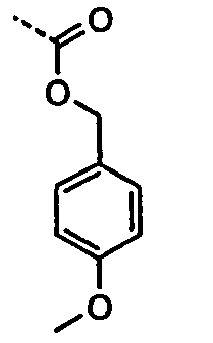
82 m-CH3 H CH3 CH CH2O C2H4 NR9 0 (R)-PhCH2 Me 
83 m-CH3 H CH3 CH CH2O C2H4 NR9 0 H H 
84 m-CH3 H CH3 CH CH2O C2H4 NR9 0 H H 
85 m-CH3 H CH3 CH CH2O C2H4 NR9 0 H H 
Die gestrichelte Linie gibt die Verknüpfungsstelle an. - Die erfindungsgemäßen Verbindungen der Formel I können entsprechend den folgenden Reaktionsschemata erhalten werden:
-

- Die Verbindung A-1 wird in einem Alkohol R-8OH umgesetzt. Das so erhaltene Produkt wird an der sekundären Hydroxylgruppe geschützt (z. B. durch Rühren bei RT mit TBDPSCI und Imidazol in DMF), wobei die Verbindung A-2 erhalten wird, worin R8 die oben beschriebene Bedeutung hat. A-2 wird in einem etherischen Lösungsmittel mit Lithiumaluminiumhydrid zur Verbindung A-3 reduziert. Die Verbindung A-3 wird in einem Zweiphasensystem aus Toluol und 50%-iger Natriumhydroxidlösung bei 10 °C mit Bromessigsäure-tert-butylester und Tetrabutylammoniumhydrogensulfat zur Verbindung A-4 umgesetzt.
Die Verbindung A-4 wird in Tetrahydrofuran mit Lithiumdiisopropylamid und einem Alkyliodid der allgemeinen Formel R6-1, worin R6 die oben beschriebene Bedeutung hat, umgesetzt. In einigen Beispielen wird die so erhaltene Verbindung in Tetrahydrofuran mit Lithiumdiisopropylamid und einem weiteren Alkyliodid der allgemeinen Formel R7-1, worin R7 die oben beschriebene Bedeutung hat, umgesetzt. Die Schutzgruppe wird abgespalten, wobei die Verbindung der allgemeinen Formel A-5 erhalten wird.
Die Verbindung A-5 wird in Methyl-tert-bütylether oder Dimethylformamid mit Natriumhydrid und der Verbindung A-6 (siehe Verfahren A), worin R1, R2, R3 und W die oben beschriebenen Bedeutungen haben, zur Verbindung A-7 umgesetzt.
Das Produkt A-7 wird mehrere Stunden in Trifluoressigsäure oder HCl/Dioxan gerührt. Dabei wird die Verbindung der allgemeinen Formel A-8 erhalten.
Nach diesem Verfahren können die Beispiele 31 bis 51 synthetisiert werden. -

- Die Verbindung A-2, wobei SG = tert-Butyldimethylsilyl ist, wird mit Wismuttribromid, Triethylsilan und einer Verbindung der allgemeinen Formel B-1, worin R1, R2, W und R3 die oben beschriebenen Bedeutungen haben, in Acetonitril bei Raumtemperatur zur Verbindung B-2 umgesetzt.
Die Verbindung B-2 wird mit Lithiumaluminiumhydrid in Diethylether oder THF zur Verbindung B-3 reduziert. Die Verbindung B-3 wird mit Triphenylphosphin und Iod in Toluol bei Raumtemperatur zur Verbindung B-4 umgesetzt.
Die Verbindung B-4 wird mit der Verbindung der allgemeinen Formel B-5, wobei R6 und R7 die oben beschriebenen Bedeutungen haben, zur Verbindung B-6 umgesetzt. Der Ester wird gespalten, indem die Verbindung B-6 mehrere Stunden in einer Mischung aus Methanol und konzentrierter Kalilauge oder Lithiumhydroxid in THF/Methanol/Wasser gerührt wird. Dabei wird die Verbindung B-7 erhalten.
In einigen Beispielen wird die Verbindung B-7 mit einem Äquivalent
Wasserstoffperoxid in Trifluoressigsäure bei Raumtemperatur zur Verbindung der allgemeinen Formel B-8, worin R1, R2, R3, R6, W und R7 die oben beschriebenen Bedeutungen haben, oxidiert.
In einigen Beispielen wird die Verbindung B-7 mit drei Äquivalenten
Wasserstoffperoxid in Trifluoressigsäure bei Raumtemperatur zur Verbindung der allgemeinen Formel B-9, worin R1, R2, R3; R6, W und R7 die oben beschriebenen Bedeutungen haben, oxidiert.
Nach diesem Verfahren können die Beispiele 52 bis 71 synthetisiert werden. -

- Die Verbindung B-3 (s. Verfahren B) wird mit Oxalylchlorid, Triethylamin und Dimethylsulfoxid in Dichlormethan bei -78°C zum Aldehyd C-1 oxidiert. Dieser wird mit Natriumtriacetoxyborhydrid und der Verbindung der allgemeinen Formel C-2, wobei, R6 und R7 die oben beschriebenen Bedeutungen haben, zur Verbindung C-3 umgesetzt.
Die Verbindung C-3 wird durch mehrstündiges Rühren in Trifluoressigsäure zur Verbindung C-4 umgesetzt.
In einigen Beispielen wird die Verbindung C-3 mit Acylchloriden, Sulfonylchloriden oder Chlorameisensäureestern der allgemeinen Formel R9-Cl, wobei R9 die oben beschriebene Bedeutung hat, in Dichlormethan in Gegenwart von Pyridin zur
Verbindung C-5 umgesetzt. Die Verbindung C-5 wird durch mehrstündiges Rühren in Trifluoressigsäure zur Verbindung C-6 umgesetzt.
Nach diesem Verfahren können die Beispiele 72 bis 78 synthetisiert werden. -

- Die Verbindung D-1 wird an der Hydroxylgruppe mit einer geeigneten Schutzgruppe geschützt, beispielsweise mit der Methoxymethylschutzgruppe. Anschließend wird die Carboxylgruppe mit Lithiumaluminiumhydrid in Diethylether zur Verbindung D-2 umgesetzt. Diese wird mit Bromessigsäure-tert-butylester und Tetrabutylammoniumhydrogensulfat in einem Zweiphasensystem Toluol /50%-ige Natronlauge zur Verbindung D-3 umgesetzt.
Die Verbindung D-3 wird entschützt (beispielsweise mit konzentrierter Salzsäure in Tetrahydrofuran im Falle der Methoxymethylschutzgruppe) und anschließend mit tert-Butyldimethylsilylchlorid und Imidazol in Dimethylformamid zur Verbindung D-4 umgesetzt.
Die Verbindung D-4 wird mit Lithiumdiisopropylamid in Tetrahydrofuran bei 0°C deprotoniert und mit einem Alkyliodid der allgemeinen Formel R6-I, wobei R6 die oben beschriebene Bedeutung hat, umgesetzt. Anschließend wird die entstandene Verbindung mit Lithiumdiisopropylamid in Tetrahydrofuran bei 0°C deprotoniert und mit einem Alkyliodid der allgemeinen Formel R7-I, wobei R7 die oben beschriebene Bedeutung hat, zur Verbindung D-5 umgesetzt.
Die Verbindung D-5 wird mit Wismuttribromid, Triethylsilan und der Verbindung B-1 (siehe Verfahren B) in Acetonitril bei Raumtemperatur oder - nach Spaltung der Silylschutzgruppe mit TBAF in THF - mit Kalium-tert-butylat und der Verbindung A-6 (s. Verfahren A) zur Verbindung D-6 umgesetzt.
Die Verbindung D-6 wird durch Rühren in Trifluoressigsäure zur Verbindung D-7 umgesetzt.
Nach diesem Verfahren können die Beispiele 79 und 80 synthetisiert werden. -

- Die Verbindung E-1 wird mit Diisobutylaluminiumhydrid und Isopropanol in Diethylether zur Verbindung E-2 reduziert. Diese wird mit der Verbindung der allgemeinen Formel A-6 und Natriumhydrid in Dimethylformamid zur Verbindung E-3 umgesetzt.
Die Verbindung E-3 wird mit Osmiumtetroxid und Natriumperiodat in Diethylether zum Aldehyd E-4 umgesetzt. Diese Verbindung wird in einer Homer-Emmons-Wadsworth-Reaktion mit einem Triethylphosphonoessigsäureester der allgemeinen Formel E-5, worin R6 die oben beschriebene Bedeutung hat, zur Verbindung E-6 umgesetzt. Die Verbindung E-6 wird mit Wasserstoff an Palladium/Kohle zur Verbindung E-7 hydriert, und anschließend wird der Ester mit Lithiumhydroxid zur Säure E-8 verseift.
Nach diesem Verfahren können die Beispiele 81 bis 84 synthetisiert werden. -

- Die Verbindung E-2 wird mit tert-Butyldiphenylsilylchlorid und Imidazol als Base in Dimethylformamid umgesetzt, aufgearbeitet und dann mit Osmiumtetroxid und Natriumperiodat in Diethylether umgesetzt. Die so erhaltene Verbindung wird mit Triphenylphosphoranylidenessigsäure-tert-butylester und nButhyllithium in einer Wittig-Reaktion umgesetzt und anschließend mit Wasserstoff an Palladium/Kohle zur Verbindung F-1 hydriert.
Die Verbindung F-1 wird mit Lithiumdiisopropylamid in Tetrahydrofuran bei 0°C deprotoniert und mit einem Alkyliodid der allgemeinen Formel R6-I, wobei R6 die oben beschriebene Bedeutung hat, umgesetzt. Anschließend wird die entstandene Verbindung mit Lithiumdiisopropylamid in Tetrahydrofuran bei 0°C deprotoniert und mit einem Alkyliodid der allgemeinen Formel R7-I, wobei R7 die oben beschriebene Bedeutung hat, zur Verbindung F-2 umgesetzt.
Die Verbindung F-2 wird zur Entschützung mit Tetrabutylammoniumfluorid in Tetrahydrofuran umgesetzt. Anschließend wird der so erhaltene Alkohol mit Natriumhydrid und der Verbindung A-6 in Dimethylformamid zur Verbindung F-3 umgesetzt.
Der tert-Butylester wird gespalten, indem die Verbindung F-3 in Trifluoressigsäuremehrere Stunden gerührt wird, wobei die Verbindung F-4 erhalten wird.
Nach diesem Verfahren wurden die Beispiele 85 bis 92 synthetisiert. -

- Die Verbindung E-4 wird mit einem Aminosäureester der allgemeinen Formel G-1, worin R6, R7 und R8 die oben angegebene Bedeutung haben, in Gegenwart einer Borhydridreagenzes (z. B. Natriumtriacetoxyborhydrid) zur Verbindung G-2 umgesetzt.
- Die Verbidnung G-2 wird mit einem Chlorid R12-Cl, worin R12 die oben angegebene Bedeutung hat, zur Verbindung G-3 umgesetzt (R12 kann auch Isocyanat oder Isothiocyanat sein). Anschließend wird die Verbindung G-3 mit LiOH zur Verbindung G-4 verseift.
- Dieses Verfahren dient zur Synthese der Bausteine A-6 und B-2, worin R1, R2, W und R3 die oben genannten Bedeutungen haben.
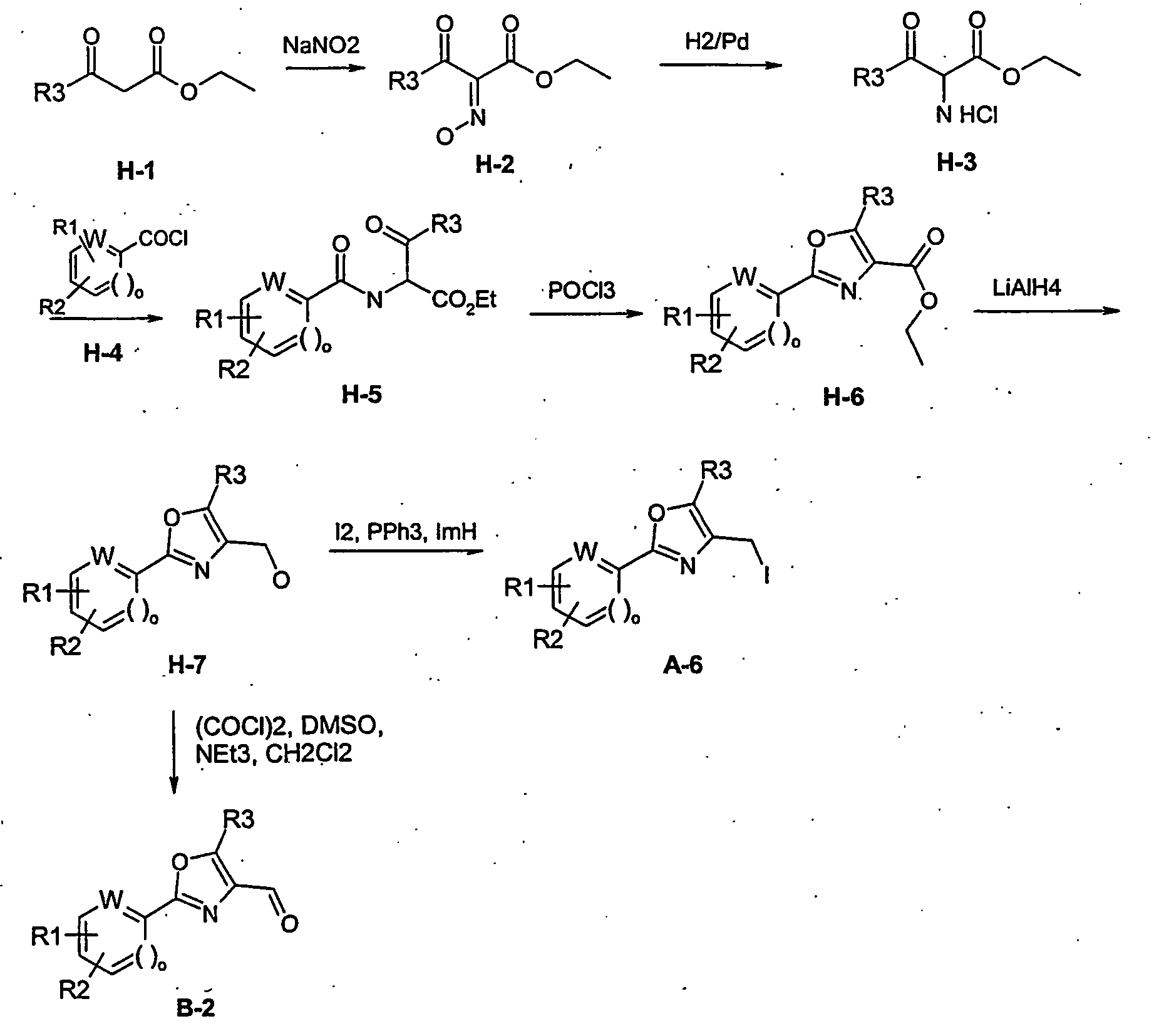
- Der Ester H-1, worin R3 die oben genannte Bedeutung hat, wird mit Natriumnitrit und Salzsäure zum Oxim H-2 umgesetzt, welches durch Hydrierung mit Wasserstoff an Palladium/Kohle zum Amin H-3 reduziert wird.
- Die Verbindung H-3 wird mit Säurechloriden der allgemeinen Formel H-4, worin R1, W und R2 die oben genannten Bedeutungen haben, und Base (beispielsweise Triethylamin) zur Verbindung H-5 umgesetzt.
Die Verbindung H-5 wird durch Erhitzen in Phosphorylchlorid zur Verbindung H-6 umgesetzt.
Der Ester H-6 wird mit Lithiumaluminiumhydrid in Diethylether zum Alkohol H-7 reduziert. Dieser wird mit Iod, Imidazol (ImH) und Triphenylphosphin in das Iodid A-6 überführt.
Alternativ wird die Verbindung H-7 mit Oxalylchlorid, Dimethylsulfoxid und Triethylamin in Dichlormethan bei -78°C zum Aldehyd B-1 oxidiert. - Dieses Verfahren dient zur Synthese des Bausteins A-6, worin R1, R2, W und R3 die oben genannten Bedeutungen haben.

- Die Verbindung J-1 wird mit dem Aldehyd J-2, worin R1, R2, W und R3 die oben beschriebenen Bedeutungen haben, in Ethanol mit Chlorwasserstoff zur Verbindung J-3 umgesetzt.
Die Verbindung J-3 wird in Phosphorylchlorid zum Sieden erhitzt, wobei die Verbindung J-4 erhalten wird. Diese wird mit Natriumiodid in Aceton zum Sieden erhitzt. Dabei erhält man die Verbindung A-6. - Die verwendeten Abkürzungen stehen für:
- Ac
- Acetyl
- Bn
- Benzyl
- iBu
- Isobutyl
- tBu
- tert-Butyl
- BuLi
- n-Butyllithium
- Bz
- Benzoyl
- Cy
- Cyclohexyl
- DC
- Dünnschichtchromatographie
- DCI
- direkte chemische Ionisation (bei MS)
- DCM
- Dichlormethan
- DMAP
- 4-N,N-Dimethylaminopyridin
- DMF
- N,N-Dimethylformamid
- DMSO
- Dimethylsulfoxid
- EE
- Essigsäureethylester
- EDC
- N'-(3-Dimethylaminopropyl)-N-ethylcarbodiimid x HCl
- EI
- Elektronenstoß-lonisation (bei MS)
- eq
- Äquivalent
- ESI
- Elektronenspray-lonisation (bei MS)
- Et
- Ethyl
- ges.
- gesättigt
- h
- Stunde
- HATU
- O-(7-Azabenzotriazol-1-yl)-N,N,N',N'-tetramethyluronium-Hexafluorophosphat
- HOBt
- 1-Hydroxy-1H-benzotriazol x H2O
- HPLC
- Hochdruck-, Hochleistungsflüssigchromatographie
- LC-MS
- Flüssigchromatographie-gekoppelte Massenspektroskopie
- Me
- Methyl
- MS
- Massenspektroskopie
- Mscl
- Methansulfonylchlorid
- NMR
- Kernresonanzspektroskopie
- Pd/C
- Palladium auf Kohle
- iPr
- Isopropyl
- nPr
- n-Propyl
- Rf
- Retentionszeit (bei DC)
- RT
- Raumtemperatur
- TBAF
- Tetrabutylammoniumfluorid
- TBAI
- Tetrabutylammoniumiodid
- TBDPSCI
- tert.Butyldiphenylsilylchlorid
- TBDMSCI
- tert.Butyldimethylsilylchlorid
- THF
- Tetrahydrofuran
- Tr
- Trityl
- Andere Verbindungen können entsprechend den oben genannten Verfahren hergestellt werden.
-

-

- 42.4 g 4-Methyl-3-oxo-pentansäureethylester werden in 100 ml Eisessig gelöst und bei 5°C mit 21 g Natriumnitrit, gelöst in 100 ml Wasser, versetzt. Man lässt innerhalb einer Stunde auf Raumtemperatur erwärmen, fügt sodann 100 ml Wasser hinzu und rührt eine weiter Stunde bei Raumtemperatur nach. Man extrahiert dreimal mit je 150 ml Methyl-tert-butylether, die vereinigten organischen Phasen werden mit 200 ml Wasser versetzt und durch Zugabe von festem NaHCO3 neutralisiert. Die organische Phase wird abgetrennt, mit gesättigter NaCl-Lösung gewaschen, über MgSO4 getrocknet und anschließend das Lösungsmittel im Vakuum entfernt. Man erhält 46 g 2-Hydroxyimino-4-methyl-3-oxo-pentansäure-ethylester als Öl. C8H13NO4 (187.20), MS(ESI) = 188 (M+H+).
-

- In 200 ml Ethanol werden 10 g HCl eingeleitet. 46 g 2-Hydroxyimino-4-methyl-3-oxo-pentansäureethylester werden darin gelöst und mit 5 g Pd(10% auf Kohle) versetzt und 8 Stunden unter einer Wasserstoffatmosphäre (5 bar) gerührt. Das Reaktionsgemisch wird über Celite filtriert und das Lösungsmittel im Vakuum entfernt. Man erhält 45 g 2-Amino-4-methyl-3-oxo-pentansäureethylester hydrochlorid als weißen Feststoff. C8H15NO3*HCl (209.5), MS(ESI) = 188 (M+H+).
-

- 10 g 2-Amino-4-methyl-3-oxo-pentansäureethylesterhydrochlorid und 7.4 g 4-Methyl-benzoylchlorid werden in 250 ml Dichlormethan gelöst und bei 0°C langsam und tropfenweise mit 13.3 ml Triethylamin versetzt. Man rührt eine Stunde bei Raumtemperatur nach, dann wird mit Wasser gewaschen, die organische Phase abgetrennt, über MgSO4 getrocknet und anschließend das Lösungsmittel im Vakuum entfernt. Man erhält 13 g 4-Methyl-2-(4-methyl-benzoylamino)-3-oxo-pentansäureethylester als Öl. C16H21 N04 (291.35), MS(ESI) = 292 (M+H+).
-

- 13 g 4-Methyl-2-(4-methyl-benzoylamino)-3-oxo-pentansäureethylester werden in 80 ml Phosphoroxychlorid 2h unter Rückfluss zum Sieden erhitzt. Das Phosphoroxychlorid wird im Vakuum entfernt und der resultierende Rückstand in 200 ml Dichlormethan gelöst , dreimal mit gesättigter NaHCO3-Lösung gewaschen, über MgSO4 getrocknet und anschließend das Lösungsmittel im Vakuum entfernt. Man erhält 11 g 5-lsopropyl-2-p-tolyl-oxazol-4-carbonsäureethylester als bräunlichen Feststoff.C16H19NO3 (273.33), MS(ESI) = 292 (M+H+), Rf(n-Heptan:Ethylacetat) = 2:1) = 0.43.
-

- 11g 5-Isopropyl-2-p-tolyl-oxazol-4-carbonsäureethylester werden in 100 ml Tetrahydrofuran gelöst und bei 0°C mit 40 ml einer 1 molaren Lösung von Lithiumaluminiumhydrid in Tetrahydrofuran versetzt. Nach 30 min wird das Reaktionsgemisch mit 50 ml 1 N HCl versetzt und fünfmal mit Ethylacetat extrahiert. Die vereinigten organischen Phasen werden über MgSO4 getrocknet und anschließend das Lösungsmittel im Vakuum entfernt. Der Rückstand wird an Kieselgel mit dem Laufmittel n-Heptan:Ethylacetat = 6:1 => 1:1 gereinigt. Man erhält 4.3 g (5-Isopropyl-2-p-tolyl-oxazol-4-yl)-methanol als hellgelben Feststoff. C14H17NO2 (231.30), MS(ESI) = 232 (M+H+), Rf(n-Heptan:Ethylacetat) = 1:1) = 0.17.
-

- 500 mg (5-Isopropyl-2-p-tolyl-oxazol-4-yl)-methanol werden zusammen mit 690 mg Triphenylphosphin und 600 mg Imidazol in 20 ml Toluol gelöst. Man gibt 715 mg Iod hinzu und rührt 1 Stunde bei Raumtemperatur nach. Dann wird 10 ml gesättigte Natriumcarbonat-Lösung und 500 mg Iod nachgegeben. Nach 10 Minuten wird die organische Phase abgetrennt und zweimal mit gesättigter Na2S2O3-Lösung gewaschen, über MgSO4 getrocknet und anschließend die lösungsmittel im Vakuum entfernt. Der Rückstand wird an Kieselgel mit dem Laufmittel n-Heptan:Ethylacetat = 10:1 gereinigt. Man erhält 400 mg 4-lodmethyl-5-isopropyl-2-p-tolyl-oxazol als weißen Feststoff. C14H161NO (341.19), MS(ESI): 342 (M+H+), Rf(n-Heptan:Ethylacetat = 1:1) = 0.75.
- Analog zur Bausteinsynthese nach Verfahren K wurde aus 2-Amino-4-methyl-3-oxo-pentansäureethylester hydrochlorid und 3-Methoxy-benzoylchlorid 4-lodmethyl-2-(3-methoxy-phenyl)-5-isopropyl-oxazol erhalten.
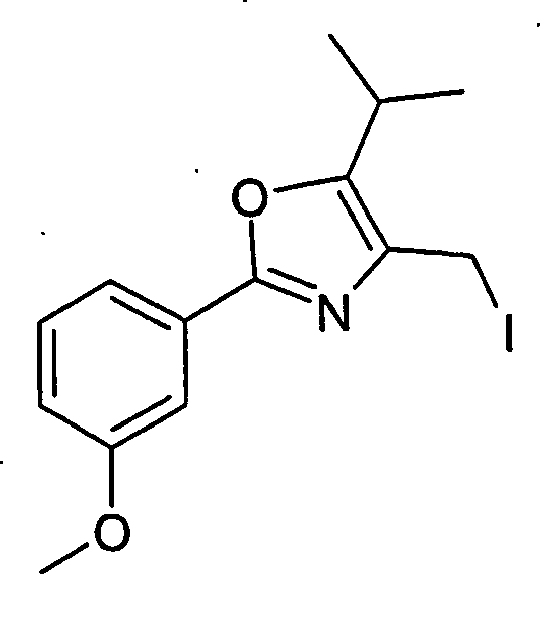
- Analog zur Bausteinsynthese von 4-Iodmethyl-5-isopropyl-2-p-tolyl-oxazol wurde aus 4,4,4-Trifluoro-3-oxo-buttersäureethylester und 3-Methoxy-benzoylchlorid 4-lodmethyl-2-(3-methoxy-phenyl)-5-trifluormethyl-oxazol erhalten.

- Analog zur Bausteinsynthese von 4-Iodmethyl-5-isopropyl-2-p-tolyl-oxazol wurde aus 4,4,4-Trifluoro-3-oxo-buttersäureethylester und 3-Trifluormethylbenzoylchlorid 4-lodmethyl-2-(3-trifluormethyl -phenyl)-5-trifluormethyl-oxazol erhalten.

- Analog zur Bausteinsynthese von 4-lodmethyl-5-isopropyl-2-p-tolyl-oxazol wurde aus 4,4,4-Trifluoro-3-oxo-buttersäureethylester und 4-Methyl-benzoylchlorid 4-lodmethyl-5-trifluormethyl-2-p-tolyl-oxazol erhalten.

- Bausteinsynthese nach Verfahren J:

-

- 12.5 g 1-Phenyl-1,2-propandion-2-oxim und 10ml p-Toluolaldehyd werden in 50 ml Eisessig gegeben und 30 Minuten unter Eiskühlung HCl Gas durchgeleitet. Durch Zugabe von Methyl-tert-butylether wird das Produkt als Hydrochlorid ausgefällt, abgesaugt und der Niederschlag mit Methyl-tert-butylether gewaschen. Man suspendiert den Niederschlag in Wasser und stellt mit Ammoniak einen basischen pH-Wert ein. Es wird dreimal mit je 200 ml Dichlormethan extrahiert, die vereinigten organischen Phasen werden über MgSO4 getrocknet und anschließend das Lösungsmittel im Vakuum entfernt. Man erhält 6.4 g 4-Methyl-5-phenyl-2-p-tolyl-oxazol 3-oxid als weißen Feststoff. C17H15NO2 (265.31), MS(ESI) = 266 (M+H+).
-

- 6.4 g 4-Methyl-5-phenyl-2-p-tolyl-oxazol 3-oxid werden in 50 ml Chloroform gelöst, mit 2.4 ml Phosphoroxychlorid versetzt und 30 Minuten unter Rückfluss zum Sieden erhitzt. Das Reaktionsgemisch'wird auf 0°C abgekühlt, mit Ammoniak ein schwach alkalischer pH-Wert eingestellt und dreimal mit je 100 ml Ethylacetat extrahiert. Die vereinigten organischen Phasen werden mit Wasser gewaschen, über MgSO4 getrocknet und anschließend das Lösungsmittel im Vakuum entfernt. Man erhält 5.4 g 4-Chlormethyl-5-phenyl-2-p-tolyl-oxazol als gelben Feststoff. C17H14CINO (283.76), MS(ESI) = 284 (M+H+), Rf(n-Heptan:Ethylacetat) = 7:1) = 0.41.
-
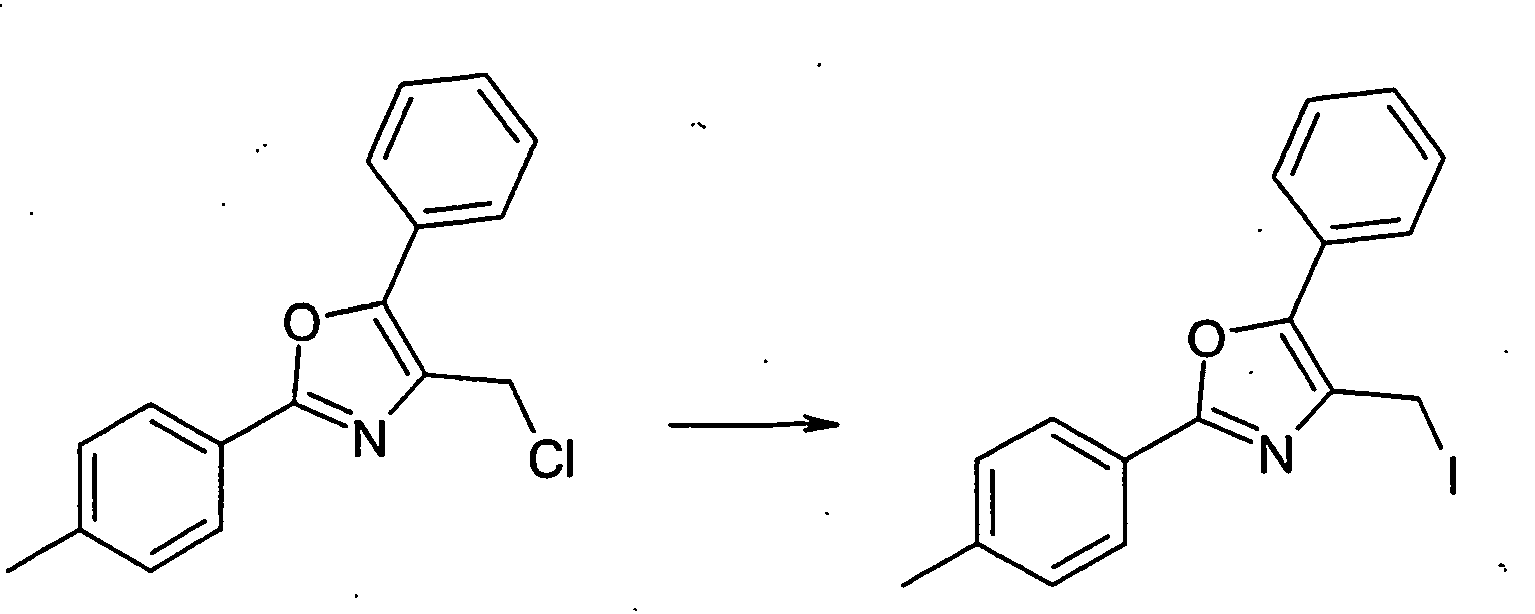
- 1.8 g 4-Chlormethyl-5-phenyl-2-p-tolyl-oxazol werden zusammen mit 3 g Natriumiodid in 150 ml Aceton 2 Stunden unter Rückfluss zum Sieden erhitzt. Nach dem Abkühlen des Reaktionsgemischs wird 300 ml Methyl-tert-butylether zugefügt, das Gemisch dreimal mit gesättigter Na2S2O3-Lösung gewaschen, über MgSO4 getrocknet und anschließend die Lösungsmittel im Vakuum entfernt: Man erhält 2.7 g 4-lodmethyl-5-phenyl-2-p-tolyl-oxazol als hellgelben Feststoff. C17H141NO (375.21), MS(ESI): 376 (M+H+).
- Analog zur Bausteinsynthese von 4-Iodmethyl-5-phenyl-2-p-tolyl-oxazol wurde aus 1-Phenyl-1,2-propandion-2-oxim und m-Anisaldehyd 4-lodmethyl-2-(3-methoxy-phenyl)-5-phenyl-oxazol erhalten.
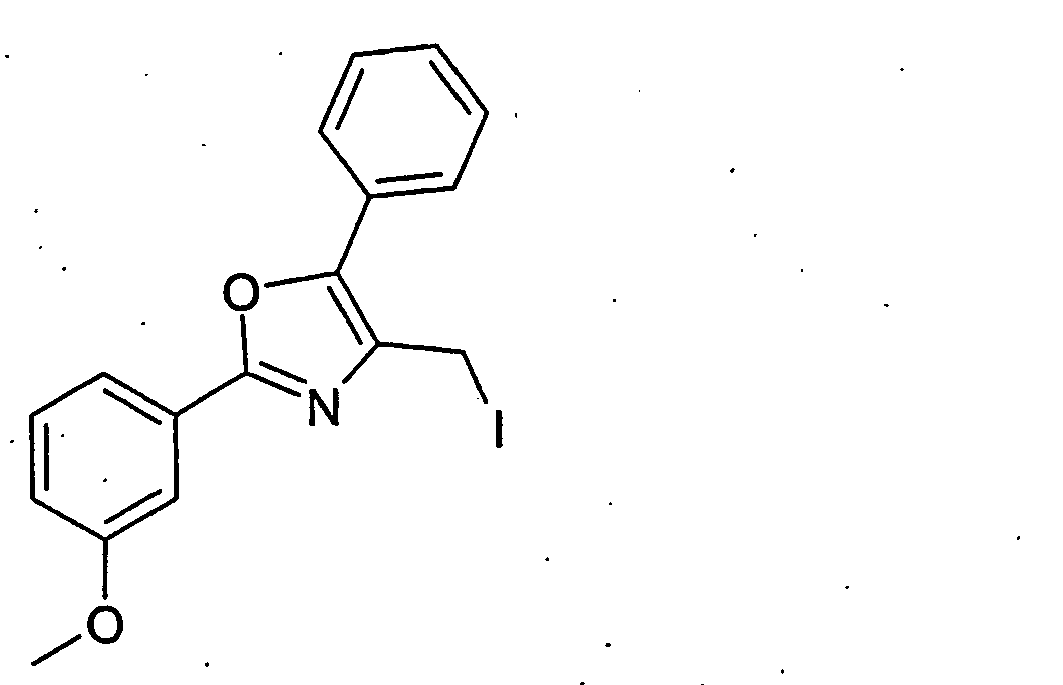
- Analog zur Bausteinsynthese von 4-lodmethyl-5-phenyl-2-p-tolyl-oxazol wurde aus 1-Ethyl-1,2-propandion-2-oxim und m-Anisaldehyd 4-lodmethyl-5-ethyl-2-(3-methoxyphenyl)-oxazol erhalten.

- Analog zur Bausteinsynthese von 4-lodmethyl-5-phenyl-2-p-tolyl-oxazol wurde aus 1-Ethyl-1,2-propandion-2-oxim und p-Toluolaldehyd 4-lodmethyl-5-ethyl-2-p-tolyl-oxazol erhalten.

- Analog zur Bausteinsynthese von 4-lodmethyl-5-phenyl-2-p-tolyl-oxazol wurde aus 1-Cyclohexyl-1,2-propandion-2-oxim und m-Anisaldehyd 4-lodmethyl-5-cyclohexyl-2-(3-methoxy-phenyl)-oxazol erhalten.

- Analog zur Bausteinsynthese von 4-lodmethyl-5-phenyl-2-p-tolyl-oxazol wurde aus 1-Cyclohexyl-1,2-propandion-2-oxim und p-Toluolaldehyd 4-lodmethyl-5-cyclohexyl-2-p-tolyl-oxazol erhalten.

- Analog zur Bausteinsynthese von 4-lodmethyl-5-phenyl-2-p-tolyl-oxazol wurde aus Diacetylmonoxim und p-Toluolaldehyd 4-lodmethyl-5-methyl-2-p-tolyl-oxazol erhalten.

- Analog zur Bausteinsynthese von 4-lodmethyl-5-phenyl-2-p-tolyl-oxazol wurde aus Diacetylmonoxim und m-Anisaldehyd 4-lodmethyl-2-(3-methoxy-phenyl)-5-methyl-oxazol erhalten.
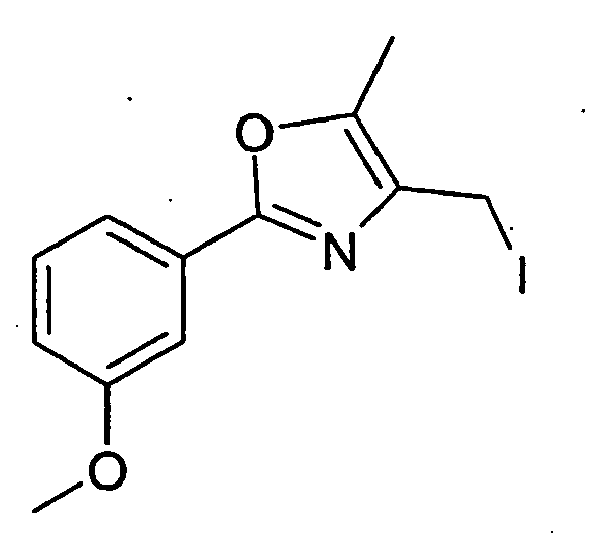
- Analog zur Bausteinsynthese von 4-lodmethyl-5-phenyl-2-p-tolyl-oxazol wurde aus Diacetylmonoxim und 3-Bromo-benzaldehyd 2-(3-Bromo-phenyl)-4-iodmethyl-5-methyl-oxazol erhalten.

- Analog zur Bausteinsynthese von 4-lodmethyl-5-phenyl-2-p-tolyl-oxazol wurde aus Diacetylmonoxim und 3-Trifluormethylbenzaldehyd 4-lodmethyl-5-methyl-2-(3-trifluoromethyl-phenyl)-oxazol erhalten.

- Analog zur Bausteinsynthese von 4-lodmethyl-5-phenyl-2-p-tolyl-oxazol wurde aus Diacetylmonoxim und 4-Fluorbenzaldehyd 2-(4-Fluoro-phenyl)-4-iodmethyl-5-methyl-oxazol erhalten.

- Analog zur Bausteinsynthese von 4-lodmethyl-5-phenyl-2-p-tolyl-oxazol wurde aus Diacetylmonoxim und 4-Methoxybenzaldehyd 4-lodmethyl-2-(4-methoxy-phenyl)-5-methyl-oxazol erhalten.

- Analog zur Bausteinsynthese von 4-lodmethyl-5-phenyl-2-p-tolyl-oxazol wurde aus Diacetylmonoxim und 4-Trifluormethylbenzaldehyd 4-lodmethyl-5-methyl-2-(4-trifluoromethyl-phenyl)-oxazol erhalten.

- Analog zur Bausteinsynthese von 4-lodmethyl-5-phenyl-2-p-tolyl-oxazol wurde aus Diacetylmonoxim und m-Toluolaldehyd 4-lodmethyl-5-methyl-2-m-tolyl-oxazol erhalten.
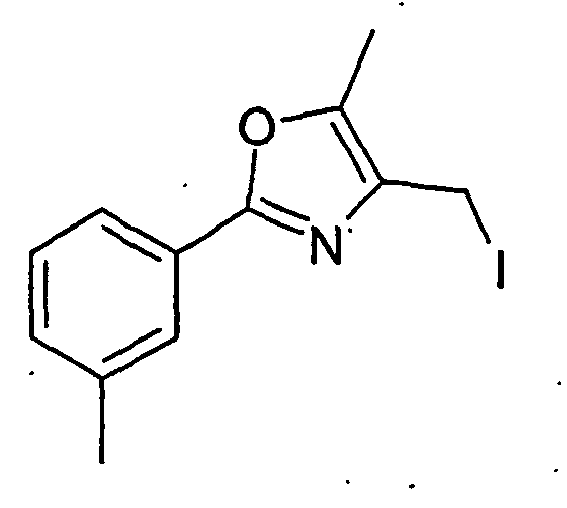
- Analog zur Bausteinsynthese von 4-lodmethyl-5-phenyl-2-p-tolyl-oxazol wurde aus Diacetylmonoxim und Benzaldehyd 4-Chlormethyl-5-methyl-2-phenyl-oxazol erhalten.

- Analog zur Bausteinsynthese von 4-lodmethyl-5-phenyl-2-p-tolyl-oxazol wurde aus Diacetylmonoxim und p-Phenylbenzaldehyd 4-lodmethyl-5-methyl-2-p-biphenyl-oxazol erhalten.

- Analog zur Bausteinsynthese von 4-lodmethyl-5-phenyl-2-p-tolyl-oxazol wurde aus Diacetylmonoxim und 3-Trifluormethoxybenzaldehyd 4-lodmethyl-5-methyl-2-(3-trifluoromethoxy-phenyl)-oxazol erhalten.
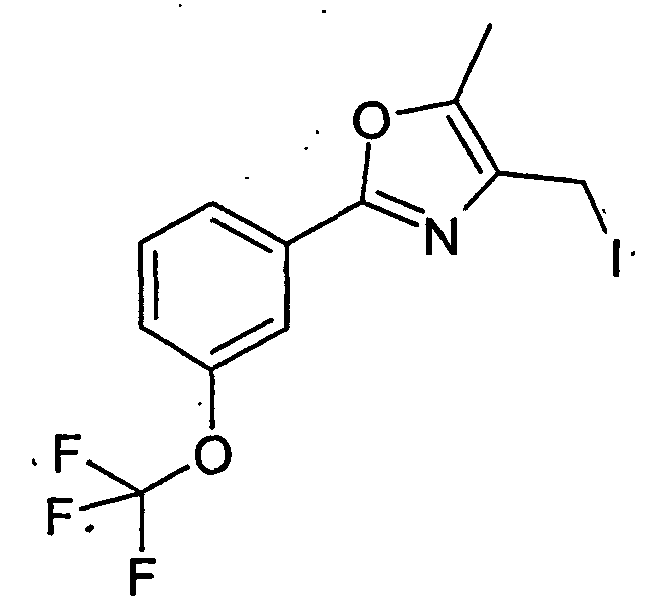
- Analog zur Bausteinsynthese von 4-lodmethyl-5-phenyl-2-p-tolyl-oxazol wurde aus Diacetylmonoxim und 5-Methylfuran-2-carbaldehyd 4-lodmethyl-5-methyl-2-(5-methylfuran-2-yl)-oxazol erhalten.

- Analog zur Bausteinsynthese von 4-lodmethyl-5-phenyl-2-p-tolyl-oxazol wurde aus Diacetylmonoxim und Thiophen-2-carbaldehyd 4-Iodmethyl-5-methyl-2-thiophen-2-yl-oxazol erhalten.

- Analog zur Bausteinsynthese von 4-lodmethyl-5-phenyl-2-p-tolyl-oxazol wurde aus Diacetylmonoxim und 4-lsopropylbenzaldehyd 4-lodmethyl-2-(4-isopropyl-phenyl)-5-methyl-oxazol erhalten.

- Analog zur Bausteinsynthese von 4-Iodmethyl-5-phenyl-2-p-tolyl-oxazol wurde aus Pentan-2,3-dion 2-oxim und 3- Trifluoromethyl-benzaldehyd 5-Ethyl-4-iodomethyl-2-(3-trifluoromethyl-phenyl)-oxazol erhalten.

- Analog zur Bausteinsynthese von 4-lodmethyl-5-phenyl-2-p-tolyl-oxazol wurde aus Pentan-2,3-dion 2-oxim und Naphthalen-2-carbaldehyd 5-Ethyl-4-iodomethyl-2-naphthale-2-yl-oxazol erhalten.

- Analog zur Bausteinsynthese von 4-lodmethyl-5-phenyl-2-p-tolyl-oxazol wurde aus Butan-2,3-dion 2-oxim und Naphthalin-2-carbaldehyd 5-Methyl-4-iodomethyl-2-naphthale-2-yl-oxazol erhalten.

- Analog zur Bausteinsynthese von 4-lodmethyl-5-phenyl-2-p-tolyl-oxazol wurde aus Pentan-2,3-dion 2-oxim und 4-Isopropylbenzaldehyd 5-Ethyl-4-iodomethyl-2-(4-isopropyl-phenyl)-oxazol erhalten.

- Analog zur Bausteinsynthese von 4-lodmethyl-5-phenyl-2-p-tolyl-oxazol wurde aus Diacetylmonoxim und 3,4-Dimethoxybenzaldehyd 4-lodmethyl-5-methyl-2-(3,4-dimethoxyphenyl)-oxazol erhalten.

- Alle im folgenden beschriebenen Substanzen sind am Cyclohex-1,3-ylen cis-konfiguriert.
-

-

- 15 g 6-Oxa-bicyclo[3.2.1]octan-7-on werden in 150 ml Methanol gelöst, mit 13 g Natriummethanolat versetzt und 2 h bei Raumtemperatur gerührt. Dann werden 13,7 ml Eisessig zugegeben, und das Lösungsmittel wird im Vakuum weitgehend abdestilliert. Der Rückstand wird in Wasser aufgenommen und dreimal mit je 100 ml Ethylacetat extrahiert. Die organischen Phasen werden über MgSO4 getrocknet und anschließend im Vakuum eingeengt. Man erhält 18,8 g des Methylesters als farbloses Öl. Dieser wird in 150 ml Dichlormethan gelöst und mit 19,2 g Methoxymethylchlorid und 23,2 g Diisopropylethylamin versetzt und 15 h bei Raumtemperatur gerührt. Die Lösung wird mit 250 ml gesättigter NH4Cl-Lösung und 200 ml Wasser vesetzt, die organische Phase wird abgetrennt. Die wäßrige Phase wird mit Dichlormethan extrahiert, die vereinigten organischen Phasen werden über Magnesiumsulfat getrocknet und eingeengt. Man erhält 22,2 g cis-,3-(Methoxymethoxy)-cyclohexancarbonsäuremethylester als gelbes Öl. C10H18O4 (202), MS(ESI): 203 (MH+).
-

- 9,0 g cis-3-Methoxymethoxy-cyclohexancarbonsäuremethylester werden in 280 ml Diethylether gelöst und mit 2,2 g LiAlH4 versetzt und bei Raumtemperatur gerührt. Nach 4 h werden bei 0°C 10 ml Ethylacetat und anschließend 15 ml 10N NaOH zugetropft. Die Suspension wird 1 h gerührt und mit MgSO4 versetzt, über Celite filtriert, und das Filtrat eingeengt, wobei 7,0 g (cis-3-Methoxymethoxy-cyclohexyl)-methanol als farbloses Öl erhalten werden. C9H18O3 (174), MS(ESI): 175 (MH+).
-
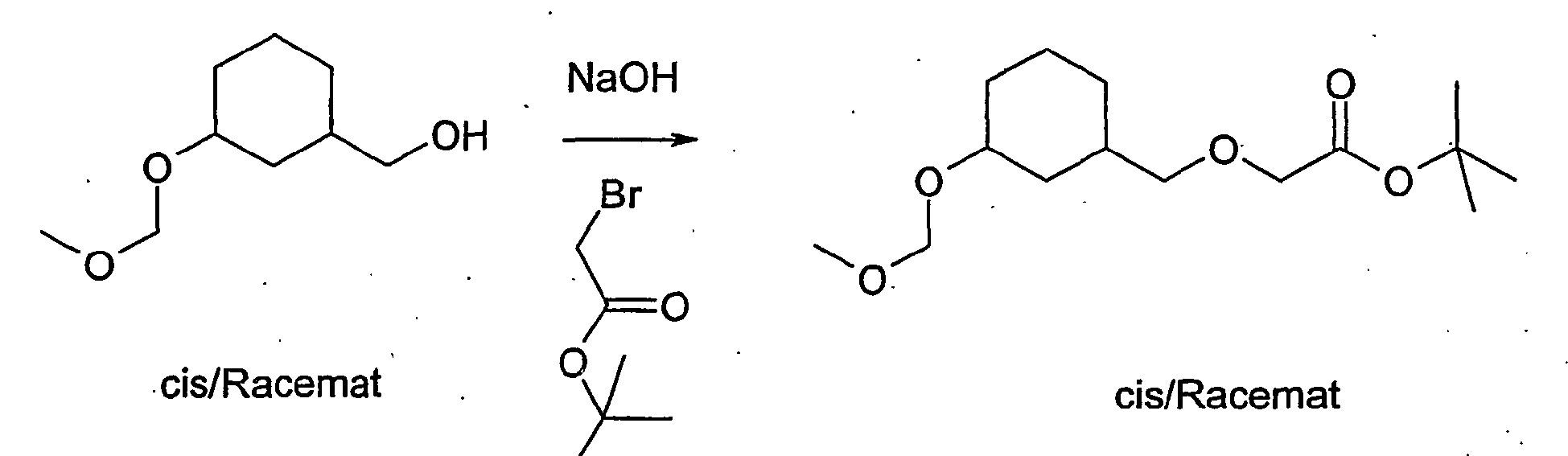
- 1,0 g (cis-3-Methoxymethoxy-cyclohexyl)-methanol und 3,3 g Bromessigsäure-tert-butylester werden in 30 ml Toluol gelöst und mit 0,50 g Tetrabutylammoniumhydrogensulfat versetzt. Die Suspension wird auf 10°C gekühlt. 10 ml 50% NaOH werden zur Suspension gegeben. Die Mischung wird auf Raumtemperatur kommen lassen und nach 3 h wird die wäßrige Phase abgetrennt und mit Methyl-tert-butylether extrahiert. Die vereinigten organischen Phasen werden über MgSO4 getrocknet und eingeengt. Nach Flash-Säulenchromatographie an Kieselgel (Heptan/Ethytacetat 10/1 -> 2/1) werden 1,10 g (cis-3-Methoxymethoxycyclohexylmethoxy)-essigsäure-tert-butylester als farbloses Öl erhalten. C15H28O5 (288), LCMS(ESI): 306 (M++H2O).
-

- 200 mg (cis-3-Methoxymethoxycyclohexylmethoxy)-essigsäure-tert-butylester werden in 5 ml abs. Tetrahydrofuran gelöst und auf -78°C (Trockeneis/Aceton-Bad) gekühlt. Anschließend werden 0,7 ml 2M Lithiumdiisopropylamid-Lösung in Tetrahydrofuran/Hexanfraktion zugetropft. Die Lösung wird zunächst bei -78 °C gerührt, dann auf 0°C erwärmt (Eisbad) und 20 min bei dieser Temperatur gerührt. Dann werden 600 mg Propyliodid in 2 ml Tetrahydrofuran zugegeben, und die Lösung wird weitere 2,5 h bei 0°C gerührt. 15 ml gesättigte Ammoniumchloridlösung werden zugesetzt und die Phasen getrennt. Die wäßrige Phase wird mit Methyl-tert-butylether extrahiert. Die vereinigten organischen Phasen werden über MgSO4 getrocknet und eingeengt (Ausbeute: 240 mg Rohprodukt). Der Rückstand wird in 2 ml Tetrahydrofuran aufgenommen, mit 0,5 ml konz. HCl versetzt und 18 h bei Raumtemperatur gerührt. Die Mischung wird mit Wasser und Methyl-tert-butylether verdünnt, die Phasen werden getrennt, und die wäßrige Phase wird mit Methyl-tert-butylether extrahiert. Die vereinigten organischen Phasen werden mit gesättigter NaCl-Lösung gewaschen, über MgSO4 getrocknet und eingeengt. Dabei werden 130 mg 2-(cis-3-Hydroxycyclohexylmethoxy)-pentansäure-tert-butylester als gelbes Öl erhalten. NMR(CDCl3) Diastereomerengemisch: 3.55-3.67 (m, 2H), 3.41-3.48 (m, 1H), 3.07-3.18 (m, 1H), 1.91-2.13 (m, 2H), 1.11-1.82 (m, 14H), 1.48 (s, 9H).
-

- 130 mg 2-(cis-3-Hydroxycyclohexylmethoxy)-pentansäure-tert-butylester werden in 3 ml Dimethylformamid gelöst und mit 20 mg NaH (95%) versetzt. Nach 60 min Rühren werden bei 0°C 350 mg 5-Methyl-2-p-tolyl-oxazol-4-ylmethyliodid in 1 ml Dimethylformamid zugegeben. Die Mischung wird bei Raumtemperatur 2 h gerührt. Anschließend werden 10 ml Methyl-tert-butylether, 5 ml Wasser und 10 ml gesättigte NaCl-Lösung zugegeben. Die Phasen werden getrennt, die wäßrige Phase wird einmal mit Methyl-tert-butylether extrahiert, die organsichen Phasen werden über MgSO4 getrocknet und eingeengt. Der Rückstand wird an Kieselgel chromatographiert (Heptan/Ethylacetat 99/1 -> 10/1). 20 mg des rohen 2-[cis-3-(5-Methyl-2-p-tolyl-oxazol-4-ylmethoxy)-cyclohexylmethoxy]-pentansäure-tert-butylesters werden als gelbes Öl erhalten. C28H41NO5 (471), LCMS (ESI): 472 (MH+).
-

- 20 mg 2-[cis-3-(5-Methyl-2-p-tolyl-oxazol-4-ylmethoxy)-cyclohexylmethoxy]-pentansäure-tert-butylesters werden in 1 ml Trifluoressigsäure über Nacht gerührt. Die Lösung wird vollständig eingeengt und per HPLC gereinigt, wobei 15 mg 2-[cis-3-(5-Methyl-2-p-tolyl-oxazol-4-ylmethoxy)-cyclohexylmethoxy]-pentansäure 7 erhalten werden. C24H33NO5 (415), MS(ES+) 416 (MH+).
- Analog zu Beispiel 1 erhält man aus (cis-3-Methoxymethoxycyclohexylmethoxy)-essigsäure-tert-butylester, Methyliodid und 5-Methyl-2-p-tolyl-oxazol-4-ylmethyliodid 2-[cis-3-(5-Methyl-2-p-tolyl-oxazol-4-ylmethoxy)-cyclohexylmethoxy]-propionsäure. C22H29NO5 (387), LCMS(ES+) 388 (MH+).

- Analog zu Beispiel 1 erhält man aus (cis-3-Methoxymethoxycyclohexylmethoxy)-essigsäure-tert-butylester, Ethyliodid und 5-Methyl-2-p-tolyl-oxazol-4-ylmethyliodid 2-[3-(5-Methyl-2-p-tolyl-oxazol-4-ylmethoxy)-cyclohexylmethoxy]-buttersäure. C23H31NO5 (401), LCMS(ES+) 402 (MH+).

- Analog zu Beispiel 1 erhält man aus (cis-3-Methoxymethoxycydohexytmethoxy)-essigsäure-tert-butylester, Benzylbromid und 5-Methyl-2-p-tolyl-oxazol-4-ylmethyliodid 2-[cis-3-(5-Methyl-2-p-tolyl-oxazol-4-ylmethoxy)-cyclohexylmethoxy]-3-phenylpropionäure. C28H33NO5 (463), LCMS(ES+) 464(MH+).
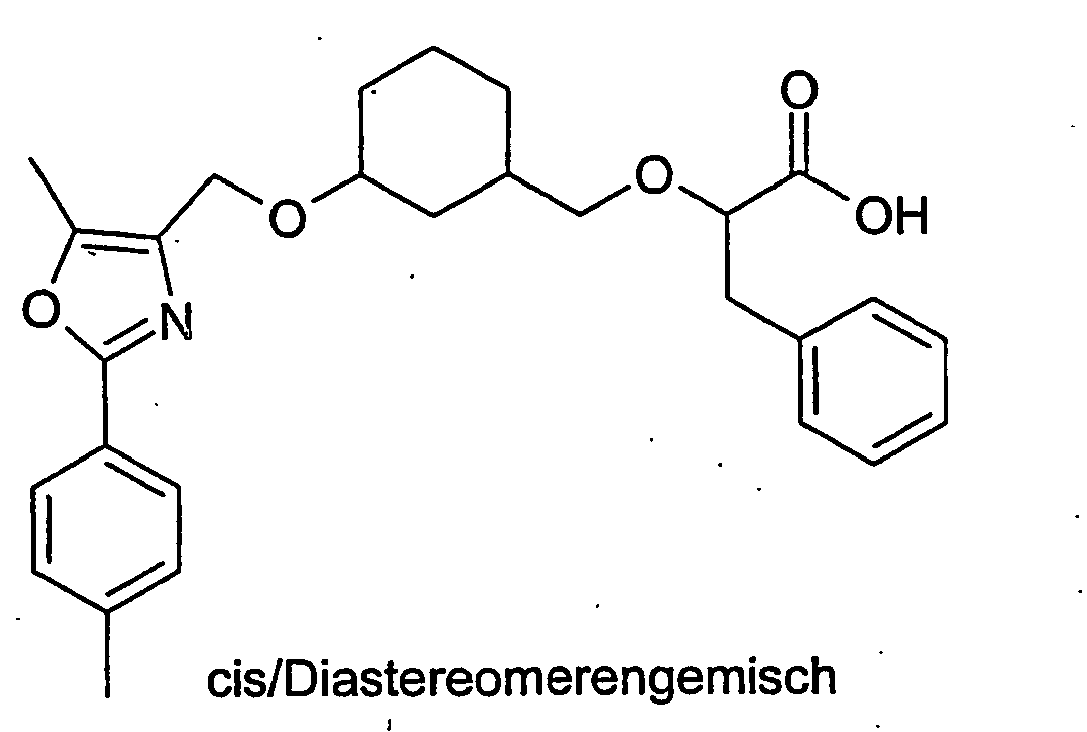
- Analog zu Beispiel 1 erhält man aus (cis-3-Methoxymethoxycyclohexylmethoxy)-essigsäure-tert-butylester, Methyliodid und 5-Methyl-2-(3-methoxyphenyl)-oxazol-4-ylmethyliodid 2-[cis-3-(5-Methyl-2-(3-methoxyphenyl)-oxazol-4-ylmethoxy)-cyclohexylmethoxy]-propionsäure. C22H29NO6 (403), LCMS(ES+) 404(MH+).

- Analog zu Beispiel 1 erhält man aus (cis-3-Methoxymethoxycyclohexylmethoxy)-essigsäure-tert-butylester, Methyliodid und 5-Methyl-2-m-tolyl-oxazol-4-ylmethyliodid 2-[cis-3-(5-Methyl-2-m-tolyl-oxazol-4-ylmethoxy)-cyclohexylmethoxy]-propionsäure. C23H31NO5 (401), LCMS(ES+) 402 (MH+).

- Analog zu Beispiel 1 erhält man aus (cis-3-Methoxymethgoxycyclohexylmethoxy)-essigsäure-tert-butylester, Methyliodid und 5-methyl-2-(3-trifluormethylphenyl)-oxazol-4-ylmethyliodid 2-[cis-3-(5-Methyl-2-(3-trifluormethylphenyl)-oxazol-4-ylmethoxy)-cyclohexylmethoxy]-propionsäure. C22H26F3NO5 (441), LCMS(ES+) 442 (MH+).

- 2-[cis-3-(5-Methyl-2-p-tolyl-oxazol-4-ylmethoxy)-cyclohexylmethoxy]-2-methylpropionsäure:

-

- 300 mg (cis-3-Methoxymethoxycyclohexylmethoxy)-essigsäure-tert-butylester werden in 5 ml abs. Tetrahydrofuran gelöst und auf-78°C (Trockeneis/Aceton-Bad) gekühlt. Anschließend werden 1,5 ml 2M Lithiumdiisopropylamid-Lösung in Tetrahydrofuran/Hexanfraktion zugetropft. Die Lösung wird zunächst bei -78 °C 90 min gerührt, dann auf 0°C erwärmt (Eisbad) und mit 1,41 g Methyliodid in 1,5 ml Tetrahydrofuran zugegeben, und die Lösung wird 1 h bei 0°C gerührt. 1 ml HCl (konz.) wird zugesetzt und die Phasen werden getrennt. Die wäßrige Phase wird mit Ethylacetat extrahiert. Die vereinigten organischen Phasen werden über MgSO4 getrocknet und eingeengt (Ausbeute: 320 mg Rohprodukt). Das Rohprodukt wird in 5 ml abs. Tetrahydrofuran gelöst und auf -78°C (Trockeneis/Aceton-Bad) gekühlt. Anschließend werden 1,5 m12M Lithiumdiisopropylamid-Lösung in Tetrahydrofuran/Hexanfraktion zugetropft. Die Lösung wird zunächst bei -78 °C 90 min gerührt, dann auf 0°C erwärmt (Eisbad) und mit 1,41 g Methyliodid in 1,5 ml Tetrahydrofuran zugegeben, und die Lösung wird 1 h bei 0°C gerührt. 1 ml HCl (konz.) wird zugesetzt und die Phasen werden getrennt. Die wäßrige Phase wird mit Ethylacetat extrahiert. Die vereinigten organischen Phasen werden über MgSO4 getrocknet und eingeengt (Ausbeute: 350 mg Rohprodukt). Der Rückstand wird in 1 ml Tetrahydrofuran aufgenommen, mit 1 ml konz. HCl versetzt und 3 d bei Raumtemperatur gerührt. Die Mischung wird mit Wasser und Ethylacetat verdünnt, die Phasen werden getrennt, und die wäßrige Phase wird mit Ethylacetat extrahiert. Die vereinigten organischen Phasen werden mit gesättigter NaCl-Lösung gewaschen, über MgSO4 getrocknet und eingeengt. Der Rückstand wird an Kieselgel (Heptan/Ethylacetat 2/1) chromatographiert, wobei 200 mg 2-(cis-3-Hydroxycyclohexylmethoxy)-2-methylpropionsäure-tert-butylester als gelbes Öl erhalten werden. C15H28O4 (272,20), MS(ESI): 273,4 (MH+).
-

- 200 mg 2-(cis-3-Hydroxycyclohexylmethoxy)-2-methylpropionsäure-tert-butylester werden in 5 ml Dimethylformamid gelöst und mit 20 mg NaH (95%) versetzt. Nach 60 min Rühren bei Raumtemperatur werden bei 0°C 460 mg 5-Methyl-2-p-tolyl-oxazol-4-ylmethyliodid in 1,5 ml Dimethylformamid zugegeben. Die Mischung wird bei Raumtemperatur 2 h gerührt. Anschließend werden 10 ml Methyl-tert-butylether und 10 ml gesättigte NH4Cl-Lösung zugegeben. Die Phasen werden getrennt, die wäßrige Phase wird einmal mit Methyl-tert-butylether extrahiert, die organsichen Phasen werden über MgSO4 getrocknet und eingeengt. Der Rückstand wird an Kieselgel chromatographiert (Heptan/Ethylacetat 5/1 -> 1/1). 200 mg des rohen 2-[cis-3-(5-Methyl-2-p-tolyl-oxazol-4-ylmethoxy)-cyclohexylmethoxy]-2-methylpropionsäure-tert-butylesters werden als gelbes Öl erhalten. C27H39NO5 (457), LCMS(ESI): 458 (MH+).
-

- 50 mg 2-(cis-3-Hydroxycyclohexylmethoxy)-2-methylpropionsäure-tert-butylester werden in 0,5 ml Dimethylformamid gelöst und mit 22 mg NaH (60%) versetzt. Nach 30 min Rühren werden bei Raumtemperatur 112 mg 5-Methyl-2-p-tolyl-oxazol-4-ylmethyliodid zugegeben. Die Mischung wird 10 min ins Ultraschallbad gegeben und anschließend 3 h bei Raumtemperatur gerührt. Anschließend werden 10 ml Methyl-tert-butylether und 10 ml Wasser zugegeben. Die Phasen werden getrennt, die wäßrige Phase wird einmal mit Methyl-tert-butylether extrahiert, die organsichen Phasen werden über MgSO4 getrocknet und eingeengt. Der Rückstand wird an Kieselgel chromatographiert (Heptan/Ethylacetat 5/1 -> 1/1). 60 mg des rohen 2-[cis-3-(5-Methyl-2-p-tolyl-oxazol-4-ylmethoxy)-cyclohexylmethoxy]-2-methylpropionsäure-tert-butylesters werden als gelbes Öl erhalten. C27H39NO5 (457), LCMS(ESI): 458 (MH+).
-

- 200 mg 2-[cis-3-(5-Methyl-2-p-tolyl-oxazol-4-ylmethoxy)-cyclohexylmethoxy]-2-methylpropionsäure-tert-butylesters werden in 2 ml Trifluoressigsäure 1 h gerührt. Die Lösung wird vollständig eingeengt und flash-chromatographisch gereinigt (Heptan/Ethylacetat 5/1), wobei 66 mg 2-[cis-3-(5-Methyl-2-p-tolyl-oxazol-4-ylmethoxy)-cyclohexylmethoxy]-2-methylpropionsäure erhalten werden. C23H31NO5 (401, 51), MS(ES+) 402,29 (MH+).
-

- Ausgehend von enantiomerenreinem 2-[(1R,3S)-cis-3-Hydroxycyclohexylmethoxy]-2-methylpropionsäure-tert-butylester erhält man 2-[(1R,3S)-cis-3-(5-Methyl-2-p-tolyl-oxazol-4-ylmethoxy)-cyclohexylmethoxy]-2-methylpropionsäure. C23H31NO5 (401,51), MS(ES+) 402,29 (MH+).
-

-
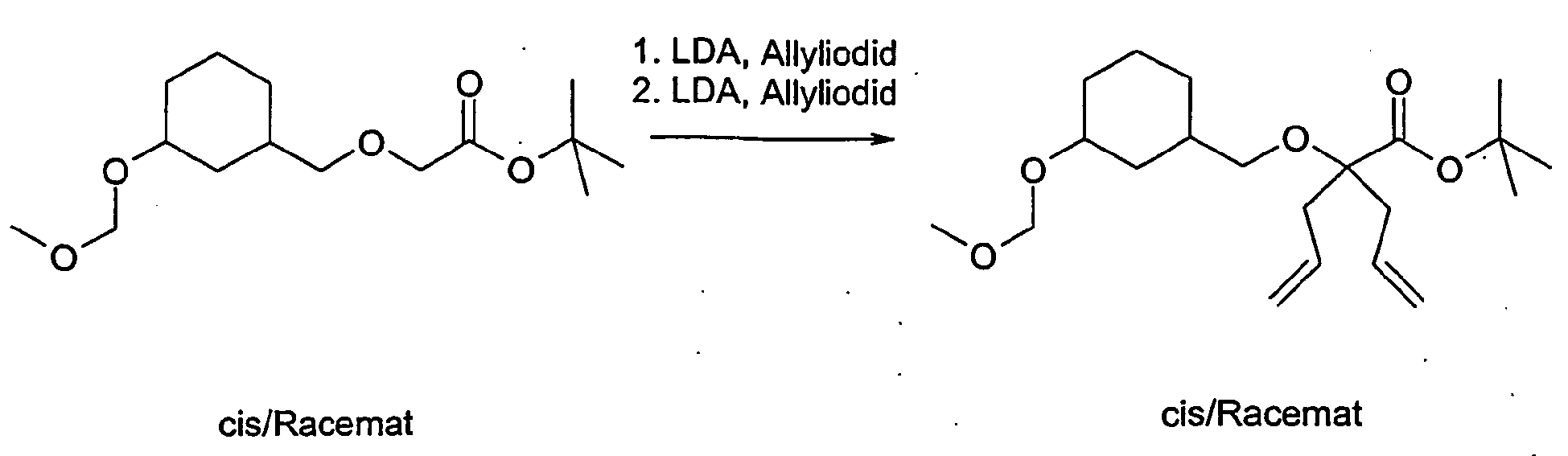
- 200 mg (cis-3-Methoxymethoxycyclohexylmethoxy)-essigsäure-tert-butylester werden in 6 ml abs. Tetrahydrofuran gelöst und auf -78°C (Trockeneis/Aceton-Bad) gekühlt. Anschließend werden 1,05 ml 2M Lithiumdiisopropylamid-Lösung in Tetrahydrofuran/Hexanfraktion zugetropft. Die Lösung wird zunächst bei -78 °C, dann bei 0 °C jeweils 20 min gerührt und bei 0 °C mit 0,85 g Allylbromid in 1,5 ml Tetrahydrofuran versetzt. Die Lösung wird 30 min bei 0°C gerührt. 1 ml gesättigte NH4Cl-Lösung und 5 ml Ethylacetat werden zugesetzt und die Phasen werden getrennt. Die wäßrige Phase wird mit Ethylacetat extrahiert. Die vereinigten organischen Phasen werden über MgSO4 getrocknet und eingeengt. Der Rückstand wird an Kieselgel chromatographiert (Heptan/Ethylacetat 10/1), wobei 160 mg monoallyliertes Produkt erhalten werden. Dieses wird in 6 ml abs. Tetrahydrofuran gelöst und auf -78°C (Trockeneis/Aceton-Bad) gekühlt. Anschließend werden 1,05 ml 2M Lithiumdiisopropylamid-Lösung in Tetrahydrofuran/Hexanfraktion zugetropft. Die Lösung wird zunächst bei -78 °C, dann bei 0 °C jeweils 20 min gerührt und bei 0 °C mit 0,85 g Allylbromid in 1,5 ml Tetrahydrofuranversetzt. Die Lösung wird 2 h bei 0°C gerührt. 1 ml gesättigte NH4Cl-Lösung und 5 ml Ethylacetat werden zugesetzt und die Phasen werden getrennt. Die wäßrige Phase wird mit Ethylacetat extrahiert. Die vereinigten organischen Phasen werden über MgSO4 getrocknet und eingeengt. Der Rückstand wird an Kieselgel chromatographiert (Heptan/Ethylacetat 5/1), wobei 140 mg 2-Allyl-2-(cis-3-methoxymethoxycyclohexylmethoxy)-pent-4-ensäure-tert-butylester als gelbes Öl erhalten werden. C21H36O5 (368,52), MS(ESI): 296,25 (MH+-C4H9O).
-

- 140 mg 2-Allyl-2-(cis-3-methoxymethoxycyclohexylmethoxy)-pent-4-ensäure-tert-butylester werden in 5 ml Dichlormethan gelöst, unter einer Ar-Atmosphäre mit 10 mg Grubbs-Katalysator (Cl2(Cy3P)2Ru=CHPh) versetzt und bei 40 °C 48 h gerührt. 10 ml Heptan/Ethylacetat (3/1) werden zugegeben und die Lösung wird über Kieselgel filtriert. 100 mg 1-(cis-3-Methoxymethoxycyclohexylmethoxy)-cyclopent-3-encarbonsäure-tert-butylester werden als braunes Öl erhalten. Dieses wird in 2 ml MeOH gelöst, entgast und mit Ar gesättigt. Dann werden 30 mg Pd/C (10%) zugegeben und erneut entgast. Die Lösung wird mit Wasserstoff gesättigt und bei Raumtemperatur über Nacht gerührt. Verdünnen mit 20 ml Ethylacetat und Filtration über Celite liefern 100 mg rohen 1-(cis-3-Methoxymethoxycyclohexylmethoxy)-cyclopentancarbonsäure-tert-butylester. Dieser wird in 2 ml Tetrahydrofuran aufgenommen, mit 0,5 ml HCl (konz.) versetzt und über Nacht bei Raumtemperatur gerührt. Die Lösung wird mit gesättigter NaHCO3-Lösung neutralisiert und dreimal mit Ethylacetat extrahiert. Die organischen Phasen werden über MgSO4 getrocknet und eingeengt. Chromatographie des Rückstandes an Kieselgel (Heptan/Ethylacetat 10/1 -> 1/1) liefert 57 mg 1-(cis-3-Hydroxycyclohexylmethoxy)-cyclopentancarbonsäure-tert-butylester als gelbes Öl. Dieses wird roh für die nächste Stufe eingesetzt.
-

- 57 mg 1-(cis-3-Hydroxycyclohexylmethoxy)-cyclopentancarbonsäure-tert-butylester werden'in 3 ml Dimethylformamid gelöst und mit 10 mg NaH versetzt. Die Suspension wird 30 min bei Raumtemperatur gerührt, dann auf 0 °C gekühlt und tropfenweise mit 150 mg Methyl-2-p-tolyl-oxazol-4-ylmethyliodid in 1 ml Dimethylformamid versetzt. Die Suspension wird 2 h bei Raumtemperatur gerührt und mit Methyl-tert-butylether und gesättigter Nacl-Lösung verdünnt. Die wäßrige Phase wird abgetrennt und mit Methyl-tert-butylether extrahiert. Die vereinigten organischen Phasen werden mit gesättigter NaCl-Lösung gewaschen, über MgSO4 getrocknet und eingeengt. Chromatographie des Rückstandes an Kieselgel (Heptan/Ethylacetat 99/ -> 10/1) liefert 20 mg eines Produktgemisches, das den gewünschten 1-[cis-3-(5-Methyl-2-p-tolyl-oxazol-4-ylmethoxy)-cyclohexylmethoxy]-cyclopentancarbonsäure-tert-butylester It. LCMS enthält. Dieses Gemisch wird ohne weitere Aufreinigung in der nächsten Stufe eingesetzt. C29H41NO5 (483,65), LCMS (ESI): 484,2 (MH+).
-
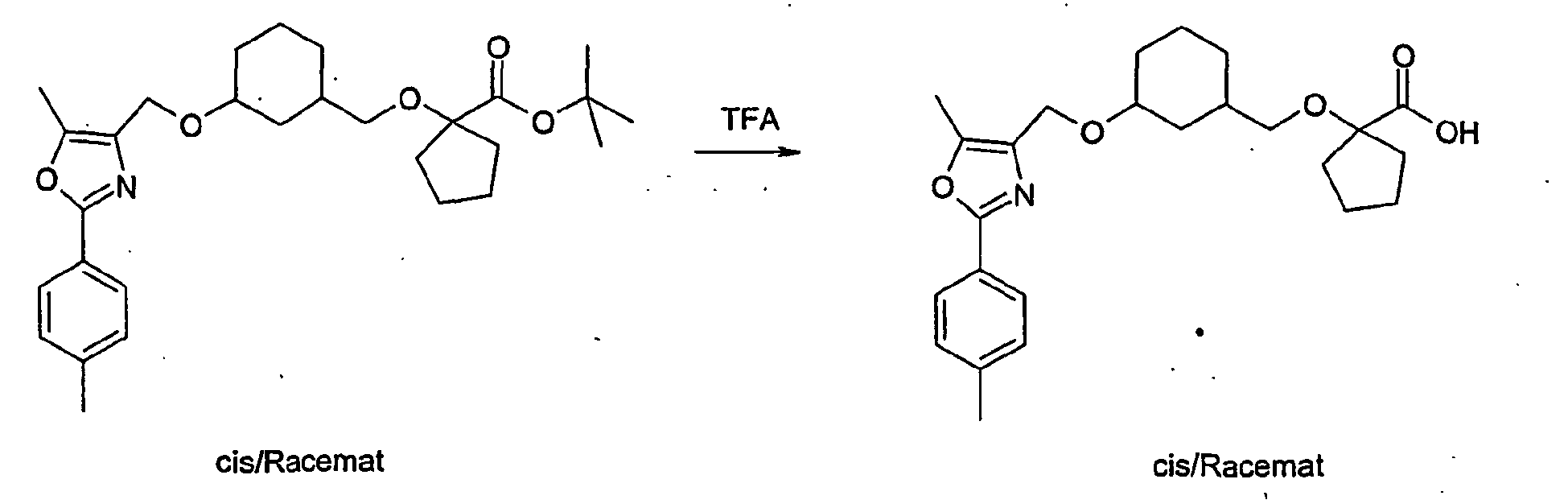
- 20 mg verunreinigter 1-[cis-3-(5-Methyl-2-p-tolyl-oxazol-4-ylmethoxy)-cyclohexylmethoxy]-cyclopentancarbonsäure-tert-butylester wird in 1 ml Trifluoressigsäure bei Raumtemperatur über Nacht gerührt. Die Lösung wird vollständig eingeengt und der Rückstand an Kieselgel chromatographiert (Heptan/Ethylacetat 10/1 -> 1/1 -> Methyl-tert-butylether), wobei 7,5 mg 1-[cis-3-(5-Methyl-2-p-tolyl-oxazol-4-ylmethoxy)-cyclohexylmethoxy]-cyclopentancarbonsäure erhalten werden. C25H33NO5 (427,55); LCMS 428,2 (MH+).
-

-
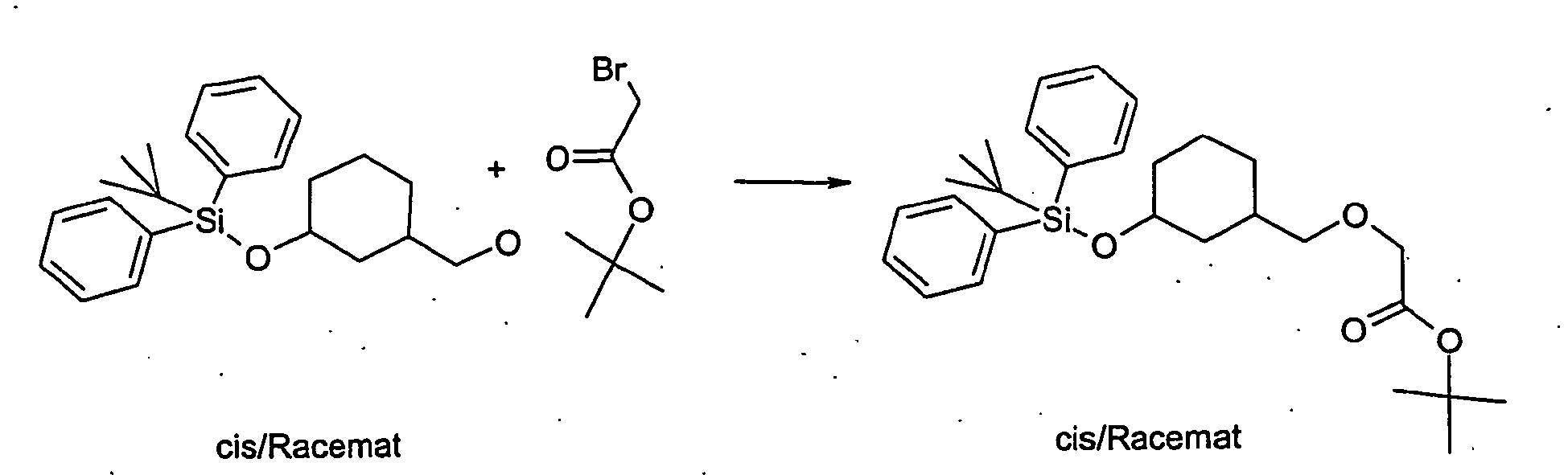
- 25 g [cis-3-(tert-Butyl-diphenyl-silanyloxy)-cyclohexyl]-methanol werden zusammen mit 40 g Bromessigsäure-tert-butylester und 6,9 g Tetrabutylammoniumhydrogensulfat in 300 ml Toluol gelöst und anschließend bei 0 °C 200 ml NaOH (50%ig) zugetropft. Bei 0 °C wird 1 h gerührt und dann auf Raumtemperatur erwärmt. Das Lösungsmittel wird entfernt und mit 3 x 100 ml Methyl-tert-butylether extrahiert. Nach der dritten Extraktion wird die wässrige Phase angesäuert und nochmals mit 200 ml Methyl-tert-butylether extrahiert. Die vereinigten organischen Phasen werden mit gesättigter Natriumclorid-Lösung ausgeschüttelt, über Magnesiumsulfat getrocknet und das Lösungsmittel im Vakuum entfernt. Man erhält 27,8 g des cis-3-(tert-Butyl-diphenyl-silanyloxy)-cyclohexylmethoxy]-essigsäure-tert-butylesters als gelbes Öl.
C29H42O4Si (482.74), MS(ESI): 483 (M + H+) -

- 20,0 g des cis-3-(tert-Butyl-diphenyl-silanyloxy)-cyclohexylmethoxy]-essigsäure-tert-butylesters werden in einem ausgeheizten 1L-Dreihals-Kolben vorgelegt, in 200 ml trockenem Tetrahydrofuran gelöst, auf - 78 °C gekühlt und 83 ml Lithiumdiisopropylamid (2N in Tetrahydrofuran) langsam zugetropft, so dass die Innentemperatur nicht über - 65 °C ansteigt. Anschließend wird auf 0 °C erwärmt und 1 h gerührt, wobei sich die Lösung gelb färbt. Nach erneutem Abkühlen auf - 70 °C werden 35,27 g Methyliodid zugetropft und 3 h bei 0 °C gerührt. Reaktionskontrolle (DC und LCMS) ergibt die Bildung eines neuen Produktes (Monomethyl Verbindung). Das Reaktionsgemisch wird mit 200 ml gesättigter Ammoniumchlorid-Lösung versetzt und mit Wasser/Methyl-tert-butylether extrahiert. Man erhält das Rohprodukt als dunkelrotes Öl, welches ohne Aufreinigung in der gleichen Reaktionssequenz zur geminalen Dimethylverbindung umgesetzt wird. Das Rohprodukt wird an Kieselgel (Heptan/Ethylacetat 50:1 → 10:1) gereinigt. Man erhält 16 g des 2-[cis-3-(tert-Butyldiphenyl-silanyloxy)-cyclohexylmethoxy]-2-methyl-propionsäure-tert-butylesters als hellgelbes Öl.
C31H46O4Si (510.80), MS(ESI): 511 (M+H+) -

- 16 g des 2-[cis-3-(tert-Butyl-diphenyl-silanyloxy)-cyclohexylmethoxy]-2-methylpropionsäure-tert-butylesters werden in 100 ml Acetonitril gelöst und mit 62 ml Tetrabutylammoniumfluorid (1N Lösung in Tetrahydrofuran) versetzt. Nach 2 h Rühren bei 60 °C ist die Reaktion beendet und es wird im Vakuum eingeengt. Der Rückstand wird aus Wasser/Ethylacetat extrahiert. Die vereinigten org. Phasen werden mit gesättigter Natriumchlorid-Lösung ausgeschüttelt, über Magnesiumsulfat getrocknet und das Lösungsmittel im Vakuum entfernt. Das Rohprodukt wird an Kieselgel (Heptan/Ethylacetat 15:1 → 1:1) gereinigt. Man erhält 16 g des Produktes 2-(cis-3-Hydroxy-cyclohexylmethoxy)-2-methyl-propionsäure-tert-butylester als farbloses Öl. C15H28O4 (272.39), MS(ESI): 273 (M + H+)
-

- 0,05 g des Alkohols 2-(cis-3-Hydroxy-cyclohexylmethoxy)-2-methyl-propionsäure-tert-butylester wird in Methyl-tert-butylether gelöst und mit 15 mg Natriumhydrid versetzt. Nach 15 Minuten Rühren bei Raumtemperatur werden 0.12 g 2-(4-Fluoro-phenyl)-4-iodmethyl-5-methyl-oxazol zugegeben und 12 h bei Raumtemperatur gerührt. Nach Zugabe von 2 ml 1N HCl wird mit Ethylacetat (2 x 5 ml) extrahiert, das Lösungsmittel im Vakuum entfernt und das Rohprodukt anschließend über HPLC gereinigt. Man erhält 0.08 g der Verbindung 2-{cis-3-[2-(4-Fluoro-phenyl)-5-methyl-oxazol-4-ylmethoxy]-cyclohexylmethoxy}-2-methyl-propionsäure-tert-butylester als farbloses Öl C26H36FNO5 (461.58), MS(ESI): 462 (M + H+)
-

- 0,07 g des 2-{cis-3-[2-(4-Fluoro-phenyl)-5-methyl-oxazol-4-ylmethoxy]-cyclohexylmethoxy}-2-methyl-propionsäure-tert-butylesters wird in 1 ml Dichlormethan gelöst, mit 1 ml Trifluoressigsäure versetzt und bei Raumtemperatur gerührt. Reaktionskontrolle (LCMS) ergibt nach 30 Minuten einen vollständigen Umsatz. Das Reaktionsgemisch wird mit Wasser / Dichlormethan ausgeschüttelt und nach Entfernen des Lösungsmittels im Vakuum mittels präparativer HPLC gereinigt. Man erhält 0,06 g der Carbonsäure 2-{cis-3-[2-(4-Fluoro-phenyl)-5-methyl-oxazol-4-ylmethoxy]-cyclohexylmethoxy}-2-methyl-propionsäure als farbloses Öl.
C22H28FNO5 (405.47), MS(ESI): 406 (M + H+) - Analog zu Beispiel 10 erhält man aus 2-(cis-3-Hydroxycyclohexylmethoxy)-2-methylpropionsäure-tert-butylester und 2-(3-Methoxy-phemyl)-5-methyl-oxazol-4-ylmethyliodid 2-{(1 S,3R)-cis-3-[2-(3-Methoxy-phenyl)-5-methyl-oxazol-4-ylmethoxy]-cyclohexylmethoxy}-2-methyl-propionsäure.

- Analog zu Beispiel 10 erhält man aus 2-(cis-3-Hydroxycyclohexylmethoxy)-2-methylpropionsäüre-tert-butylester und 2-(3-Triflüormethyl-phenyl)-5-methyl-oxazol-4-ylmethyliodid 2-{(1S,3R)-cis-3-[2-(3-Trifluormethyl-phenyl)-5-methyl-oxazol-4-ylmethoxy]-cyclohexylmethoxy}-2-methyl-propionsäure.

- Analog zu Beispiel 10 erhält man aus 2-(cis-3-Hydroxycyclohexylmethoxy)-2-methylpropionsäure-tert-butylester und 5-methyl-2-(5-methyl-furan-2-yl)-oxazol-4-ylmethyliodid 2-Methyl-2-{(1R,3S)-cis-3-[5-methyl-2-(5-methyl-furan-2-yl)-oxazol-4-ylmethoxy]-cyclohexylmethoxy}-propionsäure.

- Analog zu Beispiel 10 erhält man aus 2-(cis-3-Hydroxycyclohexylmethoxy)-2-methylpropionsäure-tert-butylester und 2-(3,4-Dimethoxy-phenyl)-5-methyl-oxazol-4-ylmeth yliodid 2-{(1 R,3S)-cis-3-[2-(3,4-Dimethoxy-phenyl)-5-methyl-oxazol-4-ylmethoxy]-cyclohexylmethoxy}-2-methyl-propionsäure.

- Analog zu Beispiel 10 erhält man aus 2-(cis-3-Hydroxycyclohexylmethoxy)-2-methylpropionsäure-tert-butylester und 5-Phenyl-2-p-tolyl-oxazol-4-ylmethyliodid 2-Methyl-2-[(1R,3S)-cis-3-(5-phenyl-2-p-tolyl-oxazol-4-ylmethoxy)-cyclohexylmethoxy]-propionsäure

- Analog zu Beispiel 10 erhält man aus 2-(cis-3-Hydroxycyclohexylmethoxy)-2-methylpropionsäure-tert-butylester und 5-Methyl-2-(4-trifluoromethyl-phenyl)-oxazol-4-ylmethyliodid 2-Methyl-2-{(1R,3S)-cis-3-[5-methyl-2-(4-trifluoromethyl-phenyl)-oxazol-4-ylmethoxy]-cyclohexylmethoxy}-propionsäure
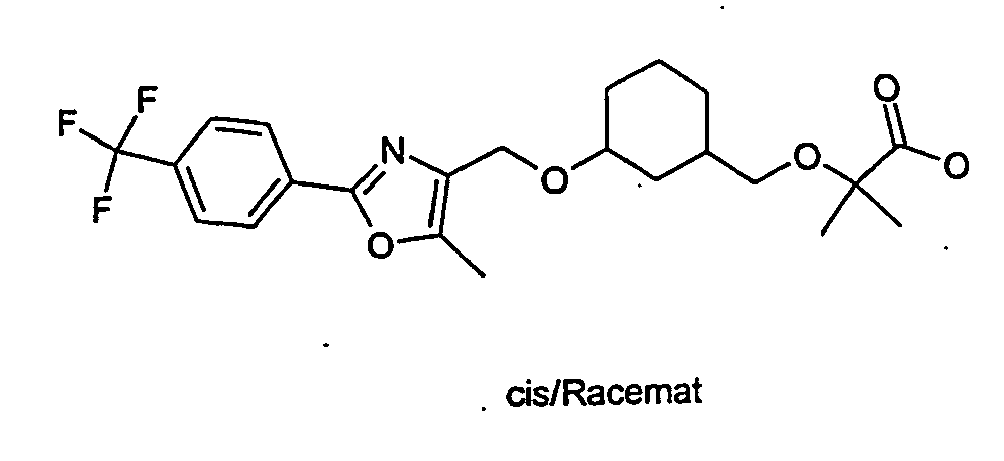
- Analog zu Beispiel 10 erhält man aus 2-(cis-3-Hydroxycyclohexylmethoxy)-2-methylpropionsäure-tert-butylester und 2-(4-Methoxy-phenyl)-5-methyl-oxazol-4-ylmethyliodid 2-{(1R,3S)-cis-3-[2-(4-Methoxy-phenyl)-5-methyl-oxazol-4-ylmethoxy]-cyclohexylmethoxy}-2-methyl-propionsäure

- Analog zu Beispiel 10 erhält man aus 2-(cis-3-Hydroxycyclohexylmethoxy)-2-methylpropionsäure-tert-butylester und 5-Methyl-2-thiophen-2-yl-oxazol-4-ylmethyliodid 2-Methyl-2-[(1R,3S)-cis-3-(5-methyl-2-thiophen-2-yl-oxazol-4-ylmethoxy)-cyclohexylmethoxy]-propionsäure

- Analog zu Beispiel 10 erhält man aus 2-(cis-3-Hydroxycyclohexylmethoxy)-2-methylpropionsäure-tert-butylester und -methyl-2-(3-trifluoromethoxy-phenyl)-oxazol-4-ylmethyliodid 2-Methyl-2-[(1R,3S)-cis-3-[5-methyl-2-(3-trifluoromethoxy-phenyl)-oxazol-4-ylmethoxy]-cyclohexylmethoxy]-propionsäure

- Analog zu Beispiel 10 erhält man aus 2-(cis-3-Hydroxycyclohexylmethoxy)-2-methylpropionsäure-tert-butylester und 5-methyl-2-(4-Isopropyl-phenyl)-oxazol-4-ylmethyliodid 2-Methyl-2-[(1R,3S)-cis-3-(5-methyl-2-(4-Isopropyl-phenyl)-oxazol-4-ylmethoxy)-cyclohexylmethoxy]-propionsäure.
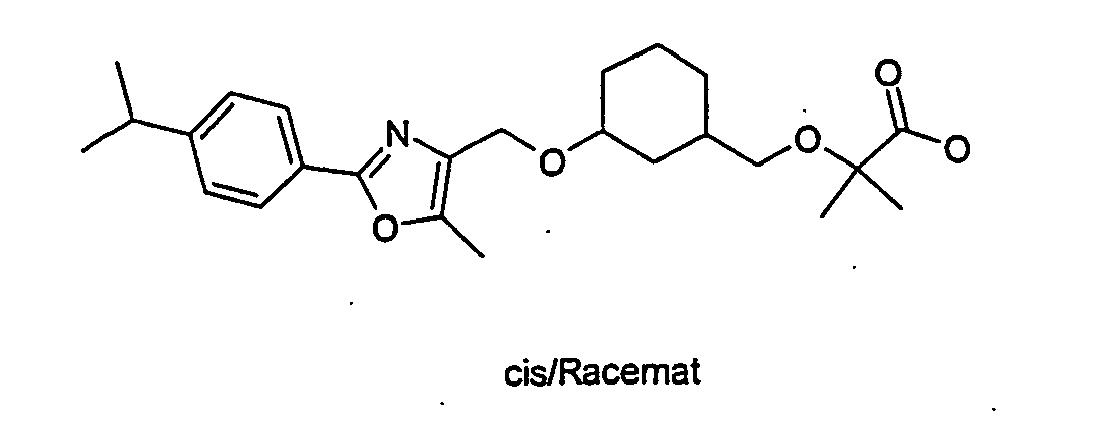
- Analog zu Beispiel 10 erhält man aus 2-(cis-3-Hydroxycyclohexylmethoxy)-2-methylpropionsäure-tert-butylester und 5-methyl-2-m-toluyl-oxazol-4-ylmethyliodid 2-Methyl-2-[(1R,3S)-cis-3-(5-methyl-2-m-toluyl-oxazol-4-ylmethoxy)-cyclohexylmethoxy]-propionsäure.

-

-
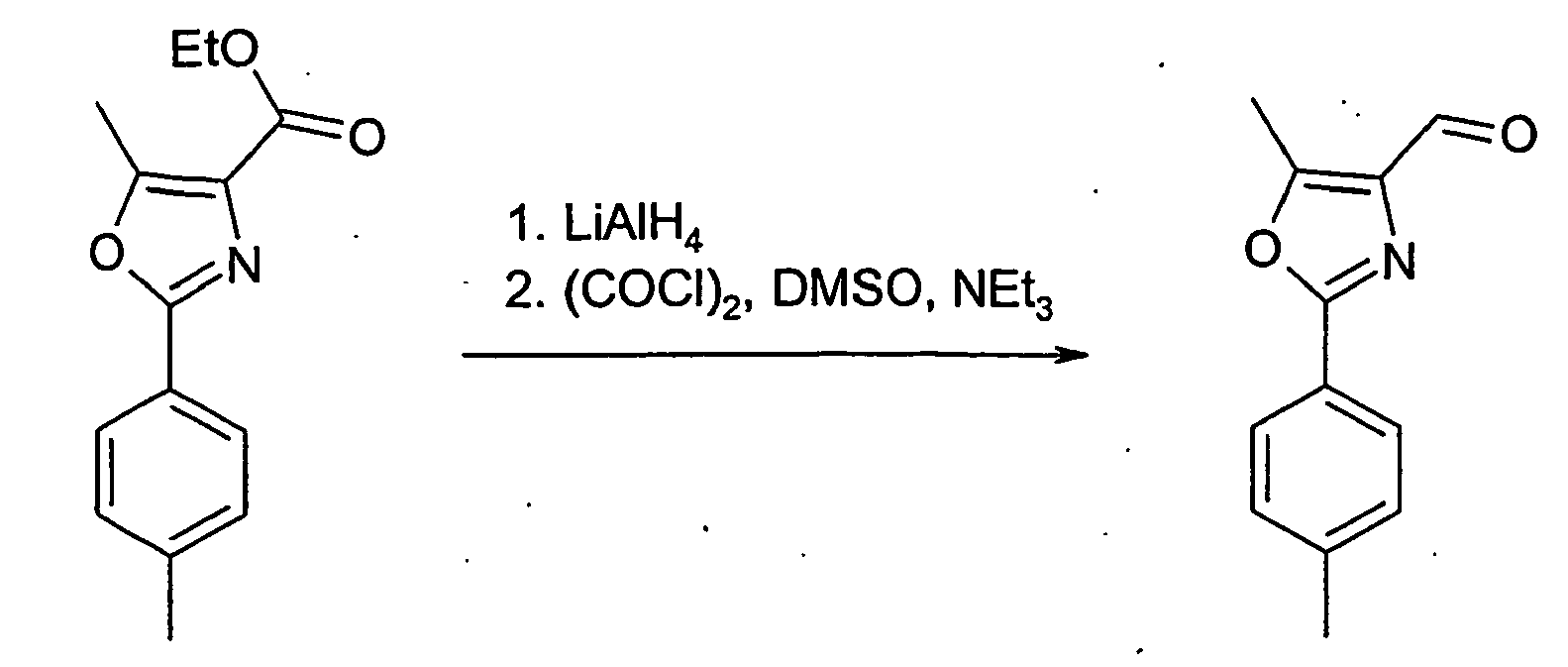
- 9,3 g LiAlH4 werden in einem trockenen Vierhalskolben mit Rührmotor, Innenthermometer, Tropftrichter mit Druckausgleich und Rückflusskühler mit Argonzuleitung (Absaugstück mit Hahn) mit 600 ml Diethylether überschichtet. Die Suspension wird auf 0°C gekühlt. 30 g 5-Methyl-2-p-tolyl-oxazol-4-carbonsäüreethylester werden in 100 ml Diethylether gelöst und der Suspension tropfenweise zugegeben. Nach einstündigem Rühren bei Raumtemperatur ist die Reaktion beendet (DC(Heptan/Ethylacetat 1/1): Rf,Edukt = 0.66, Rf,Produkt = 0.18). 80 g MgSO4, 300 ml Methyl-tert-butylether und 30 ml Ethylacetat werden nacheinander zugegeben, und die Suspension wird bei Raumtemperatur gerührt. Dann wird die Mischung auf 0°C gekühlt, tropfenweise mit 90 ml 10N KOH versetzt und weitere 60 min gerührt. Die Feststoffe werden abfiltriert, der Rückstand dreimal mit Ethylacetat gewaschen, und das Filtrat wird eingeengt, wobei 24 g 5-Methyl-2-p-tolyl-oxazol-4-methanol als gelber Feststoff erhalten werden. C12H13NO2 (203,24), LCMS(ESI): 204.1 (MH+).
Zu einer Lösung von 12 ml Oxalylchlorid in 150 ml Dichlormethan werden bei -78 °C 22.2 ml DMSO in 30 ml Dichlormethan so zugetropft, dass die Temperatur nicht über-70 °C steigt. Anschließend wird die Lösung 30 min bei dieser Temperatur gerührt. Dann werden 24 g 5-Methyl-2-p-tolyl-oxazol-4-methanol in 120 ml Dichlormethan/Chloroform (2/1) zugetropft, wobei die Temperatur nicht über -70 °C steigt. Die Lösung wird 30 min bei dieser Temperatur gerührt. Anschließend werden 80 ml NEt3 so zugetropft, dass die Temperatur nicht über-70 °C steigt. Nach beendeter Zugabe wird das Kühlbad entfernt und die Lösung unter Rühren auf 0 °C gebracht. Bei dieser Temperatur werden 100 ml Wasser zugegeben, und die Mischung wird heftig bei Raumtemperatur gerührt. Die wäßrige Phase wird abgetrennt und mit Chloroform extrahiert. Die vereinigten organischen Phasen werden mit gesättigter NH4Cl-Lösung gewaschen, über MgSO4 getrocknet und eingeengt, wobei 23,8 g 5-Methyl-2-p-tolyl-oxazol-4.-carbaldehyd als gelber Feststoff erhalten werden. C12H11NO2 (201,23), LCMS(ESI): 202,1 (MH+). -

- 47 g 6-Oxa-bicyclo[3.2.1]octan-7-on werden in 500 ml MeOH gelöst und mit 40,5 g NaOMe versetzt. Nach 2,5-stündigem Rühren bei Raumtemperatur werden 135 ml Essigsäure zugegeben und das Methanol weitgehend abdestilliert. Der Rückstand wird mit Ethylacetat/Wasser aufgenommen, und die Phasen werden getrennt. Die wäßrige Phase wird mit Ethylacetat extrahiert, die vereinigten organischen Phasen werden über MgSO4 getrocknet und eingeengt, wobei der Methylester quantitativ als Rückstand erhalten wird.
10,7 g des Rückstandes werden in 100 ml Dimethylformamid gelöst und mit 11,2 g tert-Butyldimethylsilylchlorid versetzt. Bei 0 °C werden 11,5 g Imidazol zugegeben und die Lösung wird bei Raumtemperatur über Nacht gerührt. 200 ml gesättigte NaCl-Lösung werden zugesetzt und die Lösung wird dreimal mit Methyl-tert-butylether extrahiert. Die vereinigten organischen Phasen werden mit gesättigter NaCl-Lösung gewaschen, über MgSO4 getrocknet und eingeengt. 16,4 g [cis-3-(tert-Butyldimethylsilanyloxy)-cyclohexyl]-carbonsäuremethylester werden als farbloses Öl erhalten. C14H28O3Si (272,46), MS(ESI): 273,13 (MH+). -

- 1,35 g [cis-3-(tert-Butyldimethylsilanyloxy)-cyclohexyl]-essigsäuremethylester werden bei Raumtemperatur zu einer Mischung von 4,0 ml HSiEt3 und 1,50 g BiBr3 in 20 ml Acetonitril getropft. Anschließend werden 1,51 g 5-Methyl-2-p-tolyl-oxazol-4-carbaldehyd in 5 ml Acetonitril zugegeben und die Mischung 4 h bei Raumtemperatur gerührt. Die Suspension wird filtriert und eingeengt. Der Rückstand wird an Kieselgel chromatographiert (Dichlormethan/Methanol 100/1), wobei 1,20 g cis-3-(5-Methyl-2-p-tolyloxazol-4-ylmethoxy)-cyclohexancarbonsäuremethylester als hellgelbes Öl erhalten werden. C20H25NO4 (343,43), LCMS(ESI): 344,1 (MH+).
-
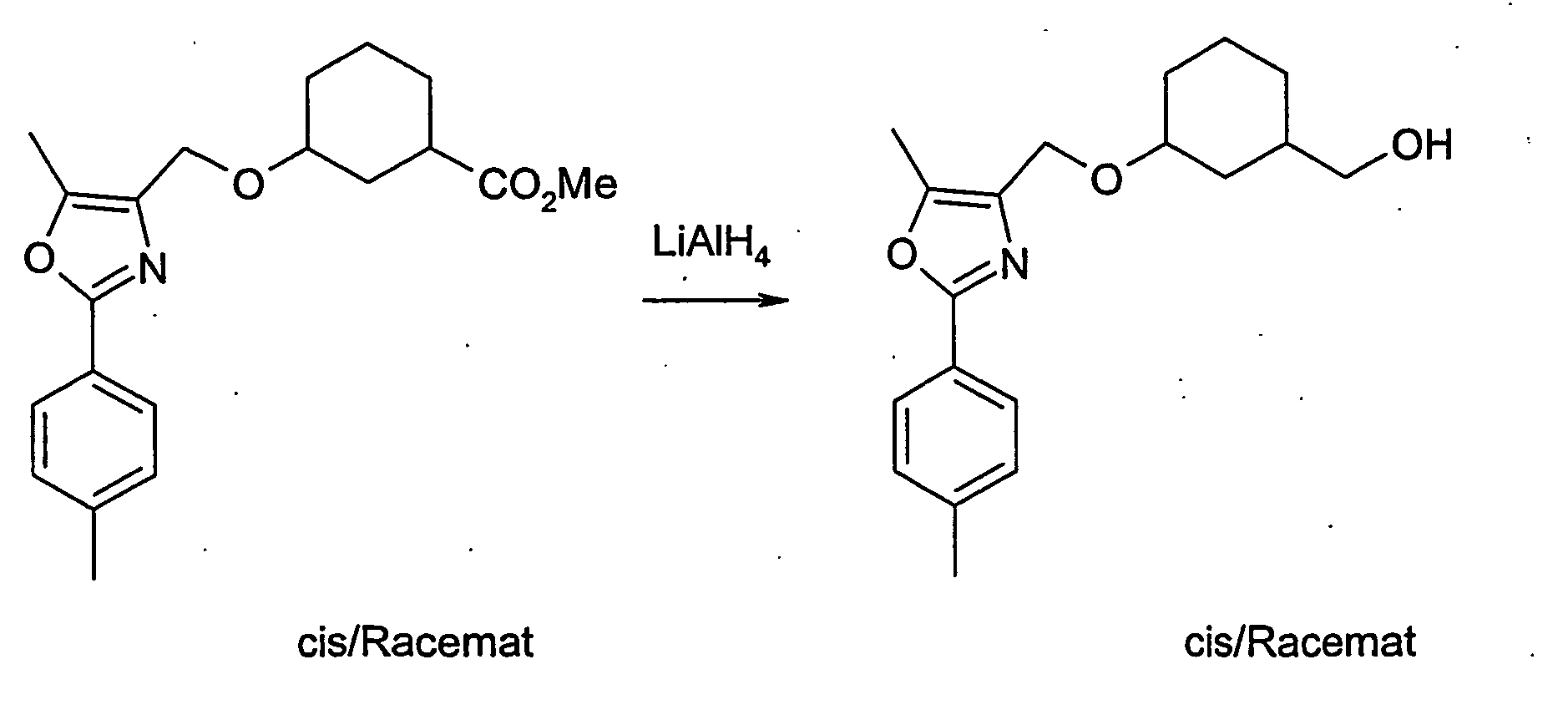
- 1,70 g cis-3-(5-Methyl-2-p-tolyloxazol-4-ylmethoxy)-cyclohexancarbonsäuremethylester in 5 ml Tetrahydrofuranwerden bei 0 °C zu einer Suspension von 380 mg LiAlH4 in 50 ml Diethylether getropft und 2 h bei Raumtemperatur gerührt. 3 g MgSO4, 30 ml Methyl-tert-butylether und 3 ml Ethylacetat werden nacheinander zugegeben und die Suspension bei Raumtemperatur gerührt. Dann wird die Mischung auf 0°C gekühlt, tropfenweise mit 1 ml 10N KOH versetzt und weitere 60 min gerührt. Die Feststoffe werden abfiltriert, der Rückstand dreimal mit Ethylacetat gewaschen, und das Filtrat wird eingeengt, wobei 1,55 g cis-3-(5-Methyl-2-p-tolyl-oxazol-4-ylmethoxy)-cyclohexyl]-methanol als gelbes Öl erhalten werden.
C19H25NO3 (315,42), MS(EI): 315.4 (M+). -
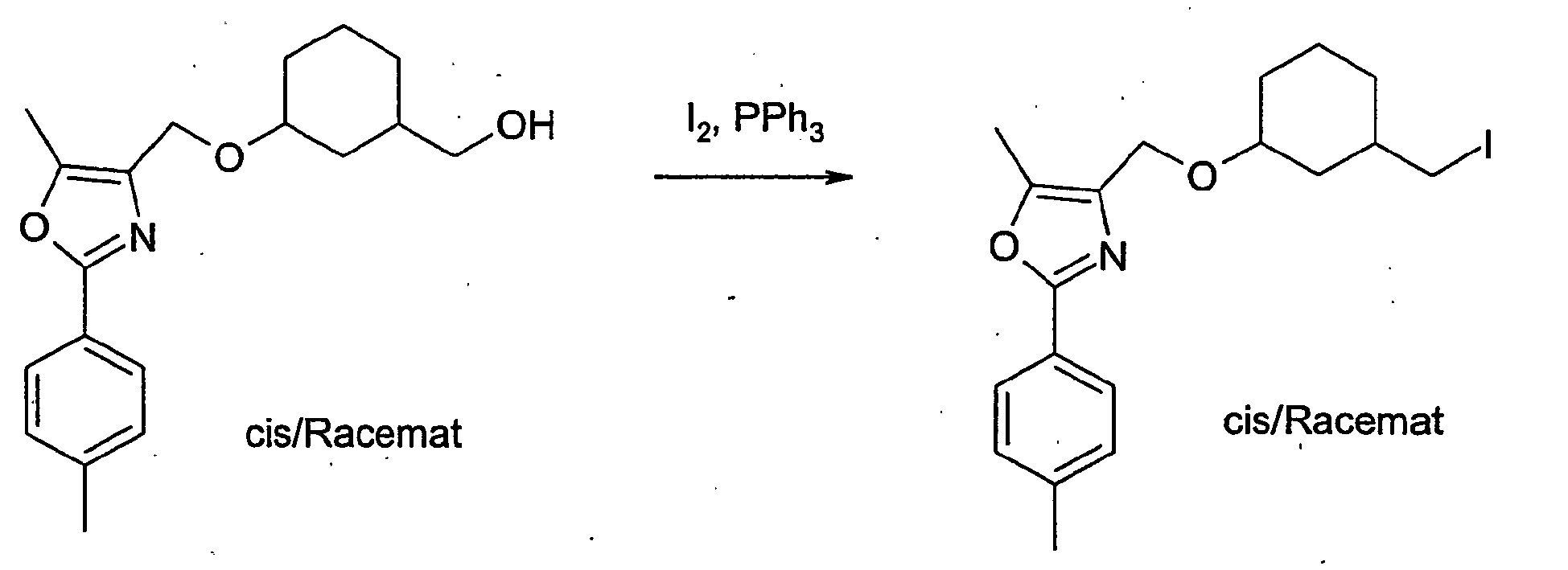
- Zu 1,55 g cis-3-(5-Methyl-2-p-tolyl-oxazol-4-ylmethoxy)-cyclohexyl]-methanol in 20 ml Toluol werden 1,56 g PPh3, 0,87 g Imidazol und 1,64 g Iod gegeben und die Mischung 2 h bei Raumtemperatur gerührt. Dann werden 10 ml Dichlormethan zugesetzt und weitere 60 min gerührt. Die Lösung wird mit 50 ml Wasser
und 50 ml Methyl-tert-butylether verdünnt, die Phasen werden getrennt, die organische Phase wird über MgSO4 getrocknet und eingeengt. Filtration des Rückstandes über Kieselgel mir Dichlormethan liefert 1,12 g 4-(cis-3-lodmethylcyclohexyloxymethyl)-5-methyl-2-p-tolyl-oxazol als gelben Feststoff. C19H24INO2 (425,31); LCMS (ESI): 426.0 (MH+). -

- 68 mg Mercaptoessigsäureethylester in 1,5 ml Dimethylformamid werden mit 50 mg KOtBu versetzt und 1 h bei Raumtemperatur gerührt. Anschließend werden 120 mg 4-(cis-3-lodmethylcyclohexyloxymethyl)-5-methyl-2-p-tolyt-oxazol zugegeben und die Lösung wird bei Raumtemperatur gerührt. Nach 1 h werden 20 ml Methyl-tert-butylether, 15 ml gesättigte NaCl-Lösung und 15 ml Wasser zugegeben und die Phasen getrennt. Die wäßrige Phase wird mit Methyl-tert-butylether extrahiert, die vereinigten organischen Phasen werden mit gesättigter NaCl-Lösung gewaschen, über MgSO4 getrocknet und eingeengt, wobei 117 mg cis-3-(5-Methyl-2-p-tolyloxazol-4-ylmethoxy)-cyclohexylmethylsulfanyl]-essigsäureethylester erhalten werden.
C23H31NO4S (417,57); LCMS (ESI): 418,1 (MH+). -

- 117 mg cis-3-(5-Methyl-2-p-tolyloxazol-4-ylmethoxy)-cyclohexylmethylsulfanyl]-essigsäureethylester in 3 ml Methanol gelöst werden mit 1 ml 2N KOH versetzt und bei Raumtemperatur über Nacht gerührt. Dann werden 2 ml 2N HCl, 10 ml gesättigte Nacl-Lösung, 5 ml Wasser und 20 ml Dichlormethan zugesetzt und die Phasen getrennt. Die organische Phase wird über MgSO4 getrocknet und eingeengt, wobei 100 mg cis-3-(5-Methyl-2-p-tolyloxazol-4-yimethoxy)-cyclohexylmethylsulfanyl]-essigsäure erhalten werden. C21H27NO4S (389,52); LCMS(ESI): 390,1 (MH+).
- Analog zu Beispiel 22 erhält man aus 4-(cis-3-lodmethylcyclohexyloxymethyl)-5-methyl-2-p-tolyl-oxazol und 2-Mercaptopropionsäureethylester 2-[cis-3-(5-Methyl-2-p-tolyloxazol-4-ylmethoxy)-cyclohexylmethylsulfanyl]-propionsäure als Diastereomerengemisch. C22H29NO4S (403,54), LCMS(ESI): 404,1 (MH+).

- Analog zu Beispiel 22 erhält man aus 4-(cis-3-lodmethylcyclohexyloxymethyl)-5-methyl-2-p-tolyl-oxazol und 2-Mercaptobuttersäuremethylester 2-[cis-3-(5-Methyl-2-p-tolyloxazol-4-ylmethoxy)-cyclohexylmethylsulfanyl]-buttersäure als Diastereomerengemisch. C23H31NO4S (417,57), LCMS(ESI): 418,1 (MH+).
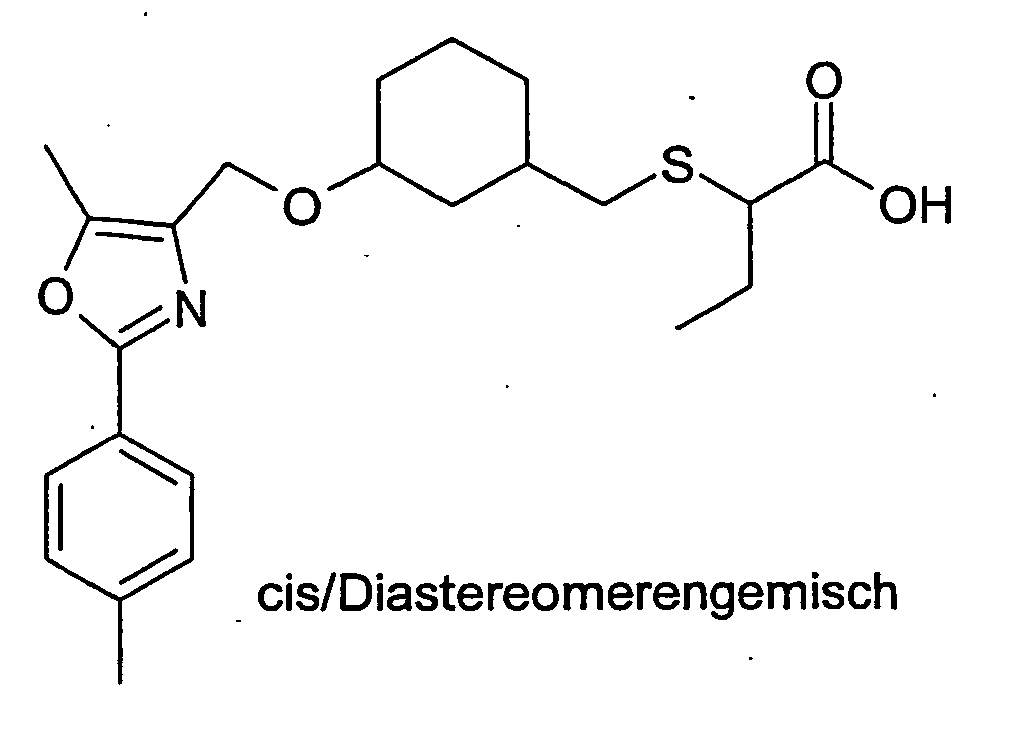
- Analog zu Beispiel 22 erhält man aus 4-(cis-3-iodmethylcyclohexyloxymethyl)-5-methyl-2-p-tolyl-oxazol und 2-Mercaptoheptansäureethylester 2-[cis-3-(5-Methyl-2-p-tolyloxazol-4-ylmethoxy)-cyclohexylmethylsulfanyl]-heptansäure als Diastereomerengemisch. C26H37NO4S (459,65), MS(ESI): 460,41 (MH+).

- Analog zu Beispiel 22 erhält man aus 4-(cis-3-lodmethylcyclohexyloxymethyl)-5-methyl-2-p-tolyl-oxazol und 2-Mercapto-3-methylbuttersäuresäureethylester 2-[cis-3-(5-Methyl-2-p-tolyloxazol-4-ylmethoxy)-cyclohexylmethylsulfanyl]-3-methylbuttersäure als Diastereomerengemisch. C24H33NO4S (431,60), LCMS(ESI): 432.2 (MH+).
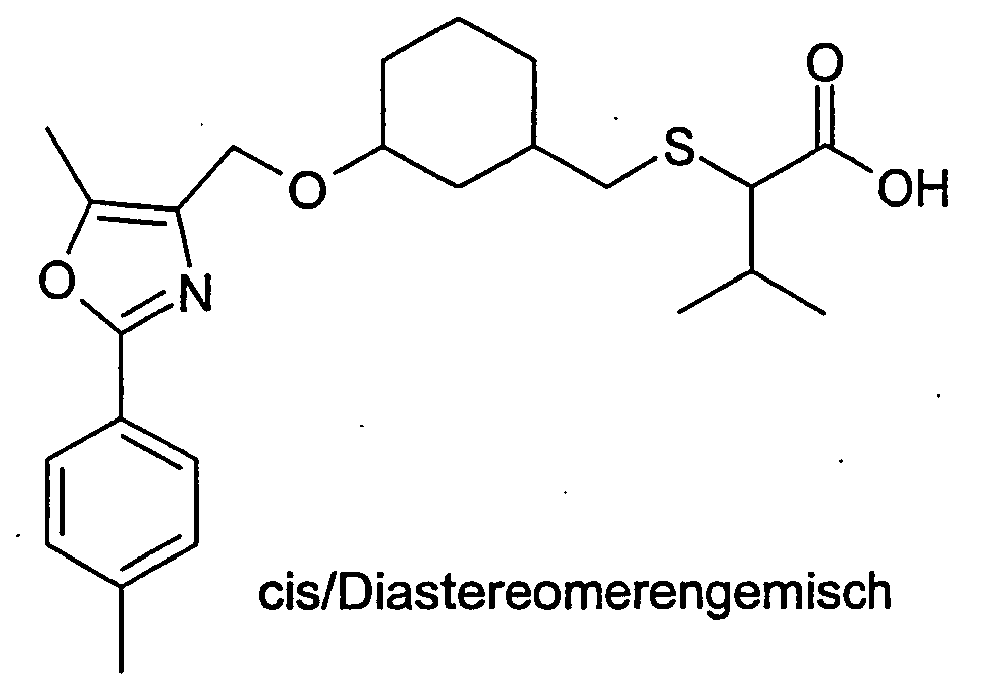
- Analog zu Beispiel 22 erhält man aus 4-(cis-3-lodmethylcyclohexyloA-ymethyl)-5-methyl-2-p-tolyl-oxazol und 2-Mercapto-2-methylpropionsäuresäureethylester 2-[cis-3-(5-Methyl-2-p-tolyloxazol-4-ylmethoxy)-cyclohexylmethylsulfanyl]-2-methylpropionsäure. C23H31NO4S (417,57), LCMS(ESI): 418,1 (MH+).

- Analog zu Beispiel 22 erhält man aus 4-(cis-3-lodmethylcyclohexyloxymethyl)-5-methyl-2-p-tolyl-oxazol und 2-Mercapto-2-phenylessigsäureethylester 2-[cis-3-(5-Methyl-2-p-tolyloxazol-4-ylmethoxy)-cyclohexylmethylsulfanyl]-2-phenylessigsäure als Diastereomerengemisch. C27H31NO4S (465,62), MS(ESI): 466,39 (MH+).

- Analog zu Beispiel 22 erhält man aus 4-(cis-3-lodmethylcyclohexyloxymethyl)-5-methyl-2-p-tolyl-oxazol und 2-Mercapto-2-cyclohexylessigsäureethylester 2-[cis-3-(5-Methyl-2-p-tolyloxazol-4-ylmethoxy-cyclohexylmethylsulfanyl]-2-cyclohexylessigsäure als Diastereomerengemisch. C27H37NO4S (471,66), LCMS(ESI): 472,2 (MH+).

- Analog zu Beispiel 22 erhält man aus 4-(cis-3-lodmethylcyclohexyloxymethyl)-5-methyl-2-p-tolyl-oxazol und 2-Mercaptovaleriansäureethylester 2-[cis-3-(5-Methyl-2-p-tolyloxazol-4-ylmethoxy)-cyclohexylmethylsulfanyl]-valeriansäure als Diastereomerengemisch. C24H33NO4S (431,60), MS(ESI): 432,39 (MH+).

- Analog zu Beispiel 22 erhält man aus 4-(cis-3-Iodmethylcyclohexyloxymethyl)-5-methyl-2-p-tolyl-oxazol und 1-Mercaptocyclobutancarbonsäureethylester 1-[cis-3-(5-Methyl-2-p-tolyloxazol-4-ylmethoxy)-cyclohexylmethylsulfanyl]-cyclobutancarbonsäure. C24H31NO4S (429,58), MS(ESI): 430,35
(MH+).
-
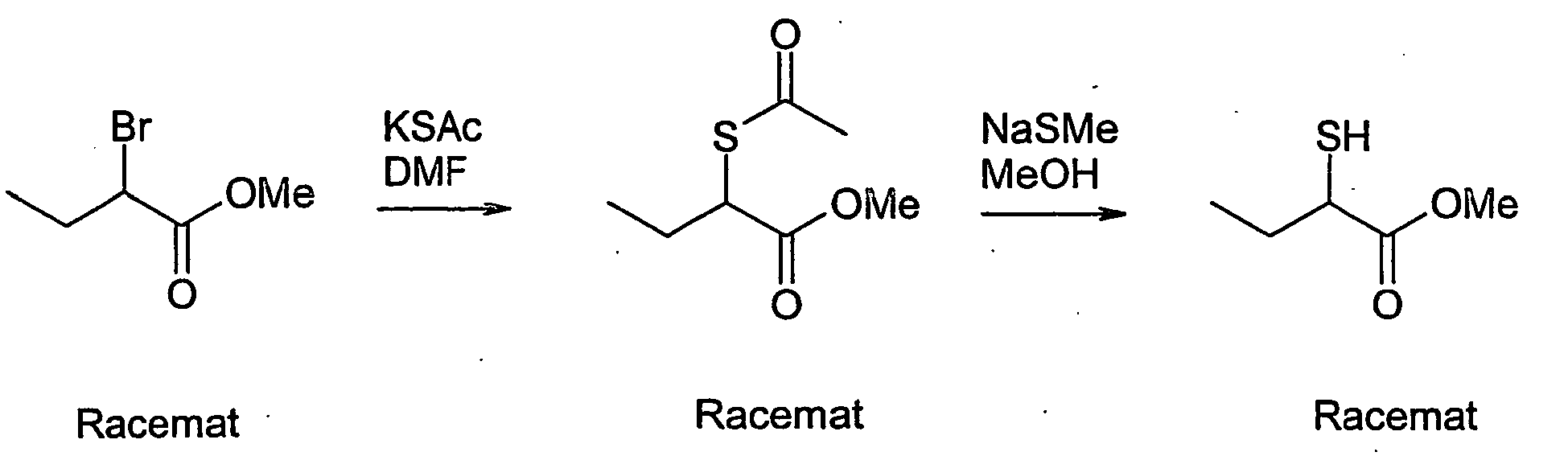
- Zu 1,81 g 2-Brombuttersäuremethylester in 5 ml Dimethylformamid werden 1,43 g KSAc gegeben und die Mischung 12 h bei Raumtemperatur gerührt. Dann werden 25 ml Methyl-tert-butylether, 10 ml Wasser und 15 ml gesättigte NaCl-Lösung zugesetzt und die Phasen getrennt. Die wäßrige Phase wird mit Methyl-tert-butylether extrahiert, die vereinigten organischen Phasen werden mit gesättigter NaCl-Lösung gewaschen, über MgSO4 getrocknet und eingeengt, wobei 2-Acetylsulfanylbuttersäuremethylester als gelbes Öl erhalten werden. Dieses wird in 10 ml Methanol aufgenommen und mit 11 ml einer 1M NaSMe Lösung in Methanol versetzt und über Nacht bei Raumtemperatur gerührt. Das Lösungsmittel wird im Vakuum vollständig abdestilliert, der Rückstand mit 15 ml Methyl-tert-butylether und 20 ml Wasser aufgenommen, die Phasen werden getrennt, die organische Phase mit gesättigter Nacl-Lösung gewaschen und über MgSO4 getrocknet. Nach Einengen der Lösung im Vakuum werden 1,30 g 2-Mercaptobuttersäuremethylester als gelbes Öl erhalten.
- Analog zu Bausteinsynthese der 2-Mercaptobuttersäuremethylester erhält man aus 2-Bromheptansäureethylester 2-Mercaptoheptansäureethylester.

- Analog zu Bausteinsynthese der 2-Mercaptobuttersäuremethylester erhält man aus 2-Brom-3-methylbuttersäuresäureethylester 2-Mercapto-3-methylbuttersäuresäureethylester.
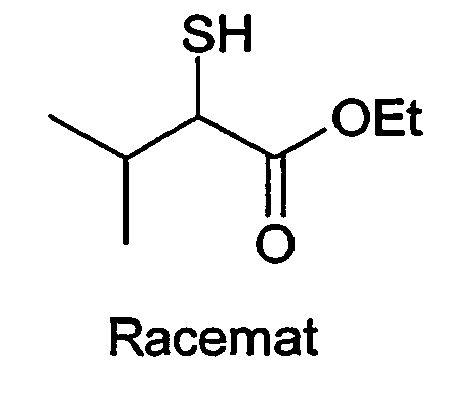
- Analog zur Bausteinsynthese der 2-Mercaptobuttersäuremethylester erhält man aus 2-Brom-2-methylpropionsäuresäureethylester 2-Mercapto-2-methylpropionsäuresäureethylester.

- Analog zu Bausteinsynthese der 2-Mercaptobuttersäuremethylester erhält man aus 2-Brom-2-phenylessigsäureethylester 2-Mercapto-2-phenylessigsäureethylester.
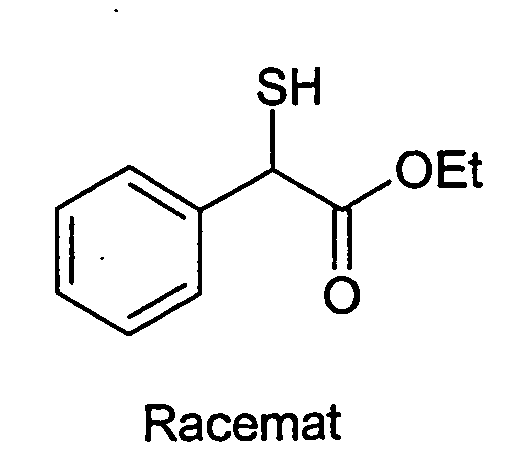
- Analog zu Bausteinsynthese der 2-Mercaptobuttersäuremethylester erhält man aus 2-Brom-2-cyclohexylessigsäuremethylester 2-Mercapto-2-cyclohexylessigsäuremethylester.

- Analog zu Bausteinsynthese der 2-Mercaptobuttersäuremethylester erhält man aus 2-Bromvaleriansäureethylester 2-Mercaptovaleriansäureethylester.

- Analog zu Bausteinsynthese der 2-Mercaptobuttersäuremethylester erhält man aus 1-Bromcyclobutancarbonsäureethylester 1-Mercaptocyclobutancarbonsäureethylester.

-

- cis-3-(5-Methyl-2-p-tolyloxazol-4-ylmethoxy)-cyclohexylmethylsulfinyl]-essigsäure:
- 65 mg cis-3-(5-Methy)-2-p-tolytoxazol-4-ylmethoxy)-cyclohexylmethylsulfanyl]-essigsäure werden in 1,5 ml Trifluoressigsäure gelöst, bei 0 °C mit 6,3 µl 35% H2O2 versetzt und über Nacht bei Raumtemperatur gerührt. Gesättigte NH4Cl-Lösung und Methyl-tert-butylether werden zugegeben, die Phasen getrennt, die wäßrige Phase mit Methyl-tert-butylether extrahiert, die vereinigten organischen Phasen mit gesättigter NaCl-Lösung gewaschen, über MgSO4 getrocknet und eingeengt. Der Rückstand wird per HPLC gereinigt, wobei 6,6 mg eines farblosen Feststoffs erhalten wurden. C21H27NO5S (405,52), LCMS(ESI): 406,1 (MH+).
- Analog zu Beispiel 32 erhält man aus 2-[cis-3-(5-Methyl-2-p-tolyloxazol-4-ylmethoxy)-cyclohexylmethylsulfanyl]-heptansäure 2-[cis-3-(5-Methyl-2-p-tolyloxazol-4-ylmethoxy)-cyclohexylmethylsulfinyl]-heptansäure als Diastereomerengemisch. C26H37NO5S (475,65), MS(ESI): 476,18 (MH+).
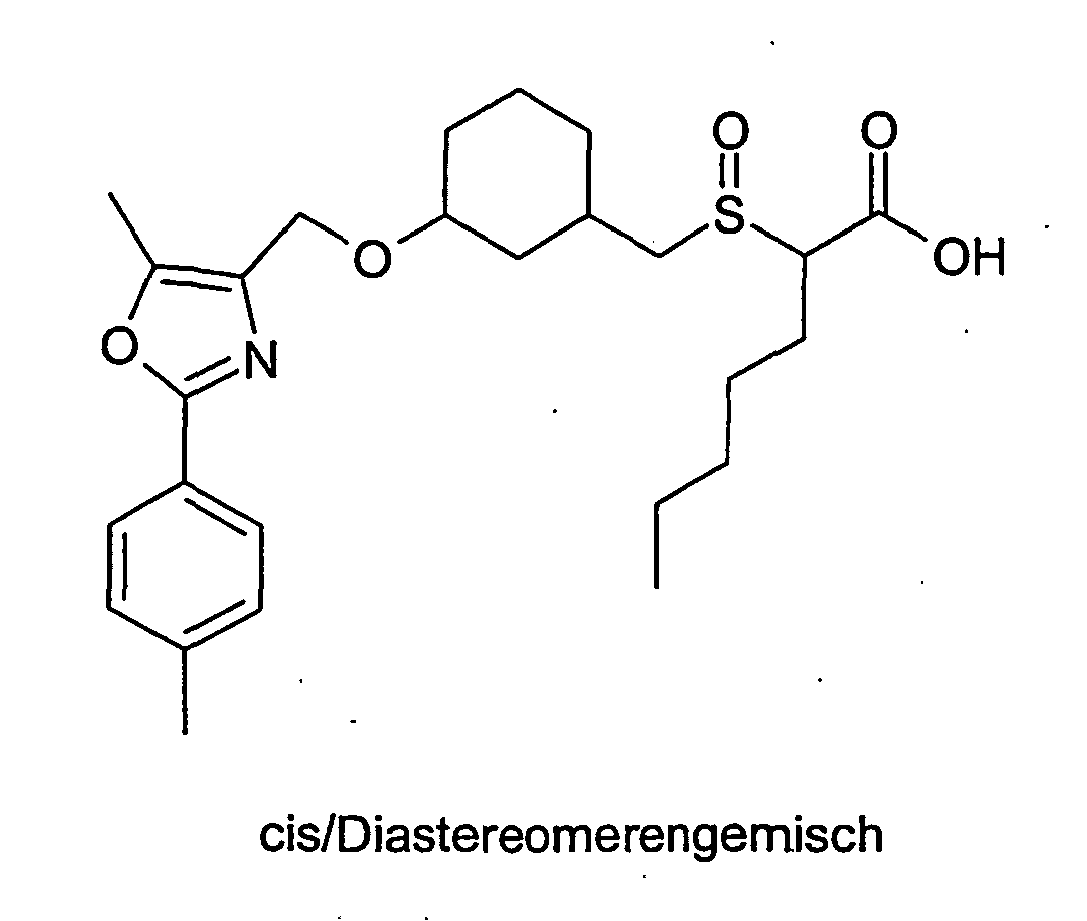
- Analog zu Beispiel 32 erhält man aus 2-[cis-3-(5-Methyl-2-p-tolyloxazol-4-ylmethoxyl)-cyclohexylmethylsulfanyl]-2-methylpropionsäure 2-[cis-3-(5-Methyl-2-p-tolyloxazol-4-ylmethoxy)-cyclohexylmethylsulfinyl]-2-methylpropionsäure. C23H31NO5S (433,57), LCMS(ESI): 434,1 (MH+).

- Analog zu Beispiel 32 erhält man aus 2-[cis-3-(5-Methyl-2-p-tolyloxazol-4-ylmethoxy)-cyclohexylmethylsulfanyl]-3-methylbuttersäure 2-[cis-3-(5-Methyl-2-p-tolyloxazol-4-ylmethoxy)-cyclohexylmethylsulfinyl]-3-methylbuttersäure als Diastereomerengemisch. C24H33NO5S (447,60), MS(ESI): 448,43 (MH+).
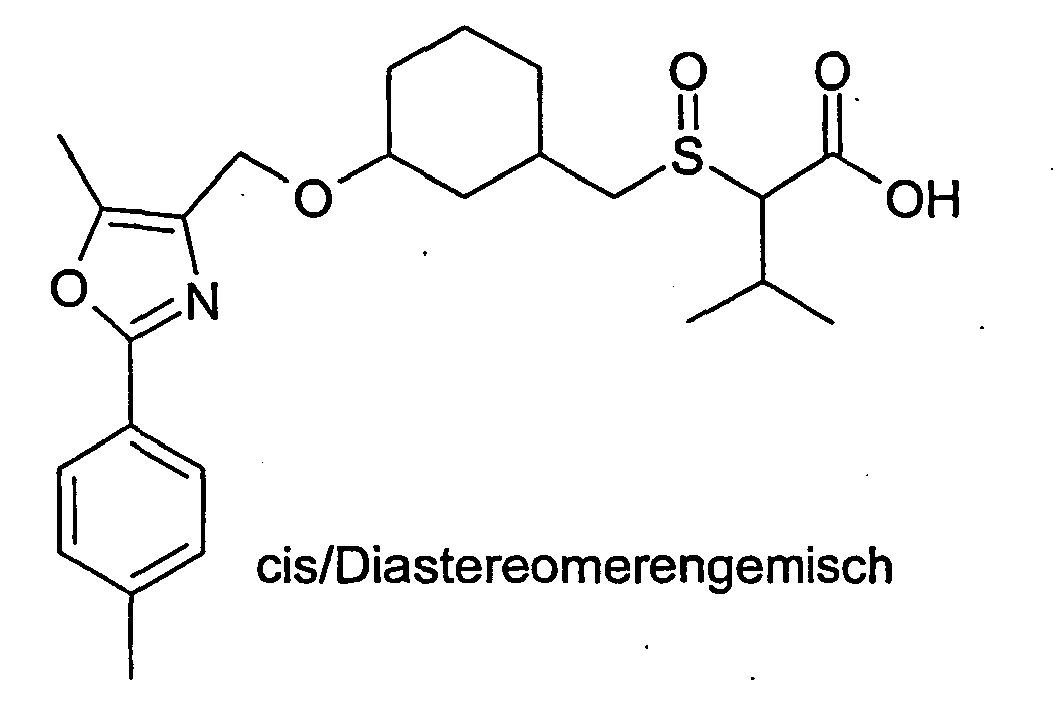
- Analog zu Beispiel 32 erhält man aus 2-[cis-3-(5-Methyl-2-p-tolyloxazol-4-ylmethoxy)-cyclohexylmethylsulfanyl]-valeriansäure 2-[cis-3-(5-Methyl-2-p-tolyloxazol-4-ylmethoxy)-cyclohexylmethylsulfinyl]-valeriansäure als Diastereomerengemisch.
C24H33NO5S (447,60), MS(ESI): 448,14 (MH+).
- cis-3-(5-Methyl-2-p-tolyloxazol-4-ylmethoxy)-cyclohexylmethylsulfonyl]-essigsäure:

- 65 mg cis-3-(5-Methyl-2-p-tolyloxazol-4-ylmethoxy)-cyclohexylmethylsulfanyl]-essigsäure werden in 1,5 ml Trifluoressigsäure gelöst, bei 0 °C mit 21,5 µl 35% H2O2 versetzt und über Nacht bei Raumtemperatur gerührt. Gesättigte NH4Cl-Lösung und Methyl-tert-butylether werden zugegeben, die Phasen getrennt, die wäßrige Phase mit Methyl-tert-butylether extrahiert, die vereinigten organischen Phasen mit gesättigter NaCl-Lösung gewaschen, über MgSO4 getrocknet und eingeengt. Der Rückstand wird per HPLC gereinigt, wobei 6,6 mg eines farblosen Feststoffs erhalten wurden.
C21H27NO6S (421,52), LCMS(ESI):422,1 (MH+). - Analog zu Beispiel 37 erhält man aus 2-[cis-3-(5-Methyl-2-p-tolyloxazol-4-ylmethoxy)-cyclohexylmethylsulfanyl]-heptansäure 2-[cis-3-(5-Methyl-2-p-tolyloxazol-4-ylmethoxy)-cyclohexylmethylsulfonyl]-heptansäure als Diastereomerengemisch. C26H37NO6S (491,65), MS(ESI): 492,42 (MH+).
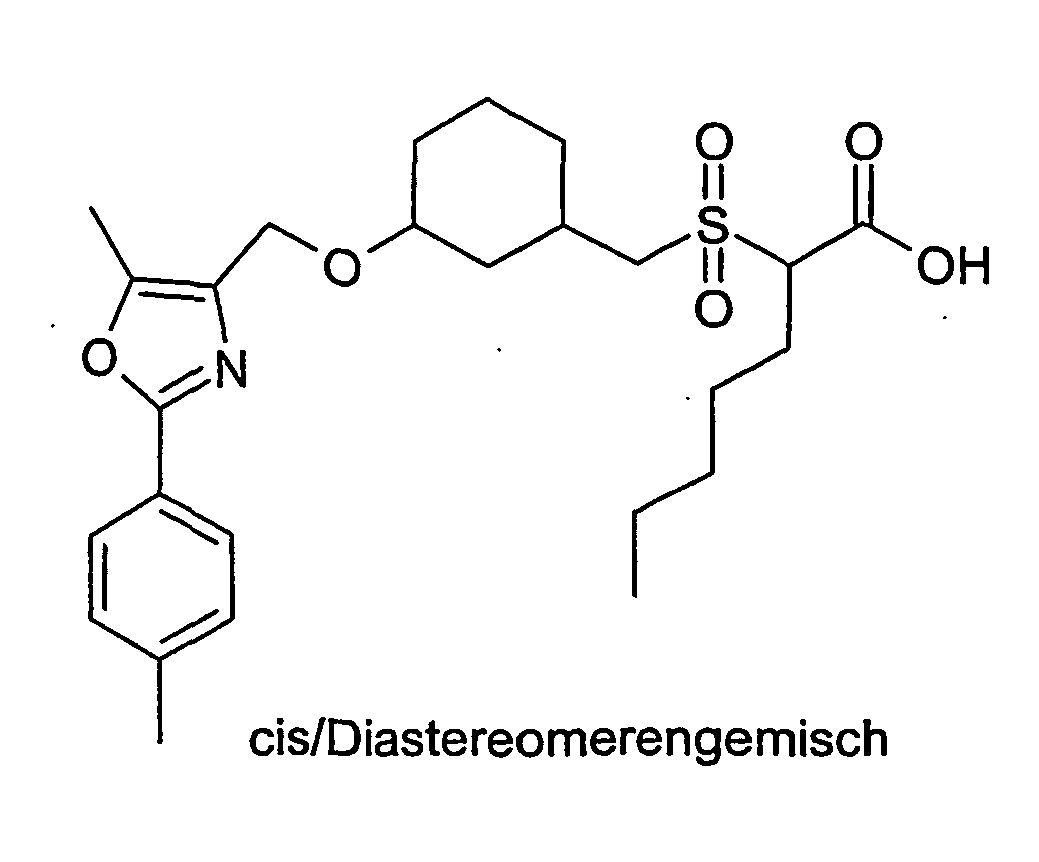
- Analog zu Beispiel 37 erhält man aus 2-[cis-3-(5-Methyl-2-p-tolyloxazol-4-ylmethoxy)-cyclohexylmethylsulfanyl]-2-methylbuttersäure 2-[cis-3-(5-Methyl-2-p-tolyloxazol-4-ylmethoxy)-cyclohexylmethylsulfonyl]-2-methylbuttersäure. C23H31NO6S (449,57), LCMS(ESI): 450,1 (MH+).

- Analog zu Beispiel 37 erhält man aus 2-[cis-3-(5-Methyl-2-p-tolyloxazol-4-ylmethoxy)-cyclohexylmethylsulfanyl]-3-methylbuttersäure 2-[cis-3-( 5-Methyl-2-p-tolyloxazol-4-ylmethoxy)-cyclohexylmethylsulfonyl]-3-methylbuttersäure als Diastereomerengemisch. C24H33NO6S (463,60), LCMS(ESI): 464,1 (MH+).

- Analog zu Beispiel 37 erhält man aus 2-[cis-3-(5-Methyl-2-p-tolyloxazol-4-ylmethoxy)-cyclohexylmethylsulfanyl]-valeriansäure 2-[cis-3-(5-Methyl-2-p-tolyloxazol-4-ylmethoxy)-cyclohexylmethylsulfonyl]-valeriansäure als Diastereomerengemisch. C24H33NO6S (463,60), MS(ESI): 464,14 (MH+).

-
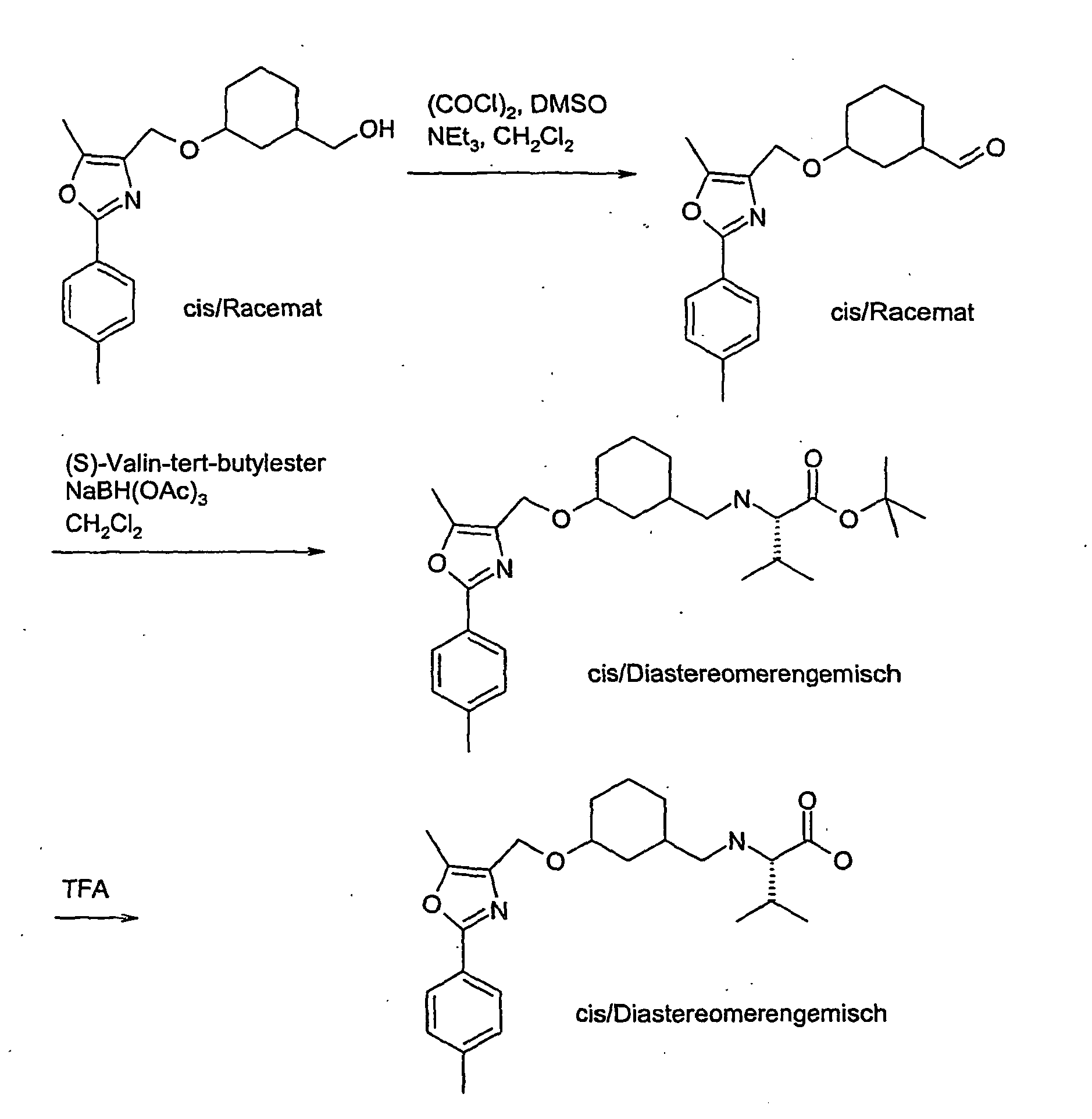
-

- Zu 0,48 ml Oxalylchlorid in 15 ml Dichlormethan werden bei -78 °C 089 ml DMSO in 1 ml Dichlormethan so zugetropft, dass die Temperatur -70 °C nicht übersteigt. Nach beendeter Zugabe wird die Lösung 30 min bei dieser Temperatur gerührt. Dann werden 1,5 g cis-3-(5-Methyl-2-p-tolyl-oxazol-4-ylmethoxy)-cyclohexyl]-methanol in 2 ml Dichlormethan so zugetropft, dass die Temperatur unter-78 °C bleibt. Die Lösung wird 30 min bei dieser Temperatur gerührt. Dann werden 3,2 ml NEt3 zugetropft, das Kühlbad wird entfernt und die Lösung auf 0 °C erwärmt. Bei dieser Temperatur werden 10 ml Wasser zugegeben, und die Mischung wird heftig bei Raumtemperatur gerührt. Die wäßrige Phase wird abgetrennt und mit Dichlormethan extrahiert. Die vereinigten organischen Phasen werden mit gesättigter NH4Cl-Lösung gewaschen, über MgSO4 getrocknet und eingeengt, wobei 1,50 g cis-3-(5-Methyl-2-p-tolyl-oxazol-4-ylmethoxy)-cyclohexancarbaldehyd erhalten werden. C19H23NO3 (313,40); LCMS (ESI): 314,1 (MH+).
-
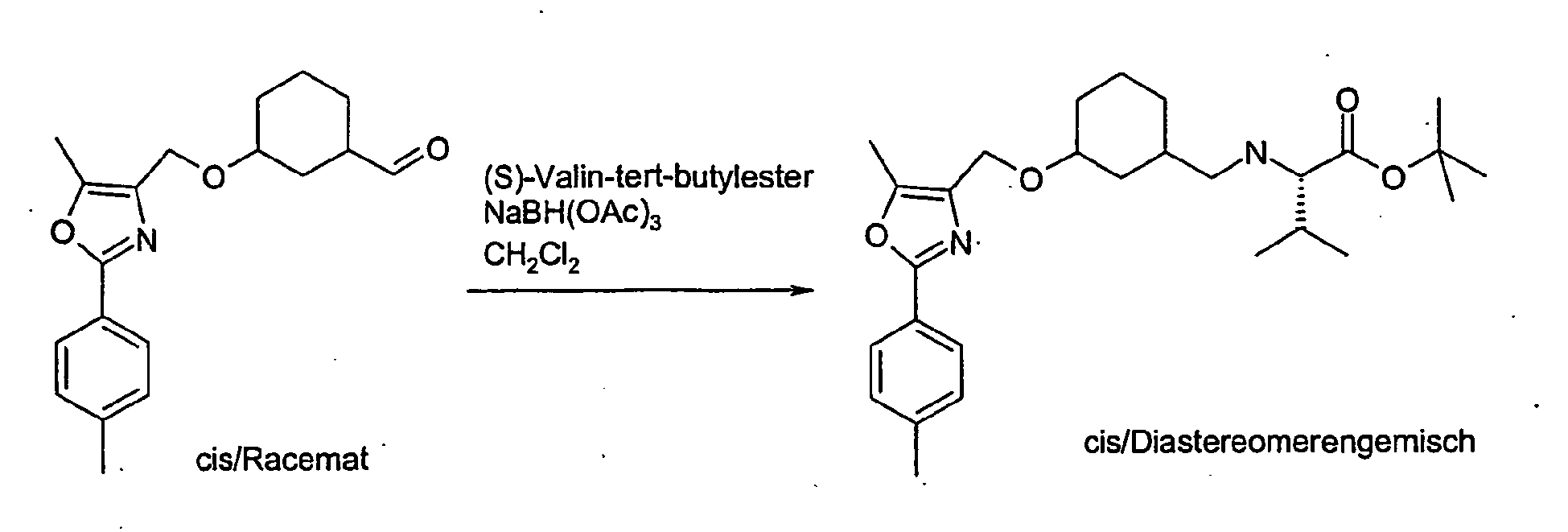
- 511 mg cis-3-(5-Methyl-2-p-tolyl-oxazol-4-ylmethoxy)-cyclohexancarbaldehyd, 0,9 ml HOAc und 310 mg (S)-Valin-tert-butylester werden in 5 ml abs. Dichlormethan gelöst. Dann werden 500 mg Molsieb 4 Å zugegeben und die Suspension wird auf 0°C gekühlt. 414 mg Natriumtriacetoxyborhydrid werden portionsweise zugesetzt. Dies Suspension wird 2 h bei 0°C gerührt, dann mit 3 ml gesättigter NH4Cl-Lösung versetzt und weitere 10 min gerührt. Jeweils 10 ml Wasser und Dichlormethan werden zugegeben, die Phasen werden getrennt, die wäßrige Phase wird mit Dichlormethan extrahiert, und die vereinigten organischen Phasen werden über MgSO4 getrocknet und eingeengt, wobei 760 mg (S)-3-Methyl-2-{[cis-3-(5-methyl-2-p-tolyl-oxazol-4-ylmethoxy)-cyclohexylmethyl]-amino}-buttersäure-tert-butylester erhalten werden.
C28H42N2O4 (470,66); MS (ESI): 471.50 (MH+). -

- 40 mg (S)-3-Methyl-2-{[cis-3-(5-methyl-2-p-tolyl-oxazol-4-ylmethoxy)-cyclohexylmethyl]-amino}-buttersäure-tert-butylester werden in 1 ml Ameisensäure gelöst und mit 0,5 ml Trifluoressigsäure versetzt. Die Lösung wird 18 bei Raumtemperatur gerührt, dann vollständig eingeengt. Der Rückstand wird per HPLC gereinigt, wobei 28,2 mg (S)-3-Methyl-2-{[cis-3-(5-methyl-2-p-tolyl-oxazol-4-ylmethoxy)-cyclohexylmethyl]-amino}-buttersäure Trifluoressigsäuresalz als farbloser Feststoff erhalten werden. C24H34N2O2.C2HF3O2 (414,55); MS(ES-): 413,28 (M+-H).
-

-

- 40 mg (S)-3-Methyl-2-{[cis-3-(5-methyl-2-p-tolyl-oxazol-4-ylmethoxy)-cyclohexylmethyl]-amino}-buttersäure-tert-butylester in 0,5 ml Dichlormethan werden mit 12 µl Acetylchlorid und 22 µl Pyridin versetzt und 18 h bei Raumtemperatur gerührt. Dann wird die Lösung mit Wasser und Dichlormethan verdünnt, die wäßrige Phase wird abgetrennt und mit Dichlormethan extrahiert, die vereinigten Phasen werden über MgSO4 getrocknet und eingeengt. Der Rückstand wird in 0,5 ml Trifluoressigsäure aufgenommen und bei Raumtemperatur über Nacht stehen gelassen. Das Lösungsmittel wird vollständig abdestilliert, der Rückstand per HPLC gereinigt, wobei 17 mg (S)-2-{Acetyl-[cis-3-(5-methyl-2-p-tolyloxazol-4-ylmethoxy)-cydohexylmethyl]-amino}-3-methylbuttersäure erhalten werden. C26H36N2O5 (456,59); LCMS (ESI):457,36 (MH+).
- Analog zu Beispiel 43 erhält man aus (S)-3-Methyl-2-{[cis-3-(5-methyl-2-p-tolyl-oxazol-4-ylmethoxy)-cyclohexylmethyl]-amino}-buttersäure-tert-butylester und Benzoylchlorid (S)-2-{Benzoyl-[cis-3-(5-methyl-2-p-tolyloxazol-4-ylmethoxy)-cyclohexylmethyl]-amino}-3-methylbuttersäure. C31H38N2O5 (518,29); LCMS (ESI):519,54 (MH+).

- Analog zu Beispiel 43 erhält man aus (S)-3-Methyl-2-{[cis-3-(5-methyl-2-p-tolyl-oxazol-4-ylmethoxy)-cyclohexylmethyl]-amino}-buttersäure-tert-butylester und Methylsulfonylchlorid (S)-2-(Methylsulfonyl-[cis-3-(5-methyl-2-p-tolyloxazol-4-ylmethoxy)-cyclohexylmethyl]-amino)-3-methylbuttersäure. C25H36N2O6S (492,23); LCMS (ESI): 493,26 (MH+).

- Analog zu Beispiel 43 erhält man aus (S)-3-Methyl-2-{[cis-3-(5-methyl-2-p-tolyl-oxazol-4-ylmethoxy)-cyclohexylmethyl]-amino}-buttersäure-tert-butylester und Methylsulfonylchlorid in Triethylamin (S)-2-{Methylsulfonylmethylsulfonyl-[cis-3-(5-methyl-2-p-tolyloxazol-4-ylmethoxy)-cyclohexylmethyl]-amino}-3-methylbuttersäure. C26H38N2O8S2 (570,21); LCMS (ES-): 569,23 (M+-H).

- Analog zu Beispiel 43 erhält man aus (S)-3-Methyl-2-{[cis-3-(5-methyl-2-p-tolyl-oxazol-4-ylmethoxy)-cyclohexylmethyl]-amino}-buttersäure-tert-butylester und p-Toluolsulfonylchlorid (S)-2-{p-Toluolsulfonyl-[cis-3-(5-methyl-2-p-tolyloxazol-4-ylmethoxy)-cyclohexylmethyl]-amino}-3-methylbuttersäure. C31H40N2O6S (568,26); LCMS (ESI): 569,35 (MH+).

- Analog zu Beispiel 43 erhält man aus (S)-3-Methyl-2-{[cis-3-(5-methyl-2-p-tolyl-oxazol-4-ylmethoxy)-cyclohexylmethyl]-amino}-buttersäure-tert-butylester und Chlorameisensäuremethylester (S)-2-{Methoxycarbonyl-[cis-3-(5-methyl-2-p-tolyloxazol-4-ylmethoxy)-cyclohexylmethyl]-amino}-3-methylbuttersäure. C26H36N2O6 (472,26), LCMS (ESI): 473,37 (MH+).

- Analog zu Beispiel 42 erhält man aus cis-3-(5-Methyl-2-p-tolyl-oxazol-4-ylmethoxy)-cyclohexancarbaldehyd und Glycinisopropylester-Hydrochlorid 2-{[cis-3-(5-Methyl-2-p-tolyl-oxazol-4-ylmethoxy)-cyclohexylmethyl]-amino}-essigsäure Trifluoressigsäuresalz. C21H28N2O4 (486,49), MS (ESI): 487 (MH+).

-

- 40 mg (S)-3-Methyl-2-{[cis-3-(5-methyl-2-p-tolyl-oxazol-4-ylmethoxy)-cyclohexylmethyl]-amino}-buttersäure-tert-butylester (s. Beispiel 42) werden in 0,5 ml DMF mit 60 mg Methyliodid und 12 mg Kaliumcarbonat versetzt und bei RT über Nacht gerührt. Zur Reaktionslösung wird 1 ml TFA zugesetzt und die Mischung 1 h weitergerührt. Die Lösung wird per präparativer HPLC gereinigt, wobei 6,4 mg (S)-2-{Methyl-[cis-3-(5-methyl-2-p-tolyloxazol-4-ylmethoxy)-cyclohexylmethyl]-amino}-3-methylbuttersäure Trifluoressigsäuresalz erhalten werden. C25H36N2O4 (542,60); MS (ESI): 543 (MH+).
- Analog zu Beispiel 50 erhält man aus (S)-3-Methyl-2-{[cis-3-(5-methyl-2-p-tolyl-oxazol-4-ylmethoxy)-cyclohexylmethyl]-amino}-buttersäure-tert-butylester und Benzylbromid (S)-2-{Benzylyl-[cis-3-(5-methyl-2-p-tolyloxazol-4-ylmethoxy)-cyclohexylmethyl]-amino}-3-methylbuttersäure Trifluoressigsäuresalz. C31H40N2O4 (618,70), MS(ESI): 619 (MH+).

-

- 120 mg 2-{[cis-3-(5-Methyl-2-p-tolyl-oxazol-4-ylmethoxy)-cyclohexylmethyl]-amino}-essigsäureisopropylester werden in 1,5 ml Dichlormethan gelöst und nacheinander mit 62 mg Benzaldehyd, einer Spatelspitze MgSO4 und 68 mg Natriumtriacetoxyborhydrid versetzt. Die Suspension wird über Nacht bei RT gerührt und dann mit Wsser versetzt. Die organische Phase wird abgetrennt, mit Na2CO3-Lösung gewaschen, über MgSO4 getrocknet und eingeengt. Der Rückstand wird in 0,7 ml Methanol und 0,23 ml Wasser gelöst, mit 20 mg LiOH versetzt und über Nacht bei RT gerührt. Die Lösung wird eingeengt, der Rückstand per präparativer HPLC gereinigt, wobei 15 mg 2-{Benzyl-[cis-3-(5-methyl-2-p-tolyloxazol-4-ylmethoxy)-cyclohexylmethyl]-amino}-essigsäure erhalten werden. C28H34N2O4 (462,59); MS(ESI): 463 (MH+).
- Analog zu Beispiel 52 erhält man aus mg 2-{[cis-3-(5-Methyl-2-p-tolyl-oxazol-4-ylmethoxy)-cyclohexylmethyl]-amino}-essigsäureisopropylester und Thiophen-2-carbaldehyd 2-{2-Thienylmethyl-[cis-3-(5-methyl-2-p-tolyloxazol-4-ylmethoxy)-cyclohexylmethyl]-amino}-essigsäure Trifluoressigsäuresalz. C26H32N2O4 (468,62), MS(ESI): 469 (MH+).

- Analog zu Beispiel 52 erhält man aus mg 2-{[cis-3-(5-Methyl-2-p-tolyl-oxazol-4-ylmethoxy)-cyclohexylmethyl]-amino}-essigsäureisopropylester und Cyclohexancarbaldehyd 2-{Cyclohexylmethyl-[cis-3-(5-methyl-2-p-tolyloxazol-4-ylmethoxy)-cyclohexylmethyl]-amino}-essigsäure Trifluoressigsäuresalz. C28H40N2O4 (468,64), MS(ESI): 469 (MH+).

-

-

- 1,70g g cis-3-Hydroxymethylcyclohexancarbonsäuremethylester werden in 20 ml Dichlormethan gelöst und mit 1,60 g Methoxymethylchlorid und 2,60 g Diisopropylethylamin versetzt und 15 h bei Raumtemperatur gerührt. Die Lösung wird mit 50 ml gesättigter NH4Cl-Lösung und 50 ml Wasser vesetzt, die organische Phase wird abgetrennt. Die wäßrige Phase wird mit Dichlormethan extrahiert, die vereinigten organischen Phasen werden über Magnesiumsulfat getrocknet und eingeengt. Man erhält 2,0 g cis-3-Methoxymethoxymethylcyclohexancarbonsäuremethylester als gelbes Öl. Dieses wird in 50 ml Diethylether gelöst und mit 350 mg LiAlH4 versetzt und bei Raumtemperatur gerührt. Nach 2 h werden bei 0°C 5 ml Ethylacetat, 40 ml Methyl-tert-butylether und 3 g MgSO4 zugegeben. Anschließend werden 15 ml 10N KOH zugetropft. Die Suspension wird 3 h gerührt, über Celite filtriert, und das Filtrat eingeengt, wobei 1,65 g (cis-3-Methoxymethoxymethylcyclohexyl)-methanol als farbloses Öl erhalten werden. C10H20O3 (188,27), MS(ESI): 189,2 (MH+).
-

- 1,65 g (cis-3-Methoxymethoxymethylcyclohexyl)-methanol und 5,1 g Bromessigsäure-tert-butylester werden in 20 ml Toluol gelöst und mit 1,50 g
Tetrabutylammoniumhydrogensulfat versetzt. Die Suspension wird auf 10°C gekühlt. 20 ml 50% NaOH werden zur Suspension gegeben. Die Mischung wird 6 h bei 10 °C gerührt, dann wird die wäßrige Phase abgetrennt und mit Methyl-tert-butylether extrahiert. Die vereinigten organischen Phasen werden über MgSO4 getrocknet und eingeengt. Nach Flash-Säulenchromatographie an Kieselgel (Heptan/Ethylacetat 10/1 -> 2/1) werden 2,23 g [cis-3-(Methoxymethoxymethyl)-cyclohexylmethoxy]-essigsäure-tert-butylester als farbloses Öl erhalten. C16H30O5 (302,41), MS(ESI): 320,30 (M+NH4+). -

- 1,9 g [cis-3-(Methoxymethoxymethyl)-cyclohexylmethoxy]-essigsäure-tert-butylester werden in 10 ml Tetrahydrofuran gelöst, mit 5 ml konz. HCl versetzt und 2 h bei Raumtemperatur gerührt. Anschließend werden 10 ml ges. NaCl-Lösung, 10 ml Wasser und 30 ml Methyl-tert-butylether zugegeben, die Phasen getrennt, und die wäßrige Phase wird mit Methyl-tert-butylether extrahiert. Die vereinigten organischen Phasen werden über MgSO4 getrocknet und eingeengt. Nach Flash-Chromatographie an Kieselgel (Heptan/Ethylacetat 3/1) werden 600 mg (cis-3-Hydroxymethylcyclohexylmethoxy)-essigsäure-tert-butylester als farbloses Öl erhalten (DC(Heptan/Ethylacetat 2/1): Rf,Edukt = 0.68, Rf,Produkt = 0.18). 260 mg davon werden in 5 ml Dimethylformamid gelöst und mit 170 mg tert-Butyldimethylsilylchlorid versetzt. Dann wird die Lösung auf 0 °C gekühlt, und 160 mg Imidazol werden zugegeben. Die Lösung wird bei Raumtemperatur 15 h gerührt, dann mit 20 ml ges. NaCl-Lösung, 10 ml Wasser und 30 ml Methyl-tert-butylether versetzt. Die Phasen werden getrennt, die organische Phase wird mit ges. NaCl-Lösung gewaschen, über MgSO4 getrocknet und eingeengt. Man erhält 350 mg [cis-3-(tert-Butyldimethylsilanyloxymethyl)-cyclohexylmethoxy]-essigsäure-tert-butylester als farbloses Öl. C20H40O4Si (372,36); LCMS (ESI): 390,3 (M+NH4+).
-

- 250 mg [cis-3-(tert-butyldimethylsilanyloxymethyl)-cyclohexylmethoxy]-essigsäure-tert-butylester werden in 10 ml abs. Tetrahydrofuran gelöst und auf -78°C (Trockeneis/Aceton-Bad) gekühlt. Anschließend werden 1,70 ml 2M Lithiumdiisopropylamid-Lösung in Tetrahydrofuran/Hexanfraktion zugetropft. Die Lösung wird zunächst bei -78°C 20 min gerührt, dann auf 0°C erwärmt (Eisbad) und mit 950 mg Methyliodid versetzt. Die Lösung wird 1 h bei 0°C gerührt. 1 ml ges.
NH4Cl-Lösung und 10 ml Wasser werden zugesetzt und die Phasen werden getrennt. Die wäßrige Phase wird mit Ethylacetat extrahiert. Die vereinigten organischen Phasen werden über MgSO4 getrocknet und eingeengt. Das Rohprodukt wird in 10 ml abs.
Tetrahydrofuran gelöst und auf -78°C (Trockeneis/Aceton-Bad) gekühlt. Anschließend werden 1,70 ml 2M Lithiumdiisopropylamid-Lösung in Tetrahydrofuran/Hexanfraktion zugetropft. Die Lösung wird zunächst bei -78°C 20 min gerührt, dann auf 0°C erwärmt (Eisbad) und mit 950 mg Methyliodid versetzt. Die Lösung wird 1 h bei 0°C gerührt. 1 ml ges. NH4Cl-Lösung und 10 ml Wasser werden zugesetzt und die Phasen werden getrennt. Die wäßrige Phase wird mit Ethylacetat extrahiert. Die vereinigten organischen Phasen werden über MgSO4 getrocknet und eingeengt. 220 mg 2-[cis-3-(tert-butyldimethylsilanyloxymethyl)-cyclohexylmethoxy]-2-methylpropionsäure-tert-butylester werden als hellgelbes Öl erhalten. DC(Heptan/Ethylacetat 4/1): Rf,Edukt = 0,66, Rf,Produkt = 0,80. -

- 50 mg 2-[cis-3-(tert-butyldimethylsilanyloxymethyl)-cyclohexylmethoxy]-2-methylpropionsäure-tert-butylester werden zu einer Mischung von 20 mg BiBr3 und 30 mg HSiEt3 in 0,5 ml Acetonitril gegeben. 38 mg 5-Methyl-2-p-tolyl-oxazol-4-carbaldehyd in 0,2 ml Acetonitril werden zugetropft, und die Mischung wird über Nacht bei Raumtemperatur gerührt. Der entstandene schwarze Feststoff wird abfiltriert, das Filtrat eingeengt und mit 1 ml Trifluoressigsäure aufgenommen. Die Lösung wird über Nacht bei Raumtemperatur gerührt. Das Lösungsmittel wird im Vakuum abdestilliert und der Rückstand per HPLC gereinigt. 3,4 mg 2-[cis-3-(5-Methyl-2-p-tolyl-oxazol-4-ylmethoxymethyl)-cyclohexylmethoxy]-2-methylpropionsäure werden als farbloses Öl erhalten. C24H33NO5 (415,24); MS (ES-): 414,25 (M-H+).
- Analog zu Beispiel 55 erhält man aus [cis-3-(Methoxymethoxymethyl)-cyclohexylmethoxy)-essigsäure-tert-butylester, Methyliodid, Ethyliodid und 5-Methyl-2-p-tolyl-oxazol-4-carbaldehyd 2-[cis-3-(5-Methyl-2-p-tolyl-oxazol-4-ylmethoxymethyl)-cyclohexylmethoxy]-2-methylbuttersäure. C25H35NO5 (429,25); MS (ES-): 428,22 (M-H+).

-
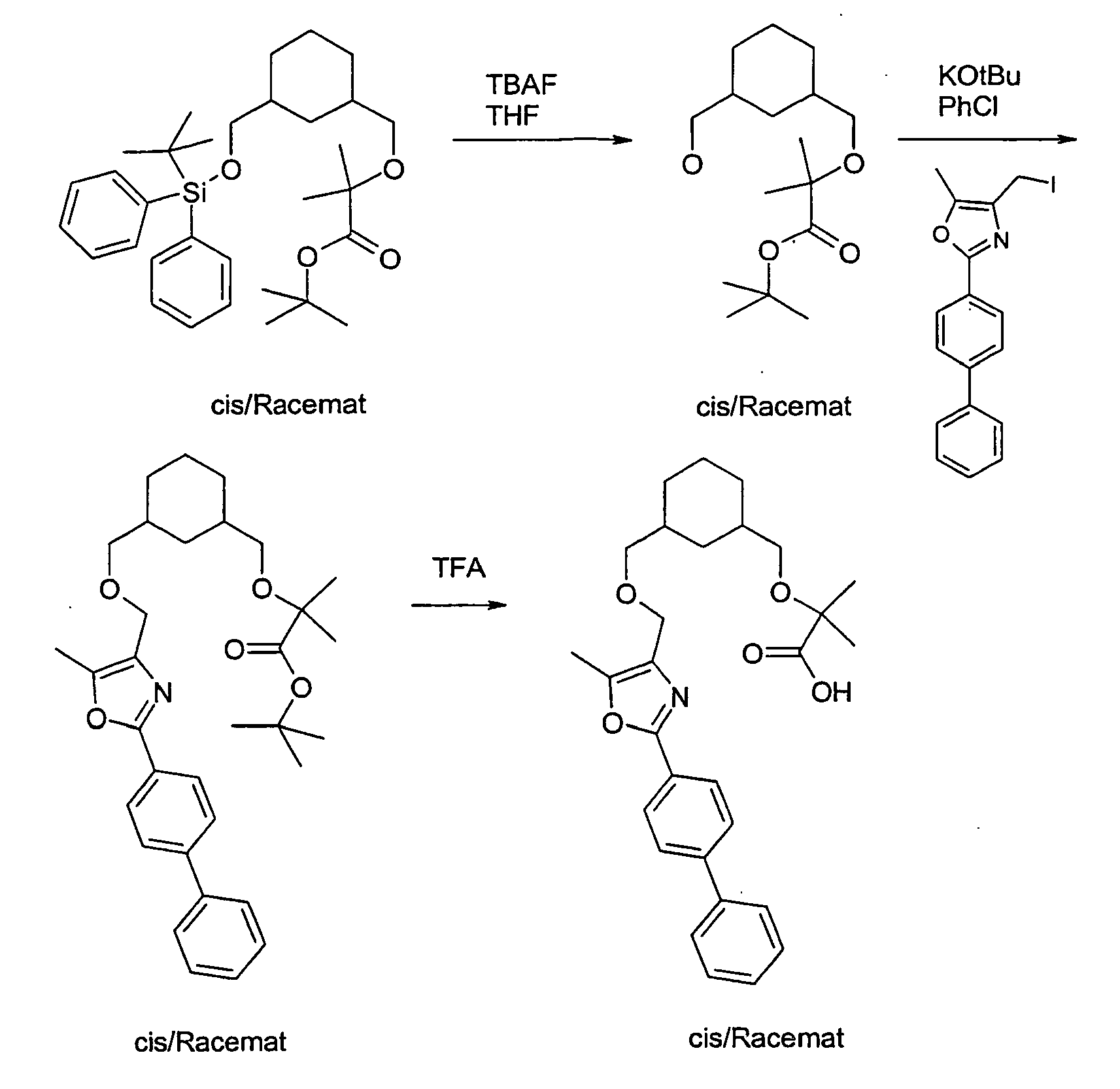
-

- 4,5 g 2-[cis-3-(tert-Butyldimethylsilanyloxymethyl)-cyclohexylmethoxy]-2-methylpropionsäure-tert-butylester (Synthese analog zu 2-[cis-3-(tert-Butyldimethylsilanyloxymethyl)-cyclohexylmethoxy]-2-methylpropionsäure-tert-butylester in Beispiel 55) werden in 85 ml THF gelöst und mit 2,24 g TBAF Trihydrat versetzt und bei 60°C 90 min gerührt. Wasser und MTBE werden zugesetzt, die Phasen getrennt, die organische Phase über MgSO4 getrocknet und eingeengt. Der Rückstand wird an Kieselgel chromatographiert (Heptan/Ethylacetat 1:1), wobei 1,45 g 2-[cis-3-Hydroxymethylcyclohexylmethoxy]-2-methylpropionsäure-tert-butylester erhalten werden. C16H30O4 (286,42), MS(ESI): 287 (MH+).
-
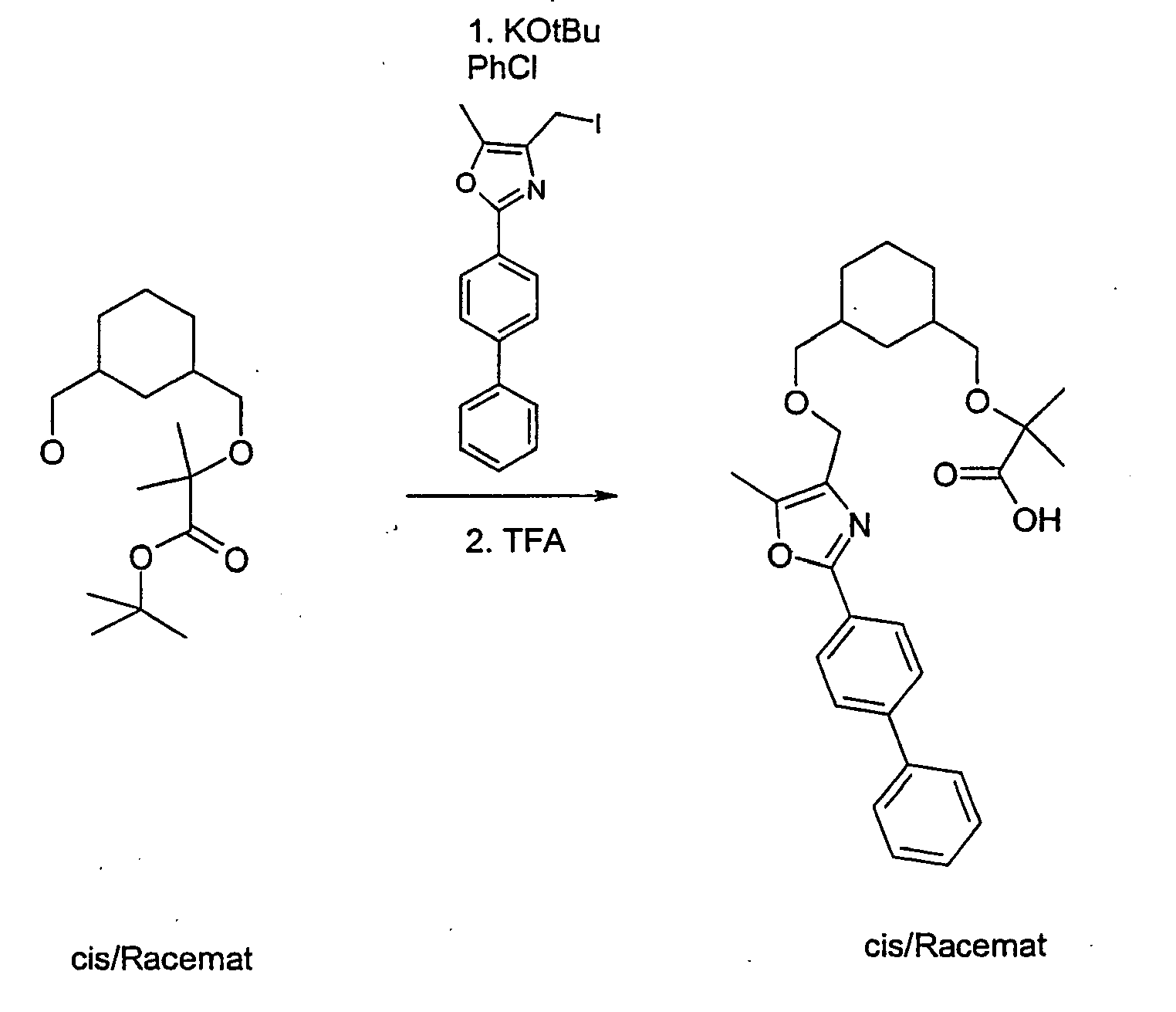
- 50 mg 2-[cis-3-hydroxymethylcyclohexylmethoxy]-2-methylpropionsäure-tert-butylester und 200 mg 5-Methyl-2-(4-biphenyl)-oxazol-4-ylmethoxymethyliodid werden in 2 ml Chlorbenzol gelöst und mit 59 mg Kalium-tert-butylat versetzt. Die Suspension wird 24 bei RT gerührt, dann werden 2,5 ml TFA zugesetzt und die Lösung weitere 24 h bei RT gerührt. Das Lösungsmittel wird im Vakuum abdestilliert, der Rückstand per präparativer HPLC gereinigt, wobei 20 mg 2-[cis-3-(5-Methy)-2-(4-biphenyt)-oxazol-4-ylmethoxymethyl)-cyclohexylmethoxy]-2-methylpropionsäure erhalten werden. C29H35NO5 (477,61), MS(ESI): 478 (MH+).
- Analog zu Beispiel 57 erhält man aus2-[cis-3-Hydroxymethylcyclohexylmethoxy]-2-methylpropionsäure-tert-butylester und 5-Methyl-2-phenyl-oxazol-4-ylmethoxymethylchlorid 2-[cis-3-(5-Methyl-2-phenyl-oxazol-4-ylmethoxymethyl)-cyclohexylmethoxy]-2-methylpropionsäure. C23H31NO5 (401,51); MS (ESI): 402 (MH+).
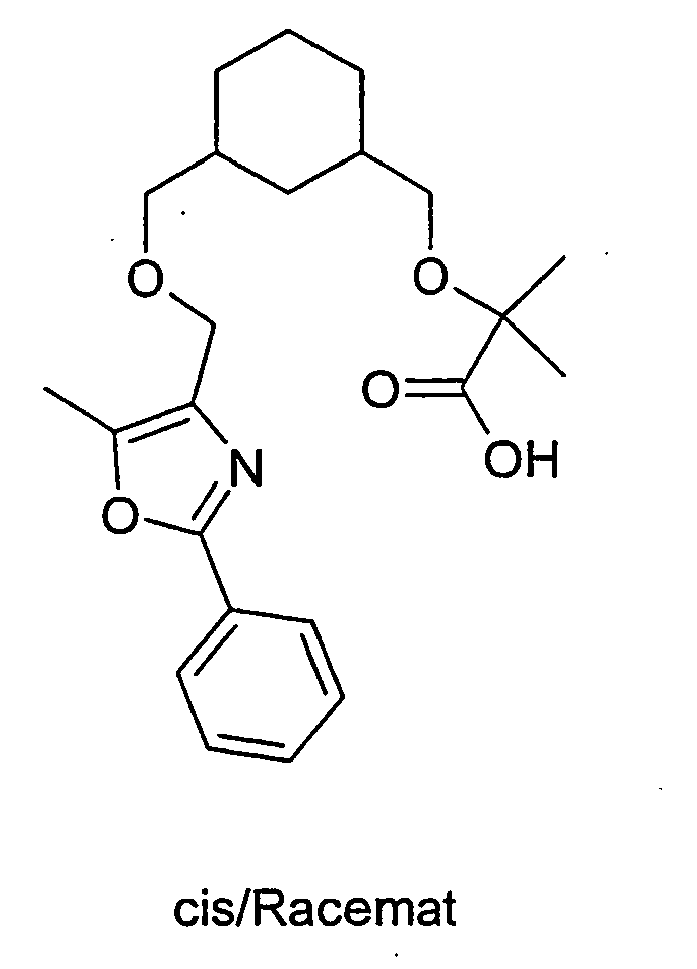
- Analog zu Beispiel 57 erhält man aus2-[cis-3-Hydroxymethylcyclohexylmethoxy]-2-methylpropionsäure-tert-butylester und 5-Methyl-2-naphthyl-oxazol-4-ylmethoxymethylchlorid 2-[cis-3-(5-Methyl-2-naphthyl-oxazol-4-ylmethoxymethyl)-cyclohexylmethoxy]-2-methylpropionsäure. C27H33NO5 (451,57); MS (ESI): 458 (MH+).

- Analog zu Beispiel 57 erhält man aus2-[cis-3-Hydroxymethylcyclohexylmethoxy]-2-methylpropionsäure-tert-butylester und 5-Ethyl-2-(3-methoxyphenyl)-oxazol-4-ylmethoxymethylchlorid 2-[cis-3-(5-Ethyl-2-(3-methoxyphenyl)-oxazol-4-ylmethoxymethyl)-cyclohexylmethoxy]-2-methylpropionsäure. C25H35NO5 (445,56); MS (ESI): 446 (MH+).

- Analog zu Beispiel 57 erhält man aus2-[cis-3-Hydroxymethylcyclohexylmethoxy]-2-methylpropionsäure-tert-butylester und 5-Methyl-2-(4-isopropylphenyl)-oxazol-4-ylmethoxymethylchlorid 2-[cis-3-(5-Ethyl-2-(4-isopropylphenyl)-oxazol-4-ylmethoxymethyl)-cyclohexylmethoxy]-2-methylpropionsäure. C26H37NO5 (443,59); MS (ESI): 444 (MH+).

- Analog zu Beispiel 57 erhält man aus2-[cis-3-Hydroxymethylcyclohexylmethoxy]-2-methylpropionsäure-tert-butylester und 5-Cyclohexyl-2-p-tolyl-oxazol-4-ylmethoxymethylchlorid 2-[cis-3-(5-Ethyl-2-p-tolyl-oxazol-4-ylmethoxymethyl)-cyclohexylmethoxy]-2-methylpropionsäure. C29H41NO5 (483,65); MS (ESI): 484 (MH+).

- Analog zu Beispiel 57 erhält man aus2-[cis-3-Hydroxymethylcyclohexylmethoxy]-2-methylpropionsäure-tert-butylester und 5-Ethyl-2-p-isopropyl-oxazol-4-ylmethoxymethylchlorid 2-[cis-3-(5-Ethyl-2-p-isopropyl-oxazol-4-ylmethoxymethyl)-cyclohexylmetlioxy]-2-methylpropionsäure. C27H39NO5 (457,62); MS (ESI): 458 (MH+).

- Analog zu Beispiel 57 erhält man aus2-[cis-3-Hydroxymethylcyclohexylmethoxy]-2-methylpropionsäure-tert-butylester und 5-Ethyl-2-(2-naphthyl)-oxazol-4-ylmethoxymethylchlorid 2-[cis-3-(5-Ethyl-2-(2-naphthyl)-oxazol-4-ylmethoxymethyl)-cyclohexylmethoxy]-2-methylpropionsäure. C28H35NO5 (465,59); MS (ESI): 466 (MH+).

- Analog zu Beispiel 57 erhält man aus2-[cis-3-Hydroxymethylcyclohexylmethoxy]-2-methylpropionsäure-tert-butylester und 5-Ethyl-2-p-tolyl-oxazol-4-ylmethoxymethylchlorid 2-[cis-3-(5-Ethyl-2-p-tolyl-oxazol-4-ylmethoxymethyl)-cyclohexylmethoxy]-2-methylpropionsäure. C25H35NO5 (429,56); MS (ESI): 430 (MH+).

- Analog zu Beispiel 57 erhält man aus2-[cis-3-Hydroxymethylcyclohexylmethoxy]-2-methylpropionsäure-tert-butylester und 5-Ethyl-2-(3-trifluormethyl)-oxazol-4-ylmethoxymethylchlorid 2-[cis-3-(5-Ethyl-2-(3-trifluormethyl)-oxazol-4-ylmethoxymethyl)-cyclohexylmethoxy]-2-methylpropionsäure. C26H34F3NO5 (497,56); MS (ESI): 498 (MH+).
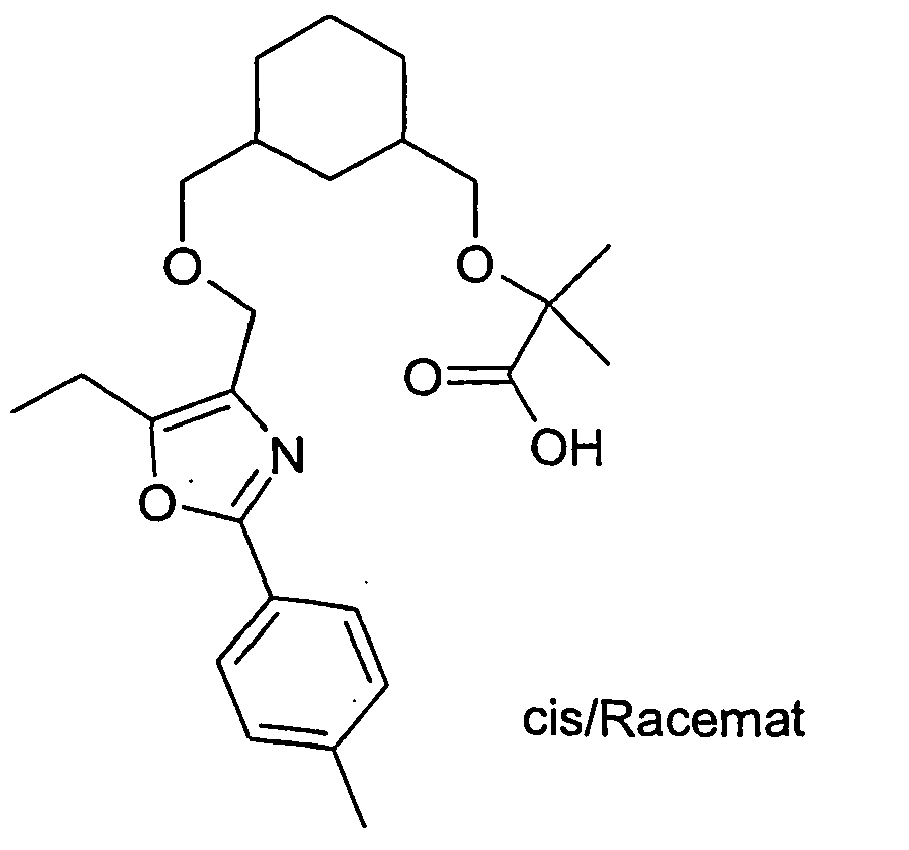
-

-

- 87 ml einer 1 molaren Lösung von Lithiumdiiobutylaluminiumhydrid in n-Hexan werden in 100 ml Diethylether gelöst und bei 0°C mit 7 ml Isopropanol versetzt. Nach beendeter Gasentwicklung werden 12.4 g cis-3-Allylcylohexanon, gelöst in 50 ml Diethylether, zugegeben. Man rührt 48 Stunden bei Raumtemperatur nach. Das Reaktionsgemisch wird durch Zugabe 1M HCl abgelöscht, die wäßrige Phase mit Natriumchlorid gesättigt und fünfmal mit je 200 ml Ethylacetat extrahiert. Die vereinigten organischen Phasen werden mit 2N NaOH gewaschen, über MgSO4 getrocknet und anschließend das Lösungsmittel im Vakuum entfernt. Der Rückstand wird an Kieselgel mit dem Laufmittel n-Heptan:Ethylacetat = 15:1 => 5:1 gereinigt. Man erhält 6.8 g cis-3-Allyl-cyclohexanol als Öl. C9H16O (140.23), MS(ESI): 141 (M+H+), Rf(n-Heptan:Ethylacetat = 2:1) = 0.22.
-

- 1.8 g cis-3-Allyl-cyclohexanol werden in 20 ml Dimethylformamid gelöst und mit 770 mg Natriumhydrid (60%ige Suspension in Paraffinöl) versetzt. Nach 30 Minuten werden 4 g 4-lodmethyl-5-methyl-2-(3-methoxy-phenyl)-oxazol gelöst in 20 ml Dimethylformamid zugetropft. Man rührt 1 Stunde bei Raumtemperatur nach.Dann wird 200 ml Methy-tert-buthylether zum Reaktionsgemisch gegeben und dreimal mit Wasser gewaschen. Die organische Phase wird über MgSO4 getrocknet und anschließend das Lösungsmittel im Vakuum entfernt. Der Rückstand wird an Kieselgel mit dem Laufmittel n-Heptan:Ethylacetat= 10:1 gereinigt. Man erhält 750 mg 4-(cis-3-Allyl-cyclohexyloxymethyl)-2-(3-methoxy-phenyl)-5-methyl-oxazol als Öl. C21 H27NO3 (341.45), MS(ESI): 342 (M+H+), Rf(n-Heptan:Ethylacetat = 2:1) = 0.26.
-

- 750 mg 4-(cis-3-Allyl-cyclohexyloxymethyl)-2-(3-methoxy-phenyl)-5-methyl-oxazol werden in 20 ml Diethylether gelöst und mit 1.4 g Natriumperiodat, gelöst in 20 ml Wasser versetzt. Man gibt bei 0°C 1 ml einer Osmiumtetroxid-Lösung (2.5Gewichts% in tert-Butanol) hinzu und rührt kräftig bei Raumtemperatur nach. Nach 8 Stunden wird 100 ml Methyl-tert-butyl-ether zugegeben und mit einer gesättigten Natriumthiosulfat-Lösung gewaschen. Die organische Phase wird über MgSO4 getrocknet und anschließend das Lösungsmittel im Vakuum entfernt. Man erhält 740 mg {cis-3-[2-(3-Methoxy-phenyl)-5-methyl-oxazol-4-ylmethoxy]-cyclohexyl}-acetaldehyde als gelbbraunes Öl. C20H25NO4 (343.43), MS(ESI): 344 (M+H+), Rf(n-Heptan:Ethylacetat =2:1) = 0.10.
-
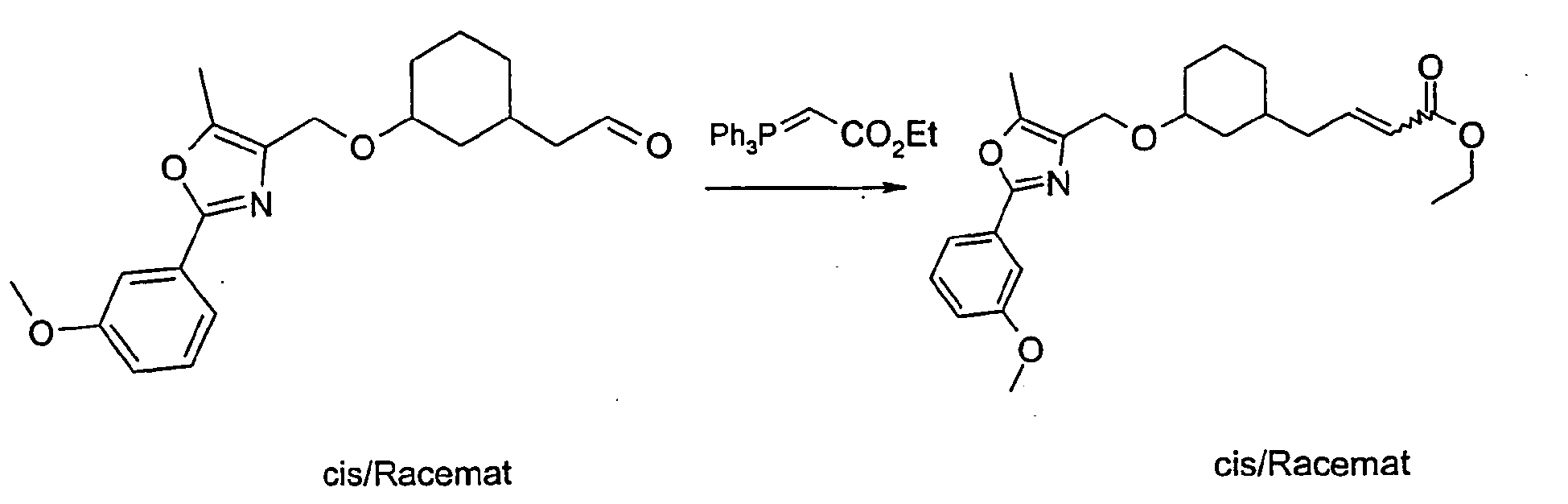
- 280 mg {cis-3-[2-(3-Methoxy-phenyl)-5-methyl-oxazol-4.-ylmethoxy]-cyclohexyl}-acetaldehyde werden in 10 ml Dichlormethan gelöst und mit 370 mg (Triphenylphosphoranylidene)-essigsäureethylester versetzt. Man rührt 3 Stunden bei Raumtemperatur nach. Das Gemisch wird mit gesättigter Natriumchlorid-Lösung gewaschen, über MgSO4 getrocknet und anschließend das Lösungsmittel im Vakuum entfernt. Der Rückstand wird an Kieselgel mit dem Laufmittel n-Heptan:Ethylacetat= 5:1 gereinigt. Man erhält 190 mg 4-{cis-3-[2-(3-Methoxy-phenyl)-5-methyl-oxazol-4-ylmethoxy]-cyclohexyl}-but-2-ensäure-ethylester als Öl. C24H31NO5 (413.52), MS(ESI): 414 (M+H+), Rf(n-Heptan:Ethylacetat = 2:1) = 0.30.
-

- 190 mg 4-{cis-3-[2-(3-Methoxy-phenyl)-5-methyl-oxazol-4-ylmethoxy]-cyclohexyl}-but-2-ensäure-ethylester werden in 25 ml Methanol gelöst und mit 20 mg Pd (10% auf Aktivkohle) versetzt. Es wird unter einer Wasserstoffatmosphäre 7 Stunden bei Raumtemperatur gerührt. Der Katalysator wird über Celite abfiltriert und das Filtrat im Vakuum eingeengt. Man erhält 110 mg 4-{cis-3-[2-(3-Methoxy-phenyl)-5-methyl-oxazol-4-ylmethoxy]-cyclohexyl}-buttersäureethylester als Öl. C24H33NO5 (415.53), MS(ESI): 416 (M+H+).
-

- 110 mg 4-{cis-3-[2-(3-Methoxy-phenyl)-5-methyl-oxazol-4-ylmethoxy]-cyclohexyl}-buttersäureethylester werden in 5 ml einer Mischung aus Tetrahydrofuran und Wasser im Verhältnis 2:1 gelöst und mit 20 mg Lithiumhydroxid versetzt. Man rührt 12 Stunden bei Raumtemperatur nach. Durch Zugabe von 1 N HCl wird das Gemisch angesäuert und mit Ethylacetat extrahiert. Die organische Phase wird über MgSO4 getrocknet und anschließend das Lösungsmittel im Vakuum entfernt. Der Rückstand wird durch RP-HPLC gereinigt. Nach Gefriertrocknung erhält man 24 mg 4-{cis-3-[2-(3-Methoxyphenyl)-5-methyl-oxazol-4-ylmethoxy]-cyclohexyl}-buttersäure als Lyophilisat.
C22H29NO5 (387.48), MS(ESI): 388 (M+H+). - Analog zu Beispiel 67 wurde aus {cis-3-[2-(3-Methoxy-phenyl)-5-methyl-oxazol-4-ylmethoxy]-cyclohexyl}-acetaldehyde und 2-(Triphenylphosphoranylidene)-propionsäureethylester 4-{cis-3-[2-(3-Methoxy-phenyl)-5-methyl-oxazol-4-ylmethoxy]-cyclohexyl}-2-methyl-buttersäure erhalten.

-

- 0.4 ml Triethylphosphonobutyrat werden in 5 ml Tetrahydrofuran gelöst und bei -20°C mit 0.5 ml einer 2.5 M n-Butyllithium-lösung in n-Hexan versetzt. Man rührt 1 Stunde bei -20°C nach, dann werden 386 mg {cis-3-[2-(3-Methoxy-phenyl)-5-methyl-oxazol-4-ylmethoxy]-cyclohexyl}-acetaldehyde, gelöst in 4 ml Tetrahydrofuran, zugegeben. Nach 30 Minuten wird das Reaktionsgemisch langsam auf Raumtemperatur erwärmt, es werden 0.5 ml Wasser zugegeben, der Rückstand mit Ethylacetat verdünnt, über MgSO4 getrocknet und anschließend das Lösungsmittel im Vakuum entfernt. Man erhält 750 mg 2-Ethyl-4-{cis-3-[2-(3-methoxy-phenyl)-5-methyl-oxazol-4-ylmethoxy]-cyclohexyl}-but-2-ensäure-ethylester als Öl. C26H35NO5 (441.57), MS(ESI): 442 (M+H+).
- Analog zu Beispiel 67 wurde aus 2-Ethyl-4-{cis-3-[2-(3-methoxy-phenyl)-5-methyl-oxazol-4-ylmethoxy]-cyclohexyl}-but-2-ensäure-ethylester 2-Ethyl-4-{cis-3-[2-(3-methoxy-phenyl)-5-methyl-oxazol-4-ylmethoxy]-cyclohexyl}-buttersäure erhalten.
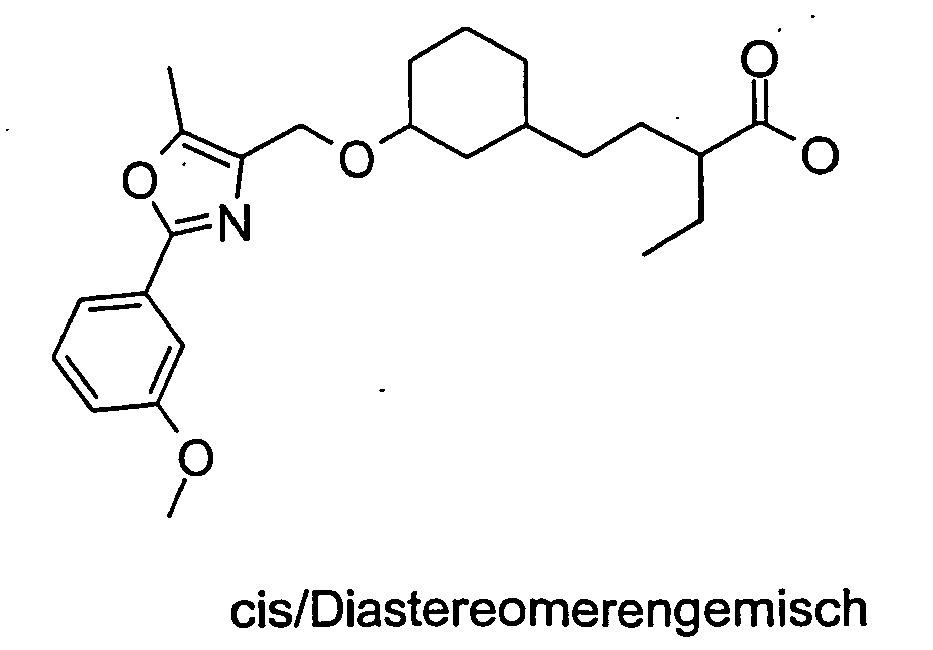
- Analog zu Beispiel 69 wurde aus {cis-3-[2-(3-Methoxy-phenyl)-5-methyl-oxazol-4-ylmethoxy]-cyclohexyl}-acetaldehyde und Triethylphosphonopentanoat 2-(2-{cis-3-[2-(3-Methoxy-phenyl)-5-methyl-oxazol-4-ylmethoxy]-cyclohexyl}-ethyl)-pentansäure erhalten.

-

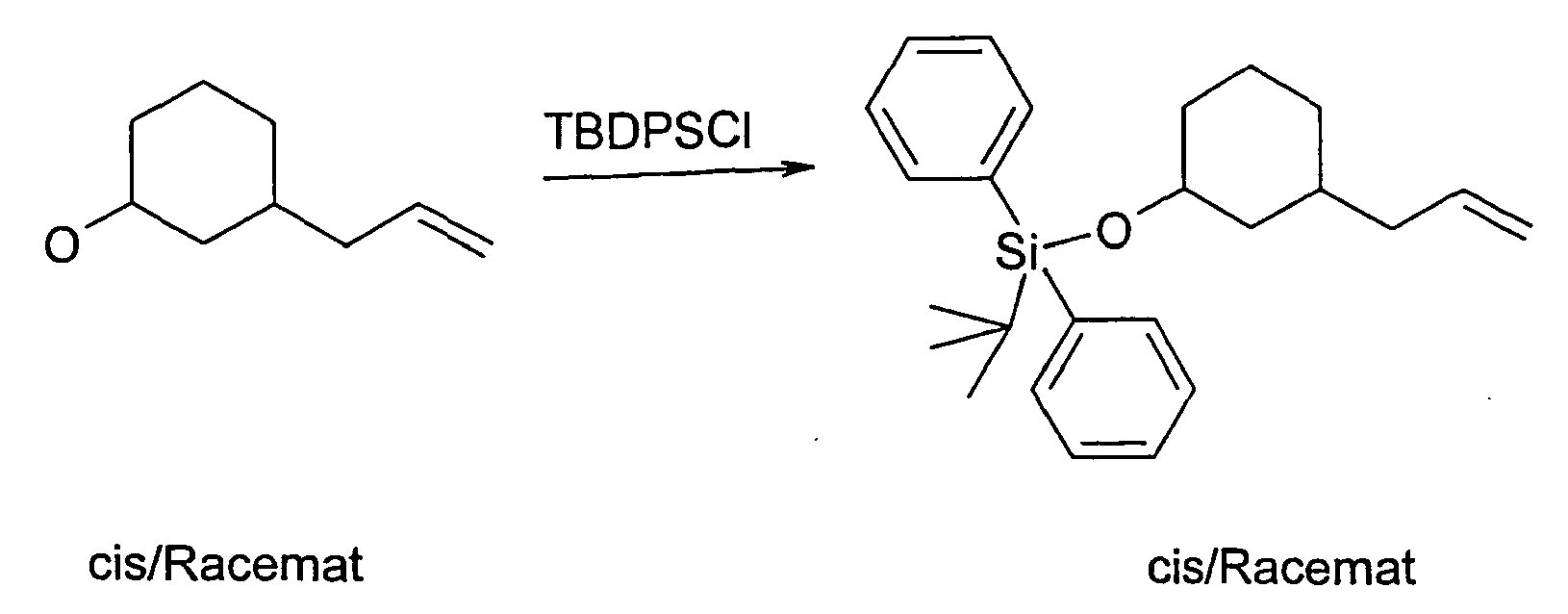
- 6.8 g cis-3-Allyl-cyclohexanol werden mit 15 ml ter-Butyldiphenylsilylchlorid, 5g Imidazol und 200 mg Dimethylaminopyridin in 100 ml Dimethylformamid gelöst und 12 h bei Raumtemperatur gerührt. Es werden 400 ml Methyltert-buthylether zum Reaktionsgemisch gegeben und dreimal mit Wasser gewaschen. Die organische Phase wird über MgSO4 getrocknet und anschließend das Lösungsmittel im Vakuum entfernt. Man erhält 20.5 g (cis-3-Allyl-cyclohexyloxy)-tert-butyl-diphenyl-silane als Öl. C25H34Osi (378.64), MS(ESI): 379 (M+H+), Rf(n-Heptan:Ethylacetat = 2:1) = 0.93.
-

- 5.5 g (cis-3-Allyl-cyclohexyloxy)-tert-butyl-diphenyl-silane werden in 100 ml Diethylether gelöst und mit 9.4 g Natriumperiodat, gelöst in 100 ml Wasser, versetzt. Man gibt bei 0°C 15 ml einer Osmiumtetroxid-Lösung (2.5Gewichts% in tert-Butanol) hinzu und rührt kräftig bei Raumtemperatur nach. Nach 5 Stunden werden weiter 5g Natriumperiodat zugegeben und nochmals 3 Stunden bei Raumtemperatur gerührt. Danach wird das Reaktionsgemisch durch Zugabe von 300 ml Methyl-tert-buthylether verdünnt und mit gesättigter Natriumthiosulfat-Lösung gewaschen. Die organische Phase wird über MgSO4 getrocknet und anschließend das Lösungsmittel im Vakuum entfernt. Man erhält 6 g [cis-3-(tert-Butyl-diphenyl-silanyloxy)-cyclohexyl]-acetaldehyde als gelbbraunes Öl. C24H32O2Si (380.61), MS(ESI): 381 (M+H+), Rf(n-Heptan:Ethylacetat = 5:1) = 0.44.
-
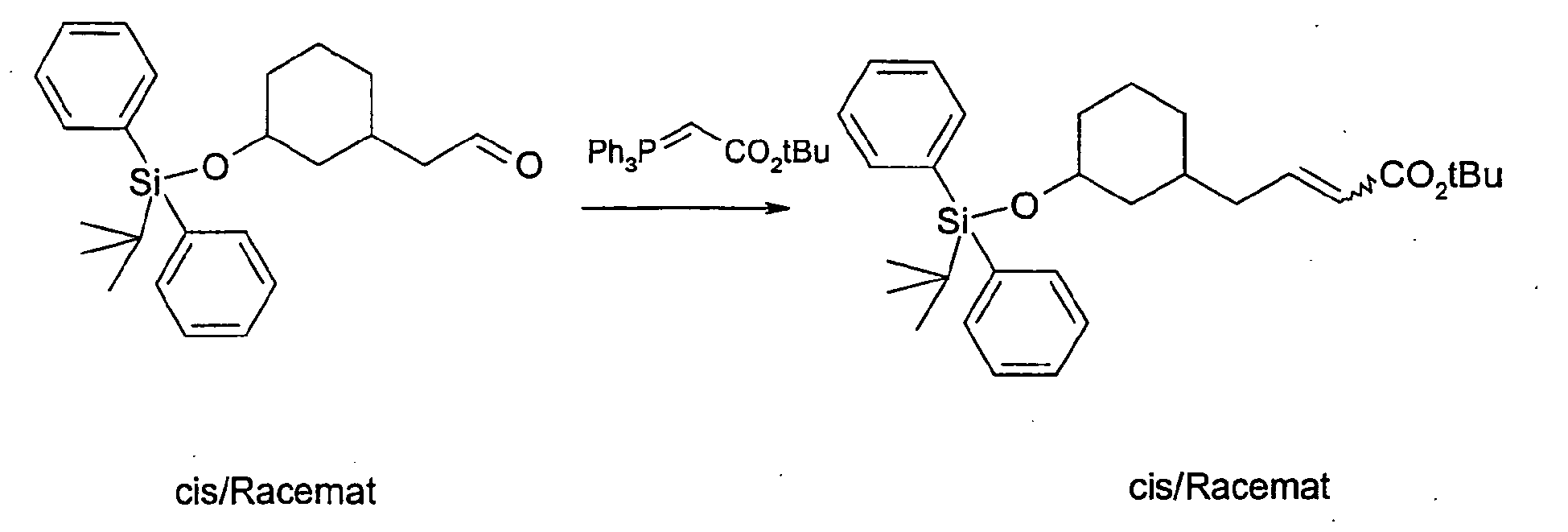
- 3.4 g [cis-3-(tert-Butyl-diphenyl-silanyloxy)-cyclohexyl]-acetaldehyde werden in 100 ml Dichlormethan gelöst und mit 5g (Triphenylphosphoranylidene)-essigsäuretertbutylester versetzt. Es wird 1 Stunde unter Rückfluss zum Sieden erhitzt. Das Gemisch wird mit gesättigter Natriumchlorid-Lösung gewaschen, über MgSO4 getrocknet und anschließend das Lösungsmittel im Vakuum entfernt. Der Rückstand wird an Kieselgel mit dem Laufmittel n-Heptan:Ethylacetat= 20:1 gereinigt. Man erhält 2.4 g 4-[cis-3-(tert-Butyl-diphenyl-silanyloxy)-cyclohexyl]-but-2-ensäure-tert-butylester als Öl. C30H4203Si (478.75), MS(ESI): 479 (M+H+), Rf(n-Heptan:Ethylacetat = 5:1) = 0.56.
-
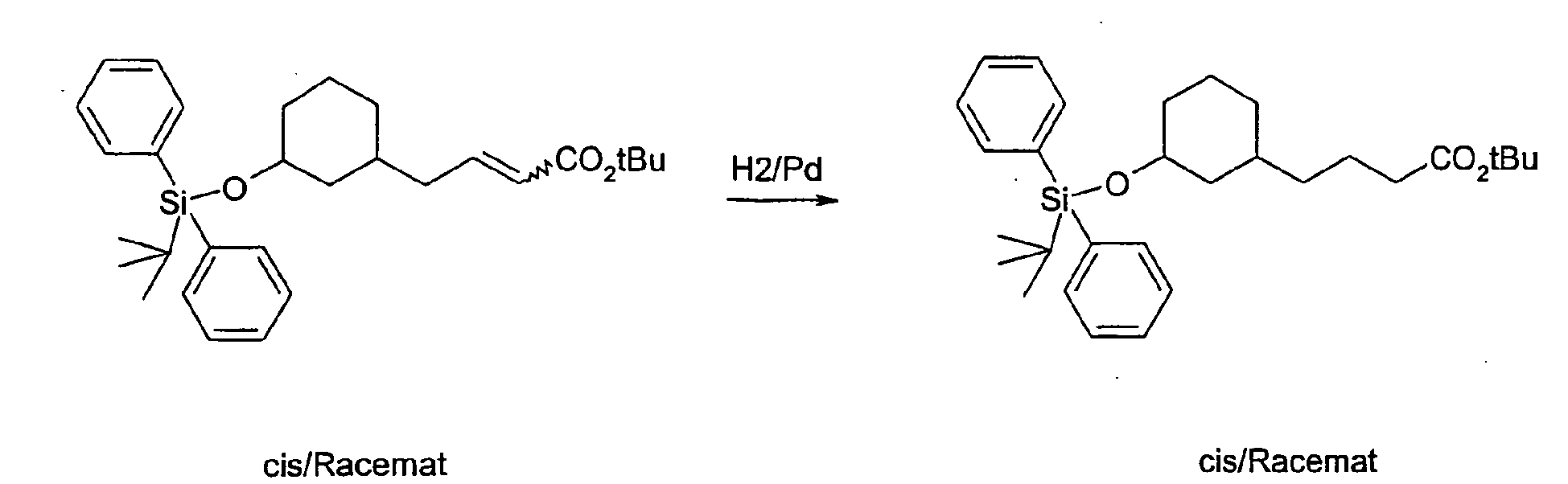
- 2.4 g 4-[cis-3-(tert-Butyl-diphenyl-silanyloxy)-cyclohexyl]-but-2-ensäure-tert-butylester werden in 35 ml Methanol gelöst und mit 200 mg Pd (10% auf Aktivkohle) versetzt. Es wird unter einer Wasserstoffatmosphäre 7 Stunden bei Raumtemperatur gerührt. Der Katalysator wird über Celite abfiltriert und das Filtrat im Vakuum eingeengt. Man erhält 2.3 g 4-[cis-3-(tert-Butyl-diphenyl-silanyloxy)-cyclohexyl]-butansäure-tert-butylester als Öl. C30H44O3Si (480.75), MS(ESI): 481 (M+H+).
-
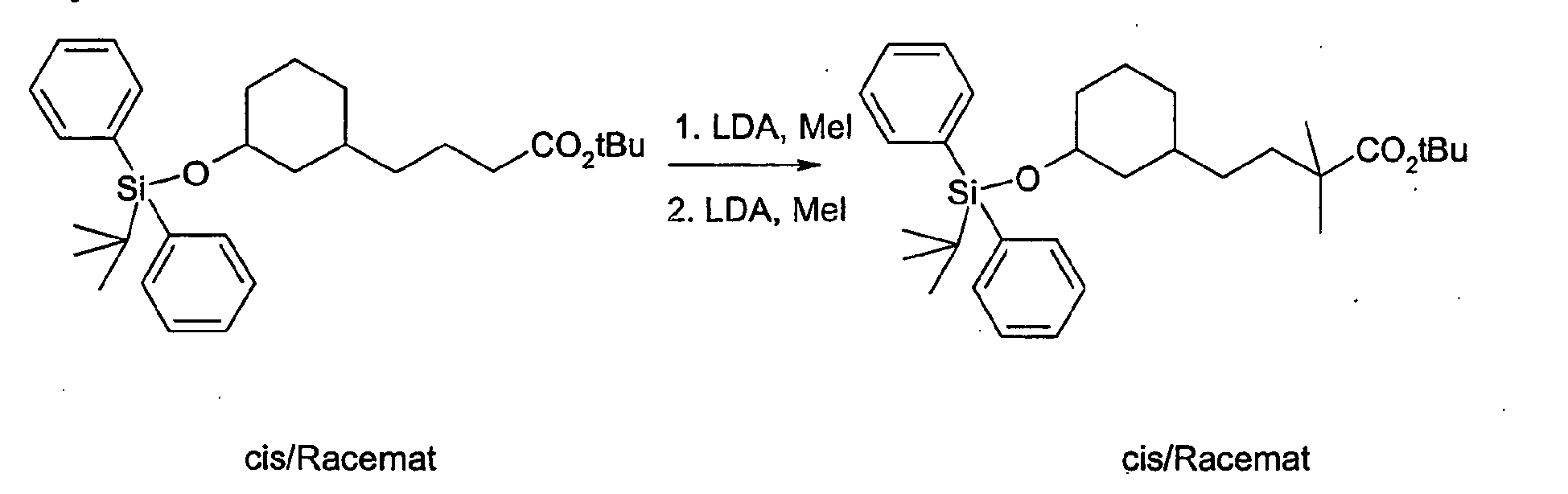
- 2 g 4-[cis-3-(tert-Butyl-diphenyl-silanyloxy)-cyclohexyl]-butansäure-tert-butylester werden in 20 ml Tetrahydrofuran gelöst und bei -78°C mit 3.1 ml einer 2M Lösung von Lithiumdiisopropylamid in Tetrahydrofuran versetzt. Man rührt 2 Stunden bei -78°C nach, dann wird das Reaktionsgemisch auf -30 °C erwärmt und mit 1.6 ml Methyliodid versetzt. Innerhalb von 12 Stunden lässt man auf Raumtemperatur erwärmen. Danach wird das Reaktionsgemisch durch Zugabe von 150 ml Methyl-tert-buthylether verdünnt und mit gesättigter NaCl-Lösung gewaschen. Die organische Phase wird über MgSO4 getrocknet und anschließend das Lösungsmittel im Vakuum entfernt. Der Rückstand wird an Kieselgel mit dem Laufmittel n-Heptan:Ethylacetat = 10:1 gereinigt. Man erhält 2.1 g des Monomethylierten Produktes. Dieses Produkt wird in 20 ml Tetrahydrofuran gelöst und bei -78°C mit 6 ml einer 2M Lösung von Lithiumdiisopropylamid in Tetrahydrofuran versetzt. Man rührt 2 Stunden bei -78°C nach, dann wird das Reaktionsgemisch auf 0 °C erwärmt und nach 10 Minuten bei 0°C mit 2.5 ml Methyliodid versetzt. Innerhalb von 12 Stunden lässt man auf Raumtemperatur erwärmen. Danach wird das Reaktionsgemisch durch Zugabe von 150 ml Methyl-tert-buthylether verdünnt und mit gesättigter NaCl-Lösung gewaschen. Die organische Phase wird über MgSO4 getrocknet und anschließend das Lösungsmittel im Vakuum entfernt. Der Rückstand wird an Kieselgel mit dem Laufmittel n-Heptan:Ethylacetat = 10:1 gereinigt. Man erhält 1.8 g 4-[cis-3-(tert-Butyl-diphenyl-silanyloxy)-cyclohexyl]-2,2-dimethyl-buttersäure-tert-butylester als Öl. C32H48O3Si (508.82), Rf(n-Heptan:Ethylacetat = 5:1) = 0.49.
-
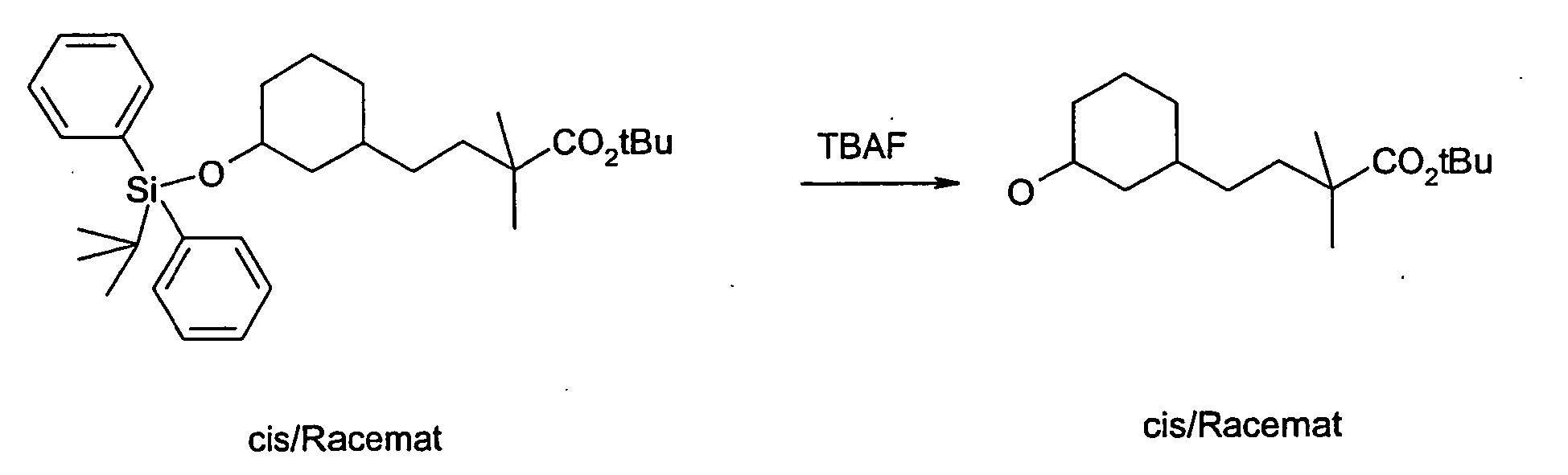
- 2 g 4-[cis-3-(tert-Butyl-diphenyl-silanyloxy)-cyclohexyl]-2,2-dimethyl-buttersäure-tert-butylester werden in 10 ml Tetrahydrofuran gelöst und mit 8 ml einer 1M Lösung von Tetrabutylammoniumfluorid in Tetrahydrofuran versetzt. Man rührt bei 2 Stunden bei 60°C nach. Das Reaktionsgemisch wird im Vakuum eingeengt und an Kieselgel mit dem Laufmittel n-Heptan:Ethylacetat = 20:1 => 1:1 gereinigt. Man erhält 730 mg 4-(cis-3-Hydroxy-cyclohexyl)-2,2-dimethyl-buttersäure-tert-butylester als Öl. C16H30O3 (270.42), Rf(n-Heptan:Ethylacetat = 5:1) = 0.22.
-

- 365 mg 4-(cis-3-Hydroxy-cyclohexyl)-2,2-dimethyl-buttersäure-tert-butylester werden zusammen mit 850 mg 4-lodmethyl-5-methyl-2-(4 methyl-phenyl)-oxazol in 5 ml Dimethylformamid gelöst und mit 110 mg Natriumhydrid (60%ig in Paraffin) versetzt. Nach 1 Stunde Rühren bei Raumtemperatur wird 100 ml Methyl-tert-butylether zugegeben und das Reaktionsgemisch dreimal mit Wasser gewaschen. Die organische Phase wird über MgSO4 getrocknet und anschließend das Lösungsmittel im Vakuum entfernt. Der Rückstand wird mittels RP-HPLC gereinigt. Man erhält 330 mg 2,2-Dimethyl-4-[cis-3-(5-methyl-2-p-tolyl-oxazol-4-ylmethoxy)-cyclohexyl]-buttersäure-tert-butylester als weißen Feststoff. C28H41NO4 (455.64), MS(ESI): 456 (M+H+).
-
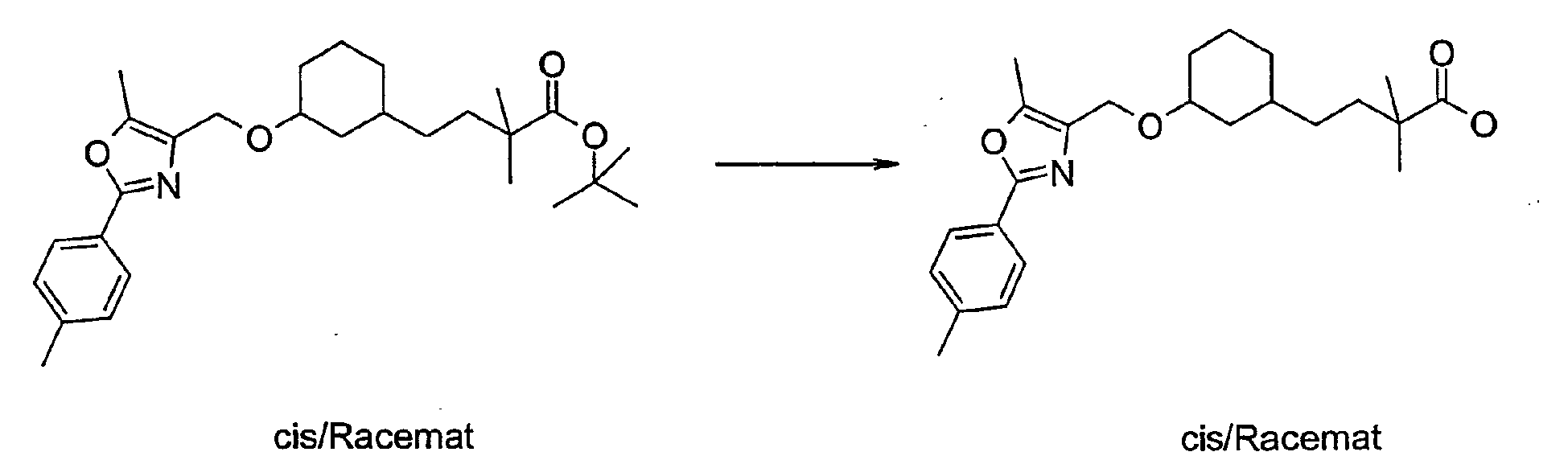
- 300 mg 2,2-Dimethyl-4-[cis-3-(5-methyl-2-p-tolyl-oxazol-4-ylmethoxy)-cyclohexyl]-buttersäure-tert-butylester werden in 20 ml Dichlormethan gelöst und mit 10 ml Trifluoressigsäure versetzt. Man rührt 1 Stunde bei Raumtemperatur nach. Es werden 200 ml Toluol zugegeben und dann die Lösungsmittel im Vakuum eingeengt. Der Rückstand wird mittels RP-HPLC gereinigt. Man erhält 180 mg 2,2-Dimethyl-4-[cis-3-(5-methyl-2-p-tolyl-oxazol-4-ylmethoxy)-cyclohexyl]-buttersäure als Öl. C24H33NO4 (399.53), MS(ESI): 400 (M+H+).
- Analog zu Beispiel 71 wurden aus 4-(cis-3-Hydroxy-cyclohexyl)-2,2-dimethylbuttersäure-tert-butylester und 4-lodmethyl-5-methyl-2-(3-trifluormethyl-phenyl)-oxazol 2,2-Dimethyl-4-{3-[5-methyl-2-(3-trifluoromethyl-phenyl)-oxazol-4-ylmethoxy]-cyclohexyl}-butyric acid erhalten.

-

- 5.5 ml tert-Butyl-diethylphosphonoacetat werden in 20 ml Dimethylformamid gelöst und bei 0°C portionsweise mit 820 mg Natriumhydrid (60%ig in Paraffinöl) versetzt. Die Suspension wird 15 Minuten bei 0°C gerührt und dann mit 2.4 ml Isopropyliodid versetzt. Es wird 12 Stunden bei Raumtemperatur gerührt. Dann werden 250 ml Ethylacetat zugegeben und das Reaktionsgemisch dreimal mit je 150 ml Wasser gewaschen. Die organische Phase wird über MgSO4 getrocknet und im Vakuum eingeengt. Der Rückstand wird an Kieselgel mit dem Laufmittel n-Heptan:Ethylacetat = 5:1 gereinigt. Man erhält 4.2 g 2-(Diethoxy-phosphoryl)-3-methyl-buttersäure-tert-butylester als Öl. C13H27O5P (294.33), MS(ESI): 239 (M-C4H8+H+), Rf(n-Heptan:Ethylacetat = 1:1) = 0.34.
-

- 770 mg 2-(Diethoxy-phosphoryl)-3-methyl-buttersäure-tert-butylester werden in 10 ml Tetrahydrofuran gelöst und bei -20°C mit 0.73 ml einer 2.7 M Lösung von n-Butyllithium in n-Hexan versetzt. Nach 1 Stunde Rühren bei -20°C werden 500 mg [cis-3-(tert-Butyl-diphenyl-silanyloxy)-cyclohexyl]-acetaldehyde, gelöst in 5 ml Tetrahydrofuran, zugetropft. Das Reaktionsgemisch wird langsam auf Raumtemperatur erwärmt. Dann wird 20 ml Wasser zugegeben und dreimal mit je 50 ml Ethylacetat extrahiert. Die vereinigten organischen Phasen werden über MgSO4 getrocknet und anschließend das Lösungsmittel im Vakuum entfernt. Der Rückstand wird an Kieselgel mit dem Laufmittel n-Heptan:Ethylacetat = 30:1 gereinigt. Man erhält 340 mg 4-[cis-3-(tert-Butyl-diphenyl-silanyloxy)-cyclohexyl]-2-isopropyl-butyr-2-ensäure-tert-butylester als Öl. C33H48O3Si (520.83), Rf(n-Heptan:Ethylacetat = 5:1) = 0.70.
-

- g 4-[cis-3-(tert-Butyl-diphenyl-silanyloxy)-cyclohexyl]-2-isopropyl-butyr-2-ensäure-tert-butylester werden in 30 ml Ethylacetat gelöst und mit 200 mg Perlman's Catalyst versetzt. Es wird 5 Stunden unter einer Wasserstoffatmosphäre (5 bar) gerührt. Der Katalysator wird über Celite abfiltriert und das Filtrat im Vakuum eingeengt. Der Rückstand wird in 15 ml Tetrahydrofuran gelöst und mit 3 ml einer 1M Lösung von Tetrabutylammoniumfluorid in Tetrahydrofuran versetzt. Es wird 2 Stunden bei 60°C gerührt. Das Reaktionsgemisch wird im Vakuum eingeengt und an Kieselgel mit dem Laufmittel n-Heptan:Ethylacetat = 40:1 => 10:1 gereinigt. Man erhält 400 mg 4-[cis-3-(tert-Butyl-diphenyl-silanyloxy)-cyclohexyn-2-isopropyl-buttersäure als Öl. C17H32O3 (284.44), MS(ESI): 211 (M-C4H9O-), Rf(n-Heptan:Ethylacetat = 10:1) = 0.15.
- Analog zu Beispiel 73 wurde aus 4-lodmethyl-5-methyl-2-(4 methyl-phenyl)-oxazol und 4-[cis-3-(tert-Butyl-diphenyl-silanyloxy)-cyclohexyl]-2-isopropyl-buttersäure 3-Methyl-2-{2-[cis-3-(5-methyl-2-p-tolyl-oxazol-4-ylmethoxy)-cyclohexyl]-ethyl}-butyric acid erhalten.

- Analog zu Beispiel 73 wurde aus 4-lodmethyl-5-methyl-2-(3 methoxy-phenyl)-oxazol und 4-[cis-3-(tert-Butyl-diphenyl-silanyloxy)-cyclohexyl]-2-isopropyl-buttersäure 2-(2-{cis-3-[2-(3-Methoxy-phenyl)-5-methyl-oxazol-4-ylmethoxy]-cyclohexyl}-ethyl)-3-methyl-buttersäure erhalten.
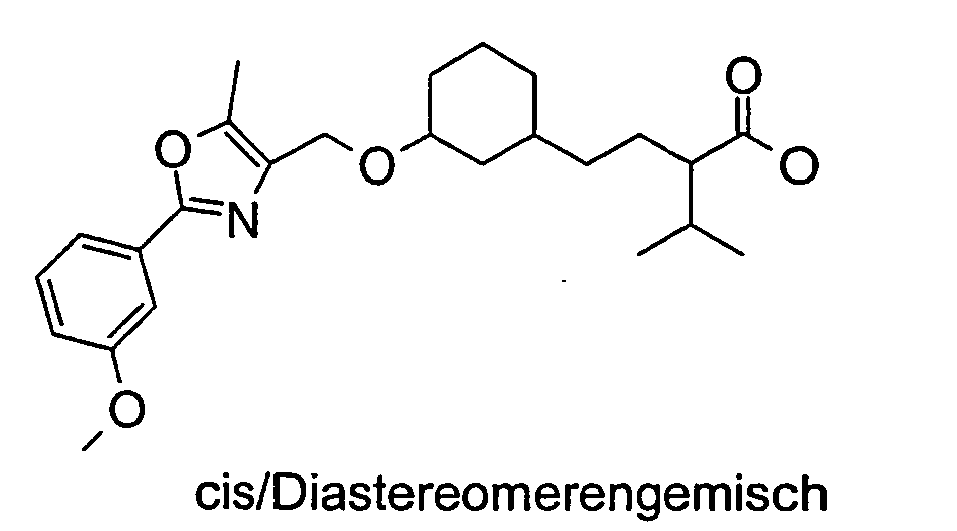
- Analog zu Beispiel 73 wurde aus tert-Butyl-diethylphosphonoacetat und Benzylbromid 2-(Diethoxy-phosphoryl)-3-phenyl-propionsäure-tert-butylester erhalten.

- Analog zu Beispiel 73 wurde aus 2-(Diethoxy-phosphoryl)-3-phenyl-propionsäure-tert-butylester, [cis-3-(tert-Butyl-diphenyl-silanyloxy)-cyclohexyl]-acetaldehyde und 4-lodmethyl-5-methyl-2-(4 methyl-phenyl)-oxazol 2-Benzyl-4-[cis-3-(5-methyl-2-p-tolyl-oxazol-4-ylmethoxy)-cyclohexyl]-buttersäure erhalten.
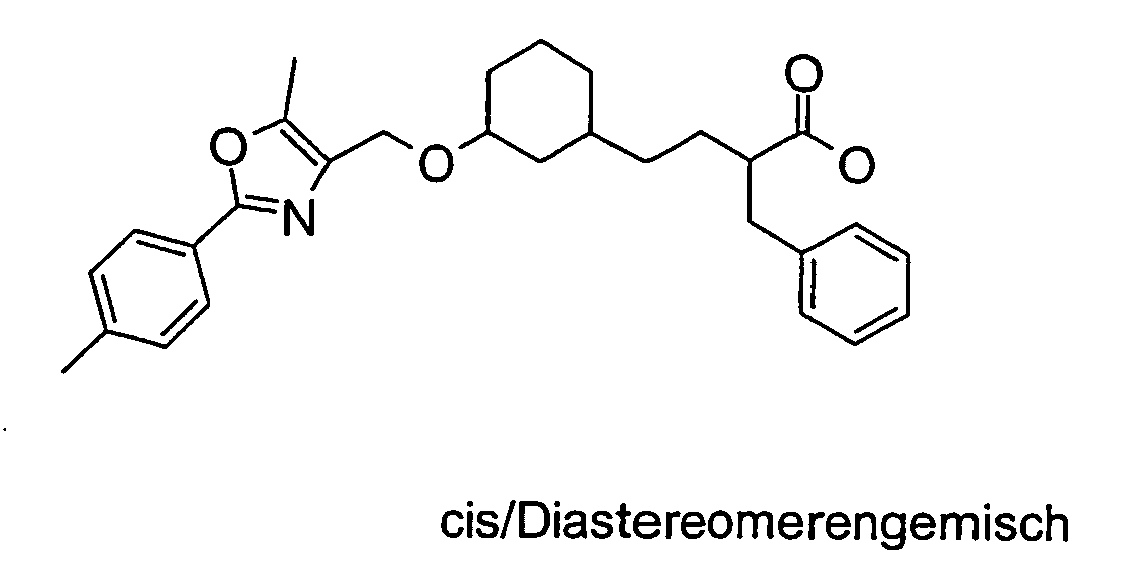
- Analog zu Beispiel 73 wurde aus 4-[cis-3-(tert-Butyl-diphenyl-silanyloxy)-cyclohexyl]-butansäure-tert-butylester, 3-Bromo-2-methyl-propene und 4-lodmethyl-5-methyl-2-(4 methyl-phenyl)-oxazol 4-Methyl-2-{2-[cis-3-(5-methyl-2-p-tolyl-oxazol-4-ylmethoxy)-cyclohexyl]-ethyl}-pent-4-ensäure-tert-butylester erhalten.

-

- 500 mg 4-Methyl-2-{2-[cis-3-(5-methyl-2-p-tolyl-oxazol-4-ylmethoxy)-cyclohexyl]-ethyl}-pent-4-ensäure-tert-butylester werden in 20 ml Ethylacetat gelöst und mit 50 mg Palladium (10% auf Aktivkohle) versetzt. Es wird 5 Stunden unter einer Wasserstoffatmosphäre (5 bar) gerührt. Der Katalysator wird über Celite abfiltriert und das Filtrat im Vakuum eingeengt. Der Rückstand wird in 20 ml Dichlormethan gelöst und mit 10 ml Trifluoressigsäure versetzt. Man rührt 1 Stunde bei Raumtemperatur nach. Es werden 100 ml Toluol zugegeben und dann die Lösungsmittel im Vakuum entfernt. Der Rückstand wird mittels RP-HPLC gereinigt. Man erhält 100 mg 4-Methyl-2-{2-[cis.3-(5-methyl-2-p-tolyl-oxazol-4-ylmethoxy)-cyclohexyl]-ethyl}-pentansäure als Öl. C26H37NO4 (427.59), MS(ESI): 428 (M+H+).
- Analog zu Beispiel 71 wurde aus 4-[cis-3-(tert-Butyl-diphenyl-silanyloxy)-cyclohexyl]-butansäure-tert-butylester und Allylbromid 2-Allyl-2-{2-[3-(tert-butyl-diphenylsilanyloxy)-cyclohexyl]-ethyl}-pent-4-ensäure-tert-butylester erhalten.
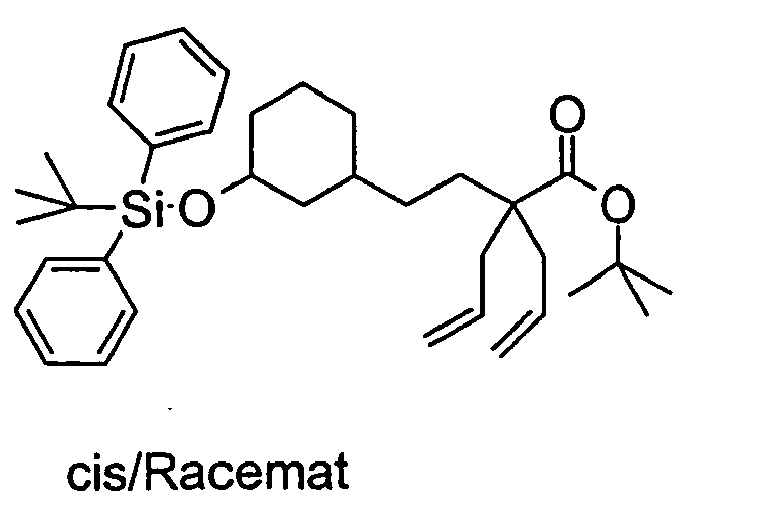
- Analog zu Beispiel 71 und Beispiel 76 wurde aus 2-Allyl-2-{2-[cis-3-(tert-butyl-diphenylsilanyloxy)-cyclohexyl]-ethyl}-pent-4-ensäure-tert-butylester und 4-lodmethyl-5-methyl-2-(3-trifluormethyl-phenyl)-oxazol 2-(2-{cis-3-[5-Methyl-2-(3-trifluoromethyl-phenyl)-oxazol-4-ylmethoxy]-cyclohexyl}-ethyl)-2-propyl-pentansäure erhalten.
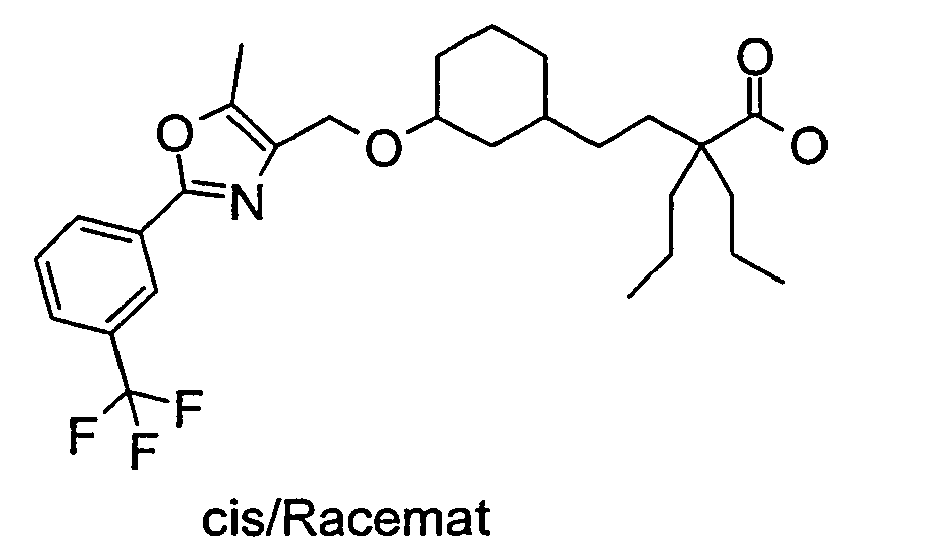
-

- 2 g 2-Allyl-2-{2-[cis-3-(tert-butyl-diphenyl-silanyloxy)-cyclohexyl]-ethyl}-pent-4-ensäure-tert-butylester werden in 100 ml Dichlormethan gelöst. Man leitet 5 Minuten Argon durch die Lösung hindurch. Dann wird 100 mg Grubbs Katalysator hinzugesetzt. Es wird 2 Stunden bei 40°C gerührt. Danach wiord das Lösungsmittel im Vakuum entfernt und der Rückstand an Kieselgel mit dem Laufmittel n-Heptan:Ethylacetat = 40:1 gereinigt. Man erhält 1.4 g 1-{2-[cis-3-(tert-Butyl-diphenyl-silanyloxy)-cyclohexyl]-ethyl}-cyclopent-3-enecarbonsäure-tert-butylester als Öl. C34H48O3Si (532.85), Rf(n-Heptan:Ethylacetat = 20:1) = 0.56.
- Analog zu Beispiel 77 wurde aus 1-{2-[cis-3-(tert-Butyl-diphenyl-silanyloxy)-cyclohexyl]-ethyl}-cyclopent-3-enecarbonsäure-tert-butylester und 4-lodmethyl-5-methyl-2-(4-methyl-phenyl)-oxazol 1-{2-[cis-3-(5-Methyl-2-p-tolyl-oxazol-4-ylmethoxy)-cyclohexyl]-ethyl}-cyclopentancarbonsäure erhalten.

-

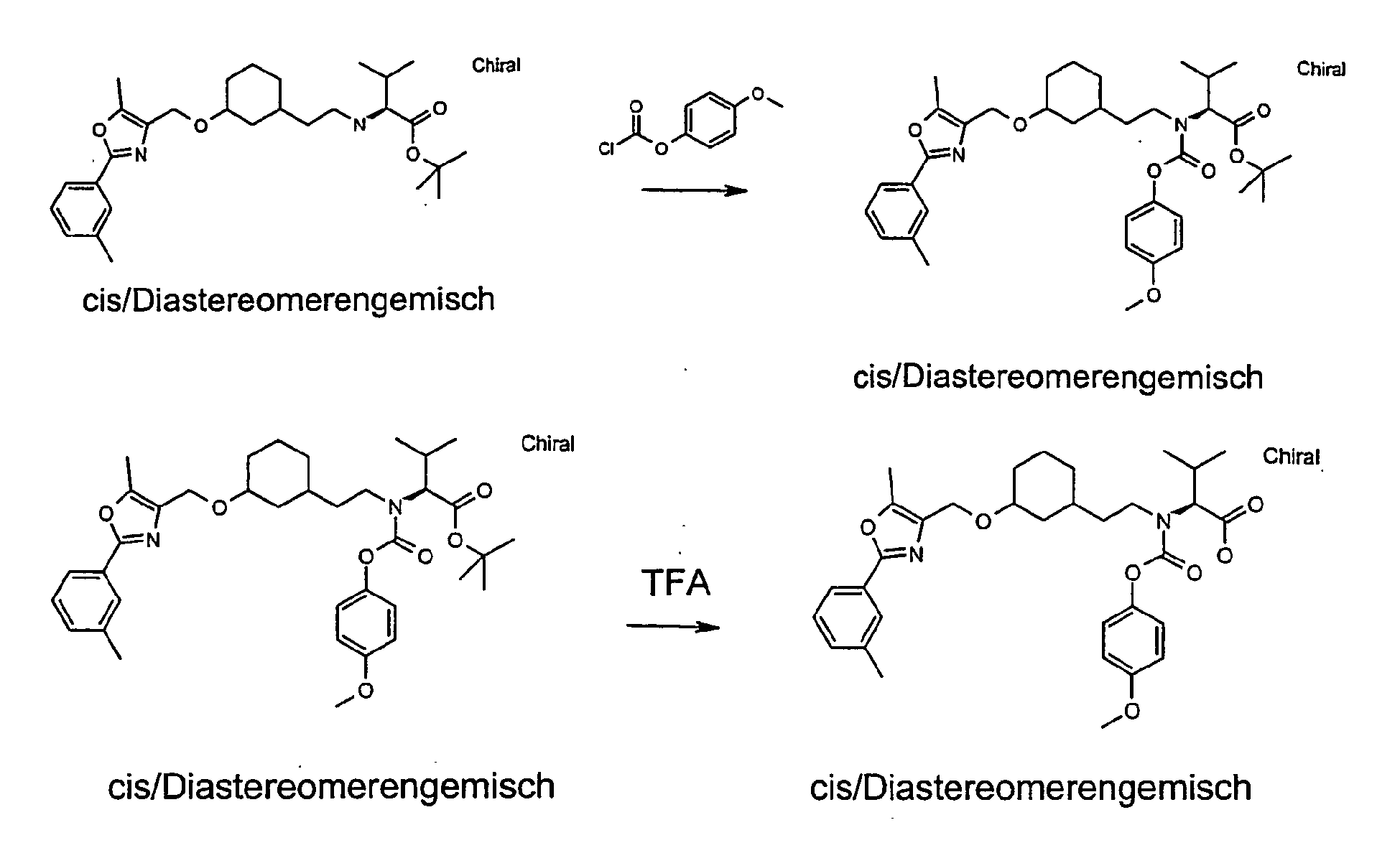
-

- 0,1g {cis-3-[2-(3-Methylphenyl)-5-methyl-oxazol-4-ylmethoxy]-cyclohexyl}-acetaldehyde (hergestellt nach dem Verfahren E4) werden in Methylenchlorid vorgelegt und eine Spatelspitze Magnesiumsulfat wird zugesetzt. Danach werden 64 mg Amin zugegeben, die Mischung auf 0°C gekühlt und mit 30 mg Natriumacetat versetzt und 30 min nachgerührt. 84 mg Natriumtriacetoxyborhydrid werden zugegeben und die Mischung über Nacht bei RT gerührt. Man gibt 8 ml Wasser zur Reaktion und filtriert über eine Kieselgurkartusche, wäscht mit 50ml Methylenchlorid nach und entfernt das Lösungsmittel am Vakuum. Man erhält 0,13g (S)-3-Methyl-2-{2-[cis-3-(5-methyl-2-m-tolyl-oxazol-4-ylmethoxy)-cyclohexyl]-ethylamino}-butyric acid tert-butyl ester. C29H44N2O4 (484), MS (ESI): 485 (M+H).
-

- 130 mg (S)-3-Methyl-2-{2-[cis-3-(5-methyl-2-m-tolyl-oxazol-4-ylmethoxy)-cyclohexyl]-ethylamino}- buttersäure-tert-butylester Werden in 1 ml Methylenchlorid gelöst, und mit 2 ml ges. Natriumcarbonat-Lösung versetzt und auf 0°C gekühlt, anschließend werden ein Überschuß des Säurechlorids zugegeben und es wird 1 h bei RTgerührt. Die gesamte Reaktionslösung wird über eine Kieselgurkartusche gegeben und mit 20ml Methylenchlorid nachgewaschen. Das Lösemittel wird am Vakuum entfernt. Man erhält 0,1g (S)-2-((4-Methoxy-phenoxycarbonyl)-{2-[cis-3-(5-methyl-2-m-tolyl-oxazol-4-ylmethoxy)-cyclohexyl]-ethyl}-amino)-3-methylbuttersäure-tert-butyl ester.
C37H50N2O7 (635), MS (ESI):636 (M+H) -

- 0,10 g (S)-2-((4-Methoxy-phenoxycarbonyl)-{2-[cis-3-(5-methyl-2-m-tolyl-oxazol-4-ylmethoxy)-cyclohexyl]-ethyl}-amino)-3-methylbuttersäure-tert-butyl ester werden in 2ml Dichlormethan gelöst und mit 1 ml Trifluoressigsäure bei RT über Nacht gerührt. Dann wird das Lösemittel komplett entfernt und über die präparative HPLC gereinigt. Man erhält 15,6 mg (S)-2-((4-Methoxy-phenoxycarbonyl)-{2-[cis-3-(5-methyl-2-m-tolyl-oxazol-4-ylmethoxy)-cyclohexyl]-ethyl}-amino)-3-methylbuttersäure. C33H42N2O7 (579), MS (ESI): 580 (M+H)
- Analog zu Beispiel 79 wurden aus [cis-3-(5-Methyl-2-m-tolyl-oxazol-4-ylmethoxy)-cyclohexyl]-acetaldehyde und 1-Amino-cyclopentanecarbonsäuremethylester, 1-(Benzyloxycarbonyl-{2-[cis-3-(5-methyl-2-m-tolyl-oxazol-4-ylmethoxy)-cyclohexyl]-ethyl}-amino)-cyclopentancarbonsäure erhalten.

- Analog zu Beispiel 79 wurden aus cis-3-(5-Methyl-2-m-tolyl-oxazol-4-ylmethoxy)-cyclohexyl]-acetaldehyde und 1-Amino-cyclopentanecarbonsäuremethylester, 1-((4-Methoxy-benzyloxycarbonyl)-{2-[cis-3-(5-methyl-2-m-tolyl-oxazol-4-yl methoxy)-cyclohexyl]-ethyl}-amino)-cyclopentancarbonsäure erhalten.
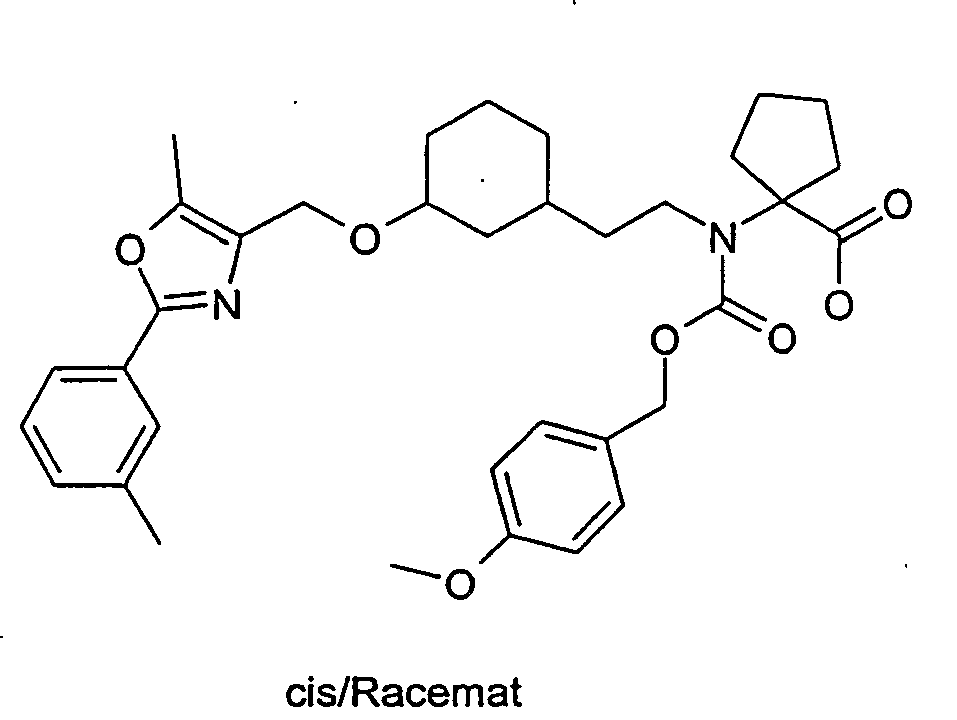
- Analog zu Beispiel 79 wurden aus cis-3-(5-Methyl-2-m-tolyl-oxazol-4-ylmethoxy)-cyclohexyl]-acetaldehyde und (S)-2-Amino-2-methyl-3-phenyl-propionsäuremethylester, (R)-2-((4-Methoxy-benzyloxycarbonyl)-{2-[cis-3-(5-methyl-2-m-tolyl-oxazol-4-ylmethoxy)-cyclohexyl]-ethyl}-amino)-2-methyl-3-phenyl-propionsäure erhalten.

- Analog zu Beispiel 79 wurden aus cis-3-(5-Methyl-2-m-tolyl-oxazol-4-ylmethoxy)-cyclohexyl]-acetaldehyde und (S)-2-Amino-2-methyl-3-phenylpropionsäuremethylester, (Benzyloxycarbonyl-{2-[cis-3-(5-methyl-2-m-tolyl-oxazol-4-ylmethoxy)-cyclohexyl]-ethyl}-amino)-essigsäure erhalten
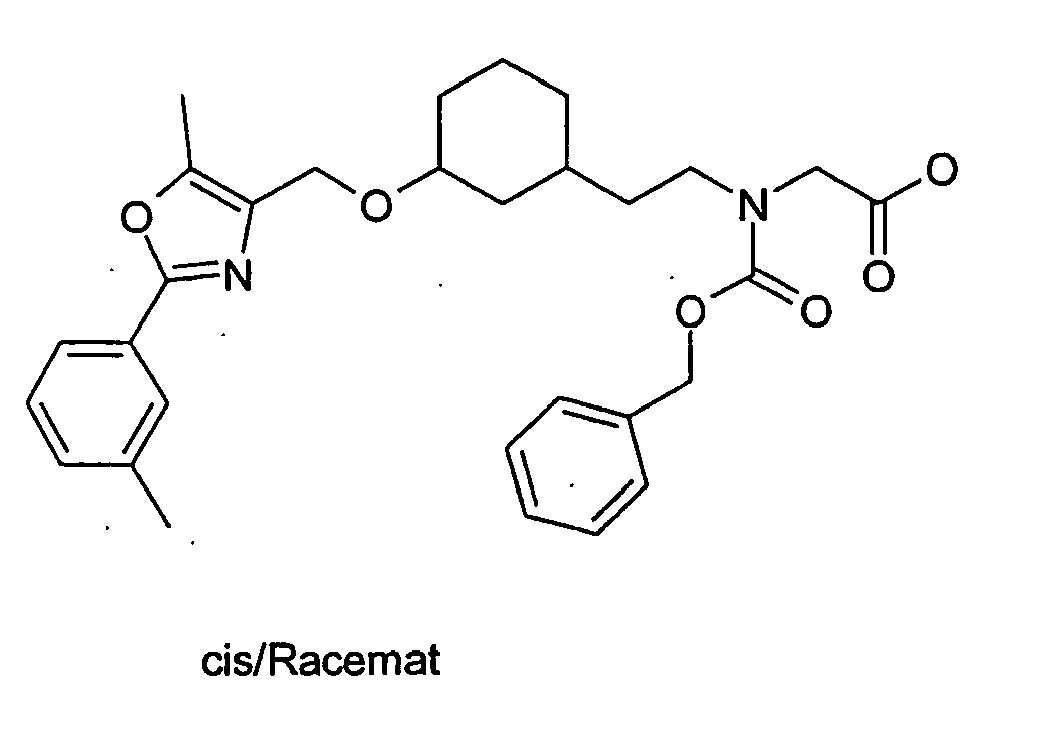
- Analog zu Beispiel 79 wurden aus cis-3-(5-Methyl-2-m-tolyl-oxazol-4-ylmethoxy)-cyclohexyl]-acetaldehyde und (S)-2-Amino-2-methyl-3-phenylpropionsäuremethylester, ({2-[cis-3-(5-Methyl-2-m-tolyl-oxazol-4-ylmethoxy)-cyclohexyl]-ethyl}-phenylacetyl-amino)-essigsäure erhalten.

- Analog zu Beispiel 79 wurden aus cis-3-(5-Methyl-2-m-tolyl-oxazol-4-ylmethoxy)-cyclohexyl]-acetaldehyde und (S)-2-Amino-2-methyl-3-phenylpropionsäuremethylester, (1-{2-[cis-3-(5-Methyl-2-m-tolyl-oxazol-4-ylmethoxy)-cyclohexyl]-ethyl}-3-phenyl-ureido)-essigsäure erhalten.
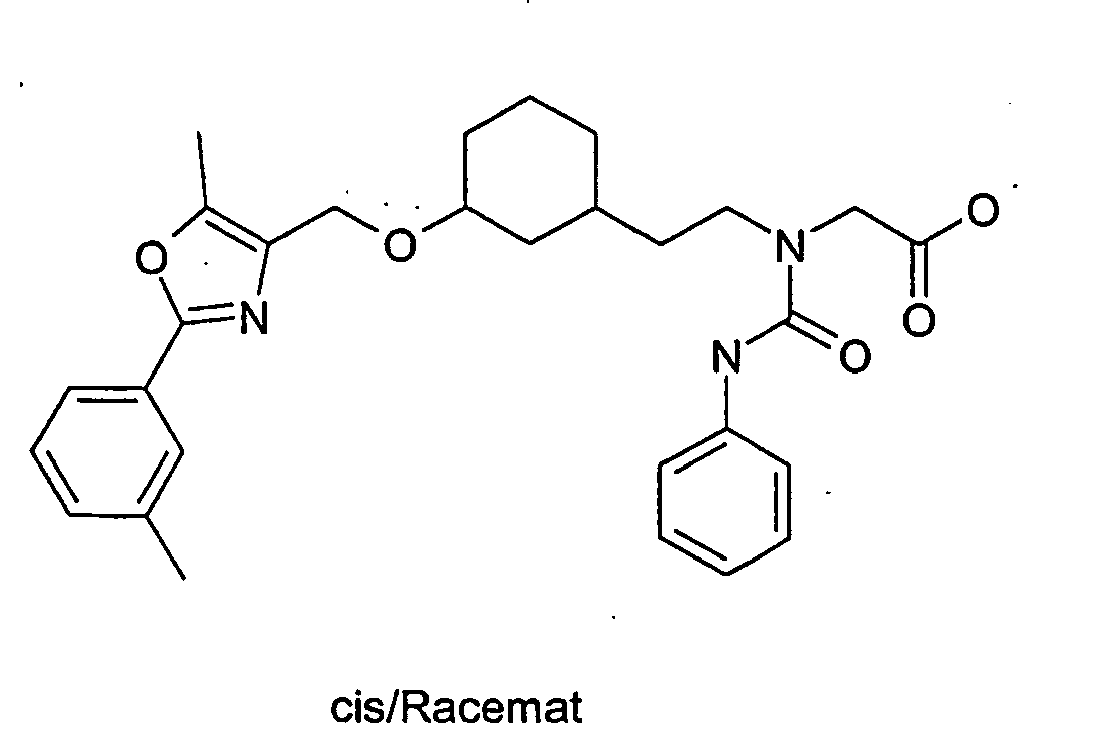
Claims (15)
- Verbindungen der Formel I
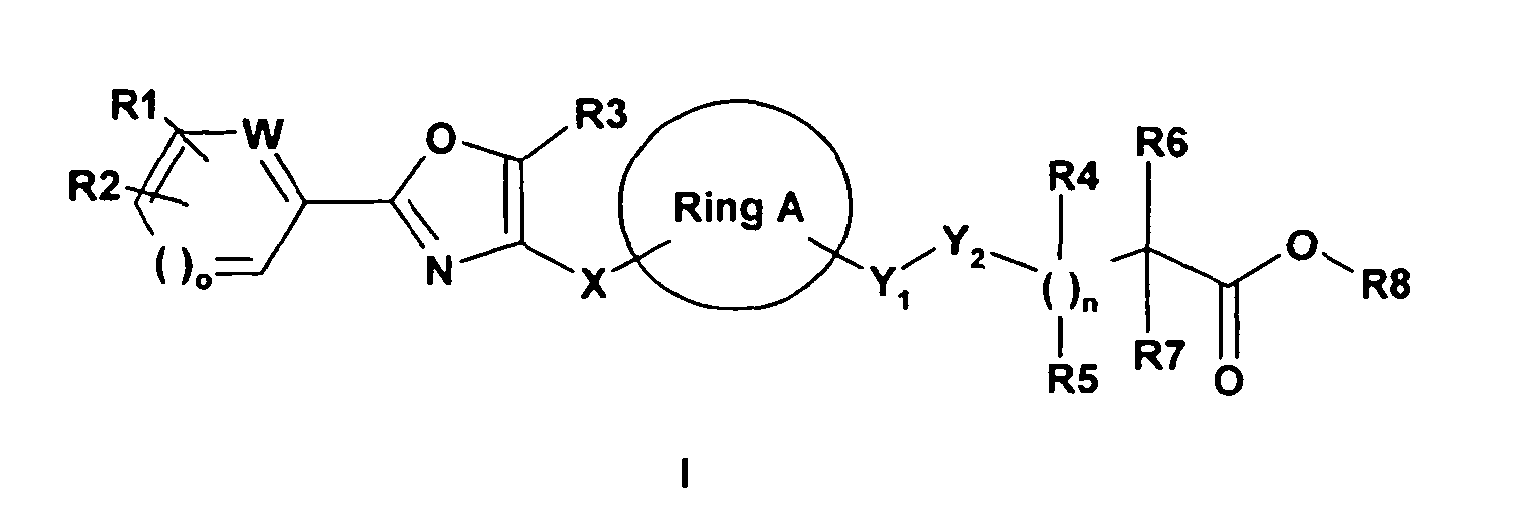 Ring A Cyclohexan-1,3-diyl;R1, R2 unabhängig voneinander H, F, Cl, Br, CF3, OCF3, (C1-C6)-Alkyl, O-(C1-C6)-Alkyl, SCF3, SF5, OCF2-CHF2, (C6-C10)-Aryl, (C6-C10)-Aryloxy, OH, NO2; oderR1 und R2 zusammengenommen mit dem Phenyl-, Pyridin-, 1-H-Pyrrol-, Thiophen- oder Furan-Ring kondensiertes, teilweise oder nicht gesättigtes bicyclisches (C6-C10)-Aryl, (C5-C11)-Heteroaryl;R3 H, (C1-C6)-Alkyl, (C3-C8)-Cycloalkyl, (C1-C3)-Alkyl-(C3-C8)-Cycloalkyl, Phenyl, (C1-C3)-Alkyl-Phenyl , (C5-C6)-Heteroaryl, (C1-C3)-Alkyl-(C5-C6)-Heteroaryl oder (C1-C3)-Alkyl, das durch F ganz oder teilweise substituiert ist;o 0 oder 1;W CH, N, falls o = 1;W O, S, NR10, falls o = 0;X (C1-C6)-Alkandiyl, wobei in der Alkandiylgruppe ein oder mehrere Kohlenstoffatome durch Sauerstoffatome ersetzt sein können;Y1 (CR13R14)p;p 1, 2;Y2 CH2, O, S, SO, SO2, NR9;n 0-2;R4 H, (C1-C6)-Alkyl; oder F, falls Y2 ungleich O, NR9;R5 H, (C1-C6)-Alkyl; oder F, falls Y2 ungleich O, NR9;R6 H, (C1-C6)-Alkyl; oder F, falls n ungleich 0;R7 H, F (falls n ungleich 0), (C1-C6)-Alkyl, (C1-C6)-Alkoxy, (C2-C6)-Alkenyl, (C2-C6)-Alkinyl, (C3-C8)-Cycloalkyl, Phenyl, wobei Alkyl gegebenenfalls substituiert sein kann durch ein oder mehrere Reste aus der Reihe Hydroxy, Phenyl, (C5-C11)-Heteroaryl, (C1-C6)-Alkoxy und NR11R12, und Phenyl gegebenfalls substituiert sein kann durch ein oder mehrere Reste aus der Reihe Hydroxy, (C1-C6)-Alkoxy, F und CF3; mit der Maßgabe, dass R7 ungleich NR11 R12 oder (C1-C6)-Alkoxy, falls R6 = F ist;R6 und R7 zusammen mit dem sie tragenden C-Atom (C3-C8)-Cycloalkyl;R8 H, (C1-C6)-Alkyl;R9 H, (C1-C6)-Alkyl, (C2-C6)-Alkenyl, (C2-C6)-Alkinyl, Aryl-(C1-C4)alkyl, CO-(C1-C6)-Alkyl, CO-(C6-C10)-Aryl, CO-(C1-C6)-Alkyl-(C6-C10)-Aryl, CO-(C5-C11)-Heteroaryl, C(O)-O-(C1-C6)-Alkyl, C(O)-O-(C1-C6)-Alkyl-(C6-C10)-Aryl, C(O)-O-(C6-C10)-Aryl, C(O)-O-(C5-C11)-Heteroaryl, SO2-(C1-C6)-Alkyl, SO2-(C1-C6)-Alkyl-(C6-C10)-Aryl, SO2-(C1-C6)-Alkyl-S02-(C1-C6)-alkyl, SO2-(C6-C10)-Aryl, SO2-(C5-C11)-Heteroaryl, wobei Aryl und Heteroaryl gegebenenfalls substituiert sein können durch (C1-C6)-Alkyl, O-(C1-C6)-Alkyl, F, Cl, CO-(C1-C6)-Alkyl;R10 H, (C1-C6)-Alkyl, (C1-C6)-Alkyl-Phenyl;R11 H, (C1-C6)-Alkyl, (C1-C6)-Alkyl-Phenyl;R12 H, (C1-C6)-Alkyl, (C1-C6)-Alkyl-Phenyl;R13 H, (C1-C6)-Alkyl;R14 H, (C1-C6)-Alkyl;sowie deren physiologisch verträgliche Salze.
 - Verbindungen der Formel I gemäß Anspruch 1, worin bedeutenRing A Cyclohexan-1,3-diyl;X (C1-C6)-Alkandiyl, wobei in der Alkandiylgruppe das C1- oder C2-Kohlenstoffatom (zum Ring A) durch Sauerstoffatom ersetzt ist.
- Verbindungen der Formel I gemäß einem oder mehreren der Ansprüche 1 bis 2, worin bedeutenRing A cis-Cyclohexan-1,3-diyl,R1, R2 unabhängig voneinander H, F, CF3, (C1-C6)-Alkyl, O-(C1-C6)-Alkyl, Phenyl, oderR1 und R2 zusammengenommen mit dem Phenylring = Naphthyl;R3 (C1-C6)-Alkyl, (C3-C8)-Cycloalkyl, Phenyl;o 0 oder 1;W CH, falls o = 1;W O, S, falls o = 0;X CH2-O, CH2-O-CH2;Y1 CH2;Y2 CH2, O S, SO, SO2, NR9;n 0;R4 H;R5 H;R6 H, (C1-C6)-Alkyl, Benzyl;R7 H, (C1-C6)-Alkyl, (C3-C6)-Cycloalkyl, Phenyl, Benzyl,R6 und R7 zusammen mit dem sie tragenden C-Atom (C3-C6)-Cycloalkyl;R8 H;R9 H; (C1-C6)-Alkyl, das gegebenenfalls substituiert sein kann durch (C3-C6)-Cycloalkyl, Phenyl, (C5-C6)-Heteroaryl; CO-(C1-C6)-Alkyl, CO-(C1-C6)-Alkyl-Phenyl, CO-Phenyl, C(O)-O-(C1-C6)-Alkyl, CO-NH-Phenyl, SO2-(C1-C4)-Alkyl, SO2-(C1-C4)-Alkyl-SO2-(C1-C4)-alkyl, SO2-Tolyl, wobei Phenyl wiederum substituiert sein kann durch O-(C1-C3)-Alkyl;sowie deren physiologisch verträgliche Salze.
- Arzneimittel enthaltend eine oder mehrere der Verbindungen der Formel I gemäß einem oder mehreren der Ansprüche 1 bis 3.
- Arzneimittel enthaltend eine oder mehrere der Verbindungen der Formel I gemäß einem oder mehreren der Ansprüche 1 bis 3 und einen oder mehrere Wirkstoffe, die günstige Wirkungen auf Stoffwechselstörungen oder damit assozierte Erkrankungen haben.
- Arzneimittel enthaltend eine oder mehrere der Verbindungen der Formel I gemäß einem oder mehreren der Ansprüche 1 bis 3 und einen oder mehrere Antidiabetika.
- Arzneimittel enthaltend eine oder mehrere der Verbindungen der Formel I gemäß einem oder mehreren der Ansprüche 1 bis 3 und einen oder mehrere Lipidmodulatoren.
- Verwendung der Verbindungen der Formel I gemäß einem oder mehreren der Ansprüche 1 bis 3 zur Herstellung eines Arzneimittels zur Behandlung und/oder Prävention von Störungen des Fettsäurestoffwechsels und Glucoseverwertungsstörungen.
- Verwendung der Verbindungen der Formel I gemäß einem oder mehreren der Ansprüche 1 bis 3 zur Herstellung eines Arzneimittels zur Behandlung und/oder Prävention von Störungen, bei denen Insulin Resistenz eine Rolle spielt.
- Verwendung der Verbindungen der Formel I gemäß einem oder mehreren der Ansprüche 1 bis 3 zur Herstellung eines Arzneimittels zur Behandlung und/oder Prävention von Diabetes mellitus und der damit verbundenen Folgeerkrankungen.
- Verwendung der Verbindungen der Formel I gemäß einem oder mehreren der Ansprüche 1 bis 3 zur Herstellung eines Arzneimittels zur Behandlung und/oder Prävention von Dyslipidämien und deren Folgen.
- Verwendung der Verbindungen der Formel I gemäß einem oder mehreren der Ansprüche 1 bis 3 zur Herstellung eines Arzneimittels zur Behandlung und/oder Prävention von Zuständen, die mit dem Metabolischen Syndrom assoziert sind.
- Verwendung der Verbindungen gemäß einem oder mehreren der Ansprüche 1 bis 3 in Kombination mit mindestens einem weiteren Wirkstoff zur Herstellung eines Arzneimittels zur Behandlung und/oder Prävention von Störungen des Fettsäurestoffwechsels und Glucoseverwertungsstörungen.
- Verwendung der Verbindungen gemäß einem oder mehreren der Ansprüche 1 bis 3 in Kombination mit mindestens einem weiteren Wirkstoff zur Herstellung eines Arzneimittels zur Behandlung und/oder Prävention von Störungen, bei denen Insulin Resistenz eine Rolle spielt.
- Verfahren zur Herstellung eines Arzneimittels enthaltend eine oder mehrere der Verbindungen gemäß einem oder mehreren der Ansprüche 1 bis 3, dadurch gekennzeichnet, dass der Wirkstoff mit einem pharmazeutisch geeigneten Träger vermischt wird und diese Mischung in eine für die Verabreichung geeignete Form gebracht wird.
Applications Claiming Priority (3)
| Application Number | Priority Date | Filing Date | Title |
|---|---|---|---|
| DE10308355A DE10308355A1 (de) | 2003-02-27 | 2003-02-27 | Aryl-cycloalkyl substituierte Alkansäurederivate, Verfahren zu ihrer Herstellung und ihre Anwendung als Arzneimittel |
| DE10308355 | 2003-02-27 | ||
| PCT/EP2004/001579 WO2004076427A1 (de) | 2003-02-27 | 2004-02-19 | 3-(2-phenyl-oxazol-4- ylmethoxy)-cyclohexylmethoxy -essigsäure derivate und verwandte verbindungen als ppar modulatoren zur behandlung von typ 2 diabetes und atherosklerose |
Publications (2)
| Publication Number | Publication Date |
|---|---|
| EP1599452A1 EP1599452A1 (de) | 2005-11-30 |
| EP1599452B1 true EP1599452B1 (de) | 2007-06-20 |
Family
ID=32920629
Family Applications (3)
| Application Number | Title | Priority Date | Filing Date |
|---|---|---|---|
| EP04712490A Expired - Lifetime EP1599452B1 (de) | 2003-02-27 | 2004-02-19 | 3-(2-phenyl-oxazol-4- ylmethoxy)-cyclohexylmethoxy -essigsäure derivate und verwandte verbindungen als ppar modulatoren zur behandlung von typ 2 diabetes und atherosklerose |
| EP04712503A Expired - Lifetime EP1599455B1 (de) | 2003-02-27 | 2004-02-19 | 4-(3- (2-phenyl-oxazol-4-ylmethoxy)-cyclohexyloxy)-butansäure derivate und verwandte verbindungen als ppar modulatoren zur behandlung von typ 2 diabetes und atherosklerose |
| EP04712494A Expired - Lifetime EP1599453B1 (de) | 2003-02-27 | 2004-02-19 | 3-methyl-2- (3- (2-phenyl-oxazol-4-ylmethoxy)-cyclohexancarbonyl-amino)-buttersäurederivate und verwandte verbindungen als ppar modulatoren zur behandlung von typ 2 diabetes und atherosklerose |
Family Applications After (2)
| Application Number | Title | Priority Date | Filing Date |
|---|---|---|---|
| EP04712503A Expired - Lifetime EP1599455B1 (de) | 2003-02-27 | 2004-02-19 | 4-(3- (2-phenyl-oxazol-4-ylmethoxy)-cyclohexyloxy)-butansäure derivate und verwandte verbindungen als ppar modulatoren zur behandlung von typ 2 diabetes und atherosklerose |
| EP04712494A Expired - Lifetime EP1599453B1 (de) | 2003-02-27 | 2004-02-19 | 3-methyl-2- (3- (2-phenyl-oxazol-4-ylmethoxy)-cyclohexancarbonyl-amino)-buttersäurederivate und verwandte verbindungen als ppar modulatoren zur behandlung von typ 2 diabetes und atherosklerose |
Country Status (34)
| Country | Link |
|---|---|
| US (5) | US7335671B2 (de) |
| EP (3) | EP1599452B1 (de) |
| JP (3) | JP2006519193A (de) |
| KR (3) | KR20050105492A (de) |
| CN (3) | CN100439345C (de) |
| AR (3) | AR043433A1 (de) |
| AT (3) | ATE430738T1 (de) |
| AU (3) | AU2004215673B2 (de) |
| BR (3) | BRPI0407758A (de) |
| CA (3) | CA2516620A1 (de) |
| CL (2) | CL2004000391A1 (de) |
| CO (2) | CO5690580A2 (de) |
| DE (4) | DE10308355A1 (de) |
| DK (3) | DK1599455T3 (de) |
| EC (2) | ECSP055985A (de) |
| ES (3) | ES2329366T3 (de) |
| HR (3) | HRP20050742A2 (de) |
| IL (2) | IL170316A (de) |
| MA (3) | MA27742A1 (de) |
| MX (3) | MXPA05008951A (de) |
| NO (3) | NO20054398L (de) |
| OA (2) | OA13034A (de) |
| PA (1) | PA8596801A1 (de) |
| PE (3) | PE20040959A1 (de) |
| PL (3) | PL378437A1 (de) |
| PT (3) | PT1599452E (de) |
| RS (1) | RS20050594A (de) |
| RU (3) | RU2005129992A (de) |
| SA (1) | SA04250153A (de) |
| TN (2) | TNSN05206A1 (de) |
| TW (3) | TW200500349A (de) |
| UY (2) | UY28209A1 (de) |
| WO (3) | WO2004076427A1 (de) |
| ZA (2) | ZA200505765B (de) |
Families Citing this family (17)
| Publication number | Priority date | Publication date | Assignee | Title |
|---|---|---|---|---|
| US7576131B2 (en) | 1999-06-04 | 2009-08-18 | Metabolex, Inc. | Use of (-) (3-trihalomethylphenoxy) (4-halophenyl) acetic acid derivatives for treatment of insulin resistance, type 2 diabetes, hyperlipidemia and hyperuricemia |
| US6262118B1 (en) * | 1999-06-04 | 2001-07-17 | Metabolex, Inc. | Use of (-) (3-trihalomethylphenoxy) (4-halophenyl) acetic acid derivatives for treatment of insulin resistance, type 2 diabetes and hyperlipidemia |
| US7399777B2 (en) * | 2001-08-31 | 2008-07-15 | Sanofi-Aventis Deutschland Gmbh | Diarylcycloalkyl derivatives, processes for their preparation and their use as pharmceuticals |
| DE10308353A1 (de) * | 2003-02-27 | 2004-12-02 | Aventis Pharma Deutschland Gmbh | Diarylcycloalkylderivate, Verfahren zu ihrer Herstellung und ihre Verwendung als Arzneimittel |
| DE102004038403B4 (de) * | 2004-08-07 | 2006-08-31 | Sanofi-Aventis Deutschland Gmbh | Verfahren zur Herstellung der enantiomeren Formen von cis-konfigurierten 3-Hydroxycyclohexancarbonsäure-Derivaten |
| DE102004039533B4 (de) * | 2004-08-14 | 2006-09-28 | Sanofi-Aventis Deutschland Gmbh | Essigsäurederivate mit Cyclohexylmethoxy-Substituenten, Verfahren zu ihrer Herstellung und ihre Anwendung als Arzneimittel |
| DE102004039532B4 (de) * | 2004-08-14 | 2006-09-21 | Sanofi-Aventis Deutschland Gmbh | Cyclohexyl-methyloxy substituierte Essigsäurederivate, Verfahren zu ihrer Herstellung und ihre Anwendung als Arzneimittel |
| DE102004039509B4 (de) * | 2004-08-14 | 2006-09-21 | Sanofi-Aventis Deutschland Gmbh | Aryl-cycloalkyl substituierte Alkansäurederivate, Verfahren zu ihrer Herstellung und ihre Verwendung als Arzneimittel |
| DE102004060227B3 (de) | 2004-12-15 | 2006-07-20 | Sanofi-Aventis Deutschland Gmbh | Verfahren zur Herstellung von Oxazolen durch Kondensation von aromatischen Aldehyden mit α-Ketoximen zu N-Oxiden und nachfolgende Reaktion mit aktivierten Säurederivaten |
| GT200600218A (es) * | 2005-06-10 | 2007-03-28 | Formulación y proceso de compresión directa | |
| NZ566877A (en) | 2005-09-29 | 2010-05-28 | Sanofi Aventis | Phenyl-1,2,4-oxadiazolone derivatives, processes for their preparation and their use as pharmaceuticals |
| EP2052728B1 (de) | 2006-08-10 | 2018-06-13 | mimozax Co., Ltd. | Hypoglykämische zusammensetzung mit einem bestandteil aus der rinde des baums des genus akazie |
| JP5340287B2 (ja) | 2007-08-16 | 2013-11-13 | ソルヴェイ(ソシエテ アノニム) | 4−フルオロ置換3−オキソ−アルカン酸のエステル類の調製方法 |
| NZ587261A (en) * | 2008-02-29 | 2012-05-25 | Nissan Chemical Ind Ltd | Process for producing thiophene compound and intermediate thereof |
| US7615661B2 (en) * | 2008-03-12 | 2009-11-10 | International Flavors & Fragrances Inc. | Thioester compounds and their use in fragrance or flavor applications |
| ES2932091T3 (es) | 2017-12-13 | 2023-01-11 | Canon Kk | Cartucho y dispositivo de formación de imágenes |
| CN109810071B (zh) * | 2019-03-28 | 2023-04-21 | 中国科学院成都生物研究所 | 一种miRNA生物合成抑制剂 |
Family Cites Families (64)
| Publication number | Priority date | Publication date | Assignee | Title |
|---|---|---|---|---|
| FR2663336B1 (fr) | 1990-06-18 | 1992-09-04 | Adir | Nouveaux derives peptidiques, leur procede de preparation et les compositions pharmaceutiques qui les contiennent. |
| FR2663464B1 (fr) | 1990-06-19 | 1992-09-11 | Commissariat Energie Atomique | Circuit integre en technologie silicium sur isolant comportant un transistor a effet de champ et son procede de fabrication. |
| IL108633A (en) | 1993-02-15 | 1998-07-15 | Wellcome Found | History of Benzothiazepine Hypolipidemic Preparation and Pharmaceutical Preparations Containing Them |
| IL108634A0 (en) | 1993-02-15 | 1994-05-30 | Wellcome Found | Hypolipidaemic heterocyclic compounds, their prepatation and pharmaceutical compositions containing them |
| JP3144624B2 (ja) | 1995-06-02 | 2001-03-12 | 杏林製薬株式会社 | N−ベンジルジオキソチアゾリジルベンズアミド誘導体及びその製造法 |
| CZ220498A3 (cs) | 1996-01-17 | 1998-11-11 | Novo Nordisk A/S | Deriváty 1,2,4-thiadiazinu a 1,4-thiazinu, příprava a použití |
| WO1997041097A2 (en) | 1996-12-31 | 1997-11-06 | Dr. Reddy's Research Foundation | Novel heterocyclic compounds process for their preparation and pharmaceutical compositions containing them and their use in the treatment of diabetes and related diseases |
| DE122009000079I2 (de) | 1996-08-30 | 2011-06-16 | Novo Nordisk As Novo Alle | Glp-1 derivate |
| TW492957B (en) | 1996-11-07 | 2002-07-01 | Novartis Ag | N-substituted 2-cyanopyrrolidnes |
| DE19726167B4 (de) | 1997-06-20 | 2008-01-24 | Sanofi-Aventis Deutschland Gmbh | Insulin, Verfahren zu seiner Herstellung und es enthaltende pharmazeutische Zubereitung |
| AU757693B2 (en) | 1997-07-16 | 2003-03-06 | Novo Nordisk A/S | Fused 1,2,4-thiadiazine derivatives, their preparation and use |
| CO4970713A1 (es) | 1997-09-19 | 2000-11-07 | Sanofi Synthelabo | Derivados de carboxamidotiazoles, su preparacion, composiciones farmaceuticas que los contienen |
| DE69941777D1 (de) * | 1998-03-10 | 2010-01-21 | Ono Pharmaceutical Co | Carbonsäurederivate und medikamente die diese als aktiven wirkstoff enthalten |
| DE19823831A1 (de) | 1998-05-28 | 1999-12-02 | Probiodrug Ges Fuer Arzneim | Neue pharmazeutische Verwendung von Isoleucyl Thiazolidid und seinen Salzen |
| SE9801992D0 (sv) | 1998-06-04 | 1998-06-04 | Astra Ab | New 3-aryl-2-hydroxypropionic acid derivative I |
| MA26634A1 (fr) | 1998-06-04 | 2004-12-20 | Astra Ab | Nouveaux derives de l'acide 3-aryl propionique et analogues |
| US6221897B1 (en) | 1998-06-10 | 2001-04-24 | Aventis Pharma Deutschland Gmbh | Benzothiepine 1,1-dioxide derivatives, a process for their preparation, pharmaceuticals comprising these compounds, and their use |
| DE19828114A1 (de) | 1998-06-24 | 2000-01-27 | Probiodrug Ges Fuer Arzneim | Produgs instabiler Inhibitoren der Dipeptidyl Peptidase IV |
| DE19828113A1 (de) | 1998-06-24 | 2000-01-05 | Probiodrug Ges Fuer Arzneim | Prodrugs von Inhibitoren der Dipeptidyl Peptidase IV |
| EP1108713A4 (de) * | 1998-08-27 | 2006-04-05 | Ono Pharmaceutical Co | Carbonsäurederivate und sie als aktiven bestandteil enthaltende medikamente |
| DE19845405C2 (de) | 1998-10-02 | 2000-07-13 | Aventis Pharma Gmbh | Arylsubstituierte Propanolaminderivate und deren Verwendung |
| GB9900416D0 (en) | 1999-01-08 | 1999-02-24 | Alizyme Therapeutics Ltd | Inhibitors |
| DE19916108C1 (de) * | 1999-04-09 | 2001-01-11 | Aventis Pharma Gmbh | Mit Zuckerresten substituierte 1,4-Benzothiazepin-1,1-dioxidderivate, Verfahren zu deren Herstellung und deren Verwendung |
| US6908926B1 (en) | 1999-04-16 | 2005-06-21 | Novo Nordisk A/S | Substituted imidazoles, their preparation and use |
| EP1173438A1 (de) | 1999-04-16 | 2002-01-23 | Novo Nordisk A/S | Substituierte imidazole, ihre herstellung und ihre verwendung |
| NZ515087A (en) * | 1999-04-28 | 2003-11-28 | Aventis Pharma Gmbh | Tri-aryl acid derivatives as PPAR receptor ligands |
| HRP20010795A2 (en) | 1999-04-28 | 2003-02-28 | Aventis Pharma Gmbh | Di-aryl acid derivatives as ppar receptor ligands |
| JP2002543200A (ja) | 1999-04-30 | 2002-12-17 | ニューロゲン コーポレイション | 9H−ピリミド[4、5−b]インドール誘導体:CRF1特異性リガンド |
| GB9911863D0 (en) | 1999-05-21 | 1999-07-21 | Knoll Ag | Therapeutic agents |
| EP1194146B1 (de) | 1999-06-18 | 2006-07-19 | Merck & Co., Inc. | Arylthiazolidinedione und aryloxa zolidinedion-derivate |
| WO2001004146A2 (en) | 1999-07-09 | 2001-01-18 | Cohesion Technologies, Inc. | Ecarin polypeptides, polynucleotides encoding ecarin, and methods for use thereof |
| CA2378878A1 (en) | 1999-07-29 | 2001-02-08 | Jeffrey Thomas Mullaney | Benzofurylpiperazines and benzofurylhomopiperazines: serotonin agonists |
| CA2383781A1 (en) | 1999-09-01 | 2001-03-08 | Aventis Pharma Deutschland Gmbh | Sulfonyl carboxamide derivatives, method for their production and their use as medicaments |
| TWI302149B (en) | 1999-09-22 | 2008-10-21 | Bristol Myers Squibb Co | Substituted acid derivatives useful as antiodiabetic and antiobesity agents and method |
| SE9904413D0 (sv) | 1999-12-03 | 1999-12-03 | Astra Ab | Comminuted form |
| AU773777B2 (en) | 1999-12-03 | 2004-06-03 | Astrazeneca Ab | Crystalline form of (S)-2 ethoxy-3-(4-(2-(4-methanesulfonyloxyphenyl) ethoxy) phenyl) propanoic acid |
| JP2003528135A (ja) | 2000-03-31 | 2003-09-24 | プロバイオドラッグ アーゲー | 糖尿病のランゲルハンス島シグナリングの改善方法及びその防止方法 |
| AU4882801A (en) | 2000-04-25 | 2001-11-07 | Kyorin Pharmaceutical Co. Ltd. | Novel stable crystal of thiazolidinedione derivative and process for producing the same |
| WO2001083451A1 (en) | 2000-04-28 | 2001-11-08 | Asahi Kasei Kabushiki Kaisha | Novel bicyclic compounds |
| JP2004507456A (ja) | 2000-05-11 | 2004-03-11 | ブリストル−マイヤーズ スクイブ カンパニー | 成長ホルモン分泌促進薬として有用なテトラヒドロイソキノリン類縁体 |
| EP1289526A4 (de) | 2000-05-30 | 2005-03-16 | Merck & Co Inc | Agoniste des melanocortin-rezeptors |
| AU6231801A (en) | 2000-06-09 | 2001-12-17 | Aventis Pharma Gmbh | Acylphenyl urea derivatives, methods for the production thereof and use thereof as a medicament |
| DE10038709A1 (de) | 2000-08-09 | 2002-02-28 | Aventis Pharma Gmbh | Substituierte und unsubstituierte Benzooxathiazole sowie daraus abgeleitete Verbindungen |
| EP1182251A1 (de) * | 2000-08-11 | 2002-02-27 | Yissum Research Development Company of the Hebrew University of Jerusalem | Verfahren zum Identifizieren von Verbindungen, die die Ubiquitin vermittelte Proteolyse von IkB inhibieren |
| DK1313716T3 (da) * | 2000-08-23 | 2007-08-27 | Lilly Co Eli | Oxazolyl-arylpropionsyrederivater og anvendelse deraf som PPAR-agonister |
| CA2420178A1 (en) | 2000-08-23 | 2002-03-07 | Eli Lilly And Company | Oxazolyl-aryloxyacetic acid derivatives and their use as ppar agonists |
| TWI243162B (en) | 2000-11-10 | 2005-11-11 | Taisho Pharmaceutical Co Ltd | Cyanopyrrolidine derivatives |
| WO2002046146A1 (fr) | 2000-12-05 | 2002-06-13 | Kyorin Pharmaceutical Co., Ltd. | Derives d'acide carboxylique substitues |
| GB0031103D0 (en) * | 2000-12-20 | 2001-01-31 | Glaxo Group Ltd | Chemical compounds |
| IL156550A0 (en) | 2000-12-21 | 2004-01-04 | Aventis Pharma Gmbh | Novel 1,2-diphenzylazetidinones, method for producing the same, medicaments containing said compounds, and the use thereof for treating disorders of the lipid metabolism |
| NZ526687A (en) * | 2000-12-25 | 2004-08-27 | Ono Pharmaceutical Co | Dihydronaphthalene derivative compounds and drugs containing these compounds as the active ingredient |
| MXPA03007284A (es) | 2001-02-15 | 2003-12-04 | Pfizer Prod Inc | Agonistas de receptor activador del proliferador de peroxisomas. |
| PE20021091A1 (es) | 2001-05-25 | 2003-02-04 | Aventis Pharma Gmbh | Derivados de fenilurea sustituidos con carbonamida y procedimiento para su preparacion |
| DE60216094T2 (de) * | 2001-06-07 | 2007-06-06 | Eli Lilly And Co., Indianapolis | Modulatoren der peroxisom-proliferator-aktivierten rezeptoren (ppar) |
| DE10154689A1 (de) | 2001-11-09 | 2003-05-22 | Probiodrug Ag | Substituierte Aminoketonverbindungen |
| WO2003005025A1 (en) | 2001-07-03 | 2003-01-16 | Biovitrum Ab | Methods for identifying compounds modulating the activity of ppar-gamma |
| FR2827859B1 (fr) | 2001-07-30 | 2005-09-23 | Lipha | Derives 4-(arylthio) - ou 4-(heteroarylthio) -butyrique dans la preparation de medicaments destines au traitement du diabete |
| BR0212158A (pt) | 2001-08-31 | 2004-07-13 | Aventis Pharma Gmbh | Derivados de diarilcicloalquila, processos para a sua preparação e sua aplicação como ativadores de ppar |
| JP2005517008A (ja) | 2002-02-05 | 2005-06-09 | イーライ・リリー・アンド・カンパニー | Pparモジュレーターとして用いるためのウレアリンカー誘導体 |
| DE10215907A1 (de) | 2002-04-11 | 2003-11-06 | Aventis Pharma Gmbh | Acyl-4-carboxyphenyl-harnstoffderivate, Verfahren zu deren Herstellung und deren Verwendung |
| DE10215908B4 (de) | 2002-04-11 | 2005-08-18 | Aventis Pharma Deutschland Gmbh | Acyl-3-carboxyphenyl-harnstoffderivate und deren Verwendung als Arzneimittel |
| DE10225635C1 (de) | 2002-06-07 | 2003-12-24 | Aventis Pharma Gmbh | N-Benzoylureido-Zimtsäurederivate, Verfahren zu deren Herstellung und deren Verwendung |
| JP4579681B2 (ja) | 2002-07-09 | 2010-11-10 | ブリストル−マイヤーズ スクイブ カンパニー | 抗糖尿病薬および抗肥満薬として有用な置換ヘテロシクロ誘導体および方法 |
| US7148246B2 (en) * | 2003-02-27 | 2006-12-12 | Sanofi-Aventis Deutschland Gmbh | Cycloalkyl derivatives having bioisosteric carboxylic acid groups, processes for their preparation and their use as pharmaceuticals |
-
2003
- 2003-02-27 DE DE10308355A patent/DE10308355A1/de not_active Withdrawn
-
2004
- 2004-02-19 PL PL378437A patent/PL378437A1/pl not_active Application Discontinuation
- 2004-02-19 BR BRPI0407758-0A patent/BRPI0407758A/pt not_active IP Right Cessation
- 2004-02-19 DK DK04712503T patent/DK1599455T3/da active
- 2004-02-19 JP JP2006501885A patent/JP2006519193A/ja active Pending
- 2004-02-19 PT PT04712490T patent/PT1599452E/pt unknown
- 2004-02-19 AU AU2004215673A patent/AU2004215673B2/en not_active Ceased
- 2004-02-19 HR HR20050742A patent/HRP20050742A2/xx not_active Application Discontinuation
- 2004-02-19 ES ES04712503T patent/ES2329366T3/es not_active Expired - Lifetime
- 2004-02-19 RU RU2005129992/04A patent/RU2005129992A/ru not_active Application Discontinuation
- 2004-02-19 ES ES04712490T patent/ES2287700T3/es not_active Expired - Lifetime
- 2004-02-19 ES ES04712494T patent/ES2326418T3/es not_active Expired - Lifetime
- 2004-02-19 DE DE502004009690T patent/DE502004009690D1/de not_active Expired - Lifetime
- 2004-02-19 BR BRPI0407814-4A patent/BRPI0407814A/pt not_active IP Right Cessation
- 2004-02-19 WO PCT/EP2004/001579 patent/WO2004076427A1/de not_active Ceased
- 2004-02-19 JP JP2006501886A patent/JP2006519194A/ja active Pending
- 2004-02-19 RU RU2005129995/04A patent/RU2005129995A/ru not_active Application Discontinuation
- 2004-02-19 KR KR1020057015851A patent/KR20050105492A/ko not_active Ceased
- 2004-02-19 CA CA002516620A patent/CA2516620A1/en not_active Abandoned
- 2004-02-19 CN CNB2004800054379A patent/CN100439345C/zh not_active Expired - Fee Related
- 2004-02-19 AU AU2004215677A patent/AU2004215677B2/en not_active Ceased
- 2004-02-19 CA CA002517381A patent/CA2517381A1/en not_active Abandoned
- 2004-02-19 WO PCT/EP2004/001578 patent/WO2004076426A1/de not_active Ceased
- 2004-02-19 EP EP04712490A patent/EP1599452B1/de not_active Expired - Lifetime
- 2004-02-19 EP EP04712503A patent/EP1599455B1/de not_active Expired - Lifetime
- 2004-02-19 PL PL378130A patent/PL378130A1/pl not_active Application Discontinuation
- 2004-02-19 PT PT04712494T patent/PT1599453E/pt unknown
- 2004-02-19 HR HR20050744A patent/HRP20050744A2/xx not_active Application Discontinuation
- 2004-02-19 RS YUP-2005/0594A patent/RS20050594A/sr unknown
- 2004-02-19 JP JP2006501892A patent/JP2006519199A/ja active Pending
- 2004-02-19 AT AT04712494T patent/ATE430738T1/de not_active IP Right Cessation
- 2004-02-19 BR BRPI0407907-8A patent/BRPI0407907A/pt not_active IP Right Cessation
- 2004-02-19 AT AT04712503T patent/ATE435217T1/de not_active IP Right Cessation
- 2004-02-19 HR HR20050743A patent/HRP20050743A2/xx not_active Application Discontinuation
- 2004-02-19 DE DE502004009453T patent/DE502004009453D1/de not_active Expired - Lifetime
- 2004-02-19 KR KR1020057016023A patent/KR20050106462A/ko not_active Ceased
- 2004-02-19 AU AU2004215672A patent/AU2004215672B2/en not_active Ceased
- 2004-02-19 CA CA002517386A patent/CA2517386A1/en not_active Abandoned
- 2004-02-19 DK DK04712490T patent/DK1599452T3/da active
- 2004-02-19 KR KR1020057015995A patent/KR20050106461A/ko not_active Ceased
- 2004-02-19 EP EP04712494A patent/EP1599453B1/de not_active Expired - Lifetime
- 2004-02-19 PL PL377735A patent/PL377735A1/pl not_active Application Discontinuation
- 2004-02-19 RU RU2005130002/04A patent/RU2005130002A/ru not_active Application Discontinuation
- 2004-02-19 PT PT04712503T patent/PT1599455E/pt unknown
- 2004-02-19 MX MXPA05008951A patent/MXPA05008951A/es active IP Right Grant
- 2004-02-19 WO PCT/EP2004/001586 patent/WO2004076428A1/de not_active Ceased
- 2004-02-19 DE DE502004004139T patent/DE502004004139D1/de not_active Expired - Lifetime
- 2004-02-19 MX MXPA05008988A patent/MXPA05008988A/es active IP Right Grant
- 2004-02-19 AT AT04712490T patent/ATE365159T1/de not_active IP Right Cessation
- 2004-02-19 OA OA1200500247A patent/OA13034A/en unknown
- 2004-02-19 MX MXPA05008995A patent/MXPA05008995A/es active IP Right Grant
- 2004-02-19 CN CNB2004800054769A patent/CN100439347C/zh not_active Expired - Fee Related
- 2004-02-19 DK DK04712494T patent/DK1599453T3/da active
- 2004-02-19 OA OA1200500248A patent/OA13035A/en unknown
- 2004-02-19 CN CNB2004800054985A patent/CN100398526C/zh not_active Expired - Fee Related
- 2004-02-25 TW TW093104704A patent/TW200500349A/zh unknown
- 2004-02-25 TW TW093104697A patent/TW200508210A/zh unknown
- 2004-02-25 TW TW093104705A patent/TW200510352A/zh unknown
- 2004-02-27 CL CL200400391A patent/CL2004000391A1/es unknown
- 2004-02-27 AR ARP040100636A patent/AR043433A1/es not_active Application Discontinuation
- 2004-02-27 PE PE2004000206A patent/PE20040959A1/es not_active Application Discontinuation
- 2004-02-27 UY UY28209A patent/UY28209A1/es unknown
- 2004-02-27 UY UY28210A patent/UY28210A1/es unknown
- 2004-02-27 AR ARP040100635A patent/AR043432A1/es not_active Application Discontinuation
- 2004-02-27 US US10/789,017 patent/US7335671B2/en not_active Expired - Lifetime
- 2004-02-27 PE PE2004000205A patent/PE20050293A1/es not_active Application Discontinuation
- 2004-02-27 PE PE2004000203A patent/PE20050292A1/es not_active Application Discontinuation
- 2004-02-27 CL CL200400392A patent/CL2004000392A1/es unknown
- 2004-02-27 US US10/788,996 patent/US7259177B2/en not_active Expired - Lifetime
- 2004-02-27 AR ARP040100629A patent/AR043427A1/es not_active Application Discontinuation
- 2004-02-27 PA PA20048596801A patent/PA8596801A1/es unknown
- 2004-02-27 US US10/788,997 patent/US7365084B2/en not_active Expired - Fee Related
- 2004-06-09 SA SA04250153A patent/SA04250153A/ar unknown
-
2005
- 2005-07-19 ZA ZA200505765A patent/ZA200505765B/en unknown
- 2005-07-19 ZA ZA200505768A patent/ZA200505768B/en unknown
- 2005-08-16 IL IL170316A patent/IL170316A/en not_active IP Right Cessation
- 2005-08-16 IL IL170314A patent/IL170314A/en not_active IP Right Cessation
- 2005-08-26 TN TNP2005000206A patent/TNSN05206A1/en unknown
- 2005-08-26 CO CO05085508A patent/CO5690580A2/es not_active Application Discontinuation
- 2005-08-26 EC EC2005005985A patent/ECSP055985A/es unknown
- 2005-08-26 MA MA28465A patent/MA27742A1/fr unknown
- 2005-08-26 MA MA28459A patent/MA27736A1/fr unknown
- 2005-08-26 MA MA28460A patent/MA27737A1/fr unknown
- 2005-08-26 TN TNP2005000204A patent/TNSN05204A1/en unknown
- 2005-08-26 CO CO05085499A patent/CO5690578A2/es not_active Application Discontinuation
- 2005-08-26 EC EC2005005986A patent/ECSP055986A/es unknown
- 2005-09-22 NO NO20054398A patent/NO20054398L/no unknown
- 2005-09-22 NO NO20054408A patent/NO20054408L/no unknown
- 2005-09-22 NO NO20054396A patent/NO20054396L/no unknown
-
2007
- 2007-08-16 US US11/839,950 patent/US20080015238A1/en not_active Abandoned
-
2008
- 2008-01-14 US US12/013,806 patent/US7872034B2/en not_active Expired - Fee Related
Also Published As
Similar Documents
| Publication | Publication Date | Title |
|---|---|---|
| EP1599454B1 (de) | Diarylcycloalkylderivate, verfahren zu ihrer herstellung und ihre verwendung als arzneimittel | |
| US20080015238A1 (en) | Cycloalkylmethoxy-substituted acetic acid derivatives, processes for their preparation and their use as pharmaceuticals | |
| EP1789403B1 (de) | N-(phenyl-oxazol-4-ylmethoxymethyl)-cyclohexyl-bernsteinsäureamid derivate und verwandte verbindungen als ppar-liganden (peroxisomen-proliferatoren-aktivierte rezeptoren) zur behandlung von hyperlipidämie und diabetes | |
| EP1599203B1 (de) | 1,3-substituierte cycloalkylderivate mit sauren, meist heterocyclischen gruppen; verfahren zu ihrer herstellung und ihre verwendung als arzneimittel | |
| EP1599443B1 (de) | Cycloalkyl substituierte alkansaürederivate, verfahren zu ihrer herstellung und ihre anwendung als arzneimittel | |
| EP1601643B1 (de) | Arylcycloalkylderivate mit verzweigten seitenketten als ppar rezeptor modulatoren, verfahren zu ihrer herstellung und ihre anwendung als arzneimittel | |
| DE102005029382B3 (de) | Alkoxymethylyl-substituierte Benzoesäurederivate, Verfahren zu ihrer Herstellung und ihre Anwendung als Arzneimittel | |
| EP1601671B1 (de) | Cycloalkylderivate mit bioisosteren carbonsäure - gruppen, verfahren zu ihrer herstellung und ihre verwendung als arzneimittel | |
| EP1789402B1 (de) | 2-{-3-¬2-(phenyl)-oxazol-4-ylmethoxymethyl -cyclohexylmethoxy}-propionsäure derivate als ppar-liganden (peroxisomen-proliferatoren-aktivierte rezeptoren) zur behandlung von hyperlipidämie und diabetes | |
| EP1778655B1 (de) | 2-{-3-'2-(phenyl)-oxazol-4-ylmethoxy!-cyclohexylmethoxy}-propionsäure derivate als ppar-liganden (peroxisomen-proliferatoren-aktivierte rezeptoren) zur behandlung von hyperlipidämie und diabetes |
Legal Events
| Date | Code | Title | Description |
|---|---|---|---|
| PUAI | Public reference made under article 153(3) epc to a published international application that has entered the european phase |
Free format text: ORIGINAL CODE: 0009012 |
|
| 17P | Request for examination filed |
Effective date: 20050927 |
|
| AK | Designated contracting states |
Kind code of ref document: A1 Designated state(s): AT BE BG CH CY CZ DE DK EE ES FI FR GB GR HU IE IT LI LU MC NL PT RO SE SI SK TR |
|
| AX | Request for extension of the european patent |
Extension state: AL LT LV MK |
|
| GRAP | Despatch of communication of intention to grant a patent |
Free format text: ORIGINAL CODE: EPIDOSNIGR1 |
|
| GRAS | Grant fee paid |
Free format text: ORIGINAL CODE: EPIDOSNIGR3 |
|
| GRAA | (expected) grant |
Free format text: ORIGINAL CODE: 0009210 |
|
| AK | Designated contracting states |
Kind code of ref document: B1 Designated state(s): AT BE BG CH CY CZ DE DK EE ES FI FR GB GR HU IE IT LI LU MC NL PT RO SE SI SK TR |
|
| AX | Request for extension of the european patent |
Extension state: AL LT LV MK |
|
| REG | Reference to a national code |
Ref country code: GB Ref legal event code: FG4D Free format text: NOT ENGLISH |
|
| REG | Reference to a national code |
Ref country code: CH Ref legal event code: EP |
|
| REG | Reference to a national code |
Ref country code: IE Ref legal event code: FG4D Free format text: LANGUAGE OF EP DOCUMENT: GERMAN |
|
| REF | Corresponds to: |
Ref document number: 502004004139 Country of ref document: DE Date of ref document: 20070802 Kind code of ref document: P |
|
| REG | Reference to a national code |
Ref country code: PT Ref legal event code: SC4A Free format text: AVAILABILITY OF NATIONAL TRANSLATION Effective date: 20070830 |
|
| GBT | Gb: translation of ep patent filed (gb section 77(6)(a)/1977) |
Effective date: 20070905 |
|
| REG | Reference to a national code |
Ref country code: DK Ref legal event code: T3 |
|
| REG | Reference to a national code |
Ref country code: GR Ref legal event code: EP Ref document number: 20070402595 Country of ref document: GR |
|
| REG | Reference to a national code |
Ref country code: SE Ref legal event code: TRGR |
|
| ET | Fr: translation filed | ||
| LTIE | Lt: invalidation of european patent or patent extension |
Effective date: 20070620 |
|
| REG | Reference to a national code |
Ref country code: ES Ref legal event code: FG2A Ref document number: 2287700 Country of ref document: ES Kind code of ref document: T3 |
|
| PG25 | Lapsed in a contracting state [announced via postgrant information from national office to epo] |
Ref country code: CZ Free format text: LAPSE BECAUSE OF FAILURE TO SUBMIT A TRANSLATION OF THE DESCRIPTION OR TO PAY THE FEE WITHIN THE PRESCRIBED TIME-LIMIT Effective date: 20070620 Ref country code: BG Free format text: LAPSE BECAUSE OF FAILURE TO SUBMIT A TRANSLATION OF THE DESCRIPTION OR TO PAY THE FEE WITHIN THE PRESCRIBED TIME-LIMIT Effective date: 20070920 Ref country code: SI Free format text: LAPSE BECAUSE OF FAILURE TO SUBMIT A TRANSLATION OF THE DESCRIPTION OR TO PAY THE FEE WITHIN THE PRESCRIBED TIME-LIMIT Effective date: 20070620 |
|
| PG25 | Lapsed in a contracting state [announced via postgrant information from national office to epo] |
Ref country code: SK Free format text: LAPSE BECAUSE OF FAILURE TO SUBMIT A TRANSLATION OF THE DESCRIPTION OR TO PAY THE FEE WITHIN THE PRESCRIBED TIME-LIMIT Effective date: 20070620 |
|
| PLBE | No opposition filed within time limit |
Free format text: ORIGINAL CODE: 0009261 |
|
| STAA | Information on the status of an ep patent application or granted ep patent |
Free format text: STATUS: NO OPPOSITION FILED WITHIN TIME LIMIT |
|
| 26N | No opposition filed |
Effective date: 20080325 |
|
| PG25 | Lapsed in a contracting state [announced via postgrant information from national office to epo] |
Ref country code: RO Free format text: LAPSE BECAUSE OF FAILURE TO SUBMIT A TRANSLATION OF THE DESCRIPTION OR TO PAY THE FEE WITHIN THE PRESCRIBED TIME-LIMIT Effective date: 20070620 |
|
| PG25 | Lapsed in a contracting state [announced via postgrant information from national office to epo] |
Ref country code: MC Free format text: LAPSE BECAUSE OF NON-PAYMENT OF DUE FEES Effective date: 20080228 |
|
| PG25 | Lapsed in a contracting state [announced via postgrant information from national office to epo] |
Ref country code: EE Free format text: LAPSE BECAUSE OF FAILURE TO SUBMIT A TRANSLATION OF THE DESCRIPTION OR TO PAY THE FEE WITHIN THE PRESCRIBED TIME-LIMIT Effective date: 20070620 |
|
| PG25 | Lapsed in a contracting state [announced via postgrant information from national office to epo] |
Ref country code: CY Free format text: LAPSE BECAUSE OF FAILURE TO SUBMIT A TRANSLATION OF THE DESCRIPTION OR TO PAY THE FEE WITHIN THE PRESCRIBED TIME-LIMIT Effective date: 20070620 |
|
| PGFP | Annual fee paid to national office [announced via postgrant information from national office to epo] |
Ref country code: SE Payment date: 20091218 Year of fee payment: 7 |
|
| PGFP | Annual fee paid to national office [announced via postgrant information from national office to epo] |
Ref country code: CH Payment date: 20100215 Year of fee payment: 7 Ref country code: DK Payment date: 20100211 Year of fee payment: 7 Ref country code: ES Payment date: 20100312 Year of fee payment: 7 Ref country code: IE Payment date: 20100217 Year of fee payment: 7 Ref country code: PT Payment date: 20100202 Year of fee payment: 7 |
|
| PGFP | Annual fee paid to national office [announced via postgrant information from national office to epo] |
Ref country code: FI Payment date: 20100215 Year of fee payment: 7 Ref country code: IT Payment date: 20100217 Year of fee payment: 7 |
|
| PGFP | Annual fee paid to national office [announced via postgrant information from national office to epo] |
Ref country code: AT Payment date: 20100212 Year of fee payment: 7 Ref country code: BE Payment date: 20100215 Year of fee payment: 7 Ref country code: TR Payment date: 20100127 Year of fee payment: 7 |
|
| PG25 | Lapsed in a contracting state [announced via postgrant information from national office to epo] |
Ref country code: HU Free format text: LAPSE BECAUSE OF FAILURE TO SUBMIT A TRANSLATION OF THE DESCRIPTION OR TO PAY THE FEE WITHIN THE PRESCRIBED TIME-LIMIT Effective date: 20071221 Ref country code: LU Free format text: LAPSE BECAUSE OF NON-PAYMENT OF DUE FEES Effective date: 20080219 |
|
| PGFP | Annual fee paid to national office [announced via postgrant information from national office to epo] |
Ref country code: NL Payment date: 20100209 Year of fee payment: 7 |
|
| PGFP | Annual fee paid to national office [announced via postgrant information from national office to epo] |
Ref country code: GR Payment date: 20100115 Year of fee payment: 7 |
|
| REG | Reference to a national code |
Ref country code: PT Ref legal event code: MM4A Free format text: LAPSE DUE TO NON-PAYMENT OF FEES Effective date: 20110819 |
|
| BERE | Be: lapsed |
Owner name: SANOFI-AVENTIS DEUTSCHLAND G.M.B.H. Effective date: 20110228 |
|
| REG | Reference to a national code |
Ref country code: NL Ref legal event code: V1 Effective date: 20110901 |
|
| REG | Reference to a national code |
Ref country code: CH Ref legal event code: PL |
|
| REG | Reference to a national code |
Ref country code: DK Ref legal event code: EBP |
|
| REG | Reference to a national code |
Ref country code: SE Ref legal event code: EUG |
|
| PG25 | Lapsed in a contracting state [announced via postgrant information from national office to epo] |
Ref country code: CH Free format text: LAPSE BECAUSE OF NON-PAYMENT OF DUE FEES Effective date: 20110228 Ref country code: LI Free format text: LAPSE BECAUSE OF NON-PAYMENT OF DUE FEES Effective date: 20110228 Ref country code: PT Free format text: LAPSE BECAUSE OF NON-PAYMENT OF DUE FEES Effective date: 20110819 |
|
| REG | Reference to a national code |
Ref country code: IE Ref legal event code: MM4A |
|
| PG25 | Lapsed in a contracting state [announced via postgrant information from national office to epo] |
Ref country code: GR Free format text: LAPSE BECAUSE OF NON-PAYMENT OF DUE FEES Effective date: 20110902 Ref country code: AT Free format text: LAPSE BECAUSE OF NON-PAYMENT OF DUE FEES Effective date: 20110219 Ref country code: BE Free format text: LAPSE BECAUSE OF NON-PAYMENT OF DUE FEES Effective date: 20110228 Ref country code: FI Free format text: LAPSE BECAUSE OF NON-PAYMENT OF DUE FEES Effective date: 20110219 |
|
| PG25 | Lapsed in a contracting state [announced via postgrant information from national office to epo] |
Ref country code: IT Free format text: LAPSE BECAUSE OF NON-PAYMENT OF DUE FEES Effective date: 20110219 Ref country code: NL Free format text: LAPSE BECAUSE OF NON-PAYMENT OF DUE FEES Effective date: 20110901 |
|
| PG25 | Lapsed in a contracting state [announced via postgrant information from national office to epo] |
Ref country code: IE Free format text: LAPSE BECAUSE OF NON-PAYMENT OF DUE FEES Effective date: 20110221 |
|
| REG | Reference to a national code |
Ref country code: ES Ref legal event code: FD2A Effective date: 20120411 |
|
| PG25 | Lapsed in a contracting state [announced via postgrant information from national office to epo] |
Ref country code: ES Free format text: LAPSE BECAUSE OF NON-PAYMENT OF DUE FEES Effective date: 20110220 |
|
| PG25 | Lapsed in a contracting state [announced via postgrant information from national office to epo] |
Ref country code: SE Free format text: LAPSE BECAUSE OF NON-PAYMENT OF DUE FEES Effective date: 20110220 |
|
| PG25 | Lapsed in a contracting state [announced via postgrant information from national office to epo] |
Ref country code: TR Free format text: LAPSE BECAUSE OF NON-PAYMENT OF DUE FEES Effective date: 20110219 |
|
| REG | Reference to a national code |
Ref country code: FR Ref legal event code: PLFP Year of fee payment: 12 |
|
| PGFP | Annual fee paid to national office [announced via postgrant information from national office to epo] |
Ref country code: DE Payment date: 20150210 Year of fee payment: 12 |
|
| PGFP | Annual fee paid to national office [announced via postgrant information from national office to epo] |
Ref country code: GB Payment date: 20150218 Year of fee payment: 12 Ref country code: FR Payment date: 20150210 Year of fee payment: 12 |
|
| REG | Reference to a national code |
Ref country code: DE Ref legal event code: R119 Ref document number: 502004004139 Country of ref document: DE |
|
| GBPC | Gb: european patent ceased through non-payment of renewal fee |
Effective date: 20160219 |
|
| REG | Reference to a national code |
Ref country code: FR Ref legal event code: ST Effective date: 20161028 |
|
| PG25 | Lapsed in a contracting state [announced via postgrant information from national office to epo] |
Ref country code: FR Free format text: LAPSE BECAUSE OF NON-PAYMENT OF DUE FEES Effective date: 20160229 Ref country code: GB Free format text: LAPSE BECAUSE OF NON-PAYMENT OF DUE FEES Effective date: 20160219 Ref country code: DE Free format text: LAPSE BECAUSE OF NON-PAYMENT OF DUE FEES Effective date: 20160901 |