EP1580784B1 - Elektromagnetisches kontaktglied - Google Patents
Elektromagnetisches kontaktglied Download PDFInfo
- Publication number
- EP1580784B1 EP1580784B1 EP03811876A EP03811876A EP1580784B1 EP 1580784 B1 EP1580784 B1 EP 1580784B1 EP 03811876 A EP03811876 A EP 03811876A EP 03811876 A EP03811876 A EP 03811876A EP 1580784 B1 EP1580784 B1 EP 1580784B1
- Authority
- EP
- European Patent Office
- Prior art keywords
- iron core
- movable
- movable iron
- movable contact
- contact support
- Prior art date
- Legal status (The legal status is an assumption and is not a legal conclusion. Google has not performed a legal analysis and makes no representation as to the accuracy of the status listed.)
- Expired - Lifetime
Links
Images

Classifications
-
- H—ELECTRICITY
- H01—ELECTRIC ELEMENTS
- H01H—ELECTRIC SWITCHES; RELAYS; SELECTORS; EMERGENCY PROTECTIVE DEVICES
- H01H50/00—Details of electromagnetic relays
- H01H50/16—Magnetic circuit arrangements
- H01H50/18—Movable parts of magnetic circuits, e.g. armature
- H01H50/34—Means for adjusting limits of movement; Mechanical means for adjusting returning force
-
- H—ELECTRICITY
- H01—ELECTRIC ELEMENTS
- H01H—ELECTRIC SWITCHES; RELAYS; SELECTORS; EMERGENCY PROTECTIVE DEVICES
- H01H51/00—Electromagnetic relays
- H01H51/02—Non-polarised relays
- H01H51/04—Non-polarised relays with single armature; with single set of ganged armatures
- H01H51/06—Armature is movable between two limit positions of rest and is moved in one direction due to energisation of an electromagnet and after the electromagnet is de-energised is returned by energy stored during the movement in the first direction, e.g. by using a spring, by using a permanent magnet, by gravity
-
- H—ELECTRICITY
- H01—ELECTRIC ELEMENTS
- H01H—ELECTRIC SWITCHES; RELAYS; SELECTORS; EMERGENCY PROTECTIVE DEVICES
- H01H50/00—Details of electromagnetic relays
- H01H50/16—Magnetic circuit arrangements
- H01H50/18—Movable parts of magnetic circuits, e.g. armature
- H01H50/30—Mechanical arrangements for preventing or damping vibration or shock, e.g. by balancing of armature
-
- H—ELECTRICITY
- H01—ELECTRIC ELEMENTS
- H01H—ELECTRIC SWITCHES; RELAYS; SELECTORS; EMERGENCY PROTECTIVE DEVICES
- H01H50/00—Details of electromagnetic relays
- H01H50/16—Magnetic circuit arrangements
- H01H50/18—Movable parts of magnetic circuits, e.g. armature
- H01H50/30—Mechanical arrangements for preventing or damping vibration or shock, e.g. by balancing of armature
- H01H50/305—Mechanical arrangements for preventing or damping vibration or shock, e.g. by balancing of armature damping vibration due to functional movement of armature
-
- H—ELECTRICITY
- H01—ELECTRIC ELEMENTS
- H01H—ELECTRIC SWITCHES; RELAYS; SELECTORS; EMERGENCY PROTECTIVE DEVICES
- H01H50/00—Details of electromagnetic relays
- H01H50/16—Magnetic circuit arrangements
- H01H50/18—Movable parts of magnetic circuits, e.g. armature
- H01H50/20—Movable parts of magnetic circuits, e.g. armature movable inside coil and substantially lengthwise with respect to axis thereof; movable coaxially with respect to coil
- H01H50/22—Movable parts of magnetic circuits, e.g. armature movable inside coil and substantially lengthwise with respect to axis thereof; movable coaxially with respect to coil wherein the magnetic circuit is substantially closed
Definitions
- the present invention relates to an electromagnetic contactor that utilizes an operation electromagnet to open or close a contact point, and more specifically, to a mechanism for preventing the rebounding of a movable contact support when a movable iron core is released.
- An electromagnetic contactor generally has a structure in which a movable contact support connected to a movable iron core of an operation electromagnet retains a movable contact for each phase, and a resin molded frame for guiding the movable contact support in a slidable manner has for each phase a pair of front and rear fixed contacts is fixed thereto.
- the movable contact bridges the fixed contacts to close a circuit, and when the electromagnetic coil is demagnetized, the released movable iron core is driven by the spring force of a return spring and separated from the fixed contacts to open the circuit.
- the released movable iron core collides with the molded frame, and stops. This poses a risk that the bouncing (rebounding) of the movable contact support causes the once-separated movable contact to abut against the fixed contacts, thus closing the circuit again.
- a known electromagnetic contactor for preventing this is disclosed in Japanese Laid Open Utility Model Publication No. 64-16043, and is configured such that the base bottom face of the a movable contact support attached to the back face of a movable iron core has a step (different height) so that the movable iron core is inclined by this difference in height when the movable iron core collides with the molded frame, thereby preventing the movable contact support to bounce.
- Fig. 7 is a longitudinal sectional view of an electromagnetic contactor illustrating another conventional example that is similar to the above-described one shown in Japanese Laid Open Utility Model Publication No. 64-16043.
- an operation electromagnet consists of: a fixed iron core 2 having an electromagnetic coil 1, and a movable iron core 4 that is attracted toward the fixed iron core 2 against the elastic force of a return spring 3.
- the back face of the movable iron core 4 is connected with a movable contact support 6 via a plate spring 5 and the movable contact support 6 retains for each phase a respective movable contact 7.
- the movable contact support 6 is slidably guided by a molded frame 8 in the left-and-right direction of Fig. 7. For each phase a pair of front and rear fixed contacts 9, 9 is fixed to the molded frame 8.
- the other end of the base section 6a (upper end section of Fig. 7) has a space to the molded frame 8 by a step S provided at the lower end section (Fig. 8).
- Each fixed contact 9 is integrally formed with a main terminal 10 and has a terminal screw 11 is attached thereto.
- a coil terminal 12 for supplying power to the electromagnetic coil 1 and has a terminal screw 13 attached.
- Figs. 8(A) and 8(B) show how the electromagnetic contactor of Fig. 7 operates; Fig. 8(A) showing the "locked” condition and Fig. 8(B) showing the "released” condition.
- the electromagnetic coil 1 (Fig. 7) is excited in Fig. 8, the movable iron core 4 is attracted toward the fixed iron core 2, and the movable contact 7, retained by the movable contact support 6, moves left to bridge the space between the fixed contacts 9, 9 as shown in Fig. 8(A)., resulting in the circuit between the main terminals 10, 10 being closed.
- the spring force of the return spring 3 (Fig. 7) separates the movable iron core 4 from the fixed iron core 2 to cause the movable contact 7 to be separated from the fixed contacts 9, thereby opening the circuit.
- the movable iron core 4 driven by the return spring 3 collides with the molded frame 8 as shown in Fig. 8(B) via the lower end section of the base section 6a of the movable contact support 6 so that the stop position thereof is determined.
- a movable section consisting of the movable iron core 4 and the movable contact support 6 is rotated clockwise due to the presence of the space between the upper end section of the base section 6a and the molded frame 8, and due to this rotation, the kinetic energy of the movable sections 4 and 6 is consumed as a rotation moment to reduce the impact by the collision between the movable iron core 4 and the molded frame 8, thereby preventing the reclosing of the circuit due to the movable contact support 6 bouncing back.
- the electromagnetic contactor is generally attached to a panel as shown in Fig. 7 such that the side at which the coil terminal 12 is provided (power source side) is at the top, and the body lies in a lateral direction.
- the electromagnetic contactor shown in Japanese Laid Open Utility Model Publication No. 64-16043 or in Fig. 7 is manufactured with the adoption of such a step arrangement, provided at the top of the movable contact support.
- the movable iron core 4 in the "released" condition in Fig. 7 supported by the molded frame 8 in a cantilever manner via the movable contact support 6 is inclined in a slightly anticlockwise direction due to the weight thereof, with the lower part of the movable iron core 4 abutting on the molded frame 8 via the movable contact support 6. Due to this, the movable iron core 4 in the "released” condition always collides with the molded frame 8 at the lower side to enable the upper side step to work effectively, and the movable iron core 4 rotates around the lower side to reduce the impact.
- This also applies to the electromagnetic contactor shown in Japanese Laid Open Utility Model Publication No. 64-16043.
- the movable contact support and the guide face of the molded frame have there between a gap by which the above-described inclination of the movable iron core is caused.
- the present invention provides an electromagnetic contactor, characterized in comprising an operation electromagnet consisting of a fixed iron core having an electromagnetic coil and a movable iron core attracted to this fixed iron core against the elastic force of a return spring, wherein, a movable contact support connected to the back face of the movable iron core via a plate spring retains for each phase a movable contact; and, a molded frame for guiding the movable contact support in a slidable manner has a pair of front and rear fixed contacts fixed thereto, wherein, when the excitation of the electromagnetic coil allows the movable iron core to be attracted, the movable contact bridges the fixed contacts, and, when the demagnetization of the electromagnetic coil allows the movable iron core to be released, the spring force of the return spring moves the movable iron core, and the movable contact is separated from the fixed contacts and the movable iron core collides with the molded frame to stop; and the molded frame is formed with a pair of collision
- the movable iron core in the "released" condition is rotated around this collision section as in the conventional case.
- the electromagnetic contactor is attached with the lower collision section provided at the lower side, then the movable contact support attracted toward the movable iron core by the plate spring is allowed to collide, at the bounce of the movable contact support, with the back face of the movable iron core via the inclined plane, thereby canceling the inertia by the bounce to reduce the impact.
- a buffering effect can be provided to the collision of the movable iron core even when the electromagnetic contactor is attached with the regular upper and lower sides reversed.
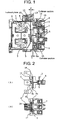
- Fig. 1 is a longitudinal sectional view of an electromagnetic contactor in the "locked" condition showing an embodiment of the present invention.
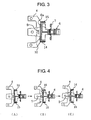
- Fig. 2(A) is a side view illustrating a movable part (movable iron core and movable contact support) of the electromagnetic contactor of Fig. 1.
- Fig. 2(B) is a bottom view thereof. The components corresponding to those of the conventional example are shown with the same reference numerals.
- the molded frame 8 is formed with a pair of collision sections 14 and 15 that are opposed to the back face of the movable iron core 4 with the movable contact support 6 there between. These collision sections 14 and 15 are provided to have different heights so that the collision section 14 is higher than the collision section 15 by the step S.
- the collision sections 14 and 15 have a plate-like shape and the width perpendicular to the page of Fig. 1 is substantially the same as the thickness of the core lamination layer of the movable iron core 4 shown in Fig. 2(B).
- the base bottom face of the movable contact support 6, against which the back face of the movable iron core 4 abuts, has an inclined plane 16 having an inclination ⁇ .
- This inclined plane 16 is provided in the vicinity of the higher collision section 14 of the base bottom face of the movable contact support 6 such that the inclined plane 16 is lowered from the point in front of the center of this base bottom face (the upper side of the center of the movable contact support 6 in Fig. 1) toward the end part.
- the movable contact support 6 has a pair of left and right arm sections 6b extending from the base section 6a to sandwich both sides of the movable iron core 4.
- the pair of left and right arm sections 6b include a groove 17 having an opening at the upper side of Fig. 2(A).
- the arm sections 6b are fitted, via this groove 17, into both sides of the arch-like plate spring 5 penetrating the window hole 18 of the movable iron core 4 from the lower side of Fig. 2(A), thus being connected to the movable iron core 4 by being attached to the back face thereof.
- This movable contact support 6 is prevented from being disengaged by engaging the convex section 6c with the concave section of the back face of the movable iron core 4.
- the electromagnetic contactor has substantially the same structure as that of the conventional example of Fig. 7.
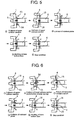
- Fig. 3 is a side view of the movable part with the electromagnetic contactor of Fig. 1 attached to have the coil terminal 12 provided at the lower side.
- the higher collision section 14 is provided at the lower side while the lower collision section 15 is provided at the upper side.
- the back face of the movable iron core 4 collides with the collision section 14 first as shown in the drawing, and the movable parts 4 and 6 are rotated clockwise around the collision section 14 as shown by the arrow to reduce the impact. This effect is substantially the same as that provided by the conventional example.
- Figs. 4(A) to 4(C) are a side view of the movable part for explaining the operation when the electromagnetic contactor is attached with the coil terminal 12 provided at the upper side (see Fig. 1).
- the higher collision section 14 is provided at the upper side while the lower collision section 15 is provided at the lower side.
- the movable iron core 4 is released from the "locked" condition of Fig. 1, the movable iron core 4 collides with the higher collision section 14 at the upper side first as shown in Fig. 4(A).
- Fig. 4(B) the movable iron core 4 is rotated anticlockwise, as shown by the arrow to collide with the lower collision section 15.
- the movable contact support 6 is rotated clockwise as shown by the arrow to deform the plate spring 5. Thereafter, as shown in Fig. 4(C), the movable iron core 4 and the movable contact support 6 are attracted to each other by the restoring force of the deformed plate spring 5 and the back face of the movable iron core 4 collides with the inclined plane 16 of the movable contact support 6, thereby absorbing the kinetic energy.
- the restoration of the plate spring 5 allows the movable contact support 6 to be returned to the movable iron core 4 as shown by 3 and the base bottom face collides with the back face of the movable iron core 4 and also collides with the inclined plane 16 as shown by 4. As a result, the kinetic energy is absorbed.
- the plate spring allows as shown by 5 the base bottom face of the movable contact support 6 to abut against the back face of the movable iron core 4 again and the movable iron core 4 is once separated from the collision section 14. Thereafter, the movable iron core 4 abuts against the collision section 14 again and stops as shown by 6.
- the molded frame is formed with a pair of higher and lower collision sections that are opposed to the back face of the movable iron core with the movable contact support there between.
- the base bottom face abutting on the back face of the movable iron core of the movable contact support has an inclined plane.
Landscapes
- Physics & Mathematics (AREA)
- Electromagnetism (AREA)
- Electromagnets (AREA)
Claims (1)
- Elektromagnetisches Schütz, aufweisend:einen Betätigungselektromagneten, der aus einem feststehenden Eisenkern mit einer elektromagnetischen Spule (1) und einem beweglichen Eisenkern (4) besteht, der gegen die Federkraft einer Rückstellfeder (3) zu diesem feststehenden Eisenkern (2) hingezogen wird, wobeieinen beweglicher Kontaktträger (6), der mit der Rückseite des beweglichen Eisenkerns (4) verbunden über eine Blattfeder (5) gehalten wird und für jede Phase einen beweglichen Kontakt (7) festhält, undeinen Formteilrahmen (8), der den beweglichen Kontaktträger (6) in gleitend verschieblicher Weise führt und ein Paar von an ihm befestigter vordere und hinterer feststehender Kontakte (9) aufweist, wobeiwenn die Erregung der elektromagnetischen Spule (1) ermöglicht, dass der bewegliche Eisenkern (4) angezogen wird, der bewegliche Kontakt (7) die feststehenden Kontakte (9) überbrückt, und wenn die Entmagnetisierung der elektromagnetischen Spule (1) ermöglicht, dass der bewegliche Eisenkern (4) freigegeben wird, die Federkraft der Rückstellfeder (3) den beweglichen Eisenkern (4) bewegt, der bewegliche Kontakt (7) von den feststehenden Kontakten (9) getrennt wird und der bewegliche Eisenkern (4) auf den Formteilrahmen (8) prallt, so dass er gestoppt wird; undder Formteilrahmen (8) mit einem Paar von Aufprallabschnitten (14, 15) ausgebildet ist, die der Rückseite des beweglichen Eisenkerns (4) gegenüberliegend angeordnet sind, wobei der bewegliche Kontaktträger zwischen ihnen angeordnet ist, und diese Aufprallabschnitte so vorgesehen sind, dass sie unterschiedliche Höhe haben, dadurch gekennzeichnet, dass eine geneigte Ebene (16) in der Nähe des höheren Aufprallabschnittes der Unterseite der Basis des beweglichen Kontaktträgers (6) vorgesehen ist, die an die Rückseite des beweglichen Eisenkerns (4) anstößt, derart, dass sich die geneigte Ebene (16) ausgehend von einem Punkt vor der Mitte dieser Unterseite der Basis zum Endteil hin absenkt.
Applications Claiming Priority (3)
| Application Number | Priority Date | Filing Date | Title |
|---|---|---|---|
| JP2002343939 | 2002-11-27 | ||
| JP2002343939 | 2002-11-27 | ||
| PCT/JP2003/012009 WO2004049368A1 (ja) | 2002-11-27 | 2003-09-19 | 電磁接触器 |
Publications (3)
| Publication Number | Publication Date |
|---|---|
| EP1580784A1 EP1580784A1 (de) | 2005-09-28 |
| EP1580784A4 EP1580784A4 (de) | 2005-12-14 |
| EP1580784B1 true EP1580784B1 (de) | 2006-07-19 |
Family
ID=32375931
Family Applications (1)
| Application Number | Title | Priority Date | Filing Date |
|---|---|---|---|
| EP03811876A Expired - Lifetime EP1580784B1 (de) | 2002-11-27 | 2003-09-19 | Elektromagnetisches kontaktglied |
Country Status (9)
| Country | Link |
|---|---|
| US (1) | US7095303B2 (de) |
| EP (1) | EP1580784B1 (de) |
| JP (1) | JP4257391B2 (de) |
| KR (1) | KR100921881B1 (de) |
| CN (1) | CN1326174C (de) |
| AU (1) | AU2003266545A1 (de) |
| DE (1) | DE60306962T8 (de) |
| TW (1) | TWI269334B (de) |
| WO (1) | WO2004049368A1 (de) |
Families Citing this family (9)
| Publication number | Priority date | Publication date | Assignee | Title |
|---|---|---|---|---|
| DE102005030376B4 (de) * | 2005-06-29 | 2009-03-26 | Siemens Ag | Herstellverfahren für eine Kontaktfläche in einem Elektromagneten sowie Elektromagnet |
| KR100749784B1 (ko) | 2006-04-28 | 2007-08-17 | 한국오므론전장주식회사 | 정음형 미니 릴레이 |
| KR101513207B1 (ko) * | 2013-11-08 | 2015-04-17 | 엘에스산전 주식회사 | 전자접촉기 |
| KR102204849B1 (ko) * | 2014-05-20 | 2021-01-18 | 후지 덴키 기기세이교 가부시끼가이샤 | 전자 접촉기 |
| KR101741586B1 (ko) * | 2014-10-31 | 2017-05-30 | 엘에스산전 주식회사 | 전자접촉기 크로스바 구조 |
| DE112014007203B4 (de) * | 2014-12-24 | 2019-05-02 | Mitsubishi Electric Corporation | Elektromagnetischer Schalter |
| WO2019154855A1 (de) * | 2018-02-07 | 2019-08-15 | Tdk Electronics Ag | Schaltvorrichtung zum schalten einer elektrischen last |
| DE102018207468B3 (de) * | 2018-05-15 | 2019-08-29 | Siemens Aktiengesellschaft | Schaltgerät mit einer reduzierten mechanischen Schlagbelastung bei Änderung des Betriebsmodus in den ausgeschalteten Zustand |
| WO2022021286A1 (zh) * | 2020-07-31 | 2022-02-03 | 华为数字能源技术有限公司 | 触头装置、电磁开关、车载充电机及新能源汽车 |
Family Cites Families (15)
| Publication number | Priority date | Publication date | Assignee | Title |
|---|---|---|---|---|
| FR2560429B1 (fr) | 1984-02-28 | 1987-06-19 | Telemecanique Electrique | Electro-aimant silencieux et contacteur utilisant un tel electro-aimant |
| JPS61216216A (ja) * | 1985-03-22 | 1986-09-25 | 三菱電機株式会社 | 電磁接触器 |
| JPH0683257B2 (ja) | 1987-07-09 | 1994-10-19 | 日本電気株式会社 | パケット通信方式 |
| JPS6416043U (de) * | 1987-07-20 | 1989-01-26 | ||
| JPH02119024A (ja) | 1988-10-28 | 1990-05-07 | Hitachi Ltd | 電磁接触器 |
| JPH0792232B2 (ja) | 1988-11-30 | 1995-10-09 | 阪神エレクトリック株式会社 | 給湯システム用流量取込み方法 |
| JPH02150631U (de) * | 1989-05-22 | 1990-12-27 | ||
| JPH0358844A (ja) | 1989-07-27 | 1991-03-14 | Canon Inc | 通電記録材を用いた画像形成装置とこの装置で用いる記録材取扱い部材 |
| JPH0358844U (de) * | 1989-10-14 | 1991-06-10 | ||
| JP3132053B2 (ja) | 1991-07-10 | 2001-02-05 | 松下電器産業株式会社 | 固体電解コンデンサ |
| JPH0594754A (ja) | 1991-10-03 | 1993-04-16 | Fuji Electric Co Ltd | 電磁接触器 |
| JPH076680A (ja) | 1993-06-21 | 1995-01-10 | Matsushita Electric Works Ltd | 電磁接触器 |
| JP3166559B2 (ja) * | 1994-10-25 | 2001-05-14 | 富士電機株式会社 | 電磁接触器の電磁石装置 |
| US6297717B1 (en) * | 2000-03-10 | 2001-10-02 | Eaton Corporation | Contactor with floating armature |
| US6377143B1 (en) * | 2001-03-16 | 2002-04-23 | Eaton Corporation | Weld-free contact system for electromagnetic contactors |
-
2003
- 2003-08-05 TW TW092121410A patent/TWI269334B/zh not_active IP Right Cessation
- 2003-09-19 JP JP2004554960A patent/JP4257391B2/ja not_active Expired - Lifetime
- 2003-09-19 WO PCT/JP2003/012009 patent/WO2004049368A1/ja not_active Ceased
- 2003-09-19 CN CNB038254654A patent/CN1326174C/zh not_active Expired - Lifetime
- 2003-09-19 AU AU2003266545A patent/AU2003266545A1/en not_active Abandoned
- 2003-09-19 DE DE60306962T patent/DE60306962T8/de active Active
- 2003-09-19 US US10/536,754 patent/US7095303B2/en not_active Expired - Lifetime
- 2003-09-19 KR KR1020057009307A patent/KR100921881B1/ko not_active Expired - Fee Related
- 2003-09-19 EP EP03811876A patent/EP1580784B1/de not_active Expired - Lifetime
Also Published As
| Publication number | Publication date |
|---|---|
| KR20050083982A (ko) | 2005-08-26 |
| DE60306962T2 (de) | 2007-08-30 |
| CN1326174C (zh) | 2007-07-11 |
| WO2004049368A1 (ja) | 2004-06-10 |
| AU2003266545A1 (en) | 2004-06-18 |
| DE60306962D1 (de) | 2006-08-31 |
| TWI269334B (en) | 2006-12-21 |
| US7095303B2 (en) | 2006-08-22 |
| CN1703767A (zh) | 2005-11-30 |
| TW200409158A (en) | 2004-06-01 |
| EP1580784A4 (de) | 2005-12-14 |
| JP4257391B2 (ja) | 2009-04-22 |
| EP1580784A1 (de) | 2005-09-28 |
| KR100921881B1 (ko) | 2009-10-13 |
| JPWO2004049368A1 (ja) | 2006-03-30 |
| US20060125581A1 (en) | 2006-06-15 |
| DE60306962T8 (de) | 2007-12-13 |
Similar Documents
| Publication | Publication Date | Title |
|---|---|---|
| JP4224757B2 (ja) | 接触器、および接点の溶着を防止する方法 | |
| CN1242586A (zh) | 可容许故障电流的接触器 | |
| US7095303B2 (en) | Electromagnetic contactor | |
| US4937544A (en) | "Contact arrangement for a relay" | |
| EP3547343B1 (de) | Einführstruktur zwischen statischer feder und spule | |
| JP2008525947A (ja) | 開閉装置を安全に作動させる方法および装置 | |
| CN214505388U (zh) | 一种平衡力式密封电磁继电器 | |
| CN216957910U (zh) | 一种动簧片以及包括该动簧片的继电器 | |
| CN210805638U (zh) | 一种小型大功率电磁继电器的接触系统 | |
| CN120933134A (zh) | 保护模块和断路器 | |
| KR20230093201A (ko) | 톰슨코일을 이용한 차단기용 액츄에이터 | |
| JPH0487130A (ja) | 電磁接触器 | |
| CN209880523U (zh) | 一种断路器自动脱扣控制装置 | |
| JP4136386B2 (ja) | 回路しゃ断器の電気操作装置 | |
| CN1265513A (zh) | 磁力促动器和配备它的断路器 | |
| CN215183809U (zh) | 一种操作装置和断路器 | |
| CN222507507U (zh) | 保护模块和断路器 | |
| KR102088395B1 (ko) | 해머링크형 차단기 | |
| WO2007140518A1 (en) | A lock | |
| CN108305819B (zh) | 操动机构脱扣器扩展式平台结构及机构操动方法 | |
| JPH0217403Y2 (de) | ||
| JPS61216216A (ja) | 電磁接触器 | |
| JPS59123205A (ja) | 電磁石 | |
| JP2002313167A (ja) | 遮断器 | |
| JPH08287790A (ja) | 遮断器投入操作用電磁石 |
Legal Events
| Date | Code | Title | Description |
|---|---|---|---|
| PUAI | Public reference made under article 153(3) epc to a published international application that has entered the european phase |
Free format text: ORIGINAL CODE: 0009012 |
|
| 17P | Request for examination filed |
Effective date: 20050624 |
|
| AK | Designated contracting states |
Kind code of ref document: A1 Designated state(s): AT BE BG CH CY CZ DE DK EE ES FI FR GB GR HU IE IT LI LU MC NL PT RO SE SI SK TR |
|
| AX | Request for extension of the european patent |
Extension state: AL LT LV MK |
|
| A4 | Supplementary search report drawn up and despatched |
Effective date: 20051028 |
|
| GRAP | Despatch of communication of intention to grant a patent |
Free format text: ORIGINAL CODE: EPIDOSNIGR1 |
|
| GRAC | Information related to communication of intention to grant a patent modified |
Free format text: ORIGINAL CODE: EPIDOSCIGR1 |
|
| DAX | Request for extension of the european patent (deleted) | ||
| RBV | Designated contracting states (corrected) |
Designated state(s): DE FR IT |
|
| RIN1 | Information on inventor provided before grant (corrected) |
Inventor name: OHKUBO, KOJI,C/O FUJI ELECTRIC FA COMP. & SYSTEMS Inventor name: OGAWA, HIDEHIKO,C/O FUJI ELECTRIC FA COMP. & Inventor name: MIYAZAWA, HIDEKAZU,C/O FUJI ELECTRIC FA COMP. & |
|
| GRAS | Grant fee paid |
Free format text: ORIGINAL CODE: EPIDOSNIGR3 |
|
| GRAA | (expected) grant |
Free format text: ORIGINAL CODE: 0009210 |
|
| AK | Designated contracting states |
Kind code of ref document: B1 Designated state(s): DE FR IT |
|
| REF | Corresponds to: |
Ref document number: 60306962 Country of ref document: DE Date of ref document: 20060831 Kind code of ref document: P |
|
| ET | Fr: translation filed | ||
| PLBE | No opposition filed within time limit |
Free format text: ORIGINAL CODE: 0009261 |
|
| STAA | Information on the status of an ep patent application or granted ep patent |
Free format text: STATUS: NO OPPOSITION FILED WITHIN TIME LIMIT |
|
| 26N | No opposition filed |
Effective date: 20070420 |
|
| REG | Reference to a national code |
Ref country code: FR Ref legal event code: TP |
|
| REG | Reference to a national code |
Ref country code: DE Ref legal event code: R084 Ref document number: 60306962 Country of ref document: DE Effective date: 20130423 |
|
| PGFP | Annual fee paid to national office [announced via postgrant information from national office to epo] |
Ref country code: IT Payment date: 20130913 Year of fee payment: 11 |
|
| PG25 | Lapsed in a contracting state [announced via postgrant information from national office to epo] |
Ref country code: IT Free format text: LAPSE BECAUSE OF NON-PAYMENT OF DUE FEES Effective date: 20140919 |
|
| PGFP | Annual fee paid to national office [announced via postgrant information from national office to epo] |
Ref country code: DE Payment date: 20150916 Year of fee payment: 13 |
|
| REG | Reference to a national code |
Ref country code: FR Ref legal event code: PLFP Year of fee payment: 14 |
|
| REG | Reference to a national code |
Ref country code: DE Ref legal event code: R119 Ref document number: 60306962 Country of ref document: DE |
|
| PG25 | Lapsed in a contracting state [announced via postgrant information from national office to epo] |
Ref country code: DE Free format text: LAPSE BECAUSE OF NON-PAYMENT OF DUE FEES Effective date: 20170401 |
|
| REG | Reference to a national code |
Ref country code: FR Ref legal event code: PLFP Year of fee payment: 15 |
|
| REG | Reference to a national code |
Ref country code: FR Ref legal event code: PLFP Year of fee payment: 16 |
|
| PGFP | Annual fee paid to national office [announced via postgrant information from national office to epo] |
Ref country code: FR Payment date: 20220808 Year of fee payment: 20 |