EP1575888B1 - Co-production of phenol, acetone and alpha-methylstyrene - Google Patents
Co-production of phenol, acetone and alpha-methylstyrene Download PDFInfo
- Publication number
- EP1575888B1 EP1575888B1 EP03814132A EP03814132A EP1575888B1 EP 1575888 B1 EP1575888 B1 EP 1575888B1 EP 03814132 A EP03814132 A EP 03814132A EP 03814132 A EP03814132 A EP 03814132A EP 1575888 B1 EP1575888 B1 EP 1575888B1
- Authority
- EP
- European Patent Office
- Prior art keywords
- group
- metal
- catalyst
- stream
- phenol
- Prior art date
- Legal status (The legal status is an assumption and is not a legal conclusion. Google has not performed a legal analysis and makes no representation as to the accuracy of the status listed.)
- Expired - Lifetime
Links
- CSCPPACGZOOCGX-UHFFFAOYSA-N Acetone Chemical compound CC(C)=O CSCPPACGZOOCGX-UHFFFAOYSA-N 0.000 title claims abstract description 122
- ISWSIDIOOBJBQZ-UHFFFAOYSA-N Phenol Chemical compound OC1=CC=CC=C1 ISWSIDIOOBJBQZ-UHFFFAOYSA-N 0.000 title claims abstract description 70
- XYLMUPLGERFSHI-UHFFFAOYSA-N alpha-Methylstyrene Chemical compound CC(=C)C1=CC=CC=C1 XYLMUPLGERFSHI-UHFFFAOYSA-N 0.000 title claims abstract description 17
- 238000004519 manufacturing process Methods 0.000 title abstract description 13
- FRIBMENBGGCKPD-UHFFFAOYSA-N 3-(2,3-dimethoxyphenyl)prop-2-enal Chemical compound COC1=CC=CC(C=CC=O)=C1OC FRIBMENBGGCKPD-UHFFFAOYSA-N 0.000 claims abstract description 96
- 239000003054 catalyst Substances 0.000 claims abstract description 74
- BDCFWIDZNLCTMF-UHFFFAOYSA-N 2-phenylpropan-2-ol Chemical compound CC(C)(O)C1=CC=CC=C1 BDCFWIDZNLCTMF-UHFFFAOYSA-N 0.000 claims abstract description 62
- 238000000034 method Methods 0.000 claims abstract description 44
- 230000002378 acidificating effect Effects 0.000 claims abstract description 22
- RWGFKTVRMDUZSP-UHFFFAOYSA-N cumene Chemical compound CC(C)C1=CC=CC=C1 RWGFKTVRMDUZSP-UHFFFAOYSA-N 0.000 claims description 76
- 229910052751 metal Inorganic materials 0.000 claims description 28
- 239000002184 metal Substances 0.000 claims description 28
- 239000000203 mixture Substances 0.000 claims description 21
- 238000005984 hydrogenation reaction Methods 0.000 claims description 20
- 239000003999 initiator Substances 0.000 claims description 17
- QAOWNCQODCNURD-UHFFFAOYSA-N sulfuric acid group Chemical group S(O)(O)(=O)=O QAOWNCQODCNURD-UHFFFAOYSA-N 0.000 claims description 17
- VYPSYNLAJGMNEJ-UHFFFAOYSA-N Silicium dioxide Chemical compound O=[Si]=O VYPSYNLAJGMNEJ-UHFFFAOYSA-N 0.000 claims description 12
- 239000003085 diluting agent Substances 0.000 claims description 11
- 239000007788 liquid Substances 0.000 claims description 10
- 150000003254 radicals Chemical class 0.000 claims description 9
- KDLHZDBZIXYQEI-UHFFFAOYSA-N Palladium Chemical compound [Pd] KDLHZDBZIXYQEI-UHFFFAOYSA-N 0.000 claims description 8
- MCMNRKCIXSYSNV-UHFFFAOYSA-N Zirconium dioxide Chemical compound O=[Zr]=O MCMNRKCIXSYSNV-UHFFFAOYSA-N 0.000 claims description 8
- 239000010941 cobalt Substances 0.000 claims description 8
- 229910017052 cobalt Inorganic materials 0.000 claims description 8
- GUTLYIVDDKVIGB-UHFFFAOYSA-N cobalt atom Chemical compound [Co] GUTLYIVDDKVIGB-UHFFFAOYSA-N 0.000 claims description 8
- 229910044991 metal oxide Inorganic materials 0.000 claims description 8
- 150000004706 metal oxides Chemical class 0.000 claims description 8
- BASFCYQUMIYNBI-UHFFFAOYSA-N platinum Chemical compound [Pt] BASFCYQUMIYNBI-UHFFFAOYSA-N 0.000 claims description 8
- 239000011973 solid acid Substances 0.000 claims description 7
- 229910052723 transition metal Inorganic materials 0.000 claims description 7
- 150000003624 transition metals Chemical class 0.000 claims description 7
- GWEVSGVZZGPLCZ-UHFFFAOYSA-N Titan oxide Chemical compound O=[Ti]=O GWEVSGVZZGPLCZ-UHFFFAOYSA-N 0.000 claims description 6
- 229910052799 carbon Inorganic materials 0.000 claims description 6
- 239000002638 heterogeneous catalyst Substances 0.000 claims description 6
- CIHOLLKRGTVIJN-UHFFFAOYSA-N tert‐butyl hydroperoxide Chemical compound CC(C)(C)OO CIHOLLKRGTVIJN-UHFFFAOYSA-N 0.000 claims description 6
- QVGXLLKOCUKJST-UHFFFAOYSA-N atomic oxygen Chemical compound [O] QVGXLLKOCUKJST-UHFFFAOYSA-N 0.000 claims description 5
- 230000001590 oxidative effect Effects 0.000 claims description 5
- 239000001301 oxygen Substances 0.000 claims description 5
- 229910052760 oxygen Inorganic materials 0.000 claims description 5
- 239000000377 silicon dioxide Substances 0.000 claims description 5
- PNEYBMLMFCGWSK-UHFFFAOYSA-N aluminium oxide Inorganic materials [O-2].[O-2].[O-2].[Al+3].[Al+3] PNEYBMLMFCGWSK-UHFFFAOYSA-N 0.000 claims description 4
- 229910003455 mixed metal oxide Inorganic materials 0.000 claims description 4
- 239000002808 molecular sieve Substances 0.000 claims description 4
- 229910052763 palladium Inorganic materials 0.000 claims description 4
- 125000000864 peroxy group Chemical group O(O*)* 0.000 claims description 4
- 229910052697 platinum Inorganic materials 0.000 claims description 4
- URGAHOPLAPQHLN-UHFFFAOYSA-N sodium aluminosilicate Chemical compound [Na+].[Al+3].[O-][Si]([O-])=O.[O-][Si]([O-])=O URGAHOPLAPQHLN-UHFFFAOYSA-N 0.000 claims description 4
- GQNOPVSQPBUJKQ-UHFFFAOYSA-N 1-hydroperoxyethylbenzene Chemical compound OOC(C)C1=CC=CC=C1 GQNOPVSQPBUJKQ-UHFFFAOYSA-N 0.000 claims description 3
- UFHFLCQGNIYNRP-UHFFFAOYSA-N Hydrogen Chemical compound [H][H] UFHFLCQGNIYNRP-UHFFFAOYSA-N 0.000 claims description 3
- 239000001257 hydrogen Substances 0.000 claims description 3
- 229910052739 hydrogen Inorganic materials 0.000 claims description 3
- RVTZCBVAJQQJTK-UHFFFAOYSA-N oxygen(2-);zirconium(4+) Chemical group [O-2].[O-2].[Zr+4] RVTZCBVAJQQJTK-UHFFFAOYSA-N 0.000 claims description 3
- 229910001928 zirconium oxide Inorganic materials 0.000 claims description 3
- OKTJSMMVPCPJKN-UHFFFAOYSA-N Carbon Chemical compound [C] OKTJSMMVPCPJKN-UHFFFAOYSA-N 0.000 claims description 2
- 239000004927 clay Substances 0.000 claims description 2
- 229910052570 clay Inorganic materials 0.000 claims description 2
- 229910000314 transition metal oxide Inorganic materials 0.000 claims description 2
- MHAJPDPJQMAIIY-UHFFFAOYSA-N Hydrogen peroxide Chemical compound OO MHAJPDPJQMAIIY-UHFFFAOYSA-N 0.000 claims 1
- 125000000751 azo group Chemical group [*]N=N[*] 0.000 claims 1
- 229910000420 cerium oxide Inorganic materials 0.000 claims 1
- BMMGVYCKOGBVEV-UHFFFAOYSA-N oxo(oxoceriooxy)cerium Chemical compound [Ce]=O.O=[Ce]=O BMMGVYCKOGBVEV-UHFFFAOYSA-N 0.000 claims 1
- 238000003776 cleavage reaction Methods 0.000 abstract description 55
- 230000007017 scission Effects 0.000 abstract description 55
- 239000002253 acid Substances 0.000 abstract description 7
- 238000006297 dehydration reaction Methods 0.000 abstract description 6
- 230000018044 dehydration Effects 0.000 abstract description 5
- KWOLFJPFCHCOCG-UHFFFAOYSA-N Acetophenone Chemical compound CC(=O)C1=CC=CC=C1 KWOLFJPFCHCOCG-UHFFFAOYSA-N 0.000 description 22
- 239000000047 product Substances 0.000 description 22
- 239000000243 solution Substances 0.000 description 17
- 238000007254 oxidation reaction Methods 0.000 description 16
- 230000003647 oxidation Effects 0.000 description 15
- 238000006243 chemical reaction Methods 0.000 description 13
- -1 U.S. Patent 4 Chemical compound 0.000 description 12
- 239000000463 material Substances 0.000 description 12
- 238000006722 reduction reaction Methods 0.000 description 11
- GOOHAUXETOMSMM-UHFFFAOYSA-N Propylene oxide Chemical compound CC1CO1 GOOHAUXETOMSMM-UHFFFAOYSA-N 0.000 description 10
- 238000007865 diluting Methods 0.000 description 10
- 238000006735 epoxidation reaction Methods 0.000 description 10
- 238000000354 decomposition reaction Methods 0.000 description 9
- 238000011084 recovery Methods 0.000 description 8
- XLYOFNOQVPJJNP-UHFFFAOYSA-N water Substances O XLYOFNOQVPJJNP-UHFFFAOYSA-N 0.000 description 8
- 238000010517 secondary reaction Methods 0.000 description 7
- 230000015572 biosynthetic process Effects 0.000 description 6
- 239000007800 oxidant agent Substances 0.000 description 5
- IKHGUXGNUITLKF-UHFFFAOYSA-N Acetaldehyde Chemical compound CC=O IKHGUXGNUITLKF-UHFFFAOYSA-N 0.000 description 4
- XEEYBQQBJWHFJM-UHFFFAOYSA-N Iron Chemical compound [Fe] XEEYBQQBJWHFJM-UHFFFAOYSA-N 0.000 description 4
- PXHVJJICTQNCMI-UHFFFAOYSA-N Nickel Chemical compound [Ni] PXHVJJICTQNCMI-UHFFFAOYSA-N 0.000 description 4
- 150000007513 acids Chemical class 0.000 description 4
- 238000010586 diagram Methods 0.000 description 4
- 239000000539 dimer Substances 0.000 description 4
- 238000004821 distillation Methods 0.000 description 4
- 229930195733 hydrocarbon Natural products 0.000 description 4
- 150000002430 hydrocarbons Chemical class 0.000 description 4
- 150000002432 hydroperoxides Chemical class 0.000 description 4
- 150000002739 metals Chemical class 0.000 description 4
- 238000002156 mixing Methods 0.000 description 4
- 238000006386 neutralization reaction Methods 0.000 description 4
- QQONPFPTGQHPMA-UHFFFAOYSA-N propylene Natural products CC=C QQONPFPTGQHPMA-UHFFFAOYSA-N 0.000 description 4
- 125000004805 propylene group Chemical group [H]C([H])([H])C([H])([*:1])C([H])([H])[*:2] 0.000 description 4
- 239000000376 reactant Substances 0.000 description 4
- 238000003756 stirring Methods 0.000 description 4
- XMNIXWIUMCBBBL-UHFFFAOYSA-N 2-(2-phenylpropan-2-ylperoxy)propan-2-ylbenzene Chemical compound C=1C=CC=CC=1C(C)(C)OOC(C)(C)C1=CC=CC=C1 XMNIXWIUMCBBBL-UHFFFAOYSA-N 0.000 description 3
- 241001147665 Foraminifera Species 0.000 description 3
- 239000003377 acid catalyst Substances 0.000 description 3
- 239000006227 byproduct Substances 0.000 description 3
- JESIHYIJKKUWIS-UHFFFAOYSA-N 1-(4-Methylphenyl)ethanol Chemical compound CC(O)C1=CC=C(C)C=C1 JESIHYIJKKUWIS-UHFFFAOYSA-N 0.000 description 2
- PAWQVTBBRAZDMG-UHFFFAOYSA-N 2-(3-bromo-2-fluorophenyl)acetic acid Chemical compound OC(=O)CC1=CC=CC(Br)=C1F PAWQVTBBRAZDMG-UHFFFAOYSA-N 0.000 description 2
- VHUUQVKOLVNVRT-UHFFFAOYSA-N Ammonium hydroxide Chemical compound [NH4+].[OH-] VHUUQVKOLVNVRT-UHFFFAOYSA-N 0.000 description 2
- 239000004215 Carbon black (E152) Substances 0.000 description 2
- ZOKXTWBITQBERF-UHFFFAOYSA-N Molybdenum Chemical compound [Mo] ZOKXTWBITQBERF-UHFFFAOYSA-N 0.000 description 2
- NBIIXXVUZAFLBC-UHFFFAOYSA-N Phosphoric acid Chemical compound OP(O)(O)=O NBIIXXVUZAFLBC-UHFFFAOYSA-N 0.000 description 2
- 239000004743 Polypropylene Substances 0.000 description 2
- 150000001875 compounds Chemical class 0.000 description 2
- 229920001577 copolymer Polymers 0.000 description 2
- 239000012153 distilled water Substances 0.000 description 2
- 230000000694 effects Effects 0.000 description 2
- 239000003456 ion exchange resin Substances 0.000 description 2
- 229920003303 ion-exchange polymer Polymers 0.000 description 2
- 229910052742 iron Inorganic materials 0.000 description 2
- 229910052750 molybdenum Inorganic materials 0.000 description 2
- 239000011733 molybdenum Substances 0.000 description 2
- 229910052759 nickel Inorganic materials 0.000 description 2
- 229920000642 polymer Polymers 0.000 description 2
- 229920001155 polypropylene Polymers 0.000 description 2
- 238000010992 reflux Methods 0.000 description 2
- 238000007086 side reaction Methods 0.000 description 2
- 239000011949 solid catalyst Substances 0.000 description 2
- OYPRJOBELJOOCE-UHFFFAOYSA-N Calcium Chemical compound [Ca] OYPRJOBELJOOCE-UHFFFAOYSA-N 0.000 description 1
- 229910052684 Cerium Inorganic materials 0.000 description 1
- RYGMFSIKBFXOCR-UHFFFAOYSA-N Copper Chemical compound [Cu] RYGMFSIKBFXOCR-UHFFFAOYSA-N 0.000 description 1
- 241000588731 Hafnia Species 0.000 description 1
- DGAQECJNVWCQMB-PUAWFVPOSA-M Ilexoside XXIX Chemical compound C[C@@H]1CC[C@@]2(CC[C@@]3(C(=CC[C@H]4[C@]3(CC[C@@H]5[C@@]4(CC[C@@H](C5(C)C)OS(=O)(=O)[O-])C)C)[C@@H]2[C@]1(C)O)C)C(=O)O[C@H]6[C@@H]([C@H]([C@@H]([C@H](O6)CO)O)O)O.[Na+] DGAQECJNVWCQMB-PUAWFVPOSA-M 0.000 description 1
- WHXSMMKQMYFTQS-UHFFFAOYSA-N Lithium Chemical compound [Li] WHXSMMKQMYFTQS-UHFFFAOYSA-N 0.000 description 1
- FYYHWMGAXLPEAU-UHFFFAOYSA-N Magnesium Chemical compound [Mg] FYYHWMGAXLPEAU-UHFFFAOYSA-N 0.000 description 1
- PWHULOQIROXLJO-UHFFFAOYSA-N Manganese Chemical compound [Mn] PWHULOQIROXLJO-UHFFFAOYSA-N 0.000 description 1
- KJTLSVCANCCWHF-UHFFFAOYSA-N Ruthenium Chemical compound [Ru] KJTLSVCANCCWHF-UHFFFAOYSA-N 0.000 description 1
- BQCADISMDOOEFD-UHFFFAOYSA-N Silver Chemical compound [Ag] BQCADISMDOOEFD-UHFFFAOYSA-N 0.000 description 1
- ATJFFYVFTNAWJD-UHFFFAOYSA-N Tin Chemical compound [Sn] ATJFFYVFTNAWJD-UHFFFAOYSA-N 0.000 description 1
- RTAQQCXQSZGOHL-UHFFFAOYSA-N Titanium Chemical compound [Ti] RTAQQCXQSZGOHL-UHFFFAOYSA-N 0.000 description 1
- 229910006251 ZrOCl2.8H2O Inorganic materials 0.000 description 1
- XECAHXYUAAWDEL-UHFFFAOYSA-N acrylonitrile butadiene styrene Chemical compound C=CC=C.C=CC#N.C=CC1=CC=CC=C1 XECAHXYUAAWDEL-UHFFFAOYSA-N 0.000 description 1
- 229920000122 acrylonitrile butadiene styrene Polymers 0.000 description 1
- 239000004676 acrylonitrile butadiene styrene Substances 0.000 description 1
- 150000001298 alcohols Chemical class 0.000 description 1
- 229910052782 aluminium Inorganic materials 0.000 description 1
- XAGFODPZIPBFFR-UHFFFAOYSA-N aluminium Chemical compound [Al] XAGFODPZIPBFFR-UHFFFAOYSA-N 0.000 description 1
- 229910000147 aluminium phosphate Inorganic materials 0.000 description 1
- DIZPMCHEQGEION-UHFFFAOYSA-H aluminium sulfate (anhydrous) Chemical compound [Al+3].[Al+3].[O-]S([O-])(=O)=O.[O-]S([O-])(=O)=O.[O-]S([O-])(=O)=O DIZPMCHEQGEION-UHFFFAOYSA-H 0.000 description 1
- 239000000908 ammonium hydroxide Substances 0.000 description 1
- 229910052788 barium Inorganic materials 0.000 description 1
- DSAJWYNOEDNPEQ-UHFFFAOYSA-N barium atom Chemical compound [Ba] DSAJWYNOEDNPEQ-UHFFFAOYSA-N 0.000 description 1
- 229910052792 caesium Inorganic materials 0.000 description 1
- TVFDJXOCXUVLDH-UHFFFAOYSA-N caesium atom Chemical compound [Cs] TVFDJXOCXUVLDH-UHFFFAOYSA-N 0.000 description 1
- 238000001354 calcination Methods 0.000 description 1
- 229910052791 calcium Inorganic materials 0.000 description 1
- 239000011575 calcium Substances 0.000 description 1
- ZMIGMASIKSOYAM-UHFFFAOYSA-N cerium Chemical compound [Ce][Ce][Ce][Ce][Ce][Ce][Ce][Ce][Ce][Ce][Ce][Ce][Ce][Ce][Ce][Ce][Ce][Ce][Ce][Ce][Ce][Ce][Ce][Ce][Ce][Ce][Ce][Ce][Ce][Ce][Ce][Ce][Ce][Ce][Ce][Ce][Ce][Ce] ZMIGMASIKSOYAM-UHFFFAOYSA-N 0.000 description 1
- 239000003795 chemical substances by application Substances 0.000 description 1
- 238000000975 co-precipitation Methods 0.000 description 1
- UFMZWBIQTDUYBN-UHFFFAOYSA-N cobalt dinitrate Chemical compound [Co+2].[O-][N+]([O-])=O.[O-][N+]([O-])=O UFMZWBIQTDUYBN-UHFFFAOYSA-N 0.000 description 1
- QGUAJWGNOXCYJF-UHFFFAOYSA-N cobalt dinitrate hexahydrate Chemical compound O.O.O.O.O.O.[Co+2].[O-][N+]([O-])=O.[O-][N+]([O-])=O QGUAJWGNOXCYJF-UHFFFAOYSA-N 0.000 description 1
- 229910001981 cobalt nitrate Inorganic materials 0.000 description 1
- 239000002131 composite material Substances 0.000 description 1
- 229910052802 copper Inorganic materials 0.000 description 1
- 239000010949 copper Substances 0.000 description 1
- 238000010790 dilution Methods 0.000 description 1
- 239000012895 dilution Substances 0.000 description 1
- 238000000921 elemental analysis Methods 0.000 description 1
- 238000001914 filtration Methods 0.000 description 1
- 239000012847 fine chemical Substances 0.000 description 1
- 239000007789 gas Substances 0.000 description 1
- PCHJSUWPFVWCPO-UHFFFAOYSA-N gold Chemical compound [Au] PCHJSUWPFVWCPO-UHFFFAOYSA-N 0.000 description 1
- 229910052737 gold Inorganic materials 0.000 description 1
- 239000010931 gold Substances 0.000 description 1
- CJNBYAVZURUTKZ-UHFFFAOYSA-N hafnium(IV) oxide Inorganic materials O=[Hf]=O CJNBYAVZURUTKZ-UHFFFAOYSA-N 0.000 description 1
- BHEPBYXIRTUNPN-UHFFFAOYSA-N hydridophosphorus(.) (triplet) Chemical compound [PH] BHEPBYXIRTUNPN-UHFFFAOYSA-N 0.000 description 1
- 238000005470 impregnation Methods 0.000 description 1
- 239000003112 inhibitor Substances 0.000 description 1
- 238000005342 ion exchange Methods 0.000 description 1
- 229910052741 iridium Inorganic materials 0.000 description 1
- GKOZUEZYRPOHIO-UHFFFAOYSA-N iridium atom Chemical compound [Ir] GKOZUEZYRPOHIO-UHFFFAOYSA-N 0.000 description 1
- 150000002576 ketones Chemical class 0.000 description 1
- 229910052746 lanthanum Inorganic materials 0.000 description 1
- FZLIPJUXYLNCLC-UHFFFAOYSA-N lanthanum atom Chemical compound [La] FZLIPJUXYLNCLC-UHFFFAOYSA-N 0.000 description 1
- 239000007791 liquid phase Substances 0.000 description 1
- 239000006193 liquid solution Substances 0.000 description 1
- 229910052744 lithium Inorganic materials 0.000 description 1
- 238000005461 lubrication Methods 0.000 description 1
- 229910052749 magnesium Inorganic materials 0.000 description 1
- 239000011777 magnesium Substances 0.000 description 1
- 229910052748 manganese Inorganic materials 0.000 description 1
- 239000011572 manganese Substances 0.000 description 1
- 229910000510 noble metal Inorganic materials 0.000 description 1
- 229910052762 osmium Inorganic materials 0.000 description 1
- SYQBFIAQOQZEGI-UHFFFAOYSA-N osmium atom Chemical compound [Os] SYQBFIAQOQZEGI-UHFFFAOYSA-N 0.000 description 1
- QBDSZLJBMIMQRS-UHFFFAOYSA-N p-Cumylphenol Chemical compound C=1C=C(O)C=CC=1C(C)(C)C1=CC=CC=C1 QBDSZLJBMIMQRS-UHFFFAOYSA-N 0.000 description 1
- NKTOLZVEWDHZMU-UHFFFAOYSA-N p-cumyl phenol Natural products CC1=CC=C(C)C(O)=C1 NKTOLZVEWDHZMU-UHFFFAOYSA-N 0.000 description 1
- 230000000737 periodic effect Effects 0.000 description 1
- 230000000704 physical effect Effects 0.000 description 1
- 239000011541 reaction mixture Substances 0.000 description 1
- 239000011347 resin Substances 0.000 description 1
- 229920005989 resin Polymers 0.000 description 1
- 229910052702 rhenium Inorganic materials 0.000 description 1
- WUAPFZMCVAUBPE-UHFFFAOYSA-N rhenium atom Chemical compound [Re] WUAPFZMCVAUBPE-UHFFFAOYSA-N 0.000 description 1
- 229910052703 rhodium Inorganic materials 0.000 description 1
- 239000010948 rhodium Substances 0.000 description 1
- MHOVAHRLVXNVSD-UHFFFAOYSA-N rhodium atom Chemical compound [Rh] MHOVAHRLVXNVSD-UHFFFAOYSA-N 0.000 description 1
- 229910052707 ruthenium Inorganic materials 0.000 description 1
- 239000012266 salt solution Substances 0.000 description 1
- 229910052706 scandium Inorganic materials 0.000 description 1
- SIXSYDAISGFNSX-UHFFFAOYSA-N scandium atom Chemical compound [Sc] SIXSYDAISGFNSX-UHFFFAOYSA-N 0.000 description 1
- 238000000926 separation method Methods 0.000 description 1
- 229910052709 silver Inorganic materials 0.000 description 1
- 239000004332 silver Substances 0.000 description 1
- 239000002002 slurry Substances 0.000 description 1
- 229910052708 sodium Inorganic materials 0.000 description 1
- 239000011734 sodium Substances 0.000 description 1
- 239000007787 solid Substances 0.000 description 1
- 239000007790 solid phase Substances 0.000 description 1
- 239000002904 solvent Substances 0.000 description 1
- 229920003048 styrene butadiene rubber Polymers 0.000 description 1
- 238000003786 synthesis reaction Methods 0.000 description 1
- 239000010936 titanium Substances 0.000 description 1
- 229910052719 titanium Inorganic materials 0.000 description 1
- WFKWXMTUELFFGS-UHFFFAOYSA-N tungsten Chemical compound [W] WFKWXMTUELFFGS-UHFFFAOYSA-N 0.000 description 1
- 229910052721 tungsten Inorganic materials 0.000 description 1
- 239000010937 tungsten Substances 0.000 description 1
- 229910052727 yttrium Inorganic materials 0.000 description 1
- VWQVUPCCIRVNHF-UHFFFAOYSA-N yttrium atom Chemical compound [Y] VWQVUPCCIRVNHF-UHFFFAOYSA-N 0.000 description 1
Images

Classifications
-
- C—CHEMISTRY; METALLURGY
- C07—ORGANIC CHEMISTRY
- C07C—ACYCLIC OR CARBOCYCLIC COMPOUNDS
- C07C409/00—Peroxy compounds
- C07C409/02—Peroxy compounds the —O—O— group being bound between a carbon atom, not further substituted by oxygen atoms, and hydrogen, i.e. hydroperoxides
- C07C409/04—Peroxy compounds the —O—O— group being bound between a carbon atom, not further substituted by oxygen atoms, and hydrogen, i.e. hydroperoxides the carbon atom being acyclic
- C07C409/08—Compounds containing six-membered aromatic rings
- C07C409/10—Cumene hydroperoxide
-
- C—CHEMISTRY; METALLURGY
- C07—ORGANIC CHEMISTRY
- C07C—ACYCLIC OR CARBOCYCLIC COMPOUNDS
- C07C37/00—Preparation of compounds having hydroxy or O-metal groups bound to a carbon atom of a six-membered aromatic ring
- C07C37/08—Preparation of compounds having hydroxy or O-metal groups bound to a carbon atom of a six-membered aromatic ring by decomposition of hydroperoxides, e.g. cumene hydroperoxide
-
- B—PERFORMING OPERATIONS; TRANSPORTING
- B01—PHYSICAL OR CHEMICAL PROCESSES OR APPARATUS IN GENERAL
- B01J—CHEMICAL OR PHYSICAL PROCESSES, e.g. CATALYSIS OR COLLOID CHEMISTRY; THEIR RELEVANT APPARATUS
- B01J23/00—Catalysts comprising metals or metal oxides or hydroxides, not provided for in group B01J21/00
- B01J23/70—Catalysts comprising metals or metal oxides or hydroxides, not provided for in group B01J21/00 of the iron group metals or copper
- B01J23/74—Iron group metals
- B01J23/75—Cobalt
-
- B—PERFORMING OPERATIONS; TRANSPORTING
- B01—PHYSICAL OR CHEMICAL PROCESSES OR APPARATUS IN GENERAL
- B01J—CHEMICAL OR PHYSICAL PROCESSES, e.g. CATALYSIS OR COLLOID CHEMISTRY; THEIR RELEVANT APPARATUS
- B01J27/00—Catalysts comprising the elements or compounds of halogens, sulfur, selenium, tellurium, phosphorus or nitrogen; Catalysts comprising carbon compounds
- B01J27/14—Phosphorus; Compounds thereof
- B01J27/185—Phosphorus; Compounds thereof with iron group metals or platinum group metals
- B01J27/1853—Phosphorus; Compounds thereof with iron group metals or platinum group metals with iron, cobalt or nickel
-
- B—PERFORMING OPERATIONS; TRANSPORTING
- B01—PHYSICAL OR CHEMICAL PROCESSES OR APPARATUS IN GENERAL
- B01J—CHEMICAL OR PHYSICAL PROCESSES, e.g. CATALYSIS OR COLLOID CHEMISTRY; THEIR RELEVANT APPARATUS
- B01J37/00—Processes, in general, for preparing catalysts; Processes, in general, for activation of catalysts
- B01J37/02—Impregnation, coating or precipitation
- B01J37/03—Precipitation; Co-precipitation
-
- C—CHEMISTRY; METALLURGY
- C07—ORGANIC CHEMISTRY
- C07C—ACYCLIC OR CARBOCYCLIC COMPOUNDS
- C07C1/00—Preparation of hydrocarbons from one or more compounds, none of them being a hydrocarbon
- C07C1/20—Preparation of hydrocarbons from one or more compounds, none of them being a hydrocarbon starting from organic compounds containing only oxygen atoms as heteroatoms
-
- C—CHEMISTRY; METALLURGY
- C07—ORGANIC CHEMISTRY
- C07C—ACYCLIC OR CARBOCYCLIC COMPOUNDS
- C07C15/00—Cyclic hydrocarbons containing only six-membered aromatic rings as cyclic parts
- C07C15/40—Cyclic hydrocarbons containing only six-membered aromatic rings as cyclic parts substituted by unsaturated carbon radicals
- C07C15/42—Cyclic hydrocarbons containing only six-membered aromatic rings as cyclic parts substituted by unsaturated carbon radicals monocyclic
- C07C15/44—Cyclic hydrocarbons containing only six-membered aromatic rings as cyclic parts substituted by unsaturated carbon radicals monocyclic the hydrocarbon substituent containing a carbon-to-carbon double bond
-
- C—CHEMISTRY; METALLURGY
- C07—ORGANIC CHEMISTRY
- C07C—ACYCLIC OR CARBOCYCLIC COMPOUNDS
- C07C407/00—Preparation of peroxy compounds
-
- C—CHEMISTRY; METALLURGY
- C07—ORGANIC CHEMISTRY
- C07C—ACYCLIC OR CARBOCYCLIC COMPOUNDS
- C07C45/00—Preparation of compounds having >C = O groups bound only to carbon or hydrogen atoms; Preparation of chelates of such compounds
- C07C45/51—Preparation of compounds having >C = O groups bound only to carbon or hydrogen atoms; Preparation of chelates of such compounds by pyrolysis, rearrangement or decomposition
- C07C45/53—Preparation of compounds having >C = O groups bound only to carbon or hydrogen atoms; Preparation of chelates of such compounds by pyrolysis, rearrangement or decomposition of hydroperoxides
-
- C—CHEMISTRY; METALLURGY
- C07—ORGANIC CHEMISTRY
- C07C—ACYCLIC OR CARBOCYCLIC COMPOUNDS
- C07C2521/00—Catalysts comprising the elements, oxides or hydroxides of magnesium, boron, aluminium, carbon, silicon, titanium, zirconium or hafnium
- C07C2521/06—Silicon, titanium, zirconium or hafnium; Oxides or hydroxides thereof
-
- C—CHEMISTRY; METALLURGY
- C07—ORGANIC CHEMISTRY
- C07C—ACYCLIC OR CARBOCYCLIC COMPOUNDS
- C07C2523/00—Catalysts comprising metals or metal oxides or hydroxides, not provided for in group C07C2521/00
- C07C2523/16—Catalysts comprising metals or metal oxides or hydroxides, not provided for in group C07C2521/00 of arsenic, antimony, bismuth, vanadium, niobium, tantalum, polonium, chromium, molybdenum, tungsten, manganese, technetium or rhenium
- C07C2523/24—Chromium, molybdenum or tungsten
- C07C2523/28—Molybdenum
-
- C—CHEMISTRY; METALLURGY
- C07—ORGANIC CHEMISTRY
- C07C—ACYCLIC OR CARBOCYCLIC COMPOUNDS
- C07C2527/00—Catalysts comprising the elements or compounds of halogens, sulfur, selenium, tellurium, phosphorus or nitrogen; Catalysts comprising carbon compounds
- C07C2527/02—Sulfur, selenium or tellurium; Compounds thereof
- C07C2527/053—Sulfates or other compounds comprising the anion (SnO3n+1)2-
- C07C2527/054—Sulfuric acid or other acids with the formula H2Sn03n+1
-
- Y—GENERAL TAGGING OF NEW TECHNOLOGICAL DEVELOPMENTS; GENERAL TAGGING OF CROSS-SECTIONAL TECHNOLOGIES SPANNING OVER SEVERAL SECTIONS OF THE IPC; TECHNICAL SUBJECTS COVERED BY FORMER USPC CROSS-REFERENCE ART COLLECTIONS [XRACs] AND DIGESTS
- Y02—TECHNOLOGIES OR APPLICATIONS FOR MITIGATION OR ADAPTATION AGAINST CLIMATE CHANGE
- Y02P—CLIMATE CHANGE MITIGATION TECHNOLOGIES IN THE PRODUCTION OR PROCESSING OF GOODS
- Y02P20/00—Technologies relating to chemical industry
- Y02P20/50—Improvements relating to the production of bulk chemicals
- Y02P20/52—Improvements relating to the production of bulk chemicals using catalysts, e.g. selective catalysts
Definitions
- This invention relates to the co-production of phenol, acetone, ⁇ -methylstyrene and, optionally, propylene oxide, more particularly to a process for producing phenol, acetone, and ⁇ -methylstyrene from cumene hydroperoxide.
- AMS ⁇ -methylstyrene
- CHP cumene hydroperoxide
- DMPC dimethyl phenyl carbinol
- DMBA dimethylbenzyl alcohol
- the hydrogenation of the AMS may take place after recovery of an AMS/cumene stream in the distillation section of the phenol plant
- the entire cleavage reactor effluent, including all of the AMS may be hydrogenated prior to separation of the phenol and acetone in the distillation section of the plant, e.g., U.S. Patent 5,245,090 .
- United States Patent 2757209 relates to the recovery of phenol and alphamethyl styrene from cumene oxidation reaction mixtures.
- AMS is used industrially in a variety of applications, particularly in the production of certain copolymers and specialty polymers.
- AMS finds utility as an intermediate in the production of fine chemicals such as unsaturated AMS dimers. These dimers are used as molecular weight controlling agents in the production of copolymers such as acrylonitrile-butadiene-styrene resins and styrene-butadiene rubber.
- the hydrogenated forms of AMS dimers are of industrial value as components in lubrication compositions.
- a number of patented processes have been developed in an attempt to increase the AMS yield in the production of phenol from cumene. These processes typically seek to increase the AMS yield by minimizing the loss of AMS through secondary reactions.
- One approach employs a multi-step process that reacts CHP and DMPC with sulfuric acid in a back mixing reactor to produce dicumyl peroxide that subsequently undergoes decomposition at elevated temperature under plug-flow conditions to produce AMS, phenol, and acetone e.g., U.S. Patent 4,358,618 .
- An alternative approach to minimize the loss of AMS through secondary reactions employs a multi-step process that decomposes the CHP in a back mixing reactor followed by dehydration of the DMPC in a plug-flow reactor after an inhibitor such as acetone and/or water has been added to control secondary reactions of AMS, e.g., U.S. Patents 5,998,677 and 5,463,136 .
- These processes do not increase the yield of AMS over the theoretical maximum that can be obtained by full dehydration of the DMPC produced in the oxidizer unit.
- These processes merely seek to minimize the loss of AMS to heavy byproducts, and result in AMS yields of 70 - 80% of the theoretical maximum based on the DMPC exiting the oxidizer unit.
- the process of this invention provides a method for increasing the AMS yield above the theoretical maximum based on the DMPC in the oxidizer effluent by reducing a portion of the CHP stream to DMPC over a suitable heterogeneous catalyst.
- This process stream having elevated amounts of DMPC, can then be fed to the cleavage unit of a phenol plant where the remaining CHP undergoes acid-catalyzed decomposition to phenol and acetone.
- the acid catalyst dehydrates the DMPC to AMS.
- the process of this invention also provides a method for controlling the AMS yield by reacting a portion of the CHP with an exogenous source of propylene in an epoxidation reaction.
- a portion of the CHP is reduced in the presence of an epoxidation catalyst to DMPC with propylene going to propylene oxide.
- the propylene oxide can be recovered as a valuable byproduct.
- the liquid solution leaving the epoxidation reactor has elevated amounts of DMPC, and can then be fed to the cleavage unit of a phenol plant where the remaining CHP undergoes acid-catalyzed decomposition to phenol and acetone.
- the acid catalyst can dehydrate DMPC to AMS.
- AMS may only be recovered from dehydration of DMPC produced in the oxidation reactor.
- Current processes do not allow flexibility in controlling the amount of DMPC produced via oxidation as unfavorable side reactions lead to higher quantities of acetophenone when DMPC levels are increased by oxidation.
- Numerous methods have been disclosed in the patent literature to maximize the yield of AMS, regardless of whether AMS is recovered as a separate product or hydrogenated to cumene and recycled. These methods for improving the AMS yield seek to minimize side reactions of the AMS by using acetone as a solvent to dilute the AMS or using alternative reactor configurations. Regardless of the method used, the maximum AMS yield for current state-of-the-art plants is typically within the range of 70 - 80% based on the DMPC leaving the oxidation reactor.
- the invention includes a process for co-producing AMS along with acetone and phenol which comprises the steps of oxidizing a stream containing cumene in the presence of an oxygen-containing stream to form a stream containing CHP.
- a portion of the CHP stream may be reduced in the presence of a catalyst, preferably a non-acidic catalyst to form a stream containing DMPC.
- the DMPC-containing stream and the remaining portion of said CHP stream are converted in the presence of a catalyst, preferably an acidic catalyst to form a product stream containing AMS, acetone, and phenol.
- AMS, acetone, and phenol are each separated from said product stream.
- the amount of CHP reduced to DMPC may be varied from about zero up to about 50 weight percent of the stream containing CHP.
- This invention also includes a process for co-producing AMS and propylene oxide along with acetone and phenol which comprises the steps of oxidizing a stream containing cumene in the presence, of an oxygen-containing stream to form a stream containing CHP.
- a portion of the CHP stream may be reduced in the presence of an epoxidation catalyst and a propylene-containing stream to form a stream containing DMPC and propylene oxide.
- Propylene oxide is separated from the reaction stream leaving a stream containing DMPC.
- the DMPC-containing stream and the remaining portion of said CHP stream are converted in the presence of a catalyst, preferably an acidic catalyst, to form a product stream containing AMS, acetone, and phenol.
- AMS, acetone, and phenol are each separated from said product stream.
- the amount of CHP reduced to DMPC may be varied from about zero up to about 50 weight percent of the stream containing CHP.
- a non-acidic catalyst for reduction of cumene hydroperoxide to dimethyl phenyl carbinol may be used said catalyst contains a metal and a catalyst support, preferably cobalt supported on zirconium oxide or on aluminophosphates.
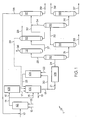
- Figure 1 is a schematic flow diagram of a processing scheme for the co-production of phenol, acetone, and AMS.
- Figure 2 is a schematic flow diagram of a processing scheme for the co-production of phenol, acetone, AMS, and propylene oxide.
- FIG. 1 represents a schematic flow diagram of an embodiment of this invention as processing scheme 1 for the co-production of phenol, acetone, and AMS.
- Cumene in stream 10 is fed to an oxidation reactor 101 where CHP is produced by reaction of the cumene with oxygen from the air fed as stream 12.
- Initiators to facilitate the oxidation of the cumene may be added as stream 13.
- these initiators may be an organic hydroperoxide, such as CHP, tert-butyl hydroperoxide, ethylbenzene hydroperoxide or the like.
- these initiators may be azo type free radical initiators or peroxy type free radical initiators that are known to catalyze the oxidation of organic hydrocarbons.
- Stream 16 is fed to the reduction reactor 103 where a portion of the CHP in stream 16 is reduced to DMPC over a suitable catalyst.
- Stream 17 leaving the reduction reactor has an increased concentration of DMPC relative to CHP stream 14.
- the catalyst used therein may be a heterogeneous catalyst comprised of a non-acidic or low acidity catalyst support and a metal.
- Non-acidic or low acidity catalyst supports include, but are not limited to, silica, alumina, crystalline or amorphous aluminophosphates; Group 4 metal oxides, such as titania, zirconia, hafnia, and mixtures thereof; and mesoporous molecular sieves exemplified by MCM-41.
- the metal deposited on such catalyst supports includes, but is not limited to, a Group 8, Group 9, or Group 10 transition metal, such as cobalt, iron, nickel, or mixtures thereof; a Group 2 metal, such as magnesium, calcium, barium, or mixtures thereof; a Group 1 metal, such as lithium, sodium, cesium, and mixtures thereof; a Group 3 metal, such as scandium, yttrium, lanthanum, or mixtures thereof; or mixtures and/or combinations of the above.
- Group numbers used in this patent application are from the Periodic Table of the Elements using the IUPAC format described in the CRC Handbook Chemistry and Physics, 79th Edition, CRC Press, Boca Raton, Florida (1998 ).
- such heterogeneous catalysts may be a Group 8, Group 9, or Group 10 transition metal on a support, such as cobalt supported on a Group 4 metal oxide, such as zirconium oxide, or cobalt supported on aluminophosphate, as disclosed in Examples 1 and 3, discussed below.
- These mixed metal oxides can be prepared by typical methods known to those skilled in the art such as impregnation, incipient wetness or ion exchange, or they can be prepared by coprecipitation of the metal oxides from soluble salt solutions.
- Streams 15 and 17 are fed to first cleavage reactor 102 where an acidic catalyst decomposes the CHP into phenol and acetone, and dehydrates the DMPC into AMS.
- the acidic catalyst may be in the liquid phase, such as sulfuric acid, fed via stream 18.
- the catalyst may be in the solid phase, such as a solid acid catalyst, capable of decomposing hydroperoxides into alcohols and ketones.
- Such solid acid catalysts include catalysts produced by calcining a source of a Group 4 metal oxide with a source of an oxyanion of a Group 6 metal at a temperature of at least 400°C, as disclosed in U.S. Patent 6,169,215 ; sulfated transition metal oxides, as disclosed in U.S.
- Patent 6,169,216 and a mixed metal oxide of cerium and a Group 4 metal, as disclosed in U.S. Patent 6,297,406 .
- the effluent from first cleavage reactor 102, stream 19 is composed of phenol, acetone, AMS, acetophenone, cumene, and some heavies produced from secondary reactions.
- first cleavage reactor 102 is operated with a solid acid catalyst, such as those described in U.S. Patents 6,169,215 ; 6,169,216 ; and 6,297,406 , in a plug flow reactor configuration, it is desirable to have as low as possible an AMS concentration at the inlet to minimize secondary reactions of the AMS. To achieve this goal, it is desirable to minimize the AMS in the diluting stream 23. This may be achieved by hydrogenating a portion of the effluent stream 19 as stream 20. Stream 20 is hydrogenated in hydrogenation reactor 104 in the presence of hydrogen stream 22 and a hydrogenation catalyst (not shown).
- the hydrogenation catalyst for use in the hydrogenation reactor 104 includes a hydrogenation component and a catalyst support.
- the hydrogenation component of the hydrogenation catalyst may be derived from a Group 8, Group 9, or Group 10 transition metal, such as platinum, iridium, osmium, palladium, rhodium, ruthenium, nickel, cobalt, iron, and mixtures of two or more thereof. Preferred metals are palladium and platinum.
- a Group 8, Group 9, or Group 10 transition metal may optionally be mixed with a Group 14 metal, preferably tin, and/or a Group 7 metal, preferably rhenium and/or manganese.
- metals known in the art capable of acting as a hydrogenation component include, but are not limited to, Group 6 metals, such as tungsten, and molybdenum and Group 11 metals, such as copper, silver, and gold, either alone or in combination.
- the amount of the hydrogenation component may be in the range of 0.001 to 30 wt.% of the total catalyst, preferably from 0.01 to 5 wt.%.
- the hydrogenation component can be exchanged onto the support material, impregnated into it or physically admixed with it.
- Suitable catalyst support materials are those well known in the art, for example, alumina, silica, clay, carbon, zirconia, titania, and mesoporous molecular sieves, as exemplified by MCM-41 type materials and mixtures thereof.
- the diluting stream 23 may be fed completely into the front end of first cleavage reactor 102. Alternatively, the diluting stream 23 may be fed in one or more stages down the length of the bed to provide the necessary diluting effect.
- stream 23 may be cooled prior to entering first cleavage reactor 102 to assist in heat removal from the reactor.
- acetone from the acetone tower 113 may be returned to the cleavage reactor in stream 29.
- Second cleavage reactor 105 may be operated at conditions that are the same or are different than those in first cleavage reactor 102.
- second cleavage reactor 105 may be operated at a higher temperature than first cleavage reactor 102.
- Second cleavage reactor 105 would typically be a plug-flow reactor, and may, or may not contain a catalyst bed. If a liquid acid such as sulfuric acid is used in first cleavage reactor 102, there may be sufficient acidity remaining in stream 21 to catalyze the necessary reactions in second cleavage reactor 105.
- second cleavage reactor 105 contains a solid acidic catalyst, such as those described in U.S. Patents 6,169,215 ; 6,169,216 ; and 6,297,406 .
- Second cleavage reactor 105 is used to decompose any dicumyl peroxide that may form in first cleavage reactor 102, and convert any residual CHP to phenol and acetone.
- a series of two or more reactors may be used for final conversion of the CHP, and a diluent such as acetone may or may not be added before each reactor bed.
- processing scheme 1 may be operated to produce phenol and acetone with minimal amounts of AMS produced.
- the split ratio ⁇ is zero wherein all of CHP stream 14 is fed to first cleavage reactor 102 (as stream 15), thereby bypassing reduction reactor 103.
- Diluent stream 23, and optionally stream 29, along with stream 15 are then fed to first cleavage reactor 102 in the presence of an acidic catalyst wherein CHP is decomposed to phenol and acetone.
- Such acidic catalyst is preferably a solid acid catalyst that is capable of decomposing hydroperoxides, such as those disclosed above.
- Effluent stream 19 in this embodiment is comprised mainly of phenol, acetone, cumene, and small amounts of AMS and heavies.
- Diluent stream 23 is formed by hydrogenating stream 20, a portion of effluent stream 19, in hydrogenation reactor 104 using a suitable hydrogenation catalyst, such as those disclosed above.
- Stream 21 the remaining portion of effluent stream 19, may then be fed to a secondary cleavage reactor 105 for further conversion, if desired.
- a two-bed, single reactor may be used (not shown) for reduction and cleavage since the reaction temperatures for DMPC formation and CHP cleavage are similar.
- a top bed may contain a heterogeneous catalyst that does not convert significant amounts of CHP to phenol and acetone, as discussed above, to produce DMPC to give the desired AMS yield.
- the bottom bed may contain a suitable acidic catalyst to decompose the remaining CHP to phenol and acetone and dehydrate the DMPC to AMS.
- liquid acids such as sulfuric acid
- a neutralization step would be required prior to the recovery section of the plant.
- Such a neutralization step may employ liquid bases or ion exchange resins or the like, as is well known to those skilled in the art.
- Stream 24 from cleavage reactor 105 is sent to the Crude Acetone Tower 110 where acetone and the lighter components are separated from phenol and the heavier components.
- the overhead stream 25 is sent to the Lights Topping Tower 112 where light compounds such as acetaldehyde are removed as stream 26.
- the bottoms from the topping tower, stream 27 are fed to the Refined Acetone Column 113, where product specification acetone is recovered as stream 28.
- the bottoms from the Crude Acetone Tower 110, stream 31, comprising phenol, and some AMS, cumene, acetophenone and heavies, are fed to the Heavy Ends Tower 114, where the heavy components are separated as stream 33.
- the overhead stream 32 is fed to the Hydrocarbon Removal Tower 115, where the residual AMS and cumene are separated from the phenol and pass to the AMS recovery section as stream 34.
- the crude phenol product, stream 35 is fed to the Phenol Finishing Tower 116, where product specification phenol is recovered overhead as stream 36.
- the AMS and cumene streams 30 and 34 are fed to the AMS Recovery Tower 117 where AMS is recovered as product stream 39, while cumene as stream 38 is returned to the oxidizer reactor 101.
- the amount of AMS produced in the plant can be continuously set, from about zero to about 50 wt.% of the stream containing CHP; preferably from about zero to about 30 wt.% of the stream containing CHP; more preferably from about zero to about 20 wt.% of the stream containing CHP; and most preferably from about zero to about 15 wt.% of the stream containing CHP, to meet the demand of the market for AMS.
- FIG. 2 represents a schematic flow diagram of still another embodiment of this invention as processing scheme 40 for the co-production of propylene oxide, AMS, phenol, and acetone.
- Cumene in stream 41 is fed to an oxidation reactor 101 where CHP is produced by reaction of the cumene with oxygen from the air fed as stream 42.
- Initiators to facilitate the oxidation of the cumene may be added as stream 43.
- these initiators may be an organic hydroperoxide such as CHP, tert-butyl hydroperoxide, ethylbenzene hydroperoxide or the like.
- these initiators may be free radical initiators known to catalyze the oxidation of organic hydrocarbons such as the azo type free radical initiators or any of the peroxy type free radical initiators or the like, as disclosed above with respect to processing scheme 1.
- the CHP stream 45, containing DMPC and acetophenone, together with unreacted cumene may be concentrated by removing a portion of the unreacted cumene prior to the cleavage section of the processing scheme 40.
- Stream 47 is fed to the epoxidation reactor 120 where a portion of the CHP in stream 47 reacts with a propylene-containing feed stream 44 to produce propylene oxide as a product stream 70.
- CHP is reduced to DMPC over a suitable epoxidation catalyst, which include titanium supported on silica or molybdenum.
- epoxidation catalysts may be the catalysts disclosed in U.S. Patent 6,114,551 .
- Streams 48 and 46 are fed to first cleavage reactor 102 where an acidic catalyst decomposes the CHP into phenol and acetone, and dehydrates the DMPC into AMS.
- suitable acidic catalysts such as a mixed metal oxide, are the same as those disclosed above with respect to processing scheme 1.
- the effluent from first cleavage reactor 102 is comprised mainly of phenol, acetone, AMS, acetophenone, cumene, and some heavies produced from secondary reactions.
- AMS dilutes in the cleavage reactor.
- One possible diluting stream is the product itself. If first cleavage reactor 102 is operated with an acidic catalyst in a plug flow reactor configuration, it is desirable to have as low as possible an AMS concentration at the inlet to minimize secondary reactions of the AMS. To achieve this goal, it is desirable to minimize the AMS in the diluting stream 53. This may be achieved by hydrogenating a portion of the effluent stream 49 as stream 50. Stream 50 is hydrogenated in hydrogenation reactor 104, in the presence of hydrogen fed stream 52 and a hydrogenation catalyst (not shown).
- Suitable catalysts for use in the hydrogenation reactor 104 include noble metals such as palladium and platinum supported on a support that may, or may not, be acidic as disclosed above.
- the diluting stream 53 may be fed completely into the front end of the hydrogentation reactor 104. Alternatively, the diluting stream 53 may be fed in one or more stages down the length of the bed to provide the necessary diluting effect.
- acetone from the acetone tower 113 may be returned to the cleavage reactor in stream 59.
- Second cleavage reactor 105 may be operated at conditions that are the same or are different than those in first cleavage reactor 102. For example, second cleavage reactor 105 may be operated at a higher temperature than first cleavage reactor 102.
- Cleavage reactor 105 would typically be a plug-flow reactor, and may, or may not contain a catalyst bed. If a liquid acid such as sulfuric acid is used in reactor 102, there may be sufficient acidity remaining in stream 51 to catalyze the necessary reactions in reactor 105.
- cleavage reactor 105 contains a solid acid catalyst, such as those described in U.S.
- Cleavage reactor 105 is used to decompose any dicumyl peroxide that may form in first reactor 102, and convert any residual CHP to phenol and acetone.
- a series of two or more reactors may be used for final conversion of the CHP, and a diluent such as acetone may or may not be added before each reactor bed.
- liquid acids such as sulfuric acid
- a neutralization step would be required prior to the recovery section of the plant (not shown).
- Such a neutralization step may employ liquid bases or ion exchange resins or the like, as is well known to those skilled in the art.
- Stream 54 from the cleavage reactor is sent to the Crude.
- Acetone Tower 110 where acetone and the lighter components are separated from phenol and the heavier components.
- the overhead stream 55 is sent to the Lights Topping Tower 112 where light compounds such as acetaldehyde are removed as stream 56.
- the bottoms from the topping tower, stream 57 are fed to the Refined Acetone Column 113, where product specification acetone is recovered as stream 58.
- the overhead stream 62 is fed to the Hydrocarbon Removal Tower 115, where the residual AMS and cumene are separated from the phenol and pass to the AMS recovery section as stream 64.
- the crude phenol product, stream 65 is fed to the Phenol Finishing Tower 116, where product specification phenol is recovered overhead as stream 66.
- the AMS/cumene streams 60 and 64 are fed to the AMS Recovery Tower 117 where AMS is recovered as product stream 69, while cumene as stream 68 is returned to the oxidizer reactor 101.
- the amount of AMS produced in the plant can be continuously set, from about zero to about 50 wt.% of the stream containing CHP; preferably from about zero to about 30 wt.% of the stream containing CHP; more preferably from about zero to about 20 wt.% of the stream containing CHP; and most preferably from about zero to about 15 wt.% of the stream containing CHP to meet the demand of the market for AMS.
- propylene oxide a high-valued product, is produced.
- a solution containing 500 g of water, 45 g of concentrated phosphoric acid, 117 g of cobalt nitrate, and 75 g of concentrated sulfuric acid was prepared with mixing.
- Another solution was prepared containing 1600 g of water and 300 g of aluminum sulfate. These two solutions were combined with stirring. The molar ratio of the cobalt/aluminum/phosphorous was 1/8/1.
- the pH of the product was adjusted to 9 by the addition of a 50 wt.% solution of sulfuric acid.
- the material was placed in a polypropylene bottle and put in a steam box (100°C) for 48 hours. The material was then filtered, washed, and dried at approximately 85°C.
- a portion of the above material was treated with a 0.1N solution of ammonium nitrate (100 ml of 0.1N ammonium nitrate solution to 10 g of calcined material). This treatment was done a total of four times with fresh solution. The material was then filtered, washed, and dried at approximately 85°C. A portion of the material was air calcined to 540°C for six hours. The surface area of this material was 310 m 2 /g.
- Example 2 To a 250-ml round bottom flask fitted with a condenser, stirrer and dropping funnel, and located in a water bath for temperature control, was charged a mixture of 100.0 g of acetone and 1.00 g of the catalyst of Example 1. The mixture was heated to reflux (57°C) with stirring, and 50.0 g of 80 wt.% CHP solution (analyzed as 80.8 wt.% CHP, 7.7 wt.% cumene, 6.9 wt.% DMPC, 2.1 wt.% acetophenone) was added dropwise at an approximate rate of 2 g/min. Following addition of the CHP solution, small samples (approximately 0.2 ml) of the reactant solution were withdrawn at regular intervals, filtered, and analyzed by gas chromatograph (GC).
- GC gas chromatograph
- Table II shows the composition (wt.%) of the reactant solution at 1 and 3 hours after the addition of the CHP was complete.
- C ⁇ H ⁇ P C ⁇ o ⁇ n ⁇ v ⁇ e ⁇ r ⁇ s ⁇ i ⁇ o ⁇ n % w ⁇ t . % C ⁇ H ⁇ P f ⁇ e ⁇ e ⁇ d - w ⁇ t . % C ⁇ H ⁇ P p ⁇ r ⁇ o d ⁇ u ⁇ c ⁇ t / w ⁇ t .
- the above example shows that the Co/Al/PO 4 catalyst reduces the CHP to DMPC.
- the catalyst being non-acidic, is inactive for the decomposition of CHP into phenol and acetone.
- Table III shows the composition (wt.%) of the reactant solution at 1 and 3 hours after the addition of the CHP was complete.
- the above example shows that a Co/ZrO 2 catalyst reduces the CHP to DMPC.
- the catalyst being non-acidic, is inactive for the decomposition of CHP into phenol and acetone.
- the catalysts of Examples 1 and 3 are suitable for use in reactor 103 of processing scheme 1.
- varying percentages of the CHP stream 14 can be reduced to DMPC.
- Table IV a material balance for processing scheme 1 is shown in Table IV where the amount of CHP reduced is varied between 0 and about 12%, by weight. TABLE IV % CHP Reduced 0 5 7 11.8 Phenol Yield (%) 94.1 88.9 86.8 81.8 AMS Yield (%) 80 171.6 208.2 296.1 AMS/Phenol (%) 3.5 8 10 15
- the phenol yield shown in Table IV is the amount of phenol produced as a percentage of the cumene fed to 101 that is converted.
- the AMS yield shown in Table IV is the amount of AMS produced in the plant relative to the amount of DMPC produced in the oxidation step. As is shown in Table IV, by varying the amount of CHP reduced from zero to about 12%, the ratio of AMS to phenol produced in the plant can be varied from 3.5% to about 15%.
- the phenol and AMS yields are a function of the CHP that is reduced in the reduction reactor 103.
- a reduction of about 7% of the CHP produced in the oxidation reactor 101 represents an AMS yield relative to the amount of phenol produced by the plant of about 10%, representing a yield in excess of 200% which is more than double that produced without the use of a reduction reactor.
- the additional DMPC that is produced is independent of the method by which the CHP is reduced. Consequently, the AMS yields are the same irrespective of whether the DMPC is formed via a reduction reaction as in the scheme of Figure 1 or in an epoxidation reaction as shown in the scheme of Figure 2 .
Landscapes
- Chemical & Material Sciences (AREA)
- Organic Chemistry (AREA)
- Engineering & Computer Science (AREA)
- Materials Engineering (AREA)
- Chemical Kinetics & Catalysis (AREA)
- Organic Low-Molecular-Weight Compounds And Preparation Thereof (AREA)
- Low-Molecular Organic Synthesis Reactions Using Catalysts (AREA)
- Catalysts (AREA)
Applications Claiming Priority (3)
| Application Number | Priority Date | Filing Date | Title |
|---|---|---|---|
| US320237 | 2002-12-16 | ||
| US10/320,237 US6984761B2 (en) | 2002-12-16 | 2002-12-16 | Co-production of phenol, acetone, α-methylstyrene and propylene oxide, and catalyst therefor |
| PCT/US2003/040283 WO2004058672A1 (en) | 2002-12-16 | 2003-12-16 | Co-production of phenol, acetone, alpha-methylstyrene and propylene oxide, and catalyst therefor |
Publications (2)
| Publication Number | Publication Date |
|---|---|
| EP1575888A1 EP1575888A1 (en) | 2005-09-21 |
| EP1575888B1 true EP1575888B1 (en) | 2010-10-06 |
Family
ID=32506828
Family Applications (1)
| Application Number | Title | Priority Date | Filing Date |
|---|---|---|---|
| EP03814132A Expired - Lifetime EP1575888B1 (en) | 2002-12-16 | 2003-12-16 | Co-production of phenol, acetone and alpha-methylstyrene |
Country Status (10)
| Country | Link |
|---|---|
| US (1) | US6984761B2 (enExample) |
| EP (1) | EP1575888B1 (enExample) |
| JP (1) | JP2006509829A (enExample) |
| KR (1) | KR101084379B1 (enExample) |
| CN (2) | CN1726176A (enExample) |
| AT (1) | ATE483674T1 (enExample) |
| AU (1) | AU2003297321A1 (enExample) |
| DE (1) | DE60334493D1 (enExample) |
| TW (1) | TWI310027B (enExample) |
| WO (1) | WO2004058672A1 (enExample) |
Families Citing this family (22)
| Publication number | Priority date | Publication date | Assignee | Title |
|---|---|---|---|---|
| US7455762B2 (en) * | 2004-08-31 | 2008-11-25 | Exxonmobil Research And Engineering Company | Selective hydrodesulfurization process |
| US7285512B2 (en) * | 2004-08-31 | 2007-10-23 | Exxonmobile Research And Engineering Company | Selective hydrodesulfurization catalyst |
| US8189615B2 (en) * | 2004-12-23 | 2012-05-29 | Nokia Corporation | Method and apparatus for communicating scheduling information from a UE to a radio access network |
| ES2261080B1 (es) * | 2005-04-19 | 2007-12-16 | Universidad Politecnica De Valencia | Procedimiento y catalizadores para la expoxidacion de compuestos olefinicos en presencia de oxigeno. |
| JP2009509729A (ja) * | 2005-09-23 | 2009-03-12 | イーストマン ケミカル カンパニー | カルボン酸の混合物からの混成ケトンの製造に選択的な触媒 |
| US20100063329A1 (en) * | 2006-05-16 | 2010-03-11 | John Charles Saukaitis | Method for decomposing di(phenylalkyl)peroxides to produce hydroxybenzenes and phenylalkenes using solid catalysts |
| US7446232B2 (en) * | 2006-08-03 | 2008-11-04 | Exxonmobil Chemical Patents Inc. | Process for oxidizing alkylaromatic compounds |
| US7417003B2 (en) * | 2006-12-29 | 2008-08-26 | Uop Llc | Solid acid catalyst and process for decomposition of cumene hydroperoxide |
| CN102227393B (zh) * | 2008-12-01 | 2015-02-18 | 三井化学株式会社 | 烯烃的制造方法 |
| ES2669301T3 (es) * | 2009-03-16 | 2018-05-24 | Mitsui Chemicals, Inc. | Procedimiento para la producción de olefinas |
| KR101403517B1 (ko) * | 2010-12-01 | 2014-06-10 | 주식회사 엘지화학 | 알파 메틸 스티렌의 제조방법 |
| KR101403518B1 (ko) | 2010-12-21 | 2014-06-10 | 주식회사 엘지화학 | 알파 메틸 스티렌의 제조방법 |
| WO2013012203A2 (ko) * | 2011-07-15 | 2013-01-24 | 주식회사 엘지화학 | 쿠밀 알코올의 제조 방법 및 페놀, 아세톤, 및 알파 메틸 스티렌의 제조방법 |
| KR101447255B1 (ko) * | 2011-07-22 | 2014-10-07 | 주식회사 엘지화학 | 페놀, 아세톤 및 알파 메틸 스티렌의 제조방법 |
| KR101476376B1 (ko) * | 2011-07-15 | 2014-12-26 | 주식회사 엘지화학 | 페놀, 아세톤 및 알파 메틸 스티렌의 제조방법 |
| KR101431122B1 (ko) * | 2011-08-12 | 2014-08-19 | 주식회사 엘지화학 | 페놀, 아세톤 및 알파 메틸 스티렌의 제조방법 |
| KR101476375B1 (ko) * | 2011-09-02 | 2014-12-26 | 주식회사 엘지화학 | 페놀, 아세톤 및 알파 메틸 스티렌의 제조방법 |
| US9115105B2 (en) | 2011-09-30 | 2015-08-25 | Exxonmobil Chemical Patents Inc. | Production of propylene oxide |
| WO2017118887A1 (en) * | 2016-01-05 | 2017-07-13 | Sabic Global Technologies B.V. | Systems and methods for the co-production of hydrogen and alkylene oxides |
| CN112079691A (zh) * | 2020-09-17 | 2020-12-15 | 吉化集团油脂化工有限公司 | 提升苯酚产品质量的方法 |
| RU2750718C1 (ru) * | 2020-12-04 | 2021-07-01 | федеральное государственное бюджетное образовательное учреждение высшего образования "Казанский национальный исследовательский технологический университет" (ФГБОУ ВО "КНИТУ") | Способ разложения гидропероксида изопропилбензола с получением диметилфенилкарбинола |
| JP7464211B2 (ja) | 2020-12-21 | 2024-04-09 | エルジー・ケム・リミテッド | α-メチルスチレンの製造方法 |
Family Cites Families (28)
| Publication number | Priority date | Publication date | Assignee | Title |
|---|---|---|---|---|
| US2757209A (en) * | 1951-04-26 | 1956-07-31 | Allied Chem & Dye Corp | Recovery of phenol and alphamethylstyrene from cumene oxidation reaction mixtures |
| US2854487A (en) * | 1955-04-12 | 1958-09-30 | Distillers Co Yeast Ltd | Process for the manufacture of carbinols |
| BE657838A (enExample) | 1964-01-07 | 1965-06-30 | ||
| US3403193A (en) * | 1965-06-28 | 1968-09-24 | Halcon International Inc | Process for the co-production of a styrene and a di-olefin |
| SU462812A1 (ru) * | 1972-03-28 | 1975-03-05 | Предприятие П/Я Р-6235 | Способ совместного получени фенола, ацетона и -метилстирола |
| JPS56140935A (en) | 1980-04-03 | 1981-11-04 | Sumitomo Chem Co Ltd | Preparation of styrene compound |
| US4358618A (en) * | 1981-06-22 | 1982-11-09 | Allied Corporation | Decomposition of cumene oxidation product |
| JPS5916843A (ja) | 1982-07-20 | 1984-01-28 | Mitsui Toatsu Chem Inc | 芳香族アルコ−ルの連続製造法 |
| JPS60174737A (ja) * | 1984-02-22 | 1985-09-09 | Mitsui Petrochem Ind Ltd | 芳香族アルコ−ルの製造法 |
| US4853197A (en) * | 1987-06-04 | 1989-08-01 | Uop | Crystalline metal aluminophosphates |
| JP2544745B2 (ja) * | 1987-10-13 | 1996-10-16 | 三菱化学株式会社 | α−メチルスチレンの製造方法 |
| JP2593212B2 (ja) * | 1988-11-30 | 1997-03-26 | 三井石油化学工業株式会社 | クメンの製造方法 |
| CA2003925C (en) * | 1988-11-28 | 1999-11-23 | Shintaro Araki | Preparation of cumene through alkylation of an aromatic compound and preparation of phenol through cumene |
| JPH02231442A (ja) * | 1988-11-28 | 1990-09-13 | Mitsui Petrochem Ind Ltd | フェノールの製造方法 |
| US5245090A (en) * | 1992-09-11 | 1993-09-14 | Aristech Chemical Corporation | Two-stage cleavage of cumene hydroperoxide |
| US5371305A (en) * | 1992-12-31 | 1994-12-06 | Hercules Incorporated | Process for producing phenol from cumene |
| US5463136A (en) * | 1994-12-22 | 1995-10-31 | Shell Oil Company | Cumene hydroperoxide cleavage process |
| JP3769050B2 (ja) * | 1995-07-07 | 2006-04-19 | 三井化学株式会社 | フェノールの製造方法 |
| AU5795998A (en) | 1996-12-17 | 1998-07-15 | Allied-Signal Inc. | Process for the production of alpha methylstyrenes |
| CA2279493A1 (en) * | 1997-02-11 | 1998-08-13 | E.I. Du Pont De Nemours And Company | Hydroperoxide decomposition process |
| EP1056697B1 (en) | 1998-02-17 | 2003-04-23 | Shell Internationale Researchmaatschappij B.V. | Process for preparing styrenes |
| US5905178A (en) * | 1998-04-20 | 1999-05-18 | Catalytic Distillation Technologies | Removal of α-methyl styrene from cumene |
| US5932751A (en) * | 1998-06-23 | 1999-08-03 | Arco Chemical Technology, L.P. | Epoxidation catalyst and process |
| US6169215B1 (en) * | 1999-03-25 | 2001-01-02 | Mobil Oil Corporation | Production of phenol |
| US6169216B1 (en) * | 1999-04-22 | 2001-01-02 | Mobil Oil Corporation | Production of phenol |
| US6297406B1 (en) * | 1999-08-03 | 2001-10-02 | Mobil Oil Corporation | Production of phenol |
| US6114551A (en) * | 1999-10-04 | 2000-09-05 | Mobil Oil Corporation | Olefin epoxidation catalysts |
| US6410804B1 (en) * | 1999-12-21 | 2002-06-25 | Exxon Mobil Oil Corporation | Production of phenol using reactive distillation |
-
2002
- 2002-12-16 US US10/320,237 patent/US6984761B2/en not_active Expired - Fee Related
-
2003
- 2003-12-16 JP JP2004563715A patent/JP2006509829A/ja active Pending
- 2003-12-16 TW TW092135625A patent/TWI310027B/zh not_active IP Right Cessation
- 2003-12-16 EP EP03814132A patent/EP1575888B1/en not_active Expired - Lifetime
- 2003-12-16 WO PCT/US2003/040283 patent/WO2004058672A1/en not_active Ceased
- 2003-12-16 CN CNA2003801061712A patent/CN1726176A/zh active Pending
- 2003-12-16 CN CN2010105394660A patent/CN102060653A/zh active Pending
- 2003-12-16 AT AT03814132T patent/ATE483674T1/de not_active IP Right Cessation
- 2003-12-16 DE DE60334493T patent/DE60334493D1/de not_active Expired - Lifetime
- 2003-12-16 KR KR1020057010980A patent/KR101084379B1/ko not_active Expired - Fee Related
- 2003-12-16 AU AU2003297321A patent/AU2003297321A1/en not_active Abandoned
Also Published As
| Publication number | Publication date |
|---|---|
| KR20050088178A (ko) | 2005-09-02 |
| DE60334493D1 (de) | 2010-11-18 |
| TW200508186A (en) | 2005-03-01 |
| ATE483674T1 (de) | 2010-10-15 |
| WO2004058672A1 (en) | 2004-07-15 |
| CN1726176A (zh) | 2006-01-25 |
| TWI310027B (en) | 2009-05-21 |
| EP1575888A1 (en) | 2005-09-21 |
| CN102060653A (zh) | 2011-05-18 |
| AU2003297321A1 (en) | 2004-07-22 |
| JP2006509829A (ja) | 2006-03-23 |
| KR101084379B1 (ko) | 2011-11-18 |
| US6984761B2 (en) | 2006-01-10 |
| US20040116749A1 (en) | 2004-06-17 |
Similar Documents
| Publication | Publication Date | Title |
|---|---|---|
| EP1575888B1 (en) | Co-production of phenol, acetone and alpha-methylstyrene | |
| RU2282625C2 (ru) | Получение соединений оксирана | |
| US7193093B2 (en) | Process for producing alkylene oxide | |
| CA2105637C (en) | Two-stage cleavage of cumene hydroperoxide | |
| US6297406B1 (en) | Production of phenol | |
| AU2002216112A1 (en) | Preparation of oxirane compounds | |
| KR20090123949A (ko) | 프로필렌 옥사이드의 제조 방법 | |
| WO2009043574A1 (en) | Process for the production of iso-propanol by liquid phase hydrogenation | |
| US6169216B1 (en) | Production of phenol | |
| US4927974A (en) | Process for the preparation of cyclohexanol and/or cyclohexanone | |
| EP1326820B1 (en) | Hydrogenation of cleavage effluents in phenol production | |
| JP2005097206A (ja) | プロピレンオキサイドの製造方法 | |
| EP1666474B1 (en) | Method for producing propyleneoxide | |
| WO2005030742A1 (ja) | プロピレンオキサイドの製造方法 | |
| CN114436756B (zh) | 一种制备异丙苯的方法、系统与应用 | |
| JP2005097184A (ja) | プロピレンオキサイドの製造方法 | |
| JP2005097183A (ja) | プロピレンオキサイドの製造方法 | |
| KR101520054B1 (ko) | 페놀, 아세톤 및 알파 메틸 스티렌의 제조방법 | |
| JP2005097211A (ja) | プロピレンオキサイドの製造方法 |
Legal Events
| Date | Code | Title | Description |
|---|---|---|---|
| PUAI | Public reference made under article 153(3) epc to a published international application that has entered the european phase |
Free format text: ORIGINAL CODE: 0009012 |
|
| 17P | Request for examination filed |
Effective date: 20050706 |
|
| AK | Designated contracting states |
Kind code of ref document: A1 Designated state(s): AT BE BG CH CY CZ DE DK EE ES FI FR GB GR HU IE IT LI LU MC NL PT RO SE SI SK TR |
|
| AX | Request for extension of the european patent |
Extension state: AL LT LV MK |
|
| DAX | Request for extension of the european patent (deleted) | ||
| 17Q | First examination report despatched |
Effective date: 20070322 |
|
| RTI1 | Title (correction) |
Free format text: CO-PRODUCTION OF PHENOL, ACETONE AND ALPHA-METHYLSTYRENE |
|
| GRAP | Despatch of communication of intention to grant a patent |
Free format text: ORIGINAL CODE: EPIDOSNIGR1 |
|
| GRAS | Grant fee paid |
Free format text: ORIGINAL CODE: EPIDOSNIGR3 |
|
| GRAA | (expected) grant |
Free format text: ORIGINAL CODE: 0009210 |
|
| AK | Designated contracting states |
Kind code of ref document: B1 Designated state(s): AT BE BG CH CY CZ DE DK EE ES FI FR GB GR HU IE IT LI LU MC NL PT RO SE SI SK TR |
|
| REG | Reference to a national code |
Ref country code: GB Ref legal event code: FG4D |
|
| REG | Reference to a national code |
Ref country code: CH Ref legal event code: EP |
|
| REG | Reference to a national code |
Ref country code: IE Ref legal event code: FG4D |
|
| REF | Corresponds to: |
Ref document number: 60334493 Country of ref document: DE Date of ref document: 20101118 Kind code of ref document: P |
|
| REG | Reference to a national code |
Ref country code: NL Ref legal event code: VDEP Effective date: 20101006 |
|
| PG25 | Lapsed in a contracting state [announced via postgrant information from national office to epo] |
Ref country code: SI Free format text: LAPSE BECAUSE OF FAILURE TO SUBMIT A TRANSLATION OF THE DESCRIPTION OR TO PAY THE FEE WITHIN THE PRESCRIBED TIME-LIMIT Effective date: 20101006 |
|
| PG25 | Lapsed in a contracting state [announced via postgrant information from national office to epo] |
Ref country code: PT Free format text: LAPSE BECAUSE OF FAILURE TO SUBMIT A TRANSLATION OF THE DESCRIPTION OR TO PAY THE FEE WITHIN THE PRESCRIBED TIME-LIMIT Effective date: 20110207 Ref country code: BG Free format text: LAPSE BECAUSE OF FAILURE TO SUBMIT A TRANSLATION OF THE DESCRIPTION OR TO PAY THE FEE WITHIN THE PRESCRIBED TIME-LIMIT Effective date: 20110106 Ref country code: NL Free format text: LAPSE BECAUSE OF FAILURE TO SUBMIT A TRANSLATION OF THE DESCRIPTION OR TO PAY THE FEE WITHIN THE PRESCRIBED TIME-LIMIT Effective date: 20101006 Ref country code: SE Free format text: LAPSE BECAUSE OF FAILURE TO SUBMIT A TRANSLATION OF THE DESCRIPTION OR TO PAY THE FEE WITHIN THE PRESCRIBED TIME-LIMIT Effective date: 20101006 Ref country code: FI Free format text: LAPSE BECAUSE OF FAILURE TO SUBMIT A TRANSLATION OF THE DESCRIPTION OR TO PAY THE FEE WITHIN THE PRESCRIBED TIME-LIMIT Effective date: 20101006 Ref country code: AT Free format text: LAPSE BECAUSE OF FAILURE TO SUBMIT A TRANSLATION OF THE DESCRIPTION OR TO PAY THE FEE WITHIN THE PRESCRIBED TIME-LIMIT Effective date: 20101006 |
|
| PG25 | Lapsed in a contracting state [announced via postgrant information from national office to epo] |
Ref country code: GR Free format text: LAPSE BECAUSE OF FAILURE TO SUBMIT A TRANSLATION OF THE DESCRIPTION OR TO PAY THE FEE WITHIN THE PRESCRIBED TIME-LIMIT Effective date: 20110107 |
|
| PG25 | Lapsed in a contracting state [announced via postgrant information from national office to epo] |
Ref country code: CZ Free format text: LAPSE BECAUSE OF FAILURE TO SUBMIT A TRANSLATION OF THE DESCRIPTION OR TO PAY THE FEE WITHIN THE PRESCRIBED TIME-LIMIT Effective date: 20101006 Ref country code: EE Free format text: LAPSE BECAUSE OF FAILURE TO SUBMIT A TRANSLATION OF THE DESCRIPTION OR TO PAY THE FEE WITHIN THE PRESCRIBED TIME-LIMIT Effective date: 20101006 Ref country code: ES Free format text: LAPSE BECAUSE OF FAILURE TO SUBMIT A TRANSLATION OF THE DESCRIPTION OR TO PAY THE FEE WITHIN THE PRESCRIBED TIME-LIMIT Effective date: 20110117 Ref country code: MC Free format text: LAPSE BECAUSE OF NON-PAYMENT OF DUE FEES Effective date: 20101231 |
|
| REG | Reference to a national code |
Ref country code: CH Ref legal event code: PL |
|
| PLBE | No opposition filed within time limit |
Free format text: ORIGINAL CODE: 0009261 |
|
| STAA | Information on the status of an ep patent application or granted ep patent |
Free format text: STATUS: NO OPPOSITION FILED WITHIN TIME LIMIT |
|
| PG25 | Lapsed in a contracting state [announced via postgrant information from national office to epo] |
Ref country code: DK Free format text: LAPSE BECAUSE OF FAILURE TO SUBMIT A TRANSLATION OF THE DESCRIPTION OR TO PAY THE FEE WITHIN THE PRESCRIBED TIME-LIMIT Effective date: 20101006 Ref country code: RO Free format text: LAPSE BECAUSE OF FAILURE TO SUBMIT A TRANSLATION OF THE DESCRIPTION OR TO PAY THE FEE WITHIN THE PRESCRIBED TIME-LIMIT Effective date: 20101006 Ref country code: SK Free format text: LAPSE BECAUSE OF FAILURE TO SUBMIT A TRANSLATION OF THE DESCRIPTION OR TO PAY THE FEE WITHIN THE PRESCRIBED TIME-LIMIT Effective date: 20101006 |
|
| REG | Reference to a national code |
Ref country code: FR Ref legal event code: ST Effective date: 20110831 |
|
| 26N | No opposition filed |
Effective date: 20110707 |
|
| GBPC | Gb: european patent ceased through non-payment of renewal fee |
Effective date: 20110106 |
|
| PG25 | Lapsed in a contracting state [announced via postgrant information from national office to epo] |
Ref country code: LI Free format text: LAPSE BECAUSE OF NON-PAYMENT OF DUE FEES Effective date: 20101231 Ref country code: CH Free format text: LAPSE BECAUSE OF NON-PAYMENT OF DUE FEES Effective date: 20101231 Ref country code: IE Free format text: LAPSE BECAUSE OF NON-PAYMENT OF DUE FEES Effective date: 20101216 Ref country code: FR Free format text: LAPSE BECAUSE OF NON-PAYMENT OF DUE FEES Effective date: 20110103 |
|
| REG | Reference to a national code |
Ref country code: DE Ref legal event code: R097 Ref document number: 60334493 Country of ref document: DE Effective date: 20110707 |
|
| PG25 | Lapsed in a contracting state [announced via postgrant information from national office to epo] |
Ref country code: GB Free format text: LAPSE BECAUSE OF NON-PAYMENT OF DUE FEES Effective date: 20110106 |
|
| PG25 | Lapsed in a contracting state [announced via postgrant information from national office to epo] |
Ref country code: IT Free format text: LAPSE BECAUSE OF FAILURE TO SUBMIT A TRANSLATION OF THE DESCRIPTION OR TO PAY THE FEE WITHIN THE PRESCRIBED TIME-LIMIT Effective date: 20101006 |
|
| PGFP | Annual fee paid to national office [announced via postgrant information from national office to epo] |
Ref country code: DE Payment date: 20120611 Year of fee payment: 9 |
|
| PG25 | Lapsed in a contracting state [announced via postgrant information from national office to epo] |
Ref country code: CY Free format text: LAPSE BECAUSE OF FAILURE TO SUBMIT A TRANSLATION OF THE DESCRIPTION OR TO PAY THE FEE WITHIN THE PRESCRIBED TIME-LIMIT Effective date: 20101006 |
|
| PG25 | Lapsed in a contracting state [announced via postgrant information from national office to epo] |
Ref country code: HU Free format text: LAPSE BECAUSE OF FAILURE TO SUBMIT A TRANSLATION OF THE DESCRIPTION OR TO PAY THE FEE WITHIN THE PRESCRIBED TIME-LIMIT Effective date: 20110407 Ref country code: LU Free format text: LAPSE BECAUSE OF NON-PAYMENT OF DUE FEES Effective date: 20101216 |
|
| PG25 | Lapsed in a contracting state [announced via postgrant information from national office to epo] |
Ref country code: TR Free format text: LAPSE BECAUSE OF FAILURE TO SUBMIT A TRANSLATION OF THE DESCRIPTION OR TO PAY THE FEE WITHIN THE PRESCRIBED TIME-LIMIT Effective date: 20101006 |
|
| PGFP | Annual fee paid to national office [announced via postgrant information from national office to epo] |
Ref country code: BE Payment date: 20120709 Year of fee payment: 9 |
|
| BERE | Be: lapsed |
Owner name: EXXONMOBIL CHEMICAL PATENTS INC. Effective date: 20121231 |
|
| PG25 | Lapsed in a contracting state [announced via postgrant information from national office to epo] |
Ref country code: BE Free format text: LAPSE BECAUSE OF NON-PAYMENT OF DUE FEES Effective date: 20121231 |
|
| REG | Reference to a national code |
Ref country code: DE Ref legal event code: R119 Ref document number: 60334493 Country of ref document: DE Effective date: 20130702 |
|
| PG25 | Lapsed in a contracting state [announced via postgrant information from national office to epo] |
Ref country code: DE Free format text: LAPSE BECAUSE OF NON-PAYMENT OF DUE FEES Effective date: 20130702 |