EP1562979B1 - Tubulysine, herstellungsverfahren und tubulysin-mittel - Google Patents
Tubulysine, herstellungsverfahren und tubulysin-mittel Download PDFInfo
- Publication number
- EP1562979B1 EP1562979B1 EP03775204A EP03775204A EP1562979B1 EP 1562979 B1 EP1562979 B1 EP 1562979B1 EP 03775204 A EP03775204 A EP 03775204A EP 03775204 A EP03775204 A EP 03775204A EP 1562979 B1 EP1562979 B1 EP 1562979B1
- Authority
- EP
- European Patent Office
- Prior art keywords
- alkyl
- alkenyl
- aryl
- cor
- tubulysin
- Prior art date
- Legal status (The legal status is an assumption and is not a legal conclusion. Google has not performed a legal analysis and makes no representation as to the accuracy of the status listed.)
- Expired - Lifetime
Links
Images


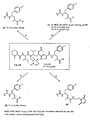


Classifications
-
- C—CHEMISTRY; METALLURGY
- C07—ORGANIC CHEMISTRY
- C07D—HETEROCYCLIC COMPOUNDS
- C07D417/00—Heterocyclic compounds containing two or more hetero rings, at least one ring having nitrogen and sulfur atoms as the only ring hetero atoms, not provided for by group C07D415/00
- C07D417/02—Heterocyclic compounds containing two or more hetero rings, at least one ring having nitrogen and sulfur atoms as the only ring hetero atoms, not provided for by group C07D415/00 containing two hetero rings
- C07D417/12—Heterocyclic compounds containing two or more hetero rings, at least one ring having nitrogen and sulfur atoms as the only ring hetero atoms, not provided for by group C07D415/00 containing two hetero rings linked by a chain containing hetero atoms as chain links
-
- A—HUMAN NECESSITIES
- A61—MEDICAL OR VETERINARY SCIENCE; HYGIENE
- A61P—SPECIFIC THERAPEUTIC ACTIVITY OF CHEMICAL COMPOUNDS OR MEDICINAL PREPARATIONS
- A61P35/00—Antineoplastic agents
-
- C—CHEMISTRY; METALLURGY
- C07—ORGANIC CHEMISTRY
- C07D—HETEROCYCLIC COMPOUNDS
- C07D417/00—Heterocyclic compounds containing two or more hetero rings, at least one ring having nitrogen and sulfur atoms as the only ring hetero atoms, not provided for by group C07D415/00
- C07D417/14—Heterocyclic compounds containing two or more hetero rings, at least one ring having nitrogen and sulfur atoms as the only ring hetero atoms, not provided for by group C07D415/00 containing three or more hetero rings
-
- C—CHEMISTRY; METALLURGY
- C07—ORGANIC CHEMISTRY
- C07K—PEPTIDES
- C07K5/00—Peptides containing up to four amino acids in a fully defined sequence; Derivatives thereof
- C07K5/02—Peptides containing up to four amino acids in a fully defined sequence; Derivatives thereof containing at least one abnormal peptide link
- C07K5/021—Peptides containing up to four amino acids in a fully defined sequence; Derivatives thereof containing at least one abnormal peptide link containing the structure -NH-(X)n-C(=0)-, n being 5 or 6; for n > 6, classification in C07K5/06 - C07K5/10, according to the moiety having normal peptide bonds
-
- A—HUMAN NECESSITIES
- A61—MEDICAL OR VETERINARY SCIENCE; HYGIENE
- A61K—PREPARATIONS FOR MEDICAL, DENTAL OR TOILETRY PURPOSES
- A61K38/00—Medicinal preparations containing peptides
Definitions
- Tubulysins are known as compounds of the following general formula; see. for example F. Sasse, H. Steinmetz, J. Heil, G. Höfle, H. Reichenbach, J. Antibiot. 2000, 53, 579-558 , and H. Reichenbach, G. Höfle, F. Sasse, H. Steinmetz (GBF), DE 196 38 870 A1 . 1996 , R R 1 1 Tubulysin A i -C 4 H 9 OH 2 Tubulysin B C 3 H 7 OH 3 Tubulysin C C 2 H 5 OH 4 Tubulysin D i -C 4 H 9 H 5 Tubulysin E C 3 H 7 H 6 Tubulysin F C 2 H 5 H
- the object of the invention is to provide new tubulysins, processes for their preparation and agents with tubulysins, in particular as cytostatic agents.
- Alkyl may be branched, unbranched or cyclic C 1-20 -alkyl, in particular C 1-7 -alkyl, preferably C 1-6 -alkyl and particularly preferably C 1-4 -alkyl, in particular methyl, ethyl, propyl , Isopropyl, n-butyl, iso-butyl, sec-butyl, tert-butyl.
- Cycloalkyl preferably has 3 to 8 carbon atoms in the ring
- the alkenyl groups may be branched, unbranched or cyclic C 2-20 -alkenyl, in particular C 2-7 -alkenyl, preferably C 2-6 -alkenyl and particularly preferably C 2-4 -alkenyl, in particular vinyl, allyl, Propen-1-yl, propen-2-yl, but-1-en-1-yl, but-1-en-2-yl, but-1-en-3-yl, but-1-ene-4 yl, but-2-en-1-yl, but-2-en-2-yl, 2-methyl-propen-1-yl, 2-methyl-propen-3-yl.
- Cycloalkenyl preferably has 3 to 8 carbon atoms in the ring.
- the number of double bonds of the alkenyl groups may be 1 to 3.
- Aryl can be phenyl, naphthyl and biphenylyl.
- Heteroaryl may be furyl, thienyl, imidazolyl, indolyl, pyridinyl, pyrrolyl, thiazolyl, oxazolyl and pyrimidinyl.
- Alkyl, alkenyl, aryl and heteroaryl may be unsubstituted or substituted, they may in any position 1 to 3 substituents from the by C 1-3 alkyl, C 1-3 alkoxy, hydroxy, amino (NE 2 ) or nitro ( NO 2 ).
- the acetal cleavage in acidic medium in particular in the presence of hydrochloric acid, and / or carried out at elevated temperature.
- ester cleavage in an organic medium, in particular a hydrophilic organic solvent, preferably an alcohol, in particular methanol, in the presence of a weak base, in particular NH 3 .
- a hydrophilic organic solvent preferably an alcohol, in particular methanol
- ring formation may be carried out in an aqueous medium, in the presence of an inorganic acid, preferably hydrochloric acid, and with heating.
- an inorganic acid preferably hydrochloric acid
- acylate with an acyl halide, in particular acyl chloride, and / or in the presence of a weak base, in particular a weak organic base, preferably a tertiary amine, in particular triethylamine.
- a weak base in particular a weak organic base, preferably a tertiary amine, in particular triethylamine.
- the process can be saponified with ammonia.
- the process can be carried out in the presence of p-CH 3 -C 6 H 4 SO 2 OH in tetrahydrofuran (THF) at elevated temperature.
- THF tetrahydrofuran
- reduction can be carried out with NaCNBH 3 and trifluoroacetic acid in methanol (MeOH).
- R 8 alkyl and in particular C 1-4 -alkyl, alkenyl or aryl, in particular acyl chloride, and / or in the presence of a base, in particular an organic base, preferably a trialkylamine, especially triethylamine.
- R alkyl and especially C 1-4 alkyl or al
- variant (a) can be carried out in the presence of I 2 and pyridine in methylene chloride.
- the variant (b) can be carried out with pyridine-SO 3 .
- alkylated with an alkyl iodide of the formula R 4 I with R 4 alkyl and in particular C 1-4 alkyl or alkenyl in the presence of a weak base, in particular Ag 2 O, in an organic solvent, in particular methylene chloride.
- esterase enzyme especially pig liver esterase.
- nitration may be carried out with an alkali metal nitrite, especially sodium nitrite, and acetic acid in the presence of an organic solvent, especially ethanol.
- an alkali metal nitrite especially sodium nitrite
- acetic acid in the presence of an organic solvent, especially ethanol.
- the acylation can be carried out with an acid anhydride, in particular acetic anhydride, preferably at elevated temperature.
- a further embodiment of the invention relates to a therapeutic agent, in particular cytostatic, with one or more compounds according to the invention as active ingredient in addition to one or more optional conventional carriers and / or one or more optional conventional diluents.
- an embodiment of the invention relates to a therapeutic agent, in particular cytostatic, with one or more products of a method according to the invention as active ingredient in addition to one or more optional conventional carriers and / or one or more optional conventional diluents.
- tubulysin A (1) 9.6 mg (11.4 ⁇ mol) of tubulysin A (1) were dissolved in 1 ml of methanol and admixed with 10 ⁇ l (133.6 ⁇ mol) of 25% ammonia at intervals of three hours and stirred at room temperature. Subsequently, the reaction mixture was adjusted to pH 5 with 18% hydrochloric acid and extracted three times with ethyl acetate. The combined organic phases were concentrated and purified by means of PSC (CH 2 Cl 2 / MeOH 85/15). 2.5 mg (27%) 9a, 2.3 mg (29%) 10a and 1.7 mg (18%) 1 were isolated.
- PSC CH 2 Cl 2 / MeOH 85/15
- tubulysin A (1) 9.6 mg (11.3 ⁇ mol) of tubulysin A (1), distributed as a thin film on the glass walls of the reaction vessel, were treated with 1 ml of 0.5 M hydrochloric acid solution and stirred at 100 ° C. for 30 min. The reaction was then lyophilized and the residue was purified over PSC (CH 2 Cl 2 / MeOH 90/10) to give 3.9 mg (50%) of 11a and 1.6 mg (21%) of 10a .
- a tubulysin derivative 12 can be prepared from a tubulysin derivative 7a by reacting 7a with acetyl chloride in triethylamine.
- a tubulysin derivative 17 may be prepared by catalytically hydrogenating a tubulysin derivative 9a in the presence of CH 3 COOH or DAST on a Pd / C catalyst with elemental hydrogen.
- tubulysin derivative 18 can be reacted with ethylmagnesium bromide to give a tubulysin derivative 19.
- tubulysin A (1) 19.0 mg (22.5 ⁇ mol) of tubulysin A (1) were dissolved in 300 ⁇ l of methanol and treated at room temperature with ethereal diazomethane solution twice at 15 minutes intervals. The reaction mixture was concentrated, and the crude product was purified by means of PSC (CH 2 Cl 2 / MeOH 90/10) to give 11.7 mg (61%) of 20a .
- a tubulysin derivative 22 can be obtained by reducing tubulysin 1 with methyl or ethyl lithium to the secondary amine.
- a tubulysin derivative 23 can be obtained by amidating tubulysin 1 in the presence of EDC in methylene chloride with 1- (2-aminoethyl) -pyrrole-2,5-dione.
- tubulysin 1 can be reacted with phosphoric acid dimethyl ester in the presence of iodine and pyridine in methylene chloride.
- tubulysin A (1) 8.9 mg were dissolved in 200 ⁇ l abs. Dissolved THF and treated with 8.2 .mu.l (30.6 .mu.mol) acetyl chloride and 7.1 .mu.mol) triethylamine. The reaction mixture was stirred for 15 min at room temperature, then admixed with 1 ml of water and extracted three times with ethyl acetate. The combined organic phases were concentrated and dried under high vacuum. The crude product was purified by PSC (CH 2 Cl 2 / MeOH 90/10) to give 5.6 mg (62%) of 25a.
- PSC CH 2 Cl 2 / MeOH 90/10
- tubulysin A (1) 21.7 mg (25.7 ⁇ mol) of tubulysin A (1) were dissolved in 200 ⁇ l of methanol and treated at room temperature at intervals of 15 minutes three times with ethereal diazomethane solution and stirred overnight. Subsequently, the reaction mixture was brought to dryness. Purification was via PSC (CH 2 Cl 2 / MeOH 90/10) and provided 10.3 mg (46%) of 26 and 5.0 mg (23%) of tubulysin A methyl ester (20a).
- tubulysin A (1) 11.0 mg (13.1 ⁇ mol) of tubulysin A (1) were dissolved in 200 ⁇ l of methanol and admixed with 13.0 ⁇ l of iodine monochloride solution (13.1 ⁇ mol). The reaction was stirred for 15 minutes at room temperature and then purified directly over PSC (CH 2 Cl 2 / MeOH 90/10). There were obtained 3.1 mg (25%) of 28a and 3.9 mg (27%) of 29a .
- a tubulysin derivative 31 can be obtained by catalytically reducing the nitro-tubulysin A (30a) in ethanol with elemental hydrogen with a Pd / C catalyst.
- the recovered tubulysin-Deriat 31 can be acylated with acetic anhydride to a tubulysin derivative 32.
- tubulysin A (1) 9.9 mg (11.7 ⁇ mol) of tubulysin A (1) were dissolved in 200 ⁇ l of dichloromethane, 290 ⁇ l (11.7 ⁇ mol) of m -CPBA solution (10 mg / ml of dichloromethane) were added and the mixture was stirred at room temperature for 30 minutes touched. After the reaction was reduced, the purification was carried out directly by means of PSC (CH 2 Cl 2 / methanol 85/15) to give 5.2 mg (52%) of 33a .
- PSC CH 2 Cl 2 / methanol 85/15
- a tubulysin derivative 34 can be obtained by treating tubulysin A-N-oxide (33a) with acetic anhydride at about 75 ° C.
Landscapes
- Chemical & Material Sciences (AREA)
- Organic Chemistry (AREA)
- Health & Medical Sciences (AREA)
- General Health & Medical Sciences (AREA)
- Medicinal Chemistry (AREA)
- Life Sciences & Earth Sciences (AREA)
- Proteomics, Peptides & Aminoacids (AREA)
- Crystallography & Structural Chemistry (AREA)
- Molecular Biology (AREA)
- Genetics & Genomics (AREA)
- Biophysics (AREA)
- Biochemistry (AREA)
- Public Health (AREA)
- Veterinary Medicine (AREA)
- Pharmacology & Pharmacy (AREA)
- General Chemical & Material Sciences (AREA)
- Animal Behavior & Ethology (AREA)
- Nuclear Medicine, Radiotherapy & Molecular Imaging (AREA)
- Chemical Kinetics & Catalysis (AREA)
- Pharmaceuticals Containing Other Organic And Inorganic Compounds (AREA)
- Organic Low-Molecular-Weight Compounds And Preparation Thereof (AREA)
- Polysaccharides And Polysaccharide Derivatives (AREA)
- Preparation Of Compounds By Using Micro-Organisms (AREA)
- Plural Heterocyclic Compounds (AREA)
Description
- Tubulysine sind als Verbindungen der folgenden allgemeinen Formel bekannt; vgl. beispielsweise F. Sasse, H. Steinmetz, J. Heil, G. Höfle, H. Reichenbach, J. Antibiot. 2000, 53, 579-558, und
H. Reichenbach, G. Höfle, F. Sasse, H. Steinmetz (GBF), DE 196 38 870 A1 ,1996 .
R R1 1 Tubulysin A i-C4H9 OH 2 Tubulysin B C3H7 OH 3 Tubulysin C C2H5 OH 4 Tubulysin D i-C4H9 H 5 Tubulysin E C3H7 H 6 Tubulysin F C2H5 H - Aufgabe der Erfindung ist es, neue Tubulysine, Verfahren zu ihrer Herstellung und Mittel mit Tubulysinen bereitzustellen, insbesondere als Cytostatika.
- Die Erfindung betrifft eine Verbindung der folgenden allgemeinen Formel I (Tubulysin):
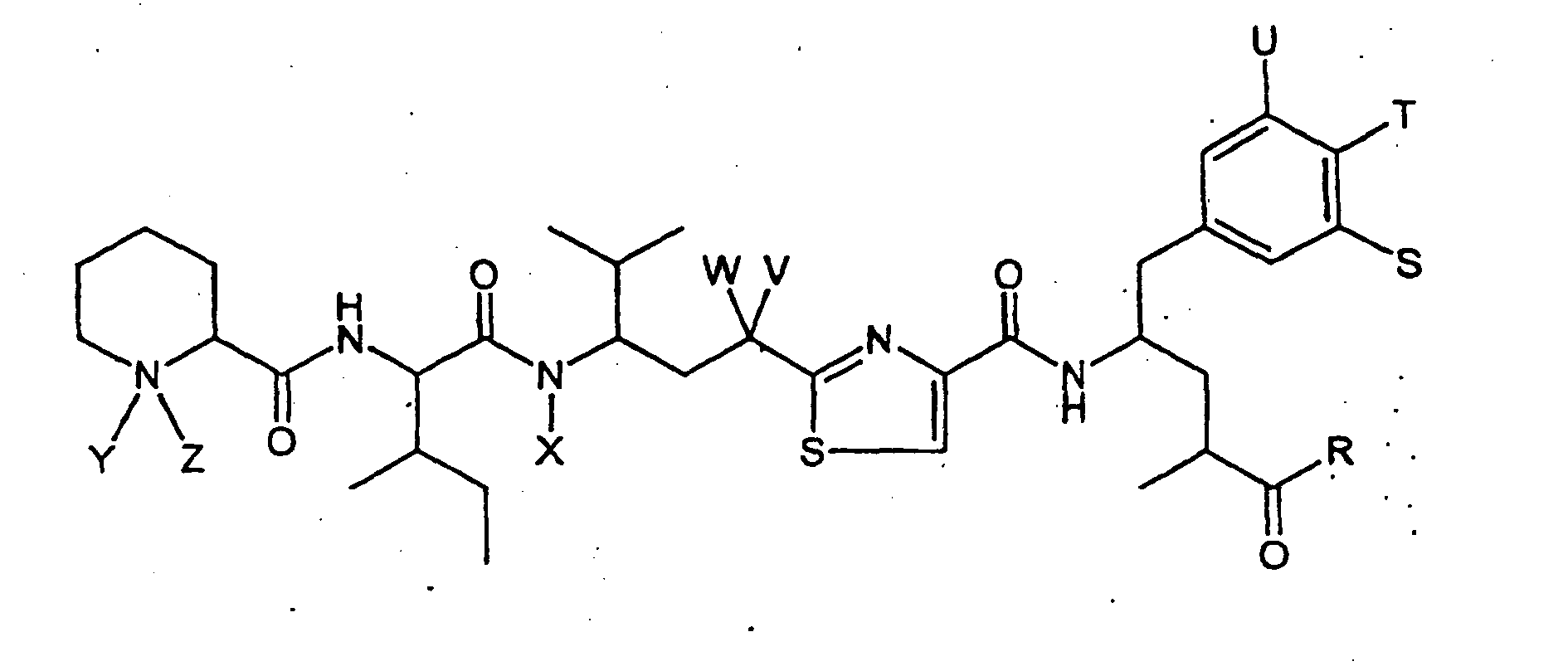
- R = OR1
- R1 = Alkyl oder Aryl
- S = H
- U = H
- T = H oder OR4
- R4 = H, Alkyl, Aryl, COR5, P(O)(OR6)2 oder SO3R6
- R5= Alkyl, Alkenyl, Aryl oder Heteroaryl
- R6 = H, Alkyl oder Metallion
- V = OR7
- R7 = COR8
- R8 = Alkyl, Alkenyl oder Aryl
- W = H
- X = CH2OR9
- R9 = COR10
- R10 = Alkyl, Alkenyl, Aryl oder Heteroaryl
- Y = freies Elektronenpaar
- R11 = Alkyl, CF3 oder Aryl und/oder
- Z = CH3 oder COR11.
- Bei Alkyl kann es sich um verzweigtes, unverzweigtes oder zyklisches C1-20-Alkyl, insbesondere C1-7-Alkyl, vorzugsweise C1-6-Alkyl und besonders bevorzugt um C1-4-Alkyl, insbesondere Methyl, Ethyl, Propyl, Isopropyl, n-Butyl, iso-Butyl, sek-Butyl, tert-Butyl, handeln. Cycloalkyl hat vorzugsweise 3 bis 8 C-Atome im Ring
- Bei den Alkenylgruppen kann es sich um verzweigtes, unverzweigtes oder zyklisches C2-20-Alkenyl, insbesondere C2-7-Alkenyl, vorzugsweise C2-6-Alkenyl und besonders bevorzugt um C2-4-Alkenyl, insbesondere Vinyl, Allyl, Propen-1-yl, Propen-2-yl, But-1-en-1-yl, But-1-en-2-yl, But-1-en-3-yl, But-1-en-4-yl, But-2-en-1-yl, But-2-en-2-yl, 2-Methyl-propen-1-yl, 2-Methyl-propen-3-yl, handeln. Cycloalkenyl hat vorzugsweise 3 bis 8 C-Atome im Ring. Die Anzahl der Doppelbindungen der Alkenylgruppen kann 1 bis 3 betragen.
- Aryl kann sein Phenyl, Naphthyl und Biphenylyl.
- Heteroaryl kann sein Furyl, Thienyl, Imidazolyl, Indolyl, Pyridinyl, Pyrrolyl, Thiazolyl, Oxazolyl und Pyrimidinyl.
- Alkyl, Alkenyl, Aryl und Heteroaryl können unsubstituiert oder substituiert sein, so können sie in beliebiger Position 1 bis 3 Substituenten aus der durch C1-3-Alkyl, C1-3-Alkoxy, Hydroxy, Amino (NE2) oder Nitro (NO2) gebildeten Gruppe tragen.
- So kann eine erfindungsgemäße Verbindung aufweisen:
- R, R1, R4, R5, R8, R9, R10 und/oder R11 = unsubstituiertes oder substituiertes Phenyl, insbesondere C1-4-Alkyl-substituiertes Phenyl
- R5 = C1-4-Alkyl, C2-6-Alkenyl oder Pyridyl
- R5 und/oder X = C2-4-Alkenyl
- R6 = Alkalimetall-Ion, insbesondere Na-Ion, oder Erdalkalimetall-Ion
- R8 und/oder R9 = C2-4-Alkenyl und/oder
- R10 = C2-6-Alkenyl, insbesondere C2-4-Alkenyl, oder Pyridyl.
- Schema 1 zeigt ein Verfahren zur Herstellung einer Verbindung der allgemeinen Formel I (Typ 7) mit R = OR1, R1 = H, S = U = H, T = H oder OH, V = OR7, R7 = COR8, R8 = Alkyl, vorzugsweise C1-4-Alkyl, insbesondere Methyl, W = H, X = CH2OR9, R9 = H, Y = freies Elekronenpaar und Z = CH3, bei dem man eine Verbindung der folgenden allgemeinen Formel II (Typ 1, 2, 3, 4, 5 oder 6) :

- Bei dem Verfahren kann man die Esterspaltung in einem organischen Lösungsmittel, insbesondere Dioxan, in Gegenwart einer Säure, insbesondere Chlorwassertoff, und/oder bei erhöhter Temperatur durchführen.
- Schema 1 zeigt ferner ein Verfahren zur Herstellung einer Verbindung der allgemeinen Formel I (Typ 8) mit R = OR1, R1 = H, S = U = H, T = H oder OH, V = OR7, R7 = COR8, R8 = Alkyl und insbesondere C1-4-Alkyl, insbesondere Methyl, W = H, X = H, Y = freies Elektronenpaar und Z = CH3, bei dem man eine Verbindung der allgemeinen Formel II (Typ 1, 2, 3, 4, 5 oder 6) mit X = CH2OR9, X9 = COR10, R10 = Alkyl und insbesondere C1-6-Alkyl, und im übrigen den vorstehend angegebenen Bedeutungen einer Acetal-Spaltung unterwirft und die Verbindung der allgemeinen Formel I mit den angegebenen Bedeutungen gewinnt.
- Bei dem Verfahren kann man die Acetal-Spaltung in saurem Milieu, insbesondere in Gegenwart von Salzsäure, und/oder bei erhöhter Temperatur durchführen.
- Schema 1 zeigt ferner ein Verfahren zur Herstellung einer Verbindung der allgemeinen Formel I (Typ 9) mit R = OR1, R1 = H, S = U = H, T = H oder OH, V = OR7, R7 = H, W = H, X = CH2OR9, R9 = COR10, R10 = Alkyl und insbesondere C1-6-Alkyl, Y = freies Elektronenpaar und Z = CH3, bei dem man eine Verbindung der allgemeinen Formel II (Typ 1, 2, 3, 4, 5 oder 6) mit V = OR7, R7 = COR8, R8 = Alkyl, vorzugsweise C1-4-Alkyl, insbesondere Methyl, und im übrigen den vorstehend angegebenen Bedeutungen einer Esterspaltung in schwach alkalischem Medium unterwirft und die Verbindung der allgemeinen Formel I mit den angegebenen Bedeutungen gewinnt.
- Bei dem Verfahren kann man die Esterspaltung in einem organischen Medium, insbesondere einem hydrophilen organischen Lösungsmittel, vorzugsweise einem Alkohol, insbesondere Methanol, in Gegenwart einer schwachen Base durchführen, insbesondere NH3.
- Schema 1 zeigt ferner ein Verfahren zur Herstellung einer Verbindung der allgemeinen Formel I (Typ 10) mit R = OR1, R1 = H, S = U = H, T = H oder OH, V = OR7, R7 = H, W = H, X = H, Y = freies Elektronenpaar und Z = CH3, bei dem man eine Verbindung der allgemeinen Formel II (Typ 1, 2, 3, 4, 5 oder 6) mit V = OR7, R7 = COR8, R8 = Alkyl , vorzugsweise C1-4-Alkyl, insbesondere Methyl, X = CH2OR9, R9 = COR10, R10 = Alkyl und insbesondere C1-6-Alkyl, und im übrigen den vorstehend angegebenen Bedeutungen einer doppelten Esterspaltung in stark alkalischem Medium unterwirft und die Verbindung der allgemeinen Formel I mit den angegebenen Bedeutungen gewinnt.
- Bei dem Verfahren kann man die doppelte Esterspaltung in einem organischen Medium, insbesondere in einem hydrophilen organischen Lösungsmittel, vorzugsweise Alkohol, insbesondere Methanol, in Gegenwart einer starken Base durchführen, insbesondere eines Alkalimetallhydroxids, vorzugsweise von Natriumhydroxid.
- Schema 1 zeigt ferner ein Verfahren zur Herstellung einer Verbindung der folgenden allgemeinen Formel III (Typ 11) :

- Bei dem Verfahren kann man die Ringbildung in wässerigem Medium, in Gegenwart einer anorganischen Säure, vorzugsweise Salzsäure, und unter Erhitzen durchführen.
- Schema 2 zeigt ein Verfahren zur Herstellung einer Verbindung der allgemeinen Formel I (Typ 12) mit R = OR1, R1 = H, S = U = H, T = H oder OR4, R4 = COR5, R5 = Alkyl und insbesondere C1-6-Alkyl, Alkenyl und insbesondere C2-6-Alkenyl, Aryl oder Heteroaryl, V = OR7, R7 = COR8, R8 = Alkyl, vorzugsweise C1-4-Alkyl, insbesondere Methyl, W = H, X = CH2OR9, R9 = COR10, R10 = R5, Y = freies Elektronenpaar und Z = CH3, bei dem man eine Verbindung der folgenden allgemeinen Formel IV (Typ 7):

- Bei dem Verfahren kann man mit einem Acylhalogenid, insbesondere Acylchlorid, und/oder in Gegenwart einer schwachen Base acylieren, insbesondere einer schwachen organischen Base, vorzugsweise eines tertiären Amins, insbesondere Triethylamin.
- Schema 2 zeigt ferner ein Verfahren zur Herstellung einer Verbindung der allgemeinen Formel I (Typ 13) mit R = OR1, R1 = H, S = U = H, T = H oder OR4, R4 = H, V = OR7, R7 = COR8, R8 = Alkyl, vorzugsweise C1-4-Alkyl, insbesondere Methyl, W = H, X = CH2OR9, R9 = COR10, R10 = Alkyl und insbesondere C1-6-Alkyl, Alkenyl und insbesondere C2-6-Alkenyl, Aryl oder Heteroaryl, Y = freies Elektronenpaar und Z = CH3, bei dem man bei einem Produkt mit T = OR4, R4 = COR5 und R5 = Alkyl und insbesondere C1-6-Alkyl, Alkenyl und insbesondere C2-6-Alkenyl, Aryl oder Heteroaryl und im übrigen den vorstehend angegebenen Bedeutungen in alkalischem Medium verseift und eine Verbindung der allgemeinen Formel I mit den angegebenen Bedeutungen gewinnt.
- Bei dem Verfahren kann man mit Ammoniak verseifen.
- Schema 3 zeigt ein Verfahren zur Herstellung einer Verbindung der allgemeinen Formel I (Typ 14) mit R = DR1, R1 = H, S = U = H, T = H oder OH, V = OR7, R7 = COR8, R8 = Alkyl, vorzugsweise C1-4-Alkyl, insbesondere Methyl, W = H, X = CH2OR9, R9 = Alkyl und insbesondere C1-4-Alkyl, Alkenyl und insbesondere C2-6-Alkenyl, oder Aryl, Y = freies Elektronenpaar und Z = CH3, bei dem man Verbindung der allgemeinen Formel II (Typ 1, 2, 3, 4, 5 oder 6) einer Esterspaltung unterwirft und alkyliert und eine Verbindung der allgemeinen Formel I mit den angegebenen Bedeutungen gewinnt.
- Bei dem Verfahren kann man mit einem Alkylierungsmittel der Formel R9OH mit R9 = Alkyl und insbesondere C1-4-Alkyl, Alkenyl oder Aryl umsetzen.
- Bei dem Verfahren kann man in Gegenwart von p-CH3-C6H4SO2OH in Tetrahydrofuran (THF) bei erhöhter Temperatur umsetzen.
- Schema 4 zeigt ein Verfahren zur Herstellung einer Verbindung der allgemeinen Formel I (Typ 15) mit R = OR1, R1 = H, S = U = H, T = H oder OR4, R4 = H, V = OR7, R7 = H oder COR8, R8 = Alkyl, vorzugsweise C1-4-Alkyl, insbesondere Methyl, W = H, X = CH3, Y = freies Elektronenpaar und Z = CH3, bei dem man eine Verbindung der allgemeinen Formel IV (Typ 7) mit X = CH2OR9, R9 = H und im übrigen den vorstehend angegebenen Bedeutungen einer Reduktion unterwirft und die Verbindung der allgemeinen Formel I mit den angegebenen Bedeutungen gewinnt.
- Bei dem Verfahren kann man die Reduktion mit NaCNBH3 und Trifluoressigsäure in Methanol (MeOH) durchführen.
- Schema 4 zeigt ferner ein Verfahren zur Herstellung einer Verbindung der allgemeinen Formel I (Typ 15) mit R = OR1, R1 = H, S = U = H, T = H oder OR4, R4 = H, V = OR7, R7 = H oder COR8, R8 = Alkyl, vorzugsweise C1-4-Alkyl, insbesondere Methyl, W = H, X = CH3, Y = freies Elektronenpaar und Z = CH3, bei dem man eine Verbindung der allgemeinen Formel III (Typ 11) einer Ringöffnung unter Reduktion bzw. Reduktion unter Ringöffnung unterwirft und eine Verbindung der allgemeinen Formel I mit den angegebenen Bedeutungen gewinnt.
- Bei dem Verfahren kann man in Gegenwart von NaCNBH3 und Me3SiCl in Acetonitril (CH3CN) umsetzen.
- Schema 5 zeigt ein Verfahren zur Herstellung einer Verbindung der allgemeinen Formel I (Typ 16) mit R = OR1, R1 = H, S = U = H, T = H oder OH, V = OR7, R7 = COR8, R8 = Alkyl und insbesondere C1-4-Alkyl, Alkenyl oder Aryl, W = H, X = CH2OR9, R9 = COR10, R10 = Alkyl und insbesondere C1-6-Alkyl oder Alkenyl, Y = freies Elektronenpaar und Z = CH3, bei dem man eine Verbindung der allgemeinen Formel I (Typ 9) mit V = OR7 und R7 = H und im übrigen den vorstehend angegebenen Bedeutungen einer Acylierung unterwirft und die Verbindung der allgemeinen Formel I mit den angegebenen Bedeutungen gewinnt.
- Bei dem Verfahren kann man die Acylierung mit einem Acylhalogenid der Formel R8COCl mit R8 = Alkyl und insbesondere C1-4-Alkyl, Alkenyl oder Aryl, insbesondere Acylchlorid, und/oder in Gegenwart einer Base durchführen, insbesondere einer organischen Base, vorzugsweise eines Trialkylamins, insbesondere Triethylamin.
- Schema 5 zeigt ferner ein Verfahren zur Herstellung einer Verbindung der allgemeinen Formel I (Typ 17) mit R = OR1, R1 = H, S = U = H, T = H oder OR4, R4 = H, V = H oder F, W = H, X = CH2OR9, R9 = COR10, R10 = Alkyl und insbesondere C1-6-Alkyl oder Alkenyl, Y = freies Elektronenpaar und Z = CH3, bei dem man eine Verbindung der allgemeinen Formel I (Typ 9) mit V = OR7 und R7 = H und im übrigen den vorstehend angegebenen Bedeutungen einer katalytischen Hydrierung oder einer Fluorierung unterwirft und die Verbindung der allgemeinen Formel I mit den angegebenen Bedeutungen gewinnt.
- Bei dem Verfahren kann man für V = H die Hydrierung mit Palladium/Kohlenstoff in Gegenwart von Essigsäure oder für V = F die Fluorierung mit DAST in Tetrahydrofuran durchführen.
- Schema 5 zeigt ferner ein Verfahren zur Herstellung einer Verbindung der allgemeinen Formel I (Typ 18) mit R = OR1, R1 = H, S = U = H, T = H oder OR4, R4 = H, V mit W = O, X = CH2OR9, R9 = COR10, R10 = Alkyl und insbesondere C1-6-Alkyl oder Alkenyl, Y = freies Elektronenpaar und Z = CH3, bei dem man eine Verbindung der allgemeinen Formel I (Typ 9) mit V = OR7 und R7 = H und im übrigen den vorstehend angegebenen Bedeutungen einer Oxidation unter Bildung eines Ketons unterwirft und eine Verbindung der allgemeinen Formel I mit den angegebenen Bedeutungen gewinnt.
- Bei dem Verfahren kann man die Oxidation in Gegenwart von TPAP und NMO in Dichlormethan durchführen.
- Schema 5 zeigt ferner ein Verfahren zur Herstellung einer Verbindung der allgemeinen Formel I (Typ 19) mit R = OR1, R1 = H, S = U = H, T = H oder OH, V = OR7, R7 = H, W = Alkyl und insbesondere C1-4-Alkyl, X = CH2OR9, R9 = COR10, R10 = Alkyl und insbesondere C1-6-Alkyl oder Alkenyl, Y = freies Elektronenpaar und Z = CH3, bei dem man ein Produkt des vorstehenden Verfahrens (Typ 18) mit einer Grignard-Verbindung zur Verbindung der allgemeinen Formel I mit den angegebenen Bedeutungen umsetzt.
- Bei dem Verfahren kann man die Umsetzung mit einer magnesiumorganischen Verbindung der Formel WMgHal mit W = Alkyl und insbesondere C1-4-Alkyl durchführen.
- Schema 5 zeigt ferner ein Verfahren zur Herstellung einer Verbindung der allgemeinen Formel I (Typ 19) mit R = OR1, R1 = H, S = U = H, T = H oder OH, V = OR7, R7 = H, W = Alkyl und insbesondere C1-4-Alkyl, X = CH2OR9, R9 = COR10, R10 = Alkyl und insbesondere C1-6-Alkyl oder Alkenyl, Y = freies Elektronenpaar und Z = CH3, bei dem man
- (i) in einer ersten Stufe ein Verfahren durchführt und eine Verbindung (Typ 18) gewinnt und danach
- (ii) in einer zweiten Stufe die angefallene Verbindung (Typ 18) in einem weiteren Verfahren zu einer Verbindung der allgemeinen Formel I mit den angegebenen Bedeutungen umsetzt und diese Verbindung gewinnt.
- Schema 6 zeigt ein Verfahren zur Herstellung einer Verbindung der allgemeinen Formel I (Typ 20) mit R = OR1, R1 = Alkyl und insbesondere C1-4-Alkyl oder Alkenyl, S = U = H, T = H oder OR4, R4 = H, V = OR7, R7 = COR8, R8 = Alkyl, vorzugsweise C1-4-Alkyl, insbesondere Methyl, W = H, X = CH2OR9, R9 = COR10, R10 = Alkyl und insbesondere C1-6-Alkyl, Alkenyl und insbesondere C2-6-Alkenyl, Aryl oder Heteroaryl, Y = freies Elektronenpaar und Z = CH3, bei dem man eine Verbindung der allgemeinen Formel II (Typ 1, 2, 3, 4, 5 oder 6) oder ein Produkt eines Verfahrens (Typ 13) einer Alkylierung oder Alkenylierung unterwirft und eine Verbindung der allgemeinen Formel I mit den angegebenen Bedeutungen gewinnt.
- Bei dem Verfahren kann man die Alkylierung oder Alkenylierung in Gegenwart von EDC, R1OH mit R1 = Alkyl und insbesondere C1-4-Alkyl oder Alkenyl und DMAP in Methylenchlorid durchführen.
- Schema 6 zeigt ferner ein Verfahren zur Herstellung einer Verbindung der allgemeinen Formel I (Typ 21) mit R = NHR1, NH-NR1R2, NHOR1 oder NH(CH2)2-4NR1R2, R1 und R2 unabhängig voneinander = H, Alkyl und insbesondere C1-6-Alkyl oder Aryl, S = U = H, T = H oder OR4, R4 = H, V = OR7, R7 = COR8, R8 = Alkyl, vorzugsweise C1-4-Alkyl, insbesondere Methyl, W = H, X = CH2OR9, R9 = COR10, R10 = Alkyl und insbesondere C1-6-Alkyl, Alkenyl und insbesondere C2-6-Alkenyl, Aryl oder Heteroaryl, Y = freies Elektronenpaar und Z = CH3, bei dem man eine Verbindung der allgemeinen Formel II (Typ 1, 2, 3, 4, 5 oder 6) oder ein Produkt eines Verfahrens (Typ 13) mit einer Verbindung der Formel RH einer Aminierung unterwirft, wobei R die angegebenen Bedeutungen besitzt, und eine Verbindung der allgemeinen Formel I mit den angegebenen Bedeutungen gewinnt.
- Bei dem Verfahren kann man die Umsetzung
- (i) in Gegenwart von EDC in Methylenchlorid oder
- (ii) in Gegenwart von i-Butylchlorformiat und Triethylamin in THF durchführen.
- Schema 6 zeigt ferner ein Verfahren zur Herstellung einer Verbindung der allgemeinen Formel I (Typ 22) mit R = Alkyl und insbesondere C1-4-Alkyl oder Alkenyl, S = U = H, T = H oder OR4, R4 = H, V = OR7, R7 = COR8, R8 = Alkyl, vorzugsweise C1-4-Alkyl, insbesondere Methyl, W = H, X = CH2OR9, R9 = COR10, R10 = Alkyl und insbesondere C1-6-Alkyl, Alkenyl und insbesondere C2-6-Alkenyl, Aryl oder Heteroaryl, Y = freies Elektronenpaar und Z = CH3, bei dem man eine Verbindung der allgemeinen Formel II (Typ 1, 2, 3, 4, 5 oder 6) oder ein Produkt eines Verfahrens (Typ 13) mit einer lithiumorganischen Verbindung der Formel RLi mit der angegebenen Bedeutung für R zu der Verbindung der allgemeinen Formel I mit den angegebenen Bedeutungen umsetzt.
- Schema 6 zeigt ferner ein Verfahren zur Herstellung einer Verbindung der allgemeinen Formel I (Typ 23) mit R = Aminorest von 1-(2-Amino-C2-4-alkyl)-pyrrol-2,5-dion, S = U = H, T = H oder OR4, R4 = H, V = OR7, R7 = COR8, R8 = Alkyl, vorzugsweise C1-4-Alkyl, insbesondere Methyl, W = H, X = CH2OR9, R9 = COR10, R10 = Alkyl und insbesondere C1-6-Alkyl, Alkenyl und insbesondere C2-6-Alkenyl, Aryl oder Heteroaryl, Y = freies Elektronenpaar und Z = CH3, bei dem man eine Verbindung der allgemeinen Formel II (Typ 1, 2, 3, 4, 5 oder 6) oder ein Produkt eines Verfahrens (Typ 13) einer Aminierung mit 1-(2-Amino-C2-4-alkyl)-pyrrol-2,5-dion unterwirft und die Verbindung der allgemeinen Formel I mit den angegebenen Bedeutungen gewinnt.
- Bei dem Verfahren kann man die Aminierung in Gegenwart von EDC in Methylenchlorid durchführen.
- Schema 7 zeigt ein Verfahren zur Herstellung einer Verbindung der allgemeinen Formel I (Typ 24) mit R = OR1, R1 = H, S = U = H, T = OR4, R4 = P(O) (OR6)2 mit R6 = H oder Alkyl, insbesondere C1-4-Alkyl, oder R4 = SO3R6 mit R6 = H, V = OR7, R7 = COR8, R8 = Alkyl, vorzugsweise C1-4-Alkyl, insbesondere Methyl, W = H, X = CH2OR9, R9 = COR10, R10 = Alkyl und insbesondere C1-6-Alkyl, Alkenyl, insbesondere C2-6-Alkenyl, Aryl oder Heteroaryl, Y = freies Elektronenpaar und Z = CH3, bei dem man
- (i) eine Verbindung der allgemeinen Formel II (Typ 1, 2 oder 3) oder
- (ii) ein Produkt eines Verfahrens (Typ 13) mit
- (a) einer Verbindung der Formel P(O)(OR6)2OH mit R6 = H oder Alkyl und insbesondere C1-4-Alkyl oder
- (b) SO3
- Bei dem Verfahren kann man die Variante (a) in Gegenwart von I2 und Pyridin in Methylenchlorid durchführen.
- Bei dem Verfahren Verfahren kann man die Variante (b) mit Pyridin-SO3 durchführen.
- Schema 7 zeigt ferner ein Verfahren zur Herstellung einer Verbindung der allgemeinen Formel I (Typ 25) mit R = OR1, R1 = H, S = U = H, T = OR4, R4 = COR5, R5 = Alkyl und insbesondere C1-4-Alkyl, Alkenyl oder N(R12)2, R12 = Alkyl, V = OR7, R7 = COR8, R8 = Alkyl, vorzugsweise C1-4-Alkyl, insbesondere Methyl, W = H, X = CH2OR9, R9 = COR10, R10 = Alkyl, insbesondere C1-6-Alkyl, Alkenyl, insbesondere C2-6-Alkenyl, Aryl oder Heteroaryl, bei dem man
- (i) eine Verbindung der allgemeinen Formel II (Typ 1, 2 oder 3) oder
- (ii) ein Produkt eines Verfahrens (Typ 13) einer Acylierung unterwirft und die Verbindung der allgemeinen Formel I mit den angegebenen Bedeutungen gewinnt.
- Bei dem Verfahren kann man die Acylierung mit einem Acylhalogenid der Formel R5COCl mit R5 = Alkyl und insbesondere C1-4-Bkyl, Alkenyl oder N(R12)2 und R12 = Alkyl, insbesondere mit einem Acylchlorid, in Gegenwart einer organischen Base, insbesondere eines Trialkylamins, vorzugsweise Triethylamin, in einem organischen Lösungsmittel durchführen, insbesondere THF.
- Schema 7 zeigt ferner ein Verfahren zur Herstellung einer Verbindung der allgemeinen Formel I (Typ 26) mit R = OR1, R1 = Alkyl und insbesondere C1-4-Alkyl oder Alkenyl, S = U = H, T = OR4, R4 = Alkyl und insbesondere C1-4-Alkyl oder Alkenyl, V = OR7, R7 = COR8, R8= Alkyl und insbesondere C1-4-Alkyl, insbesondere Methyl, W = H, X = CH2OR9, R9 = COR10, R10 = Alkyl und insbesondere C1-6-Alkyl, Alkenyl, insbesondere C2-6-Alkenyl, Aryl oder Heteroaryl, Y = freies Elektronenpaar und Z = CH3, bei dem man
- (i) eine Verbindung der allgemeinen Formel II (Typ 1, 2 oder 3) oder
- (ii) ein Produkt eines Verfahrens (Typ 13) einer Alkylierung unterwirft und die Verbindung der allgemeinen Formel gemäß Anspruch 1 mit den angegebenen Bedeutungen gewinnt.
- Bei dem Verfahren kann man mit einem Alkyliodid der Formel R4I mit R4 = Alkyl und insbesondere C1-4-Alkyl oder Alkenyl in Gegenwart einer schwachen Base, insbesondere Ag2O, in einem organischen Lösungsmittel alkylieren, insbesondere Methylenchlorid.
- Bei dem Verfahren kann man mit Diazomethan in einem organischen Lösungsmittel methylieren, insbesondere Methanol.
- Schema 7 zeigt ferner ein Verfahren zur Herstellung einer Verbindung der allgemeinen Formel I (Typ 27) mit R = OR1, R1 = H, S = U = H, T = OR4, R4 = Alkyl und insbesondere C1-4-Alkyl oder Alkenyl, V = OR7, R7 = COR8, R8 = Alkyl, vorzugsweise C1-4-Alkyl, insbesondere Methyl, W = H, X = CH2OR9, R9 = COR10, R10 = Alkyl, insbesondere C1-6-Alkyl, Alkenyl, insbesondere C2-6-Alkenyl, Aryl oder Heteroaryl, Y = freies Elektronenpaar und Z = CH3, bei dem man ein Produkt eines Verfahrens (Typ 26) enzymatisch einer partiellen Dealkylierung oder Dealkenylierung unterwirft und die Verbindung der allgemeinen Formel I mit den angegebenen Bedeutungen gewinnt.
- Bei dem Verfahren kann man als Enzym eine Esterase verwenden, insbesondere Schweineleber-Esterase.
- Schema 7 zeigt ferner ein Verfahren zur Herstellung einer Verbindung der allgemeinen Formel I (Typ 27) R = OR1, R1 = H, S = U = H, T = OR4, R4 = Alkyl und insbesondere C1-4-Alkyl oder Alkenyl, V = OR7, R7 = COR8, R8 = Alkyl, vorzugsweise C1-4-Alkyl, insbesondere Methyl, W = H, X = CH2OR9, R9 = COR10, R10 = C1-6-Alkyl, Alkenyl, insbesondere C2-6-Alkenyl, Aryl oder Heteroaryl, bei dem man
- (a) in einer ersten Stufe
- (i) eine Verbindung der allgemeinen Formel II (Typ 1, 2 oder 3) oder
- (ii) ein Produkt eines Verfahrens (Typ 13) einem Verfahren unterwirft und eine erfindungsgemäße Verbindung (Typ 26) gewinnt und
- (b) in einer zweiten Stufe die angefallene erfindungsgemäße Verbindung (Typ 26) einem weiteren Verfahren zu einer Verbindung der allgemeinen Formel I mit den angegebenen Bedeutungen umsetzt und diese Verbindung gewinnt.
- Schema 8 ein Verfahren zur Herstellung einer Verbindung der allgemeinen Formel I (Typ 28 und ggf. 29) mit R = OR1, R1 = H, S = H oder Hal, T = OR4, R4 = H, U = Hal, V = OR7, R7 = COR8, R8 = Alkyl und insbesondere C1-4-Alkyl, insbesondere Methyl, W = H, X = CH2OR9, R9 = COR10, R10 = Alkyl und insbesondere C1-6-Alkyl, Alkenyl, insbesondere C2-6-Alkenyl, Aryl oder Heteroaryl, bei dem man
- (i) eine Verbindung der allgemeinen Formel II (Typ 1, 2, 3, 4, 5 oder 6) oder
- (ii) ein Produkt eines Verfahrens (Typ 13) einer Halogenierung oder Dihalogenierung in ortho-Stellung zum T-Substituenten unterwirft und die Verbindung der allgemeinen Formel I mit den angegebenen Bedeutungen gewinnt.
- Bei dem Verfahren kann man die Halogenierung in Gegenwart von C5Cl5NF-triflat, SO2Cl2, NBS und ICl durchführen.
- Schema 8 zeigt ferner ein Verfahren zur Herstellung einer Verbindung der allgemeinen Formel I (Typ 30) mit R = OR1, R1 = H, S = H, T = OR4, R4 = H, U = NO2, V = OR7, R7 = COR8, R8 = Alkyl, vorzugsweise C1-4-Alkyl, insbesondere Methyl, W = H, X = CH2OR9, R9 = COR10, R10 = Alkyl, insbesondere C1-6-Alkyl, Alkenyl, insbesondere C2-6-Alkenyl, Aryl oder Heteroaryl, Y = freies Elektronenpaar und Z = CH3, bei dem man
- (i) eine Verbindung der allgemeinen Formel II (Typ 1, 2, 3, 4, 5 oder 6) oder
- (ii) ein Produkt eines Verfahrens (Typ 13) einer Nitrierung in ortho-Stellung zum T-Substituenten unterwirft und die Verbindung der allgemeinen Formel I mit den angegebenen Bedeutungen gewinnt.
- Bei dem Verfahren kann man die Nitrierung mit einem Alkalimetallnitrit, insbesondere Natriumnitrit, und Essigsäure in Gegenwart eines organischen Lösungsmittels durchführen, insbesondere Ethanol.
- Schema 8 zeigt ferner ein Verfahren zur Herstellung einer Verbindung der allgemeinen Formel I (Typ 31) mit R = OR1, R1 = H, S = H, T = OR4, R4 = H, U = NH2, V = OR7, R7 = COR8, R8 = Alkyl, vorzugsweise C1-4-Alkyl, insbesondere Methyl, W = H, X = CH2OR9, R9 = COR10, R10 = Alkyl und insbesondere C1-6-Alkyl, Alkenyl, insbesondere C2-6-Alkenyl, Aryl oder Heteroaryl, Y = freies Elektronenpaar und Z = CH3, bei dem man ein Produkt eines Verfahrens (Typ 30) einer katalytischen Reduktion unterwirft und die Verbindung der allgemeinen Formel I mit den angegebenen Bedeutungen gewinnt.
- Bei dem Verfahren kann man mit elementarem Wasserstoff in Gegenwart von Palladium/Aktivkohle reduzieren, insbesondere in einem organischen Lösungsmittel, vorzugsweise Ethanol.
- Schema 8 ein Verfahren zur Herstellung einer Verbindung der allgemeinen Formel I (Typ 31) mit R = OR1, R1 = H, S = H, T = OR4, R4 = H, U = NH2, V = OR7, R7 = COR8, R8 = Alkyl, vorzugsweise C1-4-Alkyl, insbesondere Methyl, W = H, X = CH2OR9, R9 = COR10, R10 = Alkyl und insbesondere C1-6-Alkyl, Alkenyl, insbesondere C2-6-Alkenyl, Aryl oder Heteroaryl, Y = freies Elektronenpaar und Z = CH3, bei dem man
- (a) in einer ersten Stufe
- (i) eine Verbindung der allgemeinen Formel II (Typ 1, 2, 3, 4, 5 oder 6) oder
- (ii) ein Produkt eines Verfahrens (Typ 13) einem weiteren Verfahren unterwirft und eine Verbindung (Typ 30) gewinnt und
- (b) in einer zweiten Stufe das erhaltene Produkt (Typ 30) einem weiteren Verfahren unterwirft und die Verbindung der allgemeinen Formel I mit den angegebenen Bedeutungen gewinnt.
- Schema 8 ein Verfahren zur Herstellung einer Verbindung der allgemeinen Formel I (Typ 32) mit R = OR1, R1 = H, S = H, T = OR4, R4 = H, U = NHR3, R3 = Alkyl-CO und insbesondere C1-4-Alkyl-CO, V = OR7, R7 = COR8, R8 = Alkyl, vorzugsweise C1-4-Alkyl, insbesondere Methyl, W = H, X = CH2OR9, R9 = COR10, R10 = Alkyl und insbesondere C1-6-Alkyl, Alkenyl, insbesondere C2-6-Alkenyl, Aryl oder Heteroaryl, Y = freies Elektronenpaar und Z = CH3, bei dem man ein Produkt eines Verfahrens (Typ 31) einer Alkylierung unterwirft und die Verbindung der allgemeinen Formel I mit den angegebenen Bedeutungen gewinnt.
- Bei dem Verfahren kann man mit einem Säureanhydrid der Formel (R3)2O mit R3 = CO-C1-4-Alkyl alkylieren.
- Schema 8 zeigt ferner ein Verfahren zur Herstellung einer Verbindung der allgemeinen Formel I (Typ 32) mit R = OR1, R1 = H, S = H, T = OR4, R4 = H, U = NHR3, R3 = Alkyl-CO und insbesondere C1-4-Alkyl-CO, V = OR7, R7 = COR8, R8 = Alkyl, vorzugsweise C1-4-Alkyl, insbesondere Methyl, W = H, X = CH2OR9, R9 = COR10, R10 = Alkyl, vorzugsweise C1-6-Alkyl, Alkenyl, insbesondere C2-6-Alkenyl, Aryl oder Heteroaryl, bei dem man
- (a) in einer fakultativen ersten Stufe
- (i) eine Verbindung der allgemeinen Formel II (Typ 1, 2, 3, 4, 5 oder 6) oder
- (ii) ein Produkt eines Verfahrens (Typ 13) einem weiteren Verfahrens unterwirft,
- (b) in einer zweiten Stufe das erhaltene Produkt (Typ 30) einem weiteren Verfahren unterwirft und
- (c) in einer dritten Stufe die angefallene Verbindung (Typ 31) einem weiteren Verfahren unterwirft und
- Schema 9 zeigt ein Verfahren zur Herstellung einer Verbindung der allgemeinen Formel I (Typ 33) mit R = OR1, R1 = H, S = U = H, T = OR4, R4 = H, V = OR7, R7 = COR8, R8 = Alkyl, vorzugsweise C1-4-Alkyl, insbesondere Methyl, W = H, X = CH2OR9, R9 = COR10, R10 = Alkyl und insbesondere C1-6-Alkyl, Alkenyl, insbesondere C2-6-Alkenyl, Aryl oder Heteroaryl, Y = O und Z = CH3, bei dem man
- (i) eine Verbindung der allgemeinen Formel II (Typ 1, 2, 3, 4, 5 oder 6) oder
- (ii) ein Produkt eines Verfahrens (Typ 13) einer Reaktion zur Bildung eines N-Oxids unterwirft und die Verbindung der allgemeinen Formel I mit den angegebenen Bedeutungen gewinnt.
- Bei dem Verfahren kann man die N-Oxid-Bildung mit m-CPBA in einem organischen Lösungsmittel durchführen, insbesondere Methylenchlorid.
- Schema 9 zeigt ferner ein Verfahren zur Herstellung einer Verbindung der allgemeinen Formel I (Typ 34) mit R = OR1, R1 = H, S = U = H, T = OR4, R4 = H, V = OR7, R7 = COR8, R8 = Alkyl, vorzugsweise C1-4-Alkyl, insbesondere Methyl, W = H, X = CH2OR9, R9 = COR10, R10 = Alkyl und insbesondere C1-6-Alkyl, Alkenyl, insbesondere C2-6-Alkenyl, Aryl oder Heteroaryl, Y = freies Elektronenpaar, Z = COR11 und R11 = Alkyl, vorzugsweise C1-4-Alkyl, insbesondere Methyl, bei dem man das Produkt eines Verfahrens (Typ 33) mit einem Acylierungsmittel umsetzt und die Verbindung der allgemeinen Formel I mit den angegebenen Bedeutungen gewinnt.
- Bei dem Verfahren kann man die Acylierung mit einem Säureanhydrid durchführen, insbesondere Essigsäureanhydrid, vorzugsweise bei erhöhter Temperatur.
- Schema 9 zeigt ferner ein Verfahren zur Herstellung einer Verbindung der allgemeinen Formel I (Typ 34) mit R = OR1, R1 = H, S = U = H, T = OR4, R4 = H, V = OR7, R7 = COR8, R8 = Alkyl, vorzugsweise C1-4-Alkyl, insbesondere Methyl, W = H, X = CH2OR9, R9 = COR10, R10 = Alkyl und insbesondere C1-6-Alkyl, Alkenyl, insbesondere C2-6-Alkenyl, Aryl oder Heteroaryl, Y = freies Elektronenpaar, Z = COR11 und R11 = Alkyl, vorzugsweise C1-4-Alkyl, insbesondere Methyl, bei dem man
- (a) in einer ersten Stufe
- (i) eine Verbindung der allgemeinen Formel II (Typ 1, 2, 3, 4, 5 oder 6) oder
- (ii) ein Produkt eines Verfahrens (Typ 13) einem Verfahren unterwirft und
- (b) in einer zweiten Stufe das erhaltene Produkt (Typ 33) einem weiteren Verfahren unterwirft und die Verbindung der allgemeinen Formel gemäß Anspruch 1 mit den angegebenen Bedeutungen gewinnt.
- Eine weitere Ausführungsform der Erfindung betrifft ein therapeutisches Mittel, insbesondere Cytostatikum, mit einer oder mehreren erfindungsgemäßen Verbindungen als Wirkstoff neben einem oder mehreren fakultativen üblichen Trägern und/oder einem oder mehreren fakultativen üblichen Verdünnungsmitteln.
- Schließlich betrifft eine Ausführungsform der Erfindung ein therapeutisches Mittel, insbesondere Cytostatikum, mit einem oder mehreren Produkten eines erfindungsgemäßen Verfahrens als Wirkstoff neben einem oder mehreren fakultativen üblichen Trägern und/oder einem oder mehreren fakultativen üblichen Verdünnungsmitteln.
- Nachstehend wird die Erfindung durch Beispiele näher erläutert.
- 9.9 mg (11.7 µmol) Tubulysin A (1) wurden in 200 µl Dioxan gelöst und mit 1 ml 0.1 M Salzsäure-Lösung versetzt. Der Reaktionsansatz wurde bei 50°C 8 h gerührt. Anschließend wurde die Mischung liophilisiert und der Rückstand mittels präp. HPLC (CH3CN/H2O 35/65 mit 50 mM NH4Ac, pH = 6.5), wobei 5.3 mg (59 %) 7a erhalten wurden.
- Rf 0.55; [α]22 D -7.0 (c 0.89-MeOH) ; UV (MeOH): λmax nm (lgε) 226 (4.13), 250 (3.91); IR (KBr): νmax 3386, 2963, 2934, 1655, 1546, 1232 cm-1; 1H NMR (DMSO-D6 600 MHz): wie Tubulysin A (1)außer Tuv δ 8.06 (1H, s, H-3), 6.18 (1H, d, J = 11.9 Hz, H-11b), 5.37 (1H, d, J = 11.8 Hz, H-11a), 4.63 (1H, br, H-5), 4.10 (1H, br, H-7), 2.20 (1H, m, H-6b), 1.99 (1H, m, H-8), 1.98 (1H, m, H-6a), 1.91 (1H, m, H-2'b), 1.48 (1H, m, H-3'b), 1.44 (1H, m, H-3'a), 1.42 (1H, m, H-2'a), 0.92 (3H, d, J = 6.4 Hz, H-9), 0.80 (3H, t, J = 7.3 Hz, H-4'), 0.73 (3H, d, J = 6.2 Hz, H-10); 13C NMR (DMSO-D6 150 MHz): wie Tubulysin A (1), außer Tuv δ 178.0 (s, C-4), 174.4 (s, C-1'), 160.0 (s, C-1), 149.6 (s, C-2), 123.0 (d, C-3), 68.0 (t, C-11), 67.5 (d, C-5), 55.0 (d, C-7), 37.4 (t, C-2'), 35.7 (t, C-6), 30.6 (d, C-8), 20.1 (q, C-9), 19.5 (q, C-10), 17.7 (t, C-3'), 13.3 (q, C-4'); DCI MS: m/z [M+H+] 760 (4); HRMS (DCI): C38H58N5O9S: 760.3917 [M+H]+ (ber.: 760.3955).
- 20.0 mg (23.7 µmol) Tubuylsin A (1) wurden mit 500 µl 0.1 M Salzsäure versetzt. Der Reaktionsansatz wurde 5 Minuten bei 100°C gerührt, anschließend abgekühlt und mit gesättigter NaHCO3-Lösung neutralisiert (pH = 7). Nachdem dreimal mit Ethylacetat extrahiert wurde, wurden die vereinigten organischen Phasen eingeengt. Das Rohprodukt wurde mittels präp. HPLC (CH3CN/H2O 35/65 mit 50 mM NH4Ac, pH = 6.5) gereinigt, wobei 6.4 mg (37 %) 8a, 2.7 mg (15 %) 7a und 5.1 mg (31 %) 10a erhalten wurden.
- Rf 0.55 ; [α]22 D -10.2 (c 1.0 MeOH); UV (MeOH) : λmax nm (lgε) 225 (4.10), 250 (3.94); IR (KBr) νmax 3389, 3251, 2962, 2934, 1658, 1547, 1228 cm-1; 1H NMR (DMSO-D6 600 MHz): wie Tubulysin A (1) außer Tuv δ 8.17 (1H, s, H-3), 7.92 (1H, br, NH-7), 5.76 (1H, dd, J = 10.5, 3.0 Hz, H-5), 3.86 (1H, m, H-7), 2.13 (1H, m, H-6b), 2.09 (3H, s, H-5OAc), 1.95 (1H, m, H-6a), 1.73 (1H, m, H-8), 0.84 (3H, d, J = 6.4 Hz, H-10), 0.83 (3H, d, J = 6.0 Hz, H-9), Ile δ 7.54 (1H, d, J = 9.3 Hz, NH-2), 4.18 (1H, dd, J = 9.1 Hz, H-2), 1.75 (1H, m, H-3), 1.48 (1H, m, H-4b), 1.07 (1H, m, H-4a), 0.85 (3H, m, H-6), 0.81 (3H, m, H-5); 13C NMR (DMSO-D6 150 MHz): wie Tubulysin A (1) außer Tuv δ 169.6 (s, C-5OAc), 169.6 (s, C-4), 159.8 (s, C-1), 149.8 (s, C-2), 124.0 (d, C-3), 69.5 (d, C-5), 49.5 (d, C-7), 36.4 (t, C-6), 31.7 (d, C-8), 20.6 (q, C-5OAc), 18.9 (q, C-9), 18.0 (q, C-10), Ile δ 171.1 (s, C-1), 56.7 (d, C-2), 36.2 (d, C-3), 24.3 (t, C-4), 15.6 (q, C-6), 10.6 (q, C-5); DCI MS m/z [M+H+] 730 (100), 672 (15); HRMS (DCI): C37H56N5O8S: 730.3839 [M+H]+ (ber.: 730.3850).
- 9.6 mg (11.4 µmol) Tubulysin A (1) wurden in 1 ml Methanol gelöst und in Abständen von drei Stunden mit jeweils 10 µl (133.6 µmol) 25 % Ammoniak versetzt und bei Raumtemperatur gerührt. Anschließend wurde der Reaktionsansatz mit 18 % Salzsäure auf pH 5 eingestellt und dreimal mit Ethylacetat extrahiert. Die vereinigten organischen Phasen wurden eingeengt und mittels PSC (CH2Cl2/MeOH 85/15) gereinigt. Es wurden 2.5 mg (27 %) 9a, 2.3 mg (29 %) 10a und 1.7 mg (18 %) 1 isoliert.
- ESI MS (1 eV): 802 [M+H]+; 1H-NMR (DMSO-D6, 600 MHz): δ = 4.63 (br, 1H, H-5), 4.10 (br, 1H, H-7), 2.20 (m, 1H, H-6b), 1.99 (m, 1H, H-8), 1.98 (m, 1H, H-6a)
- 5.4 mg (6.8 µmol) Tubulysin A (1) wurden in 300 µl Methanol gelöst, mit 67.0 µl 1 M Natronlauge (67.6 µmol) versetzt und 15 min bei Raumtemperatur gerührt. Anschließend wurde der Reaktionsansatz mit Wasser verdünnt und mit 1 M Salzsäurelösung auf pH 7 eingestellt. Nach dreimaliger Extraktion mit Ethylacetat wurden die vereinigten organischen Phasen eingeengt. Der Rückstand wurde mittels präp. HPLC (CH3CN/H2O 35/65 mit 50 mM NH4Ac, pH = 6.5) gereinigt, wobei 2.5 mg (57 %) 10a erhalten wurden.
- Rf 0.40; [α]22 D -3.0 (c 0.66 MeOH); UV (MeOH) : λmax nm (lg ε) 225 (4.12), 250 (3.92); IR (KBr): νmax 3376 cm-1, 3285, 2960, 2929, 1656, 1547; 1H NMR (DMSO-D6 600 MHz): wie Tubulysin A (1) außer Tuv δ 8.06 (1H, s, H-3), 7.67 (1H, br, NH-7), 4.65 (1H, ddbr, J = 8.7 Hz, H-5), 3.97 (1H, m, H-7), 1.98 (1H, m, H-6b), 1.79 (1H, m, H-6a), 1.74 (1H, m, H-8), 0.85 (3H, d, J = 6.7 Hz, H-9), 0.84 (3H, d, J = 6.2 Hz, H-10), Ile δ 7.75 (1H, br, NH-2), 4.15 (1H, dd, J = 8.6 Hz, H-2), 1.81 (1H, m, H-3), 1.55 (1H, m, H-4b), 1.11 (1H, m, H-4a), 0.86 (3H, d, J = 6.4 Hz, H-6), 0.80 (3H, t, J = 7.2 Hz, H-5); 13C NMR (DMSO-D6 150 MHz): wie Tubulysin A (1) außer Tuv δ 177.9 (s, C-4), 160.1 (s, C-1), 149.7 (s, C-2), 122.8 (d, C-3), 67.9 (d, C-5), 50.3 (d, C-7), 40.5 (t, C-6), 31.8 (d, C-8), 19.0 (q, C-9), 18.1 (q, C-10), Ile δ 171.4 (s, C-1), 57.1 (d, C-2), 36.2 (d, C-3), 24.6 (t, C-4), 15.6 (q, C-6), 10.4 (q, C-5); DCI MS: m/z [M+H+] 688(100), 256 (12), 223 (6), 98 (4); HRMS (DCI): C35H54N5O7S: 688.3799 [M+H]+ (ber.: 688.3744).
- 2.5 mg (3.6 µmol) 10a wurden in 200 µl Methanol gelöst, mit etherischer Diazomethanlösung versetzt und 10 min bei Raumtemperatur gerührt. Die Reinigung erfolgte direkt über eine PSC (CH2Cl2/MeOH 85/15) und ergab 2.8 mg (62 %) Methylester von 10a.
- Rf (CH2Cl2/MeOH 85/15): 0.32; IR (KBr): ν̃ = 3380 cm-1 (m), 2960 (s), 2931 (s), 2872 (w), 1743 (s), 1659 (vs), 1516 (m), 1371 (w), 1229 (s), 1092 (w); UV (MeOH): λmax (lg ε) = 204 nm (4.53), 226 (4.27), 244 (sh, 4.01), 276 (sh, 3.38); DCI MS (120 eV, NH3): 702 [M+H]+; 1H-NMR (CD3OD, 300 MHz): δ = 1.18 (d, 3 H, Tut10-H), 3.64 (s, 3 H, Tut11-H).
- 9.6 mg (11.3 µmol) Tubulysin A (1), verteilt als dünner Film an den Glaswandungen des Reaktions-gefäßes wurde mit 1 ml 0.5 M Salzsäure-Lösung versetzt und 30 min bei 100°C gerührt. Der Reaktionsansatz wurde anschließend lyophilisiert und der Rückstand über PSC (CH2Cl2/MeOH 90/10) gereinigt, wobei 3.9 mg (50 %) 11a und 1.6 mg (21 %) 10a erhalten wurden.
- ESI MS (1 eV): 699 [M+H]+; 1H-NMR (DMSO-D6, 300 MHz): δ = 8.15 (s, 1 H, Tuvt3-H), 5.32 (d, 1 H, Tuv5-H), 1.7 (m, 1 H, Tuv6a-H), 2.3 (m, 1 H, Tuv6b-H), 4.32 (m, 1 H, Tuv7-H), 1.8 (m, 1 H, Tuv8-H), 0.75 (d, 3 H, Tuv9-H3), 0.95 (d, 3 H, Tuv10-H3), 4.86 (d, 1 H, Tuv11a-H), 5.65 (d, 1 H, Tuv11b-H).
- Man kann aus einem Tubulysin-Derivat 7a ein Tubulysin-Derivat 12 herstellen, indem man 7a mit Acetylchlorid in Triethylamin umsetzt.
- Geht man von einem Tubulysin-Derivat Typ 7 mit T = OR4, R4 = COR5 und R5 = Methyl oder Ethyl aus, so kann man das anfallende Tybulysin-Derivat Typ 12 mit Ammoniak zu einem Tubulysin-Derivat Typ 13 verseifen.
- Zu einer Lösung von 10.0 mg (11.9 µmol) Tubulysin A (1) in 500 µl abs. THF wurden 500 µl abs. Ethanol und 1 mg (5.3 µmol) p-Toluolsulfonsäure zugegeben. Der Reaktionsansatz wurde 20 Minuten bei 80°C gerührt. Anschließend wurde vom Lösungsmittel befreit und das Rohprodukt mittels PSC (CH2Cl2/MeOH 90/10) gereinigt. Es wurden 3.1 mg (33 %) 14a erhalten.
- Man kann ein Tubulysin-Derivat 15 dadurch herstellen, daß man ein Tubulysin-Derivat 7a mit NaCNBH3 und TFA in Methanol reduziert.
- Man kann ein Tubulysin-Derivat 16 dadurch herstellen, daß man ein Tubulysin-Derivat 9a mit Acetylchlorid in Triethylamin acetyliert.
- Man kann ein Tubulysin-Derivat 17 dadurch herstellen, daß man ein Tubulysin-Derivat 9a in Gegenwart von CH3COOH bzw. DAST katalytisch an einem Pd/C-Katalysator mit elementarem Wasserstoff hydriert.
- Man kann ein Tubulysin-Dervat 18 dadurch herstellen, daß man ein Tybulysin-Derivat 9a in Gegenwart von TPAP und NMO oxidiert.
- Das erhaltene Tubulysin-Derivat 18 kann man mit Ethylmagnesiumbromid zu einem Tubulysin-Derivat 19 umsetzen.
- 19.0 mg (22.5 µmol)Tubulysin A (1) wurden in 300 µl Methanol gelöst und bei Raumtemperatur zweimal in Abständen von 15 Minuten mit etherischer Diazomethanlösung versetzt. Der Reaktionsansatz wurde eingeengt, die Reinigung des Rohproduktes erfolgte über PSC (CH2Cl2/MeOH 90/10) wobei 11.7 mg (61 %) 20a erhalten wurden.
- IR (KBr): ν̃ = 3383 cm-1 (m), 2962 (s), 2875 (w), 1739 (vs), 1666 (vs), 1516 (s), 1227 (vs), 1091 (w); UV (MeOH): λmax (lg ε) = 203 nm (4.61), 225 (4.34), 243 (sh, 4.11), 276 (sh, 3.41); DCI MS (120 eV, I-Butan): 858 [M+H]+; 1H-NMR (DMSO-D6, 300 MHz): δ = 2.43 (m, 1 H, Tut2-H), 1.06 (d, 3 H, Tut10-H), 3.53 (s, 3 H, Tut11-H); 13C-NMR (DMSO-D6, 75 MHz): δ = 175.8 (TutC1), 35.8 (TutC2), 17.6 (TutC10), 51.3 (TutC11).
- Zu einer Lösung aus 5.2 mg (6.2 µmol) Tubulysin A (1) in 300 µl Dichlormethan wurden13.5 µl (9.3 µmol) Ethanol, 1.8 mg (9.3 µmol) EDC und 57 µl (9.3 µmol) einer DMAP-Lösung (5 mg/250 µl CH2Cl2) gegeben. Der Reaktionsansatz wurde bei Raumtemperatur über Nacht gerührt. Anschließend erfolgte eine Reinigung der Rohprodukte mittels PSC (CH2Cl2/MeOH 90/10), wobei 1.7 mg (32 %) 20b, 0.7 mg (13 %) 25a und 1.0 mg (18 %) 20b mit R1 = OCOCH3 erhalten wurden.
- DCI MS (120 eV, NH3): 872 [M+H]+; HRMS (DCI): C45H69N5O10S: [M+H] + ber.: 872.4843 (gef.: 872.4917); 1H-NMR (CD3OD, 300 MHz): δ = 2.58 (m, 1 H, Tut2-H), 1.19 (d, 3 H, Tut10-H), 4.11 (q, 2 H, Tut11-H), 1.23 (t, 3 H, Tut12-H).
- Rf (CH2Cl2/MeOH 90/10): 0.51; IR (KBr): ν̃ = 3392 cm-1 (m), 2962 (s), 2920 (s), 2874 (w), 1736 (s), 1667 (vs), 1507 (m), 1370 (w), 1218 (s), 1195 (s); UV (MeOH): λmax (lg ε) = 203 nm (4.60), 218 (4.30), 227 (sh, 4.23), 248 (sh, 3.98); DCI MS (120 eV, NH3): 914 [M+H]+; HRMS (DCI): C47H71N5O11S: [M+H]+ ber.: 814.4949 gef.: 914.5044; 1H-NMR (CD3OD, 300 MHz): δ = 7.29 (d, 2 H, Tut7-H), 7.02 (d, 2 H, Tut8-H), 1.20 (d, 3 H, Tut10-H), 4.11 (q, 2 H, Tut11-H), 1.23 (t, 3 H, Tut12-H), 2.28 (s, 3-H, Tut13-H).
- Eine Lösung aus 11.3 mg (13.4 µmol) Tubulysin A (1) in 450 µl Dichlormethan/Diethylether (1/2) wurde mit 6.5 µl (67.0 µmol) Propyliodid und 6.2 mg (26.8 µmol) Silber(I)oxid versetzt. Der Reaktionsansatz wurde über Nacht bei. Raumtemperatur gerührt, anschließend über Celite filtriert und der Rückstand mit Dichlormethan gewaschen. Die vereinigten organischen Phasen wurden eingeengt und mittels PSC (CH2Cl2/MeOH 90/10) gereinigt, wobei 7.6 mg (64 %) 20c erhalten wurden.
- IR (KBr): ν̃ = 3387 cm-1 (m), 2964 (s), 2938 (m), 2876 (w), 1737 (s), 1667 (vs), 1516 (s), 1416 (m), 1370 (w), 1225 (s), 1094 (w); UV (MeOH): λmax (lg ε) = 204 nm (4.64), 224 (4.39), 246 (sh, 4.12), 276 (3.60); DCI MS (120 eV, NH3): 886 [M+H]+; 1H-NMR (CD3OD, 300 MHz): δ = 2.63 (m, 1 H, Tut2-H), 1.68 (m, 1 H, Tut3a-H), 2.03 (m, 1 H, Tut3b-H), 4.32 (m, 2 H, Tut4-H), 2.83 (m, 2 H, Tut5-H), 6.72 (d, 1 H, Tut7-H), 7.08 (d, 1 H, Tut8-H), 1.20 (d, 3 H, Tut10-H), 4.02 (t, 2 H, Tut11-H), 1.64 (m, 2 H, Tut12-H), 0.95 (t, 3 H, Tut13-H); 13C-NMR (CD3OD, 75 MHz): δ = 177.9 (TutC1), 38.1 (TutC2), 38.9 (TutC3), 50.7 (TutC4), 41.5 (TutC5), 130.0 (TutC6), 116.2 (TutC7), 131.4 (TutC8), 157.1 (TutC9), 18.4 (TutC10), 67.2 (TutC11), 23.0 (TutC12).10.7 (TutC13).
- Zu einer Lösung aus 4.9 mg (5.8 µmol) Tubulysin A (1) in 300 µl Dichlormethan wurden 180 µl (19.2 µmol) EDC-Lösung (4 mg/200 µl CH2Cl2) und 36 µl (43.5 µmol) Propylamin-Lösung (10 µl/100 µl CH2Cl2) gegeben. Der Reaktionsansatz wurde zwei Tage bei Raumtemperatur gerührt. Die Reinigung erfolgte mittels PSC (CH2Cl2/MeOH 90/10) und ergab 1.0 mg (20 %) 21a.
- ESI MS (1 eV): 885 [M+H]+; 1H-NMR (CD3OD, 300 MHz): δ = 2.49 (m, 1 H, Tut2-H), 1.14 (d, 3 H, Tut10-H), 3.15 (t, 2 H, Tut11-H), 1.56 (m, 2 H, Tut12-H), 0.96 (t, 3 H, Tut13-H).
- 2.8 µl (16.5 µmol) Hünig-Base wurden in 200 µl abs. THF bei 0°C gelöst und mit 1.4 µl (11.0 µmol) i-Butylchlorformiat versetzt. Nach 5 min wurden 9.3 mg (11.0 µmol) Tubulysin A (1), gelöst in 300 µl abs. THF, zugegeben und weitere 40 min bei 0°C gerührt. Anschließend wurde der Reaktionsansatz mit 1.6 µl (12.1 µmol) Hexylamin und 2.8 µl (16.5 µmol) Hünig-Base versetzt und bei Raumtemperatur über Nacht gerührt. Eine Reinigung des Rohproduktes erfolgte direkt mittels PSC (CH2Cl2/MeOH 90/10) und lieferte neben 6.0 mg (65 %) 1, 3.6 mg (35 %) 21b.
- Rf (CH2Cl2/MeOH 90/10): 0.41; IR (KBr): ν̃ = 3389 cm-1 (m), 2960 (s), 2932 (s), 2872 (w), 1743 (m), 1654 (vs), 1516 (m), 1418 (m), 1228 (s); UV (MeOH): λmax (lg ε) = 204 nm (4.62), 226 (4.31), 242 (sh, 4.09), 278 (sh, 3.41); DCI MS (120 eV, NH3): 927 [M+H]+; HRMS (DCI): C49H78N6O9S: [M+H]+ ber.: 927.5629 (gef.: 927.5641).
- 4.5 µl (26.8 µmol) Hünig-Base wurden in 200 µl abs. THF gelöst und auf 0°C gekühlt. Die Lösung wurde mit 2.4 µl (17.9 µmol) Chlorameisensäureisobutylester versetzt und 5 min gerührt. Anschließend wurde eine Lösung von 10 mg (11.9 µmol) Tubulysin A in 300 µl abs. THF zugegeben und bei 0°C gerührt. Nach 30 min wurden 1.4 µl (13.1 µmol) Benzylamin und 3 µl (17.9 µmol) Hünig-Base zugegeben und das Reaktionsgemisch über Nacht bei Raumtemperatur gerührt. Der Reaktionsansatz wurde direkt mittels PSC (CH2Cl2/Methanol 90/10) gereinigt, wobei 3.5 mg (37 %) NT19 erhalten wurden.
- Rf (CH2Cl2/MeOH 90/10): 0.40; Drehwert:

- Ein Tubulysin-Derivat 22 kann man dadurch gewinnen, daß man Tubulysin 1 mit Methyl- oder Ethyllithium zum sekundären Amin reduziert.
- Ein Tubulysin-Derivat 23 kamm man dadurch gewinnen, daß man Tubulysin 1 in Gegenwart von EDC in Methylenchlorid mit 1-(2-Aminoethyl)-pyrrol-2,5-dion amidiert.
- Ein Tubulysin-Derivat 24 mit T = OR4, R4 = SO3R6 und R6 = H kann man dadurch gewinnen, daß man Tubulysin 1 mit Pyridin-SO3 umsetzt. Analog kann man Tubulysin 1 mit Phosphorsäuredimethylester in Gegenwart von Iod und Pyridin in Methylenchlorid umsetzen.
- 8.9 mg Tubulysin A (1) wurden in 200 µl abs. THF gelöst und mit 8.2 µl (30.6 µmol) Acetylchlorid und 7.1 µmol) Triethylamin versetzt. Der Reaktionsansatz wurde 15 min bei Raumtemperatur gerührt, anschließend mit 1 ml Wasser versetzt und dreimal mit Ethylacetat extrahiert. Die vereinigten organischen Phasen wurden eingeengt und am Hochvakuum getrocknet. Das Rohprodukt wurde mittels PSC (CH2Cl2/MeOH 90/10) gereinigt, wobei 5.6 mg (62 %) 25a erhalten wurden.
- DCI MS (120 eV, NH3) : 886 [M+H]+; HRMS (DCI): C45H67N5O11S: [M+H]+ ber.: 886.4636 (gef.: 886.4701); 1H-NMR (CD3OD, 300 MHz): δ = 2.58 (m, 1 H, Tut2-H), 1.73 (m, 1 H, Tut3a-H), 2.06 (m, 1 H, Tut3b-H), 4.39 (m, 1 H, Tut4-H), 2.98 (bd, 2 H, Tut5-H), 7.29 (d, 1 H, Tut7-H), 7.00 (d, 1 H, Tut8-H), 1.21 (d, 3 H, Tut10-H), 2.27 (s, 3 H, Tut12-H); 13C-NMR (CD3OD, 75 MHz): δ = 181.1 (TutC1), 38.7 (TutC2), 39.4 (TutC3), 51.1 (TutC4), 41.2 (TutC5), 137.2 (TutC6), 131.4 (TutC7), 122.5 (TutC8), 150.8 (TutC9), 18.8 (TutC10), 171.2 (TutC11), 20.9 (TutC12).
- 15.1 mg (17.8 µmol) Tubulysin A wurden in 400 µl abs. THF gelöst und mit 5.6 µl (53.4 µmol) i-Buttersäurechlorid und 12.5 µl (89.0 µmol) Triethylamin versetzt. Der Reaktionsansatz wurde 30 min bei Raumtemperatur gerührt, anschließend mit 2 ml Wasser versetzt und dreimal mit Ethylacetat extrahiert. Die vereinigten organischen Phasen wurden über Natriumsulfat getrocknet und eingeengt. Die Reinigung des Rohproduktes erfolgt mittels PSC (CH2Cl2/Methanol 90/10) und ergab 5.3 mg (32 %) NT20.
- Rf (CH2Cl2/MeOH 90/10): 0.36; Drehwert:

- 6.0 mg (7.1 µmol) Tubulysin A (1), gelöst in 300 µl Dichlormethan/Diethylether (1/1), wurden mit 6.2 µl (71.2 µmol) Allylbromid und 6.6 mg (28.5 µmol) Silber(I)oxid versetzt und über Nacht bei Raumtemperatur gerührt. Anschließend wurde über Celite filtriert. Der Rückstand wurde mit Dichlormethan gewaschen und die vereinigten organischen Phasen eingeengt. Die Reinigung des Rohproduktes erfolgte über PSC (CH2Cl2/MeOH 90/10) und liefert 2.9 mg (44 %) 26a.
- ESI MS (1 eV): 924 [M+H]+; 1H-NMR (CD3OD, 400 MHz): δ = 7.17 (d, 2 H, Tut7-H), 6.86 (d, 2 H, Tut8-H), 1.22 (d, 3 H, Tut10-H), 4.5-4.6 (m, 4 H, Tut11-H Tut14-H), 5.93 (m, 1 H, Tut12-H), 5.1-5.5 (m, 4 H, Tut13-H, Tut16-H), 6.07 (m, 1 H, Tut15-H).
- 21.7 mg (25.7 µmol) Tubulysin A (1) wurden in 200 µl Methanol gelöst und bei Raumtemperatur in Abständen von 15 min dreimal mit etherischer Diazomethanlösung versetzt und über Nacht gerührt. Anschließend wurde der Reaktionsansatz zur Trockene gebracht. Die Reinigung erfolgte über PSC (CH2Cl2/MeOH 90/10) und lieferte 10.3 mg (46 %) 26 und 5.0 mg (23 %) Tubulysin-A-methylester (20a).
- DCI MS (120 eV, NH3): 872 [M+H]+; HRMS (DCI): C45H69N5O10S: [M+H]+ ber.: 872.4843 (gef.: 872.4818); 1H-NMR (CD3OD, 400 MHz): δ = 2.6 (m, 1 H, Tut2-H), 2.86 (d, 2 H, Tut5-H), 7.17 (d, 2 H, Tut7-H), 6.85 (d, 2 H, Tut8-H), 1.19 (d, 3 H, Tut10-H), 3.65 (s, 3 H, Tut11-H), 3.78 (s, 3 H, Tut12-H)
- 1.6 mg (1.8 µmol) 26a (R1 = CH3) wurden in 50 µl DMSO gelöst und mit 700 µl Phosphatpuffer (20 mM KH2PO4, pH = 7.3) versetzt. Der Reaktionsansatz wurde 5 min ins Ultraschallbad gestellt, anschließend wurden 72 µl Schweineleber-Esterase (Böhringer-Mannheim) zugegeben und 4 h bei 36°C gerührt. Zur Isolierung des Produktes wurde dreimal mit Ethylacetat extrahiert und die vereinigten organischen Phasen wurden zur Trockene gebracht. Eine Reinigung des Rohproduktes erfolgte über PSC (CH2Cl2/MeOH 90/10) und ergab 0.5 mg (32 %) 27a.
- DCI MS (120 eV, NH3): 858 [M+H]+; HRMS (DCI): C44H67N5O10S: [M+H]+ ber.: 857.4687 (gef.: 858.4740); 1H-NMR (CD3OD, 300 MHz): δ = 2.8 (m, 2 H, Tut5-H), 7.19 (d, 2 H, Tut7-H), 6.84 (d, 2 H, Tut8-H), 3.78 (s, 3 H, Tut11-H).
- 11.0 mg (13.1 µmol) Tubulysin A (1) wurden in 200 µl Methanol gelöst und mit 13.0 µl Iodmonochlorid-Lösung (13.1 µmol) versetzt. Der Reaktionsansatz wurde 15 Minuten bei Raumtemperatur gerührt und anschließend direkt über PSC (CH2Cl2/MeOH 90/10) gereinigt. Dabei wurden 3.1 mg (25 %) 28a und 3.9 mg (27 %) 29a erhalten.
- ESI MS (1 eV): 970 [M+H]+; 1H-NMR (CD3OD, 300 MHz): δ = 2.58 (m, 1 H, Tut2-H), 1.71 (m, 1-H, Tut3a-H), 2.05 (m, 1-H, Tut3b-H), 4.28 (m, 1-H, Tut4-H), 2.82 (m, 2 H, Tut5-H), 7.10 (dd, 2 H, Tut7-H), 6.75 (d, 2 H, Tut8-H), 7.55 (d, 1 H, Tut12-H); 13C-NMR (CD3OD, 75 MHz): δ = 181.2 (TutC1), 38.7 (TutC2), 39.5 (TutC3), 51.4 (TutC4), 40.6 (TutC5), 132.6 (TutC6), 131.5 (TutC7), 115.6 (TutC8), 156.5 (TutC9), 18.8 (TutC10), 84.4 (TutC11), 141.2 (TutC12).
- ESI MS (1 eV): 1096 [M+H]+; 1H-NMR (CD3OD, 600 MHz): δ = 2.58 (m, 1 H, Tut2-H), 1.73 (m, 1 H, Tut3a-H), 2.05 (m, 1 H, Tut3b-H), 4.25 (m, 1 H, Tut4-H), 2.75 (dd, 1 H, Tut5a-H), 2.86 (dd, 1 H, Tut5b-H), 7.61 (s, 2 H, Tut7, 12-H); 13C-NMR (CD3OD, 75 MHz): δ = 181.1 (TutC1), 38.6 (TutC2), 39.6 (TutC3), 51.5 (TutC4), 40.1 (TutC5), 135.8 (TutC6), 141.5 (TutC7,12), 85.1 (TutC8,11), 155.2 (TutC9), 18.8 (TutC10).
- Eine Lösung von 12.5 mg (14.8 µmol) Tubulysin A (1) in 400 µl Ethanol wurde mit 100 µl Eisessig und 20.5 mg (296.6 µmol) Natriumnitrit, gelöst in 100 µl Wasser, versetzt. Der Reaktionsansatz wurde zwei Tage bei Raumtemperatur gerührt und anschließend am Hochvakuum zur Trockene gebracht. Das Rohprodukt wurde mittels PSC (CH2Cl2/MeOH 90/10) gereinigt, wobei 9.8 mg (74 %) 30 erhalten wurden.
- IR (KBr): ν̃ = 3411 cm-1 (m), 2962 (m), 2932 (m), 2873 (w), 1741 (s), 1666 (vs), 1539 (s), 1492 (w), 1424 (w), 1370 (w), 1223 (s); UV (MeOH): λmax (lg ε) = 205 nm (4.56), 216 (sh, 4.42), 234 (sh, 4.19), 274 (3.77), 360 (3.43); DCI MS (120 eV, NH3): 889 [M+H]+; 1H-NMR (CD3OD, 400 MHz): δ = 2.60 (m, 1 H, Tut2-H), 1.74 (m, 1 H, Tut3a-H), 2.09 (m, 1 H, Tut3b-H), 4.37 (ddd, 2 H, Tut4-H), 2.91 (dd, 1 H, Tut5a-H), 3.01 (dd, 1 H, Tut5b-H), 7.56 (dd, 1 H, Tut7-H), 7.07 (d, 1 H, Tut8-H), 1.27 (d, 3 H, Tut10-H), 7.97 (d, 1 H, Tut12-H); 13C-NMR (CD3OD, 400 MHz): δ = 180.7 (TutC1), 38.5 (TutC2), 39.6 (TutC3), 51.0 (TutC4), 40.7 (TutC5), 132.0 (TutC6), 139.4 (TutC7), 120.8 (TutC8), 154.2 (TutC9), 18.8 (TutC10), 135.3 (TutC11), 126.5 (TutC12).
- Ein Tubulysin-Derivat 31 kann man dadurch gewinnen, daß man das Nitro-Tubulysin A (30a) in Ethanol mit elementarem Wasserstoff mit einem Pd/C-Katalysator katalytisch reduziert.
- Das gewonnen Tubulysin-Deriat 31 kann man mit Essigsäureanhydrid zu einem Tubulysin-Derivat 32 acylieren.
- 9.9 mg (11.7 µmol) Tubulysin A (1) wurden in 200 µl Dichlormethan gelöst, mit 290 µl (11.7µmol) m-CPBA-Lösung (10 mg/ml Dichlormethan) versetzt und 30 Minuten bei Raumtemperatur gerührt. Nachdem der Reaktionsansatz reduziert wurde, erfolgte direkt die Reinigung mittels PSC (CH2Cl2/Methanol 85/15), wobei 5.2 mg (52 %) 33a erhalten wurden.
- ESI MS (1 eV): 860 [M+H]+.
- Ein Tubulysin-Derivat 34 kann man dadurch gewinnen, daß man Tubulysin A-N-oxid (33a) bei etwa 75 °C mit Essigsüreanhydrid behandelt.
-
Abkürzung Name C5Cl5NF-Triflat N-Fluorpentachlorpyridinium-Triflat CH3CN Acetonitril DAST Diethylaminoschwefeltrifluorid DMAP Dimethylaminopyridin EDC N-Ethyl-N'-(3-dimethylaminopropyl)-carbodiimid ICl Iodmonochlorid m-CPBA meta-Chlorperbenzoesäure Me3SiCl Trimethylchlorsilan NaCNBH3 Natriumcyanoborhydrid NBS N-Bromsuccinimid NMO N-Methyl-morpholin-N-oxid p-CH3-C6H4SO2OH para-Toluolsulfonsäure TFA Trifluoressigsäure THF Tetrahydrofuran TPAP tetra-Propylammoniumperruthenat
Claims (8)
- Verbindung der folgenden allgemeinen Formel I (Tubulysin):
 R = OR1R1 = Alkyl oder ArylT = H oder OR4R4 = H, Alkyl, Aryl, COR5, P(O) (OR6)2 oder SO3R6R5 = Alkyl, Alkenyl, Aryl oder HeteroarylR6 = H, Alkyl oder MetallionV = OR7R7 = COR8R8 = Alkyl, Alkenyl oder ArylX = CH2OR9R9 = COR10R10 = Alkyl, Alkenyl, Aryl oder HeteroarylR11 = Alkyl, CF3 oder Aryl und/oderZ = CH3 oder COR11.
 - Verbindung nach Anspruch 1 mit
R, R1, R4, R5, R8, R10 und/oder R11 = unsubstituiertes oder substituiertes Phenyl, insbesondere C1-4-Alkyl-substituiertes Phenyl
R5 = C1-4-Alkyl, C2-6-Alkenyl oder Pyridyl
R5 und/oder X = C2-4-Alkenyl
R6 = Alkalimetall-Ion, insbesondere Na-Ion, oder Erdalkalimetall-Ion
R8 = C2-4-Alkenyl und/oder
R10 = C2-6-Alkenyl, insbesondere C2-4-Alkenyl, oder Pyridyl. - Therapeutisches Mittel, insbesondere Cytostatikum, mit ein oder mehreren Verbindungen gemäß Anspruch 1 oder 2 als Wirkstoff neben einem oder mehreren fakultativen üblichen Trägern und/oder einem oder mehreren fakultativen üblichen Verdünnungsmitteln.
- Verbindung nach Anspruch 1 oder 2, wobei
Alkyl verzweigtes, unverzweigtes oder cyclisches C1-20-Alkyl, insbesondere C1-7-Alkyl, vorzugsweise C1-6-Alkyl und besonders bevorzugt C1-4-Alkyl ist, insbesondere Methyl, Ethyl, Propyl, Isopropyl, n-Butyl, iso-Butyl, sek-Butyl, tert-Butyl, und wobei Cycloalkyl vorzugsweise 3 bis 8 C-Atome im Ring besitzt. - Verbindung nach Anspruch 1, 2 oder 4, wobei
Alkenyl verzweigtes, unverzweigtes oder cyclisches C2-20-Alkenyl, insbesondere C2-7-Alkenyl, vorzugsweise C2-6-Alkenyl und besonders bevorzugt C2-4-Alkenyl ist, insbesondere Vinyl, Allyl, Propen-1-yl, Propen-2-yl, But-1-en-1-yl, But-1-en-2-yl, But-1-en-3-yl, But-1-en-4-yl, But-2-en-1-yl, But-2-en-2-yl, 2-Methyl-propen-1-yl, 2-Methyl-propen-3-yl ist, und wobei Cycloalkenyl vorzugsweise 3 bis 8 C-Atome im Ring besitzt, und die Anzahl der Doppelbindungen der Alkenylgruppen 1 bis 3 beträgt. - Verbindung nach Anspruch 1, 2, 4 oder 5, wobei
Aryl Phenyl, Naphthyl oder Biphenylyl bedeutet. - Verbindung nach Anspruch 1, 2, 4, 5 oder 6, wobei
Heteroaryl Furyl, Thienyl, Imidazolyl, Indolyl, Pyridyl, Pyridinyl, Pyrrolyl, Thiazolyl, Oxazolyl, oder Pyrimidinyl bedeutet. - Verbindung nach Anspruch 1, 2, 4, 5, 6 oder 7, wobei
Alkyl, Alkenyl, Aryl und Heteroaryl unsubstituiert oder substituiert sind und insbesondere in beliebiger Position 1 bis 3 Substituenten aus der durch C1-3-Alkyl, C1-3-Alkyloxy, Hydroxy, Amino (NH2) oder Nitro (NO2) gebildeten Gruppen tragen.
Priority Applications (1)
| Application Number | Priority Date | Filing Date | Title |
|---|---|---|---|
| EP08018687A EP2028185A1 (de) | 2002-11-21 | 2003-10-20 | Tubulysine und Tubulysin-Mittel |
Applications Claiming Priority (3)
| Application Number | Priority Date | Filing Date | Title |
|---|---|---|---|
| DE10254439 | 2002-11-21 | ||
| DE10254439A DE10254439A1 (de) | 2002-11-21 | 2002-11-21 | Tubulysine, Herstellungsverfahren und Tubulysin-Mittel |
| PCT/EP2003/011603 WO2004046170A2 (de) | 2002-11-21 | 2003-10-20 | Tubulysine, herstellungsverfahren und tubulysin-mittel |
Related Child Applications (1)
| Application Number | Title | Priority Date | Filing Date |
|---|---|---|---|
| EP08018687A Division EP2028185A1 (de) | 2002-11-21 | 2003-10-20 | Tubulysine und Tubulysin-Mittel |
Publications (2)
| Publication Number | Publication Date |
|---|---|
| EP1562979A2 EP1562979A2 (de) | 2005-08-17 |
| EP1562979B1 true EP1562979B1 (de) | 2008-10-29 |
Family
ID=32240267
Family Applications (2)
| Application Number | Title | Priority Date | Filing Date |
|---|---|---|---|
| EP03775204A Expired - Lifetime EP1562979B1 (de) | 2002-11-21 | 2003-10-20 | Tubulysine, herstellungsverfahren und tubulysin-mittel |
| EP08018687A Ceased EP2028185A1 (de) | 2002-11-21 | 2003-10-20 | Tubulysine und Tubulysin-Mittel |
Family Applications After (1)
| Application Number | Title | Priority Date | Filing Date |
|---|---|---|---|
| EP08018687A Ceased EP2028185A1 (de) | 2002-11-21 | 2003-10-20 | Tubulysine und Tubulysin-Mittel |
Country Status (7)
| Country | Link |
|---|---|
| US (1) | US7754885B2 (de) |
| EP (2) | EP1562979B1 (de) |
| JP (1) | JP4620467B2 (de) |
| AT (1) | ATE412659T1 (de) |
| AU (1) | AU2003283282A1 (de) |
| DE (2) | DE10254439A1 (de) |
| WO (1) | WO2004046170A2 (de) |
Families Citing this family (61)
| Publication number | Priority date | Publication date | Assignee | Title |
|---|---|---|---|---|
| WO2002085908A1 (en) | 2001-04-24 | 2002-10-31 | Purdue Research Foundation | Folate mimetics and folate-receptor binding conjugates thereof |
| CA2484640C (en) * | 2002-05-15 | 2012-01-17 | Endocyte, Inc. | Vitamin-mitomycin conjugates |
| DK1523493T3 (da) * | 2002-07-09 | 2013-12-02 | Alexander Doemling | Nye tubulysinanaloge |
| JP5576007B2 (ja) | 2003-01-27 | 2014-08-20 | エンドサイト・インコーポレイテッド | ビタミン受容体結合性薬剤送達結合体 |
| JP5149620B2 (ja) * | 2004-07-23 | 2013-02-20 | エンドサイト,インコーポレイテッド | 2価リンカーおよびその結合体 |
| WO2006101845A2 (en) * | 2005-03-16 | 2006-09-28 | Endocyte, Inc. | Synthesis and purification of pteroic acid and conjugates thereof |
| EP2374480A3 (de) * | 2005-08-19 | 2013-05-01 | Endocyte, Inc. | Multidrug-Ligandenkonjugate |
| JP2009504783A (ja) * | 2005-08-19 | 2009-02-05 | エンドサイト,インコーポレイテッド | ビンカアルカロイド、類似体および誘導体のリガンド結合体 |
| US20100104626A1 (en) * | 2007-02-16 | 2010-04-29 | Endocyte, Inc. | Methods and compositions for treating and diagnosing kidney disease |
| NZ580132A (en) * | 2007-03-14 | 2012-11-30 | Endocyte Inc | Binding ligand linked drug delivery conjugates of tubulysins to vitamins |
| EP2532673A3 (de) * | 2007-05-10 | 2014-01-08 | R & D Biopharmaceuticals Gmbh | Tubulysinderivate |
| CN104383553A (zh) | 2007-06-25 | 2015-03-04 | 恩多塞特公司 | 含有亲水性间隔区接头的共轭物 |
| US9877965B2 (en) | 2007-06-25 | 2018-01-30 | Endocyte, Inc. | Vitamin receptor drug delivery conjugates for treating inflammation |
| US8476451B2 (en) * | 2007-07-20 | 2013-07-02 | The Regents Of The University Of California | Tubulysin D analogues |
| WO2009012958A2 (en) * | 2007-07-20 | 2009-01-29 | Helmholtz-Zentrum für Infektionsforschung GmbH | Tubulysin d analogues |
| WO2009055562A1 (en) | 2007-10-25 | 2009-04-30 | Endocyte, Inc. | Tubulysins and processes for preparing |
| EP2174947A1 (de) * | 2008-09-25 | 2010-04-14 | Universität des Saarlandes | Bioaktive Prätubulysine und Verwendung davon |
| IT1394860B1 (it) | 2009-07-22 | 2012-07-20 | Kemotech S R L | Composti farmaceutici |
| US8394922B2 (en) * | 2009-08-03 | 2013-03-12 | Medarex, Inc. | Antiproliferative compounds, conjugates thereof, methods therefor, and uses thereof |
| EP2409983A1 (de) * | 2010-07-19 | 2012-01-25 | Leibniz-Institut für Pflanzenbiochemie (IPB) | Tubulysinanaloga |
| MX2013001402A (es) * | 2010-08-06 | 2013-08-29 | Endocyte Inc | Proceso para preparar tubulisinas. |
| CA2837840C (en) | 2011-06-10 | 2020-08-04 | Mersana Therapeutics, Inc. | Protein-polymer-drug conjugates |
| AU2012348017A1 (en) * | 2011-12-05 | 2014-07-03 | Igenica Biotherapeutics, Inc. | Antibody-drug conjugates and related compounds, compositions, and methods |
| US10080805B2 (en) | 2012-02-24 | 2018-09-25 | Purdue Research Foundation | Cholecystokinin B receptor targeting for imaging and therapy |
| US20140080175A1 (en) | 2012-03-29 | 2014-03-20 | Endocyte, Inc. | Processes for preparing tubulysin derivatives and conjugates thereof |
| EP3925627A1 (de) | 2012-05-15 | 2021-12-22 | Concortis Biosystems, Corp | Arzneimittel-konjugate und verwendungen davon |
| EP3210627B1 (de) | 2012-07-12 | 2022-12-21 | Hangzhou Dac Biotech Co., Ltd | Konjugate aus zellbindungsmolekülen mit zytotoxika |
| US11873281B2 (en) | 2012-07-12 | 2024-01-16 | Hangzhou Dac Biotech Co., Ltd. | Conjugates of cell binding molecules with cytotoxic agents |
| EP2708243A1 (de) | 2012-09-17 | 2014-03-19 | OntoChem GmbH | Rezeptor-Ligand-verbundene zytotoxische Moleküle |
| JP2015536323A (ja) | 2012-10-16 | 2015-12-21 | エンドサイト・インコーポレイテッドEndocyte, Inc. | 非天然アミノ酸を含む薬物送達結合体および使用方法 |
| AU2013344778C1 (en) | 2012-11-15 | 2024-06-27 | Endocyte, Inc. | Conjugates for treating diseases caused by PSMA expressing cells |
| AU2012395148B2 (en) | 2012-11-24 | 2016-10-27 | Hangzhou Dac Biotech Co., Ltd. | Hydrophilic linkers and their uses for conjugation of drugs to cell binding molecules |
| CA2892863C (en) | 2012-12-10 | 2022-03-15 | Mersana Therapeutics, Inc. | Polymeric scaffold based on phf for targeted drug delivery |
| EP2931316B1 (de) | 2012-12-12 | 2019-02-20 | Mersana Therapeutics, Inc. | Hydroxylpolymer-heilmittelproteinkonjugate |
| LT2956173T (lt) | 2013-02-14 | 2017-06-26 | Bristol-Myers Squibb Company | Tubulizino junginiai, gavimo ir panaudojimo būdai |
| US20140249315A1 (en) | 2013-03-01 | 2014-09-04 | Endocyte, Inc. | Processes for preparing tubulysins |
| WO2014197866A1 (en) | 2013-06-06 | 2014-12-11 | Igenica Biotherapeutics, Inc. | Modified antibodies and related compounds, compositions, and methods of use |
| AU2014337555C1 (en) | 2013-10-15 | 2021-01-28 | Seagen Inc. | PEGylated drug-linkers for improved Ligand-Drug Conjugate pharmacokinetics |
| EP3057610B1 (de) | 2013-10-15 | 2021-09-22 | Sorrento Therapeutics, Inc. | Wirkstoffkonjugate mit einem zielmolekül und zwei verschiedenen wirkstoffen |
| ES2843537T3 (es) | 2014-01-28 | 2021-07-19 | Tube Pharmaceuticals Gmbh | Compuestos citotóxicos de tubulisina y conjugados de los mismos |
| FI3122757T3 (fi) | 2014-02-28 | 2023-10-10 | Hangzhou Dac Biotech Co Ltd | Varautuneita linkkereitä ja niiden konjugointikäyttötapoja |
| SG11201608192SA (en) | 2014-04-11 | 2016-10-28 | Medimmune Llc | Bispecific her2 antibodies |
| US10077287B2 (en) | 2014-11-10 | 2018-09-18 | Bristol-Myers Squibb Company | Tubulysin analogs and methods of making and use |
| CN110279872A (zh) * | 2014-11-11 | 2019-09-27 | 杭州多禧生物科技有限公司 | 细胞毒素分子同细胞结合受体分子的共轭体 |
| JP6871858B2 (ja) | 2015-01-28 | 2021-05-19 | ソレント・セラピューティクス・インコーポレイテッドSorrento Therapeutics, Inc. | 抗体薬物コンジュゲート |
| EP3319936B1 (de) | 2015-07-12 | 2025-12-17 | Hangzhou Dac Biotech Co., Ltd. | Brückenlinker zur konjugation von zellbindenden molekülen |
| US9839687B2 (en) | 2015-07-15 | 2017-12-12 | Suzhou M-Conj Biotech Co., Ltd. | Acetylenedicarboxyl linkers and their uses in specific conjugation of a cell-binding molecule |
| LT3374398T (lt) | 2015-11-10 | 2020-09-10 | Medimmune, Llc | Asct2 atžvilgiu specifinės surišančios molekulės ir jų panaudojimai |
| TWI852735B (zh) | 2015-12-04 | 2024-08-11 | 美商思進公司 | 四級胺化妥布賴森(tubulysin)化合物之結合物 |
| US11793880B2 (en) | 2015-12-04 | 2023-10-24 | Seagen Inc. | Conjugates of quaternized tubulysin compounds |
| KR102626498B1 (ko) | 2016-03-25 | 2024-01-19 | 씨젠 인크. | 페길화된 약물-링커 및 그의 중간체의 제조를 위한 공정 |
| AU2016429272A1 (en) | 2016-11-14 | 2019-05-02 | Hangzhou Dac Biotech Co., Ltd. | Conjugation linkers, cell binding molecule-drug conjugates containing the likers, methods of making and uses such conjugates with the linkers |
| US11730822B2 (en) | 2017-03-24 | 2023-08-22 | Seagen Inc. | Process for the preparation of glucuronide drug-linkers and intermediates thereof |
| SG11202000499RA (en) | 2017-08-01 | 2020-02-27 | Medimmune Llc | Bcma monoclonal antibody-drug conjugate |
| JP2022540395A (ja) | 2019-06-29 | 2022-09-15 | ハンジョウ ディーエーシー バイオテック シーオー.,エルティディ. | 細胞結合性分子-チューブリシン誘導体共役体及びその調製方法 |
| WO2021013999A1 (en) | 2019-07-24 | 2021-01-28 | Ontochem Gmbh | Receptor-targeting peptide-drug conjugates |
| CA3193594A1 (en) | 2020-09-11 | 2022-03-17 | Medimmune Limited | Therapeutic b7-h4 binding molecules |
| CN117980327A (zh) | 2021-11-03 | 2024-05-03 | 杭州多禧生物科技有限公司 | 抗体的特异性偶联 |
| GB202117928D0 (en) | 2021-12-11 | 2022-01-26 | Cancer Research Tech Ltd | Immunotherapy for cancer |
| AU2023229884A1 (en) | 2022-03-09 | 2024-10-10 | Astrazeneca Ab | BINDING MOLECULES AGAINST FRα |
| JP2026506049A (ja) | 2023-02-16 | 2026-02-20 | アストラゼネカ・アクチエボラーグ | 治療用結合分子を用いた癌の治療のための併用療法 |
Family Cites Families (4)
| Publication number | Priority date | Publication date | Assignee | Title |
|---|---|---|---|---|
| DE19638870B4 (de) | 1996-09-23 | 2009-05-14 | Helmholtz-Zentrum für Infektionsforschung GmbH | Tubulysine, Verfahren zu ihrer Gewinnung und sie enthaltende Mittel |
| DE10008089A1 (de) | 2000-02-22 | 2001-10-31 | Biotechnolog Forschung Gmbh | Syntheseverfahren zur Herstellung von Tubulysinen |
| DK1523493T3 (da) * | 2002-07-09 | 2013-12-02 | Alexander Doemling | Nye tubulysinanaloge |
| WO2008106080A2 (en) * | 2007-02-27 | 2008-09-04 | University Of Pittsburgh - Of The Commonwealth System Of Higher Education | Synthesis of desacetoxytubulysin h and analogs thereof |
-
2002
- 2002-11-21 DE DE10254439A patent/DE10254439A1/de not_active Withdrawn
-
2003
- 2003-10-20 EP EP03775204A patent/EP1562979B1/de not_active Expired - Lifetime
- 2003-10-20 AT AT03775204T patent/ATE412659T1/de active
- 2003-10-20 WO PCT/EP2003/011603 patent/WO2004046170A2/de not_active Ceased
- 2003-10-20 JP JP2004552485A patent/JP4620467B2/ja not_active Expired - Lifetime
- 2003-10-20 DE DE50310721T patent/DE50310721D1/de not_active Expired - Lifetime
- 2003-10-20 AU AU2003283282A patent/AU2003283282A1/en not_active Abandoned
- 2003-10-20 EP EP08018687A patent/EP2028185A1/de not_active Ceased
- 2003-10-20 US US10/535,630 patent/US7754885B2/en active Active
Also Published As
| Publication number | Publication date |
|---|---|
| WO2004046170A2 (de) | 2004-06-03 |
| US7754885B2 (en) | 2010-07-13 |
| AU2003283282A1 (en) | 2004-06-15 |
| AU2003283282A8 (en) | 2004-06-15 |
| US20060128754A1 (en) | 2006-06-15 |
| JP4620467B2 (ja) | 2011-01-26 |
| DE10254439A1 (de) | 2004-06-03 |
| EP1562979A2 (de) | 2005-08-17 |
| EP2028185A1 (de) | 2009-02-25 |
| DE50310721D1 (de) | 2008-12-11 |
| WO2004046170A3 (de) | 2004-07-01 |
| ATE412659T1 (de) | 2008-11-15 |
| JP2006518704A (ja) | 2006-08-17 |
Similar Documents
| Publication | Publication Date | Title |
|---|---|---|
| EP2028185A1 (de) | Tubulysine und Tubulysin-Mittel | |
| ES2218328T3 (es) | Derivados de epotilones, su preparacion y utilizacion. | |
| DE3852288T2 (de) | K-252-Derivate mit Antitumorwirkung und diese enthaltende Arzneimittel. | |
| DE19845405C2 (de) | Arylsubstituierte Propanolaminderivate und deren Verwendung | |
| DE69507702T2 (de) | Semisynthetisch taxal derivate mit antitumor wirkung | |
| DE19542986A1 (de) | Epothilon-Derivate und deren Verwendung | |
| DE69913413T2 (de) | 2-Fluor 3-de (2,6-dideoxy 3-C-methyl-3-0-methyl-alpha-L-ribohexopyranosyl oxy) 6-1-methyl 3-oxo Erythromycin, ihrer Verfahren zur Herstellung und ihrer Verwendung zur Synthese von Arzneimitteln | |
| DE19639456A1 (de) | Epothilon-Derivate, Herstellung und Mittel | |
| DE2808111A1 (de) | Neue dipeptidderivate und deren verwendung zur messung der enzymatischen aktivitaet | |
| DE3719377C2 (de) | Anthracyclinglykoside, Verfahren zu deren Herstellung und Arzneimittel, welche diese enthalten | |
| DE2155578B2 (de) | Verfahren zur Herstellung von 8,9-Didehydro-10-alkoxy-ergolenderivaten | |
| EP1319011B1 (de) | Triazolo-epothilone | |
| FI80039B (fi) | Antibakteriella aemnen ur 1,1-alkandiol- dikarboxylatbindning. | |
| DE2733867B2 (de) | Oleandomycinderivate und diese Verbindungen enthaltende antibakterielle Mittel | |
| DE2453649C3 (de) | Verfahren zur Herstellung von Coformycin und Zwischenprodukte zu seiner Herstellung | |
| DE69226638T2 (de) | Verfahren zur trennung von gibberellinmischungen | |
| EP1603930A1 (de) | Proteinbindende derivate von platinkomplexen mit cyclobutan-1,1-dicarboxylatliganden | |
| DE69921011T2 (de) | Neue (3,4,7,8,9,10) hexahydro-6, 10-dioxo-6H-pyridazino /1, 2-a/ /1, 2/ Diazepin-1-Carbonsäure-Derivate, Verfahren zu deren Herstellung und deren Verwendung zur Herstellung pharmazeutischer Wirkstoffe | |
| DE2101595A1 (de) | Neue Acylderivate des Digoxins und Verfahren zu deren Herstellung | |
| DE19930111A1 (de) | C-21 Modifizierte Epothilone | |
| DE68911383T2 (de) | Mitomycinderivate und Zwischenprodukte dafür. | |
| DE3787471T2 (de) | 4"-Desoxy-3"-demethoxy-3"-methylen-desmycosin-Derivate. | |
| JPS634826B2 (de) | ||
| DE2264753C3 (de) | Penicillansäureverbindungen und Verfahren zu deren Herstellung | |
| DE60002314T2 (de) | 3-deoxy-desmycosin-derivate und verfahren zu ihrer herstellung |
Legal Events
| Date | Code | Title | Description |
|---|---|---|---|
| PUAI | Public reference made under article 153(3) epc to a published international application that has entered the european phase |
Free format text: ORIGINAL CODE: 0009012 |
|
| 17P | Request for examination filed |
Effective date: 20050418 |
|
| AK | Designated contracting states |
Kind code of ref document: A2 Designated state(s): AT BE BG CH CY CZ DE DK EE ES FI FR GB GR HU IE IT LI LU MC NL PT RO SE SI SK TR |
|
| AX | Request for extension of the european patent |
Extension state: AL LT LV MK |
|
| DAX | Request for extension of the european patent (deleted) | ||
| 17Q | First examination report despatched |
Effective date: 20060529 |
|
| RAP1 | Party data changed (applicant data changed or rights of an application transferred) |
Owner name: HELMHOLTZ-ZENTRUM FUER INFEKTIONSFORSCHUNG GMBH |
|
| GRAP | Despatch of communication of intention to grant a patent |
Free format text: ORIGINAL CODE: EPIDOSNIGR1 |
|
| GRAS | Grant fee paid |
Free format text: ORIGINAL CODE: EPIDOSNIGR3 |
|
| GRAA | (expected) grant |
Free format text: ORIGINAL CODE: 0009210 |
|
| AK | Designated contracting states |
Kind code of ref document: B1 Designated state(s): AT BE BG CH CY CZ DE DK EE ES FI FR GB GR HU IE IT LI LU MC NL PT RO SE SI SK TR |
|
| REG | Reference to a national code |
Ref country code: GB Ref legal event code: FG4D Free format text: NOT ENGLISH |
|
| REG | Reference to a national code |
Ref country code: CH Ref legal event code: EP |
|
| REG | Reference to a national code |
Ref country code: IE Ref legal event code: FG4D Free format text: LANGUAGE OF EP DOCUMENT: GERMAN |
|
| REF | Corresponds to: |
Ref document number: 50310721 Country of ref document: DE Date of ref document: 20081211 Kind code of ref document: P |
|
| REG | Reference to a national code |
Ref country code: CH Ref legal event code: NV Representative=s name: E. BLUM & CO. AG PATENT- UND MARKENANWAELTE VSP |
|
| PG25 | Lapsed in a contracting state [announced via postgrant information from national office to epo] |
Ref country code: BG Free format text: LAPSE BECAUSE OF FAILURE TO SUBMIT A TRANSLATION OF THE DESCRIPTION OR TO PAY THE FEE WITHIN THE PRESCRIBED TIME-LIMIT Effective date: 20090129 Ref country code: ES Free format text: LAPSE BECAUSE OF FAILURE TO SUBMIT A TRANSLATION OF THE DESCRIPTION OR TO PAY THE FEE WITHIN THE PRESCRIBED TIME-LIMIT Effective date: 20090209 |
|
| PG25 | Lapsed in a contracting state [announced via postgrant information from national office to epo] |
Ref country code: FI Free format text: LAPSE BECAUSE OF FAILURE TO SUBMIT A TRANSLATION OF THE DESCRIPTION OR TO PAY THE FEE WITHIN THE PRESCRIBED TIME-LIMIT Effective date: 20081029 Ref country code: PT Free format text: LAPSE BECAUSE OF FAILURE TO SUBMIT A TRANSLATION OF THE DESCRIPTION OR TO PAY THE FEE WITHIN THE PRESCRIBED TIME-LIMIT Effective date: 20090330 Ref country code: SI Free format text: LAPSE BECAUSE OF FAILURE TO SUBMIT A TRANSLATION OF THE DESCRIPTION OR TO PAY THE FEE WITHIN THE PRESCRIBED TIME-LIMIT Effective date: 20081029 |
|
| REG | Reference to a national code |
Ref country code: IE Ref legal event code: FD4D |
|
| PG25 | Lapsed in a contracting state [announced via postgrant information from national office to epo] |
Ref country code: IE Free format text: LAPSE BECAUSE OF FAILURE TO SUBMIT A TRANSLATION OF THE DESCRIPTION OR TO PAY THE FEE WITHIN THE PRESCRIBED TIME-LIMIT Effective date: 20081029 Ref country code: DK Free format text: LAPSE BECAUSE OF FAILURE TO SUBMIT A TRANSLATION OF THE DESCRIPTION OR TO PAY THE FEE WITHIN THE PRESCRIBED TIME-LIMIT Effective date: 20081029 Ref country code: EE Free format text: LAPSE BECAUSE OF FAILURE TO SUBMIT A TRANSLATION OF THE DESCRIPTION OR TO PAY THE FEE WITHIN THE PRESCRIBED TIME-LIMIT Effective date: 20081029 Ref country code: RO Free format text: LAPSE BECAUSE OF FAILURE TO SUBMIT A TRANSLATION OF THE DESCRIPTION OR TO PAY THE FEE WITHIN THE PRESCRIBED TIME-LIMIT Effective date: 20081029 |
|
| PG25 | Lapsed in a contracting state [announced via postgrant information from national office to epo] |
Ref country code: SE Free format text: LAPSE BECAUSE OF FAILURE TO SUBMIT A TRANSLATION OF THE DESCRIPTION OR TO PAY THE FEE WITHIN THE PRESCRIBED TIME-LIMIT Effective date: 20090129 Ref country code: CZ Free format text: LAPSE BECAUSE OF FAILURE TO SUBMIT A TRANSLATION OF THE DESCRIPTION OR TO PAY THE FEE WITHIN THE PRESCRIBED TIME-LIMIT Effective date: 20081029 Ref country code: IT Free format text: LAPSE BECAUSE OF FAILURE TO SUBMIT A TRANSLATION OF THE DESCRIPTION OR TO PAY THE FEE WITHIN THE PRESCRIBED TIME-LIMIT Effective date: 20081029 |
|
| PLBE | No opposition filed within time limit |
Free format text: ORIGINAL CODE: 0009261 |
|
| STAA | Information on the status of an ep patent application or granted ep patent |
Free format text: STATUS: NO OPPOSITION FILED WITHIN TIME LIMIT |
|
| PG25 | Lapsed in a contracting state [announced via postgrant information from national office to epo] |
Ref country code: SK Free format text: LAPSE BECAUSE OF FAILURE TO SUBMIT A TRANSLATION OF THE DESCRIPTION OR TO PAY THE FEE WITHIN THE PRESCRIBED TIME-LIMIT Effective date: 20081029 |
|
| 26N | No opposition filed |
Effective date: 20090730 |
|
| BERE | Be: lapsed |
Owner name: HELMHOLTZ-ZENTRUM FUR INFEKTIONSFORSCHUNG G.M.B.H. Effective date: 20091031 |
|
| PG25 | Lapsed in a contracting state [announced via postgrant information from national office to epo] |
Ref country code: MC Free format text: LAPSE BECAUSE OF NON-PAYMENT OF DUE FEES Effective date: 20091031 |
|
| PG25 | Lapsed in a contracting state [announced via postgrant information from national office to epo] |
Ref country code: GR Free format text: LAPSE BECAUSE OF FAILURE TO SUBMIT A TRANSLATION OF THE DESCRIPTION OR TO PAY THE FEE WITHIN THE PRESCRIBED TIME-LIMIT Effective date: 20090130 Ref country code: BE Free format text: LAPSE BECAUSE OF NON-PAYMENT OF DUE FEES Effective date: 20091031 |
|
| PG25 | Lapsed in a contracting state [announced via postgrant information from national office to epo] |
Ref country code: LU Free format text: LAPSE BECAUSE OF NON-PAYMENT OF DUE FEES Effective date: 20091020 |
|
| PG25 | Lapsed in a contracting state [announced via postgrant information from national office to epo] |
Ref country code: HU Free format text: LAPSE BECAUSE OF FAILURE TO SUBMIT A TRANSLATION OF THE DESCRIPTION OR TO PAY THE FEE WITHIN THE PRESCRIBED TIME-LIMIT Effective date: 20090430 |
|
| PG25 | Lapsed in a contracting state [announced via postgrant information from national office to epo] |
Ref country code: TR Free format text: LAPSE BECAUSE OF FAILURE TO SUBMIT A TRANSLATION OF THE DESCRIPTION OR TO PAY THE FEE WITHIN THE PRESCRIBED TIME-LIMIT Effective date: 20081029 |
|
| PG25 | Lapsed in a contracting state [announced via postgrant information from national office to epo] |
Ref country code: CY Free format text: LAPSE BECAUSE OF FAILURE TO SUBMIT A TRANSLATION OF THE DESCRIPTION OR TO PAY THE FEE WITHIN THE PRESCRIBED TIME-LIMIT Effective date: 20081029 |
|
| REG | Reference to a national code |
Ref country code: FR Ref legal event code: PLFP Year of fee payment: 13 |
|
| REG | Reference to a national code |
Ref country code: FR Ref legal event code: PLFP Year of fee payment: 14 |
|
| REG | Reference to a national code |
Ref country code: FR Ref legal event code: PLFP Year of fee payment: 15 |
|
| REG | Reference to a national code |
Ref country code: FR Ref legal event code: PLFP Year of fee payment: 16 |
|
| PGFP | Annual fee paid to national office [announced via postgrant information from national office to epo] |
Ref country code: NL Payment date: 20191022 Year of fee payment: 17 |
|
| PGFP | Annual fee paid to national office [announced via postgrant information from national office to epo] |
Ref country code: AT Payment date: 20191018 Year of fee payment: 17 |
|
| REG | Reference to a national code |
Ref country code: NL Ref legal event code: MM Effective date: 20201101 |
|
| REG | Reference to a national code |
Ref country code: AT Ref legal event code: MM01 Ref document number: 412659 Country of ref document: AT Kind code of ref document: T Effective date: 20201020 |
|
| PG25 | Lapsed in a contracting state [announced via postgrant information from national office to epo] |
Ref country code: NL Free format text: LAPSE BECAUSE OF NON-PAYMENT OF DUE FEES Effective date: 20201101 |
|
| PG25 | Lapsed in a contracting state [announced via postgrant information from national office to epo] |
Ref country code: AT Free format text: LAPSE BECAUSE OF NON-PAYMENT OF DUE FEES Effective date: 20201020 |
|
| PGFP | Annual fee paid to national office [announced via postgrant information from national office to epo] |
Ref country code: FR Payment date: 20221020 Year of fee payment: 20 |
|
| PGFP | Annual fee paid to national office [announced via postgrant information from national office to epo] |
Ref country code: GB Payment date: 20221024 Year of fee payment: 20 Ref country code: DE Payment date: 20221025 Year of fee payment: 20 |
|
| PGFP | Annual fee paid to national office [announced via postgrant information from national office to epo] |
Ref country code: CH Payment date: 20221027 Year of fee payment: 20 |
|
| REG | Reference to a national code |
Ref country code: DE Ref legal event code: R071 Ref document number: 50310721 Country of ref document: DE |
|
| REG | Reference to a national code |
Ref country code: CH Ref legal event code: PL |
|
| REG | Reference to a national code |
Ref country code: GB Ref legal event code: PE20 Expiry date: 20231019 |
|
| PG25 | Lapsed in a contracting state [announced via postgrant information from national office to epo] |
Ref country code: GB Free format text: LAPSE BECAUSE OF EXPIRATION OF PROTECTION Effective date: 20231019 |
|
| PG25 | Lapsed in a contracting state [announced via postgrant information from national office to epo] |
Ref country code: GB Free format text: LAPSE BECAUSE OF EXPIRATION OF PROTECTION Effective date: 20231019 |