EP1560067A2 - Automatische Öffnungsvorrichtung für ein Paketfestes Material, Vorbereitungsvorrichtung für eine photographische Behandlungslösung und photographische Behandlungsvorrichtung - Google Patents
Automatische Öffnungsvorrichtung für ein Paketfestes Material, Vorbereitungsvorrichtung für eine photographische Behandlungslösung und photographische Behandlungsvorrichtung Download PDFInfo
- Publication number
- EP1560067A2 EP1560067A2 EP05001480A EP05001480A EP1560067A2 EP 1560067 A2 EP1560067 A2 EP 1560067A2 EP 05001480 A EP05001480 A EP 05001480A EP 05001480 A EP05001480 A EP 05001480A EP 1560067 A2 EP1560067 A2 EP 1560067A2
- Authority
- EP
- European Patent Office
- Prior art keywords
- package
- solid material
- pulling
- opening
- pair
- Prior art date
- Legal status (The legal status is an assumption and is not a legal conclusion. Google has not performed a legal analysis and makes no representation as to the accuracy of the status listed.)
- Withdrawn
Links
Images



Classifications
-
- G—PHYSICS
- G03—PHOTOGRAPHY; CINEMATOGRAPHY; ANALOGOUS TECHNIQUES USING WAVES OTHER THAN OPTICAL WAVES; ELECTROGRAPHY; HOLOGRAPHY
- G03D—APPARATUS FOR PROCESSING EXPOSED PHOTOGRAPHIC MATERIALS; ACCESSORIES THEREFOR
- G03D3/00—Liquid processing apparatus involving immersion; Washing apparatus involving immersion
- G03D3/02—Details of liquid circulation
- G03D3/06—Liquid supply; Liquid circulation outside tanks
Definitions
- the present invention relates to an automatic opening device for a solid material package in which a solid material is housed.
- the invention also relates to a device for easily taking out a photographic-processing agent from a photographic-processing agent vessel without touching the same, preparing a processing solution, and further processing a photosensitive material. More specifically, the invention relates to an automatic opening device for a solid material such as a solid photographic-processing agent; a processing solution preparation device for photosensitive material and a processing agent/processing solution replenishment device, both devices utilizing the automatic opening device; and a photosensitive material processing device equipped with the replenishment device.
- Processing of a photosensitive material is generally performed through processes of sequentially soaking the photosensitive material in a plurality of processing tanks, such asacolordevelopmenttank, andableach-fixtank.
- processing solutions in the respective tanks are deteriorated by the effects of other processing solutions, and the like which are brought into together with the photo-sensitive material from the preceding process. Therefore, replenishers are added to the respective tanks in accordance with a processed amount of the photosensitive materials or the like.
- the replenisher is prepared from a photographic-processing agent.
- a photographic-processing agent When a photographic-processing agent is liquid, constituent chemicals are prone toproblems such as deterioration or crystallization due to fluctuation in temperature. Furthermore, being large in weight and volume, a liquid photographic-processing agent is inconvenient in terms of transportation, storage space and handling.
- packaging materials such as a plastic bottle or plastic bag have been used for containers for photographic-processing agents, and curtailing use of such packaging materials has been desired.
- solid photographic-processing agents of a tablet or granular form have come into wider use as photographic processing agents than liquid processing agents.
- simple packages can be used, which also brings about cost advantages.
- JP-A 4-338943 discloses a gable-top type container which is appropriate for housing solid photographic-processing agents.
- an automatic solution preparation device for the purpose of assuring operational safety and labor-saving, in the course of preparation of a processing solution from a photographic-processing agent, an operator can prepare the processing solution without touching chemicals.
- an automatic solution preparation device making use of a solid processing agent is advantageous.
- an automatic processor which incorporates such an automatic solution preparation-and-replenishment mechanism for solid processing agent, or an automatic processor in which a solid replenishment agent is dispensed directly into a processing tank has been disclosed (e.g., JP-A 2003-307825).
- Such a solid processing agent, an automatic solution preparation device making use of a solid processing agent, an automaticprocessor, and the like have many advantages, including reduction in volume of processing agents, curtailment of usage of packaging materials, easing restrictions on mechanical strength on packaging materials, and reduction in air oxidation of processing agents caused by solidification. Conversely, the agent and devices involve the problems described below.
- a solid processing agent When a solid processing agent is dispensed in a solution preparation device, in the case where the solid processing agent is a tablet or tabular agent, splashing occurs, whereby the processing agent of acid or alkali is likely to come into contact with and stick to an operator. In addition, in some cases an operator must open a package and take out a solid processing agent from the package, and then put it in a solution preparation device.
- JP-UM-A 5-90494 discloses a method for smoothly removing a solid processing agent from a package, wherein a hook with a pull-string is disposed on a member forming a lip at an opening of a container, and a package is opened by pulling the string.
- rendering pulling strength uniform has been found to be difficult, and discharging solid agent within a short period of time without allowing residues has been also found to be difficult.
- JP-A 2000-181044 discloses a package for housing a solid material having a double structure consisting of an outer packaging material for mechanically protecting the package from the outside and a barrier bag in which a solid agent is housed.
- the package is advantageous in stability when being attached to a processing solution preparation tank in a highly humid working environment, or when being assembled into a development processor.
- the package is disadvantageous in the aspects of cost of packages and handling in opening.
- JP-A 10-198016 discloses a container for photographic-processing agent and an opening-and-supply device for the same.
- a first object of the invention is to provide an automatic opening device for a solidmaterial package.
- This device enables removal of a solid material; e.g., a solid photographic-processing agent, housed in a so-called gable-top type paper container used for a milk carton or a liquor carton, or a film package container through use of a sealing method of so-called gusset pouch.
- the automatic opening device can mechanically and automatically open the solid material package without splashing the solid material, irrespective of whether the solidmaterial is in the form of powder, granular, or a tablet. Hence, the solid material can be removed without being directly touched by an operator.
- a second obj ect of the invention is to provide an automatic preparation device for photographic-processing solution which is equipped with the automatic opening device, and which opens the solid material package automatically and dispenses the contents in a processing solution preparation tank, thereby preparing a processing solution.
- a third object of the invention is to provide a photosensitive material processing device which is equippedwith the automatic opening device, and which automatically opens the solid material package and dispenses a processing agent in an automatically-opened package as a replenisher directly into a processing tank; or a photosensitive material processing device which is equipped with the automatic opening device, and which automatically effects replenishment by means of dispensing the solid material in an automatically-opened package in a replenishment tank or a replenisher preparation tank.
- the inventor has investigated various means in search of such means that, according to the means, when a package ⁇ wherein a solid material is housed in a so-called gable-top type paper container used for a milk carton or a liquor carton, or a film package container making use of a sealing method of a so-called gusset pouch ⁇ is opened in an inverted state, the contents drop rapidly without sticking to an inner wall of the container. As a result, an opening condition meeting the object has been found, thereby leading to the below-described invention.
- the invention is characterized in that an opening angle formed by the pair of pulling flaps disposed at the top of the solid material package is set to 120° or smaller; or, in a case where the opening angle is 120° or larger, the container of the package is lifted upward in conjunction with opening by means of pulling at least the pulling flaps.
- an automatic opening device for a solid material package of the invention enables mechanical and automatic opening of a package to take out a solid material housed in a so-called gable-top type paper container used for a milk carton or a liquor carton, or a film package container making use of sealing method of a so-called gusset pouch without splashing the solid material or allowing residues to remain inside the container.
- the automatic opening device when the automatic opening device is applied to opening of a package of a photographic-processing agent in a solid photographic-processing solution preparation device, a photographic-processing device of a type in which a replenisher is dispensed directly in a processing tank, or a photographic-processing device of a type in which replenishment is effected by means that a solid processing agent in an automatically opened package is dispensed in a replenishment tank or a replenisher preparation tank, a solid processing agent can be discharged from a container smoothly, within a short period of time, and in a safe manner.
- a solid material package used in the invention has such a structure that a solid material is housed in a gable-top type paper container or a gusset-pouch-type film container. Accordingly, the description will be provided while a gable-top-type container is taken as an example.
- Fig. 1 is a perspective view showing a configuration of a gable-top-type container used for the invention. Fig. 1 shows that the gable-top type container is formed from an opening section 3 constituting the top, a roof section 4 continuous with the opening section 3, and a prism-like container main body 5 adjacent to the roof section 4.
- the opening section 3 is formed by extending the single sheet material common to the container main body 5 and the roof section 4.
- the opening section 3 comprises a seal section 2 adjacent to the roof section 4 which is 3 to 20 mm in width, and a pulling flap 1 disposed on the top-most section of the container located further upward of the seal section 2.
- the pulling flap 1 is disposed on the top of the container as a portion gripped by grips at a time of opening.
- a pair of pulling flaps 1, which are continuous with opposite faces of the container main body 5, contact each other but are not adhered to each other. Accordingly, a pair of grips can grip the pair of pulling flaps 1 individually.
- the pulling flap 1 is 7 to 40 mm in width, preferably 7 to 30 mm. When the width of the pulling flap 1 is small, gripping becomes uncertain; and when thick, opening motion becomes unnecessarily large.
- the seal section 2 located between the pulling flap 1 and the roof section 4, seals opposite faces of the container, thereby sealing the container.
- An arbitrary known sealing compound of either a heat seal type or a solvent type, can be employed so long as it does not hinder the opening method of the invention, and a sealing compound of a heat seal type is preferably employed.
- a known sealing compound used for a milk carton or the like is preferable for a gable-top-type container used for the invention.
- a barrier packaging material is preferably employed as the material constituting the gable-top-type container, from the viewpoint of various types of stability.
- the material is selected from a sheet of water-vapor barrier paper; plastic; laminated paper; a plastic/paper laminated material; a metal-foil/plastic laminated material; a film obtained by depositing aluminum, glass, or silica on a PET substrate; or a combined composition material thereof, which can be formed into a prism-shaped package, and which has flexibility to allow pulling.
- a preferable material include a composite material having a structure of PE/papex/PE/aluminum foil/PET/PE/PEF, that of PE/paper/PE/aluminum foil/PET/PE, and that of PE/paper/PE/aluminum foil/PE.
- a material having water-vapor permeability and oxygen permeability of 200 mL/m 2 • 24hrs • Pa or less, respectively, is preferable.
- the oxygen permeability coefficient can be determined from a method described in "O 2 permeation of plastic container” (Modern Packing, N. J. Calyan, 1968, December) PP. 143-145.
- As a high-barrier packaging material those described in “New Development of Functional Packaging Materials” (Toray Research Center, February, 1990) can be used.
- the container having low oxygen permeability and low water-vapor permeability as disclosed in JP-A 63-17453, and the vacuum packaging materials disclosed in JP-A 4-19655 and JP-A 4-230748 can also be exemplified as suitable examples of the container material.
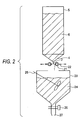
- Fig. 2 is a schematic view showing a typical arrangement in which a solid material package is opened.
- Fig. 2 is a view for conceptually depicting a process where a package is opened and a solid material housed therein is discharged from the container.
- the main body 5 of the solid material package is fixed on the opening device so that the pulling flap 1 is placed at the bottom.
- a grip 21 is disposed at the tip of a pulling unit 22.
- a pair of grips 21 grips the pair of pulling flaps 1, respectively.
- a pair of pulling units 22 moves in the directions indicated by arrows, whereby the pulling units 22, and accordingly the pulling flaps 1, and further the seal section 2, are pulled to thus peel off a seal. Consequently, a solid material 6 is discharged from the container.
- the thus-discharged solid material is automatically dispensed in a dissolution bath 23 such as a processing solution preparation tank in the embodiment shown in Fig. 2, whereby a solution 24 such as a photographic-processing solution is prepared.
- a dissolution bath 23 such as a processing solution preparation tank in the embodiment shown in Fig. 2, whereby a solution 24 such as a photographic-processing solution is prepared.
- the prepared solution is sent from a discharge port 27 to a replenishment tank, a processing tank, or the like in accordance with its purpose by way of a discharge valve 26.
- Fig. 3 is a perspective view showing a way in which a seal is peeled off in the comparative example of the invention with the opening section 3 of a package on the top.
- the pulling directions are indicated by two arrows pointing in opposite directions.
- the opened result obtained by means of such a pulling is revealed such that a corner indicated with a round frame 32 in the seal section 2 is peeled off obliquely, which causes non-smooth discharge.
- FIG. 4 A first embodiment of an opening device of the invention will be described by reference to Figs. 4 to 6.
- A shows that a solidmaterial package is attached to the opening device, wherein the package is in an inverted posture (an opening section is located at the bottom);
- B shows package supporting unit 41 for fixedly supporting the solid material package on the opening device; and
- C shows an opening mechanism which grips andpulls the opening section of the package to thus open the package and which also moves the package upward in a coordinated manner with opening of the package.
- engagement holes 31 to be gripped through engagement are formed in the pulling flap 1.
- the package main body 5 is surrounded by the fixedly-supporting units 41, and fixed to an unillustrated pillar by units of a stop 42.
- An elevating column 43 is disposed downward from the fixedly-supporting units 41.
- a rack 49 to be engaged with a gear 48 which rotates in conjunctionwith travel of movable pieces 44 is disposed on the side face of the elevating column 43.
- Each of the movable pieces 44 includes a grip 46.
- Protrusions 45 which fit in the engagement holes 31 to thus strengthen gripping are disposed on the surface of the grip 46.
- Each of the movable pieces 44 is movably positioned on a rail 51 of the pulling units while being supported by wheels 52 and 53.
- Fig. 5 is an elevation view of the opening unit supporting the package. As shown in Fig. 5, each of the movable pieces 44 is movably positioned on the corresponding rail 51 of the pulling units while being supported by the wheels 52 and 53. The pair of movable pieces 44 contact with each other, thereby forming a joint face 47.
- the main body 5 is fixed by the package supporting unit 41.
- Preparation for opening is completed in a state where the sealing section 2 of the package is pinched between the joint face 47 of the movable pieces 44, and the pulling flaps 1 are gripped by the grips 46.
- the sealing section 2 is peeled off, whereby opening is effected.
- the solid material in the packaging container is discharged downward by way of an opened portion made by the opening.
- the solid material package is raised upward in conjunction with movingof the movable pieces 44 by a gear system constituted of the gear 48 connected to the movable pieces 44, the rack 49 to be engaged with the gear 48, and the elevating column 43 having the rack 49.
- the roof section 4 of the package forms a plane with the main body 5, the opening is completed.
- the upward moving distance of the package at this time corresponds to a difference between the height of the package before the start of moving and that after completion of moving.
- pulling directions of the pulling flaps 1 are, as indicated by two arrows, opposite directions within a plane which includes the pair of pulling flaps 1 and which is perpendicular to a vertical moving direction of the solid material.
- the pulling directions of the pulling flaps 1 are not necessarily within a single plane, and can be arbitrary so long as an opening angle formed by the planes of the pair of pulling flaps 1 falls within the range of 0 to 180°.
- a solid material is thoroughly discharged in a short time, andno residual chemical is recognized inside the container. In addition, splashing of the solid material does not occur.
- Fig. 6 shows a peeling condition of the seal section at this time. The sealing section within the round frame 32 in Fig. 6 is peeled off vertically against the sealed face. The drawing also shows that deformation which may result in incomplete discharge is not found on the container main body. In this respect, the embodiment shows distinct dissimilarities from the comparative example shown in Fig. 3.
- Fig. 7 is a view corresponding to Fig. 5 of the first embodiment.
- the movable pieces 44 which fixedly support the solid material package 41 onto the opening device in an inverted state, and grip and pull the pulling units 1 to thus effect opening, are shown in the lowerportion of the drawing.
- Each of the movable pieces 44 is movably positioned on the corresponding rail 51 of the pulling units while being supported by wheels 72 and 73.
- the pair of movable pieces 44 are in contact with each other, thereby forming the joint face 47.
- the solid material package main body 5 is fixed by the package supporting unit 41.
- Preparation for opening is completed in a state that the sealing section 2 of the package is pinched between the joint face 47 of the movable pieces 44, and the pulling flaps 1 are gripped by the grips 4 6.
- the pair of movable pieces 44 move in a downwardly oblique direction on the rails 51 of the pulling units while being supported by the wheels 72 and 73, and the pair of pulling flaps 1 gripped by the grips 46 of on the movable pieces 44 are pulled, the sealing section 2 is peeled off, opening is effected.
- the second embodiment does not include a gear system which works in conjunction with moving of the movable pieces 44, and the solid material package is not moved upward.
- an opening angle formed by opposite faces of the pulling flaps is 120°. In such a case that peeling is performed by downward pulling, upward moving of the solid material package is not required.
- a solid material is thoroughly discharged within a short period of time, and no residual chemical is recognized inside the container. In addition, splashing of the solid material does not occur.
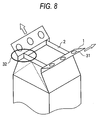
- Fig. 8 shows a peeling condition of the sealing section at this time. The sealing section within the round frame 32 in Fig. 8 is peeled off perpendicular to the sealed face. The drawing also shows that deformation which may result in incomplete discharge is not found on the container main body. In this respect, the embodiment shows distinct dissimilarities from the comparative example shown in Fig. 3.
- the grip which grips the pulling flaps may be of an arbitrary type, so long as it is capable of gripping the pulling flap securely so as to allow peeling off of the sealing section.
- a preferable type makes use of a pinching jig which pinches opposite sides of the pulling flaps so as not to allow sliding.
- Another preferable method is such that an engagement hole is formed in a pulling flap, and a protrusion which fits in the hole is formed in a grip.
- an engagement hole is preferably disposed so as to increase sliding friction as in the case of the fitting type, thereby further increasing strength of gripping the pulling flap.
- a material having a large coefficient of static friction is preferably selected for the surface of the grip.
- a hole is formed in a pulling flap, and a protrusion is disposed on the grip; however, the hole and the protrusion are not necessarily fitted together.
- An essential requirement is to provide sufficient static friction for preventing slide over a contact surface between the pulling flap and the grip.
- a solid material housed in the solid material package, which is an intended object to which the opening device of the invention is applied, is a solid material of an arbitrary form of powder, granular, tablet, or the like.
- the solid material is a solid photographic-processing agent.
- the solid processing agent may be of an arbitrary form among powder, granules, or tablets; and may be a single chemical or a mixed processing agent. Preferred forms 'are granular and tablet.
- powder agents are also applied to powder compositions formed by the following methods. Under one of the methods, respective constituents are pulverized by means of crushing as required so as to adjust grain sizes, or the like; and the respective powder raw materials are mixed in a prescribed ratio. Under another method, the respective constituents are dissolved in a solvent such as water, thereby being pulverized by means of an appropriate drying method such as spray drying.
- a powder processing agent can be manufactured in accordance with a general method as described in JP-A 54-133332, British Patent No. 725892, British Patent No. 729862, German Patent No. 3733861, and the like.
- respective constituents are pulverized as required by means of crushing so as to adjust grain sizes, or the like; and the respective powder raw materials are mixed in a prescribed ratio.
- a method such that the respective constituents are dissolved in a solvent such as water, to thereby be pulverized by means of an appropriate drying method such as spray drying.
- an appropriate binder is added for enhancing mechanical strength or stability of the tablet agents.
- a binder there may be employed for instance, a water-soluble binder such as a polyvinyl alcohol, a methylcellulose, or a binder described in JP-A5-333507 ([0066]).
- the tablet processing agents can be manufactured, for instance, in accordance with a general method as described in JP-A 51-61837, JP-A 54-155038, JP-A 52-88025, British Patent No. 1213808, and the like. Tablets can also be manufactured in accordance with (2), (4), (5), or (6), particularly (2) and (4), of granulation methods described in "Granulation Handbook," which will be described later, as granulation methods for granular processing agents.
- a shape of a tablet which may be any of spherical, tabular, disc-like, indefinite, and the like.
- a size of the tablet so long as it allows easy handling; however, the longitudinal diameter is preferably 5 to 30 mm, more preferably 8 to 20 mm.
- the granular processing agents can be manufactured, for instance, in accordance with a general method as described in JP-A 2-109042, JP-A 2-109043, JP-A 3-39735, JP-A 3-39739, JP-A 2001-183780, and the like.
- the term "spherical granules" refers to granules which are formed by granulating powder into a spherical shape.
- the spherical shape encompasses both a perfect sphere and an imperfect sphere, as well as granular shapes generally referred to as pellet, pill, andbead.
- the mean diameter of the granules is preferably 0.5 to 20 mm, more preferably 1 to 15 mm, particularly preferably 2 to 10 mm. Effects of the invention are prominent when granules whose mean diameter is 0.5 mm or smaller account for 10 wt% or less of a granular solid processing agent, particularly preferably 0 to 5 wt%.
- Preferred types of a granular solid processing agent used in the invention include granules of a core-shell type and those having a multi-layered structure.
- a granular solid processing agent When such a granular solid processing agent is employed, components which are less prone to consolidation or deliquescence can be disposed on a surface-coating layer, which brings about greater effects in attaining the object of the invention.
- JP-A 2001-183779 [0018] to [0027] and embodiments
- JP-A 2001-183780 [0021] to [0028] and embodiments
- a processing agent container there may be employed containers described in JP-A 2001-183779 ([0029] to [0033]) and JP-A 2001-183780 ([0030] to [0034]).
- Granules canbe formed in various shapes, such as spherical, cylindrical, prism-like, and indefinite.
- the mean diameter of the granules is preferably 0.1 to 10 mm, more preferably 0.2 to 8 mm, particularly preferably 0.3 to 5 mm.
- Granules according to the invention can be manufactured in accordance with any of a variety of known granulation methods, including manufacturing methods for granules of a core-shell type or a multi-layered structure.
- a variety of granulation methods applicable to the invent ion are described in "Granulation Handbook” (edited by The Association of Powder Process Industry and Engineering, Japan), and are also described in, e.g., JP-A 4-221951 and JP-A 2-109043, and the like.
- Surfaces of the tablet or granular processing agents may be coated with water-soluble polymers for the purpose of protecting the surfaces and enhancing solubility.
- water-soluble polymers for the purpose of protecting the surfaces and enhancing solubility.
- No particular restriction is imposed on the type of a water-soluble polymer used for coating, and one or more polymers selected from synthetic, semisynthetic, and natural water-soluble polymers canbe used.
- polymers include gelatin, pectin, polyacrylic acids, polyacrylates, polyvinyl alcohol, modified polyvinyl alcohol, polyvinyl pyrrolidone, polyvinyl pyrrolidone/vinyl acetate copolymer, polyethylene glycol, sodium carboxymethylcellulose,hydroxypropylmethylcellulose, hydroxyethyl cellulose, hydroxypropyl cellulose, methyl cellulose, ethyl cellulose, alginates, xanthangum, gum arabic, gum tragacanth, karaya gum, carrageenan, and methyl vinyl ether/maleic anhydride copolymer.
- polyethylene glycol, polyvinyl pyrrolidone, hydroxypropyl cellulose, methyl cellulose, gum arabic, and carrageenan are preferably used singly or in combination of two or more thereof.
- a coating method for water-soluble polymers a known method can be used without particular restrictions. However, the rolling, agitation, fluidized-bed, coating, fusion, or atomization-drying granulation process is preferably employed. Amethod of applying spray-coating on the surface of each granule with a 1 to 50% aqueous polymer solution, and drying the polymer is particularly preferable.
- the solid processing agent according to the invention may be arbitrary solid agent, such as a color developer, agents involved in a de-silvering process (a fixing agent, a bleaching agent, a bleach-fixing agent) , and a rinsing agent.
- a color developer agents involved in a de-silvering process
- agents involved in a de-silvering process a fixing agent, a bleaching agent, a bleach-fixing agent
- rinsing agent rinsing agent.
- the solid processing agent is also applicable to a black-and-white developing agent, a reducer for use in photoengraving, a photographic-processing tank cleaning agent, and the like.
- the most general object to which is applied the opening device for a solid material package of the invention is an automatic photographic processing solution preparation device.
- the automatic photographic processing solution preparation device which is equipped with the automatic opening device of the invention ⁇ opens a solid material package automatically, and dispenses the solid material into a processing solution preparation tank, thereby preparing a processing solution.
- Fig. 2 shows the automatic photographic processing solution preparation device.
- the main body 5 of the package which houses the solid material 6 in the upper portion of the processing solution preparation tank (dissolution bath) 23 in Fig. 2 is opened by means such that the sealing section 2 is pulled by the grip 21 of the opening device. Accordingly, the solid material 6 is discharged, mixed, and dissolved in the solution 24, whereby a processing solution such as a replenisher is prepared.
- a solid material can be rapidly discharged without dirtying the operator's hands, easily, and without leaving residues inside the container.
- a stationary replenisher is replenished by means of mixing in the processing tank.
- the opening device for a solid material package of the invention can be mounted above the solid replenisher storage tank. Accordingly, a package of a solidprocessing agent is automatically opened and dispensed in the solid replenisher storage tank, whereby operability can be enhanced. More specifically, an embodiment such that the opening device for a solid material package of the invention is located above the solid processing agent storage tank 100 shown in Fig. 5 of JP-A 2003-207825 so that solid materials are dispensed in the storage tank 100 as a result of opening is preferable.
- photosensitive material processing device which includes the automatic opening device ⁇ automatically opens a solid processing agent, dispenses the solid processing agent into a replenisher preparation tank to prepare a replenisher, sends the thus-prepared replenisher to a replenishment tank, and performs replenishment from the replenishment tank to a processing tank.
- the experiment used the granular color developer of test number 5 in Table 1 in Example 1 of JP-A 2001-183779 which had been prepared in accordance with the descriptions about the embodiments of the specification.
- a gable-top-type container made of a sheet material having a structure of PE/paper/PE/aluminum foil/PET/PE/PEF was used.
- the main body of the container is of a prism-like shape having a cross-section of 85mm square and a height of 250 mm.
- the roof section thereof is 50 mm in extended length, 10 mm in sealed width of the opening section, and 30 mm in width of the pulling flap.
- constituent materials of the laminated material included paper of BKP (bleached kraft pulp) having a basis weight of 300 g, PE of stretched LDPE (low density polyethylene) sheet of 60 ⁇ m thickness for every PE, aluminum foil having a thickness of 12 ⁇ m, PET having a thickness of 12 ⁇ m, and PEF having a thickness of 12 ⁇ m.
- BKP bleacheched kraft pulp
- PE of stretched LDPE low density polyethylene
- the container which housed 1,500 g of the granular processing agent, was subjected to heat sealing with use of a commercially-available heat-hardening adhesive with a sealing pressure of 1 t under 370°C, thereby preparing a solid material package.
- an opening test was repeatedly performed with an opening angle formed by the pulling flaps of 180°, and sealing temperatures of 300°C and 370°C, 3 times each.
- the opening strength was determined by use of a commercially available tensile tester (Orientec Tensilon RTA-1T).
- Table 1 The results are shown in Table 1 (in Tables 1, 2, "n” indicates the number of repetitions).
- Opening angles formed by the pulling flaps were 40° and 90°, and sealing temperatures were 300°C and 370°C.
- Tests 1 and 2 were conducted, except that the granular bleach-fix processing agent of test number 6 in Table 3 in Example 3 of JP-A 2001-183779 which had been prepared in accordance with the description thereof was used as the solid processing agents.
- the results of opening in the tests were favorable, as in the case where the granular color developer was filled in the solid material package.
Landscapes
- Physics & Mathematics (AREA)
- General Physics & Mathematics (AREA)
- Control And Other Processes For Unpacking Of Materials (AREA)
- Photographic Developing Apparatuses (AREA)
- Photographic Processing Devices Using Wet Methods (AREA)
Applications Claiming Priority (2)
| Application Number | Priority Date | Filing Date | Title |
|---|---|---|---|
| JP2004016614A JP2005206216A (ja) | 2004-01-26 | 2004-01-26 | 固形物包装体の自動開封装置、写真処理液調製装置及び写真処理装置 |
| JP2004016614 | 2004-01-26 |
Publications (2)
| Publication Number | Publication Date |
|---|---|
| EP1560067A2 true EP1560067A2 (de) | 2005-08-03 |
| EP1560067A3 EP1560067A3 (de) | 2011-08-03 |
Family
ID=34650747
Family Applications (1)
| Application Number | Title | Priority Date | Filing Date |
|---|---|---|---|
| EP05001480A Withdrawn EP1560067A3 (de) | 2004-01-26 | 2005-01-25 | Automatische Öffnungsvorrichtung für ein Paketfestes Material, Vorbereitungsvorrichtung für eine photographische Behandlungslösung und photographische Behandlungsvorrichtung |
Country Status (3)
| Country | Link |
|---|---|
| US (1) | US7100347B2 (de) |
| EP (1) | EP1560067A3 (de) |
| JP (1) | JP2005206216A (de) |
Family Cites Families (13)
| Publication number | Priority date | Publication date | Assignee | Title |
|---|---|---|---|---|
| US2459678A (en) * | 1947-02-07 | 1949-01-18 | Arden Farms Co | Carton opener |
| US2852900A (en) * | 1955-03-24 | 1958-09-23 | Ex Cell O Corp | Flat top carton infeed unit for filling machine |
| US2860467A (en) * | 1955-09-15 | 1958-11-18 | Ex Cell O Corp | Container opening mechanism |
| US2871640A (en) * | 1957-12-18 | 1959-02-03 | Bloomer Bros Co | Means for opening carton folding closure flaps |
| US2871641A (en) * | 1957-12-18 | 1959-02-03 | Bloomer Bros Co | Device for opening carton closure flaps |
| DE3345951A1 (de) * | 1982-12-23 | 1984-06-28 | The Japan Tobacco & Salt Public Corp., Tokyo | Verfahren und vorrichtung zum auspacken von gepresstem material, insbesondere tabakblaettern |
| JPH04338943A (ja) | 1991-04-10 | 1992-11-26 | Konica Corp | ハロゲン化銀写真感光材料用処理剤キット |
| JP2553541Y2 (ja) | 1992-05-21 | 1997-11-05 | コニカ株式会社 | 写真用固形処理剤キットの包装形態および自動調液装置 |
| US5400105A (en) * | 1992-10-30 | 1995-03-21 | Konica Corporation | Automatic processing machine for silver halide photographic light-sensitive materials |
| JP3529572B2 (ja) * | 1996-12-27 | 2004-05-24 | 富士写真フイルム株式会社 | 写真処理剤用容器及び写真処理剤供給装置 |
| US5826405A (en) * | 1997-05-16 | 1998-10-27 | W. R. Grace & Co.-Conn | Method and apparatus for opening taped bags |
| JP2000181044A (ja) * | 1998-12-17 | 2000-06-30 | Konica Corp | 感光材料用固形処理剤包装体、感光材料用固形処理剤補充装置および感光材料用固形処理剤補充方法 |
| JP3902502B2 (ja) | 2002-04-17 | 2007-04-11 | 富士フイルム株式会社 | 感光材料処理装置 |
-
2004
- 2004-01-26 JP JP2004016614A patent/JP2005206216A/ja active Pending
-
2005
- 2005-01-25 EP EP05001480A patent/EP1560067A3/de not_active Withdrawn
- 2005-01-26 US US11/042,088 patent/US7100347B2/en not_active Expired - Lifetime
Also Published As
| Publication number | Publication date |
|---|---|
| EP1560067A3 (de) | 2011-08-03 |
| US20050163601A1 (en) | 2005-07-28 |
| US7100347B2 (en) | 2006-09-05 |
| JP2005206216A (ja) | 2005-08-04 |
Similar Documents
| Publication | Publication Date | Title |
|---|---|---|
| US6509072B2 (en) | Multi-layer film with periodic barrier coating and methods of making and using such film | |
| JPH03505074A (ja) | 製品のためのパツケージ | |
| US7100347B2 (en) | Automatic opening device for solid material package, preparation device for photographic-processing solution, and photographic-processing device | |
| US5240822A (en) | Packed photographic solid processing agents | |
| PT95828A (pt) | Recipiente para conter em seguranca residuos perigosos e metodo para a sua producao | |
| CN1030831C (zh) | 封口包装 | |
| JPH10509676A (ja) | 少なくとも2つの相互に反応する写真薬剤の包装方法及びそのパッケージ | |
| EP1574900A1 (de) | Packung für photographische Behandlungsagenzien in fester Form | |
| EP0469877B1 (de) | Verpackte, feste, photographische Behandlungsstoffe | |
| JP3703065B2 (ja) | 写真処理剤組成物容器の開栓・洗浄装置 | |
| JP2005292811A (ja) | 固形写真処理剤包装体 | |
| JP2005352241A (ja) | 写真処理剤用容器、写真処理剤用容器の自動開封装置、写真処理液調製装置及び写真処理装置 | |
| US5246327A (en) | Apparatus and method for precisely dispensing solid materials | |
| JP3273260B2 (ja) | 感光材料用処理剤の取出し方法 | |
| US20230383074A1 (en) | Multilayered polyvinyl alcohol films and methods for making same | |
| JPH06186720A (ja) | ハロゲン化銀写真処理感光材料用自動現像機 | |
| JP5801076B2 (ja) | 薬剤容器及びその製造方法 | |
| CN1040552A (zh) | 液体产品的包装 | |
| JP3350757B2 (ja) | 感光材料用現像機、調液装置 | |
| JPH06161080A (ja) | ハロゲン化銀写真感光材料用自動現像機 | |
| WO2003029102A1 (en) | Unit dose laundering products | |
| JP3458213B2 (ja) | 感光材料用現像機調液装置 | |
| JPH06161072A (ja) | ハロゲン化銀写真感光材料用自動現像機 | |
| JPH06202298A (ja) | ハロゲン化銀写真感光材料用自動現像機 | |
| JPH1035743A (ja) | 写真感光材料用固形処理剤包装体及び処理剤供給方法 |
Legal Events
| Date | Code | Title | Description |
|---|---|---|---|
| PUAI | Public reference made under article 153(3) epc to a published international application that has entered the european phase |
Free format text: ORIGINAL CODE: 0009012 |
|
| AK | Designated contracting states |
Kind code of ref document: A2 Designated state(s): AT BE BG CH CY CZ DE DK EE ES FI FR GB GR HU IE IS IT LI LT LU MC NL PL PT RO SE SI SK TR |
|
| AX | Request for extension of the european patent |
Extension state: AL BA HR LV MK YU |
|
| RAP1 | Party data changed (applicant data changed or rights of an application transferred) |
Owner name: FUJIFILM CORPORATION |
|
| PUAL | Search report despatched |
Free format text: ORIGINAL CODE: 0009013 |
|
| AK | Designated contracting states |
Kind code of ref document: A3 Designated state(s): AT BE BG CH CY CZ DE DK EE ES FI FR GB GR HU IE IS IT LI LT LU MC NL PL PT RO SE SI SK TR |
|
| AX | Request for extension of the european patent |
Extension state: AL BA HR LV MK YU |
|
| RIC1 | Information provided on ipc code assigned before grant |
Ipc: G03D 3/06 20060101AFI20110627BHEP |
|
| AKY | No designation fees paid | ||
| REG | Reference to a national code |
Ref country code: DE Ref legal event code: R108 Effective date: 20120411 |
|
| STAA | Information on the status of an ep patent application or granted ep patent |
Free format text: STATUS: THE APPLICATION IS DEEMED TO BE WITHDRAWN |
|
| 18D | Application deemed to be withdrawn |
Effective date: 20120206 |