EP1555254B1 - Method for manufacturing porous honeycomb structure and honeycomb body - Google Patents
Method for manufacturing porous honeycomb structure and honeycomb body Download PDFInfo
- Publication number
- EP1555254B1 EP1555254B1 EP03754210A EP03754210A EP1555254B1 EP 1555254 B1 EP1555254 B1 EP 1555254B1 EP 03754210 A EP03754210 A EP 03754210A EP 03754210 A EP03754210 A EP 03754210A EP 1555254 B1 EP1555254 B1 EP 1555254B1
- Authority
- EP
- European Patent Office
- Prior art keywords
- mass
- aggregate particle
- parts
- honeycomb structure
- particle material
- Prior art date
- Legal status (The legal status is an assumption and is not a legal conclusion. Google has not performed a legal analysis and makes no representation as to the accuracy of the status listed.)
- Expired - Lifetime
Links
Images

Classifications
-
- B—PERFORMING OPERATIONS; TRANSPORTING
- B01—PHYSICAL OR CHEMICAL PROCESSES OR APPARATUS IN GENERAL
- B01D—SEPARATION
- B01D46/00—Filters or filtering processes specially modified for separating dispersed particles from gases or vapours
- B01D46/0001—Making filtering elements
-
- C—CHEMISTRY; METALLURGY
- C04—CEMENTS; CONCRETE; ARTIFICIAL STONE; CERAMICS; REFRACTORIES
- C04B—LIME, MAGNESIA; SLAG; CEMENTS; COMPOSITIONS THEREOF, e.g. MORTARS, CONCRETE OR LIKE BUILDING MATERIALS; ARTIFICIAL STONE; CERAMICS; REFRACTORIES; TREATMENT OF NATURAL STONE
- C04B38/00—Porous mortars, concrete, artificial stone or ceramic ware; Preparation thereof
- C04B38/06—Porous mortars, concrete, artificial stone or ceramic ware; Preparation thereof by burning-out added substances by burning natural expanding materials or by sublimating or melting out added substances
-
- B—PERFORMING OPERATIONS; TRANSPORTING
- B01—PHYSICAL OR CHEMICAL PROCESSES OR APPARATUS IN GENERAL
- B01D—SEPARATION
- B01D46/00—Filters or filtering processes specially modified for separating dispersed particles from gases or vapours
- B01D46/24—Particle separators, e.g. dust precipitators, using rigid hollow filter bodies
- B01D46/2403—Particle separators, e.g. dust precipitators, using rigid hollow filter bodies characterised by the physical shape or structure of the filtering element
- B01D46/2418—Honeycomb filters
-
- B—PERFORMING OPERATIONS; TRANSPORTING
- B01—PHYSICAL OR CHEMICAL PROCESSES OR APPARATUS IN GENERAL
- B01J—CHEMICAL OR PHYSICAL PROCESSES, e.g. CATALYSIS OR COLLOID CHEMISTRY; THEIR RELEVANT APPARATUS
- B01J37/00—Processes, in general, for preparing catalysts; Processes, in general, for activation of catalysts
- B01J37/0009—Use of binding agents; Moulding; Pressing; Powdering; Granulating; Addition of materials ameliorating the mechanical properties of the product catalyst
- B01J37/0018—Addition of a binding agent or of material, later completely removed among others as result of heat treatment, leaching or washing,(e.g. forming of pores; protective layer, desintegrating by heat)
-
- B—PERFORMING OPERATIONS; TRANSPORTING
- B22—CASTING; POWDER METALLURGY
- B22F—WORKING METALLIC POWDER; MANUFACTURE OF ARTICLES FROM METALLIC POWDER; MAKING METALLIC POWDER; APPARATUS OR DEVICES SPECIALLY ADAPTED FOR METALLIC POWDER
- B22F3/00—Manufacture of workpieces or articles from metallic powder characterised by the manner of compacting or sintering; Apparatus specially adapted therefor ; Presses and furnaces
- B22F3/10—Sintering only
- B22F3/11—Making porous workpieces or articles
- B22F3/1103—Making porous workpieces or articles with particular physical characteristics
- B22F3/1115—Making porous workpieces or articles with particular physical characteristics comprising complex forms, e.g. honeycombs
-
- C—CHEMISTRY; METALLURGY
- C04—CEMENTS; CONCRETE; ARTIFICIAL STONE; CERAMICS; REFRACTORIES
- C04B—LIME, MAGNESIA; SLAG; CEMENTS; COMPOSITIONS THEREOF, e.g. MORTARS, CONCRETE OR LIKE BUILDING MATERIALS; ARTIFICIAL STONE; CERAMICS; REFRACTORIES; TREATMENT OF NATURAL STONE
- C04B35/00—Shaped ceramic products characterised by their composition; Ceramics compositions; Processing powders of inorganic compounds preparatory to the manufacturing of ceramic products
- C04B35/01—Shaped ceramic products characterised by their composition; Ceramics compositions; Processing powders of inorganic compounds preparatory to the manufacturing of ceramic products based on oxide ceramics
- C04B35/10—Shaped ceramic products characterised by their composition; Ceramics compositions; Processing powders of inorganic compounds preparatory to the manufacturing of ceramic products based on oxide ceramics based on aluminium oxide
- C04B35/111—Fine ceramics
-
- C—CHEMISTRY; METALLURGY
- C04—CEMENTS; CONCRETE; ARTIFICIAL STONE; CERAMICS; REFRACTORIES
- C04B—LIME, MAGNESIA; SLAG; CEMENTS; COMPOSITIONS THEREOF, e.g. MORTARS, CONCRETE OR LIKE BUILDING MATERIALS; ARTIFICIAL STONE; CERAMICS; REFRACTORIES; TREATMENT OF NATURAL STONE
- C04B35/00—Shaped ceramic products characterised by their composition; Ceramics compositions; Processing powders of inorganic compounds preparatory to the manufacturing of ceramic products
- C04B35/01—Shaped ceramic products characterised by their composition; Ceramics compositions; Processing powders of inorganic compounds preparatory to the manufacturing of ceramic products based on oxide ceramics
- C04B35/16—Shaped ceramic products characterised by their composition; Ceramics compositions; Processing powders of inorganic compounds preparatory to the manufacturing of ceramic products based on oxide ceramics based on silicates other than clay
- C04B35/18—Shaped ceramic products characterised by their composition; Ceramics compositions; Processing powders of inorganic compounds preparatory to the manufacturing of ceramic products based on oxide ceramics based on silicates other than clay rich in aluminium oxide
- C04B35/185—Mullite 3Al2O3-2SiO2
-
- C—CHEMISTRY; METALLURGY
- C04—CEMENTS; CONCRETE; ARTIFICIAL STONE; CERAMICS; REFRACTORIES
- C04B—LIME, MAGNESIA; SLAG; CEMENTS; COMPOSITIONS THEREOF, e.g. MORTARS, CONCRETE OR LIKE BUILDING MATERIALS; ARTIFICIAL STONE; CERAMICS; REFRACTORIES; TREATMENT OF NATURAL STONE
- C04B35/00—Shaped ceramic products characterised by their composition; Ceramics compositions; Processing powders of inorganic compounds preparatory to the manufacturing of ceramic products
- C04B35/01—Shaped ceramic products characterised by their composition; Ceramics compositions; Processing powders of inorganic compounds preparatory to the manufacturing of ceramic products based on oxide ceramics
- C04B35/16—Shaped ceramic products characterised by their composition; Ceramics compositions; Processing powders of inorganic compounds preparatory to the manufacturing of ceramic products based on oxide ceramics based on silicates other than clay
- C04B35/18—Shaped ceramic products characterised by their composition; Ceramics compositions; Processing powders of inorganic compounds preparatory to the manufacturing of ceramic products based on oxide ceramics based on silicates other than clay rich in aluminium oxide
- C04B35/19—Alkali metal aluminosilicates, e.g. spodumene
-
- C—CHEMISTRY; METALLURGY
- C04—CEMENTS; CONCRETE; ARTIFICIAL STONE; CERAMICS; REFRACTORIES
- C04B—LIME, MAGNESIA; SLAG; CEMENTS; COMPOSITIONS THEREOF, e.g. MORTARS, CONCRETE OR LIKE BUILDING MATERIALS; ARTIFICIAL STONE; CERAMICS; REFRACTORIES; TREATMENT OF NATURAL STONE
- C04B35/00—Shaped ceramic products characterised by their composition; Ceramics compositions; Processing powders of inorganic compounds preparatory to the manufacturing of ceramic products
- C04B35/01—Shaped ceramic products characterised by their composition; Ceramics compositions; Processing powders of inorganic compounds preparatory to the manufacturing of ceramic products based on oxide ceramics
- C04B35/16—Shaped ceramic products characterised by their composition; Ceramics compositions; Processing powders of inorganic compounds preparatory to the manufacturing of ceramic products based on oxide ceramics based on silicates other than clay
- C04B35/18—Shaped ceramic products characterised by their composition; Ceramics compositions; Processing powders of inorganic compounds preparatory to the manufacturing of ceramic products based on oxide ceramics based on silicates other than clay rich in aluminium oxide
- C04B35/195—Alkaline earth aluminosilicates, e.g. cordierite or anorthite
-
- C—CHEMISTRY; METALLURGY
- C04—CEMENTS; CONCRETE; ARTIFICIAL STONE; CERAMICS; REFRACTORIES
- C04B—LIME, MAGNESIA; SLAG; CEMENTS; COMPOSITIONS THEREOF, e.g. MORTARS, CONCRETE OR LIKE BUILDING MATERIALS; ARTIFICIAL STONE; CERAMICS; REFRACTORIES; TREATMENT OF NATURAL STONE
- C04B35/00—Shaped ceramic products characterised by their composition; Ceramics compositions; Processing powders of inorganic compounds preparatory to the manufacturing of ceramic products
- C04B35/01—Shaped ceramic products characterised by their composition; Ceramics compositions; Processing powders of inorganic compounds preparatory to the manufacturing of ceramic products based on oxide ceramics
- C04B35/46—Shaped ceramic products characterised by their composition; Ceramics compositions; Processing powders of inorganic compounds preparatory to the manufacturing of ceramic products based on oxide ceramics based on titanium oxides or titanates
- C04B35/462—Shaped ceramic products characterised by their composition; Ceramics compositions; Processing powders of inorganic compounds preparatory to the manufacturing of ceramic products based on oxide ceramics based on titanium oxides or titanates based on titanates
- C04B35/478—Shaped ceramic products characterised by their composition; Ceramics compositions; Processing powders of inorganic compounds preparatory to the manufacturing of ceramic products based on oxide ceramics based on titanium oxides or titanates based on titanates based on aluminium titanates
-
- C—CHEMISTRY; METALLURGY
- C04—CEMENTS; CONCRETE; ARTIFICIAL STONE; CERAMICS; REFRACTORIES
- C04B—LIME, MAGNESIA; SLAG; CEMENTS; COMPOSITIONS THEREOF, e.g. MORTARS, CONCRETE OR LIKE BUILDING MATERIALS; ARTIFICIAL STONE; CERAMICS; REFRACTORIES; TREATMENT OF NATURAL STONE
- C04B35/00—Shaped ceramic products characterised by their composition; Ceramics compositions; Processing powders of inorganic compounds preparatory to the manufacturing of ceramic products
- C04B35/515—Shaped ceramic products characterised by their composition; Ceramics compositions; Processing powders of inorganic compounds preparatory to the manufacturing of ceramic products based on non-oxide ceramics
- C04B35/56—Shaped ceramic products characterised by their composition; Ceramics compositions; Processing powders of inorganic compounds preparatory to the manufacturing of ceramic products based on non-oxide ceramics based on carbides or oxycarbides
- C04B35/565—Shaped ceramic products characterised by their composition; Ceramics compositions; Processing powders of inorganic compounds preparatory to the manufacturing of ceramic products based on non-oxide ceramics based on carbides or oxycarbides based on silicon carbide
-
- C—CHEMISTRY; METALLURGY
- C04—CEMENTS; CONCRETE; ARTIFICIAL STONE; CERAMICS; REFRACTORIES
- C04B—LIME, MAGNESIA; SLAG; CEMENTS; COMPOSITIONS THEREOF, e.g. MORTARS, CONCRETE OR LIKE BUILDING MATERIALS; ARTIFICIAL STONE; CERAMICS; REFRACTORIES; TREATMENT OF NATURAL STONE
- C04B35/00—Shaped ceramic products characterised by their composition; Ceramics compositions; Processing powders of inorganic compounds preparatory to the manufacturing of ceramic products
- C04B35/515—Shaped ceramic products characterised by their composition; Ceramics compositions; Processing powders of inorganic compounds preparatory to the manufacturing of ceramic products based on non-oxide ceramics
- C04B35/58—Shaped ceramic products characterised by their composition; Ceramics compositions; Processing powders of inorganic compounds preparatory to the manufacturing of ceramic products based on non-oxide ceramics based on borides, nitrides, i.e. nitrides, oxynitrides, carbonitrides or oxycarbonitrides or silicides
- C04B35/584—Shaped ceramic products characterised by their composition; Ceramics compositions; Processing powders of inorganic compounds preparatory to the manufacturing of ceramic products based on non-oxide ceramics based on borides, nitrides, i.e. nitrides, oxynitrides, carbonitrides or oxycarbonitrides or silicides based on silicon nitride
-
- C—CHEMISTRY; METALLURGY
- C04—CEMENTS; CONCRETE; ARTIFICIAL STONE; CERAMICS; REFRACTORIES
- C04B—LIME, MAGNESIA; SLAG; CEMENTS; COMPOSITIONS THEREOF, e.g. MORTARS, CONCRETE OR LIKE BUILDING MATERIALS; ARTIFICIAL STONE; CERAMICS; REFRACTORIES; TREATMENT OF NATURAL STONE
- C04B38/00—Porous mortars, concrete, artificial stone or ceramic ware; Preparation thereof
- C04B38/0006—Honeycomb structures
-
- B—PERFORMING OPERATIONS; TRANSPORTING
- B22—CASTING; POWDER METALLURGY
- B22F—WORKING METALLIC POWDER; MANUFACTURE OF ARTICLES FROM METALLIC POWDER; MAKING METALLIC POWDER; APPARATUS OR DEVICES SPECIALLY ADAPTED FOR METALLIC POWDER
- B22F2999/00—Aspects linked to processes or compositions used in powder metallurgy
-
- C—CHEMISTRY; METALLURGY
- C04—CEMENTS; CONCRETE; ARTIFICIAL STONE; CERAMICS; REFRACTORIES
- C04B—LIME, MAGNESIA; SLAG; CEMENTS; COMPOSITIONS THEREOF, e.g. MORTARS, CONCRETE OR LIKE BUILDING MATERIALS; ARTIFICIAL STONE; CERAMICS; REFRACTORIES; TREATMENT OF NATURAL STONE
- C04B2235/00—Aspects relating to ceramic starting mixtures or sintered ceramic products
- C04B2235/02—Composition of constituents of the starting material or of secondary phases of the final product
- C04B2235/30—Constituents and secondary phases not being of a fibrous nature
- C04B2235/32—Metal oxides, mixed metal oxides, or oxide-forming salts thereof, e.g. carbonates, nitrates, (oxy)hydroxides, chlorides
- C04B2235/3201—Alkali metal oxides or oxide-forming salts thereof
-
- C—CHEMISTRY; METALLURGY
- C04—CEMENTS; CONCRETE; ARTIFICIAL STONE; CERAMICS; REFRACTORIES
- C04B—LIME, MAGNESIA; SLAG; CEMENTS; COMPOSITIONS THEREOF, e.g. MORTARS, CONCRETE OR LIKE BUILDING MATERIALS; ARTIFICIAL STONE; CERAMICS; REFRACTORIES; TREATMENT OF NATURAL STONE
- C04B2235/00—Aspects relating to ceramic starting mixtures or sintered ceramic products
- C04B2235/02—Composition of constituents of the starting material or of secondary phases of the final product
- C04B2235/30—Constituents and secondary phases not being of a fibrous nature
- C04B2235/32—Metal oxides, mixed metal oxides, or oxide-forming salts thereof, e.g. carbonates, nitrates, (oxy)hydroxides, chlorides
- C04B2235/3217—Aluminum oxide or oxide forming salts thereof, e.g. bauxite, alpha-alumina
- C04B2235/3218—Aluminium (oxy)hydroxides, e.g. boehmite, gibbsite, alumina sol
-
- C—CHEMISTRY; METALLURGY
- C04—CEMENTS; CONCRETE; ARTIFICIAL STONE; CERAMICS; REFRACTORIES
- C04B—LIME, MAGNESIA; SLAG; CEMENTS; COMPOSITIONS THEREOF, e.g. MORTARS, CONCRETE OR LIKE BUILDING MATERIALS; ARTIFICIAL STONE; CERAMICS; REFRACTORIES; TREATMENT OF NATURAL STONE
- C04B2235/00—Aspects relating to ceramic starting mixtures or sintered ceramic products
- C04B2235/02—Composition of constituents of the starting material or of secondary phases of the final product
- C04B2235/30—Constituents and secondary phases not being of a fibrous nature
- C04B2235/34—Non-metal oxides, non-metal mixed oxides, or salts thereof that form the non-metal oxides upon heating, e.g. carbonates, nitrates, (oxy)hydroxides, chlorides
- C04B2235/3418—Silicon oxide, silicic acids or oxide forming salts thereof, e.g. silica sol, fused silica, silica fume, cristobalite, quartz or flint
-
- C—CHEMISTRY; METALLURGY
- C04—CEMENTS; CONCRETE; ARTIFICIAL STONE; CERAMICS; REFRACTORIES
- C04B—LIME, MAGNESIA; SLAG; CEMENTS; COMPOSITIONS THEREOF, e.g. MORTARS, CONCRETE OR LIKE BUILDING MATERIALS; ARTIFICIAL STONE; CERAMICS; REFRACTORIES; TREATMENT OF NATURAL STONE
- C04B2235/00—Aspects relating to ceramic starting mixtures or sintered ceramic products
- C04B2235/02—Composition of constituents of the starting material or of secondary phases of the final product
- C04B2235/30—Constituents and secondary phases not being of a fibrous nature
- C04B2235/42—Non metallic elements added as constituents or additives, e.g. sulfur, phosphor, selenium or tellurium
- C04B2235/428—Silicon
-
- C—CHEMISTRY; METALLURGY
- C04—CEMENTS; CONCRETE; ARTIFICIAL STONE; CERAMICS; REFRACTORIES
- C04B—LIME, MAGNESIA; SLAG; CEMENTS; COMPOSITIONS THEREOF, e.g. MORTARS, CONCRETE OR LIKE BUILDING MATERIALS; ARTIFICIAL STONE; CERAMICS; REFRACTORIES; TREATMENT OF NATURAL STONE
- C04B2235/00—Aspects relating to ceramic starting mixtures or sintered ceramic products
- C04B2235/02—Composition of constituents of the starting material or of secondary phases of the final product
- C04B2235/30—Constituents and secondary phases not being of a fibrous nature
- C04B2235/44—Metal salt constituents or additives chosen for the nature of the anions, e.g. hydrides or acetylacetonate
- C04B2235/449—Organic acids, e.g. EDTA, citrate, acetate, oxalate
-
- F—MECHANICAL ENGINEERING; LIGHTING; HEATING; WEAPONS; BLASTING
- F01—MACHINES OR ENGINES IN GENERAL; ENGINE PLANTS IN GENERAL; STEAM ENGINES
- F01N—GAS-FLOW SILENCERS OR EXHAUST APPARATUS FOR MACHINES OR ENGINES IN GENERAL; GAS-FLOW SILENCERS OR EXHAUST APPARATUS FOR INTERNAL-COMBUSTION ENGINES
- F01N2330/00—Structure of catalyst support or particle filter
- F01N2330/06—Ceramic, e.g. monoliths
-
- F—MECHANICAL ENGINEERING; LIGHTING; HEATING; WEAPONS; BLASTING
- F01—MACHINES OR ENGINES IN GENERAL; ENGINE PLANTS IN GENERAL; STEAM ENGINES
- F01N—GAS-FLOW SILENCERS OR EXHAUST APPARATUS FOR MACHINES OR ENGINES IN GENERAL; GAS-FLOW SILENCERS OR EXHAUST APPARATUS FOR INTERNAL-COMBUSTION ENGINES
- F01N3/00—Exhaust or silencing apparatus having means for purifying, rendering innocuous, or otherwise treating exhaust
- F01N3/02—Exhaust or silencing apparatus having means for purifying, rendering innocuous, or otherwise treating exhaust for cooling, or for removing solid constituents of, exhaust
- F01N3/021—Exhaust or silencing apparatus having means for purifying, rendering innocuous, or otherwise treating exhaust for cooling, or for removing solid constituents of, exhaust by means of filters
- F01N3/022—Exhaust or silencing apparatus having means for purifying, rendering innocuous, or otherwise treating exhaust for cooling, or for removing solid constituents of, exhaust by means of filters characterised by specially adapted filtering structure, e.g. honeycomb, mesh or fibrous
- F01N3/0222—Exhaust or silencing apparatus having means for purifying, rendering innocuous, or otherwise treating exhaust for cooling, or for removing solid constituents of, exhaust by means of filters characterised by specially adapted filtering structure, e.g. honeycomb, mesh or fibrous the structure being monolithic, e.g. honeycombs
-
- Y—GENERAL TAGGING OF NEW TECHNOLOGICAL DEVELOPMENTS; GENERAL TAGGING OF CROSS-SECTIONAL TECHNOLOGIES SPANNING OVER SEVERAL SECTIONS OF THE IPC; TECHNICAL SUBJECTS COVERED BY FORMER USPC CROSS-REFERENCE ART COLLECTIONS [XRACs] AND DIGESTS
- Y10—TECHNICAL SUBJECTS COVERED BY FORMER USPC
- Y10T—TECHNICAL SUBJECTS COVERED BY FORMER US CLASSIFICATION
- Y10T428/00—Stock material or miscellaneous articles
- Y10T428/24—Structurally defined web or sheet [e.g., overall dimension, etc.]
- Y10T428/24149—Honeycomb-like
Definitions
- the present invention relates to a method of manufacturing a porous honeycomb structure preferably for use as a filter for collecting soot, and a honeycomb formed body, particularly to a method of manufacturing a porous honeycomb structure, capable of effectively preventing a situation in which the porous honeycomb structure is cracked or collapsed because of its own weight in manufacturing the porous honeycomb structure having a high porosity, and a honeycomb formed body.
- a porous honeycomb structure formed of a ceramic superior in resistance to heat or corrosion has been used as a filter for collecting soot, for use in applications such as environmental measures for preventing pollution and the like and product recovery from a high-temperature gas in various fields including chemistry, electric power, iron and steel, and industrial waste disposal.
- the porous honeycomb structure formed of a ceramic has been preferably used as a filter for collecting the soot, for use in a high-temperature corrosive gas atmosphere, such as a diesel particulate filter (DPF) which collects particulates discharged from a diesel engine.
- DPF diesel particulate filter
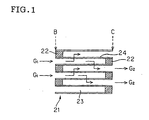
- Examples of the soot collecting filter using the porous honeycomb structure include a structure in which, for example, as shown in FIG. 1 , an inlet-side end face B and an outlet-side end face C of a plurality of cells 23 of a porous honeycomb structure 21 are alternately plugged by plugging portions 22.
- the porous honeycomb structure structured in this manner when a gas G 1 to be treated is introduced into cell 23 from the inlet-side end face B, the particulates are captured by partition walls 24.
- a treated gas G 2 which has flown into the adjacent cell 23 through the porous partition wall 24 is discharged from the outlet-side end face C. Therefore, the treated gas G 2 from which the particulates in the gas G 1 to be treated have been separated can be obtained.
- a method of manufacturing such high-porosity porous honeycomb structure a method of manufacturing a porous honeycomb filter has been described in which a cordierite material, water, additionally a binder (organic binder such as methyl cellulose, a pore former (organic material such as graphite) and the like are kneaded, and a plasticized plastic material (equivalent to formable material, or "clay” mentioned in the present description) is formed, dried, and fired (see, e.g., Japanese Patent Application Laid-Open No. 2002-219319 ). According to the manufacturing method, since the binder or the pore former is burnt down to thereby form pores in firing a formed body, the high-porosity porous honeycomb structure can be obtained.
- WO 00/34202 and WO 01/16049 describe the use of colloidal silica as one of the components of a ceramic composition which is formed by extrusion into a honeycomb shape and fired under conditions such that cordierite is formed by reaction as the primary phase of the fired honeycomb.
- the present invention has been developed in consideration of the above-described problems of the conventional techniques, and an object thereof is to provide a method of manufacturing a porous honeycomb structure, capable of effectively preventing a situation in which the porous honeycomb structure is cracked or collapsed by its own weight in firing a formed body, and a honeycomb formed body.
- the present inventor has found that the above-described object can be achieved, when colloidal particles are contained in clay for use in the forming, and has completed the present invention. That is, according to the present invention, there are provided the following method of manufacturing a porous honeycomb structure as set out in claim 1, and honeycomb formed body as set out in claim 3.
- the formable material contains an alkali metal source corresponding to 0.01 to 10 parts by mass of an alkali metal in terms of the alkali metal with respect to 100 parts by mass of the aggregate particle material.
- the present inventor has first studied reasons why the porous honeycomb structure is cracked or collapsed by its own weight in firing a formed body. As a result, it has been considered as a first reason that when the formed body is fired, a large amount of binder and pore former burn and generate heat, accordingly temperature of the formed body being fired rapidly rises, and a large thermal stress is generated. As a second reason, the binder contained in the clay is gelled, and functions as a reinforcing agent to maintain a mechanical strength of the formed body in the formed body before fired.
- the clay (formable material) for use in the forming contains colloidal particles such as silica sol. Since the colloidal particles harden by dehydration condensation reaction or the like at a comparatively low temperature, the particles function as the reinforcing agent even after the binder burns down, and the drop of the mechanical strength of the formed body (furthermore the porous honeycomb structure) can be prevented.
- At least an aggregate particle material formed of a ceramic and/or a metal, water, an organic binder, a pore former, and colloidal particles are mixed and kneaded to thereby form clay.
- Aggregate particles are particles which constitute main constituting components of a porous honeycomb structure (sintered body), and the aggregate particle material is a raw material substance.
- the aggregate particle material in the present invention contains at least one type of component selected from mullite, alumina, aluminum titanate, lithium aluminum silicate, silicon carbide, silicon nitride, and metal silicon, and a total of the mass of the component occupies 50% by mass or more with respect to a total mass of the aggregate particle material. This is beneficial from a viewpoint of enhancing resistance to heat.
- Metal silicon is not a ceramic, but is sometimes a constituting material of an Si-SiC sintered body in which silicon carbide and metal silicon are the aggregate particle materials.
- the organic binder is an additive which is gelled in the formed body (clay) before fired and which performs a function of a reinforcing agent to maintain the mechanical strength of the formed body. Therefore, as the binder, organic polymers capable of being gelled in the formed body (clay) are preferably usable such as hydroxypropoxyl methyl cellulose, hydroxypropyl methyl cellulose, methyl cellulose, hydroxyethyl cellulose, carboxyl methyl cellulose, and polyvinyl alcohol.
- the pore former is an additive which burns down during the firing of the formed body and which forms pores to thereby increase porosity, so that a high-porosity porous honeycomb structure is obtained. Therefore, examples of the pore former include organic materials which burn down during the firing of the formed body, such as graphite, flour, starch, phenol resin, polymethyl methacrylate, polyethylene, and polyethylene terephthalate. Above all, a microcapsule (acrylic resin-based microcapsule, etc.) formed of a foam resin is especially preferably usable. Since the microcapsule formed of the foam resin is hollow, a high-porosity porous honeycomb structure can be obtained by a small amount of added microcapsule. Additionally, there is an advantage that little heat is generated at a firing time, and generation of thermal stress can be reduced.
- the colloidal particles are additives which harden by dehydration condensation reaction or the like at a comparatively low temperature and which function as the reinforcing agent to bind aggregate particles to one another even after the binder burns down.
- the colloidal particles include colloidal particles formed of an inorganic material which does not burn down during the firing of the formed body, such as silica sol, alumina sol, metal alkoxide, and water glass.
- the colloidal particles whose hardening temperature is low as compared with burning temperature of the binder or the pore former for use are preferably selected from these colloidal particles and used.
- the added amount and composition of the colloidal particles to be added are preferably selected, and used as a part of a starting material in such a manner as to be adapted to a target sintered body composition.
- the clay for use in the forming contains 0.1 to 10 parts by mass of the colloidal particles with respect to 100 parts by mass of the aggregate particle material, more preferably contains 0.2 to 5.0 parts by mass of colloidal particles, and especially preferably contains 0.4 to 2.0 parts by mass of colloidal particles.
- the obtained calcined body has a strength of at least 0.01 kg/cm 2 or more, and a situation in which the calcined body (furthermore the porous honeycomb structure) is cracked or collapsed by its own weight can be effectively prevented (it is to be noted that a method of measuring the above-described strength will be described in detail in paragraphs of examples).
- the content of the colloidal particles is less than the above-described range, the content is unfavorable in that the effect of maintaining the mechanical strength of the calcined body is insufficient after the burn-down of the binder.
- the content exceeds the above-described range, the content is unfavorable in that the effect of maintaining the mechanical strength of the calcined body is fulfilled, but the colloidal particles fill in the pores of the calcined body (furthermore the porous honeycomb structure), and the porosity drops.
- the clay in the present invention needs to contain at least the aggregate particle material, water, organic binder, pore former, and colloidal particles.
- the aggregate particle material contains silicon (cordierite material, mullite, lithium aluminum silicate, silicon carbide, silicon nitride, metal silicon, etc.)
- an alkali metal source is preferably contained.
- the alkali metal source forms hydroxide when dissolved in a water content in the clay, and reacts with silica unavoidably present on the surface of the silicon-containing aggregate particle material to form alkali silicate glass (water glass) (see the following reaction formula (1)).
- This alkali silicate glass functions as the reinforcing agent even after the binder burns down, and the drop of the mechanical strength of the formed body (furthermore the porous honeycomb structure) can be prevented.
- the alkali metal source is not especially limited as long as the material is capable of reacting with water to thereby discharge alkali metal ions, and examples thereof include inorganic salts of alkali metals, such as oxide and hydroxide, and organic salts of alkali metals, such as fatty acid salt.
- the type of the alkali metal is not especially limited, but potassium and sodium are preferable.
- the clay for use in the forming preferably contains an alkali metal source corresponding to 0.01 to 10 parts by mass of a alkali metal in terms of the alkali metal with respect to 100 parts by mass of the aggregate particle material, more preferably contains the alkali metal source corresponding to 0.02 to 5 parts by mass, and especially preferably contains the alkali metal source corresponding to 0.03 to 1 part by mass.
- the above-described clay may contain another additive if necessary.
- a dispersant surfactant
- a dispersant for promoting dispersion into water which is a dispersion medium
- examples of the dispersant include ethylene glycol, dextrin, fatty acid soap, polyalcohol and the like.
- the above-described aggregate particle material, water, organic binder, pore former, colloidal particles and the like are mixed and kneaded, for example, by a vacuum kneading machine to thereby prepare clay having an appropriate viscosity.
- the clay prepared as described above is formed into a honeycomb shape having a plurality of cells constituting through channels of fluids, and dried to thereby obtain a honeycomb formed body.
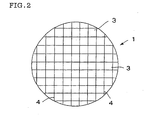
- honeycomb shape means a shape, for example, of a porous honeycomb structure 1 shown in FIG. 2 , which is partitioned by remarkably thin partition walls 4 to thereby form a plurality of cells 3 constituting the through channels of the fluids.
- a whole shape of the honeycomb formed body is not especially limited, and examples of the shape include not only a cylindrical shape shown in FIG. 2 but also a quadratic prism shape and a triangular prism shape.
- a cell shape (cell shape in a section vertical to a cell forming direction) of the honeycomb formed body is not especially limited, and examples include shapes of not only a quadrangular cell shown in FIG. 2 but also a hexagonal cell and a triangular cell.
- a forming method is not especially limited, known forming methods such as extrusion forming, injection forming, and press forming have heretofore been usable, and above all a method is preferably usable in which the clay prepared as described above is extruded using a die having a desired cell shape, partition wall thickness, and cell density.
- a drying method is not especially limited, known drying methods such as hot air drying, microwave drying, dielectric drying, reduced-pressure drying, vacuum drying, and freezing drying have heretofore been usable, and above all a drying method obtained by combining the hot air drying and the microwave drying or the dielectric drying is preferable in that the whole formed body can be quickly and uniformly dried.
- the honeycomb formed body of the present invention obtained as described above comprises the clay containing at least the aggregate particle material formed of a ceramic and/or a metal, water, organic binder, pore former, and colloidal particles, and the honeycomb formed body is formed into the honeycomb shape having a plurality of cells constituting the through channels of fluids.
- the honeycomb formed body fulfils an effect of being capable of effectively preventing a situation in which the porous honeycomb structure is cracked or collapsed by its own weight in firing the formed body.
- the clay contains 0.1 to 10 parts by mass of colloidal particles with respect to 100 parts by mass of the aggregate particle material, the effect becomes greater.
- the honeycomb formed body obtained as described above is calcined (degreased) to thereby form a calcined body.
- the calcining means an operation to burn and remove organic materials (binder, pore former, dispersant, etc.) in the formed body, and the hardening by the dehydration condensation reaction or the like of the colloidal particles is also simultaneously performed in the manufacturing method of the present invention.
- the burning temperature of the binder is about 160°C
- that of the pore former is about 300°C
- a calcining temperature may be set to about 200 to 1000°C.
- a calcining time is not especially limited, but is usually about 1 to 10 hours.
- the calcined body obtained as described above is fired to thereby obtain a porous honeycomb structure.
- the firing is an operation for sintering and densifying the aggregate particle material in the calcined body to secure a predetermined strength. Since firing conditions (temperature and time) differ with the type of the aggregate particle material, appropriate conditions may be selected in accordance with the type of the aggregate particle material for use. For example, when the cordierite material is used as the aggregate particle material, the body is preferably fired at a temperature of 1410 to 1440°C for 3 to 7 hours.
- the present invention will be further concretely described in accordance with examples in which high-porosity porous honeycomb structures having a porosity of 60% were manufactured, and comparative examples. Additionally, there is not any limitation to the present invention by these examples. It is to be noted that with regard to average particle diameters of aggregate particle materials in the following examples and comparative examples, a value of 50% particle diameter was used which was measured by an X-ray transmission system grain size distribution measuring device (e.g., Sedigraph 5000-02 type manufactured by Shimadzu Corp.) using a Stokes' liquid-phase precipitation method as a measurement principle and performing detection by an X-ray transmission method.
- an X-ray transmission system grain size distribution measuring device e.g., Sedigraph 5000-02 type manufactured by Shimadzu Corp.
- an aggregate particle material a total of 100 parts by mass including 80 parts by mass of silicon carbide powder having an average particle diameter of 33.0 ⁇ m, and 20 parts by mass of metal silicon powder having an average particle diameter of 4.0 ⁇ m were prepared. Moreover, with respect to 100 parts by mass of this aggregate particle material, 1.2 parts by mass (in terms of solid content) of silica sol which was colloidal particles, and 0.3 parts by mass of potassium laurate which was an alkali metal source were added. Furthermore, methyl cellulose and hydroxypropyl methyl cellulose which were organic binders, starch which was a pore former, and an appropriate amount of water were added, and mixed and kneaded by a vacuum kneading machine to prepare clay.
- the above-described clay was formed into a honeycomb shape by extruding the clay using a die having a cell shape, partition wall thickness, and cell density described later, and thereafter dried by a drying method obtained by combining hot air drying and microwave drying to obtain a honeycomb formed body.
- an end-face (cell opening surface) shape was a 35 mm ⁇ 35 mm square, a length was 152 mm, a cell shape was an about 1.15 mm ⁇ 1.15 mm square cell, the thickness of the partition wall was 310 ⁇ m, the cell density was about 46.5 cells/cm 2 (300 cells/square inch), and a total cell number was 576 cells.
- a honeycomb formed body was obtained in the same manner as in Example 1 except that an added amount of colloidal particles was set to 0.1 parts by mass (Example 2), and 10.0 parts by mass (Example 3).
- an aggregate particle material As an aggregate particle material, a total of 100 parts by mass including 98 parts by mass of alumina powder having an average particle diameter of 6.0 ⁇ m, and 2 parts by mass of silica powder having an average particle diameter of 5.0 ⁇ m were prepared. Moreover, with respect to 100 parts by mass of this aggregate particle material, 1.5 parts by mass (in terms of solid content) of alumina sol which was colloidal particles were added. Furthermore, methyl cellulose and hydroxypropyl methyl cellulose which were organic binders, starch which was a pore former, ethylene glycol which was a dispersant (surfactant), and an appropriate amount of water were added, and mixed and kneaded by a vacuum kneading machine to prepare clay.
- the above-described clay was formed into a honeycomb shape by extruding the clay using a die having a cell shape, partition wall thickness, and cell density described later, and thereafter dried by a drying method obtained by combining hot air drying and dielectric drying to obtain a honeycomb formed body.
- an end-face (cell opening surface) shape was a 50 mm ⁇ 50 mm square, a length was 50 mm, a cell shape was an about 2.1 mm ⁇ 2.1 mm square cell, the thickness of the partition wall was 440 ⁇ m, the cell density was about 15.5 cells/cm 2 (100 cells/square inch), and a total cell number was 400 cells.
- a honeycomb formed body was obtained in the same manner as in Example 1 except that any colloidal particle or alkali metal source was not added.
- a honeycomb formed body was obtained in the same manner as in Example 1 except that an added amount of colloidal particles was set to 15.0 parts by mass.
- honeycomb formed bodies of Examples 1 to 4 and Comparative Examples 1 and 2 described above were calcined (degreased) at about 400°C in the atmosphere for five hours to thereby obtain calcined bodies.
- the calcined bodies of Examples 1 to 3 and Comparative Examples 1 and 2 described above were fired at about 1450°C in an argon atmosphere for two hours to thereby obtain porous honeycomb structures.
- the calcined body of Example 4 was fired at about 1650°C in the atmosphere for two hours to thereby obtain a porous honeycomb structure.
- the strength was measured in conformity to "Compressive Strength Test Method of Fine Ceramics" described in JIS R 1608".
- cubic bodies of honeycomb structures of the respective examples and comparative examples having the same cell shape, partition wall thickness, and cell density and having one side of 35 mm were extruded using the clays prepared in Examples 1 to 4 and Comparative Examples 1 and 2, and were dried and calcined by the same drying and calcining methods to prepare test pieces.
- a pressure was applied to a test piece 31 toward a forming direction of cells 31a by pressurizing plates 32, and compressive strengths were measured to thereby evaluate the strengths of the calcined bodies.
- the compressive strength was calculated by assuming that the cubic body of the honeycomb structure was a solid body, and dividing a maximum load by 35x35 (mm 2 ). Results are shown in Table 1.
- the calcined bodies of Examples 1 to 4 had a strength of at least 0.01 kg/cm 2 or more, and the strength was remarkably enhanced as compared with the calcined body of Comparative Example 1.
- the generation of the crack or the collapse by the weight was not recognized in any of the calcined bodies of Examples 1 to 4.
- the porous honeycomb structures of Examples 1 to 4 maintained the porosity equal to that of the porous honeycomb structure of Comparative Example 1, and any drop of the porosity was not recognized.
- the calcined body of Comparative Example 1 had a strength of only 0.005 kg/cm 2 , and the strength was remarkably low. It was not possible to prevent the collapse by the weight in the calcined body of Comparative Example 1.
- the calcined body of Comparative Example 2 had a strength of 20.0 kg/cm 2 , the strength was remarkably enhanced as compared with the calcined body of Comparative Example 1, the generation of the crack or the collapse of the weight was not recognized, but the porosity of the porous honeycomb structure of Comparative Example 2 largely dropped as compared with the porous honeycomb structure of Comparative Example 1. That is, it was not possible to obtain the porous honeycomb structure having a targeted high porosity (porosity of 60%).
- colloidal particles are contained in clay for use in the forming in a method of manufacturing a porous honeycomb structure of the present invention, it is possible to effectively prevent a situation in which the porous honeycomb structure is cracked or collapsed by its own weight during the firing of a formed body.
Landscapes
- Chemical & Material Sciences (AREA)
- Engineering & Computer Science (AREA)
- Ceramic Engineering (AREA)
- Organic Chemistry (AREA)
- Materials Engineering (AREA)
- Structural Engineering (AREA)
- Manufacturing & Machinery (AREA)
- Chemical Kinetics & Catalysis (AREA)
- Physics & Mathematics (AREA)
- Geometry (AREA)
- Mechanical Engineering (AREA)
- Filtering Materials (AREA)
- Porous Artificial Stone Or Porous Ceramic Products (AREA)
- Compositions Of Oxide Ceramics (AREA)
Applications Claiming Priority (3)
| Application Number | Priority Date | Filing Date | Title |
|---|---|---|---|
| JP2002308067A JP4750343B2 (ja) | 2002-10-23 | 2002-10-23 | 多孔質ハニカム構造体の製造方法、及びハニカム成形体 |
| JP2002308067 | 2002-10-23 | ||
| PCT/JP2003/013429 WO2004037745A1 (ja) | 2002-10-23 | 2003-10-21 | 多孔質ハニカム構造体の製造方法、及びハニカム成形体 |
Publications (3)
| Publication Number | Publication Date |
|---|---|
| EP1555254A1 EP1555254A1 (en) | 2005-07-20 |
| EP1555254A4 EP1555254A4 (en) | 2007-07-18 |
| EP1555254B1 true EP1555254B1 (en) | 2010-03-03 |
Family
ID=32170958
Family Applications (1)
| Application Number | Title | Priority Date | Filing Date |
|---|---|---|---|
| EP03754210A Expired - Lifetime EP1555254B1 (en) | 2002-10-23 | 2003-10-21 | Method for manufacturing porous honeycomb structure and honeycomb body |
Country Status (8)
| Country | Link |
|---|---|
| US (1) | US20060003143A1 (pl) |
| EP (1) | EP1555254B1 (pl) |
| JP (1) | JP4750343B2 (pl) |
| KR (1) | KR100639145B1 (pl) |
| AU (1) | AU2003273066A1 (pl) |
| DE (1) | DE60331571D1 (pl) |
| PL (1) | PL208757B1 (pl) |
| WO (1) | WO2004037745A1 (pl) |
Cited By (1)
| Publication number | Priority date | Publication date | Assignee | Title |
|---|---|---|---|---|
| US7951324B2 (en) | 2006-09-14 | 2011-05-31 | Ibiden Co., Ltd. | Method for manufacturing honeycomb structure |
Families Citing this family (20)
| Publication number | Priority date | Publication date | Assignee | Title |
|---|---|---|---|---|
| JP4571775B2 (ja) * | 2002-10-23 | 2010-10-27 | 日本碍子株式会社 | 多孔質ハニカム構造体の製造方法、及びハニカム成形体 |
| US8663545B2 (en) * | 2004-03-31 | 2014-03-04 | Ngk Insulators, Ltd. | Method of manufacturing honeycomb structure and honeycomb structure |
| KR100865101B1 (ko) * | 2004-09-14 | 2008-10-24 | 니뽄 가이시 가부시키가이샤 | 다공질 허니컴 필터 |
| US8039050B2 (en) * | 2005-12-21 | 2011-10-18 | Geo2 Technologies, Inc. | Method and apparatus for strengthening a porous substrate |
| US7575618B2 (en) * | 2006-03-30 | 2009-08-18 | Corning Incorporated | Reactive binders for porous wall-flow filters |
| US7718246B2 (en) | 2006-06-21 | 2010-05-18 | Ben Strauss | Honeycomb with a fraction of substantially porous cell walls |
| EP1927392B1 (en) * | 2006-11-16 | 2011-06-22 | Ibiden Co., Ltd. | Method for manufacturing honeycomb structured body |
| EP1927391A1 (en) * | 2006-11-16 | 2008-06-04 | Ibiden Co., Ltd. | Method for manufacturing honeycomb structured body, and honeycomb structured body |
| US8097203B2 (en) * | 2007-01-29 | 2012-01-17 | Corning Incorporated | Crosslinked green body articles and method of manufacturing porous ceramic articles therefrom |
| EP2607336B1 (en) | 2010-08-19 | 2015-06-24 | Hitachi Metals, Ltd. | Manufacturing method for ceramic honeycomb structure |
| JP6284002B2 (ja) * | 2013-01-31 | 2018-02-28 | 日立金属株式会社 | セラミックハニカム構造体の製造方法 |
| RU2533510C1 (ru) * | 2013-05-06 | 2014-11-20 | Общество с ограниченной ответственностью "Синтезин-В" | Способ изготовления высокопористых керамических блоков |
| CN105392759B (zh) * | 2013-09-24 | 2018-01-26 | 日立金属株式会社 | 陶瓷蜂窝结构体及其制造方法 |
| JP6004150B1 (ja) * | 2015-03-24 | 2016-10-05 | 日立金属株式会社 | セラミックハニカム構造体及びその製造方法 |
| JP6756530B2 (ja) * | 2016-07-05 | 2020-09-16 | イビデン株式会社 | ハニカム構造体及びハニカム構造体の製造方法 |
| CN109225305A (zh) * | 2018-10-26 | 2019-01-18 | 北京师范大学 | 一种多孔廉价金属基臭氧催化活化剂的制备方法 |
| WO2020102536A1 (en) * | 2018-11-15 | 2020-05-22 | Corning Incorporated | Conductive ceramic honeycombs with resistive heating capability and methods of making the same |
| EP4069451A1 (en) * | 2019-12-04 | 2022-10-12 | Grundfos Holding A/S | Method of manufacturing of a powder-metallurgical component, including drying with gas flow before sintering |
| CN110981446B (zh) * | 2019-12-12 | 2021-12-07 | 江苏三恒高技术窑具有限公司 | 一种体积稳定型高温台板及制造方法 |
| JP7198789B2 (ja) * | 2020-03-02 | 2023-01-04 | 日本碍子株式会社 | ハニカムフィルタの製造方法 |
Citations (2)
| Publication number | Priority date | Publication date | Assignee | Title |
|---|---|---|---|---|
| WO2000034202A1 (en) * | 1998-12-07 | 2000-06-15 | Corning Incorporated | Fabrication of ultra low thermal expansion cordierite structures |
| WO2000076939A1 (en) * | 1999-06-11 | 2000-12-21 | Corning Incorporated | Low expansion, high porosity, high strength cordierite body and method |
Family Cites Families (26)
| Publication number | Priority date | Publication date | Assignee | Title |
|---|---|---|---|---|
| JPS57119842A (en) * | 1981-01-20 | 1982-07-26 | Kobe Steel Ltd | Production of honeycomb type catalyst |
| US4631268A (en) * | 1985-03-18 | 1986-12-23 | Corning Glass Works | Preparation of monolithic catalyst support structures having an integrated high surface area phase |
| DE3738916A1 (de) * | 1987-11-17 | 1989-05-24 | Ibs Engineering & Consulting I | Grossformatiger oder kleinformatiger molekularsieb-formkoerper und verfahren zu seiner herstellung |
| JP2578176B2 (ja) * | 1988-08-12 | 1997-02-05 | 日本碍子株式会社 | 多孔質セラミックハニカムフィルターおよびその製法 |
| JPH04160079A (ja) * | 1990-10-22 | 1992-06-03 | Nippon Petrochem Co Ltd | 透水材の製造方法およびその施工方法 |
| JPH05213681A (ja) * | 1992-01-31 | 1993-08-24 | Kawata Mfg Co Ltd | ハニカム状繊維強化セラミック体およびその製造方法 |
| JP3434533B2 (ja) * | 1993-04-02 | 2003-08-11 | 水澤化学工業株式会社 | メソポアを有するハニカム状成形体及びその製法 |
| JPH09150056A (ja) * | 1995-12-01 | 1997-06-10 | Kawata Mfg Co Ltd | ハニカム状セラミック体及びその製造方法 |
| JPH10354A (ja) * | 1996-06-18 | 1998-01-06 | Hino Motors Ltd | 排ガス浄化触媒及びその製造方法 |
| JPH1099696A (ja) * | 1996-09-30 | 1998-04-21 | Kobe Steel Ltd | 触媒成形体及びその製造方法 |
| JPH11171673A (ja) * | 1997-12-15 | 1999-06-29 | Denki Kagaku Kogyo Kk | 複合体とそれを用いたヒートシンク、及びそれらの製造法 |
| JP3434197B2 (ja) * | 1998-04-03 | 2003-08-04 | 三菱重工業株式会社 | オゾン吸着剤、オゾン吸着用成形体及びその製造方法 |
| CN1178928C (zh) * | 1998-04-08 | 2004-12-08 | Basf公司 | 使用金属氧化物溶胶生产成形体的方法、成形体、及其在生产氧化烯中的应用 |
| JP2000302540A (ja) * | 1999-04-14 | 2000-10-31 | Hitachi Metals Ltd | コージェライト質セラミックスの製造方法 |
| EP1261564B1 (en) | 1999-09-01 | 2008-05-07 | Corning Incorporated | Fabrication of ultra-thinwall cordierite structures |
| US6207101B1 (en) * | 1999-09-30 | 2001-03-27 | Corning Incorporated | Method of making fired bodies |
| JP2001146473A (ja) * | 1999-11-12 | 2001-05-29 | Bridgestone Corp | 炭化ケイ素多孔質体の製造方法 |
| JP4455708B2 (ja) * | 2000-01-17 | 2010-04-21 | 日本碍子株式会社 | ハニカム構造体及びその製造方法 |
| JP4136319B2 (ja) * | 2000-04-14 | 2008-08-20 | 日本碍子株式会社 | ハニカム構造体及びその製造方法 |
| JP4215936B2 (ja) * | 2000-07-31 | 2009-01-28 | 日本碍子株式会社 | ハニカム構造体の製造方法 |
| JP2002154876A (ja) * | 2000-11-17 | 2002-05-28 | Ngk Insulators Ltd | ハニカム構造体及びその製造方法 |
| JP4094830B2 (ja) | 2000-11-24 | 2008-06-04 | 日本碍子株式会社 | 多孔質ハニカムフィルター及びその製造方法 |
| JP3755738B2 (ja) * | 2000-12-26 | 2006-03-15 | 日立金属株式会社 | コージェライトハニカム構造体 |
| JP3639790B2 (ja) * | 2001-02-01 | 2005-04-20 | 株式会社日本触媒 | 触媒フィルタ |
| JP2002293660A (ja) * | 2001-04-02 | 2002-10-09 | Ibiden Co Ltd | 多孔質炭化珪素部材の製造方法 |
| JP4094824B2 (ja) * | 2001-04-04 | 2008-06-04 | 日本碍子株式会社 | ハニカム型セラミックス質フィルター |
-
2002
- 2002-10-23 JP JP2002308067A patent/JP4750343B2/ja not_active Expired - Fee Related
-
2003
- 2003-10-21 WO PCT/JP2003/013429 patent/WO2004037745A1/ja not_active Ceased
- 2003-10-21 EP EP03754210A patent/EP1555254B1/en not_active Expired - Lifetime
- 2003-10-21 DE DE60331571T patent/DE60331571D1/de not_active Expired - Lifetime
- 2003-10-21 US US10/531,578 patent/US20060003143A1/en not_active Abandoned
- 2003-10-21 KR KR1020057006797A patent/KR100639145B1/ko not_active Expired - Fee Related
- 2003-10-21 PL PL375506A patent/PL208757B1/pl unknown
- 2003-10-21 AU AU2003273066A patent/AU2003273066A1/en not_active Abandoned
Patent Citations (2)
| Publication number | Priority date | Publication date | Assignee | Title |
|---|---|---|---|---|
| WO2000034202A1 (en) * | 1998-12-07 | 2000-06-15 | Corning Incorporated | Fabrication of ultra low thermal expansion cordierite structures |
| WO2000076939A1 (en) * | 1999-06-11 | 2000-12-21 | Corning Incorporated | Low expansion, high porosity, high strength cordierite body and method |
Cited By (1)
| Publication number | Priority date | Publication date | Assignee | Title |
|---|---|---|---|---|
| US7951324B2 (en) | 2006-09-14 | 2011-05-31 | Ibiden Co., Ltd. | Method for manufacturing honeycomb structure |
Also Published As
| Publication number | Publication date |
|---|---|
| JP2004142978A (ja) | 2004-05-20 |
| PL375506A1 (pl) | 2005-11-28 |
| EP1555254A1 (en) | 2005-07-20 |
| PL208757B1 (pl) | 2011-06-30 |
| KR100639145B1 (ko) | 2006-10-31 |
| AU2003273066A1 (en) | 2004-05-13 |
| EP1555254A4 (en) | 2007-07-18 |
| DE60331571D1 (de) | 2010-04-15 |
| JP4750343B2 (ja) | 2011-08-17 |
| US20060003143A1 (en) | 2006-01-05 |
| KR20050073567A (ko) | 2005-07-14 |
| WO2004037745A1 (ja) | 2004-05-06 |
Similar Documents
| Publication | Publication Date | Title |
|---|---|---|
| US20060003143A1 (en) | Method for manufacturing porous honeycomb structure and honeycomb body | |
| EP1452512B1 (en) | Method for producing porous ceramic article | |
| JP4750415B2 (ja) | チタン酸アルミニウムベースのセラミック製品 | |
| EP1698388B1 (en) | Method of producing honeycomb structure body | |
| EP1591428B1 (en) | Method of baking ceramic honeycomb structure | |
| EP1342494A1 (en) | Porous honeycomb filter and method for manufacture thereof | |
| JP7678669B2 (ja) | 予備反応させた無機粒子を含むバッチ組成物およびそれからのグリーン体の製造方法 | |
| US7524450B2 (en) | Method for manufacturing silicon carbide based honeycomb structure and silicon carbide based honeycomb structure | |
| EP2119687A1 (en) | Process for producing honeycomb structure | |
| EP1428809B1 (en) | Process for production of formed honeycomb body | |
| EP1736455B1 (en) | Method for manufacturing honeycomb structure | |
| EP1555253B1 (en) | Method for manufacturing porous honeycomb structure and honeycomb body | |
| CN110790582A (zh) | 蜂窝结构体的制造方法 | |
| WO2006046542A1 (ja) | ハニカム構造体の製造方法及びハニカム構造体 |
Legal Events
| Date | Code | Title | Description |
|---|---|---|---|
| PUAI | Public reference made under article 153(3) epc to a published international application that has entered the european phase |
Free format text: ORIGINAL CODE: 0009012 |
|
| 17P | Request for examination filed |
Effective date: 20050506 |
|
| AK | Designated contracting states |
Kind code of ref document: A1 Designated state(s): AT BE BG CH CY CZ DE DK EE ES FI FR GB GR HU IE IT LI LU MC NL PT RO SE SI SK TR |
|
| AX | Request for extension of the european patent |
Extension state: AL LT LV MK |
|
| DAX | Request for extension of the european patent (deleted) | ||
| RBV | Designated contracting states (corrected) |
Designated state(s): DE FR |
|
| A4 | Supplementary search report drawn up and despatched |
Effective date: 20070615 |
|
| RIC1 | Information provided on ipc code assigned before grant |
Ipc: C04B 38/06 20060101AFI20040512BHEP Ipc: B01D 39/20 20060101ALI20070608BHEP Ipc: B01J 35/04 20060101ALI20070608BHEP |
|
| 17Q | First examination report despatched |
Effective date: 20071119 |
|
| GRAP | Despatch of communication of intention to grant a patent |
Free format text: ORIGINAL CODE: EPIDOSNIGR1 |
|
| GRAS | Grant fee paid |
Free format text: ORIGINAL CODE: EPIDOSNIGR3 |
|
| GRAA | (expected) grant |
Free format text: ORIGINAL CODE: 0009210 |
|
| AK | Designated contracting states |
Kind code of ref document: B1 Designated state(s): DE FR |
|
| REF | Corresponds to: |
Ref document number: 60331571 Country of ref document: DE Date of ref document: 20100415 Kind code of ref document: P |
|
| PLBE | No opposition filed within time limit |
Free format text: ORIGINAL CODE: 0009261 |
|
| STAA | Information on the status of an ep patent application or granted ep patent |
Free format text: STATUS: NO OPPOSITION FILED WITHIN TIME LIMIT |
|
| 26N | No opposition filed |
Effective date: 20101206 |
|
| REG | Reference to a national code |
Ref country code: FR Ref legal event code: PLFP Year of fee payment: 14 |
|
| REG | Reference to a national code |
Ref country code: FR Ref legal event code: PLFP Year of fee payment: 15 |
|
| REG | Reference to a national code |
Ref country code: FR Ref legal event code: PLFP Year of fee payment: 16 |
|
| PGFP | Annual fee paid to national office [announced via postgrant information from national office to epo] |
Ref country code: FR Payment date: 20200914 Year of fee payment: 18 |
|
| PGFP | Annual fee paid to national office [announced via postgrant information from national office to epo] |
Ref country code: DE Payment date: 20210908 Year of fee payment: 19 |
|
| PG25 | Lapsed in a contracting state [announced via postgrant information from national office to epo] |
Ref country code: FR Free format text: LAPSE BECAUSE OF NON-PAYMENT OF DUE FEES Effective date: 20211031 |
|
| REG | Reference to a national code |
Ref country code: DE Ref legal event code: R119 Ref document number: 60331571 Country of ref document: DE |
|
| PG25 | Lapsed in a contracting state [announced via postgrant information from national office to epo] |
Ref country code: DE Free format text: LAPSE BECAUSE OF NON-PAYMENT OF DUE FEES Effective date: 20230503 |