EP1554282B1 - Morphinanderivate substituiert in position 14 und deren quartäre ammoniumsalze, herstellungsverfahren und verwendung - Google Patents
Morphinanderivate substituiert in position 14 und deren quartäre ammoniumsalze, herstellungsverfahren und verwendung Download PDFInfo
- Publication number
- EP1554282B1 EP1554282B1 EP03762539A EP03762539A EP1554282B1 EP 1554282 B1 EP1554282 B1 EP 1554282B1 EP 03762539 A EP03762539 A EP 03762539A EP 03762539 A EP03762539 A EP 03762539A EP 1554282 B1 EP1554282 B1 EP 1554282B1
- Authority
- EP
- European Patent Office
- Prior art keywords
- aryl
- alkyl
- epoxy
- morphinan
- hydroxy
- Prior art date
- Legal status (The legal status is an assumption and is not a legal conclusion. Google has not performed a legal analysis and makes no representation as to the accuracy of the status listed.)
- Expired - Lifetime
Links
- 0 COc1ccc(CC2NCC[C@]34[C@@]2(*)CC2)c3c1O[C@@]4(*)C2=O Chemical compound COc1ccc(CC2NCC[C@]34[C@@]2(*)CC2)c3c1O[C@@]4(*)C2=O 0.000 description 4
- VULHYRAYXYTONQ-UHFFFAOYSA-N C=Nc1ccccc1 Chemical compound C=Nc1ccccc1 VULHYRAYXYTONQ-UHFFFAOYSA-N 0.000 description 1
Classifications
-
- C—CHEMISTRY; METALLURGY
- C07—ORGANIC CHEMISTRY
- C07D—HETEROCYCLIC COMPOUNDS
- C07D489/00—Heterocyclic compounds containing 4aH-8, 9 c- Iminoethano-phenanthro [4, 5-b, c, d] furan ring systems, e.g. derivatives of [4, 5-epoxy]-morphinan of the formula:
-
- A—HUMAN NECESSITIES
- A61—MEDICAL OR VETERINARY SCIENCE; HYGIENE
- A61P—SPECIFIC THERAPEUTIC ACTIVITY OF CHEMICAL COMPOUNDS OR MEDICINAL PREPARATIONS
- A61P1/00—Drugs for disorders of the alimentary tract or the digestive system
-
- A—HUMAN NECESSITIES
- A61—MEDICAL OR VETERINARY SCIENCE; HYGIENE
- A61P—SPECIFIC THERAPEUTIC ACTIVITY OF CHEMICAL COMPOUNDS OR MEDICINAL PREPARATIONS
- A61P1/00—Drugs for disorders of the alimentary tract or the digestive system
- A61P1/10—Laxatives
-
- A—HUMAN NECESSITIES
- A61—MEDICAL OR VETERINARY SCIENCE; HYGIENE
- A61P—SPECIFIC THERAPEUTIC ACTIVITY OF CHEMICAL COMPOUNDS OR MEDICINAL PREPARATIONS
- A61P19/00—Drugs for skeletal disorders
- A61P19/02—Drugs for skeletal disorders for joint disorders, e.g. arthritis, arthrosis
-
- A—HUMAN NECESSITIES
- A61—MEDICAL OR VETERINARY SCIENCE; HYGIENE
- A61P—SPECIFIC THERAPEUTIC ACTIVITY OF CHEMICAL COMPOUNDS OR MEDICINAL PREPARATIONS
- A61P25/00—Drugs for disorders of the nervous system
-
- A—HUMAN NECESSITIES
- A61—MEDICAL OR VETERINARY SCIENCE; HYGIENE
- A61P—SPECIFIC THERAPEUTIC ACTIVITY OF CHEMICAL COMPOUNDS OR MEDICINAL PREPARATIONS
- A61P25/00—Drugs for disorders of the nervous system
- A61P25/04—Centrally acting analgesics, e.g. opioids
-
- A—HUMAN NECESSITIES
- A61—MEDICAL OR VETERINARY SCIENCE; HYGIENE
- A61P—SPECIFIC THERAPEUTIC ACTIVITY OF CHEMICAL COMPOUNDS OR MEDICINAL PREPARATIONS
- A61P25/00—Drugs for disorders of the nervous system
- A61P25/20—Hypnotics; Sedatives
-
- A—HUMAN NECESSITIES
- A61—MEDICAL OR VETERINARY SCIENCE; HYGIENE
- A61P—SPECIFIC THERAPEUTIC ACTIVITY OF CHEMICAL COMPOUNDS OR MEDICINAL PREPARATIONS
- A61P25/00—Drugs for disorders of the nervous system
- A61P25/30—Drugs for disorders of the nervous system for treating abuse or dependence
- A61P25/32—Alcohol-abuse
-
- A—HUMAN NECESSITIES
- A61—MEDICAL OR VETERINARY SCIENCE; HYGIENE
- A61P—SPECIFIC THERAPEUTIC ACTIVITY OF CHEMICAL COMPOUNDS OR MEDICINAL PREPARATIONS
- A61P25/00—Drugs for disorders of the nervous system
- A61P25/30—Drugs for disorders of the nervous system for treating abuse or dependence
- A61P25/36—Opioid-abuse
-
- A—HUMAN NECESSITIES
- A61—MEDICAL OR VETERINARY SCIENCE; HYGIENE
- A61P—SPECIFIC THERAPEUTIC ACTIVITY OF CHEMICAL COMPOUNDS OR MEDICINAL PREPARATIONS
- A61P29/00—Non-central analgesic, antipyretic or antiinflammatory agents, e.g. antirheumatic agents; Non-steroidal antiinflammatory drugs [NSAID]
-
- A—HUMAN NECESSITIES
- A61—MEDICAL OR VETERINARY SCIENCE; HYGIENE
- A61P—SPECIFIC THERAPEUTIC ACTIVITY OF CHEMICAL COMPOUNDS OR MEDICINAL PREPARATIONS
- A61P3/00—Drugs for disorders of the metabolism
- A61P3/04—Anorexiants; Antiobesity agents
-
- A—HUMAN NECESSITIES
- A61—MEDICAL OR VETERINARY SCIENCE; HYGIENE
- A61P—SPECIFIC THERAPEUTIC ACTIVITY OF CHEMICAL COMPOUNDS OR MEDICINAL PREPARATIONS
- A61P39/00—General protective or antinoxious agents
- A61P39/02—Antidotes
-
- C—CHEMISTRY; METALLURGY
- C07—ORGANIC CHEMISTRY
- C07D—HETEROCYCLIC COMPOUNDS
- C07D489/00—Heterocyclic compounds containing 4aH-8, 9 c- Iminoethano-phenanthro [4, 5-b, c, d] furan ring systems, e.g. derivatives of [4, 5-epoxy]-morphinan of the formula:
- C07D489/06—Heterocyclic compounds containing 4aH-8, 9 c- Iminoethano-phenanthro [4, 5-b, c, d] furan ring systems, e.g. derivatives of [4, 5-epoxy]-morphinan of the formula: with a hetero atom directly attached in position 14
- C07D489/08—Oxygen atom
Definitions
- the present invention relates to a class of morphinan compounds and their quaternary ammonium salts substituted in position 14 which can be used as highly active analgesics but also as opioid antagonists.
- the present invention also relates to their pharmaceutically acceptable salts and readily available derivatives, to a process for their preparation and their use in the preparation of pharmaceutical specialties.
- opioid receptors as receptors of the central nervous system (CNS) which mediate analgesic action has been clearly established. These receptors are divided into three subtypes, ⁇ , ⁇ and ⁇ . Activation of these receptors by opioid agonists has an analgesic effect.
- the activation of the ⁇ -receptors causes the highest analgesic effect, with particularly N-methyl-substituted morphinans with an oxygen function in position 6 (morphine, oxymorphone, hydromorphone, etc.) are particularly active opioid agonists and are used as effective analgesics.
- morphine, oxymorphone, hydromorphone, etc. are particularly active opioid agonists and are used as effective analgesics.
- German Offenlegungsschrift DE 3412 727 describes 14-alkoxy-N-methylmorphinan-6-one (14-O-alkyloxymorphone) with higher activity than its 14-hydroxy analogs.
- N-methyl group z. If, for example, an N-cyclopropylmethyl group, an N-allyl group or an N-tetrahydrofurfuryl group is introduced, compounds which produce antagonistic effects on opioid receptors usually result (see FIG. Prog. Med. Chem. 1998, 35, 83-132 ). Such opioid antagonists abolish both the analgesic effect and the side effects of opioid agonists (eg, respiratory depression or constipation).
- N-cygopropyhmethyl, N-allyl or N-tetrahydrofurfuryl-substituted morphinan-6-ones having arylalkyl substituents or longer chain alkyl substituents in position 14 are highly active opioid agonists with excellent analgesic activity.
- the very high analgesic activity allows for lower dosage, resulting in a lower rate of side effects.
- the present invention provides highly active compounds of the formulas (I), (Ia), (IA) and (IAa) as defined in claims 1 and 2.
- Preferred embodiments are given in the subclaims, together with further aspects of the present invention, such as compositions and uses.
- the statements made in particular in connection with the compounds on preferred Embodiments also apply analogously to the further aspects of the invention, such as the compositions and uses.
- alkyl, alkenyl and alkynyl are branched or unbranched alkyl, alkenyl and alkynyl.
- Aryl may be unsubstituted or mono-, di- or tri-substituted independently with hydroxy, halo, nitro, cyano, thiocyanato, trifluoromethyl, C 1 -C 3 alkyl, C 1 -C 3 alkoxy, CO 2 H, CONH 2 , CO 2 (C 1 -C 3 -alkyl), CONH (C 1 -C 3 -alkyl), CON (C 1 -C 3 -alkyl) 2 , CO (C 1 -C 3 -alkyl); amino; (C 1 -C 3 monoalkyl) amino, (C 1 -C 3 dialkyl) amino, C 5 -C 6 cycloalkylamino; (C 1 -C 3 alkanoyl) amido, SH, SO 3 H, SO 3 (C
- heteroatoms preferably 1 to 3 heteroatoms are present, more preferably 1 or 2, and most preferably one Heteroatom selected preferably from O, S, N, P and B, and more preferably from O, S and N.
- alkyl, alkenyl and alkynyl are branched or unbranched alkyl, alkenyl and alkynyl.
- Aryl may be unsubstituted or mono-, di- or tri-substituted independently with hydroxy, halo, nitro, cyano, thiocyanato, trifluoromethyl, C 1 -C 3 alkyl, C 1 -C 3 alkoxy, CO 2 H, CONH 2 , CO 2 (C 1 -C 3 -alkyl), CONH (C 1 -C 3 -alkyl), CON (C 1 -C 3 -alkyl) 2 , CO (C 1 -C 3 -alkyl); amino, (C 1 -C 3 monoalkyl) amino, (C 1 -C 3 dialkyl) amino, C 5 -C 6 cycloalkylamino; (C 1 -C 3 alkanoyl) amido, SH, SO 3 H, SO 3 (C
- heteroatoms there are preferably 1 to 3 heteroatoms, more preferably 1 or 2, and most preferably one heteroatom, preferably selected from O, S, N, P and B, and more preferably from O, S and N.
- the compounds of the present invention also include pharmaceutically and pharmacologically acceptable salts of the compounds of formula (I).
- inorganic and organic salts are suitable.
- suitable inorganic salts for the present invention are hydrochlorides, hydrobromides, sulfates and phosphates.
- Possible organic salts are, for example, methanesulfonates, salicylates, fumarates, maleinates, succinates, aspartates, citrates, oxalates and orotates.
- R 1 is C 1 -C 6 alkyl, C 2 -C 6 alkenyl, C 4 -C 16 cycloalkylalkyl, wherein cycloalkyl C 3 -C 10 is and alkyl is C 1 -C 6 , C 7 -C 16 arylalkyl, wherein aryl is C 6 -aryl and alkyl is C 1 -C 3 -alkyl;
- R 2 is C 7 -C 16 arylalkyl wherein aryl is C 6 -C 10 aryl and alkyl is C 1 -C 6 alkyl;
- C 8 -C 16 arylalkenyl wherein aryl is C 6 -C 10 aryl and alkenyl is C 2 -C 6 alkenyl;
- R 3 is hydrogen or methyl;
- R 4 is hydroxy, methoxy or acetoxy.
- An example of a particularly preferred compound is 4,5 ⁇ -epoxy-3-hydroxy-5 ⁇ , 17-dimethyl-14 ⁇ - [(3-phenylpropyl) oxy] morphinan-6-one, especially the hydrochloride and the hydrobromide.
- R 1 is C 1 -C 6 alkyl, C 2 -C 6 alkenyl, C 4 -C 16 cycloalkylalkyl, wherein cycloalkyl is C 3 -C 10 is and alkyl is C 1 -C 6 , C 7 -C 16 arylalkyl, wherein aryl is C 6 -aryl and alkyl is C 1 -C 3 -alkyl;
- R 2 is C 1 -C 6 alkyl, C 2 -C 6 alkenyl, C 7 -C 16 arylalkyl, wherein aryl is C 6 -C 10 aryl and alkyl is C 1 -C 6 alkyl;
- C 8 -C 16 arylalkenyl wherein aryl is C 6 -C 10 aryl and alkenyl is C 2 -C 6 alkenyl
- R 3 is hydrogen or methyl
- the compounds of the present invention represent effective opioid receptor ligands and have a high therapeutic potential, as analgesics, narcotics, immunomodulators with immunostimulating or immunosuppressive activity, as cancer therapeutics, anti-inflammatories as antirheumatics, to suppress organ rejection after transplantation, as diuretics, anorectics, as an anti-diarrheal, constipation, ileus, pruritis, anesthetics or as neuroprotective agents.
- the compounds recited in the claims are therefore potentially useful for the treatment of acute and chronic pain, functional intestinal disorders such as diarrhea, abdominal pain, constipation, ileus, for the treatment of inflammatory intestinal diseases, for the treatment of mammals, especially humans, for the treatment of Raynaud's disease.
- dysmenorrhoea for the treatment of conditions caused by vasoconstriction, for the treatment of dysmenorrhoea, angina pectoris, myocardial infarction, emphysema, bronchial spasms, chronic obstructive bronchitis, rheumatic complaints, edema, nephrosis, nephritis associated with rheumatic diseases, tumors, phaeochromocytoma, Addison's disease, liver cirrhosis, chronic inflammation of the small and large intestine and rectum, for the treatment of pruritis, psoriasis, neurodermatitis, for addiction withdrawal of, for example, opioids, cocaine or alcohol, for the treatment of obesity, or for the treatment of mental illnesses such as dysphoria, depression or schizophrenia.
- the compounds of the subject invention are unable or only to a limited extent to overcome the blood-brain barrier, and therefore have a special significance with respect to their use as peripherally effective therapeutics, for example as medicaments for the treatment of pain, for treatment or prevention of constipation caused by analgesics, for the treatment or prevention of postoperative ileus, postpartum ileus, rheumatism therapy, suppression of organ rejection after transplantation in mammals, especially humans, as well as for the treatment of erectile dysfunction.
- the limited access to the central nervous system is associated with a very reduced rate of side effects, which causes central side effects such as Nausea, vomiting, sedation, drowsiness, confusion, respiratory depression and addiction.
- the compounds of the formula (III) or thebaine (formula (II)) can be converted into the corresponding 14-hydroxycodeinones of the formula (IV) wherein R 3 is hydrogen; C 1 -C 6 alkyl; C 2 -C 6 alkenyl; C 7 -C 16 arylalkyl wherein aryl is C 6 -C 10 aryl and alkyl is C 1 -C 6 alkyl; C 8 -C 16 arylalkenyl wherein aryl is C 6 -C 10 aryl and alkenyl is C 2 -C 6 alkenyl; Alkoxyalkyl wherein alkoxy is C 1 -C 6 alkoxy and alkyl is C 1 -C 6 alkyl; CO 2 is (C 1 -C 6 -alkyl).
- This reaction is performed with performic acid (s. H. Schmidhammer et al., Helv. Chim. Acta, Vol. 71, 1801-1804, 1988 ), m-chloroperbenzoic acid or the like, at temperatures between 0 ° C and 60 ° C.
- the preferred method is the reaction with performic acid at 0 ° C to 40 ° C.
- R 1 represents CO 2 CH (Cl) CH 3
- CO 2 CH CH 2
- CO 2 CH 2 CCl 3 CO 2 CH 2 CH 3
- CO 2 Ph CN or the like
- R 2 and R 3 are as defined above.
- the carbamates of the formula (VII) are cleaved either by refluxing in alcohols (in the case of 1-chloroethylcarbamates) or by adding hydrogen halides or halogens and then refluxing in alcohols (in the case of vinyl carbamates), the cyanamides of the formula (VII) acidic or alkaline hydrolysis to give N-Nor compounds of formula (VIII), in which R 2 and R 3 are as defined above.
- N-alkylation of compounds of formula (VIII) is accomplished with alkyl halides, dialkyl sulfates, alkenyl halides, alkynyl halides, cycloalkylalkyl halides, cycloalkenylalkyl halides, arylalkyl halides, arylalkenyl halides, arylalkynyl halides or the like in solvents such as dichloromethane, chloroform or N, N-dimethylformamide in the presence of a base such as Sodium bicarbonate, potassium carbonate, triethylamine or the like and thus obtains compounds of the formula (IX), wherein R 2 and R 3 are as defined above; and R 1 is C 1 -C 6 alkyl; C 2 -C 6 alkenyl; C 2 -C 6 alkynyl; C 4 -C 16 cycloalkylalkyl wherein cycloalkyl is C 3 -C 10
- the 3-O-alkylation of the compounds of formula (X) is accomplished with alkyl halides, dialkyl sulfates, alkenyl halides, alkynyl halides, cycloalkylalkyl halides, cycloalkylalkenyl halides, arylalkyl halides, arylalkenyl halides, arylalkynyl halides or the like in solvents such as dichloromethane, chloroform, acetone or N, N-dimethylformamide Presence of a base such as sodium hydrogencarbonate, potassium carbonate, triethylamine or the like; 3-O-acylation of the compounds of formula (X) is achieved with carboxylic acid halides, carboxylic anhydrides or the like in solvents such as dichloromethane, chloroform, acetone, N, N-dimethylformamide, pyridine or the like and thus obtains compounds of formula (XI); wherein R 1 , R
- ketones of the formula (XII) are reacted in the presence of methanesulfonic acid or the like with ethylene glycol (as reagent and solvent) to give compounds of the formula (XIII) in which R 1 and R 3 are as defined above.
- a protecting group such as benzyl, trityl or silyl at the 3-hydroxy group is achieved by 3-O-benzylation, 3-O-tritylation or 3-O-silylation of compounds of formula (XIII) with benzyl halides, trityl halides trialkylhalosilanes in solvents such as dichloromethane, chloroform, acetone or N, N-dimethylformamide in the presence of a base such as sodium bicarbonate, potassium carbonate, triethylamine or the like or by phase transfer catalysis and thus obtains compounds of the formula (XIV), in which R 1 and R 3 are as defined above and R 4 is a protecting group such as. Benzyl, trityl, tri (C 1 -C 6 alkyl) silyl or tris (C 7 -C 16 arylalkyl) silyl or is another readily cleavable protecting group.
- solvents such as dichloromethane, chloroform, ace
- the acidic cleavage of the 3-O-protective group and the ketal function of the compounds of formula (XV) is carried out in one step with an acid such as hydrochloric acid in methanol, tetrafluoroboric acid in dichloromethane or trifluoroacetic acid to give compounds of formula (X) (s 1st route),
- R 4 in compounds of formula (XV) is benzyl
- hydrogenolysis of the 3-O-benzyl bond with hydrogen gas may be carried out in the presence of a catalyst such as Pd / C, PdO, Pd / Al 2 O 3 , Pt / C, PtO 2 , Pt / Al 2 O 3 or the like in solvents such as alcohols, alcohol / water mixtures, glacial acetic acid or the like, followed by acidic hydrolysis of the ketal function in position 6 with, for example, methanol and concentrated hydrochloric acid, compounds of formula (X) see 1st route), in which R 1 , R 2 and R 3 are as defined above.
- a catalyst such as Pd / C, PdO, Pd / Al 2 O 3 , Pt / C, PtO 2 , Pt / Al 2 O 3 or the like
- solvents such as alcohols, alcohol / water mixtures, glacial acetic acid or the like
- R 5 is C 1 -C 6 -alkyloxy; C 2 -C 10 alkyloxyalkoxy wherein alkyloxy is C 1 -C 4 and alkoxy C 1 -C 6 alkyloxy is C 1 -C 6 alkyloxy; C 2 -C 6 alkenyloxy; C 2 -C 6 alkynyloxy; C 4 -C 16 cycloalkylalkyloxy, wherein cycloalkyl is C 3 -C 10 and alkyl is C 1 -C 6 ; C 5 -C 16 cycloalkylalkenyloxy, wherein cycloalkyl is C 3 -C 10 and alkenyl is C 2 -C 6 ; C 5 -C 16 cycloalkylalkynyloxy wherein cycloalkyl is C 3 -C 10 and alkynyl is C
- Compounds of formula (I) or (Ia) can be converted to quaternary ammonium salts of formula (IA) or (IAa) by alkylation with a corresponding one Alkyl halide or other alkylating agent in solvents such as N, N-dimethylformamide, acetonitrile, acetone, alcohols, tetrahydrofuran, ether, ethyl acetate, etc. or in a solvent mixture.
- solvents such as N, N-dimethylformamide, acetonitrile, acetone, alcohols, tetrahydrofuran, ether, ethyl acetate, etc. or in a solvent mixture.
- the arrangement of the entering substituent is preferably axially (s. MA Loro et al., Eur. J. Med. Chem. Chim. Ther. 1984, 19, 301-303 ).
- the oily residue was dissolved in 100 ml of dichloromethane, washed with water (3 ⁇ 100 ml) and saturated sodium chloride solution (4 ⁇ 100 ml), dried over sodium sulfate and evaporated.
- the evaporation residue (520 mg of brown oil) was purified by column chromatography (silica gel, CH 2 Cl 2 / MeOH / concentrated NH 4 OH 250: 2: 0.5), the oily evaporation residue was dissolved in 10 ml of ether and added by addition of ethereal HCl like. Yield 0.40 g (69%) of the compound 2.HCl as colorless crystals.
- trans-crotyl bromide (27 mmol, 3.2 mL of 85% trans-crotyl bromide solution) was added and stirred at room temperature for 3.5 h (1 h at 0-5 ° C, 2.5 h) Destruction of excess NaH by addition of small pieces of ice, the mixture was poured onto 500 ml H 2 O and extracted with CH 2 Cl 2 (3 x 100 ml, 2 x 50 ml) The combined organic phases were washed with H 2 O (3 x 200 ml) and saturated NaCl solution, dried over Na 2 SO 4 and evaporated The evaporation residue (13.85 g yellow oil) was purified by column chromatography (silica gel; CH 2 Cl 2 / MeOH / conc.
- the evaporation residue (3.63 g of brown oil) was purified by column chromatography (silica gel, CH 2 Cl 2 / MeOH / conc. NH 4 OH (250: 3.5: 0.5)). A portion of the evaporation residue (2.71 g colorless foam resin, 80%) was dissolved in ether and adding ethereal HCl ⁇ HCl Compound 15 (2:46 g) was obtained as a pure substance. Mp 240 ° C (decomp.); IR (KBr): 1725 (CO) cm -1 ; 1 H-NMR (DMSO-d 6 ): ⁇ 9.50 (s, OH), 8.15 (s, broad, + NH), 6.71 (d, 1 arom.
- the evaporation residue (2.5 g of brown oil) was purified by column chromatography (silica gel, CH 2 Cl 2 / MeOH / conc NH 4 OH (250: 3: 0.5)).
- the evaporation residue (2.21 g of white foam resin) was dissolved in ether, and by addition of ethereal HCl, compound 16 .HCl was obtained as a pure substance. Yield 1.99 g (78%).
- the evaporation residue (2.61 g dark brown oil) was purified by column chromatography (silica gel, CH 2 Cl 2 / MeOH / conc NH 4 OH (250: 3: 0.5)). From the evaporation residue (1.77 g of white foam resin, 62%), a portion (1.39 g) was dissolved in ether and precipitated by addition of ethereal HCl 21 .HCl (1.42 g) as a pure substance. Mp 175-185 ° C (dec.); IR (KBr): 1725 (CO) cm -1 ; 1 H-NMR (DMSO-d 6 ): ⁇ 9.52 (s, OH), 8.33 (s, broad.
- the evaporation residue (470 mg of brown oil) was purified by column chromatography (silica gel; CH 2 Cl 2 / MeOH / conc. NH 4 OH: 1 (250/2 / 0.5), (25013 / 0.5), (250 / 410.5), (250/6 / 0.5), (250/8 / 0.5)).
- the evaporation residue (280 mg, yellow oil) was dissolved in ether and precipitated by means of ethereal HCl as compound 28 .HCl.
- the evaporation residue (3.5 g, brown oil) was purified by column chromatography (silica gel; CH 2 Cl 2 / MeOH / conc NH 4 OH: 6 I: (250/2 / 0.5), 0.5 I each: ( 250/3 / 0.5), (250/4 / 0.5), (250/6 / 0.5), (250/8 / 0.5)).
- the evaporation residue (4,5 ⁇ -epoxy-3-hydroxy-17-methyl-14 ⁇ - [(3-phenylpropyl) oxy] morphinan-6-one, 1.36 g yellow oil, 47%) could not be crystallized.
- trans -crotylbromide (1.26 g, 9.3 mmol) was added and the mixture stirred first for 40 min at 0 ° C (bath temperature), then at room temperature for 2 h. Then pieces of ice were added until no evolution of hydrogen could be detected, the mixture poured into 100 ml of water and extracted with dichloromethane (1 x 100 ml, 5 x 50 ml). The combined organic phases were washed with saturated sodium chloride solution (6 ⁇ 250 ml), dried over sodium sulfate, evaporated and the evaporation residue (3.25 g brown oil) by column chromatography (silica gel; CH 2 Cl 2 / MeOH / conc. NH 4 OH 250: 6: 0.5).
- the evaporation residue (3.7 g of yellow-brown oil, TLC-pure) was - without further purified and characterized - for 1 h in a mixture of 15 ml of conc. HCl and 35 ml MeOH refluxed.
- the reaction solution was evaporated and the evaporation residue crystallized from MeOH / Et 2 O. 2.77 g (82%) of 4,5 ⁇ -epoxy-14 ⁇ - [(3-phenylpropyl) oxy] morphinan-6-one hydrochloride were isolated.
- the evaporation residue (0.30 g) was purified by column chromatography purified (silica gel, CH 2 Cl 2 / MeOH / conc. NH 4 OH (250/4 / 0.5)) and the appropriate fractions evaporated.
- the evaporation residue (0.23 g) was dissolved in ether and, after addition of ethereal HCl, 0.22 g (48%) of compound 56 .HCl were isolated as a colorless powder.
- the evaporation residue (0.43 g of brown oil) was purified by column chromatography (silica gel; CH 2 Cl 2 MeOH / conc. NH 4 OH (250/4 / 0.5)) and the appropriate fractions evaporated.
- the evaporation residue (0.26 g) was dissolved in ether and, after addition of ethereal HCl, 0.19 g (26%) of 57. HCl was isolated as a colorless powder.
- Compounds 8, 17, 17a, 17b, 38, 40-43, 48, 49 and 54-56 show very high affinity for ⁇ -opioid receptors, which are mainly responsible for analgesia (Table 1). All have significantly higher affinity than the ⁇ -opioid receptor-selective antagonist cyprodime (s. H. Schmidhammer et al. J. Med. Chem. 1995, 38, 3071-3077 ). Compounds 8, 17, 17a, 17b, 40, 48 and 54-56 show extremely high affinity for ⁇ -opioid receptors (in the sub-nanomolar range). Morphine and the opioid antagonist 3-hydroxycyprodime (see p. H. Schmidhammer et al. J. Med. Chem.
- analgesic activity of compound 17 with a different ether function (propargyloxy group) in position 3 is surprisingly high.
- Table 2 ⁇ / b>"hot-platetest" of compounds ⁇ b> 4, 6 -11, 17, 17a, 17b, 32, 53 ⁇ / b>, morphine and 14-methoxymetopone connection ED 50 ( ⁇ g / kg, sc a ) 4 60 6 5.9 7 3.7 8th 2.3 9 11.7 10 1.3 11 1.7 17 38 17a 2.6 17b 0.10 32 22 53 3.0 morphine 850 14 Methoxymetopon 30 a sc subcutaneous administration
- mice tail flick test was carried out as described earlier ( EL May et al. J. Med. Chem. 2000; 43, 5030-5036 ).
- a methoxy group in position 3 have the compounds 17a and 32 , which surprisingly have a very high analgesic activity.
- the most active compound of this series, Compound 17b is more active with an ED 50 ( ⁇ g / kg, sc) of 0.08 than hitherto most actively recognized analgesic substances etorphins and dihydroetorphins ( MD Aceto et al. Eur. J. Pharmacol 1997; 338, 215-223 ).
- the compounds 38 and 42 show as quaternary ammonium salts very high analgesic effect - both are much more active than morphine after subcutaneous administration (Table 3).
- Compound 42 is slightly less active than 14-methoxymetopone after subcutaneous administration. After intracerebroventricular administration, compound 42 is extremely active, suggesting that it can only very narrowly cross the blood-brain barrier and therefore shows its effectiveness primarily in the periphery (outside the central nervous system). This is associated with a very low rate of side effects, including central side effects such as nausea, vomiting, sedation, drowsiness, confusion, respiratory depression and addiction.
- Compound 48 surprisingly shows very high antagonistic activity on ⁇ -opioid receptors, which is unusual for quaternized morphinans (Table 4).
- quaternized morphinans have a significantly lower activity compared to the non-quaternized morphinans. It has much higher antagonist activity than the ⁇ -selective opioid receptor antagonist, cyprodime. Compared to naloxone, it has slightly lower activity, while it has slightly higher activity compared to 3-hydroxycyprodime. Due to its structure as a quaternary ammonium salt, it is difficult to cross the blood-brain barrier and its effect is predominantly in the periphery. Therefore, it can be used, for example, to counter or prevent opioid-induced constipation or ileus without abolishing the analgesia of the administered opioid.
- naloxone, cyprodime and 3-hydroxycyprodime are able to pass through the blood-brain barrier relatively easily and therefore also abolish the analgesic effect of opioids.
- Table 5 ⁇ / b>
Landscapes
- Health & Medical Sciences (AREA)
- Chemical & Material Sciences (AREA)
- Organic Chemistry (AREA)
- General Health & Medical Sciences (AREA)
- Pharmacology & Pharmacy (AREA)
- Veterinary Medicine (AREA)
- Nuclear Medicine, Radiotherapy & Molecular Imaging (AREA)
- Animal Behavior & Ethology (AREA)
- Chemical Kinetics & Catalysis (AREA)
- General Chemical & Material Sciences (AREA)
- Medicinal Chemistry (AREA)
- Public Health (AREA)
- Life Sciences & Earth Sciences (AREA)
- Engineering & Computer Science (AREA)
- Bioinformatics & Cheminformatics (AREA)
- Biomedical Technology (AREA)
- Neurosurgery (AREA)
- Neurology (AREA)
- Addiction (AREA)
- Pain & Pain Management (AREA)
- Rheumatology (AREA)
- Psychiatry (AREA)
- Toxicology (AREA)
- Diabetes (AREA)
- Child & Adolescent Psychology (AREA)
- Anesthesiology (AREA)
- Obesity (AREA)
- Hematology (AREA)
- Immunology (AREA)
- Orthopedic Medicine & Surgery (AREA)
- Physical Education & Sports Medicine (AREA)
- Pharmaceuticals Containing Other Organic And Inorganic Compounds (AREA)
- Organic Low-Molecular-Weight Compounds And Preparation Thereof (AREA)
- Medicines That Contain Protein Lipid Enzymes And Other Medicines (AREA)
- Acyclic And Carbocyclic Compounds In Medicinal Compositions (AREA)
Description
- Die vorliegende Erfindung betrifft eine Klasse von Morphinanverbindungen und deren quartäre Ammoniumsalze substituiert in Position 14, die als hochaktive Analgetika aber auch als Opioidantagonisten verwendet werden können. Die vorliegende Erfindung bezieht sich auch auf deren pharmazeutisch akzeptierbaren Salze und leicht zugänglichen Derivate, auf einen Prozess zu deren Herstellung und deren Verwendung in der Herstellung pharmazeutischer Spezialitäten.
- Die Existenz von Opioid-Rezeptoren als Rezeptoren des Zentralnervensystems (ZNS), welche analgetische Wirkung vermitteln, ist eindeutig erwiesen. Diese Rezeptoren werden in drei Subtypen, µ, κ und δ eingeteilt. Aktivierung dieser Rezeptoren durch Opioidagonisten hat einen analgetischen Effekt zur Folge. Die Aktivierung der µ-Rezeptoren bewirkt den höchsten analgetischen Effekt, wobei besonders N-methylsubstituierte Morphinane mit einer Sauerstofffunktion in Position 6 (Morphin, Oxymorphon, Hydromorphon etc.) besonders aktive Opioidagonisten sind und als effektive Analgetika eingesetzt werden. In der Vergangenheit wurde viel Arbeit in Struktur-Aktivitäts-Beziehungsstudien dieser Substanzklasse investiert.
- Im Journal of Medicinal Chemistry 1984, 27, S. 1575-1579 sind verschiedene 14-Methoxy-N-methylmorphinan-6-one mit verschiedenen Substituenten in Position 3 beschrieben. Diese Derivate zeigen höhere analgetische Aktivität als deren 14-Hydroxyanaloga.
- Eine detaillierte Studie von 5-Methyloxymorphon (= 14-Hydroxy-5-methyldihydromorphinon) ist in Helvetica Chimica Acta (1988, 71, S. 1801-1804) beschrieben, die zu dem Ergebnis gelangt, daß die Einführung einer 5-Methylgruppe die opioidagonistischen Eigenschaften von Oxymorphon verringert.
- Eine weitere Studie an 14-Alkoxy-N-methylmorphinan-6-onen ist in Helvetica Chimica Acta 1989, 72, S. 1233-1239 beschrieben, in welcher der Einfluß verschiedener Substituenten in Position 3 und des Aminstickstoffs evaluiert wurden.
- Die
Deutsche Offenlegungsschrift DE 3412 727 beschreibt 14-Alkoxy-N-methylmorphinan-6-one (14-O-Alkyloxymorphone) mit höherer Aktivität als deren 14-Hydroxy-Analoga. - Wenn anstelle der N-Methylgruppe z. B. eine N-Cyclopropylmethylgruppe, eine N-Allylgruppe oder eine N-Tetrahydrofurfurylgruppe eingeführt wird, so resultieren normalerweise Verbindungen, die antagonistische Wirkungen an Opioidrezeptoren hervorrufen (s. Prog. Med. Chem. 1998, 35, 83-132). Solche Opioidantagonisten heben sowohl die analgetische Wirkung als auch die Nebenwirkungen von Opioidagonisten (z.B. Atemdepression oder Obstipation) auf.
- Morphinanderivate und ähnliche heterocyclische Verbindungen sind auch in den folgenden Schriften offenbart:
- Cheng, C. Y., et al., Bioorganic & Medicinal Chemistry, Bd. 4, Nr. 1, 1996, Seiten 73 bis 80;
-
GB-A-1 300 419 -
EP-A-0 250 796 ; - Coop, A., et al., Bioorganic & Medicinal Chemistry Letters, Bd. 9, 1999, Seiten 3435 bis 3438;
- Schütz, J., et al., J. Med. Chem. Bd. 45, 2002, Seiten 5378 bis 5383;
-
US-A-4 272 540 ; - Schmidhammer, H., et al., Journal of Medicinal Chemistry, American Chemical Society, Washington, US, Bd. 27, Nr. 12, 1984, Seiten 1575 bis 1579;
-
DE 34 12 727 A ; - Klein, P., et al., Journal of Medicinal and Pharmaceutical Chemistry, American Chemical Society, Easton, US, Bd. 35, Nr. 24, 1992, Seiten 4589 bis 4594;
- Portoghese, P. S., et al., Jounal of Medicinal Chemistry, American Chemical Society, Washington, US, Bd. 37, Nr. 5,1994, Seiten 579 bis 585;
-
EP-A-0 030 685 ; -
US-A-4 390 699 ; -
US-A-4 912 114 . - Überraschenderweise wurde nun gefunden, dass z.B. N-cyGopropyhmethyl-, N-allyl- oder N-tetrahydrofurfurylsubstituierte Morphinan-6-one mit Arylalkylsubstituenten oder längerkettigen Alkylsubstituenten in Position 14 hochaktive Opioidagonisten mit ausgezeichneter analgetischer Aktivität sind. Die sehr hohe analgetische Aktivität ermöglicht niedrigere Dosierung, was eine niedrigere Nebenwirkungsrate zur Folge hat.
- Weiters wurde überraschenderweise gefunden, dass eine Quartemisierung von Morphinan-6-onen, welche Arylalkylsubstituenten oder Alkylsubstituenten in Position 14 aufweisen, einerseits zu Substanzen mit hoher analgetischer Aktivität führt, andererseits aber auch zu Substanzen mit ausgezeichnetem Opioidantagonismus. Die bisher beschriebenen Quartemisierungen von 14-Hydroxymorphinan-6-onen (z.B. Oxymorphon oder Naloxon) führte zu einer signifikanten Abschwächung der Wirksamkeit (s. M. A. lorio et al., Eur. J. Med. Chem. - Chim. Ther. 1984, 19, 301-303). Weiters wurde gefunden, dass diese neuen Substanzen ihre Wirkung in erster Linie in der Peripherie entfalten, da sie die Blut-Hirn-Schranke nicht oder nur in geringem Ausmaß überwinden können.
- Die vorliegende Erfindung liefert hochaktive Verbindungen der Formeln (I), (la), (IA) und (IAa) wie in den Ansprüchen 1 und 2 definiert. Bevorzugte Ausführungsformen sind in den Unteransprüchen angegeben, zusammen wit weiteren Aspekten der vorliegenden Erfindung, wie Zusammensetzungen und Verwendungen. Die insbesondere im Zusammenhang mit den Verbindungen gemachten Ausführungen über bevorzugte Ausführungsformen gelten analog auch für die weiteren Aspekte der Erfindung, wie die Zusammensetzungen und Verwendungen.
- Zusätzliche bevorzugte Ausführungsformen sind im folgenden definiert.
- Verbindungen der Formeln (I) und (la), in denen die Substituenten die folgende Bedeutung haben:
- R1: C1-C6-Alkyl; C2-C6-Alkenyl; C2-C6-Alkinyl; C4-C16-Cycloalkylalkyl, worin Cycloalkyl C3-C10 und Alkyl C1-C6 ist; C5-C16-Cycloalkylalkenyl, worin Cycloalkyl C3-C10 ist und Alkenyl C2-C6 ist; C5-C16-Cycloalkylalkinyl, worin Cycloalkyl C3-C10 ist und Alkinyl C2-C6 ist; C7-C16-Arylalkyl, worin Aryl C6-C10-Aryl ist und Alkyl C1-C6-Alkyl ist; C8-C16-Arylalkenyl, worin Aryl C6-C10-Aryl und Alkenyl C2-C6-Alkenyl ist; C8-C16-Arylalkinyl, worin Aryl C6-C10-Aryl ist und Alkinyl C2-C6-Alkinyl;
- R2: C4-C6-Alkyl; C2-C6-Alkenyl; C2-C6-Alkinyl; C4-C16-Cycloalkylalkyl, worin Cycloalkyl C3-C10 ist und Alkyl C1-C6 ist; C5-C16-Cycloalkylalkenyl, worin Cycloalkyl C3-C10 ist und Alkenyl C2-C6 ist; C5-C16-Cycloalkylalkinyl, worin Cycloalkyl C3-C10 ist und Alkinyl C2-C6 ist; C7-C16-Arylalkyl, worin Aryl C6-C10-Aryl ist und Alkyl C1-C6-Alkyl ist; C8-C16-Arylalkenyl, worin Aryl C6-C10-Aryl und Alkenyl C2-C6-Alkenyl ist; C8-C16-Arylalkinyl, worin Aryl C6-C10-Aryl ist und Alkinyl C2-C6-Alkinyl; C3-C6-Alkenoyl; C3-C6-Alkinoyl; C9-C16-Arylalkenoyl, worin Aryl C6-C10-Aryl ist und Alkenoyl C3-C6-Alkenoyl ist; C9-C16-Arylalkinoyl, worin Aryl C6-C10-Aryl ist und Alkinoyl C3-C6-Alkinoyl ist;
- R3: Wasserstoff; C1-C6-Alkyl; C2-C6-Alkenyl; C7-C16-Arylalkyl, worin Aryl C6-C10-Aryl ist und Alkyl C1-C6-Alkyl ist; C8-C16-Arylalkenyl, worin Aryl C6-C10-Aryl und Alkenyl C2-C6-Alkenyl ist; Alkoxyalkyl, worin Alkoxy C1-C6-Alkoxy und Alkyl C1-C6-Alkyl ist; CO2(C1-C6-Alkyl); CO2H; CH2OH.
- R4: Wasserstoff; Hydroxy; C1-C6-Alkyloxy; C2-C10-Alkyloxyalkoxy, worin Alkyloxy C1-C4 ist und Alkoxy C1-C6-Alkyloxy C1-C6-Alkyloxy ist; C2-C6-Alkenyloxy; C2-C6-Alkinyloxy; C4-C16-Cycloalkylalkyloxy, worin Cycloalkyl C3-C10 ist und Alkyl C1-C6 ist; C5-C16-Cycloalkylalkenyloxy, worin Cycloalkyl C3-C10 ist und Alkenyl C2-C6 ist C5-C16-Cycloalkylalkinyloxy, worin Cycloalkyl C3-C10 ist und Alkinyl C2-C6 ist; C7-C16-Arylalkyloxy, worin Aryl C6-C10-Aryl ist und Alkyl C1-C6-Alkyl ist; C8-C16-Arylalkenyloxy, worin Aryl C6-C10-Aryl und Alkenyl C2-C6-Alkenyl ist; C8-C16-Arylalkinyloxy, worin Aryl C6-C10-Aryl ist und Alkinyl C2-C6-Alkinyl, C1-C6-Alkanoyloxy; C1-C6-Alkenoyloxy; C1-C6-Alkinoyloxy; C7-C10-Arylalkanoyloxy, worin Aryl C6-C10-Aryl ist und Alkanoyloxy C1-C6-Alkylanoyloxy ist; C9-C16-Arylalkenoyloxy, worin Aryl C6-C10-Aryl ist und Alkenoyloxy C3-C6-Alkenoyloxy ist; C7-C16-Arylalkinoyloxy, worin Aryl C6-C10-Aryl ist und Alkinoyloxy C3-C6-Alkinoyloxy ist;
- R5: Wasserstoff: Hydroxy; C1-C6-Alkyloxy; C2-C10-Alkyloxyalkoxy, worin Alkyloxy C1-C4 ist und Alkoxy C1-C6-Alkyloxy C1-C6-Alkyloxy ist; C2-C6-Alkenyloxy; C2-C6-Alkinyloxy; C4-C16-Cycloalkylalkyloxy, worin Cycloalkyl C3-C10 ist und Alkyl C1-C6 ist; C5-C16-Cycloalkylalkenyloxy, worin Cycloalkyl C3-C10 ist und Alkenyl C2-C6 ist, C5-C16-Cycloalkylalkinyloxy, worin Cycloalkyl C3-C10 ist und Alkinyl C2-C6 ist; C7-C16-Arylalkyloxy, worin Aryl C6-C10-Aryl ist und Alkyl C1-C6-Alkyl ist; C8-C16-Arylalkenyloxy, worin Aryl C6-C10-Aryl und Alkenyl C2-C6-Alkenyl ist; C8-C16-Arylalkinyloxy, worin Aryl C6-C10-Aryl ist und Alkinyl C2-C6-Alkinyl; C1-C6-Alkanoyloxy; C7-C16-Arylalkanoyloxy, worin Aryl C6-C10-Aryl ist und Alkanoyloxy C1-C6-Alkylanoyloxy ist;
- X ist Sauerstoff,
- In der vorliegenden Erfindung bestehen Alkyl, Alkenyl und Alkinyl aus verzweigtem oder unverzweigtem Alkyl, Alkenyl und Alkinyl.
Aryl kann unsubstituiert oder mono-, di- oder trisubstituiert sein unabhängig mit Hydroxy, Halogen, Nitro, Cyano, Thiocyanato, Trifluormethyl, C1-C3-Alkyl, C1-C3-Alkoxy, CO2H, CONH2, CO2(C1-C3-Alkyl), CONH(C1-C3-Alkyl), CON(C1-C3-Alkyl)2, CO(C1-C3-Alkyl); amino; (C1-C3-Monoalkyl)amino, (C1-C3-Dialkyl)amino, C5-C6-Cycloalkylamino; (C1-C3-Alkanoyl)amido, SH, SO3H, SO3(C1-C3-Alkyl), SO2(C1-C3-Alkyl), SO(C1-C3-Alkyl), C1-C3-Alkylthio or C1-C3-Alkanoylthio.
Die oben angeführten Definitionen für Alkyl, Alkenyl, Alkinyl und Aryl sind für alle Substituenten der vorliegenden Anmeldung gültig. - Enthält die (cyclische gesättigte Gruppe) Heteroatome, so liegen bevorzugt 1 bis 3 Heteroatome vor, insbesondere bevorzugt 1 oder 2 und am meisten bevorzugt ein Heteroatom, ausgewählt bevorzugt unter O, S, N, P und B und stärker bevorzugt unter O, S und N.
- In Formeln (IA) und (IAa) haben die Substituenten bevorzugt die folgende Bedeutung:
- R1: C1-C6-Alkyl; C2-C6-Alkenyl; C2-C6-Alkinyl; C4-C16-Cycloalkylalkyl, worin Cycloalkyl C3-C10 und Alkyl C1-C6 ist; C5-C16-Cycloalkylalkenyl, worin Cycloalkyl C3-C10 ist und Alkenyl C2-C6 ist; C5-C16-Cycloalkylalkinyl, worin Cycloalkyl C3-C10 ist und Alkinyl C2-C6 ist; C7-C16-Arylalkyl, worin Aryl C6-C10-Aryl ist und Alkyl C1-C6-Alkyl ist; C8-C16-Arylalkenyl, worin Aryl C6-C10-Aryl und Alkenyl C2-C6-Alkenyl ist; C8-C16-Arylalkinyl, worin Aryl C6-C10-Aryl ist und Alkinyl C2-C6-Alkinyl;
- Die beiden Substituenten R1 können gleich oder verschieden sein;
- R2: C1-C6-Alkyl; C2-C6-Alkenyl; C2-C6-Alkinyl; C4-C16-Cycloalkylalkyl, worin Cycloalkyl C3-C10 ist und Alkyl C1-C6 ist; C5-C16-Cycloalkylalkenyl, worin Cycloalkyl C3-C10 ist und Alkenyl C2-C6 ist; C5-C16-Cycloalkylalkinyl, worin Cycloalkyl C3-C10 ist und Alkinyl C2-C6 ist; C7-C16-Arylalkyl, worin Aryl C6-C10-Aryl ist und Alkyl C1-C6-Alkyl ist; C8-C16-Arylalkenyl, worin Aryl C6-C10-Aryl und Alkenyl C2-C6-Alkenyl ist; C8-C16-Arylalkinyl, worin Aryl C6-C10-Aryl ist und Alkinyl C2-C6-Alkinyl; C1-C6-Alkanoyl; C3-C6-Alkenoyl; C3-C6-Alkinoyl; C7-C16-Arylalkanoyl, worin Aryl C6-C10-Aryl und Alkanoyl C1-C6-Alkyl, C9-C16-Arylalkenoyl, worin Aryl C6-C10-Aryl ist und Alkenoyl C3-C6-Alkenoyl ist; C9-C16-Arylalkinoyl, worin Aryl C6-C10-Aryl ist und Alkinoyl C3-C6-Alkinoyl ist;
- R3: Wasserstoff; C1-C6-Alkyl; C2-C6-Alkenyl; C7-C16-Arylalkyl, worin Aryl C6-C10-Aryl ist und Alkyl C1-C6-Alkyl ist; C8-C16-Arylalkenyl, worin Aryl C6-C10-Aryl und Alkenyl C2-C6-Alkenyl ist; Alkoxyalkyl, worin Alkoxy C1-C6-Alkoxy und Alkyl C1-C6-Alkyl ist; CO2(C1-C6-Alkyl); CO2H; CH2OH.
- R4: Wasserstoff; Hydroxy; C1-C6-Alkyloxy; C2-C10-Alkyloxyalkoxy, worin Alkyloxy C1-C4 ist und Alkoxy C1-C6-Alkyloxy C1-C6-Alkyloxy ist; C2-C6-Alkenyloxy; C2-C6-Alkinyloxy; C4-C16-Cycloalkylalkyloxy, worin Cycloalkyl C3-C10 ist und Alkyl C1-C6 ist; C5-C16-Cycloalkylalkenyloxy, worin Cycloalkyl C3-C10 ist und Alkenyl C2-C6 ist; C5-C18-Cycloalkylalkinyloxy, worin Cycloalkyl C3-C10 ist und Alkinyl C2-C6 ist; C7-C16-Arylalkyloxy, worin Aryl C6-C10-Aryl ist und Alkyl C1-C6-Alkyl ist; C8-C16-Arylalkenyloxy, worin Aryl C6-C10-Aryl und Alkenyl C2-C6-Alkenyl ist; C8-C16-Arylalkinyloxy, worin Aryl C6-C10-Aryl ist und Alkinyl C2-C6-Alkinyl; C1-C6-Alkanoyloxy; C1-C6-Alkenoyloxy; C1-C6-Alkinoyloxy; C7-C16-Arylalkanoyloxy, worin Aryl C6-C10-Aryl ist und Alkanoyloxy C1-C6-Alkylanoyloxy ist; C9-C16-Arylalkenoyloxy, worin Aryl C6-C10-Aryl ist und Alkenoyloxy C3-C6-Alkenoyloxy ist; C7-C16-Arylalkinoyloxy, worin Aryl C6-C10-Aryl ist und Alkinoyloxy C3-C6-Alkinoyloxy ist;
- R5: Wasserstoff: Hydroxy; C1-C6-Alkyloxy; C2-C10-Alkyloxyalkoxy, worin Alkyloxy C1-C4 ist und Alkoxy C1-C6-Alkyloxy C1-C6-Alkyloxy ist; C2-C6-Alkenyloxy; C2-C6-Alkinyloxy; C4-C16-Cycloalkylalkyloxy, worin Cycloalkyl C3-C10 ist und Alkyl C1-C6 ist; C5-C16-Cycloalkylalkenyloxy, worin Cycloalkyl C3-C10 ist und Alkenyl C2-C6 ist; C5-C16-Cycloalkylalkinyloxy, worin Cycloalkyl C3-C10 ist und Alkinyl C2-C6 ist; C7-C16-Arylalkyloxy, worin Aryl C6-C10-Aryl ist und Alkyl C1-C16-Alkyl ist; C8-C16-Arylalkenyloxy, worin Aryl C6-C10-Aryl und Alkenyl C2-C6-Alkenyl ist; C8-C16-Arylalkinyloxy, worin Aryl C6-C10-Aryl ist und Alkinyl C2-C6-Alkinyl; C1-C6-Alkanoyloxy; C7-C16-Arylalkanoyloxy, worin Aryl C6-C10-Aryl ist und Alkanoyloxy C1-C6-Alkylanoyloxy ist;
- X ist Sauerstoff.
- In der vorliegenden Erfindung bestehen Alkyl, Alkenyl und Alkinyl aus verzweigtem oder unverzweigtem Alkyl, Alkenyl und Alkinyl.
Aryl kann unsubstituiert oder mono-, di- oder trisubstituiert sein unabhängig mit Hydroxy, Halogen, Nitro, Cyano, Thiocyanato, Trifluormethyl, C1-C3-Alkyl, C1-C3-Alkoxy, CO2H, CONH2, CO2(C1-C3-Alkyl), CONH(C1-C3-Alkyl), CON(C1-C3-Alkyl)2, CO(C1-C3-Alkyl); amino, (C1-C3-Monoalkyl)amino, (C1-C3-Dialkyl)amino, C5-C6-Cycloalkylamino; (C1-C3-Alkanoyl)amido, SH, SO3H, SO3(C1-C3-Alkyl), SO2(C1-C3-Alkyl), SO(C1-C3-Alkyl), C1-C3-Alkylthio or C1-C3-Alkanoylthio.
Die oben angeführten Definitionen für Alkyl, Alkenyl, Alkinyl und Aryl sind für alle Substituenten der vorliegenden Anmeldung gültig. - Enthält die (cyclische gesättigte Gruppe) Heteroatome, so liegen bevorzugt 1 bis 3 Heteroatome vor, insbesondere bevorzugt 1 oder 2 und am meisten bevorzugt ein Heteroatom, ausgewählt bevorzugt unter O, S, N, P und B und stärker bevorzugt unter O, S und N.
- Die Verbindungen der vorliegenden Erfindung umfassen auch pharmazeutisch und pharmakologisch akzeptierbare Salze der Verbindungen der Formel (I). Entsprechend der vorliegenden Erfindung sind sowohl anorganische als auch organische Salze geeignet. Beispiele für geeignete anorganische Salze für die vorliegende Erfindung sind Hydrochloride, Hydrobromide, Sulfate und Phosphate. Mögliche organische Salze sind zum Beispiel Methansulfonate, Salicylate, Fumarate, Maleinate, Succinate, Aspartate, Citrate, Oxalate und Orotate.
- In einer bevorzugten Darstellung der Formel (I) oder (la), wenn X Sauerstoff ist, sind R1 C1-C6-Alkyl, C2-C6-Alkenyl, C4-C16-Cycloalkylalkyl, worin Cycloalkyl C3-C10 ist und Alkyl C1-C6 ist, C7-C16-Arylalkyl, worin Aryl C6-Aryl ist und Alkyl C1-C3-Alkyl ist; R2 C7-C16-Arylalkyl, worin Aryl C6-C10-Aryl ist und Alkyl C1-C6-Alkyl ist; C8-C16-Arylalkenyl, worin Aryl C6-C10-Aryl und Alkenyl C2-C6-Alkenyl ist; R3 Wasserstoff oder Methyl; R4 Hydroxy, Methoxy oder Acetoxy.
- Stärker bevorzugte Verbondungen, in denen X Sauerstoff ist, sind solche, bei denen R1 bis R4 jeweils wie folgt sind (wobei diese Verbindungen als freie Base/Säure oder als akzeptables Salz vorliegen können):
- R1: Methyl, Ethyl, Propyl, Butyl, Pentyl, Hexyl, insbesondere Methyl, Ethyl, Propyl und am stärksten bevorzugt Methyl
- R2: Phenylmethylen (in den Beispielen wird die Benennung Phenylmethyl verwendet), Phenylethylen, Phenylpropylen, Phenylbutylen, Phenylpentylen, Phenylhexylen, wobei der Phenylkern optional substituiert sein kann, insbesondere Phenylpropylen (in den Beispielen wird dieser Rest auch Phenylpropyl genannt)
- R3: Methyl, Ethyl, Propyl, Butyl, Pentyl, Hexyl, insbesondere Methyl, Ethyl, Propyl und am stärksten bevorzugt Methyl
- R4: OH, Methoxy, Acetoxy, insbesondere OH
- Ein Beispiel einer insbesondere bevorzugten Verbindung ist 4,5α-Epoxy-3-hydroxy-5β,17-dimethyl-14β-[(3-phenylpropyl)oxy]morphinan-6-on, insbesondere das Hydrochlorid und das Hydrobromid.
- In einer besonders bevorzugten Darstellung der vorliegenden Erfindung wird die Verbindung ausgewählt aus:
- 17-Allyl-4,5α-epoxy-3-methoxy-14β-(3-phenylpropyloxy)morphinan-6-on
- 17-Allyl-4,5α-epoxy-3-hydroxy-14β-(3-phenylpropyloxy)morphinan-6-on
- 17-Allyl-4,5α-epoxy-3-methoxy-5β-methyl-14β-(3-phenylpropyloxy)morphinan-6-on
- 17-Allyl-4,5α-epoxy-3-hydroxy-5β-methyl-14β-(3-phenylpropyloxy)morphinan-6-on
- 17-Cyclobutylmethyl-4,5a-epoxy-3-methoxy-14β-(3-phenylpropyloxy)morphinan-6-on
- 17-Cydobutylmethyl-4,5a-epoxy-3-hydroxy-14β-(3-phenytpropyloxy)morphinan-6-on
- 17-Cyclobutylmethyl-4,5a-epoxy-3-methoxy-5β-methyl-14β-(3-phenylpropyloxy)morphinan-6-on
- 17-Cyclobutylmethyl-4,5a-epoxy 3fiydroxy-5β-methyl-14β-(3-phenylpropyloxy)morphinan-6-on
- 17-Cyclopropylmethyl-4,5α-epoxy-3-methoxy-14β-(3-phenylpropyloxy)morphinan-6-on
- 17-Cyclopropylmethyl-4,5α-epoxy-3-hydroxy-14β-(3-phenylpropyloxy)morphinan-6-on
- 17-Cydopropylmethyl-4,5α-epoxy-3-methoxy-5β-methyl-14β-(3-phenylpropyloxy)morphinan-6-on
- 17-Cyclopropylmethyl-4,5α-epoxy-3-hydroxy-5β-methyl-14β-(3-phenylpropyloxy)morphinan-6-on
- 4,5α-Epoxy-3-methoxy-5β,17-dimethyl-14β-[(3-phenylpmpyl)oxy]morphinan-6-on
- 4,5α-Epoxy-3-hydroxy-5β,17-dimethyl-14β-[(3-phenylpropyl)oxy]morphinan-6-on
- 17-Propyl-4,5α-epoxy-3-methoxy-14β-(3-phenylpropyloxy)morphinan-6-on
- 17-Propyl-4,5α-epoxy-3-hydroxy-14β-(3-phenylpropyloxy)morphinan-6-on
- 17-Propyl -4,5α-epoxy-3-methoxy-5β-methyl-14β-(3-phenylpropyloxy)morphinan-6-on
- 17-Propyl-4,5α-epoxy-3-hydroxy-5β-methyl-14β-(3-phenylpropyloxy)morphinan-6-on
- 17-Tetrahydrofurfuryl-4,5α-epoxy-3-methoxy-14β-(3-phenylpropyloxy)morphinan-6-on
- 17-Tetrahydrofurfuryl-4,5α-epoxy-3-hydroxy-14β-(3-phenylpropyloxy)morphinan-6-on
- 17-Tetrahydrofurfuryl-4,5α-epoxy-3-methoxy-5β-methyl-14β-(3-phenylpropyloxy)morphinan-6-on
- 17-Tetrahydrofurturyl-4,5α-epoxy-3-hydroxy-5β-methyl-14β-(3-phenylpropyloxy)morphinan-6-on
- 17-(2-Phenylethyl)-4,5α-epoxy-3-methoxy-14β-(3-phenylpropyloxy)morphinan-6-on
- 17-(2-Phenylethyl)-4,5α-epoxy-3-hydroxy-14β-(3-phenylpropyloxy)morphinan-6-on
- 17-(2-Phenylethyl)-4,5α-epoxy-3-methoxy-5β-methyl-14β-(3-phenylpropyloxy)morphinan-6-on
- 17-(2-Phenylethyl)-4,5α-epoxy-3-hydroxy-5β-methyl-14β-(3-phenylpropyloxy)morphinan-6-on
- 17-Ethyl-4,5α-epoxy-3-methoxy-14β-(3-phenylpropyloxy)morphinan-6-on
- 17-Ethyl-4,5α-epoxy-3-hydroxy-14β-(3-phenylpropyloxy)morphinan-6-on
- 17-Ethyl-4,5α-epoxy-3-methoxy-5β-methyl-14β-(3-phenylpropyloxy)morphinan-6-on
- 17-Ethyl-4,5α-epoxy-3-hydroxy-5β-methyl-14β-(3-phenylpropyloxy)morphinan-6-on
- 17-CyGopropylmethyl-4,5α-epoxy-3-hydroxy-14β-[(2-methylbenzyl)oxy]-morphinan-6-on
- 14β-[(2-Chlorbenzyl)oxy]-17-(cyclopropytmethyl)-4,5α-epoxy-3-hydroxymorphinan-6-on
- 14β-Benzyloxy-17-cyclopropylmethyl-4,5α-epoxy-3-hydroxymorphinan-6-on
- 14β-Butoxy-17-cyclopropylmethyl-4,5α-epoxy-3-hydroxymorphinan-6-on
- 17-Cyclopropylmethyl-4,5α-epoxy-3-hydroxy-14β-[(3-methylbutyl)oxy]morphinan-6-on
- 4,5α-Epoxy-5β,17-dimethyl-14β-[(3-phenylpropyl)oxy]-3-[(prop-2-inyl)oxy]morphinan-6-on
- 14β-[(3-Chlorbenzyl)oxy]-4,5α-epoxy-17-methyl-3-[(prop-2-inyl)oxy]morphinan-6-on
- 4,5α-Epoxy-17-ethyl-3-methoxy-14β-[(3-phenylpropyl)oxy]morphinan-6-on
- 4,5α-Epoxy-17-ethyl-3-hydroxy-14β-[(3-phenylpropyl)oxy]morphinan-6-on
- 4,5α-Epoxy-3-hydroxy-14β-[(3-methylbutyl)oxy]-17-propylmorphinan-6-on
- 5β-Benzyl-14-methoxycodeinon (= 5-Benzyl-7,8-didehydro-4,5α-epoxy-3,14β-dimethoxy-17-methyl-morphinan-6-on)
- 5β-Benzyl-4,5α-epoxy-3,14β-dimethoxy-17-methylmorphinan-6-on
- 5β-Benzyl-4,5α-epoxy-3-hydroxy-14β-methoxy-17-methylmorphinan-6-on
- 4-Hydroxy-3-methoxy-17-methyl-14-[(3-phenylpropyl)oxy]-morphinan-6-on
- 3,4-Dimethoxy-17-methyl-14-[(3-phenylpropyl)oxy]morphinan-6-on
- 14β-Benzyloxy-4-hydroxy-3-methoxy-17-methylmorphinan-6-on
- 14β-Benzyloxy-3,4-dimethoxy-17-methylmorphinan-6-on
- 4-Hydroxy-3-methoxy-17-methyl-14β-[(2-naphthylmethyl)oxy]morphinan-6-on
- 3,4-Dimethoxy-17-methyl-14β-[(2-naphtylmethyl)oxy]morphinan-6-on
- 4-Hydroxy-3-methoxy-5β,17-dimethyl-14β-[(3-pheny)propyl)oxy]morphinan-6-on
- 3,4-Dimethoxy-5β,17-dimethyl-14β-[(3-phenylpropyl)oxy]morphinan-6-on
- 14β-Ethoxy-4-hydroxy-3-methoxy-5β,17-dimethylmorphinan-6-on
- 14β-Ethoxy-3,4-dimethoxy-5β,17-dimethylmorphinan-6-on
- 14β-Benryloxy-3,4-dimethoxy-5β,17-dimethylmorphinan-6-on
- In einer bevorzugten Darstellung der Formel (IA) oder (IAa), wenn X Sauerstoff ist, sind R1 C1-C6-Alkyl, C2-C6-Alkenyl, C4-C16-Cycloalkylalkyl, worin Cycloalkyl C3-C10 ist und Alkyl C1-C6 ist, C7-C16-Arylalkyl, worin Aryl C6-Aryl ist und Alkyl C1-C3-Alkyl ist; R2 C1-C6-Alkyl, C2-C6-Alkenyl, C7-C16-Arylalkyl, worin Aryl C6-C10-Aryl ist und Alkyl C1-C6-Alkyl ist; C8-C16-Arylalkenyl, worin Aryl C6-C10-Aryl und Alkenyl C2-C6-Alkenyl ist; R3 Wasserstoff oder Methyl; R4 Hydroxy, Methoxy oder Acetoxy.
- In einer besonders bevorzugten Darstellung der vorliegenden Erfindung wird die Verbindung ausgewählt aus:
- 4,5α-Epoxy-3-hydroxy-17,17-dimethyl-6-oxo-14β-[(3-phenylpropyl]oxy]morphinaniumiodid
- (17S)-4,5α-Epoxy-17-ethyl-3-hydroxy-17-methyl-6-oxo-14β-[(3-phenylpropyl]oxy]morphinaniumiodid
- (17R)-4,5α-Epoxy-3-hydroxy-17-methyl-6-oxo-14β-[(3-phenylpropyl)oxy]-17-[(2-R,S-tetrahydrofurfuran-2-yl)methyl]morphinaniumiodid
- (17R)-17-Allyl-4,5α-epoxy-14β-ethoxy-3-hydroxy-17-methyl-6-oxomorphinaniumiodid
- (17R)-17-Allyl-4,5α-epoxy 3-hydroxy-14β-methoxy-17-methyl-6-oxomorphinaniumiodid
- (17S)-17-Allyl-4,5α-epoxy-3-hydroxy-14β-methoxy-17-methyl-6-oxomorphinaniumiodid
- 4,5α-Epoxy-3-hydroxy-14β-methoxy-17,17-dimethyl-6-oxo-morphinaniumiodid
- 5β-Benzyl-14β-(butyloxy)-4,5α-epoxy-3-hydroxy-17,17-dimethyl-6-oxomorphinaniumiodid
- (17S)-17-Allyl-5β-benryl-14β-butoxy-4,5α-epoxy-3-hydroxy-17-methyl-6-oxomorphinaniumiodid
- 14β-Butoxy-4,5α-epoxy-3-hydroxy-17,17-imethyl-6-oxomorphinaniumiodid
- (17R)-17-Cyclopropylmethyl-4,5α-epoxy-3-hydroxy-17-methyl-6-oxo-14β-[(3-phenylpropyl)oxy]morphinaniumiodid
- (17R)-17-Cyclopropylmethyl-4,5α-epoxy-3-methoxy-17-methyl-6-oxo-14β-[(3-phenylpropyl)oxy]morphinaniumiodid
- (17R)-17-Cyclopropylmethyl-4,5α-epoxy-3-hydroxy-17-methyl-6-oxo-14β-[(2-phenylbenzyl)oxy]morphinaniumiodid
- (17R)-14β-[(4-Chlorbenzyl)oxy]-17-cyclopropylmethyl-4,5α-epoxy-3-hydroxy-17-methyl-6-oxomorphinaniumiodid
- 17(R)-4,5α-Epoxy-3-hydroxy-14β-methoxy-17-methyl-6-oxo-17-(2-phenylethyl)morphinaniumiodid
- Es wurde nun gefunden, dass die Verbindungen der gegenständlichen Erfindung (Morphinanverbindungen und deren Quartärsalze substituiert in Position 14) wirksame Opioid-Rezeptortiganden repräsentieren und ein hohes therapeutisches Einsatzpotential aufweisen, als Analgetika, Narkotika, als Immunornodulatoren mit immunstimulierender oder immunsuppressiver Wirkung, als Krebstherapeutika, Entzündungshemmer, als Antirheumatika, zur Unterdrückung von Organabstoßung nach Transplantationen, als Diuretika, Anorektika, als Mittel gegen Diarrhoe, Obstipation, Ileus, Pruritis, als Anästhetika oder als neuroprotektive Wirkstoffe.
- Die in den Ansprüchen angeführten Verbindungen sind daher potentiell verwendbar zur Behandlung von akuten und chronischen Schmerzen, von funktionellen intestinalerkrankungen, wie Diarrhoe, Abdominalschmerzen, Obstipation, Ileus, zur Behandlung von entzündlichen Intestinalerkrankungen, zur Behandlung von Säugetieren, speziell Menschen, zur Behandlung des Raynaud-Syndroms, zur Behandlung von Leiden bedingt durch Gefäßverengung, zur Behandlung von Dismenorrhoe, Angina pectoris, Herzinfarkt, Emphysem, Bronchialspasmen, chronisch obstruktiver Bronchitis, rheumatischer Beschwerden, Ödemen, Nephrosen, Nephritis in Verbindung mit rheumatischen Erkrankungen, zur Behandlung von Tumoren, Phaeochromozytom, der Addison-Krankheit, Leberzirrhose, chronischer Entzündungen des Dünn- und Dickdarms und Mastdarms, zur Behandlung von Pruritis, Psoriasis, Neurodermitis, zur Suchtentwöhnung von beispielsweise Opioiden, Kokain oder Alkohol, zur Behandlung von Übergewicht, oder zur Behandlung von psychischen Erkrankungen wie Dysphorie, Depression oder Schizophrenie.
- Überraschend wurde auch gefunden, dass die Verbindungen der gegenständlichen Erfindung die Blut-Hirn-Schranke nicht oder nur in geringem Ausmaß zu überwinden vermögen, und ihnen daher eine spezielle Bedeutung hinsichtlich ihrer Verwendung als peripher wirksame Therapeutika zukommt, beispielsweise als Medikamente zur Schmerzbehandlung, zur Behandlung oder Vorbeugung der Obstipation verursacht durch Analgetika, zur Behandlung oder Vorbeugung von postoperativem lleus, postpartum Ileus, zur Rheumatherapie, zur Unterdrückung von Organabstoßung nach Transplantationen bei Säugetieren, speziell Menschen, als auch zur Behandlung von Erektionsstörungen. Der limitierte Zugang zum Zentralnervensystem geht einher mit einer sehr verringerten Nebenwirkungsrate, was zentrale Nebenwirkungen wie z.B. Übelkeit, Erbrechen, Sedation, Benommenheit, Verwirrtheit, Atemdepression und Sucht betrifft.
- Die Verbindungen gemäß der vorliegenden Erfindung, welche durch die Formel (I) oder (la) repräsentiert werden, können mithilfe der folgenden Methoden gewonnen werden:
- Ausgehend von Thebain der Formel (II),

- Die Verbindungen der Formel (III) oder Thebain (Formel (II)) können in die entsprechenden 14-Hydroxycodeinone der Formel (IV) umgewandelt werden,

- Diese 14-Hydroxycodeinone der Formel (IV) werden in der Folge mit Dialkylsulfaten, Alkylhalogeniden, Alkenylhalogeniden, Alkinylhalogeniden, Arylalkylhalogeniden, Arylalkenylhalogeniden, Arylalkinylhalogeniden oder Chloroformiaten umgesetzt in Lösungsmitteln wie N,N-Dimethylformamid (DMF) oder Tetrahydrofuran (THF) in Gegenwart einer starken Base wie Natriumhydrid, Kaliumhydrid oder Natriumamid, um die Verbindungen der Formel (V) zu erhalten,

worin Aryl C6-C10-Aryl ist und Alkinyl C2-C6-Alkinyl; C1-C6-Alkanoyl; C3-C6-Alkenoyl; C3-C6-Alkinoyl; C7-C16-Arylalkanoyl, worin Aryl C6-C10-Aryl und Alkanoyl C1-C6-Alkanoyl; C9-C16-Arylalkenoyl, worin Aryl C6-C10-Aryl ist und Alkenoyl C3-C6-Alkenoyl ist; C9-C16-Arylalkinoyl, worin Aryl C6-C10-Aryl ist und Alkinoyl C3-C6-Alkinoyl ist, darstellt. - Diese Verbindungen werden anschließend mittels katalytischer Hydrierung über einem Katalysator wie Pd/C, PdO, Pd/Al2O3, Pt/C, PtO2, Pt/Al2O3, oder Ähnlichem in Lösungsmitteln wie Alkoholen, Alkohol/Wasser-Gemischen, Eisessig oder Ähnlichem

worin R2 und R3 wie oben definiert sind. - Die anschließende N-Demethylierung wird mit Chloroformiaten oder Bromcyan in Lösungsmitteln wie 1,2-Dichlormethan, Chloroform oder Ähnlichen durchgeführt, und man erhält Verbindungen der Formel (VII).

- Die Carbamate der Formel (VII) werden entweder durch Rückflußerhitzen in Alkoholen (im Falle von 1-Chlorethylcarbamaten) oder durch Zugabe von Hydrogenhalogeniden bzw. Halogenen und anschließendes Rückflußerhitzen in Alkoholen (im Falle von Vinylcarbamaten) gespalten, die Cyanamide der Formel (VII) durch saure oder alkalische Hydrolyse, wodurch N-Nor-Verbindungen der Formel (VIII) erhalten werden,

- Die N-Alkylierung der Verbindungen der Formel (VIII) erreicht man mit Alkylhalogeniden, Dialkylsulfaten, Alkenylhalogeniden, Alkinylhalogeniden, Cycloalkylalkylhalogeniden, Cydoalkenylalkylhalogeniden, Arylalkylhalogeniden, Arylalkenylhalogeniden, Arylalkinylhalogeniden oder Ähnlichem in Lösungsmitteln wie Dichlormethan, Chloroform oder N,N-Dimethylformamid in Gegenwart einer Base wie Natriumhydrogencarbonat, Kaliumcarbonat, Triethylamin oder Ähnlichem und erhält somit Verbindungen der Formel (IX),

- Etherspaltung dieser Verbindungen der Formel (IX) mit Bortribromid (in einem Lösungsmittel wie Dichlormethan oder Chloroform) bei 0°C, 48% Bromwasserstoffsäure (Rückflusserhitzen), mit Natriumalkanthiolaten (in einem Lösungsmittel wie N,N-Dimethylformamid) oder mit anderen allgemein bekannten Etherspaltungsreagenzien, gibt phenolische Verbindungen der Formel (X),

- Die 3-O-Alkylierung der Verbindungen der Formel (X) erreicht man mit Alkylhalogeniden, Dialkylsulfaten, Alkenylhalogeniden, Alkinylhalogeniden, Cycloalkylalkylhalogeniden, Cycloalkylalkenylhalogeniden, Arylalkylhalogeniden, Arylalkenylhalogeniden, Arylalkinylhalogeniden oder Ähnlichem in Lösungsmitteln wie Dichlormethan, Chloroform, Aceton oder N,N-Dimethylformamid in Gegenwart einer Base wie Natriumhydrogencarbonat, Kaliumcarbonat, Triethylamin oder Ähnlichem; 3-O-Acylierung der Verbindungen der Formel (X) erreicht man mit Carbonsäurehalogeniden, Carbonsäureanhydriden oder Ähnlichem in Lösungsmitteln wie Dichlormethan, Chloroform, Aceton, N,N-Dimethylformamid, Pyridin oder Ähnlichem und erhält somit Verbindungen der Formel (XI);
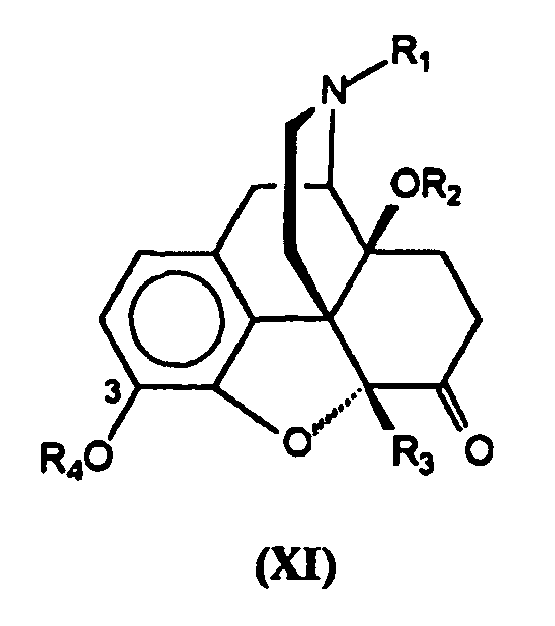
worin Aryl C6-C10-Aryl ist und Alkinyl C2-C6-Alkinyl darstellt; C1-C6-Alkanoyl; C3-C6-Alkenoyl; C3-C6-Alkinoyl; C7-C16-Arylalkanoyl, worin Aryl C6-C10-Aryl und Alkanoyl C1-C6-Alkyl; C9-C18-Arylalkenoyl, worin Aryl C6-C10-Aryl ist und Alkenoyl C3-C6-Alkenoyl ist; C8-C16-Arylalkinoyl, worin Aryl C6-C10-Aryl ist und Alkinoyl C3-C6-Alkinoyl ist. - Eine alternative Route beginnt mit Verbindungen der Formel (XII), in denen R1 und R3 wie oben definiert sind (s. Weiss et al., J. Amer. Chem. Soc., Vol. 77, S. 5891, 1955; lijima et al., J. Med. Chem., Vol. 21, S. 398-400, 1978; Coop et al., J. Org. Chem., Vol. 63, S. 4392-4396, 1998; Schmidhammer et al., Helv. Chim. Acta, Vol. 71, S. 1801-1804, 1988; Schmidhammer et al., Helv. Chim. Acta, Vol. 73, S. 1986-1990, 1990).

- Die Ketone der Formel (XII) werden in Gegenwart von Methansulfonsäure oder Ähnlichem mit Ethylenglykol (als Reagenz und Lösungsmittel) zu Verbindungen der Formel (XIII) umgesetzt,

- Die Einführung einer Schutzgruppe wie z.B. Benzyl, Trityl oder Silyl an der 3-Hydroxygruppe erreicht man durch 3-O-Benzylierung, 3-O-Tritylierung oder 3-0-Silylierung der Verbindungen der Formel (XIII) mit Benzylhalogeniden, Tritylhalogeniden Trialkylhalogensilanen in Lösungsmitteln wie Dichlormethan, Chloroform, Aceton oder N,N-Dimethylformamid in Gegenwart einer Base wie Natriumhydrogencarbonat, Kaliumcarbonat, Triethylamin oder Ähnlichem oder mittels Phasentransferkatalyse und erhält somit Verbindungen der Formel (XIV),
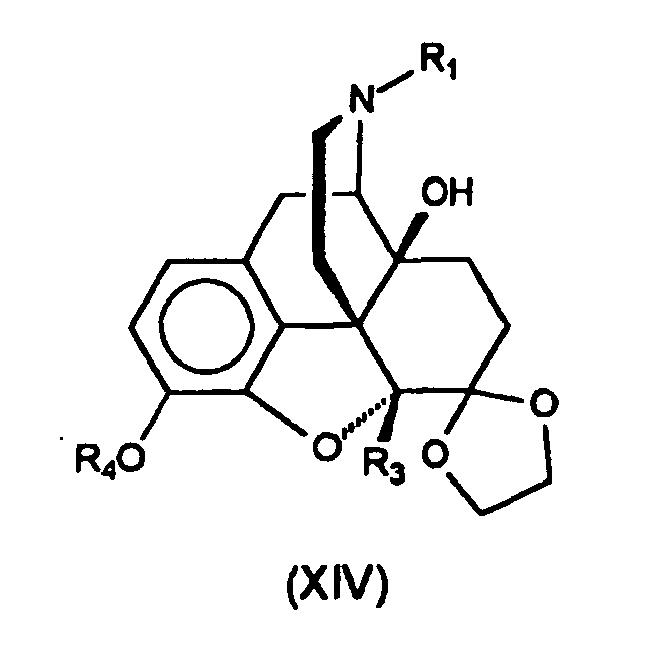
- Diese 14-Hydroxyverbindungen werden in der Folge mit Dialkylsulfaten, Alkylhalogeniden, Alkenylhalogeniden, Alkinylhalogeniden, Arylalkylhalogeniden, Arylalkenylhalogeniden, Arylalkinylhalogeniden oder Chloroformiaten umgesetzt in Lösungsmitteln wie N,N-Dimethylformamid (DMF) oder Tetrahydrofuran (THF) in Gegenwart einer starken Base wie Natriumhydrid, Kaliumhydrid oder Natriumamid, um die Verbindungen der Formel (XV) zu erhalten,

- Die saure Abspaltung der 3-O-Schutzgruppe und der Ketalfunktion der Verbindungen mit der Formel (XV) wird in einem Schritt mit einer Säure wie Salzsäure in Methanol, Tetrafluoroborsäure in Dichlormethan oder Trifluoressigsäure durchgeführt, und man erhält Verbindungen der Formel (X) (s. 1. Route),
- Alternativ dazu kann man, wenn R4 in Verbindungen der Formel (XV) Benzyl ist, durch Hydrogenolyse der 3-O-Benzylbindung mit Wasserstoffgas in Gegenwart eines Katalysators wie Pd/C, PdO, Pd/Al2O3, Pt/C, PtO2, Pt/Al2O3, oder Ähnlichem in Lösungsmitteln wie Alkoholen, Alkohol/Wasser-Gemischen, Eisessig oder Ähnlichem, gefolgt von saurer Hydrolyse der Ketalfunktion in Position 6 mit z.B. Methanol und konzentrierter Salzsäure Verbindungen der Formel (X) erhalten (s. 1. Route),

- Die Verbindungen der Formel (X) werden gemäß dem ersten Schema zu erfindungsgemäßen Verbindungen der Formel (I) umgesetzt.
- Verbindungen der Formel (I) können in Verbindungen der Formel (la), in denen R5 Wasserstoff; Hydroxy; C1-C6-Alkyloxy; C2-C10-Alkyloxyalkoxy, worin Alkyloxy C1-C4 ist und Alkoxy C1-C6-Alkyloxy C1-C6-Alkyloxy ist; C2-C6-Alkenyloxy; C2-C6-Alkinyloxy; C4-C16-Cycloalkylalkyloxy, worin Cycloalkyl C3-C10 ist und Alkyl C1-C6 ist; C5-C16-Cycloalkylalkenyloxy, worin Cycloalkyl C3-C10 ist und Alkenyl C2-C6 ist; C5-C16-Cycloalkylalkinyloxy, worin Cycloalkyl C3-C10 ist und Alkinyl C2-C6 ist; C7-C16-Arylalkyloxy, worin Aryl C6-C10-Aryl ist und Alkyl C1-C6-Alkyl ist; C8-C16-Arylalkenyloxy,
worin Aryl C6-C10-Aryl und Alkenyl C2-C6-Alkenyl ist; C8-C16-Arylalkinyloxy, worin Aryl C6-C10-Aryl ist und Alkinyl C2-C6-Alkinyl; C1-C8-Alkanoyloxy; C7-C16-Arylalkanoyloxy, worin Aryl C6-C10-Aryl ist und Alkanoyloxy C1-C6-Alkylanoyloxy ist, folgendermaßen überführt werden: - Verbindungen der Formel (I) können in Verbindungen der Formel (XVI) überführt werden, indem man bei ersteren eine reduktive Öffnung der 4,5-Etherbrücke mit z.B. Zink in einem Alkohol wie Methanol oder Ethanol (bevorzugte Temperatur 40-80 °C) in Gegenwart von Ammoniumchlorid vornimmt.

- Verbindungen der Formel (XVI) können in die erfindungsgemäßen Verbindungen der Formel (la) in denen R5 C1-C6-Alkyloxy; C2-C10-Alkyloxyalkoxy, worin Alkyloxy C1-C4 ist und Alkoxy C1-C6-Alkyloxy C1-C6-Alkyloxy ist; C2-C6-Alkenyloxy; C2-C6-Alkinytoxy; C4-C16-Cycloalkylalkyloxy, worin Cycloalkyl C3-C10 ist und Alkyl C1-C6 ist; C5-C16-Cycloalkylalkenyloxy, worin Cycloalkyl C3-C10 ist und Alkenyl C2-C6 ist; C5-C16-Cycloalkylalkinyloxy, worin Cycloalkyl C3-C10 ist und Alkinyl C2-C6 ist; C7-C16-Arylalkyloxy, worin Aryl C6-C10-Aryl ist und Alkyl C1-C6-Alkyl ist; C8-C16-Arylalkenyloxy,
worin Aryl C6-C10-Aryl und Alkenyl C2-C6-Alkenyl ist; C8-C16-Arylalkinyloxy, worin Aryl C6-C10-Aryl ist und Alkinyl C2-C6-Alkirlyl; C1-C6-Alkanoyloxy; C7-C16-Arylalkanoyloxy, worin Aryl C6-C10-Aryl ist und Alkanoyloxy C1-C6-Alkylanoyloxy ist, und R1, R2 und R3 wie oben angegeben sind und R4 in Formel (I) angegeben ist, überführt werden durch Alkylierung oder Acylierung nach allgemein üblichen Methoden.
Verbindungen der Formel (XVI) können in die erfindungsgemäßen Verbindungen der Formel (I) in denen R5 Wasserstoff ist, überführt werden durch Entfernung der Hydroxylgruppe in Position 4. Das kann z.B. geschehen durch Bildung des entsprechenden Phenyltetrazolylethers in Gegenwart einer Base wie Kaliumcarbonat in einem Lösungsmittel wie N,N-Dimethylformamid und anschließende katalytische Hydrierung des Phenyltetrazolylethers z.B. über einem Katalysator wie Pd/C in einem Alkohol oder Eisessig bei Temperaturen zwischen 20 und 100 °C (s. z.B. Schmidhammer et al. J. Med. Chem. 1984, 27, S. 1575-1579). - Verbindungen der Formel (I) oder (Ia) können in quartäre Ammoniumsalze der Formel (IA) oder (IAa) umgewandelt werden durch Alkylierung mit einem entsprechenden Alkylhalogenid oder einem anderen Alkylierungsmittel in Lösungsmitteln wie N,N-Dimethylformamid, Acetonitril, Aceton, Alkoholen, Tetrahydrofuran, Ether, Ethylacetat etc. oder in einem Lösungsmittelgemisch. Die Anordnung des eintretenden Substituenten ist bevorzugt axial (s. M. A. lorio et al., Eur. J. Med. Chem. - Chim. Ther. 1984, 19, 301-303).
- Die folgenden Beispiele beschreiben die Herstellung die erfindungsgemäßen Verbindungen im Detail.
-

- NaH (0,97 g, 40,4 mmol) (erhalten aus 1,62 g 60% NaH-Dispersion in Öl durch Waschen mit Petrolether) wurde einer Lösung von 14-Hydroxycodeinon (lijima et al. J. Med. Chem. 1978, 21, S. 398) (3,00 g, 9,6 mmol) in 100 ml wasserfreiem N,N-Dimethylformamid unter N2 bei 0° C (Badtemperatur) unter Rühren zugefügt. Nach 20 min wurde Cinnamylbromid (2,28 g, 11,6 mmol) zugesetzt und das Gemisch zunächst für 30 min bei 0° C (Badtemperatur), dann bei nachlassender Kühlung für 4.5 Stunden weiter gerührt. Zum Beenden der Reaktion wurden Eisstückchen zugesetzt, bis keine Wasserstoffentwicklung mehr festzustellen war und das Gemisch auf 100 ml Wasser gegossen. Das abgeschiedene Produkt wurde mit Dichlormethan (3 x 100 ml) extrahiert, die vereinigten organischen Phasen mit 250 ml gesättigter Natriumchloridlösung gewaschen und über Natriumsulfat getrocknet. Nach Entfernen des Lösungsmittels unter vermindertem Druck wurde ein braunes Öl erhalten. Dieses wurde aus Methanol kristallisiert. Ausbeute 2,49 g (60%) farblose Kristalle von 14-Cinnamyloxycodeinon (= 7,8-Didehydro-4,5α-epoxy-3-methoxy-17-methyl-14β-{[(E)-3-phenylprop-2-enyl]oxy}morphinan-6-on. Fp. 216-219 °C; 1H -NMR (DMSO-d6, δ in ppm): δ 7,46-7,17 (m, 5 arom. H), 7,19 (d, 1 olef. H, CH-8, J = 10.2 Hz), 6,74 (d, 1 arom. H, J = 8.3 Hz), 6,65 (d, 1 arom. H, J = 8.3 Hz), 6,51-6,59 (m, 1 olef. H, -CH=CH-Ph), 6,34 (trans) und 6,26 (cis) (2 ps-d, 1 olef. H, -CH=CH-Ph), 6,18 (d, 1 olef. H, CH-7, J = 10.2 Hz), 4,85 (s, CH-5), 4,26 und 4,11 (2 dxdxd, 2 H, C-14-OCH2-), 3,73 (s, CH3O), 2,36 (s, CH3N).
- Ein Gemisch von 14-Cinnamyloxycodeinon (6,27 g, 14,6 mmol) und 0,32 g Pd/C (10%) in 200 ml Eisessig wurde 3 h bei 30 psi und Raumtemperatur hydriert. Der Katalysator wurde abfiltriert und mit 50 ml Eisessig gewaschen. Das Filtrat wurde eingedampft, Wasser zugesetzt und mit konzentriertem Ammoniak alkalisiert und mit Dichlormethan (3 x 50 ml) extrahiert. Die vereinigten organischen Phasen wurden mit gesättigter Natriumchloridlösung gewaschen (3 x 70 ml), über Natriumsulfat getrocknet und eingedampft. Der ölige Rückstand (6,27 g) wurde aus Methanol kristallisiert. Ausbeute 4,93 g (78%) farblose Kristalle 4,5α-Epoxy-3-methoxy-17-methyt-14β-(3-phenylpropyloxy)morphinan-6-on (= 14-O-(3-Phenylpropyl)oxycodon). Fp. 119-121 °C; 1H -NMR (CDCl3, δ in ppm): δ 7,35-7,15 (m, 5 arom. H), 6,68 (d, 1 arom. H, J = 8,2 Hz), 6,60 (d, 1 arom. H, J = 8,2 Hz), 4,63 (s, CH-5), 3,89 (s, CH3O), 2,34 (s, CH3N).
- Ein Gemisch von 4,5α-Epoxy-3-methoxy-17-methyl-14β-(3-phenylpropyloxy)morphinan-6-on (= 14-O-(3-Phenylpropyl)oxycodon) (5,00 g, 11.50 mmol), Natriumhydrogencarbonat (6,8 g, 80,91 mmol) und Chlorameisensäure-1-chlorethylester (7,5 ml, 67,5 mmol) in 30 ml 1,2-Dichlorethan wurde unter Feuchtigkeitsausschluß bei 60°C (Badtemperatur) unter Rühren rückflußerhitzt. Nach 17 h wurde vom anorganischen Rückstand filtriert, mit Dichlormethan gewaschen und das Filtrat eingedampft. Das entstandene Carbamat wurde nicht isoliert, sondern in 100 ml Methanol gelöst und eine Stunde lang rückflußerhitzt. Die Lösung wurde eingedampft und der Eindampfrückstand, ein farbloses Schaumharz (6,08 g) aus Aceton kristallisiert. Ausbeute 4,91 g (93%) 4,5β-Epoxy-3-methoxy-14β-(3-phenylpropyloxy)morphinan-6-on Hydrochlorid als farblose Kristalle. Fp. 215-218 °C; IR (KBr): 1730 (CO) cm-1; 1H-NMR (CDCl3): δ 10,55 und 8,67 (2 s, breit, 2 H, +NH2), 7,28-7,10 (m, 5 arom. H), 6,75 (d, 1 arom. H, J = 8,2 Hz), 6,71 (d, 1 arom. H, J = 8,2 Hz), 4,41 (s, C5-H), 3,89 (s, CH3O); El-MS: m/z 419 (M+).
- Ein Gemisch von 4,5α-Epoxy-3-methoxy-14β-(3-phenylpropyloxy)morphinan-6-on Hydrochlorid (2,00 g, 4,76 mmol), Kaliumcarbonat (4,00 g, 28,9 mmol) und Allylbromid (0,56 ml, 6,62 mmol) in wasserfreiem N,N-Dimethylformamid (15 ml) wurde unter Feuchtigkeitsausschluß und unter Stickstoff bei 80°C (Badtemperatur) 7 h lang gerührt. Nach Filtration vom anorganischen Rückstand, der mit je 50 ml Dichlormethan dreimal gewaschen wurde, wurde das Filtrat unter vermindertem Druck eingedampft. Der ölige Rückstand wurde in 300 ml Dichlormethan gelöst, mit Wasser (3x 200 ml) und gesättigter Natriumchloridlösung (4 x 200 ml) gewaschen, über Natriumsulfat getrocknet und eingedampft. Das erhaltene braune Öl, wurde mittels Säulenchromatographie (Kieselgel; CH2Cl2 / MeOH / konz. NH4OH 250 : 2 : 0,5) gereinigt, der ölige Eindampfrückstand in 50 ml Ether gelöst und durch Zugabe von etherischer HCl bis zur sauren Reaktion gefällt. Das Produkt wurde aus Isopropanol umkristallisiert. Ausbeute 1,50 g (69%) der Verbindung 1.HCl als farblose Kristalle. Fp. 129-130 °C; MS (Cl): 460 (M++1); IR (KBr): 1725 (C=O) cm-1; 1H -NMR (DMSO-D6, δ in ppm): δ 8,98 (s, breit, HN+), 7,30-7,18 (m, 5 arom. H), 6,89 (d, 1 arom. H, J = 8,4 Hz), 6,83 (d, 1 arom. H, J = 8,4 Hz), 5,89 (m, 1 olef. H), 5,69 (m, 2 olef. H), 4,94 (s, CH-5), 3,81 (s, CH3O).
-

- Ein Gemisch von 4,5α-Epoxy-3-methoxy-14β-(3-phenylpropyloxy)morphinan-6-on Hydrochlorid (500 mg, 1,19 mmol), Kaliumcarbonat (1,00 g, 7,24 mmol) und Cyclobutylmethylbromid (0,6 ml, 5,34 mmol) in wasserfreiem N,N-Dimethylformamid (7 ml) wurde unter Feuchtigkeitsausschluß und unter Stickstoff bei 80°C (Badtemperatur) 24 h lang gerührt. Nach Filtration vom anorganischen Rückstand, der mit je 20 ml Dichlormethan dreimal gewaschen wurde, wurde das Filtrat unter vermindertem Druck eingedampft. Der ölige Rückstand wurde in 100 ml Dichlormethan gelöst, mit Wasser (3x 100 ml) und gesättigter Natriumchloridlösung (4 x 100 ml) gewaschen, über Natriumsulfat getrocknet und eingedampft. Der Eindampfrückstand (520 mg braunes Öl) wurde mittels Säulenchromatographie (Kieselgel; CH2Cl2 / MeOH / konz. NH4OH 250 : 2 : 0,5) gereinigt, der ölige Eindampftückstand in 10 ml Ether gelöst und durch Zugabe von etherischer HCl gefällt. Ausbeute 0,40 g (69%) der Verbindung 2.HCl als farblose Kristalle. Fp. 128-133 °C; MS (Cl): 488 (M++1); IR (KBr): 1728 (C=O) cm-1; 1H -NMR (DMSO-d6, δ in ppm): δ 8,48 (s, breit, HN+), 7,30-7,15 (m, 5 arom. H), 6,87 (d, 1 arom. H, J = 8,4 Hz), 6,77 (d, 1 arom. H, J = 8,4 Hz), 4,93 (s, CH-5), 3,81 (s, CH3O).
-
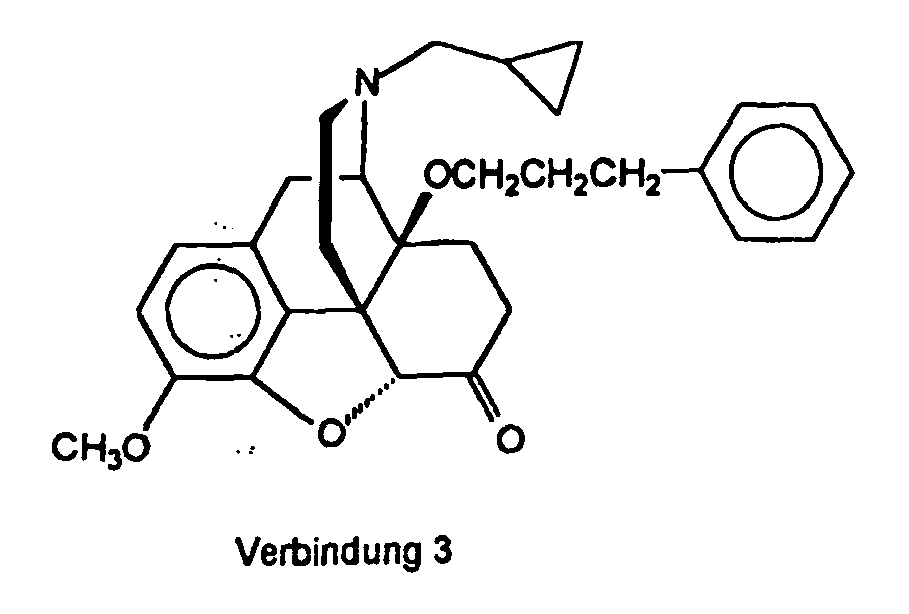
- Ein Gemisch von 4,5α-Epoxy-3-methoxy-14β-(3-phenylpropyloxy)morphinan-6-on Hydrochlorid (1,5 g, 3,57 mmol), Kaliumcarbonat (3,00 g, 21,7 mmol) und Cyclopropylmethylbromid (1,0 ml, 6,62 mmol) in wasserfreiem N,N-Dimethylformamid (10 ml) wurde unter Feuchtigkeitsausschluß und unter Stickstoff bei 80°C (Badtemperatur) 4 h lang gerührt. Nach Filtration vom anorganischen Rückstand, der mit je 10 ml Dichlormethan dreimal gewaschen wurde, wurde das Filtrat unter vermindertem Druck eingedampft. Der ölige Rückstand wurde in 50 ml Dichlormethan gelöst, mit Wasser (3x 50 ml) und gesättigter Natriumchloridlösung (4x 50 ml) gewaschen, über Natriumsulfat getrocknet und eingedampft. Der Eindampfrückstand (1,42 g gelbes Öl) wurde mittels Säulenchromatographie (Kieselgel; CH2Cl2 / MeOH / konz. NH4OH 250 : 2 : 0,5) gereinigt, der ölige Eindampfrückstand in 50 ml Ether gelöst und durch Zugabe von etherischer HCl bis zur sauren Reaktion gefällt. Ausbeute 0,60 g (53%) der Verbindung 3.HCl als farblose Kristalle. Fp. 130-133 °C; MS (El): 473 (M+); IR (KBr): 1725 (C=O) cm-1; 1H -NMR (DMSO-d6, δ in ppm): δ 8,30 (s, breit, HN+), 7,31-7,18 (m, 5 arom. H), 6,88 (d, 1 arom. H, J = 8,4 Hz), 6,78 (d, 1 arom. H, J = 8,4 Hz), 4,96 (s, CH-5), 3,81 (s, CH3O), 0,80-0,40 (m, 5 cyclopropyl H).
-

- Ein Gemisch von 4,5α-Epoxy-3-methoxy-14β-(3-phenylpropyloxy)morphinan-6-on Hydrochlorid (1,0 g, 2,38 mmol), Kaliumcarbonat (3,00 g, 21,7 mmol) und 2-Phenylethylbromid (1,19 ml, 8,8 mmol) in wasserfreiem N,N-Dimethylformamid (10 ml) wurde unter Feuchtigkeitsausschluß und unter Stickstoff bei 80°C (Badtemperatur) 12 hlang gerührt. Nach Filtration vom anorganischen Rückstand, der mit je 50 ml Dichlormethan dreimal gewaschen wurde, wurde das Filtrat unter vermindertem Druck eingedampft. Der ölige Rückstand wurde in 300 ml Dichlormethan gelöst, mit Wasser (3x 200 ml) und gesättigter Natriumchloridlösung (4x 200 ml) gewaschen, über Natriumsulfat getrocknet und eingedampft. Der Eindampfrückstand (960 mg braunes Öl) wurde mittels Säulenchromatographie (Kieselgel; CH2Cl2 / MeOH / konz. NH4OH 250 : 2 : 0,5) gereinigt, der ölige Eindampfrückstand in 50 ml Ether gelöst und durch Zugabe von etherischer HCl bis zur sauren Reaktion gefällt. Ausbeute 0,45 g (36%) der Verbindung 4.HCl als farblose Kristalle. Fp. 128-130 °C; MS (Cl): 524 (M++1); IR (KBr): 1726 (C=O) cm-1, 1H -NMR (DMSO-d6, δ in ppm): δ 8,84 (s, breit, HN+), 7,39-7,17 (m, 10 arom. H), 6,89 (d, 1 arom. H, J = 8,2 Hz), 6,79 (d, 1 arom. H, J = 8,2 Hz), 4,95 (s, CH-5), 3,81 (s, CH3O).
-

- Ein Gemisch von 4,5α-Epoxy-3-methoxy-14β-(3-phenylpropyloxy)morphinan-6-on Hydrochlorid (1,0 g, 2,38 mmol), Kaliumcarbonat (0,6 g, 4,34 mmol) und Tetrahydrofurfurylchlorid (0,5 ml, 4,59 mmol) in wasserfreiem N,N-Dimethylformamid (10 ml) wurde unter Feuchtigkeitsausschluß und unter Stickstoff bei 150°C (Badtemperatur) 15 h lang gerührt. Das Gemisch wurde gekühlt, mit 50 ml Wasser versetzt und mit Dichlormethan extrahiert (3 x 30 ml). Die vereinigten organischen Phasen wurden mit Wasser (3x 60 ml) und gesättigter Natriumchloridlösung (4 x 100 ml) gewaschen, über Natriumsulfat getrocknet und eingedampft. Der Rückstand (1,3 g braunes Öl) wurde mittels Säulenchromatographie (Kieselgel; CH2Cl2 / MeOH / konz. NH4OH 250 : 1,5 : 0,5 → 250: 3,5 : 0,5) gereinigt, der ölige Eindampfrückstand in 50 ml Ether gelöst und durch Zugabe von etherischer HCl bis zur sauren Reaktion gefällt Ausbeute 0,57 g (48%) der Verbindung 5.HCl als farblose Kristalle. Fp. 121-123 °C; MS (Cl): 504 (M'+1); IR (KBr): 1727 (C=O) cm-1; 1H-NMR (DMSO-d6, δ in ppm): δ 8,18 und 7,64 (s, breit, HN+), 7.08-6,96 (m, 5 arom. H), 6,68-6,52 (m, 2 arom. H), 4,75 und 4,73 (2 s, CH-5), 3,79 und 3,81 (2 s, CH3O).
-

- Eine Lösung von Verbindung 1.HCl (1,50 g, 3,02 mmol) in 5 ml 48% HBr wurde 15 min rückflußerhitzt. Danach wurde die Lösung abgekühlt, auf ca. 50 ml Eis gegossen, mit konz. NH4OH alkalisiert und mit Dichlormethan (3 x 80 ml)extrahiert Die vereinigten organischen Phasen wurden mit gesättigter Natriumchloridlösung (4 x 50 ml) gewaschen, über Natriumsulfat getrocknet und eingedampft. Der Rückstand (1,3 g braunes Öl) wurde mittels Säulenchromatographie (Kieselgel; CH2Cl2 / MeOH / konz. NH4OH 250 : 2 : 0,5) gereinigt, der ölige Eindampfrückstand in 50 ml Ether gelöst und durch Zugabe von etherischer HCl bis zur sauren Reaktion gefällt. Ausbeute 0,5 g (34%) der Verbindung 6.HCl als farblose Kristalle. Fp. > 250 °C (Zers.); MS (CI): 446 (M++1); IR (KBr): 1725 (C=O) cm-1; 1H -NMR (DMSO-d6, δ in ppm): g 9,51 (s, OH), 8,81 (s, breit, HN+), 7,30-7,16 (m, 5 arom. H), 6,71 (d, 1 arom. H, J = 8,0 Hz), 6,64 (d, 1 arom. H, J = 8,0 Hz), 5,92 (m, 1 olef. H), 5,61 (m, 2 olef. H), 4,87 (s, CH-5).
-

- Eine Lösung von Verbindung 2.HCl (336 mg, 0,64 mmol) in 5 ml 48% HBr wurde 15 min rückflußerhitzt. Danach wurde die Lösung abgekühlt, auf ca. 50 ml Eis gegossen, mit konz. NH4OH alkalisiert und mit Dichlormethan (3 x 50 ml)extrahiert. Die vereinigten organischen Phasen wurden mit gesättigter Natriumchloridlösung (4 x 50 ml) gewaschen, über Natriumsulfat getrocknet und eingedampft. Der Rückstand (210 mg braunes Schaumharz) wurde mittels Säulenchromatographie (Kieselgel; CH2Cl2 / MeOH / konz. NH4OH 250 : 2 : 0,5) gereinigt, der ölige Eindampfrückstand in 50 ml Ether gelöst und durch Zugabe von etherischer HCl bis zur sauren Reaktion gefällt. Ausbeute 79 mg (34%) der Verbindung 7.HCl als farblose Kristalle. Fp. > 227 °C (Zers.); MS (Cl): 474 (M++1); IR (KBr): 1725 (C=O) cm-1; 1H -NMR (DMSO-d6, δ in ppm): δ 9.51 (s, OH), 8.30 (s, breit, HN+), 7,29-7,18 (m, 5 arom. H), 6,70 (d, 1 arom. H, J = 8,4 Hz), 6,63 (d, 1 arom. H, J = 8,4 Hz), 4,86 (s, CH-5).
-

- Eine Lösung von Verbindung 3.HCl (600 mg, 1,26 mmol) in 5 ml 48% HBr wurde 12 min rückflußerhitzt. Danach wurde die Lösung abgekühlt, auf ca. 50 ml Eis gegossen, mit konz. NH4OH alkalisiert und mit Dichlormethan (3 x 50 ml) extrahiert. Die vereinigten organischen Phasen wurden mit gesättigter Natriumchloridlösung (4 x 50 ml) gewaschen, über Natriumsulfat getrocknet und eingedampft. Das erhaltene braune Öl wurde mittels Säulenchromatographie (Kieselgel; CH2Cl2 /MeOH / konz. NH4OH 250 : 2 : 0,5) gereinigt, der ölige Eindampfrückstand in 50 ml Ether gelöst und durch Zugabe von etherischer HCI bis zur sauren Reaktion gefällt. Umkristallisation aus Isopropanol gab 200 mg (34%) der reinen Verbindung 8.HCI als farblose Kristalle. Fp. 175-178 °C; MS (CI): 460 (M++1); IR (KBr): 1725 (C=O) cm-1: 1H -NMR (DMSO-d6, δ in ppm): δ 9.52 (s, OH), 8,20 (s, breit, HN+), 7,30-7,18 (m, 5 arom. H), 6,71 (d, 1 arom. H, J = 8,0 Hz), 6,64 (d, 1 arom. H, J = 8,0 Hz), 4,89 (s, CH-5).
-

- Eine Lösung von Verbindung 4.HCl (1,79 g, 3,2 mmol) in 5 ml 48% HBr wurde 15 min rückflußerhitzt. Danach wurde die Lösung abgekühlt auf ca. 50 ml Eis gegossen, mit konz. NH4OH alkalisiert und mit Dichlormethan (3 x 60 ml) extrahiert. Die vereinigten organischen Phasen wurden mit gesättigter Natriumchloridlösung (4 x 60 ml) gewaschen, über Natriumsulfat getrocknet und eingedampft. Das erhaltene braune Öl (1,02 g) wurde mittels Säulenchromatographie (Kieselgel; CH2Cl2 / MeOH / konz. NH4OH 250 : 2 : 0,5) gereinigt, der ölige Eindampfrückstand in 50 ml Ether gelöst und durch Zugabe von etherischer HCl bis zur sauren Reaktion gefällt Ausbeute 247 mg (15%) der reinen Verbindung 9.HCl als farblose Kristalle. Fp. >218 °C (Zers.); MS (Cl): 510 (M++1); IR (KBr): 1725 (C=O) cm-1; 1H -NMR (DMSO-d6, δ in ppm): δ 9,51 (s. OH), 8,84 (s, breit, HN+), 7,39-7,17 (m, 10 arom. H), 6,72 (d, 1 arom. H, J = 8,4 Hz), 6,66 (d, 1 arom. H, J = 8,4 Hz), 4,87 (s, CH-5).
-
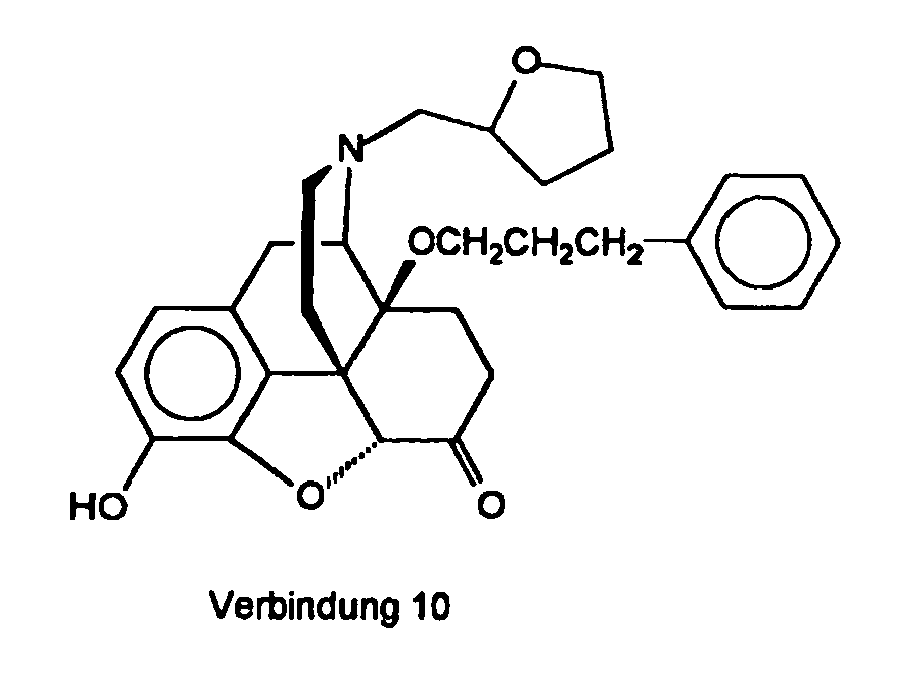
- Eine Lösung von Verbindung 5.HCl (600 mg, 1,11 mmol) in 5 ml 48% HBr wurde 15 min rückflußerhitzt. Danach wurde die Lösung abgekühlt, auf ca. 50 ml Eis gegossen, mit konz. NH4OH alkalisiert und mit Dichlormethan (3 x 60 ml) extrahiert. Die vereinigten organischen Phasen wurden mit gesättigter Natriumchloridlösung (4 x 60 ml) gewaschen, über Natriumsulfat getrocknet und eingedampft. Das erhaltene braune Öl (0,52 g) wurde mittels Säulenchromatographie (Kieselgel; CH2Cl2 / MeOH / konz. NH4OH 250 : 2 : 0,5) gereinigt, der ölige Eindampfrückstand in 50 ml Ether gelöst und durch Zugabe von etherischer HCl bis zur sauren Reaktion gefälit. Ausbeute 210 mg (36%) der Verbindung 10.HCl als farblose Kristalle. Fp. 170-172 °C; MS (Cl): 490 (M++1); IR (KBr): 1725 (C=O) cm-1; 1H -NMR (DMSO-d6, δ in ppm): δ 9,45 (s, OH), 8,45 und 7,85 (s, breit, HN+), 7,30-7,21 (m, 5 arom. H), 6,70-6,65 (m, 2 arom. H), 4,90 und 4,87 (2 s, CH-5).
-

- Ein Gemisch von Verbindung 6.HCl (308 mg, 0,64 mmol) und 35 mg 10 % Pd/C Katalysator in 50 ml Methanol wurde 3 h bei 30 psi und Raumtemperatur hydriert. Der Katalysator wurde abfiltriert und mit 50 ml Methanol gewaschen. Das Filtrat wurde eingedampft. Der Eindampfrückstand, ein farbloses Schaumharz, wurde in 30 ml Ether gelöst und durch Zugabe von etherischer HCl bis zur sauren Reaktion als Hydrochlorid gefällt. Ausbeute: 295 mg (95%) farblose Kristalle der Verbindung 11.HCl. Fp. 162-163 °C; MS (Cl): 460 (M++1); IR (KBr): 1725 (C=O) cm-1; 1H -NMR (DMSO-d6, δ in ppm): δ 9,51 (s, OH), 8,50 (s, breit, HN+), 7,30-7,18 (m, 5 arom. H), 6,75 (d, 1 arom. H, J = 8,4 Hz), 6,64 (d, 1 arom. H, J = 8,4 Hz), 4,86 (s, CH-5), 0,94 (t, CH3CH2CH2, J = 7 Hz).
-

- Eine Lösung von Tritylbromid (3,8 g, 11,86 mmol), Triethylamin (2,41 ml, 15,99 mmol), DMAP (14 mg, 0,21 mmol) und 17-Cyclopropylmethyl-4,5α-epoxy-3,14β-dihydroxymorphinan-6-spito-2'-(1,3-dioxolan) (Schmidhammer et al. Heterocycles 1998, 49, 489-497) (3,0 g, 7,78 mmol) in CH2Cl2 (80 ml) wurde 24 h rückflußerhitzt, gekühlt und mit H2O (2 x 100 ml) gewaschen. Die vereinigten organischen Phasen wurden eingedampft und der Rückstand (7,11 g gelbliche Kristalle) aus MeOH (15 ml) umkristallisiert. Ausbeute 4,15 g (85%) 17-Cyclopropylmethyl-4,5α-epoxy-14β-hydroxy-3-triphenylmethoxymorphinan-6-spiro-2'-(1,3-dioxolan). Fp 203-205 °C ; 1H NMR (CDCl3) δ 7.50-7.15 (m, 15 arom. H), 6,60 (d, 1 arom. H, J = 8,2 Hz), 6,30 (d, 1 arom. H, J = 8,2 Hz), 6,13 (s, breit, OH), 4,37 (s, CH-5), 4,12-3,80 (m, 4H, OCH2CH2O); Cl-MS: m/z 628 (M++1).
- NaH (312 mg, 13,34 mmol) (erhalten aus 520 mg einer 60% NaH-Dispersion in Öl durch Waschen mit Petrolether) wurde einer Lösung von 17-Cyclopropylmethyl-4,5α-epoxy-14β-hydroxy-3-triphenylmethoxymorphinan-6-spiro-2'-(1,3-dioxolan) (2,0 g, 3,18 mmol) in wasserfreiem N,N-Dimethylformamid (20 ml) unter N2 bei 0° C (Badtemperatur) unter Rühren zugesetzt. Nach 20 min wurde 2-Methylbenzylbromid (0,64 ml, 5,4 mmol) zugefügt und das resultierende Gemisch bei Raumtemperatur 20 h gerührt. Überschüssiges NaH wurde durch Zugabe von kleinen Eisstückchen zerstört und dann das Gemisch mit H2O (80 ml) verdünnt und mit CH2Cl2 (1 x 40 ml, 2 x 30 ml) extrahiert. Die vereinigten organischen Phasen wurden mit H2O (3 x 100 ml) gewaschen, getrocknet (Na2SO4), und eingedampft. Der Rückstand (1,8 g orangefarbenes Öl) wurde mittels Säulenchromatographie (Kieselgel; CH2Cl2/MeOH/conc. NH4OH 250 : 2 : 0,5) gereinigt. Es wurden 480 mg eines gelblichen Öls erhalten, welche aus MeOH kristallisiert wurden. Ausbeute 304 mg (13%) reines 17-Cyclopropylmethyl-4,5α-epoxy-14β-[(2-methylbenzyl)oxy]-3-(triphenylmethoxy)morphinan-6-spiro-2'-(1,3-dioxolan). Fp 180-182 °C; 1H-NMR (Me2SO-d 6): δ 7,30-7,15 (m, 19 arom. H), 6,31 (d, 1 arom. H, J = 8,2 Hz), 6,23 (d, 1 arom. H, J = 8.2 Hz), 4,68 (d, 1 H, OCH2Ar, J = 10,2 Hz), 4,22 (d, 1H, OCH2Ar, J = 10,2 Hz), 4,17 (s, CH-5), 4,05-3,50 (m, 4H, OCH2CH2O), 2,33 (s, 3H, MePh): CI-MS: m/z 733 (M++1).
- Eine Lösung von 17-Cyclopropylmethyl-4,5α-epoxy-14β-[(2-methylbenzyl)oxy]-3-(triphenylmethoxy)morphinan-6-spiro-2'-(1,3-dioxolan) (300 mg, 0,67 mmol) in MeOH (5 ml) und konz. HCI (0.5 ml) wurde 10 h rückflußerhitzt Nach dem Abkühlen mit Eis wurde die Lösung mit konz. NH4OH alkalisiert und mit CH2Cl2 (1 x 30 ml, 2 x 20 ml) extrahiert. Die vereinigten organischen Phasen wurden mit H2O gewaschen, über Na2SO4 getrocknet und eingedampft. Der Rückstand (165 mg gelbliches Öl) wurde mittels Säulenchromatographie (Kieselgel; CH2Cl2/MeOH/conc. NH4OH 250:2:0.5) gereinigt. Es wurden 80 mg eines farblosen Öls erhalten, das in Ether gelöst und durch Zugabe von etherischer HCl bis zur sauren Reaktion als Hydrochlorid gefällt wurde. Ausbeute 70 mg (23%) reine Verbindung 12.HCl. Fp 198-200 °C; 1H NMR (Me2SO-d6 ): δ 9,50 (s, OH), 8,60 (s, +NH), 7,67-7,22 (m, 4 arom. H), 6,74 (d, 1 arom. H, J = 8 Hz), 6,69 (d, 1 arom. H, J = 8 Hz), 5,16 (s, C-5 H), 2,31 (s, 3H, MePh); Cl-MS: m/z 446 (M++1).
-
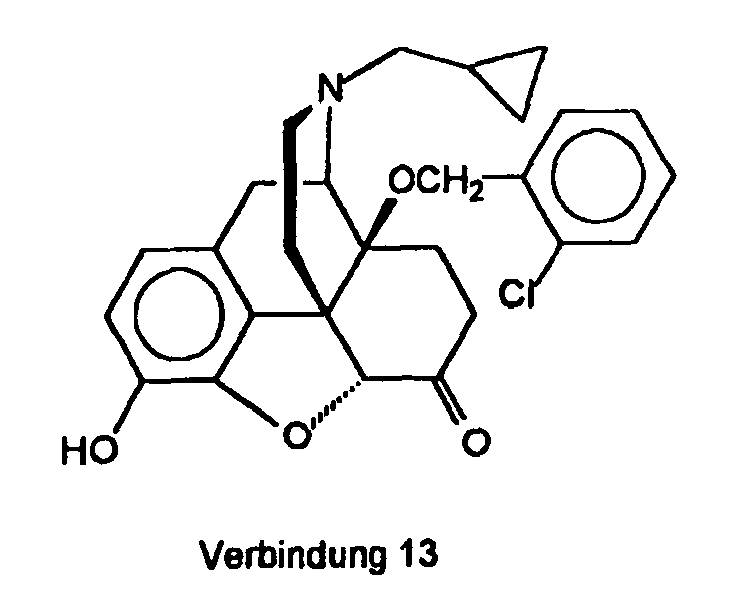
- Ein Gemisch von 17-CyGopropylmethyl-4,5α-epoxy-3,14β-dihydroxymorphinan-G-spiro-2'-(1,3-dioxolan) (Schmidhammer et al. Heterocycles 1998, 49, 489-497) (6,9 g, 17,9 mmol), K2CO, (6,7 g, 48,48 mmol), Benzylbromid (2,34 ml, 19,66 mmol) und wasserfreies N,N-Dimethylformamid (70 ml) wurde unter N2 und bei Raumtemperatur 22 h gerührt. Das anorganische Material wurde abfiltriert und das Filtrat eingedampft. Der Rückstand wurde in CH2Cl2 (80 ml) gelöst, mit H2O (7 x 50 ml) gewaschen, über Na2SO4 getrocknet und eingedampft. Der Rückstand (8,2 g farblose Kristalle) wurde aus MeOH umkristallisiert. Ausbeute 7,37 g (87%) 3-Benzyloxy-17-cyclopropylmethyl-4,5α-epoxy-14f-hydroxymorphinan-6-spiro-2'-(1,3-dioxolan). Fp 130-131 °C; 1H NMR (CDCl3): δ 7,42-7,27 (m, 5 arom. H), 6,75 (d, 1 arom. H, J = 8,3 Hz), 6,54 (d, 1 arom. H, J = 8,3 Hz), 5,17 (d, 1H, OCH2Ph, J = 11,7 Hz), 5,10 (d, 1H, OCH2Ph, J = 11,7 Hz), 4,58 (s, C-5 H), 4,19-3,73 (m, 4H, OCH2CH2O); Cl-MS: m/z 476 (M++1).
- Ein Gemisch von 3-(Benzyloxy)-17-(cyclopropylmethyl)-4,5α-epoxy-14β-hydroxy morphinan-6-spiro-2'-(1,3-dioxolane) (5,82 g, 12,2 mmol), NaH (1,47 g, 61,3 mmol; erhalten aus 2,45 g einer 60% NaH Dispersion in Öl durch Waschen mit Petrolether) and 100 ml wasserfreies N,N-Dimethylformamid wurde unter N2 bei 0 - 5 °C (Badtemperatur) 25 min gerührt. 2-Chlorbenzylbromid (3,16 ml, 24,3 mmol) wurde zugefügt und das resultierende Gemisch 4 h (1 h bei 0 - 5° C, 3 h bei Raumtemperatur) gerührt. Überschüssiges NaH wurde durch Zugabe von kleinen Eisstückchen zerstört, und dann das Gemisch mit H2O (350 ml) verdünnt und mit CH2Cl2 (1 x 250 ml, 3 x 100 ml) extrahiert. Die vereinigten organischen Phasen wurden mit H2O (3 x 100 ml) und gesättigter Natriumchloridlösung (2 x 50 ml) gewaschen, getrocknet (Na2SO4), und eingedampft. Der Rückstand (8,3 g gelbliches Öl) wurde mittels Säulenchromatographie (Kieselgel; CH2Cl2/MeOH/conc. NH4OH 250 : 4 : 0,5) gereinigt. Es wurden 4.75 g (65%) reines 3-(Benzyloxy)-14β-[(2-chlorobenzyl)oxy]-17-cyclopropylmethyl-4,5α-epoxymorphinan-6-spiro-2'-(1,3-dioxolan) als farbloses erhalten, welches für die nächste synthetische Stufe als solches verwendet wurde. 1H-NMR (Me2SO-d6) δ 7,71-7,31 (m, 9 arom. H), 6,79 (d, 1 arom. H, J = 8,0 Hz), 6,57 (d, 1 arom. H, J = 8,0 Hz), 5,14 (d, 1H, OCH2Ar, J = 11,6 Hz), 5,07 (d, 1H, OCH2Ar, J = 11,6 Hz), 4,81 (d, 1H, OCH2Ar, J = 12 Hz), 4,50 (s, C5-H), 4,46 (d, 1H, OCH2Ar, J = 12 Hz), 4,01-3,74 (m, 4H, OCH2CH2O).
- Eine Lösung von 3-Benzyloxy-14β-[(2-chlorbenzyl)oxy]-17-cyclopropylmethyl-4,5α-epoxymorphinan-6-spiro-2'-(1,3-dioxolan) (5,50 g, 9,16 mmol) in MeOH (52 ml) und konz. HCl (23 ml) wurde 2,5 h rückflußerhitzt. Nach dem Abkühlen mit Eis wurde die Lösung mit konz. NH4OH alkalisiert und mit CH2Cl2 (1 x 200 ml, 1 x 100 ml, 2 x 50 ml)extrahiert. Die vereinigten organischen Phasen wurden mit H2O gewaschen, über Na2SO4 getrocknet und eingedampft. Der Rückstand (5,54 g gelbliches Öl) wurde mittels Säulenchromatographie (Kieselgel; CH2Cl2/MeOH/conc. NH4OH 250 : 3 : 0,5) gereinigt und so 2,69 g (63%) reines 14β-[(2-Chlorobenzyl)oxy]-17-(cyclopropylmethyl)-4,5α-epoxy-3-hydroxymorphinan-6-on (Verbindung 13) erhalten. Ein Teil wurde in Ether gelöst und mit etherischer HCl versetzt. Es wurde Verbindung 13·HCl isoliert: Fp 165-168 °C; 1H-NMR (Me2SO-d 6) δ 8,63 (br. s, OH), 7,96 (s, 1H, +NH), 7,50-7,30 (m, 4 arom. H), 6,74 (d, 1 arom. H, J = 8Hz) 6,69 (d,1 1 arom. H, J = 8 Hz). 5,19 (s, C5-H), 4,87 (d, 1 H, OCH2Ar, J =11,6 Hz), 4,81 (d, 1 H, OCH2Ar, J =11,6 Hz); Cl-MS: mlz 466 (M++1).
-

- Eine Lösung von 3,14β-Dibenzyloxyl7-cyclopropylmethyl-4,5a-epoxymorphinan-6-spiro-2'-(1,3-dioxolan) (Schmidhammer et al. Heterocycles 1998, 49, 489-497) (10,0 g, 17,68 mmol) in MeOH (200 ml) / H2O (250 ml) / konz. HCl (50 ml) wurde 4 h rückflußerhitzt. Nach dem Abkühlen mit Eis wurde die Lösung mit konz. NH4OH alkalisiert und mit CH2Cl2 (1 × 100 ml, 2 x 25 ml) extrahiert. Die vereinigten organischen Phasen wurden mit H2O gewaschen, über Na2SO4 getrocknet und eingedampft. Der Rückstand (8,48 g schwach braunes Schaumharz) wurde mittels Säulenchromatographie (Kieselgel; CH2Cl2/MeOH/conc. NH4OH 90: 9: 1) gereinigt und so 6,28 g 3,14β-dibenzyloxy-17-cyclopropylmethyl-4,5α-epoxymorphinan-6-on (Schmidhammer et al. Heterocycles 1998, 49, 489-497) als farbloses Schaumharz und 1,14 g (18%) der Verbindung 14 als schwach gelbes Schaumharz erhalten. Ein Teil der Verbindung 14 wurde in üblicher Weise mittels 48% HBr in das Hydrobromid (Verbindung 14.HBr) umgewandelt. Fp >210 °C (Zers.); 1H NMR (Me2SO-d 6) δ 9,48 (s, OH), 8,31 (s, +NH), 7,56-7,32 (m, 5 arom. H), 6,72 (d, 1 arom. H, J = 8 Hz), 6,68 (d, 1 arom. H, J = 8 Hz), 5,10 (s, C-5 H), 4,70 (d, 1H, OCH2Ph, J =10,4 Hz), 4,25 (d, 1H, OCH2Ph, J = 10,4 Hz); Cl-MS: m/z 432 (M++1).
-

- Zu einer eisgekühlten, gerührten Lösung von 3-Benzyloxy-17-cyclopropylmethyl-4,5α-epoxy-14β-hydroxymorphinan-6-spiro-2'-(1,3-dioxolan) (s. Beispiel 13) (10,70 g, 22,5 mmol) in 200 ml wasserfreiem N,N-Dimethylformamid wurde unter Stickstoff NaH (2,8 g, 118 mmol; aus 4,2 g 60%iger NaH-Dispersion durch Waschen mit Petrolether erhalten) hinzugefügt. Nach 15 min wurde trans-Crotylbromid (27 mmol, 3,2 ml einer 85%igen trans-Crotylbromidlösung) zugegeben und 3,5 h lang (1 h bei 0 - 5 °C, 2,5 h bei Raumtemperatur gerührt. Nach der Zerstörung von überschüssigem NaH durch Zugabe von kleinen Eisstücken wurde die Mischung auf 500 ml H2O gegossen und mit CH2Cl2 (3 x 100 ml, 2 x 50 ml) extrahiert. Die vereinigten organischen Phasen wurden mit H2O (3 x 200 ml) und ges. NaCl-Lösung gewaschen, über Na2SO4 getrocknet und eingedampft. Der Eindampfrückstand (13,85 g gelbes Öl) wurde mittels Säulenchromatographie (Kieselgel; CH2Cl2 / MeOH / konz. NH4OH (250/3/0,5) gereinigt. Der Eindampfrückstand (7,11 g gelbes Öl) wurde in Ether gelöst und durch Zugabe von etherischer HCl wurde 3-Benzyloxy-14β-[(E)-(but-2enyl)oxy]-17-cyclopropylmethyl-4,5α-epoxymorphinan-6-spiro-2'-(1,3-dioxolan) als Hydrochlorid gefällt. Ausbeute: 6.85 g (54%). Fp 135 - 139 °C; 1H-NMR (DMSO-d6)): δ 8,11 (s, breit, +NH), 7,50 - 7,25 (m, 5 arom. H), 6,92 (d, 1 arom. H, J = 8,4 Hz), 6,68 (d, 1 arom. H, J = 8,4 Hz), 5,79 (m, 2 olefin. H), 5,14 (s, 2 H, C3OCH2), 4,59 (s, C5-H), 4,20 - 3,72 (m, 6 H, C6-(OCH2)2, C14OCH2), 1,72 (m, 3 H, CH=CHCH 3); MS (Cl): m/z 530 (M+ + 1)
- Ein Gemisch von 3-Benzyloxy-14β-[(E)-(but-2-enyl)oxy]-17-cyclopropylmethyl-4,5α-epoxymorphinan-6-spiro-2'-(1,3-dioxolan) Hydrochlorid (6,27 g, 11 mmol), 630 mg 10% Pd/C-Katalysator und 100 ml MeOH wurde bei Raumtemperatur und 30 psi 2 h hydriert. Anschließend wurde der Katalysator abfiltriert und das Filtrat im Vakuum eingedampft. Der Eindampfrückstand (rötlich gefärbte Kristalle) wurde mit rückflußkochendem MeOH behandelt. Ausbeute 4,17 g (79%) farblose Kristalle 14β-Butoxy-17-cyclopropylmethyl-4,5α-epoxy-3-hydroxymorphinan-6-spiro-2'-(1,3-dioxolan) Hydrochlorid. Fp 247 - 252 °C; 1H-NMR (DMSO-d6): δ 9,23 (s. 1 H, OH). 7,87 (s, breit, 1 H, +NH), 6,68 (d, 1 arom. H, J = 8,2 Hz), 6,57 (d, 1 arom. H, J = 8,2 Hz), 4,49 (s, C5-H), 4,11 - 3,55 (m, 4 H, C6(OCH2)2), 0,95 (t, 3 H, CH2CH 3, J = 7,4 Hz); MS (Cl): m/z 443 (M+ + 1).
- Eine Lösung von 14β-Butoxy-17-cyclopropylmethyl-4,5α-epoxy-3-hydroxymorphinan-6-spiro-2'-(1,3-dioxolan) Hydrochlorid (4,07 g, 8,5 mmol) in 100 ml MeOH / H2O / konz. HCl (50 : 85 : 15) wurde 4 h rückflußerhitzt. Nach Zugabe von H2O (70 ml) und Alkalisierung mit konz. NH4OH wurde mit CH2Cl2 (3 x 60 ml) extrahiert. Die vereinigten organischen Phasen wurden mit H2O und ges. NaCl-Lösung gewaschen, über Na2SO4 getrocknet und eingedampft. Der Eindampfrückstand (3,63 g braunes Öl) wurde mittels Säulenchromatographie (Kieselgel, CH2Cl2 / MeOH / konz. NH4OH (250 : 3,5 : 0,5)) gereinigt. Ein Teil des Eindampfrückstandes (2,71 g farbloses Schaumharz, 80%) wurde in Ether gelöst und durch Zugabe von etherischer HCl wurde Verbindung 15·HCl (2.46 g) als Reinsubstanz erhalten. Fp 240°C (Zers.); IR (KBr): 1725 (CO) cm-1; 1H-NMR (DMSO-d6): δ 9,50 (s, OH), 8,15 (s, breit, +NH), 6,71 (d, 1 arom. H, J = 8,0 Hz), 6.65 (d, 1 arom. H. = 8,0 Hz), 4,93 (s, C5-H), 0,95 (t, 3 H, CH2CH 3, J = 7,2 Hz); MS (Cl): m/z 399(M++1)
-

- Zu einer eisgekühlten, gerührten Lösung von 3-Benzyloxy-17-cyclopropylmethyl-4,5α-epoxy-14β-hydroxymorphinan-6-spiro-2'-(1,3-dioxolan) (s. Beispiel 13) (4,0 g, 8,4 mmol) in 200 ml wasserfreiem N,N-Dimethylformamid wurde unter Stickstoff NaH (840 m g, 35 mmol; aus 1,4 g 60%iger NaH-Dispersion durch Waschen mit Petrolether erhalten) hinzugefügt. Nach 15 min wurde 3,3-Dimethylallylbromid (1,95 ml, 16,8 mmol) zugegeben und 19 h lang (1 h bei 0 - 5 °C, 18 h bei Raumtemperatur) gerührt. Nach der Zerstörung von überschüssigem NaH durch Zugabe von kleinen Eisstücken wurde die Mischung auf 200 ml H2O gegossen und mit CH2Cl2 (1 x 70 ml, 3 x 40 ml) extrahiert. Die vereinigten organischen Phasen wurden mit H2O (3 x 150 ml) und ges. NaCI-Lösung gewaschen, über Na2SO4 getrocknet und eingedampft. Der Eindampfrückstand (4,8 g gelbbraunes Öl) wurde mittels Säulenchromatographie (Kieselgel; CH2Cl2 /MeOH/ konz. NH4OH 250 : 3 : 0,5) gereinigt.
Das erhaltene Öl wurde in Ether gelöst und durch Zugabe von etherischer HCI wurde 3-Benzyloxy-17-cyclopropylmethyl-4,5α-epoxy-14β-[(3-methylbut-2-enyl)oxy]morphinan-6-spiro-2'-(1,3-dioxolan) Hydrochlorid als Reinsubstanz erhalten. Ausbeute 3,81 g (78%). Fp 126 -129 °C; 1H-NMR (DMSO-d6): δ 8,15 (s, breit, +NH), 7,45 - 7,25 (m, 5 arom. H), 6,92 (d, 1 arom. H, J = 8,0 Hz), 6,68 (d, 1 arom. H, J = 8,0 Hz), 5.51 (m, 1 olefin. H), 5,14 (s, 2 H, C3OCH2), 4,58 (s, C5-H), 3,92 - 3,44 (m, 4 H, C6(OCH2)2), 1.76 (s, 3 H, CH=CCH 3), 1,67 (s, 3 H, CH=CCH 3); MS (CI): m/z 544 (M+ + 1). - Ein Gemisch von 3-Benzyloxy-17-cyclopropylmethyl-4,5α-epoxy-14β-[(3-methylbut-2-enyl)oxy]morphinan-6-spiro-2'-(1,3-dioxolan) Hydrochlorid (4,01 g, 6,9 mmol), 400 mg 10%iger Pd/C-Katalysator und 100 ml MeOH wurde bei Raumtemperatur und 30 psi 2,5 h hydriert. Anschließend wurde der Katalysator abfiltriert und das Filtrat eingedampft. Der Eindampfrückstand wurde mit Ether behandelt, der unlösliche Anteil abfiltriert, und das Filtrat mit etherischer HCl versetzt und so 17-Cyclopropylmethyl-4,5α-epoxy-3-hydroxy-14β-[(3-methylbutyl)oxy]morphinan-6-spiro-2'-(1,3-dioxolan) Hydrochlorid als Reinsubstanz erhalten. Ausbeute 2,24 g (66%). Fp191 -193 °C; 1H-NMR (DMSO-d6): δ 9,22 (s, OH), 7,83 (s, breit, +NH), 6,69 (d, 1 arom. H, J = 8,0 Hz), 6.58 (d, 1 arom. H, J = 8,0 Hz), 4,47 (s, C5-H),
4,08 - 3,50 (m, 4 H, C6(OCH2)2), 0,96 (d, 3 H, CHCH3, J = 4,8 Hz), 0,92 (d, 3 H, CHCH3, J = 4,8 Hz); MS (Cl): m/z 457 (M+ + 1). - Eine Lösung von 17-Cyclopropylmethyl-4,5α-epoxy-3-hydroxy-14β-[(3-methylbutyl)oxy]morphinan-6-spiro-2'-(1,3-dioxolan) Hydrochlorid (2,8 g, 5,7 mmol) in 110 ml MeOH / H2O / konz. HCl (4 : 5:1) wurde 4,5 h rückflußerhitzt. Nach Zugabe von H2O (80 ml) und Alkalisierung mit konz. NH4OH wurde mit CH2Cl2 (1 x 80 ml, 3 x 50 ml) extrahiert. Die vereinigten organischen Phasen wurden mit H2O und ges. NaCl-Lösung gewaschen, über Na2SO4 getrocknet und eingedampft. Der Eindampfrückstand (2,5 g braunes Öl) wurde mittels Säulenchromatographie (Kieselgel; CH2Cl2 / MeOH / konz. NH4OH (250 : 3 : 0.5)) gereinigt. Der Eindampfrückstand (2,21 g weißes Schaumharz) wurde in Ether gelöst und durch Zugabe von etherischer HCl wurde Verbindung 16.HCl als Reinsubstanz erhalten. Ausbeute 1,99 g (78%). Fp 168 -170 °C; IR (KBr): 1725 (CO) cm-1; 1H-NMR (DMSO-d6): δ 9,50 (s, OH), 8,08 (s, breit, +NH), 6,72 (d, 1 arom. H, J = 8,0 Hz), 6,66 (d, 1 arom. H, J = 8,0 Hz), 4,92 (s, C5-H), 0,96 (d, 3 H, CHCH 3, J = 3,8 Hz), 0,93 (d, 3 H, CHCH 3, J = 3,8 Hz); MS (Cl): m/z 412 (M+ + 1).
-
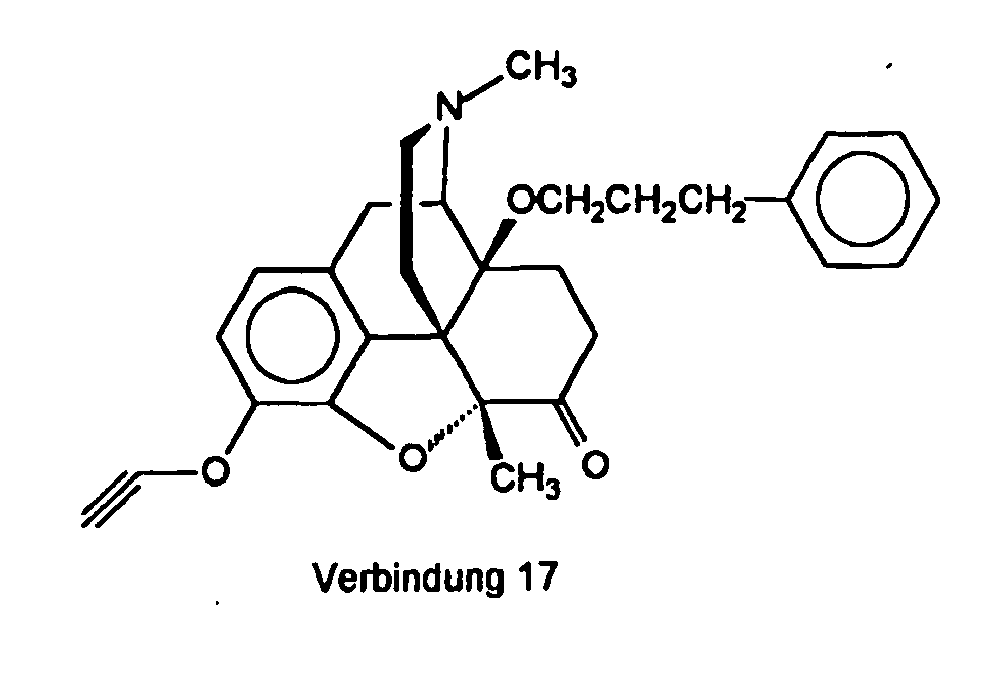
- NaH (0,72 g, 30,0 mmol; erhalten aus 1,2 g 60% NaH-Dispersion in Öl durch Waschen mit Petrolether) wurde einer Lösung von 14-hydroxy-5-methylcodeinon (Schmidhammer et al. Helv. Chim Acta 1988, 73, S.642) (5,00 g, 15,27 mmol) in 30 ml wasserfreiem N,N-Dimethylformamid unter N2 bei 0° C (Badtemperatur) unter Rühren zugefügt. Nach 25 min wurde eine Lösung von Cinnamylbromid (3,01 g, 15,27 mmol) in 20 ml N,N-Dimethylformamid zugetropft und das Gemisch 1,5 h bei 0° C (Badtemperatur) gerührt. Es wurden Eisstückchen zugesetzt, bis keine Wasserstoffentwicklung mehr festzustellen war, das Gemisch wurde auf 500 ml Wasser gegossen und mit Dichlormethan/Isopropanol (4:1) (1 x 150 ml, 3 x 50 ml) extrahiert. Die vereinigten organischen Phasen wurden mit H2O (5 x 400 ml) und 1 x mit 250 ml gesättigter Natriumchloridlösung gewaschen, über Natriumsulfat getrocknet und eingedampft. Der Eindampfrückstand (7,59 orangefärbiges Öl) wurde aus Isopropanol/Ether (1:1) (20 ml) kristallisiert. Ausbeute 3,03 g (45%) farblose Kristalle von 14-Cinnamyloxy-5-methylcodeinon (= 7,8-Didehydro-4,5α-epoxy-3-methoxy-5β,17-dimethyl-14β-{[(E/Z)-3-phenylprop-2-enyl]oxy}morphinan-6-on). Fp. >150 °C (Zers.); IR (KBr): 1675 (CO) cm-1; 1H -NMR (DMSO-d6, δ in ppm): δ 7,44-7,23 (m, 5 arom. H, 1 olef. H), 6,70 (d, 1 arom. H, J = 8.2 Hz), 6,62 (d, 1 arom. H, J = 8.2 Hz), 6,56 (d, 1 olef. H, -CH=CH-Ph, J = 15,7 Hz)), 6,33 (dt, 1 blef. H, -CH=CH-Ph, J = 15,7 Hz), 6,10 (d, 1 olef. H, J = 10.0 Hz), 4,26 und 4,11 (2 dd, 2 H, C-14-OCH2-, J = 5,0 und 10,6 Hz), 3,70 (s, CH3O), 2,36 (s, CH3N), 1,61 (s, C5-CH3); Cl-MS: m/z 444 (M++1).
- Ein Gemisch von 14-Cinnamyloxy-5-methylcodeinon (3,44 g, 7,76 mmol), 10% Pd/C-Katalysator (350 mg) und 80 ml EtOH wurden 2 h bei einer Temperatur von 50 °C und 50 psi hydriert. Der Katalysator wurde abfiltriert, das Filtrat eingedampft und der Rückstand (3,31 dunkles Öl) aus 10 ml EtOH kristallisiert. Ausbeute 2,52 g (73%) 4,5α-Epoxy-3-methoxy-5β,17-dimethyl-14β-[(3-phenylpropyl)oxy]morphinan-6-on (Verbindung 17a). Fp. 126-128 °C; IR (KBr): 1720 (CO) cm-1; 1H -NMR (CDCl3, δ in ppm): δ 7,32-7,17 (m, 5 arom. H), 6,67 (d, 1 arom. H, J = 8.2 Hz), 6,58 (d, 1 arom. H, J = 8.2 Hz), 3,87 (s, CH3O), 2,34 (s, CH3N), 1,65 (s, C5-CH3); CI-MS: m/z 448 (M++1).
- Eine Lösung von 4,5α-Epoxy-3-methoxy-5β,17-dimethyl-14β-[(3-phenylpropyl)oxy]morphinan-6-on (2,23 g, 4,98 mmol) in 13 ml 48% HBr wurde 20 min rückflußerhitzt, dann abgekühlt und eingedampft. Der Eindampfrückstand wurde in 20 ml MeOH gelöst und eingedampft. Dieser Vorgang wurde 1 x wiederholt, wobei 2,48 g beige Kristalle erhalten wurden, welche aus 15 ml MeOH umkristallisiert wurden. Ausbeute 2,26 g (88%) 4,5α-Epoxy-3-hydroxy-5β,17-dimethyl-14β-[(3-phenylpropyl)oxy]morphinan-6-on Hydrobromid (Verbindung 17b.HBr). Fp. > 270 °C (Zers.); IR (KBr): 1720 (CO) cm-1; 1H -NMR (DMSO-d6, δ in ppm): δ 9,42 (s, OH), 8,58 (s, +NH), 7,36-7,16 (m, 5 arom. H), 6,69 (d, 1 arom. H, J = 8,2 Hz), 6,64 (d, 1 arom. H, J = 8,2 Hz), 2,97 (s, CH3N), 1,65 (s, C5-CH3); Cl-MS: m/z 434 (M++1).
- Ein Gemisch aus 4,5α-Epoxy-3-hydroxy-5β,17-dimethyl-14β-[(3-phenylpropyl)oxy]morphinan-6-on Hydrobromid (380 mg, 0,88 mmol), Kaliumcarbonat (370 mg, 2,68 mmol), Propargylbromid (0,20 ml, 2,66 mmol) und 25 ml Aceton wurde unter N2 7 h rückflußerhitzt. Das anorganische Material wurde abfiltriert, das Filtrat eingedampft und der Rückstand (460 mg orangefarbenes Öl) mittels Säulenchromatographie (Kieselgel; CH2Cl2 / MeOH / konz. NH4OH 250 : 2 : 0,5) gereinigt Der Eindampfrückstand (350 mg gelbes Öl) wurde in Ether gelöst und mit etherischer HCl versetzt, wobei 220 mg (49%) der Verbindung 17.HCl erhalten wurden. Fp. >130-133 °C; IR (KBr): 1727 (CO) cm-1;1H -NMR(DMSO-d6, δ in ppm): 8.938 (s, +NH), 7,34-7,19 (m, 5 arom. H), 6,92 (d, 1 arom. H, J = 8,4 Hz), 6,78 (d, 1 arom. H, J = 8,4 Hz), 4,81 (d, 2 H, HCCCH 2O-C3, J =1 Hz), 3,59 (d, 1 H, HCCCH2O-C3, J = 1 Hz). 2,94 (s, CH3N), 1,53 (s, C5-CH3); Cl-MS: m/z 472 (M++1).
-

- NaH (1,60 g, 66,76 mmol; aus 2,67 g 60%iger NaH-Dispersion durch Waschen mit Petrolether erhalten) wurde einer Lösung von 4,5α-Epoxy-14β-hydroxy-3-methoxy-17-methylmorphinan-6-spiro-2'-(1,3-dioxolan) (Laster et al. Tetrahedron 1965, 21. S. 771-778) (6,00 g. 16,69 mmol) in 100 ml wasserfreiem N,N-Dimethylformamid unter N2 bei 0° C (Badtemperatur) unter Rühren zugefügt. Nach 15 min wurde 3-Chlorbenzylbromid (4,4 ml, 33,38 mmol) zugegeben und 24 h lang (1 h bei 0 - 5 °C, 23 h bei Raumtemperatur) gerührt. Nach der Zerstörung von überschüssigem NaH durch Zugabe von kleinen Eisstücken wurde die Mischung auf 300 ml H2O gegossen und mit CH2Cl2 (1 x 100 ml, 3 x 40 ml) extrahiert. Die vereinigten organischen Phasen wurden mit H2O (4 x 200 ml) und ges. NaCl-Lösung gewaschen, über Na2SO4 getrocknet und eingedampft. Der Eindampfrückstand (13,36 g gelbes Öl) wurde aus MeOH kristallisiert und umkristallisiert. Ausbeute 4,29 g (53%) 14β-[(3-Chlorbenzyl)oxy]-4,5α-epoxy-3-methoxy-17-methylmorphinan-6-spiro-2'-(1,3-dioxolan) als farbloses Kristallisat. Fp. 131 - 133 °C; 1H-NMR (DMSO-d6): δ 7,58-7,26 (m, 4 arom. H), 6,74 (d, 1 arom. H, J = 8.1 Hz), 6,60 (d, 1 arom. H, J = 8,1 Hz), 4,55 (d, 1 H, C14OCH2, J = 11,8 Hz), 4.31 (d, 1 H, C14OCH2, J = 11,8 Hz), 4,42 (s, C5-H), 4,10 - 3,61 (m, 4 H, C6(OCH2)2), 3,78 (s, OCH3), 2.30 (s, NCH3); MS (Cl): m/z 485 (M+ + 1).
- Ein Gemisch von 14β-[(3-Chlorbenzyl)oxy]-4,5α-epoxy-3-methoxy-17-methylmorphinan-6-spiro-2'-(1,3-dioxolan) (3,00 g, 6,2 mmol), Natriumethanthiolat (2,32 g, 27.6 mmol) und 30 ml wasserfreiem N,N-Dimethylformamid wurde 5 h lang unter N2 bei 130 °C (Badtemperatur) gerührt und dann auf 400 ml H2O gegossen und mit CH2Cl2 (1 x 100 ml, 3 x 60 ml) extrahiert. Die vereinigten organischen Phasen wurden mit H2O (4 x 200 ml) und ges. NaCl-Lösung gewaschen, über Na2SO4 getrocknet und eingedampft. Der Eindampfrückstand (3,36 g dunkelbraunes Öl 14β-[(3-Chlorbenzyl)oxy]-4,5α-epoxy-3-hydroxy-17-methylmorphinan-6-spiro-2'-(1,3-dioxolan)) konnte nicht zur Kristallisation gebracht werden. Daher wurde ein Teil (2,8 g) ohne weitere Reinigung zur Darstellung von 14β-[(3-Chlorbenzyl)oxy]-4,5α-epoxy-3-hydroxy-17-methylmorphinan-6-on verwendet. Der Rest (414 mg) wurde mittels Säulenchromatographie (Kieselgel; CH2Cl2 / MeOH / konz NH4OH (250:2:0,5) gereinigt. Der Eindampfrückstand (352 mg gelbes Öl) wurde in Ether gelöst und durch Zugabe von etherischer HCl wurde 14β-[(3-Chlorbenzyl)oxy]-4,5α-epoxy-3-hydroxy-17-methylmorphinan-6-spiro-2'-(1,3-dioxolan) Hydrochlorid (250 mg) als Reinsubstanz gefällt. Fp. 202-205°C; 1H-NMR (DMSO-d6): δ 9,28 (s, OH), 8,92 (s, breit, +NH), 7,60 - 7,36 (m, 4 arom. H), 6,70 (d, 1 arom. H, J = 8,2 Hz), 6,60 (d, 1 arom. H, J = 8,2 Hz), 4,59 (s, C5-H), 4,76 (d, 1 H, C14OCH2, J = 11, 9 Hz), 4,57 (d, 1 H, C14OCH2, J = 11, 9 Hz), 4,11 - 3,61 (m, 4 H, C6(OCH2)2), 2,88 (d, +NCH3, J = 4,6 Hz); MS (Cl): m/z 471 (M++1).
- Eine Lösung von ungereinigtem 14β-[(3-Chlorbenzyl)oxy]-4,5a-epoxy-3-hydroxy-17-methylmorphinan-6-spiro-2'-(1,3-dioxolan) (2,8 g dunkelbraunes Öl) in 100 ml MeOH/H2O/ konz. HCl (4 : 5 : 1) wurde 7 h lang rückflußerhitzt Nach Zugabe von Eiswasser und Alkalisierung mit konz. NH4OH wurde mit CH2Cl2 (3 x 60 ml) extrahiert. Die vereinigten organischen Phasen wurden mit H2O (3 x 100 ml) und ges. NaCl-Lösung gewaschen, über Na2SO4 getrocknet und eingedampft. Vom Eindampfrückstand (1,94 g braunes Schaumharz 14β-[(3-Chlorbenzyl)oxy]-4,5α-epoxy-3-hydroxy-17-methylmorphinan-6-on) wurde ein Teil (1,50 g) ohne weitere Reinigung für weitere Synthesen verwendet. Der Rest (443 mg) wurde mittels Säulenchromatographie (Kieselgel; CH2Cl2 / MeOH / konz. NH4OH (250:4:0,5) gereinigt. Der Eindampfrückstand (353 mg gelbes Schaumharz) wurde in Ether gelöst und durch Zugabe von etherischer HCI wurde 14β-[(3-Chlorbenzyl)oxy]-4,5α-epoxy-3-hydroxy-17-methylmorphinan-6-on Hydrochlorid (335 mg) als Reinsubstanz gefällt. Fp. 205 - -210°C; IR (KBr): 1724 (CO) cm-1; 1H-NMR (DMSO-d6): δ 9,55 (s, OH), 9,15 (s, breit, +NH), 7,70 - 7,25 (m, 4 arom. H), 6,73 (d, 1 arom. H, J = 8 Hz), 6,67 (d, 1 arom. H, J = 8 Hz), 5,10 (s, C5-H), 4,87 (d, 1 H, OCH2), J = 12,4 Hz), 4,68 (d, 1 H, OCH2), J = 12,4 Hz), 2,93 (d, +NCH3, J = 4,6 Hz); MS (Cl): m/z 427(M++1).
- Eine Gemisch von ungereinigtem 14β-[(3-Chlorbenzyl)oxy]-4,5α-epoxy-3-hydroxy-17-methylmorphinan-6-on (500 mg braunes Schaumharz), K2CO3 (485 mg, 3,51 mmol) und Propargylbromid (0,26 ml, 3,51 mmol) und 40 ml Aceton (mit 0.5% H2O) wurde unter N2 3 h lang rückflußerhitzt. Nach dem Abkühlen wurde das anorganische Material abfiltriert, mit CH2Cl2 gewaschen und das Filtrat eingedampft. Der Eindampfrückstand (538 mg braunes Öl) wurde mittels Säulenchromatographie (Kieselgel; CH2Cl2 /MeOH / konz. NH4OH (250:2:0.5)) gereinigt. Der Eindampfrückstand (337 mg gelbes Öl) wurde in Ether gelöst und durch Zugabe von etherischer HCl wurde 18·HCl als Reinsubstanz gefällt. Ausbeute 347 mg (74%). Fp. 145 -150 °C; IR (KBr): 1717 (CO), 2118 (C≡C) cm-1; 1H-NMR (DMSO-d6): δ 9,21 (s, breit. +NH). 7,71 -7,32 (m, 4 arom. H), 6,96 (d, 1 arom. H, J = 8,4 Hz), 6,82 (d, 1 arom. H, J = 8,4 Hz), 5,20 (s, C5-H), 4,89 (d, 1 H, C14OCH2, J = 12,1 Hz ),4,69 (d, 1 H, C14OCH2, J = 12,1 Hz), 4,84 (d, 2 H, C3OCH2, J = 2,2 Hz), 3,58 (t, 1 H, C≡CH, J = 2,2 Hz), 2,94 (d, +NCH3, J = 4,4 Hz); MS (CI): m/z 465 (M+ + 1).
-

- Ein Gemisch von 4,5α-Epoxy-3-methoxy-14β-[(3-phenylpropyl)oxy]morphinan-6-on Hydrochlorid (s. Beispiel 1) (4,0 g, 8,77 mmol), K2CO3 (8,0 g, 57,89 mmol), Ethyliodid (0,99 ml, 12,40 mmol) und 50 ml wasserfreiem N,N-Dimethylformamid wurde 5 h lang unter N2 bei 80 °C (Badtemperatur) gerührt. Dann wurde vom anorganischen Rückstand abfiltriert, das Filtrat eingedampft und der Rückstand (4,7 g braunes Öl) mittels Säulenchromatographie (Kieselgel; CH2Cl2/MeOH/konz. NH4OH: 8 I: (250/2/0,5)); 0,5 I: (250/3/0,5), (250/4/0,5), (250/6/0,5), (250/8/0,5), (250/10/0,5)) gereinigt. Der Eindampfrückstand (1,3 g, hellgelbes Öl) wurde aus MeOH kristallisiert. Ausbeute 1,2 g (30 %) Verbindung 19. Fp. 95-101 °C; IR (KBr): 1719 (C=O) cm-1; 1H-NMR (DMSO-d6): δ 7,30-7,13 (m, 5 arom. H), 6,73 (d, J = 8,2 Hz, 1 arom. H), 6,64 (d, J = 8,2 Hz, 1 arom. H), 4,76 (s, 1 H, C5-H), 3,78 (s, 3 H, OCH3), 0,96 (t, 3 H, N-CH2-CH 3 ), J = 7 Hz); MS (Cl): m/z 448 (M++1).
-

- Eine Lösung von Verbindung 19 (1,0 g, 2,23 mmol) in 48%iger HBr (10 ml) wurde 13 Minuten lang rückflusserhitzt. Nach dem Abkühlen wurde mit Wasser (50 ml) verdünnt, Eis zugesetzt, mit konz. NH4OH alkalisiert und mit CH2Cl2 (5 x 50 ml) extrahiert. Die vereinigten organischen Phasen wurden mit Wasser (3 x 50 ml) und NaCl-Lösung (1x 50 ml) gewaschen, über Na2SO4 getrocknet und eingedampft Der Eindampfrückstand (1,3 g, braunes Schaumharz) wurde mittels Säulenchromatographie (Kieselgel; CH2Cl2/MeOH/konz. NH4OH (250:2:0,5)) gereinigt. Der Eindampfrückstand (448 mg gelbes Schaumharz) wurde in Ether gelöst, etherische HCl zugesetzt und Verbindung 20.HCl isoliert. Ausbeute: 380 mg (36%). Fp. 178-180 °C; IR (KBr): 1724 (C=O) cm-1; 1H-NMR (DMSO-d6): δ 9,14 (s, OH), 7,29-7,03 (m, 5 arom. H), 6,56 (d, 1 arom. H, J = 8 Hz), 6,50 (d, 1 arom. H, J = 8 Hz), 4,69 (s, C5-H), 0,96 (t, 3 H, N-CH2-CH 3 ), J = 7,2 Hz); MS (Cl): m/z 434 (M++1).
-
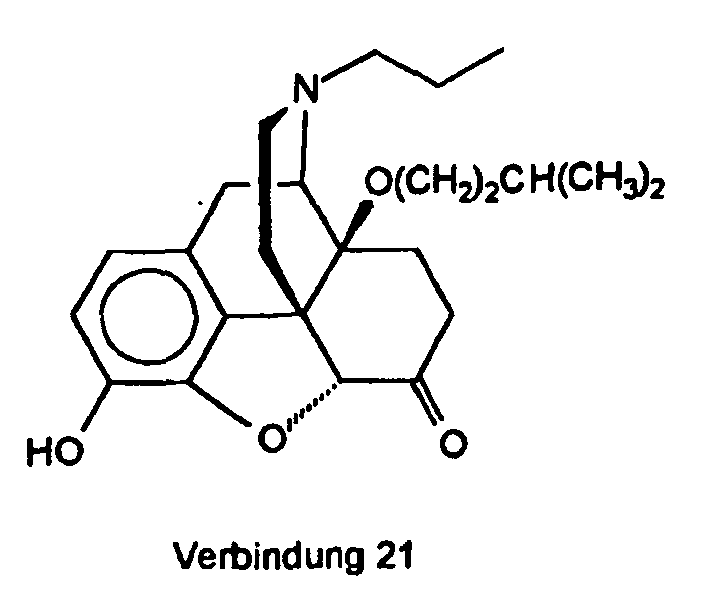
- Eine Löung von Naloxon·HCl·2H2O (20,0 g, 50,0 mmol) und Methansulfonsäure (3,9 ml, 60,0 mmol) in 150 ml Ethylenglykol wurde bei einer Badtemperatur von 80-90 °C 18 h lang unter N2 gerührt. Nach Zugabe von 200 ml Eiswasser und Alkalisierung mit konz. NH4OH erfolgte Extraktion mit CH2Cl2 (2 x 100 ml, 2 x 50 ml). Die vereinigten organischen Phasen wurden mit H2O (2 x 100 ml) und ges. NaCl-Lösung gewaschen, über Na2SO4 getrocknet und eingedampft. Der Eindampfrückstand (beige Kristalle) wurde mit siedendem MeOH behandelt, wobei 16.52 g (89%) farblose Kristalle von 4,5α-Epoxy-3,14β-dihydroxy-17-(prop-2-enyl)morphinan-6-spiro-2'-(1,3-dioxolan) erhalten wurden. Fp. 244 - 247 °C;1H-NMR (DMSO-d6): δ 8.87 (s, C3-OH), 6,54 (d, 1 arom. H, J = 8 Hz), 6,44 (d, 1 arom. H, J = 8 Hz), 5,93 - 5,70 (m, 1 olef. H), 5,27 - 5,04 (m, 2 olef. H), 4,79 (s, C14-OH), 4,33 (s, C5-H), 4,11 -3,61 (m, 4 H, C6(OCH2)2); MS (Cl): m/z 372 (M+ + 1).
- Ein Gemisch, bestehend aus 4,5α-Epoxy-3,14β-dihydroxy-17-(prop-2-enyl)morphinan-6-spiro-2'-(1,3-dioxolan) (16,0 g, 43,1 mmol), K2CO3 (16.2 g, 117 mmol), Benzylbromid (5,63 ml, 47,4 mmol) und 80 ml wasserfreiem N,N-Dimethylformamid, wurde unter N2 24 h lang bei Raumtemperatur gerührt. Das anorganische Material wurde abfiltriert, mit CH2Cl2 gespült und das Filtrat eingedampft Der Eindampfrückstand (weißes Kristallisat) wurde zur Entfernung des Lösungsmittels und des Benrylbromids 1 h lang mit rückflußkochendem Ether behandelt. Das abgekühlte Gemisch wurde abfiltriert, das verbleibende Kristallisat mit wenig kaltem Ether nachgewaschen und dann mit rückflußkochendem MeOH behandelt. Es wurden 12,53 g (63%) 3-Benryloxy-4,5α-epoxy-14β-hydroxy-17-(prop-2-enyl)morphinan-6-spiro-2'-(1,3-dioxolan) als farblose Kristalle erhalten. Fp. 142 - -144 °C; 1H-NMR (DMSO-d6): δ 7,50 - 7,22 (m, 5 arom. H), 6,77 (d, 1 arom. H, J = 8,0 Hz), 6,56 (d, 1 arom. H, J = 8,0 Hz), 5,95 - 5,68 (m, 1 H, 1 olef. H), 5,30 - 5,01 (m, 4 H, 2 olef. H, C3OCH2), 4,81 (s, OH), 4,40 (s, C5-H), 4,08 - 3,65 (m, 4 H, C6(OCH2)2); MS (Cl): m/z 463 (M+ + 1).
- NaH (650 mg, 27 mmol) (erhalten aus 1,1 g 60% NaH-Dispersion in Öl durch Waschen mit Petrolether) wurde einer Lösung von 3-Benzyloxy-4,5a-epoxy-14β-hydroxy-17-(prop-2-enyl)morphinan-6-spiro-2'-(1,3-dioxolan) (5,00 g, 10,83 mmof) in 40 ml wasserfreiem N,N-Dimethylformamid unter N2 bei 0° C (Badtemperatur) unter Rühren zugefügt. Nach 15 min wurde 3,3-Dimethylallylbromid (1,90 ml, 16,25 mmol) zugesetzt und das Gemisch zunächst für 1 h bei 0° C (Badtemperatur), dann bei nachlassender Kühlung für 4 Stunden weiter gerührt. Zum Beenden der Reaktion wurden Eisstückchen zugesetzt, bis keine Wasserstoffentwicklung mehr festzustellen war. Das Gemisch wurde auf 100 ml Wasser gegossen und mit Dichlormethan (3 x 100 ml) extrahiert. Die vereinigten organischen Phasen wurden mit H2O (3 x 100 ml) und 250 ml gesättigter Natriumchloridlösung gewaschen, über Natriumsulfat getrocknet und eingedampft. Der Eindampfrückstand (6,02 g gelbes Öl) wurde mittels Säulenchromatographie (Kieselgel; CH2Cl2/MeOH/konz. NH4OH (250 : 2 : 0.5)) gereinigt Der Eindampfrückstand (5,01 g hellgelbes Öl) wurde in Ether gelöst und durch Zugabe von etherischer HCl reines 3-Benzyloxy-4,5α-epoxy-14β-[(3-methylbut-2-enyl)oxy]-17-(prop-2-enyl)morphinan-6-spiro-2'-(1,3-dioxolan) Hydrochlorid gefällt. Ausbeute 4,83 g (79%); Fp. 122 - 124 °C; 1H-NMR (DMSO-d6): δ 8,61 (s, breit, +NH), 7,50- 7,25 (m, 5 arom. H), 6,92 (d, J = 8,4 Hz, 1 arom. H), 6,70 (d, 3J = 8,4 Hz, 1 arom. H), 5,99-5,41 (m, 4 olefin. H), 5,14 (s, C3-OCH2), 4,57 (s, C5-H), 1,75 (s, 3 H, CH=CCH 3), 1,66 (s, 3 H, CH=CCH 3); MS (Cl): m/z 531 (M++1).
- Ein Gemisch von 3-Benryloxy-4,5α-epoxy-14β-[(3-methylbut-2-enyl)oxy]-17-(prop-2-enyl)morphinan-6-spiro-2'-(1,3-dioxolan) Hydrochlorid (4,59 g, 8,11 mmol), 460 mg 10% Pd/C-Katalysator und 100 ml MeOH wurde bei Raumtemperatur und 30 psi 4 h lang hydriert. Anschließend wurde der Katalysator abfiltriert und das Filtrat im Vakuum eingedampft. Der Eindampfrückstand (schwachgraue Kristalle) wurde aus MeOH/Et2O umkristallisiert. Ausbeute 3,54 g (91%) reines 4,5α-Epoxy-3-hydroxy-14β-[(3-methylbutyl)oxy]-17-propylmorphinan-6-spiro-2'-(1,3-dioxolan) Hydrochlorid. Fp. 176 - 185 °C; 1H-NMR (DMSO-d6): δ 9,22 (s, OH), 8,12 (s, breit, 1 H, +NH), 6,68 (d, J = 8,0 Hz, 1 arom. H), 6,58 (d, J = 8,0 Hz, 1 arom. H), 4,46 (s, 1 H, C5-H), 4,11-3,62 (m, 4 H, C6(OCH2)2), 0,99 - 0,85 (m, 9 H, N+(CH2)2CH 3, CH(CH 3)2); MS (Cl): m/z 445 (M+ + 1).
- Eine Lösung von 4,5α-Epoxy-3-hydroxy-14β-[(3-methylbutyl)oxy]-17-propylmorphinan-6-spiro-2'-(1,3-dioxolan) Hydrochlorid (3,40 g, 7,1 mmol) in 40 ml MeOH/H2O/konz. HCl (50 : 85 : 15) wurde 4 h lang rückflußerhitzt Nach Zugabe von H2O (50 ml) und Alkalisierung mit konz. NH4OH wurde mit CH2Cl2 (3 x 60 ml) extrahiert. Die vereinigten organischen Phasen wurden mit H2O (2 x 100 ml) und ges. NaCl-Lösung gewaschen, über Na2SO4 getrocknet und eingedampft. Der Eindampfrückstand (2,61 g dunkelbraunes Öl) wurde mittels Säulenchromatographie (Kieselgel; CH2Cl2 / MeOH / konz. NH4OH (250 : 3:0.5)) gereinigt. Vom Eindampfrückstand (1,77 g weißes Schaumharz, 62%) wurde ein Teil (1,39 g) in Ether gelöst und durch Zugabe von etherischer HCl 21.HCl (1.42 g) als Reinsubstanz gefällt. Fp. 175 - 185 °C (Zers.); IR (KBr): 1725 (CO) cm-1; 1H-NMR (DMSO-d6): δ 9.52 (s, OH), 8,33 (s, breit. +NH), 6,70 (d, 1 arom. H, J = 8.2 Hz), 6,65 (d, 1 arom. H, J = 8,2 Hz), 4,91 (s, C5-H), 1,00 - 0,85 (m, 9 H, N+(CH2)2CH 3, CH(CH 3)2); MS (Cl): m/z 401 (M+ + 1).
-

- NaH (1,2 g, 50 mmol) (erhalten aus 2,0 g 60% NaH-Dispersion in Öl durch Waschen mit Petrolether) wurde einer Lösung von 5β-Benzyl-1 4-hydroxycodeinon (M. Gates et al. J. Org. Chem. 1989, 54, S. 972-974) (7,95 g, 19,7 mmol) in 100 ml wasserfreiem N,N-Dimethylformamid unter N2 bei 0° C (Badtemperatur) unter Rühren zugefügt. Nach 15 min wurde Dimethylsulfat (2,43 ml, 25,6 mmol) zugesetzt und das Gemisch 1 h lang bei 0° C (Badtemperatur) gerührt. Zum Beenden der Reaktion wurden Eisstückchen zugesetzt, bis keine Wasserstoffentwicklung mehr festzustellen war. Das Gemisch wurde auf 250 ml Wasser gegossen und mit Dichlormethan (3 x 100 ml) extrahiert. Die vereinigten organischen Phasen wurden mit H2O (1 x 100 ml, 3 x 60 ml) und gesättigter Natriumchloridlösung gewaschen, über Natriumsulfat getrocknet und eingedampft. Vom Eindampfrückstand (8,3 g gelbbraunes Öl) wurde ein Teil unverändert weiter verwendet, der Rest (500 mg) mittels Säulenchromatographie (Kieselgel; CH2Cl2 / MeOH / konz. NH4OH (250:2:0,5) gereinigt. Der Eindampfrückstand (210 mg gelbes Öl) wurde in Ether gelöst und durch Zugabe von etherischer HCl reine Verbindung 22.HCl gefällt. Ausbeute 148 mg. Fp. 164 - 166 °C; IR (KBr): 1680 (CO) cm-1; 1H-NMR (DMSO-d6): δ 9,47 (s, breit, +NH), 7,37-7,09 (m, 5 arom. H), 7,04 (d, 1 H, C8-H, J = 10,0 Hz), 6,84 (d, 1 arom. H, J = 8,4 Hz), 6,74 (d, 1 arom. H, J = 8,4 Hz), 6,29 (d, 1 H, C7-H, J = 10,0 Hz), 3,76 (s, 3 H, C3OCH3), 3,59 (d, 1 H, C5-CH2, J = 15,1 Hz), 3,29 (d, 1 H, C5-CH2), J = 15,1 Hz), 2,98 (s, 3 H, C14-OCH3), 2,88 (d, 3 H, +NCH3, J = 4,6 Hz); MS (CI): m/z 419 (M+ + 1).
-

- Ein Gemisch der ungereinigten Verbindung 22 (6,96 g, 16,7 mmol gelbbraunes Öl), 0,7 g 10%iger Pd/C-Katalysator und 150 ml MeOH wurde bei Raumtemperatur und 30 psi 3 h lang hydriert. Anschließend wurde der Katalysator abfiltriert und das Filtrat im Vakuum eingedampft. Der Eindampfrückstand (hellbraunes Schaumharz) wurde aus isopropanol kristallisiert, wobei 3,14 g (45%) reine Verbindung 23 erhalten wurden. Fp. 136 -138 °C; IR (KBr): 1725 (CO) cm-1; 1H-NMR (CDCl3): δ 7,35 - 7,18 (m, 5 arom. H), 6,66 (d, 1 arom. H, J = 8,2 Hz), 6,57 (d, 1 arom. H, J = 8,2 Hz), 3,90 (s, C3-OCH3), 3,48 (s, 2 H, C5-CH2), 3,34 (s, C14-OCH3), 2,42 (s, NCH3); MS (Cl): m/z 421 (M+ + 1).
-

- Eine Lösung von Verbindung 23 (2,90 g, 6,9 mmol) in 40 ml 48%iger Bromwasserstoffsäure wurde 15 min lang rückflußerhitzt. Anschließend wurde die Lösung gekühlt und eingedampft. Der Eindampfrückstand wurde in MeOH gelöst und wieder eingedampft. Das resultierende Schaumharz (2,50 g) wurde in die Base überführt und mittels Säulenchromatographie (Kieselgel; CH2Cl2 / MeOH / konz. NH4OH (250:3:0.5) gereinigt. Der Eindampfrückstand (2,27 g gelbes Öl) wurde in Ether gelöst, und mit etherischer HCl wurde die reineVerbindung 24.HCl gefällt. Ausbeute 2,30 g (75%); Fp. 222 - 224 °C; IR (KBr): 1725 (CO) cm-1; 1H-NMR (DMSO-d6): δ 9,45 (s, OH), 9,38 (s, breit, +NH), 7,37 - 7,09 (m, 5 arom. H), 6,70 (d, 1 arom. H, J = 8,2 Hz), 6,62 (d, 1 arom. H, J = 8,2 Hz), 3,41 (s, OCH3), 2,89 (d, 3 H, +NCH3, J = 3,4 Hz); MS (Cl): m/z 407 (M+ + 1).
-

- Ein Gemisch von 4,5α-Epoxy-3-methoxy-17-methyl-14-[(3-phenylpropyl)oxy]-morphinan-6-on (= 14-O-(3-Phenylpropyl)oxycodon) (s. Beispiel 1) (600 mg, 1,4 mmol), Ammoniumchlorid (0,97 g, 18,0 mmol) und 30 ml MeOH wurde unter Rühren rückflußerhitzt. Dann wurde innerhalb von 5 Minuten aktiviertes Zinkpulver (0,94 g, 14,0 mmol) in Portionen zugegeben und das Gemisch 6 h rückflußerhitzt. Dann wurde vom anorganischen Rückstand abfiltriert, das Filtrat eingedampft, mit konz. NH4OH alkalisiert, mit CH2Cl2 (3 x 40 ml) extrahiert, mit H2O gewaschen, über Na2SO4 getrocknet und eingedampft. Der Eindampfrückstand (605 mg) wurde aus wenig MeOH kristallisiert. Ausbeute 562 mg (86 %) Verbindung 25. Fp. > 258 °C Zers.); IR (KBr): 3145 (OH), 1734 (CO) cm-1; 1H-NMR (CDCl3): δ 7.37 - 7,05 (m, 5 arom.H). 6.64 (d, 1 arom. H, J = 8,3 Hz), 6,54 (d, 1 arom. H, J = 8.3 Hz), 3,79 (s, OCH3), 2,30 (s, NCH3); MS(Cl): m/z 436 (M++1).
-

- Ein Gemisch von Verbindung 25 (200 mg, 0,5 mmol), K2CO3 (420 mg, 3,0 mmol) und Phenyltrimethylammoniumchlorid (254 mg, 1,5 mmol) und 50 ml wasserfreiem N,N-Dimethylformamid wurde 9 h bei 80 °C (Badtemperatur)unter N2 gerührt. Dann wurde vom anorganischen Rückstand abfiltriert, das Filtrat eingedampft und der Eindampfrückstand mittels Säulenchromatographie (Kieselgel; CH2Cl2/MeOH/konz. NH4OH (93 : 7 : 1) gereinigt. Der Eindampfrückstand (250 mg Schaumharz) wurde in MeOH gelöst und mit Salicylsäure versetzt. Es wurden 102 mg (41 %) der Verbindung 26. C7H6O3 isoliert. Fp. 110 -115 °C; IR(KBr): 1720 (CO) cm-1; 1H-NMR (CDCl3): δ 7,29 - 7,18 (m, 5 arom. H), 6,75 (s, 2 arom. H), 3,93 (s, C4-OCH3), 3,80 (s, C3-OCH3), 2,31 (s, NCH3); MS(Cl): m/z 450 (M++1).
-
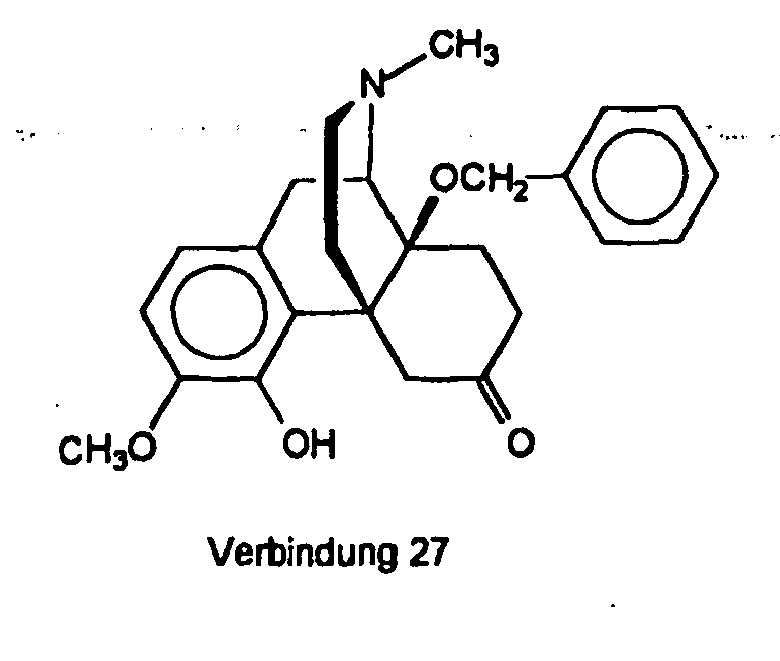
- Ein Gemisch von 4,5α-Epoxy-14β-hydroxy-3-methoxy-17-methylmorphinan-6-spiro-2'-(1,3-dioxolan) (Lester et al. 1965, 21, S. 771) (6,0 g, 16,69 mmol), NaH (2,16 g, 90,0 mmol, gewonnen aus 3,6 g 60%iger Dispersion durch Waschen mit Petrolether) und 150 ml wasserfreiem N,N-Dimethylformamid wurde bei 0 °C (Badtemperatur) unter N2 20 min lang gerührt. Nach der Zugabe von Benzylbromid (4,0 ml, 33,39 mmol) wurde weitere 16 h lang bei Raumtemperatur gerührt. Dann wurden Eisstückchen zugegeben, bis die H2-Entwicklurig beendet war, mit Wasser (100 ml) verdünnt und mit CH2Cl2 (1 x 250 ml, 3 x 150 ml, 1 x 100 ml) extrahiert. Die vereinigten organischen Phasen wurden mit Wasser (4 x 250 ml) und NaCl-Lösung (1 x 250 ml) gewaschen, über Na2SO4 getrocknet und eingedampft. Der Eindampfrückstand (7,47 g rotbraunes Öl) wurde aus MeOH (12 ml) kristallisiert. Isoliert wurden 6,01 g farbloses 4,5α-Epoxy-14β-benzyloxy-3-methoxy-17-methylmorphinan-6-spiro-2'-(1,3-dioxolan). Die Mutterlauge wurde eingedampft und mittels Säulenchromatographie (Kieselgel; CH2Cl2/MeOH/konz. NH4OH: 2 (250/2/0.5); je 1 I: (250/4/0,5), (250/6/0,5), (250/8/0,5), (250/10/0.5)) gereinigt. Der Eindampfrückstand (551 mg, hellgelbes Öl) wurde aus MeOH (1 ml) kristallisiert. Gesamtausbeute 6,32 g (84%) 4,5α-Epoxy-14β-benzyloxy-3-methoxy-17-methylmorphinan-6-spiro-2'-(1,3-dioxolan). Fp. 121-124 °C; 1H-NMR (DMSO-d6): δ 7,44-7,26 (m, 5 arom. H), 6,74 (d, 1 arom. H, J=8,2 Hz), 6,60 (d, 1 arom. H J = 8,2 Hz), 4,55 (d, 1 aliph. H, 14-O-CH 2 -C6H5, J = 11,2 Hz), 4,41 (s, C5-H), 4,31 (d, 1 aliph. H, 14-O-CH 2 -C6H5, J = 11,2 Hz), 4,02-3,67 (m, 4 H, OCH2CH2O), 3,77 (s, OCH3); 2,31 (s, NCH3); MS (Cl): m/z 450 (M++1).
- Eine Lösung von 4,5α-Epoxy-14β-benzyloxy-3-methoxy-17-methylmorphinan-6-spiro-2'-(1,3-dioxolan) (957 mg, 2,13 mmol) in MeOH (15 ml) und 2N HCl (22,5 ml) wurde 4 h lang rückflusserhitzt. Nach dem Abkühlen wurde mit Wasser (20 ml) verdünnt, mit konz. NH4OH alkalisiert und mit CH2Cl2 (1x 100 ml, 1x 50 ml, 3x 25 ml) extrahiert. Die vereinigten organischen Phasen wurden mit Wasser (1x 100 ml) und NaCl-Lösung (1x 100 ml) gewaschen, über Na2SO4 getrocknet und eingedampft. Der Eindampfrückstand (879 mg dunkelgelbes Öl) wurde aus MeOH kristallisiert. Ausbeute 801 mg (89 %) 14β-Benzyloxy-4,5a-epoxy-3-methoxy-17-methylmorphinan-6-on. Fp. 136-138 °C; IR (KBr): 1721 (CO) cm-1; 1H-NMR (CDCl3): δ 7,45-7,24 (m, 5 arom. H), 6,68 (d, 1 arom. H, J = 8,3 Hz), 6,62 (d, 1 arom. H, J = 8,3 Hz), 4,77 (d, 1 H, OCH2Ph, J = 10,3 Hz), 4,64 (s, CH-5), 4,37 (d, 1 H, OCH2Ph, J = 10,3 Hz), 3,88 (s, CH3O), 2,39 (s, CH3N); MS (CI): m/z 406 (M++1).
- Zu einem rückflußkochendem Gemisch von 14β-Benryloxy-4,5α-epoxy-3-methoxy-17-methylmorphinan-6-on (870 mg, 2,15 mmol), NH4Cl (1,4 g, 26,21 mmol) und MeOH (40 ml) wurde unter Rühren vorsichtig portionsweise Zinkstaub (insgesamt 1,4 g, 21,45 mmol) zugegeben. Das Gemisch wurde 2 h lang rückftusserhitzt. Dann wurde vom anorganischen Material abfiltriert, das Filtrat eingedampft, der Eindamptrückstand mit Wasser (40 ml) versetzt, mit einem Gemisch aus CH2Cl2 und isopropanol (3:1) (3x je 40 ml) extrahiert, die vereinigten organischen Phasen mit Wasser (1x 20 ml) und NaCl-Lösung (1x 20 ml) gewaschen, über Na2SO4 getrocknet und eingedampft. Der Eindampfrückstand (961 mg, weißes Schaumharz) wurdemittels Säulenchromatographie (Kieselgel; CH2Cl2/MeOH/konz. NH4OH (250:4:0,5)) gereinigt. Der Eindampfrückstand (750 mg) wurde in Ether gelöst und mit etherischer HCl versetzt. Ausbeute 730 mg (77 %) Verbindung 27.HCl. Fp. > 220-224 °C (Zers.); IR (KBr): 1714 (C=O) cm-1; 1H-NMR (DMSO-d6): δ 9,26 (s, breit, +NH), 8,84 (s, C4-OH), 7,55-7,31 (m, 5 arom. H), 6,91 (d, 1 arom. H, J = 8,2 Hz), 6,68 (d, 1 arom. H, J = 8,2 Hz), 4,87 (d, 1 aliph. H, OCH 2 C6H5), J = 11,6 Hz), 4,66 (d, 1 aliph. H, OCH 2 C6H5), J = 11,6 Hz), 3,76 (s, C3-OCH3), 2,88 (d, 3 H, +N-CH3). MS (CI): m/z 408 (M++1).
-

- Ein Gemisch aus 27.HCl (343 mg, 0,84 mmol), K2CO3 (353 mg, 2,52 mmol) und Phenyltrimethylammoniumchlorid (285 mg, 1,68 mmol) und N,N-Dimethylformamid (25 ml) wurde bei 80 °C (Badtemperatur) unter N2 4 h lang gerührt. Dann wurde vom anorganischen Material abfiltriert, das Filtrat eingedampft, der Eindampfrückstand (rotbraunes Öl) in CH2Cl2 (50 ml) gelöst, mit Wasser (2 x 20 ml) und NaCl-Lösung (1 x 20 ml) gewaschen, über Na2SO4 getrocknet und eingedampft. Der Eindampfrückstand (470 mg braunes Öl) wurde mittels Säulenchromatographie (Kieselgel; CH2Cl2/MeOH/konz. NH4OH: je 1 (250/2/0,5), (25013/0,5), (250/410,5), (250/6/0,5), (250/8/0,5)) gereinigt Der Eindampfrückstand (280 mg, gelbes Öl) wurde in Ether gelöst und mittels etherischer HCl als Verbindung 28.HCl gefällt. Ausbeute 251 mg (66 %); Fp. 140-145 °C; IR (KBr): 1710 (C=O) cm-1; 1H-NMR (DMSO-d6): δ 9,27 (s, breit, +NH), 7,53-7,30 (m, 5 arom. H), 7,02 (d, 1 arom. H, J = 8,4 Hz), 6,91 (d, 1 arom. H, J = 8,4 Hz), 4,84 (d, 1 aliph. H, OCH 2 C6H5), J = 11 Hz), 4,64 (d, 1 aliph. H, OCH 2 C6H5), J = 11 Hz), 3,78 und 3,82 (2 s, 2 OCH3), 2,87 (s, +N-CH3); MS (Cl): m/z 422 (M++1).
-
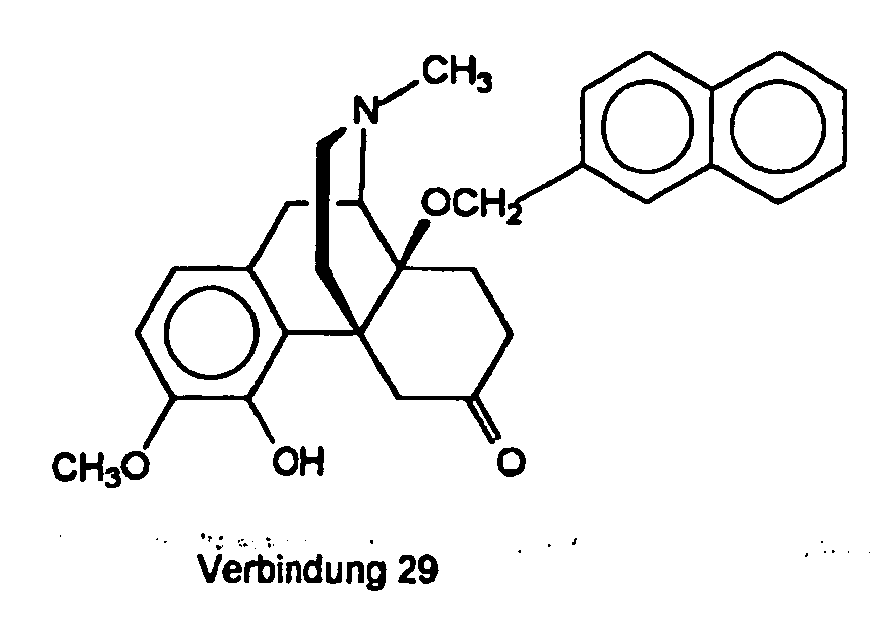
- Ein Gemisch von 4,5α-Epoxy-14β-hydroxy-3-methoxy-17-methylmorphinan-6-spiro-2'-(1,3-dioxolan) (Lester et al. 1965, 21, S. 771) (1,96 g, 5,45 mmol), NaH (682 mg, 28,43 mmol, gewonnen aus 1,14 g 60%iger Dispersion durch Waschen mit Petrolether) und 40 ml wasserfreiem N,N-Dimethylformamid wurde bei 0 °C (Badtemperatur) unter N2 45 min lang gerührt. Nach Zugabe von 2-Brommethylnaphthalin (98%ig, 2,31 g, 10,9 mmol) wurde weitere 2 h lang bei 0 °C (Badtemperatur) gerührt. Dann wurden Eisstückchen zugegeben, bis die H2-Entwicklung beendet war, mit Wasser (50 ml) verdünnt und mit CH2Cl2 (3 x 50 ml, 2 x 25 ml) extrahiert. Die vereinigten organischen Phasen wurden mit Wasser (4 x 50 ml) und NaCl-Lösung (1 x 250 ml) gewaschen, über Na2SO4 getrocknet und eingedampft. Der kristalline Eindampfrückstand (1,26 g) wurde zur Reinigung zweimal mit je 10 ml rückflußkochendem MeOH behandelt. Ausbeute 960 mg (35%) 4,5α-Epoxy-3-methoxy-17-methyl-14β-[(2-naphthylmethyl)oxy]morphinan-6-spiro-2'-(1,3-dioxolan). Fp. 184-185 °C; 1H-NMR (DMSO-d6): δ 7,93-7,89 (m, 4 arom. H), 7,62-7,48 (m, 3 arom. H), 6,75 (d, 1 arom. H, J = 8,2 Hz), 6,62 (d, 1 arom. H, J = 8,2 Hz), 4,72 (d, 1 aliph. H, OCH2Naphtyl, J = 11,4 Hz), 4,47 (d, 1 aliph. H, OCH2Naphtyl, J = 11,4 Hz), 4,43 (s, C5-H), 4,06-3,68 (m, 4 H, OCH2CH2O), 3,78 (s, OCH3), 2,34 (s, N-CH3); MS (Cl): m/z 500 (M++1).
- Eine Lösung von 4,5α-Epoxy-3-methoxy-17-methyl-14β-[(2-naphthylmethyl)oxy]-morphinan-6-spiro-2'-(1,3-dioxolan) (2,3 g, 4,60 mmol) in MeOH (30 ml) und 2N HCl (45 ml) wurde 4 h lang rückflusserhitzt. Nach dem Abkühlen wurde mit Wasser (40 ml) verdünnt, mit konz. NH4OH alkalisiert und mit CH2Cl2 (1 x 200 ml, 1 x 100 ml, 3 x 50 ml) extrahiert. Die vereinigten organischen Phasen wurden mit Wasser (1 x 200 ml) und NaCl-Lösung (1 x 200 ml) gewaschen, über Na2SO4 getrocknet und eingedampft. Der Eindampfrückstand (1,84 g dunkelgelbes Öl) wurde aus MeOH kristallisiert. Ausbeute 1,63 g (78%) 4,5α-Epoxy-3-methoxy-17-methyl-14β-[(2-naphthylmethyl)oxy]morphinan-6-on. Fp. 195-199 °C; IR (KBr): 1724 (vC=O), cm-1; 1H-NMR (DMSO-d6): δ 8,00-7,90 (m, 4 arom. H), 7,68-7,48 (m, 3 arom. H), 6,77 (d, 1 arom. H, J = 8,2 Hz), 6,70 (d, 1 arom. H, J = 8,2 Hz), 4,88 (s, C5-H), 4,84 (d, 1 aliph. H, 14OCH 2 -Naphthyl, J = 11,2 Hz), 4,64 (d, 1 aliph. H, 14OCH 2 -Naphthyl, J = 11,2 Hz), 3,80 (s, 3OCH3), 2,37 (s, N-CH3): MS (Cl) m/z 456 (M++1).
- Zu einem rückflußkochendem und gerührtem Gemisch von 4,5α-Epoxy-3-methoxy-17-methyl-14β-[(2-naphthylmethyl)oxy]-morphinan-6-on (1,0 g, 2,20 mmol), NH4Cl (1,75 g, 32,71 mmol) und MeOH (42 ml) wurde portionsweise Zinkstaub (insgesamt 1,75 g, 26,76 mmol) zugegeben. Das Gemisch wurde 3 h lang rückflusserhitzt Dann wurde vom anorganischen Rückstand abfiltriert, mit MeOH gewaschen, das Filtrat eingedampft, der Eindampfrückstand in Wasser (40 ml) versetzt, mit konz. NH4OH alkalisiert, mit CH2Cl2 (1 x 70 ml, 2 x 50 ml) extrahiert. Die vereinigten organischen Phasen wurden mit Wasser (1 x 40 ml, 1 x 30 ml) und NaCl-Lösung (1 x 30 ml) gewaschen, über Na2SO4 getrocknet und eingedampft. Der Eindampfrückstand (1,09 g, hellbraunes Schaumharz) wurde mittels Säulenchromatographie (Kieselgel; CH2Cl2/MeOH/konz. NH4OH: 1,5 I: (250/2/0,5); je 0,5 I: (250/3/0,5), (250/4/0,5), (250/6/0,5)) gereinigt. Der Eindampfrückstand (836 mg beiges Schaumharz) wurde in Ether gelöst und mit etherischer HCl Verbindung 29 als Hydrochlorid (29.HCl) ausgefällt. Ausbeute 729 mg (68%); Fp. 195-197 °C; IR (KBr): 1710 (C=O)cm-1; 1H-NMR (DMSO-d6): δ 9,24 (s, breit, +NH), 8,86 (s, 4-OH), 8.02-7,91 (m, 4 arom. H, Naphthyl), 7,70-7,48 (m, 3 arom. H, Naphthyl), 6,91 (d, 1 arom. H, J = 8,2 Hz), 6,69 (d, 1 arom. H, J = 8,2 Hz), 5,01 (d, 1 aliph. H, 14OCH 2 -Naphthyl, J = 12 Hz), 4,82 (d, 1 aliph. H, 14OCH 2 -Naphthyl, J = 12 Hz), 3,77 (s, 3OCH3), 2,90 (ps-d, +NCH3); MS (CI) m/z 458 (M++1).
-

- Ein Gemisch aus 29.HCl (316 mg, 0,64 mmol), K2CO3 (304 mg, 2,17 mmol), Phenyltrimethylammoniumchlorid (260 mg, 1,53 mmol) und N,N-Dimethylformamid (25 ml) wurde bei 80°C (Badtemperatur) unter N2 2 h lang gerührt. Dann wurde vom anorganischen Material abfiltriert, das Filtrat eingedampft, der Eindampfrückstand (rotbraunes Öl) in CH2Cl2 (50 ml) aufgenommen, mit Wasser (2 x 20 ml) und NaCl-Lösung (1 x 20 ml) gewaschen, über Na2SO4 getrocknet und eingedampft. Der Eindampfrückstand (237 mg braunes Öl) wurde mittels Säulenchromatographie (Kieselgel; CH2Cl2/MeOH/konz. NH4OH: 1,5 I: (250/2/0,5); je 0,51: (250/3:0,5), (250/4/0,5), (250/6/0,5), (250/8/0,5)) gereinigt. Der Eindampfrückstand (265 mg beiges Schaumharz) wurde in Ether gelöst und mit etherischer HCl Verbindung 30 als Hydrochlorid (30.HCl) ausgefällt. Ausbeute 257 mg (80%); Fp. 165-170 °C; IR (KBr): 1712 (C=O) cm-1; 1H-NMR (DMSO-d6): δ 9,27 (s, breit, +NH), 8,03-7,91 (m, 4 arom. H), 7,70-7,51 (m, 3 arom. H), 7,05 (d, 1 arom. H, J = 8,6 Hz), 6,97 (d, 1 arom. H, J = 8,6 Hz), 5,01 (d, 1 aliph. H, 14OCH 2 -Naphthyl, J = 11,6 Hz), 4,83 (d, 1 aliph. H, 14OCH 2-Naphthyl, J = 11,6 Hz), 3,84 und 3,79 (2 s, 2 OCH3), 2,90 (d, +NCH3); MS (Cl): m/z 472 (M++1).
-
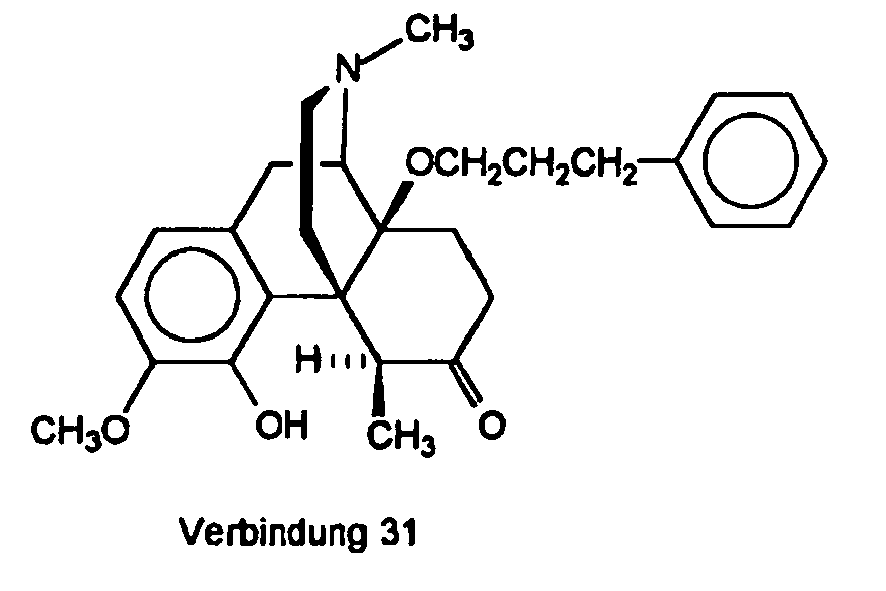
- Zu einem rückflußkochendem und gerührten Gemisch von 4,5α-Epoxy-3-methoxy-5β,17-dimethyl-14β-[(3-phenylpropyl)oxy]morphinan-6-on (s. Beispiel 17) (3,7 g, 8,27 mmol), NH4Cl (4,5 g, 83,87 mmol) und EtOH (50 ml) wurde portionsweise Zinkstaub (insgesamt 5,5 g, 84,12 mmol) zugegeben. Das Gemisch wurde 47 h lang rückflusserhitzt. Dann wurde vom anorganischen Rückstand abfiltriert, mit EtOH gewaschen, das Filtrat eingedampft, der Eindampfrückstand (6,35 g weißes Schaumharz) mit Wasser (200 ml) versetzt, mit konz. NH4OH alkalisiert, mit CH2Cl2 (1 x 100 ml, 4 x 50 ml) extrahiert. Die vereinigten organischen Phasen wurden mit Wasser (4 x 200 ml) und NaCl-Lösung (1 x 200 ml) gewaschen, über Na2SO4 getrocknet und eingedampft. Der Eindampfrückstand (3,93 g gelbes Öl) wurde mittels Säulenchromatographie (Kieselgel; CH2Cl2/MeOH/konz. NH4OH (250/2/0,5)) gereinigt. Es wurden 2,99 (80%) der reinen Verbindung 31 als gelbes Öl erhalten. 500 mg davon wurden in Ether gelöst und mit etherischer HCl Verbindung 31 als Hydrochlorid (31.HCl) ausgefällt. Fp. > 210 °C (Zers.); IR (KBr): 1700 (C=O) cm-1; 1H-NMR (DMSO-d6): δ 9,64 (s, C4-OH), 8,88 (s, breit, +NH), 7,33-7,17 (m, 5 arom. H), 6,91 (d, 1 arom. H, J = 8,2 Hz), 6,70 (d, 1 arom. H, J = 8,2 Hz), 3,78 (s, 30CH3), 2,80 (d, +NCH3, J = 3,4 Hz); 1,28 (d, C5-CH3, J = 6,6 Hz); MS (Cl): m/z 450 (M++1).
-

- Verbindung 31 (Base) 1,55 g, 3,44 mmol) wurde in 20 g 40%iger Tetrabutylammoniumhydroxid-Lösung bei Raumtemperatur unter N2 gelöst. Dann wurde eine Lösung von Dimethylsulfat (0,48 g, 3,8 mmol) in 15 ml Dichlormethan zugefügt. Das Gemisch wurde 1.2,5 h bei Raumtemperatur unter.N2 heftig gerührt und dann 300 ml Wasser und 50 ml Dichlormethan zugesetzt. Die wässrige Phase wurde mit Dichlormethan (2 x 50 ml) extrahiert. Die vereinigten organischen Phasen wurden mit konz. Ammoniak (1 x 50 ml), Wasser (6 x 200 ml) und ges. Natriumchloridlösung (1 x 200 ml) gewaschen, über Natriumsulfat getrocknet und eingedampft. Der Eindampfrückstand (1,25 g gelbes Öl) wurde mittels Säulenchromatographie (Kieselgel; CH2Cl2/MeOH/konz. NH4OH (25072/0.5)) gereinigt Es wurden 1,0 g (53%) der reinen Verbindung 32 als helles Öl erhalten. 810 mg davon wurden in Ether gelöst und mit etherischer HCI Verbindung 32 als Hydrochlorid (32.HCl) ausgefällt Fp. 135-138 °C; IR (KBr): 1700 (C=O) cm-1; 1H-NMR (DMSO-d6): δ 9,36 (s. breit, +NH), 7,31-7,21 (m, 5 arom. H), 7,05 (d, 1 arom. H, J = 8,4 Hz), 6,95 (d, 1 arom. H, J = 8,4 Hz), 3,80 und 3,79 (2 s, 2 OCH3), 2,81 (d, +NCH3, J = 4,8 Hz); 1,25 (d, C5-CH3, J = 7 Hz); MS (CI): m/z 464 (M++1).
-

- Zu einem rückflußkochendem und gerührtem Gemisch von 4,5α-Epoxy-14β-ethoxy-3-methoxy-5β,17-dimethylmorphinan-6-on (Schmidhammer et al. Helv. Chim. Acta 1990, 73, S. 1784-1787) (3,0 g, 8,4 mmol), NH4Cl (15,0 g, 280,1 mmol) und MeOH (30 ml) wurde portionsweise Zinkstaub (insgesamt 15,0 g, 229,4 mmol) zugegeben. Das Gemisch wurde 24 h lang rückflusserhitzt. Dann wurde vom anorganischen Rückstand abfiltriert, mit MeOH gewaschen, das Filtrat eingedampft, der Eindampfrückstand mit verd. NH4OH alkalisiert, mit einem Gemisch aus CH2Cl2 und MeOH (2:1) (1 x 100 ml, 3 x 30 ml) extrahiert. Die vereinigten organischen Phasen wurden über Na2SO4 getrocknet und eingedampft. Der Eindampfrückstand (2,82 g braunes Schaumharz) wurde aus MeOH kristallisiert und so 684 mg der reinen Verbindung 33 erhalten. Die Mutterlauge wurde eingedampft und der Eindampfrückstand (1,895 g braunes Schaumharz) für die Herstellung von Verbindung 34 ohne weitere Reinigung verwendet Verbindung 33: Fp. 122-129 °C; IR (KBr): 3480 (OH), 1715 (C=O) cm-1; 1H-NMR (CDCl3): δ 6,67 (d, 1 arom.
- H, J = 8,0 Hz), 6,57 (d, 1 arom. H, J = 8,0 Hz), 3,82 (s, OCH3), 2,32 (s, NCH3), 1,54 (s, C5-CH3), 1,18 (t, CH 3 CH2, J = 5,7 Hz); MS (CI): m/z 360 (M++1).
-

- Ein Gemisch aus Verbindung 33 (1,895 g, 5,3 mmol) (Eindampfrückstand der Mutterlauge, s. oben), K2CO3 (2,12 g, 15,3 mmol), Phenyltrimethylammoniumchlorid (1,8 g, 10,5 mmol) und wasserfreies N,N-Dimethylformamid (20 ml) wurde bei 80 °C (Badtemperatur) unter N2 3 h lang gerührt. Dann wurde vom anorganischen Material abfiltriert, mit Dichlormethan gewaschen und das Filtrat eingedampft. Der Eindampfrückstand wurde in Dichlormethan gelöst, mit Wasser (2 x 50 ml) ges. NaCl-Lösung (1 x 50 ml) gewaschen, über Natriumsulfat getrocknet und eingedampft. Der Eindampfrückstand (2,11 g dunkelbraunes Öl) wurde mittels Säulenchromatographie (basisches Aluminiumoxid, Aktivitätsstufe III; Dichlormethan) gereinigt. Der Eindampfrückstand wurde mit Salicylsäure in Diisopropylether als Verbindung 34. C7H6O3 kristallisiert. Ausbeute 1,32 g (49%). Fp. 135-141 °C; IR (KBr): 3400 (+NH, OH), 1710 (C=O), 1630 (CO2 -) cm-1; 1H-NMR (CDCl3): δ 7,88 (m, +NH), 7,27 (m, 2 arom. H), 6,81 (m, 4 arom. H), 3,86 (s, OCH3), 3,83 (s, OCH3), 2,84 (s, +NCH3), 1,40 (d, C5-CH3, 5,8 Hz), 1,17 (t, CH 3 CH2, J = 5,3 Hz); MS (Cl): m/z 374 (M++1).
-

- Zu einem rückflußkochendem und gerührtem Gemisch von 4,5α-Epoxy-3-methoxy-5β,17-dimethyl-14β-hydroxymorphinan-6-on (Schmidhammer et al. Helv. Chim. Acta 1988,71, S. 1801-1804) (4,17 g, 12,66 mmol), NH4Cl (7,0 g, 130,87 mmol) und EtOH (50 ml) wurde portionsweise Zinkstaub (insgesamt 10,5 g, 160,6 mmol) zugegeben. Das Gemisch wurde 68 h lang rückflusserhitzt. Dann wurde vom anorganischen Rückstand abfiltriert, mit EtOH gewaschen, das Filtrat eingedampft, der Eindampfrückstand (7,65 g weißes Schaumharz) mit Wasser (150 ml) versetzt, mit konz. NH4OH alkalisiert, mit CH2Cl2/Isopropanol (3:1) (2 x 80 ml, 1 x 60 ml, 1 x 40 ml) extrahiert. Die vereinigten organischen Phasen wurden mit Wasser (3 x 70 ml) und NaCI-Lösung (1 x 70 ml) gewaschen, über Na2SO4 getrocknet und eingedampft. Der Eindampfrückstand (5,02 g braunes Öl) wurde aus 8 ml CH2Cl2/Isopropanol (5:3) kristallisiert zu Verbindung 35 (4,14β-Dihydroxy-3-methoxy-5β,17-dimethylmorphinan-6-on) (3,39 g, 81%). 200 mg davon wurden in Aceton gelöst und mit etherischer HCl 135 mg der Verbindung 35.HCl gefällt: Fp. > 185 °C (Zers.); IR (KBr): 3200 (OH), 1700 (C=O)cm-1. Analytische Daten der Base Verbindung 35: 1H-NMR (DMSO-d6): δ 8,43 (s, C4-OH), 6,77 (d, 1 arom. H, J = 8,2 Hz), 6,57 (d, 1 arom. H, J = 8,2 Hz), 4,49 (s; C14-OH), 3.74 (s, C3-OCH3), 2,25 (s, NCH3); 1,30 (d, C5-CH3, J = 7,4 Hz); MS (CI): m/z 332 (M++1).

- Verbindung 35 (Base) (9,5 g, 28,67 mmol) wurde in 45 g 40%iger Tetrabutylammoniumhydroxid-Lösung bei Raumtemperatur unter N2 gelöst. Dann wurde eine Lösung von Dimethylsulfat (2,75 ml (=3,67 g), 29,06 mmol) in 50 ml Dichlormethan zugefügt. Das Gemisch wurde 5 h bei Raumtemperatur unter N2 heftig gerührt und dann 100 ml Wasser zugesetzt. Die wässrige Phase wurde mit Dichlormethan (3 x 50 ml) extrahiert. Die vereinigten organischen Phasen wurden mit 2 M Ammoniaklösung (1 x 70 ml), Wasser (12 x 100 ml) und ges. Natriumchloridlösung (1 x 100 ml) gewaschen, über Natriumsulfat getrocknet und eingedampft. Der Eindampfrückstand (8,16 g helles Öl) wurde aus 4 ml MeOH kristallisiert. Ausbeute 5,06 g (51%) 14β-Hydroxy-3,4-dimethoxy-5β,17-dimethylmorphinan-6-on (Verbindung 36). Fp. 122-124 °C; IR (KBr): 1704 (C=O) cm-1; 1H-NMR (CDCl3): δ 6,78 (s, 2 arom. H), 4,31 (s, C14-OH), 3,87 und 3,82 (2 s, 2,OCH3), 2,32 (s, NCH3,), 1,28 (d, C5-CH3, J = 6,8 Hz); MS (Cl): m/z 346 (M++1).

- Ein Gemisch aus Verbindung 36 (7,42 g, 21,48 mmol), 2,20 ml Methansulfonsäure (3.26 g, 33.93 mmol) und 100 ml Diethylenglykol wurde 1 h lang unter N2 und bei einer Badtemperatur von 80 °C gerührt Dann wurde das Gemisch auf 600 ml Eiswasser gegossen, mit konzentriertem Ammoniak alkalisiert und mit Dichlormethan extrahiert (1 x 200 ml, 4 x 50 ml). Die vereinigten organischen Phasen wurden mit Wasser (5 x 200 ml) und gesättigter Natriumchloridlösung (1 x 200 ml) gewaschen, über Natriumsulfat getrocknet und eingedampft. Der Eindampfrückstand (8.13 g rötliche Kristalle) wurde aus 8 ml Methanol umkristallisiert. Ausbeute 4,91 g (59 %) 14β-Hydroxy-3,4-dimethoxy-5β,17-dimethylmorphinan-6-spiro-2'-(1,3-dioxolan). Fp.155-157 °C; 1H-NMR (CDCl3): δ 6,76 (s, 2 arom. H), 4,36 (s, C14-OH), 3,91-3,57 (m, 4 H, OCH2CH2O-C), 3,83 und 3,74 (2 s, 2 CH3O), 2,30 (s, CH3N), 1,35 (d, C5-CH3, J = 5,2 Hz); MS (Cl): m/z 390 (M+ + 1).
- NaH (0,13 g, 5,41 mmol) (erhalten aus 0,21 g 60% NaH-Dispersion in Öl durch Waschen mit Petrolether) wurde einer Lösung von 14β-Hydroxy-3,4-dimethoxy-5β,17-dimethylmorphinan-6-spiro-2'-(1,3-dioxolan)(1,00 g, 2,57 mmol) in 100 ml wasserfreiem N,N-Dimethylformamid unter N2 bei 0° C (Badtemperatur) unter Rühren zugefügt Nach 15 min wurde Benzylbromid (0,88 g, 5,14 mmol) zugesetzt und das Gemisch 3 h bei Raumtemperatur gerührt. Dann wurde das überschüssige Natriumhydrid mit Eisstückchen zerstört, das Reaktionsgemisch auf 300 ml Wasser gegossen und mit Dichlormethan / Isopropanol (5 : 2) extrahiert (3 x 70 ml). Die vereinigten organischen Phasen wurden mit Wasser (5 x 200 ml) und einer gesättigten Natriumchloridlösung (1 x 200 ml) gewaschen, über Natriumsulfat getrocknet und eingedampft. Der Eindampfrückstand (1.65 g gelbliche Kristalle) wurde aus 2 ml Ethanol kristallisiert. Ausbeute 0,65 g (53 %) 14β-Benzyloxy-3,4-dimethoxy-5β,17-dimethylmorphinan-6-spiro-2'-(1,3-dioxolan). Fp. 201-202 °C; 1H-NMR (CDCl3): δ 7,49-7,23 (m, 5 arom. H), 6,77 (s, 2 arom. H), 4,61 (d, 1H, PhCH 2 O, J = 10,5 Hz), 4,29 (d, 1H, PhCH 2 O, J = 10,5 Hz), 3,88-3,56 (m, 4 H, OCH2CH2O), 3,83 und 3,76 (2 s, 2 CH3O), 2,30 (s, CH3N), 1,25 (d, C5-CH3, J = 7,4 Hz); MS (Cl): m/z 480 (M+ + 1).
- Eine Lösung von 14β-Benzyloxy-3,4-dimethoxy-5β,17-dimethylmorphinan-6-spiro-2'-(1,3-dioxolan) (0,50 g, 1,04 mmol) in 10 ml eines Gemisches von 5 ml Methanol, 4 ml Wasser und 1 ml konz. HCl wurde 30 Minuten lang rückflußerhitzt. Dann wurde das Gemisch auf 150 ml Eiswasser gegossen, mit konzentriertem Ammoniak alkalisiert und mit Dichlormethan / Isopropanol (4 : 1) extrahiert (2 x 50 ml, 2 x 25 ml). Die vereinigten organischen Phasen wurden mit Wasser (2 x 100 ml) und einer gesättigten Natriumchloridlösung (1 x 100 ml) gewaschen, über Natriumsulfat getrocknet und eingedampft. Der Eindampfrückstand (0,51 g helles Öl) wurde aus 1 ml Methanol kristallisiert. Ausbeute 0,34 g (76 %) Verbindung 37. Fp. 166-167 °C; IR (KBr): 1695 (CO) cm-1; 1H-NMR (CDCl3): δ 7,34-7,21 (m, 5 arom. H), 6,83 (d, 1 arom. H, J = 8,6 Hz), 6,78 (d, 1 arom. H, J = 8,6 Hz), 4,63 (d, 1 H, PhCH 2O, J = 10,8 Hz), 4,32 (d, 1 H, PhCH 2O, J = 10,8 Hz), 3,86 und 3,83 (2s, 2 CH3O), 2,30 (s, CH3N), 1,43 (d, C5-CH3, J = 7,0 Hz); MS (Cl): m/z 436 (M+ + 1).
-

- Eine Lösung von 4,5α-Epoxy-3-methoxy-17-methyl-14-[(3-phenylpropyl)oxy]-morphinan-6-on (= 14-O-(3-Phenylpropyl)oxycodon; s. Beispiel 1) (3,0 g, 6,90 mmol) in 48%iger HBr (30 ml) wurde 15 Minuten lang rückflusserhitzt. Nach Beendigung der Reaktion wurde mit Eis gekühlt, mit konz. NH4OH alkalisiert und mit CH2Cl2 (5 x 50 ml) extrahiert Die vereinigten organischen Phasen wurden mit Wasser (3 x 50 ml) und ges. NaCl-Lösung (1 x 50 ml) gewaschen, über Na2SO4 getrocknet und eingedampft. Der Eindampfrückstand (3,5 g, braunes Öl) wurde mittels Säulenchromatographie (Kieselgel; CH2Cl2/MeOH/konz. NH4OH: 6 I: (250/2/0,5); je 0,5 I: (250/3/0,5), (250/4/0,5), (250/6/0,5), (250/8/0,5)) gereinigt. Der Eindampfrückstand (4,5α-Epoxy-3-hydroxy-17-methyl-14β-[(3-phenylpropyl)oxy]morphinan-6-on, 1,36 g gelbes Öl, 47%) konnte nicht kristallisiert werden. Deshalb wurde ein Teil als Öl der nächsten Reaktion zugeführt, der Rest wie üblich in das Hydrochlorid (4,5α-Epoxy-3-hydroxy-17-methyl-14β-[(3-phenylpropyl)oxy]morphinan-6-on Hydrochlorid) überführt. Analytische Daten des Hydrochlorids: Fp. 185-189 °C; 1H-NMR(DMSD-d6): δ 9,50 (s, C3-OH), 8,68 (s, breit, +NH), 7,34-7,16 (m, 5 arom. H), 6,70 (d, 1 arom. H, J = 8,0 Hz), 6,65 (d, 1 arom. H, J = 8,0 Hz), 4,87 (s, C5-H), 2,92 (d, +NCH3).
- Eine Lösung von 4,5α-Epoxy-3-hydroxy-17-methyl-14β-[(3-phenylpropyl)oxy]morphinan-6-on (Öl, 257 mg, 0,61 mmol) und Methyliodid (0,38 ml, 6,11 mmol) in Acetonitril (10 ml) wurde 2 Tage lang bei 50 °C (Badtemperatur) unter N2 gerührt Eine DC-Untersuchung zeigte, daß die Reaktion nicht abgeschlossen war. Deshalb wurde weiteres Methyliodid (0,38 ml, 6,11 mmol) zugegeben und weitere 3 Tage unter den selben Bedingungen gerührt. Dann wurde das Lösungsmittel abgedampft und der Eindampfrückstand (367 mg gelbes Schaumharz) mittels Säulenchromatographie (Kieselgel; CH2Cl2/MeOH (10:1)) gereinigt. Eindampfrückstand 240 mg (71%) amorphe Verbindung 38. Fp. 164-170°C; IR (KBr):1723 (C=O) cm-1; 1H-NMR (DMSO-d6): δ 9,57 (s, C3-OH), 7,3-7,16 (m, 5 arom. H), 6,67 (s, 2 arom. H, C1-H, C2-H), 4,88 (s, C5-H), 3,56 (s, N+CH3, axial), 3,21 (s, +NCH3, äquatorial); MS (Cl): m/z 434 (M+).
-
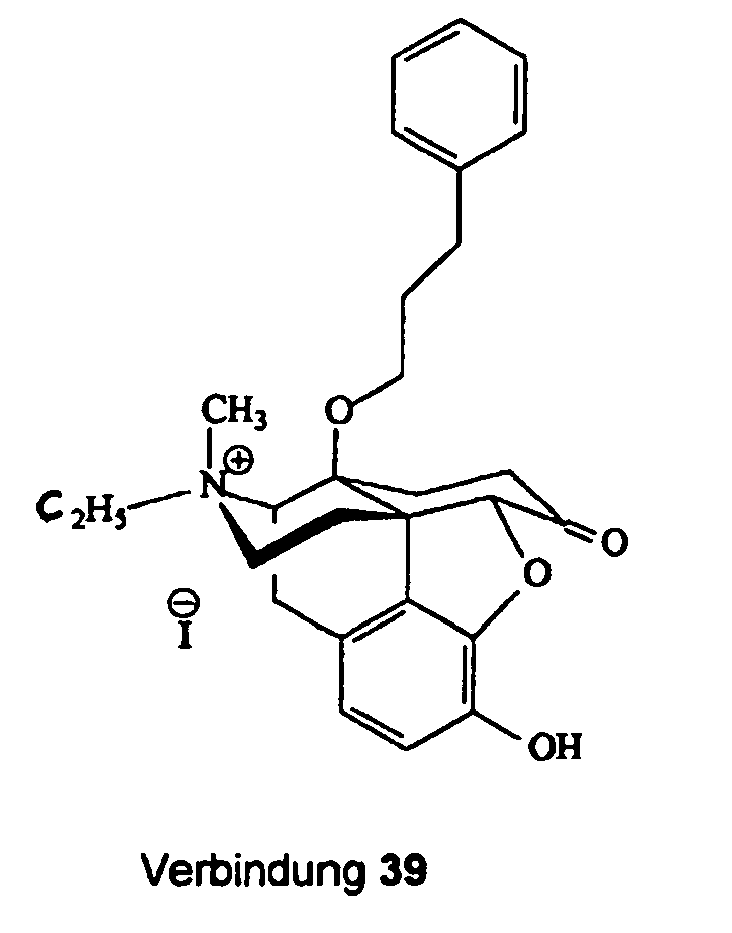
- Eine Lösung von Verbindung 20 (s. Beispiel 20) (250 mg, 0,58 mmol) und Methyliodid (0,36 ml, 5,80 mmol) in Acetonitril (10 ml) wurde 6 Tage lang bei 50 °C (Badtemperatur) unter N2 gerührt. Die Lösung wurde eingedampft und der Eindampfrückstand (320 mg hellbeiges Schaumharz) mittels Säulenchromatographie (Kieselgel; CH2Cl2/MeOH: je 1 I: (95/5), (92,5/7,5)) gereinigt. Eindampfrückstand (240 mg, 72%) amorphe Verbindung 39. Fp. 171-176 °C; IR (KBr): 1723 (C=O) cm-1; 1H-NMR (DMSO-d 6): δ 9,55 (s, C3-OH), 7,31-7,16 (m, 5 arom. H), 6,68 (s, 2 arom. H, C1-H, C2-H), 4,87 (s, C5-H), 3,44 (3 H, N+CH3, axial), 1,34 (t, 3 H, +NCH2 CH 3, J = 7 Hz); MS (Cl): m/z 448 (M+).
-

- Eine Lösung von Verbindung 10 (s. Beispiel 10) (190 mg, 0,39 mmol) und Methyliodid (0,24 ml, 3,9 mmol) in Acetonitril (8 ml) wurde 10 Tage lang bei 40-50 °C (Badtemperatur) unter N2 gerührt. Die Lösung wurde eingedampft und der Eindampfrückstand (248 mg beiges Schaumharz) mittels Säulenchromatographie (Kieselgel;CH2Cl2/MeOH: 2 I: (250/5); 1 I: (250/7,5)) gereinigt. Der resultierende Eindampfrückstand (70 mg gelbes Schaumharz, 28%) war reine Verbindung 40. Fp. 156-159 °C; IR (KBr): 1724 (C=O) cm-1; 1H-NMR(DMSO-d6): δ 9,53 (s, C3-OH), 7,30-7,16 (m, 5 arom. H), 6,68 (s, 2 arom. H, C1-H, C2-H), 4,85 (s, 1 H, C5-H), 3,58 (s, +NCH3, axial); MS(CI): m/z 504 (M+).
-
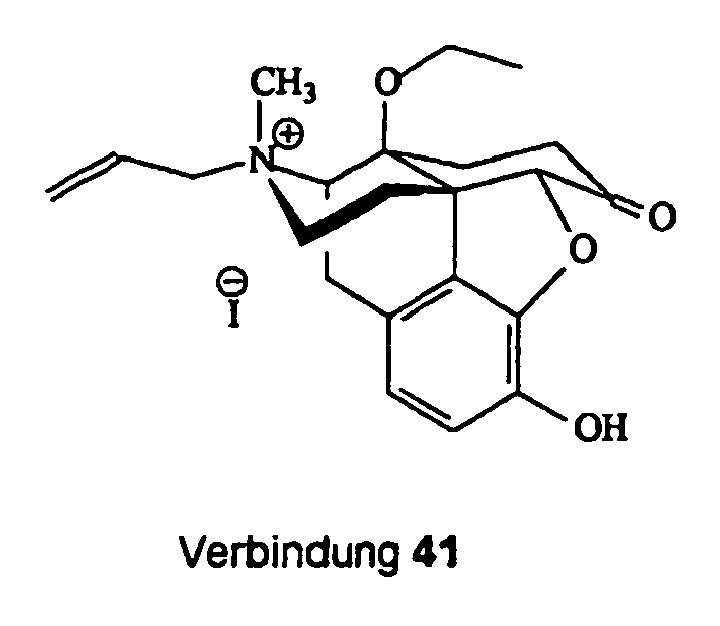
- Eine Lösung von 14-O-Ethylnaloxon (Kobylecki et al. J. Med. Chem. 1982, 25, S. 116) (300 mg, 0,84 mmol) und Methyliodid (0,25 ml, 4,2 mmol) wurden in 8 ml Acetonitril 7 Tage bei 30 °C (Badtemperatur) gerührt und dann eingedampft. Der Eindampfrückstand (450 mg hellbraunes Öl) wurde mittels Säulenchromatographie (Kieselgel; CH2Cl2/MeOH (250:4)) gereinigt. Eindampfrückstand (110 mg, 35%) amorphe Verbindung 41. Fp. 130-134 °C; IR (KBr): 1724 (CO) cm-1; 1H-NMR (DMSO-d6): δ 9,54 (s, C3-OH), 6,70 (s, 2 arom. H), 6,32-6,07 (m, 1 olef. H), 5,84-5,63 (m, 2 olef. H), 4,92 (s, C5-H), 3,49 (s, +NCH3, axial), 1,24 (t, 3 H, OCH2 CH 3, J = 6,8 Hz); MS(Cl): m/z 370 (M+).
-
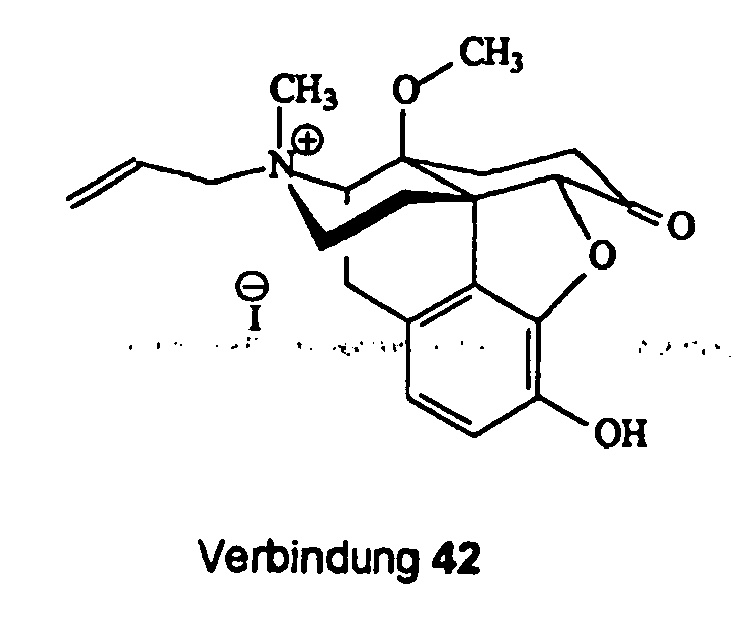
- Eine Lösung von 14-O-Methylnaloxon (Kobylecki et al. J. Med. Chem. 1982, 25, S. 116) (230 mg, 0,67 mmol) und Methyliodid (0,21 ml, 3,37 mmol) wurde in 10 ml Acetonitril 7 Tage bei 40 °C (Badtemperatur) gerührt und dann eingedampft. Der Eindampfrückstand (341 mg hellbraunes Öl) wurde mittels Säulenchromatographie (Kieselgel; CH2Cl2/MeOH (250:4,5) → 250:9)) gereinigt. Eindampfrückstand (202 mg, 62%) amorphe Verbindung 42. Fp. 178-181 °C; IR (KBr): 1722 (CO) cm-1; 1H-NMR (DMSO-d6): δ 9,55 (s, C3-OH), 6,70 (s, 2 arom. H), 6,28-6,06 (m, 1 olef. H), 5,82-5,64 (m, 2 olef. H), 4,94 (s, C5-H), 3,45 (s, +NCH3, axial), 3,38 (s, CH3O); MS(CI): m/z 356 (M+).
-

- Eine Lösung von 14-O-Methyloxymorphon (Schmidhammer et al. J. Med. Chem. 1984, 27, S. 1575-1579) (210 mg, 0,67 mmol) und Allyliodid (0,28 ml, 3,35 mmol) wurden in 5 ml N,N-Dimethylformamid 7 Tage bei 40 °C (Badtemperatur) gerührt und dann eingedampft Der Eindampfrückstand (484 mg braunes Öl) wurde mittels Säulenchromatographie (Kieselgel; CH2Cl2/MeOH (250:5) → 250:12)) gereinigt. Der Eindampfrückstand (134 mg) wurde nochmals mittels Säulenchromatographie (Kieselgel; CH2Cl2/MeOH (250:4,5)) gereinigt. Eindampfrückstand 77 mg (27%) amorphe Verbindung 43. Fp. >140 °C; IR (KBr): 1724 (CO) cm-1; 1H-NMR (DMSO-d6): δ 9,57 (s, C3-OH), 6,68 (s, 2 arom. H), 6,28-6,08 (m, 1 olef. H), 5,75-5,63 (m, 2 olef. H), 4,95 (s, C5-H), 3,42 (s, CH3O), 3,05 (s, +NCH3, äquatorial), MS(Cl): m/z 356 (M+).
-
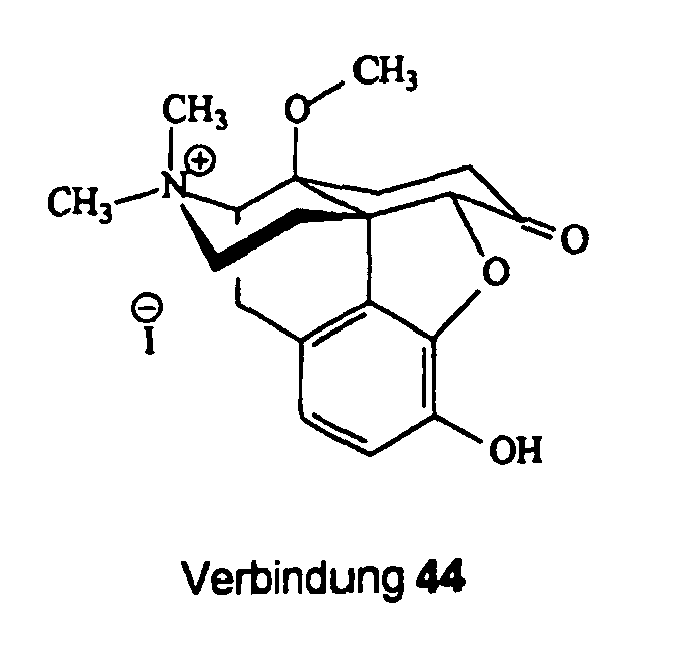
- Eine Lösung von 14-O-Methyloxymorphon (Schmidhammer et al. J. Med. Chem. 1984, 27, S. 1575-1579) (200 mg, 0,63 mmol) und Methyliodid (0,32 ml, 5,07 mmol) in Acetonitril (10 ml) wurde 21 Stunden lang unter N2 bei 50 °C (Badtemperatur) gerührt. Dann wurde nochmals Methyliodid (0,2 ml, 3,17 mmol) zugegeben, weitere 24 h lang unter den selben Bedingungen gerührt und eingedampft. Der Eindampfrückstand (324 mg, braunes Schaumharz) wurde aus MeOH (0,5 ml) kristallisiert und durch Umkristallisation aus MeOH gereinigt Ausbeute 244 mg (84 %) Verbindung 44. Fp. 225-240 °C; IR (KBr): 1725 (C=O) cm-1;1H-NMR (DMSO-d6): δ 9,55 (s, C3-OH), 6,69 (s, 2 arom. H, C1-H, C2-H), 4,94 (s, C5-H), 3,55 (s, +NCH3, axial), 3,38 (s, OCH3), 3,22 (s, +NCH3, äquatorial); MS (CI): m/z 330 (M+).
-

- NaH (0,52 g, 21,6 mmol) (erhalten aus 0,86 g 60% NaH-Dispersion in Öl durch Waschen mit Petrolether) wurde einer Lösung von 5β-Benzyl-14-hydroxycodeinon (M. Gates et al. J. Org. Chem. 1989, 54, S.972-974) (2,90 g, 7,2 mmol) in 40 ml wasserfreiem N,N-Dimethylformamid unter N2 bei 0 °C (Badtemperatur) unter Rühren zugefügt. Nach 20 min wurde trans-Crotylbromid (1,26 g, 9,3 mmol) zugesetzt und das Gemisch zunächst für 40 min bei 0 °C (Badtemperatur), dann bei Raumtemperatur für 2 h gerührt. Dann wurden Eisstückchen zugesetzt, bis keine Wasserstoffentwicklung mehr festzustellen war, das Gemisch auf 100 ml Wasser gegossen und mit Dichlormethan (1 x 100 ml, 5 x 50 ml) extrahiert. Die vereinigten organischen Phasen wurden mit gesättigter Natriumchloridlösung (6 x 250ml) gewaschen, über Natriumsulfat getrocknet, eingedampft und der Eindampfrückstand (3,25 g braunes Öl) mittels Säulenchromatographie (Kieselgel; CH2Cl2 / MeOH / konz. NH4OH 250 : 6 : 0,5) gereinigt. Vom resultierenden gelblichen Öl (1,86 g, 56%) wurden 0,1 g in 5 ml Ether gelöst und etherische HCl zugefügt. Es wurden 0,1 g farblose Kristalle von 5β-Benzyl-14β-{[(E)-(but-2-enyl]oxy}-7,8-didehydro-4,5α-epoxy-3-methoxy-17-methylmorphinan-6-on Hydrochlorid isoliert. Fp. 125-130 °C; MS (Cl): 458 (M++1); IR (KBr): 1684(C=O) cm-1;1H-NMR (DMSO-d6, δ in ppm): 9,22 (s, breit, HN+), 7,28-7,13 (m, 5 arom. H; 1 olefin. H, CH-8), 6,84 (d, 1 arom. H, J = 8,4 Hz), 6,74 (d, 1 arom. H, J = 8,4 Hz), 6,23 (d, 1 olefin. H, CH-7, J = 10,2 Hz), 5,69-5,34 (m, 2 olefin. H), 3,75 (s. CH3O), 2,91 (d, CH3N+), 1,69-1,65 (d, 3 H, C14-OCH2CHCHCH 3 , J = 7,4 Hz).
- Ein Gemisch von 5β-Benzyl-14β-{[(E)-(but-2-enyl]oxy}-7,8-didehydro-4,5α-epoxy-3-methoxy-17-methylmorphinan-6-on (1,75 g, 3,8 mmol) und 0,24 g Pd/C (10%) in 60 ml Methanol wurde 1,5 Stunden bei 35 psi und Raumtemperatur hydriert. Der Katalysator wurde abfiltriert und mit 20 ml Methanol gewaschen. Das Filtrat wurde eingedampft. Ausbeute 1,43 g (81 %) hellgelbes Öl, von dem 0,1 g in 5 ml Ether gelöst und durch Zugabe von etherischer HCl das Hydrochlorid gefällt wurde. Es wurden 0,1 g farblose Kristalle von 5β-Benzyl-14β-(butoxy)-4,5α-epoxy-3-methoxy-17-methylmorphinan-6-on Hydrochlorid isoliert. Fp. 148-152 °C; MS (Cl): 462 (M++1); IR (KBr): 1729 (C=O) cm-1; 1H-NMR (DMSO-d6, δ in ppm): 9,00 (s, breit, HN+), 7,29-7,16 (m, 5 arom. H), 6,85 (d, 1 arom. H, J = 8,4 Hz), 6,75 (d, 1 arom. H, J = 8,4 Hz), 3,80 (s, CH3O), 2,94 (d, CH3N+, J = 4,4 Hz), 1,02 (t, 3 H, C14-O(CH2)3CH 3 , J = 7,2 Hz).
- Eine Lösung von 5β-Benzyl-14β-butoxy-4,5α-epoxy-3-methoxy-17-methylmorphinan-6-on (1,30 g, 2,82 mmol) in 10 ml 48% HBr wurde 20 min rückflußerhitzt. Danach wurde die Lösung abgekühlt, auf 100 ml Eis gegossen, mit konz. NH4OH alkalisiert und mit Dichlormethan (5 x 50 ml) extrahiert. Die vereinigten organischen Phasen wurden mit gesättigter Natriumchloridlösung (3 x 150 ml) gewaschen, über Natriumsulfat getrocknet und eingedampft. Der Rückstand (0,97 g grauschwarzes Schaumharz) wurde mittels Säulenchromatographie (Kieselgel; CH2Cl2 / MeOH / konz. NH4OH 250 : 6 : 0,5) gereinigt. Ausbeute 0,82 g (65%) dunkelgelbes Öl, von dem 0,06 g in 5 ml Ether gelöst und durch Zugabe von etherischer HCl das Hydrochlorid gefällt wurde. Es wurden 0,06 g beige Kristalle von 5β-Benzyl-14β-butoxy-4,5α-epoxy-3-hydroxy-17-methylmorphinan-6-on Hydrochlorid isoliert. Fp. 200-204 °C; MS (Cl): 448 (M++1); IR (KBr): 1729 (C=O) cm-1; 1H-NMR (DMSO-d6, δ in ppm): 9,45 (s, OH), 8,72 (s, breit, HN+), 7,25-7,22 (m, 5 arom. H), 6,67-6,63 (s, 2 arom. H, CH-1 und CH-2). 2,93 (d, CH3N+), 1,02 (t, 3 H, C14-O(CH2)3CH 3 , J = 7,3 Hz).
- Eine Lösung von 5β-Benzyl-14β-butoxy-4,5α-epoxy-3-hydroxy-17-methylmorphinan-6-on (0,32 g, 0,72 mmol) und Methyliodid (0,51 g, 3,58 mmol) in 10 ml wasserfreiem Acetonitril wurde unter N2 bei 40 °C (Badtemperatur) 2 Tage gerührt und dann eingedampft. Der Eindampfrückstand (0,41 g braunes Öl) wurde mittels Säulenchromatographie (Kieselgel; CH2Cl2 / MeOH 250 : 6) gereinigt Ausbeute 0,22 g (54%) leicht beige gefärbte Kristalle der Verbindung 45. Fp. 188-195 °C; MS (Cl): 462 (M+); IR (KBr): 1729 (C=O) cm-1; 1H-NMR (DMSO-d6, δ in ppm): 9,49 (s, OH), 7,28-7,20 (m, 5 arom. H), 6,69 (d, 1 arom. H, J = 8,2 Hz), 6,62 (d, 1 arom. H, J = 8,2 Hz), 3,61 (s, CH3N+, axial), 3,23 (s, CH3N+, äquatorial), 1,01 (t, 3 H, C14-O(CH2)3CH 3 , J = 7,0 Hz).
-

- Eine Lösung von 5β-Benzyl-14β-butoxy-4,5α-epoxy-3-hydroxy-17-methylmorphinan-6-on (s. Beispiel 45) (0,31 g, 0,69 mmol) und Allylbromid (0,94 g, 5,59 mmol) in 10 ml wasserfreiem Acetonitril wurde unter N2 bei 40 °C (Badtemperatur) einen Tag lang gerührt und dann eingedampft. Der Eindampfrückstand (0,45 g braunes Öl) wurde mittels Säulenchromatographie (Kieselgel; CH2Cl2 / MeOH 250 : 5) gereinigt. Ausbeute 0,11 g (26%) beige Kristalle der Verbindung 46. Fp. 200-205 °C; MS (Cl): 488,2 (M+); IR (KBr): 1728 (C=O) cm-1; 1H-NMR (DMSO-d6, δ in ppm): 9,49 (s, OH), 7,26-7,23 (m, 5 arom. H), 6,67 (s, 2 arom. H, CH-1 und CH-2), 6,22-6,13 (m, 1 olefin. H), 5,80-5,66 (m, 2 olefin. H), 3,50 (s, CH3N+, äquatorial), 1,02 (t, C14-O(CH2)3CH 3, J = 7,4 Hz).
-

- NaH (0,92 g, 38,3 mmol) (erhalten aus 1,53 g 60% NaH-Dispersion in Öl durch Waschen mit Petrolether) wurde einer Suspension von 14-Hydroxycodeinon (lijima et al., J. Med. Chem. 1978, 21, S.398) (4,0 g, 12,8 mmol) in 50 ml wasserfreiem N,N-Dimethylformamid unter N2 bei 0 °C (Badtemperatur) unter Rühren zugefügt. Nach 20 min wurde in 20 ml DMF gelöstes trans-Crotylbromid (2,24 g, 16,6 mmol) zugetropft und das Gemisch zunächst für 40 min bei 0 °C (Badtemperatur), dann bei Raumtemperatur für 3 h weiter gerührt. Dann wurden Eisstückchen zugesetzt, bis keine Wasserstoffentwicklung mehr festzustellen war, das Gemisch wurde auf 100 ml Wasser gegossen und mit Dichlormethan (1 x 100 ml, 5 x 50 ml) extrahiert, die vereinigten organischen Phasen mit gesättigter Natriumchloridlösung (6 x 250ml) gewaschen und über Natriumsulfat getrocknet. Der Eindampfrückstand (5,2 g gelbbraunes Öl) wurde mittels Säulenchromatographie (Kieselgel; CH2Cl2 / MeOH / konz. NH4OH (250 : 5 : 0,5)) gereinigt. Es resultierte ein gelbliches Öl (2,20 g), das aus Methanol kristallisiert wurde. Ausbeute 1,75 g (36%) gelbliche Kristalle von 14β-{[(E)-(But-2-enyl]oxy}-7,8-didehydro-4,5α-epoxy-3-methoxy-17-methylmorphinan-6-on. Fp. 113-117 °C; MS (Cl): 368,2 (M++1); IR (KBr): 1679 (C=O) cm-1; 1H-NMR (DMSO-d6, δ in ppm): 7,13 (d, 1 olefin. H; CH-8, J = 10,0 Hz), 6,73 (d, 1 arom. H, J = 8,0 Hz), 6,64 (d, 1 arom. H, J = 8,0 Hz), 6,14 (d, 1 olefin. H, CH-7, J = 9,8 Hz), 5,69-5,43 (m, 2 olefin. H), 4,78 (s, CH-5), 4,03-3,80 (m, 2H, C14-OCH 2 -). 3,72 (s, CH3O), 2,34 (s, CH3N), 1,64 (d, OCH2CHCHCH 3 , J = 6,0 Hz).
- Ein Gemisch von 14β-([(E)-(But-2-enyl]oxy}-7,8-didehydro-4,5α-epoxy-3-methoxy-17-methylmorphinan-6-on (0,82 g, 2,23 mmol) und 0,82 g Pd/C (10%) in 50 ml Methanol wurde 45 min bei 30 psi und Raumtemperatur hydriert. Der Katalysator wurde abfiltriert, mit 20 ml Methanol gewaschen und das Filtrat eingedampft. Ausbeute 1,02 g hellgelbes Öl, das mittels Säulenchromatographie (Kieselgel; CH2Cl2 / MeOH / konz. NH4OH (250 : 2 : 0,5)) gereinigt wurde. Es resultierte ein gelbliches Öl, das aus Methanol kristallisiert wurde. Ausbeute 0,52 g (63%) farblose Kristalle von 14β-Butoxy-4,5α-epoxy-3-methoxy-17-methylmorphinan-6-on isoliert. Fp. 112-117 °C; MS (Cl): 371,1 (M++1); IR (KBr): 1722 (C=O) cm-1; 1H-NMR (DMSO-d6, δ in ppm): 6,74 (d, 1 arom. H, J = 8,0 Hz), 6,65 (d, 1 arom. H, J = 8,2 Hz), 4,75 (s, CH-5), 3,78 (s, CH3O), 2,29 (s, CH3N), 0,93 (t, OCH2CH2CH2CH 3, J = 7,2 Hz).
- Eine Lösung von 14β-Butoxy-4,5α-epoxy-3-methoxy-17-methylmorphinan-6-on (0,30 g, 0,81 mmol) in 3,2 ml 48% HBr wurde 8 min rücktlußerhitzt. Danach wurde die Lösung abgekühlt, auf 20 ml Eis gegossen, mit konz. NH4OH alkalisiert und mit Dichlormethan (5 x 30 ml) extrahiert. Die vereinigten organischen Phasen wurden mit gesättigter Natriumchloridlösung (3 x 100 ml) gewaschen, über Natriumsulfat getrocknet und eingedampft. Der Rückstand (0,29 g braunes Öl) wurde mittels Säulenchromatographie (Kieselgel; CH2Cl2 / MeOH / konz. NH4OH 250 : 5 : 0,5) gereinigt. Ausbeute 0,06 g (21 %) dunkelgelbes Öl, welches in 5 ml Ether gelöst wurde und mit etherischer HCl in das Hydrochlorid überführt wurde. Es wurden 0,06 g hellbraune Kristalle von 14ß-Butoxy-4,5α-epoxy-3-hydroxy-17-methylmorphinan-6-on Hydrochlorid isoliert. Fp. 168-172°C; MS (Cl): 358,2 (M++1); IR (KBr): 1725 (C=O) cm-1; 1H-NMR (DMSO-d6, δ in ppm): 9,51 (s, OH), 8,75 (s, breit, HN+), 6,71 (d, 1 arom. H, J = 8,2 Hz), 6,65 (d, 1 arom. H, J = 8,0 Hz), 4,92 (s, CH-5), 2,82 (d, CH3N+, J = 4,4 Hz), 0,95 (t, O(CH2)3CH 3, J = 7,4 Hz).
- Eine Lösung von 14β-Butoxy-4,5α-epoxy-3-hydroxy-17-methylmorphinan-6-on (0,53 g, 1,49 mmol) und Methyliodid (1,06 g, 7,44 mmol) in 10 ml wasserfreiem Acetonitril wurde unter N2 bei 40 °C (Badtemperatur) 2 Tage gerührt und dann eingedampft. Der Eindampfrückstand (0,70 g braunes Öl) wurde mittels Säulenchromatographie (Kieselgel; CH2Cl2 / MeOH 250 : 4) gereinigt. Ausbeute 0,31 g (42%) farblose Kristalle der Verbindung 47. Fp. 180-185 °C; MS (Cl): 372,2 (M+); IR (KBr): 1726 (C=O) cm-1; 1H-NMR (DMSO-d6, δ in ppm): 9,55 (s, OH), 6,68 (s, 2 arom. H), 4,95 (s, CH-5), 3,57 (s,CH3N+,axial), 3,21 (s, CH3N+, äquatorial), 0,94 (t, O(CH2)3CH3, J = 7,3 Hz).
-

- Ein Gemisch aus 17-Cyclopropylmethyl-4,5α-epoxymorphinan-6-spiro-2'-(1,3-dioxolan)-3,14β-diol (Schmidhammer et al., Heterocycles 1998, 49, 1, S. 489-498) (7,92 g, 20,55 mmol), K2CO3 (7,67 g, 55,49 mmol), Benzylbromid (4,57 g, 26,72 mmol) und 80 ml wasserfreiem N,N-Dimethylformamid wurde unter N2 12 h bei Raumtemperatur gerührt. Das anorganische Material wurde abfiltriert, mit Dichlormethan gewaschen und das Filtrat eingedampft. Der kristalline Eindampfrückstand (10,97 g) wurde aus Methanol umkristallisiert. Ausbeute 8,80 g (90%) farblose Kristalle von 3-Benzyloxy-17-cyclopropylmethyl-4,5α-epoxy-14β-hydroxymorphinan-6-spiro-2'-(1,3-dioxolan). Fp. 130-131 °C; MS (Cl): 476 (M++1); IR (KBr): 3352 (OH) cm-1; 1H-NMR (CDCl3, δ in ppm): 7,42-7,27 (m, 5 arom. H), 6,75 (d, 1 arom. H, J = 8,3 Hz), 6,54 (d, 1 arom. H, J = 8,3 Hz), 5,17 (d, 1 H, J = 11,7 Hz, OCH2Ph), 5,10 (d, 1 H, J = 11,7 Hz, OCH2Ph), 4,58 (s, CH-5), 4,19-3,73 (m, 4H, OCH2CH2O).
- NaH (2,24 g, 93,6 mmol) (erhalten aus 3,75 g 60% NaH-Dispersion in Öl durch Waschen mit Petrolether) wurde einer Lösung von 3-Benzyloxy-17-cyclopropylmethyl-4,5α-epoxy-14β-hydroxymorphinan-6-spiro-2'-(1,3-dioxolan) (14,8 g, 31,2 mmol) in 100 ml wasserfreiem N,N-Dimethylformamid unter N2 bei 0 °C (Badtemperatur) unter Rühren zugefügt. Nach 20 min wurde in 20 ml DMF gelöstes Cinnamylbromid (7,99 g, 40,6 mmol) zugetropft und das Gemisch für 25 min bei 0 °C (Badtemperatur), dann bei Raumtemperatur für 3,5 h gerührt. Dann wurden Eisstückchen zugesetzt, bis keine Wasserstoffentwicklung mehr festzustellen war. Das Gemisch wurde auf 200 ml Wasser gegossen, mit Dichlormethan (4 x 100 ml) extrahiert, die vereinigten organischen Phasen mit gesättigter Natriumchloridlösung (5 x 250ml) gewaschen, über Natriumsulfat getrocknet und eingedampft. Der Eindampfrückstand (18,2 g gelbbraunes Öl) wurde mittels Säulenchromatographie (Kieselgel; CH2Cl2 /MeOH / konz. NH4OH 250 : 3 : 0,5) gereinigt. Es resultierte ein gelbliches Öl (6,1 g, 33%), von dem 0,2 g in 5 ml Ether gelöst wurden und mit etherischer HCl in das Hydrochlorid überführt wurden. Es wurden 0,1 g beige Kristalle von 3-Benzyloxy-17-cyclopropylmethyl-4,5α-epoxy-14β-{[(E)-3-phenylprop-2-enyl]oxy}morphinan-6-spiro-2'-(1,3-dioxolan) Hydrochlorid isoliert. Fp. 133-136 °C; MS (CI): 592 (M++1); 1H-NMR (DMSO-d6): δ 8,23 (s, breit, HN+), 7,53-7,24 (m, 10 arom. H), 6,93 (d, 1 arom. H, J = 8,4 Hz), 6,70 (d, 1 arom. H, J = 8,4 Hz), 6,70 (m, 2 olefin. H), 5,15 (s, 2H, C3-OCH 2 Ph), 4,65 (s, CH-5), 4,33-4,20 (m, 2H, OCH 2 CHCHPh), 4,04-3,74 (m, 4H, OCH2CH2O).
- Ein Gemisch von 3-Benzyloxy-17-cyclopropylmethyl-4,5α-epoxy-14β-{[(E)-3-phenylprop-2-enyl]oxy}morphinan-6-spiro-2'-(1,3-dioxolan) (6,08 g, 10,3 mmol) und 0,60 g Pd/C (10%) in einem Gemisch aus 100 ml Methanol und 50 ml Tetrahydrofuran wurde 2,5 Stunden bei 30 psi und Raumtemperatur hydriert. Der Katalysator wurde abfiltriert, mit je 20 ml Methanol und Tetrahydrofuran gewaschen und das Filtrat eingedampft. Eindampfrückstand 4,02 g hellgelbes Öl, das mittels Säulenchromatographie (Kieselgel; CH2Cl2 / MeOH / konz. NH4OH 250 : 5:0,5) gereinigt wurde. Es resultierte ein gelbliches Öl (2,75g, 53%), von dem 0,07 g in 5 ml Ether gelöst wurden und mit etherischer HCl in das Hydrochlorid übergeführt wurden. Es wurden 0,06 g farblose Kristalle von 17-Cyclopropylmethyl-4,5α-epoxy-3-hydroxy-14β-[(3-phenylpropyl)oxy]morphinan-6-spiro-2'-(1,3-dioxolan) Hydrochlorid isoliert. Fp. 158-162 °C; MS (Cl): 504 (M++1);1H-NMR (DMSO-d6, δ in ppm): 9,24 (s, OH), 7,79 (s, breit, HN+), 7,35-7,18 (m, 5 arom. H), 6,68 (d, 1 arom. H, J = 8,0 Hz), 6,57 (d, 1 arom. H, J = 8,0 Hz), 4,51 (s, CH-5), 4,09-3,71 (m, 4H, OCH2CH2O).
- Eine Lösung von 17-Cyclopropylmethyl-4,5α-epoxy-3-hydroxy-14β-[(3-phenylpropyl)oxy]morphinan-6-spira-2'-(1,3-dioxolan) (0.22 g, 0,44 mmol) in 5 ml eines Gemisches aus HCl konz./MeOH (4:9) wurde 1 h lang rückflußerhitzt. Nach dem Abkühlen wurde das entstandene Kristallisat abfiltriert, das Filtrat eingedampft und der Rückstand aus Ether kristallisiert. Ausbeute 0,122 g (61 %) farblose nadelförmige Kristalle von 17-Cyclopropylmethyl-4,5α-epoxy-3-hydroxy-14β-[(3-phenylpropyl)oxy]morphinan-6-on Hydrochlorid. Fp. 200-230 °C; MS (Cl): 460,3 (M++1); IR (KBr): 1725 (C=O) cm-1; 1H-NMR (DMSO-d6, δ in ppm): 9,52 (s, OH), 8,20 (s, breit, HN+), 7,30-7,18 (m, 5 arom. H), 6,71 (d, 1 arom. H, J = 8,0 Hz), 6,64 (d, 1 arom. H, J = 8,0 Hz), 4,89 (s, CH-5).
- Eine Lösung von 17-Cyclopropylmethyl-4,5α-epoxy-3-hydroxy-14β-[(3-phenylpropyl)oxy]morphinan-6-on (0,54 g, 1,17 mmol) und Methyliodid (0,83 g, 5,84 mmol) in 10 ml wasserfreiem Acetonitril wurde unter N2 bei 40 °C (Badtemperatur) 5 Tage gerührt und dann eingedampft. Der Rückstand (0,72 g braunes Öl) wurde mittels Säulenchromatographie (Kieselgel; CH2Cl2 / MeOH 250 : 4) gereinigt. Es wurden zwei verschiedene Produkte isoliert:
Verbindung 48: Ausbeute 0,21 g (30%) farblose Kristalle. Fp. 175-176 °C; MS (Cl): 474 (M+); IR (KBr): 1726 (C=O) cm-1; 1H-NMR (OMSO-d6, δ in ppm): 9,53 (s, breit, OH), 7,31-7,17 (m, 5 arom. H), 6,69 (s, 2 arom. H), 4,87 (s, CH-5), 3,53 (s, CH3N+, axial).
Verbindung 49: Ausbeute 0,03 g (4%) hellorange Kristalle. Fp. 133-136 °C; MS (Cl): 488 (M+); IR (KBr): 1725 (C=O) cm-1; 1H-NMR (DMSO-d8, δ in ppm): 7,31-7;19 (m, 5 arom. H), 6,89 (d, 1 arom. H, J = 8,4 Hz), 6,82 (d, 1 arom. H, J = 8,4 Hz), 4,94 (s, CH-5), 3,81 (s, C3-OCH3), 3,55 (s, CH3N+, axial). -

- NaH (1,51 g, 62,9 mmol) (erhalten aus 2,51 g 60% NaH-Dispersion in Öl durch Waschen mit Petrolether) wurde einer Lösung von 3-Benzyloxy-17-cyclopropylmethyl-4,5α-epoxy-14β-hydroxymorphinan-6-spiro-2'-(1,3-dioxolan) (s. Beispiel 46) (5,99 g, 12,6 mmol) in 75 ml wasserfreiem N,N-Dimethylformamid unter N2 bei 0 °C (Badtemperatur) unter Rühren zugefügt. Nach 20 min wurde 2-Phenylbenzylbromid (4,04 g, 16,4 mmol) zugegeben und das Gemisch 20 min bei 0 °C (Badtemperatur), dann bei Raumtemperatur 2 h gerührt. Dann wurden Eisstückchen zugesetzt, bis keine Wasserstoffentwicklung mehr festzustellen war, das Gemisch wurde auf 200 ml Wasser gegossen, mit Dichlormethan (1 x 100 ml, 2 x 75ml) extrahiert, die vereinigten organischen Phasen mit Wasser (5 x 300ml) und gesättigter Natriumchloridlösung (1 x 100ml) gewaschen, über Natriumsulfat getrocknet und eingedampft. Vom Eindampfrückstand (7,90 g braunes Öl) wurden 3.52 g mittels Säulenchromatographie (Kieselgel; CH2Cl2 / MeOH / konz. NH4OH 250 : 2.5 : 0,5) gereinigt Es resultierte ein gelbliches Öl (2,83 g), das in 15 ml Ether gelöst wurde und mit etherischer HCl in das Hydrochlorid überführt wurde. So wurden 2,20 g farblose Kristalle von 3-Benzyloxy-17-cyclopropylmethyl-4,5α-epoxy-14β-[(2-phenylbenzyl)oxy]morphinan-6-spiro-2'-(1,3-dioxolan) Hydrochlorid erhalten. Fp. 142-144 °C; MS (CI): 642 (M++1); 1H-NMR der gereinigten Base (DMSO-d6): δ 7,70-7,25 (m, 14 arom. H), 6,76 (d, 1 arom. H, J = 8,4 Hz), 6,53 (d, 1 arom. H, J = 8,4 Hz), 5,10 (s, 2H, C3-OCH 2 Ph), 4,63 (d, 1 H, C14-OCH 2 , J = 10,6 Hz), 4,46 (s, CH-5), 4,34 (d, 1 H, C14-OCH2, J =10,6 Hz), 4,10-3,69 (m, 4H, OCH2CH2O).
- Eine Lösung von 3-Benzyloxy-17-cyclopropylmethyl-4,5α-epoxy-14β-[(2-phenylbenzyl)oxy]morphinan-6-spiro-2'-(1,3-dioxolan) Hydrochlorid (2,10 g, 3,10 mmol) in 40 ml eines Gemisches aus konz. HCl/MeOH (4:9) wurde 1,5 h lang rückflußerhitzt. Nach dem Abkühlen wurde das Gemisch auf 100 ml Eis gegossen, mit konz. NH4OH alkalisiert und mit Dichlormethan (1 x 100 ml, 4 x 75ml) extrahiert, die vereinigten organischen Phasen mit Wasser (2 x 150ml) und gesättigter Natriumchloridlösung (1 x 100ml) gewaschen, über Natriumsulfat getrocknet und eingedampft. Es wurde ein gelbes Öl (1,90 g) erhalten, das mittels Säulenchromatographie (Kieselgel; CH2Cl2/ MeOH / konz. NH4OH (250 : 3 : 0,5)) gereinigt wurde. Es resultierte ein gelbliches Öl (0,7 g, 42%), von dem 0,16 g in 5 ml Ether gelöst wurden und mit etherischer HCl in das Hydrochlorid überführt wurden. Es wurden 0,12 g farblose Kristalle von 17-Cyclopropylmethyl-4,5α-epoxy-3-hydroxy-14ββ-[(2-phenylbenzyl)oxy]morphinan-6-on Hydrochlorid isoliert. Fp. 181-186 °C; MS (Cl): 508 (M++1); IR (KBr): 1725 (C=O) cm-1; 1H-NMR (DMSO-d6, δ in ppm): 9,58 (s, OH), 8,33 (s, breit, HN+), 7,95-7,25 (m, 9 arom. H), 6,72 (d, 1 arom. H, J = 8,0 Hz), 6,64 (d, 1 arom. H, J = 8,0 Hz), 5,14 (s, CH-5), 4,84 (d, 1 H, C14-OCH 2 -R, J =12,4 Hz), 4,56 (d, 1 H, C14-OCH 2 -R, J =12,4 Hz).
- Eine Lösung von 17-Cyclopropylmethyl-4,5α-epoxy-3-hydroxy-14β-[(2-phenylbenzyl)oxy]morphinan-6-on (0,39 g, 0,76 mmol) und Methyliodid (0,54 g, 3,79 mmol) in 6 ml wasserfreiem Acetonitril wurde unter N2 bei 40 °C (Badtemperatur) 2 Tage gerührt und dann eingedampft. Der Rückstand (0,5 g braunes Öl) wurde mittels Säulenchromatographie (Kieselgel; CH2Cl2 / MeOH 250 : 4) gereinigt Ausbeute 0,02 g (4%) beige Kristalle der Verbindung 50. Fp. 219-221 °C; MS (Cl): 522 (M+); IR (KBr): 1725 (C=O) cm-1; 1H-NMR (DMSO-d6): δ 9,53 (s, OH), 7,68-7,25 (m, 9 arom. H), 6,67 (s, 2 arom. H), 4,73 (d, C14-OCH 2), 4,61 (s, CH-5), 3,26 (s, CH3N+, axial).
-

- NaH (1,28 g, 53,3 mmol) (erhalten aus 2,13 g 60% NaH-Dispersion in Öl durch Waschen mit Petrolether) wurde einer Lösung von 3-(Benzyloxy)-1 7-(cyclopropylmethyl)-4,5α-epoxy-14β-hydroxymorphinan-6-spiro-2'-(1,3-dioxolan) (s. Beispiel 48) (5,00 g, 10,6 mmol) in 75 ml wasserfreiem N,N-Dimethylformamid unter N2 bei 0 °C (Badtemperatur) unter Rühren zugefügt. Nach 20 min wurde 4-Chlorbenzylbromid (2,95 g, 14,3 mmol) zugegeben und das Gemisch zunächst 30 min bei 0 °C (Badtemperatur), dann bei Raumtemperatur 1,5 Stunden gerührt. Dann wurden Eisstückchen zugesetzt, bis keine Wasserstoffentwicklung mehr festzustellen war, das Gemisch auf 400 ml Wasser gegossen, mit Dichlormethan (3 x 100 ml) extrahiert, die vereinigten organischen Phasen mit Wasser (5 x 400 ml) und gesättigter Natriumchloridlösung (1 x 100 ml) gewaschen, über Natriumsulfat getrocknet und eingedampft. Der Eindampfrückstand (6,45 g gelbes Öl) wurde aus Methanol kristallisiert. Ausbeute 4,72 g (75%) farblose Kristalle von 3-Benzyloxy-14β-[(4-Chlorbenzyl)oxy]-17-cyclopropylmethyl-4,5α-epoxymorphinan-6-spiro-2'-(1,3-dioxolan). Fp. 122-125 °C; MS (CI): 600 (M++1); 1H-NMR (DMSO-d6, δ in ppm): 7,53-7,35 (m, 9 arom. H), 6,78 (d, 1 arom. H, J = 8,4 Hz), 6,57 (d, 1 arom. H, J = 8,4 Hz), 5,11 (d, 2 H, C3-OCH 2 Ph), 4,65 (d, 1 H, C14-OCH 2 , J =11,2 Hz), 4,23 (s, CH-5), 4,30 (d, 1 H. C14-OCH 2, J = 11,2 Hz), 4,10-3,70 (m, 4H, OCH2CH2O).
- Eine Lösung von 3-Benzyloxy-14β-[(4-Chtorbenzyl)oxy]-17-(cyclopropylmethyl)-4.5α-epoxymorphinan-6-spiro-2'-(1,3-dioxolan) (4,60 g, 7,66 mmol) in 100 ml eines Gemisches aus HCl konz./MeOH (4:9) wurde 1,5 h lang rückflußerhitzt. Nach dem Abkühlen wurde das Reaktionsgemisch auf 300 ml Eis gegossen, mit konz. NH4OH alkalisiert, mit Dichlormethan (3 x 150 ml) extrahiert, die vereinigten organischen Phasen mit Wasser (2 x 150ml) und gesättigter Natriumchloridlösung (1 x 100ml) gewaschen, über Natriumsulfat getrocknet und eingedampft. Der Eindampfrückstand (4,86 g gelbes Öl) wurde mittels Säulenchromatographie (Kieselgel; CH2Cl2 / MeOH / konz. NH4OH 250 : 3 : 0,5) gereinigt. Es resultierte ein gelbliches Öl (1,18 g, 33%), von dem 0,26 g in 5 ml Ether gelöst wurden und mit etherischer HCl in das Hydrochlorid überführt wurden. Es wurden 0,23 g farblose Kristalle von 14β-[(4-Chlorbenzyl)oxy]-17-cyclopropylmethyl-4,5α-epoxy-3-hydroxymorphinan-6-on Hydrochlorid isoliert. Fp. 195-200 °C; MS (Cl): 466,1 (M++1); IR (KBr): 1725 (C=O) cm-1; 1H-NMR (DMSO-d6, δ in ppm): 9,59 (s, OH), 8,63 (s, breit, HN+), 7,61 (d, 2 arom. H, C14-OCH2 Ph-Cl, J = 8,4 Hz), 7,47 (d, 2 arom. H, C14-OCH2 Ph-Cl, J = 8,4 Hz), 6,73 (d, 1 arom. H, J = 8,2 Hz), 6,68 (d, 1 arom. H, J = 8,0 Hz), 5,08 (s, CH-5), 4,80 (d, 1 H, C14-OCH 2, J = 12 Hz), 4,72 (d, 1H, C14-OCH 2, J =12 Hz).
- Eine Lösung von 14β-[(4-Chlorbenzyl)oxy]-17-cyclopropylmethyl-4,5α-epoxy-3-hydroxymorphinan-6-on (0,50 g, 1,07 mmol) und Methyliodid (0,76 g, 5,37 mmol) in 8 ml wasserfreiem Acetonitril wurde unter N2 bei 40 °C (Badtemperatur) 6 Tage gerührt und dann eingedampft. Der Rückstand (0,56 g braunes Öl) wurde mittels Säulenchromatographie (Kieselgel; CH2Cl2 / MeOH 250 : 4) gereinigt. Ausbeute 0,07 g (11%) beige Kristalle der Verbindung 51. Fp. 214-219 °C; MS (Cl): 480 (M+); IR (KBr): 1733 (C=O) cm-1; 1H-NMR (DMSO-d6, δ in ppm): 9,57 (s, OH). 7,57 (d, 2 arom.H, C14-OCH2 Ph-Cl, J = 8,6 Hz), 7,48 (d, 2 arom.H, C14-OCH2 Ph-Cl, J = 8,6 Hz), 6,71 (s, 2 arom. H), 5,10 (s, CH-5), 4,86 (d, 1H, C14-OCH 2 , J= 11,4 Hz); 4,75-4,66 (m, 3H, C14-OCH 2 und CH-9), 3,44 (s, CH3N+, axial).
-

- Ein Gemisch aus 4,5α-Epoxy-3,14β-dimethoxymorphinan-6-on (Kobylecki et al., J. Med. Chem., 1982, 25, 2, S.116-120) (1,44 g, 4,57 mmol), Kaliumcarbonat (4,11 g, 29,7 mmol), 2-Phenylethylbromid (1,1 g, 5,94 mmol) und 20 ml N,N-Dimethylformamid wurde 5,5 h bei 80 °C (Badtemperatur) unter N2 gerührt. Dann wurde 200 ml Wasser zugesetzt und mit Dichlormethan (4 x 50ml) extrahiert. Die vereinigten organischen Phasen wurden mit Wasser (6 x 130ml) gewaschen, über Natriumsulfat getrocknet und eingedampft. Ausbeute 1,95 g gelbliches Öl von 4,5α-Epoxy-3,14β-dimethoxy-17-(2-phenylethyl)morphinan-6-on, welches unverändert für den nächsten Syntheseschritt eingesetzt wurde. Analytische Daten: 1H-NMR (CDCl3, δ in ppm): 7,30-7,18 (m, 5 arom. H), 6,69 (d, 1 arom. H, J = 8,0 Hz), 6,60 (d, 1 arom. H, J = 8,0 Hz), 4,64 (s, CH-5), 3,89 (s, C3-OCH3), 3,18 (s, C14- OCH3).
- Eine Lösung von 4,5α-Epoxy-3,14β-dimethoxy-17-(2-phenylethyl)morphinan-6-on (2,4 g, 5,72 mmol) in 25 ml 48% HBr wurde 13 min rückflußerhitzt. Danach wurde die Lösung abgekühlt, auf 100 ml Eis gegossen, mit konz. NH4OH alkalisiert und mit Dichlormethan (5 x 50 ml) extrahiert. Die vereinigten organischen Phasen wurden mit gesättigter Natriumchloridlösung (3 x 150 ml) gewaschen, über Natriumsulfat getrocknet und eingedampft. Der Rückstand (2,40 g braunes Öl) wurde mittels Säulenchromatographie (Kieselgel; CH2Cl2 / MeOH / konz. NH4OH 250 : 2 : 0,5) gereinigt. Ausbeute 0,4 g (17%) dunkelgelbes Öl, von dem 0,04 g in 5 ml Ether gelöst wurden und mit etherischer HCl das Hydrochlorid erhalten wurde. Es wurden 0,02 g farblose Kristalle von 4,5α-Epoxy-3-hydroxy-14β-methoxy-17-(2-phenylethyl)morphinan-6-on Hydrochlorid isoliert. Fp. 259-262 °C; MS (Cl): 406 (M++1); IR (KBr): 1731 (C=O) cm-1: 1H-NMR (DMSO-d6, δ in ppm): 9,52 (s, OH), 9,28 (s, breit, HN+), 7,38-7,25 (m, 5 arom. H), 6,70 (s, 2 arom. H, CH-1 und CH-2), 4,96 (s, CH-5), 3,40 (s, C14-OCH3).
- Eine Lösung von 4,5α-Epoxy-3-hydroxy-14β-methoxy-17-(2-phenylethyl)morphinan-6-on (0,32 g, 0,78 mmol) und Methyliodid (0,56 g, 3,92 mmol) in 6 ml wasserfreiem Acetonitril wurde unter N2 bei 40 °C (Badtemperatur) 2 Tage gerührt und dann eingedampft. Der Rückstand (0,32 g braunes Öl) wurde mittels Säulenchromatographie (Kieselgel; CH2Cl2 / MeOH 250 : 2) gereinigt. Ausbeute 0,07 g (16%) farblose Kristalle der Verbindung 52. Fp. 180-181 °C; MS (Cl): 420 (M++1); IR (KBr): 1727 (C=O) cm-1; 1H-NMR (D2O, δ in ppm): 7,17-7,14 (m, 5 arom. H), 6,56 (s, 2 arom. H), 5,18 (s, CH-5), 3,64 (s, CH3N+, axial), 3,44 (s, OCH3).
-

- Zu einer Lösung von 4,5α-Epoxy-3-hydroxy-17-methyl-14β-[(3-phenylpropyl)oxy]morphinan-6-on (s. Beispiel 36) (6,38 g, 15,20 mmol) in 40 ml wasserfreiem Dimethylformamid wurde wasserfreies K2CO3 (5,67 g, 41,06 mmol) und 5-Chlor-1-phenyl-1H-tetrazol (3,02 g, 16,73 mmol) zugegeben und dieses Gemisch 23 h bei Raumtemperatur gerührt. Nach Zugabe von 300 ml H2O wurde mit CH2Cl2 (3x75 ml) extrahiert. Die vereinigten organischen Phasen wurden mit H2O (2x200 ml) und gesättigter NaCl-Lösung (3x250 ml) gewaschen, über Na2SO4 getrocknet und eingedampft. Der Eindampfrückstand (7,48 g gebliches Öl) wurde säulenchromatographisch gereinigt (Kieselgel; CH2Cl2 / MeOH / konz. NH4OH (250 : 2 : 0,5)). Die geeigneten Fraktionen wurden eingedampft. Es resultierte 6,41 g gelbes Öl (4,5α-Epoxy-17-methyl-14β-[(3-phenylpropyl)oxy)-3-[(1-phenyl-1 H-tetrazol-5-yl)oxy]morphinan-6-on; 75%), das ohne weitere Reinigung für den nächsten Reaktionsschritt verwendet wurde. Für analytische Zwecke wurde eine kleine Menge aus Ether kristallisiert und so 4,5α-Epoxy-17-methyl-14β-[(3-phenylpropyl)oxy]-3-[(1-phenyl-1 H-tetrazol-5-yl)oxy]morphinan-6-on als farblose Kristalle erhalten. Fp. 117-119 °C; MS (Cl): 564 (M++1); IR (KBr): 1723 (C=O) cm-1; 1H-NMR (DMSO-d6): δ 7,88-7,837 (m, 2 arom. H), 7,73-7,62 (m, 3 arom. H), 7,30-7,16 (m, 6 arom. H), 6,85 (d, J = 8,4 Hz, 1 arom. H), 4,93 (s, CH-5), 2.29 (s, 3H , N17-CH 3).
- Ein Gemisch aus 4,5α-Epoxy-17-methyl-14β-[(3-phenylpropyl)oxy]-3-[(1-phenyl-1 H-tetrazol-5-yl)oxy]morphinan-6-on (6,20 g, 11,00 mmol), 10%-igem Pd/C-Katalysator (2,48 g) und 100 ml Eisessig wurde bei 50 psi und 40 °C 17 h lang hydriert. Nach Abfiltrieren vom Katalysator wurde das Filtrat auf ein Volumen von 30 ml eingeengt, 150 ml Eis/Wasser-Gemisch zugesetzt und nach Alkalisierung mit konz. NH4OH mit CH2Cl2 (1x100 ml, 3x75 ml) extrahiert. Die vereinigten organischen Phasen wurden mit gesättigter NaCl-Lösung (4x200 ml) gewaschen, über Na2SO4 getrocknet und eingedampft. Der Eindampfrückstand (4,15 g gelbliches Öl, DC-rein) wurde aus wenig Methanol kristallisiert und so 3,20 g (72%) der Verbindung 53 als farblose Kristalle erhalten. Fp.105-109 °C; MS (Cl): 404 (M++1); IR (KBr): 1721 (C=O) cm-1; 1H-NMR (DMSO-d6): δ 7,29-7,16 (m, 5 arom. H), 7,04 (t, J = 8,0 Hz, 1 arom. H), 6,73 (d, J = 8,0 Hz, 1 arom. H), 6,64 (d, J = 8,0 Hz, 1 arom. H), 4,75 (s, 1H, C5-H), 2,28 (s, 3H, N17-CH 3 )
-
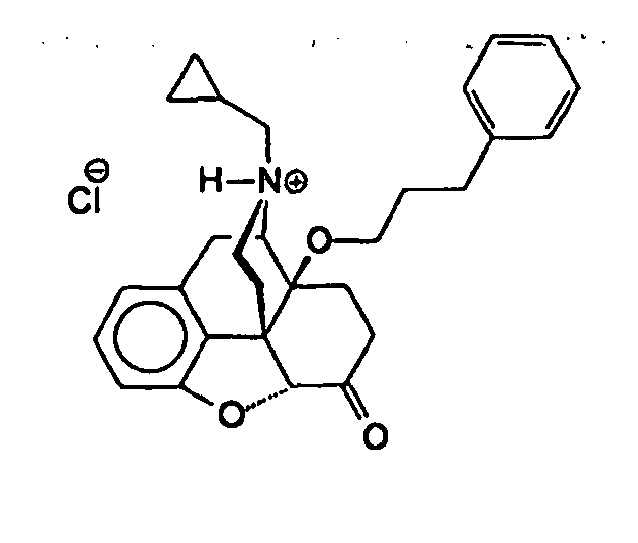

- Zu einer Lösung von 53 (3,20 g, 7,93 mmol) in 40 ml ethanolfreiem 1,2-Dichlorethan wurde unter N2 NaHCO3 (3,33 g, 39,65 mmol) und 1-Chlorethylchloroformiat (4,32 ml, 39,65 mmol) zugegeben. Dieses Gemisch wurde bei 60 °C (Ölbadtemperatur) unter N213,5 h lang gerührt. Dann wurde vom anorganischen Rückstand abfiltriert, der Rückstand mit ethanolfreiem 1,2-Dichlorethan gewaschen und das Filtrat eingedampft. Der Eindampfrückstand (3,7 g gelbbraunes Öl, DC-rein) wurde - ohne weiter gereinigt und charakterisiert zu werden -1 h lang in einem Gemisch aus 15 ml konz. HCl und 35 ml MeOH rückflußerhitzt. Die Reaktionslösung wurde eingedampft und der Eindampfrückstand aus MeOH/Et2O kristallisiert. Es wurden 2,77 g (82%) 4,5α-Epoxy-14β-[(3-phenylpropyl)oxy]morphinan-6-on Hydrochlorid isoliert. Fp. >225 °C (Zersetzung); MS (Cl): m/z 390 (M++1); IR (KBr): 1729 (C=O) cm-1; 1H-NMR (DMSO-d6): δ 9,25 (s, breit, 1 H, +HN), 8,11 (s, breit, 1 H, +HN), 7,34-7,12 (m, 5 arom. H), 7,16 (t, J = 8,0 Hz, 1 arom. H), 6,85 (d, J = 8,0 Hz, 1 arom. H), 6,77 (d, J = 8,0 Hz, 1 arom. H), 4,96 (s, 1H, C5-H), 4,28 (ps-d, C9-H).
- Zu einer Lösung von 4,5α-Epoxy-14β-[(3-phenylpropyl)oxy]morphinan-6-on Hydrochlorid (2,36 g, 5,55 mmol) in 20 ml wasserfreiem Dimethylformamid wurde unter N2 wasserfreies K2CO3 (2,13 g, 15,40 mmol) und Cyclopropylmethylbromid (0,64 ml, 6,67 mmol) zugegeben. Dieses Gemisch wurde bei einer Badtemperatur von 80°C unter N2 gerührt. Da eine DC-Kontrolle nach 7 h zeigte, dass die Reaktion noch nicht vollständig abgelaufen war, wurden nochmals 0,50 ml Cyclopropylmethylbromid (5,24 mmol) zugegeben. Nach einer weiteren Stunde war die Reaktion beendet, und es wurde nach dem Abkühlen vom anorganischen Material abfiltriert, der Rückstand mit CH2Cl2 gewaschen und das Filtrat eingedampft. Der Eindampfrückstand wurde in 150 ml CH2Cl2 gelöst, mit H2O (5x150 ml) und mit gesättigter NaCl-Lösung (150 ml) gewaschen, über Na2SO4 getrocknet und eingedampft. Es resultierten 2,43 g (99%) 17-(Cyclopropylmethyl)-4,5α-epoxy-14β-[(3-phenylpropyl)oxy]morphinan-6-on (54) als gelbliches Öl, das für die nächste Reaktion ohne weitere Reinigung verwendet wurde. 0,30 g des Öls wurden in Ether gelöst und nach Zugabe von etherischer HCl wurden 0,23 g 17-(Cyclopropylmethyl)-4,5α-epoxy-14β-[(3-phenylpropyl)oxy]morphinan-6-on Hydrochlorid (Verbindung 54.HCl) als farbloses Pulver isoliert. Fp. 145-150 °C; MS (CI): m/z 4.44 (M++1); IR (KBr): 1726 (C=O) cm-1;1H-NMR (DMSO-d6): δ 8.26 (s, breit, 1 H), 7.31-7.14 (m, 5 arom. H), 7.18 (t, J = 8,0 Hz, 1 arom. H), 6.85 (d, J = 8,0 Hz, 1 arom. H), 6.78 (d, J = 8,0 Hz, 1 arom. H), 4.96 (s, 1H, C5-H), 4.55 (ps-d, C9-H), 1.09-1.06 (m, 1 H, N17-CH2CH(CH2)2), 0.75-0.69 (m, 2H, N-CH2CH(CH 2 )2), 0.55-0.42 (m, 2H, N-CH2CH(CH 2 )2).
-
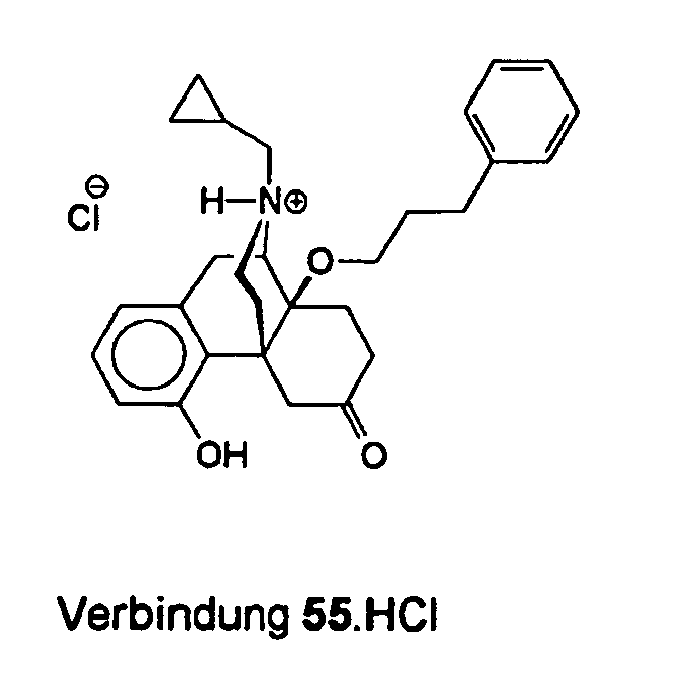
- Zu einer rückflusskochenden Lösung von 54 (1,2 g, 2,71 mmol) in 50 ml MeOH wurde unter Rühren NH4Cl (0,72 g, 13,46 mmol) zugegeben. Zu diesem Gemisch wurden in kleinen Portionen 0,88 g (13,46 mmol) aktivierter Zinkstaub gegeben. Dieses Gemisch wurde 80 min unter Rückfluß gerührt, dann auf Raumtemperatur abgekühlt und vom anorganischen Rückstand abfiltriert, der anorganische Rückstand mit heißem Methanol gewaschen und das Filtrat eingedampft. Der Eindampfrückstand wurde mit 50 ml H2O versetzt und mit konz. NH4OH alkalisiert. Dieses Gemisch wurde mit CH2Cl2 (3x80 ml) extrahiert, die vereinigten organischen Phasen mit gesättigter NaCI-Lösung (5x100 ml) gewaschen, über Na2SO4 getrocknet und eingedampft. Es wurden 1,20 g (99%) 17-(Cyclopropylmethyl)-4-hydroxy-14β-[(3-phenylpropyl)oxy]morphinan-6-on (55) als gelbliches Öl erhalten, welches ohne weitere Reinigung für den nächsten Reakionsschritt verwendet wurde. Für analytische Zwecke wurden 0.08 g des Öls in Ether gelöst und nach Zugabe von etherischer HCl wurden 0.059 g 17-(Cyclopropylmethyl)-4-hydroxy-14β-[(3-phenylpropyl)oxy]morphinan-6-on Hydrochlorid (55·HCl) als farbloses Pulver isoliert. Fp. >170°C (Zersetzung); MS (Cl): m/z 446 (M++1); IR (KBr): 1709 (C=O) cm-1; 1H-NMR (DMSO-d6): δ 9,82 (s, 1H, C4-OH), 8,43 (s, breit, 1H, +N17-H), 7,30-7,20 (m, 5 arom. H, C14-0(CH2)3 Ph), 7,03 (t, J = 8,0 Hz, 1 arom. H, C2-H), 6,66 (m, 2 arom. H), 4,40 (ps-d, C9-H), 1,09 (m, 1H. N17-CH2CH(CH2)2), 0,70-0,67 (m, 2H, N17-CH2CH(CH 2 )2), 0,52-0,40 (m, 2H, N17-CH2CH(CH 2 )2).
-

- Zu einer Lösung von 55 (0,40 g, 0,90 mmol) in 6 ml wasserfreiem Dimethylformamid wurde unter N2 wasserfreies K2CO3 (0,37 g, 2,69 mmol) und 0,46 g (2,69 mmol) Phenyltrimethylammoniumchlorid zugegeben. Dieses Gemisch wurde bei 80 °C Badtemperatur unter N2 3,5 h gerührt. Nach dem Abkühlen wurde vom anorganischen Material abfiltriert, der Rückstand mit CH2Cl2 gewaschen und das Filtrat eingedampft. Der Eindampfrückstand wurde in 100 ml CH2Cl2 gelöst, mit gesättigter NaCl-Lösung (4x150 ml) gewaschen, mit Na2SO4 getrocknet und eingedampft. Der Eindampfrückstand (0,30 g) wurde säulenchromatographisch gereinigt (Kieselgel; CH2Cl2/MeOH/konz. NH4OH (250/4/0,5)) und die geeigneten Fraktionen eingedampft. Der Eindampfrückstand (0.23 g) wurde in Ether gelöst und nach Zugabe von etherischer HCl wurden 0.22 g (48%) der Verbindung 56.HCl als farbloses Pulver isoliert. Fp. 121-126 °C; MS (Cl): m/z 460 (M++1); IR (KBr): (C=O) 1710 cm-1; 1H-NMR (DMSO-d6): δ 8,34 (s, breit, 1H, +N-H), 7,30-7,16 (m, 5 arom. H), 7,22 (t, J = 8,0 Hz, 1 arom. H), 6,88 (d, J = 8,0 Hz, 1 arom. H), 6,82 (d, J = 8,0 Hz, 1 arom. H), 4,42 (ps-d, C9-H), 3,77 (s, 3 H, C4-OCH 3 ), 1,08 (m, 1H, N-CH2CH(CH2)2), 0.70-0.42 (m, 4H, N-CH2CH(CH 2 ) 2 ).
-
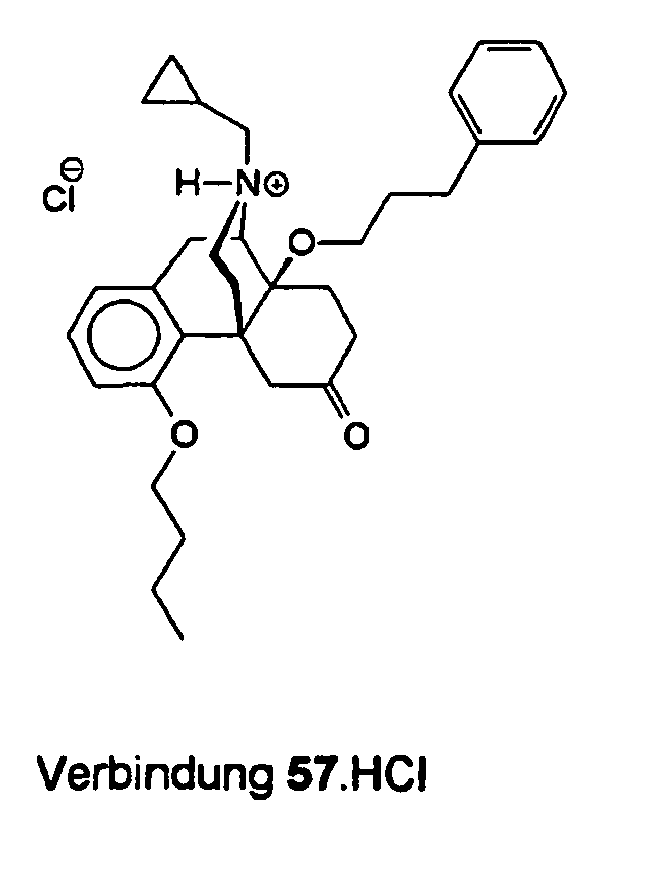
- Zu einer Lösung von 55 (0,60 g, 1,34 mmol) in 5 ml wasserfreiem Dimethylformamid wurde unter N2 wasserfreies K2CO3 (0,55 g, 4,01 mmol) und lodbutan (0,31 ml, 2,67 mmol) zugegeben. Dieses Gemisch wurde bei 90 °C Badtemperatur unter N27 h gerührt. Daraufhin wurde vom anorganischen Material abfiltriert, der Rückstand mit CH2Cl2 gewaschen und das Filtrat eingedampft. Der Eindampfrückstand wurde in 100 ml CH2Cl2 gelöst, mit gesättigter NaCl-Lösung (3x150 ml) gewaschen, über Na2SO4 getrocknet und eingedampft. Der Eindampfrückstand (0,43 g braunes Öl) wurde säulenchromatographisch gereinigt (Kieselgel; CH2Cl2MeOH/konz. NH4OH (250/4/0,5)) und die geeigneten Fraktionen eingedampft. Der Eindampfrückstand (0,26 g) wurde in Ether gelöst und nach Zugabe von etherischer HCl wurden 0,19 g (26%) 57.HCl als farbloses Pulver isoliert. Fp. 172-177 °C; MS (Cl): m/z 502 (M++1); IR (KBr): (C=0) 1711 cm-1; 1H-NMR (DMSO-d6): δ 8,52 (s, breit, 1H, +N-H), 7,30-7,15 (m, 6 arom. H), 6,86 (d, J = 8,0 Hz, 1 arom. H), 6,80 (d, J = 8,0 Hz, 1 arom. H), 4,42 (ps-d, C9-H), 3,95 (t, 2H, J =6,4 Hz, C4-OCH2 (CH2)2CH3), 1,13-1,06 (m, 1H, N-CH2CH(CH2)2), 0,95 (t, 3H, J = 7,3 Hz, C4-O(CH2) 3 CH 3 ), 0,69-0,40 (m, 4H, N-CH2CH(CH 2 ) 2 ).
- Opioid-Rezeptorbindungsstudien wurden an Rattenhirn-Homogenisaten unter Verwendung von [3H]DAMGO (µ-Rezeptor-Agonist) als Radioligand und unter strikter Einhaltung einer früher publizierten Vorschrift durchgeführt (M. Spetea et al. Neurochemical Research 1998, Vol. 23, S. 1213-1218).
- Die Verbindungen 8, 17, 17a, 17b, 38, 40-43, 48, 49 und 54-56 zeigen sehr hohe Affinität zu µ-Opioidrezeptoren, welche hauptsächlich verantwortlich sind für Analgesie (Tabelle 1). Alle haben deutlich höhere Affinität als der µ-opioidrezeptorselektive Antagonist Cyprodime (s. H. Schmidhammer et al. J. Med. Chem. 1995, 38, 3071-3077). Die Verbindungen 8, 17, 17a, 17b, 40, 48 und 54-56 zeigen extrem hohe Affinität zu µ-Opioidrezeptoren (im subnanomolaren Bereich). Morphin und der Opioidantagonist 3-Hydroxycyprodime (s. H. Schmidhammer et al. J. Med. Chem. 1995, 38, 3071-3077) zeigen im Vergleich zu diesen beiden Verbindungen deutlich geringere Affinität zu µ-Opioidrezeptoren, während 14-Methoxymetopon ähnliche Affinität aufweist.
Tabelle 1. Opioid-Rezeptorbindungsstudien der Verbindungen 8, 17, 17a, 17b, 38, 40 - 43, 48, 49, 54-56, Morphin, 14-Methoxymetopon, Cyprodime und 3-Hydroxycyprodime Verbindung K i (nM) (µ-Rezeptoren) 8 0, 34 17 0.73 17a 0.62 17b 0.20 38 4,11 40 0,37 41 2, 32 42 5,93 43 1,33 48 0,93 49 1,78 54 0,84 55 0,40 56 0,34 Morphin 6,5,5 14-Methoxymetopon 0,55 Cyprodime 23,7 3-Hydroxycyprodime 6,15 - Es wurde ein Test an Mäusen ("hot-ptate Test") wie früher beschrieben durchgeführt (E. L. May et al. J. Med. Chem. 2000; 43, 5030-5036).
- Alle getesteten Substanzen zeigen wesentlich höhere analgetische Aktivität als Morphin. Die Verbindungen 6 - 11, 17a, 17b und 53 zeigen extrem hohe analgetische Aktivität, die signifikant höher ist als die der Referenzsubstanz 14-Methoxymetopon (s. Zs. Fürst et al. Eur. J. Pharmacol. 1993; 236: 209-215). Verbindungen 4 und 32 zeigen im Vergleich zu den Verbindungen 6 - 11 etwas niedrigere analgetische Aktivität, da diese Verbindung in Position 3 eine Etherfunktion (Methoxygruppe) aufweisen, von der man weiß, dass sie die analgetische Aktivität im Vergleich zu den 3-Hydroxyanaloga senkt. Dennoch ist die analgetische Aktivität der Verbindungen 4 und 32 überraschend hoch. Auch die analgetische Aktivität der Verbindung 17 mit einer anderen Etherfunktion (Propargyloxygruppe) in Position 3 ist überraschend hoch.
Tabelle 2. "Hot-plate Test" der Verbindungen 4, 6 -11, 17, 17a, 17b, 32, 53, Morphin und 14-Methoxymetopon Verbindung ED 50 (µg/kg, sca) 4 60 6 5,9 7 3,7 8 2,3 9 11,7 10 1,3 11 1,7 17 38 17a 2,6 17b 0,10 32 22 53 3,0 Morphin 850 14-Methoxymetopon 30 a sc = subkutane Applikation - Zur Bestimmung der analgetischen Aktivität von nicht-quarternisierten Verbindungen wurde der "Mouse Tail Flick Test" wie früher beschrieben durchgeführt (E. L. May et al. J. Med. Chem. 2000; 43, 5030-5036).
- Alle getesteten Substanzen zeigen wesentlich höhere analgetische Aktivität als Morphin. Die Verbindungen 6 - 8,10, 11, 17a, 17b und 53 zeigen extrem hohe analgetische Aktivität, die signifikant höher ist als die der Referenzsubstanz 14-Methoxymetopon (s. Zs. Fürst et al. Eur. J. Pharmacol. 1993; 236: 209-215). Verbindung 4 zeigt im Vergleich zu den Verbindungen 6 - 8, 10, 11, 17a, 17b und 53 etwas niedrigere analgetische Aktivität, da diese Verbindungen in Position 3 eine Methoxygruppe aufweist, von der man weiß, dass sie die analgetische Aktivität im Vergleich zu den 3-Hydroxyanaloga senkt. Dennoch ist die analgetische Aktivität der Verbindung 4 überraschend hoch. Ebenfalls eine Methoxygruppe in Position 3 haben die Verbindungen 17a und 32, welche überraschenderweise eine sehr hohe analgetische Aktivität besitzen. Die aktivste Verbindung dieser Serie, Verbindung 17b, ist mit einer ED50 (µg/kg, sc)von 0,08 aktiver als die bisher als am aktivsten anerkannten analgetisch wirksamen Substanzen Etorphine und Dihydroetorphine (M. D. Aceto et al. Eur. J. Pharmacol 1997; 338, 215-223).
Tabelle 3. "Mouse Tail Flick Test" der Verbindungen 4, 6 - 8,10,11, 17, 17a, 17b, 32, 53, Morphin und 14-Methoxymetopon Verbindung ED 50 (µg/kg, sca) 4 84 6 5,6 7 8, 2 8 3,2 10 7,0 11 1,6 17 21 17a 4,4 17b 0,08 32 14 53 0,4 Morphin 1920 14-Methoxymetopon 30 a sc = subkutane Applikation - Zur Bestimmung der analgetischen Aktivität von quartemisierten Verbindungen wurde ein Test an Ratten ("rat tail flick test") verwendet. Dieser Test wurde wie früher beschrieben durchgeführt (Zs. Fürst et al. Eur. J. Pharmacol. 1993; 236: 209-215).
- Die Verbindungen 38 und 42 zeigen als quartäre Ammoniumsalze sehr hohe analgetische Wirkung - beide sind wesentlich aktiver als Morphin nach subkutaner Applikation (Tabelle 3). Verbindung 42 ist etwas weniger aktiv als 14-Methoxymetopon nach subkutaner Applikation. Nach intracerebroventrikulärer Applikation ist Verbindung 42 extrem aktiv, was darauf hinweist, dass es nur sehr begrenzt die Blut-Hirn-Schranke überwinden kann und seine Wirksamkeit daher in erster Linie in der Peripherie (außerhalb des Zentralnervensystems) zeigt. Das geht einher mit einer sehr verringerten Nebenwirkungsrate, was zentrale Nebenwirkungen wie z.B. Übelkeit, Erbrechen, Sedation, Benommenheit, Verwirrtheit, Atemdepression und Sucht betrifft.
Tabelle 4. "Rat tail flick test" der Verbindungen 38, 42, Morphin und 14-Methoxymetopon Verbindung ED 50 (µg/kg, sca) ED 50 (µg/ratb, icvc) 38 120 12 42 16 0,22 Morphin 1900 - 14-Methoxymetopon 7,2 - a sc = subkutane Applikation. bDas Gewicht der verwendeten Ratten war jeweils 120 g.
c icv = intracerebroventrikuläre Applikation. - Dieser Test wurde wie früher beschrieben unter Verwendung von DAMGO (µ-Rezeptor-Agonist) durchgeführt (S. Garadnay et al. Curr. Med. Chem. 2001, 8, 621-626).
- Verbindung 48 zeigt überraschenderweise sehr hohe antagonistische Aktivität an µ-Opioidrezeptoren, was für quarternisierte Morphinane ungewöhnlich ist (Tabelle 4).
- Normalerweise haben quarternisierte Morphinane eine wesentlich geringere Aktivität im Vergleich zu den nicht-quarternisierten Morphinanen. Es hat wesentlich höhere antagonistische Aktivität als der µ-selektive Opioidrezeptorantagonist Cyprodime. Im Vergleich zu Naloxon hat es etwas geringere Aktivität, während es im Vergleich zu 3-Hydroxycyprodime etwas höhere Aktivität aufweist. Aufgrund seiner Struktur als quartäres Ammoniumsalz kann es nur schwer die Blut-Hirn-Schranke überwinden und entfaltet seine Wirkung überwiegend in der Peripherie. Deswegen kann es z.B. verwendet werden, um opioidbedingter Obstipation oder Ileus entgegenzuwirken bzw. vorzubeugen, ohne dass die Analgesie des verabreichten Opioids aufgehoben wird. Im Vergleich dazu können Naloxone, Cyprodime und 3-Hydroxycyprodime die Blut-Hirn-Schranke relativ leicht passieren und daher auch die analgetische Wirkung von Opioiden aufheben.
Tabelle 5. Antagonistische Ke-Werte der Verbindungen 48, Naloxone, Cyprodime und 3-Hydroxycyprodime in der Vas Deferens-Präparation der Maus Verbindung K e (νM) (µ-Rezeptoren) 48 2,94 Naloxone 1,4 Cyprodime 55,4 3-Hydroxycyprodime 5,62

Claims (15)
- Verbindungen der Formel (I) oder (la),
 R1: C1-C6-Alkyl; C2-C6-Alkenyl; C2-C6-Alkinyl-, C3-C16-(cyclische gesättigte Gruppe)alkyl, worin Alkyl C1-C6 ist; C4-C16-(cyclische gesättigte Gruppe)alkenyl, worin Alkenyl C2-C6 ist; C4-C16-(cyclische gesättigte Gruppe)alkinyl, worin Alkinyl C2-C6 ist; C7-C16-Arylalkyl, worin Aryl C6-C10-Aryl ist und Alkyl C1-C6-Alkyl ist; C8-C16-Arylalkenyl, worin Aryl C6-C10-Aryl und Alkenyl C2-C6-Alkenyl ist; C8-C16-Arylalkinyl, worin Aryl C6-C10-Aryl ist und Alkinyl C2-C6-Alkinyl;R2: C4-C6-Alkyl; C2-C6-Alkenyl, C2-C6-Alkinyl; C3-C16-(cyclische gesättigte Gruppe)alkyl, worin Alkyl C1-C6 ist; C4-C16-(cyclische gesättigte Gruppe)alkenyl, worin Alkenyl C2-C6 ist; C4-C16-(cyclische gesättigte Gruppe)alkinyl, worin Alkinyl C2-C6 ist; C8-C16-Arylalkyl, worin Aryl C6-C10-Aryl ist und Alkyl C1-C6-Alkyl ist; C8-C16-Arylalkenyl, worin Aryl C6-C10-Aryl und Alkenyl C2-C6-Alkenyl ist; C8-C16-Arylalkinyl, worin Aryl C6-C10-Aryl ist und Alkinyl C2-C6-Alkinyl; C3-C6-Alkenoyl; C3-C6-Alkinoyl; C9-C16-Arylalkenoyl, worin Aryl C6-C10-Aryl ist und Alkenoyl C3-C6-Alkenoyl ist; C9-C16-Arylalkinoyl, worin Aryl C6-C10-Aryl ist und Alkinoyl C3-C6-Alkinoyl ist;R3: Wasserstoff; C1-C6-Alkyl; C2-C6-Alkenyl-, C7-C16-Arylalkyl, worin Aryl C6-C10-Aryl ist und Alkyl C1-C6-Alkyi ist; C8-C16-Arylalkenyl, worin Aryl C6-C10-Aryl und Alkenyl C2-C6-Alkenyl ist; Alkoxyalkyl, worin Alkoxy C1-C6-Alkoxy und Alkyl C1-C6-Alkyl ist; CO2(C1-C6-Alkyl); CO2H; CH2OH.R4: Wasserstoff; Hydroxy; C1-C6-Alkyloxy; C2-C10-Alkyloxyalkoxy, worin Alkyloxy C1-C4 ist und Alkoxy C1-C6-Alkyloxy ist; C2-C6-Alkenyloxy; C2-C6-Alkinyloxy; C3-C16-(cyclische gesättigte Gruppe)alkyloxy, worin Alkyl C1-C6 ist; C4-C16-(cyclische gesättigte Gruppe)alkenyloxy, worin Alkenyl C2-C6 ist; C4-C16-(cyclische gesättigte Gruppe)alkinyloxy, worin Alkinyl C2-C6 ist; C7-C16-Arylalkyloxy, worin Aryl C6-C10-Aryl ist und Alkyl C1-C6-Alkyl ist; C8-C16-Arylalkenyloxy, worin Aryl C6-C10-Aryl und Alkenyl C2-C6-Alkenyl ist; C8-C16-Arylalkinyloxy, worin Aryl C6-C10-Aryl ist und Alkinyl C2-C6-Alkinyl; C1-C6-Alkanoyloxy; C3-C6-Alkenoyloxy; C3-C6-Alkinoyloxy; C7-C16-Arylalkanoyloxy, worin Aryl C6-C10-Aryl ist und Alkanoyloxy C2-C6-Alkanoyloxy ist; C9-C16-Arylalkenoyloxy, worin Aryl C6-C10-Aryl ist und Alkenoyloxy C3-C6-Alkenoyloxy ist; C9-C16-Arylalkinoyloxy, worin Aryl C6-C10-Aryl ist und Alkinoyloxy C3-C6-Alkinoyloxy ist;R5: Wasserstoff; Hydroxy; C1-C6-Alkyloxy; C2-C10-Alkyloxyalkoxy, worin Alkyloxy C1-C4 ist und Alkoxy C1-C6-Alkyloxy ist; C2-C5-Alkenyloxy; C2-C6-Alkinyloxy; C3-C16-(cydische gesättigte Gruppe)alkyloxy, worin Alkyl C1-C6 ist; C4-C16-(cyclische gesättigte Gruppe)alkenyloxy, worin Alkenyl C2-C6 ist; C4-C16-(cyclische gesättigte Gruppe)alkinyloxy, worin Alkinyl C2-C6 ist; C7-C16-Arylalkyloxy, worin Aryl C6-C10-Aryl ist und Alkyl C1-C6-Alkyl ist; C8-C16-Arylalkenyloxy, worin Aryl C6-C10-Aryl und Alkenyl C2-C6-Alkenyl ist; C8-C16-Arylalkinyloxy, worin Aryl C6-C10-Aryl ist und Alkinyl C2-C6-Alkinyl; C2-C6-Alkanoyloxy; C7-C16-Arylalkanoyloxy, worin Aryl C6-C10-Aryl ist und Alkanoyloxy C2-Cs-Alkanoyloxy ist;X ist Sauerstoff;wobei zwischen den Kohlenstoffatomen der Nummern 7 und 8 eine Einfach- oder eine Doppelbindung vorliegen kann,
wobei Alkyl, Alkenyl und Alkinyl jeweils verzweigt oder unverzweigt sein können, Aryl unsubstituiert oder mono-, di- oder trisubstituiert sein kann, jeweils unabhängig, mit Hydroxy, Halogen, Nitro, Cyano, Thiocyanato, Trifluormethyl, C1-C3-Alkyl, C1-C3-Alkoxy, CO2H, CONH2, CO2(C1-C3-Alkyl), CONH(C1-C3-Alkyl), CON(C1-C3-Alkyl)2, CO(C1-C3-Alkyl); amino; (C1-C3-Monoalkyl)amino, (C1-C3-Dialkyl)amino, C5-C6-Cycloalkylamino; (C1-C3-Alkanoyl)amido, SH, SO3H, SO3(C1-C3-Alkyl), SO2(C1-C3-Alkyl), SO(C1-C3-Alkyl), C1-C3-Alkylthio oder C1-C3-Alkanoylthio,
wobei -(cyclische gesättigte Gruppe) entweder bevorzugt C3-C10-Cycloalkyl ist oder eine heterocyclische Gruppe mit 2 bis 9 Kohlenstoffatomen, enthaltend weiter ein oder mehrere Heteroatome,
mit der Ausnahme von Verbindungen worin R1 Methyl ist, R2 C4-C6-Alkyl ist, R3 Wasserstoff oder Methyl ist, R4 Hydroxy oder Methoxy ist und R5 Hydroxy, Methoxy oder ein an das Kohlenstoffatom in 5-Stellung gebundenes Sauerstoffatom ist, wenn X Sauerstoff ist;
mit der weiteren Ausnahme von Verbindungen worin R1 Cyclopropylmethyl und XR2 Benzyloxy ist, wenn R4 Wasserstoff oder Benzyloxy ist und R5 ein an das Kohlenstoffatom in 5-Stellung gebundenes Sauerstoffatom ist;
mit der weiteren Ausnahme von Verbindungen worin R1 Cyclopropylmethyl und XR2 Benzyloxy ist, wenn R4 Wasserstoff, Hydroxy oder Benzyloxy ist und R5 Hydroxy oder Methoxy ist. - Verbindungen der Formel (IA) oder (IAa),
 R1: C1-C6-Alkyl; C2-C6-Alkenyl; C2-C6-Alkinyl; C3-C16-(cyclische gesättigte Gruppe)alkyl, worin Alkyl C1-C6 ist; C4-C16-(cyclische gesättigte Gruppe)alkenyl, worin Alkenyl C2-C6 ist; C4-C16-(cyclische gesättigte Gruppe)alkinyl, worin Alkinyl C2-C6 ist; C7-C16-Arylalkyl, worin Aryl C6-C10-Aryl ist und Alkyl C1-C6-Alkyl ist; C8-C16-Arylalkenyl, worin Aryl C6-C10-Aryl und Alkenyl C2-C6-Alkenyl ist; C8-C16-Arylalkinyl, worin Aryl C6-C10-Aryl ist und Alkinyl C2-C6-Alkinyl;
wobei die beiden Substituenten R1 gleich oder verschieden sein können;R2: C1-C6-Alkyl; C2-C6-Alkenyl; C2-C6-Alkinyl; C3-C16-(cyclische gesättigte Gruppe)alkyl, worin Alkyl C1-C6 ist; C4-C16-(cyclische gesättigte Gruppe)alkenyl, worin Alkenyl C2-C6 ist; C4-C16-(cyclische gesättigte Gruppe)alkinyl, worin Alkinyl C2-C6 ist; C8-C16-Arylalkyl, worin Aryl C6-C10-Aryl ist und Alkyl C1-C6-Alkyl ist; C8-C16-Arylalkenyl, worin Aryl C6-C10-Aryl und Alkenyl C2-C6-Alkenyl ist; C8-C16-Arylalkinyl, worin Aryl C6-C10-Aryl ist und Alkinyl C2-C6-Alkinyl; C3-C6-Alkenoyl; C3-C6-Alkinoyl; C9-C16-Arylalkenoyl, worin Aryl C6-C10-Aryl ist und Alkenoyl C3-C6-Alkenoyl ist; C9-C16-Arylalkinoyl, worin Aryl C6-C10-Aryl ist und Alkinoyl C3-C6-Alkinoyl ist;R3: Wasserstoff; C1-C6-Alkyl; C2-C6-Alkenyl; C7-C16-Arylalkyl, worin Aryl C6-C10-Aryl ist und Alkyl C1-C6-Alkyl ist; C8-C16-Arylalkenyl, worin Aryl C6-C10-Aryl und Alkenyl C2-C6-Alkenyl ist; Alkoxyalkyl, worin Alkoxy C1-C6-Alkoxy und Alkyl C1-C6-Alkyl ist; CO2(C1-C6-Alkyl); CO2H; CH2OH.R4: Wasserstoff; Hydroxy; C1-C6-Alkyloxy; C2-C10-Alkyloxyalkoxy, worin Alkyloxy C1-C4 ist und Alkoxy C1-C6-Alkyloxy ist; C2-C6-Alkenyloxy; C2-C6-Alkinyloxy; C3-C16-(cyclische gesättigte Gruppe)alkyloxy, worin Alkyl C1-C6 ist; C4-C16-(cyclische gesättigte Gruppe)alkenyloxy, worin Alkenyl C2-C6 ist; C4-C16-(cyclische gesättigte Gruppe)alkinyloxy, worin Alkinyl C2-C6 ist; C7-C16-Arylalkyloxy, worin Aryl C6-C10-Aryl ist und Alkyl C1-C6-Alkyl ist; C8-C16-Arylalkenyloxy, worin Aryl C6-C10-Aryl und Alkenyl C2-C6-Alkenyl ist; C8-C16-Arylalkinyloxy, worin Aryl C6-C10-Aryl ist und Alkinyl C2-C6-Alkinyl; C2-C6-Alkanoyloxy; C3-C6-Alkenoyloxy; C3-C6-Alkinoyloxy; C8-C16-Arylalkanoyloxy, worin Aryl C6-C10-Aryl ist und Alkanoyloxy C2-C6-Alkanoyloxy ist; C9-C16-Arylalkenoyloxy, worin Aryl C6-C10-Aryl ist und Alkenoyloxy C3-C6-Alkenoyloxy ist; C9-C16-Arylalkinoyloxy, worin Aryl C6-C10-Aryl ist und Alkinoyloxy C3-C6-Alkinoyloxy ist;R5:Wasserstoff; Hydroxy; C1-C6-Alkyloxy; C2-C10-Alkyloxyalkoxy, worin Alkyloxy C1-C4 ist und Alkoxy C1-C6-Alkyloxy ist; C2-C6-Alkenyloxy; C2-C6-Alkinyloxy; C3-C16-(cyclische gesättigte Gruppe)alkyloxy, worin Alkyl C1-C6 ist; C4-C16-(cyclische gesättigte Gruppe)alkenyloxy, worin Alkenyl C2-C6 ist; C4-C16-(cyclische gesättigte Gruppe)alkinyloxy, worin Alkinyl C2-C6 ist; C7-C16-Arylalkyloxy, worin Aryl C6-C10-Aryl ist und AlkylC1-C6-Alkyl ist; C8-C16-Arylalkenyloxy, worin Aryl C6-C10-Aryl und Alkenyl C2-C6-Alkenyl ist; C8-C16-Arylalkinyloxy, worin Aryl C6-C10-Aryl ist und Alkinyl C2-C6-Alkinyl; C2-C6-Alkanoyloxy; C7-C16-Arylalkanoyloxy, worin Aryl C6-C10-Aryl ist und Alkanoyloxy C2-C6-Alkanoyloxy ist;X ist Sauerstoff;Y- ist I-, Br-, CI-, OH- oder ein anderes pharmakologisch akzeptierbares Gegenion;wobei zwischen den Kohlenstoffatomen der Nummern 7 und 8 eine Einfach- oder eine Doppelbindung vorliegen kann,
wobei Alkyl, Alkenyl und Alkinyl jeweils verzweigt oder unverzweigt sein können, Aryl unsubstituiert oder mono-, di- oder trisubstituiert sein kann, jeweils unabhängig, mit Hydroxy, Halogen, Nitro, Cyano, Thiocyanato, Trifluormethyl, C1-C3-Alkyl, C1-C3-Alkoxy, CO2H, CONH2, CO2(C1-C3-Alkyl), CONH(C1-C3-Alkyl), CON(C1-C3-Alkyl)2, CO(C1-C3-Alkyl); amino; (C1-C3-Monoalkyl)amino, (C1-C3-Dialkyl)amino, C5-C6-Cycloalkylamino; (C1-C3-Alkanoyl)amido, SH, SO3H, SO3(C1-C3-Alkyl), SO2(C1-C3-Alkyl), SO(C1-C3-Alkyl), C1-C3-Alkylthio oder C1-C3-Alkanoylthio,
wobei -(cyclische gesättigte Gruppe) entweder bevorzugt C3-C10-Cycloalkyl ist oder eine heterocyclische Gruppe mit 2 bis 9 Kohlenstoffatomen, enthaltend weiter ein oder mehrere Heteroatome. - Verbindungen der Formeln (I) und (IA) der Ansprüche 1 und 2, in denen X Sauerstoff ist; R1 C1-C6-Alkyl, C2-C6-Alkenyl, C4-C16-Cycloalkylalkyl ist, worin Cycloalkyl C3-C10 ist und Alkyl C1-C6 ist, C7-C16-Arylalkyl ist, worin Aryl C6-C10 -Aryl ist und Alkyl C1-C6-Alkyl ist; R2 C7-C16-Arylalkyl, worin Aryl C6-C10-Aryl ist und Alkyl C1-C6-Alkyl ist; C8-C16-Arylalkenyl, worin Aryl C6-C10-Aryl und Alkenyl C2-C6-Alkenyl ist; R3 Wasserstoff oder Methyl ist: R4 Hydroxy, Methoxy oder Acetoxy ist.
- Verbindungen der Formel (IA) des Anspruchs 2, in denen X Sauerstoff ist; R1 C1-C6-Alkyl, C2-C6-Alkenyl, C4-C16-Cycloalkylalkyl ist, worin Cycloalkyl C3-C10 ist und Alkyl C1-C6 ist, C7-C16-Arylalkyl ist, worin Aryl C6-C10-Aryl ist und Alkyl C1-C6-Alkyl ist; R2 C1-C6-Alkyl oder C2-C6-Alkenyl ist, R3 Wasserstoff oder Methyl ist; R4 Hydroxy, Methoxy oder Acetoxy ist.
- Verbindungen der Ansprüche 1 und 2, ausgewählt unter:17-Allyl-4,5α-epoxy-3-methoxy-14β-(3-phenylpropyloxy)morphinan-6-on, 17-Allyl-4,5α-epoxy-3-hydroxy-14β-(3-phenylpropyloxy)morphinan-6-on, 17-Allyl-4,5α-epoxy-3-methoxy-5β-methyl-14β-(3-phenylpropyloxy)morphinan-6-on, 17-Allyl-4,5α-epoxy-3 hydroxy-5β-methyl-14β-(3-phenylpropyloxy)morphinan-6-on, 17-Cyclobutylmethyl-4,5α-epoxy-3-methoxy-14β-(3-phenylpropyloxy)morphinan-6-on, 17-Cyclobutylmethyl-4,5α-epoxy-3-hydroxy-14β-(3-phenylpropyloxy)morphinan-6-on, 17-Cyclobutylmethyl-4,5α-epoxy-3-methoxy-5β-methyl-14β-(3-phenylpropyloxy)morphinan-6-on, 17-Cyclobutylmethyl-4,5α-epoxy-3-hydroxy-5β-methyl-14β-(3-phenylpropyloxy)morphinan-6-on, 17-Cyclopropylmethyl-4,5α-epoxy-3-methoxy-14β-(3-phenylpropyloxy)morphinan-6-on, 17-Cyclopropylmethyl-4,5α-epoxy-3-hydroxy-14β-(3-phenylpropyloxy)morphinan-6-on, 17-Cyclopropylmethyl-4,5α-epoxy-3-methoxy-5β-methyl-14β-(3-phenylpropyloxy)morphinan-6-on, 17-Cyclopropylmethyl-4,5α-epoxy-3-hydroxy-5β-methyl-14β-(3-phenylpropyloxy)morphinan-6-on, 4,5α-Epoxy-3-methoxy-5β,17-dimethyl-14β-[(3-phenylpropyl)oxy]morphinan-6-on, 4,5α-Epoxy-3-hydroxy-5β,17-dimethyl-14β-[(3-phenylpropyl)oxy]morphinan-6-on, 17-Propyl-4,5α-epoxy-3-methoxy-14β-(3-phenylpropyloxy)morphinan-6-on, 17-Propyl-4,5α-epoxy-3-hydroxy-14β-(3-phenylpropytoxy)morphinan-6-on, 17-Propyl -4,5α-epoxy-3-methoxy-5β-methyl-14β-(3-phenylpropyloxy)morphinan-6-on, 17-Propyl-4,5α-epoxy-3-hydroxy-5β-methyl-14β-(3-phenylpropytoxy)morphinan-6-on, 17-Tetrahydrofurfuryl-4,5α-epoxy-3-methoxy-14β-(3-phenylpropyloxy)morphinan-6-on, 17-Tetrahydrofurfuryl-4,5α-epoxy-3-hydroxy-14β-(3-phenylpropyloxy)morphinan-6-on, 17-Tetrahydrofurfuryl-4,5α-epoxy-3-methoxy-5β-methyl-14β-(3-phenylpropyloxy)morphinan-6-on, 17-Tetrahydrofurfuryl-4,5α-epoxy-3-hydroxy-5β-methyl-14β-(3-phenylpropyloxy)morphinan-6-on, 17-(2-Phenylethyl)-4,5α-epoxy-3-methoxy-14β-(3-phenylpropyloxy)morphinan-6-on, 17-(2-Phenylethyl)-4,5α-epoxy-3-hydroxy-14β-(3-phenylpropyloxy)morphinan-6-on, 17-(2-Phenylethyl)-4,5α-epoxy-3-methoxy-5β-methyl-14β-(3-phenylpropyloxy)morphinan-6-on, 17-(2-Phenylethyl)-4,5α-epoxy-3-hydroxy-5β-methyl-14β-(3-phenylpropyloxy)morphinan-6-on, 17-Ethyl-4,5α-epoxy-3-methoxy-14β-(3-phenylpropyloxy)morphinan-6-on, 17-Ethyl-4,5α-epoxy-3-hydroxy-14β-(3-phenylpropyloxy)morphinan-6-on, 17-Ethyl-4,5α-epoxy-3-methoxy-5β-methyl-14β-(3-phenylpropyloxy)morphinan-6-on, 17-Ethyl-4,5α-epoxy-3-hydroxy-5β-methyl-14β-(3-phenylpropyloxy)morphinan-6-on, 17-Cyclopropylmethyl-4,5α-epoxy-3-hydroxy-14β-[(2-methylbenzyl)oxy]-morphinan-6-on, 14β-[(2-Chlorbenzyl)oxy]-17-(cyclopropylmethyl)-4,5α-epoxy-3-hydroxymorphinan-6-on, 14β-Benzyloxy-17-cyclopropylmethy)-4,5α-epoxy-3-hydroxymorphinan-6-on, 14β-Butoxy-17-cyclopropylmethyl-4,5α-epoxy-3-hydroxymorphinan-6-on, 17-Cyclopropylmethyl-4,5α-epoxy-3-hydroxy-14β-[(3-methylbutyl)oxy]morphinan-6-on, 4,5α-Epoxy-5β,17-dimethyl-14β-[(3-phenylpropyl)oxy]-3-[(prop-2-inyl)oxy]morphinan-6-on, 14β-[(3-Chlorbenzy 4,5α-epoxy-17-methyl-3-[(prop-2-inyl)oxy]morphinan-6-on, 4,5α-Epoxy-17-ethyl-3-methoxy-14β-[(3-phenylpropyl)oxy]morphinan-6-on, 4,5α-Epoxy-17-ethyl-3-hydroxy-14β-[(3-phenylpropyl)oxy]morphinan-6-on, 4,5α-Epoxy-3-hydroxy-14β-[(3-methylbutyl)oxy]-17-propylmorphinan-6-on, 5β-Benzyl-14-methoxycodeinon (= 5-Benzyl-7,8-didehydro-4,5α-epoxy-3,14β-dimethoxy-17-methyl-morphinan-6-on), 5β-Benzyl-4,5α-epoxy-3,14β-dimethoxy-17-methylmorphinan-6-on, 5β-Benzyl-4,5α-epoxy-3-hydroxy-14β-methoxy-17-methylmorphinan-6-on, 4-Hydroxy-3-methoxy-17-methyl-14-[(3-phenylpropyl)oxy]-morphinan-6-on, 3,4-Dimethoxy-17-methyl-14-[(3-phenylpropyl)oxy]morphinan-6-on, 14β-Benzyloxy-4-hydroxy-3-methoxy-17-methylmorphinan-6-on, 14β-Benzyloxy-3,4-dimethoxy-17-methylmorphinan-6-on, 4-Hydroxy-3-methoxy-17-methyl-14β-[(2-naphthylmethyl)oxy]morphinan-6-on, 3,4-Dimethoxy-17-methyl-14β-[(2-naphtylmethyl)oxy]morphinan-6-on, 4-Hydroxy-3-methoxy-5β,17-dimethyl-14β-[(3-phenylpropyl)oxylmorphinan-6-on, 3,4-Dimethoxy-5β,17-dimethyl-14β-[(3-phenylpropyl)oxy]morphinan-6-on, 14β-Ethoxy-4-hydroxy-3-methoxy-5β,17-dimethylmorphinan-6-on, 14β-Ethoxy-3,4-dimethoxy-5β,17-dimethylmorphinan-6-on, 14β-Benzyloxy-3,4-dimethoxy-5β,17-dimethylmorphinan-6-on, 4,5α-Epoxy-3-hydroxy-17,17-dimethyl-6-oxo-14β-[(3-phenylpropyl]oxy]morphinaniumiodid, (17S)-4,5α-Epoxy-17-ethyl-3-hydroxy-17-methyl-6-oxo-14β-[(3-phenylpropyl]oxy]morphinaniumiodid, (17R)-4,5α-Epoxy-3-hydroxy-17-methyl-6-oxo-14β-[(3-phenylpropyl)oxy]-17-[(2(R,S)-tetrahydrofurfuran-2-yl)methyl]morphinaniumiodid, (17R)-17-Allyl-4,5α-epoxy-14β-ethoxy-3-hydroxy-17-methyl-6-oxomorphinaniumiodid, (17R)-17-Allyl-4,5α-epoxy 3-hydroxy-14β-methoxy-17-methyl-6-oxomorphinaniumiodid, (175)-17-Allyl-4,5α-epoxy-3-hydroxy-14β-methoxy-17-methyl-6-oxomorphinaniumiodid, 4,5α-Epoxy-3-hydroxy-14β-methoxy-17,17-dimethyl-6-oxo-morphinaniumiodid, 5β-Benzyl-14β-(butyloxy)-4,5α-epoxy-3-hydroxy-17,17-dimethyl-6-Oxomorphinaniumiodid, (17S)-17-Allyl-5β-benzyl-14β-butoxy-4,5α-epoxy-3-hydroxy-17-methyl-6-oxomorphinaniumiodid, 14β-Butoxy-4,5α-epoxy-3-hydroxy-17,17-dimethyl-6-oxomorphinaniumiodid, (17R)-17-Cyclopropylmethyl-4,5α-epoxy-3-hydroxy-17-methyl-6-oxo-14β-[(3-phenylpropyl)oxy]morphinaniumiodid, (17R)-17-Cyclopropylmethyl-4,5α-epoxy-3-methoxy-17-methyl-6-oxo-14β-[(3-phenylpropyl)oxy]morphinaniumiodid, (17R)-17-Cyclopropylmethyl-4,5α-epoxy-3-hydroxy-17-methyl-6-oxo-14β-[(2-phenylbenzyl)oxy]morphinaniumiodid, (17R)-14β-[(4-Chlorbenzyl)oxy]-17-cyclopropylmethyl-4,5α-epoxy-3-hydroxy-17-methyl-6-oxomorphinaniumiodid, 17(R)-4,5α-Epoxy-3-hydroxy-14β-methoxy-17-methyl-6-oxo-17-(2-phenylethyl)morphinaniumiodid, 4,5α-Epoxy-3-methoxy-17-methyl-14β-[(3-phenylpropyl)oxy]morphinan-6-on,4,5α-Epoxy-3-methoxy-14β-[(3-phenylpropyl)oxy]morphinan-6-on,4,5α-Epoxy-3-hydroxy-17-methyl-14β-[(3-phenylpropyl)oxy]morphinan-6-on,4,5α-Epoxy-17-methyl-14β-[(3-phenylpropyl)oxy]morphinan-6-on,17-(Cyclopropylmethyl)-4,5α-epoxy-14β-[(3-phenylpropyl)oxy]morphinan-6-on,4,5α-Epoxy-14β-[(3-phenylpropyl)oxy]morphinan-6-on,17-(Cyclopropylmethyl)-4-hydroxy-14β-[(3-phenylpropyl)oxy]morphinan-6-on,17-(Cyclopropylmethyl)-4-methoxy-14β-[(3-phenylpropyl)oxy]morphinan-6-on,4-(n-Butyloxy)-17-(cyclopropylmethyl)-14β-[(3-phenylpropyl)oxy]morphinan-6-on,oder irgendein pharmazeutisch akzeptables Salz oder leicht zugängliches Derivat davon.
- Zusammensetzung, umfassend eine Verbindung der Ansprüche 1 bis 5 und/oder ein pharmazeutisch akzeptables Säureadditionssalz davon, zusammen mit einem pharmazeutisch akzeptablen Trägerstoff.
- Verbindung nach irgendeinem der Ansprüche 1 bis 6 als Medikament.
- Verwendung einer Verbindung der Ansprüche 1 bis 5 für die Herstellung eines Medikaments zur Behandlung von Schmerzen, einschließlich chronischer und akuter Schmerzen, Operationsschmerzen, rheumatischen Erkrankungen (z. B. Arthritis), Ileus, Obstipation, Übergewicht, Sucht, einschließlich Opioid-, Kokain- und Alkoholsucht, sowie zur Herstellung eines Narkotikums.
- Verbindungen nach Anspruch 1 oder 2, wobei R5 OH oder Alkoxy ist.
- Verbindungen nach Anspruch 1, 2 oder 9, wobei R3 Wasserstoff, Alkyl oder Aralkyl ist, bevorzugt Wasserstoff oder Alkyl.
- Verbindungen nach Anspruch 1, 2, 9 oder 10, wobei R4 OH, Alkoxy oder Alkenyloxy oder Alkinyloxy ist.
- Verbindungen nach Anspruch 1, 2, 9, 10 oder 11, wobei zwischen den Kohlenstoffatomen der Nummern 7 und 8 eine Einfachbindung vorliegt.
- Verbindungen nach Anspruch 1, 2, 9, 10, 11 oder 12, wobei R2, Alkyl oder Aralkyl ist, bevorzugt Aralkyl.
- Verbindungen nach Anspruch 1, 2, 9, 10, 11, 12 oder 13, wobei R1 Alkyl, (cyclische gesättigte Gruppe)alkyl, Aralkyl oder Alkenyl ist.
- Verbindungen nach Anspruch 1 oder 2, wobei R1 C1-C6-Alkyl; C2-C6-Alkenyl, C2-C6-Alkinyl; C3-C16-(cyclische gesättigte Gruppe)alkyl, worin Alkyl C1-C6 ist; C4-C16-(cyclische gesättigte Gruppe)alkenyl, worin Alkenyl C2-C6 ist; C4-C16-(cyclische gesättigte Gruppe)alkinyl, worin Alkinyl C2-C6 ist; C7-C16-Arylalkyl, worin Aryl C6-C10-Aryl ist und Alkyl C1-C6-Alkyl ist; C8-C16-Arylalkenyl, worin Aryl C6-C10-Aryl und Alkenyl C2-C6-Alkenyl ist; C8-C16-Arylalkinyl, worin Aryl C6-C10-Aryl ist und Alkinyl C2-C6-Alkinyl ist.
Priority Applications (1)
| Application Number | Priority Date | Filing Date | Title |
|---|---|---|---|
| SI200331251T SI1554282T1 (sl) | 2002-07-03 | 2003-06-27 | Derivati morfinana, substituirani v legi 14 in njihove kvarternarne amonijeve soli, postopek izdelave in uporaba |
Applications Claiming Priority (3)
| Application Number | Priority Date | Filing Date | Title |
|---|---|---|---|
| DE10229842 | 2002-07-03 | ||
| DE10229842A DE10229842A1 (de) | 2002-07-03 | 2002-07-03 | Morphinanderivate und deren quartäre Ammoniumsalze substituiert in Position 14, Herstellungsverfahren und Verwendung |
| PCT/EP2003/006866 WO2004005294A2 (de) | 2002-07-03 | 2003-06-27 | Morphinanderivate und deren quartäre ammoniumsalze substituiert in position 14, herstellungsverfahren und verwendung |
Publications (2)
| Publication Number | Publication Date |
|---|---|
| EP1554282A2 EP1554282A2 (de) | 2005-07-20 |
| EP1554282B1 true EP1554282B1 (de) | 2008-05-28 |
Family
ID=30009787
Family Applications (1)
| Application Number | Title | Priority Date | Filing Date |
|---|---|---|---|
| EP03762539A Expired - Lifetime EP1554282B1 (de) | 2002-07-03 | 2003-06-27 | Morphinanderivate substituiert in position 14 und deren quartäre ammoniumsalze, herstellungsverfahren und verwendung |
Country Status (12)
| Country | Link |
|---|---|
| US (2) | US20050182258A1 (de) |
| EP (1) | EP1554282B1 (de) |
| JP (2) | JP2006500326A (de) |
| CN (1) | CN100368414C (de) |
| AT (1) | ATE396999T1 (de) |
| AU (1) | AU2003246627A1 (de) |
| CA (1) | CA2491689A1 (de) |
| DE (2) | DE10229842A1 (de) |
| DK (1) | DK1554282T3 (de) |
| ES (1) | ES2305508T3 (de) |
| SI (1) | SI1554282T1 (de) |
| WO (1) | WO2004005294A2 (de) |
Families Citing this family (59)
| Publication number | Priority date | Publication date | Assignee | Title |
|---|---|---|---|---|
| DE10229842A1 (de) | 2002-07-03 | 2004-02-05 | Helmut Prof. Dr. Schmidhammer | Morphinanderivate und deren quartäre Ammoniumsalze substituiert in Position 14, Herstellungsverfahren und Verwendung |
| CN100379741C (zh) * | 2002-11-08 | 2008-04-09 | 马林克罗特公司 | 制备季n-烷基吗啡喃生物碱盐的方法 |
| US7285665B2 (en) | 2002-11-08 | 2007-10-23 | Mallinckrodt Inc. | Process for the preparation of quaternary N-alkyl morphinan alkaloid salts |
| WO2006126529A1 (ja) | 2005-05-25 | 2006-11-30 | Shionogi & Co., Ltd. | 6,7-不飽和-7-カルバモイル置換モルヒナン誘導体 |
| EP1928881A2 (de) | 2005-08-19 | 2008-06-11 | Pharmacofore, Inc. | Prodrugs von wirkstoffen |
| CN101426481B (zh) * | 2006-04-21 | 2012-12-05 | 帝斯曼知识产权资产管理有限公司 | 阿片受体拮抗剂的用途 |
| EP2099764B1 (de) * | 2006-09-20 | 2011-07-27 | Mallinckrodt Inc. | Herstellung substituierter morphinan-6-one und salzen und zwischenprodukten davon |
| US20080234306A1 (en) * | 2006-11-22 | 2008-09-25 | Progenics Pharmaceuticals, Inc. | N-Oxides of 4,5-Epoxy-Morphinanium Analogs |
| JP2010510329A (ja) * | 2006-11-22 | 2010-04-02 | プロジェニックス ファーマスーティカルス インコーポレーテッド | 7,8−飽和−4,5−エポキシ−モルフィナニウム類似体 |
| EP2097418A1 (de) * | 2006-11-22 | 2009-09-09 | Progenics Pharmaceuticals, Inc. | Verfahren zur synthetisierung quaternärer 4, 5--epoxy-morphinan-analoga und isolierung ihrer n-stereoisomere |
| WO2008075997A1 (en) * | 2006-12-21 | 2008-06-26 | Sergey Konstantinovich Sudakov | Method for treating opioid withdrawal syndrome |
| US9040726B2 (en) * | 2007-03-06 | 2015-05-26 | Mallinckrodt Llc | Process for the preparation of quaternary N-alkyl morphinan alkaloid salts |
| JP5875748B2 (ja) * | 2007-03-06 | 2016-03-02 | マリンクロッド エルエルシー | 第4級n−アルキルモルフィナンアルカロイド塩の調製のための方法 |
| WO2009023567A1 (en) | 2007-08-09 | 2009-02-19 | Rensselaer Polytechnic Institute | Quaternary opioid carboxamides |
| WO2009070733A1 (en) * | 2007-11-26 | 2009-06-04 | Pharmacofore, Inc. | Peripheral phenolic opioid antagonist |
| WO2009132313A2 (en) * | 2008-04-25 | 2009-10-29 | Progenics Pharmaceuticals, Inc. | Morphinan derivatives of organic and inorganic acids |
| EP2896614B1 (de) * | 2008-05-27 | 2017-07-12 | Mallinckrodt LLC | Verfahren und Verbindungen zur Herstellung von Normorphinanen |
| CN101607963B (zh) | 2008-06-20 | 2013-04-03 | 重庆医药工业研究院有限责任公司 | 吗啡喃衍生物及其制备方法 |
| WO2010028004A2 (en) | 2008-09-03 | 2010-03-11 | Mallinckrodt Inc. | Substituted berbines and processes for their synthesis |
| FR2939796B1 (fr) * | 2008-12-11 | 2010-12-17 | Sanofi Aventis | Derives bicycliques de morphine-6-glucuronide, leur preparation et leur application en therapeutique |
| CN102325777B (zh) * | 2009-02-23 | 2015-08-12 | 马林克罗特公司 | (+)-吗啡喃*n-氧化物及其制备方法 |
| US8946419B2 (en) | 2009-02-23 | 2015-02-03 | Mallinckrodt Llc | (+)-6-hydroxy-morphinan or (+)-6-amino-morphinan derivatives |
| JP5784507B2 (ja) * | 2009-02-23 | 2015-09-24 | マリンクロッド エルエルシー | (+)−モルフィナニウム第四級塩およびその生成方法 |
| US8563724B2 (en) * | 2009-02-23 | 2013-10-22 | Mallinckrodt Llc | (+)-6-hydroxy-morphinan or (+)-6-amino-morphinan derivatives |
| AU2010239059B2 (en) | 2009-04-24 | 2016-06-09 | Brock University | Processes for the preparation of morphinane and morphinone compounds |
| US8829020B2 (en) | 2009-07-16 | 2014-09-09 | Mallinckrodt Llc | Compounds and compositions for use in phototherapy and in treatment of ocular neovascular disease and cancers |
| HUE043963T2 (hu) | 2009-12-04 | 2019-09-30 | Alkermes Pharma Ireland Ltd | Morfinán származékok gyógyszer-túladagolás kezelésére |
| EP2340832A1 (de) | 2009-12-23 | 2011-07-06 | Universität Innsbruck | Morphinan-6-one-Verbindungen zur Behandlung oder Prävention von neurodegenerativen Erkrankungen |
| WO2011119605A2 (en) | 2010-03-22 | 2011-09-29 | Rensselaer Polytechnic Institute | Carboxamide biosiosteres of opiates |
| CN102276492B (zh) | 2010-06-08 | 2013-04-10 | 上海医药工业研究院 | 阿戈美拉汀中间体及其制备方法 |
| WO2012005795A1 (en) * | 2010-07-08 | 2012-01-12 | Alkermes, Inc. | Process for the synthesis of substituted morphinans |
| EP2420503A1 (de) | 2010-07-27 | 2012-02-22 | Universität Innsbruck | Verfahren zur Herstellung von 14-oxy-substituierten morphinan-6-onen |
| EP2608670B1 (de) | 2010-08-23 | 2018-10-31 | Alkermes Pharma Ireland Limited | Verfahren zur behandlung von durch antipsychotika induzierter gewichtszunahme |
| US8987293B2 (en) * | 2010-12-23 | 2015-03-24 | Phoenix Pharmalabs, Inc. | Morphinans useful as analgesics |
| CA2840643C (en) | 2011-06-29 | 2017-11-21 | Alkermes, Inc. | Peripherally acting opioid compounds |
| KR20140063763A (ko) | 2011-09-08 | 2014-05-27 | 말린크로트 엘엘씨 | 중간체를 단리하지 않는 알칼로이드의 제조 방법 |
| US9211293B2 (en) | 2011-12-15 | 2015-12-15 | Alkermes Pharma Ireland Limited | Opioid agonist antagonist combinations |
| WO2013113120A1 (en) | 2012-02-03 | 2013-08-08 | Tomas Hudlicky | Process for the preparation of morphine analogs via the reaction of organometallic reagents with an oxazolidine derived from morphinans |
| AU2013256203B2 (en) * | 2012-05-02 | 2018-02-01 | Southern Research Institute | Heterocycle-fused morphinans, use thereof and preparation thereof |
| CN102993125A (zh) * | 2012-09-25 | 2013-03-27 | 中国人民解放军第四军医大学 | 一种新的用于缺血心脏保护作用的κ-阿片受体激动剂 |
| ES2631197T3 (es) | 2012-12-14 | 2017-08-29 | Purdue Pharma Lp | Análogos de piridonamorfinano y actividad biológica sobre los receptores opiodes |
| EP2931726B1 (de) | 2012-12-14 | 2017-01-25 | Purdue Pharma LP | Spirocyclische morphinane und deren verwendung |
| US8637538B1 (en) | 2012-12-14 | 2014-01-28 | Trevi Therapeutics, Inc. | Methods for treatment of pruritis |
| US20140179727A1 (en) | 2012-12-14 | 2014-06-26 | Trevi Therapeutics, Inc. | Methods for treating pruritus |
| US8987289B2 (en) | 2012-12-14 | 2015-03-24 | Trevi Therapeutics, Inc. | Methods for treating pruritus |
| CA2896202A1 (en) | 2012-12-28 | 2014-07-03 | Purdue Pharma L.P. | Substituted morphinans and the use thereof |
| US9422302B2 (en) * | 2013-03-07 | 2016-08-23 | University Of Maryland, Baltimore | Mixed μ agonist/ δ antagonist opioid analgesics with reduced tolerance liabilities and uses thereof |
| US9656961B2 (en) | 2013-05-24 | 2017-05-23 | Alkermes Pharma Ireland Limited | Methods for treating depressive symptoms |
| ES2770978T3 (es) | 2013-05-24 | 2020-07-06 | Alkermes Pharma Ireland Ltd | Análogos de morfanos y morfinanos y métodos de uso |
| WO2015082932A1 (en) | 2013-12-05 | 2015-06-11 | The University Of Bath | Novel opioid compounds and their uses |
| WO2015097546A1 (en) | 2013-12-26 | 2015-07-02 | Purdue Pharma L.P. | Propellane-based compounds and their use as opioid receptor modulators |
| CA2950567A1 (en) * | 2014-05-27 | 2015-12-03 | Purdue Pharma L.P. | Spirocyclic morphinans and use thereof |
| EP3154971A4 (de) * | 2014-06-13 | 2017-11-01 | Purdue Pharma L.P. | Heterocyclische morphinanderivate und verwendung davon |
| US10799496B2 (en) | 2018-07-13 | 2020-10-13 | Alkermes Pharma Ireland Limited | Naphthylenyl compounds for long-acting injectable compositions and related methods |
| US10807995B2 (en) | 2018-07-13 | 2020-10-20 | Alkermes Pharma Ireland Limited | Thienothiophene compounds for long-acting injectable compositions and related methods |
| CN118512451A (zh) | 2018-07-23 | 2024-08-20 | 特雷维治疗股份有限公司 | 慢性咳嗽、呼吸急促和呼吸困难的治疗 |
| US10975099B2 (en) | 2018-11-05 | 2021-04-13 | Alkermes Pharma Ireland Limited | Thiophene compounds for long-acting injectable compositions and related methods |
| IL294601A (en) | 2020-01-10 | 2022-09-01 | Trevi Therapeutics Inc | Methods of administration of nalbuphine |
| WO2022101444A1 (en) | 2020-11-12 | 2022-05-19 | Alkermes Pharma Ireland Limited | Immediate release multilayer tablet |
Family Cites Families (12)
| Publication number | Priority date | Publication date | Assignee | Title |
|---|---|---|---|---|
| GB1300419A (en) * | 1969-05-16 | 1972-12-20 | Organon Labor Ltd | New morphinone derivatives and their preparation |
| US4176186A (en) * | 1978-07-28 | 1979-11-27 | Boehringer Ingelheim Gmbh | Quaternary derivatives of noroxymorphone which relieve intestinal immobility |
| US4272540A (en) * | 1979-04-24 | 1981-06-09 | Sisa, Incorporated | 14-Methoxymorphinan-6-one compounds and therapeutic methods of treating pain and drug dependence with them |
| US4260617A (en) * | 1979-12-17 | 1981-04-07 | Sisa, Incorporated | 17-Cyclopropylmethyl-14-hydroxy-3-methoxymorphinan-6-one and method of treating pain with it |
| US4390699A (en) * | 1981-07-16 | 1983-06-28 | The United States Of America As Represented By The Secretary Of The Department Of Health And Human Services | 6-Keto-morphinans belonging to the 14-hydroxy-series |
| DE3412727A1 (de) * | 1984-04-04 | 1985-10-17 | Helmut Dr. Innsbruck Schmidhammer | 14-alkoxy-n-methylmorphinan-6-one, verfahren zu ihrer herstellung sowie diese verbindungen enthaltende arzneimittel |
| US4673679A (en) * | 1986-05-14 | 1987-06-16 | E. I. Du Pont De Nemours And Company | Use of prodrugs of 3-hydroxymorphinans to prevent bitter taste upon buccal, nasal or sublingual administration |
| US4912114A (en) * | 1988-03-18 | 1990-03-27 | Sandoz Ltd. | Morphinan derivatives |
| TW264473B (de) * | 1993-01-06 | 1995-12-01 | Hoffmann La Roche | |
| SE9401727D0 (sv) * | 1994-05-18 | 1994-05-18 | Astra Ab | New compounds I |
| SE9401728D0 (sv) * | 1994-05-18 | 1994-05-18 | Astra Ab | New compounds II |
| DE10229842A1 (de) | 2002-07-03 | 2004-02-05 | Helmut Prof. Dr. Schmidhammer | Morphinanderivate und deren quartäre Ammoniumsalze substituiert in Position 14, Herstellungsverfahren und Verwendung |
-
2002
- 2002-07-03 DE DE10229842A patent/DE10229842A1/de not_active Ceased
-
2003
- 2003-06-27 DE DE50309927T patent/DE50309927D1/de not_active Expired - Lifetime
- 2003-06-27 AU AU2003246627A patent/AU2003246627A1/en not_active Abandoned
- 2003-06-27 JP JP2004518608A patent/JP2006500326A/ja active Pending
- 2003-06-27 SI SI200331251T patent/SI1554282T1/sl unknown
- 2003-06-27 CN CNB038158817A patent/CN100368414C/zh not_active Expired - Fee Related
- 2003-06-27 EP EP03762539A patent/EP1554282B1/de not_active Expired - Lifetime
- 2003-06-27 US US10/519,388 patent/US20050182258A1/en not_active Abandoned
- 2003-06-27 DK DK03762539T patent/DK1554282T3/da active
- 2003-06-27 CA CA002491689A patent/CA2491689A1/en not_active Abandoned
- 2003-06-27 AT AT03762539T patent/ATE396999T1/de not_active IP Right Cessation
- 2003-06-27 WO PCT/EP2003/006866 patent/WO2004005294A2/de not_active Ceased
- 2003-06-27 ES ES03762539T patent/ES2305508T3/es not_active Expired - Lifetime
-
2007
- 2007-09-06 US US11/899,585 patent/US7655671B2/en not_active Expired - Fee Related
-
2009
- 2009-05-20 JP JP2009122311A patent/JP2009263367A/ja active Pending
Also Published As
| Publication number | Publication date |
|---|---|
| SI1554282T1 (sl) | 2008-08-31 |
| DE10229842A1 (de) | 2004-02-05 |
| JP2009263367A (ja) | 2009-11-12 |
| US7655671B2 (en) | 2010-02-02 |
| CN1665819A (zh) | 2005-09-07 |
| DK1554282T3 (da) | 2008-10-06 |
| WO2004005294A3 (de) | 2004-05-13 |
| CA2491689A1 (en) | 2004-01-15 |
| US20080064712A1 (en) | 2008-03-13 |
| DE50309927D1 (de) | 2008-07-10 |
| CN100368414C (zh) | 2008-02-13 |
| JP2006500326A (ja) | 2006-01-05 |
| ES2305508T3 (es) | 2008-11-01 |
| AU2003246627A1 (en) | 2004-01-23 |
| US20050182258A1 (en) | 2005-08-18 |
| EP1554282A2 (de) | 2005-07-20 |
| WO2004005294A2 (de) | 2004-01-15 |
| ATE396999T1 (de) | 2008-06-15 |
Similar Documents
| Publication | Publication Date | Title |
|---|---|---|
| EP1554282A2 (de) | Morphinanderivate und deren quartäre ammoniumsalze substituiert in position 14, herstellungsverfahren und verwendung | |
| EP1456212B1 (de) | 6-aminomorphinanderivate, herstellungsverfahren dafür und deren verwendung | |
| DE69532580T2 (de) | Neue antagonistische verbindungen | |
| EP2222642B1 (de) | Verfahren und verbindungen zur herstellung von (+) opiaten | |
| EP1675847B1 (de) | Spirocyclische heterocyclische derivate und verfahren zu deren anwendung | |
| US4816586A (en) | Delta opioid receptor antagonists | |
| EP2190819B1 (de) | Quaternäre opiatcarboxaimde | |
| DE69430373T2 (de) | Hydroisochinolinderivate | |
| DE69414256T2 (de) | Tropyl 7-azaindol-3-ylcarboxamide als antitussivum | |
| DE69838662T2 (de) | Morphinanderivate und ihre medizinische Anwendung | |
| DE69929173T2 (de) | Therapeutische verbindungen | |
| EP1439179B1 (de) | Neue oripavinderivate und deren verwendungen als arzneimittel | |
| DE69828284T2 (de) | Naphthyridinderivate oder salze davon | |
| EP0670319A1 (de) | Heterocyclische verbindungen | |
| AU2002224086B1 (en) | Indole derivatives and use thereof in medicines | |
| EP0168686B1 (de) | Verfahren zum N-demethylieren von Morphinan-alkaloiden | |
| Wentland et al. | Redefining the structure–activity relationships of 2, 6-methano-3-benzazocines. Part 6: Opioid receptor binding properties of cyclic variants of 8-carboxamidocyclazocine | |
| EP0039444A1 (de) | 7,7-Ditosyloxymethyl-4,5-alpha-epoxy-morphinan-6-ols und ihre Verwendung als Zwischenprodukte bei der Produktion von Epoxymorphinan-Derivaten | |
| Schmidhammer et al. | A Simple and Efficient Method for the Preparation of Binaltrorphimine and Derivatives and determination of their K opioid antagonist selectivity | |
| DE3412727A1 (de) | 14-alkoxy-n-methylmorphinan-6-one, verfahren zu ihrer herstellung sowie diese verbindungen enthaltende arzneimittel | |
| Schmidhammer et al. | Synthesis and biological evaluation of 14‐alkoxymorphinans. Part 7. 14, 14′‐dimethoxy analogues of norbinaltorphimine: Synthesis and determination of their χ opioid antagonist selectivity | |
| Subasinghe et al. | Non-CNS acting opiates bearing guanidino substituents | |
| AU757975B2 (en) | Therapeutic compounds | |
| WO2013184902A1 (en) | Chemical transformations of (-)-codeine to afford derivatives of codeine and morphine thereof |
Legal Events
| Date | Code | Title | Description |
|---|---|---|---|
| PUAI | Public reference made under article 153(3) epc to a published international application that has entered the european phase |
Free format text: ORIGINAL CODE: 0009012 |
|
| 17P | Request for examination filed |
Effective date: 20041227 |
|
| AK | Designated contracting states |
Kind code of ref document: A2 Designated state(s): AT BE BG CH CY CZ DE DK EE ES FI FR GB GR HU IE IT LI LU MC NL PT RO SE SI SK TR |
|
| AX | Request for extension of the european patent |
Extension state: AL LT LV MK |
|
| DAX | Request for extension of the european patent (deleted) | ||
| 17Q | First examination report despatched |
Effective date: 20060928 |
|
| GRAC | Information related to communication of intention to grant a patent modified |
Free format text: ORIGINAL CODE: EPIDOSCIGR1 |
|
| GRAP | Despatch of communication of intention to grant a patent |
Free format text: ORIGINAL CODE: EPIDOSNIGR1 |
|
| RTI1 | Title (correction) |
Free format text: MORPHINAN DERIVATIVES SUBSTITUTED IN POSITION 14 AND QUATERNARY AMMONIUM SALTS THEREOF, METHOD FOR PRODUCTION AND USE THEREOF |
|
| GRAS | Grant fee paid |
Free format text: ORIGINAL CODE: EPIDOSNIGR3 |
|
| GRAA | (expected) grant |
Free format text: ORIGINAL CODE: 0009210 |
|
| AK | Designated contracting states |
Kind code of ref document: B1 Designated state(s): AT BE BG CH CY CZ DE DK EE ES FI FR GB GR HU IE IT LI LU MC NL PT RO SE SI SK TR |
|
| REG | Reference to a national code |
Ref country code: GB Ref legal event code: FG4D Free format text: NOT ENGLISH |
|
| REG | Reference to a national code |
Ref country code: CH Ref legal event code: EP Ref country code: CH Ref legal event code: NV Representative=s name: PATENTANWALTSBUERO JEAN HUNZIKER AG |
|
| REF | Corresponds to: |
Ref document number: 50309927 Country of ref document: DE Date of ref document: 20080710 Kind code of ref document: P |
|
| REG | Reference to a national code |
Ref country code: RO Ref legal event code: EPE |
|
| REG | Reference to a national code |
Ref country code: IE Ref legal event code: FG4D Free format text: LANGUAGE OF EP DOCUMENT: GERMAN |
|
| REG | Reference to a national code |
Ref country code: SE Ref legal event code: TRGR |
|
| REG | Reference to a national code |
Ref country code: EE Ref legal event code: FG4A Ref document number: E002329 Country of ref document: EE Effective date: 20080729 |
|
| REG | Reference to a national code |
Ref country code: ES Ref legal event code: FG2A Ref document number: 2305508 Country of ref document: ES Kind code of ref document: T3 |
|
| PG25 | Lapsed in a contracting state [announced via postgrant information from national office to epo] |
Ref country code: MC Free format text: LAPSE BECAUSE OF NON-PAYMENT OF DUE FEES Effective date: 20080630 Ref country code: PT Free format text: LAPSE BECAUSE OF FAILURE TO SUBMIT A TRANSLATION OF THE DESCRIPTION OR TO PAY THE FEE WITHIN THE PRESCRIBED TIME-LIMIT Effective date: 20081028 |
|
| PLBE | No opposition filed within time limit |
Free format text: ORIGINAL CODE: 0009261 |
|
| STAA | Information on the status of an ep patent application or granted ep patent |
Free format text: STATUS: NO OPPOSITION FILED WITHIN TIME LIMIT |
|
| 26N | No opposition filed |
Effective date: 20090303 |
|
| PG25 | Lapsed in a contracting state [announced via postgrant information from national office to epo] |
Ref country code: CY Free format text: LAPSE BECAUSE OF FAILURE TO SUBMIT A TRANSLATION OF THE DESCRIPTION OR TO PAY THE FEE WITHIN THE PRESCRIBED TIME-LIMIT Effective date: 20080528 Ref country code: HU Free format text: LAPSE BECAUSE OF FAILURE TO SUBMIT A TRANSLATION OF THE DESCRIPTION OR TO PAY THE FEE WITHIN THE PRESCRIBED TIME-LIMIT Effective date: 20081129 Ref country code: LU Free format text: LAPSE BECAUSE OF NON-PAYMENT OF DUE FEES Effective date: 20080627 |
|
| PG25 | Lapsed in a contracting state [announced via postgrant information from national office to epo] |
Ref country code: GR Free format text: LAPSE BECAUSE OF FAILURE TO SUBMIT A TRANSLATION OF THE DESCRIPTION OR TO PAY THE FEE WITHIN THE PRESCRIBED TIME-LIMIT Effective date: 20080829 |
|
| PGFP | Annual fee paid to national office [announced via postgrant information from national office to epo] |
Ref country code: AT Payment date: 20101224 Year of fee payment: 8 Ref country code: DK Payment date: 20101222 Year of fee payment: 8 Ref country code: EE Payment date: 20101223 Year of fee payment: 8 Ref country code: FR Payment date: 20110105 Year of fee payment: 8 Ref country code: IE Payment date: 20101229 Year of fee payment: 8 |
|
| PGFP | Annual fee paid to national office [announced via postgrant information from national office to epo] |
Ref country code: BG Payment date: 20101229 Year of fee payment: 8 Ref country code: CH Payment date: 20101222 Year of fee payment: 8 Ref country code: CZ Payment date: 20101223 Year of fee payment: 8 Ref country code: FI Payment date: 20101227 Year of fee payment: 8 Ref country code: SI Payment date: 20101223 Year of fee payment: 8 Ref country code: SK Payment date: 20101223 Year of fee payment: 8 |
|
| PGFP | Annual fee paid to national office [announced via postgrant information from national office to epo] |
Ref country code: GB Payment date: 20101222 Year of fee payment: 8 Ref country code: NL Payment date: 20101222 Year of fee payment: 8 Ref country code: SE Payment date: 20101222 Year of fee payment: 8 Ref country code: TR Payment date: 20101223 Year of fee payment: 8 |
|
| PGFP | Annual fee paid to national office [announced via postgrant information from national office to epo] |
Ref country code: IT Payment date: 20101229 Year of fee payment: 8 Ref country code: DE Payment date: 20101223 Year of fee payment: 8 Ref country code: RO Payment date: 20101227 Year of fee payment: 8 |
|
| PGRI | Patent reinstated in contracting state [announced from national office to epo] |
Ref country code: IT Effective date: 20110501 |
|
| PGFP | Annual fee paid to national office [announced via postgrant information from national office to epo] |
Ref country code: BE Payment date: 20101222 Year of fee payment: 8 Ref country code: ES Payment date: 20101228 Year of fee payment: 8 |
|
| BERE | Be: lapsed |
Owner name: ALCASYNN PHARMACEUTICALS GMBH Effective date: 20110630 |
|
| REG | Reference to a national code |
Ref country code: NL Ref legal event code: V1 Effective date: 20120101 |
|
| PG25 | Lapsed in a contracting state [announced via postgrant information from national office to epo] |
Ref country code: FI Free format text: LAPSE BECAUSE OF NON-PAYMENT OF DUE FEES Effective date: 20110627 Ref country code: CZ Free format text: LAPSE BECAUSE OF NON-PAYMENT OF DUE FEES Effective date: 20110627 |
|
| REG | Reference to a national code |
Ref country code: CH Ref legal event code: PL |
|
| REG | Reference to a national code |
Ref country code: DK Ref legal event code: EBP |
|
| REG | Reference to a national code |
Ref country code: SE Ref legal event code: EUG |
|
| REG | Reference to a national code |
Ref country code: EE Ref legal event code: MM4A Ref document number: E002329 Country of ref document: EE Effective date: 20110630 |
|
| GBPC | Gb: european patent ceased through non-payment of renewal fee |
Effective date: 20110627 |
|
| PG25 | Lapsed in a contracting state [announced via postgrant information from national office to epo] |
Ref country code: AT Free format text: LAPSE BECAUSE OF NON-PAYMENT OF DUE FEES Effective date: 20110627 Ref country code: IT Free format text: LAPSE BECAUSE OF NON-PAYMENT OF DUE FEES Effective date: 20110627 |
|
| REG | Reference to a national code |
Ref country code: SI Ref legal event code: KO00 Effective date: 20120201 |
|
| REG | Reference to a national code |
Ref country code: SK Ref legal event code: MM4A Ref document number: E 3841 Country of ref document: SK Effective date: 20110627 |
|
| REG | Reference to a national code |
Ref country code: AT Ref legal event code: MM01 Ref document number: 396999 Country of ref document: AT Kind code of ref document: T Effective date: 20110627 |
|
| REG | Reference to a national code |
Ref country code: FR Ref legal event code: ST Effective date: 20120229 |
|
| REG | Reference to a national code |
Ref country code: IE Ref legal event code: MM4A |
|
| PG25 | Lapsed in a contracting state [announced via postgrant information from national office to epo] |
Ref country code: BE Free format text: LAPSE BECAUSE OF NON-PAYMENT OF DUE FEES Effective date: 20110630 |
|
| REG | Reference to a national code |
Ref country code: DE Ref legal event code: R119 Ref document number: 50309927 Country of ref document: DE Effective date: 20120103 |
|
| PG25 | Lapsed in a contracting state [announced via postgrant information from national office to epo] |
Ref country code: IE Free format text: LAPSE BECAUSE OF NON-PAYMENT OF DUE FEES Effective date: 20110627 Ref country code: SK Free format text: LAPSE BECAUSE OF NON-PAYMENT OF DUE FEES Effective date: 20110627 Ref country code: FR Free format text: LAPSE BECAUSE OF NON-PAYMENT OF DUE FEES Effective date: 20110630 Ref country code: CH Free format text: LAPSE BECAUSE OF NON-PAYMENT OF DUE FEES Effective date: 20110630 Ref country code: DE Free format text: LAPSE BECAUSE OF NON-PAYMENT OF DUE FEES Effective date: 20120103 Ref country code: LI Free format text: LAPSE BECAUSE OF NON-PAYMENT OF DUE FEES Effective date: 20110630 |
|
| PG25 | Lapsed in a contracting state [announced via postgrant information from national office to epo] |
Ref country code: NL Free format text: LAPSE BECAUSE OF NON-PAYMENT OF DUE FEES Effective date: 20120101 Ref country code: EE Free format text: LAPSE BECAUSE OF NON-PAYMENT OF DUE FEES Effective date: 20110630 Ref country code: RO Free format text: LAPSE BECAUSE OF NON-PAYMENT OF DUE FEES Effective date: 20110627 Ref country code: SI Free format text: LAPSE BECAUSE OF NON-PAYMENT OF DUE FEES Effective date: 20110628 |
|
| PG25 | Lapsed in a contracting state [announced via postgrant information from national office to epo] |
Ref country code: GB Free format text: LAPSE BECAUSE OF NON-PAYMENT OF DUE FEES Effective date: 20110627 |
|
| PG25 | Lapsed in a contracting state [announced via postgrant information from national office to epo] |
Ref country code: DK Free format text: LAPSE BECAUSE OF NON-PAYMENT OF DUE FEES Effective date: 20110630 |
|
| PG25 | Lapsed in a contracting state [announced via postgrant information from national office to epo] |
Ref country code: SE Free format text: LAPSE BECAUSE OF NON-PAYMENT OF DUE FEES Effective date: 20110628 |
|
| REG | Reference to a national code |
Ref country code: ES Ref legal event code: FD2A Effective date: 20130530 |
|
| PG25 | Lapsed in a contracting state [announced via postgrant information from national office to epo] |
Ref country code: ES Free format text: LAPSE BECAUSE OF NON-PAYMENT OF DUE FEES Effective date: 20110628 Ref country code: BG Free format text: LAPSE BECAUSE OF NON-PAYMENT OF DUE FEES Effective date: 20120630 |
|
| PG25 | Lapsed in a contracting state [announced via postgrant information from national office to epo] |
Ref country code: TR Free format text: LAPSE BECAUSE OF NON-PAYMENT OF DUE FEES Effective date: 20110627 |