EP1553129B1 - Procédé pour la production de mousse de polyuréthane rigide - Google Patents
Procédé pour la production de mousse de polyuréthane rigide Download PDFInfo
- Publication number
- EP1553129B1 EP1553129B1 EP04102405A EP04102405A EP1553129B1 EP 1553129 B1 EP1553129 B1 EP 1553129B1 EP 04102405 A EP04102405 A EP 04102405A EP 04102405 A EP04102405 A EP 04102405A EP 1553129 B1 EP1553129 B1 EP 1553129B1
- Authority
- EP
- European Patent Office
- Prior art keywords
- polyol
- nucleating agent
- rigid polyurethane
- polyurethane foam
- foam
- Prior art date
- Legal status (The legal status is an assumption and is not a legal conclusion. Google has not performed a legal analysis and makes no representation as to the accuracy of the status listed.)
- Expired - Lifetime
Links
Images
Classifications
-
- C—CHEMISTRY; METALLURGY
- C08—ORGANIC MACROMOLECULAR COMPOUNDS; THEIR PREPARATION OR CHEMICAL WORKING-UP; COMPOSITIONS BASED THEREON
- C08G—MACROMOLECULAR COMPOUNDS OBTAINED OTHERWISE THAN BY REACTIONS ONLY INVOLVING UNSATURATED CARBON-TO-CARBON BONDS
- C08G18/00—Polymeric products of isocyanates or isothiocyanates
- C08G18/06—Polymeric products of isocyanates or isothiocyanates with compounds having active hydrogen
- C08G18/28—Polymeric products of isocyanates or isothiocyanates with compounds having active hydrogen characterised by the compounds used containing active hydrogen
- C08G18/40—High-molecular-weight compounds
- C08G18/48—Polyethers
- C08G18/4804—Two or more polyethers of different physical or chemical nature
- C08G18/482—Mixtures of polyethers containing at least one polyether containing nitrogen
-
- C—CHEMISTRY; METALLURGY
- C08—ORGANIC MACROMOLECULAR COMPOUNDS; THEIR PREPARATION OR CHEMICAL WORKING-UP; COMPOSITIONS BASED THEREON
- C08J—WORKING-UP; GENERAL PROCESSES OF COMPOUNDING; AFTER-TREATMENT NOT COVERED BY SUBCLASSES C08B, C08C, C08F, C08G or C08H
- C08J9/00—Working-up of macromolecular substances to porous or cellular articles or materials; After-treatment thereof
- C08J9/04—Working-up of macromolecular substances to porous or cellular articles or materials; After-treatment thereof using blowing gases generated by a previously added blowing agent
- C08J9/12—Working-up of macromolecular substances to porous or cellular articles or materials; After-treatment thereof using blowing gases generated by a previously added blowing agent by a physical blowing agent
- C08J9/14—Working-up of macromolecular substances to porous or cellular articles or materials; After-treatment thereof using blowing gases generated by a previously added blowing agent by a physical blowing agent organic
- C08J9/141—Hydrocarbons
-
- C—CHEMISTRY; METALLURGY
- C08—ORGANIC MACROMOLECULAR COMPOUNDS; THEIR PREPARATION OR CHEMICAL WORKING-UP; COMPOSITIONS BASED THEREON
- C08J—WORKING-UP; GENERAL PROCESSES OF COMPOUNDING; AFTER-TREATMENT NOT COVERED BY SUBCLASSES C08B, C08C, C08F, C08G or C08H
- C08J9/00—Working-up of macromolecular substances to porous or cellular articles or materials; After-treatment thereof
- C08J9/04—Working-up of macromolecular substances to porous or cellular articles or materials; After-treatment thereof using blowing gases generated by a previously added blowing agent
- C08J9/12—Working-up of macromolecular substances to porous or cellular articles or materials; After-treatment thereof using blowing gases generated by a previously added blowing agent by a physical blowing agent
- C08J9/14—Working-up of macromolecular substances to porous or cellular articles or materials; After-treatment thereof using blowing gases generated by a previously added blowing agent by a physical blowing agent organic
- C08J9/143—Halogen containing compounds
- C08J9/147—Halogen containing compounds containing carbon and halogen atoms only
- C08J9/148—Halogen containing compounds containing carbon and halogen atoms only perfluorinated
-
- C—CHEMISTRY; METALLURGY
- C08—ORGANIC MACROMOLECULAR COMPOUNDS; THEIR PREPARATION OR CHEMICAL WORKING-UP; COMPOSITIONS BASED THEREON
- C08J—WORKING-UP; GENERAL PROCESSES OF COMPOUNDING; AFTER-TREATMENT NOT COVERED BY SUBCLASSES C08B, C08C, C08F, C08G or C08H
- C08J9/00—Working-up of macromolecular substances to porous or cellular articles or materials; After-treatment thereof
- C08J9/30—Working-up of macromolecular substances to porous or cellular articles or materials; After-treatment thereof by mixing gases into liquid compositions or plastisols, e.g. frothing with air
-
- C—CHEMISTRY; METALLURGY
- C08—ORGANIC MACROMOLECULAR COMPOUNDS; THEIR PREPARATION OR CHEMICAL WORKING-UP; COMPOSITIONS BASED THEREON
- C08G—MACROMOLECULAR COMPOUNDS OBTAINED OTHERWISE THAN BY REACTIONS ONLY INVOLVING UNSATURATED CARBON-TO-CARBON BONDS
- C08G2110/00—Foam properties
- C08G2110/0025—Foam properties rigid
-
- C—CHEMISTRY; METALLURGY
- C08—ORGANIC MACROMOLECULAR COMPOUNDS; THEIR PREPARATION OR CHEMICAL WORKING-UP; COMPOSITIONS BASED THEREON
- C08G—MACROMOLECULAR COMPOUNDS OBTAINED OTHERWISE THAN BY REACTIONS ONLY INVOLVING UNSATURATED CARBON-TO-CARBON BONDS
- C08G2110/00—Foam properties
- C08G2110/0041—Foam properties having specified density
-
- C—CHEMISTRY; METALLURGY
- C08—ORGANIC MACROMOLECULAR COMPOUNDS; THEIR PREPARATION OR CHEMICAL WORKING-UP; COMPOSITIONS BASED THEREON
- C08J—WORKING-UP; GENERAL PROCESSES OF COMPOUNDING; AFTER-TREATMENT NOT COVERED BY SUBCLASSES C08B, C08C, C08F, C08G or C08H
- C08J2205/00—Foams characterised by their properties
- C08J2205/04—Foams characterised by their properties characterised by the foam pores
- C08J2205/052—Closed cells, i.e. more than 50% of the pores are closed
-
- C—CHEMISTRY; METALLURGY
- C08—ORGANIC MACROMOLECULAR COMPOUNDS; THEIR PREPARATION OR CHEMICAL WORKING-UP; COMPOSITIONS BASED THEREON
- C08J—WORKING-UP; GENERAL PROCESSES OF COMPOUNDING; AFTER-TREATMENT NOT COVERED BY SUBCLASSES C08B, C08C, C08F, C08G or C08H
- C08J2205/00—Foams characterised by their properties
- C08J2205/10—Rigid foams
-
- C—CHEMISTRY; METALLURGY
- C08—ORGANIC MACROMOLECULAR COMPOUNDS; THEIR PREPARATION OR CHEMICAL WORKING-UP; COMPOSITIONS BASED THEREON
- C08J—WORKING-UP; GENERAL PROCESSES OF COMPOUNDING; AFTER-TREATMENT NOT COVERED BY SUBCLASSES C08B, C08C, C08F, C08G or C08H
- C08J2375/00—Characterised by the use of polyureas or polyurethanes; Derivatives of such polymers
- C08J2375/04—Polyurethanes
Definitions
- the present invention relates to a method of producing a rigid polyurethane foam, comprising preparing a polyol mixture comprising polyol and a nucleating agent, and reacting the polyol mixture with polyisocyanate.
- the invention also relates to a substance suitable for use in a method of rigid polyurethane foam production.
- the invention relates to a rigid polyurethane foam containing at least a trace of a hydrocarbon blowing agent.
- CFCs chlorofluorocarbons
- trichlorofluoromethane or dichlorofluoromethane are conventionally used as blowing agents.
- CFCs are regarded as environmentally harmful materials, because they deplete the ozone layer and contribute to the greenhouse effect.
- the production and use of CFCs has been banned in the developed world, and CFCs are now being replaced by other compounds.
- HCFCs hydrochlorofluorocarbons
- the closed cell size of the rigid polyurethane foam formed using HCFCs is 200 - 300 ⁇ m, which is greater than that formed using CFCs, but the rigid polyurethane foam formed using HCFCs has excellent thermal insulating properties (adiabatic index: 0.0144 mW/mk) due to the low gas adiabatic index of the HCFCs (adiabatic index: 0.0094 mW/mk). Nevertheless, HCFCs are still sufficiently harmful towards the ozone layer to mean that their use is gradually being phased out.
- a nucleating agent such as a perfluorinated alkene
- the nucleating agent makes the reaction system unstable and the rigid polyurethane foam obtained is a relatively poor thermal insulator.
- a method, according to the present invention is characterized in that the preparation of the polyol mixture comprises emulsifying the nucleating agent, which comprises a perfluorinated alkene containing at least 6 carbons, with some or all of the polyol to produce an emulsion.
- the nucleating agent which comprises a perfluorinated alkene containing at least 6 carbons
- a foam stabiliser may be included in the polyol mixture such that all or some of the foam stabiliser is present the emulsion. 10 - 30 % by weight of the polyol in the polyol mixture supplied to the polyol-polyisocyanate reaction process, may be used to produce the emulsion.
- a rigid polyurethane foam is characterized in that it contains at least a trace of a nucleating agent comprising a perfluorinated alkene containing at least 6 carbons, and in that it has an average closed cell size in the range 100-199 ⁇ m, preferably 100-150 ⁇ m.
- Another rigid polyurethane foam is characterized in that it contains at least a trace of a nucleating agent comprising a perfluorinated alkene containing at least 6 carbons, and in that it has a K-factor of 0.015 kcal/m.h. °C or less, preferably 0.0145 kcal/m.h. °C or less.
- an emulsion comprising polyol and a nucleating agent comprising a perfluorinated alkene containing at least 6 carbons, suitable for use in a method of rigid polyurethane foam production.
- ⁇ solid is the adiabatic index of the polyurethane resin comprised in the rigid polyurethane foam and represents 10 % of ⁇ total .
- the rigid polyurethane foam is most effective as a thermal insulator when the density is 30 - 40 kg/m 3 .
- ⁇ radiation is the adiabatic index relating to radiation between the closed cells of the rigid polyurethane foam and represents 16% of ⁇ total . It has been found that the thermal insulating property tends to increase as the closed cell size of the rigid polyurethane foam decreases.
- ⁇ gas is relatively high and so to compensate the ⁇ radiation of Equation (1) should be lowered to improve the thermal insulating properties, for example by decreasing the size of the closed cell.
- the present invention adopts a nucleating agent which is initially in a liquid phase.
- a nucleating agent which is initially in a liquid phase.
- numerous nuclei of microbubbles are generated at the initial step of the reaction.
- the nuclei of the microbubbles maintain their state sufficiently throughout the reaction; thus the size of the resulting closed cell is small.
- the introduction of the nucleating agent in a significant amount may cause the reaction system to become unstable because it easily induces phase separation. Thus, maintaining a small size of the closed cell is difficult.
- the present invention uses the nucleating agent in an emulsified state.
- the nuclei of the microbubbles are generally generated at the initial step of reaction, when all components are mixed. After the mixing, the reactant swells due to the chemical reaction and expansion of the blowing agent, and then the urethane reaction follows. Foaming is terminated with a closed cell size of less than 150 ⁇ m, and the reactant solidifies.
- the rigid polyurethane foam is prepared by reaction of the polyisocyanate and the polyol mixture, which comprises water, a foam stabilizer, a blowing agent, a catalyst, a polyol, and a nucleating agent.
- An emulsified nucleating agent may be obtained by mixing at least the nucleating agent and the polyol to form an emulsion.
- the foam stabilizer is also included in the emulsion.
- the proportion of any foam stabilizer, and the polyol in particular, emulsified with the nucleating agent may be a part of the total amount that is used in the overall reaction.
- the mixture to be emulsified may also contain the water, the catalyst and the blowing agent, in the whole or a part of the amount that is used in the overall reaction.
- the polyol mixture may be obtained by combining the emulsified nucleating agent with the remaining polyol (which may comprise an additional polyol compound), foam stabilizer, an additional foam stabilizer, the water, the catalyst, and the blowing agent.
- Emulsifying the nucleating agent with a part of the total polyol component is more effective than emulsifying the nucleating agent with the whole amount of polyol.
- the nucleating agent may be emulsified with 10 - 30 parts by weight of the total polyol component.
- the polyol mixture comprising an emulsified nucleating agent.
- the polyol mixture may be obtained by emulsifying the nucleating agent with the foam stabilizer and the polyol, subsequently adding (and mixing) the water and the catalyst, then adding (and mixing) the blowing agent.
- the polyol mixture may be obtained by agitating all the components of the polyol mixture together.
- the polyol mixture comprising the emulsified nucleating agent
- it is essential to mix at the minimum the nucleating agent and at least part of the total amount of polyol to form an emulsion there are various combinations of stages at which the water, the catalyst, the blowing agent, any remaining polyol, and the foam stabilizer may be added.
- at least part of the total amount of foam stabilizer is included in the mixture which is emulsified.
- the nucleating agent comprises a perfluorinated alkene containing at least 6 carbon atoms preferably having a boiling point of 20 - 80 °C. If the boiling point of the nucleating agent is below 20 °C, the nucleating agent may have a tendency to vaporize before the reaction takes place. In contrast, if the boiling point of the nucleating agent is above 80 °C, the nucleating agent may have a tendency to have not vaporized even by the end of the reaction.
- the amount of the nucleating agent may be 0.5 - 5 parts by weight per 100 parts by weight of the total polyol comprising the polyol and any additional polyol compounds. If the proportion of the nucleating agent is below 0.5 parts by weight, the resulting rigid polyurethane foam is less likely to show significantly improved thermal insulating properties. In contrast, above a value of 5 parts by weight, increasing the proportion of the nucleating agent does not tend to further improve the thermal insulating capacity of the resulting rigid polyurethane foam, and thus is less economical.
- the polyol mixture comprises a polyaromatic polyol, since this stabilizes the emulsified nucleating agent, thus improving the properties of the rigid polyurethane foam.
- the polyaromatic polyol may include, but is not limited to, a toluenediamine-based polyol, a methylenediphenyldiamine-based polyol, and a bisphenol-A-based polyol.
- the polyaromatic polyol comprises the toluenediamine-based polyol only.
- the other polyol compounds present in the mixture may comprise a polyether polyol.
- the proportion of the polyaromatic polyol is 15 - 70 parts by weight per 100 parts by weight of the total polyol. If the proportion of the polyaromatic polyol is below 15 parts by weight, the resulting rigid polyurethane foam is less likely to show significantly improved thermal insulating properties. In contrast, if the proportion of the polyaromatic polyol is above 70 parts by weight, the resulting rigid polyurethane foam has a tendency to become rather brittle.
- the total amount of polyol comprises 15 - 70 parts by weight of a toluenediamine-based polyol having an OH value of 350 - 550, 10 - 30 parts by weight of a sucrose glycerine-based polyol having an OH value of 360 - 490, 5 - 15 parts by weight of a trimethylolpropane-based polyol having an OH value of 350 - 450, and 5 - 15 parts by weight of a glycerine-based polyol having an OH value of 168 - 670.
- a hydrocarbon is useful because of the restriction on the use of CFCs and HCFCs.
- the hydrocarbon is a cyclopentane.
- this blowing agent has a relatively poor gas adiabatic index, the resulting rigid polyurethane foam has an effective thermal insulating quality due to a reduced size of the closed cells.
- the emulsifying of the nucleating agent is more effectively carried out using a homomixer of approximately 1000 - 6000 rpm than using a static mixer.
- the polyol mixture is mixed separately.
- a rigid polyurethane foam obtainable by a method according to the present invention possesses one or more novel properties, such as a relatively small closed cell size, improved thermal insulating properties and longer stable time.
- test specimens of the rigid polyurethane foam were produced with a vertical mold (1100 mm x 300 mm x 50 mm) and a high pressure foam generator.
- the amount of all components used was on the basis of 100 parts by weight of the total polyol.
- the temperature of all components before foaming was adjusted to 20°C.
- the premix was prepared by mixing all the components of the polyol mixture except the blowing agent.
- the emulsified nucleating agent was prepared with 30% of the premix, and then the emulsified nucleating agent was combined with the remaining premix. Finally, the blowing agent was added to make the polyol mixture.
- Rigid polyurethane foam was prepared by reacting the polyol mixture and the polyisocyanate.
- OH value is used herein to indicate the hydroxyl value, and its unit is mg KOH/g, that is, it is the amount of KOH, measured by mg, consumed in neutralizing acetic acid which is obtained by acetylating and hydrolyzing 1 g of polyol.
- a Perfluorinated Alkene (PFA) in this table is a mixture having perfluorinated hexene as a main component.
- the rigid polyurethane foams of Examples 1 and 2 exhibit a long stable time (6 days and 7 days, respectively), which indicates that the nucleating agent exists stably in the polyol mixture. Furthermore, they exhibit a relatively small closed cell size of 100 - 150 ⁇ m, and thus have an effective adiabatic index of 0.0143 and 0.0144 kcal/m.h.°C.
- the polyol mixture had the same composition as in Examples 1 and 2, but the nucleating agent was not emulsified.
- the resulting foam has a very short stable time of 0.25 days, indicating that the nucleating agent is not particularly stable in the polyol mixture.
- the foam has a relatively large closed cell size and a poor adiabatic index.
- the compositions of the polyol mixtures differed from those of Examples 1 and 2, in that the amount of the toluenediamine-based polyol in the total polyol component was as small as 10 parts by weight.
- the foams of Examples 3 and 4 are superior to Comparative Example 1, but are inferior to Examples 1 and 2.
- the size of the closed cells and the adiabatic index of Examples 3 and 4 are inferior to the size of the closed cells and the adiabatic index of Examples 1 and 2.
- Examples 5 and 6 not only was the proportion of the toluenediamine-based polyol small, but also the amount of the nucleating agent was as little as 0.3 parts by weight.
- the properties of the rigid polyurethane foams produced by these methods are positioned between those of Comparative Example 1, wherein the nucleating agent is not emulsified, and Examples 3 and 4, wherein the amount of the toluenediamine-based polyol is relatively small.
- the stable times of Examples 5 and 6 are longer than those of Examples 3 and 4 due to the relatively small amount of the nucleating agent.
- an emulsifying method using a homomixer has advantages over an emulsifying method using a static mixer.
- emulsifying the nucleating agent stabilizes the nucleating agent in the polyol mixture and improves the properties of the rigid polyurethane foam obtained.
- the amount of polyaromatic polyol in the polyol mixture and the amount of the nucleating agent can play important roles in the stabilization of the nucleating agent and the improvement of the rigid polyurethane foam's properties.
- a stabilized nucleating agent it is possible to obtain a rigid polyurethane foam having a closed cell of relatively small size and excellent heat insulating properties. This method is particularly useful when the blowing agent is a hydrocarbon.
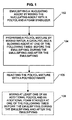
- the method of producing a rigid polyurethane foam may comprise: emulsifying a nucleating agent by mixing the nucleating agent with a polyol and a foam stabilizer (102); preparing a polyol mixture by combining this with water, a catalyst, and a blowing agent at one of the following times: before the emulsifying, during the emulsifying and after the emulsifying (104); and reacting the polyol mixture with a polyisocyanate (106).
- the method of preparing the polyol mixture may further comprise: mixing at least one of an additional polyol and an additional foam stabilizer at one of the following times: before the emulsifying, during the emulsifying, and after the emulsifying (108).
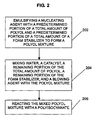
- Figure 2 is a flow chart showing operations in accordance with another embodiment of the invention.
- the method to produce a rigid polyurethane foam comprises: emulsifying a nucleating agent with a portion of a total amount of polyol and a portion of a total amount of a foam stabilizer to form an emulsified nucleating agent (202); combining this with water, a catalyst, the remaining portion of the total amount of polyol, the remaining portion of the foam stabilizer, and a blowing agent to form the polyol mixture(204); and reacting the polyol mixture with a polyisocyanate (206).
- the portion of the total amount of polyol is typically 10 - 30 parts by weight of the total amount of polyol.
- the nucleating agent comprises a perfluorinated alkene containing at least 6 carbon atoms and may have a boiling point of 20 - 80 °C.
- the amount of the nucleating agent is typically 0.5 - 5 parts by weight per 100 parts by weight of the total amount of polyol.
- the total amount of polyol typically comprises a polyaromatic polyol that is 15 - 70 parts by weight per 100 parts by weight of the total polyol component, and the polyaromatic polyol may, for example, comprise a toluenediamine-based polyol.
- the blowing agent may, for example, be a hydrocarbon such as a cyclopentane.
- the nucleating agent is preferably emulsifyied using a homomixer at approximately 1000 - 6000 rpm.
Landscapes
- Chemical & Material Sciences (AREA)
- Health & Medical Sciences (AREA)
- Chemical Kinetics & Catalysis (AREA)
- Medicinal Chemistry (AREA)
- Polymers & Plastics (AREA)
- Organic Chemistry (AREA)
- Engineering & Computer Science (AREA)
- Materials Engineering (AREA)
- Polyurethanes Or Polyureas (AREA)
- Organic Low-Molecular-Weight Compounds And Preparation Thereof (AREA)
Claims (18)
- Procédé de production d'une mousse de polyuréthanne rigide, comprenant la préparation d'un mélange de polyol comprenant du polyol et un agent de nucléation, et la mise en réaction du mélange de polyol avec du polyisocyanate, dans lequel la préparation du mélange de polyol comprend la mise en émulsion de l'agent de nucléation avec une partie ou la totalité du polyol pour produire une émulsion, ledit agent de nucléation comprenant un alcène perfluoré contenant au moins 6 atomes de carbone.
- Procédé selon la revendication 1, comprenant l'inclusion d'un stabilisateur de mousse dans le mélange de polyol de sorte qu'une partie ou la totalité du stabilisateur de mousse est présente dans ladite émulsion.
- Procédé selon la revendication 1 ou 2, dans lequel l'émulsion est formée en utilisant du polyol dans une quantité de 10 à 30 % en poids de polyol dans le mélange de polyol fourni au procédé de mise en réaction du polyol-polyisocyanate.
- Procédé selon l'une quelconque des revendications précédentes, dans lequel le mélange de polyol comprend de l'eau, un catalyseur et un agent gonflant.
- Procédé selon l'une quelconque des revendications précédentes, dans lequel le mélange de polyol comprend un stabilisateur de mousse supplémentaire.
- Procédé selon l'une quelconque des revendications précédentes, dans lequel l'agent de nucléation a un point d'ébullition de 20 à 80 °C.
- Procédé selon l'une quelconque des revendications précédentes, dans lequel la quantité de l'agent de nucléation est de 0,5 à 5 parties en poids pour 100 parties en poids de la quantité totale de polyol dans le mélange de polyol.
- Procédé selon l'une quelconque des revendications précédentes, dans lequel le mélange de polyol comprend le polyol et un polyol supplémentaire, et 15 à 70 parties en poids de la quantité totale de polyol dans le mélange de polyol sont un polyol polyaromatique.
- Procédé selon la revendication 8, dans lequel le polyol polyaromatique est un polyol à base de toluènediamine.
- Procédé selon l'une quelconque des revendications précédentes, dans lequel l'agent gonflant est un hydrocarbure.
- Procédé selon la revendication 10, dans lequel l'hydrocarbure est un cyclopentane.
- Procédé selon l'une quelconque des revendications précédentes, dans lequel la mise en émulsion de l'agent de nucléation comprend l'agitation avec un homomélangeur à environ 1000 à 6000 tr/min.
- Mousse de polyuréthanne rigide pouvant être obtenue par un procédé selon l'une quelconque des revendications précédentes.
- Mousse de polyuréthanne rigide ayant une structure à alvéoles fermées, et contenant au moins une trace d'agent gonflant de type hydrocarbure et un agent de nucléation comprenant un alcène perfluoré contenant au moins 6 atomes de carbone, dans laquelle la taille moyenne des alvéoles fermées est dans la gamme de 100 à 199 µm.
- Mousse de polyuréthanne rigide selon la revendication 14, dans laquelle la taille moyenne des alvéoles fermées est dans la gamme de 100 à 150 µm.
- Mousse de polyuréthanne rigide, contenant au moins une trace d'un agent gonflant de type hydrocarbure et un agent de nucléation comprenant un alcène perfluoré contenant au moins 6 atomes de carbone, qui a un facteur K de 0,015 kcal/m.h.°C ou moins.
- Mousse de polyuréthanne rigide selon la revendication 16, qui a un facteur K de 0,0145 kcal/m.h.°C ou moins.
- Émulsion comprenant du polyol et un agent de nucléation comprenant un alcène perfluoré contenant au moins 6 atomes de carbone, appropriée à une utilisation dans un procédé de production de mousse de polyuréthanne rigide.
Priority Applications (1)
| Application Number | Priority Date | Filing Date | Title |
|---|---|---|---|
| DE602004007752.6T DE602004007752T3 (de) | 2004-01-08 | 2004-05-28 | Verfahren zur Herstellung von Polyurethan Hartschaumstoffen |
Applications Claiming Priority (4)
| Application Number | Priority Date | Filing Date | Title |
|---|---|---|---|
| KR2004001036 | 2004-01-08 | ||
| KR20040001036 | 2004-01-08 | ||
| KR1020040034455A KR100568213B1 (ko) | 2004-01-08 | 2004-05-14 | 경질 폴리우레탄 폼의 제조방법 |
| KR2004034455 | 2004-05-14 |
Publications (3)
| Publication Number | Publication Date |
|---|---|
| EP1553129A1 EP1553129A1 (fr) | 2005-07-13 |
| EP1553129B1 true EP1553129B1 (fr) | 2007-07-25 |
| EP1553129B2 EP1553129B2 (fr) | 2014-07-23 |
Family
ID=36147011
Family Applications (1)
| Application Number | Title | Priority Date | Filing Date |
|---|---|---|---|
| EP04102405.0A Expired - Lifetime EP1553129B2 (fr) | 2004-01-08 | 2004-05-28 | Procédé pour la production de mousse de polyuréthane rigide |
Country Status (6)
| Country | Link |
|---|---|
| US (1) | US7285577B2 (fr) |
| EP (1) | EP1553129B2 (fr) |
| JP (1) | JP2005194531A (fr) |
| CN (1) | CN1293112C (fr) |
| DE (1) | DE602004007752T3 (fr) |
| MX (1) | MXPA05000400A (fr) |
Families Citing this family (6)
| Publication number | Priority date | Publication date | Assignee | Title |
|---|---|---|---|---|
| CA2855233A1 (fr) * | 2005-11-01 | 2007-05-10 | E.I. Du Pont De Nemours And Company | Agents gonflants concus pour produire une mousse et comprenant des fluorocarbures insatures |
| CN1995109B (zh) * | 2006-01-06 | 2011-04-27 | 广东科龙电器股份有限公司 | 硬质聚氨酯泡沫塑料的生产方法 |
| KR101231023B1 (ko) | 2009-11-26 | 2013-02-07 | 제일모직주식회사 | 단열성이 우수한 경질 폴리우레탄 폼 및 그 제조방법 |
| KR101332433B1 (ko) | 2010-08-24 | 2013-11-22 | 제일모직주식회사 | 단열성이 우수한 경질 폴리우레탄 폼 및 그 제조방법 |
| EP3176206A1 (fr) * | 2015-12-01 | 2017-06-07 | Evonik Degussa GmbH | Procédé de fabrication de mousse à cellules fines à l'aide d'un inhibiteur de vieillissement cellulaire |
| WO2020076539A1 (fr) | 2018-10-09 | 2020-04-16 | Dow Global Technologies Llc | Formulation de mousse de polyuréthane rigide et mousse fabriquée à partir de celle-ci |
Family Cites Families (31)
| Publication number | Priority date | Publication date | Assignee | Title |
|---|---|---|---|---|
| US4661531A (en) * | 1984-03-21 | 1987-04-28 | Basf Corporation | Process for preparing graft polymer dispersions and polyurethanes prepared therefrom |
| YU47361B (sh) * | 1989-06-28 | 1995-01-31 | Bosch-Siemens Hausgerate Gmbh. | Tvrdi penasti materijal i postupak za proizvodnju istog |
| US4981879A (en) † | 1989-08-28 | 1991-01-01 | Jim Walter Research Corp. | Rigid foam with improved "K" factor from perfluorinated hydrocarbons |
| DE4200558A1 (de) * | 1992-01-11 | 1993-07-15 | Basf Ag | Verfahren zur herstellung von polyurethan-hartschaeumen sowie treibmittelmischung hierfuer |
| US5250579A (en) | 1992-09-28 | 1993-10-05 | The Dow Chemical Company | Cellular polymer containing perforated cell windows and a process for the preparation thereof |
| US5428104A (en) * | 1992-11-27 | 1995-06-27 | Imperial Chemical Industries Plc | Polyol compositions |
| US5258418A (en) † | 1992-12-04 | 1993-11-02 | Basf Corporation | Low density, water-blown, rigid polyurethane foams having good physical properties and improved initial surface friability |
| US5260347A (en) † | 1992-12-04 | 1993-11-09 | Basf Corporation | Low density, water-blown, rigid polyurethane foams having good physical properties and improved initial surface friability |
| EP0704474A1 (fr) * | 1994-03-29 | 1996-04-03 | Air Products And Chemicals, Inc. | Procédé de préparation de mousse rigide de polyuréthane |
| US5318996A (en) * | 1993-10-08 | 1994-06-07 | Basf Corporation | Rigid insulating polyurethane foams prepared from ternary blowing agent mixtures |
| GB9324510D0 (en) * | 1993-11-30 | 1994-01-19 | Ici Plc | Process for rigid polyurethane foams |
| US5539008A (en) † | 1993-12-29 | 1996-07-23 | Minnesota Mining And Manufacturing Company | Foamable composition containing unsaturated perfluorochemical blowing agent |
| DE4406219A1 (de) * | 1994-02-25 | 1995-08-31 | Basf Schwarzheide Gmbh | Kompakte Formkörper oder Formkörper mit einem zelligen Kern und einer verdichteten Oberfläche auf Polyurethan-Basis, Verfahren zu ihrer Herstellung und ihre Verwendung als Schuh- oder Schuhsohlenmaterial |
| DE4440026A1 (de) * | 1994-11-09 | 1996-05-23 | Thanex Polyurethan Chemie Gmbh | Verfahren zur Herstellung von Schaumstoffprodukten |
| JP3425816B2 (ja) | 1995-01-19 | 2003-07-14 | 三井化学株式会社 | 硬質ポリウレタンフォーム |
| DE19502578A1 (de) * | 1995-01-27 | 1996-08-01 | Bayer Ag | Neue Polyetherpolyole, Polyformulierung enthaltend diese Polyetherpolyole und deren Verwendnung zur Herstellung von harten Polyurethanschaumstoffen |
| JPH09165427A (ja) | 1995-12-14 | 1997-06-24 | Mitsui Toatsu Chem Inc | 硬質ポリウレタンフォーム及びその製造方法 |
| DE19611367A1 (de) † | 1996-03-22 | 1997-09-25 | Bayer Ag | Verfahren zur Herstellung Kohlenwasserstoff-getriebener Polyurethan-Hartschaumstoffe |
| AU3169897A (en) * | 1996-06-20 | 1998-01-07 | Imperial Chemical Industries Plc | Process for rigid polyurethane foams |
| DE19804914A1 (de) * | 1998-02-07 | 1999-08-12 | Basf Ag | Verfahren zur Herstellung von PU-Hartschaumstoffen mit kleinen Zelldurchmessern und ihre Verwendung |
| US6660782B1 (en) | 1998-04-22 | 2003-12-09 | Essex Specialty Products, Inc. | Rigid polyurethane foams and method to form said foams using low molecular weight diols and triols |
| EP1141102A1 (fr) † | 1998-10-26 | 2001-10-10 | 3M Innovative Properties Company | Procede de preparation de mousse polymere a l'aide d'un compose perfluore dissous ou disperse dans un hydrofluoroether |
| US6127443A (en) | 1998-11-06 | 2000-10-03 | Bayer Antwerp N.V. | Energy management polyurethane rigid foams with high recovery |
| KR100609851B1 (ko) | 2000-02-09 | 2006-08-09 | 삼성전자주식회사 | 경질 폴리우레탄 발포체의 제조방법 |
| KR100356486B1 (ko) | 2000-10-20 | 2002-10-18 | 삼성전자 주식회사 | 경질 폴리우레탄 발포체의 제조방법 |
| EP1219653A1 (fr) | 2000-12-29 | 2002-07-03 | Huntsman International Llc | Mousses rigides de polyuréthane ou mousses de polyisocyanurate modifiées par des groupes uréthane et leurs procédés de préparation |
| KR100429000B1 (ko) | 2001-08-14 | 2004-04-28 | 한국과학기술원 | 약물이 봉입된 다공성 생분해성 고분자 지지체의 제조방법 |
| JP4159315B2 (ja) * | 2001-09-20 | 2008-10-01 | セントラル硝子株式会社 | 硬質ポリウレタンフォームまたはポリイソシアヌレートフォームの調製用のプレミックス、該フォームの製造方法および該フォーム |
| KR100771910B1 (ko) | 2001-09-28 | 2007-11-01 | 주식회사 엘지이아이 | 탈형성이 우수한 경질 폴리우레탄 폼 조성물 |
| US6617368B2 (en) * | 2001-11-13 | 2003-09-09 | Bayer Corporation | Isotropic rigid foams |
| KR100850995B1 (ko) | 2002-01-04 | 2008-08-12 | 주식회사 엘지이아이 | 경질 폴리우레탄 발포체 제조용 조성물 및 그로부터제조된 경질 폴리우레탄 발포체 |
-
2004
- 2004-05-28 EP EP04102405.0A patent/EP1553129B2/fr not_active Expired - Lifetime
- 2004-05-28 DE DE602004007752.6T patent/DE602004007752T3/de not_active Expired - Lifetime
- 2004-10-07 US US10/959,112 patent/US7285577B2/en not_active Expired - Fee Related
- 2004-11-30 CN CNB2004101000109A patent/CN1293112C/zh not_active Expired - Fee Related
- 2004-12-28 JP JP2004381331A patent/JP2005194531A/ja active Pending
-
2005
- 2005-01-07 MX MXPA05000400A patent/MXPA05000400A/es not_active Application Discontinuation
Also Published As
| Publication number | Publication date |
|---|---|
| DE602004007752T2 (de) | 2008-04-30 |
| JP2005194531A (ja) | 2005-07-21 |
| DE602004007752T3 (de) | 2015-06-18 |
| EP1553129A1 (fr) | 2005-07-13 |
| DE602004007752D1 (de) | 2007-09-06 |
| MXPA05000400A (es) | 2005-10-26 |
| EP1553129B2 (fr) | 2014-07-23 |
| US7285577B2 (en) | 2007-10-23 |
| US20050154072A1 (en) | 2005-07-14 |
| CN1293112C (zh) | 2007-01-03 |
| CN1637033A (zh) | 2005-07-13 |
Similar Documents
| Publication | Publication Date | Title |
|---|---|---|
| RU2058336C1 (ru) | ПОЛИУРЕТАНОВЫЙ ПЕНОМАТЕРИАЛ С ОБЪЕМНЫМ ВЕСОМ НЕ БОЛЕЕ 30 г/см3 И СПОСОБ ЕГО ПОЛУЧЕНИЯ | |
| US5169873A (en) | Process for the manufacture of foams with the aid of blowing agents containing fluoroalkanes and fluorinated ethers, and foams obtained by this process | |
| AU641959B2 (en) | Process for producing foams | |
| CN100523037C (zh) | 硬质泡沫组合物和使用链烷酸烷酯作为发泡剂的生产方法 | |
| JPH08509512A (ja) | 硬質ポリウレタンフォームの製造方法 | |
| CN1251115A (zh) | 刚性聚氨酯泡沫塑料的制法 | |
| JPH04298544A (ja) | フルオルアルカンを用いて発泡体を製造する方法 | |
| EP1553129B1 (fr) | Procédé pour la production de mousse de polyuréthane rigide | |
| KR100568213B1 (ko) | 경질 폴리우레탄 폼의 제조방법 | |
| JPH05279653A (ja) | ポリマーフォーム用の発泡剤及び/または断熱ガスとしての(ペルフルオロアルキル)エチレンの適用 | |
| CN1038135C (zh) | 多元醇组合物 | |
| JPH03121117A (ja) | 低密度硬質ウレタンフォームの製造法 | |
| KR100356486B1 (ko) | 경질 폴리우레탄 발포체의 제조방법 | |
| JP3007002B2 (ja) | ポリウレタン発泡用ポリオール組成物およびポリウレンフォームの製造方法 | |
| US6117917A (en) | Blowing agent blends and use thereof | |
| JPH0782338A (ja) | ポリウレタンフォーム及びその製造方法 | |
| JPH05247250A (ja) | 分枝ドデカフルオロヘキサンを用いたフォームの製造方法 | |
| JP2718985B2 (ja) | 発泡断熱材 | |
| EP4400537A1 (fr) | Composition d'agent moussant pour polyuréthane et procédé de préparation de mousse de polyuréthane l'utilisant | |
| WO2001088026A1 (fr) | Procede de fabrication de mousses de polyurethane rigides | |
| TW482797B (en) | Process for forming polyisocyanate-based foam and product formed thereby | |
| JP3265064B2 (ja) | 硬質ポリウレタンフォームの製造方法 | |
| JP2000516291A (ja) | ポリイソシアナート・ベースの泡およびその発泡剤 | |
| JPH0790039A (ja) | 発泡断熱材および断熱箱体 | |
| JPH04359036A (ja) | 硬質ポリウレタンフォ−ムの製造方法 |
Legal Events
| Date | Code | Title | Description |
|---|---|---|---|
| PUAI | Public reference made under article 153(3) epc to a published international application that has entered the european phase |
Free format text: ORIGINAL CODE: 0009012 |
|
| AK | Designated contracting states |
Kind code of ref document: A1 Designated state(s): AT BE BG CH CY CZ DE DK EE ES FI FR GB GR HU IE IT LI LU MC NL PL PT RO SE SI SK TR |
|
| AX | Request for extension of the european patent |
Extension state: AL HR LT LV MK |
|
| RIN1 | Information on inventor provided before grant (corrected) |
Inventor name: KIM, HYO-SEOB Inventor name: SUCK, SANG-JO Inventor name: AN, JANG-SU Inventor name: KIM, BONG-KU Inventor name: AHN, SEONG-HO Inventor name: KIM, HONG-GL Inventor name: YANG, DAE-SUNG Inventor name: KIM, JEONG-HON Inventor name: LEE, SUK-JO |
|
| 17P | Request for examination filed |
Effective date: 20060103 |
|
| AKX | Designation fees paid |
Designated state(s): DE GB IT |
|
| GRAP | Despatch of communication of intention to grant a patent |
Free format text: ORIGINAL CODE: EPIDOSNIGR1 |
|
| GRAS | Grant fee paid |
Free format text: ORIGINAL CODE: EPIDOSNIGR3 |
|
| GRAA | (expected) grant |
Free format text: ORIGINAL CODE: 0009210 |
|
| AK | Designated contracting states |
Kind code of ref document: B1 Designated state(s): DE GB IT |
|
| REG | Reference to a national code |
Ref country code: GB Ref legal event code: FG4D |
|
| RIN2 | Information on inventor provided after grant (corrected) |
Inventor name: YANG, DAE-SUNG Inventor name: SUCK, SANG-JO Inventor name: AN, JANG-SU Inventor name: KIM, JEONG-HON Inventor name: LEE, SUK-JO Inventor name: KIM, HYO-SEOB Inventor name: KIM, BONG-KU Inventor name: KIM, HONG-GL Inventor name: AHN, SEONG-HO |
|
| REF | Corresponds to: |
Ref document number: 602004007752 Country of ref document: DE Date of ref document: 20070906 Kind code of ref document: P |
|
| PLBI | Opposition filed |
Free format text: ORIGINAL CODE: 0009260 |
|
| PLAX | Notice of opposition and request to file observation + time limit sent |
Free format text: ORIGINAL CODE: EPIDOSNOBS2 |
|
| 26 | Opposition filed |
Opponent name: BAYER MATERIALSCIENCE AG Effective date: 20080425 |
|
| PLAF | Information modified related to communication of a notice of opposition and request to file observations + time limit |
Free format text: ORIGINAL CODE: EPIDOSCOBS2 |
|
| PLBB | Reply of patent proprietor to notice(s) of opposition received |
Free format text: ORIGINAL CODE: EPIDOSNOBS3 |
|
| RDAF | Communication despatched that patent is revoked |
Free format text: ORIGINAL CODE: EPIDOSNREV1 |
|
| APBM | Appeal reference recorded |
Free format text: ORIGINAL CODE: EPIDOSNREFNO |
|
| APBP | Date of receipt of notice of appeal recorded |
Free format text: ORIGINAL CODE: EPIDOSNNOA2O |
|
| APAH | Appeal reference modified |
Free format text: ORIGINAL CODE: EPIDOSCREFNO |
|
| APBQ | Date of receipt of statement of grounds of appeal recorded |
Free format text: ORIGINAL CODE: EPIDOSNNOA3O |
|
| RAP2 | Party data changed (patent owner data changed or rights of a patent transferred) |
Owner name: SAMSUNG ELECTRONICS CO., LTD. |
|
| PLAB | Opposition data, opponent's data or that of the opponent's representative modified |
Free format text: ORIGINAL CODE: 0009299OPPO |
|
| R26 | Opposition filed (corrected) |
Opponent name: BAYER MATERIALSCIENCE AG Effective date: 20080425 |
|
| APBU | Appeal procedure closed |
Free format text: ORIGINAL CODE: EPIDOSNNOA9O |
|
| PUAH | Patent maintained in amended form |
Free format text: ORIGINAL CODE: 0009272 |
|
| STAA | Information on the status of an ep patent application or granted ep patent |
Free format text: STATUS: PATENT MAINTAINED AS AMENDED |
|
| 27A | Patent maintained in amended form |
Effective date: 20140723 |
|
| AK | Designated contracting states |
Kind code of ref document: B2 Designated state(s): DE GB IT |
|
| REG | Reference to a national code |
Ref country code: DE Ref legal event code: R102 Ref document number: 602004007752 Country of ref document: DE |
|
| REG | Reference to a national code |
Ref country code: DE Ref legal event code: R102 Ref document number: 602004007752 Country of ref document: DE Effective date: 20140723 |
|
| PGFP | Annual fee paid to national office [announced via postgrant information from national office to epo] |
Ref country code: IT Payment date: 20140429 Year of fee payment: 11 |
|
| REG | Reference to a national code |
Ref country code: DE Ref legal event code: R135 Ref document number: 602004007752 Country of ref document: DE |
|
| REG | Reference to a national code |
Ref country code: DE Ref legal event code: R135 Ref document number: 602004007752 Country of ref document: DE Effective date: 20141024 |
|
| PG25 | Lapsed in a contracting state [announced via postgrant information from national office to epo] |
Ref country code: DE Free format text: LAPSE BECAUSE OF FAILURE TO SUBMIT A TRANSLATION OF THE DESCRIPTION OR TO PAY THE FEE WITHIN THE PRESCRIBED TIME-LIMIT Effective date: 20141024 |
|
| REG | Reference to a national code |
Ref country code: DE Ref legal event code: R073 Ref document number: 602004007752 Country of ref document: DE |
|
| REG | Reference to a national code |
Ref country code: DE Ref legal event code: R074 Ref document number: 602004007752 Country of ref document: DE |
|
| REG | Reference to a national code |
Ref country code: DE Ref legal event code: R074 Ref document number: 602004007752 Country of ref document: DE Effective date: 20150509 |
|
| PG25 | Lapsed in a contracting state [announced via postgrant information from national office to epo] |
Ref country code: IT Free format text: LAPSE BECAUSE OF NON-PAYMENT OF DUE FEES Effective date: 20150528 |
|
| PGRI | Patent reinstated in contracting state [announced from national office to epo] |
Ref country code: DE Effective date: 20150509 |
|
| PGFP | Annual fee paid to national office [announced via postgrant information from national office to epo] |
Ref country code: GB Payment date: 20170420 Year of fee payment: 14 |
|
| PGFP | Annual fee paid to national office [announced via postgrant information from national office to epo] |
Ref country code: DE Payment date: 20170621 Year of fee payment: 14 |
|
| REG | Reference to a national code |
Ref country code: DE Ref legal event code: R119 Ref document number: 602004007752 Country of ref document: DE |
|
| GBPC | Gb: european patent ceased through non-payment of renewal fee |
Effective date: 20180528 |
|
| PG25 | Lapsed in a contracting state [announced via postgrant information from national office to epo] |
Ref country code: GB Free format text: LAPSE BECAUSE OF NON-PAYMENT OF DUE FEES Effective date: 20180528 Ref country code: DE Free format text: LAPSE BECAUSE OF FAILURE TO SUBMIT A TRANSLATION OF THE DESCRIPTION OR TO PAY THE FEE WITHIN THE PRESCRIBED TIME-LIMIT Effective date: 20181201 |