EP1518859B1 - Verfahren zur Reinigung von Thiophenen - Google Patents
Verfahren zur Reinigung von Thiophenen Download PDFInfo
- Publication number
- EP1518859B1 EP1518859B1 EP04021686A EP04021686A EP1518859B1 EP 1518859 B1 EP1518859 B1 EP 1518859B1 EP 04021686 A EP04021686 A EP 04021686A EP 04021686 A EP04021686 A EP 04021686A EP 1518859 B1 EP1518859 B1 EP 1518859B1
- Authority
- EP
- European Patent Office
- Prior art keywords
- thiophene
- solvent
- optionally substituted
- general formula
- temperature
- Prior art date
- Legal status (The legal status is an assumption and is not a legal conclusion. Google has not performed a legal analysis and makes no representation as to the accuracy of the status listed.)
- Expired - Lifetime
Links
- 0 *c1c[n]cc1* Chemical compound *c1c[n]cc1* 0.000 description 2
Classifications
-
- C—CHEMISTRY; METALLURGY
- C07—ORGANIC CHEMISTRY
- C07D—HETEROCYCLIC COMPOUNDS
- C07D495/00—Heterocyclic compounds containing in the condensed system at least one hetero ring having sulfur atoms as the only ring hetero atoms
- C07D495/02—Heterocyclic compounds containing in the condensed system at least one hetero ring having sulfur atoms as the only ring hetero atoms in which the condensed system contains two hetero rings
- C07D495/06—Peri-condensed systems
-
- C—CHEMISTRY; METALLURGY
- C07—ORGANIC CHEMISTRY
- C07D—HETEROCYCLIC COMPOUNDS
- C07D495/00—Heterocyclic compounds containing in the condensed system at least one hetero ring having sulfur atoms as the only ring hetero atoms
- C07D495/02—Heterocyclic compounds containing in the condensed system at least one hetero ring having sulfur atoms as the only ring hetero atoms in which the condensed system contains two hetero rings
- C07D495/04—Ortho-condensed systems
-
- C—CHEMISTRY; METALLURGY
- C07—ORGANIC CHEMISTRY
- C07D—HETEROCYCLIC COMPOUNDS
- C07D333/00—Heterocyclic compounds containing five-membered rings having one sulfur atom as the only ring hetero atom
- C07D333/02—Heterocyclic compounds containing five-membered rings having one sulfur atom as the only ring hetero atom not condensed with other rings
- C07D333/04—Heterocyclic compounds containing five-membered rings having one sulfur atom as the only ring hetero atom not condensed with other rings not substituted on the ring sulphur atom
- C07D333/06—Heterocyclic compounds containing five-membered rings having one sulfur atom as the only ring hetero atom not condensed with other rings not substituted on the ring sulphur atom with only hydrogen atoms, hydrocarbon or substituted hydrocarbon radicals, directly attached to the ring carbon atoms
- C07D333/14—Radicals substituted by singly bound hetero atoms other than halogen
- C07D333/16—Radicals substituted by singly bound hetero atoms other than halogen by oxygen atoms
-
- C—CHEMISTRY; METALLURGY
- C07—ORGANIC CHEMISTRY
- C07D—HETEROCYCLIC COMPOUNDS
- C07D333/00—Heterocyclic compounds containing five-membered rings having one sulfur atom as the only ring hetero atom
- C07D333/02—Heterocyclic compounds containing five-membered rings having one sulfur atom as the only ring hetero atom not condensed with other rings
- C07D333/04—Heterocyclic compounds containing five-membered rings having one sulfur atom as the only ring hetero atom not condensed with other rings not substituted on the ring sulphur atom
- C07D333/26—Heterocyclic compounds containing five-membered rings having one sulfur atom as the only ring hetero atom not condensed with other rings not substituted on the ring sulphur atom with hetero atoms or with carbon atoms having three bonds to hetero atoms with at the most one bond to halogen, e.g. ester or nitrile radicals, directly attached to ring carbon atoms
- C07D333/30—Hetero atoms other than halogen
- C07D333/32—Oxygen atoms
-
- C—CHEMISTRY; METALLURGY
- C08—ORGANIC MACROMOLECULAR COMPOUNDS; THEIR PREPARATION OR CHEMICAL WORKING-UP; COMPOSITIONS BASED THEREON
- C08G—MACROMOLECULAR COMPOUNDS OBTAINED OTHERWISE THAN BY REACTIONS ONLY INVOLVING UNSATURATED CARBON-TO-CARBON BONDS
- C08G61/00—Macromolecular compounds obtained by reactions forming a carbon-to-carbon link in the main chain of the macromolecule
- C08G61/12—Macromolecular compounds containing atoms other than carbon in the main chain of the macromolecule
- C08G61/122—Macromolecular compounds containing atoms other than carbon in the main chain of the macromolecule derived from five- or six-membered heterocyclic compounds, other than imides
- C08G61/123—Macromolecular compounds containing atoms other than carbon in the main chain of the macromolecule derived from five- or six-membered heterocyclic compounds, other than imides derived from five-membered heterocyclic compounds
- C08G61/126—Macromolecular compounds containing atoms other than carbon in the main chain of the macromolecule derived from five- or six-membered heterocyclic compounds, other than imides derived from five-membered heterocyclic compounds with a five-membered ring containing one sulfur atom in the ring
-
- H—ELECTRICITY
- H01—ELECTRIC ELEMENTS
- H01G—CAPACITORS; CAPACITORS, RECTIFIERS, DETECTORS, SWITCHING DEVICES, LIGHT-SENSITIVE OR TEMPERATURE-SENSITIVE DEVICES OF THE ELECTROLYTIC TYPE
- H01G11/00—Hybrid capacitors, i.e. capacitors having different positive and negative electrodes; Electric double-layer [EDL] capacitors; Processes for the manufacture thereof or of parts thereof
- H01G11/22—Electrodes
- H01G11/30—Electrodes characterised by their material
- H01G11/48—Conductive polymers
-
- H—ELECTRICITY
- H05—ELECTRIC TECHNIQUES NOT OTHERWISE PROVIDED FOR
- H05K—PRINTED CIRCUITS; CASINGS OR CONSTRUCTIONAL DETAILS OF ELECTRIC APPARATUS; MANUFACTURE OF ASSEMBLAGES OF ELECTRICAL COMPONENTS
- H05K3/00—Apparatus or processes for manufacturing printed circuits
- H05K3/40—Forming printed elements for providing electric connections to or between printed circuits
- H05K3/42—Plated through-holes or plated via connections
- H05K3/423—Plated through-holes or plated via connections characterised by electroplating method
- H05K3/424—Plated through-holes or plated via connections characterised by electroplating method by direct electroplating
-
- Y—GENERAL TAGGING OF NEW TECHNOLOGICAL DEVELOPMENTS; GENERAL TAGGING OF CROSS-SECTIONAL TECHNOLOGIES SPANNING OVER SEVERAL SECTIONS OF THE IPC; TECHNICAL SUBJECTS COVERED BY FORMER USPC CROSS-REFERENCE ART COLLECTIONS [XRACs] AND DIGESTS
- Y02—TECHNOLOGIES OR APPLICATIONS FOR MITIGATION OR ADAPTATION AGAINST CLIMATE CHANGE
- Y02E—REDUCTION OF GREENHOUSE GAS [GHG] EMISSIONS, RELATED TO ENERGY GENERATION, TRANSMISSION OR DISTRIBUTION
- Y02E60/00—Enabling technologies; Technologies with a potential or indirect contribution to GHG emissions mitigation
- Y02E60/13—Energy storage using capacitors
Definitions
- the invention relates to a process for the purification of thiophenes which are liquid at room temperature, to the thiophenes purified according to this process and to their use.
- Thiophenes are used, for example, for the preparation of conductive polymers.
- These compounds are characterized by special properties such as high conductivity, high transparency and excellent long-term stability. Therefore, they have been increasingly used as organically conductive polymers in the art.
- the antistatic finish of photographic films and the use as an electrode or solid electrolyte in solid electrolytic capacitors are important applications, e.g. the through-plating of printed circuit boards.
- the properties of the resulting polymers may also be adversely affected by, for example, negatively altering the impurities of the inherent color of the resulting polymer and thereby deteriorating the transparency necessary for the use of the polymers e.g. as transparent conductive or antistatic coatings is essential.
- Impurities which are also capable of polymerization can be incorporated into the polymer and thereby significantly reduce its conductivity. Further detrimental effects of contaminants may be that the order of the conductive layers may be lowered by impurities, resulting in poorer conductivities, that impurities accumulate on the surface of the polymer after polymerization and thereby give rise to undesirable contact resistances, so that the function of the conductive Layer is limited, or that the long-term stability of the conductive polymers is adversely affected by the impurities, for example, initiate the reaction of the conductive polymer with oxygen and thus significantly deteriorate the properties of the polymer.
- the starting materials necessary for the preparation of the organically conductive polymers which are usually prepared by chemical reactions of raw materials, cleaned before use.
- a number of cleaning operations are known to those skilled in the art, which are basically suitable for the purification of the monomers for the polymerization to organic conductive polymers.
- Such purification methods are, for example, distillation, sublimation, extraction, crystallization, chromatography and adsorption. These purification methods have long been known to the skilled person and described in common textbooks.
- Thiophenes which are liquid at room temperature and which are suitable for the preparation of electrically conductive polymers are of particular importance because of their easy processibility in the liquid form.
- those skilled in the art offer the cleaning methods which are applicable to liquid substances, preferably distillation, which is also carried out on a large industrial scale, extraction and chromatography.
- EP-A 1 142 888 The distillative purification of thiophenes as monomers for use in the preparation of electrically conductive polymers is known, for example, from EP-A 1 142 888.
- EP-A 1 142 888 teaches that by optimized reaction conditions, the number and amount of by-products can be reduced and e.g. 3,4-ethylenedioxythiophene is available in a purity of up to 97.7%.
- EP-A 1 142 888 further teaches that additional purification is necessary for further purification in order to remove water-soluble by-products and to achieve a purity of more than 99%.
- 3,4-alkylenedioxythiophenes in particular of 3,4-ethylenedioxythiophene contaminated with 3,4-dimethoxythiophene
- the 3,4-alkanethiophene obtained in the synthesis of 3,4-ethylenedioxythiophene can be 3,4 -Dimethoxythiophen be separated because of only two units different molecular weight and the very similar structure only at very high cost, which is the purification over a Distillation above a certain degree of purity is no longer economical.
- 3,4-dimethoxythiophene as an impurity has the disadvantage that it is incorporated in the polymerization with in the polymer and thus properties of the polymer, such as the conductivity can adversely affect.
- WO-A 02/79295 describes the preparation of liquid and solid chiral alkylenedioxythiophenes and mentions in examples the purification by a chromatography on silica.
- the compounds prepared according to WO-A 02/79295 have a purity of up to 99.7% after purification.
- the chromatographic separation is also associated with disadvantages. Thus, large amounts of solvents are necessary for their implementation, since the compounds to be separated must be in very dilute form in order to achieve the desired separation effect.
- the chromatographic separation can not be operated continuously with the aid of simple apparatus, so that in each case only small amounts of the desired purified thiophene are obtained.
- a continuous separation of large amounts would therefore be associated with an extremely high expenditure on equipment, so that such a purification of thiophenes is economically not feasible.
- a particular form of crystallization can also be used to crystallize liquid thiophenes.
- This particular form of crystallization, melt crystallization is described, for example, in N. Wynn, Chem. Engineering (1986), 93 (8), 26-27 and in J. Ulrich and H. C Bülau, Editor (s): Myerson, Allan See "Handbook of Industrial Crystallization (2nd Edition)" (2002), 161-179.
- Melt crystallization is essentially based on cooling a liquid substance until a melt is formed, from which only the substance to be purified crystallizes out. After crystallization, the mother liquor containing in the ideal case all impurities is separated off.
- the crystallized material is heated so easily that impurities adhering to the product can be removed along with a portion of the then-melting material.
- this process is limited to substances or mixtures containing larger amounts of impurities, which can be separated in liquid form. Small amounts of impurities can be uneconomical through this process are removed, since large amounts of the desired compound must be separated with to wash out the small amount of contamination.
- the melt crystallization is critical with respect to the temperature control and thus expensive in terms of apparatus.
- the present invention was therefore based on the object of finding a less expensive process for the purification of thiophenes, with which high-purity 3,4-alkylenedioxythiophenes, preferably having a purity of more than 99.9%, can be prepared.
- thiophenes which are liquid at room temperature are to be understood as meaning those thiophenes which have their melting point below + 40 ° C., preferably below + 30 ° C.
- Room temperature can be within the scope of the invention a temperature of 10 to 40 ° C, preferably from 15 to 30 ° C, particularly preferably from 18 to 25 ° C.
- the general formula (II) is to be understood as meaning that the substituent R may be bonded x times to the alkylene or arylene radical A.
- the thiophene to be purified has one or more stereocenters
- the thiophene may be a racemate, an enantiomerically pure or diastereomerically pure compound or an enantiomerically enriched or diastereomerically enriched compound.
- an enantiomerically enriched compound is meant a compound having an enantiomeric excess (ee) greater than 50%.
- a diastereomerically enriched compound is meant a compound having a diastereomeric excess (de) greater than 30%. However, it may also be any mixture of diastereomers.
- the purified thiophene before purification with the inventive method preferably has a purity of greater than 70%, more preferably a purity greater than 90%.
- the thiophenes of the general formulas (I), (II) or (IIa) which are to be purified can be prepared by processes known to the person skilled in the art. For example, such a production method is described in EP-A 1 142 888.
- the solvents used are those in which the thiophene to be purified is dissolved and which have a sufficiently low melting point, preferably below -40 ° C.
- suitable solvents are isobutyl methyl ketone, chloroform, methylene chloride, toluene, methanol, propanol, ethanol, acetone, isopropanol, n-butanol, sec-butanol, dimethylformamide, methyl tert-butyl ether, tetrahydrofuran, diethyl ether, hexane or pentane.
- Preferred solvents are polar solvents, particularly preferred are alcohols. Very particular preference is given to methanol or ethanol.
- the solvent may also be a mixture of two or more solvents.
- each individual solvent dissolves the thiophene and has a correspondingly low melting point, but only the mixture must have these properties.
- the solvent is mixed with the thiophene in a ratio of 0.01: 1 to 10: 1, preferably in a ratio of 0.3: 1 to 3: 1, and most preferably in a ratio of 1: 1.
- the new method is e.g. is carried out by combining the thiophenes to be purified and at least one solvent in any order which cools the solvent (s) before combining with the thiophene or the solution obtained during or after combining to a temperature at which a mixture of a solid and a solid is obtained Forms liquid, the mixture of a solid and a liquid optionally stirred and then separates the solid.
- the solvent or solvents are cooled before combining with the thiophenes or the solution obtained during or after combining to a temperature which is at least 10 ° C, preferably at least 20 ° C below the melting temperature of the thiophene to be purified in pure form. More preferably, it is cooled to 0 ° C or lower, most preferably to -15 ° C or lower.
- the novel process can be carried out, for example, by dissolving the thiophene in the solvent (s) and then cooling this solution at least to the extent that the purified thiophene precipitates or crystallizes out.
- the thiophene may be dissolved in the solvent (s) at a temperature above the melting point of the thiophene.
- a temperature between 0 ° C and + 40 ° C is preferred.
- Particularly preferred is a temperature between + 15 ° C and + 25 ° C.
- the resulting solution of the solvent and the thiophene is then cooled.
- the solution is cooled down until the thiophene separates out or crystallizes out of the solution in the form of a solid.
- the solution is cooled to a temperature of at least 20 ° C below the melting temperature of the pure thiophene. Most preferably, the cooling is at -15 ° C or at a temperature lower than -15 ° C.
- the solution is preferably cooled down at a rate such that the thiophene crystallizes out within a period of a few minutes to several hours.
- the cooling down to the desired temperature over a period of about one hour.
- the cooling down can be effected by external cooling or by introducing an inert cooling medium.
- the cooling down is achieved by external cooling.
- the thiophene precipitates out of the solution as a solid, for example in the form of crystals.
- the resulting solid may contain the thiophene as a pure substance or consist of a mixture of the solvent (s) and the thiophene.
- the new process can be carried out by metering the liquid thiophene into the already cooled solvent, solvent mixture or into a cooled thiophene solution.
- the solvent is cooled to a temperature of at least 20 ° C below the melting temperature of the pure thiophene. Most preferably, the cooling is at -15 ° C or a temperature lower than -15 ° C.
- the liquid thiophene is metered into the cooled solvent, preferably over a period of a few minutes to several hours.
- the dosing rate should be chosen so that the thiophene does not precipitate or crystallize too quickly and impurities are included in the solid.
- a dosing time of at least 1 hour is preferred. Depending on the amount of thiophene that has to be added, dosing times of less than an hour may suffice.
- the solid obtained may also contain the thiophene as a pure substance or consist of a mixture of the solvent (s) and the thiophene.
- the resulting suspension is then stirred for a period of 1 minute to 5 hours.
- Particularly preferred here is a stirring time of about three hours.
- the stirring is carried out at a temperature of at least 20 ° C below the melting temperature of the pure thiophene. Preference is given to a temperature of -15 ° C or a temperature of less than -15 ° C.
- the precipitated or crystallized product is separated by known methods. This separation is preferably carried out by filtration.
- the filtration can be carried out at normal pressure or under pressure.
- the filtration is preferably carried out with the aid of a temperature-controllable filter unit and is carried out so that the product to be filtered is present during the filtration as a solid.
- the filtration is carried out at a temperature between 0 ° C and -20 ° C.
- the filtration is carried out at -15 ° C or at a temperature lower than -15 ° C.
- the resulting solid can be washed with one or more solvents to remove residues of impurities from the filter cake.
- solvents for this purpose, preference is given to using polar solvents. Alcohols are particularly preferably used in admixture with each other and / or with other solvents. Particularly preferably, the solid is washed with ethanol or methanol or a mixture of these.
- the filter cake is washed to remove contaminant residues adhered to the filter cake, it is useful to remove the detergent, i.
- the detergent has a temperature of less than 0 ° C during washing.
- the detergent is cooled down to -15 ° C or lower for washing.
- the solid then obtained is heated to a temperature above the melting point of the thiophene over a period between 5 minutes and 5 hours. Preferably, the solid is allowed to melt over a period of 1 hour.
- the molten solid may still contain residues of the solvent added before the crystallization or residues of the detergent. These residues can be determined by methods known to the person skilled in the art, e.g. remove by simple distillation.
- the solvent is distilled over.
- the distillation can be carried out at atmospheric pressure or under reduced pressure. Preferably, it is carried out at reduced pressure at temperatures between 30 ° C and 150 ° C, preferably between 50 ° C and 100 ° C.
- the resulting thiophene remaining in the bottom preferably has a purity of at least 99.50%, preferably at least 99.9%, after the solvent has been completely distilled off.
- thiophenes synthesized using 3,4-dimethoxythiophene or in the synthesis of which 3,4-dimethoxythiophene is by-produced after purification by the process of the present invention contain less than 0.05% by weight of 3,4-dimethoxythiophene.
- Such a low content of 3,4-dimethoxythiophene can not be achieved with conventional purification processes, such as, for example, simple distillation, or only with very high yield loss in the desired thiophene.
- the thiophene remaining in the bottom after the distillation can also be distilled over to remove the color-imparting traces. As a rule, this gives a colorless thiophene to the eye.
- the distillation of the thiophene is also preferably carried out at reduced pressure.
- up to 70%, preferably up to 90%, more preferably up to 95% and most preferably almost 100% of the employed Thiophene can be obtained in purified form.
- the optionally remaining part of the thiophene used remains in the mother liquor, i. e.g. in the filtrate separated in the filtration, or optionally dissolved in the detergent.
- the cleaning method can be carried out in a preferred embodiment, the mother liquor of a previous precipitation or crystallization and / or the detergent as a solvent or together with the solvent again in the process can be used for the purification of further thiophene.
- the inventive method allows the purification of thiophenes in a simple procedure.
- the products are also obtained in good yield.
- the thiophenes purified by the process according to the invention are outstandingly suitable for the production of conductive polymers or for the production of organic semiconductors, for example in the production of capacitors, printed circuit boards, antistatic layers, transparent conductive layers, displays, electrochromic glazings and semiconductor integrated circuits are suitable. This use is another object of the invention.
- the solvent was first distilled off at a pressure of 12 h Pa and a temperature of 50 ° C and then at a temperature of 90 ° C and a pressure of 12 hPa , 4-ethylenedioxythiophene distilled. 718 g of 3,4-ethylenedioxythiophene (55% of theory) were obtained in a purity of 99.2%. The product no longer had 3,4-dimethoxythiophene.
Landscapes
- Chemical & Material Sciences (AREA)
- Organic Chemistry (AREA)
- Engineering & Computer Science (AREA)
- Power Engineering (AREA)
- Medicinal Chemistry (AREA)
- Polymers & Plastics (AREA)
- Health & Medical Sciences (AREA)
- Materials Engineering (AREA)
- Chemical Kinetics & Catalysis (AREA)
- Microelectronics & Electronic Packaging (AREA)
- Heterocyclic Carbon Compounds Containing A Hetero Ring Having Oxygen Or Sulfur (AREA)
- Cephalosporin Compounds (AREA)
- Crystals, And After-Treatments Of Crystals (AREA)
Description
- Die Erfindung betrifft ein Verfahren zur Reinigung von bei Raumtemperatur flüssigen Thiophenen, die gemäß diesem Verfahren gereinigten Thiophene und deren Verwendung.
- Thiophene werden beispielsweise zur Herstellung von leitfähigen Polymeren verwendet. Von besonderem Interesse sind hierbei Poly(3,4-alkylendioxythiophene), wie sie beispielsweise in EP-A 339 340 beschrieben sind. Diese Verbindungen zeichnen sich durch besondere Eigenschaften wie hohe Leitfähigkeit, hohe Transparenz und hervorragende Langzeitstabilität aus. Daher haben sie als organisch leitfähige Polymere in der Technik zunehmend Verwendung gefunden. So sind als wichtige Einsatzgebiete z.B. die Durchkontaktierung von Leiterplatten, die Antistatikausrüstung von photographischen Filmen und der Einsatz als Elektrode oder Feststoffelektrolyt in Feststoffelektrolytkondensatoren beschrieben.
- Eine wichtige Voraussetzung bei der Herstellung der organischen leitfähigen Polymeren ist die hohe Reinheit der zu ihrer Herstellung notwendigen Ausgangsstoffe. Verunreinigungen, die in den Ausgangsstoffen enthalten sind, können die Polymerisation insofern negativ beeinflussen, dass die Polymerisation nicht, nur sehr langsam oder unvollständig erfolgt oder in unkontrolliertem Maße beschleunigt wird. In Folge dessen kann die Verarbeitungszeit dieser Monomere drastisch sinken, so dass diese in den Verarbeitungsprozessen nicht mehr einsetzbar sind.
- Zusätzlich können die Eigenschaften der resultierenden Polymere ebenfalls negativ beeinflusst werden, indem die Verunreinigungen beispielsweise die Eigenfarbe des resultierenden Polymers negativ verändern und dadurch die Transparenz verschlechtert wird, die für den Einsatz der Polymere z.B. als transparente leitfähige oder antistatische Beschichtungen wesentlich ist.
- Verunreinigungen, die ebenfalls polymerisationsfähig sind, können in das Polymer mit eingebaut werden und dadurch dessen Leitfähigkeit deutlich erniedrigen. Weitere nachteilige Auswirkungen von Verunreinigungen können sein, dass die Ordnung der leitfähigen Schichten durch Verunreinigungen erniedrigt werden kann, wodurch schlechtere Leitfähigkeiten resultieren, dass sich Verunreinigungen nach der Polymerisation auf der Oberfläche des Polymers anreichern und sich dadurch unerwünschte Übergangswiderstände ergeben, so dass die Funktion der leitfähigen Schicht eingeschränkt ist, oder aber dass die Langzeitstabilität der leitfähigen Polymere negativ beeinflusst wird, indem die Verunreinigungen beispielsweise die Reaktion des leitfähigen Polymers mit Sauerstoff initiieren und somit die Eigenschaften des Polymers signifikant verschlechtern.
- Daher werden die zur Herstellung der organisch leitfähigen Polymeren notwendigen Ausgangsstoffe, die in der Regel durch chemische Umsetzungen aus Rohstoffen hergestellt werden, vor ihrem Einsatz gereinigt.
- Dem Fachmann sind eine Reihe von Reinigungsoperationen bekannt, die zur Reinigung der Monomere für die Polymerisation zu organischen leitfähigen Polymeren grundsätzlich geeignet sind. Solche Reinigungsmethoden sind beispielsweise Destillation, Sublimation, Extraktion, Kristallisation, Chromatographie und Adsorption. Diese Reinigungsmethoden sind dem Fachmann seit langem bekannt und in gängigen Lehrbüchern beschrieben.
- Bei Raumtemperatur flüssige Thiophene, die zur Herstellung von elektrisch leitfähigen Polymeren geeignet sind, sind aufgrund ihrer leichten Verarbeitbarkeit in der flüssigen Form von besonderer Bedeutung. Bei der Reinigung dieser Thiophene bieten sich dem Fachmann die Reinigungsmethoden an, die auf flüssige Stoffe anwendbar sind, vorzugsweise Destillation, die auch im großindustriellen Maßstab durchgeführt wird, Extraktion und Chromatographie.
- Die destillative Reinigung von Thiophenen als Monomere für den Einsatz zur Herstellung von elektrisch leitfähigen Polymeren ist beispielsweise aus EP-A 1 142 888 bekannt. EP-A 1 142 888 lehrt, dass durch optimierte Reaktionsbedingungen die Anzahl und Menge an Nebenprodukten reduziert werden kann und z.B. 3,4-Ethylendioxythiophen in einer Reinheit von bis zu 97,7 % erhältlich ist. Jedoch lehrt EP-A 1 142 888 weiterhin, dass zur weiteren Reinigung eine zusätzliche Extraktion notwendig ist, um wasserlösliche Nebenprodukte zu entfernen und eine Reinheit von mehr als 99 % zu erzielen. Als Nebenkomponente, d.h. Verunreinigung, tritt bei dieser Synthese von 3,4-Ethylendioxythiophen überwiegend 3,4-Dimethoxythiophen auf.
- Eine destillative Abtrennung von Verbindungen ist zudem nur dann möglich, wenn sich die zu trennenden Komponenten in ihrem Siedepunkt deutlich, d.h. mehr als 1°C unterscheiden. Je weniger sich die Siedepunkte unterscheiden, desto größer ist der apparative Aufwand zur Abtrennung, so dass derartige Trennungen wirtschaftlich nicht mehr durchzuführen sind. Da substituierte Thiophene, wie beispielsweise Alkylendioxythiophene vorzugsweise bei Unterdruck destilliert werden, wird der Unterschied der Siedepunkte weiter reduziert, was den Trennungsaufwand weiter erhöht.
- Die Reinigung von 3,4-Alkylendioxythiophenen, insbesondere von 3,4-Ethylendioxythiophen, die mit 3,4-Dimethoxythiophen verunreinigt sind, stellt eine besondere Schwierigkeit dar. So kann das beispielsweise bei der Synthese von 3,4-Ethylendioxythiophen anfallende 3,4-Dimethoxythiophen aufgrund der sich nur um zwei Einheiten unterscheidende Molekülmasse und der sehr ähnlichen Struktur nur unter sehr hohem Aufwand abgetrennt werden, was die Aufreinigung über eine Destillation ab einem gewissen Reinheitsgrad nicht mehr wirtschaftlich macht. 3,4-Dimethoxythiophen als Verunreinigung hat jedoch den Nachteil, dass es bei Polymerisation mit in das Polymer eingebaut wird und so Eigenschaften des Polymeren, beispielsweise die Leitfähigkeit nachteilig beeinflussen kann.
- Die chromatographische Reinigung von Thiophenen als Monomere für den Einsatz zur Herstellung von elektrisch leitfähigen Polymeren ist ebenfalls bekannt. WO-A 02/79295 beschreibt die Herstellung von flüssigen und festen chiralen Alkylendioxythiophenen und erwähnt in Beispielen die Reinigung durch eine Chromatographie an Siliziumdioxid. Die gemäß WO-A 02/79295 hergestellten Verbindungen weisen nach Reinigung eine Reinheit von bis zu 99,7 % auf. Die chromatographische Trennung ist aber ebenfalls mit Nachteilen behaftet. So sind zu Ihrer Durchführung große Mengen an Lösungsmitteln notwendig, da die zu trennenden Verbindungen in sehr verdünnter Form vorliegen müssen, um den gewünschten Trenneffekt zu erzielen. Weiterhin kann die chromatographische Trennung mit Hilfe einfacher Apparate nicht kontinuierlich betrieben werden, so dass jeweils nur kleine Mengen an gewünschtem aufgereinigtem Thiophen erhalten werden. Eine kontinuierliche Trennung großer Mengen wäre daher mit einem extrem hohen apparativen Aufwand verbunden, so dass eine solche Reinigung von Thiophenen wirtschaftlich nicht mehr durchführbar ist.
- Die klassische Umkristallisation, bei der bei Raumtemperatur feste Thiophene bei erhöhter Temperatur, meist unter Rückfluss des Lösungsmittels in Lösung gebracht und anschließend durch Abkühlung wieder auskristallisiert werden, zur Reinigung von Thiophenen als Monomere für den Einsatzung zur Herstellung von elektrisch leitfähigen Polymeren ist ebenfalls bekannt und in WO-A 02/79295 beschrieben, beschränkt sich jedoch auf bei Raumtemperatur feste Thiophene.
- Eine besondere Form der Kristallisation kann ebenfalls zur Kristallisation von flüssigen Thiophenen verwendet werden. Diese spezielle Form der Kristallisation, die Schmelzkristallisation, ist beispielsweise in N. Wynn, Chem. Engineering (1986), 93(8), 26-27 und in J. Ulrich und H. C Bülau, Editor(s): Myerson, Allan S. "Handbook of Industrial Crystallization (2nd Edition)" (2002), 161-179 beschrieben. Die Schmelzkristallisation beruht im wesentlichen darauf, dass man einen flüssigen Stoff bis zur Bildung einer Schmelze abkühlt, aus der nur der aufzureinigende Stoff auskristallisiert. Nach Kristallisation wird die im Idealfall alle Verunreinigungen enthaltende Mutterlauge abgetrennt. Gegebenenfalls wird der kristallisierte Stoff so leicht erhitzt, dass an dem Produkt anhaftende Verunreinigungen zusammen mit einem Teil des dann schmelzenden Stoffes entfernt werden können. Dieses Verfahren ist jedoch auf Stoffe bzw. Stoffgemische begrenzt, die größere Mengen an Verunreinigungen enthalten, welche in flüssiger Form abgetrennt werden können. Geringe Mengen von Verunreinigungen können über dieses Verfahren nur unwirtschaftlich entfernt werden, da große Mengen an gewünschter Verbindung mit abgetrennt werden müssen, um die kleine Menge an Verunreinigung herauszuwaschen. Zudem ist die Schmelzkristallisation bezüglich der Temperaturführung kritisch und damit apparativ aufwändig.
- Es bestand daher weiterhin Bedarf an einem Verfahren zur Reinigung von bei Raumtemperatur flüssigen Thiophenen, bei dem eine extrem hohe Reinheit, vorzugsweise von mehr als 99,9 % erzielt wird, und welches die vorangehend beschriebenen Nachteile nicht aufweist.
- Der vorliegenden Erfindung lag somit die Aufgabe zugrunde ein weniger aufwändiges Verfahren zur Reinigung von Thiophenen aufzufinden, mit welchem hochreine 3,4-Alkylendioxythiophene, vorzugsweise mit einer Reinheit von mehr als 99,9 %, hergestellt werden können.
- Gegenstand der vorliegenden Erfindung ist ein Verfahren zur Reinigung von Thiophenen der allgemeinen Formel (I),

- R1 und R2
- unabhängig von einander für Wasserstoff, für eine gegebenenfalls substituierte, gegebenenfalls durch 1 bis 5 Sauerstoff- und/oder Schwefelatome unterbrochene C1-C20-Alkylgruppe oder C1-C20-Oxyalkylgruppe oder gemeinsam für eine gegebenenfalls substituierte C1-C20-Dioxyalkylen- oder C1-C20-Dioxyarylengruppe stehen,
- Unter bei Raumtemperatur flüssigen Thiophenen sind im Rahmen der Erfindung solche Thiophene zu verstehen, die ihren Schmelzpunkt unterhalb von + 40°C, bevorzugt unterhalb von + 30°C haben.
- Raumtemperatur kann im Rahmen der Erfindung eine Temperatur von 10 bis 40°C, bevorzugt von 15 bis 30°C, besonders bevorzugt von 18 bis 25°C sein.
- Bevorzugt werden mit dem erfindungsgemäßen Verfahren als Thiophene der allgemeinen Formel (I) Verbindungen der allgemeinen Formel (II),

- A
- für einen gegebenenfalls substituierten C1-C5-Alkylenrest oder einen C1-C12-Arylenrest, bevorzugt für einen gegebenenfalls substituierten C2-C3-Alkylenrest, steht,
- R
- für einen linearen oder verzweigten, gegebenenfalls substituierten C1-C18-Alkylrest, bevorzugt linearen oder verzweigten, gegebenenfalls substituierten C1-C14-Alkylrest, einen gegebenenfalls substituierten C5-C12-Cycloalkylrest, einen gegebenenfalls substituierten C6-C14-Arylrest, einen gegebenenfalls substituierten C7-C18-Aralkylrest, einen gegebenenfalls substituierten C1-C4-Hydroxyalkylrest, bevorzugt gegebenenfalls substituierten C1-C2-Hydroxyalkylrest, oder einen Hydroxylrest steht,
- x
- für eine ganze Zahl von 0 bis 8 steht, bevorzugt von 0 bis 6, besonders bevorzugt für 0 oder 1 steht und
- Die allgemeine Formel (II) ist so zu verstehen, dass der Substituent R x-mal an den Alkylen- oder Arylenrest A gebunden sein kann.
- Bevorzugte Verbindungen der allgemeinen Formel (II) sind solche der allgemeinen Formel (IIa),

- R
- die in der allgemeine Formel (II) genannte Bedeutung hat und y für 0, 1, 2, 3 oder 4 steht.
- Sofern das aufzureinigende Thiophen ein oder mehrere Stereozentren aufweist, kann es sich bei dem Thiophen um ein Racemat, eine enantiomerenreine oder diastereomerenreine Verbindung oder um eine enantiomerenangereicherte oder diastereomerenangereicherte Verbindung handeln. Unter einer entantiomerenangereicherten Verbindung ist eine Verbindung mit einem Enantiomerenüberschuss (ee) von mehr als 50 % zu verstehen. Unter einer diastereomerenangereicherten Verbindung ist eine Verbindung mit einem Diastereomerenüberschuss (de) von mehr als 30 % zu verstehen. Es kann sich jedoch auch um eine beliebige Mischung aus Diastereomeren handeln.
- Das aufzureinigende Thiophen weist vor Reinigung mit dem erfindungsgemäßem Verfahren bevorzugt eine Reinheit von größer 70 %, besonders bevorzugt eine Reinheit größer 90 % auf.
- Die aufzureinigenden Thiophene der allgemeinen Formeln (I), (II) oder (IIa) sind nach dem Fachmann bekannten Verfahren herstellbar. Beispielsweise ist ein solches Herstellverfahren in EP-A 1 142 888 beschrieben.
- Als Lösungsmittel werden solche eingesetzt, in denen sich das aufzureinigende Thiophen löst und welche einen ausreichend niedrigen Schmelzpunkt, vorzugsweise unterhalb von -40°C aufweisen. Beispielhaft seinen als geeignete Lösungsmittel Isobutylmethylketon, Chloroform, Methylenchlorid, Toluol, Methanol, Propanol, Ethanol, Aceton, iso-Propanol, n-Butanol, sec-Butanol, Dimethylformamid, Methyl-tert-butylether, Tetrahydrofuran, Diethylether, Hexan oder Pentan genannt.
- Bevorzugte Lösungsmittel sind polare Lösungsmittel, besonders bevorzugt sind dabei Alkohole. Ganz besonders bevorzugt sind Methanol oder Ethanol.
- Bei dem Lösungsmittel kann es sich um auch um ein Gemisch aus zwei oder mehreren Lösungsmitteln handeln.
- Bevorzugt sind hierbei Mischungen aus einem oder mehreren Alkohol(en) gegebenenfalls mit einem oder mehreren weiteren Lösungsmittel(n). Hierzu ist es nicht zwingend erforderlich, dass jedes einzelne Lösungsmittel das Thiophen löst und einen entsprechend niedrigen Schmelzpunkt aufweist, sondern lediglich die Mischung muss diese Eigenschaften aufweisen. Besonders bevorzugt ist eine Mischung aus zwei Alkoholen, ganz besonders bevorzugt eine Mischung aus Methanol und Ethanol.
- Das Lösungsmittel wird mit dem Thiophen in einem Verhältnis 0,01:1 bis 10:1, bevorzugt in einem Verhältnis von 0,3:1 bis 3:1 und ganz besonders bevorzugt in einem Verhältnis von 1:1 gemischt.
- Das neue Verfahren wird z.B. so durchgeführt, dass man die aufzureinigenden Thiophene und wenigstens ein Lösungsmittel in beliebiger Reihenfolge zusammengibt, das oder die Lösungsmittel vor Zusammengeben mit dem Thiophen oder die während oder nach Zusammengeben erhaltene Lösung bis zu einer Temperatur abkühlt, bei der sich eine Mischung aus einem Feststoff und einer Flüssigkeit bildet, die Mischung aus einem Feststoff und einer Flüssigkeit gegebenenfalls nachrührt und anschließend den Feststoff abtrennt.
- Bevorzugt werden das oder die Lösungsmittel vor Zusammengeben mit den Thiophenen oder die während oder nach Zusammengeben erhaltene Lösung bis zu einer Temperatur abkühlt, die mindestens 10°C, bevorzugt mindestens 20°C unterhalb der Schmelztemperatur des aufzureinigenden Thiophens in reiner Form liegt. Besonders bevorzugt wird auf 0°C oder niedriger, ganz besonders bevorzugt auf -15°C oder niedriger abgekühlt.
- Das neue Verfahren kann beispielsweise so durchgeführt werden, dass das Thiophen in dem oder den Lösungsmittel(n) gelöst wird und dann diese Lösung mindestens so weit heruntergekühlt wird, dass das gereinigte Thiophen ausfällt bzw. auskristallisiert.
- Hierbei kann das Thiophen in dem oder den Lösungsmittel(n) bei einer Temperatur oberhalb des Schmelzpunktes des Thiophens gelöst werden. Dabei ist eine Temperatur zwischen 0°C und + 40°C bevorzugt. Besonders bevorzugt ist eine Temperatur zwischen + 15°C und + 25°C.
- Die erhaltene Lösung aus dem Lösungsmittel und dem Thiophen wird anschließend abgekühlt. Dabei wird die Lösung so weit abgekühlt, bis sich aus der Lösung das Thiophen in Form eines Feststoffes abscheidet bzw. auskristallisiert. Bevorzugt wird die Lösung auf eine Temperatur von mindestens 20°C unterhalb der Schmelztemperatur des reinen Thiophens abgekühlt. Besonders bevorzugt ist das Abkühlen auf -15°C oder auf eine Temperatur von niedriger als -15°C.
- Die Lösung wird vorzugsweise mit einer Geschwindigkeit heruntergekühlt, dass das Thiophen innerhalb eines Zeitraumes von wenigen Minuten bis zu mehreren Stunden auskristallisiert. Bevorzugt ist dabei das Herunterkühlen auf die gewünschte Temperatur über einen Zeitraum von ca. einer Stunde.
- Das Herunterkühlen kann durch eine Außenkühlung oder aber durch Einbringen eines inerten Kühlmediums bewirkt werden. Bevorzugt wird das Herunterkühlen durch Außenkühlung erzielt.
- Während der Kühlphase scheidet sich aus der Lösung das Thiophen als Feststoff beispielsweise in Form von Kristallen ab. Dabei kann der erhaltene Feststoff das Thiophen als Reinstoff enthalten oder aus einem Gemisch des oder der Lösungsmittel(s) und dem Thiophen bestehen.
- Alternativ kann das neue Verfahren so durchgeführt werden, dass das flüssige Thiophen in das bereits gekühlte Lösungsmittel, Lösungsmittelgemisch oder in eine gekühlte Thiophen-Lösung eindosiert wird.
- Hierbei wird das Lösungsmittel auf eine Temperatur von mindestens 20°C unterhalb der Schmelztemperatur des reinen Thiophens abgekühlt. Besonders bevorzugt ist das Abkühlen auf -15°C oder eine Temperatur von niedriger als - 15°C.
- Anschließend wird das flüssige Thiophen in das gekühlte Lösungsmittel - vorzugsweise über einen Zeitraum von wenigen Minuten bis zu mehreren Stunden - eindosiert. Die Dosiergeschwindigkeit ist dabei so zu wählen, dass das Thiophen nicht zu schnell ausfällt bzw. auskristallisiert und dabei Verunreinigungen in den Feststoff mit eingeschlossen werden. Bevorzugt ist eine Dosierzeit von mindestens 1 Stunde. Je nach Menge Thiophen, die zudosiert werden muss, können aber auch Dosierzeiten von weniger als einer Stunde ausreichen. Der erhaltene Feststoff kann ebenfalls das Thiophen als Reinstoff enthalten oder aus einem Gemisch des oder der Lösungsmittel(s) und dem Thiophen bestehen.
- Bevorzugt wird die erhaltene Suspension anschließend über einen Zeitraum von 1 Minute bis zu 5 Stunden nachgerührt. Besonders bevorzugt ist hier bei eine Nachrührzeit von ca. drei Stunden.
- Das Nachrühren wird bei einer Temperatur von mindestens 20°C unterhalb der Schmelztemperatur des reinen Thiophens durchgeführt. Bevorzugt ist dabei eine Temperatur von -15°C oder eine Temperatur von niedriger als -15°C.
- Anschließend wird das ausgefällte bzw. auskristallisierte Produkt nach bekannten Methoden abgetrennt. Diese Abtrennung erfolgt bevorzugt durch eine Filtration. Die Filtration kann bei Normaldruck oder unter Druck durchgeführt werden.
- Die Filtration erfolgt bevorzugt mit Hilfe eines temperierbaren Filteraggregates und wird so durchgeführt, dass das zu filtrierende Produkt während der Filtration als Feststoff vorliegt. Die Filtration wird bei einer Temperatur zwischen 0°C und -20°C durchgeführt. Bevorzugt wird die Filtration bei -15°C oder einer Temperatur von niedriger als -15°C durchgeführt.
- Hiernach kann der erhaltene Feststoff mit einem oder mehreren Lösungsmittel(n) gewaschen werden um Reste von Verunreinigungen vom Filterkuchen zu entfernen. Hierzu verwendet man bevorzugt polare Lösungsmittel. Besonders bevorzugt werden Alkohole gegebenenfalls im Gemisch untereinander und/oder mit weiteren Lösungsmitteln verwendet. Besonders bevorzugt wird der Feststoff mit Ethanol oder Methanol oder einem Gemisch aus diesen gewaschen.
- Für den Fall, dass der Filterkuchen zur Entfernung von am Filterkuchen anhafteten Verunreinigungsresten gewaschen wird, ist es sinnvoll, das Waschmittel, d.h. das zum Waschen verwendete Lösungsmittel, zu kühlen, um das Lösen von größeren Mengen gereinigten Thiophens im Waschmittel zu verhindern. Das Waschmittel hat beim Waschen eine Temperatur kleiner 0°C. Bevorzugt wird das Waschmittel zum Waschen auf -15°C oder niedriger heruntergekühlt.
- Der dann erhaltene Feststoff wird auf eine Temperatur oberhalb des Schmelzpunktes des Thiophens über einen Zeitraum zwischen 5 Minuten und 5 Stunden erwärmt. Bevorzugt lässt man den Feststoff über einen Zeitraum von 1 Stunde aufschmelzen.
- Nach dem Aufschmelzen kann der geschmolzene Feststoff noch Reste des vor der Kristallisation zugesetzten Lösungsmittels oder Reste des Waschmittels enthalten. Diese Reste lassen sich nach dem Fachmann bekannten Methoden z.B. durch einfache Destillation entfernen. Bei der Destillation wird das Lösungsmittel überdestilliert. Die Destillation kann bei Normaldruck oder unter vermindertem Druck durchgeführt werden. Bevorzugt wird sie bei vermindertem Druck bei Temperaturen zwischen 30°C und 150°C, bevorzugt zwischen 50°C und 100°C durchgeführt.
- Das so erhaltene, im Sumpf verbleibende Thiophen weist nach dem vollständigen Abdestillieren des Lösungsmittels bevorzugt eine Reinheit von mindestens 99,50 %, bevorzugt mindestens 99,9 % auf. Beispielsweise enthalten Thiophene, die unter Verwendung von 3,4-Dimethoxythiophen synthetisiert wurden oder bei deren Synthese 3,4-Dimethoxythiophen als Nebenprodukt anfällt, nach Aufreinigung mit dem erfindungsgemäßen Verfahren weniger als 0,05 Gew.-% 3,4-Dimethoxythiophen. Ein derart niedriger Gehalt an 3,4-Dimethoxythiophen ist mit herkömmlichen Reinigungsverfahren, wie z.B. einfacher Destillation, nicht oder nur unter sehr hohem Ausbeuteverlust beim gewünschten Thiophen zu erzielen.
- Alle Reinheitsangaben sind - sofern nicht anders erwähnt - Gewichtsprozentangaben.
- Das nach der Destillation im Sumpf verbleibende Thiophen kann zur Abtrennung von farbgebenden Spuren ebenfalls überdestilliert werden. In der Regel erhält man dadurch ein für das Auge farbloses Thiophen. Die Destillation des Thiophens erfolgt ebenfalls bevorzugt bei Unterdruck.
- Je nach verwendeter Menge Lösungsmittel im Verhältnis zur Menge eingesetzten Thiophens und je nach Temperatur bei der Ausfällung und gegebenenfalls beim Waschen können beispielsweise bis zu 70 %, vorzugsweise bis zu 90 %, besonders bevorzugt bis zu 95 % und ganz besonders bevorzugt nahezu 100 % des eingesetzten Thiophens in gereinigter Form erhalten werden. Der gegebenenfalls restliche Teil des eingesetzten Thiophens verbleibt in der Mutterlauge, d.h. z.B. im bei der Filtration abgetrennten Filtrat, oder gegebenenfalls im Waschmittel gelöst. Da eine Wiedergewinnung von nahezu 100 % des eingesetzten Thiophens in gereinigter Form wünschenswert ist, kann das Reinigungsverfahren in einer bevorzugten Ausführungsform auch so durchgeführt werden, dass die Mutterlauge einer vorangegangenen Fällung oder Kristallisation und/oder das Waschmittel als Lösungsmittel oder zusammen mit dem Lösungsmittel wieder in das Verfahren zur Reinigung von weiterem Thiophen eingesetzt werden.
- Das erfindungsgemäße Verfahren ermöglicht die Aufreinigung von Thiophenen in einer einfachen Verfahrenweise. Die Produkte werden zudem in guter Ausbeute erhalten.
- Die nach dem erfindungsgemäßen Verfahren gereinigten Thiophene eignen sich aufgrund ihrer hohen Reinheit hervorragend zur Herstellung von leitfähigen Polymeren oder zur Herstellung von organischen Halbleitern, die z.B. bei der Herstellung von Kondensatoren, Leiterplatten, antistatischen Schichten, transparenten leitfähigen Schichten, Displays, elektrochromen Verglasungen und integrierten Halbleiterschaltungen geeignet sind. Diese Verwendung ist weiterer Gegenstand der Erfindung.
- Als Verbindungen, die mit dem erfindungsgemäßen Verfahren aufgereinigt werden können, seien beispielhaft folgende Verbindungen genannt:
- 3,4-Ethylendioxythiophen, 3,4-Methylendioxythiophen; R,S-3,4-(1'-Hydroxymethyl)ethylendioxythiophen, S-3,4-( 1'-Hydroxymethyl)ethylendioxythiophen; R-3,4-(1'-Hydroxymethyl)ethylendioxythiophen, 3,4-(2'-Hydroxy)propylendioxythiophen; 3,4-(1'-Methyl)ethylendioxythiophen, 3,4-(3'-tert.-Butyl)benzodioxythiophen; 3,4-( 1'-n-Hexyl)ethylendioxythiophen; 3,4-( 1'-Ethyl)-ethylendioxythiophen; 3,4-( 1'-n-Propyl)ethylendioxythiophen; 3,4-(1'-Butyl)ethylendioxythiophen; Thieno[3,4-b]-1,4-oxathiin; 3,4-Ethylendioxythiophen-1-methyl-N-methylcarbamat; 3,4-Ethylendioxythiophen-1-methyl-N-ethylcarbamat; 3,4-Ethylendioxythiophen-1-methyl-N-hexylcarbamat; 3,4-Ethylendioxythiophen-1-methyl-N-phenylcarbamat; 3,4-Ethylendioxythiophen-1-methyl-N-tolylcarbamat; (3,4-Ethylendioxythiophen-1-methyl)methylether; (3,4-Ethylendioxythiophen-1-methyl)ethylether; (3,4-Ethylendioxythiophen-1-methyl)propylether; (3,4-Ethylendioxythiophen-1-methyl)hexylether; 3-Hexylthiophen; 3 Octylthiophen
- 1800 g 3,4-Ethylendioxythiophen mit einer Reinheit von 98,4 % und einem Gehalt an 3,4-Dimethoxythiophen von 0,3 % sowie leicht gelblicher Farbe wurden in einem Sulfierbecher mit 2400 ml Ethanol gerührt. Die Lösung wurde durch Außenkühlung auf eine Temperatur von -15°C heruntergekühlt und 3 h bei -15°C gerührt. Der entstandene Feststoff wurde mit Hilfe einer Nutsche abgetrennt und mit auf -15°C vorgekühltem Ethanol gewaschen. Der Filterkuchen wurde auf eine Temperatur von +20°C erwärmt. In einer Destillationsapparatur, bestehend aus einer Vorlagekolben, einer Destillationsbrücke und einem Kondensationskolben, wurde bei einem Druck von 16 hPa und einer Temperatur von 50°C zuerst das Lösungsmittel abdestilliert und anschließend bei einer Temperatur von 90°C und einem Druck von 16 hPa 3,4-Ethylendioxythiophen destilliert. Man erhielt 1374 g 3,4-Ethylendioxythiophen (76 % der Theorie) in einer Reinheit von 100 %. Das farblose Produkt wies kein 3,4-Dimethoxythiophen mehr auf.
- 1800 g 3,4-Ethylendioxythiophen mit einer Reinheit von 70 % und einem Gehalt an 3,4-Dimethoxythiophen von 0,3 % sowie dunkelbrauner Farbe wurden in einem Sulfierbecher mit 1800 g Ethanol gerührt. Die Lösung wurde durch Außenkühlung auf eine Temperatur von -23°C heruntergekühlt und 3 h bei -23°C gerührt. Der entstandene Feststoff wurde mit Hilfe einer Nutsche abgetrennt und mit auf -15°C vorgekühltem Ethanol gewaschen. Der abgetrennte Filterkuchen wurde auf eine Temperatur von +20°C erwärmt. In einer Destillationsapparatur, bestehend aus einer Vorlagekolben, einer Destillationsbrücke und einem Kondensationskolben, wurde bei einem Druck von 12 h Pa und einer Temperatur von 50°C zuerst das Lösungsmittel abdestilliert und anschließend bei einer Temperatur von 90°C und einem Druck von 12 hPa 3,4-Ethylendioxythiophen destilliert. Man erhielt 718 g 3,4-Ethylendioxythiophen (55 % d. Th.) in einer Reinheit von 99,2 %. Das Produkt wies kein 3,4-Dimethoxythiophen mehr auf.
aufgereinigt.
Claims (9)
- Verfahren zur Reinigung von Thiophen der allgemeinen Formel (1),
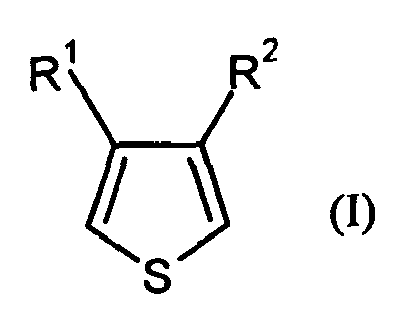 R1 und R2 unabhängig von einander für Wasserstoff, für eine gegebenenfalls substituierte, gegebenenfalls durch 1 bis 5 Sauerstoff- und/oder Schwefelatome unterbrochene C1-C20-Alkylgruppe oder C1-C20-Oxyalkylgruppe oder gemeinsam für eine gegebenenfalls substituierte C1-C20-Dioxyalkylen- oder C1-C20-Dioxyarylengruppe stehen,dadurch gekennzeichnet, dass ein bei Raumtemperatur flüssiges Thiophen der allgemeinen Formel (I), ausgewählt und durch Kühlen aus einer Lösung in einem Lösungsmittel oder Lösungsmittelgemisch oder durch Einbringung in ein gekühltes Lösungsmittel oder Lösungsmittelgemisch oder in eine gekühlte Lösung des gleichen Thiophens bei einer Temperatur unterhalb der Schmelztemperatur des Thiophens als Feststoff ausgefällt und abgetrennt wird, wobei ein bei Raumtemperatur flüssiges Thiophen ein solches mit einem Schmelzpunkt unterhalb von + 40°C ist.
- Verfahren gemäß Anspruch 1, dadurch gekennzeichnet, dass als Thiophen der allgemeinen Formel (I) eine Verbindung der allgemeinen Formel (II)
 A für einen gegebenenfalls substituierten C1-C5-Alkylenrest oder einen C1-C12-Arylenrest steht,R für einen linearen oder verzweigten, gegebenenfalls substituierten C1-C18-Alkylrest, einen gegebenenfalls substituierten C5-C12-Cycloalkylrest, einen gegebenenfalls substituierten C6-C14-Arylrest, einen gegebenenfalls substituierten C7-C18-Aralkylrest, einen gegebenenfalls substituierten C1-C4-Hydroxyalkylrest oder einen Hydroxylrest steht,x für eine ganze Zahl von 0 bis 8 steht undfür den Fall, dass mehrere Reste R an A gebunden sind, diese gleich oder unterschiedlich sein können,
eingesetzt wird. - Verfahren gemäß Anspruch 1 oder 2, dadurch gekennzeichnet, dass als Thiophen der allgemeinen Formel (I) eine Verbindung der allgemeinen Formel (IIa),

eingesetzt wird. - Verfahren gemäß wenigstens einem der Ansprüche 1 bis 3, dadurch gekennzeichnet, dass als Thiophen der allgemeinen Formel (I) eine Verbindung der allgemeinen Formel (IIa) eingesetzt wird, worin R die in Anspruch 2 genannte Bedeutung hat und y für 0 oder 1 steht.
- Verfahren gemäß wenigstens einem der Ansprüche 1 bis 4, dadurch gekennzeichnet, dass als Lösungsmittel ein oder mehrere Alkohole gegebenenfalls im Gemisch mit einem oder mehreren weiteren von Alkoholen verschiedenen Lösungsmittel(n), bevorzugt Ethanol und/oder Methanol eingesetzt werden.
- Verfahren gemäß einem der Ansprüche 1 bis 5, dadurch gekennzeichnet, dass zuerst das Lösungsmittel oder Lösungsmittelgemisch oder die Thiophen-Lösung vorgelegt und auf eine Temperatur abgekühlt wird, bei der sich bei Zugabe des flüssigen Thiophens eine Mischung aus festem Thiophen-Lösung bildet, und anschließend das flüssige Thiophen in das Lösungsmittel oder Lösungsmittelgemisch zugegeben wird.
- Verfahren gemäß wenigstens einem der Ansprüche 1 bis 6, dadurch gekennzeichnet, dass eine Thiophen-Lösung oder ein Lösungsmittelvorlage vor der Zugabe des Thiophens auf eine Temperatur abgekühlt wird, die mindestens 20°C unterhalb des Schmelzpunktes des Thiophens (nach Formel (I) liegt.
- Verfahren gemäß wenigstens einem der Ansprüche 1 bis 7, dadurch gekennzeichnet, dass die Abtrennung des festen Thiophens von der Lösung bei einer Temperatur erfolgt die mindestens 20°C unterhalb des Schmelzpunktes des Thiophens nach Formel (I) liegt.
- Verfahren gemäß einem der Ansprüche 1 bis 8, dadurch gekennzeichnet, dass das im kristallisierten Thiophen ggf. verbliebene restliche Lösungsmittel durch einen weiteren Reinigungsschritt, insbesondere durch Destillation des Thiophens entfernt wird.
Applications Claiming Priority (2)
| Application Number | Priority Date | Filing Date | Title |
|---|---|---|---|
| DE10343873 | 2003-09-23 | ||
| DE10343873A DE10343873A1 (de) | 2003-09-23 | 2003-09-23 | Verfahren zur Reinigung von Thiophenen |
Publications (2)
| Publication Number | Publication Date |
|---|---|
| EP1518859A1 EP1518859A1 (de) | 2005-03-30 |
| EP1518859B1 true EP1518859B1 (de) | 2007-03-07 |
Family
ID=34177890
Family Applications (1)
| Application Number | Title | Priority Date | Filing Date |
|---|---|---|---|
| EP04021686A Expired - Lifetime EP1518859B1 (de) | 2003-09-23 | 2004-09-13 | Verfahren zur Reinigung von Thiophenen |
Country Status (14)
| Country | Link |
|---|---|
| US (2) | US20050065352A1 (de) |
| EP (1) | EP1518859B1 (de) |
| JP (1) | JP4843207B2 (de) |
| KR (1) | KR20050030118A (de) |
| CN (1) | CN1616451B (de) |
| AT (1) | ATE356132T1 (de) |
| CA (1) | CA2482113A1 (de) |
| DE (2) | DE10343873A1 (de) |
| DK (1) | DK1518859T3 (de) |
| ES (1) | ES2283917T3 (de) |
| MX (1) | MXPA04009161A (de) |
| PT (1) | PT1518859E (de) |
| RU (1) | RU2379310C2 (de) |
| TW (1) | TWI330182B (de) |
Families Citing this family (54)
| Publication number | Priority date | Publication date | Assignee | Title |
|---|---|---|---|---|
| CN1681869B (zh) | 2002-09-24 | 2010-05-26 | E.I.内穆尔杜邦公司 | 用于电子器件用聚合物酸胶体制成的可水分散的聚苯胺 |
| US7431866B2 (en) | 2002-09-24 | 2008-10-07 | E. I. Du Pont De Nemours And Company | Water dispersible polythiophenes made with polymeric acid colloids |
| US7390438B2 (en) | 2003-04-22 | 2008-06-24 | E.I. Du Pont De Nemours And Company | Water dispersible substituted polydioxythiophenes made with fluorinated polymeric sulfonic acid colloids |
| US7351358B2 (en) | 2004-03-17 | 2008-04-01 | E.I. Du Pont De Nemours And Company | Water dispersible polypyrroles made with polymeric acid colloids for electronics applications |
| WO2006073968A2 (en) * | 2004-12-30 | 2006-07-13 | E. I. Dupont De Nemours And Company | Derivatized 3,4-alkylenedioxythiophene monomers, methods of making them, and use thereof |
| WO2006074063A2 (en) * | 2004-12-30 | 2006-07-13 | E.I. Dupont De Nemours And Company | Electrically conductive polymers |
| KR101356296B1 (ko) | 2005-06-28 | 2014-02-06 | 이 아이 듀폰 디 네모아 앤드 캄파니 | 높은 일 함수의 투명한 도체 |
| US8049205B2 (en) * | 2006-04-06 | 2011-11-01 | Xerox Corporation | Poly(alkynylthiophene)s and electronic devices generated therefrom |
| DE102006020744A1 (de) * | 2006-05-04 | 2007-11-08 | H. C. Starck Gmbh & Co. Kg | Verfahren zur Stabilisierung von Thiophenderivaten |
| US8153029B2 (en) | 2006-12-28 | 2012-04-10 | E.I. Du Pont De Nemours And Company | Laser (230NM) ablatable compositions of electrically conducting polymers made with a perfluoropolymeric acid applications thereof |
| US20080191172A1 (en) | 2006-12-29 | 2008-08-14 | Che-Hsiung Hsu | High work-function and high conductivity compositions of electrically conducting polymers |
| DE102007052522A1 (de) * | 2007-11-01 | 2009-05-07 | H.C. Starck Gmbh | Verfahren zur Beschichtung von unpolaren Polyaromaten enthaltenden Schichten |
| US8094434B2 (en) | 2008-04-01 | 2012-01-10 | Avx Corporation | Hermetically sealed capacitor assembly |
| JP2009256276A (ja) * | 2008-04-21 | 2009-11-05 | Tayca Corp | 3,4−アルキレンジオキシチオフェンの製造方法 |
| US8194395B2 (en) | 2009-10-08 | 2012-06-05 | Avx Corporation | Hermetically sealed capacitor assembly |
| US8279584B2 (en) | 2010-08-12 | 2012-10-02 | Avx Corporation | Solid electrolytic capacitor assembly |
| US8824122B2 (en) | 2010-11-01 | 2014-09-02 | Avx Corporation | Solid electrolytic capacitor for use in high voltage and high temperature applications |
| US8848342B2 (en) | 2010-11-29 | 2014-09-30 | Avx Corporation | Multi-layered conductive polymer coatings for use in high voltage solid electrolytic capacitors |
| US8576543B2 (en) | 2010-12-14 | 2013-11-05 | Avx Corporation | Solid electrolytic capacitor containing a poly(3,4-ethylenedioxythiophene) quaternary onium salt |
| US8493713B2 (en) | 2010-12-14 | 2013-07-23 | Avx Corporation | Conductive coating for use in electrolytic capacitors |
| JP5745881B2 (ja) * | 2011-02-14 | 2015-07-08 | テイカ株式会社 | 固体電解コンデンサ |
| US8451588B2 (en) | 2011-03-11 | 2013-05-28 | Avx Corporation | Solid electrolytic capacitor containing a conductive coating formed from a colloidal dispersion |
| US8947857B2 (en) | 2011-04-07 | 2015-02-03 | Avx Corporation | Manganese oxide capacitor for use in extreme environments |
| US9767964B2 (en) | 2011-04-07 | 2017-09-19 | Avx Corporation | Multi-anode solid electrolytic capacitor assembly |
| US8379372B2 (en) | 2011-04-07 | 2013-02-19 | Avx Corporation | Housing configuration for a solid electrolytic capacitor |
| US8300387B1 (en) | 2011-04-07 | 2012-10-30 | Avx Corporation | Hermetically sealed electrolytic capacitor with enhanced mechanical stability |
| DE102013101443B4 (de) | 2012-03-01 | 2025-05-28 | KYOCERA AVX Components Corporation (n. d. Ges. d. Staates Delaware) | Verfahren zum Ausbilden eines Ultrahochspannungs-Festelektrolytkondensators |
| US8971019B2 (en) | 2012-03-16 | 2015-03-03 | Avx Corporation | Wet capacitor cathode containing an alkyl-substituted poly(3,4-ethylenedioxythiophene) |
| JP2013219362A (ja) | 2012-04-11 | 2013-10-24 | Avx Corp | 過酷な条件下で強化された機械的安定性を有する固体電解コンデンサ |
| JP5933397B2 (ja) | 2012-08-30 | 2016-06-08 | エイヴィーエックス コーポレイション | 固体電解コンデンサの製造方法および固体電解コンデンサ |
| US9324503B2 (en) | 2013-03-15 | 2016-04-26 | Avx Corporation | Solid electrolytic capacitor |
| US9472350B2 (en) | 2013-05-13 | 2016-10-18 | Avx Corporation | Solid electrolytic capacitor containing a multi-layered adhesion coating |
| GB2517019B (en) | 2013-05-13 | 2018-08-29 | Avx Corp | Solid electrolytic capacitor containing conductive polymer particles |
| GB2514486B (en) | 2013-05-13 | 2018-08-29 | Avx Corp | Solid electrolytic capacitor containing a pre-coat layer |
| FR3005894B1 (fr) * | 2013-05-23 | 2020-12-25 | Centre Nat Rech Scient | Materiau superoleophobe et/ou superhydrophobe, son procede de preparation et ses applications |
| US10297393B2 (en) | 2015-03-13 | 2019-05-21 | Avx Corporation | Ultrahigh voltage capacitor assembly |
| US9928963B2 (en) | 2015-03-13 | 2018-03-27 | Avx Corporation | Thermally conductive encapsulant material for a capacitor assembly |
| US9754730B2 (en) | 2015-03-13 | 2017-09-05 | Avx Corporation | Low profile multi-anode assembly in cylindrical housing |
| US10014108B2 (en) | 2015-03-13 | 2018-07-03 | Avx Corporation | Low profile multi-anode assembly |
| US10431389B2 (en) | 2016-11-14 | 2019-10-01 | Avx Corporation | Solid electrolytic capacitor for high voltage environments |
| KR102659642B1 (ko) | 2018-08-10 | 2024-04-22 | 교세라 에이브이엑스 컴포넌츠 코포레이션 | 고유 전도성 중합체를 포함하는 고체 전해 커패시터 |
| US11114250B2 (en) | 2018-08-10 | 2021-09-07 | Avx Corporation | Solid electrolytic capacitor formed from conductive polymer particles |
| JP7426986B2 (ja) | 2018-08-10 | 2024-02-02 | キョーセラ・エイブイエックス・コンポーネンツ・コーポレーション | ポリアニリンを含む固体電解キャパシタ |
| US11081288B1 (en) | 2018-08-10 | 2021-08-03 | Avx Corporation | Solid electrolytic capacitor having a reduced anomalous charging characteristic |
| US11380492B1 (en) | 2018-12-11 | 2022-07-05 | KYOCERA AVX Components Corporation | Solid electrolytic capacitor |
| DE112019006146T5 (de) | 2018-12-11 | 2021-08-26 | Avx Corporation | Festelektrolytkondensator, der ein intrinsisch leitfähiges Polymer enthält |
| DE112020002426T5 (de) | 2019-05-17 | 2022-01-27 | Avx Corporation | Festelektrolytkondensator |
| US11670461B2 (en) | 2019-09-18 | 2023-06-06 | KYOCERA AVX Components Corporation | Solid electrolytic capacitor for use at high voltages |
| CN114787952B (zh) | 2019-12-10 | 2025-02-11 | 京瓷Avx元器件公司 | 包含预涂层和本征导电聚合物的固体电解电容器 |
| US11756742B1 (en) | 2019-12-10 | 2023-09-12 | KYOCERA AVX Components Corporation | Tantalum capacitor with improved leakage current stability at high temperatures |
| US11776759B2 (en) | 2019-12-10 | 2023-10-03 | KYOCER AVX Components Corporation | Tantalum capacitor with increased stability |
| US11763998B1 (en) | 2020-06-03 | 2023-09-19 | KYOCERA AVX Components Corporation | Solid electrolytic capacitor |
| US11631548B2 (en) | 2020-06-08 | 2023-04-18 | KYOCERA AVX Components Corporation | Solid electrolytic capacitor containing a moisture barrier |
| CN116003431B (zh) * | 2022-12-23 | 2025-10-03 | 广东华鸿科技有限公司 | 一种高纯度3,4-乙烯二氧噻吩的提纯方法及其应用 |
Family Cites Families (13)
| Publication number | Priority date | Publication date | Assignee | Title |
|---|---|---|---|---|
| JPH06104635B2 (ja) * | 1986-03-31 | 1994-12-21 | 住金化工株式会社 | メチルナフタレンの精製方法 |
| DE3843412A1 (de) * | 1988-04-22 | 1990-06-28 | Bayer Ag | Neue polythiophene, verfahren zu ihrer herstellung und ihre verwendung |
| US5914852A (en) * | 1996-04-26 | 1999-06-22 | Nippon Chemi-Con Corporation | Solid electrolyte capacitor and its manufacture |
| FR2774984B1 (fr) * | 1998-02-18 | 2000-03-24 | Atochem Elf Sa | Purification du thiophene |
| DE19822075C2 (de) * | 1998-05-16 | 2002-03-21 | Enthone Gmbh | Verfahren zur metallischen Beschichtung von Substraten |
| NO314525B1 (no) * | 1999-04-22 | 2003-03-31 | Thin Film Electronics Asa | Fremgangsmåte ved fremstillingen av organiske halvledende innretninger i tynnfilm |
| DE10016723A1 (de) * | 2000-04-04 | 2001-10-11 | Bayer Ag | Verfahren zur Herstellung von Dialkoxythiophenen und Alkylendioxythiophenen |
| EP1390422B1 (de) * | 2001-03-29 | 2004-11-03 | Agfa-Gevaert | Thiophene und davon abgeleitete polymere |
| US7094865B2 (en) * | 2001-03-29 | 2006-08-22 | Agfa Gevaert | Thiophenes and polymers derived therefrom |
| DE10133927A1 (de) * | 2001-07-12 | 2003-01-23 | Bayer Ag | Benzodioxinothiophene, deren Herstellung und Verwendung |
| EP1323763A1 (de) * | 2001-12-20 | 2003-07-02 | Agfa-Gevaert | 3,4-Alkylendioxythiophencopolymere |
| EP1321483A1 (de) * | 2001-12-20 | 2003-06-25 | Agfa-Gevaert | 3,4-Alkylendioxythiophen-Verbindungen und ihre Polymere |
| KR100525977B1 (ko) * | 2002-11-19 | 2005-11-03 | 나노캠텍주식회사 | 3,4-알킬렌디옥시티오펜 및 3,4-디알콕시티오펜의 제조방법 |
-
2003
- 2003-09-23 DE DE10343873A patent/DE10343873A1/de not_active Withdrawn
-
2004
- 2004-09-13 DK DK04021686T patent/DK1518859T3/da active
- 2004-09-13 ES ES04021686T patent/ES2283917T3/es not_active Expired - Lifetime
- 2004-09-13 PT PT04021686T patent/PT1518859E/pt unknown
- 2004-09-13 DE DE502004003113T patent/DE502004003113D1/de not_active Expired - Lifetime
- 2004-09-13 EP EP04021686A patent/EP1518859B1/de not_active Expired - Lifetime
- 2004-09-13 AT AT04021686T patent/ATE356132T1/de active
- 2004-09-16 US US10/942,409 patent/US20050065352A1/en not_active Abandoned
- 2004-09-20 CA CA002482113A patent/CA2482113A1/en not_active Abandoned
- 2004-09-21 MX MXPA04009161A patent/MXPA04009161A/es active IP Right Grant
- 2004-09-22 RU RU2004127972/04A patent/RU2379310C2/ru not_active IP Right Cessation
- 2004-09-22 KR KR1020040075769A patent/KR20050030118A/ko not_active Abandoned
- 2004-09-22 TW TW093128646A patent/TWI330182B/zh not_active IP Right Cessation
- 2004-09-23 CN CN2004100798446A patent/CN1616451B/zh not_active Expired - Fee Related
- 2004-09-24 JP JP2004277053A patent/JP4843207B2/ja not_active Expired - Fee Related
-
2009
- 2009-07-07 US US12/498,739 patent/US7994345B2/en not_active Expired - Fee Related
Also Published As
| Publication number | Publication date |
|---|---|
| TWI330182B (en) | 2010-09-11 |
| EP1518859A1 (de) | 2005-03-30 |
| MXPA04009161A (es) | 2005-04-05 |
| RU2379310C2 (ru) | 2010-01-20 |
| US20050065352A1 (en) | 2005-03-24 |
| DE10343873A1 (de) | 2005-04-21 |
| CN1616451B (zh) | 2011-06-15 |
| CA2482113A1 (en) | 2005-03-23 |
| DK1518859T3 (da) | 2007-05-07 |
| PT1518859E (pt) | 2007-05-31 |
| RU2004127972A (ru) | 2006-03-10 |
| CN1616451A (zh) | 2005-05-18 |
| ES2283917T3 (es) | 2007-11-01 |
| JP4843207B2 (ja) | 2011-12-21 |
| JP2005097305A (ja) | 2005-04-14 |
| US20090318710A1 (en) | 2009-12-24 |
| DE502004003113D1 (de) | 2007-04-19 |
| ATE356132T1 (de) | 2007-03-15 |
| TW200526617A (en) | 2005-08-16 |
| US7994345B2 (en) | 2011-08-09 |
| KR20050030118A (ko) | 2005-03-29 |
Similar Documents
| Publication | Publication Date | Title |
|---|---|---|
| EP1518859A1 (de) | Verfahren zur Reinigung von Thiophenen | |
| EP0220490B1 (de) | Verfahren zur Isolierung von Polyarylensulfiden | |
| EP0885251B1 (de) | Substituierte polythiophene, verfahren zu deren herstellung, und deren verwendung | |
| EP1440974A2 (de) | Alkylendioxythiophene und Poly(alkylendioxythiophene) mit mesogenen Gruppen | |
| DE10058116A1 (de) | Polythiophene | |
| DE102011089351B4 (de) | Halbleiterzusammensetzung | |
| DE19513479A1 (de) | Verfahren zur Herstellung von Polyarylensulfid | |
| DE3527492A1 (de) | Verfahren zur herstellung eines polyarylensulfidpolymeren | |
| DE102010031897A1 (de) | Halbleiter auf Basis substituierter [1] Benzothieno[3,2-b][1]-benzothiophene | |
| DE69321749T2 (de) | Verfahren zur Herstellung von Ceftriaxon | |
| DE19962661B4 (de) | Verfahren zur Herstellung von Hexahydro-2-oxo-1H-thieno[3,4-d]-imidazol-4-pentansäure | |
| EP1644381B1 (de) | Prozess zur herstellung eines kristallinen polymorphs eines die plättchen aggregation hemmenden arzneistoffs | |
| DE2503536B2 (de) | Verfahren zur Gewinnung eines sauren Ammoniumsalzes der 11-Cyanundecansäure | |
| DE69306694T2 (de) | Kristalle von Hydroxyphenylpropionsäure-ester und ihre Herstellung | |
| DE2841245C2 (de) | Nematische kristallin-flüssige Substanzen | |
| EP1352918A1 (de) | Alkylendioxythiophene und Poly(alkylendioxythiophen)e mit Urethangruppierungen enthaltenden Seitengruppen | |
| EP4296264A1 (de) | 1,6-naphthalendithiol und verfahren zu dessen herstellung | |
| HK1078081A (en) | Process for the purification of thiophenes | |
| EP0077830B1 (de) | Verfahren zur herstellung von gereinigtem bis(3,5-dialkyl-4-hydroxyphenyl)sulfone | |
| EP3623412A1 (de) | Selenhaltige polycarbonate | |
| WO2015067338A1 (de) | Fluorsubstituierte n-heterotetracene, deren herstellung und verwendung | |
| EP0897916A2 (de) | Neue 2-(2'-Hydroxyphenyl)benzotriazole und 2-Hydroxybenzophenone als Lichtschutzmittel für polymeres Material | |
| CN100383109C (zh) | 溶析结晶提纯碳酸二苯酯的工艺方法 | |
| DE4023773A1 (de) | Verfahren zur optischen auftrennung von zur herstellung von diltiazem geeigneten zwischenprodukten | |
| CN117486950A (zh) | 一种四氯蔗糖的获得方法 |
Legal Events
| Date | Code | Title | Description |
|---|---|---|---|
| PUAI | Public reference made under article 153(3) epc to a published international application that has entered the european phase |
Free format text: ORIGINAL CODE: 0009012 |
|
| AK | Designated contracting states |
Kind code of ref document: A1 Designated state(s): AT BE BG CH CY CZ DE DK EE ES FI FR GB GR HU IE IT LI LU MC NL PL PT RO SE SI SK TR |
|
| AX | Request for extension of the european patent |
Extension state: AL HR LT LV MK |
|
| 17P | Request for examination filed |
Effective date: 20050930 |
|
| AKX | Designation fees paid |
Designated state(s): AT BE BG CH CY CZ DE DK EE ES FI FR GB GR HU IE IT LI LU MC NL PL PT RO SE SI SK TR |
|
| GRAP | Despatch of communication of intention to grant a patent |
Free format text: ORIGINAL CODE: EPIDOSNIGR1 |
|
| RIC1 | Information provided on ipc code assigned before grant |
Ipc: C08G 61/12 20060101ALI20060830BHEP Ipc: C07D 333/32 20060101ALI20060830BHEP Ipc: C07D 495/04 20060101AFI20060830BHEP |
|
| RAP1 | Party data changed (applicant data changed or rights of an application transferred) |
Owner name: H.C. STARCK GMBH & CO. KG |
|
| GRAS | Grant fee paid |
Free format text: ORIGINAL CODE: EPIDOSNIGR3 |
|
| GRAA | (expected) grant |
Free format text: ORIGINAL CODE: 0009210 |
|
| AK | Designated contracting states |
Kind code of ref document: B1 Designated state(s): AT BE BG CH CY CZ DE DK EE ES FI FR GB GR HU IE IT LI LU MC NL PL PT RO SE SI SK TR |
|
| PG25 | Lapsed in a contracting state [announced via postgrant information from national office to epo] |
Ref country code: SI Free format text: LAPSE BECAUSE OF FAILURE TO SUBMIT A TRANSLATION OF THE DESCRIPTION OR TO PAY THE FEE WITHIN THE PRESCRIBED TIME-LIMIT Effective date: 20070307 Ref country code: PL Free format text: LAPSE BECAUSE OF FAILURE TO SUBMIT A TRANSLATION OF THE DESCRIPTION OR TO PAY THE FEE WITHIN THE PRESCRIBED TIME-LIMIT Effective date: 20070307 |
|
| REG | Reference to a national code |
Ref country code: GB Ref legal event code: FG4D Free format text: NOT ENGLISH |
|
| REG | Reference to a national code |
Ref country code: CH Ref legal event code: EP |
|
| REF | Corresponds to: |
Ref document number: 502004003113 Country of ref document: DE Date of ref document: 20070419 Kind code of ref document: P |
|
| REG | Reference to a national code |
Ref country code: CH Ref legal event code: NV Representative=s name: E. BLUM & CO. AG PATENT- UND MARKENANWAELTE VSP |
|
| GBT | Gb: translation of ep patent filed (gb section 77(6)(a)/1977) |
Effective date: 20070405 |
|
| REG | Reference to a national code |
Ref country code: IE Ref legal event code: FG4D Free format text: LANGUAGE OF EP DOCUMENT: GERMAN |
|
| REG | Reference to a national code |
Ref country code: DK Ref legal event code: T3 |
|
| REG | Reference to a national code |
Ref country code: PT Ref legal event code: SC4A Free format text: AVAILABILITY OF NATIONAL TRANSLATION Effective date: 20070503 |
|
| REG | Reference to a national code |
Ref country code: SE Ref legal event code: TRGR |
|
| REG | Reference to a national code |
Ref country code: CH Ref legal event code: PFA Owner name: H.C. STARCK GMBH Free format text: H.C. STARCK GMBH & CO. KG#IM SCHLEEKE 78-91#38642 GOSLAR (DE) -TRANSFER TO- H.C. STARCK GMBH#IM SCHLEEKE 78-91#38642 GOSLAR (DE) |
|
| REG | Reference to a national code |
Ref country code: ES Ref legal event code: FG2A Ref document number: 2283917 Country of ref document: ES Kind code of ref document: T3 |
|
| PG25 | Lapsed in a contracting state [announced via postgrant information from national office to epo] |
Ref country code: SK Free format text: LAPSE BECAUSE OF FAILURE TO SUBMIT A TRANSLATION OF THE DESCRIPTION OR TO PAY THE FEE WITHIN THE PRESCRIBED TIME-LIMIT Effective date: 20070307 |
|
| PG25 | Lapsed in a contracting state [announced via postgrant information from national office to epo] |
Ref country code: RO Free format text: LAPSE BECAUSE OF FAILURE TO SUBMIT A TRANSLATION OF THE DESCRIPTION OR TO PAY THE FEE WITHIN THE PRESCRIBED TIME-LIMIT Effective date: 20070307 |
|
| PLBE | No opposition filed within time limit |
Free format text: ORIGINAL CODE: 0009261 |
|
| STAA | Information on the status of an ep patent application or granted ep patent |
Free format text: STATUS: NO OPPOSITION FILED WITHIN TIME LIMIT |
|
| 26N | No opposition filed |
Effective date: 20071210 |
|
| PG25 | Lapsed in a contracting state [announced via postgrant information from national office to epo] |
Ref country code: GR Free format text: LAPSE BECAUSE OF FAILURE TO SUBMIT A TRANSLATION OF THE DESCRIPTION OR TO PAY THE FEE WITHIN THE PRESCRIBED TIME-LIMIT Effective date: 20070608 Ref country code: MC Free format text: LAPSE BECAUSE OF NON-PAYMENT OF DUE FEES Effective date: 20070930 |
|
| REG | Reference to a national code |
Ref country code: GB Ref legal event code: 732E |
|
| PG25 | Lapsed in a contracting state [announced via postgrant information from national office to epo] |
Ref country code: EE Free format text: LAPSE BECAUSE OF FAILURE TO SUBMIT A TRANSLATION OF THE DESCRIPTION OR TO PAY THE FEE WITHIN THE PRESCRIBED TIME-LIMIT Effective date: 20070307 |
|
| REG | Reference to a national code |
Ref country code: GB Ref legal event code: 732E Free format text: REGISTERED BETWEEN 20090618 AND 20090624 |
|
| PG25 | Lapsed in a contracting state [announced via postgrant information from national office to epo] |
Ref country code: CY Free format text: LAPSE BECAUSE OF FAILURE TO SUBMIT A TRANSLATION OF THE DESCRIPTION OR TO PAY THE FEE WITHIN THE PRESCRIBED TIME-LIMIT Effective date: 20070307 |
|
| PG25 | Lapsed in a contracting state [announced via postgrant information from national office to epo] |
Ref country code: LU Free format text: LAPSE BECAUSE OF NON-PAYMENT OF DUE FEES Effective date: 20070913 Ref country code: BG Free format text: LAPSE BECAUSE OF FAILURE TO SUBMIT A TRANSLATION OF THE DESCRIPTION OR TO PAY THE FEE WITHIN THE PRESCRIBED TIME-LIMIT Effective date: 20070607 |
|
| PG25 | Lapsed in a contracting state [announced via postgrant information from national office to epo] |
Ref country code: HU Free format text: LAPSE BECAUSE OF FAILURE TO SUBMIT A TRANSLATION OF THE DESCRIPTION OR TO PAY THE FEE WITHIN THE PRESCRIBED TIME-LIMIT Effective date: 20070908 Ref country code: TR Free format text: LAPSE BECAUSE OF FAILURE TO SUBMIT A TRANSLATION OF THE DESCRIPTION OR TO PAY THE FEE WITHIN THE PRESCRIBED TIME-LIMIT Effective date: 20070307 |
|
| PGFP | Annual fee paid to national office [announced via postgrant information from national office to epo] |
Ref country code: CH Payment date: 20100914 Year of fee payment: 7 Ref country code: IE Payment date: 20100910 Year of fee payment: 7 |
|
| PGFP | Annual fee paid to national office [announced via postgrant information from national office to epo] |
Ref country code: AT Payment date: 20100910 Year of fee payment: 7 Ref country code: CZ Payment date: 20100813 Year of fee payment: 7 Ref country code: FI Payment date: 20100910 Year of fee payment: 7 Ref country code: FR Payment date: 20100921 Year of fee payment: 7 Ref country code: IT Payment date: 20100915 Year of fee payment: 7 Ref country code: SE Payment date: 20100913 Year of fee payment: 7 |
|
| PGFP | Annual fee paid to national office [announced via postgrant information from national office to epo] |
Ref country code: GB Payment date: 20100908 Year of fee payment: 7 |
|
| PGFP | Annual fee paid to national office [announced via postgrant information from national office to epo] |
Ref country code: DK Payment date: 20100910 Year of fee payment: 7 Ref country code: NL Payment date: 20100910 Year of fee payment: 7 Ref country code: PT Payment date: 20100907 Year of fee payment: 7 |
|
| REG | Reference to a national code |
Ref country code: PT Ref legal event code: PC4A Owner name: HERAEUS CLEVIOS GMBH, DE Effective date: 20110221 |
|
| REG | Reference to a national code |
Ref country code: CH Ref legal event code: PUE Owner name: HERAEUS CLEVIOS GMBH Free format text: H.C. STARCK CLEVIOS GMBH#IM SCHLEEKE 78-91#38642 GOSLAR (DE) -TRANSFER TO- HERAEUS CLEVIOS GMBH# #63450 HANAU (DE) Ref country code: CH Ref legal event code: PFA Owner name: H.C. STARCK CLEVIOS GMBH Free format text: H.C. STARCK ZWEITE CLEVIOS GMBH#IM SCHLEEKE 78-91#38642 GOSLAR (DE) -TRANSFER TO- H.C. STARCK CLEVIOS GMBH#IM SCHLEEKE 78-91#38642 GOSLAR (DE) Ref country code: CH Ref legal event code: PUE Owner name: H.C. STARCK ZWEITE CLEVIOS GMBH Free format text: H.C. STARCK GMBH#IM SCHLEEKE 78-91#38642 GOSLAR (DE) -TRANSFER TO- H.C. STARCK ZWEITE CLEVIOS GMBH#IM SCHLEEKE 78-91#38642 GOSLAR (DE) |
|
| REG | Reference to a national code |
Ref country code: NL Ref legal event code: TD Effective date: 20110510 Ref country code: NL Ref legal event code: SD Owner name: HERAEUS CLEVIOS GMBH Effective date: 20110510 |
|
| PGFP | Annual fee paid to national office [announced via postgrant information from national office to epo] |
Ref country code: ES Payment date: 20101018 Year of fee payment: 7 |
|
| BECH | Be: change of holder |
Owner name: HERAEUS CLEVIOS G.M.B.H. Effective date: 20110824 |
|
| BECN | Be: change of holder's name |
Owner name: HERAEUS CLEVIOS G.M.B.H. Effective date: 20110824 |
|
| REG | Reference to a national code |
Ref country code: FR Ref legal event code: CD Owner name: HERAUS CLEVIOS GMBH, DE Effective date: 20110824 Ref country code: FR Ref legal event code: TP Owner name: HERAUS CLEVIOS GMBH, DE Effective date: 20110824 |
|
| REG | Reference to a national code |
Ref country code: GB Ref legal event code: 732E Free format text: REGISTERED BETWEEN 20111215 AND 20111221 |
|
| REG | Reference to a national code |
Ref country code: ES Ref legal event code: PC2A Owner name: HERAEUS CLEVIOS GMBH Effective date: 20120223 |
|
| REG | Reference to a national code |
Ref country code: DE Ref legal event code: R081 Ref document number: 502004003113 Country of ref document: DE Owner name: HERAEUS CLEVIOS GMBH, DE Free format text: FORMER OWNER: H.C. STARCK GMBH, 38642 GOSLAR, DE Effective date: 20120125 |
|
| REG | Reference to a national code |
Ref country code: PT Ref legal event code: MM4A Free format text: LAPSE DUE TO NON-PAYMENT OF FEES Effective date: 20120313 |
|
| REG | Reference to a national code |
Ref country code: NL Ref legal event code: V1 Effective date: 20120401 |
|
| PG25 | Lapsed in a contracting state [announced via postgrant information from national office to epo] |
Ref country code: CZ Free format text: LAPSE BECAUSE OF NON-PAYMENT OF DUE FEES Effective date: 20110913 |
|
| REG | Reference to a national code |
Ref country code: DK Ref legal event code: EBP Ref country code: CH Ref legal event code: PL |
|
| GBPC | Gb: european patent ceased through non-payment of renewal fee |
Effective date: 20110913 |
|
| PG25 | Lapsed in a contracting state [announced via postgrant information from national office to epo] |
Ref country code: IT Free format text: LAPSE BECAUSE OF NON-PAYMENT OF DUE FEES Effective date: 20110913 Ref country code: PT Free format text: LAPSE BECAUSE OF NON-PAYMENT OF DUE FEES Effective date: 20120313 Ref country code: FI Free format text: LAPSE BECAUSE OF NON-PAYMENT OF DUE FEES Effective date: 20110913 |
|
| REG | Reference to a national code |
Ref country code: IE Ref legal event code: MM4A |
|
| REG | Reference to a national code |
Ref country code: FR Ref legal event code: ST Effective date: 20120531 |
|
| REG | Reference to a national code |
Ref country code: SE Ref legal event code: EUG |
|
| PG25 | Lapsed in a contracting state [announced via postgrant information from national office to epo] |
Ref country code: IE Free format text: LAPSE BECAUSE OF NON-PAYMENT OF DUE FEES Effective date: 20110913 Ref country code: LI Free format text: LAPSE BECAUSE OF NON-PAYMENT OF DUE FEES Effective date: 20110930 Ref country code: NL Free format text: LAPSE BECAUSE OF NON-PAYMENT OF DUE FEES Effective date: 20120401 Ref country code: CH Free format text: LAPSE BECAUSE OF NON-PAYMENT OF DUE FEES Effective date: 20110930 |
|
| PG25 | Lapsed in a contracting state [announced via postgrant information from national office to epo] |
Ref country code: FR Free format text: LAPSE BECAUSE OF NON-PAYMENT OF DUE FEES Effective date: 20110930 Ref country code: GB Free format text: LAPSE BECAUSE OF NON-PAYMENT OF DUE FEES Effective date: 20110913 |
|
| PG25 | Lapsed in a contracting state [announced via postgrant information from national office to epo] |
Ref country code: DK Free format text: LAPSE BECAUSE OF NON-PAYMENT OF DUE FEES Effective date: 20110930 |
|
| REG | Reference to a national code |
Ref country code: AT Ref legal event code: MM01 Ref document number: 356132 Country of ref document: AT Kind code of ref document: T Effective date: 20110913 |
|
| PGFP | Annual fee paid to national office [announced via postgrant information from national office to epo] |
Ref country code: DE Payment date: 20120921 Year of fee payment: 9 |
|
| PG25 | Lapsed in a contracting state [announced via postgrant information from national office to epo] |
Ref country code: AT Free format text: LAPSE BECAUSE OF NON-PAYMENT OF DUE FEES Effective date: 20110913 |
|
| PGFP | Annual fee paid to national office [announced via postgrant information from national office to epo] |
Ref country code: BE Payment date: 20120920 Year of fee payment: 9 |
|
| PG25 | Lapsed in a contracting state [announced via postgrant information from national office to epo] |
Ref country code: SE Free format text: LAPSE BECAUSE OF NON-PAYMENT OF DUE FEES Effective date: 20110914 |
|
| REG | Reference to a national code |
Ref country code: ES Ref legal event code: FD2A Effective date: 20130531 |
|
| PG25 | Lapsed in a contracting state [announced via postgrant information from national office to epo] |
Ref country code: ES Free format text: LAPSE BECAUSE OF NON-PAYMENT OF DUE FEES Effective date: 20110914 |
|
| REG | Reference to a national code |
Ref country code: DE Ref legal event code: R082 Ref document number: 502004003113 Country of ref document: DE Representative=s name: DENNEMEYER & ASSOCIATES S.A., LU Effective date: 20130814 Ref country code: DE Ref legal event code: R081 Ref document number: 502004003113 Country of ref document: DE Owner name: HERAEUS CLEVIOS GMBH, DE Free format text: FORMER OWNER: H.C. STARCK CLEVIOS GMBH, 38642 GOSLAR, DE Effective date: 20130814 |
|
| BERE | Be: lapsed |
Owner name: HERAEUS CLEVIOS G.M.B.H. Effective date: 20130930 |
|
| REG | Reference to a national code |
Ref country code: DE Ref legal event code: R119 Ref document number: 502004003113 Country of ref document: DE Effective date: 20140401 |
|
| PG25 | Lapsed in a contracting state [announced via postgrant information from national office to epo] |
Ref country code: BE Free format text: LAPSE BECAUSE OF NON-PAYMENT OF DUE FEES Effective date: 20130930 |
|
| PG25 | Lapsed in a contracting state [announced via postgrant information from national office to epo] |
Ref country code: DE Free format text: LAPSE BECAUSE OF NON-PAYMENT OF DUE FEES Effective date: 20140401 |