EP1516668B1 - Hochaktiver fotokatalysator und verfahren zur herstellung desselben - Google Patents
Hochaktiver fotokatalysator und verfahren zur herstellung desselben Download PDFInfo
- Publication number
- EP1516668B1 EP1516668B1 EP03733300.2A EP03733300A EP1516668B1 EP 1516668 B1 EP1516668 B1 EP 1516668B1 EP 03733300 A EP03733300 A EP 03733300A EP 1516668 B1 EP1516668 B1 EP 1516668B1
- Authority
- EP
- European Patent Office
- Prior art keywords
- photocatalyst
- cadmium
- solution
- particles
- sulfide
- Prior art date
- Legal status (The legal status is an assumption and is not a legal conclusion. Google has not performed a legal analysis and makes no representation as to the accuracy of the status listed.)
- Expired - Lifetime
Links
Images


Classifications
-
- B—PERFORMING OPERATIONS; TRANSPORTING
- B01—PHYSICAL OR CHEMICAL PROCESSES OR APPARATUS IN GENERAL
- B01J—CHEMICAL OR PHYSICAL PROCESSES, e.g. CATALYSIS OR COLLOID CHEMISTRY; THEIR RELEVANT APPARATUS
- B01J27/00—Catalysts comprising the elements or compounds of halogens, sulfur, selenium, tellurium, phosphorus or nitrogen; Catalysts comprising carbon compounds
- B01J27/02—Sulfur, selenium or tellurium; Compounds thereof
- B01J27/04—Sulfides
-
- B—PERFORMING OPERATIONS; TRANSPORTING
- B01—PHYSICAL OR CHEMICAL PROCESSES OR APPARATUS IN GENERAL
- B01J—CHEMICAL OR PHYSICAL PROCESSES, e.g. CATALYSIS OR COLLOID CHEMISTRY; THEIR RELEVANT APPARATUS
- B01J35/00—Catalysts, in general, characterised by their form or physical properties
- B01J35/30—Catalysts, in general, characterised by their form or physical properties characterised by their physical properties
- B01J35/39—Photocatalytic properties
-
- B—PERFORMING OPERATIONS; TRANSPORTING
- B01—PHYSICAL OR CHEMICAL PROCESSES OR APPARATUS IN GENERAL
- B01J—CHEMICAL OR PHYSICAL PROCESSES, e.g. CATALYSIS OR COLLOID CHEMISTRY; THEIR RELEVANT APPARATUS
- B01J23/00—Catalysts comprising metals or metal oxides or hydroxides, not provided for in group B01J21/00
- B01J23/06—Catalysts comprising metals or metal oxides or hydroxides, not provided for in group B01J21/00 of zinc, cadmium or mercury
-
- B—PERFORMING OPERATIONS; TRANSPORTING
- B01—PHYSICAL OR CHEMICAL PROCESSES OR APPARATUS IN GENERAL
- B01J—CHEMICAL OR PHYSICAL PROCESSES, e.g. CATALYSIS OR COLLOID CHEMISTRY; THEIR RELEVANT APPARATUS
- B01J23/00—Catalysts comprising metals or metal oxides or hydroxides, not provided for in group B01J21/00
- B01J23/38—Catalysts comprising metals or metal oxides or hydroxides, not provided for in group B01J21/00 of noble metals
- B01J23/40—Catalysts comprising metals or metal oxides or hydroxides, not provided for in group B01J21/00 of noble metals of the platinum group metals
- B01J23/42—Platinum
-
- B—PERFORMING OPERATIONS; TRANSPORTING
- B01—PHYSICAL OR CHEMICAL PROCESSES OR APPARATUS IN GENERAL
- B01J—CHEMICAL OR PHYSICAL PROCESSES, e.g. CATALYSIS OR COLLOID CHEMISTRY; THEIR RELEVANT APPARATUS
- B01J23/00—Catalysts comprising metals or metal oxides or hydroxides, not provided for in group B01J21/00
- B01J23/38—Catalysts comprising metals or metal oxides or hydroxides, not provided for in group B01J21/00 of noble metals
- B01J23/54—Catalysts comprising metals or metal oxides or hydroxides, not provided for in group B01J21/00 of noble metals combined with metals, oxides or hydroxides provided for in groups B01J23/02 - B01J23/36
- B01J23/56—Platinum group metals
- B01J23/60—Platinum group metals with zinc, cadmium or mercury
-
- B—PERFORMING OPERATIONS; TRANSPORTING
- B01—PHYSICAL OR CHEMICAL PROCESSES OR APPARATUS IN GENERAL
- B01J—CHEMICAL OR PHYSICAL PROCESSES, e.g. CATALYSIS OR COLLOID CHEMISTRY; THEIR RELEVANT APPARATUS
- B01J27/00—Catalysts comprising the elements or compounds of halogens, sulfur, selenium, tellurium, phosphorus or nitrogen; Catalysts comprising carbon compounds
- B01J27/02—Sulfur, selenium or tellurium; Compounds thereof
- B01J27/04—Sulfides
- B01J27/043—Sulfides with iron group metals or platinum group metals
- B01J27/045—Platinum group metals
-
- B—PERFORMING OPERATIONS; TRANSPORTING
- B01—PHYSICAL OR CHEMICAL PROCESSES OR APPARATUS IN GENERAL
- B01J—CHEMICAL OR PHYSICAL PROCESSES, e.g. CATALYSIS OR COLLOID CHEMISTRY; THEIR RELEVANT APPARATUS
- B01J35/00—Catalysts, in general, characterised by their form or physical properties
- B01J35/40—Catalysts, in general, characterised by their form or physical properties characterised by dimensions, e.g. grain size
- B01J35/45—Nanoparticles
-
- B—PERFORMING OPERATIONS; TRANSPORTING
- B01—PHYSICAL OR CHEMICAL PROCESSES OR APPARATUS IN GENERAL
- B01J—CHEMICAL OR PHYSICAL PROCESSES, e.g. CATALYSIS OR COLLOID CHEMISTRY; THEIR RELEVANT APPARATUS
- B01J35/00—Catalysts, in general, characterised by their form or physical properties
- B01J35/60—Catalysts, in general, characterised by their form or physical properties characterised by their surface properties or porosity
-
- B—PERFORMING OPERATIONS; TRANSPORTING
- B01—PHYSICAL OR CHEMICAL PROCESSES OR APPARATUS IN GENERAL
- B01J—CHEMICAL OR PHYSICAL PROCESSES, e.g. CATALYSIS OR COLLOID CHEMISTRY; THEIR RELEVANT APPARATUS
- B01J37/00—Processes, in general, for preparing catalysts; Processes, in general, for activation of catalysts
- B01J37/04—Mixing
-
- B—PERFORMING OPERATIONS; TRANSPORTING
- B01—PHYSICAL OR CHEMICAL PROCESSES OR APPARATUS IN GENERAL
- B01J—CHEMICAL OR PHYSICAL PROCESSES, e.g. CATALYSIS OR COLLOID CHEMISTRY; THEIR RELEVANT APPARATUS
- B01J37/00—Processes, in general, for preparing catalysts; Processes, in general, for activation of catalysts
- B01J37/34—Irradiation by, or application of, electric, magnetic or wave energy, e.g. ultrasonic waves ; Ionic sputtering; Flame or plasma spraying; Particle radiation
- B01J37/341—Irradiation by, or application of, electric, magnetic or wave energy, e.g. ultrasonic waves ; Ionic sputtering; Flame or plasma spraying; Particle radiation making use of electric or magnetic fields, wave energy or particle radiation
-
- C—CHEMISTRY; METALLURGY
- C01—INORGANIC CHEMISTRY
- C01B—NON-METALLIC ELEMENTS; COMPOUNDS THEREOF; METALLOIDS OR COMPOUNDS THEREOF NOT COVERED BY SUBCLASS C01C
- C01B3/00—Hydrogen; Gaseous mixtures containing hydrogen; Separation of hydrogen from mixtures containing it; Purification of hydrogen; Reversible storage of hydrogen
- C01B3/02—Production of hydrogen; Production of gaseous mixtures containing hydrogen
- C01B3/04—Production of hydrogen; Production of gaseous mixtures containing hydrogen by decomposition of inorganic compounds
- C01B3/042—Decomposition of water
-
- B—PERFORMING OPERATIONS; TRANSPORTING
- B01—PHYSICAL OR CHEMICAL PROCESSES OR APPARATUS IN GENERAL
- B01J—CHEMICAL OR PHYSICAL PROCESSES, e.g. CATALYSIS OR COLLOID CHEMISTRY; THEIR RELEVANT APPARATUS
- B01J2235/00—Indexing scheme associated with group B01J35/00, related to the analysis techniques used to determine the catalysts form or properties
- B01J2235/30—Scanning electron microscopy; Transmission electron microscopy
-
- B—PERFORMING OPERATIONS; TRANSPORTING
- B01—PHYSICAL OR CHEMICAL PROCESSES OR APPARATUS IN GENERAL
- B01J—CHEMICAL OR PHYSICAL PROCESSES, e.g. CATALYSIS OR COLLOID CHEMISTRY; THEIR RELEVANT APPARATUS
- B01J37/00—Processes, in general, for preparing catalysts; Processes, in general, for activation of catalysts
- B01J37/20—Sulfiding
-
- Y—GENERAL TAGGING OF NEW TECHNOLOGICAL DEVELOPMENTS; GENERAL TAGGING OF CROSS-SECTIONAL TECHNOLOGIES SPANNING OVER SEVERAL SECTIONS OF THE IPC; TECHNICAL SUBJECTS COVERED BY FORMER USPC CROSS-REFERENCE ART COLLECTIONS [XRACs] AND DIGESTS
- Y02—TECHNOLOGIES OR APPLICATIONS FOR MITIGATION OR ADAPTATION AGAINST CLIMATE CHANGE
- Y02E—REDUCTION OF GREENHOUSE GAS [GHG] EMISSIONS, RELATED TO ENERGY GENERATION, TRANSMISSION OR DISTRIBUTION
- Y02E60/00—Enabling technologies; Technologies with a potential or indirect contribution to GHG emissions mitigation
- Y02E60/30—Hydrogen technology
- Y02E60/36—Hydrogen production from non-carbon containing sources, e.g. by water electrolysis
-
- Y—GENERAL TAGGING OF NEW TECHNOLOGICAL DEVELOPMENTS; GENERAL TAGGING OF CROSS-SECTIONAL TECHNOLOGIES SPANNING OVER SEVERAL SECTIONS OF THE IPC; TECHNICAL SUBJECTS COVERED BY FORMER USPC CROSS-REFERENCE ART COLLECTIONS [XRACs] AND DIGESTS
- Y02—TECHNOLOGIES OR APPLICATIONS FOR MITIGATION OR ADAPTATION AGAINST CLIMATE CHANGE
- Y02P—CLIMATE CHANGE MITIGATION TECHNOLOGIES IN THE PRODUCTION OR PROCESSING OF GOODS
- Y02P20/00—Technologies relating to chemical industry
- Y02P20/10—Process efficiency
- Y02P20/133—Renewable energy sources, e.g. sunlight
Definitions
- This invention relates to a photocatalyst and more particularly to a photocatalyst which is high in catalytic activity, is nontoxic, has a long life, allows visible light to be used directly for its photocatalytic reaction and is especially useful for hydrogen generation, etc.
- the desulfurization process for crude oil which is generally employed at present hydrogenates heavy naphtha during the distillation of crude oil and recovers all the sulfur components of crude oil as hydrogen sulfide. It recovers hydrogen sulfide by oxidizing sulfur through a process called the Claus process.
- the Claus process is a process which oxidizes one-third of hydrogen sulfide into sulfur dioxide and reacts it with the remaining hydrogen sulfide to form elemental sulfur.
- This process requires enormous energy, since it not only carries out the catalytic reaction of sulfur dioxide and hydrogen sulfide, but also repeats heating and condensation. Other problems thereof include the expensive control of sulfur dioxide.
- the photocatalysts so far available have, however, had problems to be solved, as will now be stated. Firstly, they are low in catalytic activity. Secondly, they are toxic. They are low in catalytic activity, since it is highly probable that the free electrons and holes which are formed upon application of light to a photocatalyst may undergo recombination, and it is also highly probable that the chemical substances separated by an oxidation-reduction reaction may recombine into the original compound.
- the catalysts have only a short life. They have a problem of being dissolved by light.
- the free electrons and holes which are formed upon application of light to a photocatalyst produce a strong oxidation-reduction reaction by which not only the chemical substances as intended, but also the catalyst itself is oxidized and reduced, is dissolved and loses its catalytic action.
- JP-A-2001-190964 has disclosed a photocatalyst having a high catalytic activity, having no toxicity and having a long life, and overcome the three problems as stated above.
- JP-A-2001-190964 discloses only a photocatalyst composed of ZnS.
- the band gap of ZnS is in the ultraviolet range, it has been impossible to utilize visible light, such as solar light, an inexhaustible and clean source of energy, directly for a photocatalytic reaction.
- an object of this invention to overcome the drawbacks of the prior art as stated above and provide a photocatalyst which is high in catalytic activity, is nontoxic, has a long life, allows visible light to be used directly for a photocatalytic reaction and is especially useful for hydrogen generation.
- JP 10 310401 A discloses semiconductor particles of titanium oxide or cadmium sulfide encapsulated within a polymer coating.
- JP 2001-239164 A cadmium sulfide based photocatalysts for hydrogen generation are described.
- Kazuyuki, Sulphuric Acid and Industry 2002, 55(1), 7-14 ; T. Kazuyuki, Shigen Sozai 2001, No. C/D, 137-140 ; and JP 2001-190964 A disclose further catalysts prepared according to conventional methods wherein commercially available cadmium oxide is used as a support.
- This invention is, therefore, as follows:
- JP10310401A discloses semiconductor particles of titanium oxide or cadmium sulfide of 10 to 100 nm and carry 0.5 to 5 wt% platinum which are encapsulated within a polymer coating.
- JP2001239164A describes cadmium sulfide based photocatalyst with a chemical formula m(A)/Cd[M(B)]S for hydrogen generation, which can be activated by visible light and by the whole region of the sun light.
- This invention is, therefore, as follows:
- the photocatalyst of the invention which contains a cadmium compound, allows the use of visible light, such as solar light, an inexhaustible and clean source of natural energy, directly for its photocatalytic reaction, is nontoxic and has a long life.
- the photocatalyst composed of simple particles of a cadmium compound which has so far been available has had only a very low efficiency for conversion of the energy of light.
- the photocatalyst of this invention is, however, of a capsular structure having a shell containing a cadmium compound and a cavity and an electrical field existing between the outer and inner surfaces of the capsular shell containing a cadmium compound is considered to make it possible to decrease the recombination of free electrons and holes formed by the application of visible light, such as solar light, and also the recombination of a product of an oxidizing reaction and a product of a reducing reaction and thereby achieve a high catalytic activity.
- the operational mechanism as described enables this invention to have a high catalytic activity, be nontoxic, have a long life, allow the use of visible light directly for its photocatalytic reaction and be particularly useful for hydrogen generation.
- the cadmium compound is not particularly limited if it has catalytic activity, but it may, for example, be one composed of cadmium and a Group 16 element, and more specifically, cadmium sulfide, cadmium selenide or cadmium telluride, though cadmium sulfide is the most suitable.
- the average particle diameter of the photocatalyst of this invention having a capsular structure is not particularly limited if it is 100 nm or less, but it is preferably 50 nm or less, since a smaller particle diameter preferably brings about a larger surface area per unit mass and thereby a higher spectral catalytic activity.
- the average particle diameter of the photocatalyst of this invention having a capsular structure is determined by a method as described below.
- the photocatalyst of this invention preferably supports a Group 8 to 11 metal to have a still higher photocatalytic activity.
- the Group 8 to 11 metal is a metal selected from among Pt, Ru, Ir, Co, Rh, Cu, Pd and Ni or an oxide thereof and platinum is, among others, preferred. Its amount supported is not particularly limited, but is preferably in the range of 0.1 to 10% by weight.
- the photocatalyst according to this invention has a shell containing a cadmium compound and a cavity.
- the shell of the photocatalyst of this invention is of a stratified structure formed by an ultrafine particle layer of a cadmium compound having a particle diameter of 1 to 10 nm, so that a photocatalyst like that of this invention is known also as a stratified photocatalyst.
- the shell having a stratified structure in the photocatalyst of this invention is likely to have a structure in which the ratio of its components like cadmium and a Group 16 element as stated before varies along its layer thickness.
- an electrical field existing along its layer thickness makes it possible to decrease the recombination of free electrons and holes formed by the application of visible light, such as solar light, and also the recombination of a product of an oxidizing reaction and a product of a reducing reaction and thereby achieve a high catalytic activity.
- the shell in the photocatalyst of this invention is of a stratified structure formed by an ultrafine particle layer of a cadmium compound having a particle diameter of 1 to 10 nm, it has innumerable pores def inedby the interstices existing among the ultrafine particles and connected to one another.
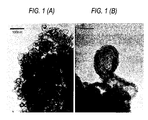
- Fig. 1(A) is a transmission electron micrograph taken of a mass of substances like layers of ultrafine particles of cadmium sulfide as one form of the photocatalyst according to this invention.
- Fig. 1 (B) is an enlarged portion of Fig. 1 (A) .
- Measurement by a micro-region EDX has confirmed as platinum the black portion on the outside of one substance like a layer of ultrafine particles of cadmium sulfide as enlarged in Fig. 1(B) .
- the cadmium compound not having photocatalytic activity is not particularly limited, but is preferably cadmium oxide or hydroxide.
- the aqueous solution containing the Group 16 element, etc. is not particularly limited, either, but is preferably a solution of a sodium compound.
- the sodium compound is not particularly limited, but is preferably sodium sulfide.
- cadmium sulfide which is a preferred form of cadmium compound having photocatalytic activity. Fine particles of cadmium oxide or hydroxide and an aqueous solution of sodium sulfide as raw materials are mixed and if the mixed solution is stirred, cadmium oxide or hydroxide reacts with water to form cadmate ions dissolved in the aqueous solution. The cadmate ions react with sulfur ions in the aqueous solution of sodium sulfide and form cadmium sulfide.
- the cadmium sulfide is deposited on the surfaces of the cadmium oxide or hydroxide particles as the raw material and forms a layer of fine particles of cadmium sulfide.
- water permeates through the layer, reaches the surface of cadmium oxide or hydroxide as the raw material and reacts with the cadmium oxide or hydroxide to form cadmate ions.
- the cadmate ions are diffused through the layer of fine particles of cadmium sulfide, reach its surface and react with sulfur ions to form cadmium sulfide, which is deposited on the layer of fine particles of cadmium sulfide.
- Ultraviolet irradiation may be employed to increase the rate of formation of the layer of fine particles of cadmium compound (cadmium sulfide). Fine particles of cadmium oxide or hydroxide and an aqueous solution of sodium sulfide are mixed together and irradiated with ultraviolet rays so that the dissolution of cadmium oxide or hydroxide under light may facilitate the dissolution of cadmate ions and thereby accelerate the growth of the layer of fine particles of cadmium compound.
- cadmium sulfide Fine particles of cadmium oxide or hydroxide and an aqueous solution of sodium sulfide are mixed together and irradiated with ultraviolet rays so that the dissolution of cadmium oxide or hydroxide under light may facilitate the dissolution of cadmate ions and thereby accelerate the growth of the layer of fine particles of cadmium compound.
- Hydrogen sulfide may be dissolved in a mixed solution of fine particles of cadmium oxide or hydroxide and water to form a weakly acid solution containing sulfur ions to accelerate the growth of the layer of fine particles of cadmium compound, since cadmium oxide or hydroxide is well soluble in a weakly acid solution.
- Ultraviolet irradiation and the dissolution of hydrogen sulfide may be combined to increase the rate of formation of the layer of fine particles of cadmium compound. Fine particles of cadmium oxide or hydroxide, an aqueous solution of sodium sulfide and hydrogen sulfide are mixed together, irradiated with ultraviolet rays and stirred to accelerate the growth of the layer of fine particles of cadmium compound to a further extent.
- cadmium oxide CdO
- Cd(OH) 2 cadmium hydroxide
- S 2- sulfur ions
- S 2- sulfur ions
- CdS cadmium compound
- the layer of fine particles of cadmium compound Upon formation of the layer of fine particles of cadmium compound, water permeates through the layer, reaches the surface of cadmium oxide or hydroxide as the raw material and reacts with the cadmium oxide or hydroxide to form cadmate ions.
- the cadmate ions are diffused through the layer of fine particles of cadmium compound and reach its surface opposite that in which it faces the cadmium oxide or hydroxide particles, namely its outer surface. In that surface, the cadmate ions react with sulfur ions and form the cadmium compound, which is deposited on the layer of fine particles of cadmium compound, whereby the layer of fine particles of cadmium compound is considered to grow.
- the layer of fine particles of cadmium compound forming the photocatalyst according to this invention is considered to have a structure featured by a ratio of cadmium (Cd) and sulfur (S) varying across its thickness.
- the particles of a cadmium compound not having photocatalytic activity which is used by the manufacturing method described above may be commercially available ones, or appropriately prepared ones.
- a method of preparing a cadmium compound not having photocatalytic activity there is no particular limitation, but it is possible to mention a method in which a solution of cadmium nitrate is mixed with a solution containing sodium hydroxide.
- the particle diameter of the photocatalyst to be manufactured may be appropriately controlled in accordance with the intended catalytic action thereof, and as regards a method of controlling its particle diameter, it is possible to mention controlling the particle diameter of the particles of a cadmium compound not having photocatalytic activity.
- a method of controlling the particle diameter of the particles of a cadmium compound there is no particular limitation, but it is preferable to have a chloride dissolved in the solution containing sodium hydroxide when the particles of a cadmium compound are prepared.
- the chloride is not particularly limited, but may, for example, be sodium or potassium chloride, though sodium chloride is preferred.
- the solution of a sodium compound preferably contains sodium sulfite or sulfide.
- the cadmium salt is preferably cadmium nitrate.
- the photocatalyst of this invention preferably supports a Group 8 to 11 metal like platinum as stated before, there is no particular limitation as to a method of having it supported.
- the photocatalyst particles produced by the manufacturing methods as described, or the like are preferably suspended in a solution containing sodium sulfite and exposed to light to have their photocatalytic activity raised.
- the light is preferably visible light, such as solar or pseudo-solar light.
- solution (1) 100 ml of a 0.1 M solution of sodium hydroxide (solution (1)).
- solution (1) and 100 ml of a 0.01 M solution of cadmium nitrate were mixed and stirred at room temperature.
- solution (2) 5 ml of a 0.1 M solution of sodium sulfide were mixed with solution (2).
- solution (3) there was obtained a suspension of particles having an intermediate color between orange and brown
- Solution (5) was filtered under suction by using a membrane filter having a diameter of 47 mm and a pore diameter of 0.2 um (6).
- the solid as obtained at (6) with the filter was placed in a desiccator and dried at room temperature to 60°C. As a result, there were obtained having a reddish brown color on the filter (7).
- the particles as obtained at (7) were suspended in a mixture of 50 ml of a 0.1 M solution of sodium sulfide and 10 ml of a 1 M solution of sodium sulfite and the suspension was irradiated with pseudo-solar light by using a 500 W Xe lamp.
- Example 1 was repeated except using 100 ml of a 0.1 M solution of sodium sulfite instead of 100 ml of a 0.1 M solution of sodium hydroxide in solution (1) according to Process 1 for Producing a Photocatalyst (Example 1). Photocatalyst particles having a greenish brown color were obtained on the filter, weighed about 110 mg and had a particle diameter of 62 nm.
- solution (1) 1 ml of a 0.1 M solution of sodium sulfide and 1 ml of a 1 M solution of sodium sulfite were mixed together (solution (1)).
- Solution (1) was diluted with deionized water until a total volume of 100 ml (solution (2)).
- 10 ml of a 0.05 M solution of cadmium nitrate were dropped into solution (2) at a dropping rate of 13.9 ml/min. and stirring was continued for two minutes.
- solution (3) 1.5 ml of a 9.65 x 10 -3 M solution of hexachloroplatinic acid were added to solution (3) and stirring was continued for two minutes (solution (4)).
- Solution (4) was irradiated with ultraviolet light for two minutes by using a mercury lamp type ultraviolet irradiating device.
- the suspension was filtered under suction and the resulting photocatalyst powder was dried with the filter.
- photocatalyst particles having a greenish brown color on the filter and the catalyst particles weighed about 40 mg and had a particle diameter of 70 nm.
- Example 1 (including sulfurizing treatment and treatment for having platinum supported) was repeated except using a suspension of 100 mg of CdO as a commercially available reagent (product of Kou-Jundo Kagaku-Sha having a particle diameter of 300 to 400 nm) instead of the suspension of particles as solution (2) according to Process 1 for Producing a Photocatalyst (Example 1) .
- Photocatalyst particles having a greenish brown color were obtained on the filter, weighed about 110 mg and had a particle diameter of 355 nm.
- Comparative Example 2 was repeated. Steps 4 and 5 of Example 1 (treatment for having platinum supported) were, however, eliminated. There were obtained photocatalyst particles having an intermediate color between orange and brown and not having a capsular structure on the filter, which particles weighed about 50 mg and had a particle diameter of 6 nm.
- Comparative Example 3 including the elimination of steps for treatment for having platinum supported was repeated except using a suspension of 100 mg of CdS as a commercially available reagent (product of Kou-Jundo Kagaku-Sha having a particle diameter of 30 to 40 nm) instead of the prepared CdS particles according to Comparative Example 3, and Photocatalyst particles having a dark brown color and not having a capsular structure were obtained on the filter.
- the catalyst particles weighed about 100 mg and had a particle diameter of 42 nm.
- a device for measuring the amount of hydrogen generated including a burette, was charged with 100 mg of photocatalyst particles. Then, the device for measuring the amount of hydrogen generated was charged with 140 ml of a 0.1 M solution of sodium sulfide.
- Pseudo-solar light having an intensity of 50 mW/cm 2 was applied from below the device by using a 500 W Xe lamp and the amount of hydrogen generated was measured every ten minutes.
- the device used for measuring the amount of hydrogen generated is shown in Fig. 2 .
- the device is composed of a light responding portion made of quartz glass, a hydrogen measuring portion 2 for measuring the amount of hydrogen generated, a solution reservoir 4 for storing an aqueous solution 3 of sodium sulfide corresponding in volume to the hydrogen gas generated and thereby preventing a hydrogen pressure elevation, a 500 W Xe lamp 5 for emitting pseudo-solar light, a lens L for collecting pseudo-solar light 6, and a reflecting mirror 8 for reflecting the pseudo-solar light 6 and irradiating a photocatalyst 7 therewith, as shown in Fig. 2 .
- the whole system When a reaction for decomposition by light is started, the whole system is filled with the aqueous solution 3 of sodium sulfide, a certain amount of photocatalyst 7 is caused to settle at the bottom of the light responding portion 1, a port 9 for collecting generated gas is closed and the 500 W Xe lamp is turned on. The amount of hydrogen generated is measured by the hydrogen measuring portion 7 at specific intervals of time of irradiation.
- Fig. 3 shows the dependence of the amount of hydrogen generated on the length of time of visible light irradiation.
- the photocatalyst particles according to Example 1 showed a maximum hydrogen generating rate of 74.8 ml/h one hour after the start of irradiation and a total amount of 210.3 ml for the hydrogen generated during four hours after the start of irradiation
- the photocatalyst particles according to Example 3 showed a maximum hydrogen generating rate of 70.8 ml/h one hour after the start of irradiation and a total amount of 189.2 ml for the hydrogen generated during four hours after the start of irradiation.
- the photocatalyst of this invention is high in catalytic activity, is nontoxic, has a long life, allows visible light to be used directly for its photocatalytic reaction and is useful for hydrogen generation, etc.
- the photocatalyst of this invention contributes to solving an environmental problem and exhibits the practical advantages of, for example, permitting the inexpensive production of useful substances if it is used in a method of decomposing hydrogen sulfide to produce hydrogen and sulfur.
Landscapes
- Chemical & Material Sciences (AREA)
- Organic Chemistry (AREA)
- Engineering & Computer Science (AREA)
- Materials Engineering (AREA)
- Chemical Kinetics & Catalysis (AREA)
- Health & Medical Sciences (AREA)
- General Health & Medical Sciences (AREA)
- Physics & Mathematics (AREA)
- Inorganic Chemistry (AREA)
- Combustion & Propulsion (AREA)
- Optics & Photonics (AREA)
- Toxicology (AREA)
- Plasma & Fusion (AREA)
- Catalysts (AREA)
Claims (7)
- Fotokatalysator, der eine Cadmiumverbindung enthält;
wobei der Fotokatalysator eine kapselförmige Struktur mit einer Hülle und einem Hohlraum aufweist;
wobei die Hülle eine Schichtstruktur aufweist, die durch eine Ultrafeinteilchenschicht der Cadmiumverbindung gebildet wird;
wobei der Teilchendurchmesser der Cadmiumverbindung 1 bis 10 nm beträgt; und
wobei der mittlere Teilchendurchmesser des Fotokatalysators 100 nm oder weniger beträgt, wobei der mittlere Teilchendurchmesser durch Berechnen des Mittelwerts der Hauptdurchmesser, die in einer elektronenmikroskopischen Aufnahme gemessen werden,
bestimmt wird. - Fotokatalysator gemäß Anspruch 1, wobei der mittlere Teilchendurchmesser 50 nm oder weniger beträgt.
- Fotokatalysator gemäß Anspruch 1, wobei die Cadmiumverbindung Cadmiumsulfid ist.
- Fotokatalysator gemäß Anspruch 1, dadurch gekennzeichnet, dass er ein Metall der Gruppe 8 bis 11 trägt.
- Fotokatalysator gemäß Anspruch 4, dadurch gekennzeichnet, dass das Metall Platin ist.
- Fotokatalysator gemäß Anspruch 1, welcher eine Pore aufweist, die sich von seiner Oberfläche zu seinem Inneren erstreckt.
- Fotokatalysator gemäß Anspruch 6, welcher eine Vielzahl solcher Poren aufweist.
Applications Claiming Priority (3)
| Application Number | Priority Date | Filing Date | Title |
|---|---|---|---|
| JP2001084748 | 2002-06-25 | ||
| JP2002184748A JP4357801B2 (ja) | 2002-06-25 | 2002-06-25 | 高活性光触媒およびその製造方法 |
| PCT/JP2003/007160 WO2004000459A1 (ja) | 2002-06-25 | 2003-06-05 | 高活性光触媒およびその製造方法 |
Publications (3)
| Publication Number | Publication Date |
|---|---|
| EP1516668A1 EP1516668A1 (de) | 2005-03-23 |
| EP1516668A4 EP1516668A4 (de) | 2010-08-25 |
| EP1516668B1 true EP1516668B1 (de) | 2016-10-12 |
Family
ID=29996711
Family Applications (1)
| Application Number | Title | Priority Date | Filing Date |
|---|---|---|---|
| EP03733300.2A Expired - Lifetime EP1516668B1 (de) | 2002-06-25 | 2003-06-05 | Hochaktiver fotokatalysator und verfahren zur herstellung desselben |
Country Status (9)
| Country | Link |
|---|---|
| US (1) | US7608557B2 (de) |
| EP (1) | EP1516668B1 (de) |
| JP (1) | JP4357801B2 (de) |
| KR (1) | KR20050077259A (de) |
| CN (1) | CN100357028C (de) |
| AU (1) | AU2003242189B2 (de) |
| CA (1) | CA2499579A1 (de) |
| EA (1) | EA009448B1 (de) |
| WO (1) | WO2004000459A1 (de) |
Families Citing this family (9)
| Publication number | Priority date | Publication date | Assignee | Title |
|---|---|---|---|---|
| JP2003265962A (ja) * | 2002-03-18 | 2003-09-24 | Nittetsu Mining Co Ltd | 光触媒およびその製造方法 |
| KR20070118668A (ko) | 2005-03-31 | 2007-12-17 | 닛데츠 고교 가부시키가이샤 | 황화수소의 처리방법, 수소의 제조방법 및 광촉매반응장치 |
| US7625835B2 (en) | 2005-06-10 | 2009-12-01 | Gm Global Technology Operations, Inc. | Photocatalyst and use thereof |
| US9824107B2 (en) | 2006-10-25 | 2017-11-21 | Entit Software Llc | Tracking changing state data to assist in computer network security |
| US9593053B1 (en) | 2011-11-14 | 2017-03-14 | Hypersolar, Inc. | Photoelectrosynthetically active heterostructures |
| US10100415B2 (en) | 2014-03-21 | 2018-10-16 | Hypersolar, Inc. | Multi-junction artificial photosynthetic cell with enhanced photovoltages |
| CN107051548B (zh) * | 2017-04-18 | 2019-11-05 | 曲阜师范大学 | 一种简易制备六边形CdO/CdS异质结纳米复合材料的方法 |
| IL302184B2 (en) | 2017-04-18 | 2024-12-01 | Breakthrough Tech Llc | Sulfur production |
| RU2752496C1 (ru) * | 2020-12-15 | 2021-07-28 | федеральное государственное автономное образовательное учреждение высшего образования "Российский государственный университет нефти и газа (национальный исследовательский университет) имени И.М. Губкина" | Композитный мезопористый фотокатализатор |
Family Cites Families (26)
| Publication number | Priority date | Publication date | Assignee | Title |
|---|---|---|---|---|
| US4041140A (en) * | 1974-07-16 | 1977-08-09 | Matsushita Electric Industrial Co., Ltd. | Method of making a sulphide ceramic body |
| US4197122A (en) * | 1977-04-29 | 1980-04-08 | Canon Kabushiki Kaisha | Process for preparing raw particles of cadmium sulfide for electrophotography |
| US4366222A (en) | 1977-07-11 | 1982-12-28 | Varian Associates | Cadmium sulfide/cadmium carbonate/cadmium oxide photoconductor produced by high temperature, inert atmosphere calcination |
| EP0002109B1 (de) | 1977-11-15 | 1981-12-02 | Imperial Chemical Industries Plc | Verfahren zum Herstellen dünner photoleitender Schichten und von Solarzellen unter Verwendung dieser dünnen photoleitenden Schichten |
| US4242374A (en) * | 1979-04-19 | 1980-12-30 | Exxon Research & Engineering Co. | Process for thin film deposition of metal and mixed metal chalcogenides displaying semi-conductor properties |
| CH644471A5 (fr) * | 1981-02-02 | 1984-07-31 | Michael Graetzel | Produit destine a etre utilise comme photocatalyseur, procede de preparation de ce produit et utilisation de ce produit. |
| US4484992A (en) * | 1981-02-04 | 1984-11-27 | Ciba-Geigy Corporation | Process for the production of hydrogen by means of heterogeneous photoredox catalysis |
| US4447335A (en) | 1981-03-31 | 1984-05-08 | Argus Chemical Corporation | Process for the preparation of thin films of cadmium sulfide and precursor solutions of cadmium ammonia thiocyanate complex useful therein |
| US4461753A (en) * | 1981-04-15 | 1984-07-24 | Canon Kabushiki Kaisha | Process for producing photoconductive cadmium sulfide |
| JPS62193696A (ja) * | 1986-02-20 | 1987-08-25 | Nomura Micro Sci Kk | 超純水の製造法 |
| JP2989330B2 (ja) | 1991-07-17 | 1999-12-13 | レーザーテック株式会社 | 顕微鏡観察装置 |
| DE4244354C2 (de) * | 1991-12-28 | 1995-06-14 | Hidefumi Hirai | Verfahren zur Herstellung einer nicht-wäßrigen Dispersion von Teilchen eines Metalls und/oder einer Metallverbindung |
| JPH06148172A (ja) * | 1992-11-04 | 1994-05-27 | Japan Storage Battery Co Ltd | Codの測定方法 |
| JPH07313884A (ja) * | 1994-05-24 | 1995-12-05 | Riken Corp | 水の光分解用触媒及びそれを用いた水素の製造方法 |
| JPH10310401A (ja) * | 1997-04-30 | 1998-11-24 | Japan Energy Corp | 半導体光触媒及びこれを用いた水素の製造方法 |
| US6415806B1 (en) | 1998-05-14 | 2002-07-09 | Robert E. Gillis | Flexible structure and method |
| US6248218B1 (en) * | 1999-03-25 | 2001-06-19 | Clovis A. Linkous | Closed cycle photocatalytic process for decomposition of hydrogen sulfide to its constituent elements |
| IL129718A0 (en) | 1999-05-02 | 2000-02-29 | Yeda Res & Dev | Synthesis of nanotubes of transition metal chalcogenides |
| JP2000325796A (ja) * | 1999-05-24 | 2000-11-28 | Japan Organo Co Ltd | 光触媒担持体及びその製造方法 |
| JP3440295B2 (ja) | 1999-08-03 | 2003-08-25 | 独立行政法人産業技術総合研究所 | 新規な半導体光触媒及びそれを使用する光触媒反応方法 |
| JP3138738B1 (ja) * | 1999-12-03 | 2001-02-26 | 工業技術院長 | 光触媒及びその製造方法 |
| JP4496444B2 (ja) * | 2000-01-06 | 2010-07-07 | 和幸 田路 | 光触媒及びその製造方法並びに該光触媒を用いた硫化水素の分解方法 |
| JP3421628B2 (ja) * | 2000-02-29 | 2003-06-30 | 韓国化学研究所 | 光触媒の製造方法 |
| JP4096330B2 (ja) * | 2002-02-27 | 2008-06-04 | 独立行政法人科学技術振興機構 | 内部に制御された空隙を有するコア・シェル構造体及びそれを構成要素とする構造体並びにこれらの調製方法 |
| JP2003265962A (ja) | 2002-03-18 | 2003-09-24 | Nittetsu Mining Co Ltd | 光触媒およびその製造方法 |
| JP2008090964A (ja) | 2006-10-03 | 2008-04-17 | Ricoh Co Ltd | 追記型2層構成光記録媒体 |
-
2002
- 2002-06-25 JP JP2002184748A patent/JP4357801B2/ja not_active Expired - Lifetime
-
2003
- 2003-06-05 CA CA002499579A patent/CA2499579A1/en not_active Abandoned
- 2003-06-05 US US10/518,934 patent/US7608557B2/en not_active Expired - Lifetime
- 2003-06-05 EP EP03733300.2A patent/EP1516668B1/de not_active Expired - Lifetime
- 2003-06-05 WO PCT/JP2003/007160 patent/WO2004000459A1/ja not_active Ceased
- 2003-06-05 AU AU2003242189A patent/AU2003242189B2/en not_active Expired - Fee Related
- 2003-06-05 CN CNB038180324A patent/CN100357028C/zh not_active Expired - Fee Related
- 2003-06-05 KR KR1020047021128A patent/KR20050077259A/ko not_active Withdrawn
- 2003-06-05 EA EA200401573A patent/EA009448B1/ru not_active IP Right Cessation
Non-Patent Citations (1)
| Title |
|---|
| None * |
Also Published As
| Publication number | Publication date |
|---|---|
| CN100357028C (zh) | 2007-12-26 |
| US20050215421A1 (en) | 2005-09-29 |
| JP4357801B2 (ja) | 2009-11-04 |
| EP1516668A4 (de) | 2010-08-25 |
| EA009448B1 (ru) | 2007-12-28 |
| EP1516668A1 (de) | 2005-03-23 |
| CN1671476A (zh) | 2005-09-21 |
| EA200401573A1 (ru) | 2005-06-30 |
| CA2499579A1 (en) | 2003-12-31 |
| WO2004000459A1 (ja) | 2003-12-31 |
| JP2004025032A (ja) | 2004-01-29 |
| AU2003242189A1 (en) | 2004-01-06 |
| AU2003242189B2 (en) | 2009-05-21 |
| US7608557B2 (en) | 2009-10-27 |
| KR20050077259A (ko) | 2005-08-01 |
Similar Documents
| Publication | Publication Date | Title |
|---|---|---|
| Zhang et al. | A simple cation exchange approach to Bi-doped ZnS hollow spheres with enhanced UV and visible-light photocatalytic H 2-production activity | |
| EP3554695B1 (de) | Photokatalysator auf basis von halbleiter/m1/cdxm1-xs zur effizienten wasserstofferzeugung | |
| US7625835B2 (en) | Photocatalyst and use thereof | |
| JP6803065B2 (ja) | 光触媒およびその製造方法 | |
| EP1516668B1 (de) | Hochaktiver fotokatalysator und verfahren zur herstellung desselben | |
| Mokhtarifar et al. | Fabrication of dual-phase TiO 2/WO 3 with post-illumination photocatalytic memory | |
| Ramanathan et al. | Sol-gel derived ormosil-exfoliated graphite− TiO2 composite floating catalyst: photodeposition of copper | |
| Yousefi et al. | Coupling effect of Fe-doped Co3O4 nanoparticles with SrTiO3 nanotubes on the high-efficiency photocatalytic activities of basic violet 16 dye degradation and H2 evolution | |
| Nordin et al. | Synergistic interaction and chemically bonded association between ZIF-8 and C-doped g-C3N4 for enhancement of visible light photocatalytic H2O2 production | |
| JP2009189952A (ja) | 半導体光触媒 | |
| WO2003078061A1 (fr) | Photocatalyseur et son procede de production | |
| Ou-Yang et al. | Carbon quantum dots modified oxygen doped carbon nitride nanosheets with enhanced hydrogen evolution under visible light irradiation | |
| JP2003265962A6 (ja) | 光触媒およびその製造方法 | |
| WO2023286845A1 (ja) | 水素生成用光触媒、水分解システム及び水素製造方法 | |
| JP4496444B2 (ja) | 光触媒及びその製造方法並びに該光触媒を用いた硫化水素の分解方法 | |
| Pradhan et al. | Synergistic Photocatalytic and Supercapacitive Properties of Transition Metal Doped Co3o4: Towards Efficient Dye Degradation and Energy Storage | |
| Panahi et al. | Synthesis and visible-light photocatalytic activity of nanoperovskites and exploration of silver decoration to enhance photocatalytic efficiency | |
| Black | Botanically templated macroporous materials and their energy catalysis applications | |
| 콜라이 | Development of sodium titanate semiconductor for removal of organic dyes from aqueous solutions and hydrogen production using photoelectrochemical (PEC) water splitting | |
| CN118304908A (zh) | Bi2WO6/BiOCl复合光催化剂制备方法及其在降解TNT废水上的应用 | |
| de la Flor Gutiérrez et al. | Synthesis and characterization of TiO2/CNT/Pd: An effective sunlight photocatalyst for neonicotinoids degradation | |
| KR20250118291A (ko) | 금속복합구조체의 광촉매 및 이의 제조방법 | |
| Wang et al. | TiO2-Based Hydrogen Heterogeneous Generation Catalysis for Photocatalytic and Photodegradation | |
| Zaleska et al. | Photocatalysts for solar energy conversion | |
| Sohn et al. | NANOSTRUCTURED POROUS SEMICONDUCTORS AS EMERGING MATERIALS IN ENVIRONMENTAL TECHNOLOGY: SYNTHESIS, PROPERTY AND APPLICATIONS |
Legal Events
| Date | Code | Title | Description |
|---|---|---|---|
| PUAI | Public reference made under article 153(3) epc to a published international application that has entered the european phase |
Free format text: ORIGINAL CODE: 0009012 |
|
| 17P | Request for examination filed |
Effective date: 20041222 |
|
| AK | Designated contracting states |
Kind code of ref document: A1 Designated state(s): AT BE BG CH CY CZ DE DK EE ES FI FR GB GR HU IE IT LI LU MC NL PT RO SE SI SK TR |
|
| AX | Request for extension of the european patent |
Extension state: AL LT LV MK |
|
| RAP1 | Party data changed (applicant data changed or rights of an application transferred) |
Owner name: NITTETSU MINING CO., LTD. |
|
| DAX | Request for extension of the european patent (deleted) | ||
| A4 | Supplementary search report drawn up and despatched |
Effective date: 20100727 |
|
| 17Q | First examination report despatched |
Effective date: 20101008 |
|
| GRAP | Despatch of communication of intention to grant a patent |
Free format text: ORIGINAL CODE: EPIDOSNIGR1 |
|
| INTG | Intention to grant announced |
Effective date: 20160622 |
|
| GRAS | Grant fee paid |
Free format text: ORIGINAL CODE: EPIDOSNIGR3 |
|
| GRAA | (expected) grant |
Free format text: ORIGINAL CODE: 0009210 |
|
| AK | Designated contracting states |
Kind code of ref document: B1 Designated state(s): AT BE BG CH CY CZ DE DK EE ES FI FR GB GR HU IE IT LI LU MC NL PT RO SE SI SK TR |
|
| REG | Reference to a national code |
Ref country code: GB Ref legal event code: FG4D |
|
| REG | Reference to a national code |
Ref country code: CH Ref legal event code: EP |
|
| REG | Reference to a national code |
Ref country code: AT Ref legal event code: REF Ref document number: 835993 Country of ref document: AT Kind code of ref document: T Effective date: 20161015 |
|
| REG | Reference to a national code |
Ref country code: IE Ref legal event code: FG4D |
|
| REG | Reference to a national code |
Ref country code: DE Ref legal event code: R096 Ref document number: 60349486 Country of ref document: DE |
|
| REG | Reference to a national code |
Ref country code: NL Ref legal event code: MP Effective date: 20161012 |
|
| REG | Reference to a national code |
Ref country code: AT Ref legal event code: MK05 Ref document number: 835993 Country of ref document: AT Kind code of ref document: T Effective date: 20161012 |
|
| PG25 | Lapsed in a contracting state [announced via postgrant information from national office to epo] |
Ref country code: SE Free format text: LAPSE BECAUSE OF FAILURE TO SUBMIT A TRANSLATION OF THE DESCRIPTION OR TO PAY THE FEE WITHIN THE PRESCRIBED TIME-LIMIT Effective date: 20161012 Ref country code: GR Free format text: LAPSE BECAUSE OF FAILURE TO SUBMIT A TRANSLATION OF THE DESCRIPTION OR TO PAY THE FEE WITHIN THE PRESCRIBED TIME-LIMIT Effective date: 20170113 |
|
| PG25 | Lapsed in a contracting state [announced via postgrant information from national office to epo] |
Ref country code: AT Free format text: LAPSE BECAUSE OF FAILURE TO SUBMIT A TRANSLATION OF THE DESCRIPTION OR TO PAY THE FEE WITHIN THE PRESCRIBED TIME-LIMIT Effective date: 20161012 Ref country code: PT Free format text: LAPSE BECAUSE OF FAILURE TO SUBMIT A TRANSLATION OF THE DESCRIPTION OR TO PAY THE FEE WITHIN THE PRESCRIBED TIME-LIMIT Effective date: 20170213 Ref country code: NL Free format text: LAPSE BECAUSE OF FAILURE TO SUBMIT A TRANSLATION OF THE DESCRIPTION OR TO PAY THE FEE WITHIN THE PRESCRIBED TIME-LIMIT Effective date: 20161012 Ref country code: ES Free format text: LAPSE BECAUSE OF FAILURE TO SUBMIT A TRANSLATION OF THE DESCRIPTION OR TO PAY THE FEE WITHIN THE PRESCRIBED TIME-LIMIT Effective date: 20161012 Ref country code: BE Free format text: LAPSE BECAUSE OF FAILURE TO SUBMIT A TRANSLATION OF THE DESCRIPTION OR TO PAY THE FEE WITHIN THE PRESCRIBED TIME-LIMIT Effective date: 20161012 Ref country code: FI Free format text: LAPSE BECAUSE OF FAILURE TO SUBMIT A TRANSLATION OF THE DESCRIPTION OR TO PAY THE FEE WITHIN THE PRESCRIBED TIME-LIMIT Effective date: 20161012 |
|
| REG | Reference to a national code |
Ref country code: DE Ref legal event code: R097 Ref document number: 60349486 Country of ref document: DE |
|
| PG25 | Lapsed in a contracting state [announced via postgrant information from national office to epo] |
Ref country code: CZ Free format text: LAPSE BECAUSE OF FAILURE TO SUBMIT A TRANSLATION OF THE DESCRIPTION OR TO PAY THE FEE WITHIN THE PRESCRIBED TIME-LIMIT Effective date: 20161012 Ref country code: EE Free format text: LAPSE BECAUSE OF FAILURE TO SUBMIT A TRANSLATION OF THE DESCRIPTION OR TO PAY THE FEE WITHIN THE PRESCRIBED TIME-LIMIT Effective date: 20161012 Ref country code: DK Free format text: LAPSE BECAUSE OF FAILURE TO SUBMIT A TRANSLATION OF THE DESCRIPTION OR TO PAY THE FEE WITHIN THE PRESCRIBED TIME-LIMIT Effective date: 20161012 Ref country code: SK Free format text: LAPSE BECAUSE OF FAILURE TO SUBMIT A TRANSLATION OF THE DESCRIPTION OR TO PAY THE FEE WITHIN THE PRESCRIBED TIME-LIMIT Effective date: 20161012 Ref country code: RO Free format text: LAPSE BECAUSE OF FAILURE TO SUBMIT A TRANSLATION OF THE DESCRIPTION OR TO PAY THE FEE WITHIN THE PRESCRIBED TIME-LIMIT Effective date: 20161012 |
|
| PLBE | No opposition filed within time limit |
Free format text: ORIGINAL CODE: 0009261 |
|
| STAA | Information on the status of an ep patent application or granted ep patent |
Free format text: STATUS: NO OPPOSITION FILED WITHIN TIME LIMIT |
|
| PG25 | Lapsed in a contracting state [announced via postgrant information from national office to epo] |
Ref country code: BG Free format text: LAPSE BECAUSE OF FAILURE TO SUBMIT A TRANSLATION OF THE DESCRIPTION OR TO PAY THE FEE WITHIN THE PRESCRIBED TIME-LIMIT Effective date: 20170112 Ref country code: IT Free format text: LAPSE BECAUSE OF FAILURE TO SUBMIT A TRANSLATION OF THE DESCRIPTION OR TO PAY THE FEE WITHIN THE PRESCRIBED TIME-LIMIT Effective date: 20161012 |
|
| 26N | No opposition filed |
Effective date: 20170713 |
|
| PG25 | Lapsed in a contracting state [announced via postgrant information from national office to epo] |
Ref country code: SI Free format text: LAPSE BECAUSE OF FAILURE TO SUBMIT A TRANSLATION OF THE DESCRIPTION OR TO PAY THE FEE WITHIN THE PRESCRIBED TIME-LIMIT Effective date: 20161012 |
|
| PG25 | Lapsed in a contracting state [announced via postgrant information from national office to epo] |
Ref country code: MC Free format text: LAPSE BECAUSE OF FAILURE TO SUBMIT A TRANSLATION OF THE DESCRIPTION OR TO PAY THE FEE WITHIN THE PRESCRIBED TIME-LIMIT Effective date: 20161012 |
|
| REG | Reference to a national code |
Ref country code: CH Ref legal event code: PL |
|
| GBPC | Gb: european patent ceased through non-payment of renewal fee |
Effective date: 20170605 |
|
| REG | Reference to a national code |
Ref country code: IE Ref legal event code: MM4A |
|
| REG | Reference to a national code |
Ref country code: FR Ref legal event code: ST Effective date: 20180228 |
|
| PG25 | Lapsed in a contracting state [announced via postgrant information from national office to epo] |
Ref country code: CH Free format text: LAPSE BECAUSE OF NON-PAYMENT OF DUE FEES Effective date: 20170630 Ref country code: IE Free format text: LAPSE BECAUSE OF NON-PAYMENT OF DUE FEES Effective date: 20170605 Ref country code: LU Free format text: LAPSE BECAUSE OF NON-PAYMENT OF DUE FEES Effective date: 20170605 Ref country code: LI Free format text: LAPSE BECAUSE OF NON-PAYMENT OF DUE FEES Effective date: 20170630 Ref country code: GB Free format text: LAPSE BECAUSE OF NON-PAYMENT OF DUE FEES Effective date: 20170605 |
|
| PG25 | Lapsed in a contracting state [announced via postgrant information from national office to epo] |
Ref country code: FR Free format text: LAPSE BECAUSE OF NON-PAYMENT OF DUE FEES Effective date: 20170630 |
|
| PG25 | Lapsed in a contracting state [announced via postgrant information from national office to epo] |
Ref country code: HU Free format text: LAPSE BECAUSE OF FAILURE TO SUBMIT A TRANSLATION OF THE DESCRIPTION OR TO PAY THE FEE WITHIN THE PRESCRIBED TIME-LIMIT; INVALID AB INITIO Effective date: 20030605 |
|
| PG25 | Lapsed in a contracting state [announced via postgrant information from national office to epo] |
Ref country code: CY Free format text: LAPSE BECAUSE OF NON-PAYMENT OF DUE FEES Effective date: 20161012 |
|
| PG25 | Lapsed in a contracting state [announced via postgrant information from national office to epo] |
Ref country code: TR Free format text: LAPSE BECAUSE OF FAILURE TO SUBMIT A TRANSLATION OF THE DESCRIPTION OR TO PAY THE FEE WITHIN THE PRESCRIBED TIME-LIMIT Effective date: 20161012 |
|
| PGFP | Annual fee paid to national office [announced via postgrant information from national office to epo] |
Ref country code: DE Payment date: 20220505 Year of fee payment: 20 |
|
| REG | Reference to a national code |
Ref country code: DE Ref legal event code: R071 Ref document number: 60349486 Country of ref document: DE |
|
| P01 | Opt-out of the competence of the unified patent court (upc) registered |
Effective date: 20230428 |