EP1491500A2 - Quasi-crystalline boehmites containing additives - Google Patents
Quasi-crystalline boehmites containing additives Download PDFInfo
- Publication number
- EP1491500A2 EP1491500A2 EP20040077631 EP04077631A EP1491500A2 EP 1491500 A2 EP1491500 A2 EP 1491500A2 EP 20040077631 EP20040077631 EP 20040077631 EP 04077631 A EP04077631 A EP 04077631A EP 1491500 A2 EP1491500 A2 EP 1491500A2
- Authority
- EP
- European Patent Office
- Prior art keywords
- quasi
- additive
- crystalline boehmite
- process according
- boehmite
- Prior art date
- Legal status (The legal status is an assumption and is not a legal conclusion. Google has not performed a legal analysis and makes no representation as to the accuracy of the status listed.)
- Withdrawn
Links
Images


Classifications
-
- C—CHEMISTRY; METALLURGY
- C04—CEMENTS; CONCRETE; ARTIFICIAL STONE; CERAMICS; REFRACTORIES
- C04B—LIME, MAGNESIA; SLAG; CEMENTS; COMPOSITIONS THEREOF, e.g. MORTARS, CONCRETE OR LIKE BUILDING MATERIALS; ARTIFICIAL STONE; CERAMICS; REFRACTORIES; TREATMENT OF NATURAL STONE
- C04B35/00—Shaped ceramic products characterised by their composition; Ceramics compositions; Processing powders of inorganic compounds preparatory to the manufacturing of ceramic products
- C04B35/622—Forming processes; Processing powders of inorganic compounds preparatory to the manufacturing of ceramic products
- C04B35/626—Preparing or treating the powders individually or as batches ; preparing or treating macroscopic reinforcing agents for ceramic products, e.g. fibres; mechanical aspects section B
- C04B35/62605—Treating the starting powders individually or as mixtures
-
- C—CHEMISTRY; METALLURGY
- C01—INORGANIC CHEMISTRY
- C01F—COMPOUNDS OF THE METALS BERYLLIUM, MAGNESIUM, ALUMINIUM, CALCIUM, STRONTIUM, BARIUM, RADIUM, THORIUM, OR OF THE RARE-EARTH METALS
- C01F7/00—Compounds of aluminium
- C01F7/02—Aluminium oxide; Aluminium hydroxide; Aluminates
- C01F7/04—Preparation of alkali metal aluminates; Aluminium oxide or hydroxide therefrom
-
- B—PERFORMING OPERATIONS; TRANSPORTING
- B01—PHYSICAL OR CHEMICAL PROCESSES OR APPARATUS IN GENERAL
- B01J—CHEMICAL OR PHYSICAL PROCESSES, e.g. CATALYSIS OR COLLOID CHEMISTRY; THEIR RELEVANT APPARATUS
- B01J21/00—Catalysts comprising the elements, oxides, or hydroxides of magnesium, boron, aluminium, carbon, silicon, titanium, zirconium, or hafnium
- B01J21/02—Boron or aluminium; Oxides or hydroxides thereof
- B01J21/04—Alumina
-
- B—PERFORMING OPERATIONS; TRANSPORTING
- B01—PHYSICAL OR CHEMICAL PROCESSES OR APPARATUS IN GENERAL
- B01J—CHEMICAL OR PHYSICAL PROCESSES, e.g. CATALYSIS OR COLLOID CHEMISTRY; THEIR RELEVANT APPARATUS
- B01J21/00—Catalysts comprising the elements, oxides, or hydroxides of magnesium, boron, aluminium, carbon, silicon, titanium, zirconium, or hafnium
- B01J21/12—Silica and alumina
-
- B—PERFORMING OPERATIONS; TRANSPORTING
- B01—PHYSICAL OR CHEMICAL PROCESSES OR APPARATUS IN GENERAL
- B01J—CHEMICAL OR PHYSICAL PROCESSES, e.g. CATALYSIS OR COLLOID CHEMISTRY; THEIR RELEVANT APPARATUS
- B01J23/00—Catalysts comprising metals or metal oxides or hydroxides, not provided for in group B01J21/00
- B01J23/02—Catalysts comprising metals or metal oxides or hydroxides, not provided for in group B01J21/00 of the alkali- or alkaline earth metals or beryllium
-
- B—PERFORMING OPERATIONS; TRANSPORTING
- B01—PHYSICAL OR CHEMICAL PROCESSES OR APPARATUS IN GENERAL
- B01J—CHEMICAL OR PHYSICAL PROCESSES, e.g. CATALYSIS OR COLLOID CHEMISTRY; THEIR RELEVANT APPARATUS
- B01J23/00—Catalysts comprising metals or metal oxides or hydroxides, not provided for in group B01J21/00
- B01J23/06—Catalysts comprising metals or metal oxides or hydroxides, not provided for in group B01J21/00 of zinc, cadmium or mercury
-
- B—PERFORMING OPERATIONS; TRANSPORTING
- B01—PHYSICAL OR CHEMICAL PROCESSES OR APPARATUS IN GENERAL
- B01J—CHEMICAL OR PHYSICAL PROCESSES, e.g. CATALYSIS OR COLLOID CHEMISTRY; THEIR RELEVANT APPARATUS
- B01J23/00—Catalysts comprising metals or metal oxides or hydroxides, not provided for in group B01J21/00
- B01J23/08—Catalysts comprising metals or metal oxides or hydroxides, not provided for in group B01J21/00 of gallium, indium or thallium
-
- B—PERFORMING OPERATIONS; TRANSPORTING
- B01—PHYSICAL OR CHEMICAL PROCESSES OR APPARATUS IN GENERAL
- B01J—CHEMICAL OR PHYSICAL PROCESSES, e.g. CATALYSIS OR COLLOID CHEMISTRY; THEIR RELEVANT APPARATUS
- B01J23/00—Catalysts comprising metals or metal oxides or hydroxides, not provided for in group B01J21/00
- B01J23/16—Catalysts comprising metals or metal oxides or hydroxides, not provided for in group B01J21/00 of arsenic, antimony, bismuth, vanadium, niobium, tantalum, polonium, chromium, molybdenum, tungsten, manganese, technetium or rhenium
- B01J23/24—Chromium, molybdenum or tungsten
- B01J23/28—Molybdenum
-
- B—PERFORMING OPERATIONS; TRANSPORTING
- B01—PHYSICAL OR CHEMICAL PROCESSES OR APPARATUS IN GENERAL
- B01J—CHEMICAL OR PHYSICAL PROCESSES, e.g. CATALYSIS OR COLLOID CHEMISTRY; THEIR RELEVANT APPARATUS
- B01J23/00—Catalysts comprising metals or metal oxides or hydroxides, not provided for in group B01J21/00
- B01J23/70—Catalysts comprising metals or metal oxides or hydroxides, not provided for in group B01J21/00 of the iron group metals or copper
-
- B—PERFORMING OPERATIONS; TRANSPORTING
- B01—PHYSICAL OR CHEMICAL PROCESSES OR APPARATUS IN GENERAL
- B01J—CHEMICAL OR PHYSICAL PROCESSES, e.g. CATALYSIS OR COLLOID CHEMISTRY; THEIR RELEVANT APPARATUS
- B01J23/00—Catalysts comprising metals or metal oxides or hydroxides, not provided for in group B01J21/00
- B01J23/70—Catalysts comprising metals or metal oxides or hydroxides, not provided for in group B01J21/00 of the iron group metals or copper
- B01J23/74—Iron group metals
- B01J23/75—Cobalt
-
- B—PERFORMING OPERATIONS; TRANSPORTING
- B01—PHYSICAL OR CHEMICAL PROCESSES OR APPARATUS IN GENERAL
- B01J—CHEMICAL OR PHYSICAL PROCESSES, e.g. CATALYSIS OR COLLOID CHEMISTRY; THEIR RELEVANT APPARATUS
- B01J23/00—Catalysts comprising metals or metal oxides or hydroxides, not provided for in group B01J21/00
- B01J23/70—Catalysts comprising metals or metal oxides or hydroxides, not provided for in group B01J21/00 of the iron group metals or copper
- B01J23/74—Iron group metals
- B01J23/755—Nickel
-
- B—PERFORMING OPERATIONS; TRANSPORTING
- B01—PHYSICAL OR CHEMICAL PROCESSES OR APPARATUS IN GENERAL
- B01J—CHEMICAL OR PHYSICAL PROCESSES, e.g. CATALYSIS OR COLLOID CHEMISTRY; THEIR RELEVANT APPARATUS
- B01J23/00—Catalysts comprising metals or metal oxides or hydroxides, not provided for in group B01J21/00
- B01J23/70—Catalysts comprising metals or metal oxides or hydroxides, not provided for in group B01J21/00 of the iron group metals or copper
- B01J23/76—Catalysts comprising metals or metal oxides or hydroxides, not provided for in group B01J21/00 of the iron group metals or copper combined with metals, oxides or hydroxides provided for in groups B01J23/02 - B01J23/36
- B01J23/84—Catalysts comprising metals or metal oxides or hydroxides, not provided for in group B01J21/00 of the iron group metals or copper combined with metals, oxides or hydroxides provided for in groups B01J23/02 - B01J23/36 with arsenic, antimony, bismuth, vanadium, niobium, tantalum, polonium, chromium, molybdenum, tungsten, manganese, technetium or rhenium
- B01J23/85—Chromium, molybdenum or tungsten
- B01J23/88—Molybdenum
- B01J23/882—Molybdenum and cobalt
-
- B—PERFORMING OPERATIONS; TRANSPORTING
- B01—PHYSICAL OR CHEMICAL PROCESSES OR APPARATUS IN GENERAL
- B01J—CHEMICAL OR PHYSICAL PROCESSES, e.g. CATALYSIS OR COLLOID CHEMISTRY; THEIR RELEVANT APPARATUS
- B01J23/00—Catalysts comprising metals or metal oxides or hydroxides, not provided for in group B01J21/00
- B01J23/70—Catalysts comprising metals or metal oxides or hydroxides, not provided for in group B01J21/00 of the iron group metals or copper
- B01J23/76—Catalysts comprising metals or metal oxides or hydroxides, not provided for in group B01J21/00 of the iron group metals or copper combined with metals, oxides or hydroxides provided for in groups B01J23/02 - B01J23/36
- B01J23/84—Catalysts comprising metals or metal oxides or hydroxides, not provided for in group B01J21/00 of the iron group metals or copper combined with metals, oxides or hydroxides provided for in groups B01J23/02 - B01J23/36 with arsenic, antimony, bismuth, vanadium, niobium, tantalum, polonium, chromium, molybdenum, tungsten, manganese, technetium or rhenium
- B01J23/85—Chromium, molybdenum or tungsten
- B01J23/88—Molybdenum
- B01J23/883—Molybdenum and nickel
-
- B—PERFORMING OPERATIONS; TRANSPORTING
- B01—PHYSICAL OR CHEMICAL PROCESSES OR APPARATUS IN GENERAL
- B01J—CHEMICAL OR PHYSICAL PROCESSES, e.g. CATALYSIS OR COLLOID CHEMISTRY; THEIR RELEVANT APPARATUS
- B01J37/00—Processes, in general, for preparing catalysts; Processes, in general, for activation of catalysts
- B01J37/02—Impregnation, coating or precipitation
- B01J37/03—Precipitation; Co-precipitation
-
- B—PERFORMING OPERATIONS; TRANSPORTING
- B01—PHYSICAL OR CHEMICAL PROCESSES OR APPARATUS IN GENERAL
- B01J—CHEMICAL OR PHYSICAL PROCESSES, e.g. CATALYSIS OR COLLOID CHEMISTRY; THEIR RELEVANT APPARATUS
- B01J37/00—Processes, in general, for preparing catalysts; Processes, in general, for activation of catalysts
- B01J37/02—Impregnation, coating or precipitation
- B01J37/03—Precipitation; Co-precipitation
- B01J37/036—Precipitation; Co-precipitation to form a gel or a cogel
-
- C—CHEMISTRY; METALLURGY
- C01—INORGANIC CHEMISTRY
- C01F—COMPOUNDS OF THE METALS BERYLLIUM, MAGNESIUM, ALUMINIUM, CALCIUM, STRONTIUM, BARIUM, RADIUM, THORIUM, OR OF THE RARE-EARTH METALS
- C01F7/00—Compounds of aluminium
- C01F7/02—Aluminium oxide; Aluminium hydroxide; Aluminates
-
- B—PERFORMING OPERATIONS; TRANSPORTING
- B01—PHYSICAL OR CHEMICAL PROCESSES OR APPARATUS IN GENERAL
- B01J—CHEMICAL OR PHYSICAL PROCESSES, e.g. CATALYSIS OR COLLOID CHEMISTRY; THEIR RELEVANT APPARATUS
- B01J2235/00—Indexing scheme associated with group B01J35/00, related to the analysis techniques used to determine the catalysts form or properties
- B01J2235/15—X-ray diffraction
-
- B—PERFORMING OPERATIONS; TRANSPORTING
- B01—PHYSICAL OR CHEMICAL PROCESSES OR APPARATUS IN GENERAL
- B01J—CHEMICAL OR PHYSICAL PROCESSES, e.g. CATALYSIS OR COLLOID CHEMISTRY; THEIR RELEVANT APPARATUS
- B01J23/00—Catalysts comprising metals or metal oxides or hydroxides, not provided for in group B01J21/00
- B01J23/10—Catalysts comprising metals or metal oxides or hydroxides, not provided for in group B01J21/00 of rare earths
-
- B—PERFORMING OPERATIONS; TRANSPORTING
- B01—PHYSICAL OR CHEMICAL PROCESSES OR APPARATUS IN GENERAL
- B01J—CHEMICAL OR PHYSICAL PROCESSES, e.g. CATALYSIS OR COLLOID CHEMISTRY; THEIR RELEVANT APPARATUS
- B01J35/00—Catalysts, in general, characterised by their form or physical properties
- B01J35/70—Catalysts, in general, characterised by their form or physical properties characterised by their crystalline properties, e.g. semi-crystalline
-
- B—PERFORMING OPERATIONS; TRANSPORTING
- B01—PHYSICAL OR CHEMICAL PROCESSES OR APPARATUS IN GENERAL
- B01J—CHEMICAL OR PHYSICAL PROCESSES, e.g. CATALYSIS OR COLLOID CHEMISTRY; THEIR RELEVANT APPARATUS
- B01J37/00—Processes, in general, for preparing catalysts; Processes, in general, for activation of catalysts
- B01J37/08—Heat treatment
- B01J37/10—Heat treatment in the presence of water, e.g. steam
-
- C—CHEMISTRY; METALLURGY
- C01—INORGANIC CHEMISTRY
- C01P—INDEXING SCHEME RELATING TO STRUCTURAL AND PHYSICAL ASPECTS OF SOLID INORGANIC COMPOUNDS
- C01P2002/00—Crystal-structural characteristics
- C01P2002/50—Solid solutions
-
- C—CHEMISTRY; METALLURGY
- C01—INORGANIC CHEMISTRY
- C01P—INDEXING SCHEME RELATING TO STRUCTURAL AND PHYSICAL ASPECTS OF SOLID INORGANIC COMPOUNDS
- C01P2002/00—Crystal-structural characteristics
- C01P2002/70—Crystal-structural characteristics defined by measured X-ray, neutron or electron diffraction data
- C01P2002/72—Crystal-structural characteristics defined by measured X-ray, neutron or electron diffraction data by d-values or two theta-values, e.g. as X-ray diagram
-
- C—CHEMISTRY; METALLURGY
- C04—CEMENTS; CONCRETE; ARTIFICIAL STONE; CERAMICS; REFRACTORIES
- C04B—LIME, MAGNESIA; SLAG; CEMENTS; COMPOSITIONS THEREOF, e.g. MORTARS, CONCRETE OR LIKE BUILDING MATERIALS; ARTIFICIAL STONE; CERAMICS; REFRACTORIES; TREATMENT OF NATURAL STONE
- C04B2235/00—Aspects relating to ceramic starting mixtures or sintered ceramic products
- C04B2235/02—Composition of constituents of the starting material or of secondary phases of the final product
- C04B2235/30—Constituents and secondary phases not being of a fibrous nature
- C04B2235/32—Metal oxides, mixed metal oxides, or oxide-forming salts thereof, e.g. carbonates, nitrates, (oxy)hydroxides, chlorides
- C04B2235/3205—Alkaline earth oxides or oxide forming salts thereof, e.g. beryllium oxide
- C04B2235/3215—Barium oxides or oxide-forming salts thereof
-
- C—CHEMISTRY; METALLURGY
- C04—CEMENTS; CONCRETE; ARTIFICIAL STONE; CERAMICS; REFRACTORIES
- C04B—LIME, MAGNESIA; SLAG; CEMENTS; COMPOSITIONS THEREOF, e.g. MORTARS, CONCRETE OR LIKE BUILDING MATERIALS; ARTIFICIAL STONE; CERAMICS; REFRACTORIES; TREATMENT OF NATURAL STONE
- C04B2235/00—Aspects relating to ceramic starting mixtures or sintered ceramic products
- C04B2235/02—Composition of constituents of the starting material or of secondary phases of the final product
- C04B2235/30—Constituents and secondary phases not being of a fibrous nature
- C04B2235/32—Metal oxides, mixed metal oxides, or oxide-forming salts thereof, e.g. carbonates, nitrates, (oxy)hydroxides, chlorides
- C04B2235/3217—Aluminum oxide or oxide forming salts thereof, e.g. bauxite, alpha-alumina
- C04B2235/3218—Aluminium (oxy)hydroxides, e.g. boehmite, gibbsite, alumina sol
-
- C—CHEMISTRY; METALLURGY
- C04—CEMENTS; CONCRETE; ARTIFICIAL STONE; CERAMICS; REFRACTORIES
- C04B—LIME, MAGNESIA; SLAG; CEMENTS; COMPOSITIONS THEREOF, e.g. MORTARS, CONCRETE OR LIKE BUILDING MATERIALS; ARTIFICIAL STONE; CERAMICS; REFRACTORIES; TREATMENT OF NATURAL STONE
- C04B2235/00—Aspects relating to ceramic starting mixtures or sintered ceramic products
- C04B2235/02—Composition of constituents of the starting material or of secondary phases of the final product
- C04B2235/30—Constituents and secondary phases not being of a fibrous nature
- C04B2235/32—Metal oxides, mixed metal oxides, or oxide-forming salts thereof, e.g. carbonates, nitrates, (oxy)hydroxides, chlorides
- C04B2235/3231—Refractory metal oxides, their mixed metal oxides, or oxide-forming salts thereof
- C04B2235/3256—Molybdenum oxides, molybdates or oxide forming salts thereof, e.g. cadmium molybdate
-
- C—CHEMISTRY; METALLURGY
- C04—CEMENTS; CONCRETE; ARTIFICIAL STONE; CERAMICS; REFRACTORIES
- C04B—LIME, MAGNESIA; SLAG; CEMENTS; COMPOSITIONS THEREOF, e.g. MORTARS, CONCRETE OR LIKE BUILDING MATERIALS; ARTIFICIAL STONE; CERAMICS; REFRACTORIES; TREATMENT OF NATURAL STONE
- C04B2235/00—Aspects relating to ceramic starting mixtures or sintered ceramic products
- C04B2235/02—Composition of constituents of the starting material or of secondary phases of the final product
- C04B2235/30—Constituents and secondary phases not being of a fibrous nature
- C04B2235/32—Metal oxides, mixed metal oxides, or oxide-forming salts thereof, e.g. carbonates, nitrates, (oxy)hydroxides, chlorides
- C04B2235/327—Iron group oxides, their mixed metal oxides, or oxide-forming salts thereof
- C04B2235/3275—Cobalt oxides, cobaltates or cobaltites or oxide forming salts thereof, e.g. bismuth cobaltate, zinc cobaltite
-
- C—CHEMISTRY; METALLURGY
- C04—CEMENTS; CONCRETE; ARTIFICIAL STONE; CERAMICS; REFRACTORIES
- C04B—LIME, MAGNESIA; SLAG; CEMENTS; COMPOSITIONS THEREOF, e.g. MORTARS, CONCRETE OR LIKE BUILDING MATERIALS; ARTIFICIAL STONE; CERAMICS; REFRACTORIES; TREATMENT OF NATURAL STONE
- C04B2235/00—Aspects relating to ceramic starting mixtures or sintered ceramic products
- C04B2235/02—Composition of constituents of the starting material or of secondary phases of the final product
- C04B2235/30—Constituents and secondary phases not being of a fibrous nature
- C04B2235/32—Metal oxides, mixed metal oxides, or oxide-forming salts thereof, e.g. carbonates, nitrates, (oxy)hydroxides, chlorides
- C04B2235/327—Iron group oxides, their mixed metal oxides, or oxide-forming salts thereof
- C04B2235/3279—Nickel oxides, nickalates, or oxide-forming salts thereof
-
- C—CHEMISTRY; METALLURGY
- C04—CEMENTS; CONCRETE; ARTIFICIAL STONE; CERAMICS; REFRACTORIES
- C04B—LIME, MAGNESIA; SLAG; CEMENTS; COMPOSITIONS THEREOF, e.g. MORTARS, CONCRETE OR LIKE BUILDING MATERIALS; ARTIFICIAL STONE; CERAMICS; REFRACTORIES; TREATMENT OF NATURAL STONE
- C04B2235/00—Aspects relating to ceramic starting mixtures or sintered ceramic products
- C04B2235/02—Composition of constituents of the starting material or of secondary phases of the final product
- C04B2235/30—Constituents and secondary phases not being of a fibrous nature
- C04B2235/32—Metal oxides, mixed metal oxides, or oxide-forming salts thereof, e.g. carbonates, nitrates, (oxy)hydroxides, chlorides
- C04B2235/3284—Zinc oxides, zincates, cadmium oxides, cadmiates, mercury oxides, mercurates or oxide forming salts thereof
-
- C—CHEMISTRY; METALLURGY
- C04—CEMENTS; CONCRETE; ARTIFICIAL STONE; CERAMICS; REFRACTORIES
- C04B—LIME, MAGNESIA; SLAG; CEMENTS; COMPOSITIONS THEREOF, e.g. MORTARS, CONCRETE OR LIKE BUILDING MATERIALS; ARTIFICIAL STONE; CERAMICS; REFRACTORIES; TREATMENT OF NATURAL STONE
- C04B2235/00—Aspects relating to ceramic starting mixtures or sintered ceramic products
- C04B2235/02—Composition of constituents of the starting material or of secondary phases of the final product
- C04B2235/30—Constituents and secondary phases not being of a fibrous nature
- C04B2235/32—Metal oxides, mixed metal oxides, or oxide-forming salts thereof, e.g. carbonates, nitrates, (oxy)hydroxides, chlorides
- C04B2235/3286—Gallium oxides, gallates, indium oxides, indates, thallium oxides, thallates or oxide forming salts thereof, e.g. zinc gallate
Definitions
- the present invention pertains to quasi-crystalline boehmites containing additives.
- Alumina, alpha-monohydrates or boehmites and their dehydrated and or sintered forms are some of the most extensively used aluminium oxide-hydroxides materials.
- Some of the major commercial applications for example, ceramics, abrasive materials, fire-retardants, adsorbents, catalysts fillers in composites, and so on, involve one or more forms of these materials.
- a substantial portion of commercial boehmite aluminas is used in catalytic applications such as refinery catalysts, catalyst for hydroprocessing hydrocarbon feeds, reforming catalysts, pollution control catalysts, cracking catalysts.
- hydroprocessing in this context encompasses all processes in which a hydrocarbon feed is reacted with hydrogen at elevated temperature and elevated pressure. These processes include hydrodesulphurisation, hydrodenitrogenation, hydrodemetallisation, hydrodearomatisation, hydro-isomerisation, hydrodewaxing, hydrocracking, and hydrocracking under mild pressure conditions, which is commonly referred to as mild hydrocracking.
- This type of alumina is also used as a catalyst for specific chemical processes such as ethylene-oxide production and methanol synthesis.
- Relatively more recent commercial uses of boehmite types of aluminas or modified forms thereof involve the transformation of environmentally unfriendly chemical components such as chlorofluorohydrocarbons (CFCs) and other undesirable pollutants.
- Boehmite alumina types are further used as catalytic material in the combustion of gas turbines for reducing nitrogen oxide.
- Some of the main properties which determine the suitability of commercial applications involving gas-solid phase interactions are pore volume, pore size distribution, pore texture, specific density, surface areas, density and type of active centre, basicity and acidity, crushing strength, abrasion properties, thermal and hydrothermal aging (sintering), and long-term stability.
- the desired properties of the alumina product can be obtained by selecting and carefully controlling certain parameters. These usually involve: raw materials, impurities, precipitation or conversion process conditions, aging conditions and subsequent thermal treatments (calcinations/steamings), and mechanical treatments.
- boehmite is used in the industry to describe alumina hydrates which exhibit XRD patterns close to that of aluminium oxide-hydroxide [AIO(OH)], naturally occurring boehmite or diaspore. Further, the general term boehmite tends to be used to describe a wide range of alumina hydrates which contain different amounts of water of hydration, have different surface areas, pore volumes, and specific densities, and exhibit different thermal characteristics upon thermal treatment. Yet although their XRD patterns exhibit the characteristic boehmite [AIO(OH)] peaks, their widths usually vary and they can also shift location. The sharpness of the XRD peaks and their locations have been used to indicate the degree of crystallinity, crystal size, and amount of imperfections.
- boehmite aluminas there are two categories of boehmite aluminas.
- Category I in general, contains boehmites which have been synthesised and/or aged at temperatures close to 100°C, most of the time under ambient atmospheric pressure. In the present specification, this type of boehmite is referred to as quasi-crystalline boehmite.
- the second category of boehmites consists of so-called micro-crystalline boehmites.
- category I boehmites i.e. quasi-crystalline boehmites
- pseudo-boehmites gelatinous boehmites or quasi-crystalline boehmites (QCBs).
- these QCB aluminas have very high surface areas, large pores and pore volumes, and lower specific densities than microcrystalline boehmites. They disperse easily in water of acids, have smaller crystal sizes than micro-crystalline boehmites, and contain a larger number of water molecules of hydration.
- the extent of hydration of the QCB can have a wide range of values, for example from about 1.4 up, and about 2 moles of water per mole of Al0, usually intercalated orderly or otherwise between the octahedral layers.
- the DTG (differential thermographimetry) curves of the water release from the QCB materials as a function of temperature show that the major peak appears at much lower temperatures compared to that of the much more crystalline boehmites.
- the XRD patterns of QCBs show quite broad peaks, and their half-widths are indicative of the crystal size as well as the degree of crystal perfection.
- the broadening of the widths at half-maximum intensities varies substantially and for the QCBs typically can be from about 2° - 6° to 2 ⁇ . Further, as the amount of water intercalated in the QCB crystals is increased, the main (020) XRD reflection moves to lower 2 ⁇ values corresponding to greater d-spacings.
- Some typical, commercially available QCB's are: Condea Pural ®, Catapal ® and Versal ® products.
- the category II boehmites consist of microcrystalline boehmites (MCBs), which are distinguished from the QCBs by their high degree of crystallinity, relatively large crystal sizes, very low surface areas, and high densities. Unlike the QCBs, the MCBs show XRD patterns with higher peak intensities and very narrow half-peak line widths. This is due to the relatively small number of intercalated water molecules, large crystal sizes, higher degree of crystallisation of the bulk material, and smaller amount of crystal imperfections present. Typically, the number of intercalated molecules of water can vary from about 1 up to about 1.4 per mole of Al0.
- the main XRD reflection peaks (020) at half-length of maximum intensity have widths from about 1.5 down to about 0.1 degree 2-theta (2 ⁇ ).
- quasi-crystalline boehmites as having 020 peak widths at half-length of the maximum intensity of 1.5 or greater than 1.5 °.
- a typical commercially available MCB product is Condea's P-200 ® grade of alumina.
- the basic, characteristic differences between the QCB and MCB types of boehmites involve variations in the following: 3-dimensional lattice order, sizes of the crystallites, amount of water intercalated between the octahedral layers, and degree of crystal imperfections.
- QCBs are most commonly manufactured via processes involving:
- MCBs are also prepared using hydrothermal processing of gibbsite. Variations on these processes involve: addition of acids, alkaline metals, and salts during the hydrothermal treatment, as well as the use of boehmite seeds to enhance the conversion of gibbsite to MCB. These types of processes are described in Alcoa's US 5,194,243, in US 4,117,105 and in US 4,797,139.
- boehmite materials are characterised by reflections in their powder X-ray.
- the ICDD contains entries for boehmite and confirms that there would be reflections corresponding to the (020) , (021), and (041) planes. For copper radiation, such reflections would appear at 14, 28, and 38 degrees 2-theta.
- the various forms of boehmite would be distinguished by the relative intensity and width of the reflections.
- Various authors have considered the exact position of the reflections in terms of the extent of crystallinity. Nevertheless, lines close to the above positions would be indicative of the presence of one or more types of boehmite phases.
- a stabilisation of the gamma phase is obtained, i.e. a higher surface area is maintained before conversion to the refractory lower surface area alpha-alumina.
- Wachowski et al. used the lanthanide ions (La, Ce, Pr, Nd, Sm) in quantities from 1% to 10% by weight, calcined at temperatures in the range of 500°C to 1200°C. No information is provided by Wachowski et al. regarding the state and properties of the materials below 500°C, which is the most important area for catalytic applications.
- EP-A1-0 597 738 describes the thermal stabilisation of alumina by the addition of lanthanum, optionally combined with neodymium.
- This material is prepared by aging flash-calcined Gibbsite in a slurry with a lanthanum salt at a temperature between 70 and 110°C, followed by a thermal treatment at a temperature between 100 and 1000°C.
- EP-A-0 130 835 describes a catalyst comprising a catalytically active metal supported on a lanthanum or neodymium- ⁇ -Al 2 O 3 carrier.
- Said carrier is obtained by the precipitation of aluminium nitrate solution with ammonium hydroxide in the presence of a lanthanum, praseodymium or neodymium salt solution.
- the precipitated amorphous material is directly washed with water and filtered, the alumina is not allowed to age with time under the usual conditions and a certain pH, concentration, and temperature, so that it is not allowed to crystallise to a boehmite alumina structure.
- the present invention is directed to quasi-crystalline boehmite wherein an additive is present in a homogeneously dispersed state, said additive being a compound containing an element selected from the group consisting of alkaline earth metals, transition metals, actinides, noble metals, gallium, boron, and phosphorus.
- the additive present in the QCB according to the invention helps to adjust the QCB's physical, chemical, and catalytic properties such as specific density, surface area, pore size distribution, pore volume, density and type of active centres, basicity and acidity, crushing strength, abrasion properties, etcetera, which determine the boehmite's suitability for use in catalytic or absorbent material.
- transition metals introduce catalytic or absorbing activity such as SO x captivation, NO x captivation, hydrogenation, hydroconversion, and other catalytic systems for gas/solid interactions.
- the additive is homogeneously dispersed within the QCB distinguishes the QCBs according to the invention from QCBs which have been impregnated with additives, and renders these new QCBs extremely suitable for catalytic purposes or as starting materials for the preparation of catalysts for heterogeneous catalytic reactions.
- a homogenous dispersion of the additive is present in the QCB if the X-ray diffraction pattern has no reflections of the additive, and thus the additive is not present as a separate phase.
- Suitable compounds containing the desired elements are nitrates, sulphates, chlorides, formates, acetates, carbonates, vanadates, etcetera.
- the use of compounds with decomposable anions is preferred, because the resulting QCBs with additive can be dried directly, without any washing, as anions undesirable for catalytic purposes are not present.
- rare earth metal-containing compounds are present in the quasi-crystalline boehmite according to the invention.
- Said QCBs according to the invention can be prepared in several ways.
- a quasi-crystalline boehmite precursor and an additive are converted to a quasi-crystalline boehmite containing the additive in a homogeneously dispersed state. Examples of suitable preparation processes are described below:
- the QCB can be prepared by hydrolysing and aging an aluminium alkoxide in the presence of a compound containing the desired additive(s).
- the additive can be incorporated during the hydrolysis step or added at the end before the aging step.
- the QCB can be prepared by hydrolysis and precipitation as hydroxides of soluble aluminium salts and aged to form a QCB containing additive.
- suitable aluminium salts are aluminium sulphate, aluminium nitrate, aluminium chloride, sodium aluminate, and mixtures thereof.
- the additive(s) may be added while the hydrolysis and coprecipitation are going on or at the end in the aging step.
- the QCB can also be prepared by aging a slurry containing a thermally treated form of aluminium trihydrate and additive(s) at temperatures ranging from 80 to 130°C for a time sufficient to form QCBs, preferably at a temperature between 90 and 110°C.
- Thermally treated forms of aluminium trihydrate are calcined aluminium trihydrate and flash calcined aluminium trihydrate (CP ® alumina).
- This preparation method has the advantage that no ions are introduced into the QCB apart from any ions present in the additive compound. That means that with the appropriate choice of additive compounds washing steps can be reduced or avoided altogether.
- the QCB containing additive can be dried directly, as cations undesirable for catalytic purposes are not present.
- a further advantage of this preparation method is that it is possible to first shape a slurry containing a thermally treated form of aluminium trihydrate and additive, re-slurry the shaped bodies, and subsequently age the shaped bodies to form QCBs.
- Shaping is defined in this specification as any method of obtaining particles with the appropriate size and strength for the specific purpose. Suitable shaping methods are spray-drying, extrusion (optionally with intermediate spray-drying, filterpressing, or kneading), pelletising, beading or any other conventional shaping method used in the catalyst or absorbent field and combinations thereof.
- the QCB can also be prepared by aging a slurry containing amorphous gel alumina and additive(s) at temperatures ranging from 80 to 130°C, preferably at a temperature between 90 and 110°C, to form QCBs.
- this preparation method also has the advantage that no ions are introduced into the QCB apart from the ions of the additive compound. This means that with the appropriate choice of additive compounds washing steps can be reduced or avoided altogether.
- QCBs according to the invention can also be prepared by aging a relatively amorphous QCB by thermal or hydrothermal treatment in the presence of compounds of the desired additive to form a QCB containing additive in a homogeneously dispersed state.
- the crystallinity increases to some extent, but the resulting product is still a QCB according to the definition of the present description.
- This process also allows shaping of the QCB-additive mixture before the (hydro)thermal treatment. Further, no ions other than the ions of the additive compound are introduced into the QCB.
- QCBs can also be prepared by aging alumina trihydrates such as gibbsite, BOC, and bayerite by hydrothermal treatment, with the aid of suitable boehmite seeds in the presence of compounds of the desired additives.
- Suitable seeds are the known seeds to make microcrystalline boehmite such as commercially available boehmite (Catapal ®, Condea ®Versal, P-200 ®, etcetera), amorphous seeds, milled boehmite seeds, boehmite prepared from sodium aluminate solutions, etcetera.
- quasi-crystalline boehmites prepared by one of the processes described here can suitably be used as a seed.
- no ions other than the ions of the additive are introduced into the QCB, and this process allows shaping prior to the aging step.
- boehmite seed is also claimed to produce finer particle size boehmite product which is easier to disperse in water.
- boehmite seeds in the hydrothermal conversion of gibbsite has been described in US 4,797,139, filed on December 16, 1987, and in US 5,194,243, filed on September 30, 1985.
- All the processes described above may be conducted batch-wise or in a continuous mode, optionally in a continuous multi step operation.
- the processes may be conducted partly continuous, partly batch wise.
- QCB precursor As mentioned above, more than one type of QCB precursor may be used, although care must be taken that the reaction conditions employed enable the conversion of the precursor to QCB. Said mixture of QCB precursors may be prepared before introduction of the additive, or the various types of precursors may be added in any of the further stages of the reaction.
- more than one aging step may be applied, wherein for instance the aging temperature and/or condition (thermally or hydrothermally, pH, time) is varied.
- reaction products of the processes for the preparation of the QCBs according to the invention may also be recycled to the reactor.
- the various additives may be added simultaneously or sequentially in any of the reaction steps.
- the QCBs according to the invention are extremely suitable as components or starting material for catalyst compositions or catalyst additives.
- the QCB is combined with, optionally, binders, fillers (e.g. clay such as kaolin, titanium oxide, zirconia, silica, silica-alumina, bentonite etcetera), catalytically active material such as molecular sieves (e.g.ZSM-5, zeolite Y, USY zeolite), and any other catalyst components such as for instance pore regulating additives, which are commonly used in catalyst compositions.
- fillers e.g. clay such as kaolin, titanium oxide, zirconia, silica, silica-alumina, bentonite etcetera
- catalytically active material such as molecular sieves (e.g.ZSM-5, zeolite Y, USY zeolite)
- any other catalyst components such as for instance pore regulating additives, which are commonly used in catalyst compositions
- the present invention therefore is also directed to catalyst compositions and catalyst additives comprising the QCB according to the invention.
- the QCB may be mixed with other metal oxides or hydroxides, binders, extenders, activators, pore regulating additives, etcetera in the course of further processing to produce absorbents, ceramics, refractories, substrates, and other carriers.
- boehmites are generally used at temperatures between 200 and 1000°C. At these high temperatures the boehmites are usually converted into transition-aluminas. Therefore, the present invention is also directed to transition alumina which is obtainable by thermal treatment of the quasi-crystalline boehmite containing additive according to the invention and to transition alumina wherein additives are present in a homogeneously dispersed state, said additive being selected from the group consisting of alkaline earth metals, transition metals, actinides, noble metals, gallium, boron, and phosphorus.
- transition aluminas catalyst compositions or catalyst additives can be made, optionally with the help of binder materials, fillers, etcetera.
- a QCB was co-precipitated by co-precipitation of aluminium sulfate and sodium aluminate to a final pH of 10 at a temperature of 80 °C in the presence of 10wt % (calculated as the oxide based on alumina) nickel nitrate and 6 wt% (calculated as the oxide based on the alumina) cobalt nitrate.
- the reaction product is aged at 80 °C for 48 hours.
- the resulting slurry was washed with hot dilute ammonium hydroxide (pH 8 to 9).
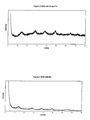
- Figure 3 shows the XRD pattern of the QCB formed.
- a QCB was prepared by co-precipitation of aluminium sulfate and sodium aluminate to a final pH of 10 at a temperature of 80 °C in the presence of 10 wt% (calculated as the oxide based on the alumina) nickel nitrate. The reaction product is aged at a temperature of 80 °C for 48 hours.
- a QCB was co-precipitated by co-precipitation of aluminium sulfate and sodium aluminate to a final pH of 10 at a temperature of 80 °C in the presence of 8 wt% (calculated as the oxide based on the alumina) cobalt nitrate.
- the reaction product is aged at a temperature of 80 °C for 48 hours.
- a QCB was co-precipitated by co-precipitation of aluminium sulfate and sodium aluminate to a final pH of 10 at a temperature of 80 °C in the presence of 5 wt% (calculated as the oxide based on the alumina) molybdenum nitrate.
- the reaction product is aged at a temperature of 80 °C for 48 hours.
- a QCB was co-precipitated by co-precipitation of aluminium sulfate and sodium aluminate to a final pH of 10 at a temperature of 80 °C in the presence of 8 wt% cobalt nitrate and 5 wt% (both calculated as the oxides based on the alumina) molybdenum nitrate.
- the reaction product is aged at a temperature of 80 °C for 48 hours.
- a QCB was co-precipitated by co-precipitation of aluminium sulfate and sodium aluminate to a final pH of 10 at a temperature of 80 °C in the presence of 9 wt% nickel nitrate, 8 wt% cobalt nitrate, and 6 wt% molybdenum nitrate (all calculated as the oxides based on the alumina).
- the reaction product is aged at a temperature of 80 °C for 48 hours.
- P3 ® alumina was treated with 10 wt% (calculated as the oxide) gallium nitrate in solution at a temperature of 90°C for 18 hours, the pH being kept at 6.1.
- Figure 5 shows the XRD pattern of the QCB formed.
Landscapes
- Chemical & Material Sciences (AREA)
- Engineering & Computer Science (AREA)
- Organic Chemistry (AREA)
- Materials Engineering (AREA)
- Chemical Kinetics & Catalysis (AREA)
- Inorganic Chemistry (AREA)
- Manufacturing & Machinery (AREA)
- Ceramic Engineering (AREA)
- Life Sciences & Earth Sciences (AREA)
- Geology (AREA)
- Dispersion Chemistry (AREA)
- Structural Engineering (AREA)
- Catalysts (AREA)
- Compounds Of Alkaline-Earth Elements, Aluminum Or Rare-Earth Metals (AREA)
- Organic Low-Molecular-Weight Compounds And Preparation Thereof (AREA)
- Nitrogen And Oxygen Or Sulfur-Condensed Heterocyclic Ring Systems (AREA)
- Transition And Organic Metals Composition Catalysts For Addition Polymerization (AREA)
- Cosmetics (AREA)
- Silicates, Zeolites, And Molecular Sieves (AREA)
Applications Claiming Priority (3)
| Application Number | Priority Date | Filing Date | Title |
|---|---|---|---|
| US372558 | 1995-01-13 | ||
| US37255899A | 1999-08-11 | 1999-08-11 | |
| EP00964010A EP1204596B1 (en) | 1999-08-11 | 2000-08-11 | Quasi-crystalline boehmites containing additives |
Related Parent Applications (1)
| Application Number | Title | Priority Date | Filing Date |
|---|---|---|---|
| EP00964010.3 Division | 2000-08-11 |
Publications (1)
| Publication Number | Publication Date |
|---|---|
| EP1491500A2 true EP1491500A2 (en) | 2004-12-29 |
Family
ID=23468662
Family Applications (2)
| Application Number | Title | Priority Date | Filing Date |
|---|---|---|---|
| EP20040077631 Withdrawn EP1491500A2 (en) | 1999-08-11 | 2000-08-11 | Quasi-crystalline boehmites containing additives |
| EP00964010A Revoked EP1204596B1 (en) | 1999-08-11 | 2000-08-11 | Quasi-crystalline boehmites containing additives |
Family Applications After (1)
| Application Number | Title | Priority Date | Filing Date |
|---|---|---|---|
| EP00964010A Revoked EP1204596B1 (en) | 1999-08-11 | 2000-08-11 | Quasi-crystalline boehmites containing additives |
Country Status (12)
| Country | Link |
|---|---|
| US (1) | US6503867B1 (https=) |
| EP (2) | EP1491500A2 (https=) |
| JP (1) | JP2003507296A (https=) |
| KR (1) | KR100711321B1 (https=) |
| CN (1) | CN1247460C (https=) |
| AT (1) | ATE280737T1 (https=) |
| BR (1) | BR0013136A (https=) |
| CA (1) | CA2381410C (https=) |
| DE (1) | DE60015352T2 (https=) |
| ES (1) | ES2232499T3 (https=) |
| PT (1) | PT1204596E (https=) |
| WO (1) | WO2001012551A2 (https=) |
Cited By (1)
| Publication number | Priority date | Publication date | Assignee | Title |
|---|---|---|---|---|
| RU2522343C1 (ru) * | 2013-01-21 | 2014-07-10 | Открытое акционерное общество "Акрон" | Способ переработки нитратных солей |
Families Citing this family (30)
| Publication number | Priority date | Publication date | Assignee | Title |
|---|---|---|---|---|
| DE19836821A1 (de) * | 1998-08-14 | 2000-02-24 | Rwe Dea Ag | Böhmitische Tonerden und aus diesen erhältliche phasenreine, hochtemperaturstabile und hochporöse Aluminiumoxide |
| US7208446B2 (en) * | 1999-08-11 | 2007-04-24 | Albemarle Netherlands B. V. | Quasi-crystalline boehmites containing additives |
| AU2002367444A1 (en) * | 2001-05-10 | 2003-09-29 | Akzo Nobel N.V. | Continuous process and apparatus for the efficient conversion of inorganic solid particles |
| RU2336935C2 (ru) * | 2002-08-13 | 2008-10-27 | Интеркэт, Инк. | Обработка дымовых газов для снижения выбросов nox и со |
| US6969692B2 (en) | 2002-08-28 | 2005-11-29 | Albemarle Netherlands B.V. | Process for the preparation of doped pentasil-type zeolites using a doped reactant |
| US6964934B2 (en) | 2002-08-28 | 2005-11-15 | Albemarle Netherlands B.V. | Process for the preparation of doped pentasil-type zeolite using doped seeds |
| AU2003301247A1 (en) * | 2002-10-16 | 2004-05-04 | Conocophillips Company | Fischer-tropsch processes and catalysts made from a material comprising boehmite |
| US7341976B2 (en) * | 2002-10-16 | 2008-03-11 | Conocophillips Company | Stabilized boehmite-derived catalyst supports, catalysts, methods of making and using |
| CA2500646C (en) * | 2002-10-16 | 2010-12-14 | Conocophillips Company | Fischer-tropsch processes and catalysts using stabilized supports |
| US7402612B2 (en) * | 2002-10-16 | 2008-07-22 | Conocophillips Company | Stabilized transition alumina catalyst support from boehmite and catalysts made therefrom |
| US8277773B2 (en) | 2004-02-13 | 2012-10-02 | Velocys Corp. | Steam reforming method |
| US7722854B2 (en) * | 2003-06-25 | 2010-05-25 | Velocy's | Steam reforming methods and catalysts |
| US7186757B2 (en) * | 2003-10-16 | 2007-03-06 | Conocophillips Company | Silica-alumina catalyst support with bimodal pore distribution, catalysts, methods of making and using same |
| WO2005046855A2 (en) * | 2003-10-16 | 2005-05-26 | Conocophillips Company | Silica-alumina catalyst support, catalysts made therefrom and methods of making and using same |
| ATE478032T1 (de) * | 2003-11-26 | 2010-09-15 | Albemarle Netherlands Bv | Hydrothermalverfahren zur herstellung von quasikristallinem boehmit |
| KR100912041B1 (ko) | 2003-12-05 | 2009-08-12 | 인터캣, 인코포레이티드 | 혼합 금속 산화물 흡수체 |
| US7431825B2 (en) * | 2003-12-05 | 2008-10-07 | Intercat, Inc. | Gasoline sulfur reduction using hydrotalcite like compounds |
| TWI342335B (en) * | 2004-06-02 | 2011-05-21 | Intercat Inc | Mixed metal oxide additives |
| JP5255844B2 (ja) * | 2004-12-21 | 2013-08-07 | アルベマール・ネーザーランズ・ベー・ブイ | 触媒、これらの製造方法およびこれらの使用 |
| CN1915485B (zh) * | 2005-08-17 | 2010-05-12 | 中国石油化工股份有限公司 | 一种含添加剂的氧化铝 |
| CN1915486B (zh) * | 2005-08-17 | 2010-05-12 | 中国石油化工股份有限公司 | 一种含添加剂的具有拟薄水铝石结构的水合氧化铝 |
| CN101116818B (zh) * | 2006-07-31 | 2010-12-01 | 中国石油化工股份有限公司 | 一种含金属元素的水合氧化铝及其制备方法 |
| CN102574109B (zh) * | 2009-10-23 | 2014-12-31 | 三菱瓦斯化学株式会社 | 甲醇合成催化剂 |
| CN102234125B (zh) * | 2010-04-30 | 2013-09-25 | 中国石油化工股份有限公司 | 含碱金属和/或碱土金属组分的拟薄水铝石及由其制备的氧化铝 |
| CN102234124B (zh) * | 2010-04-30 | 2013-07-31 | 中国石油化工股份有限公司 | 含过渡金属组分的拟薄水铝石以及由其制备的氧化铝 |
| CN102267710B (zh) * | 2010-06-03 | 2014-05-28 | 中国石油化工股份有限公司 | 一种含硼拟薄水铝石及由其制备的氧化铝 |
| CN109954885A (zh) * | 2017-12-25 | 2019-07-02 | 中国石油化工股份有限公司 | 一种增材制造用复合粉末及其制备方法 |
| EP4277743A1 (en) | 2021-01-15 | 2023-11-22 | Albemarle Corporation | Pseudo solid state crystallization of zeolites and uses therein |
| CN116124587B (zh) * | 2023-02-20 | 2025-07-08 | 贵州大学 | 一种孔洞状态下控制晶体层厚度提升材料强度的模拟方法 |
| CN116835620B (zh) * | 2023-05-30 | 2024-07-09 | 中国石油大学(华东) | 一种插层-剥离勃姆石制备二维纳米片的方法 |
Family Cites Families (30)
| Publication number | Priority date | Publication date | Assignee | Title |
|---|---|---|---|---|
| US3357791A (en) | 1964-07-20 | 1967-12-12 | Continental Oil Co | Process for producing colloidal-size particles of alumina monohydrate |
| US3669904A (en) * | 1970-05-28 | 1972-06-13 | Air Prod & Chem | Particles featuring gamma alumina |
| US4117105A (en) | 1977-03-21 | 1978-09-26 | Pq Corporation | Process for preparing dispersible boehmite alumina |
| JPS5527830A (en) * | 1978-08-15 | 1980-02-28 | Chiyoda Chem Eng & Constr Co Ltd | Production of alumina carrier |
| FR2449650A1 (fr) * | 1979-02-26 | 1980-09-19 | Rhone Poulenc Ind | Procede de preparation d'alumine au moins partiellement sous forme de boehmite ultra-fine |
| US4318896A (en) * | 1980-04-14 | 1982-03-09 | Uop Inc. | Manufacture of alumina particles |
| JPS5930668B2 (ja) * | 1980-11-14 | 1984-07-28 | 新技術開発事業団 | アルミナ含有セラミツク成形物の製造法 |
| US4379134A (en) * | 1981-02-13 | 1983-04-05 | Union Carbide Corporation | Process of preparing high purity alumina bodies |
| EP0130835B1 (en) | 1983-07-01 | 1990-05-02 | Hitachi, Ltd. | High temperature stable catalyst, process for preparing same and process for conducting chemical reaction using same |
| US5194243A (en) | 1983-09-22 | 1993-03-16 | Aluminum Company Of America | Production of aluminum compound |
| US4676928A (en) * | 1986-01-30 | 1987-06-30 | Vista Chemical Company | Process for producing water dispersible alumina |
| US4797139A (en) | 1987-08-11 | 1989-01-10 | Norton Company | Boehmite produced by a seeded hydyothermal process and ceramic bodies produced therefrom |
| JP2920255B2 (ja) * | 1990-05-21 | 1999-07-19 | 住友金属鉱山株式会社 | 水素化脱硫触媒 |
| FR2663245B1 (fr) * | 1990-06-13 | 1992-09-18 | Rhone Poulenc Chimie | Composition a base d'alumine pour catalyseur et procede de fabrication. |
| US5219806A (en) * | 1990-07-16 | 1993-06-15 | Minnesota Mining And Manufacturing Company | Alpha phase seeding of transition alumina using chromium oxide-based nucleating agents |
| JP3102082B2 (ja) * | 1990-09-26 | 2000-10-23 | 住友化学工業株式会社 | 耐熱性遷移アルミナの製造法 |
| JP3046060B2 (ja) * | 1990-11-30 | 2000-05-29 | 水澤化学工業株式会社 | 微粉末状アルミナ系複合酸化物、その製法及びインクジェット記録紙用填料 |
| US5837634A (en) * | 1992-11-12 | 1998-11-17 | Condea Vista Company | Process for producing stabilized alumina having enhanced resistance to loss of surface area at high temperatures |
| FR2697832B1 (fr) * | 1992-11-12 | 1994-12-30 | Rhone Poulenc Chimie | Alumine stabilisée par du lanthane et son procédé de préparation. |
| US5800797A (en) * | 1993-12-09 | 1998-09-01 | Catalysts & Chemicals Industries Co., Ltd. | Process for producing alumina and apparatus therefor |
| JPH08268716A (ja) * | 1995-03-30 | 1996-10-15 | Japan Energy Corp | 擬ベ−マイト粉の粒径制御方法 |
| US5681658A (en) * | 1995-05-30 | 1997-10-28 | Aluminum Company Of America | Gelation-resistant alumina |
| US5877106A (en) * | 1997-01-03 | 1999-03-02 | Asec Manufacturing | Stabilized crystalline alumina compositions |
| JPH1045412A (ja) * | 1996-07-31 | 1998-02-17 | Sumitomo Chem Co Ltd | 耐熱性遷移アルミナ及びその製造方法 |
| JPH10194733A (ja) * | 1996-11-14 | 1998-07-28 | Sumitomo Chem Co Ltd | 耐熱性遷移アルミナ及びその製造方法 |
| FR2764213B1 (fr) * | 1997-06-10 | 1999-07-16 | Inst Francais Du Petrole | Catalyseur d'hydrotraitement de charges hydrocarbonees dans un reacteur a lit fixe |
| JP3653383B2 (ja) * | 1997-12-25 | 2005-05-25 | 触媒化成工業株式会社 | シリカ含有アルミナ成形体の製造方法 |
| WO1999038802A1 (fr) * | 1998-01-30 | 1999-08-05 | Japan Energy Corporation | Procede de fabrication de pseudo-bohemite |
| US6027706A (en) * | 1998-05-05 | 2000-02-22 | Board Of Trustees Operating Michigan State University | Porous aluminum oxide materials prepared by non-ionic surfactant assembly route |
| US6262132B1 (en) * | 1999-05-21 | 2001-07-17 | Energy International Corporation | Reducing fischer-tropsch catalyst attrition losses in high agitation reaction systems |
-
2000
- 2000-08-11 PT PT00964010T patent/PT1204596E/pt unknown
- 2000-08-11 ES ES00964010T patent/ES2232499T3/es not_active Expired - Lifetime
- 2000-08-11 WO PCT/EP2000/007794 patent/WO2001012551A2/en not_active Ceased
- 2000-08-11 JP JP2001516856A patent/JP2003507296A/ja active Pending
- 2000-08-11 EP EP20040077631 patent/EP1491500A2/en not_active Withdrawn
- 2000-08-11 DE DE60015352T patent/DE60015352T2/de not_active Revoked
- 2000-08-11 KR KR1020027001566A patent/KR100711321B1/ko not_active Expired - Fee Related
- 2000-08-11 CA CA002381410A patent/CA2381410C/en not_active Expired - Fee Related
- 2000-08-11 AT AT00964010T patent/ATE280737T1/de not_active IP Right Cessation
- 2000-08-11 US US09/636,690 patent/US6503867B1/en not_active Expired - Fee Related
- 2000-08-11 CN CNB008113890A patent/CN1247460C/zh not_active Expired - Fee Related
- 2000-08-11 BR BR0013136-9A patent/BR0013136A/pt not_active Application Discontinuation
- 2000-08-11 EP EP00964010A patent/EP1204596B1/en not_active Revoked
Cited By (1)
| Publication number | Priority date | Publication date | Assignee | Title |
|---|---|---|---|---|
| RU2522343C1 (ru) * | 2013-01-21 | 2014-07-10 | Открытое акционерное общество "Акрон" | Способ переработки нитратных солей |
Also Published As
| Publication number | Publication date |
|---|---|
| CN1247460C (zh) | 2006-03-29 |
| KR20020026363A (ko) | 2002-04-09 |
| CN1368937A (zh) | 2002-09-11 |
| KR100711321B1 (ko) | 2007-04-27 |
| EP1204596A2 (en) | 2002-05-15 |
| DE60015352D1 (de) | 2004-12-02 |
| WO2001012551A3 (en) | 2001-08-30 |
| US6503867B1 (en) | 2003-01-07 |
| EP1204596B1 (en) | 2004-10-27 |
| ES2232499T3 (es) | 2005-06-01 |
| CA2381410C (en) | 2009-01-27 |
| PT1204596E (pt) | 2005-03-31 |
| BR0013136A (pt) | 2002-04-30 |
| CA2381410A1 (en) | 2001-02-22 |
| DE60015352T2 (de) | 2005-10-20 |
| JP2003507296A (ja) | 2003-02-25 |
| ATE280737T1 (de) | 2004-11-15 |
| WO2001012551A2 (en) | 2001-02-22 |
Similar Documents
| Publication | Publication Date | Title |
|---|---|---|
| CA2381410C (en) | Quasi-crystalline boehmites containing additives | |
| CA2381301C (en) | Process for the preparation of quasi-crystalline boehmites | |
| US6555496B1 (en) | Micro-crystalline boehmites containing additives | |
| EP1200349B2 (en) | Process for the preparation of quasi-crystalline boehmites from inexpensive precursors | |
| US7208446B2 (en) | Quasi-crystalline boehmites containing additives | |
| EP1358129B1 (en) | Method of making doped anionic clays | |
| JP2003517993A (ja) | アルミナ三水化物から生じさせた高い細孔容積と高い表面積を有する酸化アルミニウム複合体そしてこれの製造および使用方法 | |
| US20030180214A1 (en) | Process for the preparation of quasi-crystalline boehmites |
Legal Events
| Date | Code | Title | Description |
|---|---|---|---|
| PUAI | Public reference made under article 153(3) epc to a published international application that has entered the european phase |
Free format text: ORIGINAL CODE: 0009012 |
|
| 17P | Request for examination filed |
Effective date: 20040921 |
|
| AC | Divisional application: reference to earlier application |
Ref document number: 1204596 Country of ref document: EP Kind code of ref document: P |
|
| AK | Designated contracting states |
Kind code of ref document: A2 Designated state(s): AT BE CH CY DE DK ES FI FR GB GR IE IT LI LU MC NL PT SE |
|
| RAP1 | Party data changed (applicant data changed or rights of an application transferred) |
Owner name: ALBEMARLE NETHERLANDS B.V. |
|
| STAA | Information on the status of an ep patent application or granted ep patent |
Free format text: STATUS: THE APPLICATION HAS BEEN WITHDRAWN |
|
| 18W | Application withdrawn |
Effective date: 20090424 |