EP1472593B1 - Verbesserte einrichtungsschnittstelle - Google Patents
Verbesserte einrichtungsschnittstelle Download PDFInfo
- Publication number
- EP1472593B1 EP1472593B1 EP02766922A EP02766922A EP1472593B1 EP 1472593 B1 EP1472593 B1 EP 1472593B1 EP 02766922 A EP02766922 A EP 02766922A EP 02766922 A EP02766922 A EP 02766922A EP 1472593 B1 EP1472593 B1 EP 1472593B1
- Authority
- EP
- European Patent Office
- Prior art keywords
- keys
- mobile telephone
- telephone
- key
- housing
- Prior art date
- Legal status (The legal status is an assumption and is not a legal conclusion. Google has not performed a legal analysis and makes no representation as to the accuracy of the status listed.)
- Expired - Lifetime
Links
Images




Classifications
-
- H—ELECTRICITY
- H04—ELECTRIC COMMUNICATION TECHNIQUE
- H04M—TELEPHONIC COMMUNICATION
- H04M1/00—Substation equipment, e.g. for use by subscribers
- H04M1/72—Mobile telephones; Cordless telephones, i.e. devices for establishing wireless links to base stations without route selection
- H04M1/724—User interfaces specially adapted for cordless or mobile telephones
- H04M1/72466—User interfaces specially adapted for cordless or mobile telephones with selection means, e.g. keys, having functions defined by the mode or the status of the device
-
- G—PHYSICS
- G06—COMPUTING OR CALCULATING; COUNTING
- G06F—ELECTRIC DIGITAL DATA PROCESSING
- G06F1/00—Details not covered by groups G06F3/00 - G06F13/00 and G06F21/00
- G06F1/16—Constructional details or arrangements
- G06F1/1613—Constructional details or arrangements for portable computers
- G06F1/1626—Constructional details or arrangements for portable computers with a single-body enclosure integrating a flat display, e.g. Personal Digital Assistants [PDAs]
-
- G—PHYSICS
- G06—COMPUTING OR CALCULATING; COUNTING
- G06F—ELECTRIC DIGITAL DATA PROCESSING
- G06F1/00—Details not covered by groups G06F3/00 - G06F13/00 and G06F21/00
- G06F1/16—Constructional details or arrangements
- G06F1/1613—Constructional details or arrangements for portable computers
- G06F1/1633—Constructional details or arrangements of portable computers not specific to the type of enclosures covered by groups G06F1/1615 - G06F1/1626
- G06F1/1662—Details related to the integrated keyboard
-
- G—PHYSICS
- G06—COMPUTING OR CALCULATING; COUNTING
- G06F—ELECTRIC DIGITAL DATA PROCESSING
- G06F3/00—Input arrangements for transferring data to be processed into a form capable of being handled by the computer; Output arrangements for transferring data from processing unit to output unit, e.g. interface arrangements
- G06F3/01—Input arrangements or combined input and output arrangements for interaction between user and computer
- G06F3/02—Input arrangements using manually operated switches, e.g. using keyboards or dials
- G06F3/023—Arrangements for converting discrete items of information into a coded form, e.g. arrangements for interpreting keyboard generated codes as alphanumeric codes, operand codes or instruction codes
- G06F3/0233—Character input methods
- G06F3/0237—Character input methods using prediction or retrieval techniques
-
- G—PHYSICS
- G06—COMPUTING OR CALCULATING; COUNTING
- G06F—ELECTRIC DIGITAL DATA PROCESSING
- G06F3/00—Input arrangements for transferring data to be processed into a form capable of being handled by the computer; Output arrangements for transferring data from processing unit to output unit, e.g. interface arrangements
- G06F3/01—Input arrangements or combined input and output arrangements for interaction between user and computer
- G06F3/02—Input arrangements using manually operated switches, e.g. using keyboards or dials
- G06F3/023—Arrangements for converting discrete items of information into a coded form, e.g. arrangements for interpreting keyboard generated codes as alphanumeric codes, operand codes or instruction codes
- G06F3/0238—Programmable keyboards
-
- G—PHYSICS
- G06—COMPUTING OR CALCULATING; COUNTING
- G06F—ELECTRIC DIGITAL DATA PROCESSING
- G06F3/00—Input arrangements for transferring data to be processed into a form capable of being handled by the computer; Output arrangements for transferring data from processing unit to output unit, e.g. interface arrangements
- G06F3/01—Input arrangements or combined input and output arrangements for interaction between user and computer
- G06F3/048—Interaction techniques based on graphical user interfaces [GUI]
- G06F3/0481—Interaction techniques based on graphical user interfaces [GUI] based on specific properties of the displayed interaction object or a metaphor-based environment, e.g. interaction with desktop elements like windows or icons, or assisted by a cursor's changing behaviour or appearance
-
- G—PHYSICS
- G06—COMPUTING OR CALCULATING; COUNTING
- G06F—ELECTRIC DIGITAL DATA PROCESSING
- G06F3/00—Input arrangements for transferring data to be processed into a form capable of being handled by the computer; Output arrangements for transferring data from processing unit to output unit, e.g. interface arrangements
- G06F3/01—Input arrangements or combined input and output arrangements for interaction between user and computer
- G06F3/048—Interaction techniques based on graphical user interfaces [GUI]
- G06F3/0481—Interaction techniques based on graphical user interfaces [GUI] based on specific properties of the displayed interaction object or a metaphor-based environment, e.g. interaction with desktop elements like windows or icons, or assisted by a cursor's changing behaviour or appearance
- G06F3/0482—Interaction with lists of selectable items, e.g. menus
-
- H—ELECTRICITY
- H04—ELECTRIC COMMUNICATION TECHNIQUE
- H04M—TELEPHONIC COMMUNICATION
- H04M1/00—Substation equipment, e.g. for use by subscribers
- H04M1/02—Constructional features of telephone sets
- H04M1/23—Construction or mounting of dials or of equivalent devices; Means for facilitating the use thereof
- H04M1/236—Construction or mounting of dials or of equivalent devices; Means for facilitating the use thereof including keys on side or rear faces
-
- H—ELECTRICITY
- H04—ELECTRIC COMMUNICATION TECHNIQUE
- H04M—TELEPHONIC COMMUNICATION
- H04M1/00—Substation equipment, e.g. for use by subscribers
- H04M1/26—Devices for calling a subscriber
- H04M1/27—Devices whereby a plurality of signals may be stored simultaneously
- H04M1/274—Devices whereby a plurality of signals may be stored simultaneously with provision for storing more than one subscriber number at a time, e.g. using toothed disc
- H04M1/2745—Devices whereby a plurality of signals may be stored simultaneously with provision for storing more than one subscriber number at a time, e.g. using toothed disc using static electronic memories, e.g. chips
- H04M1/27467—Methods of retrieving data
- H04M1/27475—Methods of retrieving data using interactive graphical means or pictorial representations
-
- H—ELECTRICITY
- H04—ELECTRIC COMMUNICATION TECHNIQUE
- H04M—TELEPHONIC COMMUNICATION
- H04M1/00—Substation equipment, e.g. for use by subscribers
- H04M1/72—Mobile telephones; Cordless telephones, i.e. devices for establishing wireless links to base stations without route selection
- H04M1/724—User interfaces specially adapted for cordless or mobile telephones
- H04M1/72403—User interfaces specially adapted for cordless or mobile telephones with means for local support of applications that increase the functionality
- H04M1/7243—User interfaces specially adapted for cordless or mobile telephones with means for local support of applications that increase the functionality with interactive means for internal management of messages
-
- H—ELECTRICITY
- H04—ELECTRIC COMMUNICATION TECHNIQUE
- H04M—TELEPHONIC COMMUNICATION
- H04M1/00—Substation equipment, e.g. for use by subscribers
- H04M1/72—Mobile telephones; Cordless telephones, i.e. devices for establishing wireless links to base stations without route selection
- H04M1/724—User interfaces specially adapted for cordless or mobile telephones
- H04M1/72403—User interfaces specially adapted for cordless or mobile telephones with means for local support of applications that increase the functionality
- H04M1/72445—User interfaces specially adapted for cordless or mobile telephones with means for local support of applications that increase the functionality for supporting Internet browser applications
Definitions
- the present invention relates to a small computing device with an improved interface, and, particularly, but not exclusively, to a mobile communications device, such as a mobile telephone.
- the display screens provided for mobile telephones are, by necessity, also small where the phone is small. They are not able to provide, therefore, a view of a great deal of information at any one time.
- GB-A-2 357 220 relates to a telecommunication apparatus with a conventional numeric keypad, the apparatus for receiving a page of information from a remote source.
- the page contains a link to a linked page of information and is displayed on a display.
- a user operable input device is provided that is associated with the link. Actuation of the input device causes a request to be sent for the linked page.
- US 5,633,912 relates to a user interface for use in a mobile telephone handset.
- the interface includes dynamic visual display means for presenting a plurality of context sensitive function labels. Fixed-label signalling keys and soft-label keys are also provided.
- the handset includes a conventional numeric keypad for enabling a telephone number to be dialled.
- US 6,032,053 relates to a user interface for a cellular telephone system subscriber unit, including the following functions: (1) a predictive keyboard input method; (2) a word completion method; (3) a distinctive signalling method; (4) a secret message method that permits secret messages to be received by an authorized user of a cellular telephone that includes a data messaging capability; (5) a message screening method that permits a user to set a message screening mode in a cellular telephone; (6) a "scratchpad" method which permits a user to enter a telephone number into a storage register of a cellular telephone while in the middle of a voice call, visually verify the entry, and then save the number to a rapid redial location for later use; (7) a global search method for searching text strings in all of the different memory sections of a cellular telephone having an address book, a hierarchical menu structure, and stored data messages.
- Predictive keyboard input provides a method for displaying and selecting individual characters per input step.
- the present invention provides a small computing device that is a mobile telephone according to appended claim 1.
- the first and second plurality of keys are positioned in rows running parallel to the length of the display screen.
- Each row is preferably only one key in width.
- control means is arranged to control operation of the small computing device, the control means being arranged to control the small computing device to operate in a plurality of operating modes, wherein the keys operate as multi-function keys.
- control means is arranged to control the device such that the particular function of a key in a particular operating mode is designated by indicia appearing on the display screen.
- indicia appear adjacent the associated key.
- the first plurality of keys comprises two or more keys and the second plurality of keys comprises two or more keys.
- the first plurality of keys comprises between four and ten keys and the second plurality of keys comprises between four and ten keys.
- the first plurality of keys comprises six to eight keys and the second plurality of keys comprises six to eight keys.
- the keys are associated with numerics and operation of the keys is arranged to input numerals to the small computing device.
- each of the keys are associated in one operating mode with each of the ten digits of the decimal numeral system appearing as indicia on the display screen.
- a scrolling function is provided which enables information on the display screen to be scrolled.
- the scrolling function has a plurality of modes of scrolling.
- each of the keys is associated with one or more of the modes of scrolling.
- the device does not include any standard numeric or alpha-numeric keypad. It may include a limited number of additional keys, such as "yes” or “no” and/or “direction” keys, but the majority of the functions of the device are preferably carried out by the first and second plurality of keys.
- a plurality of the first and second plurality of keys are associated with a plurality of menu options. Selection of a menu option by actuating an associated key in this mode, then switches the device to a further operating mode where a plurality of the first and second plurality of keys are associated with a menu item within the selected menu option.
- the number of menu items is equal to or less than the number of the first and second plurality of keys, enabling selection of a menu item by a simple two step operation of the interface, the first step selecting the menu option, the second step selecting the menu item within the menu.
- operation is not limited to two step operation, and there may be modes where more than two steps of operation are implemented.
- the text sense means proposes further characters to go with the characters already selected, and the user may select or deny the word or further characters.
- the text sense means may also be arranged to provide a suggestion without a user having first selected characters of the word ie. text sense may be arranged to provide a suggestion for the start of the word.
- the text sense means does not provide a suggestion which completes a word, and provides a selection of one or more than one characters that continue a word.
- a speaker area is positioned on the face of the housing above the screen, for transmission of sound to the user.
- the small computing device of the present invention preferably has the advantage that it uses multi-function keys positioned adjacent the display screen, rather than a conventional numeric keypad (such as used on conventional mobile telephones), which enables more room on a face of the device for the screen so that more information can be displayed.
- the interface preferably uses "soft" buttons (ie. the buttons are multi-function) the function of the device can be altered easily by altering the software/hardware that drives the device.
- the interface is totally flexible and not limited by any dedicated operation (as normally is the case with conventional alpha-numeric keypads).
- the small computing device may be controlled by the control means in a hard key operating mode.
- the keys are arranged to input data associated with hard labels appearing on the small computing device and not on the display screen (ie. not "soft" labels).
- a plurality of the keys may be labelled with numerics and in a hard key operating mode may be operable to input numerics.
- a small computing device is arranged in one operating mode to act as a dedicated function device.
- functions associated with the multi-function keys are pre-configurable and are arranged to operate in a dedicated mode ie. the multi-function keys become dedicated function keys.
- This feature can be used to implement small devices including telephones having dedicated operation.
- a telephone which may be dedicated for operation by a particular person, such as a child, and be limited to, for example, being able to call only selected telephone numbers.
- Functionality of the small device of the present invention may be implemented by appropriate software and/or hardware.
- a communications device including a housing and a display screen extending along a face of the housing lengthwise, a first plurality of keys positioned sequentially adjacent one side of the screen and a second plurality of keys positioned sequentially adjacent the opposite side of the screen, the device including means enabling the device to be worn by a user.
- a conventional mobile telephone comprises a controller for controlling operation of the telephone, usually in the form of a processor, a radio transceiver for communicating voice and/or text messages to and from the telephone, and an interface for input and output by the user.
- a typical mobile telephone includes a housing which mounts the processor, radio transceiver communications and other required circuitry, the housing having one face which mounts the interface, comprising (usually) a twelve button numeric keypad, "yes” and “no” keys and “direction” keys, a display screen and a space above the display screen for a speaker area.
- the display area is also very small so it is not possible to display a great deal of information at any one of time.
- the traditional numeric keypad interface hampers these activities greatly as it is a far from ideal method of controlling text input. For example, in order to input text, it is necessary to actuate a key four times in some cases to enter a letter.
- FIG. 1 of the drawings is a front view of a mobile telephone in accordance with an embodiment of the present invention.
- the telephone includes a housing 1, which in this embodiment mounts internally mobile telephone circuitry (see later), and has a front face 2.
- the front face 2 mounts an interface which includes a display screen 3.
- the display screen 3 may be any convenient type of display eg. LCD.
- the interface includes a first row of keys 4 and a second row of keys 5, the rows 4 and 5 in this embodiment extending in a line along the face of the housing on either side of the display screen 3.
- Each of the keys 6 in the rows 4 and 5 are controlled as "multi function" keys in this embodiment.
- the interface is arranged such that a function of a particular key 6 at any time will be indicated by dynamic labels appearing next to the key 6 on the display screen 3, controlled by the device processor (see later). The functions change depending on the activity the user is performing.
- the interface does not include any standard alpha-numeric key pad.
- a "yes” 7 and “no” 8 key is included positioned below the screen, and can be associated with the usual "yes” and “no” functions eg. to initiate a telephone call ("yes” button) or finish a telephone call (“no" button).
- the format is sufficiently versatile to be more capable of implementing future functions, depending on software/hardware provided in the device. It is also possible that various "personal digital assistant" (PDA) - type functionality could also be implemented using this interface eg. calenders, diaries.
- PDA personal digital assistant
- FIG 2 illustrates a small device 10 which may resemble such items as a watch, pager or pendant.
- the device 10 includes a housing 11 which mounts on one face 12 an interface including a display screen 13 and first 14 and second 15 rows of keys 16.
- the key 16 may be on the side of the device rather than on the face 12, and in the figure 2 , the areas 17, 18, 19 and 20 are folded down ie. they are the sides, top and bottom, of the housing 11.
- “Yes" 21 and "no" 22 buttons are provided at the bottom 17 of the device 10.
- This small device may be a communications device, a PDA, or any other small computing device.
- One advantage of this type of device is that it could be worn rather than carried which means the user may have the device with them at all times. Such a device could become ubiquitous.
- both figure 1 and figure 2 because the keys are placed in a row, they can be conveniently separated so that a finger does not overlap more than one key when a key is pressed. This results in easy control of a small device compared to, for example, the standard alpha-numeric keypads on small telephones, which are very clumsy to deal with.
- figure 1 and figure 2 Another advantage of the arrangement of both figure 1 and figure 2 is the larger screen, which provides the ability to be able to see more text at a time, see more of the context of what is being read. It is also possible that images and more complicated documents may be viewed.
- the interface also enables faster, easier text entry (see later on how text may be entered) so that it is easier to use text based services such as SMS and e-mail. Further, because of the large screen and the multi-function keys it is possible to implement a simpler, more intuitive menu operation (see later).
- the interface enables many options to be presented at once rather than one at a time as is conventional with typical mobile telephones.
- this device does not require any particularly new manufacturing techniques over those already used for a conventional mobile telephone and PDAs.
- the internal hardware of a mobile telephone may be similar (although, of course it may vary). It is merely the arrangement of the display and the keys that is altered.
- One particular advantage of this is that this is by altering software the language of operation of the device can be altered. Operation could include operation in Chinese characters, for example, utilising the same interface and the multi-function keys.
- FIGS. 3 through 13 of the drawings are schematic representations of the interface of a device in accordance with an embodiment of the present invention, for the purposes of illustrating some of the functions which may be implemented utilising this interface.
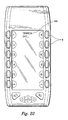
- Figure 22 illustrates an embodiment where the soft labels on the screen do not take up the whole screen width and entry may be made on the screen between the labels. In this case numeric entry 100 is indicated.
- FIG 4 illustrates an operating mode enabling simple numeric entry into the device.
- Each of the keys 6 is associated with a numeral or a * or a #. This is equivalent to a standard numeric keypad on, for example, a standard mobile telephone. The difference here is that the keys 6 are dynamic and this "numeric keypad" is one operating mode only. Pressing “yes” 7 enables the telephone connection and pressing "no” 8 would be used to hang up, disconnect or abort the function. Note that an area for display of the number that is input in may be provided on display screen 3 (area not shown).
- Typical mobile telephones allow selection from an array of menu options by requiring the user to navigate through a "tree", generally one option at time, using "direction” keys. This limits the user to a "tunnel vision" view of the interface and results in many key presses required to perform any one function.
- many menu options can be presented to the user at any one time and if it is desired any of those options may go on to a further menu of more options (depending upon the number of multi-function keys available).
- Figures 5 though 7 illustrates some typical menus that may be utilised in the small device of this embodiment.
- Figure 5 and 6 show twelve menu options, each one associated with a key 6, eg in figure 5 options include “call number”, “send msg”, “send email” “programs” "addresses”, “into”, name”, “view msg”, view email” “games", “internet”, “settings”.
- the options include "text", "ring”, “clock”, “alert”, “key sound”, “key lock”, “list”, answer mode", voice ans", "store”, “ph num”, “more".
- figure 6 represents "settings” menu selectable via the interface of figure 5 .
- the figure 6 display also enable a selection of "more” settings.
- an operating function corresponds to an option selection (ie. selection of a particular menu item within a menu).
- option selection ie. selection of a particular menu item within a menu.
- on-line screen labels for the option are highlighted to indicate the current selection state. In figures 8 through 11 this is illustrated by underlining in the diagrams.
- a binary option is either on or off and may be toggled in place by pressing its associated key.
- Figure 8 illustrates a text setting menu with the "key beep" off.
- Figure 9 illustrates a text setting menu with the "key beep" on. This is a binary option.
- a multiple selection option enables a user to choose one or more items from a list of several items.
- Figure 10 illustrates the ring melody menu for a telephone with the original setting "Rivers of Arabic”.
- Figure 11 illustrates the ring melody menu with the setting changed (multiple selection option).
- Figures 12 and 13 illustrate how scrolling of the display screen 3 may be implemented utilising this interface.
- Scrolling such as illustrated in figure 12 may be implemented.
- this operating mode implements scrolling.
- Indicia 30 indicates that pressing the associated key 6 would move the display to the top of the document.
- Indicia 31 indicates that pressing the associated key 6 would move the document up a page.
- Indicia 32 indicates that pressing the associated key 6 moves the document up a line.
- Indicia 33, 34 and 35 have the equivalent functions in the opposite direction to 32, 31 and 30 respectively.
- Figure 12 illustrates scrolling as applied to a document.
- Figure 13 illustrates scrolling as applied to a menu. This option may be used when there are more menu options to display then will fit on the display screen.
- the row of buttons 4 is associated with menu selection and the row of buttons 5 on the right hand side is associated with the scrolling function.
- Figure 13 illustrates a phone book function where six addresses (of David Bowie, Dean Martin, Jerry Lewis, Jack Nicholson, John West and Mick Jagger) are visible at any one time. To select one that is visible the user would press the relevant associated button in the row 4 and to see more they use the scroll control associated with keys in row 5.
- FIG. 15 shows 8 diagrams of the interface of the small device of the present invention, each diagram illustrating a different stage in input of text into the device.
- the same reference numerals are used for components equivalent to the components already described above.
- the two top keys on each of the rows 4 and 5 of the keys 6 are associated with "direction" indicia 40, 41, 42, 43.
- a space 44 on the display screen is available to indicate the results of characters entered using this operating mode.
- the other keys are associated with dynamic functions illustrating text entry, as will become clear from the following description.
- each of the lower four keys 6 of the rows 4 and 5 are associated with a soft key representing one of the characters of the group of the soft key 46 in diagram 1.
- Soft keys 50, 51, 52, 53, 54, 55, 56, 57 are associated with respectively the characters "i", "j", “k", “l”, “m”, “n”, “o” and "p”. The user actuates the key associated with the soft key 53 and this results in input in the character "1" to the device.
- numeric and alphabet soft keys 45, 46, 47, 48 there are also numeral 49 soft keys, a key 60 for "space”, a key 61 for "delete” and a key 62 for "more” options.
- the "best guess" may not include an option for progressing the intended word. If this is the case, the user must select the next character explicitly and allow the text sense functionality to guess based on this more explicit start string.
- the permutations for the conclusion for the word may be so great that text sense does not proffer the entire end of the word, just the next one, two or more character blocks.
- the end result is that the user can enter medium to large words with significantly less key strokes or button presses than if they had typed all the characters of the word.
- text sense will be implemented by appropriate software running on the control means, to provide a text sense means.
- text sense implementation refers to figure 23 .
- the internal data of the system is built up from a list presented to the system which contains all the words upon which to base guesses as well as an integer indicating a frequency of usage of the word.
- the frequency number does not have an absolute significance, it is only a representation of the frequency of usage of the word in relation to other words in the file.
- Figure 23 is a representation of the raw data (on the right) and the corresponding tree structure (on the left) built up internally for words starting with "Ie”.
- the system travels down the tree to the node that represents that start string. For instance, given the string “let” it would first go to the top “1” node then the “e” node under that then “t” node under that. This would bring us to the node that is shaded in the table above.
- step 3 we were presented with “ea” and “eg” but we wanted “et” so we explicitly entered “e”. Thus it would be possible at step 6 of the example to present "a” and "g” but this is unnecessary as we know that these are not part of the desired word.
- step 6 of the example we flag all nodes that have been presented so that when we are selecting candidates we treat flagged nodes as if they were not there.
- the system also optionally learn new words as the user uses them.
- the data set must be stored in persistent storage between activations of the system.
- Figure 24 illustrates a front view of a device in accordance with an embodiment of the present invention illustrating one form of interface for text entry.
- Figure 25 illustrates another form of interface which is modelled on the T9 style text entry with predictive guesses shown by indicators 200, 201, 202.
- the small device may be configured to operate in a dedicated operating mode which is pre-configurable, either by the manufacturer or by a user of the device so that the device cannot be easily switched from this one operating mode (for example it may have to be returned to the manufacturer or alternatively a user may have to enter a security code to switch the operating mode).
- a dedicated operating mode which is pre-configurable, either by the manufacturer or by a user of the device so that the device cannot be easily switched from this one operating mode (for example it may have to be returned to the manufacturer or alternatively a user may have to enter a security code to switch the operating mode).
- the keys can be associated with soft keys implementing any function which is enabled by the hardware/software of the device, the device can be configured in any dedicated operating mode.
- Figure 17 is a further diagram illustrating use of the interface of the small device of the present invention, in the case as applied to a mobile telephone.
- the same reference numerals have been used to designate the same components as in the previous drawings.
- the small device of this embodiment of the present invention has been pre-configured, either during manufacture or by application of a configuration step by a user (eg. a parent) to configure the telephone in a "kids" mode, as illustrated.
- the operation of the telephone cannot be changed, unless it is reconfigured by the manufacturer or by the parent (on entry of an appropriate security code, or other security operation).
- the keys 6 in the left hand row are associated with soft keys which include limited operations only such as “answer” 17, “hang up” 71 and stored numbers for dialling "mum” 72, "dad” 73, “school” 74 and "emergency” 75.
- Such a pre-configured telephone could be provided for a child's use, in the sure knowledge that they could not use the phone to dial any other numbers, and also would find the telephone very simple to operate and use in an emergency or to call school, mum or dad (or any other pre-configured number that may be required).
- Figure 26 illustrates a front view of a device in accordance with an embodiment of the invention in "kids" mode.
- the pre-configuration could take place at the factory ie. devices with this interface could be produced with dedicated functions, or a multi-function device may be produced in which at least a plurality of the keys may be "locked" into one particular function.
- Security means such as a PIN, may be available to unlock function if it is wished to return the device to multi-function operation.
- the control means may control the operation of the device to provide a "hard key" operating mode.
- operation of the keys is not associated with a soft label is on the display screen, instead a hard label is associated with the key, eg. on the key.
- Figure 18 illustrates a front view of a device in accordance with an embodiment of the present invention illustrating hard labels 110 on the key 6.
- the hard labels are alpha-numerics.
- the device may be switched between hard and "soft" operating modes.
- Figure 19 illustrates an embodiment of a small device in accordance with the present invention which utilises icons to indicate functionality of the key 6 in an icon operating mode.
- the icons 111 may indicate any operating function which is implemented by the device eg. address book, diary, calendar, world time, etc.
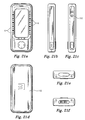
- Figures 20 and 21 illustrate a view of further embodiments of small computing devices in accordance with the present invention.
- Figure 20 shows a front view, figure 20A , side view from one side ( figure 20B ) illustrating direction keys 112 on the side, side view from the other side ( figure 20C ) rear view ( figure 20D ) indicating a battery cover 113, top view ( figure 20E ) and bottom view ( figure 20F ).
- Figure 21 illustrates similar views for a further embodiment, with the same reference numerals indicating similar components.
- figure 16 is a block diagram which illustrates one way only in which the hardware of a mobile telephone in accordance with an embodiment of the present invention may be implemented.
- This hardware generally designated by reference numeral 80 is mounted in the housing 1 of the small device.
- the components include a control means in the form processing means 81, which may include an on-board or off-board memory and a processor(s) arranged to control operation of the device.
- the processing means 81 may in fact include multiple processes eg. SIM card, DSP (Digital Signal Processor) and conventional processor for controlling other operations of the device such as the interface operation.
- the control means may incorporate any form of processor or arrangement of processors which can implement the functionally of the device described above.
- the device also includes a microphone 83 and microphone input 82 into the processor 81.
- Voice output via the processor 81 is via an amplifier 82 and loud speaker 83.
- a radio transceiver 84 is provided for telecommunications reception and transmission via an antenna 85.
- a display driver 86 is arranged to drive the display 3 and a keypad sensor 87 is arranged to receive input from the rows 4 and 5 of keys 6. The functionality as described above will be implemented by the appropriate software.
- Figure 14 illustrates further embodiment of a mobile telephone in accordance with the present invention.
- the telephone of the embodiment of figure 14 also includes "direction" key 100.
- the direction key may be used for such things as scrolling or controlling games.
- the above described embodiment is a small device which has a communication function and is preferably a mobile telephone.
- the present invention is applicable to devices which do not necessarily have communications functions.
- the present invention may be implemented as a PDA type device which does not include a communications function but which includes computing functions such as diary, calendar, etc.
- the present invention may be implemented as a hybrid device which includes communication function which may also include functionally which is not normally seen in a conventional mobile telephone, such as functionally associated with a PDA, e-mail, calendar, calculator, address book, world time, alarm clock and others.
- communication function which may also include functionally which is not normally seen in a conventional mobile telephone, such as functionally associated with a PDA, e-mail, calendar, calculator, address book, world time, alarm clock and others.
Landscapes
- Engineering & Computer Science (AREA)
- Theoretical Computer Science (AREA)
- General Engineering & Computer Science (AREA)
- Human Computer Interaction (AREA)
- Physics & Mathematics (AREA)
- General Physics & Mathematics (AREA)
- Computer Hardware Design (AREA)
- Signal Processing (AREA)
- Computer Networks & Wireless Communication (AREA)
- Input From Keyboards Or The Like (AREA)
- Telephone Function (AREA)
- Telephone Set Structure (AREA)
- Glass Compositions (AREA)
- Diaphragms For Electromechanical Transducers (AREA)
- Small-Scale Networks (AREA)
- Lubricants (AREA)
- Oscillators With Electromechanical Resonators (AREA)
- Arrangements For Transmission Of Measured Signals (AREA)
- Measurement Of Velocity Or Position Using Acoustic Or Ultrasonic Waves (AREA)
- Communication Control (AREA)
Claims (7)
- Mobiltelefon, enthaltend ein Gehäuse (1), einen Anzeigebildschirm (3), der sich entlang einer Front (2) des Gehäuses erstreckt, wobei die Front (2) des Gehäuses eine große Längenabmessung und eine kleine Breitenabmessung hat, dadurch gekennzeichnet, dass das Mobiltelefon enthält:eine einzelne Reihe einer ersten Vielzahl von Tasten (4), die auf einer Seite des Gehäuses (1) oder direkt benachbart derselben und direkt angrenzend an eine Seite des Bildschirms (3) angeordnet ist,eine einzelne Reihe einer zweiten Vielzahl von Tasten (5), die auf einer gegenüberliegenden Seite des Gehäuses (1) oder direkt benachbart derselben und direkt angrenzend der gegenüberliegenden Seite des Bildschirms (3) angeordnet ist,eine Steuereinrichtung (81), die auf die Betätigung der Tasten reagiert, um wenigstens eine Telefonnummern-Wählfunktion einzusetzen, wobei die Steuereinrichtung (81) weiterhin dazu eingerichtet ist, das Telefon derart zu steuern, dass die Auswahl von alphanumerischen Zeichen durch Betätigung einer Vielzahl von Tasten erfolgen kann, um den Eintrag von Text auf dem Telefon zu ermöglichen; undeine Texterkennungseinrichtung, die dazu eingerichtet ist, Vorschläge von Zeichen zu machen, die von einem Benutzer des Telefons eingegeben werden sollen,wobei sich die Reihe von Tasten (4, 5) in derselben Richtung erstreckt, wie die Längenabmessung der Front (2) des Gehäuses,
sich der Anzeigebildschirm (3) zum Großteil in der Längenrichtung des Gehäuses erstreckt,
die Steuereinrichtung dazu eingerichtet ist, die Anzeige derart zu steuern, dass jeder der Texterkennungsvorschläge auf dem Anzeigebildschirm derart erscheint, dass er einer entsprechenden aus der Vielzahl von Tasten zugeordnet ist und durch Betätigung der zugehörigen Taste ausgewählt werden kann, und
wenigstens einer der Vorschläge von Zeichen, der durch die Texterfassungseinrichtung gemacht wird, eine Vielzahl von Zeichen enthält, die eine Fortführung eines Wortes jedoch nicht ein vollständiges Wort darstellen. - Mobiltelefon nach Anspruch 1, bei dem die Steuereinrichtung weiterhin dazu eingerichtet ist, das Mobiltelefon derart zu steuern, dass es in einer Vielzahl zusätzlicher Betriebsarten arbeitet, wobei wenigstens eine Vielzahl der Tasten als Multifunktionstasten arbeiten und die spezielle Funktion der Taste in einer speziellen Betriebsart durch Kennzeichen angezeigt wird, die auf dem Anzeigebildschirm erscheinen.
- Mobiltelefon nach Anspruch 1 oder 2, bei dem die erste Vielzahl von Tasten zwischen sechs und einschließlich acht Tasten und die zweite Vielzahl von Tasten zwischen sechs und einschließlich acht Tasten umfasst.
- Mobiltelefon nach Anspruch 1, weiterhin enthaltend einen Kommunikationsschaltkreis (84), um eine Kommunikationsfunktion zu ermöglichen.
- Mobiltelefon nach Anspruch 1, bei dem der Anzeigebildschirm derart beschaffen ist, dass er berührungsempfindlich ist, und die Steuereinrichtung dazu eingerichtet ist, das Telefon derart zu steuern, dass Daten durch Berühren des Bildschirms eingegeben werden können.
- Mobiltelefon nach Anspruch 1, bei dem die erste und die zweite Vielzahl von Tasten in Reihen mit einer Breite einer einzelnen Taste angeordnet sind.
- Mobiltelefon nach Anspruch 1, bei dem die erste und die zweite Vielzahl von Tasten auf der Front des Gehäuses angeordnet sind.
Applications Claiming Priority (3)
| Application Number | Priority Date | Filing Date | Title |
|---|---|---|---|
| AUPS1072A AUPS107202A0 (en) | 2002-03-13 | 2002-03-13 | Improved device interface |
| AUPS107202 | 2002-03-13 | ||
| PCT/AU2002/001114 WO2003077102A1 (en) | 2002-03-13 | 2002-08-20 | Improved device interface |
Publications (3)
| Publication Number | Publication Date |
|---|---|
| EP1472593A1 EP1472593A1 (de) | 2004-11-03 |
| EP1472593A4 EP1472593A4 (de) | 2007-03-21 |
| EP1472593B1 true EP1472593B1 (de) | 2011-05-18 |
Family
ID=3834670
Family Applications (1)
| Application Number | Title | Priority Date | Filing Date |
|---|---|---|---|
| EP02766922A Expired - Lifetime EP1472593B1 (de) | 2002-03-13 | 2002-08-20 | Verbesserte einrichtungsschnittstelle |
Country Status (8)
| Country | Link |
|---|---|
| US (5) | US20050043063A1 (de) |
| EP (1) | EP1472593B1 (de) |
| CN (2) | CN100350354C (de) |
| AT (1) | ATE510252T1 (de) |
| AU (3) | AUPS107202A0 (de) |
| DE (1) | DE02766922T1 (de) |
| GB (1) | GB2385692B (de) |
| WO (1) | WO2003077102A1 (de) |
Families Citing this family (67)
| Publication number | Priority date | Publication date | Assignee | Title |
|---|---|---|---|---|
| KR20030048570A (ko) * | 2001-12-12 | 2003-06-25 | 한국전자통신연구원 | 부가적 버튼을 장착한 키패드 및 그의 작동방법 |
| AUPS107202A0 (en) | 2002-03-13 | 2002-04-11 | K W Dinn Holdings Pty Limited | Improved device interface |
| US9697264B2 (en) | 2002-08-20 | 2017-07-04 | Kannuu Pty. Ltd. | Process and apparatus for selecting an item from a database |
| US7363059B1 (en) * | 2003-01-16 | 2008-04-22 | Sprint Spectrum L.P. | Method and system for presenting a graphical representation of telephone keys on a wireless terminal |
| US20040242279A1 (en) * | 2003-05-28 | 2004-12-02 | Costanzo Rito Natale | Implementing direct telephone access on a multi-purpose wireless mobile electronic device |
| US20050026644A1 (en) * | 2003-07-28 | 2005-02-03 | Inventec Appliances Corp. | Cellular phone for specific person |
| DE10339903A1 (de) * | 2003-08-29 | 2005-03-31 | Siemens Ag | Texteingabeverfahren für ein Kommunikationsgerät |
| DE10348873A1 (de) * | 2003-10-21 | 2005-06-02 | Siemens Ag | Kommunikationsgerät |
| EP1603019A1 (de) * | 2004-06-02 | 2005-12-07 | 2012244 Ontario Inc. | Tragbares elektronisches Gerät mit Textdisambiguation |
| US8060138B2 (en) | 2004-06-02 | 2011-11-15 | Research In Motion Limited | Handheld electronic device and associated method employing a multiple-axis input device and providing a learning function in a text disambiguation environment |
| US7389124B2 (en) | 2004-06-02 | 2008-06-17 | Research In Motion Limited | Handheld electronic device with text disambiguation |
| CN101194493A (zh) * | 2005-06-08 | 2008-06-04 | 诺基亚公司 | 具有单行键盘的移动通信终端 |
| US7890134B2 (en) * | 2005-06-13 | 2011-02-15 | Dyna Llc | Communications device methods and apparatus including ergonomic key layout and intuitive user interface |
| EP2393203A3 (de) * | 2005-06-16 | 2013-03-06 | Systems Ltd Keyless | Dateneingabesystem |
| KR101149091B1 (ko) | 2005-08-02 | 2012-05-25 | 삼성전자주식회사 | 효율적인 입력 기능을 가진 디지털 영상 처리 장치 및 그제어 방법 |
| CN100501647C (zh) * | 2005-08-12 | 2009-06-17 | 深圳华为通信技术有限公司 | 手机键盘及其使用方法 |
| NZ566172A (en) | 2005-08-12 | 2011-08-26 | Kannuu Pty Ltd | Improved process and apparatus for selecting an item from a database |
| EP1775920B1 (de) * | 2005-10-14 | 2017-12-13 | Vodafone Holding GmbH | Steuerung von über ein Telekommunikationsnetz bereitgestellten Diensten |
| KR101235689B1 (ko) | 2005-12-01 | 2013-02-22 | 삼성전자주식회사 | 다기능 복합영상장치 및 그의 ui 제공방법 |
| TWI362876B (en) * | 2005-12-28 | 2012-04-21 | Panasonic Corp | Input unit, mobile terminal unit, and content data manipulation method in mobile terminal unit |
| US20070256025A1 (en) * | 2006-04-28 | 2007-11-01 | Vincent Yen | Mobile application menu system |
| US20080233937A1 (en) * | 2006-05-08 | 2008-09-25 | Marja-Leena Nurmela | Mobile communication terminal and method |
| CN101083807A (zh) * | 2006-06-02 | 2007-12-05 | 鸿富锦精密工业(深圳)有限公司 | 移动通讯设备 |
| US20080141125A1 (en) * | 2006-06-23 | 2008-06-12 | Firooz Ghassabian | Combined data entry systems |
| US7619584B2 (en) * | 2006-09-08 | 2009-11-17 | Generation One, Inc. | Messaging including active response feature |
| JP4574603B2 (ja) * | 2006-09-26 | 2010-11-04 | 株式会社エヌ・ティ・ティ・ドコモ | 移動体端末装置 |
| CN101573748A (zh) * | 2006-12-20 | 2009-11-04 | 摩托罗拉公司 | 用于导航电子设备屏幕的方法和装备 |
| USD898736S1 (en) | 2007-01-05 | 2020-10-13 | Apple Inc. | Electronic device |
| US20080270949A1 (en) * | 2007-04-25 | 2008-10-30 | Liang Younger L | Methods and Systems for Navigation and Selection of Items within User Interfaces with a Segmented Cursor |
| USD628205S1 (en) | 2007-06-23 | 2010-11-30 | Apple Inc. | Graphical user interface for a display screen or portion thereof |
| USD615090S1 (en) * | 2007-07-05 | 2010-05-04 | Sony Corporation | Personal digital assistant |
| USD957385S1 (en) | 2007-08-31 | 2022-07-12 | Apple Inc. | Electronic device |
| USD601155S1 (en) * | 2007-12-28 | 2009-09-29 | Sony Corporation | Personal digital assistant |
| USD585413S1 (en) * | 2007-12-28 | 2009-01-27 | Samsung Electronics Co., Ltd. | Portable phone |
| US8232973B2 (en) | 2008-01-09 | 2012-07-31 | Apple Inc. | Method, device, and graphical user interface providing word recommendations for text input |
| US10354689B2 (en) | 2008-04-06 | 2019-07-16 | Taser International, Inc. | Systems and methods for event recorder logging |
| US20090251311A1 (en) * | 2008-04-06 | 2009-10-08 | Smith Patrick W | Systems And Methods For Cooperative Stimulus Control |
| USD602015S1 (en) * | 2008-04-07 | 2009-10-13 | Apple Inc. | Electronic device |
| JP4557048B2 (ja) * | 2008-06-04 | 2010-10-06 | ソニー株式会社 | 電子機器 |
| RU2008125657A (ru) * | 2008-06-26 | 2010-01-10 | Константин Ефимович Шварцер (RU) | Способ ввода буквенно-, символьно- цифровой информации |
| US8345012B2 (en) * | 2008-10-02 | 2013-01-01 | Utc Fire & Security Americas Corporation, Inc. | Method and interface device for operating a security system |
| KR101050642B1 (ko) | 2008-12-04 | 2011-07-19 | 삼성전자주식회사 | 와치 폰 및 상기 와치 폰에서 통화수행 방법 |
| CN101848272B (zh) * | 2009-03-25 | 2013-08-28 | 鸿富锦精密工业(深圳)有限公司 | 手机的输入法切换方法 |
| USD620467S1 (en) | 2009-07-15 | 2010-07-27 | Nokia Corporation | Handset |
| JP5127792B2 (ja) | 2009-08-18 | 2013-01-23 | キヤノン株式会社 | 情報処理装置、その制御方法、プログラム及び記録媒体 |
| USD626109S1 (en) * | 2009-09-30 | 2010-10-26 | Samsung Electronics Co., Ltd. | Mobile phone |
| USD622250S1 (en) * | 2009-10-15 | 2010-08-24 | Samsung Electronics Co., Ltd. | Mobile phone |
| USD641332S1 (en) * | 2010-01-06 | 2011-07-12 | Sony Ericsson Mobile Communications Ab | Mobile phone |
| JP4973746B2 (ja) * | 2010-02-22 | 2012-07-11 | コニカミノルタビジネステクノロジーズ株式会社 | 画像処理装置、同装置における動作モード設定キーの表示方法及び表示制御プログラム |
| USD633888S1 (en) * | 2010-04-16 | 2011-03-08 | Nokia Corporation | Handset |
| USD687024S1 (en) * | 2010-07-06 | 2013-07-30 | Sony Corporation | Information terminal |
| USD634294S1 (en) * | 2010-07-09 | 2011-03-15 | Nokia Corporation | Handset |
| USD635543S1 (en) * | 2010-08-06 | 2011-04-05 | Fih (Hong Kong) Limited | Mobile phone |
| USD637992S1 (en) | 2010-10-07 | 2011-05-17 | Nokia Corporation | Handset |
| USD657336S1 (en) * | 2011-05-13 | 2012-04-10 | Motorola Mobility, Inc. | Communication device |
| USD656917S1 (en) * | 2011-05-20 | 2012-04-03 | Nokia Corporation | Handset |
| WO2012162379A1 (en) * | 2011-05-23 | 2012-11-29 | Barnes & Noble, Inc. | Programmable buttons for ereader device |
| USD652815S1 (en) * | 2011-05-31 | 2012-01-24 | Nokia Corporation | Handset |
| USD664517S1 (en) * | 2011-07-11 | 2012-07-31 | Motorola Mobility Llc | Communication device |
| USD749085S1 (en) * | 2011-08-23 | 2016-02-09 | Sony Corporation | Display panel or screen with graphical user interface |
| USD711342S1 (en) * | 2013-01-03 | 2014-08-19 | Neonode Inc. | Mobile phone |
| USD725150S1 (en) * | 2013-05-28 | 2015-03-24 | Deere & Company | Display screen with icon |
| KR102065411B1 (ko) * | 2013-09-04 | 2020-01-13 | 엘지전자 주식회사 | 이동 단말기 및 이의 제어 방법 |
| US10255267B2 (en) * | 2014-05-30 | 2019-04-09 | Apple Inc. | Device, method, and graphical user interface for a predictive keyboard |
| CN104267889B (zh) | 2014-09-15 | 2019-03-29 | 联想(北京)有限公司 | 一种控制方法和电子设备 |
| US11194467B2 (en) | 2019-06-01 | 2021-12-07 | Apple Inc. | Keyboard management user interfaces |
| US11416136B2 (en) | 2020-09-14 | 2022-08-16 | Apple Inc. | User interfaces for assigning and responding to user inputs |
Family Cites Families (108)
| Publication number | Priority date | Publication date | Assignee | Title |
|---|---|---|---|---|
| US3937939A (en) * | 1974-01-07 | 1976-02-10 | Frenkel Marvin A | Single-hand digital calculator |
| DE3123596A1 (de) * | 1981-06-13 | 1983-01-05 | Licentia Patent-Verwaltungs-Gmbh, 6000 Frankfurt | Handapparat fuer ein mobilfunkgeraet, insbesondere autotelefon |
| FR2571442B1 (fr) | 1984-10-09 | 1987-02-20 | Theys Henri | Machine utilisant l'energie produite par la pression d'un fluide pour produire un mouvement rotatif |
| US5263174A (en) | 1988-04-01 | 1993-11-16 | Symantec Corporation | Methods for quick selection of desired items from hierarchical computer menus |
| CA2089177C (en) | 1990-08-09 | 2002-10-22 | Bruce R. Baker | Communication system with text message retrieval based on concepts inputted via keyboard icons |
| US5398023A (en) * | 1990-08-27 | 1995-03-14 | Motorola, Inc. | Selective call receiver with flip-out display |
| US5128672A (en) | 1990-10-30 | 1992-07-07 | Apple Computer, Inc. | Dynamic predictive keyboard |
| US5754655A (en) * | 1992-05-26 | 1998-05-19 | Hughes; Thomas S. | System for remote purchase payment and remote bill payment transactions |
| US5787417A (en) | 1993-01-28 | 1998-07-28 | Microsoft Corporation | Method and system for selection of hierarchically related information using a content-variable list |
| EP0624965A3 (de) | 1993-03-23 | 1996-01-31 | Us West Advanced Tech Inc | Methode und System zum Recherchieren in einem on-line Telephonbuch in einer Telephonstation. |
| US5425077A (en) * | 1993-07-08 | 1995-06-13 | U.S. West Advanced Technologies, Inc. | Mobile telephone user interface including fixed and dynamic function keys and method of using same |
| JPH07240776A (ja) | 1994-02-28 | 1995-09-12 | Nippondenso Co Ltd | 携帯電話機 |
| US5496992A (en) * | 1994-06-21 | 1996-03-05 | Lxe, Inc. | Dual trigger multiplexed data entry terminal |
| US5724069A (en) * | 1994-07-15 | 1998-03-03 | Chen; Jack Y. | Special purpose terminal for interactive user interface |
| US5797098A (en) * | 1995-07-19 | 1998-08-18 | Pacific Communication Sciences, Inc. | User interface for cellular telephone |
| EP0842463B1 (de) | 1995-07-26 | 2000-03-29 | Tegic Communications, Inc. | System zur unterdrückung der vieldeutigkeit in einer verringerten tastatur |
| US5818437A (en) * | 1995-07-26 | 1998-10-06 | Tegic Communications, Inc. | Reduced keyboard disambiguating computer |
| US5825306A (en) * | 1995-08-25 | 1998-10-20 | Aisin Aw Co., Ltd. | Navigation system for vehicles |
| JPH0983402A (ja) | 1995-09-07 | 1997-03-28 | Kokusai Electric Co Ltd | 携帯電話機 |
| FI955340A7 (fi) * | 1995-11-07 | 1997-05-08 | Nokia Mobile Phones Ltd | Matkapuhelimen käyttäjäliityntä |
| FI111897B (fi) * | 1995-11-24 | 2003-09-30 | Nokia Corp | Kaksitoiminen tiedonvälityslaite |
| US5911485A (en) | 1995-12-11 | 1999-06-15 | Unwired Planet, Inc. | Predictive data entry method for a keypad |
| US5867799A (en) | 1996-04-04 | 1999-02-02 | Lang; Andrew K. | Information system and method for filtering a massive flow of information entities to meet user information classification needs |
| FR2751442B1 (fr) * | 1996-07-16 | 1999-01-22 | Gillot Jean L | Dispositif interface homme/machine de poche |
| JPH1093668A (ja) * | 1996-09-19 | 1998-04-10 | Nec Corp | 携帯無線機 |
| US5901222A (en) * | 1996-10-31 | 1999-05-04 | Lucent Technologies Inc. | User interface for portable telecommunication devices |
| JPH10154144A (ja) * | 1996-11-25 | 1998-06-09 | Sony Corp | 文章入力装置及び方法 |
| US5894276A (en) * | 1996-12-23 | 1999-04-13 | Motorola, Inc. | Communication device with programmable function button and method of operation |
| US5953541A (en) * | 1997-01-24 | 1999-09-14 | Tegic Communications, Inc. | Disambiguating system for disambiguating ambiguous input sequences by displaying objects associated with the generated input sequences in the order of decreasing frequency of use |
| US6154757A (en) | 1997-01-29 | 2000-11-28 | Krause; Philip R. | Electronic text reading environment enhancement method and apparatus |
| US6009444A (en) | 1997-02-24 | 1999-12-28 | Motorola, Inc. | Text input device and method |
| JPH10293640A (ja) * | 1997-04-18 | 1998-11-04 | Toshiba Corp | 可搬型コンピュータ |
| JPH10304234A (ja) | 1997-04-24 | 1998-11-13 | Sony Corp | 撮像システム、及びビデオカメラ装置 |
| US20040192276A1 (en) * | 1997-09-09 | 2004-09-30 | Wesby Philip Bernard | Emergency mobile radio telephone with reduced key set |
| US6377965B1 (en) | 1997-11-07 | 2002-04-23 | Microsoft Corporation | Automatic word completion system for partially entered data |
| US5896321A (en) | 1997-11-14 | 1999-04-20 | Microsoft Corporation | Text completion system for a miniature computer |
| FI104928B (fi) * | 1997-11-27 | 2000-04-28 | Nokia Mobile Phones Ltd | Langaton viestin ja menetelmä langattoman viestimen valmistuksessa |
| US6247043B1 (en) | 1998-06-11 | 2001-06-12 | International Business Machines Corporation | Apparatus, program products and methods utilizing intelligent contact management |
| GB9814398D0 (en) * | 1998-07-02 | 1998-09-02 | Nokia Mobile Phones Ltd | Electronic apparatus |
| US6801659B1 (en) * | 1999-01-04 | 2004-10-05 | Zi Technology Corporation Ltd. | Text input system for ideographic and nonideographic languages |
| NL1011027C2 (nl) * | 1999-01-14 | 2000-09-27 | Hugo Marlon Charles Vasilda | Inrichting voor het versturen van tekstberichten. |
| US6901439B1 (en) * | 1999-01-22 | 2005-05-31 | Leviton Manufacturing Co., Inc. | Method of adding a device to a network |
| CA2274351A1 (en) * | 1999-01-25 | 2000-07-25 | Jacob Kim | Flat panel display |
| US6434403B1 (en) * | 1999-02-19 | 2002-08-13 | Bodycom, Inc. | Personal digital assistant with wireless telephone |
| GB2347240A (en) * | 1999-02-22 | 2000-08-30 | Nokia Mobile Phones Ltd | Communication terminal having a predictive editor application |
| JP2000267787A (ja) * | 1999-03-18 | 2000-09-29 | Canon Inc | 入力装置及び携帯情報処理装置 |
| WO2000059181A1 (en) * | 1999-03-30 | 2000-10-05 | Ericsson, Inc. | Non-keypad dialing interfaces for handheld radiotelephones |
| US6418325B1 (en) * | 1999-07-12 | 2002-07-09 | Motorola, Inc. | Handheld device having an optical data reader |
| JP3234823B2 (ja) | 1999-09-29 | 2001-12-04 | インターナショナル・ビジネス・マシーンズ・コーポレーション | 道路データの処理方法、地図データ処理装置、地図データ処理システム、道路データを処理するためのソフトウエア・プロダクトを格納した記憶媒体 |
| US6968365B2 (en) * | 1999-12-01 | 2005-11-22 | Telefonaktiebolaget L M Ericsson (Publ) | Device and a method for operating an electronic utility device from a portable telecommunication apparatus |
| US6264146B1 (en) | 1999-12-07 | 2001-07-24 | The Boeing Company | Portable controller for an aircraft |
| GB2357220B (en) | 1999-12-10 | 2003-11-05 | Nokia Mobile Phones Ltd | A user interface |
| JP2001236138A (ja) * | 2000-02-22 | 2001-08-31 | Sony Corp | 通信端末装置 |
| NL1014587C2 (nl) * | 2000-03-08 | 2001-09-21 | George Wilhelm Blaes | Mobiele telefoon. |
| DE10019727A1 (de) * | 2000-04-20 | 2001-10-25 | Alcatel Sa | Netzwerkserver |
| US20020049795A1 (en) | 2000-05-15 | 2002-04-25 | Freeman Alfred Boyd | Computer assisted text input system |
| US20020062258A1 (en) | 2000-05-18 | 2002-05-23 | Bailey Steven C. | Computer-implemented procurement of items using parametric searching |
| US6580932B1 (en) * | 2000-05-31 | 2003-06-17 | Nokia Mobile Phones Limited | Foldable keyboard for mobile communications device |
| GB2363290A (en) * | 2000-06-07 | 2001-12-12 | Alan Gilberg Rosenburg | Wristwatch communication device |
| WO2002008876A2 (en) * | 2000-07-19 | 2002-01-31 | Michael Katz | Folding cellular telephone and digital assistant with improved keyboard |
| AUPQ903400A0 (en) | 2000-07-27 | 2000-08-17 | Oh, Young June | Navigable search engine |
| US6748242B1 (en) * | 2000-08-04 | 2004-06-08 | Nokia Mobile Phones Ltd. | Personal communication device with full keyboard and gaming feature |
| GB2365734A (en) * | 2000-08-07 | 2002-02-20 | Argo Interactive Group Plc | Allocation of labels to associated user input elements |
| JP4505975B2 (ja) | 2000-11-08 | 2010-07-21 | カシオ計算機株式会社 | 小型情報処理装置及び入力操作制御プログラムを記憶した記憶媒体 |
| AU2002214813A1 (en) | 2000-11-10 | 2002-05-21 | Besdi Pty Ltd | Device interface |
| JP2002158758A (ja) * | 2000-11-20 | 2002-05-31 | Nec Corp | 開閉型携帯情報端末 |
| FI116345B (fi) * | 2000-12-19 | 2005-10-31 | Nokia Corp | Kannettavat elektroniset laitteet |
| US20020151327A1 (en) | 2000-12-22 | 2002-10-17 | David Levitt | Program selector and guide system and method |
| WO2002069240A2 (en) | 2001-02-22 | 2002-09-06 | Moxi Digital Inc. | Apparatus and method for selecting data |
| US7054659B2 (en) * | 2001-05-14 | 2006-05-30 | Palm, Inc. | Compact removable voice handset for an integrated portable computer system/mobile phone |
| US20020183099A1 (en) * | 2001-05-30 | 2002-12-05 | Lee Man Wei | Multiple display panels for different modes of operation for conveying personality |
| WO2003003184A1 (en) * | 2001-06-27 | 2003-01-09 | Timespace System Co., Ltd. | Arabic-persian alphabet input apparatus |
| US7185286B2 (en) | 2001-08-28 | 2007-02-27 | Nvidia International, Inc. | Interface for mobilizing content and transactions on multiple classes of devices |
| WO2003021418A1 (en) * | 2001-08-29 | 2003-03-13 | Katsuzo Tanaka | Ultrahigh rate character input unit of portable telephone |
| US20030073414A1 (en) * | 2001-10-15 | 2003-04-17 | Stephen P. Capps | Textual and telephony dual input device |
| JP4147016B2 (ja) * | 2001-10-16 | 2008-09-10 | 富士通株式会社 | 携帯端末 |
| US20030078069A1 (en) * | 2001-10-24 | 2003-04-24 | Phillip Lindeman | Portable communication device with split user inputs |
| US6744423B2 (en) | 2001-11-19 | 2004-06-01 | Nokia Corporation | Communication terminal having a predictive character editor application |
| CA2473446A1 (en) | 2002-01-14 | 2003-07-24 | Jerzy Lewak | Identifier vocabulary data access method and system |
| AUPS107202A0 (en) | 2002-03-13 | 2002-04-11 | K W Dinn Holdings Pty Limited | Improved device interface |
| AU2002950801A0 (en) | 2002-08-14 | 2002-09-12 | Besdi Pty Ltd | Improved device interface |
| US9697264B2 (en) | 2002-08-20 | 2017-07-04 | Kannuu Pty. Ltd. | Process and apparatus for selecting an item from a database |
| US20040163032A1 (en) | 2002-12-17 | 2004-08-19 | Jin Guo | Ambiguity resolution for predictive text entry |
| US8543564B2 (en) | 2002-12-23 | 2013-09-24 | West Publishing Company | Information retrieval systems with database-selection aids |
| US20040153975A1 (en) * | 2003-02-05 | 2004-08-05 | Williams Roland E. | Text entry mechanism for small keypads |
| JP2005159250A (ja) | 2003-10-30 | 2005-06-16 | Kyocera Corp | 積層セラミックコンデンサの洗浄方法 |
| DE10357475A1 (de) | 2003-12-09 | 2005-07-07 | Siemens Ag | Kommunikationsvorrichtung und Verfahren zum Eingeben und Vorhersagen von Text |
| US20070273648A1 (en) | 2003-12-23 | 2007-11-29 | Thomas Fussinger | Method and Apparatus for Entering Data with a Four Way Input Device |
| US20050188330A1 (en) | 2004-02-20 | 2005-08-25 | Griffin Jason T. | Predictive text input system for a mobile communication device |
| US7836044B2 (en) | 2004-06-22 | 2010-11-16 | Google Inc. | Anticipated query generation and processing in a search engine |
| US7466859B2 (en) | 2004-12-30 | 2008-12-16 | Motorola, Inc. | Candidate list enhancement for predictive text input in electronic devices |
| US7630980B2 (en) | 2005-01-21 | 2009-12-08 | Prashant Parikh | Automatic dynamic contextual data entry completion system |
| US7543244B2 (en) | 2005-03-22 | 2009-06-02 | Microsoft Corporation | Determining and displaying a list of most commonly used items |
| GB0505942D0 (en) | 2005-03-23 | 2005-04-27 | Patel Sanjay | Human to mobile interfaces |
| US8237658B2 (en) | 2005-04-04 | 2012-08-07 | Research In Motion Limited | Handheld electronic device with text disambiguation employing advanced text case feature |
| US7616191B2 (en) | 2005-04-18 | 2009-11-10 | Avago Technologies Ecbu Ip (Singapore) Pte. Ltd. | Electronic device and method for simplifying text entry using a soft keyboard |
| US7886233B2 (en) | 2005-05-23 | 2011-02-08 | Nokia Corporation | Electronic text input involving word completion functionality for predicting word candidates for partial word inputs |
| US8185841B2 (en) | 2005-05-23 | 2012-05-22 | Nokia Corporation | Electronic text input involving a virtual keyboard and word completion functionality on a touch-sensitive display screen |
| EP1896969A2 (de) | 2005-05-31 | 2008-03-12 | Ipifini, Inc. | Computerprogramm zum identifizieren und automatisierung sich wiederholender benutzereingaben |
| US8413069B2 (en) | 2005-06-28 | 2013-04-02 | Avaya Inc. | Method and apparatus for the automatic completion of composite characters |
| US7487147B2 (en) | 2005-07-13 | 2009-02-03 | Sony Computer Entertainment Inc. | Predictive user interface |
| US20070016862A1 (en) | 2005-07-15 | 2007-01-18 | Microth, Inc. | Input guessing systems, methods, and computer program products |
| NZ566172A (en) | 2005-08-12 | 2011-08-26 | Kannuu Pty Ltd | Improved process and apparatus for selecting an item from a database |
| US7443316B2 (en) | 2005-09-01 | 2008-10-28 | Motorola, Inc. | Entering a character into an electronic device |
| US20070060114A1 (en) | 2005-09-14 | 2007-03-15 | Jorey Ramer | Predictive text completion for a mobile communication facility |
| US8060357B2 (en) | 2006-01-27 | 2011-11-15 | Xerox Corporation | Linguistic user interface |
| US7793228B2 (en) | 2006-10-13 | 2010-09-07 | Apple Inc. | Method, system, and graphical user interface for text entry with partial word display |
| EP2135177A4 (de) | 2007-03-07 | 2011-04-13 | Kannuu Pty Ltd | Verfahren, system und vorrichtung zum eingeben von text auf einem datenverarbeitungsgerät |
-
2002
- 2002-03-13 AU AUPS1072A patent/AUPS107202A0/en not_active Abandoned
- 2002-08-20 DE DE02766922T patent/DE02766922T1/de active Pending
- 2002-08-20 US US10/495,585 patent/US20050043063A1/en not_active Abandoned
- 2002-08-20 CN CNB028250591A patent/CN100350354C/zh not_active Expired - Fee Related
- 2002-08-20 AU AU2002331407A patent/AU2002331407A1/en not_active Abandoned
- 2002-08-20 EP EP02766922A patent/EP1472593B1/de not_active Expired - Lifetime
- 2002-08-20 AT AT02766922T patent/ATE510252T1/de not_active IP Right Cessation
- 2002-08-20 WO PCT/AU2002/001114 patent/WO2003077102A1/en not_active Ceased
- 2002-08-20 CN CN2007101534684A patent/CN101187822B/zh not_active Expired - Fee Related
- 2002-08-20 GB GB0306754A patent/GB2385692B/en not_active Expired - Fee Related
-
2007
- 2007-03-12 US US11/716,667 patent/US20070198954A1/en not_active Abandoned
-
2010
- 2010-01-11 AU AU2010200095A patent/AU2010200095B2/en not_active Ceased
-
2011
- 2011-04-07 US US13/081,990 patent/US9729701B2/en not_active Expired - Fee Related
-
2017
- 2017-07-06 US US15/643,130 patent/US20180152552A1/en not_active Abandoned
-
2020
- 2020-05-07 US US16/869,127 patent/US20210092216A1/en not_active Abandoned
Also Published As
| Publication number | Publication date |
|---|---|
| CN1606727A (zh) | 2005-04-13 |
| CN101187822A (zh) | 2008-05-28 |
| AU2002331407A1 (en) | 2003-09-22 |
| GB2385692B (en) | 2004-04-21 |
| US20070198954A1 (en) | 2007-08-23 |
| ATE510252T1 (de) | 2011-06-15 |
| GB2385692A (en) | 2003-08-27 |
| CN101187822B (zh) | 2012-04-18 |
| AU2010200095B2 (en) | 2011-11-24 |
| DE02766922T1 (de) | 2005-03-31 |
| WO2003077102A1 (en) | 2003-09-18 |
| AU2010200095A1 (en) | 2010-01-28 |
| CN100350354C (zh) | 2007-11-21 |
| AUPS107202A0 (en) | 2002-04-11 |
| US20050043063A1 (en) | 2005-02-24 |
| US20110183720A1 (en) | 2011-07-28 |
| EP1472593A1 (de) | 2004-11-03 |
| US20210092216A1 (en) | 2021-03-25 |
| GB0306754D0 (en) | 2003-04-30 |
| EP1472593A4 (de) | 2007-03-21 |
| US9729701B2 (en) | 2017-08-08 |
| US20180152552A1 (en) | 2018-05-31 |
| HK1119807A1 (en) | 2009-03-13 |
Similar Documents
| Publication | Publication Date | Title |
|---|---|---|
| EP1472593B1 (de) | Verbesserte einrichtungsschnittstelle | |
| JP2000003250A (ja) | 情報を入力するための方法および装置 | |
| KR19990036989A (ko) | 문자 입력의 최적화를 위한 통신 장치 및키패드 | |
| KR100682331B1 (ko) | 이동통신 단말기에서 전화번호부 검색 방법 | |
| KR20060129735A (ko) | 이동통신 단말기 및 이를 이용한 데이터 처리 방법 | |
| KR100386944B1 (ko) | 문자 입력장치, 그를 갖는 이동 전화 시스템 및 그 입력제어방법 | |
| AU2012200999B2 (en) | Improved device interface | |
| KR100370427B1 (ko) | 이동통신 단말기의 한글 입력 방법 | |
| JP2003167822A (ja) | 移動通信端末装置及びその宛先入力方法 | |
| HK1119807B (en) | Small computing device with improved device interface | |
| KR100581827B1 (ko) | 이동 통신 단말기의 전화 번호 검색 방법 | |
| KR100795952B1 (ko) | 이동통신 단말기의 문자 입력방법 | |
| KR100748250B1 (ko) | 휴대용 단말기의 문자 배열구조 및 문자입력 방법 | |
| KR200360604Y1 (ko) | 타자기식 키보드가 결합된 전화번호부기능 일반전화기 | |
| JP4182045B2 (ja) | メモリへの情報の格納を制御する装置およびその方法 | |
| JP2002251252A (ja) | 携帯電話機、並びにその文字入力方法、及びその文字表示方法 | |
| JP3686800B2 (ja) | メモリへの情報の格納を制御する装置およびその方法 | |
| KR200232648Y1 (ko) | 일정 버튼을 포함하는 휴대폰 | |
| KR20020064408A (ko) | 이동통신단말기에서 확장 표시방법 | |
| JP2004227511A (ja) | 電子機器の文字入力方法 | |
| JP2002328765A (ja) | キー入力装置及び携帯電話機 | |
| JPS62151913A (ja) | キヤラクタ入力方式 | |
| KR20030094811A (ko) | 통신기기용 다국어 입력 장치 및 이를 이용한 다국어입력방법 | |
| JP2003186609A (ja) | キー入力装置 | |
| WO2006026050A2 (en) | Method for entering a character into an electronic device |
Legal Events
| Date | Code | Title | Description |
|---|---|---|---|
| PUAI | Public reference made under article 153(3) epc to a published international application that has entered the european phase |
Free format text: ORIGINAL CODE: 0009012 |
|
| 17P | Request for examination filed |
Effective date: 20040505 |
|
| AK | Designated contracting states |
Kind code of ref document: A1 Designated state(s): AT BE BG CH CY CZ DE DK EE ES FI FR GB GR IE IT LI LU MC NL PT SE SK TR |
|
| AX | Request for extension of the european patent |
Extension state: AL LT LV MK RO SI |
|
| DET | De: translation of patent claims | ||
| RIC1 | Information provided on ipc code assigned before grant |
Ipc: G06F 3/033 20060101ALI20061127BHEP Ipc: G06F 3/023 20060101AFI20061127BHEP Ipc: H04M 1/247 20060101ALI20061127BHEP |
|
| A4 | Supplementary search report drawn up and despatched |
Effective date: 20070219 |
|
| 17Q | First examination report despatched |
Effective date: 20070522 |
|
| RAP1 | Party data changed (applicant data changed or rights of an application transferred) |
Owner name: KANNUU PTY LTD |
|
| GRAP | Despatch of communication of intention to grant a patent |
Free format text: ORIGINAL CODE: EPIDOSNIGR1 |
|
| GRAS | Grant fee paid |
Free format text: ORIGINAL CODE: EPIDOSNIGR3 |
|
| GRAA | (expected) grant |
Free format text: ORIGINAL CODE: 0009210 |
|
| AK | Designated contracting states |
Kind code of ref document: B1 Designated state(s): AT BE BG CH CY CZ DE DK EE ES FI FR GB GR IE IT LI LU MC NL PT SE SK TR |
|
| REG | Reference to a national code |
Ref country code: GB Ref legal event code: FG4D |
|
| REG | Reference to a national code |
Ref country code: CH Ref legal event code: EP |
|
| REG | Reference to a national code |
Ref country code: IE Ref legal event code: FG4D |
|
| REG | Reference to a national code |
Ref country code: DE Ref legal event code: R096 Ref document number: 60240104 Country of ref document: DE Effective date: 20110630 |
|
| REG | Reference to a national code |
Ref country code: NL Ref legal event code: VDEP Effective date: 20110518 |
|
| PG25 | Lapsed in a contracting state [announced via postgrant information from national office to epo] |
Ref country code: PT Free format text: LAPSE BECAUSE OF FAILURE TO SUBMIT A TRANSLATION OF THE DESCRIPTION OR TO PAY THE FEE WITHIN THE PRESCRIBED TIME-LIMIT Effective date: 20110919 Ref country code: SE Free format text: LAPSE BECAUSE OF FAILURE TO SUBMIT A TRANSLATION OF THE DESCRIPTION OR TO PAY THE FEE WITHIN THE PRESCRIBED TIME-LIMIT Effective date: 20110518 |
|
| PG25 | Lapsed in a contracting state [announced via postgrant information from national office to epo] |
Ref country code: BE Free format text: LAPSE BECAUSE OF FAILURE TO SUBMIT A TRANSLATION OF THE DESCRIPTION OR TO PAY THE FEE WITHIN THE PRESCRIBED TIME-LIMIT Effective date: 20110518 Ref country code: CY Free format text: LAPSE BECAUSE OF FAILURE TO SUBMIT A TRANSLATION OF THE DESCRIPTION OR TO PAY THE FEE WITHIN THE PRESCRIBED TIME-LIMIT Effective date: 20110518 Ref country code: AT Free format text: LAPSE BECAUSE OF FAILURE TO SUBMIT A TRANSLATION OF THE DESCRIPTION OR TO PAY THE FEE WITHIN THE PRESCRIBED TIME-LIMIT Effective date: 20110518 Ref country code: FI Free format text: LAPSE BECAUSE OF FAILURE TO SUBMIT A TRANSLATION OF THE DESCRIPTION OR TO PAY THE FEE WITHIN THE PRESCRIBED TIME-LIMIT Effective date: 20110518 Ref country code: GR Free format text: LAPSE BECAUSE OF FAILURE TO SUBMIT A TRANSLATION OF THE DESCRIPTION OR TO PAY THE FEE WITHIN THE PRESCRIBED TIME-LIMIT Effective date: 20110819 Ref country code: ES Free format text: LAPSE BECAUSE OF FAILURE TO SUBMIT A TRANSLATION OF THE DESCRIPTION OR TO PAY THE FEE WITHIN THE PRESCRIBED TIME-LIMIT Effective date: 20110829 |
|
| PG25 | Lapsed in a contracting state [announced via postgrant information from national office to epo] |
Ref country code: NL Free format text: LAPSE BECAUSE OF FAILURE TO SUBMIT A TRANSLATION OF THE DESCRIPTION OR TO PAY THE FEE WITHIN THE PRESCRIBED TIME-LIMIT Effective date: 20110518 |
|
| PG25 | Lapsed in a contracting state [announced via postgrant information from national office to epo] |
Ref country code: EE Free format text: LAPSE BECAUSE OF FAILURE TO SUBMIT A TRANSLATION OF THE DESCRIPTION OR TO PAY THE FEE WITHIN THE PRESCRIBED TIME-LIMIT Effective date: 20110518 Ref country code: CZ Free format text: LAPSE BECAUSE OF FAILURE TO SUBMIT A TRANSLATION OF THE DESCRIPTION OR TO PAY THE FEE WITHIN THE PRESCRIBED TIME-LIMIT Effective date: 20110518 |
|
| PG25 | Lapsed in a contracting state [announced via postgrant information from national office to epo] |
Ref country code: DK Free format text: LAPSE BECAUSE OF FAILURE TO SUBMIT A TRANSLATION OF THE DESCRIPTION OR TO PAY THE FEE WITHIN THE PRESCRIBED TIME-LIMIT Effective date: 20110518 Ref country code: SK Free format text: LAPSE BECAUSE OF FAILURE TO SUBMIT A TRANSLATION OF THE DESCRIPTION OR TO PAY THE FEE WITHIN THE PRESCRIBED TIME-LIMIT Effective date: 20110518 |
|
| PLBE | No opposition filed within time limit |
Free format text: ORIGINAL CODE: 0009261 |
|
| STAA | Information on the status of an ep patent application or granted ep patent |
Free format text: STATUS: NO OPPOSITION FILED WITHIN TIME LIMIT |
|
| PG25 | Lapsed in a contracting state [announced via postgrant information from national office to epo] |
Ref country code: MC Free format text: LAPSE BECAUSE OF NON-PAYMENT OF DUE FEES Effective date: 20110831 |
|
| REG | Reference to a national code |
Ref country code: CH Ref legal event code: PL |
|
| 26N | No opposition filed |
Effective date: 20120221 |
|
| PG25 | Lapsed in a contracting state [announced via postgrant information from national office to epo] |
Ref country code: LI Free format text: LAPSE BECAUSE OF NON-PAYMENT OF DUE FEES Effective date: 20110831 Ref country code: CH Free format text: LAPSE BECAUSE OF NON-PAYMENT OF DUE FEES Effective date: 20110831 |
|
| REG | Reference to a national code |
Ref country code: FR Ref legal event code: ST Effective date: 20120430 |
|
| REG | Reference to a national code |
Ref country code: IE Ref legal event code: MM4A |
|
| PG25 | Lapsed in a contracting state [announced via postgrant information from national office to epo] |
Ref country code: IT Free format text: LAPSE BECAUSE OF FAILURE TO SUBMIT A TRANSLATION OF THE DESCRIPTION OR TO PAY THE FEE WITHIN THE PRESCRIBED TIME-LIMIT Effective date: 20110518 |
|
| REG | Reference to a national code |
Ref country code: DE Ref legal event code: R097 Ref document number: 60240104 Country of ref document: DE Effective date: 20120221 |
|
| PG25 | Lapsed in a contracting state [announced via postgrant information from national office to epo] |
Ref country code: IE Free format text: LAPSE BECAUSE OF NON-PAYMENT OF DUE FEES Effective date: 20110820 |
|
| PG25 | Lapsed in a contracting state [announced via postgrant information from national office to epo] |
Ref country code: FR Free format text: LAPSE BECAUSE OF NON-PAYMENT OF DUE FEES Effective date: 20110831 |
|
| PG25 | Lapsed in a contracting state [announced via postgrant information from national office to epo] |
Ref country code: LU Free format text: LAPSE BECAUSE OF NON-PAYMENT OF DUE FEES Effective date: 20110820 |
|
| PG25 | Lapsed in a contracting state [announced via postgrant information from national office to epo] |
Ref country code: BG Free format text: LAPSE BECAUSE OF FAILURE TO SUBMIT A TRANSLATION OF THE DESCRIPTION OR TO PAY THE FEE WITHIN THE PRESCRIBED TIME-LIMIT Effective date: 20110818 |
|
| PG25 | Lapsed in a contracting state [announced via postgrant information from national office to epo] |
Ref country code: TR Free format text: LAPSE BECAUSE OF FAILURE TO SUBMIT A TRANSLATION OF THE DESCRIPTION OR TO PAY THE FEE WITHIN THE PRESCRIBED TIME-LIMIT Effective date: 20110518 |
|
| PGFP | Annual fee paid to national office [announced via postgrant information from national office to epo] |
Ref country code: GB Payment date: 20150819 Year of fee payment: 14 |
|
| GBPC | Gb: european patent ceased through non-payment of renewal fee |
Effective date: 20160820 |
|
| PGFP | Annual fee paid to national office [announced via postgrant information from national office to epo] |
Ref country code: DE Payment date: 20170131 Year of fee payment: 15 |
|
| PG25 | Lapsed in a contracting state [announced via postgrant information from national office to epo] |
Ref country code: GB Free format text: LAPSE BECAUSE OF NON-PAYMENT OF DUE FEES Effective date: 20160820 |
|
| REG | Reference to a national code |
Ref country code: DE Ref legal event code: R119 Ref document number: 60240104 Country of ref document: DE |
|
| PG25 | Lapsed in a contracting state [announced via postgrant information from national office to epo] |
Ref country code: DE Free format text: LAPSE BECAUSE OF NON-PAYMENT OF DUE FEES Effective date: 20180301 |