EP1469316A1 - Screeningverfahren - Google Patents
Screeningverfahren Download PDFInfo
- Publication number
- EP1469316A1 EP1469316A1 EP04014603A EP04014603A EP1469316A1 EP 1469316 A1 EP1469316 A1 EP 1469316A1 EP 04014603 A EP04014603 A EP 04014603A EP 04014603 A EP04014603 A EP 04014603A EP 1469316 A1 EP1469316 A1 EP 1469316A1
- Authority
- EP
- European Patent Office
- Prior art keywords
- protein
- polynucleotide
- peptide
- cell
- gene
- Prior art date
- Legal status (The legal status is an assumption and is not a legal conclusion. Google has not performed a legal analysis and makes no representation as to the accuracy of the status listed.)
- Granted
Links
Images






































Classifications
-
- C—CHEMISTRY; METALLURGY
- C07—ORGANIC CHEMISTRY
- C07K—PEPTIDES
- C07K14/00—Peptides having more than 20 amino acids; Gastrins; Somatostatins; Melanotropins; Derivatives thereof
- C07K14/435—Peptides having more than 20 amino acids; Gastrins; Somatostatins; Melanotropins; Derivatives thereof from animals; from humans
- C07K14/46—Peptides having more than 20 amino acids; Gastrins; Somatostatins; Melanotropins; Derivatives thereof from animals; from humans from vertebrates
- C07K14/47—Peptides having more than 20 amino acids; Gastrins; Somatostatins; Melanotropins; Derivatives thereof from animals; from humans from vertebrates from mammals
-
- A—HUMAN NECESSITIES
- A61—MEDICAL OR VETERINARY SCIENCE; HYGIENE
- A61P—SPECIFIC THERAPEUTIC ACTIVITY OF CHEMICAL COMPOUNDS OR MEDICINAL PREPARATIONS
- A61P29/00—Non-central analgesic, antipyretic or antiinflammatory agents, e.g. antirheumatic agents; Non-steroidal antiinflammatory drugs [NSAID]
-
- G—PHYSICS
- G01—MEASURING; TESTING
- G01N—INVESTIGATING OR ANALYSING MATERIALS BY DETERMINING THEIR CHEMICAL OR PHYSICAL PROPERTIES
- G01N33/00—Investigating or analysing materials by specific methods not covered by groups G01N1/00 - G01N31/00
- G01N33/48—Biological material, e.g. blood, urine; Haemocytometers
- G01N33/50—Chemical analysis of biological material, e.g. blood, urine; Testing involving biospecific ligand binding methods; Immunological testing
- G01N33/68—Chemical analysis of biological material, e.g. blood, urine; Testing involving biospecific ligand binding methods; Immunological testing involving proteins, peptides or amino acids
- G01N33/6893—Chemical analysis of biological material, e.g. blood, urine; Testing involving biospecific ligand binding methods; Immunological testing involving proteins, peptides or amino acids related to diseases not provided for elsewhere
-
- G—PHYSICS
- G01—MEASURING; TESTING
- G01N—INVESTIGATING OR ANALYSING MATERIALS BY DETERMINING THEIR CHEMICAL OR PHYSICAL PROPERTIES
- G01N2500/00—Screening for compounds of potential therapeutic value
-
- G—PHYSICS
- G01—MEASURING; TESTING
- G01N—INVESTIGATING OR ANALYSING MATERIALS BY DETERMINING THEIR CHEMICAL OR PHYSICAL PROPERTIES
- G01N2500/00—Screening for compounds of potential therapeutic value
- G01N2500/04—Screening involving studying the effect of compounds C directly on molecule A (e.g. C are potential ligands for a receptor A, or potential substrates for an enzyme A)
-
- G—PHYSICS
- G01—MEASURING; TESTING
- G01N—INVESTIGATING OR ANALYSING MATERIALS BY DETERMINING THEIR CHEMICAL OR PHYSICAL PROPERTIES
- G01N2500/00—Screening for compounds of potential therapeutic value
- G01N2500/10—Screening for compounds of potential therapeutic value involving cells
-
- G—PHYSICS
- G01—MEASURING; TESTING
- G01N—INVESTIGATING OR ANALYSING MATERIALS BY DETERMINING THEIR CHEMICAL OR PHYSICAL PROPERTIES
- G01N2800/00—Detection or diagnosis of diseases
- G01N2800/28—Neurological disorders
- G01N2800/2842—Pain, e.g. neuropathic pain, psychogenic pain
Definitions
- the invention relates to a method for finding pain-relevant Substances, associated polynucleotides, peptides, proteins, vectors and Cells, compounds identified thereby, corresponding medicinal products and diagnostics and their use in pain therapy.
- the starting point of the invention was therefore the identification of such Pain-regulated genes that are expressed in their expression Pain conditions changed and therefore probably at the Development and processing of chronic pain in particular are involved about their regulatory context.
- This new screening method is based on the fact that a potential pain effectiveness of a substance through its interaction found with a pain-regulated peptide or protein structure can be.
- the term pain regulating refers to a potential regulating influence on physiological pain, especially on an analgesic effect.
- substance includes any compound suitable as an active pharmaceutical ingredient, in particular therefore low molecular weight active ingredients, but also others such as nucleic acids, fats, Sugar, peptides or proteins such as antibodies.
- the aqueous medium can be tempered be, for example between 4 ° C and 40 ° C, preferably at Room temperature or at 37 ° C.
- the incubation period can be between a few seconds and several hours, depending on the Interaction of the substance with the peptide or protein. Are preferred but times between 1 min and 60 min.
- the aqueous medium can contain suitable salts and / or buffer systems, so that the Incubation for example a pH between 6 and 8, preferably pH 7.0 - 7.5 prevails in the medium.
- the medium can be further suitable Substances such as coenzymes, nutrients etc.
- the suitable conditions can be determined by the skilled worker depending on the interaction of the substance to be investigated with the peptide or Protein due to its experience, literature or less, easier Preliminary tests can easily be set up in order to get one as possible in the procedure to obtain a clear measured value.
- a cell that has synthesized a particular peptide or protein is a Cell that has already expressed this peptide or protein endogenously or one that has been genetically engineered to use this peptide or protein expressed and accordingly before the start of the inventive method containing the peptide or protein.
- the cells can be cells from possibly immortalized cell lines or native from Tissue-derived and isolated from these cells, the Cell dressing is mostly broken.
- the preparation from these cells comprises in particular homogenates from the cells, the cytosol, a Membrane fraction of the cells with membrane fragments, a suspension isolated cell organelles etc.
- the proteins and peptides listed here were included in this Invention identified as regulated by pain in an animal Pain was triggered and after a reasonable time the Expression patterns in certain tissues of the animal with those of one Control animal compared without pain-triggering measures.
- the found altered expressed peptides and proteins include also known proteins such as JNK3, a protein kinase, PIM-2, a Signaling Kinase, LR-11, a mosaic protein from the "Low" family density lipoprotein "receptors, TFIIF ⁇ , a transcription factor, GGT- ⁇ , a subtype of geranygeranyltransferase, GATA3, a transcription factor, CLC-7, a chloride channel, catalase, an enzyme of the Oxygen detoxification pathway.
- TM4SF / TSPAN-6 / TM4-D Tetraspanin
- PLC signaling molecules
- PI4 kinase casein kinase 1a, which is produced by the phosphorylation of the AP-3 complex should contribute to synapse formation
- MAP3K7 / TAK-1 TGF- ⁇ activated kinase
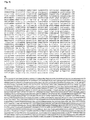
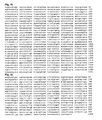
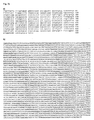
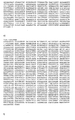
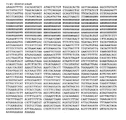
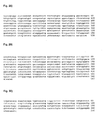
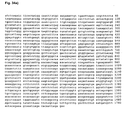
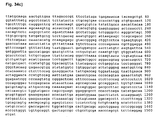
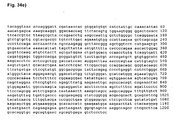
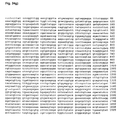
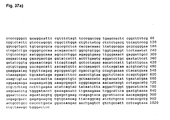
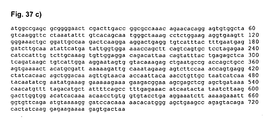
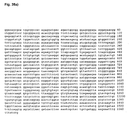
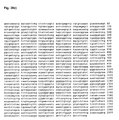
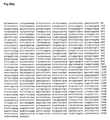
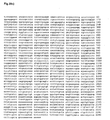
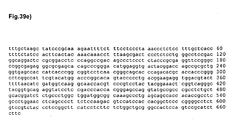
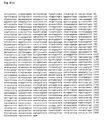
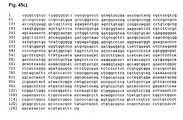
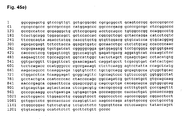
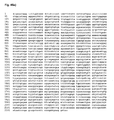
- proteins or peptides used can also be selected from those for which a polynucleotide according to one of the figures 34a), 34c), 34e), 34g), 35a), 35c), 35e), 36a), 36c), 37a), 37c), 38a), 38c), 39a), 39c), 39e), 40a), 40c), 40e), 41 a), 41c), 41e), 42a), 42e), 43c), 43e), 44e), 45a), 45c), 45e), or 46e).
- coding cDNA sequences for mouse, rat and human from JNK3, PIM-2, LR-11, TFIIF ⁇ , GGT- ⁇ , GATA3, CLC-7, and catalase as well such as tetraspanin (TM4SF / TSPAN-6 / TM4-D), casein kinase 1a, MAP3K7 / TAK-1 (TGF- ⁇ activated kinase), BAB14112 and / or spermidine Synthase, or in the case of the GATA3 rat only a partial sequence and in Trap of CCL-7, mouse genomic DNA.
- TM4SF / TSPAN-6 / TM4-D tetraspanin
- casein kinase 1a MAP3K7 / TAK-1
- BAB14112 and / or spermidine Synthase or in the case of the GATA3 rat only a partial sequence and in Trap of CCL-7, mouse genomic DNA.
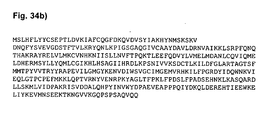
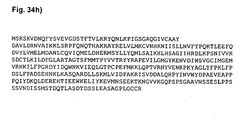
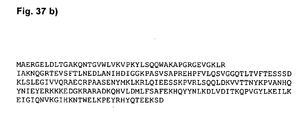
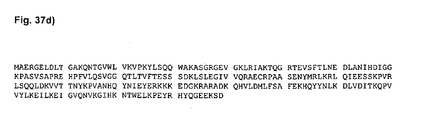
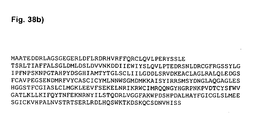
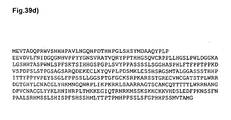
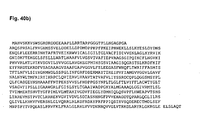
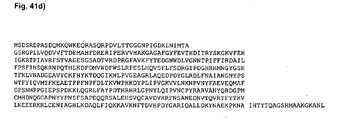
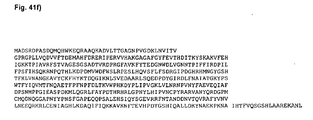
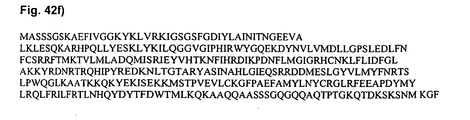
- the proteins can also be selected from those with a Amino acid sequence according to one of Figures 34b), 34d), 34f), 34h), 35b), 35d), 35f), 36b), 36d), 37b), 37d), 38b), 38d), 39b), 39d), 40b), 40d), 40f), 41b), 41d), 41f), 42b), 42f), 43d), 43f), 44f), 45b), 45d), 45f) or 46f). These are also predominantly known from the prior art Sequences except for the sequence of the PIM-2 rat, which is part of the Invention was determined.
- Peptides and proteins can also be used here, whose amino acid sequence is at least 90% one of the shown is similar, since even small deviations in the amino acid sequence Interaction of the substance with peptide and protein and thus the Usually do not influence the function of the process. You understand below 90% similarity a 90% match in the Amino acid sequence.
- the proteins can also be selected from those expressed by a Nucleic acid can be encoded under stringent conditions Polynucleotide according to one of the figures 34a), 34c), 34e), 34g), 35a), 35c), 35e), 36a), 36c), 37a), 37c), 38a), 38c), 39a), 39c), 39e), 40a), 40c), 40e), 41a), 41c), 41e), 42a), 42e), 43c), 43e), 44e), 45a), 45c), 45e), or 46e) or bind their antisense polynucleotide.
- a partial protein at least 10 amino acids long is one of the the aforementioned proteins and / or peptides is used since 10 Amino acids, preferably 15, especially 20 amino acids completely are or can be specific.
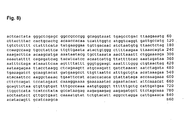
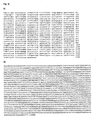
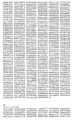
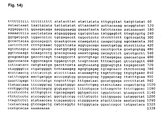
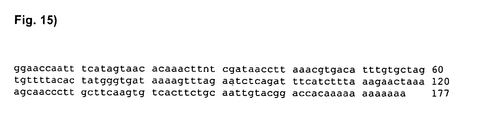
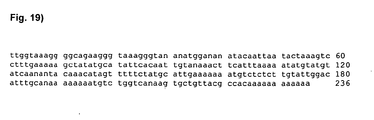
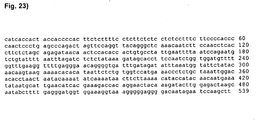
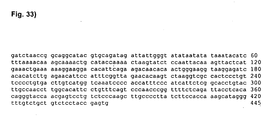
- the peptides and proteins can also be selected from those compounds for which a gene encoding consists of a polynucleotide encodes, the nucleotide sequence of which comprises a gene fragment according to one of the sequences shown in FIGS. 1-33.
- gene fragments regulated by pain have been identified and sequenced which have not yet been assigned to a known peptide or protein in the prior art.
- TM4SF / TSPAN-6 / TM4-D tetraspanin
- casein kinase 1a MAP3K7 / TAK-1 (TGF- ⁇ activated kinase)
- BAB14112 spermidine synthase.
- the sufficiently extensive sequenced gene fragment clearly defines the associated gene, the polynucleotide, the sequence of which the gene fragment is part of.
- the fact that the corresponding gene fragment was identified as pain-regulated also outlines a clearly physiological function of the gene.
- the person skilled in the art can obtain the complete gene comprising the fragment using known methods.
- a polynucleotide can be labeled as a probe according to one of Figures 1 - 33, a cDNA library hybridized with the probe and washed under stringent conditions and the cDNA clone to which the probe has bound isolated and optionally sequenced.
- the gene or polynucleotide is also obtainable by identifying and synthesizing sections of a polynucleotide according to one of Figures 1 - 33 as gene-specific oligonucleotide primers, with which PCR then starting from single- or double-stranded DNA, from cDNA- Libraries or genomic DNA as a template, the extended polynucleotide is generated and optionally sequenced. The procedure will be explained in more detail later using an example.
- This group of peptides and proteins also has the advantage over the known methods that when used in the method according to the invention an in vivo reference is ensured and the method allows the identification of potentially pain-regulating substances that are known in the prior art Screening methods may not have been noticed.
- the yardstick by which the method allows the discovery of interesting substances is either the binding to the protein or peptide, which can be demonstrated, for example, by displacement of a known ligand or the extent of bound substance, or the change in a functional parameter by the interaction of the substance with the peptide or protein.
- This interaction can be, in particular, regulation, inhibition and / or activation of receptors, ion channels and / or enzymes, and changed functional parameters can be, for example, gene expression, the ionic environment, the pH or the membrane potential, or the change in the enzyme activity or the concentration of the 2 nd messenger.
- the cell is pre step (a) genetically engineered.
- This is genetic material introduced into the cell, in particular one or more Polynucleotide sequences.
- the genetic engineering manipulation allows the measurement at least one of the functional ones changed by the test substance Parameter.
- genetic engineering Manipulation created conditions under which the change of a functional parameter measured at all or improved can be. It is particularly preferred that genetic engineering a form that is not endogenously expressed in the cell of a G protein is expressed or a reporter gene is introduced.
- GTP binding Protein an endogenous existing or physiologically unexpressed G protein
- GTP binding Protein an endogenous existing or physiologically unexpressed G protein
- the introduction of a reporter gene is permitted the measurement of an (extracellularly triggered) induced expression of the Gene product.
- the cell is genetically engineered manipulated so that the cell has at least one polynucleotide according to one of the Figures 34a), 34c), 34e), 34g), 35a), 35c), 35e), 36a), 36c), 37a), 37c), 38a), 38c), 39a), 39c), 39e), 40a), 40c), 40e), 41a), 41c), 41e), 42a), 42e), 43c), 43e), 44e), 45a), 45c), 45e), or 46e) or at least one of them 90% similar polynucleotide or a polynucleotide from the coding Sequence of a gene that a gene fragment according to one of the in the Figure 1-33 includes sequences shown, or one to contains at least 90% similar polynucleotide.
- a peptide or protein that is in the im Method used cell or preparation not endogenously expressed is synthesized by the cell. It is particularly preferred if the polynucleotide is contained in a recombinant DNA construct is.
- a (recombinant) DNA construct is an in vitro made DNA molecule.
- the cell is genetically manipulated in the process before step a) it is preferred that the cell after the genetic engineering manipulation and before step (a) under conditions that allow expression, is cultivated, possibly under selection pressure. Cultivate under one understands cells or tissues in conditions that survive the Secure cells or their successor generation. Doing so the conditions here are chosen so that an expression of the by genetic manipulation of inserted material is made possible. For this, pH, oxygen content and temperature should be kept physiological be and sufficient nutrients and necessary cofactors are added. The selection pressure allows only the cells in which to continue to cultivate the genetic engineering manipulation was at least partially successful. To includes, for example, the introduction of antibiotic resistance via the DNA construct.
- the cell used is an amphibian cell, bacterial cell, yeast cell, Insect cell or an immortalized or native mammalian cell.
- amphibian cells are Xenopus oocytes, for bacterial cells E-coli cells, for yeast cells such as Saccharomyces cerevisiae, for Insect cells Sf9 cells, for immortalized mammalian cell HeLa cells and for native mammalian cells, the CHO (Chinese Hamster Ovary) cell.
- a preferred measuring method for determining the binding of the Substance on peptide or protein takes place in the method according to the invention the measurement of the binding via the displacement of a known labeled ligands from the peptide or protein and / or via them bound activity of a labeled test substance.
- a known labeled ligands is one molecule with high specificity binding to the protein or peptide through a likewise binding substance to be tested from the Binding site is displaced.
- One of the marks is the proof to understand facilitating artificial modification to the molecule. Examples are radioactive, fluorescent or luminescent labels.
- the measurement of at least one of the functional parameters changed by the test substance is carried out by measuring the regulation, inhibition and / or activation of receptors , ion channels and / or enzymes, especially via measuring the alteration of gene expression, the ion milieu, the pH or the membrane potential, the 2 nd messenger via alteration of the enzyme activity or concentration.
- the measurement of the effect of the substance via the influence of receptors, ion channels and / or enzymes is directly recorded, on the other hand, examples of changing parameters such as gene expression, ion milieu, pH, membrane potential, enzyme activity or concentration that are to be measured as preferred the 2 nd messenger.
- changing parameters such as gene expression, ion milieu, pH, membrane potential, enzyme activity or concentration that are to be measured as preferred the 2 nd messenger.
- concentration of one or more ions in a cell compartment, in particular the cytosol under membrane potential the Ladungsdiffferenz between two sides of a biomembrane and 2 nd messenger mediators of the intracellular signaling pathway such as cyclic AMP (cAMP), Inosotoltriphosphat (IP3) or diacylglycerol (DAG).
- cAMP cyclic AMP
- IP3 Inosotoltriphosphat
- DAG diacylglycerol
- the method codes for the Peptide or protein in steps (a) and (b) is a gene consisting of a polynucleotide that a gene fragment according to one of the in the Figures 1, 3-8, 10, 11, 13, 14, 15, 17-27 or 31-33 are shown Sequences, or encodes for the peptide or protein to the At least 90%, in particular 95%, preferably 97% of the gene similar polynucleotide.
- the method codes for the Peptide or protein in steps (a) and (b) is a gene consisting of a polynucleotide that a gene fragment according to one of the in the Figure 2, 9, 12, 16 or 28-30 sequences shown, or it codes for the peptide or protein at least 90% of the gene, in particular 95%, preferably 97%, similar polynucleotide.
- Another preferred subject of the invention is also a Polynucleotide, which is one of those in one of Figures 1-33 nucleotide sequences shown or a polynucleotide from the coding sequence of a gene that a gene fragment according to one of the Figures 1-33 includes, at least 90%, preferably 95%, corresponds in particular to at least 97%.
- This also makes polynucleotides meant the at least 90%, preferably 95%, in particular at least 97% agreement in the base sequence with the coding sequence of the imaged polynucleotides or have coding sequence of the gene.
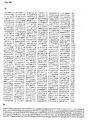
- the first specially selected form of the polynucleotide is a Polynucleotide, which is one of those in one of Figures 1, 3-8, 10, 11, 13, 14, 15, 17-27 or 31-33, in particular 20 or 21, shown Nucleotide sequences or parts thereof or a polynucleotide from the coding sequence of a gene that a gene fragment according to one of the Figures 1, 3-8, 10, 11, 13, 14, 15, 17-27 or 31-33, especially 20 or 21, comprises at least 90%, preferably 95%, in particular to corresponds to at least 97%.
- Another preferred item is a first through the Manufacturing process defined polynucleotide, namely a polynucleotide, at least 90%, preferably 95%, in particular at least 97% of a defined nucleic acid sequence corresponds to that one receives that a polynucleotide according to one of the figures 1 - 33 as Probe labeled, a cDNA library hybridized with the probe and under stringent conditions and the cDNA clone to which the Has bound probe, isolated and optionally sequenced.
- a polynucleotide, or gene is defined via a manufacturing process, with which a certain product, the gene, which a certain, known Contains gene fragment, isolated, or can be sequenced.
- a probe is a nucleic acid that is complementary to identification or corresponding nucleotide sequences can and mostly is marked for identification.
- a cDNA library is cloned cDNA fragments a cell or tissue that is as complete as possible should display mRNA of the selected tissue. hybridization means the binding of two single-stranded nucleic acid molecules, where washing under stringent conditions should ensure that only nucleic acid molecules hybridized via precisely paired bases stay.
- a cDNA clone is a genetically uniform progeny group here with a uniform cDNA.
- Another preferred item is a second through the Manufacturing process defined polynucleotide, namely a polynucleotide, at least 90%, preferably 95%, in particular at least 97% of a defined nucleic acid sequence corresponds to that one receives sections of a polynucleotide according to one of the figures 1 - 33 determined and synthesized as a gene-specific oligonucleotide primer with which then by PCR starting from single or double stranded DNA, from cDNA libraries or genomic DNA as The template generates the extended polynucleotide and, if necessary is sequenced.
- a polynucleotide, or gene is transferred via a defined further manufacturing process with which a specific product, isolates the gene that contains a certain known gene fragment, or can be sequenced.
- Primer is an oligonucleotide that hybridizes with the target DNA (as a so-called template) and the starting point of the Synthesis is.
- PCR is short for polymerase chain reaction, in which the heat resistance of a particular polymerase for selective Duplication is used.
- the template serves as Starting material on which the reproduction is selective with the primers hybridizing matching DNA takes place.
- the second particularly selected form of the polynucleotide are those by the production processes defined polynucleotides in particular if as a starting point for their manufacture / isolation / sequencing Polynucleotide (gene fragment) according to one of Figures 1, 3-8, 10, 11, 13, 14, 15, 17-27 or 31-33, in particular 20 or 21, is used.
- the polynucleotide is RNA or single- or double-stranded DNA, in particular mRNA or cDNA.
- the polynucleotide is a Aritisense polynucleotide, or PNA, that has a sequence that is able to specifically target a polynucleotide according to the invention tie.
- PNA means "peptidic nucleic acid” Nucleic acid), which carries the base pairs, but its backbone is peptide bound.
- An antisense polynucleotide shows that complementary base sequence to at least part of a base nucleic acid.
- the polynucleotide is part of a Ribozyme or other DNA enzyme or a catalytic RNA or DNA is. Under cat enzyme there is a catalytically active ribonucleic acid understand, by DNA enzyme a corresponding deoxyribonucleic acid, thus catalytic RNA or DNA.
- Another object of the invention is a vector containing one of the polynucleotides already described.
- a vector is one Nucleic acid molecule that is used for genetic engineering purposes Contain or transfer foreign genes. Is particularly preferred that it is an expression vector. He thus serves the Expression of the contained foreign gene, the polynucleotide.
- a vector derived from a virus is also preferred.
- the adenovirus, adeno-associated virus or herpes virus and / or he has at least one LTR, poly A, promoter and / or ORI sequence contains.
- An LTR is a "long terminal repeat", one at the end section for viruses.
- Poly-A sequence is a more than 20 adenosine residues long tail.
- a promoter sequence is the Control area for transcription.
- a particularly selected form of the vector according to the invention is a Vector of a polynucleotide, or at least 90% of it, preferably 95%, in particular 97% similar polynucleotide according to Figures 1, 3-8, 10, 11, 13, 14, 15, 17-27 or 31-33, especially 20 or 21, or a polynucleotide, or at least 90% of it, preferably 95%, especially 97% similar polynucleotide that the Sequence according to Figures 1, 3-8, 10, 11, 13, 14, 15, 17-27 or 31-33, contains in particular 20 or 21, or a polynucleotide, or one thereto at least 90%, preferably 95%, especially 97% of the like Polynucleotide that is made by a manufacturing process starting from a Gene fragment according to one of Figures 1, 3-8, 10, 11, 13, 14, 15, 17-27 or 31-33, in particular 20 or 21, is obtained.
- Another subject is a peptide, in particular oligopeptide or Polypeptide, or protein, which is already one of the objects of the Polynucleotides described invention is encoded.
- Another object of the invention is also a peptide, in particular Oligopeptide or polypeptide, or protein encoded by a polynucleotide, that according to stringent conditions with one of the polynucleotides Figure 1-33 or its antisense polyucleotide hybridizes.
- the peptide or protein has been post-translationally modified, in particular it has been glycosylated, phosphorylated, amidated, methylated, acetylated, ADP-ribosylated, hydroxylated, provided with a membrane anchor, cleaved or shortened.
- Post-translational modifications can be found, for example, in Voet / Voet, Biochemistry, 1 st Edition, 1990, pp. 935-938.
- a particularly selected form of the peptide or protein if there is by a polynucleotide or at least 90%, preferably 95 %, in particular 97% similar polynucleotide according to Figures 1, 3-8, 10, 11, 13, 14, 15, 17-27 or 31-33, especially 20 or 21, or a Polynucleotide, or at least 90%, preferably 95% thereof, in particular 97% similar polynucleotide, which the sequence according to the Figures 1, 3-8, 10, 11, 13, 14, 15, 17-27 or 31-33, especially 20 or 21, or contains a polynucleotide, or at least 90% thereof, preferably 95%, especially 97% similar polynucleotide, which by a manufacturing process based on a gene fragment according to a of Figures 1, 3-8, 10, 11, 13, 14, 15, 17-27 or 31-33, in particular 20 or 21, is obtained, is encoded.
- Another object of the invention are antibodies against an already peptide or protein described as the subject of the invention. It is it is preferred if the antibody is a monoclonal or polyclonal antibody.
- Another object of the invention is a cell containing one already polynucleotide described as the subject of the application, an already peptide or protein described as the subject of the application and / or one already described as the subject of the application Vector. It is particularly preferred if it is a Amphibian cell, bacterial cell, yeast cell, insect cell or one immortalized or native mammalian cell.
- Amphibian cells are Xenopus oocytes, for bacterial cells E-coli cells, for yeast cells such as Saccharomyces cerevisiae, for insect cells Sf9 cells, for immortalized mammalian cell HeLa cells and for native Mammalian cells the CHO (Chinese Hamster Ovary) cell.
- the specially selected shape of the cell contains the special one selected form of the polynucleotide, the specially selected form of the peptide or protein and / or the specially selected form of the Vector.
- Another object of the invention is a transgenic non-human Mammal, whose germ and somatic cells are already one of the The subject of the invention described polynucleotides as the result of a chromosomal introduction into the genome of the animal or the genome contain one of the ancestors of the named animal. You understand under chromosomal introduction, which is the genetic manipulative Interference affects the animal's chromosome.
- Another object of the invention is a transgenic non-human Mammal, whose germ and somatic cells as a result of one chromosomal manipulation in the genome of the animal or in the genome of a one of the nucleotide sequences according to the ancestor of the named animal one of claims 14-21 no longer contained in expressible form.
- the chromosomal manipulation concerned the gene of the animal or its Ancestors. No longer expressible means when the Information on the synthesis of a polypeptide or protein, although in native Form present, no longer allow full synthesis. Examples are changing the regulatory sequences or cutting them out part of the native nucleic acid molecule in the coding region.
- transgenic is non-human Mammal is a rodent.
- the specially selected form of the transgenic non-human Mammal is present when the nucleotide sequence of the particular selected form of the polynucleotide corresponds.
- connection is identifiable as a pain-regulating substance by an inventive Method.
- connection refers in particular to low molecular weight active ingredients, but also on peptides, proteins and Nucleic acids.
- Identifiable means that the connection is the Feature that it is in the screening method according to the invention in terms of binding significantly stronger, preferably twice as strong binds like the average of the substances to be tested or regarding the change in functional parameters significantly from the average of the substances to be tested differs.
- a particularly selected form of the compound according to the invention is by a method using the known proteins, JNK3, PIM-2, LR-11, TFIIF ⁇ , GGT- ⁇ , GATA3, CLC-7, catalase, tetraspanin (TM4SF / TSPAN-6 / TM4-D), casein kinase 1a, MAP3K7 / TAK-1 (TGF- ⁇ activated kinase), BAB14112 and / or spermidine synthase, a peptide or protein, for which or for a part thereof a polynucleotide according to one of the figures 34a), 34c), 34e), 34g), 35a), 35c), 35e), 36a), 36c), 37a), 37c), 38a), 38c), 39a), 39c), 39e), 40a), 40c), 40e), 41a), 41c), 41e), 42a), 42e), 43c), 43e), 44e), 45a), 45c), 45e), or 46e) or
- Another particularly selected form of the invention Connection that is identifiable by a method in which the Peptide or protein in steps (a) and (b) is a gene consisting of a polynucleotide that is a gene fragment according to one of the figures 1, 3-8, 10, 11, 13, 14, 15, 17-27 or 31-33, especially 20 or 21, comprises, encodes, or at least 90%, in particular 95, of the gene %, preferably 97%, similar polynucleotide.
- a compound created by a method is identifiable in that for the peptide or protein in steps (a) and (b) a gene consisting of a polynucleotide that is a gene fragment encoded or encoded according to any of Figures 2, 9, 12, 16 or 28-30 one to the gene at least 90%, especially 95%, preferably 97%, similar polynucleotide as a pain-regulating substance.
- Another subject is also an active ingredient that is linked to a peptide or protein according to the invention binds, with particular preference is when the active ingredient is a low molecular weight active ingredient.
- a particularly selected form of the active ingredient is when the Active ingredient to the specially selected form of the peptide or protein binds.
- Another object of the invention is a medicament containing at least one polynucleotide according to the invention, one according to the invention Peptide or protein, a vector according to the invention, a Antibodies according to the invention, a cell according to the invention, a compound of the invention and / or a compound of the invention Active ingredient and, if appropriate, suitable auxiliaries and / or additives.
- the Medicaments according to the invention can be in the form of liquid pharmaceutical forms of injection solutions, drops or juices, as semi-solid dosage forms in Form of granules, tablets, pellets, patches, capsules, plasters or Aerosols are administered and contain in addition to the at least one Subject according to the invention, depending on the galenic form, if appropriate Carrier materials, fillers, solvents, diluents, dyes and / or binders.
- auxiliary materials and the ones to be used Amounts of these depend on whether the drug is oral, oral, parenteral, intravenous, intraperitoneal, intradermal, intramuscular, intranasal, buccal, rectal or local, for example, infections on the Skin to be applied to the mucous membranes and eyes.
- Oral application is suitable for preparations in the form of tablets, Dragees, capsules, granules, drops, juices and syrups, for those parenteral, topical and inhalation application solutions, suspensions, Easily reconstitutable dry preparations and sprays.
- Objects according to the invention in a depot in dissolved form or in a plaster, possibly with the addition of skin penetration promoting agents are suitable percutaneous application preparations.
- Forms of preparation that can be used orally or percutaneously can be Release items according to the invention with a delay.
- the Andes The amount of active ingredient to be administered to patients varies depending on Weight of the patient, the type of application, the indication and the Severity of the disease. Usually 2 to 500 mg / kg applied at least one object according to the invention. If that Medicines to be used in particular for gene therapy A suitable auxiliary or additive is recommended, for example physiological saline, stabilizers, proteinase, DNAse inhibitors Etc.
- a drug is particularly preferred, the preferred forms or the specially selected form (s) of the polynucleotide (s), Peptide or protein, vector, antibody, cell, compound and / or Contains active ingredient.
- the drug is a contains preferred compound of the invention by a method using the known proteins, JNK3, PIM-2, LR-11, TFIIF ⁇ , GGT- ⁇ , GATA3, CLC-7, catalase, tetraspanin (TM4SF / TSPAN-6 / TM4-D), Casein kinase 1a, MAP3K7 / TAK-1 (TGF- ⁇ activated kinase), BAB14112 and / or spermidine synthase, a peptide or protein, for or for a part of which is a polynucleotide according to one of Figures 34a), 34c), 34e), 34g), 35a), 35c), 35e), 36a), 36c), 37a), 37c), 38a), 38c), 39a), 39c), 39e), 40a), 40c), 40e), 41a), 41c), 41e), 42a), 42e), 43c), 43e), 44e), 45a), 45c), 45e
- the medicament is a compound which is caused by a method is identifiable in which for the peptide or protein in the Steps (a) and (b) a gene consisting of a polynucleotide that a Gene fragments according to one of Figures 1, 3-8, 10, 11, 13, 14, 15, 17-27 or 31-33, in particular 20 or 21, encoded, or one to the At least 90%, in particular 95%, preferably 97% of the gene Similar polynucleotide, or contains an active ingredient that is particularly linked to the selected form of the peptide or protein binds.
- Another object of the invention is a diagnostic agent containing at least one polynucleotide, peptide or protein according to the invention, Vector, antibodies or parts thereof and / or an inventive Cell and any suitable additives. You understand a diagnostic tool, for example, a diagnostic tool Disease process.
- a diagnostic agent that is particularly preferred is that which is particularly selected Form of the polynucleotide, peptide or protein or a part thereof, vector, antibody and / or the cell contains.
- Polynucleotide which is an antisense polynucleotide or PNA acts that has a sequence that is capable of specific to a bind polynucleotide according to the invention contains.
- the use for the treatment of chronic is particularly preferred Pain.
- Another highly preferred use for the treatment of pain relates to the second particularly selected form of connection and / or the specially selected form of the active ingredient.
- Gene therapy is a form of therapy in which the introduction of nucleic acids into cells is an effector gene, usually a Protein that is expressed.
- In vitro methods are used to remove cells from the organism removed and transfected with vectors ex vivo, after which it was then reintroduced to be introduced into the same or into another organism. at In vivo gene therapy will use vectors, for example to combat it from tumors, systemically (e.g. via the bloodstream) or directly into the tumor applied.
- Polynucleotide which is an antisense polynucleotide or PNA acts that has a sequence that is capable of specific to a to bind the polynucleotide according to the invention, or the part of a ribozyme or other DNA enzyme or a catalytic RNA or DNA.
- Another object of the invention is the use of a polynucleotide according to the invention, a peptide or protein, one Vector, an antibody, a cell, a compound and / or one Active ingredient for diagnostics and / or for effectiveness studies. Diagnostics is the analysis of a clinical picture assigned symptoms and under efficacy studies Studies on the effectiveness of substances to be tested, especially their medical effectiveness.
- the cell is genetically engineered before step (a) becomes. It is particularly preferred if the genetic engineering Manipulion the measurement of at least one of the test substance changed functional parameters allowed. Also particularly preferred It is when the cell is genetically manipulated so that the cell at least one polynucleotide defined by the manufacturing process, preferably the second particularly preferred form of the polynucleotide, or at least 90%, preferably 95%, in particular 97 % contains similar polynucleotide.
- Another object of the invention is a method for Production of a peptide or protein according to the invention, in which one cell 33-35 according to the invention which is a polynucleotide according to the invention and / or contains, cultivated and optionally the peptide or protein is isolated.
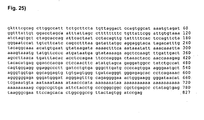
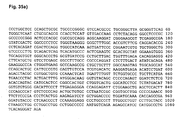
- Another object of the invention is a polynucleotide that the in Figure 35e) nucleotide sequence shown at least 90%, preferably 95%, in particular at least 97%, or exactly equivalent.
- Another object of the invention is a protein that the in Figure 35f) amino acid sequence shown to at least 90%, preferably 95%, in particular at least 97%, or exactly.
- administration may take the form of a drug such as described above.
- Another object of the invention is a method for treatment, especially pain treatment, a non-human mammal or People who have a pain treatment, in particular chronic pain, required by administering a Medicament according to the invention, in particular containing one substance according to the invention and / or an active substance according to the invention.
- RNA or RNA derived from the nucleic acid sequence of the complete cDNA or constructs of sub-areas that the mRNA or Can reduce protein concentration.
- This can e.g. antisense oligonucleotides (DNA or RNA) that may be in use modified nucleotide building blocks (e.g. O-allyl ribose) increased Show stability to nucleases.
- Ribozymes conceivable as an enzymatically active RNA molecule catalyze specific cleavage of the RNA.
- Peptide nucleic acids or use of non-traditional bases such as Inosine, Queosine or Wybutosine as well as Acetyl-, Methyl-, Thio- and similarly modified forms of adenine, cytidine, guanosine and thymidine and Uridine not or to a lesser extent through endogenous nucleases can be broken down.
- sequences described can be used for the therapy of neurological Diseases used in particular chronic pain conditions by cloning into suitable vectors (e.g. Adenovirus vectors or adeno-associated virus vectors) for in vivo or ex vivo therapy can be used to e.g. one Overexpression or underexpression of the endogenous gene product to counteract the sequence of the defective gene product correct (e.g. by transsplicing with the exogenous construct) or a to provide functional gene product.
- suitable vectors e.g. Adenovirus vectors or adeno-associated virus vectors
- Polynucleotide sequences which are derived from the nucleotide sequences according to the invention could be used to diagnose conditions or diseases which are associated with expression of these gene sequences.
- these conditions or diseases include neurological diseases including chronic pain or neuropathic pain (caused, for example, by diabetes, cancer or AIDS) or neurodegenerative diseases such as Alzheimer's, Parkinson's, Huntington's disease, Jacob-Creutzfeld, amyotrophic lateral sclerosis and dementias.
- nucleotide sequences can serve in a variety of ways (Northern blot, Southern blot, FISH analysis, PRINS analysis, PCR) either to identify the gene product or deviating diagnostically relevant gene products or to quantify the gene product.
- antibodies or aptamers against the protein encoded by the nucleic acids according to the invention can also be used for diagnostics (e.g. by means of ELISA, RIA, immunocytochemical or immunohistochemical methods) in order to identify the protein or different forms and to quantify the protein.
- nucleic acid probes derived from the nucleotide sequences according to the invention could be used to determine the gene locus (for example by FISH, FACS, artificial chromosomes such as YACs, BACs or P1 constructs).
- the gene fragment 141-13 is particularly interesting.
- the in the Figures 20 and 21 have shown the extension of the gene fragment in analysis shows that a new gene is present here, which is related to UNC-115 and is homologous to other members of the abLIM family, but is still unknown. Along with the expression pattern and considering the interesting ones This is the role of UNC-115 in neuronal development Gene fragment or gene of particular interest.
- the gene fragment 127-8 is also interesting because it is very homologous to an apparently highly expressed part of the human genome (AN: NT_009379.1 on chromosome 11q13.
- PIM-2 kinase For other isotypes of this enzyme, PIM-1 and -3, it could be shown that this signaling kinase is involved in learning and memory processes in the hippocampus (Konietzko et al. (1999) EMBO J., 18: 3359-3369).
- a nucleic acid sequence was isolated and characterized which codes for the complete rat PIM-2 protein (Fig. 35e, 35f).
- the nucleic acid sequence and the protein sequence for Pim-2 from the rat are not yet known.
- a complete cDNA was encoded, ie containing the entire coding region, which codes for the human Pim-2 (35 a, b).
- catalase which removes the harmful H 2 O 2 by converting it into O 2 and H 2 O.
- the protein kinase JNK-3 is specifically expressed in nerve cells of the central nervous system (Mohit et al., 1995) and it is the subsequent activation of protein kinases from a number of opiate receptors (such as .mu.-opiate receptor and ORL-1) Family of mitogen-activated protein kinases have been described (Li & Chang, 1996; Hawes et al., 1998).
- the LR11 protein is a mosaic protein of the "Low density lipoprotein receptor (LDLR)" family (Möwald et al., 1997).
- Rats were subjected to various pain models for some time after the pain triggered spinal cord incisions and by in situ hybridization with DNA probes or with specific ones Antibodies express the respective gene or gene fragment examined and compared with control animals.
- the complete rat cDNA sequences are either cloned by screening cDNA banks or PCR-mediated Methods.
- the cDNA libraries were created with RNA from a tissue which expresses the mRNA of the gene sought. Single or double-stranded DNA or RNA molecules are used as probes, which are either radioactive (eg with [ ⁇ 32 P] dCTP) or not radioactively labeled (eg UTP labeled with digoxigenin).
- the cDNA library present in bacteria or phages is applied to agar plates, hybridized with the nucleic acid probes after transfer to suitable filter membranes and detected after a stringent washing procedure.
- the cDNA clones identified by these methods are further isolated and analyzed by sequencing (see Sambrooks et al., 1989; Ausubel et al., 1990).
- the PCR-mediated methods are based on the regulated cDNA sequences in sense or oligonucleotide primers antisense orientation determined and synthesized.
- the conventional 5'-RACE method Rapid amplification of 5'-cDNA Ends
- the antisense-oriented primer used for cDNA synthesis then the Single-stranded cDNA formed by ligation of an oligonucleotide extended with RNA ligase or tailing reaction with terminal transferase and then a PCR reaction with an internal one (called nested) and subjected to a tail-specific primer.
- the PCR amplicons are cloned and analyzed by sequencing.
- a Modification of this method uses the effect of so-called supression PCR, to start from a cDNA template in both the 5 'and the 3' direction to extend the cDNA sequence (marathon cDNA amplification Kit, Clontech).
- supression PCR a double-stranded cDNA starting from RNA created from rat spinal cord, and with specially modified linkers ligated.
- This cDNA is then labeled with a gene-specific primer and a linker-specific primer was amplified by PCR, the Amplification products cloned and sequenced.
- the homologous human cDNA sequences are modified by the methods mentioned above isolated. In conventional screening of cDNA banks are used banks of human origin and the Hybridization performed under less stringent conditions also detect cDNA clones with less homology.
- PCR-mediated strategies you first try one Variety of different primers, preferably from the coding region to amplify a human cDNA. If this does not succeed, it can you use degenerate PCR primers or you choose less stringent PCR conditions.
- a nucleic acid segment which codes for the chloride channel CLC-7 is cloned in an expression vector which allows a constitutive expression (for example a CMV promoter) or an inducible expression in eukaryotic cells.
- the DNA is introduced into eukaryotic cells (for example CHO cells, HEK293 cells or NIH-3T3 cells) using a suitable transfection method, for example using lipofectamine (Roche Diagnostics).
- the cells are cultivated in the presence of a selection reagent (eg Zeocin; hygromycin or neomycin) so that only the cells that have taken up the DNA construct survive and, in the case of prolonged selection, have also been incorporated into the genome.
- a selection reagent eg Zeocin; hygromycin or neomycin
- membrane fractions which contain the CLC-7 channel in large quantities and can be used for a binding assay.
- This consists of 1.) the CLC-7-containing membranes 2.) a radiolabeled ligand (eg tritium-labeled 4,4'-diisothiocyanostilbene-2,2'-disulfonic acid (DIDS) or [ 3 H] labeled 4-acetamido-4 '-isothiocyanatostilbene-2,2'-disulfonic acid (SITS)); 3.) a binding buffer (eg 50 mM HEPES pH 7.4, 1 mM EDTA) and the ligand to be examined for binding.
- DIDS tritium-labeled 4,4'-diisothiocyanostilbene-2,2'-disulfonic acid
- SITS 4-acetamido-4 '-isothiocyanatostilbene-2,2'-disulfonic acid
- This method is suitably miniaturized in such a way that it can be carried out in (96-, 384- or 1536-well) microtiter plates in order to carry out this method by means of a robot in the so-called high throughput screening (HTS) method:
- HTS high throughput screening
- a nucleic acid segment which codes for the protein kinase PIM-2 is cloned in an expression vector which allows inducible expression in prokaryotes, such as, for example, E. coli.
- the nucleic acid section is modified so that it is expressed as a fusion protein with an additional N- or C-terminal amino acid sequence. If the function of the PIM-2 kinase remains unchanged, this sequence should allow purification by means of a specific method, for example a glutathione S-transferase fragment, which allows isolation from the protein mixture by binding to glutathione.
- the fusion proteins are purified and used in an in vitro kinase experiment. 5 ⁇ g protein at 30 ° C for 30 minutes in 50 ⁇ l kinase buffer (20 mM PIPES, pH 7.0, 5 mM MnCl 2 , 7 mM ⁇ -mercaptoethanol, 0.4 mM spermine, 10 mMrATP) supplemented with 10 ⁇ Ci [ ⁇ 32 P ] ATP. Purified histone H1 protein (Sigma) or bacterially expressed GST-NFATc1 fusion protein are added as substrates.
- the unincorporated [ ⁇ - 32 P] ATP is filtered off and the amount of 32 phosphate incorporated is determined by ⁇ -scintillation (Trilux, Wallac).
- the test substances are also incubated in this approach and a decrease in the 32 P incorporation is used as an indicator of an inhibitor.
- This method is suitably miniaturized so that it can be carried out in (96-, 384- or 1536-well) microtiter plates in order to carry out this method by means of a robot in the so-called high throughput screening (HTS) method.
- HTS high throughput screening
- Tablets can be obtained by directly compressing mixtures of the active ingredient according to the invention with appropriate auxiliaries or by Compressing granules containing the active ingredient (with additional granules if necessary) Auxiliaries) are produced.
- the granules can either by wet granulation with e.g. aqueous granulating liquids and subsequent drying of these granules or by dry granulation e.g. be made via compacting.
- 1 g of an active ingredient according to the invention is in 1 liter of water for Injections solved at room temperature and then by Add NaCl (sodium chloride) adjusted to isotonic conditions.
Landscapes
- Health & Medical Sciences (AREA)
- Life Sciences & Earth Sciences (AREA)
- Chemical & Material Sciences (AREA)
- Molecular Biology (AREA)
- Engineering & Computer Science (AREA)
- General Health & Medical Sciences (AREA)
- Organic Chemistry (AREA)
- Medicinal Chemistry (AREA)
- Biochemistry (AREA)
- Biomedical Technology (AREA)
- Hematology (AREA)
- Immunology (AREA)
- Proteomics, Peptides & Aminoacids (AREA)
- Urology & Nephrology (AREA)
- Pathology (AREA)
- Genetics & Genomics (AREA)
- Biotechnology (AREA)
- Cell Biology (AREA)
- Biophysics (AREA)
- Gastroenterology & Hepatology (AREA)
- Microbiology (AREA)
- Zoology (AREA)
- Food Science & Technology (AREA)
- Physics & Mathematics (AREA)
- Analytical Chemistry (AREA)
- General Physics & Mathematics (AREA)
- Toxicology (AREA)
- Animal Behavior & Ethology (AREA)
- Rheumatology (AREA)
- Chemical Kinetics & Catalysis (AREA)
- General Chemical & Material Sciences (AREA)
- Nuclear Medicine, Radiotherapy & Molecular Imaging (AREA)
- Pharmacology & Pharmacy (AREA)
- Pain & Pain Management (AREA)
- Public Health (AREA)
- Veterinary Medicine (AREA)
- Medicines That Contain Protein Lipid Enzymes And Other Medicines (AREA)
- Measuring Or Testing Involving Enzymes Or Micro-Organisms (AREA)
- Micro-Organisms Or Cultivation Processes Thereof (AREA)
- Preparation Of Compounds By Using Micro-Organisms (AREA)
Abstract
Description
- Erhöhte Empfindlichkeit und verringerte Reizschwelle peripherer Nozizeptoren
- Aktivierung sogenannter stiller Nozizeptoren
- Reorganisation rezeptiver Felder
- Erregbarkeitszunahme im Rückenmark.
- JNK3, PIM-2, LR-11, TFIIFβ, GGT-β, GATA3, CLC-7, Katalase, Tetraspanin (TM4SF/TSPAN-6/TM4-D), Caseinkinase 1a, MAP3K7/TAK-1 (TGF-β activated kinase), BAB14112 und/oder Spermidin Synthase,
- einem Peptid oder Protein, für das oder für einen Teil dessen ein Polynukleotid gemäß einer der Abbildungen 34a), 34c), 34e), 34g), 35a), 35c), 35e), 36a), 36c), 37a), 37c), 38a), 38c), 39a), 39c), 39e), 40a), 40c), 40e), 41a), 41c), 41e), 42a), 42e), 43c), 43e), 44e), 45a), 45c), 45e), oder 46e) oder ein dazu zu mindestens 90 % ähnliches Polynukleotid kodiert,
- einem Peptid oder Protein mit einer Aminosäuresequenz gemäß einer der Abbildungen 34b), 34d), 34f), 34h), 35b), 35d), 35f), 36b), 36d), 37b), 37d), 38b), 38d), 39b), 39d), 40b), 40d), 40f), 41b), 41d), 41f), 42b), 42f), 43d), 43f), 44f), 45b), 45d), 45f) oder 46f) oder ein dazu zu mindestens 90 % ähnliches Peptid oder Protein
- und/oder einem Protein, das durch eine Nukleinsäure kodiert wird, die unter stringenten Bedingungen an ein Polynukleotid gemäß einer der Abbildungen 34a), 34c), 34e), 34g), 35a), 35c), 35e), 36a), 36c), 37a), 37c), 38a), 38c), 39a), 39c), 39e), 40a), 40c), 40e), 41a), 41c), 41e), 42a), 42e), 43c), 43e), 44e), 45a), 45c), 45e), oder 46e) oder deren Antisense Polynukleotid bindet,
- einem mindestens 10 Aminosäuren langen Teilprotein eines der vorgenannten Proteine und/oder Peptide, und/oder
- einem Peptid oder Protein, für das ein Gen bestehend aus einem Polynukleotid kodiert, dessen Nukleotidsequenz ein Genfragment gemäß einer der in den Abbildungen 1-33 dargestellten Sequenzen umfaßt, oder für das ein zu einem solchen Gen mindestens 90 % ähnliches Polynukleotid kodiert,
- Substanz: Damit ist eine chemische Verbindung gemeint. Hier handelt es sich im engeren Sinne um Verbindungen, die potentiell eine Wirkung im Körper entfalten können, niedermolekulare Wirkstoffe, Nukleinsäuren, Fette, Zucker, Peptide oder Proteine, insbesondere hier niedermolekulare Wirkstoffe.
- schmerzregulierend: Im Sinne der Erfindung heißt schmerzregulierend, daß die Substanz die Wahrnehmung von Schmerz direkt oder indirekt beeinflußt, insbesondere natürlich analgetisch wirkt.
- Inkubation: Unter Inkubation ist das Einbringen und Belassen eines biologischen Untersuchungsobjektes, beispielsweise einer Zelle oder eines Proteins, in einem temperierten Medium wie in einem Brutschrank oder auf einem Wasserbad zu verstehen. Dabei heiß hier unter geeigneten Bedingungen eine Inkubation unter physiologischen Bedingungen (z.B. 37°C pH7,2) oder bei den Bedingungen, bei denen eine optimale Messung im Verfahren möglich wird.
- Zelle: Die Zelle ist ein sich selbst regulierendes, offenes, mit seiner Umgebung durch permanenten Stoffaustausch in einem Fließgleichgewicht stehendes System mit eigenem Stoffwechsel, und Vermehrungsfähigkeit. Die Zelle kann separat kultiviert oder Teil eines Gewebes, insbesondere aus einem Organ, sein, und dort vereinzelt oder noch im Zellverband vorliegen.
- Präparation aus einer Zelle: Darunter versteht man Präparate, die mittels chemischer, biologischer, mechanischer oder physikalischer Methoden unter Änderung der Zellstruktur hergestellt werden, beispielsweise Membranfragmente, isolierte Zellkompartimente, isoliertes Cytosol, oder aus Gewebe gewonnenes Homogenat.
- Peptid: Verbindung aus über peptidische Bindungen zu Ketten verknüpften Aminosäuren. Ein Oligopeptid besteht aus zwischen 2 und 9 Aminosäuren, ein Polypeptid aus zwischen 10 und 100 Aminosäuren.
- Protein: Verbindung aus über peptidische Bindungen zu Ketten verknüpften mehr als 100 Aminosäuren u.U. mit einer definierten Raumstruktur.
- JNK3: Proteinkinase aus der Familie der mitogen-aktivierten Proteinkinasen.
- PIM-2: Ein Proto-Oncogen und eine Serin-Threonin-Kinase
- LR-11: Ein Mitglied der LDL ("Low density lipoprotein")-Rezeptor-Familie und ein Mosaikprotein.
- TFIIFβ: Beta-Untereinheit eines Transkriptions-Initiationsfaktors, der an die RNA-Polymerase II bindet
- GGT-β: Beta-Untereinheit der Geranyl-Geranyl-Transferase vom Typ I (EC 2.5.1.3.)
- GATA3: Typ 3 eines GATA-Bindungsproteins
- CLC-7: Ein Chlorid-Kanal-Protein.
- Katalase: Ein Enzym (EC 1.11.1.6), das eine entscheidende Rolle in der Entgiftung reaktiver Sauerstoffspezies spielt.
- Tetraspanin (TM4SF/TSPAN-6/TM4-D): Spezifisch neuronal im ZNS insbesondere u.a. im Cortex und Hippocampus zu finden. Spielt wohl eine Rolle bei Neuritenwachstum und Synapsenbildung und scheint ein Vermittler zwischen Zelladhäsion (Integrine) und Signalmolekülen (PKC, PI4-Kinase) zu sein.
- Caseinkinase 1a: Ubiquitäres Enzym, das durch die Phosphorylierung des AP-3-Komplexes zur Synapsenbildung beitragen dürfte.
- MAP3K7/TAK-1 (TGF-β activated kinase): Enzym, das spezifisch JNK-Kinasen aktiviert.
- BAB14112: ein bisher weitgehend unbekanntes Protein; AN: BAB14112,
- Spermidin Synthase: ubiquitäres Enzym, das unter anderem für Zellwachstum verantwortlich zu sein scheint.
- Polynukleotid: Das zugrundeliegende Nukleotid ist ein grundsätzlich aus Nucleinbase, Pentose und Phosphorsäure bestehender Grundbaustein der Nucleinsäuren. Diese entspricht einem hochmolekularen Polynucleotid aus mehreren Nukleotiden, die über Phosphorsäure-Pentose-Veresterung miteinander verknüpft sind. Unter dierr Erfindung fallen aber auch modifizierte Polynukleotide, die zwar die Basenabfolge beibehalten, aber über ein modifiziertes Rückrat statt der Phosphorsäure-Pentose verfügen.
- zu mindestens 90 (95, 97)% ähnlich: Darunter ist zu verstehen, daß die mit erfaßten Polynucleotide in ihrem kodierenden Bereich beuzüglich der Basenabfolge zu mindestens 90% (95%, 97%) identisch mit der Referenz (Abbildung etc.) sind und die mit erfaßten Peptide und Proteine in ihrer Primärstruktur, der Abfolge der Aminosäuren zu mindestens 90% (95%, 97%) mit der Referenz identisch sind.
- Gen: Mit dem Begriff Gen wird ein Genomabschnitt mit einer definierten Nukleotidsequenz bezeichnet, der die Information zur Synthese einer m-oder prä-mRNA oder einer sonstigen RNA (z.B. tRNA, rRNA, snRNA etc.) enthält. Es besteht aus kodierenden und nicht kodierenden Abschnitten.
- Genfragment: Nukleinsäureabschnitt, der in seiner Basenabfolge einen Teilbereich eines Gens beinhaltet
- physiologisch verlängertes Genfragment: ein Genfragment, das durch molekularbiologische Verfahren, wie z.B. das Durchmustern einer cDNA-Bibliothek, das Herausziehen komplementärer DNA-Stränge aus einem Nukleinsäuregemisch oder PCR-vermittelten Verfahren (sog. RACE-Protokolle) so verlängert wird, daß es in seiner Sequenz der in dem entsprechenden Zielorgan (Gehirn, Rückenmark, Hinterwurzelganglion) exprimierten mRNA entspricht.
- Bindung an das Peptid oder Protein: Wechselwirkung zwischen Substanz und Peptid oder Protein, die zu Fixierung führt.
- funktionelle Parameter: darunter versteht man Meßgrößen eines Experimentes, die mit der Funktion eines Proteins (Ionenkanal, Rezeptor, Enzym) korrelieren
- gentechnisch manipuliert: Manipulation von Zellen, Geweben oder Organismen derart, daß hier genetisches Material eingebracht wird
- endogen exprimiert: Expression eines Proteins, die eine Zelllinie unter geeigneten Kulturbedingungen aufweist, ohne das dieses entsprechende Protein durch gentechnische Manipulation zur Expression veranlasst wurde
- G-Protein: International übliche Abkürzung für ein Gunaosintriphosphat (GTP)-bindendes Protein, das als Signalprotein durch G-Protein gekoppelte Rezeptoren aktiviert wird
- Reportergen: Generelle Bezeichnung für Gene, deren Genprodukte sich mit Hilfe einfacher biochemischer Methoden oder histochemischer Methoden einfach nachweisen lassen, wie z.B. Luziferase, alkalische Phosphatase oder Green Fluorescent Protein (GFP).
- (rekombinantes) DNA-Konstrukt: Generelle Bezeichnung für jede Art von DNA-Molekülen, die durch die in vitro-Verknüpfung von DNA-Molekülen entstanden sind.
- Klonierungsvektor: Generelle Bezeichnung für Nukleinsäure-Moleküle, die beim Klonieren als Träger von Fremdgenen oder Teilen dieser Gene dienen.
- Expressionsvektor: Bezeichnung für speziell konstruierte Klonierungsvektoren, die nach Einbringen in eine geeignete Wirtszelle die Transcription und Translation des in den Vektor einkionierten Fremdgens erlauben.
- LTR-Sequenz: Abkürzung für Long terminal repeat. Generelle Bezeichnung für längere Sequenzbereiche, die an beiden Enden eines linearen Genoms zu finden sind. Derartige Sequenzbereiche kommen z.B. in den Genomen von Retroviren und an den Enden eukaryontischer Transposons vor.
- Poly-.A-Schwanz: die am 3'-Ende von messenger-RNAs durch Polyadenylierung angeheftenen Adenyl-Reste (ca. 20-250).
- Promotor-Sequenz: Bezeichnung für einen DNA-Sequenzbereich, von dem aus die Transkription eines Gens, d.h. die Synthese der mRNA, gesteuert wird.
- ORI-Sequenz: Abkürzung für Origin of replication. Die ORI-Sequenz erlaubt einem DNA-Molekül, sich als autonome Einheit in der Zelle zu vermehren.
- Enhancer-Sequenz: Bezeichung für relativ kurze, zum Teil als Repetitionen auftretende, genetische Elemente, die in der Regel die Expression mancher Gene in unterschiedlichem Maße verstärken.
- Transkriptionsfaktor: Bezeichnung für ein Protein, das über eine Bindung an spezifische DNA-Sequenzen, die Transkription eines Gens beeinflußt.
- kultivieren: Zellen oder Gewebe unter geeigneten Kulturbedingungen halten
- Bedingungen, die eine Expression erlauben, darunter versteht man die Auswahl und Anwendung von Kulturbedingungen die eine Expression des interessierenden Proteins erlauben, darunter gehören Temperaturänderung, Mediumwechsel, Zusatz von induzierenden Substanzen, Weglassen hemmender Substanzen.
- Inkubationszeit: Zeitdauer für die Zellen oder Gewebe inkubiert, d.h. einer definierten Temperatur ausgesetzt werden.
- Selektionsdruck: Anwendungen von Kulturbedingungen die Zellen mit einem bestimmtem Genprodukt, dem sog. Selektionsmarker, einen Wachstumsvorteil verschaffen.
- Amphibienzelle, Zelle aus einem Tier der Klasse der Amphibia
- Bakterienzelle, Zelle die dem Überreich der Eubacteria oder Archaebacteria zuzuordnen ist, oder von ihr abstammt.
- Hefezelle, Zelle die der Ordnung der Endomycetalse zuzuordnen ist, oder von ihr abstammt.
- Insektenzelle, Zelle die der Ordnung der Hexapoda zuzuordnen ist, oder von ihr abstammt.
- native Säugetierzelle, aus einem Säugetier stammende Zelle, die in ihren relevanten Merkmalen der im Organismus befindlichen Zelle entspricht.
- immortalisierte Säugetierzelle: Zelle die durch die angewendeten Kulturbedingungen oder gentechnische Manipulation die Eigenschaft erlangt hat, sich über die normalerweise übliche Teilungshäufigkeit hinaus (ca.100) in der Kultur zu teilen.
- markiert: durch entsprechende Modifizierung oder Derivatisierung für eine Nachweisreaktion zugänglich gemacht. Beispielsweise radioaktiv, fluoreszierend oder lumineszierend.
- Ligand: Substanz, die an ein im Körper oder einer Zelle befindliches Molekül, im speziellen einen Rezeptor, bindet
- Verdrängung: vollständiges oder partielles Entfernen eines Liganden von seiner Bindungsstelle
- gebundene Aktivität: Biochemisch oder physikalisch erfaßter Meßwert, der mit der an einem Rezptor gebundenen Ligandenmenge korreliert
- Regulation: die als Teil eines Regelprozese erfolgte Hemmung oder Aktivierung eines Vorgangs
- Hemmung: als Sonderfall der Regulation die Verhinderung/Minderung eines Vorgangs
- Aktivierung: als Sonderfall der Regulation die Verstärkung eines Vorgangs
- Rezeptoren, Im weitesten Sinne alle im pro- oder eukaryoten Organismus vorhandenen Moleküle, an die ein Wirkstoff binden kann. Im engeren Sinne membrangebundene Proteine oder Komplexen mehrerer Proteine, die durch Bindung eines Wirkstoffes eine Änderung in der Zelle hervorrufen.
- lonenkanäle: Membrangebundene Proteine oder Komplexe mehrerer Proteine, durch die Kationen oder Anionen durch die Membran hindurchgelangen können.
- Enzyme: Bezeichnung für Proteine oder Komplexe aus einer aktivierenden Nichteiweißkomponente mit einem Protein, die katalytische Eigenschaften besitzen.
- Genexpression (exprimieren/exprimierbar): das Übersetzen der genetischen Information eines Genes in RNA (RNA-Expression) oder in Protein (Proteinexpression).
- Ionenmilieu: Ionenkonzentration eines oder mehrerer Ionen in einem bestimmten Kompartiment.
- Membranpotential: Spannungsdifferenz über eine Membran aufgrund eines Überschusses an Kationen auf der einen Seite und Anionen auf der anderen Seite der Membran.
- Veränderung der Enzymaktivität: Hemmung oder Induktion der katalytischen Aktivität eines Enzyms.
- 2nd messenger: kleines Molekül, das als Antwort auf ein extrazelluläres Signal entweder im Cytosol gebildet wird oder in das Cytosol hineinwandert und dabei hilft die Information an das Zelliniere weiterzugeben, wie zum Beispiel cAMP, IP3.
- (Gen-)Sonde: Bezeichnung für jede Art von Nukleinsäuren, mit deren Hilfe man ein gesuchtes Gen oder eine bestimmte DNA-Sequenz nachweisen kann. Durch Derivatisierung der Gensonde (z.B. Biotin, magnetische Beads, Digoxinin) können zudem DNA-Moleküle aus einem Gemisch herausgezogen werden. Als Sonden werden klonierte Gene, Genfragmente, chemisch synthetisierte Oligonukleotide und auch RNA verwendet, die meist radioaktiv markiert ist.
- DNA: Internationale Bezeichnung für Desoxyribonukleinsäure
- genomische DNA: Generelle Bezeichnung für die bei eukaryontischen Organismen aus dem Zellkern einer Zelle stammenden DNA.
- cDNA: Abkürzung für complementary DNA. Bezeichnung für die einzel- bzw. doppelsträngige DNA-Kopie eines RNA-Moleküls.
- cDNA-Bank/Bibliothek: Bezeichung für eine Sammlung von willkürlich klonierten cDNA-Fragmenten, die zusammengenommen die Gesamtheit aller von einer Zelle oder einem Gewebe synthetisierten RNA repäsentieren.
- cDNA-Klon: Bezeichnung für eine Population genetisch einheitlicher Zellen, die sich von einer einzigen Zelle ableiten, derart, daß diese Zelle eine künstlich eingebrachtes cDNA-Fragment enthält.
- Hybridisierung: Durch Basenpaarung bewirkte Ausbildung eines doppelsträngigen Nukleinsäuremoleküls aus zwei getrennten Einzelsträngen.
- stringente Bedingungen: Bedingungen, unter denen nur perfekt basengepaarte Nukleinsäure-Stränge gebildet werden und stabil bleiben.
- isolieren: ein gesuchtes Molekül aus einem Gemisch herausfinden und abtrennen.
- DNA-Sequenzierung: Bestimmung der Abfolge der von Basen in einem DNA-Molekül.
- Nukleinsäuresequenz: Bezeichnung für die Primärstruktur eines DNA-Moleküls, d.h. die Abfolge der einzelnen Basen, aus denen sich eine DNA zusammensetzt.
- Genspezifische Oligonukleotid Primer: Oligonukleinsäuren, also 10-40 Basen lange Nukleinsäurefragmente, die in ihrer Basenzusammensetzung eine stringente Hybridisierung an das gesuchte Gen oder die gesuchte cDNA erlauben.
- Ermitteln von Oligonukleotid Primern: Die manuelle oder Computerunterstützte Suche von Oligonukleotiden zu einer vorgegebenen DNA-Sequenz, die für eine Hybridisierung und/oder eine Polymerase-Ketten Reaktion optimal geeignet sind.
- PCR: Abkürzung für Polymerase-Kettenreaktion. In vitro-Verfahren zur selektiven Anreicherung von Nucleinsäure-Bereichen definierter Länge und definierter Sequenz aus einem Gemisch von Nukleinsäure-Molekülen.
- DNA-Template: Nukleinsäuremolekül oder ein Gemisch von Nukleinsäuremolekülen, aus denen ein DNA-Abschnitt mit Hilfe der PCR (s.o.) vervielfältigt wird.
- RNA: International gebräuchliche Abkürzung für Ribonukleinsäuren
- mRNA: International gebräuchliche Abkürzung für messenger-Ribonukleinsäuren, die am Transfer der genetischen Information aus dem Kern in die Zelle beteiligt sind und die Information für die Synthese eines Polypetids oder eines Proteins beinhalten.
- Antisense Polynukleotid: Eine aus mehreren natürlichen oder modifizierten Nukleinsäuren bestehendes Molekül, deren Basenabfolge komplementär zur Basenabfolge eines Teilbereiches einer in der Natur vorkommenden RNA ist.
- PNA: International gebräuchliche Abkürzung für peptidic Nucleic Acids. Hierbei bilden peptidisch verknüpfte Aminosäuren eine Kette, wobei die Aminosäuren als Seitenkette eine für die Hybridisierung mit DNA oder RNA fähigen Base trägt.
- Sequenz: Abfolge von Nukleotiden oder Aminosäuren. Im spezifischen Sinne dieser Erfindung ist damit die Nukleinsäuresequenz gemeint.
- Ribozym: Bezeichnung für eine katalytisch aktive Ribonukleinsäure (z.B. Ligase, Endonuklease, Polymerase, Exonuklease)
- DNA-Enzym: Bezeichnung für ein DNA-Molekül, das katalytische Aktivität beinhaltet (z.B. Ligase, Endonuklease, Polymerase, Exonuklease)
- katalytische RNA/DNA: generelle Bezeichnung für Ribozyme bzw. DNA-Enzyme (s.o.).
- Adenovirus: bei Vertebraten vorkommender cytopathogener Virus
- Adenoassoziiertes Virus (AAV): Gehört zur Familie der Parvoviren. Für eine effektive Vermehrung des AAV ist eine Coinfektion der Wirtszellen mit Helferviren (z.B. Herpes-, Vaccina- oder Adenoviren) erforderlich. Die Eigenschaft von AAV, stabil in das Wirtsgenöm zu integrieren, macht es als Transduktionsvektor für Säugetierzellen besonders interessant.
- Herpesvirus: Viraler Erreger der Herpes-Infektion
- posttranslationale Modifikation: Veränderung an Proteinen oder Polypetiden, die nach der Translation durchgeführt wird, hierzu zählen z.B. Phosphorylierung, Glykosylierung, Amidierung, Acetylierung oder Proteolyse.
- glykosilieren: Bezeichnung für das Anhängen von einzelnen Zuckermolekülen oder ganzen Zuckerketten an Proteine.
- phosphorylieren: Bezeichnung für das Anhängen von einem oder mehreren Phosphatresten an ein Protein, bevorzugt an die OH-Gruppen der Aminosäuren Serin, Threonin oder Tyrosin.
- amidieren. Die Bezeichnung für das Umwandeln einer Carboxylfunktion in eine Amidfunktion, z.B. an den carboxyterminalen Aminosäurerest eines Peptides oder Proteins.
- mit Membrananker versehen: Posttranslationelle Modifikation eines Proteins, oder eines anderen organischen Moleküls, derart daß es durch Anhängen eines hydrophoben Moleküls, geeigneterweise eine Fettsäure oder ein Derivat derselben, an die Lipiddoppelschicht-Membran von Zellen verankert wird.
- spalten: in diesem spezifischen Fall die Spaltung eines Peptids oder Proteins in mehrere Untersequenzen.
- verkürzen: Ein aus mehreren Einzelteilen bestehendes Molekül um eine oder mehrere Teile zu verkürzen.
- Antikörper: Lösliche, oder an Zellmembranen gebundene, als Immunglobuline bezeichnete Proteine mit einer spezifischen Bindungsstelle für Antigene.
- monoklonaler Antikörper: sind gegen eine einzige antigene Determinante eines Antigens gerichtete Antikörper mit extrem hoher Selektivität
- polyklonaler Antikörper: Gemisch aus Antikörpern, die gegen mehrere Determinanten eines Antigens gerichtet sind.
- transgen: genetisch verändert
- nichthumanes Säugetier: Die Gesamtheit der Säugetiere (Klasse der Mammalia) mit Ausnahme der Spezies Mensch.
- Keim-Zelle: Zelle mit haploidem Genom, die durch Verschmelzung mit einer zweiten Keimzelle die Bildung eines neuen Organismus ermöglicht.
- somatische Zelle: diploide Zelle als Bestandteil eines Organismus
- chromosomale Einbringung: Eingriff in die Nukleotidsequenz auf chromosomaler Ebene
- Genom: Allgemeine Beschreibung für die Gesamtheit aller Gene in einem Organismus
- Vorfahr des Tieres: Ein Tier (der Vorfahr), das auf natürliche oder künstliche Weise durch Weitergabe an seinem genetischen Material in direkter Linie mit einem anderen Tier (dem Nachfahren) verwandt ist.
- exprimierbar: Ein Nukleinsäuremolekül ist dann exprimierbar, wenn es die Information zur Synthese eine Proteins oder Polypetids beinhaltet und mit ensprechenden regulatorischen Sequenzen versehen ist, die eine Synthese dieses Proteins oder Polypeptids in vitro oder in vivo erlauben. Wenn diese Voraussetzungen nicht mehr gegeben sind, beispielsweise durch Eingriff in der kodierenden Sequenz, ist das Nukleinsäuremolekül nicht mehr exprimierbar.
- Nagetier: Tier aus der Ordnung der Rodentia, z.B. Ratte oder Maus
- als schmerzregulierende Substanz identifizierbar: Substanz die bei Einbringung in einen lebenden Organismus eine Verhaltensänderung bewirkt, die der Fachmann als schmerzhemmend bezeichnet (antinozizeptiv, antihyperalgetisch oder antiallodynisch). Im Falle des Screeningverfahrens bezieht sich das darauf, daß die Substanz beim Screening durch stärkere Bindung oder Auslösung einer Änderung eines funktionellen Parameters deutlich, beispielsweise 100 %, die Bindung oder Wechselwirkung des Durchschnitts der getesteten Substanzen übertrifft.
- Verbindung: ein anderer Name für Molekül, als aus mehreren Atomen bestehend, hier ein durch das erfindungsgemäße Verfahren identifiziertes Molekül.
- Wirkstoff: Eine Verbindung, die bei Anwendung an einem Organismus eine Veränderung in diesem Organismus hervorruft. Im Besonderen werden darunter organisch-chemisch synthetisierte Moleküle verstanden, die auf den Organismus eine heilende Wirkung ausüben. Hier insbesondere Moleküle, die an die erfindungsgemäßen Proteine und Peptide binden.
- niedermolekular: Molekül mit einem Molekulargewicht < 2kDa
- Arzneimittel: ein Stoff entsprechend der Definition im Artikel 1 §2 des Gesetzes über den Verkehr mit Arzneimitteln
- Diagnostikum: Verbindung oder Verfahren, das verwendet werden kann, um eine Krankheit zu diagnostizieren
- Behandlung von Schmerz: Verfahren, mit dem Ziel Schmerzen zu lindern oder aufzuheben, oder das zu erwartende Auftreten von Schmerzen zu hemmen (preemptive Analgesie).
- chronischer Schmerz: eine Schmerzempfindung von länger anhaltender Dauer, oft dadurch gekennzeichnet, daß sie über Zeitpunkt und Ort des initialen Stimulus hinausreicht, die Schmerzempfindlichkeit des Körpers steigert.
- Gentherapie: Unter Gentherapie versteht man alle Verfahren, die das Ziel haben, genetische Erkrankungen durch geeignete Veränderungen des Genoms kausal zu behandeln.
- In-vivo-Gentherapie: Einbringen von genetischem Material in den lebenden Organismus mit dem Ziel der Gentherapie. Man kann zwischen somatischem und Keimbahn-Eingriff unterscheiden, der einmal an diploiden Zellen und einmal an haploiden Zellen stattfindet.
- In-vitro-Gentherapie: Einbringen von genetischem Material in Zellen außerhalb des menschlichen Körpers mit dem Ziel diese nachher wieder durch Einbringen in den menschlichen Körper zur Gentherapie zur verwenden.
- Diagnostik: Verfahren, um eine Krankheit zu identifizieren.
- Wirksamkeitsuntersuchung: Untersuchung mit dem Ziel die Wirksamkeit einer Verbindung nach Einwirkung auf einen lebenden Organismus zu untersuchen.
- JNK3, PIM-2, LR-11, TFIIFβ, GGT-β, GATA3, CLC-7, Katalase, Tetraspanin (TM4SF/TSPAN-6/TM4-D), Caseinkinase 1a, MAP3K7/TAK-1 (TGF-β activated kinase), BAB14112 und/oder Spermidin Synthase,
- ein Peptid oder Protein, für das oder für einen Teil dessen ein Polynukleotid gemäß einer der Abbildungen 34a), 34c), 34e), 34g), 35a), 35c), 35e), 36a), 36c), 37a), 37c), 38a), 38c), 39a), 39c), 39e), 40a), 40c), 40e), 41a), 41c), 41e), 42a), 42e), 43c), 43e), 44e), 45a), 45c), 45e), oder 46e) oder ein dazu zu mindestens 90 %, vorzugsweise 95%, insbesondere 97%, ähnliches Polynukleotid kodiert, oder
- ein Peptid oder Protein mit einer Aminosäuresequenz gemäß einer der Abbildungen 34b), 34d), 34f), 34h), 35b), 35d), 35f), 36b), 36d), 37b), 37d), 38b), 38d), 39b), 39d), 40b), 40d), 40f), 41b), 41d), 41f), 42b), 42f), 43d), 43f), 44f), 45b), 45d), 45f) oder 46f) oder ein dazu zu mindestens 90 %, vorzugsweise 95%, insbesondere 97%, ähnliches Peptid oder Protein
- und/oder einem Protein, das durch eine Nukleinsäure kodiert wird, die unter stringenten Bedingungen an ein Polynukleotid gemäß einer der Abbildungen 34a), 34c), 34e), 34g), 35a), 35c), 35e), 36a), 36c), 37a), 37c), 38a), 38c), 39a), 39c), 39e), 40a), 40c), 40e), 41a), 41c), 41e), 42a), 42e), 43c), 43e), 44e), 45a), 45c), 45e), oder 46e) oder deren Antisense Polynukleotid bindet, und/oder
- einem mindestens 10, vorzugsweise mindestens 15, insbesondere mindestens 20 Aminosäuren langen Teilprotein eines der vorgenannten Proteine und/oder Peptide.
- JNK3, PIM-2, LR-11, TFIIFβ, GGT-β, GATA3, CLC-7, Katalase, Tetraspanin (TM4SF/TSPAN-6/TM4-D), Caseinkinase 1a, MAP3K7/TAK-1 (TGF-β activated kinase), BAB14112 und/oder Spermidin Synthase,
- einem Peptid oder Protein, für das oder für einen Teil dessen ein Polynukleotid gemäß einer der Abbildungen 34a), 34c), 34e), 34g), 35a), 35c), 35e), 36a), 36c), 37a), 37c), 38a), 38c), 39a), 39c), 39e), 40a), 40c), 40e), 41a), 41c), 41e), 42a), 42e), 43c), 43e), 44e), 45a), 45c), 45e), oder 46e) oder ein dazu zu mindestens 90 %, vorzugsweise 95%, insbesondere 97%, ähnliches Polynukleotid kodiert, oder
- einem Peptid oder Protein mit einer Aminosäuresequenz gemäß einer der Abbildungen 34b), 34d), 34f), 34h), 35b), 35d), 35f), 36b), 36d), 37b), 37d), 38b), 38d), 39b), 39d), 40b), 40d), 40f), 41b), 41d), 41f), 42b), 42f), 43d), 43f), 44f), 45b), 45d), 45f) oder 46f) oder ein dazu zu mindestens 90 %, vorzugsweise 95%, insbesondere 97%, ähnliches Peptid oder Protein
- und/oder einem Protein, das durch eine Nukleinsäure kodiert wird, die unter stringenten Bedingungen an ein Polynukleotid gemäß einer der Abbildungen 34a), 34c), 34e), 34g), 35a), 35c), 35e), 36a), 36c), 37a), 37c), 38a), 38c), 39a), 39c), 39e), 40a), 40c), 40e), 41a), 41c), 41e), 42a), 42e), 43c), 43e), 44e), 45a), 45c), 45e), oder 46e) oder deren Antisense Polynukleotid bindet, und/oder
- einem mindestens 10, vorzugsweise 15, insbesondere 20, Aminosäuren langen Teilprotein eines der vorgenannten Proteine und/oder Peptide,
- JNK3, PIM-2, LR-11, TFIIFβ, GGT-β, GATA3, CLC-7; Katalase, Tetraspanin (TM4SF/TSPAN-6/TM4-D), Caseinkinase 1a, MAP3K7/TAK-1 (TGF-β activated kinase), BAB14112 und/oder Spermidin Synthase,
- einem Peptid oder Protein, für das oder für einen Teil dessen ein Polynukleotid gemäß einer der Abbildungen 34a), 34c), 34e), 34g), 35a), 35c), 35e), 36a), 36c), 37a), 37c), 38a), 38c), 39a), 39c), 39e), 40a), 40c), 40e), 41a), 41c), 41e), 42a), 42e), 43c), 43e), 44e), 45a), 45c), 45e), oder 46e) oder ein dazu zu mindestens 90 %, vorzugsweise 95%, insbesondere 97%, ähnliches Polynukleotid kodiert, oder
- einem Peptid oder Protein mit einer Aminosäuresequenz gemäß einer der Abbildungen 34b), 34d), 34f), 34h), 35b), 35d), 35f), 36b), 36d), 37b), 37d), 38b), 38d), 39b), 39d), 40b), 40d), 40f), 41b), 41d), 41f), 42b), 42f), 43d), 43f), 44f), 45b), 45d), 45f) oder 46f) oder ein dazu zu mindestens 90 %, vorzugsweise 95%, insbesondere 97%, ähnliches Peptid oder Protein
- JNK3, PIM-2, LR-11, TFIIFβ, GGT-β, GATA3, CLC-7, Katalase, Tetraspanin (TM4SF/TSPAN-6/TM4-D), Caseinkinase 1a, MAP3K7/TAK-1 (TGF-β activated kinase), BAB14112 und/oder Spermidin Synthase,
- einem Peptid oder Protein, für das oder für einen Teil dessen ein Polynukleotid gemäß einer der Abbildungen 34a), 34c), 34e), 34g), 35a), 35c), 35e), 36a), 36c), 37a), 37c), 38a), 38c), 39a), 39c), 39e), 40a), 40c), 40e), 41a), 41c), 41e), 42a), 42e), 43c), 43e), 44e), 45a), 45c), 45e), oder 46e) oder ein dazu zu mindestens 90 %, vorzugsweise 95%, insbesondere 97%, ähnliches Polynukleotid kodiert, oder
- einem Peptid oder Protein mit einer Aminosäuresequenz gemäß einer der Abbildungen 34b), 34d), 34f), 34h), 35b), 35d), 35f), 36b), 36d), 37b), 37d), 38b), 38d), 39b), 39d), 40b), 40d), 40f), 41b), 41d), 41f), 42b), 42f), 43d), 43f), 44f), 45b), 45d), 45f) oder 46f) oder ein dazu zu mindestens 90 %, vorzugsweise 95%, insbesondere 97%, ähnliches Peptid oder Protein;
- JNK3, PIM-2, LR-11, TFIIFβ, GGT-β, GATA3, CLC-7, Katalase, Tetraspanin (TM4SF/TSPAN-6/TM4-D), Caseinkinase 1a, MAP3K7/TAK-1 (TGF-β activated kinase), BAB14112 und/oder Spermidin Synthase,
- einem Peptid oder Protein, für das oder für einen Teil dessen ein Polynukleotid gemäß einer der Abbildungen 34a), 34c), 34e), 34g), 35a), 35c), 35e), 36a), 36c), 37a), 37c), 38a), 38c), 39a), 39c), 39e), 40a), 40c), 40e), 41a), 41c), 41e), 42a), 42e), 43c), 43e), 44e), 45a), 45c), 45e), oder 46e) oder ein dazu zu mindestens 90 % ähnliches Polynukleotid kodiert,
- einem Peptid oder Protein mit einer Aminosäuresequenz gemäß einer der Abbildungen 34b), 34d), 34f), 34h), 35b), 35d), 35f), 36b), 36d), 37b), 37d), 38b), 38d), 39b), 39d), 40b), 40d), 40f), 41b), 41d), 41f), 42b), 42f), 43d), 43f), 44f), 45b), 45d), 45f) oder 46f) oder ein dazu zu mindestens 90 % ähnliches Peptid oder Protein
- und/oder einem Protein, das durch eine Nukleinsäure kodiert wird, die unter stringenten Bedingungen an ein Polynukleotid gemäß einer der Abbildungen 34a), 34c), 34e), 34g), 35a), 35c), 35e), 36a), 36c), 37a), 37c), 38a), 38c), 39a), 39c), 39e), 40a), 40c), 40e), 41a), 41c), 41e), 42a), 42e), 43c), 43e), 44e), 45a), 45c), 45e), oder 46e) oder deren Antisense Polynukleotid bindet,
- einem mindestens 10 Aminosäuren langen Teilprotein eines der vorgenannten Proteine und/öder Peptide, und/oder
- einem Peptid oder Protein, für das ein Gen bestehend aus einem Polynukleotid kodiert, dessen Nukleotidsequenz ein Genfragment gemäß einer der in den Abbildungen 1-33 dargestellten Sequenzenumfaßt, oder für das ein zu einem solchen Gen mindestens 90 % ähnliches Polynukleotid kodiert,
- JNK3, PIM-2, LR-11, TFIIFβ, GGT-β, GATA3, CLC-7, Katalase, Tetraspanin (TM4SF/TSPAN-6/TM4-D), Caseinkinase 1a, MAP3K7/TAK-1 (TGF-β activated kinase), BAB14112 und/oder Spermidin Synthase,
- einem Peptid oder Protein, für das oder für einen Teil dessen ein Polynukleotid gemäß einer der Abbildungen 34a), 34c), 34e), 34g), 35a), 35c), 35e), 36a), 36c), 37a), 37c), 38a), 38c), 39a), 39c), 39e), 40a), 40c), 40e), 41a), 41c), 41e), 42a), 42e), 43c), 43e), 44e), 45a), 45c), 45e), oder 46e) oder ein dazu zu mindestens 90 % ähnliches Polynukleotid kodiert,
- einem Peptid oder Protein mit einer Aminosäuresequenz gemäß einer der Abbildungen 34b), 34d), 34f), 34h), 35b), 35d), 35f), 36b), 36d), 37b), 37d), 38b), 38d), 39b), 39d), 40b), 40d), 40f), 41b), 41d), 41f), 42b), 42f), 43d), 43f), 44f), 45b), 45d), 45f) oder 46f) oder ein dazu zu mindestens 90 % ähnliches Peptid oder Protein
- und/oder einem Protein, das durch eine Nukleinsäure kodiert wird, die unter stringenten Bedingungen an ein Polynukleotid gemäß einer der Abbildungen 34a), 34c), 34e), 34g), 35a), 35c), 35e), 36a), 36c), 37a), 37c), 38a), 38c), 39a), 39c), 39e), 40a), 40c), 40e), 41a), 41c), 41e), 42a), 42e), 43c), 43e), 44e), 45a), 45c), 45e), oder 46e) oder deren Antisense Polynukleotid bindet,
- einem mindestens 10 Aminosäuren langen Teilprotein eines der vorgenannten Proteine und/oder Peptide, und/oder
- einem Peptid oder Protein, für das ein Gen bestehend aus einem Polynukleotid kodiert, dessen Nukleotidsequenz ein Genfragment gemäß einer der in den Abbildungen 1-33 dargestellten Sequenzenumfaßt, oder für das ein zu einem solchen Gen mindestens 90 % ähnliches Polynukleotid kodiert.
Im Hinblick auf eine Gendiagnostik könnten Nukleinsäure-Sonden abgeleitet von den erfindungsgemäßen Nukleotidsequenzen zur Bestimmung des Gen-Lokus eingesetzt werden (z.B. durch FISH, FACS, artifizielle Chromosomen wie YACs, BACs oder P1-Konstrukte).
- Fig. 1)
- Genfragment 111_16 [a) ursprünglich sequenziertes Genfragment aus DDRT-PCR, b) entsprechendes 1. verlängertes Genfragment, c) entsprechendes 2. verlängertes Genfragment]
- Fig. 2)
- Genfragment 111_33 [a) ursprünglich sequenziertes Genfragment aus DDRT-PCR, b) entsprechendes neues Genfragment]
- Fig. 3)
- Genfragment 111_39
- Fig. 4)
- Genfragment 111_45 [a) ursprünglich sequenziertes Genfragment aus DDRT-PCR, b) entsprechendes verlängertes Genfragment]
- Fig. 5)
- Teil des Genfragments 113_15
- Fig. 6)
- Teil des Genfragments 113_15
- Fig. 7)
- Teil des Genfragments 113_15 [a) ursprünglich sequenziertes Genfragment aus DDRT-PCR, b) entsprechendes verlängertes Genfragment]
- Fig. 8)
- Genfragment 113_20
- Fig. 9)
- Genfragment 124_29 [a) ursprünglich sequenziertes Genfragment aus DDRT-PCR, b) entsprechendes verlängertes Genfragment]
- Fig. 10)
- Genfragment 124_4
- Fig. 11)
- Genfragment 127_3
- Fig. 12)
- Genfragment 127_34 [a) ursprünglich sequenziertes Genfragment aus DDRT-PCR, b) entsprechendes 1. verlängertes Genfragment, c) entsprechendes 2. verlängertes Genfragment]
- Fig. 13)
- Genfragment 127_8 [ a) ursprünglich sequenziertes Genfragment aus DDRT-PCR, b) entsprechende umfangreichere humane Nukleotidsequenz (RUP), c) upstream Teil der entsprechenden Maus Nukleotidsequenz,d) downstream Teil der entsprechenden Maus Nukleotidsequenz, e) upstream Teil der entsprechenden Ratten Nukleotidsequenz, f) downstream Teil der entsprechenden Ratten Nuklleotidsequenz].
- Fig. 14)
- Genfragment 135_18
- Fig. 15)
- Genfragment 135_2
- Fig. 16)
- Genfragment 135_7
- Fig. 17)
- Teil des Genfragments 135_9 [a) ursprünglich sequenziertes Genfragment aus DDRT-PCR, b) entsprechendes verlängertes Genfragment]
- Fig. 18)
- Teil des Genfragments 135_9 [a) ursprünglich sequenziertes Genfragment aus DDRT-PCR, b) entsprechendes verlängertes Genfragment]
- Fig. 19)
- Genfragment 141_1
- Fig. 20)
- Teil des Genfragments 141_13 [ a) ursprünglich sequenziertes Genfragment aus DDRT-PCR, b) entsprechende umfangreichere humane Nukleotidsequenz (verwandt mit ABLIM und KIAA 0843), c) entsprechende Maus Nukleotidsequenz, d) entsprechende Ratten Nuklleotidsequenz].
- Fig. 21)
- Teil des Genfragments 141_13 [a) ursprünglich sequenziertes Genfragment aus DDRT-PCR, b) entsprechendes verlängertes Genfragment]
- Fig. 22)
- Genfragment 141_24 [a) ursprünglich sequenziertes Genfragment aus DDRT-PCR, b) entsprechendes verlängertes Genfragment]
- Fig. 23)
- Genfragment 141_6
- Fig. 24)
- Genfragment 146_10
- Fig. 25)
- Genfragment 154_26
- Fig. 26)
- Genfragment 154_29
- Fig. 27)
- Genfragment 164_12
- Fig. 28)
- Teil des Genfragments 164_24
- Fig. 29)
- Teil des Genfragments 164_24
- Fig. 30)
- Teil des Genfragments 164_24
- Fig. 31)
- Genfragment 180_12
- Fig. 32)
- Genfragment 180_8
- Fig. 33)
- Genfragment 89_28
- Fig. 34a)
- cDNA-Sequenz von JNK3, human, α1-Subtyp; AN: U34820
- Fig. 34b)
- Aminosäure-Sequenz von JNK3, human, α1-Subtyp; AN: U34820
- Fig. 34c)
- cDNA-Sequenz von JNK3, human, α2-Subtyp; AN: U34819
- Fig. 34d)
- Aminosäure-Sequenz von JNK3, human, α1-Subtyp; AN: U34819
- Fig. 34e)
- cDNA-Sequenz von JNK3, Maus; AN: AB005665
- Fig. 34f)
- Aminosäure-Sequenz von JNK3, Maus; AN: AB005665
- Fig. 34g)
- cDNA-Sequenz von JNK3, Ratte; AN: NM_012806
- Fig. 34h)
- Aminosäure-Sequenz von JNK3, Ratte; AN: NM_012806
- Fig. 35a)
- cDNA-Sequenz von PIM-2, human; eigene Klonierung
- Fig. 35b)
- Aminosäure-Sequenz von PIM-2, human; eigene Klonierung
- Fig. 35c)
- cDNA-Sequenz von PIM-2, Maus; AN: L41495
- Fig. 35d)
- Aminosäure-Sequenzen von PIM-2, Maus; AN: L41495
unterschiedliche Proteinlängen:
- 1.) 40 kDa
- 2.) 37 kDa
- 3.) 34 kDa
- Fig. 35e)
- cDNA-Sequenz von PIM-2, Ratte; eigene Klonierung
- Fig. 35f)
- Aminosäure-Sequenz von PIM-2, Ratte; eigene Klonierung
- Fig. 35g)
- Vergleich der Proteinsequenzen der in 35b) dargestellten PIM-2 Sequenz mit der in der Gendatenbank niedergelegten humanen PIM-2 Sequenz NM_006875
- Fig. 36a)
- cDNA-Sequenz von LR11, Maus; AN: AB015790
- Fig. 36b)
- Aminosäure -Sequenz von LR11, Maus; AN: AB015790
- Fig. 36c)
- cDNA-Sequenz von LR11, human; AN: Y08110
- Fig. 36d)
- Aminosäure -Sequenz von LR11, human; AN: Y08110
- Fig. 37a)
- cDNA-Sequenz von TFIIFβ, Ratte; AN: D10665
- Fig. 37b)
- Aminosäure -Sequenz von TFIIFβ, Ratte; AN: D10665
- Fig. 37c)
- cDNA-Sequenz von TFIIFβ, human; AN: X59745
- Fig. 37d)
- Aminosäure -Sequenz von TFIIFβ, human; AN: X59745
- Fig. 38a)
- cDNA-Sequenz von GGT, Ratte; AN: L24116
- Fig. 38b)
- Aminosäure -Sequenz von GGT, Ratte; AN: L24116
- Fig. 38c)
- cDNA-Sequenz von GGT, human; AN: L25441
- Fig. 38d)
- Aminosäure -Sequenz von GGT, human; AN: L25411
- Fig. 39a)
- cDNA-Sequenz von GATA3, Maus; AN: NM_008091
- Fig. 39b)
- Aminosäure -Sequenz von GATA3, Maus; AN: NM_008091
- Fig. 39c)
- cDNA-Sequenz von GATA3, human; AN: NM_002051
- Fig. 39d)
- Aminosäure -Sequenz von GATA3, human; AN: NM_002051
- Fig. 39e)
- Teil-cDNA-Sequenz von GATA3, Ratte; AN: AB000217
- Fig. 40a)
- cDNA-Sequenz von CCL-7, human; AN: AF224741
- Fig. 40b)
- Aminosäure -Sequenz von CCL-7, human; AN: AF224741
- Fig. 40c)
- cDNA-Sequenz von CCL-7, Ratte; AN: Z67744
- Fig. 40d)
- Aminosäure -Sequenz von CCL-7, Ratte; AN: Z67744
- Fig. 40e)
- genomische DNA-Sequenz von CCL-7, Maus; AN: AH063101
- Fig. 40f)
- Aminosäure -Sequenz von CCL-7, Maus; AN: AH063101
- Fig. 41a)
- cDNA-Sequenz von Catalase, Ratte; AN: NM_012520
- Fig. 41b)
- Aminosäure -Sequenz von Catalase, Ratte; AN: NM_012520
- Fig. 41c)
- cDNA-Sequenz von Catalase, Maus; AN: NM_009804
- Fig. 41d)
- Aminosäure -Sequenz von Catalase, Maus; AN: NM_009804
- Fig. 41e)
- cDNA-Sequenz von Catalase, human; AN: NM_001752
- Fig. 41f)
- Aminosäure -Sequenz von Catalase, human; AN: NM_001752
- Fig. 42a)
- cDNA-Sequenz von Caseinkinase 1a, Ratte; AN: U77582
- Fig. 42b)
- Aminosäure -Sequenz von Caseinkinase 1α, Ratte; AN: AAB19227
- Fig. 42e)
- cDNA-Sequenz von Caseinkinase 1α, human; AN: NM_001892
- Fig. 42f)
- Aminosäure -Sequenz von Caseinkinase 1α, human; AN: NM_001892
- Fig. 43c)
- cDNA-Sequenz von Tetraspanin-6, Maus; AN: AF053454
- Fig. 43d)
- Aminosäure -Sequenz von Tetraspanin-6, Maus; AN: AAC69711
- Fig. 43e)
- cDNA-Sequenz von Tetraspanin TM4-D, human; AN: AF133426
- Fig. 43f)
- Aminosäure -Sequenz von Tetraspanin TM4-D, human; AN: AF133426
- Fig. 44e)
- cDNA-Sequenz von MAP3K7/TAK-1, human; AN: NM_003188
- Fig. 44f)
- Aminosäure -Sequenz von MAP3K7/TAK-1, human; AN: NM_003188
- Fig. 45a)
- cDNA-Sequenz von Spermidin Synthase, Ratte; AN: AF337636
- Fig. 45b)
- Aminosäure -Sequenz von Spermidin Synthase, Ratte; AN: AAK21288
- Fig. 45c)
- cDNA-Sequenz von Spermidin Synthase, Maus; AN: L19311
- Fig. 45d)
- Aminosäure -Sequenz von Spermidin Synthase, Maus; AN: AAC37666
- Fig. 45e)
- cDNA-Sequenz von Spermidin Synthase, human; AN: XM_042276
- Fig. 45f)
- Aminosäure -Sequenz von Spermidin Synthase, human; AN: XP_042276
- Fig. 46e)
- cDNA-Sequenz von BAB14112, human; AN: AK022582
- Fig. 46f)
- Aminosäure -Sequenz von BAB14112, human; AN: BAB14112
- Fig. 47)
- Casein-Kinase in verschiedednen Schmerzmodellen
- Fig. 48)
- Tetrapanin (TSPAN) in verschiedednen Schmerzmodellen
- Fig. 49)
- M3K7-Kinase in verschiedednen Schmerzmodellen
- Fig. 50)
- Überblick über die angewandte generelle Klonierungsstrategie
- Fig. 51)
- Überblick über die Regulation der identifizierten Gene und Genfragmente
- cDNA-RDA (cDNA-representational difference analysis; Hubank & Schatz, 1994)
- DDRT-PCR (Differential Display RT-PCR; Liang & Pardee 1992, Bauer et al., 1994),
- Subtraktive Hybridisierung (Watson & Margulies, 1993)
- SAGE (Serial Analysis of Gene expression, Velculescu et al., 1995).
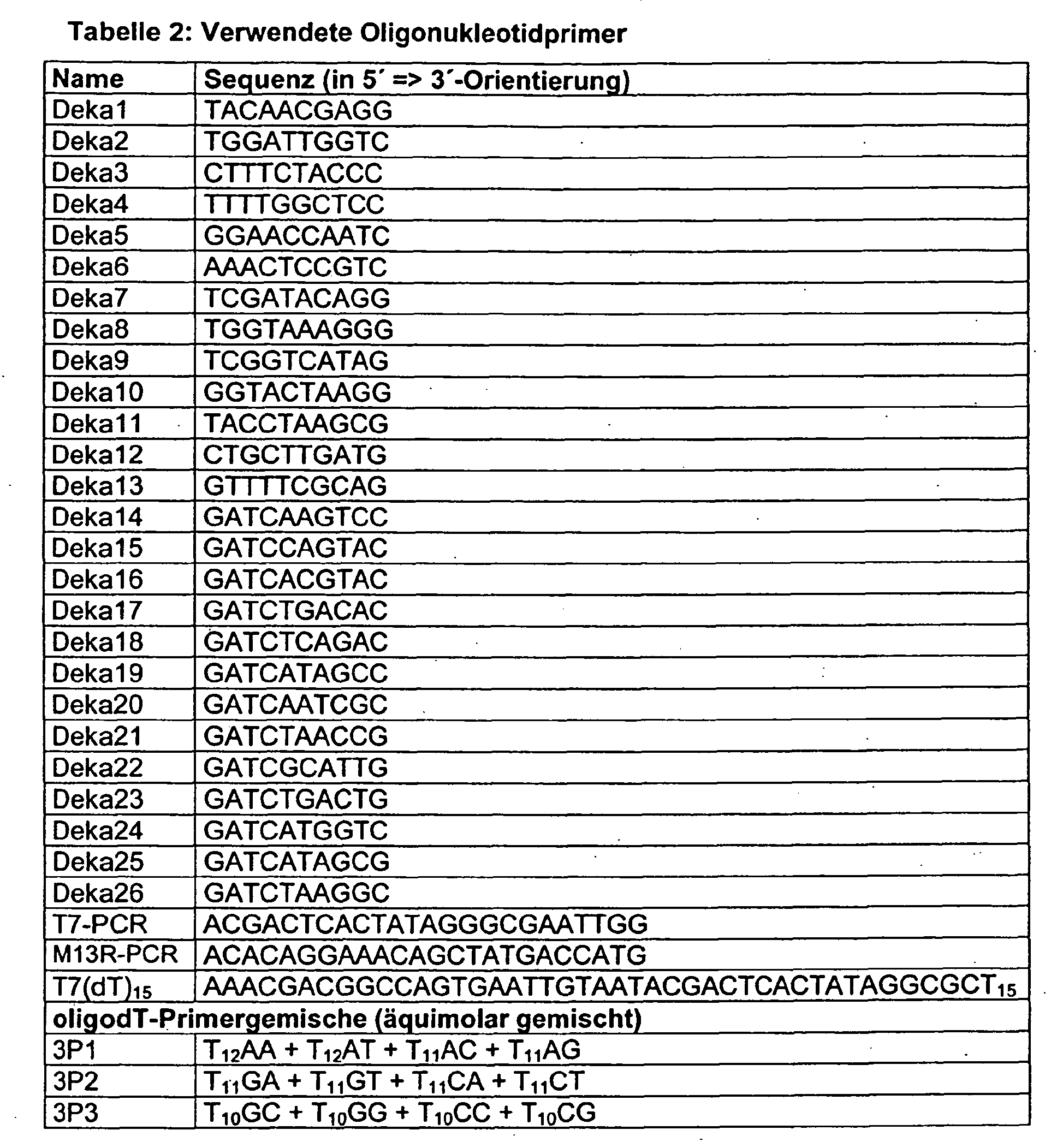
- Tiermodell: Der Formalin-Test stellt ein geeignetes Modell für den Bereich des inflammatorischen/persistenten Schmerz dar (Duibisson et al., 1997). Hierbei wurde 50µl 5%ige Formalinlösung unliateral in die Hinterpfote adulter Wistar-Ratten injiziert und die Tiere 24Std. nach der Injektion zur Gewebeentnahme getötet. Parallel wurden bei den Kontrolltieren isotonische Kochsalzlösung in die Hinterpfote injiziert.
- Gewebeentnahme. Die Tier werden dekapitiert, die Rückenwirbelsäule herauspräpariert und das Rückenmark durch kräftige Injektion einer eiskalten isotonischen Kochsalzlösung aus dem Rückenmarkskanal herausgespült. Nach Entfernen der Dura wurde die dorsale Hälfte des Bereiches von L3 bis L6 herausgeschnitten und sofort in flüssigem Stickstoff eingefroren.
- RNA-Isolierung. Aus den Gewebeproben wurde die Gesamt-RNA mit dem Trizol-Kit (Life Technologies) nach Angaben des Herstellers isoliert. Die RNA wurde UV-spektrometrisch quantifiziert (Extinktion bei 260nm) und durch denaturierende Gelelektropherese in einem Formaldehyd-Agarosegel (Sambrook et al., 1989) auf Integrität überprüft.
- DNase-Verdau. Vor Einsatz in die DDRT-PCR werden eventuelle Spuren an genomischer DNA durch DNase-Verdau entfernt. Hierbei wurden je 6µg RNA in einem Gesamtvolumen von 100µl in 1X First-Strandbuffer (Life Techn.) und 10 Units RNase-freie DNasel (Boehringer Mannheim) für 15 Minuten bei 37°c inkubiert. Nach Phenol-Chloroform-Extraktion wurde die RNA durch Zugabe an 1/10 Vol. Natriumacetat pH5.2 und 2.5 Vol. Ethanol präzipitiert, in DEPC-Wasser gelöst, UV-spektrometrisch quantifiziert und durch erneute Formaldehyd-Agarose-Gelelektrophorese charakterisiert.
- Reverse Transkription. Je 200ng DNasel-verdaute RNA wurden zunächst mit 2.5µM oligodT-Primergemisch (3P1, 3P2 oder 3P3) durch 5minütige Inkubation bei 70°C denaturiert, auf Eis abgeschreckt und dann in einem Gesamtvolumen von 20µl Reaktionsgemisch für 60 Min. bei 37°C inkubiert. Das Reaktionsgemisch enthielt 1X First-Strandbuffer (Life Techn.), 10 mM DTT, je 18.75 µM dATP, dCTP, dGTP, dTTP, 20 Units RNasin (Fa. Promega) und 200 Units Superscript II RNaseH- - reverse Transkriptase (Life Techn.). Anschließend wurde das Enzym durch 5minütiges Erhitzen auf 99°C inaktiviert und der cDNA-Ansatz bei -20°C gelagert.
- DDRT-PCR. Je 2µl der cDNA wurden in einem Volumen von 20µl der Polymerase-Kettenreaktion (PCR) unterworfen. Das Reaktionsgemisch enthielt 1X PCRII-Puffer (Fa. Perkin-Elmer), 2.5mM MgCl2, 2µM je dATP, dCTP, dGTP, dTTP, 0.2µM Dekamer-Primer (Deka1-26), 0.8µM oligodT-Primergemisch (3P1, 3P2 oder 3P3) und 2µCi [α-33P]dATP (≥2000mCi/mmol, Fa. Amersham) Die PCR-Ansätze wurden in einem PTC200-Thermocycler (Fa. MJ Research) folgendem Temperaturprofil unterworfen: 3 Min. bei 94°C; 40 Zyklen mit 15 Sek. 94°C, 1 min 40°C, innerhalb von 70 Sek. Hochheizen auf 72°C, 30 Sek. 72°C; 10 Min. bei 72°C und Halten bei 4°C.
- Gelelektrophorese und Auswertung. Die PCR-Proben wurden im Vakuum bis zur Trockne eingeengt, in 4µl Probenpuffer (0.25% Bromphenolblau, 0.25% Xylenecyanol FF, 30 % Glycerin) gelöst und je 2 µl in einem 6% igen Tris-Taurin-EDTA-Polyacrylamidgel (Multiphor-System, Fa. Promega) für 2.5 Std. bei 50 Watt elektrophoretisch aufgetrennt. Das Gel wurde anschließend für eine Stunde bei 80°C getrocknet und über Nacht auf einem BASIII-Detektionsscreen (Fa. Fuji) exponiert. Zur Auswertung wurde der STORM-Phosphor-Imager (Fa. Molecular Dynamics) unter Verwendung der ImageQuant-Software verwendet. Die Autoradiographie-Daten wurden im gleichen Größenmaßstab auf Folie gedruckt, die dann zum Auschneiden der Fragmente verwendet wurde.
- Reamplifikation der DDRT-PCR-Fragmente. Differentiell regulierte PCR-Banden wurden mit einem Skalpell aus dem Gel ausgeschnitten und durch 10minütiges Kochen in 100µl bidest. Wasser aus dem Gelstück eluiert. 25µl hiervon wurden in einem Gesamtvolumen von 50µl mittels PCR erneut amplifiziert. Das PCR-Reaktionsgemisch enthielt 1 X PCR-Pufferll (Fa. Perkin-Elmer); 1.5mM MgCl2; 50µM je dATP, dCTP, dGTP, dTTP;M 0.2µM des entsprechenden Dekameres; 1µM 1PX oligodT-Primergemisch und 2.5µl Units AmpliTAQ-DNA-Polymerase (Perkin-Elmer). Das PCR-Temperaturprofil entsprach der originalen PCR-Reaktion (s.o.). Die PCR-Ansätze anschließend mit 10µl Probenpuffer (0.25% Bromphenolblau, 0.25% Xylenecyanol FF, 30 % Glycerin) versetzt und in einem 3%igen TAE-Agarosegel mit 10µg/ml Ethidiumbromid gelelektrophoretisch aufgetrennt und PCR-Produkte der erwarteten Größe aus dem Gel ausgeschnitten.
- Klonierung in TA-Klonierungsvektoren. Die ausgeschnittenen Fragmente wurden mit dem Qiaquick-Gel-Extraktionskit (Fa. Qiagen) nach Angaben des Herstellers aufgereinigt, bis zur Trockne eingeengt und in 5µl bidest. Wasser aufgenommen. Anschließend wurden sie in den pCRII-TOPO-Vektor mittels des TOPO TA Cloning Kits (Fa. Invitrogen) nach Angaben des Herstellers ligiert und in TOP10F'-E.coli-Zellen transformiert. Der Transformationsansatz wurde auf LB-Agar-Platten mit 100µg/ml Ampicillin ausgestrichen, die vorher mit 50µl 2% X-Gal (Fa. Sigma) und 50µl Isopropylthiogalactosid (Fa. Sigma) behandelt wurden. Die nach 15 stündiger Inkubation bei 37°C erhaltenen weißen Bakterien-Klone wurden in 5 ml LB-Flüssigmedium mit 100µg/ml Ampicillin (100µg/ml) überführt und über Nacht bei 37°C unter Schütteln inkubiert. Aus diesen Kulturen wurde Plasmid-DNA unter Verwendung des Qiagen-Spin-Miniprep-Kits (Fa. Qiagen) nach Angaben des Herstellers isoliert und je 5µl der Plasmid-DNA durch EcoRI-Restriktionsverdau und anschließende TAE-Agarose-Gelelektrophorese charakterisiert.
- Sequenzanalyse. Hierbei wurden je 500 ng der Plasmid-DNA mit dem T7-PCR-Primer unter Verwendung des Dye Terminator Cycle Sequencing Kits (Fa. Perkin-Elmer) nach Angaben des Herstellers sequenziert und die Reaktionen mittels des automatischen Sequencers ABI 370 (Fa. Applied Biosystems Inc.) analysiert. Die DNA-Sequenzen wurden unter Verwendung der bioSCOUT-Software (Fa. LION, Heidelberg) mit den Gendatenbanken abgeglichen.
- Geranylgeranyltransferase
- Katalase
- Transkriptionsfaktor TFIIFβ
- Transkriptionsfaktor GATA-3
- LDL-like Receptor LR-11
- Cl- - Kanal CIC7
- MAP-Kinase/JNK3/SAPKβ
- PIM-2 Kinase
Im Rahmen der Erfindung wurde eine Nukleinsäuresequenz isoliert und charakterisiert, die für das vollständige Ratten PIM-2 Protein kodiert (Fig.35e, 35f). Die Nukleinsäuresequenz und die Proteinsequenz für Pim-2 aus der Ratte sind bisher nicht bekannt. Desweiteren wurde eine vollständige, d.h. die gesamte kodierende Region enthaltende, cDNA sioliert, die für das humane Pim-2 kodiert (35 a, b). Ein Sequenzvergleich mit der publizierten humanen PIM-2 Sequenz (Acc.nr. U77735) ergab folgende Unterschiede:
| Sequenzunterschied | Auswirkung | Interpretation |
| Nt 230: C →T | Thr → Thr | stille Mutation, evtl. Polymorphismus |
| Nt 515: A → G | Glu → Glu | stille Mutation, evtl. Polymorphismus |
| nt 1064: Deletion T | Änderung des Leserasters führt zu veränderter C-terminaler Proteinsequenz | neuer C-Terminus ist der Maus und Rattensequenz ähnlicher, als die publizierte humane Pim-2 Sequenz |
| Nt 1175: A → C | 3'UTR, keine Auswirkung auf Proteinsequenz |

Das Protein LR11 ist ein Mosaikprotein der " Low density lipoprotein receptor (LDLR)" Familie (Möwald et al., 1997). Die stärkste Expression an LR11-mRNA konnte im Gehirn nachgewiesen werden, die zudem entwicklungsabhängig in einer Art reguliert wird, die eine Funktion bei der Synaptogenese oder Neuritenwachstum nahelegt (Hermann-Borgmeyer et al., 1998).
| Expression der 27 (meist) unbekannten cDNAs in der adulten Ratte | ||
| Klon/ Abb.Nr. | Regulation | Expressionsprofil der neuartigen cDNAs in Geweben der adulten Ratte |
| 180.12/31 | up | noch offen |
| 180.8/32 | up | noch offen |
| 111.16/1 | down | Milz, Magen, Rückenmark |
| 111.33/2 | up | Niere, Lunge, Dickdarm, Magen, Gehirn, Rückenmark |
| 111.39/3 | up | Gehirn, Rückenmark |
| 111.45/4 | up | Gehirn, Rückenmark (ubiquitär) |
| 113.15/5,6,7 | down | ubiquitär |
| 113.20/8 | down | Gehirn, Herz, Milz, Rückenmark |
| 124.29/9 | down | Dickdarm, Gehirn, Lunge, Testis |
| 124.4/10 | up | ubiquitär |
| 127.3/11 | up | spezifisch Hoden |
| 127.34/12 | down | noch offen |
| 127.8/13 | up | Milz, Rückenmark (ubiquitär) |
| 135.18/14 | down | noch offen |
| 135.2/15 | up | noch offen |
| 135.7/16 | down | Niere (ubiquitär) |
| 135.9/17,18 | down | noch offen |
| 141.1/19 | down | nicht erfolgreich |
| 141.13/19,20 | down | Rückenmark (ubiquitär) |
| 141.24/22 | down | Leber, Rückenmark, Skelettmuskel |
| 141.6/23 | down | ubiquitär |
| 146.10/24 | down | Dickdarm, Herz, Magen, Rückenmark (ubiquitär) |
| 154.26/25 | up | Niere, Leber, Lunge |
| 154.29/26 | up | spezifisch Rückenmark |
| 164.12/27 | up | noch offen |
| 164.24/28,29,30 | down | noch offen |
| 89.28/33 | up | ubiquitär (Dickdarm, Gehirn, Lunge, Rückenmark, Testis) |
| Bisher unbekannte, nicht zugeordnete Genfragmente | ||
| Abbildung Nr. | Name der cDNA | Länge (bp) |
| 1 | 111_16 | 1268 |
| 2 | 111_33 | 840 |
| 3 | 111_39 | 1540 |
| 4 | 111_45 | 2025 |
| 5 | 113_15 | 1721 |
| 6 | 113_15a | 1009 |
| 7 | 113_15b | 685 |
| 8 | 113_20 | 860 |
| 9 | 124_29 | 1348 |
| 10 | 124_4 | 923 |
| 11 | 127_3 | 741 |
| 12 | 127_34 | 109 |
| 13 | 127_8 | 1508 |
| 14 | 135_18 | 1339 |
| 15 | 135_2 | 177 |
| 16 | 135_7 | 1102 |
| 17 | 135_9a | 478 |
| 18 | 135_9b | 616 |
| 19 | 141_1 | 236 |
| 20 | 141_13a | 1497 |
| 21 | 141_13b | 197 |
| 22 | 141_24 | 2818 |
| 23 | 141_6 | 539 |
| 24 | 146_10 | 1759 |
| 25 | 154_26 | 827 |
| 26 | 154_29 | 1081 |
| 27 | 164_12 | 195 |
| 28 | 164_24a | 538 |
| 29 | 164_24b | 547 |
| 30 | 164_24d | 250 |
| 31 | 180_12 | 90 |
| 32 | 180_8 | 559 |
| 33 | 89_28 | 445 |
| Genfragmente aus bekannten cDNA-Sequenzen | ||
| Abbildung Nr. der bekannten DNA- Seq. | Name der cDNA | Länge des gefundenen Genfragments (bp) |
| 34 a, c, e, g | b141_15 | 2733 |
| 35 a, c, e | b141_2 | 314 |
| 36 a, c | b141_26 | 338 |
| 37 a, c | b151_32 | 633 |
| 38 a, c | b151_38 | 2201 |
| 39 a, c, e | b154_13 | 190 |
| 40 a, c, e | b20_37a | 389 |
| 40 a, c, e | b20_37b | 109 |
| 41 a, c, e | b69_24 | 720 |
Tabelle 5a zeigt die Ergebnisse
| Name | Lokalisation | Expressions- Level | Regulation | ||
| CFA | CIA | Formalin | |||
| JNK3 | Grey- Matter DH + VH | hoch | hoch
VH, tiefes DH | hoch | hoch |
| PIM-2 | Grey- Matter DH + VH | relativ hoch | Hoch DH runter | Hoch DH runter | Hoch DH runter |
| GF135.7 | Grey- Matter VH > DH | niedrig | DH runter | ||
| GF111.39 | Grey- Matter DH ≥ VH | sehr niedrig | 0 | 0 | |
| GF111.45 | Grey- Matter DH >> VH | sehr niedrig | Hoch DH>VH | Hoch DH>VH | |
| GF141.24 | Grey- Matter DH >> VH | sehr niedrig | Hoch DH>VH | ||
| DH = Dorsalhorn | |||||
| VH = Ventralhorn |
Ausgehend von diesen Zellen werden Membranfraktionen gewonnen, die den CLC-7 Kanal in großer Menge enthalten und für einen Bindungsassay verwendet werden können. Dieser besteht aus 1.) dem CLC-7 enthaltenden Membranen 2.) einem radioaktiv markierten Liganden (z.B. Tritium markierten 4,4'-Diisothiocyanostilbene-2,2'-disulfonsäure (DIDS) oder [3H] markiertem 4-Acetamido-4'-isothiocyanatostilbene-2,2'-disulfonsäure (SITS)); 3.) einem Bindungspuffer (z.B. 50 mM HEPES pH 7.4, 1 mM EDTA) und dem auf Bindung zu untersuchenden Liganden. Die Substanzen SITS und DIDS waren in funktionellen Untersuchungen an CLC-7 exprimierenden Oozyten in der Lage, CLC-7 vermittelte Chloridströme zu inhibieren (unveröffentliche Ergebnisse Fr. Dr. Diewald, Universität Mainz). Nach Inkubation der oben genannten Reaktionsgemische (für z.B. 30-60 min) bei einer geeigneten Temperatur (meistens Raumtemperatur) werden die nichtgebundenen radioaktiven Ligandenmoleküle abfiltriert. Die Restmenge an gebundenem [3H]-DIDS bzw. [3H]-SITS wird nach Zugabe eines Szintillationscocktails in einem β-Counter (z.B. Trilux, Fa. Wallac) vermessen. Zeigt die Testsubstanz eine Bindung an den CLC-7-Kanal, so wird dies als verringerter radioaktiver Einbau detektiert. Dieses Verfahren wird geeignetermaßen so miniaturisiert, daß es in (96-, 384- oder 1536-well) Mikrotiterplatten durchgeführt werden kann, um dieses Verfahren mittels eines Roboters im sogenannten Hightroughput-Screening (HTS)-Verfahren durchzuführen:
| z.B. pro Tablette | 25 mg | erfindungsgemäßer Wirkstoff |
| 271 mg | LudipressTM (Granulat zur Direkttablettierung aus Lactose monohydrat, Povidon K30 und Crospovidon) | |
| 4 mg | Magnesiumstearat | |
| 300 mg | Gesamt |
| z.B. pro Tablette | 25 mg | erfindungsgemäßer Wirkstoff |
| 166 mg | Microcristalline Cellulose | |
| 80 mg | Niedrig substituierte Hydroxypropylcellulose (I-HPC LH 11™) | |
| 5 mg | Hochdisperses Siliziumdioxid | |
| 4 mg | Magnesiumstearat | |
| 280 mg | Gesamt |
| z.B. pro Tablette | 25 mg | erfindungsgemäßer Wirkstoff |
| 205 mg | Mikrokristalline Cellulose | |
| 6 mg | Povidon K30 | |
| 10 mg | Crospovidon | |
| 4 mg | Magnesiumstearat | |
| 250 mg | Gesamt |


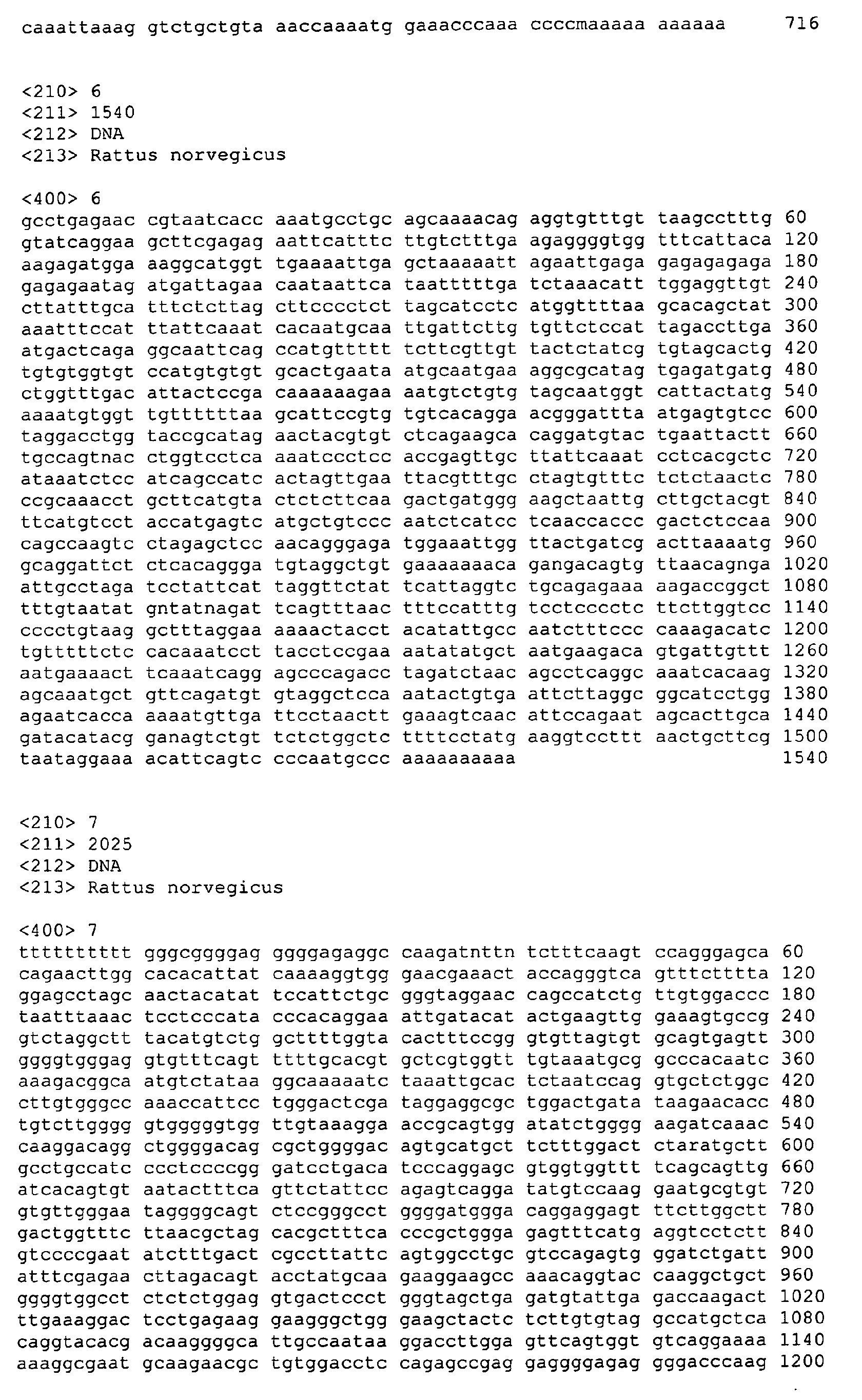

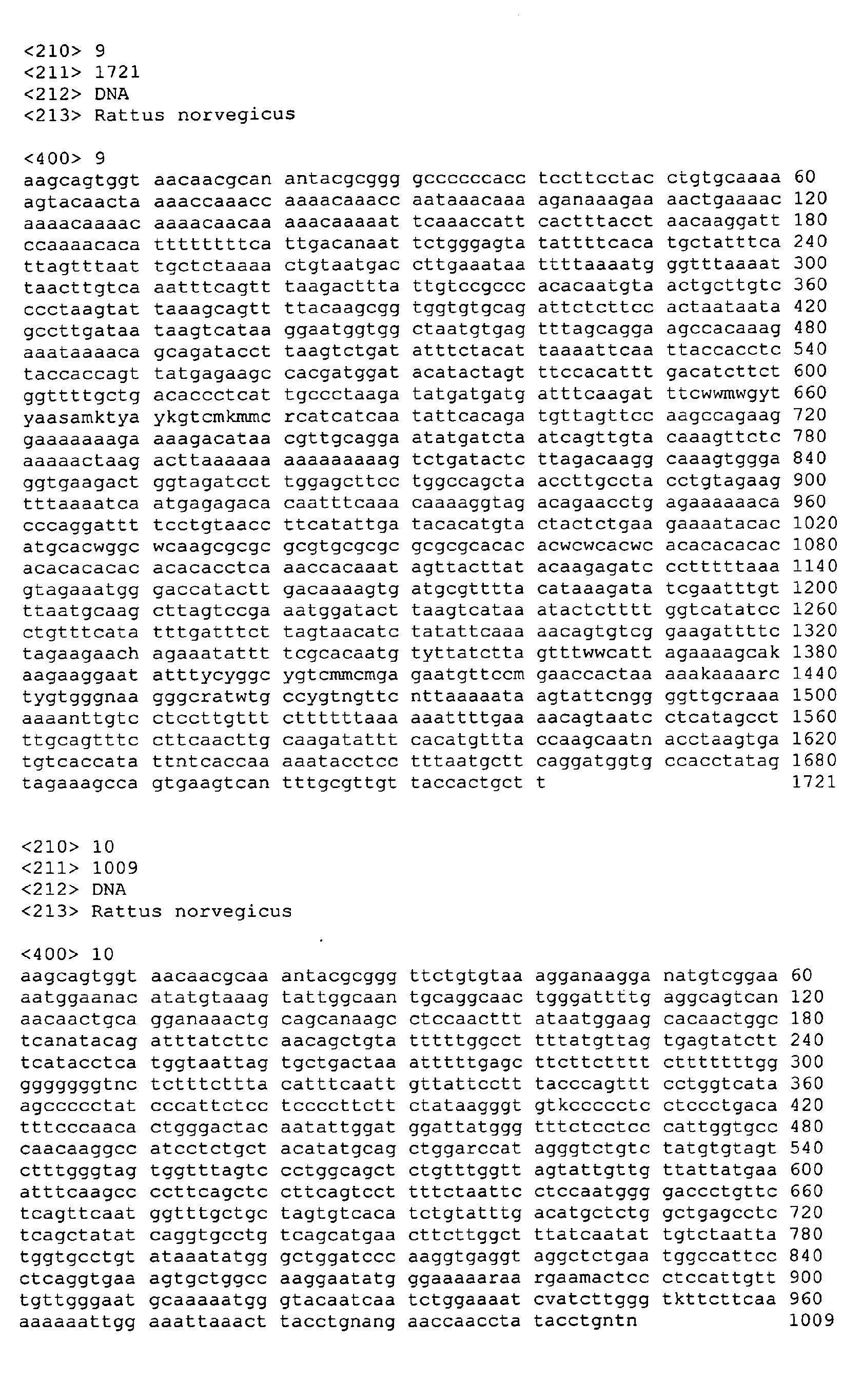
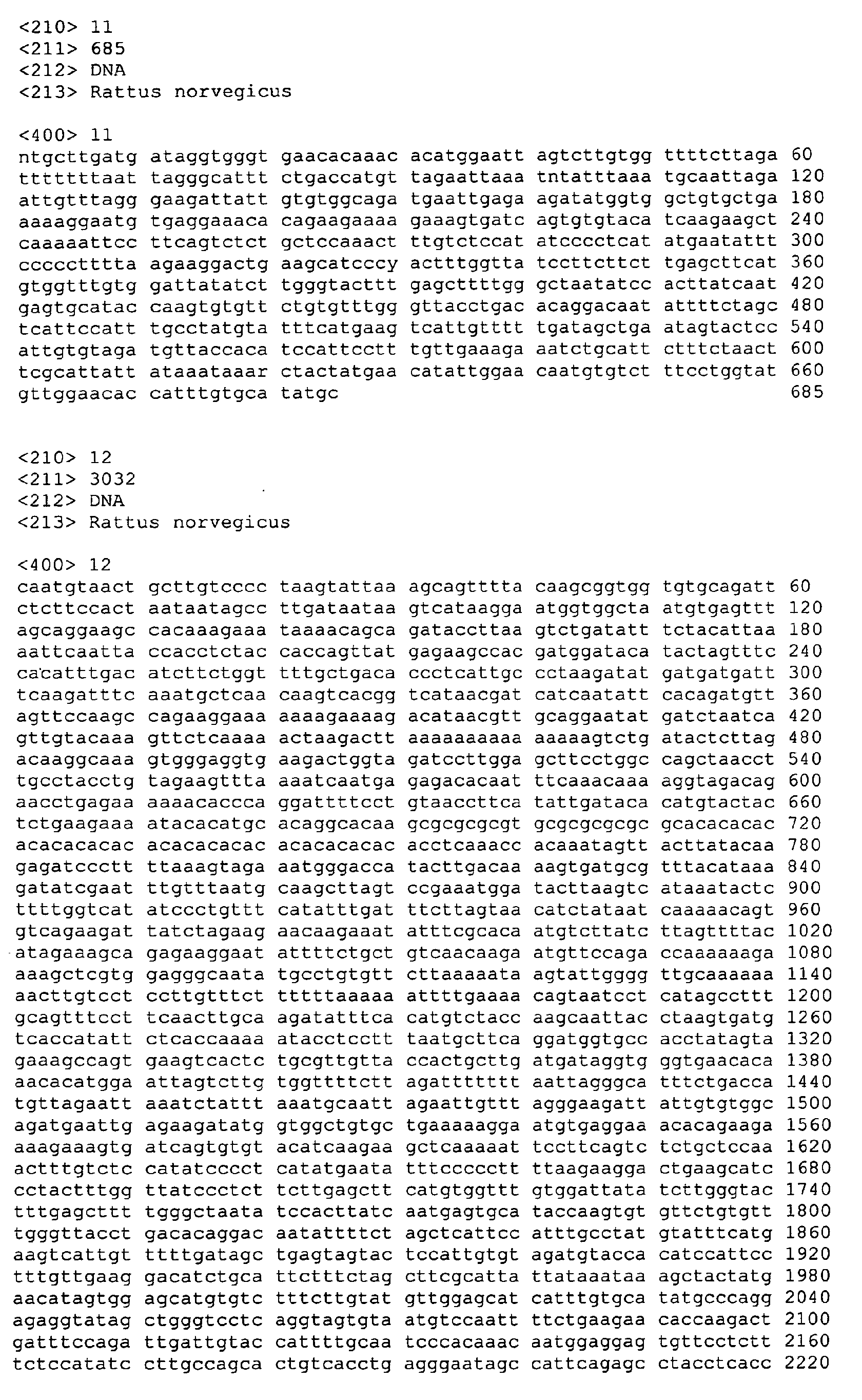
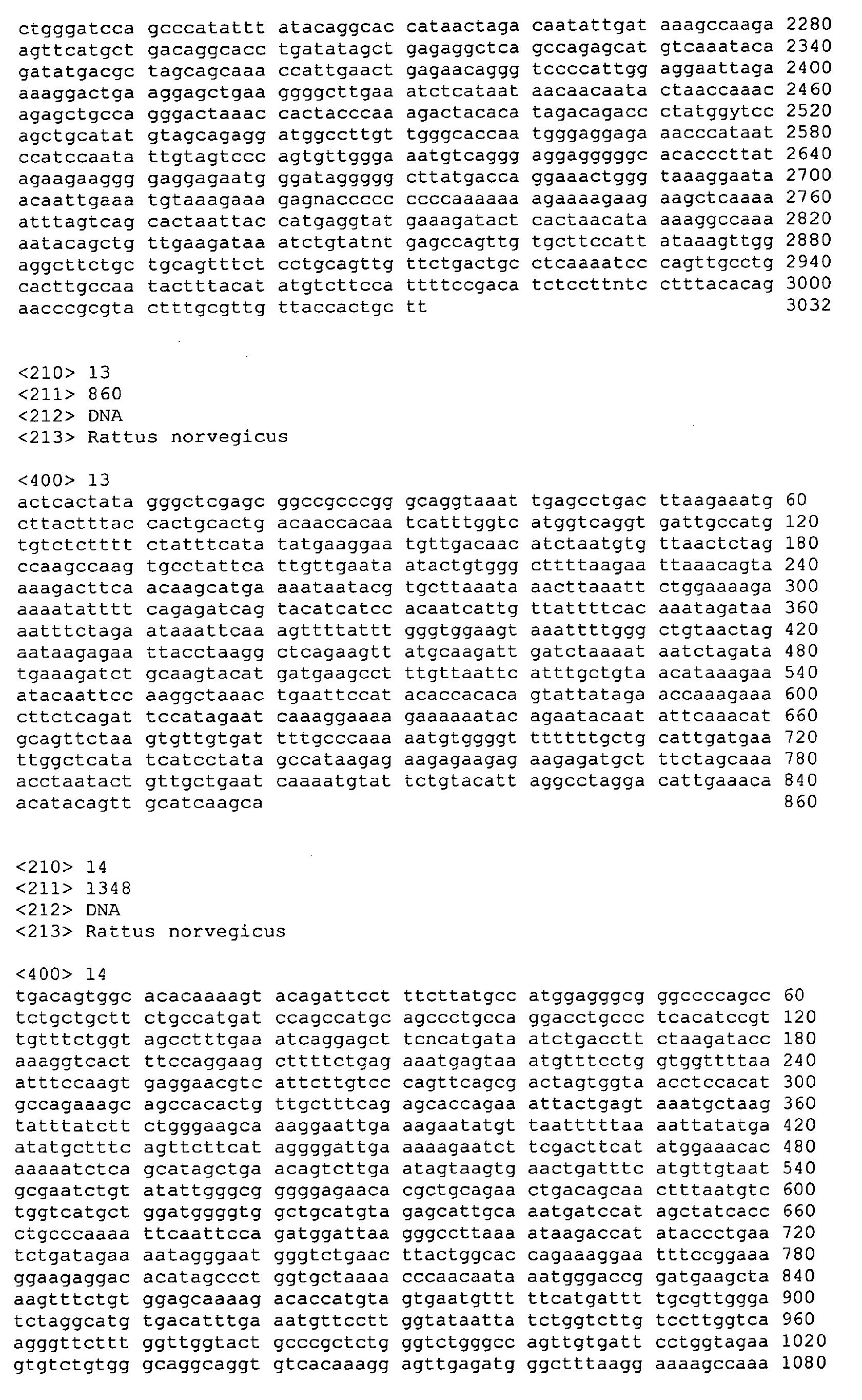


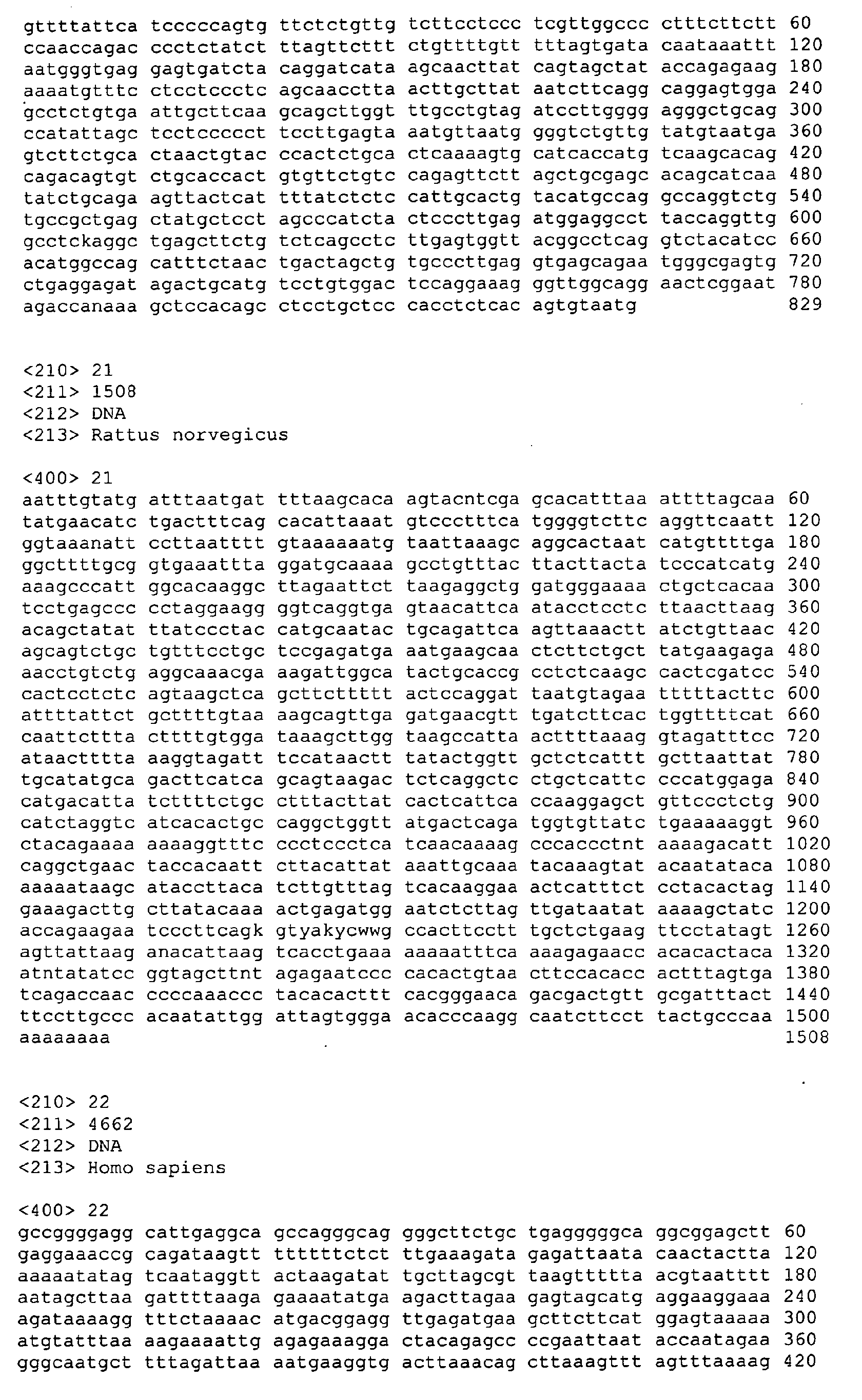
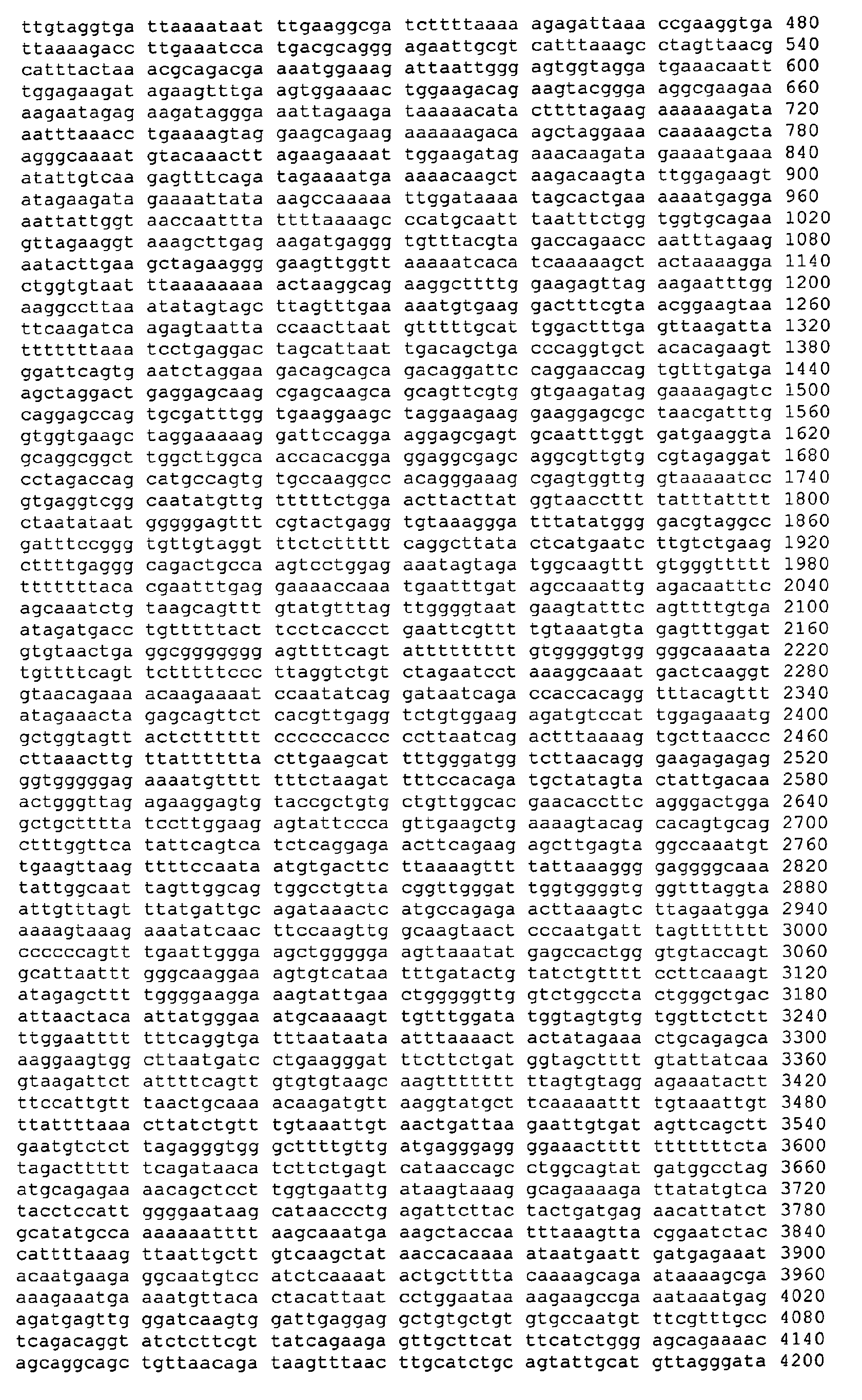


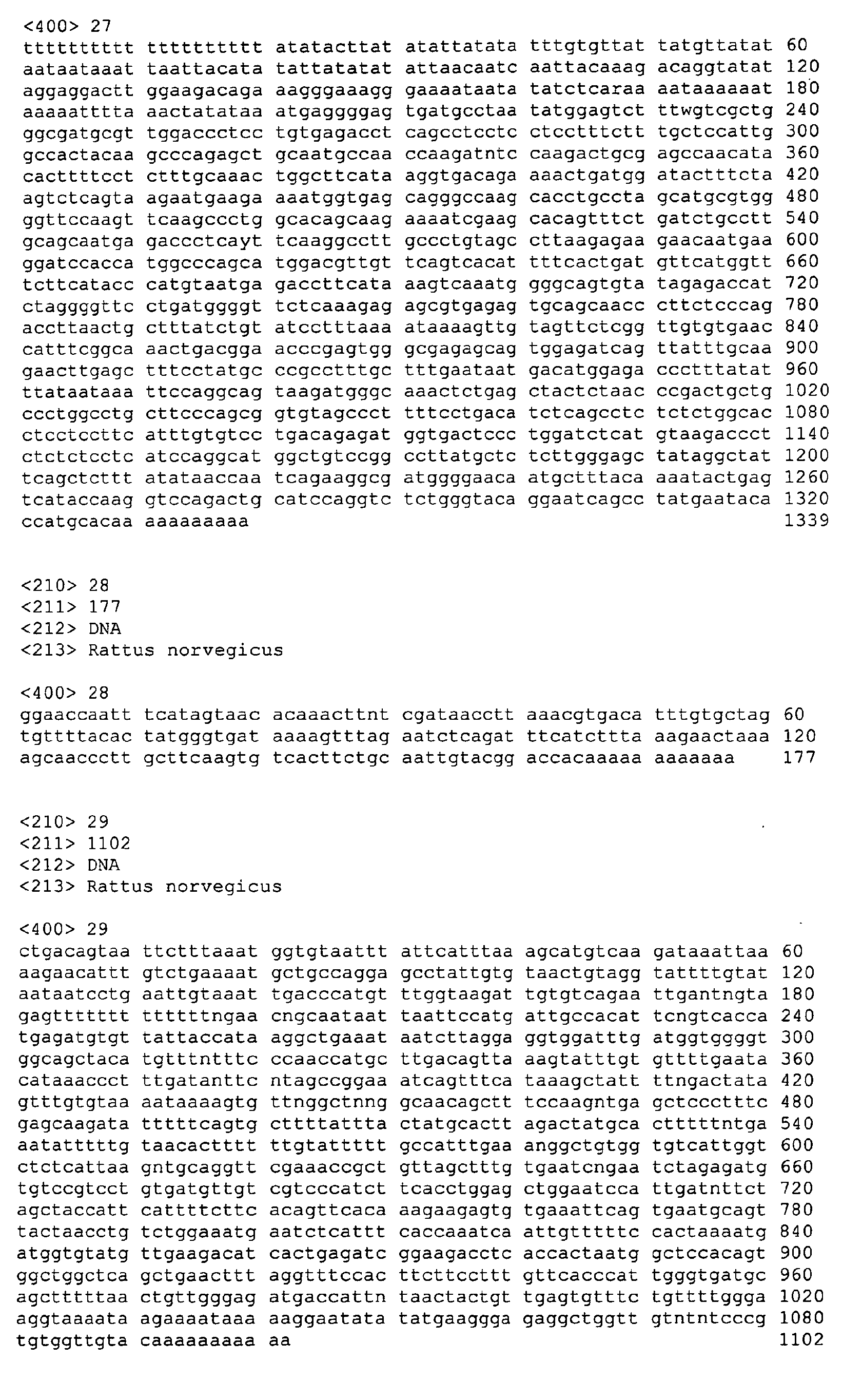
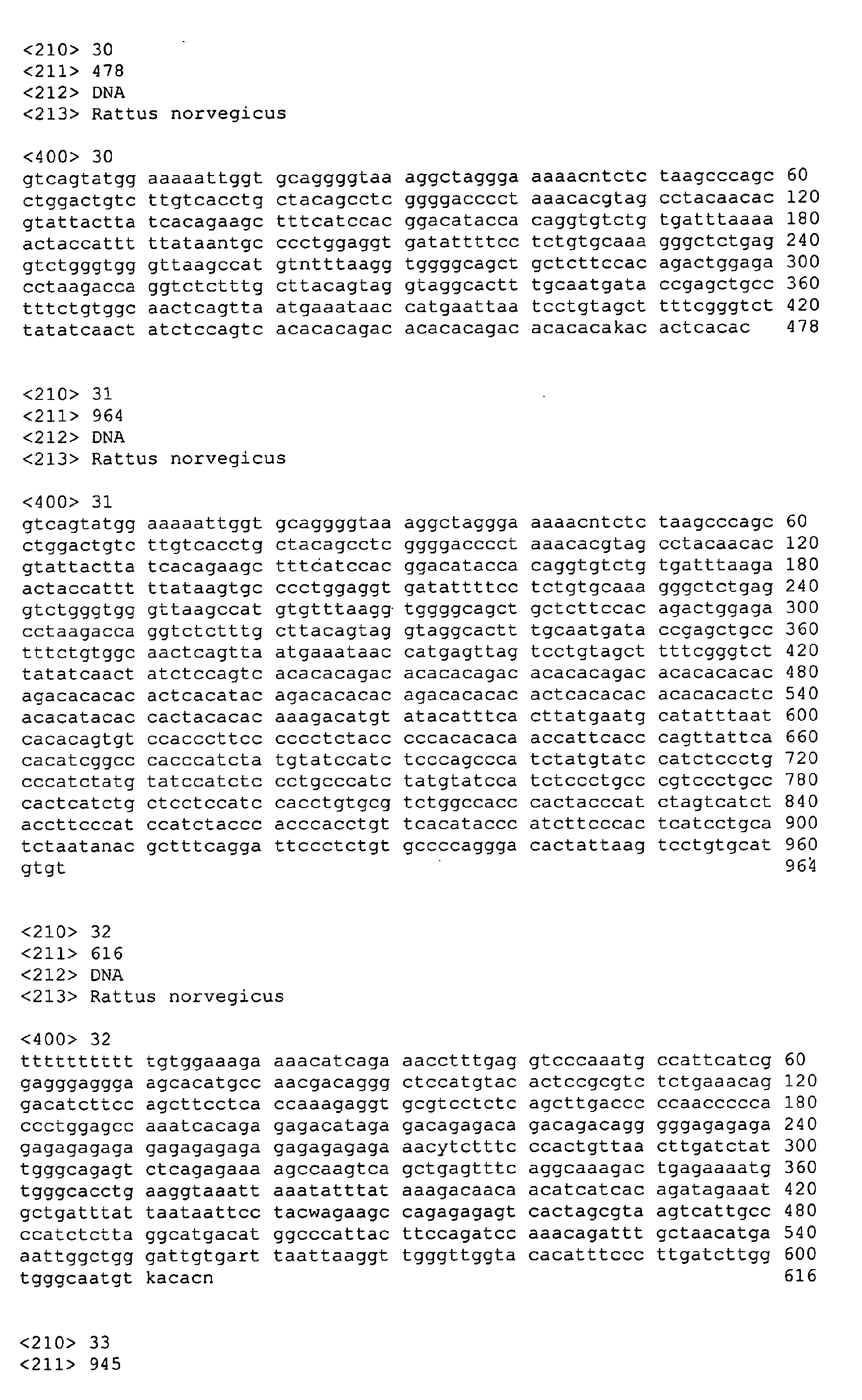
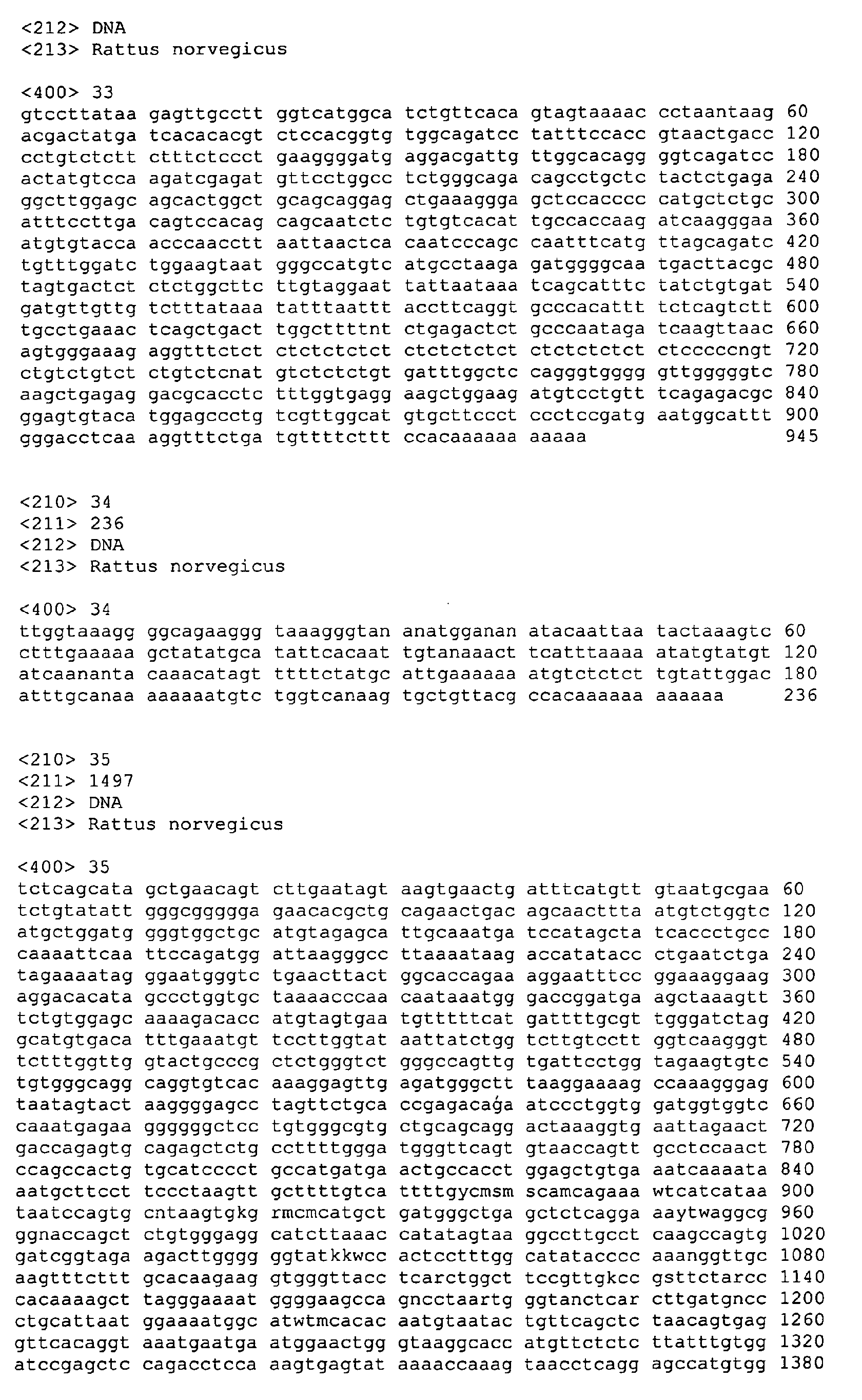
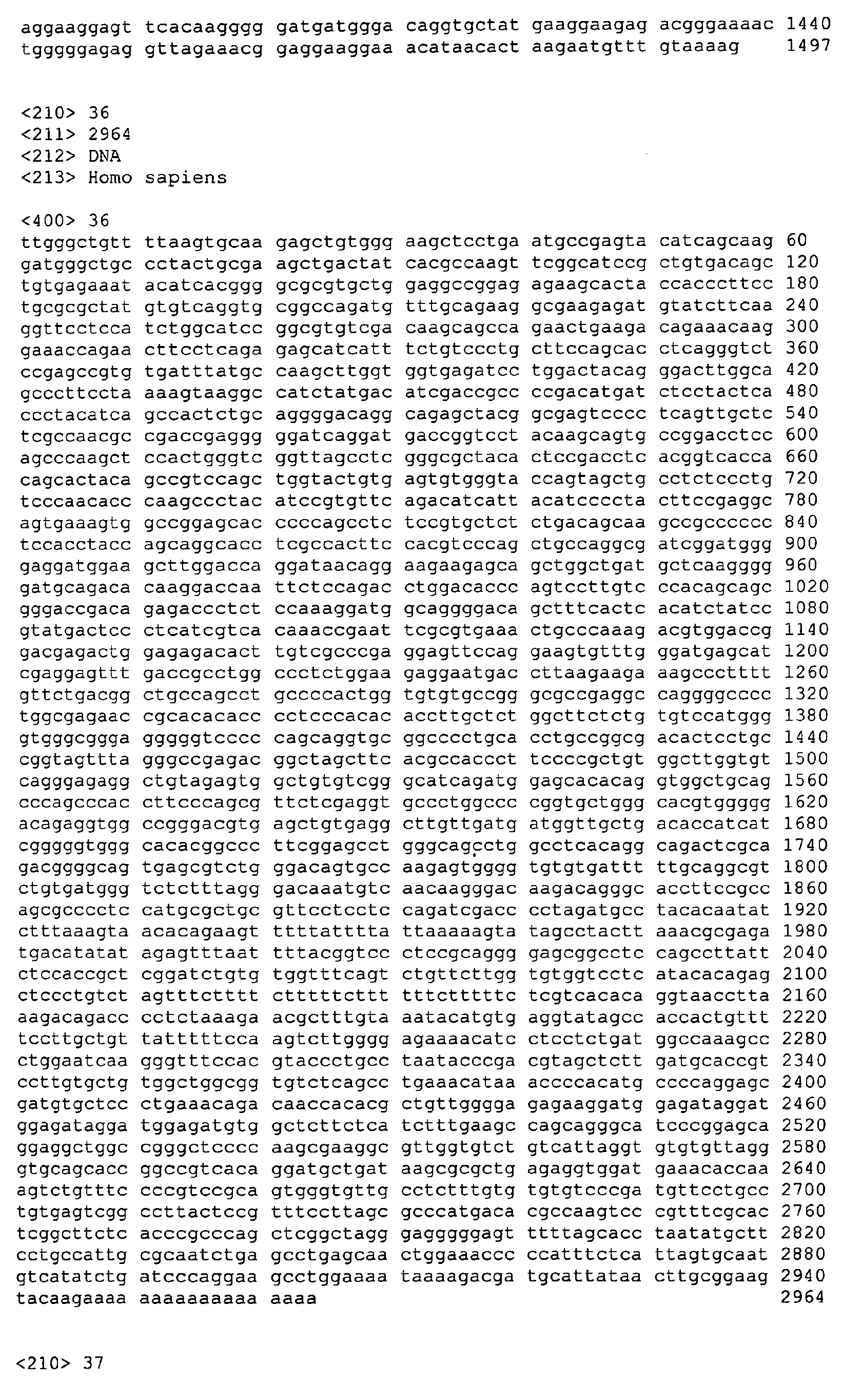
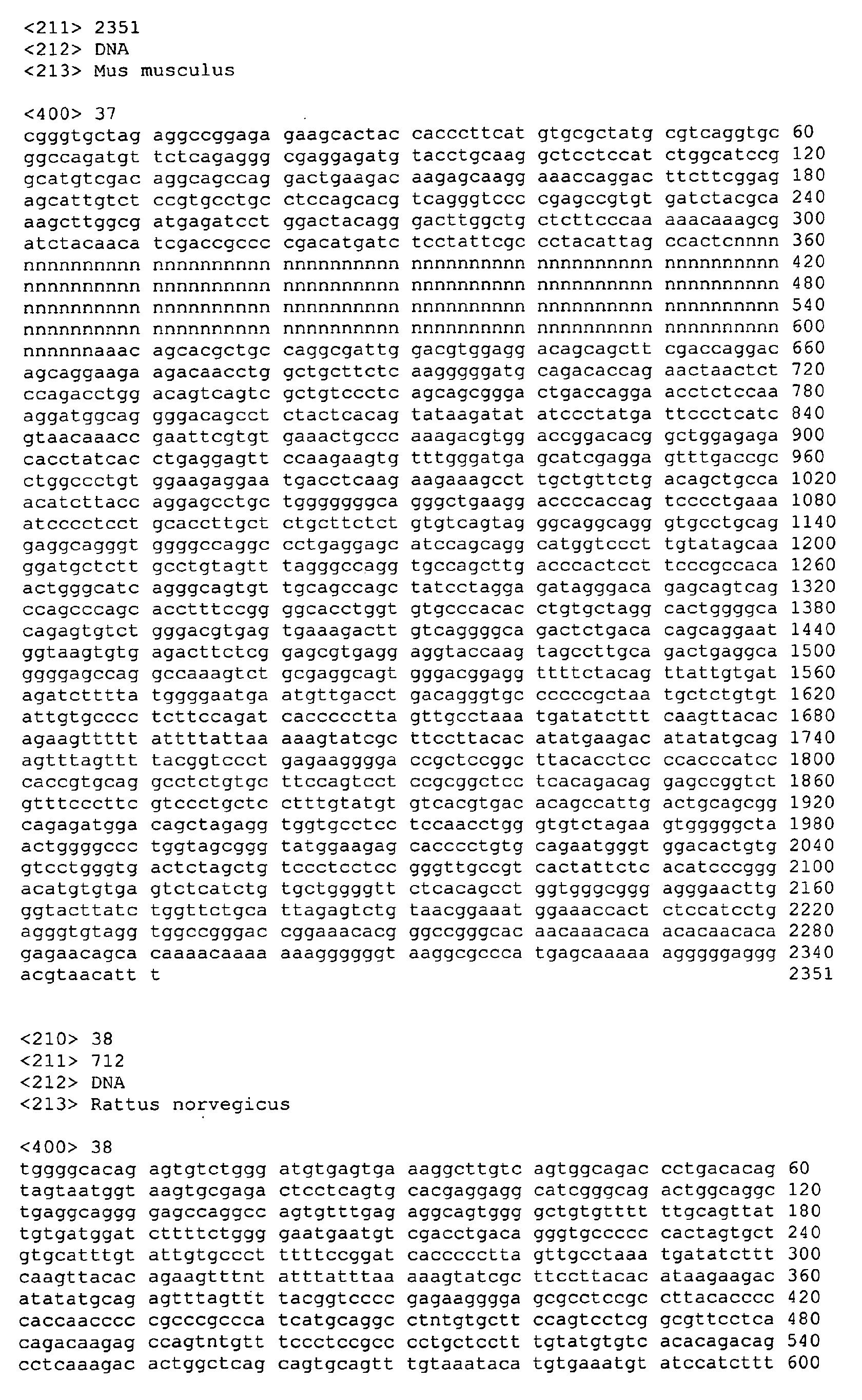


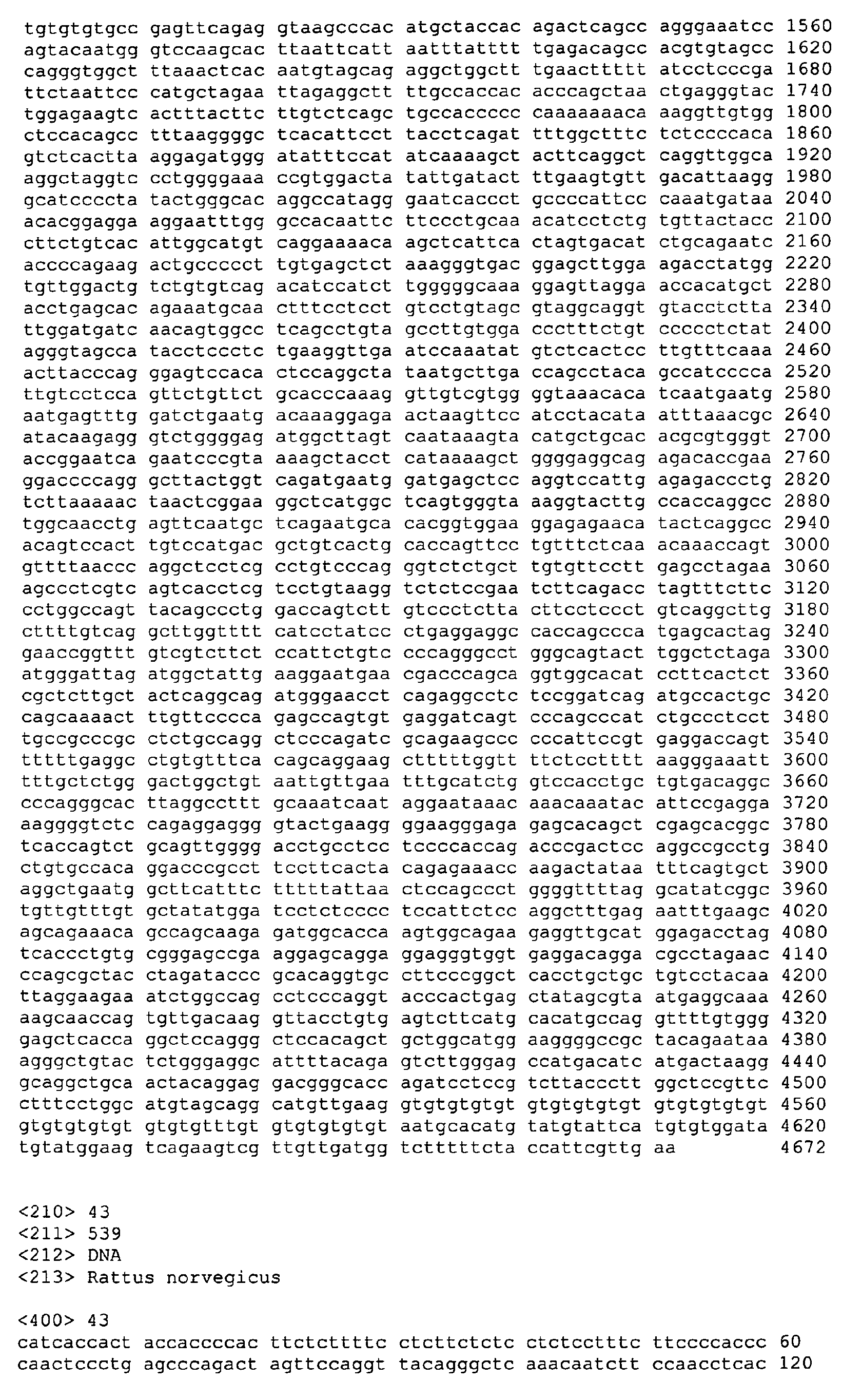
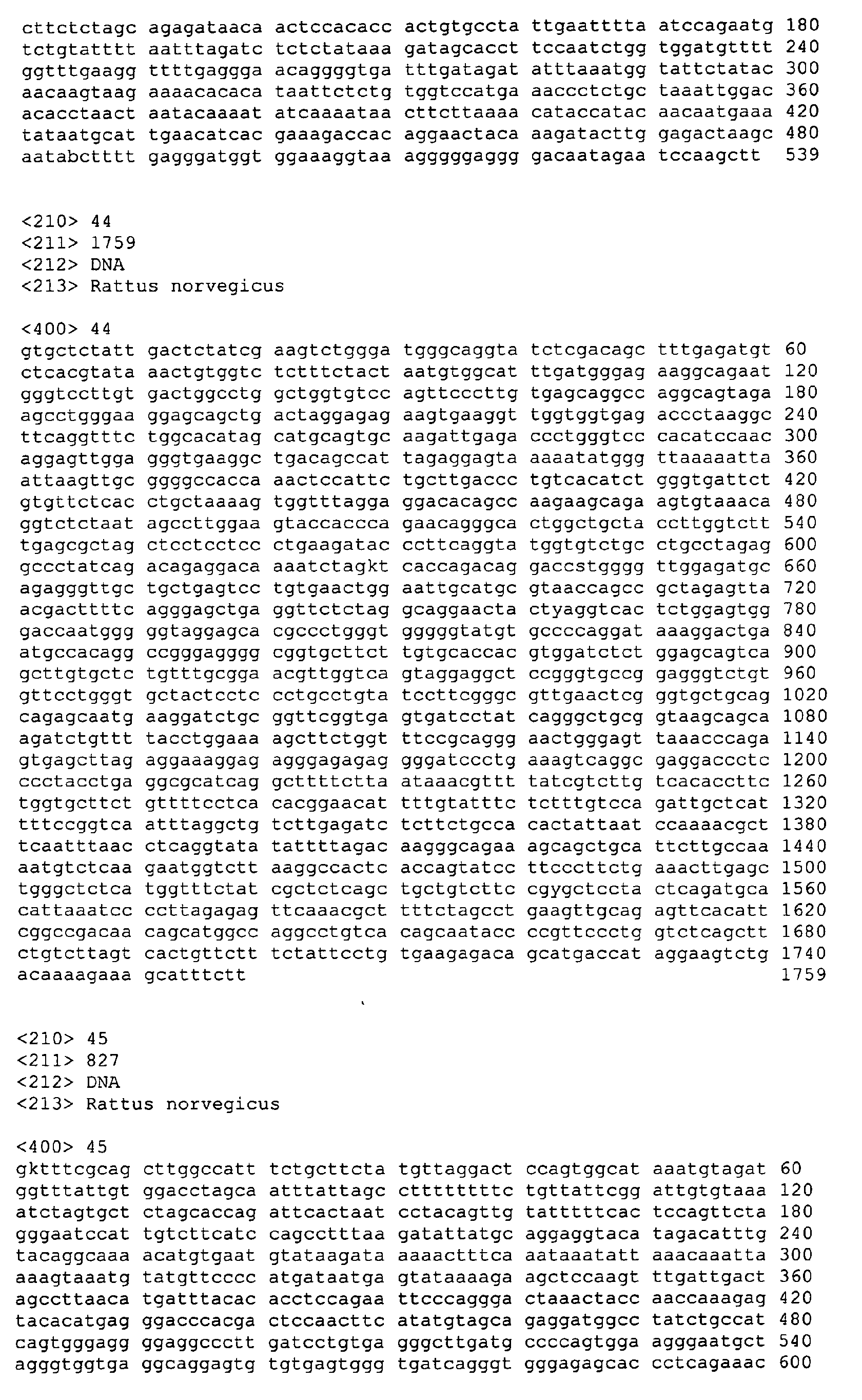


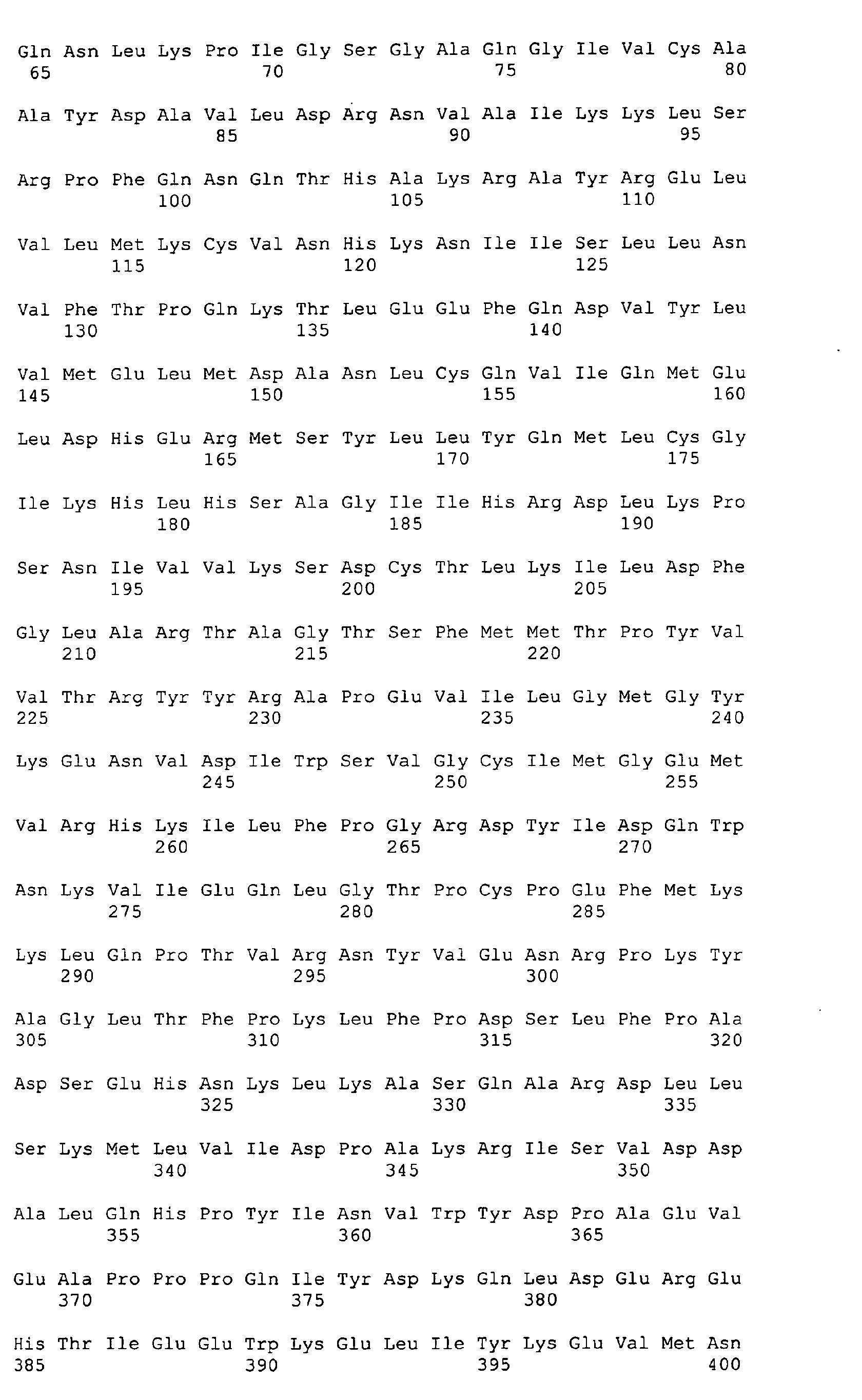


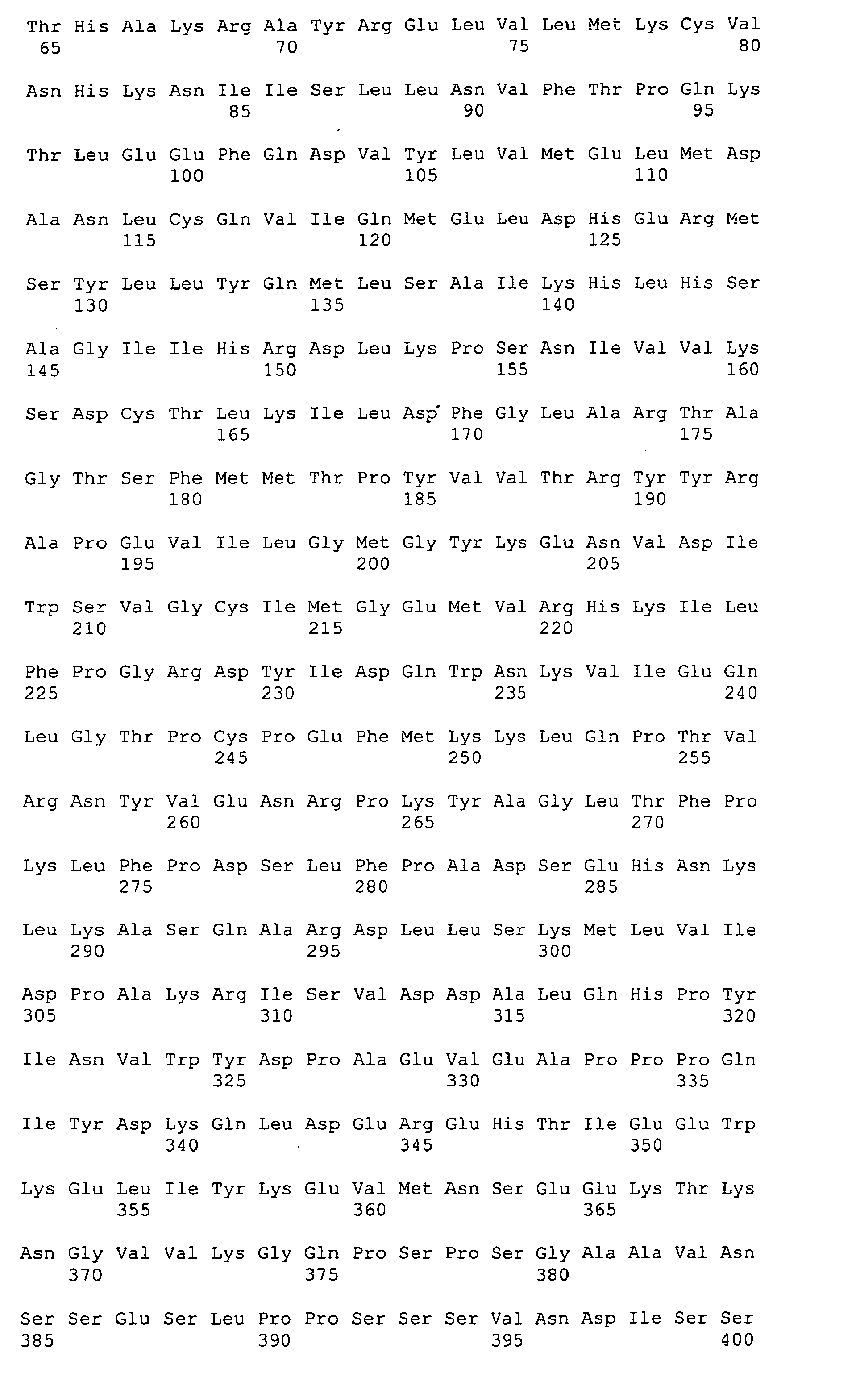
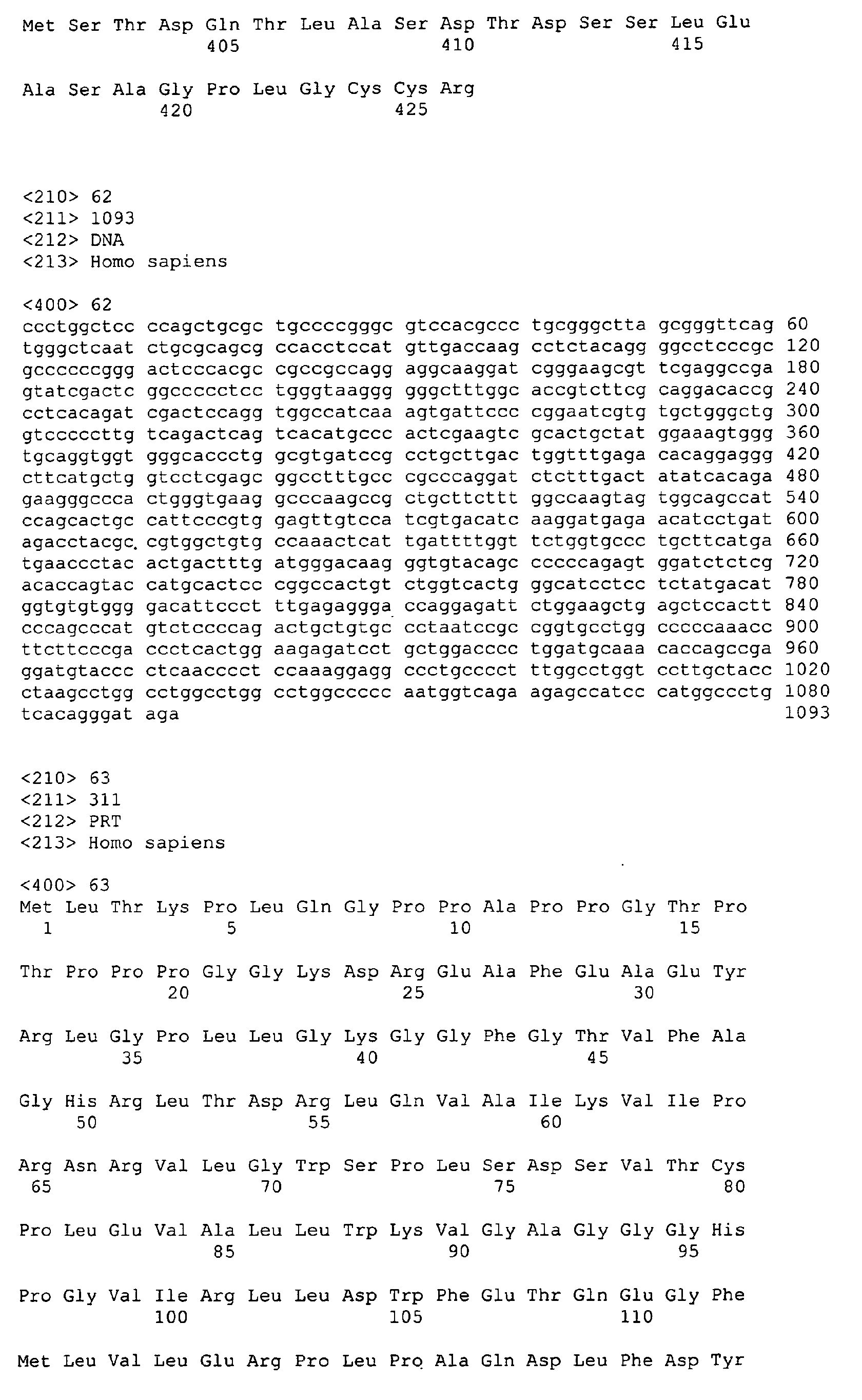
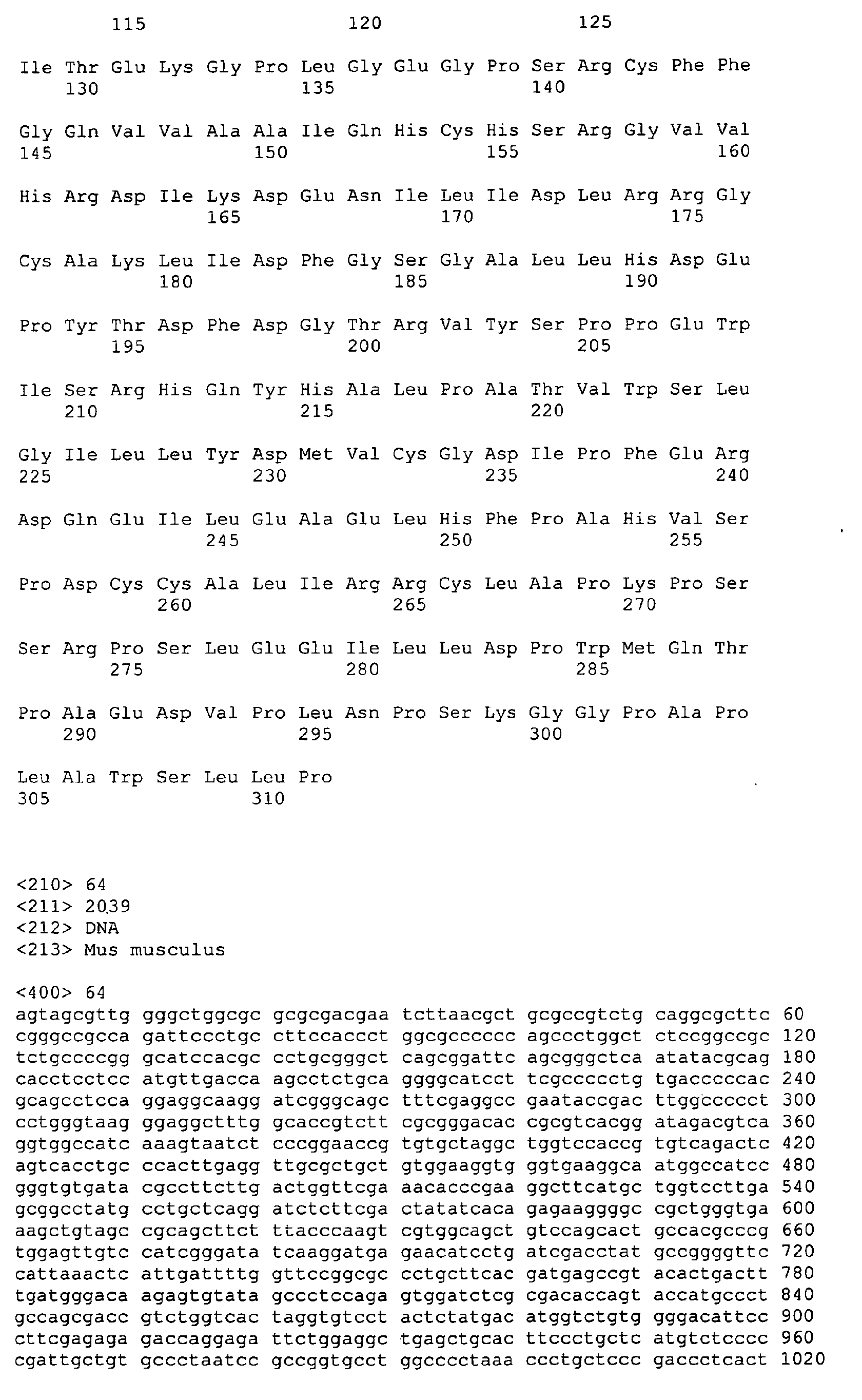
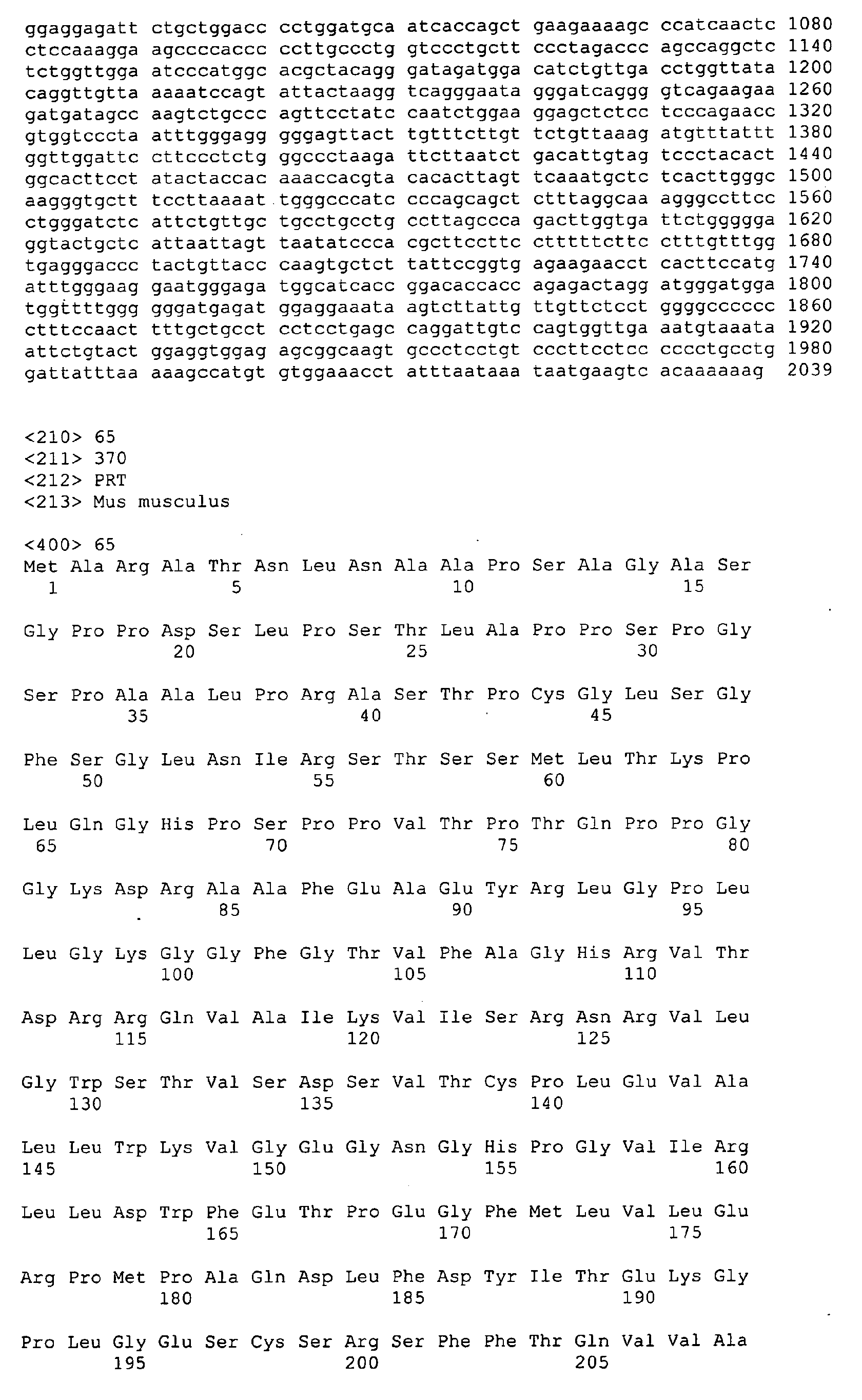
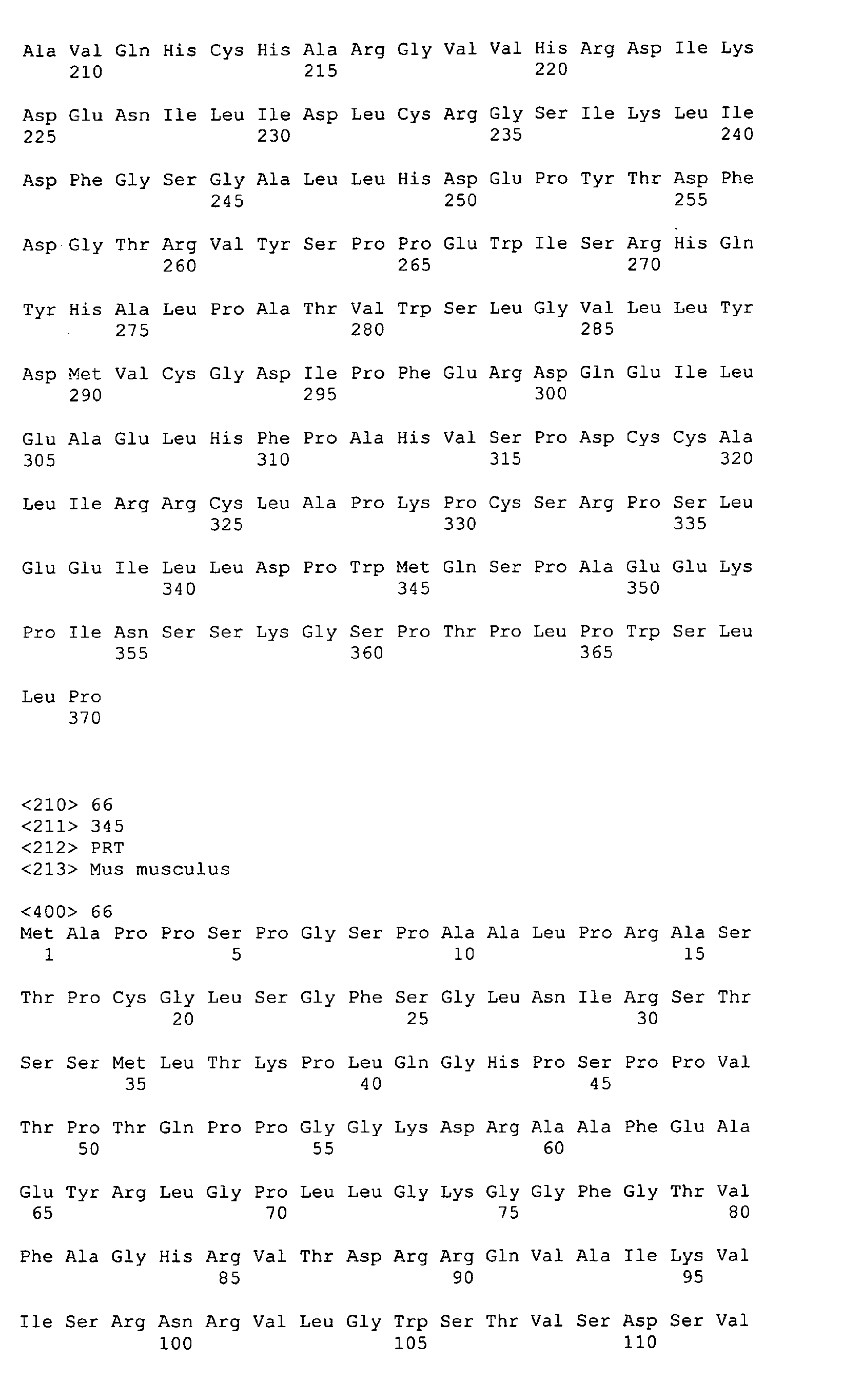


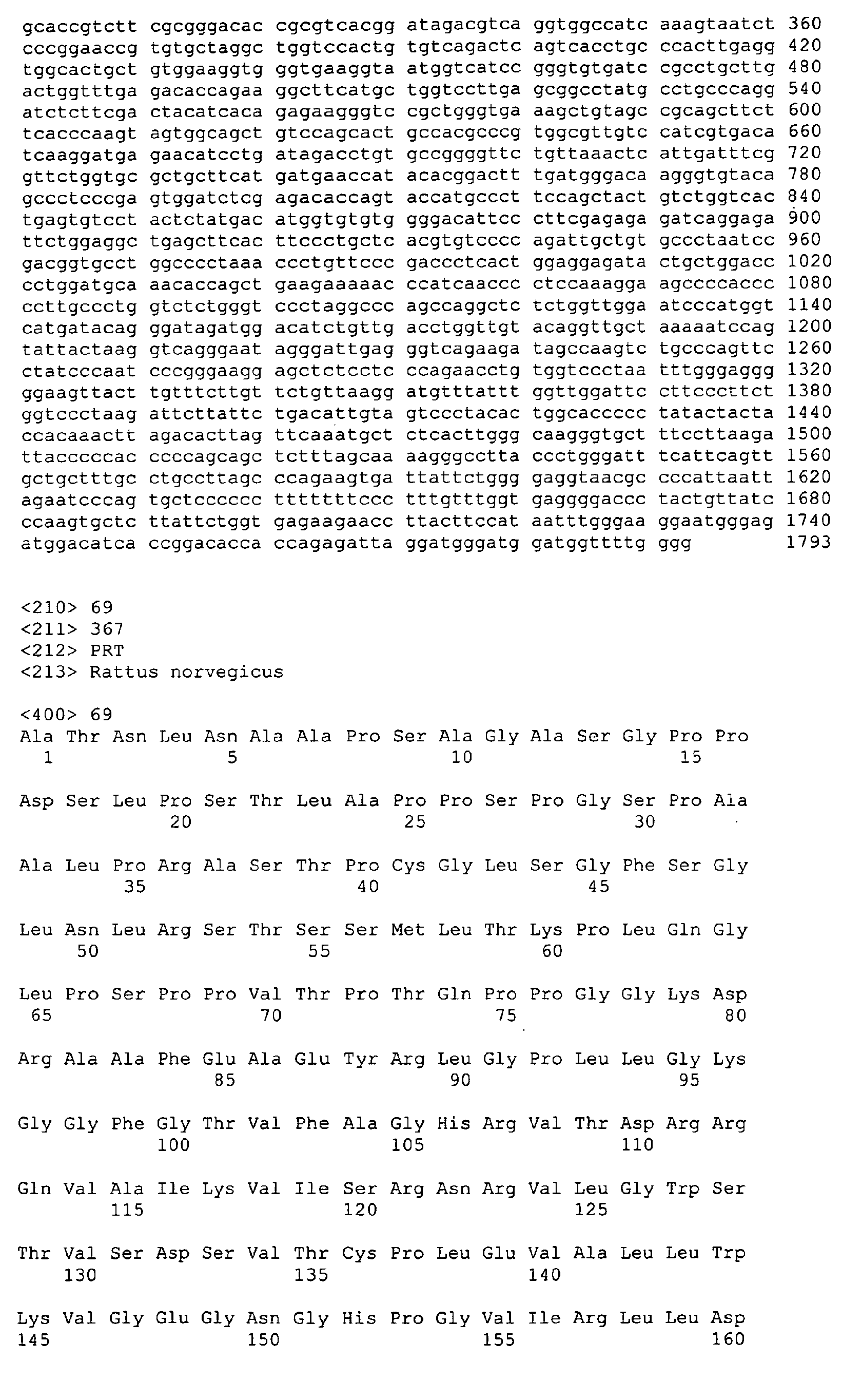
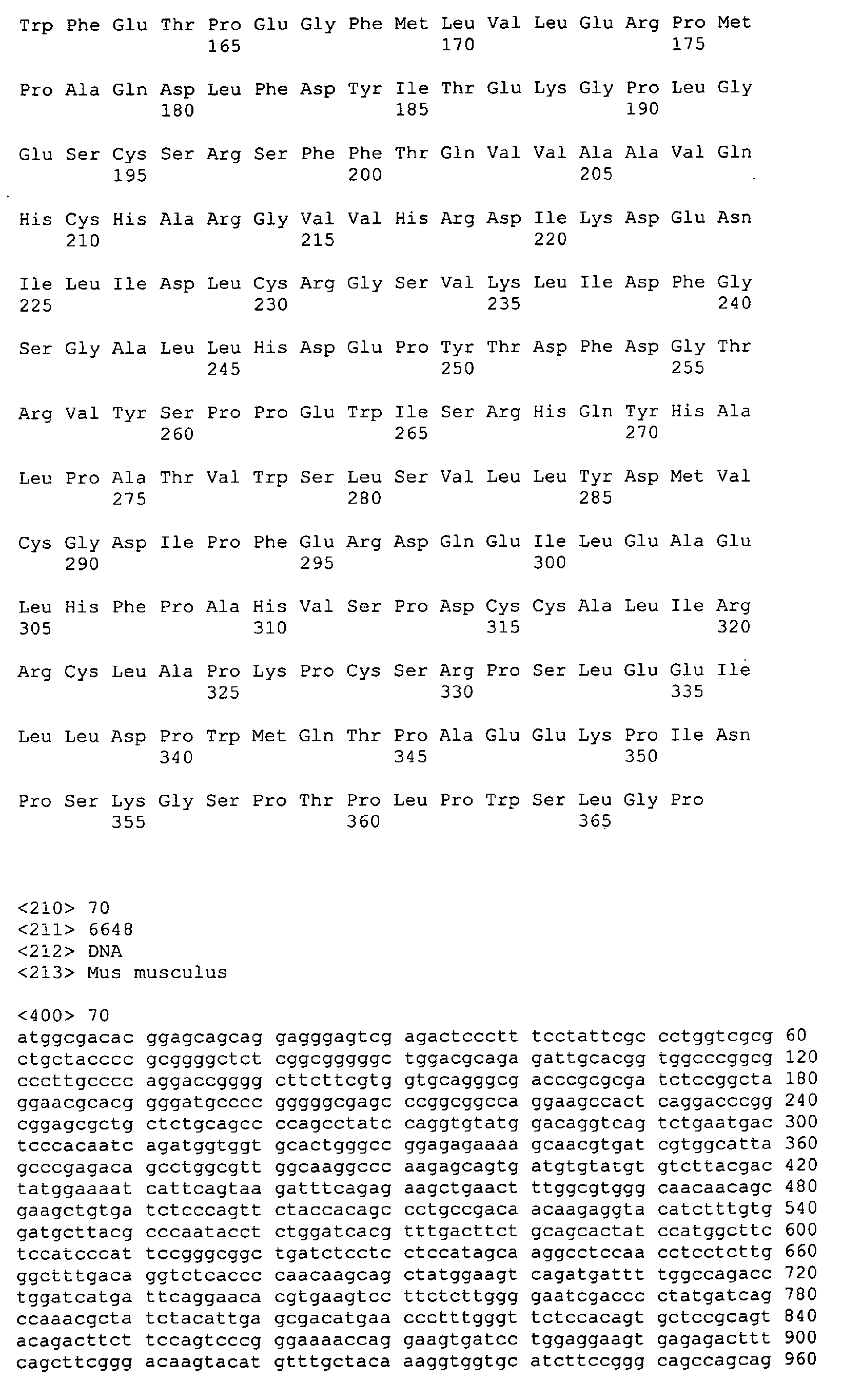
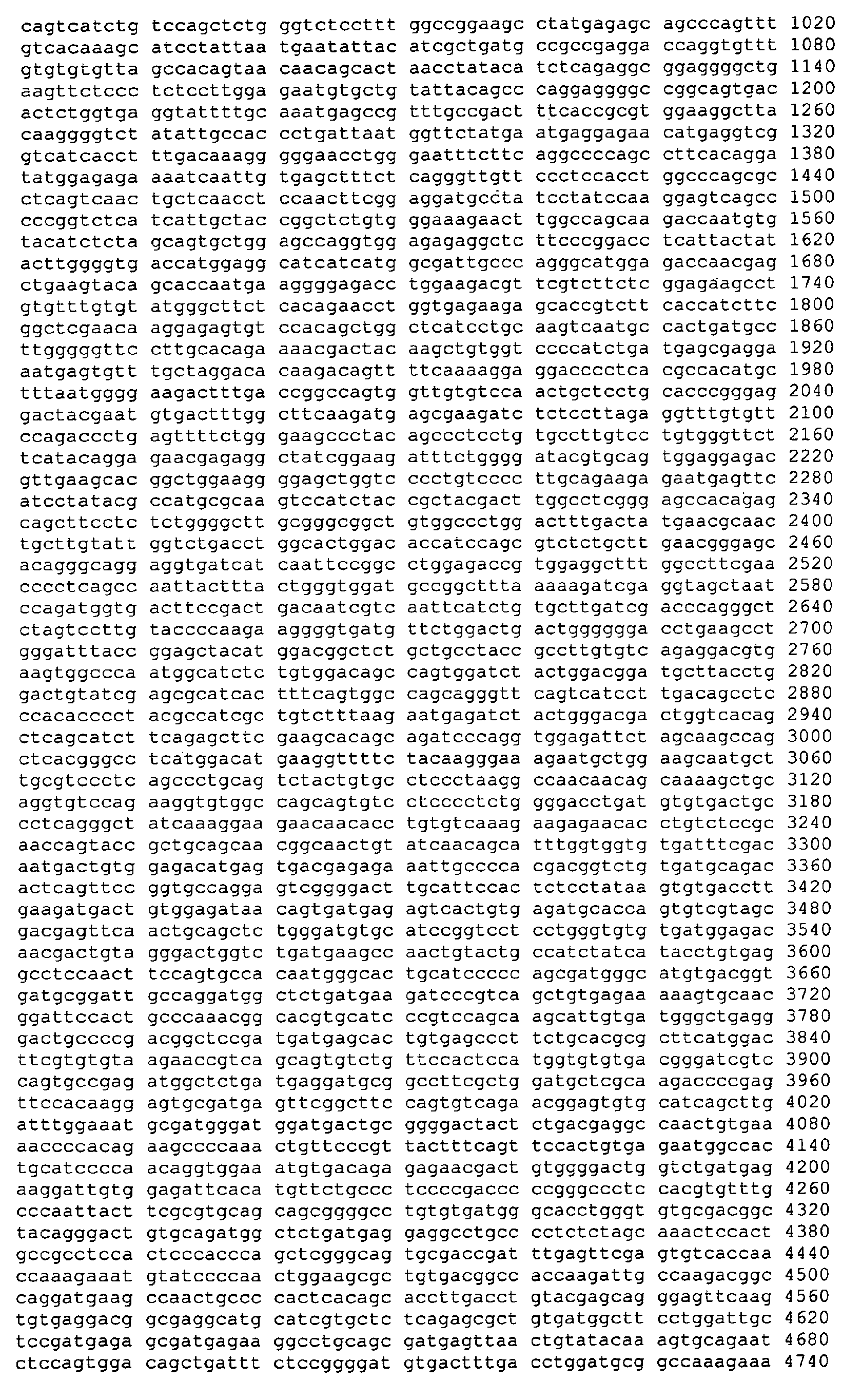
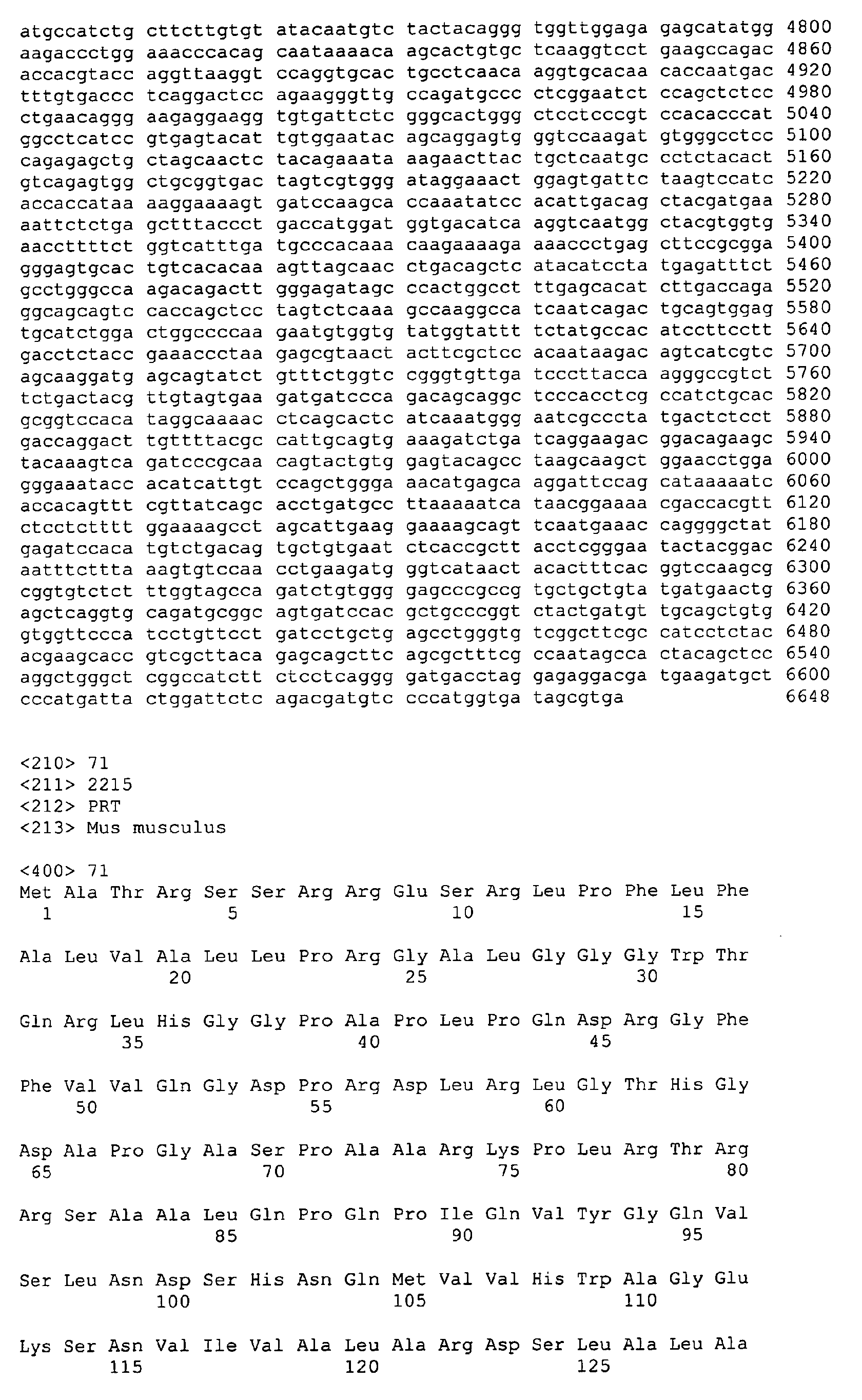


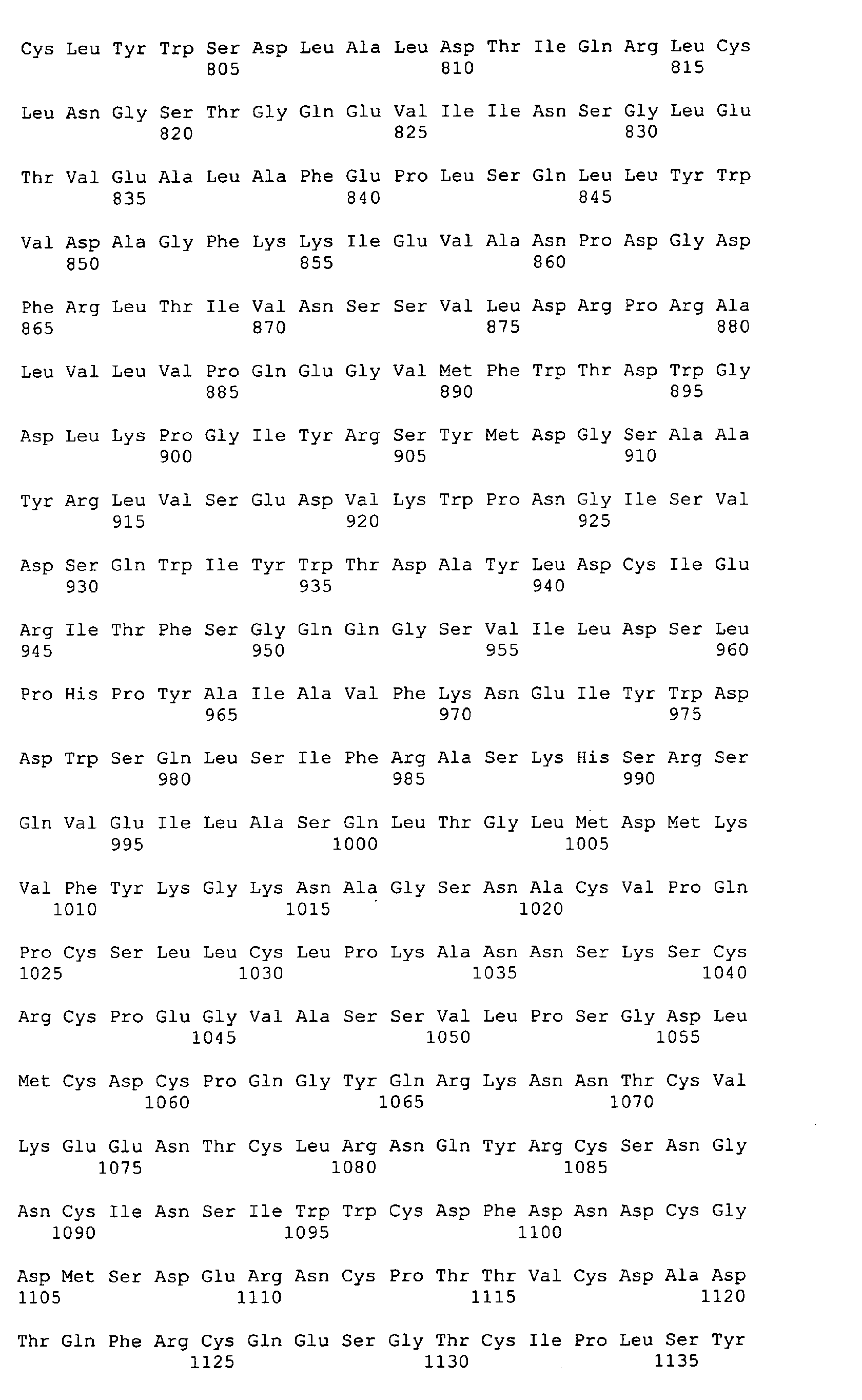
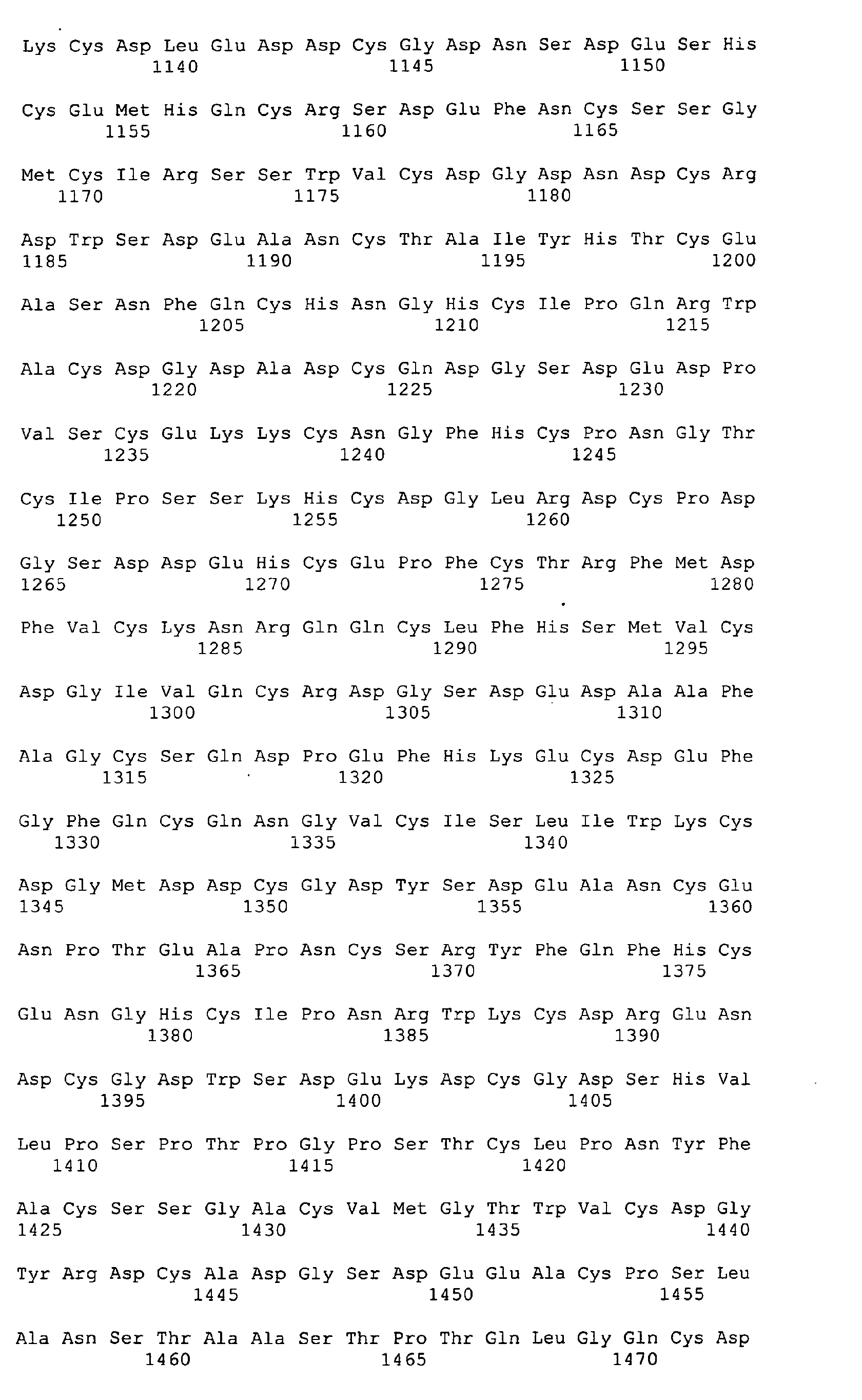
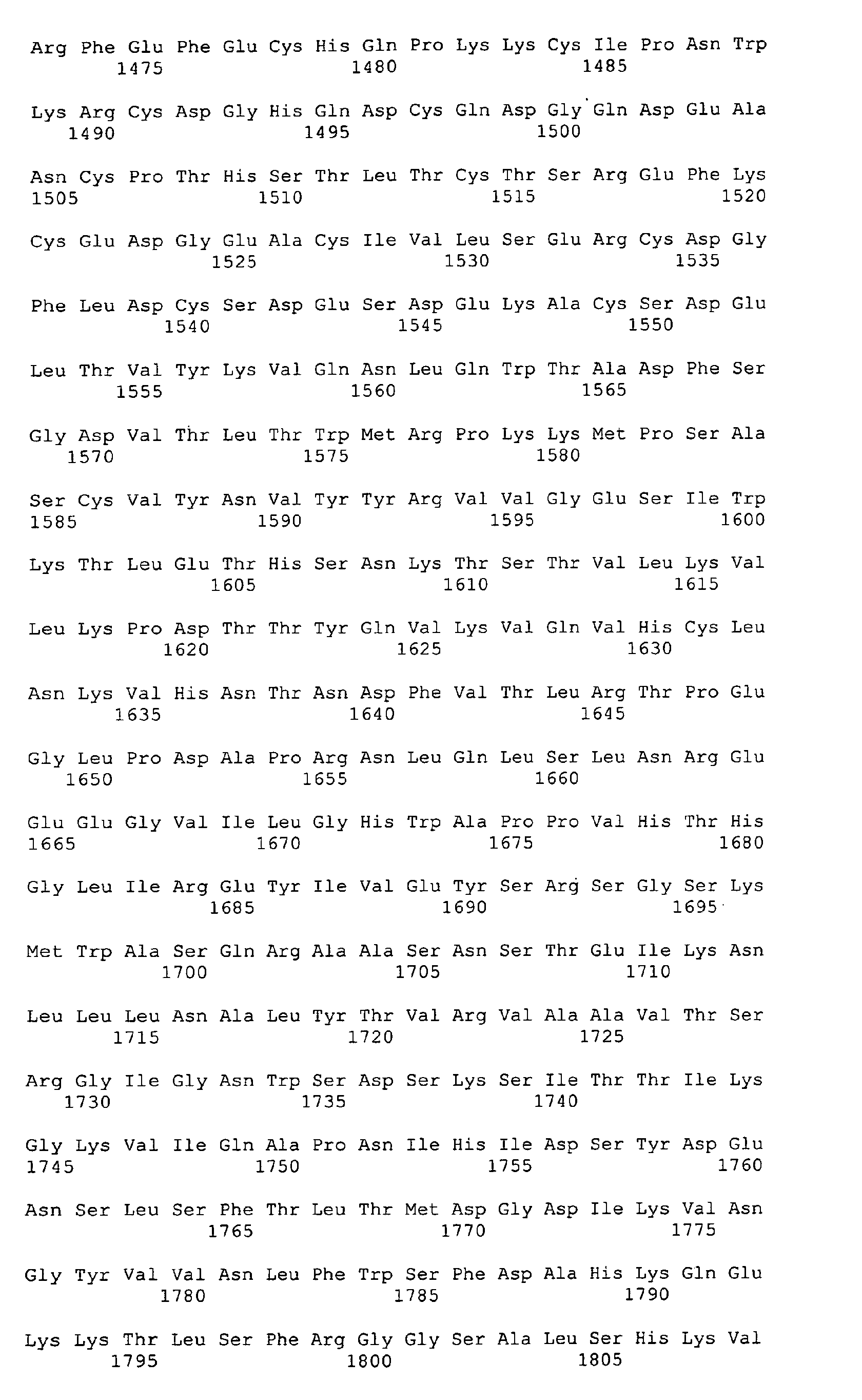

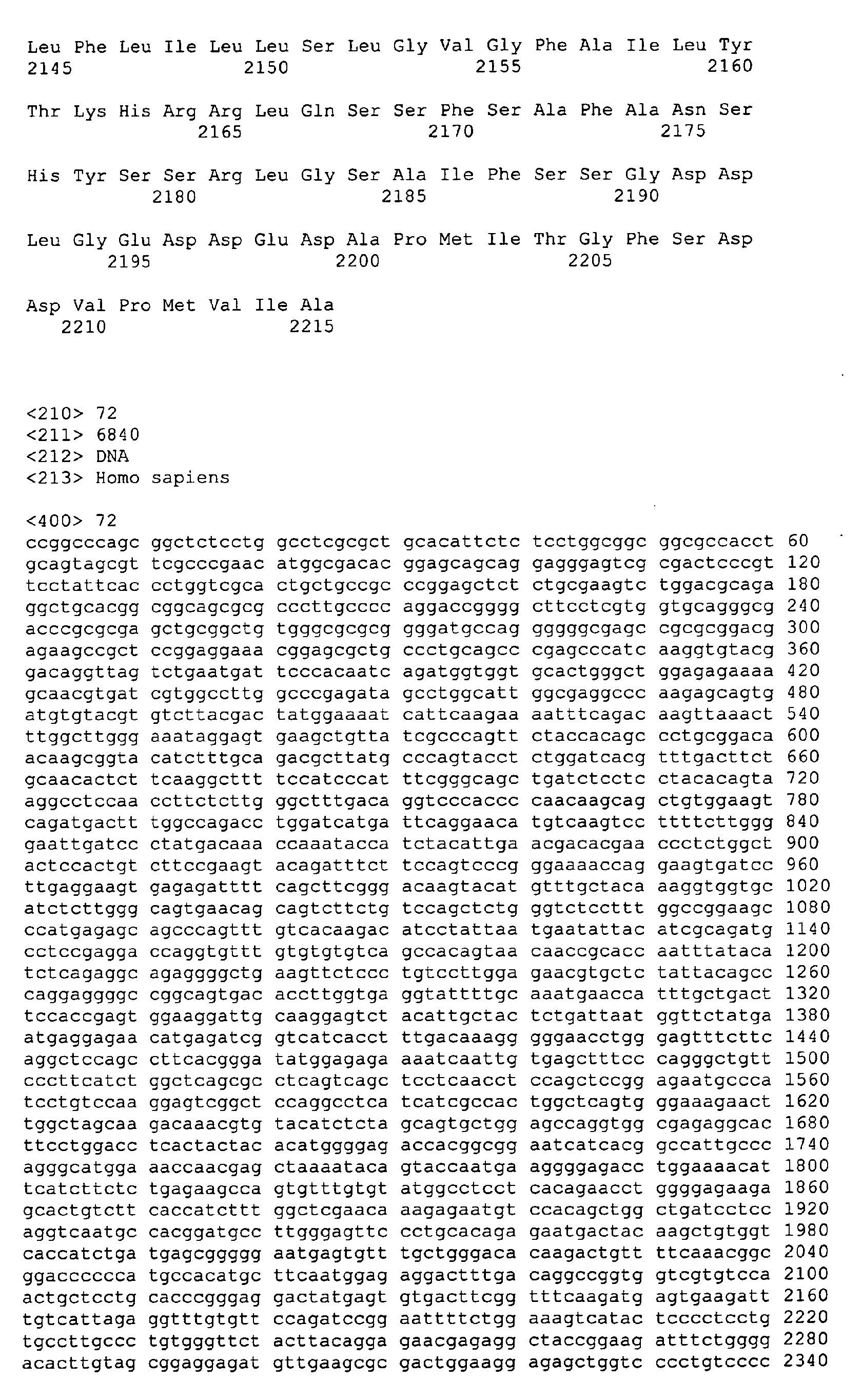


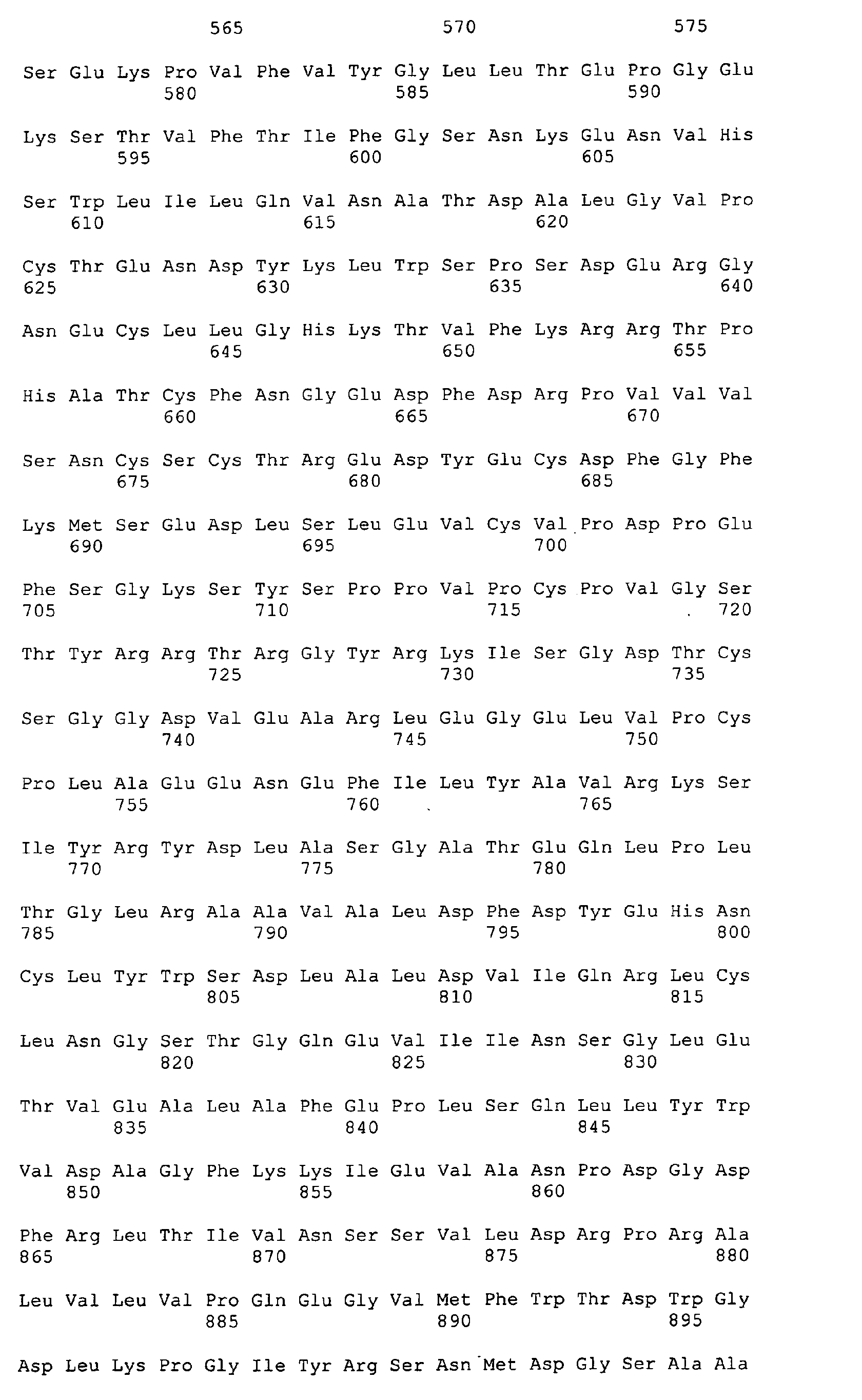
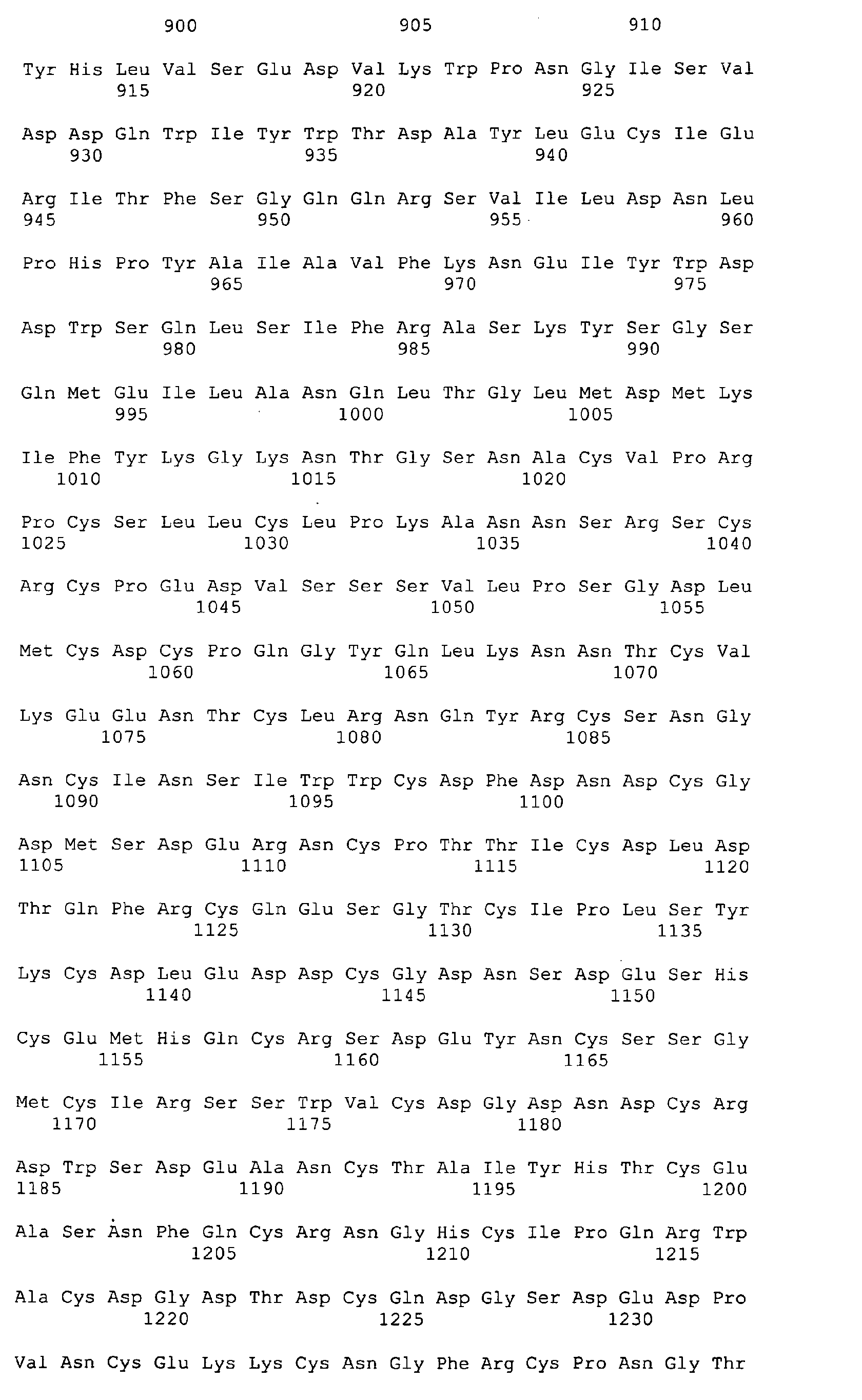
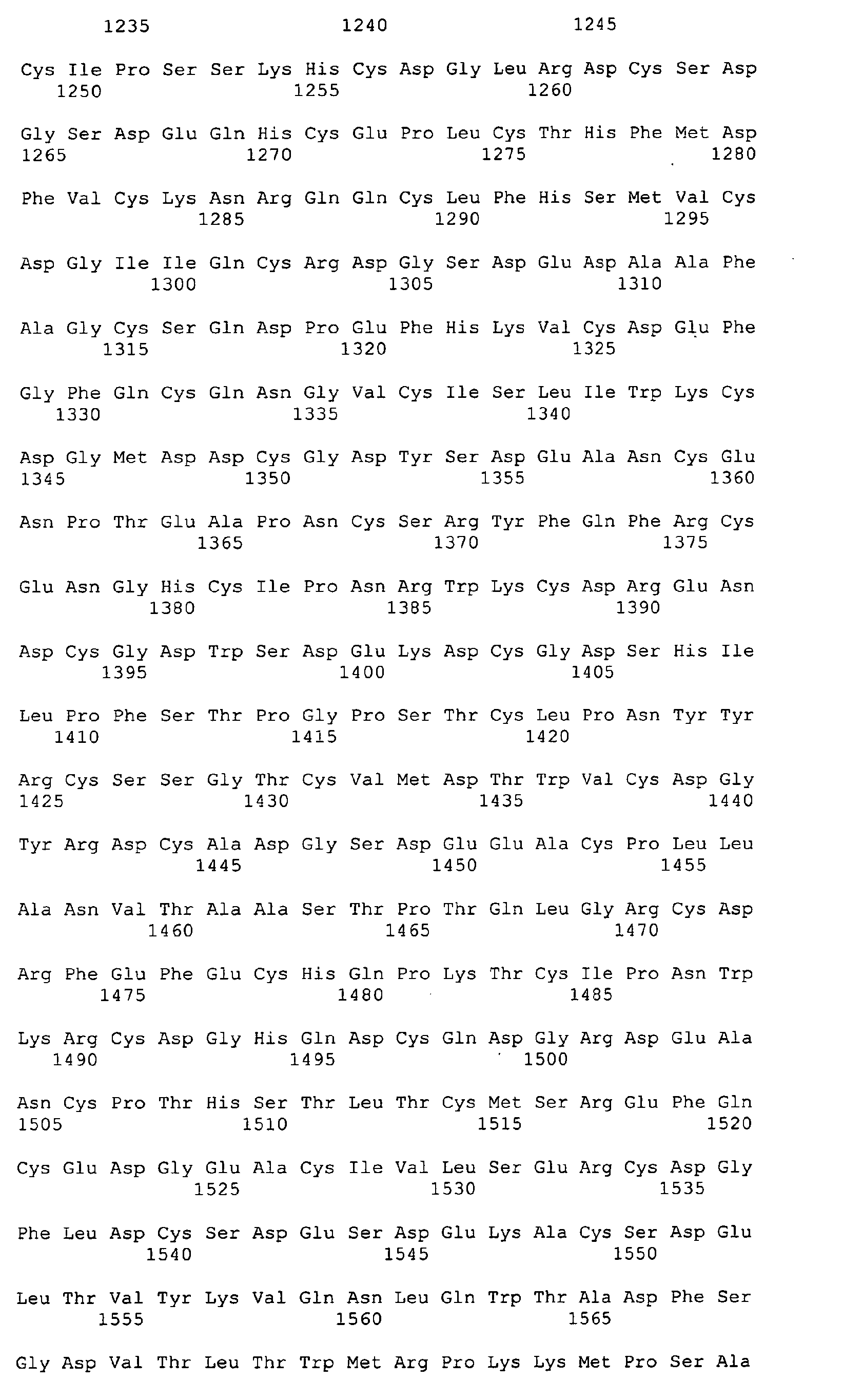
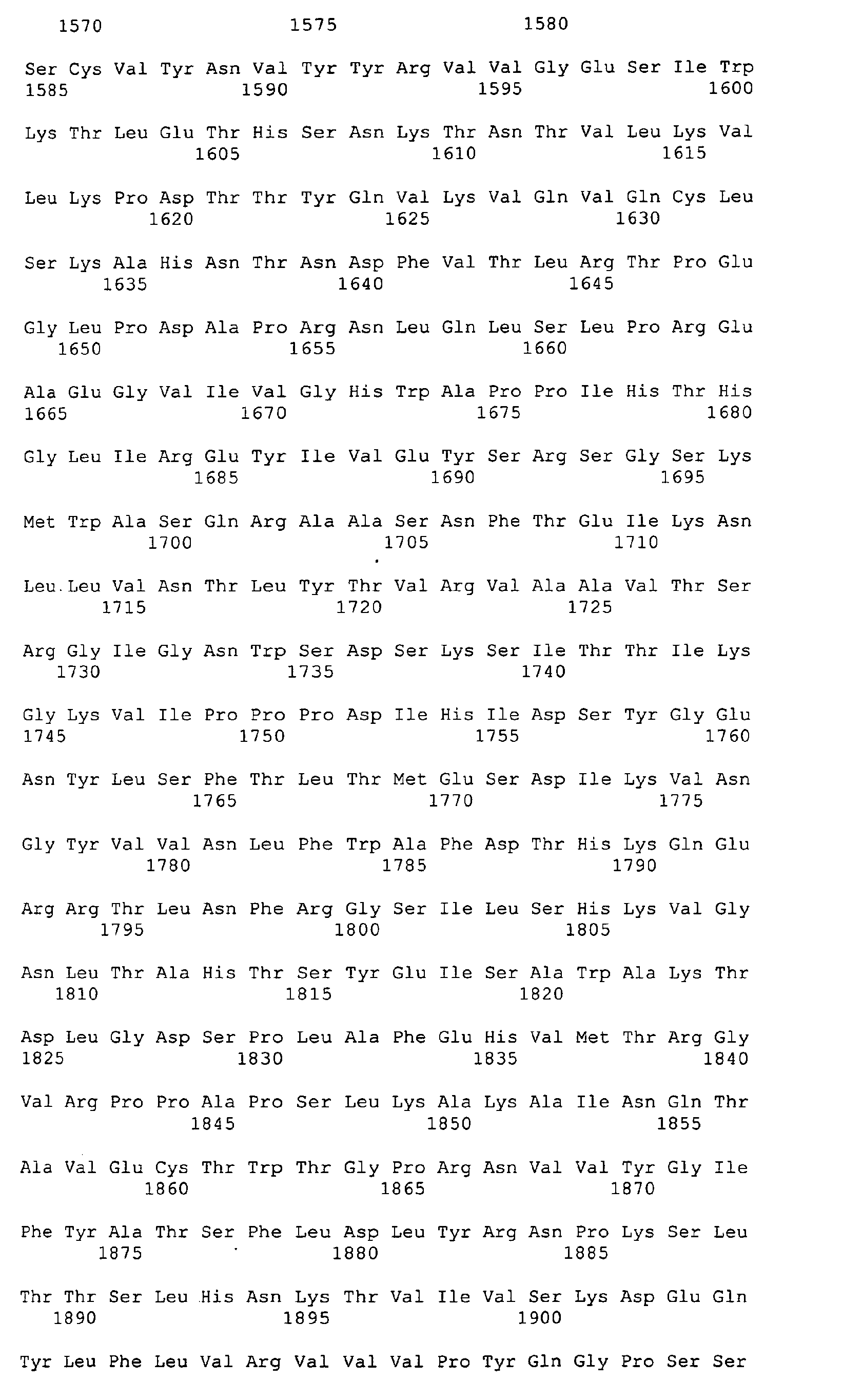


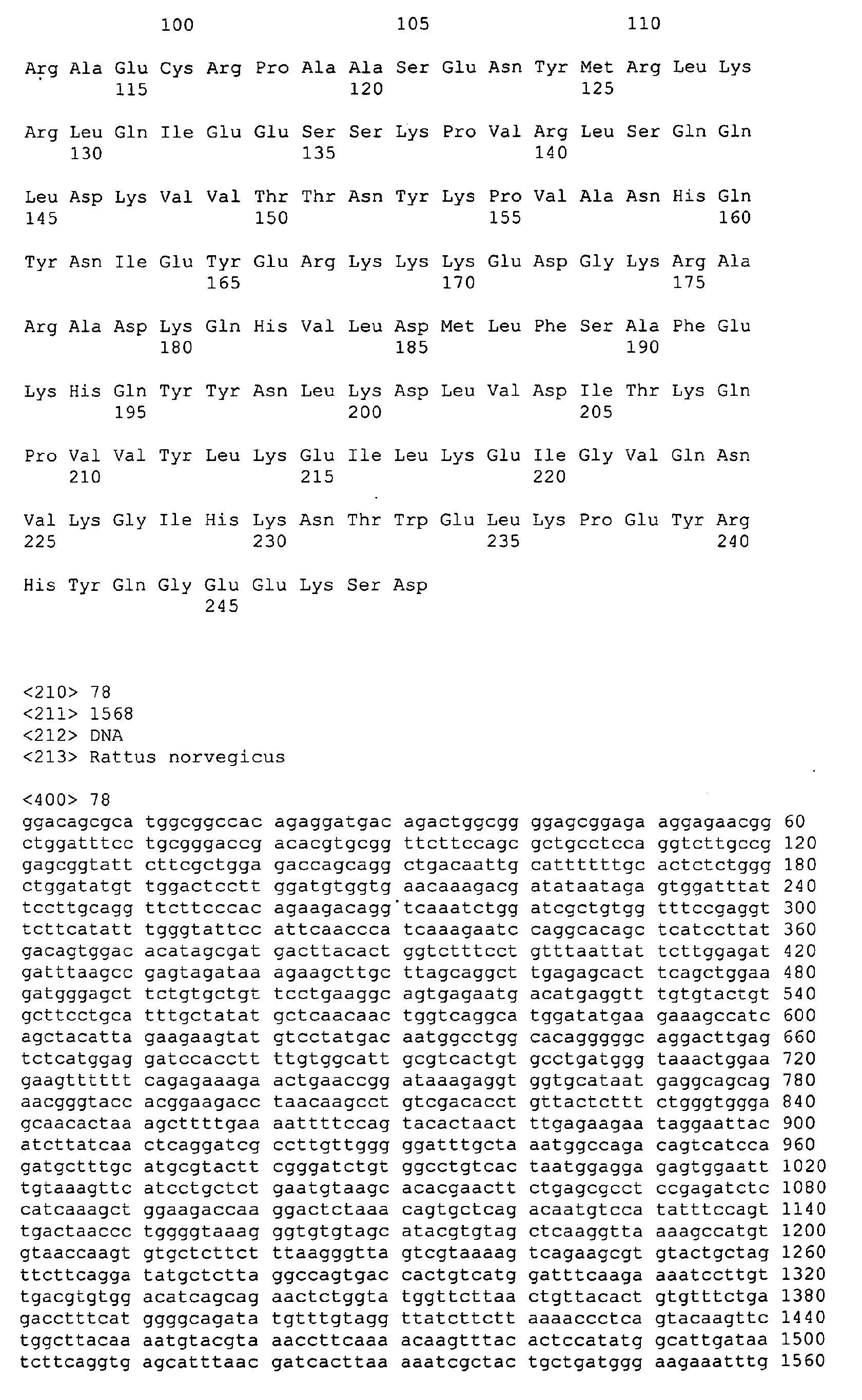


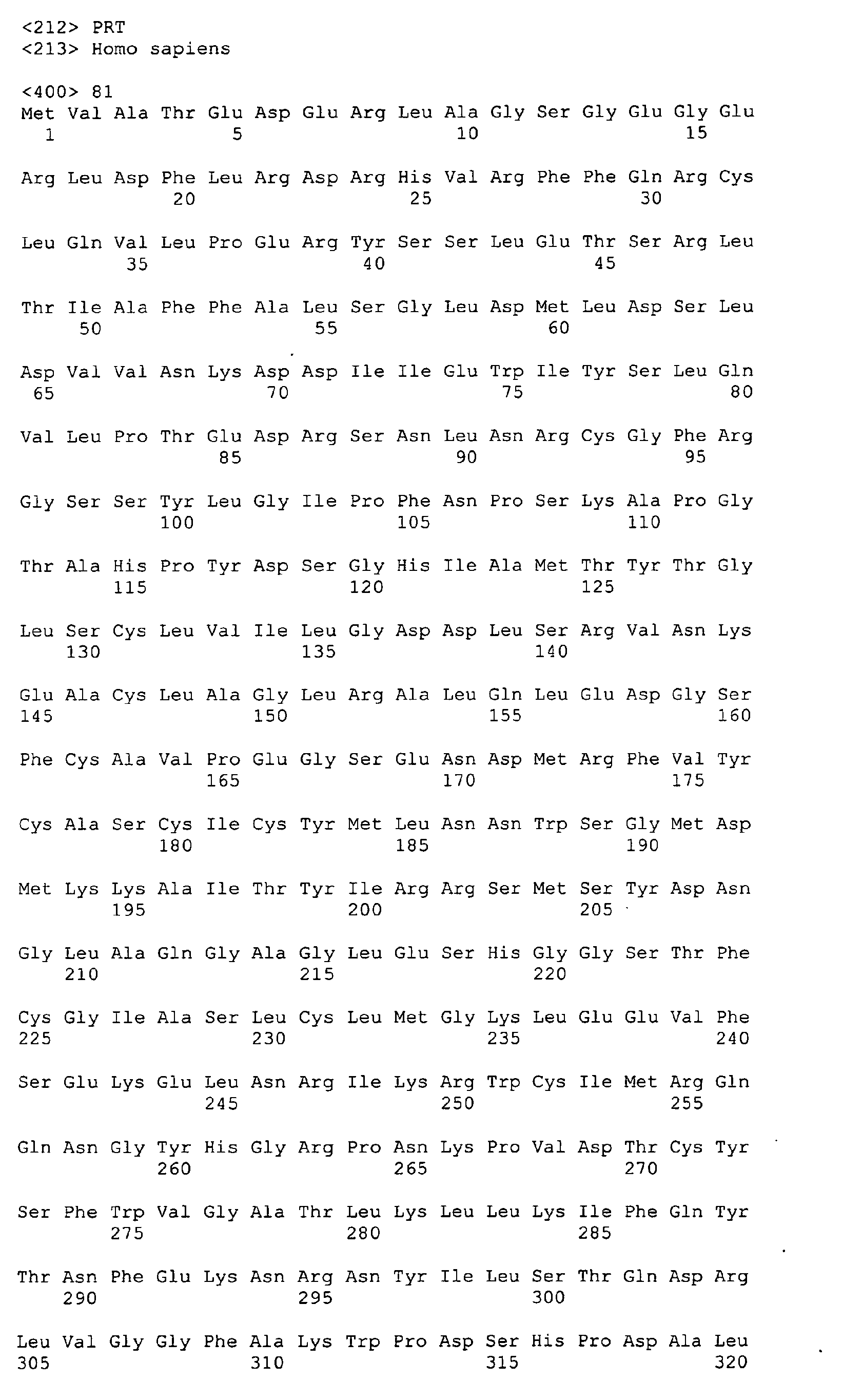
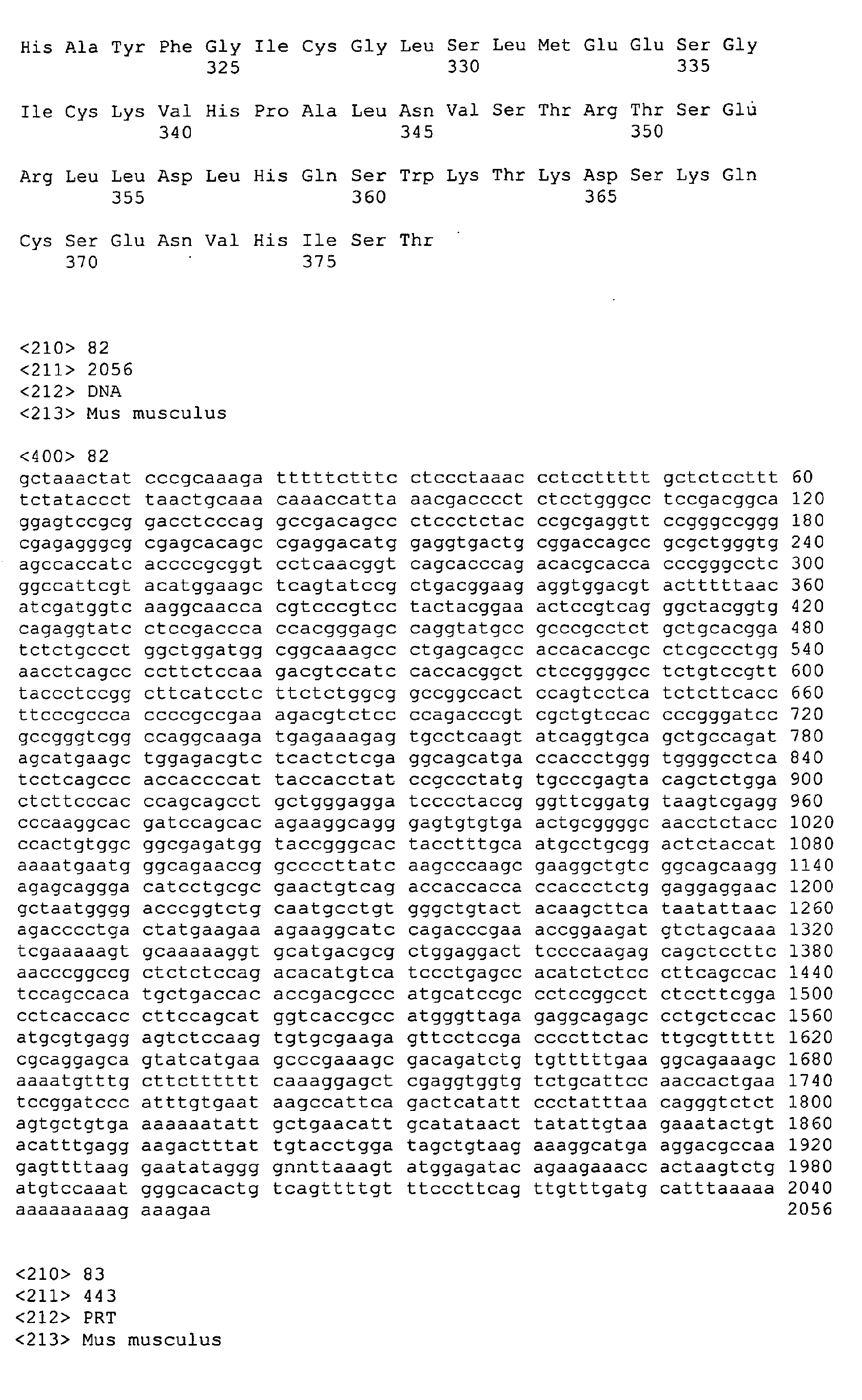


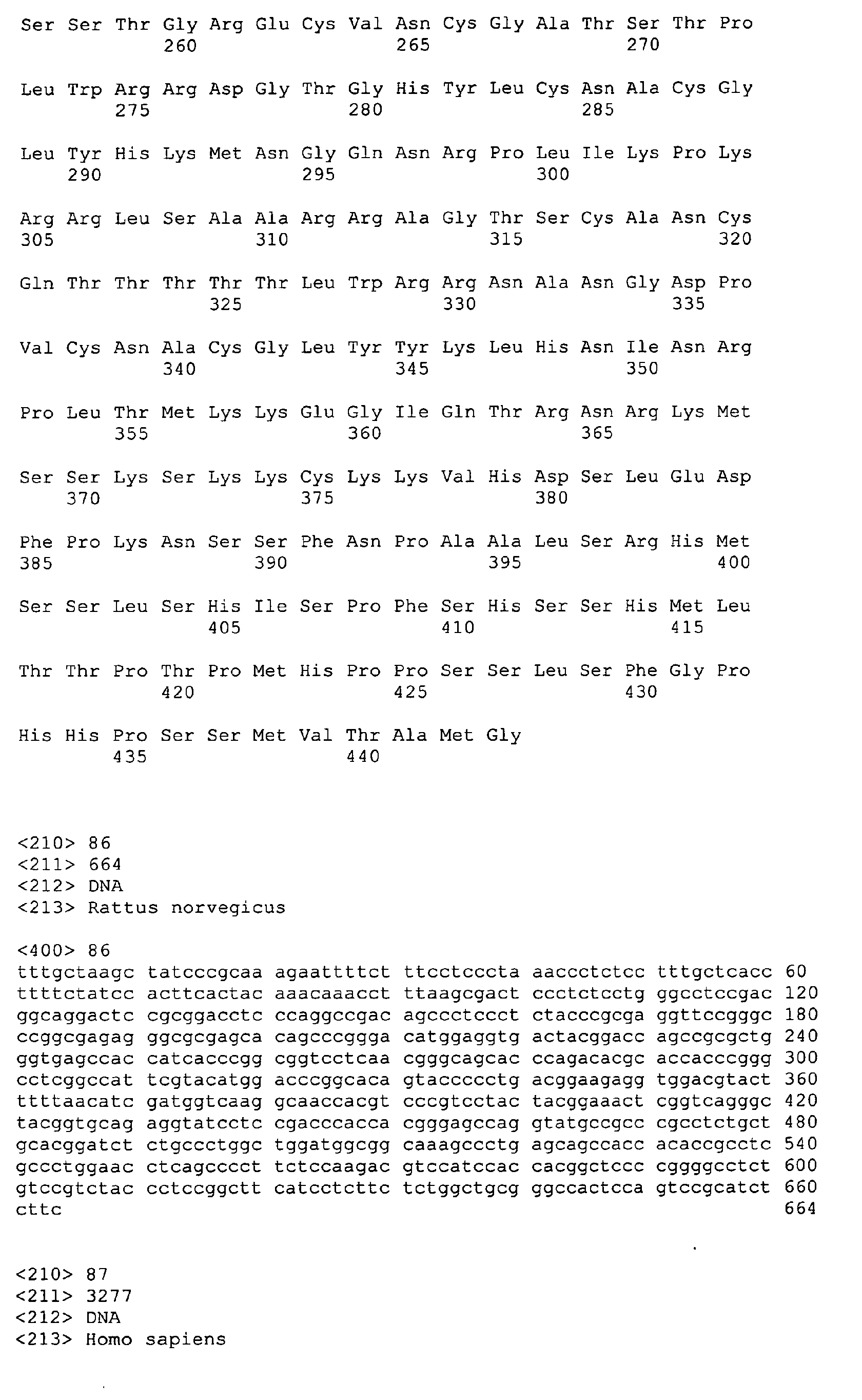
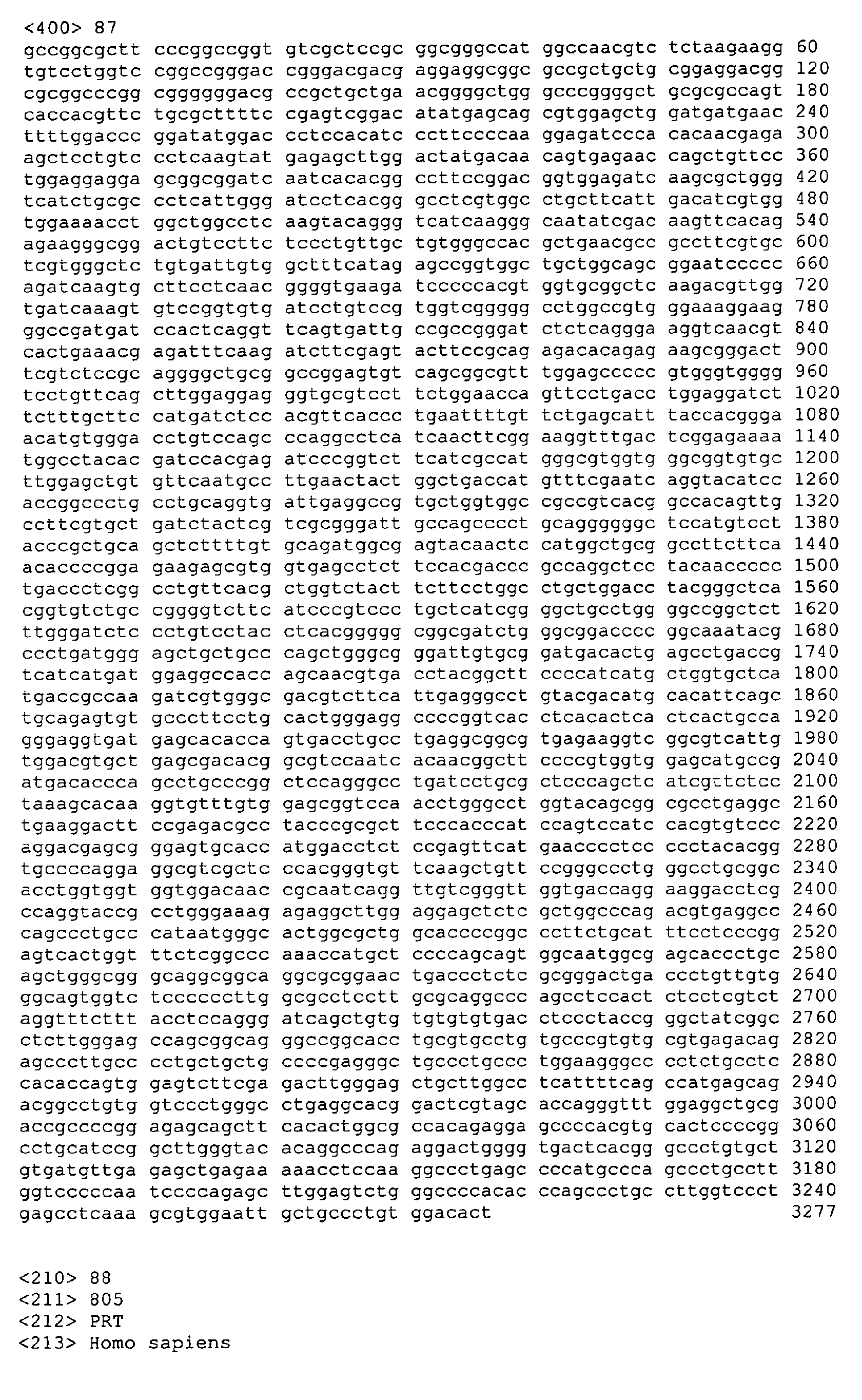


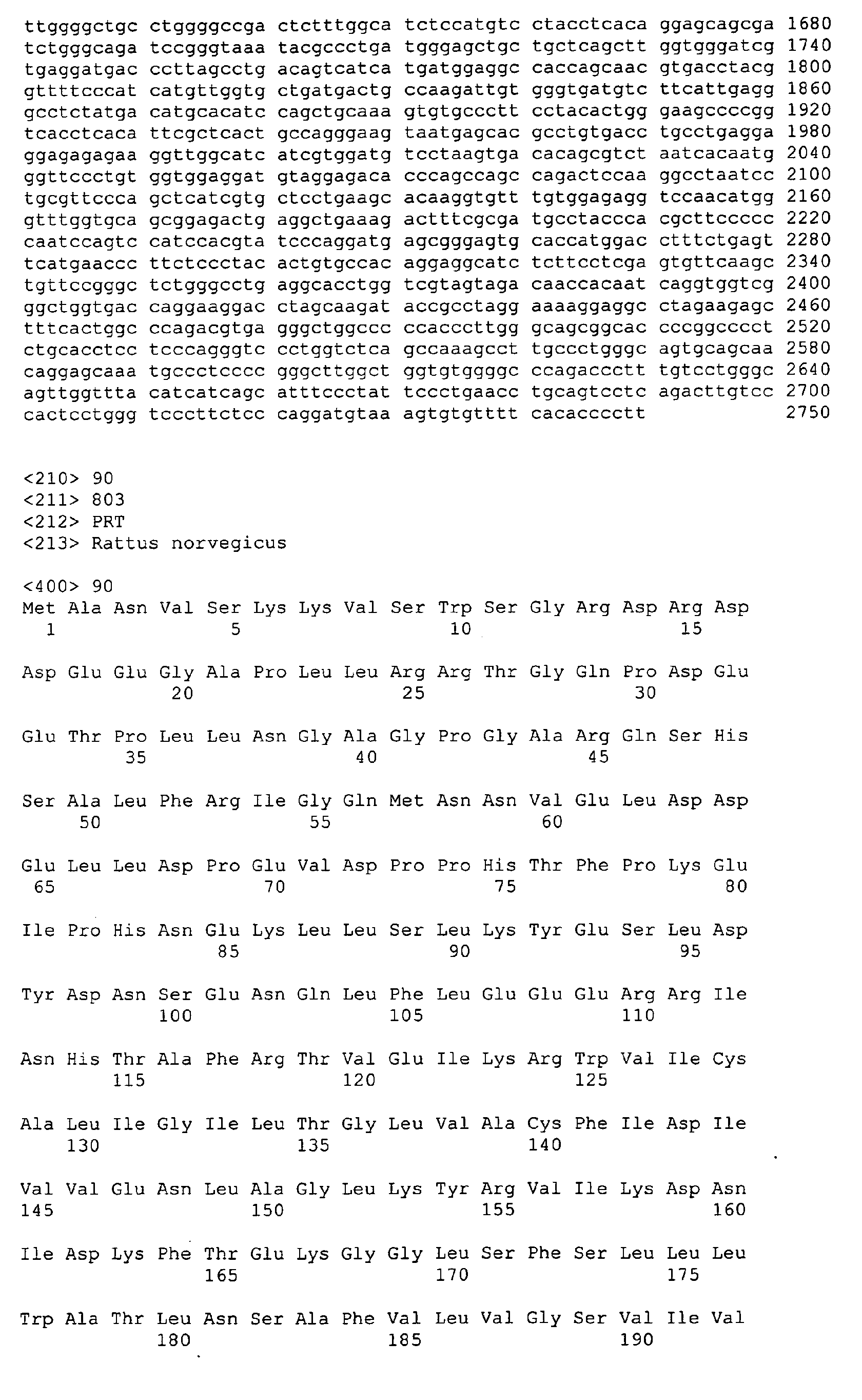
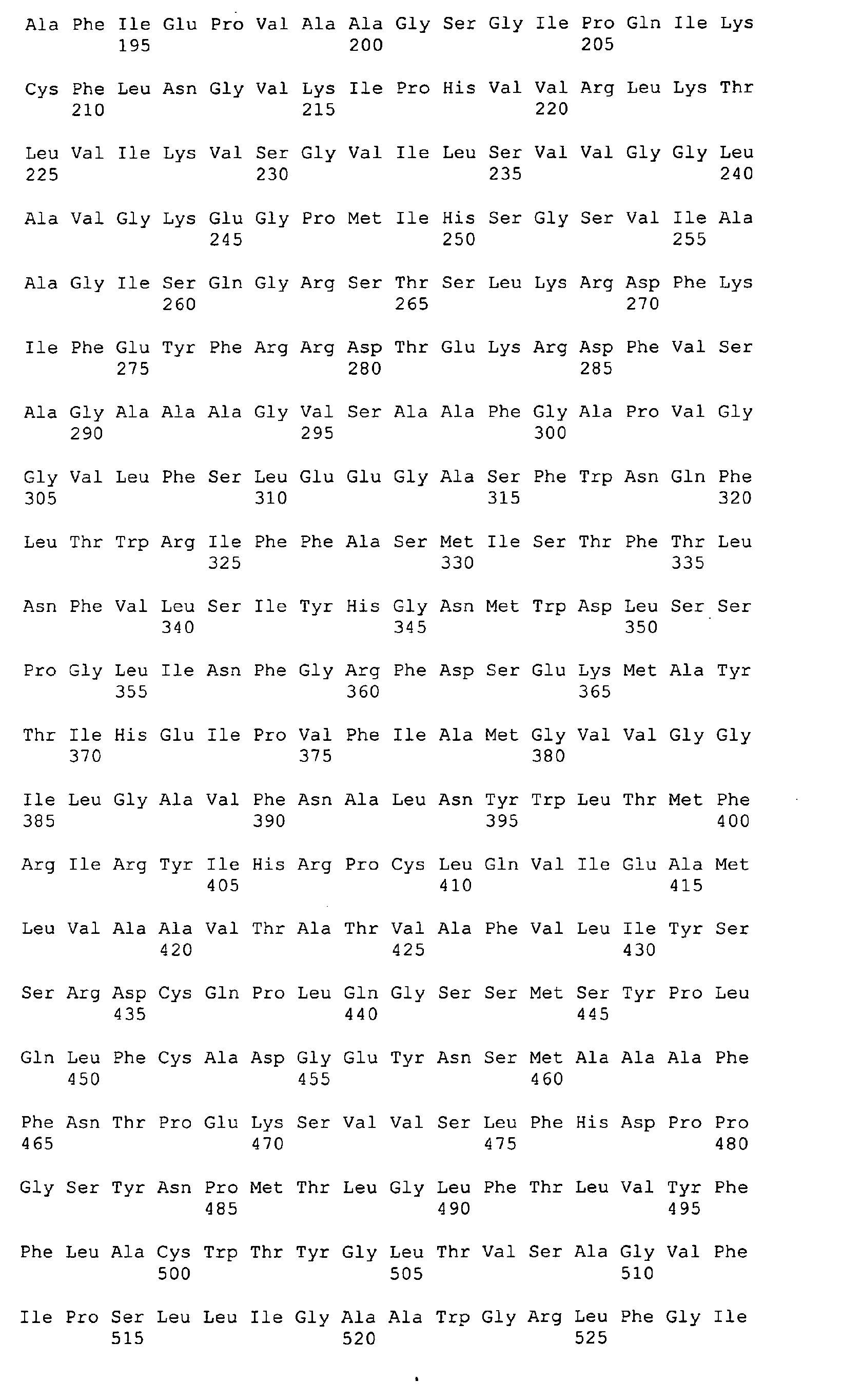


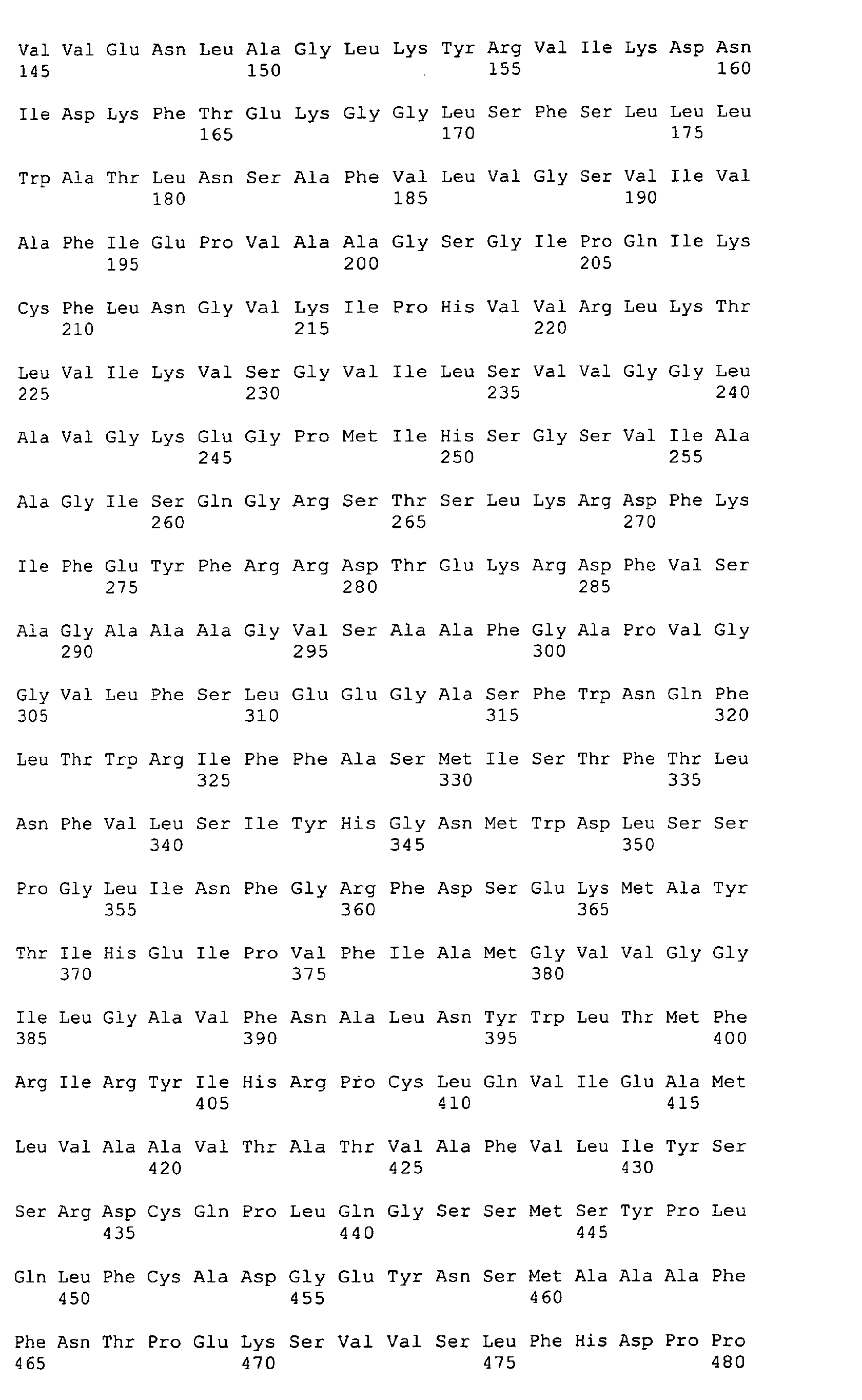


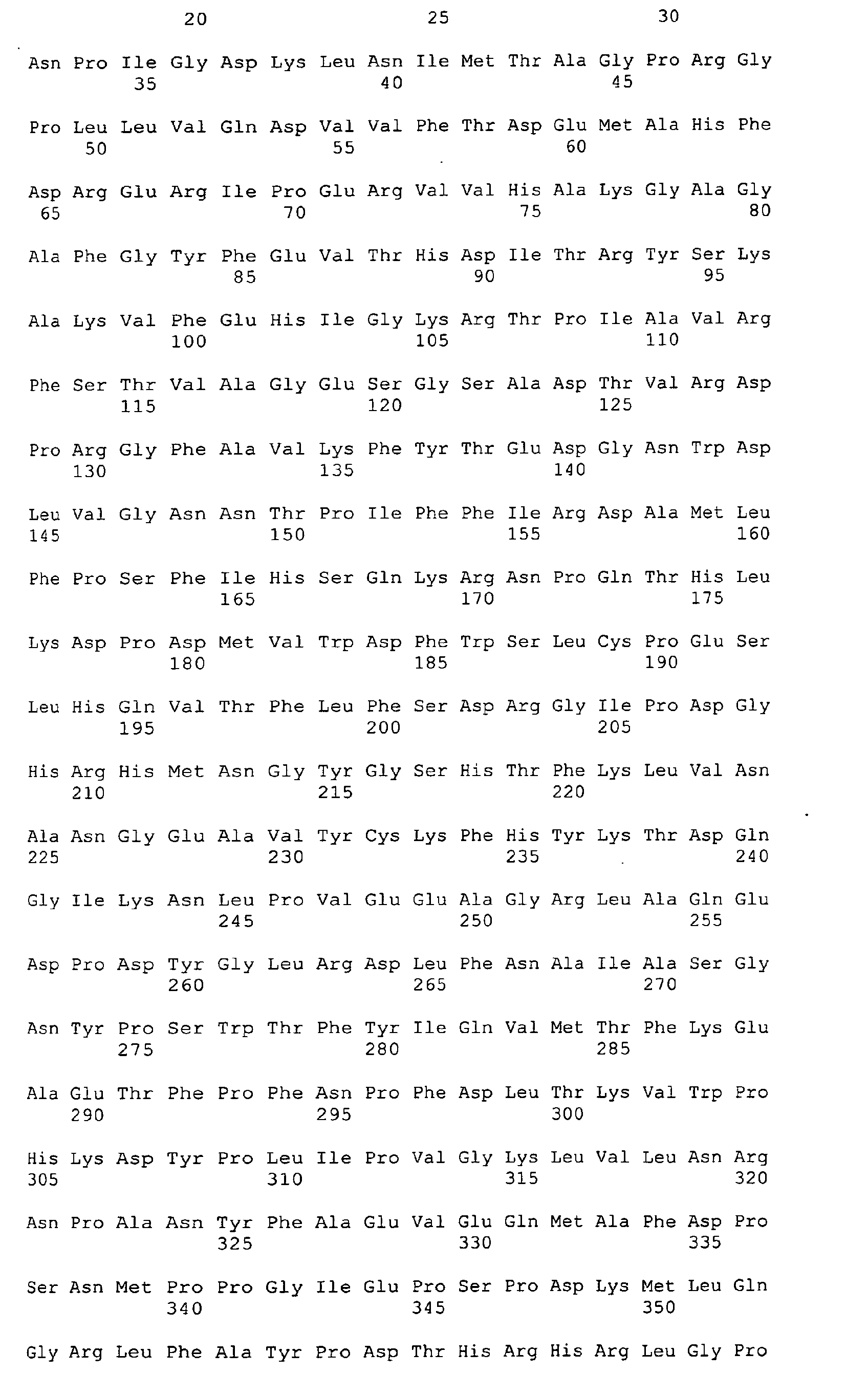
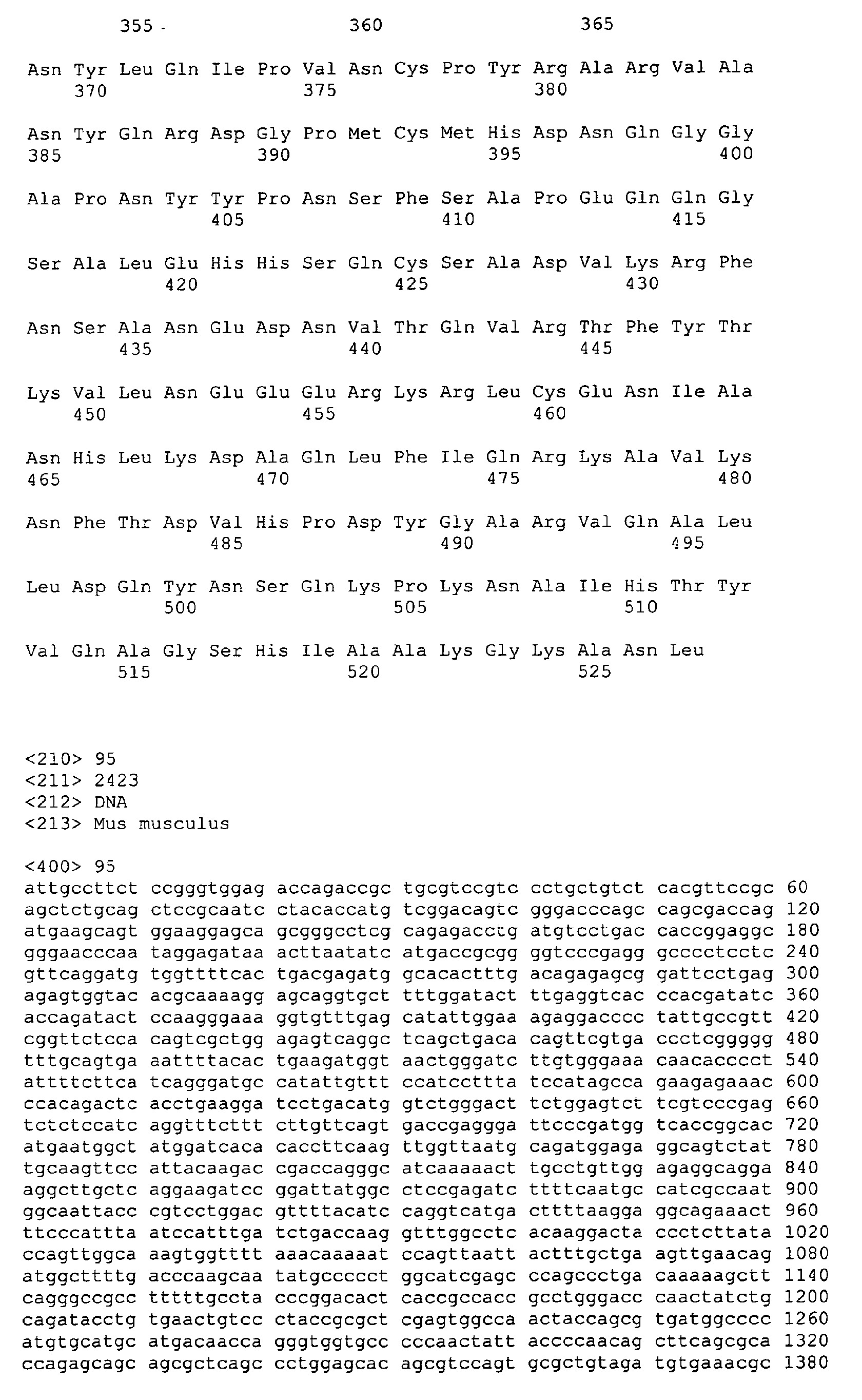
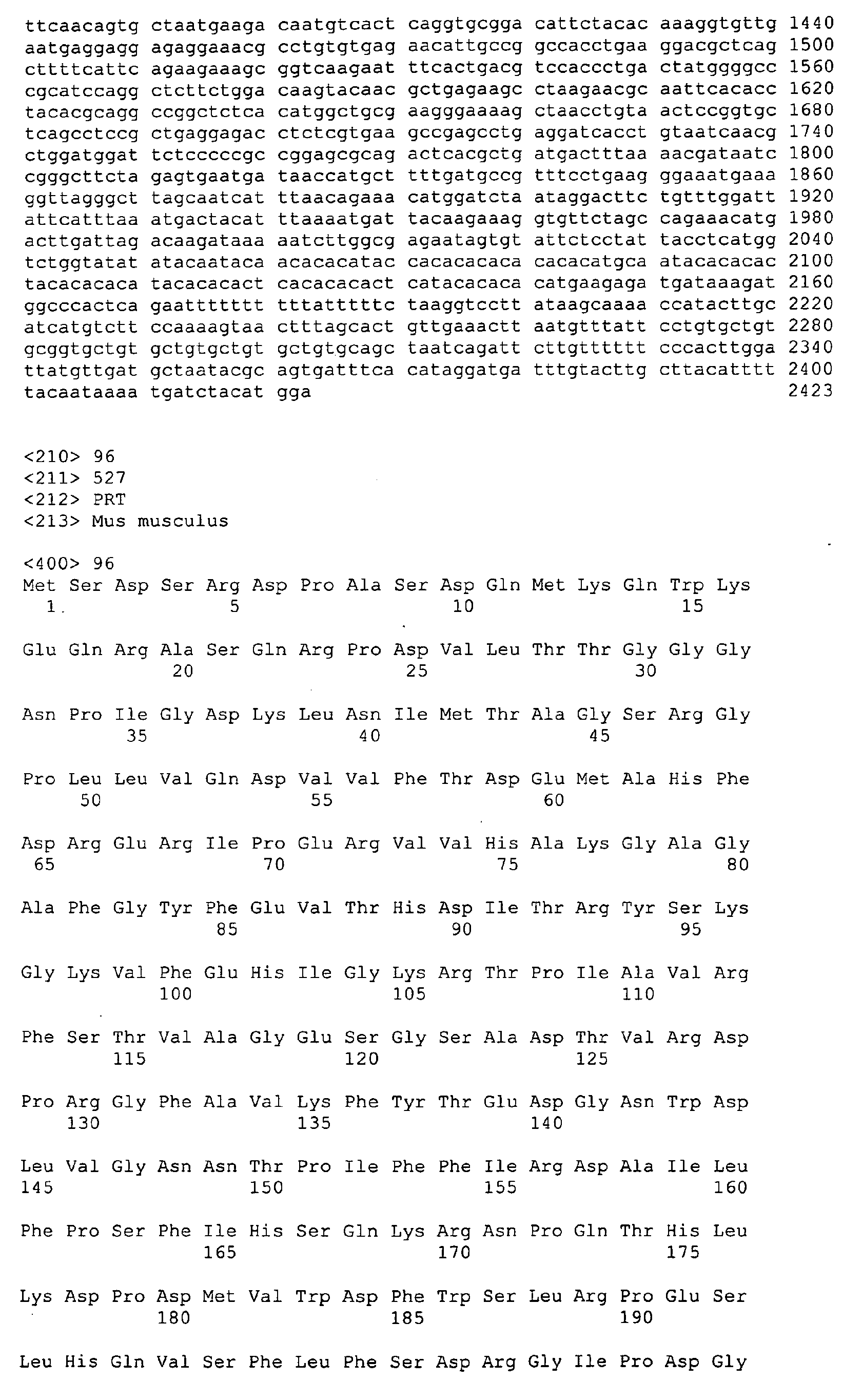
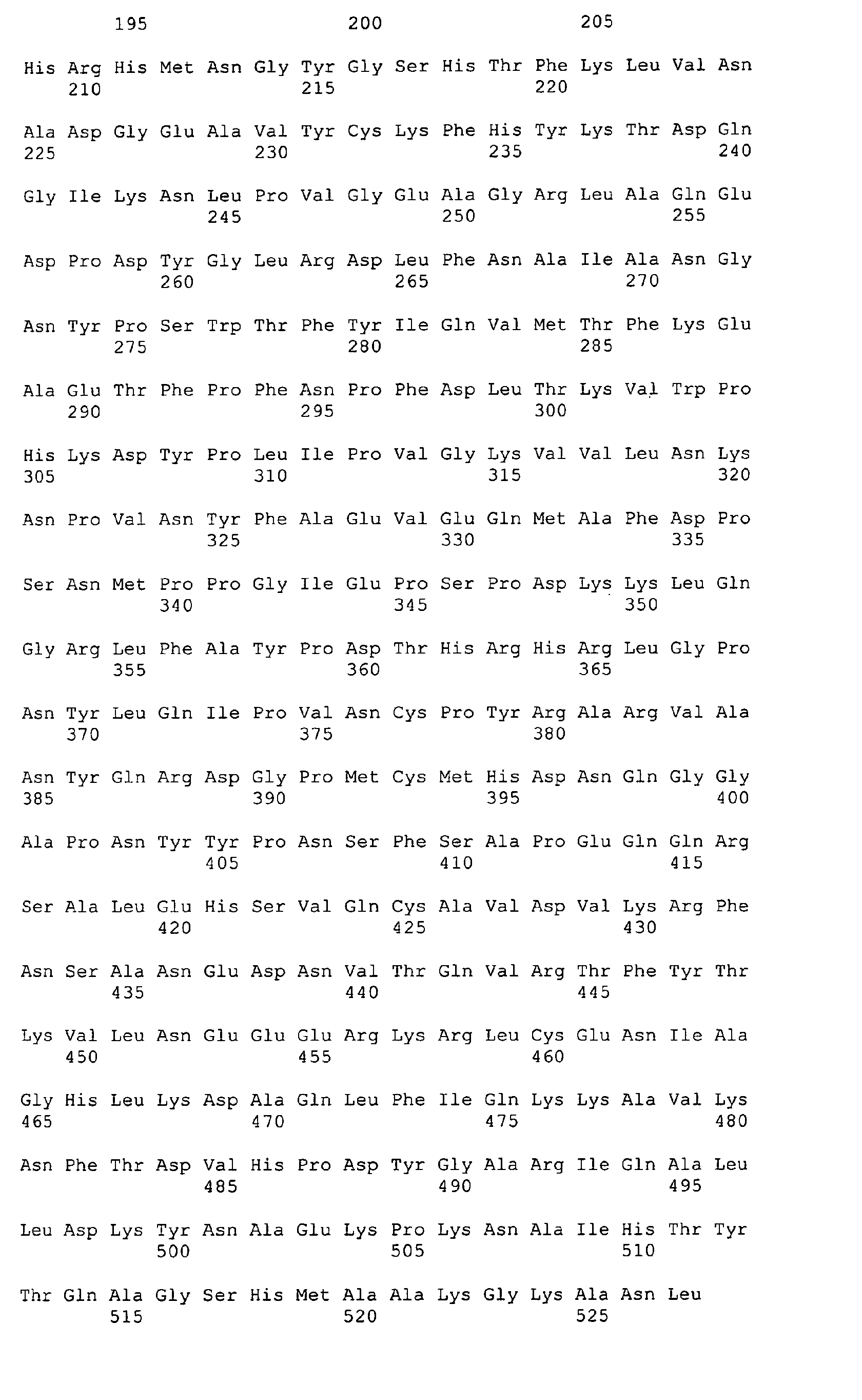

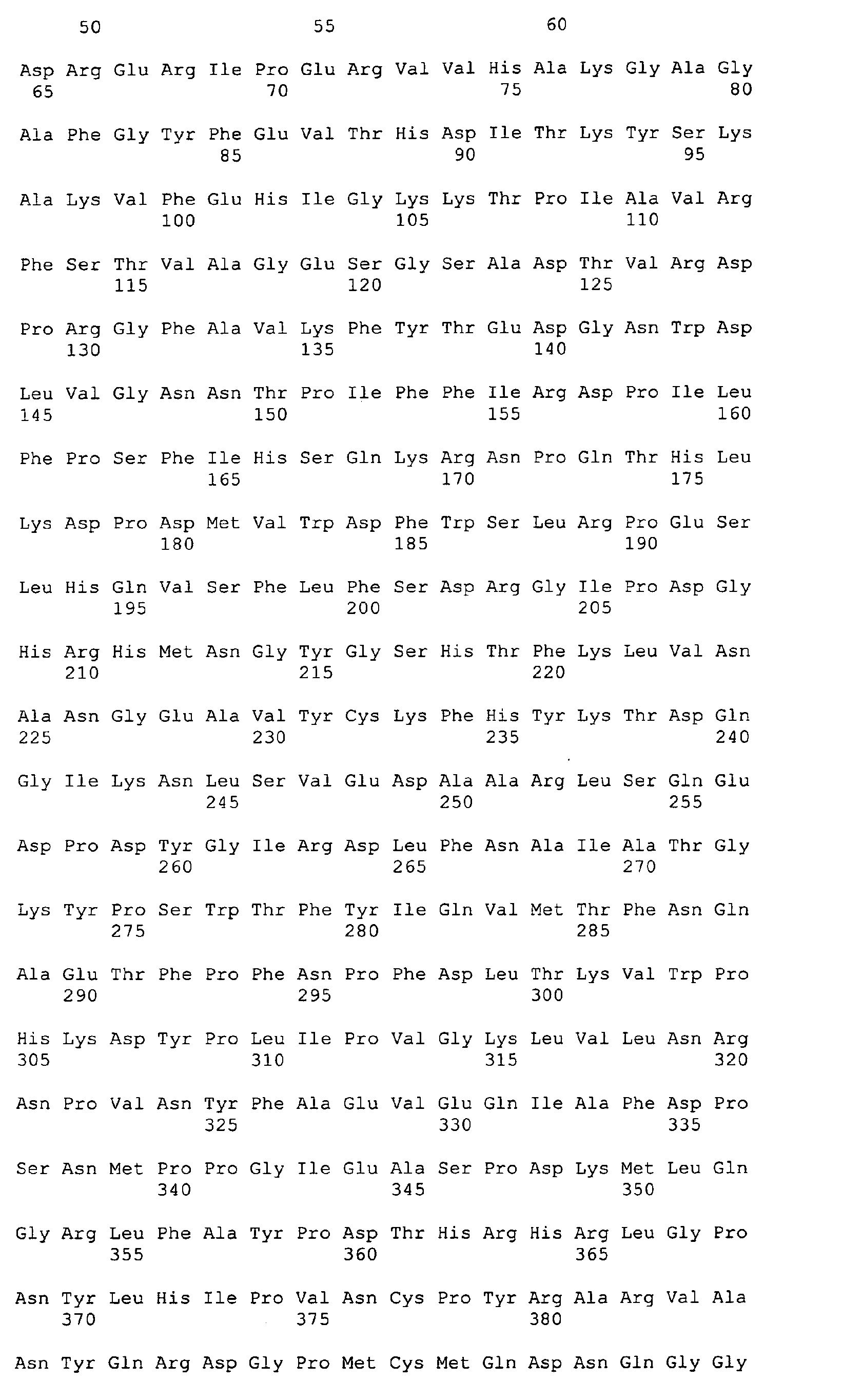


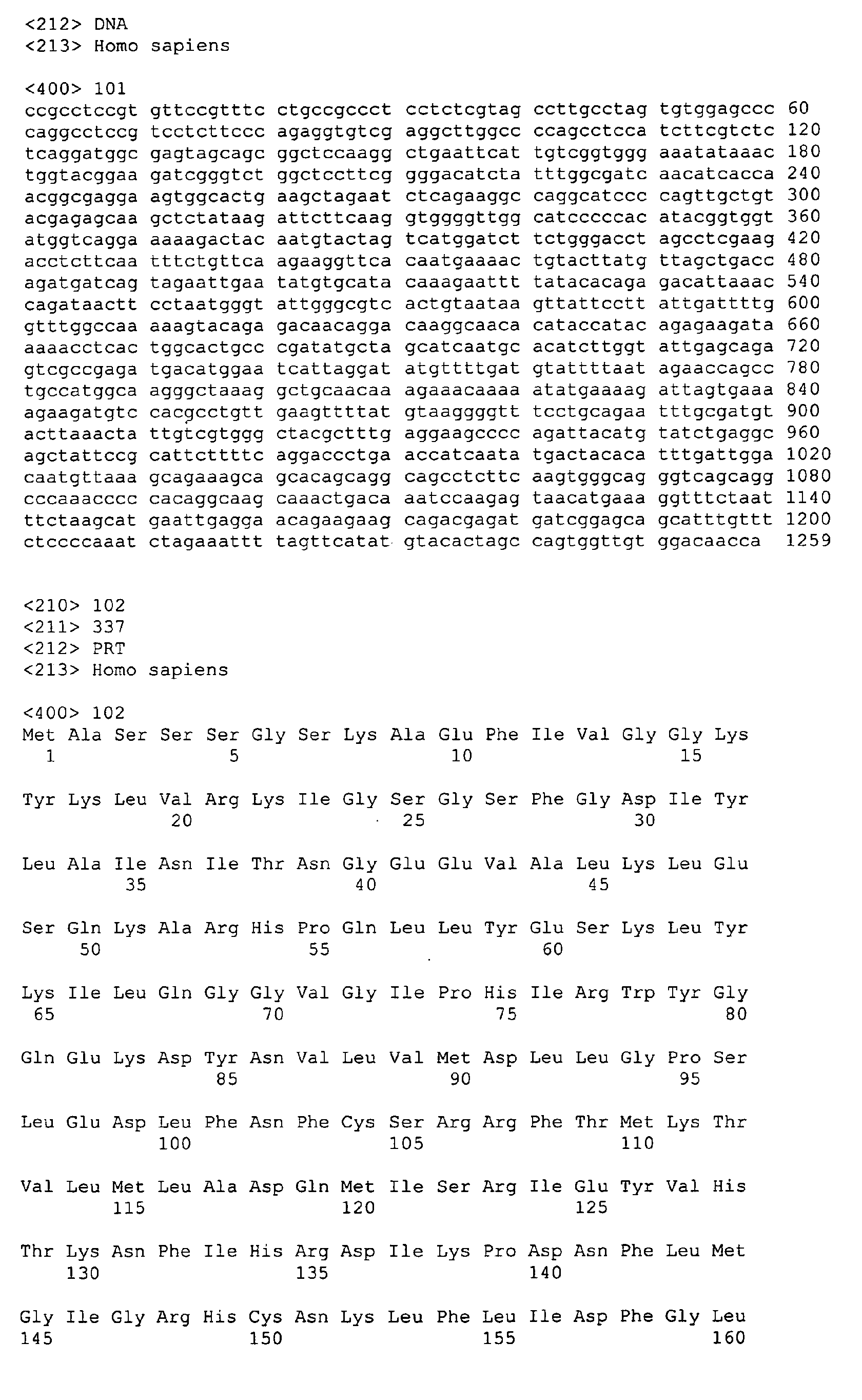
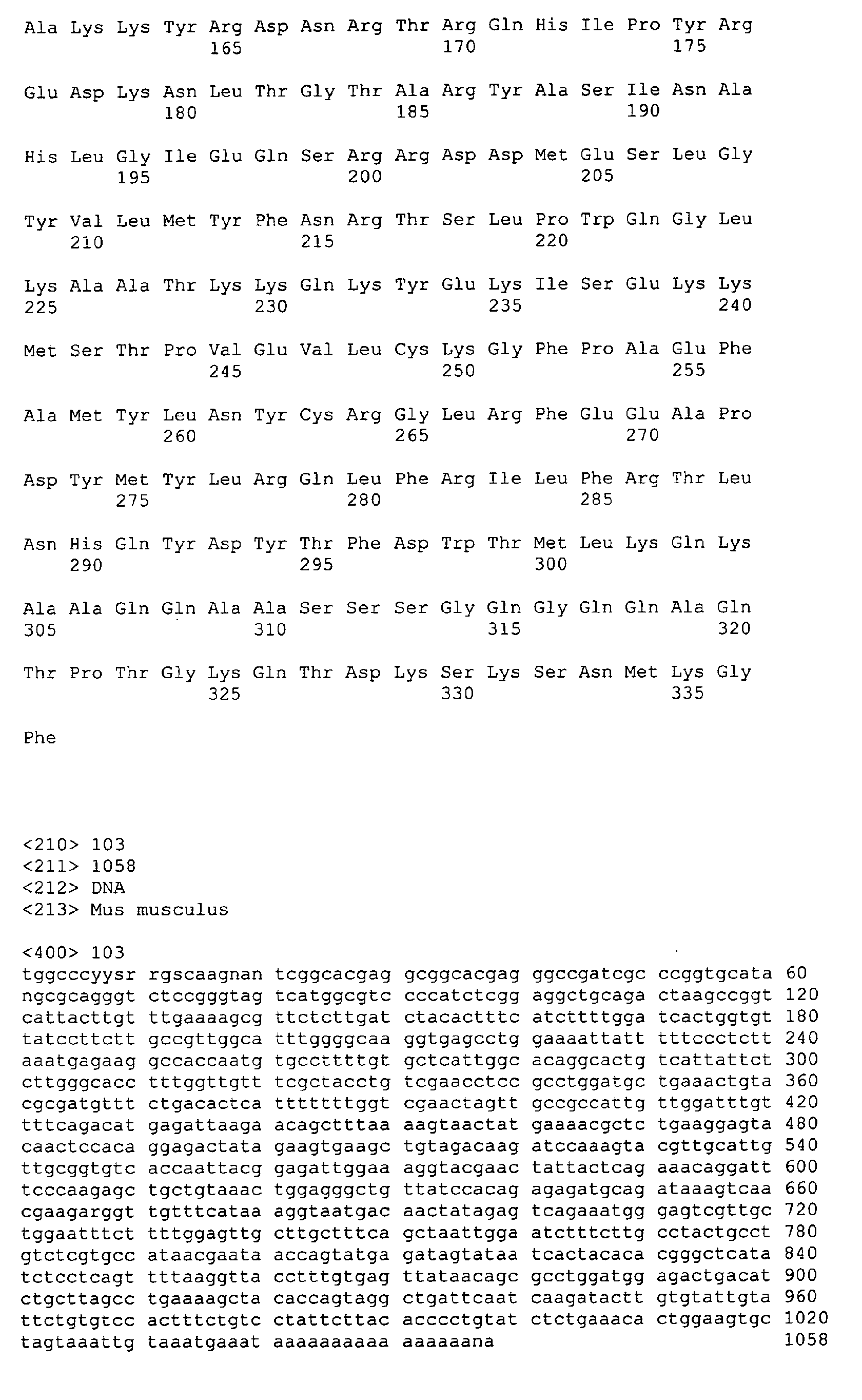

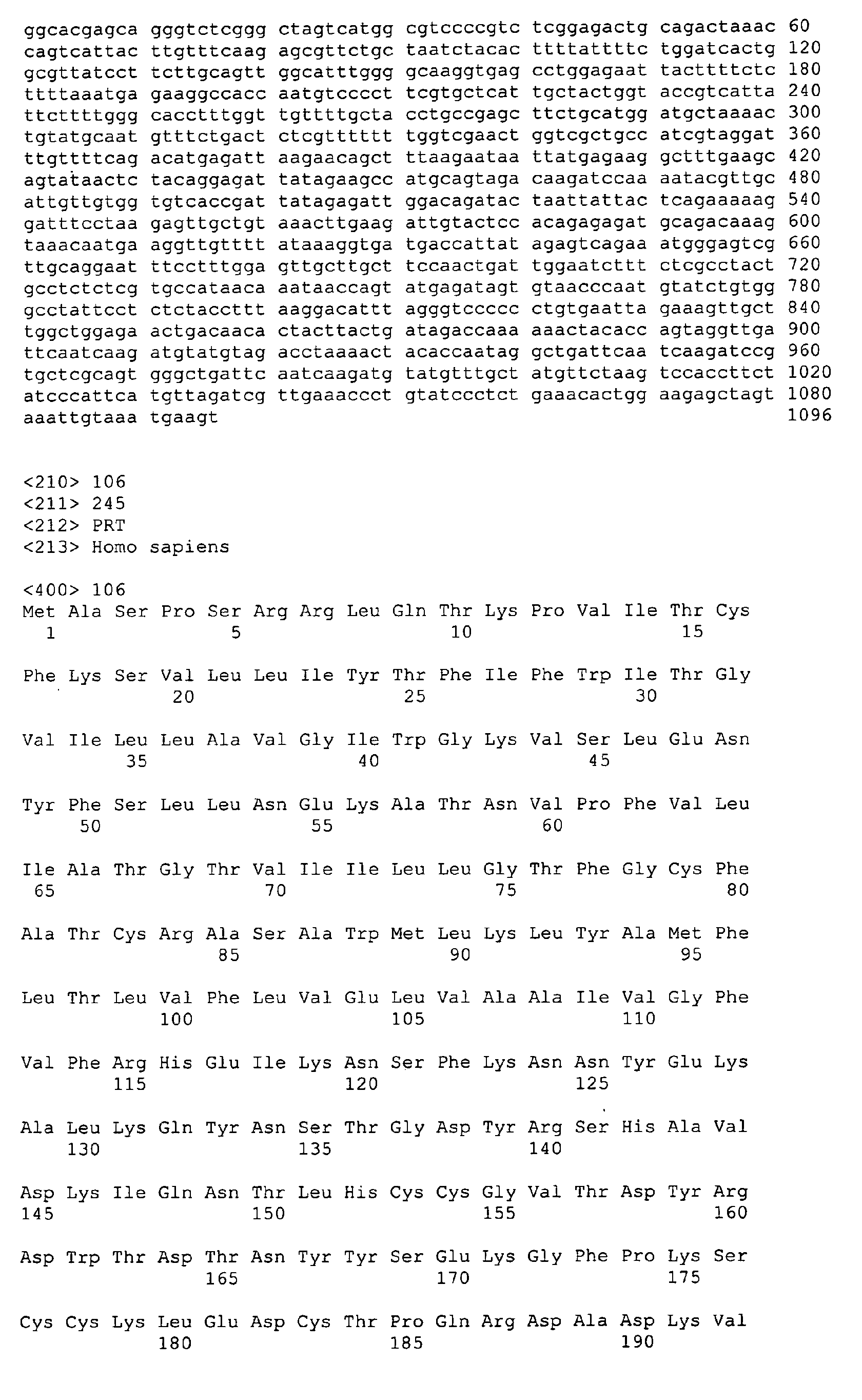


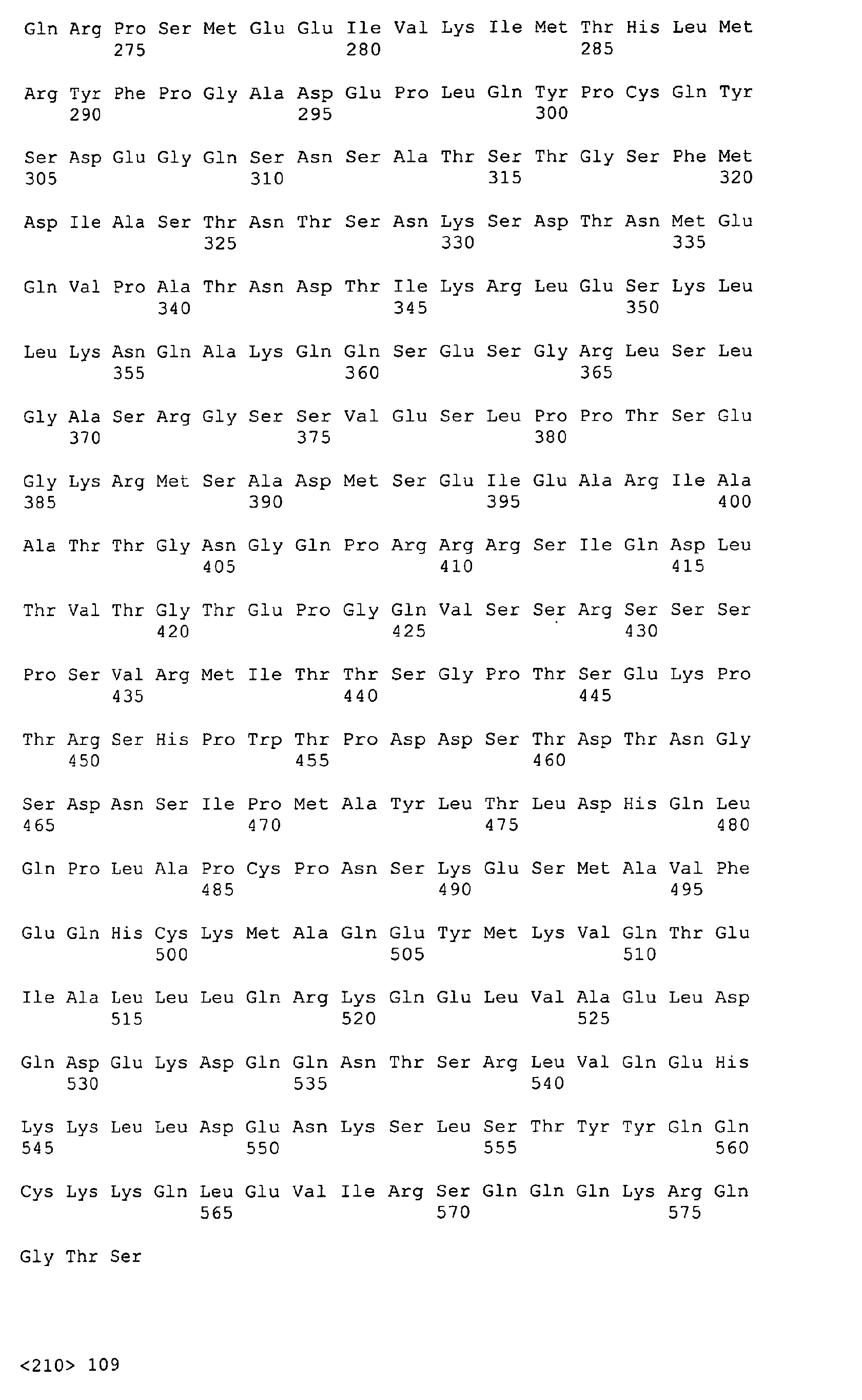
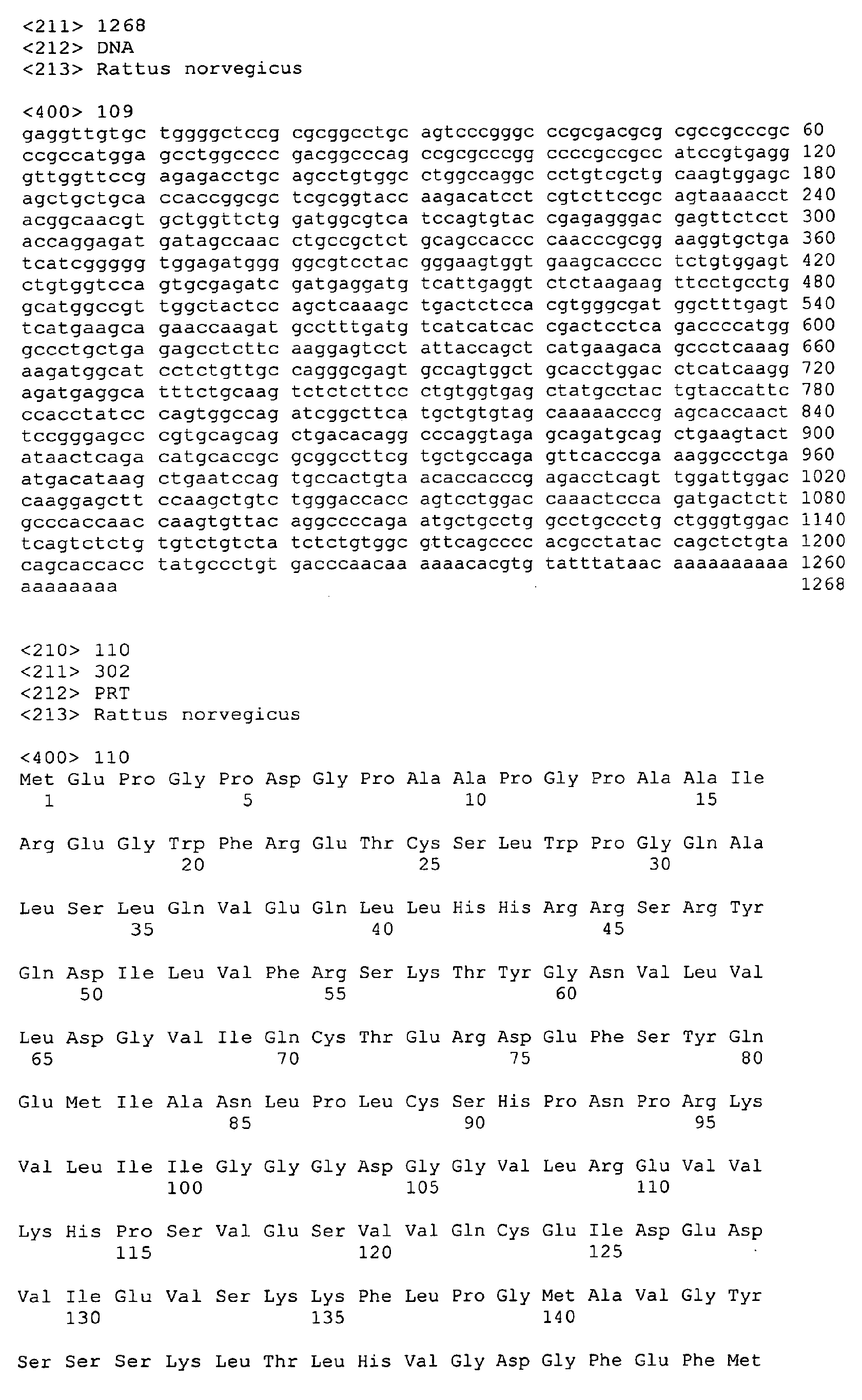


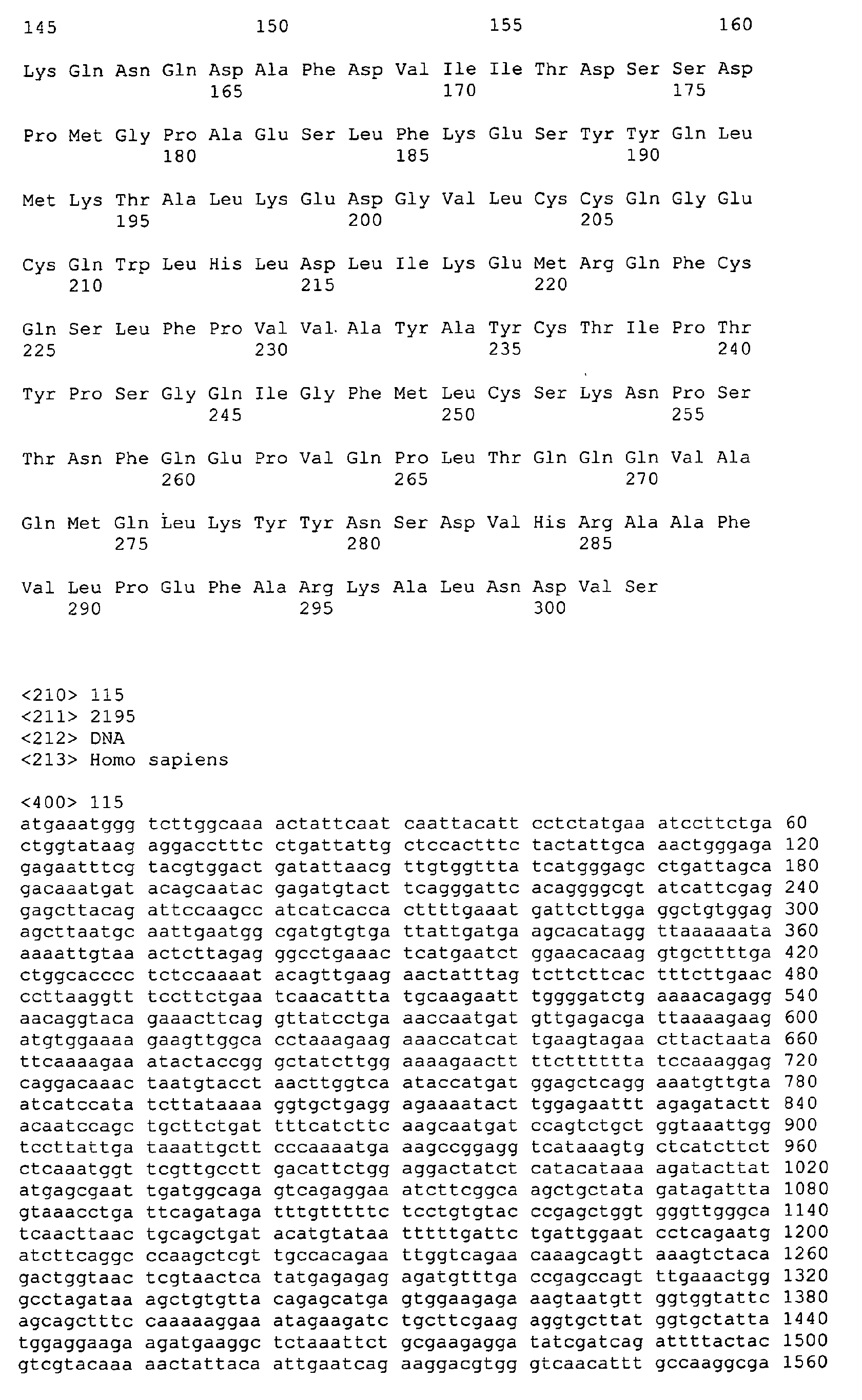


Claims (71)
- Verfahren zur Auffindung schmerzregulierender Substanzen mit folgenden Verfahrensschritten:(a) Inkubation einer zu testenden Substanz unter geeigneten Bedingungen mit einer Zelle und/oder einer Präparation aus einer solchen Zelle, die ein Peptid oder Protein synthetisiert hat, das ausgewählt ist aus folgender Gruppe:JNK3, PIM-2, LR-11, TFIIFβ, GGT-β, GATA3, CLC-7, Katalase, Tetraspanin (TM4SF/TSPAN-6/TM4-D), Caseinkinase 1a, MAP3K7/TAK-1 (TGF-β activated kinase), BAB14112 und/oder Spermidin Synthase,einem Peptid oder Protein, für das oder für einen Teil dessen ein Polynukleotid gemäß einer der Abbildungen 34a), 34c), 34e), 34g), 35a), 35c), 35e), 36a), 36c), 37a), 37c), 38a), 38c), 39a), 39c), 39e), 40a), 40c), 40e), 41a), 41c), 41e), 42a), 42e), 43c), 43e), 44e), 45a), 45c), 45e), oder 46e) oder ein dazu zu mindestens 90 % ähnliches Polynukleotid kodiert,einem Peptid oder Protein mit einer Aminosäuresequenz gemäß einer der Abbildungen 34b), 34d), 34f), 34h), 35b), 35d), 35f), 36b), 36d), 37b), 37d), 38b), 38d), 39b), 39d), 40b), 40d), 40f), 41b), 41d), 41f), 42b), 42f), 43d), 43f), 44f), 45b), 45d), 45f) oder 46f) oder ein dazu zu mindestens 90 % ähnliches Peptid oder Proteinund/oder einem Protein, das durch eine Nukleinsäure kodiert wird, die unter stringenten Bedingungen an ein Polynukleotid gemäß einer der Abbildungen 34a), 34c), 34e), 34g), 35a), 35c), 35e), 36a), 36c), 37a), 37c), 38a), 38c), 39a), 39c), 39e), 40a), 40c), 40e), 41a), 41c), 41e), 42a), 42e), 43c), 43e), 44e), 45a), 45c), 45e), oder 46e) oder deren Antisense Polynukleotid bindet,einem mindestens 10 Aminosäuren langen Teilprotein eines der vorgenannten Proteine und/oder Peptide, und/odereinem Peptid oder Protein, für das ein Gen bestehend aus einem Polynukleotid kodiert, dessen Nukleotidsequenz ein Genfragment gemäß einer der in den Abbildungen 1-33 dargestellten Sequenzen umfaßt, oder für das ein zu einem solchen Gen mindestens 90 % ähnliches Polynukleotid kodiert,(b) Messung der Bindung der Testsubstanz an dem von der Zelle synthetisierten Peptid oder Protein oder Messung mindestens eines der durch die Bindung der Testsubstanz an das Peptid oder Protein veränderten funktionellen Parameters.
- Verfahren gemäß Anspruch 1, dadurch gekennzeichnet, daß die Zelle vor dem Schritt (a) gentechnisch manipuliert wird.
- Verfahren gemäß Anspruch 2, dadurch gekennzeichnet, daß die gentechnische Manipulation die Messung mindestens eines der durch die Testsubstanz veränderten funktionellen Parameter erlaubt.
- Verfahren gemäß Anspruch 3, dadurch gekennzeichnet, daß durch die gentechnische Manipulion eine in der Zelle nicht endogen exprimierte Form eines G-Proteins exprimiert oder ein Reportergen eingeführt wird.
- Verfahren gemäß einem der Ansprüche 2-4, dadurch gekennzeichnet, daß die Zelle gentechnisch so manipuliert wird, daß die Zelle mindestens ein Polynukleotid gemäß einer der Abbildungen 34a), 34c), 34e), 34g), 35a), 35c), 35e), 36a), 36c), 37a), 37c), 38a), 38c), 39a), 39c), 39e), 40a), 40c), 40e), 41a), 41c), 41e), 42a), 42e), 43c), 43e), 44e), 45a), 45c), 45e), oder 46e) oder ein dazu zu mindestens 90 % ähnliches Polynukleotid oder ein Polynukleotid aus der kodierenden Sequenz eines Genes, das ein Genfragment gemäß einer der in den Abbildungen 1-33 dargestellten Sequenzen umfaßt, oder ein dazu zu mindestens 90 % ähnliches Polynukleotid enthält.
- Verfahren gemäß Anspruch 5, dadurch gekennzeichnet, daß das Polynukleotid in einem rekombinanten DNA-Konstrukt enthalten ist.
- Verfahren gemäß einem der Ansprüche 2 bis 6, dadurch gekennzeichnet, daß die Zelle nach der gentechnischen Manipulation gemäß Anspruch 2 und vor dem Schritt (a) gemäß Anspruch 1 unter Bedingungen, die eine Expression erlauben, kultiviert wird, gegebenenfalls unter Selektionsdruck.
- Verfahren gemäß einem der Ansprüche 1 bis 7, dadurch gekennzeichnet, daß die Zelle eine Amphibienzelle, Bakterienzelle, Hefezelle, Insektenzelle oder eine immortalisierte oder native Säugetierzelle ist.
- Verfahren gemäß einem der Ansprüche 1 bis 8, dadurch gekennzeichnet, daß die Messung der Bindung über die Verdrängung eines bekannten markierten Liganden des Peptids oder Proteins gemäß Anspruch 1 und/oder über die daran gebundene Aktivität einer markierten Testsubstanz erfolgt.
- Verfahren gemäß einem der Ansprüche 1 bis 8, dadurch gekennzeichnet, daß die Messung mindestens eines der durch die Testsubstanz veränderten funktionellen Parameter über Messung der Regulation, Hemmung und/oder Aktivierung von Rezeptoren, Ionenkanälen und/oder Enzymen erfolgt, insbesondere über Messung der Veränderung der Genexpression, des Ionenmilieus, des pH oder des Membranpotentials, über Veränderung der Enzymaktivität oder der Konzentration der 2nd messenger.
- Verfahren gemäß einem der Ansprüche 1-10, dadurch gekennzeichnet, daß das Peptid oder Protein in den Schritten (a) und (b) ausgewählt ist aus folgenden Gruppen:JNK3, PIM-2, LR-11, TFIIFβ, GGT-β, GATA3, CLC-7, Katalase, Tetraspanin (TM4SF/TSPAN-6/TM4-D), Caseinkinase 1a, MAP3K7/TAK-1 (TGF-β activated kinase), BAB14112 und/oder Spermidin Synthase,ein Peptid oder Protein, für das oder für einen Teil dessen ein Polynukleotid gemäß einer der Abbildungen 34a), 34c), 34e), 34g), 35a), 35c), 35e), 36a), 36c), 37a), 37c), 38a), 38c), 39a), 39c), 39e), 40a), 40c), 40e), 41 a), 41c); 41e), 42a), 42e), 43c), 43e), 44e), 45a), 45c), 45e), oder 46e) oder ein dazu zu mindestens 90 %, vorzugsweise 95%, insbesondere 97%, ähnliches Polynukleotid kodiert, oderein Peptid oder Protein mit einer Aminosäuresequenz gemäß einer der Abbildungen 34b), 34d), 34f), 34h), 35b), 35d), 35f), 36b), 36d), 37b), 37d), 38b), 38d), 39b), 39d), 40b), 40d), 40f), 41b), 41d), 41f), 42b), 42f), 43d), 43f), 44f), 45b), 45d), 45f) oder 46f) oder ein dazu zu mindestens 90 %, vorzugsweise 95%, insbesondere 97%, ähnliches Peptid oder Proteinund/oder einem Protein, das durch eine Nukleinsäure kodiert wird, die unter stringenten Bedingungen an ein Polynukleotid gemäß einer der Abbildungen 34a), 34c), 34e), 34g), 35a), 35c), 35e), 36a), 36c), 37a), 37c), 38a), 38c), 39a), 39c), 39e), 40a), 40c), 40e), 41a), 41c), 41e), 42a), 42e), 43c), 43e), 44e), 45a), 45c), 45e), oder 46e) oder deren Antisense Polynukleotid bindet, und/odereinem mindestens 10, vorzugsweise mindestens 15, insbesondere mindestens 20 Aminosäuren langen Teilprotein eines der vorgenannten Proteine und/oder Peptide.
- Verfahren gemäß einem der Ansprüche 1-10, dadurch gekennzeichnet, daß für das Peptid oder Protein in den Schritten (a) und (b) ein Gen bestehend aus einem Polynukleotid, das ein Genfragment gemäß einer der in den Abbildungen 1, 3-8, 10, 11, 13, 14, 15, 17-27 oder 31-33 dargestellten Sequenzen umfaßt, kodiert, oder ein zu dem Gen zu mindestens 90%, insbesondere 95 %, vorzugsweise 97%, ähnliches Polynukleotid.
- Verfahren gemäß einem der Ansprüche 1-10, dadurch gekennzeichnet, daß für das Peptid oder Protein in den Schritten (a) und (b) ein Gen bestehend aus einem Polynukleotid, das ein Genfragment gemäß einer der in den Abbildungen 2, 9, 12, 16 oder 28-30 dargestellten Sequenzen umfaßt, kodiert, oder ein zu dem Gen zu mindestens 90%, insbesondere 95 %, vorzugsweise 97%, ähnliches Polynukleotid.
- Polynukleotid, welches einer der in einer der Abbildungen 1-33 dargestellten Nukleotidsequenzen oder einem Polynukleotid aus der kodierenden Sequenz eines Genes, das ein Genfragment gemäß einer der Abbildungen 1-33 umfaßt, zu wenigstens 90%, vorzugsweise 95%, insbesondere zu wenigstens 97% entspricht.
- Polynukleotid gemäß Anspruch 14, dadurch gekennzeichnet, daß es einer der in einer der Abbildungen 1, 3-8, 10, 11, 13, 14, 15, 17-27 oder 31-33, insbesondere 20 oder 21, dargestellten Nukleotidsequenzen oder Teilen davon oder einem Polynukleotid aus der kodierenden Sequenz eines Genes, das ein Genfragment gemäß einer der Abbildungen 1, 3-8, 10, 11, 13, 14, 15, 17-27 oder 31-33, insbesondere 20 oder 21, umfaßt, zu wenigstens 90%, vorzugsweise 95%, insbesondere zu wenigstens 97% entspricht.
- Polynukleotid das zu wenigstens 90%, vorzugsweise 95%, insbesondere zu wenigstens 97% einer definierten Nukleinsäuresequenz entspricht, dadurch erhältlich, daß ein Polynukleotid gemäß einer der Abbildungen 1 - 33 als Sonde markiert, eine cDNA-Bank mit der Sonde hybridisiert und unter stringenten Bedingungen gewaschen wird und der cDNA-Klon, an den die Sonde gebunden hat, isoliert und gegebenenfalls sequenziert wird.
- Polynukleotid, das zu wenigstens 90%, vorzugsweise 95%, insbesondere zu wenigstens 97% einer definierten Nukleinsäuresequenz entspricht, dadurch erhältlich, daß Abschnitte eines Polynukleotids gemäß einer der Abbildungen 1 - 33 als Genspezifische Oligonukleotid-Primer ermittelt und synthetisiert werden, mit denen dann durch PCR ausgehend von einzel- oder doppelsträngiger DNA, von cDNA-Bibliotheken oder genomischer DNA als Template das verlängerte Polynukleotid generiert und gegebenenfalls sequenziert wird.
- Polynukleotid gemäß einem der Ansprüche 16 oder 17, dadurch gekennzeichnet, daß ein Polynukleotid gemäß einer der Abbildungen 1, 3-8, 10, 11, 13, 14, 15, 17-27 oder 31-33, insbesondere 20 oder 21, verwendet wird.
- Polynukleotid gemäß einem der Ansprüche 14 - 18, dadurch gekennzeichnet, daß es sich um RNA oder ein- oder doppelstängige DNA, insbesondere mRNA oder cDNA handelt.
- Polynukleotid gemäß einem der Ansprüche 14-19, dadurch gekennzeichnet, daß es sich um ein Antisense Polynukleotid oder PNA handelt, das eine Sequenz aufweist, die in der Lage ist, spezifisch an ein Polynukleotid gemäß einem der Ansprüche 14 - 19 zu binden.
- Polynukleotid gemäß Anspruch 20, dadurch gekennzeichnet, daß es Teil eines Ribozym oder sonstigen DNA-Enzyms oder einer katalytischen RNA oder DNA ist.
- Vektor enthaltend ein Polynukleotid gemäß einem der Ansprüche 14-21.
- Vektor gemäß Anspruch 22, dadurch gekennzeichnet, daß er ein Expressionsvektor ist.
- Vektor gemäß einem der Ansprüch 22 oder 23, dadurch gekennzeichnet, daß der Vektor abgeleitet ist von einem Virus, beispielsweise dem Adenovirus, Adenoassoziiertem Virus oder Herpesvirus und/oder er mindestens eine LTR-, Poly A-, Promotorund/oder ORI-Sequenz enthält.
- Vektor gemäß einem der Ansprüch 22 - 24, dadurch gekennzeichnet, daß er ein Polynukleotid gemäß einem der Ansprüche 15 oder 18 enthält.
- Peptid, insbesondere Oligopeptid oder Polypeptid, oder Protein kodiert durch ein Polynukleotid gemäß einem der Ansprüche 14 - 19.
- Peptid, insbesondere Oligopeptid oder Polypeptid, oder Protein, für das ein Polynukleotid kodiert, daß unter stringenten Bedingungen mit einem der Polynukleotide gemäß Abbildung 1-33 oder dessen Antisense-Polyukleotid hybridisiert.
- Peptid oder Protein gemäß einem der Ansprüche 26 oder 27, dadurch gekennzeichnet, daß es posttranslational modifiziert wurde, es insbesondere glykosiliert, phosphoryliert, amidiert, methyliert, acetyliert, ADP-ribosyliert, hydroxyliert, mit einem Membrananker versehen, gespalten oder verkürzt wurde.
- Peptid oder Protein gemäß einem der Ansprüche 26 bis 28, dadurch gekennzeichnet, daß es durch ein Polynukleotid gemäß einem der Ansprüche 15 oder 18 kodiert wird.
- Antikörper gegen ein Peptid oder Protein gemäß einem der Ansprüche 26 - 29.
- Antikörper gemäß Anspruch 30, dadurch gekennzeichnet, daß es ein monoklonaler oder polyklonaler Antikörper ist.
- Antikörper gemäß einem der Ansprüche 30 oder 31, dadurch gekennzeichnet, daß er gegen ein Peptid oder Protein gemäß Anspruch 29 gerichtet ist.
- Zelle enthaltend ein Polynukleotid gemäß einem der Ansprüche 14 - 21, ein Peptid oder Protein gemäß einem der Ansprüche 26 - 29 und/oder einen Vektor gemäß einem der Ansprüche 22 - 25.
- Zelle gemäß Anspruch 33, dadurch gekennzeichnet, daß es sich um eine Amphibienzelle, Bakterienzelle, Hefezelle, Insektenzelle oder eine immortalisierte oder native Säugetierzelle handelt.
- Zelle gemäß einem der Ansprüche 33 oder 34, dadurch gekennzeichnet, daß sie eine Nukleinsäuresequenz gemäß Anspruch 15 oder 18, ein Peptid oder Protein gemäß Anspruch 29 und/oder einen Vektor gemäß Anspruch 25 enthält.
- Transgenes nichthumanes Säugetier, dessen Keim- und somatische Zellen eine Nukleotidsequenz gemäß einem der Ansprüche 14-21 als Resultat einer chromosomalen Einbringung in das Genom des Tieres oder das Genom eines der Vorfahren des genannten Tieres enthalten.
- Transgenes nichthumanes Säugetier, dessen Keim- und somatische Zellen als Resultat einer chromosomalen Manipulation im Genom des Tieres oder im Genom eines der Vorfahren des genannten Tieres eine der Nukleotidsequenzen gemäß einem der Ansprüche 14-21 nicht mehr in exprimierbarer Form enthalten.
- Transgenes nichthumanes Säugetier gemäß einem der Ansprüche 36 oder 37, dadurch gekennzeichnet, daß es ein Nagetier ist.
- Transgenes nichthumanes Säugetier gemäß einem der Ansprüche 36-38, dadurch gekennzeichnet, daß die Nukleotidsequenz Anspruch 15 oder 18 entspricht.
- Verbindung identifizierbar als schmerzregulierende Substanz durch ein Verfahren gemäß einem der Ansprüche 1-13.
- Verbindung gemäß Anspruch 40, dadurch gekennzeichnet, daß die Verbindung durch ein Verfahren gemäß Anspruch 11 als schmerzregulierende Substanz identifizierbar ist.
- Verbindung gemäß Anspruch 40, dadurch gekennzeichnet, daß die Verbindung durch ein Verfahren gemäß Anspruch 12 als schmerzregulierende Substanz identifizierbar ist.
- Verbindung gemäß Anspruch 40, dadurch gekennzeichnet, daß die Verbindung durch ein Verfahren gemäß Anspruch 13 als schmerzregulierende Substanz identifizierbar ist.
- Wirkstoff, dadurch gekennzeichnet, daß er an ein Peptid oder Protein gemäß einem der Ansprüche 26 - 29 bindet.
- Wirkstoff gemäß Anspruch 44, dadurch gekennzeichnet, daß er ein niedermolekularer Wirkstoff ist.
- Wirkstoff gemäß einem der Ansprüche 44 oder 45, dadurch gekennzeichnet, daß er an ein Peptid oder Protein gemäß Anspruch 29 bindet.
- Arzneimittel enthaltend mindestens ein Polynukleotid gemäß einem der Ansprüche 14 - 21, ein Peptid oder Protein gemäß einem der Ansprüche 26 - 29, einen Vektor gemäß einem der Ansprüche 22 - 25, einen Antikörper gemäß einem der Ansprüche 30 - 32, eine Zelle gemäß einem der Ansprüche 33-35, eine Verbindung gemäß einem der Ansprüche 40 - 43 und/oder einen Wirkstoff gemäß einem der Ansprüche 44 - 46 sowie gegebenenfalls geeignete Hilfs- und/oder Zusatzstoffe.
- Arzneimittel gemäß Anspruch 47, dadurch gekennzeichnet, daß es ein Polynukleotid gemäß einem der Ansprüche 15 oder 18, ein Peptid oder Protein gemäß Anspruch 29, einen Vektor gemäß Anspruch 25, einen Antikörper gemäß Anspruch 32, eine Zelle gemäß Anspruch 35, eine Verbindung gemäß einem der Ansprüche 41 oder 42 und/oder einen Wirkstoff gemäß Anspruch 46 enthält.
- Arzneimittel gemäß einem der Ansprüche 47 oder 48, dadurch gekennzeichnet, daß es eine Verbindung gemäß Anspruch 41 enthält.
- Arzneimittel gemäß einem der Ansprüche 47 oder 48, dadurch gekennzeichnet, daß es eine Verbindung gemäß Anspruch 42 und/oder einen Wirkstoff gemäß Anspruch 46 enthält.
- Diagnostikum enthaltend mindestens ein Polynukleotid gemäß einem der Ansprüche 14 - 21 oder Teile davon, ein Peptid oder Protein gemäß einem der Ansprüche 26 - 29 oder Teile davon, einen Vektor gemäß einem der Ansprüche 22 - 25, einen Antikörper gemäß einem der Ansprüche 30 - 32 oder Teile davon und/oder eine Zelle gemäß einem der Ansprüche 33-35 sowie gegebenenfalls geeignete Zusatzstoffe.
- Diagnostikum gemäß Anspruch 51, dadurch gekennzeichnet, daß es ein Polynukleotid gemäß einem der Ansprüche 15 oder 18 oder Teile davon, ein Peptid oder Protein gemäß Anspruch 29 oder Teile davon, einen Vektor gemäß Anspruch 25, einen Antikörper gemäß Anspruch 32 und/oder eine Zelle gemäß Anspruch 35 enthält.
- Diagnostikum gemäß einem der Ansprüche 51 oder 52, dadurch gekennzeichnet, daß es ein Polynukleotid gemäß Anspruch 20 enthält.
- Verwendung eines Polynukleotids gemäß einem der Ansprüche 14bindet, zur Herstellung eines Arzneimittels zur Behandlung von Schmerz.21, eines Peptids oder Proteins gemäß einem der Ansprüche 26 - 29, eines Vektors gemäß einem der Ansprüche 22 - 25, eines Antikörpers gemäß einem der Ansprüche 30 - 32, einer Zelle gemäß einem der Ansprüche 33-35, einer Verbindung gemäß einem der Ansprüche 40 - 43, eines Wirkstoffes gemäß einem der Ansprüche 4446 und/oder eines Wirkstoffes, der an ein Peptid oder Protein ausgewählt aus der folgenden Gruppe:JNK3, PIM-2, LR-11, TFIIFβ, GGT-β, GATA3, CLC-7, Katalase, Tetraspanin (TM4SF/TSPAN-6/TM4-D), Caseinkinase 1a, MAP3K7/TAK-1 (TGF-β activated kinase), BAB14112 und/oder Spermidin Synthase,ein Peptid oder Protein, für das oder für einen Teil dessen ein Polynukleotid gemäß einer der Abbildungen 34a), 34c), 34e), 34g), 35a), 35c), 35e), 36a), 36c), 37a), 37c), 38a), 38c), 39a), 39c), 39e), 40a), 40c), 40e), 41a), 41c), 41e), 42a), 42e), 43c), 43e), 44e), 45a), 45c), 45e), oder 46e) oder ein dazu zu mindestens 90 %, vorzugsweise 95%, insbesondere 97%, ähnliches Polynukleotid kodiert, oderein Peptid oder Protein mit einer Aminosäuresequenz gemäß einer der Abbildungen 34b), 34d), 34f), 34h), 35b), 35d), 35f), 36b), 36d), 37b), 37d), 38b), 38d), 39b), 39d), 40b), 40d), 40f), 41b), 41d), 41f), 42b), 42f), 43d), 43f), 44f), 45b), 45d), 45f) oder 46f) oder ein dazu zu mindestens 90 %, vorzugsweise 95%, insbesondere 97%, ähnliches Peptid oder Proteinund/oder einem Protein, das durch eine Nukleinsäure kodiert wird, die unter stringenten Bedingungen an ein Polynukleotid gemäß einer der Abbildungen 34a), 34c), 34e), 34g), 35a), 35c), 35e), 36a), 36c), 37a), 37c), 38a), 38c), 39a), 39c), 39e), 40a), 40c), 40e), 41a), 41c), 41e), 42a), 42e), 43c), 43e), 44e), 45a), 45c), 45e), oder 46e) oder deren Antisense Polynukleotid bindet, und/odereinem mindestens 10, vorzugsweise 15, insbesondere 20, Aminosäuren langen Teilprotein eines der vorgenannten Proteine und/oder Peptide, und/oder
- Verwendung gemäß Anspruch 54, dadurch gekennzeichnet, daß die Behandlung chronischen Schmerz betrifft.
- Verwendung gemäß einem der Ansprüche 54 oder 55, dadurch gekennzeichnet, daß ein Polynukleotid gemäß einem der Ansprüche 15 oder 18, ein Peptid oder Protein gemäß Anspruch 29, ein Vektor gemäß Anspruch 25, ein Antikörper gemäß Anspruch 32, eine Zelle gemäß Anspruch 35, eine Verbindung gemäß einem der Ansprüche 41 oder 42, ein Wirkstoff gemäß Anspruch 46und/oder ein Wirkstoff, der an ein Peptid oder Protein ausgewählt aus der folgenden Gruppe:bindet, verwendet werden.JNK3, PIM-2, LR-11, TFIIFβ, GGT-β, GATA3, CLC-7, Katalase, Tetraspanin (TM4SF/TSPAN-6/TM4-D), Caseinkinase 1a, MAP3K7/TAK-1 (TGF-β activated kinase), BAB14112 und/oder Spermidin Synthase,ein Peptid oder Protein, für das oder für einen Teil dessen ein Polynukleotid gemäß einer der Abbildungen 34a), 34c), 34e), 34g), 35a), 35c), 35e), 36a), 36c), 37a), 37c), 38a), 38c), 39a), 39c), 39e), 40a), 40c), 40e), 41a), 41c), 41e), 42a), 42e), 43c), 43e), 44e), 45a), 45c), 45e), oder 46e) oder ein dazu zu mindestens 90 %, vorzugsweise 95%, insbesondere 97%, ähnliches Polynukleotid kodiert, oderein Peptid oder Protein mit einer Aminosäuresequenz gemäß einer der Abbildungen 34b), 34d), 34f), 34h), 35b), 35d), 35f), 36b), 36d), 37b), 37d), 38b), 38d), 39b), 39d), 40b), 40d), 40f), 41b), 41d), 41f), 42b), 42f), 43d), 43f), 44f), 45b), 45d), 45f) oder 46f) oder ein dazu zu mindestens 90 %, vorzugsweise 95%, insbesondere 97%, ähnliches Peptid oder Protein;
- Verwendung gemäß einem der Ansprüche 54 - 56, dadurch gekennzeichnet, daß eine Verbindung gemäß Anspruch 41 und/oder ein Wirkstoff der an ein Peptid oder Protein ausgewählt aus der folgenden Gruppe:bindet, verwendet werden.JNK3, PIM-2, LR-11, TFIIFβ, GGT-β, GATA3, CLC-7, Katalase, Tetraspanin (TM4SF/TSPAN-6/TM4-D), Caseinkinase 1a, MAP3K7/TAK-1 (TGF-β activated kinase), BAB14112 und/oder Spermidin Synthase,ein Peptid oder Protein, für das oder für einen Teil dessen ein Polynukleotid gemäß einer der Abbildungen 34a), 34c), 34e), 34g), 35a), 35c), 35e), 36a), 36c), 37a), 37c), 38a), 38c), 39a), 39c), 39e), 40a), 40c), 40e), 41a), 41c), 41e), 42a), 42e), 43c), 43e), 44e), 45a), 45c), 45e), oder 46e) oder ein dazu zu mindestens 90 %, vorzugsweise 95%, insbesondere 97%, ähnliches Polynukleotid kodiert, oderein Peptid oder Protein mit einer Aminosäuresequenz gemäß einer der Abbildungen 34b), 34d), 34f), 34h), 35b), 35d), 35f), 36b), 36d), 37b), 37d), 38b), 38d), 39b), 39d), 40b), 40d), 40f), 41b), 41d), 41f), 42b), 42f), 43d), 43f), 44f), 45b), 45d), 45f) oder 46f) oder ein dazu zu mindestens 90 %, vorzugsweise 95%, insbesondere 97%, ähnliches Peptid oder Protein;
- Verwendung gemäß einem der Ansprüche 54 - 56, dadurch gekennzeichnet, daß eine Verbindung gemäß Anspruch 42 und/oder ein Wirkstoff gemäß Anspruch 46 verwendet werden.
- Verwendung eines Polynukleotids gemäß einem der Ansprüche 14 - 21, eines Peptids oder Proteins gemäß einem der Ansprüche 26 - 29, eines Vektors gemäß einem der Ansprüche 22 - 25, eines Antikörpers gemäß einem der Ansprüche 30 - 32 und/oder einer Zelle gemäß einem der Ansprüche 33-35 für die Gentherapie.
- Verwendung gemäß Anspruch 59, dadurch gekennzeichnet, daß es sich um In-vivo oder In-vitro Gentherapie handelt.
- Verwendung gemäß einem der Ansprüche 59 oder 60, dadurch gekennzeichnet, daß ein Polynukleotid gemäß einem der Ansprüche 16 - 18, vorzugsweise 18 verwendet wird.
- Verwendung gemäß einem der Ansprüche 59 oder 60, dadurch gekennzeichnet, daß ein Polynukleotid gemäß Anspruch 15 verwendet wird.
- Verwendung gemäß einem der Ansprüche 59 oder 60, dadurch gekennzeichnet, daß ein Polynukleotid gemäß einem der Ansprüche 20 oder 21 verwendet wird.
- Verwendung eines Polynukleotids gemäß einem der Ansprüche 14 - 21, eines Peptids oder Proteins gemäß einem der Ansprüche 26 - 29, eines Vektors gemäß einem der Ansprüche 22 - 25, eines Antikörpers gemäß einem der Ansprüche 30 - 32, einer Zelle gemäß einem der Ansprüche 33-35, einer Verbindung gemäß einem der Ansprüche 40 - 43 und/oder eines Wirkstoffes gemäß einem der Ansprüche 44 - 46 für die Diagnostik und/oder für Wirksamkeitsuntersuchungen.
- Verfahren zur Auffindung schmerzregulierender Substanzen mit folgenden Verfahrensschritten:(a) Inkubation einer zu testenden Substanz unter geeigneten Bedingungen mit einer Zelle und/oder einer Präparation aus einer solchen Zelle, die ein Peptid oder Protein synthetisiert hat, für das ein Polynukleotid gemäß einem der Ansprüche 16 - 18, vorzugsweise 18, oder ein dazu zu mindestens 90 %, vorzugsweise 95%, insbesondere 97%, ähnliches Polynukleotid kodiert,(b) Messung der Bindung der Testsubstanz an dem von der Zelle synthetisierten Peptid oder Protein oder Messung mindestens eines der durch die Bindung der Testsubstanz an das Peptid oder Protein veränderten funktionellen Parameter.
- Verfahren gemäß Anspruch 65, dadurch gekennzeichnet, daß die Zelle vor dem Schritt (a) gentechnisch manipuliert wird.
- Verfahren gemäß Anspruch 66, dadurch gekennzeichnet, daß die gentechnische Manipulion die Messung mindestens eines der durch die Testsubstanz veränderten funktionellen Parameter erlaubt.
- Verfahren gemäß einem der Ansprüche 66 oder 67, dadurch gekennzeichnet, daß die Zelle gentechnisch so manipuliert wird, daß die Zelle mindestens ein Polynukleotid gemäß einem der Ansprüche 15 - 18, vorzugsweise 18, oder ein dazu zu mindestens 90 % , vorzugsweise 95%, insbesondere 97 % ähnliches Polynukleotid enthält.
- Verfahren gemäß einem der Ansprüche 66 bis 68, dadurch gekennzeichnet, daß die Zelle nach der gentechnischen Manipulation gemäß Anspruch 66 und vor dem Schritt (a) gemäß Anspruch 65 unter Bedingungen, die eine Expression erlauben, kultiviert wird, gegebenenfalls unter Selektionsdruck.
- Verfahren zur Herstellung eines Peptids oder Proteins gemäß einem der Ansprüche 26 - 29, dadurch gekennzeichnet, daß eine Zelle gemäß einem der Ansprüche 33-35 kultiviert und gegebenfalls das Peptid oder Protein isoliert wird.
- Verwendung eines Peptids oder Proteins ausgewählt aus einer der folgenden Gruppen:in einem Verfahren zur Auffindung schmerzregulierender Substanzen.JNK3, PIM-2, LR-11, TFIIFβ, GGT-β, GATA3, CLC-7, Katalase, Tetraspanin (TM4SF/TSPAN-6/TM4-D), Caseinkinase 1a, MAP3K7/TAK-1 (TGF-β activated kinase), BAB14112 und/oder Spermidin Synthase,einem Peptid oder Protein, für das oder für einen Teil dessen ein Polynukleotid gemäß einer der Abbildungen 34a), 34c), 34e), 34g), 35a), 35c), 35e), 36a), 36c), 37a), 37c), 38a), 38c), 39a), 39c), 39e), 40a), 40c), 40e), 41a), 41c), 41e), 42a), 42e), 43c), 43e), 44e), 45a), 45c), 45e), oder 46e) oder ein dazu zu mindestens 90 % ähnliches Polynukleotid kodiert,einem Peptid oder Protein mit einer Aminosäuresequenz gemäß einer der Abbildungen 34b), 34d), 34f), 34h), 35b), 35d), 35f), 36b), 36d), 37b), 37d), 38b), 38d), 39b), 39d), 40b), 40d), 40f), 41b), 41d), 41f), 42b), 42f), 43d), 43f), 44f), 45b), 45d), 45f) oder 46f) oder ein dazu zu mindestens 90 % ähnliches Peptid oder Proteinund/oder einem Protein, das durch eine Nukleinsäure kodiert wird, die unter stringenten Bedingungen an ein Polynukleotid gemäß einer der Abbildungen 34a), 34c), 34e), 34g), 35a), 35c), 35e), 36a), 36c), 37a), 37c), 38a), 38c); 39a), 39c), 39e), 40a), 40c), 40e), 41a), 41c), 41e), 42a), 42e), 43c), 43e), 44e), 45a), 45c), 45e), oder 46e) oder deren Antisense Polynukleotid bindet,einem mindestens 10 Aminosäuren langen Teilprotein eines der vorgenannten Proteine und/oder Peptide, und/odereinem Peptid oder Protein, für das ein Gen bestehend aus einem Polynukleotid kodiert, dessen Nukleotidsequenz ein Genfragment gemäß einer der in den Abbildungen 1-33 dargestellten Sequenzenumfaßt, oder für das ein zu einem solchen Gen mindestens 90 % ähnliches Polynukleotid kodiert,
Applications Claiming Priority (3)
| Application Number | Priority Date | Filing Date | Title |
|---|---|---|---|
| DE10037759 | 2000-08-03 | ||
| DE10037759A DE10037759A1 (de) | 2000-08-03 | 2000-08-03 | Screeningverfahren |
| EP01960621A EP1305636B1 (de) | 2000-08-03 | 2001-08-03 | Screeningverfahren |
Related Parent Applications (2)
| Application Number | Title | Priority Date | Filing Date |
|---|---|---|---|
| EP01960621A Division EP1305636B1 (de) | 2000-08-03 | 2001-08-03 | Screeningverfahren |
| EP01960621.9 Division | 2001-08-03 |
Publications (5)
| Publication Number | Publication Date |
|---|---|
| EP1469316A1 true EP1469316A1 (de) | 2004-10-20 |
| EP1469316A2 EP1469316A2 (de) | 2004-10-20 |
| EP1469316A8 EP1469316A8 (de) | 2004-12-15 |
| EP1469316A3 EP1469316A3 (de) | 2005-01-05 |
| EP1469316B1 EP1469316B1 (de) | 2006-11-02 |
Family
ID=7651135
Family Applications (2)
| Application Number | Title | Priority Date | Filing Date |
|---|---|---|---|
| EP01960621A Expired - Lifetime EP1305636B1 (de) | 2000-08-03 | 2001-08-03 | Screeningverfahren |
| EP04014603A Expired - Lifetime EP1469316B1 (de) | 2000-08-03 | 2001-08-03 | Screeningverfahren |
Family Applications Before (1)
| Application Number | Title | Priority Date | Filing Date |
|---|---|---|---|
| EP01960621A Expired - Lifetime EP1305636B1 (de) | 2000-08-03 | 2001-08-03 | Screeningverfahren |
Country Status (14)
| Country | Link |
|---|---|
| US (1) | US20040087478A1 (de) |
| EP (2) | EP1305636B1 (de) |
| JP (1) | JP2004537962A (de) |
| AT (2) | ATE319092T1 (de) |
| AU (1) | AU2001282066A1 (de) |
| CA (1) | CA2417972A1 (de) |
| DE (3) | DE10037759A1 (de) |
| DK (1) | DK1305636T3 (de) |
| ES (2) | ES2276192T3 (de) |
| HU (1) | HUP0301812A2 (de) |
| MX (1) | MXPA03001015A (de) |
| PL (1) | PL365131A1 (de) |
| PT (1) | PT1305636E (de) |
| WO (1) | WO2002012338A2 (de) |
Families Citing this family (19)
| Publication number | Priority date | Publication date | Assignee | Title |
|---|---|---|---|---|
| EP1395227B1 (de) * | 2001-05-23 | 2008-05-28 | Boehringer Ingelheim Pharmaceuticals Inc. | Verfahren und verbindungen zur diagnose von entzündlichen erkrankungen und identifizierung von pharmakologischen mitteln zur behandlung von entzündlichen erkrankungen |
| ES2350089T3 (es) | 2001-06-28 | 2011-01-18 | Millennium Pharmaceuticals, Inc. | Un miembro de la familia de las proteína quinasas humanas y usos de la misma. |
| AU2003227071A1 (en) * | 2002-03-14 | 2003-09-22 | Develogen Aktiengesellschaft Fur Entwicklungsbiologische Forschung | Cg8327, cg10823, cg18418, cg15862, cg3768, cg11447 and cg16750 homologous proteins involved in the regulation of energy homeostasis |
| DE10226702A1 (de) * | 2002-06-14 | 2004-09-09 | Grünenthal GmbH | Antisense Oligonukleotide gegen PIM1 |
| WO2004070383A2 (de) * | 2003-02-05 | 2004-08-19 | Grünenthal GmbH | Identifizierung schmerzegulierter gene im drg nach cfa-arthritits |
| ES2307381B1 (es) | 2006-04-12 | 2009-10-23 | Bial Industrial Farmaceutica S.A. | Proteinas quimericas hipoalergenicas pertenecientes a la familia de transportadoras de lipidos de parietaria judaica utiles para el tratami ento de alergias. |
| US8642334B2 (en) | 2009-02-17 | 2014-02-04 | Memorial Sloan Kettering Cancer Center | Methods of neural conversion of human embryonic stem cells |
| AR080301A1 (es) | 2010-02-24 | 2012-03-28 | Immunogen Inc | Anticuerpos e inmunoconjugados del receptor 1 de folato y sus usos |
| AU2011258634B2 (en) | 2010-05-25 | 2015-03-26 | Memorial Sloan-Kettering Cancer Center | Method of nociceptor differentiation of human embryonic stem cells and uses thereof |
| PL2694106T3 (pl) | 2011-04-01 | 2018-06-29 | Immunogen, Inc. | Sposoby zwiększania skuteczności terapii przeciwnowotworowej opartej na receptorze folr1 |
| CN113528442A (zh) | 2011-11-04 | 2021-10-22 | 纪念斯隆-凯特琳癌症中心 | 用于植入的中脑多巴胺(da)神经元 |
| US20150301068A1 (en) | 2012-01-30 | 2015-10-22 | Vib Vzw | Means and method for diagnosis and treatment of alzheimer's disease |
| KR20150046316A (ko) | 2012-08-31 | 2015-04-29 | 이뮤노젠 아이엔씨 | 엽산 수용체 1의 검출을 위한 진단성 검정 및 키트 |
| EP3498824A1 (de) | 2013-04-26 | 2019-06-19 | Memorial Sloan-Kettering Cancer Center | Durch gezielte differenzierung pluripotenter und multipotenter zellen hergestellte kortikale interneuronen und andere neuronale zellen |
| PT3038650T (pt) | 2013-08-30 | 2021-08-25 | Immunogen Inc | Anticorpos e ensaios para a deteção do recetor de folato 1 |
| JP6880006B2 (ja) | 2015-09-17 | 2021-06-02 | イミュノジェン, インコーポレイテッド | 抗folr1免疫複合体を含む治療組み合わせ |
| JP7457642B2 (ja) | 2017-04-03 | 2024-03-28 | ビオンテック ユーエス インコーポレイテッド | タンパク質抗原およびその使用 |
| US11793867B2 (en) | 2017-12-18 | 2023-10-24 | Biontech Us Inc. | Neoantigens and uses thereof |
| WO2019246286A1 (en) | 2018-06-19 | 2019-12-26 | Neon Therapeutics, Inc. | Neoantigens and uses thereof |
Citations (6)
| Publication number | Priority date | Publication date | Assignee | Title |
|---|---|---|---|---|
| CA2148898A1 (en) * | 1994-05-09 | 1995-11-10 | John M. Kyriakis | P54 stress-activated protein kinases |
| WO1998026054A2 (en) * | 1996-12-11 | 1998-06-18 | Sugen, Inc. | Pyk2 related products and methods |
| WO1999012559A1 (en) * | 1997-09-09 | 1999-03-18 | The Regents Of The University Of California | Inhibition of apoptotis using prosaposin receptor agonists |
| WO1999018193A1 (en) * | 1997-10-03 | 1999-04-15 | University Of Massachusetts | Jnk3 modulators and methods of use |
| WO2000043524A1 (fr) * | 1999-01-20 | 2000-07-27 | Aventis Pharma S.A. | Polypeptides derives de jnk3 |
| WO2000075118A1 (en) * | 1999-06-03 | 2000-12-14 | Vertex Pharmaceuticals Incorporated | INHIBITORS OF c-JUN N-TERMINAL KINASES (JNK) |
Family Cites Families (5)
| Publication number | Priority date | Publication date | Assignee | Title |
|---|---|---|---|---|
| JPH09163988A (ja) * | 1995-10-09 | 1997-06-24 | Kowa Co | 新規なldl受容体類似蛋白質及び遺伝子 |
| DK0986753T4 (da) * | 1997-04-07 | 2005-12-19 | Bioimage As | Fremgangsmåde til uddragning af kvantitativ information, hvad angår en påvirkning af et cellulært respons |
| US6162613A (en) * | 1998-02-18 | 2000-12-19 | Vertex Pharmaceuticals, Inc. | Methods for designing inhibitors of serine/threonine-kinases and tyrosine kinases |
| TW200302722A (en) * | 2002-02-13 | 2003-08-16 | Astrazeneca Ab | Therapeutic agents |
| KR20040111445A (ko) * | 2002-03-28 | 2004-12-31 | 에자이 가부시키가이샤 | 신경퇴행성 질환 치료용 c─Jun N─말단 키나아제억제제로서의 7─아자인돌 |
-
2000
- 2000-08-03 DE DE10037759A patent/DE10037759A1/de not_active Withdrawn
-
2001
- 2001-08-03 US US10/343,710 patent/US20040087478A1/en not_active Abandoned
- 2001-08-03 CA CA002417972A patent/CA2417972A1/en not_active Abandoned
- 2001-08-03 MX MXPA03001015A patent/MXPA03001015A/es unknown
- 2001-08-03 DE DE50109087T patent/DE50109087D1/de not_active Expired - Lifetime
- 2001-08-03 WO PCT/EP2001/009011 patent/WO2002012338A2/de not_active Ceased
- 2001-08-03 PT PT01960621T patent/PT1305636E/pt unknown
- 2001-08-03 ES ES04014603T patent/ES2276192T3/es not_active Expired - Lifetime
- 2001-08-03 PL PL01365131A patent/PL365131A1/xx unknown
- 2001-08-03 DK DK01960621T patent/DK1305636T3/da active
- 2001-08-03 AU AU2001282066A patent/AU2001282066A1/en not_active Abandoned
- 2001-08-03 JP JP2002518309A patent/JP2004537962A/ja not_active Withdrawn
- 2001-08-03 EP EP01960621A patent/EP1305636B1/de not_active Expired - Lifetime
- 2001-08-03 AT AT01960621T patent/ATE319092T1/de active
- 2001-08-03 DE DE50111395T patent/DE50111395D1/de not_active Expired - Lifetime
- 2001-08-03 ES ES01960621T patent/ES2260267T3/es not_active Expired - Lifetime
- 2001-08-03 EP EP04014603A patent/EP1469316B1/de not_active Expired - Lifetime
- 2001-08-03 AT AT04014603T patent/ATE344458T1/de active
- 2001-08-03 HU HU0301812A patent/HUP0301812A2/hu unknown
Patent Citations (6)
| Publication number | Priority date | Publication date | Assignee | Title |
|---|---|---|---|---|
| CA2148898A1 (en) * | 1994-05-09 | 1995-11-10 | John M. Kyriakis | P54 stress-activated protein kinases |
| WO1998026054A2 (en) * | 1996-12-11 | 1998-06-18 | Sugen, Inc. | Pyk2 related products and methods |
| WO1999012559A1 (en) * | 1997-09-09 | 1999-03-18 | The Regents Of The University Of California | Inhibition of apoptotis using prosaposin receptor agonists |
| WO1999018193A1 (en) * | 1997-10-03 | 1999-04-15 | University Of Massachusetts | Jnk3 modulators and methods of use |
| WO2000043524A1 (fr) * | 1999-01-20 | 2000-07-27 | Aventis Pharma S.A. | Polypeptides derives de jnk3 |
| WO2000075118A1 (en) * | 1999-06-03 | 2000-12-14 | Vertex Pharmaceuticals Incorporated | INHIBITORS OF c-JUN N-TERMINAL KINASES (JNK) |
Non-Patent Citations (7)
| Title |
|---|
| BAYTEL D ET AL: "Erratum to: 'The human Pim-2 proto-oncogene and its testicular expression' - [Biochim. Biophys. Acta 1442 (1998) 274-285]", BIOCHIMICA ET BIOPHYSICA ACTA . GENE STRUCTURE AND EXPRESSION, ELSEVIER, AMSTERDAM, NL, vol. 1444, no. 2, 16 February 1999 (1999-02-16), pages 312 - 313, XP004275323, ISSN: 0167-4781 * |
| BAYTEL D ET AL: "The human Pim-2 proto-oncogene and its testicular expression", BIOCHIMICA ET BIOPHYSICA ACTA . GENE STRUCTURE AND EXPRESSION, ELSEVIER, AMSTERDAM, NL, vol. 1442, no. 2-3, 8 November 1998 (1998-11-08), pages 274 - 285, XP004275262, ISSN: 0167-4781 * |
| DATABASE SWISS-PROT "Mitogen-activated protein kinase 10 (JNK3)", XP002206558 * |
| GUPTA SHASHI ET AL: "Selective interaction of JNK protein kinase isoforms with transcription factors.", EMBO (EUROPEAN MOLECULAR BIOLOGY ORGANIZATION) JOURNAL, vol. 15, no. 11, 1996, pages 2760 - 2770, XP002915273, ISSN: 0261-4189 * |
| LUGT VAN DER N M T ET AL: "PROVIRAL TAGGING IN EMU-MYC TRANSGENIC MICE LACKING THE PIM-1 PROTO-ONCOGENE LEADS TO COMPENSATORY ACTIVATION OF PIM-2", EMBO JOURNAL, OXFORD UNIVERSITY PRESS, SURREY, GB, vol. 14, no. 11, 1995, pages 2536 - 2544, XP001074091, ISSN: 0261-4189 * |
| RAUSCH O ET AL: "Nerve injury-associated kinase: a sterile 20-like protein kinase up-regulated in dorsal root ganglia in a rat model of neuropathic pain.", NEUROSCIENCE, 101 (3) 767-77., 15 November 2000 (2000-11-15), XP001066240 * |
| SARAGOVI, H. URI ET AL: "Development of pharmacological agents for targeting neurotrophins and their receptors", TRENDS PHARMACOL. SCI., 21(3), 93-98, March 2000 (2000-03-01), XP004202571 * |
Also Published As
| Publication number | Publication date |
|---|---|
| ES2260267T3 (es) | 2006-11-01 |
| ES2276192T3 (es) | 2007-06-16 |
| DE50109087D1 (de) | 2006-04-27 |
| DE50111395D1 (de) | 2006-12-14 |
| WO2002012338A2 (de) | 2002-02-14 |
| PT1305636E (pt) | 2006-07-31 |
| EP1469316A8 (de) | 2004-12-15 |
| WO2002012338A3 (de) | 2002-12-19 |
| EP1469316A3 (de) | 2005-01-05 |
| ATE319092T1 (de) | 2006-03-15 |
| CA2417972A1 (en) | 2003-01-31 |
| MXPA03001015A (es) | 2004-01-29 |
| US20040087478A1 (en) | 2004-05-06 |
| EP1305636A2 (de) | 2003-05-02 |
| HUP0301812A2 (hu) | 2003-09-29 |
| ATE344458T1 (de) | 2006-11-15 |
| DE10037759A1 (de) | 2002-07-04 |
| EP1305636B1 (de) | 2006-03-01 |
| JP2004537962A (ja) | 2004-12-24 |
| EP1469316B1 (de) | 2006-11-02 |
| PL365131A1 (en) | 2004-12-27 |
| DK1305636T3 (da) | 2006-07-10 |
| AU2001282066A1 (en) | 2002-02-18 |
Similar Documents
| Publication | Publication Date | Title |
|---|---|---|
| EP1305636B1 (de) | Screeningverfahren | |
| DE69824597T2 (de) | Ikk-beta proteine, nukleinsäuren und verfahren | |
| DE69737740T2 (de) | GDP-Dissoziation stimulierendes Protein, gehirnspezifisches Nucleosomfügungsprotein, Skelettmuskel-spezifisches Ubiquitin-Conjugationsenzym, Zellproliferationsprotein, Phosphatidylinositolkinase, Nel verwandte Proteine | |
| EP1386161B1 (de) | Screeningverfahren mit pim1-kinase oder pim3-kinase | |
| DE69826493T2 (de) | IKK-Alpha Proteine, Nukleinsäuren und Verfahren | |
| DE60126602T2 (de) | Neue collectine | |
| EP1395834B1 (de) | Screeningverfahren mit bnpi und dnpi | |
| DE10021834A1 (de) | mRNA Moleküle zur Verwendung als Indikatoren für den Aktivierungs- und Funktionszustand von T-Lymphozyten | |
| EP1526382B1 (de) | Screeningverfahren für verschiedene Indikationen mit DNPI | |
| WO2004070383A2 (de) | Identifizierung schmerzegulierter gene im drg nach cfa-arthritits | |
| DE10246329B4 (de) | Duftstoffrezeptoren | |
| DE19757695A1 (de) | Klonierte, Neurotransmitter-Rezeptor produzierende Zellen | |
| WO2002021138A2 (de) | Die m30-genfamilie und ihre verwendung | |
| DE10304660A1 (de) | Identifizierung schmerzregulierter Gene im DRG nach CFA-Arthritis | |
| DE10147006A1 (de) | Screeningverfahren für verschiedene Indikationen mit BNPI und/oder DNPI | |
| EP1282700A1 (de) | Neuronale serin-threonin-protein-kinase | |
| DE102004031116A1 (de) | Verfahren zum Auffinden schmerzrelevanter Substanzen unter Verwendung schmerzrelevanter Proteine | |
| WO2003038437A2 (de) | Screening-verfahren für nervenzellen-beeinflussende wirkstoffe | |
| WO2004081042A2 (de) | IDENTIFIZIERUNG VON SCHMERZRELEVANTEN GENEN DER SNSR (Sensory Neuron Specific Receptor)-FAMILIE | |
| DE102004004894A1 (de) | Verfahren zur Wirkstoffidentifizierung bei Harninkontinenz unter Verwendung von PIM-Kinasen | |
| DE10046400A1 (de) | Neuronal exprimiertes Protein und seine Verwendung | |
| WO2001046412A2 (de) | Interaktionsprotein für stat transkriptionsfaktor |
Legal Events
| Date | Code | Title | Description |
|---|---|---|---|
| PUAI | Public reference made under article 153(3) epc to a published international application that has entered the european phase |
Free format text: ORIGINAL CODE: 0009012 |
|
| 17P | Request for examination filed |
Effective date: 20040622 |
|
| AC | Divisional application: reference to earlier application |
Ref document number: 1305636 Country of ref document: EP Kind code of ref document: P |
|
| AK | Designated contracting states |
Kind code of ref document: A1 Designated state(s): AT BE CH CY DE DK ES FI FR GB GR IE IT LI LU MC NL PT SE TR |
|
| AX | Request for extension of the european patent |
Extension state: LT LV RO SI |
|
| PUAB | Information related to the publication of an a document modified or deleted |
Free format text: ORIGINAL CODE: 0009199EPPU |
|
| PUAF | Information related to the publication of a search report (a3 document) modified or deleted |
Free format text: ORIGINAL CODE: 0009199SEPU |
|
| PUAL | Search report despatched |
Free format text: ORIGINAL CODE: 0009013 |
|
| D17D | Deferred search report published (deleted) | ||
| RA1 | Application published (corrected) |
Date of ref document: 20041020 Kind code of ref document: A2 |
|
| AK | Designated contracting states |
Kind code of ref document: A3 Designated state(s): AT BE CH CY DE DK ES FI FR GB GR IE IT LI LU MC NL PT SE TR |
|
| AX | Request for extension of the european patent |
Extension state: LT LV RO SI |
|
| 17Q | First examination report despatched |
Effective date: 20050616 |
|
| AKX | Designation fees paid |
Designated state(s): AT BE CH CY DE DK ES FI FR GB GR IE IT LI LU MC NL PT SE TR |
|
| AXX | Extension fees paid |
Extension state: RO Payment date: 20040622 Extension state: LT Payment date: 20040622 Extension state: LV Payment date: 20040622 Extension state: SI Payment date: 20040622 |
|
| GRAP | Despatch of communication of intention to grant a patent |
Free format text: ORIGINAL CODE: EPIDOSNIGR1 |
|
| GRAS | Grant fee paid |
Free format text: ORIGINAL CODE: EPIDOSNIGR3 |
|
| GRAA | (expected) grant |
Free format text: ORIGINAL CODE: 0009210 |
|
| AC | Divisional application: reference to earlier application |
Ref document number: 1305636 Country of ref document: EP Kind code of ref document: P |
|
| AK | Designated contracting states |
Kind code of ref document: B1 Designated state(s): AT BE CH CY DE DK ES FI FR GB GR IE IT LI LU MC NL PT SE TR |
|
| AX | Request for extension of the european patent |
Extension state: LT LV RO SI |
|
| PG25 | Lapsed in a contracting state [announced via postgrant information from national office to epo] |
Ref country code: IE Free format text: LAPSE BECAUSE OF FAILURE TO SUBMIT A TRANSLATION OF THE DESCRIPTION OR TO PAY THE FEE WITHIN THE PRESCRIBED TIME-LIMIT Effective date: 20061102 Ref country code: FI Free format text: LAPSE BECAUSE OF FAILURE TO SUBMIT A TRANSLATION OF THE DESCRIPTION OR TO PAY THE FEE WITHIN THE PRESCRIBED TIME-LIMIT Effective date: 20061102 |
|
| REG | Reference to a national code |
Ref country code: GB Ref legal event code: FG4D Free format text: NOT ENGLISH |
|
| REG | Reference to a national code |
Ref country code: IE Ref legal event code: FG4D Free format text: LANGUAGE OF EP DOCUMENT: GERMAN |
|
| REG | Reference to a national code |
Ref country code: CH Ref legal event code: NV Representative=s name: BRAUNPAT BRAUN EDER AG Ref country code: CH Ref legal event code: EP |
|
| REF | Corresponds to: |
Ref document number: 50111395 Country of ref document: DE Date of ref document: 20061214 Kind code of ref document: P |
|
| PG25 | Lapsed in a contracting state [announced via postgrant information from national office to epo] |
Ref country code: DK Free format text: LAPSE BECAUSE OF FAILURE TO SUBMIT A TRANSLATION OF THE DESCRIPTION OR TO PAY THE FEE WITHIN THE PRESCRIBED TIME-LIMIT Effective date: 20070202 Ref country code: SE Free format text: LAPSE BECAUSE OF FAILURE TO SUBMIT A TRANSLATION OF THE DESCRIPTION OR TO PAY THE FEE WITHIN THE PRESCRIBED TIME-LIMIT Effective date: 20070202 |
|
| GBT | Gb: translation of ep patent filed (gb section 77(6)(a)/1977) |
Effective date: 20070208 |
|
| PG25 | Lapsed in a contracting state [announced via postgrant information from national office to epo] |
Ref country code: PT Free format text: LAPSE BECAUSE OF FAILURE TO SUBMIT A TRANSLATION OF THE DESCRIPTION OR TO PAY THE FEE WITHIN THE PRESCRIBED TIME-LIMIT Effective date: 20070402 |
|
| LTIE | Lt: invalidation of european patent or patent extension |
Effective date: 20061102 |
|
| ET | Fr: translation filed | ||
| REG | Reference to a national code |
Ref country code: ES Ref legal event code: FG2A Ref document number: 2276192 Country of ref document: ES Kind code of ref document: T3 |
|
| REG | Reference to a national code |
Ref country code: IE Ref legal event code: FD4D |
|
| PLBE | No opposition filed within time limit |
Free format text: ORIGINAL CODE: 0009261 |
|
| STAA | Information on the status of an ep patent application or granted ep patent |
Free format text: STATUS: NO OPPOSITION FILED WITHIN TIME LIMIT |
|
| 26N | No opposition filed |
Effective date: 20070803 |
|
| PG25 | Lapsed in a contracting state [announced via postgrant information from national office to epo] |
Ref country code: GR Free format text: LAPSE BECAUSE OF FAILURE TO SUBMIT A TRANSLATION OF THE DESCRIPTION OR TO PAY THE FEE WITHIN THE PRESCRIBED TIME-LIMIT Effective date: 20070203 Ref country code: MC Free format text: LAPSE BECAUSE OF NON-PAYMENT OF DUE FEES Effective date: 20070831 |
|
| PG25 | Lapsed in a contracting state [announced via postgrant information from national office to epo] |
Ref country code: LU Free format text: LAPSE BECAUSE OF NON-PAYMENT OF DUE FEES Effective date: 20070803 Ref country code: CY Free format text: LAPSE BECAUSE OF FAILURE TO SUBMIT A TRANSLATION OF THE DESCRIPTION OR TO PAY THE FEE WITHIN THE PRESCRIBED TIME-LIMIT Effective date: 20061102 |
|
| PG25 | Lapsed in a contracting state [announced via postgrant information from national office to epo] |
Ref country code: TR Free format text: LAPSE BECAUSE OF FAILURE TO SUBMIT A TRANSLATION OF THE DESCRIPTION OR TO PAY THE FEE WITHIN THE PRESCRIBED TIME-LIMIT Effective date: 20061102 |
|
| PGFP | Annual fee paid to national office [announced via postgrant information from national office to epo] |
Ref country code: CH Payment date: 20130813 Year of fee payment: 13 Ref country code: DE Payment date: 20130831 Year of fee payment: 13 Ref country code: NL Payment date: 20130810 Year of fee payment: 13 Ref country code: AT Payment date: 20130726 Year of fee payment: 13 Ref country code: ES Payment date: 20130711 Year of fee payment: 13 |
|
| PGFP | Annual fee paid to national office [announced via postgrant information from national office to epo] |
Ref country code: FR Payment date: 20130808 Year of fee payment: 13 Ref country code: GB Payment date: 20130731 Year of fee payment: 13 |
|
| PGFP | Annual fee paid to national office [announced via postgrant information from national office to epo] |
Ref country code: IT Payment date: 20130821 Year of fee payment: 13 |
|
| PGFP | Annual fee paid to national office [announced via postgrant information from national office to epo] |
Ref country code: BE Payment date: 20130819 Year of fee payment: 13 |
|
| REG | Reference to a national code |
Ref country code: DE Ref legal event code: R119 Ref document number: 50111395 Country of ref document: DE |
|
| REG | Reference to a national code |
Ref country code: NL Ref legal event code: V1 Effective date: 20150301 |
|
| REG | Reference to a national code |
Ref country code: CH Ref legal event code: PL |
|
| REG | Reference to a national code |
Ref country code: AT Ref legal event code: MM01 Ref document number: 344458 Country of ref document: AT Kind code of ref document: T Effective date: 20140803 |
|
| GBPC | Gb: european patent ceased through non-payment of renewal fee |
Effective date: 20140803 |
|
| PG25 | Lapsed in a contracting state [announced via postgrant information from national office to epo] |
Ref country code: LI Free format text: LAPSE BECAUSE OF NON-PAYMENT OF DUE FEES Effective date: 20140831 Ref country code: CH Free format text: LAPSE BECAUSE OF NON-PAYMENT OF DUE FEES Effective date: 20140831 Ref country code: NL Free format text: LAPSE BECAUSE OF NON-PAYMENT OF DUE FEES Effective date: 20150301 Ref country code: BE Free format text: LAPSE BECAUSE OF NON-PAYMENT OF DUE FEES Effective date: 20140831 Ref country code: IT Free format text: LAPSE BECAUSE OF NON-PAYMENT OF DUE FEES Effective date: 20140803 |
|
| REG | Reference to a national code |
Ref country code: DE Ref legal event code: R119 Ref document number: 50111395 Country of ref document: DE Effective date: 20150303 |
|
| PG25 | Lapsed in a contracting state [announced via postgrant information from national office to epo] |
Ref country code: AT Free format text: LAPSE BECAUSE OF NON-PAYMENT OF DUE FEES Effective date: 20140803 |
|
| REG | Reference to a national code |
Ref country code: FR Ref legal event code: ST Effective date: 20150430 |
|
| PG25 | Lapsed in a contracting state [announced via postgrant information from national office to epo] |
Ref country code: GB Free format text: LAPSE BECAUSE OF NON-PAYMENT OF DUE FEES Effective date: 20140803 Ref country code: DE Free format text: LAPSE BECAUSE OF NON-PAYMENT OF DUE FEES Effective date: 20150303 |
|
| PG25 | Lapsed in a contracting state [announced via postgrant information from national office to epo] |
Ref country code: FR Free format text: LAPSE BECAUSE OF NON-PAYMENT OF DUE FEES Effective date: 20140901 |
|
| REG | Reference to a national code |
Ref country code: ES Ref legal event code: FD2A Effective date: 20150925 |
|
| PG25 | Lapsed in a contracting state [announced via postgrant information from national office to epo] |
Ref country code: ES Free format text: LAPSE BECAUSE OF NON-PAYMENT OF DUE FEES Effective date: 20140804 |